WO2022181725A1 - 硬化性樹脂組成物及び接合レンズ - Google Patents
硬化性樹脂組成物及び接合レンズ Download PDFInfo
- Publication number
- WO2022181725A1 WO2022181725A1 PCT/JP2022/007744 JP2022007744W WO2022181725A1 WO 2022181725 A1 WO2022181725 A1 WO 2022181725A1 JP 2022007744 W JP2022007744 W JP 2022007744W WO 2022181725 A1 WO2022181725 A1 WO 2022181725A1
- Authority
- WO
- WIPO (PCT)
- Prior art keywords
- group
- lens
- carbon atoms
- resin composition
- structural unit
- Prior art date
- Legal status (The legal status is an assumption and is not a legal conclusion. Google has not performed a legal analysis and makes no representation as to the accuracy of the status listed.)
- Ceased
Links
Images

Classifications
-
- C—CHEMISTRY; METALLURGY
- C08—ORGANIC MACROMOLECULAR COMPOUNDS; THEIR PREPARATION OR CHEMICAL WORKING-UP; COMPOSITIONS BASED THEREON
- C08F—MACROMOLECULAR COMPOUNDS OBTAINED BY REACTIONS ONLY INVOLVING CARBON-TO-CARBON UNSATURATED BONDS
- C08F220/00—Copolymers of compounds having one or more unsaturated aliphatic radicals, each having only one carbon-to-carbon double bond, and only one being terminated by only one carboxyl radical or a salt, anhydride ester, amide, imide or nitrile thereof
- C08F220/02—Monocarboxylic acids having less than ten carbon atoms; Derivatives thereof
- C08F220/10—Esters
- C08F220/12—Esters of monohydric alcohols or phenols
- C08F220/16—Esters of monohydric alcohols or phenols of phenols or of alcohols containing two or more carbon atoms
- C08F220/18—Esters of monohydric alcohols or phenols of phenols or of alcohols containing two or more carbon atoms with acrylic or methacrylic acids
- C08F220/1806—C6-(meth)acrylate, e.g. (cyclo)hexyl (meth)acrylate or phenyl (meth)acrylate
-
- C—CHEMISTRY; METALLURGY
- C08—ORGANIC MACROMOLECULAR COMPOUNDS; THEIR PREPARATION OR CHEMICAL WORKING-UP; COMPOSITIONS BASED THEREON
- C08F—MACROMOLECULAR COMPOUNDS OBTAINED BY REACTIONS ONLY INVOLVING CARBON-TO-CARBON UNSATURATED BONDS
- C08F2/00—Processes of polymerisation
- C08F2/46—Polymerisation initiated by wave energy or particle radiation
- C08F2/48—Polymerisation initiated by wave energy or particle radiation by ultraviolet or visible light
-
- C—CHEMISTRY; METALLURGY
- C08—ORGANIC MACROMOLECULAR COMPOUNDS; THEIR PREPARATION OR CHEMICAL WORKING-UP; COMPOSITIONS BASED THEREON
- C08F—MACROMOLECULAR COMPOUNDS OBTAINED BY REACTIONS ONLY INVOLVING CARBON-TO-CARBON UNSATURATED BONDS
- C08F2/00—Processes of polymerisation
- C08F2/46—Polymerisation initiated by wave energy or particle radiation
- C08F2/48—Polymerisation initiated by wave energy or particle radiation by ultraviolet or visible light
- C08F2/50—Polymerisation initiated by wave energy or particle radiation by ultraviolet or visible light with sensitising agents
-
- C—CHEMISTRY; METALLURGY
- C08—ORGANIC MACROMOLECULAR COMPOUNDS; THEIR PREPARATION OR CHEMICAL WORKING-UP; COMPOSITIONS BASED THEREON
- C08F—MACROMOLECULAR COMPOUNDS OBTAINED BY REACTIONS ONLY INVOLVING CARBON-TO-CARBON UNSATURATED BONDS
- C08F220/00—Copolymers of compounds having one or more unsaturated aliphatic radicals, each having only one carbon-to-carbon double bond, and only one being terminated by only one carboxyl radical or a salt, anhydride ester, amide, imide or nitrile thereof
- C08F220/02—Monocarboxylic acids having less than ten carbon atoms; Derivatives thereof
- C08F220/10—Esters
- C08F220/12—Esters of monohydric alcohols or phenols
- C08F220/16—Esters of monohydric alcohols or phenols of phenols or of alcohols containing two or more carbon atoms
- C08F220/18—Esters of monohydric alcohols or phenols of phenols or of alcohols containing two or more carbon atoms with acrylic or methacrylic acids
- C08F220/1804—C4-(meth)acrylate, e.g. butyl (meth)acrylate, isobutyl (meth)acrylate or tert-butyl (meth)acrylate
-
- C—CHEMISTRY; METALLURGY
- C08—ORGANIC MACROMOLECULAR COMPOUNDS; THEIR PREPARATION OR CHEMICAL WORKING-UP; COMPOSITIONS BASED THEREON
- C08F—MACROMOLECULAR COMPOUNDS OBTAINED BY REACTIONS ONLY INVOLVING CARBON-TO-CARBON UNSATURATED BONDS
- C08F220/00—Copolymers of compounds having one or more unsaturated aliphatic radicals, each having only one carbon-to-carbon double bond, and only one being terminated by only one carboxyl radical or a salt, anhydride ester, amide, imide or nitrile thereof
- C08F220/02—Monocarboxylic acids having less than ten carbon atoms; Derivatives thereof
- C08F220/10—Esters
- C08F220/20—Esters of polyhydric alcohols or phenols, e.g. 2-hydroxyethyl (meth)acrylate or glycerol mono-(meth)acrylate
-
- C—CHEMISTRY; METALLURGY
- C08—ORGANIC MACROMOLECULAR COMPOUNDS; THEIR PREPARATION OR CHEMICAL WORKING-UP; COMPOSITIONS BASED THEREON
- C08F—MACROMOLECULAR COMPOUNDS OBTAINED BY REACTIONS ONLY INVOLVING CARBON-TO-CARBON UNSATURATED BONDS
- C08F220/00—Copolymers of compounds having one or more unsaturated aliphatic radicals, each having only one carbon-to-carbon double bond, and only one being terminated by only one carboxyl radical or a salt, anhydride ester, amide, imide or nitrile thereof
- C08F220/02—Monocarboxylic acids having less than ten carbon atoms; Derivatives thereof
- C08F220/52—Amides or imides
- C08F220/54—Amides, e.g. N,N-dimethylacrylamide or N-isopropylacrylamide
- C08F220/56—Acrylamide; Methacrylamide
-
- C—CHEMISTRY; METALLURGY
- C08—ORGANIC MACROMOLECULAR COMPOUNDS; THEIR PREPARATION OR CHEMICAL WORKING-UP; COMPOSITIONS BASED THEREON
- C08F—MACROMOLECULAR COMPOUNDS OBTAINED BY REACTIONS ONLY INVOLVING CARBON-TO-CARBON UNSATURATED BONDS
- C08F222/00—Copolymers of compounds having one or more unsaturated aliphatic radicals, each having only one carbon-to-carbon double bond, and at least one being terminated by a carboxyl radical and containing at least one other carboxyl radical in the molecule; Salts, anhydrides, esters, amides, imides, or nitriles thereof
- C08F222/10—Esters
- C08F222/12—Esters of phenols or saturated alcohols
- C08F222/24—Esters containing sulfur
-
- C—CHEMISTRY; METALLURGY
- C08—ORGANIC MACROMOLECULAR COMPOUNDS; THEIR PREPARATION OR CHEMICAL WORKING-UP; COMPOSITIONS BASED THEREON
- C08F—MACROMOLECULAR COMPOUNDS OBTAINED BY REACTIONS ONLY INVOLVING CARBON-TO-CARBON UNSATURATED BONDS
- C08F265/00—Macromolecular compounds obtained by polymerising monomers on to polymers of unsaturated monocarboxylic acids or derivatives thereof as defined in group C08F20/00
- C08F265/04—Macromolecular compounds obtained by polymerising monomers on to polymers of unsaturated monocarboxylic acids or derivatives thereof as defined in group C08F20/00 on to polymers of esters
- C08F265/06—Polymerisation of acrylate or methacrylate esters on to polymers thereof
-
- C—CHEMISTRY; METALLURGY
- C08—ORGANIC MACROMOLECULAR COMPOUNDS; THEIR PREPARATION OR CHEMICAL WORKING-UP; COMPOSITIONS BASED THEREON
- C08F—MACROMOLECULAR COMPOUNDS OBTAINED BY REACTIONS ONLY INVOLVING CARBON-TO-CARBON UNSATURATED BONDS
- C08F283/00—Macromolecular compounds obtained by polymerising monomers on to polymers provided for in subclass C08G
-
- C—CHEMISTRY; METALLURGY
- C08—ORGANIC MACROMOLECULAR COMPOUNDS; THEIR PREPARATION OR CHEMICAL WORKING-UP; COMPOSITIONS BASED THEREON
- C08K—Use of inorganic or non-macromolecular organic substances as compounding ingredients
- C08K5/00—Use of organic ingredients
- C08K5/16—Nitrogen-containing compounds
- C08K5/20—Carboxylic acid amides
-
- C—CHEMISTRY; METALLURGY
- C09—DYES; PAINTS; POLISHES; NATURAL RESINS; ADHESIVES; COMPOSITIONS NOT OTHERWISE PROVIDED FOR; APPLICATIONS OF MATERIALS NOT OTHERWISE PROVIDED FOR
- C09J—ADHESIVES; NON-MECHANICAL ASPECTS OF ADHESIVE PROCESSES IN GENERAL; ADHESIVE PROCESSES NOT PROVIDED FOR ELSEWHERE; USE OF MATERIALS AS ADHESIVES
- C09J133/00—Adhesives based on homopolymers or copolymers of compounds having one or more unsaturated aliphatic radicals, each having only one carbon-to-carbon double bond, and at least one being terminated by only one carboxyl radical, or of salts, anhydrides, esters, amides, imides, or nitriles thereof; Adhesives based on derivatives of such polymers
- C09J133/04—Homopolymers or copolymers of esters
- C09J133/06—Homopolymers or copolymers of esters of esters containing only carbon, hydrogen and oxygen, the oxygen atom being present only as part of the carboxyl radical
- C09J133/10—Homopolymers or copolymers of methacrylic acid esters
-
- C—CHEMISTRY; METALLURGY
- C09—DYES; PAINTS; POLISHES; NATURAL RESINS; ADHESIVES; COMPOSITIONS NOT OTHERWISE PROVIDED FOR; APPLICATIONS OF MATERIALS NOT OTHERWISE PROVIDED FOR
- C09J—ADHESIVES; NON-MECHANICAL ASPECTS OF ADHESIVE PROCESSES IN GENERAL; ADHESIVE PROCESSES NOT PROVIDED FOR ELSEWHERE; USE OF MATERIALS AS ADHESIVES
- C09J133/00—Adhesives based on homopolymers or copolymers of compounds having one or more unsaturated aliphatic radicals, each having only one carbon-to-carbon double bond, and at least one being terminated by only one carboxyl radical, or of salts, anhydrides, esters, amides, imides, or nitriles thereof; Adhesives based on derivatives of such polymers
- C09J133/04—Homopolymers or copolymers of esters
- C09J133/14—Homopolymers or copolymers of esters of esters containing halogen, nitrogen, sulfur or oxygen atoms in addition to the carboxy oxygen
-
- C—CHEMISTRY; METALLURGY
- C09—DYES; PAINTS; POLISHES; NATURAL RESINS; ADHESIVES; COMPOSITIONS NOT OTHERWISE PROVIDED FOR; APPLICATIONS OF MATERIALS NOT OTHERWISE PROVIDED FOR
- C09J—ADHESIVES; NON-MECHANICAL ASPECTS OF ADHESIVE PROCESSES IN GENERAL; ADHESIVE PROCESSES NOT PROVIDED FOR ELSEWHERE; USE OF MATERIALS AS ADHESIVES
- C09J4/00—Adhesives based on organic non-macromolecular compounds having at least one polymerisable carbon-to-carbon unsaturated bond ; adhesives, based on monomers of macromolecular compounds of groups C09J183/00 - C09J183/16
-
- G—PHYSICS
- G02—OPTICS
- G02B—OPTICAL ELEMENTS, SYSTEMS OR APPARATUS
- G02B1/00—Optical elements characterised by the material of which they are made; Optical coatings for optical elements
- G02B1/04—Optical elements characterised by the material of which they are made; Optical coatings for optical elements made of organic materials, e.g. plastics
-
- G—PHYSICS
- G02—OPTICS
- G02B—OPTICAL ELEMENTS, SYSTEMS OR APPARATUS
- G02B1/00—Optical elements characterised by the material of which they are made; Optical coatings for optical elements
- G02B1/04—Optical elements characterised by the material of which they are made; Optical coatings for optical elements made of organic materials, e.g. plastics
- G02B1/041—Lenses
-
- G—PHYSICS
- G02—OPTICS
- G02B—OPTICAL ELEMENTS, SYSTEMS OR APPARATUS
- G02B13/00—Optical objectives specially designed for the purposes specified below
- G02B13/001—Miniaturised objectives for electronic devices, e.g. portable telephones, webcams, PDAs, small digital cameras
- G02B13/0055—Miniaturised objectives for electronic devices, e.g. portable telephones, webcams, PDAs, small digital cameras employing a special optical element
- G02B13/006—Miniaturised objectives for electronic devices, e.g. portable telephones, webcams, PDAs, small digital cameras employing a special optical element at least one element being a compound optical element, e.g. cemented elements
-
- G—PHYSICS
- G02—OPTICS
- G02B—OPTICAL ELEMENTS, SYSTEMS OR APPARATUS
- G02B3/00—Simple or compound lenses
-
- C—CHEMISTRY; METALLURGY
- C09—DYES; PAINTS; POLISHES; NATURAL RESINS; ADHESIVES; COMPOSITIONS NOT OTHERWISE PROVIDED FOR; APPLICATIONS OF MATERIALS NOT OTHERWISE PROVIDED FOR
- C09J—ADHESIVES; NON-MECHANICAL ASPECTS OF ADHESIVE PROCESSES IN GENERAL; ADHESIVE PROCESSES NOT PROVIDED FOR ELSEWHERE; USE OF MATERIALS AS ADHESIVES
- C09J2433/00—Presence of (meth)acrylic polymer
Definitions
- the present invention relates to a curable resin composition and a cemented lens.
- a compound (monomer) containing a skeleton such as benzodithiol, benzothiazole, or phenylhydrazone is used as an absorber in the near-ultraviolet region in the cured resin.
- These compounds are also excellent in fastness to ultraviolet irradiation, and the curable resin composition containing the above compounds can be used as an "ultraviolet cut layer" that protects resin materials that are prone to photodegradation from ultraviolet rays.
- Patent Document 2 describes a curable resin composition containing ITO (indium tin oxide) nanoparticles and a monomer having a benzodithiol skeleton.
- the adhesion of the obtained cured product to the glass substrate is not sufficient when a conventional curable resin composition containing a compound having a skeleton such as benzodithiol, benzothiazole or phenylhydrazone is blended.
- a conventional curable resin composition containing a compound having a skeleton such as benzodithiol, benzothiazole or phenylhydrazone
- further improvements are necessary for use as a lens adhesive.
- the compatibility between the compound containing a skeleton such as benzodithiol, benzothiazole or phenylhydrazone in the composition and other resin components is not sufficient. It has also been found that further improvements are needed in terms of obtaining cured products with high transmittance.
- the technique described in Patent Document 2 provides a resin composition that can be used as a low Abbe number resin for multilayer diffraction grating elements, and does not describe application to adhesives.
- the present invention relates to a curable resin composition containing a monomer having a skeleton such as benzodithiol, benzothiazole, or phenylhydrazone, which provides a cured product having excellent adhesion to a glass substrate and excellent transmittance.
- An object of the present invention is to provide a curable resin composition capable of Another object of the present invention is to provide a cemented lens containing a cured product obtained from this curable resin composition.
- a curable resin composition comprising the following component (A) and the following component (B).
- Component (A) A compound represented by the following general formula (1).
- the structural unit (b1) does not have a hydrogen bonding group.
- Ar represents an aromatic ring group represented by any one of the following general formulas (2-1) to (2-4).
- R 101 to R 104 represent -Sp c -Pol 3 or halogen atoms.
- Sp a and Sp b are a single bond, an optionally substituted linear alkylene group having 1 to 30 carbon atoms, or an optionally substituted linear alkylene group having 2 to 30 carbon atoms.
- group wherein one or more —CH 2 — excluding the linking portion to L 1 or L 2 is selected from —O—, —S—, >C( O) and >NR 111 indicates a group replaced by R 111 represents -Sp d -Pol 4 or a halogen atom.
- Sp c and Sp d represent a single bond or a divalent linking group.
- Pol 1 and Pol 2 represent polymerizable groups
- Pol 3 and Pol 4 represent hydrogen atoms or polymerizable groups.
- Q 1 represents -S-, -O- or >NR 11
- R 11 represents a hydrogen atom or an alkyl group having 1 to 6 carbon atoms
- Y 1 represents an alkyl group having 1 to 6 carbon atoms, an aromatic hydrocarbon group having 6 to 12 carbon atoms or an aromatic heterocyclic group having 3 to 12 carbon atoms
- Z 1 , Z 2 and Z 3 each represent a hydrogen atom, an aliphatic hydrocarbon group having 1 to 20 carbon atoms, an alkoxy group having 1 to 20 carbon atoms, an alicyclic hydrocarbon group having 3 to 20 carbon atoms, or 6 carbon atoms.
- Z 1 and Z 2 may combine with each other to form an aromatic hydrocarbon ring or an aromatic heterocyclic ring.
- R 12 and R 13 represent a hydrogen atom or an alkyl group having 1 to 6 carbon atoms.
- a x represents an organic group having 1 to 30 carbon atoms and having at least one aromatic ring selected from an aromatic hydrocarbon ring and an aromatic heterocyclic ring.
- a y represents a hydrogen atom, an alkyl group having 1 to 6 carbon atoms, or an organic group having 1 to 30 carbon atoms and having at least one aromatic ring selected from an aromatic hydrocarbon ring and an aromatic heterocyclic ring.
- a x and A y may combine with each other to form a ring.
- Q2 represents a hydrogen atom or an alkyl group having 1 to 6 carbon atoms. * indicates the binding position with L1 or L2.
- the hydrogen-bonding group of the structural unit (b2) is a hydroxy group, a carboxy group, a sulfo group, a phosphoric acid group, a phosphonic acid group, an amino group, a sulfanyl group, an amide group, a urethane group, a urea group, a thiourethane group,
- the curable resin composition according to ⁇ 1> which is at least one of a thiourea group and a sulfonamide group.
- the component (B) has a structural unit represented by the following general formula (p1) as the structural unit (b1), and a structural unit represented by the following general formula (p2) as the structural unit (b2).
- the curable resin composition according to ⁇ 3> which is a vinyl polymer having In the above formula, R P1 and R P2 represent a hydrogen atom or a methyl group, L P1 and L P2 represent a single bond or a divalent linking group, and Ar P is an aromatic hydrocarbon which may have a substituent. represents an aromatic heterocyclic group optionally having a group or a substituent, and R P3 represents a monovalent substituent.
- L P2 and R P3 is a hydroxy group, carboxy group, sulfo group, phosphoric acid group, phosphonic acid group, amino group, sulfanyl group, amide group, urethane group, urea group, thiourethane group, thiourea group and at least one group of a sulfonamide group.
- the structural unit represented by general formula (p1) does not have a hydrogen bonding group. * indicates a binding site for incorporation into the polymer.
- the above L 1 and L 2 are —O—, the above Sp a is a linking group having the shortest number of atoms of 11 to 30 that connects the above Pol 1 and the above L 1 , and the above Sp b is the above Pol 2
- ⁇ 8> The cemented lens according to ⁇ 7>, wherein at least one of the lens A and the lens B is a glass lens.
- substituents, etc. when there are a plurality of substituents or connecting groups (hereinafter referred to as substituents, etc.) indicated by a specific symbol or formula, or when a plurality of substituents, etc. are defined at the same time, there is no particular notice.
- substituents, etc. may be the same or different from each other (regardless of the presence or absence of the expression "independently", the respective substituents, etc. may be the same or different from each other). This also applies to the number of substituents and the like.
- substituents and the like when a plurality of substituents and the like are close to each other (especially when they are adjacent), they may be linked together to form a ring unless otherwise specified.
- rings such as alicyclic rings, aromatic rings, and heterocyclic rings may be condensed to form condensed rings.
- the double bond may be either E-type or Z-type, or a mixture thereof, unless otherwise specified.
- the stereochemistry of such asymmetric carbon atoms is independently (R)-form or It can take either of the (S) forms.
- the compounds may be mixtures of stereoisomers, such as optical isomers or diastereoisomers, or may be racemates.
- the expression of a compound is meant to include those in which a part of the structure is changed within a range that does not impair the effects of the present invention.
- compounds that are not specified as substituted or unsubstituted are meant to have optional substituents within a range that does not impair the effects of the present invention.
- substituents the same applies to linking groups and rings
- substitution or unsubstitution is not specified in the present invention
- the meaning that the group may have any substituent as long as the desired effect is not impaired. is.
- the term "alkyl group” is meant to include both unsubstituted alkyl groups and substituted alkyl groups.
- this number of carbon atoms means the number of carbon atoms in the entire group unless otherwise specified in the present invention or this specification.
- this group when this group is in the form of further having a substituent, it means the total number of carbon atoms including this substituent.
- a numerical range represented by “to” means a range including the numerical values before and after “to” as lower and upper limits.
- each component may be used alone or in combination of two or more.
- the solid content in the curable resin composition of the present invention means, in addition to the compound represented by the general formula (1), the curing of the present invention. It means a component remaining in the cured product obtained from the flexible resin composition. Usually, the remainder after removing the solvent is the "solid content”.
- (meth)acrylate represents either or both of acrylate and methacrylate
- (meth)acryloyl represents either or both of acryloyl and methacryloyl.
- a monomer in the present invention is distinguished from an oligomer and a polymer and refers to a compound having a weight average molecular weight of 1000 or less.
- aliphatic hydrocarbon group refers to a group obtained by removing one arbitrary hydrogen atom from a linear or branched alkane, a linear or branched alkene, or a linear or branched alkyne.
- the aliphatic hydrocarbon group is preferably an alkyl group obtained by removing one arbitrary hydrogen atom from a linear or branched alkane.
- Alkyl groups include methyl, ethyl, propyl, isopropyl, butyl, isobutyl, sec-butyl, tert-butyl, pentyl, 1-methylbutyl, 3-methylbutyl, hexyl, 1 -methylpentyl group, 4-methylpentyl group, heptyl group, 1-methylhexyl group, 5-methylhexyl group, 2-ethylhexyl group, octyl group, 1-methylheptyl group, nonyl group, 1-methyloctyl group, decyl group, undecyl group, dodecyl group, tridecyl group, tetradecyl group, pentadecyl group, hexadecyl group, heptadecyl group, octadecyl group, nonadecyl group, eicosyl group and the like.
- the aliphatic hydrocarbon group (unsubstituted) is preferably an alkyl group having 1 to 30 carbon atoms, more preferably an alkyl group having 1 to 12 carbon atoms, and further an alkyl group having 1 to 4 carbon atoms.
- Preferred are methyl and ethyl groups.
- the alkyl group means a linear or branched alkyl group.
- the alkyl group include those described above. The same applies to alkyl groups in groups containing alkyl groups (alkoxy groups, alkoxycarbonyl groups, acyl groups, acyloxy groups, amido groups, amino groups, silyl groups substituted with alkoxy groups (alkoxysilyl groups), etc.).
- examples of the alkylene group include groups obtained by removing one arbitrary hydrogen atom from the above alkyl group
- examples of the straight-chain alkylene group include straight-chain among the above-mentioned alkyl groups. Examples thereof include groups obtained by removing one hydrogen atom bonded to a terminal carbon atom from an alkyl group.
- an alicyclic hydrocarbon ring means a saturated hydrocarbon ring (cycloalkane).
- alicyclic hydrocarbon rings include cyclopropane, cyclobutane, cyclopentane, cyclohexane, cycloheptane, cyclooctane, cyclononane, cyclodecane, and the like.
- the unsaturated hydrocarbon ring means a hydrocarbon ring having a carbon-carbon unsaturated double bond that is not an aromatic ring.
- unsaturated hydrocarbon rings include indene, indane, fluorene, and the like.
- an alicyclic hydrocarbon group means a cycloalkyl group obtained by removing one arbitrary hydrogen atom from a cycloalkane.
- alicyclic hydrocarbon groups include cyclopropyl, cyclobutyl, cyclopentyl, cyclohexyl, cycloheptyl, cyclooctyl, cyclononyl, cyclodecyl groups, and cycloalkyl groups having 3 to 12 carbon atoms. groups are preferred.
- a cycloalkylene group represents a divalent group obtained by removing two arbitrary hydrogen atoms from a cycloalkane.
- cycloalkylene groups include cyclohexylene groups.
- aromatic ring means either one or both of an aromatic hydrocarbon ring and an aromatic heterocyclic ring.
- an aromatic hydrocarbon ring means an aromatic ring formed only by carbon atoms.
- the aromatic hydrocarbon ring may be monocyclic or condensed.
- Aromatic hydrocarbon rings having 6 to 14 carbon atoms are preferred. Examples of aromatic hydrocarbon rings include benzene ring, naphthalene ring, anthracene ring, phenanthrene ring and the like.
- the aromatic hydrocarbon ring when the aromatic hydrocarbon ring is bonded to another ring, the aromatic hydrocarbon ring is substituted on the other ring as a monovalent or divalent aromatic hydrocarbon group. good.
- a monovalent group when referred to as an aromatic hydrocarbon group, it means a monovalent group obtained by removing one arbitrary hydrogen atom from an aromatic hydrocarbon ring.
- the monovalent aromatic hydrocarbon group is preferably an aromatic hydrocarbon group having 6 to 14 carbon atoms, examples of which include phenyl, 1-naphthyl, 2-naphthyl, 1-anthracenyl and 2-anthracenyl. group, 9-anthracenyl group, 1-phenanthryl group, 2-phenanthryl group, 3-phenanthryl group, 4-phenanthryl group, 9-phenanthryl group and the like.
- a phenyl group is preferred.
- a divalent group when referred to as an aromatic hydrocarbon group, it means a divalent group obtained by removing one arbitrary hydrogen atom from the above monovalent aromatic hydrocarbon group.
- the divalent aromatic hydrocarbon group include a phenylene group, a naphthylene group, a phenanthrylene group and the like, preferably a phenylene group, and more preferably a 1,4-phenylene group.
- the aromatic heterocyclic ring means an aromatic ring formed by carbon atoms and heteroatoms. Heteroatoms include oxygen, nitrogen, and sulfur atoms.
- the aromatic heterocyclic ring may be a single ring or a condensed ring, and the number of atoms constituting the ring is preferably 5-20, more preferably 5-14.
- Each ring constituting the aromatic heterocycle is preferably a 5- or 6-membered ring.
- the number of heteroatoms in the atoms constituting the ring is not particularly limited, it is preferably 1-3, more preferably 1-2.
- aromatic heterocycles examples include furan ring, thiophene ring, pyrrole ring, imidazole ring, isothiazole ring, isoxazole ring, pyridine ring, pyrazine ring, quinoline ring, benzofuran ring, benzothiazole ring, benzoxazole ring, and Examples of the nitrogen-containing condensed aromatic ring described later can be mentioned.
- the aromatic heterocycle when the aromatic heterocycle is bonded to another ring, the aromatic heterocycle may be substituted on the other ring as a monovalent or divalent aromatic heterocyclic group.
- a monovalent group when referred to as an aromatic heterocyclic group, it means a monovalent group obtained by removing one arbitrary hydrogen atom from an aromatic heterocyclic ring.
- monovalent aromatic heterocyclic groups include furyl, thienyl, pyrrolyl, imidazolyl, isothiazolyl, isoxazolyl, pyridyl, pyrazinyl, quinolyl, benzofuranyl (preferably 2-benzofuranyl ), benzothiazolyl group (preferably 2-benzothiazolyl group), benzoxazolyl group (preferably 2-benzoxazolyl group), and the like.
- furyl group, thienyl group, benzofuranyl group, benzothiazolyl group and benzoxazolyl group are preferable, and 2-furyl group and 2-thienyl group are more preferable.
- divalent aromatic heterocyclic group refers to a divalent group obtained by removing any two hydrogen atoms from an aromatic heterocyclic ring, examples of which include the above (monovalent)
- a divalent group obtained by removing one arbitrary hydrogen atom from an aromatic heterocyclic group can be mentioned.
- halogen atoms include fluorine, chlorine, bromine and iodine atoms.
- the cured product obtained by the curing reaction has excellent adhesion to the glass substrate and excellent transmittance. Therefore, the cemented lens of the present invention containing this cured product as a constituent member has excellent transmittance and excellent adhesion between lenses bonded by the cured product.
- the curable resin composition of the present invention is a curable resin composition containing the following component (A) and the following component (B).
- Component (A) A compound represented by general formula (1) below.
- the structural unit (b1) does not have a hydrogen bonding group.
- the curable resin composition of the present invention contains component (A): a compound represented by general formula (1) and component (B): a specific polymer.
- the polymer of component (B) is a structural unit (b1) having an aromatic ring that exhibits a high affinity for Ar (hereinafter abbreviated as “aromatic ring Ar”) possessed by the compound represented by general formula (1). and a structural unit (b2) having a hydrogen-bonding group, which exhibits high affinity for glass in a cemented lens or the like.
- the curable resin composition of the present invention uses a polymer in which these structural units (b1) and (b2) are controlled to specific amounts, so that the resulting cured product is a phase of component (A) and component (B). It is thought that excellent transmittance can be achieved by improving the solubility, and excellent adhesion to optical materials such as glass (preferably glass lenses) can also be exhibited.
- composition of the present invention contains a compound represented by the following general formula (1).
- Ar represents an aromatic ring group represented by any one of the following general formulas (2-1) to (2-4).
- R 101 to R 104 represent -Sp c -Pol 3 or halogen atoms.
- Sp a and Sp b are a single bond, an optionally substituted linear alkylene group having 1 to 30 carbon atoms, or an optionally substituted linear alkylene group having 2 to 30 carbon atoms.
- group wherein one or more —CH 2 — excluding the linking portion to L 1 or L 2 is selected from —O—, —S—, >C( O) and >NR 111 indicates a group replaced by R 111 represents -Sp d -Pol 4 or a halogen atom.
- Sp c and Sp d represent a single bond or a divalent linking group.
- Pol 1 and Pol 2 represent polymerizable groups
- Pol 3 and Pol 4 represent hydrogen atoms or polymerizable groups.
- Ar Ar above is an aromatic ring group represented by any one of the following general formulas (2-1) to (2-4).
- Q 1 represents -S-, -O-, or >NR 11
- R 11 represents a hydrogen atom or an alkyl group having 1 to 6 carbon atoms
- Y 1 represents an alkyl group having 1 to 6 carbon atoms, an aromatic hydrocarbon group having 6 to 12 carbon atoms or an aromatic heterocyclic group having 3 to 12 carbon atoms
- Z 1 , Z 2 and Z 3 each represent a hydrogen atom, an aliphatic hydrocarbon group having 1 to 20 carbon atoms, an alkoxy group having 1 to 20 carbon atoms, an alicyclic hydrocarbon group having 3 to 20 carbon atoms, or 6 carbon atoms.
- Z 1 and Z 2 may combine with each other to form an aromatic hydrocarbon ring or an aromatic heterocyclic ring.
- R 12 and R 13 represent a hydrogen atom or an alkyl group having 1 to 6 carbon atoms.
- R 21 represents a hydrogen atom or a substituent, preferably a hydrogen atom or an alkyl group having 1 to 6 carbon atoms.
- a x represents an organic group having 1 to 30 carbon atoms and having at least one aromatic ring selected from an aromatic hydrocarbon ring and an aromatic heterocyclic ring.
- a y represents a hydrogen atom, an alkyl group having 1 to 6 carbon atoms, or an organic group having 1 to 30 carbon atoms and having at least one aromatic ring selected from an aromatic hydrocarbon ring and an aromatic heterocyclic ring.
- a x and A y may combine with each other to form a ring.
- Q2 represents a hydrogen atom or an alkyl group having 1 to 6 carbon atoms. * indicates the binding position with L1 or L2.
- Y 1 regarding compound (A) described in JP-A-2012-21068 , Q 1 and Q 2 can be applied to Y 1 , Z 1 and Z 2 as they are, and A 1 and A 2 for compounds represented by general formula (I) described in JP-A-2008-107767.
- Q 1 in general formula (2-1) is preferably -S-.
- X in general formula (2-2) is preferably a carbon atom to which two substituents are bonded, and both A 1 and A 2 are preferably -S-.
- the ring is preferably an alicyclic hydrocarbon ring, an aromatic hydrocarbon ring or an aromatic heterocyclic ring. Aromatic heterocycles are more preferred.
- the ring is preferably an unsaturated hydrocarbon ring.
- Ar in general formula (1) is preferably an aromatic ring group represented by general formula (2-2) from the viewpoint of further improving wet heat durability and transmittance.
- an aromatic ring group represented by general formula (2-21) below is preferable.
- R z represents a substituent
- Z 1 and Z 2 have the same definitions as Z 1 and Z 2 in general formula (2-2) above.
- substituents represented by R z include substituents that may be possessed by the straight-chain alkylene groups in Sp a and Sp b described later, such as an alkyl group, an alkoxy group, an alkoxycarbonyl group, a halogen atom and a cyano groups are preferred.
- Two Rz may be the same or different.
- two Rz may combine to form a ring, in which case the ring to be formed is preferably a 5- or 6-membered ring, and the atoms constituting the ring are a nitrogen atom or an oxygen atom. More preferably, it contains atoms.
- the ring formed by combining two Rz 's is more preferably a ring represented by any one of the following structures.
- each * indicates the position of the carbon atom to which two Rz bonds in general formula (2-21).
- the substituent is preferably an alkyl group having 1 to 6 carbon atoms, more preferably a linear alkyl group having 1 to 4 carbon atoms.
- the aromatic ring group represented by general formula (2-21) includes an aromatic ring group in which at least one R z is a cyano group or an aromatic ring group in which two R z are bonded to form a ring. is preferred, and an aromatic ring group represented by the following general formula (2-21a) in which both R z are cyano groups is more preferred.
- Z 1 and Z 2 have the same definitions as Z 1 and Z 2 in general formula (2-2) above.
- Sp a , Sp b Sp a and Sp b are a single bond, an optionally substituted linear alkylene group having 1 to 30 carbon atoms, or an optionally substituted linear alkylene group having 2 to 30 carbon atoms.
- group wherein one or more —CH 2 — excluding the linking portion to L 1 or L 2 is selected from —O—, —S—, >C( O) and >NR 111 indicates a group replaced by R 111 represents -Sp d -Pol 4 or a halogen atom.
- Sp d represents a single bond or a divalent linking group
- Pol 4 represents a hydrogen atom or a polymerizable group.
- Sp d and Pol 4 can apply the description of Sp c and Pol 3 , respectively, which will be described later.
- both the linking portion of Sp a to L 1 and the linking portion of Sp b to L 2 are —CH 2 —
- the linking portion of Spa a to Pol 1 and the linking portion of Sp b to Pol 2 are —CH 2 —.
- the definition of these connecting portions also applies to the descriptions of Spa a and Sp b below.
- the number of carbon atoms in the above-mentioned "straight-chain alkylene group having 1 to 30 carbon atoms” and “straight-chain alkylene group having 2 to 30 carbon atoms” means the number of carbon atoms in a state without a substituent. , is synonymous with the shortest number of atoms connecting Pol 1 and L 1 , and in Sp b it is synonymous with the shortest number of atoms connecting Pol 2 and L 2 . Therefore, as the number of carbon atoms in the straight-chain alkylene group having 1 to 30 carbon atoms and the straight-chain alkylene group having 2 to 30 carbon atoms, the preferable number of carbon atoms with the shortest number of atoms described below can be applied.
- the "straight-chain alkylene group having 1 to 30 carbon atoms" has a substituent
- an alkyl group can also be used as the substituent. In this case, it is a branched alkylene group as a whole. It corresponds to a "straight-chain alkylene group”. This also applies to the "straight-chain alkylene group having 2 to 30 carbon atoms".
- the shortest number of atoms connecting -O- as L 2 and the methacryloyloxy group as Pol 2 is 10.
- the minimum number of atoms is preferably 2 to 30, more preferably 11 to 30, still more preferably 11 to 25, particularly preferably 12 to 25, especially preferably 12 to 20.
- substituents that the straight-chain alkylene group in Sp a and Sp b may have include an alkyl group, a cycloalkyl group, an alkoxy group, an acyl group, an acyloxy group, an alkoxycarbonyl group, an amido group, an amino group, a halogen atom, a nitro group and a cyano group, preferably an alkyl group, more preferably an alkyl group having 1 to 3 carbon atoms, and even more preferably a methyl group.
- the number of substituents is not particularly limited, and may have, for example, 1 to 4 substituents.
- Spa and Spb may be the same or different, but are preferably the same.
- the polymerizable group may be a group containing any one of a vinylidene structure, an oxirane structure and an oxetane structure. From the viewpoint of convenience in synthesizing the compound represented by the general formula (1), the polymerizable group has an oxygen atom as the linking portion to Spa a or Sp b , and has a vinylidene structure, an oxirane structure and an oxetane structure. Examples thereof include polymerizable groups represented by any one of the following formulas (Pol-1) to (Pol-6).
- a (meth)acryloyloxy group represented by the above formula (Pol-1) or formula (Pol-2) is preferable, and a methacryloyloxy group represented by the above formula (Pol-2) is more preferable.
- Either one of Pol 1 and Pol 2 is preferably a (meth)acryloyloxy group, more preferably both are (meth)acryloyloxy groups.
- Pol 1 and Pol 2 may be the same or different, and are preferably the same.
- Examples of specific structures of Pol 1 -Sp a -L 1 - or Pol 2 -Sp b -L 2 - include the following structures.
- R is a hydrogen atom or a methyl group, and * indicates the bonding position with Ar.
- Pol 1 -Sp a -L 1 - and Pol 2 -Sp b -L 2 - may be the same or different, but are preferably the same.
- isopropylene structures In the present invention, structures represented by the following notation indicate isopropylene structures.
- This isopropylene structure may be either of two structural isomers in which a methyl group is bonded to one of the carbons constituting the ethylene group, or these structural isomers may be mixed.
- the compound represented by the general formula (1) when the compound represented by the general formula (1) has a structure in which a straight-chain alkylene group is substituted with a substituent, structural isomers with different substitution positions of the substituent may exist. .
- the compound represented by general formula (1) may be a mixture of such structural isomers.
- R 101 to R 104 represent -Sp c -Pol 3 or halogen atoms.
- Sp c represents a single bond or a divalent linking group
- Pol 3 represents a hydrogen atom or a polymerizable group.
- a linear alkylene group e.g., trans- 1,4-cyclohexylene group
- divalent aromatic hydrocarbon group e.g
- R 201 to R 204 each represent a hydrogen atom or an alkyl group having 1 to 3 carbon atoms.
- the divalent linking group represented by Sp c is preferably a single bond or a straight chain alkylene group having 1 to 10 carbon atoms, more preferably a straight chain alkylene group having 1 to 5 carbon atoms, and a straight chain alkylene group having 1 to 3 carbon atoms. Straight chain alkylene groups are more preferred.
- the straight-chain alkylene group that can be used as Sp c is preferably an unsubstituted straight-chain alkylene group.
- the polymerizable group that can be taken as Pol 3 is synonymous with the polymerizable group described above.
- Pol 3 is preferably a hydrogen atom.
- -Sp c -Pol 3 is preferably a hydrogen atom or an alkyl group having 1 to 4 carbon atoms, more preferably a hydrogen atom or an unsubstituted alkyl group having 1 to 4 carbon atoms.
- L 1 and L 2 may be the same or different, but are preferably the same.
- L 1 and L 2 are —O—, and Spa has a minimum number of atoms connecting Pol 1 and L 1 of 11, from the viewpoint of further improving adhesion.
- ⁇ 30, and Sp b is preferably a linking group with the shortest number of atoms connecting Pol 2 and L 2 of 11 to 30.
- the compound represented by the general formula (1) is preferably a non-liquid crystal compound. That is, from the viewpoint of use as a lens material, both Spa a and Sp b described above are preferably linking groups that do not have a ring structure.
- Me is a methyl group
- Et is an ethyl group
- nPr is an n-propyl group
- iPr is an isopropyl group
- nBu is an n-butyl group
- tBu is a t-butyl group.
- compounds described in [0068] to [0074] of International Publication No. 2019/131572 are also preferably mentioned as compounds represented by general formula (1) in the present invention.
- the content of the compound represented by the general formula (1) in the curable resin composition of the present invention is preferably 10 to 90% by mass, more preferably 15 to 85% by mass, and 20 to More preferably, it is 80% by mass.
- the curable resin composition of the present invention may contain two or more compounds represented by general formula (1).
- the total content is preferably within the above range.
- the curable resin composition of the present invention is a polymer containing a structural unit (b1) having an aromatic ring and a structural unit (b2) having a hydrogen-bonding group as the component (B).
- the structural unit (b1) accounts for 10% by mass or more of the total structural units, and the structural unit (b2) accounts for 3% by mass or more.
- structural units having a hydrogen-bonding group are always classified as structural units (b2). That is, the structural unit (b1) does not have a hydrogen-bonding group, and the structural unit having both an aromatic ring and a hydrogen-bonding group is classified as the structural unit (b2).
- the type of the component (B) polymer is not particularly limited as long as it is a polymer containing a structural unit (b1) containing an aromatic ring and a structural unit (b2) containing a hydrogen-bonding group.
- Vinyl polymers such as acrylic polymers, addition polymers such as polyurethanes, condensation polymers such as polyesters and polycarbonates, and ring-opening using cyclic olefin monomers, which are formed by chain polymerization of one or more monomers having a bond. Metathesis polymers and the like can be used. Among them, a vinyl polymer is preferable from the viewpoint of further improving adhesion and wet heat durability.
- the polymer of component (B) has a structural unit (b1) having an aromatic ring.
- the aromatic ring of the structural unit (b1) includes an aromatic hydrocarbon ring such as a benzene ring, naphthalene ring, anthracene ring or phenanthrene ring, or a furan ring, pyrrole ring, thiophene ring, pyridine ring, thiazole ring, Aromatic heterocycles such as benzothiazole ring and phenanthroline ring are included.
- the aromatic ring of the structural unit (b1) is preferably a benzene ring, a naphthalene ring or a pyridine ring, and more preferably a benzene ring from the viewpoint of further improving adhesion.
- the polymer of the component (B) preferably has a structural unit represented by the following general formula (p1) as the structural unit (b1).
- R P1 represents a hydrogen atom or a methyl group
- L P1 represents a single bond or a divalent linking group
- Ar P represents an aromatic hydrocarbon group optionally having a substituent or having a substituent represents an aromatic heterocyclic group which may be
- the structural unit represented by general formula (p1) does not have a hydrogen bonding group. That is, L P1 does not have a hydrogen bonding group and Ar 2 P does not have a hydrogen bonding group.
- * indicates a binding site for incorporation into the polymer.
- substituents that the aromatic hydrocarbon ring group and aromatic heterocyclic group in Ar 2 P may have include an alkyl group, an alkoxy group, an alkoxysilyl group, and an acyloxy group.
- LP1 represents a single bond or a divalent linking group.
- divalent linking groups that L P1 can take include an alkylene group, a divalent aromatic hydrocarbon group (eg, a 1,4-phenylene group, hereinafter referred to as an "arylene group”), and a divalent aromatic group.
- a heterocyclic group hereinafter referred to as a “heteroarylene group”
- Rb is an alkyl group, a monovalent aliphatic or aromatic heterocyclic group or a monovalent aromatic hydrocarbon ring group.
- the alkylene group, arylene group and heteroarylene group that can constitute L P1 may have a substituent.
- the substituents that the alkylene group, arylene group and heteroarylene group that may constitute L P1 may have are not particularly limited as long as they are not hydrogen bonding groups, and examples thereof include alkyl groups, cycloalkyl groups, alkoxy groups, Acyl group, acyloxy group, alkoxycarbonyl group, amino group (-N(R Y ) 2 ), amide group (-CON(R Y ) 2 or -NR Y COR Y ), sulfonamide group (-SO 2 N(R Y 1 ) 2 or —NR Y SO 2 R Y ).
- RY is an alkyl group, a monovalent aliphatic or aromatic heterocyclic group, or a monovalent aromatic hydrocarbon ring group.
- the number of substituents is not particularly limited, and may have, for example, 1 to 4 substituents.
- the left side is bonded to the carbon atom to which R 1 P1 is bonded, and the right side is bonded to Ar 2 P. Also in the following, it has the same meaning.
- Groups are also preferably mentioned.
- Examples of structural units represented by the general formula (p1) include the following structural units. However, it is not limited to these structural units. In the following chemical structural formulas, Me represents a methyl group and t Bu represents a tert-butyl group.
- the ratio of the structural unit (b1) containing an aromatic ring to the total structural units constituting the polymer is preferably 10 to 97% by mass, more preferably 20 to 96% by mass, and from the viewpoint of further improving the transmittance, it is 30 to 30%. 95% by weight is particularly preferred.
- the aromatic ring-containing structural unit (b1 ) is preferably 10 to 80% by mass, more preferably 20 to 80% by mass, and even more preferably 30 to 75% by mass.
- the ratio of the structural unit (b1) containing an aromatic ring and the ratio of the structural unit (b2) containing a hydrogen-bonding group to the total structural units constituting the polymer are the aromatic After determining the component corresponding to the structural unit (b1) containing the ring, determine the component corresponding to the structural unit (b2) having a hydrogen bonding group in the remaining monomer components, based on the mass ratio of these components can decide.
- the proportion of the isocyanate compound (A1) in the monomer component is the above structural unit ( The ratio of b1) and the ratio of the diol compound (B1) in the monomer component correspond to the ratio of the structural unit (b2).
- the polymer when the polymer is obtained by an elimination reaction during synthesis, for example, by condensation polymerization of a bifunctional acid chloride compound (A2) having an aromatic ring and a compound (B2) having two primary amino groups,
- the structural unit (b1) has two chlorine atoms eliminated from the acid chloride compound (A2), and two hydrogen atoms from the compound (B2) (that is, two A structural unit in which one hydrogen atom is eliminated from a primary amino group corresponds to the structural unit (b2). Therefore, the content ratio of the structural units (b1) and (b2) can be determined from the mass ratio of these compounds (A2) and (B2).
- the polymer of component (B) has a structural unit (b2) having a hydrogen bonding group.
- the hydrogen-bonding group of the structural unit (b2) means a group having a hydrogen atom capable of forming a hydrogen bond, and includes a hydroxy group, a carboxyl group, a sulfo group, a phosphoric acid group, a phosphonic acid group, an amino group, sulfanyl group, amide group, urethane group, urea group, thiourethane group, thiourea group, sulfonamide group and the like.
- the amino group, amido group and sulfonamide group mean a monovalent group or a divalent group having a hydrogen-bonding hydrogen atom. These monovalent groups mean an amino group (--NH 2 ), an amide group (--CONH 2 ) and a sulfonamide group (--SO 2 NH 2 ), respectively.
- R a above is a hydrogen atom, an alkyl group, a monovalent aliphatic or aromatic heterocyclic group, or a monovalent aromatic hydrocarbon ring group, preferably a hydrogen atom.
- the hydrogen-bonding group of the structural unit (b2) includes a hydroxy group, a carboxy group, a sulfo group, a phosphoric acid group, a phosphonic acid group, an amino group, a sulfanyl group, an amide group, a urethane group, a urea group, a thiourethane group, It is preferably at least one of a thiourea group and a sulfonamide group, and more preferably at least one of a hydroxyl group, an amide group, a urethane group and a urea group from the viewpoint of further improving adhesion. .
- the number of hydrogen-bonding groups contained in one structural unit may be one or may be two or more, and when two or more are contained, these two or more hydrogen-bonding groups are , some or all of which may be the same hydrogen-bonding groups, or may be different hydrogen-bonding groups.
- the polymer of component (B) preferably has a structural unit represented by the following general formula (p2) as the structural unit (b2).
- R P2 represents a hydrogen atom or a methyl group
- L P2 represents a single bond or a divalent linking group
- R P3 represents a monovalent substituent.
- at least one of L P2 and R P3 is a hydroxy group, carboxy group, sulfo group, phosphoric acid group, phosphonic acid group, amino group, sulfanyl group, amide group, urethane group, urea group, thiourethane group, thiourea group and at least one group of a sulfonamide group.
- * indicates a binding site for incorporation into the polymer.
- a sulfonamide group is a hydroxy group, a carboxy group, a sulfo group, a phosphoric acid group, a phosphonic acid group, an amino group, a sulfanyl group, an amide group, a urethane group, and a urea group as a hydrogen-bonding group possessed by the structural unit (b2).
- the descriptions of groups, thiourethane groups, thiourea groups and sulfonamide groups can be applied.
- the group represented by -L P2 -R P3 shall be interpreted based on the following rules (i) to (iii). Rule (i) shall be applied first, then rule (ii) shall be applied, and finally rule (iii) shall be applied. (i) In the group represented by -L P2 -R P3 , the structure located at the most end counted from the carbon atom to which R P2 is bonded in the longest binding chain (hereinafter referred to as "the most terminal structure"). ) corresponds to a monovalent group among the above hydrogen-bonding groups, R P3 is the monovalent group in the hydrogen-bonding group, and the remainder is interpreted as L P2 .
- L P2 LP2 and RP3 are interpreted as an atom or an atom group that bonds to RP3 among the constituent atoms.
- LP2 represents a single bond or a divalent linking group.
- R a the description of R a in the description of the hydrogen-bonding group of the structural unit (b2) above can be applied.
- the alkylene group and arylene group that can constitute L P2 may have a substituent.
- substituents that the alkylene group and arylene group that may constitute L P2 may have include an alkyl group, a cycloalkyl group, an alkoxy group, an acyl group, an acyloxy group, an alkoxycarbonyl group, a hydroxy group, and a carboxy group.
- R 2 is a hydrogen atom, an alkyl group, a monovalent aliphatic or aromatic heterocyclic group, or a monovalent aromatic hydrocarbon ring group, preferably a hydrogen atom.
- R Z is a hydroxy group, an alkyl group, a monovalent aliphatic or aromatic heterocyclic group or a monovalent aromatic hydrocarbon ring group, preferably a hydroxy group.
- the number of substituents is not particularly limited, and may have, for example, 1 to 4 substituents.
- the left side is attached to the carbon atom to which R 2 P2 is attached, and the right side is attached to R 2 P3 .
- R P3 represents a monovalent substituent.
- the monovalent substituent as R P3 includes an alkyl group, a monovalent aliphatic or aromatic heterocyclic group, an aryl group, a hydroxy group, a carboxy group, a sulfo group, a phosphoric acid group, a phosphonic acid group, a sulfanyl group, -NH 2 , -CONH 2 and -SO 2 NH 2 are preferred.
- the alkyl group, monovalent aliphatic or aromatic heterocyclic group, and aryl group that can be used as R P3 may be substituted with a substituent.
- Examples of the alkyl group, the monovalent aliphatic or aromatic heterocyclic group, and the substituent that the aryl group may have as R P3 include the polymerizable groups in Pol 1 and Pol 2 described above. Among them, a (meth)acryloyloxy group is preferred.
- an alkyl group having a substituent includes an alkyl group having a polymerizable group such as a (meth)acryloyloxyalkyl group.
- R P3 is preferably an alkyl group, an aryl group, a hydroxy group, a carboxy group, a sulfo group, a phosphoric acid group, a phosphonic acid group, a sulfanyl group, —NH 2 , —CONH 2 or —SO 2 NH 2 , an alkyl group, An aryl group, a hydroxy group or -CONH2 is more preferred, and an alkyl group, a hydroxy group or -CONH2 is even more preferred.
- the group represented by -L P2 -R P3 is a hydroxy group, a carboxy group, a sulfo group, a phosphoric acid group,
- a group selected from a phosphonic acid group, an amino group, a sulfanyl group, an amide group, a urethane group, a urea group, a thiourethane group, a thiourea group and a sulfonamide group it preferably contains a polymerizable group. More preferably, it contains a polymerizable group in addition to at least one of a group, a urea group and an amide group.
- Examples of structural units represented by the general formula (p2) include the following structural units. However, it is not limited to these structural units.
- R represents a hydrogen atom or a methyl group.
- the ratio of the structural unit (b2) containing a hydrogen bonding group to the total structural units constituting the polymer is preferably 3 to 90% by mass, and more preferably 4 to 80% by mass from the viewpoint of further improving adhesion. From the viewpoint of further improving the transmittance, it is more preferably 5 to 70% by mass.
- the polymer of component (B) has other structural units (other structural units) than the structural units (b1) and (b2), structural units containing hydrogen-bonding groups occupying all structural units constituting the polymer
- the proportion of (b2) is preferably 3 to 30% by mass, more preferably 4 to 25% by mass, even more preferably 5 to 20% by mass.
- the polymer of component (B) is preferably a vinyl polymer from the viewpoint of further improving adhesion and wet heat durability, and the structural unit (b1) is a structural unit represented by the above general formula (p1). and having a structural unit represented by the above general formula (p2) as the structural unit (b2).
- the polymer of component (B) contains structural units other than the above-described structural units (b1) and (b2) (hereinafter also referred to as "other structural units"). good too.
- the other structural units are not particularly limited as long as they are structural units having neither an aromatic ring nor the hydrogen bonding group described above.
- Structural units derived from common monomers such as chemical compounds, maleic anhydride compounds and the like can be mentioned. By containing these structural units, the transmittance and wet heat durability can be adjusted to be further improved.
- monomers selected from (meth)acrylic acid ester compounds and (meth)acrylonitrile compounds are preferred as monomers leading to other structural units, and (meth)acrylic acid ester compounds are more preferred.
- acrylic acid ester compounds such as alkyl acrylate (preferably those having 1 to 20 carbon atoms in the alkyl group) (specifically, for example, methyl acrylate, ethyl acrylate, propyl acrylate, , butyl acrylate, amyl acrylate, ethylhexyl acrylate, octyl acrylate, t-octyl acrylate, chloroethyl acrylate, glycidyl acrylate, methoxybenzyl acrylate, tetrahydrofurfuryl acrylate, etc.), alkyl methacrylate (the carbon atom of the alkyl group is preferably 1 to 20) and other methacrylic acid ester compounds (e.g., methyl methacrylate, ethyl methacrylate, propyl methacrylate, isopropyl methacrylate, amyl methacrylate, hexyl meth
- alkyl (meth)acrylate compounds having 4 to 20 carbon atoms in the alkyl group are particularly preferred from the viewpoint of further improving the transmittance.
- Compatibility between component (A) and component (B) in the curable resin composition of the present invention is improved by making the polymer of component (B) containing structural units derived from such monomers as other structural units.
- component (C) which will be described later, is contained, the compatibility of the components (A) to (C) can be enhanced, and a highly transparent cured product can be obtained.
- the polymer of component (B) preferably contains, as another structural unit, a structural unit derived from a monomer (compound) having an alkoxysilyl group.
- the monomer having an alkoxysilyl group is not particularly limited as long as it is a compound having at least one group in which an alkoxy group is directly bonded to a silicon atom and has a polymerizable group (preferably a radically polymerizable group).
- a monomer having a dialkoxysilyl group and/or a trialkoxysilyl group and a polymerizable group is preferable, and a monomer having a trialkoxysilyl group and a polymerizable group is more preferable.
- ⁇ -methacryloxypropyltrialkoxysilane examples include ⁇ -methacryloxypropyltrialkoxysilane, ⁇ -methacryloxypropyldialkoxysilane, and vinyltrialkoxysilane. Of these, ⁇ -methacryloxypropyltrialkoxysilane or ⁇ -acryloxypropyltrialkoxysilane is more preferred. One type of these may be used, or two or more types may be used in combination.
- the ratio of the other structural units to the total structural units constituting the polymer is preferably 2 to 65% by mass, more preferably 3 to 45% by mass. ⁇ 40% by mass is more preferred.
- the weight average molecular weight (Mw) of the polymer of component (B) is preferably 1000 or more, more preferably 3000 or more, and even more preferably 5000 or more. Also, the upper limit of the weight average molecular weight is preferably 500,000 or less, more preferably 300,000 or less, and even more preferably 200,000 or less. In the present invention, the weight average molecular weight is the weight average molecular weight in terms of polystyrene by GPC (Gel Permeation Chromatography), and the value measured under the following measurement conditions is adopted. However, an appropriate eluent can be selected and used according to the sample to be measured.
- Measuring instrument HLC-8320GPC (trade name, manufactured by Tosoh Corporation) Columns: TOSOH TSKgel HZM-H (trade name, manufactured by Tosoh Corporation), TOSOH TSKgel HZ4000 (trade name, manufactured by Tosoh Corporation), and TOSOH TSKgel HZ2000 (trade name, manufactured by Tosoh Corporation) were connected.
- Carrier THF Measurement temperature: 40°C
- Carrier flow rate 0.35 ml/min
- Sample concentration 0.1% by mass
- Detector RI (refractive index) detector
- the content of the polymer of component (B) in the curable resin composition of the present invention is preferably 60% by mass or less, more preferably 50% by mass or less, and 40% by mass or less. More preferred.
- the lower limit is preferably 3% by mass or more, more preferably 5% by mass or more, and even more preferably 10% by mass or more.
- the curable resin composition of the present invention may further contain other components in addition to the components (A) and (B) described above.
- Other components include, for example, the component (C) vinyl monomer or polymerization initiator. It may also contain a silane coupling agent, for example, a monomer having an alkoxysilyl group described in the other structural units of the polymer of component (B) above.
- the curable resin composition of the present invention also preferably contains a vinyl monomer as component (C).
- the vinyl monomer is a (meth)acrylate monomer.
- the (meth)acrylate monomer may be a polyfunctional (meth)acrylate monomer having two or more (meth)acryloyl groups in the molecule, or a monofunctional (meth)acrylate monomer having one (meth)acryloyl group in the molecule. ) acrylate monomers.
- the number of (meth)acryloyl groups in the compound is preferably 1-4.
- the molecular weight of the vinyl monomer is preferably 100-1000, more preferably 100-800, even more preferably 130-800.
- the vinyl monomers may be used singly or in combination of two or more.
- Examples of (meth)acrylate monomers that can be preferably used in the present invention include (meth)acrylate monomers described in paragraphs 0037 to 0046 of JP-A-2012-107191. Specifically, the following monomers can be used. Specific examples of (meth)acrylate monomers include, for example, monomer 1 (phenoxyethyl acrylate), monomer 2 (benzyl acrylate), monomer 3 (tricyclodecanedimethanol diacrylate), monomer 4 (dicyclopentanyl acrylate), Monomer 5 (1,6-hexanediol diacrylate), Monomer 6 (1,6-hexanediol dimethacrylate), Monomer 7 (benzyl acrylate), Monomer 8 (isobornyl methacrylate), Monomer 9 (dicyclopentanyl methacrylate) ), monomer 10 (dodecyl methacrylate), monomer 11 (dodecyl acrylate), monomer 12 (2-eth
- dodecyl methacrylate or dodecyl acrylate can further improve wet heat durability
- use of KAYARAD HX-620 can further improve adhesion.
- the (meth)acrylate monomer is obtained, and it may be obtained commercially or synthesized by a conventional method.
- the content of component (C) in the curable resin composition is preferably 5 to 80% by mass, more preferably 10 to 70% by mass. is more preferred, and 20 to 70% by mass is even more preferred.
- the curable resin composition of the present invention preferably contains at least one of a thermal radical polymerization initiator and a photoradical polymerization initiator as a polymerization initiator.
- the curable resin composition of the present invention preferably contains a radical photopolymerization initiator.
- a radical photopolymerization initiator a compound that is usually used as a radical photopolymerization initiator can be appropriately used according to the conditions of the photopolymerization (photocuring) step described later. Specifically, the following compounds can be used. can be done.
- bis(2,6-dimethoxybenzoyl)-2,4,4-trimethylpentylphosphine oxide bis(2,6-dimethylbenzoyl)-2,4,4-trimethylpentylphosphine oxide, bis(2,4,4-trimethylpentylphosphine oxide), 6-trimethylbenzoyl)-2,4,4-trimethylpentylphosphine oxide, bis(2,6-dichlorobenzoyl)-2,4,4-trimethylpentylphosphine oxide, 1-phenyl-2-hydroxy-2-methyl propan-1-one, 1-hydroxycyclohexylphenyl ketone, 1-(4-isopropylphenyl)-2-hydroxy-2-methylpropan-1-one, 1,2-diphenylethanedione, methylphenylglyoxylate, 1 -[4-(2-hydroxyethoxy)-phenyl]-2-hydroxy-2-methyl-1-propan-1-one, 2-hydroxy-1- ⁇ 4-
- 1-hydroxycyclohexylphenyl ketone such as Irgacure 184 (trade name) manufactured by BASF
- BASF bis(2,4,6-trimethylbenzoyl)-phenylphosphine oxide
- the content of the photoradical polymerization initiator in the curable resin composition of the present invention is preferably 0.01 to 5.0% by mass, and 0.05 to 1 0% by mass, more preferably 0.05 to 0.5% by mass.
- the curable resin composition of the present invention also preferably contains a thermal radical polymerization initiator.
- a thermal radical polymerization initiator By thermally polymerizing the curable resin composition by the action of the thermal polymerization initiator, a cured product exhibiting high heat resistance can be molded.
- thermal radical polymerization initiator compounds commonly used as thermal radical polymerization initiators can be appropriately used according to the conditions of the thermal polymerization (thermosetting) step described below.
- examples thereof include organic peroxides, and specifically, the following compounds can be used.
- 1,1-di(t-hexylperoxy)cyclohexane, 1,1-di(t-butylperoxy)cyclohexane, 2,2-di(4,4-di-(t-butylperoxy)cyclohexyl)propane t-hexylperoxyisopropyl monocarbonate, t-butylperoxy-3,5,5-trimethylhexanoate, t-butylperoxylaurate, dicumyl peroxide, di-t-butylperoxide, t-butylperoxy-2 -ethylhexanoate, t-hexylperoxy-2-ethylhexanoate, cumene
- the content of the thermal radical polymerization initiator in the curable resin composition of the present invention is preferably 0.01 to 10% by mass, more preferably 0.05 to 5.0%. % by mass is more preferred, and 0.05 to 2.0% by mass is even more preferred.
- the total content of the photoradical polymerization initiator and the thermal radical polymerization initiator is the curing of the present invention. It is preferably 0.01 to 5% by mass, more preferably 0.05 to 1.0% by mass, and 0.05 to 0.5% by mass with respect to the total mass of the resin composition. It is even more preferable to have
- the curable resin composition of the present invention may contain components other than the above-described components (A to (C), polymerization initiators, vinyl monomers, silane coupling agents, for example, as long as it does not contradict the spirit of the present invention.
- Polymers or monomers other than the components described above, dispersants, plasticizers, heat stabilizers, release agents, solvents, and the like may also be included.
- the viscosity of the curable resin composition of the present invention is preferably 60 to 5,000 mPa s or less, more preferably 80 to 3,000 mPa s, and 100 to 2,000 mPa s. is more preferred. By setting the viscosity of the curable resin composition within the above range, it is possible to improve the handleability during adhesion and form a high-quality adhesive layer (cured product).
- the cemented lens of the present invention is a cemented lens including a lens A, an adhesive layer and a lens B in this order, wherein the adhesive layer is a layer made of a cured product of the curable resin composition of the present invention.
- the cemented lens of the present invention can be produced by bonding two or more lenses using the curable resin composition of the present invention. For example, lens A and lens B are bonded using the curable resin composition of the present invention, and lens A, a layer (adhesive layer) made of a cured product of the curable resin composition of the present invention, and lens B are bonded together.
- Cemented lenses can be manufactured which in turn contain.
- the cemented lens manufactured using the curable resin composition of the present invention absorbs ultraviolet light and has a structure having an adhesive layer inside that has excellent fastness to ultraviolet irradiation. Can be used as a lens.
- a device such as an image pickup module using this cemented lens, by arranging a component containing a cured resin that is susceptible to ultraviolet rays on the opposite side of the cemented lens to the incident side of external light, there is no deterioration due to light. can be prevented.
- the cemented lens itself has a lens made of a resin cured product, the lens is designed to be on the side opposite to the incident side of external light with respect to the adhesive layer during use, thereby achieving high durability. be able to.
- a cemented lens can be obtained by superimposing two lenses via the curable resin composition of the present invention and then curing the adhesive to form an adhesive layer as described below. Curing is preferably carried out after removing air bubbles mixed in the adhesive after the above superimposition.
- the adhesive layer is a layer obtained by curing the curable resin composition of the present invention.
- the curable resin composition of the present invention is applied to the surface of one of the lenses to be cemented, the other lens is superimposed, and then cured to form an adhesive layer. be done. Curing can be performed by at least light irradiation. Moreover, after performing light irradiation, you may implement the process of further heating.
- a light source that emits light having a wavelength with which the photoradical polymerization initiator reacts can be arbitrarily selected.
- halogen-xenon lamps, metal halide lamps, low-pressure mercury lamps, high-pressure mercury lamps, ultra-high-pressure mercury lamps, germicidal lamps, xenon lamps, LED (Light Emitting Diode) light source lamps, etc. are preferably used.
- a laser may be used to selectively irradiate a narrow range of wavelengths of light.
- the atmosphere during light irradiation is preferably an atmosphere replaced with air or an inert gas, and more preferably an atmosphere in which the air is replaced with nitrogen until the oxygen concentration becomes 1% or less.
- the heating temperature when performing the heating step is 60°C or higher, preferably 70 to 200°C, more preferably 70 to 190°C, and even more preferably 80 to 180°C.
- the thickness of the adhesive layer is preferably 10-50 ⁇ m, more preferably 20-30 ⁇ m. By setting the thickness to 10 ⁇ m or more, the effect of ultraviolet absorption can be sufficiently obtained. Further, by setting the thickness to 50 ⁇ m or less, it is possible to increase the transmittance in the short wavelength region (400 to 430 nm) of visible light while exhibiting high adhesiveness.
- the refractive index of the adhesive layer at a wavelength of 587 nm is preferably 1.51 or more, more preferably 1.53 or more, and even more preferably 1.55 or more. This is because the difference in refractive index from the cemented lens is small.
- the cutoff wavelength is preferably 380 nm or less, more preferably 385 nm or less, and even more preferably 390 nm or less in the adhesive layer having a thickness of 30 ⁇ m.
- the wavelength at which the transmittance of the adhesive layer is 0.5% or less is defined as the cutoff wavelength.
- the transmittance of the adhesive layer can be measured using a spectrophotometer (for example, UV-2550 (trade name) manufactured by Shimadzu Corporation).
- the refractive index and cutoff wavelength of the adhesive layer can be adjusted within the above ranges by adjusting the amount of the compound represented by formula (1).
- Lens A and lens B are lenses forming a cemented lens.
- a cemented lens when a cemented lens is used, a lens closer to the external light incident side (object (object to be imaged) side) is referred to as lens A, and a lens further away is referred to as lens B.
- the materials constituting the lens A and the lens B are not particularly limited, but at least one lens of the lens A and the lens B may be a glass lens.
- the lens A is a glass lens
- the lens B is more preferably a resin lens or a compound lens having a resin layer on its surface
- the lens A is a glass lens
- the lens B is a compound lens having a resin layer on its surface. is more preferable.
- the resin layer is in contact with the adhesive layer in the cemented lens. This is because the structure in which the resin adhesive layer and the resin layer are in direct contact can minimize the difference in refractive index between the layers and reduce interfacial reflection within the cemented lens.
- the adhesive layer is provided on the surface of the resin layer, which has a larger surface roughness than that of glass, the uneven surface of the resin layer is flattened, and light scattering due to the roughness of the surface of the resin layer can be prevented. Because you can.
- lenses A, B, and C which will be described later, are not particularly limited, and examples include disc-shaped convex lenses, concave lenses, meniscus lenses, aspherical lenses, and cylindrical lenses having a cylindrical lens surface. , ball lenses, and rod lenses.
- glass lens Any known glass lens can be used without limitation. Examples of commercially available glass lenses include BK7 manufactured by Ohara Corporation. Similar glass lenses can be used when the compound lens includes glass lenses.
- a resin lens means a lens made of a cured resin.
- a compound lens means a lens including a layer made of glass and a resin layer.
- the resin layer is a layer made of a cured resin.
- Each layer included in the compound lens may be a lens (single lens), and in this case, it is preferable that the optical axes (lines connecting the centers of curvature of both spherical surfaces) of each single lens are aligned.
- the compound lens may have a resin layer on its surface or inside, and the compound lens used as lens B preferably has a resin layer on its surface.
- a typical example of the compound lens used as the lens B is a compound lens in which a resin layer is formed on the surface of a glass lens.
- the cured resin material constituting the resin layer of the resin lens or compound lens is not particularly limited, but a cured resin material with a low Abbe number is preferable.
- a cured resin with a low Abbe number generally absorbs up to the long wavelength side (approximately 320 nm to 400 nm) of the ultraviolet light wavelength region, and thus is susceptible to photodegradation.
- the curable resin composition of the present invention can absorb light up to the long wavelength side of the ultraviolet light region by controlling the structure of the compound contained and the film thickness when the adhesive layer is formed. This is because the photodegradation of the cured resin can be remarkably suppressed.
- the Abbe number of the cured resin is preferably 30 or less, more preferably 25 or less.
- the resin lens composing the lens B or the cured resin material composing the resin layer of the compound lens has a higher partial dispersion ratio ⁇ g, F.
- the partial dispersion ratio ⁇ g,F is not particularly limited, it is preferably 0.65 or more, more preferably 0.70 or more.
- the partial dispersion ratio ⁇ g,F is not particularly limited, it is preferably 2 or less.
- the Abbe number ( ⁇ d) and the partial dispersion ratio ( ⁇ g, F) of the cured resin are values calculated by the following equations.
- ⁇ d (nd-1)/(nF-nC) ⁇ g
- F (ng-nF)/(nF-nC)
- nd represents a refractive index at a wavelength of 587.56 nm
- nF represents a refractive index at a wavelength of 486.13 nm
- nC represents a refractive index at a wavelength of 656.27 nm
- ng represents a refractive index at a wavelength of 435.83 nm.
- the Abbe number of the cured resin can be determined using a Kalnew precision refractometer KPR-2000 (manufactured by Shimadzu Device Manufacturing Co., Ltd.) or an Abbe meter (manufactured by Atago Co., Ltd.).
- resins that form cured resins having an Abbe number of 30 or less include resins containing structures such as 9,9'-diarylfluorene, naphthalene, biphenyl, carbazole, benzothiazole, and benzotriazole (specifically, for example, JP-A-60-38411, JP-A-10-67977, JP-A-2002-47335, JP-A-2004-83855, JP-A-2005-325331, JP-A-2007-238883, JP-A-2012-52016 2012-1498, 2016-75911, WO 2006/095610, JP-A-2-29401, etc.).
- a cured product of a composition containing the compounds described in paragraphs 0112 to 0124 of WO 2019/131572 can also be preferably used.
- the curable resin composition of the present invention is used in a device containing an optical lens therein, and can prevent photodegradation of the optical lens and, in turn, the device.
- the curable resin composition of the present invention is applied in the direction in which external light is incident on the resin lens or compound lens of the housing (light-shielding property).
- an adhesive layer formed of a material it is possible to prevent photodegradation of the above resin lens or compound lens.
- An adhesive layer can be provided, for example, as part of the cemented lens.
- Examples of devices that use the curable resin composition of the present invention and include an optical lens inside include an imaging module that forms an image by imaging an object with a lens optical system.
- Examples of objects to which the imaging module is embedded include a digital camera, a PC (Personal Computer) built-in or external PC camera, an interphone with a camera, an in-vehicle camera, an endoscope, or a mobile terminal device having a photographing function.
- An electronic device can be mentioned.
- Mobile terminal devices include, for example, mobile phones, smart phones, PDAs (Personal Digital Assistants), and portable game machines.
- FIG. 1 An example of the lens optical system including the adhesive layer formed from the curable resin composition of the present invention is schematically shown in FIG.
- a lens A (3), an adhesive layer 1, a lens B (4), and a lens C (5) are arranged in this order from the object (object to be imaged) side 7 toward the image forming surface side 8.
- Lens B(4) and Lens C(5) are compound lenses, Lens B(4) is composed of resin layer 6 and glass layer 10, and Lens C(5) is composed of resin layer 6 and glass layer 10. It is composed of a layer 11 consisting of In FIG. 1, the lens A (3), the adhesive layer 1 and the lens B (4) constitute a cemented lens 2.
- FIG. 1 In the lens optical system shown in FIG.
- the following lens optical systems can prevent photodegradation of the constituent lenses: (1) A lens optical system including only a cemented lens of lens A which is a glass lens and lens B which is a compound lens and no lens C; (2) a lens optical system in which lens A and lens B are glass lenses and lens C is a compound lens or a resin lens; and (3) A lens optical system including one or more additional lenses in addition to the optical system (1) or (2).
- the lens optical system in the imaging module including the adhesive layer formed from the curable resin composition of the present invention may include the lens C.
- lens C refers to a cemented lens in which a lens is bonded with the curable resin composition of the present invention and a lens other than the lens constituting the cemented lens, and is formed from the curable resin composition of the present invention.
- the lens is arranged at a position farther from the external light incident side (object (object to be imaged) side) than the cemented lens including the adhesive layer.
- the material forming the lens C is not particularly limited, but the lens C is preferably a resin lens or a compound lens. This is because, when the lens C is a resin lens or a compound lens, the cemented lens including the adhesive layer formed from the curable resin composition of the present invention is particularly effective in suppressing photodegradation due to absorption of ultraviolet rays.
- the compound lens used as the lens C may have a resin layer on its surface or inside.
- the preferred range and examples of the resin layer of the resin lens or compound lens forming the lens C are the same as those described above for the resin layer of the resin lens or compound lens forming the lens B.
- EDAC 1-ethyl-3-(3-dimethylaminopropyl) carbodiimide hydrochloride
- HPMA hydroxypropyl methacrylate
- DMAc N,N-dimethylacetamide
- THF tetrahydrofuran
- Ac acetyl group
- Et ethyl group
- the polymerization reaction was further carried out at 80° C. for 6 hours. After allowing the reaction solution to cool to room temperature and placing it in an air atmosphere, 4.3 g of Karenz AOI (trade name, 2-acryloyloxyethyl isocyanate, manufactured by Showa Denko) and Neostan U-600 (trade name, Nitto) as a catalyst were added. Kasei Co., Ltd.) 0.14 g, 2-tert-butyl-1,4-benzoquinone (manufactured by Tokyo Kasei Kogyo Co., Ltd.) 0.04 g as a polymerization inhibitor, and cyclohexanone 10 mL were added, then heated to 70 ° C. for 6 hours. reacted. After standing to cool, the reaction solution was added dropwise to a cooled mixed solution of 200 mL of water and 1800 mL of methanol, and the precipitated powder was collected by filtration and dried to obtain 32 g of polymer P-21.
- Karenz AOI
- each polymer is collectively shown below.
- the parentheses in the following structural formulas mean structural units, and the numbers on the right side of each structural unit mean the mass content ratio of each structural unit.
- the mass average molecular weight (Mw) of each polymer is a value measured under the above-described measurement conditions.
- Example 1 Preparation of curable resin composition
- Component (A), component (B) or comparative polymer, component (C) and photopolymerization initiator are mixed and stirred so that the composition shown in the table below is obtained.
- a curable resin composition was prepared by homogenizing the mixture.
- the evaluation results of the obtained curable resin composition are summarized in the table below.
- T% was 90% or more.
- each component in the table is as follows.
- the compounding ratio of each component is based on mass.
- Irgacure 819 product (manufactured by BASF Japan Ltd.) was blended.
- "-" means that the component is not contained.
- HX-620 vinyl monomer represented by the following structural formula, KAYARAD HX-620 (trade name), manufactured by Nippon Kayaku Co., Ltd.
- Plaxel FA1DDM trade name, manufactured by Daicel, unsaturated fatty acid hydroxyalkyl ester-modified ⁇ -caprolactone (molecular weight: 230, compositional formula: CH 2 ⁇ CHCOO(CH 2 ) 2 O[CO(CH 2 ) 5 O] n H, n means the number of repetitions.)
- Comparative Polymers 1, 3 and 4 Comparative Polymers 1, 3 and 4 described in Synthetic Examples above Comparative polymer 2: Shikou UV-3000B (trade name, manufactured by Mitsubishi Chemical Corporation, urethane acrylate containing no aromatic ring, Mw 18000)
- Comparative curable resin composition No. c01 is not a curable resin composition defined in the present invention in that it does not contain a polymer in the first place.
- This comparative curable resin composition No. The cured product obtained from c01 had a poor adhesion index of less than 20 N, and a non-defective rate of less than 70% in the wet heat durability test, indicating poor wet heat durability.
- the comparative curable resin composition No. c02 is the comparative curable resin composition No. 1 in that it contains the comparative polymer 1 that does not contain a structural unit having a hydrogen-bonding group.
- c05 is not a curable resin composition defined in the present invention in that it contains comparative polymer 4 containing less than 3% by mass of structural units having a hydrogen-bonding group as a polymer.
- These comparative curable resin composition nos. Both of the cured products obtained from c02 or c05 have poor adhesion with an index of adhesion strength of less than 20 N, and the non-defective product rate in the wet heat durability test is less than 70%, and the wet heat durability is also poor.
- the comparative curable resin composition No. c03 is the comparative curable resin composition No. 2 in that it contains the comparative polymer 2 that does not contain a structural unit having an aromatic ring as a polymer.
- c04 is not a curable resin composition defined in the present invention in that it contains comparative polymer 3 containing less than 10% by mass of structural units having an aromatic ring as a polymer.
- These comparative curable resin composition nos. In c03 and c04 the compatibility between the polymer and component (A) was low, and phase separation occurred during preparation of the composition, so evaluation could not be performed.
- the comparative curable resin composition No. Comparative curable resin composition No. c03 was prepared by changing the type of component (A) so as not to cause phase separation.
- the transmittance of the resulting cured product is as low as less than 88%, and the number of non-defective products in the wet heat durability test is less than 70%, and the wet heat durability is also poor. rice field.
- the curable resin composition No. of the present invention The cured products obtained from Nos. 101 to 122 all exhibited high transmittance, high adhesion index, and were excellent in both adhesion and transmittance. Moreover, the number of non-defective products in the wet heat durability test was large, and the wet heat durability was also excellent. Moreover, the curable resin composition No. of the present invention. The cured product obtained from No. 118 and No.
- the curable resin composition of the present invention provides a cured product obtained by a curing reaction with excellent adhesion to the glass substrate and excellent transmittance.
Landscapes
- Chemical & Material Sciences (AREA)
- Organic Chemistry (AREA)
- Health & Medical Sciences (AREA)
- Chemical Kinetics & Catalysis (AREA)
- Medicinal Chemistry (AREA)
- Polymers & Plastics (AREA)
- Physics & Mathematics (AREA)
- General Physics & Mathematics (AREA)
- Optics & Photonics (AREA)
- Addition Polymer Or Copolymer, Post-Treatments, Or Chemical Modifications (AREA)
Abstract
Description
上記樹脂硬化物には、ベンゾジチオール、ベンゾチアゾール又はフェニルヒドラゾン等の骨格を含む化合物(モノマー)が近紫外領域の吸収剤として用いられている。これらの化合物は紫外線照射に対する堅牢性にも優れ、上記化合物を含む硬化性樹脂組成物を、紫外線で光劣化しやすい樹脂材料等を紫外線から守る「紫外線カット層」として利用すること、さらに、ガラスレンズと樹脂レンズとを接着するレンズ用接着剤として応用することなども提案されている(例えば特許文献1)。
特許文献2には、ITO(酸化インジウム錫)ナノ粒子およびベンゾジチオール骨格のモノマーを含む硬化性樹脂組成物が記載されている。
すなわち、本発明の上記課題は、下記の手段によって解決された。
<1>
下記成分(A)及び下記成分(B)を含む、硬化性樹脂組成物。
成分(A):下記一般式(1)で表される化合物。
成分(B):芳香環を有する構造単位(b1)と、水素結合性基を有する構造単位(b2)とを含むポリマーであって、このポリマーを構成する全構造単位に占める上記構造単位(b1)の割合が10質量%以上、上記構造単位(b2)の割合が3質量%以上であるポリマー。
ただし、上記構造単位(b1)が水素結合性基を有することはない。

L1及びL2は単結合、-O-、-S-、-C(=O)-、-OC(=O)-、-C(=O)O-、-OC(=O)O-、-NR101C(=O)-、-C(=O)NR102-、-OC(=O)NR103-、-NR104C(=O)O-、-SC(=O)-又は-C(=O)S-を示す。
R101~R104は、-Spc-Pol3又はハロゲン原子を示す。
Spa及びSpbは、単結合、置換基を有していてもよい炭素数1~30の直鎖アルキレン基、又は、置換基を有していてもよい炭素数2~30の直鎖アルキレン基において、L1又はL2への連結部分を除く1つもしくは2つ以上の-CH2-が、-O-、-S-、>C(=O)及び>NR111から選択される基で置き換えられた基を示す。
R111は、-Spd-Pol4又はハロゲン原子を示す。
Spc及びSpdは、単結合又は2価の連結基を示す。
Pol1及びPol2は重合性基を示し、Pol3及びPol4は水素原子又は重合性基を示す。
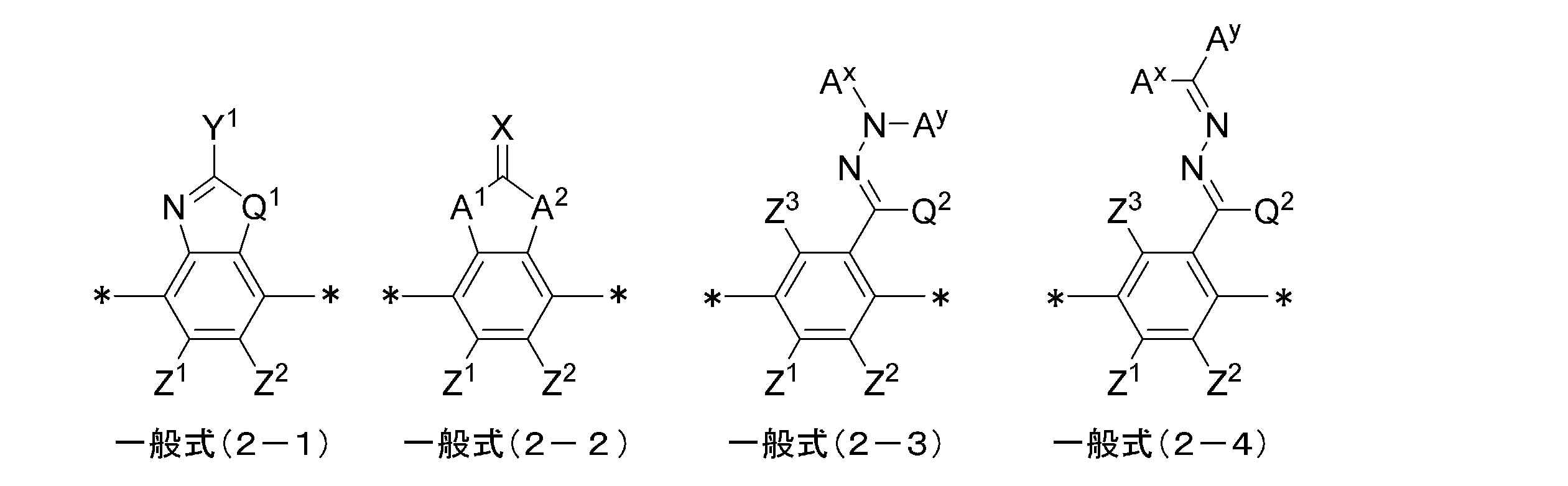
Y1は、炭素数1~6のアルキル基、炭素数6~12の芳香族炭化水素基又は炭素数3~12の芳香族複素環基を示す。
Z1、Z2及びZ3は、水素原子、炭素数1~20の脂肪族炭化水素基、炭素数1~20のアルコキシ基、炭素数3~20の脂環式炭化水素基、炭素数6~20の芳香族炭化水素基、ハロゲン原子、シアノ基、ニトロ基、-NR12R13又は-SR12を示す。Z1及びZ2は互いに結合して芳香族炭化水素環又は芳香族複素環を形成してもよい。R12及びR13は、水素原子又は炭素数1~6のアルキル基を示す。
A1及びA2は、-O-、>NR21、-S-及び>C(=O)から選択される基を示し、R21は水素原子又は置換基を示す。
Xは=O、=S、水素原子もしくは置換基が結合している炭素原子、又は、水素原子もしくは置換基が結合している窒素原子を示す。
Axは芳香族炭化水素環及び芳香族複素環から選択される少なくとも一つの芳香環を有する炭素数1~30の有機基を示す。Ayは水素原子、炭素数1~6のアルキル基、又は、芳香族炭化水素環及び芳香族複素環から選択される少なくとも一つの芳香環を有する炭素数1~30の有機基を示す。AxとAyは互いに結合して環を形成していてもよい。
Q2は、水素原子又は炭素数1~6のアルキル基を示す。
*はL1又はL2との結合位置を示す。
<2>
上記構造単位(b2)が有する水素結合性基が、ヒドロキシ基、カルボキシ基、スルホ基、リン酸基、ホスホン酸基、アミノ基、スルファニル基、アミド基、ウレタン基、ウレア基、チオウレタン基、チオウレア基及びスルホンアミド基のうちの少なくとも1種である、<1>に記載の硬化性樹脂組成物。
<3>
上記成分(B)がビニル重合体である、<1>又は<2>に記載の硬化性樹脂組成物。
<4>
上記成分(B)が、上記構造単位(b1)として下記一般式(p1)で表される構造単位を有し、上記構造単位(b2)として下記一般式(p2)で表される構造単位を有するビニル重合体である、<3>に記載の硬化性樹脂組成物。

ただし、LP2及びRP3の少なくとも一方は、ヒドロキシ基、カルボキシ基、スルホ基、リン酸基、ホスホン酸基、アミノ基、スルファニル基、アミド基、ウレタン基、ウレア基、チオウレタン基、チオウレア基及びスルホンアミド基のうちの少なくとも1つの基を含む。また、一般式(p1)で表される構造単位が水素結合性基を有することはない。
*はポリマー中に組み込まれるための結合部位を示す。
<5>
上記Arが上記一般式(2-2)で表される芳香環基である、<1>~<4>のいずれか1つに記載の硬化性樹脂組成物。
<6>
上記のL1及びL2が-O-であり、上記Spaが、上記Pol1と上記L1とを結ぶ最短原子数が11~30の連結基であり、上記Spbが、上記Pol2と上記L2とを結ぶ最短原子数が11~30の連結基である、<1>~<5>のいずれか1つに記載の硬化性樹脂組成物。
<7>
レンズAと接着層とレンズBとをこの順に含む接合レンズであって、
上記接着層が<1>~<6>のいずれか1つに記載の硬化性樹脂組成物の硬化物からなる層である、接合レンズ。
<8>
上記レンズA及び上記レンズBの少なくとも一方がガラスレンズである、<7>に記載の接合レンズ。
本発明において、特段の断りがない限り、二重結合については、分子内にE型及びZ型が存在する場合、そのいずれであっても、またこれらの混合物であってもよい。
また、本発明において、特段の断りがない限り、化合物中に1個又は2個以上の不斉炭素を有する場合、このような不斉炭素の立体化学についてはそれぞれ独立して(R)体又は(S)体のいずれかをとることができる。この結果、化合物は、光学異性体又はジアステレオ異性体などの立体異性体の混合物であってもよく、ラセミ体であってもよい。
また、本発明において化合物の表示は、本発明の効果を損なわない範囲で、構造の一部を変化させたものを含む意味である。更に、置換又は無置換を明記していない化合物については、本発明の効果を損なわない範囲で、任意の置換基を有していてもよい意味である。
本発明において置換又は無置換を明記していない置換基(連結基及び環についても同様)については、所望の効果を損なわない範囲で、その基に任意の置換基を有していてもよい意味である。例えば、「アルキル基」という場合、無置換アルキル基と置換アルキル基の両方を含む意味である。
本発明において、ある基の炭素数を規定する場合、この炭素数は、本発明ないし本明細書において特段の断りのない限りは、基全体の炭素数を意味する。つまり、この基がさらに置換基を有する形態である場合、この置換基を含めた全体の炭素数を意味する。
本発明において、各成分は、それぞれ1種を用いてもよく、2種以上を混合して用いてもよい。
本発明の硬化性樹脂組成物中における各成分の含有量の記載において、本発明の硬化性樹脂組成物における固形分とは、一般式(1)で表される化合物に加え、本発明の硬化性樹脂組成物から得られる硬化物中に残存する成分を意味する。通常は、溶媒を除いた残部が「固形分」である。
また、本発明において、脂肪族炭化水素基(無置換)は、炭素数1~30のアルキル基が好ましく、炭素数1~12のアルキル基がより好ましく、炭素数1~4のアルキル基がさらに好ましく、メチル基又はエチル基が特に好ましい。
また、本発明において、アルキレン基の例としては、上記アルキル基から任意の水素原子を1つ除いて得られる基が挙げられ、直鎖アルキレン基の例としては、上記アルキル基のうち、直鎖アルキル基から末端の炭素原子に結合する水素原子を1つ除いて得られる基が挙げられる。
本発明において、不飽和炭化水素環とは、炭素-炭素不飽和二重結合を有する炭化水素環のうち、芳香族環でないものを意味する。不飽和炭化水素環の例としては、インデン、インダン、フルオレン等が挙げられる。
本発明において、シクロアルキレン基は、シクロアルカンから、任意の水素原子を2つ除いて得られる2価の基を表す。シクロアルキレン基の例としては、シクロヘキシレン基が挙げられる。
本発明において、ハロゲン原子としてはフッ素原子、塩素原子、臭素原子、ヨウ素原子が挙げられる。
本発明の硬化性樹脂組成物は、下記成分(A)及び下記成分(B)を含む、硬化性樹脂組成物である。
成分(A):後記一般式(1)で表される化合物。
成分(B):芳香環を有する構造単位(b1)と、水素結合性基を有する構造単位(b2)とを含むポリマーであって、このポリマーを構成する全構造単位に占める上記構造単位(b1)の割合が10質量%以上、上記構造単位(b2)の割合が3質量%以上であるポリマー。
ただし、上記構造単位(b1)が水素結合性基を有することはない。
本発明の硬化性樹脂組成物は、下記一般式(1)で表される化合物を含有する。

L1及びL2は単結合、-O-、-S-、-C(=O)-、-OC(=O)-、-C(=O)O-、-OC(=O)O-、-NR101C(=O)-、-C(=O)NR102-、-OC(=O)NR103-、-NR104C(=O)O-、-SC(=O)-又は-C(=O)S-を示す。
R101~R104は、-Spc-Pol3又はハロゲン原子を示す。
Spa及びSpbは、単結合、置換基を有していてもよい炭素数1~30の直鎖アルキレン基、又は、置換基を有していてもよい炭素数2~30の直鎖アルキレン基において、L1又はL2への連結部分を除く1つもしくは2つ以上の-CH2-が、-O-、-S-、>C(=O)及び>NR111から選択される基で置き換えられた基を示す。
R111は、-Spd-Pol4又はハロゲン原子を示す。
Spc及びSpdは、単結合又は2価の連結基を示す。
Pol1及びPol2は重合性基を示し、Pol3及びPol4は水素原子又は重合性基を示す。
上記Arは、下記一般式(2-1)~(2-4)のいずれかで表される芳香環基である。
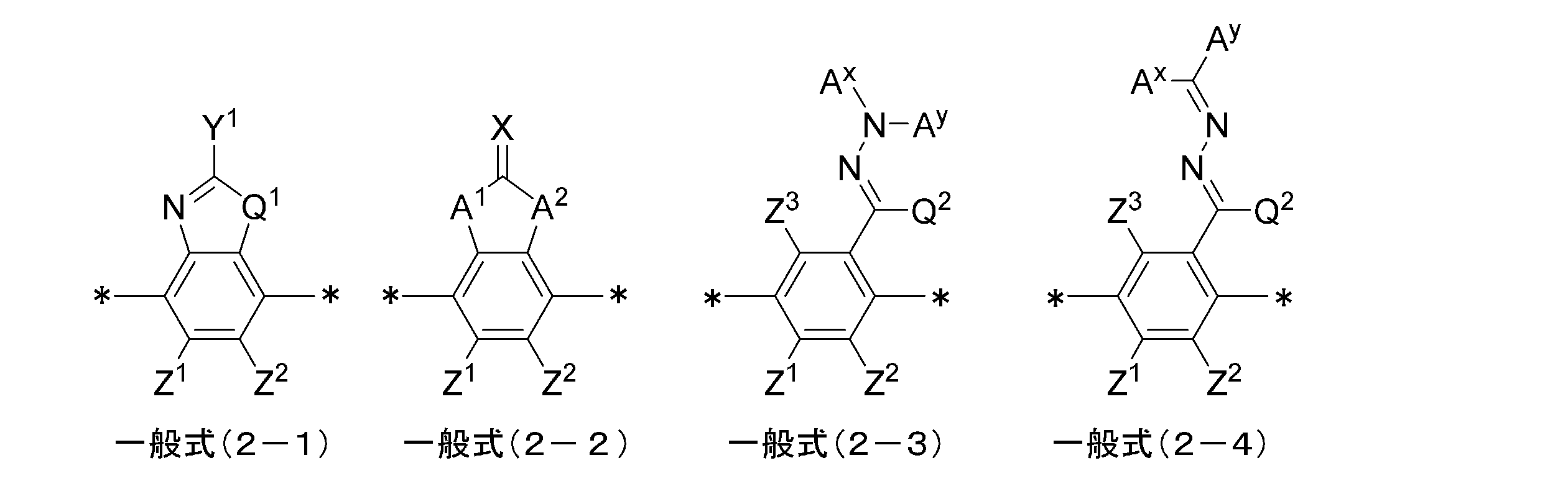
Y1は、炭素数1~6のアルキル基、炭素数6~12の芳香族炭化水素基又は炭素数3~12の芳香族複素環基を示す。
Z1、Z2及びZ3は、水素原子、炭素数1~20の脂肪族炭化水素基、炭素数1~20のアルコキシ基、炭素数3~20の脂環式炭化水素基、炭素数6~20の芳香族炭化水素基、ハロゲン原子、シアノ基、ニトロ基、-NR12R13又は-SR12を示す。Z1及びZ2は互いに結合して芳香族炭化水素環又は芳香族複素環を形成してもよい。R12及びR13は、水素原子又は炭素数1~6のアルキル基を示す。
A1及びA2は、-O-、>NR21、-S-及び>C(=O)から選択される基を示す。R21は水素原子又は置換基を示し、水素原子又は炭素数1~6のアルキル基が好ましい。
Xは=O(酸素原子)、=S(硫黄原子)、水素原子もしくは置換基が結合している炭素原子、又は、水素原子もしくは置換基が結合している窒素原子を示す。
Axは芳香族炭化水素環及び芳香族複素環から選択される少なくとも一つの芳香環を有する炭素数1~30の有機基を示す。Ayは水素原子、炭素数1~6のアルキル基、又は、芳香族炭化水素環及び芳香族複素環から選択される少なくとも一つの芳香環を有する炭素数1~30の有機基を示す。AxとAyは互いに結合して、環を形成していてもよい。
Q2は、水素原子又は炭素数1~6のアルキル基を示す。
*はL1又はL2との結合位置を示す。
一般式(2-2)で表される芳香環基としては、下記一般式(2-21)で表される芳香環基が好ましい。

Rzが示す置換基の例としては、後述するSpa及びSpbにおける直鎖アルキレン基が有していてもよい置換基が挙げられ、アルキル基、アルコキシ基、アルコキシカルボニル基、ハロゲン原子及びシアノ基が好ましく挙げられる。2つのRzは同一でも異なっていてもよい。
また、2つのRzが結合して環を形成していてもよく、この場合、形成される環は5員環または6員環であることが好ましく、環を構成する原子として窒素原子または酸素原子を含むことがより好ましい。2つのRzが結合して形成される環は、さらに好ましくは以下のいずれかの構造で表される環である。


Spa及びSpbは、単結合、置換基を有していてもよい炭素数1~30の直鎖アルキレン基、又は、置換基を有していてもよい炭素数2~30の直鎖アルキレン基において、L1又はL2への連結部分を除く1つもしくは2つ以上の-CH2-が、-O-、-S-、>C(=O)及び>NR111から選択される基で置き換えられた基を示す。
R111は、-Spd-Pol4又はハロゲン原子を示す。Spdは単結合又は2価の連結基を示し、Pol4は水素原子又は重合性基を示す。Spd及びPol4は、それぞれ後述のSpc及びPol3の記載を適用することができる。
ただし、SpaのL1への連結部分及びSpbのL2への連結部分はいずれも-CH2-であり、SpaのPol1への連結部分及びSpbのPol2への連結部分はいずれも炭素原子である。これらの連結部分の規定は、以降のSpa及びSpbに係る記載においても同様に適用する。
下記に示す-L2-Spb-Pol2の例においては、L2である-O-と、Pol2であるメタクリロイルオキシ基とを結ぶ最短の原子数は10となる。
上記最短原子数は、2~30が好ましく、11~30がより好ましく、11~25がさらに好ましく、12~25が特に好ましく、なかでも12~20が好ましい。
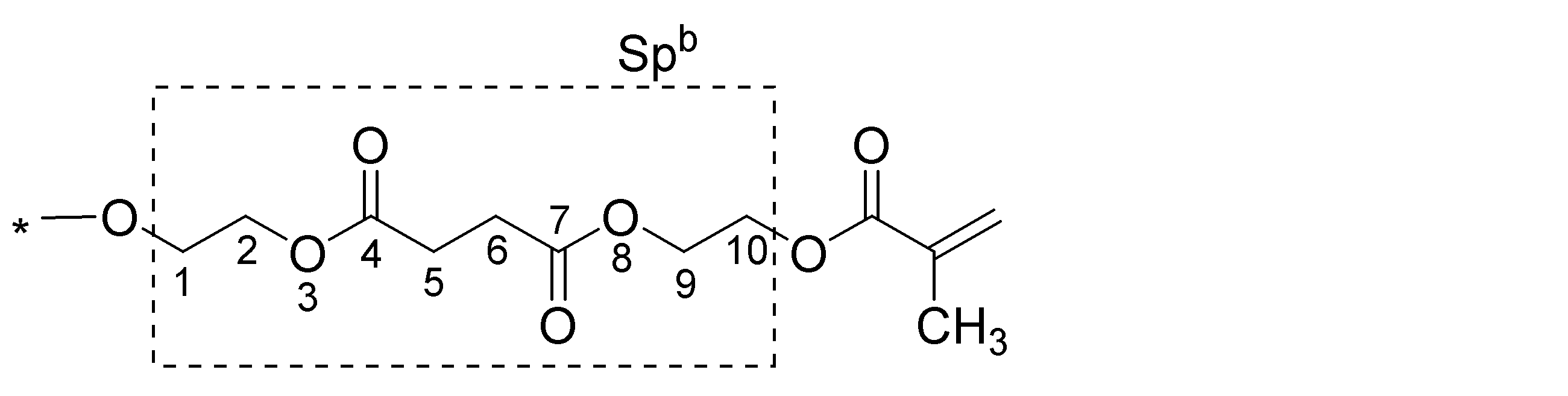
置換基の数は特に限定されず、例えば、置換基を1~4個有していてもよい。
上記置き換えの具体例を以下に示す。
-CH2-の、-O-、-S-、>C(=O)又は>NR111による置き換えが挙げられ、-O-又は>C(=O)による置き換えが好ましく、-O-による置き換えがより好ましい。
-CH2CH2-の、-C(=O)O-、-NR111C(=O)-又は-SC(=O)-での置き換えが挙げられ、-C(=O)O-又は-NR111C(=O)-による置き換えが好ましく、-C(=O)O-による置き換えがより好ましい。
-CH2CH2CH2-の-OC(=O)O-又は-NR111C(=O)O-による置き換えが挙げられ、-OC(=O)O-による置き換えが好ましい。
Pol1及びPol2は重合性基を示す。
重合性基とは、ビニリデン構造、オキシラン構造及びオキセタン構造のいずれかを含む基であればよい。一般式(1)で表される化合物の合成における簡便性等の観点からは、重合性基は、Spa又はSpbへの連結部が酸素原子であって、ビニリデン構造、オキシラン構造及びオキセタン構造のいずれかを含む基であることが好ましく、例えば、下記式(Pol-1)~式(Pol-6)のいずれかで表される重合性基が挙げられる。

Pol1及びPol2のいずれか一方は(メタ)アクリロイルオキシ基であることが好ましく、両方が(メタ)アクリロイルオキシ基であることがより好ましい。
Pol1及びPol2は同一であっても異なっていてもよく、同一であることが好ましい。
また、後述する、一般式(1)で表される化合物の具体例において記載するPol1-Spa-L1-又はPol2-Spb-L2-の構造も挙げられる。
なお、Pol1-Spa-L1-及びPol2-Spb-L2-は同一であっても異なっていてもよいが、同一であることが好ましい。


L1及びL2は、単結合、-O-、-S-、-C(=O)-、-OC(=O)-、-C(=O)O-、-OC(=O)O-、-NR101C(=O)-、-C(=O)NR102-、-OC(=O)NR103-、-NR104C(=O)O-、-SC(=O)-又は-C(=O)S-を示す。なお、上記の連結基の記載において、左側がArに結合し、右側がSpa又はSpbに結合するものとする。以降のL1及びL2に係る記載においても同様である。
R101~R104は、-Spc-Pol3又はハロゲン原子を示す。Spcは単結合又は2価の連結基を示し、Pol3は水素原子又は重合性基を示す。
2価の連結基であるSpcの例としては、直鎖アルキレン基、シクロアルキレン基、2価の芳香族炭化水素基及び2価の芳香族複素環基が挙げられる。また、直鎖アルキレン基、シクロアルキレン基、2価の芳香族炭化水素基及び2価の芳香族複素環基から選択される二つ以上の連結基が、単結合、-O-、-C(=O)-、-OC(=O)-、-C(=O)O-、-OC(=O)O-、-NR201C(=O)-及びC(=O)NR202-から選択される連結基を介して結合した連結基も挙げられる。
R201~R204は、水素原子又は炭素数1~3のアルキル基を示す。
Spcで表される2価の連結基としては、単結合又は炭素数1~10の直鎖アルキレン基が好ましく、炭素数1~5の直鎖アルキレン基がより好ましく、炭素数1~3の直鎖アルキレン基がさらに好ましい。なお、Spcとして採り得る直鎖アルキレン基は無置換の直鎖アルキレン基であることが好ましい。
Pol3は、水素原子が好ましい。
-Spc-Pol3としては、水素原子又は炭素数1~4のアルキル基が好ましく、水素原子又は無置換の炭素数1~4のアルキル基がより好ましい。
L1及びL2は、同一でも異なっていてもよいが、同一であることが好ましい。
また、国際公開第2019/131572号の[0068]~[0074]に記載の化合物も、本発明における一般式(1)で表される化合物として好ましく挙げられる。

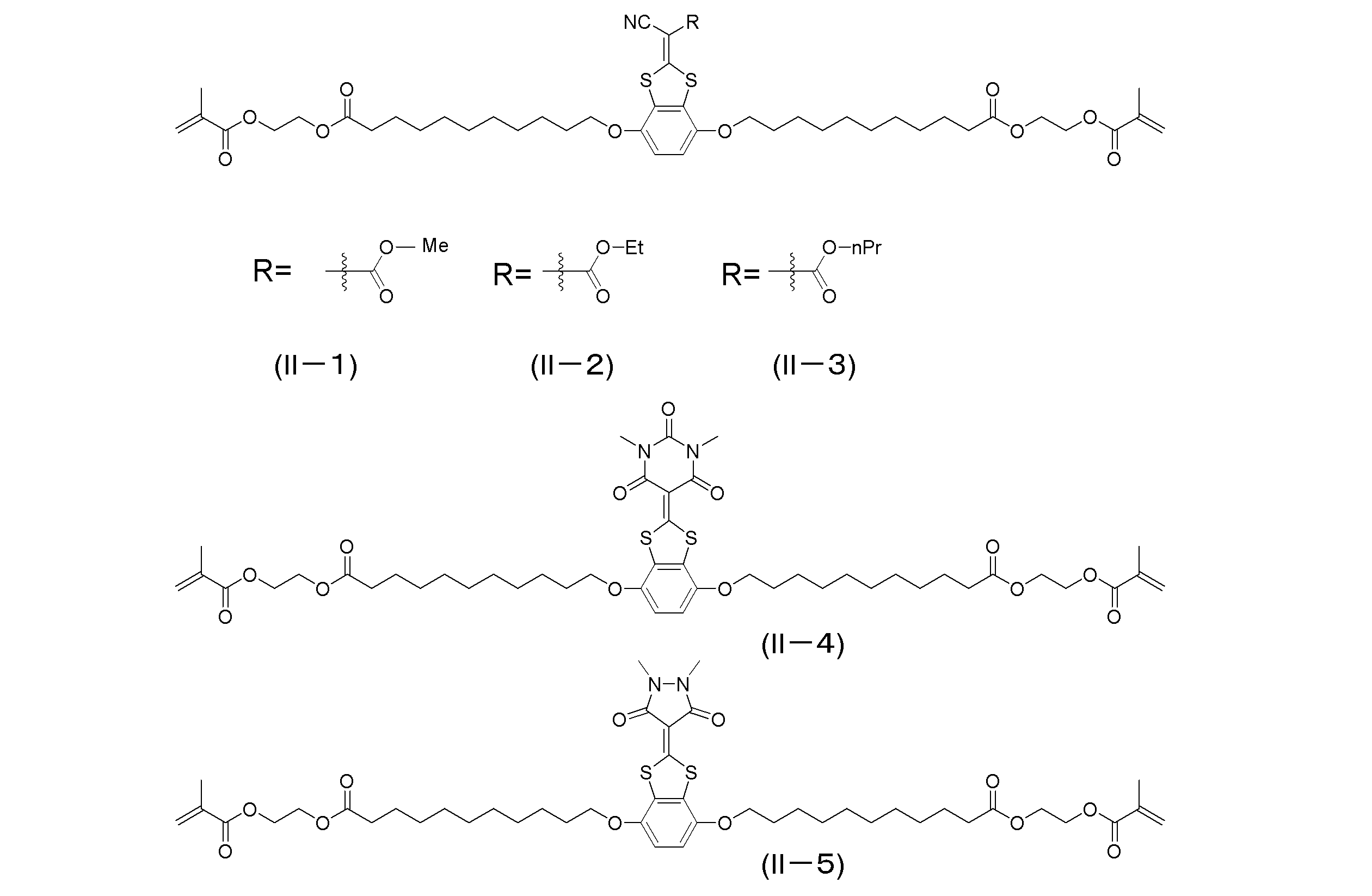
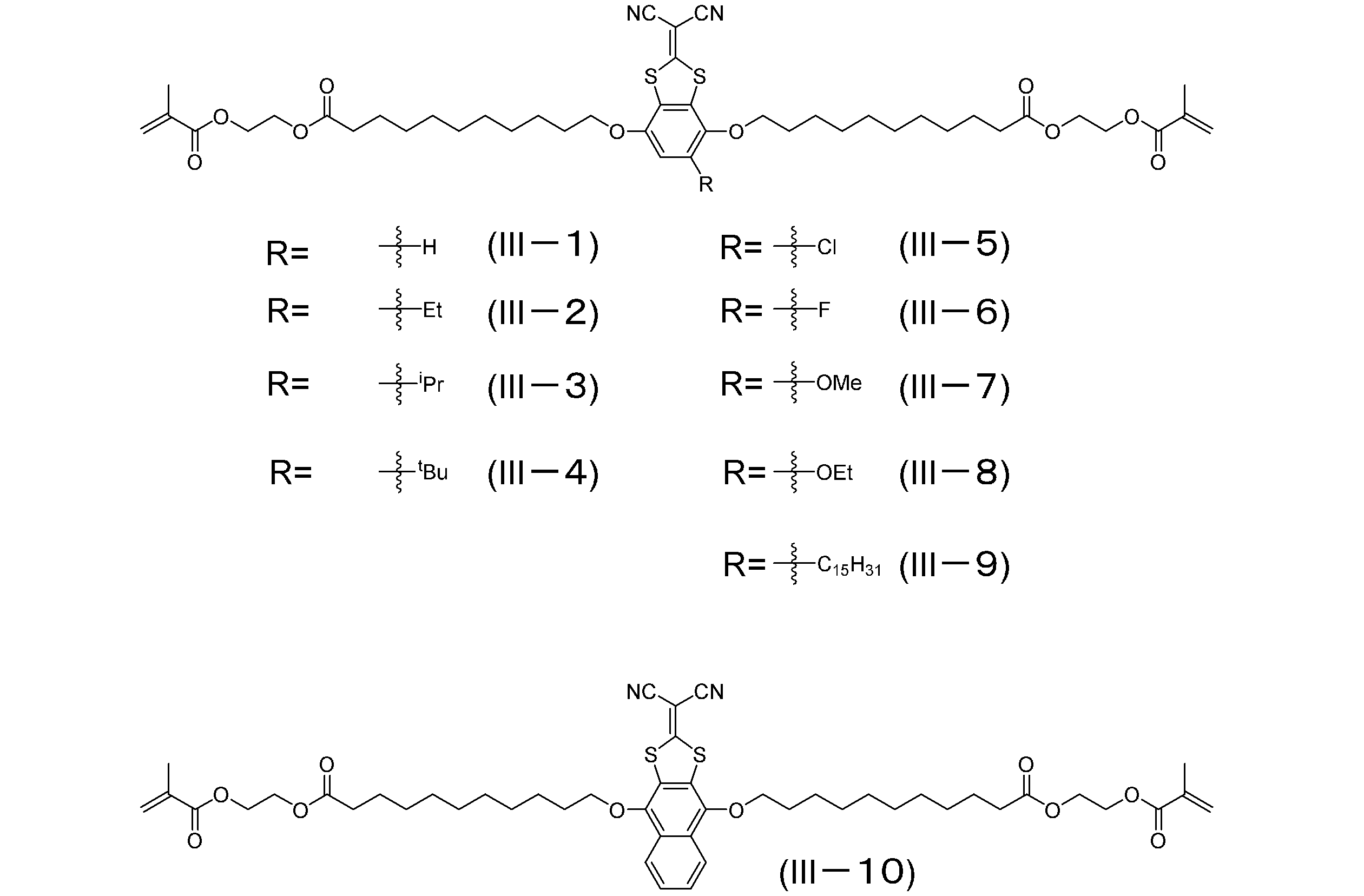
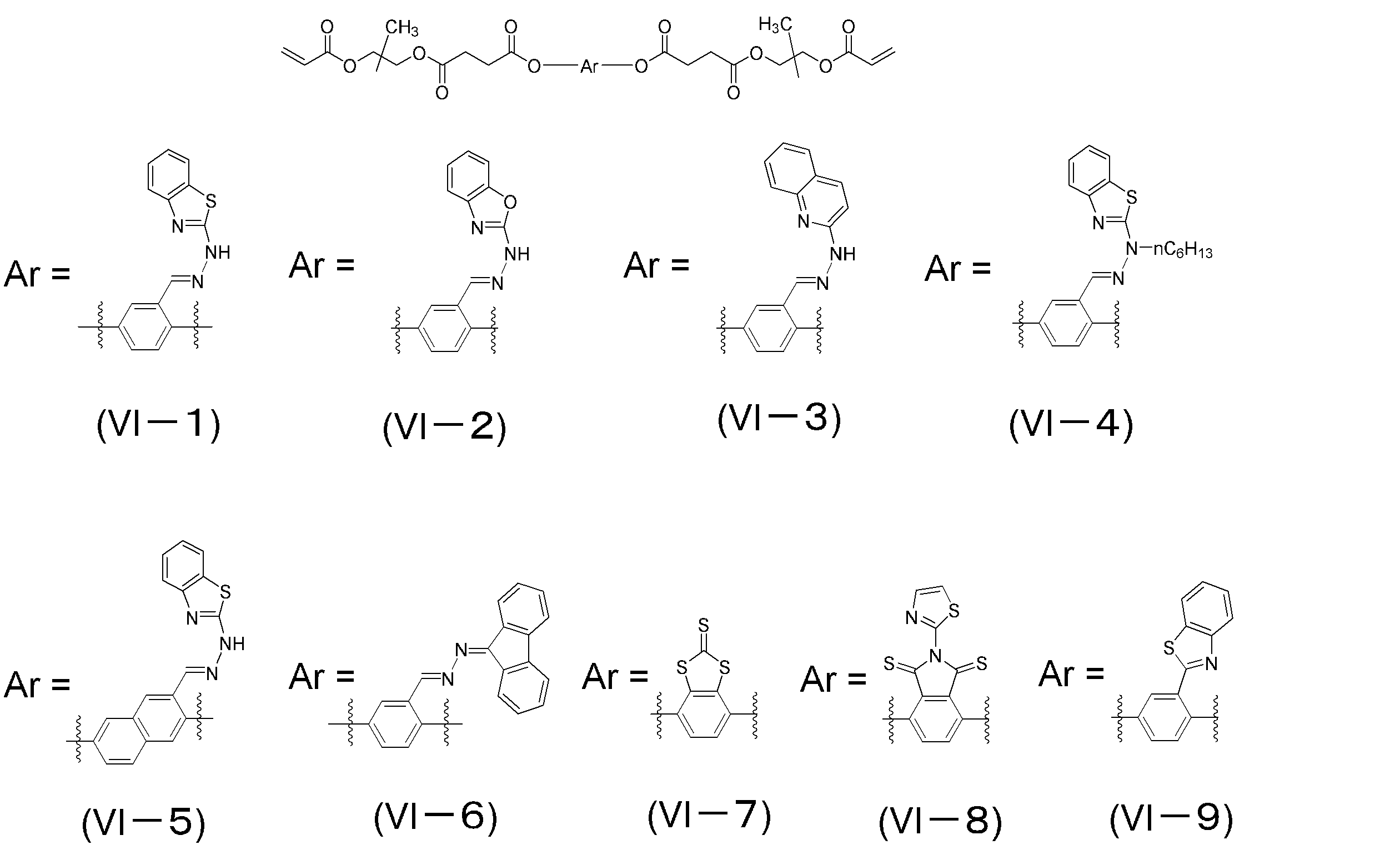

本発明の硬化性樹脂組成物は、成分(B)として、芳香環を有する構造単位(b1)と、水素結合性基を有する構造単位(b2)とを含むポリマーであって、このポリマーを構成する全構造単位に占める上記構造単位(b1)の割合が10質量%以上、上記構造単位(b2)の割合が3質量%以上であるポリマーを含有する。
本発明において、成分(B)のポリマー中に含まれる構造単位のうち、水素結合性基を有する構造単位は必ず構造単位(b2)に分類される。すなわち、上記構造単位(b1)が水素結合性基を有することはなく、芳香環及び水素結合性基の両方を有する構造単位については、上記構造単位(b2)に分類される。
上記成分(B)のポリマーは、芳香環を有する構造単位(b1)を有する。
上記構造単位(b1)が有する芳香環としては、ベンゼン環、ナフタレン環、アントラセン環もしくはフェナントレン環等などの芳香族炭化水素環、又は、フラン環、ピロール環、チオフェン環、ピリジン環、チアゾール環、ベンゾチアゾール環もしくはフェナントロリン環等の芳香族複素環が挙げられる。
上記構造単位(b1)が有する芳香環は、ベンゼン環、ナフタレン環又はピリジン環が好ましく、密着性をより向上させる観点から、ベンゼン環がより好ましい。

ただし、一般式(p1)で表される構造単位が水素結合性基を有することはない。すなわち、LP1が水素結合性基を有することはなく、ArPが水素結合性基を有することもない。
*はポリマー中に組み込まれるための結合部位を示す。
すなわち、ArPとしての置換基を有してもよい芳香族炭化水素基における芳香族炭化水素及び置換基を有していてもよい芳香族複素環基における芳香族複素環として、それぞれ、上記の構造単位(b1)が有する芳香環としての芳香族炭化水素環及び芳香族複素環の記載を適用することができる。
LP1が採り得る2価の連結基としては、アルキレン基、2価の芳香族炭化水素基(例えば、1,4-フェニレン基。以下、「アリーレン基」と称す。)、2価の芳香族複素環基(以下、「ヘテロアリーレン基」と称す。)、-O-、>C(=O)及び>NRbから選択される基、並びに、これらの基の2つ以上の組み合わせからなる連結基が挙げられる。
Rbは、アルキル基、1価の脂肪族又は芳香族複素環基又は1価の芳香族炭化水素環基である。
置換基の数は特に限定されず、例えば、置換基を1~4個有していてもよい。
また、アルキレン基、アリーレン基及びヘテロアリーレン基から選択される基の少なくとも1つと、-O-、>C(=O)及び>NRbから選択される基又はこれらの基の2つ以上の組み合わせからなる連結基の少なくとも1つとの組み合わせからなる基も好ましく挙げられる。例えば、-C(=O)O-アルキレン基が挙げられる。また、-C(=O)O-アルキレン基におけるアルキレン基に、更に-O-、アリーレン基-O-、-O-アリーレン基、ヘテロアリーレン基-O-又は-O-ヘテロアリーレン基が組合わせられた基も好ましく挙げられる。
なお、下記化学構造式中、Meはメチル基を示し、tBuはtert-ブチル基を示す。

成分(B)のポリマーが、構造単位(b1)及び(b2)以外の他の構造単位(その他の構造単位)を有する場合、ポリマーを構成する全構造単位に占める芳香環を含む構造単位(b1)の割合は、10~80質量%が好ましく、20~80質量%がより好ましく、30~75質量%がさらに好ましい。
上記成分(B)のポリマーは、水素結合性基を有する構造単位(b2)を有する。
上記構造単位(b2)が有する水素結合性基とは、水素結合を形成可能な水素原子を有する基を意味し、ヒドロキシ基、カルボキシ基、スルホ基、リン酸基、ホスホン酸基、アミノ基、スルファニル基、アミド基、ウレタン基、ウレア基、チオウレタン基、チオウレア基又はスルホンアミド基などが挙げられる。
上記のうち、ヒドロキシ基、カルボキシ基、スルホ基(スルホン酸基、-S(=O)2(OH))、リン酸基(-OP(=O)(OH)2)、ホスホン酸基(-P(=O)(OH)2)及びスルファニル基は、1価の基である。
上記のうち、アミノ基、アミド基及びスルホンアミド基は、1価の基又は水素結合性の水素原子を有する2価の基を意味する。これらの1価の基とは、それぞれ、アミノ基(-NH2)、アミド基(-CONH2)及びスルホンアミド基(-SO2NH2)を意味し、これらの水素結合性の水素原子を有する2価の基とは、それぞれ、アミノ基(>NH)、アミド基(-CONH-)及びスルホンアミド基(-SO2NH-)を意味する。
上記のうち、ウレタン基(-NHC(=O)O-)、ウレア基(-NRaC(=O)NH-)、チオウレタン基(-NHC(=O)S-又は-NHC(=S)O-)及びチオウレア基(-NRaC(=S)NH-)は、水素結合性の水素原子を有する2価の基である。
上記Raは水素原子、アルキル基、1価の脂肪族又は芳香族複素環基又は1価の芳香族炭化水素環基であり、水素原子が好ましい。
1つの構造単位中に含まれる水素結合性基の数は1つであってもよく、2つ以上であってもよく、2つ以上含まれる場合は、これら2つ以上の水素結合性基は、一部又は全てが同一の水素結合性基であってもよく、異なる水素結合性基であってもよい。

*はポリマー中に組み込まれるための結合部位を示す。
(i)-LP2-RP3で表される基において、最長となる結合鎖のうちRP2が結合する炭素原子から数えて最も末端に位置する構造(以下、「最末端構造」と称す。)が、上記水素結合性基のうち1価の基に該当する場合、RP3を上記水素結合性基における1価の基とし、残部をLP2として解釈する。
(ii)上記(i)に該当せず、かつ、上記最末端構造側に位置する、最長となる結合鎖を構成する原子が環構成原子である場合、RP3をこの環構成原子を含む環構造からなる1価の環基とし、残部をLP2として解釈する。
(iii)上記(i)又は(ii)に該当しない場合、上記最末端構造側から、最長となる結合鎖を構成する原子を、RP2が結合する炭素原子側にカウントする。結合鎖を構成する原子が、初めて、上記水素結合性基における1価の基を置換基として有する原子となる箇所、又は、上記水素結合性基における2価の基となる箇所を、LP2を構成する原子のうちRP3と結合する原子又は原子群とし、LP2及びRP3を解釈する。
例えば、後述の例示ポリマー(P-21)を構成する水素結合性基を有する構造単位(右端に記載の構造単位)における-LP2-RP3で表される基は、上記の規則(i)及び(ii)に該当しないため、上記規則(iii)に基づき、RP3を2-アクリロイルオキシエチル基、LP2を-C(=O)O-エチレン-OC(=O)NH-として解釈する。
LP2が採り得る2価の連結基としては、アルキレン基、アリーレン基、-O-、-S-、>C(=O)、>C(=S)及び>NRaから選択される基、並びに、これらの基の2つ以上の組み合わせからなる連結基が挙げられる。
Raは、上記の構造単位(b2)が有する水素結合性基の説明におけるRaの記載を適用することができる。
置換基の数は特に限定されず、例えば、置換基を1~4個有していてもよい。
また、アルキレン基又はアリーレン基と、-O-、-S-、>C(=O)、>C(=S)及び>NRaから選択される基又はこれらの基の2つ以上の組み合わせからなる連結基の少なくとも1つとの組み合わせからなる基も好ましく挙げられる。例えば、-C(=O)NH-アルキレン基、-C(=O)O-アルキレン基、-C(=O)NH-アリーレン基又は-C(=O)O-アリーレン基が挙げられる。また、-C(=O)NH-アルキレン基もしくは-C(=O)O-アルキレン基におけるアルキレン基、又は、-C(=O)NH-アリーレン基もしくは-C(=O)O-アリーレン基におけるアリーレン基に、更に-OC(=O)-、-C(=O)O-、-NRaC(=O)-、-C(=O)NRa-、-OC(=O)NRa-、-NRaC(=O)O-、-NRaC(=O)NRa-、-SC(=O)-、-C(=O)S-、-NRaC(=S)-、-C(=S)NRa-、-SC(=O)NRa-、-OC(=S)NRa-、-NRaC(=S)O-、-NRaC(=O)S-又は-NRaC(=S)NRa-が組合わせられた基も好ましく挙げられる。
RP3としての1価の置換基としては、アルキル基、1価の脂肪族又は芳香族複素環基、アリール基、ヒドロキシ基、カルボキシ基、スルホ基、リン酸基、ホスホン酸基、スルファニル基、-NH2、-CONH2及び-SO2NH2が好ましく挙げられる。
RP3として採り得るアルキル基、1価の脂肪族又は芳香族複素環基、及び、アリール基は、置換基で置換されていてもよい。RP3として採り得るアルキル基、1価の脂肪族又は芳香族複素環基、及び、アリール基が有していてもよい置換基としては、例えば、上述のPol1及びPol2における重合性基が挙げられ、なかでも(メタ)アクリロイルオキシ基が好ましい。例えば、置換基を有するアルキル基としては、(メタ)アクリロイルオキシアルキル基等の重合性基を有するアルキル基が挙げられる。
RP3としては、アルキル基、アリール基、ヒドロキシ基、カルボキシ基、スルホ基、リン酸基、ホスホン酸基、スルファニル基、-NH2、-CONH2又は-SO2NH2が好ましく、アルキル基、アリール基、ヒドロキシ基又は-CONH2がより好ましく、アルキル基、ヒドロキシ基又は-CONH2がさらに好ましい。
なお、下記化学構造式中、Rは水素原子又はメチル基を示す。

成分(B)のポリマーが、構造単位(b1)及び(b2)以外の他の構造単位(その他の構造単位)を有する場合、ポリマーを構成する全構造単位に占める水素結合性基を含む構造単位(b2)の割合は、3~30質量%が好ましく、4~25質量%がより好ましく、5~20質量%がさらに好ましい。
成分(B)のポリマーは、上述の構造単位(b1)及び(b2)以外の他の構造単位(以下、「その他の構造単位」とも称す。)を含有していてもよい。
上記その他の構造単位としては、芳香環及び前述の水素結合性基のいずれも有しない構造単位であれば特に制限されることなく、(メタ)アクリル酸エステル化合物、ビニルエステル化合物、(メタ)アクリロニトリル化合物、無水マレイン酸化合物等の常用のモノマーに由来する構造単位が挙げられる。これらの構造単位を含有することにより、透過率及び湿熱耐久性をより向上させるよう調整することができる。
これらの中でも、その他の構造単位を導くモノマーとしては、(メタ)アクリル酸エステル化合物及び(メタ)アクリロニトリル化合物などから選ばれるモノマーが好ましく挙げられ、(メタ)アクリル酸エステル化合物がより好ましい。
上記のモノマーのうち、透過率をより向上させる観点から、特にアルキル基の炭素原子が4~20のアルキル(メタ)アクリレート化合物が好ましい。このようなモノマーに由来する構造単位をその他の構造単位として含有する成分(B)のポリマーとすることにより、本発明の硬化性樹脂組成物中における成分(A)と成分(B)の相溶性、更に後述する成分(C)を含有する場合には成分(A)~(C)の相溶性を高めることができ、透明性の高い硬化物を得ることができる。
アルコキシシリル基を有するモノマーとしては、アルコキシ基がケイ素原子に直接結合した基を少なくとも1つ有し、かつ重合性基(好ましくはラジカル重合性基)を有する化合物であれば特に制限はないが、ジアルコキシシリル基及び/又はトリアルコキシシリル基と重合性基とを有するモノマーであることが好ましく、トリアルコキシシリル基と重合性基とを有するモノマーであることがより好ましい。
具体的には、例えば、γ-メタクリロキシプロピルトリアルコキシシラン、γ-メタクリロキシプロピルジアルコキシシラン又はビニルトリアルコキシシランが挙げられる。これらのうち、γ-メタクリロキシプロピルトリアルコキシシラン又はγ-アクリロキシプロピルトリアルコキシシランがより好ましい。
これらは1種用いてもよく、2種以上を組み合わせて用いてもよい。
成分(B)のポリマーの質量平均分子量(Mw)は、1000以上であることが好ましく、3000以上であることがより好ましく、5000以上であることがさらに好ましい。また、質量平均分子量の上限値は、500000以下であることが好ましく、300000以下であることがより好ましく、200000以下であることがさらに好ましい。
本発明において、質量平均分子量は、GPC(Gel Permeation Chromatography)によるポリスチレン換算の重量平均分子量であり、下記測定条件により測定した値を採用する。ただし、測定する試料に応じて、適宜適切な溶離液を選定して用いることができる。
(測定条件)
測定器:HLC-8320GPC(商品名、東ソー社製)
カラム:TOSOH TSKgel HZM-H(商品名、東ソー社製)、TOSOH TSKgel HZ4000(商品名、東ソー社製)、TOSOH TSKgel HZ2000(商品名、東ソー社製)をつなげた。
キャリア:THF
測定温度:40℃
キャリア流量:0.35ml/min
試料濃度:0.1質量%
検出器:RI(屈折率)検出器
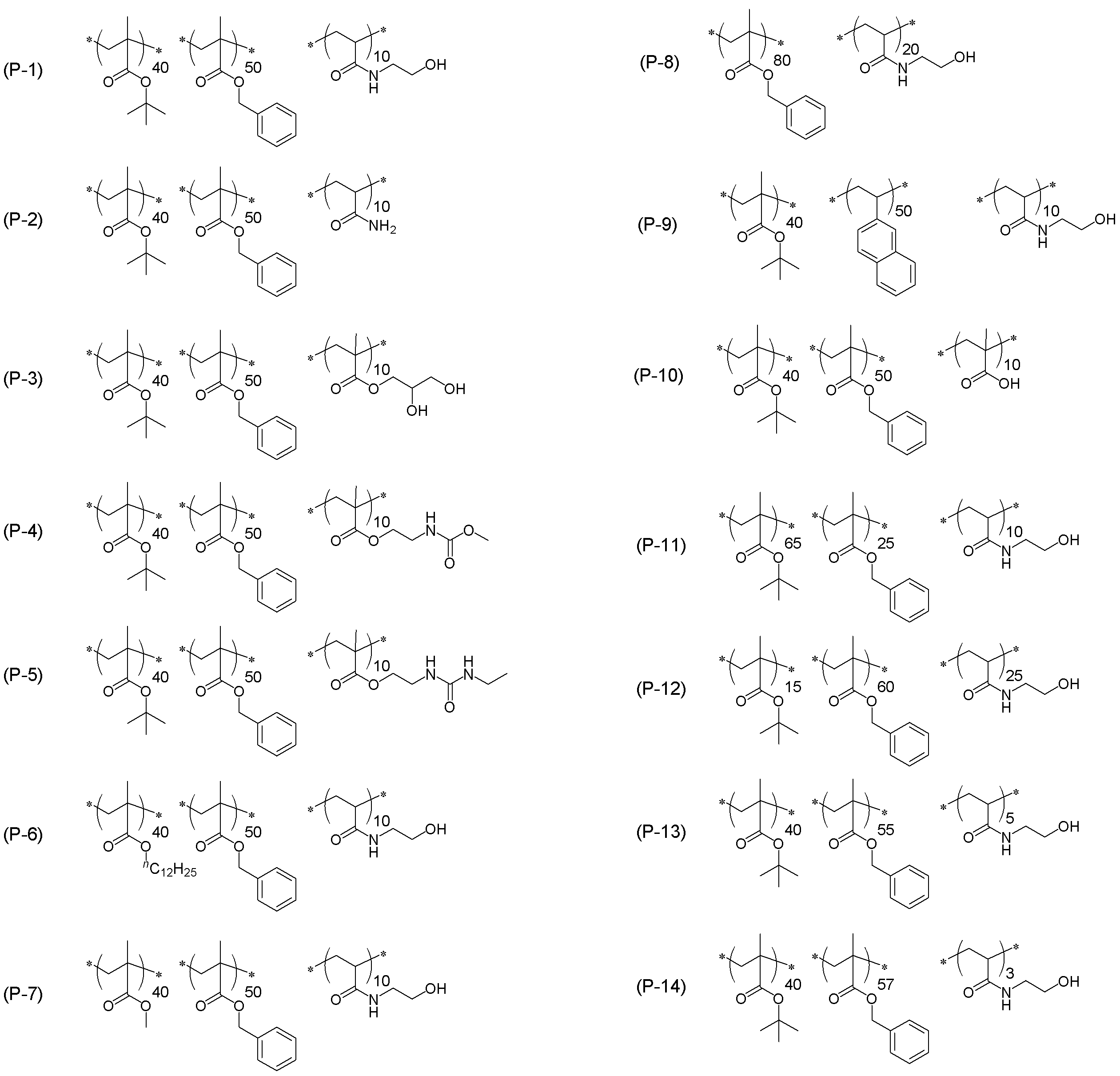

本発明の硬化性樹脂組成物は、上述の成分(A)及び(B)の他に、さらにその他の成分を含んでいてもよい。その他の成分としては、例えば、成分(C)ビニルモノマー又は重合開始剤等が挙げられる。また、シランカップリング剤を含有してもよく、例えば、上述の成分(B)のポリマーのその他の構造単位において記載のアルコキシシリル基を有するモノマーが挙げられる。
本発明の硬化性樹脂組成物は、成分(C)としてビニルモノマーを含むことも好ましい。ビニルモノマーは、(メタ)アクリレートモノマーであることが好ましい。
(メタ)アクリレートモノマーは、分子中に2つ以上の(メタ)アクリロイル基を有する多官能(メタ)アクリレートモノマーであってもよく、分子中に1つの(メタ)アクリロイル基を有する単官能(メタ)アクリレートモノマーであってもよい。化合物中における(メタ)アクリロイル基の数は1~4が好ましい。
ビニルモノマーの分子量は100~1000であることが好ましく、100~800であることがより好ましく、130~800であることがさらに好ましい。また、ビニルモノマーは1種単独で用いてもよく、2種以上を組み合わせて用いてもよい。
(メタ)アクリレートモノマーの具体例としては、例えば、モノマー1(フェノキシエチルアクリレート)、モノマー2(ベンジルアクリレート)、モノマー3(トリシクロデカンジメタノールジアクリレート)、モノマー4(ジシクロペンタニルアクリレート)、モノマー5(1,6-ヘキサンジオールジアクリレート)、モノマー6(1,6-ヘキサンジオールジメタクリレート)、モノマー7(ベンジルアクリレート)、モノマー8(イソボルニルメタクリレート)、モノマー9(ジシクロペンタニルメタクリレート)、モノマー10(ドデシルメタクリレート)、モノマー11(ドデシルアクリレート)、モノマー12(2-エチルヘキシルメタクリレート)、モノマー13(2-エチルヘキシルアクリレート)、モノマー14(2-ヒドロキシエチルアクリレート)、モノマー15(ヒドロキシプロピルアクリレート)、モノマー16(4-ヒドロキシブチルアクリレート)、モノマー17(2-ヒドロキシエチルアクリレートのカプロラクトン1mol付加物、商品名:プラクセルFA1DDM、ダイセル社製)、モノマー18(2-ヒドロキシエチルアクリレートのカプロラクトン2mol付加物、商品名:プラクセルFA2D、ダイセル社製)、モノマー19(カプロラクトン変性ヒドロキシピバリン酸ネオペンチルグリコールジアクリレート、商品名:カヤラッドHX-620、日本化薬社製)を挙げることができる。
例えば、ドデシルメタクリレート又はドデシルアクリレートを用いることにより湿熱耐久性をより向上させることができ、上記KAYARAD HX-620を用いることにより密着性をより向上させることができる。
(メタ)アクリレートモノマーの入手方法については特に制限は無く、商業的に入手してもよく、常法により合成してもよい。
本発明の硬化性樹脂組成物は、重合開始剤として、熱ラジカル重合開始剤及び光ラジカル重合開始剤のうちの少なくとも1種を含んでいることが好ましい。
本発明の硬化性樹脂組成物は、光ラジカル重合開始剤を含むことが好ましい。光ラジカル重合開始剤としては、光ラジカル重合開始剤として通常用いられる化合物を、後述する光重合(光硬化)工程の条件にあわせて適宜用いることができ、具体的には以下の化合物を用いることができる。
例えば、ビス(2,6-ジメトキシベンゾイル)-2,4,4-トリメチルペンチルホスフィンオキシド、ビス(2,6-ジメチルベンゾイル)-2,4,4-トリメチルペンチルホスフィンオキシド、ビス(2,4,6-トリメチルベンゾイル)-2,4,4-トリメチルペンチルホスフィンオキシド、ビス(2,6-ジクロルベンゾイル)-2,4,4-トリメチルペンチルホスフィンオキシド、1-フェニル-2-ヒドロキシ-2-メチルプロパン-1-オン、1-ヒドロキシシクロヘキシルフェニルケトン、1-(4-イソプロピルフェニル)-2-ヒドロキシ-2-メチルプロパン-1-オン、1,2-ジフェニルエタンジオン、メチルフェニルグリオキシレート、1-[4-(2-ヒドロキシエトキシ)-フェニル]-2-ヒドロキシ-2-メチル-1-プロパン-1-オン、2-ヒロドキシ-1-{4-[4-(2-ヒドロキシ-2-メチル-プロピオニル)-ベンジル]フェニル}-2-メチル-プロパン-1-オン、2,2-ジメトキシ-1,2-ジフェニルエタン-1-オン、2-メチル-1-(4-メチルチオフェニル)-2-モルフォリノプロパン-1-オン、2-ベンジル-2-ジメチルアミノ-1-(4-モルフォリノフェニル)-ブタノン-1、2,4,6-トリメチルベンゾイル-ジフェニル-ホスフィンオキサイド、ビス(2,4,6-トリメチルベンゾイル)-フェニルホスフィンオキサイド等を挙げることができる。
本発明の硬化性樹脂組成物は、熱ラジカル重合開始剤を含むことも好ましい。この熱重合開始剤の作用によって、上記硬化性樹脂組成物を熱重合することにより、高い耐熱性を示す硬化物を成形することができる。
例えば、1,1-ジ(t-ヘキシルペルオキシ)シクロヘキサン、1,1-ジ(t-ブチルペルオキシ)シクロヘキサン、2,2-ジ(4,4-ジ-(t-ブチルペルオキシ)シクロヘキシル)プロパン、t-ヘキシルペルオキシイソプロピルモノカーボネート、t-ブチルペルオキシ-3,5,5-トリメチルヘキサノエート、t-ブチルペルオキシラウレート、ジクミルパーオキシド、ジ-t-ブチルパーオキシド、t-ブチルペルオキシ-2-エチルヘキサノエート、t-ヘキシルペルオキシ-2-エチルヘキサノエート、クメンハイドロパーオキシド、t-ブチルハイドロパーオキシド、t-ブチルパーオキシ-2-エチルヘキシル、2,3-ジメチル-2,3-ジフェニルブタン等を挙げることができる。
本発明の接合レンズは、レンズAと接着層とレンズBとをこの順に含む接合レンズであって、上記接着層が本発明の硬化性樹脂組成物の硬化物からなる層であるレンズである。
本発明の接合レンズは、本発明の硬化性樹脂組成物を用いて、2つ以上のレンズを接着することにより、接合レンズを製造することができる。例えば、レンズAおよびレンズBを本発明の硬化性樹脂組成物を用いて接着し、レンズA、本発明の硬化性樹脂組成物の硬化物からなる層(接着層)、およびレンズBを、この順に含む接合レンズを製造することができる。
接着層は本発明の硬化性樹脂組成物を硬化した層である。例えば、接合レンズの製造において、接合されるいずれか一方のレンズの表面に本発明の硬化性樹脂組成物を適用し、他方のレンズを重ね合わせた後、硬化を行うことにより、接着層が形成される。硬化は少なくとも光照射を実施することで行うことができる。また、光照射を行った後に更に加熱する工程を実施してもよい。
また、カットオフ波長は、膜厚30μmの接着層において、380nm以下であることが好ましく、385nm以下であることがより好ましく、390nm以下であることがさらに好ましい。なお、ここで、接着層の透過率が0.5%以下となる波長をカットオフ波長と定義する。接着層の透過率は、分光光度計(例えば島津製作所社製のUV-2550(商品名))を用いて測定することができる。
本発明の硬化性樹脂組成物においては、一般式(1)で表される化合物の量を調整することによって、上記の範囲に接着層の屈折率とカットオフ波長を調整することができる。
レンズAおよびレンズBは接合レンズを形成するレンズである。本発明において、接合レンズの使用時に、外光入射側(物体(被撮像体)側)に、より近いレンズをレンズAといい、より遠いレンズをレンズBという。
レンズA、接着層、およびレンズBを、この順に含む接合レンズにおいて、レンズAおよびレンズBを構成する材料は特に制限されないが、レンズAおよびレンズBの少なくとも一方のレンズがガラスレンズであることが好ましく、レンズAはガラスレンズであり、レンズBが樹脂レンズまたは表面に樹脂層を有する複合レンズであることがより好ましく、レンズAはガラスレンズであり、レンズBが表面に樹脂層を有する複合レンズであることがさらに好ましい。
ガラスレンズとしては、公知のものを制限なく使用できる。市販のガラスレンズとしては、例えば、オハラ社製のBK7が挙げられる。
複合レンズがガラスレンズを含むときも同様のガラスレンズを用いることができる。
樹脂レンズは樹脂硬化物からなるレンズを意味する。
本発明において、複合レンズはガラスからなる層と樹脂層とを含むレンズを意味する。樹脂層は樹脂硬化物からなる層である。複合レンズに含まれる各層は、レンズ(単レンズ)であってもよく、この場合、各単レンズの光軸(両球面の曲率中心を結ぶ線)は一致していることが好ましい。複合レンズは樹脂層を表面に有していてもよく、内部に有していてもよく、レンズBとして用いられる複合レンズは表面に樹脂層を有することが好ましい。レンズBとして用いられる複合レンズの典型的な例としては、ガラスレンズの表面に樹脂層が形成された複合レンズを挙げることができる。
νd=(nd-1)/(nF-nC)
θg,F=(ng-nF)/(nF-nC)
ここで、ndは波長587.56nmにおける屈折率、nFは波長486.13nmにおける屈折率、nCは波長656.27nmにおける屈折率、ngは波長435.83nmにおける屈折率を表す。
樹脂硬化物のアッベ数は具体的にはカルニュー精密屈折計KPR-2000(島津デバイス製造社製)またはアッベ計(アタゴ社製)等を用いて求めることができる。
本発明の硬化性樹脂組成物は、内部に光学レンズを含むデバイスにおいて用いられ、その光学レンズ、ひいてはデバイスの光劣化を防止することができる。具体的には、樹脂レンズまたは樹脂層を含む複合レンズが備え付けられたデバイスにおいて、筐体(遮光性)の上記の樹脂レンズまたは複合レンズに外部光が入射する方向に本発明の硬化性樹脂組成物から形成される接着層を配することによって、上記の樹脂レンズまたは複合レンズの光劣化を防止することができる。接着層は、例えば、上記接合レンズの一部として設けることができる。
図1において、物体(被撮像体)側7から画像形成面側8に向かって、レンズA(3)、接着層1、レンズB(4)、レンズC(5)がこの順で配置されており、レンズB(4)およびレンズC(5)はそれぞれ複合レンズであり、レンズB(4)は樹脂層6およびガラスからなる層10から構成され、レンズC(5)は樹脂層6およびガラスからなる層11から構成されている。また、図1において、レンズA(3)、接着層1およびレンズB(4)が接合レンズ2を構成している。
図1に示すレンズ光学系においては、接着層1より画像形成面側8にあるレンズB(4)またはレンズC(5)として配される複合レンズにおける樹脂層6の光劣化を防止できる。また、図1において、レンズB(4)及び/又はレンズC(5)として複合レンズに代えて樹脂レンズを採用したレンズ光学系においても、レンズB(4)及びレンズC(5)の位置に配される複合レンズ及び/又は樹脂レンズの光劣化を防止できる。これらのレンズ光学系のほか、例えば以下のレンズ光学系において、構成レンズの光劣化の防止を図ることができる:
(1)ガラスレンズであるレンズAおよび複合レンズであるレンズBの接合レンズのみを含みレンズCのないレンズ光学系;
(2)レンズAおよびレンズBがガラスレンズであり、レンズCが複合レンズまたは樹脂レンズであるレンズ光学系;および、
(3)(1)または(2)の光学系に加えて、さらに追加の1または2以上のレンズを含むレンズ光学系。
上述のように、本発明の硬化性樹脂組成物から形成された接着層を含む、撮像モジュール中のレンズ光学系は、レンズCを含んでいてもよい。本発明において、「レンズC」は、本発明の硬化性樹脂組成物によりレンズが接着された接合レンズおよびこれを構成するレンズ以外のレンズを示し、本発明の硬化性樹脂組成物から形成された接着層を含む接合レンズよりも、外光入射側(物体(被撮像体)側)から遠い位置に配置されるレンズを示す。
レンズCとして用いられる複合レンズは樹脂層を表面に有していてもよく、内部に有していてもよい。
以下の合成例において、室温とは25℃を意味する。
なお、硬化性樹脂組成物の調製から硬化物の試験を行うまでの全て工程において、照明として黄色灯を使用する環境下で行った。
成分(A)及び成分(B)について、以下の通り合成した。
なお、以下に示す各成分の合成に用いた略語は下記の通りである。
HPMA:ヒドロキシプロピルメタクリレート
DMAc:N,N-ジメチルアセトアミド
THF:テトラヒドロフラン
Ac:アセチル基
Et:エチル基
〔合成例1:化合物(I-6)の合成〕

Bulletin of the Chemical Society of Japan, 81, 1518記載の11-ブロモウンデカン酸エチル(化合物(I-6A0))と同様の合成方法により合成した。収率90%。
化合物(I-6A0)36.9g(125.8mmol)、化合物(I-1D)15g(57.2mmol)、炭酸カリウム17.4g(125.8mmol)、THF60mL、及び、N,N-ジメチルアセトアミド90mLを混合しながら、内温(液温)が80℃になるよう加熱した。80℃で3時間撹拌したのち、酢酸エチル150mL、水180mL、濃塩酸30mLを加え撹拌したのち、洗浄、分液を行った。次に、5%炭酸水素ナトリウム水溶液150mLを加え撹拌したのち、洗浄、分液を行った。その後、有機層にメタノール230mLを添加し、析出した結晶をろ過することで化合物(I-6A)を得た。収率65%。
化合物(I-6A)20g(30.6mmol)、濃塩酸20mL、酢酸240mL、及び、水80mLを混合後、80℃で1時間撹拌した。その後、25℃に戻し、水200mLを添加し析出した固体をろ過したのちメタノール、水を用いて洗浄し、50℃で乾燥させることで化合物(I-6B)を得た。収率90%。
カルボン酸化合物(I-6B)18g(28.5mmol)、酢酸エチル45mL、ヒドロキシプロピルメタクリレート9.1g(62.8mmol)、N,N-ジメチルアミノピリジン0.4g(2.9mmol)、および、1-エチル-3-(3-ジメチルアミノプロピル)カルボジイミド塩酸塩12g(62.8mmol、略称:EDAC)を混合した。40℃で2時間撹拌したのち、1N塩酸300mlを加え、洗浄、分液したのち、5%炭酸水素ナトリウム水溶液を加え、洗浄、分液した。硫酸マグネシウムによる脱水とろ過、濃縮を行うことでオイル状の組成物を得たのち、カラムクロマトグラフィーで精製し、化合物(I-6)を得た。収率70%。
1H-NMR(300MHz,CDCl3):δ(ppm)1.25-1.50(m,30H)、1.50-1.70(m,8H)、1.95(s,6H)、2.20-2.40(m,7H)、3.85(t,2H)、4.0(t,2H)、4.10-4.30(m,4H)、5.10-5.30(m,2H)、5.60(s,2H)、6.10(s,2H)、6.70(s,1H)
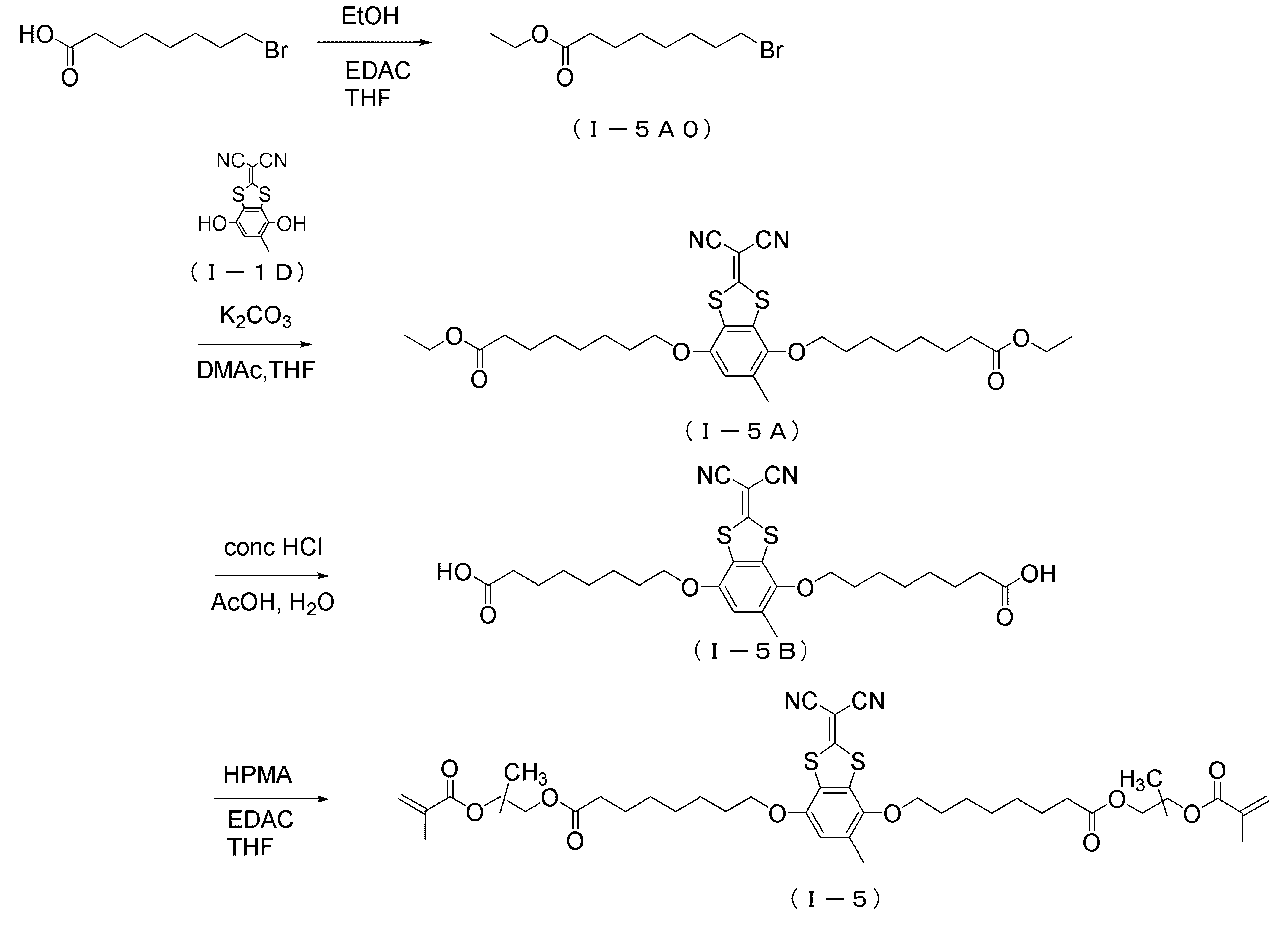
化合物(I-6A0)の合成において、11-ブロモウンデカン酸を8-ブロモオクタン酸に変更した以外は同様の方法により、8-ブロモオクタン酸エチル(化合物(I-5A0))を合成した。収率88%。
化合物(I-6A)の合成において、化合物(I-6A0)を化合物(I-5A0)に変更した以外は同様の方法により化合物(I-5A)を合成した。収率67%。
化合物(I-6B)の合成において、化合物(I-6A)を化合物(I-5A)に変更以外は同様の方法により化合物(I-5B)を合成した。収率97%。
化合物(I-6)の合成において、化合物(I-6B)を化合物(I-5B)にした以外は同様の方法により化合物(I-5)を合成した。収率60%。
1H-NMR(300MHz,CDCl3):δ(ppm)1.25-1.50(m,18H)、1.50-1.70(m,4H)、1.50-1.70(quint,4H)、1.95(s,6H)、2.20-2.40(m,7H)、3.85(t,2H)、4.0(t,2H)、4.10-4.30(m,4H)、5.10-5.30(m,2H)、5.60(s,2H)、6.10(s,2H)、6.70(s,1H)

1H-NMR(300MHz,CDCl3):δ(ppm)1.25-1.35(d,6H)、1.95(s,6H)、2.10-2.20(m,4H)、2.31(s,3H)、2.50-2.70(m,4H)、3.90(t,2H)、4.0-4.4(m,6H)、5.10-5.30(m,2H)、5.60(s,2H)、6.10(s,2H)、6.70(s,1H)
国際公開第2019/131572号パンフレットの段落0144~段落0146に記載の化合物(V-3)の合成方法に従って、下記化合物(V-3)を合成した。

〔ポリマーP-1の合成〕
メタクリル酸ベンジル(富士フイルム和光純薬社製)25.0g、メタクリル酸tert-ブチル(富士フイルム和光純薬社製)20.0g、およびN-(2-ヒドロキシエチル)アクリルアミド(東京化成工業社製)5.0gをメチルエチルケトン35mLに溶解させ、窒素気流下で70℃に加熱した。この溶液に、重合開始剤(富士フイルム和光純薬社製、商品名:V-65)1.0gをメチルエチルケトン45mLに溶解させた溶液を30分かけて滴下した。滴下終了後、さらに70℃で4.5時間反応させた。放冷後、反応液を、冷却した水200mLおよびメタノール1800mLの混合液に対して滴下し、析出した粉体をろ取し、乾燥させることで、ポリマーP-1を40g得た。
上記ポリマーP-1の合成において、下記に示す構造のポリマーが得られるように適宜モノマーの種類、モノマー配合比を変更した以外は同様にして、下記ポリマーP-2~P-14、並びに、比較用ポリマー1、3及び4を合成した。
コンデンサー及び撹拌機を取り付けた3つ口フラスコに、1,6-ヘキサンジアミン(東京化成工業社製)6.97g、N-メチルピロリドン(関東化学社製)53.9gを秤量し、窒素フローしながら室温で撹拌し、均一溶液とした。次いでピリジン(関東化学社製)9.49g及び4-ジメチルアミノピリジン(東京化成工業社製)7.33gを秤量し、反応液に添加し、溶解させた。次いで4,4’-オキシビス(ベンゼンスルホニルクロリド)(東京化成工業社製)22.03gをフラスコに添加し、室温で1時間撹拌後、60℃に昇温し、10時間反応させた。反応液を純水0.5L、メタノール0.5Lの混合液に滴下し、ポリマーを析出させた。これをろ取、洗浄、乾燥し、ポリマーP-15を25.5g得た。
コンデンサー及び撹拌機を取り付けた3つ口フラスコにシクロヘキサノン30mLを計量し、窒素気流下で80℃に加熱した。ここに、メタクリル酸ベンジル(富士フイルム和光純薬社製)21.0g、メタクリル酸tert-ブチル(富士フイルム和光純薬社製)17.0g、およびメタクリル酸2-ヒドロキシエチル(富士フイルム和光純薬社製)2.0g、重合開始剤(富士フイルム和光純薬社製、商品名:V-601)をシクロヘキサノン60mLに溶解した溶液を窒素気流下で120分かけて滴下した。滴下終了後、さらに80℃で6時間重合反応を行った。
反応液を室温まで放冷し、空気雰囲気下としたのち、カレンズAOI(商品名、2-アクリロイルオキシエチルイソシアナート、昭和電工社製)4.3g、触媒としてネオスタンU-600(商品名、日東化成社製)を0.14g、重合禁止剤として2-tert-ブチル-1,4-ベンゾキノン(東京化成工業社製)0.04g、シクロヘキサノン10mLを加えたのち、70℃に加温し6時間反応を行った。
放冷後、反応液を、冷却した水200mLおよびメタノール1800mLの混合液に対して滴下し、析出した粉体をろ取し、乾燥させることで、ポリマーP-21を32g得た。
また、各ポリマーの質量平均分子量(Mw)については、前述の測定条件により測定した値である。
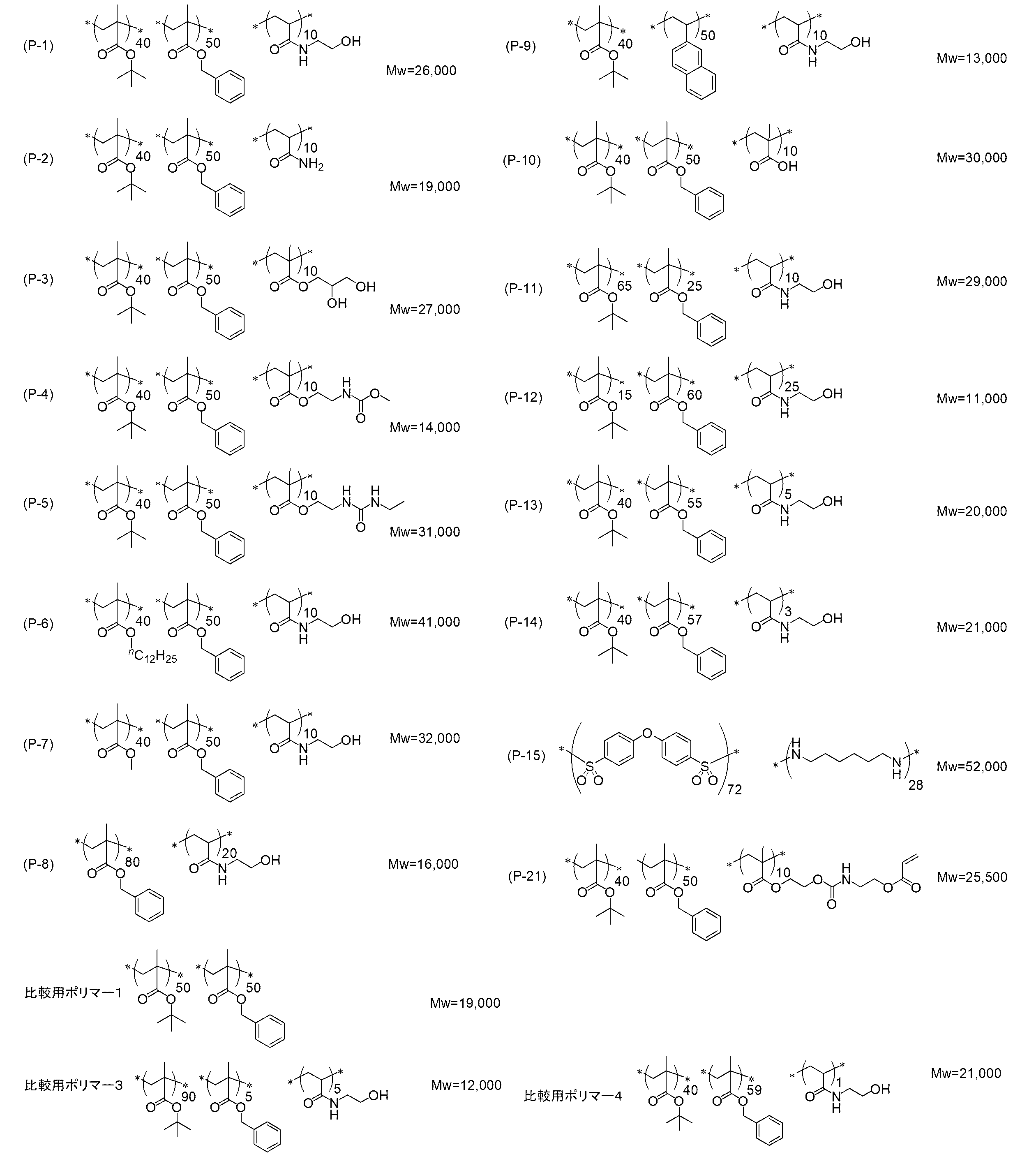
(1)硬化性樹脂組成物の調製
下記表に記載の組成となるように、成分(A)、成分(B)又は比較用ポリマー、成分(C)及び光重合開始剤を混合し、撹拌して均一にすることで、硬化性樹脂組成物を調製した。
得られた硬化性樹脂組成物に係る評価結果を下記表にまとめて示す。
なお、比較の硬化性樹脂組成物No.c03およびc04は、各成分を混合しても液が均一とならず、相分離してしまい、以降の評価を行うことができなかった。
(1)密着力試験用硬化物サンプルの作製
幅12mm、長さ30mmの長方形にカットしたスライドガラス上の端部に、上記で調製した硬化性樹脂組成物を2μLのせた。同サイズにカットしたスライドガラスを、重ね合わせ部分が幅12mm、長さ5mmとなるように挟むことで、硬化性樹脂組成物を、重ね合わせた部分に一様に広げた。酸素濃度1%以下の雰囲気下でUV照射装置としてEXECURE3000(商品名、HOYA社製)を用いて、2J/cm2の紫外線を照射することにより、幅12mm、長さ55mmの貼り合わせサンプル(引張せん断試験用サンプル)を得た。
上記方法により作製した貼り合わせサンプルについて、TENSILON RTC-1225A(商品名、エー・アンド・デイ社製)を用い、下記の条件にて引張せん断試験を行い、サンプルの貼り合わせ箇所が剥離する際の荷重を測定した。1つの硬化性樹脂組成物につき5回の試験を行い、5回の測定結果の平均値を密着力の指標とし、下記評価基準に基づき密着力を評価した。密着力の指標が大きいほど密着力に優れる。
(条件)
チャック間距離:40mm
試験温度:25℃
引張速度:2mm/秒
- 評価基準 -
AA:密着力の指標が100N以上
A:密着力の指標が70N以上100N未満
B:密着力の指標が40N以上70N未満
C:密着力の指標が20N以上40N未満
D:密着力の指標が20N未満
(1)湿熱耐久性試験用接合レンズの作製
両凸ガラスレンズA(硝材:BK7、外径10mm、接合面となる面の曲率半径が12mm、もう一方の面の曲率半径が10mm)および両凹ガラスレンズB(硝材:BK7、外径10mm、接合面となる面の曲率半径が12mm、もう一方の面の曲率半径が10mm)の間に、上記で調製した硬化性樹脂組成物2μLを接合面に一様に広がるように挟み込んだ後、酸素濃度1%以下の雰囲気下でUV照射装置としてEXECURE3000(商品名、HOYA社製)を用いて、レンズA側から2J/cm2の紫外線を照射することにより、接合レンズを得た。
上記方法により作製した20個の接合レンズについて、60℃、90%RH(相対湿度)の条件下で240時間保管した後、室温(25℃)に戻し、試験サンプルの形態をキーエンス社製のデジタルマイクロスコープ、及び、レーザー顕微鏡を用いて観察した。
ヒビ又は界面剥離等の形状変化が認められる接合レンズを不良品とし、発生していない接合レンズを良品と判定した。良品の割合(良品率)を以下の基準に当てはめ、湿熱耐久性を評価した。良品率が高いほど湿熱耐久性に優れる。
- 評価基準 -
AA:良品率が90%以上であった。
A:良品率が80%以上90%未満であった。
B:良品率が70%以上80%未満であった。
C:良品率が70%未満であった。
(1)透過率評価用硬化物サンプルの作製
縦76mm×横52mmの長方形のスライドガラスに、上記で調製した硬化性樹脂組成物を25μLのせ、20μmの厚みとなるよう、同サイズのガラス板で挟むことで、硬化性樹脂組成物を重ね合わせた部分に一様に広げた。
酸素濃度1%以下の雰囲気下でUV照射装置としてEXECURE3000(商品名、HOYA社製)を用いて、2J/cm2の紫外線を照射することにより、ガラス板にサンドされた硬化物(透過率評価用硬化物サンプル)を得た。
上記で作製した硬化物サンプルについて、分光光度計UV-2600(商品名、島津製作所社製)を用い、450nmにおける透過率T(%)を測定し、下記基準に基づき透過率を評価した。
- 評価基準 -
AA:T%が90%以上であった。
A:T%が89%以上90%未満であった。
B:T%が88%以上89%未満であった。
C:T%が88%未満であった。

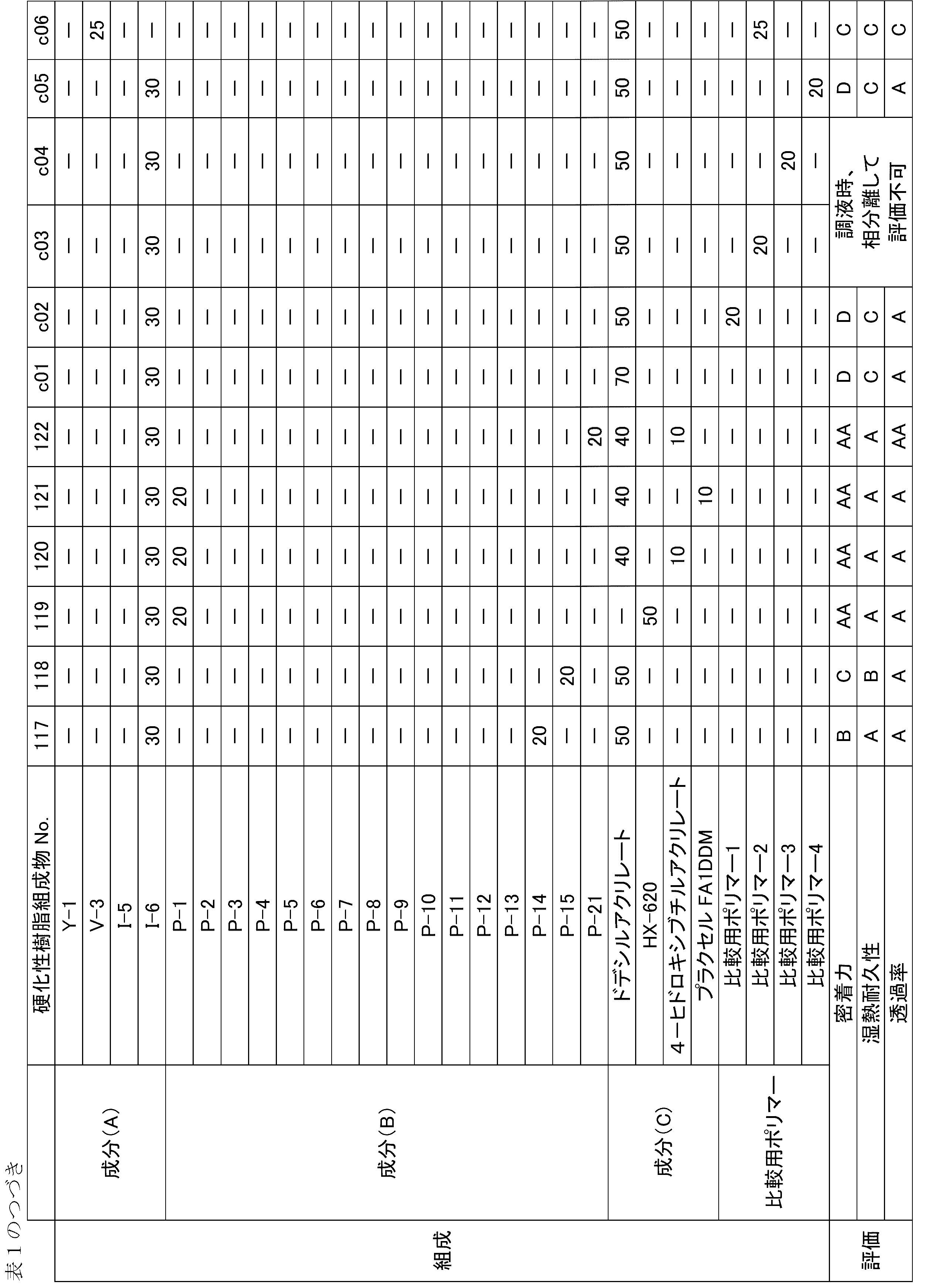
表中における各成分は、下記の通りである。なお、各成分の配合量比は質量基準である。
なお、いずれの硬化性樹脂組成物においても、成分(A)、成分(B)又は比較用ポリマー、及び、成分(C)の合計100質量部に対して、光重合開始剤としてIrgacure 819(商品名、BASFジャパン社製)0.1質量部を配合した。
また「-」はその成分を含有しないことを意味する。
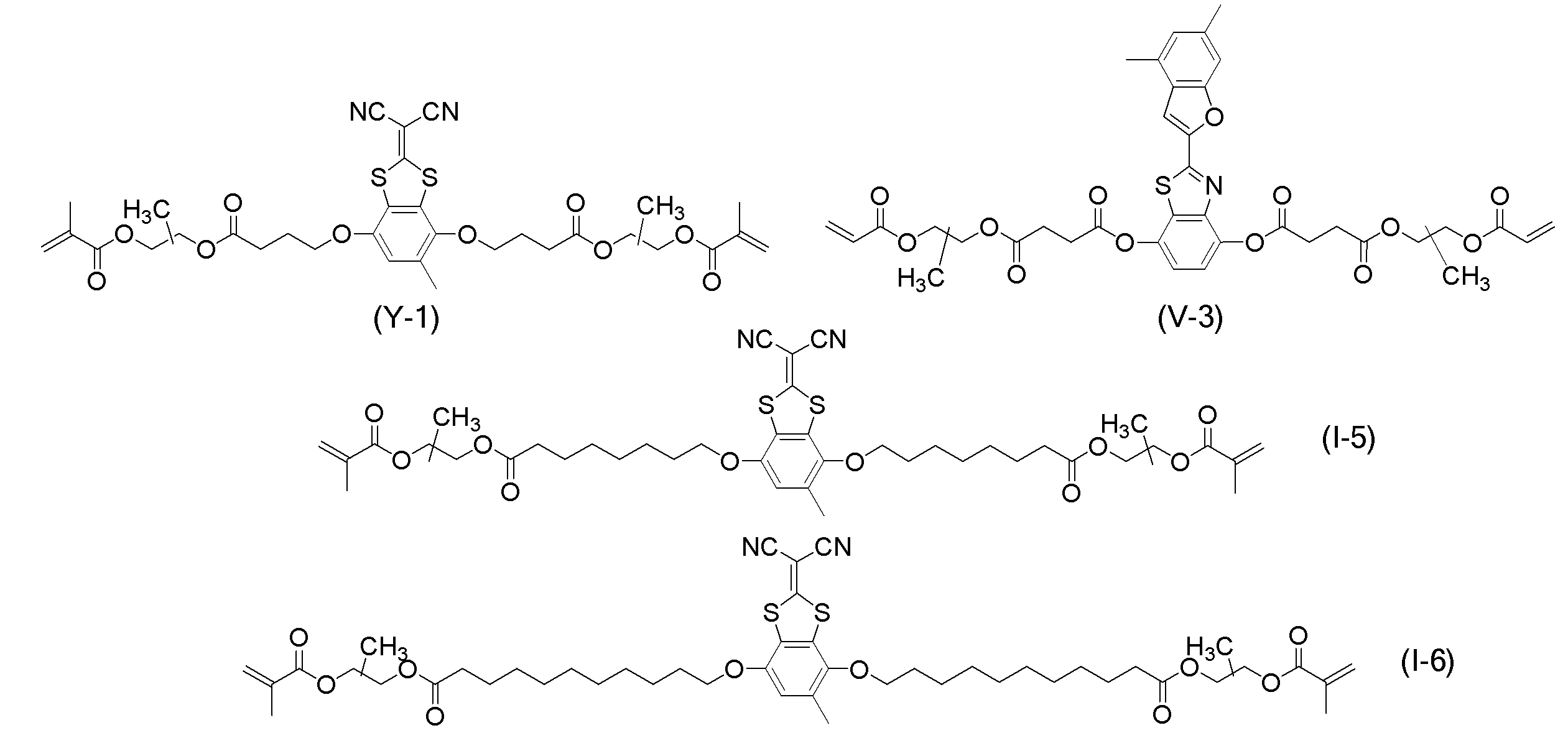
ポリマーP-1~P-15及びP-21:上記合成例に記載のポリマーP-1~P-15及びP-21
HX-620:下記構造式で表されるビニルモノマー、KAYARAD HX-620(商品名)、日本化薬社製

比較用ポリマー1、3及び4:上記合成例に記載の比較用ポリマー1、3及び4
比較用ポリマー2:紫光UV-3000B(商品名、三菱ケミカル社製、芳香環を含まないウレタンアクリレート、Mw18000)
比較の硬化性樹脂組成物No.c01は、そもそもポリマーを含有しない点で、本発明で規定する硬化性樹脂組成物ではない。この比較の硬化性樹脂組成物No.c01から得られる硬化物は、密着力の指標が20N未満と密着性に劣っており、さらに、湿熱耐久性試験における良品率が70%未満であり、湿熱耐久性にも劣っていた。
また、比較の硬化性樹脂組成物No.c02は、ポリマーとして水素結合性基を有する構造単位を含まない比較用ポリマー1を含有する点で、比較の硬化性樹脂組成物No.c05は、ポリマーとして水素結合性基を有する構造単位を3質量%未満しか含まない比較用ポリマー4を含有する点で、いずれも本発明で規定する硬化性樹脂組成物ではない。これらの比較の硬化性樹脂組成物No.c02又はc05から得られる硬化物は、いずれも、密着力の指標が20N未満と密着性に劣っており、さらに、湿熱耐久性試験における良品率が70%未満であり、湿熱耐久性にも劣っていた。
また、比較の硬化性樹脂組成物No.c03は、ポリマーとして芳香環を有する構造単位を含まない比較用ポリマー2を含有する点で、比較の硬化性樹脂組成物No.c04は、ポリマーとして芳香環を有する構造単位を10質量%未満しか含まない比較用ポリマー3を含有する点で、いずれも本発明で規定する硬化性樹脂組成物ではない。これらの比較の硬化性樹脂組成物No.c03及びc04はポリマーと成分(A)との相溶性が低く、組成物の調製時に相分離が生じしてしまい評価をすることができなかった。また、比較の硬化性樹脂組成物No.c03に対して、相分離が生じないように成分(A)の種類を変更して調製した比較の硬化性樹脂組成物No.c06においても、相分離が生じなかったとしても、得られる硬化物の透過率は88%未満と低く、さらに、湿熱耐久性試験における良品数は70%未満であり、湿熱耐久性にも劣っていた。
対して、本発明の硬化性樹脂組成物No.101~122から得られる硬化物は、いずれも、高い透過率を示し、密着力の指標も高く、密着性及び透過率のいずれにも優れていた。しかも、湿熱耐久性試験における良品数が多く、湿熱耐久性にも優れていた。
また、本発明の硬化性樹脂組成物No.118から得られる硬化物とNo.104~117又は122から得られる硬化物との対比から、成分(B)のポリマーがビニル重合体であることにより、密着性及び湿熱耐久性により優れることがわかった。
また、本発明の硬化性樹脂組成物No.102から得られる硬化物とNo.101、103又は104から得られる硬化物との対比から、成分(A)の一般式(1)中におけるArが一般式(2-2)で表される芳香環基であることにより、より優れた湿熱耐久性を示し、かつ、より高い透過率を示すことがわかった。
さらに、本発明の硬化性樹脂組成物No.101から得られる硬化物とNo.103又は104から得られる硬化物との対比から、成分(A)の一般式(1)中におけるL1及びL2が-O-であり、Pol1とL1とを結ぶ連結原子数及びPol2とL2とを結ぶ連結原子数がいずれも11~30であることにより、密着性により優れることがわかった。
このように、本発明の硬化性樹脂組成物は、硬化反応により得られる硬化物がガラス基材との密着性に優れ、透過率にも優れる。
2 接合レンズ
3 レンズA
4 レンズB
5 レンズC
6 樹脂層
7 物体側
8 画像形成面側
9 光軸
10、11 ガラスからなる層
Claims (8)
- 下記成分(A)及び下記成分(B)を含む、硬化性樹脂組成物。
成分(A):下記一般式(1)で表される化合物。
成分(B):芳香環を有する構造単位(b1)と、水素結合性基を有する構造単位(b2)とを含むポリマーであって、該ポリマーを構成する全構造単位に占める前記構造単位(b1)の割合が10質量%以上、前記構造単位(b2)の割合が3質量%以上であるポリマー。
ただし、前記構造単位(b1)が水素結合性基を有することはない。

L1及びL2は単結合、-O-、-S-、-C(=O)-、-OC(=O)-、-C(=O)O-、-OC(=O)O-、-NR101C(=O)-、-C(=O)NR102-、-OC(=O)NR103-、-NR104C(=O)O-、-SC(=O)-又は-C(=O)S-を示す。
R101~R104は、-Spc-Pol3又はハロゲン原子を示す。
Spa及びSpbは、単結合、置換基を有していてもよい炭素数1~30の直鎖アルキレン基、又は、置換基を有していてもよい炭素数2~30の直鎖アルキレン基において、L1又はL2への連結部分を除く1つもしくは2つ以上の-CH2-が、-O-、-S-、>C(=O)及び>NR111から選択される基で置き換えられた基を示す。
R111は、-Spd-Pol4又はハロゲン原子を示す。
Spc及びSpdは、単結合又は2価の連結基を示す。
Pol1及びPol2は重合性基を示し、Pol3及びPol4は水素原子又は重合性基を示す。

Y1は、炭素数1~6のアルキル基、炭素数6~12の芳香族炭化水素基又は炭素数3~12の芳香族複素環基を示す。
Z1、Z2及びZ3は、水素原子、炭素数1~20の脂肪族炭化水素基、炭素数1~20のアルコキシ基、炭素数3~20の脂環式炭化水素基、炭素数6~20の芳香族炭化水素基、ハロゲン原子、シアノ基、ニトロ基、-NR12R13又は-SR12を示す。Z1及びZ2は互いに結合して芳香族炭化水素環又は芳香族複素環を形成してもよい。R12及びR13は、水素原子又は炭素数1~6のアルキル基を示す。
A1及びA2は、-O-、>NR21、-S-及び>C(=O)から選択される基を示し、R21は水素原子又は置換基を示す。
Xは=O、=S、水素原子もしくは置換基が結合している炭素原子、又は、水素原子もしくは置換基が結合している窒素原子を示す。
Axは芳香族炭化水素環及び芳香族複素環から選択される少なくとも一つの芳香環を有する炭素数1~30の有機基を示す。Ayは水素原子、炭素数1~6のアルキル基、又は、芳香族炭化水素環及び芳香族複素環から選択される少なくとも一つの芳香環を有する炭素数1~30の有機基を示す。AxとAyは互いに結合して環を形成していてもよい。
Q2は、水素原子又は炭素数1~6のアルキル基を示す。
*はL1又はL2との結合位置を示す。 - 前記構造単位(b2)が有する水素結合性基が、ヒドロキシ基、カルボキシ基、スルホ基、リン酸基、ホスホン酸基、アミノ基、スルファニル基、アミド基、ウレタン基、ウレア基、チオウレタン基、チオウレア基及びスルホンアミド基のうちの少なくとも1種である、請求項1に記載の硬化性樹脂組成物。
- 前記成分(B)がビニル重合体である、請求項1又は2に記載の硬化性樹脂組成物。
- 前記成分(B)が、前記構造単位(b1)として下記一般式(p1)で表される構造単位を有し、前記構造単位(b2)として下記一般式(p2)で表される構造単位を有するビニル重合体である、請求項3に記載の硬化性樹脂組成物。

ただし、LP2及びRP3の少なくとも一方は、ヒドロキシ基、カルボキシ基、スルホ基、リン酸基、ホスホン酸基、アミノ基、スルファニル基、アミド基、ウレタン基、ウレア基、チオウレタン基、チオウレア基及びスルホンアミド基のうちの少なくとも1つの基を含む。また、一般式(p1)で表される構造単位が水素結合性基を有することはない。
*はポリマー中に組み込まれるための結合部位を示す。 - 前記Arが前記一般式(2-2)で表される芳香環基である、請求項1~4のいずれか1項に記載の硬化性樹脂組成物。
- 前記のL1及びL2が-O-であり、前記Spaが、前記Pol1と前記L1とを結ぶ最短原子数が11~30の連結基であり、前記Spbが、前記Pol2と前記L2とを結ぶ最短原子数が11~30の連結基である、請求項1~5のいずれか1項に記載の硬化性樹脂組成物。
- レンズAと接着層とレンズBとをこの順に含む接合レンズであって、
前記接着層が請求項1~6のいずれか1項に記載の硬化性樹脂組成物の硬化物からなる層である、接合レンズ。 - 前記レンズA及び前記レンズBの少なくとも一方がガラスレンズである、請求項7に記載の接合レンズ。
Priority Applications (3)
| Application Number | Priority Date | Filing Date | Title |
|---|---|---|---|
| JP2023502506A JP7753334B2 (ja) | 2021-02-25 | 2022-02-24 | 硬化性樹脂組成物及び接合レンズ |
| CN202280008602.4A CN116802218A (zh) | 2021-02-25 | 2022-02-24 | 固化性树脂组合物及接合透镜 |
| US18/330,791 US20230322985A1 (en) | 2021-02-25 | 2023-06-07 | Curable resin composition and cemented lens |
Applications Claiming Priority (2)
| Application Number | Priority Date | Filing Date | Title |
|---|---|---|---|
| JP2021-029032 | 2021-02-25 | ||
| JP2021029032 | 2021-02-25 |
Related Child Applications (1)
| Application Number | Title | Priority Date | Filing Date |
|---|---|---|---|
| US18/330,791 Continuation US20230322985A1 (en) | 2021-02-25 | 2023-06-07 | Curable resin composition and cemented lens |
Publications (1)
| Publication Number | Publication Date |
|---|---|
| WO2022181725A1 true WO2022181725A1 (ja) | 2022-09-01 |
Family
ID=83049207
Family Applications (1)
| Application Number | Title | Priority Date | Filing Date |
|---|---|---|---|
| PCT/JP2022/007744 Ceased WO2022181725A1 (ja) | 2021-02-25 | 2022-02-24 | 硬化性樹脂組成物及び接合レンズ |
Country Status (4)
| Country | Link |
|---|---|
| US (1) | US20230322985A1 (ja) |
| JP (1) | JP7753334B2 (ja) |
| CN (1) | CN116802218A (ja) |
| WO (1) | WO2022181725A1 (ja) |
Cited By (1)
| Publication number | Priority date | Publication date | Assignee | Title |
|---|---|---|---|---|
| WO2025150451A1 (ja) * | 2024-01-12 | 2025-07-17 | 株式会社日本触媒 | 共重合体、組成物及び洗剤用添加剤 |
Citations (9)
| Publication number | Priority date | Publication date | Assignee | Title |
|---|---|---|---|---|
| WO2017043438A1 (ja) * | 2015-09-07 | 2017-03-16 | 富士フイルム株式会社 | 重合性液晶組成物、位相差フィルム、偏光板、液晶表示装置および有機電界発光装置 |
| WO2018101196A1 (ja) * | 2016-11-29 | 2018-06-07 | 富士フイルム株式会社 | 重合性液晶組成物、光学異方性膜、光学フィルム、偏光板、画像表示装置および有機エレクトロルミネッセンス表示装置 |
| WO2018216812A1 (ja) * | 2017-05-26 | 2018-11-29 | 富士フイルム株式会社 | 光配向性ポリマー、バインダー組成物、バインダー層、光学積層体、光学積層体の製造方法および画像表示装置 |
| WO2019044863A1 (ja) * | 2017-08-30 | 2019-03-07 | 富士フイルム株式会社 | 硬化物、光学部材、レンズ、化合物、及び硬化性組成物 |
| WO2019131572A1 (ja) * | 2017-12-26 | 2019-07-04 | 富士フイルム株式会社 | レンズ用接着剤、接合レンズ、および撮像モジュール |
| JP2019151763A (ja) * | 2018-03-05 | 2019-09-12 | 住友化学株式会社 | 重合性液晶組成物 |
| JP2020164835A (ja) * | 2019-03-28 | 2020-10-08 | 住友化学株式会社 | 粘着剤組成物 |
| WO2021172552A1 (ja) * | 2020-02-28 | 2021-09-02 | 富士フイルム株式会社 | 硬化物、硬化性樹脂組成物、光学部材、レンズ、回折光学素子及び多層型回折光学素子、並びに、化合物 |
| JP2021143329A (ja) * | 2020-03-11 | 2021-09-24 | 住友化学株式会社 | 重合性液晶組成物、位相差フィルム、楕円偏光板および光学ディスプレイ |
Family Cites Families (1)
| Publication number | Priority date | Publication date | Assignee | Title |
|---|---|---|---|---|
| CN112352003A (zh) * | 2018-07-02 | 2021-02-09 | 富士胶片株式会社 | 固化性组合物、固化物、光学部件、透镜及化合物 |
-
2022
- 2022-02-24 WO PCT/JP2022/007744 patent/WO2022181725A1/ja not_active Ceased
- 2022-02-24 CN CN202280008602.4A patent/CN116802218A/zh active Pending
- 2022-02-24 JP JP2023502506A patent/JP7753334B2/ja active Active
-
2023
- 2023-06-07 US US18/330,791 patent/US20230322985A1/en active Pending
Patent Citations (9)
| Publication number | Priority date | Publication date | Assignee | Title |
|---|---|---|---|---|
| WO2017043438A1 (ja) * | 2015-09-07 | 2017-03-16 | 富士フイルム株式会社 | 重合性液晶組成物、位相差フィルム、偏光板、液晶表示装置および有機電界発光装置 |
| WO2018101196A1 (ja) * | 2016-11-29 | 2018-06-07 | 富士フイルム株式会社 | 重合性液晶組成物、光学異方性膜、光学フィルム、偏光板、画像表示装置および有機エレクトロルミネッセンス表示装置 |
| WO2018216812A1 (ja) * | 2017-05-26 | 2018-11-29 | 富士フイルム株式会社 | 光配向性ポリマー、バインダー組成物、バインダー層、光学積層体、光学積層体の製造方法および画像表示装置 |
| WO2019044863A1 (ja) * | 2017-08-30 | 2019-03-07 | 富士フイルム株式会社 | 硬化物、光学部材、レンズ、化合物、及び硬化性組成物 |
| WO2019131572A1 (ja) * | 2017-12-26 | 2019-07-04 | 富士フイルム株式会社 | レンズ用接着剤、接合レンズ、および撮像モジュール |
| JP2019151763A (ja) * | 2018-03-05 | 2019-09-12 | 住友化学株式会社 | 重合性液晶組成物 |
| JP2020164835A (ja) * | 2019-03-28 | 2020-10-08 | 住友化学株式会社 | 粘着剤組成物 |
| WO2021172552A1 (ja) * | 2020-02-28 | 2021-09-02 | 富士フイルム株式会社 | 硬化物、硬化性樹脂組成物、光学部材、レンズ、回折光学素子及び多層型回折光学素子、並びに、化合物 |
| JP2021143329A (ja) * | 2020-03-11 | 2021-09-24 | 住友化学株式会社 | 重合性液晶組成物、位相差フィルム、楕円偏光板および光学ディスプレイ |
Cited By (1)
| Publication number | Priority date | Publication date | Assignee | Title |
|---|---|---|---|---|
| WO2025150451A1 (ja) * | 2024-01-12 | 2025-07-17 | 株式会社日本触媒 | 共重合体、組成物及び洗剤用添加剤 |
Also Published As
| Publication number | Publication date |
|---|---|
| JP7753334B2 (ja) | 2025-10-14 |
| JPWO2022181725A1 (ja) | 2022-09-01 |
| CN116802218A (zh) | 2023-09-22 |
| US20230322985A1 (en) | 2023-10-12 |
Similar Documents
| Publication | Publication Date | Title |
|---|---|---|
| JP7061641B2 (ja) | フレキシブルデバイスの前面板 | |
| JP6460901B2 (ja) | 硬化性組成物、硬化膜、有機el表示装置、液晶表示装置、タッチパネル及びタッチパネル表示装置 | |
| JP6955581B2 (ja) | レンズ用接着剤、接合レンズ、および撮像モジュール | |
| CN103370348B (zh) | 自由基聚合性组合物、固化物及塑料透镜 | |
| JP5810611B2 (ja) | 硬化性組成物および光学接着剤 | |
| JP7719249B2 (ja) | 積層体および画像表示装置 | |
| JP6215346B2 (ja) | 硬化性組成物、硬化膜の製造方法、硬化膜、及び、表示装置 | |
| CN112789527A (zh) | 偏光膜及其制造方法 | |
| JP2016204583A (ja) | 硬化性組成物、硬化膜、有機el表示装置、液晶表示装置、タッチパネル及びタッチパネル表示装置 | |
| WO2012147712A1 (ja) | 硬化性組成物および光学用接着剤 | |
| CN112740084A (zh) | 偏光膜及其制造方法 | |
| US20230212136A1 (en) | Curable resin composition, cured product, diffractive optical element, and multilayer diffractive optical element | |
| JPWO2017159552A1 (ja) | 多官能チオール化合物の製造方法、多官能チオール化合物、硬化性組成物および硬化性組成物の製造方法 | |
| JP7274040B2 (ja) | 硬化物、硬化性樹脂組成物、光学部材、レンズ、回折光学素子及び多層型回折光学素子、並びに、化合物 | |
| JP5754233B2 (ja) | 硬化性組成物および光学接着剤 | |
| JP7753334B2 (ja) | 硬化性樹脂組成物及び接合レンズ | |
| JP6254184B2 (ja) | 硬化性組成物、硬化膜の製造方法、硬化膜および表示装置 | |
| TWI688581B (zh) | (甲基)丙烯酸酯樹脂之製造方法及光學構件之製造方法、硬化性組成物之製造方法、硬化物之製造方法 | |
| JP7346747B2 (ja) | 化合物、硬化性樹脂組成物、硬化物、光学部材及びレンズ | |
| JP2019045736A (ja) | 感光性樹脂組成物及び硬化膜 | |
| WO2022255228A1 (ja) | 組成物、硬化物又は成形体、光学部材、及び、レンズ | |
| US20240368076A1 (en) | Compound, curable resin composition, cured product, diffractive optical element, and augmented reality glasses | |
| JP5849432B2 (ja) | 硬化性組成物および光学接着剤 | |
| WO2012147711A1 (ja) | 硬化性組成物および光学用接着剤 | |
| JP5834475B2 (ja) | 硬化性組成物および光学接着剤 |
Legal Events
| Date | Code | Title | Description |
|---|---|---|---|
| 121 | Ep: the epo has been informed by wipo that ep was designated in this application |
Ref document number: 22759760 Country of ref document: EP Kind code of ref document: A1 |
|
| ENP | Entry into the national phase |
Ref document number: 2023502506 Country of ref document: JP Kind code of ref document: A |
|
| WWE | Wipo information: entry into national phase |
Ref document number: 202280008602.4 Country of ref document: CN |
|
| NENP | Non-entry into the national phase |
Ref country code: DE |
|
| 122 | Ep: pct application non-entry in european phase |
Ref document number: 22759760 Country of ref document: EP Kind code of ref document: A1 |