WO2022176121A1 - 差動信号伝送用ケーブル - Google Patents
差動信号伝送用ケーブル Download PDFInfo
- Publication number
- WO2022176121A1 WO2022176121A1 PCT/JP2021/006167 JP2021006167W WO2022176121A1 WO 2022176121 A1 WO2022176121 A1 WO 2022176121A1 JP 2021006167 W JP2021006167 W JP 2021006167W WO 2022176121 A1 WO2022176121 A1 WO 2022176121A1
- Authority
- WO
- WIPO (PCT)
- Prior art keywords
- cable
- signal transmission
- differential signal
- insulating layer
- layer
- Prior art date
- Legal status (The legal status is an assumption and is not a legal conclusion. Google has not performed a legal analysis and makes no representation as to the accuracy of the status listed.)
- Ceased
Links
Images








Classifications
-
- H—ELECTRICITY
- H01—ELECTRIC ELEMENTS
- H01B—CABLES; CONDUCTORS; INSULATORS; SELECTION OF MATERIALS FOR THEIR CONDUCTIVE, INSULATING OR DIELECTRIC PROPERTIES
- H01B11/00—Communication cables or conductors
- H01B11/02—Cables with twisted pairs or quads
- H01B11/06—Cables with twisted pairs or quads with means for reducing effects of electromagnetic or electrostatic disturbances, e.g. screens
-
- H—ELECTRICITY
- H01—ELECTRIC ELEMENTS
- H01B—CABLES; CONDUCTORS; INSULATORS; SELECTION OF MATERIALS FOR THEIR CONDUCTIVE, INSULATING OR DIELECTRIC PROPERTIES
- H01B11/00—Communication cables or conductors
- H01B11/002—Pair constructions
-
- H—ELECTRICITY
- H01—ELECTRIC ELEMENTS
- H01B—CABLES; CONDUCTORS; INSULATORS; SELECTION OF MATERIALS FOR THEIR CONDUCTIVE, INSULATING OR DIELECTRIC PROPERTIES
- H01B11/00—Communication cables or conductors
- H01B11/02—Cables with twisted pairs or quads
- H01B11/06—Cables with twisted pairs or quads with means for reducing effects of electromagnetic or electrostatic disturbances, e.g. screens
- H01B11/10—Screens specially adapted for reducing interference from external sources
-
- H—ELECTRICITY
- H01—ELECTRIC ELEMENTS
- H01B—CABLES; CONDUCTORS; INSULATORS; SELECTION OF MATERIALS FOR THEIR CONDUCTIVE, INSULATING OR DIELECTRIC PROPERTIES
- H01B7/00—Insulated conductors or cables characterised by their form
- H01B7/08—Flat or ribbon cables
- H01B7/0823—Parallel wires, incorporated in a flat insulating profile
Definitions
- the present disclosure relates to cables for differential signal transmission.
- Patent Document 1 Japanese Patent Application Laid-Open No. 2019-16451 describes a cable for differential signal transmission.
- a differential signal transmission cable described in Patent Document 1 has an insulating layer, a pair of signal lines, and an electroless plating layer.
- the pair of signal lines are embedded inside the insulating layer.
- the electroless plated layer is formed on the outer peripheral surface of the insulating layer.
- the differential signal transmission cable of the present disclosure includes an insulating layer extending along the longitudinal direction of the differential signal transmission cable, and an insulating layer extending along the longitudinal direction of the differential signal transmission cable, It includes a pair of signal wires embedded within the insulating layer and a shield around the outer peripheral surface of the insulating layer.
- the cable for differential signal transmission of the present disclosure also includes improvements.
- FIG. 1 is a perspective view of the cable 100.
- FIG. FIG. 2 is a cross-sectional view of cable 100.
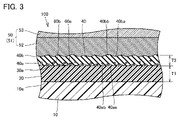
- FIG. 3 is an enlarged cross-sectional view of the cable 100 in the vicinity of the outer peripheral surface 30a.
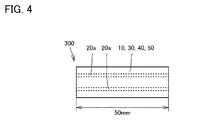
- FIG. 4 is a first schematic diagram for explaining a method of measuring the pull-out strength when the signal line 20a is pulled out from the insulating layer 10.
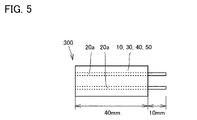
- FIG. 5 is a second schematic diagram for explaining a method of measuring the pull-out strength when the signal line 20a is pulled out from the insulating layer 10.
- FIG. 6 is a third schematic diagram for explaining a method of measuring the pull-out strength when the signal line 20a is pulled out from the insulating layer 10.
- FIG. FIG. FIG. 5 is a first schematic diagram for explaining a method of measuring the pull-out strength when the signal line 20a is pulled out from the insulating layer 10.
- FIG. 5 is a second schematic diagram for explaining a method of measuring the pull-out strength when the signal line 20a is pulled out from
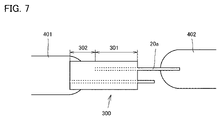
- FIG. 7 is a fourth schematic diagram illustrating a method of measuring the pull-out strength when the signal line 20a is pulled out from the insulating layer 10.
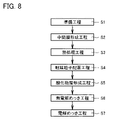
- FIG. 8A to 8D are process diagrams showing a method for manufacturing the cable 100.
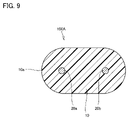
- FIG. 9 is a cross-sectional view of the member to be processed 100A prepared in the preparation step S1.
- FIG. 10 is a cross-sectional view of the member to be processed 100A after the intermediate layer forming step S2 has been performed.
- FIG. 11 is a cross-sectional view of the member 100A to be processed after the catalyst particle placement step S4 has been performed.
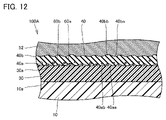
- FIG. 12 is a cross-sectional view of the member 100A to be processed after the oxide layer forming step S5 and the electroless plating step S6 are performed.
- FIG. 9 is a cross-sectional view of the member to be processed 100A prepared in the preparation step S1.
- FIG. 10 is a cross-sectional view of the member to be processed 100A after the intermediate layer forming step S
- FIG. 13 is a cross-sectional view of cable 100 according to Modification 1.
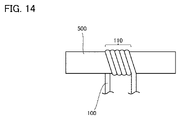
- FIG. 14 is a first schematic diagram for explaining bending of the cable 100.
- FIG. 15 is a second schematic diagram for explaining bending of the cable 100.
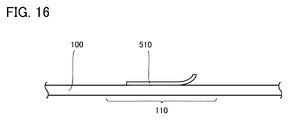
- FIG. 16 is a schematic diagram for explaining a tape peel test on the cable 100.
- FIG. 17 is a schematic diagram of a sample prepared for evaluating the insertion loss of cable 100.
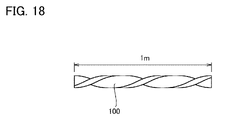
- FIG. 18 is a schematic diagram showing the twist applied to cable 100 during insertion loss assessment of cable 100 .
- the present disclosure has been made in view of the problems of the prior art as described above. More specifically, the present disclosure provides a differential signal transmission cable that has good transmission characteristics in a high frequency range.
- the differential signal transmission cable includes an insulating layer extending along the longitudinal direction of the differential signal transmission cable, and an insulating layer extending along the longitudinal direction of the differential signal transmission cable. a pair of signal wires extending along and embedded within an insulating layer; a shield surrounding the outer peripheral surface of the insulating layer; and a metal oxide layer between the shield and the insulating layer. I have it.
- the differential signal transmission cable of (1) above may further include an intermediate layer covering the outer peripheral surface of the insulating layer.
- the metal oxide layer may cover the outer peripheral surface of the intermediate layer.
- the metal oxide layer may be a layer of copper oxide.
- the differential signal transmission cable of (2) or (3) may further include first catalyst particles in the metal oxide layer.
- the first catalyst particles may be particles containing palladium.
- the thickness of the metal oxide layer is greater than the thickness of the intermediate layer in a cross section perpendicular to the longitudinal direction of the differential signal transmission cable. It can be small.
- the thickness of the metal oxide layer in the cross section orthogonal to the longitudinal direction of the differential signal transmission cable is the thickness of the intermediate layer. It may be 0.001 times or more and 0.9 times or less.
- the metal oxide layer has a thickness of 1.5 nm or more and 223 nm or less in a cross section orthogonal to the longitudinal direction of the differential signal transmission cable.
- the metal oxide layer faces the intermediate layer side. It may have a face and a second face facing the shield.
- the first surface has a first recess recessed toward the second surface and a first protrusion protruding on the side opposite to the second surface. may contain.
- the second surface in a cross section perpendicular to the longitudinal direction of the cable for differential signal transmission, has a second recess recessed toward the first surface and a second A second convex portion projecting on the side opposite to the one surface may be included.
- the thickness of the metal oxide layer is equal to the outer peripheral surface of the intermediate layer. may fluctuate along the
- the metal oxide layer covers the outer peripheral surface of the intermediate layer over the entire circumference. It may be covered.
- the intermediate layer may contain polyolefin.
- the intermediate layer may contain an acrylonitrile-butadiene-styrene resin.
- the cables for differential signal transmission of (2) to (15) above may further include second catalyst particles on the intermediate layer.
- the second catalyst particles may be particles containing palladium.
- the shield may have a plating layer.
- the plating layer may be in contact with the metal oxide layer.
- the plating layer may include an electroless plating layer.
- the electroless plated layer may be in contact with the metal oxide layer.
- the adhesive strength between the electroless plated layer and the metal oxide layer may be 0.1 N/cm or more and 20 N/cm or less.
- the plating layer may include an electrolytic plating layer.
- the electrolytic plating layer may be formed on the electroless plating layer.
- the pull-out strength from the insulating layer of each of the pair of signal lines may be 0.8N or more and 82.5N or less.
- the arithmetic average roughness of the outer peripheral surface of each of the pair of signal lines may be 0.009 ⁇ m or more and 0.54 ⁇ m or less.
- the insulating layer extends from each outer peripheral surface of the pair of signal lines. It may have a first portion whose distance is up to 50 ⁇ m and a second portion whose distance is up to 50 ⁇ m from the outer peripheral surface of the insulating layer.
- the hardness in the second portion may be less than the hardness in the first portion.
- the hardness of the first portion may be 0.02 GPa or more and 0.11 GPa or less.
- the hardness of the second portion may be 0.01 GPa or more and 0.10 GPa or less.
- the insulating layer may contain at least one of polyethylene, cyclic olefin polymer, polymethylpentene and polypropylene.
- the insulating layer may contain polyolefin having a melting point of 120°C or higher.
- the insulating layer may be a layer of foamed resin.
- the pair of signal lines may be the first signal line and the second signal line.
- the insulating layer has a third portion in which the first signal line is embedded and a fourth portion in which the second signal line is embedded.
- the width of the insulating layer in the first direction is perpendicular to the first direction. It may be larger than the width in the second direction.
- the third portion and the fourth portion may be arranged along the first direction.
- the insulating layer is between the third portion and the fourth portion in the first direction and is integrally formed with the third portion and the fourth portion. It may further have a fifth portion.
- the width of the fifth portion in the second direction is smaller than the width of the third portion in the second direction and the width of the fourth portion in the second direction. good too.
- the differential signal transmission cable of (1) to (3) above may further include first catalyst particles in the metal oxide layer and second catalyst particles on the intermediate layer.
- the total content of the first catalyst particles and the second catalyst particles contained in the cable for differential signal transmission may be 0.1 ⁇ g or more and 10 ⁇ g or less per cm along the longitudinal direction.
- the differential signal transmission cable includes an insulating layer extending along the longitudinal direction of the differential signal transmission cable, and an insulating layer extending along the longitudinal direction of the differential signal transmission cable. It includes a pair of signal wires extending along and embedded within the insulating layer and a shield around the outer peripheral surface of the insulating layer.
- the pullout strength of each of the pair of signal lines from the insulating layer is 0.8N or more and 82.5N or less.
- the differential signal transmission cable includes an insulating layer extending along the longitudinal direction of the differential signal transmission cable, and an insulating layer extending along the longitudinal direction of the differential signal transmission cable. It includes a pair of signal wires extending along and embedded within the insulating layer and a shield around the outer peripheral surface of the insulating layer.
- the insulating layer has a first portion, which is a portion at a distance of up to 50 ⁇ m from the outer peripheral surface of each of the pair of signal lines, and the distance from the outer peripheral surface of the insulating layer. and a second portion of which is up to 50 ⁇ m. The hardness in the second portion is less than the hardness in the first portion.
- a differential signal transmission cable (referred to as "cable 100") according to the embodiment will be described below.
- FIG. 1 is a perspective view of the cable 100.
- FIG. FIG. 2 is a cross-sectional view of cable 100. As shown in FIG. FIG. 2 shows a cross section perpendicular to the longitudinal direction of the cable 100 .
- FIG. 3 is an enlarged cross-sectional view of the cable 100 in the vicinity of the outer peripheral surface 30a.
- cable 100 includes insulating layer 10, signal line 20a, signal line 20b, intermediate layer 30, metal oxide layer 40, shield 50, and catalyst particles 60a. , catalyst particles 60b.
- the insulating layer 10 extends along the longitudinal direction of the cable 100.
- the insulating layer 10 is made of an electrically insulating material.
- the insulating layer 10 may be made of foamed resin. That is, the insulating layer 10 may be a layer of foamed resin.
- the thickness of the insulating layer 10 (the distance between the outer peripheral surface 10a described later and the outer peripheral surface of the signal line 20a or the signal line 20b) is, for example, 110 ⁇ m or more and 560 ⁇ m or less. However, the thickness of the insulating layer 10 is not limited to this.
- the insulating layer 10 is made of, for example, polyethylene, cyclic olefin polymer, polymethylpentene, or polypropylene. Insulating layer 10 may be a layer containing one or more of these materials. When polyolefin is used for the insulating layer 10, the melting point of the polyolefin is preferably 120° C. or higher from the viewpoint of heat resistance.
- the insulating layer 10 has an outer peripheral surface 10a.
- the insulating layer 10 has a first portion 11 and a second portion 12 .
- the first portion 11 is a portion up to 50 ⁇ m from the outer peripheral surface of the signal line 20a (signal line 20b).
- the second portion 12 is a portion whose distance from the outer peripheral surface 10a is up to 50 ⁇ m.
- the hardness of the second portion 12 is preferably less than the hardness of the first portion 11 .
- the hardness of the first portion 11 is, for example, 0.02 GPa or more and 0.11 GPa or less.
- the hardness of the second portion 12 is 0.01 GPa or more and 0.10 GPa or less.
- the hardness of the first portion 11 may be 1.03 times or more that of the second portion 12 .
- the hardness of the first portion 11 may be 1.10 times or more the hardness of the second portion 12 .
- the hardness of the first portion 11 may be 1.50 times or less that of the second portion 12 .
- the hardness of the first portion 11 may be 2.00 times or less the hardness of the second portion 12 .
- the hardness of the first portion 11 may be 1.03 times or more and 1.50 times or less of the hardness of the second portion 12 .
- the hardness of the first portion 11 may be 1.03 times or more and 2.00 times or less of the hardness of the second portion 12 .
- the hardness of the first portion 11 may be 1.10 times or more and 1.50 times or less of the hardness of the second portion 12 .
- the hardness of the first portion 11 is, for example, 0.024 GPa or more. In this case, the hardness of the first portion 11 may be 0.024 GPa or more and 0.030 GPa or less.
- the hardness of the second portion 12 is, for example, 0.024 GPa or less. In this case, the hardness of the second portion 12 may be 0.021 GPa or more and 0.024 GPa or less.
- the hardness of the first portion 11 is, for example, 0.060 GPa or more. In this case, the hardness of the first portion 11 may be 0.060 GPa or more and 0.090 GPa or less.
- the hardness of the second portion 12 is, for example, 0.060 GPa or less. In this case, the hardness of the second portion 12 may be 0.045 GPa or more and 0.060 GPa or less.
- the cable 100 has a first direction DR1 and a second direction DR2.
- First direction DR1 is orthogonal to the longitudinal direction of cable 100 .
- the second direction DR2 is orthogonal to the longitudinal direction of the cable 100 and orthogonal to the first direction DR1.
- the insulating layer 10 has a width W1 along the first direction DR1 and a width W2 along the second direction DR2. Width W1 is, for example, greater than width W2.
- the hardness of the first portion 11 and the second portion 12 is measured using a tripoindenter Hysitron TI980 manufactured by Bruker. In this measurement, a Berkovich indenter is used as an indenter. The maximum load is 8mN. The load time is 5 seconds. The maximum load holding time is 0 seconds. This measurement is performed at 25° C. in air.
- the signal line 20a and the signal line 20b are paired.
- a signal having a phase opposite to that applied to the signal line 20a is applied to the signal line 20b.
- the cable 100 transmits differential signals.
- the signal lines 20 a and 20 b are embedded inside the insulating layer 10 .
- the signal line 20 a and the signal line 20 b extend along the longitudinal direction of the cable 100 .
- the signal lines 20a and 20b are made of a conductive material.
- the signal line 20a and the signal line 20b are made of copper (Cu), for example. However, the material forming the signal lines 20a and 20b is not limited to copper.
- the signal line 20a and the signal line 20b are arranged, for example, along the first direction DR1.
- the arithmetic average roughness of the outer peripheral surfaces of the signal lines 20a and 20b is preferably 0.009 ⁇ m or more and 0.54 ⁇ m or less.
- the arithmetic average roughness of the outer peripheral surfaces of the signal wires 20a and 20b is controlled by the arithmetic average roughness of the inner peripheral surface of the mold used when drawing the signal wires 20a and 20b.
- the arithmetic average roughness of the outer peripheral surface of the signal line 20a (signal line 20b) is measured with a laser microscope VM-X150 (manufactured by KEYENCE CORPORATION).
- the signal line 20a (signal line 20b) using a 50x objective lens and applying analysis software VK-H1XM to the observation result, the signal line 20a ( The arithmetic mean roughness of the outer peripheral surface of the signal line 20b) is calculated.
- the pullout strength when the signal line 20a (signal line 20b) is pulled out from the insulating layer 10 is preferably 0.8N or more and 82.5N or less.
- the pull-out strength when the signal line 20a (signal line 20b) is pulled out from the insulating layer 10 is measured by the following method.
- FIG. 4 is a first schematic diagram for explaining a method of measuring the pull-out strength when the signal line 20a is pulled out from the insulating layer 10.
- FIG. A cable 100 having a length of 50 mm is prepared as a test piece 300, as shown in FIG.
- FIG. 5 is a second schematic diagram for explaining a method of measuring the pull-out strength when the signal line 20a is pulled out from the insulating layer 10.
- the width of the removed insulating layer 10 is 10 mm.
- the signal line 20a and the signal line 20b with a length of 10 mm are exposed from the ends of the test piece 300.
- the intermediate layer 30, the metal oxide layer 40 and the shield 50 on the insulating layer 10 at the end of the test piece 300 are also removed.
- FIG. 6 is a third schematic diagram for explaining a method of measuring the pull-out strength when the signal line 20a is pulled out from the insulating layer 10.
- the signal line 20a is drawn so that the exposed length from the insulating layer 10 is 30 mm.
- the test piece 300 has a first region 301 in which the signal line 20a exists inside the insulating layer 10 and a second region 302 in which the signal line 20a does not exist inside the insulating layer 10 .
- FIG. 7 is a fourth schematic diagram illustrating a method of measuring the pull-out strength when the signal line 20a is pulled out from the insulating layer 10.
- a tensile tester is used to pull out the signal line 20a from the insulating layer 10.
- the tensile tester is, for example, Shimadzu EZ-LX.
- the tensile tester has a first chuck 401 and a second chuck 402 .
- the first chuck 401 chucks the second area 302 .
- the second chuck 402 chucks the signal line 20 a exposed from the insulating layer 10 .
- the tensile tester pulls out the signal line 20a from the insulating layer 10 by moving the first chuck 401 and the second chuck 402 away from each other.
- the maximum value of the force detected by the tensile tester at this time is the pull-out strength when the signal line 20 a is pulled out from the insulating layer 10 .
- the intermediate layer 30 covers the outer peripheral surface 10a.
- the intermediate layer 30 has an outer peripheral surface 30a.
- the intermediate layer 30 is made of an electrically insulating material.
- the intermediate layer 30 is made of polyolefin, for example.
- the intermediate layer 30 may be made of acrylonitrile-butadiene-styrene resin (ABS resin).
- ABS resin acrylonitrile-butadiene-styrene resin
- the metal oxide layer 40 is a layer of metal oxide. This metal oxide is, for example, copper oxide (CuO). However, this metal oxide is not limited to copper oxide.
- the metal oxide layer 40 covers the outer peripheral surface 30a.
- the metal oxide layer 40 preferably covers the outer peripheral surface 30a over the entire circumference. However, the metal oxide layer 40 may not partially cover the outer peripheral surface 30a. In this case, that part of the outer peripheral surface 30 a is in contact with the shield 50 .
- the metal oxide layer 40 has a first surface 40a and a second surface 40b opposite to the first surface 40a.
- the first surface 40a is a surface facing the intermediate layer 30 side.
- the second surface 40b is a surface facing the shield 50 side.
- the metal oxide layer 40 contacts the intermediate layer 30 on the first surface 40a and contacts the shield 50 on the second surface 40b.
- the first surface 40a may have an irregular shape. That is, the first surface 40a includes a plurality of concave portions 40aa and a plurality of convex portions 40ab. The first surface 40a is recessed toward the second surface 40b at the concave portion 40aa, and protrudes to the opposite side from the second surface 40b at the convex portion 40ab.
- the second surface 40b may have an irregular shape. That is, the second surface 40b includes a plurality of concave portions 40ba and a plurality of convex portions 40bb. The second surface 40b is recessed toward the first surface 40a at the concave portion 40ba, and protrudes opposite to the first surface 40a at the convex portion 40bb.
- the thickness T2 of the metal oxide layer 40 is preferably smaller than the thickness T1 of the intermediate layer 30.
- the thickness T2 is preferably 0.001 to 0.9 times the thickness T1.
- the thickness T1 is, for example, 200 nm or more and 1000 nm or less. However, the thickness T1 is not limited to this.
- the thickness T2 is, for example, 1.5 nm or more and 223 nm or more.
- the thickness T2 is preferably 2.9 nm or more and 130 nm or less. However, the thickness T2 is not limited to this.
- the shield 50 covers the second surface 40b. That is, the shield 50 surrounds the outer peripheral surface 10a with the intermediate layer 30 and the metal oxide layer 40 therebetween.
- a metal oxide layer 40 is between the insulating layer 10 and the shield 50 .
- a metal oxide layer 40 is between the intermediate layer 30 and the shield 50 .
- the shield 50 has electrical conductivity.
- the shield 50 is, for example, a copper layer 51.
- the copper layer 51 is a layer formed by plating.
- the copper layer 51 has, for example, a first copper layer 52 formed by electroless plating.
- the copper layer 51 may further have a second copper layer 53 formed by electrolytic plating.
- the first copper layer 52 is, for example, an electroless copper plating layer.
- the first copper layer 52 contacts the metal oxide layer 40 .
- the second copper layer 53 is, for example, an electrolytic copper plating layer.
- a second copper layer 53 is formed on the first copper layer 52 .
- the catalyst particles 60a are in the metal oxide layer 40.
- the surfaces of the catalyst particles 60 a are covered with the metal oxide layer 40 .
- the catalyst particles 60b are on the outer peripheral surface 30a.
- the surfaces of the catalyst particles 60b are partially in contact with the outer peripheral surface 30a and partially in contact with the first surface 40a.
- the catalyst particles 60a and the catalyst particles 60b are, for example, particles containing palladium (Pd). However, catalyst particles 60a and catalyst particles 60b are not limited to particles containing palladium.
- the catalyst particles 60a and the catalyst particles 60b may be particles containing, for example, copper, silver (Ag), gold (Au), or the like.
- the catalyst particles 60a and the catalyst particles 60b may contain different materials, or may contain the same material.
- the total content of catalyst particles 60a and catalyst particles 60b contained in cable 100 is preferably 0.1 ⁇ g or more and 10 ⁇ g or less per 1 cm along the longitudinal direction of cable 100.
- the total content of catalyst particles 60a and catalyst particles 60b per cm along the length of cable 100 is measured using an inductively coupled plasma mass spectrometer.
- FIG. 8A to 8D are process diagrams showing a method for manufacturing the cable 100.
- the method for manufacturing the cable 100 includes a preparation step S1, an intermediate layer forming step S2, a heat treatment step S3, a catalyst particle placement step S4, an oxide layer forming step S5, electroless plating. It has a step S6 and an electrolytic plating step S7.
- the intermediate layer forming step S2 is performed.
- a heat treatment step S3 is performed after the intermediate layer forming step S2.
- the catalyst particle placement step S4 is performed.
- the oxide layer forming step S5 is performed after the catalyst particle arranging step S4.
- Electroless plating process S6 is performed after oxide layer formation process S5. After the electroless plating step S6, an electrolytic plating step S7 is performed.
- FIG. 9 is a cross-sectional view of the member to be processed 100A prepared in the preparation step S1.
- the processing target member 100A has an insulating layer 10, signal lines 20a, and signal lines 20b.
- FIG. 10 is a cross-sectional view of the member to be processed 100A after the intermediate layer forming step S2 has been performed.
- intermediate layer forming step S2 intermediate layer 30 is formed to cover outer peripheral surface 10a.
- the material forming the intermediate layer 30 is applied to the outer peripheral surface 10a, and the applied material is cured to form the intermediate layer 30 so as to cover the outer peripheral surface 10a.
- the member 100A to be processed on which the intermediate layer 30 is formed is heat-treated at a predetermined temperature for a predetermined time.
- the predetermined temperature is, for example, 80° C. or higher and 120° C. or lower.
- the predetermined time is, for example, 1 minute or more and 30 minutes or less.
- the hardness of the second portion 12 is lower than the hardness of the first portion 11 .
- FIG. 11 is a cross-sectional view of the member 100A to be processed after the catalyst particle placement step S4 has been performed.
- the catalyst particles 60 are dispersedly arranged on the outer peripheral surface 30a.
- a solution containing the catalyst particles 60 is applied to the outer peripheral surface 30a, and the solution is volatilized to disperse and arrange the catalyst particles 60 on the outer peripheral surface 30a.
- FIG. 12 is a cross-sectional view of the member 100A to be processed after the oxide layer forming step S5 and the electroless plating step S6 are performed. As shown in FIG. 12, the metal oxide layer 40 is formed in the oxide layer forming step S5, and the first copper layer 52 is formed on the metal oxide layer 40 in the electroless plating step S6.
- the oxide layer forming step S5 first, the material contained in the first copper layer 52 is dissolved, and an oxygen-containing gas (for example, air) is bubbled through the plating solution to which the object to be treated is placed. Member 100A is immersed. As a result, the metal oxide layer 40 is formed so as to cover the outer peripheral surface 30a with the catalyst particles 60 as nuclei.
- the catalyst particles 60a are the nuclei for the growth of the metal oxide layer 40, and the other catalyst particles 60b.
- the above bubbling is stopped in the electroless plating step S6.
- the first copper layer 52 is plated on the metal oxide layer 40 .
- the second copper layer 53 is formed so as to cover the first copper layer 52.
- the member 100A to be processed is immersed in a plating solution in which the material contained in the second copper layer 53 is dissolved, and the first copper layer 52 is energized. Thereby, the second copper layer 53 is plated on the first copper layer 52, and the cable 100 having the structure shown in FIGS. 1 to 3 is manufactured.
- the shield 50 is in close contact with the insulating layer 10 via the metal oxide layer 40, in the cable 100, the roughening of the outer peripheral surface 10a reduces the insertion loss in the high frequency region. Hard to get worse. Therefore, cable 100 has good transmission characteristics in the high frequency region.
- the hardness of the second portion 12 is smaller than the hardness of the first portion 11.
- the geometrical moment of inertia of the insulating layer 10 is reduced, and the deformation of the insulating layer 10 can easily follow the deformation of the cable 100 . Therefore, in this case, when the cable 100 is bent, the insulating layer 10 is less likely to peel off from the signal wire 20a (signal wire 20b).
- the adhesion between the signal line 20a (signal line 20b) and the insulating layer 10 improves as the arithmetic average roughness of the outer peripheral surface of the signal line 20a (signal line 20b) increases.
- this high adhesion results in deterioration of the attenuation characteristics of the cable 100 in the high frequency region.
- the signal line 20a (signal line 20b) is pulled out from the insulating layer 10 with a sufficient pull-out strength. (more specifically, 0.8 N or more and 82.5 N or less), the attenuation characteristic in the high frequency region of the cable 100 can be maintained.
- the metal In the cross section orthogonal to the longitudinal direction of the cable 100, when the second surface 40b has an irregular shape (that is, the second surface 40b has the concave portion 40ba and the convex portion 40bb), the metal The contact area between oxide layer 40 and shield 50 is increased. Therefore, in this case, the above-mentioned hydrogen bonds act more strongly, and the adhesion of the shield 50 can be further ensured.
- FIG. 13 is a cross-sectional view of cable 100 according to Modification 1. As shown in FIG. 13 shows a cross section perpendicular to the longitudinal direction of the cable 100 according to Modification 1. As shown in FIG. As shown in FIG. 13, the cable 100 has a third portion 13, a fourth portion 14, and a fifth portion 15 in the cross section orthogonal to the longitudinal direction of the cable 100. good.
- a signal line 20a and a signal line 20b are embedded in the third portion 13 and the fourth portion 14, respectively.
- the third portion 13, the fourth portion 14 and the fifth portion 15 are arranged along the first direction DR1.
- the fifth portion 15 is arranged between the third portion 13 and the fourth portion 14 in the first direction DR1.
- the fifth portion 15 is formed integrally with the third portion 13 and the fourth portion 14 .
- the width W3 of the third portion 13 in the second direction DR2 and the width W4 of the fourth portion 14 in the second direction DR2 are larger than the width W5 of the fifth portion 15 in the second direction DR2.
- the outer peripheral surface 10a has a pair of notches facing each other in the second direction DR2 between the third portion 13 and the fourth portion 14. As shown in FIG.
- Cable 100 may not have intermediate layer 30 . If the cable 100 does not have the intermediate layer 30, the intermediate layer forming step S2 is omitted. In this case, the metal oxide layer 40 directly covers the outer peripheral surface 10a.
- the heat treatment step S3 is performed after the intermediate layer forming step S2.
- the heat treatment step S3 may be performed after the preparation step S1.
- the heat treatment step S3 may be performed after the catalyst particle placement step S4.
- Samples 1-1 to 1-10 of cable 100 were prepared in order to evaluate the adhesion between shield 50 and insulating layer 10 .
- the material constituting the insulating layer 10 the presence or absence of the intermediate layer 30, the processing time of the oxide layer forming step S5, and the oxide layer forming step
- the type of gas used for bubbling S5 and the thickness of the metal oxide layer 40 were varied.
- FIG. 14 is a first schematic diagram for explaining bending of the cable 100.
- the cable 100 is wound around a cylindrical member 500 in bending.
- a portion of the cable 100 that is wound around the cylindrical member 500 in the bending process is referred to as a bent portion 110 .
- FIG. 15 is a second schematic diagram for explaining bending of the cable 100.
- FIG. 15 As shown in FIG. 15, after the above winding has taken place, the cable 100 is removed from the cylindrical member 500 and straightened back.
- FIG. 16 is a schematic diagram for explaining the tape peel test on the cable 100.
- the tape 510 is attached to the bent portion 110 of the cable 100 after bending.
- the tape 510 is a tape conforming to the JIS standard (JIS5400) and having an adhesive force of 10 ⁇ 1 N/25 mm.
- Second, the tape 510 is peeled off the bend 110 within 5 minutes after being applied to the bend 110 .
- Adhesion between the shield 50 and the insulating layer 10 was evaluated based on whether or not the shield 50 was peeled off by peeling off the tape 510 .
- C in the "adhesion between the shield 50 and the insulating layer 10" column in Table 1 indicates that the shield 50 was peeled off in the tape peel test after bending using the cylindrical member 500 having a diameter of 300 mm.
- a tape peel test after bending using a cylindrical member 500 having a diameter of 200 mm indicates that the shield 50 had delaminated.
- the adhesion between the shield 50 and the insulating layer 10 is the lowest when the “adhesion between the shield 50 and the insulating layer 10" column in Table 1 is "C”, and the adhesion between the shield 50 and the insulating layer 10 is the lowest when " The adhesion between the shield 50 and the insulating layer 10 is the highest when the column "Adhesion between the shield 50 and the insulating layer 10" is "A”.
- the metal oxide layer 40 was not formed in samples 1-1 and 1-8. On the other hand, the metal oxide layer 40 was formed in samples 1-2 to 1-7, 1-9 and 1-10. From this comparison, it is clear that the cable 100 having the metal oxide layer 40 enhances the adhesion between the shield 50 and the insulating layer 10 .
- the thickness of the metal oxide layer 40 was not within the range of 2.9 nm or more and 130 nm or less.
- the thickness of the metal oxide layer 40 was within the range of 2.9 nm or more and 130 nm or less. This comparison reveals that the adhesion between the shield 50 and the insulating layer 10 is further enhanced by setting the thickness of the metal oxide layer 40 to 2.9 nm or more and 130 nm or less.
- the flexibility of the insulating layer 10 was evaluated by performing a cable bending test on the cable 100.
- the cable bending test first, the cable 100 is subjected to bending. Bending is performed by the method shown in FIGS.
- the diameter of the cylindrical member 500 used for bending was set to 10 mm.
- the hardness of the second portion 12 was not less than the hardness of the first portion 11.
- the hardness of the second portion 12 was lower than the hardness of the first portion 11 . From this comparison, it can be seen that the hardness of the second portion 12 is lower than that of the first portion 11, so that the flexibility of the insulating layer 10 is increased, and the insulating layer 10 and the signal line 20a (signal line 20b) are connected. It was clarified that delamination is less likely to occur between them.
- Samples 3-1 to 3-8 of the cable 100 were prepared in order to evaluate the relationship between the pull-out strength when the signal line 20a of the cable 100 is pulled out from the insulating layer 10 and the insertion loss. As shown in Table 3, in Samples 3-1 to 3-8, the arithmetic average roughness of the signal line 20a, the material forming the insulating layer 10, and the drawing when the signal line 20a was drawn out from the insulating layer 10 Varying intensity.
- FIG. 17 is a schematic diagram of a sample prepared for evaluating the insertion loss of the cable 100.
- cables 100 having a length of 1 m were prepared as samples 3-1 to 3-8 in the evaluation of the insertion loss of cable 100.
- FIG. 18 is a schematic diagram showing the torsion applied to the cable 100 when evaluating insertion loss of the cable 100.
- twist is applied to samples 3-1 to 3-8. Samples 3-1 to 3-8 were twisted by 180° every 200 mm. As described above, since the length of Samples 3-1 to 3-8 is 1 m, Samples 3-1 to 3-8 are twisted by 2.5 turns. The insertion loss of Samples 3-1 to 3-8 was measured by inputting a differential mode signal to Samples 3-1 to 3-8 with the twist applied.
- Peripheral surface 10 Insulating layer 10a Peripheral surface 11 First part 12 Second part 13 Third part 14 Fourth part 15 Fifth part 20a, 20b Signal line 30 Intermediate layer 30a Peripheral surface 40 Metal oxidation Material layer, 40a first surface, 40aa concave portion, 40ab convex portion, 40b second surface, 40ba concave portion, 40bb convex portion, 50 shield, 51 copper layer, 52 first copper layer, 53 second copper layer, 60 catalyst particles, 60a catalyst particles, 60b catalyst particles, 100 cable, 100A member to be processed, 110 bent portion, 300 test piece, 301 first region, 302 second region, 401 first chuck, 402 second chuck, 500 cylindrical member, 510 tape , DR1 first direction, DR2 second direction, L distance, S1 preparation process, S2 intermediate layer formation process, S3 heat treatment process, S4 catalyst particle placement process, S5 metal oxide layer formation process, S6 electroless plating process, S7 electrolysis Plating process, T1, T2 thickness, W1, W2, W
Landscapes
- Physics & Mathematics (AREA)
- Electromagnetism (AREA)
- Insulated Conductors (AREA)
Priority Applications (4)
| Application Number | Priority Date | Filing Date | Title |
|---|---|---|---|
| PCT/JP2021/006167 WO2022176121A1 (ja) | 2021-02-18 | 2021-02-18 | 差動信号伝送用ケーブル |
| CN202180089167.8A CN116783664A (zh) | 2021-02-18 | 2021-02-18 | 差动信号传输用电缆 |
| US18/274,902 US12451270B2 (en) | 2021-02-18 | 2021-02-18 | Differential signal transmission cable |
| JP2023500235A JP7677397B2 (ja) | 2021-02-18 | 2021-02-18 | 差動信号伝送用ケーブル |
Applications Claiming Priority (1)
| Application Number | Priority Date | Filing Date | Title |
|---|---|---|---|
| PCT/JP2021/006167 WO2022176121A1 (ja) | 2021-02-18 | 2021-02-18 | 差動信号伝送用ケーブル |
Publications (1)
| Publication Number | Publication Date |
|---|---|
| WO2022176121A1 true WO2022176121A1 (ja) | 2022-08-25 |
Family
ID=82930389
Family Applications (1)
| Application Number | Title | Priority Date | Filing Date |
|---|---|---|---|
| PCT/JP2021/006167 Ceased WO2022176121A1 (ja) | 2021-02-18 | 2021-02-18 | 差動信号伝送用ケーブル |
Country Status (4)
| Country | Link |
|---|---|
| US (1) | US12451270B2 (https=) |
| JP (1) | JP7677397B2 (https=) |
| CN (1) | CN116783664A (https=) |
| WO (1) | WO2022176121A1 (https=) |
Families Citing this family (1)
| Publication number | Priority date | Publication date | Assignee | Title |
|---|---|---|---|---|
| US20240196582A1 (en) * | 2021-07-01 | 2024-06-13 | Sumitomo Electric Industries, Ltd. | Differential signal transmission cable |
Citations (2)
| Publication number | Priority date | Publication date | Assignee | Title |
|---|---|---|---|---|
| WO2015001817A1 (ja) * | 2013-07-03 | 2015-01-08 | Jx日鉱日石金属株式会社 | 電磁波シールド用金属箔、電磁波シールド材及びシールドケーブル |
| JP2016015255A (ja) * | 2014-07-02 | 2016-01-28 | 日立金属株式会社 | 差動信号伝送用ケーブル及びその製造方法並びに多芯差動信号伝送用ケーブル |
Family Cites Families (12)
| Publication number | Priority date | Publication date | Assignee | Title |
|---|---|---|---|---|
| JPS54111839A (en) | 1978-02-22 | 1979-09-01 | Nippon Telegr & Teleph Corp <Ntt> | Optical fiber core |
| JP3092668B1 (ja) | 1999-09-03 | 2000-09-25 | 住友電気工業株式会社 | 高圧リード線 |
| US6551658B1 (en) * | 2001-05-18 | 2003-04-22 | Ensci Inc. | Process for producing thin film metal oxide coated substrates |
| JP2008004275A (ja) * | 2006-06-20 | 2008-01-10 | Nissei Electric Co Ltd | 2芯平行同軸ケーブル |
| JP2010055925A (ja) | 2008-08-28 | 2010-03-11 | Sumitomo Wiring Syst Ltd | 絶縁電線およびワイヤーハーネス |
| BR112013003296A2 (pt) * | 2010-08-31 | 2016-06-07 | 3M Innovatie Properties Company | cabo elétrico blindado e montagem de cabo |
| JP6594606B2 (ja) * | 2013-01-31 | 2019-10-23 | 日東電工株式会社 | 粘着剤組成物および粘着シート |
| JP6898062B2 (ja) | 2016-01-20 | 2021-07-07 | 日立金属株式会社 | 差動伝送用ケーブル及び多対差動伝送用ケーブル |
| JP6245402B1 (ja) | 2017-07-04 | 2017-12-13 | 日立金属株式会社 | 差動信号伝送用ケーブル、多芯ケーブル、及び差動信号伝送用ケーブルの製造方法 |
| JP7195735B2 (ja) * | 2017-12-18 | 2022-12-26 | 日立金属株式会社 | 信号伝送用ケーブル |
| JP7010018B2 (ja) | 2018-01-19 | 2022-01-26 | 日立金属株式会社 | 信号伝送用ケーブル |
| CN111684547A (zh) | 2018-02-02 | 2020-09-18 | 住友电气工业株式会社 | 2芯平行电线 |
-
2021
- 2021-02-18 CN CN202180089167.8A patent/CN116783664A/zh active Pending
- 2021-02-18 JP JP2023500235A patent/JP7677397B2/ja active Active
- 2021-02-18 WO PCT/JP2021/006167 patent/WO2022176121A1/ja not_active Ceased
- 2021-02-18 US US18/274,902 patent/US12451270B2/en active Active
Patent Citations (2)
| Publication number | Priority date | Publication date | Assignee | Title |
|---|---|---|---|---|
| WO2015001817A1 (ja) * | 2013-07-03 | 2015-01-08 | Jx日鉱日石金属株式会社 | 電磁波シールド用金属箔、電磁波シールド材及びシールドケーブル |
| JP2016015255A (ja) * | 2014-07-02 | 2016-01-28 | 日立金属株式会社 | 差動信号伝送用ケーブル及びその製造方法並びに多芯差動信号伝送用ケーブル |
Also Published As
| Publication number | Publication date |
|---|---|
| JP7677397B2 (ja) | 2025-05-15 |
| CN116783664A (zh) | 2023-09-19 |
| US20240312672A1 (en) | 2024-09-19 |
| US12451270B2 (en) | 2025-10-21 |
| JPWO2022176121A1 (https=) | 2022-08-25 |
Similar Documents
| Publication | Publication Date | Title |
|---|---|---|
| US8921696B2 (en) | Wiring harness and a method for producing the same, and a method for connecting insulated wires | |
| JP6324164B2 (ja) | 複合撚線 | |
| CN113823455B (zh) | 同轴电缆和电缆组件 | |
| CN103503082A (zh) | 多芯线缆 | |
| CN109791815B (zh) | 线束用线股和线束 | |
| JP6185419B2 (ja) | アルミニウムめっきステンレス鋼線 | |
| JP2012146431A (ja) | 電線導体及び絶縁電線 | |
| WO2022176121A1 (ja) | 差動信号伝送用ケーブル | |
| US11715584B2 (en) | Coaxial cable and cable assembly | |
| JP7081699B2 (ja) | 同軸ケーブル及びケーブルアセンブリ | |
| US12250802B2 (en) | Differential signal transmission cable | |
| US11942234B2 (en) | Coaxial cable and cable assembly | |
| JP2003051219A (ja) | 超極細同軸ケーブル | |
| JP2002203437A (ja) | シールド付きケーブル | |
| US12159730B2 (en) | Signal transmission cable and cable assembly | |
| CN113966539B (zh) | 铜覆钢线、绞合线、绝缘电线以及电缆 | |
| JP2017174559A (ja) | 絶縁電線および絶縁電線の製造方法 | |
| US20240196582A1 (en) | Differential signal transmission cable | |
| JP3054793B2 (ja) | 合せ配線板の布線用電線およびその製造方法 | |
| JP2004118112A (ja) | 光ケーブル補強用金属線 | |
| JPS58123606A (ja) | 端末処理された平型電線 |
Legal Events
| Date | Code | Title | Description |
|---|---|---|---|
| 121 | Ep: the epo has been informed by wipo that ep was designated in this application |
Ref document number: 21926556 Country of ref document: EP Kind code of ref document: A1 |
|
| ENP | Entry into the national phase |
Ref document number: 2023500235 Country of ref document: JP Kind code of ref document: A |
|
| WWE | Wipo information: entry into national phase |
Ref document number: 202180089167.8 Country of ref document: CN |
|
| WWE | Wipo information: entry into national phase |
Ref document number: 18274902 Country of ref document: US |
|
| NENP | Non-entry into the national phase |
Ref country code: DE |
|
| 122 | Ep: pct application non-entry in european phase |
Ref document number: 21926556 Country of ref document: EP Kind code of ref document: A1 |
|
| WWG | Wipo information: grant in national office |
Ref document number: 18274902 Country of ref document: US |