WO2022172829A1 - 光学活性インダゾリルアラニン又はインダゾリルアルデヒドの製造方法 - Google Patents
光学活性インダゾリルアラニン又はインダゾリルアルデヒドの製造方法 Download PDFInfo
- Publication number
- WO2022172829A1 WO2022172829A1 PCT/JP2022/004115 JP2022004115W WO2022172829A1 WO 2022172829 A1 WO2022172829 A1 WO 2022172829A1 JP 2022004115 W JP2022004115 W JP 2022004115W WO 2022172829 A1 WO2022172829 A1 WO 2022172829A1
- Authority
- WO
- WIPO (PCT)
- Prior art keywords
- formula
- indazolylalanine
- represented
- group
- acid
- Prior art date
- Legal status (The legal status is an assumption and is not a legal conclusion. Google has not performed a legal analysis and makes no representation as to the accuracy of the status listed.)
- Ceased
Links
Classifications
-
- C—CHEMISTRY; METALLURGY
- C07—ORGANIC CHEMISTRY
- C07D—HETEROCYCLIC COMPOUNDS
- C07D231/00—Heterocyclic compounds containing 1,2-diazole or hydrogenated 1,2-diazole rings
- C07D231/54—Heterocyclic compounds containing 1,2-diazole or hydrogenated 1,2-diazole rings condensed with carbocyclic rings or ring systems
- C07D231/56—Benzopyrazoles; Hydrogenated benzopyrazoles
-
- C—CHEMISTRY; METALLURGY
- C07—ORGANIC CHEMISTRY
- C07D—HETEROCYCLIC COMPOUNDS
- C07D405/00—Heterocyclic compounds containing both one or more hetero rings having oxygen atoms as the only ring hetero atoms, and one or more rings having nitrogen as the only ring hetero atom
- C07D405/02—Heterocyclic compounds containing both one or more hetero rings having oxygen atoms as the only ring hetero atoms, and one or more rings having nitrogen as the only ring hetero atom containing two hetero rings
- C07D405/06—Heterocyclic compounds containing both one or more hetero rings having oxygen atoms as the only ring hetero atoms, and one or more rings having nitrogen as the only ring hetero atom containing two hetero rings linked by a carbon chain containing only aliphatic carbon atoms
-
- C—CHEMISTRY; METALLURGY
- C12—BIOCHEMISTRY; BEER; SPIRITS; WINE; VINEGAR; MICROBIOLOGY; ENZYMOLOGY; MUTATION OR GENETIC ENGINEERING
- C12P—FERMENTATION OR ENZYME-USING PROCESSES TO SYNTHESISE A DESIRED CHEMICAL COMPOUND OR COMPOSITION OR TO SEPARATE OPTICAL ISOMERS FROM A RACEMIC MIXTURE
- C12P13/00—Preparation of nitrogen-containing organic compounds
- C12P13/04—Alpha- or beta- amino acids
- C12P13/22—Tryptophan; Tyrosine; Phenylalanine; 3,4-Dihydroxyphenylalanine
Definitions
- the present invention relates to indazoles such as optically active indazolylalanine or indazolylaldehyde, and includes first and second aspects.
- a compound having an indazole skeleton can be used as a synthetic intermediate for a drug having the skeleton, for example, a compound represented by formula (10).
- the compound represented by the formula (10) is a calcitonin gene-related peptide (CGRP) receptor antagonist. etc. is disclosed.
- Non-Patent Document 1 has the following problems.
- An object of the present invention (first aspect) is to provide a method capable of producing optically active indazolylalanine (8) or indazolylaldehyde (3) from dimethylaniline (1) without requiring cryogenic conditions. That's what it is.
- An object of the present invention (second aspect) is to provide a method for asymmetrically synthesizing a compound having an indazolylalanine skeleton from a stable compound without using an expensive catalyst.
- [3] further comprising a step (B) of obtaining an indazolylaldehyde represented by formula (3) by cyclizing the aminobenzaldehyde represented by formula (2) obtained in the formylation step [1] or [ 2].
- step (B) The production method according to [3], wherein the aminobenzaldehyde (2) is treated with nitrous acid or an alkyl nitrite in the step (B).
- Step (A) of formylating dimethylaniline represented by formula (1) Production of indazolylaldehyde (3) comprising step (B) of obtaining indazolylaldehyde of formula (3) by cyclizing aminobenzaldehyde of formula (2) obtained in the formylation step Method.
- treating the dimethylaniline (1) in the step (A) with an acid and hexamethylenetetramine The production method according to [11], wherein the aminobenzaldehyde (2) is treated with nitrous acid or an alkyl nitrite in the step (B).
- first aspect and the second aspect also include the following inventions.
- [10] The production method according to any one of [1] to [9], wherein an optically active indazolylalanine ester represented by formula (9) or a salt thereof is produced from the optically active indazolylalanine (8). . (Wherein, R 2 represents an alkyl group having 1 to 6 carbon atoms)
- aminobenzaldehyde (2) can be produced from dimethylaniline (1) without requiring cryogenic conditions.
- Optically active indazolylalanine (8) or indazolylaldehyde (3) can be produced from aminobenzaldehyde (2) thus produced.
- an optically active indazolyl is synthesized from stable compounds such as indazolylmethylhydantoin (5) and N-carbonylated indazolylalanine (7) without using an expensive catalyst.
- Rylalanine (8) can be synthesized asymmetrically.
- the present invention (first aspect) relates to a method for producing indazoles from anilines. It has a step (A) of manufacturing. This step (A) is advantageous in that it does not require cryogenic conditions. Aminobenzaldehyde (2) obtained in step (A) is useful as a raw material for producing optically active indazolylalanine (8) as described later.
- step (A) for example, the dimethylaniline (1) is preferably treated with an acid and hexamethylenetetramine. Acid and hexamethylenetetramine can be used to obtain aminobenzaldehyde (2) in moderate amounts with high conversion without cryogenic conditions.
- carboxylic acids such as acetic acid and trifluoroacetic acid are preferable, and saturated aliphatic carboxylic acids having 3 to 5 carbon atoms are more preferable.
- the amount of the acid is, for example, about 1 to 100 mol, preferably about 3 to 60 mol, more preferably about 5 to 20 mol, per 1 mol of dimethylaniline (1).
- the amount of hexamethylenetetramine is, for example, 1 to 20 mol, preferably 1.2 to 10 mol, more preferably 1.5 to 5 mol, per 1 mol of dimethylaniline (1).
- the reaction solvent in step (A) is, for example, preferably water, and may be a mixed solvent of water and a water-soluble organic solvent.
- water-soluble organic solvents include alcohols such as methanol and ethanol, cyclic ethers such as tetrahydrofuran and dioxane, and amides such as dimethylformamide.
- the amount of the reaction solvent is, for example, about 0.1 to 20 parts by weight, preferably 0.5 to 10 parts by weight, and more preferably about 1 to 5 parts by weight with respect to 1 part by weight of dimethylaniline (1).
- the reaction temperature in step (A) can be selected from a range that is not extremely low, for example, 0 to 150°C, preferably 50 to 150°C, more preferably 80 to 120°C. Also, the upper limit of the reaction temperature may be the boiling point of the solvent.
- reaction time of step (A) is, for example, 0.1 to 20 hours, preferably 0.3 to 10 hours, more preferably 0.5 to 5 hours.
- the product may be removed from the reaction solution as necessary.
- an extracting solvent such as ethyl acetate, diethyl ether, methylene chloride, toluene, heptane, etc. to extract the desired product into the organic layer side and extract the water-soluble component. is preferably removed.
- the product obtained in this way has sufficient purity to be used in subsequent steps, but for the purpose of further increasing the purity, it is purified by general purification techniques such as crystallization, fractional distillation, and column chromatography. , may be further purified.
- the present invention preferably includes a step (B) of cyclizing the aminobenzaldehyde (2) obtained in the step (A) to obtain an indazolylaldehyde represented by the formula (3).
- indazolyl aldehyde (3) can also be produced without requiring cryogenic conditions.
- Indazolylaldehyde (3) is also useful as a raw material for producing optically active indazolylalanine (8) as described later.
- step (B) for example, it is preferable to treat the aminobenzaldehyde (2) with nitrous acid or an alkyl nitrite (hereinafter collectively referred to as a nitrite compound). Treatment of aminobenzaldehyde (2) with a nitrite compound affords a suitable amount of indazolylaldehyde (3) with high conversion even without cryogenic conditions.
- a nitrite compound an alkyl nitrite
- alkyl nitrite examples include methyl nitrite, ethyl nitrite, n-propyl nitrite, isopropyl nitrite, n-butyl nitrite, isobutyl nitrite, t-butyl nitrite, and isoamyl nitrite (also known as amyl nitrite).
- C 4-8 alkyl nitrite such as C 1-10 alkyl nitrite (preferably C 4-8 alkyl nitrite), and amyl nitrite is preferred.
- the nitrous acid may be prepared from a nitrite salt (preferably an alkali metal salt) such as sodium nitrite and an acid (inorganic acid such as hydrochloric acid, sulfuric acid, etc.).
- a nitrite salt preferably an alkali metal salt
- an acid inorganic acid such as hydrochloric acid, sulfuric acid, etc.
- the amount of nitrite compound is, for example, 1.00 to 3 mol, preferably 1.05 to 2 mol, more preferably 1.10 to 1.5 mol, per 1 mol of aminobenzaldehyde (2).
- the synthesis reaction of the indazolyl compound (3) with a nitrite compound is preferably carried out in the presence of an acid.
- the presence of acid promotes diazotization and indazolylation.
- the acid include inorganic acids such as hydrochloric acid and sulfuric acid, carboxylic acids such as acetic acid (preferably saturated aliphatic carboxylic acids having 3 to 5 carbon atoms), and carboxylic acids are preferred.
- the amount of carboxylic acid is, for example, 0.1 to 5 mol, preferably 0.8 to 3 mol, more preferably 1.1 to 2 mol, per 1 mol of aminobenzaldehyde (2).
- a carboxylic acid salt such as a salt of an alkali metal such as sodium or potassium and a carboxylic acid
- the amount of carboxylate is, for example, 0.1 to 10 mol, preferably 0.3 to 5 mol, more preferably 0.5 to 2 mol, per 1 mol of carboxylic acid.
- the reaction solvent in step (B) is, for example, water; alcohols such as methanol, ethanol, propanol, ethylene glycol; - ether solvents such as methyltetrahydropyran; aliphatic hydrocarbon solvents such as pentane, hexane, heptane and methylcyclohexane; aromatic hydrocarbon solvents such as benzene, toluene, xylene, ethylbenzene and mesitylene; N,N-dimethyl Amide solvents such as formamide, N,N-dimethylacetamide, N,N-diethylacetamide, N-methyl-2-pyrrolidone, N-ethyl-2-pyrrolidone, N-methyl- ⁇ -caprolactam, hexamethylphosphoramide urea-based solvents such as dimethylpropylene urea; phosphonic acid triamide-based solvents such as hexamethylphosphonic triamide, etc., preferably
- the reaction temperature in step (B) can be selected from a range that is not extremely low, for example -20 to 150°C, preferably 0 to 100°C, more preferably 30 to 70°C.
- the reaction time of step (B) is, for example, 0.1 to 60 hours, preferably 1 to 40 hours, more preferably 3 to 20 hours.
- the product may be removed from the reaction solution as necessary.
- an extracting solvent such as ethyl acetate, diethyl ether, methylene chloride, toluene, heptane, etc.
- a base such as an aqueous sodium hydroxide solution to make the aqueous layer basic.
- a basic aqueous solution such as an aqueous sodium hydroxide solution or with water, if necessary.
- the indazolyl aldehyde (3) thus obtained or the indazolyl aldehyde (3) in the reaction solution is preferably dissolved in water to remove unnecessary components that dissolve in the organic solvent.
- the indazolyl aldehyde (3) is treated with sodium hydrogen nitrite or the like to form an adduct with the aldehyde, dissolved in water, washed with the extraction solvent, and then the aqueous layer is basified.
- the indazolylaldehyde (3) is preferably precipitated by making the pH basic and filtered.
- Indazolyl aldehyde (3) has sufficient purity to be used in subsequent steps, but in order to further improve its purity, it is further purified by general purification techniques such as crystallization, fractional distillation, and column chromatography. Purity may be increased.
- the indazolyl aldehyde (3) obtained as described above is converted to an aldehyde group using a known method, for example, an acylcarbonylaminoacetic acid (R 3 —CONH—CH 2 COOH) such as hippuric acid.
- a known method for example, an acylcarbonylaminoacetic acid (R 3 —CONH—CH 2 COOH) such as hippuric acid.
- oxazole cyclized is oxazole cyclized to obtain a compound (11), the oxazole compound (11) is treated in the presence of an alcohol (R 4 OH) such as methanol and a base such as sodium methoxide to give a ring-opened ester compound (12 ), hydrolyzing ring-opened ester compound (12) to obtain ketocarboxylic acid compound (13), and treating ketocarboxylic acid compound (13) with DL-alanine and D-transaminase.
- R 4 OH an alcohol
- R 4 OH such as methanol
- a base such as sodium methoxide
- the indazolyl aldehyde (3) is then used to produce the olefin compound (4) (step (C)), and the resulting olefin compound (4) is reduced to indazolylmethylhydantoin ( 5) (step (D)), and after converting this indazolylmethylhydantoin (5) directly or into the N-carbonylated indazolylalanine represented by formula (7), it is treated with an enzyme source. to produce optically active indazolylalanine (8).
- step (X1) indazolylmethylhydantoin (5) is directly treated with an enzyme source to produce optically active indazolylalanine (8).
- step (X2) or after converting the indazolylmethylhydantoin (5) to the racemic N-carbonylated indazolylalanine (7) (step (E), step (F), step (G)), it is preferable to treat with an enzyme source to produce optically active indazolylalanine (8) (step (X2)). Since indazolylmethylhydantoin (5) is stable, this series of steps makes it possible to easily carry out the enzymatic reaction step. Note that the steps (C) to (G), step (X1), and step (X2) are the steps (C) to (G), step (X1), and step (X2) described in the second aspect below. ), and the preferred embodiments thereof are also the same.
- R 1 represents an alkyl group having 1 to 6 carbon atoms which may have either a hydroxyl group or a carboxy group, or an amino group
- racemic indazolylmethylhydantoin (5) is directly treated with an enzyme source to produce optically active indazolylalanine (8) (step (X1)), or After converting indazolylmethylhydantoin (5) to racemic N-carbonylated indazolylalanine (7) (step (E), step (F), step (G)), treatment with an enzyme source An optically active indazolylalanine (8) is produced (step (X2)).
- step (X1), step (X2) Since indazolylmethylhydantoin (5) and N-carbonylated indazolylalanine (7), which are raw materials for the enzymatic reaction (step (X1), step (X2)), are stable, according to this series of steps , it becomes possible to easily perform an enzymatic reaction.
- R 1 represents an alkyl group having 1 to 6 carbon atoms which may have either a hydroxyl group or a carboxy group, or an amino group
- the term “enzyme source” includes not only the active enzyme itself, but also cultures of microorganisms having the above activity and processed products thereof.
- microorganism culture means a culture medium containing cells or cultured cells, and may be a processed product thereof.
- processed product thereof means, for example, crude extracts, freeze-dried cells, acetone-dried cells, crushed cells, or the like.
- the enzyme source can be immobilized by known means and used as an immobilized enzyme or immobilized bacterial cells. Immobilization can be performed by methods well known to those skilled in the art (eg, cross-linking method, physical adsorption method, entrapment method, etc.).
- alkyl groups having 1 to 6 carbon atoms represented by R 1 include methyl group, ethyl group, n-propyl group, isopropyl group, n-butyl group, isobutyl group, n-pentyl group, 1-methylbutyl group, 2 -methylbutyl group, 3-methylbutyl group, n-hexyl group and the like.
- alkyl groups having 1 to 6 carbon atoms and having a hydroxyl group represented by R 1 include a hydroxymethyl group, a 1-hydroxyethyl group, a 2-hydroxyethyl group, a 1-hydroxy-n-propyl group and a 2-hydroxy-n -propyl group, 3-hydroxy-n-propyl group, 1-hydroxy-n-butyl group, 2-hydroxy-n-butyl group, 3-hydroxy-n-butyl group, 4-hydroxy-n-butyl group, 1 -hydroxy-n-pentyl group, 2-hydroxy-n-pentyl group, 3-hydroxy-n-pentyl group, 4-hydroxy-n-pentyl group, 5-hydroxy-n-pentyl group, 1-hydroxy-n- Hydroxy groups such as hexyl group, 2-hydroxy-n-hexyl group, 3-hydroxy-n-hexyl group, 4-hydroxy-n-hexyl group, 5-hydroxy-n-hexyl group and 6-hydroxy-n-hexy
- alkyl groups having 1 to 6 carbon atoms and having a carboxy group represented by R 1 include carboxymethyl group, 2-carboxyethyl group, 3-carboxypropyl group, 4-carboxybutyl group, 5-carboxypentyl group, 6 -Carboxyhexyl group and the like.
- step (X1) it is preferred to react indazolylmethylhydantoin (5) with hydantoinase and decarbamoylase to obtain optically active indazolylalanine (8).
- the hydantoinase is an N-carbamoyl- ⁇ -amino acid derivative (D form)
- this step (X1 ) is an enzyme having activity to produce a compound represented by the following formula (7c).
- Decarbamoylase hydrolyzes an N-carbamoyl- ⁇ -amino acid derivative (D form) (formula (7c) in this step (X1)) in which the asymmetric carbon is in the R configuration, and the asymmetric carbon is R It is an enzyme that has the activity of producing indazolylalanine (8) (D-form) of the configuration.
- the photochemically active indazolylalanine (8) can also be obtained by chemically hydrolyzing the optically active substance (7c) instead of treating the optically active substance (7c) with decarbamoylase.
- Any hydantoinase derived from animals, plants, or microorganisms can be used, and those derived from microorganisms are preferable for industrial use.
- Any microorganism capable of producing the enzyme can be used as the enzyme source microorganism. Examples thereof include the following known microorganisms capable of producing the enzyme.
- those belonging to bacteria include the genus Acetobacter, the genus Achromobacter, the genus Aerobacter, the genus Agrobacterium, the genus Alcaligenes, the genus Arthrobacter ), Bacillus, Aneurinibacillus, Brevibacterium, Corynebacterium, Enterobacter, Erwinia, Escherichia ), Klebsiella, Microbacterium, Micrococcus, Protaminobacter, Proteus, Pseudomonas, Sartina, Genus Serratia, genus Xanthomonas, genus Aeromonas, genus Flavobacterium, genus Rhizobium, etc.; Genus Mycobacterium, Nocardia, Streptomyces, Actinoplanes, Rhodococcus, etc.; genus Penicillium and the like; those belonging to yeast include genus Candida, genus Pichia, genus Rhodotorul
- Agrobacterium sp. KNK712 (FERM BP-1900), Bacillus sp. KNK245 strain (FERM BP-4863), Aneurinibacillus sp. KNK491C strain (FERM BP-10735), or Pseudomonas sp. KNK003A (FERM BP-3181)-derived enzymes.
- Agrobacterium sp. KNK712 is the accession number of FERM BP-1900, dated May 31, 1988; Bacillus sp.
- KNK245 is the accession number of FERM BP-4863. , dated November 2, 1994; Aneurinibacillus sp. KNK491C strain, under accession number FERM BP-10735, dated November 20, 2006; Pseudomonas sp. .)
- KNK003A is the accession number of FERM BP-3181, dated December 1, 1990; Internationally deposited at the Depositary Center based on the Budapest Treaty, and this deposit is succeeded to the Patent Microorganisms Depositary Center (NPMD), National Institute of Technology and Evaluation, Biotechnology Center (2-5-8 Kazusa Kamatari, Kisarazu City, Chiba Prefecture) It is
- the microorganism may be a wild strain, or a mutant strain whose hydantoinase activity has been enhanced by mutation treatment. Furthermore, it may be a transformed microorganism that has been created by a method such as genetic recombination so as to produce a high level of the above-mentioned microorganism-derived hydantoinase.
- a method for producing a transformed microorganism that efficiently and highly produces hydantoinase for example, as described in WO 96/20275, after cloning a hydantoinase gene from a strain exhibiting hydantoinase activity, a recombinant plasmid with an appropriate vector is prepared.
- KNK245 (FERM BP-4863), HB101 pTH104 (FERM BP-4864), Aneurinii Escherichia coli HB101 pALH101 (FERM P-20712) containing the hydantoinase gene derived from Bacillus sp. strain KNK491C (FERM BP-10735), or Pseudomonas sp. Escherichia coli HB101 pPHD301 (FERM BP-4866) containing the hydantoinase gene derived from FERM BP-3181).
- Escherichia coli HB101 pAH1043 is the accession number of FERM BP-4865, dated November 2, 1994; Escherichia coli HB101 pTH104 is the accession number of FERM BP-4864, dated November 2, 1994; Escherichia coli HB101 pALH101 is accession number FERM P-20712, dated November 15, 2005; Escherichia coli HB101 pPHD301 is FERM BP - 4866, dated November 2, 1994; to the National Institute of Advanced Industrial Science and Technology Patent Organism Depositary, Central 6, 1-1-1 Higashi, Tsukuba, Ibaraki, Japan, and to the Budapest Treaty, respectively. This deposit has been succeeded by the National Institute of Technology and Evaluation, Biotechnology Center, Patent Microorganisms Depositary Center (NPMD) (2-5-8 Kazusa Kamatari, Kisarazu City, Chiba Prefecture).
- NPMD Patent Microorganisms Depositary Center
- the production of hydantoinase by the above-mentioned microorganisms exhibiting hydantoinase activity or the above-mentioned transformed microorganisms can be performed by culturing using a normal nutrient medium, and if necessary, treatment for enzyme induction can be performed. Enzyme induction can be performed, for example, by adding uracil to the medium and culturing.
- the hydantoinase produced by the microorganism can be used not only as the enzyme itself, but also as a microorganism having the enzyme activity or a processed product thereof.
- the treated microorganism means, for example, a crude extract, a freeze-dried cultured organism, an acetone-dried organism, or a crushed product of these organisms.
- they can be used as enzymes themselves or as immobilized enzymes obtained by immobilizing bacterial cells as they are by known means. By immobilizing and stabilizing the enzyme, it becomes possible to carry out the enzymatic reaction in a more severe temperature range, etc., and the reaction can proceed more efficiently.
- the enzyme can be used repeatedly, simplifying the manufacturing process.
- the decarbamoylase can be derived from animals, plants, or microorganisms, and those derived from microorganisms are preferable for industrial use. Any microorganism capable of producing the enzyme can be used as the enzyme source microorganism. Examples thereof include the following known microorganisms capable of producing the enzyme.
- the microorganisms include, for example, Agrobacterium, Pseudomonas, Arthrobacter, Alcaligenes, Achromobacter, Moraxella, Paracoccus, Aerobacter, Aeromonas, Brevibacterium, Bacillus, Flavo Examples include the genus Bacterium and the genus Serratia. These microorganisms include Agrobacterium sp. KNK712 (FERM BP-1900), Pseudomonas sp. KNK003A (FERM BP-3181), Pseudomonas species (F-BP-3181) KNK50 3182), E. coli JM109 pAD108 (FERM BP-3184, CCTCC NO: M91095), E. coli JM109 pPD304 (FERM BP-3183, CCTCC NO: M91096), and the like.
- E. coli JM109 pAD402 (FERM BP-3912, CCTCC NO: M93038)
- E. coli JM109 pAD404 (FERM BP-3913, CCTCC NO: M93038)
- E. coli JM109 pAD406 (FERM BP- 3914)
- E. Coli JM109 pAD416 (FERM BP-3915, CCTCC NO: M93040)
- Coli JM109 pAD429 (FERM BP-4035), E. Coli JM109 pAD431, E. Coli JM109 pAD434, E. Coli JM109 pAD435, E. Coli JM109 pAD439, E. Coli JM109 pAD441, E. Coli JM109 pAD445, E. Coli JM109 pAD447, E. Coli JM109 pAD448, E. Coli JM109 pAD450, E. Coli JM109 pAD421 E. Coli JM109 pAD422, E. Coli JM109 pAD423, E.
- Coli JM109 pAD424 (FERM BP-4034, CCTCC NO: M93041), E. Coli JM109 pAD425, E. Coli JM109 pAD426, E. Coli JM109 pAD427, E. Coli JM109 pAD427, E. Coli JM109 pAD427 , E. Coli JM109 pAD452, E. Coli JM109 pAD453, E. Coli JM109 pAD461, E. Coli JM109 pAD454, E. Coli JM109 pAD455 (FERMBP-4036), E. Coli JM109 pAD456, E.
- Coli JM109 pAD468 - Transformed microorganisms such as E. coli JM109 pAD469, E. coli JM109 pAD470 or E. coli HB101 pNT4553 (FERM BP-4368, CCTCC NO: M93042).
- the production of decarbamoylase by the above-mentioned microorganisms exhibiting decarbamoylase activity or the above-mentioned transformed microorganisms can be carried out by culturing using a normal nutrient medium, and if necessary, treatment for enzyme induction. can also be done. Enzyme induction can be performed, for example, by adding uracil to the medium and culturing.
- the decarbamoylase produced by the microorganism can be used as the enzyme itself, or as a microorganism having the enzyme activity or a processed product thereof.
- the treated microorganism means, for example, a crude extract, a freeze-dried cultured organism, an acetone-dried organism, or a crushed product of these organisms.
- they can be used as enzymes themselves or as immobilized enzymes obtained by immobilizing bacterial cells as they are by known means. By immobilizing and stabilizing the enzyme, it becomes possible to carry out the enzymatic reaction in a more severe temperature range, etc., and the reaction can proceed more efficiently.
- the enzyme can be used repeatedly, simplifying the manufacturing process.
- step (X1) it is preferable to use hydantoin racemase in addition to hydantoinase and decarbamoylase.
- a hydantoin racemase is an enzyme that has the activity to convert the asymmetric carbon at the 5-position of a 5-substituted hydantoin derivative from the S configuration to the R configuration, and has the activity to convert the R configuration to the S configuration (that is, the activity to racemize).
- the yield of optically active indazolylalanine (8) can be increased by using hydantoin racemase.
- Any hydantoin racemase derived from an animal, a plant, or a microorganism can be used, and those derived from a microorganism are preferable for industrial use.
- Any microorganism capable of producing the enzyme can be used as the enzyme source microorganism. Examples thereof include the following known microorganisms capable of producing the enzyme.
- microorganisms capable of producing hydantoin racemase include the genera Arthrobacter, the genus Pseudomonas, the genus Agrobacterium, the genus Sinorhizobium, the genus Microbacterium, and the genus Flavo.
- KNK519HR strain under the accession number of FERM BP-10477, was established on December 12, 2005 by an independent administrative agency industrial technology located at 1-1-1-1, Chuo-6, Higashi, Tsukuba, Ibaraki, Japan on December 12, 2005. Based on the Budapest Treaty, this deposit is internationally deposited at the National Institute of Technology Patent Organism Depositary Center based on the Budapest Treaty. -8).
- the above microorganism may be a wild strain, or may be a mutant strain whose hydantoin racemase activity is enhanced by mutation treatment. Furthermore, it may be a transformed microorganism that has been created by a method such as genetic recombination so as to highly produce the hydantoin racemase derived from the above microorganism.
- a recombinant plasmid is produced by cloning it with an appropriate vector, and using this, It can be obtained by transforming a suitable host strain.
- Recombinant DNA technology is well known in the art, and is described, for example, in Molecular Cloning 2nd Edition (Cold Spring Harbor Laboratory Press, 1989) and Current Protocols in Molecular Biology (Greene Publishing Associates International). .
- Escherichia coli containing the hydantoin racemase gene derived from Bacillus sp. strain KNK519HR (FERM BP-10477) is used.
- HB101 pBHR001 (FERM BP-10476) can be mentioned.
- Escherichia coli HB101 pBHR001 is the accession number of FERM BP-10476, and was established on December 12, 2005 by an independent administrative agency Industrial Technology Co., Ltd. located at 1-1-1, Chuo-6, Higashi, Tsukuba, Ibaraki Prefecture, Japan on December 12, 2005. Based on the Budapest Treaty, this deposit is internationally deposited at the National Institute of Technology Patent Organism Depositary Center based on the Budapest Treaty. -8).
- Production of hydantoin racemase by the above-mentioned microorganisms exhibiting hydantoin racemase activity or the above-mentioned transformed microorganisms can be carried out by culturing using a normal nutrient medium, and if necessary, a treatment for enzyme induction can be performed. can. Enzyme induction can be performed, for example, by adding uracil to the medium and culturing.
- the hydantoin racemase produced by the above microorganism can be used not only as the enzyme itself, but also as a microorganism having the enzyme activity or a processed product thereof.
- the treated microorganism means, for example, a crude extract, a freeze-dried cultured organism, an acetone-dried organism, or a crushed product of these organisms.
- they can be used as enzymes themselves or as immobilized enzymes obtained by immobilizing bacterial cells as they are by known means. By immobilizing and stabilizing the enzyme, it becomes possible to carry out the enzymatic reaction in a more severe temperature range, etc., and the reaction can proceed more efficiently.
- the enzyme can be used repeatedly, simplifying the manufacturing process.
- the enzymatic reaction in step (X1) can be performed by the following method.
- Indazolylmethylhydantoin (5) as substrate is treated with the aforementioned hydantoinase and decarbamoylase, preferably also in the presence of a hydantoin racemase.
- the substrate concentration is 0.1% (w/v) or more and 90% (w/v) or less, preferably 1% (w/v) or more and 50% (w/v) or less, dissolved or suspended
- the reaction temperature is adjusted to an appropriate temperature of 10 ° C. or higher and 80 ° C. or lower, preferably 20 ° C. or higher and 60 ° C.
- the pH is maintained at 4 or higher and 9 or lower, preferably pH 5 or higher and 8 or lower, while standing for a while or Just stir.
- the substrate can be added continuously.
- the reaction can be run batchwise or continuously.
- the reaction of the present invention can also be performed using immobilized enzymes, membrane reactors, and the like.
- aqueous medium water, buffer solutions (e.g., phosphate buffer, Tris buffer, carbonate buffer, etc.), and solvents including water-soluble organic solvents (e.g., ethanol, methanol, acetonitrile, etc.) can be used.
- the aqueous medium can also be used as a two-phase system with an organic solvent that is difficult to dissolve in water (eg, ethyl acetate, butyl acetate, toluene, chloroform, n-heptane, etc.).
- an organic solvent that is difficult to dissolve in water eg, ethyl acetate, butyl acetate, toluene, chloroform, n-heptane, etc.
- antioxidants, surfactants, coenzymes, metals, etc. can be added.
- Step (X2)> (Wherein, R 1 represents an alkyl group having 1 to 6 carbon atoms which may have either a hydroxyl group or a carboxy group, or an amino group)
- an enzyme source is allowed to act on N-carbonylated indazolylalanine (7) to obtain optically active indazolylalanine (8).
- R 1 is a C 1-6 alkyl group
- an aminoacylase can be used as the enzyme source.
- Aminoacylase has the activity of hydrolyzing an ⁇ -amino acid whose amino group is protected by an acyl group and in which the carbon atom at the ⁇ -position is in the R configuration (D form) to eliminate the acyl group. It is an enzyme that has
- a hydroxyalkanoic acid amide hydrolase can be used as the enzyme source.
- Hydroxyalkanoic acid amide hydrolase hydrolyzes an ⁇ -amino acid whose amino group is protected by a hydroxyalkylcarboxy group and in which the carbon atom at the ⁇ -position is in the R configuration (D form) to convert the hydroxy It is an enzyme that has the activity of leaving an alkylcarboxy group.
- an alkanedicarboxylic acid amide hydrolase can be used as the enzyme source, and particularly when R 1 is a 2-carboxyethyl group, succinylase can be used as the enzyme source.
- An alkanedicarboxylic acid amide hydrolase is an ⁇ -amino acid having a carboxyalkylcarbonyl group bonded to an amino group and having a carbon atom at the ⁇ -position in the R configuration (D form) to hydrolyze the carboxy It is an enzyme that has the activity of leaving an alkylcarbonyl group.
- Succinylase is an ⁇ -amino acid in which a carboxyethylcarbonyl group is bound to an amino group, and the carbon atom at the ⁇ -position is in the R configuration (D form) is hydrolyzed to eliminate the carboxyethylcarbonyl group. It is an enzyme that has the activity to
- decarbamoylase can be used as the enzyme source. Decarbamoylase hydrolyzes an ⁇ -amino acid in which a carbamoyl group is bound to an amino group and the carbon atom at the ⁇ position is in the R configuration (D form) to eliminate the carbamoyl group. It is an active enzyme.
- Any succinylase derived from animals, plants, or microorganisms can be used, and those derived from microorganisms are preferable for industrial use.
- Any microorganism capable of producing the enzyme can be used as the enzyme source microorganism. Examples thereof include the following known microorganisms capable of producing the enzyme.
- microorganism examples include the genus Cupriavidus, preferably the J11 strain of Cupriavidus gilardii, and the amino acid sequence of succinylase derived from the microorganism is shown in SEQ ID NO: 1, A gene encoding the amino acid sequence is shown in SEQ ID NO:2.
- the above-mentioned microorganisms may be wild strains, or may be mutant strains whose succinylase activity is enhanced by mutation treatment. Furthermore, it may be a transformed microorganism that has been created to produce a high level of succinylase derived from the microorganism by using a method such as genetic recombination.
- a method for producing a transformed microorganism that efficiently produces high levels of succinylase after cloning a succinylase gene from a strain exhibiting succinylase activity, a recombinant plasmid is prepared with an appropriate vector, and this is used to prepare an appropriate host strain.
- obtained by transforming Recombinant DNA technology is well known in the art, and is described in, for example, Molecular Cloning 2nd Edition (Cold Spring Harbor Laboratory Press, 1989), Current Protocols in Molecular Biology (Greene Publishing Associates Institute) .
- the production of succinylase by the above-mentioned microorganisms that exhibit succinylase activity or the above-mentioned transformed microorganisms can be performed by culturing using a normal nutrient medium, and if necessary, treatment for enzyme induction can be performed. Enzyme induction can be performed, for example, by adding uracil to the medium and culturing.
- the succinylase produced by the above microorganism can be used not only as the enzyme itself, but also as a microorganism having the enzyme activity or a processed product thereof.
- the treated microorganism means, for example, a crude extract, a freeze-dried cultured organism, an acetone-dried organism, or a crushed product of these organisms.
- they can be used as enzymes themselves or as immobilized enzymes obtained by immobilizing bacterial cells as they are by known means. By immobilizing and stabilizing the enzyme, it becomes possible to carry out the enzymatic reaction in a more severe temperature range, etc., and the reaction can proceed more efficiently.
- the enzyme can be used repeatedly, simplifying the manufacturing process.
- acyl amino acid racemase is an enzyme that has the activity of converting the carbon atom at the ⁇ -position of an ⁇ -amino acid whose amino group is protected by an acyl group from the S-configuration (L-configuration) to the R-configuration (D-configuration). It may have an activity to convert (D form) to S configuration (L form) (that is, an activity to racemize).
- the yield of optically active indazolylalanine (8) can be increased by using acylamino acid racemase.
- Any acyl amino acid racemase derived from animals, plants, or microorganisms can be used, and those derived from microorganisms are preferable for industrial use.
- Any microorganism capable of producing the enzyme can be used as the enzyme source microorganism. Examples thereof include the following known microorganisms capable of producing the enzyme.
- microorganisms capable of producing an acyl amino acid racemase include enzymes derived from microorganisms belonging to the genera Geobacillus and Thermus, preferably Geobacillus kaustophilus and Thermus thermophilus. It is an enzyme derived from microorganisms such as More preferred are enzymes derived from Geobacillus kaustophilus NBRC102445 and Thermus thermophilus HB8.
- the gene encoding the amino acid sequence of the N-acyl amino acid racemase from Geobacillus kaustophilus NBRC102445 is shown in SEQ ID NO:7.
- the above microorganism may be a wild strain, or may be a mutant strain whose acyl amino acid racemase activity is enhanced by mutation treatment. Furthermore, it may be a transformed microorganism that has been produced by a method such as genetic recombination so as to produce a high amount of the acyl amino acid racemase derived from the above microorganism.
- a method for producing a transformed microorganism capable of efficiently and highly producing an acylamino acid racemase for example, after cloning an acylamino acid racemase gene from a strain exhibiting acylamino acid racemase activity, a recombination plasmid is prepared with an appropriate vector, and this is cloned.
- Production of acylamino acid racemase by the above-described microorganism exhibiting acylamino acid racemase activity or the above-described transformed microorganism can be carried out by culturing using a normal nutrient medium, and if necessary, treatment for enzyme induction is performed. can also Enzyme induction can be performed, for example, by adding uracil to the medium and culturing.
- the acylamino acid racemase produced by the microorganism can be used as the enzyme itself, or as a microorganism having the enzyme activity or a processed product thereof.
- the treated microorganism means, for example, a crude extract, a freeze-dried cultured organism, an acetone-dried organism, or a crushed product of these organisms.
- they can be used as enzymes themselves or as immobilized enzymes obtained by immobilizing bacterial cells as they are by known means. By immobilizing and stabilizing the enzyme, it becomes possible to carry out the enzymatic reaction in a more severe temperature range, etc., and the reaction can proceed more efficiently.
- the enzyme can be used repeatedly, simplifying the manufacturing process.
- the decarbamoylase that can be used in step (X2) is the same as the decarbamoylase that can be used in step (X1).
- the substrate N-carbonylated indazolylalanine (7) is treated with an appropriate enzyme corresponding to the group R 1 .
- the substrate concentration is 0.1% (w/v) or more and 90% (w/v) or less, preferably 1% (w/v) or more and 50% (w/v) or less, dissolved or suspended
- the reaction temperature is adjusted to an appropriate temperature of 10 ° C. or higher and 80 ° C. or lower, preferably 20 ° C. or higher and 60 ° C. or lower, and the pH is maintained at 4 or higher and 9 or lower, preferably pH 5 or higher and 8 or lower, while standing for a while or Just stir.
- the substrate can be added continuously.
- the reaction can be run batchwise or continuously.
- the reaction of the present invention can also be performed using immobilized enzymes, membrane reactors, and the like.
- aqueous medium water, buffer solutions (e.g., phosphate buffer, Tris buffer, carbonate buffer, etc.), and solvents including water-soluble organic solvents (e.g., ethanol, methanol, acetonitrile, etc.) can be used.
- the aqueous medium can also be used as a two-phase system with an organic solvent that is difficult to dissolve in water (eg, ethyl acetate, butyl acetate, toluene, chloroform, n-heptane, etc.).
- an organic solvent that is difficult to dissolve in water eg, ethyl acetate, butyl acetate, toluene, chloroform, n-heptane, etc.
- antioxidants, surfactants, coenzymes, metals, etc. can be added.
- N-carbonylated indazolylalanine (7) can be prepared directly from indazolylmethylhydantoin (5) (step (G)), or from indazolylmethylhydantoin (5) first It is also possible to produce alanine (6) (step (E)) and then to produce N-carbonylated indazolylalanine (7) (step (F)).
- R 1 represents an alkyl group having 1 to 6 carbon atoms which may have either a hydroxyl group or a carboxy group, or an amino group
- Step (E) is adopted when producing an N-carbonylated indazolylalanine (7) in which R 1 is an alkyl group having 1 to 6 carbon atoms which may have either a hydroxyl group or a carboxy group. is preferred.
- indazolylalanine (6) can be produced by hydrolyzing indazolylmethylhydantoin (5). Indazolylalanine (6) is racemic.
- Water is, for example, 2 mol or more, preferably 10 mol or more, more preferably 100 mol or more, per 1 mol of indazolylmethylhydantoin (5).
- alkali metal hydroxides such as lithium hydroxide, sodium hydroxide and potassium hydroxide are preferred.
- the amount of the base is, for example, 2 to 50 mol, preferably 3 to 20 mol, more preferably 4 to 15 mol, per 1 mol of indazolylmethylhydantoin (5).
- the reaction solvent in step (E) is, for example, water; alcohols such as methanol, ethanol, propanol, ethylene glycol; - ether solvents such as methyltetrahydropyran; aliphatic hydrocarbon solvents such as pentane, hexane, heptane and methylcyclohexane; aromatic hydrocarbon solvents such as benzene, toluene, xylene, ethylbenzene and mesitylene; N,N-dimethyl Amide solvents such as formamide, N,N-dimethylacetamide, N,N-diethylacetamide, N-methyl-2-pyrrolidone, N-ethyl-2-pyrrolidone, N-methyl- ⁇ -caprolactam, hexamethylphosphoramide urea-based solvents such as dimethylpropylene urea; phosphonic acid triamide-based solvents such as hexamethylphosphonic triamide, etc., preferably
- the reaction temperature in step (E) is, for example, 50-150°C, preferably 70-120°C, more preferably 90-110°C. Also, the upper limit of the reaction temperature in step (E) may be the boiling point of the solvent.
- the reaction time of step (E) is, for example, 1 to 200 hours, preferably 30 to 150 hours, more preferably 50 to 100 hours.
- the product may be removed from the reaction solution as necessary.
- suitable impurity removal treatments such as neutralization, washing, filtration, etc. may be performed.
- the product obtained in this way has sufficient purity to be used in subsequent steps, but for the purpose of further increasing the purity, it is purified by general purification techniques such as crystallization, fractional distillation, and column chromatography. , may be further purified.
- R 1 represents an alkyl group having 1 to 6 carbon atoms which may have either a hydroxyl group or a carboxy group, or an amino group, and may have either a hydroxyl group or a carboxy group. preferably an alkyl group having 1 to 6 carbon atoms
- step (F) the amino group of indazolylalanine (6) is preferably amidated to form N-carbonylated indazolylalanine (7).
- the N-carbonylated indazolylalanine (7) is racemic.
- R 1 COOH or an activated product thereof eg, an acid anhydride of R 1 COOH, a halide of R 1 COOH, an ester of R 1 COOH activated with a condensing agent, etc.
- R 1 COOH or an activated product thereof eg, an acid anhydride of R 1 COOH, a halide of R 1 COOH, an ester of R 1 COOH activated with a condensing agent, etc.
- R 1 COOH includes acetic acid, propionic acid, butyric acid, isobutyric acid, valeric acid, isovaleric acid, pivalic acid, caproic acid, 2-methylvaleric acid, 3- Methylvaleric acid, 4-methylvaleric acid, enanthic acid and the like can be mentioned. When these have an asymmetric carbon, they may be racemic or optically active.
- R 1 is an alkyl group having 1 to 6 carbon atoms and having a hydroxyl group
- R 1 COOH includes glycolic acid, lactic acid, 3-hydroxypropionic acid, 2-hydroxybutanoic acid, 3-hydroxybutanoic acid and 4-hydroxybutane.
- R 1 COOH in which R 1 is a C 1-6 alkyl group having a hydroxyl group, the hydroxyl group may be protected with a protecting group such as a benzyl group or a t-butyl group.
- R 1 COOH When the hydroxyl group of R 1 COOH is protected, it is deprotected after reacting indazolylalanine (6) with R 1 COOH.
- R 1 is an alkyl group having 1 to 6 carbon atoms and having a carboxy group, R 1 COOH includes malonic acid, succinic acid, glutaric acid, adipic acid, pimelic acid and suberic acid.
- condensing agent examples include carbodiimides such as dicyclohexylcarbodiimide (DCC), diisopropylcarbodiimide (DIC), 1-ethyl-3-(3-dimethylaminopropyl)carbodiimide (EDC); 1-[bis(dimethylamino)methylene] -1H-benzotriazolium 3-oxide hexafluorophosphate (HBTU), 1-[bis(dimethylamino)methylene]-1H-1,2,3-triazolo[4,5-b]pyridinium 3-oxide hexa fluorophosphate (HATU), 1H-benzotriazol-1-yloxytripyrrolidinophosphonium hexafluorophosphate (PyBOP), (1-cyano-2-ethoxy-2-oxoethylideneaminooxy)dimethylaminomorpholinocarbenium hexa fluorophosphate (COMU) and the like
- the carbodiimides include triazoles such as 1-hydroxybenzotriazole (HOBt) and 1-hydroxy-7-azabenzotriazole (HOAt), N-hydroxysuccinimide (NHS), ethylcyano(hydroxyimino) acetate (Oxyma), dimethyl It may be used together with aminopyridine (DMAP), N-methylimidazole, N,N-dimethyl-4-aminopyridine N-oxide (DMAPO) and the like.
- triazoles such as 1-hydroxybenzotriazole (HOBt) and 1-hydroxy-7-azabenzotriazole (HOAt), N-hydroxysuccinimide (NHS), ethylcyano(hydroxyimino) acetate (Oxyma), dimethyl It may be used together with aminopyridine (DMAP), N-methylimidazole, N,N-dimethyl-4-aminopyridine N-oxide (DMAPO) and the like.
- DMAP aminopyridine
- the amount of R 1 COOH or its activated product is, for example, 0.5 to 10 mol, preferably 0.8 to 7 mol, more preferably 1 to 3 mol, per 1 mol of indazolylalanine (6). be.
- the pH of the reaction mixture is adjusted to 8.0 to 14, preferably 9.0 to 13, more preferably 9.5 to 12. It is to leave.
- Acids and bases (such as alkali metal hydroxides such as sodium hydroxide) can be used as appropriate for adjusting the pH.
- the reaction temperature in step (F) is, for example, 0 to 150°C, preferably 10 to 80°C, more preferably 20 to 40°C.
- the reaction time of step (F) is, for example, 0.1 to 20 hours, preferably 0.3 to 5 hours, more preferably 0.5 to 3 hours.
- the product may be removed from the reaction solution as necessary.
- suitable impurity removal treatments such as washing, filtration, etc. may be performed.
- the product obtained in this way has sufficient purity to be used in subsequent steps, but for the purpose of further increasing the purity, it is purified by general purification techniques such as crystallization, fractional distillation, and column chromatography. , may be further purified.
- R 1 represents an alkyl group having 1 to 6 carbon atoms which may have either a hydroxyl group or a carboxy group, or an amino group, preferably an amino group.
- Step (G) is preferably employed when R 1 is an amino group.
- N-carbonylated indazolylalanine (7) can be produced by hydrolyzing indazolylmethylhydantoin (5).
- the N-carbonylated indazolylalanine (7) is racemic.
- Water is, for example, 2 mol or more, preferably 10 mol or more, more preferably 100 mol or more, per 1 mol of indazolylmethylhydantoin (5).
- alkali metal hydroxides such as lithium hydroxide, sodium hydroxide and potassium hydroxide are preferred.
- the amount of the base is, for example, 2 to 50 mol, preferably 3 to 20 mol, more preferably 4 to 15 mol, per 1 mol of indazolylmethylhydantoin (5).
- the reaction solvent in step (G) is, for example, water; alcohols such as methanol, ethanol, propanol, ethylene glycol; - ether solvents such as methyltetrahydropyran; aliphatic hydrocarbon solvents such as pentane, hexane, heptane and methylcyclohexane; aromatic hydrocarbon solvents such as benzene, toluene, xylene, ethylbenzene and mesitylene; N,N-dimethyl Amide solvents such as formamide, N,N-dimethylacetamide, N,N-diethylacetamide, N-methyl-2-pyrrolidone, N-ethyl-2-pyrrolidone, N-methyl- ⁇ -caprolactam, hexamethylphosphoramide urea-based solvents such as dimethylpropylene urea; phosphonic acid triamide-based solvents such as hexamethylphosphonic triamide, etc., preferably
- the reaction temperature in step (G) is, for example, 20-100°C, preferably 30-90°C, more preferably 40-80°C.
- the reaction time of step (G) is, for example, 1 to 50 hours, preferably 5 to 40 hours, more preferably 10 to 30 hours.
- the product may be removed from the reaction solution as necessary.
- suitable impurity removal treatments such as neutralization, washing, filtration, etc. may be performed.
- the product obtained in this way has sufficient purity to be used in subsequent steps, but for the purpose of further increasing the purity, it is purified by general purification techniques such as crystallization, fractional distillation, and column chromatography. , may be further purified.
- the indazolylmethylhydantoin (5) which is the starting material for the enzymatic reaction, is used to produce the olefin compound (4) from the indazolylaldehyde (3) (step (C)), and the resulting olefin compound (4) is reduced. (Step (D)).
- step (C) it is preferable to treat indazolylaldehyde (3) with hydantoin and amines.
- the amount of hydantoin is, for example, 1 to 10 mol, preferably 1.1 to 5 mol, more preferably 1.2 to 2 mol, per 1 mol of indazolylaldehyde (3).
- Amines are used to promote the condensation reaction between indazolylaldehyde (3) and hydantoin.
- Amines include ethanolamine and piperidine.
- the amount of amines is, for example, 1 to 10 mol, preferably 1.1 to 5 mol, more preferably 1.2 to 2 mol, per 1 mol of indazolylaldehyde (3).
- step (C) Although there are no particular restrictions on the order of mixing in step (C), it is preferable to add indazolylaldehyde (3) and amines to hydantoin.
- the reaction solvent in step (C) is preferably, for example, water or a water-soluble organic solvent, more preferably a mixed solvent of water and a water-soluble organic solvent.
- water-soluble organic solvents include alcohols such as methanol and ethanol, cyclic ethers such as tetrahydrofuran and dioxane, and amides such as dimethylformamide.
- the amount of the reaction solvent is, for example, 1 to 50 parts by mass, preferably 2 to 30 parts by mass, and more preferably about 5 to 20 parts by mass with respect to 1 part by mass of indazolylaldehyde (3).
- the reaction temperature in step (C) is, for example, 0 to 150°C, preferably 30 to 120°C, more preferably 50 to 100°C.
- the reaction time of step (C) is, for example, 0.5 to 40 hours, preferably 1 to 30 hours, more preferably 1 to 20 hours.
- the product may be removed from the reaction solution as necessary.
- suitable impurity removal treatments such as washing, filtration, etc. may be performed.
- the product obtained in this way has sufficient purity to be used in subsequent steps, but for the purpose of further increasing the purity, it is purified by general purification techniques such as crystallization, fractional distillation, and column chromatography. , may be further purified.
- step (D) for example, olefin compound (4) is preferably reduced with hydrogen molecules or sodium borohydride to form indazolylmethylhydantoin (5).
- Indazolylmethylhydantoin (5) is racemic.
- hydrogen gas is used as the hydrogen molecule.
- Hydrogen gas may be used under normal pressure or under pressure.
- a catalyst for the reduction with hydrogen molecules examples include heterogeneous metal catalysts such as platinum, nickel, palladium and ruthenium, and homogeneous metal catalysts such as Wilkinson's catalyst, with palladium being preferred.
- the heterogeneous metal catalyst is preferably supported on a carrier such as carbon.
- the amount of sodium borohydride in the reduction with sodium borohydride is, for example, 1 to 10 mol, preferably 1.3 to 5 mol, more preferably 1.5 to 1 mol, per 1 mol of the olefin compound (4). 3 mol.
- the reduction with sodium borohydride is preferably carried out in the coexistence of a cobalt compound and a chelating agent.
- Cobalt compounds include cobalt chloride, cobalt nitrate, and cobalt acetate, with cobalt nitrate being preferred.
- the amount of the cobalt compound is, for example, 0.001 to 0.05 mol, preferably 0.005 to 0.03 mol, more preferably 0.01 to 0.02 mol, relative to the olefin compound (4).
- the chelating agent include dimethylglyoxime, 2,2'-bipyridyl, phenanthroline and the like, and dimethylglyoxime is preferred.
- the amount of the chelating agent is, for example, 0.01 to 0.5 mol, preferably 0.03 to 0.3 mol, more preferably 0.05 to 0.2 mol, relative to the olefin compound (4). .
- the reaction solvent in step (D) is, for example, water; alcohols such as methanol, ethanol, propanol, ethylene glycol; - ether solvents such as methyltetrahydropyran; aliphatic hydrocarbon solvents such as pentane, hexane, heptane and methylcyclohexane; aromatic hydrocarbon solvents such as benzene, toluene, xylene, ethylbenzene and mesitylene; N,N-dimethyl Amide solvents such as formamide, N,N-dimethylacetamide, N,N-diethylacetamide, N-methyl-2-pyrrolidone, N-ethyl-2-pyrrolidone, N-methyl- ⁇ -caprolactam, hexamethylphosphoramide urea-based solvents such as dimethylpropylene urea; phosphonic acid triamide-based solvents such as hexamethylphosphonic triamide, etc., preferably
- the reaction temperature in step (D) is, for example, -20 to 150°C, preferably -10 to 100°C, more preferably 0 to 50°C.
- the reaction time of step (D) is, for example, 0.1 to 40 hours, preferably 1 to 30 hours, more preferably 3 to 20 hours.
- the product may be removed from the reaction solution as necessary.
- suitable impurity removal treatments such as washing, filtration, etc. may be performed.
- the product obtained in this way has sufficient purity to be used in subsequent steps, but for the purpose of further increasing the purity, it is purified by general purification techniques such as crystallization, fractional distillation, and column chromatography. , may be further purified.
- the indazolyl aldehyde (3) can be converted to 5-bromo-7-methyl-1H- by known methods such as treatment of 4-bromo-2,6-dimethylaniline with nitrites and acid to form 5-bromo-7-methyl-1H-
- the indazole may be made and then made with butyllithium and dimethylformamide.
- the indazolyl aldehyde (3) is the aminobenzaldehyde (2) obtained in the step (A) of formylating dimethylaniline (1) and the formylation step described in the first aspect. is preferably prepared by step (B) of cyclizing to give the indazolyl aldehyde (3).
- the method according to steps (A) and (B) does not require cryogenic conditions and is energetically advantageous.
- An optically active indazolylalanine ester (9) or a salt thereof can be produced from the optically active indazolylalanine (8) obtained by the method of the present invention (first aspect or second aspect) (step (Y)).
- R 2 represents an alkyl group having 1 to 6 carbon atoms
- R 2 include a methyl group, an ethyl group, a propyl group, a butyl group, a pentyl group and a hexyl group, and preferably a methyl group and an ethyl group.
- optically active indazolylalanine (8) is esterified into optically active indazolylalanine ester (9).
- the optically active indazolylalanine (8) may be reacted with R 2 OH in the presence of an acid catalyst, and after the optically active indazolylalanine (8) is halogenated or anhydrided, R 2 OH may be allowed to act, and optically active indazolylalanine (8) and R 2 OH may be dehydrated and condensed using a condensing agent.
- inorganic acids such as hydrochloric acid and sulfuric acid are preferred.
- a halogenating agent such as thionyl chloride or oxalyl chloride can be used for the halogenation, and the halogenating agent may be used together with a halogenating catalyst such as dimethylformamide.
- the amount of the halogenating agent is, for example, 1.0 to 5 mol, preferably 1.3 to 4 mol, more preferably 1.5 to 3 mol, per 1 mol of the optically active indazolylalanine (8). be.
- Condensing agents include carbodiimides such as dicyclohexylcarbodiimide (DCC), diisopropylcarbodiimide (DIC), 1-ethyl-3-(3-dimethylaminopropyl)carbodiimide (EDC); 1-[bis(dimethylamino)methylene]- 1H-benzotriazolium 3-oxide hexafluorophosphate (HBTU), 1-[bis(dimethylamino)methylene]-1H-1,2,3-triazolo[4,5-b]pyridinium 3-oxide hexafluoro phosphate (HATU), 1H-benzotriazol-1-yloxytripyrrolidinophosphonium hexafluorophosphate (PyBOP), (1-cyano-2-ethoxy-2-oxoethylideneaminooxy)dimethylaminomorpholinocarbenium hexafluoro Phosphate (COMU) and
- the amount of R 2 OH is, for example, 1 mol or more, preferably 2 mol or more, more preferably 10 mol or more, relative to 1 mol of the optically active indazolylalanine (8).
- R 2 OH may be used as a solvent, and therefore the upper limit of the amount of R 2 OH is not particularly limited. It may be mol or less.
- the reaction temperature in step (Y) is, for example, -20 to 150°C, preferably 0 to 80°C, more preferably 10 to 50°C.
- the reaction time of step (Y) is, for example, 0.1 to 100 hours, preferably 20 to 80 hours, may be 0.1 to 20 hours, or may be 0.5 to 15 hours. Well, it can be from 1 to 10 hours.
- the product may be removed from the reaction solution as necessary.
- suitable impurity removal treatments such as washing, filtration, etc. may be performed.
- the product obtained in this way has sufficient purity to be used in subsequent steps, but for the purpose of further increasing the purity, it is purified by general purification techniques such as crystallization, fractional distillation, and column chromatography. , may be further purified.
- optically active indazolylalanine ester (9) obtained as described above or a salt thereof is useful as a drug having an indazole skeleton.
- optically active indazolylalanine ester (9) or a salt thereof can be converted into a compound represented by formula (10) according to the method described in Non-Patent Document 1.
- Compounds represented by formula (10) are useful as calcitonin gene-related peptide (CGRP) receptor antagonists.
- the enzyme source used in this example was prepared as follows.
- Preparation Example 1 Hydantoinase Enriched Cell 1 Transformant Escherichia coli HB101 (pTH104) (FERM BP-4864) having a hydantoinase gene derived from Bacillus sp. strain KNK245 (FERM BP-4863) described in International Publication No.
- WO96/20275 was sterilized in a Sakaguchi flask and 100 mL of medium A (tryptone 16 g, yeast extract 10 g, sodium chloride 5 g, ampicillin 100 mg, volume up to 1 L with deionized water, pH 7.0 before sterilization, but ampicillin was added after sterilization ), and aerobically shake cultured at 37°C for 24 hours. This culture solution was centrifuged to obtain 10 mL of hydantoinase-enriched cell 1.
- medium A tryptone 16 g, yeast extract 10 g, sodium chloride 5 g, ampicillin 100 mg, volume up to 1 L with deionized water, pH 7.0 before sterilization, but ampicillin was added after sterilization
- Hydantoinase enriched cells 2-4 As a transformant Escherichia coli having a hydantoinase gene, Agrobacterium sp. KNK712 (FERM BP-1900) instead of the Escherichia coli HB101 (pTH104) (FERM BP-4864) Escherichia coli HB101 (pAH1043) (FERM BP-4865) containing the hydantoinase gene from Escherichia coli HB101 (pPHD301) containing the hydantoinase gene from Pseudomonas sp.
- Agrobacterium sp. KNK712 (FERM BP-1900) instead of the Escherichia coli HB101 (pTH104) (FERM BP-4864) Escherichia coli HB101 (pAH1043) (FERM BP-4865) containing the hydantoinase gene from Escherichia
- KNK003A (FERM BP-3181) (FERM BP-4866), or Aneurinibacillus sp. .) Same as Preparation Example 1, except that Escherichia coli HB101 (pALH101) (FERM P-20712: Patent No. 5159319) containing the hydantoinase gene derived from KNK491C strain (FERM BP-10735) is used. Hydantoinase-enriched cells 2 to 4 were prepared by the method of .
- Escherichia coli HB101 (pBHR001) containing hydantoin racemase gene derived from Bacillus sp. strain KNK519HR (FERM BP-10477) (FERM BP-10476: Patent No. 5096911) was inoculated into 100 mL of medium A sterilized in a Sakaguchi flask and cultured with aerobic shaking at 37° C. for 24 hours. This culture solution was centrifuged to obtain 10 mL of hydantoin racemase-enriched cells.
- D-succinylase-enriched fungus A succinylase gene (amino acid sequence: SEQ ID NO: 1, nucleotide sequence: SEQ ID NO: 2) derived from the J11 strain of Cupriavidus gilardii, in which codons are optimized for Escherichia coli, was sent to Eurofin. was artificially synthesized. The resulting artificial gene was subjected to PCR amplification using primers (SEQ ID NOS: 3 and 4) having a ribosome binding site to obtain a DNA fragment of the succinylase gene. Plasmid pSTV28 manufactured by Takara Bio Inc. was amplified by PCR using primers (SEQ ID NOS: 5 and 6) to obtain a DNA fragment of pSTV28.
- the above succinylase gene and pSTV28 DNA fragment were mixed, cloned using the In-Fusion HD Cloning Kit (Takara Bio Inc.), and then transformed using Escherichia coli HB101 Competent Cells (Takara Bio Inc.). did Plated on an agar medium (10 g tryptone, 5 g yeast extract, 10 g sodium chloride, 15 g agar, 100 mg chloramphenicol, volume up to 1 L with deionized water, pH 7.0 before sterilization), A transformant Escherichia coli HB101 (pSTVDSL CG) containing the recombinant DNA was obtained as a colony.
- the Escherichia coli HB101 (pSTVDSL CG) was inoculated into 100 mL of sterilized medium A in a Sakaguchi flask and cultured with aerobic shaking at 37°C for 24 hours. This culture solution was centrifuged to obtain 10 mL of D-succinylase-enriched cells.
- Preparation Example 8 Escherichia coli HB101 (pNIG) containing the N-acyl amino acid racemase gene (SEQ ID NO: 7) derived from Geobacillus kaustophilus NBRC102445 (reference example of Patent No. 6039710) 3) was inoculated into 100 mL of sterilized medium A in a Sakaguchi flask and cultured with aerobic shaking at 37° C. for 24 hours. This culture solution was centrifuged to obtain 10 mL of N-acyl amino acid racemase-enriched cells.
- Acetic acid 750 g, 12500 mmol
- water 250 g
- 2,6-dimethylaniline (1) 50.0 g, 413 mmol
- hexamethylenetetramine 115.9 g, 828 mmol
- the internal temperature was adjusted to 30° C., water (250 ml) was added, and the mixture was extracted and separated three times with 500 ml of methylene chloride.
- HPLC conditions are as follows. Also, unless otherwise specified, the rate of change and purity were determined based on these HPLC conditions in the experimental examples described later.
- HPLC column Zorbax SB-C3, 250mm x 4.6mm ID. Flow rate: 1.0 mL/min, detection wavelength: 220 nm, column temperature: 40°C
- Mobile phase A 0.1% phosphoric acid aqueous solution
- Mobile phase B 0.1% phosphate acetonitrile solution
- a 30 wt % sodium hydroxide aqueous solution was added to adjust the pH to 9.3.
- the aqueous layer was separated and the organic layer was concentrated to 87g.
- a 10 wt % sodium hydrogen sulfite aqueous solution (174.1 g, 252 mmol) was added thereto, and the mixture was stirred for 45 minutes.
- the aqueous layer was separated, ethyl acetate (87 g) was added to the aqueous layer, and 30 wt % aqueous sodium hydroxide solution (22.8 g) was added to adjust the pH to 9.0.
- the aqueous layer was separated and concentrated to 45 g of organic layer. To this was added heptane (80.9 g) and concentrated to 49 g.
- the olefin compound (4) (3.0 g, 12.4 mmol) prepared in Example 3 and N,N-dimethylformamide (45 ml) were added to the flask and stirred at 30°C. 50 wt % palladium-carbon (300 mg) was added thereto, the gas layer in the reaction system was replaced with hydrogen, and the mixture was stirred at 30° C. for 15 hours. A sample of the reaction solution was analyzed by HPLC, and the conversion rate was 100 area %. Palladium on carbon was filtered and the filtrate was concentrated to 5 g. Ethanol (20 ml) was added and the mixture was concentrated to 5 g, the precipitated insoluble matter was filtered off, and the filtrate was concentrated to 6 g.
- the conversion rate was 96.7 area %.
- the resulting reaction solution was adjusted to pH 0.5 with 35% hydrochloric acid, centrifuged to remove cells, and then adjusted to pH 6.5 with a 30 wt% sodium hydroxide aqueous solution.
- the precipitated crystals were filtered and dried under reduced pressure to obtain 1.7 g of the title optically active indazolylalanine (8) (HPLC purity 97.2 area %, yield 92.4 mol %).
- HPLC column SUMICHIRAL OA-5000 4.6 mm ID x 150 mm
- Flow rate 1.0 mL/min
- detection wavelength 254 nm
- column temperature 30°C
- Mobile phase a solution consisting of copper sulfate pentahydrate (1.425 g), water (2400 mL), methanol (600 mL)
- Examples 6-8 Synthesis of optically active indazolylalanine (8) (D form) (STEP X1)
- the procedure was the same as in Example 5, except that hydantoinase-enriched cells 1 (Preparation Example 1) was changed to hydantoinase-enriched cells 2 to 4 (Preparation Examples 2 to 4).
- the results are shown in the table below, and the production of optically active indazolylalanine (8) (D form) was confirmed when any of the hydantoinases was used. .
- Indazolylmethylhydantoin (5) (2.0 g, 8.19 mmol) prepared in Example 4 and 20 ml of water were added to the flask and stirred at 30°C. A 30 wt % sodium hydroxide aqueous solution (10.2 g, 77 mmol) was added thereto. The jacket temperature was adjusted to 110° C. and the mixture was stirred for 76 hours. A sample of the reaction solution was analyzed by HPLC, and the conversion rate was 99 area %. The reaction solution was cooled to 30° C. and concentrated hydrochloric acid (8.2 g) was added to adjust the pH to 6.3. The precipitated crystals were filtered and the wet cake was washed with water (7.5 g). The crystals were dried under reduced pressure to obtain 2.3 g of indazolylalanine (6) (HPLC purity 93 area %).
- Indazolylalanine (6) (1.0 g, 4.56 mmol) prepared in Example 9 and water (14.8 g) were added to the flask and the temperature was adjusted to 25°C. 0.15 g (1.13 mmol) of a 30 wt % sodium hydroxide aqueous solution was added thereto to adjust the pH to 10.2. A total of 0.37 g (3.70 mmol) of succinic anhydride was added in five portions. During this time, a 30 wt % sodium hydroxide aqueous solution was added to maintain the pH at 9.8 to 10.5. Stir at 25° C. for 1 hour. A sample of the reaction solution was analyzed by HPLC, and the conversion rate was 99.9 area %.
- N-carbonylated indazolylalanine (7a) prepared in Example 10 and 2.0 g of water were added to suspend in a flask, and the pH was adjusted to 7.0 with a 30 wt% aqueous sodium hydroxide solution. It was adjusted. After pH adjustment, water was added to adjust the total weight to 3.0 g (concentration of N-carbonylated indazolylalanine (7a): 10% by mass).
- the resulting reaction solution was adjusted to pH 0.5 with 35% hydrochloric acid, centrifuged to remove cells, and then adjusted to pH 6.5 with a 30 wt% aqueous sodium hydroxide solution.
- the precipitated crystals were filtered and dried under reduced pressure to obtain 0.178 g of the title optically active indazolylalanine (8) (HPLC purity 96.7 area %, yield 91 mol %).
- Indazolylmethylhydantoin (5) (2.0 g, 8.19 mmol) prepared in Example 4 and 20 ml of water were added to the flask and stirred at 30°C. A 30 wt % sodium hydroxide aqueous solution (10.9 g, 82 mmol) was added thereto. The jacket temperature was adjusted to 60° C. and the mixture was stirred for 19 hours. A sample of the reaction solution was analyzed by HPLC, and the conversion rate was 98 area %. The reaction solution was cooled to 30° C. and concentrated hydrochloric acid (7.9 g) was added to adjust the pH to 4.7. The precipitated crystals were filtered and the wet cake was washed with water (3.5 g).
- N-carbonylated indazolylalanine (7b) (HPLC purity 96 area %). No decomposition was observed when the N-carbonylated indazolylalanine (7b) was kept at a temperature of 50° C. for 24 hours.
Landscapes
- Organic Chemistry (AREA)
- Chemical & Material Sciences (AREA)
- Wood Science & Technology (AREA)
- Life Sciences & Earth Sciences (AREA)
- Engineering & Computer Science (AREA)
- Zoology (AREA)
- Biotechnology (AREA)
- Microbiology (AREA)
- General Chemical & Material Sciences (AREA)
- Chemical Kinetics & Catalysis (AREA)
- Health & Medical Sciences (AREA)
- Biochemistry (AREA)
- Bioinformatics & Cheminformatics (AREA)
- General Engineering & Computer Science (AREA)
- General Health & Medical Sciences (AREA)
- Genetics & Genomics (AREA)
- Preparation Of Compounds By Using Micro-Organisms (AREA)
Abstract
ジメチルアニリン(1)をホルミル化してアミノベンズアルデヒド(2)を製造する工程(A)を含む本発明(第一態様)の方法によれば、ジメチルアニリン(1)から極低温条件を必要とすることなく光学活性インダゾリルアラニン(8)又はインダゾリルアルデヒド(3)を製造できる。 また、式(5)で表されるインダゾリルメチルヒダントインを、直接又は式(7)で表されるN-カルボニル化インダゾリルアラニンに変えた後、酵素源で処理する本発明(第二態様)の方法によれば、高価な触媒を用いることなく、安定な化合物からインダゾリルアラニン骨格を有する化合物を不斉合成できる。
Description
本発明は光学活性インダゾリルアラニン又はインダゾリルアルデヒドなどのインダゾール類に関するものであり、第一態様及び第二態様を包括したものである。
インダゾール骨格を有する化合物は、当該骨格を有する医薬、例えば、式(10)で表される化合物の合成中間体として使用できる。式(10)で表される化合物はカルシトニン遺伝子関連ペプチド(CGRP)受容体拮抗薬であり、非特許文献1には下記スキーム1で表される合成方法、及び下記スキーム2で表される合成方法などが開示されている。
スキーム1:

スキーム2:

Org. Process Res. Dev. 2012, 16, 1953-1966
しかし、非特許文献1の前記合成方法は、以下の課題がある。
(第一態様の課題)
スキーム1で表される合成方法において、ジメチルアニリン16からインダゾリルアルデヒド18を製造する工程で-70℃の極低温反応が必要となる。極低温反応はエネルギーを多量に消費し、またハンドリングできる容量が小さいなど、工業的に不利である。また不斉合成ステップ(化合物15から化合物14を得るステップ)の原料となる化合物15の安定性が低い点にも問題がある。
スキーム1で表される合成方法において、ジメチルアニリン16からインダゾリルアルデヒド18を製造する工程で-70℃の極低温反応が必要となる。極低温反応はエネルギーを多量に消費し、またハンドリングできる容量が小さいなど、工業的に不利である。また不斉合成ステップ(化合物15から化合物14を得るステップ)の原料となる化合物15の安定性が低い点にも問題がある。
本発明(第一態様)の課題は、ジメチルアニリン(1)から極低温条件を必要とすることなく光学活性インダゾリルアラニン(8)又はインダゾリルアルデヒド(3)を製造できる方法を提供することにある。
(第二態様の課題)
スキーム1及びスキーム2の合成方法は、いずれも不斉合成ステップに課題がある。すなわちスキーム2の不斉合成ステップ(化合物8から化合物9を得るステップ)では高価な不斉触媒であるEt-ferrotane-Rhを使用する必要がある。またスキーム1の不斉合成ステップ(化合物15から化合物14を得るステップ)では酵素を用いることで不斉触媒の使用を避けているが、酵素反応の原料となる化合物15の安定性が低い。
スキーム1及びスキーム2の合成方法は、いずれも不斉合成ステップに課題がある。すなわちスキーム2の不斉合成ステップ(化合物8から化合物9を得るステップ)では高価な不斉触媒であるEt-ferrotane-Rhを使用する必要がある。またスキーム1の不斉合成ステップ(化合物15から化合物14を得るステップ)では酵素を用いることで不斉触媒の使用を避けているが、酵素反応の原料となる化合物15の安定性が低い。
本発明(第二態様)の課題は、高価な触媒を用いることなく、安定な化合物からインダゾリルアラニン骨格を有する化合物を不斉合成する方法を提供することにある。
(第一態様の課題を解決するための手段)
上記第一態様の課題を解決し得た本発明の構成は以下の通りである。
[1] 式(1)で表されるジメチルアニリンをホルミル化して式(2)で表されるアミノベンズアルデヒドを製造する工程(A)を含む、式(8)で表される光学活性インダゾリルアラニンの製造方法。

[2] 前記工程(A)で前記ジメチルアニリン(1)を、酸及びヘキサメチレンテトラミンで処理する、[1]に記載の製造方法。
[3] 前記ホルミル化工程で得られる式(2)で表されるアミノベンズアルデヒドを環化して式(3)で表されるインダゾリルアルデヒドを得る工程(B)をさらに含む[1]又は[2]に記載の製造方法。

[4] 前記工程(B)で前記アミノベンズアルデヒド(2)を亜硝酸又は亜硝酸アルキルで処理する、[3]に記載の製造方法。
[5] 前記インダゾリルアルデヒド(3)から式(4)で表されるオレフィン化合物を製造し、得られたオレフィン化合物(4)を還元して式(5)で表されるインダゾリルメチルヒダントインを製造し、このインダゾリルメチルヒダントイン(5)を酵素源で処理して式(8)で表される光学活性インダゾリルアラニンを製造する[3]又は[4]に記載の製造方法。

[6] 前記インダゾリルアルデヒド(3)から式(4)で表されるオレフィン化合物を製造し、得られたオレフィン化合物(4)を還元して式(5)で表されるインダゾリルメチルヒダントインを製造し、得られたインダゾリルメチルヒダントイン(5)を直接又は式(6)で表されるインダゾリルアラニンにした後、式(7)で表されるN-カルボニル化インダゾリルアラニンを製造し、このN-カルボニル化インダゾリルアラニンを酵素源で処理して式(8)で表される光学活性インダゾリルアラニンを製造する[3]又は[4]に記載の製造方法。

(式中、R1は、水酸基及びカルボキシ基のいずれかを有していてもよい炭素数1~6のアルキル基、又はアミノ基を示す)
[11] 式(1)で表されるジメチルアニリンをホルミル化する工程(A)、
前記ホルミル化工程で得られる式(2)で表されるアミノベンズアルデヒドを環化して式(3)で表されるインダゾリルアルデヒドを得る工程(B)を含むインダゾリルアルデヒド(3)の製造方法。
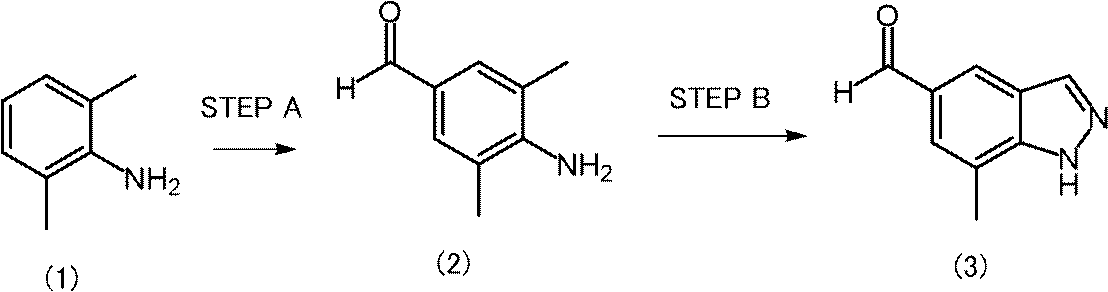
[12] 前記工程(A)で前記ジメチルアニリン(1)を、酸及びヘキサメチレンテトラミンで処理し、
前記工程(B)で前記アミノベンズアルデヒド(2)を亜硝酸又は亜硝酸アルキルで処理する、[11]に記載の製造方法。
上記第一態様の課題を解決し得た本発明の構成は以下の通りである。
[1] 式(1)で表されるジメチルアニリンをホルミル化して式(2)で表されるアミノベンズアルデヒドを製造する工程(A)を含む、式(8)で表される光学活性インダゾリルアラニンの製造方法。
[2] 前記工程(A)で前記ジメチルアニリン(1)を、酸及びヘキサメチレンテトラミンで処理する、[1]に記載の製造方法。
[3] 前記ホルミル化工程で得られる式(2)で表されるアミノベンズアルデヒドを環化して式(3)で表されるインダゾリルアルデヒドを得る工程(B)をさらに含む[1]又は[2]に記載の製造方法。
[4] 前記工程(B)で前記アミノベンズアルデヒド(2)を亜硝酸又は亜硝酸アルキルで処理する、[3]に記載の製造方法。
[5] 前記インダゾリルアルデヒド(3)から式(4)で表されるオレフィン化合物を製造し、得られたオレフィン化合物(4)を還元して式(5)で表されるインダゾリルメチルヒダントインを製造し、このインダゾリルメチルヒダントイン(5)を酵素源で処理して式(8)で表される光学活性インダゾリルアラニンを製造する[3]又は[4]に記載の製造方法。
[6] 前記インダゾリルアルデヒド(3)から式(4)で表されるオレフィン化合物を製造し、得られたオレフィン化合物(4)を還元して式(5)で表されるインダゾリルメチルヒダントインを製造し、得られたインダゾリルメチルヒダントイン(5)を直接又は式(6)で表されるインダゾリルアラニンにした後、式(7)で表されるN-カルボニル化インダゾリルアラニンを製造し、このN-カルボニル化インダゾリルアラニンを酵素源で処理して式(8)で表される光学活性インダゾリルアラニンを製造する[3]又は[4]に記載の製造方法。
(式中、R1は、水酸基及びカルボキシ基のいずれかを有していてもよい炭素数1~6のアルキル基、又はアミノ基を示す)
[11] 式(1)で表されるジメチルアニリンをホルミル化する工程(A)、
前記ホルミル化工程で得られる式(2)で表されるアミノベンズアルデヒドを環化して式(3)で表されるインダゾリルアルデヒドを得る工程(B)を含むインダゾリルアルデヒド(3)の製造方法。
[12] 前記工程(A)で前記ジメチルアニリン(1)を、酸及びヘキサメチレンテトラミンで処理し、
前記工程(B)で前記アミノベンズアルデヒド(2)を亜硝酸又は亜硝酸アルキルで処理する、[11]に記載の製造方法。
(第二態様の課題を解決するための手段)
上記第二態様の課題を解決し得た本発明の構成は以下の通りである。
[7] 式(5)で表されるインダゾリルメチルヒダントインを、直接又は式(7)で表されるN-カルボニル化インダゾリルアラニンに変えた後、酵素源で処理する、式(8)で表される光学活性インダゾリルアラニンの製造方法。
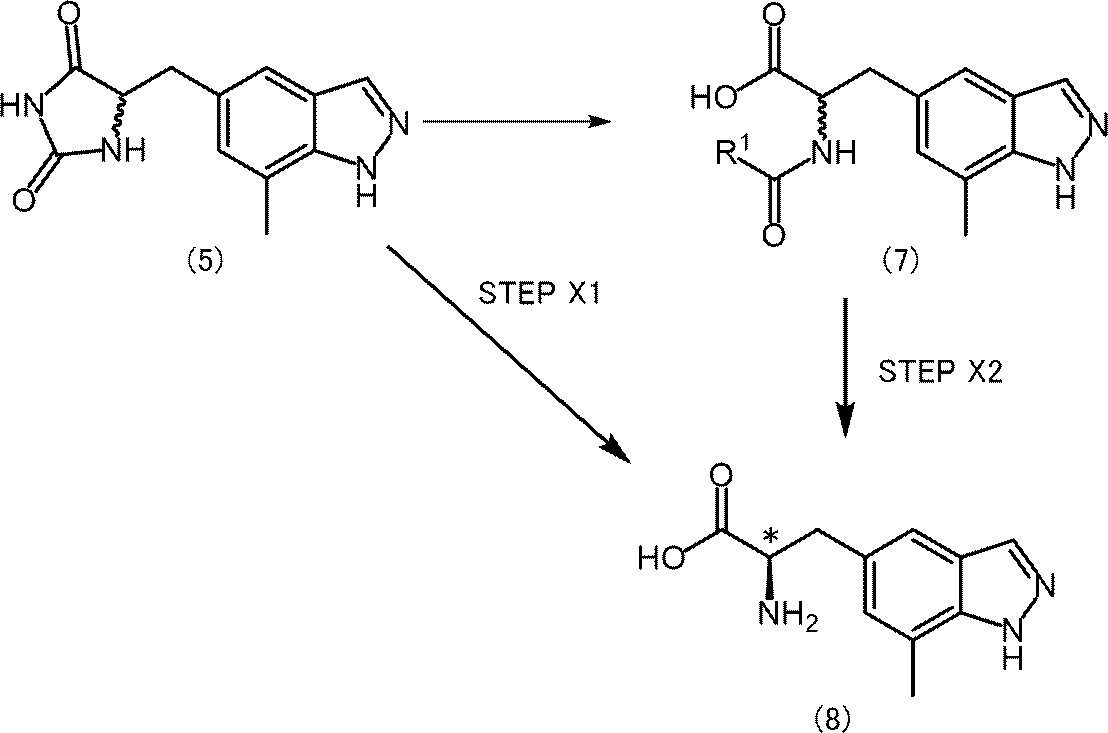
(式中、R1は、水酸基及びカルボキシ基のいずれかを有していてもよい炭素数1~6のアルキル基、又はアミノ基を示す)
[8] 前記インダゾリルメチルヒダントイン(5)を、直接又は式(6)で表されるインダゾリルアラニンにした後、前記N-カルボニル化インダゾリルアラニン(7)にする[7]に記載の製造方法。

(式中、R1は前記と同じ)
[9] 前記インダゾリルメチルヒダントイン(5)が、式(4)で表されるオレフィン化合物から製造される[7]又は[8]に記載の製造方法。

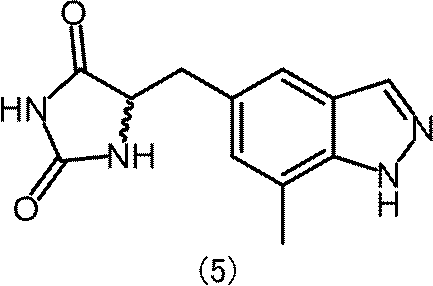
[13] 式(4)で表されるオレフィン化合物。

[14] 式(5)で表されるインダゾリルメチルヒダントイン。
[15] 式(7)で表されるN-カルボニル化インダゾリルアラニン。

(式中、R1は、水酸基及びカルボキシ基のいずれかを有していてもよい炭素数1~6のアルキル基、又はアミノ基を示す)
上記第二態様の課題を解決し得た本発明の構成は以下の通りである。
[7] 式(5)で表されるインダゾリルメチルヒダントインを、直接又は式(7)で表されるN-カルボニル化インダゾリルアラニンに変えた後、酵素源で処理する、式(8)で表される光学活性インダゾリルアラニンの製造方法。
(式中、R1は、水酸基及びカルボキシ基のいずれかを有していてもよい炭素数1~6のアルキル基、又はアミノ基を示す)
[8] 前記インダゾリルメチルヒダントイン(5)を、直接又は式(6)で表されるインダゾリルアラニンにした後、前記N-カルボニル化インダゾリルアラニン(7)にする[7]に記載の製造方法。
(式中、R1は前記と同じ)
[9] 前記インダゾリルメチルヒダントイン(5)が、式(4)で表されるオレフィン化合物から製造される[7]又は[8]に記載の製造方法。
[13] 式(4)で表されるオレフィン化合物。
[14] 式(5)で表されるインダゾリルメチルヒダントイン。
[15] 式(7)で表されるN-カルボニル化インダゾリルアラニン。
(式中、R1は、水酸基及びカルボキシ基のいずれかを有していてもよい炭素数1~6のアルキル基、又はアミノ基を示す)
また、第一態様及び第二態様は、以下の発明も含む。
[10] 前記光学活性インダゾリルアラニン(8)から式(9)で表される光学活性インダゾリルアラニンエステルまたはその塩を製造する[1]~[9]のいずれかに記載の製造方法。
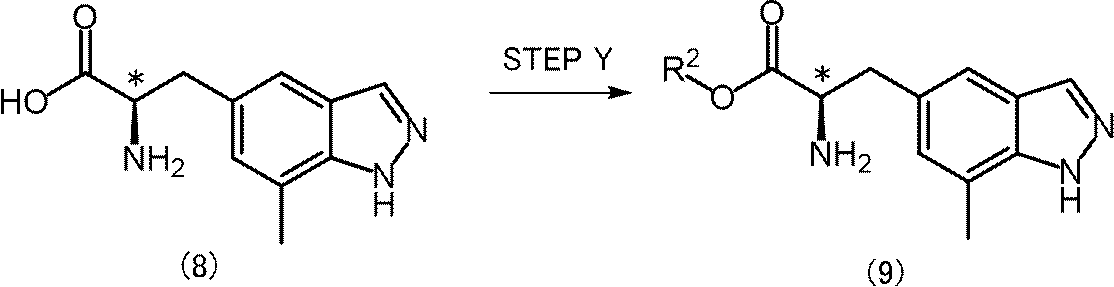
(式中、R2は炭素数1~6のアルキル基を表す)
[10] 前記光学活性インダゾリルアラニン(8)から式(9)で表される光学活性インダゾリルアラニンエステルまたはその塩を製造する[1]~[9]のいずれかに記載の製造方法。
(式中、R2は炭素数1~6のアルキル基を表す)
(第一態様の効果)
本発明(第一態様)によればジメチルアニリン(1)から極低温条件を必要とすることなくアミノベンズアルデヒド(2)を製造できる。またこのようして製造されたアミノベンズアルデヒド(2)から光学活性インダゾリルアラニン(8)又はインダゾリルアルデヒド(3)を製造できる。
本発明(第一態様)によればジメチルアニリン(1)から極低温条件を必要とすることなくアミノベンズアルデヒド(2)を製造できる。またこのようして製造されたアミノベンズアルデヒド(2)から光学活性インダゾリルアラニン(8)又はインダゾリルアルデヒド(3)を製造できる。
(第二態様の効果)
本発明(第二態様)によれば、インダゾリルメチルヒダントイン(5)、N-カルボニル化インダゾリルアラニン(7)などの安定な化合物から、高価な触媒を用いることなく、光学活性インダゾリルアラニン(8)を不斉合成できる。
本発明(第二態様)によれば、インダゾリルメチルヒダントイン(5)、N-カルボニル化インダゾリルアラニン(7)などの安定な化合物から、高価な触媒を用いることなく、光学活性インダゾリルアラニン(8)を不斉合成できる。
[第一態様]
本発明(第一態様)はアニリン類からインダゾール類を製造する方法に関するものであり、より詳細は、式(1)で表されるジメチルアニリンをホルミル化して式(2)で表されるアミノベンズアルデヒドを製造する工程(A)を有する。この工程(A)は極低温条件を必要としない点で有利である。そして工程(A)で得られるアミノベンズアルデヒド(2)は後述する様に光学活性インダゾリルアラニン(8)の製造原料として有用である。
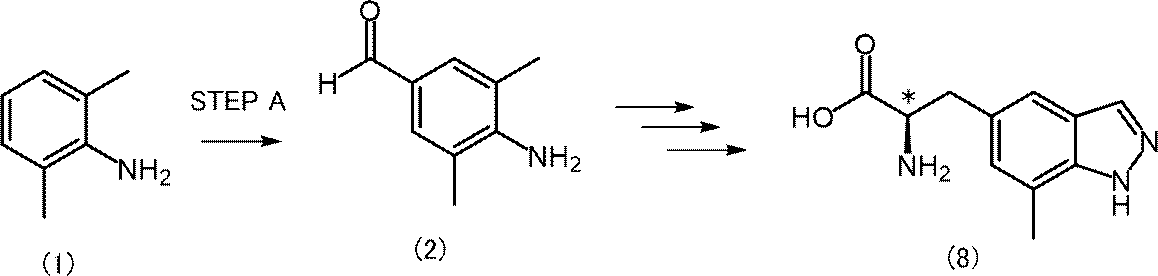
本発明(第一態様)はアニリン類からインダゾール類を製造する方法に関するものであり、より詳細は、式(1)で表されるジメチルアニリンをホルミル化して式(2)で表されるアミノベンズアルデヒドを製造する工程(A)を有する。この工程(A)は極低温条件を必要としない点で有利である。そして工程(A)で得られるアミノベンズアルデヒド(2)は後述する様に光学活性インダゾリルアラニン(8)の製造原料として有用である。
<工程(A)>
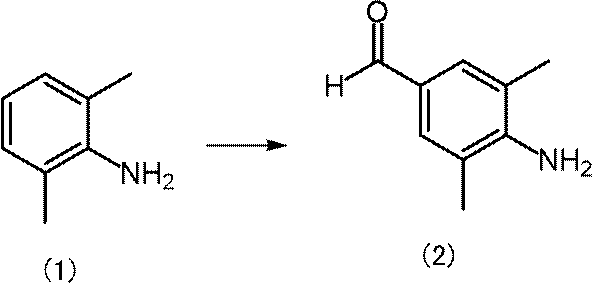
工程(A)では、例えば、前記ジメチルアニリン(1)を、酸及びヘキサメチレンテトラミンで処理することが好ましい。酸とヘキサメチレンテトラミンを用いると、極低温条件にしなくても、高い変換率で適量のアミノベンズアルデヒド(2)を得ることができる。
工程(A)では、例えば、前記ジメチルアニリン(1)を、酸及びヘキサメチレンテトラミンで処理することが好ましい。酸とヘキサメチレンテトラミンを用いると、極低温条件にしなくても、高い変換率で適量のアミノベンズアルデヒド(2)を得ることができる。
前記酸としては、酢酸、トリフルオロ酢酸などのカルボン酸が好ましく、炭素数が3~5の飽和脂肪族カルボン酸がより好ましい。酸の量は、ジメチルアニリン(1)1モルに対して、例えば、1~100モル程度、好ましくは3~60モル程度、より好ましくは5~20モル程度である。
ヘキサメチレンテトラミンの量は、ジメチルアニリン(1)1モルに対して、例えば、1~20モル、好ましくは1.2~10モル、より好ましくは1.5~5モルである。
ヘキサメチレンテトラミンの量は、ジメチルアニリン(1)1モルに対して、例えば、1~20モル、好ましくは1.2~10モル、より好ましくは1.5~5モルである。
工程(A)の反応溶媒は、例えば、水が好ましく、水と水溶性有機溶媒との混合溶媒であってもよい。水溶性有機溶媒には、例えば、メタノール、エタノールなどのアルコール類、テトラヒドロフラン、ジオキサンなどの環状エーテル類、ジメチルホルムアミドなどのアミド類などが挙げられる。反応溶媒の量は、ジメチルアニリン(1)1質量部に対して、例えば、0.1~20質量部、好ましくは0.5~10質量部、より好ましくは1~5質量部程度である。
工程(A)の反応温度は極低温とならない範囲から選択でき、例えば、0~150℃、好ましくは50~150℃、より好ましくは80~120℃である。また反応温度の上限は溶媒の沸点であってもよい。
工程(A)の反応時間は、例えば、0.1~20時間、好ましくは0.3~10時間、より好ましくは0.5~5時間である。
工程(A)の反応後、必要に応じて反応液から生成物を取り出してもよい。生成物の取り出し方法としては、例えば、反応終了後、反応液を酢酸エチル、ジエチルエーテル、塩化メチレン、トルエン、ヘプタン等の抽出溶媒で処理して目的物を有機層側に抽出して水溶性成分を除去することが好ましい。有機層を必要に応じて水酸化ナトリウム水溶液などの塩基性水溶液や水で洗浄することも好ましい。このようにして得られた生成物は、後続工程に使用できる十分な純度を有しているが、純度を更に高める目的で、晶析、分別蒸留、カラムクロマトグラフィー等の一般的な精製手法により、更に純度を高めてもよい。
また本発明では前記工程(A)で得られるアミノベンズアルデヒド(2)を環化して式(3)で表されるインダゾリルアルデヒドを得る工程(B)を含むことが好ましい。この方法によれば、インダゾリルアルデヒド(3)も極低温条件を必要とすることなく製造可能である。インダゾリルアルデヒド(3)も後述する様に光学活性インダゾリルアラニン(8)の製造原料として有用である。
<工程(B)>

工程(B)では、例えば、前記アミノベンズアルデヒド(2)を亜硝酸又は亜硝酸アルキル(以下、これらを総称して亜硝酸化合物という)で処理することが好ましい。アミノベンズアルデヒド(2)を亜硝酸化合物で処理すると、極低温条件にしなくても、高い変換率で適量のインダゾリルアルデヒド(3)を得ることができる。
工程(B)では、例えば、前記アミノベンズアルデヒド(2)を亜硝酸又は亜硝酸アルキル(以下、これらを総称して亜硝酸化合物という)で処理することが好ましい。アミノベンズアルデヒド(2)を亜硝酸化合物で処理すると、極低温条件にしなくても、高い変換率で適量のインダゾリルアルデヒド(3)を得ることができる。
前記亜硝酸アルキルとしては、例えば、亜硝酸メチル、亜硝酸エチル、亜硝酸n-プロピル、亜硝酸イソプロピル、亜硝酸n-ブチル、亜硝酸イソブチル、亜硝酸t-ブチル、硝酸イソアミル(亜硝酸アミルともいう)などの亜硝酸C1-10アルキル(好ましくは亜硝酸C4-8アルキル)などが挙げられ、亜硝酸アミルが好ましい。前記亜硝酸は、亜硝酸ナトリウムなどの亜硝酸塩(好ましくはアルカリ金属塩)と酸(塩酸、硫酸などの無機酸など)とから調製してもよい。亜硝酸化合物の量は、アミノベンズアルデヒド(2)1モルに対して、例えば、1.00~3モル、好ましくは1.05~2モル、より好ましくは1.10~1.5モルである。
亜硝酸化合物による前記インダゾリル化合物(3)の合成反応は、酸の存在下で行うことが好ましい。酸が存在することでジアゾ化及びインダゾリル化が促進される。酸としては、塩酸、硫酸などの無機酸、酢酸などのカルボン酸(好ましくは炭素数が3~5の飽和脂肪族カルボン酸)などが挙げられ、カルボン酸が好ましい。カルボン酸の量は、アミノベンズアルデヒド(2)1モルに対して、例えば、0.1~5モル、好ましくは0.8~3モル、より好ましくは1.1~2モルである。
工程(B)でカルボン酸を用いる場合、カルボン酸塩(ナトリウム、カリウムなどのアルカリ金属とカルボン酸との塩など)をカルボン酸と共に用いてもよい。カルボン酸塩の量は、カルボン酸1モルに対して、例えば、0.1~10モル、好ましくは0.3~5モル、より好ましくは0.5~2モルである。
工程(B)の反応溶媒は、例えば、水;メタノール、エタノール、プロパノール、エチレングリコールなどのアルコール類;テトラヒドロフラン、メチルテトラヒドロフラン、ジエチルエーテル、1,4-ジオキサン、メチルtert-ブチルエーテル、エチレングリコールジメチルエーテル、4-メチルテトラヒドロピラン等のエーテル系溶媒;ペンタン、ヘキサン、ヘプタン、メチルシクロヘキサン等の脂肪族炭化水素系溶媒;ベンゼン、トルエン、キシレン、エチルベンゼン、メシチレン等の芳香族炭化水素系溶媒;N,N-ジメチルホルムアミド、N,N-ジメチルアセトアミド、N,N-ジエチルアセトアミド、N-メチル-2-ピロリドン、N-エチル-2-ピロリドン、N-メチル-ε-カプロラクタム、ヘキサメチルホスホルアミド等のアミド系溶媒;ジメチルプロピレンウレア等のウレア系溶媒;ヘキサメチルホスホン酸トリアミド等のホスホン酸トリアミド系溶媒などであり、好ましくは芳香族炭化水素系溶媒である。反応溶媒の量は、アミノベンズアルデヒド(2)1質量部に対して、例えば、1~50質量部、好ましくは2~30質量部、より好ましくは5~20質量部である。
工程(B)の反応温度は極低温とならない範囲から選択でき、例えば、-20~150℃、好ましくは0~100℃、より好ましくは30~70℃である。工程(B)の反応時間は、例えば、0.1~60時間、好ましくは1~40時間、より好ましくは3~20時間である。
工程(B)の反応後、必要に応じて反応液から生成物を取り出してもよい。生成物の取り出し方法としては、例えば、反応終了後、反応液を酢酸エチル、ジエチルエーテル、塩化メチレン、トルエン、ヘプタン等の抽出溶媒で処理して目的物を有機層側に抽出して水溶性成分を除去することが好ましい。前記抽出では水酸化ナトリウム水溶液などの塩基を加えて水層を塩基性にすることが好ましい。また抽出した有機層を必要に応じて水酸化ナトリウム水溶液などの塩基性水溶液や水で洗浄することも好ましい。このようにして得られたインダゾリルアルデヒド(3)、あるいは、反応液中のインダゾリルアルデヒド(3)を水に転溶することで、有機溶媒に溶解する不要成分を除去することが好ましい。例えば、インダゾリルアルデヒド(3)を亜硝酸水素ナトリウムなどで処理してアルデヒドとの付加体にすることで水に溶解させ、この水溶液を前記抽出溶媒で洗浄した後、水層を塩基性にして前記付加体をインダゾリルアルデヒド(3)に戻し、水層中のインダゾリルアルデヒド(3)を抽出溶媒で抽出する、あるいは抽出溶媒を用いず、水層中のインダゾリルアルデヒド(3)をpHを塩基性にすることで析出させて濾過することが好ましい。インダゾリルアルデヒド(3)は、後続工程に使用できる十分な純度を有しているが、純度を更に高める目的で、晶析、分別蒸留、カラムクロマトグラフィー等の一般的な精製手法により、更に純度を高めてもよい。
第一態様において、以上のようにして得られたインダゾリルアルデヒド(3)は、公知の方法、例えば、馬尿酸などのアシルカルボニルアミノ酢酸(R3-CONH-CH2COOH)用いてアルデヒド基がオキサゾール環化された化合物(11)を得る工程、このオキサゾール化合物(11)をメタノールなどのアルコール(R4OH)とナトリウムメトキシドなどの塩基の存在下で処理して開環エステル化合物(12)を得る工程、開環エステル化合物(12)を加水分解してケトカルボン酸化合物(13)を得る工程、及びケトカルボン酸化合物(13)をDL-アラニンとD-トランスアミナーゼで処理する工程からなる一連の方法によって光学活性インダゾリルアラニン(8)を得ることができる。

また第一態様において、前記インダゾリルアルデヒド(3)は、次いでオレフィン化合物(4)を製造し(工程(C))、得られたオレフィン化合物(4)を還元してインダゾリルメチルヒダントイン(5)を製造し(工程(D))、このインダゾリルメチルヒダントイン(5)を直接又は式(7)で表されるN-カルボニル化インダゾリルアラニンに変えた後、酵素源で処理して光学活性インダゾリルアラニン(8)を製造することが好ましい。インダゾリルメチルヒダントイン(5)から光学活性インダゾリルアラニン(8)を製造する工程は、インダゾリルメチルヒダントイン(5)を直接酵素源で処理して光学活性インダゾリルアラニン(8)を製造するか(工程(X1))、前記インダゾリルメチルヒダントイン(5)をラセミ体のN-カルボニル化インダゾリルアラニン(7)に変えた後(工程(E)、工程(F)、工程(G))、酵素源で処理して光学活性インダゾリルアラニン(8)を製造(工程(X2))することが好ましい。インダゾリルメチルヒダントイン(5)が安定であるため、この一連の工程によれば、酵素反応工程を容易に行うことが可能になる。なお、上記工程(C)~(G)、工程(X1)、及び工程(X2)は、後述の第二態様に記載の工程(C)~(G)、工程(X1)、及び工程(X2)と同様であり、その好ましい態様も同じである。
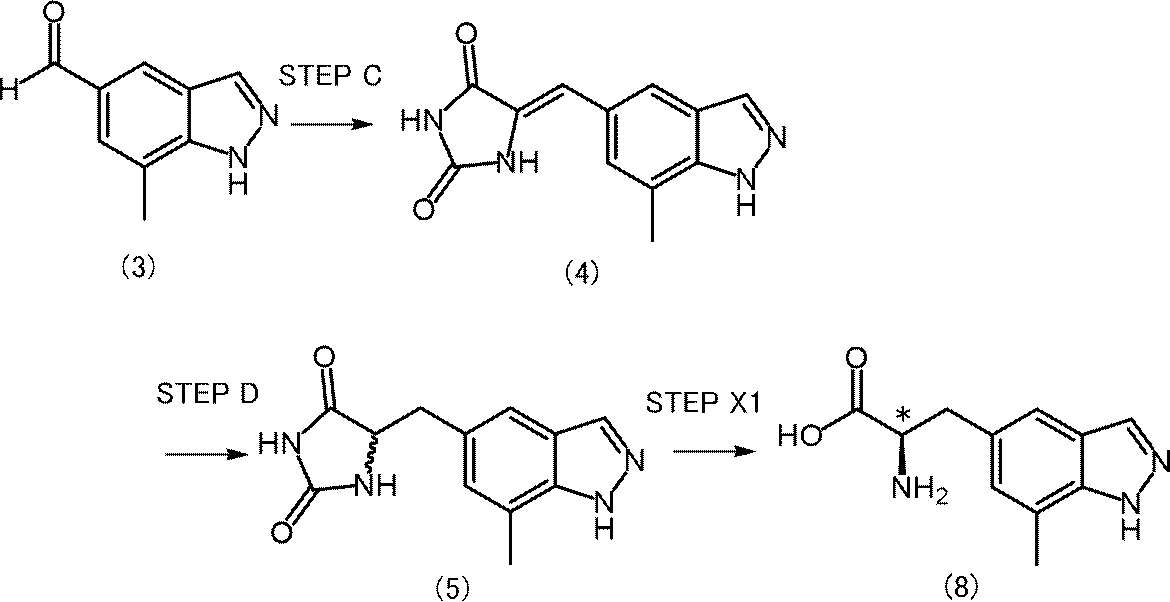

(式中、R1は、水酸基及びカルボキシ基のいずれかを有していてもよい炭素数1~6のアルキル基、又はアミノ基を示す)
[第二態様]
本発明(第二態様)では、ラセミ体のインダゾリルメチルヒダントイン(5)を、直接酵素源で処理して光学活性インダゾリルアラニン(8)を製造するか(工程(X1))、前記インダゾリルメチルヒダントイン(5)をラセミ体のN-カルボニル化インダゾリルアラニン(7)に変えた後(工程(E)、工程(F)、工程(G))、酵素源で処理して光学活性インダゾリルアラニン(8)を製造する(工程(X2))。酵素反応(工程(X1)、工程(X2))の原料であるインダゾリルメチルヒダントイン(5)及びN-カルボニル化インダゾリルアラニン(7)は安定であるため、この一連の工程によれば、酵素反応を容易に行うことが可能となる。
本発明(第二態様)では、ラセミ体のインダゾリルメチルヒダントイン(5)を、直接酵素源で処理して光学活性インダゾリルアラニン(8)を製造するか(工程(X1))、前記インダゾリルメチルヒダントイン(5)をラセミ体のN-カルボニル化インダゾリルアラニン(7)に変えた後(工程(E)、工程(F)、工程(G))、酵素源で処理して光学活性インダゾリルアラニン(8)を製造する(工程(X2))。酵素反応(工程(X1)、工程(X2))の原料であるインダゾリルメチルヒダントイン(5)及びN-カルボニル化インダゾリルアラニン(7)は安定であるため、この一連の工程によれば、酵素反応を容易に行うことが可能となる。
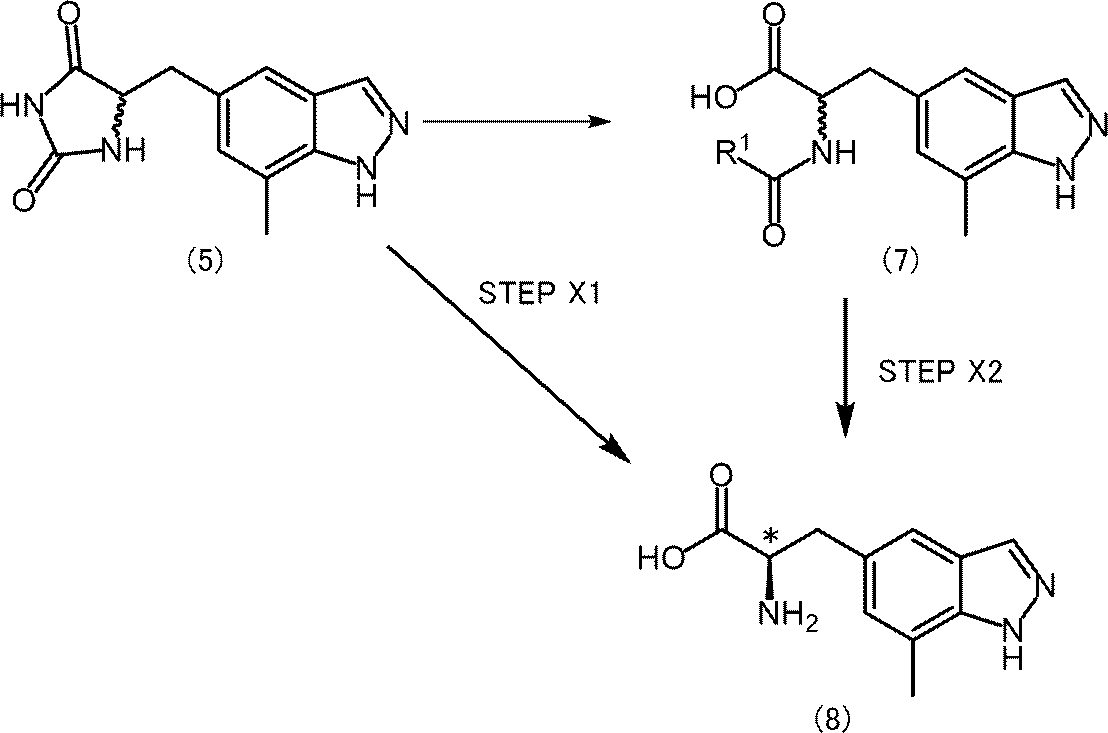
(式中、R1は、水酸基及びカルボキシ基のいずれかを有していてもよい炭素数1~6のアルキル基、又はアミノ基を示す)
なお本明細書において「酵素源」とは、活性を有する酵素自体はもちろんのこと、上記活性を有する微生物の培養物およびその処理物も含まれる。「微生物の培養物」とは、菌体を含む培養液あるいは培養菌体を意味し、また、その処理物であってもよい。「その処理物」とは、例えば、粗抽出液、凍結乾燥菌体、アセトン乾燥菌体、またはそれら菌体の破砕物等を意味する。さらに上記酵素源は、公知の手段で固定化して、固定化酵素又は固定化菌体として用いることもできる。固定化は、当業者に周知の方法(例えば架橋法、物理的吸着法、包括法等)で行うことができる。
R1で表される炭素数1~6のアルキル基としては、メチル基、エチル基、n-プロピル基、イソプロピル基、n-ブチル基、イソブチル基、n-ペンチル基、1-メチルブチル基、2-メチルブチル基、3-メチルブチル基、n-ヘキシル基などが挙げられる。
R1で表される水酸基を有する炭素数1~6のアルキル基としては、ヒドロキシメチル基、1-ヒドロキシエチル基、2-ヒドロキシエチル基、1-ヒドロキシ-n-プロピル基、2-ヒドロキシ-n-プロピル基、3-ヒドロキシ-n-プロピル基、1-ヒドロキシ-n-ブチル基、2-ヒドロキシ-n-ブチル基、3-ヒドロキシ-n-ブチル基、4-ヒドロキシ-n-ブチル基、1-ヒドロキシ-n-ペンチル基、2-ヒドロキシ-n-ペンチル基、3-ヒドロキシ-n-ペンチル基、4-ヒドロキシ-n-ペンチル基、5-ヒドロキシ-n-ペンチル基、1-ヒドロキシ-n-ヘキシル基、2-ヒドロキシ-n-ヘキシル基、3-ヒドロキシ-n-ヘキシル基、4-ヒドロキシ-n-ヘキシル基、5-ヒドロキシ-n-ヘキシル基、6-ヒドロキシ-n-ヘキシル基などのヒドロキシ-n-アルキル基が好ましい。
R1で表されるカルボキシ基を有する炭素数1~6のアルキル基としては、カルボキシメチル基、2-カルボキシエチル基、3-カルボキシプロピル基、4-カルボキシブチル基、5-カルボキシペンチル基、6-カルボキシヘキシル基などが挙げられる。
R1で表されるカルボキシ基を有する炭素数1~6のアルキル基としては、カルボキシメチル基、2-カルボキシエチル基、3-カルボキシプロピル基、4-カルボキシブチル基、5-カルボキシペンチル基、6-カルボキシヘキシル基などが挙げられる。
<工程(X1)>
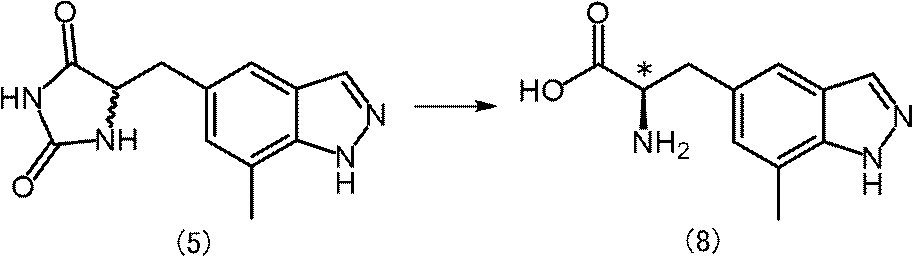
工程(X1)では、インダゾリルメチルヒダントイン(5)にヒダントイナーゼ及びデカルバモイラーゼを作用させて光学活性インダゾリルアラニン(8)を得ることが好ましい。ヒダントイナーゼとは、5位の不斉炭素がR配置である5-置換ヒダントイン誘導体を加水分解して不斉炭素がR配置であるN-カルバモイル-α-アミノ酸誘導体(D体)(本工程(X1)では下記式(7c)で表される化合物)を生成する活性を有する酵素である。デカルバモイラーゼとは、不斉炭素がR配置であるN-カルバモイル-α-アミノ酸誘導体(D体)(本工程(X1)では式(7c))を加水分解して、不斉炭素がR配置であるインダゾリルアラニン(8)(D体)を生成する活性を有する酵素である。光学活性体(7c)のデカルバモイラーゼによる処理に代えて、光学活性体(7c)を化学的に加水分解しても、光化学活性インダゾリルアラニン(8)を得ることができる。

工程(X1)では、インダゾリルメチルヒダントイン(5)にヒダントイナーゼ及びデカルバモイラーゼを作用させて光学活性インダゾリルアラニン(8)を得ることが好ましい。ヒダントイナーゼとは、5位の不斉炭素がR配置である5-置換ヒダントイン誘導体を加水分解して不斉炭素がR配置であるN-カルバモイル-α-アミノ酸誘導体(D体)(本工程(X1)では下記式(7c)で表される化合物)を生成する活性を有する酵素である。デカルバモイラーゼとは、不斉炭素がR配置であるN-カルバモイル-α-アミノ酸誘導体(D体)(本工程(X1)では式(7c))を加水分解して、不斉炭素がR配置であるインダゾリルアラニン(8)(D体)を生成する活性を有する酵素である。光学活性体(7c)のデカルバモイラーゼによる処理に代えて、光学活性体(7c)を化学的に加水分解しても、光化学活性インダゾリルアラニン(8)を得ることができる。
ヒダントイナーゼとしては、動物、植物、又は微生物由来のいずれでも使用でき、工業的な利用には微生物由来のものが好ましい。酵素源となる微生物としては、当該酵素の生産能力を有する微生物であればいずれも利用でき、例えば、以下の公知の、当該酵素の生産能力を有する微生物を挙げることができる。
例えば、細菌に属するものとしてはアセトバクター属(Acetobacter)、アクロモバクター属(Achromobacter)、アエロバクター属(Aerobacter)、アグロバクテリウム属(Agrobacterium)、アルカリゲネス属(Alcaligenes)、アルスロバクター属(Arthrobacter)、バチルス属(Bacillus)、アネウリニバチルス属(Aneurinibacillus)、ブレビバクテリウム属(Brevibacterium)、コリネバクテリウム属(Corynebacterium)、エンテロバクター属(Enterobacter)、エルウイニア属(Erwinia)、エシェリヒア属(Escherichia)、クレブシエラ属(Klebsiella)、ミクロバクテリウム属(Microbacterium)、ミクロコッカス属(Micrococcus)、プロタミノバクター属(Protaminobacter)、プロテウス属(Proteus)、シュードモナス属(Pseudomonas)、サルチナ属(Sartina)、セラチア属(Serratia)、キサントモナス属(Xanthomonas)、アエロモナス属(Aeromonas)、フラボバクテリウム属(Flavobacterium)、リゾビウム属(Rhizobium)等;放線菌に属するものとしてはアクチノミセス属(Actinomyces)、ミコバクテリウム属(Mycobacterium)、ノカルデイア属(Nocardia)、ストレプトミセス属(Streptomyces)、アクチノプラネス属(Actinoplanes)、ロドコッカス属(Rhodococcus)等;かびに属するものとしてはアスペルギルス属(Aspergillus)、パエシロミセス属(Paecilomyces)、ペニシリウム属(Penicillium)等;酵母に属するものとしてはキャンディダ属(Candida)、ピキア属(Phichia)、ロードトルラ属(Rhodotorula)、トルロプシス属(Torulopsis)等が挙げられる。好ましくは、アグロバクテリウム属(Agrobacterium)、バチルス属(Bacillus)、アネウリニバチルス属(Aneurinibacillus)、又はシュードモナス属(Pseudomonas)に属する微生物由来の酵素が挙げられる。より好ましくは、アグロバクテリウム・スピーシーズ(Agrobacterium sp.)KNK712(FERM BP-1900)、バチルス・スピーシーズ(Bacillus sp.)KNK245株(FERM BP-4863)、アネウリニバチルス・スピーシーズ(Aneurinibacillus sp.)KNK491C株(FERM BP-10735)、又はシュードモナス・スピーシーズ(Pseudomonas sp.)KNK003A(FERM BP-3181)由来の酵素が挙げられる。なお、アグロバクテリウム・スピーシーズ(Agrobacterium sp.)KNK712は、FERM BP-1900の受託番号で、1988年5月31日付で;バチルス・スピーシーズ(Bacillus sp.)KNK245は、FERM BP-4863の受託番号で、1994年11月2日付で;アネウリニバチルス・スピーシーズ(Aneurinibacillus sp.)KNK491C株は、FERM BP-10735の受託番号で、平成18年11月20日付けで;シュードモナス・スピーシーズ(Pseudomonas sp.)KNK003Aは、FERM BP-3181の受託番号で、1990年12月1日付で;それぞれ、日本国茨城県つくば市東1丁目1番地1中央第6にある独立行政法人産業技術総合研究所特許生物寄託センターに、ブダペスト条約に基づいて国際寄託され、この寄託は独立行政法人製品評価技術基盤機構 バイオテクノロジーセンター 特許微生物寄託センター(NPMD)(千葉県木更津市かずさ鎌足2-5-8)に承継されている。
上記微生物は野生株であってもよく、また、変異処理によってヒダントイナーゼ活性が高められた変異株であってもよい。さらに、遺伝子組換え等の方法を用いて、上記微生物由来のヒダントイナーゼを高生産するように作成された形質転換微生物であってもよい。ヒダントイナーゼを効率良く高生産する形質転換微生物の作成方法としては、例えば国際公開第96/20275号記載のように、ヒダントイナーゼ活性を示す菌株からヒダントイナーゼ遺伝子をクローニングした後、適当なベクターとの組換えプラスミドを作成して、これを用いて適当な宿主菌を形質転換することで得られる。なお、組換えDNA技術については当該分野において周知であり、例えば、Molecular Cloning 2nd Edition(Cold Spring Harbor Laboratory Press,1989)、Current Protocols in Molecular Biology(Greene Publishing Associates and Wiley-Interscience)に記載されている。
このようにして得られた、ヒダントイナーゼを高生産する形質転換微生物としては、アグロバクテリウム・スピーシーズ(Agrobacterium sp.)KNK712(FERM BP-1900)由来のヒダントイナーゼ遺伝子を含有するエシェリヒア・コリ(Escherichia coli)HB101 pAH1043(FERM BP-4865)、バチルス・スピーシーズ(Bacillus sp.)KNK245(FERM BP-4863)由来のヒダントイナーゼ遺伝子を含有するエシェリヒア・コリ(Escherichia coli)HB101 pTH104(FERM BP-4864)、アネウリニバチルス・スピーシーズ(Aneurinibacillus sp.)KNK491C株(FERM BP-10735)由来のヒダントイナーゼ遺伝子を含有するエシェリヒア・コリ(Escherichia coli)HB101 pALH101(FERM P-20712)、又はシュードモナス・スピーシーズ(Pseudomonas sp.)KNK003A(FERM BP-3181)由来のヒダントイナーゼ遺伝子を含有するエシェリヒア・コリ(Escherichia coli)HB101 pPHD301(FERM BP-4866)を挙げることができる。なお、エシェリヒア・コリ(Escherichia coli)HB101 pAH1043は、FERM BP-4865の受託番号で、1994年11月2日付で;エシェリヒア・コリ(Escherichia coli)HB101 pTH104は、FERM BP-4864の受託番号で、1994年11月2日付で;エシェリヒア・コリ(Escherichia coli)HB101 pALH101は、FERM P-20712の受託番号で、平成17年11月15日付で;エシェリヒア・コリ(Escherichia coli)HB101 pPHD301は、FERM BP-4866の受託番号で、1994年11月2日付で;それぞれ、日本国茨城県つくば市東1丁目1番地1中央第6にある独立行政法人産業技術総合研究所特許生物寄託センターに、ブダペスト条約に基づいて国際寄託され、この寄託は独立行政法人製品評価技術基盤機構 バイオテクノロジーセンター 特許微生物寄託センター(NPMD)(千葉県木更津市かずさ鎌足2-5-8)に承継されている。
前述のヒダントイナーゼ活性を示す微生物、或いは、上記形質転換微生物によるヒダントイナーゼの生産は、通常の栄養培地を用いて培養を行えば良く、必要に応じて、酵素誘導のための処理を行うこともできる。酵素誘導は、例えば、培地にウラシルを添加して培養することにより行うことができる。
本発明において、上記微生物によって生産されたヒダントイナーゼは、酵素自体として用いることができるほか、本酵素活性を有する微生物若しくはその処理物としても用いることができる。ここで、微生物の処理物とは、例えば、粗抽出液、培養菌体凍結乾燥生物体、アセトン乾燥生物体、又はそれらの菌体の破砕物を意味する。さらにそれらは、酵素自体あるいは菌体のまま公知の手段で固定化して得た固定化酵素として用いられ得る。なお、酵素を固定化して安定化することで、酵素反応を、より過酷な温度域で行うこと等が可能となり、反応をより効率的に進行させることができる。さらに、酵素の反復使用が可能となり、製造プロセスが簡略化できる。
前記デカルバモイラーゼとしては、動物、植物、又は微生物由来のいずれでも使用でき、工業的な利用には微生物由来のものが好ましい。酵素源となる微生物としては、当該酵素の生産能力を有する微生物であればいずれも利用でき、例えば、以下の公知の、当該酵素の生産能力を有する微生物を挙げることができる。
前記微生物としては、例えば、アグロバクテリウム属、シュードモナス属、アースロバクター属、アルカリゲネス属、アクロモバクター属、モラキセラ属、パラコッカス属、アエロバクター属、アエロモナス属、ブレビバクテリウム属、バチルス属、フラボバクテリウム属、セラチア属などが挙げられる。これら微生物としては、アグロバクテリウム スピーシーズ(Agrobacterium sp.)KNK712(FERM BP-1900)、シュードモナス・スピーシーズ(Pseudomonas sp.)KNK003A(FERM BP-3181)、シュードモナス・スピーシーズ(Pseudomonas species)KNK505(FERM BP-3182)、イー・コリ(Escherichia coli)JM109 pAD108(FERM BP-3184、CCTCCNO:M91095)、イー・コリ JM109 pPD304(FERM BP-3183、CCTCC NO:M91096)などが挙げられる。
また、デカルバモイラーゼの耐熱性に関与するアミノ酸を他のアミノ酸に置換して、安定化させたデカルバモイラーゼを使用する場合は、以下の形質転換株が使用できる。例えば、イー・コリ(E.coli) JM109 pAD402(FERM BP-3912、CCTCC NO:M93038)、イー・コリ JM109 pAD404(FERM BP-3913、CCTCC NO:M93038)、イー・コリ JM109 pAD406(FERM BP-3914)、イー・コリ JM109 pAD416(FERM BP-3915、CCTCC NO:M93040)、イー・コリ JM109 pAD428、イー・コリ JM109 pAD429(FERM BP-4035)、イー・コリ JM109 pAD431、イー・コリ JM109 pAD434、イー・コリ JM109 pAD435、イー・コリ JM109 pAD439、イー・コリ JM109 pAD441、イー・コリ JM109 pAD445、イー・コリJM109 pAD447、イー・コリ JM109 pAD448、イー・コリ JM109 pAD450、イー・コリ JM109 pAD421、イー・コリ JM109 pAD422、イー・コリ JM109 pAD423、イー・コリ JM109 pAD424(FERM BP-4034、CCTCC NO:M93041)、イー・コリ JM109 pAD425、イー・コリ JM109 pAD426、イー・コリ JM109 pAD427、イー・コリ JM109 pAD451、イー・コリ JM109 pAD452、イー・コリ JM109 pAD453、イー・コリ JM109 pAD461、イー・コリ JM109 pAD454、イー・コリ JM109 pAD455(FERM BP-4036)、イー・コリ JM109 pAD456、イー・コリ JM109 pAD468、イー・コリ JM109 pAD469、イー・コリ JM109 pAD470またはイー・コリ HB101 pNT4553(FERM BP-4368、CCTCC NO:M93042)などの形質転換微生物が挙げられる。
前述のデカルバモイラーゼ活性を示す微生物、或いは、上記形質転換微生物によるデカルバモイラーゼの生産は、通常の栄養培地を用いて培養を行えば良く、必要に応じて、酵素誘導のための処理を行うこともできる。酵素誘導は、例えば、培地にウラシルを添加して培養することにより行うことができる。
本発明において、上記微生物によって生産されたデカルバモイラーゼは、酵素自体として用いることができるほか、本酵素活性を有する微生物若しくはその処理物としても用いることができる。ここで、微生物の処理物とは、例えば、粗抽出液、培養菌体凍結乾燥生物体、アセトン乾燥生物体、又はそれらの菌体の破砕物を意味する。さらにそれらは、酵素自体あるいは菌体のまま公知の手段で固定化して得た固定化酵素として用いられ得る。なお、酵素を固定化して安定化することで、酵素反応を、より過酷な温度域で行うこと等が可能となり、反応をより効率的に進行させることができる。さらに、酵素の反復使用が可能となり、製造プロセスが簡略化できる。
工程(X1)では、ヒダントイナーゼ及びデカルバモイラーゼに加えてヒダントインラセマーゼを用いることが好ましい。ヒダントインラセマーゼとは、5-置換ヒダントイン誘導体の5位の不斉炭素をS配置からR配置にする活性を有する酵素であり、R配置をS配置にする活性(すなわちラセミ化する活性)を有していてもよい。ヒダントインラセマーゼを用いることで、光学活性インダゾリルアラニン(8)の収量を多くすることができる。
ヒダントインラセマーゼとしては、動物、植物、又は微生物由来のいずれでも使用でき、工業的な利用には微生物由来のものが好ましい。酵素源となる微生物としては、当該酵素の生産能力を有する微生物であればいずれも利用でき、例えば、以下の公知の、当該酵素の生産能力を有する微生物を挙げることができる。
ヒダントインラセマーゼの生産能力を有する微生物としては、例えば、アースロバクター(Arthrobacter)属、シュードモナス(Pseudomonas)属、アグロバクテリウム(Agrobacterium)属、シノリゾビウム(Sinorhizobium)属、マイクロバクテリウム(Microbacterium)属、フラボバクテリウム(Flavobacterium)属、パスツレラ(Pasteurella)属、キャンディダ(Candida)属、バチルス(Bacillus)属に属する微生物が挙げられ、好ましくはバチルス(Bacillus)属に属する微生物が挙げられ、より好ましくはバチルス・スピーシーズ(Bacillus sp.)KNK519HR株(FERM BP-10477)が挙げられる。バチルス・スピーシーズ(Bacillus sp.)KNK519HR株は、FERM BP-10477の受託番号で、2005年12月12日付けで日本国茨城県つくば市東1丁目1番地1中央第6にある独立行政法人産業技術総合研究所特許生物寄託センターに、ブダペスト条約に基づいて国際寄託され、この寄託は独立行政法人製品評価技術基盤機構 バイオテクノロジーセンター 特許微生物寄託センター(NPMD)(千葉県木更津市かずさ鎌足2-5-8)に承継されている。
上記微生物は野生株であってもよく、また、変異処理によってヒダントインラセマーゼ活性が高められた変異株であってもよい。さらに、遺伝子組換え等の方法を用いて、上記微生物由来のヒダントインラセマーゼを高生産するように作成された形質転換微生物であってもよい。ヒダントインラセマーゼを効率良く高生産する形質転換微生物の作成方法としては、例えばヒダントインラセマーゼ活性を示す菌株からヒダントインラセマーゼ遺伝子をクローニングした後、適当なベクターとの組換えプラスミドを作成して、これを用いて適当な宿主菌を形質転換することで得られる。なお、組換えDNA技術については当該分野において周知であり、例えば、Molecular Cloning 2nd Edition(Cold Spring Harbor Laboratory Press,1989)、Current Protocols in Molecular Biology(Greene Publishing Associates and Wiley-Interscience)に記載されている。
このようにして得られたヒダントインラセマーゼを高生産する形質転換微生物としては、バチルス・スピーシーズ(Bacillus sp.)KNK519HR株(FERM BP-10477)由来のヒダントインラセマーゼ遺伝子を含有するエシェリヒア・コリ(Escherichia coli)HB101 pBHR001(FERM BP-10476)を挙げることができる。なおエシェリヒア・コリ(Escherichia coli)HB101 pBHR001は、FERM BP-10476の受託番号で、2005年12月12日付けで日本国茨城県つくば市東1丁目1番地1中央第6にある独立行政法人産業技術総合研究所特許生物寄託センターに、ブダペスト条約に基づいて国際寄託され、この寄託は独立行政法人製品評価技術基盤機構 バイオテクノロジーセンター 特許微生物寄託センター(NPMD)(千葉県木更津市かずさ鎌足2-5-8)に承継されている。
前述のヒダントインラセマーゼ活性を示す微生物、或いは、上記形質転換微生物によるヒダントインラセマーゼの生産は、通常の栄養培地を用いて培養を行えば良く、必要に応じて、酵素誘導のための処理を行うこともできる。酵素誘導は、例えば、培地にウラシルを添加して培養することにより行うことができる。
本発明において、上記微生物によって生産されたヒダントインラセマーゼは、酵素自体として用いることができるほか、本酵素活性を有する微生物若しくはその処理物としても用いることができる。ここで、微生物の処理物とは、例えば、粗抽出液、培養菌体凍結乾燥生物体、アセトン乾燥生物体、又はそれらの菌体の破砕物を意味する。さらにそれらは、酵素自体あるいは菌体のまま公知の手段で固定化して得た固定化酵素として用いられ得る。なお、酵素を固定化して安定化することで、酵素反応を、より過酷な温度域で行うこと等が可能となり、反応をより効率的に進行させることができる。さらに、酵素の反復使用が可能となり、製造プロセスが簡略化できる。
工程(X1)の酵素反応は、以下の方法で行うことができる。基質としてインダゾリルメチルヒダントイン(5)を前述のヒダントイナーゼ及びデカルバモイラーゼで、好ましくはさらにヒダントインラセマーゼの存在下で、処理する。基質の仕込み濃度は0.1%(w/v)以上90%(w/v)以下、好ましくは1%(w/v)以上50%(w/v)以下で、溶解又は懸濁した状態で反応を行い、反応温度は10℃以上80℃以下、好ましくは20℃以上60℃以下の適当な温度で調節し、pH4以上9以下、好ましくはpH5以上8以下に保ちつつ、暫時静置又は攪拌すればよい。また、基質を連続的に添加しうる。反応は、バッチ法又は連続方式で行い得る。さらに、本発明の当該反応は、固定化酵素、膜リアクター等を利用して行うことも可能である。
水性媒体としては、水、緩衝液(例えばリン酸緩衝液、トリス緩衝液、炭酸緩衝液等)、これらに水溶性有機溶媒(例えばエタノール、メタノール、アセトニトリル等)を含む溶媒等を用いることができる。なお、上記水性媒体は、水に溶解しにくい有機溶媒(例えば、酢酸エチル、酢酸ブチル、トルエン、クロロホルム、n-ヘプタン等)との2相系として用いることもできる。さらに必要に応じて、抗酸化剤、界面活性剤、補酵素、金属等を添加することもできる。
<工程(X2)>
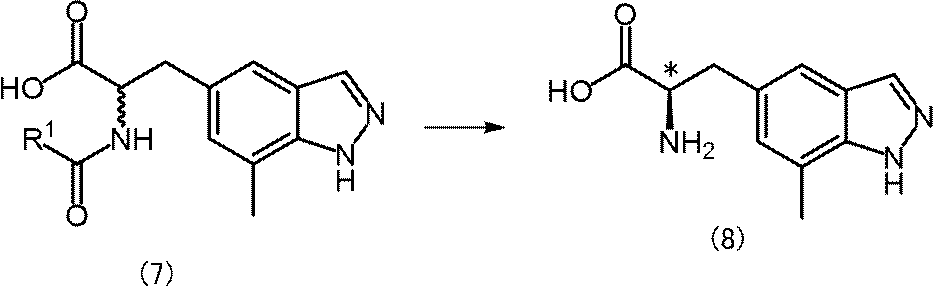
(式中、R1は、水酸基及びカルボキシ基のいずれかを有していてもよい炭素数1~6のアルキル基、又はアミノ基を示す)
工程(X2)では、N-カルボニル化インダゾリルアラニン(7)に酵素源を作用させて光学活性インダゾリルアラニン(8)を得る。R1が炭素数1~6のアルキル基であるとき、酵素源としてアミノアシラーゼが使用できる。アミノアシラーゼとは、アミノ基がアシル基で保護されているα-アミノ酸であってα位の炭素原子がR配置であるもの(D体)を加水分解して前記アシル基を脱離させる活性を有する酵素である。
(式中、R1は、水酸基及びカルボキシ基のいずれかを有していてもよい炭素数1~6のアルキル基、又はアミノ基を示す)
工程(X2)では、N-カルボニル化インダゾリルアラニン(7)に酵素源を作用させて光学活性インダゾリルアラニン(8)を得る。R1が炭素数1~6のアルキル基であるとき、酵素源としてアミノアシラーゼが使用できる。アミノアシラーゼとは、アミノ基がアシル基で保護されているα-アミノ酸であってα位の炭素原子がR配置であるもの(D体)を加水分解して前記アシル基を脱離させる活性を有する酵素である。
R1が水酸基を有する炭素数1~6のアルキル基であるとき、酵素源としてヒドロキシアルカン酸アミド加水分解酵素が使用できる。ヒドロキシアルカン酸アミド加水分解酵素とは、アミノ基がヒドロキシアルキルカルボキシ基で保護されているα-アミノ酸であってα位の炭素原子がR配置であるもの(D体)を加水分解して前記ヒドロキシアルキルカルボキシ基を脱離させる活性を有する酵素である。
R1がカルボキシル基を有する炭素数1~6のアルキル基であるとき、酵素源としてアルカンジカルボン酸アミド加水分解酵素が使用でき、特にR1が2-カルボキシエチル基であるとき、酵素源としてサクシニラーゼが使用できる。アルカンジカルボン酸アミド加水分解酵素とは、アミノ基にカルボキシアルキルカルボニル基が結合しているα-アミノ酸であってα位の炭素原子がR配置であるもの(D体)を加水分解して前記カルボキシアルキルカルボニル基を脱離させる活性を有する酵素である。サクシニラーゼとは、アミノ基にカルボキシエチルカルボニル基が結合しているα-アミノ酸であってα位の炭素原子がR配置であるもの(D体)を加水分解して前記カルボキシエチルカルボニル基を脱離させる活性を有する酵素である。
R1がアミノ基であるとき、酵素源としてデカルバモイラーゼが使用できる。デカルバモイラーゼとは、アミノ基にカルバモイル基が結合しているα-アミノ酸であってα位の炭素原子がR配置であるもの(D体)を加水分解して前記カルバモイル基を脱離させる活性を有する酵素である。
サクシニラーゼとしては、動物、植物、又は微生物由来のいずれでも使用でき、工業的な利用には微生物由来のものが好ましい。酵素源となる微生物としては、当該酵素の生産能力を有する微生物であればいずれも利用でき、例えば、以下の公知の、当該酵素の生産能力を有する微生物を挙げることができる。
前記微生物としては、カプリアヴィダス属(Cupriavidus)などが挙げられ、好ましくはカプリアヴィダス・ギラーディー(Cupriavidus gilardii) J11株が挙げられ、該微生物由来のサクシニラーゼのアミノ酸配列は配列番号1で示され、該アミノ酸配列をコードする遺伝子は配列番号2で示される。
上記微生物は野生株であってもよく、また、変異処理によってサクシニラーゼ活性が高められた変異株であってもよい。さらに、遺伝子組換え等の方法を用いて、上記微生物由来のサクシニラーゼを高生産するように作成された形質転換微生物であってもよい。サクシニラーゼを効率良く高生産する形質転換微生物の作成方法としては、サクシニラーゼ活性を示す菌株からサクシニラーゼ遺伝子をクローニングした後、適当なベクターとの組換えプラスミドを作成して、これを用いて適当な宿主菌を形質転換することで得られる。なお、組換えDNA技術については当該分野において周知であり、例えば、Molecular Cloning 2nd Edition (Cold Spring Harbor Laboratory Press,1989)、Current Protocols in Molecular Biology (Greene Publishing Associates and Wiley-Interscience)に記載されている。
前述のサクシニラーゼ活性を示す微生物、或いは、上記形質転換微生物によるサクシニラーゼの生産は、通常の栄養培地を用いて培養を行えば良く、必要に応じて、酵素誘導のための処理を行うこともできる。酵素誘導は、例えば、培地にウラシルを添加して培養することにより行うことができる。
本発明において、上記微生物によって生産されたサクシニラーゼは、酵素自体として用いることができるほか、本酵素活性を有する微生物若しくはその処理物としても用いることができる。ここで、微生物の処理物とは、例えば、粗抽出液、培養菌体凍結乾燥生物体、アセトン乾燥生物体、又はそれらの菌体の破砕物を意味する。さらにそれらは、酵素自体あるいは菌体のまま公知の手段で固定化して得た固定化酵素として用いられ得る。なお、酵素を固定化して安定化することで、酵素反応を、より過酷な温度域で行うこと等が可能となり、反応をより効率的に進行させることができる。さらに、酵素の反復使用が可能となり、製造プロセスが簡略化できる。
工程(X2)では、サクシニラーゼに加えてアシルアミノ酸ラセマーゼを用いることが好ましい。アシルアミノ酸ラセマーゼとは、アミノ基がアシル基で保護されているα-アミノ酸のα位の炭素原子をS配置(L体)からR配置(D体)にする活性を有する酵素であり、R配置(D体)をS配置(L体)にする活性(すなわちラセミ化する活性)を有していてもよい。アシルアミノ酸ラセマーゼを用いることで、光学活性インダゾリルアラニン(8)の収量を多くすることができる。
アシルアミノ酸ラセマーゼとしては、動物、植物、又は微生物由来のいずれでも使用でき、工業的な利用には微生物由来のものが好ましい。酵素源となる微生物としては、当該酵素の生産能力を有する微生物であればいずれも利用でき、例えば、以下の公知の、当該酵素の生産能力を有する微生物を挙げることができる。
アシルアミノ酸ラセマーゼの生産能力を有する微生物としては、ゲオバチルス(Geobacillus)属及びサーマス(Thermus)属などに属する微生物由来の酵素が挙げられ、好ましくは、ゲオバチルス・カウストフィラス(Geobacilluskaustophilus)、サーマス・サーモフィラス(Thermusthermophilus)等の微生物に由来する酵素である。より好ましくはゲオバチルス・カウストフィラス(Geobacilluskaustophilus)NBRC102445、サーマス・サーモフィラス(Thermusthermophilus)HB8に由来する酵素である。ゲオバチルス・カウストフィラス(Geobacilluskaustophilus)NBRC102445に由来するN-アシルアミノ酸ラセマーゼのアミノ酸配列をコードする遺伝子は配列番号7で示される。
上記微生物は野生株であってもよく、また、変異処理によってアシルアミノ酸ラセマーゼ活性が高められた変異株であってもよい。さらに、遺伝子組換え等の方法を用いて、上記微生物由来のアシルアミノ酸ラセマーゼを高生産するように作成された形質転換微生物であってもよい。アシルアミノ酸ラセマーゼを効率良く高生産する形質転換微生物の作成方法としては、例えばアシルアミノ酸ラセマーゼ活性を示す菌株からアシルアミノ酸ラセマーゼ遺伝子をクローニングした後、適当なベクターとの組換えプラスミドを作成して、これを用いて適当な宿主菌を形質転換することで得られる。なお、組換えDNA技術については当該分野において周知であり、例えば、Molecular Cloning 2nd Edition (Cold Spring Harbor Laboratory Press,1989)、Current Protocols in Molecular Biology (Greene Publishing Associates and Wiley-Interscience)に記載されている。
前述のアシルアミノ酸ラセマーゼ活性を示す微生物、或いは、上記形質転換微生物によるアシルアミノ酸ラセマーゼの生産は、通常の栄養培地を用いて培養を行えば良く、必要に応じて、酵素誘導のための処理を行うこともできる。酵素誘導は、例えば、培地にウラシルを添加して培養することにより行うことができる。
本発明において、上記微生物によって生産されたアシルアミノ酸ラセマーゼは、酵素自体として用いることができるほか、本酵素活性を有する微生物若しくはその処理物としても用いることができる。ここで、微生物の処理物とは、例えば、粗抽出液、培養菌体凍結乾燥生物体、アセトン乾燥生物体、又はそれらの菌体の破砕物を意味する。さらにそれらは、酵素自体あるいは菌体のまま公知の手段で固定化して得た固定化酵素として用いられ得る。なお、酵素を固定化して安定化することで、酵素反応を、より過酷な温度域で行うこと等が可能となり、反応をより効率的に進行させることができる。さらに、酵素の反復使用が可能となり、製造プロセスが簡略化できる。
工程(X2)で使用可能なデカルバモイラーゼは、工程(X1)で使用可能なデカルバモイラーゼと同様である。
工程(X2)の酵素反応では、基質であるN-カルボニル化インダゾリルアラニン(7)を、基R1に対応する適当な酵素で処理する。基質の仕込み濃度は0.1%(w/v)以上90%(w/v)以下、好ましくは1%(w/v)以上50%(w/v)以下で、溶解又は懸濁した状態で反応を行い、反応温度は10℃以上80℃以下、好ましくは20℃以上60℃以下の適当な温度で調節し、pH4以上9以下、好ましくはpH5以上8以下に保ちつつ、暫時静置又は攪拌すればよい。また、基質を連続的に添加しうる。反応は、バッチ法又は連続方式で行い得る。さらに、本発明の当該反応は、固定化酵素、膜リアクター等を利用して行うことも可能である。
水性媒体としては、水、緩衝液(例えばリン酸緩衝液、トリス緩衝液、炭酸緩衝液等)、これらに水溶性有機溶媒(例えばエタノール、メタノール、アセトニトリル等)を含む溶媒等を用いることができる。なお、上記水性媒体は、水に溶解しにくい有機溶媒(例えば、酢酸エチル、酢酸ブチル、トルエン、クロロホルム、n-ヘプタン等)との2相系として用いることもできる。さらに必要に応じて、抗酸化剤、界面活性剤、補酵素、金属等を添加することもできる。
インダゾリルメチルヒダントイン(5)から、直接、N-カルボニル化インダゾリルアラニン(7)を製造することができ(工程(G))、またインダゾリルメチルヒダントイン(5)からまずインダゾリルアラニン(6)を製造し(工程(E))、次いでN-カルボニル化インダゾリルアラニン(7)を製造することもできる(工程(F))。
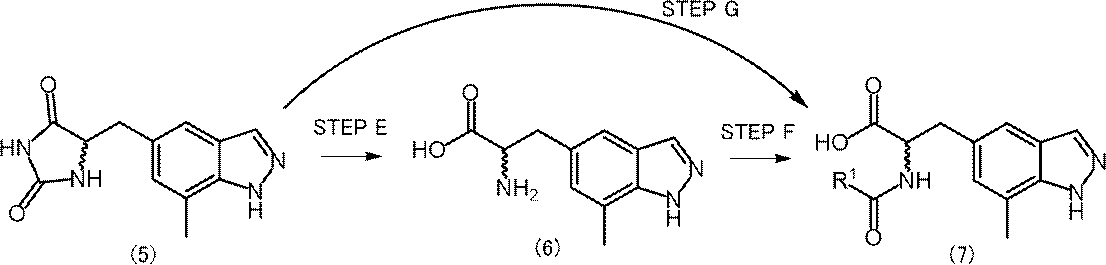
(式中、R1は、水酸基及びカルボキシ基のいずれかを有していてもよい炭素数1~6のアルキル基、又はアミノ基を示す)
(式中、R1は、水酸基及びカルボキシ基のいずれかを有していてもよい炭素数1~6のアルキル基、又はアミノ基を示す)
<工程(E)>

工程(E)はR1が水酸基及びカルボキシ基のいずれかを有していてもよい炭素数1~6のアルキル基であるN-カルボニル化インダゾリルアラニン(7)を製造するときに採用することが好ましい。工程(E)では、インダゾリルメチルヒダントイン(5)を加水分解することでインダゾリルアラニン(6)を製造できる。インダゾリルアラニン(6)はラセミ体である。
工程(E)はR1が水酸基及びカルボキシ基のいずれかを有していてもよい炭素数1~6のアルキル基であるN-カルボニル化インダゾリルアラニン(7)を製造するときに採用することが好ましい。工程(E)では、インダゾリルメチルヒダントイン(5)を加水分解することでインダゾリルアラニン(6)を製造できる。インダゾリルアラニン(6)はラセミ体である。
前記加水分解では、水及び塩基を用いることが好ましい。水は、インダゾリルメチルヒダントイン(5)1モルに対して、例えば、2モル以上、好ましくは10モル以上、より好ましくは100モル以上である。
塩基としては、水酸化リチウム、水酸化ナトリウム、水酸化カリウムなどのアルカリ金属水酸化物が好ましい。塩基は、インダゾリルメチルヒダントイン(5)1モルに対して、例えば、2~50モル、好ましくは3~20モル、より好ましくは4~15モルである。
工程(E)の反応溶媒は、例えば、水;メタノール、エタノール、プロパノール、エチレングリコールなどのアルコール類;テトラヒドロフラン、メチルテトラヒドロフラン、ジエチルエーテル、1,4-ジオキサン、メチルtert-ブチルエーテル、エチレングリコールジメチルエーテル、4-メチルテトラヒドロピラン等のエーテル系溶媒;ペンタン、ヘキサン、ヘプタン、メチルシクロヘキサン等の脂肪族炭化水素系溶媒;ベンゼン、トルエン、キシレン、エチルベンゼン、メシチレン等の芳香族炭化水素系溶媒;N,N-ジメチルホルムアミド、N,N-ジメチルアセトアミド、N,N-ジエチルアセトアミド、N-メチル-2-ピロリドン、N-エチル-2-ピロリドン、N-メチル-ε-カプロラクタム、ヘキサメチルホスホルアミド等のアミド系溶媒;ジメチルプロピレンウレア等のウレア系溶媒;ヘキサメチルホスホン酸トリアミド等のホスホン酸トリアミド系溶媒などであり、好ましくは水である。反応溶媒の量は、インダゾリルメチルヒダントイン(5)1質量部に対して、例えば、1~50質量部、好ましくは2~30質量部、より好ましくは5~20質量部である。
工程(E)の反応温度は、例えば、50~150℃、好ましくは70~120℃、より好ましくは90~110℃である。また工程(E)の反応温度の上限は溶媒の沸点であってもよい。工程(E)の反応時間は、例えば、1~200時間、好ましくは30~150時間、より好ましくは50~100時間である。
工程(E)の反応後、必要に応じて反応液から生成物を取り出してもよい。例えば、中和、洗浄、濾過などの適当な不純物除去処理を行ってもよい。このようにして得られた生成物は、後続工程に使用できる十分な純度を有しているが、純度を更に高める目的で、晶析、分別蒸留、カラムクロマトグラフィー等の一般的な精製手法により、更に純度を高めてもよい。
<工程(F)>

(式中、R1は、水酸基及びカルボキシ基のいずれかを有していてもよい炭素数1~6のアルキル基、又はアミノ基を示し、水酸基及びカルボキシ基のいずれかを有していてもよい炭素数1~6のアルキル基であることが好ましい)
(式中、R1は、水酸基及びカルボキシ基のいずれかを有していてもよい炭素数1~6のアルキル基、又はアミノ基を示し、水酸基及びカルボキシ基のいずれかを有していてもよい炭素数1~6のアルキル基であることが好ましい)
工程(F)では、例えば、インダゾリルアラニン(6)のアミノ基をアミド化し、N-カルボニル化インダゾリルアラニン(7)にするのが好ましい。N-カルボニル化インダゾリルアラニン(7)はラセミ体である。前記アミド化では、例えば、R1COOH又はその活性化物(例えばR1COOHの酸無水物、R1COOHのハロゲン化物、R1COOHを縮合剤で活性化したエステルなど)などを使用することが好ましい。R1が炭素数1~6のアルキル基のとき、R1COOHとしては酢酸、プロピオン酸、酪酸、イソ酪酸、吉草酸、イソ吉草酸、ピバル酸、カプロン酸、2-メチル吉草酸、3-メチル吉草酸、4-メチル吉草酸、エナント酸などが挙げられ、これらが不斉炭素を有する場合、ラセミ体であってもよく光学活性体であってもよい。R1が水酸基を有する炭素数1~6のアルキル基のとき、R1COOHとしては、グリコール酸、乳酸、3-ヒドロキシプロピオン酸、2-ヒドロキシブタン酸、3-ヒドロキシブタン酸、4-ヒドロキシブタン酸、2-ヒドロキシペンタン酸、3-ヒドロキシペンタン酸、4-ヒドロキシペンタン酸、5-ヒドロキシペンタン酸、2-ヒドロキシヘキサン酸、3-ヒドロキシヘキサン酸、4-ヒドロキシヘキサン酸、5-ヒドロキシヘキサン酸、6-ヒドロキシヘキサン酸などが挙げられ、これらが不斉炭素を有する場合、ラセミ体であってもよく光学活性体であってもよい。R1が水酸基を有する炭素数1~6のアルキル基であるR1COOHでは、水酸基がベンジル基、t-ブチル基などの保護基で保護されていてもよい。R1COOHの水酸基が保護されている場合、インダゾリルアラニン(6)とR1COOHとを反応させた後で、脱保護する。R1がカルボキシ基を有する炭素数1~6のアルキル基のとき、R1COOHとしては、マロン酸、コハク酸、グルタル酸、アジピン酸、ピメリン酸、スベリン酸などが挙げられる。
前記縮合剤としては、ジシクロヘキシルカルボジイミド(DCC)、ジイソプロピルカルボジイミド(DIC)、1-エチル-3-(3-ジメチルアミノプロピル)カルボジイミド(EDC)などのカルボジイミド類;1-[ビス(ジメチルアミノ)メチレン]-1H-ベンゾトリアゾリウム3-オキシドヘキサフルオロホスファート(HBTU)、1-[ビス(ジメチルアミノ)メチレン]-1H-1,2,3-トリアゾロ[4,5-b]ピリジニウム3-オキシドヘキサフルオロホスファート(HATU)、1H-ベンゾトリアゾール-1-イルオキシトリピロリジノホスホニウムヘキサフルオロホスファート(PyBOP)、(1-シアノ-2-エトキシ-2-オキソエチリデンアミノオキシ)ジメチルアミノモルホリノカルベニウムヘキサフルオロホスファート(COMU)などが挙げられる。前記カルボジイミド類は、1-ヒドロキシベンゾトリアゾール(HOBt)、1-ヒドロキシ-7-アザベンゾトリアゾール(HOAt)などのトリアゾール類、N-ヒドロキシスクシンイミド(NHS)、エチルシアノ(ヒドロキシイミノ)アセテート(Oxyma)、ジメチルアミノピリジン(DMAP)、N-メチルイミダゾール、N,N-ジメチル-4-アミノピリジン N-オキシド(DMAPO)などと共に用いてもよい。
R1COOHまたはその活性化物の量は、インダゾリルアラニン(6)1モルに対して、例えば、0.5~10モル、好ましくは0.8~7モル、より好ましくは1~3モルである。インダゾリルアラニン(6)とR1COOH又はその活性化物とを反応させるとき、反応混合物のpHを8.0~14、好ましくは9.0~13、より好ましくは9.5~12にしておくことである。pHの調整には、酸、塩基(水酸化ナトリウムなどのアルカリ金属水酸化物など)を適宜使用できる。
工程(F)の反応温度は、例えば、0~150℃、好ましくは10~80℃、より好ましくは20~40℃である。工程(F)の反応時間は、例えば、0.1~20時間、好ましくは0.3~5時間、より好ましくは0.5~3時間である。
工程(F)の反応後、必要に応じて反応液から生成物を取り出してもよい。例えば、洗浄、濾過などの適当な不純物除去処理を行ってもよい。このようにして得られた生成物は、後続工程に使用できる十分な純度を有しているが、純度を更に高める目的で、晶析、分別蒸留、カラムクロマトグラフィー等の一般的な精製手法により、更に純度を高めてもよい。
<工程(G)>
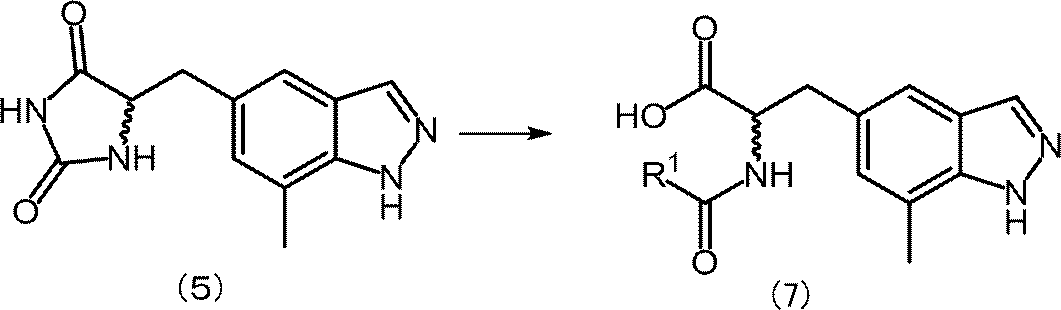
(式中、R1は、水酸基及びカルボキシ基のいずれかを有していてもよい炭素数1~6のアルキル基、又はアミノ基を示し、アミノ基であることが好ましい)
(式中、R1は、水酸基及びカルボキシ基のいずれかを有していてもよい炭素数1~6のアルキル基、又はアミノ基を示し、アミノ基であることが好ましい)
工程(G)は、R1がアミノ基であるときに採用することが好ましい。工程(G)では、インダゾリルメチルヒダントイン(5)を加水分解することでN-カルボニル化インダゾリルアラニン(7)を製造できる。N-カルボニル化インダゾリルアラニン(7)はラセミ体である。
前記加水分解では、水及び塩基を用いることが好ましい。水は、インダゾリルメチルヒダントイン(5)1モルに対して、例えば、2モル以上、好ましくは10モル以上、より好ましくは100モル以上である。
塩基としては、水酸化リチウム、水酸化ナトリウム、水酸化カリウムなどのアルカリ金属水酸化物が好ましい。塩基は、インダゾリルメチルヒダントイン(5)1モルに対して、例えば、2~50モル、好ましくは3~20モル、より好ましくは4~15モルである。
工程(G)の反応溶媒は、例えば、水;メタノール、エタノール、プロパノール、エチレングリコールなどのアルコール類;テトラヒドロフラン、メチルテトラヒドロフラン、ジエチルエーテル、1,4-ジオキサン、メチルtert-ブチルエーテル、エチレングリコールジメチルエーテル、4-メチルテトラヒドロピラン等のエーテル系溶媒;ペンタン、ヘキサン、ヘプタン、メチルシクロヘキサン等の脂肪族炭化水素系溶媒;ベンゼン、トルエン、キシレン、エチルベンゼン、メシチレン等の芳香族炭化水素系溶媒;N,N-ジメチルホルムアミド、N,N-ジメチルアセトアミド、N,N-ジエチルアセトアミド、N-メチル-2-ピロリドン、N-エチル-2-ピロリドン、N-メチル-ε-カプロラクタム、ヘキサメチルホスホルアミド等のアミド系溶媒;ジメチルプロピレンウレア等のウレア系溶媒;ヘキサメチルホスホン酸トリアミド等のホスホン酸トリアミド系溶媒などであり、好ましくは水である。反応溶媒の量は、インダゾリルメチルヒダントイン(5)1質量部に対して、例えば、1~50質量部、好ましくは2~30質量部、より好ましくは5~20質量部である。
工程(G)の反応温度は、例えば、20~100℃、好ましくは30~90℃、より好ましくは40~80℃である。工程(G)の反応時間は、例えば、1~50時間、好ましくは5~40時間、より好ましくは10~30時間である。
工程(G)の反応後、必要に応じて反応液から生成物を取り出してもよい。例えば、中和、洗浄、濾過などの適当な不純物除去処理を行ってもよい。このようにして得られた生成物は、後続工程に使用できる十分な純度を有しているが、純度を更に高める目的で、晶析、分別蒸留、カラムクロマトグラフィー等の一般的な精製手法により、更に純度を高めてもよい。
前記酵素反応原料となるインダゾリルメチルヒダントイン(5)は、インダゾリルアルデヒド(3)からオレフィン化合物(4)を製造し(工程(C))、得られたオレフィン化合物(4)を還元することによって製造できる(工程(D))。

<工程(C)>
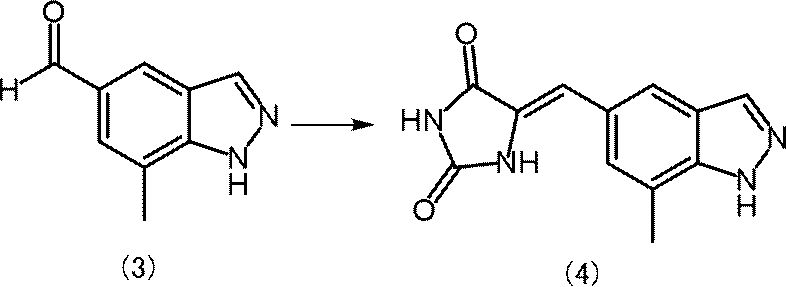
工程(C)では、例えば、インダゾリルアルデヒド(3)をヒダントイン及びアミン類で処理することが好ましい。ヒダントインは、インダゾリルアルデヒド(3)1モルに対して、例えば、1~10モル、好ましくは1.1~5モル、より好ましくは1.2~2モルである。
アミン類は、インダゾリルアルデヒド(3)とヒダントインとの縮合反応を促進するために使用される。アミン類としては、エタノールアミン、ピペリジン等が挙げられる。アミン類は、インダゾリルアルデヒド(3)1モルに対して、例えば、1~10モル、好ましくは1.1~5モル、より好ましくは1.2~2モルである。
工程(C)の混合順序について特に制限はないが、ヒダントインにインダゾリルアルデヒド(3)とアミン類を添加するのが好ましい。
工程(C)の反応溶媒は、例えば、水、水溶性有機溶媒などが好ましく、水と水溶性有機溶媒との混合溶媒がより好ましい。水溶性有機溶媒には、例えば、メタノール、エタノールなどのアルコール類、テトラヒドロフラン、ジオキサンなどの環状エーテル類、ジメチルホルムアミドなどのアミド類などが挙げられる。反応溶媒の量は、インダゾリルアルデヒド(3)1質量部に対して、例えば、1~50質量部、好ましくは2~30質量部、より好ましくは5~20質量部程度である。
工程(C)の反応温度は、例えば、0~150℃、好ましくは30~120℃、より好ましくは50~100℃である。工程(C)の反応時間は、例えば、0.5~40時間、好ましくは1~30時間、より好ましくは1~20時間である。
工程(C)の反応後、必要に応じて反応液から生成物を取り出してもよい。例えば、洗浄、濾過などの適当な不純物除去処理を行ってもよい。このようにして得られた生成物は、後続工程に使用できる十分な純度を有しているが、純度を更に高める目的で、晶析、分別蒸留、カラムクロマトグラフィー等の一般的な精製手法により、更に純度を高めてもよい。
<工程(D)>
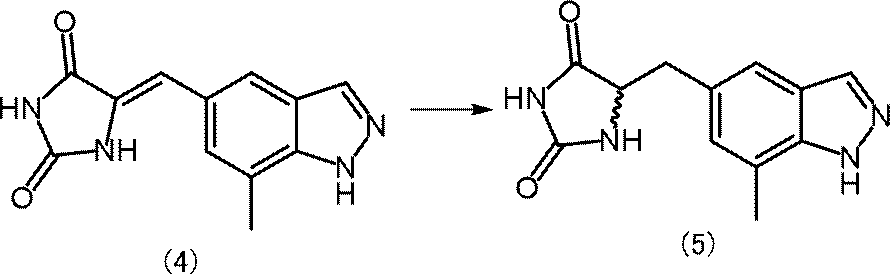
工程(D)では、例えば、オレフィン化合物(4)を水素分子、あるいは、水素化ホウ素ナトリウムで還元してインダゾリルメチルヒダントイン(5)にするのが好ましい。インダゾリルメチルヒダントイン(5)はラセミ体である。
工程(D)では、例えば、オレフィン化合物(4)を水素分子、あるいは、水素化ホウ素ナトリウムで還元してインダゾリルメチルヒダントイン(5)にするのが好ましい。インダゾリルメチルヒダントイン(5)はラセミ体である。
前記水素分子としては、例えば、水素ガスが使用される。水素ガスは常圧で使用してもよく、加圧して使用してもよい。また水素分子による還元には、触媒を使用することが好ましい。触媒としては、例えば、白金、ニッケル、パラジウム、ルテニウムなどの不均一系金属触媒、ウィルキンソン触媒などの均一系金属触媒などが挙げられ、パラジウムが好ましい。また不均一系金属触媒は、炭素などの担体に担持されていることが好ましい。
前記水素化ホウ素ナトリウムによる還元における水素化ホウ素ナトリウムの量は、オレフィン化合物(4)1モルに対して、例えば、1~10モル、好ましくは1.3~5モル、より好ましくは1.5~3モルである。また、水素化ホウ素ナトリウムによる還元は、コバルト化合物及びキレート剤の共存下で実施することが好ましい。コバルト化合物としては、塩化コバルト、硝酸コバルト、酢酸コバルトなどが挙げられ、硝酸コバルトが好ましい。コバルト化合物の量は、オレフィン化合物(4)に対して、例えば、0.001~0.05モル、好ましくは0.005~0.03モル、より好ましくは0.01~0.02モルである。キレート剤としては、ジメチルグリオキシム、2,2’-ビピリジル、フェナントロリン等が挙げられるが、ジメチルグリオキシムが好ましい。キレート剤の量は、オレフィン化合物(4)に対して、例えば、0.01~0.5モル、好ましくは0.03~0.3モル、より好ましくは0.05~0.2モルである。
工程(D)の反応溶媒は、例えば、水;メタノール、エタノール、プロパノール、エチレングリコールなどのアルコール類;テトラヒドロフラン、メチルテトラヒドロフラン、ジエチルエーテル、1,4-ジオキサン、メチルtert-ブチルエーテル、エチレングリコールジメチルエーテル、4-メチルテトラヒドロピラン等のエーテル系溶媒;ペンタン、ヘキサン、ヘプタン、メチルシクロヘキサン等の脂肪族炭化水素系溶媒;ベンゼン、トルエン、キシレン、エチルベンゼン、メシチレン等の芳香族炭化水素系溶媒;N,N-ジメチルホルムアミド、N,N-ジメチルアセトアミド、N,N-ジエチルアセトアミド、N-メチル-2-ピロリドン、N-エチル-2-ピロリドン、N-メチル-ε-カプロラクタム、ヘキサメチルホスホルアミド等のアミド系溶媒;ジメチルプロピレンウレア等のウレア系溶媒;ヘキサメチルホスホン酸トリアミド等のホスホン酸トリアミド系溶媒などであり、好ましくは水、アルコール溶媒、アミド系溶媒、及び、それらからなる混合溶媒である。反応溶媒の量は、オレフィン化合物(4)1質量部に対して、例えば、1~50質量部、好ましくは2~30質量部、より好ましくは5~20質量部である。
工程(D)の反応温度は、例えば、-20~150℃、好ましくは-10~100℃、より好ましくは0~50℃である。工程(D)の反応時間は、例えば、0.1~40時間、好ましくは1~30時間、より好ましくは3~20時間である。
工程(D)の反応後、必要に応じて反応液から生成物を取り出してもよい。例えば、洗浄、濾過などの適当な不純物除去処理を行ってもよい。このようにして得られた生成物は、後続工程に使用できる十分な純度を有しているが、純度を更に高める目的で、晶析、分別蒸留、カラムクロマトグラフィー等の一般的な精製手法により、更に純度を高めてもよい。
第二態様において、前記インダゾリルアルデヒド(3)は、公知の方法、例えば4-ブロモ-2,6-ジメチルアニリンを亜硝酸類と酸で処理して5-ブロモ-7-メチル-1H-インダゾールを製造し、次いでブチルリチウムとジメチルホルムアミドで製造してもよい。
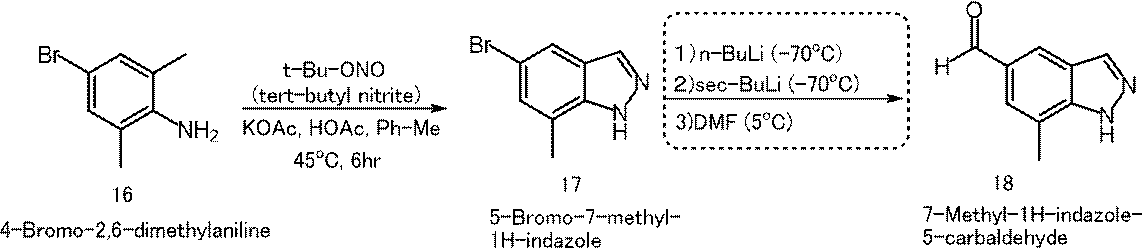
また第二態様において、前記インダゾリルアルデヒド(3)は、第一態様で説明した、ジメチルアニリン(1)をホルミル化する工程(A)、及び前記ホルミル化工程で得られるアミノベンズアルデヒド(2)を環化してインダゾリルアルデヒド(3)を得る工程(B)によって製造されることが好ましい。工程(A)、工程(B)による方法は、極低温条件を必要とせず、エネルギー的に有利である。
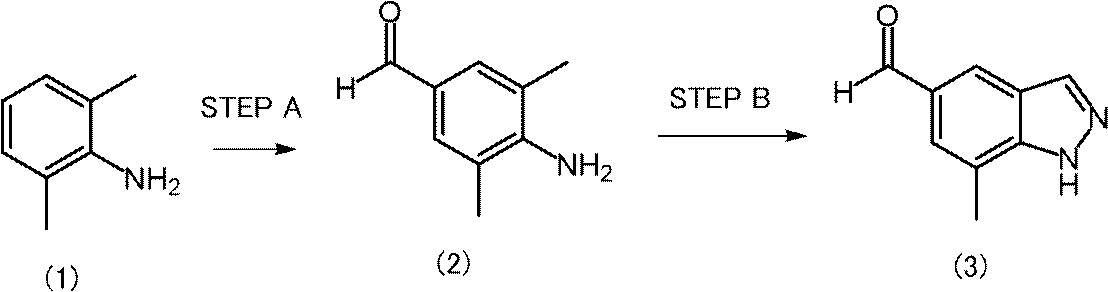
本発明(第一態様又は第二態様)の方法で得られた光学活性インダゾリルアラニン(8)から光学活性インダゾリルアラニンエステル(9)またはその塩を製造できる(工程(Y))。
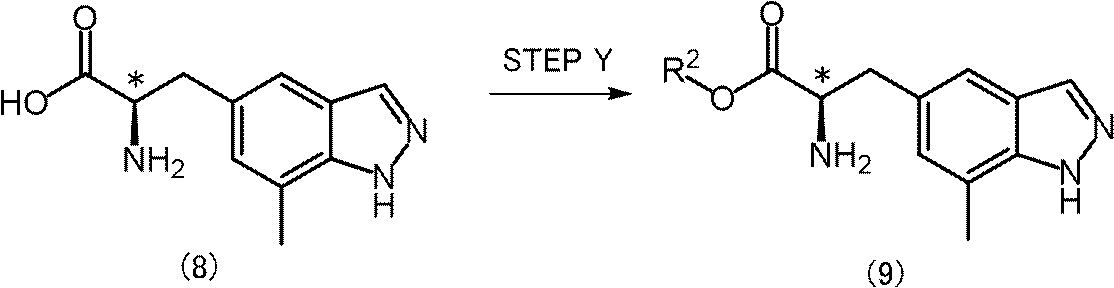
(式中、R2は炭素数1~6のアルキル基を表す)
R2としては、メチル基、エチル基、プロピル基、ブチル基、ペンチル基、ヘキシル基などが挙げられ、メチル基、エチル基が好ましい。
(式中、R2は炭素数1~6のアルキル基を表す)
R2としては、メチル基、エチル基、プロピル基、ブチル基、ペンチル基、ヘキシル基などが挙げられ、メチル基、エチル基が好ましい。
<工程(Y)>
工程(Y)では、光学活性インダゾリルアラニン(8)をエステル化し、光学活性インダゾリルアラニンエステル(9)にする。該エステル化では、光学活性インダゾリルアラニン(8)に、酸触媒の存在下、R2OHを作用させてもよく、光学活性インダゾリルアラニン(8)をハロゲン化又は無水物化した後、R2OHを作用させてもよく、縮合剤を用いて光学活性インダゾリルアラニン(8)とR2OHとを脱水縮合してもよい。
工程(Y)では、光学活性インダゾリルアラニン(8)をエステル化し、光学活性インダゾリルアラニンエステル(9)にする。該エステル化では、光学活性インダゾリルアラニン(8)に、酸触媒の存在下、R2OHを作用させてもよく、光学活性インダゾリルアラニン(8)をハロゲン化又は無水物化した後、R2OHを作用させてもよく、縮合剤を用いて光学活性インダゾリルアラニン(8)とR2OHとを脱水縮合してもよい。
酸触媒としては、塩酸、硫酸などの無機酸が好ましい。
ハロゲン化には、塩化チオニル、塩化オキサリルなどのハロゲン化剤が使用でき、該ハロゲン化剤はジメチルホルムアミドなどのハロゲン化触媒と共に用いてもよい。ハロゲン化剤の量は、光学活性インダゾリルアラニン(8)1モルに対して、例えば、1.0~5モル、好ましくは1.3~4モル、より好ましくは1.5~3モルである。
ハロゲン化には、塩化チオニル、塩化オキサリルなどのハロゲン化剤が使用でき、該ハロゲン化剤はジメチルホルムアミドなどのハロゲン化触媒と共に用いてもよい。ハロゲン化剤の量は、光学活性インダゾリルアラニン(8)1モルに対して、例えば、1.0~5モル、好ましくは1.3~4モル、より好ましくは1.5~3モルである。
縮合剤としては、ジシクロヘキシルカルボジイミド(DCC)、ジイソプロピルカルボジイミド(DIC)、1-エチル-3-(3-ジメチルアミノプロピル)カルボジイミド(EDC)などのカルボジイミド類;1-[ビス(ジメチルアミノ)メチレン]-1H-ベンゾトリアゾリウム3-オキシドヘキサフルオロホスファート(HBTU)、1-[ビス(ジメチルアミノ)メチレン]-1H-1,2,3-トリアゾロ[4,5-b]ピリジニウム3-オキシドヘキサフルオロホスファート(HATU)、1H-ベンゾトリアゾール-1-イルオキシトリピロリジノホスホニウムヘキサフルオロホスファート(PyBOP)、(1-シアノ-2-エトキシ-2-オキソエチリデンアミノオキシ)ジメチルアミノモルホリノカルベニウムヘキサフルオロホスファート(COMU)などが挙げられる。
R2OHの量は、光学活性インダゾリルアラニン(8)1モルに対して、例えば、1モル以上、好ましくは2モル以上、より好ましくは10モル以上である。R2OHは溶媒として使用してもよく、よってR2OHの量の上限は特に限定されないが、光学活性インダゾリルアラニン(8)1モルに対して、例えば、200モル以下、好ましくは100モル以下であってもよい。
工程(Y)の反応温度は、例えば、-20~150℃、好ましくは0~80℃、より好ましくは10~50℃である。工程(Y)の反応時間は、例えば、0.1~100時間、好ましくは20~80時間であり、また0.1~20時間であってもよく、0.5~15時間であってもよく、1~10時間であってもよい。
工程(Y)の反応後、必要に応じて反応液から生成物を取り出してもよい。例えば、洗浄、濾過などの適当な不純物除去処理を行ってもよい。このようにして得られた生成物は、後続工程に使用できる十分な純度を有しているが、純度を更に高める目的で、晶析、分別蒸留、カラムクロマトグラフィー等の一般的な精製手法により、更に純度を高めてもよい。
以上で説明した工程A、B、C、D、E、F、G、X1、X2、Yの関係を整理すると下式の通りである。
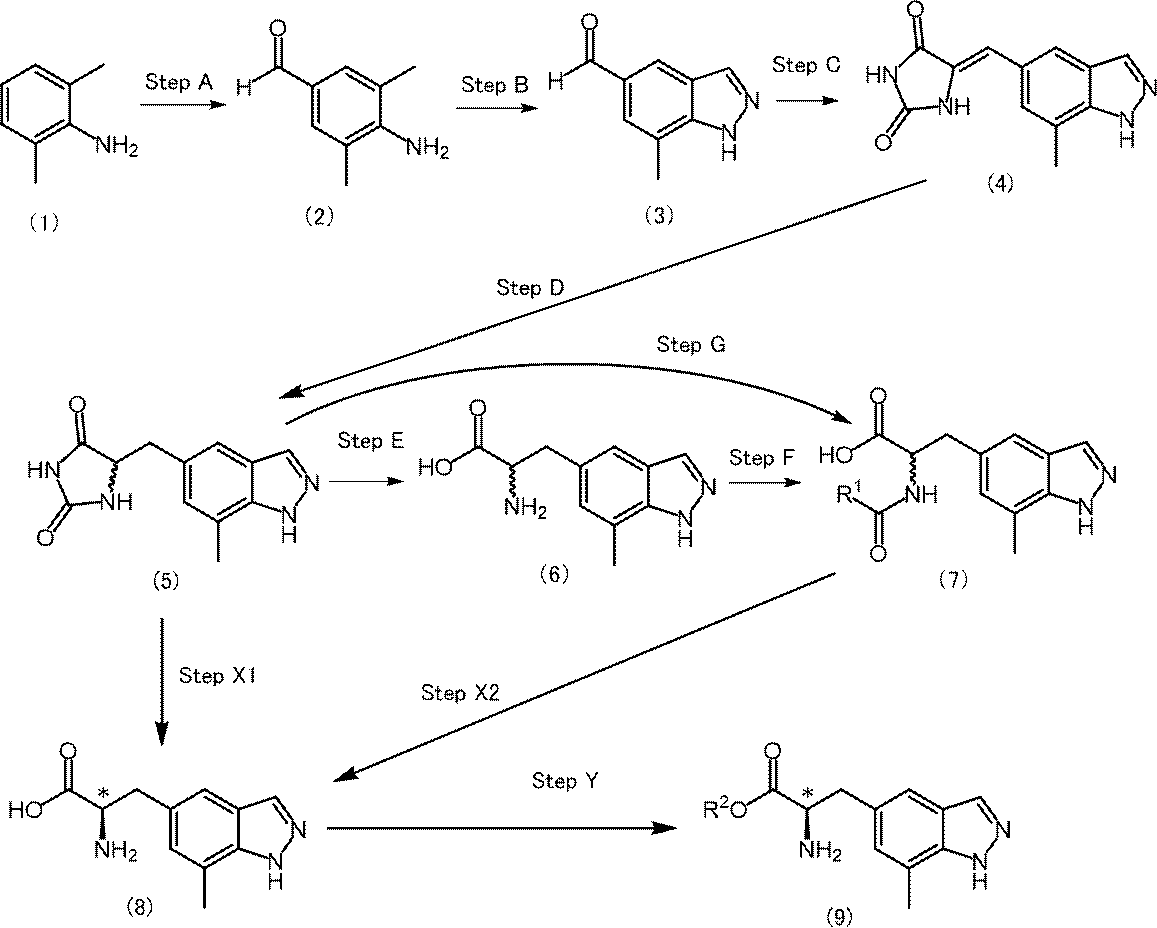
以上の様にして得られる光学活性インダゾリルアラニンエステル(9)又はその塩は、インダゾール骨格を有する医薬に有用である。例えば、光学活性インダゾリルアラニンエステル(9)又はその塩は、非特許文献1に記載の方法に従って式(10)で表される化合物にできる。式(10)で表される化合物は、カルシトニン遺伝子関連ペプチド(CGRP)受容体拮抗薬として有用である。

本願は、2021年2月15日に提出された、日本国特許出願第2021-022037号及び日本国特許出願第2021-022038号に基づく優先権の利益を主張するものである。2021年2月15日に提出された、日本国特許出願第2021-022037号及び日本国特許出願第2021-022038号の明細書の全内容が、本願に参考のため援用される。
以下、実施例を挙げて本発明をより具体的に説明するが、本発明はもとより下記実施例によって制限を受けるものではなく、前・後記の趣旨に適合し得る範囲で適当に変更を加えて実施することも勿論可能であり、それらはいずれも本発明の技術的範囲に包含される。
本実施例の欄で使用する酵素源には、以下の様にして調製したものを使用した。
調製例1 ヒダントイナーゼ濃縮菌体1
国際公開第WO96/20275号記載のバチルス・スピーシーズ(Bacillus sp.)KNK245株(FERM BP-4863)由来のヒダントイナーゼ遺伝子を有する形質転換体エシェリヒア・コリ(Escherichia coli)HB101(pTH104)(FERM BP-4864)を坂口フラスコ内にて滅菌した100mLの培地A(トリプトン16g、イーストエキス10g、塩化ナトリウム5g、アンピシリン100mg、脱イオン水にて1Lにメスアップ、滅菌前pH7.0、ただしアンピシリンは滅菌後に添加する)に植菌し、37℃にて24時間、好気的に振とう培養した。この培養液を遠心分離により、10mLのヒダントイナーゼ濃縮菌体1とした。
調製例1 ヒダントイナーゼ濃縮菌体1
国際公開第WO96/20275号記載のバチルス・スピーシーズ(Bacillus sp.)KNK245株(FERM BP-4863)由来のヒダントイナーゼ遺伝子を有する形質転換体エシェリヒア・コリ(Escherichia coli)HB101(pTH104)(FERM BP-4864)を坂口フラスコ内にて滅菌した100mLの培地A(トリプトン16g、イーストエキス10g、塩化ナトリウム5g、アンピシリン100mg、脱イオン水にて1Lにメスアップ、滅菌前pH7.0、ただしアンピシリンは滅菌後に添加する)に植菌し、37℃にて24時間、好気的に振とう培養した。この培養液を遠心分離により、10mLのヒダントイナーゼ濃縮菌体1とした。
調製例2~4 ヒダントイナーゼ濃縮菌体2~4
ヒダントイナーゼ遺伝子を有する形質転換体エシェリヒア・コリとして、前記エシェリヒア・コリ(Escherichia coli)HB101(pTH104)(FERM BP-4864)に代えて、アグロバクテリウム スピーシーズ(Agrobacterium sp.)KNK712(FERM BP-1900)由来のヒダントイナーゼ遺伝子を含有するエシェリヒア・コリ(Escherichia coli)HB101(pAH1043)(FERM BP-4865)、
シュードモナス・スピーシーズ(Pseudomonas sp.)KNK003A(FERM BP-3181)由来のヒダントイナーゼ遺伝子を含有するエシェリヒア・コリ(Escherichia coli)HB101(pPHD301)(FERM BP-4866)、又は
アネウリニバチルス・スピーシーズ(Aneurinibacillus sp.)KNK491C株(FERM BP-10735)由来のヒダントイナーゼ遺伝子を含有するエシェリヒア・コリ(Escherichia coli)HB101(pALH101)(FERM P-20712:特許第5159319号)を使用する以外は、調製例1と同様の方法でヒダントイナーゼ濃縮菌体2~4を調製した。
ヒダントイナーゼ遺伝子を有する形質転換体エシェリヒア・コリとして、前記エシェリヒア・コリ(Escherichia coli)HB101(pTH104)(FERM BP-4864)に代えて、アグロバクテリウム スピーシーズ(Agrobacterium sp.)KNK712(FERM BP-1900)由来のヒダントイナーゼ遺伝子を含有するエシェリヒア・コリ(Escherichia coli)HB101(pAH1043)(FERM BP-4865)、
シュードモナス・スピーシーズ(Pseudomonas sp.)KNK003A(FERM BP-3181)由来のヒダントイナーゼ遺伝子を含有するエシェリヒア・コリ(Escherichia coli)HB101(pPHD301)(FERM BP-4866)、又は
アネウリニバチルス・スピーシーズ(Aneurinibacillus sp.)KNK491C株(FERM BP-10735)由来のヒダントイナーゼ遺伝子を含有するエシェリヒア・コリ(Escherichia coli)HB101(pALH101)(FERM P-20712:特許第5159319号)を使用する以外は、調製例1と同様の方法でヒダントイナーゼ濃縮菌体2~4を調製した。
調製例5 デカルバモイラーゼ濃縮菌体
遺伝子改変により耐熱性の向上したアグロバクテリウム・スピーシーズ(Agrobacterium sp.)KNK712株(FERM BP-1900)由来のデカルバミラーゼ遺伝子を含有するエシェリヒア・コリ HB101(pNT4553)(FERM BP-4368)を坂口フラスコ内にて滅菌した100mLの培地Aに植菌し、37℃にて24時間、好気的に振とう培養した。この培養液を遠心分離により、10mLのデカルバモイラーゼ濃縮菌体とした。
遺伝子改変により耐熱性の向上したアグロバクテリウム・スピーシーズ(Agrobacterium sp.)KNK712株(FERM BP-1900)由来のデカルバミラーゼ遺伝子を含有するエシェリヒア・コリ HB101(pNT4553)(FERM BP-4368)を坂口フラスコ内にて滅菌した100mLの培地Aに植菌し、37℃にて24時間、好気的に振とう培養した。この培養液を遠心分離により、10mLのデカルバモイラーゼ濃縮菌体とした。
調製例6 ヒダントインラセマーゼ濃縮菌体
バチルス・スピーシーズ(Bacillus sp.)KNK519HR株(FERM BP-10477)由来のヒダントインラセマーゼ遺伝子を含有するエシェリヒア・コリ HB101(pBHR001)(FERM BP-10476:特許第5096911号)を坂口フラスコ内にて滅菌した100mLの培地Aに植菌し、37℃にて24時間、好気的に振とう培養した。この培養液を遠心分離により、10mLのヒダントインラセマーゼ濃縮菌体とした。
バチルス・スピーシーズ(Bacillus sp.)KNK519HR株(FERM BP-10477)由来のヒダントインラセマーゼ遺伝子を含有するエシェリヒア・コリ HB101(pBHR001)(FERM BP-10476:特許第5096911号)を坂口フラスコ内にて滅菌した100mLの培地Aに植菌し、37℃にて24時間、好気的に振とう培養した。この培養液を遠心分離により、10mLのヒダントインラセマーゼ濃縮菌体とした。
調整例7 D-サクシニラーゼ濃縮菌体
コドンを大腸菌に最適化したカプリアヴィダス・ギラーディー(Cupriavidus gilardii) J11株由来のサクシニラーゼ遺伝子(アミノ酸配列:配列番号1、塩基配列:配列番号2)をEurofin社にて人工的に合成した。得られた人工遺伝子を、リボソーム結合部位を付与したプライマー(配列番号3、4)を用いてPCR増幅を行い、サクシニラーゼ遺伝子のDNA断片を得た。タカラバイオ株式会社製のプラスミドpSTV28をプライマー(配列番号5、6)を用いてPCR増幅を行い、pSTV28のDNA断片を得た。
コドンを大腸菌に最適化したカプリアヴィダス・ギラーディー(Cupriavidus gilardii) J11株由来のサクシニラーゼ遺伝子(アミノ酸配列:配列番号1、塩基配列:配列番号2)をEurofin社にて人工的に合成した。得られた人工遺伝子を、リボソーム結合部位を付与したプライマー(配列番号3、4)を用いてPCR増幅を行い、サクシニラーゼ遺伝子のDNA断片を得た。タカラバイオ株式会社製のプラスミドpSTV28をプライマー(配列番号5、6)を用いてPCR増幅を行い、pSTV28のDNA断片を得た。
上記サクシニラーゼ遺伝子及びpSTV28のDNA断片を混合し、In-Fusion HD Cloning Kit(タカラバイオ株式会社)にてクローニング後、エシェリヒア・コリ(Escherichia coli)HB101 Competent Cells(タカラバイオ株式会社)を用いて形質転換を行った。寒天培地(トリプトン10g、イーストエキス5g、塩化ナトリウム10g、寒天15g、クロラムフェニコール100mg、脱イオン水にて1Lにメスアップ、滅菌前pH7.0)にプレーティングして、サクシニラーゼ遺伝子を含む組換え体DNAを含有する形質転換体エシェリヒア・コリ(Escherichia coli)HB101(pSTVDSL CG)をコロニーとして取得した。
前記エシェリヒア・コリ HB101(pSTVDSL CG)を坂口フラスコ内にて滅菌した100mLの培地Aに植菌し、37℃にて24時間、好気的に振とう培養した。この培養液を遠心分離により、10mLのD-サクシニラーゼ濃縮菌体とした。
調製例8 N-アシルアミノ酸ラセマーゼ濃縮菌体
ゲオバチルス・カウストフィラス(Geobacillus kaustophilus)NBRC102445由来のN-アシルアミノ酸ラセマーゼ遺伝子(配列番号7)を含有するエシェリヒア・コリ HB101(pNIG)(特許第6039710号の参考例3と同様にして得られたもの)を坂口フラスコ内にて滅菌した100mLの培地Aに植菌し、37℃にて24時間、好気的に振とう培養した。この培養液を遠心分離により、10mLのN-アシルアミノ酸ラセマーゼ濃縮菌体とした。
ゲオバチルス・カウストフィラス(Geobacillus kaustophilus)NBRC102445由来のN-アシルアミノ酸ラセマーゼ遺伝子(配列番号7)を含有するエシェリヒア・コリ HB101(pNIG)(特許第6039710号の参考例3と同様にして得られたもの)を坂口フラスコ内にて滅菌した100mLの培地Aに植菌し、37℃にて24時間、好気的に振とう培養した。この培養液を遠心分離により、10mLのN-アシルアミノ酸ラセマーゼ濃縮菌体とした。
実施例1 (STEP A)
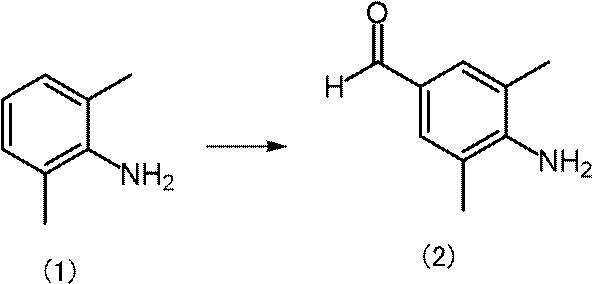
フラスコに酢酸(750g、12500mmol)、水(250g)、2,6-ジメチルアニリン(1)(50.0g、413mmol)、ヘキサメチレンテトラミン(115.9g、828mmol)を加え、内温89℃~102℃で1時間撹拌した。反応液をサンプリングしてHPLCで分析したところ、変換率(転化率)は97面積%であった。内温30℃に温調し、水(250ml)を加え、500mlの塩化メチレンで三回抽出分液した。有機層を480gまで濃縮した後に、トルエン(500ml)、水(450ml)を加えて内温21℃に温調した。これに30wt%水酸化ナトリウム水溶液 513gを加えてpH9に調整した。分液して水層を除去し、有機層を水(50ml)で洗浄した。有機層が118gになるまで濃縮し、内温0℃に冷却して14時間熟成した。結晶を濾過し、湿ケーキを60mlのトルエン/ヘプタン=1/1(体積比)溶媒で洗浄した。減圧下で結晶を乾燥し、表題のアミノベンズアルデヒド(2)を23.5g得た(HPLC純度97面積%、収率47モル%)。
HPLC条件は以下の通りである。また特に断りがない限り、後述する実験例でもこのHPLC条件に基づいて変化率や純度を決定した。
HPLCカラム:Zorbax SB-C3、250mm×4.6mmID.
流速:1.0mL/min、検出波長:220nm、カラム温度:40℃
移動相A:0.1%リン酸水溶液
移動相B:0.1%リン酸アセトニトリル溶液
HPLCカラム:Zorbax SB-C3、250mm×4.6mmID.
流速:1.0mL/min、検出波長:220nm、カラム温度:40℃
移動相A:0.1%リン酸水溶液
移動相B:0.1%リン酸アセトニトリル溶液
実施例2 (STEP B)
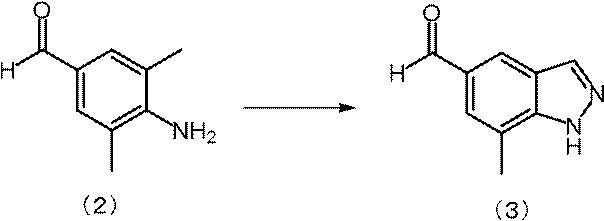
フラスコに実施例1で調製したアミノベンズアルデヒド(2)(17.8g、127mmol)、トルエン(226g)、酢酸カリウム(17.2g、175mmol)、酢酸(10.0g、166mmol)を加えて内温40℃に温調した。亜硝酸イソアミル(15.7g、134mmol)を加えて、内温45℃に温調し、7時間撹拌した。反応液をサンプリングしてHPLCで分析したところ、変換率は95面積%であった。内温22℃に温調し、水(170.2g)、酢酸エチル(155.1g)を加えた。30wt%水酸化ナトリウム水溶液を加えて、pH9.3に調整した。水層を分離し、有機層を87gに濃縮した。これに10wt%亜硫酸水素ナトリウム水溶液(174.1g、252mmol)を加えて45分撹拌した。水層を分離し、水層に酢酸エチル(87g)を加え、30wt%水酸化ナトリウム水溶液(22.8g)を加えて、pH9.0に調整した。水層を分離し、有機層が45gになるまで濃縮した。これにヘプタン(80.9g)を加え、49gになるまで濃縮した。内温4℃に温調して1時間熟成後に結晶を濾過した。減圧下で結晶を乾燥することで表題のインダゾリルアルデヒド(3)13.2gを得た(HPLC純度95.6面積%、収率68モル%)。
実施例3 (STEP C)

フラスコにヒダントイン(24.3g、243mmol)、水(130ml)とエタノール(130ml)を投入し、ここに、インダゾリルアルデヒド(3)(26.0g、162mmol)、エタノールアミン(14.8g、242mmol)を加えて25℃で撹拌した。次にこの反応液を70℃に温調して23時間撹拌した。反応液をサンプリングしてHPLCで分析したところ、変換率は97面積%であった。
反応液を冷却し、水130mlを加えて35℃に温調した。析出した結晶を分離し、湿ケーキを90mlのエタノール・水(1/1(体積比))で洗浄後、減圧下で結晶を乾燥し、オレフィン化合物(4)を38.3g取得した(HPLC純度94面積%、収率92モル%)。1H-NMR(500MHz,DMSO-d6)δ11.18(s,1H),10.55(s,1H),8.07(s,1H),7.86(s,1H),7.41(s,1H),6.50(s,1H),2.49(s,3H)
反応液を冷却し、水130mlを加えて35℃に温調した。析出した結晶を分離し、湿ケーキを90mlのエタノール・水(1/1(体積比))で洗浄後、減圧下で結晶を乾燥し、オレフィン化合物(4)を38.3g取得した(HPLC純度94面積%、収率92モル%)。1H-NMR(500MHz,DMSO-d6)δ11.18(s,1H),10.55(s,1H),8.07(s,1H),7.86(s,1H),7.41(s,1H),6.50(s,1H),2.49(s,3H)
実施例4 (STEP D)
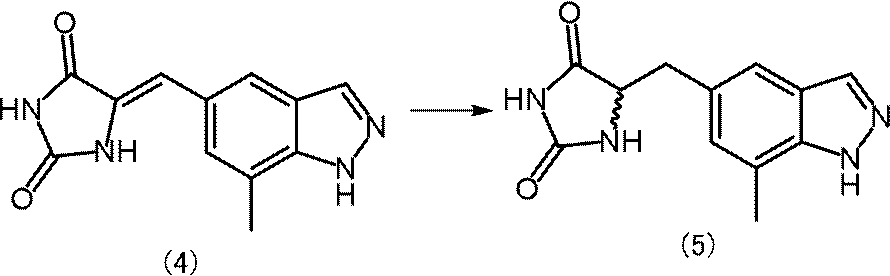
フラスコに実施例3で調製したオレフィン化合物(4)(3.0g、12.4mmol)、N,N-ジメチルホルムアミド(45ml)を加え、30℃で撹拌した。ここに50wt%パラジウム炭素(300mg)を加えて、反応系の気層部を水素に置換し、30℃で15時間撹拌した。反応液をサンプリングしてHPLCで分析したところ、変換率は100面積%であった。パラジウム炭素を濾過し、濾液を5gまで濃縮した。エタノール(20ml)を加えて5gになるまで濃縮し、析出した不溶物を濾別し、濾液を6gまで濃縮した。エタノール(25ml)を加えて20℃で撹拌した。析出した結晶を分離し、減圧下で結晶を乾燥し、インダゾリルメチルヒダントイン(5)を2.1g取得した(HPLC純度99面積%、収率68モル%)。インダゾリルメチルヒダントイン(5)を温度50℃で24時間保持しても分解は認められなかった。
1H-NMR(500MHz,DMSO-d6)δ10.39(s,1H),7.98(s,1H),7.92(s,1H),7.34(s,1H),6.95(s,1H),4.31(t,J=4.5Hz,1H),2.92-3.01(m,2H),2.49(s,3H)
1H-NMR(500MHz,DMSO-d6)δ10.39(s,1H),7.98(s,1H),7.92(s,1H),7.34(s,1H),6.95(s,1H),4.31(t,J=4.5Hz,1H),2.92-3.01(m,2H),2.49(s,3H)
実施例5 光学活性インダゾリルアラニン(8)(D体)の合成(STEP X1)

フラスコに実施例4で調製したインダゾリルメチルヒダントイン(5)を2g(8.1mmol)、1M KPB(リン酸バッファー pH7.0) 6.7g、水42.7g、0.1M MnSO4aq 0.67g、ヒダントイナーゼ濃縮菌体1(調製例1) 6.7g、デカルバモイラーゼ濃縮菌体(調製例5) 6.7g及びヒダントインラセマーゼ濃縮菌体(調製例6) 3.3gを加えて窒素置換後に攪拌しながら50℃で温調した。50hr後に反応液をサンプリングしてHPLCで分析したところ、変換率は96.7面積%。光学純度99%e.e.以上であった。得られた反応液を35%塩酸にてpH0.5に調整し、遠心分離にて菌体除去後、30wt%水酸化ナトリウム水溶液にてpH6.5に調整した。析出した結晶を濾過し、減圧下で結晶を乾燥し、表題の光学活性インダゾリルアラニン(8)を1.7g取得した(HPLC純度97.2面積%、収率92.4モル%)。
光学純度のHPLC条件は以下の通りである。また特に断りがない限り、後述する実験例でもこのHPLC条件に基づいて光学純度を決定した。
HPLCカラム:SUMICHIRAL OA-5000 4.6mmID×150mm
流速:1.0mL/min、検出波長:254nm、カラム温度:30℃
移動相:硫酸銅5水和物(1.425g)、水(2400mL)、メタノール(600mL)からなる溶液
HPLCカラム:SUMICHIRAL OA-5000 4.6mmID×150mm
流速:1.0mL/min、検出波長:254nm、カラム温度:30℃
移動相:硫酸銅5水和物(1.425g)、水(2400mL)、メタノール(600mL)からなる溶液
実施例6~8 光学活性インダゾリルアラニン(8)(D体)の合成(STEP X1)
ヒダントイナーゼ濃縮菌体1(調製例1)をヒダントイナーゼ濃縮菌体2~4(調製例2~4)に変更する以外は実施例5と同様にした。反応5hr後の変換率及び光学純度を測定したところ、以下の表に示す通りであり、いずれのヒダントイナーゼを用いた場合でも光学活性インダゾリルアラニン(8)(D体)の生成が確認された。

ヒダントイナーゼ濃縮菌体1(調製例1)をヒダントイナーゼ濃縮菌体2~4(調製例2~4)に変更する以外は実施例5と同様にした。反応5hr後の変換率及び光学純度を測定したところ、以下の表に示す通りであり、いずれのヒダントイナーゼを用いた場合でも光学活性インダゾリルアラニン(8)(D体)の生成が確認された。
実施例9 (STEP E)
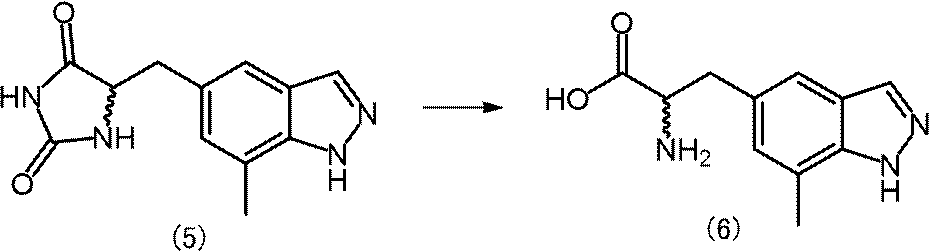
フラスコに実施例4で調製したインダゾリルメチルヒダントイン(5)(2.0g、8.19mmol)、水20mlを加えて30℃で撹拌した。ここに30wt%水酸化ナトリウム水溶液(10.2g、77mmol)を加えた。ジャケット温度を110℃に温調して76時間撹拌した。反応液をサンプリングしてHPLCで分析したところ、変換率は99面積%であった。反応液を30℃に冷却し、濃塩酸(8.2g)を加えてpH6.3に調整した。析出した結晶を濾過し、湿ケーキを水(7.5g)で洗浄した。減圧下で結晶を乾燥し、インダゾリルアラニン(6)を2.3g取得した(HPLC純度93面積%)。
実施例10 (STEP F)

フラスコに実施例9で調製したインダゾリルアラニン(6)(1.0g、4.56mmol)、水(14.8g)を加えて25℃に温調した。ここに30wt%水酸化ナトリウム水溶液 0.15g(1.13mmol)を加えてpH10.2に調整した。無水コハク酸を5回に分けて合計0.37g(3.70mmol)加えた。この間、30wt%水酸化ナトリウム水溶液を加えてpHを9.8~10.5に保持した。25℃で1時間撹拌した。反応液をサンプリングしてHPLCで分析したところ、変換率は99.9面積%であった。
不溶物を濾過で除去した後に、水(5g)、濃塩酸(1.1g)を加えてpH2に調整した。析出した結晶を濾過し、湿ケーキを水(5g)で洗浄した。減圧下で結晶を乾燥し、N-カルボニル化インダゾリルアラニン(7a)を0.6g取得した(HPLC純度95面積%、インダゾリルメチルヒダントイン(5)からの収率53モル%)。N-カルボニル化インダゾリルアラニン(7a)を温度50℃で24時間保持したところ、分解は認められなかった。
1H-NMR(500MHz,DMSO-d6)δ8.23(d,J=8.0Hz,1H),8.00(s,1H),7.40(s,1H),7.03(s,1H),4.42(dt,J=5.0,9.0Hz,1H),3.09(dd,J=5.0,13.5z,1H),2.93(dd,J=9.0,14.0Hz,1H),2.50(s,3H),2.32-2.37(m,4H)
不溶物を濾過で除去した後に、水(5g)、濃塩酸(1.1g)を加えてpH2に調整した。析出した結晶を濾過し、湿ケーキを水(5g)で洗浄した。減圧下で結晶を乾燥し、N-カルボニル化インダゾリルアラニン(7a)を0.6g取得した(HPLC純度95面積%、インダゾリルメチルヒダントイン(5)からの収率53モル%)。N-カルボニル化インダゾリルアラニン(7a)を温度50℃で24時間保持したところ、分解は認められなかった。
1H-NMR(500MHz,DMSO-d6)δ8.23(d,J=8.0Hz,1H),8.00(s,1H),7.40(s,1H),7.03(s,1H),4.42(dt,J=5.0,9.0Hz,1H),3.09(dd,J=5.0,13.5z,1H),2.93(dd,J=9.0,14.0Hz,1H),2.50(s,3H),2.32-2.37(m,4H)
実施例11 光学活性インダゾリルアラニン(8)(D体)の合成(STEP X2)
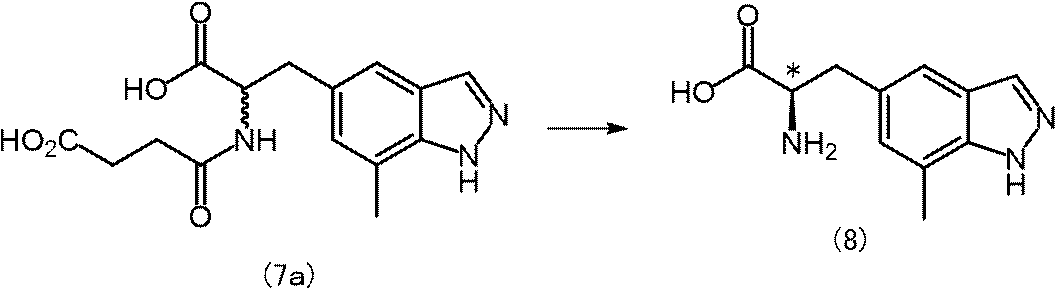
フラスコに実施例10で調製したN-カルボニル化インダゾリルアラニン(7a)を0.3g(0.89mmol)、水2.0gを加えて懸濁し、30wt%水酸化ナトリウム水溶液でpH7.0に調整した。pH調整後、水にて全重量が3.0gとなるように調製した(N-カルボニル化インダゾリルアラニン(7a)の濃度:10質量%)。得られたN-カルボニル化インダゾリルアラニン(7a)の溶液3.0gに0.1M 塩化コバルト水溶液 0.06g、水1.74g、D-サクシニラーゼ濃縮菌体(調製例7) 0.6g及びN-アシルアミノ酸ラセマーゼ濃縮菌体(調製例8) 0.6gを加えて、攪拌しながら40℃で温調した。21hr後に反応液をサンプリングしてHPLCで分析したところ、変換率は96.7面積%、光学純度は95.5%e.e.であった。得られた反応液を35%塩酸にてpH0.5に調整し、遠心分離にて菌体除去後、30wt%水酸化ナトリウム水溶液にてpH6.5に調製した。析出した結晶を濾過し、減圧下で結晶を乾燥し、表題の光学活性インダゾリルアラニン(8)を0.178g取得した(HPLC純度96.7面積%、収率91モル%)。
実施例12 (STEP G)
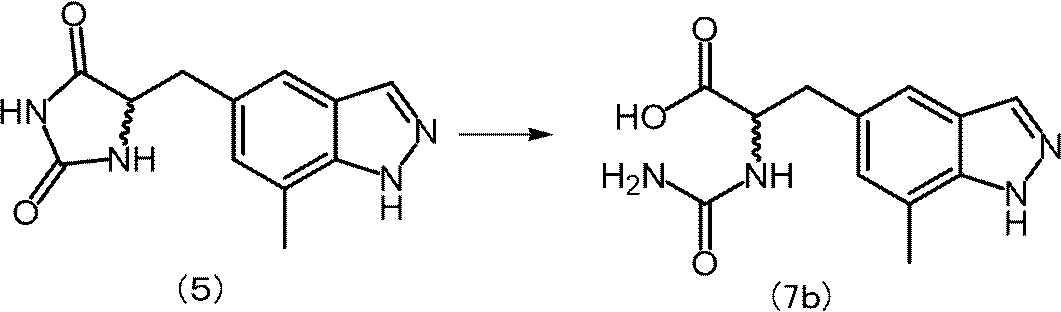
フラスコに実施例4で調整したインダゾリルメチルヒダントイン(5)(2.0g、8.19mmol)、水20mlを加えて30℃で撹拌した。ここに30wt%水酸化ナトリウム水溶液(10.9g、82mmol)を加えた。ジャケット温度を60℃に温調して19時間撹拌した。反応液をサンプリングしてHPLCで分析したところ、変換率は98面積%であった。反応液を30℃に冷却し、濃塩酸(7.9g)を加えてpH4.7に調整した。析出した結晶を濾過し、湿ケーキを水(3.5g)で洗浄した。減圧下で結晶を乾燥し、N-カルボニル化インダゾリルアラニン(7b)を2.5g取得した(HPLC純度96面積%)。N-カルボニル化インダゾリルアラニン(7b)を温度50℃で24時間保持したところ、分解は認められなかった。
1H-NMR(500MHz,DMSO-d6)δ7.92(s,1H),7.29(s,1H),6.94(s,1H),6.00(br,1H),5.54(br,2H),4.13(br,1H),3.04(dd,J=5.0,9.5Hz,1H),2.91(dd,J=6.0,10.0Hz,1H),2.43(s,3H)
1H-NMR(500MHz,DMSO-d6)δ7.92(s,1H),7.29(s,1H),6.94(s,1H),6.00(br,1H),5.54(br,2H),4.13(br,1H),3.04(dd,J=5.0,9.5Hz,1H),2.91(dd,J=6.0,10.0Hz,1H),2.43(s,3H)
実施例13 光学活性インダゾリルアラニン(8)(D体)の合成(STEP X2)
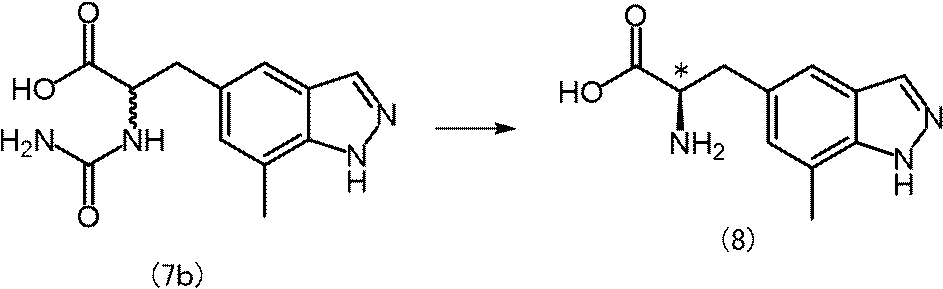
フラスコに実施例12で調製したN-カルボニル化インダゾリルアラニン(7b)を1.0g(3.8mmol)、1M KPB(リン酸バッファー pH7.0) 10.0g、水78.0g、0.1M MnSO4aq 1.0g、デカルバモイラーゼ濃縮菌体(調製例5) 10.0gを加えて窒素置換後に攪拌しながら50℃で温調した。19hr後に反応液をサンプリングしてHPLCで分析したところ、変換率は45.4面積%。光学純度99%e.e.以上であった。
実施例14 (STEP Y)

フラスコにメタノール(5ml、124mmol)を加えて14℃に温調した。ここに塩化チオニル(0.54g、4.54mmol)を加えた。14℃で0.5時間撹拌した後に実施例5~8、11、又は13と同様に調製した光学活性インダゾリルアラニン(8)(0.5g、2.28mmol)、加えて、35℃で65時間撹拌した。反応液をサンプリングしてHPLCで分析したところ、変換率は99.5面積%であった。反応液を濃縮することにより、光学活性インダゾリルアラニンエステル(9a)を0.6g取得した(HPLC純度面積87%、収率78モル%)。
Claims (15)
- 式(1)で表されるジメチルアニリンをホルミル化して式(2)で表されるアミノベンズアルデヒドを製造する工程(A)を含む、式(8)で表される光学活性インダゾリルアラニンの製造方法。

- 前記工程(A)で前記ジメチルアニリン(1)を、酸及びヘキサメチレンテトラミンで処理する、請求項1に記載の製造方法。
- 前記ホルミル化工程で得られる式(2)で表されるアミノベンズアルデヒドを環化して式(3)で表されるインダゾリルアルデヒドを得る工程(B)をさらに含む、請求項1又は2に記載の製造方法。

- 前記工程(B)で前記アミノベンズアルデヒド(2)を亜硝酸又は亜硝酸アルキルで処理する、請求項3に記載の製造方法。
- 前記インダゾリルアルデヒド(3)から式(4)で表されるオレフィン化合物を製造し、得られたオレフィン化合物(4)を還元して式(5)で表されるインダゾリルメチルヒダントインを製造し、このインダゾリルメチルヒダントイン(5)を酵素源で処理して式(8)で表される光学活性インダゾリルアラニンを製造する請求項3又は4に記載の製造方法。
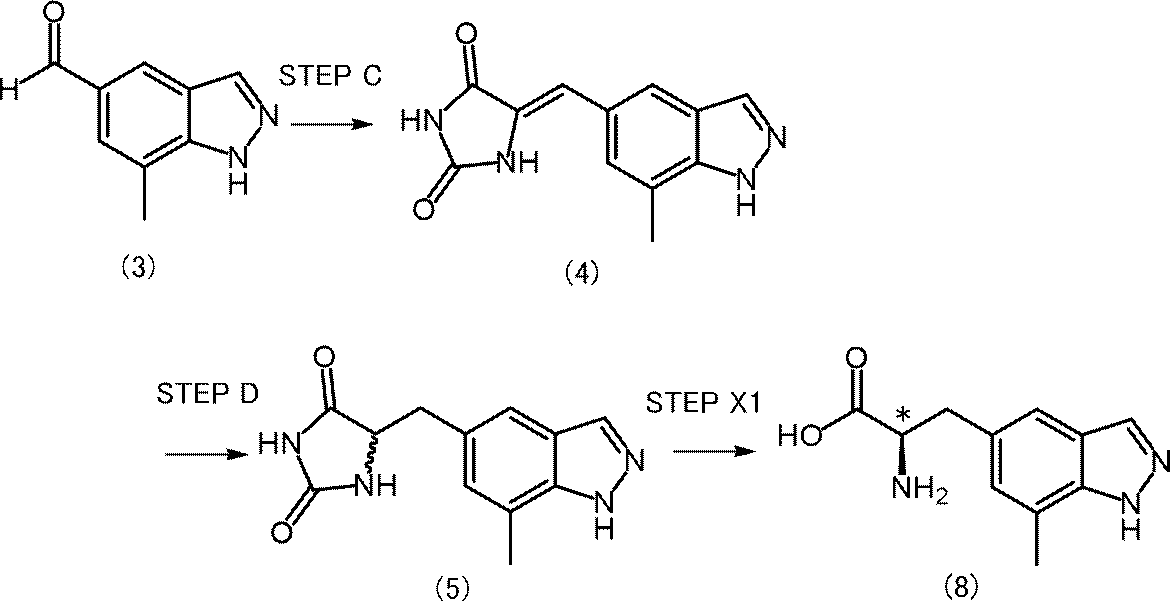
- 前記インダゾリルアルデヒド(3)から式(4)で表されるオレフィン化合物を製造し、得られたオレフィン化合物(4)を還元して式(5)で表されるインダゾリルメチルヒダントインを製造し、得られたインダゾリルメチルヒダントイン(5)を直接又は式(6)で表されるインダゾリルアラニンにした後、式(7)で表されるN-カルボニル化インダゾリルアラニンを製造し、このN-カルボニル化インダゾリルアラニンを酵素源で処理して式(8)で表される光学活性インダゾリルアラニンを製造する請求項3又は4に記載の製造方法。
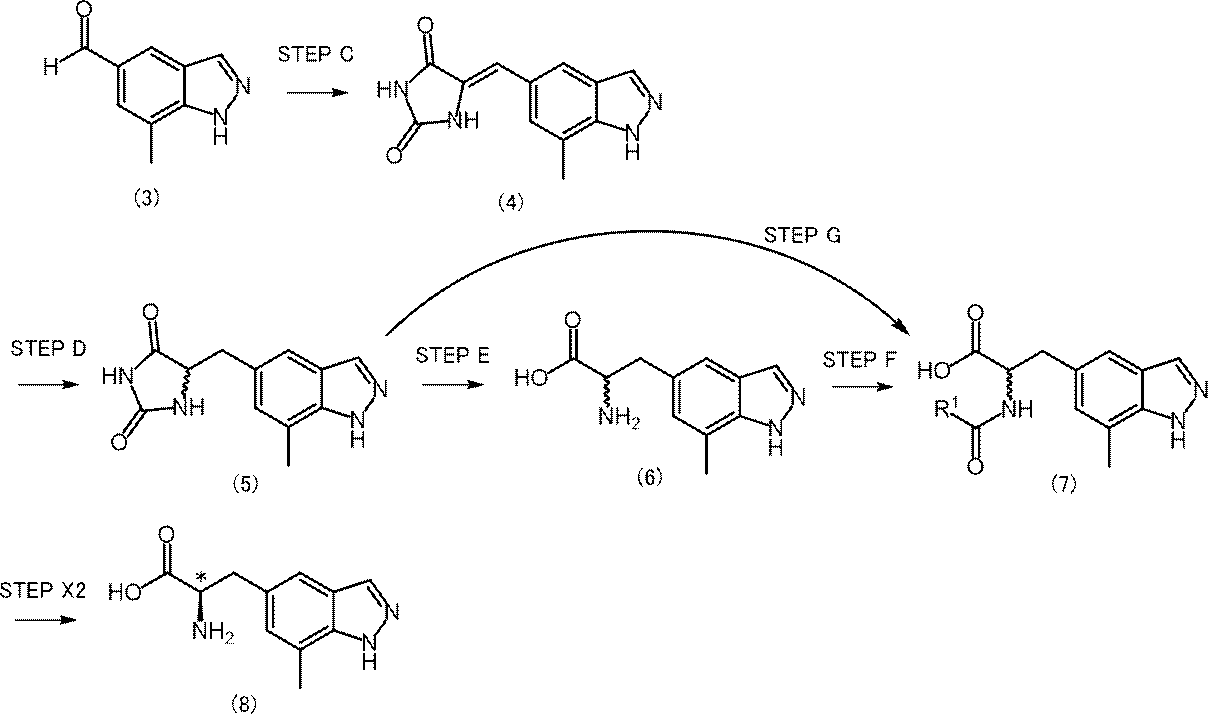
(式中、R1は、水酸基及びカルボキシ基のいずれかを有していてもよい炭素数1~6のアルキル基、又はアミノ基を示す) - 式(5)で表されるインダゾリルメチルヒダントインを、直接又は式(7)で表されるN-カルボニル化インダゾリルアラニンに変えた後、酵素源で処理する、式(8)で表される光学活性インダゾリルアラニンの製造方法。

(式中、R1は、水酸基及びカルボキシ基のいずれかを有していてもよい炭素数1~6のアルキル基、又はアミノ基を示す) - 前記インダゾリルメチルヒダントイン(5)を、直接又は式(6)で表されるインダゾリルアラニンにした後、前記N-カルボニル化インダゾリルアラニン(7)にする請求項7に記載の製造方法。
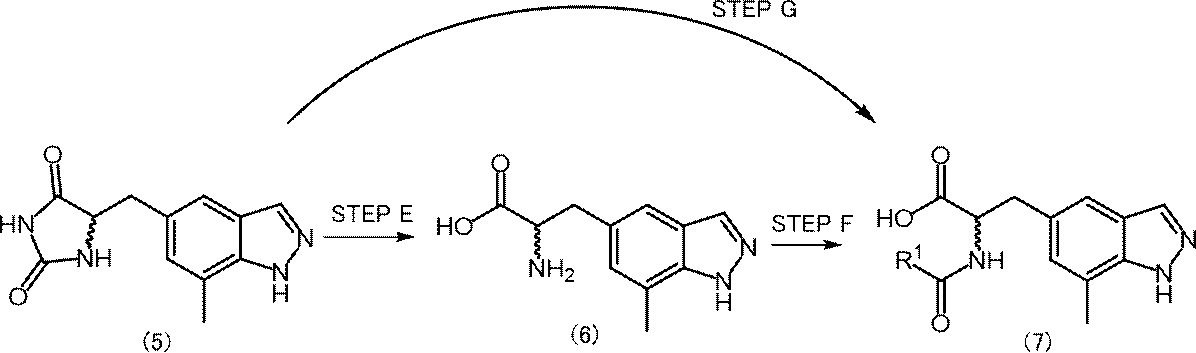
(式中、R1は前記と同じ) - 前記インダゾリルメチルヒダントイン(5)が、式(4)で表されるオレフィン化合物から製造される請求項7又は8に記載の製造方法。

- 前記光学活性インダゾリルアラニン(8)から式(9)で表される光学活性インダゾリルアラニンエステルまたはその塩を製造する請求項1~9のいずれかに記載の製造方法。

(式中、R2は炭素数1~6のアルキル基を表す) - 式(1)で表されるジメチルアニリンをホルミル化する工程(A)、
前記ホルミル化工程で得られる式(2)で表されるアミノベンズアルデヒドを環化して式(3)で表されるインダゾリルアルデヒドを得る工程(B)を含むインダゾリルアルデヒド(3)の製造方法。

- 前記工程(A)で前記ジメチルアニリン(1)を、酸及びヘキサメチレンテトラミンで処理し、
前記工程(B)で前記アミノベンズアルデヒド(2)を亜硝酸又は亜硝酸アルキルで処理する、請求項11に記載の製造方法。 - 式(4)で表されるオレフィン化合物。
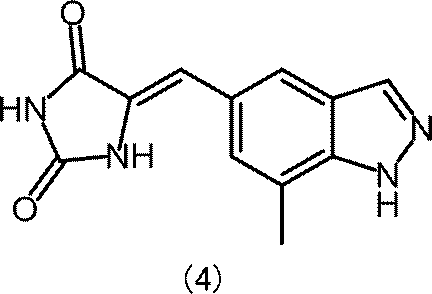
- 式(5)で表されるインダゾリルメチルヒダントイン。
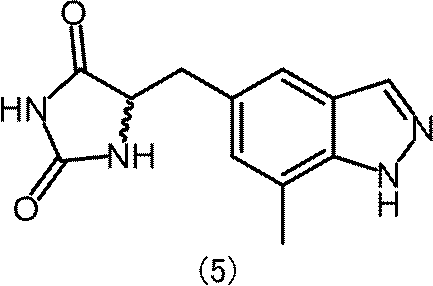
- 式(7)で表されるN-カルボニル化インダゾリルアラニン。
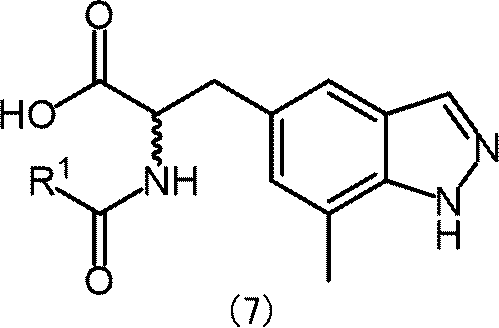
(式中、R1は、水酸基及びカルボキシ基のいずれかを有していてもよい炭素数1~6のアルキル基、又はアミノ基を示す)
Applications Claiming Priority (4)
| Application Number | Priority Date | Filing Date | Title |
|---|---|---|---|
| JP2021022038 | 2021-02-15 | ||
| JP2021022037 | 2021-02-15 | ||
| JP2021-022038 | 2021-02-15 | ||
| JP2021-022037 | 2021-02-15 |
Publications (1)
| Publication Number | Publication Date |
|---|---|
| WO2022172829A1 true WO2022172829A1 (ja) | 2022-08-18 |
Family
ID=82838807
Family Applications (1)
| Application Number | Title | Priority Date | Filing Date |
|---|---|---|---|
| PCT/JP2022/004115 Ceased WO2022172829A1 (ja) | 2021-02-15 | 2022-02-02 | 光学活性インダゾリルアラニン又はインダゾリルアルデヒドの製造方法 |
Country Status (1)
| Country | Link |
|---|---|
| WO (1) | WO2022172829A1 (ja) |
Cited By (1)
| Publication number | Priority date | Publication date | Assignee | Title |
|---|---|---|---|---|
| CN118373756A (zh) * | 2024-04-22 | 2024-07-23 | 甘肃皓天医药科技有限责任公司 | 一种沙库比曲中间体的制备方法 |
Citations (1)
| Publication number | Priority date | Publication date | Assignee | Title |
|---|---|---|---|---|
| JP2007516967A (ja) * | 2003-12-05 | 2007-06-28 | ブリストル−マイヤーズ スクイブ カンパニー | 複素環抗片頭痛薬 |
-
2022
- 2022-02-02 WO PCT/JP2022/004115 patent/WO2022172829A1/ja not_active Ceased
Patent Citations (1)
| Publication number | Priority date | Publication date | Assignee | Title |
|---|---|---|---|---|
| JP2007516967A (ja) * | 2003-12-05 | 2007-06-28 | ブリストル−マイヤーズ スクイブ カンパニー | 複素環抗片頭痛薬 |
Non-Patent Citations (2)
| Title |
|---|
| HANSON RONALD L., DAVIS BRIAN L., GOLDBERG STEVEN L., JOHNSTON ROBERT M., PARKER WILLIAM L., TULLY THOMAS P., MONTANA MICHAEL A., : "-Amino Acid from a Racemic Amino Acid or Keto Acid", ORGANIC PROCESS RESEARCH & DEVELOPMENT, vol. 12, no. 6, 21 November 2008 (2008-11-21), US , pages 1119 - 1129, XP055957729, ISSN: 1083-6160, DOI: 10.1021/op800149q * |
| REGINALD O. CANN, CHEN CHUNG-PIN H., GAO QI, HANSON RONALD L., HSIEH DANIEL, LI JUN, LIN DONG, PARSONS RODNEY L., PENDRI YADAGIRI,: "Selection of an Enantioselective Process for the Preparation of a CGRP Receptor Inhibitor", ORGANIC PROCESS RESEARCH & DEVELOPMENT, vol. 16, no. 12, 21 December 2012 (2012-12-21), US , pages 1953 - 1966, XP055333905, ISSN: 1083-6160, DOI: 10.1021/op3003097 * |
Cited By (1)
| Publication number | Priority date | Publication date | Assignee | Title |
|---|---|---|---|---|
| CN118373756A (zh) * | 2024-04-22 | 2024-07-23 | 甘肃皓天医药科技有限责任公司 | 一种沙库比曲中间体的制备方法 |
Similar Documents
| Publication | Publication Date | Title |
|---|---|---|
| JP5303950B2 (ja) | 光学活性化合物の製造方法 | |
| EP2123769B1 (en) | Method for producing optically active 3-aminopiperidine or salt thereof | |
| JP5096435B2 (ja) | 光学活性α−メチルシステイン誘導体の製造方法 | |
| KR100549598B1 (ko) | 아미드화합물의 제조방법 | |
| JP4672161B2 (ja) | アミド化合物の製造方法 | |
| WO2022172829A1 (ja) | 光学活性インダゾリルアラニン又はインダゾリルアルデヒドの製造方法 | |
| WO2008047656A1 (fr) | Procédé de fabrication d'un acide l-amino | |
| KR100482686B1 (ko) | 아미드화합물의 정제방법 | |
| WO2010050564A1 (ja) | N-保護アミノ酸の製造法 | |
| CN102203274A (zh) | L-氨基酸的制造方法 | |
| CN111757940B (zh) | 用于制备酰胺的微生物学方法 | |
| CN105008324B (zh) | 用于制备手性γ‑芳基‑β‑氨基丁酸衍生物的酶途径 | |
| JP4857114B2 (ja) | 2−ヒドロキシ−4置換ピリジンの製造方法 | |
| JPWO2012176715A1 (ja) | 1−アミノ−2−ビニルシクロプロパンカルボン酸アミドおよびその塩、ならびにその製造方法 | |
| CN1128874C (zh) | 一种红球菌sp.D12及其培养方法和用途 | |
| CN118374468B (zh) | 一种转氨酶突变体及其在(s)-苯并二氢吡喃-4-胺制备上的应用 | |
| JP4492765B2 (ja) | L−アリシンアセタールの製造法 | |
| WO2002008439A1 (fr) | Procede d'elaboration d'acides 2-amino | |
| CN115851691B (zh) | 一种天冬氨酸氨裂解酶突变体及其应用 | |
| JP5126707B2 (ja) | α−ヒドロキシアシルピリジンの製造方法 | |
| JPWO2004090152A1 (ja) | 2−アルキルシステインアミド又はその塩、並びに、それらの製造方法及び用途 | |
| JP4006183B2 (ja) | S,s−2−ヒドロキシプロピレンジアミン−n,n’−ジコハク酸の製造法 | |
| KR100951490B1 (ko) | 락톤류의 제조방법 | |
| JP4982164B2 (ja) | 2−ヒドロキシ−4−置換ピリジンの製造方法 | |
| JP2002034593A (ja) | 光学活性α−アミノ酸の製造方法 |
Legal Events
| Date | Code | Title | Description |
|---|---|---|---|
| 121 | Ep: the epo has been informed by wipo that ep was designated in this application |
Ref document number: 22752656 Country of ref document: EP Kind code of ref document: A1 |
|
| NENP | Non-entry into the national phase |
Ref country code: DE |
|
| 122 | Ep: pct application non-entry in european phase |
Ref document number: 22752656 Country of ref document: EP Kind code of ref document: A1 |
|
| NENP | Non-entry into the national phase |
Ref country code: JP |