WO2022137671A1 - ポリアセタール樹脂組成物 - Google Patents
ポリアセタール樹脂組成物 Download PDFInfo
- Publication number
- WO2022137671A1 WO2022137671A1 PCT/JP2021/033857 JP2021033857W WO2022137671A1 WO 2022137671 A1 WO2022137671 A1 WO 2022137671A1 JP 2021033857 W JP2021033857 W JP 2021033857W WO 2022137671 A1 WO2022137671 A1 WO 2022137671A1
- Authority
- WO
- WIPO (PCT)
- Prior art keywords
- mass
- parts
- resin composition
- polyacetal resin
- acid
- Prior art date
- Legal status (The legal status is an assumption and is not a legal conclusion. Google has not performed a legal analysis and makes no representation as to the accuracy of the status listed.)
- Ceased
Links
Classifications
-
- C—CHEMISTRY; METALLURGY
- C08—ORGANIC MACROMOLECULAR COMPOUNDS; THEIR PREPARATION OR CHEMICAL WORKING-UP; COMPOSITIONS BASED THEREON
- C08L—COMPOSITIONS OF MACROMOLECULAR COMPOUNDS
- C08L59/00—Compositions of polyacetals; Compositions of derivatives of polyacetals
- C08L59/04—Copolyoxymethylenes
-
- C—CHEMISTRY; METALLURGY
- C08—ORGANIC MACROMOLECULAR COMPOUNDS; THEIR PREPARATION OR CHEMICAL WORKING-UP; COMPOSITIONS BASED THEREON
- C08K—Use of inorganic or non-macromolecular organic substances as compounding ingredients
- C08K3/00—Use of inorganic substances as compounding ingredients
- C08K3/18—Oxygen-containing compounds, e.g. metal carbonyls
- C08K3/20—Oxides; Hydroxides
- C08K3/22—Oxides; Hydroxides of metals
-
- C—CHEMISTRY; METALLURGY
- C08—ORGANIC MACROMOLECULAR COMPOUNDS; THEIR PREPARATION OR CHEMICAL WORKING-UP; COMPOSITIONS BASED THEREON
- C08K—Use of inorganic or non-macromolecular organic substances as compounding ingredients
- C08K5/00—Use of organic ingredients
- C08K5/0008—Organic ingredients according to more than one of the "one dot" groups of C08K5/01 - C08K5/59
- C08K5/005—Stabilisers against oxidation, heat, light, ozone
-
- C—CHEMISTRY; METALLURGY
- C08—ORGANIC MACROMOLECULAR COMPOUNDS; THEIR PREPARATION OR CHEMICAL WORKING-UP; COMPOSITIONS BASED THEREON
- C08K—Use of inorganic or non-macromolecular organic substances as compounding ingredients
- C08K5/00—Use of organic ingredients
- C08K5/04—Oxygen-containing compounds
- C08K5/10—Esters; Ether-esters
- C08K5/101—Esters; Ether-esters of monocarboxylic acids
-
- C—CHEMISTRY; METALLURGY
- C08—ORGANIC MACROMOLECULAR COMPOUNDS; THEIR PREPARATION OR CHEMICAL WORKING-UP; COMPOSITIONS BASED THEREON
- C08K—Use of inorganic or non-macromolecular organic substances as compounding ingredients
- C08K5/00—Use of organic ingredients
- C08K5/04—Oxygen-containing compounds
- C08K5/10—Esters; Ether-esters
- C08K5/101—Esters; Ether-esters of monocarboxylic acids
- C08K5/103—Esters; Ether-esters of monocarboxylic acids with polyalcohols
-
- C—CHEMISTRY; METALLURGY
- C08—ORGANIC MACROMOLECULAR COMPOUNDS; THEIR PREPARATION OR CHEMICAL WORKING-UP; COMPOSITIONS BASED THEREON
- C08K—Use of inorganic or non-macromolecular organic substances as compounding ingredients
- C08K5/00—Use of organic ingredients
- C08K5/04—Oxygen-containing compounds
- C08K5/13—Phenols; Phenolates
-
- C—CHEMISTRY; METALLURGY
- C08—ORGANIC MACROMOLECULAR COMPOUNDS; THEIR PREPARATION OR CHEMICAL WORKING-UP; COMPOSITIONS BASED THEREON
- C08K—Use of inorganic or non-macromolecular organic substances as compounding ingredients
- C08K5/00—Use of organic ingredients
- C08K5/16—Nitrogen-containing compounds
- C08K5/17—Amines; Quaternary ammonium compounds
-
- C—CHEMISTRY; METALLURGY
- C08—ORGANIC MACROMOLECULAR COMPOUNDS; THEIR PREPARATION OR CHEMICAL WORKING-UP; COMPOSITIONS BASED THEREON
- C08K—Use of inorganic or non-macromolecular organic substances as compounding ingredients
- C08K5/00—Use of organic ingredients
- C08K5/16—Nitrogen-containing compounds
- C08K5/20—Carboxylic acid amides
-
- C—CHEMISTRY; METALLURGY
- C08—ORGANIC MACROMOLECULAR COMPOUNDS; THEIR PREPARATION OR CHEMICAL WORKING-UP; COMPOSITIONS BASED THEREON
- C08K—Use of inorganic or non-macromolecular organic substances as compounding ingredients
- C08K5/00—Use of organic ingredients
- C08K5/16—Nitrogen-containing compounds
- C08K5/34—Heterocyclic compounds having nitrogen in the ring
- C08K5/3412—Heterocyclic compounds having nitrogen in the ring having one nitrogen atom in the ring
- C08K5/3432—Six-membered rings
- C08K5/3435—Piperidines
-
- C—CHEMISTRY; METALLURGY
- C08—ORGANIC MACROMOLECULAR COMPOUNDS; THEIR PREPARATION OR CHEMICAL WORKING-UP; COMPOSITIONS BASED THEREON
- C08K—Use of inorganic or non-macromolecular organic substances as compounding ingredients
- C08K5/00—Use of organic ingredients
- C08K5/16—Nitrogen-containing compounds
- C08K5/34—Heterocyclic compounds having nitrogen in the ring
- C08K5/3467—Heterocyclic compounds having nitrogen in the ring having more than two nitrogen atoms in the ring
- C08K5/3472—Five-membered rings
-
- C—CHEMISTRY; METALLURGY
- C08—ORGANIC MACROMOLECULAR COMPOUNDS; THEIR PREPARATION OR CHEMICAL WORKING-UP; COMPOSITIONS BASED THEREON
- C08K—Use of inorganic or non-macromolecular organic substances as compounding ingredients
- C08K5/00—Use of organic ingredients
- C08K5/16—Nitrogen-containing compounds
- C08K5/34—Heterocyclic compounds having nitrogen in the ring
- C08K5/3467—Heterocyclic compounds having nitrogen in the ring having more than two nitrogen atoms in the ring
- C08K5/3472—Five-membered rings
- C08K5/3475—Five-membered rings condensed with carbocyclic rings
-
- C—CHEMISTRY; METALLURGY
- C08—ORGANIC MACROMOLECULAR COMPOUNDS; THEIR PREPARATION OR CHEMICAL WORKING-UP; COMPOSITIONS BASED THEREON
- C08L—COMPOSITIONS OF MACROMOLECULAR COMPOUNDS
- C08L59/00—Compositions of polyacetals; Compositions of derivatives of polyacetals
-
- C—CHEMISTRY; METALLURGY
- C08—ORGANIC MACROMOLECULAR COMPOUNDS; THEIR PREPARATION OR CHEMICAL WORKING-UP; COMPOSITIONS BASED THEREON
- C08L—COMPOSITIONS OF MACROMOLECULAR COMPOUNDS
- C08L71/00—Compositions of polyethers obtained by reactions forming an ether link in the main chain; Compositions of derivatives of such polymers
- C08L71/02—Polyalkylene oxides
-
- C—CHEMISTRY; METALLURGY
- C08—ORGANIC MACROMOLECULAR COMPOUNDS; THEIR PREPARATION OR CHEMICAL WORKING-UP; COMPOSITIONS BASED THEREON
- C08K—Use of inorganic or non-macromolecular organic substances as compounding ingredients
- C08K3/00—Use of inorganic substances as compounding ingredients
- C08K3/18—Oxygen-containing compounds, e.g. metal carbonyls
- C08K3/20—Oxides; Hydroxides
- C08K3/22—Oxides; Hydroxides of metals
- C08K2003/2217—Oxides; Hydroxides of metals of magnesium
- C08K2003/222—Magnesia, i.e. magnesium oxide
-
- C—CHEMISTRY; METALLURGY
- C08—ORGANIC MACROMOLECULAR COMPOUNDS; THEIR PREPARATION OR CHEMICAL WORKING-UP; COMPOSITIONS BASED THEREON
- C08K—Use of inorganic or non-macromolecular organic substances as compounding ingredients
- C08K3/00—Use of inorganic substances as compounding ingredients
- C08K3/18—Oxygen-containing compounds, e.g. metal carbonyls
- C08K3/20—Oxides; Hydroxides
- C08K3/22—Oxides; Hydroxides of metals
- C08K2003/2296—Oxides; Hydroxides of metals of zinc
-
- C—CHEMISTRY; METALLURGY
- C08—ORGANIC MACROMOLECULAR COMPOUNDS; THEIR PREPARATION OR CHEMICAL WORKING-UP; COMPOSITIONS BASED THEREON
- C08K—Use of inorganic or non-macromolecular organic substances as compounding ingredients
- C08K2201/00—Specific properties of additives
- C08K2201/002—Physical properties
- C08K2201/006—Additives being defined by their surface area
-
- C—CHEMISTRY; METALLURGY
- C08—ORGANIC MACROMOLECULAR COMPOUNDS; THEIR PREPARATION OR CHEMICAL WORKING-UP; COMPOSITIONS BASED THEREON
- C08K—Use of inorganic or non-macromolecular organic substances as compounding ingredients
- C08K2201/00—Specific properties of additives
- C08K2201/014—Additives containing two or more different additives of the same subgroup in C08K
Definitions
- the present invention relates to a polyacetal resin composition having high resistance to an acid component.
- polyacetal resin Since polyacetal resin has excellent chemical resistance, molded products made from polyacetal resin are widely used as automobile parts. For example, it is used as a large component such as a fuel transfer unit represented by a fuel contact body such as a fuel pump module that comes into direct contact with fuel oil.
- Patent The applicant of the present application reports that these problems can be significantly improved by adding a hindered phenolic antioxidant, an alkaline earth metal oxide, and a polyalkylene glycol to the polyacetal resin (Patent).
- Patent a hindered phenolic antioxidant, an alkaline earth metal oxide, and a polyalkylene glycol
- Automobile parts such as fuel transport units are often covered with a housing such as a bonnet, but may be exposed to sunlight during assembly or use. Further, depending on the vehicle model, the fuel tank is not covered with a housing, and the fuel transport unit is also used in a state where it is exposed to sunlight. In addition, these parts may be subject to detergent droplets when washing the car. In particular, a strong acid cleaning agent that exceeds high sulfur fuel may be used for the wheels, and further rapid deterioration of automobile parts made of polyacetal resin, which has undergone photodegradation due to sunlight, is also a major issue. be.
- An object of the present invention is to provide a polyacetal resin composition capable of suppressing deterioration of a molded product when it comes into contact with an acidic cleaning agent on a portion exposed to sunlight.
- the present inventors have made the composition of the polyacetal resin composition into a specific composition, so that the acidic cleaning agent comes into contact with the sunlight-irradiated portion when it is made into a molded product. It was found that the deterioration at the time of the operation can be minimized.
- the present invention 1. at least, (A) With respect to 100 parts by mass of the polyacetal polymer (B) Hindered phenolic antioxidant 0.1-2.0 parts by mass, (C) At least one selected from magnesium or zinc oxides, in an amount of more than 2.0 parts by mass and 20 parts by mass or less. (D) Polyalkylene glycol 0.5 to 3.0 parts by mass, (E) 0.2 to 1.5 parts by mass of the hindered amine compound, (F) UV absorber 0.2 to 1.5 parts by mass, A polyacetal resin composition containing and. 2. 2. The polyacetal resin composition according to 1 above, wherein at least one selected from the oxides of magnesium or zinc is magnesium oxide. 3. 3. 3.
- the (F) ultraviolet absorber is at least one selected from a benzotriazole-based compound or an oxalic acid diamide-based compound.
- the (F) ultraviolet absorbers are 2- (2H-benzotriazole-2-yl) -4,6-bis (1-methyl-1-phenylethyl) phenol and N- (2-ethylphenyl) -N'.
- the polyacetal resin composition according to any one of 1 to 4 above which is at least one selected from (2-ethoxyphenyl) oxalic acid diamide.
- the present invention it is possible to provide a polyacetal resin composition capable of minimizing deterioration of a portion in contact with an acidic cleaning agent after irradiation with sunlight when it is made into a molded product.
- the "acidic cleaning agent” means a cleaning agent having a pH of 6 or less, and in some cases, a pH of 2 or less, and examples thereof include a wheel cleaner and the like.
- the polyacetal resin composition of the present invention comprises (A) 0.1 to 2.0 parts by mass of a hindered phenolic antioxidant and (C) an oxide of magnesium or zinc with respect to 100 parts by mass of the polyacetal polymer. At least one selected from, more than 2.0 parts by mass and 20 parts by mass or less, (D) polyalkylene glycol 0.5 to 3.0 parts by mass, (E) hindered amine compound 0.2 to 1.5. It is a polyacetal resin composition containing 0.2 to 1.5 parts by mass of (F) an ultraviolet absorber.
- the (A) polyacetal polymer used in the present invention may be a homopolymer having an oximethylene group ( -OCH2- ) as a constituent unit, or a copolymer having another comonomer unit in addition to the oximethylene unit. It is also preferable that it is a copolymer.
- trioxane which is a cyclic trimer of formaldehyde
- Trioxane is generally obtained by reacting an aqueous formaldehyde solution in the presence of an acidic catalyst, and is purified by a method such as distillation before use.
- the trioxane used for the polymerization preferably contains as little impurities as possible such as water, methanol and formic acid.
- comonomer general cyclic ether and cyclic formal, and glycidyl ether compounds capable of forming a branched structure or a crosslinked structure can be used alone or in combination of two or more.
- the polyacetal polymer as described above can generally be obtained by adding an appropriate amount of a molecular weight modifier and cationically polymerizing using a cationic polymerization catalyst.
- the molecular weight modifier used, cationic polymerization catalyst, polymerization method, polymerization apparatus, deactivation treatment of catalyst after polymerization, end stabilization treatment method of crude polyacetal polymer obtained by polymerization, etc. are known from many documents. Yes, and basically any of them can be used.
- trioxane is used as the main monomer (a)
- one or more selected from cyclic ethers having at least one carbon-carbon bond and cyclic formal is used as the comonomer (b)
- a heteropolyacid is used as the polymerization catalyst (c).
- carbonates, hydrogen carbonates, carboxylates or hydrates (d) thereof of alkali metal elements or alkaline earth metal elements are added and melt-kneaded to obtain the polymerization catalyst (c). It is something that deactivates.
- the heteropolyacid used as the polymerization catalyst (c) is a general term for polyacids produced by dehydration condensation of different kinds of oxygen acids, and a specific different kinds of elements are present in the center and the condensed oxygen shares an oxygen atom. It has a mononuclear or dinuclear complex ion formed by condensation of groups.
- heteropolyacids include phosphomolybdic acid, phosphotungstate, phosphoribodtungstate, phosphoribodvanadic acid, lymmolibed tangstovanadic acid, lintangustovanadic acid, phytonic acid, silicate molybdic acid, and kei.
- examples thereof include molybdotungstate, keimolybdtungstentovanadic acid and the like.
- the heteropolyacid is preferably one or more of silicate molybdic acid, silicate tungstic acid, phosphomolybdic acid and phosphotungstic acid.
- the amount of the above-mentioned heteropolyacid used varies depending on the type thereof, and the polymerization reaction can be appropriately changed to control the polymerization reaction, but in general, it is 0.05 to 100 ppm (hereinafter, 0.05 to 100 ppm) with respect to the total amount of the monomers to be polymerized. It indicates mass / mass ppm), preferably 0.1 to 50 ppm.
- a reaction tank with a stirrer which is generally used in the batch type, can be used, and as the continuous type, a conider, a 2-screw type continuous extrusion mixer, a 2-screw paddle type continuous mixer, etc.
- a continuous polymerization apparatus such as trioxane proposed so far can be used, and two or more types of polymerization machines can be used in combination.
- the polymerization method is not particularly limited, but as previously proposed, a trioxane, a comonomer, and a heteropolyacid as a polymerization catalyst are sufficiently mixed while maintaining a liquid phase state in advance, and the obtained reaction raw material is obtained. If the mixed solution is supplied to the polymerization apparatus and the copolymerization reaction is carried out, the required amount of catalyst can be reduced, and as a result, it is advantageous to obtain a polyacetal copolymer having a smaller amount of formaldehyde emission, which is a more preferable polymerization method. Is.
- the polymerization temperature is in the temperature range of 60 to 120 ° C.
- a known chain transfer agent for adjusting the degree of polymerization for example, a low molecular weight wire such as methylal, is used. It is also possible to add a state acetal or the like.
- the polymerization reaction is carried out in a state in which impurities having active hydrogen, for example, water, methanol, formic acid, etc. are substantially not present, for example, in a state where each of these is 10 ppm or less, and for this purpose, these impurity components are used. It is desirable to use trioxane, cyclic ether and / or cyclic formal prepared to contain as little as possible as the main monomer or comonomer.
- the molecular weight of the (A) polyacetal polymer used in the present invention is not particularly limited, but the weight average molecular weight equivalent to PMMA (polymethyl methacrylate) determined by the size exclusion chromatography method is 10,000 to 400,000. The degree is preferable. Further, the melt index (measured at 190 ° C. and a load of 2.16 kg according to ASTM-D1238), which is an index of the fluidity of the resin, is preferably 0.1 to 100 g / 10 minutes, more preferably 0.5 to. 80 g / 10 minutes.
- the (A) polyacetal polymer used in the present invention has specific terminal properties.
- the hemiformal terminal group amount is 1.0 mmol / kg or less
- the formyl terminal group amount is 0.5 mmol / kg or less
- the unstable terminal amount is 0.5% by mass or less.
- the hemiformal terminal group is represented by -OCH 2 OH, and is also referred to as a hydroxymethoxy group or a hemiacetal terminal group.
- the formyl terminal group is indicated by -OCHO.
- the amounts of such hemiformal terminal groups and formyl terminal groups can be determined by 1 H-NMR measurement, and the specific measurement method thereof can be referred to the method described in JP-A-2001-11143.
- the amount of unstable terminal indicates the amount of the portion that is present at the terminal portion of the polyacetal polymer and is unstable to heat or base and easily decomposed.
- 1 g of a polyacetal polymer was placed in a pressure-resistant airtight container together with 100 ml of a 50% (volume%) methanol solution containing 0.5% (% by volume) ammonium hydroxide and heat-treated at 180 ° C. for 45 minutes. After that, the amount of formaldehyde decomposed and eluted in the solution obtained by cooling and opening was quantified and expressed in mass% with respect to the polyacetal polymer.
- the polyacetal polymer (A) used in the present invention preferably has a hemiformal terminal group amount of 1.0 mmol / kg or less, more preferably 0.6 mmol / kg or less.
- the amount of formyl terminal groups is preferably 0.5 mmol / kg or less, more preferably 0.1 mmol / kg or less.
- the amount of unstable terminals is preferably 0.5% by mass or less, more preferably 0.3% by mass or less.
- the lower limits of the hemiformal terminal group amount, the formyl terminal group amount, and the unstable terminal amount are not particularly limited.
- the (A) polyacetal polymer having specific terminal characteristics can be produced by reducing impurities contained in the monomer and comonomer, selecting a production process, optimizing the production conditions thereof, and the like.
- the method for producing the (A) polyacetal polymer having specific terminal characteristics that satisfy the requirements of the present invention for example, the method described in JP-A-2009-286874 can be used. However, the method is not limited to this method.
- a polyacetal polymer having a branched or crosslinked structure may be added to the (A) polyacetal polymer and used, in which case the blending amount is 0.01 with respect to 100 parts by mass of the (A) polyacetal polymer. It is about 20 parts by mass, and particularly preferably 0.03 to 5 parts by mass.
- (B) Hindered phenolic antioxidant examples include 2,2'-methylenebis (4-methyl-6-t-butylphenol) and 1,6-hexanediolbis [3- (3,5).
- At least one or two or more selected from these antioxidants can be used.
- the content of the (B) hindered phenolic antioxidant in the present invention is 0.1 to 1.0 part by mass and 0.2 to 0.5 part by mass with respect to 100 parts by mass of the (A) polyacetal resin. Is more preferable.
- the blending amount of the antioxidant is small, not only the antioxidant property which is the original object is insufficient, but also the cleaning resistance which is the object of the present invention is inferior.
- the amount of the antioxidant is excessive, unfavorable effects such as mechanical properties and moldability of the resin composition occur.
- At least one selected from (C) magnesium or zinc oxide examples include magnesium oxide and zinc oxide.
- magnesium oxide is most preferable because it has an excellent balance between the improvement of detergent resistance and the performance such as mechanical properties and moldability.
- magnesium oxide having a BET specific surface area of 100 m 2 / g or more is more preferable.
- the content of the compound (C) in the present invention is more than 2.0 parts by mass and 30 parts by mass or less, and more than 2.0 parts by mass and 10 parts by mass with respect to 100 parts by mass of the (A) polyacetal resin.
- the following is more preferable.
- (D) Polyalkylene glycol used in the present invention.
- These types are not particularly limited, but from the viewpoint of affinity with the polyacetal resin, those containing polyethylene glycol or polypropylene glycol are preferable, and those containing polyethylene glycol are more preferable.
- the number average molecular weight (Mn) of the polyalkylene glycol is not particularly limited, but is preferably 1,000 or more and 50,000 or less, preferably 5,000 or more and 30,000 or less, from the viewpoint of dispersibility in the polyacetal resin. It is more preferable to have.
- the number average molecular weight is assumed to be a polystyrene-equivalent molecular weight obtained by a size exclusion chromatography method using tetrahydrofuran (THF) as a solvent.
- the content of (D) polyalkylene glycol in the present invention is 0.5 to 3.0 parts by mass and 1.0 to 2.0 parts by mass with respect to 100 parts by mass of the (A) polyacetal resin. More preferred.
- the upper limit of the addition amount is selected in consideration of the balance with the mechanical properties of the molded product. These may be used by mixing two or more kinds.
- the hindered amine compound (hereinafter also referred to as HALS) used in the present invention is not particularly limited, and a hindered amine compound in which the nitrogen of the piperidine derivative having a sterically hindering group such as a methyl group on the adjacent carbon is secondary or tertiary is preferably used. Be done.
- the hindered amine stabilizer in which the nitrogen of the piperidin derivative having a sterically disordering group used in the present invention is secondary, bis (2,2,6,6-tetramethyl-4-piperidyl) sebacate, 1,2,3 , 4-Butanetetracarboxylic acid and 2,2,6,6-tetramethyl-4-piperidinol and ⁇ , ⁇ , ⁇ ', ⁇ '-tetramethyl-3,9- (2,4,8,10-tetra) Oxaspiro [5.5] undecane) -condensate with diethanol, tetrakis (2,2,6,6-tetramethyl-4-piperidyl) 1,2,3,4-butanetetracarboxylate, 1,2, Examples thereof include a condensate of 3,4-butanetetracarboxylic acid, 2,2,6,6-tetramethyl-4-piperidinol and tridecyl alcohol.
- Examples of the hydride amine compound in which the nitrogen of the piperidine derivative having a sterically disordering group used in the present invention is tertiary includes bis (1,2,2,6,6-pentamethyl-4-piperidyl) adipate and bis (1).
- the amount of the (E) hindered amine compound added is 0.2 to 1.5 parts by mass, preferably 0.4 to 0.8 parts by mass with respect to 100 parts by mass of the (A) polyacetal polymer. Is.
- UV absorber of the present invention examples include benzotriazole-based compounds and oxalic acid anilides-based compounds, and these light stabilizers can be used alone or in combination of two or more.
- benzotriazole compounds include 2- (2H-benzotriazole-2-yl) -p-cresol and 2- (2H-benzotriazol-2-yl) -4,6-bis (1-methyl-1-yl). Phenylethyl) phenol, 2- [5-chloro (2H) -benzotriazole-2-yl) -4-methyl-6- (t-butyl) phenol, 2,4-di-t-butyl-6- (5) -Chlorobenzotriazole-2-yl) phenol, 2- (2H-benzotriazole-2-yl) -4,6-di-t-pentylphenol, 2- (2H-benzotriazole-2-yl) -4- Hydroxyl groups such as (1,1,3,3-tetramethylbutyl) phenol, 2- (2'-hydroxy-3', 5'-di-isoamylphenyl) benzotriazole and alkyl (alkyl with 1 to 6 carbon atoms).
- benzotriazole compounds can be used alone or in combination of two or more.
- oxalic acid anilide compound examples include N- (2-ethylphenyl) -N'-(2-ethoxy-5-t-butylphenyl) oxalic acid diamide and N- (2-ethylphenyl) -N'-(2).
- -Ethoxyphenyl) oxalic acid diamides oxalic acid diamides having an aryl group optionally substituted on the nitrogen atom and the like can be mentioned.
- the oxalic acid anilides compound can be used alone or in combination of two or more.
- the amount of the (F) ultraviolet absorber added is 0.2 to 1.5 parts by mass with respect to 100 parts by mass of the (A) polyacetal polymer. It is preferably 0.4 to 0.8 parts by mass. (F) If the amount of the ultraviolet absorber is too small, a polya-sail resin composition having excellent weather resistance cannot be obtained. On the contrary, if the amount of the ultraviolet absorber is too large, the mechanical properties are deteriorated and exudation occurs. Causes problems such as poor appearance.
- the polyacetal resin composition in the present invention may contain other components, if necessary.
- One or more known stabilizers for the polyacetal resin composition can be added as long as the object and effect of the present invention are not impaired.
- the molded product made of the polyacetal resin composition of the present invention can be used for all automobile parts that may come into contact with a cleaning agent when cleaning a vehicle body such as an automobile wheel.
- This molded product is obtained by molding using the above polyacetal resin composition by a conventional molding method, for example, injection molding, extrusion molding, compression molding, blow molding, vacuum molding, foam molding, rotary molding, or the like. be able to. Even if the molded product of the present invention comes into contact with a strong acid cleaning agent having a pH of 2 or less, deterioration due to acid and photodegradation of the contact portion are suppressed, and a good surface appearance of the molded product can be maintained.
- a strong acid cleaning agent having a pH of 2 or less, deterioration due to acid and photodegradation of the contact portion are suppressed, and a good surface appearance of the molded product can be maintained.
- a mixture of 96.7% by mass of trioxane and 3.3% by mass of 1,3-dioxolane was continuously supplied to a biaxial paddle type continuous polymerizer, and 15 ppm of boron trifluoride was added as a catalyst. Polymerization was performed.
- the mixture of trioxane and 1,3-dioxolane to be subjected to polymerization contained 10 ppm of water, 3.5 ppm of methanol and 5 ppm of formic acid as impurities.
- the polymer discharged from the discharge port of the polymer is immediately added with an aqueous solution containing 1000 ppm of triethylamine, pulverized and stirred to inactivate the catalyst, and then centrifuged and dried to deactivate the crude polyacetal copolymer.
- this crude polyacetal copolymer is supplied to a twin-screw extruder having a vent port, and melt-kneaded at a resin temperature of about 220 ° C. to decompose unstable ends and volatile components containing decomposition products.
- the pressure was removed from the vent port.
- the polymer taken out from the die of the extruder was cooled and shredded to obtain a pellet-shaped polyacetal copolymer A-1 from which the unstable end portion was removed.
- B Hindered Phenolic Antioxidant
- B-1 Pentaerythritol Tetrakis [3- (3,5-di-t-butyl-4-hydroxyphenyl) propionate]
- B-2) Bis [3- (3-t-butyl-4-hydroxy-5-methylphenyl) propionic acid] (ethylene bisoxy) bisethylene)
- Irganox245 manufactured by BASF
- C Metal compound (C-1) Magnesium oxide, BET specific surface area 135 m 2 / g, average particle size 0.9 ⁇ m (Product name: Kyowamag MF150, manufactured by Kyowa Chemical Industry Co., Ltd.) (C-2) Magnesium oxide, BET specific surface area 30 m 2 / g, average particle size 0.6 ⁇ m (Product name: Kyowa Mag MF30, manufactured by Kyowa Chemical Industry Co., Ltd.) (C-3) Magnesium oxide, BET specific surface area 155 m 2 / g, average particle size 7 ⁇ m (Product name: Kyowa Mag 150, manufactured by Kyowa Chemical Industry Co., Ltd.) (C-4) Zinc oxide, BET specific surface area 60-90 m 2 / g (Product name: Active Zinc Hua AZO, manufactured by Shodo Chemical Industry Co., Ltd.)
- D Polyalkylene glycol (D-1) Product name: PEG6000S (manufactured by Sanyo Chemical Industries, Ltd.)
- E Hinderedamine compound (E-1) Bis (2,2,6,6-tetramethyl-4-piperidyl) sebacate (TINUVIN770DF: manufactured by BASF) (E-2) 1,2,3,4-butanetetracarboxylic acid, 1,2,2,6,6-pentamethyl-4-piperidinol and ⁇ , ⁇ , ⁇ ', ⁇ '-tetramethyl-3,9 -(2,4,8,10-Tetraoxaspiro [5.5] undecane) Condensate with diethanol (ADEKA STAB LA-63P: manufactured by ADEKA Corporation) (E-3) Tetrakis (1,2,2,6,6-pentamethyl-4-piperidyl) 1,2,3,4-butanetetracarboxylate (ADEKA STAB LA-52: manufactured by ADEKA Corporation) (E-4) Condensation of 1,2,3,4-butanetetracarboxylic acid, 1,2,2,6,6-pentamethyl-4-piperidinol and tridecy
- Examples and comparative examples> Various components shown in Tables 1 and 2 were added and mixed at the ratios shown in Tables 1 and 2, and melt-kneaded with a twin-screw extruder to prepare a pellet-shaped polyacetal resin composition.
- the numbers in the table are parts by mass.
- the following acidic cleaning agents were used as the acidic cleaning agents.
- Detergent Sulfuric acid: 1.5%
- Hydrofluoric acid 1.5%
- Phosphoric acid 10%
- ⁇ Less than 6 ⁇ : 6 or more and less than 16 ⁇ : 16 or more
- Comparative Example 6 the acid resistance and weather resistance were improved, but the characteristics of the polyacetal resin were deteriorated, and the tensile fracture preliminary strain was also inferior. From Examples and Comparative Examples, it was confirmed that the product of the present invention was excellent in both acid-resistant detergent resistance and light resistance.
Landscapes
- Chemical & Material Sciences (AREA)
- Health & Medical Sciences (AREA)
- Chemical Kinetics & Catalysis (AREA)
- Medicinal Chemistry (AREA)
- Polymers & Plastics (AREA)
- Organic Chemistry (AREA)
- Compositions Of Macromolecular Compounds (AREA)
Abstract
Description
1. 少なくとも、
(A)ポリアセタール重合体100質量部に対し、
(B)ヒンダードフェノール系酸化防止剤0.1~2.0質量部、
(C)マグネシウムまたは亜鉛の酸化物から選択される少なくとも1種を、2.0質量部を超えて20質量部以下、
(D)ポリアルキレングリコール0.5~3.0質量部、
(E)ヒンダードアミン化合物0.2~1.5質量部、
(F)紫外線吸収剤0.2~1.5質量部、
とを含有するポリアセタール樹脂組成物。
2. 前記マグネシウムまたは亜鉛の酸化物から選択される少なくとも1種が酸化マグネシウムである前記1記載のポリアセタール樹脂組成物。
3. 前記酸化マグネシウムのBET比表面積が100m2/g以上である前記1または2記載のポリアセタール樹脂組成物。
4. 前記(F)紫外線吸収剤が、ベンゾトリアゾール系化合物又はシュウ酸ジアミド系化合物から選ばれた少なくとも1種である、
前記1~3いずれかに記載のポリアセタール樹脂組成物。
5. 前記(F)紫外線吸収剤が、2-(2H-ベンゾトリアゾール-2-イル)-4,6-ビス(1-メチル-1-フェニルエチル)フェノール及びN-(2-エチルフェニル)-N’-(2-エトキシフェニル)シュウ酸ジアミドから選ばれた少なくとも1種である、前記1~4いずれかに記載のポリアセタール樹脂組成物。
6. 前記1~5のいずれかに記載のポリアセタール樹脂組成物の成形品からなる自動車部品。
7. 前記自動車部品が酸性洗浄剤接触自動車部品である前記6記載の自動車部品。
8. 前記1~5のいずれかに記載のポリアセタール樹脂組成物の成形品を用いて、酸成分に対する酸耐性を向上させる方法。
9. 前記酸成分が、酸性洗浄剤由来である、前記8に記載の方法。
なお、本発明において、「酸性洗浄剤」とは、pHが6以下、場合によりpHが2以下の洗浄剤を言い、例えば、ホイールクリーナー等が挙げられる。
本発明のポリアセタール樹脂組成物は、(A)ポリアセタール重合体100質量部に対し、(B)ヒンダードフェノール系酸化防止剤0.1~2.0質量部、(C)マグネシウムまたは亜鉛の酸化物から選択される少なくとも1種を、2.0質量部を超えて20質量部以下、(D)ポリアルキレングリコール0.5~3.0質量部、(E)ヒンダードアミン化合物0.2~1.5質量部、(F)紫外線吸収剤0.2~1.5質量部、とを含有するポリアセタール樹脂組成物、であることを特徴とする。
本発明に使用する(A)ポリアセタール重合体は、オキシメチレン基(-OCH2-)を構成単位とするホモポリマーでもよいし、オキシメチレン単位以外に他のコモノマー単位を有する共重合体であってもよく、共重合体であることが好ましい。
本発明において使用する(B)ヒンダードフェノール系酸化防止剤としては、2,2’-メチレンビス(4-メチル-6-t-ブチルフェノール)、1,6-ヘキサンジオールビス[3-(3,5-ジ-t-ブチル-4-ヒドロキシフェニル)プロピオネート]、ペンタエリスリトールテトラキス[3-(3,5-ジ-t-ブチル-4-ヒドロキシフェニル)プロピオネート]、ビス[3-(3-t-ブチル-4-ヒドロキシ-5-メチルフェニル)プロピオン酸](エチレンビス(オキシ)ビスエチレン)、1,3,5-トリメチル-2,4,6-トリス(3,5-ジ-t-ブチル-4-ヒドロキシベンジル)ベンゼン、n-オクタデシル-3-(3,5-ジ-t-ブチル-4-ヒドロキシフェニル)プロピオネート、4,4’-メチレンビス(2,6-ジ-t-ブチルフェノール)、4,4’-ブチリデン-ビス(6-t-ブチル-3-メチル-フェノール)、ジ-ステアリル-3,5-ジ-t-ブチル-4-ヒドロキシベンジルホスホネート、2-t-ブチル-6-(3-t-ブチル-5-メチル-2-ヒドロキシベンジル)-4-メチルフェニルアクリレート、3,9-ビス{2-〔3-(3-t-ブチル-4-ヒドロキシ-5-メチルフェニル)プロピオニルオキシ〕-1,1-ジメチルエチル}-2,4,8,10-テトラオキサスピロ〔5,5〕ウンデカン等が例示される。
本発明において使用する(C)マグネシウムまたは亜鉛の酸化物から選択される少なくとも1種(以下(C)化合物と略す)としては、酸化マグネシウム、酸化亜鉛等が挙げられる。これらの化合物の中では酸化マグネシウムが最も耐洗浄剤性の改善と機械物性や成形性等の性能のバランスが優れており好ましい。酸化マグネシウムに関して、BET比表面積が100m2/g以上である酸化マグネシウムがより好ましい。
これまでは(C)化合物が多くなるとポリアセタール樹脂中の不安定末端の分解を促進することがあったが、本発明の(A)ポリアセタール共重合体であれば、その分解を抑制することができることから、(C)化合物を増量することによる酸耐性向上の特性を見出すことができた。
本発明において使用する(D)ポリアルキレングリコールを含有させることも好ましい。これらの種類は特に限定されないが、ポリアセタール樹脂との親和性の観点から、ポリエチレングリコール又はポリプロピレングリコールを含有するものが好ましく、ポリエチレングリコールを含有するものがより好ましい。
本発明において使用するヒンダードアミン化合物(以下HALSともいう)に特に制限がなく、隣接する炭素にメチル基等の立体障害性基を有するピペリジン誘導体の窒素が2級または3級であるヒンダードアミン化合物が好ましく用いられる。
本発明の紫外線吸収剤としては、ベンゾトリアゾール系化合物、シュウ酸アニリド系化合物が挙げられ、これらの光安定剤は1種又は2種以上組合せて使用できる。
本発明におけるポリアセタール樹脂組成物は、必要に応じて他の成分を含有するものであってもよい。本発明の目的・効果を阻害しない限り、ポリアセタール樹脂組成物に対する公知の安定剤を1種又は2種以上添加することができる。
本発明のポリアセタール樹脂組成物からなる成形品は、自動車のホイール等車体洗浄の際に洗浄剤に触れる可能性のある自動車部品の全てに使用することができる。
本発明の成形品は、例えばpH2以下の強酸性洗浄剤に接触したとしても、接触部の酸による劣化および光劣化が抑制され、良好な成形品表面外観を保持できる。
(A)ポリアセタール重合体
(A-1)ポリアセタール重合体[ヘミホルマール末端基量=1.0mmol/kg、メルトインデックス(ASTM-D1238に準じ190℃、荷重2.16kgで測定)=9g/10分]
ポリアセタール重合体A-1は、次のようにして調製した。
(B-1)ペンタエリスリトールテトラキス[3-(3,5-ジ-t-ブチル-4-ヒドロキシフェニル)プロピオネート](製品名:Irganox1010:BASF社製)
(B-2)ビス[3-(3-t-ブチル-4-ヒドロキシ-5-メチルフェニル)プロピオン酸](エチレンビスオキシ)ビスエチレン)(製品名:Irganox245:BASF社製)
(C-1)酸化マグネシウム、BET比表面積135m2/g、平均粒径0.9μm(製品名:キョーワマグMF150、 協和化学工業(株)製)
(C-2)酸化マグネシウム、BET比表面積30m2/g、平均粒径0.6μm(製品名:キョーワマグMF30、協和化学工業(株)製)
(C-3)酸化マグネシウム、BET比表面積155m2/g、平均粒径7μm(製品名:キョーワマグ150、 協和化学工業(株)製)
(C-4)酸化亜鉛、BET比表面積60~90m2/g(製品名:活性亜鉛華AZO, 正同化学工業(株)製)
(D-1)製品名:PEG6000S(三洋化成工業(株)製)
(E-1)ビス(2,2,6,6-テトラメチル-4-ピペリジル)セバケート(TINUVIN770DF:BASF社製)
(E-2)1,2,3,4-ブタンテトラカルボン酸と1,2,2,6,6-ペンタメチル-4-ピペリジノールとβ,β,β’,β’-テトラメチル-3,9-(2,4,8,10-テトラオキサスピロ[5.5]ウンデカン)ジエタノールとの縮合物(アデカスタブLA-63P:(株)ADEKA社製)
(E-3)テトラキス(1,2,2,6,6-ペンタメチル-4-ピペリジル)1,2,3,4-ブタンテトラカルボキシレート(アデカスタブLA-52:(株)ADEKA社製)
(E-4)1,2,3,4-ブタンテトラカルボン酸と1,2,2,6,6-ペンタメチル-4-ピペリジノールとトリデシルアルコールとの縮合物(アデカスタブLA-62:(株)ADEKA社製)
(F-1)2-(2H-ベンゾトリアゾ-ル-2-イル)-4,6-ビス(1-メチル-1-フェニルエチル)フェノール(TINUVIN234:BASF社製)
(F-2)N-(2-エチルフェニル)-N’-(2-エトキシ-フェニル)シュウ酸ジアミド(SanduvorVSU:クラリアント(株)製)
表1、2に示す各種成分を表1、2に示す割合で添加混合し、二軸の押出機で溶融混練してペレット状のポリアセタール樹脂組成物を調製した。表内の数値は、質量部である。
上記の通り調製したポリアセタール樹脂組成物を用い、下記条件で射出成形により厚さ4mmのISOtype1-A多目的試験片を作製し、以下の評価を行った。結果を表1、2に示す。
・成形機: EC-40(東芝機械(株))
・成形条件:シリンダー温度(℃) ノズル-C1-C2-C3
205 215 205 185℃
射出圧力 40(MPa)
射出速度 1.5(m/min)
金型温度 90(℃)
SAE J2527に従い、以下の装置、条件にて耐候性を評価した。
試験装置:Ci4000 Xenon Weather-Ometer(ATLAS社製)
光源:キセノンアークランプ
照射照度:0.55W/m2 波長 340nm
ブラックパネル温度:70℃
湿度:50%RH
フィルタ:(内側)石英、(外側)ボロシリケート“S”タイプ
以下の条件を1サイクルとし、152サイクル(照射強度600kJ相当)試験を行った。
1.ダーク(0J/m2)、両面水噴射-60分
2.ライト(1320J/m2)-40分
3.ライト(660J/m2)、前面水噴射-20分
4.ライト(1980J/m2)-60分
処理後の試験片の表面を目視、顕微鏡で観察し、クラックの入り方で以下の様に区分した。
○:外観異常なし
△:実体顕微鏡観察(拡大倍率50倍)でクラックが確認できる
×:目視でクラックが確認できる
ポリアセタール樹脂組成物の酸性洗浄剤への耐性を評価するため、上記多目的試験片の両端を固定し、負荷歪み:2.0%の割合で湾曲させた。そして、引張試験片の表面に酸性洗浄剤をスプレーし、スプレー後の引張試験片を60℃の条件下で4時間放置した。その後、引張試験片を23℃55%RHの条件下で4時間放置した。その後、酸性洗浄剤を再度スプレーし、23℃55%RHの条件下で16時間放置した。
洗浄剤:硫酸:1.5%、フッ化水素酸:1.5%、リン酸:10%
酸性洗浄剤のスプレー-引張試験片の60℃4時間の放置-引張試験片の23℃55%RH4時間の放置-再度酸性洗浄剤のスプレー-引張試験片の23℃16時間の放置を1サイクルとし、この1サイクルが終了する毎に、ダンベル試験片表面のクラック発生状況を目視で観察し、クラックが確認されたサイクル数で以下の通り×~〇に区分した。
× :6未満
△ :6以上16未満
○ :16以上
前記(1)の耐候性評価の38サイクル終了後に試験片を取り出し、前記(2)条件にて耐酸性評価を行った。評価結果の区分も同様である。
ISO527-1、2に準拠した引張破壊予備歪の測定を実施し、以下の通りに×から〇に判断した。測定室の温度湿度条件は25℃、50%RHで測定を行った。
×:5%未満
△:5%以上8%未満
〇:8%以上
(5)染み出し
多目的試験片を60℃、95%RHの条件で96時間保存処理した。
≪評価法≫
保存処理した試験片の外観を、目視によって下記の通りに区分した。
○:試験片表面に染み出し物は観察されない。
△:試験片表面にわずかな染み出し物が観察される。
×:試験片表面に多量の染み出し物が観察される。

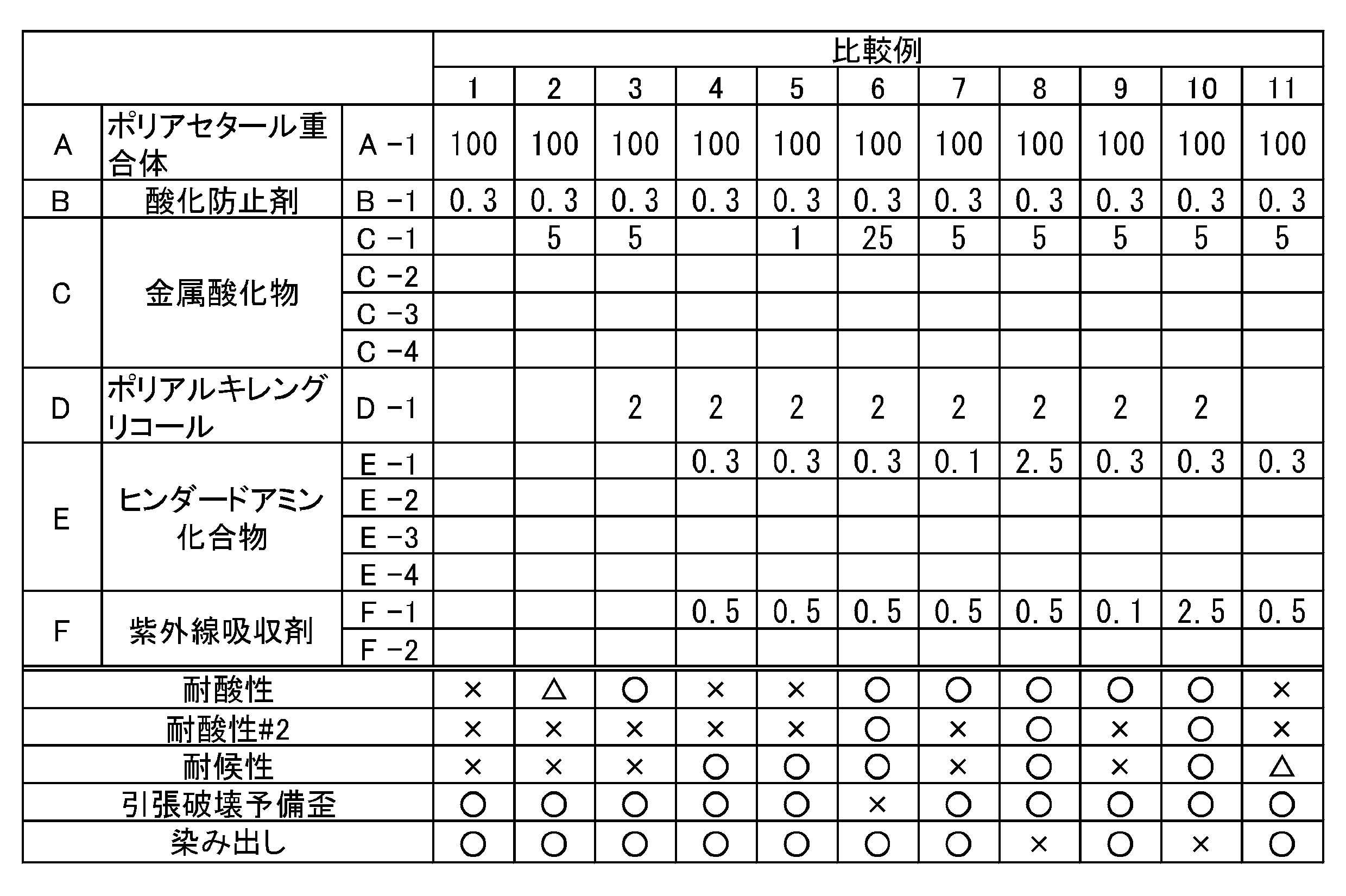
実施例、比較例より、本発明品は、耐酸性洗浄剤性および光耐性においてともに優れていることが確認された。
Claims (9)
- 少なくとも、
(A)ポリアセタール重合体100質量部に対し、
(B)ヒンダードフェノール系酸化防止剤0.1~2.0質量部、
(C)マグネシウムまたは亜鉛の酸化物から選択される少なくとも1種を、2.0質量部を超えて20質量部以下、
(D)ポリアルキレングリコール0.5~3.0質量部、
(E)ヒンダードアミン化合物0.2~1.5質量部、
(F)紫外線吸収剤0.2~1.5質量部、
とを含有するポリアセタール樹脂組成物。 - 前記マグネシウムまたは亜鉛の酸化物から選択される少なくとも1種が酸化マグネシウムである請求項1記載のポリアセタール樹脂組成物。
- 前記酸化マグネシウムのBET比表面積が100m2/g以上である請求項1または2記載のポリアセタール樹脂組成物。
- 前記(F)紫外線吸収剤が、ベンゾトリアゾール系化合物又はシュウ酸ジアミド系化合物から選ばれた少なくとも1種である、
請求項1~3いずれかに記載のポリアセタール樹脂組成物。 - 前記(F)紫外線吸収剤が、2-(2H-ベンゾトリアゾール-2-イル)-4,6-ビス(1-メチル-1-フェニルエチル)フェノール及びN-(2-エチルフェニル)-N’-(2-エトキシフェニル)シュウ酸ジアミドから選ばれた少なくとも1種である、請求項1~4いずれかに記載のポリアセタール樹脂組成物。
- 請求項1~5のいずれかに記載のポリアセタール樹脂組成物の成形品からなる自動車部品。
- 前記自動車部品が酸性洗浄剤接触自動車部品である請求項6記載の自動車部品。
- 請求項1~5のいずれかに記載のポリアセタール樹脂組成物の成形品を用いて、酸成分に対する酸耐性を向上させる方法。
- 前記酸成分が、酸性洗浄剤由来である、請求項8に記載の方法。
Priority Applications (3)
| Application Number | Priority Date | Filing Date | Title |
|---|---|---|---|
| MX2023007617A MX2023007617A (es) | 2020-12-24 | 2021-09-15 | Composicion de resina de poliacetal. |
| KR1020237023549A KR102629392B1 (ko) | 2020-12-24 | 2021-09-15 | 폴리아세탈 수지 조성물 |
| US18/338,790 US20230331978A1 (en) | 2020-12-24 | 2023-06-21 | Polyacetal resin composition |
Applications Claiming Priority (2)
| Application Number | Priority Date | Filing Date | Title |
|---|---|---|---|
| JP2020-214497 | 2020-12-24 | ||
| JP2020214497A JP7204727B2 (ja) | 2020-12-24 | 2020-12-24 | ポリアセタール樹脂組成物 |
Related Child Applications (1)
| Application Number | Title | Priority Date | Filing Date |
|---|---|---|---|
| US18/338,790 Continuation US20230331978A1 (en) | 2020-12-24 | 2023-06-21 | Polyacetal resin composition |
Publications (1)
| Publication Number | Publication Date |
|---|---|
| WO2022137671A1 true WO2022137671A1 (ja) | 2022-06-30 |
Family
ID=82157503
Family Applications (1)
| Application Number | Title | Priority Date | Filing Date |
|---|---|---|---|
| PCT/JP2021/033857 Ceased WO2022137671A1 (ja) | 2020-12-24 | 2021-09-15 | ポリアセタール樹脂組成物 |
Country Status (5)
| Country | Link |
|---|---|
| US (1) | US20230331978A1 (ja) |
| JP (1) | JP7204727B2 (ja) |
| KR (1) | KR102629392B1 (ja) |
| MX (1) | MX2023007617A (ja) |
| WO (1) | WO2022137671A1 (ja) |
Citations (12)
| Publication number | Priority date | Publication date | Assignee | Title |
|---|---|---|---|---|
| WO2004058884A1 (ja) * | 2002-12-26 | 2004-07-15 | Polyplastics Co., Ltd. | ポリアセタール樹脂組成物及びその製造方法 |
| WO2004058875A1 (ja) * | 2002-12-26 | 2004-07-15 | Polyplastics Co., Ltd. | ポリアセタール樹脂組成物及びその製造方法 |
| JP2006321880A (ja) * | 2005-05-18 | 2006-11-30 | Polyplastics Co | ポリアセタール樹脂組成物及び成形品 |
| JP2007070575A (ja) * | 2005-09-09 | 2007-03-22 | Polyplastics Co | ポリアセタール樹脂組成物及び成形品 |
| JP2007070574A (ja) * | 2005-09-09 | 2007-03-22 | Polyplastics Co | ポリアセタール樹脂組成物及び成形品 |
| CN103102640A (zh) * | 2013-01-30 | 2013-05-15 | 云南云天化股份有限公司 | 抗静电聚甲醛及其制备方法 |
| CN103571153A (zh) * | 2012-07-31 | 2014-02-12 | 上海杰事杰新材料(集团)股份有限公司 | 一种耐候的聚甲醛组合物及其制备方法 |
| CN104371267A (zh) * | 2014-05-28 | 2015-02-25 | 河南能源化工集团研究院有限公司 | 一种汽车用耐候性聚甲醛共混物及其制备方法 |
| CN104419112A (zh) * | 2013-08-19 | 2015-03-18 | 开滦能源化工股份有限公司 | 耐候型聚甲醛复合物及其制备方法 |
| WO2018180078A1 (ja) * | 2017-03-31 | 2018-10-04 | ポリプラスチックス株式会社 | ポリアセタール樹脂組成物 |
| WO2019244477A1 (ja) * | 2018-06-19 | 2019-12-26 | ポリプラスチックス株式会社 | ポリアセタール樹脂組成物 |
| JP2020518708A (ja) * | 2017-05-05 | 2020-06-25 | ティコナ・エルエルシー | 耐化学薬品性であるポリオキシメチレンポリマー組成物 |
Family Cites Families (11)
| Publication number | Priority date | Publication date | Assignee | Title |
|---|---|---|---|---|
| JPS6386124U (ja) | 1986-11-20 | 1988-06-06 | ||
| DE19943178A1 (de) * | 1999-09-09 | 2001-03-15 | Ticona Gmbh | Polyoxymethylen mit verbesserter Stabilität gegen Säuren und seine Verwendung |
| JP2001354832A (ja) * | 2000-06-15 | 2001-12-25 | Polyplastics Co | ポリアセタール樹脂組成物 |
| JP4827435B2 (ja) * | 2005-04-27 | 2011-11-30 | 旭化成ケミカルズ株式会社 | ポリアセタール樹脂組成物及びその成形品 |
| JP5085061B2 (ja) * | 2006-06-30 | 2012-11-28 | ポリプラスチックス株式会社 | ポリアセタール樹脂組成物 |
| JP5480471B2 (ja) * | 2007-12-26 | 2014-04-23 | ポリプラスチックス株式会社 | ポリアセタール樹脂組成物 |
| JP5610613B2 (ja) * | 2010-04-27 | 2014-10-22 | 旭化成ケミカルズ株式会社 | ポリアセタール樹脂組成物及びその成形体 |
| JP5814419B1 (ja) * | 2014-04-25 | 2015-11-17 | ポリプラスチックス株式会社 | ポリアセタール樹脂組成物、及びこのポリアセタール樹脂組成物の成形品を備える硫黄燃料接触体 |
| JP6784805B1 (ja) * | 2019-06-27 | 2020-11-11 | ポリプラスチックス株式会社 | ポリアセタ−ル樹脂組成物及びその製造方法 |
| MX2023004042A (es) * | 2020-10-09 | 2023-08-31 | Polyplastics Co | Composición de resina de poliacetal y parte de automóvil. |
| JP7078687B2 (ja) * | 2020-10-09 | 2022-05-31 | ポリプラスチックス株式会社 | ポリアセタール樹脂組成物及び自動車部品 |
-
2020
- 2020-12-24 JP JP2020214497A patent/JP7204727B2/ja active Active
-
2021
- 2021-09-15 WO PCT/JP2021/033857 patent/WO2022137671A1/ja not_active Ceased
- 2021-09-15 MX MX2023007617A patent/MX2023007617A/es unknown
- 2021-09-15 KR KR1020237023549A patent/KR102629392B1/ko active Active
-
2023
- 2023-06-21 US US18/338,790 patent/US20230331978A1/en active Pending
Patent Citations (12)
| Publication number | Priority date | Publication date | Assignee | Title |
|---|---|---|---|---|
| WO2004058884A1 (ja) * | 2002-12-26 | 2004-07-15 | Polyplastics Co., Ltd. | ポリアセタール樹脂組成物及びその製造方法 |
| WO2004058875A1 (ja) * | 2002-12-26 | 2004-07-15 | Polyplastics Co., Ltd. | ポリアセタール樹脂組成物及びその製造方法 |
| JP2006321880A (ja) * | 2005-05-18 | 2006-11-30 | Polyplastics Co | ポリアセタール樹脂組成物及び成形品 |
| JP2007070575A (ja) * | 2005-09-09 | 2007-03-22 | Polyplastics Co | ポリアセタール樹脂組成物及び成形品 |
| JP2007070574A (ja) * | 2005-09-09 | 2007-03-22 | Polyplastics Co | ポリアセタール樹脂組成物及び成形品 |
| CN103571153A (zh) * | 2012-07-31 | 2014-02-12 | 上海杰事杰新材料(集团)股份有限公司 | 一种耐候的聚甲醛组合物及其制备方法 |
| CN103102640A (zh) * | 2013-01-30 | 2013-05-15 | 云南云天化股份有限公司 | 抗静电聚甲醛及其制备方法 |
| CN104419112A (zh) * | 2013-08-19 | 2015-03-18 | 开滦能源化工股份有限公司 | 耐候型聚甲醛复合物及其制备方法 |
| CN104371267A (zh) * | 2014-05-28 | 2015-02-25 | 河南能源化工集团研究院有限公司 | 一种汽车用耐候性聚甲醛共混物及其制备方法 |
| WO2018180078A1 (ja) * | 2017-03-31 | 2018-10-04 | ポリプラスチックス株式会社 | ポリアセタール樹脂組成物 |
| JP2020518708A (ja) * | 2017-05-05 | 2020-06-25 | ティコナ・エルエルシー | 耐化学薬品性であるポリオキシメチレンポリマー組成物 |
| WO2019244477A1 (ja) * | 2018-06-19 | 2019-12-26 | ポリプラスチックス株式会社 | ポリアセタール樹脂組成物 |
Also Published As
| Publication number | Publication date |
|---|---|
| JP7204727B2 (ja) | 2023-01-16 |
| KR102629392B1 (ko) | 2024-01-25 |
| US20230331978A1 (en) | 2023-10-19 |
| KR20230111263A (ko) | 2023-07-25 |
| JP2022100492A (ja) | 2022-07-06 |
| MX2023007617A (es) | 2023-12-13 |
Similar Documents
| Publication | Publication Date | Title |
|---|---|---|
| EP2226358B1 (en) | Polyacetal resin composition | |
| JP6386124B1 (ja) | ポリアセタール樹脂組成物 | |
| JP6691171B2 (ja) | ポリアセタール樹脂組成物 | |
| EP3162851B1 (en) | Polyacetal resin composition and fuel contactor provided with molded article of the polyacetal resin composition | |
| WO2022137671A1 (ja) | ポリアセタール樹脂組成物 | |
| JP7078687B2 (ja) | ポリアセタール樹脂組成物及び自動車部品 | |
| JP6784805B1 (ja) | ポリアセタ−ル樹脂組成物及びその製造方法 | |
| JP2007534787A (ja) | 耐高温ディーゼル性ポリアセタール成形品 | |
| CN104650527B (zh) | 聚缩醛树脂用母料以及包含该母料的聚缩醛树脂组合物 | |
| WO2022201669A1 (ja) | ポリアセタール樹脂組成物、及びこのポリアセタール樹脂組成物の成形品を備える硫黄燃料接触体 | |
| EP3683247B1 (en) | Oxymethylene-copolymer manufacturing method | |
| JP7628407B2 (ja) | 酸性液体接触部材および部材の酸性液体耐性を向上させる方法 | |
| JP7492334B2 (ja) | ポリアセタール樹脂組成物、そのポリアセタール樹脂組成物を用いた成形品および自動車部品、ならびに酸性液体耐性を向上させる方法 | |
| KR20130078778A (ko) | 폴리옥시메틸렌 수지 조성물 |
Legal Events
| Date | Code | Title | Description |
|---|---|---|---|
| 121 | Ep: the epo has been informed by wipo that ep was designated in this application |
Ref document number: 21909829 Country of ref document: EP Kind code of ref document: A1 |
|
| WWE | Wipo information: entry into national phase |
Ref document number: MX/A/2023/007617 Country of ref document: MX |
|
| ENP | Entry into the national phase |
Ref document number: 20237023549 Country of ref document: KR Kind code of ref document: A |
|
| NENP | Non-entry into the national phase |
Ref country code: DE |
|
| 122 | Ep: pct application non-entry in european phase |
Ref document number: 21909829 Country of ref document: EP Kind code of ref document: A1 |