WO2022124180A1 - 導電性液晶性樹脂組成物 - Google Patents
導電性液晶性樹脂組成物 Download PDFInfo
- Publication number
- WO2022124180A1 WO2022124180A1 PCT/JP2021/044205 JP2021044205W WO2022124180A1 WO 2022124180 A1 WO2022124180 A1 WO 2022124180A1 JP 2021044205 W JP2021044205 W JP 2021044205W WO 2022124180 A1 WO2022124180 A1 WO 2022124180A1
- Authority
- WO
- WIPO (PCT)
- Prior art keywords
- conductive filler
- liquid crystal
- conductive
- resin composition
- crystal resin
- Prior art date
- Legal status (The legal status is an assumption and is not a legal conclusion. Google has not performed a legal analysis and makes no representation as to the accuracy of the status listed.)
- Ceased
Links
Classifications
-
- C—CHEMISTRY; METALLURGY
- C08—ORGANIC MACROMOLECULAR COMPOUNDS; THEIR PREPARATION OR CHEMICAL WORKING-UP; COMPOSITIONS BASED THEREON
- C08K—Use of inorganic or non-macromolecular organic substances as compounding ingredients
- C08K3/00—Use of inorganic substances as compounding ingredients
-
- C—CHEMISTRY; METALLURGY
- C08—ORGANIC MACROMOLECULAR COMPOUNDS; THEIR PREPARATION OR CHEMICAL WORKING-UP; COMPOSITIONS BASED THEREON
- C08K—Use of inorganic or non-macromolecular organic substances as compounding ingredients
- C08K3/00—Use of inorganic substances as compounding ingredients
- C08K3/01—Use of inorganic substances as compounding ingredients characterized by their specific function
- C08K3/013—Fillers, pigments or reinforcing additives
-
- C—CHEMISTRY; METALLURGY
- C08—ORGANIC MACROMOLECULAR COMPOUNDS; THEIR PREPARATION OR CHEMICAL WORKING-UP; COMPOSITIONS BASED THEREON
- C08K—Use of inorganic or non-macromolecular organic substances as compounding ingredients
- C08K3/00—Use of inorganic substances as compounding ingredients
- C08K3/02—Elements
- C08K3/04—Carbon
-
- C—CHEMISTRY; METALLURGY
- C08—ORGANIC MACROMOLECULAR COMPOUNDS; THEIR PREPARATION OR CHEMICAL WORKING-UP; COMPOSITIONS BASED THEREON
- C08K—Use of inorganic or non-macromolecular organic substances as compounding ingredients
- C08K7/00—Use of ingredients characterised by shape
- C08K7/02—Fibres or whiskers
-
- C—CHEMISTRY; METALLURGY
- C08—ORGANIC MACROMOLECULAR COMPOUNDS; THEIR PREPARATION OR CHEMICAL WORKING-UP; COMPOSITIONS BASED THEREON
- C08K—Use of inorganic or non-macromolecular organic substances as compounding ingredients
- C08K7/00—Use of ingredients characterised by shape
- C08K7/02—Fibres or whiskers
- C08K7/04—Fibres or whiskers inorganic
- C08K7/06—Elements
-
- C—CHEMISTRY; METALLURGY
- C08—ORGANIC MACROMOLECULAR COMPOUNDS; THEIR PREPARATION OR CHEMICAL WORKING-UP; COMPOSITIONS BASED THEREON
- C08L—COMPOSITIONS OF MACROMOLECULAR COMPOUNDS
- C08L101/00—Compositions of unspecified macromolecular compounds
- C08L101/12—Compositions of unspecified macromolecular compounds characterised by physical features, e.g. anisotropy, viscosity or electrical conductivity
-
- H—ELECTRICITY
- H01—ELECTRIC ELEMENTS
- H01B—CABLES; CONDUCTORS; INSULATORS; SELECTION OF MATERIALS FOR THEIR CONDUCTIVE, INSULATING OR DIELECTRIC PROPERTIES
- H01B1/00—Conductors or conductive bodies characterised by the conductive materials; Selection of materials as conductors
- H01B1/20—Conductive material dispersed in non-conductive organic material
- H01B1/24—Conductive material dispersed in non-conductive organic material the conductive material comprising carbon-silicon compounds, carbon or silicon
-
- C—CHEMISTRY; METALLURGY
- C08—ORGANIC MACROMOLECULAR COMPOUNDS; THEIR PREPARATION OR CHEMICAL WORKING-UP; COMPOSITIONS BASED THEREON
- C08K—Use of inorganic or non-macromolecular organic substances as compounding ingredients
- C08K2201/00—Specific properties of additives
- C08K2201/001—Conductive additives
Definitions
- the present invention relates to a conductive liquid crystal resin composition.
- Liquid crystal resin represented by liquid crystal polyester resin has excellent mechanical strength, heat resistance, chemical resistance, electrical properties, etc. in a well-balanced manner, and also has excellent dimensional stability, so it is widely used as a high-performance engineering plastic. It's being used. Further, taking advantage of the excellent fluidity of the liquid crystal resin, a conductive filler is blended with the liquid crystal resin to impart conductivity (for example, Patent Document 1).
- thermoplastic conductive materials that can give complex shapes as noise countermeasures by electromagnetic wave shielding or ground point formation is important. It is a close-up.
- a conductive material not only has a low volume resistivity as an index of conductivity, but also has excellent molding processability so that it can be easily formed into a complicated shape. Further, after being formed into a complicated shape, it is molded. It is required that the fluctuation of volume resistivity is small regardless of the thickness of the body.
- a liquid crystal resin composition can be mentioned as a candidate for the conductive material as described above.
- the conventional liquid crystal resin composition has a high volume resistivity and a high melt viscosity in the first place, so that the molding processability is not sufficient.
- the present invention has been made to solve the above problems, and an object of the present invention is not only that the molding processability is excellent and the volume resistivity is low, but also that the fluctuation of the volume resistivity is small regardless of the thickness. It is an object of the present invention to provide a conductive liquid crystal resin composition which gives a molded body.
- the present inventors have conducted extensive research to solve the above problems.
- the liquid crystal resin, the fibrous conductive filler, the granular conductive filler, and the non-conductive filler are contained, and the total of the fibrous conductive filler and the granular conductive filler is contained.
- the content is in a predetermined range
- the mass ratio of the content of the fibrous conductive filler to the content of the granular conductive filler is in the predetermined range
- the content of the non-conductive filler is in the predetermined range.
- a liquid crystal resin, (B) a fibrous conductive filler, (C) a granular conductive filler, and (D) a non-conductive filler are contained, and the above (B)
- the total content of the fibrous conductive filler and the (C) granular conductive filler is 25 to 50% by mass, and the (B) fiber with respect to the content of the (C) granular conductive filler.
- the mass ratio of the content of the state conductive filler is 0.50 to 3.00, and the content of the non-conductive filler (D) is 2 to 8% by mass. thing.
- the non-conductive filler (D) is composed of talc, mica, glass flakes, silica, glass beads, glass balloons, potassium titanate whisker, calcium silicate whisker, milled glass fiber, and glass fiber.
- a conductive liquid crystal resin composition that not only has excellent molding processability and low volume resistivity, but also gives a molded body having a small fluctuation in volume resistivity regardless of the thickness. Can be done.
- the conductive liquid crystal resin composition of the present invention comprises (A) a liquid crystal resin, (B) a fibrous conductive filler, (C) a granular conductive filler, and (D) a non-conductive filler. , Contain.
- the liquid crystal resin (A) used in the present invention refers to a melt-processable polymer having a property of forming an optically anisotropic molten phase.
- the properties of the anisotropic molten phase can be confirmed by a conventional polarization inspection method using an orthogonal polarizing element. More specifically, the confirmation of the anisotropic molten phase can be carried out by observing the molten sample placed on the Leitz hot stage at a magnification of 40 times under a nitrogen atmosphere using a Leitz polarizing microscope.
- Liquid crystalline polymers applicable to the present invention normally transmit polarized light and are optically anisotropy when inspected between orthogonal modulators, even in a molten and stationary state.
- the type of the liquid crystal resin (A) as described above is not particularly limited, and is preferably an aromatic polyester and / or an aromatic polyester amide. Further, polyesters partially containing aromatic polyesters and / or aromatic polyester amides in the same molecular chain are also in the range.
- the liquid crystal resin (A) is preferably at least about 2.0 dl / g, more preferably 2.0 to 10.0 dl / g when dissolved in pentafluorophenol at 60 ° C. at a concentration of 0.1% by mass. Those having a logarithmic viscosity (IV) of are preferably used.
- Aromatic polyester or aromatic polyester amide as a liquid crystal resin applicable to the present invention particularly preferably comprises a repeating unit derived from one or more of aromatic hydroxycarboxylic acid and its derivative.
- Aromatic polyester or aromatic polyester amide having as.
- Polyester consisting mainly of repeating units derived from one or more of aromatic hydroxycarboxylic acids and their derivatives; (2) Repeating units mainly derived from (a) one or more of aromatic hydroxycarboxylic acids and their derivatives, and (b) one of aromatic dicarboxylic acids, alicyclic dicarboxylic acids, and their derivatives. Or polyester consisting of repeating units derived from two or more species; (3) Repeating units mainly derived from (a) one or more of aromatic hydroxycarboxylic acids and their derivatives, and (b) one of aromatic dicarboxylic acids, alicyclic dicarboxylic acids, and their derivatives.
- a polyester consisting of a repeating unit derived from two or more kinds and (c) a repeating unit derived from at least one kind or two or more kinds of aromatic diols, alicyclic diols, aliphatic diols, and derivatives thereof; (4) Repeating units derived mainly from (a) one or more of aromatic hydroxycarboxylic acids and their derivatives, and (b) one or two of aromatic hydroxyamines, aromatic diamines, and their derivatives.
- Polyesteramide consisting of repeating units derived from species or more and (c) aromatic dicarboxylic acids, alicyclic dicarboxylic acids, and repeating units derived from one or more of their derivatives; (5) Repeating units mainly derived from (a) one or more of aromatic hydroxycarboxylic acids and their derivatives, and (b) one or two of aromatic hydroxyamines, aromatic diamines, and their derivatives. Repeating units derived from species or higher, (c) aromatic dicarboxylic acids, alicyclic dicarboxylic acids, and repeating units derived from one or more of their derivatives, and (d) aromatic diols, alicyclics.
- polyesteramides composed of group diols, aliphatic diols, and repeating units derived from at least one or more of the derivatives thereof.
- a molecular weight adjusting agent may be used in combination with the above-mentioned constituent components, if necessary.
- Preferred examples of the specific compound constituting the (A) liquid crystal resin applicable to the present invention are aromatic hydroxycarboxylic acids such as 4-hydroxybenzoic acid and 6-hydroxy-2-naphthoic acid; 2,6-dihydroxy.
- Aromatic diols such as naphthalene, 1,4-dihydroxynaphthalene, 4,4'-dihydroxybiphenyl, hydroquinone, resorcin, the compound represented by the following general formula (I), and the compound represented by the following general formula (II).
- Aromatic compounds such as 1,4-phenylenedicarboxylic acid, 1,3-phenylenedicarboxylic acid, 4,4'-diphenyldicarboxylic acid, 2,6-naphthalenedicarboxylic acid, and compounds represented by the following general formula (III).
- Dicarboxylic acids; aromatic amines such as p-aminophenol, p-phenylenediamine, N-acetyl-p-aminophenol and the like can be mentioned.
- X A group selected from alkylene (C 1 to C 4 ), alkylidene, -O-, -SO-, -SO 2- , -S-, and -CO-).
- the liquid crystal resin (A) used in the present invention can be prepared by a known method using a direct polymerization method or an ester exchange method from the above-mentioned monomer compound (or a mixture of monomers), and is usually a melt polymerization method.
- a melt polymerization method Solution polymerization method, slurry polymerization method, solid phase polymerization method, etc., or a combination of two or more thereof is used, and a melt polymerization method or a combination of a melt polymerization method and a solid phase polymerization method is preferably used.
- the above compounds having an ester-forming ability may be used in the polymerization as they are, or may be modified from a precursor to a derivative having the ester-forming ability in the pre-polymerization stage.
- catalysts can be used in these polymerizations, and typical ones are potassium acetate, magnesium acetate, stannous acetate, tetrabutyl titanate, lead acetate, sodium acetate, antimony trioxide, and tris (2).
- 4-Pentandionato) Examples thereof include metal salt-based catalysts such as cobalt (III) and organic compound-based catalysts such as N-methylimidazole and 4-dimethylaminopyridine.
- the amount of the catalyst used is generally preferably about 0.001 to 1% by mass, particularly preferably about 0.01 to 0.2% by mass, based on the total mass of the monomers. If necessary, the polymer produced by these polymerization methods can be further increased in molecular weight by a solid phase polymerization method in which the polymer is heated under reduced pressure or in an inert gas.
- the melt viscosity of the liquid crystal resin (A) obtained by the above method is not particularly limited. Generally, those having a melt viscosity at a molding temperature of 1000 sec -1 and a shear rate of 3 Pa ⁇ s or more and 500 Pa ⁇ s or less can be used. However, the one having a very high viscosity by itself is not preferable because the fluidity is very deteriorated.
- the liquid crystal resin (A) may be a mixture of two or more kinds of liquid crystal resins.
- the content of the liquid crystal resin (A) is preferably 42 to 73% by mass, more preferably 47.3 to 67.7% by mass, and even more. It is preferably 52.5 to 64.5% by mass.
- the content of the component (A) is within the above range, it is preferable in terms of fluidity, heat resistance and the like.
- the conductive liquid crystal resin composition according to the present invention contains a fibrous conductive filler.
- the fibrous conductive filler can be used alone or in combination of two or more.
- the average fiber length of the fibrous conductive filler is not particularly limited, and may be, for example, 50 ⁇ m or more and 10 mm, 80 ⁇ m or more and 8 mm, or 100 ⁇ m or more and 7 mm from the viewpoint of conductivity.
- the average fiber length of (B) the fibrous conductive filler 10 real microscope images of the fibrous conductive filler are taken into a PC from a CCD camera, and an image processing method is performed by an image measuring machine. Therefore, the average of the measured fiber lengths of 100 fibrous conductive fillers, that is, a total of 1000 fibrous conductive fillers is adopted for each stereoscopic microscope image.
- the average fiber length of the (B) fibrous conductive filler in the conductive liquid crystal resin composition is the fibrous conductive filling remaining after ashing the conductive liquid crystal resin composition by heating at 500 ° C. for 4 hours.
- the agent is measured by applying the above method.
- the fiber diameter of the fibrous conductive filler is not particularly limited, and may be, for example, 0.2 to 15 ⁇ m, 0.25 to 13 ⁇ m, or 0.3 to 11 ⁇ m from the viewpoint of conductivity.
- the fiber diameter of (B) the fibrous conductive filler is observed with a scanning electron microscope, and the fiber diameter is determined for 30 fibrous conductive fillers. Use the average of the measured values.
- the fiber diameter of the (B) fibrous conductive filler in the conductive liquid crystal resin composition is the fibrous conductive filler remaining after ashing the conductive liquid crystal resin composition by heating at 500 ° C. for 4 hours. Is measured by applying the above method.
- fibrous conductive filler examples include carbon fibers; conductive fibers such as metal fibers; and inorganic fibrous substances coated with metals such as nickel and copper to impart conductivity.
- Carbon fiber is preferable from the viewpoint of conductivity.
- carbon fibers examples include PAN-based carbon fibers made from polyacrylonitrile and pitch-based carbon fibers made from pitch.
- metal fibers examples include fibers made of mild steel, stainless steel, steel and its alloys, copper, brass, aluminum and its alloys, titanium, lead and the like. As these metal fibers, those coated with other metals can also be used in order to further impart conductivity if necessary due to their conductivity.
- inorganic fibrous substance examples include glass fiber, milled glass fiber, asbestos fiber, silica fiber, silica-alumina fiber, zirconia fiber, boron nitride fiber, silicon nitride fiber, boron fiber, potassium titanate whisker, calcium silicate whisker (). Fibrous wollastonite) and the like.
- the conductive liquid crystal resin composition according to the present invention contains a granular conductive filler.
- the granular conductive filler can be used alone or in combination of two or more.
- the median diameter of the granular conductive filler is not particularly limited, and may be, for example, 10 nm or more and 50 ⁇ m or less, 15 nm or more and 20 ⁇ m or less, or 18 nm or more and 10 ⁇ m or less from the viewpoint of conductivity.
- the median diameter means the median value of the volume standard measured by the laser diffraction / scattering type particle size distribution measurement method.
- Examples of the (C) granular conductive filler include carbon black, granular metal powder (for example, aluminum, iron, and copper), granular conductive ceramics (for example, zinc oxide, tin oxide, and indium tin oxide), and the like. From the viewpoint of sex, carbon black is preferable.
- the carbon black is not particularly limited as long as it is generally available and is used for resin coloring. Normally, carbon black contains lumps formed by agglomeration of primary particles, but unless a large amount of lumps having a size of 50 ⁇ m or more are contained, the resin composition of the present invention is formed. Many bumps (fine bumpy protrusions (fine irregularities) in which carbon black is aggregated) are unlikely to occur on the surface of the molded body. When the content of the particles having a mass particle diameter of 50 ⁇ m or more is 20 ppm or less, the smoothness of the surface of the molded product tends to be high. The preferred content is 5 ppm or less.
- the total content of the (B) fibrous conductive filler and the (C) granular conductive filler is 25 to 50% by mass, preferably 29 to 50% by mass in the conductive liquid crystal resin composition of the present invention. It is 45% by mass, more preferably 33 to 40% by mass.
- the total content is 25% by mass or more, the volume resistivity of the molded product tends to be low, and it is easy to obtain a molded product having improved conductivity.
- the total content is 50% by mass or less, the fluidity of the conductive liquid crystal resin composition is likely to be improved, and it is easy to obtain a conductive liquid crystal resin composition having excellent molding processability.
- the mass ratio of the content of the (B) fibrous conductive filler to the content of the (C) granular conductive filler is 0.50 to 3.00, preferably 0.60 to 2.50. Yes, more preferably 0.70 to 2.00.
- the mass ratio is 0.50 or more, the fluidity of the conductive liquid crystal resin composition is likely to be improved, it is easy to obtain a conductive liquid crystal resin composition having excellent molding processability, and the conductivity of the molded body is easy to obtain. It is easy to reduce the thickness dependence of the resin, and it is easy to obtain a molded product having a small fluctuation in mass resistivity regardless of the thickness.
- the mass ratio is 3.00 or less, the thickness dependence of the conductivity of the molded body is likely to be reduced, and it is easy to obtain a molded body having a small fluctuation in volume resistivity regardless of the thickness.
- the conductive liquid crystal resin composition according to the present invention contains a non-conductive filler.
- the non-conductive filler can be used alone or in combination of two or more.
- Examples of the non-conductive filler (D) include a plate-shaped non-conductive filler, a granular non-conductive filler, and a fibrous non-conductive filler.
- the median diameter of the plate-shaped non-conductive filler is not particularly limited, and may be, for example, 10 to 100 ⁇ m, 12 to 50 ⁇ m, or 14 to 30 ⁇ m.
- the median diameter of the plate-shaped non-conductive filler is 10 to 100 ⁇ m, it is easy to reduce the thickness dependence of the conductivity of the molded body, and it is easy to obtain a molded body having a small fluctuation in volume resistivity regardless of the thickness.
- Examples of the plate-shaped non-conductive filler include talc, mica, glass flakes and the like.
- the median diameter of the granular non-conductive filler is not particularly limited, and may be, for example, 0.3 to 50 ⁇ m, 0.4 to 25 ⁇ m, or 0.5 to 5.0 ⁇ m.
- the median diameter of the granular non-conductive filler is 0.3 to 50 ⁇ m, it is easy to reduce the thickness dependence of the conductivity of the molded body, and it is easy to obtain a molded body having a small fluctuation in volume resistivity regardless of the thickness. ..
- Examples of the granular non-conductive filler include silica salts such as silica, quartz powder, glass beads, glass balloons, glass powder, calcium silicate, aluminum silicate, kaolin, clay, diatomaceous earth, and wollastonite; iron oxide. , Titanium oxide, zinc oxide, alumina and the like; metal carbonates such as calcium carbonate and magnesium carbonate; metal sulfates such as calcium sulfate and barium sulfate;
- the average fiber length of the fibrous non-conductive filler is not particularly limited, and may be, for example, 50 ⁇ m or more and 10 mm, 80 ⁇ m or more and 7 mm, or 100 ⁇ m or more and 4 mm.
- the fiber diameter of the fibrous non-conductive filler is not particularly limited, and may be, for example, 0.2 to 15 ⁇ m, 0.25 to 13 ⁇ m, or 0.3 to 11 ⁇ m.
- the thickness dependence of the conductivity of the molded body can be easily reduced, and a molded body having a small fluctuation in volume resistivity can be obtained regardless of the thickness.
- Cheap The average fiber length of the fibrous non-conductive filler and the fiber diameter of the fibrous non-conductive filler are the values measured for (B) the fibrous conductive filler in the same manner as described above. Adopt the average.
- fibrous non-conductive filler examples include glass fiber, milled glass fiber, asbestos fiber, silica fiber, silica / alumina fiber, zirconia fiber, boron nitride fiber, silicon nitride fiber, boron fiber, potassium titanate whisker, and Kay.
- inorganic fibrous substances such as calcium acid whiskers (fibrous wollastonite).
- the (D) non-conductive filler is preferably talc because it is easier to reduce the thickness dependence of the conductivity of the molded body and it is easier to obtain a molded body having a small fluctuation in volume resistance regardless of the thickness.
- the content of the non-conductive filler (D) is 2 to 8% by mass, preferably 2.3 to 7.7% by mass, and more preferably 2 to 8% by mass in the conductive liquid crystal resin composition of the present invention. It is 2.5 to 7.5% by mass.
- the content is 2 to 8% by mass, the fluidity of the conductive liquid crystal resin composition is likely to be improved, and it is easy to obtain a conductive liquid crystal resin composition having excellent molding processability.
- the liquid crystal resin composition of the present invention contains other polymers, other fillers, and known substances generally added to synthetic resins, that is, antioxidants and ultraviolet absorbers, as long as the effects of the present invention are not impaired.
- Stabilizers such as agents, antistatic agents, flame retardants, colorants such as dyes and pigments, lubricants, crystallization accelerators, crystal nucleating agents, mold release agents and other other components should be added as appropriate according to the required performance. Can be done.
- Other components may be used alone or in combination of two or more.
- Examples of other polymers include epoxy group-containing copolymers.
- the other polymers may be used alone or in combination of two or more.
- the other fillers refer to fillers other than (B) fibrous conductive fillers, (C) granular conductive fillers, and (D) non-conductive fillers, for example, the component (B) and ( C) Conductive fillers other than the components can be mentioned.
- Other fillers may be used alone or in combination of two or more. Examples of the conductive filler other than the component (B) and the component (C) include a plate-shaped conductive filler.
- the method for preparing the conductive liquid crystal resin composition of the present invention is not particularly limited.
- the above components (A) to (D) and, optionally, at least one of the other components are blended, and these are melt-kneaded using a single-screw or twin-screw extruder to provide conductivity.
- the liquid crystal resin composition is prepared.
- the conductive liquid crystal resin composition of the present invention obtained as described above preferably has a melt viscosity of 150 Pa ⁇ sec or less, preferably 145 Pa ⁇ sec, from the viewpoint of fluidity at the time of melting and formability. It is more preferably sec or less, and more preferably 140 Pa ⁇ sec or less.
- the melt viscosity a value obtained by a measuring method based on ISO 11443 is adopted under the conditions of a cylinder temperature 10 to 20 ° C. higher than the melting point of the liquid crystal resin and a shear rate of 1000 sec -1 .
- a conductive material can be produced by using the conductive liquid crystal resin composition of the present invention.
- the conductive material of the present invention comprises a molded body of the conductive liquid crystal resin composition of the present invention.
- the conductive material of the present invention not only has a low volume resistivity, but also has a small fluctuation in the volume resistivity regardless of the thickness. Therefore, the conductive material of the present invention can be suitably used for products having complicated shapes having various thicknesses, and specifically, for example, connectors, transmission boards, antennas and the like.
- the stirring torque reached a predetermined value
- nitrogen was introduced to bring the mixture into a pressurized state from a reduced pressure state through a normal pressure state
- the polymer was discharged from the lower part of the polymerization vessel, and the strands were pelletized to obtain pellets.
- the obtained pellets were heat-treated at 300 ° C. for 2 hours under a nitrogen stream to obtain the desired polymer.
- the melting point of the obtained polymer was 336 ° C, and the melt viscosity at 350 ° C was 19.0 Pa ⁇ s.
- the melting point of the polymer was measured according to the method for measuring the melting point described later, and the melt viscosity of the polymer was measured in the same manner as the method for measuring the melt viscosity described later.
- HBA 4-Hydroxybenzoic acid
- HNA 2-Hydroxy-6-naphthoic acid
- TA 1,4-phenylenedicarboxylic acid
- BP 4,4'-dihydroxybiphenyl
- APAP N-Acetyl-p-Aminophenol
- APAP N-Acetyl-p-Aminophenol
- Metal catalyst potassium acetate catalyst
- 110 mg Acylating agent acetic anhydride
- -Fibrous conductive filler HTC432 manufactured by Teijin Limited (PAN-based carbon fiber, chopped strand, fiber diameter 7 ⁇ m, length 6 mm)
- -Carbon black VULCAN XC305 (manufactured by Cabot Japan Co., Ltd., median diameter 20 nm, particle ratio of particles with a particle diameter of 50 ⁇ m or more is 20 ppm or less)
- Talc Crown talc PP (manufactured by Matsumura Sangyo Co., Ltd., talc, median diameter 14.6 ⁇ m)
- Mica AB-25S (manufactured by Yamaguchi Mica Co., Ltd., mica, median diameter 25.0 ⁇ m)
- -Silica Denka fused silica FB-5SDC (manufactured by Denka Co., Ltd., silica, median diameter 4.0 ⁇ m)
- -Glass fiber ECS03T-786H (man
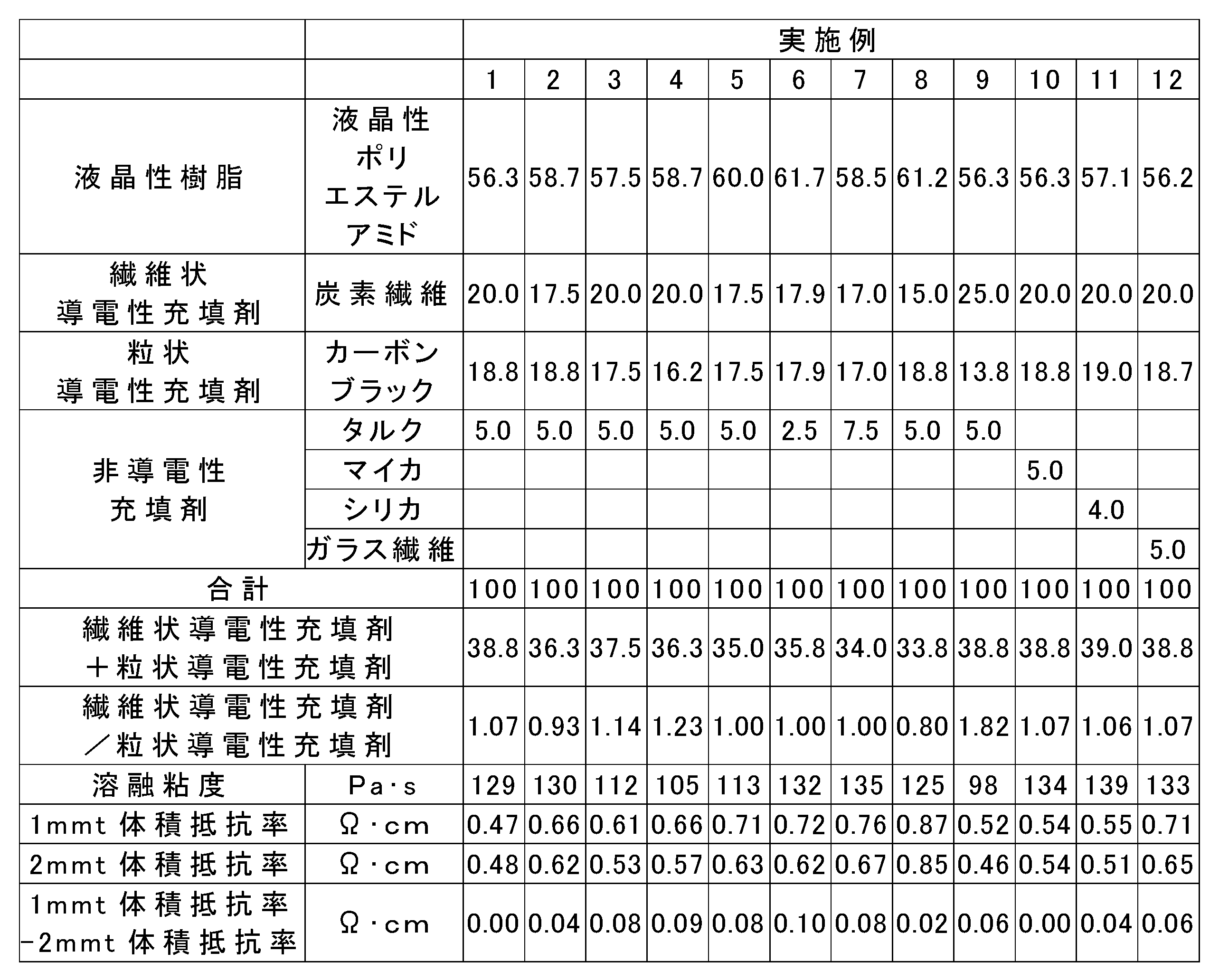
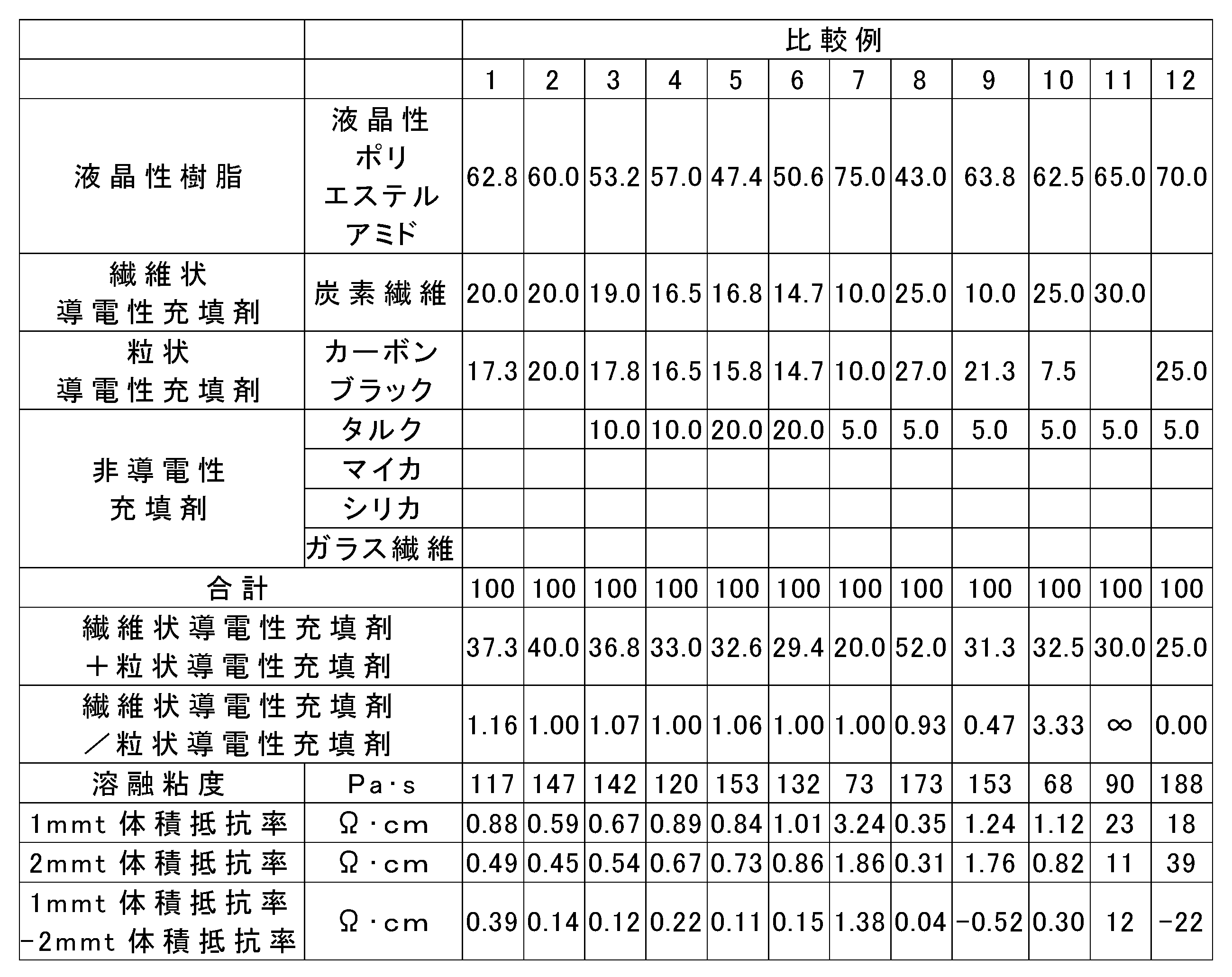
- ⁇ Volume resistivity> The pellets of Examples and Comparative Examples were molded using a molding machine (“SE100DU” manufactured by Sumitomo Heavy Industries, Ltd.) under the following molding conditions, and 80 mm ⁇ 80 mm ⁇ 1 mmt flat plate test piece 1 or 80 mm ⁇ 80 mm. A flat plate test piece 2 of ⁇ 2 mmt was obtained. Using a flat plate test piece 1, a resistivity meter (“Loresta-GP” manufactured by Nittoseiko Analytech Co., Ltd.) is used, and in accordance with JIS K 7194, the volume resistivity (hereinafter referred to as “1 mmt volume resistivity”” is also used. ) was measured.
- SE100DU manufactured by Sumitomo Heavy Industries, Ltd.
- a resistivity meter (“Loresta-GP” manufactured by Nittoseiko Analytech Co., Ltd.) is used, and the volume resistivity (hereinafter, “2 mmt volume resistivity”) is compliant with JIS K 7194. It is also called.) was measured. Further, the difference between the 1 mmt volume resistivity and the 2 mmt volume resistivity was calculated. The results are shown in Tables 1 and 2. When the absolute value of the above difference was 0.10 ⁇ ⁇ cm or less, it was evaluated that the fluctuation of the volume resistivity was small regardless of the thickness. ⁇ Molding condition ⁇ Cylinder temperature: 350 ° C Mold temperature: 80 ° C Injection speed: 33 mm / sec
Landscapes
- Chemical & Material Sciences (AREA)
- Health & Medical Sciences (AREA)
- Chemical Kinetics & Catalysis (AREA)
- Medicinal Chemistry (AREA)
- Polymers & Plastics (AREA)
- Organic Chemistry (AREA)
- Physics & Mathematics (AREA)
- Dispersion Chemistry (AREA)
- Spectroscopy & Molecular Physics (AREA)
- Compositions Of Macromolecular Compounds (AREA)
Abstract
Description
本発明の導電性液晶性樹脂組成物は、(A)液晶性樹脂と、(B)繊維状導電性充填剤と、(C)粒状導電性充填剤と、(D)非導電性充填剤と、を含有する。
本発明で使用する(A)液晶性樹脂とは、光学異方性溶融相を形成し得る性質を有する溶融加工性ポリマーを指す。異方性溶融相の性質は、直交偏光子を利用した慣用の偏光検査法により確認することが出来る。より具体的には、異方性溶融相の確認は、Leitz偏光顕微鏡を使用し、Leitzホットステージに載せた溶融試料を窒素雰囲気下で40倍の倍率で観察することにより実施できる。本発明に適用できる液晶性ポリマーは直交偏光子の間で検査したときに、たとえ溶融静止状態であっても偏光は通常透過し、光学的に異方性を示す。
(1)主として芳香族ヒドロキシカルボン酸及びその誘導体の1種又は2種以上に由来する繰り返し単位からなるポリエステル;
(2)主として(a)芳香族ヒドロキシカルボン酸及びその誘導体の1種又は2種以上に由来する繰り返し単位と、(b)芳香族ジカルボン酸、脂環族ジカルボン酸、及びそれらの誘導体の1種又は2種以上に由来する繰り返し単位とからなるポリエステル;
(3)主として(a)芳香族ヒドロキシカルボン酸及びその誘導体の1種又は2種以上に由来する繰り返し単位と、(b)芳香族ジカルボン酸、脂環族ジカルボン酸、及びそれらの誘導体の1種又は2種以上に由来する繰り返し単位と、(c)芳香族ジオール、脂環族ジオール、脂肪族ジオール、及びそれらの誘導体の少なくとも1種又は2種以上に由来する繰り返し単位、とからなるポリエステル;
(4)主として(a)芳香族ヒドロキシカルボン酸及びその誘導体の1種又は2種以上に由来する繰り返し単位と、(b)芳香族ヒドロキシアミン、芳香族ジアミン、及びそれらの誘導体の1種又は2種以上に由来する繰り返し単位と、(c)芳香族ジカルボン酸、脂環族ジカルボン酸、及びそれらの誘導体の1種又は2種以上に由来する繰り返し単位、とからなるポリエステルアミド;
(5)主として(a)芳香族ヒドロキシカルボン酸及びその誘導体の1種又は2種以上に由来する繰り返し単位と、(b)芳香族ヒドロキシアミン、芳香族ジアミン、及びそれらの誘導体の1種又は2種以上に由来する繰り返し単位と、(c)芳香族ジカルボン酸、脂環族ジカルボン酸、及びそれらの誘導体の1種又は2種以上に由来する繰り返し単位と、(d)芳香族ジオール、脂環族ジオール、脂肪族ジオール、及びそれらの誘導体の少なくとも1種又は2種以上に由来する繰り返し単位、とからなるポリエステルアミド等が挙げられる。更に上記の構成成分に必要に応じ分子量調整剤を併用してもよい。



本発明に係る導電性液晶性樹脂組成物には、繊維状導電性充填剤が含まれる。繊維状導電性充填剤は、1種単独で又は2種以上組み合わせて使用することができる。
本発明に係る導電性液晶性樹脂組成物には、粒状導電性充填剤が含まれる。粒状導電性充填剤は、1種単独で又は2種以上組み合わせて使用することができる。
本発明に係る導電性液晶性樹脂組成物には、非導電性充填剤が含まれる。非導電性充填剤は、1種単独で又は2種以上組み合わせて使用することができる。(D)非導電性充填剤としては、例えば、板状非導電性充填剤、粒状非導電性充填剤、繊維状非導電性充填剤が挙げられる。
本発明の液晶性樹脂組成物には、本発明の効果を害さない範囲で、その他の重合体、その他の充填剤、一般に合成樹脂に添加される公知の物質、即ち、酸化防止剤や紫外線吸収剤等の安定剤、帯電防止剤、難燃剤、染料や顔料等の着色剤、潤滑剤、結晶化促進剤、結晶核剤、離型剤等のその他の成分も要求性能に応じ適宜添加することができる。その他の成分は1種単独で用いても2種以上を組み合わせて用いてもよい。
本発明の導電性液晶性樹脂組成物の調製方法は特に限定されない。例えば、上記(A)~(D)成分、及び、任意に、その他の成分の少なくとも1種を配合して、これらを1軸又は2軸押出機を用いて溶融混練処理することで、導電性液晶性樹脂組成物の調製が行われる。
上記のようにして得られた本発明の導電性液晶性樹脂組成物は、溶融時の流動性の観点、成形加工性の観点から、溶融粘度が150Pa・sec以下であることが好ましく、145Pa・sec以下であることがより好ましく、140Pa・sec以下であることがより好ましい。本明細書において、溶融粘度としては、液晶性樹脂の融点よりも10~20℃高いシリンダー温度、剪断速度1000sec-1の条件で、ISO 11443に準拠した測定方法で得られた値を採用する。
本発明の導電性液晶性樹脂組成物を用いて、導電性材料を製造することができる。本発明の導電性材料は、本発明の導電性液晶性樹脂組成物の成形体からなる。本発明の導電性材料は、体積抵抗率が低いだけでなく、厚みによらず、体積抵抗率の変動が小さい。よって、本発明の導電性材料は、様々な厚みを有する複雑な形状の製品に好適に用いることができ、具体的には、例えば、コネクター、伝送基板、アンテナ等に用いることができる。
・液晶性ポリエステルアミド樹脂
重合容器に下記の原料を仕込んだ後、反応系の温度を140℃に上げ、140℃で1時間反応させた。その後、更に340℃まで4.5時間かけて昇温し、そこから15分かけて10Torr(即ち1330Pa)まで減圧にして、酢酸、過剰の無水酢酸、及びその他の低沸分を留出させながら溶融重合を行った。撹拌トルクが所定の値に達した後、窒素を導入して減圧状態から常圧を経て加圧状態にして、重合容器の下部からポリマーを排出し、ストランドをペレタイズしてペレットを得た。得られたペレットについて、窒素気流下、300℃で2時間の熱処理を行って、目的のポリマーを得た。得られたポリマーの融点は336℃、350℃における溶融粘度は19.0Pa・sであった。なお、上記ポリマーの融点は、後述する融点の測定方法の通りに測定し、上記ポリマーの溶融粘度は、後述する溶融粘度の測定方法と同様にして測定した。
(I)4-ヒドロキシ安息香酸(HBA);1380g(60モル%)
(II)2-ヒドロキシ-6-ナフトエ酸(HNA);157g(5モル%)
(III)1,4-フェニレンジカルボン酸(TA);484g(17.5モル%)
(IV)4,4’-ジヒドロキシビフェニル(BP);388g(12.5モル%)
(V)N-アセチル-p-アミノフェノール(APAP);126g(5モル%)
金属触媒(酢酸カリウム触媒);110mg
アシル化剤(無水酢酸);1659g
・繊維状導電性充填剤:帝人(株)製 HTC432(PAN系炭素繊維、チョップドストランド、繊維径7μm、長さ6mm)
・カーボンブラック:VULCAN XC305(キャボットジャパン(株)製、メディアン径20nm、粒子径50μm以上の粒子の割合が20ppm以下)
・タルク:クラウンタルクPP(松村産業(株)製、タルク、メディアン径14.6μm)
・マイカ:AB-25S((株)ヤマグチマイカ製、マイカ、メディアン径25.0μm)
・シリカ:デンカ溶融シリカFB-5SDC(デンカ(株)製、シリカ、メディアン径4.0μm)
・ガラス繊維:ECS03T-786H(日本電気硝子(株)製、チョップドストランド、繊維径10μm、長さ3mm)
TAインスツルメント社製DSCにて、液晶性樹脂を室温から20℃/分の昇温条件で加熱した際に観測される吸熱ピーク温度(Tm1)の測定後、(Tm1+40)℃の温度で2分間保持した後、20℃/分の降温条件で室温まで一旦冷却した後、再度、20℃/分の昇温条件で加熱した際に観測される吸熱ピークの温度を測定した。
上記成分を、表1又は表2に示す割合(単位:質量%)で二軸押出機((株)日本製鋼所製TEX30α型)を用いて、シリンダー温度350℃にて溶融混練し、導電性液晶性樹脂組成物ペレットを得た。
(株)東洋精機製作所製キャピログラフ1B型を使用し、液晶性樹脂の融点よりも10~20℃高い温度で、内径1mm、長さ20mmのオリフィスを用いて、剪断速度1000/秒で、ISO11443に準拠して、導電性液晶性樹脂組成物の溶融粘度を測定した。なお、測定温度は、350℃であった。結果を表1及び表2に示す。
実施例及び比較例のペレットを、成形機(住友重機械工業(株)製 「SE100DU」)を用いて、以下の成形条件で成形し、80mm×80mm×1mmtの平板試験片1又は80mm×80mm×2mmtの平板試験片2を得た。平板試験片1を用い、抵抗率計(日東精工アナリテック(株)製 「ロレスタ-GP」)を使用し、JIS K 7194に準拠して、体積抵抗率(以下、「1mmt体積抵抗率」ともいう。)を測定した。また、平板試験片2を用い、抵抗率計(日東精工アナリテック(株)製 「ロレスタ-GP」)を使用し、JIS K 7194に準拠して、体積抵抗率(以下、「2mmt体積抵抗率」ともいう。)を測定した。更に、1mmt体積抵抗率と2mmt体積抵抗率との差を算出した。結果を表1及び表2に示す。上記差の絶対値が0.10Ω・cm以下である場合に、厚みによらず、体積抵抗率の変動が小さいと評価した。
〔成形条件〕
シリンダー温度:350℃
金型温度:80℃
射出速度:33mm/sec
Claims (4)
- (A)液晶性樹脂と、(B)繊維状導電性充填剤と、(C)粒状導電性充填剤と、(D)非導電性充填剤と、を含有し、
前記(B)繊維状導電性充填剤と前記(C)粒状導電性充填剤との合計の含有量は、25~50質量%であり、
前記(C)粒状導電性充填剤の含有量に対する前記(B)繊維状導電性充填剤の含有量の質量比は、0.50~3.00であり、
前記(D)非導電性充填剤の含有量は、2~8質量%である導電性液晶性樹脂組成物。 - 前記(B)繊維状導電性充填剤は、炭素繊維であり、
前記(C)粒状導電性充填剤は、カーボンブラックである請求項1に記載の導電性液晶性樹脂組成物。 - 前記(D)非導電性充填剤は、タルク、マイカ、ガラスフレーク、シリカ、ガラスビーズ、ガラスバルーン、チタン酸カリウムウィスカー、ケイ酸カルシウムウィスカー、ミルドガラスファイバー、及びガラス繊維からなる群より選択される1種以上である請求項1又は2に記載の導電性液晶性樹脂組成物。
- 前記(D)非導電性充填剤は、タルク、マイカ、シリカ、及びガラス繊維からなる群より選択される1種以上である請求項1~3のいずれかに記載の導電性液晶性樹脂組成物。
Priority Applications (3)
| Application Number | Priority Date | Filing Date | Title |
|---|---|---|---|
| KR1020237021247A KR102748762B1 (ko) | 2020-12-07 | 2021-12-02 | 도전성 액정성 수지 조성물 |
| JP2022568229A JP7373080B2 (ja) | 2020-12-07 | 2021-12-02 | 導電性液晶性樹脂組成物 |
| CN202180081329.3A CN116601230B (zh) | 2020-12-07 | 2021-12-02 | 导电性液晶性树脂组合物 |
Applications Claiming Priority (2)
| Application Number | Priority Date | Filing Date | Title |
|---|---|---|---|
| JP2020-202782 | 2020-12-07 | ||
| JP2020202782 | 2020-12-07 |
Publications (1)
| Publication Number | Publication Date |
|---|---|
| WO2022124180A1 true WO2022124180A1 (ja) | 2022-06-16 |
Family
ID=81973181
Family Applications (1)
| Application Number | Title | Priority Date | Filing Date |
|---|---|---|---|
| PCT/JP2021/044205 Ceased WO2022124180A1 (ja) | 2020-12-07 | 2021-12-02 | 導電性液晶性樹脂組成物 |
Country Status (5)
| Country | Link |
|---|---|
| JP (1) | JP7373080B2 (ja) |
| KR (1) | KR102748762B1 (ja) |
| CN (1) | CN116601230B (ja) |
| TW (1) | TWI874733B (ja) |
| WO (1) | WO2022124180A1 (ja) |
Citations (7)
| Publication number | Priority date | Publication date | Assignee | Title |
|---|---|---|---|---|
| JPS63146959A (ja) * | 1986-12-10 | 1988-06-18 | Polyplastics Co | 液晶性ポリエステル樹脂組成物 |
| JPH04311758A (ja) * | 1991-04-10 | 1992-11-04 | Toray Ind Inc | 液晶ポリマ樹脂組成物 |
| JP2000230117A (ja) * | 1998-12-11 | 2000-08-22 | Toray Ind Inc | 難燃性樹脂組成物、その長繊維ペレットおよびその成形品 |
| JP2001067933A (ja) * | 1999-08-24 | 2001-03-16 | Toray Ind Inc | 導電性樹脂組成物およびその成形品 |
| JP2001081318A (ja) * | 1999-07-13 | 2001-03-27 | Toray Ind Inc | 難燃性ポリアミド樹脂組成物およびその成形品 |
| JP2002194194A (ja) * | 2000-12-25 | 2002-07-10 | Polyplastics Co | 半導電性樹脂組成物及び成形品 |
| JP2018048306A (ja) * | 2016-09-14 | 2018-03-29 | 住友化学株式会社 | 液晶性樹脂組成物 |
Family Cites Families (5)
| Publication number | Priority date | Publication date | Assignee | Title |
|---|---|---|---|---|
| JP2550797Y2 (ja) * | 1992-01-18 | 1997-10-15 | 太陽誘電株式会社 | トンネル型乾燥炉 |
| US20040113129A1 (en) | 2002-07-25 | 2004-06-17 | Waggoner Marion G. | Static dissipative thermoplastic polymer composition |
| JP4302508B2 (ja) | 2003-12-26 | 2009-07-29 | ポリプラスチックス株式会社 | 導電性樹脂組成物 |
| WO2014087842A1 (ja) * | 2012-12-03 | 2014-06-12 | ポリプラスチックス株式会社 | カメラモジュール用液晶性樹脂組成物及びそれを用いたカメラモジュール |
| WO2018012371A1 (ja) * | 2016-07-11 | 2018-01-18 | ポリプラスチックス株式会社 | 液晶性樹脂組成物 |
-
2021
- 2021-12-02 KR KR1020237021247A patent/KR102748762B1/ko active Active
- 2021-12-02 CN CN202180081329.3A patent/CN116601230B/zh active Active
- 2021-12-02 JP JP2022568229A patent/JP7373080B2/ja active Active
- 2021-12-02 WO PCT/JP2021/044205 patent/WO2022124180A1/ja not_active Ceased
- 2021-12-03 TW TW110145222A patent/TWI874733B/zh active
Patent Citations (7)
| Publication number | Priority date | Publication date | Assignee | Title |
|---|---|---|---|---|
| JPS63146959A (ja) * | 1986-12-10 | 1988-06-18 | Polyplastics Co | 液晶性ポリエステル樹脂組成物 |
| JPH04311758A (ja) * | 1991-04-10 | 1992-11-04 | Toray Ind Inc | 液晶ポリマ樹脂組成物 |
| JP2000230117A (ja) * | 1998-12-11 | 2000-08-22 | Toray Ind Inc | 難燃性樹脂組成物、その長繊維ペレットおよびその成形品 |
| JP2001081318A (ja) * | 1999-07-13 | 2001-03-27 | Toray Ind Inc | 難燃性ポリアミド樹脂組成物およびその成形品 |
| JP2001067933A (ja) * | 1999-08-24 | 2001-03-16 | Toray Ind Inc | 導電性樹脂組成物およびその成形品 |
| JP2002194194A (ja) * | 2000-12-25 | 2002-07-10 | Polyplastics Co | 半導電性樹脂組成物及び成形品 |
| JP2018048306A (ja) * | 2016-09-14 | 2018-03-29 | 住友化学株式会社 | 液晶性樹脂組成物 |
Also Published As
| Publication number | Publication date |
|---|---|
| CN116601230B (zh) | 2025-04-18 |
| KR20230116010A (ko) | 2023-08-03 |
| CN116601230A (zh) | 2023-08-15 |
| JPWO2022124180A1 (ja) | 2022-06-16 |
| TW202231763A (zh) | 2022-08-16 |
| TWI874733B (zh) | 2025-03-01 |
| JP7373080B2 (ja) | 2023-11-01 |
| KR102748762B1 (ko) | 2025-01-03 |
Similar Documents
| Publication | Publication Date | Title |
|---|---|---|
| KR101945912B1 (ko) | 액정성 수지 조성물 | |
| JP6576808B2 (ja) | 液晶ポリマー | |
| CN106164172B (zh) | 摄像模组 | |
| KR101618239B1 (ko) | 고열전도성의 열가소성 수지 조성물 및 열가소성 수지 | |
| CN111971346B (zh) | 液晶性树脂组合物 | |
| JPS62131067A (ja) | 導電性樹脂組成物 | |
| JP6852233B2 (ja) | 全芳香族ポリエステル及びポリエステル樹脂組成物 | |
| JP7199853B2 (ja) | 耐摺動摩耗部材用液晶性樹脂組成物及びそれを用いた耐摺動摩耗部材 | |
| JP6841978B2 (ja) | 液晶性樹脂組成物、及び当該液晶性樹脂組成物の成形品を含むコネクター | |
| WO2022004553A1 (ja) | 耐ボールベアリング摺動摩耗部材用液晶性樹脂組成物及びそれを用いた耐ボールベアリング摺動摩耗部材 | |
| JP7481830B2 (ja) | 高熱伝導性樹脂組成物の製造方法 | |
| JP7373080B2 (ja) | 導電性液晶性樹脂組成物 | |
| JP4498810B2 (ja) | 液晶樹脂組成物 | |
| JP7612006B2 (ja) | 電磁波シールド部材 | |
| WO2024204593A1 (ja) | 液晶性樹脂組成物 | |
| CN113874432B (zh) | 液晶性树脂组合物及使用其的成型体 | |
| JP2008001848A (ja) | 液晶性樹脂組成物 | |
| JP7169869B2 (ja) | 全芳香族ポリエステルアミド、ポリエステルアミド樹脂組成物、及びポリエステルアミド成形品 | |
| CN109312070B (zh) | 全芳香族聚酯酰胺和其制造方法 | |
| WO2022210967A1 (ja) | 全芳香族ポリエステル及びポリエステル樹脂組成物 | |
| WO2013051346A1 (ja) | 全芳香族ポリエステル、ポリエステル樹脂組成物、及びポリエステル成形品 |
Legal Events
| Date | Code | Title | Description |
|---|---|---|---|
| 121 | Ep: the epo has been informed by wipo that ep was designated in this application |
Ref document number: 21903284 Country of ref document: EP Kind code of ref document: A1 |
|
| ENP | Entry into the national phase |
Ref document number: 2022568229 Country of ref document: JP Kind code of ref document: A |
|
| WWE | Wipo information: entry into national phase |
Ref document number: 202180081329.3 Country of ref document: CN |
|
| ENP | Entry into the national phase |
Ref document number: 20237021247 Country of ref document: KR Kind code of ref document: A |
|
| NENP | Non-entry into the national phase |
Ref country code: DE |
|
| 122 | Ep: pct application non-entry in european phase |
Ref document number: 21903284 Country of ref document: EP Kind code of ref document: A1 |
|
| WWG | Wipo information: grant in national office |
Ref document number: 202180081329.3 Country of ref document: CN |