WO2022113953A1 - 暗部硬化性を有する活性エネルギー線硬化型組成物 - Google Patents
暗部硬化性を有する活性エネルギー線硬化型組成物 Download PDFInfo
- Publication number
- WO2022113953A1 WO2022113953A1 PCT/JP2021/042846 JP2021042846W WO2022113953A1 WO 2022113953 A1 WO2022113953 A1 WO 2022113953A1 JP 2021042846 W JP2021042846 W JP 2021042846W WO 2022113953 A1 WO2022113953 A1 WO 2022113953A1
- Authority
- WO
- WIPO (PCT)
- Prior art keywords
- meth
- component
- active energy
- energy ray
- curable composition
- Prior art date
- Legal status (The legal status is an assumption and is not a legal conclusion. Google has not performed a legal analysis and makes no representation as to the accuracy of the status listed.)
- Ceased
Links
Images

Classifications
-
- C—CHEMISTRY; METALLURGY
- C08—ORGANIC MACROMOLECULAR COMPOUNDS; THEIR PREPARATION OR CHEMICAL WORKING-UP; COMPOSITIONS BASED THEREON
- C08G—MACROMOLECULAR COMPOUNDS OBTAINED OTHERWISE THAN BY REACTIONS ONLY INVOLVING UNSATURATED CARBON-TO-CARBON BONDS
- C08G75/00—Macromolecular compounds obtained by reactions forming a linkage containing sulfur with or without nitrogen, oxygen, or carbon in the main chain of the macromolecule
- C08G75/02—Polythioethers
- C08G75/04—Polythioethers from mercapto compounds or metallic derivatives thereof
- C08G75/045—Polythioethers from mercapto compounds or metallic derivatives thereof from mercapto compounds and unsaturated compounds
-
- B—PERFORMING OPERATIONS; TRANSPORTING
- B32—LAYERED PRODUCTS
- B32B—LAYERED PRODUCTS, i.e. PRODUCTS BUILT-UP OF STRATA OF FLAT OR NON-FLAT, e.g. CELLULAR OR HONEYCOMB, FORM
- B32B25/00—Layered products comprising a layer of natural or synthetic rubber
- B32B25/04—Layered products comprising a layer of natural or synthetic rubber comprising rubber as the main or only constituent of a layer, which is next to another layer of the same or of a different material
- B32B25/08—Layered products comprising a layer of natural or synthetic rubber comprising rubber as the main or only constituent of a layer, which is next to another layer of the same or of a different material of synthetic resin
-
- B—PERFORMING OPERATIONS; TRANSPORTING
- B32—LAYERED PRODUCTS
- B32B—LAYERED PRODUCTS, i.e. PRODUCTS BUILT-UP OF STRATA OF FLAT OR NON-FLAT, e.g. CELLULAR OR HONEYCOMB, FORM
- B32B25/00—Layered products comprising a layer of natural or synthetic rubber
- B32B25/16—Layered products comprising a layer of natural or synthetic rubber comprising polydienes homopolymers or poly-halodienes homopolymers
-
- B—PERFORMING OPERATIONS; TRANSPORTING
- B32—LAYERED PRODUCTS
- B32B—LAYERED PRODUCTS, i.e. PRODUCTS BUILT-UP OF STRATA OF FLAT OR NON-FLAT, e.g. CELLULAR OR HONEYCOMB, FORM
- B32B27/00—Layered products comprising a layer of synthetic resin
-
- B—PERFORMING OPERATIONS; TRANSPORTING
- B32—LAYERED PRODUCTS
- B32B—LAYERED PRODUCTS, i.e. PRODUCTS BUILT-UP OF STRATA OF FLAT OR NON-FLAT, e.g. CELLULAR OR HONEYCOMB, FORM
- B32B27/00—Layered products comprising a layer of synthetic resin
- B32B27/16—Layered products comprising a layer of synthetic resin specially treated, e.g. irradiated
-
- C—CHEMISTRY; METALLURGY
- C08—ORGANIC MACROMOLECULAR COMPOUNDS; THEIR PREPARATION OR CHEMICAL WORKING-UP; COMPOSITIONS BASED THEREON
- C08F—MACROMOLECULAR COMPOUNDS OBTAINED BY REACTIONS ONLY INVOLVING CARBON-TO-CARBON UNSATURATED BONDS
- C08F2/00—Processes of polymerisation
- C08F2/44—Polymerisation in the presence of compounding ingredients, e.g. plasticisers, dyestuffs, fillers
-
- C—CHEMISTRY; METALLURGY
- C08—ORGANIC MACROMOLECULAR COMPOUNDS; THEIR PREPARATION OR CHEMICAL WORKING-UP; COMPOSITIONS BASED THEREON
- C08F—MACROMOLECULAR COMPOUNDS OBTAINED BY REACTIONS ONLY INVOLVING CARBON-TO-CARBON UNSATURATED BONDS
- C08F2/00—Processes of polymerisation
- C08F2/46—Polymerisation initiated by wave energy or particle radiation
- C08F2/48—Polymerisation initiated by wave energy or particle radiation by ultraviolet or visible light
-
- C—CHEMISTRY; METALLURGY
- C08—ORGANIC MACROMOLECULAR COMPOUNDS; THEIR PREPARATION OR CHEMICAL WORKING-UP; COMPOSITIONS BASED THEREON
- C08F—MACROMOLECULAR COMPOUNDS OBTAINED BY REACTIONS ONLY INVOLVING CARBON-TO-CARBON UNSATURATED BONDS
- C08F2/00—Processes of polymerisation
- C08F2/46—Polymerisation initiated by wave energy or particle radiation
- C08F2/48—Polymerisation initiated by wave energy or particle radiation by ultraviolet or visible light
- C08F2/50—Polymerisation initiated by wave energy or particle radiation by ultraviolet or visible light with sensitising agents
-
- C—CHEMISTRY; METALLURGY
- C08—ORGANIC MACROMOLECULAR COMPOUNDS; THEIR PREPARATION OR CHEMICAL WORKING-UP; COMPOSITIONS BASED THEREON
- C08F—MACROMOLECULAR COMPOUNDS OBTAINED BY REACTIONS ONLY INVOLVING CARBON-TO-CARBON UNSATURATED BONDS
- C08F290/00—Macromolecular compounds obtained by polymerising monomers on to polymers modified by introduction of aliphatic unsaturated end or side groups
- C08F290/02—Macromolecular compounds obtained by polymerising monomers on to polymers modified by introduction of aliphatic unsaturated end or side groups on to polymers modified by introduction of unsaturated end groups
- C08F290/06—Polymers provided for in subclass C08G
-
- C—CHEMISTRY; METALLURGY
- C08—ORGANIC MACROMOLECULAR COMPOUNDS; THEIR PREPARATION OR CHEMICAL WORKING-UP; COMPOSITIONS BASED THEREON
- C08F—MACROMOLECULAR COMPOUNDS OBTAINED BY REACTIONS ONLY INVOLVING CARBON-TO-CARBON UNSATURATED BONDS
- C08F290/00—Macromolecular compounds obtained by polymerising monomers on to polymers modified by introduction of aliphatic unsaturated end or side groups
- C08F290/02—Macromolecular compounds obtained by polymerising monomers on to polymers modified by introduction of aliphatic unsaturated end or side groups on to polymers modified by introduction of unsaturated end groups
- C08F290/06—Polymers provided for in subclass C08G
- C08F290/067—Polyurethanes; Polyureas
-
- C—CHEMISTRY; METALLURGY
- C08—ORGANIC MACROMOLECULAR COMPOUNDS; THEIR PREPARATION OR CHEMICAL WORKING-UP; COMPOSITIONS BASED THEREON
- C08K—Use of inorganic or non-macromolecular organic substances as compounding ingredients
- C08K3/00—Use of inorganic substances as compounding ingredients
- C08K3/10—Metal compounds
- C08K3/11—Compounds containing metals of Groups 4 to 10 or of Groups 14 to 16 of the Periodic Table
-
- C—CHEMISTRY; METALLURGY
- C08—ORGANIC MACROMOLECULAR COMPOUNDS; THEIR PREPARATION OR CHEMICAL WORKING-UP; COMPOSITIONS BASED THEREON
- C08K—Use of inorganic or non-macromolecular organic substances as compounding ingredients
- C08K5/00—Use of organic ingredients
- C08K5/36—Sulfur-, selenium-, or tellurium-containing compounds
- C08K5/37—Thiols
-
- C—CHEMISTRY; METALLURGY
- C08—ORGANIC MACROMOLECULAR COMPOUNDS; THEIR PREPARATION OR CHEMICAL WORKING-UP; COMPOSITIONS BASED THEREON
- C08K—Use of inorganic or non-macromolecular organic substances as compounding ingredients
- C08K5/00—Use of organic ingredients
- C08K5/49—Phosphorus-containing compounds
-
- C—CHEMISTRY; METALLURGY
- C08—ORGANIC MACROMOLECULAR COMPOUNDS; THEIR PREPARATION OR CHEMICAL WORKING-UP; COMPOSITIONS BASED THEREON
- C08K—Use of inorganic or non-macromolecular organic substances as compounding ingredients
- C08K5/00—Use of organic ingredients
- C08K5/49—Phosphorus-containing compounds
- C08K5/51—Phosphorus bound to oxygen
- C08K5/53—Phosphorus bound to oxygen bound to oxygen and to carbon only
- C08K5/5397—Phosphine oxides
-
- B—PERFORMING OPERATIONS; TRANSPORTING
- B32—LAYERED PRODUCTS
- B32B—LAYERED PRODUCTS, i.e. PRODUCTS BUILT-UP OF STRATA OF FLAT OR NON-FLAT, e.g. CELLULAR OR HONEYCOMB, FORM
- B32B2255/00—Coating on the layer surface
- B32B2255/10—Coating on the layer surface on synthetic resin layer or on natural or synthetic rubber layer
-
- B—PERFORMING OPERATIONS; TRANSPORTING
- B32—LAYERED PRODUCTS
- B32B—LAYERED PRODUCTS, i.e. PRODUCTS BUILT-UP OF STRATA OF FLAT OR NON-FLAT, e.g. CELLULAR OR HONEYCOMB, FORM
- B32B2255/00—Coating on the layer surface
- B32B2255/20—Inorganic coating
- B32B2255/205—Metallic coating
-
- B—PERFORMING OPERATIONS; TRANSPORTING
- B32—LAYERED PRODUCTS
- B32B—LAYERED PRODUCTS, i.e. PRODUCTS BUILT-UP OF STRATA OF FLAT OR NON-FLAT, e.g. CELLULAR OR HONEYCOMB, FORM
- B32B2405/00—Adhesive articles, e.g. adhesive tapes
-
- B—PERFORMING OPERATIONS; TRANSPORTING
- B32—LAYERED PRODUCTS
- B32B—LAYERED PRODUCTS, i.e. PRODUCTS BUILT-UP OF STRATA OF FLAT OR NON-FLAT, e.g. CELLULAR OR HONEYCOMB, FORM
- B32B2457/00—Electrical equipment
- B32B2457/20—Displays, e.g. liquid crystal displays, plasma displays
- B32B2457/208—Touch screens
-
- B—PERFORMING OPERATIONS; TRANSPORTING
- B32—LAYERED PRODUCTS
- B32B—LAYERED PRODUCTS, i.e. PRODUCTS BUILT-UP OF STRATA OF FLAT OR NON-FLAT, e.g. CELLULAR OR HONEYCOMB, FORM
- B32B27/00—Layered products comprising a layer of synthetic resin
- B32B27/36—Layered products comprising a layer of synthetic resin comprising polyesters
-
- B—PERFORMING OPERATIONS; TRANSPORTING
- B32—LAYERED PRODUCTS
- B32B—LAYERED PRODUCTS, i.e. PRODUCTS BUILT-UP OF STRATA OF FLAT OR NON-FLAT, e.g. CELLULAR OR HONEYCOMB, FORM
- B32B3/00—Layered products comprising a layer with external or internal discontinuities or unevennesses, or a layer of non-planar shape; Layered products comprising a layer having particular features of form
- B32B3/26—Layered products comprising a layer with external or internal discontinuities or unevennesses, or a layer of non-planar shape; Layered products comprising a layer having particular features of form characterised by a particular shape of the outline of the cross-section of a continuous layer; characterised by a layer with cavities or internal voids ; characterised by an apertured layer
- B32B3/266—Layered products comprising a layer with external or internal discontinuities or unevennesses, or a layer of non-planar shape; Layered products comprising a layer having particular features of form characterised by a particular shape of the outline of the cross-section of a continuous layer; characterised by a layer with cavities or internal voids ; characterised by an apertured layer characterised by an apertured layer, the apertures going through the whole thickness of the layer, e.g. expanded metal, perforated layer, slit layer regular cells B32B3/12
Definitions
- the present invention relates to an active energy ray-curable composition, preferably an active energy ray-curable composition capable of curing a portion not directly irradiated with the active energy ray by irradiation with an active energy ray such as ultraviolet rays. It belongs to the technical field.
- acrylate and / or methacrylate are referred to as (meth) acrylate, acryloyl group and / or methacrylic acid group is referred to as (meth) acryloyl group, and acrylic acid and / or methacrylic acid is referred to as (meth) acrylic acid. It is expressed as.
- the active energy ray-curable composition which is cured by irradiation with active energy rays such as ultraviolet rays, has a short curing time, excellent productivity, and energy saving. Therefore, printing inks, paints, electronic parts, optical members, building materials, etc. It is used for various purposes.
- active energy ray-curable composition it is difficult to cure the portion not exposed to the active energy ray.
- the active energy ray-curable composition becomes uncured, and the resulting defects have become a major problem.
- Japanese Patent Application Laid-Open No. 05-097963 describes a molecule as a composition capable of curing a shadow portion (dark portion) having a large gap, which was not conventionally applicable because it has excellent photocurability and is cured by moisture in the air.
- a curable resin composition has been proposed in which a (meth) acrylate monomer having an isocyanate group as a main component is used as a main component, and a photopolymerization initiator and an elastomer component are blended therein.
- Japanese Patent Application Laid-Open No. 07-109333 describes a photocuring composition obtained by blending a bisphenol type epoxy resin with a hydroxyl group-containing organic compound and a photopolymerization initiator as a photocurable composition having excellent shadow (dark) curability.
- a composition in which an alkoxysilane is further added to the sex composition has been proposed.
- Japanese Patent Application Laid-Open No. 07-224132 has propenyloxysilyl groups at both ends of the molecule as a composition showing sufficient curability even in a shaded portion (dark portion) where light does not reach, and the main chain is polysiloxane or polyether.
- a photocurable rubber elastic composition containing a polymer, a cationically polymerizable photopolymerization initiator, and a condensation polymerization accelerator has been proposed.
- Japanese Patent Application Laid-Open No. 07-224133 describes an acrylic trialkoxysilyl functional group or an acrylic triallyloxysilyl functional group as a terminal group as a composition showing sufficient curability even in a shaded portion (dark portion) to which light does not reach.
- a UV curable silicone resin composition containing a specific reactive polyorganosiloxane having a trimethylsilyl group, a silicone oil having a trimethylsilyl group as a terminal group, and a catalytic amount of a silicone moisture-curing catalyst and a photosensitizer has been proposed.
- Japanese Patent Application Laid-Open No. 08-287890 describes a visible light or near-infrared light curing resin in order to improve the insulation reliability of the end face of the opening of the dry battery case where light is difficult to reach and the peripheral portion thereof and the gap between the positive and negative electrodes.
- a photocurable composition containing a photocurable catalyst that generates radicals by irradiating with visible light or near-infrared light has been proposed. It is stated that there is no such thing.
- Japanese Patent Application Laid-Open No. 11-050014 describes (A) polymerization as a dark reaction curing composition in which the curing reaction is started by light irradiation and then the curing reaction proceeds by blocking oxygen by bonding adherends or the like.
- a dark reaction curable composition containing a metal complex in which the metal to be coordinated is a transition metal selected from the genera VIII, Ib, and IIb has been proposed.
- Japanese Patent Application Laid-Open No. 2000-169821 describes (a) an epoxy resin compound containing at least two glycidyl groups in one molecule so that the anisotropic conductive adhesive can be completely cured even in a shaded area (dark area).
- the photoactive onium salt is irradiated with ultraviolet rays to (b) a photoactive onium salt, (c) conductive fine particles, and (d) an ultraviolet curable anisotropic conductive adhesive containing at least an alkoxysilane compound as an essential component.
- a method has been proposed in which a cation species is generated from the glycidyl group so that the anisotropic conductive adhesive is polymerized in the living room and is completely cured even at a low curing temperature.
- Japanese Patent Application Laid-Open No. 2012-219180 describes at least one ethylenically unsaturated group in order to completely cure the liquid adhesive when the translucent protective material having a light-shielding portion (dark portion) is adhered to the image display unit. It is possible to decompose the first composition containing the first base agent and the polymerization initiator containing the compound having, and the second base agent and the polymerization initiator containing at least one compound having an ethylenically unsaturated group. A two-component redox type adhesive composed of a second composition containing a various reducing agents has been proposed.
- Japanese Patent Application Laid-Open No. 2015-117265 describes (A) component: acrylic oligomer, (B) component: acrylic monomer, (C) so that a shadow portion (dark portion) not exposed to energy rays can be cured.
- a photocurable composition comprising a component: a photoinitiator and a component (D): a compound having an N-phenylmorpholine skeleton has been proposed.
- Japanese Patent Application Laid-Open No. 2017-145293 describes the composition in which the light-shielding portion (dark portion) can be sufficiently cured when cured by light irradiation, and the absorbance of a 10 ppm solution in ethanol in an optical path length of 10 mm is in the range of 390 to 420 nm.
- a photocurable resin composition containing a photoinitiator having a concentration of 0.01 or more and a fluorescent agent having a fluorescence emission intensity of 20 or more in the range of 390 to 450 nm at an optical path length of 10 mm in a 1 ppm solution in acetonitrile has been proposed. There is.
- WO13 / 105163 which is specially republished, as an ultraviolet curable adhesive capable of sufficiently curing an adhesive located in a light-shielding region even when a light-shielding portion is formed on an optical substrate, it is contained in tetrahydrofuran.
- An organic substance that absorbs and emits ultraviolet rays dissolved in an ultraviolet curable adhesive in which the maximum wavelength of the measured absorption spectrum is in the range of 250 to 400 nm and the maximum wavelength of the emission spectrum is in the range of 350 to 430 nm.
- UV curable adhesives containing compounds, photopolymerizable compounds, and photopolymerization initiators have been proposed.
- the active energy ray-curable compositions described in JP-A-05-097963, JP-A-07-109333, JP-A-07-224132, and JP-A-07-224133 are exposed to moisture in the air. Although it is a composition called "dual cure" in which cross-linking proceeds, the reaction rate is low when curing by moisture, and the merit of quick curing, which is a feature of the active energy ray-curable composition, is greatly impaired. Further, there is a problem that the influence of humidity at the time of curing is large, and if the humidity is low, curing failure occurs, and the final performance such as insulation reliability and hardness deteriorates.
- the active energy ray-curable composition described in Japanese Patent Application Laid-Open No. 08-287890 has improved insulation reliability in the gaps as compared with the conventional ultraviolet curable composition, but has completely insufficient dark curability. ..
- the active energy ray-curable composition described in JP-A-11-050014 can be used only in a limited process of irradiating an active energy ray and then adhering an adherend, and is used for various purposes. Limited. Since the active energy ray-curable composition described in JP-A-2000-169821 contains an onium salt that generates a strong acid, there is a problem that the metal is easily corroded. In addition, it takes time to completely cure, and the merit of quick curing is greatly impaired.
- the active energy ray-curable composition described in JP-A-2012-219180 is a two-component type, which is inferior in workability and can be used only in a limited process, and its use is limited. ..
- the active energy ray-curable composition described in JP-A-2015-117265, JP-A-2017-145293, and JP-A-2013 / 105163 is an invention characterized by dark part curability. According to the studies by the inventors, as a result of using a black substrate having a low light reflectance as the adherend, the curability in the dark part was completely insufficient.
- One embodiment of the present invention has been made in view of the above problems, and is an active energy ray-curable composition having excellent dark part curability and particularly high dark part curability even when a substrate having a low light reflectance is used.
- the purpose is to provide.
- an active energy ray-curable composition containing a compound having an ethylenically unsaturated group, a fluorescent agent, and a reducing agent in a specific ratio has excellent dark part curability.
- the present invention includes the following aspects. ⁇ 1> Contains the following components (A), (B) and (C) An active energy ray-curable composition containing 0.001 to 5 parts by weight of the component (B) and 0.1 to 20 parts by weight of the component (C) with respect to a total of 100 parts by weight of the component (A).
- (A) Component A compound having an ethylenically unsaturated group (provided that it has a linear or branched saturated hydrocarbon group having 1 to 7 carbon atoms without a substituent and has one (meth) acryloyl group.
- (C) component: reducing agent ⁇ 2>
- the component (C) contains a thiol compound.
- ⁇ 4> The active energy ray-curable composition according to any one of ⁇ 1> to ⁇ 3>, wherein the component (C) contains a divalent tin compound.
- ⁇ 5> The active energy ray-curable composition according to any one of ⁇ 1> to ⁇ 4>, wherein the component (C) contains a trivalent phosphorus compound.
- ⁇ 6> Further, ⁇ 1> to ⁇ 5 containing a photoradical polymerization initiator as the component (D) and 0.01 to 15 parts by weight of the component (D) with respect to a total of 100 parts by weight of the component (A). > The active energy ray-curable composition according to any one of.
- An active energy ray-curable composition having dark part curability which comprises the composition according to any one of ⁇ 1> to ⁇ 7>.
- ⁇ 11> It has a cured product, which comprises applying the active energy ray-curable composition having dark portion curability according to ⁇ 8> to a substrate having a dark portion, and then irradiating the base material with the active energy ray from the side of the coated portion. Method of manufacturing the base material.
- ⁇ 12> A method for producing a laminated body having a dark portion, which comprises the following steps 1 and 2 in sequence. Step 1: The active energy ray-curable composition having dark portion curability according to ⁇ 8> is applied to a substrate having no dark portion, and the active energy ray curable composition of the substrate having no dark portion is applied.
- Step 2 After the step 1, the active energy ray is irradiated from the side of the base material having no dark portion or the side of the base material having the dark portion.
- an active energy ray-curable composition having excellent dark part curability, and particularly excellent dark part curability when a substrate having a low light reflectance is used. Therefore, according to one embodiment of the present invention, an adherend having a three-dimensional shape in which a dark portion is likely to be formed, and further, a colored plastic having a low light reflectance, a plastic colored with a paint having a low light reflectance, or the like. And an active energy ray-curable composition which can be preferably used as an adhesive, a sealant, a coating agent and the like used for metals and electronic parts and the like are provided.
- FIG. 1 schematically shows a top view of a test piece used in the dark part curability test.
- FIG. 2 schematically shows a side view of the test piece used in the dark part curability test.
- a to b representing a numerical range means “a or more and b or less” unless otherwise specified.
- the upper limit value or the lower limit value described in one numerical range may be replaced with the upper limit value or the lower limit value of the numerical range described in another stepwise description.
- the upper limit value or the lower limit value described in a certain numerical range may be replaced with the value shown in the examples.
- a combination of two or more preferred embodiments is a more preferred embodiment.
- the content of each component means the total content of a plurality of substances, unless otherwise specified, when a plurality of substances corresponding to each component are present.
- the active energy ray-curable composition of the present disclosure contains the following components (A), (B), and (C).
- the component (B) is contained in an amount of 0.001 to 5 parts by weight and the component (C) is contained in a proportion of 0.1 to 20 parts by weight based on 100 parts by weight of the component (A) in total.
- (A) Component A compound having an ethylenically unsaturated group (provided that it has a linear or branched saturated hydrocarbon group having 1 to 7 carbon atoms without a substituent and has one (meth) acryloyl group.
- Component (A) is a compound having an ethylenically unsaturated group.
- the component (A) is a compound having a saturated hydrocarbon group having 1 to 7 carbon atoms having no substituent and having one (meth) acryloyl group [hereinafter, referred to as “(AX) component”]. It is a compound to be excluded.
- the ethylenically unsaturated group include (meth) acryloyl group, (meth) acrylamide group, vinyl group and (meth) allyl group, and the (meth) acryloyl group is preferable because the composition is excellent in curability. , Acryloyl group is more preferred.
- the component (A) may be a compound having one or more ethylenically unsaturated groups, and specifically, a compound having one ethylenically unsaturated group (hereinafter referred to as “monofunctional unsaturated compound”). ), And a compound having two or more ethylenically unsaturated groups (hereinafter referred to as “polyfunctional unsaturated compound”).
- the monofunctional unsaturated compound (A) component specific examples of the monofunctional unsaturated compound include one compound having one (meth) acryloyl group (hereinafter referred to as “monofunctional (meth) acrylate”). Examples thereof include (meth) acrylamide having a (meth) acryloyl group (hereinafter referred to as “monofunctional (meth) acrylamide”), a compound having one vinyl group, and a compound having one allyl group.
- the component (A) as the monofunctional unsaturated compound, the component (AX), that is, a linear or branched saturated hydrocarbon group having 1 to 7 carbon atoms having no substituent and having one.
- the component (AX) has low radical polymerizable property in air, when it is used as an active energy ray-curable composition, it tends to remain in the cured product as an unreacted monomer even after curing. As a result, since the compound has a small molecular weight and a low boiling point, problems such as odor become a problem and stickiness remains on the surface of the cured film, which is not preferable.
- monofunctional (meth) acrylates include Hydrocarbon groups such as octyl (meth) acrylate, isooctyl (meth) acrylate, 2-ethylhexyl (meth) acrylate, nonyl (meth) acrylate, isononyl (meth) acrylate, lauryl (meth) acrylate, and stearyl (meth) acrylate.
- Hydrocarbon groups such as octyl (meth) acrylate, isooctyl (meth) acrylate, 2-ethylhexyl (meth) acrylate, nonyl (meth) acrylate, isononyl (meth) acrylate, lauryl (meth) acrylate, and stearyl (meth) acrylate.
- Alkyl (meth) acrylate having 8 or more carbon atoms Polyols such as trimethylolpropane mono (meth) acrylates, glycerin mono (meth) acrylates, pentaerythritol mono (meth) acrylates, trimethylolpropane mono (meth) acrylates, and dipentaerythritol mono (meth) acrylates.
- the monofunctional (meth) acrylate may be a compound having various functional groups.
- the functional group include a hydroxyl group, a carboxyl group, a cyclic ether group, a heterocycle and the like.
- monofunctional (meth) acrylates having a hydroxyl group include (meth) having a hydroxyl group such as 2-hydroxyethyl (meth) acrylate, 2-hydroxypropyl (meth) acrylate, and 4-hydroxybutyl (meth) acrylate. Examples thereof include acrylates and 2-hydroxy-3-phenoxypropyl (meth) acrylates.
- Examples of monofunctional (meth) acrylates with carboxyl groups are (meth) acrylic acid, Michael-added dimer of (meth) acrylic acid, ⁇ -carboxy-polycaprolactone mono (meth) acrylate, and monohydroxyphthalate. Examples thereof include ethyl (meth) acrylate.
- Examples of compounds having a cyclic ether group include glycidyl (meth) acrylate, tetrahydrofurfuryl (meth) acrylate, (2-methyl-2-ethyl-1,3-dioxolan-4-yl) methyl (meth) acrylate, Cyclohexanespiro-2- (1,3-dioxolan-4-yl) methyl (meth) acrylate, 3-ethyl-3-oxetanylmethyl (meth) acrylate and the like can be mentioned.
- Examples of the monofunctional (meth) acrylate having a heterocycle include (meth) acryloyl morpholine, N- (2- (meth) acryloxyethyl) hexahydrophthalimide, and N- (2- (meth) acryloxyethyl) tetrahydro.
- Examples thereof include monofunctional (meth) acrylates having an imide group such as phthalimide.
- monofunctional (meth) acrylate having a saturated hydrocarbon group having 1 to 7 carbon atoms there is an example of a monofunctional (meth) acrylate having a saturated hydrocarbon group having 1 to 7 carbon atoms, but since these compounds have a substituent on the saturated hydrocarbon group, (AX). There is no above-mentioned problem as in the case of using the component.
- the compound having one vinyl group examples include styrene, vinyl toluene, N-vinylpyrrolidone, N-vinylcaprolactam, vinylimidazole, vinylpyridine, n-propyl vinyl ether, isopropyl vinyl ether, n-butyl vinyl ether, 2-.
- Examples thereof include vinyl monomers such as hydroxyethyl vinyl ether, cyclohexanedimethanol monovinyl ether, diethylene glycol monovinyl ether, 4-hydroxybutyl vinyl ether, cyclohexyl vinyl ether, dodecyl vinyl ether, octadecyl vinyl ether, lauryl vinyl ether, cetyl vinyl ether and 2-ethylhexyl vinyl ether.
- vinyl monomers such as hydroxyethyl vinyl ether, cyclohexanedimethanol monovinyl ether, diethylene glycol monovinyl ether, 4-hydroxybutyl vinyl ether, cyclohexyl vinyl ether, dodecyl vinyl ether, octadecyl vinyl ether, lauryl vinyl ether, cetyl vinyl ether and 2-ethylhexyl vinyl ether.
- Specific examples of the compound having one allyl group include allyl alcohol and the like.
- polyfunctional unsaturated compound examples include a compound having two (meth) acryloyl groups [hereinafter referred to as “bifunctional (meth) acrylate”] and a compound having three or more (meth) acryloyl groups. [Hereinafter referred to as "trifunctional or higher (meth) acrylate”].
- bifunctional (meth) acrylate examples include ethylene glycol di (meth) acrylate, propylene glycol di (meth) acrylate, 1,4-butanediol diacrylate, 1,6-hexanediol diacrylate, and neopentyl.
- An aliphatic diol di (meth) such as glycol diacrylate, 3-methyl-1,5-pentanediol diacrylate, 2-butyl-2-ethyl-1,3-propanediol diacrylate, and 1,9-nonanediol diacrylate.
- Di (meth) acrylates of these polyol alkylene oxide adducts Di (meth) acrylate having an isocyanuric acid skeleton such as di (meth) acrylate of isocyanuric acid ethylene oxide adduct; and di (meth) acrylate of bisphenol A alkylene oxide adduct, and di (meth) acrylate of bisphenol F alkylene oxide adduct.
- Examples thereof include di (meth) acrylate of a bisphenol alkylene oxide adduct such as (meth) acrylate.
- examples of the alkylene oxide in the alkylene oxide adduct include ethylene oxide, propylene oxide, tetramethylene oxide, and a combination of ethylene oxide and propylene oxide.
- trifunctional or higher (meth) acrylates include, for example. Glycerintri (meth) acrylate, trimethylolpropane tri (meth) acrylate, triethanolamine tri (meth) acrylate, pentaerythritol tri or tetra (meth) acrylate, pentaerythritol tri and tetraacrylate mixture, dimethylolpropane
- Polycarbonate poly (meth) acrylates such as tri or tetra (meth) acrylates, tri or tetra (meth) acrylates of diglycerin and tri, tetra, penta or hexa (meth) acrylates of dipentaerythritol; and alkylene oxide addition of these polyols.
- Tri, tetra, penta or hexa (meth) acrylates of the substance; and tri (meth) acrylates having an isocyanuric acid skeleton such as tri (meth) acrylate of an isocyanuric acid alkylene oxide adduct can be mentioned.
- Examples of the above-mentioned alkylene oxide adduct include ethylene oxide adducts, propylene oxide adducts, ethylene oxide and propylene oxide adducts, and the like.
- Bifunctional (meth) acrylate and trifunctional or higher (meth) acrylate can also be used in combination.
- a mixture of di and triacrylate of the ethylene oxide adduct of isocyanuric acid can be mentioned.
- polyfunctional unsaturated compound examples include urethane (meth) acrylate, epoxy (meth) acrylate, polyester (meth) acrylate and polyether (meth) acrylate, in addition to the above-mentioned bifunctional (meth) acrylate and trifunctional or higher (meth) acrylate.
- examples thereof include acrylates, polyfunctional polymers, polyfunctional vinyl compounds, and polyfunctional allyl compounds. Hereinafter, these compounds will be described.
- Urethane (meth) acrylate is a (meth) acrylate compound having a urethane bond.
- Urethane (meth) acrylates include polyols, organic polyisocyanates and reaction products of hydroxyl group-containing (meth) acrylates [hereinafter referred to as “urethane (meth) acrylate oligomers”], and organic polyisocyanates and hydroxyl group-containing (meth) acrylates. Examples thereof include reactants [hereinafter referred to as “urethane adduct”].
- the raw material compound of urethane (meth) acrylate and the production method will be described below.
- polystyrene resin examples include polyether polyols, polycarbonate polyols, polyester polyols, diols having a polyene skeleton, and the like.
- polyether polyol examples include polyalkylene glycol having two or more oxyalkylene units, and specific examples thereof include polyethylene glycol, polypropylene glycol, and polytetramethylene glycol.
- polycarbonate polyol examples include reaction products of carbonate and diol.
- the carbonate include diaryl carbonates such as diphenyl carbonate, dialkyl carbonates such as dimethyl carbonate and diethyl carbonate, and the like.
- the diols include ethylene glycol, propylene glycol, butanediol, 1,6-hexanediol, 2-methyl-1,8-octanediol, nonanediol, cyclohexanedimethanol, neopentyl glycol, 3-methyl-1, Examples thereof include 5-pentanediol and hydroxypivalic acid neopentyl glycol ester (hereinafter referred to as “low molecular weight diol”).
- polyester polyol examples include a reaction product of at least one selected from the group consisting of the above-mentioned low molecular weight diols, polyether polyols and polycarbonate polyols and an acid component.
- acid component include dibasic acids such as adipic acid, sebacic acid, succinic acid, maleic acid, phthalic acid, hexahydrophthalic acid and terephthalic acid, or anhydrides thereof, and ring-opening reaction products of polycarbonate diol and caprolactone. And so on.
- diol having a polyene skeleton examples include a diol having a polybutadiene skeleton, a diol having a polyisoprene skeleton, a diol having a hydrogenated polybutadiene skeleton, and a diol having a hydrogenated polyisoprene skeleton.
- a diol having a polyene skeleton examples include a diol having a polybutadiene skeleton, a diol having a polyisoprene skeleton, a diol having a hydrogenated polybutadiene skeleton, and a diol having a hydrogenated polyisoprene skeleton.
- the above-mentioned polyol only one kind may be used, or two or more kinds may be used in combination.
- organic polyisocyanate examples include diisocyanate and triisocyanate.
- diisocyanate examples include aromatic diisocyanides such as toluene diisocyanate, 4,4'-diphenylmethane diisocyanate, xylene diisocyanate and naphthalenedi isocyanate, aliphatic diisocyanates such as hexamethylene diisocyanate and trimethylhexamethylene diisocyanate, isophorone diisocyanate, 4,4.
- examples thereof include alicyclic diisocyanates such as'-dicyclohexylmethane diisocyanate, norbornene diisocyanate and hydrogenated xylene diisocyanate.
- triisocyanate examples include 1,6,11-undecanetriisocyanate, 1,3,6-hexamethylene triisocyanate and bicycloheptane triisocyanate.
- the organic polyisocyanate may be used alone or in combination of two or more.
- hydroxyl group-containing (meth) acrylate examples include 2-Hydroxyethyl (meth) acrylate and 2-hydroxypropyl (meth) acrylate, 2-hydroxybutyl (meth) acrylate, 4-hydroxybutyl (meth) acrylate, 1,4-cyclohexanedimethylol mono (meth) acrylate, pentane Diol mono (meth) acrylate, hexanediol mono (meth) acrylate, diethylene glycol mono (meth) acrylate, triethylene glycol mono (meth) acrylate, tetraethylene glycol mono (meth) acrylate, polyethylene glycol mono (meth) Acrylate, mono (meth) acrylate of dipropylene glycol, mono (meth) acrylate of tripropylene glycol, mono (meth) acrylate of polypropylene glycol, 2-hydroxy-3-phenoxypropyl (meth) acrylate, 2-hydroxy-3-phen
- the polyol, organic polyisocyanate and hydroxyl group-containing (meth) acrylate are heated in the presence of a urethanization catalyst and, if necessary, in the presence of a reaction solvent. It can be manufactured by stirring to make urethane.
- the polyol, the organic polyisocyanate and the hydroxyl group-containing (meth) acrylate can be charged together and reacted (hereinafter referred to as "one-step reaction"), and the polyol and the organic polyisocyanate are reacted to form an isocyanate group-containing prepolymer.
- urethane adduct can be produced by heating and stirring in the presence of an organic polyisocyanate, a hydroxyl group-containing (meth) acrylate and a urethanization catalyst, and if necessary, in the presence of a reaction solvent to urenate.
- urethanization catalysts include amine compounds and metal catalysts.
- Specific examples of the amine compound include triethylamine and the like.
- Specific examples of the metal catalyst include dibutyltin dilaurate, dibutyltin diacetate, dibutyltin dioctate, dibutyltin diacetylacetonate, bismus dioctate, iron (III) acetylacetoneate, zinc acetylacetoneate, and aluminum acetylacetoneate.
- the urethanization catalyst may be used alone or in combination of two or more.
- the ratio of the polyol to the organic polyisocyanate may be appropriately set according to the structure of the urethane (meth) acrylate to be finally obtained, and specifically, the hydroxyl group in the polyol.
- the total amount of isocyanate groups in the organic polyisocyanate is preferably 1.05 to 2 mol with respect to the total amount of 1 mol.
- the ratio of the hydroxyl group-containing (meth) acrylate is preferably such that the isocyanate group does not remain in the obtained urethane (meth) acrylate.
- the total amount of hydroxyl groups of the hydroxyl group-containing (meth) acrylate is preferably 1.0 to 1.5 mol with respect to the total amount of isocyanate groups of 1 mol of the isocyanate group-containing prepolymer.
- the total amount of hydroxyl groups in the hydroxyl group-containing (meth) acrylate is preferably 1.0 to 1.5 mol.
- the total amount of hydroxyl groups of the polyol and the hydroxyl group-containing (meth) acrylate is preferably 1.0 to 1.5 mol with respect to 1 mol of the total amount of isocyanate groups of the organic polyisocyanate.
- the ratio of the hydroxyl group-containing (meth) acrylate is preferably such that the isocyanate group does not remain in the obtained urethane (meth) acrylate, and the hydroxyl group is preferably obtained with respect to 1 mol of the total isocyanate group amount of the organic polyisocyanate.
- the total amount of hydroxyl groups contained (meth) acrylate is preferably 1.0 to 1.5 mol.
- the reaction solvent is preferably one that does not participate in the urethanization reaction, and examples thereof include aromatic solvents such as toluene and xylene, and organic solvents such as ketone solvents such as methyl ethyl ketone and methyl isobutyl ketone.
- the blending amount may be appropriately set according to the viscosity of the urethane (meth) acrylate to be produced, but is preferably set to 0 to 70% by weight in the reaction solution.
- the reaction solution means the total amount of the raw material compounds when only the raw material compounds are used, and means the total amount including these when the reaction solvent or the like is used in addition to the raw material compounds. Specifically, it is used to mean a solution obtained by blending a polyol, an organic polyisocyanate, a hydroxyl group-containing (meth) acrylate, a reaction solvent used as necessary, and the like.
- reaction solvent a (meth) acrylate compound other than the urethane (meth) acrylate that can be used as a component of the composition together with or in place of the above organic solvent (hereinafter referred to as “other (meth) acrylate”) is blended. You can also do it.
- other (meth) acrylate those described as other components described later can be used.
- the blending amount may be appropriately set according to the ratio of the other (meth) acrylate finally blended in the composition.
- 10 to 10 to 10 in the reaction solution It is preferably set to 70% by weight, more preferably 10 to 50% by weight.
- the blending amount of the urethanization catalyst may be a catalytic amount, for example, 0.01 to 1,000 wtppm is preferable, and 0.1 to 1,000 is more preferable than wtppm with respect to the total weight of the reaction solution.
- the urethanization reaction can proceed preferably, and by setting the blending amount to 1,000 wtppm or less, the coloring of the obtained urethane (meth) acrylate can be suppressed. can.
- the urethanization catalyst is added at the time of charging the polyol, organic polyisocyanate and hydroxyl group-containing (meth) acrylate in the case of a one-step reaction, and the polyol and organic poly in the case of a two-step reaction. It can be added at the time of charging isocyanate. In the case of urethane adduct, it can be added at the time of charging the organic polyisocyanate and the hydroxyl group-containing (meth) acrylate.
- a chain extender In the urethanization reaction, a small amount of a chain extender can be added for the purpose of adjusting the molecular weight.
- the chain extender those usually used in the urethanization reaction can be used, and the same ones as those of the above-mentioned low molecular weight polyols can be mentioned.
- a polymerization inhibitor for the purpose of preventing the polymerization of the (meth) acryloyl group of the raw material or the product, and further, an oxygen-containing gas may be introduced into the reaction solution.
- the polymerization inhibitor include hydroquinone, tert-butylhydroquinone, hydroquinone monomethyl ether, 2,6-di-tert-butyl-4-methylphenol, 2,4,6-tri-tert-butylphenol, benzoquinone and phenothiazine.
- Organic polymerization inhibitors such as, inorganic polymerization inhibitors such as copper chloride and copper sulfate, and organic salt polymerization inhibitors such as dibutyldithiocarbamate copper, 4-hydroxy-2,2,6,6-tetra. Examples thereof include stable radicals such as methylpiperidin-1-oxyl-free radical and galbinoxyl.
- the polymerization inhibitor may be used alone or in combination of two or more.
- the ratio of the polymerization inhibitor is preferably 5 to 20,000 wtppm, more preferably 25 to 3,000 wtppm with respect to the total weight of the reaction solution.
- the oxygen-containing gas include air, a mixed gas of oxygen and nitrogen, a mixed gas of oxygen and helium, and the like.
- the reaction temperature may be appropriately set according to the raw material used, the structure and molecular weight of the target urethane (meth) acrylate, etc., but is usually preferably 25 to 150 ° C, more preferably 30 to 120 ° C.
- the reaction time may be appropriately set according to the raw material to be used, the structure and molecular weight of the target urethane (meth) acrylate, and the like, but is usually preferably 1 to 70 hours, more preferably 2 to 30 hours.
- the weight average molecular weight (hereinafter referred to as "Mw") of the urethane (meth) acrylate in the present disclosure is preferably 500 to 50,000 from the viewpoint of improving the adhesive strength of the composition.
- Mw is a value obtained by converting the molecular weight measured by gel permeation chromatography (hereinafter referred to as “GPC”) into polystyrene, and means a value measured under the following conditions.
- GPC gel permeation chromatography
- urethane (meth) acrylates other than those described above include compounds as described on pages 70 to 74 of the document "UV / EB Curing Material” [CMC Co., Ltd., published in 1992]. Be done.
- Epoxy (meth) acrylate is a compound obtained by adding (meth) acrylic acid to an epoxy resin, and is as described on pages 74 to 75 of the above-mentioned document "UV / EB Curing Material”. Examples include compounds.
- the epoxy resin examples include aromatic epoxy resins and aliphatic epoxy resins.
- aromatic epoxy resin include resorcinol diglycidyl ether; bisphenol A, bisphenol F, bisphenol S, bisphenol fluorene or a polyglycidyl ether of an alkylene oxide adduct thereof; phenol novolac type epoxy resin and cresol novolac type.
- Novolak type epoxy resin such as epoxy resin; glycidyl phthalimide; o-phthalic acid diglycidyl ester and the like can be mentioned.
- aliphatic epoxy resin examples include diglycidyl ethers of alkylene glycols such as ethylene glycol, propylene glycol, 1,4-butanediol and 1,6-hexanediol; diglycidyl ethers of polyethylene glycol and polypropylene glycol.
- Diglycidyl ether of polyalkylene glycol diglycidyl ether of neopentyl glycol, dibromoneopentyl glycol and its alkylene oxide adduct; diglycidyl ether of trimethylolethane, trimethylolpropane, glycerin and its alkylene oxide adduct, And polyglycidyl ethers of polyhydric alcohols such as di, tri or tetraglycidyl ethers of pentaerythritol and its alkylene oxide adduct; di or polyglycidyl ethers of hydrogenated bisphenol A and its alkylene oxide adducts; diglycidyl tetrahydrophthalate. Ether; Examples thereof include hydroquinone diglycidyl ether.
- the compounds described on pages 3 to 6 of the separate volume epoxy resin of the above-mentioned document "Polymer processing" can be mentioned.
- epoxy compounds having a triazine nucleus as a skeleton for example, TEPIC [Nissan Kagaku Co., Ltd.], Denacol EX-310 [Nagase Kasei Co., Ltd.] and the like can be mentioned. Examples thereof include compounds as described in pages 289 to 296 of the separate volume epoxy resin of the above-mentioned document "Polymer processing".
- the alkylene oxide of the alkylene oxide adduct ethylene oxide, propylene oxide and the like are preferable.
- polyester (meth) acrylate examples include a dehydration condensate of a polyester polyol and (meth) acrylic acid.
- the polyester polyol the above 1-2-1. Examples thereof include compounds similar to the compounds exemplified in.
- polyester diol is preferable, and examples thereof include a reaction product of the diol and a dicarboxylic acid or an anhydride thereof. Specific examples thereof include the same compounds as described above.
- Polyether (meth) acrylate oligomers examples include polyalkylene glycol di (meth) acrylates, and more specifically, polyethylene glycol di (meth) acrylates and polypropylene glycol di (meth) acrylates. And polytetramethylene glycol di (meth) acrylate and the like.
- Polyfunctional unsaturated compounds other than the above examples of the polyfunctional polymer include a (meth) acrylic polymer having a (meth) acryloyloxy group, a (meth) acrylic polymer having a functional group, and a (meth) acryloyl group in the side chain. Examples thereof include compounds which have been introduced and are described on pages 78 to 79 of the above-mentioned document "UV / EB curing material".
- polyfunctional vinyl compound examples include compounds having two or more vinyl groups. Specifically, divinylbenzene, 1,4-butanediol divinyl ether, cyclohexanedimethanol divinyl ether, diethylene glycol divinyl ether, triethylene glycol divinyl ether, 2- (2-vinyloxyethoxy) ethyl (meth) acrylate and the like. Can be mentioned.
- polyfunctional allyl compound examples include compounds having two or more allyl groups. Specific examples thereof include diallyl phthalate, triallyl isocyanurate, and triallyl cyanurate.
- Component (B ) is a fluorescent agent.
- the fluorescent agent means a compound having fluorescence performance (photoluminescence), and in the present disclosure, it means a compound that absorbs active energy rays in the ultraviolet region and emits fluorescence in the visible light region.
- the wavelength range of the active energy rays to be absorbed is preferably 200 to 450 nm, more preferably 250 to 430 nm, and the wavelength range of the emitted visible light is preferably 350 to 700 nm, more preferably. Is 380 to 600 nm.
- the absorption wavelength of the component (B) is the acetonitrile solution of the component (B) (concentration 0.008 to 1% by weight, the concentration is adjusted so that the absorbance is 1 or less), and a spectrophotometer is used. It means the value obtained by measuring the absorption spectrum.
- the emitted visible light preferably has a maximum between wavelengths of 400 to 500 nm, more preferably 430 nm to 500 nm, and even more preferably more than 430 nm to 470 nm. By showing the maximum in this range, it is possible to suppress excessive absorption of the emitted visible light by the component (B) and the component (D) to be blended as needed, so that the dark part curability is improved.
- the emission wavelength of the component (B) a tetrahydrofuran solution (concentration 0.002% by weight) of the component (B) was used, and an emission spectrum at an excitation light wavelength of 365 nm was measured using a spectral fluorometer. Means the value obtained.
- a fluorescent whitening agent As a compound satisfying the above-mentioned preferable absorption and emission wavelengths in the component (B), a fluorescent whitening agent is known.
- the fluorescent whitening agent is preferable as the component (B) because it is easily available and has a low risk.
- Specific examples of the fluorescent whitening agent include thiophene-based fluorescent whitening agent, coumarin-based fluorescent whitening agent, stylben-based fluorescent whitening agent, naphthalene-based fluorescent whitening agent, and benzimidazole-based fluorescent whitening agent. Can be mentioned.
- thiophene-based optical brightener examples include 2,5-bis (5-t-butyl-2-benzoxazolyl) thiophene, 2,5-bis (benzoxazole-2-yl) thiophene, and 2,5. -Bis (benzoxazole-2-yl) thiophene, 2,5-thiophene diylbis (5-tert-butyl-1,3-benzoxazole) and the like can be mentioned.
- Thiophene-based optical brighteners are commercially available, and commercially available products can be used. For example, Tinopal OB [manufactured by BASF Japan], NIKKAFLUOR OB [manufactured by Nippon Kagaku Kogyo Co., Ltd.] and the like can be mentioned.
- Examples of the coumarin-based fluorescent whitening agent include 4-methyl-7-hydroxycoumarin, 4-methyl-7-diethylaminocoumarin, 4-methyl-7-aminocoumarin, 4-methyl-7-pyrrolinidylcoumarin, 4 -Methyl-7- (3', 5'-diphenyl-4', 5'-hydropyrazolyl) coumarin, 4-methyl-3- (4'-cyanophenyl) -7- (3', 5'-dimethylpyrazolyl) ) Coumarin, 4-methyl-3- (4'-ethoxycarbonylphenyl) -7- (3', 5'-dimethylpyrazolyl) coumarin, 3- (4'-carbonylphenyl) -4-methyl-7-diethylaminocoumarin , 3- (4'-Acetylaminophenyl) -4-methyl-7-diethylaminocoumarin, 3-phenyl-7- (3'-methylpyrazolyl) coumarin, 3- (4'-acetylaminopheny
- the coumarin-based fluorescent whitening agent is commercially available, and it is possible to use a commercially available product.
- NIKKAFLUOR MC-T manufactured by Nippon Kayaku Kogyo Co., Ltd.
- Kayalight B manufactured by Nippon Kayaku Co., Ltd.
- Hakkol P manufactured by Showa Chemical Industry Co., Ltd.
- stilben-based fluorescent whitening agent examples include 4,4'-bis (2-benzoxazolyl) stilben and 4- (2H-naphtho [1,2-d] triazole-2-yl) stilben-2-.
- Stilbene-based fluorescent whitening agents are commercially available, and commercially available products can be used.
- the stilbene fluorescent whitening agent NIKKAFLUOR SB, NIKKAFLUOR RP, NIKKAFLUOR 2R [all manufactured by Nippon Kagaku Kogyo Co., Ltd.] and the like can be mentioned.
- naphthalene-based fluorescent whitening agent examples include 1,4-bis (2-benzoxazolyl) naphthalene and the like.
- Naphthalene-based fluorescent whitening agents are commercially available, and commercially available products can be used.
- NIKKAFLUOR KB manufactured by Nippon Kagaku Kogyo Co., Ltd.] and the like can be mentioned.
- Benzimidazole optical brighteners are commercially available, and commercially available products can be used.
- HOSTALUX ACK LIQ manufactured by Clariant Japan
- Clariant Japan Benzimidazole optical brighteners
- fluorescent agents other than the above include polycyclic aromatic hydrocarbon compounds.
- anthracene compounds, perylene compounds and the like can be mentioned.
- thiophene-based fluorescent whitening agents are excellent in dark area curability, storage stability, solubility, and the like.
- Whitening agents, benzimidazole optical brighteners, and perylene compounds are preferred.
- a thiophene-based fluorescent whitening agent is more preferable, and specifically, 2,5-thiophene diylbis (5-tert-butyl-1,3-benzoxazole) is preferable.
- the content ratio of the component (B) is 0.001 to 5 parts by weight, preferably 0.005 to 1 part by weight, and more preferably 0.01 to 0.01 to 100 parts by weight of the total component (A). 0.1 part by weight.
- the content ratio of the component (B) is less than 0.001 part by weight, the curability of the dark part cannot be improved, while when it exceeds 5 parts by weight, the curability of the bottom of the coating film is deteriorated.
- Component (C) is a reducing agent.
- the reducing agent means an element or molecule that reduces other chemical species in a redox reaction.
- Specific examples of the component (C) include amine compounds, thiourea derivatives, metal salts, organic acid compounds, aldehyde compounds, phenol compounds, phosphorus compounds, thiol compounds and the like.
- Examples of the amine compound include N, N-dimethylaniline, N, N-dimethyl-p-toluidine, N, N-dimethyl-m-toluidine, N, N-diethyl-p-toluidine, N, N-dimethyl-3, 5-Dimethylaniline, N, N-dimethyl-3,4-dimethylaniline, N, N-dimethyl-4-ethylaniline, N, N-dimethyl-4-i-propylaniline, N, N-dimethyl-4- t-butylaniline, N, N-dimethyl-3,5-di-t-butylaniline, N, N-bis (2-hydroxyethyl) -p-toluidine, N, N-bis (2-hydroxyethyl)- 3,5-dimethylaniline, N, N-bis (2-hydroxyethyl) -3,4-dimethylaniline, N, N-bis (2-hydroxyethyl) -4-e
- thiourea derivative 2-imidazolidinethione, 2-mercaptobenzimidazole, thiourea, methylthiourea, tetramethylthiourea, ethylenethiourea, N, N'-dimethylthiourea, N, N'-diethylthiourea, N, N'- Dipropylthiourea, N, N'-di-n-butylthiourea, N, N'-dilaurylthiourea, N, N'-diphenylthiourea, trimethylthiourea, 1-acetyl-2-thiourea, and 1-benzoyl- 2-thiourea and the like can be mentioned.
- metal salt examples include iron acetate (II), copper acetate (I), iron formate (II), copper formate (I), iron oxalate (II), copper oxalate (I), iron stearate (II), and the like.
- the vanadium compound may be a pentavalent vanadium compound, for example, vanadium pentoxide (V), metavanadic acid (V) salt, tri (alkoxy) oxovanadium (V) or the like.
- the pentavalent vanadium compound can form a tetravalent vanadium compound in the composition in the presence of an acidic compound such as a phosphoric acid compound (eg, dibutyl phosphate, tributyl phosphate, etc.).
- an acidic compound such as a phosphoric acid compound (eg, dibutyl phosphate, tributyl phosphate, etc.).
- organic acid compound examples include ascorbic acid, sodium ascorbate, and ascorbic acid salts such as potassium ascorbate; Erythorbic acid and erythorbic acid salts such as sodium erythorbate and potassium erythorbate; tartaric acid and sodium tartrate, and tartrate such as potassium tartrate; Subphosphates such as phosphite and sodium phosphite, and potassium phosphite; Hydrogen phosphites such as sodium hydrogen phosphite and potassium hydrogen phosphite; Sodium sulfite and potassium sulfite and other sulfites; Sodium bisulfite and potassium bisulfite and other hydrogen sulfites; Sodium thiosulfate and thiosulfates such as potassium thiosulfate; Thio-sulfites such as sodium thio-sulfite and potassium thio-sulfite; Examples thereof include pyrosulfites such as sodium thi
- sodium hydroxymethanesulfonate sodium formaldehyde sulfoxylate
- sodium sulfinate derivative sodium sulfinate derivative
- propyl formate isoamyl formate
- pentyl formate phenyl formate and the like
- aldehyde compound examples include aromatic aldehydes such as benzaldehyde, anisaldehyde, and p-methoxyaldehyde, and aliphatic aldehydes such as propionaldehyde, hexylaldehyde, and glyoxal, and aldimine which is a condensate with a primary amine. It is preferably used as a compound.
- phenolic compound examples include catechol, resorcinol, p-hydroquinone, pyrocatechol, catecholamine and the like.
- the phosphorus compound a trivalent compound having a reducing property is preferable.
- the trivalent phosphorus compound include phosphine compounds such as triethylphosphine, tri-n-butylphosphine, tri-n-octylphosphine, tris (3-hydroxypropyl) phosphine, and triphenylphosphine; and tri.
- Phosphine phosphine tris (nonylphenyl) phosphine, tricresyl phosphine, triethyl phosphine, tris (2-ethylhexyl) phosphine, tridecylphosphine, trilauryl phosphine, tris (tridecyl) phosphine, trioleyl Phosphine, diphenylmono (2-ethylhexyl) phosphine, diphenylmonodecylphosphine, diphenylmono (tridecyl) phosphine, trilauryltrithiophosphine, tetraphenyldipropylene glycol diphosphine, tetra (C12-C15 alkyl)- 4,4'-isopropyridene diphenyldiphosphine, 4,4'-butylidenebis (3-methyl-6-t-butyl
- the thiol compound is a compound containing one or more thiol groups in the molecule, and specific examples thereof include the following.
- Examples of the compound having one thiol group in the molecule include n-hexyl mercaptan, n-octyl mercaptan, n-dodecyl mercaptan and t-dodecyl mercaptan.
- Examples of the compound having two thiol groups in the molecule include 1,2-ethanedithiol, 1,3-propanedithiol, 1,4-butanedithiol, 2,3-butanedithiol, and 1,5-pentanedithiol.
- Examples of the compound having three thiol groups in the molecule include 1,2,6-hexanetrioltrithioglycolate, 1,3,5-trithiocyanic acid, and 1,3,5-tris (3-mercaptobutylyl).
- Examples of the compound having four thiol groups in the molecule include pentaerythritol tetrakis (3-mercaptobutyrate), pentaerythritol tetrakis (3-mercaptopropionate), and pentaerythritol tetrakisthioglycolate.
- Examples of the compound having 5 or more thiol groups in the molecule include dipentaerythritol hexakis (3-mercaptopropionate), after a radical polymerization reaction between a (meth) acrylate monomer having a hydroxy group and a (meth) acrylate monomer. Examples thereof include compounds obtained by an esterification reaction with a mercapto organic acid.
- the metal salt, the thiol compound and the phosphorus compound are preferable as the component (C) because they can improve the curability in the dark part, and among them, the divalent tin compound, the thiol compound and the trivalent phosphorus compound are more preferable. preferable. These compounds may be used alone or in combination of two or more.
- the content ratio of the component (C) is 0.1 to 20 parts by weight, preferably 1 to 15 parts by weight, and more preferably 5 to 10 parts by weight with respect to 100 parts by weight of the total component (A). be. If the content ratio of the component (C) is less than 0.1 parts by weight, the curability in the dark part is insufficient, while if it exceeds 20 parts by weight, the storage stability of the composition is lowered or the cured product is cured.
- the active energy ray-curable composition of the present disclosure contains the above-mentioned components (A) to (C), and the component (B) is 0 with respect to a total of 100 parts by weight of the component (A). It contains 001 to 5 parts by weight and the component (C) in a ratio of 0.1 to 20 parts by weight.
- the composition containing only the components (A) and (B) and not containing the component (C) has a dark part curability, but the dark part curability is insufficient because it cures only in a range of about several mm from the end of the dark part. It becomes a thing.
- the composition of the present disclosure contains the three components (A), (B) and (C) in the above-mentioned ratios, and is cured in a range of several tens of mm or more from the end of the dark portion. It exhibits excellent dark part curing property.
- the method for producing the composition of the present disclosure a conventional method may be followed, and for example, the components (A) to (C) and, if necessary, other components described later may be produced by stirring and mixing.
- the stirring speed, the temperature at the time of stirring, and the like may be appropriately set according to the composition to be produced, the purpose, and the like.
- heating can be performed if necessary.
- the temperature is preferably 30 to 100 ° C, particularly preferably 40 to 80 ° C.
- composition of the present disclosure contains the above-mentioned components (A) to (C) as essential components, but various components can be blended depending on the purpose.
- specific examples of the other components include a photoradical polymerization initiator [hereinafter referred to as “(D) component”], an antioxidant, an ultraviolet absorber, a silane coupling agent, a surface modifier, a polymerization inhibitor and the like. Can be mentioned.
- (D) component a photoradical polymerization initiator
- antioxidant an antioxidant
- ultraviolet absorber an ultraviolet absorber
- silane coupling agent e.g., silane coupling agent
- surface modifier e.g., a silane coupling agent
- a polymerization inhibitor e.g., a polymerization inhibitor, etc.
- these components will be described.
- only one of the exemplified compounds may be used, or two or more of them may be used in combination.
- Component (D) The composition of the present disclosure contains the components (A) to (C) as essential components, but in order to further improve the curability in the dark part, the photoradical polymerization initiator which is the component (D). Can be compounded.
- the component (D) is a compound that generates radicals by irradiation with active energy rays and initiates the polymerization of the compound having an ethylenically unsaturated group, which is the component (A). Further, depending on the type of the component (D), there is also one that functions as a sensitizer that promotes photodecomposition of the component (D).
- component (D) examples include benzyldimethylketal, benzyl, benzoin, benzoinethyl ether, benzoin isopropyl ether, benzoin isobutyl ether, 1-hydroxycyclohexylphenylketone, 2-hydroxy-2-methyl-1-phenylpropane-.
- a photopolymerization initiator having an extinction coefficient (mL / g ⁇ cm) at 405 nm of 100 or more is preferable for improving dark part curability, and more preferably 500 or more.
- a photopolymerization initiator having an extinction coefficient (mL / g ⁇ cm) at 405 nm of 100 or more is preferable for improving dark part curability, and more preferably 500 or more.
- Acylphosphine oxide compound bis ( ⁇ 5-2,4-cyclopentadiene-1-yl) -bis (2,6-difluoro-3- (1H-pyrrole-1-yl) -phenyl) titanium (extinction coefficient at 405 nm)
- a titanosen compound such as 1197)
- the ratio of the component (D) is preferably 0.01 to 15 parts by weight, more preferably 0.1 to 10 parts by weight, based on 100 parts by weight of the total amount of the component (A).
- Antioxidant may be added for the purpose of improving durability such as heat resistance and weather resistance of the cured product.
- the antioxidant include a phenol-based antioxidant and a sulfur-based antioxidant.
- the phenolic antioxidant include hindered phenols such as dit-butylhydroxytoluene.
- examples of commercially available products include AO-20, AO-30, AO-40, AO-50, AO-60, AO-70, and AO-80 manufactured by ADEKA CORPORATION.
- Examples of the sulfur-based antioxidant include thioether-based compounds, and examples of commercially available products include AO-23, AO-412S, and AO-503A manufactured by ADEKA CORPORATION. These may be used alone or in combination of two or more.
- Preferred combinations of these antioxidants include the combined use of a phenolic antioxidant and a sulfur-based antioxidant.
- the content ratio of the antioxidant may be appropriately set according to the purpose, and is preferably 0.01 to 5 parts by weight, more preferably 0.1 to 1 part by weight, based on 100 parts by weight of the total amount of (A) components. It is a department. When the content ratio is 0.1 parts by weight or more, the durability of the composition can be improved, while when the content ratio is 5 parts by weight or less, the curability and adhesion can be improved.
- the ultraviolet absorber may be added for the purpose of improving the light resistance of the cured product.
- the ultraviolet absorber include triazine-based ultraviolet absorbers such as TINUVIN400, TINUVIN405, TINUVIN460, and TINUVIN479 manufactured by BASF, and benzotriazole-based ultraviolet absorbers such as TINUVIN900, TINUVIN928, and TINUVIN1130.
- the content ratio of the ultraviolet absorber may be appropriately set according to the purpose, and is preferably 0.01 to 5 parts by weight, more preferably 0.1 to 1 part by weight, based on 100 parts by weight of the total amount of (A) components. It is a department. When the content ratio is 0.01 parts by weight or more, the light resistance of the cured product can be improved, while when the content ratio is 5 parts by weight or less, the curability of the composition is excellent. be able to.
- the silane coupling agent may be blended for the purpose of improving the interfacial adhesive strength between the cured product and the substrate.
- the silane coupling agent is not particularly limited as long as it can contribute to improving the adhesiveness with the substrate.
- silane coupling agent examples include 2- (3,4-epoxycyclohexyl) ethyltrimethoxysilane, 3-glycidoxypropyltrimethoxysilane, 3-glycidoxypropylmethyldiethoxysilane, and 3-glycidoxypropyltri.
- the blending ratio of the silane coupling agent may be appropriately set according to the purpose, and is preferably 0.1 to 10 parts by weight, more preferably 1 to 5 parts by weight, based on 100 parts by weight of the total amount of (A) components. be.
- the blending ratio may be appropriately set according to the purpose, and is preferably 0.1 to 10 parts by weight, more preferably 1 to 5 parts by weight, based on 100 parts by weight of the total amount of (A) components. be.
- the composition of the present disclosure may be added with a surface modifier for the purpose of enhancing the leveling property at the time of application, increasing the slipperiness of the cured product, and enhancing the scratch resistance.
- a surface modifier include a surface conditioner, a surfactant, a leveling agent, an antifoaming agent, a slipperiness-imparting agent, an antifouling agent, and the like, and these known surface modifiers can be used. .. Among them, a silicone-based surface modifier and a fluorine-based surface modifier are preferably mentioned.
- a silicone polymer and an oligomer having a silicone chain and a polyalkylene oxide chain examples include a silicone polymer and an oligomer having a silicone chain and a polyalkylene oxide chain, a silicone polymer and an oligomer having a silicone chain and a polyester chain, and a fluoropolymer having a perfluoroalkyl group and a polyalkylene oxide chain.
- oligomers, as well as fluoropolymers and oligomers having a perfluoroalkyl ether chain and a polyalkylene oxide chain examples include a silicone polymer and an oligomer having a silicone chain and a polyalkylene oxide chain, a silicone polymer and an oligomer having a silicone chain and a polyester chain, and a fluoropolymer having a perfluoroalkyl group and a polyalkylene oxide chain.
- the content ratio of the surface modifier is preferably 0.01 to 1.0 part by weight with respect to 100 parts by weight of the total amount of the component (A). Within the above range, the surface smoothness of the cured film is excellent.
- a polymerization inhibitor can be added for the purpose of improving storage stability and the like.
- the polymerization inhibitor include organic polymerization inhibitors, inorganic polymerization inhibitors, and organic salt polymerization inhibitors.
- Specific examples of the organic polymerization inhibitor include hydroquinone, tert-butylhydroquinone, hydroquinone monomethyl ether, 2,6-di-tert-butyl-4-methylphenol, 2,4,6-tri-tert-butylphenol, 4-.
- Phenol compounds such as tert-butylcatechol, quinone compounds such as benzoquinone, galbinoxyl, 2,2,6,6-tetramethylpiperidine-1-oxyl, 4-hydroxy-2,2,6,6-tetramethylpiperidine-1 -Stable radicals such as oxyl, phenothiazine, N-nitroso-N-phenylhydroxylamine ammonium and the like can be mentioned.
- the inorganic polymerization inhibitor include copper chloride, copper sulfate and iron sulfate.
- organic salt-based polymerization inhibitor examples include nitroso compounds such as N-nitroso-N-phenylhydroxylamine / aluminum salt and ammonium N-nitrosophenylhydroxylamine, and copper dibutyldithiocarbamate.
- the content ratio of the polymerization inhibitor may be appropriately set according to the purpose, and is preferably 0.0005 to 1 part by weight, more preferably 0.001 to 0, based on 100 parts by weight of the total amount of the component (A). 5 parts by weight.
- the content ratio is 0.0005 parts by weight or more, the thermal stability and photostability of the composition can be enhanced, and when the content ratio is 1 part by weight or less, the photocurability of the composition is excellent. Can be done.
- composition of the present disclosure is used as a coating agent, for example, a method of applying the composition of the present disclosure to a base material and irradiating the coated surface with active energy rays can be mentioned.
- composition of the present disclosure is used as an adhesive, for example, the composition of the present disclosure is coated on a substrate, bonded to another substrate, and then the active energy ray is emitted from the side of either substrate. Examples include a method of irradiating.
- the composition of the present disclosure can be preferably used as an active energy ray-curable composition having dark part curability.
- a coating agent for example, a cured product comprising coating a substrate having a dark portion with the composition of the present disclosure and then irradiating an active energy ray from the coated portion side.
- examples thereof include a method for producing a base material having the same material. According to this method, a substrate obtained by forming a cured product of the composition of the present disclosure on the surface of a substrate having a dark portion can be produced.
- the base material having a dark portion in this case include electronic parts and the like when the composition of the present disclosure is used as a moisture-proof coating agent and the like, and ICs (integrated circuits), resistors and the like constituting the electronic parts and the like.
- the back side of is the dark part.
- the method of use when the composition is used as an adhesive include a method of producing a laminate having a dark portion.
- the manufacturing method preferably includes, for example, the following steps 1 and 2 in sequence. Step 1: The composition of the present disclosure is applied to a base material having no dark portion, and the coated side of the base material having no dark portion and the base material having a dark portion are bonded together.
- the composition of the present disclosure is applied to a base material having a dark portion, and the coated side of the base material having the dark portion and the base material having no dark portion are bonded together. .. Step 2: After the step 1, the active energy ray is irradiated from the side of the base material having no dark portion or the side of the base material having the dark portion. According to this method, it is possible to produce a substrate having a dark portion, a substrate having no dark portion, a cured product of the composition of the present disclosure, and a substrate having a dark portion.
- Examples of the active energy ray for curing the composition of the present disclosure include ultraviolet rays, visible rays, electron beams and the like, but ultraviolet rays are preferable.
- Examples of the ultraviolet irradiation device include a high-pressure mercury lamp, a metal halide lamp, an ultraviolet (UV) electrodeless lamp, and a light emitting diode (LED).
- the irradiation energy may be appropriately set according to the type and compounding composition of the active energy rays. For example, when a high-pressure mercury lamp is used, the irradiation energy is preferably 50 to 50,000 mJ / cm 2 , preferably 200 to 200. 10,000 mJ / cm 2 is more preferable.
- a base material having high light reflectance As the adherend. Specific examples thereof include plastics and inorganic materials.
- Plastics include polyethylene, polypropylene, polycarbonate, polyethylene terephthalate, polyethylene naphthalate, acrylic polymers, acrylic / styrene copolymers, aliphatic polyamides (nylons), aromatic polyamides, polyurethanes, polyimides, and ethylene-vinyl acetate copolymers.
- the inorganic material examples include ceramic materials such as glass, metals such as aluminum, stainless steel, copper, silver, iron, tin, and chromium, and metal oxides such as zinc oxide (ZnO) and indium tin oxide (ITO). Can be mentioned.
- the composition of the present disclosure is excellent in dark part curing when a substrate having a low light reflectance is used, and can be effectively cured in the dark part even when such a material is used.
- the base material having a low light reflectance in the present disclosure means a base material having a light reflectance of less than 10%, which is the ratio of the reflected light to the incident light.
- a black substrate or the like having a light reflectance of less than 1% or almost zero is also referred to as a “non-reflective substrate”.
- the substrate having a low light reflectance include plastics and metals colored with a color having a low light reflectance, and plastics and metals having a coating layer colored with a color having a low light reflectance on the surface.
- FIG. 1 schematically shows a top view of a test piece used in the dark part curability test.
- the test piece has a non-reflective base material 1 and a punched portion (a).
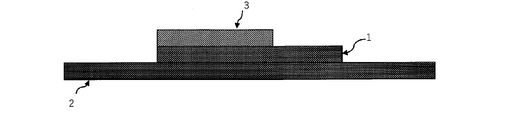
- FIG. 2 schematically shows a side view of the test piece used in the dark part curability test.
- the test piece has a non-reflective base material 1, a non-reflective or reflective base material 2, and a light-shielding member 3.
- Examples of the non-reflective base material 1 include black NBR (acrylonitrile butadiene rubber) and the like.
- non-reflective or reflective base material 2 examples include black NBR and the like in the case of the non-reflective base material, and aluminum-deposited PET (polyethylene terephthalate) film and the like in the case of the reflective base material.
- Examples of the light-shielding member 3 include a resist pattern.
- the dark part curability test can be performed, for example, by the following procedure.
- the non-reflective base material 1 is punched out with a punching die having a predetermined shape to provide a punching portion (a).
- the non-reflective or reflective base material 2 is attached to one side of the non-reflective base material 1 having the punched portion (a) to prepare a sample having a concave shape.
- the active energy ray-curable composition is poured into the concave portion, and the light-shielding member 3 is laminated to prepare a test piece with curability in the dark part.
- a cured product is prepared by irradiating this test piece with ultraviolet rays.
- the uncured material is removed from the obtained cured product, and the length of the cured portion extending from the portion irradiated with ultraviolet rays toward the unirradiated portion is measured to obtain an index of the curability of the dark portion.
- the present invention is an active energy ray-curable composition, preferably, by irradiating an active energy ray such as ultraviolet rays, a portion not directly irradiated with the active energy ray can be cured, so-called active energy ray curing having excellent dark part curability.
- an active energy ray such as ultraviolet rays
- active energy ray curing having excellent dark part curability.
- the mold composition Since the composition of the present disclosure is excellent in curability in dark areas, it can be preferably used for adhesion, sealing, coating and the like of an adherend having a three-dimensional shape in which dark areas are easily formed.
- the composition of the present disclosure is excellent in dark part curing property when a substrate having a low light reflectance is used, a colored plastic having a low light reflectance, a plastic colored with a paint having a low light reflectance, and the like, and a plastic colored with a paint having a low light reflectance and the like It is suitable as an adhesive, a sealant, and a coating agent based on metals, electronic parts, and the like. Further, the composition of the present disclosure can be preferably used for adhesion, sealing, coating and the like of an adherend having a three-dimensional shape in which a dark portion is easily formed and having a low light reflectance.
- Apps that require dark curability include adhesion and sealing of various members in the manufacture of display devices such as liquid crystal displays, plasma displays, and organic EL displays, adhesion between substrates and electronic elements, moisture-proof insulating coating of electronic components, and , Adhesion and sealing of openings, end faces and peripheral portions in battery case manufacturing.
- a dark portion to which light does not reach occurs in the bonding of constituent members.
- the transparent protective plate of the touch panel is formed with a band-shaped light-shielding portion on the outermost edge in order to improve the contrast of the displayed image. Black resin is generally used for this light-shielding portion, and the light reflectance is very low at less than 1%, so that high dark portion curability is required.
- a liquid composition wraps around the back side of an IC or a resistor which is an electronic component, and a dark portion where light does not reach is generated. Since these electronic components are often black and have a very low light reflectance of less than 1%, high dark area curability is required.
- part means a part by weight.
- a resist pattern (light-shielding portion) having a value (optical density) of 4 or more [3 in FIG. 2] was laminated to obtain a dark part curable test piece, leaving 10 mm from the end.
- the intensity of the ultraviolet region (UV-A) centered on 365 nm was adjusted to 200 mW / cm 2 and the integrated light intensity was 100 mJ / cm 2 .
- irradiated with ultraviolet rays This work was repeated 20 times to prepare a cured product so that the total integrated light intensity was 2,000 mJ / cm 2 .
- the obtained cured product was immediately washed with methanol to remove the uncured product. Then, by measuring the length of the cured portion extending from the portion irradiated with ultraviolet rays toward the unirradiated portion, it was used as an index of the curability of the dark portion.
- the obtained active energy ray-curable composition is poured into this concave portion to prevent bubbles from entering the aluminum-deposited PET (polyethylene terephthalate) film [manufactured by AS ONE Co., Ltd., trade name: aluminum-deposited PET film, film. Thickness 12 ⁇ m] [3 in FIG. 2] was laminated leaving 10 mm from the end. Next, a 0.1 mm thick aluminum plate was placed under the easy-adhesive PET film of this test piece and on the aluminum-deposited PET film to prepare a test piece with curability in a dark part.
- aluminum-deposited PET polyethylene terephthalate
- UV-A ultraviolet region centered on 365 nm
- the intensity of the ultraviolet region (UV-A) centered on 365 nm was adjusted to 200 mW / cm 2 and the integrated light intensity was 100 mJ / cm 2 .
- irradiated with ultraviolet rays was repeated 20 times to prepare a cured product so that the total integrated light intensity was 2,000 mJ / cm 2 .
- the obtained cured product was immediately washed with methanol to remove the uncured product. Then, by measuring the length of the cured portion extending from the portion irradiated with ultraviolet rays toward the unirradiated portion, it was used as an index of the curability of the dark portion.
- -M-305 A mixture of pentaerythritol and tetraacrylate, "Aronix M-305" manufactured by Toagosei Co., Ltd.
- M-313 A mixture of di and triacrylate of isocyanuric acid ethylene oxide adduct, "Aronix M-313" manufactured by Toagosei Co., Ltd.
- the emission wavelength of the component (B) a tetrahydrofuran solution (concentration 0.002% by weight) was prepared, and an excitation light wavelength of 365 nm was used using a spectrofluorometer FP-750 [manufactured by Nippon Spectroscopy Co., Ltd.]. The emission spectrum of each compound was measured and obtained in.
- TIDP Triisodecylphosphite, "ADEKA STAB 3010" manufactured by ADEKA Corporation
- Ingredients -BAPO Bis (2,4,6-trimethylbenzoyl) -phenylphosphine oxide, made of IGM resin "Omnirad 819"
- UV-784 bis ( ⁇ 5-2,4-cyclopentadiene-1-yl) -bis (2,6-difluoro-3- (1H-pyrrole-1-yl) -phenyl) titanium, Daido Kasei Kogyo Co., Ltd.
- the composition of the present disclosure was excellent in dark part curability. Although the compositions of Examples 8 to 10 have excellent dark curability, the storage stability is about 1 to 3 days, but each component is blended for applications that do not require long-term storage, for example, in the field. The composition can be prepared and used in applications where the composition is used in a relatively short period of time. On the other hand, the composition of Comparative Example 1 which does not contain the components (B) and (C), the composition of Comparative Example 2 which does not contain the component (C), and the composition of Comparative Example 3 which does not contain the component (B). All of the products had insufficient dark curability.
- compositions of the present disclosure can be used in various applications requiring dark part curability, and can be preferably used as an adhesive, a sealant, and a coating agent.
- Specific examples thereof include adhesives for optical films / members, adhesives for electronic materials, sealants, and moisture-proof coating agents.
- the adhesive and the sealing agent for the optical film / member include a sealant for a liquid crystal display element, a display body and a touch panel, and a cover glass and a touch panel bonded together.
Landscapes
- Chemical & Material Sciences (AREA)
- Health & Medical Sciences (AREA)
- Chemical Kinetics & Catalysis (AREA)
- Medicinal Chemistry (AREA)
- Polymers & Plastics (AREA)
- Organic Chemistry (AREA)
- Polymerisation Methods In General (AREA)
- Macromonomer-Based Addition Polymer (AREA)
- Adhesives Or Adhesive Processes (AREA)
- Paints Or Removers (AREA)
- Addition Polymer Or Copolymer, Post-Treatments, Or Chemical Modifications (AREA)
Priority Applications (4)
| Application Number | Priority Date | Filing Date | Title |
|---|---|---|---|
| JP2022565337A JPWO2022113953A1 (https=) | 2020-11-24 | 2021-11-22 | |
| KR1020237021243A KR20230110596A (ko) | 2020-11-24 | 2021-11-22 | 암부 경화성을 가지는 활성에너지선 경화형 조성물 |
| US18/253,509 US20240002603A1 (en) | 2020-11-24 | 2021-11-22 | Active energy ray-curable composition with dark part curability |
| CN202180078848.4A CN116568502A (zh) | 2020-11-24 | 2021-11-22 | 具有暗部固化性的活性能量射线固化型组合物 |
Applications Claiming Priority (2)
| Application Number | Priority Date | Filing Date | Title |
|---|---|---|---|
| JP2020-194754 | 2020-11-24 | ||
| JP2020194754 | 2020-11-24 |
Publications (1)
| Publication Number | Publication Date |
|---|---|
| WO2022113953A1 true WO2022113953A1 (ja) | 2022-06-02 |
Family
ID=81754612
Family Applications (1)
| Application Number | Title | Priority Date | Filing Date |
|---|---|---|---|
| PCT/JP2021/042846 Ceased WO2022113953A1 (ja) | 2020-11-24 | 2021-11-22 | 暗部硬化性を有する活性エネルギー線硬化型組成物 |
Country Status (6)
| Country | Link |
|---|---|
| US (1) | US20240002603A1 (https=) |
| JP (1) | JPWO2022113953A1 (https=) |
| KR (1) | KR20230110596A (https=) |
| CN (1) | CN116568502A (https=) |
| TW (1) | TWI905316B (https=) |
| WO (1) | WO2022113953A1 (https=) |
Cited By (1)
| Publication number | Priority date | Publication date | Assignee | Title |
|---|---|---|---|---|
| WO2024106245A1 (ja) | 2022-11-17 | 2024-05-23 | 信越化学工業株式会社 | 紫外線硬化型オルガノポリシロキサン組成物及び硬化物並びに電子機器 |
Families Citing this family (1)
| Publication number | Priority date | Publication date | Assignee | Title |
|---|---|---|---|---|
| CN118530411B (zh) * | 2024-05-21 | 2025-05-30 | 常州亚龙电子科技有限公司 | 一种光固化树脂及其制备方法和在医用电子产品上的应用 |
Citations (6)
| Publication number | Priority date | Publication date | Assignee | Title |
|---|---|---|---|---|
| JPH1150014A (ja) * | 1997-07-30 | 1999-02-23 | Three Bond Co Ltd | 暗反応硬化組成物およびその硬化方法 |
| JP2012219180A (ja) * | 2011-04-08 | 2012-11-12 | Three M Innovative Properties Co | 画像表示装置の製造方法 |
| WO2013105163A1 (ja) * | 2012-01-13 | 2013-07-18 | 日本化薬株式会社 | 光学部材及びその製造に用いる紫外線硬化型接着剤 |
| JP2014202996A (ja) * | 2013-04-08 | 2014-10-27 | 株式会社カネカ | 画像表示装置の製造方法および画像表示装置 |
| JP2017145293A (ja) * | 2016-02-16 | 2017-08-24 | 協立化学産業株式会社 | 光硬化性樹脂組成物 |
| WO2021019920A1 (ja) * | 2019-07-31 | 2021-02-04 | 積水ポリマテック株式会社 | 光硬化性の樹脂組成物 |
Family Cites Families (1)
| Publication number | Priority date | Publication date | Assignee | Title |
|---|---|---|---|---|
| JP6297405B2 (ja) * | 2014-05-14 | 2018-03-20 | デンカ株式会社 | 組成物 |
-
2021
- 2021-11-22 JP JP2022565337A patent/JPWO2022113953A1/ja active Pending
- 2021-11-22 KR KR1020237021243A patent/KR20230110596A/ko active Pending
- 2021-11-22 US US18/253,509 patent/US20240002603A1/en active Pending
- 2021-11-22 WO PCT/JP2021/042846 patent/WO2022113953A1/ja not_active Ceased
- 2021-11-22 CN CN202180078848.4A patent/CN116568502A/zh active Pending
- 2021-11-23 TW TW110143534A patent/TWI905316B/zh active
Patent Citations (6)
| Publication number | Priority date | Publication date | Assignee | Title |
|---|---|---|---|---|
| JPH1150014A (ja) * | 1997-07-30 | 1999-02-23 | Three Bond Co Ltd | 暗反応硬化組成物およびその硬化方法 |
| JP2012219180A (ja) * | 2011-04-08 | 2012-11-12 | Three M Innovative Properties Co | 画像表示装置の製造方法 |
| WO2013105163A1 (ja) * | 2012-01-13 | 2013-07-18 | 日本化薬株式会社 | 光学部材及びその製造に用いる紫外線硬化型接着剤 |
| JP2014202996A (ja) * | 2013-04-08 | 2014-10-27 | 株式会社カネカ | 画像表示装置の製造方法および画像表示装置 |
| JP2017145293A (ja) * | 2016-02-16 | 2017-08-24 | 協立化学産業株式会社 | 光硬化性樹脂組成物 |
| WO2021019920A1 (ja) * | 2019-07-31 | 2021-02-04 | 積水ポリマテック株式会社 | 光硬化性の樹脂組成物 |
Cited By (3)
| Publication number | Priority date | Publication date | Assignee | Title |
|---|---|---|---|---|
| WO2024106245A1 (ja) | 2022-11-17 | 2024-05-23 | 信越化学工業株式会社 | 紫外線硬化型オルガノポリシロキサン組成物及び硬化物並びに電子機器 |
| JPWO2024106245A1 (https=) * | 2022-11-17 | 2024-05-23 | ||
| EP4620992A1 (en) | 2022-11-17 | 2025-09-24 | Shin-Etsu Chemical Co., Ltd. | Ultraviolet-curable organopolysiloxane composition, cured object, and electronic appliance |
Also Published As
| Publication number | Publication date |
|---|---|
| JPWO2022113953A1 (https=) | 2022-06-02 |
| TW202231670A (zh) | 2022-08-16 |
| US20240002603A1 (en) | 2024-01-04 |
| KR20230110596A (ko) | 2023-07-24 |
| TWI905316B (zh) | 2025-11-21 |
| CN116568502A (zh) | 2023-08-08 |
Similar Documents
| Publication | Publication Date | Title |
|---|---|---|
| TWI394768B (zh) | A hardening composition containing a thiol compound | |
| TWI901663B (zh) | 光學積層體及自發光型顯示裝置 | |
| JP6106355B2 (ja) | プラスチック製フィルム又はシート用活性エネルギー線硬化型接着剤組成物 | |
| JP5853859B2 (ja) | プラスチック製フィルム又はシート用活性エネルギー線硬化型接着剤組成物 | |
| JP5397918B2 (ja) | 樹脂型導光板用組成物、これで形成される導光板を含むバックライトユニット及び該バックライトユニットを備える液晶表示装置 | |
| JP2021161263A (ja) | 光学積層体 | |
| JP2019167542A (ja) | 光硬化性樹脂組成物並びにそれを用いた光硬化性遮光塗料、光漏洩防止材、液晶表示パネル及び液晶表示装置、並びに光硬化方法 | |
| WO2015133416A1 (ja) | ポリウレタン化合物、それを含有する樹脂組成物、該樹脂組成物の硬化物及び該樹脂組成物の製造方法 | |
| WO2022113953A1 (ja) | 暗部硬化性を有する活性エネルギー線硬化型組成物 | |
| WO2015083795A1 (ja) | ポリウレタン化合物、感光性樹脂組成物、感光性樹脂組成物の製造方法、及び、硬化物 | |
| WO2016039324A1 (ja) | 樹脂組成物、重合性樹脂組成物及び感光性樹脂組成物並びにそれらの硬化物 | |
| JP5935337B2 (ja) | 液状光硬化性樹脂組成物、光学部材、画像表示用装置及びその製造方法 | |
| JP2023157017A (ja) | 光学積層体 | |
| JP7822958B2 (ja) | 硬化性組成物、硬化物および電子部品 | |
| JP2024104326A (ja) | 暗部硬化性を有する活性エネルギー線硬化型組成物 | |
| JP2000212234A (ja) | 光硬化性組成物 | |
| JP2007000794A (ja) | 紫外線硬化型接着剤の硬化方法 | |
| JP5835055B2 (ja) | プラスチック製フィルム又はシート用活性エネルギー線硬化型接着剤組成物 | |
| JP2025127200A (ja) | 活性エネルギー線硬化型組成物ならびにそれを用いた縫合物およびその製造方法 | |
| JP2024108332A (ja) | 被覆電線シール用活性エネルギー線硬化型組成物 | |
| JP2024029540A (ja) | 活性エネルギー線硬化型接着剤組成物 | |
| CN114874704B (zh) | 胶黏剂组成物和显示装置 | |
| JP7476553B2 (ja) | 活性エネルギー線硬化型組成物 | |
| JP2015010163A (ja) | プラスチック製フィルム又はシート用活性エネルギー線硬化型接着剤組成物 | |
| JP5050435B2 (ja) | 積層体 |
Legal Events
| Date | Code | Title | Description |
|---|---|---|---|
| 121 | Ep: the epo has been informed by wipo that ep was designated in this application |
Ref document number: 21897926 Country of ref document: EP Kind code of ref document: A1 |
|
| ENP | Entry into the national phase |
Ref document number: 2022565337 Country of ref document: JP Kind code of ref document: A |
|
| WWE | Wipo information: entry into national phase |
Ref document number: 18253509 Country of ref document: US |
|
| WWE | Wipo information: entry into national phase |
Ref document number: 202180078848.4 Country of ref document: CN |
|
| ENP | Entry into the national phase |
Ref document number: 20237021243 Country of ref document: KR Kind code of ref document: A |
|
| NENP | Non-entry into the national phase |
Ref country code: DE |
|
| 122 | Ep: pct application non-entry in european phase |
Ref document number: 21897926 Country of ref document: EP Kind code of ref document: A1 |