WO2022097495A1 - 急結性混和材、及び吹付け材料 - Google Patents
急結性混和材、及び吹付け材料 Download PDFInfo
- Publication number
- WO2022097495A1 WO2022097495A1 PCT/JP2021/038959 JP2021038959W WO2022097495A1 WO 2022097495 A1 WO2022097495 A1 WO 2022097495A1 JP 2021038959 W JP2021038959 W JP 2021038959W WO 2022097495 A1 WO2022097495 A1 WO 2022097495A1
- Authority
- WO
- WIPO (PCT)
- Prior art keywords
- setting
- mass
- quick
- less
- fast
- Prior art date
- Legal status (The legal status is an assumption and is not a legal conclusion. Google has not performed a legal analysis and makes no representation as to the accuracy of the status listed.)
- Ceased
Links
Classifications
-
- C—CHEMISTRY; METALLURGY
- C04—CEMENTS; CONCRETE; ARTIFICIAL STONE; CERAMICS; REFRACTORIES
- C04B—LIME, MAGNESIA; SLAG; CEMENTS; COMPOSITIONS THEREOF, e.g. MORTARS, CONCRETE OR LIKE BUILDING MATERIALS; ARTIFICIAL STONE; CERAMICS; REFRACTORIES; TREATMENT OF NATURAL STONE
- C04B22/00—Use of inorganic materials as active ingredients for mortars, concrete or artificial stone, e.g. accelerators or shrinkage compensating agents
- C04B22/08—Acids or salts thereof
- C04B22/10—Acids or salts thereof containing carbon in the anion, e.g. carbonates
-
- C—CHEMISTRY; METALLURGY
- C04—CEMENTS; CONCRETE; ARTIFICIAL STONE; CERAMICS; REFRACTORIES
- C04B—LIME, MAGNESIA; SLAG; CEMENTS; COMPOSITIONS THEREOF, e.g. MORTARS, CONCRETE OR LIKE BUILDING MATERIALS; ARTIFICIAL STONE; CERAMICS; REFRACTORIES; TREATMENT OF NATURAL STONE
- C04B22/00—Use of inorganic materials as active ingredients for mortars, concrete or artificial stone, e.g. accelerators or shrinkage compensating agents
- C04B22/08—Acids or salts thereof
-
- C—CHEMISTRY; METALLURGY
- C04—CEMENTS; CONCRETE; ARTIFICIAL STONE; CERAMICS; REFRACTORIES
- C04B—LIME, MAGNESIA; SLAG; CEMENTS; COMPOSITIONS THEREOF, e.g. MORTARS, CONCRETE OR LIKE BUILDING MATERIALS; ARTIFICIAL STONE; CERAMICS; REFRACTORIES; TREATMENT OF NATURAL STONE
- C04B22/00—Use of inorganic materials as active ingredients for mortars, concrete or artificial stone, e.g. accelerators or shrinkage compensating agents
- C04B22/08—Acids or salts thereof
- C04B22/12—Acids or salts thereof containing halogen in the anion
-
- C—CHEMISTRY; METALLURGY
- C04—CEMENTS; CONCRETE; ARTIFICIAL STONE; CERAMICS; REFRACTORIES
- C04B—LIME, MAGNESIA; SLAG; CEMENTS; COMPOSITIONS THEREOF, e.g. MORTARS, CONCRETE OR LIKE BUILDING MATERIALS; ARTIFICIAL STONE; CERAMICS; REFRACTORIES; TREATMENT OF NATURAL STONE
- C04B22/00—Use of inorganic materials as active ingredients for mortars, concrete or artificial stone, e.g. accelerators or shrinkage compensating agents
- C04B22/08—Acids or salts thereof
- C04B22/14—Acids or salts thereof containing sulfur in the anion, e.g. sulfides
-
- C—CHEMISTRY; METALLURGY
- C04—CEMENTS; CONCRETE; ARTIFICIAL STONE; CERAMICS; REFRACTORIES
- C04B—LIME, MAGNESIA; SLAG; CEMENTS; COMPOSITIONS THEREOF, e.g. MORTARS, CONCRETE OR LIKE BUILDING MATERIALS; ARTIFICIAL STONE; CERAMICS; REFRACTORIES; TREATMENT OF NATURAL STONE
- C04B28/00—Compositions of mortars, concrete or artificial stone, containing inorganic binders or the reaction product of an inorganic and an organic binder, e.g. polycarboxylate cements
- C04B28/02—Compositions of mortars, concrete or artificial stone, containing inorganic binders or the reaction product of an inorganic and an organic binder, e.g. polycarboxylate cements containing hydraulic cements other than calcium sulfates
-
- E—FIXED CONSTRUCTIONS
- E21—EARTH OR ROCK DRILLING; MINING
- E21D—SHAFTS; TUNNELS; GALLERIES; LARGE UNDERGROUND CHAMBERS
- E21D11/00—Lining tunnels, galleries or other underground cavities, e.g. large underground chambers; Linings therefor; Making such linings in situ, e.g. by assembling
- E21D11/04—Lining with building materials
- E21D11/10—Lining with building materials with concrete cast in situ; Shuttering also lost shutterings, e.g. made of blocks, of metal plates or other equipment adapted therefor
-
- C—CHEMISTRY; METALLURGY
- C04—CEMENTS; CONCRETE; ARTIFICIAL STONE; CERAMICS; REFRACTORIES
- C04B—LIME, MAGNESIA; SLAG; CEMENTS; COMPOSITIONS THEREOF, e.g. MORTARS, CONCRETE OR LIKE BUILDING MATERIALS; ARTIFICIAL STONE; CERAMICS; REFRACTORIES; TREATMENT OF NATURAL STONE
- C04B2103/00—Function or property of ingredients for mortars, concrete or artificial stone
- C04B2103/10—Accelerators; Activators
- C04B2103/14—Hardening accelerators
Definitions
- the present invention relates to a quick-setting admixture and a spraying material.
- Patent Document 1 describes a sprayed concrete composition containing a quick-setting material containing calcium aluminate, an aluminum sulfate salt, etc., cement, and an aggregate (claim 1).
- a powdery, fast-setting admixture containing calcium aluminate, aluminum sulphate, gypsum, and sodium sulphate. Contains CaF 2
- the content of CaF 2 when quantitatively analyzed by the Rietveld method is 0.3% by mass or more and 2% by mass or less in 100% by mass of the fast-setting admixture.
- the content of the calcium aluminate is 60% by mass or more and 80% by mass or less in 100% by mass of the fast-setting admixture.
- the content of the aluminum sulfate is 1% by mass or more and 10% by mass or less in 100% by mass of the quick-setting admixture.
- the content of the gypsum is 15% by mass or more and 30% by mass or less in 100% by mass of the fast-setting admixture, and the content of the sodium sulfate is 3% by mass in 100% by mass of the quick-setting admixture. More than 12% by mass or less, A fast-setting admixture is provided.
- Spraying materials are provided, including the fast-setting admixtures described above, and cement.
- a fast-setting admixture material having excellent storage stability and quick-setting property, and a spraying material using the fast-setting admixture material are provided.
- the quick-setting admixture of the present embodiment is a powdery composition containing calcium aluminate, aluminum sulfate, gypsum, and sodium sulfate.
- the fast-setting admixture is configured to contain CaF 2 .
- This fast-setting admixture may have a peak derived from CaF 2 in the powder X-ray diffraction pattern.
- the content of CaF 2 when quantitatively analyzed by the Reetbelt method is, for example, 0.3% by mass or more and 2% by mass or less, preferably 0.5% by mass or more and 1.9 in 100% by mass of the quick-setting admixture. It is mass% or less, more preferably 0.5 mass% or more and 1.7 mass% or less. Within such a range, storage stability can be further improved.
- the quick-setting admixture contains calcium aluminate (a compound mainly composed of a CaO component and an Al2O3 component).
- the calcium aluminate may contain either crystalline or amorphous, and these may be used alone or in combination of two or more.
- the CaO / Al 2 O 3 in the calcium aluminate is, for example, 1.8 to 2.5, preferably 1.9 to 2.4 in molar ratio. By setting this molar ratio within this range, the amorphization rate can be increased and excellent initial condensation can be obtained.
- Calcium aluminate may contain amorphous.
- the amorphization rate in the calcium aluminate is preferably 50% or more, more preferably 60% or more, further preferably 70% or more, still more preferably 80% or more in terms of mass. As a result, the initial cohesiveness can be enhanced.
- the content of calcium aluminate is, for example, 60% by mass or more and 80% by mass or less, preferably 60% by mass or more and 75% by mass or less, and more preferably 60% by mass or more and 70% by mass in 100% by mass of the fast-setting admixture. It is as follows. By setting it to the above lower limit value or more, the quick connection can be improved. By setting the value to the upper limit or less, it is possible to achieve a balance between rapid connection and strength development.
- each mineral composition in the quick-setting admixture or calcium aluminate powder can be confirmed by a general analysis method.
- the mineral composition of a powdery sample can be confirmed by the powder X-ray diffraction method and the data can be analyzed by the Rietveld method to quantify the mineral composition.
- the mineral composition can be calculated based on the identification results of the chemical composition and the powder X-ray diffraction.
- the method for producing calcium aluminate may include, for example, a step of firing or melting a raw material mixture containing a CaO raw material and an Al2O3 raw material by , for example, a kiln or an electric furnace.
- CaO raw material those commercially available as industrial raw materials may be used, but for example, one or more selected from the group consisting of limestone, coal ash, quicklime, slaked lime, and acetylene-generated waste may be contained. Among these, quicklime may be used.
- Al 2 O 3 raw material those commercially available as an industrial raw material may be used, but may contain, for example, one or more selected from the group consisting of bauxite, aluminum hydroxide, and aluminum residual ash.
- the aluminum residual ash may be mainly composed of aluminum hydroxide.
- These raw materials are mixed and pulverized so as to have a predetermined mineral composition ratio to obtain a raw material mixture.
- the method of mixed pulverization is not particularly limited, and a dry pulverization method or a wet pulverization method can be applied.
- a dry pulverization method it is necessary to perform dehydration treatment for subsequent granulation.
- quicklime When quicklime is used as a raw material, it is desirable to use a dry method.
- the CaO / Al2O 3 molar ratio of calcium aluminate can be controlled by adjusting the charging ratio of the raw materials.
- the firing and melting temperatures may be, for example, 1,200 ° C to 1,800 ° C, or 1,300 ° C to 1,600 ° C. By setting it to the above lower limit value or more, the generation of impurities can be suppressed.
- An electric furnace or a rotary kiln can be used for firing.
- Clinker can be obtained by firing or melting.
- the clinker may be pulverized by a known method to obtain a pulverized product. From the above, a powder of calcium aluminate can be obtained.
- the fast-setting admixture contains aluminum sulphate.
- Aluminum sulphate can increase the rate of condensation.
- the aluminum sulfate is not particularly limited, and may be an anhydrous salt or a hydrous salt (hydrate).
- Aluminum sulphate hydrate has a higher dissolution rate and can improve the setting property as compared with its anhydride.
- Aluminum sulphate hydrate contains, for example, 4 to 27 hydrates, preferably 10 to 18 hydrates, more preferably 14 to 18 hydrates.
- the setting property can be enhanced by containing 14 to 18 hydrates of aluminum sulfate, or at least 17 hydrates of aluminum sulfate.
- the aluminum sulfate may contain one or more having a peak in the range of chemical shift ⁇ 5.0 ppm or more and 0 ppm or less in the spectrum obtained by solid 27 Al-NMR measured under the following conditions. This makes it possible to improve the storage stability of the quick-setting admixture.
- the half width of the peak in the range of chemical shift ⁇ 5.0 ppm or more and 0 ppm or less is, for example, 10.0 ppm or less, preferably 9.0 ppm or less, and more preferably 8.0 ppm or less. This makes it possible to improve the storage stability of the quick-setting admixture.
- the half width may be, for example, 0.1 ppm or more.
- the peak area derived from the OH group expansion / contraction vibration near 3000 cm -1 is, for example, 10 or more and 50 or less, preferably 15 or more and 40 or less, and more preferably 20 or more and 35 or less. This makes it possible to improve the storage stability of the quick-setting admixture.
- the peak area derived from the OH group variable angle vibration near 1600 cm -1 is, for example, 1 or more and 10 or less, preferably 2.0 or more and 8.0 or less, more preferably 2.0. It is 5.0 or more and 5.0 or less. This makes it possible to improve the storage stability of the quick-setting admixture.
- the peak area derived from the OH group expansion and contraction vibration near 3000 cm -1 is A
- the peak area derived from the OH group variable angle vibration near 1600 cm -1 is B
- SO near 1100 cm -1 is B
- C the peak area derived from the four expansion and contraction vibrations.
- the area ratio T1 of the peak area derived from the OH group expansion and contraction vibration near 3000 cm -1 to the peak area derived from the SO 4 group expansion and contraction vibration near -1 is calculated from A / C ⁇ 100 and 1100 cm -1 .
- the area ratio T2 of the peak area derived from the OH group variable angle vibration near 1600 cm -1 to the peak area derived from the nearby SO 4 expansion and contraction vibration is calculated from B / C ⁇ 100.
- the area ratio T1 is, for example, 350 or more and 600 or less, preferably 400 or more and 500 or less, and more preferably 400 or more and 450 or less. This makes it possible to improve the storage stability of the quick-setting admixture.
- the area ratio T2 is, for example, 30 or more and 70 or less, preferably 40 or more and 70 or less, and more preferably 50 or more and 70 or less. This makes it possible to improve the storage stability of the quick-setting admixture.
- the content of aluminum sulfate is, in terms of Al 2 (SO 4 ) 3 , in 100% by mass of the fast-setting admixture, for example, 1% by mass or more and 10% by mass or less, preferably 2% by mass or more and 9% by mass or less. It is preferably 3% by mass or more and 8% by mass or less.
- gypsum can improve the strength development.
- gypsum include calcium sulfate, anhydrous gypsum, hemihydrate gypsum, and dihydrate gypsum.
- naturally produced natural gypsum, gypsum excreted as an industrial by-product, gypsum by-product hydrofluoric acid, and the like may be used. One or more of these can be used. Above all, anhydrous gypsum may be used from the viewpoint of developing adhesive strength.
- the content of gypsum is, in terms of CaSO 4 , 100% by mass of the fast-setting admixture, for example, 15% by mass or more and 30% by mass or less, preferably 15% by mass or more and 25% by mass or less, and more preferably 15% by mass or more. It is 20% by mass or less.
- the fast-setting admixture contains sodium sulfate.
- Sodium sulfate can improve the strength development.
- Potassium sulfate, lithium sulfate and the like may be contained as the alkali metal sulfate other than sodium sulfate. These may be used alone or in combination of two or more. Among these, neutral anhydrous bow glass may be used as the sodium sulfate.
- the content of sodium sulfate is, for example, 3% by mass or more and 12% by mass or less, preferably 4% by mass or more and 10% by mass or less, more preferably 5 in 100% by mass of the quick-setting admixture in terms of Na 2 SO 4 . It is by mass% or more and 10% by mass or less.
- the quick-setting admixture does not contain alkali carbonate (alkali metal carbonate), or contains alkali carbonate in a content of 0.05% by mass or less with respect to 100% by mass of calcium aluminate.
- alkali carbonate include sodium carbonate, potassium carbonate, and sodium bicarbonate.
- the storage stability of the quick-setting admixture can be improved by configuring the material so that it does not substantially contain alkali carbonate. Further, with such a configuration, even when the acute admixture contains 14 to 18 hydrates of aluminum sulfate hydrate, it is possible to suppress a decrease in the storage stability thereof.
- the quick-setting admixture may contain other components other than the above-mentioned components, that is, calcium aluminate, aluminum sulfate, gypsum, and sodium sulfate, as long as the effects of the invention are not impaired.
- other components include one or more of SiO 2 , TiO 2 , Fe 2 O 3 , MgO, K 2 O and the like.
- the content of the other components is, for example, 10% by mass or less, preferably 9% by mass or less , more preferably 8% by mass, based on 100% by mass of CaO and Al2O3 in the quick-setting admixture. It may be as follows.
- the particle size with a cumulative value of 50% is D50
- the particle size with a cumulative value of 10% is D10
- the cumulative value is 90%.
- the particle size is D90.
- the D50 is, for example, 6 ⁇ m or more and 15 ⁇ m or less, preferably 7 ⁇ m or more and 13 ⁇ m or less, and more preferably 7 ⁇ m or more and 10 ⁇ m or less.
- D10 is, for example, 1 ⁇ m or more and 5 ⁇ m or less, preferably 1 ⁇ m or more and 4 ⁇ m or less, and more preferably 1 ⁇ m or more and 3 ⁇ m or less.
- (D50-D10) / D50 is, for example, 0.1 or more and 1.0 or less, preferably 0.2 or more and 0.8 or less, and more preferably 0.3 or more and 0.7 or less.
- D90 is, for example, 30 ⁇ m or more and 300 ⁇ m or less, preferably 40 ⁇ m or more and 200 ⁇ m or less, and more preferably 50 ⁇ m or more and 150 ⁇ m or less.
- (D90-D10) / D50 is, for example, 4.0 or more and 35.0 or less, preferably 5.0 or more and 35.0 or less, and more preferably 5.0 or more and 30.0 or less.
- the fast-setting admixture was sieved using a sieve with a mesh opening of 75 ⁇ m, and the volume frequency particle size distribution of the remaining fraction (A) on the sieve was measured by the laser diffraction scattering method.
- the particle size having a value of 50% is D50
- the particle size having a cumulative value of 10% is D10.
- the D50 is, for example, 130 ⁇ m or more and 400 ⁇ m or less, preferably 150 ⁇ m or more and 350 ⁇ m or less, and more preferably 200 ⁇ m or more and 300 ⁇ m or less.
- D10 is, for example, 90 ⁇ m or more and 125 ⁇ m or less, preferably 100 ⁇ m or more and 125 ⁇ m or less, and more preferably 100 ⁇ m or more and 120 ⁇ m or less.
- the fast-setting admixture was sieved using a sieve with a mesh opening of 75 ⁇ m, and the volume frequency particle size distribution of the subsieving fraction (B) that passed through this sieve was measured by the laser diffraction scattering method.
- the particle size at which is 50% is D50, and the particle size at which the cumulative value is 10% is D10.
- the D50 is, for example, 7 ⁇ m or more and 12 ⁇ m or less, preferably 8 ⁇ m or more and 11 ⁇ m or less, and more preferably 8 ⁇ m or more and 10.
- D10 is, for example, 0.5 ⁇ m or more and 6 ⁇ m or less, preferably 1 ⁇ m or more and 5 ⁇ m or less, and more preferably 1 ⁇ m or more and 4 ⁇ m or less.
- CaF 2 may be contained in the sieving fraction (B). This makes it possible to improve the storage stability of the fast-setting admixture.
- the quick-setting admixture and the sieve drawing can be obtained. It is possible to control the composition components, D10, D50, D90, ((D50-D10) / D50), and ((D90-D10) / D50) in the fraction (A) and the subsieving fraction (B). Is. Among these, for example, crushing calcium aluminate and appropriately adjusting the classification treatment conditions, and continuously measuring the particle size distribution and particle size in the mixture obtained after mixing the constituent materials of the fast-setting admixture.
- the particle size is screened using an arbitrary sieve, and the screened particle size is mixed again so as to have the desired particle size distribution to adjust the particle size distribution and the particle size.
- the composition components, D10, D50, D90, ((D50-D10) / D50), and ((D90-D10)) in the quick-setting admixture, the upper sieving fraction (A), and the lower sieving fraction (B). ) / D50) can be mentioned as an element for setting a desired numerical range.
- the cement composition of the present embodiment contains the above-mentioned quick-setting admixture and cement.
- the cement composition can be used for various concrete applications, for example, spraying applications, ground improvement applications for injecting into the ground or stirring and solidifying with the ground, applications for filling gaps such as cavities, and the like.
- cement composition it can be used as a spraying material to be sprayed on an exposed ground surface, for example, in tunnels such as roads, railways and headraces.
- the spraying material of this embodiment contains the above-mentioned quick-setting admixture and cement.
- the amount of the quick-setting admixture used varies depending on the purpose of use, but is usually 1 to 20 parts by mass, preferably 3 to 10 parts by mass in 100 parts by mass of cement.
- various Portland cements such as ordinary, fast-strength, ultra-fast-strength, low heat, and moderate heat, various mixed cements in which blast furnace slag, fly ash, or silica are mixed with these Portland cements, urban waste incineration ash and sewage sludge.
- Waste-using cement manufactured from incineration ash, so-called eco-cement (R), filler cement mixed with limestone powder, etc., alumina cement, sulfoaluminate cement, limestone calcined clay cement (LC3), etc. may be mentioned. These may be used alone or in combination of two or more.
- the amount of water used is not particularly limited, but usually, the water / cement composition ratio is, for example, about 25 to 70% by mass with respect to the cement composition composed of cement and the quick-setting admixture. Yes, it may be 30 to 60% by mass.
- the kneading method is a generally used method and is not particularly limited.
- any existing stirring device can be used, and for example, a tilting mixer, an omni mixer, a V-type mixer, a Henschel mixer, a Nauter mixer and the like can be used.
- each material may be mixed at the time of construction, or a part or all of them may be mixed in advance.
- Spraying materials include aggregates such as sand and gravel, fibrous materials, swelling materials, hardeners, coagulation adjusters, water reducing agents, high-performance water reducing agents, AE agents, AE water reducing agents, high-performance AE water reducing agents, etc.
- the spraying material may also contain a liquid quick-setting admixture containing an aluminum salt.
- the aluminum salt include aluminum sulfate and the like.
- a dry spraying method can also be constructed, but from the viewpoint of reducing the amount of dust, a wet spraying method in which water is added to the cement concrete side in advance and kneaded before using the quick-setting admixture. It is preferable to use.
- a wet spraying method cement, fine aggregate, coarse aggregate, and water are added and kneaded to form sprayed concrete, which is pneumatically fed, and a Y-shaped pipe is provided in the middle, and a quick-setting admixture supply device is provided from one of them.
- the quick-setting admixture is pneumatically fed and mixed to form a quick-setting wet-sprayed concrete.
- the area ratio of the peak area derived from the OH group stretching vibration near 3000 cm -1 to the peak area derived from the SO4 stretching vibration near 1100 cm -1 is 350 or more and 600 or less.
- the area ratio of the peak area derived from the OH group variable angular vibration near 1600 cm -1 to the peak area derived from the SO4 expansion and contraction vibration near 1100 cm -1 is 30 or more and 70 or less. Is a quick-setting admixture. 7. 1. 1. ⁇ 6.
- the quick-setting miscible material described in any one of the above A quick-setting admixture having an aluminum sulfate content of 1% by mass or more and 10% by mass or less in 100% by mass of the quick-setting admixture. 11. 1. 1. ⁇ 10. The quick-setting miscible material described in any one of the above. A quick-setting admixture having a gypsum content of 15% by mass or more and 30% by mass or less in 100% by mass of the quick-setting admixture. 12. 1. 1. ⁇ 11. The quick-setting miscible material described in any one of the above.
- FT-IR Fast Transform Infrared Spectroscopy
- ATR Analog to Physical Transport
- the background measurement was performed once using the reflection type ATR, the sample was set, and the sample surface was measured with 16 scanning times.
- the measurement results are output with the vertical axis (Y-axis) as the absorbance and the horizontal axis as the wave frequency, and the peak area (integrated value) derived from the OH group expansion and contraction vibration near 3000 cm -1 and the OH group variable angular vibration near 1600 cm -1 . ),
- the peak area (integrated value) derived from the SO4 expansion and contraction vibration in the vicinity of 1100 cm -1 was calculated by analysis software (Spectremum manufactured by PerkinElmer).
- Table 1 shows the measurement results of solid 27 Al-NMR and FT-IR in each aluminum sulfate.
- the obtained mixture was continuously measured for particle size distribution and particle size using a laser diffraction / scattering method, and based on the measurement results, it was screened using an arbitrary sieve.
- the screened particle sizes were mixed again so as to have the particle size distribution shown below to prepare the fast-setting admixtures A1 to A14.
- the material ratios that make up the quick-setting admixture are 60 to 80% by mass for calcium aluminate, 1 to 10% by mass for aluminum sulfate, 15 to 30% by mass for gypsum, and 3 to 12 by mass for sodium sulfate. It can be seen that% by mass is a suitable ratio. Further, it was found that when CaF 2 was 0.3 to 2% by mass, quick-setting and storage stability could be improved as compared with the case where CaF 2 was not contained.
- Example B In Experimental Example A, the particle size and particle size distribution were changed using the formulation whose quick-setting performance was confirmed, and the storage stability of the quick-setting admixture was evaluated.
- the materials are mixed by blending 60% by mass of calcium aluminate, 10% by mass of aluminum sulfate, 20% by mass of gypsum, 9% by mass of sodium sulfate, and 1% by mass of calcium fluoride. Then, for the obtained mixture, the particle size and particle size distribution were changed, and the quick-setting admixtures B1 to B15 having the particle size and particle size distribution in Table 4 were adjusted.
- the quick-setting admixtures B2, B7, and B12 sodium carbonate (commercially available) was further added as an alkali carbonate in an amount of 0.05% by mass based on 100% by mass of calcium aluminate, and the quick-setting admixture B3 was further blended.
- sodium carbonate commercially available was further added as an alkali carbonate at 0.06% by mass with respect to 100% by mass of calcium aluminate, and alkali carbonate was added to the other quick-setting admixtures. I didn't.
- any of the quick-setting admixtures B1 to B15 a sieve having a mesh size of 75 ⁇ m was used, and the particle sizes of the upper sieve fraction (A) and the lower sieve fraction (B) remaining on the sieve were within the following ranges. there were.
- the materials are mixed in a composition of 60% by mass of calcium aluminate, 10% by mass of aluminum sulfate, 20% by mass of gypsum, 9% by mass of sodium sulfate, and 1% by mass of calcium fluoride. Then, for the obtained mixture, the particle size and particle size distribution were changed, and the particle size of the upper-sieving fraction (A) and the lower-sieving fraction (B) when using a sieve having an opening of 75 ⁇ m was adjusted, and Table 6 The quick-setting admixtures C1 to C10 having the particle size of (A) and the particle size of (B) were adjusted.
- the particle size distribution of the prepared quick-setting admixtures C1 to C10 is within the following range. D10: 1 to 5 ⁇ m, D50: 6 to 15 ⁇ m, D90: 50 to 300 ⁇ m
- Example D A spraying test was carried out on a spraying material prepared using a quick-setting admixture having a composition confirmed in Experimental Examples A to C for quick-setting performance and storage stability.
- the miscible admixture was mixed and merged with the air-conveyed concrete to form a quick-bonding material, which was sprayed onto the iron plate from the nozzle tip.
- the initial strength and long-term strength after spraying were examined.
- the supply of the quick-setting admixture to the quick-setting admixture carrier uses a device of Spiroflow Co., Ltd. (FLEXIBLE SCREW CONVEYOR), and each device is controlled in conjunction with an electric signal.
- Initial strength The initial strength was measured by spraying it on a mold according to JSCE-G561 and converting it into compressive strength from the pull-out strength at the age of 10 minutes, 3 hours, and 1 day.
- the quick-setting admixture of each example showed excellent storage stability and quick-setting as compared with each comparative example.
- the quick-setting admixture of such an example can be suitably used as a spraying material.
Landscapes
- Chemical & Material Sciences (AREA)
- Engineering & Computer Science (AREA)
- Ceramic Engineering (AREA)
- Structural Engineering (AREA)
- Inorganic Chemistry (AREA)
- Materials Engineering (AREA)
- Organic Chemistry (AREA)
- Architecture (AREA)
- Mining & Mineral Resources (AREA)
- Chemical Kinetics & Catalysis (AREA)
- Civil Engineering (AREA)
- Life Sciences & Earth Sciences (AREA)
- General Life Sciences & Earth Sciences (AREA)
- Geochemistry & Mineralogy (AREA)
- Geology (AREA)
- Curing Cements, Concrete, And Artificial Stone (AREA)
- Lining And Supports For Tunnels (AREA)
Abstract
本発明の急結性混和材は、カルシウムアルミネート、硫酸アルミニウム、石膏、及び硫酸ナトリウムを含む、粉体状の急結性混和材であって、CaF2を含むものである。
Description
本発明は、急結性混和材、及び吹付け材料に関する。
これまで急結性混和材について様々な開発がなされてきた。この種の技術として、例えば、特許文献1に記載の技術が知られている。特許文献1には、カルシウムアルミネート、硫酸アルミニウム塩等を含む急結材、セメント、骨材を含む吹付けコンクリート組成物が記載されている(特許文献1の請求項)。
しかしながら、本発明者が検討した結果、上記特許文献1に記載の急結材において、貯蔵安定性及び急結性の点で改善の余地があることが判明した。
本発明者はさらに検討したところ、粉体状の急結性混和材において、カルシウムアルミネート、硫酸アルミニウム、石膏、及び硫酸ナトリウムに、CaF2を併用することによって、貯蔵安定性及び急結性を向上できることを見出し、本発明を完成するに至った。
本発明によれば、
カルシウムアルミネート、硫酸アルミニウム、石膏、及び硫酸ナトリウムを含む、粉体状の急結性混和材であって、
CaF2を含み、
リートベルト法による定量分析したときの前記CaF2の含有量が、当該急結性混和材100質量%中、0.3質量%以上2質量%以下、
前記カルシウムアルミネートの含有量が、当該急結性混和材100質量%中、60質量%以上80質量%以下、
前記硫酸アルミニウムの含有量が、当該急結性混和材100質量%中、1質量%以上10質量%以下、
前記石膏の含有量が、当該急結性混和材100質量%中、15質量%以上30質量%以下、および
前記硫酸ナトリウムの含有量が、当該急結性混和材100質量%中、3質量%以上12質量%以下である、
急結性混和材が提供される。
カルシウムアルミネート、硫酸アルミニウム、石膏、及び硫酸ナトリウムを含む、粉体状の急結性混和材であって、
CaF2を含み、
リートベルト法による定量分析したときの前記CaF2の含有量が、当該急結性混和材100質量%中、0.3質量%以上2質量%以下、
前記カルシウムアルミネートの含有量が、当該急結性混和材100質量%中、60質量%以上80質量%以下、
前記硫酸アルミニウムの含有量が、当該急結性混和材100質量%中、1質量%以上10質量%以下、
前記石膏の含有量が、当該急結性混和材100質量%中、15質量%以上30質量%以下、および
前記硫酸ナトリウムの含有量が、当該急結性混和材100質量%中、3質量%以上12質量%以下である、
急結性混和材が提供される。
また本発明によれば、
上記の急結性混和材、及びセメントを含む、吹付け材料が提供される。
上記の急結性混和材、及びセメントを含む、吹付け材料が提供される。
本発明によれば、貯蔵安定性及び急結性に優れた急結性混和材、及び、これを用いた吹付け材料が提供される。
本実施形態の急結性混和材を概説する。
本実施形態の急結性混和材は、カルシウムアルミネート、硫酸アルミニウム、石膏、及び硫酸ナトリウムを含む、粉体状の組成物である。
急結性混和材は、CaF2を含むように構成される。
この急結性混和材は、粉末X線回折パターンにおいて、CaF2に由来するピークを有してもよい。
この急結性混和材は、粉末X線回折パターンにおいて、CaF2に由来するピークを有してもよい。
急結性混和材において、カルシウムアルミネート、硫酸アルミニウム、石膏、及び硫酸ナトリウムを含むことにより、貯蔵安定性及び急結性のバランスを図ることができ、硫酸アルミニウム及びCaF2を併用することで、貯蔵安定性を一層向上できる。
詳細なメカニズムは定かではないが、CaF2の凝結遅延効果により、急結性混和材の水和による凝結の進行を遅延でき、その結果、貯蔵安定性が向上すると考えられる。
詳細なメカニズムは定かではないが、CaF2の凝結遅延効果により、急結性混和材の水和による凝結の進行を遅延でき、その結果、貯蔵安定性が向上すると考えられる。
リートベルト法による定量分析したときのCaF2の含有量は、急結性混和材100質量%中、例えば、0.3質量%以上2質量%以下、好ましくは0.5質量%以上1.9質量%以下、より好ましくは0.5質量%以上1.7質量%以下である。このような範囲内にすることで、貯蔵安定性を一層向上できる。
本実施形態によれば、貯蔵安定性と急結性とのバランスに優れた急結性混和材を実現できる。
以下、本実施形態の急結性混和材を詳述する。
(カルシウムアルミネート)
急結性混和材は、カルシウムアルミネート(CaO成分とAl2O3成分とを主体とする化合物)を含む。
カルシウムアルミネートは、結晶質又は非晶質のいずれを含んでもよく、これらを単独で用いても2種以上を組み合わせて用いてもよい。
急結性混和材は、カルシウムアルミネート(CaO成分とAl2O3成分とを主体とする化合物)を含む。
カルシウムアルミネートは、結晶質又は非晶質のいずれを含んでもよく、これらを単独で用いても2種以上を組み合わせて用いてもよい。
カルシウムアルミネート中のCaO/Al2O3は、モル比で、例えば、1.8~2.5、好ましくは1.9~2.4である。このモル比がこの範囲内とすることで、非晶質化率を高くでき、優れた初期凝結が得られる。
カルシウムアルミネートは、非晶質を含んでもよい。カルシウムアルミネート中の非晶質化率は、質量換算で、50%以上が好ましく、60%以上がより好ましく、70%以上がさらに好ましく、80%以上がより一層好ましい。これにより初期凝結性を高めることができる。
カルシウムアルミネートの含有量は、急結性混和材100質量%中、例えば、60質量%以上80質量%以下、好ましくは60質量%以上75質量%以下、より好ましくは60質量%以上70質量%以下である。上記下限値以上とすることにより、急結性を向上できる。上記上限値以下とすることにより、急結性と強度発現性とのバランスを図ることができる。
急結性混和材中やカルシウムアルミネートの粉末中の各鉱物組成の含有量は、一般の分析方法で確認することができる。例えば、粉体状のサンプルを粉末X線回折法で生成鉱物組成を確認するとともにデータをリートベルト法にて解析し、鉱物組成を定量することができる。また、化学成分と粉末X線回折の同定結果に基づいて、鉱物組成量を計算によって求めることもできる。
カルシウムアルミネートの製造方法は、例えば、CaO原料、Al2O3原料を含む原料混合物を、例えば、キルンや電気炉により焼成や熔融する工程を含んでもよい。
CaO原料として、工業原料として市販されているものを使用してもよいが、例えば、石灰石、石炭灰、生石灰、消石灰、及びアセチレン発生屑からなる群から選ばれる一又は二以上を含んでもよい。この中でも、生石灰を用いてもよい。
Al2O3原料として、工業原料として市販されているものを使用してもよいが、例えば、ボーキサイト、水酸化アルミニウム、及びアルミ残灰からなる群から選ばれる一又は二以上を含んでもよい。アルミ残灰は水酸化アルミニウムを主体としてもよい。
これらの原料を、所定の鉱物組成割合となるように調合し混合粉砕し、原料混合物を得る。
混合粉砕の方法は、特に限定されるものではなく、乾式粉砕法又は湿式粉砕法を適用することができ、湿式粉砕法の場合は、その後造粒するために脱水処理を施す必要がある。また、原料に生石灰を用いる場合は、乾式で行うことが望ましい。
また原料の仕込み割合を調整することで、カルシウムアルミネートのCaO/Al2O3モル比を制御できる。
焼成や熔融温度は、例えば、1,200℃~1,800℃でもよく、1,300℃~1,600℃でもよい。上記下限値以上とすることで、不純物の発生を抑制できる。
焼成には、電気炉やロータリーキルンなどを使用できる。
焼成には、電気炉やロータリーキルンなどを使用できる。
焼成や熔融によって、クリンカが得られる。クリンカは、公知の方法で粉砕し粉砕物としてもよい。
以上により、カルシウムアルミネートの粉末が得られる。
以上により、カルシウムアルミネートの粉末が得られる。
(硫酸アルミニウム)
急結性混和材は、硫酸アルミニウムを含む。硫酸アルミニウムにより、凝結速度を増進できる。
硫酸アルミニウムとしては、特に限定されるものではなく、無水塩でも有水塩(水和物)でもよい。
硫酸アルミニウム水和物は、その無水物と比較して、溶解速度が大きくなり、凝結特性を向上させることができる。
硫酸アルミニウム水和物は、例えば、4~27の水和物、好ましくは10~18の水和物、より好ましくは14~18の水和物を含む。この中でも、硫酸アルミニウムの14~18水和物を含むこと、また少なくとも硫酸アルミニウムの17水和物を含むことによって、凝結特性を高められる。
急結性混和材は、硫酸アルミニウムを含む。硫酸アルミニウムにより、凝結速度を増進できる。
硫酸アルミニウムとしては、特に限定されるものではなく、無水塩でも有水塩(水和物)でもよい。
硫酸アルミニウム水和物は、その無水物と比較して、溶解速度が大きくなり、凝結特性を向上させることができる。
硫酸アルミニウム水和物は、例えば、4~27の水和物、好ましくは10~18の水和物、より好ましくは14~18の水和物を含む。この中でも、硫酸アルミニウムの14~18水和物を含むこと、また少なくとも硫酸アルミニウムの17水和物を含むことによって、凝結特性を高められる。
硫酸アルミニウムは、下記の条件で測定される固体27Al-NMRによって得られるスペクトルにおいて、化学シフト-5.0ppm以上0ppm以下の範囲にピークを有するものを一または二以上含んでもよい。これにより、急結性混和材の貯蔵安定性を向上できる。
(固体27Al-NMRの測定条件)
観測核:27Al
試料管回転数:10KHz
測定温度:25℃
パルス幅:3.3μsec(90°パルス)
待ち時間:5秒
外部標準:硝酸アルミニウム
観測核:27Al
試料管回転数:10KHz
測定温度:25℃
パルス幅:3.3μsec(90°パルス)
待ち時間:5秒
外部標準:硝酸アルミニウム
硫酸アルミニウムにおいて、化学シフト-5.0ppm以上0ppm以下の範囲にピークの半値幅は、例えば、10.0ppm以下、好ましくは9.0ppm以下、より好ましくは8.0ppm以下である。これにより、急結性混和材の貯蔵安定性を向上できる。なお、半値幅は、例えば、0.1ppm以上でもよい。
硫酸アルミニウムにおけるFT-IRスペクトルにおいて、3000cm-1付近のOH基伸縮振動に由来するピーク面積が、例えば、10以上50以下、好ましくは15以上40以下、より好ましくは20以上35以下である。これにより、急結性混和材の貯蔵安定性を向上できる。
硫酸アルミニウムにおけるFT-IRスペクトルにおいて、1600cm-1付近のOH基変角振動に由来するピーク面積が、例えば、1以上10以下、好ましくは2.0以上8.0以下、より好ましくは2.0以上5.0以下である。これにより、急結性混和材の貯蔵安定性を向上できる。
硫酸アルミニウムにおけるFT-IRスペクトルにおいて、3000cm-1付近のOH基伸縮振動に由来するピーク面積をA、1600cm-1付近のOH基変角振動に由来するピーク面積をB、1100cm-1付近のSO4基伸縮振動に由来するピーク面積をCとする。
このようなA、B、Cを用いて、1100cm-1付近のSO4基伸縮振動に由来するピーク面積に対する3000cm-1付近のOH基伸縮振動に由来するピーク面積の面積比を、A/C×100、1100cm-1付近のSO4基伸縮振動に由来するピーク面積に対する3000cm-1付近のOH基伸縮振動に由来するピーク面積の面積比T1をA/C×100から算出し、1100cm-1付近のSO4基伸縮振動に由来するピーク面積に対する1600cm-1付近のOH基変角振動に由来するピーク面積の面積比T2をB/C×100から算出する。
このようなA、B、Cを用いて、1100cm-1付近のSO4基伸縮振動に由来するピーク面積に対する3000cm-1付近のOH基伸縮振動に由来するピーク面積の面積比を、A/C×100、1100cm-1付近のSO4基伸縮振動に由来するピーク面積に対する3000cm-1付近のOH基伸縮振動に由来するピーク面積の面積比T1をA/C×100から算出し、1100cm-1付近のSO4基伸縮振動に由来するピーク面積に対する1600cm-1付近のOH基変角振動に由来するピーク面積の面積比T2をB/C×100から算出する。
面積比T1は、例えば、350以上600以下、好ましくは400以上500以下、より好ましくは400以上450以下である。これにより、急結性混和材の貯蔵安定性を向上できる。
面積比T2は、例えば、30以上70以下、好ましくは40以上70以下、より好ましくは50以上70以下である。これにより、急結性混和材の貯蔵安定性を向上できる。
硫酸アルミニウムの含有量は、Al2(SO4)3換算で、急結性混和材100質量%中、例えば、1質量%以上10質量%以下、好ましくは2質量%以上9質量%以下、より好ましくは3質量%以上8質量%以下である。上記下限値以上とすることにより、凝結促進能を向上できる。上記上限値以下とすることにより、凝結促進能と強度発現性とのバランスを図ることができる。
(石膏)
急結性混和材は、石膏を含む。石膏により、強度発現性を向上できる。
石膏としては、硫酸カルシウムを含み、無水石膏、半水石膏、及び二水石膏等が挙げられる。
また、天然で産出する天然石膏や、産業副産物として得られる排脱石膏や弗酸副生無水石膏等が用いられてもよい。これらのうちの1種又は2種以上を使用することができる。中でも、付着強度の発現性の観点から、無水石膏を用いてもよい。
急結性混和材は、石膏を含む。石膏により、強度発現性を向上できる。
石膏としては、硫酸カルシウムを含み、無水石膏、半水石膏、及び二水石膏等が挙げられる。
また、天然で産出する天然石膏や、産業副産物として得られる排脱石膏や弗酸副生無水石膏等が用いられてもよい。これらのうちの1種又は2種以上を使用することができる。中でも、付着強度の発現性の観点から、無水石膏を用いてもよい。
石膏の含有量は、CaSO4換算で、急結性混和材100質量%中、例えば、15質量%以上30質量%以下、好ましくは15質量%以上25質量%以下、より好ましくは15質量%以上20質量%以下である。上記下限値以上とすることにより、強度発現性を向上できる。上記上限値以下とすることにより、急結性と強度発現性とのバランスを図ることができる。
(硫酸ナトリウム)
急結性混和材は、硫酸ナトリウムを含む。硫酸ナトリウムにより、強度発現性を向上できる。
硫酸ナトリウム以外のアルカリ金属硫酸塩として、硫酸カリウム、硫酸リチウム等を含んでもよい。
これらを単独で用いても2種以上を組み合わせて用いてもよい。この中でも、硫酸ナトリウムとして、中性無水ボウ硝を用いてもよい。
急結性混和材は、硫酸ナトリウムを含む。硫酸ナトリウムにより、強度発現性を向上できる。
硫酸ナトリウム以外のアルカリ金属硫酸塩として、硫酸カリウム、硫酸リチウム等を含んでもよい。
これらを単独で用いても2種以上を組み合わせて用いてもよい。この中でも、硫酸ナトリウムとして、中性無水ボウ硝を用いてもよい。
硫酸ナトリウムの含有量は、Na2SO4換算で、急結性混和材100質量%中、例えば、3質量%以上12質量%以下、好ましくは4質量%以上10質量%以下、より好ましくは5質量%以上10質量%以下である。上記下限値以上とすることにより、強度発現性を向上できる。上記上限値以下とすることにより、急結性と強度発現性とのバランスを図ることができる。
急結性混和材は、炭酸アルカリ(アルカリ金属炭酸塩)を含有しないか、又はカルシウムアルミネート100質量%に対して0.05質量%以下の含有量で炭酸アルカリを含有する。
炭酸アルカリとしては、例えば、炭酸ナトリウム、炭酸カリウム、及び重炭酸ナトリウムが挙げられる。
炭酸アルカリとしては、例えば、炭酸ナトリウム、炭酸カリウム、及び重炭酸ナトリウムが挙げられる。
このように、炭酸アルカリを実質的に含まないように構成することによって、急結性混和材における貯蔵安定性を向上できる。また、このような構成によって、急性混和材が硫酸アルミニウム水和物の14~18水和物を含む場合においても、その貯蔵安定性の低下を抑制できる。
急結性混和材は、発明の効果を損なわない範囲で、上述の成分、すなわち、カルシウムアルミネート、硫酸アルミニウム、石膏、及び硫酸ナトリウム以外の、他の成分を含んでもよい。
他の成分として、例えば、SiO2、TiO2、Fe2O3、MgO、K2O等の一又は二以上が挙げられる。
他の成分として、例えば、SiO2、TiO2、Fe2O3、MgO、K2O等の一又は二以上が挙げられる。
他の成分の含有量は、急結性混和材中、CaO及びAl2O3の合計100質量%に対して、例えば、10質量%以下、好ましくは9質量%以下、より好ましくは8質量%以下でもよい。
以下、急結性混和材の粉体特性について説明する。
急結性混和材について、レーザー回折散乱法で測定される体積頻度粒度分布において、累積値が50%となる粒子径をD50、累積値が10%となる粒子径をD10、累積値が90%となる粒子径をD90とする。
D50が、例えば、6μm以上15μm以下、好ましくは7μm以上13μm以下、より好ましくは7μm以上10μm以下である。
D10が、例えば、1μm以上5μm以下、好ましくは1μm以上4μm以下、より好ましくは1μm以上3μm以下である。
(D50-D10)/D50が、例えば、0.1以上1.0以下、好ましくは0.2以上0.8以下、より好ましくは0.3以上0.7以下である。
D10,D50,及び(D50-D10)/D50をそれぞれ上記の範囲内に粒子径を調整することによって、急結性混和材における粉体搬送時の偏析の防止や貯蔵安定性と急結性とのバランスを図ることが可能となる。
D10が、例えば、1μm以上5μm以下、好ましくは1μm以上4μm以下、より好ましくは1μm以上3μm以下である。
(D50-D10)/D50が、例えば、0.1以上1.0以下、好ましくは0.2以上0.8以下、より好ましくは0.3以上0.7以下である。
D10,D50,及び(D50-D10)/D50をそれぞれ上記の範囲内に粒子径を調整することによって、急結性混和材における粉体搬送時の偏析の防止や貯蔵安定性と急結性とのバランスを図ることが可能となる。
D90が、例えば、30μm以上300μm以下、好ましくは40μm以上200μm以下、より好ましくは50μm以上150μm以下である。D90を、上記の範囲内とすることで、急結性混和材における粉体搬送時の偏析の防止や貯蔵安定性と急結性とのバランスを図ることができる。
(D90-D10)/D50が、例えば、4.0以上35.0以下、好ましくは5.0以上35.0以下、より好ましくは5.0以上30.0以下である。
(D90-D10)/D50を、上記の範囲内とすることで、急結性混和材における粉体搬送時の偏析の防止や貯蔵安定性と急結性とのバランスを図ることができる。
(D90-D10)/D50を、上記の範囲内とすることで、急結性混和材における粉体搬送時の偏析の防止や貯蔵安定性と急結性とのバランスを図ることができる。
急結性混和材を、目開き75μmの篩を用いて篩分けを行い、この篩上に残存した篩上画分(A)について、レーザー回折散乱法で体積頻度粒度分布を測定したとき、累積値が50%となる粒子径をD50、累積値が10%となる粒子径をD10とする。
D50が、例えば、130μm以上400μm以下、好ましくは150μm以上350μm以下、より好ましくは200μm以上300μm以下である。
D10が、例えば、90μm以上125μm以下、好ましくは100μm以上125μm以下、より好ましくは100μm以上120μm以下である。
篩上画分(A)中のD50,D10を、上記の範囲内とすることで、急結性混和材における粉体搬送時の偏析の防止や貯蔵安定性と急結性とのバランスを図ることができる。
D50が、例えば、130μm以上400μm以下、好ましくは150μm以上350μm以下、より好ましくは200μm以上300μm以下である。
D10が、例えば、90μm以上125μm以下、好ましくは100μm以上125μm以下、より好ましくは100μm以上120μm以下である。
篩上画分(A)中のD50,D10を、上記の範囲内とすることで、急結性混和材における粉体搬送時の偏析の防止や貯蔵安定性と急結性とのバランスを図ることができる。
急結性混和材を、目開き75μmの篩を用いて篩分けを行い、この篩を通過した篩下画分(B)について、レーザー回折散乱法で体積頻度粒度分布を測定したとき、累積値が50%となる粒子径をD50、累積値が10%となる粒子径をD10とする。
D50が、例えば、7μm以上12μm以下、好ましくは8μm以上11μm以下、より好ましくは8μm以上10である。
D10が、例えば、0.5μm以上6μm以下、好ましくは1μm以上5μm以下、より好ましくは1μm以上4μm以下である。
篩上画分(B)中のD50,D10を、上記の範囲内とすることで、急結性混和材における粉体搬送時の偏析の防止や貯蔵安定性と急結性とのバランスを図ることができる。
D10が、例えば、0.5μm以上6μm以下、好ましくは1μm以上5μm以下、より好ましくは1μm以上4μm以下である。
篩上画分(B)中のD50,D10を、上記の範囲内とすることで、急結性混和材における粉体搬送時の偏析の防止や貯蔵安定性と急結性とのバランスを図ることができる。
篩上画分(B)中にCaF2が含まれてもよい。これにより、急結性混和材における貯蔵安定性を向上できる。
本実施形態では、たとえば急結性混和材中に含まれる各成分の種類や配合量、急結性混和材の調製方法等を適切に選択することにより、上記急結性混和材、篩上画分(A)、篩下画分(B)中における、組成成分、D10、D50、D90、((D50-D10)/D50)、及び((D90-D10)/D50)を制御することが可能である。これらの中でも、たとえば、カルシウムアルミネートの破砕や分級処理条件などを適切に調整すること、急結性混和材の構成材料を混合した後に得られた混合物における粒度分布と粒子径を連続的に測定し、その結果を用いて、任意のふるいを用いて粒子径をスクリーニングし、スクリーニングした粒子径を目的の粒度分布になるよう再び混合することで、粒度分布や粒子径を調整すること等が、上記急結性混和材、篩上画分(A)、篩下画分(B)中における、組成成分、D10、D50、D90、((D50-D10)/D50)、及び((D90-D10)/D50)を所望の数値範囲とするための要素として挙げられる。
本実施形態のセメント組成物は、上記の急結性混和材と、セメントと、を含む。
セメント組成物は、各種のコンクリート用途に用いることができ、例えば、吹付用途、地盤へ注入あるいは地盤と攪拌し固化させる地盤改良用途、空洞などの隙間を充填する用途などへも適用できる。
セメント組成物は、各種のコンクリート用途に用いることができ、例えば、吹付用途、地盤へ注入あるいは地盤と攪拌し固化させる地盤改良用途、空洞などの隙間を充填する用途などへも適用できる。
セメント組成物の一つの態様として、例えば、道路、鉄道及び導水路等のトンネルにおいて、露出した地山面へ吹付ける吹付け材料に使用できる。
本実施形態の吹付け材料は、上記の急結性混和材、セメントを含むものである。
急結性混和材の使用量は、使用する目的により異なるが、通常、セメント100質量部中、例えば、1~20質量部、好ましくは3~10質量部でもよい。
セメントとしては、普通、早強、超早強、低熱、及び中庸熱等の各種ポルトランドセメント、これらポルトランドセメントに高炉スラグ、フライアッシュ、又はシリカを混合した各種混合セメント、都市ゴミ焼却灰や下水汚泥焼却灰などを原料として製造された廃棄物利用セメント、いわゆるエコセメント(R)、及び石灰石粉末等を混合したフィラーセメント、並びに、アルミナセメント、サルフォアルミネートセメント、石灰石焼成粘土セメント(LC3)等が挙げられる。これらを単独で用いても2種以上を組み合わせて用いてもよい。
水の使用量は特に限定されるものではないが、通常、セメントと急結性混和材とからなるセメント組成物に対して、水/セメント組成物比が、例えば、25~70質量%程度であり、30~60質量%でもよい。
混練方法は、一般に用いられる方法で、特に限定されるものではない。混合装置としては、既存のいかなる撹拌装置も使用可能であり、例えば、傾胴ミキサー、オムニミキサー、V型ミキサー、ヘンシェルミキサー、及びナウターミキサー等が使用可能である。
混合は、それぞれの材料を施工時に混合してもよいし、あらかじめ一部を、あるいは全部を混合しておいても差し支えない。
吹付け材料は、さらに、砂や砂利などの骨材、繊維物質、膨張材、急硬材、凝結調整剤、減水剤、高性能減水剤、AE剤、AE減水剤、高性能AE減水剤、増粘剤、防錆剤、防凍剤、水和熱抑制剤、高分子エマルジョン、ベントナイトやモンモリロナイトなどの粘土鉱物、ゼオライト、ハイドロタルサイト、及びハイドロカルマイト等のイオン交換体、硫酸アルミニウムなどの硫酸塩、リン酸塩、並びに、ホウ酸等のうちの一種又は二種以上のその他の混和材、を本発明の目的を実質的に阻害しない範囲で併用することが可能である。
また、吹付け材料は、アルミニウム塩を含む液体急結剤を含んでもよい。
アルミニウム塩としては、例えば、硫酸アルミニウム等が挙げられる。
アルミニウム塩としては、例えば、硫酸アルミニウム等が挙げられる。
本実施形態の吹付工法としては、乾式吹付工法も施工できるが、粉塵量を低減する観点から、急結性混和材を使用する前に予め水をセメントコンクリート側に加えて混練りした湿式吹付工法を使用することが好ましい。
湿式吹付工法としては、セメント、細骨材、粗骨材、及び水を加えて混練して吹付コンクリートとしたものを空気圧送し、途中にY字管を設け、その一方から急結剤供給装置により急結性混和材を空気圧送し、合流混合して急結性湿式吹付コンクリートとしたものを吹付ける方法が挙げられる。
以上、本発明の実施形態について述べたが、これらは本発明の例示であり、上記以外の様々な構成を採用することができる。また、本発明は上述の実施形態に限定されるものではなく、本発明の目的を達成できる範囲での変形、改良等は本発明に含まれる。
以下、参考形態の例を付記する。
1. カルシウムアルミネート、硫酸アルミニウム、石膏、及び硫酸ナトリウムを含む、粉体状の急結性混和材であって、
CaF2を含む、急結性混和材。
2. 1.に記載の急結性混和材であって、
リートベルト法による定量分析したときの前記CaF2の含有量が、当該急結性混和材100質量%中、0.3質量%以上2質量%以下である、急結性混和材。
3. 1.又は2.に記載の急結性混和材であって、
前記硫酸アルミニウムは、下記の条件で測定される固体27Al-NMRによって得られるスペクトルにおいて、化学シフト-5.0ppm以上0ppm以下の範囲にピークを有する、急結性混和材。
(条件)
観測核:27Al
試料管回転数:10KHz
測定温度:25℃
パルス幅:3.3μsec(90°パルス)
待ち時間:5秒
外部標準:硝酸アルミニウム
4. 3.に記載の急結性混和材であって、
前記硫酸アルミニウムにおいて、化学シフト-5.0ppm以上0ppm以下の範囲にピークの半値幅が10.0ppm以下である、急結性混和材。
5. 1.~4.のいずれか一つに記載の急結性混和材であって、
前記硫酸アルミニウムにおけるFT-IRスペクトルにおいて、1100cm-1付近のSO4基伸縮振動に由来するピーク面積に対する3000cm-1付近のOH基伸縮振動に由来するピーク面積の面積比が、350以上600以下である、急結性混和材。
6. 1.~5.のいずれか一つに記載の急結性混和材であって、
前記硫酸アルミニウムにおけるFT-IRスペクトルにおいて、1100cm-1付近のSO4基伸縮振動に由来するピーク面積に対する1600cm-1付近のOH基変角振動に由来するピーク面積の面積比が、30以上70以下である、急結性混和材。
7. 1.~6.のいずれか一つに記載の急結性混和材であって、
前記硫酸アルミニウムが、少なくとも硫酸アルミニウムの17水和物を含む、急結性混和材。
8. 1.~7.のいずれか一つに記載の急結性混和材であって、
炭酸アルカリを含有しないか、又は前記カルシウムアルミネート100質量%に対して0.05質量%以下の含有量で炭酸アルカリを含有する、急結性混和材。
9. 1.~8.のいずれか一つに記載の急結性混和材であって、
前記カルシウムアルミネートの含有量が、当該急結性混和材100質量%中、60質量%以上80質量%以下である、急結性混和材。
10. 1.~9.のいずれか一つに記載の急結性混和材であって、
前記硫酸アルミニウムの含有量が、当該急結性混和材100質量%中、1質量%以上10質量%以下である、急結性混和材。
11. 1.~10.のいずれか一つに記載の急結性混和材であって、
前記石膏の含有量が、当該急結性混和材100質量%中、15質量%以上30質量%以下である、急結性混和材。
12. 1.~11.のいずれか一つに記載の急結性混和材であって、
前記硫酸ナトリウムの含有量が、当該急結性混和材100質量%中、3質量%以上12質量%以下である、急結性混和材。
13. 1.~12.のいずれか一つに記載の急結性混和材であって、
レーザー回折散乱法で測定される当該急結性混和材の体積頻度粒度分布において、累積値が50%となる粒子径をD50、累積値が10%となる粒子径をD10としたとき、
D50が6μm以上15μm以下、
D10が1μm以上5μm以下、及び
(D50-D10)/D50が0.1以上1.0以下である、急結性混和材。
14. 13.に記載の急結性混和材であって、
レーザー回折散乱法で測定される当該急結性混和材の体積頻度粒度分布において、累積値が90%となる粒子径をD90としたとき、
D90が30μm以上300μm以下である、急結性混和材。
15. 14.に記載の急結性混和材であって、
(D90-D10)/D50が4.0以上35.0以下である、急結性混和材。
16. 1.~15.のいずれか一つに記載の急結性混和材、及びセメントを含む、吹付け材料。
17. 16.に記載の吹付け材料であって、
アルミニウム塩を含有する液体急結剤を含む、吹付け材料。
以下、参考形態の例を付記する。
1. カルシウムアルミネート、硫酸アルミニウム、石膏、及び硫酸ナトリウムを含む、粉体状の急結性混和材であって、
CaF2を含む、急結性混和材。
2. 1.に記載の急結性混和材であって、
リートベルト法による定量分析したときの前記CaF2の含有量が、当該急結性混和材100質量%中、0.3質量%以上2質量%以下である、急結性混和材。
3. 1.又は2.に記載の急結性混和材であって、
前記硫酸アルミニウムは、下記の条件で測定される固体27Al-NMRによって得られるスペクトルにおいて、化学シフト-5.0ppm以上0ppm以下の範囲にピークを有する、急結性混和材。
(条件)
観測核:27Al
試料管回転数:10KHz
測定温度:25℃
パルス幅:3.3μsec(90°パルス)
待ち時間:5秒
外部標準:硝酸アルミニウム
4. 3.に記載の急結性混和材であって、
前記硫酸アルミニウムにおいて、化学シフト-5.0ppm以上0ppm以下の範囲にピークの半値幅が10.0ppm以下である、急結性混和材。
5. 1.~4.のいずれか一つに記載の急結性混和材であって、
前記硫酸アルミニウムにおけるFT-IRスペクトルにおいて、1100cm-1付近のSO4基伸縮振動に由来するピーク面積に対する3000cm-1付近のOH基伸縮振動に由来するピーク面積の面積比が、350以上600以下である、急結性混和材。
6. 1.~5.のいずれか一つに記載の急結性混和材であって、
前記硫酸アルミニウムにおけるFT-IRスペクトルにおいて、1100cm-1付近のSO4基伸縮振動に由来するピーク面積に対する1600cm-1付近のOH基変角振動に由来するピーク面積の面積比が、30以上70以下である、急結性混和材。
7. 1.~6.のいずれか一つに記載の急結性混和材であって、
前記硫酸アルミニウムが、少なくとも硫酸アルミニウムの17水和物を含む、急結性混和材。
8. 1.~7.のいずれか一つに記載の急結性混和材であって、
炭酸アルカリを含有しないか、又は前記カルシウムアルミネート100質量%に対して0.05質量%以下の含有量で炭酸アルカリを含有する、急結性混和材。
9. 1.~8.のいずれか一つに記載の急結性混和材であって、
前記カルシウムアルミネートの含有量が、当該急結性混和材100質量%中、60質量%以上80質量%以下である、急結性混和材。
10. 1.~9.のいずれか一つに記載の急結性混和材であって、
前記硫酸アルミニウムの含有量が、当該急結性混和材100質量%中、1質量%以上10質量%以下である、急結性混和材。
11. 1.~10.のいずれか一つに記載の急結性混和材であって、
前記石膏の含有量が、当該急結性混和材100質量%中、15質量%以上30質量%以下である、急結性混和材。
12. 1.~11.のいずれか一つに記載の急結性混和材であって、
前記硫酸ナトリウムの含有量が、当該急結性混和材100質量%中、3質量%以上12質量%以下である、急結性混和材。
13. 1.~12.のいずれか一つに記載の急結性混和材であって、
レーザー回折散乱法で測定される当該急結性混和材の体積頻度粒度分布において、累積値が50%となる粒子径をD50、累積値が10%となる粒子径をD10としたとき、
D50が6μm以上15μm以下、
D10が1μm以上5μm以下、及び
(D50-D10)/D50が0.1以上1.0以下である、急結性混和材。
14. 13.に記載の急結性混和材であって、
レーザー回折散乱法で測定される当該急結性混和材の体積頻度粒度分布において、累積値が90%となる粒子径をD90としたとき、
D90が30μm以上300μm以下である、急結性混和材。
15. 14.に記載の急結性混和材であって、
(D90-D10)/D50が4.0以上35.0以下である、急結性混和材。
16. 1.~15.のいずれか一つに記載の急結性混和材、及びセメントを含む、吹付け材料。
17. 16.に記載の吹付け材料であって、
アルミニウム塩を含有する液体急結剤を含む、吹付け材料。
以下、本発明について実施例を参照して詳細に説明するが、本発明は、これらの実施例の記載に何ら限定されるものではない。
硫酸アルミニウム・17水和物、硫酸アルミニウム・脱水塩、硫酸アルミニウム・無水塩について、下記の条件に基づいて固体27Al-NMR測定、FT-IR測定を行った。
(固体27Al-NMR測定の条件)
観測核:27Al
試料管回転数:10KHz
測定温度:25℃
パルス幅:3.3μsec(90°パルス)
待ち時間:5秒
外部標準:硝酸アルミニウム
日本電子株式会社製の超伝導核磁気共鳴装置(ECX-400)を用いて上記した条件で行い、ピークの化学シフト及び半値幅を測定した。
観測核:27Al
試料管回転数:10KHz
測定温度:25℃
パルス幅:3.3μsec(90°パルス)
待ち時間:5秒
外部標準:硝酸アルミニウム
日本電子株式会社製の超伝導核磁気共鳴装置(ECX-400)を用いて上記した条件で行い、ピークの化学シフト及び半値幅を測定した。
(FT-IRの条件)
FT-IR(フーリエ変換赤外分光分析)は、ATR法によりパーキンエルマー社製のFrontierを用いて測定した。測定は、1回反射型ATRを用いてバックグラウンド測定を行った後、サンプルをセットし、スキャニング回数16回でサンプル表面を測定した。測定結果は、縦軸(Y軸)を吸光度、横軸を波数として出力し、3000cm-1近傍のOH基伸縮振動、及び1600cm-1近傍のOH基変角振動に由来するピーク面積(積分値)、1100cm-1近傍のSO4基伸縮振動に由来するピーク面積(積分値)を解析ソフト(パーキンエルマー社製のSpectrum)によって算出した。
FT-IR(フーリエ変換赤外分光分析)は、ATR法によりパーキンエルマー社製のFrontierを用いて測定した。測定は、1回反射型ATRを用いてバックグラウンド測定を行った後、サンプルをセットし、スキャニング回数16回でサンプル表面を測定した。測定結果は、縦軸(Y軸)を吸光度、横軸を波数として出力し、3000cm-1近傍のOH基伸縮振動、及び1600cm-1近傍のOH基変角振動に由来するピーク面積(積分値)、1100cm-1近傍のSO4基伸縮振動に由来するピーク面積(積分値)を解析ソフト(パーキンエルマー社製のSpectrum)によって算出した。
以下、各硫酸アルミニウムにおける固体27Al-NMR、FT-IRの測定結果を表1に示す。

[実験例A]
(急結性混和材の調製)
急結性混和材は、表2に示す配合量となるよう各種材料を混合して混合物を得た。使用した材料を下記に示す。
CA:カルシウムアルミネート(非晶質、CaO/Al2O3モル比:2.4、ガラス化率:95%)
AS:硫酸アルミニウム(17水和物、上記の固体27Al-NMR、FT-IRの測定に使用したもの)
CS:石膏(無水和物、市販品)
NS:硫酸ナトリウム(無水和物、市販品)
CaF2:フッ化カルシウム(市販品)
(急結性混和材の調製)
急結性混和材は、表2に示す配合量となるよう各種材料を混合して混合物を得た。使用した材料を下記に示す。
CA:カルシウムアルミネート(非晶質、CaO/Al2O3モル比:2.4、ガラス化率:95%)
AS:硫酸アルミニウム(17水和物、上記の固体27Al-NMR、FT-IRの測定に使用したもの)
CS:石膏(無水和物、市販品)
NS:硫酸ナトリウム(無水和物、市販品)
CaF2:フッ化カルシウム(市販品)
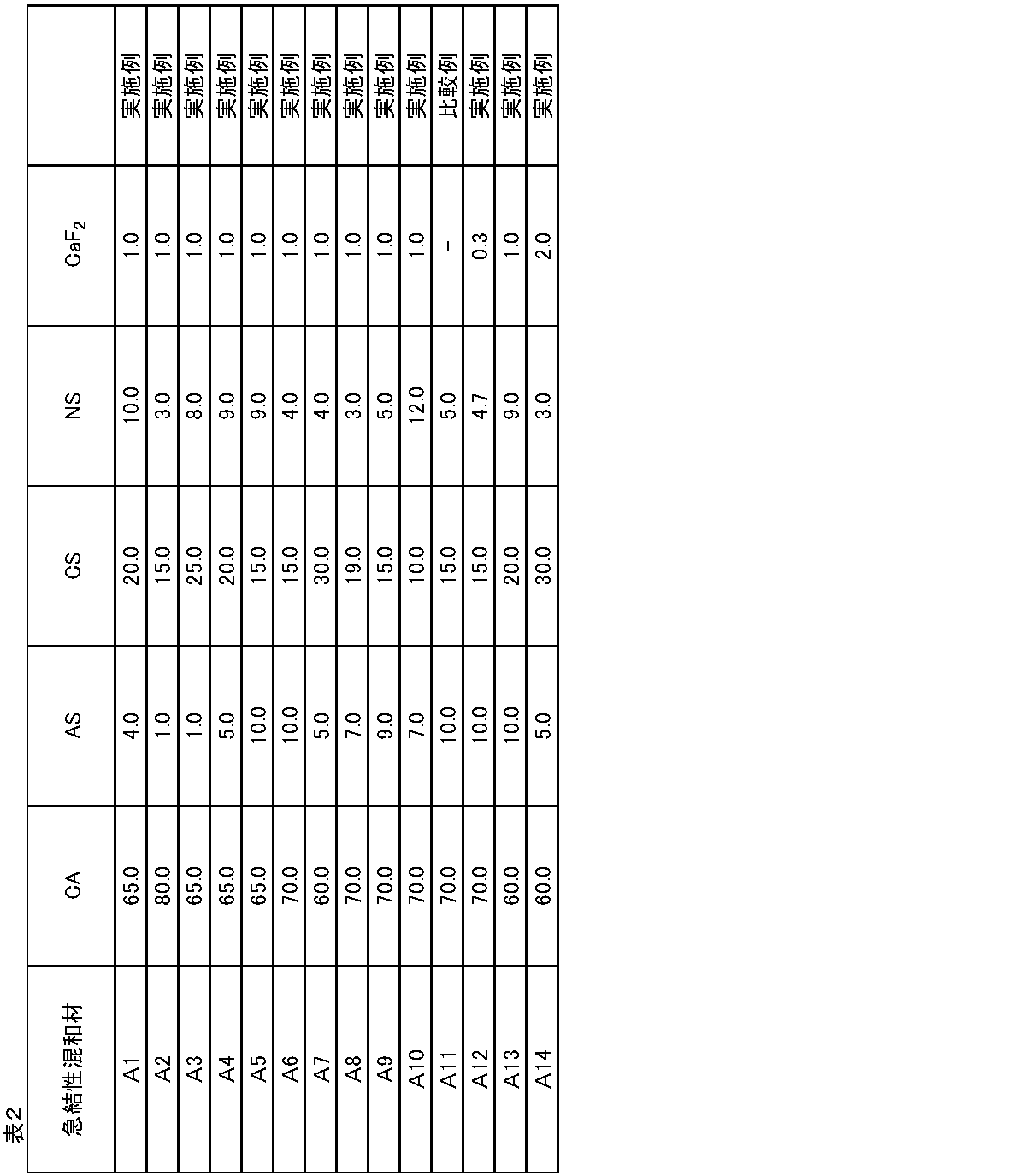
得られた混合物について、レーザー回折散乱法を用いて粒度分布と粒子径を連続的に測定し、その測定結果をもとに、任意のふるいを用いてスクリーニングした。スクリーニングした粒子径を下記に示す粒度分布になるよう再び混合して、急結性混和材A1~A14を調整した。
D10:5μm
D50:20μm
D90:200μm
(D50-D10)/D50=0.8
(D90-D10)/D50=9.8
D10:5μm
D50:20μm
D90:200μm
(D50-D10)/D50=0.8
(D90-D10)/D50=9.8
次に、普通ポルトランドセメント(pH14、工業品)100質量部と、得られた急結性混和材質量10部と、水(上水道水)40質量部と混合し、試験サンプルを得た。得られた試験サンプルを用いて、凝結試験を行った。凝結試験は、JIS R5201「セメントの物理試験方法」に準拠し、始発時間及び終結時間を計測した。

表3の結果から、急結性混和材を構成する材料比率はカルシウムアルミネートが60~80質量%、硫酸アルミニウムが1~10質量%、石膏が15~30質量%、硫酸ナトリウムが3~12質量%が適する割合であることが分かる。また、CaF2が0.3~2質量%であれば、CaF2を含まない場合と比べて、急結性及び貯蔵安定性を向上できることが分かった。
[実験例B]
実験例Aにおいて、急結性能が確認された配合を用いて、粒子径、粒度分布を変化させ、急結性混和材の貯蔵安定性について評価した。
実験例Aと同様にして、カルシウムアルミネートが60質量%、硫酸アルミニウムが10質量%、石膏が20質量%、硫酸ナトリウムが9質量%、フッ化カルシウムが1質量%の配合にて材料を混合し、得られた混合物について、粒子径、粒度分布を変化させ、表4の粒子径、粒度分布を有する急結性混和材B1~B15を調整した。
なお、急結性混和材B2、B7、B12については、炭酸アルカリとして炭酸ナトリウム(市販品)をカルシウムアルミネート100質量%に対して0.05質量%をさらに配合し、急結性混和材B3、B8、B13については、炭酸アルカリとして炭酸ナトリウム(市販品)をカルシウムアルミネート100質量%に対して0.06質量%をさらに配合し、その他の急結性混和材には炭酸アルカリを配合しなかった。
実験例Aにおいて、急結性能が確認された配合を用いて、粒子径、粒度分布を変化させ、急結性混和材の貯蔵安定性について評価した。
実験例Aと同様にして、カルシウムアルミネートが60質量%、硫酸アルミニウムが10質量%、石膏が20質量%、硫酸ナトリウムが9質量%、フッ化カルシウムが1質量%の配合にて材料を混合し、得られた混合物について、粒子径、粒度分布を変化させ、表4の粒子径、粒度分布を有する急結性混和材B1~B15を調整した。
なお、急結性混和材B2、B7、B12については、炭酸アルカリとして炭酸ナトリウム(市販品)をカルシウムアルミネート100質量%に対して0.05質量%をさらに配合し、急結性混和材B3、B8、B13については、炭酸アルカリとして炭酸ナトリウム(市販品)をカルシウムアルミネート100質量%に対して0.06質量%をさらに配合し、その他の急結性混和材には炭酸アルカリを配合しなかった。
また、いずれの急結性混和材B1~B15において、目開き篩い75μmの篩を用い、篩いに残存した篩い上画分(A)と篩い下画分(B)の粒度は下記の範囲内であった。
(A)D10:90~125μm、D50:130~400μm
(B)D10:0.5~6μm、D50:7~12μm
(A)D10:90~125μm、D50:130~400μm
(B)D10:0.5~6μm、D50:7~12μm

作製した急結性混和材を袋に詰め、温度20℃、湿度60%の室内で所定の日数保管した後、普通ポルトランドセメント(pH14、工業品)100質量部、急結性混和材10質量部、水(上水道水)40質量部を混合し、試験サンプルを得た。得られた試験サンプルを用いて、凝結試験及び圧縮強度の測定を行った。
凝結試験及び圧縮強度の測定は、JIS R5201「セメントの物理試験方法」に準拠して行った。凝結試験は、凝結の始発時間を測定した。
凝結試験及び圧縮強度の測定は、JIS R5201「セメントの物理試験方法」に準拠して行った。凝結試験は、凝結の始発時間を測定した。
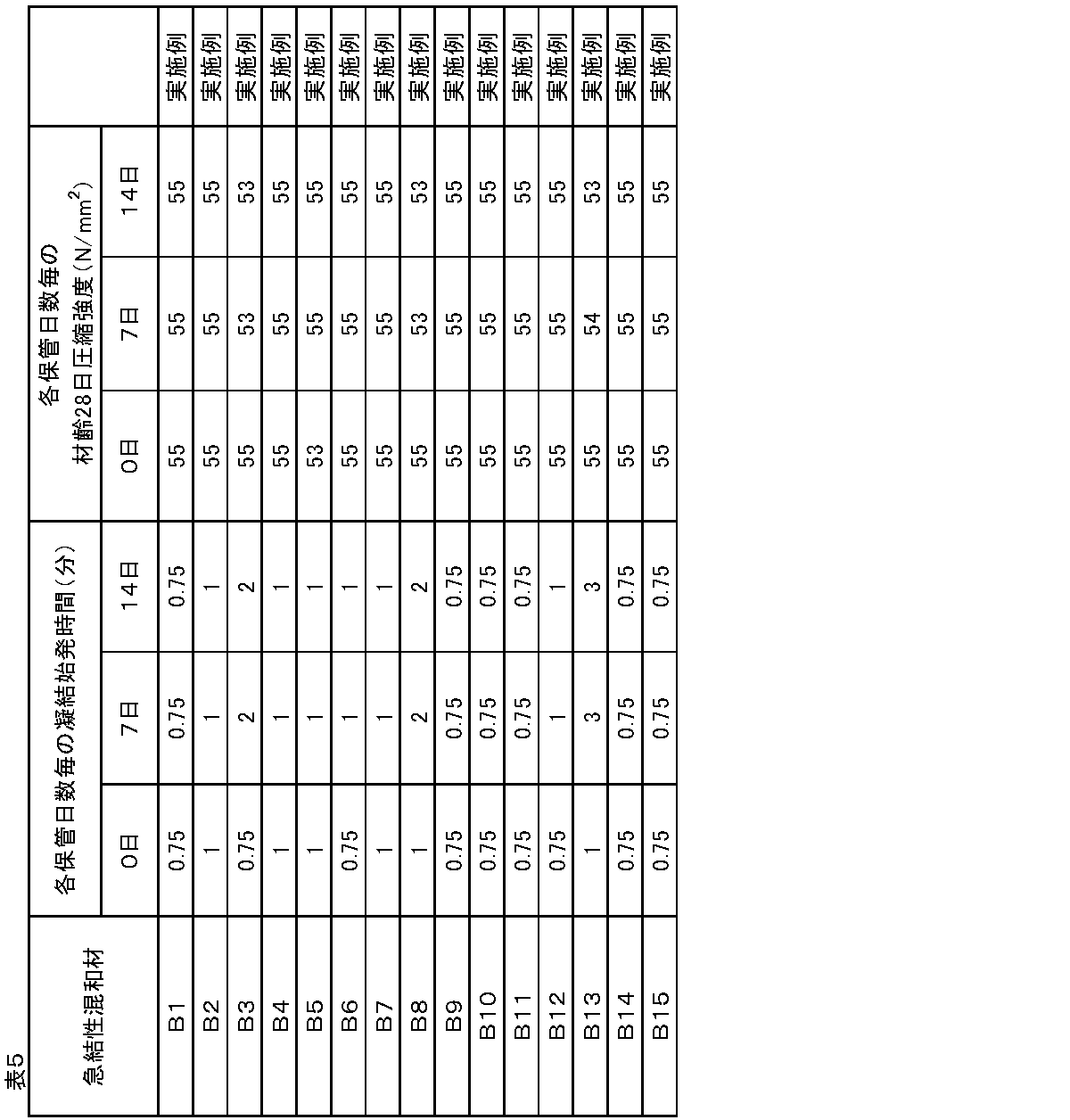
表5の結果から、粒子径、粒度分布を適切に調整することによって急結性能及び貯蔵安定性が優れた急結性混和材を実現できることが示された。
[実験例C]
実験例A、Bにより急結性能が確認された急結性混和材の配合において、目開き75μmの篩を用いたときの篩上画分(A)と篩下画分(B)の粒子径、粒度分布を調整した急結性混和材C1~C10を作製し、実験例Bと同様の方法にて貯蔵安定性能を評価した。
実験例A、Bにより急結性能が確認された急結性混和材の配合において、目開き75μmの篩を用いたときの篩上画分(A)と篩下画分(B)の粒子径、粒度分布を調整した急結性混和材C1~C10を作製し、実験例Bと同様の方法にて貯蔵安定性能を評価した。
実験例Aと同様にして、カルシウムアルミネートが60質量%、硫酸アルミニウムが10質量%、石膏が20質量%、硫酸ナトリウムが9質量%、フッ化カルシウムが1質量%の配合にて材料を混合し、得られた混合物について、粒子径、粒度分布を変化させ、目開き75μmの篩を用いたときの篩上画分(A)と篩下画分(B)粒子径を調整し、表6の(A)の粒子径、(B)の粒子径を有する急結性混和材C1~C10を調整した。
なお、作製した急結性混和材C1~C10の粒度分布は下記の範囲内である。
D10:1~5μm、D50:6~15μm、D90:50~300μm
D10:1~5μm、D50:6~15μm、D90:50~300μm


表7の結果より、目開き75μmの篩を用いたときの篩上画分(A)と篩下画分(B)の粒子径、粒度分布を適切に調整することによって、急結性能及び貯蔵安定性が優れた急結性混和材を実現できることが示された。
[実験例D]
実験例A~Cで急結性能及び貯蔵安定性が確認された配合の急結性混和材を用いて作製した吹付け材料について、吹付け試験を実施した。
実験例A~Cで急結性能及び貯蔵安定性が確認された配合の急結性混和材を用いて作製した吹付け材料について、吹付け試験を実施した。
セメント360kg、水216kg、細骨材1049kg、粗骨材(新潟県姫川水系6号砕石、密度2.67g/cm3)716kgのコンクリート(吹付けコンクリート)を調製した。MAYCO社(Suprema)のコンクリートポンプで5m3/hの設定でコンクリートをポンプ圧送し、途中で別系統からの圧縮空気と混合合流させて空気搬送した。さらに、吐出前3m地点で、下記の表8に示す粉状の急結性混和材を搬送装置Werner Mader社(WM-14 FU)でセメント100部に対して10部となるように、当該急結性混和材を空気搬送されたコンクリートと混合合流させて急結材料とし、ノズル先より鉄板に吹付けた。吹付けてからの初期強度、長期強度について検討した。なお、急結剤搬送装置への急結剤の供給はSpiroflow社(FLEXIBLE SCREW CONVEYOR)の装置を用い、それぞれの装置は電気信号にて連動して制御されている。
初期強度:JSCE-G561に準じて型枠に吹付けて、材齢10分、3時間、1日時点での引き抜き強度より、圧縮強度に換算し、初期強度を測定した。
長期強度:JSCE-F561、JIS A1107に準じて型枠に吹付けて、材齢7日、28日時点でコアを採取して、圧縮強度を測定した。

表8より、吹付けコンクリートの初期強度、長期強度ともに良好な結果を得た。
各実施例の急結性混和材は、各比較例と比較して、貯蔵安定性、及び急結性に優れる結果を示した。このような実施例の急結性混和材は、吹付け材料に好適に用いることが可能である。
この出願は、2020年11月9日に出願された日本出願特願2020-186653号を基礎とする優先権を主張し、その開示の全てをここに取り込む。
Claims (12)
- カルシウムアルミネート、硫酸アルミニウム、石膏、及び硫酸ナトリウムを含む、粉体状の急結性混和材であって、
CaF2を含み、
リートベルト法による定量分析したときの前記CaF2の含有量が、当該急結性混和材100質量%中、0.3質量%以上2質量%以下、
前記カルシウムアルミネートの含有量が、当該急結性混和材100質量%中、60質量%以上80質量%以下、
前記硫酸アルミニウムの含有量が、当該急結性混和材100質量%中、1質量%以上10質量%以下、
前記石膏の含有量が、当該急結性混和材100質量%中、15質量%以上30質量%以下、および
前記硫酸ナトリウムの含有量が、当該急結性混和材100質量%中、3質量%以上12質量%以下である、
急結性混和材。 - 請求項1に記載の急結性混和材であって、
前記硫酸アルミニウムは、下記の条件で測定される固体27Al-NMRによって得られるスペクトルにおいて、化学シフト-5.0ppm以上0ppm以下の範囲にピークを有する、急結性混和材。
(条件)
観測核:27Al
試料管回転数:10KHz
測定温度:25℃
パルス幅:3.3μsec(90°パルス)
待ち時間:5秒
外部標準:硝酸アルミニウム - 請求項2に記載の急結性混和材であって、
前記硫酸アルミニウムにおいて、化学シフト-5.0ppm以上0ppm以下の範囲にピークの半値幅が10.0ppm以下である、急結性混和材。 - 請求項1~3のいずれか一項に記載の急結性混和材であって、
前記硫酸アルミニウムにおけるFT-IRスペクトルにおいて、1100cm-1付近のSO4基伸縮振動に由来するピーク面積に対する3000cm-1付近のOH基伸縮振動に由来するピーク面積の面積比が、350以上600以下である、急結性混和材。 - 請求項1~4のいずれか一項に記載の急結性混和材であって、
前記硫酸アルミニウムにおけるFT-IRスペクトルにおいて、1100cm-1付近のSO4基伸縮振動に由来するピーク面積に対する1600cm-1付近のOH基変角振動に由来するピーク面積の面積比が、30以上70以下である、急結性混和材。 - 請求項1~5のいずれか一項に記載の急結性混和材であって、
前記硫酸アルミニウムが、少なくとも硫酸アルミニウムの17水和物を含む、急結性混和材。 - 請求項1~6のいずれか一項に記載の急結性混和材であって、
炭酸アルカリを含有しないか、又は前記カルシウムアルミネート100質量%に対して0.05質量%以下の含有量で炭酸アルカリを含有する、急結性混和材。 - 請求項1~7のいずれか一項に記載の急結性混和材であって、
レーザー回折散乱法で測定される当該急結性混和材の体積頻度粒度分布において、累積値が50%となる粒子径をD50、累積値が10%となる粒子径をD10としたとき、
D50が6μm以上15μm以下、
D10が1μm以上5μm以下、及び
(D50-D10)/D50が0.1以上1.0以下である、急結性混和材。 - 請求項8に記載の急結性混和材であって、
レーザー回折散乱法で測定される当該急結性混和材の体積頻度粒度分布において、累積値が90%となる粒子径をD90としたとき、
D90が30μm以上300μm以下である、急結性混和材。 - 請求項9に記載の急結性混和材であって、
(D90-D10)/D50が4.0以上35.0以下である、急結性混和材。 - 請求項1~10のいずれか一項に記載の急結性混和材、及びセメントを含む、吹付け材料。
- 請求項11に記載の吹付け材料であって、
アルミニウム塩を含有する液体急結剤を含む、吹付け材料。
Applications Claiming Priority (2)
| Application Number | Priority Date | Filing Date | Title |
|---|---|---|---|
| JP2020-186653 | 2020-11-09 | ||
| JP2020186653A JP6873305B1 (ja) | 2020-11-09 | 2020-11-09 | 急結性混和材、及び吹付け材料 |
Publications (1)
| Publication Number | Publication Date |
|---|---|
| WO2022097495A1 true WO2022097495A1 (ja) | 2022-05-12 |
Family
ID=75896345
Family Applications (1)
| Application Number | Title | Priority Date | Filing Date |
|---|---|---|---|
| PCT/JP2021/038959 Ceased WO2022097495A1 (ja) | 2020-11-09 | 2021-10-21 | 急結性混和材、及び吹付け材料 |
Country Status (2)
| Country | Link |
|---|---|
| JP (1) | JP6873305B1 (ja) |
| WO (1) | WO2022097495A1 (ja) |
Cited By (4)
| Publication number | Priority date | Publication date | Assignee | Title |
|---|---|---|---|---|
| JP7453303B1 (ja) | 2022-09-27 | 2024-03-19 | デンカ株式会社 | 液状急結剤、吹付けコンクリート |
| JP7453304B1 (ja) | 2022-09-27 | 2024-03-19 | デンカ株式会社 | 液状急結剤、吹付けコンクリート |
| WO2025204916A1 (ja) * | 2024-03-28 | 2025-10-02 | デンカ株式会社 | 粉体急結材料及びコンクリート材料 |
| PL448265A1 (pl) * | 2024-04-10 | 2025-10-13 | Mateusz Szopiński | Gładź szpachlowa |
Families Citing this family (4)
| Publication number | Priority date | Publication date | Assignee | Title |
|---|---|---|---|---|
| CN113735480B (zh) * | 2021-09-07 | 2022-12-13 | 焦作市红石环保科技有限公司 | 一种铝酸盐水泥基粉体速凝剂及其制备方法和应用 |
| JP7209878B1 (ja) * | 2022-01-12 | 2023-01-20 | デンカ株式会社 | 液体急結剤、吹付けコンクリート |
| JP7810813B2 (ja) * | 2022-09-20 | 2026-02-03 | デンカ株式会社 | 液体急結剤、吹付けコンクリート |
| JP7355953B1 (ja) * | 2023-01-19 | 2023-10-03 | デンカ株式会社 | 液体急結剤、補修材料、硬化体 |
Citations (5)
| Publication number | Priority date | Publication date | Assignee | Title |
|---|---|---|---|---|
| JPH0375249A (ja) * | 1989-08-11 | 1991-03-29 | Denki Kagaku Kogyo Kk | セメント急硬材 |
| JP2016108235A (ja) * | 2014-12-01 | 2016-06-20 | 住友大阪セメント株式会社 | セメント用急硬性添加材及びその製造方法 |
| JP2019043806A (ja) * | 2017-08-31 | 2019-03-22 | デンカ株式会社 | 急硬材及び急硬性セメント組成物 |
| JP2019210167A (ja) * | 2018-05-31 | 2019-12-12 | 太平洋マテリアル株式会社 | 急結混和材 |
| JP6793270B1 (ja) * | 2020-05-13 | 2020-12-02 | デンカ株式会社 | 急結性混和材、及び吹付け材料 |
-
2020
- 2020-11-09 JP JP2020186653A patent/JP6873305B1/ja active Active
-
2021
- 2021-10-21 WO PCT/JP2021/038959 patent/WO2022097495A1/ja not_active Ceased
Patent Citations (5)
| Publication number | Priority date | Publication date | Assignee | Title |
|---|---|---|---|---|
| JPH0375249A (ja) * | 1989-08-11 | 1991-03-29 | Denki Kagaku Kogyo Kk | セメント急硬材 |
| JP2016108235A (ja) * | 2014-12-01 | 2016-06-20 | 住友大阪セメント株式会社 | セメント用急硬性添加材及びその製造方法 |
| JP2019043806A (ja) * | 2017-08-31 | 2019-03-22 | デンカ株式会社 | 急硬材及び急硬性セメント組成物 |
| JP2019210167A (ja) * | 2018-05-31 | 2019-12-12 | 太平洋マテリアル株式会社 | 急結混和材 |
| JP6793270B1 (ja) * | 2020-05-13 | 2020-12-02 | デンカ株式会社 | 急結性混和材、及び吹付け材料 |
Cited By (8)
| Publication number | Priority date | Publication date | Assignee | Title |
|---|---|---|---|---|
| JP7453303B1 (ja) | 2022-09-27 | 2024-03-19 | デンカ株式会社 | 液状急結剤、吹付けコンクリート |
| JP7453304B1 (ja) | 2022-09-27 | 2024-03-19 | デンカ株式会社 | 液状急結剤、吹付けコンクリート |
| WO2024070814A1 (ja) * | 2022-09-27 | 2024-04-04 | デンカ株式会社 | 液状急結剤、吹付けコンクリート |
| WO2024070813A1 (ja) * | 2022-09-27 | 2024-04-04 | デンカ株式会社 | 液状急結剤、吹付けコンクリート |
| JP2024047947A (ja) * | 2022-09-27 | 2024-04-08 | デンカ株式会社 | 液状急結剤、吹付けコンクリート |
| JP2024047946A (ja) * | 2022-09-27 | 2024-04-08 | デンカ株式会社 | 液状急結剤、吹付けコンクリート |
| WO2025204916A1 (ja) * | 2024-03-28 | 2025-10-02 | デンカ株式会社 | 粉体急結材料及びコンクリート材料 |
| PL448265A1 (pl) * | 2024-04-10 | 2025-10-13 | Mateusz Szopiński | Gładź szpachlowa |
Also Published As
| Publication number | Publication date |
|---|---|
| JP6873305B1 (ja) | 2021-05-19 |
| JP2022076297A (ja) | 2022-05-19 |
Similar Documents
| Publication | Publication Date | Title |
|---|---|---|
| JP6873305B1 (ja) | 急結性混和材、及び吹付け材料 | |
| EP0640062B2 (en) | Cement composition | |
| Yan et al. | Studies on the binder of fly ash-fluorgypsum-cement | |
| JP6793270B1 (ja) | 急結性混和材、及び吹付け材料 | |
| TWI815994B (zh) | 水泥摻和料、膨脹材料和水泥組成物 | |
| JP7453047B2 (ja) | セメント急結剤、及びセメント組成物 | |
| JP7173827B2 (ja) | 超速硬性組成物、セメント組成物、コンクリート組成物及び吹付け施工方法 | |
| WO2023022172A1 (ja) | セメント混和材、セメント混和材の製造方法及びセメント組成物 | |
| JP7026741B1 (ja) | セメント混和材、及びセメント組成物 | |
| JP7293019B2 (ja) | セメント用膨張組成物、セメント組成物、及びセメント用膨張組成物の製造方法 | |
| JP3818802B2 (ja) | セメント混和材及びセメント組成物 | |
| JP2000281410A (ja) | セメント混和材及びセメント組成物 | |
| JP7636636B2 (ja) | セメント組成物及び水硬性組成物 | |
| JP7257278B2 (ja) | セメント用膨張組成物、及びセメント組成物 | |
| JP2001064054A (ja) | セメント混和材及びセメント組成物 | |
| JP7762792B2 (ja) | セメント混和材、セメント組成物、セメントコンクリート | |
| JP2011051876A (ja) | 無水石膏含有焼成物および固化材 | |
| JP6116350B2 (ja) | セメント混和材およびセメント組成物 | |
| JP7254418B2 (ja) | セメント組成物用急結剤 | |
| JP4606631B2 (ja) | セメント混和材及びセメント組成物 | |
| JP4459379B2 (ja) | セメント混和材及びセメント組成物 | |
| JP7770219B2 (ja) | セメント混和材 | |
| JP5744498B2 (ja) | セメント急硬材の製造方法 | |
| JP2014185040A (ja) | セメント組成物 | |
| JP4459380B2 (ja) | セメント混和材及びセメント組成物 |
Legal Events
| Date | Code | Title | Description |
|---|---|---|---|
| 121 | Ep: the epo has been informed by wipo that ep was designated in this application |
Ref document number: 21889048 Country of ref document: EP Kind code of ref document: A1 |
|
| NENP | Non-entry into the national phase |
Ref country code: DE |
|
| 122 | Ep: pct application non-entry in european phase |
Ref document number: 21889048 Country of ref document: EP Kind code of ref document: A1 |