WO2022080481A1 - 抗her2抗体の放射性複合体、及び、放射性医薬 - Google Patents
抗her2抗体の放射性複合体、及び、放射性医薬 Download PDFInfo
- Publication number
- WO2022080481A1 WO2022080481A1 PCT/JP2021/038207 JP2021038207W WO2022080481A1 WO 2022080481 A1 WO2022080481 A1 WO 2022080481A1 JP 2021038207 W JP2021038207 W JP 2021038207W WO 2022080481 A1 WO2022080481 A1 WO 2022080481A1
- Authority
- WO
- WIPO (PCT)
- Prior art keywords
- complex
- antibody
- group
- peptide
- chelating agent
- Prior art date
- Legal status (The legal status is an assumption and is not a legal conclusion. Google has not performed a legal analysis and makes no representation as to the accuracy of the status listed.)
- Ceased
Links
Images


Classifications
-
- A—HUMAN NECESSITIES
- A61—MEDICAL OR VETERINARY SCIENCE; HYGIENE
- A61K—PREPARATIONS FOR MEDICAL, DENTAL OR TOILETRY PURPOSES
- A61K33/00—Medicinal preparations containing inorganic active ingredients
- A61K33/24—Heavy metals; Compounds thereof
-
- A—HUMAN NECESSITIES
- A61—MEDICAL OR VETERINARY SCIENCE; HYGIENE
- A61K—PREPARATIONS FOR MEDICAL, DENTAL OR TOILETRY PURPOSES
- A61K33/00—Medicinal preparations containing inorganic active ingredients
- A61K33/24—Heavy metals; Compounds thereof
- A61K33/244—Lanthanides; Compounds thereof
-
- A—HUMAN NECESSITIES
- A61—MEDICAL OR VETERINARY SCIENCE; HYGIENE
- A61K—PREPARATIONS FOR MEDICAL, DENTAL OR TOILETRY PURPOSES
- A61K39/00—Medicinal preparations containing antigens or antibodies
- A61K39/395—Antibodies; Immunoglobulins; Immune serum, e.g. antilymphocytic serum
-
- A—HUMAN NECESSITIES
- A61—MEDICAL OR VETERINARY SCIENCE; HYGIENE
- A61K—PREPARATIONS FOR MEDICAL, DENTAL OR TOILETRY PURPOSES
- A61K41/00—Medicinal preparations obtained by treating materials with wave energy or particle radiation ; Therapies using these preparations
-
- A—HUMAN NECESSITIES
- A61—MEDICAL OR VETERINARY SCIENCE; HYGIENE
- A61K—PREPARATIONS FOR MEDICAL, DENTAL OR TOILETRY PURPOSES
- A61K47/00—Medicinal preparations characterised by the non-active ingredients used, e.g. carriers or inert additives; Targeting or modifying agents chemically bound to the active ingredient
- A61K47/50—Medicinal preparations characterised by the non-active ingredients used, e.g. carriers or inert additives; Targeting or modifying agents chemically bound to the active ingredient the non-active ingredient being chemically bound to the active ingredient, e.g. polymer-drug conjugates
- A61K47/51—Medicinal preparations characterised by the non-active ingredients used, e.g. carriers or inert additives; Targeting or modifying agents chemically bound to the active ingredient the non-active ingredient being chemically bound to the active ingredient, e.g. polymer-drug conjugates the non-active ingredient being a modifying agent
- A61K47/68—Medicinal preparations characterised by the non-active ingredients used, e.g. carriers or inert additives; Targeting or modifying agents chemically bound to the active ingredient the non-active ingredient being chemically bound to the active ingredient, e.g. polymer-drug conjugates the non-active ingredient being a modifying agent the modifying agent being an antibody, an immunoglobulin or a fragment thereof, e.g. an Fc-fragment
-
- A—HUMAN NECESSITIES
- A61—MEDICAL OR VETERINARY SCIENCE; HYGIENE
- A61K—PREPARATIONS FOR MEDICAL, DENTAL OR TOILETRY PURPOSES
- A61K47/00—Medicinal preparations characterised by the non-active ingredients used, e.g. carriers or inert additives; Targeting or modifying agents chemically bound to the active ingredient
- A61K47/50—Medicinal preparations characterised by the non-active ingredients used, e.g. carriers or inert additives; Targeting or modifying agents chemically bound to the active ingredient the non-active ingredient being chemically bound to the active ingredient, e.g. polymer-drug conjugates
- A61K47/69—Medicinal preparations characterised by the non-active ingredients used, e.g. carriers or inert additives; Targeting or modifying agents chemically bound to the active ingredient the non-active ingredient being chemically bound to the active ingredient, e.g. polymer-drug conjugates the conjugate being characterised by physical or galenical forms, e.g. emulsion, particle, inclusion complex, stent or kit
-
- A—HUMAN NECESSITIES
- A61—MEDICAL OR VETERINARY SCIENCE; HYGIENE
- A61K—PREPARATIONS FOR MEDICAL, DENTAL OR TOILETRY PURPOSES
- A61K51/00—Preparations containing radioactive substances for use in therapy or testing in vivo
- A61K51/02—Preparations containing radioactive substances for use in therapy or testing in vivo characterised by the carrier, i.e. characterised by the agent or material covalently linked or complexing the radioactive nucleus
- A61K51/04—Organic compounds
- A61K51/08—Peptides, e.g. proteins, carriers being peptides, polyamino acids, proteins
- A61K51/10—Antibodies or immunoglobulins; Fragments thereof, the carrier being an antibody, an immunoglobulin or a fragment thereof, e.g. a camelised human single domain antibody or the Fc fragment of an antibody
-
- A—HUMAN NECESSITIES
- A61—MEDICAL OR VETERINARY SCIENCE; HYGIENE
- A61K—PREPARATIONS FOR MEDICAL, DENTAL OR TOILETRY PURPOSES
- A61K51/00—Preparations containing radioactive substances for use in therapy or testing in vivo
- A61K51/02—Preparations containing radioactive substances for use in therapy or testing in vivo characterised by the carrier, i.e. characterised by the agent or material covalently linked or complexing the radioactive nucleus
- A61K51/04—Organic compounds
- A61K51/08—Peptides, e.g. proteins, carriers being peptides, polyamino acids, proteins
- A61K51/10—Antibodies or immunoglobulins; Fragments thereof, the carrier being an antibody, an immunoglobulin or a fragment thereof, e.g. a camelised human single domain antibody or the Fc fragment of an antibody
- A61K51/1045—Antibodies or immunoglobulins; Fragments thereof, the carrier being an antibody, an immunoglobulin or a fragment thereof, e.g. a camelised human single domain antibody or the Fc fragment of an antibody against animal or human tumor cells or tumor cell determinants
- A61K51/1051—Antibodies or immunoglobulins; Fragments thereof, the carrier being an antibody, an immunoglobulin or a fragment thereof, e.g. a camelised human single domain antibody or the Fc fragment of an antibody against animal or human tumor cells or tumor cell determinants the tumor cell being from breast, e.g. the antibody being herceptin
-
- A—HUMAN NECESSITIES
- A61—MEDICAL OR VETERINARY SCIENCE; HYGIENE
- A61K—PREPARATIONS FOR MEDICAL, DENTAL OR TOILETRY PURPOSES
- A61K51/00—Preparations containing radioactive substances for use in therapy or testing in vivo
- A61K51/02—Preparations containing radioactive substances for use in therapy or testing in vivo characterised by the carrier, i.e. characterised by the agent or material covalently linked or complexing the radioactive nucleus
- A61K51/04—Organic compounds
- A61K51/08—Peptides, e.g. proteins, carriers being peptides, polyamino acids, proteins
- A61K51/10—Antibodies or immunoglobulins; Fragments thereof, the carrier being an antibody, an immunoglobulin or a fragment thereof, e.g. a camelised human single domain antibody or the Fc fragment of an antibody
- A61K51/1093—Antibodies or immunoglobulins; Fragments thereof, the carrier being an antibody, an immunoglobulin or a fragment thereof, e.g. a camelised human single domain antibody or the Fc fragment of an antibody conjugates with carriers being antibodies
- A61K51/1096—Antibodies or immunoglobulins; Fragments thereof, the carrier being an antibody, an immunoglobulin or a fragment thereof, e.g. a camelised human single domain antibody or the Fc fragment of an antibody conjugates with carriers being antibodies radioimmunotoxins, i.e. conjugates being structurally as defined in A61K51/1093, and including a radioactive nucleus for use in radiotherapeutic applications
-
- A—HUMAN NECESSITIES
- A61—MEDICAL OR VETERINARY SCIENCE; HYGIENE
- A61P—SPECIFIC THERAPEUTIC ACTIVITY OF CHEMICAL COMPOUNDS OR MEDICINAL PREPARATIONS
- A61P35/00—Antineoplastic agents
-
- C—CHEMISTRY; METALLURGY
- C07—ORGANIC CHEMISTRY
- C07K—PEPTIDES
- C07K1/00—General methods for the preparation of peptides, i.e. processes for the organic chemical preparation of peptides or proteins of any length
- C07K1/13—Labelling of peptides
-
- C—CHEMISTRY; METALLURGY
- C07—ORGANIC CHEMISTRY
- C07K—PEPTIDES
- C07K16/00—Immunoglobulins [IG], e.g. monoclonal or polyclonal antibodies
- C07K16/18—Immunoglobulins [IG], e.g. monoclonal or polyclonal antibodies against material from animals or humans
- C07K16/28—Immunoglobulins [IG], e.g. monoclonal or polyclonal antibodies against material from animals or humans against receptors, cell surface antigens or cell surface determinants
-
- C—CHEMISTRY; METALLURGY
- C07—ORGANIC CHEMISTRY
- C07K—PEPTIDES
- C07K16/00—Immunoglobulins [IG], e.g. monoclonal or polyclonal antibodies
- C07K16/18—Immunoglobulins [IG], e.g. monoclonal or polyclonal antibodies against material from animals or humans
- C07K16/28—Immunoglobulins [IG], e.g. monoclonal or polyclonal antibodies against material from animals or humans against receptors, cell surface antigens or cell surface determinants
- C07K16/30—Immunoglobulins [IG], e.g. monoclonal or polyclonal antibodies against material from animals or humans against receptors, cell surface antigens or cell surface determinants from tumour cells
-
- C—CHEMISTRY; METALLURGY
- C07—ORGANIC CHEMISTRY
- C07K—PEPTIDES
- C07K16/00—Immunoglobulins [IG], e.g. monoclonal or polyclonal antibodies
- C07K16/18—Immunoglobulins [IG], e.g. monoclonal or polyclonal antibodies against material from animals or humans
- C07K16/32—Immunoglobulins [IG], e.g. monoclonal or polyclonal antibodies against material from animals or humans against translation products of oncogenes
-
- C—CHEMISTRY; METALLURGY
- C07—ORGANIC CHEMISTRY
- C07K—PEPTIDES
- C07K7/00—Peptides having 5 to 20 amino acids in a fully defined sequence; Derivatives thereof
- C07K7/04—Linear peptides containing only normal peptide links
- C07K7/08—Linear peptides containing only normal peptide links having 12 to 20 amino acids
-
- C—CHEMISTRY; METALLURGY
- C12—BIOCHEMISTRY; BEER; SPIRITS; WINE; VINEGAR; MICROBIOLOGY; ENZYMOLOGY; MUTATION OR GENETIC ENGINEERING
- C12N—MICROORGANISMS OR ENZYMES; COMPOSITIONS THEREOF; PROPAGATING, PRESERVING, OR MAINTAINING MICROORGANISMS; MUTATION OR GENETIC ENGINEERING; CULTURE MEDIA
- C12N15/00—Mutation or genetic engineering; DNA or RNA concerning genetic engineering, vectors, e.g. plasmids, or their isolation, preparation or purification; Use of hosts therefor
- C12N15/09—Recombinant DNA-technology
- C12N15/11—DNA or RNA fragments; Modified forms thereof; Non-coding nucleic acids having a biological activity
-
- A—HUMAN NECESSITIES
- A61—MEDICAL OR VETERINARY SCIENCE; HYGIENE
- A61K—PREPARATIONS FOR MEDICAL, DENTAL OR TOILETRY PURPOSES
- A61K39/00—Medicinal preparations containing antigens or antibodies
- A61K2039/505—Medicinal preparations containing antigens or antibodies comprising antibodies
-
- A—HUMAN NECESSITIES
- A61—MEDICAL OR VETERINARY SCIENCE; HYGIENE
- A61K—PREPARATIONS FOR MEDICAL, DENTAL OR TOILETRY PURPOSES
- A61K38/00—Medicinal preparations containing peptides
-
- C—CHEMISTRY; METALLURGY
- C07—ORGANIC CHEMISTRY
- C07K—PEPTIDES
- C07K2317/00—Immunoglobulins specific features
- C07K2317/90—Immunoglobulins specific features characterized by (pharmaco)kinetic aspects or by stability of the immunoglobulin
- C07K2317/94—Stability, e.g. half-life, pH, temperature or enzyme-resistance
Definitions
- the present invention relates to a radioactive complex of an anti-HER2 antibody and a radioactive drug.
- HER2 Human Epidermal Growth Factor Receptor Type 2: Human Epidermal Growth Factor Receptor Type 2 is a growth factor receptor identified as a gene product of the human cancer gene HER2 / neu, and is a transmembrane protein having a molecular weight of about 185 kDa. ..
- Trastuzumab is known as an anti-HER2 antibody, and is clinically used as an antitumor agent for HER2-overexpressed breast cancer or gastric cancer.
- Trastuzumab is known to be an antibody used in several ADCs (Antibody Drug Conjugates) on the market.
- ADC is a drug in which a payload (drug), which is a chemotherapeutic agent, is covalently bound to an antibody via a linker.
- drug drug
- Chemotherapeutic agents have strong efficacy, but their low selectivity for targets means that the minimum effective dose required to kill cancer cells is high, while the dose cannot be increased too much from the viewpoint of toxicity. Therefore, the problem is that the maximum tolerated dose is low and the therapeutic dose range is narrow.
- ADC advanced chemotherapeutic agent
- more chemotherapeutic agents can be selectively delivered to cancer cells, resulting in better effects in smaller doses and fewer chemotherapeutic agents reaching normal cells. Therefore, it is expected that the therapeutic dose range will be widened by increasing the maximum resistant dose.
- Radioactive immune complex Radioimmunoconjugate
- radionuclides are used instead of payloads.
- Non-Patent Documents 1 and 2 1,4,7,10-ttraazzyclododecane-1,4,7,10 terraacetic acid (DOTA) is used as a chelating agent, and the isothiocyanate group and trastuzumab introduced into DOTA are used.
- DOTA 1,4,7,10-ttraazzyclododecane-1,4,7,10 terraacetic acid
- 225 Ac-labeled trastuzumab in which trastuzumab is randomly labeled with 225 Ac by reacting with a terminal amino group, has been described.
- trastuzumab is randomly modified with trastuzumab and pertuzumab as an anti-HER2 antibody, and then trastuzumab is randomly modified with 225 Ac by clicking reaction with DOTAGA-DBCO labeled with Ac-225. Labeled 225 Ac-labeled trastuzumab and 225 Ac-labeled pertuzumab are described.
- Patent Document 2 describes a complex of an anti-HER2 antibody and a peptide that site-specifically modifies the Fc region of an antibody. Further, in Patent Document 3, DTPA was introduced into this peptide to modify trastuzumab, and the peptide was labeled with In-111 to obtain 111 In-labeled trastuzumab. DFO was introduced into the peptide to modify trastuzumab. It is described that 89 Zr-labeled trastuzumab was obtained by labeling with Zr-89.
- Patent Document 1 does not describe site-specific modification of anti-HER2 antibody by peptide. In addition, there is no disclosure or suggestion regarding the problem of the anti-HER2 antibody that formed the thiourea bond.
- One aspect of the present invention is a complex of an anti-HER2 antibody site-specifically modified with a peptide and a chelating agent, in which a radioactive metal nuclide is chelated with the chelating agent, and the peptide and the chelating agent form a linker ( Linked via L), the linker (L) is a thiourea-free complex.
- Another aspect of the present invention is a radiopharmaceutical containing the above complex as an active ingredient.
- another aspect of the present invention contains a complex of a chelating agent chelated with a radioactive metal nuclide and an anti-HER2 antibody as an active ingredient, and does not contain a thiourea bond in the linkage between the anti-HER2 antibody and the chelating agent.
- a radiopharmaceutical having a radiochemical purity of 90% or more when stored at room temperature for 7 days.
- a radioactive complex of an anti-HER2 antibody having higher stability than before without impairing the efficacy of the drug.
- FIG. 3 is a graph showing changes in tumor volume over time in cancer-bearing mice of the radioactive complex (Example 1) group, the radioactive complex (Comparative Example 1) group, the antibody control group, and the Vehicle group.
- the vertical axis shows the relative value when the tumor volume at the time of administration of each drug is 1, and the horizontal axis shows the number of days elapsed since the administration of each drug.
- the graph shows the mean ⁇ standard deviation of the tumor volume of each group, where "*" is the time point when a significant difference (p ⁇ 0.05) was observed with respect to the antibody control group, and "**" is the antibody control group.
- FIG. 3 is a graph showing changes in body weight over time in cancer-bearing mice of the radioactive complex (Example 1) group, the radioactive complex (Comparative Example 1) group, the antibody control group, and the Vehicle group.
- the vertical axis shows the relative value when the body weight at the time of administration of each drug is 1, and the horizontal axis shows the number of days elapsed since the administration of each drug.
- the graph shows the mean ⁇ standard deviation of the body weight of each group.
- the vertical axis is the value obtained by dividing the count value in the region of interest (ROI) set on the used tumor section by the area of the ROI and correcting the value obtained by dividing the count value of the standard radiation source by the area of the standard radiation source.
- the horizontal axis shows the cell type of the tumor section used at each evaluation date.
- the vertical axis is the value obtained by dividing the count value in the region of interest (ROI) set on the used tumor section by the area of the ROI and correcting the value obtained by dividing the count value of the standard radiation source by the area of the standard radiation source.
- the horizontal axis shows the cell type of the tumor section used at each evaluation date.
- the vertical axis is the value obtained by dividing the count value in the region of interest (ROI) set on the used tumor section by the area of the ROI and correcting the value obtained by dividing the count value of the standard radiation source by the area of the standard radiation source.
- the horizontal axis shows the cell type of the tumor section used at each evaluation date.
- 6 is an image showing a representative example of the result of PET imaging by administering the radioactive complex produced according to Example 2 to a subcutaneous cancer-bearing model mouse of SK-OV-3 cells.
- the arrows in the figure indicate the tumors that carry the cancer.
- the vertical axis shows the relative value when the tumor volume at the time of administration of each drug is 1, and the horizontal axis shows the number of days elapsed since the administration of each drug.
- the graph represents the mean ⁇ standard deviation of the tumor volume of each group, and “*” indicates the time point at which a significant difference (p ⁇ 0.05) was observed with respect to the Enhertz® low-dose group.
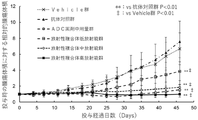
- 3 is a graph showing changes in tumor volume over time in cancer-bearing mice of each radio complex administration group, each ADC drug administration group, an antibody control group and a vehicle group.
- the vertical axis shows the relative value when the tumor volume at the time of administration of each drug is 1, and the horizontal axis shows the number of days elapsed since the administration of each drug.
- the graph shows the mean ⁇ standard deviation of the tumor volume of each group, "**" is the time point where a significant difference (p ⁇ 0.01) was observed with respect to the antibody control group, and " ⁇ ” is the Vehicle group. On the other hand, the time points at which a significant difference (p ⁇ 0.01) was observed are shown.
- Radioactive complex is a complex of an anti-HER2 antibody site-specifically modified with a peptide and a chelating agent.
- the chelating agent is chelated with a radioactive metal nuclei, and the peptide and the chelating agent are used. Is linked via a linker (L), and the linker (L) is a complex (hereinafter, also referred to as a radioactive complex of the present invention) that does not contain a thiourea bond.
- Radionuclide The radiometal nuclide contained in the radioactive complex of the present invention emits a radionuclide that emits ⁇ -rays, a radionuclide that emits ⁇ -rays, a radionuclide that emits positrons, or ⁇ -rays. It is a radionuclide.
- the radioactive complex of the present invention is used for cancer treatment, it is preferable to use a radionuclide that emits ⁇ -rays or a radionuclide that emits ⁇ -rays.
- radioactive complex of the present invention When the radioactive complex of the present invention is used for diagnosis or detection of cancer, it is preferable to use a radionuclide that emits positron or a radionuclide that emits ⁇ -rays.
- radionuclides that emit ⁇ rays include Bi-212, Bi-213, Ac-225, and Th-227.
- Cu-64, Y-90 or Lu-177 are exemplified as radionuclides that emit ⁇ rays.
- Cu-64, Ga-68, Y-86, and Zr-89 are exemplified as radionuclides that release positron.
- Tc-99m or In-111 is exemplified as a radionuclide that emits ⁇ -rays. It is more preferable that the radioactive metal nuclide contained in the radioactive complex of the present invention is Ac-225, Y-90, Lu-177 or Zr-89.
- the antibody contained in the radioactive complex of the present invention is an immunoglobulin that specifically binds to HER2 (hereinafter, also referred to as an antibody used in the present invention).
- the antibody used in the present invention may be a polyclonal antibody or a monoclonal antibody, but a monoclonal antibody is preferable.
- the origin of the antibody is not particularly limited, and examples thereof include non-human animal antibodies, non-human mammalian antibodies, and human antibodies, and humans, rats, mice, and rabbits are preferably exemplified.
- the antibody used in the present invention is a chimeric antibody, a humanized antibody, or a human antibody. May be. Further, the antibody used in the present invention may be a bispecific antibody.
- the antibody used for the radioactive complex of the present invention is more preferably trastuzumab or pertuzumab.
- Trastuzumab is a recombinant humanized monoclonal antibody in which the amino acid sequence of the antigen-binding site of a mouse monoclonal antibody (4D5) is genetically engineered to a considerable portion of human IgG 1 , and is a mouse anti-human epithelial growth factor. It consists of a complement determination part of a receptor type 2 (HER2) monoclonal antibody, a human framework part and a constant part of human IgG1.
- trastuzumab is an antibody described in JP-A-6-508267, specifically, a light chain variable domain amino acid sequence:
- trastuzumab is clinically used as an antitumor agent for breast cancer with confirmed HER2 overexpression or curative unresectable advanced / recurrent gastric cancer with confirmed HER2 overexpression, and is Herceptin®.
- Herceptin® or various biosimilar products
- trastuzumab is composed of two H chain ( ⁇ 1 chain) molecules consisting of 450 amino acid residues and two L chain ( ⁇ chain) molecules consisting of 214 amino acid residues. Glycoprotein to be produced (molecular weight: about 148,000).
- Pertuzumab is a recombinant humanized monoclonal antibody in which the amino acid sequence of the antigen-binding site of a mouse monoclonal antibody (2C4) is genetically engineered to a considerable portion of human IgG 1 , and is a mouse anti-HER2 monoclonal antibody. It consists of a complementarity determination unit, as well as a human IgG 1 framework and a stationary unit.
- Pertuzumab is produced by Chinese hamster ovary cells. Pertuzumab is clinically used as an antitumor agent for HER2-positive breast cancer and is available as Perjeta®.
- pertuzumab is a glycoprotein (molecular weight) composed of two H chain ( ⁇ 1 chain) molecules consisting of 449 amino acid residues and two L chain ( ⁇ chain) molecules consisting of 214 amino acid residues. : Approximately 148,000).
- the chelating agent is not particularly limited as long as it has a site in which the radioactive metal nuclide is coordinated in the structure.
- examples of chelating agents include CB-TE2A (1,4,8,11-Tetraazabicyclo [6.6.2] hexadecane-4,11-diacetic acid) and CDTA (Cyclohexane-trans-1,2-diamine tetra-acetic acid).
- CDTPA (4-cyano-4-[[(dodecylthio) thioxomethyl] thio] -Pentanoic acid), DOTA (1,4,7,10-Tetraazacyclododecane-1,4,7,10-tetraacetic acid), DOTMA (((dodecylthio) thioxomethyl] thio]-DOTMA (((dodecylthio) thioxomethyl] thio] -Pentanoic acid) 1R, 4R, 7R, 10R)- ⁇ , ⁇ ', ⁇ ”, ⁇ '”-tetramethyl-1,4,7,10-tetraazacyclododecane-1,4,7,10-tetraacetic acid), DOTAM (1,4) , 7,10-tetrakis (carbamoylmethyl) -1,4,7,10-tetraazacyclododecane), DOTA-GA ( ⁇ - (2
- H2dedpa (1,2-[ ⁇ 6- (carboxy) -pyridin-2-yl ⁇ -methylamino] ethane
- H2macropa (6- (1) , 4,10,13-tetraoxa-7,16-diazacyclooctadecan-N, N'-methyl) picolinic acid
- H5decapa N, N ”-bis (6-carboxy-2-pyridylmethyl) -diethylenetriamine-N, N' , N ”-triacetic acid
- H6phospa N, N'-(methylenephosphonate)-N, N'-[6- (methoxycarbonyl) pyridin-2-yl] -methyl-1,2-diaminoethane
- HP-D03A Hydroxypropyltetraazacyclododecanetriacetic acid
- R 11 , R 12 , R 13 and R 14 are independently ⁇ (CH 2 ) p COOH, ⁇ (CH 2 ) p C 5 H 5 N, ⁇ (CH 2 ). It is a group consisting of p PO 3 H 2 ,-(CH 2 ) p CONH 2 or-(CHCOOH) (CH 2 ) p COOH, where R 15 is a hydrogen atom and p is 0 or more and 3 or less. It is an integer of.)
- the compound represented by the formula (A) preferably contains a structure derived from 1,4,7,10-tetraazacyclododecane-1,4,7,10-tetraacetic acid (DOTA) or a derivative thereof. It is a compound, specifically, DOTA (1,4,7,10-Tetraazacyclododecane-1,4,7,10-tetraacetic acid), DOTMA ((1R, 4R, 7R, 10R)- ⁇ , in the structure.
- DOTA 1,4,7,10-tetraazacyclododecane-1,4,7,10-tetraacetic acid
- DOTMA ((1R, 4R, 7R, 10R)- ⁇
- the chelating agent used in the present invention is linked to the peptide via a linker (L).
- the chelating agent and the linker (L) are connected by a covalent bond. Therefore, in the above-mentioned chelating agent, in the radioactive complex of the present invention, some groups in the compound may be replaced with groups forming a covalent bond with the linker (L).
- R 12 or R 15 may be substituted with a group forming a covalent bond with the linker (L).
- R 15 is a hydrogen atom and R 12 is ⁇ (CH 2 ) p COOH, ⁇ (CH 2 ) p C 5
- R 15 is a linker (L). It has been replaced by a group that forms a covalent bond.
- the covalent bond between the chelating agent and the linker (L) does not have to contain a thiourea bond, and examples thereof include a carbon-carbon bond, an amide bond, an ether bond, and an ester bond.
- connection between the chelating agent and the linker (L) is, for example, the N-hydroxysuccinimide ester (NHS) group of the following formula (A-7) or (A-8), or 2, of the following formula (A-9). It is formed by the reaction of the 6-dioxotetrahydro-2H-pyranyl group with the primary amine of the linker (L).
- NHS N-hydroxysuccinimide ester
- the peptide modifies the antibody site-specifically, preferably the Fc region specifically, and more preferably the lysine residue in the Fc region of the antibody site-specifically. If so, it is not particularly limited. Thereby, the activity of the antibody itself (antigen recognition action, neutralization action, complement activation action and / or opsonin action) can be maintained.
- the peptide used in the present invention may be a chain peptide or a cyclic peptide, but a cyclic peptide is preferable. More preferably, it contains an amino acid sequence consisting of 13 to 17 amino acid residues represented by the following formula (i) (hereinafter, also referred to as “antibody-modified peptide”) and is modified with a cross-linking agent.
- the left side of the paper surface of the amino acid sequence indicates the N-terminal side
- the right side of the paper surface of the amino acid sequence indicates the C-terminal side.
- Xa, Xb, Xc and Xd represent a continuous X, a continuous b X, a continuous c X, and a continuous d X, respectively.
- X is an amino acid residue having neither a thiol group nor a haloacetyl group in the side chain.
- a, b, c and d are independently integers of 1 or more and 5 or less, and a + b + c + d ⁇ 14 are satisfied, and Xaa1 and Xaa3 are independently.
- Xaa2 is a lysine residue, an arginine residue, a cysteine residue, an aspartic acid residue, a glutamic acid residue, 2-aminosveric acid, or a diaminopropionic acid, preferably a lysine residue, and Xaa2 is modified with a cross-linking agent. Has been done.
- amino acid residues that can be contained in X in the above formula (i) are derived from amino acids such as glycine, alanine, phenylalanine, proline, aspartic acid, aspartic acid, glutamic acid, arginine, histidine, serine, threonine, tyrosine, and methionine.
- X may be an amino acid residue composed of the same type of amino acid, or may be an amino acid residue composed of different types of amino acids.
- a + b + c + d ⁇ 14 is a condition.
- a is preferably an integer of 1 or more and 3 or less
- b is preferably an integer of 1 or more and 3 or less
- c is preferably an integer of 3 or more and 5 or less
- d is preferably an integer of 1 or more and 3 or less.
- At least one of Xaa1 and Xaa3 is an amino acid residue derived from an amino acid having a thiol group in the side chain, and the amino acids may be the same or different.
- amino acids having a thiol group in the side chain include cysteine and homocysteine. It is preferable that such an amino acid residue is bound by a disulfide bond or a sulfide group is bound via a structure represented by the following formula (4). In the formula (4), the broken line portion indicates the bonding portion with the sulfide group.
- Xaa1 and Xaa3 are amino acid residues derived from amino acids having a thiol group in the side chain, and amino acids derived from amino acids having a haloacetyl group in the side chain, in place of the above-mentioned combination. It may be a residue. These are attached via a thioether bond. The terminal of the haloacetyl group is substituted with a halogen such as iodine, and the halogen is removed by the reaction with the thiol group in the other side chain to form a thioether bond.
- a halogen such as iodine
- Specific amino acid sequences of the antibody-modified peptide represented by the formula (i) include, for example, the peptides described in WO2016 / 186206, WO2017 / 217347 and WO2018 / 230257, and these can also be used.
- the antibody-modified peptide used in the present invention is an amino acid sequence consisting of 13 to 17 amino acid residues represented by the following formula. (X 1-3 ) -C- (Xaa3')-(Xaa4')-H- (Xaa1')-G- (Xaa2')-LVWC- (X 1-3 )
- each of X is independently any amino acid residue other than cysteine.
- C is a cysteine residue
- H is a histidine residue
- Xaa1' is a lysine residue
- a cysteine residue an aspartic acid residue
- glutamic acid residue 2-aminosveric acid
- diaminopropionic acid is independently any amino acid residue other than cysteine.
- G is a glycine residue
- Xaa2' is a glutamic acid residue or an asparagine residue
- L is a leucine residue
- V is a valine residue
- W is a tryptophan residue
- Xaa3' is an alanine residue, a serine residue or a threonine residue
- Xaa4' is a tyrosine residue or a tryptophan residue.
- the notation X 1-3 at the N-terminal or C-terminal means that 1 to 3 independently arbitrary amino acid residues X other than cysteine (C or Cys) are consecutive.
- the amino acid residues constituting the above are the same or different residues, but preferably all three are composed of sequences that are not the same residue.
- (Xaa2) is a lysine residue, a cysteine residue, an aspartic acid residue, a glutamic acid residue, 2-aminosveric acid, or a diaminopropionic acid, preferably a lysine residue.
- (Xaa2) is modified with a cross-linking agent, and (Xaa1) and (Xaa3) both show homocysteine residues.
- amino acids other than (Xaa1), (Xaa2) and (Xaa3) are represented by one-letter abbreviations.
- the linker (L) is preferably introduced at the N-terminal, and the C-terminal is amidated.
- Xaa2 of these peptides is modified with a cross-linking agent, which allows the peptide to be covalently bound to the Fc region of human IgG or rabbit IgG via the cross-linking agent.
- the term "human anti-HER antibody” means an anti-HER antibody in which a region to which an antibody-modified peptide can bind is conserved in human IgG, and the Fc region of human IgG is preferably used. conserveed anti-HER2 antibody.
- the cross-linking agent can be appropriately selected by those skilled in the art and binds to a desired amino acid (for example, lysine, cysteine, aspartic acid, glutamic acid, 2-aminosveric acid, or diaminopropionic acid, and arginine). It can be a compound having at least two possible sites. Examples thereof include, but are not limited to, a cross-linking agent containing two or more succinimidyl groups, such as DSG (disuccinidily glulate) and DSS (disuccinimidyl suberate).
- DSG disuccinidily glulate
- DSS disuccinimidyl suberate
- DTBP dimethyl 3,3'-dithiobispropionimidate / 2HCl, 3,3'-dithiobispropionimide acid dimethyldihydrochloride
- DSP dithylbis (succinimidyl tropionate), dithiobiscusinate
- SBAP succinimimidyl3- (bromoacetamido) propionate
- SBAP succinimimidyl3- (bromoacetamido) propionate
- the N-terminal is blocked and then reacted with DSS or DSG to react only the amino group of Xaa2 with DSS or DSG.
- the linker (L) may be introduced into the N-terminal of the antibody-modified peptide in advance and then reacted with DSS or DSG.
- the succinimidyl group of DSS or DSG reacts with Lys248 or Lys246 residues, preferably Lys248 residues according to Eu numbering in a human anti-HER2 antibody (eg, trastuzumab) so that the human anti-HER2 antibody is peptide site specific. Is modified to.
- Lys residues are present in the Fc region of human IgG, and even if it is an anti-HER2 antibody other than trastuzumab, those skilled in the art can align the amino acid sequence of the antibody and identify the corresponding Lys residue. ..
- Linker (L) is not particularly limited as long as it can link the chelating agent and the peptide in the radioactive complex of the present invention.
- the linker (L) used in the present invention is not particularly limited as long as it does not contain a thiourea bond, and is a substituted or unsubstituted alkyl group, a substituted or unsubstituted heteroalkyl group, a polyethylene glycol (PEG) group, a peptide, and the like. Examples thereof include sugar chains, disulfide groups, amide groups, and combinations thereof.
- the linker (L) is a general term for linkers used for connecting a peptide-modified anti-HER2 antibody to a chelating agent, and includes an antibody-modified linker (L 1 ) and a chelating linker (L 2 ). It is a term.
- the antibody-modified linker (L 1 ) will be introduced in detail later, but will be introduced into the N-terminal side of the peptide described in (1-4), and the chelate linker (L 2 ) will also be described in detail later. It is introduced into the functional group of the chelating agent described in (1-3).
- the linker (L) used in the present invention may contain a binding site formed by a click reaction, and preferably the antibody-modified linker (L 1 ) and the chelate linker (L 2 ) are bound by the click reaction. ing.
- the binding site formed by the click reaction is preferably a triazole skeleton-containing structure represented by the following formula (10a) or (10b) or a pyridazine skeleton-containing structure represented by the following formula (10c). .. Since the formula (10a) and the formula (10b) are isomers, they may be contained in any ratio.
- R 1A indicates a linking site with a chelating agent
- R 2A indicates a linking site with an antibody-modified peptide
- one of R 3A and R 4A shows a hydrogen atom, a methyl group, a phenyl group or a pyridyl group, the other shows a linking site with a chelating agent
- R 5A shows a linking site with an antibody-modified peptide. Is shown.
- the formula (10a) the formula (10b) and the formula (10c)
- the peptide is linked to the antibody-modified peptide via the antibody - modified linker (L1)
- the linking site with the chelating agent is the linking site.
- the chelating agent is linked via a chelating linker (L 2 ).
- the antibody is site-specifically modified with the peptide, and the peptide and the chelating agent are linked via the linker (L). It is a complex of chelating agents.
- the method for producing a radioactive complex of the present invention comprises a conjugation step of conjugating a chelating agent and an anti-HER2 antibody, and a complex forming a complex of a radioactive metal nuclei and a chelating agent. It can be manufactured from two steps, a forming step.
- the conjugation step may be before the complex formation step or after the complex formation step.
- the chelating agent or linker (L) having the antibody-modified peptide represented by the above-mentioned formula (i) is site-specifically modified to the Fc region of the antibody.
- the chelating agent chelate (complexes) the radioactive metal nuclide.
- the radioactive metal nuclide used here is preferably used in an ionizable manner, and more preferably in an ionic manner, from the viewpoint of increasing the complex formation efficiency.
- the order of adding the radioactive metal nuclide to the chelating agent does not matter as long as the complex can be formed with the radioactive metal nuclide.
- a solution in which radioactive metal ions are dissolved in a solvent mainly composed of water can be used as a radionuclide.
- the obtained complex may be purified by using a filtration filter, a membrane filter, a column filled with various fillers, chromatography and the like.
- the conjugation step is executed after the complex formation step.
- a complex is formed between the radioactive metal nuclide and a chelating agent having a click-reactable first atomic group as a substituent for conjugation with the antibody.
- the conjugation step (B) the Fc region is site-specific using an antibody-modified linker (L 1 ) having an antibody-modified peptide represented by the above-mentioned formula (i) and a second atomic group capable of click reaction.
- L 1 antibody-modified linker
- i antibody-modified peptide represented by the above-mentioned formula (i)
- a second atomic group capable of click reaction A click reaction is carried out between the peptide-modified antibody modified to the above and the complex-formed chelating agent obtained in the step (A) to obtain the radioactive complex of the present invention.
- the combination of the first atomic group and the second atomic group capable of the click reaction an appropriate one is selected according to the type of the click reaction. For example, a combination of an alkyne and an azide, 1,2,4,5-tetrazine. And the combination with Alken.
- the first atomic group has one of the above combinations of atomic groups
- the second atomic group has an atomic group that is different from the first atomic group among the combinations of the above atomic groups. You just have to.
- the chelating linker (L 2 ) is an alkyne and the antibody-modified linker (L 1 ) is an azide, or the chelating linker (L 1). It is preferable that L 2 ) is 1,2,4,5-tetrazine and the antibody-modified linker (L 1 ) is an alkene.
- Specific examples of the click reaction by such a combination of atomic groups include a Husgen cycloaddition reaction, a reverse electron-requested Diels-Alder reaction, and the like.
- the combination of the click-reactable atomic group include an atomic group (formula (1a)) containing dibenzylcyclooctyne (DBCO) as an alkin of the first atomic group and a second atomic group as shown in the following formula.
- a combination with an atomic group containing an azido group (formula (2a)) as an azide of the atomic group, or an atomic group containing 1,2,4,5-tetrazine as the first atomic group (formula (1b)) and the first Examples of the alken of the two atomic groups include a combination with an atomic group containing trans-cyclooctene (TCO) (formula (2b)).
- TCO trans-cyclooctene
- R 1 indicates a linking site with a chelating agent
- R 2 indicates a linking site with an antibody-modified peptide
- one of R 3 and R 4 indicates a linking site with a chelating agent or an antibody-modified peptide, and the other represents a hydrogen atom, a methyl group, a phenyl group or a pyridyl group.
- R5 is a linking site with the antibody - modified peptide when the atomic group of the formula (1b) is linked to the chelating agent, and the chelating agent when the atomic group of the formula (1b) is linked to the antibody-modified peptide. The connection site with is shown.
- DBCO dibenzylcyclooctyne
- various commercially available DBCO reagents can be mentioned. Specifically, for example, DBCO-C6-Acid, Dibenzylcyclooctyne-Amine, Dibenzylcyclooctyne Maleimide, DBCO-PEG acid, DBCO-PEG-Alcohol, DBCO-PEG-amine, DBCO-PEG-NH-Boc, Carboxyrhodamine-PEG-DBCO.
- Sulforhodamine-PEG-DBCO, TAMRA-PEG-DBCO, DBCO-PEG-Biotin, DBCO-PEG-DBCO, DBCO-PEG-Maleimide, TCO-PEG-DBCO, DBCO-mPEG, etc. can be selected, but Dibenzylcyclooctyne Maleimide is preferable. Is used.
- a compound having a structure represented by the following formula (ii) is more preferably used.
- A is the above-mentioned chelating agent, and B and C are generically referred to as a chelate linker (L 2 ).
- La and Lb are independently binding linkers having at least an amide bond and having 1 or more and 50 or less carbon atoms, t is an integer of 0 or more and 30 or less, and s is 0 or 1. , * Is the binding site with A, and ** is the binding site with C.
- C is either an alkyne derivative represented by the following formula (ii) or a tetrazine derivative represented by the formula (iid).
- X is CHRk-** or N-**
- Rk is an independently hydrogen atom or an alkyl group having 1 or more and 5 or less carbon atoms.
- the Rk moieties may be combined to form a cycloalkyl group, with Rf, Rg, Rh and Ri independently.
- a hydrogen atom, a halogen atom, or an alkyl group having 1 or more and 5 or less carbon atoms may be used together, and Rf and Rg may be combined, or Rh and Ri may be combined to form a hydrocarbon ring, where ** is B.
- ** indicates a binding site with B
- Rj indicates a hydrogen atom, a methyl group, a phenyl group or a pyridyl group).
- R 11 to R 14 are ⁇ (CH 2 ) p COOH, p is 1, and R 15 is the binding site with B.
- A is the above DO3A
- B is a binding linker having 1 to 50 carbon atoms including an amide bond
- s is 0 or 1
- s is 1.
- T is an integer of 0 or more and 30 or less
- Lb is a binding linker having 1 or more and 50 or less carbon atoms including an amide bond
- C is an alkyne derivative represented by the formula (iic).
- X is N-**
- Y is CHRk
- Rk is a hydrogen atom
- Rf and Rg are combined to form a benzene ring
- Rh and Ri are combined to form a benzene ring.
- Is formed, and ** is preferably DO3A-PEGt-DBCO, which is a binding site with B.
- A is the above-mentioned DOTAGA derivative
- B is a binding linker having 1 to 50 carbon atoms including an amide bond
- s is 0 or 1
- s is 1.
- Lb is a binding linker having 1 or more and 50 or less carbon atoms including an amide bond
- C is an alkin derivative represented by the formula (iic).
- X is N-**
- Y is CHRk
- Rk is a hydrogen atom
- Rf and Rg are combined to form a benzene ring
- Rh and Ri are combined to form a benzene.
- a DOTAG A-PEGt-DBCO derivative which forms a ring and where ** is a binding site with B, is preferable. More preferably, it is the following DOTAGA-DBCO.
- the molar ratio of the chelating agent to the radioactive metal nuclide is preferably 10/1 or more, more preferably 100/1 or more, further preferably 500/1 or more, and an upper limit of 10,000 as the chelate part / radioactive metal nuclide. 1/1 or less is preferable, 8000/1 or less is more preferable, 7000/1 or less is further preferable, for example, a range of 100/1 or more and 7000/1 or less is preferable, and a range of 500/1 or more and 7000/1 or less is more preferable. Is.
- the complex formation reaction is preferably carried out under a solvent.
- the solvent include water, physiological saline, sodium acetate buffer, ammonium acetate buffer, phosphate buffer, phosphate buffered physiological saline, Tris hydroxymethylaminomethane buffer (Tris buffer), 4- ( 2-Hydroxyethyl) -1-piperazine ethanesulfonic acid buffer (HEPES buffer), a buffer solution such as tetramethylammonium acetate buffer, or the like can be used.
- the amount of the solvent is not particularly limited, but from the viewpoint of practicality in the manufacturing process, the lower limit is 0.01 mL or more, preferably 0.1 mL or more, more preferably 1.0 mL or more at the start of the step (A). , More preferably 10 mL or more, still more preferably 100 mL or more, and the upper limit is preferably 1000 mL or less, more preferably 100 mL or less, still more preferably 10 mL or less, still more preferably 1.0 mL or less, for example, 0. The range is 0.01 mL or more and 100 mL or less.
- the concentration of the chelating agent in the reaction solution of the complex formation reaction is independent from the viewpoint of the yield of the target chelating agent, and at the start of the step (A), the lower limit is preferably 0.001 ⁇ mol / L.
- the above is more preferably 0.01 ⁇ mol / L or more, further preferably 0.1 ⁇ mol / L or more, still more preferably 1 ⁇ mol / L or more, and the upper limit is preferably 1000 ⁇ mol / L or less, more preferably 100 ⁇ mol / L or less. More preferably, it is 10 ⁇ mol / L or less, and examples thereof include a range of 1 ⁇ mol / L or more and 100 ⁇ mol / L or less.
- the temperature of the complex formation reaction may be, for example, room temperature (25 ° C.) or heating conditions, but the lower limit is set from the viewpoint of both suppressing the decomposition of the chelating agent and improving the complex formation efficiency. It is preferably 20 ° C. or higher, more preferably 30 ° C. or higher, further preferably 35 ° C. or higher, still more preferably 37 ° C. or higher, particularly preferably 45 ° C. or higher, and the upper limit is preferably 150 ° C. or higher, more preferably 150 ° C. or higher. It is 120 ° C. or lower, more preferably 100 ° C. or lower, still more preferably 90 ° C. or lower, and for example, a range of 30 ° C. or higher and 100 ° C. or lower is preferable, and a range of 35 ° C. or higher and 90 ° C. or lower is more preferable.
- the antibody used in the step (B) is an antibody-modified linker (L 2 ) having an antibody-modified peptide represented by the above-mentioned formula (i) and a second atomic group capable of a click reaction, and the above-mentioned "((L 2)" is used.
- This is a peptide-modified antibody in which the Fc region (constant region) of the anti-HER2 antibody described in detail in the section "1-2) Antibodies" is site-specifically modified.
- the antibody-modified peptide can be used in a combination of amino acids regardless of natural amino acids and unnatural amino acids, for example, in peptide synthesis methods such as liquid phase synthesis method, solid phase synthesis method, automatic peptide synthesis method, gene recombination method and phage display method. It can be manufactured by providing it. In the synthesis of the peptide, the functional groups of the amino acids used may be protected, if necessary. These can be performed, for example, according to the methods described in WO2017 / 217347 and WO2018 / 230257.
- the antibody-modified linker (L 2 ) may be a combination of an antibody-modified peptide and a linker (L 2 ) represented by the following formula (S1). *-(( Li ) m -Z) k -L ii -AG2 ... (S1) (In the formula, * indicates the binding site of the peptide to the N-terminal or C-terminal, and indicates the binding site.
- L i is a polyethylene glycol (PEG) linker section.
- m is an integer of 1 or more and 50 or less.
- Z is a second linker portion that binds (L i ) m and Li i i. k is 0 or 1 and is L ii is the second PEG linker part, AG2 is the second atomic group. )
- the structure of Z is not particularly limited as long as it is a linker structure that binds (Li) m and Li i to each other, and includes, for example, an amino acid sequence consisting of amino acid residues of 1 or more and 5 or less. be able to.
- the amino acid sequence contained in Z preferably contains a cysteine residue, and is more likely to be bound to L2 via a thioether group formed by a bond between a thiol group and a maleimide group of the cysteine residue. preferable.
- the polyethylene glycol (PEG) linker portion constituting Lii preferably has a structure represented by the following formula (P2).
- n is an integer, preferably 1 or more and 50 or less, more preferably 1 or more and 20 or less, still more preferably 2 or more and 10 or less, and further preferably 2 or more and 6 or less.
- One end of the structure of the PEG linker section may be modified by a structure derived from a commercially available PEGylation reagent or a structure derived from a reagent usually used for PEGylation, and is not particularly limited, but for example, diglycol.
- a structure derived from an acid or a derivative thereof, maleimide or a derivative thereof is exemplified.
- an antibody-modified peptide having a desired amino acid sequence is obtained by the above method, and then the peptide is used as a lysis aid, a reducing agent, and a reducing agent. If necessary, dissolve in a solution to which acid has been added, add an organic solvent solution of the atomic group containing an azido group or trans-cyclooctene (TCO) as a second atomic group to the solution, and stir at room temperature. There is a method to introduce it.
- an azido group-containing atomic group As the second atomic group, a commercially available azide group-introducing reagent is used, and the azide group is directly introduced into the N-terminal or C-terminal of the peptide according to a conventional method, or the above-mentioned.
- An atomic group containing an azido group can be introduced through the linker structure.
- the azide group introducing reagent used include silyl azide, phosphoric acid azide, alkylammonium azide, inorganic azide, sulfonyl azide, PEG azide and the like.
- an atomic group containing TCO as the second atomic group, whether TCO is directly introduced into the N-terminal or C-terminal of the peptide according to a conventional method using a commercially available click chemistry reagent containing TCO. , Or an atomic group containing TCO can be introduced via the linker structure described above.
- a method for obtaining a peptide-modified antibody by binding an antibody-modified peptide to a human anti-HER2 antibody is described in accordance with the description of WO2016 / 186206, for example, the above-mentioned antibody-modified peptide, human anti-HER2 antibody, cross-linking agent, and the like.
- the catalyst can be dispersed in an appropriate buffer solution.
- the above-mentioned cross-linking agent can be used.
- the present disclosure relates to a method for producing a complex of an antibody-modified peptide and a human anti-HER2 antibody, which comprises a step of mixing an antibody-modified peptide modified with a cross-linking agent and a human anti-HER2 antibody.
- a cross-linking reaction can occur between the antibody-modified peptide modified with the cross-linking agent and the human anti-HER2 antibody.
- the cross-linking reaction can occur site-specifically between the amino acid residue of Xaa2 of the antibody-modified peptide and Lys248 or Lys246, preferably Lys248, according to Eu numbering in human IgG Fc.
- the conditions of the mixing step are not particularly limited as long as the cross-linking reaction occurs between the antibody-modified peptide and the human anti-HER2 antibody.
- the reaction can be carried out by mixing the antibody-modified peptide and the human anti-HER2 antibody in a suitable buffer at room temperature (for example, about 15 ° C to 30 ° C).
- the mixing step may be carried out by adding an appropriate amount of a catalyst that promotes the crosslinking reaction, if necessary.
- a solvent containing at least water is added to dissolve the human anti-HER2 antibody.
- this solvent may be, for example, dimethyl sulfoxide, acetonitrile, physiological saline, or sodium acetate buffer, ammonium acetate buffer, phosphate buffer, phosphate buffer physiological saline, Tris buffer, HEEPS buffer.
- examples thereof include a solution, a buffer solution such as a tetramethylammonium acetate buffer solution or a histidine buffer solution.
- the pH at 25 ° C. is preferably 4.0 or more and 10.0 or less, more preferably 5.5 or more and 8.5 or less, from the viewpoint of antibody stability.
- the antibody concentration is preferably such that the lower limit is 1.0 ⁇ mol / L or more, the upper limit is 1000 ⁇ mol / L or less, and the upper limit is more preferably 500 ⁇ mol / L or less.
- an antibody-modified peptide modified with a cross-linking agent and a catalyst can be added and dispersed at 10 ° C. or higher and 30 ° C. or lower.
- the mixing ratio of the antibody-modified peptide and the human anti-HER2 antibody in the mixing step is not particularly limited.
- the molar ratio of antibody-modified peptide to human anti-HER2 antibody can be, for example, 1: 1 to 20: 1, preferably 2: 1 to 20: 1 or 5: 1 to 10: 1.
- the antibody-modified peptide in the mixing step, can be mixed at 0.5 to 2.2, preferably 0.8 to 1.8 with respect to the human anti-HER2 antibody. .. By doing so, it is possible to efficiently obtain an antibody (hereinafter referred to as "monovalent antibody") in which one molecule of an antibody-modified peptide is bound to one molecule of a human anti-HER2 antibody.
- the mixing time (reaction time) in the mixing step is not limited as long as a cross-linking reaction occurs between the antibody-modified peptide and the human anti-HER2 antibody, but is, for example, 1 minute to 5 hours, preferably 10 minutes to 2 hours. Can be.
- the peptide-modified antibody obtained through the above steps is an antibody in which one antibody-modified peptide is bound to one human anti-HER2 antibody (that is, a monovalent antibody) and one antibody-modified human anti-HER2 antibody. It is a mixture containing an antibody to which two peptides are bound (hereinafter referred to as "divalent antibody”) in an arbitrary ratio, but this may be used as it is for the subsequent steps, and a filtration filter, a membrane filter, various types. After separating and purifying the unmodified antibody, the monovalent antibody, and the divalent antibody by a column filled with the packing material, various chromatography, etc., only the antibody having any valence is used in the subsequent steps. You may provide it.
- the unmodified antibody cannot be separated from the antibody having another valence as a result of purification, it may be used as a mixture containing these in the subsequent steps.
- the unmodified antibody, the monovalent antibody, and the divalent antibody are separated and purified, any of the above purification methods may be used for separation and purification, but a column packed with various fillers can be used.
- a column packed with a filler in which a protein such as protein A, protein G or the above-mentioned antibody-modified peptide is bound to a carrier can be used.
- Examples of the shape of the carrier of the filler to be filled in such a column include shapes such as gel (for example, column gel), particles, beads, nanoparticles, fine particles, and macrobeads, and the carrier material is magnetic. Examples include substances, latex, agarose, glass, cellulose, sepharose, nitrocellulose, polystyrene and other polymeric materials.
- an IgG-BP column in which the above-mentioned antibody-modified peptide is bound to a gel for a column can be exemplified (see WO2021 / 080008).
- the IgG-BP column is a column on which an IgG-binding peptide is immobilized.
- the bivalent antibody cannot bind to the column because the binding site is already occupied by the IgG binding peptide, and only the monovalent antibody shows affinity for the column.
- the first antibody composition containing a relatively large amount of unmodified antibody and monovalent antibody and the bivalent antibody are relative to each other by utilizing the difference in each interaction with the antibody-modified peptide. It is possible to separate and purify each of the second antibody composition containing a large amount of the antibody.
- the molar ratio of unmodified antibody to monovalent antibody is 4 to 47:53 to 96, preferably 4 to 30:70 to 96, more preferably 4 to 20 :. It is 80 to 96, more preferably 4 to 10: 90 to 96.
- the first antibody composition or the second antibody composition thus separated and purified may be used as it is for the click reaction in the subsequent step (B), and the protein concentration of the peptide-modified antibody contained therein may be adjusted. Then, it may be used for the click reaction in the step (B).
- the click reaction in the step (B) is carried out between the click-reactive first atomic group of the chelating agent and the click-reactive second atomic group of the peptide-modified antibody.
- a click reaction a binding group (substituent capable of complexing with the antibody) that links the chelating agent and the antibody is formed.
- step (A) the order of addition thereof does not matter, and for example, one of the complex and the peptide-modified antibody is placed in a reaction vessel containing a solvent. It may be added and then the other may be added and reacted, or the other may be added and reacted in a dispersion in which one of the chelating agent and the antibody is dispersed in a solvent. Alternatively, these may be added simultaneously to the reaction vessel containing the solvent and reacted.
- a solvent containing water can be used, for example, water, physiological saline, or sodium acetate buffer, ammonium acetate buffer, phosphate buffer, phosphate.
- a buffer solution such as buffered physiological saline, Tris buffer solution, HEPES buffer solution, or tetramethylammonium acetate buffer solution can be used.
- the pH at 25 ° C. is preferably 4.0 or more and 10.0 or less, more preferably 5.5 or more and 8. It shall be 5 or less.
- the amount of the reaction solution is not particularly limited, but from the viewpoint of practicality in the manufacturing process, the lower limit is preferably 0.001 mL or more, more preferably 0.01 mL or more, and 0.1 mL or more at the start of the step (B). More preferably, 1 mL or more is more preferable, the upper limit is preferably 1000 mL or less, 100 mL or less is more preferable, 10 mL or less is further preferable, 1 mL or less is further preferable, and for example, the range of 0.001 mL or more and 1000 mL or less is preferable. A range of 0.1 mL or more and 10 mL or less is more preferable.
- the concentrations of the chelating agent and the antibody in the reaction solution are independently, preferably 0.001 ⁇ mol / L or more, more preferably 0.01 ⁇ mol / L or more as the lower limit at the start of the step (B).
- 0.1 ⁇ mol / L or more is further preferable, 1.0 ⁇ mol / L or more is further preferable, and as an upper limit, 1000 ⁇ mol / L or less is preferable, 100 ⁇ mol / L or less is more preferable, and for example, 0.1 ⁇ mol / L or more and 1000 ⁇ mol / L.
- the following range is preferable, and the range of 1 ⁇ mol / L or more and 100 ⁇ mol / L or less is more preferable from the viewpoint of the yield of the target complex.
- the upper limit of the reaction temperature of the click reaction in the step (B) is preferably 50 ° C. or lower, more preferably 40 ° C. or lower.
- the lower limit of the reaction temperature is not particularly limited as long as it is the temperature at which the reaction proceeds, but is preferably 15 ° C. or higher.
- the reaction time of the click reaction is preferably 5 minutes or more, more preferably 10 minutes or more, preferably 24 hours or less, more preferably 20 hours or less, on condition that the reaction temperature is as described above, for example. The range of 5 minutes or more and 24 hours or less is preferable, and the range of 10 minutes or more and 20 hours or less is more preferable.
- the obtained complex may be used as it is, or may be purified by using a filtration filter, a membrane filter, a column filled with various fillers, chromatography or the like.
- the complex produced by steps (A) and (B) is a complex in which the lysine residue in the Fc region of the anti-HER2 antibody is specifically modified with a chelating agent.
- This complex comprises one or two molecules of the chelating agent for one molecule of the antibody.
- the chelating agent site-specifically modifies the Fc region of the antibody of the present invention via the linker (L).
- the linker (L) is a chelate linker (L 2 ) connected to a chelating agent, a first atomic group connected to the linker (L 2 ), a second atomic group capable of click reaction with the first atomic group, and a second atomic group.
- the linker (L) has a chemical structure derived from the first atomic group and the second atomic group.
- a triazole skeleton-containing structure represented by the above-mentioned formula (10a) or (10b) or a pyridazine skeleton-containing structure represented by the following formula (10c) can be considered. Since the formula (10a) and the formula (10b) are isomers, they may be contained in any ratio.
- Radiopharmaceutical refers to a composition containing the radioactive complex of the present invention and in a form suitable for administration into a living body of a subject.
- the radioactive complex produced by the method shown in (1-6) above may be used as it is, or after purification thereof, it may be dissolved in a solvent mainly composed of water and substantially isotonic with a living body. Can be manufactured.
- the radiopharmaceutical is preferably in the form of an aqueous solution and may optionally contain other pharmaceutically acceptable components.
- the effective amount of the radiopharmaceutical is orally or parenterally administered to the living body such as intravenously, subcutaneously, intraperitoneally or intramuscularly to treat cancer, diagnose cancer, detect lesions, etc.
- the administration target is humans, or animals such as mice, rats, monkeys, guinea pigs, chimpanzees, sheep, goats, dogs, cats, pigs, cows and horses, but is not particularly limited. It is preferably human.
- Preferred target diseases include cancers overexpressing HER2.
- the type of cancer overexpressing HER2 treated, diagnosed or detected in the present invention is not particularly limited as long as it overexpresses HER2, but for example, salivary adenocarcinoma, ovarian cancer, and bladder cancer.
- the cancer overexpressing HER2 may be cancer of any stage, and may be localized or metastatic, or primary or recurrent.
- overexpression means that the HER2 gene in the tumor tissue is significantly amplified as compared with the non-tumor tissue or the expression of the HER2 protein is significantly enhanced as compared with the non-tumor tissue when measured by a known test method. The state to be done.
- the "effective amount” here is an amount capable of obtaining a diagnostically or therapeutically effective effect on the administration subject.
- the effective dose to be administered to a subject is the type of subject, the body weight of the subject, the dosage form (tablets, injections, etc.) and route (oral administration, parenteral administration, etc.), and the severity of the disease (eg, cancer). It depends on the severity. Physicians and veterinarians can consider these factors to determine the appropriate effective amount.
- the radiopharmaceutical of the present invention When stored at room temperature, the radiopharmaceutical of the present invention emits a certain percentage or more after a period of a multiple of 1 or more and 5 or less of the half-life, based on the half-life of the radioactive metal nuclide constituting the radiopharmaceutical. Has chemical purity.
- the radioactive metal nuclide is a ⁇ -ray nuclide (for example, Lu-177 or Y-90)
- the radiochemical purity of the complex when stored at room temperature for 7 days from the end of production is preferably 90% or more. Yes, more preferably 95% or more.
- the radiochemical purity of the complex when stored at room temperature for 14 days from the end of production is preferably 90% or more, and more. It is preferably 95% or more.
- the "room temperature” in the present specification preferably means "room temperature” defined in the Japanese Pharmacopoeia, specifically 15 to 25 ° C.
- the radiochemical purity refers to the percentage of the peak radioactivity (count) corresponding to the complex to the total radioactivity (count) detected when the sample is analyzed by a commercially available radiation detector. Although high performance liquid chromatography or thin layer chromatography can be used for the analysis of radiochemical purity, it is preferable to use thin layer chromatography.
- the radiopharmaceutical of the present invention is preferably in the form of an aqueous solution, but as described above, the form of a buffer solution is more preferable from the viewpoint of maintaining radiochemical purity.
- the buffer solution any buffer solution used in an antibody drug containing an anti-HER2 antibody or an ADC of the anti-HER2 antibody as an active ingredient can be used, and as an example without particular limitation, a histidine buffer solution or a succinate buffer solution can be used. Liquids can be used.
- the histidine buffer is composed of histidine and a salt thereof, and can be composed of, for example, histidine and a hydrochloride thereof, or histidine and an acetate thereof.
- the succinic acid buffer is composed of succinic acid and a salt thereof, and can be composed of, for example, succinic acid and a sodium salt thereof.
- the radiopharmaceutical of the present invention may contain any saccharide such as sucrose or trehalose, or may contain a solubilizer such as polysorbate 20 and polysorbate 80.
- Radionuclide having a therapeutic effect specifically, a radionuclide that emits ⁇ rays or a nuclide that emits ⁇ rays (preferably Ac-225, Y-90, Lu-177, more preferably By selecting Ac-225), the radiopharmaceutical of the present invention can be used for internal radiation therapy for cancer.
- the radiopharmaceutical of the present invention is administered intravenously or orally, and the radioactive complex of the present invention is accumulated at a lesion site such as a primary cancer lesion or a metastatic lesion and released from the radioactive metal nuclide. Radiation can destroy cancer cells at the lesion site.
- the dose and dose of the radiopharmaceutical of the present invention are the effectiveness of the active ingredient, the form and route of administration, the stage of cancer progression, the body shape, body weight and age of the patient, and the type and amount of the therapeutic agent for other diseases to be used in combination. It is appropriately selected according to the above.
- a radionuclide that emits positron or a radionuclide that emits ⁇ -rays preferably Zr-89
- it can be used for cancer diagnosis or lesion detection.
- a radiopharmaceutical using a radionuclide that emits positron it can be suitably used for PET (Positron Emission Tomography) examination, and in the case of a radiopharmaceutical using a radionuclide that emits ⁇ -rays, SPECT (Single Photon) Emission Computed Tomography) Can be suitably used for inspection.
- the radiopharmaceutical for diagnosis of cancer of the present invention may be used for diagnosis before performing internal radiation therapy for cancer, or may be used for diagnosis after internal radiation therapy for cancer.
- Radiopharmaceutical (Radioactive drug (2)) Another aspect of the present invention contains a complex of a chelating agent chelated with a radioactive metal nuclide and an anti-HER2 antibody as an active ingredient, does not contain a thiourea bond in the linkage between the anti-HER2 antibody and the chelating agent, and is at room temperature. When stored in, it has a radiochemical purity of a certain percentage or more at the time point when a period of 1 or more and 5 or less of the half-life is elapsed, based on the half-life of the radioactive metal nuclide constituting the radiopharmaceutical.
- the radiochemical purity of the complex when stored at room temperature for 7 days from the end of production is preferably 90% or more. It is more preferably 95% or more.
- the radioactive metal nuclide is an ⁇ -ray nuclide (for example, Ac-225)
- the radiochemical purity of the complex when stored at room temperature for 14 days from the end of production is preferably 90% or more, and more. It is preferably 95% or more.
- the definition of room temperature is the same as that of the radiopharmaceutical (1) described above.
- Method of modifying with agent or linker (b) Method of modifying chelating agent or linker (L) having a maleimide group to cysteine newly introduced into the antibody by amino acid mutation by genetic engineering (c) Gene A method (d) of modifying a chelating agent or linker (L) having an alkin (for example, Dibenzocyclooctyne: DBCO) to an azido group of lysine azide newly introduced into an antibody by an amino acid mutation by engineering using a click reaction (d). ) A method of modifying a chelating agent or linker (L) having a side chain of lysine to glutamine introduced at a specific position of an antibody using transglutaminase.
- alkin for example, Dibenzocyclooctyne: DBCO
- the peptide that specifically modifies the anti-HER2 antibody and the chelating agent are linked without using a thiourea bond, a radioactive complex and a radioactive drug that are stable even at room temperature can be obtained.
- site-specific modification of an antibody can include a monovalent antibody, a divalent antibody, or both in any proportion, resulting in a stable quality radioactive complex and radiopharmaceutical.
- the radioactive complex of the present invention maintains the same medicinal effect as the conventional one. Therefore, according to the present invention, it is possible to provide a complex of an anti-HER2 antibody having higher quality and a radiopharmaceutical thereof while maintaining the medicinal effect.
- [1] A complex of an anti-HER2 antibody and a chelating agent site-specifically modified with a peptide. Radioactive metal nuclides are chelated to the chelating agent.
- the chelating agent is DOTAGA ( ⁇ - (2-Carboxythyl) -1,4,7,10-tetrazaciclododecane-1,4,7,10-tetracatic acid).
- the peptide is based on the following formula (i): (Xa) -Xaa1- (Xb) -Xaa2- (Xc) -Xaa3- (Xd) ⁇ ⁇ ⁇ (i) (In formula (i), Xa, Xb, Xc and Xd represent a continuous X, a continuous b X, a continuous c X, and a continuous d X, respectively.
- X is an amino acid residue having neither a thiol group nor a haloacetyl group in the side chain.
- a, b, c and d are independently integers of 1 or more and 5 or less, and a + b + c + d ⁇ 14 are satisfied, and Xaa1 and Xaa3 are independently.
- Derived amino acid residue By connecting Xaa1 and Xaa3, a ring structure is formed.
- Xaa2 is a lysine residue, an arginine residue, a cysteine residue, an aspartic acid residue, a glutamic acid residue, 2-aminosuberic acid, or a diaminopropionic acid, and Xaa2 is modified with a cross-linking agent.
- [4] The complex according to any one of [1] to [3], wherein the radioactive metal nuclide is Ac-225, Y-90, Lu-177 or Zr-89.
- the linker (L) comprises the formula (10a), the formula (10b) or the formula (10c).
- R 1A indicates the linking site with the chelating agent
- R 2A indicates the linking site with the peptide
- R 3A and R 4A in the formula (10c) One indicates a hydrogen atom, a methyl group, a phenyl group or a pyridyl group, the other indicates a linking site with the chelating agent
- R5A indicates a linking site with the peptide.
- the anti-HER2 antibody in which the peptide having an azide group introduced at the N-terminal is site-specifically modified is complexed by a click reaction with the radioactive metal complex of DOTAGA-DBCO represented by the following formula.
- a complex of a chelating agent chelated with a radioactive metal nuclide and an anti-HER2 antibody is contained as an active ingredient, and the ligation between the anti-HER2 antibody and the chelating agent does not contain a thiourea bond.
- the radiopharmaceutical according to [14], wherein the complex is the complex according to any one of [1] to [9].
- the radiopharmaceutical according to [15] which is used for diagnosing cancer.
- Radiopharmaceuticals (1) The radioactive metal nuclide is 177 Lu or 90 Y, and the radiochemical purity of the complex when stored at room temperature for 7 days is 90% or more.
- the radioactive metal nuclide is 225 Ac, and the radiochemical purity of the complex when stored at room temperature for 14 days is 90% or more.
- a complex of a chelating agent chelated with a radioactive metal nuclide and an anti-HER2 antibody is contained as an active ingredient, and the ligation between the anti-HER2 antibody and the chelating agent does not contain a thiourea bond.
- Example 1 Production of a complex with trastuzumab using 225 Ac-labeled DOTAG A-DBCO (1. Antibody modification step)
- a peptide containing 17 amino acid residues represented by the following formula (P3) was obtained.
- the amino acid sequence of this peptide was the same as the sequence in which Xaa2 of SEQ ID NO: (2) was a lysine residue, and the side chain terminal amino group of the lysine residue was modified with the structure shown by R1 .
- cysteine residues are disulfide-bonded to each other, and the N-terminal of the peptide is an atom containing an azido group, which is a second atomic group, via a linker (L 1 ) structure having diglycolic acid and eight PEGs. As a group, ethyl azide was bound.
- SEQ ID NO: 17 (In formula (P3), Gly is glycine, Pro is proline, Asp is aspartic acid, Cys is cysteine, Ala is alanine, Tyr is tyrosine, His is histidine, Glu is glutamic acid, and Leu is. Leucine, Val stands for valine, Trp stands for tryptophan, and Phe stands for phenylalanine.)
- the solution was passed through an IgG-BP column to obtain a first antibody composition containing a relatively large amount of unlabeled antibody and a monovalent antibody, and a second antibody composition containing a relatively large amount of a divalent antibody. separated.
- the solution containing the peptide-modified antibody obtained in the above step was diluted with 0.02 mol / L sodium acetate buffer (pH 6.0) and added to the above IgG-BP column to contain 0.15 mol / L sodium chloride.
- a 0.10 mol / L sodium acetate buffer (pH 5.7) was flown, the second antibody composition was recovered, and the concentration was adjusted so that the concentration of the divalent antibody contained in the recovered fraction was 15 mg / mL. bottom.
- DOTAGA-DBCO represented by the following formula is referred to as Bernhard et al.
- DOTAG A-Anhydride A Variable Building Block for the Preparation of DOTA-Like Chelating Agents Chem. Eur. J. It was manufactured based on the method described in 2012, 18, 7834-7841.
- This chelating agent was dispersed in 0.1 mol / L sodium acetate buffer (pH 6.0) as a solvent to prepare a dispersion containing 1.7 mmol / L of the chelating agent.
- the radiochemical purity (RCP) of the obtained 225 Ac complex was measured by the following method. That is, a part of the 225 Ac complex solution was developed by thin layer chromatography (manufactured by Agent, model number: SGI0001, developing solvent: acetonitrile / water mixed solution (volume ratio 1: 1)), and then a radio ⁇ -TLC analyzer. It was measured by (MODEL GITA Star manufactured by acetonitrile). The percentage of the radioactivity (count) of the peak detected near the origin with respect to the total radioactivity (count) detected was defined as the RCP (%) of the 225 Ac complex. As a result, the RCP of the 225 Ac complex was 90%. The obtained 225 Ac complex solution was used as it was in the labeling step.
- a solution of the unpurified 225 Ac complex obtained in the above step (2) and a solution containing the peptide-modified antibody (monovalent antibody) obtained in the above step (1) were obtained from 0. It was added to 0.1 mol / L histidine buffer pH 6.0 containing 1 mol / L arginine and click-reacted at 37 ° C. for 120 minutes to obtain a 225 Ac complex-labeled antibody.
- the amount of the 225 Ac complex and the amount of the peptide-modified antibody (monovalent antibody) were 85 nmol, respectively, and the molar ratio of the DBCO group to the azide group was about 1: 1.2, respectively.
- the reaction rate (%) of the 225 Ac complex-labeled antibody when unpurified is shown in Table 1 below.
- the reaction rate (%) means the RCP (%) of the 225 Ac complex-labeled antibody with respect to the labeling rate (%) in the complex formation step
- the labeling rate (%) means the 225 Ac complex with respect to the charged radioactivity amount. It means the amount of radioactivity (%).
- a solution of the 225 Ac complex-labeled antibody obtained by reacting at 37 ° C. for 2 hours was purified using an ultrafiltration filter (manufactured by Merck, model number: UFC505096).
- the RCP and radiochemical yields (RCY) of the purified 225 Ac complex-labeled antibody are shown in Table 1 below.
- the method for measuring RCP and RCY of the 225 Ac complex-labeled antibody was as follows. That is, thin layer chromatography (manufactured by Agent, model number: SGI0001, developing solvent is a mixed solution of acetonitrile: 0.1 mmol / L EDTA solution (volume ratio 1: 1)) is used with a radio ⁇ -TLC analyzer (manufactured by raytest, MODEL GITA). The percentage of the radioactivity (count) of the peak detected near the origin to the total radioactivity (count) detected by Star) was defined as RCP (%).
- the total radioactivity added at the start of the labeling process ( ⁇ -ray spectrometer: GMX10P4-70 (manufactured by ORTEC), multi-channel analyzer: M7-000 (manufactured by Seiko Easy and G), data processing. : Radiator: DS-P300 (manufactured by Seiko Easy and G) and Gamma Studio: DS-P600 (manufactured by Seiko Easy and G))
- the percentage of the radioactivity recovered after purification was defined as RCY (%).
- Example 2 Production of a complex with trastuzumab using 89 Zr-labeled DOTAG A-DBCO (1. Complex formation step) DOTAGA-DBCO was dispersed in DMSO as a solvent to prepare a dispersion liquid containing 0.33 mmol / L of a chelating agent. 0.030 mL of this dispersion and 89 Zr ion-containing solution (0.1 mol / L hydrochloric acid aqueous solution, radioactive concentration 181 MBq / mL, prepared from Nippon Mediphysics Co., Ltd., liquid volume 0.33 mL) 60 MBq as a radioactive metal source.
- the reaction solution containing the above was reacted under heating conditions to obtain an 89 Zr complex solution.
- the RCP of the obtained 89 Zr complex was measured by the following method. That is, a part of the 89 Zr complex solution was developed by thin layer chromatography (manufactured by Agent, model number: SGI0001, developing solvent: acetonitrile / water mixed solution (volume ratio 1: 1)), and then a radio ⁇ -TLC analyzer. It was measured by (MODEL GITA Star PS manufactured by acetonitrile). The percentage of the radioactivity (count) of the peak detected near the origin with respect to the total radioactivity (count) detected was defined as the RCP (%) of the 89 Zr complex. As a result, the RCP of the 89 Zr complex was 90%. The obtained 89 Zr complex solution was used as it was in the labeling step.
- the reaction rate (%) of the 89 Zr complex-labeled antibody of the example in the unpurified state is shown in Table 2 below.
- the reaction rate (%) means the RCP (%) of the 89 Zr complex-labeled antibody with respect to the labeling rate (%) in the complex formation step
- the labeling rate (%) means the 89 Zr complex with respect to the charged radioactivity amount. It means the amount of radioactivity (%).
- a solution of the 89 Zr complex-labeled antibody obtained by reacting at 37 ° C. for 2 hours was purified using an ultrafiltration filter (manufactured by Merck, model number: UFC505096).
- the RCP and RCY of the purified 89 Zr complex-labeled antibody are shown in Table 2 below.
- Example 3 Formulation step A part of the radioactive complex produced according to the description of Example 1 and Comparative Example 1 is extracted into a 0.5 mL Eppentube (LoBind, manufactured by Eppendorf Co., Ltd.), and a storage buffer solution (19 g / L trehalose) is removed. It was diluted with hydrate, 0.47 g / L L-histidine hydrochloride hydrate, 0.30 g / L L-histidine and 85 mg / L polysorbate 20 mixed solution).
- Example 3 Stability evaluation Each radioactive complex obtained in Example 3 was stored at room temperature (24.5 to 25.5 ° C.) for 2 weeks, and each time point (0 day point, 1 day point, 7). At day and / or day 14), RCP, aggregate ratio, and antigen-binding activity were evaluated. In addition, 14 days from the end of production corresponds to about 1.5 half-life when the radioactive metal nuclide is Ac-225.
- the radioactive complex produced according to the description of Example 1 containing no thiourea bond maintained 99% or more as RCP when stored at room temperature for 7 days after the completion of production. Even when stored at room temperature for 14 days after the end of production, 99% or more of RCP was maintained.
- the radioactive complex produced according to the description of Comparative Example 1 containing a thiourea bond maintained 90% or more as RCP but less than 95% when stored at room temperature for 7 days after the end of production. When stored at room temperature for 14 days after the end of production, the RCP was less than 80%.
- Antigen-binding activity was confirmed by in vitro autoradiography (ARG) (only on the production date (0 day point) and the final storage day (14 day point)).
- ARG in vitro autoradiography
- Female BALB / c nu / HER2-positive human ovarian cancer cell line SK-OV-3 cells and HER2-negative human breast cancer cell line MDA-MB-231 cells purchased from ATCC (American Type Culture Culture). Cancer-bearing mice were prepared by administering 5 ⁇ 10 6 cells and 1 ⁇ 10 7 cells under the flanks of nu mice, respectively. After that, the SK-OV-3 tumor and the MDA-MB-231 tumor were excised, and Tissue Tech O. C. T.
- Frozen sections were prepared by embedding in a compound (Sakura Finetech Japan).
- the radioactive complexes obtained in Example 1 and Comparative Example 1 were added to PBS containing 10% bovine serum albumin at 1 kBq / mL, respectively, and SK-OV-3 tumor sections and MDA-MB-231 tumor sections were added. Soaked. After contacting the section with the imaging plate, it was read by a scanner-type image analyzer and the amount of radioactivity bound to the section was evaluated. The results are shown in FIG.
- the specificity of each radioactive complex for HER2 can be confirmed by performing the same evaluation with the solution to which trastuzumab is added to each solution.
- Tumor volume (mm 3 ) (tumor major axis x (tumor minor axis) 2 ) x 1/2
- the radioactive complex produced according to the description of Example 1 and Comparative Example 1 was intravenously administered at a dose of 15 kBq / animal (50 ⁇ g / animal as trastuzumab).
- a control group a group to which trastuzumab having the same amount of antibody as each radioactive complex was administered (antibody control group) and a vehicle group to which a storage buffer was administered were set.
- the number of animals in each group was 6, and the general condition was observed and the body weight and tumor volume were measured over time until 38 days after administration.
- the change in tumor volume over time is shown in FIG. 1, and the change in body weight over time is shown in FIG.
- the group to which the radioactive complex produced according to the description of Example 1 and Comparative Example 1 was administered was significantly more effective in antitumor effect than the two control groups (antibody control group and Vehicle group) at 38 days after administration. A difference was observed (P ⁇ 0.01). To determine the significant difference, Tukey's test was performed using statistical analysis software Stat Preclinica (manufactured by Takumi Information Technology Co., Ltd.). On the other hand, no significant difference in antitumor effect was observed between the groups treated with each radioactive complex. In addition, there was no significant change in general condition in each group, and no signs of toxicity such as significant weight loss were observed.
- Example 4 Production of a complex with trastuzumab using 177 Lu-labeled DOTAG A-DBCO (1. Antibody modification step) The method described in the antibody modification step in Example 1 was carried out in the same manner.
- the reaction was carried out with 177 Lu complex solution.
- the RCP measurement of the obtained 177 Lu complex was carried out in the same manner as the RCP measurement of the radioactive complex of Example 1. As a result, the RCP of the 177 Lu complex was 99%.
- the obtained 177 Lu complex solution was used as it was in the labeling step.
- a solution of the unpurified 177 Lu complex obtained in the above step (2) and a solution containing the peptide-modified antibody (monovalent antibody) obtained in the above step (1) were obtained from 0. It was added to 0.1 mol / L histidine buffer pH 6.0 containing 1 mol / L arginine and click-reacted at 37 ° C. for 120 minutes to obtain a 177 Lu complex-labeled antibody.
- the amount of the 177 Lu complex and the amount of the peptide-modified antibody (monovalent antibody) were 8.4 nmol and 10 nmol, respectively, and the molar ratio of the DBCO group to the azide group was about 1: 1.2, respectively.
- the reaction rate (%) of the 177 Lu complex-labeled antibody when unpurified is shown in Table 7 below.
- the RCP and RCY of the 177 Lu complex-labeled antibody after purification using an ultrafiltration filter in the same manner as in Example 1 are shown in Table 7 below.
- Example 5 Production of a complex with trastuzumab using 90 Y-labeled DOTAGA-DBCO (1. Antibody modification step) The method described in the antibody modification step in Example 1 was carried out in the same manner.
- DOTAG A-DBCO (2. Complex formation step)
- This chelating agent was dispersed in 0.156 mol / L sodium acetate buffer (pH 5.5) as a solvent to prepare a dispersion containing 0.3 mmol / L of the chelating agent. 0.03 mL of this dispersion, 0.03 mL of 0.156 mol / L sodium acetate buffer (pH 5.5) in which 0.15 mol / L gentidic acid was dissolved, and a 90 Y ion-containing solution (0.) as a radioactive metal source.
- a reaction solution prepared by mixing 04 mol / L aqueous hydrochloric acid solution, radioactivity concentration 3786 to 3943 MBq / mL, prepared from Eckert & Ziegler, liquid volume 0.03 mL) 113 to 118 MBq (calculated value calculated by attenuation from the test date and time radioactivity amount).
- the reaction was carried out under heating conditions to obtain a 90 Y complex solution.
- the RCP measurement of the obtained 90 Y complex was carried out in the same manner as the RCP measurement of Example 1. As a result, the RCP of the 90 Y complex was 99%.
- the obtained 90 Y complex solution was used as it was in the labeling step.
- the reaction rate (%) of the 90 Y complex-labeled antibody when unpurified is shown in Table 9 below.
- the RCP and RCY of the 90 Y complex-labeled antibody after purification using an ultrafiltration filter in the same manner as in Example 1 are shown in Table 9 below.
- Example 6 Storage stability of the radioactive complex produced according to the description of Example 4, Example 5, Comparative Example 4 or Comparative Example 5.
- Example 6 Stability evaluation Each radioactive complex obtained in Example 6 was stored at room temperature (20.6 to 21.8 ° C.) for 2 weeks, and each time point (0 day point, 1 day point, 7). RCP and antigen-binding activity were evaluated at the day point and / or the 14th day point). For 7 days from the end of production, when the radioactive metal nuclide is Lu-177, it corresponds to about 1 half-life, and when it is Y-90, it corresponds to about 2.5 half-life. The 14 days from the end correspond to about 2 half-lives when the radioactive metal nuclide is Lu-177 and about 5 half-lives when it is Y-90.
- the radioactive complex produced according to the description of Example 4 or 5 containing no thiourea bond maintained 95% or more as RCP when stored for 7 days after the end of production.
- the radioactive complex produced according to the description of Example 4 or 5 containing no thiourea bond maintained 90% or more as RCP even when stored for 14 days after the end of production.
- the radioactive complex produced according to the description of Comparative Example 4 was stored at room temperature for 7 days after the completion of production, the RCP was less than 85%, and the radioactive complex produced according to the description of Comparative Example 5 was 7 at room temperature after the completion of production. When stored for one day, the RCP was less than 75%.
- the RCP When the radioactive complex produced according to the description of Comparative Example 4 was stored at room temperature for 14 days after the completion of production, the RCP was less than 60%, and the radioactive complex produced according to the description of Comparative Example 5 was stored at room temperature after the completion of production. When stored for 14 days, the RCP was below 65%.
- SK-OV-3 cells A subcutaneous cancer-bearing model of SK-OV-3 cells was prepared using mice, and tumor accumulation of the radioactive complex produced according to the description of Example 2 was confirmed.
- SK-OV-3 cells a HER2-positive human ovarian cancer strain purchased from ATCC, were suspended in McCoy's 5A medium (gibco) and flanked by 5-week-old BALB / c nu / nu (Japan Charles River). Cancer-bearing mice were prepared by subcutaneously administering 5 ⁇ 10 6 cells. Four weeks after the cancer-bearing treatment, it was confirmed that the tumor volume was approximately 100 to 400 mm 3 .
- PET / CT Si78 manufactured by Bruker
- FIG. 6 shows a representative example of the result of performing PET imaging. The tumor accumulated at a higher concentration of radioactivity than other organs, and it was possible to visualize a HER2-positive tumor.
- trastuzumab Herceptin (registered trademark), manufactured by Roche
- trastuzumab Herceptin (registered trademark) was used as an antibody control.
- SK-OV-3 tumor-bearing mice were prepared. After the cancer-bearing treatment, it was confirmed that the tumor volume was 150 to 550 mm 3 , and the individual groups having a shape suitable for measuring the tumor diameter were randomly grouped.
- Table 13 shows the tumor volume and body weight of each group of mice at that time.
- Enhertz registered trademark
- the low-dose administration group is adjusted so that the amount of antibody administered is about the same as that of the 225 Ac complex-labeled antibody group.
- the high-dose administration group was adjusted so that the clinical dose was administered to the antibody amount in terms of body weight in mice.
- the radioactive complex produced according to the description of Example 1 was intravenously administered at a dose of 20 kBq / animal (20 ⁇ g / animal as trastuzumab).
- Herceptin® has a dose of 20 ⁇ g / animal
- Kadcyla® has a dose of 72 ⁇ g / animal
- Enherts® low dose group has a dose of 20 ⁇ g / animal.
- a dose of 108 ⁇ g / animal was administered intravenously to the tail.
- the number of animals in each group was 4, and the general condition was observed and the body weight and tumor volume were measured over time until 35 days after administration. The change in the tumor volume of each group of mice at that time is shown in FIG.
- the radioactive complex administration group showed a significant difference in antitumor effect compared with the Enhertz® low-dose group (P ⁇ 0.05).
- Tukey's test was performed using the statistical analysis software Stat Preclinica.
- the antitumor effect tended to be stronger in the radio complex administration group than in the ADC drug administration group other than the Enhearts® low dose group, which was significant. No difference was observed. There were no significant changes in general condition in each group, and no signs of toxicity such as significant weight loss were observed.
- Example 8 Comparison of drug efficacy for each dose of the radioactive complex
- Example 1 Drug efficacy evaluation using the radioactive complex
- Trastuzumab derkustecan Engelmand trademark
- Daiichi Sankyo Co., Ltd. was used as the ADC drug.
- SK-OV-3 tumor-bearing mice were prepared. Three weeks after the cancer-bearing treatment, it was confirmed that the tumor volume was 100 to 300 mm 3 , and the individual groups having a shape suitable for measuring the tumor diameter were randomly grouped. The tumor volume and body weight of each mouse at that time are shown in Table 14.
- the radioactive complex produced according to the description of Example 1 was used at a dose of 20 kBq / 21 g in the high radioactivity administration group, 10 kHz / 21 g in the medium radioactivity administration group, and 5 kBq / 21 g in the low radioactivity administration group (each group). Both were administered intravenously at a dose of 3.57 mg / kg) as trastuzumab.
- the ADC drug was administered intravenously at a medium dose of 10 mg / kg.
- a group to which trastuzumab was administered having the same amount of antibody as the radiocomplex administration group (3.57 mg / kg as trastuzumab) and a vehicle group to which storage buffer was administered were set.
- the number of animals in each group was 6, and the general condition was observed and the body weight and tumor volume were measured over time until 46 days after administration.
- the change in the tumor volume of each group of mice at that time is shown in FIG.
- a culture test was performed, and the heart, lungs, spleen, liver, and kidneys were collected and weighed.
- each radioactive complex administration group showed a significant difference in antitumor effect as compared with the antibody control group and the Vehicle group (P ⁇ 0.01).
- the antitumor effect tended to be stronger depending on the administered radioactivity, suggesting that the antitumor effect became stronger depending on the administered radioactivity.
- Tukey's test was performed using the statistical analysis software Stat Preclinica.
- no significant difference was observed in the antitumor effect between the radioconjugate high radioactivity group and the radioactivity complex radioactivity group as compared with the ADC drug administration group, and the antitumor effect was the same. It was suggested that. There were no significant changes in general condition in each group, and no signs of toxicity such as significant weight loss were observed.
- no significant difference was observed in the weight of the organs collected by the culture test.
- Example 9 Production of a complex with pertuzumab using 225 Ac-labeled DOTAG A-DBCO (1. Antibody modification step) A peptide containing the amino acid residue represented by the above formula (P3) was obtained by the same method as in Example 1.
- the solution was passed through an IgG-BP column to obtain an antibody composition containing a relatively large amount of unlabeled antibody and monovalent antibody.
- Preservation buffer 41 g / L sucrose, 3.1 g / L L-histidine, 0.66 g / L glacial acetic acid mixture
- the concentration was adjusted at pH 6.0.
- a solution containing a relatively large amount of unlabeled antibody and monovalent antibody was subjected to the labeling step described later.
- DOTAGA-DBCO (2. Complex formation step) DOTAGA-DBCO was produced in the same manner as in Example 1. This chelating agent was dispersed in 0.156 mol / L sodium acetate buffer (pH 5.5) as a solvent to prepare a dispersion containing 0.3 mmol / L of the chelating agent. 3. This dispersion 0.02835 mL and a 225 Ac ion-containing solution as a radioactive metal source (0.1 mol / L aqueous hydrochloric acid solution, radioactivity concentration 259 MBq / mL, prepared from Rosatom State Atomic Energy Corporation, liquid volume 0.0126 mL).
- a reaction solution mixed with 25 MBq (calculated value calculated from the amount of radioactivity on the test date and time) was reacted under heating conditions to obtain a 225 Ac complex solution.
- the RCP of the obtained 225 Ac complex was measured in the same manner as in Example 1. As a result, the RCP of the 225 Ac complex was 67%.
- the obtained 225 Ac complex solution was used as it was in the labeling step.
- Example 10 Formulation step A part of the radioactive complex produced according to the description of Example 9 is withdrawn into a 0.5 mL Eppentube (LoBind, manufactured by Eppendorf Co., Ltd.), and a storage buffer solution (41 g / L dilution, 3.1 g) is removed. / L L-histidine, 0.66 g / L glacial acetic acid and 0.2 g / L polysorbate 20 mixed solution).
- the radioactive complex produced according to the description of Example 9 was maintained at 98% or more as RCP when stored at room temperature for 7 days after the completion of production. Even when stored at room temperature for 14 days after the end of production, the RCP was maintained at 97% or more.
Landscapes
- Health & Medical Sciences (AREA)
- Chemical & Material Sciences (AREA)
- Life Sciences & Earth Sciences (AREA)
- General Health & Medical Sciences (AREA)
- Medicinal Chemistry (AREA)
- Organic Chemistry (AREA)
- Proteomics, Peptides & Aminoacids (AREA)
- Veterinary Medicine (AREA)
- Public Health (AREA)
- Animal Behavior & Ethology (AREA)
- Pharmacology & Pharmacy (AREA)
- Immunology (AREA)
- Genetics & Genomics (AREA)
- Molecular Biology (AREA)
- Epidemiology (AREA)
- Biochemistry (AREA)
- Biophysics (AREA)
- Engineering & Computer Science (AREA)
- Physics & Mathematics (AREA)
- Optics & Photonics (AREA)
- Oncology (AREA)
- Bioinformatics & Cheminformatics (AREA)
- Chemical Kinetics & Catalysis (AREA)
- Nuclear Medicine, Radiotherapy & Molecular Imaging (AREA)
- General Chemical & Material Sciences (AREA)
- Inorganic Chemistry (AREA)
- Biomedical Technology (AREA)
- Analytical Chemistry (AREA)
- Biotechnology (AREA)
- Microbiology (AREA)
- Wood Science & Technology (AREA)
- Zoology (AREA)
- Cell Biology (AREA)
- General Engineering & Computer Science (AREA)
- Plant Pathology (AREA)
- Mycology (AREA)
- Peptides Or Proteins (AREA)
- Medicines Containing Antibodies Or Antigens For Use As Internal Diagnostic Agents (AREA)
- Medicines That Contain Protein Lipid Enzymes And Other Medicines (AREA)
Priority Applications (10)
| Application Number | Priority Date | Filing Date | Title |
|---|---|---|---|
| CN202180070240.7A CN116456992A (zh) | 2020-10-16 | 2021-10-15 | 抗her2抗体的放射性复合物和放射性药物 |
| US18/249,220 US20230390425A1 (en) | 2020-10-16 | 2021-10-15 | Radioactive complexes of anti-her2 antibody, and radiopharmaceutical |
| CA3198721A CA3198721A1 (en) | 2020-10-16 | 2021-10-15 | Radioactive complexes of anti-her2 antibody, and radiopharmaceutical |
| KR1020237016275A KR20230088764A (ko) | 2020-10-16 | 2021-10-15 | 항her2 항체의 방사성 복합체, 및 방사성 의약 |
| EP21880216.3A EP4230637A4 (en) | 2020-10-16 | 2021-10-15 | RADIOACTIVE COMPLEXES OF ANTI-HER2 ANTIBODIES AND RADIOPHARMACEUTICAL |
| AU2021361746A AU2021361746A1 (en) | 2020-10-16 | 2021-10-15 | Radioactive complexes of anti-her2 antibody, and radiopharmaceutical |
| JP2022557474A JPWO2022080481A1 (https=) | 2020-10-16 | 2021-10-15 | |
| IL302111A IL302111A (en) | 2020-10-16 | 2021-10-15 | A radioactive complex of an antibody against HER2, and a radioactive drug |
| MX2023004428A MX2023004428A (es) | 2020-10-16 | 2021-10-15 | Complejos radioactivos de anticuerpo anti-her2 y radiofarmaceutico. |
| ZA2023/05253A ZA202305253B (en) | 2019-01-23 | 2023-05-12 | Radioactive complexes of anti-her2 antibody, and radiopharmaceutical |
Applications Claiming Priority (6)
| Application Number | Priority Date | Filing Date | Title |
|---|---|---|---|
| JP2020174840 | 2020-10-16 | ||
| JP2020-174840 | 2020-10-16 | ||
| JP2020-215740 | 2020-12-24 | ||
| JP2020215740 | 2020-12-24 | ||
| JP2021-024688 | 2021-02-18 | ||
| JP2021024688 | 2021-02-18 |
Publications (1)
| Publication Number | Publication Date |
|---|---|
| WO2022080481A1 true WO2022080481A1 (ja) | 2022-04-21 |
Family
ID=81208085
Family Applications (1)
| Application Number | Title | Priority Date | Filing Date |
|---|---|---|---|
| PCT/JP2021/038207 Ceased WO2022080481A1 (ja) | 2019-01-23 | 2021-10-15 | 抗her2抗体の放射性複合体、及び、放射性医薬 |
Country Status (10)
| Country | Link |
|---|---|
| US (1) | US20230390425A1 (https=) |
| EP (1) | EP4230637A4 (https=) |
| JP (1) | JPWO2022080481A1 (https=) |
| KR (1) | KR20230088764A (https=) |
| AU (1) | AU2021361746A1 (https=) |
| CA (1) | CA3198721A1 (https=) |
| IL (1) | IL302111A (https=) |
| MX (1) | MX2023004428A (https=) |
| TW (1) | TW202233247A (https=) |
| WO (1) | WO2022080481A1 (https=) |
Citations (11)
| Publication number | Priority date | Publication date | Assignee | Title |
|---|---|---|---|---|
| JPH06508267A (ja) | 1991-06-14 | 1994-09-22 | ジェネンテク,インコーポレイテッド | 免疫グロブリン変異体 |
| WO2016186206A1 (ja) | 2015-05-20 | 2016-11-24 | 国立大学法人鹿児島大学 | IgG結合ペプチドによる抗体の特異的修飾 |
| WO2017217347A1 (ja) | 2016-06-13 | 2017-12-21 | 国立大学法人鹿児島大学 | IgG結合ペプチドによる部位特異的RI標識抗体 |
| WO2018230257A1 (ja) | 2017-06-16 | 2018-12-20 | 国立大学法人鹿児島大学 | IgG結合ペプチド、及び該ペプチドによる抗体の特異的修飾 |
| WO2019125982A1 (en) * | 2017-12-18 | 2019-06-27 | Janssen Biotech, Inc. | Radiolabeling of polypeptides |
| JP2020021574A (ja) | 2018-07-30 | 2020-02-06 | パナソニックIpマネジメント株式会社 | 光源ユニット、照明器具、及び照明器具用の拡張構造 |
| JP2020174840A (ja) | 2019-04-17 | 2020-10-29 | 豊丸産業株式会社 | 遊技機 |
| JP2021024688A (ja) | 2019-08-02 | 2021-02-22 | 清水建設株式会社 | 水平搬送台車 |
| WO2021075546A1 (ja) * | 2019-10-18 | 2021-04-22 | 日本メジフィジックス株式会社 | 放射性金属標識抗体の製造方法 |
| WO2021075544A1 (ja) * | 2019-10-18 | 2021-04-22 | 日本メジフィジックス株式会社 | Ri標識されたヒト化抗体 |
| WO2021080008A1 (ja) | 2019-10-24 | 2021-04-29 | 国立大学法人 鹿児島大学 | 1価ccap生成物の製造方法 |
Family Cites Families (3)
| Publication number | Priority date | Publication date | Assignee | Title |
|---|---|---|---|---|
| SG11202009990UA (en) * | 2018-04-16 | 2020-11-27 | Nihon Mediphysics Co Ltd | Modified antibody and radioactive metal-labelled antibody |
| WO2022149578A1 (ja) * | 2021-01-08 | 2022-07-14 | 日本メジフィジックス株式会社 | Ac-225溶液の製造方法およびAc-225溶液を用いた医薬の製造方法 |
| EP4397320A1 (en) * | 2021-08-31 | 2024-07-10 | Nihon Medi-Physics Co., Ltd. | Radioactive complex of deglycosylated antibody and radioactive pharmaceutical product |
-
2021
- 2021-10-15 US US18/249,220 patent/US20230390425A1/en active Pending
- 2021-10-15 JP JP2022557474A patent/JPWO2022080481A1/ja active Pending
- 2021-10-15 IL IL302111A patent/IL302111A/en unknown
- 2021-10-15 TW TW110138421A patent/TW202233247A/zh unknown
- 2021-10-15 KR KR1020237016275A patent/KR20230088764A/ko active Pending
- 2021-10-15 MX MX2023004428A patent/MX2023004428A/es unknown
- 2021-10-15 EP EP21880216.3A patent/EP4230637A4/en active Pending
- 2021-10-15 CA CA3198721A patent/CA3198721A1/en active Pending
- 2021-10-15 WO PCT/JP2021/038207 patent/WO2022080481A1/ja not_active Ceased
- 2021-10-15 AU AU2021361746A patent/AU2021361746A1/en active Pending
Patent Citations (11)
| Publication number | Priority date | Publication date | Assignee | Title |
|---|---|---|---|---|
| JPH06508267A (ja) | 1991-06-14 | 1994-09-22 | ジェネンテク,インコーポレイテッド | 免疫グロブリン変異体 |
| WO2016186206A1 (ja) | 2015-05-20 | 2016-11-24 | 国立大学法人鹿児島大学 | IgG結合ペプチドによる抗体の特異的修飾 |
| WO2017217347A1 (ja) | 2016-06-13 | 2017-12-21 | 国立大学法人鹿児島大学 | IgG結合ペプチドによる部位特異的RI標識抗体 |
| WO2018230257A1 (ja) | 2017-06-16 | 2018-12-20 | 国立大学法人鹿児島大学 | IgG結合ペプチド、及び該ペプチドによる抗体の特異的修飾 |
| WO2019125982A1 (en) * | 2017-12-18 | 2019-06-27 | Janssen Biotech, Inc. | Radiolabeling of polypeptides |
| JP2020021574A (ja) | 2018-07-30 | 2020-02-06 | パナソニックIpマネジメント株式会社 | 光源ユニット、照明器具、及び照明器具用の拡張構造 |
| JP2020174840A (ja) | 2019-04-17 | 2020-10-29 | 豊丸産業株式会社 | 遊技機 |
| JP2021024688A (ja) | 2019-08-02 | 2021-02-22 | 清水建設株式会社 | 水平搬送台車 |
| WO2021075546A1 (ja) * | 2019-10-18 | 2021-04-22 | 日本メジフィジックス株式会社 | 放射性金属標識抗体の製造方法 |
| WO2021075544A1 (ja) * | 2019-10-18 | 2021-04-22 | 日本メジフィジックス株式会社 | Ri標識されたヒト化抗体 |
| WO2021080008A1 (ja) | 2019-10-24 | 2021-04-29 | 国立大学法人 鹿児島大学 | 1価ccap生成物の製造方法 |
Non-Patent Citations (4)
| Title |
|---|
| BERNHARD ET AL.: "DOTAGA-Anhydride: A Valuable Building Block for the Preparation of DOTA-Like Chelating Agents", CHEM. EUR. J., vol. 18, 2012, pages 7834 - 7841, XP055465245, DOI: 10.1002/chem.201200132 |
| CANCER RES, vol. 63, no. 16, 15 August 2003 (2003-08-15), pages 5084 - 90 |
| CLIN CANCER RES, vol. 10, no. 13, 1 July 2004 (2004-07-01), pages 4489 - 97 |
| See also references of EP4230637A4 |
Also Published As
| Publication number | Publication date |
|---|---|
| EP4230637A1 (en) | 2023-08-23 |
| US20230390425A1 (en) | 2023-12-07 |
| IL302111A (en) | 2023-06-01 |
| EP4230637A4 (en) | 2025-12-17 |
| KR20230088764A (ko) | 2023-06-20 |
| AU2021361746A1 (en) | 2023-06-22 |
| MX2023004428A (es) | 2023-05-04 |
| CA3198721A1 (en) | 2022-04-21 |
| AU2021361746A9 (en) | 2024-06-27 |
| TW202233247A (zh) | 2022-09-01 |
| JPWO2022080481A1 (https=) | 2022-04-21 |
Similar Documents
| Publication | Publication Date | Title |
|---|---|---|
| JP7679326B2 (ja) | Ri標識されたヒト化抗体 | |
| WO2023033022A1 (ja) | 脱グリコシル化抗体の放射性複合体、及び、放射性医薬 | |
| WO2023277144A1 (ja) | Heg1タンパク質に結合するヒト化抗体および当該抗体と放射性核種との複合体 | |
| EP4609881A1 (en) | Radioactive pharmaceutical composition | |
| CN116456992A (zh) | 抗her2抗体的放射性复合物和放射性药物 | |
| WO2022080481A1 (ja) | 抗her2抗体の放射性複合体、及び、放射性医薬 | |
| EP4480502A1 (en) | Radioactive complex of anti-vegf antibody, and radiopharmaceutical | |
| US20240207464A1 (en) | Radioactive complex of anti-cd20 antibody, and radiopharmaceutical | |
| US20240207463A1 (en) | Radioactive complex of anti-egfr antibody, and radiopharmaceutical | |
| EA051630B1 (ru) | Радиоактивные комплексы анти-her2 антитела и радиофармацевтическое средство | |
| EP4328244A1 (en) | Humanised antibodies labelled with radionuclides that emit ?-rays | |
| HK40092772A (zh) | 抗her2抗体的放射性复合物和放射性药物 | |
| EA050335B1 (ru) | Радиоактивный комплекс анти-egfr антитела и радиофармацевтическое средство | |
| CN117769440A (zh) | 抗cd20抗体的放射性复合物和放射性药物 | |
| KR20230174238A (ko) | 방사성 항종양제 | |
| CN117377690A (zh) | 抗egfr抗体的放射性复合物和放射性药物 |
Legal Events
| Date | Code | Title | Description |
|---|---|---|---|
| 121 | Ep: the epo has been informed by wipo that ep was designated in this application |
Ref document number: 21880216 Country of ref document: EP Kind code of ref document: A1 |
|
| ENP | Entry into the national phase |
Ref document number: 3198721 Country of ref document: CA |
|
| WWE | Wipo information: entry into national phase |
Ref document number: 202180070240.7 Country of ref document: CN |
|
| ENP | Entry into the national phase |
Ref document number: 2022557474 Country of ref document: JP Kind code of ref document: A |
|
| REG | Reference to national code |
Ref country code: BR Ref legal event code: B01A Ref document number: 112023007055 Country of ref document: BR |
|
| ENP | Entry into the national phase |
Ref document number: 20237016275 Country of ref document: KR Kind code of ref document: A |
|
| WWE | Wipo information: entry into national phase |
Ref document number: 202347033988 Country of ref document: IN |
|
| NENP | Non-entry into the national phase |
Ref country code: DE |
|
| ENP | Entry into the national phase |
Ref document number: 2021880216 Country of ref document: EP Effective date: 20230516 |
|
| ENP | Entry into the national phase |
Ref document number: 112023007055 Country of ref document: BR Kind code of ref document: A2 Effective date: 20230414 |
|
| ENP | Entry into the national phase |
Ref document number: 2021361746 Country of ref document: AU Date of ref document: 20211015 Kind code of ref document: A |