WO2022080381A1 - 硬化性組成物及び硬化膜 - Google Patents
硬化性組成物及び硬化膜 Download PDFInfo
- Publication number
- WO2022080381A1 WO2022080381A1 PCT/JP2021/037769 JP2021037769W WO2022080381A1 WO 2022080381 A1 WO2022080381 A1 WO 2022080381A1 JP 2021037769 W JP2021037769 W JP 2021037769W WO 2022080381 A1 WO2022080381 A1 WO 2022080381A1
- Authority
- WO
- WIPO (PCT)
- Prior art keywords
- group
- meth
- mass
- groups
- curable composition
- Prior art date
- Legal status (The legal status is an assumption and is not a legal conclusion. Google has not performed a legal analysis and makes no representation as to the accuracy of the status listed.)
- Ceased
Links
Classifications
-
- C—CHEMISTRY; METALLURGY
- C08—ORGANIC MACROMOLECULAR COMPOUNDS; THEIR PREPARATION OR CHEMICAL WORKING-UP; COMPOSITIONS BASED THEREON
- C08F—MACROMOLECULAR COMPOUNDS OBTAINED BY REACTIONS ONLY INVOLVING CARBON-TO-CARBON UNSATURATED BONDS
- C08F2/00—Processes of polymerisation
- C08F2/44—Polymerisation in the presence of compounding ingredients, e.g. plasticisers, dyestuffs, fillers
-
- C—CHEMISTRY; METALLURGY
- C08—ORGANIC MACROMOLECULAR COMPOUNDS; THEIR PREPARATION OR CHEMICAL WORKING-UP; COMPOSITIONS BASED THEREON
- C08F—MACROMOLECULAR COMPOUNDS OBTAINED BY REACTIONS ONLY INVOLVING CARBON-TO-CARBON UNSATURATED BONDS
- C08F220/00—Copolymers of compounds having one or more unsaturated aliphatic radicals, each having only one carbon-to-carbon double bond, and only one being terminated by only one carboxyl radical or a salt, anhydride ester, amide, imide or nitrile thereof
- C08F220/02—Monocarboxylic acids having less than ten carbon atoms; Derivatives thereof
- C08F220/10—Esters
- C08F220/12—Esters of monohydric alcohols or phenols
- C08F220/16—Esters of monohydric alcohols or phenols of phenols or of alcohols containing two or more carbon atoms
- C08F220/18—Esters of monohydric alcohols or phenols of phenols or of alcohols containing two or more carbon atoms with acrylic or methacrylic acids
- C08F220/1807—C7-(meth)acrylate, e.g. heptyl (meth)acrylate or benzyl (meth)acrylate
-
- C—CHEMISTRY; METALLURGY
- C08—ORGANIC MACROMOLECULAR COMPOUNDS; THEIR PREPARATION OR CHEMICAL WORKING-UP; COMPOSITIONS BASED THEREON
- C08F—MACROMOLECULAR COMPOUNDS OBTAINED BY REACTIONS ONLY INVOLVING CARBON-TO-CARBON UNSATURATED BONDS
- C08F220/00—Copolymers of compounds having one or more unsaturated aliphatic radicals, each having only one carbon-to-carbon double bond, and only one being terminated by only one carboxyl radical or a salt, anhydride ester, amide, imide or nitrile thereof
- C08F220/02—Monocarboxylic acids having less than ten carbon atoms; Derivatives thereof
- C08F220/10—Esters
- C08F220/38—Esters containing sulfur
-
- C—CHEMISTRY; METALLURGY
- C08—ORGANIC MACROMOLECULAR COMPOUNDS; THEIR PREPARATION OR CHEMICAL WORKING-UP; COMPOSITIONS BASED THEREON
- C08F—MACROMOLECULAR COMPOUNDS OBTAINED BY REACTIONS ONLY INVOLVING CARBON-TO-CARBON UNSATURATED BONDS
- C08F226/00—Copolymers of compounds having one or more unsaturated aliphatic radicals, each having only one carbon-to-carbon double bond, and at least one being terminated by a single or double bond to nitrogen or by a heterocyclic ring containing nitrogen
- C08F226/06—Copolymers of compounds having one or more unsaturated aliphatic radicals, each having only one carbon-to-carbon double bond, and at least one being terminated by a single or double bond to nitrogen or by a heterocyclic ring containing nitrogen by a heterocyclic ring containing nitrogen
- C08F226/12—N-Vinylcarbazole
Definitions
- the present invention relates to a curable composition and a cured film.
- Patent Document 1 aims to provide a curable composition having a high refractive index, for example, 45% by mass of zirconia nanoparticles and 25% by mass of tricyclodecanedimethanol dimethacrylate as a ring structure polyfunctional compound.
- a curable composition containing 14% by mass of 1,9-nonandiol dimethacrylate as a non-ring structure polyfunctional compound and 10% by mass of isobutyl methacrylate as a monofunctional compound together with a polymerization initiator and a surfactant. ing.
- An object of the present invention is to provide a curable composition having excellent curability.
- the present invention that has solved the above problems has the following configurations.
- the polymerizable compound (B) is a vinyl group, a 1-methylvinyl group, an allyl group, a metalyl group, an acryloyl group, a methacryloyl group, a vinyloxy group, a 1-methylvinyloxy group, an allyloxy group, a metallyloxy group, an acryloyloxy group,
- a curable composition comprising a compound having one or two polymerizable groups selected from the group consisting of a methacryloyloxy group and an aromatic heterocycle.
- R2 to R9 are a hydrogen atom, a vinyl group, a 1 -methylvinyl group, an allyl group, a methallyl group, an acryloyl group, a methacryloyl group, a vinyloxy group, a 1-methylvinyloxy group, an allyloxy group, a methallyloxy group and an acryloyloxy group.
- a methacryloyloxy group, an alkyl group having 1 to 20 carbon atoms, or a substituent, and two adjacent groups of R2 to R9 may be bonded to each other to form an aromatic hydrocarbon ring, and this aromatic group may be formed.
- the group hydrocarbon ring includes a vinyl group, a 1-methylvinyl group, an allyl group, a metalyl group, an acryloyl group, a methacryloyl group, a vinyloxy group, a 1-methylvinyloxy group, an allyloxy group, a metallyloxy group, an acryloyloxy group and a methacryloyloxy group.
- a group, an alkyl group having 1 to 20 carbon atoms, or a substituent may be bonded.
- the alkyl group having 1 to 20 carbon atoms includes a vinyl group, a 1-methylvinyl group, an acryloyl group, a methacryloyl group, a vinyloxy group, a 1-methylvinyloxy group, an allyloxy group, a metallyloxy group, an acryloyloxy group and a methacryloyloxy group.
- a substituent may be bonded.
- the substituents are a halogen atom, a hydroxy group, -NR a R b (R a and R b are independently hydrogen atoms or alkyl groups having 1 to 20 carbon atoms), a nitro group, and 1 to 20 carbon atoms.
- the compound represented by the formula (B1b) includes a vinyl group, a 1-methylvinyl group, an allyl group, a methallyl group, an acryloyl group, a methacryloyl group, a vinyloxy group, a 1-methylvinyloxy group, an allyloxy group, a methallyloxy group and an acryloyloxy. It has one or two groups selected from the group consisting of groups and methacryloyloxy groups. ) [3] The curable composition according to [1] or [2], which further contains a polymerizable compound (BX2) that does not contain an aromatic heterocycle.
- the curability of the curable composition can be improved.
- the present invention is a curable composition containing inorganic fine particles (A), a polymerizable compound (B), and a polymerization initiator (C), and contains specific monomers as the polymerizable compound (B). There is a feature in.
- Such a curable composition is excellent in visible light transmittance of the obtained film and is also excellent in curability.
- the inorganic fine particles (A) are preferably particles having no wavelength conversion ability to the visible light region, and preferably particles having a refractive index of 1.6 or more.
- the refractive index is preferably 1.8 or more, more preferably 2.0 or more.
- the refractive index may be, for example, 3.5 or less, or 3.0 or less.
- the refractive index is the value of sodium on the D line.
- the inorganic fine particles (A) contain oxides, nitrides, etc., and specifically, TIO 2 (titanium oxide; refractive index 2.3 to 2.7) and Nb 2 O 5 (niobium oxide; refractive index 2).
- Ta 2 O 5 titanium oxide; refractive index 2.3
- BN boronitride; refractive index 2.2
- ZrO 2 titanium oxide; refractive index 2.1
- SnO 2 tin oxide; tin oxide; Refraction rate 2.0
- ITO tin -doped indium oxide; refractive index 2.0
- Si 3N 4 silicon nitride; refractive index 2.0
- CeO 2 cerium oxide; refractive index 1.9 to 2.0
- ZnO zinc oxide; refractive index 1.9
- Y2 O 3 ittium oxide; refractive index 1.9
- ATO antimonated tin oxide; refractive index 1.7 to 1.9
- SbO 5 Antimonium oxide; refraction rate 1.8
- Al 2 O 3 aluminum oxide; refraction rate 1.8
- TiN titanium nitride; refraction rate 1.6
- Oxides of Group 12-15 elements or nitrides of Group 4 elements of the periodic table more preferably titanium oxide, zirconium oxide, aluminum oxide, niobium oxide, and silicon nitride, still more preferably titanium oxide and oxidation. It is zirconium.
- These inorganic fine particles (A) may be one kind or a combination of two or more kinds.
- the volume average particle diameter of the inorganic fine particles (A) is, for example, 100 nm or less, preferably 50 nm or less, and more preferably 30 nm or less.
- the lower limit of the volume average particle diameter of the inorganic fine particles (A) is not particularly limited, but is, for example, 0.1 nm or more, preferably 0.5 nm or more, and more preferably 1.0 nm or more.
- the content of the inorganic fine particles (A) is, for example, 10% by mass or more, preferably 15% by mass or more, more preferably 20% by mass or more, and particularly preferably 30% by mass or more in the curable composition.
- the content of the inorganic fine particles (A) is, for example, 80% by mass or less, preferably 70% by mass or less, and more preferably 60% by mass or less.
- the inorganic fine particles (A) may be surface-treated with a coupling agent.
- a coupling agent include a silane-based coupling agent, a zirconium-based coupling agent, a titanium-based coupling agent, a phosphorus-based coupling agent, and the like, and these may be one kind or a combination of two or more kinds.
- silane coupling agent examples include ⁇ - (meth) acryloyloxypropyldimethylmethoxysilane, ⁇ - (meth) acryloyloxypropylmethyldimethoxysilane, ⁇ - (meth) acryloyloxypropyltrimethoxysilane, diphenyldimethoxysilane, and diphenyldi.
- Examples thereof include ethoxysilane, phenyldimethylmethoxysilane, phenylmethyldimethoxysilane, phenyldiethylmethoxysilane, phenylethyldimethoxysilane, phenyltrimethoxysilane, and diphenyldimethoxysilane.
- zirconium-based coupling agent examples include tetrapropylzirconate, tetrabutylzirconate, tetra (triethanolamine) zirconate, tetraisopropylzirconate, zirconium acetylacetonate, acetylacetone zirconium butyrate, zirconium stearate, and zirconium stearate.
- Butyrate, monoalkoxyzircoaluminate, trialkoxyzircoaluminate, tetraalkoxyzircoaluminate and the like can be mentioned.
- titanium-based coupling agent examples include isopropyltriisostearoyl titanate, isopropyltristearoyl titanate, isopropyltrioctanoyl titanate, isopropyldimethacrylisostearoyl titanate, isopropyltridodecylbenzenesulfonyl titanate, isopropylisostearoyldiacyl titanate, and isopropyltri. (Dioctyl phosphate) Titanium, isopropyltitanium triisostearate and the like can be mentioned.
- Examples of the phosphorus-based coupling agent include isopropyltris (dioctylpyrophosphate) titanate, isopropyltri (N-aminoethyl-aminoethyl) titanate, tetraoctylbis (ditridecylphosphite) titanate, and tetra (2,2-diallyloxy).
- Examples thereof include methyl-1-butyl) bis (ditridecyl) phosphite titanate, bis (dioctylpyrophosphate) oxyacetate titanate, bis (dioctylpyrophosphate) ethylene titanate, and acryloyloxyethylphthaloxyethyldiethyl phosphate.
- the inorganic fine particles (A) may be contained in the curable composition together with the dispersant.
- the dispersant any type of dispersant such as nonionic, anionic, and cationic dispersants can be used, and anionic dispersants are preferable.
- anion-based dispersant a phosphoric acid ester-based dispersant can be preferably used.
- Commercially available products can also be used as the dispersant, for example, DISPERBYK-101, DISPERBYK-130, DISPERBYK-140, DISPERBYK-160, DISPERBYK-161, DISPERBYK-162, DISPERBYK-163, DISPERBYK-164, DISPERBYK-165.
- the amount of the dispersant is, for example, 1 part by mass or more, preferably 5 parts by mass or more, and more preferably 10 parts by mass or more with respect to 100 parts by mass of the inorganic fine particles (A). As the amount of the dispersant increases, the dispersibility of the inorganic fine particles (A) can be improved.
- the amount of the dispersant is, for example, 100 parts by mass or less, preferably 60 parts by mass or less, and more preferably 40 parts by mass or less with respect to 100 parts by mass of the inorganic fine particles (A). The smaller the amount of dispersant, the higher the refractive index of the curable composition.
- the polymerizable compound (B) includes a vinyl group, a 1-methylvinyl group, an allyl group, a metalyl group, an acryloyl group, a methacryloyl group, a vinyloxy group, a 1-methylvinyloxy group, an allyloxy group, a metallyloxy group, an acryloyloxy group, and a group.
- a compound having one or two polymerizable groups hereinafter, may be referred to as a polymerizable group (V)) selected from the group consisting of methacryloyloxy groups and an aromatic heterocycle (hereinafter, a polymerizable compound (B1)). In some cases).
- the number of polymerizable groups (V) contained in the polymerizable compound (B1) is preferably one.
- the aromatic heterocycle may be any of a nitrogen-containing aromatic heterocycle, a sulfur-containing aromatic heterocycle, and an oxygen-containing aromatic heterocycle, and may be fused with another ring, such as a pyrrole ring or another condensed ring.
- a thiophene ring which may be used, a furan ring which may be fused with another ring, or the like is preferable.
- the pyrrole ring, the thiophene ring, and the furan ring, which may be fused with the other ring may be bonded to a substituent or an alkyl group having 1 to 20 carbon atoms, and the carbon number is 1 to 20.
- a substituent may be bonded to the alkyl group of.
- Examples of the pyrrole ring that may be fused with another ring include a pyrrole ring, an indole ring, an isoindole ring, a carbazole ring, a naphthopyrrole ring, and a dinaphthopyrrole ring.
- Examples of the thiophene ring that may be fused with another ring include a thiophene ring, a benzothiophene ring, a dibenzothiophene ring, a naphthothiophene ring, and a dinaphthothiophene ring.
- furan ring that may be fused with another ring
- furan ring examples include a furan ring, a benzofuran ring, a dibenzofuran ring, a naphthofuran ring, and a dinaphthofuran ring.
- the alkyl group having 1 to 20 carbon atoms may be either linear or branched.
- specific examples of the linear or branched alkyl group include a methyl group, an ethyl group, a propyl group, an isobutyl group, a butyl group, a tert-butyl group, a hexyl group, a heptyl group, an octyl group and a nonyl group. Examples thereof include a decyl group, a heptadecyl group and an undecyl group.
- the alkyl group preferably has 1 to 12 carbon atoms, more preferably 1 to 8 carbon atoms, and even more preferably 1 to 4 carbon atoms.
- a halogen atom such as a fluorine atom, a chlorine atom, a bromine atom, or an iodine atom; a hydroxy group; -NR a R b (R a and R b are independently hydrogen atoms or 1 to 20 carbon atoms, respectively). ); Nitro group; alkoxy group having 1 to 10 carbon atoms such as methoxy group and ethoxy group; alkoxycarbonyl group having 2 to 10 carbon atoms such as methoxycarbonyl group and ethoxycarbonyl group; and the like.
- the polymerizable compound (B1) is more preferably a compound represented by the formula (B1b) (hereinafter, may be referred to as a compound (B1b)).
- X is a nitrogen atom, an oxygen atom, or a sulfur atom.
- n is 0.
- R 1 is a hydrogen atom, an alkyl group having 1 to 20 carbon atoms, a vinyl group, a 1-methylvinyl group, an allyl group, a metallicyl group, an acryloyl group, or a methacryloyl group.
- R2 to R9 are a hydrogen atom, a vinyl group, a 1 -methylvinyl group, an allyl group, a methallyl group, an acryloyl group, a methacryloyl group, a vinyloxy group, a 1-methylvinyloxy group, an allyloxy group, a methallyloxy group and an acryloyloxy group.
- a methacryloyloxy group, an alkyl group having 1 to 20 carbon atoms, or a substituent, and two adjacent groups of R2 to R9 may be bonded to each other to form an aromatic hydrocarbon ring, and this aromatic group may be formed.
- the group hydrocarbon ring includes a vinyl group, a 1-methylvinyl group, an allyl group, a metalyl group, an acryloyl group, a methacryloyl group, a vinyloxy group, a 1-methylvinyloxy group, an allyloxy group, a metallyloxy group, an acryloyloxy group and a methacryloyloxy group.
- a group, an alkyl group having 1 to 20 carbon atoms, or a substituent may be bonded.
- the alkyl group having 1 to 20 carbon atoms includes a vinyl group, a 1-methylvinyl group, an acryloyl group, a methacryloyl group, a vinyloxy group, a 1-methylvinyloxy group, an allyloxy group, a metallyloxy group, an acryloyloxy group and a methacryloyloxy group.
- a substituent may be bonded.
- the substituents are a halogen atom, a hydroxy group, -NR a R b (R a and R b are independently hydrogen atoms or alkyl groups having 1 to 20 carbon atoms), a nitro group, and 1 to 20 carbon atoms.
- the compound represented by the formula (B1b) includes a vinyl group, a 1-methylvinyl group, an allyl group, a methallyl group, an acryloyl group, a methacryloyl group, a vinyloxy group, a 1-methylvinyloxy group, an allyloxy group, a methallyloxy group and an acryloyloxy. It has one or two groups selected from the group consisting of groups and methacryloyloxy groups. )
- a nitrogen atom or a sulfur atom is preferable.
- R2 to R9 are hydrogen atoms or polymerizable groups (V) (aspect a), or two adjacent twos of R2 to R9 are bonded to each other to form an aromatic hydrocarbon ring.
- those which do not form an aromatic hydrocarbon ring are preferably hydrogen atoms or polymerizable groups (V) (aspect b).
- the aromatic hydrocarbon ring formed by bonding R 2 to R 9 include a benzene ring, a naphthalene ring, and an anthracene ring.
- Examples of the alkyl group having 1 to 20 carbon atoms constituting the compound (B1b) include the same groups as the alkyl group having 1 to 20 carbon atoms constituting the polymerizable compound (B1).
- Examples of the substituent constituting the compound (B1b) include the same groups as the substituent constituting the polymerizable compound (B1).
- the compound (B1b) has one or two groups selected from the group consisting of a vinyl group, an allyl group, an allyloxy group, an acryloyl group, acryloyl group, an acryloyloxy group, and a methacryloyloxy group, and has a vinyl group and an allyl group. , Allyloxy group, acryloyl group, acryloyloxy group, and methacryloyloxy group are more preferable.
- R 1 is a vinyl group, a 1-methylvinyl group, an allyl group, a methallyl group, an acryloyl group, a methacryloyl group, a vinyloxy group, a 1-methylvinyloxy group, an allyloxy group, a methallyloxy group, an acryloyloxy. It is preferably a group or a methacryloyloxy group, preferably When X is an oxygen atom or a sulfur atom, one or two of R2 to R9 are independently vinyl group, 1 -methylvinyl group, allyl group, metharyl group, acryloyl group, methacryloyl group, respectively. It is preferably a vinyloxy group, a 1-methylvinyloxy group, an allyloxy group, a metallyloxy group, an acryloyloxy group, or a methacryloyloxy group.
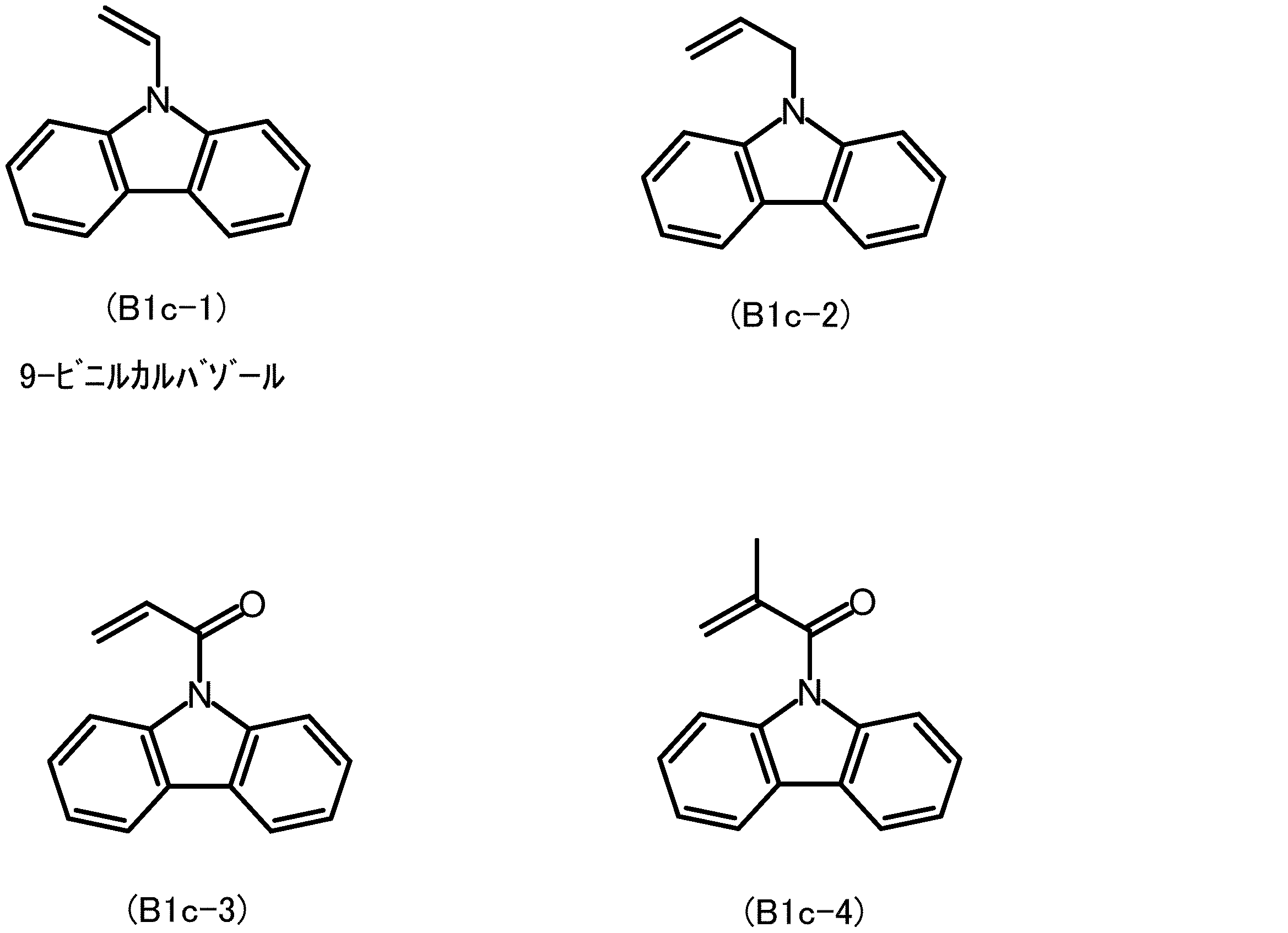
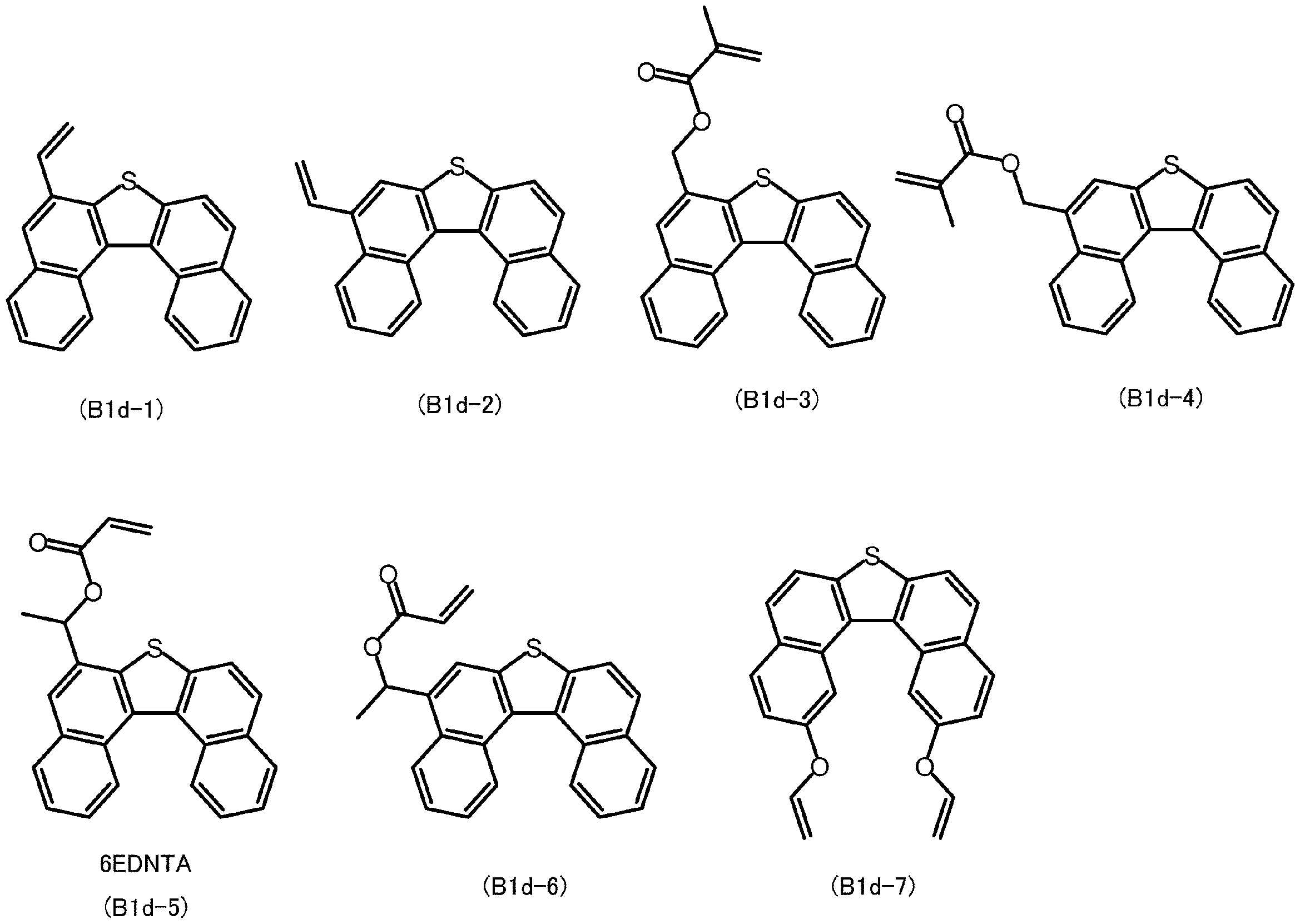
- polymerizable compound (B1) compounds represented by the formulas (B1c-1) to (B1c-4) and the formulas (B1d-1) to (B1d-7) are preferable, and the compounds represented by the formulas (B1c-1) are preferable. And the compound represented by the formula (B1d-5) are more preferable.
- the polymerizable compound (B) is a compound having an ethylenic double bond, preferably the polymerizable group (V), and is different from the polymerizable compound (B1) in a polymerizable compound (BX) (hereinafter, another compound). It may be referred to as a polymerizable compound (BX)).
- the ratio of the polymerizable compound (B1) in the polymerizable compound (B) is, for example, 5% by mass or more, preferably 10% by mass or more, more preferably 15% by mass or more, and for example, 80% by mass or less, preferably. Is 60% by mass or less, more preferably 40% by mass or less.
- the ratio of the other polymerizable compound (BX) in the polymerizable compound (B) is, for example, 20% by mass or more, preferably 40% by mass or more, more preferably 60% by mass or more, and for example, 95% by mass or less. It is preferably 90% by mass or less, more preferably 85% by mass or less.
- the other polymerizable compound (BX) is preferably a polymerizable compound (BX2) that does not contain an aromatic heterocycle, a polyfunctional compound (B2) having a non-ring structure, and a polyfunctional compound having a hydrocarbon ring. (B3), a monofunctional compound (B4) and the like can be mentioned. These other polymerizable compounds (BX) may be used alone or in combination of two or more. As the other polymerizable compound, a monofunctional compound (B4) is preferable.
- Examples of the polyfunctional compound (B2) having an acyclic structure include compounds having two or more (meth) acryloyl groups, and examples of the bifunctional compound having an acyclic structure include ethylene glycol di (meth) acrylate and diethylene glycol di.
- (Meta) acrylate polyethylene glycol di (meth) acrylate, 1,4-butanediol di (meth) acrylate, 1,6-hexanediol di (meth) acrylate, 1,8-octanediol (meth) acrylate, 1,
- the methylene group may be replaced with -O-, such as 9-nonanediol (meth) acrylate, 1,10-decanediol di (meth) acrylate, neopentyl glycol di (meth) acrylate, having 1 to 40 carbon atoms.
- Di (meth) acrylate of alkanediol can be mentioned.
- Examples of the trifunctional or higher functional compound having an acyclic structure include trimethylolpropane tri (meth) acrylate, pentaerythritol tri (meth) acrylate, pentaerythritol tetra (meth) acrylate, dipentaerythritol tetrameth) acrylate, and dipentaerythritol penta.
- Examples include esters with acrylic acid.
- Examples of the polyfunctional compound (B3) having a hydrocarbon ring include compounds having two or more (meth) acryloyl groups, and the bifunctional compound having a hydrocarbon ring is tricyclodecanedimethanol di (meth) acrylate. , Cyclohexanedimethanol di (meth) acrylate, cyclopentanedimethanol di (meth) acrylate and other di (meth) acrylates of cycloalkanodiol having about 4 to 8 carbon atoms; propoxylated bisphenol A di (meth) acrylate, ethoxylated.
- the trifunctional or higher functional compound having a hydrocarbon ring include ethoxylated isocyanurate tri (meth) acrylate, ⁇ -caprolactone-modified tris- (2-acryloxyethyl) isocyanurate, and the like.
- Examples of the monofunctional compound (B4) include ethyl (meth) acrylate, n-butyl (meth) acrylate, isobutyl (meth) acrylate, 2-ethylhexyl (meth) acrylate, and lauryl (meth) acrylate, which have 1 to 12 carbon atoms.
- Alkanol (meth) acrylates alkylene glycol monoether (meth) acrylates such as ethyldiethylene glycol (meth) acrylates; dicyclopentadiene (meth) acrylates, isobornyloxyethyl (meth) acrylates, isobornyl (meth) acrylates, Monofunctional compounds with a hydrocarbon ring such as dicyclopentenyloxyethyl (meth) acrylate, dicyclopentenyl (meth) acrylate, tetrahydrofurfuryl (meth) acrylate, benzyl (meth) acrylate; (meth) acryloylmorpholine, 7- Examples thereof include monofunctional compounds having a nitrogen atom such as amino-3,7-dimethyloctyl (meth) acrylate.
- the polymerizable compound (B) is, for example, 80% by mass or less, preferably 70% by mass or less, and more preferably 60% by mass or less in the curable composition.
- the content of the polymerizable compound (B) is, for example, 20% by mass or more, preferably 30% by mass or more, and more preferably 40% by mass or more.
- the polymerization initiator (C) is not particularly limited as long as it is a compound that can initiate polymerization by generating active radicals, acids and the like by the action of light or heat, and a known polymerization initiator can be used. Photopolymerization initiators are preferred. Examples of the polymerization initiator that generates an active radical include an O-acyloxime compound, an alkylphenone compound, a triazine compound, an acylphosphine oxide compound, a phosphinic acid ester compound, and a biimidazole compound. These polymerization initiators may be used alone or in combination of two or more.
- the O-acyloxime compound is a compound having a partial structure represented by the formula (c1).
- * represents a bond.
- O-acyloxym compound examples include N-benzoyloxy-1- (4-phenylsulfanylphenyl) butane-1-on-2-imine and N-benzoyloxy-1- (4-phenylsulfanylphenyl) octane.
- the alkylphenone compound is a compound having a partial structure represented by the formula (c2) or a partial structure represented by the formula (c3).
- the benzene ring may have a substituent.
- Examples of the compound having a partial structure represented by the formula (c2) include 2-methyl-2-morpholino-1- (4-methylsulfanylphenyl) propan-1-one and 2-dimethylamino-1- (4).
- -Morholinophenyl) -2-benzylbutane-1-one 2- (dimethylamino) -2-[(4-methylphenyl) methyl] -1- [4- (4-morpholinyl) phenyl] butane-1-one
- Commercially available products such as Irgacure 369, 907, 379 (all manufactured by BASF) may be used.
- Examples of the compound having a partial structure represented by the formula (c3) include 2-hydroxy-2-methyl-1-phenylpropan-1-one and 2-hydroxy-2-methyl-1- [4- (2). -Hydroxyethoxy) phenyl] Propane-1-one, 1-hydroxycyclohexylphenylketone, 2-hydroxy-2-methyl-1- (4-isopropenylphenyl) propan-1-one oligomer, ⁇ , ⁇ -diethoxy Examples thereof include acetophenone and benzyldimethylketal.
- triazine compound examples include 2,4-bis (trichloromethyl) -6- (4-methoxyphenyl) -1,3,5-triazine and 2,4-bis (trichloromethyl) -6- (4-). Methoxynaphthyl) -1,3,5-triazine, 2,4-bis (trichloromethyl) -6-piperonyl-1,3,5-triazine, 2,4-bis (trichloromethyl) -6- (4-methoxy) Styryl) -1,3,5-triazine, 2,4-bis (trichloromethyl) -6- [2- (5-methylfuran-2-yl) ethenyl] -1,3,5-triazine, 2,4 -Bis (trichloromethyl) -6- [2- (fran-2-yl) ethenyl] -1,3,5-triazine, 2,4-bis (trichloromethyl) -6- [2- (4-diethyla
- acylphosphine oxide compound examples include 2,4,6-trimethylbenzoyldiphenylphosphine oxide, bis (2,4,6-trimethylbenzoyl) -phenylphosphine oxide and the like.
- Commercially available products such as Irga Cure (registered trademark) 819 (manufactured by BASF) may be used.
- phosphinic acid ester compound examples include phenyl (2,4,6-trimethylbenzoyl) ethyl phosphinate and the like.
- Commercially available products such as Omnirad TPO-L (manufactured by IGM Resins BV) may be used.
- biimidazole compound examples include 2,2'-bis (2-chlorophenyl) -4,4', 5,5'-tetraphenylbiimidazole and 2,2'-bis (2,3-dichlorophenyl)-.
- benzoin compounds such as benzoin, benzoin methyl ether, benzoin ethyl ether, benzoin isopropyl ether and benzoin isobutyl ether; benzophenone, o-methyl benzoyl benzoate, 4-phenylbenzophenone, 4-benzoyl- Benzoyl compounds such as 4'-methyldiphenylsulfide, 3,3', 4,4'-tetra (tert-butylperoxycarbonyl) benzophenone, 2,4,6-trimethylbenzophenone; 9,10-phenanthlenquinone, Kinone compounds such as 2-ethylanthraquinone and camphorquinone; examples thereof include 10-butyl-2-chloroacrydone, benzyl, methyl phenylglycoxylate, and titanosen compounds. These are preferably used in combination with the polymerization initiation aid (C1) (particularly amines)
- the polymerization initiator (C) also includes an acid generator.
- the acid generator include 4-hydroxyphenyldimethylsulfonium p-toluenesulfonate, 4-hydroxyphenyldimethylsulfonium hexafluoroantimonate, 4-acetoxyphenyldimethylsulfonium p-toluenesulfonate, 4-acetoxyphenylmethyl.
- Onium salts such as benzylsulfonium hexafluoroantimonate, triphenylsulfonium p-toluenesulfonate, triphenylsulfonium hexafluoroantimonate, diphenyliodonium p-toluenesulfonate, diphenyliodonium hexafluoroantimonate, and nitrobenzyltosilates, Examples include benzointosylates.
- the polymerization initiator (C) is a polymerization initiator containing at least one selected from the group consisting of an O-acyloxime compound, an alkylphenone compound, a triazine compound, an acylphosphine oxide compound, a phosphinic acid ester compound, and a biimidazole compound.
- a polymerization initiator containing at least one selected from the group consisting of an acylphosphine oxide compound and a phosphinic acid ester compound is more preferable, and a phosphinic acid ester compound is further preferable.
- the total content of the acylphosphine oxide compound and the phosphinic acid ester compound in the polymerization initiator (C) is, for example, 50 mass by mass. % Or more, preferably 70% by mass or more, more preferably 90% by mass or more, and may be 100% by mass.
- the content of the polymerization initiator (C) is, for example, 0.1% by mass or more, preferably 1% by mass or more, more preferably 10% by mass or more, based on 100 parts by mass of the polymerizable compound (B). For example, it is 40% by mass or less, preferably 30% by mass or less, and more preferably 25% by mass or less.
- the polymerization initiator (C1) is a compound or a sensitizer used to promote the polymerization of the polymerizable compound initiated by the polymerization initiator. When the polymerization initiator (C1) is contained, it is usually used in combination with the polymerization initiator (C).
- the polymerization initiation aid (C1) include amine compounds, alkoxyanthracene compounds, thioxanthone compounds and carboxylic acid compounds.
- Examples of the amine compound include triethanolamine, methyldiethanolamine, triisopropanolamine, methyl 4-dimethylaminobenzoate, ethyl 4-dimethylaminobenzoate, isoamyl 4-dimethylaminobenzoate, 2-dimethylaminoethyl benzoate, 4 -2-Ethylhexyl dimethylaminobenzoate, N, N-dimethylparatoluidine, 4,4'-bis (dimethylamino) benzophenone (commonly known as Michler's ketone), 4,4'-bis (diethylamino) benzophenone, 4,4'-bis (Ethylmethylamino) Benzophenone and the like can be mentioned.
- Commercially available products such as EAB-F (manufactured by Hodogaya Chemical Co., Ltd.) may be used.
- alkoxyanthracene compound examples include 9,10-dimethoxyanthracene, 2-ethyl-9,10-dimethoxyanthracene, 9,10-diethoxyanthracene, 2-ethyl-9,10-diethoxyanthracene, and 9,10-di. Butoxyanthracene, 2-ethyl-9,10-dibutoxyanthracene and the like can be mentioned.
- thioxanthone compound examples include 2-isopropylthioxanthone, 4-isopropylthioxanthone, 2,4-diethylthioxanthone, 2,4-dichlorothioxanthone, 1-chloro-4-propoxythioxanthone and the like.
- carboxylic acid compound examples include phenylsulfanyl acetic acid, methylphenylsulfanyl acetic acid, ethylphenylsulfanyl acetic acid, methylethylphenylsulfanyl acetic acid, dimethylphenylsulfanyl acetic acid, methoxyphenylsulfanyl acetic acid, dimethoxyphenylsulfanyl acetic acid, chlorophenylsulfanyl acetic acid, and dichlorophenylsulfanyl acetic acid.
- Examples thereof include N-phenylglycine, phenoxyacetic acid, naphthylthioacetic acid, N-naphthylglycine and naphthoxyacetic acid.
- the content thereof is, for example, 0.1% by mass or more, preferably 1% by mass or more, and more preferably 10% by mass with respect to 100 parts by mass of the polymerizable compound (B). % Or more, for example, 40% by mass or less, preferably 30% by mass or less, and more preferably 25% by mass or less.
- the curable composition may contain a resin (D), a solvent (E) and the like, if necessary.
- the resin (D) is not particularly limited, but is preferably an alkali-soluble resin.
- Examples of the resin (D) include the following resins [K1] to [K6].
- Resin [K1] a structural unit derived from at least one (a) selected from the group consisting of unsaturated carboxylic acids and unsaturated carboxylic acid anhydrides (hereinafter, may be referred to as “(a)”), and 2 carbon atoms.
- a copolymer having a cyclic ether structure of ⁇ 4 and a structural unit derived from a monomer (b) having an ethylenically unsaturated bond (hereinafter, may be referred to as “(b)”); Resin [K2]; Structural unit derived from (a), structural unit derived from (b), and monomer (c) copolymerizable with (a) (however, (a) and (b) are Different.) Copolymer having a structural unit derived from (hereinafter sometimes referred to as “(c)”); Resin [K3]; a copolymer having a structural unit derived from (a) and a structural unit derived from (c); Resin [K4]; A copolymer having a structural unit derived from (a) with (b) added and a structural unit derived from (c); Resin [K5]; A copolymer having a structural unit derived from (b) with (a) added and a structural unit
- (a) include unsaturated monocarboxylic acids such as acrylic acid, methacrylic acid, crotonic acid, o-, m-, and p-vinylbenzoic acid; Maleic acid, fumaric acid, citraconic acid, mesaconic acid, itaconic acid, 3-vinylphthalic acid, 4-vinylphthalic acid, 3,4,5,6-tetrahydrophthalic acid, 1,2,3,6-tetrahydrophthalic acid, dimethyl Unsaturated dicarboxylic acids such as tetrahydrophthalic acid, 1,4-cyclohexendicarboxylic acid; Methyl-5-norbornene-2,3-dicarboxylic acid, 5-carboxybicyclo [2.2.1] hept-2-ene, 5,6-dicarboxybicyclo [2.2.1] hept-2-ene, 5-carboxy-5-methylbicyclo [2.2.1] hept-2-ene, 5-carboxy-5-e
- Examples thereof include unsaturated acrylates containing a hydroxy group and a carboxy group in the same molecule, such as ⁇ - (hydroxymethyl) acrylic acid.
- unsaturated acrylates containing a hydroxy group and a carboxy group in the same molecule such as ⁇ - (hydroxymethyl) acrylic acid.
- acrylic acid, methacrylic acid, maleic anhydride and the like are preferable from the viewpoint of copolymerizability and solubility of the obtained resin in an alkaline aqueous solution.
- (B) is, for example, a polymerizable compound having a cyclic ether structure having 2 to 4 carbon atoms (for example, at least one selected from the group consisting of an oxylan ring, an oxetane ring and a tetrahydrofuran ring) and an ethylenically unsaturated bond.
- a monomer having a cyclic ether having 2 to 4 carbon atoms and a (meth) acryloyloxy group is preferable.
- (meth) acrylic acid represents at least one selected from the group consisting of acrylic acid and methacrylic acid. Notations such as "(meth) acryloyl" and "(meth) acrylate” have the same meaning.
- Examples of (b) include a monomer (b1) having an oxylanyl group and an ethylenically unsaturated bond (hereinafter sometimes referred to as “(b1)”), and a single having an oxetanyl group and an ethylenically unsaturated bond.
- a metric (b2) hereinafter sometimes referred to as "(b2)
- b3 a monomer having a tetrahydrofuryl group and an ethylenically unsaturated bond
- (b1) for example, a monomer (b1-1) having a structure in which a linear or branched aliphatic unsaturated hydrocarbon is epoxidized (hereinafter referred to as “(b1-1)”). There is), a monomer (b1-2) having an epoxidized structure of an alicyclic unsaturated hydrocarbon (hereinafter, may be referred to as “(b1-2)”).
- Examples of (b1-1) include glycidyl (meth) acrylate, ⁇ -methylglycidyl (meth) acrylate, ⁇ -ethylglycidyl (meth) acrylate, glycidyl vinyl ether, o-vinylbenzyl glycidyl ether, m-vinylbenzyl glycidyl ether, and p.
- Examples of (b1-2) include vinylcyclohexene monooxide, 1,2-epoxy-4-vinylcyclohexane (for example, seroxide 2000; manufactured by Dycel Co., Ltd.), and 3,4-epoxycyclohexylmethyl (meth) acrylate (for example,).
- Cyclomer A400 manufactured by Dycel Co., Ltd.
- 3,4-epoxycyclohexylmethyl (meth) acrylate for example, Cyclomer M100; manufactured by Dycel Co., Ltd.
- a compound represented by the formula (I) and a compound represented by the formula (II) examples thereof include compounds represented by.
- Ra and R b represent a hydrogen atom or an alkyl group having 1 to 4 carbon atoms, and the hydrogen atom contained in the alkyl group is substituted with a hydroxy group.
- X a and X b represent a single bond, * -R c-, * -R c-O-, * -R c-S- or * -R c - NH- .
- R c represents an alkanediyl group having 1 to 6 carbon atoms. * Represents a bond with O.
- alkyl group having 1 to 4 carbon atoms examples include a methyl group, an ethyl group, an n-propyl group, an isopropyl group, an n-butyl group, a sec-butyl group, a tert-butyl group and the like.
- the alkyl groups in which the hydrogen atom is substituted with hydroxy include hydroxymethyl group, 1-hydroxyethyl group, 2-hydroxyethyl group, 1-hydroxypropyl group, 2-hydroxypropyl group, 3-hydroxypropyl group and 1-hydroxy.
- R a and R b include a hydrogen atom, a methyl group, a hydroxymethyl group, a 1-hydroxyethyl group and a 2-hydroxyethyl group, and more preferably a hydrogen atom and a methyl group.
- the alkanediyl group includes a methylene group, an ethylene group, a propane-1,2-diyl group, a propane-1,3-diyl group, a butane-1,4-diyl group, a pentane-1,5-diyl group, and a hexane-.
- Examples include 1,6-diyl group.
- Examples of X a and X b are preferably a single bond, a methylene group, an ethylene group, * -CH 2 -O- and * -CH 2 CH 2 -O-, and more preferably a single bond, * -CH 2 . CH 2 -O- can be mentioned (* represents a bond with O).
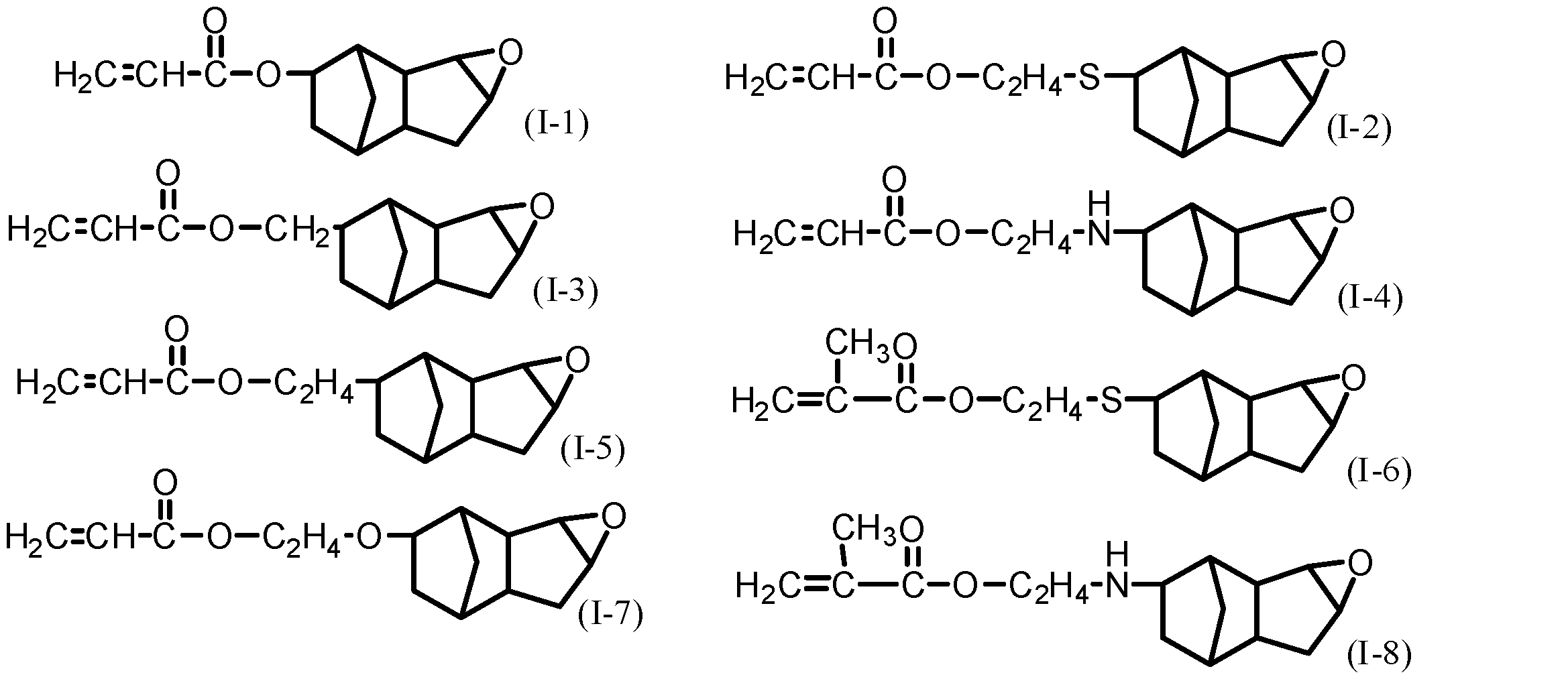
- Examples of the compound represented by the formula (I) include compounds represented by any of the formulas (I-1) to (I-15). Among them, formula (I-1), formula (I-3), formula (I-5), formula (I-7), formula (I-9) or formula (I-11) to formula (I-15).
- the compound represented by the formula (I-1) is preferable, and the compound represented by the formula (I-1), the formula (I-7), the formula (I-9) or the formula (I-15) is more preferable.
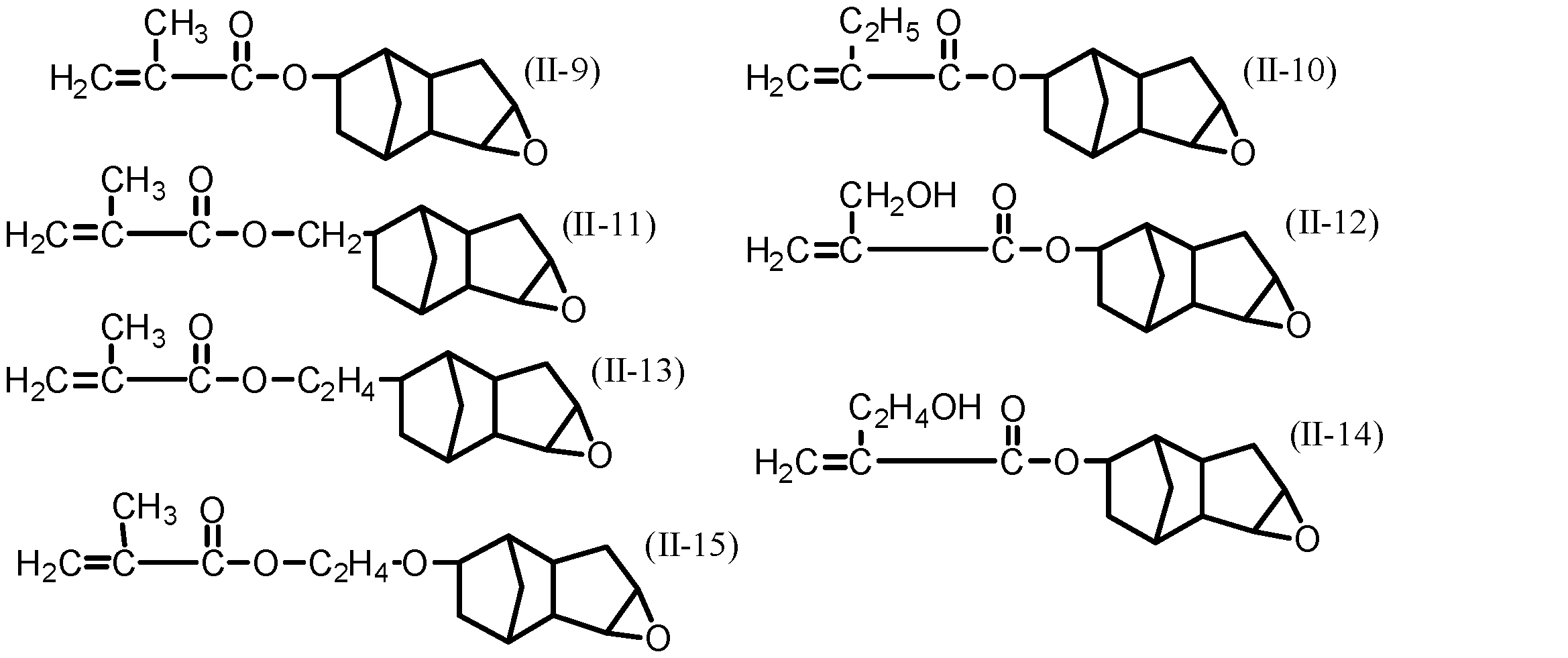
- Examples of the compound represented by the formula (II) include compounds represented by any of the formulas (II-1) to (II-15). Among them, formula (II-1), formula (II-3), formula (II-5), formula (II-7), formula (II-9) or formula (II-11) to formula (II-15). The compound represented by the formula (II-1), the formula (II-7), the formula (II-9) or the compound represented by the formula (II-15) is more preferable.
- the compound represented by the formula (I) and the compound represented by the formula (II) may be used alone or in combination of two or more.
- the content ratio thereof [the compound represented by the formula (I): the compound represented by the formula (II)] is On a molar basis, it is preferably 5:95 to 95: 5, more preferably 20:80 to 80:20.
- (b2) a monomer having an oxetanyl group and a (meth) acryloyloxy group is more preferable.
- Examples of (b2) include 3-methyl-3-methacrylloyloxymethyloxetane, 3-methyl-3-acryloyloxymethyloxetane, 3-ethyl-3-methacryloyloxymethyloxetane, and 3-ethyl-3-acryloyloxymethyloxetane.
- (b3) a monomer having a tetrahydrofuryl group and a (meth) acryloyloxy group is more preferable.
- Specific examples of (b3) include tetrahydrofurfuryl acrylate (for example, Viscort V # 150, manufactured by Osaka Organic Chemical Industry Co., Ltd.), tetrahydrofurfuryl methacrylate and the like.
- (b1) is preferable in that the reliability of the obtained color filter such as heat resistance and chemical resistance can be further improved. Further, (b1-2) is more preferable in that the curable composition has excellent storage stability.
- Examples of (c) include methyl (meth) acrylate, ethyl (meth) acrylate, n-butyl (meth) acrylate, sec-butyl (meth) acrylate, tert-butyl (meth) acrylate, and 2-ethylhexyl (meth).
- Tricyclo [5.2.1.0 2,6 ] decene-8-yl (meth) acrylate (in the art, it is commonly referred to as "dicyclopentenyl (meth) acrylate”.
- Dicyclopentanyloxyethyl (meth) acrylate isobornyl (meth) acrylate, adamantyl (meth) acrylate, allyl (meth) acrylate, propargyl (meth) acrylate, phenyl (meth) acrylate, naphthyl (meth) acrylate, benzyl (Meta) acrylic acid esters such as (meth) acrylate; Hydroxy group-containing (meth) acrylic acid esters such as 2-hydroxyethyl (meth) acrylate and 2-hydroxypropyl (meth) acrylate; Dicarboxylic acid diesters such as diethyl maleate, diethyl fumarate, and diethyl itaconic acid; Bicyclo
- styrene, vinyltoluene, N-phenylmaleimide, N-cyclohexylmaleimide, N-benzylmaleimide, bicyclo [2.2.1] hept-2-ene and the like are selected from the viewpoint of copolymerization reactivity and heat resistance. preferable.
- the ratio of the structural units derived from each is the ratio of all the structural units constituting the resin [K1].
- the ratio of the structural units of the resin [K1] is within the above range, the curable composition tends to be excellent in storage stability, developability when forming a pattern, and solvent resistance of the obtained developed product. ..
- the resin [K1] is, for example, the method described in the document "Experimental Method for Polymer Synthesis” (written by Takayuki Otsu, Kagaku-Dojin Co., Ltd., 1st edition, 1st print, published on March 1, 1972) and the relevant document. It can be manufactured with reference to the cited documents described in.
- a predetermined amount of (a) and (b), a polymerization initiator, a solvent and the like are placed in a reaction vessel, and for example, oxygen is replaced with nitrogen to create a deoxidized atmosphere, and the mixture is stirred. Examples thereof include a method of heating and keeping warm.
- the polymerization initiator, solvent and the like used here are not particularly limited, and those usually used in the art can be used.
- an azo compound (2,2'-azobisisobutyronitrile, 2,2'-azobis (2,4-dimethylvaleronitrile), etc.) or an organic peroxide (benzoyl peroxide, etc.
- any solvent may be used as long as it dissolves each monomer, and examples of the solvent (E) of the curable composition include a solvent described later.
- the solution after the reaction may be used as it is, a concentrated or diluted solution may be used, or the copolymer is taken out as a solid (powder) by a method such as reprecipitation. You may use the one.
- the solvent (E) contained in the curable composition as the solvent during this polymerization, the solution after the reaction can be used as it is for the preparation of the curable composition, so that the curable composition can be used.
- the manufacturing process of goods can be simplified.
- the ratio of the structural units derived from each is the ratio of all the structural units constituting the resin [K2].
- the storage stability of the curable composition, the developability when forming a pattern, and the solvent resistance, heat resistance and heat resistance of the obtained developed product are obtained. It tends to have excellent mechanical strength.
- the resin [K2] can be produced, for example, in the same manner as the method described as the method for producing the resin [K1].
- the ratio of the structural units derived from each is the ratio of all the structural units constituting the resin [K3].
- the resin [K3] can be produced, for example, in the same manner as the method described as the method for producing the resin [K1].
- the resin [K4] is a carboxylic acid and / or a carboxylic acid anhydride having (a) a cyclic ether having 2 to 4 carbon atoms having (b) obtained by obtaining a copolymer of (a) and (c). It can be manufactured by adding it to.
- the copolymer of (a) and (c) is produced in the same manner as the method described as the method for producing the resin [K1]. In this case, the ratio of the structural units derived from each is preferably the same as that mentioned in the resin [K3].
- the cyclic ether having 2 to 4 carbon atoms of (b) is reacted with a part of the carboxylic acid and / or the carboxylic acid anhydride derived from (a) in the copolymer.
- the atmosphere in the flask was replaced with air from nitrogen, and (b) a reaction catalyst of carboxylic acid or carboxylic acid anhydride and cyclic ether (for example, Tris (for example, Tris).
- Resin [K4] can be produced by putting (dimethylaminomethyl) phenol etc.) and a polymerization inhibitor (for example, hydroquinone etc.) in a flask and reacting at 60 to 130 ° C. for 1 to 10 hours, for example. can.
- the amount of (b) used is preferably 5 to 80 mol, more preferably 10 to 75 mol, relative to 100 mol of (a). Within this range, the storage stability of the curable composition, the developability when forming a pattern, and the balance between the solvent resistance, heat resistance, mechanical strength and sensitivity of the obtained developed product tend to be improved. There is. Since the reactivity of the cyclic ether is high and the unreacted (b) is unlikely to remain, (b1) is preferable as the (b) used for the resin [K4], and (b1-1) is more preferable.
- the amount of the reaction catalyst used is preferably 0.001 to 5 parts by mass with respect to 100 parts by mass of the total amount of (a), (b) and (c).
- the amount of the polymerization inhibitor used is preferably 0.001 to 5 parts by mass with respect to 100 parts by mass of the total amount of (a), (b) and (c).
- the reaction conditions such as the charging method, the reaction temperature and the time can be appropriately adjusted in consideration of the production equipment, the calorific value due to the polymerization and the like. As with the polymerization conditions, the charging method and the reaction temperature can be appropriately adjusted in consideration of the production equipment, the calorific value due to the polymerization, and the like.
- the resin [K5] obtains a copolymer of (b) and (c) in the same manner as in the above-mentioned manufacturing method of the resin [K1].
- the obtained copolymer may be a solution after the reaction as it is, a concentrated or diluted solution may be used, or a solid (powder) may be used by a method such as reprecipitation. You may use the one taken out as.
- the ratio of the structural units derived from (b) and (c) is, respectively, with respect to the total number of moles of all the structural units constituting the copolymer.
- the carboxylic acid or carboxylic acid anhydride of (a) is added to the cyclic ether derived from (b) of the copolymer of (b) and (c).
- the resin [K5] can be obtained by reacting an object.
- the amount of (a) used to react with the copolymer is preferably 5 to 80 mol with respect to 100 mol of (b). Since the reactivity of the cyclic ether is high and the unreacted (b) is unlikely to remain, (b1) is preferable as the (b) used for the resin [K5], and (b1-1) is more preferable.
- the resin [K6] is a resin obtained by further reacting the resin [K5] with a carboxylic acid anhydride.
- the carboxylic acid anhydride is reacted with the hydroxy group generated by the reaction of the cyclic ether with the carboxylic acid or the carboxylic acid anhydride.
- carboxylic acid anhydride examples include maleic anhydride, citraconic acid anhydride, itaconic acid anhydride, 3-vinylphthalic anhydride, 4-vinylphthalic anhydride, 3,4,5,6-tetrahydrophthalic anhydride, 1 , 2,3,6-tetrahydrophthalic anhydride, dimethyltetrahydrophthalic anhydride, 5,6-dicarboxybicyclo [2.2.1] hept-2-ene anhydride and the like.
- the amount of the carboxylic acid anhydride used is preferably 0.5 to 1 mol with respect to 1 mol of the amount used in (a).
- the resin (D) include 3,4-epoxycyclohexylmethyl (meth) acrylate / (meth) acrylic acid copolymer and 3,4-epoxytricyclo [5.2.1.0 2,6 . ] Resins such as decyl acrylate / (meth) acrylic acid copolymer [K1]; glycidyl (meth) acrylate / benzyl (meth) acrylate / (meth) acrylic acid copolymer, glycidyl (meth) acrylate / styrene / (meth) ) Acrylic acid copolymer, 3,4-epoxytricyclo [5.2.1.0 2,6 ] decylacrylate / (meth) acrylic acid / N-cyclohexylmaleimide copolymer, 3-methyl-3-( Resin [K2] such as meta) acrylic loyloxymethyloxetane / (meth) acrylic acid / sty
- Resins with glycidyl (meth) acrylate added to the coalescence resins such as tricyclodecyl (meth) acrylate / benzyl (meth) acrylate / (meth) acrylic acid copolymer with glycidyl (meth) acrylate added [ K4]; Co-weight of tricyclodecyl (meth) acrylate / styrene / glycidyl (meth) acrylate, a resin obtained by reacting a copolymer of tricyclodecyl (meth) acrylate / glycidyl (meth) acrylate with (meth) acrylic acid.
- a resin such as a resin obtained by reacting a (meth) acrylic acid with a coalescence [K5]; a resin obtained by reacting a (meth) acrylic acid with a copolymer of tricyclodecyl (meth) acrylate / glycidyl (meth) acrylate and further tetrahydro.
- a resin [K6] such as a resin obtained by reacting phthalic acid anhydride.
- the resin [K1] and the resin [K2] are preferable, and the resin [K2] is particularly preferable.
- the polystyrene-equivalent weight average molecular weight of the resin (D) is preferably 3,000 to 100,000, more preferably 5,000 to 50,000, and even more preferably 5,000 to 30,000. ..
- the molecular weight is within the above range, the hardness of the color filter is improved, the residual film ratio is high, the solubility of the unexposed portion in the developing solution is good, and the resolution of the pattern tends to be improved.
- the degree of dispersion [weight average molecular weight (Mw) / number average molecular weight (Mn)] of the resin (D) is preferably 1.1 to 6, and more preferably 1.2 to 4.
- the acid value of the resin (D) is preferably 50 to 170 mg-KOH / g, more preferably 60 to 150 mg-KOH / g, and even more preferably 70 to 135 mg-KOH / g in terms of solid content.
- the acid value is a value measured as the amount (mg) of potassium hydroxide required to neutralize 1 g of the resin (D), and can be obtained by titration using, for example, an aqueous potassium hydroxide solution. ..
- the solid content of the resin (D) in the curable composition is, for example, 200 parts by mass or less, preferably 100 parts by mass or less, more preferably 50 parts by mass or less, based on 100 parts by mass of the polymerizable compound (B). Even more preferably, it is 30 parts by mass or less, particularly preferably 10 parts by mass or less, and it may be 0 parts by mass.
- the solvent (E) is not particularly limited, and a solvent usually used in the art can be used.
- a solvent usually used in the art can be used.
- an ester solvent solvent containing -COO- in the molecule and not containing -O-
- an ether solvent solvent containing -O- in the molecule and not containing -COO-
- an ether ester solvent intramolecular
- Solvent containing -COO- and -O- Solvent containing -COO- and -O-), Ketone solvent (solvent containing -CO- in the molecule and not containing -COO-), alcohol solvent (solvent containing OH in the molecule, -O-,- Examples thereof include CO- and -COO-free solvents), alcohol ketone solvents (solvents containing OH and -CO- in the molecule), aromatic hydrocarbon solvents, amide solvents, dimethylsulfoxide and the like.
- Ester solvents include methyl lactate, ethyl lactate, butyl lactate, methyl 2-hydroxyisobutate, ethyl acetate, n-butyl acetate, isobutyl acetate, pentyl formate, isopentyl acetate, butyl propionate, isopropyl butyrate, ethyl butyrate, butyl butyrate. , Methyl pyruvate, ethyl pyruvate, propyl pyruvate, methyl acetoacetate, ethyl acetoacetate, cyclohexanol acetate, ⁇ -butyrolactone and the like.
- ether solvent examples include ethylene glycol monomethyl ether, ethylene glycol monoethyl ether, ethylene glycol monopropyl ether, ethylene glycol monobutyl ether, diethylene glycol monomethyl ether, diethylene glycol monoethyl ether, diethylene glycol monobutyl ether, propylene glycol monomethyl ether, and propylene glycol monoethyl ether.
- ether ester solvent examples include methyl methoxyacetate, ethyl methoxyacetate, butyl methoxyacetate, methyl ethoxyacetate, ethyl ethoxyacetate, methyl 3-methoxypropionate, ethyl 3-methoxypropionate, methyl 3-ethoxypropionate, 3-ethoxy.
- Ethyl propionate methyl 2-methoxypropionate, ethyl 2-methoxypropionate, propyl 2-methoxypropionate, methyl 2-ethoxypropionate, ethyl 2-ethoxypropionate, methyl 2-methoxy-2-methylpropionate, Ethyl 2-ethoxy-2-methylpropionate, 3-methoxybutyl acetate, 3-methyl-3-methoxybutyl acetate, propylene glycol monomethyl ether acetate, propylene glycol monoethyl ether acetate, propylene glycol monopropyl ether acetate, ethylene glycol monomethyl Examples thereof include ether acetate, ethylene glycol monoethyl ether acetate, diethylene glycol monoethyl ether acetate and diethylene glycol monobutyl ether acetate.
- ketone solvent examples include 4-hydroxy-4-methyl-2-pentanone, acetone, methyl ethyl ketone, 2-heptanone, 3-heptanone, 4-heptanone, 4-methyl-2-pentanone, cyclopentanone, cyclohexanone and isophorone. Can be mentioned.
- alcohol solvent examples include methanol, ethanol, propanol, butanol, hexanol, cyclohexanol, ethylene glycol, propylene glycol, glycerin and the like.
- Examples of the alcohol ketone solvent include a dimer of a ketone selected from the above-mentioned ketone solvents such as diacetone alcohol.
- Examples of the aromatic hydrocarbon solvent include benzene, toluene, xylene and mesitylene.
- Examples of the amide solvent include N, N-dimethylformamide, N, N-dimethylacetamide and N-methylpyrrolidone.
- an organic solvent having a boiling point of 120 ° C. or higher and 180 ° C. or lower at 1 atm is preferable from the viewpoint of workability and dryness.
- the solvent propylene glycol monomethyl ether acetate, ethyl lactate, propylene glycol monomethyl ether, ethyl 3-ethoxypropionate, ethylene glycol monomethyl ether, diethylene glycol monomethyl ether, diethylene glycol monoethyl ether, 4-hydroxy-4-methyl-2-pentanone , Methyl ethyl ketone, butyl acetate, 2-heptanone, diacetone alcohol and N, N-dimethylformamide are preferred, and propylene glycol monomethyl ether acetate, propylene glycol monomethyl ether, ethyl lactate ethyl ketone and ethyl 3-ethoxypropionate are more preferred.
- the content of the solvent (E) in the curable composition is, for example, 40% by mass or less, preferably 30% by mass or less, more preferably 20% by mass or less. It is even more preferably 15% by mass or less, particularly preferably 10% by mass or less, and most preferably 5% by mass or less.
- the curable composition of the present invention has high fluidity and excellent workability even if it does not contain a solvent.
- the curable composition may contain a surfactant (F).
- the surfactant (F) can be used as a leveling agent, and examples thereof include a silicone-based surfactant, a fluorine-based surfactant, and a silicone-based surfactant having a fluorine atom. These may have a polymerizable group in the side chain.
- silicone-based surfactant examples include a surfactant having a siloxane bond in the molecule.
- examples of the surfactant having a siloxane bond in the molecule include octamethylcyclotetrasiloxane.
- Silicone-based surfactants include Torre Silicone DC3PA, SH7PA, DC11PA, SH21PA, SH28PA, SH29PA, SH30PA, SH8400 (trade name: manufactured by Toray Dow Corning Co., Ltd.), KF994, KP321, KP322.
- TSF400 TSF401, TSF410, TSF4300, TSF4440, TSF4445, TSF4446, TSF4452 and TSF4460 (manufactured by Momentive Performance Materials Japan) And so on.
- fluorine-based surfactant examples include surfactants having a fluorocarbon chain in the molecule. Specifically, Florard (registered trademark) FC430, FC431 (manufactured by Sumitomo 3M Co., Ltd.), Megafuck (registered trademark) F142D, F171, F172, F173, F177, F183, F554, and F554.
- R30, RS-718-K (manufactured by DIC Co., Ltd.), Ftop (registered trademark) EF301, EF303, EF351, EF352 (manufactured by Mitsubishi Materials Electronics Co., Ltd.), Surflon (registered trademark) S381, Examples thereof include S382, SC101, SC105 (manufactured by Asahi Glass Co., Ltd.) and E5844 (manufactured by Daikin Fine Chemical Laboratory Co., Ltd.).
- silicone-based surfactant having a fluorine atom examples include a surfactant having a siloxane bond and a fluorocarbon chain in the molecule. Specific examples thereof include Megafuck (registered trademark) R08, BL20, F475, F477 and F443 (manufactured by DIC Corporation).
- the content thereof may be, for example, 0.001% by mass or more and 2% by mass or less, and 0.001% by mass or more, based on the total amount of the curable composition. It may be 1.5% by mass or less. This content is preferably 0.001% by mass or more and 0.2% by mass or less, more preferably 0.002% by mass or more and 0.1% by mass or less, and further preferably 0.005% by mass or more and 0.07. It is less than mass%.
- the curable composition of the present invention contains, if necessary, additives known in the art such as fillers, other polymer compounds, adhesion promoters, antioxidants, light stabilizers, chain transfer agents and the like. But it may be.
- the viscosity of the curable composition of the present invention at a temperature of 23 ° C. is, for example, 200 mPa ⁇ s or less, preferably 150 mPa ⁇ s or less, more preferably 120 mPa ⁇ s or less, and particularly preferably 100 mPa ⁇ s. It is as follows.
- the viscosity is, for example, 1 mPa ⁇ s or more. When the viscosity is in the above range, clogging of ink and flight bending are less likely to occur when the cured film is formed by using the inkjet method.
- the viscosity can be measured, for example, by using an E-type viscometer and optimizing the rotor rotation speed (preferably 1 rpm).
- the curable composition of the present invention has excellent visible light transmittance. Specifically, the average value of the transmittance of the cured film obtained by the following film forming method 1 at a wavelength of 400 to 700 nm is 90% or more, preferably 93% or more, more preferably 95% or more per 1.0 ⁇ m film thickness. become. Further, the total transmittance of the cured film obtained by the following film forming method 1 in the wavelength range of 400 to 700 nm is preferably 90% or more, more preferably 93% or more per 1.0 ⁇ m film thickness. , 95% or more is more preferable.
- [Film formation method 1] A curable composition is applied onto a glass substrate so that the average thickness of the cured film falls within the range of 1.0 ⁇ 0.2 ⁇ m, and UV with a wavelength of 385 nm is irradiated with an integrated light intensity of 2000 J / m 2 using an LED lamp. do.
- the transmittance T (when the film thickness is 1.0 ⁇ m) is assumed to be the transmittance per 1.0 ⁇ m as it is, and the average thickness of the obtained cured film is assumed to be 1.0 ⁇ m.
- the transmittance T (at a film thickness of 1.0 ⁇ m) based on 10 T, the transmittance T per film thickness of 1.0 ⁇ m is obtained. Then, the average value of the transmittance per 1.0 ⁇ m film thickness at a wavelength of 400 to 700 nm is calculated.
- the curable composition of the present invention has a high refractive index.
- the refractive index of the cured film obtained by the following film forming method 2 measured with a spectroscopic ellipsometer at a wavelength of 550 nm is, for example, 1.5 or more, preferably 1.6 or more, more preferably 1.7.
- the above is, for example, 3.0 or less, preferably 2.5 or less, and more preferably 2.0 or less.
- Each curable composition obtained by using a spin coater is applied onto a 4-inch Si wafer substrate so that the average film thickness of the cured film is 0.5 ⁇ m. Using an LED lamp, UV with a wavelength of 385 nm is irradiated with an integrated light amount of 2000 J / m 2 .
- a cured film can be produced by treating the curable composition by a wet method such as a printing method, a capillary coating method, or a nozzle coating method. Further, a patterned cured film may be produced by using a photolithography method, an inkjet printing method, or the like.
- the thickness of the cured film is usually about 1 nm to 50 ⁇ m, preferably 1 ⁇ m to 50 ⁇ m.
- the cured film can be used as a microlens, a sealing material, or the like, and is particularly preferable to be used as a microlens, a sealing material, or the like of a light emitting element.
- Example 1 Manufacturing of inorganic fine particle dispersion
- Benzyl acrylate manufactured by Tokyo Kasei Kogyo Co., Ltd.
- zirconium oxide dispersion zirconium oxide dispersion
- methyl ethyl ketone was removed by distillation under reduced pressure to obtain a benzyl acrylate dispersion of zirconium oxide particles (hereinafter referred to as an inorganic fine particle dispersion).
- the component ratio of the inorganic fine particle dispersion was prepared, and as a polymerization initiator, phenyl (2,4,6-trimethylbenzoyl) ethyl phosphinate (Omnirad TPO-L, manufactured by IGM Resins B.V., Inc., hereinafter TPO-L) was prepared. () was blended in 8 parts by mass and dissolved, and then filtered with a membrane filter made of PTFE to obtain a curable composition 1.
- Example 2 The curable composition 2 was prepared in the same manner as in Example 1 except that 6-ethylacrylate dinaphthophene (6EDNTA, manufactured by Sugai Chemical Industry Co., Ltd.) was used instead of 9-vinylcarbazole as the polymerizable compound. Obtained.
- 6-ethylacrylate dinaphthophene (6EDNTA, manufactured by Sugai Chemical Industry Co., Ltd.) was used instead of 9-vinylcarbazole as the polymerizable compound. Obtained.
- Example 3 An inorganic fine particle dispersion was produced in the same manner as in Example 1.
- the mass of zirconium oxide particles is 37 parts by mass
- the mass of dispersant is 9 parts by mass
- the mass of benzyl acrylate is 31 parts by mass
- the mass of 9-vinylcarbazole (manufactured by Tokyo Kasei Kogyo Co., Ltd.) is 14 parts by mass.
- the component ratio of the inorganic fine particle dispersion was prepared, and 1 part by mass of octamethylcyclotetrasiloxane (manufactured by Tokyo Kasei Kogyo Co., Ltd.) as a surfactant and 8 parts by mass of TPO-L as a polymerization initiator were added. Then, the mixture was filtered through a membrane filter made of PTFE to obtain a curable composition 3.
- Example 4 The curable composition 4 was prepared in the same manner as in Example 3 except that 6-ethylacrylate dinaphthophene (6EDNTA, manufactured by Sugai Chemical Industry Co., Ltd.) was used instead of 9-vinylcarbazole as the polymerizable compound. Obtained.
- 6-ethylacrylate dinaphthophene (6EDNTA, manufactured by Sugai Chemical Industry Co., Ltd.) was used instead of 9-vinylcarbazole as the polymerizable compound. Obtained.
- Comparative Example 1 No benzyl acrylate was used as the polymerizable compound, and instead of 9-vinylcarbazole, tricyclodecanedimethanol diacrylate (A-DCP, manufactured by Shin-Nakamura Chemical Industry Co., Ltd., hereinafter referred to as A-DCP), 1 , 10-Decandiol diacrylate (A-DOD-N, manufactured by Shin-Nakamura Chemical Industry Co., Ltd., hereinafter referred to as A-DOD-N) and isobutyl methacrylate (manufactured by Tokyo Kasei Kogyo Co., Ltd.).
- A-DCP tricyclodecanedimethanol diacrylate
- A-DCP 9-vinylcarbazole
- A-DCP tricyclodecanedimethanol diacrylate
- A-DOD-N 10-Decandiol diacrylate
- A-DOD-N isobutyl methacrylate
- Octamethylcyclotetrasiloxane manufactured by Tokyo Kasei Kogyo Co., Ltd. was further used as the surfactant, and bis (2,4,6-trimethylbenzoyl)-in place of 8 parts by mass of TPO-L as the polymerization initiator.
- a comparative curable composition 1 was obtained in the same manner as in Example 1 except that 5 parts by mass of phenylphosphine oxide (IRGACURE (registered trademark) 819, manufactured by BASF, also referred to as IRG819) was used.
- the comparatively curable composition 1 contains 37 parts by mass of zirconium oxide particles, 9 parts by mass of a dispersant, 24 parts by mass of A-DCP, 14 parts by mass of A-DOD-N, 10 parts by mass of isobutylmethacrylate, and IRG819. It contained 5 parts by mass and 1 part by mass of octamethylcyclotetrasiloxane.
- the transmittance of the cured film from 400 nm to 700 nm was measured using a microspectroscopy, and the average transmittance was taken as the transmittance of the cured film.
- Manufacturing of cured film and its evaluation 4 4. Refractive index Each of the obtained curable compositions was applied onto a 4-inch Si wafer substrate using a spin coater so that the average film thickness of the cured film was 0.5 ⁇ m. Then, using an LED lamp, UV with a wavelength of 385 nm was irradiated with an integrated light amount of 2000 J / m 2 .
- the cured product is irradiated with light having a wavelength in the range of 400 nm to 1600 nm at angles of 60 °, 70 °, and 75 ° to obtain a refractive index with a wavelength of 550 nm, which is determined by the refractive index of the cured film. And said.
Landscapes
- Chemical & Material Sciences (AREA)
- Health & Medical Sciences (AREA)
- Chemical Kinetics & Catalysis (AREA)
- Medicinal Chemistry (AREA)
- Polymers & Plastics (AREA)
- Organic Chemistry (AREA)
- Addition Polymer Or Copolymer, Post-Treatments, Or Chemical Modifications (AREA)
- Polymerisation Methods In General (AREA)
Abstract
Description
本発明の目的は、硬化性に優れる硬化性組成物を提供することにある。
[1] 無機微粒子(A)、重合性化合物(B)、及び重合開始剤(C)を含有し、
前記重合性化合物(B)が、ビニル基、1-メチルビニル基、アリル基、メタリル基、アクリロイル基、メタクリロイル基、ビニルオキシ基、1-メチルビニルオキシ基、アリルオキシ基、メタリルオキシ基、アクリロイルオキシ基、及びメタクリロイルオキシ基からなる群より選ばれる重合性基の1つ又は2つと、芳香族複素環とを有する化合物を含有する、硬化性組成物。
[2] 前記重合性化合物(B)が式(B1b)で表される化合物である[1]に記載の硬化性組成物。
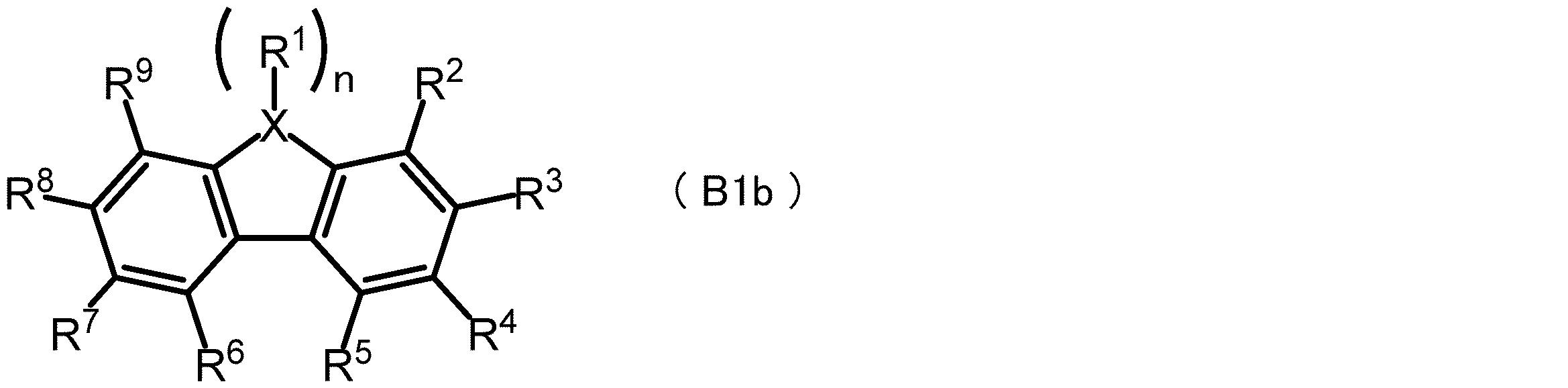
Xが酸素原子又は硫黄原子のとき、nは0である。
Xが窒素原子のとき、nは1であり、R1は水素原子、炭素数1~20のアルキル基、ビニル基、1-メチルビニル基、アリル基、メタリル基、アクリロイル基、又はメタクリロイル基である。
R2~R9は、水素原子、ビニル基、1-メチルビニル基、アリル基、メタリル基、アクリロイル基、メタクリロイル基、ビニルオキシ基、1-メチルビニルオキシ基、アリルオキシ基、メタリルオキシ基、アクリロイルオキシ基、メタクリロイルオキシ基、炭素数1~20のアルキル基、又は置換基であり、R2~R9のうち隣接する2つは互いに結合して芳香族炭化水素環を形成してもよく、この芳香族炭化水素環には、ビニル基、1-メチルビニル基、アリル基、メタリル基、アクリロイル基、メタクリロイル基、ビニルオキシ基、1-メチルビニルオキシ基、アリルオキシ基、メタリルオキシ基、アクリロイルオキシ基、メタクリロイルオキシ基、炭素数1~20のアルキル基、又は置換基が結合していてもよい。
前記炭素数1~20のアルキル基には、ビニル基、1-メチルビニル基、アクリロイル基、メタクリロイル基、ビニルオキシ基、1-メチルビニルオキシ基、アリルオキシ基、メタリルオキシ基、アクリロイルオキシ基、メタクリロイルオキシ基又は置換基が結合していてもよい。
前記置換基は、ハロゲン原子、ヒドロキシ基、-NRaRb(Ra及びRbは、それぞれ独立に、水素原子または炭素数1~20のアルキル基である)、ニトロ基、炭素数1~10のアルコキシ基、又は炭素数2~10のアルコキシカルボニル基である。
式(B1b)で表される化合物は、ビニル基、1-メチルビニル基、アリル基、メタリル基、アクリロイル基、メタクリロイル基、ビニルオキシ基、1-メチルビニルオキシ基、アリルオキシ基、メタリルオキシ基、アクリロイルオキシ基、及びメタクリロイルオキシ基からなる群より選ばれる基を1つ又は2つ有する。)
[3] 芳香族複素環を含まない重合性化合物(BX2)をさらに含有する[1]または[2]に記載の硬化性組成物。
[4] 前記無機微粒子(A)の含有率が、硬化性組成物中、20質量%以上である[1]~[3]のいずれかに記載の硬化性組成物。
[5] [1]~[4]のいずれかに記載の硬化性組成物から形成される硬化膜。
前記無機微粒子(A)は、可視光域への波長変換能を有さない粒子であることが好ましく、また屈折率が1.6以上である粒子が好ましい。無機微粒子(A)の屈折率が高くなるほど、硬化性組成物から得られる膜の屈折率も高くなり、発光層からの光取り出し効率が向上する。屈折率は、好ましくは1.8以上であり、より好ましくは2.0以上である。また屈折率は、例えば、3.5以下であってもよく、3.0以下であってもよい。前記屈折率は、ナトリウムのD線での値である。
分散剤としては、市販品を用いることもでき、例えば、DISPERBYK-101、DISPERBYK-130、DISPERBYK-140、DISPERBYK-160、DISPERBYK-161、DISPERBYK-162、DISPERBYK-163、DISPERBYK-164、DISPERBYK-165、DISPERBYK-166、DISPERBYK-170、DISPERBYK-171、DISPERBYK-182、DISPERBYK-2000、DISPERBYK-2001(BYK Chemie, GMBH)、Solsperse 32000、Solsperse 36000、Solsperse 28000、Solsperse 20000、Solsperse 41000、及びSolsperse 45000(Lubrizol, Wickliffe, OH, USA)が挙げられる。
重合性化合物(B)は、ビニル基、1-メチルビニル基、アリル基、メタリル基、アクリロイル基、メタクリロイル基、ビニルオキシ基、1-メチルビニルオキシ基、アリルオキシ基、メタリルオキシ基、アクリロイルオキシ基、及びメタクリロイルオキシ基からなる群より選ばれる重合性基(以下、重合性基(V)という場合がある)の1つ又は2つと、芳香族複素環とを有する化合物(以下、重合性化合物(B1)という場合がある)を含有する。
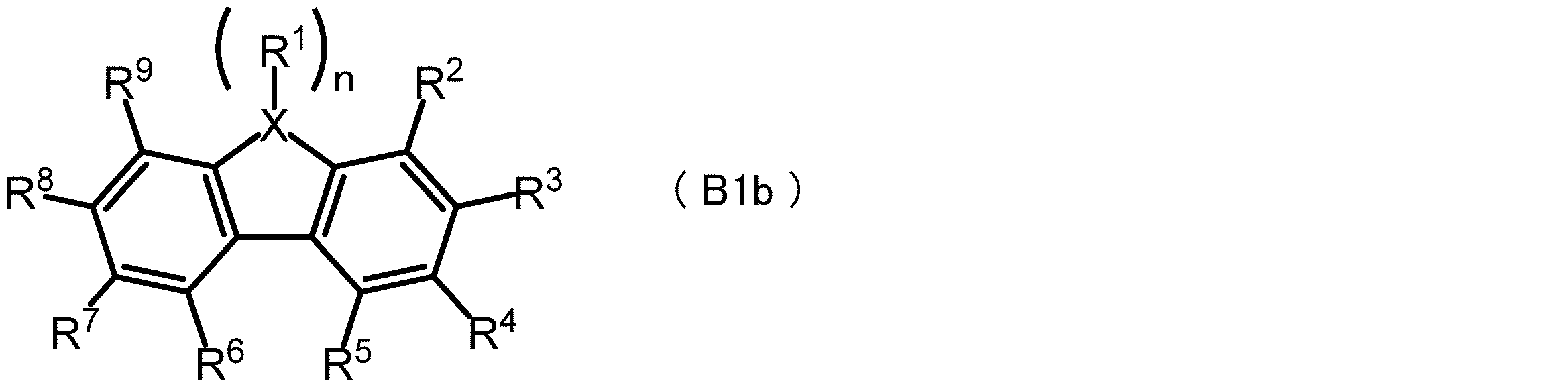
Xが酸素原子又は硫黄原子のとき、nは0である。
Xが窒素原子のとき、nは1であり、R1は水素原子、炭素数1~20のアルキル基、ビニル基、1-メチルビニル基、アリル基、メタリル基、アクリロイル基、又はメタクリロイル基である。
R2~R9は、水素原子、ビニル基、1-メチルビニル基、アリル基、メタリル基、アクリロイル基、メタクリロイル基、ビニルオキシ基、1-メチルビニルオキシ基、アリルオキシ基、メタリルオキシ基、アクリロイルオキシ基、メタクリロイルオキシ基、炭素数1~20のアルキル基、又は置換基であり、R2~R9のうち隣接する2つは互いに結合して芳香族炭化水素環を形成してもよく、この芳香族炭化水素環には、ビニル基、1-メチルビニル基、アリル基、メタリル基、アクリロイル基、メタクリロイル基、ビニルオキシ基、1-メチルビニルオキシ基、アリルオキシ基、メタリルオキシ基、アクリロイルオキシ基、メタクリロイルオキシ基、炭素数1~20のアルキル基、又は置換基が結合していてもよい。
前記炭素数1~20のアルキル基には、ビニル基、1-メチルビニル基、アクリロイル基、メタクリロイル基、ビニルオキシ基、1-メチルビニルオキシ基、アリルオキシ基、メタリルオキシ基、アクリロイルオキシ基、メタクリロイルオキシ基、又は置換基が結合していてもよい。
前記置換基は、ハロゲン原子、ヒドロキシ基、-NRaRb(Ra及びRbは、それぞれ独立に、水素原子または炭素数1~20のアルキル基である)、ニトロ基、炭素数1~10のアルコキシ基、又は炭素数2~10のアルコキシカルボニル基である。
式(B1b)で表される化合物は、ビニル基、1-メチルビニル基、アリル基、メタリル基、アクリロイル基、メタクリロイル基、ビニルオキシ基、1-メチルビニルオキシ基、アリルオキシ基、メタリルオキシ基、アクリロイルオキシ基、及びメタクリロイルオキシ基からなる群より選ばれる基を1つ又は2つ有する。)
R2~R9が結合して形成される芳香族炭化水素環としては、ベンゼン環、ナフタレン環、アントラセン環などが挙げられる。
Xが酸素原子、又は硫黄原子である場合、R2~R9の1つ又は2つが、それぞれ独立して、ビニル基、1-メチルビニル基、アリル基、メタリル基、アクリロイル基、メタクリロイル基、ビニルオキシ基、1-メチルビニルオキシ基、アリルオキシ基、メタリルオキシ基、アクリロイルオキシ基、又はメタクリロイルオキシ基であることが好ましい。
炭化水素環を有する3官能以上の化合物としては、エトキシ化イソシアヌル酸トリ(メタ)アクリレート、ε-カプロラクトン変性トリス-(2-アクリロキシエチル)イソシアヌレートなどが挙げられる。
重合開始剤(C)は、光や熱の作用により活性ラジカル、酸等を発生し、重合を開始しうる化合物であれば特に限定されることなく、公知の重合開始剤を用いることができ、光重合開始剤が好ましい。活性ラジカルを発生する重合開始剤としては、例えば、O-アシルオキシム化合物、アルキルフェノン化合物、トリアジン化合物、アシルホスフィンオキサイド化合物、ホスフィン酸エステル化合物、ビイミダゾール化合物などが挙げられる。これら重合開始剤は、単独で用いてもよく、2種以上を組み合わせてもよい。


式(c3)で表される部分構造を有する化合物としては、例えば、2-ヒドロキシ-2-メチル-1-フェニルプロパン-1-オン、2-ヒドロキシ-2-メチル-1-〔4-(2-ヒドロキシエトキシ)フェニル〕プロパン-1-オン、1-ヒドロキシシクロヘキシルフェニルケトン、2-ヒドロキシ-2-メチル-1-(4-イソプロペニルフェニル)プロパン-1-オンのオリゴマー、α,α-ジエトキシアセトフェノン、ベンジルジメチルケタールなどが挙げられる。
アシルホスフィンオキサイド化合物及びホスフィン酸エステル化合物からなる群から選ばれる少なくとも1種を含む場合、重合開始剤(C)中、アシルホスフィンオキサイド化合物及びホスフィン酸エステル化合物の合計の含有率は、例えば、50質量%以上、好ましくは70質量%以上、より好ましくは90質量%以上であり、100質量%であってもよい。
重合開始助剤(C1)は、重合開始剤によって重合が開始された重合性化合物の重合を促進するために用いられる化合物、もしくは増感剤である。重合開始助剤(C1)を含む場合、通常、重合開始剤(C)と組み合わせて用いられる。
重合開始助剤(C1)としては、アミン化合物、アルコキシアントラセン化合物、チオキサントン化合物及びカルボン酸化合物などが挙げられる。
重合開始助剤(C1)を用いる場合、その含有量は、重合性化合物(B)100質量部に対して、例えば、0.1質量%以上、好ましくは1質量%以上、より好ましくは10質量%以上であり、例えば、40質量%以下、好ましくは30質量%以下、より好ましくは25質量%以下である。
<樹脂(D)>
樹脂(D)は、特に限定されないが、アルカリ可溶性樹脂であることが好ましい。樹脂(D)としては、以下の樹脂[K1]~[K6]等が挙げられる。
樹脂[K1];不飽和カルボン酸及び不飽和カルボン酸無水物からなる群から選ばれる少なくとも1種(a)(以下「(a)」という場合がある)に由来する構造単位と、炭素数2~4の環状エーテル構造とエチレン性不飽和結合とを有する単量体(b)(以下「(b)」という場合がある)に由来する構造単位とを有する共重合体;
樹脂[K2];(a)に由来する構造単位と(b)に由来する構造単位と、(a)と共重合可能な単量体(c)(ただし、(a)及び(b)とは異なる。)(以下「(c)」という場合がある)に由来する構造単位とを有する共重合体;
樹脂[K3];(a)に由来する構造単位と(c)に由来する構造単位とを有する共重合体;
樹脂[K4];(a)に由来する構造単位に(b)を付加させた構造単位と(c)に由来する構造単位とを有する共重合体;
樹脂[K5];(b)に由来する構造単位に(a)を付加させた構造単位と(c)に由来する構造単位とを有する共重合体;
樹脂[K6];(b)に由来する構造単位に(a)を付加させ、カルボン酸無水物をさらに付加させた構造単位と(c)に由来する構造単位とを有する共重合体。
マレイン酸、フマル酸、シトラコン酸、メサコン酸、イタコン酸、3-ビニルフタル酸,4-ビニルフタル酸、3,4,5,6-テトラヒドロフタル酸、1,2,3,6-テトラヒドロフタル酸、ジメチルテトラヒドロフタル酸、1、4-シクロヘキセンジカルボン酸等の不飽和ジカルボン酸類;
メチル-5-ノルボルネン-2,3-ジカルボン酸、5-カルボキシビシクロ[2.2.1]ヘプト-2-エン、5,6-ジカルボキシビシクロ[2.2.1]ヘプト-2-エン、5-カルボキシ-5-メチルビシクロ[2.2.1]ヘプト-2-エン、5-カルボキシ-5-エチルビシクロ[2.2.1]ヘプト-2-エン、5-カルボキシ-6-メチルビシクロ[2.2.1]ヘプト-2-エン、5-カルボキシ-6-エチルビシクロ[2.2.1]ヘプト-2-エン等のカルボキシ基を含有するビシクロ不飽和化合物類;
無水マレイン酸、シトラコン酸無水物、イタコン酸無水物、3-ビニルフタル酸無水物、4-ビニルフタル酸無水物、3,4,5,6-テトラヒドロフタル酸無水物、1,2,3,6-テトラヒドロフタル酸無水物、ジメチルテトラヒドロフタル酸無水物、5,6-ジカルボキシビシクロ[2.2.1]ヘプト-2-エン無水物等の不飽和ジカルボン酸類無水物;
こはく酸モノ〔2-(メタ)アクリロイルオキシエチル〕、フタル酸モノ〔2-(メタ)アクリロイルオキシエチル〕等の2価以上の多価カルボン酸の不飽和モノ〔(メタ)アクリロイルオキシアルキル〕エステル類;
α-(ヒドロキシメチル)アクリル酸のような、同一分子中にヒドロキシ基及びカルボキシ基を含有する不飽和アクリレート類等が挙げられる。
これらのうち、共重合反応性の点や得られる樹脂のアルカリ水溶液への溶解性の点から、アクリル酸、メタクリル酸、無水マレイン酸等が好ましい。
尚、本明細書において、「(メタ)アクリル酸」とは、アクリル酸及びメタクリル酸よりなる群から選ばれる少なくとも1種を表す。「(メタ)アクリロイル」及び「(メタ)アクリレート」等の表記も、同様の意味を有する。

Xa及びXbは、単結合、*-Rc-、*-Rc-O-、*-Rc-S-又は*-Rc-NH-を表す。
Rcは、炭素数1~6のアルカンジイル基を表す。
*は、Oとの結合手を表す。]
水素原子がヒドロキシで置換されたアルキル基としては、ヒドロキシメチル基、1-ヒドロキシエチル基、2-ヒドロキシエチル基、1-ヒドロキシプロピル基、2-ヒドロキシプロピル基、3-ヒドロキシプロピル基、1-ヒドロキシ-1-メチルエチル基、2-ヒドロキシ-1-メチルエチル基、1-ヒドロキシブチル基、2-ヒドロキシブチル基、3-ヒドロキシブチル基、4-ヒドロキシブチル基等が挙げられる。
Ra及びRbとしては、好ましくは水素原子、メチル基、ヒドロキシメチル基、1-ヒドロキシエチル基、2-ヒドロキシエチル基が挙げられ、より好ましくは水素原子、メチル基が挙げられる。
Xa及びXbとしては、好ましくは単結合、メチレン基、エチレン基、*-CH2-O-及び*-CH2CH2-O-が挙げられ、より好ましくは単結合、*-CH2CH2-O-が挙げられる(*はOとの結合手を表す)。


2-ヒドロキシエチル(メタ)アクリレート、2-ヒドロキシプロピル(メタ)アクリレート等のヒドロキシ基含有(メタ)アクリル酸エステル類;
マレイン酸ジエチル、フマル酸ジエチル、イタコン酸ジエチル等のジカルボン酸ジエステル;
ビシクロ[2.2.1]ヘプト-2-エン、5-メチルビシクロ[2.2.1]ヘプト-2-エン、5-エチルビシクロ[2.2.1]ヘプト-2-エン、5-ヒドロキシビシクロ[2.2.1]ヘプト-2-エン、5-ヒドロキシメチルビシクロ[2.2.1]ヘプト-2-エン、5-(2’-ヒドロキシエチル)ビシクロ[2.2.1]ヘプト-2-エン、5-メトキシビシクロ[2.2.1]ヘプト-2-エン、5-エトキシビシクロ[2.2.1]ヘプト-2-エン、5,6-ジヒドロキシビシクロ[2.2.1]ヘプト-2-エン、5,6-ジ(ヒドロキシメチル)ビシクロ[2.2.1]ヘプト-2-エン、5,6-ジ(2’-ヒドロキシエチル)ビシクロ[2.2.1]ヘプト-2-エン、5,6-ジメトキシビシクロ[2.2.1]ヘプト-2-エン、5,6-ジエトキシビシクロ[2.2.1]ヘプト-2-エン、5-ヒドロキシ-5-メチルビシクロ[2.2.1]ヘプト-2-エン、5-ヒドロキシ-5-エチルビシクロ[2.2.1]ヘプト-2-エン、5-ヒドロキシメチル-5-メチルビシクロ[2.2.1]ヘプト-2-エン、5-tert-ブトキシカルボニルビシクロ[2.2.1]ヘプト-2-エン、5-シクロヘキシルオキシカルボニルビシクロ[2.2.1]ヘプト-2-エン、5-フェノキシカルボニルビシクロ[2.2.1]ヘプト-2-エン、5,6-ビス(tert-ブトキシカルボニル)ビシクロ[2.2.1]ヘプト-2-エン、5,6-ビス(シクロヘキシルオキシカルボニル)ビシクロ[2.2.1]ヘプト-2-エン等のビシクロ不飽和化合物類;
N-フェニルマレイミド、N-シクロヘキシルマレイミド、N-ベンジルマレイミド、N-スクシンイミジル-3-マレイミドベンゾエート、N-スクシンイミジル-4-マレイミドブチレート、N-スクシンイミジル-6-マレイミドカプロエート、N-スクシンイミジル-3-マレイミドプロピオネート、N-(9-アクリジニル)マレイミド等のジカルボニルイミド誘導体類;
スチレン、α-メチルスチレン、m-メチルスチレン、p-メチルスチレン、ビニルトルエン、p-メトキシスチレン、アクリロニトリル、メタクリロニトリル、塩化ビニル、塩化ビニリデン、アクリルアミド、メタクリルアミド、酢酸ビニル、1,3-ブタジエン、イソプレン、2,3-ジメチル-1,3-ブタジエン等が挙げられる。
これらのうち、共重合反応性及び耐熱性の点から、スチレン、ビニルトルエン、N-フェニルマレイミド、N-シクロヘキシルマレイミド、N-ベンジルマレイミド、ビシクロ[2.2.1]ヘプト-2-エン等が好ましい。
(a)に由来する構造単位;2~60モル%
(b)に由来する構造単位;40~98モル%
であることが好ましく、
(a)に由来する構造単位;10~50モル%
(b)に由来する構造単位;50~90モル%
であることがより好ましい。
樹脂[K1]の構造単位の比率が、上記の範囲にあると、硬化性組成物の保存安定性、パターンを形成する際の現像性、及び得られる現像物の耐溶剤性に優れる傾向がある。
(a)に由来する構造単位;2~45モル%
(b)に由来する構造単位;2~95モル%
(c)に由来する構造単位;1~65モル%
であることが好ましく、
(a)に由来する構造単位;5~40モル%
(b)に由来する構造単位;5~80モル%
(c)に由来する構造単位;5~60モル%
であることがより好ましい。
樹脂[K2]の構造単位の比率が、上記の範囲にあると、硬化性組成物の保存安定性、パターンを形成する際の現像性、並びに、得られる現像物の耐溶剤性、耐熱性及び機械強度に優れる傾向がある。
(a)に由来する構造単位;2~60モル%
(c)に由来する構造単位;40~98モル%
であることが好ましく、
(a)に由来する構造単位;10~50モル%
(c)に由来する構造単位;50~90モル%
であることがより好ましい。
樹脂[K3]は、例えば、樹脂[K1]の製造方法として記載した方法と同様に製造することができる。
まず(a)と(c)との共重合体を、樹脂[K1]の製造方法として記載した方法と同様に製造する。この場合、それぞれに由来する構造単位の比率は、樹脂[K3]で挙げたものと同じ比率であることが好ましい。
(a)と(c)との共重合体の製造に引き続き、フラスコ内雰囲気を窒素から空気に置換し、(b)、カルボン酸又はカルボン酸無水物と環状エーテルとの反応触媒(例えばトリス(ジメチルアミノメチル)フェノール等)及び重合禁止剤(例えばハイドロキノン等)等をフラスコ内に入れて、例えば、60~130℃で、1~10時間反応することにより、樹脂[K4]を製造することができる。
仕込方法、反応温度及び時間等の反応条件は、製造設備や重合による発熱量等を考慮して適宜調整することができる。なお、重合条件と同様に、製造設備や重合による発熱量等を考慮し、仕込方法や反応温度を適宜調整することができる。
(b)及び(c)に由来する構造単位の比率は、前記の共重合体を構成する全構造単位の合計モル数に対して、それぞれ、
(b)に由来する構造単位;5~95モル%
(c)に由来する構造単位;5~95モル%
であることが好ましく、
(b)に由来する構造単位;10~90モル%
(c)に由来する構造単位;10~90モル%
であることがより好ましい。
前記の共重合体に反応させる(a)の使用量は、(b)100モルに対して、5~80モルが好ましい。環状エーテルの反応性が高く、未反応の(b)が残存しにくいことから、樹脂[K5]に用いる(b)としては(b1)が好ましく、さらに(b1-1)が好ましい。
カルボン酸無水物としては、無水マレイン酸、シトラコン酸無水物、イタコン酸無水物、3-ビニルフタル酸無水物、4-ビニルフタル酸無水物、3,4,5,6-テトラヒドロフタル酸無水物、1,2,3,6-テトラヒドロフタル酸無水物、ジメチルテトラヒドロフタル酸無水物、5,6-ジカルボキシビシクロ[2.2.1]ヘプト-2-エン無水物等が挙げられる。カルボン酸無水物の使用量は、(a)の使用量1モルに対して、0.5~1モルが好ましい。
中でも、樹脂(D)としては、樹脂[K1]及び樹脂[K2]が好ましく、樹脂[K2]が特に好ましい。
溶剤(E)は、特に限定されず、当該分野で通常使用される溶剤を用いることができる。例えば、エステル溶剤(分子内に-COO-を含み、-O-を含まない溶剤)、エーテル溶剤(分子内に-O-を含み、-COO-を含まない溶剤)、エーテルエステル溶剤(分子内に-COO-と-O-とを含む溶剤)、ケトン溶剤(分子内に-CO-を含み、-COO-を含まない溶剤)、アルコール溶剤(分子内にOHを含み、-O-、-CO-及び-COO-を含まない溶剤)、アルコールケトン溶媒(分子内にOHと-CO-を含む溶媒)、芳香族炭化水素溶剤、アミド溶剤、ジメチルスルホキシド等が挙げられる。
アミド溶剤としては、N,N-ジメチルホルムアミド、N,N-ジメチルアセトアミド及びN-メチルピロリドンなどが挙げられる。
硬化性組成物は、界面活性剤(F)を含有してもよい。界面活性剤(F)は、レベリング剤として使用でき、シリコーン系界面活性剤、フッ素系界面活性剤及びフッ素原子を有するシリコーン系界面活性剤等が挙げられる。これらは、側鎖に重合性基を有していてもよい。
本発明の硬化性組成物は、必要に応じて、充填剤、他の高分子化合物、密着促進剤、酸化防止剤、光安定剤、連鎖移動剤等、当該技術分野で公知の添加剤を含んでもよい。
本発明の硬化性組成物の温度23℃での粘度は、例えば、200mPa・s以下であり、好ましくは150mPa・s以下であり、より好ましくは120mPa・s以下であり、特に好ましくは100mPa・s以下である。また前記粘度は、例えば、1mPa・s以上である。粘度が前記範囲にあると、インクジェット法を利用して硬化膜を形成するとき、インクの目詰まりや飛行曲がりがおきにくい。前記粘度は、例えば、E型粘度計を用い、ローターの回転数を最適(好ましくは1rpm)にすることによって測定できる。
[成膜方法1]
ガラス基板上に硬化膜の平均厚さが1.0±0.2μmの範囲に入るように硬化性組成物を塗布し、LEDランプを用い、波長385nmのUVを積算光量2000J/m2で照射する。
得られた硬化膜の平均厚さが1.0μmのとき、透過率T(膜厚1.0μm時)をそのまま膜厚1.0μmあたりの透過率であるとし、得られた硬化膜の平均厚さxμm(xは1.0±0.2の範囲であって1.0ではない値)の場合は、透過率T(膜厚xμm時)を、A=-log10Tに基づいて吸光度A(膜厚xμm時)に換算し、この吸光度A(膜厚xμm時)に膜厚x(μm)の逆数を掛けることで吸光度A(膜厚1.0μm時)を求め、次いでA=-log10Tに基づいて透過率T(膜厚1.0μm時)を算出することで膜厚1.0μmあたりの透過率Tを求める。そして膜厚1.0μmあたりの透過率について、波長400~700nmでの平均値を算出する。
[成膜方法2]
4インチのSiウエハ基板上に、硬化膜の平均膜厚が0.5μmになるようにスピンコータを用いて得られた各硬化性組成物を塗布する。LEDランプを用い、波長385nmのUVを積算光量2000J/m2で照射する。
スピンコート法、キャスティング法、マイクログラビアコート法、グラビアコート法、バーコート法、ロールコート法、ワイヤーバーコート法、ディップコート法、スプレーコート法、スクリーン印刷法、フレキソ印刷法、オフセット印刷法、インクジェット印刷法、キャピラリ-コート法、ノズルコート法等の湿式法で前記硬化性組成物を処理することにより硬化膜を作製できる。またフォトリソグラフ法、インクジェット印刷法などを利用してパターン化された硬化膜を作製してもよい。
硬化膜の厚さは、通常、1nm~50μm程度であり、1μm~50μmが好ましい。
前記硬化膜は、マイクロレンズ、封止材などとして使用でき、特に発光素子のマイクロレンズ、封止材などとして使用することが好ましい。
[無機微粒子分散液の製造]
酸化ジルコニウム分散液(酸化ジルコニウム/分散剤/メチルエチルケトン=55/15/30、質量比、酸化ジルコニウムの体積平均粒径:10nm)に、重合性化合物としてベンジルアクリレート(東京化成工業(株)製)を加え、減圧留去することでメチルエチルケトンを除去し、酸化ジルコニウム粒子のベンジルアクリレート分散液(以下、無機微粒子分散液という)を得た。メチルエチルケトンの残存量はガスクロマトグラフィー(GC)分析により確認した。
[硬化性組成物の調製]
酸化ジルコニウム粒子の質量が37質量部、分散剤の質量が9質量部、ベンジルアクリレートの質量が31質量部、9-ビニルカルバゾール(東京化成工業(株)製)の質量が15質量部となるように前記無機微粒子分散液の成分割合を調製し、重合開始剤としてフェニル(2,4,6-トリメチルベンゾイル)ホスフィン酸エチル(Omnirad TPO-L、IGM Resins B.V.社製、以下TPO-Lという)を8質量部配合して溶解させた後、PTFE製のメンブレンフィルターでろ過し、硬化性組成物1を得た。
重合性化合物として9-ビニルカルバゾールの代わりに、6-エチルアクリレートジナフトチオフェン(6EDNTA、スガイ化学工業(株)製)を使用したこと以外は実施例1と同様にして、硬化性組成物2を得た。
実施例1と同様の方法で無機微粒子分散液を製造した。
酸化ジルコニウム粒子の質量が37質量部、分散剤の質量が9質量部、ベンジルアクリレートの質量が31質量部、9-ビニルカルバゾール(東京化成工業(株)製)の質量が14質量部となるように前記無機微粒子分散液の成分割合を調製し、界面活性剤としてオクタメチルシクロテトラシロキサン(東京化成工業(株)製)を1質量部、及び重合開始剤としてTPO-Lを8質量部配合して溶解させた後、PTFE製のメンブレンフィルターでろ過し、硬化性組成物3を得た。
重合性化合物として9-ビニルカルバゾールの代わりに、6-エチルアクリレートジナフトチオフェン(6EDNTA、スガイ化学工業(株)製)を使用したこと以外は実施例3と同様にして、硬化性組成物4を得た。
重合性化合物として、ベンジルアクリレートを用いなかったこと、9-ビニルカルバゾールに代えて、トリシクロデカンジメタノールジアクリレート(A-DCP、新中村化学工業(株)製、以下A-DCPという)、1,10-デカンジオールジアクリレート(A-DOD-N、新中村化学工業(株)製、以下A-DOD-Nという)及びイソブチルメタクリレート(東京化成工業(株)製)の混合物を使用したこと、界面活性剤としてオクタメチルシクロテトラシロキサン(東京化成工業(株)製)をさらに使用したこと、及び重合開始剤としてTPO-L 8質量部に代えてビス(2,4,6-トリメチルベンゾイル)-フェニルフォスフィンオキサイド(イルガキュア(IRGACURE)(登録商標)819、BASF社製、IRG819ともいう)5質量部を用いたこと以外は実施例1と同様にして比較硬化性組成物1を得た。
比較硬化性組成物1は、酸化ジルコニウム粒子を37質量部、分散剤を9質量部、A-DCPを24質量部、A-DOD-Nを14質量部、イソブチルメタクリレートを10質量部、IRG819を5質量部、オクタメチルシクロテトラシロキサンを1質量部含んでいた。
得られた各硬化性組成物の温度23℃での粘度を、E型粘度計を用い、ローターの回転数1rpmにして測定した。
得られた各硬化性組成物を2インチ角のガラス基板上に、硬化膜の平均厚さが10μmになるようにスピンコータを用いて塗布した。次いで、LEDランプを用い、波長385nm、積算光量2000J/m2のUV照射を行い、硬化膜を得た。
得られた硬化膜及び硬化性組成物について、以下の各評価を行った。各評価結果は表1に示す。
1.硬化性(タック性)
保護手袋を着用したまま硬化膜表面に触れ、硬化膜に保護手袋の跡が付かない時を○、硬化膜に保護手袋の跡が付いた時を×とした。
2.塗布性
硬化膜の2か所の厚みを測定し、2か所の膜厚の差が、2か所の膜厚の平均値の5%以内の時を○、5%より大きい時を×とした。
[硬化膜の製造とその評価3]
3.透過率
得られた各硬化性組成物を2インチ角のガラス基板上に、硬化膜の平均厚さが1.0μmになるようにスピンコータを用いて塗布した。次いで、LEDランプを用い、波長385nm、積算光量2000J/m2のUV照射を行い、硬化膜を得た。硬化膜の400nm~700nmの透過率は顕微分光光度計を用いて測定し、平均透過率を硬化膜の透過率とした。
[硬化膜の製造とその評価4]
4.屈折率
得られた各硬化性組成物を4インチのSiウエハ基板上に、硬化膜の平均膜厚が0.5μmになるようにスピンコータを用いて塗布した。次いで、LEDランプを用い、波長385nmのUVを積算光量2000J/m2で照射した。分光エリプソメーターを用い、前記硬化物に対して60°、70°、75°の角度で波長400nm~1600nmの範囲の光を照射して波長550nmの屈折率を求め、それを硬化膜の屈折率とした。
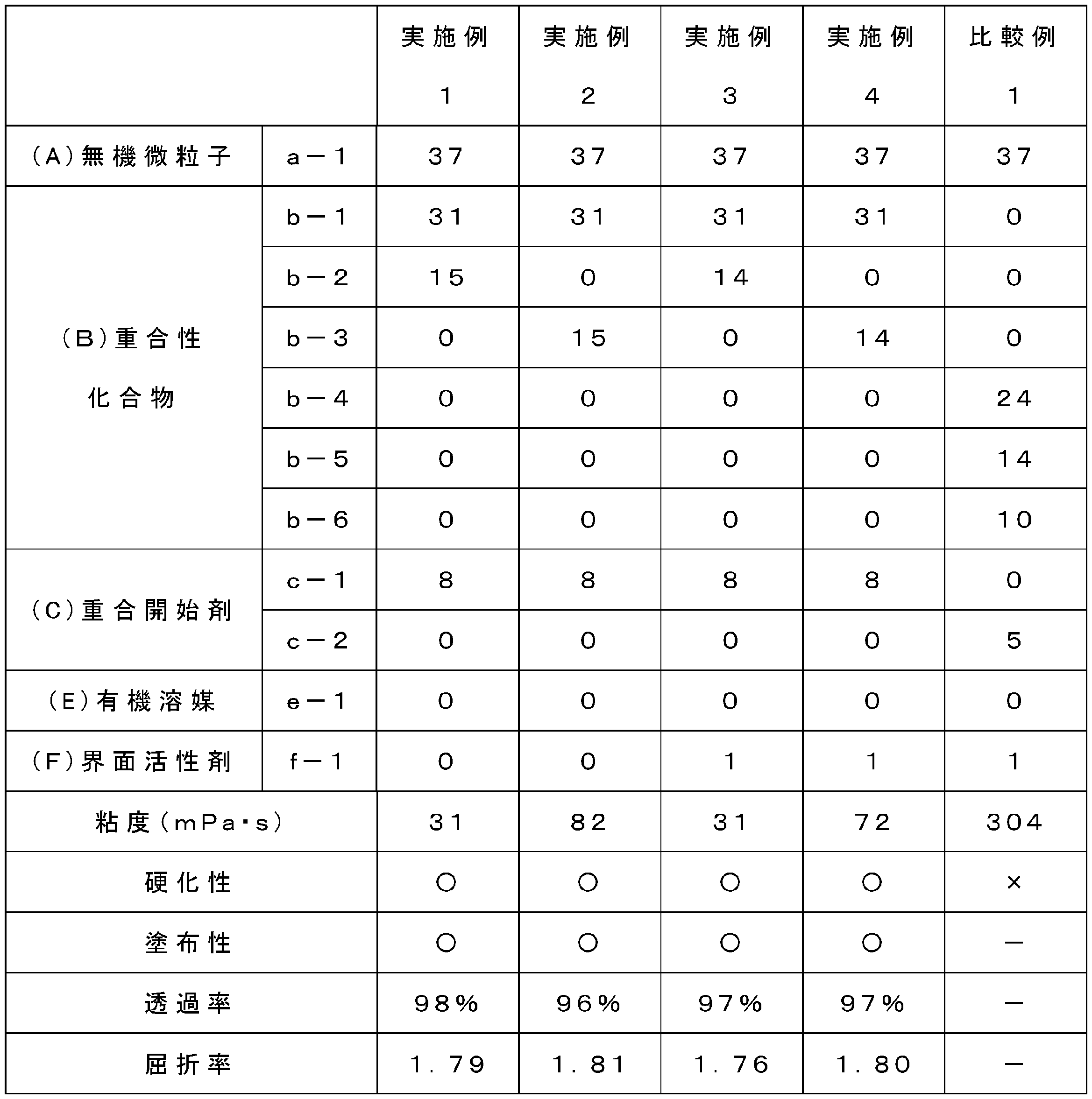
b-1:ベンジルアクリレート
b-2:9-ビニルカルバゾール
b-3:6EDNTA
b-4:A-DCP
b-5:A-DOD-N
b-6:イソブチルメタクリレート
c-1:TPO-L
c-2:IRGACURE819
e-1:メチルエチルケトン
f-1:オクタメチルシクロテトラシロキサン
Claims (5)
- 無機微粒子(A)、重合性化合物(B)、及び重合開始剤(C)を含有し、
前記重合性化合物(B)が、ビニル基、1-メチルビニル基、アリル基、メタリル基、アクリロイル基、メタクリロイル基、ビニルオキシ基、1-メチルビニルオキシ基、アリルオキシ基、メタリルオキシ基、アクリロイルオキシ基、及びメタクリロイルオキシ基からなる群より選ばれる重合性基の1つ又は2つと、芳香族複素環とを有する化合物を含有する、硬化性組成物。 - 前記重合性化合物(B)が式(B1b)で表される化合物である請求項1に記載の硬化性組成物。
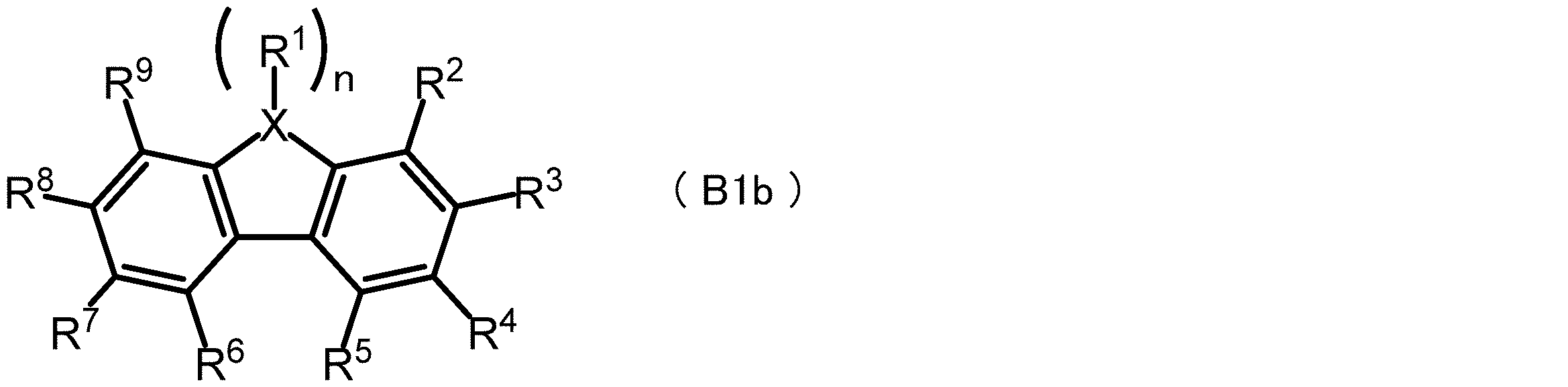
Xが酸素原子又は硫黄原子のとき、nは0である。
Xが窒素原子のとき、nは1であり、R1は水素原子、炭素数1~20のアルキル基、ビニル基、1-メチルビニル基、アリル基、メタリル基、アクリロイル基、又はメタクリロイル基である。
R2~R9は、水素原子、ビニル基、1-メチルビニル基、アリル基、メタリル基、アクリロイル基、メタクリロイル基、ビニルオキシ基、1-メチルビニルオキシ基、アリルオキシ基、メタリルオキシ基、アクリロイルオキシ基、メタクリロイルオキシ基、炭素数1~20のアルキル基、又は置換基であり、R2~R9のうち隣接する2つは互いに結合して芳香族炭化水素環を形成してもよく、この芳香族炭化水素環には、ビニル基、1-メチルビニル基、アリル基、メタリル基、アクリロイル基、メタクリロイル基、ビニルオキシ基、1-メチルビニルオキシ基、アリルオキシ基、メタリルオキシ基、アクリロイルオキシ基、メタクリロイルオキシ基、炭素数1~20のアルキル基、又は置換基が結合していてもよい。
前記炭素数1~20のアルキル基には、ビニル基、1-メチルビニル基、アクリロイル基、メタクリロイル基、ビニルオキシ基、1-メチルビニルオキシ基、アリルオキシ基、メタリルオキシ基、アクリロイルオキシ基、メタクリロイルオキシ基又は置換基が結合していてもよい。
前記置換基は、ハロゲン原子、ヒドロキシ基、-NRaRb(Ra及びRbは、それぞれ独立に、水素原子または炭素数1~20のアルキル基である)、ニトロ基、炭素数1~10のアルコキシ基、又は炭素数2~10のアルコキシカルボニル基である。
式(B1b)で表される化合物は、ビニル基、1-メチルビニル基、アリル基、メタリル基、アクリロイル基、メタクリロイル基、ビニルオキシ基、1-メチルビニルオキシ基、アリルオキシ基、メタリルオキシ基、アクリロイルオキシ基、及びメタクリロイルオキシ基からなる群より選ばれる基を1つ又は2つ有する。) - 芳香族複素環を含まない重合性化合物(BX2)をさらに含有する請求項1または2に記載の硬化性組成物。
- 前記無機微粒子(A)の含有率が、硬化性組成物中、20質量%以上である請求項1~3のいずれか一項に記載の硬化性組成物。
- 請求項1~4のいずれか一項に記載の硬化性組成物から形成される硬化膜。
Priority Applications (3)
| Application Number | Priority Date | Filing Date | Title |
|---|---|---|---|
| JP2022557012A JP7764390B2 (ja) | 2020-10-14 | 2021-10-12 | 硬化性組成物及び硬化膜 |
| KR1020237015562A KR20230087527A (ko) | 2020-10-14 | 2021-10-12 | 경화성 조성물 및 경화막 |
| CN202180066470.6A CN116323713B (zh) | 2020-10-14 | 2021-10-12 | 固化性组合物及固化膜 |
Applications Claiming Priority (2)
| Application Number | Priority Date | Filing Date | Title |
|---|---|---|---|
| JP2020172994 | 2020-10-14 | ||
| JP2020-172994 | 2020-10-14 |
Publications (1)
| Publication Number | Publication Date |
|---|---|
| WO2022080381A1 true WO2022080381A1 (ja) | 2022-04-21 |
Family
ID=81208205
Family Applications (1)
| Application Number | Title | Priority Date | Filing Date |
|---|---|---|---|
| PCT/JP2021/037769 Ceased WO2022080381A1 (ja) | 2020-10-14 | 2021-10-12 | 硬化性組成物及び硬化膜 |
Country Status (5)
| Country | Link |
|---|---|
| JP (1) | JP7764390B2 (ja) |
| KR (1) | KR20230087527A (ja) |
| CN (1) | CN116323713B (ja) |
| TW (1) | TW202227518A (ja) |
| WO (1) | WO2022080381A1 (ja) |
Cited By (1)
| Publication number | Priority date | Publication date | Assignee | Title |
|---|---|---|---|---|
| WO2024181199A1 (ja) * | 2023-02-27 | 2024-09-06 | 住友化学株式会社 | 硬化性組成物及び硬化膜 |
Citations (7)
| Publication number | Priority date | Publication date | Assignee | Title |
|---|---|---|---|---|
| JP2009227829A (ja) * | 2008-03-24 | 2009-10-08 | Sumitomo Chemical Co Ltd | 組成物、該組成物を含む光学フィルム及び該光学フィルムの製造方法 |
| JP2009288693A (ja) * | 2008-05-30 | 2009-12-10 | Canon Inc | 光学材料およびその製造方法 |
| JP2011063710A (ja) * | 2009-09-17 | 2011-03-31 | Olympus Corp | 材料組成物およびそれを用いた光学素子 |
| JP2017014429A (ja) * | 2015-07-03 | 2017-01-19 | 東亞合成株式会社 | 無機微粒子分散体組成物およびその硬化物 |
| WO2017068989A1 (ja) * | 2015-10-21 | 2017-04-27 | Dic株式会社 | 活性エネルギー線硬化型組成物及びプラスチックレンズ |
| WO2018043593A1 (ja) * | 2016-08-30 | 2018-03-08 | ソニー株式会社 | ホログラム記録用感光性組成物、ホログラム記録媒体及びホログラム |
| JP2020164742A (ja) * | 2019-03-29 | 2020-10-08 | 太陽ホールディングス株式会社 | ポリマー被覆無機フィラーの製造方法 |
Family Cites Families (2)
| Publication number | Priority date | Publication date | Assignee | Title |
|---|---|---|---|---|
| JP2017105697A (ja) | 2015-11-26 | 2017-06-15 | 東洋炭素株式会社 | 薄型のSiCウエハの製造方法及び薄型のSiCウエハ |
| JP2020164800A (ja) * | 2019-03-26 | 2020-10-08 | 住友化学株式会社 | 硬化性樹脂組成物及び硬化膜 |
-
2021
- 2021-10-12 CN CN202180066470.6A patent/CN116323713B/zh active Active
- 2021-10-12 KR KR1020237015562A patent/KR20230087527A/ko active Pending
- 2021-10-12 WO PCT/JP2021/037769 patent/WO2022080381A1/ja not_active Ceased
- 2021-10-12 JP JP2022557012A patent/JP7764390B2/ja active Active
- 2021-10-13 TW TW110138030A patent/TW202227518A/zh unknown
Patent Citations (7)
| Publication number | Priority date | Publication date | Assignee | Title |
|---|---|---|---|---|
| JP2009227829A (ja) * | 2008-03-24 | 2009-10-08 | Sumitomo Chemical Co Ltd | 組成物、該組成物を含む光学フィルム及び該光学フィルムの製造方法 |
| JP2009288693A (ja) * | 2008-05-30 | 2009-12-10 | Canon Inc | 光学材料およびその製造方法 |
| JP2011063710A (ja) * | 2009-09-17 | 2011-03-31 | Olympus Corp | 材料組成物およびそれを用いた光学素子 |
| JP2017014429A (ja) * | 2015-07-03 | 2017-01-19 | 東亞合成株式会社 | 無機微粒子分散体組成物およびその硬化物 |
| WO2017068989A1 (ja) * | 2015-10-21 | 2017-04-27 | Dic株式会社 | 活性エネルギー線硬化型組成物及びプラスチックレンズ |
| WO2018043593A1 (ja) * | 2016-08-30 | 2018-03-08 | ソニー株式会社 | ホログラム記録用感光性組成物、ホログラム記録媒体及びホログラム |
| JP2020164742A (ja) * | 2019-03-29 | 2020-10-08 | 太陽ホールディングス株式会社 | ポリマー被覆無機フィラーの製造方法 |
Cited By (1)
| Publication number | Priority date | Publication date | Assignee | Title |
|---|---|---|---|---|
| WO2024181199A1 (ja) * | 2023-02-27 | 2024-09-06 | 住友化学株式会社 | 硬化性組成物及び硬化膜 |
Also Published As
| Publication number | Publication date |
|---|---|
| KR20230087527A (ko) | 2023-06-16 |
| JP7764390B2 (ja) | 2025-11-05 |
| TW202227518A (zh) | 2022-07-16 |
| CN116323713A (zh) | 2023-06-23 |
| CN116323713B (zh) | 2025-04-11 |
| JPWO2022080381A1 (ja) | 2022-04-21 |
Similar Documents
| Publication | Publication Date | Title |
|---|---|---|
| KR102021617B1 (ko) | 착색 감광성 수지 조성물 | |
| JP2012181505A (ja) | 着色感光性樹脂組成物 | |
| JP2013242554A (ja) | 着色感光性樹脂組成物 | |
| JP7075724B2 (ja) | 化合物、着色組成物、繊維材料、カラーフィルタ、及び表示装置 | |
| CN102207679A (zh) | 感光性树脂组合物 | |
| JP7046997B2 (ja) | 化合物及び該化合物を含む着色硬化性樹脂組成物 | |
| JP6135063B2 (ja) | 硬化性樹脂組成物 | |
| TW201303489A (zh) | 感光性樹脂組合物 | |
| KR101867103B1 (ko) | 감광성 수지 조성물 | |
| JP7764390B2 (ja) | 硬化性組成物及び硬化膜 | |
| JP7802679B2 (ja) | 硬化性組成物 | |
| TWI571456B (zh) | 光敏性樹脂組成物 | |
| JP6051689B2 (ja) | 着色感光性樹脂組成物 | |
| JP2013064967A (ja) | 着色感光性樹脂組成物 | |
| JP5978583B2 (ja) | 着色感光性樹脂組成物 | |
| CN113448169A (zh) | 着色固化性树脂组合物 | |
| JP7750855B2 (ja) | 硬化性組成物 | |
| JP6837863B2 (ja) | 赤色着色組成物 | |
| JP2014106266A (ja) | 感光性樹脂組成物 | |
| JP2012173550A (ja) | カラーフィルタ | |
| CN121758677A (zh) | 固化性树脂组合物、固化膜和拍摄装置 | |
| WO2025028355A1 (ja) | スルフィド化合物を含有する高屈折ラジカル重合性組成物 | |
| JP2013050505A (ja) | 着色感光性樹脂組成物 |
Legal Events
| Date | Code | Title | Description |
|---|---|---|---|
| 121 | Ep: the epo has been informed by wipo that ep was designated in this application |
Ref document number: 21880119 Country of ref document: EP Kind code of ref document: A1 |
|
| ENP | Entry into the national phase |
Ref document number: 2022557012 Country of ref document: JP Kind code of ref document: A |
|
| ENP | Entry into the national phase |
Ref document number: 20237015562 Country of ref document: KR Kind code of ref document: A |
|
| NENP | Non-entry into the national phase |
Ref country code: DE |
|
| 122 | Ep: pct application non-entry in european phase |
Ref document number: 21880119 Country of ref document: EP Kind code of ref document: A1 |
|
| WWG | Wipo information: grant in national office |
Ref document number: 202180066470.6 Country of ref document: CN |