WO2022075015A1 - 合わせガラス - Google Patents
合わせガラス Download PDFInfo
- Publication number
- WO2022075015A1 WO2022075015A1 PCT/JP2021/033732 JP2021033732W WO2022075015A1 WO 2022075015 A1 WO2022075015 A1 WO 2022075015A1 JP 2021033732 W JP2021033732 W JP 2021033732W WO 2022075015 A1 WO2022075015 A1 WO 2022075015A1
- Authority
- WO
- WIPO (PCT)
- Prior art keywords
- layer
- functional member
- laminated glass
- dummy
- interlayer film
- Prior art date
- Legal status (The legal status is an assumption and is not a legal conclusion. Google has not performed a legal analysis and makes no representation as to the accuracy of the status listed.)
- Ceased
Links
Images








Classifications
-
- B—PERFORMING OPERATIONS; TRANSPORTING
- B32—LAYERED PRODUCTS
- B32B—LAYERED PRODUCTS, i.e. PRODUCTS BUILT-UP OF STRATA OF FLAT OR NON-FLAT, e.g. CELLULAR OR HONEYCOMB, FORM
- B32B17/00—Layered products essentially comprising sheet glass, or glass, slag, or like fibres
- B32B17/06—Layered products essentially comprising sheet glass, or glass, slag, or like fibres comprising glass as the main or only constituent of a layer, next to another layer of a specific material
- B32B17/10—Layered products essentially comprising sheet glass, or glass, slag, or like fibres comprising glass as the main or only constituent of a layer, next to another layer of a specific material of synthetic resin
- B32B17/10005—Layered products essentially comprising sheet glass, or glass, slag, or like fibres comprising glass as the main or only constituent of a layer, next to another layer of a specific material of synthetic resin laminated safety glass or glazing
- B32B17/10165—Functional features of the laminated safety glass or glazing
- B32B17/10541—Functional features of the laminated safety glass or glazing comprising a light source or a light guide
-
- B—PERFORMING OPERATIONS; TRANSPORTING
- B60—VEHICLES IN GENERAL
- B60J—WINDOWS, WINDSCREENS, NON-FIXED ROOFS, DOORS, OR SIMILAR DEVICES FOR VEHICLES; REMOVABLE EXTERNAL PROTECTIVE COVERINGS SPECIALLY ADAPTED FOR VEHICLES
- B60J1/00—Windows; Windscreens; Accessories therefor
- B60J1/02—Windows; Windscreens; Accessories therefor arranged at the vehicle front, e.g. structure of the glazing, mounting of the glazing
-
- B—PERFORMING OPERATIONS; TRANSPORTING
- B32—LAYERED PRODUCTS
- B32B—LAYERED PRODUCTS, i.e. PRODUCTS BUILT-UP OF STRATA OF FLAT OR NON-FLAT, e.g. CELLULAR OR HONEYCOMB, FORM
- B32B1/00—Layered products having a non-planar shape
-
- B—PERFORMING OPERATIONS; TRANSPORTING
- B32—LAYERED PRODUCTS
- B32B—LAYERED PRODUCTS, i.e. PRODUCTS BUILT-UP OF STRATA OF FLAT OR NON-FLAT, e.g. CELLULAR OR HONEYCOMB, FORM
- B32B17/00—Layered products essentially comprising sheet glass, or glass, slag, or like fibres
- B32B17/06—Layered products essentially comprising sheet glass, or glass, slag, or like fibres comprising glass as the main or only constituent of a layer, next to another layer of a specific material
- B32B17/10—Layered products essentially comprising sheet glass, or glass, slag, or like fibres comprising glass as the main or only constituent of a layer, next to another layer of a specific material of synthetic resin
- B32B17/10005—Layered products essentially comprising sheet glass, or glass, slag, or like fibres comprising glass as the main or only constituent of a layer, next to another layer of a specific material of synthetic resin laminated safety glass or glazing
- B32B17/10009—Layered products essentially comprising sheet glass, or glass, slag, or like fibres comprising glass as the main or only constituent of a layer, next to another layer of a specific material of synthetic resin laminated safety glass or glazing characterized by the number, the constitution or treatment of glass sheets
- B32B17/10036—Layered products essentially comprising sheet glass, or glass, slag, or like fibres comprising glass as the main or only constituent of a layer, next to another layer of a specific material of synthetic resin laminated safety glass or glazing characterized by the number, the constitution or treatment of glass sheets comprising two outer glass sheets
-
- B—PERFORMING OPERATIONS; TRANSPORTING
- B32—LAYERED PRODUCTS
- B32B—LAYERED PRODUCTS, i.e. PRODUCTS BUILT-UP OF STRATA OF FLAT OR NON-FLAT, e.g. CELLULAR OR HONEYCOMB, FORM
- B32B17/00—Layered products essentially comprising sheet glass, or glass, slag, or like fibres
- B32B17/06—Layered products essentially comprising sheet glass, or glass, slag, or like fibres comprising glass as the main or only constituent of a layer, next to another layer of a specific material
- B32B17/10—Layered products essentially comprising sheet glass, or glass, slag, or like fibres comprising glass as the main or only constituent of a layer, next to another layer of a specific material of synthetic resin
- B32B17/10005—Layered products essentially comprising sheet glass, or glass, slag, or like fibres comprising glass as the main or only constituent of a layer, next to another layer of a specific material of synthetic resin laminated safety glass or glazing
- B32B17/10165—Functional features of the laminated safety glass or glazing
- B32B17/10174—Coatings of a metallic or dielectric material on a constituent layer of glass or polymer
- B32B17/1022—Metallic coatings
-
- B—PERFORMING OPERATIONS; TRANSPORTING
- B32—LAYERED PRODUCTS
- B32B—LAYERED PRODUCTS, i.e. PRODUCTS BUILT-UP OF STRATA OF FLAT OR NON-FLAT, e.g. CELLULAR OR HONEYCOMB, FORM
- B32B17/00—Layered products essentially comprising sheet glass, or glass, slag, or like fibres
- B32B17/06—Layered products essentially comprising sheet glass, or glass, slag, or like fibres comprising glass as the main or only constituent of a layer, next to another layer of a specific material
- B32B17/10—Layered products essentially comprising sheet glass, or glass, slag, or like fibres comprising glass as the main or only constituent of a layer, next to another layer of a specific material of synthetic resin
- B32B17/10005—Layered products essentially comprising sheet glass, or glass, slag, or like fibres comprising glass as the main or only constituent of a layer, next to another layer of a specific material of synthetic resin laminated safety glass or glazing
- B32B17/10165—Functional features of the laminated safety glass or glazing
- B32B17/10174—Coatings of a metallic or dielectric material on a constituent layer of glass or polymer
- B32B17/1022—Metallic coatings
- B32B17/10229—Metallic layers sandwiched by dielectric layers
-
- B—PERFORMING OPERATIONS; TRANSPORTING
- B32—LAYERED PRODUCTS
- B32B—LAYERED PRODUCTS, i.e. PRODUCTS BUILT-UP OF STRATA OF FLAT OR NON-FLAT, e.g. CELLULAR OR HONEYCOMB, FORM
- B32B17/00—Layered products essentially comprising sheet glass, or glass, slag, or like fibres
- B32B17/06—Layered products essentially comprising sheet glass, or glass, slag, or like fibres comprising glass as the main or only constituent of a layer, next to another layer of a specific material
- B32B17/10—Layered products essentially comprising sheet glass, or glass, slag, or like fibres comprising glass as the main or only constituent of a layer, next to another layer of a specific material of synthetic resin
- B32B17/10005—Layered products essentially comprising sheet glass, or glass, slag, or like fibres comprising glass as the main or only constituent of a layer, next to another layer of a specific material of synthetic resin laminated safety glass or glazing
- B32B17/10165—Functional features of the laminated safety glass or glazing
- B32B17/10431—Specific parts for the modulation of light incorporated into the laminated safety glass or glazing
- B32B17/1044—Invariable transmission
-
- B—PERFORMING OPERATIONS; TRANSPORTING
- B32—LAYERED PRODUCTS
- B32B—LAYERED PRODUCTS, i.e. PRODUCTS BUILT-UP OF STRATA OF FLAT OR NON-FLAT, e.g. CELLULAR OR HONEYCOMB, FORM
- B32B17/00—Layered products essentially comprising sheet glass, or glass, slag, or like fibres
- B32B17/06—Layered products essentially comprising sheet glass, or glass, slag, or like fibres comprising glass as the main or only constituent of a layer, next to another layer of a specific material
- B32B17/10—Layered products essentially comprising sheet glass, or glass, slag, or like fibres comprising glass as the main or only constituent of a layer, next to another layer of a specific material of synthetic resin
- B32B17/10005—Layered products essentially comprising sheet glass, or glass, slag, or like fibres comprising glass as the main or only constituent of a layer, next to another layer of a specific material of synthetic resin laminated safety glass or glazing
- B32B17/10165—Functional features of the laminated safety glass or glazing
- B32B17/10376—Laminated safety glass or glazing containing metal wires
-
- B—PERFORMING OPERATIONS; TRANSPORTING
- B32—LAYERED PRODUCTS
- B32B—LAYERED PRODUCTS, i.e. PRODUCTS BUILT-UP OF STRATA OF FLAT OR NON-FLAT, e.g. CELLULAR OR HONEYCOMB, FORM
- B32B17/00—Layered products essentially comprising sheet glass, or glass, slag, or like fibres
- B32B17/06—Layered products essentially comprising sheet glass, or glass, slag, or like fibres comprising glass as the main or only constituent of a layer, next to another layer of a specific material
- B32B17/10—Layered products essentially comprising sheet glass, or glass, slag, or like fibres comprising glass as the main or only constituent of a layer, next to another layer of a specific material of synthetic resin
- B32B17/10005—Layered products essentially comprising sheet glass, or glass, slag, or like fibres comprising glass as the main or only constituent of a layer, next to another layer of a specific material of synthetic resin laminated safety glass or glazing
- B32B17/1055—Layered products essentially comprising sheet glass, or glass, slag, or like fibres comprising glass as the main or only constituent of a layer, next to another layer of a specific material of synthetic resin laminated safety glass or glazing characterized by the resin layer, i.e. interlayer
- B32B17/10743—Layered products essentially comprising sheet glass, or glass, slag, or like fibres comprising glass as the main or only constituent of a layer, next to another layer of a specific material of synthetic resin laminated safety glass or glazing characterized by the resin layer, i.e. interlayer containing acrylate (co)polymers or salts thereof
-
- B—PERFORMING OPERATIONS; TRANSPORTING
- B32—LAYERED PRODUCTS
- B32B—LAYERED PRODUCTS, i.e. PRODUCTS BUILT-UP OF STRATA OF FLAT OR NON-FLAT, e.g. CELLULAR OR HONEYCOMB, FORM
- B32B17/00—Layered products essentially comprising sheet glass, or glass, slag, or like fibres
- B32B17/06—Layered products essentially comprising sheet glass, or glass, slag, or like fibres comprising glass as the main or only constituent of a layer, next to another layer of a specific material
- B32B17/10—Layered products essentially comprising sheet glass, or glass, slag, or like fibres comprising glass as the main or only constituent of a layer, next to another layer of a specific material of synthetic resin
- B32B17/10005—Layered products essentially comprising sheet glass, or glass, slag, or like fibres comprising glass as the main or only constituent of a layer, next to another layer of a specific material of synthetic resin laminated safety glass or glazing
- B32B17/1055—Layered products essentially comprising sheet glass, or glass, slag, or like fibres comprising glass as the main or only constituent of a layer, next to another layer of a specific material of synthetic resin laminated safety glass or glazing characterized by the resin layer, i.e. interlayer
- B32B17/10761—Layered products essentially comprising sheet glass, or glass, slag, or like fibres comprising glass as the main or only constituent of a layer, next to another layer of a specific material of synthetic resin laminated safety glass or glazing characterized by the resin layer, i.e. interlayer containing vinyl acetal
-
- B—PERFORMING OPERATIONS; TRANSPORTING
- B32—LAYERED PRODUCTS
- B32B—LAYERED PRODUCTS, i.e. PRODUCTS BUILT-UP OF STRATA OF FLAT OR NON-FLAT, e.g. CELLULAR OR HONEYCOMB, FORM
- B32B17/00—Layered products essentially comprising sheet glass, or glass, slag, or like fibres
- B32B17/06—Layered products essentially comprising sheet glass, or glass, slag, or like fibres comprising glass as the main or only constituent of a layer, next to another layer of a specific material
- B32B17/10—Layered products essentially comprising sheet glass, or glass, slag, or like fibres comprising glass as the main or only constituent of a layer, next to another layer of a specific material of synthetic resin
- B32B17/10005—Layered products essentially comprising sheet glass, or glass, slag, or like fibres comprising glass as the main or only constituent of a layer, next to another layer of a specific material of synthetic resin laminated safety glass or glazing
- B32B17/1055—Layered products essentially comprising sheet glass, or glass, slag, or like fibres comprising glass as the main or only constituent of a layer, next to another layer of a specific material of synthetic resin laminated safety glass or glazing characterized by the resin layer, i.e. interlayer
- B32B17/10788—Layered products essentially comprising sheet glass, or glass, slag, or like fibres comprising glass as the main or only constituent of a layer, next to another layer of a specific material of synthetic resin laminated safety glass or glazing characterized by the resin layer, i.e. interlayer containing ethylene vinylacetate
-
- B—PERFORMING OPERATIONS; TRANSPORTING
- B32—LAYERED PRODUCTS
- B32B—LAYERED PRODUCTS, i.e. PRODUCTS BUILT-UP OF STRATA OF FLAT OR NON-FLAT, e.g. CELLULAR OR HONEYCOMB, FORM
- B32B2250/00—Layers arrangement
- B32B2250/02—2 layers
-
- B—PERFORMING OPERATIONS; TRANSPORTING
- B32—LAYERED PRODUCTS
- B32B—LAYERED PRODUCTS, i.e. PRODUCTS BUILT-UP OF STRATA OF FLAT OR NON-FLAT, e.g. CELLULAR OR HONEYCOMB, FORM
- B32B2250/00—Layers arrangement
- B32B2250/44—Number of layers variable across the laminate
-
- B—PERFORMING OPERATIONS; TRANSPORTING
- B32—LAYERED PRODUCTS
- B32B—LAYERED PRODUCTS, i.e. PRODUCTS BUILT-UP OF STRATA OF FLAT OR NON-FLAT, e.g. CELLULAR OR HONEYCOMB, FORM
- B32B2255/00—Coating on the layer surface
- B32B2255/10—Coating on the layer surface on synthetic resin layer or on natural or synthetic rubber layer
-
- B—PERFORMING OPERATIONS; TRANSPORTING
- B32—LAYERED PRODUCTS
- B32B—LAYERED PRODUCTS, i.e. PRODUCTS BUILT-UP OF STRATA OF FLAT OR NON-FLAT, e.g. CELLULAR OR HONEYCOMB, FORM
- B32B2255/00—Coating on the layer surface
- B32B2255/20—Inorganic coating
-
- B—PERFORMING OPERATIONS; TRANSPORTING
- B32—LAYERED PRODUCTS
- B32B—LAYERED PRODUCTS, i.e. PRODUCTS BUILT-UP OF STRATA OF FLAT OR NON-FLAT, e.g. CELLULAR OR HONEYCOMB, FORM
- B32B2255/00—Coating on the layer surface
- B32B2255/20—Inorganic coating
- B32B2255/205—Metallic coating
-
- B—PERFORMING OPERATIONS; TRANSPORTING
- B32—LAYERED PRODUCTS
- B32B—LAYERED PRODUCTS, i.e. PRODUCTS BUILT-UP OF STRATA OF FLAT OR NON-FLAT, e.g. CELLULAR OR HONEYCOMB, FORM
- B32B2255/00—Coating on the layer surface
- B32B2255/26—Polymeric coating
-
- B—PERFORMING OPERATIONS; TRANSPORTING
- B32—LAYERED PRODUCTS
- B32B—LAYERED PRODUCTS, i.e. PRODUCTS BUILT-UP OF STRATA OF FLAT OR NON-FLAT, e.g. CELLULAR OR HONEYCOMB, FORM
- B32B2255/00—Coating on the layer surface
- B32B2255/28—Multiple coating on one surface
-
- B—PERFORMING OPERATIONS; TRANSPORTING
- B32—LAYERED PRODUCTS
- B32B—LAYERED PRODUCTS, i.e. PRODUCTS BUILT-UP OF STRATA OF FLAT OR NON-FLAT, e.g. CELLULAR OR HONEYCOMB, FORM
- B32B2307/00—Properties of the layers or laminate
- B32B2307/40—Properties of the layers or laminate having particular optical properties
- B32B2307/414—Translucent
-
- B—PERFORMING OPERATIONS; TRANSPORTING
- B32—LAYERED PRODUCTS
- B32B—LAYERED PRODUCTS, i.e. PRODUCTS BUILT-UP OF STRATA OF FLAT OR NON-FLAT, e.g. CELLULAR OR HONEYCOMB, FORM
- B32B2307/00—Properties of the layers or laminate
- B32B2307/40—Properties of the layers or laminate having particular optical properties
- B32B2307/416—Reflective
-
- B—PERFORMING OPERATIONS; TRANSPORTING
- B32—LAYERED PRODUCTS
- B32B—LAYERED PRODUCTS, i.e. PRODUCTS BUILT-UP OF STRATA OF FLAT OR NON-FLAT, e.g. CELLULAR OR HONEYCOMB, FORM
- B32B2307/00—Properties of the layers or laminate
- B32B2307/40—Properties of the layers or laminate having particular optical properties
- B32B2307/418—Refractive
-
- B—PERFORMING OPERATIONS; TRANSPORTING
- B32—LAYERED PRODUCTS
- B32B—LAYERED PRODUCTS, i.e. PRODUCTS BUILT-UP OF STRATA OF FLAT OR NON-FLAT, e.g. CELLULAR OR HONEYCOMB, FORM
- B32B2307/00—Properties of the layers or laminate
- B32B2307/50—Properties of the layers or laminate having particular mechanical properties
- B32B2307/538—Roughness
-
- B—PERFORMING OPERATIONS; TRANSPORTING
- B32—LAYERED PRODUCTS
- B32B—LAYERED PRODUCTS, i.e. PRODUCTS BUILT-UP OF STRATA OF FLAT OR NON-FLAT, e.g. CELLULAR OR HONEYCOMB, FORM
- B32B2307/00—Properties of the layers or laminate
- B32B2307/50—Properties of the layers or laminate having particular mechanical properties
- B32B2307/558—Impact strength, toughness
-
- B—PERFORMING OPERATIONS; TRANSPORTING
- B32—LAYERED PRODUCTS
- B32B—LAYERED PRODUCTS, i.e. PRODUCTS BUILT-UP OF STRATA OF FLAT OR NON-FLAT, e.g. CELLULAR OR HONEYCOMB, FORM
- B32B2307/00—Properties of the layers or laminate
- B32B2307/70—Other properties
- B32B2307/732—Dimensional properties
- B32B2307/737—Dimensions, e.g. volume or area
- B32B2307/7375—Linear, e.g. length, distance or width
- B32B2307/7376—Thickness
-
- B—PERFORMING OPERATIONS; TRANSPORTING
- B32—LAYERED PRODUCTS
- B32B—LAYERED PRODUCTS, i.e. PRODUCTS BUILT-UP OF STRATA OF FLAT OR NON-FLAT, e.g. CELLULAR OR HONEYCOMB, FORM
- B32B2419/00—Buildings or parts thereof
-
- B—PERFORMING OPERATIONS; TRANSPORTING
- B32—LAYERED PRODUCTS
- B32B—LAYERED PRODUCTS, i.e. PRODUCTS BUILT-UP OF STRATA OF FLAT OR NON-FLAT, e.g. CELLULAR OR HONEYCOMB, FORM
- B32B2457/00—Electrical equipment
- B32B2457/20—Displays, e.g. liquid crystal displays, plasma displays
-
- B—PERFORMING OPERATIONS; TRANSPORTING
- B32—LAYERED PRODUCTS
- B32B—LAYERED PRODUCTS, i.e. PRODUCTS BUILT-UP OF STRATA OF FLAT OR NON-FLAT, e.g. CELLULAR OR HONEYCOMB, FORM
- B32B2551/00—Optical elements
-
- B—PERFORMING OPERATIONS; TRANSPORTING
- B32—LAYERED PRODUCTS
- B32B—LAYERED PRODUCTS, i.e. PRODUCTS BUILT-UP OF STRATA OF FLAT OR NON-FLAT, e.g. CELLULAR OR HONEYCOMB, FORM
- B32B2551/00—Optical elements
- B32B2551/08—Mirrors
-
- B—PERFORMING OPERATIONS; TRANSPORTING
- B32—LAYERED PRODUCTS
- B32B—LAYERED PRODUCTS, i.e. PRODUCTS BUILT-UP OF STRATA OF FLAT OR NON-FLAT, e.g. CELLULAR OR HONEYCOMB, FORM
- B32B2605/00—Vehicles
-
- B—PERFORMING OPERATIONS; TRANSPORTING
- B32—LAYERED PRODUCTS
- B32B—LAYERED PRODUCTS, i.e. PRODUCTS BUILT-UP OF STRATA OF FLAT OR NON-FLAT, e.g. CELLULAR OR HONEYCOMB, FORM
- B32B27/00—Layered products comprising a layer of synthetic resin
- B32B27/06—Layered products comprising a layer of synthetic resin as the main or only constituent of a layer, which is next to another layer of the same or of a different material
- B32B27/08—Layered products comprising a layer of synthetic resin as the main or only constituent of a layer, which is next to another layer of the same or of a different material of synthetic resin
-
- B—PERFORMING OPERATIONS; TRANSPORTING
- B32—LAYERED PRODUCTS
- B32B—LAYERED PRODUCTS, i.e. PRODUCTS BUILT-UP OF STRATA OF FLAT OR NON-FLAT, e.g. CELLULAR OR HONEYCOMB, FORM
- B32B27/00—Layered products comprising a layer of synthetic resin
- B32B27/30—Layered products comprising a layer of synthetic resin comprising vinyl (co)polymers; comprising acrylic (co)polymers
-
- B—PERFORMING OPERATIONS; TRANSPORTING
- B32—LAYERED PRODUCTS
- B32B—LAYERED PRODUCTS, i.e. PRODUCTS BUILT-UP OF STRATA OF FLAT OR NON-FLAT, e.g. CELLULAR OR HONEYCOMB, FORM
- B32B27/00—Layered products comprising a layer of synthetic resin
- B32B27/30—Layered products comprising a layer of synthetic resin comprising vinyl (co)polymers; comprising acrylic (co)polymers
- B32B27/306—Layered products comprising a layer of synthetic resin comprising vinyl (co)polymers; comprising acrylic (co)polymers comprising vinyl acetate or vinyl alcohol (co)polymers
-
- B—PERFORMING OPERATIONS; TRANSPORTING
- B32—LAYERED PRODUCTS
- B32B—LAYERED PRODUCTS, i.e. PRODUCTS BUILT-UP OF STRATA OF FLAT OR NON-FLAT, e.g. CELLULAR OR HONEYCOMB, FORM
- B32B27/00—Layered products comprising a layer of synthetic resin
- B32B27/30—Layered products comprising a layer of synthetic resin comprising vinyl (co)polymers; comprising acrylic (co)polymers
- B32B27/308—Layered products comprising a layer of synthetic resin comprising vinyl (co)polymers; comprising acrylic (co)polymers comprising acrylic (co)polymers
-
- B—PERFORMING OPERATIONS; TRANSPORTING
- B32—LAYERED PRODUCTS
- B32B—LAYERED PRODUCTS, i.e. PRODUCTS BUILT-UP OF STRATA OF FLAT OR NON-FLAT, e.g. CELLULAR OR HONEYCOMB, FORM
- B32B27/00—Layered products comprising a layer of synthetic resin
- B32B27/32—Layered products comprising a layer of synthetic resin comprising polyolefins
- B32B27/325—Layered products comprising a layer of synthetic resin comprising polyolefins comprising polycycloolefins
-
- B—PERFORMING OPERATIONS; TRANSPORTING
- B32—LAYERED PRODUCTS
- B32B—LAYERED PRODUCTS, i.e. PRODUCTS BUILT-UP OF STRATA OF FLAT OR NON-FLAT, e.g. CELLULAR OR HONEYCOMB, FORM
- B32B7/00—Layered products characterised by the relation between layers; Layered products characterised by the relative orientation of features between layers, or by the relative values of a measurable parameter between layers, i.e. products comprising layers having different physical, chemical or physicochemical properties; Layered products characterised by the interconnection of layers
- B32B7/04—Interconnection of layers
- B32B7/12—Interconnection of layers using interposed adhesives or interposed materials with bonding properties
-
- G—PHYSICS
- G02—OPTICS
- G02B—OPTICAL ELEMENTS, SYSTEMS OR APPARATUS
- G02B5/00—Optical elements other than lenses
- G02B5/08—Mirrors
- G02B5/0808—Mirrors having a single reflecting layer
Definitions
- the present invention relates to laminated glass.
- Laminated glass which is made by joining two glass plates to each other via an interlayer film, is used in many fields such as vehicle glass members and building window glass.
- Patent Document 1 a functional member including a dimmer sheet or an electroluminescent element in an interlayer film to form a laminated glass for automobiles.
- Patent Document 2 In order to suppress the step caused by the insertion of the functional member, it has been proposed to hollow out the central portion of the interlayer film and install the functional member in this hollowed out portion (Patent Document 2).
- the present invention has been made in view of such a background, and an object of the present invention is to provide a laminated glass in which the contour lines of functional members are not so conspicuous and the design is significantly enhanced.
- the present invention is a laminated glass having a first glass plate and a second glass plate.
- a first interlayer film is installed on the first glass plate.
- a second interlayer film is installed on the second glass plate.
- the first glass plate and the second glass plate are arranged so that the first intermediate film and the second intermediate film face each other.
- An encapsulating layer is arranged between the first interlayer film and the second interlayer film.
- the encapsulation layer has a functional member having a side wall and a dummy layer arranged on the side wall of the functional member, and the functional member includes one or more transparent layers.
- the functional member has a maximum thickness of 200 ⁇ m.
- the dummy layer is made of a thermoplastic resin and is made of a thermoplastic resin.
- Laminated glass
- the laminated glass formed by enclosing the functional member in the hollowed out portion of the interlayer film as described in Patent Document 2 has a problem that a gap is likely to be formed next to the side wall of the functional member. Further, if such a gap exists, the contour line of the functional member becomes conspicuous when the laminated glass is viewed from the front, and there is a problem that the design of the laminated glass is deteriorated.
- the present invention is a laminated glass having a first glass plate and a second glass plate.
- a first interlayer film is installed on the first glass plate.
- a second interlayer film is installed on the second glass plate.
- the first glass plate and the second glass plate are arranged so that the first intermediate film and the second intermediate film face each other.
- An encapsulating layer is arranged between the first interlayer film and the second interlayer film.
- the encapsulation layer has a functional member having a side wall and a dummy layer arranged on the side wall of the functional member, and the functional member includes one or more transparent layers.
- the functional member has a maximum thickness of 200 ⁇ m.
- the dummy layer is made of a thermoplastic resin and is made of a thermoplastic resin.
- Laminated glass
- a dummy layer is installed adjacent to the side wall of the functional member.
- This dummy layer is composed of a thermoplastic resin that melts by heating. Therefore, when the resin for the dummy layer is installed on the side wall of the functional member and heated, the resin for the dummy layer melts and the dummy layer can be brought into close contact with the side wall of the functional member. That is, the dummy layer can be arranged without a gap next to the functional member.
- the refractive index difference ⁇ n defined as described above is adjusted to be 0.05 or less.
- the refractive index difference ⁇ n is preferably 0.01 or less, and more preferably 0.001 or less.
- the boundary between the functional member and the dummy layer can be made less conspicuous, which can significantly enhance the design of the laminated glass.
- the thickness of the encapsulating layer including the functional member is 200 ⁇ m or less. In general, in the case of such a thin encapsulation layer, it is not easy to accurately hollow out the inside in order to install the functional member.
- the functional member can be arranged at a desired position without hollowing out the encapsulating layer, as will be described later. Therefore, in one embodiment of the present invention, high-quality laminated glass can be produced relatively easily even if a thin encapsulation layer having a maximum thickness of 200 ⁇ m or less is used.
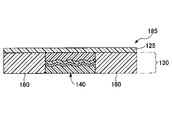
- FIG. 1 schematically shows a cross section of an example of a laminated glass according to an embodiment of the present invention.
- the laminated glass (hereinafter referred to as “first laminated glass”) 100 includes a first glass plate 110 and a second glass plate 120. It has an encapsulation layer 130 provided between them.
- a first interlayer film 115 is installed on one surface of the first glass plate 110, and a second interlayer film 125 is installed on one surface of the second glass plate 120.
- the first glass plate 110 and the second glass plate 120 are arranged so that the interlayer films 115 and 125, respectively, face each other. Therefore, the encapsulation layer 130 is arranged between the first interlayer film 115 and the second interlayer film 125.
- the encapsulation layer 130 has a functional member 140.
- the functional member 140 is a reflective screen member and thus has a reflective layer 144. More specifically, the functional member 140 has a first transparent layer 142, a reflective layer 144, an adhesion layer 146, and a second transparent layer 148 in the order of proximity to the first glass plate 110.
- the encapsulation layer 130 has a dummy layer 160 arranged adjacent to the functional member 140.
- the first dummy layer 160A and the functional member 140 are formed in a direction (X direction in FIG. 1) perpendicular to the thickness direction (Z direction in FIG. 1) of the first laminated glass 100.
- the second dummy layer 160B are arranged in this order, thereby forming the encapsulation layer 130.
- the thickness of the encapsulation layer 130 (dimension in the Z direction in FIG. 1) is 200 ⁇ m or less at the maximum.
- the functional member 140 has a first side wall 150A and a second side wall 150B.
- the first dummy layer 160A is arranged so as to be in close contact with the first side wall 150A of the functional member 140. Therefore, there is substantially no gap between the functional member 140 and the first dummy layer 160A.
- the second dummy layer 160B is arranged so as to be in close contact with the second side wall 150B. Therefore, there is substantially no gap between the functional member 140 and the second dummy layer 160B.
- the functional member 140 and the first dummy layer 160A are both when the refractive index of the functional member 140 is n11 and the refractive index of the first dummy layer 160A is n12 .
- is adjusted to be 0.05 or less.
- the refractive index of the second dummy layer 160B is n 13 , the absolute value of the difference in refractive index
- the "refractive index of the functional member” represents the average of the refractive indexes of all the transparent layers contained in the functional member. Therefore, the refractive index n 11 of the functional member 140 is expressed as the average of the first transparent layer 142, the close contact layer 146, and the second transparent layer 148.
- the boundary E1 between the functional member 140 and the first dummy layer 160A and the boundary E2 between the functional member 140 and the second dummy layer 160B are not so conspicuous. can do. Therefore, in the first laminated glass 100, the designability can be significantly enhanced.
- first dummy layer 160A and / or the second dummy layer 160B may be made of the same material as the second transparent layer 148 of the functional member 140.
- the boundary E1 and / or the boundary E2 becomes less noticeable, and the design of the first laminated glass 100 can be further enhanced.
- the first interlayer film 115 is made of a transparent material such as a transparent resin.
- a transparent resin examples include PVB (polyvinyl butyral), EVA (ethylene-vinyl acetate copolymer resin), ionomer (material in which molecules of an ethylene-methacrylic acid copolymer are crosslinked with metal ions, etc.), and COP. (Cycloolefin polymer), acrylic pressure-sensitive adhesives, and other pressure-sensitive adhesives.
- the functional member 140 functions as a reflective screen.
- the visible light reflectance of the functional member 140 may be, for example, 5% to 50%.
- the refractive index of the functional member 140 that is, the average refractive index n 11 of the first transparent layer 142, the adhesion layer 146, and the second transparent layer 148 contained in the functional member 140 is, for example, 1.45 to 1.55. It is a range.
- the average refractive index n 11 is preferably in the range of 1.48 to 1.53.
- the functional member 140 preferably has a thickness of 15 ⁇ m to 200 ⁇ m.
- the material of the first transparent layer 142 is not particularly limited as long as it is a transparent material capable of forming irregularities on the surface.
- the first transparent layer 142 may be made of a transparent resin.
- examples of such raw materials for resins include photocurable resins such as acrylic resins and epoxy resins, thermosetting resins, and thermoplastic resins.
- the uneven surface of the first transparent layer 142 may have an arithmetic mean roughness Ra in the range of 0.01 ⁇ m to 20 ⁇ m.
- the arithmetic mean roughness Ra is preferably in the range of 0.01 ⁇ m to 20 ⁇ m.
- the uneven surface of the first transparent layer 142 may have a difference between the maximum height and the minimum height (referred to as "maximum PV value”) in the range of 0.1 ⁇ m to 50 ⁇ m.
- the maximum PV value is preferably in the range of 0.05 ⁇ m to 50 ⁇ m.
- the transmittance of the first transparent layer 142 is preferably 50% or more, more preferably 75% or more, still more preferably 90% or more.
- the thickness (maximum thickness) of the first transparent layer 142 is, for example, in the range of 0.5 ⁇ m to 50 ⁇ m.
- the second transparent layer 148 may be made of a resin having a crosslinked structure.
- a resin having a crosslinked structure examples include a photocurable resin and a thermosetting resin.
- Examples of the photocurable resin or the thermosetting resin include a cured product of a composition having an unsaturated group in the molecule, an epoxy resin, a silicone resin, and the like.
- the average number of unsaturated groups per molecule is preferably 2 or more.
- the second transparent layer 148 is composed of an epoxy resin
- a resin obtained by curing a composition which is a one-component type and contains a molecule containing three or more epoxy groups per molecule, or an epoxy group per molecule is preferable.
- the one-component epoxy resin preferably has an average number of epoxy groups per molecule of 3 or more.
- the second transparent layer 148 is composed of a silicone resin
- a condensed silicone resin obtained by condensation-curing an organosiloxane having three or more alkoxy groups is preferable.
- the curing shrinkage rate of the second transparent layer 148 is preferably in the range of 3% to 20%. When it is 3% or more, the viscosity and the hardness of the second transparent layer 148 are preferably easily adjusted, and when it is 20% or less, peeling is difficult.
- the transmittance of the second transparent layer 148 is preferably 50% or more, more preferably 75% or more, still more preferably 90% or more.
- a photocurable resin is preferable because it is easy to manufacture and has a small influence on other layers in the manufacturing process, and in particular, a composition having two or more unsaturated groups per molecule on average.
- a photo-cured product is preferable.
- the photocurable resin include acrylic resin compositions and urethane acrylates having two or more unsaturated groups on average.
- the acrylic equivalent is 50 g / eq to 700 g / eq, preferably 60 g / eq to 600 g / eq.
- the second transparent layer 148 contains 0.5 to 15 wt% of a silane coupling agent with respect to the resin constituting the second transparent layer 148 in order to improve the adhesion with the adhesion layer 146. Is preferable.
- the silane coupling agent is 0.5% or more, the effect of improving the adhesion is exhibited, and when it is 15% or less, sufficient adhesion can be obtained. Even if the silane coupling agent is contained in an amount of more than 15 wt%, the adhesion does not change. Therefore, from the viewpoint of cost, 15 wt% or less is preferable.
- silane coupling agent examples include 2- (3,4-epoxycyclohexyl) ethyltrimethoxysilane, 3-glycidoxypropyltrimethoxysilane, 3-glycidoxypropyltriethoxysilane, and 3-glycidoxypropyl.
- Epoxysilanes such as methyldiethoxysilane, (meth) acryloxysilanes such as 3-methacryloxypropylmethyldimethoxysilane, 3-methacryloxypropyltrimethoxysilane, 3-acryloxypropyltrimethoxysilane, vinyltri Vinyl silanes such as methoxysilane, N-2- (N-vinylbenzylaminoethyl) -3-aminopropyltrimethoxysilane, N- (2-aminoethyl) -3-aminopropylmethyldimethoxysilane, N- (2) -Aminoethyl) -3-aminopropyltrimethoxysilane, N- (2-aminoethyl) -N'-(2-aminoethyl) -3-aminopropyltriethoxysilane, 3-aminopropyltrimethoxysilane, 3- Aminopropyl
- the silane coupling agent is preferably selected in consideration of the mixing property with the resin constituting the second transparent layer 148.
- the resin constituting the second transparent layer 148 is an acrylic resin, (meth) acryloxysilanes and vinylsilanes are preferable.
- the resin constituting the second transparent layer 148 is an epoxy resin, epoxysilanes are preferable.
- the thickness (maximum thickness) of the second transparent layer 148 is, for example, in the range of 0.01 ⁇ m to 50 ⁇ m.
- the reflective layer 144 is configured to have a function of reflecting a part of the incident light and transmitting the other part.
- the reflective layer 144 does not necessarily have to be a single-layer film, and may have a multilayer structure.
- the reflective layer 144 may be composed of a metal (including an alloy), a metal oxide, a metal nitride, and a combination thereof.
- Metals include aluminum (Al), silver (Ag), or alloys thereof (eg, alloys of gold and silver).
- metal oxides and metal nitrides of Group 3 to Group 16 elements in the periodic table are preferable.
- one or more oxides and nitrides selected from Zr, Ni, Cr, Ti, Zn, Nb, Zn, Pd, In, W, Si and Mo are more preferable.
- the reflective layer 144 may have a repeating structure of a metal film and an oxide film.
- the thickness of one metal film and oxide film is preferably in the range of, for example, 1 nm to 100 nm, and preferably in the range of, for example, 4 nm to 25 nm.
- the thickness of the reflective layer 144 (in the case of a multilayer film, the total thickness) is, for example, in the range of 1 nm to 150 nm, preferably in the range of 2 nm to 150 nm, more preferably in the range of 5 nm to 80 nm, still more preferably in the range of 5 nm to 50 nm. .. Within the above range, it is easy to increase the visible light transmittance.
- the dummy layer 160 is made of a thermoplastic resin.
- the dummy layer 160 may be composed of, for example, a linear polymer.
- the dummy layer 160 is, for example, an acrylic resin (water absorption rate 0.3%), a polyester resin (water absorption rate 0.1%), a polyurethane resin, a polyurethane acrylate resin, a polycarbonate resin (water absorption rate 0.15%), or a polyvinyl butyral resin.
- Cycloolefin resin polymer, cycloolefin copolymer resin, ethylene / vinyl acetate copolymer resin and the like may be selected.
- linearity means that the main chain is linear, and does not limit the presence or absence of side chains.
- the polymer constituting the dummy layer 160 may contain a crosslinked structure as long as the effect of the present invention is not impaired.
- Examples of the cycloolefin polymer include a polymer represented by the following chemical structural formula a or b.
- functionalities that react with metals and metal oxides such as alkoxyl groups, isocyanate groups, epoxy groups, silanol groups, carbonyl groups, amino groups and hydroxyl groups in at least one of R1 or R2, or in additives. It is preferable to have a group. With such a structure, it is possible to realize adhesion to the reflective film while ensuring hydrophobicity by the cycloolefin main skeleton.
- the dummy layer 160 may be made of the same material as the second transparent layer 148.
- the dummy layer 160 has a visible light transmittance of, for example, 30% or more.
- the visible light transmittance is preferably 80% or more.
- the refractive index n 12 of the first dummy layer 160A and the refractive index n 13 of the second dummy layer 160B are, for example, in the range of 1.45 to 1.55, respectively.
- the dummy layer 160 preferably has the same thickness as the functional member 140.
- the difference between the thickness of the dummy layer 160 and the thickness of the functional member 140 may be, for example, within ⁇ 5%.
- the adhesion between the dummy layer 160 and the first interlayer film 115 is preferably 4N / 25 mm width or more.
- the adhesion between the dummy layer 160 and the second interlayer film 125 is preferably 4N / 25 mm width or more.
- the adhesion layer 146 is provided to improve the adhesion between the reflection layer 144 and the second transparent layer 148. However, the close contact layer 146 may be omitted.
- the adhesion layer 146 may be made of the same material as the dummy layer 160.
- the thickness of the adhesion layer 146 is, for example, in the range of 0.01 ⁇ m to 1 ⁇ m.
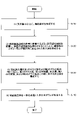
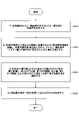
- FIG. 2 schematically shows an example of a flow of a method for manufacturing a laminated glass according to an embodiment of the present invention (hereinafter, referred to as “first method”).
- the first method is (1) A step of forming a functional member on a supporting base material (step S110), (2) A step of installing a thermoplastic resin so as to be in close contact with the side wall of the functional member and curing the thermoplastic resin to form an encapsulating layer in which the functional member and the dummy layer are in close contact with each other in the lateral direction (2).
- Step S120) and (3) The encapsulation layer is arranged between the first glass plate and the second glass plate, and the first glass plate, the first interlayer film, the encapsulation layer, the second interlayer film, and the second glass plate are formed.
- a step (step S140) of forming a laminated glass by integrating the assembly. Have.
- Step S110 First, the functional member 140 is formed on the support base material.
- the material of the supporting base material is not particularly limited as long as the film can be laminated on the upper part.
- the supporting base material may be, for example, a resin base material such as PET (polyethylene terephthalate).
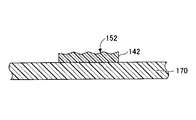
- FIG. 3 schematically shows a state in which the first transparent layer 142 for the functional member 140 is formed on the support base material 170.
- the first transparent layer 142 has an uneven surface 152.
- a first resin for the first transparent layer 142 is placed on a support base material 170, and unevenness is formed on the upper portion of the first resin. It is formed by curing the first resin in a state where the mold having the above is pressed.
- the first resin is preferably a resin that is cured by an external stimulus (energy application) such as a photocurable resin, a thermosetting resin, and a thermoplastic resin.
- the method of installing the first resin is not particularly limited.
- the first resin may be placed on the support substrate 170 by, for example, die coating, spin coating, inkjet coating, spray coating, or the like.
- the arithmetic mean roughness Ra of the uneven surface 152 of the first transparent layer 142 is, for example, in the range of 0.01 ⁇ m to 20 ⁇ m.
- the maximum PV value of the uneven surface 152 is in the range of 0.01 ⁇ m to 50 ⁇ m, more preferably 0.05 ⁇ m to 50 ⁇ m.
- the reflective layer 144 is installed on the first transparent layer 142.
- FIG. 4 schematically shows a state in which the reflective layer 144 is formed on the first transparent layer 142.
- the reflective layer 144 includes, for example, a vapor deposition method, a physical vapor deposition (PVD) method, and sputtering.
- the film may be formed by a film forming technique such as a method.
- the material of the reflective layer 144 may be composed of a metal (including an alloy), a metal oxide, a metal nitride, and a combination thereof. Further, the reflective layer 144 may be composed of a multilayer film.
- the thickness of the reflective layer 144 is, for example, in the range of 1 nm to 150 nm, more preferably 1 nm to 20 nm. Since the reflective layer 144 is relatively thin, as shown in FIG. 4, the outermost surface of the reflective layer 144 is an uneven surface 154 that reflects the shape of the uneven surface 152 of the lower first transparent layer 142.
- the adhesion layer 146 is installed on the reflective layer 144.
- FIG. 5 schematically shows a state in which the adhesion layer 146 is formed on the reflection layer 144.
- the adhesion layer 146 is selected from, for example, acrylic resin, polyester resin, polyurethane resin, polyurethane acrylate resin, ester resin, polycarbonate resin, polyvinyl butyral resin, cycloolefin resin, cycloolefin copolymer resin, vinyl acetate copolymer resin and the like. May be.
- the Tg of the adhesion layer 146 is preferably, for example, 40 ° C to 150 ° C.
- the method of forming the adhesion layer 146 is not particularly limited.
- the adhesion layer 146 is formed by uniformly applying a coating liquid prepared by dissolving or suspending the above-mentioned material in an appropriate solvent onto the reflection layer 144 to form a coating layer, and then forming the coating layer. It may be formed by volatilizing the solvent from. In this method, the molding shrinkage rate of the adhesion layer 146 can be made extremely small.
- the solvent is not particularly limited as long as it dissolves the material to be the adhesion layer and is easy to dry, but may be, for example, alcohol, acetone, methyl ethyl ketone, ethyl acetate, toluene or the like. Further, the volatilization of the solvent may be carried out by heating the coating layer. In this case, the heat treatment temperature may be in the range of, for example, 50 ° C to 150 ° C.
- the adhesion layer 146 may be formed by placing a monomer before the reaction on the reflection layer 144 and polymerizing the monomer.
- the thickness of the adhesion layer 146 is, for example, in the range of 1 nm to 150 nm, more preferably 1 nm to 20 nm. Since the adhesion layer 146 is relatively thin, as shown in FIG. 5, the outermost surface of the adhesion layer 146 is an uneven surface 156 that reflects the shape of the uneven surface 154 of the lower reflective layer 144.
- a second transparent layer 148 is installed on the adhesion layer 146.
- FIG. 6 schematically shows a state in which the second transparent layer 148 is formed on the adhesion layer 146.
- the second transparent layer 148 is formed by placing a second resin on the adhesion layer 146 and curing the second resin.
- the second resin is selected from the resins capable of forming the second transparent layer 148 by the crosslinking reaction.
- the second resin may be selected from an ultraviolet curable resin having an unsaturated group, a thermosetting resin or a thermoplastic resin, an epoxy resin, and a silicone resin.
- the method of installing the second resin is not particularly limited.
- the second resin may be installed on the adhesion layer 146 by, for example, die coating, spin coating, inkjet coating, spray coating, or the like.
- the second transparent layer 148 is formed on the adhesion layer 146.
- the functional member 140 can be formed on the support base material 170.
- the lower surface of the first transparent layer 142 (on the side of the supporting base material 170) and the upper surface of the second transparent layer 148 are smooth surfaces having no unevenness.
- the arithmetic mean roughness Ra of the smooth surface is preferably less than 0.01 ⁇ m.
- Step S120 Next, the dummy layer 160 is formed so as to be in close contact with the first side wall 150A and the second side wall 150B of the functional member 140.
- the dummy layer 160 can be formed by placing a thermoplastic resin on the support base material 170 in parallel with the functional member 140 and curing the thermoplastic resin.
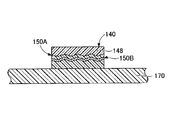
- FIG. 7 schematically shows a state in which the dummy layer 160 is arranged on the side portion of the functional member 140 and the encapsulation layer 130 is configured.
- the encapsulation layer 130 has a maximum thickness of 200 ⁇ m or less.
- Step S130 an assembly having a first glass plate 110, a first interlayer film 115, an encapsulating layer 130, a second interlayer film 125, and a second glass plate 120 in this order is configured.
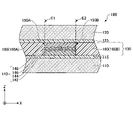
- FIG. 8 schematically shows a cross section of the assembly 180.
- the method of constructing the assembly 180 is not particularly limited.
- the assembly 180 has, for example, after separating the encapsulation layer 130 from the support base material 170, the encapsulation layer 130 has a first glass plate 110 having a first interlayer film 115 and a second interlayer film 125. It may be configured by arranging it between the second glass plate 120 and the second glass plate 120.
- the assembly 180 may be configured after forming an intermediate as shown in FIG.
- the second interlayer film 125 is arranged on the encapsulation layer 130.
- the encapsulation layer 130 is separated from the support substrate 170 to form the intermediate 185.
- the assembly 180 is configured by arranging the intermediate 185 between the first glass plate 110 having the first intermediate film 115 and the second glass plate 120.
- Step S140 Next, the assembly 180 is integrally processed.
- the conditions of the integration process also vary depending on the material contained in the assembly 180.
- the integration process may be carried out, for example, by holding the assembly 180 under vacuum at 120 ° C. for 1 hour.
- each member included in the assembly 180 is firmly adhered to each other.
- the first laminated glass 100 as shown in FIG. 1 can be manufactured.
- an interlayer film is hollowed out, and a functional member is arranged in the hollowed out portion.
- the interlayer film is 200 ⁇ m or less, it becomes difficult to appropriately hollow out the interlayer film and enclose the functional member in the hollowed out portion.
- the functional member 140 can be arranged without hollowing out the encapsulation layer 130. Therefore, in the first method, the functional member 140 can be properly arranged even if a thin encapsulation layer 130 having a thickness of 200 ⁇ m or less is used.
- FIG. 10 schematically shows a cross section of a configuration example of laminated glass according to another embodiment of the present invention.
- the laminated glass (hereinafter referred to as “second laminated glass”) 200 has the same configuration as the first laminated glass 100 shown in FIG. .. Therefore, in the second laminated glass 200, a reference code obtained by adding 100 to the reference code shown in FIG. 1 is used for the same member as the first laminated glass 100.
- the configuration of the functional member 240 provided in the sealing layer 230 is different from that of the first laminated glass 100. That is, in the second laminated glass 200, the functional member 240 is composed of the first transparent layer 242, the reflective layer 244, and the close contact layer 246, and the second transparent layer is omitted.
- the thickness (dimension in the Z direction of FIG. 10) of the encapsulation layer 230 is 200 ⁇ m or less at the maximum.
- the encapsulation layer 230 has a functional member 240 and a dummy layer 260 arranged adjacent to the functional member 240.
- the dummy layers 260B are arranged in this order to form the encapsulation layer 230.
- the functional member 240 has a first side wall 250A and a second side wall 250B.
- the first dummy layer 260A is arranged so as to be in close contact with the first side wall 250A of the functional member 240. Therefore, there is substantially no gap between the functional member 240 and the first dummy layer 260A.
- the second dummy layer 260B is arranged so as to be in close contact with the second side wall 250B. Therefore, there is substantially no gap between the functional member 240 and the second dummy layer 260B.
- the functional member 240 and the first dummy layer 260A are both when the refractive index of the functional member 240 is n 21 and the refractive index of the first dummy layer 260A is n 22 .
- is adjusted to be 0.05 or less.
- the refractive index of the second dummy layer 260B is n 23 , the absolute value of the difference in refractive index
- the refractive index n 21 of the functional member 240 is represented as the average of the first transparent layer 242 and the close contact layer 246.
- the boundary E1 between the functional member 240 and the first dummy layer 260A and the boundary E2 between the functional member 240 and the second dummy layer 260B are not so conspicuous. can do. Therefore, in the second laminated glass 200, the designability can be significantly enhanced.
- the first dummy layer 260A and / or the second dummy layer 260B may be made of the same material as the close contact layer 246 of the functional member 240.
- the boundary E1 and / or the boundary E2 becomes less noticeable, and the design of the second laminated glass 200 can be further enhanced.
- FIG. 11 schematically shows an example of the flow of the second laminated glass manufacturing method (hereinafter referred to as “second method”).
- the second method is (1) A step of forming a feature portion including at least a part of the functional member on the support base material (step S210). (2) A thermoplastic resin is installed so as to be in close contact with the upper portion and the side wall of the characteristic portion, and the thermoplastic resin is cured to complete an enclosed layer in which the functional member and the dummy layer are in close contact with each other in the lateral direction. Step (step S220) and (3) The encapsulation layer is arranged between the first glass plate and the second glass plate, and the first glass plate, the first interlayer film, the encapsulation layer, the second interlayer film, and the second glass plate are formed. A step (step S230) of forming an assembly having in this order and (4) A step (step S240) of forming the laminated glass by integrating the assembly. Have.
- Step S210 First, a part of the functional member 240 (hereinafter referred to as "feature portion") is formed on the support base material.
- the same material as the supporting base material 170 in the above-mentioned first method can be used.
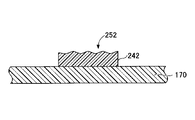
- FIG. 12 schematically shows a state in which the first transparent layer 242 for the functional member 240 is formed on the support base material 170.
- the first transparent layer 242 can be formed by the same method as the method for forming the first transparent layer 142 in the above-mentioned first method.
- the first transparent layer 242 has an uneven surface 252.
- the reflective layer 244 is installed on the first transparent layer 242.
- FIG. 13 schematically shows a state in which the reflective layer 244 is formed on the first transparent layer 242.
- the reflective layer 244 can be formed by the same method as the method for forming the reflective layer 144 in the above-mentioned first method.
- the reflective layer 244 has an uneven surface 254.
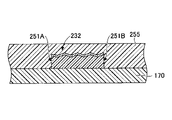
- the feature portion 232 is formed on the support base material 170.
- the feature portion 232 has a first side wall 251A and a second side wall 251B.
- thermoplastic resin is installed so as to be in close contact with the first side wall 251A and the second side wall 251B of the feature portion 232.
- the thermoplastic resin is also installed on the upper part of the feature portion 232.
- thermoplastic resin may be the resin used in the step S120 in the above-mentioned first method.
- FIG. 14 schematically shows a state in which the thermoplastic resin 255 is installed on each of the upper surface of the feature portion 232, the first side wall 251A, and the second side wall 251B.
- thermoplastic resin 255 is cured.
- the adhesion layer 246 is formed on the upper surface of the feature portion 232, and the functional member 240 is completed. Further, the dummy layer 260 is formed by curing the thermoplastic resin 255 installed on the side surface of the feature portion 232.
- the encapsulation layer 230 as shown in FIG. 15 is formed on the support base material 170.
- the encapsulation layer 230 is arranged between the first glass plate 210 and the second glass plate 220 to form an assembly.
- the assembly has a first glass plate 210, a first interlayer film 215, an encapsulation layer 230, a second interlayer film 225, and a second glass plate 220 in this order.
- each member included in the assembly is brought into close contact with each other.
- the second laminated glass 200 as shown in FIG. 10 can be manufactured.
- the functional member 240 can be arranged without hollowing out the encapsulation layer 230. Therefore, in the second method, the functional member 240 can be properly arranged even if a thin encapsulation layer 230 having a thickness of 200 ⁇ m or less is used.
- FIG. 16 schematically shows a cross section of a configuration example of laminated glass according to still another embodiment of the present invention.
- the laminated glass (hereinafter referred to as “third laminated glass”) 300 has the same configuration as the first laminated glass 100 shown in FIG. Have. Therefore, in the third laminated glass 300, a reference code obtained by adding 200 to the reference code shown in FIG. 1 is used for the same member as the first laminated glass 100.
- the configuration of the functional member provided in the sealing layer 330 is different from that of the first laminated glass 100.
- each functional member includes a light emitting element such as a light emitting diode (LED).
- FIG. 16 shows three functional members, a first functional member 340-1, a second functional member 340-2, and a third functional member 340-3.
- each functional member is arranged in a matrix in a top view of the third laminated glass 300.
- the arrangement form of the functional member is not particularly limited, and the functional member 340 may be arranged in any two-dimensional manner.
- Each functional member 340-1, 340-2 and 340-3 (hereinafter, collectively referred to as "functional member 340") has a transparent layer, a light emitting element, and a protective layer in order from the first glass plate 310.
- the first functional member 340-1 is a protective layer 342 arranged so as to cover the first light emitting element 345-1 formed on the transparent layer 348-1 and the first light emitting element 345-1. It has -1 and. The same applies to the second functional member 340-2 and the third functional member 340-3.
- protective layer 342 the protective layers 342-1 to 342-3 are collectively referred to as “protective layer 342", and the first light emitting element 345-1 to the third light emitting element 345-3 are collectively referred to as “protective layer 342". It is referred to as “light emitting element 345", and the transparent layer 348-1 to the transparent layer 348-3 may be collectively referred to as “transparent layer 348".
- the thickness of the encapsulation layer 330 (dimension in the Z direction in FIG. 16) is 100 ⁇ m or less at the maximum. Further, the encapsulation layer 330 has a functional member 340 and a dummy layer arranged adjacent to the functional member 340.
- the first dummy layer 360A and the first functional member 340-1 are oriented along the direction perpendicular to the thickness direction (Z direction in FIG. 16) (X direction in FIG. 16).
- the second dummy layer 360B, the second functional member 340-2, the third dummy layer 360C, the third functional member 340-3, and the fourth dummy layer 360D are arranged in this order, and the encapsulation layer 330 is formed. It is composed.
- the first functional member 340-1 has a first side wall 350-1A and a second side wall 350-1B.
- the first dummy layer 360A is arranged so as to be in close contact with the first side wall 350-1A of the first functional member 340-1. Therefore, there is substantially no gap between the first functional member 340-1 and the first dummy layer 360A.
- the second dummy layer 360B is arranged so as to be in close contact with the second side wall 350-1B of the first functional member 340-1. Therefore, there is substantially no gap between the first functional member 340-1 and the second dummy layer 360B.
- the refractive index of the first functional member 340-1 is set to n 31.
- of the difference between the two refractive indexes is adjusted to be 0.05 or less. From the above definition, the refractive index n 31 of the first functional member 340 is represented as an average of the refractive index of the protective layer 342-1 and the refractive index of the transparent layer 348-1.
- the second dummy layer 360B has an absolute value
- the third dummy layer 360C has an absolute value
- the fourth dummy layer 360D is adjusted so that the absolute value
- the boundary between the functional member 340 and each dummy layer 360 adjacent to the functional member 340 can be made less conspicuous. Therefore, in the third laminated glass 300, the designability can be significantly enhanced.
- the first dummy layer 360A may be made of the same material as the transparent layer 348-1 of the first functional member 340-1.
- the second dummy layer 360B is made of the same material as the transparent layer 348-1 of the first functional member 340-1 and / or the transparent layer 348-2 of the second functional member 340-2.
- the third dummy layer 360C may be made of the same material as the transparent layer 348-2 of the second functional member 340-2 and / or the transparent layer 348-3 of the third functional member 340-3.
- the fourth dummy layer 360D may be made of the same material as the transparent layer 348-3 of the third functional member 340-3.
- the boundary between the functional member 340 and the dummy layer becomes less conspicuous, and the design of the third laminated glass 300 can be further enhanced.
- the third laminated glass 300 can be manufactured by the same method as the first method or the second method described above. However, it should be noted that in the third laminated glass 300, a combination of the protective layer 342, the light emitting element 345, and the transparent layer 348 is used as the functional member 340.
- each member constituting the third laminated glass 300 will be described in more detail. However, the above description can be referred to for each component except the functional member 340 of the third laminated glass 300. Therefore, here, the functional member 340 will be described.
- Each functional member 340 has a light emitting element 345 and a transparent layer 348.
- the type of light emitting element 345 is not particularly limited.
- the light emitting element 345 may be, for example, an LED.
- each light emitting element 345 may include two or more LEDs.
- the light emitting element 345 includes three LEDs of a red LED, a green LED, and a blue LED, a set of three color LEDs can form one pixel. Therefore, a laminated glass that displays a full-color image can be obtained.
- the LED is preferably a small size LED called a so-called mini LED.
- the functional member 340 includes the light emitting element 345
- the configuration of such wiring 345X and the like is obvious to those skilled in the art and will not be described further here.
- the transparent layer 348 included in each functional member 340 may be made of, for example, a transparent resin. Further, it is preferable that the transparent layer 348 is made of a film-shaped resin base material so that a light emitting element 345 can be laminated on the transparent layer 348.
- resins include polyester resins such as PET and PEN (polyethylene naphthalate), olefin resins such as COP and cycloolefin copolyma (COC), celluloses, acetyl celluloses, and triacetyl celluloses (TAC).
- Cellular resin such as, imide resin such as polyimide (PI), polyethylene (PE), polyvinyl chloride (PVC), polystyrene (PS), polyvinyl acetate (PVAc), polyvinyl alcohol (PVA), polyvinyl butyral (PVB) ) And the like, acrylic resins such as polymethyl methacrylate (PMMA) and ethylene / vinyl acetate copolymer resin (EVA), those having a crosslinked skeleton, urethane resins and the like.
- imide resin such as polyimide (PI), polyethylene (PE), polyvinyl chloride (PVC), polystyrene (PS), polyvinyl acetate (PVAc), polyvinyl alcohol (PVA), polyvinyl butyral (PVB)
- acrylic resins such as polymethyl methacrylate (PMMA) and ethylene / vinyl acetate copolymer resin (EVA), those having a crosslinked skeleton, urethane resins and the
- each functional member 340 may be made of, for example, a transparent resin.
- a transparent resin the above-mentioned description such as the first transparent layer 142 in the first laminated glass 100 can be referred to.
- the protective layer 342 may be made of the same resin as the transparent layer 348.
- the thickness of the functional member 340 is preferably in the range of 1 ⁇ m to 100 ⁇ m.
- the thickness is more preferably in the range of 5 ⁇ m to 30 ⁇ m.
- the configuration of the laminated glass according to the embodiment of the present invention has been described above by taking the first laminated glass 100, the second laminated glass 200, and the third laminated glass 300 as examples.
- the laminated glass according to one embodiment of the present invention may have any aspect as long as the enclosed layer has a structure in which the functional member and the dummy layer are in close contact with each other in the lateral direction.
- the adhesion layer 146 of the functional member 140 may be omitted.
- dummy layers 160A and 160B are provided on the respective sides of the side walls 150A and 150B of the functional member 140 in the enclosed layer 130.
- the functional member 140 is provided on either end side of the first laminated glass 100 in a top view, one of the first dummy layer 160A and the second dummy layer 260B is present. It does not have to be.
- a method for producing a laminated glass according to an embodiment of the present invention has been described by taking the first method and the second method as examples. However, the method for producing a laminated glass according to one embodiment of the present invention may have another step.
- the functional member 140 is formed in the step S110, and then the dummy layer 160 is formed on the side walls 150A and 150B of the functional member 140 in the step S120 to form the encapsulation layer 130.
- the thermoplastic resin may be applied to the side wall and the upper surface of the feature portion.
- the thermoplastic resin is cured, the second transparent layer 148 is formed on the upper portion of the feature portion, and the dummy layer 160 is formed on the side portion of the feature portion. Therefore, in this method, the functional member 140 and the dummy layer 160 can be completed at one time.
- step S210 the feature portion 232 up to the reflective layer 244 is formed, and then in step S220, the upper surface of the feature portion 232, the first side wall 251A, and the second side wall 251B are brought into close contact with each other.
- the thermoplastic resin 255 is installed. Further, by curing the thermoplastic resin 255, the adhesion layer 246 is formed on the upper portion of the feature portion 232, and the dummy layer 260 is formed on the side portion of the feature portion 232.
- the functional member 240 may be formed in advance, and then the dummy layer 260 may be formed on the side walls 250A and 250B of the functional member 240 to form the encapsulation layer 230.
- the laminated glass according to one embodiment of the present invention can be applied to, for example, a windshield of a vehicle and / or a window glass of a building.
- the first glass plate and / or the second glass plate may be flat or curved.
- FIG. 17 schematically shows a top view of a windshield of a vehicle to which a laminated glass according to an embodiment of the present invention is applied.
- the windshield 400 is configured by sandwiching an encapsulating layer between the first interlayer film of the first glass plate and the second interlayer film of the second glass plate.
- the encapsulation layer may have a screen member such as the above-mentioned functional members 140 and 240.
- the windshield 400 has an upper side 402 and a lower side 404.
- the length of the upper side 402 is longer than that of the lower side 404.
- the windshield 400 has a curved first glass plate and a second glass plate, and has a convex shape curved in any direction perpendicular to the paper surface. Has the form of.
- the windshield 400 has a screen portion 441 configured on the side of the lower side 404 and a transmission portion 461 configured on the side of the upper side 402.
- the screen unit 441 can reflect the image projected on the windshield 400.
- the screen unit 441 has, for example, a visible light reflectance of 5% or more.
- the transmitting portion 461 has a visible light transmittance of 30% or more.
- the screen unit 441 corresponds to the position of the functional member (for example, the functional member 140 or the functional member 240) in the laminated glass according to the embodiment of the present invention.
- the transmission portion 461 corresponds to the position of the dummy layer (for example, the dummy layer 160 or the dummy layer 260) in the laminated glass according to the embodiment of the present invention.
- the boundary E between the screen portion 441 and the transmission portion 461 can be made difficult to see.
- the encapsulating layer is provided in the form shown in FIG.
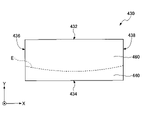
- FIG. 18 schematically shows a top view of the encapsulating layer in a state before being installed between two glass plates.
- the encapsulation layer 430 at this stage has a film-like form having an upper side 432 and a lower side 434 and two ends 436 and 438.
- the side of the upper side 432 of the encapsulation layer 430 is composed of the dummy layer 460, and the side of the lower side 434 is composed of the screen member 440.
- the screen member 440 is configured so that the width (dimension in the Y direction) of the end portions 436 and 438 is larger than that of the central portion.
- the dummy layer 460 is configured so that the width (dimension in the Y direction) of the end portions 436 and 438 is smaller than that of the central portion.
- the glass plate of the windshield 400 has a curved curved surface shape. Therefore, when the encapsulation layer having the uniform width of the screen member is installed between the two glass plates, wrinkles are generated in the encapsulation layer due to the dimensional difference between the upper side 402 and the lower side 404.
- the encapsulation layer 430 is provided as a film having the dimensions shown in FIG. 18, when the encapsulation layer 430 is installed between two glass plates, the dimensional difference between the upper side 402 and the lower side 404 can be offset. Therefore, it is possible to significantly suppress the occurrence of wrinkles in the encapsulation layer 430.
- the above-mentioned third laminated glass 300 may be applied to form a windshield.
- a windshield capable of displaying an image without providing an external device such as a projector.
Landscapes
- Engineering & Computer Science (AREA)
- Mechanical Engineering (AREA)
- Laminated Bodies (AREA)
- Joining Of Glass To Other Materials (AREA)
Priority Applications (4)
| Application Number | Priority Date | Filing Date | Title |
|---|---|---|---|
| CN202180063354.9A CN116323179A (zh) | 2020-10-05 | 2021-09-14 | 夹层玻璃 |
| EP21877318.2A EP4227280A1 (en) | 2020-10-05 | 2021-09-14 | Laminated glass |
| JP2022555328A JPWO2022075015A1 (https=) | 2020-10-05 | 2021-09-14 | |
| US18/129,730 US20230234427A1 (en) | 2020-10-05 | 2023-03-31 | Laminated glass |
Applications Claiming Priority (2)
| Application Number | Priority Date | Filing Date | Title |
|---|---|---|---|
| JP2020168527 | 2020-10-05 | ||
| JP2020-168527 | 2020-10-05 |
Related Child Applications (1)
| Application Number | Title | Priority Date | Filing Date |
|---|---|---|---|
| US18/129,730 Continuation US20230234427A1 (en) | 2020-10-05 | 2023-03-31 | Laminated glass |
Publications (1)
| Publication Number | Publication Date |
|---|---|
| WO2022075015A1 true WO2022075015A1 (ja) | 2022-04-14 |
Family
ID=81126829
Family Applications (1)
| Application Number | Title | Priority Date | Filing Date |
|---|---|---|---|
| PCT/JP2021/033732 Ceased WO2022075015A1 (ja) | 2020-10-05 | 2021-09-14 | 合わせガラス |
Country Status (5)
| Country | Link |
|---|---|
| US (1) | US20230234427A1 (https=) |
| EP (1) | EP4227280A1 (https=) |
| JP (1) | JPWO2022075015A1 (https=) |
| CN (1) | CN116323179A (https=) |
| WO (1) | WO2022075015A1 (https=) |
Citations (8)
| Publication number | Priority date | Publication date | Assignee | Title |
|---|---|---|---|---|
| WO2007142319A1 (ja) | 2006-06-09 | 2007-12-13 | Nippon Sheet Glass Company, Limited | シート封入合わせガラス |
| JP2011189590A (ja) * | 2010-03-15 | 2011-09-29 | Sony Corp | 光学積層体および建具 |
| JP2015511570A (ja) * | 2012-02-27 | 2015-04-20 | サン−ゴバン グラス フランスSaint−Gobain Glass France | 日除け機能及び断熱機能を備えた合わせガラス |
| JP2017186229A (ja) * | 2016-04-01 | 2017-10-12 | 旭硝子株式会社 | 車両用合わせガラス |
| JP2019172512A (ja) * | 2018-03-28 | 2019-10-10 | Agc株式会社 | 合わせガラス |
| JP2020007182A (ja) * | 2018-07-05 | 2020-01-16 | 大日本印刷株式会社 | 合わせガラスの製造方法 |
| WO2020171063A1 (ja) * | 2019-02-20 | 2020-08-27 | Agc株式会社 | 合わせガラス |
| JP2020168527A (ja) | 2019-02-18 | 2020-10-15 | 株式会社バンダイ | プログラム、端末、ゲームシステム及びゲーム管理装置 |
Family Cites Families (6)
| Publication number | Priority date | Publication date | Assignee | Title |
|---|---|---|---|---|
| FR2892594B1 (fr) * | 2005-10-21 | 2007-12-07 | Saint Gobain | Structure lumineuse comportant au moins une diode electroluminescente, sa fabrication et ses applications |
| JP2010222233A (ja) * | 2009-02-27 | 2010-10-07 | Central Glass Co Ltd | 断熱合わせガラス |
| CN108367980A (zh) * | 2015-12-09 | 2018-08-03 | 旭硝子株式会社 | 夹层玻璃 |
| US11338555B2 (en) * | 2017-03-31 | 2022-05-24 | Sekisui Chemical Co., Ltd. | Laminated glass |
| JP7024618B2 (ja) * | 2017-07-26 | 2022-02-24 | Agc株式会社 | 車両用合わせガラス |
| WO2019198748A1 (ja) * | 2018-04-11 | 2019-10-17 | 大日本印刷株式会社 | 合わせガラス、合わせガラスの製造方法、調光装置、調光セル及び調光装置用積層体 |
-
2021
- 2021-09-14 JP JP2022555328A patent/JPWO2022075015A1/ja active Pending
- 2021-09-14 EP EP21877318.2A patent/EP4227280A1/en not_active Withdrawn
- 2021-09-14 CN CN202180063354.9A patent/CN116323179A/zh active Pending
- 2021-09-14 WO PCT/JP2021/033732 patent/WO2022075015A1/ja not_active Ceased
-
2023
- 2023-03-31 US US18/129,730 patent/US20230234427A1/en not_active Abandoned
Patent Citations (8)
| Publication number | Priority date | Publication date | Assignee | Title |
|---|---|---|---|---|
| WO2007142319A1 (ja) | 2006-06-09 | 2007-12-13 | Nippon Sheet Glass Company, Limited | シート封入合わせガラス |
| JP2011189590A (ja) * | 2010-03-15 | 2011-09-29 | Sony Corp | 光学積層体および建具 |
| JP2015511570A (ja) * | 2012-02-27 | 2015-04-20 | サン−ゴバン グラス フランスSaint−Gobain Glass France | 日除け機能及び断熱機能を備えた合わせガラス |
| JP2017186229A (ja) * | 2016-04-01 | 2017-10-12 | 旭硝子株式会社 | 車両用合わせガラス |
| JP2019172512A (ja) * | 2018-03-28 | 2019-10-10 | Agc株式会社 | 合わせガラス |
| JP2020007182A (ja) * | 2018-07-05 | 2020-01-16 | 大日本印刷株式会社 | 合わせガラスの製造方法 |
| JP2020168527A (ja) | 2019-02-18 | 2020-10-15 | 株式会社バンダイ | プログラム、端末、ゲームシステム及びゲーム管理装置 |
| WO2020171063A1 (ja) * | 2019-02-20 | 2020-08-27 | Agc株式会社 | 合わせガラス |
Also Published As
| Publication number | Publication date |
|---|---|
| EP4227280A1 (en) | 2023-08-16 |
| CN116323179A (zh) | 2023-06-23 |
| US20230234427A1 (en) | 2023-07-27 |
| JPWO2022075015A1 (https=) | 2022-04-14 |
Similar Documents
| Publication | Publication Date | Title |
|---|---|---|
| US10409150B2 (en) | Image projection structure, transparent screen, and manufacturing method of image projection structure | |
| US8305743B2 (en) | Curved display panel and method for manufacturing the same | |
| CN102576112B (zh) | 功能性片材和使用该功能性片材的透镜 | |
| TWI753069B (zh) | 透明樹脂基板 | |
| US20130209796A1 (en) | Polycarbonate with hard coat layer | |
| US20180307092A1 (en) | Display apparatus | |
| JP2006183022A5 (ja) | 光学フィルム用粘着剤層、光学フィルム用粘着剤層の製造方法、粘着型光学フィルムおよび画像表示装置 | |
| KR20110110268A (ko) | 편광자 부착 적층체, 지지체 부착 표시 장치용 패널, 표시 장치용 패널, 표시 장치 및 이들의 제조 방법 | |
| TW201501943A (zh) | 用於顯示裝置之視窗以及包含該視窗之顯示裝置 | |
| JPWO2014123165A1 (ja) | 透明面材およびそれを用いた表示装置 | |
| CN104097375A (zh) | 用于显示装置的窗和包括该窗的显示装置 | |
| JP2007225633A (ja) | 表示装置、及び、液晶表示装置 | |
| JP2010205514A (ja) | El素子、並びにそれを用いた照明装置及び表示装置 | |
| KR102318106B1 (ko) | 점착 시트, 표시체 및 그들의 제조 방법 | |
| WO2022075015A1 (ja) | 合わせガラス | |
| JP6877525B1 (ja) | 加飾付積層体、光学積層体、およびフレキシブル画像表示装置 | |
| TWI566929B (zh) | Integrated optical film and its diffuser | |
| CN206805064U (zh) | 背光装置和显示装置 | |
| JP2006330737A5 (https=) | ||
| CN114327120A (zh) | 曲面结构及其制造方法和显示设备 | |
| JP2019191426A (ja) | 光学部材 | |
| JP5039826B2 (ja) | 電子機器の画像の視認性向上構造及びその構造を有する電子機器 | |
| CN118664981A (zh) | 可透光多层膜、其制备方法以及包含可透光多层膜的玻璃组件 | |
| JP6784185B2 (ja) | 映像投影用構造体、透明スクリーン、および映像投影用構造体の製造方法 | |
| WO2024262296A1 (ja) | フィルムミラー積層体及びミラー部材 |
Legal Events
| Date | Code | Title | Description |
|---|---|---|---|
| 121 | Ep: the epo has been informed by wipo that ep was designated in this application |
Ref document number: 21877318 Country of ref document: EP Kind code of ref document: A1 |
|
| ENP | Entry into the national phase |
Ref document number: 2022555328 Country of ref document: JP Kind code of ref document: A |
|
| NENP | Non-entry into the national phase |
Ref country code: DE |
|
| ENP | Entry into the national phase |
Ref document number: 2021877318 Country of ref document: EP Effective date: 20230508 |