WO2022074916A1 - プレスフィット端子及びコネクタ装置 - Google Patents
プレスフィット端子及びコネクタ装置 Download PDFInfo
- Publication number
- WO2022074916A1 WO2022074916A1 PCT/JP2021/028697 JP2021028697W WO2022074916A1 WO 2022074916 A1 WO2022074916 A1 WO 2022074916A1 JP 2021028697 W JP2021028697 W JP 2021028697W WO 2022074916 A1 WO2022074916 A1 WO 2022074916A1
- Authority
- WO
- WIPO (PCT)
- Prior art keywords
- press
- fit
- fit terminal
- outer edge
- hole
- Prior art date
- Legal status (The legal status is an assumption and is not a legal conclusion. Google has not performed a legal analysis and makes no representation as to the accuracy of the status listed.)
- Ceased
Links
Images



Classifications
-
- H—ELECTRICITY
- H01—ELECTRIC ELEMENTS
- H01R—ELECTRICALLY-CONDUCTIVE CONNECTIONS; STRUCTURAL ASSOCIATIONS OF A PLURALITY OF MUTUALLY-INSULATED ELECTRICAL CONNECTING ELEMENTS; COUPLING DEVICES; CURRENT COLLECTORS
- H01R12/00—Structural associations of a plurality of mutually-insulated electrical connecting elements, specially adapted for printed circuits, e.g. printed circuit boards [PCB], flat or ribbon cables, or like generally planar structures, e.g. terminal strips, terminal blocks; Coupling devices specially adapted for printed circuits, flat or ribbon cables, or like generally planar structures; Terminals specially adapted for contact with, or insertion into, printed circuits, flat or ribbon cables, or like generally planar structures
- H01R12/50—Fixed connections
- H01R12/51—Fixed connections for rigid printed circuits or like structures
- H01R12/55—Fixed connections for rigid printed circuits or like structures characterised by the terminals
- H01R12/58—Fixed connections for rigid printed circuits or like structures characterised by the terminals terminals for insertion into holes
- H01R12/585—Terminals having a press fit or a compliant portion and a shank passing through a hole in the printed circuit board
-
- H—ELECTRICITY
- H01—ELECTRIC ELEMENTS
- H01R—ELECTRICALLY-CONDUCTIVE CONNECTIONS; STRUCTURAL ASSOCIATIONS OF A PLURALITY OF MUTUALLY-INSULATED ELECTRICAL CONNECTING ELEMENTS; COUPLING DEVICES; CURRENT COLLECTORS
- H01R13/00—Details of coupling devices of the kinds covered by groups H01R12/70 or H01R24/00 - H01R33/00
- H01R13/02—Contact members
- H01R13/04—Pins or blades for co-operation with sockets
- H01R13/05—Resilient pins or blades
-
- H—ELECTRICITY
- H01—ELECTRIC ELEMENTS
- H01R—ELECTRICALLY-CONDUCTIVE CONNECTIONS; STRUCTURAL ASSOCIATIONS OF A PLURALITY OF MUTUALLY-INSULATED ELECTRICAL CONNECTING ELEMENTS; COUPLING DEVICES; CURRENT COLLECTORS
- H01R13/00—Details of coupling devices of the kinds covered by groups H01R12/70 or H01R24/00 - H01R33/00
- H01R13/02—Contact members
- H01R13/15—Pins, blades or sockets having separate spring member for producing or increasing contact pressure
Definitions
- This disclosure relates to press-fit terminals and connector devices.
- Patent Document 1 discloses a press-fit terminal having a connecting portion composed of a slit portion having a width penetrating the front and back surfaces and two beam members facing each other across the slit portion.
- the thickness of the beam member is formed to be thinner than the thickness of the center of the connection portion on the front end side of the connection portion and the rear end side of the connection portion, and the length of the slit portion is from the center of the connection portion. The length from the center of the connection portion to the rear end side is shorter than the length to the front end side.
- Patent Document 2 has an introduction portion introduced into the through hole, a pressure holding portion connected to the introduction portion and press-fitted and held in the through hole, and a main body portion connected to the pressure holding portion.
- a press-fit terminal having an opening extending in the longitudinal direction from the center of the pressure holding portion to the main body portion side and the introduction portion side is disclosed.
- the ratio of the longitudinal length from the center of the pressure holding portion to one end of the opening on the main body side and the longitudinal length from the center of the pressure holding portion to the other end of the opening on the introduction portion side Is specified in the range of 80: 220 to 120: 180.
- the press-fit terminal is evaluated by, for example, the insertion force, the holding force, and the contact area.
- the insertion force is the load required to insert the press-fit terminal into the through hole.
- the holding force is the load required to pull out the press-fit terminal from the through hole.
- the contact area is the area where the press-fit terminal contacts the inner surface of the through hole when the press-fit terminal is inserted into the through hole.
- the press-fit terminal can be easily inserted into the through hole, and the damage given to the board when the press-fit terminal is inserted into the through hole can be suppressed. Further, if the holding force and the contact area are large, the press-fit terminal is firmly held against the substrate, and the electrical connection reliability between the press-fit terminal and the circuit formed on the substrate is also improved. Therefore, it is required for the press-fit terminal to reduce the insertion force and increase the holding force and the contact area.
- the insertion force tends to be large for press-fit terminals with a large plate thickness of 0.75 to 0.85 mm. If the insertion force becomes too large, the substrate may be damaged. For this reason, for press-fit terminals with a large plate thickness of 0.75 to 0.85 mm, the insertion force, holding force, and contact area are balanced at a high level within the range in which excessive damage to the substrate can be suppressed. It becomes more important to take.
- the purpose of this disclosure is to make it possible to balance the insertion force, the holding force, and the contact area at a high level with respect to the press-fit terminal having a plate thickness of 0.75 to 0.85 mm.
- the press-fit terminal of the present disclosure is a press-fit terminal that is press-fitted into a through hole formed in a substrate, and includes a press-fit portion including two contact pieces facing each other across the eye hole, and the two contacts thereof. Each of the pieces has a parallel portion parallel to each other, a front spring portion extending from the parallel portion in the direction in which the press fit portion is inserted, and a direction opposite to the direction in which the press fit portion is inserted from the parallel portion.
- the thickness of the press-fit portion including the extending rear spring portion is 0.75 mm or more and 0.85 mm or less, and the front spring strength calculated under the following conditions for the press-fit portion is G 1 [mm 3 ].
- the eye hole is formed from the intersection of a straight line extending in a direction perpendicular to the front reference plane from the intersection of the front reference plane and the outer edge of the front spring portion and a straight line extending along the outer edge of the parallel portion.
- the length of the press-fit portion to the front end in the insertion direction is L 1 [mm].
- the eye hole is formed from the intersection of a straight line extending in a direction perpendicular to the rear reference surface from the intersection of the rear reference surface and the outer edge of the rear spring portion and a straight line extending along the outer edge of the parallel portion.
- the length of the press-fit portion to the rear end in the insertion direction is L 2 [mm].
- the front spring strength G 1 is I 1 / L 1 [mm 3 ]
- the rear spring strength G 2 is I 2 / L 2 [mm 3 ].
- the present disclosure it is possible to balance the insertion force, the holding force, and the contact area at a high level for the press-fit terminal having a plate thickness of 0.75 to 0.85 mm.
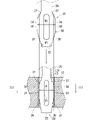
- FIG. 1 is a front view showing a press-fit terminal according to an embodiment.
- FIG. 2 is an explanatory diagram showing a state in which the press-fit portion is inserted into the through hole.
- FIG. 3 is a cross-sectional view taken along the line III-III of FIG.
- FIG. 4 is a cross-sectional view showing another press-fit terminal.
- FIG. 5 is an explanatory view showing the cross-sectional shape of the front spring portion on the front reference plane.
- FIG. 6 is a schematic view showing a connector device.
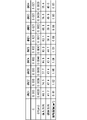
- FIG. 7 is a diagram showing the evaluation results of the press-fit terminal.
- FIG. 8 is a diagram showing the evaluation results of the press-fit terminals.
- the press-fit terminals disclosed in this disclosure are as follows.
- a press-fit terminal that is press-fitted into a through hole formed in a substrate and includes a press-fit portion including two contact pieces facing each other across an eye hole, and each of the two contact pieces is provided with a press-fit portion.
- a parallel portion parallel to each other, a front spring portion extending from the parallel portion in the direction in which the press fit portion is inserted, and a rear spring portion extending from the parallel portion in the direction opposite to the direction in which the press fit portion is inserted.
- the thickness of the press-fit portion is 0.75 mm or more and 0.85 mm or less, and for the press-fit portion, the front spring strength calculated under the following conditions is G 1 [mm 3 ], and the rear spring strength is When the value is G 2 [mm 3 ], G 1 + G 2 is 0.030 or more and 0.080 or less, and the inclination of the front spring portion with respect to the insertion direction of the press fit portion is ⁇ . , G 1 tan ⁇ is 0.0024 or more and 0.0070 or less, which is a press-fit terminal. [conditions] -The direction in which the press-fit terminal is inserted is forward, and the direction opposite to the insertion direction is backward.
- the position of 0.1 mm backward from the front end of the eye hole is used as the front reference, and the position of 0.1 mm forward from the rear end of the eye hole is used as the rear reference.
- -Assuming a front reference plane perpendicular to the outer edge of the front spring portion from the inner edge of the front spring portion in the front reference the moment of inertia of area of the front spring portion in this front reference plane is I 1 [mm 4 ].
- -Assuming a rear reference plane perpendicular to the outer edge of the rear spring portion from the inner edge of the rear spring portion in the rear reference, the moment of inertia of area of the rear spring portion on the rear reference plane is I 2 [mm 4 ]. ].
- the eye hole is formed from the intersection of a straight line extending in a direction perpendicular to the front reference plane from the intersection of the front reference plane and the outer edge of the front spring portion and a straight line extending along the outer edge of the parallel portion.
- the length of the press-fit portion to the front end in the insertion direction is L 1 [mm].
- the eye hole is formed from the intersection of a straight line extending in a direction perpendicular to the rear reference surface from the intersection of the rear reference surface and the outer edge of the rear spring portion and a straight line extending along the outer edge of the parallel portion.
- the length of the press-fit portion to the rear end in the insertion direction is L 2 [mm].
- the front spring strength G 1 is I 1 / L 1 [mm 3 ]
- the rear spring strength G 2 is I 2 / L 2 [mm 3 ].
- G 1 + G 2 may be 0.030 or more and 0.060 or less, and G 1 tan ⁇ may be 0.0028 or more and 0.0060 or less.
- the insertion force, the holding force, and the contact area can be balanced at a higher level.
- a connector including the press-fit terminal of (5) and a substrate on which a through hole is formed are provided, and the press-fit portion of the press-fit terminal is press-fitted into the through hole and along the insertion direction.
- the connector device may have a radius of curvature of the outward portion of the parallel portion equal to or smaller than the radius of the inner circumference of the through hole. As a result, the contact area between the parallel portion and the inner peripheral surface of the through hole becomes large.
- FIG. 1 is a front view showing a press-fit terminal 20.
- FIG. 2 is an explanatory diagram showing a state in which the press-fit portion 30 is inserted into the through hole 13.
- FIG. 2 shows a press-fit terminal 20 inserted into the through-hole 13 and a press-fit terminal 20 inserted into the through-hole 13.
- FIG. 3 is a cross-sectional view taken along the line III-III of FIG.
- the press-fit terminal 20 is a terminal that is press-fitted into the through hole 13 formed in the substrate 12.
- the substrate 12 is formed of an insulating plate such as a glass epoxy plate.
- Through holes 13 penetrating the front and back are formed on the substrate 12.
- the through hole 13 is a circular hole.
- the through hole 13 may be a square hole or the like.
- a conductive layer 13f made of a metal such as copper is formed on the inner surface of the through hole 13. With the press-fit terminal 20 press-fitted into the through hole 13, the press-fit terminal 20 comes into contact with the conductive layer 13f and is electrically connected to the conductive layer 13f.
- the conductive layer 13f may be connected to a circuit formed on the surface of the substrate 12 or the like.
- the press-fit terminal 20 is formed of a metal such as copper or a copper alloy.
- the press-fit terminal 20 may be formed, for example, by pressing a metal plate.
- the surface of the press-fit terminal 20 may be plated with tin, a tin alloy, or the like.
- the press-fit terminal 20 includes a press-fit portion 30.
- the tip end portion 22 is connected to one end of the press-fitting portion 30, and the base end portion 26 is connected to the other end of the press-fitting portion 30.
- the tip portion 22 is a portion that is first inserted into the through hole 13 when the press fit terminal 20 is inserted into the through hole 13.
- the base end portion 26 is a portion in which a portion serving as an electrical connection destination of the conductive layer 13f on the through hole 13 side is connected. In the example shown in FIG. 6 to be described later, the base end portion 26 is connected to the connector terminal portion 54.
- the direction in which the press-fit portion 30 is inserted is forward, and the direction opposite to the direction in which the press-fit portion 30 is inserted is backward.
- the press fit portion 30 is a portion provided between the tip end portion 22 and the base end portion 26.
- the width W2 (here, the maximum width) of the press-fit portion 30 is larger than the width W1 of the tip portion 22, and further larger than the diameter ⁇ of the through hole 13. Therefore, the press-fit portion 30 can come into contact with the inner peripheral surface of the through hole 13.
- the press-fit portion 30 may be grasped as a portion for obtaining an electrical connection to the conductive layer 13f by maintaining a contact state with the inner peripheral surface of the through hole 13.
- the press-fit terminal 20 is formed in an elongated plate shape extending linearly as a whole.
- the tip portion 22 includes a tapered portion that gradually narrows toward the tip side. Due to the presence of the tapered portion, the press-fit terminal 20 is easily inserted into the through hole 13.
- the tip portion may include a rectangular plate-shaped portion having a continuous portion having the same width. In this case, a tapered portion may be formed on the tip side of the rectangular plate-shaped portion. The tip portion 22 can be inserted into the through hole 13 with a gap between the inner peripheral surface of the through hole 13.
- the base end portion 26 includes a rectangular plate-shaped portion having a continuous portion having the same width. The edges on both sides of this rectangular plate are parallel to each other. The width of the base end portion 26 is smaller than the width W2 of the press fit portion 30.
- the base end portion does not have to be rectangular plate-shaped.
- the base end portion may have a shape that gradually narrows or widens toward the press fit portion.
- the base end portion may have a portion larger than the width of the press fit portion.
- the press fit portion 30 is provided between the tip end portion 22 and the base end portion 26.
- the press-fit portion 30 includes two contact pieces 34 facing each other across the eye hole 31.
- the eye hole 31 is a hole elongated in the direction connecting the tip end portion 22 and the base end portion 26. Specific examples of the shape of the eye hole 31 include a perfect circle, an oval shape, a square, and a rectangle.
- the eye hole 31 is preferably elongated in the direction in which the press-fit terminal is inserted.
- the contact piece 34 is formed in the shape of an elongated plate. One end of the two contact pieces 34 is connected to the tip 22. The other end of the two contact pieces 34 is connected to the base end portion 26.
- Each of the two contact pieces 34 includes a parallel portion 36, a front spring portion 35, and a rear spring portion 37.
- the parallel portions 36 of the two contact pieces 34 are arranged in parallel with each other. More specifically, the outer edges 36a of the two parallel portions 36 are aligned linearly along the front-rear direction and parallel to each other. The inner edges of the two parallel portions 36 may also be arranged linearly along the front-rear direction and parallel to each other. However, depending on the shape of the eye hole 31, part or all of the inner edges of the two parallel portions 36 may draw a curve.
- the front spring portion 35 is a portion extending from the parallel portion 36 in the direction (forward) into which the press fit terminal 20 is inserted.
- the front spring portion 35 is a portion that is more easily deformed than the parallel portion 36 when the press fit portion 30 is inserted into the through hole 13.
- the outer edge 35a of the front spring portion 35 is inclined inward in the width direction of the press fit portion 30 toward the front. That is, the outer edge 35a of the front spring portion 35 is connected to the outer edge 36a of the parallel portion 36 at the rear end, gradually faces inward in the width direction of the press fit portion 30 toward the front, and the tip portion 22 at the front end. It is connected to the outer edge of.
- the outer edge 35a of the front spring portion 35 may have a straight line as a whole, a curved line as a whole, or a composite shape of a straight line and a curved line.
- the outer edge 35a of the front spring portion 35 and the outer edge 36a of the parallel portion 36 may be connected in a curved line or may be connected in a corner.
- the outer edge 35a of the front spring portion 35 and the outer edge 36a of the parallel portion 36 form a continuous curve that is convex outward.
- the outer edge 35a of the front spring portion 35 and the outer edge of the tip portion 22 may be connected in a curved line, may be connected in a corner shape, or may be connected in a straight line.
- the outer edge 35a of the front spring portion 35 is linearly connected to the outer edge of the tip portion 22.
- the rear spring portion 37 is a portion extending from the parallel portion 36 in the direction opposite to the direction in which the press fit terminal 20 is inserted (rearward direction).
- the rear spring portion 37 is a portion that is more easily deformed than the parallel portion 36 when the press fit portion 30 is inserted into the through hole 13.
- the front spring portion 35 and the rear spring portion 37 are easily deformed before and after the parallel portion 36, so that the parallel portion 36 can be displaced inward without being significantly tilted.
- the outer edge 37a of the rear spring portion 37 is inclined toward the inside in the width direction of the press fit portion 30 toward the rear.
- the outer edge 37a of the rear spring portion 37 is connected to the outer edge 36a of the parallel portion 36 at the front end, gradually faces inward in the width direction of the press fit portion 30 toward the rear, and the base end portion at the rear end. It is connected to the outer edge of 26.
- the outer edge 37a of the rear spring portion 37 may have a straight line as a whole, a curved line as a whole, or a composite shape of a straight line and a curved line.
- the outer edge 37a of the rear spring portion 37 and the outer edge 36a of the parallel portion 36 may be connected in a curved line or may be connected in a corner.
- the outer edge 37a of the rear spring portion 37 and the outer edge of the proximal end portion 26 may be connected in a curved line or may be connected in a corner.
- the intermediate portion of the outer edge 37a of the rear spring portion 37 forms a straight line, and the portions on both ends thereof form a curved line.
- the outward portion of the parallel portion 36 is formed on an arcuate surface 36f that is convex outward. If the outward portion of the parallel portion 36 is formed on the arcuate surface 36f, it is expected that the arcuate surface 36f will come into contact with the inner peripheral surface of the through hole 13 in a large area.
- the radius of curvature r of the arcuate surface 36f is the same as the inner peripheral radius ( ⁇ / 2) of the through hole 13 into which the press-fit terminal 20 is inserted, or smaller than the inner peripheral radius ( ⁇ / 2). If the radius of curvature r of the arcuate surface 36f is the same as the inner peripheral radius ( ⁇ / 2) of the through hole 13, it is expected that the entire arcuate surface 36f comes into contact with the inner peripheral surface of the through hole 13.
- the radius of curvature r of the arcuate surface 36f and the same radius of the inner circumference ( ⁇ / 2) of the through hole 13 may include the case where they are the same within the manufacturing error range.
- the radius of curvature r of the arcuate surface 36f may be the same within an error range within ⁇ 20% with respect to the inner peripheral radius ( ⁇ / 2) of the through hole 13. Further, even when the radius of curvature r of the arcuate surface is smaller than the inner peripheral radius ( ⁇ / 2) of the through hole 13, when the radius of curvature r of the arcuate surface 136f is larger than the inner peripheral radius ( ⁇ / 2) of the through hole 13. It is expected that the curved surface portion at the center of the arcuate surface 36f will come into contact with the inner peripheral surface of the through hole 13 in a large area (see the range E1 in FIG. 3). For example, as shown in FIG.
- the outward portions of the front spring portion 35 and the rear spring portion 37 are also formed in an arcuate surface in the same manner as described above.
- the outward portions of the parallel portion 36, the front spring portion 35 and the rear spring portion 37 are formed in the above shape when viewed along the insertion direction of the press fit terminal 20.
- the outward portions of the parallel portion 36, the front spring portion 35, and the rear spring portion 37 may be formed on a flat surface.
- the case where the radius of curvature r of the arcuate surface 136f is larger than the inner peripheral radius ( ⁇ / 2) of the through hole 13 is not excluded.
- the press-fit terminal when the thickness of the press-fit portion 30 is as thick as 0.75 mm or more and 0.85 mm or less, when the press-fit terminal applied to the thinner press-fit portion as it is or as a similar shape is formed, the press-fit terminal is formed. It is possible that the insertion force into the through hole becomes excessive. This is because the increase in the thickness of the press-fit portion directly leads to the increase in the insertion force. On the other hand, the substrate itself is not necessarily reinforced in response to an increase in the thickness of the press-fit portion, or a substrate having excellent strength is not always used.
- the thickness of the press-fit portion 30 is as thick as 0.75 mm or more and 0.85 mm or less, the insertion force, the holding force, and the contact area are set to a high level within a range in which excessive damage to the substrate can be suppressed. It is more important to balance with.
- G 1 + G 2 is 0.030.
- the above is 0.080 or less.
- the G 1 tan ⁇ is 0.0024 or more and 0.0070 or less.
- the position 0.1 mm backward from the front end of the eye hole 31 is set as the front reference SF.
- the pre-reference SF is shown as a straight line orthogonal to the front-back direction.
- the position 0.1 mm forward from the rear end of the eye hole 31 is set as the rear reference SR.
- the posterior reference SR is shown as a straight line orthogonal to the anteroposterior direction.
- the front reference plane TF is perpendicular to the outer edge 35a of the front spring portion 35 from the inner edge of the front spring portion 35 in the front reference SF.
- the front reference plane TF perpendicular to the outer edge 35a of the front spring portion 35 is the outer edge 35a of the front spring portion 35 that can be observed when the press-fit portion 30 is viewed along the thickness direction thereof. It means a vertical front reference plane TF.
- a straight line M1 is formed in a direction perpendicular to the front reference plane TF from the intersection of the front reference plane TF and the outer edge 35a of the front spring portion 35.
- the straight line M2 is extended along the outer edge 36a of the parallel portion 36.
- the straight line N1 is extended from the intersection of the rear reference surface TR and the outer edge 37a of the rear spring portion 37 in the direction perpendicular to the rear reference surface TR.
- the length of the press-fit portion 30 from the intersection P2 of the straight line N1 and the straight line N2 (M2) extended along the outer edge 36a of the parallel portion 36 to the rear end of the eye hole 31 is L 2 [mm].
- the moment of inertia of area is a quantity indicating the difficulty of deformation of a member according to the shape of the cross section.
- the moment of inertia of area on the front reference plane TF and the rear reference plane TR can be obtained, for example, as follows.
- the cross-sectional shape of the front spring portion 35 on the front reference plane TF is, for example, a shape obtained by combining a rectangular first portion A and a second portion B obtained by cutting a part of a circle with a straight line, as shown in FIG. Is. Therefore, the moment of inertia of area on the front reference plane TF can be considered to be the sum of the moment of inertia of area of the first portion A and the moment of inertia of area of the second portion B.
- the thickness of the press-fit portion 30 is t [mm]
- the radius of curvature of the outward portion of the press-fit portion 30 is r [mm]
- the dimensions from the inward-facing portion to the outward-facing portion on the eye hole 31 side is h [mm]
- the moment of inertia of area on the front reference plane TF is calculated by the following formula.
- Ia is the moment of inertia of area of the first portion A
- Ib is the moment of inertia of area of the second portion B
- Sa is the cross-sectional area of the first portion A
- Sb is the cross-sectional area of the second portion B.
- ya is the position of the neutral axis of the first part A
- yb is the position of the neutral axis of the second part B
- y is the position of the neutral axis of the whole of the first part A and the second part B combined. The position.
- the moment of inertia of area on the rear reference plane TR can also be obtained in the same manner as above.
- the method of obtaining the moment of inertia of area is an example.
- the moment of inertia of area can be obtained by a calculation method based on the cross-sectional shape of the front spring portion 35 on the front reference plane TF, the cross-sectional shape of the rear spring portion 37 on the rear reference plane TR, and the like.
- G 1 + G 2 is 0.030 [mm 3 ] or more and 0.075 [mm 3 ] or less
- G 1 tan ⁇ is 0.0024 or more and 0. Since it is .0070 or less, the insertion force, the holding force, and the contact area can be balanced at a high level for the press-fit terminal 20 having a thickness of 0.75 mm or more and 0.85 mm or less.
- Such a press-fit terminal 20 can be suitably used when it is provided at a location where vibration is applied, or when it is desired to firmly hold the press-fit terminal 20 on the substrate 12 at a power supply location.
- the outer edge 35a of the front spring portion 35 is inclined toward the inside in the width direction of the press fit portion 30 toward the front, and the outer edge 37a of the rear spring portion 37 is inclined toward the inside in the width direction of the press fit portion 30. It is inclined toward the inside. Therefore, when the press-fit terminal 20 is press-fitted into the through hole 13, the press-fit portion 30 is easily formed due to the presence of the front spring portion 35 and the rear spring portion 37 having outer edges 35a and 37a that are inclined with respect to the parallel portion 36. Can be transformed into.
- the parallel portion 36 can easily come into contact with the inner peripheral surface of the through hole 13 on a large surface, and the contact area can be further increased.
- the central portion of the arcuate surface 36f has a relatively large area and easily contacts the inner peripheral surface of the through hole 13, and the contact area is increased. Can be bigger.
- FIG. 6 is a diagram showing a connector device 50 in which the press-fit terminal 20 is press-fitted into the substrate 12.
- the connector device 50 includes a substrate 12 and a connector 60.
- the connector 60 includes the press-fit terminal 20.
- the connector terminal portion 54 is integrally connected to the base end portion 26 of the press-fit terminal 20.
- the connector terminal portion 54 is connected in a bent state (here, a bent state at a right angle) with respect to the base end portion 26.
- the connector terminal portion 54 may be linearly connected to the base end portion 26.
- the base end portion and the connector terminal portion 54 of the press-fit terminal 20 are incorporated in the connector housing 61 of the connector 60. The base end may protrude from the connector housing 61.
- the connector terminal portion 54 is arranged so as to project from the bottom of the space in the connector housing 61 toward the opening.
- a plurality of press-fit terminals 20 are incorporated in the connector housing 61. Therefore, a plurality of connector terminal portions 54 are lined up at intervals in the connector housing 61.
- a plurality of press-fit terminals 20 project from the outer surface of the connector housing 61.
- a plurality of press-fit terminals 20 projecting from the outer surface of the connector housing 61 are simultaneously press-fitted into the plurality of through holes 13.
- the connector 60 is mounted and fixed on the substrate 12 in a state where the plurality of press-fit terminals 20 are press-fitted into the plurality of through holes 13.
- the thing in which the connector 60 is mounted and fixed on the board 12 may be referred to as a board with a connector 10.
- the radius of curvature r of the outward portion of the parallel portion 36 is the same as or smaller than the inner peripheral radius of the through hole 13, the contact area between the press-fit portion 30 and the inner peripheral surface of the through hole 13 becomes large.
- G (G 1 + G 2) in Example A1-A4 is 0.077
- G (G 1 + G 2 ) in Example B1-B5 is 0,052
- G (G 1 + G 2 ) in Example C1-C5. Is 0.033
- G (G 1 + G 2 ) in Example D1-D4 is 0.027.
- the value of G 1 tan ⁇ is changed.
- the thickness of the press-fit terminal 20 is 0.8 mm
- the diameter ⁇ of the through hole 13 is 1.45 mm.
- B4, C2, C3, C4, C5 it can be seen that the insertion force, the holding force, and the contact area can be balanced at a high level. For example, it can be seen that an insertion force of 104.8 N or less, a holding force of 42.4 N or more, and a contact area of 1.01 mm 2 can be realized.
- examples B1, B2, B3, C3, C4, and C5 in which G (G 1 + G 2 ) is 0.030 or more and 0.060 or less and G 1 tan ⁇ is 0.0028 or more and 0.0060 or less.
- G (G 1 + G 2 ) is 0.030 or more and 0.060 or less
- G 1 tan ⁇ is 0.0028 or more and 0.0060 or less.
- the insertion force, the holding force, and the contact area can be balanced at a higher level.
- an insertion force of 100.1 N or less, a holding force of 43.4 N or more, and a contact area of 1.01 mm 2 can be realized.
Landscapes
- Coupling Device And Connection With Printed Circuit (AREA)
Priority Applications (3)
| Application Number | Priority Date | Filing Date | Title |
|---|---|---|---|
| DE112021005318.3T DE112021005318T5 (de) | 2020-10-07 | 2021-08-03 | Presspassanschluss und Verbindervorrichtung |
| US18/027,546 US12482963B2 (en) | 2020-10-07 | 2021-08-03 | Press-fit terminal and connector device |
| CN202180065329.4A CN116529960A (zh) | 2020-10-07 | 2021-08-03 | 压配合端子及连接器装置 |
Applications Claiming Priority (2)
| Application Number | Priority Date | Filing Date | Title |
|---|---|---|---|
| JP2020169734A JP7413967B2 (ja) | 2020-10-07 | 2020-10-07 | プレスフィット端子及びコネクタ装置 |
| JP2020-169734 | 2020-10-07 |
Publications (1)
| Publication Number | Publication Date |
|---|---|
| WO2022074916A1 true WO2022074916A1 (ja) | 2022-04-14 |
Family
ID=81126417
Family Applications (1)
| Application Number | Title | Priority Date | Filing Date |
|---|---|---|---|
| PCT/JP2021/028697 Ceased WO2022074916A1 (ja) | 2020-10-07 | 2021-08-03 | プレスフィット端子及びコネクタ装置 |
Country Status (5)
| Country | Link |
|---|---|
| US (1) | US12482963B2 (https=) |
| JP (1) | JP7413967B2 (https=) |
| CN (1) | CN116529960A (https=) |
| DE (1) | DE112021005318T5 (https=) |
| WO (1) | WO2022074916A1 (https=) |
Citations (4)
| Publication number | Priority date | Publication date | Assignee | Title |
|---|---|---|---|---|
| JP2007012279A (ja) * | 2005-06-28 | 2007-01-18 | Auto Network Gijutsu Kenkyusho:Kk | プレスフィット端子 |
| JP2015225701A (ja) * | 2014-05-26 | 2015-12-14 | 株式会社オートネットワーク技術研究所 | プレスフィット端子 |
| JP2019160700A (ja) * | 2018-03-15 | 2019-09-19 | 株式会社神戸製鋼所 | プレスフィット端子 |
| JP2020166954A (ja) * | 2019-03-28 | 2020-10-08 | 株式会社オートネットワーク技術研究所 | プレスフィット端子、基板用コネクタ、及び基板付きコネクタ |
Family Cites Families (11)
| Publication number | Priority date | Publication date | Assignee | Title |
|---|---|---|---|---|
| US7491897B2 (en) * | 2002-09-30 | 2009-02-17 | Fujitsu Ten Limited | Electronic equipment provided with wiring board into which press-fit terminals are press-fitted |
| WO2008038331A1 (en) | 2006-09-25 | 2008-04-03 | Autonetworks Technologies, Ltd. | Press fit terminal |
| JP4532462B2 (ja) | 2006-12-26 | 2010-08-25 | 古河電気工業株式会社 | プレスフィット端子 |
| JP2013037791A (ja) * | 2011-08-04 | 2013-02-21 | Sumitomo Wiring Syst Ltd | 回路基板と端子金具の接続構造 |
| JP6451569B2 (ja) * | 2015-09-14 | 2019-01-16 | 株式会社デンソー | 電子装置 |
| US20170085016A1 (en) * | 2015-09-18 | 2017-03-23 | Aisin Seiki Kabushiki Kaisha | Press-fit terminal |
| JP7043751B2 (ja) * | 2016-10-12 | 2022-03-30 | 株式会社オートネットワーク技術研究所 | プレスフィット端子 |
| JP6711262B2 (ja) * | 2016-12-26 | 2020-06-17 | 株式会社デンソー | 電子装置 |
| JP6534405B2 (ja) * | 2017-02-14 | 2019-06-26 | 矢崎総業株式会社 | プレスフィット端子 |
| JP6905208B2 (ja) * | 2017-06-13 | 2021-07-21 | Smk株式会社 | プレスフィット端子及びそれを使用したコネクタ |
| JP2020126724A (ja) * | 2019-02-01 | 2020-08-20 | 矢崎総業株式会社 | プレスフィット端子、及び、端子付き基板 |
-
2020
- 2020-10-07 JP JP2020169734A patent/JP7413967B2/ja active Active
-
2021
- 2021-08-03 CN CN202180065329.4A patent/CN116529960A/zh active Pending
- 2021-08-03 US US18/027,546 patent/US12482963B2/en active Active
- 2021-08-03 DE DE112021005318.3T patent/DE112021005318T5/de active Granted
- 2021-08-03 WO PCT/JP2021/028697 patent/WO2022074916A1/ja not_active Ceased
Patent Citations (4)
| Publication number | Priority date | Publication date | Assignee | Title |
|---|---|---|---|---|
| JP2007012279A (ja) * | 2005-06-28 | 2007-01-18 | Auto Network Gijutsu Kenkyusho:Kk | プレスフィット端子 |
| JP2015225701A (ja) * | 2014-05-26 | 2015-12-14 | 株式会社オートネットワーク技術研究所 | プレスフィット端子 |
| JP2019160700A (ja) * | 2018-03-15 | 2019-09-19 | 株式会社神戸製鋼所 | プレスフィット端子 |
| JP2020166954A (ja) * | 2019-03-28 | 2020-10-08 | 株式会社オートネットワーク技術研究所 | プレスフィット端子、基板用コネクタ、及び基板付きコネクタ |
Also Published As
| Publication number | Publication date |
|---|---|
| DE112021005318T5 (de) | 2023-08-03 |
| US20230378671A1 (en) | 2023-11-23 |
| CN116529960A (zh) | 2023-08-01 |
| US12482963B2 (en) | 2025-11-25 |
| JP7413967B2 (ja) | 2024-01-16 |
| JP2022061666A (ja) | 2022-04-19 |
Similar Documents
| Publication | Publication Date | Title |
|---|---|---|
| CN206180228U (zh) | 电源连接器及其电源端子 | |
| US7833039B2 (en) | Electrical connector and conducting terminal used therein | |
| CN109792113B (zh) | 压配合端子 | |
| JP6619287B2 (ja) | コネクタ端子 | |
| CN108780961B (zh) | 接触件 | |
| CN101471503B (zh) | 接触部件及电连接器 | |
| JP2024161199A (ja) | プレスフィット端子及びコネクタ装置 | |
| WO2022074916A1 (ja) | プレスフィット端子及びコネクタ装置 | |
| WO2018220927A1 (ja) | プレスフィット端子 | |
| JP2021093345A (ja) | プレスフィット端子、プレスフィット端子付基板及び機器 | |
| JP2022115601A (ja) | プレスフィット端子 | |
| JP4532462B2 (ja) | プレスフィット端子 | |
| JP4550840B2 (ja) | プレスフィット端子 | |
| JP7799161B2 (ja) | プレスフィット端子 | |
| JP2020072015A (ja) | プレスフィット端子及び電気部品 | |
| WO2021106546A1 (ja) | プレスフィット端子、プレスフィット端子付基板及び機器 | |
| JP2020155268A (ja) | プレスフィット端子、および基板用コネクタ | |
| JP7163891B2 (ja) | 電子装置 | |
| WO2023037945A1 (ja) | プレスフィット端子及びプレスフィット端子付基板 | |
| WO2026018677A1 (ja) | 端子 | |
| WO2018070318A1 (ja) | プレスフィット端子 | |
| CN120917628A (zh) | 压配合端子 | |
| WO2021200753A1 (ja) | コネクタ装置の組立部品、及びコネクタ装置 | |
| JP2016189278A (ja) | コネクタ |
Legal Events
| Date | Code | Title | Description |
|---|---|---|---|
| 121 | Ep: the epo has been informed by wipo that ep was designated in this application |
Ref document number: 21877220 Country of ref document: EP Kind code of ref document: A1 |
|
| WWE | Wipo information: entry into national phase |
Ref document number: 202180065329.4 Country of ref document: CN |
|
| 122 | Ep: pct application non-entry in european phase |
Ref document number: 21877220 Country of ref document: EP Kind code of ref document: A1 |
|
| WWG | Wipo information: grant in national office |
Ref document number: 18027546 Country of ref document: US |