WO2022059634A1 - 二次電池 - Google Patents
二次電池 Download PDFInfo
- Publication number
- WO2022059634A1 WO2022059634A1 PCT/JP2021/033476 JP2021033476W WO2022059634A1 WO 2022059634 A1 WO2022059634 A1 WO 2022059634A1 JP 2021033476 W JP2021033476 W JP 2021033476W WO 2022059634 A1 WO2022059634 A1 WO 2022059634A1
- Authority
- WO
- WIPO (PCT)
- Prior art keywords
- positive electrode
- negative electrode
- secondary battery
- lithium
- active material
- Prior art date
- Legal status (The legal status is an assumption and is not a legal conclusion. Google has not performed a legal analysis and makes no representation as to the accuracy of the status listed.)
- Ceased
Links
Images

Classifications
-
- H—ELECTRICITY
- H01—ELECTRIC ELEMENTS
- H01M—PROCESSES OR MEANS, e.g. BATTERIES, FOR THE DIRECT CONVERSION OF CHEMICAL ENERGY INTO ELECTRICAL ENERGY
- H01M10/00—Secondary cells; Manufacture thereof
- H01M10/05—Accumulators with non-aqueous electrolyte
- H01M10/056—Accumulators with non-aqueous electrolyte characterised by the materials used as electrolytes, e.g. mixed inorganic/organic electrolytes
- H01M10/0564—Accumulators with non-aqueous electrolyte characterised by the materials used as electrolytes, e.g. mixed inorganic/organic electrolytes the electrolyte being constituted of organic materials only
- H01M10/0566—Liquid materials
- H01M10/0569—Liquid materials characterised by the solvents
-
- H—ELECTRICITY
- H01—ELECTRIC ELEMENTS
- H01M—PROCESSES OR MEANS, e.g. BATTERIES, FOR THE DIRECT CONVERSION OF CHEMICAL ENERGY INTO ELECTRICAL ENERGY
- H01M10/00—Secondary cells; Manufacture thereof
- H01M10/05—Accumulators with non-aqueous electrolyte
- H01M10/052—Li-accumulators
-
- H—ELECTRICITY
- H01—ELECTRIC ELEMENTS
- H01M—PROCESSES OR MEANS, e.g. BATTERIES, FOR THE DIRECT CONVERSION OF CHEMICAL ENERGY INTO ELECTRICAL ENERGY
- H01M10/00—Secondary cells; Manufacture thereof
- H01M10/05—Accumulators with non-aqueous electrolyte
- H01M10/052—Li-accumulators
- H01M10/0525—Rocking-chair batteries, i.e. batteries with lithium insertion or intercalation in both electrodes; Lithium-ion batteries
-
- H—ELECTRICITY
- H01—ELECTRIC ELEMENTS
- H01M—PROCESSES OR MEANS, e.g. BATTERIES, FOR THE DIRECT CONVERSION OF CHEMICAL ENERGY INTO ELECTRICAL ENERGY
- H01M10/00—Secondary cells; Manufacture thereof
- H01M10/05—Accumulators with non-aqueous electrolyte
- H01M10/056—Accumulators with non-aqueous electrolyte characterised by the materials used as electrolytes, e.g. mixed inorganic/organic electrolytes
- H01M10/0564—Accumulators with non-aqueous electrolyte characterised by the materials used as electrolytes, e.g. mixed inorganic/organic electrolytes the electrolyte being constituted of organic materials only
- H01M10/0566—Liquid materials
- H01M10/0567—Liquid materials characterised by the additives
-
- H—ELECTRICITY
- H01—ELECTRIC ELEMENTS
- H01M—PROCESSES OR MEANS, e.g. BATTERIES, FOR THE DIRECT CONVERSION OF CHEMICAL ENERGY INTO ELECTRICAL ENERGY
- H01M4/00—Electrodes
- H01M4/02—Electrodes composed of, or comprising, active material
- H01M4/13—Electrodes for accumulators with non-aqueous electrolyte, e.g. for lithium-accumulators; Processes of manufacture thereof
- H01M4/131—Electrodes based on mixed oxides or hydroxides, or on mixtures of oxides or hydroxides, e.g. LiCoOx
-
- H—ELECTRICITY
- H01—ELECTRIC ELEMENTS
- H01M—PROCESSES OR MEANS, e.g. BATTERIES, FOR THE DIRECT CONVERSION OF CHEMICAL ENERGY INTO ELECTRICAL ENERGY
- H01M4/00—Electrodes
- H01M4/02—Electrodes composed of, or comprising, active material
- H01M4/13—Electrodes for accumulators with non-aqueous electrolyte, e.g. for lithium-accumulators; Processes of manufacture thereof
- H01M4/139—Processes of manufacture
- H01M4/1391—Processes of manufacture of electrodes based on mixed oxides or hydroxides, or on mixtures of oxides or hydroxides, e.g. LiCoOx
-
- H—ELECTRICITY
- H01—ELECTRIC ELEMENTS
- H01M—PROCESSES OR MEANS, e.g. BATTERIES, FOR THE DIRECT CONVERSION OF CHEMICAL ENERGY INTO ELECTRICAL ENERGY
- H01M4/00—Electrodes
- H01M4/02—Electrodes composed of, or comprising, active material
- H01M4/36—Selection of substances as active materials, active masses, active liquids
-
- H—ELECTRICITY
- H01—ELECTRIC ELEMENTS
- H01M—PROCESSES OR MEANS, e.g. BATTERIES, FOR THE DIRECT CONVERSION OF CHEMICAL ENERGY INTO ELECTRICAL ENERGY
- H01M4/00—Electrodes
- H01M4/02—Electrodes composed of, or comprising, active material
- H01M4/36—Selection of substances as active materials, active masses, active liquids
- H01M4/362—Composites
- H01M4/366—Composites as layered products
-
- H—ELECTRICITY
- H01—ELECTRIC ELEMENTS
- H01M—PROCESSES OR MEANS, e.g. BATTERIES, FOR THE DIRECT CONVERSION OF CHEMICAL ENERGY INTO ELECTRICAL ENERGY
- H01M4/00—Electrodes
- H01M4/02—Electrodes composed of, or comprising, active material
- H01M4/36—Selection of substances as active materials, active masses, active liquids
- H01M4/48—Selection of substances as active materials, active masses, active liquids of inorganic oxides or hydroxides
- H01M4/485—Selection of substances as active materials, active masses, active liquids of inorganic oxides or hydroxides of mixed oxides or hydroxides for inserting or intercalating light metals, e.g. LiTi2O4 or LiTi2OxFy
-
- H—ELECTRICITY
- H01—ELECTRIC ELEMENTS
- H01M—PROCESSES OR MEANS, e.g. BATTERIES, FOR THE DIRECT CONVERSION OF CHEMICAL ENERGY INTO ELECTRICAL ENERGY
- H01M4/00—Electrodes
- H01M4/02—Electrodes composed of, or comprising, active material
- H01M4/36—Selection of substances as active materials, active masses, active liquids
- H01M4/48—Selection of substances as active materials, active masses, active liquids of inorganic oxides or hydroxides
- H01M4/50—Selection of substances as active materials, active masses, active liquids of inorganic oxides or hydroxides of manganese
- H01M4/505—Selection of substances as active materials, active masses, active liquids of inorganic oxides or hydroxides of manganese of mixed oxides or hydroxides containing manganese for inserting or intercalating light metals, e.g. LiMn2O4 or LiMn2OxFy
-
- H—ELECTRICITY
- H01—ELECTRIC ELEMENTS
- H01M—PROCESSES OR MEANS, e.g. BATTERIES, FOR THE DIRECT CONVERSION OF CHEMICAL ENERGY INTO ELECTRICAL ENERGY
- H01M4/00—Electrodes
- H01M4/02—Electrodes composed of, or comprising, active material
- H01M4/36—Selection of substances as active materials, active masses, active liquids
- H01M4/48—Selection of substances as active materials, active masses, active liquids of inorganic oxides or hydroxides
- H01M4/52—Selection of substances as active materials, active masses, active liquids of inorganic oxides or hydroxides of nickel, cobalt or iron
- H01M4/525—Selection of substances as active materials, active masses, active liquids of inorganic oxides or hydroxides of nickel, cobalt or iron of mixed oxides or hydroxides containing iron, cobalt or nickel for inserting or intercalating light metals, e.g. LiNiO2, LiCoO2 or LiCoOxFy
-
- H—ELECTRICITY
- H01—ELECTRIC ELEMENTS
- H01M—PROCESSES OR MEANS, e.g. BATTERIES, FOR THE DIRECT CONVERSION OF CHEMICAL ENERGY INTO ELECTRICAL ENERGY
- H01M50/00—Constructional details or processes of manufacture of the non-active parts of electrochemical cells other than fuel cells, e.g. hybrid cells
- H01M50/10—Primary casings; Jackets or wrappings
- H01M50/102—Primary casings; Jackets or wrappings characterised by their shape or physical structure
- H01M50/105—Pouches or flexible bags
-
- H—ELECTRICITY
- H01—ELECTRIC ELEMENTS
- H01M—PROCESSES OR MEANS, e.g. BATTERIES, FOR THE DIRECT CONVERSION OF CHEMICAL ENERGY INTO ELECTRICAL ENERGY
- H01M50/00—Constructional details or processes of manufacture of the non-active parts of electrochemical cells other than fuel cells, e.g. hybrid cells
- H01M50/10—Primary casings; Jackets or wrappings
- H01M50/116—Primary casings; Jackets or wrappings characterised by the material
- H01M50/117—Inorganic material
- H01M50/119—Metals
-
- H—ELECTRICITY
- H01—ELECTRIC ELEMENTS
- H01M—PROCESSES OR MEANS, e.g. BATTERIES, FOR THE DIRECT CONVERSION OF CHEMICAL ENERGY INTO ELECTRICAL ENERGY
- H01M50/00—Constructional details or processes of manufacture of the non-active parts of electrochemical cells other than fuel cells, e.g. hybrid cells
- H01M50/10—Primary casings; Jackets or wrappings
- H01M50/116—Primary casings; Jackets or wrappings characterised by the material
- H01M50/121—Organic material
-
- H—ELECTRICITY
- H01—ELECTRIC ELEMENTS
- H01M—PROCESSES OR MEANS, e.g. BATTERIES, FOR THE DIRECT CONVERSION OF CHEMICAL ENERGY INTO ELECTRICAL ENERGY
- H01M50/00—Constructional details or processes of manufacture of the non-active parts of electrochemical cells other than fuel cells, e.g. hybrid cells
- H01M50/10—Primary casings; Jackets or wrappings
- H01M50/116—Primary casings; Jackets or wrappings characterised by the material
- H01M50/124—Primary casings; Jackets or wrappings characterised by the material having a layered structure
-
- H—ELECTRICITY
- H01—ELECTRIC ELEMENTS
- H01M—PROCESSES OR MEANS, e.g. BATTERIES, FOR THE DIRECT CONVERSION OF CHEMICAL ENERGY INTO ELECTRICAL ENERGY
- H01M50/00—Constructional details or processes of manufacture of the non-active parts of electrochemical cells other than fuel cells, e.g. hybrid cells
- H01M50/10—Primary casings; Jackets or wrappings
- H01M50/116—Primary casings; Jackets or wrappings characterised by the material
- H01M50/124—Primary casings; Jackets or wrappings characterised by the material having a layered structure
- H01M50/126—Primary casings; Jackets or wrappings characterised by the material having a layered structure comprising three or more layers
- H01M50/129—Primary casings; Jackets or wrappings characterised by the material having a layered structure comprising three or more layers with two or more layers of only organic material
-
- H—ELECTRICITY
- H01—ELECTRIC ELEMENTS
- H01M—PROCESSES OR MEANS, e.g. BATTERIES, FOR THE DIRECT CONVERSION OF CHEMICAL ENERGY INTO ELECTRICAL ENERGY
- H01M50/00—Constructional details or processes of manufacture of the non-active parts of electrochemical cells other than fuel cells, e.g. hybrid cells
- H01M50/10—Primary casings; Jackets or wrappings
- H01M50/131—Primary casings; Jackets or wrappings characterised by physical properties, e.g. gas permeability, size or heat resistance
- H01M50/133—Thickness
-
- H—ELECTRICITY
- H01—ELECTRIC ELEMENTS
- H01M—PROCESSES OR MEANS, e.g. BATTERIES, FOR THE DIRECT CONVERSION OF CHEMICAL ENERGY INTO ELECTRICAL ENERGY
- H01M50/00—Constructional details or processes of manufacture of the non-active parts of electrochemical cells other than fuel cells, e.g. hybrid cells
- H01M50/10—Primary casings; Jackets or wrappings
- H01M50/172—Arrangements of electric connectors penetrating the casing
- H01M50/174—Arrangements of electric connectors penetrating the casing adapted for the shape of the cells
- H01M50/178—Arrangements of electric connectors penetrating the casing adapted for the shape of the cells for pouch or flexible bag cells
-
- H—ELECTRICITY
- H01—ELECTRIC ELEMENTS
- H01M—PROCESSES OR MEANS, e.g. BATTERIES, FOR THE DIRECT CONVERSION OF CHEMICAL ENERGY INTO ELECTRICAL ENERGY
- H01M4/00—Electrodes
- H01M4/02—Electrodes composed of, or comprising, active material
- H01M2004/026—Electrodes composed of, or comprising, active material characterised by the polarity
- H01M2004/027—Negative electrodes
-
- H—ELECTRICITY
- H01—ELECTRIC ELEMENTS
- H01M—PROCESSES OR MEANS, e.g. BATTERIES, FOR THE DIRECT CONVERSION OF CHEMICAL ENERGY INTO ELECTRICAL ENERGY
- H01M2220/00—Batteries for particular applications
- H01M2220/20—Batteries in motive systems, e.g. vehicle, ship, plane
-
- H—ELECTRICITY
- H01—ELECTRIC ELEMENTS
- H01M—PROCESSES OR MEANS, e.g. BATTERIES, FOR THE DIRECT CONVERSION OF CHEMICAL ENERGY INTO ELECTRICAL ENERGY
- H01M2300/00—Electrolytes
- H01M2300/0017—Non-aqueous electrolytes
- H01M2300/0025—Organic electrolyte
- H01M2300/0028—Organic electrolyte characterised by the solvent
-
- Y—GENERAL TAGGING OF NEW TECHNOLOGICAL DEVELOPMENTS; GENERAL TAGGING OF CROSS-SECTIONAL TECHNOLOGIES SPANNING OVER SEVERAL SECTIONS OF THE IPC; TECHNICAL SUBJECTS COVERED BY FORMER USPC CROSS-REFERENCE ART COLLECTIONS [XRACs] AND DIGESTS
- Y02—TECHNOLOGIES OR APPLICATIONS FOR MITIGATION OR ADAPTATION AGAINST CLIMATE CHANGE
- Y02E—REDUCTION OF GREENHOUSE GAS [GHG] EMISSIONS, RELATED TO ENERGY GENERATION, TRANSMISSION OR DISTRIBUTION
- Y02E60/00—Enabling technologies; Technologies with a potential or indirect contribution to GHG emissions mitigation
- Y02E60/10—Energy storage using batteries
Definitions
- This technology is related to secondary batteries.
- This secondary battery includes an electrolytic solution together with a positive electrode and a negative electrode, and various studies have been made on the configuration of the secondary battery.
- the surface analysis result of the Ni-based compound using the X-ray photoelectron spectroscopy (1s spectrum of oxygen) The strength ratio) has been optimized (see, for example, Patent Document 1).
- a composite oxide containing lithium and a transition metal M is used as the positive electrode active material, and X-ray photoelectron spectroscopy is used when a thin film is formed on the surface of the positive electrode.
- the surface analysis result of the positive electrode (intensity ratio of the 2p spectrum of the transition metal M) has been optimized (see, for example, Patent Document 2).
- titanium oxide is used as the negative electrode active material, and when a film is formed on the surface of the negative electrode, the analysis result of the film using X-ray photoelectron spectroscopy (ratio of oxygen atoms) The ratio) has been optimized (see, for example, Patent Document 3).
- the secondary battery of one embodiment of the present technology includes a positive electrode containing a lithium nickel composite oxide, a negative electrode containing a lithium titanium composite oxide, and an electrolytic solution containing a carboxylic acid ester, and the carboxylic acid ester is ethyl acetate. , Propyl acetate, ethyl propionate and propyl propionate.
- the first oxygen spectrum having a peak in the range where the bond energy is 528 eV or more and 531 eV or less and the range where the bond energy is larger than 531 eV and 535 eV or less.
- a second oxygen spectrum having a peak is detected, and the ratio of the intensity of the first oxygen spectrum to the intensity of the second oxygen spectrum is 0.30 or more and 0.80 or less.
- the third oxygen spectrum having a peak in the range where the bond energy is 528 eV or more and 531 eV or less and the range where the bond energy is larger than 531 eV and 535 eV or less.
- a fourth oxygen spectrum having a peak is detected, and the ratio of the intensity of the third oxygen spectrum to the intensity of the fourth oxygen spectrum is 0.82 or more and 1.35 or less.
- lithium-nickel composite oxide is a general term for oxides containing lithium and nickel as constituent elements
- lithium-titanium composite oxide is an oxide containing lithium and titanium as constituent elements. It is a generic term. The details of each of the lithium nickel composite oxide and the lithium titanium composite oxide will be described later.
- the positive electrode contains a lithium nickel composite oxide
- the negative electrode contains a lithium titanium composite oxide
- the electrolytic solution contains a carboxylic acid ester.
- the carboxylic acid ester contains ethyl acetate and the like.
- the effect of the present technology is not necessarily limited to the effect described here, and may be any effect of a series of effects related to the present technology described later.
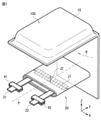
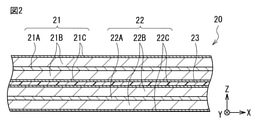
- FIG. 1 It is a perspective view which shows the structure of the secondary battery in one Embodiment of this technique. It is sectional drawing which shows the structure of the battery element shown in FIG. It is a block diagram which shows the structure of the application example of a secondary battery.
- the secondary battery described here is a secondary battery whose battery capacity can be obtained by utilizing the storage and release of an electrode reactant, and includes an electrolytic solution which is a liquid electrolyte together with a positive electrode and a negative electrode.
- the charge capacity of the negative electrode is larger than the discharge capacity of the positive electrode in order to suppress the precipitation of the electrode reactant on the surface of the negative electrode during charging. That is, the electrochemical capacity per unit area of the negative electrode is set to be larger than the electrochemical capacity per unit area of the positive electrode.
- the type of electrode reactant is not particularly limited, but specifically, it is a light metal such as an alkali metal and an alkaline earth metal.
- Alkali metals are lithium, sodium and potassium and the like, and alkaline earth metals are beryllium, magnesium and calcium and the like.
- a secondary battery whose battery capacity can be obtained by utilizing the occlusion and release of lithium is a so-called lithium ion secondary battery.
- lithium ion secondary battery lithium is occluded and released in an ionic state.
- FIG. 1 shows a perspective configuration of a secondary battery
- FIG. 2 shows a cross-sectional configuration of the battery element 20 shown in FIG.
- FIG. 1 shows a state in which the exterior film 10 and the battery element 20 are separated from each other.
- FIG. 2 only a part of the battery element 20 is shown, and the cross section of the battery element 20 along the XZ plane is shown by a broken line.
- this secondary battery includes an exterior film 10, a battery element 20, a positive electrode lead 31 and a negative electrode lead 32, and sealing films 41 and 42.
- the secondary battery described here is a laminated film type secondary battery using a flexible (or flexible) exterior film 10 as an exterior member for accommodating the battery element 20.
- the exterior film 10 is a flexible exterior member that houses the battery element 20, and has a bag-like structure in which the battery element 20 is housed inside. is doing. Therefore, the exterior film 10 stores the electrolytic solution together with the positive electrode 21 and the negative electrode 22 which will be described later.
- the exterior film 10 is a single film-like member and can be folded in the direction R.
- the exterior film 10 is provided with a recessed portion 10U (so-called deep drawing portion) for accommodating the battery element 20.
- the exterior film 10 is a three-layer laminated film in which a fusion layer, a metal layer, and a surface protective layer are laminated in this order from the inside, and the exterior films 10 face each other in a folded state.
- the outer peripheral edges of the fused layer are fused to each other.
- the fused layer contains a polymer compound such as polypropylene.
- the metal layer contains a metallic material such as aluminum.
- the surface protective layer contains a polymer compound such as nylon.
- the configuration (number of layers) of the exterior film 10 is not particularly limited, and may be one layer or two layers, or four or more layers.
- the sealing film 41 is inserted between the exterior film 10 and the positive electrode lead 31, and the sealing film 42 is inserted between the exterior film 10 and the negative electrode lead 32.
- the sealing films 41 and 42 may be omitted.
- the sealing film 41 is a sealing member that prevents outside air and the like from entering the inside of the exterior film 10. Further, the sealing film 41 contains a polymer compound such as a polyolefin having adhesion to the positive electrode lead 31, and the polyolefin thereof is polypropylene or the like.
- the structure of the sealing film 42 is the same as that of the sealing film 41, except that it is a sealing member having adhesion to the negative electrode lead 32. That is, the sealing film 42 contains a polymer compound such as polyolefin having adhesion to the negative electrode lead 32.
- the battery element 20 is a power generation element including a positive electrode 21, a negative electrode 22, a separator 23, and an electrolytic solution (not shown), and is housed inside the exterior film 10. Has been done.
- This battery element 20 is a so-called wound electrode body. That is, in the battery element 20, the positive electrode 21 and the negative electrode 22 are laminated with each other via the separator 23, and the positive electrode 21, the negative electrode 22 and the separator 23 are wound around the winding shaft P.
- the winding axis P is a virtual axis extending in the Y-axis direction. As a result, the positive electrode 21 and the negative electrode 22 are wound while facing each other via the separator 23.
- the three-dimensional shape of the battery element 20 is not particularly limited.
- the shape of the cross section (cross section along the XZ plane) of the battery element 20 intersecting the winding axis P is flat defined by the long axis J1 and the short axis J2.
- the long axis J1 is a virtual axis extending in the X-axis direction and having a length larger than that of the short axis J2, and the short axis J2 extends in the Z-axis direction intersecting the X-axis direction and has a long length. It is a virtual axis having a length smaller than that of the axis J1.
- the cross-sectional shape of the battery element 20 is a flat substantially elliptical shape.
- the positive electrode 21 contains a lithium nickel composite oxide. More specifically, as shown in FIG. 2, the positive electrode 21 includes a positive electrode current collector 21A, a positive electrode active material layer 21B and a coating film 21C, and the positive electrode active material layer 21B is a lithium nickel composite oxide. Includes.
- the positive electrode current collector 21A has a pair of surfaces on which the positive electrode active material layer 21B is provided.
- the positive electrode current collector 21A contains a conductive material such as a metal material, and the metal material is aluminum or the like.
- the positive electrode 21 includes two positive electrode active material layers 21B.
- the positive electrode active material layer 21B contains any one or more of the positive electrode active materials capable of occluding and releasing lithium.
- the positive electrode active material layer 21B may be provided on only one side of the positive electrode current collector 21A on the side where the positive electrode 21 faces the negative electrode 22.
- the positive electrode active material layer 21B may further contain a positive electrode binder, a positive electrode conductive agent, and the like.
- the positive electrode active material contains a lithium-containing compound, and more specifically, contains any one or more of the above-mentioned lithium nickel composite oxides.
- This "lithium-nickel composite oxide” is a general term for oxides containing lithium and nickel as constituent elements, and has a layered rock salt type crystal structure.
- the positive electrode active material contains a lithium-nickel composite oxide because a high energy density can be obtained, which increases the battery capacity.
- the type (constituent) of the lithium-nickel composite oxide is not particularly limited as long as it is an oxide containing lithium and nickel as constituent elements.
- the lithium-nickel composite oxide contains lithium, nickel, and other elements as constituent elements, and the other elements are elements belonging to groups 2 to 15 in the long-periodic table (however). , Nickel is excluded.) Any one type or two or more types.
- the lithium nickel composite oxide does not have to contain other elements as constituent elements.
- the lithium nickel composite oxide contains any one or more of the compounds represented by the following formula (1).
- the composition of lithium differs depending on the charge / discharge state, and the value of x in the formula (1) is the value in the completely discharged state.
- M1 is at least one of the elements belonging to groups 2 to 15 of the long periodic table (excluding Ni).
- X and y are 0.8 ⁇ x ⁇ 1.2 and 0 ⁇ y ⁇ 1.0 is satisfied.
- the content of Ni in the lithium nickel composite oxide is determined according to the content of the other element (M1). However, as is clear from the range of values that y can take, the lithium nickel composite oxide may or may not contain M1 as a constituent element. If the lithium nickel composite oxide contains Ni as a constituent element, the content of Ni in the lithium nickel composite oxide is not particularly limited and can be arbitrarily set.
- the lithium nickel composite oxide contains any one or more of the compounds represented by the following formula (5). This is because a higher energy density can be obtained.
- M5 is at least one of the elements belonging to groups 2 to 15 of the long periodic table (excluding Ni).
- X and y are 0.8 ⁇ x ⁇ 1.2 and 0 ⁇ y ⁇ 0.2 is satisfied.
- lithium nickel composite oxide examples include LiNiO 2 , LiNi 0.70 Co 0.30 O 2 , LiNi 0.80 Co 0.15 Al 0.05 O 2 , LiNi 0.82 Co 0.14 Al 0.04 O 2 , LiNi 0.50 Co 0.20 Mn 0.30 O 2 , LiNi 0.80 Co.
- LiNi 0.80 Co 0.15 Al 0.05 O 2 LiNi 0.80 Co 0.10 Al 0.05 Mn 0.05 O 2 , LiNi 0.80 Co 0.20 O 2 , LiNi 0.82 Co 0.18 O 2 , LiNi 0.85 Co 0.15 O 2 having a Ni ratio of 80% or more.
- LiNi 0.90 Co 0.10 O 2 and the like are preferable.
- the positive electrode active material may contain any one or more of the other positive electrode active materials (other lithium-containing compounds) as long as it contains the above-mentioned lithium nickel composite oxide. good.
- the type of other positive electrode active material is not particularly limited, but specifically, it is a lithium transition metal compound or the like.
- This "lithium transition metal compound” is a general term for compounds containing lithium and one or more kinds of transition metal elements as constituent elements, and may further contain one kind or two or more kinds of other elements. good.
- the type of the other element is not particularly limited as long as it is an element other than the transition metal element, but specifically, any one or two of the elements belonging to the groups 2 to 15 in the long-periodic table. More than a kind. However, the above-mentioned lithium-nickel composite oxide is excluded from the lithium transition metal compounds described here.
- the type of the lithium transition metal compound is not particularly limited, and specific examples thereof include oxides, phosphoric acid compounds, silicic acid compounds and boric acid compounds.
- Specific examples of the oxide are LiCoO 2 and LiMn 2 O 4 .
- Specific examples of the phosphoric acid compound include LiFePO 4 , LiMnPO 4 , LiFe 0.5 Mn 0.5 PO 4 and LiFe 0.3 Mn 0.7 PO 4 .
- the positive electrode binder contains any one or more of synthetic rubber and polymer compounds.
- Synthetic rubber includes styrene-butadiene rubber, fluorine-based rubber, ethylene propylene diene and the like.
- Polymer compounds include polyvinylidene fluoride, polyimide and carboxymethyl cellulose.
- the positive electrode conductive agent contains any one or more of conductive materials such as carbon materials, and the carbon materials are graphite, carbon black, acetylene black, ketjen black and the like.
- the conductive material may be a metal material, a polymer compound, or the like.
- the method for forming the positive electrode active material layer 21B is not particularly limited, but specifically, any one or more of the coating methods and the like.
- the coating film 21C is a positive electrode coating provided on the surface of the positive electrode active material layer 21B, and covers the surface of the positive electrode active material layer 21B.
- the positive electrode 21 since the coating film 21C is provided so as to cover the surfaces of the two positive electrode active material layers 21B, the positive electrode 21 includes the two coating films 21C. However, since the coating film 21C is provided so as to cover only one surface of the two positive electrode active material layers 21B, the positive electrode 21 may include one coating film 21C.
- the coating film 21C may cover the entire surface of the positive electrode active material layer 21B, or may cover only a part of the surface of the positive electrode active material layer 21B. However, in the latter case, a plurality of coatings 21C may cover the surface of the positive electrode active material layer 21B at a plurality of locations separated from each other.
- FIG. 2 shows a case where the coating film 21C covers the entire surface of the positive electrode active material layer 21B.
- the coating film 21C is formed on the surface of the positive electrode active material layer 21B by using the stabilization treatment (first charge / discharge treatment) of the secondary battery after assembly in the manufacturing process of the secondary battery. ing.
- This coating film 21C is mainly derived from the carboxylic acid ester because it contains any one or more of the reactants and decomposition products of the carboxylic acid ester contained in the electrolytic solution described later. Ester film. As a result, the coating film 21C contains oxygen as a constituent element.
- the negative electrode 22 contains a lithium titanium composite oxide. More specifically, as shown in FIG. 2, the negative electrode 22 includes a negative electrode current collector 22A, a negative electrode active material layer 22B and a coating film 22C, and the negative electrode active material layer 22B thereof is a lithium titanium composite oxide. Includes.
- the negative electrode current collector 22A has a pair of surfaces on which the negative electrode active material layer 22B is provided.
- the negative electrode current collector 22A contains a conductive material such as a metal material, and the metal material is copper or the like.
- the negative electrode 22 includes two negative electrode active material layers 22B.
- the negative electrode active material layer 22B contains any one or more of the negative electrode active materials capable of occluding and releasing lithium.
- the negative electrode active material layer 22B may be provided on only one side of the negative electrode current collector 22A on the side where the negative electrode 22 faces the positive electrode 21.
- the negative electrode active material layer 22B may further contain a negative electrode binder, a negative electrode conductive agent, and the like. The details regarding the negative electrode binder and the negative electrode conductive agent are the same as the details regarding the positive electrode binder and the positive electrode conductive agent, respectively.
- the negative electrode active material contains any one or more of the above-mentioned lithium-titanium composite oxides.
- This "lithium-titanium composite oxide” is a general term for oxides containing lithium and titanium as constituent elements, and has a spinel-type crystal structure. The reason why the negative electrode active material contains the lithium-titanium composite oxide is that the discharge capacity is less likely to decrease even after repeated charging and discharging, so that the cycle characteristics are improved.
- the type (constituent) of the lithium-titanium composite oxide is not particularly limited as long as it is an oxide containing lithium and titanium as constituent elements.
- the lithium-titanium composite oxide contains lithium, titanium, and other elements as constituent elements, and the other elements are elements belonging to groups 2 to 15 in the long-periodic table (however). , Titanium is excluded.) Any one or two or more.
- the oxide containing nickel as a constituent element together with lithium and titanium is not a lithium nickel composite oxide but a lithium titanium composite oxide.
- the lithium-titanium composite oxide contains any one or more of the compounds represented by the following formulas (2), (3) and (4).
- M2 represented by the formula (2) is a metal element that can be a divalent ion.
- M3 represented by the formula (3) is a metal element that can be a trivalent ion.
- M4 represented by the formula (4) is a metal element that can be a tetravalent ion. This is because the discharge capacity is unlikely to decrease sufficiently even after repeated charging and discharging, so that the cycle characteristics are sufficiently improved.
- M2 is at least one of Mg, Ca, Cu, Zn and Sr. X satisfies 0 ⁇ x ⁇ 1/3.
- the lithium titanium composite oxide shown in the formula (2) may contain M2, which is another element, as a constituent element, or M2. It is not necessary to include as a constituent element.
- the lithium titanium composite oxide shown in the formula (3) may contain M3, which is another element, as a constituent element, or M3. It is not necessary to include as a constituent element.
- the lithium titanium composite oxide shown in the formula (4) may contain M4, which is another element, as a constituent element, or M4. It is not necessary to include as a constituent element.
- lithium-titanium composite oxide shown in the formula (2) are Li 3.75 Ti 4.875 Mg 0.375 O 12 .
- Specific examples of the lithium-titanium composite oxide shown in the formula (3) are LiCrTiO 4 and the like.
- Specific examples of the lithium-titanium composite oxide shown in the formula (4) are Li 4 Ti 5 O 12 and Li 4 Ti 4.95 Nb 0.05 O 12 .
- the negative electrode active material may further contain any one or more of the other negative electrode active materials as long as it contains the above-mentioned lithium titanium composite oxide.
- the type of the other negative electrode active material is not particularly limited, but specifically, one or both of the carbon material and the metal-based material. This is because a high energy density can be obtained.
- Carbon materials include graphitizable carbon, non-graphitizable carbon and graphite (natural graphite and artificial graphite).
- Metallic materials are a general term for materials containing one or more of metal elements and metalloid elements capable of forming an alloy with lithium, and the metal elements and metalloid elements are silicon and tin. One or both of them.
- the metal-based material may be a simple substance, an alloy, a compound, a mixture of two or more of them, or a material containing two or more of these phases.
- the above-mentioned lithium-titanium composite oxide is excluded from the metal-based materials described here.
- Specific examples of the metallic material are TiSi 2 and SiO x (0 ⁇ x ⁇ 2, or 0.2 ⁇ x ⁇ 1.4).
- the method for forming the negative electrode active material layer 22B is not particularly limited, but specifically, any one of a coating method, a gas phase method, a liquid phase method, a thermal spraying method, a firing method (sintering method), and the like, or There are two or more types.
- the coating film 22C is a negative electrode coating provided on the surface of the negative electrode active material layer 22B, and covers the surface of the negative electrode active material layer 22B.
- the negative electrode 22 since the coating 22C is provided so as to cover the surfaces of the two negative electrode active material layers 22B, the negative electrode 22 includes the two coatings 22C. However, since the coating 22C is provided so as to cover only one surface of the two negative electrode active material layers 22B, the negative electrode 22 may include one coating 22C.
- the coating 22C may cover the entire surface of the negative electrode active material layer 22B, or may cover only a part of the surface of the negative electrode active material layer 22B. However, in the latter case, a plurality of coatings 22C may cover the surface of the negative electrode active material layer 22B at a plurality of locations separated from each other.
- FIG. 2 shows a case where the coating film 22C covers the entire surface of the negative electrode active material layer 22B.
- the coating film 22C is formed by the same procedure as the procedure for forming the coating film 21C. That is, as will be described later, the coating film 22C is formed on the surface of the negative electrode active material layer 22B by using the stabilization treatment (first charge / discharge treatment) of the secondary battery after assembly in the manufacturing process of the secondary battery. There is. Similar to the coating film 21C, the coating film 22C mainly contains one or more of one or more of the reactants and decomposition products of the carboxylic acid ester contained in the electrolytic solution described later. It is a film derived from the carboxylic acid ester. As a result, the coating film 22C contains oxygen as a constituent element.
- predetermined conditions may be satisfied with respect to the physical characteristics of the negative electrode 22, that is, the physical properties of the coating film 22C.
- the details of the physical properties of the negative electrode 22 (coating 22C) will be described later.
- the separator 23 is an insulating porous film interposed between the positive electrode 21 and the negative electrode 22, and while preventing contact (short circuit) between the positive electrode 21 and the negative electrode 22. Allows lithium ions to pass through.
- the separator 23 contains a polymer compound such as polyethylene.
- the electrolytic solution contains a carboxylic acid ester, and the carboxylic acid ester contains any one or more of ethyl acetate, propyl acetate, ethyl propionate and propyl propionate.
- This electrolytic solution is impregnated in each of the positive electrode 21, the negative electrode 22, and the separator 23.
- the reason why the electrolytic solution contains a carboxylic acid ester is that the decomposition reaction of the electrolytic solution is suppressed during charging and discharging, so that the generation of gas due to the decomposition reaction of the electrolytic solution is suppressed.
- the chain carboxylic ester is preferably one or both of ethyl propionate and propyl propionate. This is because the decomposition reaction of the electrolytic solution is sufficiently suppressed, so that the generation of gas caused by the decomposition reaction of the electrolytic solution is sufficiently suppressed.
- the electrolytic solution contains a solvent and an electrolyte salt, and the solvent contains a carboxylic acid ester.
- This solvent may further contain any one or more of non-aqueous solvents (organic solvents).
- non-aqueous solvents organic solvents.
- carboxylic acid ester is excluded from the non-aqueous solvent described here.
- the content of the carboxylic acid ester in the solvent is not particularly limited, but is preferably 50% by weight to 90% by weight. This is because the decomposition reaction of the electrolytic solution is sufficiently suppressed, so that the generation of gas caused by the decomposition reaction of the electrolytic solution is sufficiently suppressed.
- the non-aqueous solvent contains any one or two or more of carbonic acid ester compounds and lactone compounds, and the electrolytic solution containing the non-aqueous solvent is a so-called non-aqueous electrolytic solution. This is because the dissociative property of the electrolyte salt is improved and the mobility of ions is also improved.
- the carbonic acid ester compound is a cyclic carbonate ester, a chain carbonate ester, or the like.
- the cyclic carbonate ester are ethylene carbonate and propylene carbonate
- specific examples of the chain carbonate ester are dimethyl carbonate, diethyl carbonate, methyl ethyl carbonate and the like.
- Specific examples of the lactone-based compound include ⁇ -butyrolactone and ⁇ -valerolactone.
- the non-aqueous solvent preferably contains any one or more of the cyclic carbonic acid esters. That is, the solvent preferably contains a cyclic carbonate ester together with a carboxylic acid ester. This is because the decomposition reaction of the electrolytic solution is sufficiently suppressed while ensuring the dissociative property of the electrolyte salt and the mobility of the ions.
- the electrolyte salt contains any one or more of light metal salts such as lithium salts.
- lithium salts include lithium hexafluorophosphate (LiPF 6 ), lithium tetrafluoroborate (LiBF 4 ), lithium trifluoromethanesulfonate (LiCF 3 SO 3 ), and bis (fluorosulfonyl) imide lithium (LiN).
- the electrolytic solution may further contain any one or more of the additives.
- the type of additive is not particularly limited, but specifically, it is an unsaturated cyclic carbonate ester, a halogenated carbonate ester, a sulfonic acid ester, a phosphoric acid ester, an acid anhydride, a nitrile compound, an isocyanate compound and the like. This is because the chemical stability of the electrolytic solution is improved.
- the positive electrode lead 31 is a positive electrode terminal connected to the battery element 20 (positive electrode 21), and more specifically, is connected to the positive electrode current collector 21A.
- the positive electrode lead 31 is led out from the inside of the exterior film 10 to the outside, and contains a conductive material such as aluminum.
- the shape of the positive electrode lead 31 is not particularly limited, but specifically, it is one of a thin plate shape and a mesh shape.
- the negative electrode lead 32 is a negative electrode terminal connected to the battery element 20 (negative electrode 22), and more specifically, is connected to the negative electrode current collector 22A.
- the negative electrode lead 32 is led out from the inside of the exterior film 10 to the outside, and contains a conductive material such as copper.
- the lead-out direction of the negative electrode lead 32 is the same as the lead-out direction of the positive electrode lead 31.
- the details regarding the shape of the negative electrode lead 32 are the same as the details regarding the shape of the positive electrode lead 31.
- two types of XPS spectra are detected in the surface analysis of the positive electrode 21 using XPS.
- the positive electrode 21 contains the coating film 21C together with the positive electrode active material layer 21B, the coating film 21C is analyzed in the surface analysis of the positive electrode 21 using XPS.
- the first type XPS spectrum is an XPS spectrum caused by an oxygen atom contained as a constituent element in the coating film 21C, and more specifically, has a peak in the range where the binding energy is 528 eV or more and 531 eV or less. It is a first oxygen (O1s) spectrum.
- This first oxygen spectrum mainly contains the constituent components of the positive electrode active material layer 21B (lithium nickel composite oxide which is the positive electrode active material), the bonding state of oxygen atoms in the crystal structure of the positive electrode active material, and the composition of the coating film 21C. It is considered that it is detected due to the components and the like.
- the second type of XPS spectrum is another XPS spectrum similarly caused by the oxygen atom in the film 21C, and more specifically, it has a peak in the range where the binding energy is larger than 531 eV and less than or equal to 535 eV.
- the second oxygen spectrum Similar to the above-mentioned first oxygen spectrum, this second oxygen spectrum is mainly composed of the constituent components of the positive electrode active material layer 21B (positive positive active material), the bonded state of oxygen atoms in the crystal structure of the positive positive active material, and the coating film. It is considered that it is detected due to the constituent components of 21C and the like.
- the ratio defined based on the intensity of each of the above two types of XPS spectra (first oxygen spectrum and second oxygen spectrum), that is, the ratio of the intensity of the first oxygen spectrum to the intensity of the second oxygen spectrum.
- the value of the positive electrode strength ratio is a value rounded off to the third decimal place.
- the above conditions are satisfied with respect to the physical properties (positive electrode strength ratio) of the positive electrode 21 because the positive electrode active material layer 21B (positive electrode active material) contains a lithium nickel composite oxide and the carboxylic acid ester in the electrolytic solution.
- the coating film 21C derived from the above is formed on the surface of the positive electrode active material layer 21B, the physical properties of the positive electrode 21 (coating 21C) are optimized, so that the oxidative decomposition reaction of the electrolytic solution is suppressed in the positive electrode 21. This is because that.
- the gas caused by the oxidative decomposition reaction of the electrolytic solution is less likely to be generated, so that the secondary battery is less likely to swell.
- the generation of gas due to the reduction and decomposition of the by-product in the negative electrode 22 is also suppressed. Therefore, the secondary battery is remarkably less likely to swell.
- the oxidative decomposition reaction of the electrolytic solution is suppressed during charging and discharging, the amount of the electrolytic solution is less likely to be excessively reduced, so that the discharge capacity is less likely to be reduced even if charging and discharging are repeated. Become.
- since lithium ions are easily moved in and out of the positive electrode 21 during charging and discharging, lithium ions are easily stored and released in the positive electrode 21.
- Each of the intensity of the first oxygen spectrum and the intensity of the second oxygen spectrum changes the composition of the positive electrode active material (lithium-nickel composite oxide) (type and content of constituent elements other than lithium and oxygen, etc.). It can be adjusted by. Specific examples of the constituent elements other than lithium and oxygen are nickel, cobalt, aluminum, manganese and the like.
- the intensity of the first oxygen spectrum and the intensity of the second oxygen spectrum can be changed. It is adjustable. Further, the intensity of the first oxygen spectrum and the intensity of the second oxygen spectrum can be adjusted by changing the composition of the electrolytic solution (type of solvent, type of electrolyte salt, etc.). Therefore, the positive electrode strength ratio can be controlled so as to obtain a desired value.
- the procedure for specifying the positive electrode strength ratio is as described below.
- the XPS analyzer a scanning X-ray photoelectron spectroscopic analyzer PHI Quantera manufactured by ULVAC FI Co., Ltd. is used.
- the positive electrode 21 is recovered by disassembling the completed secondary battery. Subsequently, the positive electrode 21 is washed with an organic solvent, and then the positive electrode 21 is dried.
- the type of the organic solvent is not particularly limited, but specifically, dimethyl carbonate or the like.
- the surface of the positive electrode 21 is analyzed using an XPS analyzer to measure the intensity of the first oxygen spectrum and the intensity of the second oxygen spectrum, respectively. Finally, the positive electrode intensity ratio is calculated based on each of the intensity of the first oxygen spectrum and the intensity of the second oxygen spectrum.
- two types of XPS spectra are detected in the surface analysis of the negative electrode 22 using XPS.
- the negative electrode 22 contains the coating film 22C together with the negative electrode active material layer 22B, the coating film 22C is analyzed in the surface analysis of the negative electrode 22 using XPS.
- the first type XPS spectrum is an XPS spectrum caused by an oxygen atom contained as a constituent element in the film 22C, and more specifically, has a peak in the range where the binding energy is 528 eV or more and 531 eV or less.
- This is the third oxygen spectrum.
- the detection factor of the third oxygen spectrum is the same as the detection factor of the first oxygen spectrum, except that the detection factor is caused by the oxygen atom in the coating film 22C instead of the coating film 21C.
- the second type of XPS spectrum is another XPS spectrum similarly caused by the oxygen atom in the coating 22C, and more specifically, it has a peak in the range where the binding energy is larger than 531 eV and less than or equal to 535 eV. It is a fourth oxygen spectrum.
- the detection factor of the fourth oxygen spectrum is the same as the detection factor of the second oxygen spectrum, except that the detection factor is caused by the oxygen atom in the coating film 22C instead of the coating film 21C.
- the ratio defined based on the intensity of each of the above two types of XPS spectra (third oxygen spectrum and fourth oxygen spectrum), that is, the ratio of the intensity of the third oxygen spectrum to the intensity of the fourth oxygen spectrum.
- the value of the negative electrode strength ratio is a value obtained by rounding off the value at the third decimal place, similarly to the value of the positive electrode strength ratio.
- the above conditions are satisfied with respect to the physical properties (negative electrode strength ratio) of the negative electrode 22 because the negative electrode active material layer 22B (negative electrode active material) contains a lithium titanium composite oxide and the carboxylic acid ester in the electrolytic solution.
- the coating film 22C derived from the above is formed on the surface of the negative electrode active material layer 22B, the physical properties of the negative electrode 22 (coating 22C) are optimized, so that the reduction decomposition reaction of the electrolytic solution is suppressed in the negative electrode 22. This is because that.
- the swelling of the secondary battery is suppressed, the decrease in the discharge capacity is suppressed even if charging and discharging are repeated, and the storage and discharging property of lithium ions is improved during charging and discharging.
- the intensity of the third oxygen spectrum and the intensity of the fourth oxygen spectrum are each determined by changing the type of the negative electrode active material (lithium-titanium composite oxide) and the composition of the negative electrode active material layer 22B (type of additive, etc.). It is adjustable. In addition, the intensity of the third oxygen spectrum and the intensity of the fourth oxygen spectrum can be adjusted by changing the composition of the electrolytic solution (type of solvent, type of electrolyte salt, etc.). Therefore, the negative electrode strength ratio can be controlled so as to obtain a desired value.
- the procedure for specifying the negative electrode strength ratio is the same as the procedure for specifying the positive electrode strength ratio, except that the negative electrode 22 is used instead of the positive electrode 21 for surface analysis.
- a positive electrode 21 and a negative electrode 22 are manufactured and an electrolytic solution is prepared according to the procedure described below, and then the secondary battery is manufactured using the positive electrode 21, the negative electrode 22 and the electrolytic solution. do.
- a paste-like positive electrode mixture slurry is prepared by adding a mixture (positive electrode mixture) of a positive electrode active material containing a lithium nickel composite oxide to a positive electrode binder, a positive electrode conductive agent, and the like into a solvent. .. Subsequently, the positive electrode mixture slurry is applied to both sides of the positive electrode current collector 21A to form the positive electrode active material layer 21B. After that, the positive electrode active material layer 21B may be compression-molded using a roll press machine or the like. In this case, the positive electrode active material layer 21B may be heated, or compression molding may be repeated a plurality of times.
- the positive electrode active material layers 21B are formed on both sides of the positive electrode current collector 21A, so that a positive electrode precursor (not shown) is produced.
- This positive electrode precursor has the same configuration as that of the positive electrode 21 except that the coating film 21C is not formed on the surface of the positive electrode active material layer 21B.
- the film 21C is formed on the surface of the positive electrode active material layer 21B by using the post-assembly stabilization treatment (first charge / discharge treatment) described later. As a result, the positive electrode 21 is manufactured.
- the negative electrode 22 is formed by the same procedure as the procedure for manufacturing the positive electrode 21 described above. Specifically, first, a mixture (negative electrode mixture) of a negative electrode active material containing a lithium-titanium composite oxide and a negative electrode binder, a negative electrode conductive agent, or the like is added to a solvent to form a paste-like negative electrode combination. Prepare the agent slurry. Subsequently, the negative electrode mixture layer 22B is formed by applying the negative electrode mixture slurry on both sides of the negative electrode current collector 22A. After that, the negative electrode active material layer 22B may be compression-molded.
- the negative electrode active material layers 22B are formed on both sides of the negative electrode current collector 22A, so that a negative electrode precursor (not shown) is produced.
- This negative electrode precursor has the same configuration as that of the negative electrode 22 except that the coating film 22C is not formed on the surface of the negative electrode active material layer 22B.
- the film 22C is formed on the surface of the negative electrode active material layer 22B by using the post-assembly stabilization treatment (first charge / discharge treatment) described later. As a result, the negative electrode 22 is manufactured.
- the electrolyte salt is added to the solvent containing the carboxylic acid ester. As a result, the electrolyte salt is dispersed or dissolved in the solvent, so that an electrolytic solution is prepared.
- the positive electrode lead 31 is connected to the positive electrode precursor (positive electrode current collector 21A) and the negative electrode lead 32 is connected to the negative electrode precursor (negative electrode current collector 22A) by using a welding method or the like.
- the positive electrode precursor and the negative electrode precursor are laminated with each other via the separator 23, and then the positive electrode precursor, the negative electrode precursor, and the separator 23 are wound around the winding shaft P to form a wound body.
- the winding body is molded into a flat shape by pressing the winding body using a press machine or the like.
- the exterior films 10 are folded in the direction R so that the exterior films 10 face each other. Subsequently, by using a heat fusion method or the like to join the outer peripheral edges of the two sides of the exterior films 10 (fused layers) facing each other to each other, the film is wound inside the bag-shaped exterior film 10. Store the body.
- the outer peripheral edges of the remaining one side of the exterior film 10 are joined to each other by a heat fusion method or the like.
- the sealing film 41 is inserted between the exterior film 10 and the positive electrode lead 31, and the sealing film 42 is inserted between the exterior film 10 and the negative electrode lead 32.
- the wound body is impregnated with the electrolytic solution, so that the battery element 20 which is a wound electrode body is manufactured, and the battery element 20 is enclosed inside the bag-shaped exterior film 10, so that it is secondary. Batteries are assembled.
- Stabilization of secondary battery Charge and discharge the assembled secondary battery.
- Various conditions such as the environmental temperature, the number of charge / discharge cycles (number of cycles), and charge / discharge conditions can be arbitrarily set.
- the film 21C is formed on the surface of the positive electrode active material layer 21B, so that the positive electrode 21 is produced, and the film 22C is formed on the surface of the negative electrode active material layer 22B, so that the negative electrode 22 is formed. Is produced.
- the surface of the positive electrode active material layer 21B is protected by the coating film 21C, and the surface of the negative electrode active material layer 22B is protected by the coating film 22C, so that the state of the secondary battery is electrochemically stabilized. ..
- the positive electrode 21 contains a lithium nickel composite oxide
- the negative electrode 22 contains a lithium titanium composite oxide
- the electrolytic solution contains a carboxylic acid ester such as ethyl acetate.
- the surface analysis result of the positive electrode 21 using XPS is satisfied.
- the above conditions (negative electrode strength ratio 0.82 to 1.35) are satisfied with respect to (negative electrode strength ratio).
- the physical characteristics (positive electrode intensity ratio) of the positive electrode 21 defined by the two types of XPS spectra (first oxygen spectrum and second oxygen spectrum) are optimized, so that the positive electrode 21 is used.
- the oxidative decomposition reaction of the electrolytic solution is suppressed.
- the generation of gas caused by the oxidative decomposition reaction of the electrolytic solution is suppressed in the positive electrode 21, and the generation of gas caused by the reduction decomposition reaction of highly reducing by-products is also suppressed in the negative electrode 22.
- the secondary battery is significantly less likely to swell.
- the amount of the electrolytic solution is less likely to decrease excessively during charging / discharging, the discharge capacity is less likely to decrease even after repeated charging / discharging, and lithium ions are more likely to smoothly enter and exit the positive electrode 21 during charging / discharging. Therefore, lithium ions are easily stored and discharged at the positive electrode 21.
- the electrolytic solution is used in the negative electrode 22.
- the reduction decomposition reaction is also suppressed.
- the swelling of the secondary battery is further suppressed, the decrease in the discharge capacity is further suppressed even if charging and discharging are repeated, and the occlusion and release property of lithium ions is further improved during charging and discharging.
- the lithium-nickel composite oxide contains the compound represented by the formula (1), a sufficiently high energy density can be obtained, so that a higher effect can be obtained.
- the Ni ratio is 80% or more, a higher energy density can be obtained, so that a higher effect can be obtained.
- the solvent of the electrolytic solution contains a carboxylic acid ester and the content of the carboxylic acid ester in the solvent is 50% by weight to 90% by weight, the decomposition reaction of the electrolytic solution is sufficiently suppressed. A higher effect can be obtained.
- the solvent further contains a cyclic carbonate, the decomposition reaction of the electrolytic solution is sufficiently suppressed while ensuring the dissociation of the electrolyte salt and the mobility of the ions, so that a higher effect is achieved. Obtainable.
- the positive electrode 21 contains a positive electrode active material layer 21B (including a lithium nickel composite oxide) and a coating film 21C (containing oxygen as a constituent element), and the coating film 21C is formed in a surface analysis of the positive electrode 21 using XPS. If analyzed, the decomposition reaction of the electrolytic solution is sufficiently suppressed in the positive electrode 21, so that a higher effect can be obtained.
- a positive electrode active material layer 21B including a lithium nickel composite oxide
- a coating film 21C containing oxygen as a constituent element
- the lithium-titanium composite oxide contains any one or more of the compounds represented by the formulas (2), (3) and (4), charging and discharging are repeated. However, since the discharge capacity is not sufficiently reduced, a higher effect can be obtained.
- the negative electrode 22 contains the negative electrode active material layer 22B (including lithium titanium composite oxide) and the coating film 22C (containing oxygen as a constituent element), and the coating film 22C is formed in the surface analysis of the negative electrode 22 using XPS. If analyzed, the decomposition reaction of the electrolytic solution is sufficiently suppressed in the negative electrode 22, so that a higher effect can be obtained.
- the negative electrode active material layer 22B including lithium titanium composite oxide
- the coating film 22C containing oxygen as a constituent element
- the secondary battery is provided with the flexible exterior film 10, the secondary battery is less likely to swell effectively even if the exterior film 10 that is easily deformed due to an increase in internal pressure is used, which is higher. The effect can be obtained.
- the secondary battery is a lithium ion secondary battery, a sufficient battery capacity can be stably obtained by utilizing the occlusion and release of lithium, so that a higher effect can be obtained.
- the laminated separator 23 includes a porous membrane having a pair of faces and a polymer compound layer provided on one or both sides of the porous membrane. This is because the adhesion of the separator 23 to each of the positive electrode 21 and the negative electrode 22 is improved, so that the position shift (winding shift) of the battery element 20 is less likely to occur. As a result, even if a decomposition reaction of the electrolytic solution occurs, the secondary battery is less likely to swell.
- the polymer compound layer contains a polymer compound such as polyvinylidene fluoride. This is because polyvinylidene fluoride and the like have excellent physical strength and are electrochemically stable.
- one or both of the porous membrane and the polymer compound layer may contain any one or more of the plurality of insulating particles. This is because a plurality of insulating particles dissipate heat when the secondary battery generates heat, so that the safety (heat resistance) of the secondary battery is improved.
- Insulating particles include inorganic particles and resin particles. Specific examples of the inorganic particles are particles such as aluminum oxide, aluminum nitride, boehmite, silicon oxide, titanium oxide, magnesium oxide and zirconium oxide. Specific examples of the resin particles are particles such as acrylic resin and styrene resin.
- a precursor solution containing a polymer compound, an organic solvent, or the like is prepared, and then the precursor solution is applied to one or both sides of the porous membrane.
- the porous membrane may be immersed in the precursor solution.
- a plurality of insulating particles may be added to the precursor solution as needed.
- the positive electrode 21 and the negative electrode 22 are laminated with each other via the separator 23 and the electrolyte layer, and the positive electrode 21, the negative electrode 22, the separator 23 and the electrolyte layer are wound around the battery element 20.
- This electrolyte layer is interposed between the positive electrode 21 and the separator 23, and is interposed between the negative electrode 22 and the separator 23.
- the electrolyte layer contains a polymer compound together with the electrolytic solution, and the electrolytic solution is held by the polymer compound in the electrolyte layer. This is because leakage of the electrolytic solution is prevented.
- the structure of the electrolytic solution is as described above.
- the polymer compound contains polyvinylidene fluoride and the like.
- the application (application example) of the secondary battery is not particularly limited.
- the secondary battery used as a power source may be a main power source for electronic devices and electric vehicles, or may be an auxiliary power source.
- the main power source is a power source that is preferentially used regardless of the presence or absence of another power source.
- the auxiliary power supply is a power supply used in place of the main power supply or a power supply that can be switched from the main power supply.
- secondary batteries Specific examples of applications for secondary batteries are as follows. Electronic devices such as video cameras, digital still cameras, mobile phones, laptop computers, headphone stereos, portable radios and portable information terminals.
- a storage device such as a backup power supply and a memory card. Power tools such as electric drills and saws. It is a battery pack installed in electronic devices. Medical electronic devices such as pacemakers and hearing aids. It is an electric vehicle such as an electric vehicle (including a hybrid vehicle). It is a power storage system such as a household or industrial battery system that stores power in case of an emergency. In these applications, one secondary battery may be used, or a plurality of secondary batteries may be used.
- the battery pack may use a single battery or an assembled battery.
- the electric vehicle is a vehicle that operates (runs) using a secondary battery as a drive power source, and may be a hybrid vehicle that also has a drive source other than the secondary battery.
- household electric products and the like can be used by using the power stored in a secondary battery which is a power storage source.
- FIG. 3 shows the block configuration of the battery pack.
- the battery pack described here is a battery pack (so-called soft pack) using one secondary battery, and is mounted on an electronic device represented by a smartphone.
- this battery pack includes a power supply 51 and a circuit board 52.
- the circuit board 52 is connected to the power supply 51 and includes a positive electrode terminal 53, a negative electrode terminal 54, and a temperature detection terminal 55.
- the power supply 51 includes one secondary battery.
- the positive electrode lead is connected to the positive electrode terminal 53
- the negative electrode lead is connected to the negative electrode terminal 54. Since the power supply 51 can be connected to the outside via the positive electrode terminal 53 and the negative electrode terminal 54, it can be charged and discharged.
- the circuit board 52 includes a control unit 56, a switch 57, a PTC element 58, and a temperature detection unit 59. However, the PTC element 58 may be omitted.
- the control unit 56 includes a central processing unit (CPU), a memory, and the like, and controls the operation of the entire battery pack.
- the control unit 56 detects and controls the usage state of the power supply 51 as needed.
- the control unit 56 turns off the switch 57 so that the charging current does not flow in the current path of the power supply 51.
- the overcharge detection voltage and the overdischarge detection voltage are not particularly limited. As an example, the overcharge detection voltage is 4.2V ⁇ 0.05V, and the overdischarge detection voltage is 2.4V ⁇ 0.1V.
- the switch 57 includes a charge control switch, a discharge control switch, a charging diode, a discharging diode, and the like, and switches whether or not the power supply 51 is connected to an external device according to an instruction from the control unit 56.
- the switch 57 includes a field effect transistor (MOSFET) using a metal oxide semiconductor, and the charge / discharge current is detected based on the ON resistance of the switch 57.
- MOSFET field effect transistor
- the temperature detection unit 59 includes a temperature detection element such as a thermistor, measures the temperature of the power supply 51 using the temperature detection terminal 55, and outputs the measurement result of the temperature to the control unit 56.
- the temperature measurement result measured by the temperature detection unit 59 is used when the control unit 56 performs charge / discharge control when abnormal heat generation occurs, or when the control unit 56 performs correction processing when calculating the remaining capacity.
- Examples 1 to 12 and Comparative Examples 1 to 11> As will be described below, the laminated film type secondary batteries (lithium ion secondary batteries) shown in FIGS. 1 and 2 were produced, and then the performance of the secondary batteries was evaluated.
- a secondary battery was manufactured by the following procedure.
- the material layer 21B was formed.
- the positive electrode active material layer 21B was compression-molded using a roll press machine to obtain a positive electrode precursor.
- the positive electrode 21 was produced by forming a film 21C on the surface of the positive electrode active material layer 21B in the stabilization treatment of the secondary battery described later.
- the material layer 22B was formed.
- the negative electrode active material layer 22B was compression-molded using a roll press machine to obtain a negative electrode precursor.
- the negative electrode 22 was produced by forming a coating film 22C on the surface of the negative electrode active material layer 22B in the stabilization treatment of the secondary battery described later.
- the content of the electrolyte salt was 1 mol / kg with respect to the solvent.
- the content of unsaturated cyclic carbonate in the electrolytic solution was 1% by weight.
- the electrolyte salt was dispersed or dissolved in the solvent, so that an electrolytic solution was prepared.
- an electrolytic solution was prepared by the same procedure except that a chain carbonate ester was used instead of the carboxylic acid ester.
- a chain carbonate ester dimethyl carbonate (DMC) or diethyl carbonate (DEC) was used.
- an electrolytic solution was prepared by the same procedure except that another carboxylic acid ester (methyl propionate (MtPr)) was used instead of the carboxylic acid ester.
- MtPr methyl propionate
- the positive electrode lead 31 made of aluminum was welded to the positive electrode 21 (positive electrode current collector 21A), and the negative electrode lead 32 made of copper was welded to the negative electrode 22 (negative electrode current collector 22A).
- the positive electrode precursor and the negative electrode precursor are laminated with each other via the separator 23 (microporous polyethylene film having a thickness of 15 ⁇ m), and then the positive electrode precursor, the negative electrode precursor and the negative electrode precursor are centered on the winding shaft P.
- a wound body was produced by winding the separator 23.
- the winding body was molded into a flat shape by pressing the winding body using a press machine.
- the exterior film 10 includes a fused layer (polypropylene film having a thickness of 30 ⁇ m), a metal layer (aluminum foil having a thickness of 40 ⁇ m), and a surface protective layer (nylon film having a thickness of 25 ⁇ m). Aluminum laminated films laminated in this order were used. Subsequently, after the exterior film 10 is folded so as to sandwich the wound body while the fusion layer is arranged inside, the outer peripheral edges of the two sides of the exterior film 10 (fusion layer) are heated to each other. By fusing, the wound body was housed inside the bag-shaped exterior film 10.
- the winding body was impregnated with the electrolytic solution, so that the battery element 20 was manufactured. Therefore, since the battery element 20 is enclosed inside the exterior film 10, the secondary battery is assembled.
- the positive electrode 21 was formed on the surface of the positive electrode active material layer 21B in the positive electrode precursor, so that the positive electrode 21 was produced, and the coating 22C was formed on the surface of the negative electrode active material layer 22B in the negative electrode precursor. 22 was made. Therefore, the state of the secondary battery was electrochemically stabilized, and the laminated film type secondary battery was completed.
- the positive electrode strength ratio was changed by changing the environmental temperature during charging during the stabilization process of the secondary battery described above, and the stabilization of the secondary battery described above was performed.
- the negative electrode strength ratio was changed by changing the current during charging during processing.
- the positive electrode 21 was recovered by disassembling the secondary battery, and then the surface analysis of the positive electrode 21 (coating 21C) was performed using XPS. After measuring the intensity of each of the two types of XPS spectra (first oxygen spectrum and second oxygen spectrum) based on the surface analysis result of the positive electrode 21, the positive electrode intensity ratio was calculated based on the measurement results. The calculation result of this positive electrode strength ratio is as shown in Table 1.
- the discharge capacity discharge capacity at the 100th cycle
- the charging / discharging conditions were the same as those of the first cycle, except that the charging current was changed to 6.0C and the discharging current was changed to 2.0C.
- 6.0C is a current value that can completely discharge the battery capacity in 1/6 hour
- 2.0C is a current value that can completely discharge the battery capacity in 0.5 hours.
- discharge capacity in the second cycle was measured by charging and discharging the secondary battery for another cycle in the same environment.
- the charging / discharging conditions were the same as those in the first cycle, except that the current at the time of discharging was changed to 6.0C.
- the positive electrode 21 contains a lithium nickel composite oxide
- the negative electrode 22 contains a lithium titanium composite oxide
- the electrolytic solution contains a carboxylic acid ester (implemented).
- the swelling rate, the cycle retention rate, and the load retention rate each fluctuated according to the positive electrode intensity ratio and the negative electrode intensity ratio.
- Examples 13 to 18> As shown in Table 3, a secondary battery was manufactured by the same procedure except that the Ni ratio was changed, and the performance (swelling characteristic, cycle characteristic and load characteristic) of the secondary battery was evaluated. Here, the battery capacity (Ah) was further measured as the performance of the secondary battery.
- Examples 19 to 22> As shown in Table 4, a secondary battery was manufactured by the same procedure except that the content of the carboxylic acid ester in the solvent was changed, and the performance (swelling characteristics, cycle characteristics and swelling characteristics) of the secondary battery were prepared. Load characteristics) were evaluated.
- Example 4 when the content of the carboxylic acid ester is 50% by weight or more (Examples 4, 20 to 22), the content of the carboxylic acid ester is less than 50% by weight (implementation). Compared with Example 19), each of the cycle maintenance rate and the load maintenance rate was further increased while the swelling rate was suppressed within the allowable range. In this case, in particular, when the content of the carboxylic acid ester was 80% by weight or less (Examples 4, 20, 21), the swelling rate was significantly suppressed.
- the positive electrode 21 contains a lithium nickel composite oxide
- the negative electrode 22 contains a lithium titanium composite oxide
- the electrolytic solution contains a carboxylic acid ester such as ethyl acetate.
- the surface analysis result positive electrode strength ratio
- the surface analysis result of the negative electrode 22 using XPS 0.82 to 1.35
- the swelling rate decreased and each of the cycle maintenance rate and the load maintenance rate increased. Therefore, since the swelling rate, the cycle maintenance rate, and the load maintenance rate were all improved, excellent swelling characteristics, excellent cycle characteristics, and excellent load characteristics were obtained in the secondary battery.
- the battery structure of the secondary battery is a laminated film type
- the battery structure is not particularly limited, other battery structures such as a cylindrical type, a square type, a coin type, and a button type are described. But it may be.
- the element structure of the battery element is a winding type
- other element structures such as a laminated type and a zigzag type may be used.
- the electrodes (positive electrode and negative electrode) are laminated, and in the ninety-nine fold type, the electrodes (positive electrode and negative electrode) are folded in a zigzag manner.
- the electrode reactant is not particularly limited. Specifically, as described above, the electrode reactant may be another alkali metal such as sodium and potassium, or an alkaline earth metal such as beryllium, magnesium and calcium. In addition, the electrode reactant may be another light metal such as aluminum.
Landscapes
- Chemical & Material Sciences (AREA)
- Chemical Kinetics & Catalysis (AREA)
- Electrochemistry (AREA)
- General Chemical & Material Sciences (AREA)
- Engineering & Computer Science (AREA)
- Inorganic Chemistry (AREA)
- Manufacturing & Machinery (AREA)
- Materials Engineering (AREA)
- Condensed Matter Physics & Semiconductors (AREA)
- General Physics & Mathematics (AREA)
- Physics & Mathematics (AREA)
- Composite Materials (AREA)
- Battery Electrode And Active Subsutance (AREA)
- Secondary Cells (AREA)
- Inorganic Compounds Of Heavy Metals (AREA)
- Sealing Battery Cases Or Jackets (AREA)
Abstract
二次電池は、リチウムニッケル複合酸化物を含む正極と、リチウムチタン複合酸化物を含む負極と、カルボン酸エステルを含む電解液とを備え、そのカルボン酸エステルは、酢酸エチル、酢酸プロピル、プロピオン酸エチルおよびプロピオン酸プロピルのうちの少なくとも1種を含む。X線光電子分光分析法を用いた正極の表面分析において、結合エネルギーが528eV以上531eV以下である範囲内にピークを有する第1酸素スペクトルと、結合エネルギーが531eVよりも大きいと共に535eV以下である範囲内にピークを有する第2酸素スペクトルとが検出され、その第2酸素スペクトルの強度に対する第1酸素スペクトルの強度の比は、0.30以上0.80以下である。X線光電子分光分析法を用いた負極の表面分析において、結合エネルギーが528eV以上531eV以下である範囲内にピークを有する第3酸素スペクトルと、結合エネルギーが531eVよりも大きいと共に535eV以下である範囲内にピークを有する第4酸素スペクトルとが検出され、その第4酸素スペクトルの強度に対する第3酸素スペクトルの強度の比は、0.82以上1.35以下である。
Description
本技術は、二次電池に関する。
携帯電話機などの多様な電子機器が普及しているため、小型かつ軽量であると共に高エネルギー密度を得ることが可能である電源として、二次電池の開発が進められている。この二次電池は、正極および負極と共に電解液を備えており、その二次電池の構成に関しては、様々な検討がなされている。
具体的には、優れたサイクル特性などを得るために、正極活物質としてNi系化合物を用いた場合において、X線光電子分光分析法を用いたNi系化合物の表面分析結果(酸素の1sスペクトルの強度比)が適正化されている(例えば、特許文献1参照。)。内部ショートの発生を防止するために、正極活物質としてリチウムと遷移金属Mとを含む複合酸化物を用いると共に、正極の表面に薄膜が形成されている場合において、X線光電子分光分析法を用いた正極の表面分析結果(遷移金属Mの2pスペクトルの強度比)が適正化されている(例えば、特許文献2参照)。膨れを抑制するために、負極活物質としてチタン酸化物を用いると共に、負極の表面に被膜が形成されている場合において、X線光電子分光分析法を用いた被膜の分析結果(酸素原子の割合の比)が適正化されている(例えば、特許文献3参照。)。
二次電池の性能に関する様々な検討がなされているが、膨れ特性、サイクル特性および負荷特性のそれぞれは未だ十分でないため、改善の余地がある。
よって、優れた膨れ特性、優れたサイクル特性および優れた負荷特性を得ることが可能である二次電池が望まれている。
本技術の一実施形態の二次電池は、リチウムニッケル複合酸化物を含む正極と、リチウムチタン複合酸化物を含む負極と、カルボン酸エステルを含む電解液とを備え、そのカルボン酸エステルが酢酸エチル、酢酸プロピル、プロピオン酸エチルおよびプロピオン酸プロピルのうちの少なくとも1種を含むものである。X線光電子分光分析法を用いた正極の表面分析において、結合エネルギーが528eV以上531eV以下である範囲内にピークを有する第1酸素スペクトルと、結合エネルギーが531eVよりも大きいと共に535eV以下である範囲内にピークを有する第2酸素スペクトルとが検出され、その第2酸素スペクトルの強度に対する第1酸素スペクトルの強度の比は、0.30以上0.80以下である。X線光電子分光分析法を用いた負極の表面分析において、結合エネルギーが528eV以上531eV以下である範囲内にピークを有する第3酸素スペクトルと、結合エネルギーが531eVよりも大きいと共に535eV以下である範囲内にピークを有する第4酸素スペクトルとが検出され、その第4酸素スペクトルの強度に対する第3酸素スペクトルの強度の比は、0.82以上1.35以下である。
ここで、「リチウムニッケル複合酸化物」とは、リチウムおよびニッケルを構成元素として含む酸化物の総称であると共に、「リチウムチタン複合酸化物」とは、リチウムおよびチタンを構成元素として含む酸化物の総称である。なお、リチウムニッケル複合酸化物およびリチウムチタン複合酸化物のそれぞれの詳細に関しては、後述する。
本技術の一実施形態の二次電池によれば、正極がリチウムニッケル複合酸化物を含んでおり、負極がリチウムチタン複合酸化物を含んでおり、電解液がカルボン酸エステルを含んでおり、そのカルボン酸エステルが酢酸エチルなどを含んでいる。また、X線光電子分光分析法を用いた正極の表面分析結果(第2酸素スペクトルの強度に対する第1酸素スペクトルの強度の比)に関して上記した条件が満たされていると共に、X線光電子分光分析法を用いた負極の表面分析結果(第4酸素スペクトルの強度に対する第3酸素スペクトルの強度の比)に関して上記した条件が満たされている。よって、優れた膨れ特性、優れたサイクル特性および優れた負荷特性を得ることができる。
なお、本技術の効果は、必ずしもここで説明された効果に限定されるわけではなく、後述する本技術に関連する一連の効果のうちのいずれの効果でもよい。
以下、本技術の一実施形態に関して、図面を参照しながら詳細に説明する。なお、説明する順序は、下記の通りである。
1.二次電池
1-1.構成
1-2.物性
1-3.動作
1-4.製造方法
1-5.作用および効果
2.変形例
3.二次電池の用途
1.二次電池
1-1.構成
1-2.物性
1-3.動作
1-4.製造方法
1-5.作用および効果
2.変形例
3.二次電池の用途
<1.二次電池>
まず、本技術の一実施形態の二次電池に関して説明する。
まず、本技術の一実施形態の二次電池に関して説明する。
ここで説明する二次電池は、電極反応物質の吸蔵放出を利用して電池容量が得られる二次電池であり、正極および負極と共に、液状の電解質である電解液を備えている。この二次電池では、充電途中において負極の表面に電極反応物質が析出することを抑制するために、その負極の充電容量が正極の放電容量よりも大きくなっている。すなわち、負極の単位面積当たりの電気化学容量は、正極の単位面積当たりの電気化学容量よりも大きくなるように設定されている。
電極反応物質の種類は、特に限定されないが、具体的には、アルカリ金属およびアルカリ土類金属などの軽金属である。アルカリ金属は、リチウム、ナトリウムおよびカリウムなどであると共に、アルカリ土類金属は、ベリリウム、マグネシウムおよびカルシウムなどである。
以下では、電極反応物質がリチウムである場合を例に挙げる。リチウムの吸蔵放出を利用して電池容量が得られる二次電池は、いわゆるリチウムイオン二次電池である。このリチウムイオン二次電池では、リチウムがイオン状態で吸蔵放出される。
<1-1.構成>
図1は、二次電池の斜視構成を表していると共に、図2は、図1に示した電池素子20の断面構成を表している。ただし、図1では、外装フィルム10と電池素子20とが互いに分離された状態を示している。図2では、電池素子20の一部だけを示していると共に、XZ面に沿った電池素子20の断面を破線で示している。
図1は、二次電池の斜視構成を表していると共に、図2は、図1に示した電池素子20の断面構成を表している。ただし、図1では、外装フィルム10と電池素子20とが互いに分離された状態を示している。図2では、電池素子20の一部だけを示していると共に、XZ面に沿った電池素子20の断面を破線で示している。
この二次電池は、図1および図2に示したように、外装フィルム10と、電池素子20と、正極リード31および負極リード32と、封止フィルム41,42とを備えている。ここで説明する二次電池は、電池素子20を収納するための外装部材として、可撓性(または柔軟性)を有する外装フィルム10を用いたラミネートフィルム型の二次電池である。
[外装フィルムおよび封止フィルム]
外装フィルム10は、図1に示したように、電池素子20を収納する可撓性の外装部材であり、その電池素子20が内部に収納された状態において封止された袋状の構造を有している。このため、外装フィルム10は、後述する正極21および負極22と共に電解液を収納している。
外装フィルム10は、図1に示したように、電池素子20を収納する可撓性の外装部材であり、その電池素子20が内部に収納された状態において封止された袋状の構造を有している。このため、外装フィルム10は、後述する正極21および負極22と共に電解液を収納している。
ここでは、外装フィルム10は、1枚のフィルム状の部材であり、方向Rに折り畳み可能である。この外装フィルム10には、電池素子20を収容するための窪み部10U(いわゆる深絞り部)が設けられている。
具体的には、外装フィルム10は、融着層、金属層および表面保護層が内側からこの順に積層された3層のラミネートフィルムであり、その外装フィルム10が折り畳まれた状態において、互いに対向する融着層のうちの外周縁部同士は互いに融着されている。融着層は、ポリプロピレンなどの高分子化合物を含んでいる。金属層は、アルミニウムなどの金属材料を含んでいる。表面保護層は、ナイロンなどの高分子化合物を含んでいる。
ただし、外装フィルム10の構成(層数)は、特に、限定されないため、1層または2層でもよいし、4層以上でもよい。
封止フィルム41は、外装フィルム10と正極リード31との間に挿入されていると共に、封止フィルム42は、外装フィルム10と負極リード32との間に挿入されている。ただし、封止フィルム41,42のうちの一方または双方は、省略されてもよい。
この封止フィルム41は、外装フィルム10の内部に外気などが侵入することを防止する封止部材である。また、封止フィルム41は、正極リード31に対して密着性を有するポリオレフィンなどの高分子化合物を含んでおり、そのポリオレフィンは、ポリプロピレンなどである。
封止フィルム42の構成は、負極リード32に対して密着性を有する封止部材であることを除いて、封止フィルム41の構成と同様である。すなわち、封止フィルム42は、負極リード32に対して密着性を有するポリオレフィンなどの高分子化合物を含んでいる。
[電池素子]
電池素子20は、図1および図2に示したように、正極21と、負極22と、セパレータ23と、電解液(図示せず)とを含む発電素子であり、外装フィルム10の内部に収納されている。
電池素子20は、図1および図2に示したように、正極21と、負極22と、セパレータ23と、電解液(図示せず)とを含む発電素子であり、外装フィルム10の内部に収納されている。
この電池素子20は、いわゆる巻回電極体である。すなわち、電池素子20では、正極21および負極22がセパレータ23を介して互いに積層されていると共に、その正極21、負極22およびセパレータ23が巻回軸Pを中心として巻回されている。この巻回軸Pは、Y軸方向に延在する仮想軸である。これにより、正極21および負極22は、セパレータ23を介して互いに対向しながら巻回されている。
電池素子20の立体的形状は、特に限定されない。ここでは、電池素子20は、扁平状であるため、巻回軸Pと交差する電池素子20の断面(XZ面に沿った断面)の形状は、長軸J1および短軸J2により規定される扁平形状である。この長軸J1は、X軸方向に延在すると共に短軸J2よりも大きい長さを有する仮想軸であると共に、短軸J2は、X軸方向と交差するZ軸方向に延在すると共に長軸J1よりも小さい長さを有する仮想軸である。ここでは、電池素子20の立体的形状は、扁平な円筒状であるため、その電池素子20の断面の形状は、扁平な略楕円形状である。
(正極)
正極21は、リチウムニッケル複合酸化物を含んでいる。より具体的には、正極21は、図2に示したように、正極集電体21A、正極活物質層21Bおよび被膜21Cを含んでおり、その正極活物質層21Bは、リチウムニッケル複合酸化物を含んでいる。
正極21は、リチウムニッケル複合酸化物を含んでいる。より具体的には、正極21は、図2に示したように、正極集電体21A、正極活物質層21Bおよび被膜21Cを含んでおり、その正極活物質層21Bは、リチウムニッケル複合酸化物を含んでいる。
正極集電体21Aは、正極活物質層21Bが設けられる一対の面を有している。この正極集電体21Aは、金属材料などの導電性材料を含んでおり、その金属材料は、アルミニウムなどである。
正極活物質層21Bは、正極集電体21Aの両面に設けられているため、正極21は、2個の正極活物質層21Bを含んでいる。この正極活物質層21Bは、リチウムを吸蔵放出可能である正極活物質のうちのいずれか1種類または2種類以上を含んでいる。ただし、正極活物質層21Bは、正極21が負極22に対向する側における正極集電体21Aの片面だけに設けられていてもよい。また、正極活物質層21Bは、さらに、正極結着剤および正極導電剤などを含んでいてもよい。
正極活物質は、リチウム含有化合物を含んでおり、より具体的には、上記したリチウムニッケル複合酸化物のうちのいずれか1種類または2種類以上を含んでいる。この「リチウムニッケル複合酸化物」とは、リチウムおよびニッケルを構成元素として含む酸化物の総称であり、層状岩塩型の結晶構造を有している。正極活物質がリチウムニッケル複合酸化物を含んでいるのは、高いエネルギー密度が得られるため、電池容量が増加するからである。
リチウムニッケル複合酸化物の種類(構成)は、リチウムおよびニッケルを構成元素として含んでいる酸化物であれば、特に限定されない。具体的には、リチウムニッケル複合酸化物は、リチウムと、ニッケルと、他元素とを構成元素として含んでおり、その他元素は、長周期型周期表中の2族~15族に属する元素(ただし、ニッケルを除く。)のうちのいずれか1種類または2種類以上である。ただし、リチウムニッケル複合酸化物は、他元素を構成元素として含んでいなくてもよい。
より具体的には、リチウムニッケル複合酸化物は、下記の式(1)で表される化合物のうちのいずれか1種類または2種類以上を含んでいる。ただし、リチウムの組成は、充放電状態に応じて異なると共に、式(1)中のxの値は、完全放電状態の値である。
Lix Ni(1-y) M1y O2 ・・・(1)
(M1は、長周期型周期表の2族~15族に属する元素(ただし、Niを除く。)のうちの少なくとも1種である。xおよびyは、0.8≦x≦1.2および0≦y<1.0を満たす。)
(M1は、長周期型周期表の2族~15族に属する元素(ただし、Niを除く。)のうちの少なくとも1種である。xおよびyは、0.8≦x≦1.2および0≦y<1.0を満たす。)
式(1)から明らかなように、リチウムニッケル複合酸化物中におけるNiの含有量は、他元素(M1)の含有量に応じて決定される。ただし、yが取り得る値の範囲から明らかなように、リチウムニッケル複合酸化物は、M1を構成元素として含んでいてもよいし、M1を構成元素として含んでいなくてもよい。リチウムニッケル複合酸化物がNiを構成元素として含んでいれば、そのリチウムニッケル複合酸化物中におけるNiの含有量は、特に限定されないため、任意に設定可能である。
中でも、リチウムニッケル複合酸化物中におけるNiの含有量は、十分に大きいことが好ましい。より具体的には、Niのモル数とM1のモル数との和に対するNiのモル数の割合(Ni割合)は、80%以上であることが好ましい。容量密度が増加するため、高い電池容量(正極活物質当たりの容量)が得られるからである。このNi割合は、Ni割合(%)=[Niのモル数/(Niのモル数+M1のモル数)]×100により算出される。
すなわち、リチウムニッケル複合酸化物は、下記の式(5)で表される化合物のうちのいずれか1種類または2種類以上を含んでいることが好ましい。より高いエネルギー密度が得られるからである。
Lix Ni(1-y) M5y O2 ・・・(5)
(M5は、長周期型周期表の2族~15族に属する元素(ただし、Niを除く。)のうちの少なくとも1種である。xおよびyは、0.8≦x≦1.2および0≦y≦0.2を満たす。)
(M5は、長周期型周期表の2族~15族に属する元素(ただし、Niを除く。)のうちの少なくとも1種である。xおよびyは、0.8≦x≦1.2および0≦y≦0.2を満たす。)
リチウムニッケル複合酸化物の具体例は、LiNiO2 、LiNi0.70Co0.30O2 、LiNi0.80Co0.15Al0.05O2 、LiNi0.82Co0.14Al0.04O2 、LiNi0.50Co0.20Mn0.30O2 、LiNi0.80Co0.10Al0.05Mn0.05O2 、LiNi0.80Co0.20O2 、LiNi0.82Co0.18O2 、LiNi0.85Co0.15O2 、LiNi0.90Co0.10O2 、LiNi0.33Co0.33Mn0.33O2 、Li1.2 Mn0.52Co0.175 Ni0.1 O2 およびLi1.15(Mn0.65Ni0.22Co0.13)O2 などである。中でも、Ni割合が80%以上であるLiNi0.80Co0.15Al0.05O2 、LiNi0.80Co0.10Al0.05Mn0.05O2 、LiNi0.80Co0.20O2 、LiNi0.82Co0.18O2 、LiNi0.85Co0.15O2 およびLiNi0.90Co0.10O2 などが好ましい。
なお、正極活物質は、上記したリチウムニッケル複合酸化物を含んでいれば、さらに、他の正極活物質(他のリチウム含有化合物)のうちのいずれか1種類または2種類以上を含んでいてもよい。
他の正極活物質の種類は、特に限定されないが、具体的には、リチウム遷移金属化合物などである。この「リチウム遷移金属化合物」とは、リチウムと1種類または2種類以上の遷移金属元素とを構成元素として含む化合物の総称であり、さらに、1種類または2種類以上の他元素を含んでいてもよい。他元素の種類は、遷移金属元素以外の元素であれば、特に限定されないが、具体的には、長周期型周期表中の2族~15族に属する元素のうちのいずれか1種類または2種類以上である。ただし、上記したリチウムニッケル複合酸化物は、ここで説明するリチウム遷移金属化合物から除かれる。
リチウム遷移金属化合物の種類は、特に限定されないが、具体的には、酸化物、リン酸化合物、ケイ酸化合物およびホウ酸化合物などである。酸化物の具体例は、LiCoO2 およびLiMn2 O4 などである。リン酸化合物の具体例は、LiFePO4 、LiMnPO4 、LiFe0.5 Mn0.5 PO4 およびLiFe0.3 Mn0.7 PO4 などである。
正極結着剤は、合成ゴムおよび高分子化合物などのうちのいずれか1種類または2種類以上を含んでいる。合成ゴムは、スチレンブタジエン系ゴム、フッ素系ゴムおよびエチレンプロピレンジエンなどである。高分子化合物は、ポリフッ化ビニリデン、ポリイミドおよびカルボキシメチルセルロースなどである。
正極導電剤は、炭素材料などの導電性材料のうちのいずれか1種類または2種類以上を含んでおり、その炭素材料は、黒鉛、カーボンブラック、アセチレンブラックおよびケッチェンブラックなどである。ただし、導電性材料は、金属材料および高分子化合物などでもよい。
正極活物質層21Bの形成方法は、特に限定されないが、具体的には、塗布法などのうちのいずれか1種類または2種類以上である。
被膜21Cは、正極活物質層21Bの表面に設けられている正極被膜であり、その正極活物質層21Bの表面を被覆している。
ここでは、2個の正極活物質層21Bのそれぞれの表面を被覆するように被膜21Cが設けられているため、正極21が2個の被膜21Cを含んでいる。ただし、2個の正極活物質層21Bのうちの一方の表面だけを被覆するように被膜21Cが設けられているため、正極21が1個の被膜21Cを含んでいてもよい。
この被膜21Cは、正極活物質層21Bの表面の全体を被覆していてもよいし、正極活物質層21Bの表面の一部だけを被覆していてもよい。ただし、後者の場合には、互いに離隔された複数の場所において複数の被膜21Cが正極活物質層21Bの表面を被覆していてもよい。図2では、被膜21Cが正極活物質層21Bの表面の全体を被覆している場合を示している。
ここで、被膜21Cは、後述するように、二次電池の製造工程において、組み立て後の二次電池の安定化処理(最初の充放電処理)を用いて正極活物質層21Bの表面に形成されている。この被膜21Cは、主に、後述する電解液に含まれているカルボン酸エステルの反応物および分解物などのうちのいずれか1種類または2種類以上を含んでいるため、そのカルボン酸エステルに由来する被膜である。これにより、被膜21Cは、酸素を構成元素として含んでいる。
この二次電池では、膨れ特性、サイクル特性および負荷特性のそれぞれを改善するために、正極21の物性、すなわち被膜21Cの物性に関して所定の条件が満たされている。この正極21(被膜21C)の物性の詳細に関しては、後述する。
(負極)
負極22は、リチウムチタン複合酸化物を含んでいる。より具体的には、負極22は、図2に示したように、負極集電体22A、負極活物質層22Bおよび被膜22Cを含んでおり、その負極活物質層22Bは、リチウムチタン複合酸化物を含んでいる。
負極22は、リチウムチタン複合酸化物を含んでいる。より具体的には、負極22は、図2に示したように、負極集電体22A、負極活物質層22Bおよび被膜22Cを含んでおり、その負極活物質層22Bは、リチウムチタン複合酸化物を含んでいる。
負極集電体22Aは、負極活物質層22Bが設けられる一対の面を有している。この負極集電体22Aは、金属材料などの導電性材料を含んでおり、その金属材料は、銅などである。
負極活物質層22Bは、負極集電体22Aの両面に設けられているため、負極22は、2個の負極活物質層22Bを含んでいる。この負極活物質層22Bは、リチウムを吸蔵放出可能である負極活物質のうちのいずれか1種類または2種類以上を含んでいる。ただし、負極活物質層22Bは、負極22が正極21に対向する側における負極集電体22Aの片面だけに設けられていてもよい。また、負極活物質層22Bは、さらに、負極結着剤および負極導電剤などを含んでいてもよい。負極結着剤および負極導電剤のそれぞれに関する詳細は、正極結着剤および正極導電剤のそれぞれに関する詳細と同様である。
負極活物質は、上記したリチウムチタン複合酸化物のうちのいずれか1種類または2種類以上を含んでいる。この「リチウムチタン複合酸化物」とは、リチウムおよびチタンを構成元素として含む酸化物の総称であり、スピネル型の結晶構造を有している。負極活物質がリチウムチタン複合酸化物を含んでいるのは、充放電を繰り返しても放電容量が減少しにくくなるため、サイクル特性が向上するからである。
リチウムチタン複合酸化物の種類(構成)は、リチウムおよびチタンを構成元素として含んでいる酸化物であれば、特に限定されない。具体的には、リチウムチタン複合酸化物は、リチウムと、チタンと、他元素とを構成元素として含んでおり、その他元素は、長周期型周期表中の2族~15族に属する元素(ただし、チタンを除く。)のうちのいずれか1種類または2種類以上である。ただし、リチウムおよびチタンと共にニッケルを構成元素として含んでいる酸化物は、リチウムニッケル複合酸化物ではなくリチウムチタン複合酸化物に該当することとする。
より具体的には、リチウムチタン複合酸化物は、下記の式(2)、式(3)および式(4)のそれぞれで表される化合物のうちのいずれか1種類または2種類以上を含んでいる。式(2)に示したM2は、2価イオンになり得る金属元素である。式(3)に示したM3は、3価イオンになり得る金属元素である。式(4)に示したM4は、4価イオンになり得る金属元素である。充放電を繰り返しても放電容量が十分に減少しにくくなるため、サイクル特性が十分に向上するからである。
Li[Lix M2(1-3x)/2Ti(3+x)/2 ]O4 ・・・(2)
(M2は、Mg、Ca、Cu、ZnおよびSrのうちの少なくとも1種である。xは、0≦x≦1/3を満たす。)
(M2は、Mg、Ca、Cu、ZnおよびSrのうちの少なくとも1種である。xは、0≦x≦1/3を満たす。)
Li[Liy M31-3yTi1+2y]O4 ・・・(3)
(M3は、Al、Sc、Cr、Mn、Fe、GaおよびYのうちの少なくとも1種である。yは、0≦y≦1/3を満たす。)
(M3は、Al、Sc、Cr、Mn、Fe、GaおよびYのうちの少なくとも1種である。yは、0≦y≦1/3を満たす。)
Li[Li1/3 M4z Ti(5/3)-z ]O4 ・・・(4)
(M4は、V、ZrおよびNbのうちの少なくとも1種である。zは、0≦z≦2/3を満たす。)
(M4は、V、ZrおよびNbのうちの少なくとも1種である。zは、0≦z≦2/3を満たす。)
式(2)においてxが取り得る値の範囲から明らかなように、その式(2)に示したリチウムチタン複合酸化物は、他元素であるM2を構成元素として含んでいてもよいし、M2を構成元素として含んでいなくてもよい。式(3)においてyが取り得る値の範囲から明らかなように、その式(3)に示したリチウムチタン複合酸化物は、他元素であるM3を構成元素として含んでいてもよいし、M3を構成元素として含んでいなくてもよい。式(4)においてzが取り得る値の範囲から明らかなように、その式(4)に示したリチウムチタン複合酸化物は、他元素であるM4を構成元素として含んでいてもよいし、M4を構成元素として含んでいなくてもよい。
式(2)に示したリチウムチタン複合酸化物の具体例は、Li3.75Ti4.875 Mg0.375 O12などである。式(3)に示したリチウムチタン複合酸化物の具体例は、LiCrTiO4 などである。式(4)に示したリチウムチタン複合酸化物の具体例は、Li4 Ti5 O12およびLi4 Ti4.95Nb0.05O12などである。
なお、負極活物質は、上記したリチウムチタン複合酸化物を含んでいれば、さらに、他の負極活物質のうちのいずれか1種類または2種類以上を含んでいてもよい。
他の負極活物質の種類は、特に限定されないが、具体的には、炭素材料および金属系材料のうちの一方または双方などである。高いエネルギー密度が得られるからである。炭素材料は、易黒鉛化性炭素、難黒鉛化性炭素および黒鉛(天然黒鉛および人造黒鉛)などである。金属系材料は、リチウムと合金を形成可能である金属元素および半金属元素のうちのいずれか1種類または2種類以上を含む材料の総称であり、その金属元素および半金属元素は、ケイ素およびスズのうちの一方または双方などである。ただし、金属系材料は、単体でもよいし、合金でもよいし、化合物でもよいし、それらの2種類以上の混合物でもよいし、それらの2種類以上の相を含む材料でもよい。ただし、上記したリチウムチタン複合酸化物は、ここで説明する金属系材料から除かれる。金属系材料の具体例は、TiSi2 およびSiOx (0<x≦2、または0.2<x<1.4)などである。
負極活物質層22Bの形成方法は、特に限定されないが、具体的には、塗布法、気相法、液相法、溶射法および焼成法(焼結法)などのうちのいずれか1種類または2種類以上である。
被膜22Cは、負極活物質層22Bの表面に設けられている負極被膜であり、その負極活物質層22Bの表面を被覆している。
ここでは、2個の負極活物質層22Bのそれぞれの表面を被覆するように被膜22Cが設けられているため、負極22が2個の被膜22Cを含んでいる。ただし、2個の負極活物質層22Bのうちの一方の表面だけを被覆するように被膜22Cが設けられているため、負極22が1個の被膜22Cを含んでいてもよい。
この被膜22Cは、負極活物質層22Bの表面の全体を被覆していてもよいし、負極活物質層22Bの表面の一部だけを被覆していてもよい。ただし、後者の場合には、互いに離隔された複数の場所において複数の被膜22Cが負極活物質層22Bの表面を被覆していてもよい。図2では、被膜22Cが負極活物質層22Bの表面の全体を被覆している場合を示している。
ここで、被膜22Cは、被膜21Cの形成手順と同様の手順により形成されている。すなわち、被膜22Cは、後述するように、二次電池の製造工程において、組み立て後の二次電池の安定化処理(最初の充放電処理)を用いて負極活物質層22Bの表面に形成されている。この被膜22Cは、被膜21Cと同様に、主に、後述する電解液に含まれているカルボン酸エステルの反応物および分解物などのうちのいずれか1種類または2種類以上を含んでいるため、そのカルボン酸エステルに由来する被膜である。これにより、被膜22Cは、酸素を構成元素として含んでいる。
この二次電池では、膨れ特性、サイクル特性および負荷特性のそれぞれを改善するために、負極22の物性、すなわち被膜22Cの物性に関して所定の条件が満たされていてもよい。この負極22(被膜22C)の物性の詳細に関しては、後述する。
(セパレータ)
セパレータ23は、図2に示したように、正極21と負極22との間に介在している絶縁性の多孔質膜であり、その正極21と負極22との接触(短絡)を防止しながらリチウムイオンを通過させる。このセパレータ23は、ポリエチレンなどの高分子化合物を含んでいる。
セパレータ23は、図2に示したように、正極21と負極22との間に介在している絶縁性の多孔質膜であり、その正極21と負極22との接触(短絡)を防止しながらリチウムイオンを通過させる。このセパレータ23は、ポリエチレンなどの高分子化合物を含んでいる。
(電解液)
電解液は、カルボン酸エステルを含んでおり、そのカルボン酸エステルは、酢酸エチル、酢酸プロピル、プロピオン酸エチルおよびプロピオン酸プロピルのうちのいずれか1種類または2種類以上を含んでいる。この電解液は、正極21、負極22およびセパレータ23のそれぞれに含浸されている。電解液がカルボン酸エステルを含んでいるのは、充放電時において電解液の分解反応が抑制されるため、その電解液の分解反応に起因したガスの発生が抑制されるからである。
電解液は、カルボン酸エステルを含んでおり、そのカルボン酸エステルは、酢酸エチル、酢酸プロピル、プロピオン酸エチルおよびプロピオン酸プロピルのうちのいずれか1種類または2種類以上を含んでいる。この電解液は、正極21、負極22およびセパレータ23のそれぞれに含浸されている。電解液がカルボン酸エステルを含んでいるのは、充放電時において電解液の分解反応が抑制されるため、その電解液の分解反応に起因したガスの発生が抑制されるからである。
中でも、鎖状カルボンエステルは、プロピオン酸エチルおよびプロピオン酸プロピルのうちの一方または双方であることが好ましい。電解液の分解反応が十分に抑制されるため、その電解液の分解反応に起因したガスの発生が十分に抑制されるからである。
ここでは、電解液は、溶媒および電解質塩を含んでおり、その溶媒は、カルボン酸エステルを含んでいる。この溶媒は、さらに、非水溶媒(有機溶剤)のうちのいずれか1種類または2種類以上を含んでいてもよい。ただし、上記したカルボン酸エステルは、ここで説明する非水溶媒から除かれる。
溶媒中におけるカルボン酸エステルの含有量は、特に限定されないが、中でも、50重量%~90重量%であることが好ましい。電解液の分解反応が十分に抑制されるため、その電解液の分解反応に起因したガスの発生が十分に抑制されるからである。
非水溶媒は、炭酸エステル系化合物およびラクトン系化合物などのうちのいずれか1種類または2種類以上を含んでおり、その非水溶媒を含んでいる電解液は、いわゆる非水電解液である。電解質塩の解離性が向上すると共に、イオンの移動度も向上するからである。
具体的には、炭酸エステル系化合物は、環状炭酸エステルおよび鎖状炭酸エステルなどである。環状炭酸エステルの具体例は、炭酸エチレンおよび炭酸プロピレンなどであると共に、鎖状炭酸エステルの具体例は、炭酸ジメチル、炭酸ジエチルおよび炭酸メチルエチルなどである。ラクトン系化合物の具体例は、γ-ブチロラクトンおよびγ-バレロラクトンなどである。
中でも、非水溶媒は、環状炭酸エステルのうちのいずれか1種類または2種類以上を含んでいることが好ましい。すなわち、溶媒は、カルボン酸エステルと共に環状炭酸エステルを含んでいることが好ましい。電解質塩の解離性およびイオンの移動度のそれぞれが担保されながら、電解液の分解反応が十分に抑制されるからである。
電解質塩は、リチウム塩などの軽金属塩のうちのいずれか1種類または2種類以上を含んでいる。リチウム塩の具体例は、六フッ化リン酸リチウム(LiPF6 )、四フッ化ホウ酸リチウム(LiBF4 )、トリフルオロメタンスルホン酸リチウム(LiCF3 SO3 )、ビス(フルオロスルホニル)イミドリチウム(LiN(FSO2 )2 )、ビス(トリフルオロメタンスルホニル)イミドリチウム(LiN(CF3 SO2 )2 )、トリス(トリフルオロメタンスルホニル)メチドリチウム(LiC(CF3 SO2 )3 )、ジフルオロオキサラトホウ酸リチウム(LiBF2 (C2 O4 ))およびビス(オキサラト)ホウ酸リチウム(LiB(C2 O4 )2 )などである。
なお、電解液は、さらに、添加剤のうちのいずれか1種類または2種類以上を含んでいてもよい。添加剤の種類は、特に限定されないが、具体的には、不飽和環状炭酸エステル、ハロゲン化炭酸エステル、スルホン酸エステル、リン酸エステル、酸無水物、ニトリル化合物およびイソシアネート化合物などである。電解液の化学的安定性が向上するからである。
[正極リードおよび負極リード]
正極リード31は、図1に示したように、電池素子20(正極21)に接続された正極端子であり、より具体的には、正極集電体21Aに接続されている。この正極リード31は、外装フィルム10の内部から外部に導出されており、アルミニウムなどの導電性材料を含んでいる。正極リード31の形状は、特に限定されないが、具体的には、薄板状および網目状などのうちのいずれかである。
正極リード31は、図1に示したように、電池素子20(正極21)に接続された正極端子であり、より具体的には、正極集電体21Aに接続されている。この正極リード31は、外装フィルム10の内部から外部に導出されており、アルミニウムなどの導電性材料を含んでいる。正極リード31の形状は、特に限定されないが、具体的には、薄板状および網目状などのうちのいずれかである。
負極リード32は、図1に示したように、電池素子20(負極22)に接続された負極端子であり、より具体的には、負極集電体22Aに接続されている。この負極リード32は、外装フィルム10の内部から外部に導出されており、銅などの導電性材料を含んでいる。ここでは、負極リード32の導出方向は、正極リード31の導出方向と同様である。なお、負極リード32の形状に関する詳細は、正極リード31の形状に関する詳細と同様である。
<1-2.物性>
この二次電池では、上記したように、膨れ特性、サイクル特性および負荷特性のそれぞれを改善するために、正極21の物性および負極22の物性に関して、以下で説明する条件が満たされている。
この二次電池では、上記したように、膨れ特性、サイクル特性および負荷特性のそれぞれを改善するために、正極21の物性および負極22の物性に関して、以下で説明する条件が満たされている。
[正極の物性に関する条件]
正極21の物性に関して、所定の条件が満たされている。すなわち、以下で説明するように、X線光電子分光分析法(X-ray Photoelectron Spectroscopy(XPS))を用いた表面分析結果により規定される正極21の物性が適正化されている。
正極21の物性に関して、所定の条件が満たされている。すなわち、以下で説明するように、X線光電子分光分析法(X-ray Photoelectron Spectroscopy(XPS))を用いた表面分析結果により規定される正極21の物性が適正化されている。
具体的には、XPSを用いた正極21の表面分析において、2種類のXPSスペクトルが検出される。ここでは、正極21が正極活物質層21Bと共に被膜21Cを含んでいるため、XPSを用いた正極21の表面分析では、その被膜21Cが分析される。
1種類目のXPSスペクトルは、被膜21C中に構成元素として含まれている酸素原子に起因するXPSスペクトルであり、より具体的には、結合エネルギーが528eV以上531eV以下である範囲内にピークを有する第1酸素(O1s)スペクトルである。この第1酸素スペクトルは、主に、正極活物質層21B(正極活物質であるリチウムニッケル複合酸化物)の構成成分、その正極活物質の結晶構造中における酸素原子の結合状態および被膜21Cの構成成分などに起因して検出されると考えられる。
2種類目のXPSスペクトルは、同様に被膜21C中の酸素原子に起因する他のXPSスペクトルであり、より具体的には、結合エネルギーが531eVよりも大きいと共に535eV以下である範囲内にピークを有する第2酸素スペクトルである。この第2酸素スペクトルは、上記した第1酸素スペクトルと同様に、主に、正極活物質層21B(正極活物質)の構成成分、その正極活物質の結晶構造中における酸素原子の結合状態および被膜21Cの構成成分などに起因して検出されると考えられる。
この場合において、上記した2種類のXPSスペクトル(第1酸素スペクトルおよび第2酸素スペクトル)のそれぞれの強度に基づいて規定される比、すなわち第2酸素スペクトルの強度に対する第1酸素スペクトルの強度の比(正極強度比)は、0.30~0.80である。この正極強度比は、正極強度比=第1酸素スペクトルの強度/第2酸素スペクトルの強度により算出される。なお、正極強度比の値は、小数点第三位の値が四捨五入された値である。
正極21の物性(正極強度比)に関して上記した条件が満たされているのは、正極活物質層21B(正極活物質)がリチウムニッケル複合酸化物を含んでいると共に、電解液中のカルボン酸エステルに由来する被膜21Cが正極活物質層21Bの表面に形成されている場合において、その正極21(被膜21C)の物性が適正化されるため、その正極21において電解液の酸化分解反応が抑制されるからである。
これにより、第1に、電解液の酸化分解反応に起因したガスが発生しにくくなるため、二次電池が膨れにくくなる。この場合には、特に、電解液の酸化分解反応時において高還元性の副生成物が発生しても、その副生成物が負極22において還元分解されることに起因したガスの発生も抑制されるため、二次電池が著しく膨れにくくなる。第2に、充放電時において電解液の酸化分解反応が抑制されることに起因して、その電解液の量が過剰に減少しにくくなるため、充放電を繰り返しても放電容量が減少しにくくなる。第3に、充放電時の正極21においてリチウムイオンが円滑に出入りしやすくなるため、その正極21においてリチウムイオンが吸蔵放出されやすくなる。
第1酸素スペクトルの強度および第2酸素スペクトルの強度のそれぞれは、正極活物質(リチウムニッケル複合酸化物)の組成(リチウムおよび酸素のそれぞれ以外の構成元素の種類および含有量など)を変化させることにより、調整可能である。このリチウムおよび酸素のそれぞれ以外の構成元素の具体例は、ニッケル、コバルト、アルミニウムおよびマンガンなどである。この他、任意の元素を含む被膜を用いて正極活物質の表面を被覆する際に、その被膜の被覆量を変化させても、第1酸素スペクトルの強度および第2酸素スペクトルの強度のそれぞれを調整可能である。また、電解液の組成(溶媒の種類および電解質塩の種類など)を変化させても、第1酸素スペクトルの強度および第2酸素スペクトルの強度のそれぞれを調整可能である。よって、所望の値となるように正極強度比を制御可能である。
なお、正極強度比の特定する手順は、以下で説明する通りである。この場合には、XPS分析装置として、アルバック・ファイ株式会社製の走査型X線光電子分光分析装置 PHI Quanteraなどを用いる。
最初に、完成後の二次電池を解体することにより、正極21を回収する。続いて、有機溶剤を用いて正極21を洗浄したのち、その正極21を乾燥させる。有機溶剤の種類は、特に限定されないが、具体的には、炭酸ジメチルなどである。続いて、XPS分析装置を用いて正極21の表面を分析することにより、第1酸素スペクトルの強度および第2酸素スペクトルの強度のそれぞれを測定する。最後に、第1酸素スペクトルの強度および第2酸素スペクトルの強度のそれぞれに基づいて、正極強度比を算出する。
[負極の物性に関する条件]
また、負極22の物性に関して、所定の条件が満たされている。
また、負極22の物性に関して、所定の条件が満たされている。
具体的には、XPSを用いた負極22の表面分析において、2種類のXPSスペクトルが検出される。ここでは、負極22が負極活物質層22Bと共に被膜22Cを含んでいるため、XPSを用いた負極22の表面分析では、その被膜22Cが分析される。
1種類目のXPSスペクトルは、被膜22C中に構成元素として含まれている酸素原子に起因するXPSスペクトルであり、より具体的には、結合エネルギーが528eV以上531eV以下である範囲内にピークを有する第3酸素スペクトルである。この第3酸素スペクトルの検出要因は、被膜21Cではなく被膜22C中の酸素原子に起因して検出されることを除いて、第1酸素スペクトルの検出要因と同様である。
2種類目のXPSスペクトルは、同様に被膜22C中の酸素原子に起因する他のXPSスペクトルであり、より具体的には、結合エネルギーが531eVよりも大きいと共に535eV以下である範囲内にピークを有する第4酸素スペクトルである。この第4酸素スペクトルの検出要因は、被膜21Cではなく被膜22C中の酸素原子に起因して検出されることを除いて、第2酸素スペクトルの検出要因と同様である。
この場合において、上記した2種類のXPSスペクトル(第3酸素スペクトルおよび第4酸素スペクトル)のそれぞれの強度に基づいて規定される比、すなわち第4酸素スペクトルの強度に対する第3酸素スペクトルの強度の比(負極強度比)は、特に限定されないが、中でも、0.82~1.35であることが好ましい。この負極強度比は、負極強度比=第3酸素スペクトルの強度/第4酸素スペクトルの強度により算出される。なお、負極強度比の値は、正極強度比の値と同様に、小数点第三位の値が四捨五入された値である。
負極22の物性(負極強度比)に関して上記した条件が満たされているのは、負極活物質層22B(負極活物質)がリチウムチタン複合酸化物を含んでいると共に、電解液中のカルボン酸エステルに由来する被膜22Cが負極活物質層22Bの表面に形成されている場合において、その負極22(被膜22C)の物性が適正化されるため、その負極22において電解液の還元分解反応が抑制されるからである。これにより、二次電池の膨れが抑制されながら、充放電を繰り返しても放電容量の減少が抑制されると共に、充放電時においてリチウムイオンの吸蔵放出性が向上する。
第3酸素スペクトルの強度および第4酸素スペクトルの強度のそれぞれは、負極活物質(リチウムチタン複合酸化物)の種類および負極活物質層22Bの組成(添加剤の種類など)を変化させることにより、調整可能である。この他、電解液の組成(溶媒の種類および電解質塩の種類など)を変化させても、第3酸素スペクトルの強度および第4酸素スペクトルの強度のそれぞれを調整可能である。よって、所望の値となるように負極強度比を制御可能である。
なお、負極強度比を特定する手順は、正極21の代わりに負極22を用いて表面分析を行うことを除いて、正極強度比を特定する手順と同様である。
<1-3.動作>
充電時には、電池素子20において、正極21からリチウムが放出されると共に、そのリチウムが電解液を介して負極22に吸蔵される。一方、放電時には、電池素子20において、負極22からリチウムが放出されると共に、そのリチウムが電解液を介して正極21に吸蔵される。これらの充電時および放電時には、リチウムがイオン状態で吸蔵および放出される。
充電時には、電池素子20において、正極21からリチウムが放出されると共に、そのリチウムが電解液を介して負極22に吸蔵される。一方、放電時には、電池素子20において、負極22からリチウムが放出されると共に、そのリチウムが電解液を介して正極21に吸蔵される。これらの充電時および放電時には、リチウムがイオン状態で吸蔵および放出される。
<1-4.製造方法>
二次電池を製造する場合には、以下で説明する手順により、正極21および負極22を作製すると共に電解液を調製したのち、その正極21、負極22および電解液を用いて二次電池を作製する。
二次電池を製造する場合には、以下で説明する手順により、正極21および負極22を作製すると共に電解液を調製したのち、その正極21、負極22および電解液を用いて二次電池を作製する。
[正極の作製]
最初に、リチウムニッケル複合酸化物を含む正極活物質と、正極結着剤および正極導電剤などとの混合物(正極合剤)を溶媒に投入することにより、ペースト状の正極合剤スラリーを調製する。続いて、正極集電体21Aの両面に正極合剤スラリーを塗布することにより、正極活物質層21Bを形成する。こののち、ロールプレス機などを用いて正極活物質層21Bを圧縮成型してもよい。この場合には、正極活物質層21Bを加熱してもよいし、圧縮成型を複数回繰り返してもよい。
最初に、リチウムニッケル複合酸化物を含む正極活物質と、正極結着剤および正極導電剤などとの混合物(正極合剤)を溶媒に投入することにより、ペースト状の正極合剤スラリーを調製する。続いて、正極集電体21Aの両面に正極合剤スラリーを塗布することにより、正極活物質層21Bを形成する。こののち、ロールプレス機などを用いて正極活物質層21Bを圧縮成型してもよい。この場合には、正極活物質層21Bを加熱してもよいし、圧縮成型を複数回繰り返してもよい。
これにより、正極集電体21Aの両面に正極活物質層21Bが形成されるため、正極前駆体(図示せず)が作製される。この正極前駆体は、正極活物質層21Bの表面に被膜21Cが形成されていないことを除いて、正極21の構成と同様の構成を有している。最後に、後述する組み立て後の二次電池の安定化処理(最初の充放電処理)を用いて、正極活物質層21Bの表面に被膜21Cを形成する。これにより、正極21が作製される。
[負極の作製]
上記した正極21の作製手順と同様の手順により、負極22を形成する。具体的には、最初に、リチウムチタン複合酸化物を含む負極活物質と、負極結着剤および負極導電剤などとの混合物(負極合剤)を溶媒に投入することにより、ペースト状の負極合剤スラリーを調製する。続いて、負極集電体22Aの両面に負極合剤スラリーを塗布することにより、負極活物質層22Bを形成する。こののち、負極活物質層22Bを圧縮成型してもよい。
上記した正極21の作製手順と同様の手順により、負極22を形成する。具体的には、最初に、リチウムチタン複合酸化物を含む負極活物質と、負極結着剤および負極導電剤などとの混合物(負極合剤)を溶媒に投入することにより、ペースト状の負極合剤スラリーを調製する。続いて、負極集電体22Aの両面に負極合剤スラリーを塗布することにより、負極活物質層22Bを形成する。こののち、負極活物質層22Bを圧縮成型してもよい。
これにより、負極集電体22Aの両面に負極活物質層22Bが形成されるため、負極前駆体(図示せず)が作製される。この負極前駆体は、負極活物質層22Bの表面に被膜22Cが形成されていないことを除いて、負極22の構成と同様の構成を有している。最後に、後述する組み立て後の二次電池の安定化処理(最初の充放電処理)を用いて、負極活物質層22Bの表面に被膜22Cを形成する。これにより、負極22が作製される。
(電解液の調製)
カルボン酸エステルを含む溶媒に電解質塩を投入する。これにより、溶媒中において電解質塩が分散または溶解されるため、電解液が調製される。
カルボン酸エステルを含む溶媒に電解質塩を投入する。これにより、溶媒中において電解質塩が分散または溶解されるため、電解液が調製される。
(二次電池の組み立て)
最初に、溶接法などを用いて、正極前駆体(正極集電体21A)に正極リード31を接続させると共に、負極前駆体(負極集電体22A)に負極リード32を接続させる。
最初に、溶接法などを用いて、正極前駆体(正極集電体21A)に正極リード31を接続させると共に、負極前駆体(負極集電体22A)に負極リード32を接続させる。
続いて、セパレータ23を介して正極前駆体および負極前駆体を互いに積層させたのち、巻回軸Pを中心として正極前駆体、負極前駆体およびセパレータ23を巻回させることにより、巻回体を作製する。続いて、プレス機などを用いて巻回体を押圧することにより、扁平形状となるように巻回体を成型する。
続いて、窪み部10Uの内部に巻回体を収容したのち、外装フィルム10を方向Rに折り畳むことにより、その外装フィルム10同士を互いに対向させる。続いて、熱融着法などを用いて、互いに対向する外装フィルム10(融着層)のうちの2辺の外周縁部同士を互いに接合させることにより、袋状の外装フィルム10の内部に巻回体を収納する。
最後に、袋状の外装フィルム10の内部に電解液を注入したのち、熱融着法などを用いて外装フィルム10(融着層)のうちの残りの1辺の外周縁部同士を互いに接合させる。この場合には、外装フィルム10と正極リード31との間に封止フィルム41を挿入すると共に、外装フィルム10と負極リード32との間に封止フィルム42を挿入する。これにより、巻回体に電解液が含浸されるため、巻回電極体である電池素子20が作製されると共に、袋状の外装フィルム10の内部に電池素子20が封入されるため、二次電池が組み立てられる。
(二次電池の安定化)
組み立て後の二次電池を充放電させる。環境温度、充放電回数(サイクル数)および充放電条件などの各種条件は、任意に設定可能である。
組み立て後の二次電池を充放電させる。環境温度、充放電回数(サイクル数)および充放電条件などの各種条件は、任意に設定可能である。
これにより、上記したように、正極活物質層21Bの表面に被膜21Cが形成されるため、正極21が作製されると共に、負極活物質層22Bの表面に被膜22Cが形成されるため、負極22が作製される。この場合には、正極活物質層21Bの表面が被膜21Cにより保護されると共に、負極活物質層22Bの表面が被膜22Cにより保護されるため、二次電池の状態が電気化学的に安定化する。
よって、外装フィルム10を用いた二次電池、すなわちラミネートフィルム型の二次電池が完成する。
<1-5.作用および効果>
この二次電池によれば、正極21がリチウムニッケル複合酸化物を含んでおり、負極22がリチウムチタン複合酸化物を含んでおり、電解液が酢酸エチルなどのカルボン酸エステルを含んでいる。また、XPSを用いた正極21の表面分析結果(正極強度比)に関して上記した条件(正極強度比=0.30~0.80)が満たされており、XPSを用いた負極22の表面分析結果(負極強度比)に関して上記した条件(負極強度比=0.82~1.35)が満たされている。
この二次電池によれば、正極21がリチウムニッケル複合酸化物を含んでおり、負極22がリチウムチタン複合酸化物を含んでおり、電解液が酢酸エチルなどのカルボン酸エステルを含んでいる。また、XPSを用いた正極21の表面分析結果(正極強度比)に関して上記した条件(正極強度比=0.30~0.80)が満たされており、XPSを用いた負極22の表面分析結果(負極強度比)に関して上記した条件(負極強度比=0.82~1.35)が満たされている。
この場合には、上記したように、2種類のXPSスペクトル(第1酸素スペクトルおよび第2酸素スペクトル)により規定される正極21の物性(正極強度比)が適正化されるため、その正極21において電解液の酸化分解反応が抑制される。これにより、正極21において電解液の酸化分解反応に起因したガスの発生が抑制されると共に、負極22において高還元性の副生成物の還元分解反応に起因したガスの発生も抑制されるため、二次電池が著しく膨れにくくなる。しかも、充放電時において電解液の量が過剰に減少しにくくなるため、充放電を繰り返しても放電容量が減少しにくくなると共に、充放電時の正極21においてリチウムイオンが円滑に出入りしやすくなるため、その正極21においてリチウムイオンが吸蔵放出されやすくなる。
また、上記したように、2種類のXPSスペクトル(第3酸素スペクトルおよび第4酸素スペクトル)により規定される負極22の物性(負極強度比)が適正化されるため、その負極22において電解液の還元分解反応も抑制される。これにより、二次電池の膨れがより抑制されながら、充放電を繰り返しても放電容量の減少がより抑制されると共に、充放電時においてリチウムイオンの吸蔵放出性がより向上する。
よって、二次電池の膨れが著しく抑制されながら、充放電を繰り返しても放電容量の減少が抑制されると共に、充放電時においてリチウムイオンの吸蔵放出性が向上するため、優れた膨れ特性、優れたサイクル特性および優れた負荷特性を得ることができる。
特に、リチウムニッケル複合酸化物が式(1)に示した化合物を含んでいれば、十分に高いエネルギー密度が得られるため、より高い効果を得ることができる。この場合には、Ni割合が80%以上であれば、より高いエネルギー密度が得られるため、さらに高い効果を得ることができる。
また、電解液の溶媒がカルボン酸エステルを含んでおり、その溶媒中におけるカルボン酸エステルの含有量が50重量%~90重量%であれば、電解液の分解反応が十分に抑制されるため、より高い効果を得ることができる。この場合には、溶媒がさらに環状炭酸エステルを含んでいれば、電解質塩の解離性およびイオンの移動度のそれぞれが担保されながら電解液の分解反応が十分に抑制されるため、さらに高い効果を得ることができる。
また、正極21が正極活物質層21B(リチウムニッケル複合酸化物を含む。)および被膜21C(酸素を構成元素として含む。)を含んでおり、XPSを用いた正極21の表面分析において被膜21Cが分析されれば、その正極21において電解液の分解反応が十分に抑制されるため、より高い効果を得ることができる。
また、リチウムチタン複合酸化物が式(2)、式(3)および式(4)のそれぞれに示した化合物のうちのいずれか1種類または2種類以上を含んでいれば、充放電を繰り返しても放電容量が十分に減少しにくくなるため、より高い効果を得ることができる。
また、負極22が負極活物質層22B(リチウムチタン複合酸化物を含む。)および被膜22C(酸素を構成元素として含む。)を含んでおり、XPSを用いた負極22の表面分析において被膜22Cが分析されれば、その負極22において電解液の分解反応が十分に抑制されるため、より高い効果を得ることができる。
また、二次電池が可撓性の外装フィルム10を備えていれば、内圧の上昇に起因して変形しやすい外装フィルム10を用いても二次電池が効果的に膨れにくくなるため、より高い効果を得ることができる。
また、二次電池がリチウムイオン二次電池であれば、リチウムの吸蔵放出を利用して十分な電池容量が安定に得られるため、より高い効果を得ることができる。
<2.変形例>
二次電池の構成は、以下で説明するように、適宜、変更可能である。ただし、以下で説明する一連の変形例のうちの任意の2種類以上は、互いに組み合わされてもよい。
二次電池の構成は、以下で説明するように、適宜、変更可能である。ただし、以下で説明する一連の変形例のうちの任意の2種類以上は、互いに組み合わされてもよい。
[変形例1]
多孔質膜であるセパレータ23を用いた。しかしながら、ここでは具体的に図示しないが、多孔質膜であるセパレータ23の代わりに、高分子化合物層を含む積層型のセパレータ23を用いてもよい。
多孔質膜であるセパレータ23を用いた。しかしながら、ここでは具体的に図示しないが、多孔質膜であるセパレータ23の代わりに、高分子化合物層を含む積層型のセパレータ23を用いてもよい。
具体的には、積層型のセパレータ23は、一対の面を有する多孔質膜と、その多孔質膜の片面または両面に設けられた高分子化合物層とを含んでいる。正極21および負極22のそれぞれに対するセパレータ23の密着性が向上するため、電池素子20の位置ずれ(巻きずれ)が発生しにくくなるからである。これにより、電解液の分解反応などが発生しても、二次電池が膨れにくくなる。高分子化合物層は、ポリフッ化ビニリデンなどの高分子化合物を含んでいる。ポリフッ化ビニリデンなどは、物理的強度に優れていると共に、電気化学的に安定だからである。
なお、多孔質膜および高分子化合物層のうちの一方または双方は、複数の絶縁性粒子のうちのいずれか1種類または2種類以上を含んでいてもよい。二次電池の発熱時において複数の絶縁性粒子が放熱するため、その二次電池の安全性(耐熱性)が向上するからである。絶縁性粒子は、無機粒子および樹脂粒子などである。無機粒子の具体例は、酸化アルミニウム、窒化アルミニウム、ベーマイト、酸化ケイ素、酸化チタン、酸化マグネシウムおよび酸化ジルコニウムなどの粒子である。樹脂粒子の具体例は、アクリル樹脂およびスチレン樹脂などの粒子である。
積層型のセパレータ23を作製する場合には、高分子化合物および有機溶剤などを含む前駆溶液を調製したのち、多孔質膜の片面または両面に前駆溶液を塗布する。この他、前駆溶液中に多孔質膜を浸漬させてもよい。この場合には、必要に応じて前駆溶液に複数の絶縁性粒子を添加してもよい。
この積層型のセパレータ23を用いた場合においても、正極21と負極22との間においてリチウムイオンが移動可能になるため、同様の効果を得ることができる。
[変形例2]
液状の電解質である電解液を用いた。しかしながら、ここでは具体的に図示しないが、電解液の代わりに、ゲル状の電解質である電解質層を用いてもよい。
液状の電解質である電解液を用いた。しかしながら、ここでは具体的に図示しないが、電解液の代わりに、ゲル状の電解質である電解質層を用いてもよい。
電解質層を用いた電池素子20では、セパレータ23および電解質層を介して正極21および負極22が互いに積層されていると共に、その正極21、負極22、セパレータ23および電解質層が巻回されている。この電解質層は、正極21とセパレータ23との間に介在していると共に、負極22とセパレータ23との間に介在している。
具体的には、電解質層は、電解液と共に高分子化合物を含んでおり、その電解質層中では、電解液が高分子化合物により保持されている。電解液の漏液が防止されるからである。電解液の構成は、上記した通りである。高分子化合物は、ポリフッ化ビニリデンなどを含んでいる。電解質層を形成する場合には、電解液、高分子化合物および有機溶剤などを含む前駆溶液を調製したのち、正極21および負極22のそれぞれの片面または両面に前駆溶液を塗布する。
この電解質層を用いた場合においても、正極21と負極22との間において電解質層を介してリチウムイオンが移動可能になるため、同様の効果を得ることができる。
<3.二次電池の用途>
二次電池の用途(適用例)は、特に限定されない。電源として用いられる二次電池は、電子機器および電動車両などの主電源でもよいし、補助電源でもよい。主電源とは、他の電源の有無に関係なく、優先的に用いられる電源である。補助電源は、主電源の代わりに用いられる電源、または主電源から切り替えられる電源である。
二次電池の用途(適用例)は、特に限定されない。電源として用いられる二次電池は、電子機器および電動車両などの主電源でもよいし、補助電源でもよい。主電源とは、他の電源の有無に関係なく、優先的に用いられる電源である。補助電源は、主電源の代わりに用いられる電源、または主電源から切り替えられる電源である。
二次電池の用途の具体例は、以下の通りである。ビデオカメラ、デジタルスチルカメラ、携帯電話機、ノート型パソコン、ヘッドホンステレオ、携帯用ラジオおよび携帯用情報端末などの電子機器である。バックアップ電源およびメモリーカードなどの記憶用装置である。電動ドリルおよび電動鋸などの電動工具である。電子機器などに搭載される電池パックである。ペースメーカおよび補聴器などの医療用電子機器である。電気自動車(ハイブリッド自動車を含む。)などの電動車両である。非常時などに備えて電力を蓄積しておく家庭用または産業用のバッテリシステムなどの電力貯蔵システムである。これらの用途では、1個の二次電池が用いられてもよいし、複数個の二次電池が用いられてもよい。
電池パックは、単電池を用いてもよいし、組電池を用いてもよい。電動車両は、二次電池を駆動用電源として作動(走行)する車両であり、その二次電池以外の駆動源を併せて備えたハイブリッド自動車でもよい。家庭用の電力貯蔵システムでは、電力貯蔵源である二次電池に蓄積された電力を利用して家庭用の電気製品などを使用可能である。
ここで、二次電池の適用例の一例に関して具体的に説明する。以下で説明する適用例の構成は、あくまで一例であるため、適宜、変更可能である。
図3は、電池パックのブロック構成を表している。ここで説明する電池パックは、1個の二次電池を用いた電池パック(いわゆるソフトパック)であり、スマートフォンに代表される電子機器などに搭載される。
この電池パックは、図3に示したように、電源51と、回路基板52とを備えている。この回路基板52は、電源51に接続されていると共に、正極端子53、負極端子54および温度検出端子55を含んでいる。
電源51は、1個の二次電池を含んでいる。この二次電池では、正極リードが正極端子53に接続されていると共に、負極リードが負極端子54に接続されている。この電源51は、正極端子53および負極端子54を介して外部と接続可能であるため、充放電可能である。回路基板52は、制御部56と、スイッチ57と、PTC素子58と、温度検出部59とを含んでいる。ただし、PTC素子58は省略されてもよい。
制御部56は、中央演算処理装置(CPU)およびメモリなどを含んでおり、電池パック全体の動作を制御する。この制御部56は、必要に応じて電源51の使用状態の検出および制御を行う。
なお、制御部56は、電源51(二次電池)の電圧が過充電検出電圧または過放電検出電圧に到達すると、スイッチ57を切断することにより、電源51の電流経路に充電電流が流れないようにする。過充電検出電圧および過放電検出電圧は、特に限定されない。一例を挙げると、過充電検出電圧は、4.2V±0.05Vであると共に、過放電検出電圧は、2.4V±0.1Vである。
スイッチ57は、充電制御スイッチ、放電制御スイッチ、充電用ダイオードおよび放電用ダイオードなどを含んでおり、制御部56の指示に応じて電源51と外部機器との接続の有無を切り換える。このスイッチ57は、金属酸化物半導体を用いた電界効果トランジスタ(MOSFET)などを含んでおり、充放電電流は、スイッチ57のON抵抗に基づいて検出される。
温度検出部59は、サーミスタなどの温度検出素子を含んでおり、温度検出端子55を用いて電源51の温度を測定すると共に、その温度の測定結果を制御部56に出力する。温度検出部59により測定される温度の測定結果は、異常発熱時において制御部56が充放電制御を行う場合および残容量の算出時において制御部56が補正処理を行う場合などに用いられる。
本技術の実施例に関して説明する。
<実施例1~12および比較例1~11>
以下で説明するように、図1および図2に示したラミネートフィルム型の二次電池(リチウムイオン二次電池)を作製したのち、その二次電池の性能を評価した。
以下で説明するように、図1および図2に示したラミネートフィルム型の二次電池(リチウムイオン二次電池)を作製したのち、その二次電池の性能を評価した。
[二次電池の作製]
以下の手順により、二次電池を作製した。
以下の手順により、二次電池を作製した。
(正極の作製)
最初に、正極活物質(リチウムニッケル複合酸化物(LiNi複合酸化物)であるLiNi0.86Co0.10Al0.03Mn0.01O2 (LNCAO),Ni割合=82%)98質量部と、正極結着剤(ポリフッ化ビニリデン)1質量部と、正極導電剤(カーボンブラック)1質量部とを混合することにより、正極合剤とした。続いて、溶媒(有機溶剤であるN-メチル-2-ピロリドン)に正極合剤を投入したのち、その溶媒を撹拌することにより、ペースト状の正極合剤スラリーを調製した。続いて、コーティング装置を用いて正極集電体21A(厚さ=12μmである帯状のアルミニウム箔)の両面に正極合剤スラリーを塗布したのち、その正極合剤スラリーを乾燥させることにより、正極活物質層21Bを形成した。続いて、ロールプレス機を用いて正極活物質層21Bを圧縮成型することにより、正極前駆体が得られた。最後に、後述する二次電池の安定化処理において正極活物質層21Bの表面に被膜21Cが形成されることにより、正極21が作製された。
最初に、正極活物質(リチウムニッケル複合酸化物(LiNi複合酸化物)であるLiNi0.86Co0.10Al0.03Mn0.01O2 (LNCAO),Ni割合=82%)98質量部と、正極結着剤(ポリフッ化ビニリデン)1質量部と、正極導電剤(カーボンブラック)1質量部とを混合することにより、正極合剤とした。続いて、溶媒(有機溶剤であるN-メチル-2-ピロリドン)に正極合剤を投入したのち、その溶媒を撹拌することにより、ペースト状の正極合剤スラリーを調製した。続いて、コーティング装置を用いて正極集電体21A(厚さ=12μmである帯状のアルミニウム箔)の両面に正極合剤スラリーを塗布したのち、その正極合剤スラリーを乾燥させることにより、正極活物質層21Bを形成した。続いて、ロールプレス機を用いて正極活物質層21Bを圧縮成型することにより、正極前駆体が得られた。最後に、後述する二次電池の安定化処理において正極活物質層21Bの表面に被膜21Cが形成されることにより、正極21が作製された。
(負極の作製)
最初に、負極活物質(リチウムチタン複合酸化物(LiTi複合酸化物)であるLi4 Ti5 O12(LTO))98質量部と、負極結着剤(ポリフッ化ビニリデン)1質量部と、負極導電剤(カーボンブラック)1質量部とを混合することにより、負極合剤とした。続いて、溶媒(有機溶剤であるN-メチル-2-ピロリドン)に負極合剤を投入したのち、その溶媒を撹拌することにより、ペースト状の負極合剤スラリーを調製した。続いて、コーティング装置を用いて負極集電体22A(厚さ=15μmである帯状の銅箔)の両面に負極合剤スラリーを塗布したのち、その負極合剤スラリーを乾燥させることにより、負極活物質層22Bを形成した。続いて、ロールプレス機を用いて負極活物質層22Bを圧縮成型することにより、負極前駆体が得られた。最後に、後述する二次電池の安定化処理において負極活物質層22Bの表面に被膜22Cが形成されることにより、負極22が作製された。
最初に、負極活物質(リチウムチタン複合酸化物(LiTi複合酸化物)であるLi4 Ti5 O12(LTO))98質量部と、負極結着剤(ポリフッ化ビニリデン)1質量部と、負極導電剤(カーボンブラック)1質量部とを混合することにより、負極合剤とした。続いて、溶媒(有機溶剤であるN-メチル-2-ピロリドン)に負極合剤を投入したのち、その溶媒を撹拌することにより、ペースト状の負極合剤スラリーを調製した。続いて、コーティング装置を用いて負極集電体22A(厚さ=15μmである帯状の銅箔)の両面に負極合剤スラリーを塗布したのち、その負極合剤スラリーを乾燥させることにより、負極活物質層22Bを形成した。続いて、ロールプレス機を用いて負極活物質層22Bを圧縮成型することにより、負極前駆体が得られた。最後に、後述する二次電池の安定化処理において負極活物質層22Bの表面に被膜22Cが形成されることにより、負極22が作製された。
(電解液の調製)
溶媒に電解質塩(六フッ化リン酸リチウム(LiPF6 ))を投入することにより、その溶媒を撹拌したのち、その溶媒に添加剤(不飽和環状炭酸エステルである炭酸ビニレン)を添加することにより、その溶媒を撹拌した。溶媒としては、環状炭酸エステルである炭酸プロピレン(PC)と、カルボン酸エステルであるプロピオン酸プロプル(PrPr)、プロピオン酸エチル(EtPr)、酢酸プロピル(PrAc)または酢酸エチル(EtAc)との混合物を用いた。溶媒の混合比(重量比)は、環状炭酸エステル:カルボン酸エステル=30:70(溶媒中におけるカルボン酸エステルの含有量=70重量%)とした。電解質塩の含有量は、溶媒に対して1mol/kgとした。電解液中における不飽和環状炭酸エステルの含有量は、1重量%とした。これにより、溶媒中において電解質塩が分散または溶解されたため、電解液が調製された。
溶媒に電解質塩(六フッ化リン酸リチウム(LiPF6 ))を投入することにより、その溶媒を撹拌したのち、その溶媒に添加剤(不飽和環状炭酸エステルである炭酸ビニレン)を添加することにより、その溶媒を撹拌した。溶媒としては、環状炭酸エステルである炭酸プロピレン(PC)と、カルボン酸エステルであるプロピオン酸プロプル(PrPr)、プロピオン酸エチル(EtPr)、酢酸プロピル(PrAc)または酢酸エチル(EtAc)との混合物を用いた。溶媒の混合比(重量比)は、環状炭酸エステル:カルボン酸エステル=30:70(溶媒中におけるカルボン酸エステルの含有量=70重量%)とした。電解質塩の含有量は、溶媒に対して1mol/kgとした。電解液中における不飽和環状炭酸エステルの含有量は、1重量%とした。これにより、溶媒中において電解質塩が分散または溶解されたため、電解液が調製された。
なお、比較のために、カルボン酸エステルの代わりに鎖状炭酸エステルを用いたことを除いて同様の手順により、電解液を調製した。鎖状炭酸エステルとしては、炭酸ジメチル(DMC)または炭酸ジエチル(DEC)を用いた。
また、比較のために、カルボン酸エステルの代わりに他のカルボン酸エステル(プロピオン酸メチル(MtPr))を用いたことを除いて同様の手順により、電解液を調製した。
(二次電池の組み立て)
最初に、正極21(正極集電体21A)にアルミニウム製の正極リード31を溶接したと共に、負極22(負極集電体22A)に銅製の負極リード32を溶接した。
最初に、正極21(正極集電体21A)にアルミニウム製の正極リード31を溶接したと共に、負極22(負極集電体22A)に銅製の負極リード32を溶接した。
続いて、セパレータ23(厚さ=15μmである微多孔性ポリエチレンフィルム)を介して正極前駆体および負極前駆体を互いに積層させたのち、巻回軸Pを中心として正極前駆体、負極前駆体およびセパレータ23を巻回させることにより、巻回体を作製した。続いて、プレス機を用いて巻回体をプレスすることにより、扁平形状となるように巻回体を成型した。
続いて、外装フィルム10に設けられた窪み部10Uの内部に巻回体を収容した。外装フィルム10としては、融着層(厚さ=30μmであるポリプロピレンフィルム)と、金属層(厚さ=40μmであるアルミニウム箔)と、表面保護層(厚さ=25μmであるナイロンフィルム)とがこの順に積層されたアルミラミネートフィルムを用いた。続いて、融着層が内側に配置されると共に巻回体を挟むように外装フィルム10を折り畳んだのち、その外装フィルム10(融着層)のうちの2辺の外周縁部同士を互いに熱融着させることにより、袋状の外装フィルム10の内部に巻回体を収納した。
最後に、袋状の外装フィルム10の内部に電解液を注入したのち、減圧環境中において外装フィルム10(融着層)のうちの残りの1辺の外周縁部同士を互いに熱融着させた。この場合には、外装フィルム10と正極リード31との間に封止フィルム41(厚さ=5μmであるポリプロピレンフィルム)を挿入したと共に、外装フィルム10と負極リード32との間に封止フィルム42(厚さ=5μmであるポリプロピレンフィルム)を挿入した。これにより、巻回体に電解液が含浸されたため、電池素子20が作製された。よって、外装フィルム10の内部に電池素子20封入されたため、二次電池が組み立てられた。
(二次電池の安定化)
最初に、常温環境中(温度=23℃)において二次電池を充電させた。この場合には、0.5Cの電流で電圧が2.7Vに到達するまで、すなわち充電率(State Of Charge (SOC))が100%に到達するまで定電流充電した。続いて、高温環境中(温度=40℃)において充電状態の二次電池を保存(保存期間=7日間)した。最後に、常温環境中(温度=23℃)において二次電池を放電させた。この場合には、0.2Cの電流で電圧が1.0Vに到達するまで定電流放電した。なお、0.5Cとは、電池容量(理論容量)を2時間で放電しきる電流値であると共に、0.2Cとは、電池容量を5時間で放電しきる電流値である。
最初に、常温環境中(温度=23℃)において二次電池を充電させた。この場合には、0.5Cの電流で電圧が2.7Vに到達するまで、すなわち充電率(State Of Charge (SOC))が100%に到達するまで定電流充電した。続いて、高温環境中(温度=40℃)において充電状態の二次電池を保存(保存期間=7日間)した。最後に、常温環境中(温度=23℃)において二次電池を放電させた。この場合には、0.2Cの電流で電圧が1.0Vに到達するまで定電流放電した。なお、0.5Cとは、電池容量(理論容量)を2時間で放電しきる電流値であると共に、0.2Cとは、電池容量を5時間で放電しきる電流値である。
これにより、正極前駆体において正極活物質層21Bの表面に被膜21Cが形成されたため、正極21が作製されたと共に、負極前駆体において負極活物質層22Bの表面に被膜22Cが形成されたため、負極22が作製された。よって、二次電池の状態が電気化学的に安定化したため、ラミネートフィルム型の二次電池が完成した。
この二次電池を作製する場合には、上記した二次電池の安定化処理時において充電時の環境温度を変更することにより、正極強度比を変化させたと共に、上記した二次電池の安定化処理時において充電時の電流を変更することにより、負極強度比を変化させた。
二次電池の完成後、その二次電池を解体することにより、正極21を回収したのち、XPSを用いて正極21(被膜21C)の表面分析を行った。この正極21の表面分析結果に基づいて、2種類のXPSスペクトル(第1酸素スペクトルおよび第2酸素スペクトル)のそれぞれの強度を測定したのち、それらの測定結果に基づいて正極強度比を算出した。この正極強度比の算出結果は、表1に示した通りである。
また、正極21の代わりに負極22の表面分析を行ったことを除いて同様の手順により、2種類のXPSスペクトル(第3酸素スペクトルおよび第4酸素スペクトル)のそれぞれの強度を測定したのち、その測定結果に基づいて負極強度比を算出した。この負極強度比の算出結果は、表1に示した通りである。
[性能の評価]
二次電池の性能(膨れ特性、サイクル特性および負荷特性)を評価したところ、表1および表2に示した結果が得られた。
二次電池の性能(膨れ特性、サイクル特性および負荷特性)を評価したところ、表1および表2に示した結果が得られた。
(膨れ特性)
最初に、常温環境中(温度=23℃)において二次電池を充電させたのち、その二次電池の厚さ(保存前の厚さ)を測定した。この場合には、0.5Cの電流で電圧が2.7Vに到達するまで定電流充電したのち、その2.7Vの電圧で電流が0.01Cに到達するまで定電圧充電した。なお、0.01Cとは、電池容量を100時間で放電しきる電流値である。続いて、高温環境中(温度=60℃)において充電状態の二次電池を保存(保存期間=1月間)したのち、その二次電池の厚さ(保存後の厚さ)を再び測定した。最後に、膨れ率(%)=[(保存後の厚さ-保存前の厚さ)/保存前の厚さ]×100を算出した。
最初に、常温環境中(温度=23℃)において二次電池を充電させたのち、その二次電池の厚さ(保存前の厚さ)を測定した。この場合には、0.5Cの電流で電圧が2.7Vに到達するまで定電流充電したのち、その2.7Vの電圧で電流が0.01Cに到達するまで定電圧充電した。なお、0.01Cとは、電池容量を100時間で放電しきる電流値である。続いて、高温環境中(温度=60℃)において充電状態の二次電池を保存(保存期間=1月間)したのち、その二次電池の厚さ(保存後の厚さ)を再び測定した。最後に、膨れ率(%)=[(保存後の厚さ-保存前の厚さ)/保存前の厚さ]×100を算出した。
(サイクル特性)
最初に、常温環境中(温度=23℃)において二次電池を1サイクル充放電させることにより、放電容量(1サイクル目の放電容量)を測定した。この場合には、0.5Cの電流で電圧が2.7Vに到達するまで定電流充電したのち、その2.7Vの電圧で電流が0.01Cに到達するまで定電圧充電した。また、0.5Cの電流で電圧が1.0Vに到達するまで定電流放電した。
最初に、常温環境中(温度=23℃)において二次電池を1サイクル充放電させることにより、放電容量(1サイクル目の放電容量)を測定した。この場合には、0.5Cの電流で電圧が2.7Vに到達するまで定電流充電したのち、その2.7Vの電圧で電流が0.01Cに到達するまで定電圧充電した。また、0.5Cの電流で電圧が1.0Vに到達するまで定電流放電した。
続いて、高温環境中(温度=50℃)において、サイクル数の総数が100回に到達するまで二次電池を繰り返して充放電させることにより、放電容量(100サイクル目の放電容量)を測定した。充放電条件は、充電時の電流を6.0Cに変更したと共に放電時の電流を2.0Cに変更したことを除いて、1サイクル目の充放電条件と同様にした。なお、6.0Cとは、電池容量を1/6時間で放電しきる電流値であると共に、2.0Cとは、電池容量を0.5時間で放電しきる電流値である。
最後に、サイクル維持率(%)=(100サイクル目の放電容量/1サイクル目の放電容量)×100を算出した。
(負荷特性)
最初に、常温環境中(温度=23℃)において二次電池を1サイクル充放電させることにより、放電容量(1サイクル目の放電容量)を測定した。この場合には、0.5Cの電流で電圧が2.7Vに到達するまで定電流充電したのち、その2.7Vの電圧で電流が0.01Cに到達するまで定電圧充電した。また、1.0Cの電流で電圧が1.0Vに到達するまで定電流放電した。なお、1.0Cとは、電池容量を1時間で放電しきる電流値である。
最初に、常温環境中(温度=23℃)において二次電池を1サイクル充放電させることにより、放電容量(1サイクル目の放電容量)を測定した。この場合には、0.5Cの電流で電圧が2.7Vに到達するまで定電流充電したのち、その2.7Vの電圧で電流が0.01Cに到達するまで定電圧充電した。また、1.0Cの電流で電圧が1.0Vに到達するまで定電流放電した。なお、1.0Cとは、電池容量を1時間で放電しきる電流値である。
続いて、同環境中において二次電池をさらに1サイクル充放電させることにより、放電容量(2サイクル目の放電容量)を測定した。充放電条件は、放電時の電流を6.0Cに変更したことを除いて、1サイクル目の充放電条件と同様にした。
最後に、負荷維持率(%)=(2サイクル目の放電容量(放電時の電流=6.0C)/1サイクル目の放電容量(放電時の電流=1.0C))×100を算出した。

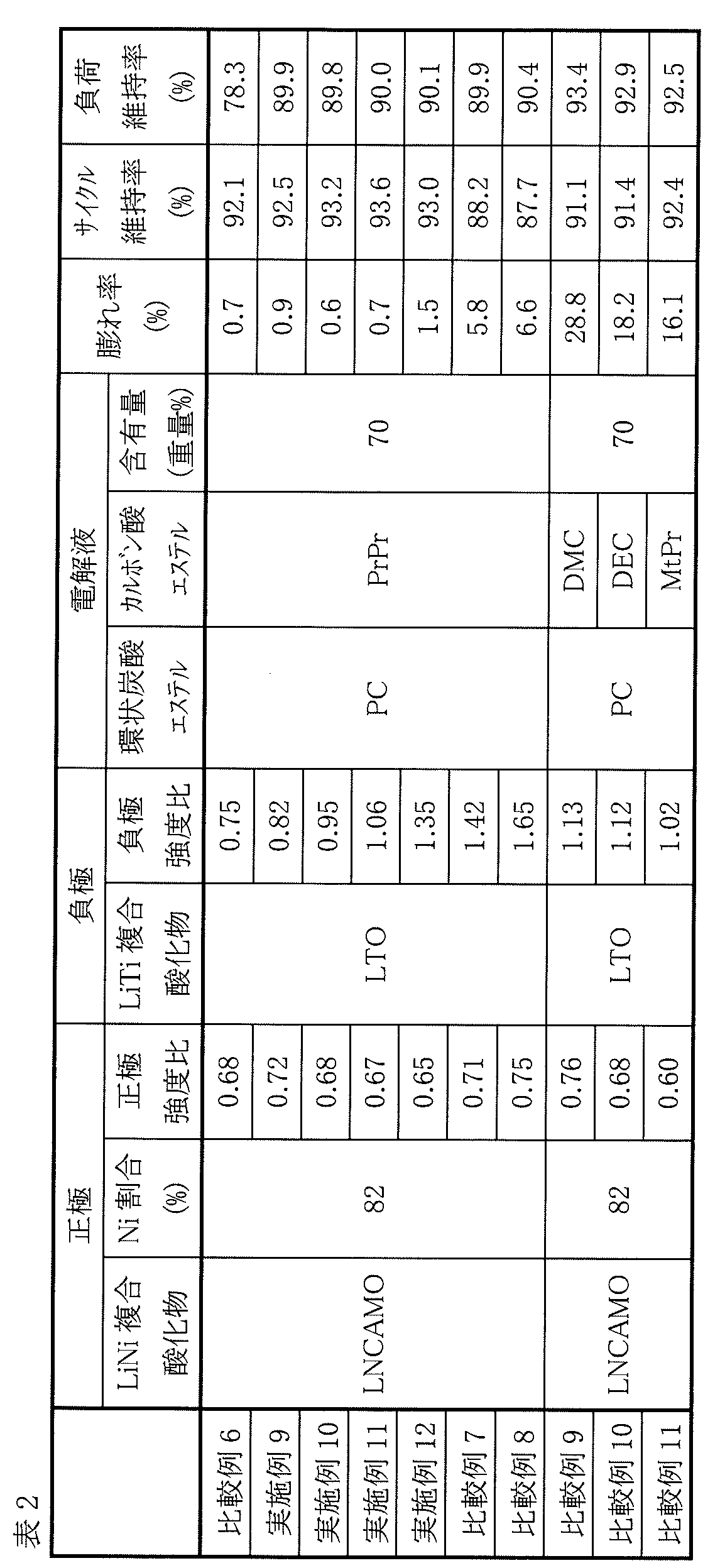
[考察]
表1および表2に示したように、正極21がリチウムニッケル複合酸化物を含んでおり、負極22がリチウムチタン複合酸化物を含んでおり、電解液がカルボン酸エステルを含んでいる場合(実施例1~5,9~12および比較例1~8)において、膨れ率、サイクル維持率および負荷維持率のそれぞれは、正極強度比および負極強度比に応じて変動した。
表1および表2に示したように、正極21がリチウムニッケル複合酸化物を含んでおり、負極22がリチウムチタン複合酸化物を含んでおり、電解液がカルボン酸エステルを含んでいる場合(実施例1~5,9~12および比較例1~8)において、膨れ率、サイクル維持率および負荷維持率のそれぞれは、正極強度比および負極強度比に応じて変動した。
具体的には、正極強度比は0.30~0.80であるという適正条件が満たされていない場合(比較例1~5)には、膨れ率、サイクル維持率および負荷維持率のうちのいずれかが改善されると残りが悪化するというトレードオフの関係が発生したため、膨れ率、サイクル維持率および負荷維持率の全てが改善されなかった。
また、負極強度比は0.82~1.35であるという適正条件が満たされていない場合(比較例6~8)には、やはりトレードオフの関係が発生したため、膨れ率、サイクル維持率および負荷維持率の全てが改善されなかった。
これに対して、正極強度比に関して上記した適正条件が満たされていると共に、負極強度比に関して上記した適正条件が満たされている場合(実施例1~5,9~12)には、上記したトレードオフの関係が打破されたため、膨れ率、サイクル維持率および負荷維持率の全てが改善された。
特に、正極強度比および負極強度比のそれぞれに関して適正条件が満たされている場合(実施例6~8)には、カルボン酸エステルの種類を変更しても、同様の結果が得られた。
なお、電解液がカルボン酸エステルの代わりに鎖状炭酸エステルを含んでいる場合(比較例9,10)には、上記したトレードオフの関係が発生したため、膨れ率、サイクル維持率および負荷維持率の全てが改善されなかった。
また、電解液が他のカルボン酸エステルを含んでいる場合(比較例11)には、電解液が鎖状炭酸エステルを含んでいる場合(比較例9,10)と同様の傾向が得られたため、膨れ率、サイクル維持率および負荷維持率の全てが改善されなかった。
<実施例13~18>
表3に示したように、Ni割合を変更したことを除いて同様の手順により、二次電池を作製したと共に、その二次電池の性能(膨れ特性、サイクル特性および負荷特性)を評価した。ここでは、二次電池の性能として、さらに、電池容量(Ah)を測定した。
表3に示したように、Ni割合を変更したことを除いて同様の手順により、二次電池を作製したと共に、その二次電池の性能(膨れ特性、サイクル特性および負荷特性)を評価した。ここでは、二次電池の性能として、さらに、電池容量(Ah)を測定した。
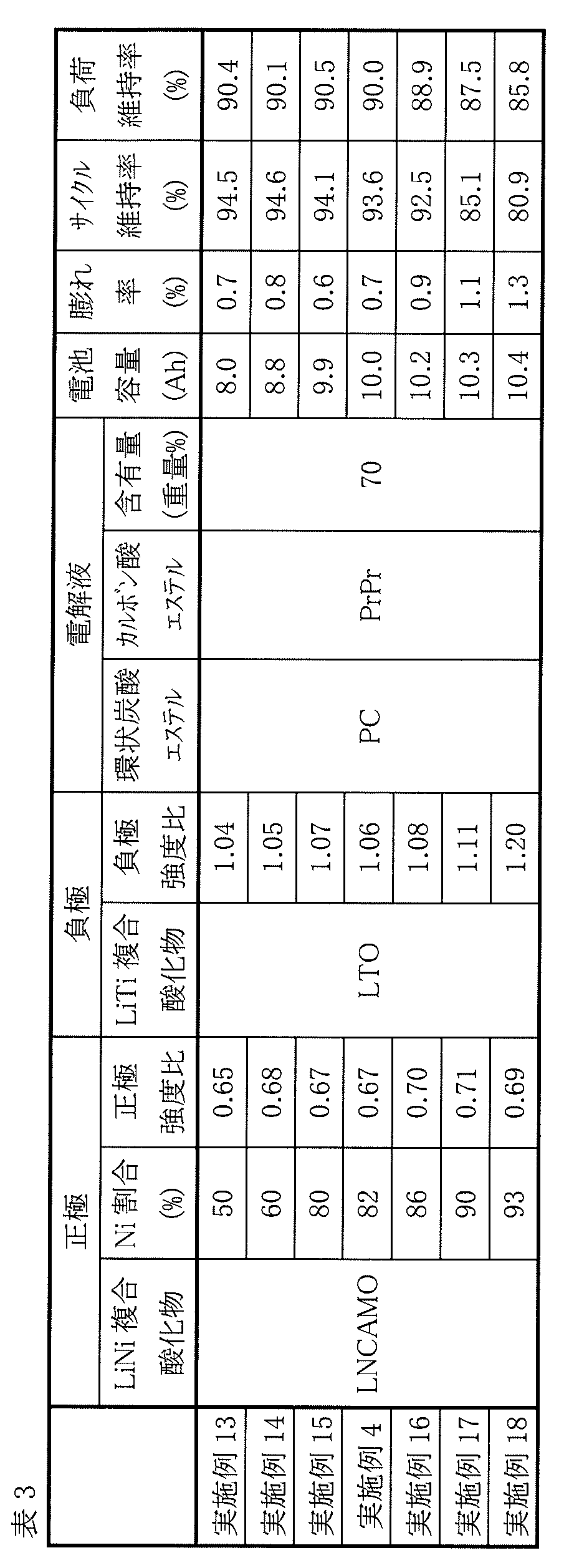
表3に示したように、Ni割合が80%以上である場合(実施例4,15~18)には、Ni割合が80%未満である場合(実施例13,14)と比較して、低い膨れ率が得られると共に高いサイクル維持率および高い負荷維持率が得られながら、電池容量が増加した。
<実施例19~22>
表4に示したように、溶媒中におけるカルボン酸エステルの含有量を変更したことを除いて同様の手順により、二次電池を作製したと共に、その二次電池の性能(膨れ特性、サイクル特性および負荷特性)を評価した。
表4に示したように、溶媒中におけるカルボン酸エステルの含有量を変更したことを除いて同様の手順により、二次電池を作製したと共に、その二次電池の性能(膨れ特性、サイクル特性および負荷特性)を評価した。
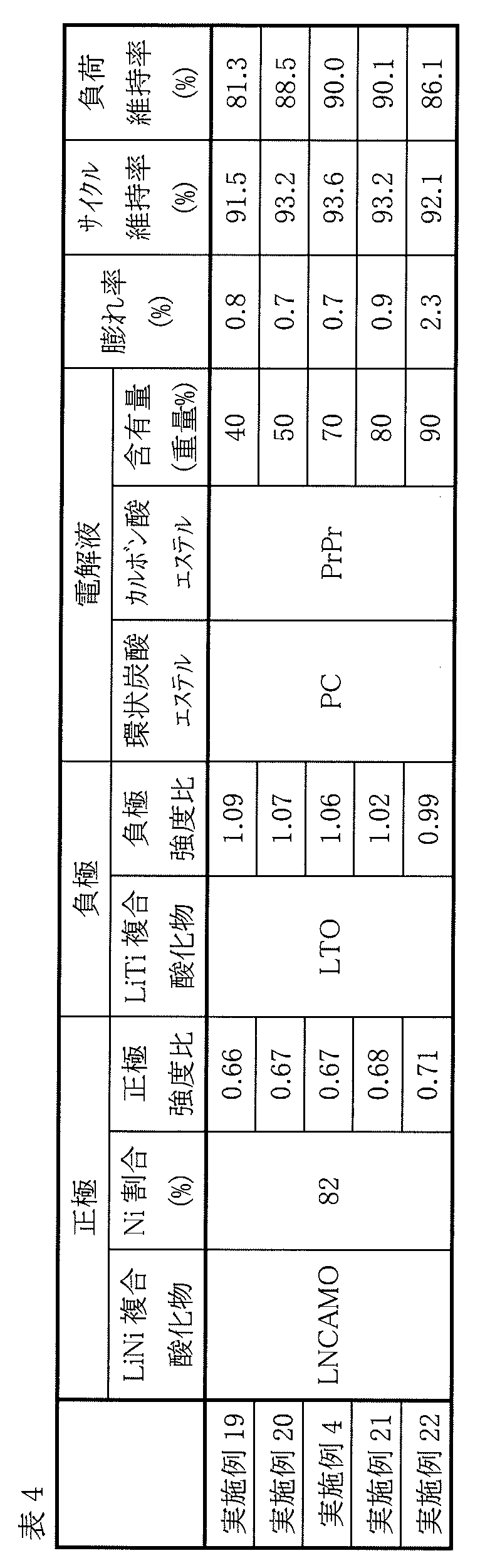
表4に示したように、カルボン酸エステルの含有量が50重量%以上である場合(実施例4,20~22)には、カルボン酸エステルの含有量が50重量%未満である場合(実施例19)と比較して、膨れ率が許容範囲内において抑制されながら、サイクル維持率および負荷維持率のそれぞれがより増加した。この場合には、特に、カルボン酸エステルの含有量が80重量%以下であると(実施例4,20,21)、膨れ率が著しく抑制された。
[まとめ]
表1~表4に示した結果から、正極21がリチウムニッケル複合酸化物を含んでおり、負極22がリチウムチタン複合酸化物を含んでおり、電解液が酢酸エチルなどのカルボン酸エステルを含んでいると共に、XPSを用いた正極21の表面分析結果(正極強度比)に関して適正条件(正極強度比=0.30~0.80)が満たされており、XPSを用いた負極22の表面分析結果(負極強度比)に関して適正条件(負極強度比=0.82~1.35)が満たされていると、膨れ率が減少したと共に、サイクル維持率および負荷維持率のそれぞれが増加した。よって、膨れ率、サイクル維持率および負荷維持率の全てが改善されたため、二次電池において優れた膨れ特性、優れたサイクル特性および優れた負荷特性が得られた。
表1~表4に示した結果から、正極21がリチウムニッケル複合酸化物を含んでおり、負極22がリチウムチタン複合酸化物を含んでおり、電解液が酢酸エチルなどのカルボン酸エステルを含んでいると共に、XPSを用いた正極21の表面分析結果(正極強度比)に関して適正条件(正極強度比=0.30~0.80)が満たされており、XPSを用いた負極22の表面分析結果(負極強度比)に関して適正条件(負極強度比=0.82~1.35)が満たされていると、膨れ率が減少したと共に、サイクル維持率および負荷維持率のそれぞれが増加した。よって、膨れ率、サイクル維持率および負荷維持率の全てが改善されたため、二次電池において優れた膨れ特性、優れたサイクル特性および優れた負荷特性が得られた。
以上、一実施形態および実施例を挙げながら本技術に関して説明したが、その本技術の構成は、一実施形態および実施例において説明された構成に限定されないため、種々に変形可能である。
具体的には、二次電池の電池構造がラミネートフィルム型である場合に関して説明したが、その電池構造は、特に限定されないため、円筒型、角型、コイン型およびボタン型などの他の電池構造でもよい。
また、電池素子の素子構造が巻回型である場合に関して説明したが、その電池素子の素子構造は、特に限定されないため、積層型および九十九折り型などの他の素子構造でもよい。積層型では、電極(正極および負極)が積層されていると共に、九十九折り型では、電極(正極および負極)がジグザグに折り畳まれている。
さらに、電極反応物質がリチウムである場合に関して説明したが、その電極反応物質は、特に限定されない。具体的には、電極反応物質は、上記したように、ナトリウムおよびカリウムなどの他のアルカリ金属でもよいし、ベリリウム、マグネシウムおよびカルシウムなどのアルカリ土類金属でもよい。この他、電極反応物質は、アルミニウムなどの他の軽金属でもよい。
本明細書中に記載された効果は、あくまで例示であるため、本技術の効果は、本明細書中に記載された効果に限定されない。よって、本技術に関して、他の効果が得られてもよい。
Claims (10)
- リチウムニッケル複合酸化物を含む正極と、
リチウムチタン複合酸化物を含む負極と、
カルボン酸エステルを含む電解液と
を備え、
前記カルボン酸エステルは、酢酸エチル、酢酸プロピル、プロピオン酸エチルおよびプロピオン酸プロピルのうちの少なくとも1種を含み、
X線光電子分光分析法を用いた前記正極の表面分析において、結合エネルギーが528eV以上531eV以下である範囲内にピークを有する第1酸素スペクトルと、結合エネルギーが531eVよりも大きいと共に535eV以下である範囲内にピークを有する第2酸素スペクトルとが検出され、
前記第2酸素スペクトルの強度に対する前記第1酸素スペクトルの強度の比は、0.30以上0.80以下であり、
前記X線光電子分光分析法を用いた前記負極の表面分析において、結合エネルギーが528eV以上531eV以下である範囲内にピークを有する第3酸素スペクトルと、結合エネルギーが531eVよりも大きいと共に535eV以下である範囲内にピークを有する第4酸素スペクトルとが検出され、
前記第4酸素スペクトルの強度に対する前記第3酸素スペクトルの強度の比は、0.82以上1.35以下である、
二次電池。 - 前記リチウムニッケル複合酸化物は、下記の式(1)で表される化合物を含む、
請求項1記載の二次電池。
Lix Ni(1-y) M1y O2 ・・・(1)
(M1は、長周期型周期表の2族~15族に属する元素(ただし、Niを除く。)のうちの少なくとも1種である。xおよびyは、0.8≦x≦1.2および0≦y<1.0を満たす。) - 前記Niのモル数と前記M1のモル数との和に対する前記Niのモル数の割合は、80%以上である、
請求項2記載の二次電池。 - 前記電解液は、溶媒および電解質塩を含み、
前記溶媒は、前記カルボン酸エステルを含み、
前記溶媒中における前記カルボン酸エステルの含有量は、50重量%以上90重量%以下である、
請求項1ないし請求項3のいずれか1項に記載の二次電池。 - 前記溶媒は、さらに、環状炭酸エステルを含む、
請求項4記載の二次電池。 - 前記正極は、
前記リチウムニッケル複合酸化物を含む正極活物質層と、
前記正極活物質層の表面に設けられ、酸素を構成元素として含む正極被膜と
を含み、
前記X線光電子分光分析法を用いた前記正極の表面分析において、前記正極被膜が分析される、
請求項1ないし請求項5のいずれか1項に記載の二次電池。 - 前記リチウムチタン複合酸化物は、下記の式(2)、式(3)および式(4)のそれぞれで表される化合物のうちの少なくとも1種を含む、
請求項1ないし請求項6のいずれか1項に記載の二次電池。
Li[Lix M2(1-3x)/2Ti(3+x)/2 ]O4 ・・・(2)
(M2は、Mg、Ca、Cu、ZnおよびSrのうちの少なくとも1種である。xは、0≦x≦1/3を満たす。)
Li[Liy M31-3yTi1+2y]O4 ・・・(3)
(M3は、Al、Sc、Cr、Mn、Fe、GaおよびYのうちの少なくとも1種である。yは、0≦y≦1/3を満たす。)
Li[Li1/3 M4z Ti(5/3)-z ]O4 ・・・(4)
(M4は、V、ZrおよびNbのうちの少なくとも1種である。zは、0≦z≦2/3を満たす。) - 前記負極は、
前記リチウムチタン複合酸化物を含む負極活物質層と、
前記負極活物質層の表面に設けられ、酸素を構成元素として含む負極被膜と
を含み、
前記X線光電子分光分析法を用いた前記負極の表面分析において、前記負極被膜が分析される、
請求項1ないし請求項7のいずれか1項に記載の二次電池。 - さらに、前記正極、前記負極および前記電解液を収納する可撓性の外装部材を備えた、
請求項1ないし請求項8のいずれか1項に記載の二次電池。 - リチウムイオン二次電池である、
請求項1ないし請求項9のいずれか1項に記載の二次電池。
Priority Applications (3)
| Application Number | Priority Date | Filing Date | Title |
|---|---|---|---|
| CN202180063714.5A CN116250094A (zh) | 2020-09-17 | 2021-09-13 | 二次电池 |
| JP2022550541A JP7462142B2 (ja) | 2020-09-17 | 2021-09-13 | 二次電池 |
| US18/090,947 US12394824B2 (en) | 2020-09-17 | 2022-12-29 | Secondary battery |
Applications Claiming Priority (2)
| Application Number | Priority Date | Filing Date | Title |
|---|---|---|---|
| JP2020156447 | 2020-09-17 | ||
| JP2020-156447 | 2020-09-17 |
Related Child Applications (1)
| Application Number | Title | Priority Date | Filing Date |
|---|---|---|---|
| US18/090,947 Continuation US12394824B2 (en) | 2020-09-17 | 2022-12-29 | Secondary battery |
Publications (1)
| Publication Number | Publication Date |
|---|---|
| WO2022059634A1 true WO2022059634A1 (ja) | 2022-03-24 |
Family
ID=80776646
Family Applications (1)
| Application Number | Title | Priority Date | Filing Date |
|---|---|---|---|
| PCT/JP2021/033476 Ceased WO2022059634A1 (ja) | 2020-09-17 | 2021-09-13 | 二次電池 |
Country Status (4)
| Country | Link |
|---|---|
| US (1) | US12394824B2 (ja) |
| JP (1) | JP7462142B2 (ja) |
| CN (1) | CN116250094A (ja) |
| WO (1) | WO2022059634A1 (ja) |
Citations (5)
| Publication number | Priority date | Publication date | Assignee | Title |
|---|---|---|---|---|
| JP2003338277A (ja) * | 2002-05-20 | 2003-11-28 | Sony Corp | 非水電解質二次電池 |
| JP2005251700A (ja) * | 2004-03-08 | 2005-09-15 | Japan Storage Battery Co Ltd | 非水電解質二次電池 |
| US20150017515A1 (en) * | 2012-04-20 | 2015-01-15 | Lg Chem, Ltd. | Electrolyte for lithium secondary battery and lithium secondary battery including the same |
| JP2016531388A (ja) * | 2014-06-13 | 2016-10-06 | エルジー・ケム・リミテッド | 非水電解液及びこれを含むリチウム二次電池 |
| JP2017168265A (ja) * | 2016-03-15 | 2017-09-21 | 株式会社東芝 | 非水電解質電池、電池パック及び車両 |
Family Cites Families (4)
| Publication number | Priority date | Publication date | Assignee | Title |
|---|---|---|---|---|
| WO2005036680A1 (ja) | 2003-10-07 | 2005-04-21 | Gs Yuasa Corporation | 非水電解質二次電池 |
| JP2014060143A (ja) * | 2012-08-22 | 2014-04-03 | Sony Corp | 正極活物質、正極および電池、並びに電池パック、電子機器、電動車両、蓄電装置および電力システム |
| JP5665828B2 (ja) * | 2012-10-18 | 2015-02-04 | 株式会社東芝 | 電池用活物質、非水電解質電池および電池パック |
| WO2015177665A1 (en) * | 2014-05-23 | 2015-11-26 | Semiconductor Energy Laboratory Co., Ltd. | Negative electrode active material and power storage device |
-
2021
- 2021-09-13 JP JP2022550541A patent/JP7462142B2/ja active Active
- 2021-09-13 WO PCT/JP2021/033476 patent/WO2022059634A1/ja not_active Ceased
- 2021-09-13 CN CN202180063714.5A patent/CN116250094A/zh active Pending
-
2022
- 2022-12-29 US US18/090,947 patent/US12394824B2/en active Active
Patent Citations (5)
| Publication number | Priority date | Publication date | Assignee | Title |
|---|---|---|---|---|
| JP2003338277A (ja) * | 2002-05-20 | 2003-11-28 | Sony Corp | 非水電解質二次電池 |
| JP2005251700A (ja) * | 2004-03-08 | 2005-09-15 | Japan Storage Battery Co Ltd | 非水電解質二次電池 |
| US20150017515A1 (en) * | 2012-04-20 | 2015-01-15 | Lg Chem, Ltd. | Electrolyte for lithium secondary battery and lithium secondary battery including the same |
| JP2016531388A (ja) * | 2014-06-13 | 2016-10-06 | エルジー・ケム・リミテッド | 非水電解液及びこれを含むリチウム二次電池 |
| JP2017168265A (ja) * | 2016-03-15 | 2017-09-21 | 株式会社東芝 | 非水電解質電池、電池パック及び車両 |
Also Published As
| Publication number | Publication date |
|---|---|
| US20230137208A1 (en) | 2023-05-04 |
| JPWO2022059634A1 (ja) | 2022-03-24 |
| JP7462142B2 (ja) | 2024-04-05 |
| CN116250094A (zh) | 2023-06-09 |
| US12394824B2 (en) | 2025-08-19 |
Similar Documents
| Publication | Publication Date | Title |
|---|---|---|
| US12424622B2 (en) | Secondary battery | |
| JP7276603B2 (ja) | 二次電池 | |
| JP7380845B2 (ja) | 二次電池 | |
| WO2022196266A1 (ja) | 二次電池 | |
| WO2021220743A1 (ja) | 二次電池用正極および二次電池 | |
| JP7845484B2 (ja) | 二次電池用負極および二次電池 | |
| JP7276602B2 (ja) | 二次電池用正極および二次電池 | |
| JP7302731B2 (ja) | 二次電池 | |
| JP7044174B2 (ja) | 二次電池 | |
| JP7462142B2 (ja) | 二次電池 | |
| JP7694802B2 (ja) | 二次電池用負極および二次電池 | |
| JP7852805B2 (ja) | 二次電池 | |
| JP7380898B2 (ja) | 二次電池 | |
| JP7347679B2 (ja) | 二次電池用正極活物質、二次電池用正極および二次電池 | |
| JP7380881B2 (ja) | 二次電池 | |
| CN115349190B (zh) | 二次电池 | |
| CN121416577A (zh) | 锂离子二次电池 | |
| JP2024077703A (ja) | リチウムイオン二次電池 | |
| WO2021192402A1 (ja) | 二次電池 | |
| JP2024021739A (ja) | 二次電池用正極活物質、二次電池用正極および二次電池 | |
| WO2024157620A1 (ja) | 二次電池用正極活物質、二次電池用正極および二次電池 | |
| JP2024021740A (ja) | 二次電池用正極活物質、二次電池用正極および二次電池 | |
| WO2022255018A1 (ja) | 二次電池用電解液および二次電池 | |
| CN116964769A (zh) | 二次电池用负极以及二次电池 |
Legal Events
| Date | Code | Title | Description |
|---|---|---|---|
| 121 | Ep: the epo has been informed by wipo that ep was designated in this application |
Ref document number: 21869321 Country of ref document: EP Kind code of ref document: A1 |
|
| ENP | Entry into the national phase |
Ref document number: 2022550541 Country of ref document: JP Kind code of ref document: A |
|
| NENP | Non-entry into the national phase |
Ref country code: DE |
|
| 122 | Ep: pct application non-entry in european phase |
Ref document number: 21869321 Country of ref document: EP Kind code of ref document: A1 |