WO2022044539A1 - ポリアミド樹脂組成物およびそれを成形してなる成形品 - Google Patents
ポリアミド樹脂組成物およびそれを成形してなる成形品 Download PDFInfo
- Publication number
- WO2022044539A1 WO2022044539A1 PCT/JP2021/024902 JP2021024902W WO2022044539A1 WO 2022044539 A1 WO2022044539 A1 WO 2022044539A1 JP 2021024902 W JP2021024902 W JP 2021024902W WO 2022044539 A1 WO2022044539 A1 WO 2022044539A1
- Authority
- WO
- WIPO (PCT)
- Prior art keywords
- weight
- flame retardant
- polyamide resin
- parts
- resin composition
- Prior art date
- Legal status (The legal status is an assumption and is not a legal conclusion. Google has not performed a legal analysis and makes no representation as to the accuracy of the status listed.)
- Ceased
Links
Classifications
-
- C—CHEMISTRY; METALLURGY
- C08—ORGANIC MACROMOLECULAR COMPOUNDS; THEIR PREPARATION OR CHEMICAL WORKING-UP; COMPOSITIONS BASED THEREON
- C08K—Use of inorganic or non-macromolecular organic substances as compounding ingredients
- C08K3/00—Use of inorganic substances as compounding ingredients
- C08K3/18—Oxygen-containing compounds, e.g. metal carbonyls
- C08K3/24—Acids; Salts thereof
- C08K3/26—Carbonates; Bicarbonates
-
- C—CHEMISTRY; METALLURGY
- C08—ORGANIC MACROMOLECULAR COMPOUNDS; THEIR PREPARATION OR CHEMICAL WORKING-UP; COMPOSITIONS BASED THEREON
- C08K—Use of inorganic or non-macromolecular organic substances as compounding ingredients
- C08K5/00—Use of organic ingredients
- C08K5/02—Halogenated hydrocarbons
- C08K5/03—Halogenated hydrocarbons aromatic, e.g. C6H5-CH2-Cl
-
- C—CHEMISTRY; METALLURGY
- C08—ORGANIC MACROMOLECULAR COMPOUNDS; THEIR PREPARATION OR CHEMICAL WORKING-UP; COMPOSITIONS BASED THEREON
- C08K—Use of inorganic or non-macromolecular organic substances as compounding ingredients
- C08K5/00—Use of organic ingredients
- C08K5/16—Nitrogen-containing compounds
- C08K5/34—Heterocyclic compounds having nitrogen in the ring
- C08K5/3467—Heterocyclic compounds having nitrogen in the ring having more than two nitrogen atoms in the ring
- C08K5/3477—Six-membered rings
- C08K5/3492—Triazines
-
- C—CHEMISTRY; METALLURGY
- C08—ORGANIC MACROMOLECULAR COMPOUNDS; THEIR PREPARATION OR CHEMICAL WORKING-UP; COMPOSITIONS BASED THEREON
- C08L—COMPOSITIONS OF MACROMOLECULAR COMPOUNDS
- C08L77/00—Compositions of polyamides obtained by reactions forming a carboxylic amide link in the main chain; Compositions of derivatives of such polymers
Definitions
- the present invention is a polyamide resin composition having excellent rigidity and toughness during water absorption, excellent glow wire characteristics, flame retardancy, and electrical characteristics, and capable of reducing resin discoloration and mold stains during continuous molding, and molding thereof. It is related to a molded product.
- plastic materials are widely used for power supply peripheral members of electrical and electronic parts such as connectors.
- polyamide resins are widely used for power supply peripheral members because they are excellent in moldability, mechanical properties, heat resistance, flame retardancy, and electrical properties, and various resins are used according to the resin properties and required needs. High functionality and high performance have been achieved by prescription.
- the comparative tracking index (Comparative Tracking Index (CTI)) is 250 V or more with a thickness of 3 mm.
- Patent Document 1 describes a polyamide resin composition containing a halogen-based flame retardant using ethylene-bis (pentabromobenzene), which has a particularly high bromine content among halogen-based flame retardants. Proposed. Further, in Patent Document 2, a polyamide resin containing a halogen-based flame retardant in combination with ethylene-bis (pentabromobenzene) and a triazine-based flame retardant which is a non-halogen flame retardant as a flame retardant imparting tracking resistance. Compositions have been proposed.
- Patent Document 1 flame retardancy V-0 (0.8 mm thickness) is achieved, but CTI is 225 V.
- Ethylene-bis (pentabromobenzene) is a monomer-type flame retardant, has poor heat resistance, and is a resin for molded products in continuous molding at a cylinder temperature of 260 ° C or higher, which is the general molding temperature for nylon resins. There was a problem that mold stains frequently occurred due to discoloration and generation of gas.
- Patent Document 2 by combining ethylene-bis (pentabromobenzene) with a triazine-based flame retardant, which is a non-halogen flame retardant as a flame retardant that imparts tracking resistance, in a region where a large amount of triazine-based flame retardant is blended.
- Flame retardant V-0 (0.8 mm thickness), GW-IT 775 ° C (3 mm thickness), CTI 400 V or higher.
- the effect of improving the flame retardancy and glow wire property of the triazine-based flame retardant is not so high as compared with the halogen-based flame retardant, a large amount of compounding is required and the toughness becomes poor.
- the flame retardancy did not reach V-0, and the problems of resin discoloration and mold stain during continuous molding remained.
- the present invention has an excellent balance of flame retardancy, glow wire characteristics, tracking resistance, rigidity and toughness, and can reduce resin discoloration and mold stains during continuous molding. It is an object to provide a composition.
- the present invention has the following configuration.
- it can be a molded product made of the above-mentioned polyamide resin composition.
- the polyamide resin composition of the present invention comprises a polyamide resin (A), a flame retardant (B) containing 75% by weight or more and 90% by weight or less of bromine in one molecule, a flame retardant aid (C), and an average particle size of 0. It is composed of a triazine-based flame retardant (D) of 1 to 20 ⁇ m.
- the polyamide resin (A) constituting the polyamide resin composition according to the present invention is a polyamide obtained by polycondensation of a three-membered ring or more lactam, a polymerizable ⁇ -amino acid, or a dibasic acid and a diamine. .. Specifically, polymers such as ⁇ -caprolactam, aminocaproic acid, enantractum, 7-aminoheptanoic acid, 11-aminoundecanoic acid, 9-aminononanoic acid, ⁇ -pyrrolidone, ⁇ -piperidone, tetramethylenediamine, pentamethylene.
- Diamine Hexamethylenediamine, Nonamethylenediamine, Undecamethylenediamine, Dodecamethylenediamine, Metaxylylenediamine, Paraxylylenediamine, 2-Methylpentamethylenediamine, 2,2,4- / 2,4,4-trimethyl Hexamethylenediamine, 5-methylnonamethylenediamine, 1,3-bis (aminomethyl) cyclohexane, 1,4-bis (aminomethyl) cyclohexane, 1-amino-3-aminomethyl-3,5,5-trimethylsik Hexamethylenediamine, bis (4-aminocyclohexyl) methane, bis (3-methyl-4-aminocyclohexyl) methane, 2,2-bis (4-aminocyclohexyl) propane, bis (aminopropyl) piperazine, aminoethylpiperazine, etc.
- Fat group alicyclic group, aromatic diamine, adipic acid, spellic acid, azelaic acid, sebacic acid, dodecanedioic acid, terephthalic acid, isophthalic acid, 2-chloroterephthalic acid, 2-methylterephthalic acid, 5-methylisophthalic acid.
- an aliphatic, alicyclic, or aromatic dicarboxylic acid such as acid, 5-sodiumsulfoisophthalic acid, 2,6-naphthalenedicarboxylic acid, hexahydroterephthalic acid, hexahydroisophthalic acid, and cyclohexanedicarboxylic acid. Examples thereof include the obtained polymer or a copolymer thereof.
- These polyamide resins may be those whose ends are sealed with a carboxylic acid or an amine also for controlling the molecular weight.
- polyamide 4 polyamide 6, polyamide 7, polyamide 8, polyamide 11, polyamide 12, polyamide 46, polyamide 56, polyamide 66, polyamide 69, polyamide 410, polyamide 510, polyamide 610, polyamide 611, polyamide. 612, Polyamide 66 / 6T copolymer, Polyamide 6/66 copolymer, Polyamide 6/12 copolymer, Polyamide 6 / 6T copolymer, Polyamide 6T / 6I copolymer, Polyamide MXD6, etc. It may be a mixture of the kinds of polyamide resins.
- Preferred polyamide resins include polyamide 6, polyamide 6/66 copolymer, polyamide 66, and mixtures thereof from the viewpoints of flame retardancy, rigidity / toughness, and moldability, and polyamide 66 is particularly preferable.
- Examples of the flame retardant (B) containing 75% by weight or more and 90% by weight or less of bromine in one molecule constituting the polyamide resin composition according to the present invention include ethylene-bis (pentabromobenzene) and decabromodiphenyloxide. Examples thereof include tetradecabromodihydroxybenzene.
- ethylene-bis (pentabromobenzene) is preferable from the viewpoint of the balance between toughness, flame retardancy, glow wire characteristics, and tracking resistance.
- one molecule contains 80% by weight or more and 85% by weight or less of bromine.
- the blending amount of the flame retardant (B) containing 75% by weight or more and 90% by weight or less of bromine in one molecule is in the range of 1 to 30 parts by weight with respect to 100 parts by weight of the polyamide resin (A).
- the blending amount of the flame retardant (B) is preferably 8.1 to 30 parts by weight, more preferably 10 to 18 parts by weight.
- Examples of the flame-retardant aid (C) constituting the polyamide resin composition according to the present invention include antimony compounds such as antimony trioxide and antimony pentoxide, boric acid metal salts such as zinc borate, and tin acid metal salts such as zinc tintate. Can be mentioned. In particular, antimony trioxide and zinc borate are preferable, and antimony trioxide is most preferable, from the viewpoint of imparting flame retardancy and glow wire characteristics.
- the blending amount of the flame retardant aid (C) is 1 to 10 parts by weight with respect to 100 parts by weight of the polyamide resin (A). When the blending amount of the flame retardant aid (C) is less than 1 part by weight, the flame retardancy and the glow wire characteristics are deteriorated. When the blending amount of the flame retardant aid (C) exceeds 10 parts by weight, the toughness is lowered.
- the blending amount of the flame retardant aid (C) is preferably 1 to 9 parts by weight, more preferably 3 to 6 parts by weight.
- the triazine-based flame retardant (D) constituting the flame-retardant polyamide resin composition according to the present invention includes (i) a compound represented by the following general formula (1) or (2), (ii) melamines, and (Iii) Examples thereof include equimolar reactants of (i) and (ii).
- R 1 to R 6 each represent a hydrogen atom or an alkyl group.
- the number of carbon atoms of the alkyl group is preferably 1 to 5, and more preferably 1 to 3.).
- Specific examples of the compound represented by the above general formula (1) include cyanuric acid, trimethyl cyanurate, triethyl cyanurate, tri (n-propyl) cyanurate, methyl cyanurate, diethyl cyanurate and the like.
- Specific examples of the compound represented by the general formula (2) include isocyanuric acid, trimethylisocyanurate, triethylisocyanurate, tri (n-propyl) isocyanurate, diethylisocyanurate, methylisocyanurate and the like. ..
- melamines examples include melamine, melamine derivatives, compounds having a structure similar to melamine, and condensates of melamine.
- Specific examples of melamines include melamine, ammelide, ammeline, formoguanamine, guanylmelamine, cyanomelamine, arylguanamine, melam, melem, and melon.
- an equimolar reaction product of cyanuric acid and melamine is preferably mentioned. Further, some of the amino groups or hydroxyl groups in melamine cyanurate may be substituted with other substituents.
- Melamine cyanurate can be obtained, for example, by mixing an aqueous solution of cyanuric acid and an aqueous solution of melamine, reacting them under stirring at a temperature of 90 to 100 ° C., and filtering the produced precipitate.
- Melamine cyanurate is a white solid and is preferably used after being pulverized into a fine powder. Of course, a solid commercial product can be used as it is, or it can be pulverized and used.
- Melamine cyanurate is most preferable from the viewpoint of imparting rigidity, toughness, flame retardancy, glow wire characteristics, and tracking resistance in a well-balanced manner, and reducing resin discoloration and mold stains during continuous molding.
- the average particle size of the triazine-based flame retardant (D) is 0.1 to 20 ⁇ m.
- the triazine-based flame retardant (D) exhibits flame retardancy by combining the endothermic reaction of the sublimation heat and decomposition heat of (D) with the oxygen dilution and blocking effect of the generated nitrogen-based gas.
- the mechanism is not clear by using the above-mentioned triazine-based flame retardant (D) having an average particle size.
- the dispersibility of (D) in the polyamide resin composition is good, an efficient endothermic effect is exhibited, and the decomposition of (B) due to shear heat generation during melt kneading and injection molding can be significantly suppressed. Conceivable.
- the average particle size of the triazine-based flame retardant (D) is less than 0.1 ⁇ m, it becomes difficult to supply the triazine-based flame retardant (D) to the kneader during melt-kneading.
- the average particle size of the triazine-based flame retardant (D) exceeds 20 ⁇ m, the toughness and flame retardancy are lowered, and the resin burn and mold stain during continuous molding become remarkable.
- Triazine-based flame retardant (D) By setting the average particle size to 0.1 to 20 ⁇ m, toughness and flame retardancy are highly exhibited, and it is difficult to contain bromine in 75% by weight% 90% by weight or less in one molecule. By efficiently suppressing the decomposition of the flame retardant (B), it is possible to suppress resin discoloration and mold stains during continuous molding.
- the average particle size of the triazine-based flame retardant (D) is preferably 10 ⁇ m or less, more preferably 5 ⁇ m or less.
- the average particle size is a numerical average calculated from the values measured using a laser diffraction type particle size distribution meter LMS-24 (manufactured by Seishin Co., Ltd.) in accordance with JIS K 5600-9-3 (2006). Particle size.
- the triazine-based flame retardant (D) has the same particle size as the raw material before melting and mixing and the particle size in the polyamide resin composition.
- the blending amount of the triazine-based flame retardant (D) is 1 to 10 parts by weight with respect to 100 parts by weight of the polyamide resin (A). If the blending amount of the triazine-based flame retardant (D) is less than 1 part by weight, the flame retardancy and glow wire characteristics are deteriorated, and resin discoloration and mold stains become remarkable during continuous molding. If the blending amount of the triazine-based flame retardant (D) exceeds 10 parts by weight, the toughness is greatly reduced, which leads to breakage in the thin-walled molded product.
- the blending amount of the triazine-based flame retardant (D) is preferably 1 to 6.9 parts by weight, more preferably 4 to 6.5 parts by weight.
- the polyamide resin composition of the present invention contains 8.1 to 30 parts by weight of the flame retardant (B) and 1 to 6.9 parts of the triazine flame retardant (D) containing 75% by weight or 90% by weight or more of bromine in one molecule.
- the UL-94 flame retardant standard is preferably V-0.
- hydrotalcite used in the present invention refers to magnesium, aluminum, hydroxyoxide, carbonate, and hydrate as naturally occurring minerals in a narrow sense, and has a composition similar to that of hydrotalcite as a mineral in a broad sense. It shall also include synthetic products of metal oxides. It is preferable to use calcined hydrotalcite represented by the following general formula (3). (Mg 1-X Al X ) O 1 + 0.5X (3) However, in the formula, 0 ⁇ x ⁇ 0.4
- the calcined hydrotalcite represented by the formula (3) is a so-called magnesium oxide-based solid solution in which aluminum oxide (Al 2 O 3 ) is solid-dissolved in magnesium oxide (MgO), and is, for example, the following general formula (4).
- An- indicates an n- valent anion
- x, m and n are positive numbers satisfying the range of 0 ⁇ x ⁇ 0.4, 0 ⁇ m ⁇ 1, 1 ⁇ n ⁇ 4, respectively.
- the anions An - of the hydrotalcite of the formula (4) include F-, Cl- , Br-, I- , OH- , HCO 2- , CH 3 COO- , HCOO- , CO 3 2- , SO 4 2 -Etc ., but not limited to these.
- the blending amount of the hydrotalcite of the present invention is preferably 0.1 to 5.0 parts by weight, more preferably 0.2 to 4.5 parts by weight, based on 100 parts by weight of the polyamide resin component. From the viewpoint of the balance between mechanical properties and flame retardancy, it is more preferably 0.5 to 4.0 parts by weight. If it is less than 0.1 part by weight, the trapping of the halogen compound becomes insufficient and the desired mold stain suppressing effect cannot be obtained. If it exceeds 5.0 parts by weight, the mechanical properties such as strength and toughness are deteriorated. Flame retardancy and glow wire characteristics tend to deteriorate. It was
- the polyamide resin composition of the present invention comprises a polyamide resin (A), a flame retardant (B) containing 75% by weight or more and 90% by weight or less of bromine in one molecule, and a flame retardant aid (flame retardant aid), as long as the characteristics are not impaired.
- A a polyamide resin
- B flame retardant
- B flame retardant aid
- C a triazine-based flame retardant
- E hydrotalcite
- thermoplastic resin other than the component (A) may be contained as another component.
- thermoplastic resin include polyamide resins other than the polyamide resin (A), polyester resins, polyphenylene sulfide resins, polyphenylene oxide resins, polycarbonate resins, polylactic acid resins, polyacetal resins, polysulfone resins, tetrafluoropolyethylene resins, and polyetherimides.
- polyamideimide resin polyimide resin
- polyether sulfone resin polyether ketone resin
- polythioether ketone resin polyether ether ketone resin
- polyolefin resin such as polyethylene resin and polypropylene resin
- styrene resin such as polystyrene resin and ABS resin.
- Polyalkylene oxide resin polybutadiene, polyisoprene, styrene / butadiene random copolymers and block copolymers, hydrogenated products of the block copolymers, acrylonitrile / butadiene copolymers, butadiene / isoprene copolymers, etc.
- ethylene / propylene random copolymers and block copolymers ethylene / butene random copolymers and block copolymers, ethylene / ⁇ -olefin copolymers, ethylene / acrylic acid esters, ethylene / Ethylene / unsaturated carboxylic acid ester copolymers such as methacrylic acid esters, acrylic acid esters / butadiene copolymers such as butyl acrylate / butadiene copolymers, and ethylene / fatty acid vinyl copolymers such as ethylene / vinyl acetate copolymers.
- Polymers such as ethylene / propylene / non-conjugated diene ternary copolymers such as ethylene / propylene / etilidennorbornene copolymers, ethylene / propylene / hexadiene copolymers, butylene / isoprene copolymers, chlorinated polyethylene, polyamide elastomers, Examples thereof include thermoplastic elastomers such as polyester elastomers.
- thermoplastic resin when such a thermoplastic resin is used, the content thereof is not limited, but is preferably 0.1 part by weight or more and less than 10 parts by weight with respect to 100 parts by weight of the polyamide resin (A).
- an ultraviolet absorber an antioxidant, a heat stabilizer, a crystal nucleating agent, an antioxidant, a weathering agent, a mold release agent, a lubricant, an antistatic agent, etc.
- an ultraviolet absorber an antioxidant, a heat stabilizer, a crystal nucleating agent, an antioxidant, a weathering agent, a mold release agent, a lubricant, an antistatic agent, etc.
- One or more kinds of ordinary additives such as colorants containing dyes and pigments can be added.
- additives examples include ultraviolet absorbers such as benzotriazole-based, phenol-based, and phosphorus-based, antioxidants such as copper-based, hindered phenol-based, phosphorus-based, and sulfur-based, heat stabilizers, and aromatic carboxylic acids.
- organic nucleating agents such as aromatic amide compounds
- crystal nucleating agents including talc, boron nitride, and other inorganic nucleating agents such as silicate metal salts, resorcinol-based, salicylate-based
- Weather resistant agents such as benzotriazole, benzophenone, and hinder
- -Sluices such as octyl oxybenzoate and wax, alkyl sulfate type anionic type, quaternary ammonium salt type cationic type, non-ionic type such as polyoxyethylene sorbitan monostearate, betaine type amphoteric antistatic agent and the like can be mentioned. It is also possible to use two or more kinds of such additives.
- the content thereof is not particularly limited, but is preferably 0.01 parts by weight or more and less than 5 parts by weight with respect to 100 parts by weight of the polyamide resin (A).
- the method for producing the polyamide resin composition of the present invention comprises a polyamide resin (A), a flame retardant (B) containing 75% by weight or more and 90% by weight or less of bromine in one molecule, a flame retardant aid (C), and average particles.
- a flame retardant B
- C flame retardant aid
- D triazine-based flame retardant
- melt-kneading by a twin-screw extruder is usually preferably used from the viewpoint of productivity and kneadability.
- melt-kneading method using a twin-screw extruder include a polyamide resin (A), a flame retardant (B) containing 75% by weight or more and 90% by weight or less of bromine in one molecule, and a flame retardant aid (C).
- a triazine flame retardant (D) having an average particle size of 0.1 to 20 ⁇ m, and if necessary, components other than (A), (B), (C), and (D), and the cylinder temperature.
- the mixing order of the raw materials is not particularly limited, and all the raw materials are melt-kneaded by the above method, some raw materials are melt-kneaded by the above method, and the remaining raw materials are melt-kneaded, or some of them. Any method may be used, such as a method of mixing the remaining raw materials using a side feeder while the raw materials are melt-kneaded.
- the screw configuration preferably has 1 to 5 kneading zones, and the ratio (%) of the total length of the kneading zones to the total length of the screw is calculated by (total length of the kneading zones) ⁇ (total length of the screw).
- ⁇ 100 it is preferably 5 to 40%.
- a method of removing the gas generated by exposing to a vacuum state in the middle of the extruder is also preferably used.
- the resin composition extruded after melt-kneading is usually taken up in the form of strands and processed into pellets by a pelletizer.
- the method for producing the resin of the present invention is not particularly limited, but there is no problem as long as it is a normal processing method for a thermoplastic resin, and an injection molding method having high dimensional accuracy of the product and excellent productivity is usually preferably used. ..
- the polyamide resin composition of the present invention can be molded by any method.
- the molding method include extrusion molding, injection molding, hollow molding, calender molding, compression molding, vacuum molding, foam molding, blow molding, rotary molding and the like.
- the molding shape include a box shape, a plate shape, a fibrous shape, an uneven shape, a strand shape, a film or sheet shape, a pipe shape, a hollow shape, a box shape, a claw shape, and the like.
- the obtained molded products can be applied to various uses such as electrical and electronic parts, automobile parts, vehicle-related parts, building material-related parts, general / industrial machine parts, sports goods, household goods, household / office goods, and furniture parts. Above all, high flame retardancy, glow wire characteristics, and tracking resistance are required for power supply peripheral members of unmanned operating equipment in which a current exceeding 0.2 A flows, including connectors, and fitting of molded products and insertion / removal of terminals are required.
- the polyamide resin composition of the present invention is preferably applicable because the product is required to have large strain, high rigidity, and high toughness.
- the unmanned driving device refers to a device that is automatically operated in the absence of an operator, or a device that is operated in a state where an operator is not nearby for a long time (several hours or more) such as at night.
- Such equipment has a high risk of fire or explosion when heat is generated due to some abnormality, and glow wire characteristics are required.
- the polyamide resin composition of the present invention and a molded product obtained by molding the same have high glow wire characteristics. Specifically, in the test compliant with IEC60695-2-13, the glow wire ignition temperature for the material is 775 ° C or higher at a thickness of 3 mm, and in the test compliant with IEC60695-2-11, the glow wire for the final product. It means that the temperature is 750 ° C or higher.
- the glow wire ignition temperature is called GW-IT (Glow Wire Ignition Temperature) and is a test performed on a material. A wire heated to a desired temperature is pushed into a resin molded product having a specified thickness. It is the lowest temperature at which ignition for 5 seconds or more is confirmed.
- the GW-IT is preferably 800 ° C. or higher with a thickness of 3 mm.
- the glow wire temperature for the final product is called GWT (Glow-wire Temperature), which is the lowest temperature at which a wire heated to a desired temperature is pressed against the final product and combustion for 2 seconds or longer is confirmed. Yes, it is required to pass 750 ° C.
- GWT Low-wire Temperature
- Glow wire ignition temperature The pellets obtained in Examples and Comparative Examples were injection molded by an injection molding machine NEX1000 manufactured by Nissei Plastic Industry Co., Ltd. under the conditions of a cylinder temperature of 280 ° C and a mold surface temperature of 80 ° C. A test piece was prepared. Using the obtained test piece, the glow wire ignition temperature (GW-IT) was measured according to IEC60695-2-13.
- CTI test Comparative tracking index test
- the pellets obtained in Examples and Comparative Examples were injection molded by an injection molding machine NEX1000 manufactured by Nissei Plastic Industry Co., Ltd. under the conditions of a cylinder temperature of 280 ° C and a mold surface temperature of 80 ° C.
- a test piece was prepared.
- the resulting test piece was used to determine CTI according to IEC60112.
- CTI shows resistance to tracking at a voltage of 25V increments between 100V and 600V when the surface of a solid electrical insulating material is wet-contaminated with an electric field applied, and the higher the value, the better.
- the CTI is preferably 250 V or higher.
- the ranks of CTI are as follows. 600V or higher: Rank 0 400V or more and less than 600V: Rank 1 250V or more and less than 400V: Rank 2 175V or more and less than 250V: Rank 3 100V or more and less than 175V: Rank 4
- the raw materials of the resin compositions used in Examples and Comparative Examples are as follows.
- A-2 Polyamide 6/66 copolymer (66 components 5% by weight) having a viscosity number of 135 ml / g measured in accordance with JIS K 6933 (2013).
- (D-1) Melamine cyanurate with an average particle size of 14 ⁇ m measured using a laser diffraction type particle size distribution meter LMS-24 (manufactured by Seishin Co., Ltd.) according to JIS K5600-9-3.
- (D-2) Melamine cyanurate with an average particle size of 4 ⁇ m measured using a laser diffraction type particle size distribution meter LMS-24 (manufactured by Seishin Co., Ltd.) according to JIS K5600-9-3.
- (D-3) Melamine cyanurate with an average particle size of 2 ⁇ m measured using a laser diffraction type particle size distribution meter LMS-24 (manufactured by Seishin Co., Ltd.) according to JIS K5600-9-3.
- (G-1) Melamine cyanurate having an average particle size of 40 ⁇ m measured according to JIS K5600-9-3.
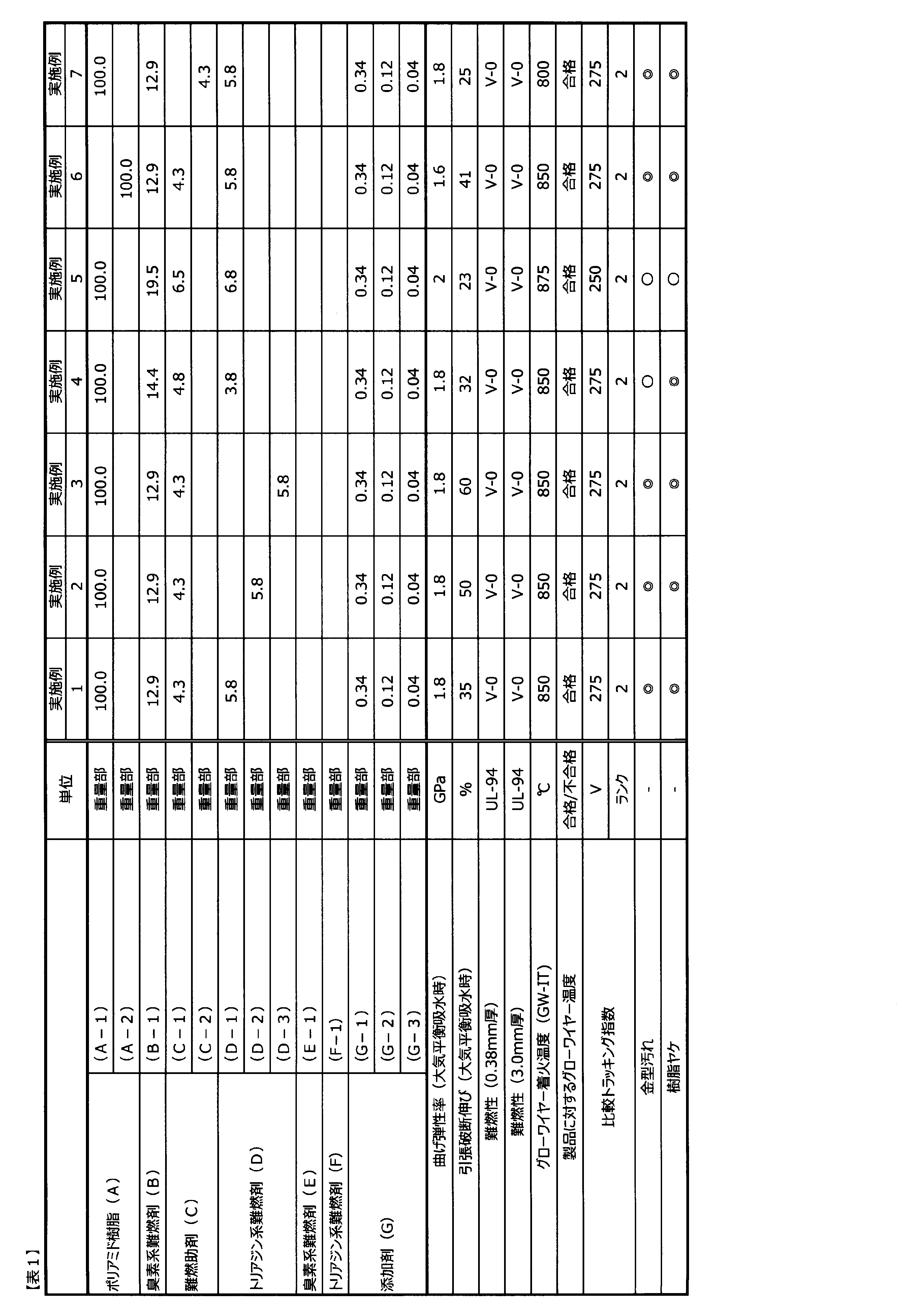
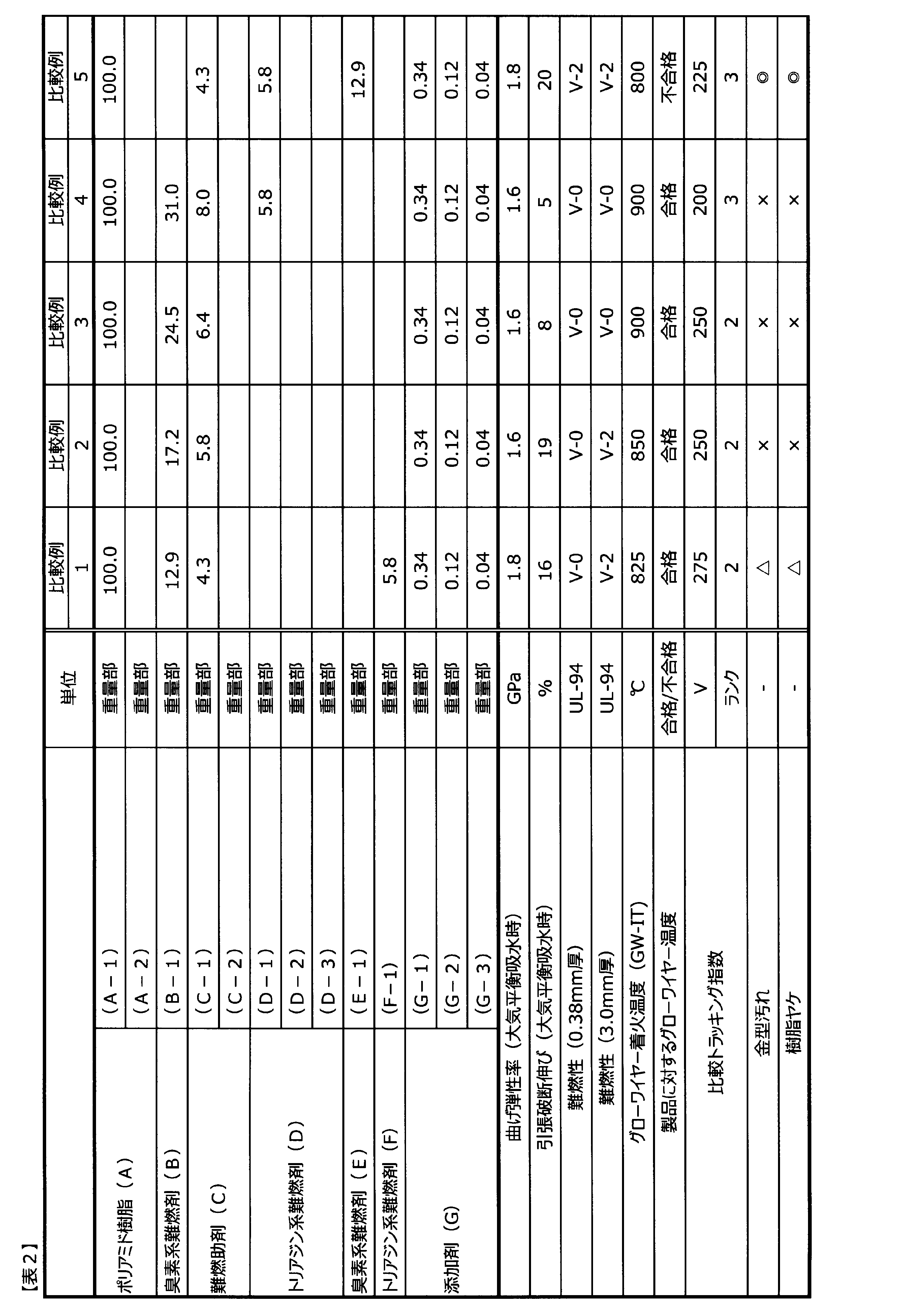
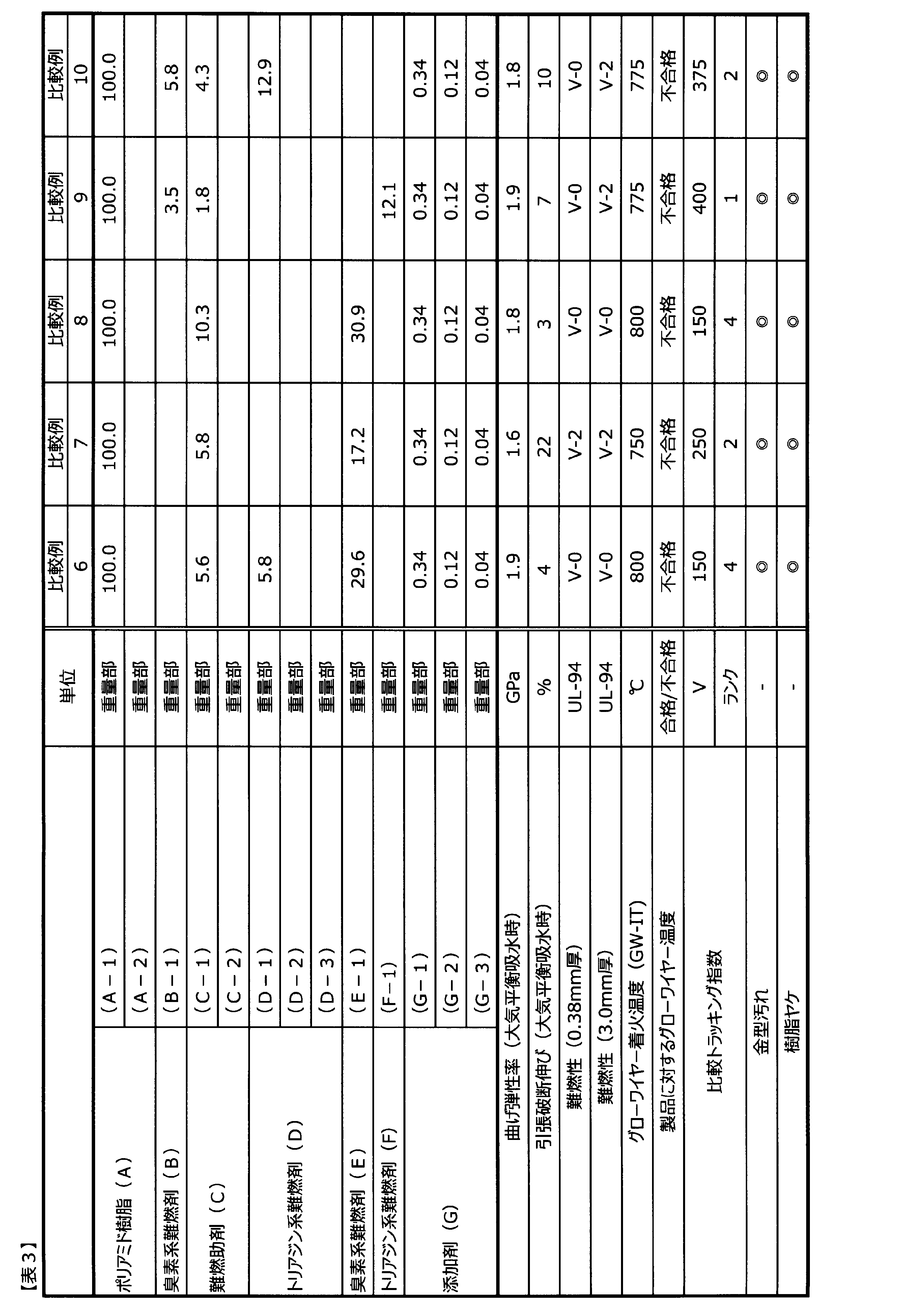
- Examples 1 to 7, Comparative Examples 1 to 10 Each raw material was charged from the raw material supply port upstream of the twin-screw extruder with the composition shown in Tables 1 to 3 and melt-kneaded, and the extruded strands were pelletized to obtain a pellet-shaped resin composition.
- a MAX46 manufactured by Nippon Placon Co., Ltd. was used as a twin-screw extruder, and melt kneading was performed at a cylinder temperature of 270 ° C., a screw rotation speed of 270 rpm, and a discharge rate of 70 kg / hr.
- the pellets of the obtained resin composition were vacuum dried at 80 ° C. for 12 hours or more, and then various characteristics were examined by the above evaluation method. The results are shown in Tables 1 to 3.
- Example 8 by blending hydrotalcite (E), mold stains were further suppressed as compared with Example 1, and mold stains were not observed even after 1000 shot molding.
- Comparative Example 1 since melamine cyanurate having an average particle diameter larger than 20 ⁇ m is used, the toughness and glow wire characteristics are poor as compared with Example 1, and resin discoloration and mold stains during continuous molding are also suppressed. could not.
Landscapes
- Chemical & Material Sciences (AREA)
- Health & Medical Sciences (AREA)
- Chemical Kinetics & Catalysis (AREA)
- Medicinal Chemistry (AREA)
- Polymers & Plastics (AREA)
- Organic Chemistry (AREA)
- Compositions Of Macromolecular Compounds (AREA)
Abstract
本発明は、難燃性、グローワイヤー特性、耐トラッキング性、剛性及び靭性のバランスに優れ、かつ連続成形時の樹脂ヤケ、金型汚れを低減できる樹脂組成物を提供することを目的とする。 ポリアミド樹脂(A)100重量部に対し、1分子中に臭素を75重量%以上90重量%以下含有する難燃剤(B)1~30重量部、難燃助剤(C)1~10重量部、およびトリアジン系難燃剤(D)1~10重量部を配合してなるポリアミド樹脂組成物であって、前記(D)の平均粒子径が0.1~20μmである、ポリアミド樹脂組成物。
Description
本発明は、吸水時の剛性・靭性に優れ、グローワイヤー特性、難燃性、電気特性に優れ、かつ連続成形時の樹脂ヤケ、金型汚れを低減できるポリアミド樹脂組成物およびそれを成形してなる成形品に関するものである。
電気導体間の絶縁材料として、プラスチック材料はコネクターをはじめとする電気電子部品の電源周辺部材に広く使用されている。一般にポリアミド樹脂は、成形性、機械的特性、耐熱性、難燃性、電気的特性に優れていることから、電源周辺部材に広く使用されており、樹脂の特性と要求ニーズに応じて種々の処方により高機能化と高性能化を実現してきた。
近年、これらの部品に対する要求レベル、特に電気的安全性に対する要求性能がますます高くなり、これに伴い、ポリアミド樹脂に対しても更なる高機能化と高性能化が要求されてきている。例えば、国際電気標準会議(InternationalElectrotechnical Commission、略称IEC)のIEC60335-1規格によると、冷蔵庫、全自動洗濯機などの家庭用電気製品において、オペレーターが付かない状態で動作する機器の部品のうち、通常の動作中に0.2Aを超える電流が流れる接続部を支持している電気絶縁部品、及びこれらの接続部から3mm以内の距離にある電気絶縁部品(プリント回路基板、端子台、コネクターなど)に使用される材料は、着火及び炎の伝播に対しての耐性であるグローワイヤー性として、IEC60695-2-13規格におけるグローワイヤー着火温度(以下、「GWIT」と記載することがある)の要求レベルが、725℃以上から775℃以上に改訂された。また、IEC60112規格による耐トラッキング性に関しては、比較トラッキング指数(ComparativeTracking Index(CTI))が3mm厚みで250V以上が必要とされることが多い。
勿論、これらの部品は、既に同様の電気電子部品に必要であるとされているアンダーライターズ・ラボラトリーズ(Underwriter's LaboratoriesInc.)のUL-94規格の難燃性も同時に満たさねばならない。近年は電源周辺部材の小型化、複雑形状化が進んでいることから、0.38mm~3.0mm厚みの幅広い厚みにて難燃性がV-0等級(UL-94難燃性規格)である材料が要求される。
これらの課題に対して、特許文献1では、ハロゲン系難燃剤のなかでも特に高い臭素含有率を示す、エチレン-ビス(ペンタブロモベンゼン)を用いたハロゲン系難燃剤を配合したポリアミド樹脂組成物が提案されている。また、特許文献2では、エチレン-ビス(ペンタブロモベンゼン)と、耐トラッキング性を付与する難燃剤として非ハロゲン系難燃剤であるトリアジン系難燃剤と組み合わせた、ハロゲン系難燃剤を配合したポリアミド樹脂組成物が提案されている。
特許文献1では、難燃性V-0(0.8mm厚み)を達成しているが、CTIは225Vとなっている。また、エチレン-ビス(ペンタブロモベンゼン)はモノマー型の難燃剤であり、耐熱性に乏しく、ナイロン樹脂の一般的な成形温度であるシリンダー温度260℃以上での連続成形において、成形品への樹脂ヤケとガスの発生による金型汚れが多発するという課題があった。
特許文献2では、エチレン-ビス(ペンタブロモベンゼン)と、耐トラッキング性を付与する難燃剤として非ハロゲン系難燃剤であるトリアジン系難燃剤と組み合わせることで、トリアジン系難燃剤配合量の多い領域では、難燃性V-0(0.8mm厚み)、GW-IT775℃(3mm厚み)、CTI400V以上を達成している。しかし、トリアジン系難燃剤の難燃性、グローワイヤー性改良効果はハロゲン系難燃剤と比べそれほど高くないため、多量の配合を必要とし、靭性に乏しくなることが課題であった。また、エチレン-ビス(ペンタブロモベンゼン)の配合量の多い領域では、難燃性がV-0未達であり、また連続成形時の樹脂ヤケと金型汚れの課題は残ったままであった。
近年、無人運転機器の電源周辺部材を始めとする電気電子部品には、グローワイヤー性、耐トラッキング性、難燃性についても厳しい規定が設けられている。加えて、製品の小型化・複雑形状化に伴い、従来よりも優れた剛性、靭性を要求されるようになった。そのため、難燃性、グローワイヤー性、耐トラッキング性、剛性及び靭性をすべて満たす、すなわち、バランスに優れた材料が必要とされている。
そこで、本発明は、これらの従来技術の課題に鑑み、難燃性、グローワイヤー特性、耐トラッキング性、剛性及び靭性のバランスに優れ、かつ連続成形時の樹脂ヤケ、金型汚れを低減できる樹脂組成物を提供することを課題とする。
すなわち本発明は、以下の構成を有する。
ポリアミド樹脂(A)100重量部に対し、1分子中に臭素を75重量%以上90重量%以下含有する難燃剤(B)1~30重量部、難燃助剤(C)1~10重量部、およびトリアジン系難燃剤(D)1~10重量部を配合してなるポリアミド樹脂組成物であって、前記(D)の平均粒子径が0.1~20μmであるポリアミド樹脂組成物。
さらに、本発明においては、前記ポリアミド樹脂組成物からなる、成形品とすることができる。
本発明により、難燃性、グローワイヤー特性、耐トラッキング性、剛性及び靭性のバランスに優れ、かつ連続成形時の樹脂ヤケ、金型汚れを低減できる樹脂組成物を提供することが可能となる。
以下、本発明を詳細に説明する。
本発明のポリアミド樹脂組成物は、ポリアミド樹脂(A)、1分子中に臭素を75重量%以上90重量%以下含有する難燃剤(B)、難燃助剤(C)、平均粒子径が0.1~20μmのトリアジン系難燃剤(D)から構成される。
本発明に係るポリアミド樹脂組成物を構成するポリアミド樹脂(A)は、3員環以上のラクタム、重合可能なω-アミノ酸、または、二塩基酸とジアミンなどの重縮合によって得られるポリアミド類である。具体的には、ε-カプロラクタム、アミノカプロン酸、エナントラクタム、7-アミノヘプタン酸、11-アミノウンデカン酸、9-アミノノナン酸、α-ピロリドン、α-ピペリドンなどの重合体、テトラメチレンジアミン、ペンタメチレンジアミン、ヘキサメチレンジアミン、ノナメチレンジアミン、ウンデカメチレンジアミン、ドデカメチレンジアミン、メタキシリレンジアミン、パラキシリレンジアミン、2-メチルペンタメチレンジアミン、2,2,4-/2,4,4-トリメチルヘキサメチレンジアミン、5-メチルノナメチレンジアミン、1,3-ビス(アミノメチル)シクロヘキサン、1,4-ビス(アミノメチル)シクロヘキサン、1-アミノ-3-アミノメチル-3,5,5-トリメチルシクをロヘキサン、ビス(4-アミノシクロヘキシル)メタン、ビス(3-メチル-4-アミノシクロヘキシル)メタン、2,2-ビス(4-アミノシクロヘキシル)プロパン、ビス(アミノプロピル)ピペラジン、アミノエチルピペラジンなどの脂肪族、脂環族、芳香族ジアミンと、アジピン酸、スペリン酸、アゼライン酸、セバシン酸、ドデカン二酸、テレフタル酸、イソフタル酸、2-クロロテレフタル酸、2-メチルテレフタル酸、5-メチルイソフタル酸、5-ナトリウムスルホイソフタル酸、2,6-ナフタレンジカルボン酸、ヘキサヒドロテレフタル酸、ヘキサヒドロイソフタル酸、シクロヘキサンジカルボン酸などの脂肪族、脂環族、芳香族のジカルボン酸とを重縮合させて得られる重合体、またはこれらの共重合体が挙げられる。これらポリアミド樹脂は、その末端が分子量調節も兼ねてカルボン酸またはアミンで封止されたものであってもよい。
具体的には、例えば、ポリアミド4、ポリアミド6、ポリアミド7、ポリアミド8、ポリアミド11、ポリアミド12、ポリアミド46、ポリアミド56、ポリアミド66、ポリアミド69、ポリアミド410、ポリアミド510、ポリアミド610、ポリアミド611、ポリアミド612、ポリアミド66/6T共重合体、ポリアミド6/66共重合体、ポリアミド6/12共重合体、ポリアミド6/6T共重合体、ポリアミド6T/6I共重合体、ポリアミドMXD6などが挙げられ、複数種のポリアミド樹脂の混合物であってもよい。好ましいポリアミド樹脂としては、難燃性、剛性・靭性、成形加工性の観点から、ポリアミド6、ポリアミド6/66共重合体、ポリアミド66、およびこれらの混合物が挙げられ、特にポリアミド66が好ましい。
本発明に係るポリアミド樹脂組成物を構成する、1分子中に臭素を75重量%以上90重量%以下含有する難燃剤(B)としては、エチレン-ビス(ペンタブロモベンゼン)、デカブロモジフェニルオキサイド、テトラデカブロモジフェキシベンゼンなどが挙げられる。特に、靭性、難燃性、グローワイヤー特性、耐トラッキング性のバランスの観点から、エチレン-ビス(ペンタブロモベンゼン)が好ましい。1分子中に臭素を75重量%未満含有する難燃剤を配合した場合、靭性、難燃性、グローワイヤー特性、耐トラッキング性でバランスを取ることが難しい。一方、90重量%超える量を含有する場合、連続成形時の樹脂ヤケと金型汚れも著しくなる。靭性、難燃性、グローワイヤー特性、耐トラッキング性のバランスを取る面から、1分子中に臭素を80重量%以上85重量以下含有することが好ましい。
1分子中に臭素を75重量%以上90重量%以下含有する難燃剤(B)の配合量は、ポリアミド樹脂(A)100重量部に対し1~30重量部の範囲である。(B)の配合量が1重量部未満である場合、難燃性、グローワイヤー特性が低下する。難燃剤(B)の配合量が30重量部を超える場合、靭性、耐トラッキング性が低下し、また連続成形時の樹脂ヤケ、金型汚れが急激に増加する。難燃剤(B)の配合量は、好ましくは8.1~30重量部、より好ましくは10~18重量部である。
本発明に係るポリアミド樹脂組成物を構成する難燃助剤(C)としては、三酸化アンチモン、五酸化アンチモンなどのアンチモン化合物、硼酸亜鉛などの硼酸金属塩、スズ酸亜鉛などのスズ酸金属塩が挙げられる。特に、難燃性、グローワイヤー特性を付与する点から、三酸化アンチモン、硼酸亜鉛が好ましく、三酸化アンチモンが最も好ましい。
難燃助剤(C)の配合量は、ポリアミド樹脂(A)100重量部に対し1~10重量部である。難燃助剤(C)の配合量が1重量部未満である場合、難燃性、グローワイヤー特性が低下する。難燃助剤(C)の配合量が10重量部を超える場合、靭性が低下する。難燃助剤(C)の配合量は、好ましくは1~9重量部であり、より好ましくは3~6重量部である。
本発明に係る難燃性ポリアミド樹脂組成物を構成するトリアジン系難燃剤(D)としては、(i)下記一般式(1)または(2)で表される化合物、(ii)メラミン類および、(iii)(i)と(ii)の等モル反応物などが挙げられる。

(式中、R1~R6は、それぞれ、水素原子又はアルキル基を示す。アルキル基の炭素数は、好ましくは1~5、より好ましくは1~3である。)
上記一般式(1)で表される化合物の具体例としては、シアヌル酸、トリメチルシアヌレート、トリエチルシアヌレート、トリ(n-プロピル)シアヌレート、メチルシアヌレート、ジエチルシアヌレートなどが挙げられる。上記一般式(2)で表される化合物の具体例としては、イソシアヌル酸、トリメチルイソシアヌネート、トリエチルイソシアヌレート、トリ(n-プロピル)イソシアヌレート、ジエチルイソシアヌネート、メチルイソシアヌレートなどが挙げられる。
メラミン類としては、メラミン、メラミン誘導体、メラミンと類似の構造を有する化合物、およびメラミンの縮合物などが挙げられる。メラミン類の具体例としては、例えば、メラミン、アンメリド、アンメリン、ホルモグアナミン、グアニルメラミン、シアノメラミン、アリールグアナミン、メラム、メレム、メロンなどが挙げられる。
(i)と(ii)の等モル反応物としては、シアヌル酸とメラミンとの等モル反応物が好ましく挙げられる。また、メラミンシアヌレート中のアミノ基または水酸基のいくつかが、他の置換基で置換されていてもよい。メラミンシアヌレートは、例えば、シアヌル酸の水溶液とメラミンの水溶液とを混合し、90~100℃の温度で攪拌下反応させ、生成した沈殿を濾過することによって得ることができる。メラミンシアヌレートは、白色の固体であり、微粉末状に粉砕して使用するのが好ましい。勿論、固体の市販品をそのまま、または、これを粉砕して使用することもできる。
剛性、靭性、難燃性、グローワイヤー特性、耐トラッキング特性をバランスよく付与し、かつ連続成形時の樹脂ヤケと金型汚れを低減する観点から、メラミンシアヌレートが最も好ましい。
トリアジン系難燃剤(D)の平均粒子径は0.1~20μmである。トリアジン系難燃剤(D)は、かかる(D)の昇華熱、分解熱による吸熱反応と、発生する窒素系ガスによる酸素希釈、遮断効果の組み合わせにより、難燃性を発現する。1分子中に臭素を75重量%以上90重量%以下含有する難燃剤(B)との併用した際、上記の平均粒子径のトリアジン系難燃剤(D)を用いることで、メカニズムについては明確ではないが、ポリアミド樹脂組成物中における(D)の分散性が良好となり、効率的な吸熱効果を示し、溶融混錬時や射出成型時のせん断発熱による(B)の分解を大幅に抑制できると考えられる。トリアジン系難燃剤(D)の平均粒子径が0.1μm未満である場合、溶融混練時に混練機に供給されにくくなる。トリアジン系難燃剤(D)の平均粒子径が20μmを超える場合、靭性、難燃性が低下し、連続成形時の樹脂ヤケと金型汚れも著しくなる。トリアジン系難燃剤(D)平均粒子径を0.1~20μmとすることで、靭性、難燃性を高度に発現し、かつ1分子中に臭素を75重量%90重量%以下以上含有する難燃剤(B)の分解を効率的に抑制することで、連続成形時の樹脂ヤケ、金型汚れの抑制が可能となる。トリアジン系難燃剤(D)の平均粒子径は、10μm以下が好ましく、5μm以下がより好ましい。なお、平均粒子径はJIS K 5600-9-3(2006年)に準じて、レーザー回折式粒度分布計 LMS-24((株)セイシン企業製)を用いて測定をした値から算出した数平均粒子径である。尚、トリアジン系難燃剤(D)は、溶融混合前の原料の粒子径と、ポリアミド樹脂組成物中の粒子径は同じである。
トリアジン系難燃剤(D)の配合量は、ポリアミド樹脂(A)100重量部に対し1~10重量部である。トリアジン系難燃剤(D)の配合量が1重量部未満であると、難燃性、グローワイヤー特性が低下し、連続成形時に樹脂ヤケ、金型汚れも著しくなる。トリアジン系難燃剤(D)の配合量が10重量部を超えると、靭性が大きく低下し、薄肉成形品における破損に繋がる。トリアジン系難燃剤(D)の配合量は、好ましくは1~6.9重量部、より好ましくは4~6.5重量部である。
本発明のポリアミド樹脂組成物は、1分子中に臭素を75重量%90重量%以下以上含有する難燃剤(B)8.1~30重量部、トリアジン系難燃剤(D)1~6.9重量部で、UL-94難燃性規格がV-0であることが好ましい。
本発明のポリアミド樹脂組成物は、さらにハイドロタルサイト(E)を0.1~5重量部配合することが、金型汚れを低減できる面から好ましい。本発明で用いるハイドロタルサイトは、狭義には、天然に産出される鉱物としてのマグネシウム・アルミニウム・ハイドロオキサイド・カーボネート・ハイドレートを指し、広義には、鉱物としてのハイドロタルサイトに準ずる組成を有する金属酸化物の合成品をも含むものとする。好ましくは下記一般式(3)で表される焼成ハイドロタルサイトを使用するのが好ましい。
(Mg1-XAlX )O1+0.5X (3)
但し、式中0<x<0.4
(Mg1-XAlX )O1+0.5X (3)
但し、式中0<x<0.4
式(3)で表される焼成ハイドロタルサイトとは、酸化アルミニウム(Al2O3)が酸化マグネシウム(MgO)に固溶した所謂、酸化マグネシウム系固溶体であり、例えば下記一般式(4)で表される天然或いは合成のハイドロタルサイトを400~900℃、好ましくは500~700℃の温度で、空気中、或いは窒素、二酸化炭素等の不活性ガス中で、常圧、減圧或いは加圧下で焼成処理を行う等公知の方法で製造する事が出来る。
Mg1-X AlX(OH)2An- X/n ・mH2O (4)
Mg1-X AlX(OH)2An- X/n ・mH2O (4)
式中、An- はn価のアニオンを示し、x、m及びnはそれぞれ、0<x<0.4、0≦m<1、1≦n≦4の範囲を満足する正の数である。式(4)のハイドロタルサイトのアニオンAn-としては、F-、Cl-、Br-、I-、OH-、HCO2
-、CH3COO- 、HCOO- 、CO3
2- 、SO4
2-等が挙げられるがこれらに限定されるものではない。
本発明のハイドロタルサイトの配合量は、ポリアミド樹脂成分100重量部に対して、0.1~5.0重量であることが好ましく、0.2~4.5重量部であることがより好ましく、機械特性と難燃性のバランスから0.5~4.0重量部であることがさらに好ましい。0.1重量部未満であると、ハロゲン化合物の捕捉が不充分となり、目的の金型汚れ抑制効果が得られず、5.0重量部を超えると、強度、靭性をはじめとする機械特性や難燃性、グローワイヤー特性が低下する傾向にある。
本発明のポリアミド樹脂組成物は、その特性を損なわない範囲で、ポリアミド樹脂(A)、1分子中に臭素を75重量%以上90重量%以下含有する難燃剤(B)、難燃助剤(C)、平均粒子径が0.1~20μmのトリアジン系難燃剤(D)、ハイドロタルサイト(E)以外のその他の成分を含有していても良い。
例えば、その他成分として(A)成分以外の熱可塑性樹脂を含有していてもよい。かかる熱可塑性樹脂としては、ポリアミド樹脂(A)以外のポリアミド樹脂、ポリエステル樹脂、ポリフェニレンスルフィド樹脂、ポリフェニレンオキシド樹脂、ポリカーボネート樹脂、ポリ乳酸樹脂、ポリアセタール樹脂、ポリスルホン樹脂、四フッ化ポリエチレン樹脂、ポリエーテルイミド樹脂、ポリアミドイミド樹脂、ポリイミド樹脂、ポリエーテルスルホン樹脂、ポリエーテルケトン樹脂、ポリチオエーテルケトン樹脂、ポリエーテルエーテルケトン樹脂、ポリエチレン樹脂やポリプロピレン樹脂等のポリオレフィン樹脂、ポリスチレン樹脂やABS樹脂等のスチレン系樹脂、ポリアルキレンオキサイド樹脂、ポリブタジエン、ポリイソプレン、スチレン/ブタジエンのランダム共重合体およびブロック共重合体、該ブロック共重合体の水素添加物、アクリロニトリル/ブタジエン共重合体、ブタジエン/イソプレン共重合体などのジエン系ゴム、エチレン/プロピレンのランダム共重合体およびブロック共重合体、エチレン/ブテンのランダム共重合体およびブロック共重合体、エチレン/α-オレフィンの共重合体、エチレン/アクリル酸エステル、エチレン/メタクリル酸エステルなどのエチレン/不飽和カルボン酸エステル共重合体、ブチルアクリレート/ブタジエン共重合体などのアクリル酸エステル/ブタジエン共重合体、エチレン/酢酸ビニル共重合体などのエチレンと脂肪酸ビニルとの共重合体、エチレン/プロピレン/エチリデンノルボルネン共重合体、エチレン/プロピレン/ヘキサジエン共重合体などのエチレン/プロピレン/非共役ジエン3元共重合体、ブチレン/イソプレン共重合体、塩素化ポリエチレン、ポリアミドエラストマー、ポリエステルエラストマーなどの熱可塑性エラストマーなどが挙げられる。
かかる熱可塑性樹脂を用いる場合、その含有量に制限はないが、ポリアミド樹脂(A)100重量部に対して、0.1重量部以上10重量部未満が好ましい。
また、その他成分としては、本発明の目的を損なわない範囲で、紫外線吸収剤、酸化防止剤、熱安定剤、結晶核剤、着色防止剤、耐候剤、離型剤、滑剤、帯電防止剤、染料・顔料を含む着色剤などの通常の添加剤を1種類以上添加することができる。
かかる添加剤としては、例えば、ベンゾトリアゾール系、フェノール系、リン系などの紫外線吸収剤、銅系、ヒンダードフェノール系、リン系、イオウ系などの酸化防止剤、熱安定剤、芳香族カルボン酸の金属塩、ソルビトール系誘導体、有機リン酸塩、芳香族アミド化合物などの有機核剤、タルク、ボロンナイトライド、その他珪酸金属塩などの無機核剤を含む結晶核剤、レゾルシノール系、サリシレート系、ベンゾトリアゾール系、ベンゾフェノン系、ヒンダードアミン系などの耐候剤、ステアリン酸カルシウムなどのステアリン酸金属塩、脂肪族アルコール、脂肪族アミド、脂肪族ビスアミド、エチレンビスステアリルアミドや高級脂肪酸エステルなどの離型剤、p-オキシ安息香酸オクチル、ワックスなどの滑剤、アルキルサルフェート型アニオン系、4級アンモニウム塩型カチオン系、ポリオキシエチレンソルビタンモノステアレートのような非イオン系、ベタイン系両性帯電防止剤などが挙げられる。かかる添加剤は2種以上を用いることも可能である。その含有量は、特に制限はないが、ポリアミド樹脂(A)100重量部に対し、0.01重量部以上5重量部未満が好ましい。
本発明のポリアミド樹脂組成物の製造方法は、ポリアミド樹脂(A)、1分子中に臭素を75重量%以上90重量%以下含有する難燃剤(B)、難燃助剤(C)、平均粒子径が0.1~20μmのトリアジン系難燃剤(D)を溶融混合することが可能であれば特に制限はない。
本発明のポリアミド樹脂組成物および成形品の製造方法としては、生産性や混練性の面から二軸押出機による溶融混練が通常好ましく用いられる。二軸押出機を用いた溶融混練方法としては、例えば、ポリアミド樹脂(A)、1分子中に臭素を75重量%以上90重量%以下含有する難燃剤(B)、難燃助剤(C)、平均粒子径が0.1~20μmのトリアジン系難燃剤(D)、および必要に応じて(A)、(B)、(C)、(D)以外の成分を予備混合して、シリンダー温度が230℃~300℃に設定された二軸押出機に供給して溶融混練する手法が挙げられる。原料の混合順序に特に制限はなく、全ての原料を上記の方法により溶融混練する方法、一部の原料を上記の方法により溶融混練し、さらに残りの原料を溶融混練する方法、あるいは一部の原料を溶融混練中にサイドフィーダーを用いて残りの原料を混合する方法など、いずれの方法を用いてもよい。スクリュー構成としては、ニーディングゾーンを1~5箇所有することが好ましく、スクリュー全長に対する前記ニーディングゾーンの合計長さの割合(%)を、(ニーディングゾーンの合計長さ)÷(スクリュー全長)×100とした場合、5~40%であることが好ましい。押出機途中で真空状態に曝して発生するガスを除去する方法も好ましく使用される。溶融混練後押し出された樹脂組成物は通常ストランド状に引き取られ、ペレタイザーによりペレット状に加工される。
また、本発明の樹脂の製造方法は特に限定されないが、通常の熱可塑性樹脂の加工方法であれば問題なく、通常は製品の寸法精度が高く生産性に優れた射出成形法が好ましく使用される。
本発明のポリアミド樹脂組成物は、任意の方法により成形することができる。成形方法としては、例えば、押出成形、射出成形、中空成形、カレンダ成形、圧縮成形、真空成形、発泡成形、ブロー成形、回転成形等が挙げられる。成形形状としては、例えば、箱状、板状、繊維状、凹凸状、ストランド状、フィルムまたはシート状、パイプ状、中空状、箱状、爪状等の形状が挙げられる。
得られる成形品は、電気電子部品、自動車用部品、車両関連部品、建材関係部品、一般・産業機械部品、スポーツ用品、生活雑貨用品、家庭・事務用品、家具用部品など各種用途に適用できる。中でも0.2Aを超える電流が流れる無人運転機器の電源周辺部材では、コネクターをはじめとして、高い難燃性、グローワイヤー特性、耐トラッキング性が要求され、かつ成形品同士の嵌合や端子を挿抜する際に製品が大きくひずみ、高剛性、高靭性が要求されるため、本発明のポリアミド樹脂組成物は好ましく適用できる。ここで、無人運転機器とは、オペレーターが存在しない状態で自動運転が行われる機器や、夜間など長時間(数時間以上)オペレーターが近くにいない状態で運転される機器を指す。かかる機器は、何らかの異常による発熱が発生した場合に、火災や爆発のリスクが高く、グローワイヤー特性が求められる。
本発明のポリアミド樹脂組成物およびそれを成形してなる成形品は、高いグローワイヤー特性を有する。具体的にはIEC60695-2-13に準拠した試験において、材料に対するグローワイヤー着火温度が、3mm厚みにおいて775℃以上であることと、IEC60695-2-11に準拠した試験において、最終製品に対するグローワイヤー温度が750℃以上であることを指す。
グローワイヤー着火温度とは、GW-IT(Glow Wire Ignition Temperature)と呼ばれ、材料に対して実施する試験であり、所望の温度に昇温したワイヤーを、規定厚みを有した樹脂成形品に押し当て、5秒以上の着火が確認される最低温度のことである。後述する最終製品に対するグローワイヤー温度が750℃以上とするためには、GW-ITは3mm厚みで800℃以上であることが好ましい。
最終製品に対するグローワイヤー温度とは、GWT(Glow-wire Temperature)と呼ばれ、所望の温度に昇温したワイヤーを、最終製品に押し当て、2秒以上の燃焼が確認される最低温度のことであり、750℃を合格することが要求される。
以下、実施例を挙げてさらに本発明を詳細に説明する。本発明はこれらにより限定されるものではない。実施例および比較例中の諸特性の評価方法を以下に示す。
(1)曲げ弾性率、引張破断伸び(大気平衡吸水時)
実施例および比較例で得られたペレットを、日精樹脂工業(株)製の射出成形機NEX1000により、シリンダ温度280℃、金型表面温度80℃の条件で射出成形し、ISO Type-A規格の試験片を作製した。得られた試験片を23℃×50%RH環境下で3000時間静置した後に、以下の標準方法に従って曲げ弾性率と引張り破断伸びを測定した。曲げ弾性率は剛性の指標となり、引張破断伸びは靭性の指標となる。
曲げ弾性率:ISO178。
引張り破断伸び:ISO 527-1、-2
実施例および比較例で得られたペレットを、日精樹脂工業(株)製の射出成形機NEX1000により、シリンダ温度280℃、金型表面温度80℃の条件で射出成形し、ISO Type-A規格の試験片を作製した。得られた試験片を23℃×50%RH環境下で3000時間静置した後に、以下の標準方法に従って曲げ弾性率と引張り破断伸びを測定した。曲げ弾性率は剛性の指標となり、引張破断伸びは靭性の指標となる。
曲げ弾性率:ISO178。
引張り破断伸び:ISO 527-1、-2
(2)難燃性
実施例および比較例で得られたペレットを、日精樹脂工業(株)製の射出成形機NEX1000により、シリンダ温度280℃、金型表面温度80℃の条件で射出成形し、127mm×12.7mm×0.38mmと、127mm×12.7mm×3.0mmの試験片を作製した。得られた試験片を用いてUL94規格(米国Under WriterIncで定められた規格)に準拠し、難燃性を評価した。
実施例および比較例で得られたペレットを、日精樹脂工業(株)製の射出成形機NEX1000により、シリンダ温度280℃、金型表面温度80℃の条件で射出成形し、127mm×12.7mm×0.38mmと、127mm×12.7mm×3.0mmの試験片を作製した。得られた試験片を用いてUL94規格(米国Under WriterIncで定められた規格)に準拠し、難燃性を評価した。
(3)グローワイヤー着火温度(GW-IT)
実施例および比較例で得られたペレットを、日精樹脂工業(株)製の射出成形機NEX1000により、シリンダー温度280℃、金型表面温度80℃の条件で射出成形し、80mm×80mm×3mmの試験片を作製した。得られた試験片を用いて、IEC60695-2-13に準拠してグローワイヤー着火温度(GW-IT)を測定した。
実施例および比較例で得られたペレットを、日精樹脂工業(株)製の射出成形機NEX1000により、シリンダー温度280℃、金型表面温度80℃の条件で射出成形し、80mm×80mm×3mmの試験片を作製した。得られた試験片を用いて、IEC60695-2-13に準拠してグローワイヤー着火温度(GW-IT)を測定した。
(4)製品に対するグローワイヤー温度(GWT)
実施例および比較例で得られたペレットを、日精樹脂工業(株)製の射出成形機NEX1000により、シリンダー温度280℃、金型表面温度80℃の条件で射出成形し、異なる壁厚のセクションを含む(薄い場所で0.5mm厚み、厚い場所で2mm厚み、外形寸法は35mm×10mm×5mm)コネクターを作製した。得られたコネクターを用いて、IEC60695-2-11に準拠して試験を行い、750℃試験における燃焼時間が2秒未満であれば合格と判断した。
実施例および比較例で得られたペレットを、日精樹脂工業(株)製の射出成形機NEX1000により、シリンダー温度280℃、金型表面温度80℃の条件で射出成形し、異なる壁厚のセクションを含む(薄い場所で0.5mm厚み、厚い場所で2mm厚み、外形寸法は35mm×10mm×5mm)コネクターを作製した。得られたコネクターを用いて、IEC60695-2-11に準拠して試験を行い、750℃試験における燃焼時間が2秒未満であれば合格と判断した。
(5)耐トラッキング性:比較トラッキング指数試験(CTI試験)
実施例および比較例で得られたペレットを、日精樹脂工業(株)製の射出成形機NEX1000により、シリンダー温度280℃、金型表面温度80℃の条件で射出成形し、80mm×80mm×3mmの試験片を作製した。得られた試験片を用いて、IEC60112に準拠し、CTIを決定した。CTIは固体電気絶縁材料の表面に電界が加わった状態で湿潤汚染されたとき、100Vから600Vの間の25V刻みの電圧におけるトラッキングに対する対抗性を示すものであり、数値が高いほど良好であることを意味する。CTIは250V以上であるのが好ましい。尚、CTIのランクは以下の通りである。
600V以上:ランク0
400V以上600V未満:ランク1
250V以上400V未満:ランク2
175V以上250V未満:ランク3
100V以上175V未満:ランク4
実施例および比較例で得られたペレットを、日精樹脂工業(株)製の射出成形機NEX1000により、シリンダー温度280℃、金型表面温度80℃の条件で射出成形し、80mm×80mm×3mmの試験片を作製した。得られた試験片を用いて、IEC60112に準拠し、CTIを決定した。CTIは固体電気絶縁材料の表面に電界が加わった状態で湿潤汚染されたとき、100Vから600Vの間の25V刻みの電圧におけるトラッキングに対する対抗性を示すものであり、数値が高いほど良好であることを意味する。CTIは250V以上であるのが好ましい。尚、CTIのランクは以下の通りである。
600V以上:ランク0
400V以上600V未満:ランク1
250V以上400V未満:ランク2
175V以上250V未満:ランク3
100V以上175V未満:ランク4
(6)金型汚れ
成形品のサイズとして最大長さ55mm、幅20mm、厚み2mm、ゲートサイズとして幅2mm、厚み1mm(サイドゲート)、ガスベント部最大長さ20mm、幅10mm、深さ5μmのガス評価用金型を用いて、実施例および比較例で得られたペレットを、住友重機械工業社製射出成形機SE-30Dにより、シリンダー温度280℃、金型温度80℃の条件で射出成形し、200ショット連続成形を行った後のガスベント部の外観確認を行った。ガスベント部に汚染物がほとんどない場合は非常に優れる(表中に“◎”と表す)、微量の汚染物が発生した場合は優れる(表中に“○”と表す)、中量の汚染物が発生した場合はやや劣る(表中に“△”と表す)、多量の汚染物が発生した場合は劣る(表中に“×”と表す)とした。また、非常に優れる(表中に“◎”と表す)ものについてはさらに1000ショットまでショット数を重ね、汚染物が発生するショット数を確認した。
成形品のサイズとして最大長さ55mm、幅20mm、厚み2mm、ゲートサイズとして幅2mm、厚み1mm(サイドゲート)、ガスベント部最大長さ20mm、幅10mm、深さ5μmのガス評価用金型を用いて、実施例および比較例で得られたペレットを、住友重機械工業社製射出成形機SE-30Dにより、シリンダー温度280℃、金型温度80℃の条件で射出成形し、200ショット連続成形を行った後のガスベント部の外観確認を行った。ガスベント部に汚染物がほとんどない場合は非常に優れる(表中に“◎”と表す)、微量の汚染物が発生した場合は優れる(表中に“○”と表す)、中量の汚染物が発生した場合はやや劣る(表中に“△”と表す)、多量の汚染物が発生した場合は劣る(表中に“×”と表す)とした。また、非常に優れる(表中に“◎”と表す)ものについてはさらに1000ショットまでショット数を重ね、汚染物が発生するショット数を確認した。
(7)樹脂ヤケ
上記の金型汚れ性の測定において200ショット連続成形時の成形品とスプルーの外観確認を行った。200ショットにおいて樹脂ヤケがない場合は非常に優れる(表中に“◎”と表す)、151~200ショット目で樹脂ヤケが発生する場合は優れる(表中に“○”と表す)、51~150ショット目で樹脂ヤケが発生する場合はやや劣る(表中に“△”と表す)、1~50ショット目で樹脂ヤケが発生する場合は劣る(表中に“×”と表す)とした。
上記の金型汚れ性の測定において200ショット連続成形時の成形品とスプルーの外観確認を行った。200ショットにおいて樹脂ヤケがない場合は非常に優れる(表中に“◎”と表す)、151~200ショット目で樹脂ヤケが発生する場合は優れる(表中に“○”と表す)、51~150ショット目で樹脂ヤケが発生する場合はやや劣る(表中に“△”と表す)、1~50ショット目で樹脂ヤケが発生する場合は劣る(表中に“×”と表す)とした。
また実施例、比較例に用いた樹脂組成物の各原料については下記の通りである。
(A-1)JIS K 6933(2013)に準拠して測定した粘度数が135ml/gのポリアミド66。
(A-2)JIS K 6933(2013)に準拠して測定した粘度数が135ml/gのポリアミド6/66共重合体(66成分5重量%)。
(B-1)エチレン-ビス(ペンタブロモベンゼン)(臭素含有率82%)“SAYTEX”(登録商標)8010(アルベマール社製)。
(C-1)三酸化アンチモン「PATOX-MK」(日本精鉱社製)。
(C-2)硼酸亜鉛“Firebrake”(登録商標)ZB(ボラックス社製)。
(D-1)JIS K5600-9-3に準じて、レーザー回折式粒度分布計 LMS-24((株)セイシン企業製)を用いて測定した平均粒子径が14μmのメラミンシアヌレート。
(D-2)JIS K5600-9-3に準じて、レーザー回折式粒度分布計 LMS-24((株)セイシン企業製)を用いて測定した平均粒子径が4μmのメラミンシアヌレート。
(D-3)JIS K5600-9-3に準じて、レーザー回折式粒度分布計 LMS-24((株)セイシン企業製)を用いて測定した平均粒子径が2μmのメラミンシアヌレート。
(E-1)ハイドロタルサイト「KW-2100」(協和化学工業社製)。
(F-1)臭素化フェノール縮合物(臭素含有率65%)「ピロガードSR-460B」
(第一工業製薬社製)。
(第一工業製薬社製)。
(G-1)JIS K5600-9-3に準じて測定した平均粒子径が40μmのメラミ
ンシアヌレート。
ンシアヌレート。
(H-1)ヒンダードフェノール系酸化防止剤“IRGANOX”(登録商標)1098
(BASF社製)。
(BASF社製)。
(H-2)脂肪酸アミド「WH500」(共栄社化学社製)。
(H-3)ステアリン酸カルシウム(川村化成工業社製)。
[実施例1~7、比較例1~10]
表1~3に示す配合組成で二軸押出機上流の原料供給口から各原料を投入して溶融混練し、押し出されたストランドをペレタイズしてペレット状の樹脂組成物を得た。二軸押出機は日本プラコン社製のMAX46を使用し、シリンダー温度は270℃、スクリュー回転数は270rpm、吐出量は70kg/hrで溶融混練を行った。得られた樹脂組成物のペレットを80℃で12時間以上真空乾燥した後、前記の評価方法によって諸特性を調べた。その結果を表1~3に示す。
表1~3に示す配合組成で二軸押出機上流の原料供給口から各原料を投入して溶融混練し、押し出されたストランドをペレタイズしてペレット状の樹脂組成物を得た。二軸押出機は日本プラコン社製のMAX46を使用し、シリンダー温度は270℃、スクリュー回転数は270rpm、吐出量は70kg/hrで溶融混練を行った。得られた樹脂組成物のペレットを80℃で12時間以上真空乾燥した後、前記の評価方法によって諸特性を調べた。その結果を表1~3に示す。
実施例1~8では、剛性、靭性、難燃性、グローワイヤー特性、耐トラッキング性のバ
ランスに優れ、かつ連続成形時の樹脂ヤケ、金型汚れも抑制できた。
ランスに優れ、かつ連続成形時の樹脂ヤケ、金型汚れも抑制できた。
また、実施例8では、ハイドロタルサイト(E)を配合することで、実施例1より更に金型汚れが抑制され、1000ショット成形後も金型汚れは認められなかった。
比較例1では、平均粒子径が20μmより大きいメラミンシアヌレートを用いているため、実施例1と比較して、靭性、グローワイヤー特性が悪く、また連続成形時の樹脂ヤケ、金型汚れも抑制できなかった。
比較例2、3では、メラミンシアヌレートを配合していないため、連続成形時の樹脂ヤケ、金型汚れが著しく悪かった。
比較例4では、1分子中に臭素を75重量%以上90重量%以下含有する臭素系難燃剤(B)の配合量が30重量部を超えるため、靭性、耐トラッキング性が悪く、また連続成形時の樹脂ヤケ、金型汚れも著しく悪かった。
比較例5~8では、配合する臭素系難燃剤の臭素含有量が1分子中に75重量%未満であるため、靭性、難燃性、グローワイヤー特性、耐トラッキング性のバランスを取ることが難しかった。
比較例9、10では、トリアジン系難燃剤(D)の配合量が10重量部を超えるため、靭性が大きく低下した。また難燃性、GWTも悪かった。
Claims (9)
- ポリアミド樹脂(A)100重量部に対し、1分子中に臭素を75重量%以上90重量%以下含有する難燃剤(B)1~30重量部、難燃助剤(C)1~10重量部、およびトリアジン系難燃剤(D)1~10重量部を配合してなるポリアミド樹脂組成物であって、前記(D)の平均粒子径が0.1~20μmである、ポリアミド樹脂組成物。
- ポリアミド樹脂(A)100重量部に対し、1分子中に臭素を75重量%以上90重量%以下含有する難燃剤(B)8.1~30重量部、トリアジン系難燃剤(D)1~6.9重量部である、請求項1に記載のポリアミド樹脂組成物。
- 成形品としたときのUL-94難燃性規格がV-0である、請求項1または2に記載のポリアミド樹脂組成物。
- 1分子中に臭素を75重量%以上90重量%以下含有する難燃剤(B)が、エチレン-ビス(ペンタブロモベンゼン)である、請求項1~3のいずれかに記載のポリアミド樹脂組成物。
- トリアジン系難燃剤(D)がメラミンシアヌレートである、請求項1~4のいずれかに記載のポリアミド樹脂組成物。
- ポリアミド樹脂(A)100重量部に対し、さらにハイドロタルサイト(E)を0.1~5重量部配合してなる、請求項1~5のいずれかに記載のポリアミド樹脂組成物。
- ポリアミド樹脂(A)がポリアミド66である、請求項1~6のいずれかに記載のポリア
ミド樹脂組成物。 - 請求項1~7のいずれかに記載のポリアミド樹脂組成物からなる、成形品。
- 請求項8に記載の成形品が無人運転機器の電源周辺部材である、成形品。
Priority Applications (2)
| Application Number | Priority Date | Filing Date | Title |
|---|---|---|---|
| JP2021541123A JPWO2022044539A1 (ja) | 2020-08-25 | 2021-07-01 | |
| CN202180044102.1A CN115916899A (zh) | 2020-08-25 | 2021-07-01 | 聚酰胺树脂组合物和将其成型而得的成型品 |
Applications Claiming Priority (4)
| Application Number | Priority Date | Filing Date | Title |
|---|---|---|---|
| JP2020-141576 | 2020-08-25 | ||
| JP2020141576 | 2020-08-25 | ||
| JP2021022222 | 2021-02-16 | ||
| JP2021-022222 | 2021-02-16 |
Publications (1)
| Publication Number | Publication Date |
|---|---|
| WO2022044539A1 true WO2022044539A1 (ja) | 2022-03-03 |
Family
ID=80353146
Family Applications (1)
| Application Number | Title | Priority Date | Filing Date |
|---|---|---|---|
| PCT/JP2021/024902 Ceased WO2022044539A1 (ja) | 2020-08-25 | 2021-07-01 | ポリアミド樹脂組成物およびそれを成形してなる成形品 |
Country Status (3)
| Country | Link |
|---|---|
| JP (1) | JPWO2022044539A1 (ja) |
| CN (1) | CN115916899A (ja) |
| WO (1) | WO2022044539A1 (ja) |
Citations (8)
| Publication number | Priority date | Publication date | Assignee | Title |
|---|---|---|---|---|
| JP2001207053A (ja) * | 1999-01-06 | 2001-07-31 | Sankyo Organic Chem Co Ltd | 難燃化ポリアミド系樹脂組成物 |
| JP2005200636A (ja) * | 2003-12-18 | 2005-07-28 | Mitsubishi Engineering Plastics Corp | 難燃性ポリアミド樹脂組成物 |
| JP2007126555A (ja) * | 2005-11-04 | 2007-05-24 | Toray Ind Inc | レーザーマーキング用難燃性ポリアミド樹脂組成物 |
| WO2008143096A1 (ja) * | 2007-05-17 | 2008-11-27 | Mitsubishi Engineering-Plastics Corporation | 難燃性ポリアミド樹脂組成物 |
| JP2010163472A (ja) * | 2009-01-13 | 2010-07-29 | Mitsubishi Engineering Plastics Corp | 電離放射線照射用難燃性ポリアミド樹脂組成物 |
| CN103319885A (zh) * | 2013-07-23 | 2013-09-25 | 广东顺德顺炎新材料有限公司 | 高灼热丝、高cti值阻燃非增强尼龙及制备方法 |
| CN109401303A (zh) * | 2018-10-31 | 2019-03-01 | 中山市华邦塑料有限公司 | 高灼热丝起燃温度的增强阻燃尼龙组合物及其制备方法 |
| JP2019175584A (ja) * | 2018-03-27 | 2019-10-10 | 東レ株式会社 | コネクターおよび樹脂組成物 |
Family Cites Families (1)
| Publication number | Priority date | Publication date | Assignee | Title |
|---|---|---|---|---|
| JP5688201B2 (ja) * | 2008-05-15 | 2015-03-25 | 三菱エンジニアリングプラスチックス株式会社 | 電気安全性に優れた難燃性ポリアミド樹脂組成物 |
-
2021
- 2021-07-01 WO PCT/JP2021/024902 patent/WO2022044539A1/ja not_active Ceased
- 2021-07-01 JP JP2021541123A patent/JPWO2022044539A1/ja active Pending
- 2021-07-01 CN CN202180044102.1A patent/CN115916899A/zh not_active Withdrawn
Patent Citations (8)
| Publication number | Priority date | Publication date | Assignee | Title |
|---|---|---|---|---|
| JP2001207053A (ja) * | 1999-01-06 | 2001-07-31 | Sankyo Organic Chem Co Ltd | 難燃化ポリアミド系樹脂組成物 |
| JP2005200636A (ja) * | 2003-12-18 | 2005-07-28 | Mitsubishi Engineering Plastics Corp | 難燃性ポリアミド樹脂組成物 |
| JP2007126555A (ja) * | 2005-11-04 | 2007-05-24 | Toray Ind Inc | レーザーマーキング用難燃性ポリアミド樹脂組成物 |
| WO2008143096A1 (ja) * | 2007-05-17 | 2008-11-27 | Mitsubishi Engineering-Plastics Corporation | 難燃性ポリアミド樹脂組成物 |
| JP2010163472A (ja) * | 2009-01-13 | 2010-07-29 | Mitsubishi Engineering Plastics Corp | 電離放射線照射用難燃性ポリアミド樹脂組成物 |
| CN103319885A (zh) * | 2013-07-23 | 2013-09-25 | 广东顺德顺炎新材料有限公司 | 高灼热丝、高cti值阻燃非增强尼龙及制备方法 |
| JP2019175584A (ja) * | 2018-03-27 | 2019-10-10 | 東レ株式会社 | コネクターおよび樹脂組成物 |
| CN109401303A (zh) * | 2018-10-31 | 2019-03-01 | 中山市华邦塑料有限公司 | 高灼热丝起燃温度的增强阻燃尼龙组合物及其制备方法 |
Also Published As
| Publication number | Publication date |
|---|---|
| CN115916899A (zh) | 2023-04-04 |
| JPWO2022044539A1 (ja) | 2022-03-03 |
Similar Documents
| Publication | Publication Date | Title |
|---|---|---|
| EP1995280B1 (en) | Flame retardant polyamide resin composition and molding | |
| CN100451059C (zh) | 阻燃芳族聚酰胺树脂组合物以及使用该组合物制造的制品 | |
| JP5522904B2 (ja) | 難燃性ポリアミド樹脂組成物 | |
| JP6506952B2 (ja) | ポリアミド組成物 | |
| JP5282364B2 (ja) | 難燃性ポリアミド樹脂組成物および成形品 | |
| CN108350271B (zh) | 聚酰胺树脂组合物和将其成型而成的成型体 | |
| US20070072967A1 (en) | Polymeric molding compositions based on thermoplastic polyamides | |
| US11851564B2 (en) | Low-halogen flame retardant polyamide compositions resistant to heat aging | |
| US12043719B2 (en) | Flame retardant mixture | |
| DE102015211728A1 (de) | Antikorrosive Flammschutzformulierungen für thermoplastische Polymere | |
| KR20160140636A (ko) | 난연성 폴리아미드 조성물 | |
| JP4307882B2 (ja) | 難燃性ポリアミド樹脂組成物 | |
| EP1544240B1 (en) | Flame-retardant polyamide resin composition | |
| JP5402628B2 (ja) | 難燃性ポリアミド樹脂組成物及びそれを用いた成形体 | |
| US20070173573A1 (en) | Flame-retardant resin composition | |
| WO2022044539A1 (ja) | ポリアミド樹脂組成物およびそれを成形してなる成形品 | |
| JP2005200636A (ja) | 難燃性ポリアミド樹脂組成物 | |
| JP2005220240A (ja) | 難燃性ポリアミド樹脂組成物 | |
| JP4030301B2 (ja) | 難燃性ポリアミド樹脂組成物 |
Legal Events
| Date | Code | Title | Description |
|---|---|---|---|
| ENP | Entry into the national phase |
Ref document number: 2021541123 Country of ref document: JP Kind code of ref document: A |
|
| 121 | Ep: the epo has been informed by wipo that ep was designated in this application |
Ref document number: 21860969 Country of ref document: EP Kind code of ref document: A1 |
|
| NENP | Non-entry into the national phase |
Ref country code: DE |
|
| 122 | Ep: pct application non-entry in european phase |
Ref document number: 21860969 Country of ref document: EP Kind code of ref document: A1 |