WO2022034883A1 - グリース組成物および転がり軸受 - Google Patents
グリース組成物および転がり軸受 Download PDFInfo
- Publication number
- WO2022034883A1 WO2022034883A1 PCT/JP2021/029534 JP2021029534W WO2022034883A1 WO 2022034883 A1 WO2022034883 A1 WO 2022034883A1 JP 2021029534 W JP2021029534 W JP 2021029534W WO 2022034883 A1 WO2022034883 A1 WO 2022034883A1
- Authority
- WO
- WIPO (PCT)
- Prior art keywords
- mass
- grease composition
- thickener
- base oil
- grease
- Prior art date
- Legal status (The legal status is an assumption and is not a legal conclusion. Google has not performed a legal analysis and makes no representation as to the accuracy of the status listed.)
- Ceased
Links
- USIUVYZYUHIAEV-UHFFFAOYSA-N c(cc1)ccc1Oc1ccccc1 Chemical compound c(cc1)ccc1Oc1ccccc1 USIUVYZYUHIAEV-UHFFFAOYSA-N 0.000 description 1
Images


Classifications
-
- C—CHEMISTRY; METALLURGY
- C10—PETROLEUM, GAS OR COKE INDUSTRIES; TECHNICAL GASES CONTAINING CARBON MONOXIDE; FUELS; LUBRICANTS; PEAT
- C10M—LUBRICATING COMPOSITIONS; USE OF CHEMICAL SUBSTANCES EITHER ALONE OR AS LUBRICATING INGREDIENTS IN A LUBRICATING COMPOSITION
- C10M169/00—Lubricating compositions characterised by containing as components a mixture of at least two types of ingredient selected from base-materials, thickeners or additives, covered by the preceding groups, each of these compounds being essential
-
- C—CHEMISTRY; METALLURGY
- C10—PETROLEUM, GAS OR COKE INDUSTRIES; TECHNICAL GASES CONTAINING CARBON MONOXIDE; FUELS; LUBRICANTS; PEAT
- C10M—LUBRICATING COMPOSITIONS; USE OF CHEMICAL SUBSTANCES EITHER ALONE OR AS LUBRICATING INGREDIENTS IN A LUBRICATING COMPOSITION
- C10M169/00—Lubricating compositions characterised by containing as components a mixture of at least two types of ingredient selected from base-materials, thickeners or additives, covered by the preceding groups, each of these compounds being essential
- C10M169/04—Mixtures of base-materials and additives
- C10M169/045—Mixtures of base-materials and additives the additives being a mixture of compounds of unknown or incompletely defined constitution and non-macromolecular compounds
-
- C—CHEMISTRY; METALLURGY
- C10—PETROLEUM, GAS OR COKE INDUSTRIES; TECHNICAL GASES CONTAINING CARBON MONOXIDE; FUELS; LUBRICANTS; PEAT
- C10M—LUBRICATING COMPOSITIONS; USE OF CHEMICAL SUBSTANCES EITHER ALONE OR AS LUBRICATING INGREDIENTS IN A LUBRICATING COMPOSITION
- C10M105/00—Lubricating compositions characterised by the base-material being a non-macromolecular organic compound
- C10M105/08—Lubricating compositions characterised by the base-material being a non-macromolecular organic compound containing oxygen
- C10M105/18—Ethers, e.g. epoxides
-
- C—CHEMISTRY; METALLURGY
- C10—PETROLEUM, GAS OR COKE INDUSTRIES; TECHNICAL GASES CONTAINING CARBON MONOXIDE; FUELS; LUBRICANTS; PEAT
- C10M—LUBRICATING COMPOSITIONS; USE OF CHEMICAL SUBSTANCES EITHER ALONE OR AS LUBRICATING INGREDIENTS IN A LUBRICATING COMPOSITION
- C10M115/00—Lubricating compositions characterised by the thickener being a non-macromolecular organic compound other than a carboxylic acid or salt thereof
- C10M115/08—Lubricating compositions characterised by the thickener being a non-macromolecular organic compound other than a carboxylic acid or salt thereof containing nitrogen
-
- C—CHEMISTRY; METALLURGY
- C10—PETROLEUM, GAS OR COKE INDUSTRIES; TECHNICAL GASES CONTAINING CARBON MONOXIDE; FUELS; LUBRICANTS; PEAT
- C10M—LUBRICATING COMPOSITIONS; USE OF CHEMICAL SUBSTANCES EITHER ALONE OR AS LUBRICATING INGREDIENTS IN A LUBRICATING COMPOSITION
- C10M135/00—Lubricating compositions characterised by the additive being an organic non-macromolecular compound containing sulfur, selenium or tellurium
- C10M135/08—Lubricating compositions characterised by the additive being an organic non-macromolecular compound containing sulfur, selenium or tellurium containing a sulfur-to-oxygen bond
- C10M135/10—Sulfonic acids or derivatives thereof
-
- C—CHEMISTRY; METALLURGY
- C10—PETROLEUM, GAS OR COKE INDUSTRIES; TECHNICAL GASES CONTAINING CARBON MONOXIDE; FUELS; LUBRICANTS; PEAT
- C10M—LUBRICATING COMPOSITIONS; USE OF CHEMICAL SUBSTANCES EITHER ALONE OR AS LUBRICATING INGREDIENTS IN A LUBRICATING COMPOSITION
- C10M135/00—Lubricating compositions characterised by the additive being an organic non-macromolecular compound containing sulfur, selenium or tellurium
- C10M135/20—Thiols; Sulfides; Polysulfides
-
- C—CHEMISTRY; METALLURGY
- C10—PETROLEUM, GAS OR COKE INDUSTRIES; TECHNICAL GASES CONTAINING CARBON MONOXIDE; FUELS; LUBRICANTS; PEAT
- C10M—LUBRICATING COMPOSITIONS; USE OF CHEMICAL SUBSTANCES EITHER ALONE OR AS LUBRICATING INGREDIENTS IN A LUBRICATING COMPOSITION
- C10M137/00—Lubricating compositions characterised by the additive being an organic non-macromolecular compound containing phosphorus
- C10M137/02—Lubricating compositions characterised by the additive being an organic non-macromolecular compound containing phosphorus having no phosphorus-to-carbon bond
-
- C—CHEMISTRY; METALLURGY
- C10—PETROLEUM, GAS OR COKE INDUSTRIES; TECHNICAL GASES CONTAINING CARBON MONOXIDE; FUELS; LUBRICANTS; PEAT
- C10M—LUBRICATING COMPOSITIONS; USE OF CHEMICAL SUBSTANCES EITHER ALONE OR AS LUBRICATING INGREDIENTS IN A LUBRICATING COMPOSITION
- C10M141/00—Lubricating compositions characterised by the additive being a mixture of two or more compounds covered by more than one of the main groups C10M125/00 - C10M139/00, each of these compounds being essential
- C10M141/10—Lubricating compositions characterised by the additive being a mixture of two or more compounds covered by more than one of the main groups C10M125/00 - C10M139/00, each of these compounds being essential at least one of them being an organic phosphorus-containing compound
-
- C—CHEMISTRY; METALLURGY
- C10—PETROLEUM, GAS OR COKE INDUSTRIES; TECHNICAL GASES CONTAINING CARBON MONOXIDE; FUELS; LUBRICANTS; PEAT
- C10M—LUBRICATING COMPOSITIONS; USE OF CHEMICAL SUBSTANCES EITHER ALONE OR AS LUBRICATING INGREDIENTS IN A LUBRICATING COMPOSITION
- C10M2207/00—Organic non-macromolecular hydrocarbon compounds containing hydrogen, carbon and oxygen as ingredients in lubricant compositions
- C10M2207/04—Ethers; Acetals; Ortho-esters; Ortho-carbonates
- C10M2207/0406—Ethers; Acetals; Ortho-esters; Ortho-carbonates used as base material
-
- C—CHEMISTRY; METALLURGY
- C10—PETROLEUM, GAS OR COKE INDUSTRIES; TECHNICAL GASES CONTAINING CARBON MONOXIDE; FUELS; LUBRICANTS; PEAT
- C10M—LUBRICATING COMPOSITIONS; USE OF CHEMICAL SUBSTANCES EITHER ALONE OR AS LUBRICATING INGREDIENTS IN A LUBRICATING COMPOSITION
- C10M2215/00—Organic non-macromolecular compounds containing nitrogen as ingredients in lubricant Compositions
- C10M2215/10—Amides of carbonic or haloformic acids
- C10M2215/102—Ureas; Semicarbazides; Allophanates
- C10M2215/1026—Ureas; Semicarbazides; Allophanates used as thickening material
-
- C—CHEMISTRY; METALLURGY
- C10—PETROLEUM, GAS OR COKE INDUSTRIES; TECHNICAL GASES CONTAINING CARBON MONOXIDE; FUELS; LUBRICANTS; PEAT
- C10M—LUBRICATING COMPOSITIONS; USE OF CHEMICAL SUBSTANCES EITHER ALONE OR AS LUBRICATING INGREDIENTS IN A LUBRICATING COMPOSITION
- C10M2219/00—Organic non-macromolecular compounds containing sulfur, selenium or tellurium as ingredients in lubricant compositions
- C10M2219/02—Sulfur-containing compounds obtained by sulfurisation with sulfur or sulfur-containing compounds
- C10M2219/022—Sulfur-containing compounds obtained by sulfurisation with sulfur or sulfur-containing compounds of hydrocarbons, e.g. olefines
-
- C—CHEMISTRY; METALLURGY
- C10—PETROLEUM, GAS OR COKE INDUSTRIES; TECHNICAL GASES CONTAINING CARBON MONOXIDE; FUELS; LUBRICANTS; PEAT
- C10M—LUBRICATING COMPOSITIONS; USE OF CHEMICAL SUBSTANCES EITHER ALONE OR AS LUBRICATING INGREDIENTS IN A LUBRICATING COMPOSITION
- C10M2219/00—Organic non-macromolecular compounds containing sulfur, selenium or tellurium as ingredients in lubricant compositions
- C10M2219/04—Organic non-macromolecular compounds containing sulfur, selenium or tellurium as ingredients in lubricant compositions containing sulfur-to-oxygen bonds, i.e. sulfones, sulfoxides
- C10M2219/044—Sulfonic acids, Derivatives thereof, e.g. neutral salts
-
- C—CHEMISTRY; METALLURGY
- C10—PETROLEUM, GAS OR COKE INDUSTRIES; TECHNICAL GASES CONTAINING CARBON MONOXIDE; FUELS; LUBRICANTS; PEAT
- C10M—LUBRICATING COMPOSITIONS; USE OF CHEMICAL SUBSTANCES EITHER ALONE OR AS LUBRICATING INGREDIENTS IN A LUBRICATING COMPOSITION
- C10M2219/00—Organic non-macromolecular compounds containing sulfur, selenium or tellurium as ingredients in lubricant compositions
- C10M2219/04—Organic non-macromolecular compounds containing sulfur, selenium or tellurium as ingredients in lubricant compositions containing sulfur-to-oxygen bonds, i.e. sulfones, sulfoxides
- C10M2219/046—Overbased sulfonic acid salts
-
- C—CHEMISTRY; METALLURGY
- C10—PETROLEUM, GAS OR COKE INDUSTRIES; TECHNICAL GASES CONTAINING CARBON MONOXIDE; FUELS; LUBRICANTS; PEAT
- C10M—LUBRICATING COMPOSITIONS; USE OF CHEMICAL SUBSTANCES EITHER ALONE OR AS LUBRICATING INGREDIENTS IN A LUBRICATING COMPOSITION
- C10M2219/00—Organic non-macromolecular compounds containing sulfur, selenium or tellurium as ingredients in lubricant compositions
- C10M2219/08—Thiols; Sulfides; Polysulfides; Mercaptals
-
- C—CHEMISTRY; METALLURGY
- C10—PETROLEUM, GAS OR COKE INDUSTRIES; TECHNICAL GASES CONTAINING CARBON MONOXIDE; FUELS; LUBRICANTS; PEAT
- C10M—LUBRICATING COMPOSITIONS; USE OF CHEMICAL SUBSTANCES EITHER ALONE OR AS LUBRICATING INGREDIENTS IN A LUBRICATING COMPOSITION
- C10M2223/00—Organic non-macromolecular compounds containing phosphorus as ingredients in lubricant compositions
- C10M2223/02—Organic non-macromolecular compounds containing phosphorus as ingredients in lubricant compositions having no phosphorus-to-carbon bonds
- C10M2223/049—Phosphite
-
- C—CHEMISTRY; METALLURGY
- C10—PETROLEUM, GAS OR COKE INDUSTRIES; TECHNICAL GASES CONTAINING CARBON MONOXIDE; FUELS; LUBRICANTS; PEAT
- C10N—INDEXING SCHEME ASSOCIATED WITH SUBCLASS C10M RELATING TO LUBRICATING COMPOSITIONS
- C10N2010/00—Metal present as such or in compounds
- C10N2010/04—Groups 2 or 12
-
- C—CHEMISTRY; METALLURGY
- C10—PETROLEUM, GAS OR COKE INDUSTRIES; TECHNICAL GASES CONTAINING CARBON MONOXIDE; FUELS; LUBRICANTS; PEAT
- C10N—INDEXING SCHEME ASSOCIATED WITH SUBCLASS C10M RELATING TO LUBRICATING COMPOSITIONS
- C10N2030/00—Specified physical or chemical properties which is improved by the additive characterising the lubricating composition, e.g. multifunctional additives
- C10N2030/02—Pour-point; Viscosity index
-
- C—CHEMISTRY; METALLURGY
- C10—PETROLEUM, GAS OR COKE INDUSTRIES; TECHNICAL GASES CONTAINING CARBON MONOXIDE; FUELS; LUBRICANTS; PEAT
- C10N—INDEXING SCHEME ASSOCIATED WITH SUBCLASS C10M RELATING TO LUBRICATING COMPOSITIONS
- C10N2030/00—Specified physical or chemical properties which is improved by the additive characterising the lubricating composition, e.g. multifunctional additives
- C10N2030/06—Oiliness; Film-strength; Anti-wear; Resistance to extreme pressure
-
- C—CHEMISTRY; METALLURGY
- C10—PETROLEUM, GAS OR COKE INDUSTRIES; TECHNICAL GASES CONTAINING CARBON MONOXIDE; FUELS; LUBRICANTS; PEAT
- C10N—INDEXING SCHEME ASSOCIATED WITH SUBCLASS C10M RELATING TO LUBRICATING COMPOSITIONS
- C10N2030/00—Specified physical or chemical properties which is improved by the additive characterising the lubricating composition, e.g. multifunctional additives
- C10N2030/40—Low content or no content compositions
- C10N2030/43—Sulfur free or low sulfur content compositions
-
- C—CHEMISTRY; METALLURGY
- C10—PETROLEUM, GAS OR COKE INDUSTRIES; TECHNICAL GASES CONTAINING CARBON MONOXIDE; FUELS; LUBRICANTS; PEAT
- C10N—INDEXING SCHEME ASSOCIATED WITH SUBCLASS C10M RELATING TO LUBRICATING COMPOSITIONS
- C10N2040/00—Specified use or application for which the lubricating composition is intended
- C10N2040/02—Bearings
-
- C—CHEMISTRY; METALLURGY
- C10—PETROLEUM, GAS OR COKE INDUSTRIES; TECHNICAL GASES CONTAINING CARBON MONOXIDE; FUELS; LUBRICANTS; PEAT
- C10N—INDEXING SCHEME ASSOCIATED WITH SUBCLASS C10M RELATING TO LUBRICATING COMPOSITIONS
- C10N2050/00—Form in which the lubricant is applied to the material being lubricated
- C10N2050/10—Form in which the lubricant is applied to the material being lubricated semi-solid; greasy
Definitions
- the present invention relates to a grease composition and a rolling bearing in which the grease composition is enclosed.
- Bearings used in automobile electrical components such as alternators, electromagnetic clutches for car air conditioners, intermediate pulleys, electric fan motors, and auxiliary machinery for automobile engines are used in harsh environments such as high temperatures, high speeds, high loads, and high vibrations.
- harsh environments such as high temperatures, high speeds, high loads, and high vibrations.
- early peeling may occur in fixed wheels and rolling elements due to structural changes in steel during use.
- the early peeling associated with this structural change of steel is characterized by the appearance of a white structure, unlike the peeling of the internal origin, and is called white layer peeling.
- white layer peeling In recent years, the usage conditions of rolling bearings have become more severe, and white layer peeling is likely to occur in rolling bearings.
- Patent Document 1 proposes using a grease containing a conductive substance such as carbon black in a proportion of 0.1 to 10% by weight in order to prevent peeling due to a change in white structure due to hydrogen. ..
- the main cause of white layer peeling is an increase in internal stress due to slippage, high surface pressure, impact load, etc. Furthermore, as the internal stress increases, a new surface is generated on the friction surface between the inner and outer rings and the rolling element. It is thought that hydrogen is generated by the chemical reaction between this new surface and moisture and grease in the atmosphere, and this hydrogen is promoted by invading the bearing steel. Further, in recent years, the number of fuel cell vehicles (FCVs) has been increasing. For example, hydrogen circulation pumps used in fuel cell vehicles are used in a low pressure hydrogen atmosphere. Therefore, in the bearing used for the hydrogen circulation pump or the like, hydrogen easily penetrates into the bearing steel in the first place, and the white layer peeling is easily promoted.
- FCVs fuel cell vehicles
- the present inventors have made diligent studies to meet the above requirements, and a grease composition containing a predetermined amount of zinc sulfonate, polysulfide, hyperbasic calcium sulfonate, and triphenylphosphite as additives is used in rolling bearings.
- the present invention has been completed by finding that it is suitable for suppressing the occurrence of peeling of the white layer.
- the grease composition of the present invention comprises a base oil, a thickener, zinc sulfonate, polysulfide, perbasic calcium sulfonate and triphenylphosphine.
- the zinc sulfonate has a zinc content of 0.030 to 0.045% by mass as a ratio to the total mass of the base oil and the thickener.
- the ratio of the base oil to the total mass of the thickener is 0.16 to 0.24% by mass as the amount of sulfur.
- the hyperbasic calcium sulfonate has a calcium content of 0.010 to 0.015% by mass as a ratio of the total mass of the base oil and the thickener.
- the ratio of the triphenylphosphine to the total mass of the base oil and the thickener is 0.24 to 0.36% by mass.
- the grease composition of the present invention has the above-mentioned composition containing four specific kinds of additives, it is possible to suppress the occurrence of white layer peeling in the rolling bearing when it is used for a rolling bearing. This is because in rolling bearings using a grease composition containing four types of additives with different action mechanisms, when used in an atmospheric atmosphere or a hydrogen atmosphere, the tribo film is applied to the friction surface of the inner and outer rings and rolling elements at an early stage. I think it is because it can form.
- the base oil is alkyl diphenyl ether
- the thickener is an alicyclic diurea
- the thickener is preferably 10 to 14% by mass in proportion to the total mass of the base oil and the thickener.
- the rolling bearing of the present invention is a rolling bearing in which the grease composition of the present invention is sealed.
- the rolling bearing of the present invention is a rolling bearing in which the white layer is less likely to peel off because the grease composition is sealed therein.
- FIG. 1 is a cross-sectional view showing a ball bearing according to an embodiment of the present invention.
- FIG. 2 is a diagram showing the evaluation results of the steel ball wear marks area evaluated in Examples and Comparative Examples.
- FIG. 3 is a diagram showing an outline of a thrust type rolling fatigue test adopted in the evaluation of the lifespan of Examples and Comparative Examples.
- the rolling bearing according to the embodiment of the present invention is a ball bearing filled with grease made of the grease composition according to the embodiment of the present invention.
- FIG. 1 is a cross-sectional view showing a ball bearing according to an embodiment of the present invention.
- the ball bearing 1 includes an inner ring 2, an outer ring 3 provided on the radial outer side of the inner ring 2, a ball 4 as a plurality of rolling elements provided between the inner ring 2 and the outer ring 3, and these. It is provided with an annular cage 5 for holding the ball 4. Further, the ball bearing 1 is provided with seals 6 on one side and the other side in the axial direction, respectively. Further, the annular region 7 between the inner ring 2 and the outer ring 3 is filled with grease G made of the grease composition according to the embodiment of the present invention.
- the inner ring 2 has an inner raceway surface 21 formed on the outer periphery thereof on which the ball 4 rolls.
- the outer ring 3 is formed on the inner circumference thereof with an outer raceway surface 31 on which the ball 4 rolls.
- a plurality of balls 4 are interposed between the inner raceway surface 21 and the outer raceway surface 31, and roll on the inner raceway surface 21 and the outer raceway surface 31.
- the grease G sealed in the region 7 also intervenes in the contact points between the ball 4 and the inner raceway surface 21 of the inner ring 2 and the contact points between the ball 4 and the outer raceway surface 31 of the outer ring 3.
- the grease G is sealed so as to occupy 20 to 40% by volume with respect to the volume of the space surrounded by the inner ring 2, the outer ring 3, and the seal 6 excluding the ball 4 and the cage 5. ..
- the seal 6 is an annular member including an annular metal ring 6a and an elastic member 6b fixed to the metal ring 6a.
- the radial outer portion is fixed to the outer ring 3, and the tip of the lip on the radial inner portion is the inner ring. It is attached to 2 so that it can be slidably contacted.
- the seal 6 prevents the enclosed grease G from leaking to the outside.
- the ball bearing 1 configured as described above is filled with grease as grease G, which is a grease composition according to an embodiment of the present invention, which will be described later. Therefore, the ball bearing 1 in which the grease G is sealed is less likely to cause peeling of the white layer even when used in a harsh environment such as high temperature, high speed, high load, and high vibration. Further, even when the ball bearing 1 is used in a hydrogen atmosphere, the white layer is less likely to peel off.
- grease G is a grease composition according to an embodiment of the present invention, which will be described later. Therefore, the ball bearing 1 in which the grease G is sealed is less likely to cause peeling of the white layer even when used in a harsh environment such as high temperature, high speed, high load, and high vibration. Further, even when the ball bearing 1 is used in a hydrogen atmosphere, the white layer is less likely to peel off.
- the grease composition constituting the grease G is the grease composition according to the embodiment of the present invention, and is a base oil, a thickener, a zinc sulfonate, a polysulfide, a hyperbasic calcium sulfonate, and a triphenylphosphite. And include.
- the grease composition contains zinc sulfonate, polysulfide, hyperbasic calcium sulfonate, and triphenylphosphine as essential components. Therefore, when it is used for a rolling bearing, it is extremely suitable for suppressing the occurrence of peeling of the white layer in the rolling bearing.
- examples of the base oil include alkyldiphenyl ether, poly- ⁇ -olefin (PAO), ester oil, polyalkylene glycol, fluorine oil, silicone oil and the like.
- alkyl diphenyl ether is preferable from the viewpoint of evaporation resistance at high temperature and oxidation stability.
- a conventionally known alkyl diphenyl ether used as a base oil for grease for rolling bearings can be used.
- alkyl diphenyl ether for example, those represented by the following structural formulas (1) and (2) can be used.
- R represents an alkyl group having 10 to 18 carbon atoms. R is bonded to a benzene ring.
- Rn represents an alkyl group having 10 to 18 carbon atoms.
- M is an integer of 2 to 10.
- Each Rn is bonded to a benzene ring.
- Each of the plurality of Rn is another. It may be the same as or different from Rn.
- the kinematic viscosity of the base oil at 40 ° C. is preferably 50 mm 2 / s to 150 mm 2 / s, more preferably 80 mm 2 / s to 120 mm 2 / s. In this case, it is suitable for ensuring the heat resistance and low temperature fluidity of the grease composition.
- the kinematic viscosity of the base oil is a value based on JIS K 2283: 2000.
- examples of the thickener include urea-based thickeners.
- examples of the urea-based thickener include urea compounds such as diurea, triurea, tetraurea, and polyurea (excluding diurea, triurea, and tetraurea), urethane compounds such as urea / urethane compounds, and urethane compounds such as diurethane, or mixtures thereof.
- diurea represented by the following structural formula (3) is preferable.
- Diurea (In the formula (3), R 1 and R 3 indicate amino residues independently of each other, and R 2 indicates a diisocyanate residue.)
- Diurea an alicyclic diurea in which the amino residue is a residue of an alicyclic amine is preferable. This is because the shear stability at high speed is excellent in this case.
- Diurea represented by the above structural formula (3) is a reaction product of an amine compound and a diisocyanate compound.
- Examples of the amine compound include alkylamine, alkylphenylamine, cyclohexylamine and the like. Of these, cyclohexylamine is preferred.
- diisocyanate compound examples include aliphatic diisocyanates, alicyclic diisocyanates, and aromatic diisocyanates.
- aromatic diisocyanates are preferable because they are suitable for forming a grease composition having good heat resistance.
- aromatic diisocyanate examples include a mixture of 4,4'-diphenylmethane diisocyanate, 2,4-toluene diisocyanate, 2,6-toluene diisocyanate, 2,4-toluene diisocyanate and 2,6-toluene diisocyanate. , 3,3'-dimethyldiphenyl-4,4'-diisocyanate and the like.
- 4,4'-diphenylmethane diisocyanate is preferable because it is easily available and has good heat resistance.
- the amine compound and the diisocyanate compound can be reacted under various conditions, but the diurea compound having high uniform dispersibility as a thickener can be used. Since it is obtained, it is preferable to react it in the base oil. Further, the reaction between the amine compound and the diisocyanate compound may be carried out by adding the base oil in which the diisocyanate compound is dissolved to the base oil in which the amine compound is dissolved, or in the base oil in which the diisocyanate compound is dissolved. , A base oil in which an amine compound is dissolved may be added.
- the temperature and time in the reaction between the amine compound and the diisocyanate compound are not particularly limited, and the same conditions as those usually adopted in this kind of reaction may be adopted.
- the reaction temperature is preferably 60 ° C. to 170 ° C. from the viewpoint of solubility and volatility of the amine compound and the diisocyanate compound.
- the reaction time is preferably 2.0 hours to 6.0 hours from the viewpoint of completing the reaction between the amine compound and the diisocyanate compound and shortening the production time to efficiently produce the grease.
- the content of the thickener is preferably 10 to 14% by mass with respect to the total mass of the base oil and the thickener. If the content of the thickener is less than 10% by mass, the ability of the grease to hold the base oil is reduced, and it is highly possible that the amount of the base oil degreased from the grease during the rotation of the rolling bearing is increased. .. On the other hand, if the content of the thickener exceeds 14% by mass, the grease composition becomes hard, and the torque of the rolling bearing may increase when it is encapsulated in a rolling bearing and used.
- the grease composition contains (a) zinc sulfonate, (b) polysulfide, (c) hyperbasic calcium sulfonate, and (d) triphenylphosphine as essential additives. All of these additives are known additives, but it is important to use these four types of additives together as essential components in the above grease composition. As a result, it is possible to suppress the occurrence of white layer peeling in the rolling bearing regardless of whether it is in an atmospheric atmosphere or a hydrogen atmosphere.
- Zinc sulfonate is a compound known in the field of lubricant as a rust preventive or the like.
- Examples of the zinc sulfonate include zinc sulfonate represented by the following general formula (4). [R 4 -SO 3 ] 2 Zn ... (4)
- R 4 represents an alkyl group, an alkenyl group, an alkylnaphthyl group, a dialkylnaphthyl group, an alkylphenyl group or a petroleum high boiling point fraction residue.
- the alkyl and the alkenyl may be linear or branched chain, respectively.
- the carbon number of the alkyl moiety and the carbon number of the alkenyl moiety are preferably 2 to 22, respectively.
- the above R 4 is more preferably an alkylphenyl group having 10 to 18 carbon atoms in the alkyl moiety.
- Commercially available products can also be used as the zinc sulfonate. Specific examples of the commercially available product include, for example, NA-SUL ZS-HT manufactured by King.
- the zinc sulfonate has a zinc content of 0.030 to 0.045% by mass as a ratio to the total mass of the base oil and the thickener.
- the ratio of the zinc sulfonate is in the range of 0.030 to 0.045% by mass as the amount of zinc, it is suitable for suppressing the occurrence of peeling of the white layer when the grease composition is used for a rolling bearing. be.
- the ratio of the zinc sulfonate is less than 0.030% by mass as the amount of zinc, the occurrence of peeling of the white layer may not be suppressed.
- the above ratio exceeds 0.045% by mass as the amount of zinc, the grease composition may soften and leak from the rolling bearing when used for the rolling bearing.
- the blending amount thereof is preferably 0.8 to 1.2% by mass with respect to the total mass of the base oil and the thickener.
- Polysulfide is a compound known in the field of lubricants as a friction modifier and the like.
- examples of the polysulfide include a compound represented by the following structural formula (5).
- R 5- (S) x-R 6 ... (5) (In the formula (5), R 5 and R 6 represent a linear or branched alkyl group having 3 to 20 carbon atoms, an aryl group having 6 to 20 carbon atoms, an alkylaryl group or an arylalkyl group, respectively. .X is an integer from 1 to 10.
- R5 and R6 may be the same or different.
- the above x is preferably an integer of 2 to 6.
- the above (S) x may be in the form of a chain, or may be partially or wholly in the form of a ring.
- Commercially available products can also be used as the polysulfide. Specific examples of the commercially available product include, for example, DAILUBE GS-440L manufactured by DIC Corporation.
- the ratio of the base oil to the total mass of the thickener is 0.16 to 0.24% by mass as the amount of sulfur.
- the ratio of the polysulfide is in the range of 0.16 to 0.24% by mass as the amount of sulfur, it is suitable for suppressing the occurrence of peeling of the white layer when the grease composition is used for a rolling bearing. ..
- the ratio of the polysulfide is less than 0.16% by mass as the amount of sulfur, the occurrence of peeling of the white layer may not be suppressed.
- the above ratio exceeds 0.24% by mass as the amount of sulfur, the grease composition may soften and leak from the rolling bearing when used for the rolling bearing.
- the blending amount thereof is preferably 0.4 to 0.6% by mass with respect to the total mass of the base oil and the thickener.
- (C) Hyperbasic calcium sulfonate The superbasic calcium sulfonate is a compound known in the field of lubricant as a metal detergent or the like.
- Examples of the hyperbasic calcium sulfonate include a compound containing calcium sulfonate represented by the following general formula (6) and calcium carbonate. [R 7 -SO 3 ] 2 Ca ⁇ nCaCO 3 ... (6) (In formula (6), R 7 represents an alkyl group, an alkenyl group, an alkylnaphthyl group, a dialkylnaphthyl group, an alkylphenyl group or a petroleum high boiling point fraction residue. N is an integer of 6 to 50.
- the alkyl and the alkenyl may be linear or branched chain, respectively.
- the carbon number of the alkyl moiety and the carbon number of the alkenyl moiety are preferably 2 to 22, respectively.
- the above R 7 is more preferably an alkylphenyl group having 10 to 18 carbon atoms in the alkyl moiety.
- the hyperbasic calcium sulfonate preferably has a base value of 50 mgKOH / g to 500 mgKOH / g according to JIS K 2501: 2003.
- Commercially available products can also be used as the hyperbasic calcium sulfonate. Specific examples of the commercially available product include, for example, Hybase C-311 manufactured by LANXESS.
- the ratio of the hyperbasic calcium sulfonate to the total mass of the base oil and the thickener is 0.010 to 0.015% by mass as the amount of calcium.
- the ratio of the hyperbasic calcium sulfonate is in the range of 0.010 to 0.015% by mass as the amount of calcium, the occurrence of white layer peeling is suppressed when the grease composition is used for rolling bearings. Suitable for.
- the ratio of the hyperbasic calcium sulfonate is less than 0.010% by mass as the amount of calcium, the occurrence of white layer peeling may not be suppressed. If the above ratio exceeds 0.015% by mass as the amount of calcium, the grease composition may soften and leak from the rolling bearing when used for the rolling bearing.
- the Hybase C-311 is used as the hyperbasic calcium sulfonate, the blending amount thereof is preferably 0.08 to 0.12% by mass with respect to the total mass of the base oil and the thickener.
- Triphenylphosphine is a compound known in the field of lubricants as an extreme pressure agent, an antioxidant and the like, and is represented by the following structural formula (7).
- the ratio of the triphenylphosphine to the total mass of the base oil and the thickener is 0.24 to 0.36% by mass.
- the ratio of the triphenylphosphine is in the range of 0.24 to 0.36% by mass, it is suitable for suppressing the occurrence of white layer peeling when the grease composition is used for a rolling bearing. ..
- the proportion of triphenylphosphine is less than 0.24% by mass, the occurrence of white layer peeling may not be suppressed. If the above ratio exceeds 0.36% by mass, the grease composition may soften and leak from the rolling bearing when used for the rolling bearing.
- the grease composition may contain additives other than the above-mentioned four types of additives as long as the effects of the present invention are not impaired.
- Other additives include, for example, antioxidants, rust inhibitors, extreme pressure agents, abrasion resistant agents, dyes, hue stabilizers, thickeners, structural stabilizers, metal deactivators, viscosity index improvers and the like. Can be mentioned.
- the total content of the other additives in the grease composition is preferably 10% by mass or less based on the total mass of the base oil and the thickener.
- the grease composition of the present invention can be used in places where grease lubrication is required, and is preferably used as grease for rolling bearings.
- the grease composition of the present invention is suitable as a grease for rolling bearings, which requires peeling resistance to a white layer.
- the grease composition of the present invention is also suitable as a grease composition for rolling bearings used in a hydrogen atmosphere. Therefore, the grease made of the above grease composition includes automobile electrical components such as alternators, electromagnetic clutches for car air conditioners, intermediate pulleys, electric fan motors, auxiliary machinery for automobile engines, bearings for CVTs (steel belt type continuously variable transmissions), and the like. It is preferably used as a grease to be sealed in a rolling bearing used in a harsh environment. Further, it can be suitably used as grease to be sealed in a rolling bearing of a device exposed to a hydrogen atmosphere such as a hydrogen circulation pump for a fuel cell vehicle (FCV).
- FCV fuel cell vehicle
- a mixture of a base oil and a thickener (base grease) is prepared, and then, (a) zinc sulfonate, (b) polysulfide, (b) polysulfide, (b) polysulfide, (b) c) Hyperbasic calcium sulfonate, (d) triphenyl phosphite, and other additives different from the above-mentioned additives (a) to (d) to be contained as needed, are added to rotate and rotate. This can be done by mixing each component by stirring with a revolution mixer or the like.
- the present invention is not limited to the above embodiment, and can be implemented in other embodiments.
- the rolling bearing according to the embodiment of the present invention is not limited to the ball bearing in which the grease composition according to the embodiment of the present invention is sealed, and the rolling bearing is filled with the grease composition according to the embodiment of the present invention. If it is, other rolling bearings such as needle bearings and roller bearings in which a rolling element other than a ball is used may be used.
- -Diisocyanate compound 4,4'-diphenylmethane diisocyanate (MDI)
- MDI 4,4'-diphenylmethane diisocyanate
- -Amine compound Cyclohexylamine-Base oil: Alkyl diphenyl ether (base oil kinematic viscosity at 40 ° C is 100 mm 2 / s)
- -Zinc sulfonate NA-SUL ZS-HT manufactured by King (containing 3.8% by mass of zinc).
- -Polysulfide DIC Corporation, DAILUBE GS-440L (containing 40% by mass of sulfur)
- Hyperbasic calcium sulfonate Hybase C-311 manufactured by LANXESS (containing 12% by mass of calcium).
- -Triphenylphosphine JP-360 manufactured by Johoku Chemical Industry Co., Ltd. (containing 100% by mass of triphenylphosphine)
- Example 1 Amine compound (cyclohexylamine), which is a raw material for a thickener, is added to half the amount of alkyldiphenyl ether prepared so as to have the base oil content shown in Table 1 so that the content of the thickener is as shown in Table 1.
- Solution A was prepared by mixing and dissolving in.
- MDI diisocyanate compound
- the contents of the base oil and the thickener shown in Table 1 are the ratios to the total mass of the base oil and the thickener, respectively.
- Example 2 A grease composition was obtained in the same manner as in Example 1 except that "JP-360 (manufactured by Johoku Chemical Industry Co., Ltd.)" was not added in the step (4) of Example 1.
- Example 4 A grease composition was obtained in the same manner as in Example 1 except that "DAILUBE GS-440L (manufactured by DIC Corporation)" was not added in the step (4) of Example 1.
- FIG. 3 is a diagram showing an outline of a thrust type rolling fatigue test according to this evaluation. Here, a test piece using a thrust ball bearing was prepared and tested.
- a track board (thrust race) 63 having a track groove between the rotating shaft 66 and the receiving member 61, and a plurality of racetracks 63.
- the ball 62 was placed.
- the receiving member 61 is an inverted version of one of the thrust ball bearings, and is installed so as to come into contact with the ball 62 on the back surface of the thrust ball bearing.
- the receiving member 61, the ball 62, and the track board 63 are all made of SUJ2.
- the balls 62 are rotatably held between the receiving member 61 and the track board 63 at equal intervals in the circumferential direction by the cage 64.
- the grease composition 65 is injected into the test chamber 67 so as to be present at least at the contact points with the receiving member 61 and the ball 62, and hydrogen gas is further supplied from the gas supply port 68A to generate hydrogen. I went in the atmosphere.
- the test method is as follows. The details of the test conditions are as shown in Table 3.
- the ball 62 was rolled on the upper surface of the receiving member 61 by rotating the rotating shaft 66 while applying a test load of 2450N by the load shaft 69 and pressing the upper surface of the receiving member 61 against the ball 62. Then, the time until the vibration value of the vibration meter (not shown) reaches four times the initial value was measured. The maximum test time was 300 hours. In this test, the test was terminated when the vibration value of the vibrating meter reached four times the initial value. After the test was completed, the surface of the ball 62 was visually observed and observed with a microscope.
- the grease composition according to the embodiment of the present invention has excellent wear resistance when used by being encapsulated in a rolling bearing, and changes to a white layer structure or a white layer. It is thought that it is less likely to cause peeling and can contribute to extending the life of rolling bearings. Further, it is considered that the rolling bearing in which the grease composition according to the embodiment of the present invention is used can suppress the occurrence of white layer peeling even when used in a hydrogen atmosphere.
- Ball bearing 2 Inner ring 3: Outer ring 4: Ball 5: Cage 6: Seal 7: Area G: Grease
Landscapes
- Chemical & Material Sciences (AREA)
- Chemical Kinetics & Catalysis (AREA)
- General Chemical & Material Sciences (AREA)
- Oil, Petroleum & Natural Gas (AREA)
- Organic Chemistry (AREA)
- Health & Medical Sciences (AREA)
- Emergency Medicine (AREA)
- Lubricants (AREA)
Abstract
本発明は、基油と、増ちょう剤と、亜鉛スルホネートと、ポリサルファイドと、過塩基性カルシウムスルホネートと、トリフェニルホスファイトとを含み、基油と増ちょう剤との合計質量に対する割合が、亜鉛スルホネートは亜鉛量として0.030~0.045質量%であり、ポリサルファイドは硫黄量として0.16~0.24質量%であり、過塩基性カルシウムスルホネートはカルシウム量として0.010~0.015質量%であり、トリフェニルホスファイトは0.24~0.36質量%である、グリース組成物に関する。
Description
本発明は、グリース組成物および当該グリース組成物が封入された転がり軸受に関する。
オルタネータ、カーエアコン用電磁クラッチ、中間プーリ、電動ファンモータなどの自動車電装部品や自動車用エンジンの補機などに用いられる軸受は、高温・高速・高荷重・高振動などの苛酷な環境で使用される。
このような過酷な環境で使用される転がり軸受では、使用中に固定輪や転動体に鋼の組織変化に伴う早期はく離が発生することがある。この鋼の組織変化に伴う早期はく離は、内部起点はく離とは異なり、白色組織が見られるのが特徴的で、白層はく離と呼ばれている。
近年、転がり軸受の使用条件がさらに過酷になり、転がり軸受において白層はく離が発生しやすくなっている。
このような過酷な環境で使用される転がり軸受では、使用中に固定輪や転動体に鋼の組織変化に伴う早期はく離が発生することがある。この鋼の組織変化に伴う早期はく離は、内部起点はく離とは異なり、白色組織が見られるのが特徴的で、白層はく離と呼ばれている。
近年、転がり軸受の使用条件がさらに過酷になり、転がり軸受において白層はく離が発生しやすくなっている。
一方、白層はく離の問題を解決することを目的とするグリースが提案されている。
例えば、特許文献1では、水素による白色組織変化をともなうはく離を防止するために、カーボンブラック等の導電性物質を0.1~10重量%の割合で含有するグリースを用いることが提案されている。
例えば、特許文献1では、水素による白色組織変化をともなうはく離を防止するために、カーボンブラック等の導電性物質を0.1~10重量%の割合で含有するグリースを用いることが提案されている。
白層はく離の発生は、すべり、高面圧、衝撃荷重などによる内部応力の増大が主原因であり、更に、内部応力の増大にともない内外輪と転動体との摩擦面に新生面が発生し、この新生面と大気中の水分やグリースとの化学反応によって水素が発生し、この水素が軸受鋼へ侵入することによって助長されると考えられている。
また、近年、燃料電池自動車(FCV)が増加傾向にあり、例えば、燃料電池自動車に用いられる水素循環ポンプは、低圧の水素雰囲気下で使用される。そのため、上記水素循環ポンプ等に使用される軸受では、そもそも水素が軸受鋼へ侵入しやすく、白層はく離の発生が助長され易かった。また、上記水素循環ポンプ等に使用される軸受では、周囲に酸素が存在しないため、内外輪と転動体との摩擦面に、酸化膜やトライボフィルムが形成されにくく、この点でも上記水素循環ポンプ等に使用される軸受は、白層はく離が発生し易い傾向にあった。
そのため、白層はく離の発生を抑制することが重要な課題となっている。
また、近年、燃料電池自動車(FCV)が増加傾向にあり、例えば、燃料電池自動車に用いられる水素循環ポンプは、低圧の水素雰囲気下で使用される。そのため、上記水素循環ポンプ等に使用される軸受では、そもそも水素が軸受鋼へ侵入しやすく、白層はく離の発生が助長され易かった。また、上記水素循環ポンプ等に使用される軸受では、周囲に酸素が存在しないため、内外輪と転動体との摩擦面に、酸化膜やトライボフィルムが形成されにくく、この点でも上記水素循環ポンプ等に使用される軸受は、白層はく離が発生し易い傾向にあった。
そのため、白層はく離の発生を抑制することが重要な課題となっている。
一方、特許文献1で提案されたような所定量のカーボンブラックを含有するグリースでは、上記白層はく離を充分に抑制することが困難であった。
そのため、上記白層はく離を回避するのにより適したグリースが引き続き求められている。
そのため、上記白層はく離を回避するのにより適したグリースが引き続き求められている。
本発明者らは、上記の要求に応えるべく鋭意検討を行い、添加剤として、亜鉛スルホネート、ポリサルファイド、過塩基性カルシウムスルホネート、及び、トリフェニルホスファイトを所定量含むグリース組成物が、転がり軸受における白層はく離の発生を抑制するのに好適であることを見出し、本発明を完成した。
本発明のグリース組成物は、基油と、増ちょう剤と、亜鉛スルホネートと、ポリサルファイドと、過塩基性カルシウムスルホネートと、トリフェニルホスファイトとを含む。
ここで、上記亜鉛スルホネートは、上記基油と上記増ちょう剤との合計質量に対する割合が亜鉛量として0.030~0.045質量%であり、
上記ポリサルファイドは、上記基油と上記増ちょう剤との合計質量に対する割合が硫黄量として0.16~0.24質量%であり、
上記過塩基性カルシウムスルホネートは、上記基油と上記増ちょう剤との合計質量に対する割合がカルシウム量として0.010~0.015質量%であり、
上記トリフェニルホスファイトは、上記基油と上記増ちょう剤との合計質量に対する割合が0.24~0.36質量%である。
ここで、上記亜鉛スルホネートは、上記基油と上記増ちょう剤との合計質量に対する割合が亜鉛量として0.030~0.045質量%であり、
上記ポリサルファイドは、上記基油と上記増ちょう剤との合計質量に対する割合が硫黄量として0.16~0.24質量%であり、
上記過塩基性カルシウムスルホネートは、上記基油と上記増ちょう剤との合計質量に対する割合がカルシウム量として0.010~0.015質量%であり、
上記トリフェニルホスファイトは、上記基油と上記増ちょう剤との合計質量に対する割合が0.24~0.36質量%である。
本発明のグリース組成物は、特定の4種類の添加剤を含有する上述した組成を有するため、転がり軸受に使用した際に、当該転がり軸受における白層はく離の発生を抑制することができる。これは、作用機構の異なる4種類の添加剤を含有するグリース組成物を使用した転がり軸受では、大気雰囲気下や水素雰囲気下での使用時に、内外輪や転動体の摩擦面に早期にトライボフィルムを形成することができるためと考えている。
上記グリース組成物において、
上記基油は、アルキルジフェニルエーテルであり、
上記増ちょう剤は、脂環式ジウレアであり、
上記増ちょう剤は、上記基油と上記増ちょう剤との合計質量に対する割合が10~14質量%である、ことが好ましい。
また、本発明の転がり軸受は、本発明のグリース組成物が封入された、転がり軸受である。
上記基油は、アルキルジフェニルエーテルであり、
上記増ちょう剤は、脂環式ジウレアであり、
上記増ちょう剤は、上記基油と上記増ちょう剤との合計質量に対する割合が10~14質量%である、ことが好ましい。
また、本発明の転がり軸受は、本発明のグリース組成物が封入された、転がり軸受である。
本発明のグリース組成物は、転がり軸受に使用した際に、当該転がり軸受における白層はく離の発生を抑制することができる。
また、本発明の転がり軸受は、上記グリース組成物が封入されているため、白層はく離が発生しにくい転がり軸受である。
また、本発明の転がり軸受は、上記グリース組成物が封入されているため、白層はく離が発生しにくい転がり軸受である。
以下、本発明の実施形態について図面を参照しながら説明する。
本発明の実施形態に係る転がり軸受は、本発明の実施形態に係るグリース組成物からなるグリースが封入された玉軸受である。
図1は、本発明の一実施形態に係る玉軸受を示す断面図である。
玉軸受1は、内輪2と、この内輪2の径方向外側に設けられている外輪3と、これら内輪2と外輪3との間に設けられている複数の転動体としての玉4と、これらの玉4を保持している環状の保持器5とを備えている。また、この玉軸受1は、軸方向一方側及び他方側のそれぞれにシール6が設けられている。
さらに、内輪2と外輪3との間の環状の領域7は、本発明の実施形態に係るグリース組成物からなるグリースGが封入されている。
本発明の実施形態に係る転がり軸受は、本発明の実施形態に係るグリース組成物からなるグリースが封入された玉軸受である。
図1は、本発明の一実施形態に係る玉軸受を示す断面図である。
玉軸受1は、内輪2と、この内輪2の径方向外側に設けられている外輪3と、これら内輪2と外輪3との間に設けられている複数の転動体としての玉4と、これらの玉4を保持している環状の保持器5とを備えている。また、この玉軸受1は、軸方向一方側及び他方側のそれぞれにシール6が設けられている。
さらに、内輪2と外輪3との間の環状の領域7は、本発明の実施形態に係るグリース組成物からなるグリースGが封入されている。
内輪2は、その外周に玉4が転動する内軌道面21が形成されている。
外輪3は、その内周に玉4が転動する外軌道面31が形成されている。
玉4は、内軌道面21と外軌道面31との間に複数介在し、これら内軌道面21及び外軌道面31を転動する。
領域7に封入されたグリースGは、玉4と内輪2の内軌道面21との接触箇所、及び、玉4と外輪3の外軌道面31との接触箇所にも介在する。なお、グリースGは、内輪2と外輪3とシール6とで囲まれた空間から玉4と保持器5を除いた空間の容積に対して、20~40体積%を占めるように封入されている。
シール6は、環状の金属環6aと金属環6aに固定された弾性部材6bとを備えた環状の部材であり、径方向外側部が外輪3に固定され、径方向内側部のリップ先端が内輪2に摺接可能に取付けられている。シール6は、封入されたグリースGが外部へ漏れるのを防止している。
外輪3は、その内周に玉4が転動する外軌道面31が形成されている。
玉4は、内軌道面21と外軌道面31との間に複数介在し、これら内軌道面21及び外軌道面31を転動する。
領域7に封入されたグリースGは、玉4と内輪2の内軌道面21との接触箇所、及び、玉4と外輪3の外軌道面31との接触箇所にも介在する。なお、グリースGは、内輪2と外輪3とシール6とで囲まれた空間から玉4と保持器5を除いた空間の容積に対して、20~40体積%を占めるように封入されている。
シール6は、環状の金属環6aと金属環6aに固定された弾性部材6bとを備えた環状の部材であり、径方向外側部が外輪3に固定され、径方向内側部のリップ先端が内輪2に摺接可能に取付けられている。シール6は、封入されたグリースGが外部へ漏れるのを防止している。
このように構成された玉軸受1は、グリースGとして、後述する本発明の実施形態に係るグリース組成物からなるグリースが封入されている。そのため、グリースGが封入された玉軸受1は、高温・高速・高荷重・高振動などの苛酷な環境で使用されても白層はく離が発生しにくい。また、玉軸受1は、水素雰囲気下で使用された場合も白層はく離が発生しにくい。
次に、グリースGを構成するグリース組成物について詳細に説明する。
グリースGを構成するグリース組成物は、本発明の実施形態に係るグリース組成物であり、基油と、増ちょう剤と、亜鉛スルホネートと、ポリサルファイドと、過塩基性カルシウムスルホネートと、トリフェニルホスファイトとを含む。
上記グリース組成物は、基油及び増ちょう剤以外に、亜鉛スルホネートと、ポリサルファイドと、過塩基性カルシウムスルホネートと、トリフェニルホスファイトとを必須成分としている。そのため、転がり軸受に使用した際に、当該転がり軸受における白層はく離の発生を抑制するのに極めて適している。
グリースGを構成するグリース組成物は、本発明の実施形態に係るグリース組成物であり、基油と、増ちょう剤と、亜鉛スルホネートと、ポリサルファイドと、過塩基性カルシウムスルホネートと、トリフェニルホスファイトとを含む。
上記グリース組成物は、基油及び増ちょう剤以外に、亜鉛スルホネートと、ポリサルファイドと、過塩基性カルシウムスルホネートと、トリフェニルホスファイトとを必須成分としている。そのため、転がり軸受に使用した際に、当該転がり軸受における白層はく離の発生を抑制するのに極めて適している。
上記グリース組成物において、上記基油としては、例えば、アルキルジフェニルエーテル、ポリ-α-オレフィン(PAO)、エステル油、ポリアルキレングリコール、フッ素油、シリコーン油等が挙げられる。
これらのなかでは、高温での耐蒸発性、酸化安定性の観点からアルキルジフェニルエーテルが好ましい。
アルキルジフェニルエーテルとしては、転がり軸受用のグリースの基油として使用される従来公知のアルキルジフェニルエーテルを使用することができる。
これらのなかでは、高温での耐蒸発性、酸化安定性の観点からアルキルジフェニルエーテルが好ましい。
アルキルジフェニルエーテルとしては、転がり軸受用のグリースの基油として使用される従来公知のアルキルジフェニルエーテルを使用することができる。
上記アルキルジフェニルエーテルとしては、例えば、下記構造式(1)や(2)で示されるものを使用することができる。


上記基油において、40℃における基油動粘度は、50mm2/s~150mm2/sが好ましく、80mm2/s~120mm2/sがより好ましい。この場合、グリース組成物の耐熱性及び低温流動性を確保するのに適している。
上記基油動粘度は、JIS K 2283:2000に準拠した値である。
上記基油動粘度は、JIS K 2283:2000に準拠した値である。
上記グリース組成物において、上記増ちょう剤としては、ウレア系増ちょう剤が挙げられる。
上記ウレア系増ちょう剤としては、例えば、ジウレア、トリウレア、テトラウレア、ポリウレア(ジウレア、トリウレア、テトラウレアを除く)等のウレア化合物、ウレア・ウレタン化合物、ジウレタン等のウレタン化合物、又は、これらの混合物等が挙げられる。
上記ウレア系増ちょう剤としては、下記構造式(3)で表されるジウレアが好ましい。
R1-NHCONH-R2-NHCONH-R3・・・(3)
(式(3)中、R1及びR3は互いに独立してアミノ残基を示し、R2はジイソシアネート残基を示す。)
上記ジウレアとしては、上記アミノ残基が脂環式アミンの残基である脂環式ジウレアが好ましい。この場合、高速時のせん断安定性に優れるからである。
上記構造式(3)で表されるジウレアは、アミン化合物とジイソシアネート化合物との反応物である。
上記ウレア系増ちょう剤としては、例えば、ジウレア、トリウレア、テトラウレア、ポリウレア(ジウレア、トリウレア、テトラウレアを除く)等のウレア化合物、ウレア・ウレタン化合物、ジウレタン等のウレタン化合物、又は、これらの混合物等が挙げられる。
上記ウレア系増ちょう剤としては、下記構造式(3)で表されるジウレアが好ましい。
R1-NHCONH-R2-NHCONH-R3・・・(3)
(式(3)中、R1及びR3は互いに独立してアミノ残基を示し、R2はジイソシアネート残基を示す。)
上記ジウレアとしては、上記アミノ残基が脂環式アミンの残基である脂環式ジウレアが好ましい。この場合、高速時のせん断安定性に優れるからである。
上記構造式(3)で表されるジウレアは、アミン化合物とジイソシアネート化合物との反応物である。
上記アミン化合物としては、例えば、アルキルアミン、アルキルフェニルアミン、シクロヘキシルアミン等が挙げられる。
これらのなかでは、シクロヘキシルアミンが好ましい。
これらのなかでは、シクロヘキシルアミンが好ましい。
上記ジイソシアネート化合物としては、例えば、脂肪族ジイソシアネート、脂環式ジイソシアネート、芳香族ジイソシアネート等が挙げられる。
これらの中では、耐熱性が良好なグリース組成物とするのに適している点から芳香族ジイソシアネートが好ましい。
上記芳香族ジイソシアネートとしては、例えば、4,4′-ジフェニルメタンジイソシアネート、2,4-トリレンジイソシアネート、2,6-トリレンジイソシアネート、2,4-トリレンジイソシアネート及び2,6-トリレンジイソシアネートの混合物、3,3′-ジメチルジフェニル-4,4′-ジイソシアネート等が挙げられる。これらのなかでは、入手しやすく、耐熱性が良好な点から4,4′-ジフェニルメタンジイソシアネートが好ましい。
これらの中では、耐熱性が良好なグリース組成物とするのに適している点から芳香族ジイソシアネートが好ましい。
上記芳香族ジイソシアネートとしては、例えば、4,4′-ジフェニルメタンジイソシアネート、2,4-トリレンジイソシアネート、2,6-トリレンジイソシアネート、2,4-トリレンジイソシアネート及び2,6-トリレンジイソシアネートの混合物、3,3′-ジメチルジフェニル-4,4′-ジイソシアネート等が挙げられる。これらのなかでは、入手しやすく、耐熱性が良好な点から4,4′-ジフェニルメタンジイソシアネートが好ましい。
上記構造式(3)で表されるジウレアを得るために、上記アミン化合物と上記ジイソシアネート化合物とは種々の条件下で反応させることができるが、増ちょう剤としての均一分散性が高いジウレア化合物が得られることから、基油中で反応させることが好ましい。
また、上記アミン化合物と上記ジイソシアネート化合物との反応は、アミン化合物を溶解した基油中に、ジイソシアネート化合物を溶解した基油を添加して行っても良いし、ジイソシアネート化合物を溶解した基油中に、アミン化合物を溶解した基油を添加して行っても良い。
また、上記アミン化合物と上記ジイソシアネート化合物との反応は、アミン化合物を溶解した基油中に、ジイソシアネート化合物を溶解した基油を添加して行っても良いし、ジイソシアネート化合物を溶解した基油中に、アミン化合物を溶解した基油を添加して行っても良い。
上記のアミン化合物とジイソシアネート化合物との反応における温度及び時間は特に制限されず、通常この種の反応で採用される条件と同様の条件を採用すれば良い。
反応温度は、アミン化合物及びジイソシアネート化合物の溶解性、揮発性の点から、60℃~170℃が好ましい。
反応時間は、アミン化合物とジイソシアネート化合物との反応を完結させるという点や、製造時間を短縮してグリースの製造を効率良く行うという点から、2.0時間~6.0時間が好ましい。
反応温度は、アミン化合物及びジイソシアネート化合物の溶解性、揮発性の点から、60℃~170℃が好ましい。
反応時間は、アミン化合物とジイソシアネート化合物との反応を完結させるという点や、製造時間を短縮してグリースの製造を効率良く行うという点から、2.0時間~6.0時間が好ましい。
上記増ちょう剤の含有量は、基油及び増ちょう剤の合計質量に対して、10~14質量%が好ましい。
上記増ちょう剤の含有量が10質量%未満では、グリースが基油を保持する能力が低下して、転がり軸受の回転中にグリースから基油が離油する量が多くなる可能性が大きくなる。一方、上記増ちょう剤の含有量が14質量%を超えると、グリース組成物が硬質となり、転がり軸受に封入して使用した際に、当該転がり軸受のトルクが増大することがある。
上記増ちょう剤の含有量が10質量%未満では、グリースが基油を保持する能力が低下して、転がり軸受の回転中にグリースから基油が離油する量が多くなる可能性が大きくなる。一方、上記増ちょう剤の含有量が14質量%を超えると、グリース組成物が硬質となり、転がり軸受に封入して使用した際に、当該転がり軸受のトルクが増大することがある。
上記グリース組成物は、必須の添加剤として、(a)亜鉛スルホネートと、(b)ポリサルファイドと、(c)過塩基性カルシウムスルホネートと、(d)トリフェニルホスファイトとを含む。
これらの添加剤は、いずれも公知の添加剤であるが、上記グリース組成物では、これらの4種類の添加剤を必須成分として併用することが重要である。これにより、大気雰囲気下、水素雰囲気下を問わず、転がり軸受における白層はく離の発生を抑制することができる。
これらの添加剤は、いずれも公知の添加剤であるが、上記グリース組成物では、これらの4種類の添加剤を必須成分として併用することが重要である。これにより、大気雰囲気下、水素雰囲気下を問わず、転がり軸受における白層はく離の発生を抑制することができる。
(a)亜鉛スルホネート
亜鉛スルホネートは、防錆剤等として潤滑剤の分野で知られている化合物である。
上記亜鉛スルホネートとしては、例えば、下記一般式(4)で表される亜鉛スルホネートが挙げられる。
[R4-SO3]2Zn ・・・(4)
(式(4)中、R4は、アルキル基、アルケニル基、アルキルナフチル基、ジアルキルナフチル基、アルキルフェニル基または石油高沸点留分残基を表す。)
上記R4において、アルキル及びアルケニルは、それぞれ直鎖状であっても良いし、分岐鎖状であっても良い。また、上記R4において、アルキル部分の炭素数及びアルケニル部分の炭素数は、それぞれ2~22が好ましい。
上記R4は、アルキル部分の炭素数が10~18であるアルキルフェニル基がより好ましい。
上記亜鉛スルホネートとしては市販品を使用することもできる。上記市販品の具体例としては、例えば、King社製、NA-SUL ZS-HT等が挙げられる。
亜鉛スルホネートは、防錆剤等として潤滑剤の分野で知られている化合物である。
上記亜鉛スルホネートとしては、例えば、下記一般式(4)で表される亜鉛スルホネートが挙げられる。
[R4-SO3]2Zn ・・・(4)
(式(4)中、R4は、アルキル基、アルケニル基、アルキルナフチル基、ジアルキルナフチル基、アルキルフェニル基または石油高沸点留分残基を表す。)
上記R4において、アルキル及びアルケニルは、それぞれ直鎖状であっても良いし、分岐鎖状であっても良い。また、上記R4において、アルキル部分の炭素数及びアルケニル部分の炭素数は、それぞれ2~22が好ましい。
上記R4は、アルキル部分の炭素数が10~18であるアルキルフェニル基がより好ましい。
上記亜鉛スルホネートとしては市販品を使用することもできる。上記市販品の具体例としては、例えば、King社製、NA-SUL ZS-HT等が挙げられる。
上記亜鉛スルホネートは、上記基油と上記増ちょう剤との合計質量に対する割合が亜鉛量として0.030~0.045質量%である。
上記亜鉛スルホネートの上記割合が亜鉛量として0.030~0.045質量%の範囲にあると、上記グリース組成物を転がり軸受に使用した際に、白層はく離の発生を抑制するのに好適である。
一方、上記亜鉛スルホネートの上記割合が亜鉛量として0.030質量%未満では、白層はく離の発生を抑制できないことがある。また、上記割合が亜鉛量として0.045質量%を超えると、グリース組成物が軟化し、転がり軸受に使用した際に、転がり軸受から漏れる場合がある。
上記亜鉛スルホネートとして、上記NA-SUL ZS-HTを使用する場合、その配合量は、基油と増ちょう剤との合計質量に対して0.8~1.2質量%が好ましい。
上記亜鉛スルホネートの上記割合が亜鉛量として0.030~0.045質量%の範囲にあると、上記グリース組成物を転がり軸受に使用した際に、白層はく離の発生を抑制するのに好適である。
一方、上記亜鉛スルホネートの上記割合が亜鉛量として0.030質量%未満では、白層はく離の発生を抑制できないことがある。また、上記割合が亜鉛量として0.045質量%を超えると、グリース組成物が軟化し、転がり軸受に使用した際に、転がり軸受から漏れる場合がある。
上記亜鉛スルホネートとして、上記NA-SUL ZS-HTを使用する場合、その配合量は、基油と増ちょう剤との合計質量に対して0.8~1.2質量%が好ましい。
(b)ポリサルファイド
ポリサルファイドは、摩擦調整剤等として潤滑剤の分野で知られている化合物である。
上記ポリサルファイドとしては、例えば、下記構造式(5)で表される化合物が挙げられる。
R5-(S)x-R6・・・(5)
(式(5)中、R5及びR6は、それぞれ炭素数3~20の直鎖状又は分岐鎖状のアルキル基、炭素数6~20のアリール基、アルキルアリール基又はアリールアルキル基を表す。xは、1~10の整数である。R5とR6とは同一であっても良いし、異なっていても良い。)
上記xは、2~6の整数が好ましい。上記(S)xは、鎖状であっても良いし、一部又は全部が環状であっても良い。
上記ポリサルファイドとしては市販品を使用することもできる。上記市販品の具体例としては、例えば、DIC社製、DAILUBE GS-440L等が挙げられる。
ポリサルファイドは、摩擦調整剤等として潤滑剤の分野で知られている化合物である。
上記ポリサルファイドとしては、例えば、下記構造式(5)で表される化合物が挙げられる。
R5-(S)x-R6・・・(5)
(式(5)中、R5及びR6は、それぞれ炭素数3~20の直鎖状又は分岐鎖状のアルキル基、炭素数6~20のアリール基、アルキルアリール基又はアリールアルキル基を表す。xは、1~10の整数である。R5とR6とは同一であっても良いし、異なっていても良い。)
上記xは、2~6の整数が好ましい。上記(S)xは、鎖状であっても良いし、一部又は全部が環状であっても良い。
上記ポリサルファイドとしては市販品を使用することもできる。上記市販品の具体例としては、例えば、DIC社製、DAILUBE GS-440L等が挙げられる。
上記ポリサルファイドは、上記基油と上記増ちょう剤との合計質量に対する割合が硫黄量として0.16~0.24質量%である。
上記ポリサルファイドの上記割合が硫黄量として0.16~0.24質量%の範囲にあると、上記グリース組成物を転がり軸受に使用した際に、白層はく離の発生を抑制するのに好適である。
一方、上記ポリサルファイドの上記割合が硫黄量として0.16質量%未満では、白層はく離の発生を抑制できないことがある。また、上記割合が硫黄量として0.24質量%を超えると、グリース組成物が軟化し、転がり軸受に使用した際に、転がり軸受から漏れる場合がある。
上記ポリサルファイドとして、上記DAILUBE GS-440Lを使用する場合、その配合量は、基油と増ちょう剤との合計質量に対して0.4~0.6質量%が好ましい。
上記ポリサルファイドの上記割合が硫黄量として0.16~0.24質量%の範囲にあると、上記グリース組成物を転がり軸受に使用した際に、白層はく離の発生を抑制するのに好適である。
一方、上記ポリサルファイドの上記割合が硫黄量として0.16質量%未満では、白層はく離の発生を抑制できないことがある。また、上記割合が硫黄量として0.24質量%を超えると、グリース組成物が軟化し、転がり軸受に使用した際に、転がり軸受から漏れる場合がある。
上記ポリサルファイドとして、上記DAILUBE GS-440Lを使用する場合、その配合量は、基油と増ちょう剤との合計質量に対して0.4~0.6質量%が好ましい。
(c)過塩基性カルシウムスルホネート
過塩基性カルシウムスルホネートは、金属清浄剤等として潤滑剤の分野で知られている化合物である。
上記過塩基性カルシウムスルホネートとしては、例えば、下記一般式(6)で表されるカルシウムスルホネートと炭酸カルシウムとを含む化合物等が挙げられる。
[R7-SO3]2Ca・nCaCO3・・・(6)
(式(6)中、R7は、アルキル基、アルケニル基、アルキルナフチル基、ジアルキルナフチル基、アルキルフェニル基または石油高沸点留分残基を表す。nは、6~50の整数である。)
上記R7において、アルキル及びアルケニルは、それぞれ直鎖状であっても良いし、分岐鎖状であっても良い。また、上記R7において、アルキル部分の炭素数及びアルケニル部分の炭素数は、それぞれ2~22が好ましい。
上記R7は、アルキル部分の炭素数が10~18であるアルキルフェニル基がより好ましい。
過塩基性カルシウムスルホネートは、金属清浄剤等として潤滑剤の分野で知られている化合物である。
上記過塩基性カルシウムスルホネートとしては、例えば、下記一般式(6)で表されるカルシウムスルホネートと炭酸カルシウムとを含む化合物等が挙げられる。
[R7-SO3]2Ca・nCaCO3・・・(6)
(式(6)中、R7は、アルキル基、アルケニル基、アルキルナフチル基、ジアルキルナフチル基、アルキルフェニル基または石油高沸点留分残基を表す。nは、6~50の整数である。)
上記R7において、アルキル及びアルケニルは、それぞれ直鎖状であっても良いし、分岐鎖状であっても良い。また、上記R7において、アルキル部分の炭素数及びアルケニル部分の炭素数は、それぞれ2~22が好ましい。
上記R7は、アルキル部分の炭素数が10~18であるアルキルフェニル基がより好ましい。
上記過塩基性カルシウムスルホネートとしては、JIS K 2501:2003に準拠した塩基価が、50mgKOH/g~500mgKOH/gのものが好ましい。
上記過塩基性カルシウムスルホネートとしては市販品を使用することもできる。上記市販品の具体例としては、例えば、LANXESS社製、Hybase C-311等が挙げられる。
上記過塩基性カルシウムスルホネートとしては市販品を使用することもできる。上記市販品の具体例としては、例えば、LANXESS社製、Hybase C-311等が挙げられる。
上記過塩基性カルシウムスルホネートは、上記基油と上記増ちょう剤との合計質量に対する割合がカルシウム量として0.010~0.015質量%である。
上記過塩基性カルシウムスルホネートの上記割合がカルシウム量として0.010~0.015質量%の範囲にあると、上記グリース組成物を転がり軸受に使用した際に、白層はく離の発生を抑制するのに好適である。
一方、上記過塩基性カルシウムスルホネートの上記割合がカルシウム量として0.010質量%未満では、白層はく離の発生を抑制できないことがある。また、上記割合がカルシウム量として0.015質量%を超えると、グリース組成物が軟化し、転がり軸受に使用した際に、転がり軸受から漏れる場合がある。
上記過塩基性カルシウムスルホネートとして、上記Hybase C-311を使用する場合、その配合量は、基油と増ちょう剤との合計質量に対して0.08~0.12質量%が好ましい。
上記過塩基性カルシウムスルホネートの上記割合がカルシウム量として0.010~0.015質量%の範囲にあると、上記グリース組成物を転がり軸受に使用した際に、白層はく離の発生を抑制するのに好適である。
一方、上記過塩基性カルシウムスルホネートの上記割合がカルシウム量として0.010質量%未満では、白層はく離の発生を抑制できないことがある。また、上記割合がカルシウム量として0.015質量%を超えると、グリース組成物が軟化し、転がり軸受に使用した際に、転がり軸受から漏れる場合がある。
上記過塩基性カルシウムスルホネートとして、上記Hybase C-311を使用する場合、その配合量は、基油と増ちょう剤との合計質量に対して0.08~0.12質量%が好ましい。
(d)トリフェニルホスファイト
トリフェニルホスファイトは、極圧剤、酸化防止剤等として潤滑剤の分野で知られている化合物であり、下記構造式(7)で表される。
トリフェニルホスファイトは、極圧剤、酸化防止剤等として潤滑剤の分野で知られている化合物であり、下記構造式(7)で表される。

上記トリフェニルホスファイトとしては市販品を使用することもできる。上記市販品の具体例としては、例えば、城北化学工業社製、JP-360等が挙げられる。
上記トリフェニルホスファイトは、上記基油と上記増ちょう剤との合計質量に対する割合が0.24~0.36質量%である。
上記トリフェニルホスファイトの上記割合が0.24~0.36質量%の範囲にあると、上記グリース組成物を転がり軸受に使用した際に、白層はく離の発生を抑制するのに好適である。
一方、上記トリフェニルホスファイトの上記割合が0.24質量%未満では、白層はく離の発生を抑制できないことがある。また、上記割合が0.36質量%を超えると、グリース組成物が軟化し、転がり軸受に使用した際に、転がり軸受から漏れる場合がある。
上記トリフェニルホスファイトの上記割合が0.24~0.36質量%の範囲にあると、上記グリース組成物を転がり軸受に使用した際に、白層はく離の発生を抑制するのに好適である。
一方、上記トリフェニルホスファイトの上記割合が0.24質量%未満では、白層はく離の発生を抑制できないことがある。また、上記割合が0.36質量%を超えると、グリース組成物が軟化し、転がり軸受に使用した際に、転がり軸受から漏れる場合がある。
上記グリース組成物は、本発明の効果を損なわない範囲で、上述した4種類の添加剤以外の他の添加剤を含有しても良い。他の添加剤としては、例えば、酸化防止剤、防錆剤、極圧剤、耐摩耗剤、染料、色相安定剤、増粘剤、構造安定剤、金属不活性剤、粘度指数向上剤などが挙げられる。
これらの他の添加剤を含有する場合、グリース組成物における他の添加剤の総含有量は、基油と増ちょう剤の合計質量に対して10質量%以下とすることが好ましい。
これらの他の添加剤を含有する場合、グリース組成物における他の添加剤の総含有量は、基油と増ちょう剤の合計質量に対して10質量%以下とすることが好ましい。
本発明のグリース組成物は、グリース潤滑が求められる箇所に用いることができ、転がり軸受用のグリースとして好ましく用いられる。特に、本発明のグリース組成物は、耐白層はく離性が要求される転がり軸受用のグリースとして好適である。また、本発明のグリース組成物は、水素雰囲気下で使用する転がり軸受用のグリース組成物としても好適である。
そのため、上記グリース組成物からなるグリースは、オルタネータ、カーエアコン用電磁クラッチ、中間プーリ、電動ファンモータなどの自動車電装部品や自動車用エンジンの補機、CVT(スチールベルト式連続可変トランスミッション)の軸受などの苛酷な環境で用いられる転がり軸受に封入するグリースとして好ましく用いられる。更には、燃料電池自動車(FCV)用の水素循環ポンプ等の水素雰囲気に晒される装置の転がり軸受に封入するグリースとしても好適に用いることができる。
そのため、上記グリース組成物からなるグリースは、オルタネータ、カーエアコン用電磁クラッチ、中間プーリ、電動ファンモータなどの自動車電装部品や自動車用エンジンの補機、CVT(スチールベルト式連続可変トランスミッション)の軸受などの苛酷な環境で用いられる転がり軸受に封入するグリースとして好ましく用いられる。更には、燃料電池自動車(FCV)用の水素循環ポンプ等の水素雰囲気に晒される装置の転がり軸受に封入するグリースとしても好適に用いることができる。
上記グリース組成物の製造は、例えば、最初に、基油及び増ちょう剤の混合物(ベースグリース)を調製し、その後、得られたベースグリースに、(a)亜鉛スルホネート、(b)ポリサルファイド、(c)過塩基性カルシウムスルホネート、及び(d)トリフェニルホスファイト、更には必要に応じて含有させる上記(a)~(d)の添加剤とは異なる他の添加剤、を投入し、自転・公転ミキサー等で撹拌して各成分を混合することによって行うことができる。
本発明は、上記の実施形態に制限されることなく、他の実施形態で実施することもできる。
本発明の実施形態に係る転がり軸受は、本発明の実施形態に係るグリース組成物が封入された玉軸受に限定されず、上記転がり軸受は、本発明の実施形態に係るグリース組成物が封入されたものであれば、転動体として玉以外のものが使用された針軸受、ころ軸受等、他の転がり軸受であっても良い。
本発明の実施形態に係る転がり軸受は、本発明の実施形態に係るグリース組成物が封入された玉軸受に限定されず、上記転がり軸受は、本発明の実施形態に係るグリース組成物が封入されたものであれば、転動体として玉以外のものが使用された針軸受、ころ軸受等、他の転がり軸受であっても良い。
次に、本発明を実施例に基づいてさらに詳細に説明するが、本発明は、かかる実施例のみに限定されるものではない。
ここでは、複数のグリース組成物を調製し、各グリース組成物の特性を評価した。各グリース組成物の組成及び評価結果は、表1に示した。
ここでは、複数のグリース組成物を調製し、各グリース組成物の特性を評価した。各グリース組成物の組成及び評価結果は、表1に示した。
実施例/比較例では、以下の原料を使用した。
・ジイソシアネート化合物:4,4′-ジフェニルメタンジイソシアネート(MDI)
・アミン化合物:シクロヘキシルアミン
・基油:アルキルジフェニルエーテル(40℃における基油動粘度が100mm2/s)
・ジイソシアネート化合物:4,4′-ジフェニルメタンジイソシアネート(MDI)
・アミン化合物:シクロヘキシルアミン
・基油:アルキルジフェニルエーテル(40℃における基油動粘度が100mm2/s)
・亜鉛スルホネート:King社製、NA―SUL ZS―HT(亜鉛を3.8質量%含有する。)
・ポリサルファイド:DIC社製、DAILUBE GS-440L(硫黄を40質量%含有する。)
・過塩基性カルシウムスルホネート:LANXESS社製、Hybase C-311(カルシウムを12質量%含有する。)
・トリフェニルホスファイト:城北化学工業社製、JP-360(トリフェニルホスファイトを100質量%含有する。)
・ポリサルファイド:DIC社製、DAILUBE GS-440L(硫黄を40質量%含有する。)
・過塩基性カルシウムスルホネート:LANXESS社製、Hybase C-311(カルシウムを12質量%含有する。)
・トリフェニルホスファイト:城北化学工業社製、JP-360(トリフェニルホスファイトを100質量%含有する。)
(実施例1)
(1)表1に示す基油含有量となるように用意したアルキルジフェニルエーテルの半量のアルキルジフェニルエーテルに、増ちょう剤原料のアミン化合物(シクロヘキシルアミン)を表1に示す増ちょう剤含有量となるように混合、溶解させ溶液Aを調製した。
(2)溶液Aの調製とは別に、表1に示す基油含有量となるように用意したアルキルジフェニルエーテルの半量のアルキルジフェニルエーテルに、増ちょう剤原料のジイソシアネート化合物(MDI)を表1に示す増ちょう剤含有量となるように混合し、70℃に加熱して溶解させ溶液Bを調製した。
なお、表1に示す基油及び増ちょう剤の含有量は、それぞれ基油と増ちょう剤との合計質量に対する割合である。
(3)上記溶液Bを撹拌しつつ、これに上記溶液Aを徐々に添加した。添加後150℃で30分間保持した。その後、攪拌を継続しながら放冷により冷却させた。
(1)表1に示す基油含有量となるように用意したアルキルジフェニルエーテルの半量のアルキルジフェニルエーテルに、増ちょう剤原料のアミン化合物(シクロヘキシルアミン)を表1に示す増ちょう剤含有量となるように混合、溶解させ溶液Aを調製した。
(2)溶液Aの調製とは別に、表1に示す基油含有量となるように用意したアルキルジフェニルエーテルの半量のアルキルジフェニルエーテルに、増ちょう剤原料のジイソシアネート化合物(MDI)を表1に示す増ちょう剤含有量となるように混合し、70℃に加熱して溶解させ溶液Bを調製した。
なお、表1に示す基油及び増ちょう剤の含有量は、それぞれ基油と増ちょう剤との合計質量に対する割合である。
(3)上記溶液Bを撹拌しつつ、これに上記溶液Aを徐々に添加した。添加後150℃で30分間保持した。その後、攪拌を継続しながら放冷により冷却させた。
(4)得られた基油と増ちょう剤との混合物が60℃以下になったことを確認後、表1に示した含有量となるように「NA―SUL ZS―HT(King社製)」、「DAILUBE GS-440L(DIC社製)」、「Hybase C-311(LANXESS社製)」、及び「JP-360(城北化学工業社製)」を添加し、撹拌を続けながら室温まで冷却させた。
なお、表1に示す各添加剤の含有量は、それぞれ基油と増ちょう剤との合計質量に対する割合である。
(5)最後に、3本ロールミルにより均質化処理することで、グリース組成物を得た。
なお、表1に示す各添加剤の含有量は、それぞれ基油と増ちょう剤との合計質量に対する割合である。
(5)最後に、3本ロールミルにより均質化処理することで、グリース組成物を得た。
(比較例1)
実施例1の(4)の工程において、「NA―SUL ZS―HT(King社製)」、及び「DAILUBE GS-440L(DIC社製)」を添加しなかった以外は、実施例1と同様にして、グリース組成物を得た。
実施例1の(4)の工程において、「NA―SUL ZS―HT(King社製)」、及び「DAILUBE GS-440L(DIC社製)」を添加しなかった以外は、実施例1と同様にして、グリース組成物を得た。
(比較例2)
実施例1の(4)の工程において、「JP-360(城北化学工業社製)」を添加しなかった以外は、実施例1と同様にして、グリース組成物を得た。
実施例1の(4)の工程において、「JP-360(城北化学工業社製)」を添加しなかった以外は、実施例1と同様にして、グリース組成物を得た。
(比較例3)
実施例1の(4)の工程において、「Hybase C-311(LANXESS社製)」を添加しなかった以外は、実施例1と同様にして、グリース組成物を得た。
実施例1の(4)の工程において、「Hybase C-311(LANXESS社製)」を添加しなかった以外は、実施例1と同様にして、グリース組成物を得た。
(比較例4)
実施例1の(4)の工程において、「DAILUBE GS-440L(DIC社製)」を添加しなかった以外は、実施例1と同様にして、グリース組成物を得た。
実施例1の(4)の工程において、「DAILUBE GS-440L(DIC社製)」を添加しなかった以外は、実施例1と同様にして、グリース組成物を得た。
(グリース組成物の評価)
実施例1及び比較例1~4で調製したグリース組成物を評価した。結果を表1に示した。
実施例1及び比較例1~4で調製したグリース組成物を評価した。結果を表1に示した。
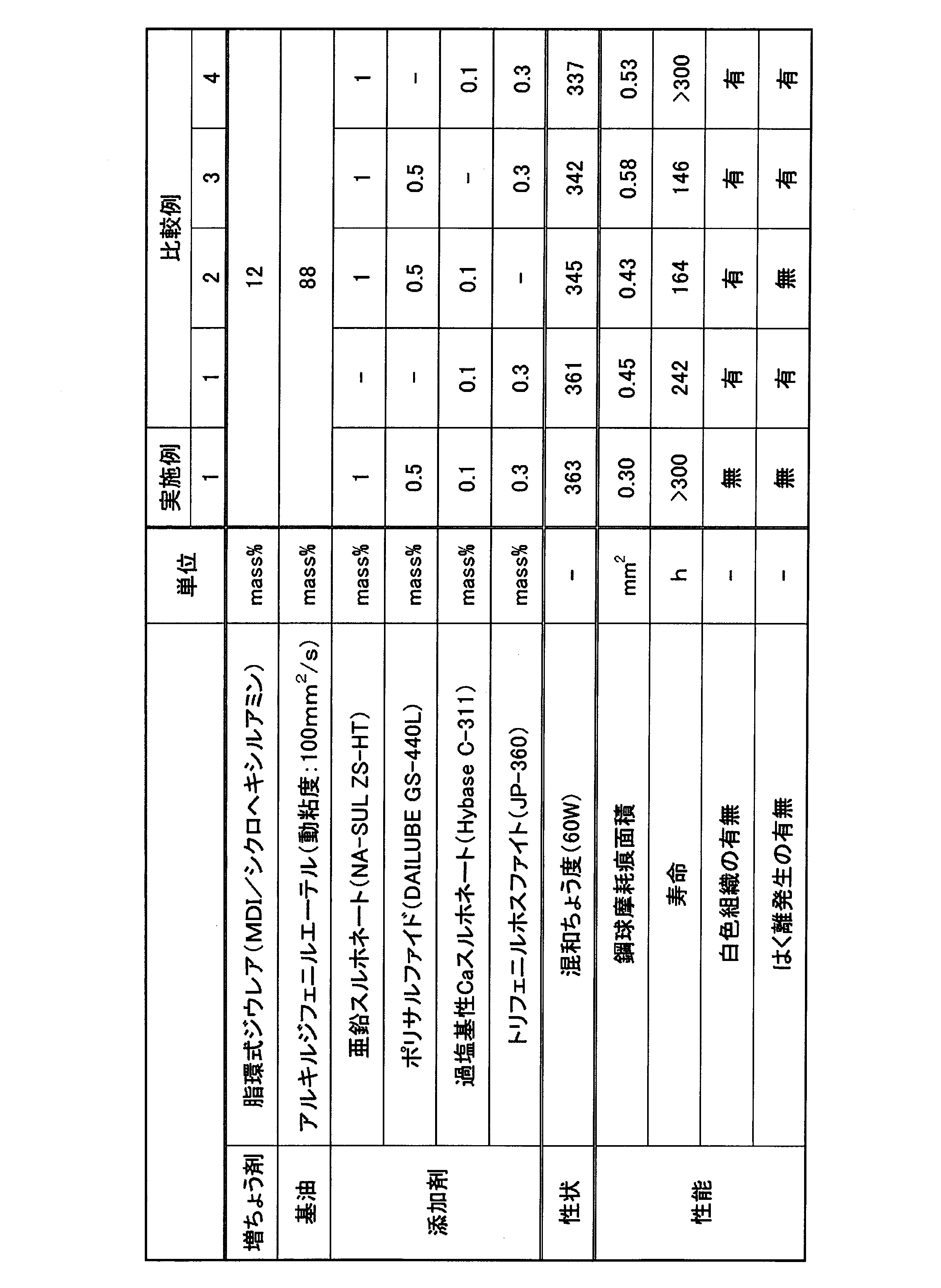
表1に示した各評価の評価方法は、下記の通りである。
[1]混和ちょう度(60W)
混和ちょう度(60W)をJIS K 2220:2013に準拠した方法で測定した。
[1]混和ちょう度(60W)
混和ちょう度(60W)をJIS K 2220:2013に準拠した方法で測定した。
[2]鋼球摩擦痕面積
摩擦摩耗試験機(レスカ社製、フリクションプレーヤ FPR2100)を用いて、実施例及び比較例で調製したグリース組成物のボールオンディスク摩擦摩耗試験を行い、摩耗量(鋼球摩耗痕面積)を評価した。結果は表1、及び図2に示した。
ここでは、SUJ2製の円板上にグリース組成物を塗布し、その上に試験荷重が30Nになるように荷重を掛けてSUJ2製の鋼球を接触させた。
この状態で円板を10時間回転させ、その後、鋼球の摩耗痕面積(mm2)を摩耗量として測定した。本試験は大気下で行った。試験条件の詳細は表2に示した通りである。
摩擦摩耗試験機(レスカ社製、フリクションプレーヤ FPR2100)を用いて、実施例及び比較例で調製したグリース組成物のボールオンディスク摩擦摩耗試験を行い、摩耗量(鋼球摩耗痕面積)を評価した。結果は表1、及び図2に示した。
ここでは、SUJ2製の円板上にグリース組成物を塗布し、その上に試験荷重が30Nになるように荷重を掛けてSUJ2製の鋼球を接触させた。
この状態で円板を10時間回転させ、その後、鋼球の摩耗痕面積(mm2)を摩耗量として測定した。本試験は大気下で行った。試験条件の詳細は表2に示した通りである。

[3]寿命、並びに、白色組織の有無及びはく離発生の有無
スラスト型転動疲労試験機を用いて、実施例及び比較例で調製したグリース組成物を使用した転動疲労試験を水素雰囲気下で行い(図3参照)、振動計の振動値が初期の4倍に達するまでの時間(表1では、「寿命」と記載している。)を測定した。なお、試験時間は最大300時間とし、振動計の振動値が初期の4倍に達するか否かにかかわらず、300時間で試験を終了した。
図3は、本評価に係るスラスト型転動疲労試験の概略を示す図である。
ここでは、スラスト玉軸受を利用した試験片を用意して試験を行った。
本試験では、ガス供給口68Aとガス排出口68Bとを備えた試験室67内において、回転軸66と受部材61との間に、軌道溝を有する軌道盤(スラストレース)63と、複数の玉62を配置した。ここで、受部材61は、スラスト玉軸受の一方のスラストレースを反転させたものであり、スラストレースの背面で玉62と接触するように設置した。受部材61、玉62、及び軌道盤63は、いずれもSUJ2で形成されている。また、本試験では、玉62を3個使用し、玉62は、保持器64によって受部材61と軌道盤63との間に周方向に等間隔で転動自在に保持されている。
また、本試験は、少なくとも受部材61、玉62との接触箇所に存在するようにグリース組成物65を試験室67内に注入し、更に、ガス供給口68Aから水素ガスを供給して、水素雰囲気下で行った。
スラスト型転動疲労試験機を用いて、実施例及び比較例で調製したグリース組成物を使用した転動疲労試験を水素雰囲気下で行い(図3参照)、振動計の振動値が初期の4倍に達するまでの時間(表1では、「寿命」と記載している。)を測定した。なお、試験時間は最大300時間とし、振動計の振動値が初期の4倍に達するか否かにかかわらず、300時間で試験を終了した。
図3は、本評価に係るスラスト型転動疲労試験の概略を示す図である。
ここでは、スラスト玉軸受を利用した試験片を用意して試験を行った。
本試験では、ガス供給口68Aとガス排出口68Bとを備えた試験室67内において、回転軸66と受部材61との間に、軌道溝を有する軌道盤(スラストレース)63と、複数の玉62を配置した。ここで、受部材61は、スラスト玉軸受の一方のスラストレースを反転させたものであり、スラストレースの背面で玉62と接触するように設置した。受部材61、玉62、及び軌道盤63は、いずれもSUJ2で形成されている。また、本試験では、玉62を3個使用し、玉62は、保持器64によって受部材61と軌道盤63との間に周方向に等間隔で転動自在に保持されている。
また、本試験は、少なくとも受部材61、玉62との接触箇所に存在するようにグリース組成物65を試験室67内に注入し、更に、ガス供給口68Aから水素ガスを供給して、水素雰囲気下で行った。
試験方法は、以下の通りである。また、試験条件の詳細は表3に示した通りである。
荷重軸69により、試験荷重2450Nを付与して受部材61の上面を玉62に押し当てつつ、回転軸66を回転させることにより、玉62を受部材61の上面で転動させた。そして、振動計(図示せず)の振動値が初期の4倍に達するまでの時間を測定した。なお、試験時間は最大300時間とした。また、本試験では、振動計の振動値が初期の4倍に達した時点で試験終了とした。
試験終了後には、玉62の表面を目視、及び顕微鏡で観察した。
荷重軸69により、試験荷重2450Nを付与して受部材61の上面を玉62に押し当てつつ、回転軸66を回転させることにより、玉62を受部材61の上面で転動させた。そして、振動計(図示せず)の振動値が初期の4倍に達するまでの時間を測定した。なお、試験時間は最大300時間とした。また、本試験では、振動計の振動値が初期の4倍に達した時点で試験終了とした。
試験終了後には、玉62の表面を目視、及び顕微鏡で観察した。
表1に結果を示した通り、比較例で調製したグリース組成物を使用した評価において、比較例1、3の評価では、300時間以内に振動値が初期の4倍に達し、振動値が初期の4倍に達した時点で、玉62の表面に白色組織が観察され、はく離の発生も観察された。また、比較例2の評価では、振動値が初期の4倍に達した時点で、はく離は発生していなかったものの、玉62の表面に白色組織が観察された。また、比較例4の評価では、300時間以内に振動値が初期の4倍に達することはなかったものの、300時間経過時点で、玉62の表面に白色組織が観察され、はく離の発生も観察された。
一方、実施例1で調製したグリース組成物を使用した評価では、300時間以内に振動値が初期の4倍に達することはなく、玉62の表面に白色組織もはく離の発生も観察されなかった。
一方、実施例1で調製したグリース組成物を使用した評価では、300時間以内に振動値が初期の4倍に達することはなく、玉62の表面に白色組織もはく離の発生も観察されなかった。
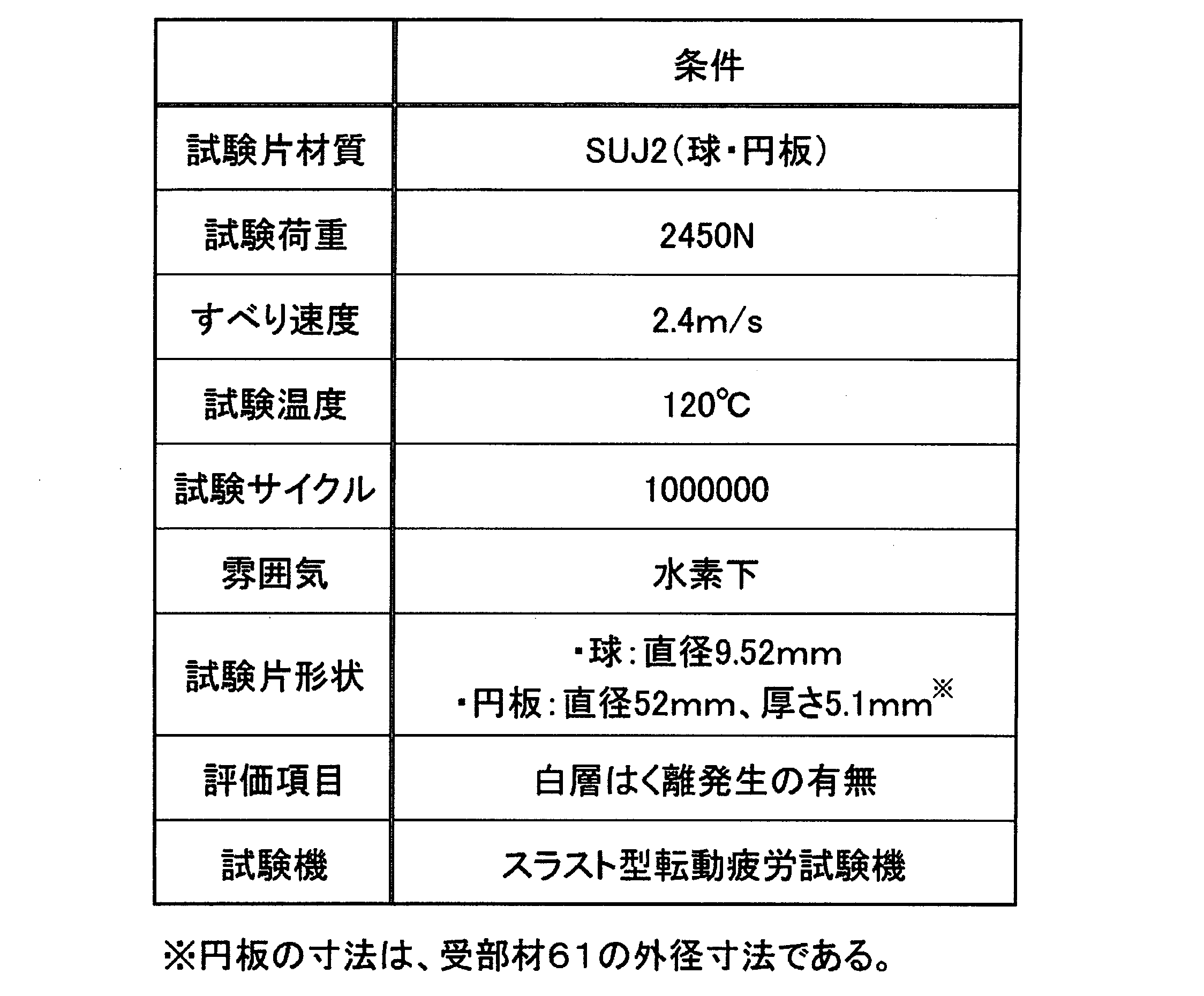
実施例及び比較例の結果から明らかな通り、本発明の実施形態に係るグリース組成物は、転がり軸受に封入して使用した際に、耐摩耗性に優れ、白層組織への変化や白層はく離の発生を引き起こしにくく、転がり軸受の長寿命化に寄与することができると考えられる。
また、本発明の実施形態に係るグリース組成物が使用された転がり軸受は、水素雰囲気下で使用した際にも白層はく離の発生を抑制することができると考えられる。
また、本発明の実施形態に係るグリース組成物が使用された転がり軸受は、水素雰囲気下で使用した際にも白層はく離の発生を抑制することができると考えられる。
本出願は、2020年8月12日出願の日本特許出願2020-136449に基づくものであり、その内容はここに参照として取り込まれる。
1:玉軸受
2:内輪
3:外輪
4:玉
5:保持器
6:シール
7:領域
G:グリース
2:内輪
3:外輪
4:玉
5:保持器
6:シール
7:領域
G:グリース
Claims (3)
- 基油と、
増ちょう剤と、
亜鉛スルホネートと、
ポリサルファイドと、
過塩基性カルシウムスルホネートと、
トリフェニルホスファイトと、を含み、
前記亜鉛スルホネートは、前記基油と前記増ちょう剤との合計質量に対する割合が亜鉛量として0.030~0.045質量%であり、
前記ポリサルファイドは、前記基油と前記増ちょう剤との合計質量に対する割合が硫黄量として0.16~0.24質量%であり、
前記過塩基性カルシウムスルホネートは、前記基油と前記増ちょう剤との合計質量に対する割合がカルシウム量として0.010~0.015質量%であり、
前記トリフェニルホスファイトは、前記基油と前記増ちょう剤との合計質量に対する割合が0.24~0.36質量%である、グリース組成物。 - 前記基油は、アルキルジフェニルエーテルであり、
前記増ちょう剤は、脂環式ジウレアであり、
前記増ちょう剤は、前記基油と前記増ちょう剤との合計質量に対する割合が10~14質量%である、請求項1に記載のグリース組成物。 - 請求項1又は2に記載のグリース組成物が封入された、転がり軸受。
Priority Applications (4)
| Application Number | Priority Date | Filing Date | Title |
|---|---|---|---|
| US18/020,743 US12037561B2 (en) | 2020-08-12 | 2021-08-10 | Grease composition, and rolling bearing |
| JP2022542854A JP7751585B2 (ja) | 2020-08-12 | 2021-08-10 | グリース組成物および転がり軸受 |
| CN202180056136.2A CN116113683B (zh) | 2020-08-12 | 2021-08-10 | 润滑脂组合物和滚动轴承 |
| DE112021004265.3T DE112021004265B4 (de) | 2020-08-12 | 2021-08-10 | Schmierfettzusammensetzung und Verwendung dieser in einem Wälzlager |
Applications Claiming Priority (2)
| Application Number | Priority Date | Filing Date | Title |
|---|---|---|---|
| JP2020136449 | 2020-08-12 | ||
| JP2020-136449 | 2020-08-12 |
Publications (1)
| Publication Number | Publication Date |
|---|---|
| WO2022034883A1 true WO2022034883A1 (ja) | 2022-02-17 |
Family
ID=80247938
Family Applications (1)
| Application Number | Title | Priority Date | Filing Date |
|---|---|---|---|
| PCT/JP2021/029534 Ceased WO2022034883A1 (ja) | 2020-08-12 | 2021-08-10 | グリース組成物および転がり軸受 |
Country Status (5)
| Country | Link |
|---|---|
| US (1) | US12037561B2 (ja) |
| JP (1) | JP7751585B2 (ja) |
| CN (1) | CN116113683B (ja) |
| DE (1) | DE112021004265B4 (ja) |
| WO (1) | WO2022034883A1 (ja) |
Citations (4)
| Publication number | Priority date | Publication date | Assignee | Title |
|---|---|---|---|---|
| JPH0860174A (ja) * | 1994-08-03 | 1996-03-05 | Lubrizol Corp:The | 有機ポリスルフィドおよびオーバーベース化組成物またはリン化合物またはホウ素化合物の配合物を含有する潤滑組成物、濃縮物およびグリース |
| WO2012124815A1 (ja) * | 2011-03-17 | 2012-09-20 | 協同油脂株式会社 | グリース組成物 |
| WO2015016376A1 (ja) * | 2013-08-02 | 2015-02-05 | 協同油脂株式会社 | グリース組成物 |
| JP2020059776A (ja) * | 2018-10-05 | 2020-04-16 | 株式会社ジェイテクト | グリース組成物および転がり軸受 |
Family Cites Families (17)
| Publication number | Priority date | Publication date | Assignee | Title |
|---|---|---|---|---|
| IT1263745B (it) | 1992-01-22 | 1996-08-27 | Ntn Toyo Bearing Co Ltd | Cuscinetto a contatto di rotolamento chiuso a tenuta con grasso |
| JP2557597B2 (ja) | 1992-01-22 | 1996-11-27 | エヌティエヌ株式会社 | オルタネータ用グリース封入転がり軸受 |
| JPH09303264A (ja) | 1996-05-10 | 1997-11-25 | Matsushita Electric Ind Co Ltd | 冷凍機用圧縮機 |
| JPH10183162A (ja) * | 1996-12-26 | 1998-07-14 | Kyodo Yushi Kk | シリコーンゴム製ブーツを有する等速ジョイント用グリース組成物 |
| US6063742A (en) | 1999-03-01 | 2000-05-16 | The Lubrizol Corporation | Grease compositions |
| JP4620219B2 (ja) * | 2000-06-02 | 2011-01-26 | Jx日鉱日石エネルギー株式会社 | グリ−ス組成物 |
| JP3988912B2 (ja) * | 2000-07-06 | 2007-10-10 | 協同油脂株式会社 | 等速ジョイント用グリース組成物 |
| JP2002195277A (ja) | 2000-10-19 | 2002-07-10 | Nsk Ltd | 転がり軸受 |
| JP4177596B2 (ja) | 2002-04-30 | 2008-11-05 | 協同油脂株式会社 | グリース組成物 |
| JP4520756B2 (ja) * | 2004-02-26 | 2010-08-11 | 新日本石油株式会社 | 等速ジョイント用グリース組成物 |
| JP2007262300A (ja) | 2006-03-29 | 2007-10-11 | Kyodo Yushi Co Ltd | 潤滑剤組成物 |
| JP5467723B2 (ja) * | 2008-01-23 | 2014-04-09 | 協同油脂株式会社 | 潤滑剤組成物及び機械部材 |
| JP2012180439A (ja) | 2011-03-01 | 2012-09-20 | Mitsubishi Heavy Ind Ltd | 風力発電機増速機用潤滑剤組成物 |
| JP6041202B2 (ja) | 2012-10-26 | 2016-12-07 | 協同油脂株式会社 | グリース組成物 |
| US10266787B2 (en) | 2012-11-16 | 2019-04-23 | Idemitsu Kosan Co., Ltd. | Grease composition |
| WO2020095359A1 (ja) | 2018-11-06 | 2020-05-14 | 協同油脂株式会社 | 耐剥離剤およびそれを含有する潤滑剤組成物 |
| JP7215206B2 (ja) | 2019-02-19 | 2023-01-31 | 富士電機株式会社 | 半導体装置の製造方法 |
-
2021
- 2021-08-10 JP JP2022542854A patent/JP7751585B2/ja active Active
- 2021-08-10 DE DE112021004265.3T patent/DE112021004265B4/de active Active
- 2021-08-10 CN CN202180056136.2A patent/CN116113683B/zh active Active
- 2021-08-10 WO PCT/JP2021/029534 patent/WO2022034883A1/ja not_active Ceased
- 2021-08-10 US US18/020,743 patent/US12037561B2/en active Active
Patent Citations (4)
| Publication number | Priority date | Publication date | Assignee | Title |
|---|---|---|---|---|
| JPH0860174A (ja) * | 1994-08-03 | 1996-03-05 | Lubrizol Corp:The | 有機ポリスルフィドおよびオーバーベース化組成物またはリン化合物またはホウ素化合物の配合物を含有する潤滑組成物、濃縮物およびグリース |
| WO2012124815A1 (ja) * | 2011-03-17 | 2012-09-20 | 協同油脂株式会社 | グリース組成物 |
| WO2015016376A1 (ja) * | 2013-08-02 | 2015-02-05 | 協同油脂株式会社 | グリース組成物 |
| JP2020059776A (ja) * | 2018-10-05 | 2020-04-16 | 株式会社ジェイテクト | グリース組成物および転がり軸受 |
Also Published As
| Publication number | Publication date |
|---|---|
| DE112021004265B4 (de) | 2023-12-07 |
| DE112021004265T5 (de) | 2023-05-25 |
| CN116113683A (zh) | 2023-05-12 |
| US20230323240A1 (en) | 2023-10-12 |
| US12037561B2 (en) | 2024-07-16 |
| JP7751585B2 (ja) | 2025-10-08 |
| JPWO2022034883A1 (ja) | 2022-02-17 |
| CN116113683B (zh) | 2024-10-15 |
Similar Documents
| Publication | Publication Date | Title |
|---|---|---|
| JP7042375B2 (ja) | ハブユニット | |
| CN107922868B (zh) | 润滑脂组合物及封入润滑脂滚动轴承 | |
| EP1770309A1 (en) | Rotation transmission apparatus with built-in one-way clutch | |
| WO2013047781A1 (ja) | 転がり軸受用グリース組成物及び転がり軸受 | |
| CN115867632B (zh) | 润滑脂组合物和滚动轴承 | |
| US20200109344A1 (en) | Grease composition and rolling bearing | |
| JP7434953B2 (ja) | グリース組成物および転がり軸受 | |
| JP7511351B2 (ja) | グリース組成物およびグリース封入軸受 | |
| WO2016114380A1 (ja) | 転がり軸受 | |
| JP2005298629A (ja) | 自動車電装補機用グリース組成物及び前記グリース組成物を封入した転がり軸受 | |
| JP7751585B2 (ja) | グリース組成物および転がり軸受 | |
| JP2021063166A (ja) | 潤滑剤組成物および転がり軸受 | |
| JP7435003B2 (ja) | グリース組成物および転がり軸受 | |
| JP2005112955A (ja) | グリース組成物及び転動装置 | |
| JP2005048044A (ja) | 転動装置用グリース組成物及び転動装置 | |
| JP4838549B2 (ja) | グリース組成物および該グリース封入転がり軸受 | |
| JP2024158366A (ja) | 転がり軸受用グリース組成物 | |
| WO2024150344A1 (ja) | マレイン酸系添加剤、グリース組成物および転がり軸受 | |
| JP2004067940A (ja) | グリース組成物及びそれを封入した転がり軸受 | |
| JP2021130806A (ja) | グリース組成物および転がり軸受 | |
| WO2024034556A1 (ja) | グリース組成物及び転動装置 | |
| JP2015028351A (ja) | インバータ駆動モータ用グリース封入軸受 | |
| CN120584170A (zh) | 润滑脂组合物和滚动轴承 | |
| JP2010266017A (ja) | 一方向クラッチ内蔵型回転伝達装置 | |
| JP2008133909A (ja) | グリース封入複列アンギュラ軸受 |
Legal Events
| Date | Code | Title | Description |
|---|---|---|---|
| 121 | Ep: the epo has been informed by wipo that ep was designated in this application |
Ref document number: 21855962 Country of ref document: EP Kind code of ref document: A1 |
|
| ENP | Entry into the national phase |
Ref document number: 2022542854 Country of ref document: JP Kind code of ref document: A |
|
| 122 | Ep: pct application non-entry in european phase |
Ref document number: 21855962 Country of ref document: EP Kind code of ref document: A1 |