WO2022030027A1 - 断熱材、及び断熱材の製造方法 - Google Patents
断熱材、及び断熱材の製造方法 Download PDFInfo
- Publication number
- WO2022030027A1 WO2022030027A1 PCT/JP2020/035628 JP2020035628W WO2022030027A1 WO 2022030027 A1 WO2022030027 A1 WO 2022030027A1 JP 2020035628 W JP2020035628 W JP 2020035628W WO 2022030027 A1 WO2022030027 A1 WO 2022030027A1
- Authority
- WO
- WIPO (PCT)
- Prior art keywords
- heat insulating
- insulating material
- mass
- parts
- insulation material
- Prior art date
- Legal status (The legal status is an assumption and is not a legal conclusion. Google has not performed a legal analysis and makes no representation as to the accuracy of the status listed.)
- Ceased
Links
Images



Classifications
-
- C—CHEMISTRY; METALLURGY
- C04—CEMENTS; CONCRETE; ARTIFICIAL STONE; CERAMICS; REFRACTORIES
- C04B—LIME, MAGNESIA; SLAG; CEMENTS; COMPOSITIONS THEREOF, e.g. MORTARS, CONCRETE OR LIKE BUILDING MATERIALS; ARTIFICIAL STONE; CERAMICS; REFRACTORIES; TREATMENT OF NATURAL STONE
- C04B28/00—Compositions of mortars, concrete or artificial stone, containing inorganic binders or the reaction product of an inorganic and an organic binder, e.g. polycarboxylate cements
- C04B28/24—Compositions of mortars, concrete or artificial stone, containing inorganic binders or the reaction product of an inorganic and an organic binder, e.g. polycarboxylate cements containing alkyl, ammonium or metal silicates; containing silica sols
- C04B28/26—Silicates of the alkali metals
-
- C—CHEMISTRY; METALLURGY
- C04—CEMENTS; CONCRETE; ARTIFICIAL STONE; CERAMICS; REFRACTORIES
- C04B—LIME, MAGNESIA; SLAG; CEMENTS; COMPOSITIONS THEREOF, e.g. MORTARS, CONCRETE OR LIKE BUILDING MATERIALS; ARTIFICIAL STONE; CERAMICS; REFRACTORIES; TREATMENT OF NATURAL STONE
- C04B14/00—Use of inorganic materials as fillers, e.g. pigments, for mortars, concrete or artificial stone; Treatment of inorganic materials specially adapted to enhance their filling properties in mortars, concrete or artificial stone
- C04B14/02—Granular materials, e.g. microballoons
- C04B14/022—Carbon
-
- C—CHEMISTRY; METALLURGY
- C04—CEMENTS; CONCRETE; ARTIFICIAL STONE; CERAMICS; REFRACTORIES
- C04B—LIME, MAGNESIA; SLAG; CEMENTS; COMPOSITIONS THEREOF, e.g. MORTARS, CONCRETE OR LIKE BUILDING MATERIALS; ARTIFICIAL STONE; CERAMICS; REFRACTORIES; TREATMENT OF NATURAL STONE
- C04B14/00—Use of inorganic materials as fillers, e.g. pigments, for mortars, concrete or artificial stone; Treatment of inorganic materials specially adapted to enhance their filling properties in mortars, concrete or artificial stone
- C04B14/02—Granular materials, e.g. microballoons
- C04B14/04—Silica-rich materials; Silicates
- C04B14/043—Alkaline-earth metal silicates, e.g. wollastonite
-
- C—CHEMISTRY; METALLURGY
- C04—CEMENTS; CONCRETE; ARTIFICIAL STONE; CERAMICS; REFRACTORIES
- C04B—LIME, MAGNESIA; SLAG; CEMENTS; COMPOSITIONS THEREOF, e.g. MORTARS, CONCRETE OR LIKE BUILDING MATERIALS; ARTIFICIAL STONE; CERAMICS; REFRACTORIES; TREATMENT OF NATURAL STONE
- C04B14/00—Use of inorganic materials as fillers, e.g. pigments, for mortars, concrete or artificial stone; Treatment of inorganic materials specially adapted to enhance their filling properties in mortars, concrete or artificial stone
- C04B14/02—Granular materials, e.g. microballoons
- C04B14/04—Silica-rich materials; Silicates
- C04B14/08—Diatomaceous earth
-
- C—CHEMISTRY; METALLURGY
- C04—CEMENTS; CONCRETE; ARTIFICIAL STONE; CERAMICS; REFRACTORIES
- C04B—LIME, MAGNESIA; SLAG; CEMENTS; COMPOSITIONS THEREOF, e.g. MORTARS, CONCRETE OR LIKE BUILDING MATERIALS; ARTIFICIAL STONE; CERAMICS; REFRACTORIES; TREATMENT OF NATURAL STONE
- C04B18/00—Use of agglomerated or waste materials or refuse as fillers for mortars, concrete or artificial stone; Treatment of agglomerated or waste materials or refuse, specially adapted to enhance their filling properties in mortars, concrete or artificial stone
- C04B18/04—Waste materials; Refuse
- C04B18/06—Combustion residues, e.g. purification products of smoke, fumes or exhaust gases
- C04B18/10—Burned or pyrolised refuse
-
- C—CHEMISTRY; METALLURGY
- C04—CEMENTS; CONCRETE; ARTIFICIAL STONE; CERAMICS; REFRACTORIES
- C04B—LIME, MAGNESIA; SLAG; CEMENTS; COMPOSITIONS THEREOF, e.g. MORTARS, CONCRETE OR LIKE BUILDING MATERIALS; ARTIFICIAL STONE; CERAMICS; REFRACTORIES; TREATMENT OF NATURAL STONE
- C04B18/00—Use of agglomerated or waste materials or refuse as fillers for mortars, concrete or artificial stone; Treatment of agglomerated or waste materials or refuse, specially adapted to enhance their filling properties in mortars, concrete or artificial stone
- C04B18/04—Waste materials; Refuse
- C04B18/06—Combustion residues, e.g. purification products of smoke, fumes or exhaust gases
- C04B18/10—Burned or pyrolised refuse
- C04B18/101—Burned rice husks or other burned vegetable material
-
- C—CHEMISTRY; METALLURGY
- C04—CEMENTS; CONCRETE; ARTIFICIAL STONE; CERAMICS; REFRACTORIES
- C04B—LIME, MAGNESIA; SLAG; CEMENTS; COMPOSITIONS THEREOF, e.g. MORTARS, CONCRETE OR LIKE BUILDING MATERIALS; ARTIFICIAL STONE; CERAMICS; REFRACTORIES; TREATMENT OF NATURAL STONE
- C04B20/00—Use of materials as fillers for mortars, concrete or artificial stone according to more than one of groups C04B14/00 - C04B18/00 and characterised by shape or grain distribution; Treatment of materials according to more than one of the groups C04B14/00 - C04B18/00 specially adapted to enhance their filling properties in mortars, concrete or artificial stone; Expanding or defibrillating materials
- C04B20/0016—Granular materials, e.g. microballoons
- C04B20/002—Hollow or porous granular materials
- C04B20/004—Hollow or porous granular materials inorganic
-
- C—CHEMISTRY; METALLURGY
- C04—CEMENTS; CONCRETE; ARTIFICIAL STONE; CERAMICS; REFRACTORIES
- C04B—LIME, MAGNESIA; SLAG; CEMENTS; COMPOSITIONS THEREOF, e.g. MORTARS, CONCRETE OR LIKE BUILDING MATERIALS; ARTIFICIAL STONE; CERAMICS; REFRACTORIES; TREATMENT OF NATURAL STONE
- C04B28/00—Compositions of mortars, concrete or artificial stone, containing inorganic binders or the reaction product of an inorganic and an organic binder, e.g. polycarboxylate cements
- C04B28/02—Compositions of mortars, concrete or artificial stone, containing inorganic binders or the reaction product of an inorganic and an organic binder, e.g. polycarboxylate cements containing hydraulic cements other than calcium sulfates
- C04B28/06—Aluminous cements
-
- C—CHEMISTRY; METALLURGY
- C04—CEMENTS; CONCRETE; ARTIFICIAL STONE; CERAMICS; REFRACTORIES
- C04B—LIME, MAGNESIA; SLAG; CEMENTS; COMPOSITIONS THEREOF, e.g. MORTARS, CONCRETE OR LIKE BUILDING MATERIALS; ARTIFICIAL STONE; CERAMICS; REFRACTORIES; TREATMENT OF NATURAL STONE
- C04B40/00—Processes, in general, for influencing or modifying the properties of mortars, concrete or artificial stone compositions, e.g. their setting or hardening ability
- C04B40/0082—Processes, in general, for influencing or modifying the properties of mortars, concrete or artificial stone compositions, e.g. their setting or hardening ability making use of a rise in temperature, e.g. caused by an exothermic reaction
-
- C—CHEMISTRY; METALLURGY
- C04—CEMENTS; CONCRETE; ARTIFICIAL STONE; CERAMICS; REFRACTORIES
- C04B—LIME, MAGNESIA; SLAG; CEMENTS; COMPOSITIONS THEREOF, e.g. MORTARS, CONCRETE OR LIKE BUILDING MATERIALS; ARTIFICIAL STONE; CERAMICS; REFRACTORIES; TREATMENT OF NATURAL STONE
- C04B7/00—Hydraulic cements
- C04B7/32—Aluminous cements
-
- C—CHEMISTRY; METALLURGY
- C04—CEMENTS; CONCRETE; ARTIFICIAL STONE; CERAMICS; REFRACTORIES
- C04B—LIME, MAGNESIA; SLAG; CEMENTS; COMPOSITIONS THEREOF, e.g. MORTARS, CONCRETE OR LIKE BUILDING MATERIALS; ARTIFICIAL STONE; CERAMICS; REFRACTORIES; TREATMENT OF NATURAL STONE
- C04B2111/00—Mortars, concrete or artificial stone or mixtures to prepare them, characterised by specific function, property or use
- C04B2111/00474—Uses not provided for elsewhere in C04B2111/00
- C04B2111/00612—Uses not provided for elsewhere in C04B2111/00 as one or more layers of a layered structure
-
- C—CHEMISTRY; METALLURGY
- C04—CEMENTS; CONCRETE; ARTIFICIAL STONE; CERAMICS; REFRACTORIES
- C04B—LIME, MAGNESIA; SLAG; CEMENTS; COMPOSITIONS THEREOF, e.g. MORTARS, CONCRETE OR LIKE BUILDING MATERIALS; ARTIFICIAL STONE; CERAMICS; REFRACTORIES; TREATMENT OF NATURAL STONE
- C04B2111/00—Mortars, concrete or artificial stone or mixtures to prepare them, characterised by specific function, property or use
- C04B2111/20—Resistance against chemical, physical or biological attack
- C04B2111/28—Fire resistance, i.e. materials resistant to accidental fires or high temperatures
-
- C—CHEMISTRY; METALLURGY
- C04—CEMENTS; CONCRETE; ARTIFICIAL STONE; CERAMICS; REFRACTORIES
- C04B—LIME, MAGNESIA; SLAG; CEMENTS; COMPOSITIONS THEREOF, e.g. MORTARS, CONCRETE OR LIKE BUILDING MATERIALS; ARTIFICIAL STONE; CERAMICS; REFRACTORIES; TREATMENT OF NATURAL STONE
- C04B2201/00—Mortars, concrete or artificial stone characterised by specific physical values
- C04B2201/30—Mortars, concrete or artificial stone characterised by specific physical values for heat transfer properties such as thermal insulation values, e.g. R-values
-
- Y—GENERAL TAGGING OF NEW TECHNOLOGICAL DEVELOPMENTS; GENERAL TAGGING OF CROSS-SECTIONAL TECHNOLOGIES SPANNING OVER SEVERAL SECTIONS OF THE IPC; TECHNICAL SUBJECTS COVERED BY FORMER USPC CROSS-REFERENCE ART COLLECTIONS [XRACs] AND DIGESTS
- Y02—TECHNOLOGIES OR APPLICATIONS FOR MITIGATION OR ADAPTATION AGAINST CLIMATE CHANGE
- Y02W—CLIMATE CHANGE MITIGATION TECHNOLOGIES RELATED TO WASTEWATER TREATMENT OR WASTE MANAGEMENT
- Y02W30/00—Technologies for solid waste management
- Y02W30/50—Reuse, recycling or recovery technologies
- Y02W30/91—Use of waste materials as fillers for mortars or concrete
Definitions
- This disclosure relates to a heat insulating material and a method for manufacturing the heat insulating material.
- a heat insulating material made of foamed plastic is known.
- a heat insulating material made of foamed plastic is disclosed in Patent Document 1.
- a material containing rice husks is known.
- a heat insulating material containing rice husks is disclosed in Patent Document 2.
- the conventional heat insulating material was not sufficiently nonflammable.
- One aspect of the present disclosure is a heat insulating material containing a dehydration condensation reaction product of sodium silicate, alumina cement, and smoked charcoal.
- the heat insulating material which is one aspect of the present disclosure, is highly nonflammable.
- Another aspect of the present disclosure is a method for producing a heat insulating material, which is a heat insulating material that causes a dehydration condensation reaction in sodium silicate by heating a raw material containing sodium silicate, alumina cement, and smoked charcoal. It is a manufacturing method of. According to the method for producing a heat insulating material, which is another aspect of the present disclosure, a highly nonflammable heat insulating material can be manufactured.
- FIG. 3 is a cross-sectional view taken along the line IV-IV in FIG.
- test piece 1 ... test piece, 3 ... front surface, 5 ... back surface, 6 ... burner, 7 ... data logger, 11 ... first heat insulating material, 13 ... one side, 15 ... coat layer, 17 ... first test piece, 19 ... first 2 insulation, 21 ... coat layer, 23 ... second test piece
- the insulation material contains (a) a dehydration condensation reaction product of sodium silicate, (b) alumina cement, and (c) smoked charcoal.
- the dehydration condensation reaction product of sodium silicate as a component (a) is a product produced by the dehydration condensation reaction of sodium silicate.
- the component (a) is, for example, a compound having a skeleton in which siloxane bonds are connected.
- the component (a) contains, for example, siloxane.
- Smoked charcoal which is a component, is carbonized rice husks and wood chips by steaming.
- the heat insulating material preferably contains the component (b) of 40 parts by mass or more and 100 parts by mass or less with respect to the component (a) of 100 parts by mass.
- the heat resistance of the heat insulating material is further high.
- the heat insulating material preferably contains the component (c) of 30 parts by mass or more and 80 parts by mass or less with respect to the component (a) of 100 parts by mass.
- the heat insulating property of the heat insulating material is higher.
- the insulation further comprises one or more selected from the group consisting of, for example, silica-based hollow balloons, silicate minerals, and diatomaceous earth.
- silica-based hollow balloons When the heat insulating material contains a silica-based hollow balloon, the nonflammability of the heat insulating material is higher.
- the heat insulating material contains a silicate mineral When the heat insulating material contains a silicate mineral, the adhesive strength between the heat insulating material and other members is higher. If the insulation contains diatomaceous earth, the insulation is more durable.
- the heat insulating material preferably contains a silica-based hollow balloon of 3 parts by mass or more and 15 parts by mass or less with respect to 100 parts by mass of the component (a).
- a silica-based hollow balloon of 3 parts by mass or more and 15 parts by mass or less with respect to 100 parts by mass of the component (a).
- the heat insulating material preferably contains 1 part by mass or more and 10 parts by mass or less of a silicate mineral with respect to 100 parts by mass of the component (a). When the blending amount of the silicate mineral is within this range, the nonflammability of the heat insulating material is higher.
- the heat insulating material preferably contains 3 parts by mass or more and 20 parts by mass or less of diatomaceous earth with respect to 100 parts by mass of the component (a). When the blending amount of diatomaceous earth is within this range, the nonflammability of the heat insulating material is higher.
- the form of the heat insulating material is not particularly limited.
- the form of the heat insulating material is, for example, a board shape.
- the heat insulating material can be used for, for example, buildings, heavy machinery, vehicles and the like. Examples of the building include a freezer warehouse and the like.
- the heat insulating material can be arranged around a member that generates heat. Examples of the member that generates heat include an internal combustion engine and the like.
- a dehydration condensation reaction is caused in sodium silicate by heating a raw material containing sodium silicate, alumina cement, and smoked charcoal.
- the heat insulating material produced contains (a) component, (b) component, and (c) component.
- 100 parts by mass of sodium silicate becomes 60 parts by mass of the component (a).
- the raw material preferably contains 40 parts by mass or more and 60 parts by mass or less of alumina cement with respect to 100 parts by mass of sodium silicate. When the blending amount of alumina cement is within this range, the nonflammability of the heat insulating material is higher.
- the raw material preferably contains 20 parts by mass or more and 50 parts by mass or less of smoked charcoal with respect to 100 parts by mass of sodium silicate.
- the heat insulating property of the heat insulating material is higher.
- the raw material further comprises, for example, one or more selected from the group consisting of silica-based hollow balloons, silicate minerals, and diatomaceous earth.
- silica-based hollow balloon the nonflammability of the heat insulating material is higher.
- silicate minerals the adhesive strength between the heat insulating material and other members is higher.
- diatomaceous earth the durability of the heat insulating material is higher.
- the raw material preferably contains 1 part by mass or more and 10 parts by mass or less of a silica-based hollow balloon with respect to 100 parts by mass of sodium silicate.
- the heat insulating property of the heat insulating material is further high.
- the raw material preferably contains 1 part by mass or more and 10 parts by mass or less of a silicate mineral with respect to 100 parts by mass of sodium silicate.
- a silicate mineral with respect to 100 parts by mass of sodium silicate.
- the raw material preferably contains 3 parts by mass or more and 20 parts by mass or less of diatomaceous earth with respect to 100 parts by mass of sodium silicate.
- the blending amount of diatomaceous earth is within this range, the durability of the heat insulating material is higher.
- a heat insulating material of the present disclosure for example, by pouring a fluid raw material into a mold, it is possible to manufacture a heat insulating material in a form corresponding to the mold.
- the form of the heat insulating material is, for example, a board shape.
- Example 1 (4-1) Production of Insulation Material A liquid raw material was obtained by mixing the following components.
- Soda silicate JIS3 100 parts by mass Silica-based hollow balloon: 10 parts by mass Silicate mineral (wollastonite): 5 parts by mass Silica soil: 10 parts by mass Special cement: 70 parts by mass Smoked charcoal: 50 parts by mass Water: 30 Part by mass Special cement corresponds to alumina cement.
- a liquid raw material was poured into a mold and heated at a temperature of 70 ° C. for 3 hours to obtain a solid heat insulating material. The form of the heat insulating material was board-shaped. When heated, the sodium silicate contained in the raw material became a dehydration condensation reaction product.
- a plate-shaped test piece 1 was prepared from the manufactured heat insulating material.
- the size of the test body 1 was 300 mm in length, 300 mm in width, and 16 mm in thickness.
- a point on one surface 3 of the test piece 1 was designated as the first measurement point P1.
- the point on the back surface 5 of the test body 1 was designated as the second measurement point P2.
- the back surface 5 is the surface opposite to the front surface 3.
- the straight line passing through the first measurement point P1 and the second measurement point P2 is parallel to the thickness direction of the test piece 1.
- the first measurement point P1 was continuously heated using the burner 6.
- the burner 6 was a power torch RZ-840 manufactured by Shinfuji Burner Co., Ltd. Room temperature was 23 ° C.
- the elapsed time in Table 1 is the elapsed time from the time when the heating of the first measurement point P1 is started.
- Example 2 Production of Insulation Material A liquid raw material was obtained by mixing the following components.
- Soda silicate JIS3 100 parts by mass Silica-based hollow balloon: 4 parts by mass Silicate mineral (wollastonite): 2 parts by mass Silica soil: 8 parts by mass Special cement: 60 parts by mass Smoked: 40 parts by mass Water: 40 Part by mass Special cement corresponds to alumina cement.
- the liquid raw material was poured into the first mold and heated at a temperature of 70 ° C. for 3 hours to obtain the first heat insulating material.
- the form of the first heat insulating material was a solid board.
- the size of the first heat insulating material was 99 mm in length, 99 mm in width, and 15 mm in thickness.
- the sodium silicate contained in the raw material became a dehydration condensation reaction product.
- the first insulation was removed from the first mold.
- the liquid raw material was poured into the second mold and heated at a temperature of 70 ° C. for 3 hours to obtain a second heat insulating material.
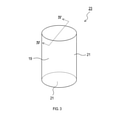
- the form of the second heat insulating material was a solid columnar shape.
- the diameter of the second insulation was 44 mm.
- the height of the second heat insulating material was 50 mm.
- test piece A liquid coating agent was obtained by mixing the following components.
- a coat layer 15 was formed on one side 13 of the heat insulating material 11 of 1.
- the method of forming the coat layer 15 was a method of applying a coating agent to one side 13 and heating at 100 ° C. for 3 hours.
- the thickness of the coat layer 15 was 0.5 mm.
- the first heat insulating material 11 provided with the coat layer 15 was used as the first test piece 17.
- a coat layer 21 was formed on the entire surface of the second heat insulating material 19.
- the method of forming the coat layer 21 was a method of applying a coating agent to the entire surface of the second heat insulating material 19 and heating at 100 ° C. for 3 hours.
- the thickness of the coat layer 21 was 0.5 mm.
- the second heat insulating material 19 provided with the coat layer 21 was used as the second test piece 23.
- the first test piece 17 was subjected to a heat generation test in accordance with ISO-5660. In the exothermic test, the first test piece 17 was heated for 20 minutes. The radiation intensity was 50 kW / m 2 . The surface to which radiant heating was applied was 13 on one side.
- the total calorific value was 0.2 MJ / m 2 , which was very small.
- the maximum heat generation rate was 1.88 kW / m 2 , which was very low.
- the second test piece 23 was subjected to a nonflammability test in accordance with ISO-1182.
- the test method was as follows. A cylindrical electric furnace was prepared. The number of the second test pieces 23 used in the test was three. The masses of the second test piece 23 before the test were 63.9 g, 64.5 g, and 73.6 g, respectively.
- the temperature inside the electric furnace was adjusted to 750 ⁇ 5 ° C. After adjusting the temperature inside the furnace, the power consumption of the electric furnace was kept constant. After adjusting the temperature inside the furnace, the second test piece 23 was inserted into the furnace. After inserting the second test piece 23, the temperature inside the furnace and the surface temperature of the second test piece 23 were continuously measured. In addition, the mass of the second test piece 23 was measured before and after the test. In addition, the shape of the second test piece 23 was observed before and after the test. The test was continued until the temperature inside the furnace reached the final equilibrium temperature. The final equilibrium temperature is the temperature inside the furnace when the temperature inside the furnace remains stable for 10 minutes within the range of ⁇ 2 ° C.
- the temperature inside the ascending furnace on the surface of the second test piece 23 was 5.0 ° C, 1.3 ° C, and ⁇ 0.5 ° C.
- the ascending furnace temperature is a value obtained by subtracting the final equilibrium temperature from the maximum temperature in the furnace.
- the maximum temperature in the furnace is the maximum temperature in the furnace during the period from the insertion of the second test piece 23 to the end of the test.
- the mass reduction rate WR of the second test piece 23 was 13.1%, 14.2%, and 13.0%.
- the mass reduction rate WR is a value represented by the following equation (1).
- W1 is the mass of the second test piece 23 before the test.
- W2 is the mass of the second test piece 23 after the test.
- the temperature inside the ascending furnace on the surface of the second test piece 23 was smaller than the standard of 20 ° C. in ISO-1182.
- the mass reduction rate WR was smaller than the standard of 30% in ISO-1182.
- the shape of the second test piece 23 after the test did not change significantly as compared with the shape of the second test piece 23 before the test. The result of the nonflammability test shows that the second test piece 23 is highly nonflammable.
- a plurality of functions possessed by one component in the above embodiment may be realized by a plurality of components, or one function possessed by one component may be realized by a plurality of components. May be good. Further, a plurality of functions possessed by the plurality of components may be realized by one component, or one function realized by the plurality of components may be realized by one component. Further, a part of the configuration of the above embodiment may be omitted. Further, at least a part of the configuration of the above embodiment may be added or replaced with the configuration of the other above embodiment.
Landscapes
- Chemical & Material Sciences (AREA)
- Engineering & Computer Science (AREA)
- Ceramic Engineering (AREA)
- Materials Engineering (AREA)
- Organic Chemistry (AREA)
- Structural Engineering (AREA)
- Chemical Kinetics & Catalysis (AREA)
- Inorganic Chemistry (AREA)
- Civil Engineering (AREA)
- Environmental & Geological Engineering (AREA)
- Combustion & Propulsion (AREA)
- Thermal Insulation (AREA)
- Curing Cements, Concrete, And Artificial Stone (AREA)
- Silicates, Zeolites, And Molecular Sieves (AREA)
Priority Applications (5)
| Application Number | Priority Date | Filing Date | Title |
|---|---|---|---|
| US18/019,139 US20230278928A1 (en) | 2020-08-03 | 2020-09-08 | Thermal insulation material and method for producing thermal insulation material |
| KR1020237006751A KR102879303B1 (ko) | 2020-08-03 | 2020-09-18 | 단열재 및 단열재 제조 방법 |
| EP20947876.7A EP4190760A4 (en) | 2020-08-03 | 2020-09-18 | THERMAL INSULATION MATERIAL AND METHOD FOR PRODUCING THE THERMAL INSULATION MATERIAL |
| CN202080104139.4A CN116133999A (zh) | 2020-08-03 | 2020-09-18 | 隔热材料及其制造方法 |
| JP2022541103A JP7626474B2 (ja) | 2020-08-03 | 2020-09-18 | 断熱材、及び断熱材の製造方法 |
Applications Claiming Priority (2)
| Application Number | Priority Date | Filing Date | Title |
|---|---|---|---|
| JP2020-131657 | 2020-08-03 | ||
| JP2020131657 | 2020-08-03 |
Publications (1)
| Publication Number | Publication Date |
|---|---|
| WO2022030027A1 true WO2022030027A1 (ja) | 2022-02-10 |
Family
ID=80117203
Family Applications (1)
| Application Number | Title | Priority Date | Filing Date |
|---|---|---|---|
| PCT/JP2020/035628 Ceased WO2022030027A1 (ja) | 2020-08-03 | 2020-09-18 | 断熱材、及び断熱材の製造方法 |
Country Status (7)
| Country | Link |
|---|---|
| US (1) | US20230278928A1 (https=) |
| EP (1) | EP4190760A4 (https=) |
| JP (1) | JP7626474B2 (https=) |
| KR (1) | KR102879303B1 (https=) |
| CN (1) | CN116133999A (https=) |
| TW (1) | TWI864107B (https=) |
| WO (1) | WO2022030027A1 (https=) |
Citations (6)
| Publication number | Priority date | Publication date | Assignee | Title |
|---|---|---|---|---|
| JPS5426232A (en) * | 1977-08-01 | 1979-02-27 | Igaki Sangiyou Kk | Insulating material for smelting or casting metal |
| JPS61251554A (ja) * | 1985-04-26 | 1986-11-08 | ニチアス株式会社 | 撥水性ケイ酸カルシウム成形体の製造法 |
| JPS62246880A (ja) * | 1986-04-15 | 1987-10-28 | 品川白煉瓦株式会社 | 耐火断熱ボ−ド |
| JPH0699272A (ja) * | 1992-09-21 | 1994-04-12 | Kuroda Shoji:Yugen | 保温材 |
| JP2004169547A (ja) | 2002-11-05 | 2004-06-17 | Yamaguchi Prefecture | 建築用断熱材と、この建築用断熱材を用いる木造建築物並びにその構築方法 |
| JP2010121727A (ja) | 2008-11-20 | 2010-06-03 | Sekisui Chem Co Ltd | 発泡プラスチック系断熱材 |
Family Cites Families (9)
| Publication number | Priority date | Publication date | Assignee | Title |
|---|---|---|---|---|
| JPS5376458A (en) * | 1976-12-17 | 1978-07-06 | Shikoku Kaken Kogyo Kk | Heat retaining and insulating plate |
| US6264734B1 (en) * | 1997-03-20 | 2001-07-24 | Radva Corporation | Method for forming insulated products and building products formed in accordance therewith |
| JP3974771B2 (ja) * | 2001-11-13 | 2007-09-12 | 三菱電線工業株式会社 | 電波音波吸収体の製造方法 |
| JP4714640B2 (ja) * | 2006-06-07 | 2011-06-29 | 新日本製鐵株式会社 | 断熱傾斜材の製造方法 |
| JP2009256897A (ja) * | 2008-04-14 | 2009-11-05 | Meisei Fudosan Kk | 籾殻炭利用の建築材とその製造方法 |
| KR101099025B1 (ko) * | 2010-01-11 | 2011-12-29 | 이동희 | 초경량 시멘트 단열재의 제조방법 |
| CN105330251A (zh) * | 2015-11-30 | 2016-02-17 | 安徽济峰节能材料有限公司 | 一种阻燃保温砂浆 |
| CN106045546A (zh) * | 2016-08-22 | 2016-10-26 | 武汉科技大学 | 一种镁质浇注料及其制备方法 |
| CN108892419A (zh) * | 2018-07-05 | 2018-11-27 | 常州蓝森环保设备有限公司 | 一种无机墙体保温材料的制备方法 |
-
2020
- 2020-09-08 US US18/019,139 patent/US20230278928A1/en active Pending
- 2020-09-18 KR KR1020237006751A patent/KR102879303B1/ko active Active
- 2020-09-18 EP EP20947876.7A patent/EP4190760A4/en active Pending
- 2020-09-18 CN CN202080104139.4A patent/CN116133999A/zh active Pending
- 2020-09-18 TW TW109132384A patent/TWI864107B/zh active
- 2020-09-18 WO PCT/JP2020/035628 patent/WO2022030027A1/ja not_active Ceased
- 2020-09-18 JP JP2022541103A patent/JP7626474B2/ja active Active
Patent Citations (6)
| Publication number | Priority date | Publication date | Assignee | Title |
|---|---|---|---|---|
| JPS5426232A (en) * | 1977-08-01 | 1979-02-27 | Igaki Sangiyou Kk | Insulating material for smelting or casting metal |
| JPS61251554A (ja) * | 1985-04-26 | 1986-11-08 | ニチアス株式会社 | 撥水性ケイ酸カルシウム成形体の製造法 |
| JPS62246880A (ja) * | 1986-04-15 | 1987-10-28 | 品川白煉瓦株式会社 | 耐火断熱ボ−ド |
| JPH0699272A (ja) * | 1992-09-21 | 1994-04-12 | Kuroda Shoji:Yugen | 保温材 |
| JP2004169547A (ja) | 2002-11-05 | 2004-06-17 | Yamaguchi Prefecture | 建築用断熱材と、この建築用断熱材を用いる木造建築物並びにその構築方法 |
| JP2010121727A (ja) | 2008-11-20 | 2010-06-03 | Sekisui Chem Co Ltd | 発泡プラスチック系断熱材 |
Non-Patent Citations (1)
| Title |
|---|
| See also references of EP4190760A4 |
Also Published As
| Publication number | Publication date |
|---|---|
| KR20230045038A (ko) | 2023-04-04 |
| TWI864107B (zh) | 2024-12-01 |
| KR102879303B1 (ko) | 2025-10-30 |
| EP4190760A4 (en) | 2024-08-28 |
| CN116133999A (zh) | 2023-05-16 |
| JP7626474B2 (ja) | 2025-02-04 |
| US20230278928A1 (en) | 2023-09-07 |
| TW202206398A (zh) | 2022-02-16 |
| JPWO2022030027A1 (https=) | 2022-02-10 |
| EP4190760A1 (en) | 2023-06-07 |
Similar Documents
| Publication | Publication Date | Title |
|---|---|---|
| Golab et al. | Laminar forced convection in a tube with a nano-encapsulated phase change materials: minimizing exergy losses and maximizing the heat transfer rate | |
| NO821994L (no) | Brannherdige materialer. | |
| WO2022030027A1 (ja) | 断熱材、及び断熱材の製造方法 | |
| CN107257821A (zh) | 热固泡沫和使用还原糖和胺的制造方法 | |
| CN103304139B (zh) | 一种墙体保温隔热用发泡微孔隙玻璃轻石及其制备方法 | |
| CN112341134B (zh) | 一种加热不燃烧器具用隔热材料及其制备方法和应用 | |
| KR101444200B1 (ko) | 목질패널로 제조한 탄화보드의 난연성 개선방법 | |
| KR102540884B1 (ko) | 3d 프린팅용 지오폴리머 조성물 및 이를 이용한 3d 프린팅 방법 | |
| EA005771B1 (ru) | Легкий теплоизоляционный формованный продукт с высокой механической прочностью и способ его получения | |
| CN215189434U (zh) | 具有隔热功能的加热卷烟烟具 | |
| CN209468913U (zh) | 一种建筑用全竹结构装配 | |
| JP2002020635A (ja) | 断熱材料 | |
| JP7626473B2 (ja) | 複合材料及び複合材料の製造方法 | |
| SU1557129A1 (ru) | Теплоизол ционный материал | |
| CN118515500B (zh) | 一种轻质密排二氧化硅空心球隔热材料及其制备方法与应用 | |
| JP2025011006A (ja) | 高物性セラミックス体とその製造法 | |
| SU601269A1 (ru) | Шихта дл изготовлени огнеупорного теплоизол ционного материала | |
| KR20050063487A (ko) | 실리카 폼을 이용한 경량 정형 내화 단열재의 제조방법 | |
| SU1590466A1 (ru) | Сырьева смесь дл изготовлени жаростойких теплоизол ционных изделий | |
| US960318A (en) | Size for paper-makers. | |
| DE19507400C2 (de) | Wärmedämmaterial und Verfahren zu seiner Herstellung | |
| US2036877A (en) | Insulating material and method of making | |
| KR101809643B1 (ko) | 단열 실리카섬유 매트의 압착 성형용 조성물 및 이를 이용한 압착 성형 방법 | |
| JP2007015111A (ja) | 耐熱断熱材の製造方法 | |
| DE1047977B (de) | Wand fuer Feuerraeume und Rauchgaszuege |
Legal Events
| Date | Code | Title | Description |
|---|---|---|---|
| 121 | Ep: the epo has been informed by wipo that ep was designated in this application |
Ref document number: 20947876 Country of ref document: EP Kind code of ref document: A1 |
|
| ENP | Entry into the national phase |
Ref document number: 2022541103 Country of ref document: JP Kind code of ref document: A |
|
| ENP | Entry into the national phase |
Ref document number: 20237006751 Country of ref document: KR Kind code of ref document: A |
|
| WWE | Wipo information: entry into national phase |
Ref document number: 202337013104 Country of ref document: IN |
|
| WWE | Wipo information: entry into national phase |
Ref document number: 2020947876 Country of ref document: EP |
|
| NENP | Non-entry into the national phase |
Ref country code: DE |
|
| ENP | Entry into the national phase |
Ref document number: 2020947876 Country of ref document: EP Effective date: 20230303 |
|
| WWG | Wipo information: grant in national office |
Ref document number: 1020237006751 Country of ref document: KR |