WO2022019328A1 - 感光性液状組成物 - Google Patents
感光性液状組成物 Download PDFInfo
- Publication number
- WO2022019328A1 WO2022019328A1 PCT/JP2021/027315 JP2021027315W WO2022019328A1 WO 2022019328 A1 WO2022019328 A1 WO 2022019328A1 JP 2021027315 W JP2021027315 W JP 2021027315W WO 2022019328 A1 WO2022019328 A1 WO 2022019328A1
- Authority
- WO
- WIPO (PCT)
- Prior art keywords
- inorganic filler
- mass
- liquid composition
- photosensitive liquid
- less
- Prior art date
- Legal status (The legal status is an assumption and is not a legal conclusion. Google has not performed a legal analysis and makes no representation as to the accuracy of the status listed.)
- Ceased
Links
Classifications
-
- C—CHEMISTRY; METALLURGY
- C08—ORGANIC MACROMOLECULAR COMPOUNDS; THEIR PREPARATION OR CHEMICAL WORKING-UP; COMPOSITIONS BASED THEREON
- C08F—MACROMOLECULAR COMPOUNDS OBTAINED BY REACTIONS ONLY INVOLVING CARBON-TO-CARBON UNSATURATED BONDS
- C08F2/00—Processes of polymerisation
- C08F2/44—Polymerisation in the presence of compounding ingredients, e.g. plasticisers, dyestuffs, fillers
-
- C—CHEMISTRY; METALLURGY
- C08—ORGANIC MACROMOLECULAR COMPOUNDS; THEIR PREPARATION OR CHEMICAL WORKING-UP; COMPOSITIONS BASED THEREON
- C08G—MACROMOLECULAR COMPOUNDS OBTAINED OTHERWISE THAN BY REACTIONS ONLY INVOLVING UNSATURATED CARBON-TO-CARBON BONDS
- C08G59/00—Polycondensates containing more than one epoxy group per molecule; Macromolecules obtained by polymerising compounds containing more than one epoxy group per molecule using curing agents or catalysts which react with the epoxy groups
- C08G59/18—Macromolecules obtained by polymerising compounds containing more than one epoxy group per molecule using curing agents or catalysts which react with the epoxy groups ; e.g. general methods of curing
-
- C—CHEMISTRY; METALLURGY
- C08—ORGANIC MACROMOLECULAR COMPOUNDS; THEIR PREPARATION OR CHEMICAL WORKING-UP; COMPOSITIONS BASED THEREON
- C08J—WORKING-UP; GENERAL PROCESSES OF COMPOUNDING; AFTER-TREATMENT NOT COVERED BY SUBCLASSES C08B, C08C, C08F, C08G or C08H
- C08J3/00—Processes of treating or compounding macromolecular substances
- C08J3/20—Compounding polymers with additives, e.g. colouring
-
- C—CHEMISTRY; METALLURGY
- C08—ORGANIC MACROMOLECULAR COMPOUNDS; THEIR PREPARATION OR CHEMICAL WORKING-UP; COMPOSITIONS BASED THEREON
- C08L—COMPOSITIONS OF MACROMOLECULAR COMPOUNDS
- C08L101/00—Compositions of unspecified macromolecular compounds
Definitions
- the present disclosure relates to a photosensitive liquid composition.
- examples of the resin composition include a photosensitive resin composition containing a photocurable resin and a photoinitiator and cured by irradiation with light.
- the photosensitive resin composition contains the inorganic filler for the purpose of imparting the above-mentioned properties, depending on the size of the inorganic filler, the light irradiated by the inorganic filler is absorbed and the deep portion of the resin composition is contained. It turned out to be difficult to cure to (for example, several hundred ⁇ m or more). Therefore, for example, when forming a thick molded product, there is a problem that the curing of the deep portion tends to be insufficient.
- One aspect of the present disclosure is a photosensitive liquid composition containing a photocurable resin, a photoinitiator, and an inorganic filler, wherein the inorganic filler contains an inorganic filler having an average particle diameter of 1.0 ⁇ m or more.
- the inorganic filler having an average particle diameter of 1.0 ⁇ m or more may contain silica.
- the above-mentioned inorganic filler may contain a first inorganic filler and a second inorganic filler.
- the content of the inorganic filler may be 60% by mass or more based on the mass of all the components excluding the solvent in the photosensitive liquid composition.
- the photosensitive liquid composition according to one aspect of the present disclosure may further contain a thermosetting resin.
- the photosensitive liquid composition according to one aspect of the present disclosure may be for forming a molded body.
- the amount of each component in the composition is the total amount of the plurality of substances present in the composition unless otherwise specified, when a plurality of substances corresponding to each component are present in the composition.
- the term "solid content” refers to a non-volatile content excluding volatile substances (water, solvent, etc.) in the photosensitive liquid composition. That is, the “solid content” refers to a component other than the solvent that remains without volatilizing in the drying of the photosensitive liquid composition described later, and includes liquid, starch syrup-like or wax-like components at room temperature (25 ° C.).
- the photosensitive liquid composition according to the present embodiment contains a photocurable resin, a photoinitiator, and an inorganic filler.
- the photosensitive liquid composition according to the present embodiment contains a photocurable resin as a curing component.
- the photocurable resin is not particularly limited as long as it is a resin component that is cured by light irradiation, and may be, for example, a radically polymerizable compound.
- examples of the radically polymerizable compound include (meth) acrylic resin and maleimide resin.
- the photocurable resin may be used alone or in combination of two or more.
- Examples of the (meth) acrylic resin include bisphenol A type, bisphenol F type, naphthalene type, phenol novolac type, cresol novolak type, phenol aralkyl type, biphenyl type, triphenylmethane type, dicyclopentadiene type, fluorene type, adamantan type or Examples thereof include polyfunctional (meth) acrylic resins having an isocyanuric acid type skeleton.
- Examples of the polyfunctional (meth) acrylic resin include pentaerythritol tri (meth) acrylate, dipentaerythritol penta (meth) acrylate, and trimethylolpropane di (meth) acrylate.
- the content of the (meth) acrylic resin is 50% by mass or more, 80% by mass or more, or 90% by mass or more based on the total mass of the photocurable resin. It may be, and may be substantially 100% by mass.
- the content of the photocurable resin is 1% by mass or more, 4% by mass or more, or 5.5% by mass, based on the mass of all the components (total mass of solid content) excluding the solvent in the photosensitive liquid composition. It may be 30% by mass or less, 20% by mass or less, 10% by mass or less, or 8% by mass or less.
- the photocurable resin contains a (meth) acrylic resin
- the content of the (meth) acrylic resin may be in the above range based on the mass of all the components excluding the solvent in the photosensitive liquid composition.
- the photosensitive liquid composition according to this embodiment contains a photoinitiator.
- the photoinitiator is a compound that is decomposed by light to generate free radicals and the like, and may contain at least one selected from the group consisting of a radical polymerization photoinitiator and a cationic polymerization photoinitiator.
- the photoinitiator includes an oxime ester structure, a bisimidazole structure, an acrydin structure, an ⁇ -aminoalkylphenone structure, an aminobenzophenone structure, an N-phenylglycine structure, an acylphosphine oxide structure, a benzyldimethylketal structure, and an ⁇ -hydroxyalkylphenone structure. Examples thereof include compounds having such a structure.
- the photoinitiator may be used alone or in combination of two or more.
- Examples of the compound having an oxime ester structure include 1-phenyl-1,2-butandion-2- (o-methoxycarbonyl) oxime, 1-phenyl-1,2-propanedione-2- (o-methoxycarbonyl) oxime, and the like.
- Examples of the compound having an acylphosphine oxide structure include bis (2,6-dimethoxybenzoyl) -2,4,4-trimethyl-pentylphosphine oxide, bis (2,4,6, -trimethylbenzoyl) -phenylphosphine oxide, and the like. Examples thereof include 2,4,6-trimethylbenzoyl-diphenylphosphine oxide.
- the content of the photoinitiator is 0.01% by mass or more, 0.03% by mass or more, or 0. It may be 05% by mass or more, and may be 1% by mass or less, 0.5% by mass or less, or 0.1% by mass or less.
- the content of the photoinitiator may be 0.1 part by mass or more, 0.5 part by mass or more, or 1 part by mass or more with respect to 100 parts by mass of the total amount of the photocurable resin, and 10 parts by mass or less, 5 It may be 3 parts by mass or less, or 3 parts by mass or less.
- thermosetting resin The photosensitive liquid composition according to the present embodiment may further contain a thermosetting resin.
- the photosensitive liquid resin composition further contains a thermosetting resin, for example, the thermomechanical properties are improved.
- the thermosetting resin is not particularly limited as long as it is a resin component that is cured by heat. Examples of the thermosetting resin include epoxy resin, oxetane resin, melamine resin, polyester resin, silicone resin, urethane resin, benzoxazine resin, and phenol resin.
- the thermosetting resin may be used alone or in combination of two or more.
- epoxy resin bisphenol A type epoxy resin, bisphenol F type epoxy resin, naphthalene type epoxy resin, phenol novolac type epoxy resin, cresol novolac type epoxy resin, phenol aralkyl type epoxy resin, biphenyl type epoxy resin, triphenylmethane type epoxy
- examples thereof include polyfunctional epoxy resins such as resins and dicyclopentadiene type epoxy resins.
- the content of the thermosetting resin is 1% by mass or more, 10% by mass or more, or 20% by mass or more based on the mass (total mass of solid content) of all the components excluding the solvent in the photosensitive liquid composition. It may be 30% by mass or less, or 25% by mass or less.
- the thermosetting resin contains an epoxy resin, the content of the epoxy resin may be in the above range based on the mass of all the components excluding the solvent in the photosensitive liquid composition.
- the content of the thermosetting resin may be 100 parts by mass or more, 200 parts by mass or more, or 300 parts by mass or more, and 500 parts by mass or less, or 400 parts by mass with respect to 100 parts by mass of the total amount of the photocurable resin. It may be as follows.
- thermosetting agent The photosensitive liquid composition according to the present embodiment may further contain a thermosetting agent.
- the thermosetting agent is a compound that reacts with the thermosetting resin when heated.
- Examples of the heat curing agent for the epoxy resin include an acid anhydride curing agent, an amine curing agent, a phenol curing agent, and a polythiol curing agent.
- the thermosetting agent may be used alone or in combination of two or more.
- Examples of the amine curing agent include 2-methylimidazole, 2-ethyl-4-methylimidazole, 1-cyanoethyl-2-phenylimidazole, 1-cyanoethyl-2-phenylimidazolium trimellitate, and 2,4-diamino-6.
- Imidazole compounds such as, hexamethylenediamine, octamethylenediamine, decamethylenediamine, 3,9-bis (3-aminopropyl) -2,4,8,10-tetraspiro [5.5] undecane, bis (4-amino).
- examples thereof include amine compounds such as cyclohexyl) methane, metaphenylenediamine and diaminodiphenyl sulfone.
- polythiol curing agent examples include trimethylolpropanetris-3-mercaptopropionate, pentaerythritol tetrakis-3-mercaptopropionate, and dipentaerythritol hexa-3-mercaptopropionate.
- the content of the thermosetting agent is 0.1% by mass or more, 0.3% by mass or more, or 0. It may be 5% by mass or more, 10% by mass or less, 5% by mass or less, 3% by mass or less, or 2% by mass or less.
- curable resin may be liquid, solid or the like.
- the solid curable resin can be dissolved by mixing with a liquid resin (curable resin) or a solvent to make it liquid and used.
- the photosensitive liquid composition according to the present embodiment contains an inorganic filler, and the inorganic filler contains an inorganic filler having an average particle diameter of 1.0 ⁇ m or more (hereinafter, also referred to as inorganic filler A).
- the average particle size of the inorganic filler A is 1.3 ⁇ m or more, 1.5 ⁇ m or more, 3.0 ⁇ m or more, 5.0 ⁇ m or more, 8.0 ⁇ m or more, 10 ⁇ m or more, 12 ⁇ m or more, 14 ⁇ m or more, 16 ⁇ m or more, or 18 ⁇ m or more. It may be 50 ⁇ m or less, 40 ⁇ m or less, 30 ⁇ m or less, or 20 ⁇ m or less.
- the average particle size of the inorganic filler can be measured by a particle size distribution meter.
- the inorganic filler examples include silica, alumina (Al 2 O 3 ), aluminum hydroxide, titanium oxide and the like.
- the inorganic filler may contain at least one selected from the group consisting of silica, alumina, aluminum hydroxide and titanium oxide from the viewpoint of excellent fluidity of the photosensitive liquid composition, and may contain silica.
- the inorganic filler may be used alone or in combination of two or more.
- the silica may be crystalline silica or amorphous silica, and may be amorphous silica from the viewpoint of easy control of particle size and particle shape.
- the inorganic filler may be a surface-treated inorganic filler from the viewpoint of the fluidity of the photosensitive liquid composition.
- the silica may be surface-treated silica from the above viewpoint.
- the surface treatment include surface treatment with epoxysilane-based, aminosilane-based, phenylsilane-based, phenylaminosilane-based, acrylicsilane-based, vinylsilane-based, siloxane-based, and the like.
- the inorganic filler may contain a plurality of inorganic fillers having different average particle sizes from the viewpoint of excellent fluidity of the photosensitive liquid composition and further improving the filling property of the inorganic filler.
- a plurality of inorganic fillers having different average particle diameters in combination, the gaps between the inorganic fillers having a large average particle diameter can be filled with the inorganic fillers having a small average particle diameter.
- the photosensitive liquid composition contains a plurality of inorganic fillers having different average particle sizes, for example, the particle size distribution of the inorganic fillers contained in the photosensitive liquid composition is measured, and the peak of the particle size is a plurality of particle sizes. It can be confirmed by occurring in.
- the inorganic filler may contain an inorganic filler having an average particle size of less than 1.0 ⁇ m from the viewpoint of excellent fluidity of the photosensitive liquid composition and further improving the filling property of the inorganic filler (hereinafter, average particle size).
- An inorganic filler having a thickness of less than 1.0 ⁇ m is also referred to as an inorganic filler B).
- the second inorganic filler described later may be the inorganic filler B.
- the average particle size of the inorganic filler B may be 500 nm or less, 300 nm or less, or 100 nm or less, and may be 10 nm or more, 30 nm or more, or 50 nm or more.
- the inorganic filler B may be silica, alumina (Al 2 O 3 ), aluminum hydroxide, titanium oxide or the like, and may contain silica from the viewpoint of increasing the sensitivity at the time of exposure and increasing the curing depth, and may contain silica on the surface. It may contain treated silica.
- the inorganic filler may contain a first inorganic filler and a second inorganic filler from the viewpoint of excellent fluidity of the photosensitive liquid composition and further improving the filling property of the inorganic filler.
- the average particle size of the first inorganic filler may be 1.0 ⁇ m or more, and may be 5 times or more the average particle size of the second inorganic filler. From the above viewpoint, the average particle size of the first inorganic filler may be 6 times or more, 8 times or more, or 10 times or more the average particle size of the second inorganic filler.
- the average particle size of the first inorganic filler may be 30 times or less, 20 times or less, 15 times or less, 10 times or less, or 8 times or less the average particle size of the second inorganic filler.
- the average particle size of the plurality of inorganic fillers for example, based on the Furnas formula, the Suzuki formula, etc., it is possible to select the average particle diameter such that the plurality of inorganic fillers are close-packed.
- the average particle size of the first inorganic filler is 1.3 ⁇ m or more, 1.5 ⁇ m or more, 3.0 ⁇ m or more, 5.0 ⁇ m or more, 8.0 ⁇ m or more, 10 ⁇ m or more, 12 ⁇ m or more, 14 ⁇ m or more, 16 ⁇ m or more, or 18 ⁇ m. It may be 30 ⁇ m or less, 20 ⁇ m or less, 15 ⁇ m or less, 13 ⁇ m or less, 11 ⁇ m or less, 9.0 ⁇ m or less, 6.0 ⁇ m or less, 4.0 ⁇ m or less, or 2.0 ⁇ m or less.
- the average particle size of the second inorganic filler may be 0.1 ⁇ m or more, 0.3 ⁇ m or more, 0.5 ⁇ m or more, 1.0 ⁇ m or more, 1.3 ⁇ m or more, or 1.5 ⁇ m or more, and may be less than 10 ⁇ m, 8 It may be 0.0 ⁇ m or less, 5.0 ⁇ m or less, or 2.0 ⁇ m or less.
- the inclusion of the first inorganic filler having the above average particle size and the second inorganic filler having the above average particle size in the photosensitive liquid composition means that the particle size of the inorganic filler contained in the photosensitive liquid composition is contained. It can be confirmed by measuring the distribution and confirming that the peak occurs within the above particle size range.
- the first inorganic filler and the second inorganic filler may have the same component or different components.
- the first inorganic filler and the second inorganic filler may be silica or may be surface-treated silica from the viewpoint of excellent fluidity of the photosensitive liquid composition.
- the content of the first inorganic filler is the total mass of the inorganic filler contained in the photosensitive liquid composition from the viewpoint of excellent thermomechanical properties. As a reference, it may be 50% by mass or more, 80% by mass or more, or 90% by mass or more.
- the content of the first inorganic filler may be 50% by mass or less, 20% by mass or less, or 10% by mass or less based on the total mass of the inorganic filler contained in the photosensitive liquid composition.
- the content of the second inorganic filler may be within the same range as the range of the content of the first inorganic filler described above, based on the total mass of the inorganic filler contained in the photosensitive liquid composition.
- the content of the first inorganic filler is based on the total mass (total mass of solid content) excluding the solvent of the photosensitive liquid composition. It may be 30% by mass or more, 40% by mass or more, or 50% by mass or more.
- the content of the first inorganic filler is 20% by mass or less, less than 15% by mass, or less than 10% by mass based on the total mass (total mass of solid content) of the photosensitive liquid composition excluding the solvent. good.
- the content of the second inorganic filler is within the same range as the above-mentioned range of the content of the first inorganic filler, based on the total mass of the photosensitive liquid composition excluding the solvent (total mass of the solid content). It may be there.
- the ratio of the content of the first inorganic filler to the content of the second inorganic filler may be 0.1 or more, 0.5 or more, 1 or more, 2 or more, 5 or more, or 8 or more from the viewpoint of increasing the curing depth.
- the ratio may be 10 or less, 6 or less, 4 or less, 2 or less, 1 or less, 0.5 or less, or 0.2 or less.
- the content of the inorganic filler (when a plurality of inorganic fillers are used in combination, the total content thereof) is 50% by mass or more based on the total mass (total mass of solid content) excluding the solvent of the photosensitive liquid composition. , 60% by mass or more, or 70% by mass or more.
- the content of the inorganic filler may be 90% by mass or less, 85% by mass or less, or 80% by mass or less based on the total mass (total mass of solid content) of the photosensitive liquid composition excluding the solvent. From these viewpoints, the content of the inorganic filler may be 50 to 90% by mass based on the total mass (total mass of solid content) of the photosensitive liquid composition excluding the solvent.
- the content of the inorganic filler is 100% by mass with respect to 100 parts by mass of the total amount of the curable resin (total amount of the photocurable resin and the thermosetting resin) from the viewpoint of increasing the sensitivity at the time of exposure and increasing the curing depth. It may be 10 parts or more, 150 parts by mass or more, 200 parts by mass or more, 300 parts by mass or more, or 400 parts by mass or more.
- the content of the inorganic filler may be 600 parts by mass or less or 500 parts by mass or less with respect to 100 parts by mass of the total amount of the curable resin (total amount of the photocurable resin and the thermosetting resin). From these viewpoints, the content of the inorganic filler may be 100 to 600 parts by mass with respect to 100 parts by mass of the total amount of the curable resin (total amount of the photocurable resin and the thermosetting resin).
- the photosensitive liquid composition according to the present embodiment may further contain other additives.
- Other additives include coupling agents, dyes, photochromic agents, thermal colorant, plasticizers, pigments, defoamers, flame retardants, stabilizers, adhesion imparting agents, leveling agents, peeling accelerators, oxidation. Examples include inhibitors, fragrances, imaging agents and the like.
- the content of other additives is 0.01% by mass or more, 0.1% by mass or more, or 0.5% by mass based on the total mass (total mass of solid content) of the photosensitive liquid composition excluding the solvent. % Or more, and may be 10% by mass or less, or 1% by mass or less.
- the content of the other additives may be substantially 0% by weight.
- the viscosity of the photosensitive liquid composition according to the present embodiment at 25 ° C. is 1000 Pa ⁇ s or less, 500 Pa ⁇ s or less, 300 Pa ⁇ s or less, 150 Pa ⁇ s or less, 100 Pa ⁇ s or less, from the viewpoint of excellent fluidity. It may be 50 Pa ⁇ s or less, or 30 Pa ⁇ s or less.
- the viscosity of the photosensitive liquid composition can be measured by the method described in Examples.
- the photosensitive liquid composition can be suitably used for forming a molded product.
- the molded product can be formed, for example, by irradiating the photosensitive liquid composition with light (wavelength 365 to 405 nm) and curing it. After curing by light irradiation (primary curing), further heating (for example, 100 to 200 ° C. for 1 to 8 hours) may be performed for secondary curing.
- the molded product may have a portion where the shortest distance to the surface (outer surface capable of light irradiation) is 200 ⁇ m or more, 220 ⁇ m or more, or 240 ⁇ m or more. Even in the case of forming such a molded product having a portion (deep portion) far from the surface, the photosensitive liquid composition of the present embodiment can be used to sufficiently cure the portion (deep portion). can.
- Example 1 The photocurable resin and the photoinitiator in the blending amount (part by mass) shown in Table 1 were stirred at 50 ° C. for 1 hour in a light-shielding container to obtain a mixture 1. Put the thermosetting resin in the amount of 1/3 of the compounding amount shown in Table 1 and the thermosetting agent in the compounding amount shown in the same table in a 50 mL container (trade name: Iboy), and put it in a rotating and revolving stirrer (Sinky stock). Using a company-manufactured product (trade name: Rentaro Awatori), the mixture was stirred at 2000 rpm for 3 minutes and then vibrated and defoamed at 2200 rpm for 2 minutes to obtain a mixed solution 2.
- a company-manufactured product (trade name: Rentaro Awatori)
- the mixture was stirred at 2000 rpm for 3 minutes and then vibrated and defoamed at 2200 rpm for 2 minutes to obtain a mixed solution 2.
- the inorganic fillers having the blending amounts shown in Table 1 were placed in a 50 mL container (trade name: Iboy), and the additives having the blending amounts shown in the same table were added dropwise and mixed for 5 minutes. Then, the mixed liquid 1 and the mixed liquid 2 returned to room temperature (25 ° C.) are added to the container containing the inorganic filler, and the thermosetting resin in an amount of 2/3 of the blending amount shown in the same table is further added. After stirring at 2000 rpm for 10 minutes using the above-mentioned rotating and revolving stirrer, vibration defoaming was performed at 2200 rpm for 5 minutes to obtain a photosensitive liquid composition.
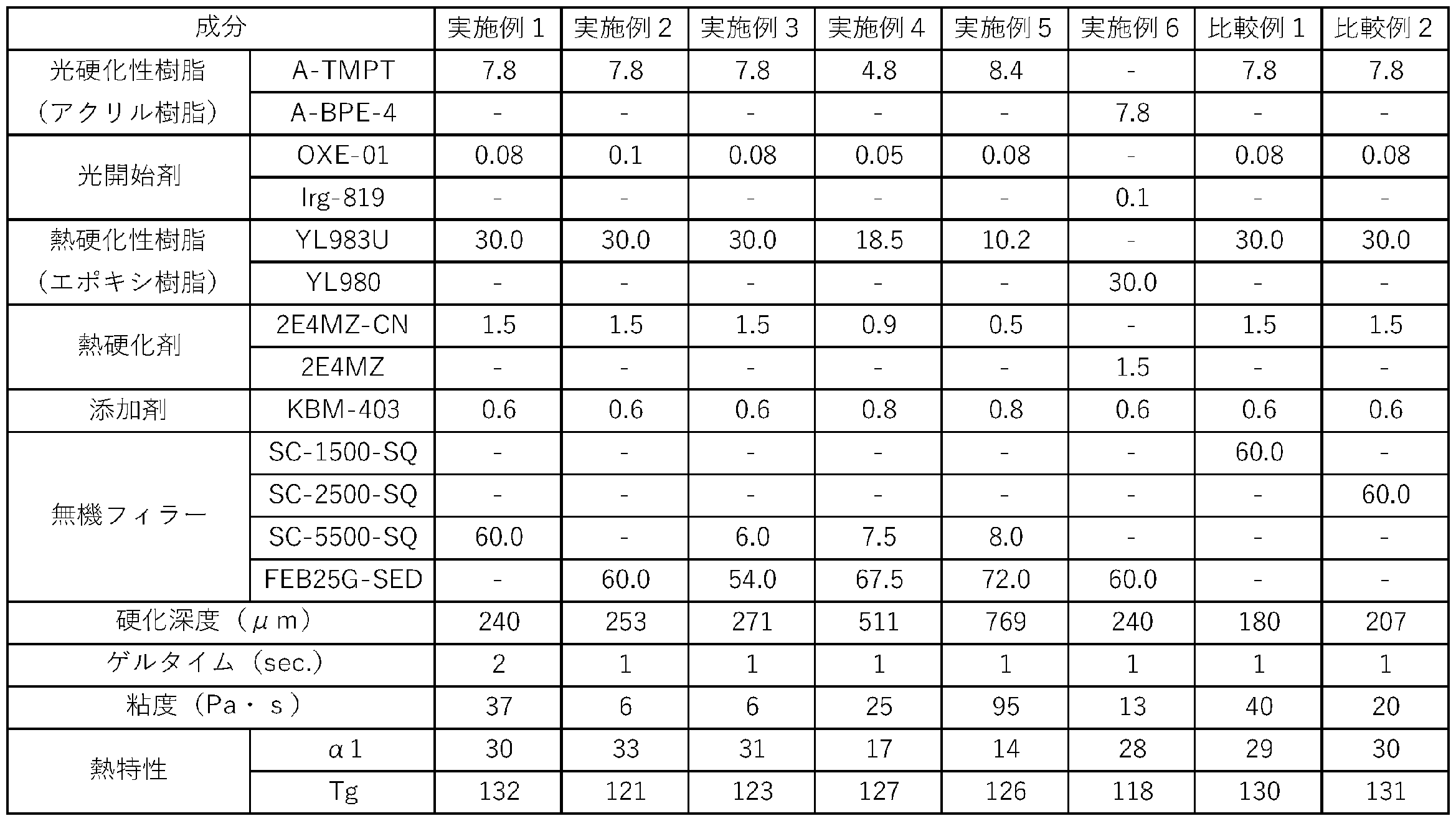
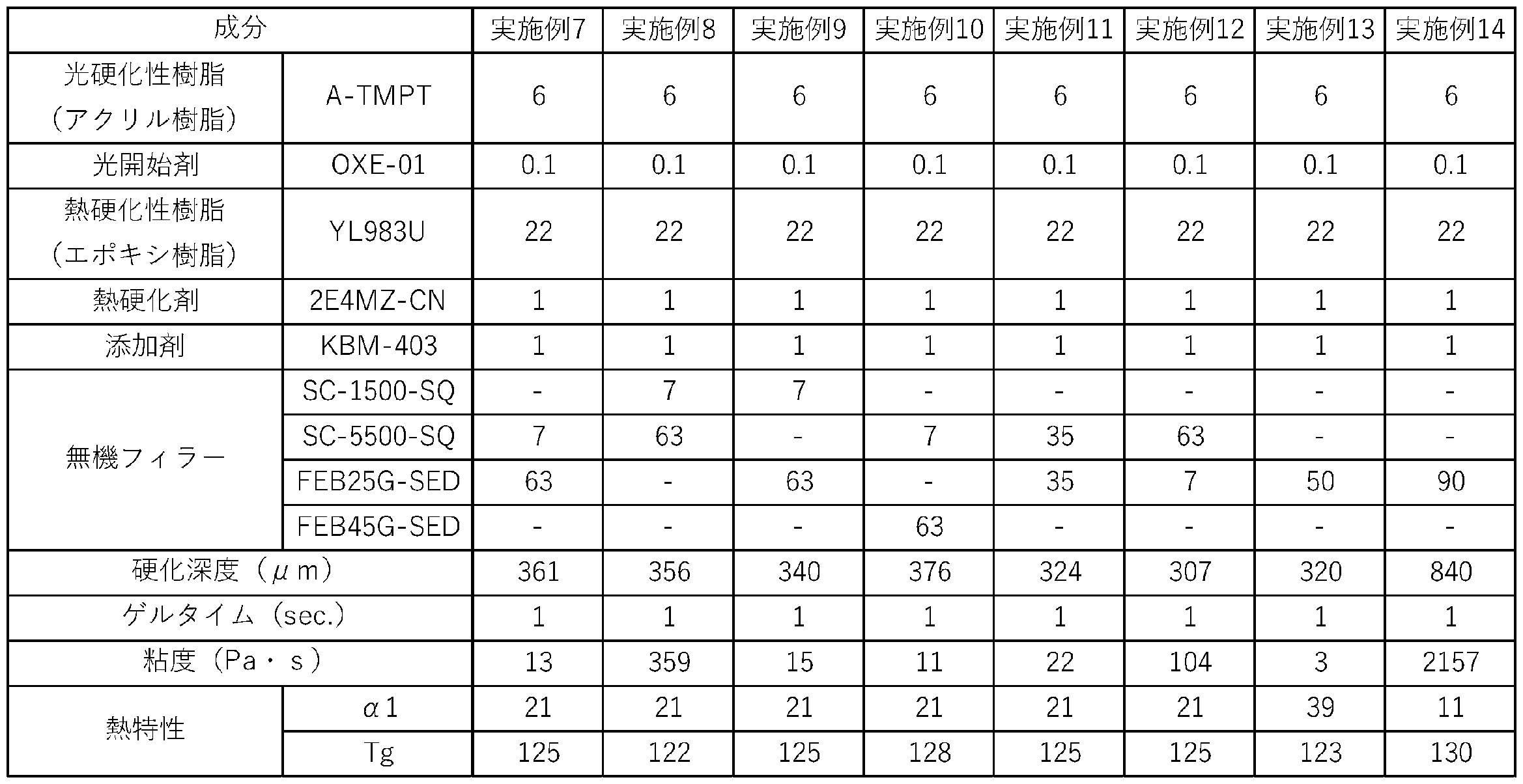
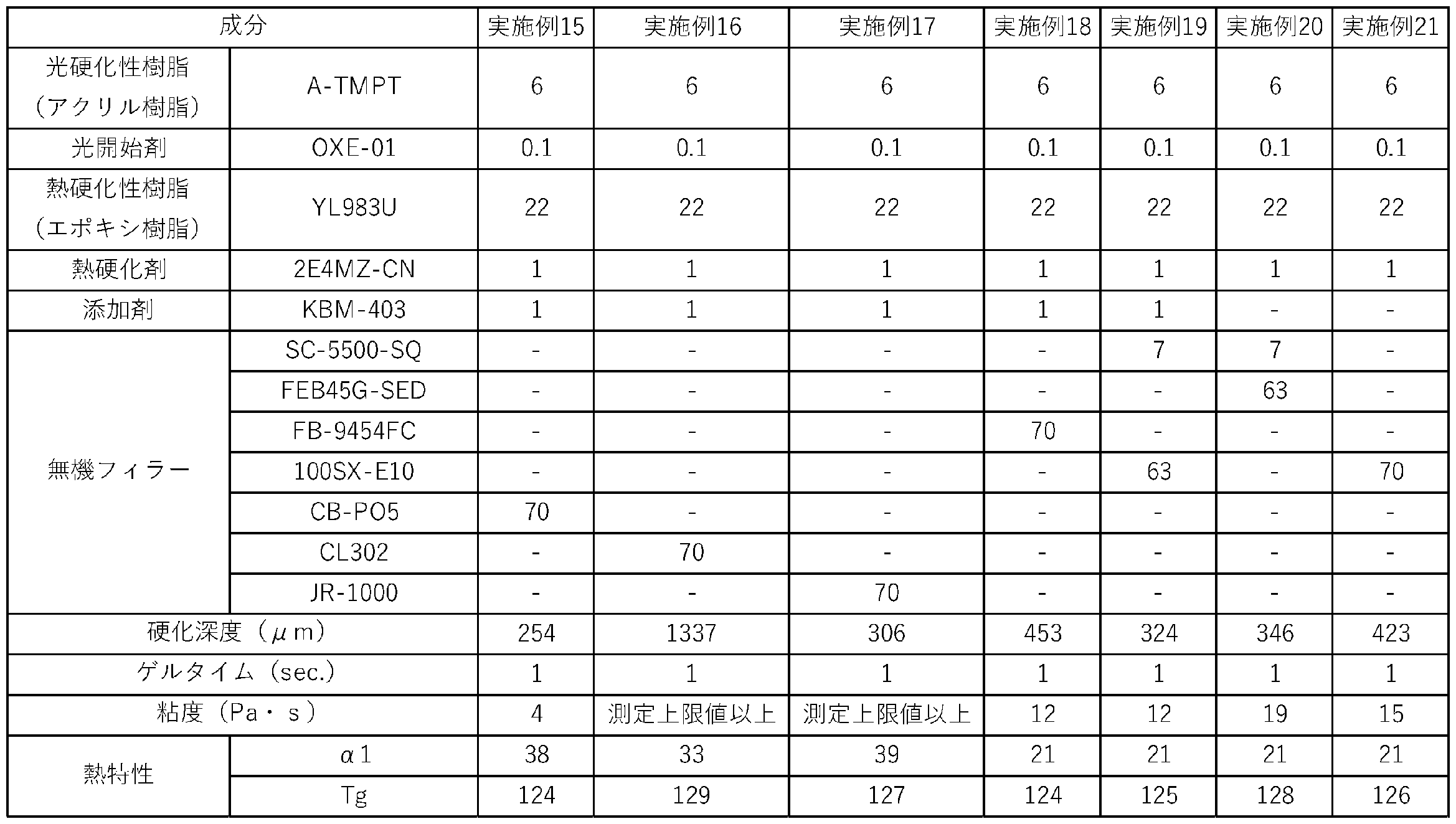
- Examples 2 to 21, Comparative Examples 1 to 2 A photosensitive liquid composition was obtained in the same manner as in Example 1 except that the blending amount of each component was changed to the amount shown in Tables 1 to 3.
- a fiber light source type LED spot UV irradiation device (manufactured by Ushio, Inc., trade name: Spot Cure SPL-2, irradiation wavelength: 365 nm) is fixed with a clamp so that the irradiation surface faces upward, and an illuminance meter (Ushio, Inc.) The height of the sample table was adjusted so as to have a predetermined irradiation intensity using UIT-20I).
- a 1.5 mm thick silicon rubber sheet with five ⁇ 10 mm holes is placed on a slide glass (manufactured by Matsunami Glass Ind.
- thermomechanical characteristics A 20 ⁇ 20 mm, 2 mm-thick silicone rubber sheet having a hole of ⁇ 8 mm was placed on an aluminum cup, and the photosensitive liquid composition was supplied to the hole of the silicone rubber sheet. Then, heating on a hot plate heated to 80 ° C. for 5 minutes and evacuation for 10 minutes were repeated until no bubbles appeared. After the bubbles disappear, the photosensitive liquid composition is irradiated with light for 30 seconds using a fiber light source type LED spot UV irradiation device (manufactured by Ushio, Inc., trade name: Spot Cure SPL-2, irradiation wavelength: 365 nm).
- a fiber light source type LED spot UV irradiation device manufactured by Ushio, Inc., trade name: Spot Cure SPL-2, irradiation wavelength: 365 nm.
- thermomechanical analyzer manufactured by Hitachi Chemical High-Tech Science Co., Ltd., trade name: TMA / SS-6000. It was measured under the measurement conditions of. The measurement results are shown in Tables 1 to 3.
Landscapes
- Chemical & Material Sciences (AREA)
- Health & Medical Sciences (AREA)
- Chemical Kinetics & Catalysis (AREA)
- Medicinal Chemistry (AREA)
- Polymers & Plastics (AREA)
- Organic Chemistry (AREA)
- Materials For Photolithography (AREA)
Abstract
本開示の一側面は、光硬化性樹脂、光開始剤、及び無機フィラーを含有し、無機フィラーが、平均粒子径1.0μm以上の無機フィラーを含む、感光性液状組成物である。
Description
本開示は、感光性液状組成物に関する。
従来、樹脂組成物に無機粒子等のフィラーを含有させることで、フィラー特有の性質(例えば、熱的性質、加工性)を付与する試みがなされている。例えば、下記特許文献1には、フェノール性末端基濃度を特定範囲に設定したポリカーボネートに非ガラス質フィラーを配合することで、耐衝撃性、耐熱性を損なうことなく、優れた成形加工性と、配合したフィラーの特性に応じた機能とが発揮されることが示されている。
ところで、樹脂組成物としては、例えば、光硬化性樹脂及び光開始剤を含有し、光を照射することにより硬化する感光性樹脂組成物が挙げられる。ここで、感光性樹脂組成物に上述したような性質を付与する目的で無機フィラーを含有させると、無機フィラーの大きさによっては、無機フィラーが照射した光を吸収して、樹脂組成物の深部(例えば、数百μm以上)まで硬化させることが困難であることがわかった。そのため、例えば、厚みのある成形体を形成する場合、深部の硬化が不十分になりやすいという問題がある。
そこで、本開示は、無機フィラーを含有しつつ、樹脂組成物の深部まで硬化させることが可能な感光性液状組成物を提供することを目的とする。
本開示の一側面は、光硬化性樹脂、光開始剤、及び無機フィラーを含有し、上記無機フィラーが、平均粒子径1.0μm以上の無機フィラーを含む、感光性液状組成物である。
上記平均粒子径1.0μm以上の無機フィラーは、シリカを含んでいてもよい。
上記無機フィラーは、第一の無機フィラーと、第二の無機フィラーと、を含んでいてもよい。
上記無機フィラーの含有量は、感光性液状組成物中の溶剤を除く全成分の質量を基準として60質量%以上であってよい。
本開示の一側面に係る感光性液状組成物は熱硬化性樹脂を更に含んでいてもよい。
本開示の一側面に係る感光性液状組成物は成形体形成用であってよい。
本開示によれば、無機フィラーを含有しつつ、樹脂組成物の深部まで硬化させることが可能な感光性液状組成物を提供することができる。
以下、本開示の実施形態について詳細に説明する。
<定義>
本明細書において、「~」を用いて示された数値範囲は、「~」の前後に記載される数値をそれぞれ最小値及び最大値として含む範囲を示す。「(メタ)アクリル酸」とは、「アクリル酸」、及び、それに対応する「メタクリル酸」の少なくとも一方を意味する。(メタ)アクリル樹脂等の他の類似表現についても同様である。
本明細書において、「~」を用いて示された数値範囲は、「~」の前後に記載される数値をそれぞれ最小値及び最大値として含む範囲を示す。「(メタ)アクリル酸」とは、「アクリル酸」、及び、それに対応する「メタクリル酸」の少なくとも一方を意味する。(メタ)アクリル樹脂等の他の類似表現についても同様である。
本明細書において組成物中の各成分の量は、組成物中に各成分に該当する物質が複数存在する場合には、特に断らない限り、組成物中に存在する当該複数の物質の合計量を意味する。本明細書において、「固形分」とは、感光性液状組成物において、揮発する物質(水、溶媒等)を除いた不揮発分を指す。すなわち、「固形分」とは、後述する感光性液状組成物の乾燥において揮発せずに残る溶媒以外の成分を指し、室温(25℃)で液状、水飴状又はワックス状のものも含む。
<感光性液状組成物>
本実施形態に係る感光性液状組成物は、光硬化性樹脂、光開始剤、及び無機フィラーを含有する。
本実施形態に係る感光性液状組成物は、光硬化性樹脂、光開始剤、及び無機フィラーを含有する。
(光硬化性樹脂)
本実施形態に係る感光性液状組成物は、硬化成分として光硬化性樹脂を含有する。光硬化性樹脂は、光照射によって硬化する樹脂成分であれば特に制限されず、例えば、ラジカル重合性化合物であってよい。ラジカル重合性化合物としては、(メタ)アクリル樹脂、マレイミド樹脂等が挙げられる。光硬化性樹脂は、1種単独、又は2種以上を組み合わせて用いてもよい。
本実施形態に係る感光性液状組成物は、硬化成分として光硬化性樹脂を含有する。光硬化性樹脂は、光照射によって硬化する樹脂成分であれば特に制限されず、例えば、ラジカル重合性化合物であってよい。ラジカル重合性化合物としては、(メタ)アクリル樹脂、マレイミド樹脂等が挙げられる。光硬化性樹脂は、1種単独、又は2種以上を組み合わせて用いてもよい。
(メタ)アクリル樹脂としては、ビスフェノールA型、ビスフェノールF型、ナフタレン型、フェノールノボラック型、クレゾールノボラック型、フェノールアラルキル型、ビフェニル型、トリフェニルメタン型、ジシクロペンタジエン型、フルオレン型、アダマンタン型又はイソシアヌル酸型の骨格を有する多官能(メタ)アクリル樹脂等が挙げられる。多官能(メタ)アクリル樹脂としては、ペンタエリスリトールトリ(メタ)アクリレート、ジペンタエリスリトールペンタ(メタ)アクリレート、トリメチロールプロパンジ(メタ)アクリレート等が挙げられる。
光硬化性樹脂が(メタ)アクリル樹脂を含む場合、(メタ)アクリル樹脂の含有量は、光硬化性樹脂の全質量を基準として、50質量%以上、80質量%以上、又は90質量%以上であってよく、実質的に100質量%であってよい。
光硬化性樹脂の含有量は、感光性液状組成物中の溶剤を除く全成分の質量(固形分の全質量)を基準として、1質量%以上、4質量%以上、又は5.5質量%以上であってよく、30質量%以下、20質量%以下、10質量%以下、又は8質量%以下であってよい。光硬化性樹脂が(メタ)アクリル樹脂を含む場合、(メタ)アクリル樹脂の含有量は、感光性液状組成物中の溶剤を除く全成分の質量を基準として、上記の範囲であってよい。
(光開始剤)
本実施形態に係る感光性液状組成物は、光開始剤を含有する。光開始剤は、光により分解して遊離ラジカル等を発生する化合物であり、ラジカル重合光開始剤及びカチオン重合光開始剤からなる群より選ばれる少なくとも一種を含むものであってよい。光開始剤としては、オキシムエステル構造、ビスイミダゾール構造、アクリジン構造、α-アミノアルキルフェノン構造、アミノベンゾフェノン構造、N-フェニルグリシン構造、アシルホスフィンオキサイド構造、ベンジルジメチルケタール構造、α-ヒドロキシアルキルフェノン構造等の構造を有する化合物等が挙げられる。光開始剤は、1種単独、又は2種以上を組み合わせて用いてもよい。
本実施形態に係る感光性液状組成物は、光開始剤を含有する。光開始剤は、光により分解して遊離ラジカル等を発生する化合物であり、ラジカル重合光開始剤及びカチオン重合光開始剤からなる群より選ばれる少なくとも一種を含むものであってよい。光開始剤としては、オキシムエステル構造、ビスイミダゾール構造、アクリジン構造、α-アミノアルキルフェノン構造、アミノベンゾフェノン構造、N-フェニルグリシン構造、アシルホスフィンオキサイド構造、ベンジルジメチルケタール構造、α-ヒドロキシアルキルフェノン構造等の構造を有する化合物等が挙げられる。光開始剤は、1種単独、又は2種以上を組み合わせて用いてもよい。
オキシムエステル構造を有する化合物としては、1-フェニル-1,2-ブタンジオン-2-(o-メトキシカルボニル)オキシム、1-フェニル-1,2-プロパンジオン-2-(o-メトキシカルボニル)オキシム、1-フェニル-1,2-プロパンジオン-2-(o-エトキシカルボニル)オキシム、1-フェニル-1,2-プロパンジオン-2-o-ベンゾイルオキシム、1,3-ジフェニルプロパントリオン-2-(o-エトキシカルボニル)オキシム、1-フェニル-3-エトキシプロパントリオン-2-(o-ベンゾイル)オキシム、1,2-オクタンジオン,1-[4-(フェニルチオ)フェニル-,2-(o-ベンゾイルオキシム)]、エタノン,1-[9-エチル-6-(2-メチルベンゾイル)-9H-カルバゾール-3-イル]-,1-(o-アセチルオキシム)等が挙げられる。
アシルホスフィンオキサイド構造を有する化合物としては、ビス(2,6-ジメトキシベンゾイル)-2,4,4-トリメチル-ペンチルホスフィンオキサイド、ビス(2,4,6,-トリメチルベンゾイル)-フェニルフォスフィンオキサイド、2,4,6-トリメチルベンゾイル-ジフェニルホスフィンオキサイド等が挙げられる。
光開始剤の含有量は、感光性液状組成物中の溶剤を除く全成分の質量(固形分の全質量)を基準として、0.01質量%以上、0.03質量%以上、又は0.05質量%以上であってよく、1質量%以下、0.5質量%以下、又は0.1質量%以下であってよい。
光開始剤の含有量は、光硬化性樹脂全量100質量部に対して、0.1質量部以上、0.5質量部以上、又は1質量部以上であってよく、10質量部以下、5質量部以下、又は3質量部以下であってよい。
(熱硬化性樹脂)
本実施形態に係る感光性液状組成物は、熱硬化性樹脂を更に含有してもよい。感光性液状樹脂組成物が熱硬化性樹脂を更に含有することで、例えば、熱機械特性が向上する。熱硬化性樹脂は、熱によって硬化する樹脂成分であれば特に制限されない。熱硬化性樹脂としては、エポキシ樹脂、オキセタン樹脂、メラミン樹脂、ポリエステル樹脂、シリコーン樹脂、ウレタン樹脂、ベンゾオキサジン樹脂、フェノール樹脂等が挙げられる。熱硬化性樹脂は、1種単独、又は2種以上を組み合わせて用いてもよい。
本実施形態に係る感光性液状組成物は、熱硬化性樹脂を更に含有してもよい。感光性液状樹脂組成物が熱硬化性樹脂を更に含有することで、例えば、熱機械特性が向上する。熱硬化性樹脂は、熱によって硬化する樹脂成分であれば特に制限されない。熱硬化性樹脂としては、エポキシ樹脂、オキセタン樹脂、メラミン樹脂、ポリエステル樹脂、シリコーン樹脂、ウレタン樹脂、ベンゾオキサジン樹脂、フェノール樹脂等が挙げられる。熱硬化性樹脂は、1種単独、又は2種以上を組み合わせて用いてもよい。
エポキシ樹脂としては、ビスフェノールA型エポキシ樹脂、ビスフェノールF型エポキシ樹脂、ナフタレン型エポキシ樹脂、フェノールノボラック型エポキシ樹脂、クレゾールノボラック型エポキシ樹脂、フェノールアラルキル型エポキシ樹脂、ビフェニル型エポキシ樹脂、トリフェニルメタン型エポキシ樹脂、ジシクロペンタジエン型エポキシ樹脂等の多官能エポキシ樹脂が挙げられる。
熱硬化性樹脂の含有量は、感光性液状組成物中の溶剤を除く全成分の質量(固形分の全質量)を基準として、1質量%以上、10質量%以上、又は20質量%以上であってよく、30質量%以下、又は25質量%以下であってよい。熱硬化性樹脂がエポキシ樹脂を含む場合、エポキシ樹脂の含有量は、感光性液状組成物中の溶剤を除く全成分の質量を基準として、上記の範囲であってよい。
熱硬化性樹脂の含有量は、光硬化性樹脂全量100質量部に対して、100質量部以上、200質量部以上、又は300質量部以上であってよく、500質量部以下、又は400質量部以下であってよい。
(熱硬化剤)
本実施形態に係る感光性液状組成物は、熱硬化剤を更に含有してもよい。熱硬化剤は、加熱により、熱硬化樹脂と反応する化合物である。エポキシ樹脂の熱硬化剤としては、酸無水物硬化剤、アミン硬化剤、フェノール硬化剤、ポリチオール硬化剤等が挙げられる。熱硬化剤は、1種単独、又は2種以上を組み合わせて用いてもよい。
本実施形態に係る感光性液状組成物は、熱硬化剤を更に含有してもよい。熱硬化剤は、加熱により、熱硬化樹脂と反応する化合物である。エポキシ樹脂の熱硬化剤としては、酸無水物硬化剤、アミン硬化剤、フェノール硬化剤、ポリチオール硬化剤等が挙げられる。熱硬化剤は、1種単独、又は2種以上を組み合わせて用いてもよい。
上記アミン硬化剤としては、2-メチルイミダゾール、2-エチル-4-メチルイミダゾール、1-シアノエチル-2-フェニルイミダゾール、1-シアノエチル-2-フェニルイミダゾリウムトリメリテート、2,4-ジアミノ-6-[2’-メチルイミダゾリル-(1’)]-エチル-s-トリアジン及び2,4-ジアミノ-6-[2’-メチルイミダゾリル-(1’)]-エチル-s-トリアジンイソシアヌル酸付加物等のイミダゾール化合物、ヘキサメチレンジアミン、オクタメチレンジアミン、デカメチレンジアミン、3,9-ビス(3-アミノプロピル)-2,4,8,10-テトラスピロ[5.5]ウンデカン、ビス(4-アミノシクロヘキシル)メタン、メタフェニレンジアミン及びジアミノジフェニルスルホン等のアミン化合物が挙げられる。
上記ポリチオール硬化剤としては、トリメチロールプロパントリス-3-メルカプトプロピオネート、ペンタエリスリトールテトラキス-3-メルカプトプロピオネート及びジペンタエリスリトールヘキサ-3-メルカプトプロピオネート等が挙げられる。
熱硬化剤の含有量は、感光性液状組成物中の溶剤を除く全成分の質量(固形分の全質量)を基準として、0.1質量%以上、0.3質量%以上、又は0.5質量%以上であってよく、10質量%以下、5質量%以下、3質量%以下、又は2質量%以下であってよい。
上述した光硬化性樹脂及び熱硬化性樹脂(以下、両者をまとめて硬化性樹脂ともいう。)は、液状、固形等であってよい。硬化性樹脂が固形である場合、液状の樹脂(硬化性樹脂)又は溶媒と混合することにより固形の硬化性樹脂を溶解させ、液状にして用いることができる。
(無機フィラー)
本実施形態に係る感光性液状組成物は、無機フィラーを含有し、無機フィラーは、平均粒子径1.0μm以上の無機フィラー(以下、無機フィラーAともいう。)を含む。無機フィラーAの平均粒子径は、1.3μm以上、1.5μm以上、3.0μm以上、5.0μm以上、8.0μm以上、10μm以上、12μm以上、14μm以上、16μm以上、又は18μm以上であってよく、50μm以下、40μm以下、30μm以下、又は20μm以下であってよい。無機フィラーの平均粒子径は、粒度分布計により測定することができる。
本実施形態に係る感光性液状組成物は、無機フィラーを含有し、無機フィラーは、平均粒子径1.0μm以上の無機フィラー(以下、無機フィラーAともいう。)を含む。無機フィラーAの平均粒子径は、1.3μm以上、1.5μm以上、3.0μm以上、5.0μm以上、8.0μm以上、10μm以上、12μm以上、14μm以上、16μm以上、又は18μm以上であってよく、50μm以下、40μm以下、30μm以下、又は20μm以下であってよい。無機フィラーの平均粒子径は、粒度分布計により測定することができる。
無機フィラーとしては、シリカ、アルミナ(Al2O3)、水酸化アルミニウム、酸化チタン等が挙げられる。無機フィラーは、感光性液状組成物の流動性が優れる観点から、シリカ、アルミナ、水酸化アルミニウム及び酸化チタンからなる群より選ばれる少なくとも一種を含んでよく、シリカを含んでよい。無機フィラーは、1種単独で、又は、2種以上を組み合わせて使用することができる。
シリカは、結晶性シリカ又は非結晶性シリカであってよく、粒子サイズ及び粒子形状を制御しやすい観点から、非結晶性シリカであってよい。
無機フィラーは、感光性液状組成物の流動性の観点から、表面処理された無機フィラーであってよい。また、無機フィラーがシリカを含む場合、シリカは、上記観点から、表面処理されたシリカであってよい。表面処理としては、エポキシシラン系、アミノシラン系、フェニルシラン系、フェニルアミノシラン系、アクリルシラン系、ビニルシラン系、シロキサン系等による表面処理が挙げられる。
無機フィラーは、感光性液状組成物の流動性が優れるとともに、無機フィラーの充填性がより向上する観点から、平均粒子径が異なる複数の無機フィラーを含んでよい。平均粒子径が異なる複数の無機フィラーを併用することにより、平均粒子径が大きい無機フィラー同士の隙間を、平均粒子径が小さい無機フィラーが埋めることができる。感光性液状組成物が、平均粒子径の異なる複数の無機フィラーを含むことは、例えば、感光性液状組成物に含まれる無機フィラーの粒子径分布を測定し、粒子径のピークが複数の粒子径において生じることにより確認できる。
無機フィラーは、感光性液状組成物の流動性が優れるとともに、無機フィラーの充填性がより向上する観点から、平均粒子径が1.0μm未満である無機フィラーを含んでもよい(以下、平均粒子径が1.0μm未満の無機フィラーを無機フィラーBともいう。)。後述の第二の無機フィラーが、無機フィラーBであってもよい。無機フィラーBの平均粒子径は、500nm以下、300nm以下、又は100nm以下であってよく、10nm以上、30nm以上、又は50nm以上であってよい。無機フィラーBは、シリカ、アルミナ(Al2O3)、水酸化アルミニウム、酸化チタン等であってよく、露光時の感度を高め、硬化深度がより大きくなる観点から、シリカを含んでよく、表面処理されたシリカを含んでよい。
無機フィラーは、感光性液状組成物の流動性が優れるとともに、無機フィラーの充填性がより向上する観点から、第一の無機フィラーと、第二の無機フィラーと、を含んでもよい。第一の無機フィラーの平均粒子径は、1.0μm以上であり、且つ、第二の無機フィラーの平均粒子径の5倍以上であってよい。第一の無機フィラーの平均粒子径は、上記観点から、第二の無機フィラーの平均粒子径の6倍以上、8倍以上、又は10倍以上であってよい。第一の無機フィラーの平均粒子径は、第二の無機フィラーの平均粒子径の30倍以下、20倍以下、15倍以下、10倍以下、又は8倍以下であってよい。複数の無機フィラーの平均粒子径の選択においては、例えば、Furnas式、鈴木式等に基づいて、複数の無機フィラーが最密充填になるような平均粒子径を選択することができる。
第一の無機フィラーの平均粒子径は、1.3μm以上、1.5μm以上、3.0μm以上、5.0μm以上、8.0μm以上、10μm以上、12μm以上、14μm以上、16μm以上、又は18μm以上であってよく、30μm以下、20μm以下、15μm以下、13μm以下、11μm以下、9.0μm以下、6.0μm以下、4.0μm以下、又は2.0μm以下であってよい。第二の無機フィラーの平均粒子径は、0.1μm以上、0.3μm以上、0.5μm以上、1.0μm以上、1.3μm以上、又は1.5μm以上であってよく、10μm未満、8.0μm以下、5.0μm以下、又は2.0μm以下であってよい。感光性液状組成物が、上記の平均粒子径を有する第一無機フィラー、及び上記の平均粒子径を有する第二の無機フィラーを含むことは、感光性液状組成物に含まれる無機フィラーの粒子径分布を測定し、ピークが上記の粒子径の範囲内において生じることにより確認できる。
第一の無機フィラー及び第二の無機フィラーは、それぞれ同じ成分であってよく、異なる成分であってよい。第一の無機フィラー及び第二の無機フィラーは、感光性液状組成物の流動性が優れる観点から、いずれもシリカであってよく、いずれも表面処理されたシリカであってよい。
無機フィラーが第一の無機フィラー及び第二の無機フィラーを含む場合、第一の無機フィラーの含有量は、熱機械特性が優れる観点から、感光性液状組成物に含まれる無機フィラーの全質量を基準として、50質量%以上、80質量%以上、又は90質量%以上であってよい。第一の無機フィラーの含有量は、感光性液状組成物に含まれる無機フィラーの全質量を基準として、50質量%以下、20質量%以下、又は10質量%以下であってよい。第二の無機フィラーの含有量は、感光性液状組成物に含まれる無機フィラーの全質量を基準として、上記の第一の無機フィラーの含有量の範囲と同様の範囲内であってよい。
無機フィラーが第一の無機フィラー及び第二の無機フィラーを含む場合、第一の無機フィラーの含有量は、感光性液状組成物の溶剤を除く全質量(固形分の全質量)を基準として、30質量%以上、40質量%以上、又は50質量%以上であってよい。第一の無機フィラーの含有量は、感光性液状組成物の溶剤を除く全質量(固形分の全質量)を基準として、20質量%以下、15質量%未満、又は10質量%未満であってよい。第二の無機フィラーの含有量は、感光性液状組成物の溶剤を除く全質量(固形分の全質量)を基準として、上記の第一の無機フィラーの含有量の範囲と同様の範囲内であってよい。
無機フィラーが第一の無機フィラー及び第二の無機フィラーを含む場合、第二の無機フィラーの含有量に対する第一の無機フィラーの含有量の比率(第一の無機フィラーの含有量/第二の無機フィラーの含有量)は、硬化深度がより大きくなる観点から、0.1以上、0.5以上、1以上、2以上、5以上、又は8以上であってよい。当該比率は、10以下、6以下、4以下、2以下、1以下、0.5以下、又は0.2以下であってよい。
無機フィラーの含有量(複数の無機フィラーを併用する場合は、その合計の含有量)は、感光性液状組成物の溶剤を除く全質量(固形分の全質量)を基準として、50質量%以上、60質量%以上、又は70質量%以上であってよい。無機フィラーの含有量は、感光性液状組成物の溶剤を除く全質量(固形分の全質量)を基準として、90質量%以下、85質量%以下、又は80質量%以下であってよい。これらの観点から、無機フィラーの含有量は、感光性液状組成物の溶剤を除く全質量(固形分の全質量)を基準として、50~90質量%であってよい。
無機フィラーの含有量は、露光時の感度を高め、硬化深度がより大きくなる観点から、硬化性樹脂全量(光硬化性樹脂と熱硬化性樹脂の合計量)100質量部に対して、100質量部以上、150質量部以上、200質量部以上、300質量部以上、又は400質量部以上であってよい。無機フィラーの含有量は、硬化性樹脂全量(光硬化性樹脂と熱硬化性樹脂の合計量)100質量部に対して、600質量部以下、又は500質量部以下であってよい。これらの観点から、無機フィラーの含有量は、硬化性樹脂全量(光硬化性樹脂と熱硬化性樹脂の合計量)100質量部に対して、100~600質量部であってよい。
(その他の成分)
本実施形態に係る感光性液状組成物は、他の添加剤を更に含有してもよい。他の添加剤としては、カップリング剤、染料、光発色剤、熱発色防止剤、可塑剤、顔料、消泡剤、難燃剤、安定剤、密着性付与剤、レベリング剤、剥離促進剤、酸化防止剤、香料、イメージング剤等が挙げられる。他の添加剤の含有量は、感光性液状組成物の溶剤を除く全質量(固形分の全質量)を基準として、0.01質量%以上、0.1質量%以上、又は0.5質量%以上であってよく、10質量%以下、又は1質量%以下であってよい。他の添加剤の含有量は、実質的に0質量%であってよい。
本実施形態に係る感光性液状組成物は、他の添加剤を更に含有してもよい。他の添加剤としては、カップリング剤、染料、光発色剤、熱発色防止剤、可塑剤、顔料、消泡剤、難燃剤、安定剤、密着性付与剤、レベリング剤、剥離促進剤、酸化防止剤、香料、イメージング剤等が挙げられる。他の添加剤の含有量は、感光性液状組成物の溶剤を除く全質量(固形分の全質量)を基準として、0.01質量%以上、0.1質量%以上、又は0.5質量%以上であってよく、10質量%以下、又は1質量%以下であってよい。他の添加剤の含有量は、実質的に0質量%であってよい。
本実施形態に係る感光性液状組成物の25℃での粘度は、流動性が優れる観点から、1000Pa・s以下、500Pa・s以下、300Pa・s以下、150Pa・s以下、100Pa・s以下、50Pa・s以下、又は30Pa・s以下であってよい。感光性液状組成物の粘度は実施例に記載の方法により測定することができる。
感光性液状組成物は、成形体の形成用に好適に用いることができる。成形体は、例えば、感光性液状組成物に光照射(波長365~405nm)して硬化させることにより形成することができる。光照射により硬化(1次硬化)した後に、更に加熱(例えば、100~200℃、1~8時間)して2次硬化させてもよい。
成形体は、その表面(光照射が可能な外表面)までの最短距離が200μm以上、220μm以上、又は、240μm以上である部位を有していてよい。このような、表面から遠い部位(深部)を有する成形体を形成する場合であっても、本実施形態の感光性液状組成物を用いることで、当該部位(深部)を十分に硬化させることができる。
以下、実施例により本開示を具体的に説明する。但し、本開示は下記の実施例のみに限定されるものではない。
<感光性液状組成物の調整>
実施例及び比較例の感光性液状組成物に使用した各成分の詳細を以下に示す。
(光硬化性樹脂)
・トリメチロールプロパントリアクリレート(新中村化学工業株式会社製、商品名:A-TMPT)
・2,2-ビス{4-(アクリロキシ・ジエトキシ)フェニル}プロパン(新中村化学株式会社製、商品名:A-BPE-4)
(光開始剤)
・1,2-オクタンジオン-1-[4-(フェニルチオ)フェニル]-2-(O-ベンゾイルオキシム)(BASF社製、商品名:OXE-01)
・ビス(2,4,6-トリメチルベンゾイル)-フェニルフォスフィンオキサイド(チバスペシャリティーケミカルズ株式会社製、商品名:Irg-819)
(熱硬化性樹脂)
・ビスフェノールF型エポキシ樹脂(三菱ケミカル株式会社製、商品名:YL983U)
・ビスフェノールA型エポキシ樹脂(三菱ケミカル株式会社製、商品名:YL980)
(熱硬化剤)
・2-エチル-4-メチルイミダゾール(四国化成工業株式会社製、商品名:2E4MZ)
・1-シアノエチル-2-エチル-4-メチルイミダゾール(四国化成工業株式会社製、商品名:2E4MZ-CN)
(添加剤)
・3-グリシドキシプロピルトリメトキシシラン(信越化学工業株式会社製、商品名:KBM-403、カップリング剤)
(無機フィラー)
・表面処理シリカフィラー(株式会社アドマテックス製、商品名:SC-1500-SQ、平均粒子径300nm)
・表面処理シリカフィラー(株式会社アドマテックス製、商品名:SC-2500-SQ、平均粒子径500nm)
・表面処理シリカフィラー(株式会社アドマテックス製、商品名:SC-5500-SQ、平均粒子径1.5μm)
・表面処理シリカフィラー(株式会社アドマテックス製、商品名:FEB25G-SED、平均粒子径8μm)
・表面処理シリカフィラー(株式会社アドマテックス製、商品名:FEB45G-SED、平均粒子径14μm)
・表面未処理シリカフィラー(デンカ株式会社製、商品名:FB-9454FC、平均粒子径18μm)
・表面未処理シリカフィラー(株式会社アドマテックス製、商品名:100SX-E10、平均粒子径8μm)
・アルミナフィラー(昭和電工株式会社製、商品名:CB-PO5、平均粒子径4μm)
・水酸化アルミニウムフィラー(住友化学株式会社製、商品名:CL302、平均粒子径2.4μm)
・酸化チタンフィラー(テイカ株式会社製、商品名:JR-1000、平均粒子径1μm)
実施例及び比較例の感光性液状組成物に使用した各成分の詳細を以下に示す。
(光硬化性樹脂)
・トリメチロールプロパントリアクリレート(新中村化学工業株式会社製、商品名:A-TMPT)
・2,2-ビス{4-(アクリロキシ・ジエトキシ)フェニル}プロパン(新中村化学株式会社製、商品名:A-BPE-4)
(光開始剤)
・1,2-オクタンジオン-1-[4-(フェニルチオ)フェニル]-2-(O-ベンゾイルオキシム)(BASF社製、商品名:OXE-01)
・ビス(2,4,6-トリメチルベンゾイル)-フェニルフォスフィンオキサイド(チバスペシャリティーケミカルズ株式会社製、商品名:Irg-819)
(熱硬化性樹脂)
・ビスフェノールF型エポキシ樹脂(三菱ケミカル株式会社製、商品名:YL983U)
・ビスフェノールA型エポキシ樹脂(三菱ケミカル株式会社製、商品名:YL980)
(熱硬化剤)
・2-エチル-4-メチルイミダゾール(四国化成工業株式会社製、商品名:2E4MZ)
・1-シアノエチル-2-エチル-4-メチルイミダゾール(四国化成工業株式会社製、商品名:2E4MZ-CN)
(添加剤)
・3-グリシドキシプロピルトリメトキシシラン(信越化学工業株式会社製、商品名:KBM-403、カップリング剤)
(無機フィラー)
・表面処理シリカフィラー(株式会社アドマテックス製、商品名:SC-1500-SQ、平均粒子径300nm)
・表面処理シリカフィラー(株式会社アドマテックス製、商品名:SC-2500-SQ、平均粒子径500nm)
・表面処理シリカフィラー(株式会社アドマテックス製、商品名:SC-5500-SQ、平均粒子径1.5μm)
・表面処理シリカフィラー(株式会社アドマテックス製、商品名:FEB25G-SED、平均粒子径8μm)
・表面処理シリカフィラー(株式会社アドマテックス製、商品名:FEB45G-SED、平均粒子径14μm)
・表面未処理シリカフィラー(デンカ株式会社製、商品名:FB-9454FC、平均粒子径18μm)
・表面未処理シリカフィラー(株式会社アドマテックス製、商品名:100SX-E10、平均粒子径8μm)
・アルミナフィラー(昭和電工株式会社製、商品名:CB-PO5、平均粒子径4μm)
・水酸化アルミニウムフィラー(住友化学株式会社製、商品名:CL302、平均粒子径2.4μm)
・酸化チタンフィラー(テイカ株式会社製、商品名:JR-1000、平均粒子径1μm)
(実施例1)
表1に示す配合量(質量部)の光硬化性樹脂と光開始剤とを遮光容器内で、50℃で1時間撹拌し、混合液1とした。表1に示す配合量の1/3の量の熱硬化性樹脂と、同表に示す配合量の熱硬化剤とを50mL容器(商品名:アイボーイ)に入れ、自転公転式撹拌機(シンキー株式会社製、商品名:あわとり錬太郎)を使用して、2000rpmで3分間撹拌した後、2200rpmで2分間振動脱泡させて、混合液2とした。表1に示す配合量の無機フィラーを50mL容器(商品名:アイボーイ)に入れ、更に同表の配合量の添加剤を滴下して、5分間混合した。その後、室温(25℃)に戻した混合液1及び混合液2を無機フィラーが入った容器に加え、同表に示す配合量の2/3の量の熱硬化性樹脂を更に加えた後、上記の自転公転式撹拌機を使用して2000rpmで10分間撹拌した後、2200rpmで5分間振動脱泡して、感光性液状組成物を得た。
表1に示す配合量(質量部)の光硬化性樹脂と光開始剤とを遮光容器内で、50℃で1時間撹拌し、混合液1とした。表1に示す配合量の1/3の量の熱硬化性樹脂と、同表に示す配合量の熱硬化剤とを50mL容器(商品名:アイボーイ)に入れ、自転公転式撹拌機(シンキー株式会社製、商品名:あわとり錬太郎)を使用して、2000rpmで3分間撹拌した後、2200rpmで2分間振動脱泡させて、混合液2とした。表1に示す配合量の無機フィラーを50mL容器(商品名:アイボーイ)に入れ、更に同表の配合量の添加剤を滴下して、5分間混合した。その後、室温(25℃)に戻した混合液1及び混合液2を無機フィラーが入った容器に加え、同表に示す配合量の2/3の量の熱硬化性樹脂を更に加えた後、上記の自転公転式撹拌機を使用して2000rpmで10分間撹拌した後、2200rpmで5分間振動脱泡して、感光性液状組成物を得た。
(実施例2~21、比較例1~2)
各成分の配合量を表1~3に示す量に変更したこと以外は実施例1と同様にして、感光性液状組成物を得た。
各成分の配合量を表1~3に示す量に変更したこと以外は実施例1と同様にして、感光性液状組成物を得た。
<硬化深度の測定>
ファイバー光源式LEDスポットUV照射装置(ウシオ電機株式会社製、商品名:スポットキュアSPL-2、照射波長:365nm)を照射面が上向きになるようクランプで固定し、照度計(ウシオ電機株式会社社製、商品名:UIT-20I)を用いて既定の照射強度になるようにサンプル台の高さを調整した。スライドガラス(松浪硝子工業株式会社製、商品名:S9213、76×52mmm、厚さ1.3)の上に、φ10mmの穴を5つ有する厚さ1.5mmのシリコンゴムシートを載せ、各穴に調整した感光性液状組成物を表面張力が発現するまで供給した。各穴に入れた感光性液状組成物に5秒間10mW/cm2で露光して硬化させた後、シリコンゴムシートを取り外し、硬化していない感光性液状組成物をふき取った。各穴の硬化後の感光性液状組成物の厚さを測定し、厚さの平均値を硬化深度とした。測定結果を表1~3に示す。
ファイバー光源式LEDスポットUV照射装置(ウシオ電機株式会社製、商品名:スポットキュアSPL-2、照射波長:365nm)を照射面が上向きになるようクランプで固定し、照度計(ウシオ電機株式会社社製、商品名:UIT-20I)を用いて既定の照射強度になるようにサンプル台の高さを調整した。スライドガラス(松浪硝子工業株式会社製、商品名:S9213、76×52mmm、厚さ1.3)の上に、φ10mmの穴を5つ有する厚さ1.5mmのシリコンゴムシートを載せ、各穴に調整した感光性液状組成物を表面張力が発現するまで供給した。各穴に入れた感光性液状組成物に5秒間10mW/cm2で露光して硬化させた後、シリコンゴムシートを取り外し、硬化していない感光性液状組成物をふき取った。各穴の硬化後の感光性液状組成物の厚さを測定し、厚さの平均値を硬化深度とした。測定結果を表1~3に示す。
<粘度の測定>
感光性液状組成物の25℃での粘度をフォトレオメーター(Anton Paar社製、商品名:MCR301)を用いて下記の測定条件で測定した。ステージ上に感光性液状組成物を供給し、その上にボイドが入らないようにφ12mmの平行なプレートを設置して、ステージとプレートとのギャップを100μmとして、室温(25℃)環境下で粘度を測定した。測定結果を表1~3に示す。
・測定モード:振動モード
・周波数:1Hz
・ノーマルフォース:0.01N
・ステイン:1%
感光性液状組成物の25℃での粘度をフォトレオメーター(Anton Paar社製、商品名:MCR301)を用いて下記の測定条件で測定した。ステージ上に感光性液状組成物を供給し、その上にボイドが入らないようにφ12mmの平行なプレートを設置して、ステージとプレートとのギャップを100μmとして、室温(25℃)環境下で粘度を測定した。測定結果を表1~3に示す。
・測定モード:振動モード
・周波数:1Hz
・ノーマルフォース:0.01N
・ステイン:1%
<熱機械特性の測定>
φ8mmの穴を有する20×20mm、厚さ2mmのシリコンゴムシートをアルミカップに載せて、シリコンゴムシートの穴に感光性液状組成物を供給した。その後、80℃に熱したホットプレートで5分間の加熱と、10分間の真空引きを気泡が出なくなるまで繰り返し行った。気泡が出なくなった後、ファイバー光源式LEDスポットUV照射装置(ウシオ電機株式会社製、商品名:スポットキュアSPL-2、照射波長:365nm)を用いて、感光性液状組成物に30秒間光照射(光量800mW/cm2)して、130℃のオーブン内で1時間加熱した。加熱後、感光性液状組成物の硬化物の底面と上面が平行になるよう、1000番のやすりで研磨し、熱特性測定用サンプルとした。得られた熱測定用サンプルのガラス転移温度(Tg)及び熱膨張係数CTE(α1)を熱機械分析装置(株式会社日立化成ハイテクサイエンス社製、商品名:TMA/SS-6000)を用いて下記の測定条件で測定した。測定結果を表1~3に示す。
・サンプルサイズ:φ8mm×高さ2mm
・測定モード:圧縮モード
・荷重:1gF
・1stRan:測定範囲 室温(25℃)~220℃、昇温速度 20℃/min
・2ndRan:測定範囲 0~220℃、昇温速度 5℃/min
・CTE(α1)計算範囲:40~50℃
φ8mmの穴を有する20×20mm、厚さ2mmのシリコンゴムシートをアルミカップに載せて、シリコンゴムシートの穴に感光性液状組成物を供給した。その後、80℃に熱したホットプレートで5分間の加熱と、10分間の真空引きを気泡が出なくなるまで繰り返し行った。気泡が出なくなった後、ファイバー光源式LEDスポットUV照射装置(ウシオ電機株式会社製、商品名:スポットキュアSPL-2、照射波長:365nm)を用いて、感光性液状組成物に30秒間光照射(光量800mW/cm2)して、130℃のオーブン内で1時間加熱した。加熱後、感光性液状組成物の硬化物の底面と上面が平行になるよう、1000番のやすりで研磨し、熱特性測定用サンプルとした。得られた熱測定用サンプルのガラス転移温度(Tg)及び熱膨張係数CTE(α1)を熱機械分析装置(株式会社日立化成ハイテクサイエンス社製、商品名:TMA/SS-6000)を用いて下記の測定条件で測定した。測定結果を表1~3に示す。
・サンプルサイズ:φ8mm×高さ2mm
・測定モード:圧縮モード
・荷重:1gF
・1stRan:測定範囲 室温(25℃)~220℃、昇温速度 20℃/min
・2ndRan:測定範囲 0~220℃、昇温速度 5℃/min
・CTE(α1)計算範囲:40~50℃
Claims (6)
- 光硬化性樹脂、光開始剤、及び無機フィラーを含有し、
前記無機フィラーが、平均粒子径1.0μm以上の無機フィラーを含む、感光性液状組成物。 - 前記平均粒子径1.0μm以上の無機フィラーがシリカを含む、請求項1に記載の感光性液状組成物。
- 前記無機フィラーが、第一の無機フィラーと、第二の無機フィラーと、を含み、
前記第一の無機フィラーの平均粒子径が、1.0μm以上であり、且つ、前記第二の無機フィラーの平均粒子径の5倍以上である、請求項1又は2に記載の感光性液状組成物。 - 前記無機フィラーの含有量が、感光性液状組成物中の溶剤を除く全成分の質量を基準として60質量%以上である、請求項1~3のいずれか一項に記載の感光性液状組成物。
- 熱硬化性樹脂を更に含む、請求項1~4のいずれか一項に記載の感光性液状組成物。
- 成形体形成用である、請求項1~5のいずれか一項に記載の感光性液状組成物。
Priority Applications (1)
| Application Number | Priority Date | Filing Date | Title |
|---|---|---|---|
| JP2022538040A JPWO2022019328A1 (ja) | 2020-07-22 | 2021-07-21 |
Applications Claiming Priority (2)
| Application Number | Priority Date | Filing Date | Title |
|---|---|---|---|
| JP2020125697 | 2020-07-22 | ||
| JP2020-125697 | 2020-07-22 |
Publications (1)
| Publication Number | Publication Date |
|---|---|
| WO2022019328A1 true WO2022019328A1 (ja) | 2022-01-27 |
Family
ID=79729166
Family Applications (1)
| Application Number | Title | Priority Date | Filing Date |
|---|---|---|---|
| PCT/JP2021/027315 Ceased WO2022019328A1 (ja) | 2020-07-22 | 2021-07-21 | 感光性液状組成物 |
Country Status (3)
| Country | Link |
|---|---|
| JP (1) | JPWO2022019328A1 (ja) |
| TW (1) | TW202214763A (ja) |
| WO (1) | WO2022019328A1 (ja) |
Citations (5)
| Publication number | Priority date | Publication date | Assignee | Title |
|---|---|---|---|---|
| JP2000053714A (ja) * | 1998-08-05 | 2000-02-22 | Three Bond Co Ltd | 点字形成用光硬化性樹脂組成物 |
| JP2014074774A (ja) * | 2012-10-03 | 2014-04-24 | Hitachi Chemical Co Ltd | 感光性樹脂組成物、感光性フィルム及びそれらを用いた部品内蔵基板 |
| JP2017194644A (ja) * | 2016-04-22 | 2017-10-26 | パナソニックIpマネジメント株式会社 | ソルダーレジスト用樹脂組成物、ソルダーレジスト用フィルム、ソルダーレジスト層付き回路基板及びパッケージ |
| WO2019009124A1 (ja) * | 2017-07-07 | 2019-01-10 | タツタ電線株式会社 | 導電性樹脂組成物及びそれを用いたシールドパッケージの製造方法 |
| JP2020047654A (ja) * | 2018-09-14 | 2020-03-26 | 太陽インキ製造株式会社 | 硬化性樹脂組成物、ドライフィルム、硬化物およびプリント配線板 |
Family Cites Families (2)
| Publication number | Priority date | Publication date | Assignee | Title |
|---|---|---|---|---|
| JP4460968B2 (ja) * | 2004-07-27 | 2010-05-12 | 株式会社アドマテックス | 樹脂組成物の製造方法 |
| JP5455144B2 (ja) * | 2009-03-31 | 2014-03-26 | 日本製紙株式会社 | 防眩ハードコートフィルム |
-
2021
- 2021-07-21 JP JP2022538040A patent/JPWO2022019328A1/ja active Pending
- 2021-07-21 TW TW110126829A patent/TW202214763A/zh unknown
- 2021-07-21 WO PCT/JP2021/027315 patent/WO2022019328A1/ja not_active Ceased
Patent Citations (5)
| Publication number | Priority date | Publication date | Assignee | Title |
|---|---|---|---|---|
| JP2000053714A (ja) * | 1998-08-05 | 2000-02-22 | Three Bond Co Ltd | 点字形成用光硬化性樹脂組成物 |
| JP2014074774A (ja) * | 2012-10-03 | 2014-04-24 | Hitachi Chemical Co Ltd | 感光性樹脂組成物、感光性フィルム及びそれらを用いた部品内蔵基板 |
| JP2017194644A (ja) * | 2016-04-22 | 2017-10-26 | パナソニックIpマネジメント株式会社 | ソルダーレジスト用樹脂組成物、ソルダーレジスト用フィルム、ソルダーレジスト層付き回路基板及びパッケージ |
| WO2019009124A1 (ja) * | 2017-07-07 | 2019-01-10 | タツタ電線株式会社 | 導電性樹脂組成物及びそれを用いたシールドパッケージの製造方法 |
| JP2020047654A (ja) * | 2018-09-14 | 2020-03-26 | 太陽インキ製造株式会社 | 硬化性樹脂組成物、ドライフィルム、硬化物およびプリント配線板 |
Also Published As
| Publication number | Publication date |
|---|---|
| JPWO2022019328A1 (ja) | 2022-01-27 |
| TW202214763A (zh) | 2022-04-16 |
Similar Documents
| Publication | Publication Date | Title |
|---|---|---|
| JP7345429B2 (ja) | 感光性樹脂組成物、感光性フィルム、多層プリント配線板、半導体装置、及び、多層プリント配線板の製造方法 | |
| CN1293116C (zh) | 形成消光涂膜用的光固化性·热固化性组合物 | |
| TWI529489B (zh) | 光固化性及熱固性樹脂組成物、其製造之防焊乾膜及包含該防焊乾膜之電路板 | |
| TWI745366B (zh) | 硬化性樹脂組成物、乾膜、硬化物及印刷配線板 | |
| KR100877342B1 (ko) | 인쇄회로기판용 난연성 수지 조성물, 이를 이용한 인쇄회로기판 및 그 제조방법 | |
| JP5532384B2 (ja) | Si系樹脂配合硬化性樹脂組成物 | |
| JP6162775B2 (ja) | 光硬化性および熱硬化性を有する樹脂組成物と、ドライフィルムソルダレジスト | |
| CN104380196B (zh) | 光固化和热固性树脂组合物、由其制备的阻焊干膜及包含所述阻焊干膜的电路板 | |
| CN107531815B (zh) | 固化性组合物及电子部件的制造方法 | |
| JP2018533652A (ja) | 光硬化性および熱硬化性を有する樹脂組成物およびドライフィルムソルダーレジスト | |
| US20090087775A1 (en) | Inorganic filler and organic filler-containing curable resin composition, resist film coated printed wiring board, and method for producing the same | |
| JP6856489B2 (ja) | インダクタ用接着剤及びインダクタ | |
| CN107203095B (zh) | 一种白色碱可溶感光性组合物及其制备方法与应用 | |
| JP7596091B2 (ja) | 樹脂材料及び多層プリント配線板 | |
| JP2022122992A (ja) | 樹脂組成物及びインダクタ | |
| CN115362184A (zh) | 固化性组合物、固化物和电子部件 | |
| JP5940828B2 (ja) | インクジェット用硬化性組成物及び電子部品の製造方法 | |
| KR20070103204A (ko) | 우수한 열전도도를 갖는 광경화성 수지 조성물 | |
| WO2022019328A1 (ja) | 感光性液状組成物 | |
| TWI814970B (zh) | 硬化性樹脂組成物、乾膜、硬化物及電子零件 | |
| TW202202940A (zh) | 硬化性樹脂組成物、硬化物、及印刷配線板 | |
| WO2019189171A1 (ja) | 放熱絶縁性樹脂組成物、及びそれを用いたプリント配線板 | |
| JP6445816B2 (ja) | 配線板の製造方法、絶縁フィルム及び配線板用絶縁フィルム | |
| WO2025105091A1 (ja) | 感光性樹脂組成物、成形体及びその製造方法、並びに電子デバイス | |
| JP2014240468A (ja) | インクジェット用硬化性組成物、硬化物及び電子部品の製造方法 |
Legal Events
| Date | Code | Title | Description |
|---|---|---|---|
| 121 | Ep: the epo has been informed by wipo that ep was designated in this application |
Ref document number: 21847075 Country of ref document: EP Kind code of ref document: A1 |
|
| ENP | Entry into the national phase |
Ref document number: 2022538040 Country of ref document: JP Kind code of ref document: A |
|
| NENP | Non-entry into the national phase |
Ref country code: DE |
|
| 122 | Ep: pct application non-entry in european phase |
Ref document number: 21847075 Country of ref document: EP Kind code of ref document: A1 |