WO2022018919A1 - エマルジョン組成物および土壌流出防止材 - Google Patents
エマルジョン組成物および土壌流出防止材 Download PDFInfo
- Publication number
- WO2022018919A1 WO2022018919A1 PCT/JP2021/016043 JP2021016043W WO2022018919A1 WO 2022018919 A1 WO2022018919 A1 WO 2022018919A1 JP 2021016043 W JP2021016043 W JP 2021016043W WO 2022018919 A1 WO2022018919 A1 WO 2022018919A1
- Authority
- WO
- WIPO (PCT)
- Prior art keywords
- emulsion
- emulsion composition
- vinyl acetate
- mass
- water
- Prior art date
- Legal status (The legal status is an assumption and is not a legal conclusion. Google has not performed a legal analysis and makes no representation as to the accuracy of the status listed.)
- Ceased
Links
Images

Classifications
-
- C—CHEMISTRY; METALLURGY
- C09—DYES; PAINTS; POLISHES; NATURAL RESINS; ADHESIVES; COMPOSITIONS NOT OTHERWISE PROVIDED FOR; APPLICATIONS OF MATERIALS NOT OTHERWISE PROVIDED FOR
- C09K—MATERIALS FOR MISCELLANEOUS APPLICATIONS, NOT PROVIDED FOR ELSEWHERE
- C09K17/00—Soil-conditioning materials or soil-stabilising materials
- C09K17/14—Soil-conditioning materials or soil-stabilising materials containing organic compounds only
- C09K17/18—Prepolymers; Macromolecular compounds
-
- C—CHEMISTRY; METALLURGY
- C09—DYES; PAINTS; POLISHES; NATURAL RESINS; ADHESIVES; COMPOSITIONS NOT OTHERWISE PROVIDED FOR; APPLICATIONS OF MATERIALS NOT OTHERWISE PROVIDED FOR
- C09K—MATERIALS FOR MISCELLANEOUS APPLICATIONS, NOT PROVIDED FOR ELSEWHERE
- C09K17/00—Soil-conditioning materials or soil-stabilising materials
- C09K17/14—Soil-conditioning materials or soil-stabilising materials containing organic compounds only
- C09K17/18—Prepolymers; Macromolecular compounds
- C09K17/20—Vinyl polymers
Definitions
- the present invention relates to an emulsion composition and a soil erosion inhibitor.
- it relates to a soil erosion preventive material that prevents soil erosion.
- plants other than the target crop are generally treated as weeds, so there are many places where the ground surface is exposed.
- soil erosion and soil erosion such as the surface soil being eroded by rainfall and the like, and the surface soil flowing at the same time as rainwater.
- a water-soluble emulsion obtained by copolymerizing a vinyl-based monomer such as an acrylic acid ester or ethylene that can be copolymerized with vinyl acetate has been used (see, for example, Patent Document 1).
- the strength may be insufficient or the flexibility may be lost, and the soil erosion prevention effect may be reduced.
- the present invention has been made in view of such a problem, and provides a soil erosion preventive material having high soil erosion prevention property and improved strength and flexibility in a well-balanced manner in agricultural land.
- the present invention is as follows.
- the minimum film-forming temperature of the emulsion composition is ⁇ 5 ° C. to 10 ° C.
- the minimum film-forming temperature is the minimum film-forming temperature of a SUS304 plate having a mirror surface treatment of 2.0 mm ⁇ 50 mm ⁇ 125 mm.
- the emulsion composition was applied to the SUS plate so as to have a coating thickness of 0.2 mm, and the SUS plate coated with the emulsion composition was allowed to stand at the minimum film forming temperature for 3 hours.
- Emulsion composition which is the lowest temperature at which film formation is confirmed when placed.
- (2) The emulsion composition according to (1) which comprises a water-soluble resin emulsion and a water-soluble polymer.
- the ethylene-vinyl acetate copolymer contained in the ethylene-vinyl acetate copolymer emulsion has 5 to 35% by mass of an ethylene monomer unit and 65 to 95% by mass of a vinyl acetate monomer unit.
- the emulsion according to (4) or (5) which contains 20 to 80 parts by mass of the ethylene-vinyl acetate copolymer emulsion, 0 to 20 parts by mass of polyvinyl alcohol, and 20 to 80 parts by mass of water.
- Composition (7)
- FIG. 1A It is a figure which shows the film-forming state at ⁇ 7 ° C. (FIG. 1A) and -3 ° C. (FIG. 1B) in the measurement of the minimum film-forming temperature of the emulsion composition M1, respectively.
- the emulsion composition of the present invention has a minimum film-forming temperature of ⁇ 5 ° C. to 10 ° C., and a minimum film-forming temperature is 3 at the minimum film-forming temperature of a SUS plate adjusted to a size of 2.0 mm ⁇ 50 mm ⁇ 125 mm. After allowing to stand for a while, the emulsion composition is applied to the SUS plate so as to have a coating thickness of 0.2 mm, and the SUS plate coated with the emulsion composition is allowed to stand at the minimum film forming temperature for 3 hours to form a film. The lowest temperature that can be confirmed, the emulsion composition. More specifically, the minimum film forming temperature is determined by the following method.
- a SUS plate (mirror-treated SUS304 size: 2.0 ⁇ 50 ⁇ 125 mm) is allowed to stand at a temperature of T ° C. for 3 hours.
- the emulsion composition is applied to a temperature-adjusted SUS plate so that the coating thickness is 0.2 mm.
- the SUS plate coated with the emulsion composition is allowed to stand for 3 hours under the condition of a temperature of T ° C.
- Confirm the presence or absence of film formation (5) If the film is not formed, the same procedure is repeated under the condition that the temperature T is raised by 1 ° C. to confirm the film formation. That is, the lowest film-forming temperature is the temperature at which film-forming is confirmed for the first time by increasing the temperature.
- the temperature T is, for example, ⁇ 10 ° C. to 10 ° C.
- the minimum film formation temperature is determined by increasing the temperature T by 1 ° C.
- the temperature T can be increased by a temperature break of less than 1 ° C.
- the minimum film-forming temperature is the lowest temperature at which film-forming is confirmed by the above method, but can be rephrased as the lowest temperature at which the water-soluble resin emulsion contained in the emulsion composition forms a continuous film. If the minimum film-forming temperature is less than ⁇ 5 ° C., the strength of the film formed by the water-soluble resin emulsion is reduced and the soil erosion prevention effect is reduced. On the other hand, when the minimum film-forming temperature exceeds 10 ° C., the film formed by the water-soluble resin emulsion loses its flexibility, and it becomes difficult to form a film in cold regions.
- the minimum film forming temperature is, for example, -5, -4, -3, -2, -1, 0, 1, 2, 3, 4, 5, 6, 7, 8, 9, 10 ° C. Yes, it may be within the range between any two of the numerical values exemplified here.
- the film formation temperature is preferably low, and the minimum film formation temperature is preferably ⁇ 5 ° C. or higher and lower than 0 ° C. On the other hand, from the viewpoint of film strength and suppression of outflow, it is preferably more than 0 ° C and 10 ° C or lower.
- the presence or absence of film formation is confirmed on the portion (coated surface) coated with a coating thickness of 0.2 mm in the above method.
- the presence or absence of film formation is visually confirmed. More specifically, the presence or absence of film formation can be confirmed by the fact that the coated surface is not cloudy and has a transparent appearance.
- the film is not formed, it cannot be peeled off in the state of the film. If the film is not formed, the continuous film is not formed and it breaks when it is peeled off by holding one end. It is considered that this is because when the temperature is lower than the glass transition temperature of the polymer contained in the water-soluble resin emulsion, the particles of the polymer do not bind to each other and the polymer particles do not become transparent and elastic.
- the presence or absence of film formation may be confirmed by confirming whether or not a film is formed on 90% or more of the coated surface.
- the ethylene monomer unit content of the ethylene-vinyl acetate copolymer emulsion is used to adjust the minimum film-forming temperature of the emulsion composition. For example, in order to raise the minimum film-forming temperature, the ethylene monomer unit content of the ethylene-vinyl acetate copolymer emulsion may be lowered. Further, it may be adjusted by adding a film forming aid described later.
- the emulsion composition preferably contains a water-soluble resin emulsion and a water-soluble polymer.
- the water-soluble resin emulsion is not particularly limited as long as it uses water as a dispersion medium and a resin as a dispersoid, and various olefin compounds such as vinyl acetate, acrylic acid ester, styrene, ethylene, and butadiene as main monomers.
- a water-soluble resin emulsion prepared by polymerizing using one or more of the above can be used.
- vinyl acetate resin emulsion vinyl acetate copolymer emulsion, acrylic acid ester resin emulsion, styrene acrylic acid ester copolymer emulsion, ethylene-vinyl acetate copolymer emulsion (EVA emulsion), styrene-butadiene co-weight.
- EVA emulsion ethylene-vinyl acetate copolymer emulsion
- Examples thereof include coalesced emulsion, vinylidene resin emulsion, polybutene resin emulsion, acrylic nitrile-butadiene resin emulsion, methacrylate-butadiene resin emulsion, asphalt emulsion, epoxy resin emulsion, urethane resin emulsion, silicon resin emulsion, etc., among which vinyl acetate is used.
- Emulsion of the resin containing the derived structural unit (vinyl acetate resin emulsion, vinyl acetate copolymer emulsion, ethylene-vinyl acetate copolymer emulsion, etc.) is preferable, and ethylene-vinyl acetate copolymer emulsion is more preferable.
- the ethylene monomer unit content of the ethylene-vinyl acetate copolymer (EVA) contained in the ethylene-vinyl acetate copolymer emulsion is It is preferably 5 to 35% by mass, and the vinyl acetate monomer unit content is preferably 65 to 95% by mass. If the ethylene monomer unit is excessive, the film becomes flexible and the tensile strength of the film may decrease. On the other hand, if the ethylene monomer unit is too small, the flexibility of the film may be lost or it may be difficult to form a film in a cold region.
- the method for producing the water-soluble resin emulsion is not particularly limited, and for example, it can be produced by adding an emulsifier and a monomer to a dispersion medium containing water as a main component and emulsion-polymerizing the monomer while stirring.
- the emulsifier include an ionic (cationic / anionic / bidirectional) surfactant and a nonionic (nonionic) surfactant.
- the nonionic surfactant include low molecular weight surfactants such as alkyl glycosides and high molecular weight surfactants such as polyethylene glycol and polyvinyl alcohol, and high molecular weight surfactants are preferable.
- the polymer-based surfactant is particularly preferably made of polyvinyl alcohol, and the average degree of polymerization thereof is, for example, 200 to 2500, preferably 400 to 2200, and even more preferably 500 to 2000.
- the average degree of polymerization of polyvinyl alcohol increases, the emulsifying dispersion force increases. Therefore, polyvinyl alcohol having an appropriate average degree of polymerization may be used so that an emulsion having a desired degree of dispersion can be obtained. Further, the polyvinyl alcohol may be used in combination of a plurality of types having different average degrees of polymerization.
- the degree of saponification of polyvinyl alcohol is not particularly limited, but is, for example, 70% or more, preferably 80 to 95%.
- polyvinyl alcohol having an appropriate degree of saponification may be used so that an emulsion having a desired degree of dispersion can be obtained.
- a plurality of different types of emulsifiers may be used in combination.
- the amount of the emulsifier added is not particularly limited, but is, for example, 0.5 to 20 parts by mass with respect to 100 parts by mass of the dispersion medium, preferably 1 to 10 parts by mass. Since the emulsifying and dispersing power increases as the amount of the emulsifier added increases, the amount of the emulsifier added is appropriately adjusted so that an emulsion having a desired degree of dispersion can be obtained.
- the water-soluble polymer is not particularly limited, and cellulose derivatives such as methyl cellulose, ethyl cellulose, hydroxymethyl cellulose, hydroxypropyl methyl cellulose, hydroxybutyl methyl cellulose, hydroxyethyl cellulose, carboxymethyl cellulose, aminomethyl hydroxypropyl cellulose, aminoethyl hydroxypropyl cellulose; starch.
- cellulose derivatives such as methyl cellulose, ethyl cellulose, hydroxymethyl cellulose, hydroxypropyl methyl cellulose, hydroxybutyl methyl cellulose, hydroxyethyl cellulose, carboxymethyl cellulose, aminomethyl hydroxypropyl cellulose, aminoethyl hydroxypropyl cellulose; starch.
- Carrageenan Carrageenan, Mannan, Agalose, Dextran, Tragant, Pectin, Glue, Arginic acid or its salts; Gelatin; Polyvinylpyrrolidone; Polyacrylic acid or its salts Polymethacrylic acid or its salts; Examples thereof include acid and its salt, chondroitin sulfate and its salt, polyvinyl alcohol, polyethyleneimine, polyethylene oxide, polyethylene glycol, polypropylene glycol and glycerin, and a plurality of kinds thereof can be used in combination.
- a nonionic surfactant that can be mixed with water can also be used, and polyoxyethylene alkylaryls such as polyoxyethylene nonylphenyl ether, polyoxyethylene styrene phenyl ether, polyoxyethylene oleyl ether, and polyoxyethylene lauryl ether can be used.
- polyoxyethylene alkylaryls such as polyoxyethylene nonylphenyl ether, polyoxyethylene styrene phenyl ether, polyoxyethylene oleyl ether, and polyoxyethylene lauryl ether
- examples thereof include ethers or polyoxyethylene alkyl ethers, polyethylene glycol monolaurates, polyethylene glycol monostearate, polyoxyethylene fatty acid esters such as polyethylene glycol monooleate, and oxyethylene / oxypropylene block copolymers.
- the water-soluble polymer may be added as an emulsifier during the production of the water-soluble resin emulsion, or may be added after the production of the water-soluble resin emulsion.
- the content of the water-soluble resin emulsion in the emulsion composition is 20 to 80 parts by mass, the content of the water-soluble polymer is 0 to 20 parts by mass, and the content of water is 20 to 80 parts by mass. preferable. If the amount of the water-soluble resin emulsion is too small, the force for binding soil particles may be reduced and the soil erosion prevention effect may be reduced. On the other hand, if the amount of the water-soluble resin emulsion is excessive, the viscosity becomes high and spraying may be difficult. Further, if the amount of the water-soluble polymer is excessive, the water resistance of the film may be lowered and the soil erosion prevention effect may be reduced.
- a film forming aid may be added to the emulsion composition.
- the film forming aid is formulated for the purpose of promoting the fusion of the polymer particles of the water-soluble resin emulsion and forming a uniform film of the polymer.
- the type of the film-forming aid is not particularly limited, and examples thereof include ethylene glycol diethyl ether, benzyl alcohol, butyl cellosolve, ester alcohol, and texanol, and a plurality of types can be used in combination.
- the amount of the film-forming auxiliary added is preferably 0 to 5% by mass for the film-forming auxiliary contained in 100% by mass of the emulsion composition. If the amount of the film forming aid is excessive, the strength of the film may be lowered and the soil erosion prevention effect may be reduced.
- the emulsion composition may be used as it is as a soil erosion preventive material, but it can be diluted with water or added with humic acid or the like to obtain a soil erosion preventive material.
- the method of spraying the soil erosion preventive material containing the emulsion composition of the present invention on the soil is no particular limitation on the method of spraying the soil erosion preventive material containing the emulsion composition of the present invention on the soil, but for example, when spraying on a small area, a watering can, a power sprayer or the like can be used, and a large area can be used. A hydroceeder, a boom sprayer, or the like can be used when spraying.
- the sprayed soil erosion prevention material plays a role of forming a consolidated layer composed of the powder granules of the powdery sediment and the soil outflow prevention material in the powdery sediment, and rainwater flowing into the solidified layer.
- the soil erosion prevention material may be sprayed alone on the surface to be protected, and should be protected together with the spray material by blending it with the spray material mainly composed of soil and mixed with seeds, bark compost, fertilizer, etc. It may be sprayed on the surface.
- the spray material mainly composed of soil and mixed with seeds, bark compost, fertilizer, etc. It may be sprayed on the surface.
- the method of spraying the sprayed material on the target surface for example, seed dispersal work, soil dressing work, base material spraying work, etc., or if the target surface is vast, a helicopter, etc. It can also be seeded and sprayed from an aircraft.
- the strength of the film based on the emulsion composition is preferably 1 to 20 MPa, more preferably 2 to 15 MPa. Further, from the viewpoint of use in cold regions and flexibility, the film strength is preferably 3 to 5 MPa. The method for measuring the film strength will be described later.
- Emulsion Composition M1 Polyvinyl alcohol as an emulsifier in 100 parts of pure water in advance in a high-pressure polymerization can equipped with a stirrer (Dencapovar B-05 (sacination degree 88 mol%, average polymerization degree 600, manufactured by Denka Co., Ltd.) 3.
- Emulsion Composition M2 Polyvinyl alcohol as an emulsifier in 100 parts of pure water in advance in a high-pressure polymerization can equipped with a stirrer (Dencapovar B-05 (sacination degree 88 mol%, average polymerization degree 600, manufactured by Denka Co., Ltd.) 2.
- Dencapovar B-17 (sacination degree 88 mol%, average polymerization degree 1700, manufactured by Denka Co., Ltd.) 2.5 parts) and surfactant (Emargen 1135S-70 (manufactured by Kao Co., Ltd.) 1.0 part
- surfactant Emargen 1135S-70 (manufactured by Kao Co., Ltd.) 1.0 part
- auxiliary agent 0.1 part of formamidine sulfinic acid, 0.2 part of sodium acetate, 0.005 part of ferrous sulfate heptahydrate, and 0.01 part of tetrasodium ethylenediamine tetraacetate are dissolved and then stirred.
- Emulsion Composition M3 Polyvinyl alcohol as an emulsifier in 100 parts of pure water in advance in a high-pressure polymerization can equipped with a stirrer (Dencapovar B-05 (sacination degree 88 mol%, average polymerization degree 600, manufactured by Denka Co., Ltd.) 3.
- Emulsion Composition M4 In a reaction vessel equipped with a stirrer, 100 parts of pure water and polyvinyl alcohol as an emulsifier (Denka Poval B-17 (condensation degree 88 mol%, average degree of polymerization 1700, manufactured by Denka Co., Ltd.) 5.5 After adding the dissolved product, 3.3 parts of vinyl acetate monomer was added under stirring, the internal liquid temperature was adjusted to 70 ° C., and then ammonium persulfate was added for initial polymerization.
- Denka Poval B-17 condensation degree 88 mol%, average degree of polymerization 1700, manufactured by Denka Co., Ltd.
- the temperature was raised to 85 ° C., and 63.3 parts of vinyl acetate monomer and an aqueous solution of ammonium persulfate / sodium carbonate were continuously added dropwise for 3 hours for emulsion polymerization. Then, it was aged at 85 ° C. for 1 hour to obtain an emulsion composition M4.
- the ethylene monomer unit content in the ethylene-vinyl acetate copolymer contained in the emulsion composition M4 was 0% by mass.
- the vinyl acetate content was 100% by mass. That is, the aqueous resin contained in the emulsion composition M4 was substantially a homopolymer of vinyl acetate.
- Ethylene Monomer Unit (Et) Content The content of ethylene monomer unit contained in the ethylene-vinyl acetate copolymer contained in the emulsion composition was measured by the following method.
- (5-1) The emulsion composition obtained by the above method was dried at 105 ° C. for 3 hours to obtain a dry solid product.
- (5-2) 15 mg of the obtained dry matter was placed in 1 mL of deuterated chloroform as a solvent, and the dry matter was dissolved in deuterated chloroform using an ultrasonic homogenizer (manufactured by Titec Co., Ltd .: VP-30). ..
- the film strength of the emulsion composition was measured by the method shown below.
- (6-1) The emulsion composition was dissolved in water (solid content: 30% by mass) and cured in a constant temperature and humidity chamber at 23 ° C. and 65% RH for 6 days to prepare a film.
- (6-2) A film was punched out using a JIS standard No. 3 dumbbell to prepare a test piece for a tensile test.
- Soil filling container Planter 600E (Inner dimensions: width 17 cm x depth 56 cm x height 16 cm) Soil filling amount: 7.0 ⁇ 0.5 kg / container (no rolling compaction) Water content of soil before spraying solution: 10.0% Spraying method: Spraying amount of spraying liquid: 2000g / m 2 Type of film forming aid: CS-12 (Texanol: manufactured by JNC Corporation) Curing conditions: 23 ° C indoors (only temperature is controlled by air conditioner) / 1 week
- Minimum film formation temperature The minimum film formation temperature was measured by the following method. (8-1) The surface of a SUS plate (mirror-treated SUS304 size: 2.0 ⁇ 50 ⁇ 125 mm) was degreased with methanol and allowed to stand at a temperature of T ° C. for 3 hours. (8-2) The emulsion composition was applied to the SUS plate whose temperature was adjusted in (8-1) so as to have a coating thickness of 0.2 mm. (8-3) The SUS plate coated with the emulsion composition was allowed to stand for 3 hours under the condition of temperature T ° C. (8-4) The presence or absence of film formation was confirmed.
- Examples 1 to 4 using the emulsion composition having the minimum film forming temperature of ⁇ 5 ° C. to 10 ° C., the balance between the soil erosion prevention property and the flexibility and strength of the film was good. By comparing Examples 1 and Examples 3 and 4, the film strength and the amount of soil erosion could be adjusted by adding the film forming aid.
Landscapes
- Chemical & Material Sciences (AREA)
- Life Sciences & Earth Sciences (AREA)
- General Life Sciences & Earth Sciences (AREA)
- Soil Sciences (AREA)
- Engineering & Computer Science (AREA)
- Materials Engineering (AREA)
- Organic Chemistry (AREA)
- Compositions Of Macromolecular Compounds (AREA)
- Emulsifying, Dispersing, Foam-Producing Or Wetting Agents (AREA)
- Soil Conditioners And Soil-Stabilizing Materials (AREA)
Abstract
農地における高い土壌流出防止性と強度と柔軟性をバランスよく向上させた土壌流出防止材を提供する。 エマルジョン組成物であって、最低造膜温度が-5℃~10℃であり、前記最低造膜温度は、2.0mm×50mm×125mmのSUS板を前記最低造膜温度で3時間静置し、前記SUS板に、塗布厚さ0.2mmになるように前記エマルジョン組成物を塗布し、前記エマルジョン組成物を塗布した前記SUS板を前記最低造膜温度で3時間静置した場合に、造膜が確認される最低の温度である、エマルジョン組成物が提供される。
Description
本発明は、エマルジョン組成物および土壌流出防止材に関する。特に、土壌流出を防止する土壌流出防止材に関する。
農地では目的とする作物以外の植物は、一般的に雑草として処理するため地表が剥き出しになっている場所が多い。そのような農地では降雨等により表面の土壌が侵食され、雨水と同時に表層の土壌が流れるといった、土壌侵食及び土壌流出の問題がある。
そこで、土壌侵食や土壌流出を防止するため、土壌の表面に樹脂エマルジョンを散布し皮膜を作る方法が知られている。
当該樹脂エマルジョンとしては、酢酸ビニルと共重合し得るアクリル酸エステル、エチレン等のビニル系単量体を共重合した水溶性エマルジョンが用いられてきた(例えば特許文献1参照)。
上述の技術は、強度が不足したり、柔軟性がなくなって土壌流出防止効果が低下する場合があった。
本発明はこのような問題に鑑みてなされたものであり、農地における高い土壌流出防止性と強度と柔軟性をバランスよく向上させた土壌流出防止材を提供するものである。
すなわち、本発明は以下の通りである。
(1)エマルジョン組成物であって、最低造膜温度が-5℃~10℃であり、前記最低造膜温度は、2.0mm×50mm×125mmの鏡面処理したSUS304板を前記最低造膜温度で3時間静置し、前記SUS板に、塗布厚さ0.2mmになるように前記エマルジョン組成物を塗布し、前記エマルジョン組成物を塗布した前記SUS板を前記最低造膜温度で3時間静置した場合に、造膜が確認される最低の温度である、エマルジョン組成物。
(2)水溶性樹脂エマルジョンと水溶性高分子を含む、(1)記載のエマルジョン組成物。
(3)前記水溶性樹脂エマルジョンが、酢酸ビニルに由来する構造単位を含む樹脂のエマルジョンである、(1)又は(2)に記載のエマルジョン組成物。
(4)前記水溶性樹脂エマルジョンが、エチレン-酢酸ビニル共重合体エマルジョンである、(1)~(3)の何れか1つに記載のエマルジョン組成物。
(5)前記エチレン-酢酸ビニル共重合体エマルジョンが含有するエチレン-酢酸ビニル共重合体は、エチレン単量体単位を5~35質量%、酢酸ビニル単量体単位を65~95質量%有する、(4)に記載のエマルジョン組成物。
(6)前記エチレン-酢酸ビニル共重合体エマルジョンを20~80質量部と、ポリビニルアルコールを0~20質量部と、水を20~80質量部を含む(4)又は(5)に記載のエマルジョン組成物。
(7)エマルジョン組成物100質量%中に、成膜助剤を0~5質量%含む(1)~(6)の何れか1つに記載のエマルジョン組成物。
(8)(1)~(7)のいずれか一つに記載のエマルジョン組成物を含む土壌流出防止材。
(1)エマルジョン組成物であって、最低造膜温度が-5℃~10℃であり、前記最低造膜温度は、2.0mm×50mm×125mmの鏡面処理したSUS304板を前記最低造膜温度で3時間静置し、前記SUS板に、塗布厚さ0.2mmになるように前記エマルジョン組成物を塗布し、前記エマルジョン組成物を塗布した前記SUS板を前記最低造膜温度で3時間静置した場合に、造膜が確認される最低の温度である、エマルジョン組成物。
(2)水溶性樹脂エマルジョンと水溶性高分子を含む、(1)記載のエマルジョン組成物。
(3)前記水溶性樹脂エマルジョンが、酢酸ビニルに由来する構造単位を含む樹脂のエマルジョンである、(1)又は(2)に記載のエマルジョン組成物。
(4)前記水溶性樹脂エマルジョンが、エチレン-酢酸ビニル共重合体エマルジョンである、(1)~(3)の何れか1つに記載のエマルジョン組成物。
(5)前記エチレン-酢酸ビニル共重合体エマルジョンが含有するエチレン-酢酸ビニル共重合体は、エチレン単量体単位を5~35質量%、酢酸ビニル単量体単位を65~95質量%有する、(4)に記載のエマルジョン組成物。
(6)前記エチレン-酢酸ビニル共重合体エマルジョンを20~80質量部と、ポリビニルアルコールを0~20質量部と、水を20~80質量部を含む(4)又は(5)に記載のエマルジョン組成物。
(7)エマルジョン組成物100質量%中に、成膜助剤を0~5質量%含む(1)~(6)の何れか1つに記載のエマルジョン組成物。
(8)(1)~(7)のいずれか一つに記載のエマルジョン組成物を含む土壌流出防止材。
本発明によれば、農地における高い土壌流出防止性と強度と柔軟性をバランスよく向上させた土壌流出防止材が得られる。
本発明のエマルジョン組成物は、最低造膜温度が-5℃~10℃であり、最低造膜温度は、2.0mm×50mm×125mmの大きさに調整したSUS板を最低造膜温度で3時間静置し、SUS板に、塗布厚さ0.2mmになるようにエマルジョン組成物を塗布し、エマルジョン組成物を塗布したSUS板を最低造膜温度で3時間静置した場合に、造膜が確認される最低の温度である、エマルジョン組成物。最低造膜温度は、より具体的には、以下の方法により決定される。
(1)SUS板(鏡面処理したSUS304 サイズ:2.0×50×125mm)を、温度T℃で3時間静置する。
(2)(1)温度調整したSUS板に、塗布厚さ0.2mmになるようにエマルジョン組成物を塗布する。
(3)エマルジョン組成物を塗布したSUS板を温度T℃の条件下で3時間静置する。
(4)造膜の有無を確認する。
(5)造膜されていなければ、温度Tを1℃上昇させた条件下で同様の手順を繰り返し造膜を確認する。すなわち、温度を上昇させていって、上記手順で初めて造膜が確認された温度が最低造膜温度である。
なお、温度Tは、例えば、-10℃~10℃である。上記手順(1)~(5)においては、T=-10℃から造膜の確認を開始し、温度Tを1℃ずつ上昇させていくことにより最低造膜温度を決定する。また、一態様において、温度Tは1℃未満の温度区切りで上昇させていくことも可能である。
(1)SUS板(鏡面処理したSUS304 サイズ:2.0×50×125mm)を、温度T℃で3時間静置する。
(2)(1)温度調整したSUS板に、塗布厚さ0.2mmになるようにエマルジョン組成物を塗布する。
(3)エマルジョン組成物を塗布したSUS板を温度T℃の条件下で3時間静置する。
(4)造膜の有無を確認する。
(5)造膜されていなければ、温度Tを1℃上昇させた条件下で同様の手順を繰り返し造膜を確認する。すなわち、温度を上昇させていって、上記手順で初めて造膜が確認された温度が最低造膜温度である。
なお、温度Tは、例えば、-10℃~10℃である。上記手順(1)~(5)においては、T=-10℃から造膜の確認を開始し、温度Tを1℃ずつ上昇させていくことにより最低造膜温度を決定する。また、一態様において、温度Tは1℃未満の温度区切りで上昇させていくことも可能である。
最低造膜温度は、上記方法で造膜が確認される最低の温度であるが、エマルジョン組成物に含まれる水溶性樹脂エマルジョンが連続皮膜を形成する最低の温度と言い換えることができる。最低造膜温度が-5℃に満たないと、水溶性樹脂エマルジョンが形成するフィルムの強度が小さくなり土壌流出防止効果が小さくなる。一方、最低造膜温度が10℃を超えると、水溶性樹脂エマルジョンが形成するフィルムの柔軟性が無くなり、また寒冷地では造膜しにくくなる。最低造膜温度は、具体的には例えば、-5,-4,-3,-2,-1,0,1,2,3,4,5,6,7,8,9,10℃であり、ここで例示した数値の何れか2つの間の範囲内であってもよい。
寒冷地での造膜の観点からは造膜温度は低い方が好ましく、最低造膜温度は、-5℃以上且つ0℃未満が好ましい。一方で、フィルム強度や流出量の抑制という観点からは、0℃超且つ10℃以下が好ましい。
また、造膜の有無の確認は、上記方法において塗布厚さ0.2mmで塗布された部分(塗布面)について行われる。造膜の有無の確認は、目視にて行われる。より具体的には、造膜の有無は塗布面が白濁しておらず透明な外観を有していることにより確認することができる。また、造膜ができていない場合には、膜の状態で剥がせない。造膜ができてないと、連続皮膜を形成されておらず一端を持って剥がしたときに割れる。これは、温度が水溶性樹脂エマルジョンに含まれるポリマーのガラス転移温度より低い場合、ポリマーの粒子同士が結着せず、透明で弾力のある状態にならないことが原因であると考えられる。造膜の有無の確認は、塗布面の90%以上に膜が生成しているかを確認することによって行われてもよい。
例えば水溶性樹脂エマルジョンとして後述するエチレン-酢酸ビニル共重合体エマルジョンを用いる場合、エマルジョン組成物の最低造膜温度を調整するには、エチレン-酢酸ビニル共重合体エマルジョンのエチレン単量体単位含有量を調整すればよく、例えば最低造膜温度を高くするにはエチレン-酢酸ビニル共重合体エマルジョンのエチレン単量体単位含有量を低くすればよい。また、後述する成膜助剤を添加して調整してもよい。
エマルジョン組成物は、水溶性樹脂エマルジョンと水溶性高分子を含むものが好ましい。
水溶性樹脂エマルジョンは、水を分散媒、樹脂を分散質としたものであれば特に限定されず、主モノマーとして、酢酸ビニル、アクリル酸エステル、スチレン、エチレン、ブタジエン等の、種々のオレフィン系化合物を単独または複数用いて重合し調製した水溶性樹脂エマルジョンが使用できる。具体的には、酢酸ビニル樹脂エマルジョン、酢酸ビニル共重合体エマルジョン、アクリル酸エステル樹脂エマルジョン、スチレンアクリル酸エステル共重合体エマルジョン、エチレン-酢酸ビニル共重合体エマルジョン(EVAエマルジョン)、スチレン-ブタジエン共重合体エマルジョン、ビニリデン樹脂エマルジョン、ポリブテン樹脂エマルジョン、アクリルニトリル-ブタジエン樹脂エマルジョン、メタアクリレート-ブタジエン樹脂エマルジョン、アスファルトエマルジョン、エポキシ樹脂エマルジョン、ウレタン樹脂エマルジョン、シリコン樹脂エマルジョンなどが例示され、このうち、酢酸ビニルに由来する構造単位を含む樹脂のエマルジョン(酢酸ビニル樹脂エマルジョン、酢酸ビニル共重合体エマルジョン、エチレン-酢酸ビニル共重合体エマルジョン等)が好ましく、エチレン-酢酸ビニル共重合体エマルジョンがさらに好ましい。
水溶性樹脂エマルジョンとして、エチレン-酢酸ビニル共重合体エマルジョンを用いる場合、そのエチレン-酢酸ビニル共重合体エマルジョンが含有するエチレン-酢酸ビニル共重合体(EVA)が有するエチレン単量体単位含有量は5~35質量%であり、酢酸ビニル単量体単位含有量は65~95質量%であることが好ましい。エチレン単量体単位が過多であると、フィルムが柔軟になり、フィルムの引張強度が低下する場合がある。一方、エチレン単量体単位が過少であると、フィルムの柔軟性が無くなったり、寒冷地で造膜しにくくなったりする場合がある。
水溶性樹脂エマルジョンの製造方法は、特に限定されないが、例えば、水を主成分とする分散媒中に乳化剤とモノマーを添加し、撹拌させながらモノマーを乳化重合させることによって製造することができる。乳化剤としては、イオン性(カチオン性・アニオン性・双性)界面活性剤や非イオン性(ノニオン性)界面活性剤が挙げられる。非イオン性界面活性剤としては、アルキルグリコシドのような低分子系界面活性剤、あるいはポリエチレングリコールやポリビニルアルコールのような高分子系界面活性剤が挙げられ、高分子系界面活性剤が好ましい。高分子系界面活性剤は、ポリビニルアルコールからなるものが特に好ましく、その平均重合度は例えば200~2500であり、400~2200が好ましく、500~2000がさらに好ましい。ポリビニルアルコールは、平均重合度が大きいほど乳化分散力が高まるので、所望の分散度のエマルジョンが得られるように、適切な平均重合度を有するポリビニルアルコールを使用すればよい。また、ポリビニルアルコールは、平均重合度が互いに異なる複数種類のものを組み合わせて使用してもよい。ポリビニルアルコールのケン化度は、特に限定されないが、例えば、70%以上であり、80~95%が好ましい。ケン化度が低すぎると極端に水への溶解性が低下し、特殊な溶解方法を用いなければ溶解できず、工業的には使用し難いからである。ポリビニルアルコールは、ケン化度が低いほど乳化分散力が高まるので、所望の分散度のエマルジョンが得られるように、適切なケン化度を有するポリビニルアルコールを使用すればよい。乳化剤は異なる複数種類のものを組み合わせて使用してもよい。乳化剤の添加量は、特に限定されないが、例えば、分散媒100質量部に対して0.5~20質量部であり、1から10質量部が好ましい。乳化剤は添加量が多いほど乳化分散力が高まるので、乳化剤の添加量は、所望の分散度のエマルジョンが得られるように、適宜調整される。
水溶性高分子は、特に限定されず、メチルセルロース、エチルセルロース、ヒドロキシメチルセルロース、ヒドロキシプロピルメチルセルロース、ヒドロキシブチルメチルセルロース、ヒドロキシエチルセルロース、カルボキシメチルセルロース、アミノメチルヒドロキシプロピルセルロース、アミノエチルヒドロキシプロピルセルロース等のセルロース誘導体類;デンプン、カラギーナン、マンナン、アガロース、デキストラン、トラガント、ペクチン、グルー、アルギン酸又はその塩;ゼラチン;ポリビニルピロリドン;ポリアクリル酸又はその塩ポリメタクリル酸又はその塩;ポリアクリルアミド、ポリメタクリルアミド等のアクリルアミド類;ヒアルロン酸及びその塩、コンドロイチン硫酸及びその塩、ポリビニルアルコール、ポリエチレンイミン、ポリエチレンオキシド、ポリエチレングリコール、ポリプロピレングリコール、グリセリンが例示され、複数種のものを組み合わせて使用することもできる。また、水と混和するノニオン性界面活性剤も用いることができ、ポリオキシエチレンノニルフェニルエーテル、ポリオキシエチレンスチレン化フェニルエーテル、ポリオキシエチレンオレイルエーテル、ポリオキシエチレンラウリルエーテル等のポリオキシエチレンアルキルアリールエーテル類又はポリオキシエチレンアルキルエーテル類、ポリエチレングリコールモノラウレート、ポリエチレングリコールモノステアレート、ポリエチレングリコールモノオレエート等のポリオキシエチレン脂肪酸エステル類、オキシエチレン/オキシプロピレンブロックコポリマー等が例示される。
水溶性高分子は、水溶性樹脂エマルジョンの製造の際に乳化剤として添加してもよいし、水溶性樹脂エマルジョンの製造後に添加してもよい。
エマルジョン組成物中の水溶性樹脂エマルジョンの含有量は、20~80質量部、水溶性高分子の含有量は、0~20質量部、水の含有量は、20~80質量部であることが好ましい。
水溶性樹脂エマルジョンが過少であると、土壌粒子を結着する力が低下して土壌流出防止効果が小さくなる場合がある。一方、水溶性樹脂エマルジョンが過多であると、粘度が高くなり、散布が困難になることがある。また、水溶性高分子が過多であると、フィルムの耐水性が低下して土壌流出防止効果が小さくなる場合がある。
水溶性樹脂エマルジョンが過少であると、土壌粒子を結着する力が低下して土壌流出防止効果が小さくなる場合がある。一方、水溶性樹脂エマルジョンが過多であると、粘度が高くなり、散布が困難になることがある。また、水溶性高分子が過多であると、フィルムの耐水性が低下して土壌流出防止効果が小さくなる場合がある。
エマルジョン組成物には、成膜助剤を添加してもよい。成膜助剤は、水溶性樹脂エマルジョンのポリマー粒子の融着を促進し,ポリマーによる均一な皮膜を形成させることを目的で配合される。成膜助剤の種類は、特に限定されず、エチレングリコールジエチルエーテル、ベンジルアルコール、ブチルセロソルブ、エステルアルコール、テキサノール等が例示され、複数種のものを組み合わせて使用することもできる。
成膜助剤の添加量は、エマルジョン組成物100質量%中に含まれる成膜助剤は、0~5質量%とすることが好ましい。成膜助剤が過多であると、フィルムの強度が低下して土壌流出防止効果が小さくなる場合がある。
エマルジョン組成物は、そのまま土壌流出防止材として使用してもよいが、水で希釈したり、腐植酸などを添加して土壌流出防止材とすることができる。
本発明のエマルジョン組成物を含む土壌流出防止材を土壌に散布する方法に特に制限はないが、例えば、小面積に散布する場合では、じょうろや動力散布機等を使用することができ、大面積を散布する場合ではハイドロシーダーやブームスプレーヤ等を使用することができる。また、散布された土壌流出防止材は粉粒状堆積物に、粉粒状堆積物の粉粒体と土壌流出防止材とからなる固結層を形成する役割を果たすとともに、固結層に流入した雨水を保持し、固結層下に存在する粉粒状堆積物へ流入する水量を少なくすることにより、粉粒状堆積物の崩れ、流出防止に効果を示しうる。また、固結層を形成することにより、粉塵発生の防止にも効果を示しうる。
また、土壌流出防止材は、保護すべき面に対して単独で吹き付けてもよく、土壌を主体とし、種子、バーク堆肥、又は肥料などを混合した吹付資材に配合して吹付資材と共に保護すべき面に対して吹き付けてもよい。吹付資材を対象面に吹き付ける工法に特に制限はなく、例えば、種子散布工、客土吹付工、基材吹付工などを挙げることができ、あるいは、対象面が広大な場合には、ヘリコプターなどの航空機から実播して吹き付けることもできる。
エマルジョン組成物によるフィルムの強度は、好ましくは1~20MPaであり、より好ましくは2~15MPaである。また、寒冷地での使用や柔軟性の観点からは、フィルム強度は、好ましくは3~5MPaである。フィルム強度の測定方法については後述する。
以下、本発明の実施例を説明する。以下の説明中で特に断りがない限り、「部」、「%」、「割合」は、それぞれ、「質量部」、「質量%」、「質量割合」を意味する。
1.エマルジョン組成物M1の製造例
攪拌機付きの高圧重合缶に、予め100部の純水に乳化剤としてポリビニルアルコール(デンカポバールB-05(鹸化度88mol%、平均重合度600、デンカ株式会社製)3.5部及びデンカポバールB-17(鹸化度88mol%、平均重合度1700、デンカ株式会社製)0.7部)及び界面活性剤(プルロニックL-64(株式会社ADEKA社製)0.2部)、助剤としてホルムアミジンスルフィン酸0.2部、酢酸ソーダ0.2部、硫酸第一鉄七水和物0.005部、エチレンジアミン四酢酸四ナトリウム0.01部を溶解したものを投入後、攪拌下で酢酸ビニルモノマー34部及びエチレン23部を充填し、内液温度を55℃とした後、過硫酸アンモニウム水溶液を連続添加し、重合を行った。重合率が40%になった時点から、酢酸ビニルモノマー58部を5時間かけて分添した。さらに、重合率が70%になった時点から、エチレン15部を30分間かけて分添した。重合末期にt-ブチルハイドロパーオキサイド水溶液を添加し、未反応の酢酸ビニルモノマー量が2質量%未満になるまで重合を継続した。
重合後に残存するエチレンをパージし、生成したエマルジョン中の未反応の酢酸ビニルモノマーを減圧除去した結果、未反応の酢酸ビニルモノマーが0.5質量%以下のエマルジョン組成物M1を得た。エマルジョン組成物M1に含まれるエチレン-酢酸ビニル共重合体中のエチレン単量体単位含有量は29質量%であった。また、酢酸ビニルは71質量%であった。
攪拌機付きの高圧重合缶に、予め100部の純水に乳化剤としてポリビニルアルコール(デンカポバールB-05(鹸化度88mol%、平均重合度600、デンカ株式会社製)3.5部及びデンカポバールB-17(鹸化度88mol%、平均重合度1700、デンカ株式会社製)0.7部)及び界面活性剤(プルロニックL-64(株式会社ADEKA社製)0.2部)、助剤としてホルムアミジンスルフィン酸0.2部、酢酸ソーダ0.2部、硫酸第一鉄七水和物0.005部、エチレンジアミン四酢酸四ナトリウム0.01部を溶解したものを投入後、攪拌下で酢酸ビニルモノマー34部及びエチレン23部を充填し、内液温度を55℃とした後、過硫酸アンモニウム水溶液を連続添加し、重合を行った。重合率が40%になった時点から、酢酸ビニルモノマー58部を5時間かけて分添した。さらに、重合率が70%になった時点から、エチレン15部を30分間かけて分添した。重合末期にt-ブチルハイドロパーオキサイド水溶液を添加し、未反応の酢酸ビニルモノマー量が2質量%未満になるまで重合を継続した。
重合後に残存するエチレンをパージし、生成したエマルジョン中の未反応の酢酸ビニルモノマーを減圧除去した結果、未反応の酢酸ビニルモノマーが0.5質量%以下のエマルジョン組成物M1を得た。エマルジョン組成物M1に含まれるエチレン-酢酸ビニル共重合体中のエチレン単量体単位含有量は29質量%であった。また、酢酸ビニルは71質量%であった。
2.エマルジョン組成物M2の製造例
攪拌機付きの高圧重合缶に、予め100部の純水に乳化剤としてポリビニルアルコール(デンカポバールB-05(鹸化度88mol%、平均重合度600、デンカ株式会社製)2.5部及びデンカポバールB-17(鹸化度88mol%、平均重合度1700、デンカ株式会社製)2.5部)及び界面活性剤(エマルゲン1135S-70(花王株式会社製)1.0部)、助剤としてホルムアミジンスルフィン酸0.1部、酢酸ソーダ0.2部、硫酸第一鉄七水和物0.005部、エチレンジアミン四酢酸四ナトリウム0.01部を溶解したものを投入後、攪拌下で酢酸ビニルモノマー63部及びエチレン11部を充填し、内液温度を55℃とした後、過硫酸アンモニウム水溶液を連続添加し、重合を行った。重合開始時から3時間30分の間、酢酸ビニルモノマー48部を分添した。未反応の酢酸ビニルモノマー量が2%未満になった時点で、残存するエチレンをパージし、EVAエマルジョンを得た。
得られたEVAエマルジョン100部に対して、酢酸ビニルモノマーを4部、助剤としてホルムアミジンスルフィン酸0.02部、硫酸第一鉄七水和物0.001部を加え、30分間攪拌しながら、温度を55℃とした後、過硫酸カリウム水溶液を連続添加し、未反応の酢酸ビニルモノマー量が1質量%未満になるまで重合を継続した。
生成したエマルジョン中の未反応の酢酸ビニルモノマーを減圧除去した結果、未反応の酢酸ビニルモノマーが0.5質量%以下のエマルジョン組成物M2を得た。エマルジョン組成物M2に含まれるエチレン-酢酸ビニル共重合体中のエチレン単量体単位含有量は11質量%であった。また、酢酸ビニルは89質量%であった。
攪拌機付きの高圧重合缶に、予め100部の純水に乳化剤としてポリビニルアルコール(デンカポバールB-05(鹸化度88mol%、平均重合度600、デンカ株式会社製)2.5部及びデンカポバールB-17(鹸化度88mol%、平均重合度1700、デンカ株式会社製)2.5部)及び界面活性剤(エマルゲン1135S-70(花王株式会社製)1.0部)、助剤としてホルムアミジンスルフィン酸0.1部、酢酸ソーダ0.2部、硫酸第一鉄七水和物0.005部、エチレンジアミン四酢酸四ナトリウム0.01部を溶解したものを投入後、攪拌下で酢酸ビニルモノマー63部及びエチレン11部を充填し、内液温度を55℃とした後、過硫酸アンモニウム水溶液を連続添加し、重合を行った。重合開始時から3時間30分の間、酢酸ビニルモノマー48部を分添した。未反応の酢酸ビニルモノマー量が2%未満になった時点で、残存するエチレンをパージし、EVAエマルジョンを得た。
得られたEVAエマルジョン100部に対して、酢酸ビニルモノマーを4部、助剤としてホルムアミジンスルフィン酸0.02部、硫酸第一鉄七水和物0.001部を加え、30分間攪拌しながら、温度を55℃とした後、過硫酸カリウム水溶液を連続添加し、未反応の酢酸ビニルモノマー量が1質量%未満になるまで重合を継続した。
生成したエマルジョン中の未反応の酢酸ビニルモノマーを減圧除去した結果、未反応の酢酸ビニルモノマーが0.5質量%以下のエマルジョン組成物M2を得た。エマルジョン組成物M2に含まれるエチレン-酢酸ビニル共重合体中のエチレン単量体単位含有量は11質量%であった。また、酢酸ビニルは89質量%であった。
3.エマルジョン組成物M3の製造例
攪拌機付きの高圧重合缶に、予め100部の純水に乳化剤としてポリビニルアルコール(デンカポバールB-05(鹸化度88mol%、平均重合度600、デンカ株式会社製)3.5部及びデンカポバールB-17(鹸化度88mol%、平均重合度1700、デンカ株式会社製)0.7部)及び界面活性剤(プルロニックL-64(株式会社ADEKA社製)0.2部)、助剤としてホルムアミジンスルフィン酸0.2部、酢酸ソーダ0.2部、硫酸第一鉄七水和物0.005部、エチレンジアミン四酢酸四ナトリウム0.01部を溶解したものを投入後、攪拌下で酢酸ビニルモノマー34部及びエチレン37部を充填し、内液温度を55℃とした後、過硫酸アンモニウム水溶液を連続添加し、重合を行った。重合率が40%になった時点から、酢酸ビニルモノマー58部を5時間かけて分添した。さらに、重合率が70%になった時点から、エチレン24部を30分間かけて分添した。重合末期にt-ブチルハイドロパーオキサイド水溶液を添加し、未反応の酢酸ビニルモノマー量が2質量%未満になるまで重合を継続した。
重合後に残存するエチレンをパージし、生成したエマルジョン中の未反応の酢酸ビニルモノマーを減圧除去した結果、未反応の酢酸ビニルモノマーが0.5質量%以下のエマルジョン組成物M3を得た。エマルジョン組成物M3に含まれるエチレン-酢酸ビニル共重合体中のエチレン単量体単位含有量は40質量%であった。また、酢酸ビニルは60質量%であった。
攪拌機付きの高圧重合缶に、予め100部の純水に乳化剤としてポリビニルアルコール(デンカポバールB-05(鹸化度88mol%、平均重合度600、デンカ株式会社製)3.5部及びデンカポバールB-17(鹸化度88mol%、平均重合度1700、デンカ株式会社製)0.7部)及び界面活性剤(プルロニックL-64(株式会社ADEKA社製)0.2部)、助剤としてホルムアミジンスルフィン酸0.2部、酢酸ソーダ0.2部、硫酸第一鉄七水和物0.005部、エチレンジアミン四酢酸四ナトリウム0.01部を溶解したものを投入後、攪拌下で酢酸ビニルモノマー34部及びエチレン37部を充填し、内液温度を55℃とした後、過硫酸アンモニウム水溶液を連続添加し、重合を行った。重合率が40%になった時点から、酢酸ビニルモノマー58部を5時間かけて分添した。さらに、重合率が70%になった時点から、エチレン24部を30分間かけて分添した。重合末期にt-ブチルハイドロパーオキサイド水溶液を添加し、未反応の酢酸ビニルモノマー量が2質量%未満になるまで重合を継続した。
重合後に残存するエチレンをパージし、生成したエマルジョン中の未反応の酢酸ビニルモノマーを減圧除去した結果、未反応の酢酸ビニルモノマーが0.5質量%以下のエマルジョン組成物M3を得た。エマルジョン組成物M3に含まれるエチレン-酢酸ビニル共重合体中のエチレン単量体単位含有量は40質量%であった。また、酢酸ビニルは60質量%であった。
4.エマルジョン組成物M4の製造例
攪拌機付きの反応容器に、予め100部の純水に乳化剤としてポリビニルアルコール(デンカポバールB-17(鹸化度88mol%、平均重合度1700、デンカ株式会社製)5.5部)を溶解したものを投入後、攪拌下で酢酸ビニルモノマー3.3部を添加し、内液温度を70℃とした後、過硫酸アンモニウムを添加し、初期重合させた。次に、85℃に昇温し、酢酸ビニルモノマーを63.3部および過硫酸アンモニウム・炭酸ナトリウム水溶液を3時間連続滴下して乳化重合させた。その後、85℃で1時間熟成して、エマルジョン組成物M4を得た。エマルジョン組成物M4に含まれるエチレン-酢酸ビニル共重合体中のエチレン単量体単位含有量は0質量%であった。また、酢酸ビニルは100質量%であった。すなわち、エマルジョン組成物M4に含まれる水性樹脂は、実質的に酢酸ビニルのホモポリマーであった。
攪拌機付きの反応容器に、予め100部の純水に乳化剤としてポリビニルアルコール(デンカポバールB-17(鹸化度88mol%、平均重合度1700、デンカ株式会社製)5.5部)を溶解したものを投入後、攪拌下で酢酸ビニルモノマー3.3部を添加し、内液温度を70℃とした後、過硫酸アンモニウムを添加し、初期重合させた。次に、85℃に昇温し、酢酸ビニルモノマーを63.3部および過硫酸アンモニウム・炭酸ナトリウム水溶液を3時間連続滴下して乳化重合させた。その後、85℃で1時間熟成して、エマルジョン組成物M4を得た。エマルジョン組成物M4に含まれるエチレン-酢酸ビニル共重合体中のエチレン単量体単位含有量は0質量%であった。また、酢酸ビニルは100質量%であった。すなわち、エマルジョン組成物M4に含まれる水性樹脂は、実質的に酢酸ビニルのホモポリマーであった。
5.エチレン単量体単位(Et)含有量の測定
エマルジョン組成物に含まれるエチレン-酢酸ビニル共重合体が有するエチレン単量体単位の含有量は、以下の方法により測定した。
(5-1)上述の方法で得られたエマルジョン組成物を105℃で3時間乾燥させて乾固物を得た。
(5-2)得られた乾固物15mgを溶媒である重クロロホルム1mLに入れ、超音波式ホモジナイザー(タイテック株式会社製:VP-30)を用いて、乾固物を重クロロホルムに溶解させた。
(5-3)得られた乾固物の重クロロホルム溶液を、プロトンNMR(ブルカージャパン株式会社製:AVANCE-III)を使用し、酢酸ビニルとエチレンに由来するピーク強度を測定し、その積分値より算出した。このとき酢酸ビニル単量体単位の含有量も同時に算出した。測定条件は次のとおりである。
測定条件
観測核:1H
観測周波数:300MHz
測定溶媒:重クロロホルム
測定温度:25℃
エマルジョン組成物に含まれるエチレン-酢酸ビニル共重合体が有するエチレン単量体単位の含有量は、以下の方法により測定した。
(5-1)上述の方法で得られたエマルジョン組成物を105℃で3時間乾燥させて乾固物を得た。
(5-2)得られた乾固物15mgを溶媒である重クロロホルム1mLに入れ、超音波式ホモジナイザー(タイテック株式会社製:VP-30)を用いて、乾固物を重クロロホルムに溶解させた。
(5-3)得られた乾固物の重クロロホルム溶液を、プロトンNMR(ブルカージャパン株式会社製:AVANCE-III)を使用し、酢酸ビニルとエチレンに由来するピーク強度を測定し、その積分値より算出した。このとき酢酸ビニル単量体単位の含有量も同時に算出した。測定条件は次のとおりである。
測定条件
観測核:1H
観測周波数:300MHz
測定溶媒:重クロロホルム
測定温度:25℃
6.フィルム強度の測定
以下に示す方法でエマルジョン組成物のフィルム強度を測定した。
(6-1)エマルジョン組成物を水に溶解し(固形分:30質量%)、23℃、65%RHの恒温恒湿室で6日間養生し、フィルムを作製した。
(6-2)JIS規格の3号ダンベルを用いて、フィルムを打ち抜き、引張試験用の試験片を作製した。
(6-3)チャック間距離を7cm、引張速度を200mm/minとして、23℃、65%RHの環境下で引張試験を実施し、フィルムが破断したときの荷重を測定し、その値をフィルムの断面積で除した値をフィルム強度とした。
以下に示す方法でエマルジョン組成物のフィルム強度を測定した。
(6-1)エマルジョン組成物を水に溶解し(固形分:30質量%)、23℃、65%RHの恒温恒湿室で6日間養生し、フィルムを作製した。
(6-2)JIS規格の3号ダンベルを用いて、フィルムを打ち抜き、引張試験用の試験片を作製した。
(6-3)チャック間距離を7cm、引張速度を200mm/minとして、23℃、65%RHの環境下で引張試験を実施し、フィルムが破断したときの荷重を測定し、その値をフィルムの断面積で除した値をフィルム強度とした。
7.土壌流出量の測定
<試験土壌の種類>
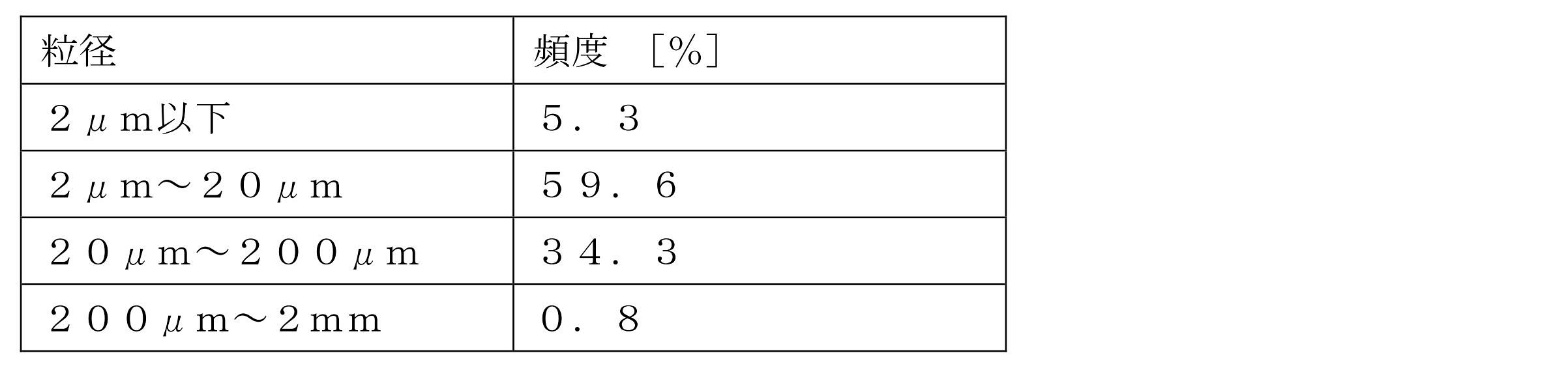
土壌流出量の測定には、表1に示す粒度分布の赤土(石垣島にて採取)を試験土壌として使用した。赤土の粒度分布は以下の手順で測定した。
(7-1)赤土を2mmのふるいにかけ、網目を通過した赤土3gと、水50gで懸濁液を作製した。
(7-2)レーザ回折/散乱式粒子径分布測定装置LA-950(株式会社堀場製作所社製)を用い、(7-1)で作製した懸濁液の粒度分布を測定した。
<試験土壌の種類>
土壌流出量の測定には、表1に示す粒度分布の赤土(石垣島にて採取)を試験土壌として使用した。赤土の粒度分布は以下の手順で測定した。
(7-1)赤土を2mmのふるいにかけ、網目を通過した赤土3gと、水50gで懸濁液を作製した。
(7-2)レーザ回折/散乱式粒子径分布測定装置LA-950(株式会社堀場製作所社製)を用い、(7-1)で作製した懸濁液の粒度分布を測定した。
<試験土壌の準備>
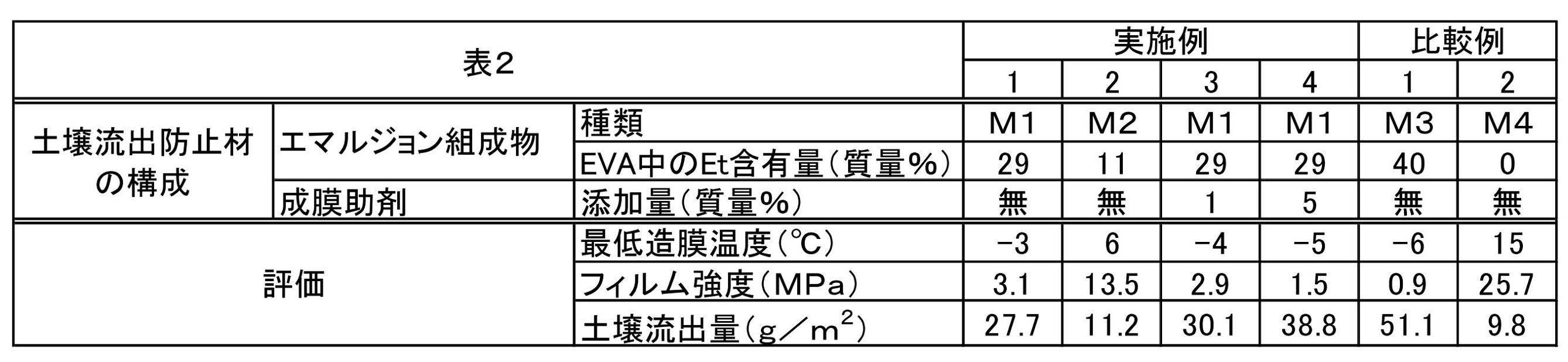
以下のとおり、充填容器に土壌を仕込み、土壌表面を転圧せずに刷毛を用いて平らに均した。表2に示すようエマルジョン組成物と成膜助剤と純水を用いて散布液中の固形分(水溶性樹脂エマルジョン、水溶性高分子、成膜助剤及び界面活性剤などの不揮発分)の濃度が5.5質量%になるように調製した散布液を土壌流出防止材として散布し、養生した。
土壌の充填容器:プランター600E (内寸:幅17cm×奥行56cm×高さ16cm)
土壌の充填量:7.0±0.5kg/容器(転圧無し)
散布溶液散布前の土壌の含水率:10.0%
散布方法:霧吹き
散布液全量の散布量:2000g/m2
成膜助剤の種類:CS-12(テキサノール:JNC株式会社製)
養生条件:23℃屋内(エアコンにより温度のみ管理)/1週間
以下のとおり、充填容器に土壌を仕込み、土壌表面を転圧せずに刷毛を用いて平らに均した。表2に示すようエマルジョン組成物と成膜助剤と純水を用いて散布液中の固形分(水溶性樹脂エマルジョン、水溶性高分子、成膜助剤及び界面活性剤などの不揮発分)の濃度が5.5質量%になるように調製した散布液を土壌流出防止材として散布し、養生した。
土壌の充填容器:プランター600E (内寸:幅17cm×奥行56cm×高さ16cm)
土壌の充填量:7.0±0.5kg/容器(転圧無し)
散布溶液散布前の土壌の含水率:10.0%
散布方法:霧吹き
散布液全量の散布量:2000g/m2
成膜助剤の種類:CS-12(テキサノール:JNC株式会社製)
養生条件:23℃屋内(エアコンにより温度のみ管理)/1週間
<土壌流出量>
試験土壌の表面が10度の傾斜角度になるようにプランターを固定し、高さ2.0mの位置から、水を土壌土表面全体に200mm/hで30分間散布した(装置:大起理化社 降雨装置DIK-6000)。水を散布している間にプランターの縁から流出した土壌を含む水を全量回収し、土壌と水を分離して、各々の質量を測定した。試験は1日ごとに降雨させ、5回繰り返して行い、5回分の積算量について、以下の式に基づいて表層流出土壌量を算出した。
土壌流出量(g/m2)=土壌の質量(g)/プランターの開口面積(m2)
試験土壌の表面が10度の傾斜角度になるようにプランターを固定し、高さ2.0mの位置から、水を土壌土表面全体に200mm/hで30分間散布した(装置:大起理化社 降雨装置DIK-6000)。水を散布している間にプランターの縁から流出した土壌を含む水を全量回収し、土壌と水を分離して、各々の質量を測定した。試験は1日ごとに降雨させ、5回繰り返して行い、5回分の積算量について、以下の式に基づいて表層流出土壌量を算出した。
土壌流出量(g/m2)=土壌の質量(g)/プランターの開口面積(m2)
8.最低造膜温度
最低造膜温度は、以下の方法により測定した。
(8-1)SUS板(鏡面処理したSUS304 サイズ:2.0×50×125mm)の表面をメタノールで脱脂処理し、温度T℃で3時間静置した。
(8-2)(8-1)で温度調整したSUS板に、塗布厚さ0.2mmになるようにエマルジョン組成物を塗布した。
(8-3)エマルジョン組成物を塗布したSUS板を温度T℃の条件下で3時間静置した。
(8-4)造膜の有無を確認した。
(8-5)造膜されていなければ、温度Tを1℃上昇させた条件下で同様の手順を繰り返し造膜を確認した。
Tは、-10℃から開始し、1℃ずつ上昇させ、初めて造膜が確認された温度を最低造膜温度とした。
最低造膜温度は、以下の方法により測定した。
(8-1)SUS板(鏡面処理したSUS304 サイズ:2.0×50×125mm)の表面をメタノールで脱脂処理し、温度T℃で3時間静置した。
(8-2)(8-1)で温度調整したSUS板に、塗布厚さ0.2mmになるようにエマルジョン組成物を塗布した。
(8-3)エマルジョン組成物を塗布したSUS板を温度T℃の条件下で3時間静置した。
(8-4)造膜の有無を確認した。
(8-5)造膜されていなければ、温度Tを1℃上昇させた条件下で同様の手順を繰り返し造膜を確認した。
Tは、-10℃から開始し、1℃ずつ上昇させ、初めて造膜が確認された温度を最低造膜温度とした。
実施例1においては、エマルジョン組成物M1を用いて最低造膜温度を測定した。T=-7℃においては、図1Aに示すように(8-3)での静置後も透明とならず造膜が確認できなかった。T=-3℃においては、図1Bに示すように(8-3)での静置後に透明となっており造膜が確認できた。T=-3℃において初めて造膜が確認できたので、-3℃を最低造膜温度とした。実施例2~4及び比較例1~2においても同様に最低造膜温度を測定した。
上述の実施例及び比較例より、以下が認められる。
最低造膜温度が-5℃~10℃のエマルジョン組成物を用いた実施例1~4は、土壌流出防止性とフィルムの柔軟性と強度のバランスが良かった。
実施例1と、実施例3及び4の比較により、成膜助剤を添加することでフィルム強度と土壌流出量を調整することができた。
最低造膜温度が-5℃~10℃のエマルジョン組成物を用いた実施例1~4は、土壌流出防止性とフィルムの柔軟性と強度のバランスが良かった。
実施例1と、実施例3及び4の比較により、成膜助剤を添加することでフィルム強度と土壌流出量を調整することができた。
Claims (8)
- エマルジョン組成物であって、
最低造膜温度が-5℃~10℃であり、
前記最低造膜温度は、2.0mm×50mm×125mmの鏡面処理したSUS304板を前記最低造膜温度で3時間静置し、前記SUS板に、塗布厚さ0.2mmになるように前記エマルジョン組成物を塗布し、前記エマルジョン組成物を塗布した前記SUS板を前記最低造膜温度で3時間静置した場合に、造膜が確認される最低の温度である、
エマルジョン組成物。 - 水溶性樹脂エマルジョンと水溶性高分子を含む、請求項1記載のエマルジョン組成物。
- 前記水溶性樹脂エマルジョンが、酢酸ビニルに由来する構造単位を含む樹脂のエマルジョンである、請求項2に記載のエマルジョン組成物。
- 前記水溶性樹脂エマルジョンが、エチレン-酢酸ビニル共重合体エマルジョンである、請求項2又は請求項3に記載のエマルジョン組成物。
- 前記エチレン-酢酸ビニル共重合体エマルジョンが含有するエチレン-酢酸ビニル共重合体は、エチレン単量体単位を5~35質量%、酢酸ビニル単量体単位を65~95質量%有する、請求項4に記載のエマルジョン組成物。
- 前記エチレン-酢酸ビニル共重合体エマルジョンを20~80質量部と、ポリビニルアルコールを0~20質量部と、水を20~80質量部を含む請求項4又は5に記載のエマルジョン組成物。
- エマルジョン組成物100質量%中に、成膜助剤を0~5質量%含む請求項1~6の何れか1項に記載のエマルジョン組成物。
- 請求項1~7のいずれか一項に記載のエマルジョン組成物を含む土壌流出防止材。
Applications Claiming Priority (2)
| Application Number | Priority Date | Filing Date | Title |
|---|---|---|---|
| JP2020-123801 | 2020-07-20 | ||
| JP2020123801A JP2023120461A (ja) | 2020-07-20 | 2020-07-20 | エマルジョン組成物および土壌流出防止材 |
Publications (1)
| Publication Number | Publication Date |
|---|---|
| WO2022018919A1 true WO2022018919A1 (ja) | 2022-01-27 |
Family
ID=79729328
Family Applications (1)
| Application Number | Title | Priority Date | Filing Date |
|---|---|---|---|
| PCT/JP2021/016043 Ceased WO2022018919A1 (ja) | 2020-07-20 | 2021-04-20 | エマルジョン組成物および土壌流出防止材 |
Country Status (3)
| Country | Link |
|---|---|
| JP (1) | JP2023120461A (ja) |
| TW (1) | TW202216962A (ja) |
| WO (1) | WO2022018919A1 (ja) |
Citations (3)
| Publication number | Priority date | Publication date | Assignee | Title |
|---|---|---|---|---|
| JPS59122623A (ja) * | 1982-12-28 | 1984-07-16 | Sanyo Kokusaku Pulp Co Ltd | 土壌崩壊防止方法 |
| JP2009013373A (ja) * | 2007-07-09 | 2009-01-22 | Nichigo-Mowinyl Co Ltd | 培土固化用水性合成樹脂エマルジョン、およびそれを乾燥してなる培土固化用水性合成樹脂エマルジョン粉末、並びにそれを用いた育苗培土およびその製法。 |
| WO2016204290A1 (ja) * | 2015-06-18 | 2016-12-22 | デンカ株式会社 | 凍結融解安定性に優れる土壌侵食防止剤 |
-
2020
- 2020-07-20 JP JP2020123801A patent/JP2023120461A/ja active Pending
-
2021
- 2021-04-20 WO PCT/JP2021/016043 patent/WO2022018919A1/ja not_active Ceased
- 2021-06-17 TW TW110122187A patent/TW202216962A/zh unknown
Patent Citations (3)
| Publication number | Priority date | Publication date | Assignee | Title |
|---|---|---|---|---|
| JPS59122623A (ja) * | 1982-12-28 | 1984-07-16 | Sanyo Kokusaku Pulp Co Ltd | 土壌崩壊防止方法 |
| JP2009013373A (ja) * | 2007-07-09 | 2009-01-22 | Nichigo-Mowinyl Co Ltd | 培土固化用水性合成樹脂エマルジョン、およびそれを乾燥してなる培土固化用水性合成樹脂エマルジョン粉末、並びにそれを用いた育苗培土およびその製法。 |
| WO2016204290A1 (ja) * | 2015-06-18 | 2016-12-22 | デンカ株式会社 | 凍結融解安定性に優れる土壌侵食防止剤 |
Also Published As
| Publication number | Publication date |
|---|---|
| TW202216962A (zh) | 2022-05-01 |
| JP2023120461A (ja) | 2023-08-30 |
Similar Documents
| Publication | Publication Date | Title |
|---|---|---|
| JP6691116B2 (ja) | 凍結融解安定性に優れる土壌侵食防止剤 | |
| JP6767384B2 (ja) | 凍結融解安定性に優れる土壌侵食防止剤 | |
| US10092004B2 (en) | Agricultural adjuvants and processes for making and using same | |
| JP6581510B2 (ja) | 土壌侵食防止剤 | |
| US10098344B2 (en) | Agricultural adjuvants and processes for making and using same | |
| CN101578311A (zh) | 聚合物组合物和方法 | |
| WO2021075104A1 (ja) | 樹脂エマルジョンの散布方法 | |
| KR20180126774A (ko) | 도배풀의 연속 제조공정 | |
| JP2009013373A (ja) | 培土固化用水性合成樹脂エマルジョン、およびそれを乾燥してなる培土固化用水性合成樹脂エマルジョン粉末、並びにそれを用いた育苗培土およびその製法。 | |
| WO2021090751A1 (ja) | 土壌改質方法 | |
| TW202216962A (zh) | 乳液組成物和土壤流失防止材料 | |
| JP3491176B2 (ja) | 土壌安定化用組成物 | |
| WO2022138378A1 (ja) | 土壌侵食防止剤 | |
| WO2022079960A1 (ja) | 樹脂エマルジョン散布液、樹脂エマルジョン散布液の評価方法 | |
| JPH0217598B2 (ja) | ||
| JP2024110012A (ja) | エマルジョン組成物及び土壌侵食防止剤 | |
| WO2022230462A1 (ja) | 土壌侵食防止剤の散布方法 | |
| JP2009034009A (ja) | 育苗培土の製造方法およびそれにより得られる育苗培土 | |
| JPS6241271B2 (ja) |
Legal Events
| Date | Code | Title | Description |
|---|---|---|---|
| NENP | Non-entry into the national phase |
Ref country code: DE |
|
| 122 | Ep: pct application non-entry in european phase |
Ref document number: 21846898 Country of ref document: EP Kind code of ref document: A1 |
|
| NENP | Non-entry into the national phase |
Ref country code: JP |