WO2022009975A1 - Tarcを含有する組成物、及びtarcの保存安定性向上方法 - Google Patents
Tarcを含有する組成物、及びtarcの保存安定性向上方法 Download PDFInfo
- Publication number
- WO2022009975A1 WO2022009975A1 PCT/JP2021/025904 JP2021025904W WO2022009975A1 WO 2022009975 A1 WO2022009975 A1 WO 2022009975A1 JP 2021025904 W JP2021025904 W JP 2021025904W WO 2022009975 A1 WO2022009975 A1 WO 2022009975A1
- Authority
- WO
- WIPO (PCT)
- Prior art keywords
- tarc
- polymer
- composition
- concentration
- lipidure
- Prior art date
- Legal status (The legal status is an assumption and is not a legal conclusion. Google has not performed a legal analysis and makes no representation as to the accuracy of the status listed.)
- Ceased
Links
Classifications
-
- G—PHYSICS
- G01—MEASURING; TESTING
- G01N—INVESTIGATING OR ANALYSING MATERIALS BY DETERMINING THEIR CHEMICAL OR PHYSICAL PROPERTIES
- G01N33/00—Investigating or analysing materials by specific methods not covered by groups G01N1/00 - G01N31/00
- G01N33/48—Biological material, e.g. blood, urine; Haemocytometers
- G01N33/50—Chemical analysis of biological material, e.g. blood, urine; Testing involving biospecific ligand binding methods; Immunological testing
- G01N33/68—Chemical analysis of biological material, e.g. blood, urine; Testing involving biospecific ligand binding methods; Immunological testing involving proteins, peptides or amino acids
Definitions
- the present invention relates to a composition containing TARC. More specifically, the present invention relates to a composition capable of stably storing TARC for a long period of time.
- the present invention also relates to a TARC measuring method and kit, a TARC storage stability improving method, and a TARC adsorption inhibitor.
- Thymus and activated-regulated chemokine (hereinafter, may be referred to as TARC) is a CC chemokine ligand 17 (CCL17), which is a kind of chemokine having a leukocyte migration action.
- TARC attracts Th2 cells, which are one of the lymphocytes, to the lesion site, causing IgE production and infiltration / activation of eosinophils. By enhancing the allergic reaction in this way, TARC is considered to exacerbate the symptoms of atopic dermatitis (Non-Patent Document 1).
- TARC is important to promptly and surely sedate the inflammation of atopic dermatitis.
- TARC is in good agreement with the severity of atopic dermatitis when compared to serum IgE, peripheral blood eosinophil counts, and serum LDH levels, which have been used as indicators of the pathology of other atopic dermatitis. It is considered to reflect the disease situation more sensitively (Non-Patent Document 2). Therefore, by using TARC as a biomarker, when selecting or changing a therapeutic agent for atopic dermatitis, the severity can be objectively and quickly grasped and the effect can be determined.
- the calibration sample is a sample containing a component to be measured, which is used for purposes such as an internal standard or a concentration calibration standard (calibrator).
- a calibration sample that is stable with respect to the passage of time and temperature is required.
- the calibration sample is preferably in a fluid liquid state (hereinafter, may be referred to as “liquid”) because of its ease of operation.
- biological activity for example, antigenicity to a specific antibody, binding activity to a specific binding partner possessed by an antibody or lectin, physiological activity possessed by a peptide hormone or the like, enzyme activity).
- biological activity for example, antigenicity to a specific antibody, binding activity to a specific binding partner possessed by an antibody or lectin, physiological activity possessed by a peptide hormone or the like, enzyme activity.
- Patent Document 1 As a method for storing the calibration sample in liquid form, which is intended for use in an immunological measurement method, a method for stabilizing an antigen by coexisting casein and / or whey protein in the calibration sample (Patent Document 1).
- Patent Document 2 A method of stabilizing insulin in the coexistence of a bile acid amide derivative (Patent Document 2) and a method of stabilizing a soluble interleukin-2 receptor (sIL-2R) in the coexistence of a chelating agent are known (Patent Document 3).
- sIL-2R soluble interleukin-2 receptor
- An object of the present invention is to provide a TARC-containing composition having high storage stability.
- the present inventors have attempted to prepare a TARC-containing composition having high storage stability. They have found that the stability of TARC is improved when TARC is added to a solution containing a polymer having 2-methacryloyloxyethyl phosphorylcholine as a constituent unit.
- the present invention is based on such findings. Specifically, the present invention is as follows. ⁇ 1> The composition comprising TARC (Themus and activation-regulated chemokine), which comprises TARC and a polymer having 2-methacryloyloxyethyl phosphorylcholine as a constituent unit, and is liquid. ⁇ 2> The composition according to ⁇ 1>, which is a sample solution for calibration for measuring TARC.
- ⁇ 3> The composition according to ⁇ 1> or ⁇ 2>, which is filled in a storage container.
- ⁇ 4> The composition according to ⁇ 3>, wherein the storage container is plastic or glass.
- ⁇ 5> The composition according to any one of ⁇ 1> to ⁇ 4>, wherein the concentration of TARC is 10 pg / mL to 1 ⁇ g / mL with respect to the composition.
- ⁇ 6> The composition according to any one of ⁇ 1> to ⁇ 5>, wherein the concentration of the polymer is 0.001% by mass to 5% by mass with respect to the composition.
- ⁇ 7> The composition according to any one of ⁇ 1> to ⁇ 6>, wherein the polymer has a weight average molecular weight of 1000 to 2000000.
- the concentration of TARC is 500 pg / mL with respect to the composition
- the residual rate of TARC after storage in a plastic container at 37 ° C. for 28 days is 80% or more, ⁇ 1> to The composition according to any one of ⁇ 7>.
- the concentration of TARC is 500 pg / mL with respect to the composition
- the residual rate of TARC after storage in a plastic container at 4 ° C. for 28 days is 80% or more, ⁇ 1> to The composition according to any one of ⁇ 8>.
- the concentration of TARC is 500 pg / mL with respect to the composition
- composition according to any one of. ⁇ 11> The composition according to any one of ⁇ 1> to ⁇ 10>, wherein the polymer has a weight average molecular weight of 10,000 to 70,000.
- ⁇ 12> A method for measuring TARC using the composition according to any one of ⁇ 1> to ⁇ 11>.
- ⁇ 13> A TARC measurement kit comprising the composition according to any one of ⁇ 1> to ⁇ 11>.
- ⁇ 14> A method for improving the storage stability of TARC, which comprises a step of contacting TARC with a solution containing a polymer having 2-methacryloyloxyethyl phosphorylcholine as a constituent unit.
- ⁇ 15> The method for improving storage stability of TARC according to ⁇ 14>, which comprises a step of adjusting the concentration of TARC to be 10 pg / mL to 1 ⁇ g / mL with respect to the solution.
- ⁇ 16> The method for improving the storage stability of TARC according to ⁇ 14> or ⁇ 15>, wherein the concentration of the polymer is 0.001% by mass to 5% by mass with respect to the solution.
- ⁇ 17> The method for improving storage stability of TARC according to any one of ⁇ 14> to ⁇ 16>, wherein the polymer has a weight average molecular weight of 10,000 to 70,000.
- TARC-containing composition having high storage stability, particularly a TARC-containing calibration sample. Therefore, according to the present invention, TARC in a biological sample can be accurately quantified, and the severity of atopic dermatitis can be accurately grasped.
- TARC means Symus and activated-regulated chemokine (CCL17).
- TARC is a type of chemokine that has leukocyte migration activity.
- TARC has a function of attracting Th2 cells, which are one of lymphocytes, to the lesion site to produce IgE or infiltrate and activate eosinophils.
- the measurement of TARC can be performed using a known method, for example, an immunological method.
- Immunological methods include ELISA, enzyme immunoassay, surface plasmon resonance method, latex aggregation immunoassay (LTIA), chemical luminescence immunoassay, electrochemical luminescence immunoassay, fluorescent antibody method, radioimmunoassay, Western blot method, immunochromatography method, high performance liquid chromatography method (HPLC method) and the like can be mentioned.
- TARC contained in the composition of the present invention a commercially available product may be used, or a product prepared or purified by itself may be used.
- TARC contained in the composition of the present invention one prepared in vitro may be used, or one extracted from a living body may be used.
- TARC concentration The concentration of TARC contained in the composition of the present invention is not limited to the following, but is preferably 10 pg / mL to 1 ⁇ g / mL with respect to the composition in consideration of the stability of TARC. It is preferably 50 pg / mL to 500 ng / mL, more preferably 100 pg / mL to 100 ng / mL, and most preferably 100 pg / mL to 50 ng / mL.
- the polymer having 2-methacryloxyethyl phosphorylcholine as a constituent unit (hereinafter, may be simply referred to as a polymer) is not particularly limited as long as the constituent monomer has 2-methacryloxyethyl phosphorylcholine.
- the polymer having 2-methacryloyloxyethyl phosphorylcholine as a constituent unit may be a polymer of 2-methacryloyloxyethylphosphorylcholine alone, or a copolymer of 2-methacryloxyethylphosphorylcholine and another monomer. May be good.
- Other monomers can have hydrophobic side chains, hydrophilic side chains, anionic side chains, cationic side chains, or hydrogen bonding side chains. It may have both hydrophobic and hydrophilic side chains.
- composition ratio of 2-methacryloyloxyethyl phosphorylcholine and other monomers varies depending on the structure of the monomer used, etc., but usually, the content of 2-methacryloyloxyethylphosphorylcholine is preferably 5 mol% or more with respect to the copolymer. ..
- the polymer having 2-methacryloyloxyethyl phosphorylcholine as a constituent unit for example, a polymer produced according to or according to a known synthesis method as shown in JP-A-2004-189678 may be used.
- the 2-methacryloyloxyethyl phosphorylcholine monomer is sold by NOF Corporation, for example, and those skilled in the art can polymerize it with any monomer to produce a polymer having necessary properties.
- the LIPIDURE (registered trademark) series sold by NOF CORPORATION may be used, and the LIPIDURE-BL series sold as a diagnostic drug field product is preferable, but the present invention is not limited thereto.
- the LIPIDURE-BL series is a polymer obtained by copolymerizing various monomers with 2-methacryloyloxyethyl phosphorylcholine monomer.
- LIPIDURE-BL100 series which is a copolymer of a monomer having a hydrophilic group
- LIPIDURE-BL200 series which is a copolymer of a monomer having a hydrophobic group
- LIPIDURE-BL300 series which is a copolymer of a monomer having a negative charge, and a positive charge.
- LIPIDURE-BL400 series which is a copolymer of a monomer having a hydrophobic group
- LIPIDURE-BL700 series which is a copolymer of a monomer having a hydrogen-binding group
- LIPIDURE-BL1100 series, LIPIDURE-BL1200 series, and LIPIDURE-BL1300 series are preferable.
- the weight average molecular weight of the polymer having 2-methacryloyloxyethyl phosphorylcholine as a constituent unit is not particularly limited as long as the desired performance can be obtained.
- the weight average molecular weight and the monomer ratio of the polymer having 2-methacryloyloxyethyl phosphorylcholine as a constituent unit can be selected by those skilled in the art with reference to the Lipidure-BL series manufactured by NOF CORPORATION.
- the lower limit of the weight average molecular weight is, for example, 1000, preferably 2000, more preferably 5000, and most preferably 10000.
- the upper limit of the weight average molecular weight is, for example, 2000000, preferably 1,000,000, more preferably 700,000, still more preferably 100,000, and most preferably 70,000.
- the weight average molecular weight can be measured by a method such as gel permeation chromatography.
- the polymer having 2-methacryloyloxyethyl phosphorylcholine as a constituent unit may be used alone or in combination of any two or more kinds.
- a surfactant such as a cationic surfactant or an anionic surfactant can also be added.
- the order of addition of the polymer having 2-methacryloyloxyethyl phosphorylcholine as a constituent unit and TARC is not particularly limited as long as the effects of the present invention can be obtained.
- the concentration of the polymer having 2-methacryloyloxyethyl phosphorylcholine as a constituent unit is not limited to the following, but is preferable with respect to the composition in consideration of the stability of TARC. Is 0.0001% by mass to 5% by mass, more preferably 0.001% by mass to 5% by mass, still more preferably 0.01% by mass to 5% by mass, and most preferably 0.01% by mass to 1% by mass. be.
- the composition of the present invention is preferably filled in a storage container.
- the material of the storage container is not particularly limited as long as the effects of the present invention can be obtained and can be sealed, but at least a part or all of the contact portion with the composition is a plastic [for example, an olefin resin or a styrene resin.
- Acrylic resin Acrylic resin, polyester resin, polycarbonate resin, fluororesin, chlorine resin (polyvinyl chloride, etc.), polyamide resin, polyacetal resin, polyphenylene ether resin (modified polyphenylene ether, etc.), polyallylate, polysulfone, Polyimide-based resins, cellulose-based resins (cellulose acetate, etc.), hydrocarbon-based resins (including halogen atom-substituted products), etc.], metals (aluminum, etc.), glass, etc.
- plastic or glass is preferable, and among the plastics, an olefin resin is preferable, and polypropylene is more preferable, from the viewpoint of manufacturing, transporting, and storing a sample for calibration.
- the storage container may be made of a single material or two or more kinds of materials, but is preferably made of a single material.
- the storage container can include a container body portion and a cap. In this case, the container body portion and the cap may be made of different materials. Further, it is preferable that the storage container, particularly the main body portion, has transparency to the extent that the content liquid can be seen from the outside.
- the storage container may be of either a hard type or a soft type, and examples thereof include ampoules, vials, soft bags, injection containers, and glass bottles.
- the storage container is preferably in the form of a plastic eye drop bottle including a container body portion and a cap portion, particularly in the form of a cylindrical eye drop bottle, from the viewpoint of ease of use and stability of TARC.
- the storage container should be a glass ampoule or a form including a glass container body and a cap, particularly a cylindrical glass container and a form including a rubber cap, for ease of use and TARC. Preferred from the viewpoint of stability.
- composition The composition of the present invention can be used as a sample solution for calibration in the measurement of TARC.
- the sample solution for calibration means a sample solution containing a substance to be measured at a constant concentration, which is used for accurate measurement of the substance to be measured, and is used as a standard substance, a calibrator, a control, and a sample solution. Internal standard substances, etc. are applicable.
- Examples of the supply form of the composition of the present invention include a pre-solution state in which TARC and a polymer having 2-methacryloyloxyethyl phosphorylcholine as a constituent unit are mixed in a solvent.
- "using a composition” means using a composition in order to accurately measure TARC.
- a liquid composition containing TARC is used as a sample solution for calibration ( Means to be used as a reference material, calibrator, control, and internal standard material, etc.).
- the pH of the composition of the present invention is, for example, 4.0 to 9.5, 5.0 to 9.0, 6.0 to 8.5, 6.5 to 8.0, or 7.0 to 8. It is 0.
- the pH can be adjusted using a pH adjusting reagent well known to those skilled in the art, such as sodium hydroxide or hydrochloric acid.
- composition of the composition of the present invention is not particularly limited as long as the effect of the present invention is not impaired. If TARC is measured by an immunological measurement method, the effects of the present invention are not impaired, and the reactions constituting the measurement system such as antigen-antibody reaction, labeling reaction for detection with biotin / avidin, and enzyme reaction It does not have to interfere with all or part of it.
- Various components commonly used in immunological measurement methods such as acetic acid, citric acid, phosphoric acid, PBS (phosphate buffered saline), HEPES, MES, Tris, glycine, boric acid, carbonic acid and good buffer.
- buffers components that promote antigen-antibody reactions (polymers such as polyethylene glycol and polyvinylpyrrolidone), glycoproteins and peptides (BSA, casein, etc.), amino acids, salts (sodium chloride, potassium chloride, etc.), sugars (sho) Sugar, cyclodextrin, etc.), preservatives (sodium azide, ProClin300, etc.) and the like can be appropriately selected and used according to the purpose. It is preferable to use PBS having a pH of 6.5 to 8.0.
- improved storage stability means that most of the TARC contained in the solution containing TARC is not decomposed for a long period of time and the structure is not changed. Alternatively, by maintaining the TARC in the solution without adsorbing it, it means that there is no big difference between the initial value of TARC in the solution and the measured value after storage. More specifically, “improvement of storage stability” or “improvement of storage stability” means, for example, 80% or more of TARC contained in a solution containing TARC having a concentration of 10 pg / mL to 1 ⁇ g / mL. In the solution after storage in a plastic container for 28 days at 37 ° C. by being maintained at 37 ° C.
- TARC for 28 days without decomposition, structural changes or adsorption to the container. It can mean that the measured value of TARC is 80% or more of the initial value.
- "improvement of storage stability” or “improvement of storage stability” means that, for example, 80% or more of TARC contained in a solution containing TARC having a concentration of 10 pg / mL to 1 ⁇ g / mL is 4 ° C. Measurement of TARC in the solution after storage in a plastic container at 4 ° C. for 28 days at 4 ° C. by being maintained without decomposition, structural changes or adsorption to the container for 28 days. It can mean that the value is 80% or more of the initial value.
- improved of storage stability or “improvement of storage stability” means that, for example, 30% or more of TARC contained in a solution containing TARC having a concentration of 10 pg / mL to 1 ⁇ g / mL is 10 ° C.
- the measured value of TARC in the solution after storage in a glass container at 10 ° C. for 12 hours It can mean that it becomes 30% or more of the initial value.
- the biological sample for measuring TARC is not particularly limited as long as TARC can be measured, but blood, serum, or plasma is preferably used. If necessary, the biological sample may be pretreated.
- the biological sample is preferably a biological sample taken from a human.
- the composition of the present invention can be used to easily and accurately measure TARC.
- the TARC measurement kit include a kit using an immunological method.
- the TARC measurement kit of the present invention can contain a reagent for measuring the concentration of TARC in a human body by an immunological method. Immunological methods include ELISA, enzyme immunoassay, surface plasmon resonance method, latex aggregation immunoassay (LTIA), chemical luminescence immunoassay, electrochemical luminescence immunoassay, fluorescent antibody method, radioimmunoassay, Western blot method, immunochromatography method, high performance liquid chromatography method (HPLC method) and the like can be mentioned.
- the TARC measurement kit of the present invention can be used to grasp the severity of atopic dermatitis in determining the treatment method or drug selection of atopic dermatitis and the effect of the treatment.
- the TARC measurement kit of the present invention may also include an instruction manual or the like.
- the TARC measurement kit may include any component, such as a buffer, a stabilizer, a sample diluent, a pH regulator, a reaction vessel, and the like.
- the method for improving the storage stability of TARC of the present invention includes a step of contacting TARC with a solution containing a polymer having 2-methacryloyloxyethyl phosphorylcholine as a constituent unit.
- TARC may be added after adding a polymer having 2-methacryloyloxyethyl phosphorylcholine as a constituent unit to the solution, or a polymer having 2-methacryloxyethyl phosphorylcholine as a constituent unit after adding TARC to the solution. It may be added.
- the solution is preferably a buffer such as PBS, HEPES, MES, CHES and Tris. It is more preferable to use PBS having a pH of 6.5 to 8.0.
- the concentration of TARC contained in the solution is not limited to the following, but is preferably 10 pg / mL to 1 ⁇ g / mL in consideration of the stability of TARC. , More preferably 50 pg / mL to 500 ng / mL, still more preferably 100 pg / mL to 100 ng / mL, and most preferably 100 pg / mL to 50 ng / mL.
- the polymer having 2-methacryloyloxyethyl phosphorylcholine as a constituent unit is not particularly limited as long as it has 2-methacryloxyethylphosphorylcholine as a constituent monomer.
- the polymer having 2-methacryloyloxyethyl phosphorylcholine as a constituent unit may be a polymer of 2-methacryloyloxyethylphosphorylcholine alone, or a copolymer of 2-methacryloxyethylphosphorylcholine and another monomer. May be good.
- Other monomers can have hydrophobic side chains, hydrophilic side chains, anionic side chains, cationic side chains, or hydrogen bonding side chains. It may have both hydrophobic and hydrophilic side chains.
- composition ratio of 2-methacryloyloxyethyl phosphorylcholine and other monomers varies depending on the structure of the monomer used, but the content of 2-methacryloxyethyl phosphorylcholine is preferably 5 mol% or more.
- the polymer having 2-methacryloyloxyethyl phosphorylcholine as a constituent unit a polymer produced according to or according to a known synthesis method may be used, or a commercially available product, for example, the LIPIDURE (registered trademark) series manufactured by NOF CORPORATION may be used. You may use it.
- the LIPIDURE-BL series is preferred, LIPIDURE (registered trademark) -BL103, LIPIDURE (registered trademark) -BL203, LIPIDURE (registered trademark) -BL206 (molecular weight about 300,000), LIPIDURE (registered trademark) -BL405, LIPIDURE (registered trademark).
- LIPIDURE registered trademark
- -BL502 LIPIDURE (registered trademark) -BL702, LIPIDURE (registered trademark) -BL802, LIPIDURE (registered trademark) -BL1002, LIPIDURE (registered trademark) -BL1201 (molecular weight of about 400,000), or LIPIDURE (registered trademark) -BL1301 More preferred.
- the weight average molecular weight of the polymer having 2-methacryloyloxyethyl phosphorylcholine as a constituent unit is not particularly limited as long as the desired performance can be obtained.
- the lower limit of the molecular weight is, for example, 1000, preferably 2000, more preferably 5000, and most preferably 10000.
- the upper limit of the molecular weight is, for example, 20000, preferably 1000000, and more preferably 700,000.
- the weight average molecular weight can be measured by a method such as gel permeation chromatography.
- the polymer having 2-methacryloyloxyethyl phosphorylcholine as a constituent unit for example, a polymer produced according to or according to a known synthesis method as shown in JP-A-2004-189678 may be used.
- the 2-methacryloyloxyethyl phosphorylcholine monomer is sold by NOF Corporation, for example, and those skilled in the art can polymerize it with any monomer to produce a polymer having necessary properties.
- the LIPIDURE (registered trademark) series sold by NOF CORPORATION may be used, and the LIPIDURE-BL series sold as a diagnostic drug field product is preferable, but the present invention is not limited thereto.
- the LIPIDURE-BL series is a polymer obtained by copolymerizing various monomers with 2-methacryloyloxyethyl phosphorylcholine monomer.
- LIPIDURE-BL100 series which is a copolymer of a monomer having a hydrophilic group
- LIPIDURE-BL200 series which is a copolymer of a monomer having a hydrophobic group
- LIPIDURE-BL300 series which is a copolymer of a monomer having a negative charge, and a positive charge.
- LIPIDURE-BL400 series which is a copolymer of a monomer having a hydrophobic group
- LIPIDURE-BL700 series which is a copolymer of a monomer having a hydrogen-binding group
- LIPIDURE-BL1100 series, LIPIDURE-BL1200 series, and LIPIDURE-BL1300 series are preferable.
- the TARC adsorption inhibitor of the present invention contains a polymer having 2-methacryloyloxyethyl phosphorylcholine as a constituent unit.
- a polymer having 2-methacryloyloxyethyl phosphorylcholine as a constituent unit may be added to the storage container before contacting the solution containing TARC, or 2-methacryloyloxyethylphosphorylcholine may be added to the solution containing TARC as an adsorption inhibitor.
- a polymer having as a unit may be added and added to a storage container.
- ⁇ Brij (Registered Trademark) 35 Ingredient Name: Polyoxyethylene Lauryl Ether, Kishida Chemical Co., Ltd./Triton® X-100 Ingredient Name: Polyethylene Glycol Monop-isooctylphenyl Ether, Kishida Chemical Co., Ltd./MEGA-9 Ingredient Name : N-nonanoylu N-methyl-D-glucamine, Dojin Chemical Research Institute Co., Ltd. ⁇ CHAPS component name: 3-[(3-Cholamidopolyethylene) dimethyllammionio] propanesulfonate, Dojin Chemical Research Institute Co., Ltd.
- Example 1 Results of storage stability test in a glass vial >> The storage stability of TARC in glass vials was tested.
- the test method and evaluation method are as follows. A solution having the following composition was used as the storage solution. ⁇ PBS (pH 7.2) ⁇ 1% by mass BSA ⁇ Additives (concentration, product name, type are listed in Table 1)
- TARC liquid preservation solution 0.5 mL was dispensed into a glass container and stored at 10 ° C. for 12 hours. As a control, a sample before dispensing in a glass container was also used for measurement. TARC concentrations were tested at 500 pg / mL, 2000 pg / mL, and 10000 pg / mL.
- Measurement method was performed by a latex immunoturbidimetry method using two types of antibodies.
- the composition of the reagent and the measurement method are shown below. The measurement was performed by a Hitachi automated analyzer using the first reagent and the second reagent.
- -First reagent 100 mM MOPS-NaOH (pH 7.5) 500 mM NaCl 0.5% BSA ⁇
- Second reagent Anti-human TARC monoclonal antibody sensitized latex (2 types) 5 mM MOPS-NaOH (pH 7.0)
- the anti-human TARC monoclonal antibody was obtained by a method well known to those skilled in the art using a commercially available TARC antigen.
- TARC antigens include CCL17, thymus and activated chemokine (Shenandoah Biotechnology, Inc.), CCL17 / TARC, Human (LifeSpan Biossyence, Inc., Inc., Inc.). Further, a combination of monoclonal antibodies capable of sandwich measurement against the TARC antigen was selected by a method well known to those skilled in the art.
- the anti-human TARC monoclonal antibody sensitized latex was prepared with reference to the method described in JP-A-2017-18137. First, 120 ⁇ L of the first reagent was added to 2.4 ⁇ L of the TARC liquid storage solution having each concentration, and the mixture was heated at 37 ° C. for 5 minutes.
- TARC Residual Rate (%) was calculated using the following formula for the TARC concentration of each TARC liquid storage solution after storage at 10 ° C. for 12 hours.
- TARC residual rate (%) TARC concentration (pg / mL) of each TARC liquid storage solution after storage at 10 ° C. for 12 hours in a glass container / TARC concentration (pg / mL) of TARC liquid storage solution before dispensing in a glass container. ⁇ 100
- the TARC concentration is 500 pg / mL
- the residual rate after 12 hours is 0.0%, and all TARCs are glass. It was considered that it was adsorbed on the container or the structure was changed.
- the residual ratio was 30.1, 33.9. It was improved to%.
- the TARC residual rate was 32.3% or more. It was 89.7%, which was a significant improvement over Condition 1.
- the TARC concentration was 2000 pg / mL and 10000 pg / mL, the TARC residual rate was evaluated in the same manner.
- the residual rate after 12 hours was 5.2% and 10.2%, whereas in the present invention.
- the TARC residual rate was significantly improved to 51.3% to 100.8%. It was shown that in the case of a polymer having 2-methacryloyloxyethyl phosphorylcholine as a constituent unit, the TARC residual rate is improved regardless of the side chain properties of the copolymerizing monomer.
- condition 15 in which a cationic surfactant was used in combination with Lipidure-BL206 having 2-methacryloyloxyethyl phosphorylcholine as a constituent unit
- the TARC residual rate was significantly improved as compared with condition 1. Further, it was obtained that the TARC residual rate was higher when the surfactant was used in combination as compared with the condition 4 in which Lipidure-BL206 having the same concentration was used alone. From the above, it was shown that the coexistence of TARC with a polymer having 2-methacryloyloxyethyl phosphorylcholine as a constituent unit improves the storage stability of TARC during storage of glass vials.
- Example 2 Storage stability test results in a plastic eye drop bottle >> The storage stability of TARC in plastic eye drop bottles was tested.
- the test method and evaluation method are as follows.
- TARC residual rate (%) of the TARC concentration in the liquid storage solution of each TARC after storage at 37 ° C for 28 days or at 4 ° C for 28 days using the following formula. was calculated.
- TARC residual rate (%) TARC concentration (pg / mL) of each TARC liquid storage solution after storage at 37 ° C for 28 days or 4 ° C for 28 days in an eye drop bottle / TARC concentration of TARC liquid storage solution immediately after preparation (TARC concentration) pg / mL) x 100
- the residual rate after 28 days was 47.2% under the condition 1 in which the polymer having 2-methacryloyloxyethyl phosphorylcholine as a constituent unit was not added.
- the residual ratio maintained a high value of 83.9 to 96.1.
- the 2-methacryloyloxy found in the present application is subjected to the condition 1 in which the polymer having 2-methacryloyloxyethyl phosphorylcholine as a constituent unit is not added.
- the TARC residual rate was improved. This is because under conditions 2 to 15, the addition of a polymer having 2-methacryloyloxyethyl phosphorylcholine as a constituent unit could prevent the adsorption of TARC on the wall surface of the container, or could suppress the structural change of TARC during storage. It was thought that it was a tame.
- the 2-methacryloyloxy found in the present application is subjected to the condition 1 in which the polymer having 2-methacryloyloxyethyl phosphorylcholine as a constituent unit is not added.
- the TARC residual rate was improved. This is because under conditions 2 to 15, the addition of a polymer having 2-methacryloyloxyethyl phosphorylcholine as a constituent unit could prevent the adsorption of TARC on the wall surface of the container, or could suppress the structural change of TARC during storage. It was thought that it was a tame.
- the residual rate after 6 hours is 4.4%, and most of the TARC is adsorbed on the glass container or the structure is changed. It was thought that it was done.
- the residual rate after 6 hours was 0.6% to 7.8, and the interface. The residual rate did not improve as compared with the condition 1 to which the activator was not added.
- the TARC concentration is 2000 pg / mL and 10000 pg / mL
- a nonionic surfactant having a specific structure or an amphoteric surfactant is added to the condition 1 in which the surfactant is not added.
- the TARC survival rate did not improve under the conditions 16 to 20. Therefore, the polymer having 2-methacryloyloxyethyl phosphorylcholine as a constituent unit has better storage stability of TARC than the nonionic surfactant and amphoteric surfactant having a specific structure used in Comparative Example 1. It was considered to have an effect. In particular, under condition 20, the compound shown in Patent Document 2 was added, but no effect of improving storage stability was observed at all the TARC concentrations examined.
- TARC-containing composition having high storage stability, particularly a TARC-containing calibration sample.
Landscapes
- Life Sciences & Earth Sciences (AREA)
- Health & Medical Sciences (AREA)
- Engineering & Computer Science (AREA)
- Molecular Biology (AREA)
- Chemical & Material Sciences (AREA)
- Biomedical Technology (AREA)
- Urology & Nephrology (AREA)
- Hematology (AREA)
- Immunology (AREA)
- Biotechnology (AREA)
- Microbiology (AREA)
- Cell Biology (AREA)
- Proteomics, Peptides & Aminoacids (AREA)
- Food Science & Technology (AREA)
- Medicinal Chemistry (AREA)
- Physics & Mathematics (AREA)
- Analytical Chemistry (AREA)
- Biochemistry (AREA)
- General Health & Medical Sciences (AREA)
- General Physics & Mathematics (AREA)
- Pathology (AREA)
- Medicinal Preparation (AREA)
Abstract
本発明の課題は、保存安定性の高いTARC含有組成物を提供することである。 TARC(Thymus and activation-regulated chemokine)を含む組成物であって、TARC、及び2-メタクリロイルオキシエチルホスホリルコリンを構成単位として有する重合体を含み、そして液状である、前記組成物により、前記課題を解決することができる。
Description
本発明は、TARCを含有する組成物に関する。より詳細には、本発明は、TARCを安定に長期間保存することが可能な組成物に関する。本発明は、TARCの測定方法及びキット、TARCの保存安定性向上方法、並びにTARCの吸着防止剤にも関する。
Thymus and activation-regulated chemokine(以下、TARCと称することがある)は、C-Cケモカイン リガンド17(CCL17)であり、白血球遊走作用を持つケモカインの一種である。TARCは、リンパ球の1つであるTh2細胞を病変局所に引き寄せて、IgE産生や好酸球の浸潤・活性化を引き起こす。このようにして、アレルギー反応を亢進させることで、TARCはアトピー性皮膚炎の症状を増悪させると考えられている(非特許文献1)。
アトピー性皮膚炎の炎症に対しては、速やかにかつ確実に鎮静させることが重要とされている。TARCは、他のアトピー性皮膚炎の病勢を示す指標として用いられてきた血清IgE値、末梢血好酸球数、血清LDH値と比較して、アトピー性皮膚炎の重症度によく一致し、病勢をより鋭敏に反映すると考えられている(非特許文献2)。したがって、TARCをバイオマーカーとして使用することで、アトピー性皮膚炎に対する治療薬を選択又は変更する際に、客観的に且つ迅速に重症度を把握し、効果を判定することができる。
生体試料中の測定対象成分の定量を行うには、校正用試料を用いる必要がある。校正用試料は、内部標準又は濃度校正用基準(キャリブレータ)等の用途で用いられる、測定対象成分を含む試料である。正確な定量値を得るためには、時間経過や温度に対して安定した校正用試料が求められる。校正用試料は、操作の簡便さから、流動性のある溶液の状態(以下、「液状」ということがある)であることが好ましい。この場合に校正用試料に望まれる事項としては、生物学的活性(例えば、特異抗体に対する抗原性、抗体やレクチンなどが有する特異的結合相手に対する結合活性、ペプチドホルモンなどが有する生理活性、酵素活性、前記各活性を支持するためのタンパク質としての立体構造など)の維持、容器への吸着防止、防腐能力の維持などが挙げられる。
免疫学的測定方法での使用を意図した、校正用試料の液状での保存方法としては、校正用試料にカゼイン及び/又はホエイ蛋白を共存させて抗原を安定化する方法(特許文献1)、胆汁酸アミド誘導体を共存させてインスリンを安定化する方法(特許文献2)、キレート剤を共存させて可溶性インターロイキン-2受容体(sIL-2R)を安定化する方法(特許文献3)が知られている。安定化対象物質の性質に応じて安定化方法を検討する必要があるが、TARCに関しては、液状の校正用試料についての詳細な検討はなされていないのが現状である。
J Allergy Clin Immunol 107:535-541,2001
日本皮膚科学会雑誌 116(1):27-39, 2006
本発明の目的は、保存安定性の高いTARC含有組成物を提供することである。
本発明者らは、保存安定性の高いTARC含有組成物を作製しようと試みた。そして、2-メタクリロイルオキシエチルホスホリルコリンを構成単位として有する重合体を含む溶液にTARCを添加した場合に、TARCの安定性が向上することを見出した。本発明は、このような知見に基づくものである。
具体的に、本発明は以下のとおりである。
<1>TARC(Thymus and activation-regulated chemokine)を含む組成物であって、TARC、及び2-メタクリロイルオキシエチルホスホリルコリンを構成単位として有する重合体を含み、そして液状である、前記組成物。
<2>TARCを測定するための校正用試料溶液である、<1>に記載の組成物。
<3>保存容器に充填されている、<1>又は<2>に記載の組成物。
<4>保存容器が、プラスチック又はガラスである、<3>に記載の組成物。
<5>TARCの濃度が、前記組成物に対して、10pg/mL~1μg/mLである、<1>~<4>のいずれかに記載の組成物。
<6>前記重合体の濃度が、前記組成物に対して、0.001質量%~5質量%である、<1>~<5>のいずれかに記載の組成物。
<7>前記重合体の重量平均分子量が、1000~2000000である、<1>~<6>のいずれかに記載の組成物。
<8>TARCの濃度が、前記組成物に対して500pg/mLの場合に、37℃で28日間、プラスチック容器において保存した後のTARCの残存率が、80%以上である、<1>~<7>のいずれかに記載の組成物。
<9>TARCの濃度が、前記組成物に対して500pg/mLの場合に、4℃で28日間、プラスチック容器において保存した後のTARCの残存率が、80%以上である、<1>~<8>のいずれかに記載の組成物。
<10>TARCの濃度が、前記組成物に対して500pg/mLの場合に10℃で12時間、ガラス容器において保存した後のTARCの残存率が30%以上である、<1>~<9>のいずれかに記載の組成物。
<11>前記重合体の重量平均分子量が、10000~70000である、<1>~<10>のいずれかに記載の組成物。
<12><1>~<11>のいずれかに記載の組成物を使用する、TARCの測定方法。
<13><1>~<11>のいずれかに記載の組成物を含む、TARCの測定キット。
<14>2-メタクリロイルオキシエチルホスホリルコリンを構成単位として有する重合体を含む溶液にTARCを接触させる工程を含む、TARCの保存安定性向上方法。
<15>前記TARCの濃度が、前記溶液に対して、10pg/mL~1μg/mLとなるように調整する工程を含む、<14>に記載のTARCの保存安定性向上方法。
<16>前記重合体の濃度が、前記溶液に対して、0.001質量%~5質量%である、<14>又は<15>に記載のTARCの保存安定性向上方法。
<17>前記重合体の重量平均分子量が、10000~70000である、<14>~<16>のいずれかに記載のTARCの保存安定性向上方法。
<18>TARCを含む溶液中のTARCの容器への吸着防止剤であって、2-メタクリロイルオキシエチルホスホリルコリンを構成単位として有する重合体を有効成分として含有する前記吸着防止剤。
<19>前記TARCを含む溶液中のTARCの濃度が、前記溶液に対して、10pg/mL~1μg/mLである、<18>に記載の吸着防止剤。
<20>前記重合体の濃度が、前記溶液に対して、0.001質量%~5質量%となるように使用する、<18>又は<19>に記載の吸着防止剤。
<21>前記重合体の重量平均分子量が、10000~70000である、<18>~<20>のいずれかに記載の吸着防止剤。
具体的に、本発明は以下のとおりである。
<1>TARC(Thymus and activation-regulated chemokine)を含む組成物であって、TARC、及び2-メタクリロイルオキシエチルホスホリルコリンを構成単位として有する重合体を含み、そして液状である、前記組成物。
<2>TARCを測定するための校正用試料溶液である、<1>に記載の組成物。
<3>保存容器に充填されている、<1>又は<2>に記載の組成物。
<4>保存容器が、プラスチック又はガラスである、<3>に記載の組成物。
<5>TARCの濃度が、前記組成物に対して、10pg/mL~1μg/mLである、<1>~<4>のいずれかに記載の組成物。
<6>前記重合体の濃度が、前記組成物に対して、0.001質量%~5質量%である、<1>~<5>のいずれかに記載の組成物。
<7>前記重合体の重量平均分子量が、1000~2000000である、<1>~<6>のいずれかに記載の組成物。
<8>TARCの濃度が、前記組成物に対して500pg/mLの場合に、37℃で28日間、プラスチック容器において保存した後のTARCの残存率が、80%以上である、<1>~<7>のいずれかに記載の組成物。
<9>TARCの濃度が、前記組成物に対して500pg/mLの場合に、4℃で28日間、プラスチック容器において保存した後のTARCの残存率が、80%以上である、<1>~<8>のいずれかに記載の組成物。
<10>TARCの濃度が、前記組成物に対して500pg/mLの場合に10℃で12時間、ガラス容器において保存した後のTARCの残存率が30%以上である、<1>~<9>のいずれかに記載の組成物。
<11>前記重合体の重量平均分子量が、10000~70000である、<1>~<10>のいずれかに記載の組成物。
<12><1>~<11>のいずれかに記載の組成物を使用する、TARCの測定方法。
<13><1>~<11>のいずれかに記載の組成物を含む、TARCの測定キット。
<14>2-メタクリロイルオキシエチルホスホリルコリンを構成単位として有する重合体を含む溶液にTARCを接触させる工程を含む、TARCの保存安定性向上方法。
<15>前記TARCの濃度が、前記溶液に対して、10pg/mL~1μg/mLとなるように調整する工程を含む、<14>に記載のTARCの保存安定性向上方法。
<16>前記重合体の濃度が、前記溶液に対して、0.001質量%~5質量%である、<14>又は<15>に記載のTARCの保存安定性向上方法。
<17>前記重合体の重量平均分子量が、10000~70000である、<14>~<16>のいずれかに記載のTARCの保存安定性向上方法。
<18>TARCを含む溶液中のTARCの容器への吸着防止剤であって、2-メタクリロイルオキシエチルホスホリルコリンを構成単位として有する重合体を有効成分として含有する前記吸着防止剤。
<19>前記TARCを含む溶液中のTARCの濃度が、前記溶液に対して、10pg/mL~1μg/mLである、<18>に記載の吸着防止剤。
<20>前記重合体の濃度が、前記溶液に対して、0.001質量%~5質量%となるように使用する、<18>又は<19>に記載の吸着防止剤。
<21>前記重合体の重量平均分子量が、10000~70000である、<18>~<20>のいずれかに記載の吸着防止剤。
本発明によれば、保存安定性の高いTARC含有組成物、特に、TARC含有校正用試料を提供することができる。したがって、本発明によれば、生体試料中のTARCを正確に定量することができ、アトピー性皮膚炎の重症度を正確に把握することができる。
(TARC)
本明細書において「TARC」は、Thymus and activation-regulated chemokine(CCL17)を意味する。TARCは、白血球遊走作用を持つケモカインの一種である。TARCは、リンパ球の1つであるTh2細胞を病変局所に引き寄せて、IgE産生又は好酸球の浸潤・活性化をする機能を有する。TARCをバイオマーカーとして使用することで、アトピー性皮膚炎に対する治療薬を選択又は変更する際に、客観的に且つ迅速に重症度を把握することができる。
本明細書において「TARC」は、Thymus and activation-regulated chemokine(CCL17)を意味する。TARCは、白血球遊走作用を持つケモカインの一種である。TARCは、リンパ球の1つであるTh2細胞を病変局所に引き寄せて、IgE産生又は好酸球の浸潤・活性化をする機能を有する。TARCをバイオマーカーとして使用することで、アトピー性皮膚炎に対する治療薬を選択又は変更する際に、客観的に且つ迅速に重症度を把握することができる。
TARCの測定は、公知の手法、例えば、免疫学的手法を使用して行うことができる。免疫学的手法としては、ELISA、酵素免疫測定法、表面プラズモン共鳴法、ラテックス凝集免疫測定法(LTIA)、化学発光免疫測定法、電気化学発光免疫測定法、蛍光抗体法、放射免疫測定法、ウエスタンブロット法、イムノクロマトグラフィー法、及び高速液体クロマトグラフィー法(HPLC法)等が挙げられる。
本発明の組成物に含まれるTARCとしては、市販のものを使用してもよく、自ら作製又は精製したものを使用してもよい。本発明の組成物に含まれるTARCとしては、インビトロで作製したものを使用してもよく、生体から抽出したものを使用してもよい。
(TARCの濃度)
本発明の組成物に含まれるTARCの濃度としては、以下に限定されるものではないが、TARCの安定性を考慮して、組成物に対して、好ましくは10pg/mL~1μg/mL、より好ましくは50pg/mL~500ng/mL、さらに好ましくは100pg/mL~100ng/mL、最も好ましくは100pg/mL~50ng/mLである。
本発明の組成物に含まれるTARCの濃度としては、以下に限定されるものではないが、TARCの安定性を考慮して、組成物に対して、好ましくは10pg/mL~1μg/mL、より好ましくは50pg/mL~500ng/mL、さらに好ましくは100pg/mL~100ng/mL、最も好ましくは100pg/mL~50ng/mLである。
(2-メタクリロイルオキシエチルホスホリルコリンを構成単位として有する重合体)
本発明の組成物において、2-メタクリロイルオキシエチルホスホリルコリンを構成単位として有する重合体(以下、単に重合体と称することがある)は、構成モノマーが2-メタクリロイルオキシエチルホスホリルコリンを有する限り特に限定されない。
2-メタクリロイルオキシエチルホスホリルコリンを構成単位として有する重合体としては、2-メタクリロイルオキシエチルホスホリルコリン単独の重合体であってもよく、2-メタクリロイルオキシエチルホスホリルコリンと他のモノマーとの共重合体であってもよい。他のモノマーは、疎水性側鎖、親水性側鎖、アニオン性側鎖、カチオン性側鎖、又は水素結合性側鎖を有することができる。疎水性側鎖及び親水性側鎖の両方を有していてもよい。
本発明の組成物において、2-メタクリロイルオキシエチルホスホリルコリンを構成単位として有する重合体(以下、単に重合体と称することがある)は、構成モノマーが2-メタクリロイルオキシエチルホスホリルコリンを有する限り特に限定されない。
2-メタクリロイルオキシエチルホスホリルコリンを構成単位として有する重合体としては、2-メタクリロイルオキシエチルホスホリルコリン単独の重合体であってもよく、2-メタクリロイルオキシエチルホスホリルコリンと他のモノマーとの共重合体であってもよい。他のモノマーは、疎水性側鎖、親水性側鎖、アニオン性側鎖、カチオン性側鎖、又は水素結合性側鎖を有することができる。疎水性側鎖及び親水性側鎖の両方を有していてもよい。
2-メタクリロイルオキシエチルホスホリルコリンと他のモノマーとの構成比は、使用するモノマーの構造等によって異なるが、通常、共重合体に対して、2-メタクリロイルオキシエチルホスホリルコリンの含量が5モル%以上が好ましい。
2-メタクリロイルオキシエチルホスホリルコリンを構成単位として有する重合体は、例えば特開2004-189678に示されるような公知の合成方法に従って又は準じて製造したものを用いてもよい。2-メタクリロイルオキシエチルホスホリルコリンモノマーは、例えば日油株式会社より販売されており、当業者は任意のモノマーと重合して、必要な性質を有する重合体を製造することができる。また、例えば日油株式会社より販売されているLIPIDURE(登録商標)シリーズを用いてもよく、診断薬分野製品として販売されているLIPIDURE-BLシリーズが好ましいが、これに限定されることはない。LIPIDURE-BLシリーズは、2-メタクリロイルオキシエチルホスホリルコリンモノマーに対して、様々なモノマーを共重合させた重合体である。親水性基を有するモノマーを共重合させたLIPIDURE-BL100シリーズ、疎水性基を有するモノマーを共重合させたLIPIDURE-BL200シリーズ、負電荷を有するモノマーを共重合させたLIPIDURE-BL300シリーズ、正電荷を有するモノマーを共重合させたLIPIDURE-BL400シリーズ、水素結合性基を有するモノマーを共重合させたLIPIDURE-BL700シリーズ、疎水性基を有するモノマーを共重合させたLIPIDURE-BL800シリーズ、LIPIDURE-BL1000シリーズ、LIPIDURE-BL1100シリーズ、LIPIDURE-BL1200シリーズ、LIPIDURE-BL1300シリーズが好ましい。さらに、LIPIDURE(登録商標)-BL103、LIPIDURE(登録商標)-BL203、LIPIDURE(登録商標)-BL206(分子量約30万)、LIPIDURE(登録商標)-BL405、LIPIDURE(登録商標)-BL502、LIPIDURE(登録商標)-BL702、LIPIDURE(登録商標)-BL802、LIPIDURE(登録商標)-BL1002、LIPIDURE(登録商標)-BL1201(分子量約40万)、又はLIPIDURE(登録商標)-BL1301がより好ましい。
2-メタクリロイルオキシエチルホスホリルコリンを構成単位として有する重合体の重量平均分子量は、所望の性能が得られるならば、特に限定されるものではない。2-メタクリロイルオキシエチルホスホリルコリンを構成単位として有する重合体の重量平均分子量及びモノマー比は、日油株式会社製のLipidure-BLシリーズを参考に、当業者であれば目的に応じて選択可能である。
重量平均分子量の下限は、例えば1000、好ましくは2000、より好ましくは5000、最も好ましくは10000である。重量平均分子量の上限は、例えば2000000、好ましくは1000000、さらに好ましくは700000、さらに好ましくは100000、最も好ましくは70000である。重量平均分子量は、ゲルパーミュエーションクロマトグラフィー等の方法により測定することができる。
重量平均分子量の下限は、例えば1000、好ましくは2000、より好ましくは5000、最も好ましくは10000である。重量平均分子量の上限は、例えば2000000、好ましくは1000000、さらに好ましくは700000、さらに好ましくは100000、最も好ましくは70000である。重量平均分子量は、ゲルパーミュエーションクロマトグラフィー等の方法により測定することができる。
2-メタクリロイルオキシエチルホスホリルコリンを構成単位として有する重合体は、1種単独で用いることもできるし、任意の2種以上を組み合わせて用いることもできる。2-メタクリロイルオキシエチルホスホリルコリンを構成単位として有する重合体に加えて、陽イオン性界面活性剤又は陰イオン性界面活性剤などの界面活性剤を添加することもできる。
本発明の組成物では、本発明の効果が得られる限りにおいて、2-メタクリロイルオキシエチルホスホリルコリンを構成単位として有する重合体とTARCの添加順序は特に限定されない。
本発明の組成物では、本発明の効果が得られる限りにおいて、2-メタクリロイルオキシエチルホスホリルコリンを構成単位として有する重合体とTARCの添加順序は特に限定されない。
(2-メタクリロイルオキシエチルホスホリルコリンを構成単位として有する重合体の濃度)
本発明の組成物において、2-メタクリロイルオキシエチルホスホリルコリンを構成単位として有する重合体の濃度は、以下に限定されるものではないが、TARCの安定性を考慮して、組成物に対して、好ましくは0.0001質量%~5質量%、より好ましくは0.001質量%~5質量%、さらに好ましくは0.01質量%~5質量%、最も好ましくは0.01質量%~1質量%である。
本発明の組成物において、2-メタクリロイルオキシエチルホスホリルコリンを構成単位として有する重合体の濃度は、以下に限定されるものではないが、TARCの安定性を考慮して、組成物に対して、好ましくは0.0001質量%~5質量%、より好ましくは0.001質量%~5質量%、さらに好ましくは0.01質量%~5質量%、最も好ましくは0.01質量%~1質量%である。
(保存容器)
本発明の組成物は、好ましくは、保存容器に充填されている。保存容器の材質は、本発明の効果を得ることができ、そして密封ができれば特に限定されないが、少なくとも組成物との接触部分の一部又は全部が、プラスチック[例えば、オレフィン系樹脂、スチレン系樹脂、アクリル系樹脂、ポリエステル系樹脂、ポリカーボネート系樹脂、フッ素樹脂、塩素系樹脂(ポリ塩化ビニルなど)、ポリアミド系樹脂、ポリアセタール系樹脂、ポリフェニレンエーテル系樹脂(変性ポリフェニレンエーテルなど)、ポリアリレート、ポリスルホン、ポリイミド系樹脂、セルロース系樹脂(セルロースアセテートなど)、炭化水素系樹脂(ハロゲン原子置換品を含む)など]、金属(アルミニウムなど)、ガラスなどである。中でも、校正用試料の製造、輸送、保管の観点から、プラスチック又はガラスが好ましく、プラスチックの中ではオレフィン系樹脂が好ましく、ポリプロピレンがより好ましい。
本発明の組成物は、好ましくは、保存容器に充填されている。保存容器の材質は、本発明の効果を得ることができ、そして密封ができれば特に限定されないが、少なくとも組成物との接触部分の一部又は全部が、プラスチック[例えば、オレフィン系樹脂、スチレン系樹脂、アクリル系樹脂、ポリエステル系樹脂、ポリカーボネート系樹脂、フッ素樹脂、塩素系樹脂(ポリ塩化ビニルなど)、ポリアミド系樹脂、ポリアセタール系樹脂、ポリフェニレンエーテル系樹脂(変性ポリフェニレンエーテルなど)、ポリアリレート、ポリスルホン、ポリイミド系樹脂、セルロース系樹脂(セルロースアセテートなど)、炭化水素系樹脂(ハロゲン原子置換品を含む)など]、金属(アルミニウムなど)、ガラスなどである。中でも、校正用試料の製造、輸送、保管の観点から、プラスチック又はガラスが好ましく、プラスチックの中ではオレフィン系樹脂が好ましく、ポリプロピレンがより好ましい。
保存容器は、単独又は2種以上の材質で構成されていてもよいが、単独の材質で構成されていることが好ましい。保存容器は、容器本体部分とキャップとを含むことができる。この場合、容器本体部分とキャップとは異なる材質で構成されていてもよい。また、保存容器、特に本体部分は、外部から内容液が見える程度の透明性を有していることが好ましい。
保存容器の形態としては、ハードタイプまたはソフトタイプのいずれでもよく、アンプル、バイアル、ソフトバッグ、注射型容器、ガラス瓶などが例示される。保存容器は、容器本体部分とキャップ部分を含む、プラスチック製の点眼瓶の形態、特に円筒形状の点眼瓶の形態であることが、使用しやすさ及びTARCの安定性の観点から好ましい。また、保存容器は、ガラス製のアンプル、またはガラス製の容器本体部分とキャップを含む形態、特に円筒形状のガラス容器およびゴム製のキャップを含む形態であることが、使用しやすさ及びTARCの安定性の観点から好ましい。
保存容器の形態としては、ハードタイプまたはソフトタイプのいずれでもよく、アンプル、バイアル、ソフトバッグ、注射型容器、ガラス瓶などが例示される。保存容器は、容器本体部分とキャップ部分を含む、プラスチック製の点眼瓶の形態、特に円筒形状の点眼瓶の形態であることが、使用しやすさ及びTARCの安定性の観点から好ましい。また、保存容器は、ガラス製のアンプル、またはガラス製の容器本体部分とキャップを含む形態、特に円筒形状のガラス容器およびゴム製のキャップを含む形態であることが、使用しやすさ及びTARCの安定性の観点から好ましい。
(組成物)
本発明の組成物は、TARCの測定において、校正用試料溶液として用いることができる。本明細書において、校正用試料溶液とは、測定対象物質の測定を正確に行うために使用する、測定対象物質を一定の濃度で含有する試料溶液を意味し、標準物質、キャリブレーター、コントロール、及び内部標準物質などが該当する。本発明の組成物の供給の形態としては、TARCと2-メタクリロイルオキシエチルホスホリルコリンを構成単位として有する重合体とを溶媒に混合した、あらかじめ溶液状態にした形態が挙げられる。
なお、TARCの測定方法において「組成物を使用する」とは、TARCの測定を正確に行うために組成物を使用することを意味し、例えば、TARCを含む液状組成物を校正用試料溶液(標準物質、キャリブレーター、コントロール、及び内部標準物質など)として使用することを意味する。
本発明の組成物は、TARCの測定において、校正用試料溶液として用いることができる。本明細書において、校正用試料溶液とは、測定対象物質の測定を正確に行うために使用する、測定対象物質を一定の濃度で含有する試料溶液を意味し、標準物質、キャリブレーター、コントロール、及び内部標準物質などが該当する。本発明の組成物の供給の形態としては、TARCと2-メタクリロイルオキシエチルホスホリルコリンを構成単位として有する重合体とを溶媒に混合した、あらかじめ溶液状態にした形態が挙げられる。
なお、TARCの測定方法において「組成物を使用する」とは、TARCの測定を正確に行うために組成物を使用することを意味し、例えば、TARCを含む液状組成物を校正用試料溶液(標準物質、キャリブレーター、コントロール、及び内部標準物質など)として使用することを意味する。
本発明の組成物のpHは、例えば、4.0~9.5、5.0~9.0、6.0~8.5、6.5~8.0、又は7.0~8.0である。
pHの調整は、当業者に周知のpH調整用試薬、例えば水酸化ナトリウム又は塩酸などを用いて行うことができる。
pHの調整は、当業者に周知のpH調整用試薬、例えば水酸化ナトリウム又は塩酸などを用いて行うことができる。
本発明の組成物の組成は、本発明の効果を損なわないことを限度として特に制限はない。TARCを免疫学的測定方法により測定するのであれば、本発明の効果を損なわず、かつ、抗原抗体反応、ビオチン・アビジンによる検出のための標識反応、酵素反応などの測定系を構成する反応の全部又は一部を妨害しなければよい。免疫学的測定方法において通常使用される各種成分、例えば、酢酸、クエン酸、リン酸、PBS(リン酸緩衝生理食塩水)、HEPES、MES、Tris、グリシン、ホウ酸、炭酸やグッドバッファーなどの各種緩衝液、抗原抗体反応を促進する成分(ポリエチレングリコール、ポリビニルピロリドンなどの高分子など)、糖タンパク質やペプチド(BSA、カゼインなど)、アミノ酸、塩類(塩化ナトリウム、塩化カリウムなど)、糖類(ショ糖、シクロデキストリンなど)、防腐剤(アジ化ナトリウム、ProClin300など)などを目的に応じ、適宜選択して使用することができる。pHが6.5~8.0のPBSを用いることが好ましい。
本明細書において「保存安定性向上」又は「保存安定性が向上する」とは、TARCを含む溶液中に含有されるTARCの大部分が長期間分解されずに、構造を変化させずに、又は容器に吸着せずに維持されることにより、当該溶液中のTARCの初期値と保存後の測定値とにおいて、大きな差異がなくなることを意味する。
より具体的には、「保存安定性向上」又は「保存安定性が向上する」とは、例えば、濃度が10pg/mL~1μg/mLのTARCを含む溶液中に含有されるTARCの80%以上が、37℃で28日間の間分解されずに、構造を変化させずに、又は容器に吸着せずに維持されることにより、37℃で28日間のプラスチック製容器における保存後の当該溶液中のTARCの測定値が、初期値の80%以上となることを意味することができる。
また、「保存安定性向上」又は「保存安定性が向上する」とは、例えば、濃度が10pg/mL~1μg/mLのTARCを含む溶液中に含有されるTARCの80%以上が、4℃で28日間の間分解されずに、構造を変化させずに、又は容器に吸着せずに維持されることにより、4℃で28日間のプラスチック製容器における保存後の当該溶液中のTARCの測定値が、初期値の80%以上となることを意味することができる。
また、「保存安定性向上」又は「保存安定性が向上する」とは、例えば、濃度が10pg/mL~1μg/mLのTARCを含む溶液中に含有されるTARCの30%以上が、10℃で12時間分解されずに、構造を変化させずに、又は容器に吸着せずに維持されることにより、10℃で12時間のガラス製容器における保存後の当該溶液中のTARCの測定値が、初期値の30%以上となることを意味することができる。
より具体的には、「保存安定性向上」又は「保存安定性が向上する」とは、例えば、濃度が10pg/mL~1μg/mLのTARCを含む溶液中に含有されるTARCの80%以上が、37℃で28日間の間分解されずに、構造を変化させずに、又は容器に吸着せずに維持されることにより、37℃で28日間のプラスチック製容器における保存後の当該溶液中のTARCの測定値が、初期値の80%以上となることを意味することができる。
また、「保存安定性向上」又は「保存安定性が向上する」とは、例えば、濃度が10pg/mL~1μg/mLのTARCを含む溶液中に含有されるTARCの80%以上が、4℃で28日間の間分解されずに、構造を変化させずに、又は容器に吸着せずに維持されることにより、4℃で28日間のプラスチック製容器における保存後の当該溶液中のTARCの測定値が、初期値の80%以上となることを意味することができる。
また、「保存安定性向上」又は「保存安定性が向上する」とは、例えば、濃度が10pg/mL~1μg/mLのTARCを含む溶液中に含有されるTARCの30%以上が、10℃で12時間分解されずに、構造を変化させずに、又は容器に吸着せずに維持されることにより、10℃で12時間のガラス製容器における保存後の当該溶液中のTARCの測定値が、初期値の30%以上となることを意味することができる。
(TARCの測定を行うための生体試料)
TARCの測定を行うための生体試料としては、TARCの測定が可能であれば特に限定されることはないが、血液、血清、又は血漿を用いることが好ましい。生体試料には、必要に応じて適宜前処理を実施してもよい。生体試料は、好ましくは、ヒトから採取された生体試料である。
TARCの測定を行うための生体試料としては、TARCの測定が可能であれば特に限定されることはないが、血液、血清、又は血漿を用いることが好ましい。生体試料には、必要に応じて適宜前処理を実施してもよい。生体試料は、好ましくは、ヒトから採取された生体試料である。
(TARCの測定キット)
本発明のTARCの測定キットでは、本発明の組成物を使用することにより、TARCの測定を簡便に及び正確に行うことが可能である。TARCの測定キットとしては、例えば免疫学的手法を用いたキットを挙げることができる。本発明のTARCの測定キットは、免疫学的手法によりヒト体内のTARCの濃度を測定するための試薬を含むことができる。免疫学的手法としては、ELISA、酵素免疫測定法、表面プラズモン共鳴法、ラテックス凝集免疫測定法(LTIA)、化学発光免疫測定法、電気化学発光免疫測定法、蛍光抗体法、放射免疫測定法、ウエスタンブロット法、イムノクロマトグラフィー法、及び高速液体クロマトグラフィー法(HPLC法)等が挙げられる。
本発明のTARCの測定キットは、アトピー性皮膚炎の治療方法又は薬の選択、そして治療の効果を判定する際に、アトピー性皮膚炎の重症度を把握するために用いることができる。
本発明のTARCの測定キットでは、本発明の組成物を使用することにより、TARCの測定を簡便に及び正確に行うことが可能である。TARCの測定キットとしては、例えば免疫学的手法を用いたキットを挙げることができる。本発明のTARCの測定キットは、免疫学的手法によりヒト体内のTARCの濃度を測定するための試薬を含むことができる。免疫学的手法としては、ELISA、酵素免疫測定法、表面プラズモン共鳴法、ラテックス凝集免疫測定法(LTIA)、化学発光免疫測定法、電気化学発光免疫測定法、蛍光抗体法、放射免疫測定法、ウエスタンブロット法、イムノクロマトグラフィー法、及び高速液体クロマトグラフィー法(HPLC法)等が挙げられる。
本発明のTARCの測定キットは、アトピー性皮膚炎の治療方法又は薬の選択、そして治療の効果を判定する際に、アトピー性皮膚炎の重症度を把握するために用いることができる。
本発明のTARC測定キットには、他に使用説明書などを含むこともできる。TARC測定キットは、任意の構成要素、例えば緩衝剤、安定化剤、検体希釈液、pH調整剤、反応容器等を含んでいてもよい。
(TARCの保存安定性向上方法)
本発明のTARCの保存安定性向上方法は、2-メタクリロイルオキシエチルホスホリルコリンを構成単位として有する重合体を含む溶液にTARCを接触させる工程を含む。溶液に2-メタクリロイルオキシエチルホスホリルコリンを構成単位として有する重合体を添加した後に、TARCを添加してもよく、TARCを溶液に添加した後に、2-メタクリロイルオキシエチルホスホリルコリンを構成単位として有する重合体を添加してもよい。溶液は、PBS、HEPES、MES、CHES及びTris等の緩衝液であることが好ましい。pHが6.5~8.0のPBSを用いることがより好ましい。
本発明のTARCの保存安定性向上方法は、2-メタクリロイルオキシエチルホスホリルコリンを構成単位として有する重合体を含む溶液にTARCを接触させる工程を含む。溶液に2-メタクリロイルオキシエチルホスホリルコリンを構成単位として有する重合体を添加した後に、TARCを添加してもよく、TARCを溶液に添加した後に、2-メタクリロイルオキシエチルホスホリルコリンを構成単位として有する重合体を添加してもよい。溶液は、PBS、HEPES、MES、CHES及びTris等の緩衝液であることが好ましい。pHが6.5~8.0のPBSを用いることがより好ましい。
(TARCの濃度)
本発明のTARCの保存安定性向上方法において、溶液に含まれるTARCの濃度としては、以下に限定されるものではないが、TARCの安定性を考慮して、好ましくは10pg/mL~1μg/mL、より好ましくは50pg/mL~500ng/mL、さらに好ましくは100pg/mL~100ng/mL、最も好ましくは100pg/mL~50ng/mLである。
本発明のTARCの保存安定性向上方法において、溶液に含まれるTARCの濃度としては、以下に限定されるものではないが、TARCの安定性を考慮して、好ましくは10pg/mL~1μg/mL、より好ましくは50pg/mL~500ng/mL、さらに好ましくは100pg/mL~100ng/mL、最も好ましくは100pg/mL~50ng/mLである。
(2-メタクリロイルオキシエチルホスホリルコリンを構成単位として有する重合体)
本発明のTARCの保存安定性向上方法において、2-メタクリロイルオキシエチルホスホリルコリンを構成単位として有する重合体は、構成モノマーとして2-メタクリロイルオキシエチルホスホリルコリンを有する限り特に限定されない。
2-メタクリロイルオキシエチルホスホリルコリンを構成単位として有する重合体としては、2-メタクリロイルオキシエチルホスホリルコリン単独の重合体であってもよく、2-メタクリロイルオキシエチルホスホリルコリンと他のモノマーとの共重合体であってもよい。他のモノマーは、疎水性側鎖、親水性側鎖、アニオン性側鎖、カチオン性側鎖、又は水素結合性側鎖を有することができる。疎水性側鎖及び親水性側鎖の両方を有していてもよい。
本発明のTARCの保存安定性向上方法において、2-メタクリロイルオキシエチルホスホリルコリンを構成単位として有する重合体は、構成モノマーとして2-メタクリロイルオキシエチルホスホリルコリンを有する限り特に限定されない。
2-メタクリロイルオキシエチルホスホリルコリンを構成単位として有する重合体としては、2-メタクリロイルオキシエチルホスホリルコリン単独の重合体であってもよく、2-メタクリロイルオキシエチルホスホリルコリンと他のモノマーとの共重合体であってもよい。他のモノマーは、疎水性側鎖、親水性側鎖、アニオン性側鎖、カチオン性側鎖、又は水素結合性側鎖を有することができる。疎水性側鎖及び親水性側鎖の両方を有していてもよい。
2-メタクリロイルオキシエチルホスホリルコリンと他のモノマーとの構成比は、使用するモノマーの構造等によって異なるが、2-メタクリロイルオキシエチルホスホリルコリンの含量が5モル%以上が好ましい。
2-メタクリロイルオキシエチルホスホリルコリンを構成単位として有する重合体は、公知の合成方法に従って又は準じて製造したものを用いてもよいし、市販品、例えば日油株式会社製のLIPIDURE(登録商標)シリーズを用いてもよい。LIPIDURE-BLシリーズが好ましく、LIPIDURE(登録商標)-BL103、LIPIDURE(登録商標)-BL203、LIPIDURE(登録商標)-BL206(分子量約30万)、LIPIDURE(登録商標)-BL405、LIPIDURE(登録商標)-BL502、LIPIDURE(登録商標)-BL702、LIPIDURE(登録商標)-BL802、LIPIDURE(登録商標)-BL1002、LIPIDURE(登録商標)-BL1201(分子量約40万)、又はLIPIDURE(登録商標)-BL1301がより好ましい。
2-メタクリロイルオキシエチルホスホリルコリンを構成単位として有する重合体の重量平均分子量は、所望の性能が得られるならば、特に限定されるものではない。該分子量の下限は、例えば1000、好ましくは2000、より好ましくは5000、最も好ましくは10000である。該分子量の上限は、例えば2000000、好ましくは1000000、さらに好ましくは700000である。重量平均分子量は、ゲルパーミュエーションクロマトグラフィー等の方法により測定することができる。
2-メタクリロイルオキシエチルホスホリルコリンを構成単位として有する重合体は、例えば特開2004-189678に示されるような公知の合成方法に従って又は準じて製造したものを用いてもよい。2-メタクリロイルオキシエチルホスホリルコリンモノマーは、例えば日油株式会社より販売されており、当業者は任意のモノマーと重合して、必要な性質を有する重合体を製造することができる。また、例えば日油株式会社より販売されているLIPIDURE(登録商標)シリーズを用いてもよく、診断薬分野製品として販売されているLIPIDURE-BLシリーズが好ましいが、これに限定されることはない。LIPIDURE-BLシリーズは、2-メタクリロイルオキシエチルホスホリルコリンモノマーに対して、様々なモノマーを共重合させた重合体である。親水性基を有するモノマーを共重合させたLIPIDURE-BL100シリーズ、疎水性基を有するモノマーを共重合させたLIPIDURE-BL200シリーズ、負電荷を有するモノマーを共重合させたLIPIDURE-BL300シリーズ、正電荷を有するモノマーを共重合させたLIPIDURE-BL400シリーズ、水素結合性基を有するモノマーを共重合させたLIPIDURE-BL700シリーズ、疎水性基を有するモノマーを共重合させたLIPIDURE-BL800シリーズ、LIPIDURE-BL1000シリーズ、LIPIDURE-BL1100シリーズ、LIPIDURE-BL1200シリーズ、LIPIDURE-BL1300シリーズが好ましい。さらに、LIPIDURE(登録商標)-BL103、LIPIDURE(登録商標)-BL203、LIPIDURE(登録商標)-BL206(分子量約30万)、LIPIDURE(登録商標)-BL405、LIPIDURE(登録商標)-BL502、LIPIDURE(登録商標)-BL702、LIPIDURE(登録商標)-BL802、LIPIDURE(登録商標)-BL1002、LIPIDURE(登録商標)-BL1201(分子量約40万)、又はLIPIDURE(登録商標)-BL1301がより好ましい。
(TARCの吸着防止剤)
本発明のTARCの吸着防止剤は、2-メタクリロイルオキシエチルホスホリルコリンを構成単位として有する重合体を含む。TARCを含む溶液を接触させる前に、保存容器に2-メタクリロイルオキシエチルホスホリルコリンを構成単位として有する重合体を添加してもよく、TARCを含む溶液に吸着防止剤として2-メタクリロイルオキシエチルホスホリルコリンを構成単位として有する重合体を添加しておき、これを保存容器に添加してもよい。
本発明のTARCの吸着防止剤は、2-メタクリロイルオキシエチルホスホリルコリンを構成単位として有する重合体を含む。TARCを含む溶液を接触させる前に、保存容器に2-メタクリロイルオキシエチルホスホリルコリンを構成単位として有する重合体を添加してもよく、TARCを含む溶液に吸着防止剤として2-メタクリロイルオキシエチルホスホリルコリンを構成単位として有する重合体を添加しておき、これを保存容器に添加してもよい。
次に実施例を挙げて本発明を具体的に説明するが、これらは本発明の範囲を限定するものではない。なお、実施例で使用した添加剤の製品名、成分名および販売元は以下のとおりである。
・Lipidure-BLシリーズ、日油株式会社製
・アセタミン(登録商標)24 成分名:ココナットアミンアセテート、花王株式会社
・エマノーン(登録商標)1112 成分名:ポリエチレングリコールモノラウレート、花王株式会社
・Brij(登録商標)35 成分名:ポリオキシエチレンラウリルエーテル、キシダ化学株式会社
・Triton(登録商標)X-100 成分名:ポリエチレングリコールモノーp-イソオクチルフェニルエーテル、キシダ化学株式会社
・MEGA-9 成分名:n-ノナノイルーN-メチルーD-グルカミン、株式会社同仁化学研究所
・CHAPS 成分名:3-[(3-Cholamidopropyl)dimethylammonio]propanesulfonate、株式会社同仁化学研究所
・Lipidure-BLシリーズ、日油株式会社製
・アセタミン(登録商標)24 成分名:ココナットアミンアセテート、花王株式会社
・エマノーン(登録商標)1112 成分名:ポリエチレングリコールモノラウレート、花王株式会社
・Brij(登録商標)35 成分名:ポリオキシエチレンラウリルエーテル、キシダ化学株式会社
・Triton(登録商標)X-100 成分名:ポリエチレングリコールモノーp-イソオクチルフェニルエーテル、キシダ化学株式会社
・MEGA-9 成分名:n-ノナノイルーN-メチルーD-グルカミン、株式会社同仁化学研究所
・CHAPS 成分名:3-[(3-Cholamidopropyl)dimethylammonio]propanesulfonate、株式会社同仁化学研究所
≪実施例1:ガラスバイアルにおける保存安定性試験結果≫
ガラスバイアルにおけるTARCの保存安定性を試験した。試験方法及び評価方法は以下のとおりである。保存液としては以下の組成の溶液を使用した。
・PBS(pH7.2)
・1質量% BSA
・添加剤(濃度、製品名、種類は表1に記載)
ガラスバイアルにおけるTARCの保存安定性を試験した。試験方法及び評価方法は以下のとおりである。保存液としては以下の組成の溶液を使用した。
・PBS(pH7.2)
・1質量% BSA
・添加剤(濃度、製品名、種類は表1に記載)
(1)保存条件
各濃度のTARCの液状保存液をガラス容器に0.5mLずつ分注し、10℃で12時間保存した。対照として、ガラス容器に分注前の試料も測定に供した。TARCの濃度は、500pg/mL、2000pg/mL、及び10000pg/mLで試験した。
各濃度のTARCの液状保存液をガラス容器に0.5mLずつ分注し、10℃で12時間保存した。対照として、ガラス容器に分注前の試料も測定に供した。TARCの濃度は、500pg/mL、2000pg/mL、及び10000pg/mLで試験した。
(2)測定方法
2種類の抗体を使用するラテックス免疫比濁法により測定した。以下に試薬の組成および測定方法を示す。第一試薬と第二試薬を用い、日立自動分析装置により測定した。
・第一試薬
100mM MOPS-NaOH(pH7.5)
500mM NaCl
0.5% BSA
・第二試薬
抗ヒトTARCモノクローナル抗体感作ラテックス(2種類)
5mM MOPS-NaOH(pH7.0)
なお、抗ヒトTARCモノクローナル抗体は、市販のTARC抗原を使用し、当業者周知の方法にて取得した。市販のTARC抗原には、CCL17, thymus and activation regulated chemokine(Shenandoah Biotechnology,Inc.)、CCL17/TARC, Human(LifeSpan Biosscience,Inc.)、Human TARC(CCL17)(Abeomics,Inc.)があった。さらに、TARC抗原に対してサンドイッチ測定が可能であるモノクローナル抗体の組み合わせを、当業者周知の方法にて選定した。抗ヒトTARCモノクローナル抗体感作ラテックスは、特開2017-181377記載の方法を参考に調製した。
まず、各濃度のTARC液状保存液2.4μLに、第一試薬を120μLずつ加えて、37℃で5分間加温した。その後、第二試薬を40μLずつ加えて攪拌した。その後5分間の吸光度変化を、主波長570nm、副波長800nmにて測定した。測定された吸光度の変化量を濃度既知の標準物質を測定して得られる検量線を用いてTARC濃度に換算した。
2種類の抗体を使用するラテックス免疫比濁法により測定した。以下に試薬の組成および測定方法を示す。第一試薬と第二試薬を用い、日立自動分析装置により測定した。
・第一試薬
100mM MOPS-NaOH(pH7.5)
500mM NaCl
0.5% BSA
・第二試薬
抗ヒトTARCモノクローナル抗体感作ラテックス(2種類)
5mM MOPS-NaOH(pH7.0)
なお、抗ヒトTARCモノクローナル抗体は、市販のTARC抗原を使用し、当業者周知の方法にて取得した。市販のTARC抗原には、CCL17, thymus and activation regulated chemokine(Shenandoah Biotechnology,Inc.)、CCL17/TARC, Human(LifeSpan Biosscience,Inc.)、Human TARC(CCL17)(Abeomics,Inc.)があった。さらに、TARC抗原に対してサンドイッチ測定が可能であるモノクローナル抗体の組み合わせを、当業者周知の方法にて選定した。抗ヒトTARCモノクローナル抗体感作ラテックスは、特開2017-181377記載の方法を参考に調製した。
まず、各濃度のTARC液状保存液2.4μLに、第一試薬を120μLずつ加えて、37℃で5分間加温した。その後、第二試薬を40μLずつ加えて攪拌した。その後5分間の吸光度変化を、主波長570nm、副波長800nmにて測定した。測定された吸光度の変化量を濃度既知の標準物質を測定して得られる検量線を用いてTARC濃度に換算した。
(3)TARC残存率(%)の算出
10℃、12時間保存後の各TARC液状保存液のTARC濃度について、次式を用いて、TARC残存率(%)を算出した。
10℃、12時間保存後の各TARC液状保存液のTARC濃度について、次式を用いて、TARC残存率(%)を算出した。
TARC残存率(%)=ガラス容器で10℃、12時間保存後の各TARC液状保存液のTARC濃度(pg/mL)/ガラス容器分注前のTARC液状保存液のTARC濃度(pg/mL)×100
(4)各条件において使用した添加剤、濃度を表1に、評価結果を表2に示した。なお、TARC残存率(%)は3回の実験の平均値を元に算出した。

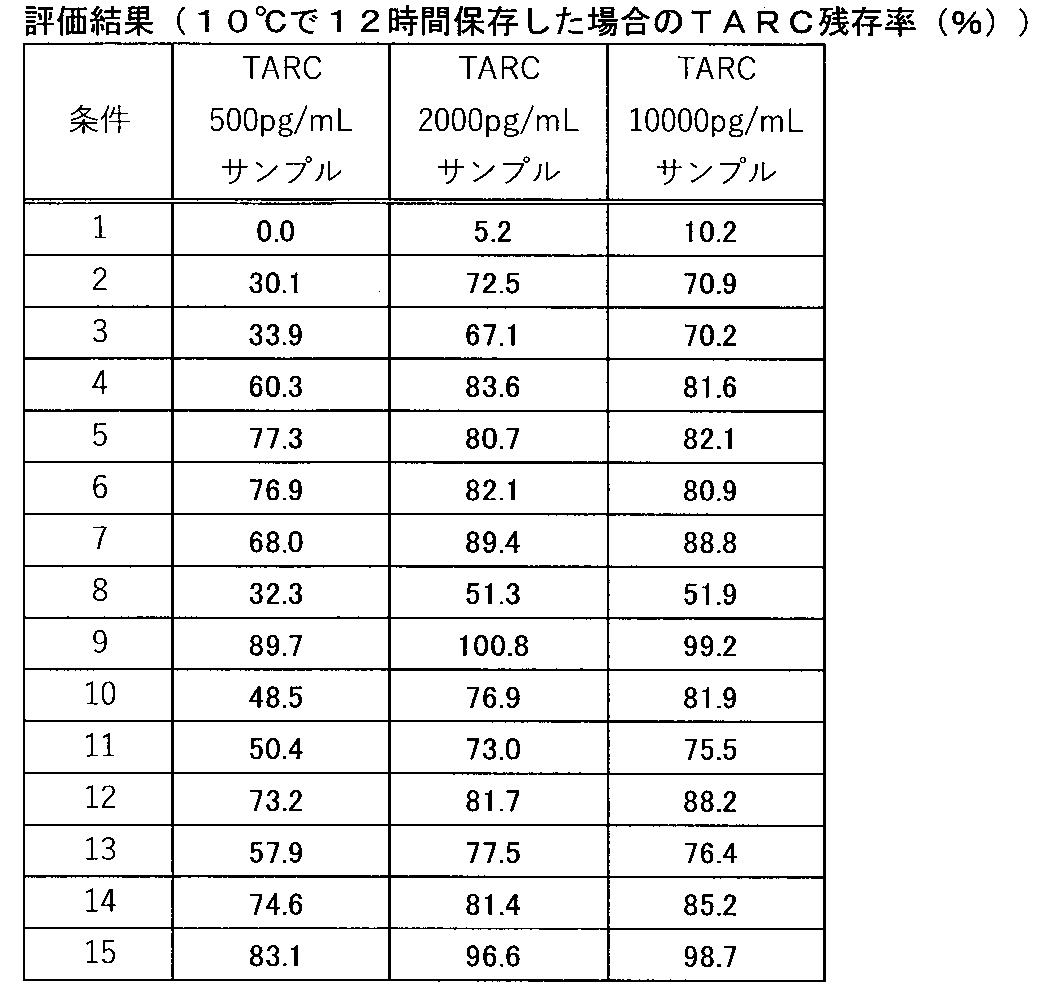
TARC濃度が500pg/mLの場合、2-メタクリロイルオキシエチルホスホリルコリンを構成単位として有する重合体を添加していない条件1では、12時間経過後の残存率が0.0%となり、すべてのTARCがガラス容器に吸着した、または構造が変化したと考えられた。これに対し、2-メタクリロイルオキシエチルホスホリルコリンを構成単位として有する重合体である、Lipidure―BL206を0.01、0.05%添加した条件2、3においては残存率が30.1、33.9%と改善された。さらにLipidure-BL206を0.1%添加した条件4では残存率は60.3%、Lipidure-BL206を0.5%、1.0%添加した条件5、6では残存率は75%以上と、大幅に改善された。また、2-メタクリロイルオキシエチルホスホリルコリンを構成単位として有する重合体であって、さまざまな側鎖構造を有する化合物を0.1%添加した条件7~14においても、TARC残存率は32.3%~89.7%と、条件1に対して大幅に改善された。
TARC濃度が2000pg/mL、10000pg/mLの場合も同様にTARC残存率を評価した。2-メタクリロイルオキシエチルホスホリルコリンを構成単位として有する重合体を添加していない条件1では、12時間経過後の残存率が5.2%、10.2%であったのに対して、本発明で見いだされた条件2~14では、51.3%~100.8%と、TARC残存率が大幅に改善された。2-メタクリロイルオキシエチルホスホリルコリンを構成単位として有する重合体であれば、共重合するモノマーが有する側鎖の性質に依らず、TARC残存率が改善することが示された。
さらに、2-メタクリロイルオキシエチルホスホリルコリンを構成単位として有するLipidure-BL206に対して陽イオン性界面活性剤を併用した条件15においても、条件1と比較してTARC残存率が大幅に改善された。また、同濃度のLipidure-BL206を単独で使用した条件4と比較して、界面活性剤を併用したほうが、TARC残存率が高いという結果が得られた。
以上より、2-メタクリロイルオキシエチルホスホリルコリンを構成単位として有する重合体とTARCとを共存させることで、ガラスバイアル保存時におけるTARCの保存安定性が改善することが示された。これは、条件2~15において、2-メタクリロイルオキシエチルホスホリルコリンを構成単位として有する重合体の添加により、容器の壁面へのTARCの吸着を防止できたため、または保存中のTARCの構造変化を抑制できたためと考えられた。さらに、2-メタクリロイルオキシエチルホスホリルコリンを構成単位として有する重合体に対して任意の界面活性剤を併用することで、さらに高い効果が得られることが示唆された。
TARC濃度が2000pg/mL、10000pg/mLの場合も同様にTARC残存率を評価した。2-メタクリロイルオキシエチルホスホリルコリンを構成単位として有する重合体を添加していない条件1では、12時間経過後の残存率が5.2%、10.2%であったのに対して、本発明で見いだされた条件2~14では、51.3%~100.8%と、TARC残存率が大幅に改善された。2-メタクリロイルオキシエチルホスホリルコリンを構成単位として有する重合体であれば、共重合するモノマーが有する側鎖の性質に依らず、TARC残存率が改善することが示された。
さらに、2-メタクリロイルオキシエチルホスホリルコリンを構成単位として有するLipidure-BL206に対して陽イオン性界面活性剤を併用した条件15においても、条件1と比較してTARC残存率が大幅に改善された。また、同濃度のLipidure-BL206を単独で使用した条件4と比較して、界面活性剤を併用したほうが、TARC残存率が高いという結果が得られた。
以上より、2-メタクリロイルオキシエチルホスホリルコリンを構成単位として有する重合体とTARCとを共存させることで、ガラスバイアル保存時におけるTARCの保存安定性が改善することが示された。これは、条件2~15において、2-メタクリロイルオキシエチルホスホリルコリンを構成単位として有する重合体の添加により、容器の壁面へのTARCの吸着を防止できたため、または保存中のTARCの構造変化を抑制できたためと考えられた。さらに、2-メタクリロイルオキシエチルホスホリルコリンを構成単位として有する重合体に対して任意の界面活性剤を併用することで、さらに高い効果が得られることが示唆された。
≪実施例2:プラスチック製点眼瓶における保存安定性試験結果≫
プラスチック製点眼瓶におけるTARCの保存安定性を試験した。試験方法及び評価方法は以下のとおりである。
プラスチック製点眼瓶におけるTARCの保存安定性を試験した。試験方法及び評価方法は以下のとおりである。
(1)保存条件
各濃度のTARCの液状保存液をプラスチック製点眼瓶に0.5mL分注し、37℃で28日間、あるいは4℃で28日間保存した。TARCの濃度は、500pg/mL、2000pg・BR>^mL、及び10000pg/mLで試験した。
各濃度のTARCの液状保存液をプラスチック製点眼瓶に0.5mL分注し、37℃で28日間、あるいは4℃で28日間保存した。TARCの濃度は、500pg/mL、2000pg・BR>^mL、及び10000pg/mLで試験した。
(2)測定方法
実施例1と同一の方法で測定した。
実施例1と同一の方法で測定した。
(3)TARC残存率(%)の算出
37℃で28日間、あるいは4℃で28日間保存後の各TARCの液状保存液のTARCの濃度について、次式を用いて、TARC残存率(%)を算出した。
37℃で28日間、あるいは4℃で28日間保存後の各TARCの液状保存液のTARCの濃度について、次式を用いて、TARC残存率(%)を算出した。
TARC残存率(%)=点眼瓶で37℃で28日、あるいは4℃で28日間保存後の各TARC液状保存液のTARC濃度(pg/mL)/調製直後のTARC液状保存液のTARC濃度(pg/mL)×100
(4)表1と同一の条件で検討を実施し、評価結果を表3、4に示した。なお、TARC残存率(%)は3回の実験の平均値を用いて算出した。

TARC濃度が500pg/mLの場合、2-メタクリロイルオキシエチルホスホリルコリンを構成単位として有する重合体を添加していない条件1では、28日経過後の残存率は47.2%であった。一方、2-メタクリロイルオキシエチルホスホリルコリンを構成単位として有する重合体を添加した条件2~15では、残存率は83.9~96.1と高い値を維持した。同様に、TARC濃度が2000pg/mL、10000pg/mLの場合も、2-メタクリロイルオキシエチルホスホリルコリンを構成単位として有する重合体を添加していない条件1に対して、本願で見いだされた2-メタクリロイルオキシエチルホスホリルコリンを構成単位として有する重合体を添加した条件2~15では、TARC残存率が改善された。これは、条件2~15では、2-メタクリロイルオキシエチルホスホリルコリンを構成単位として有する重合体の添加により、容器の壁面へのTARCの吸着を防止できたため、または保存中のTARCの構造変化を抑制できたためと考えられた。
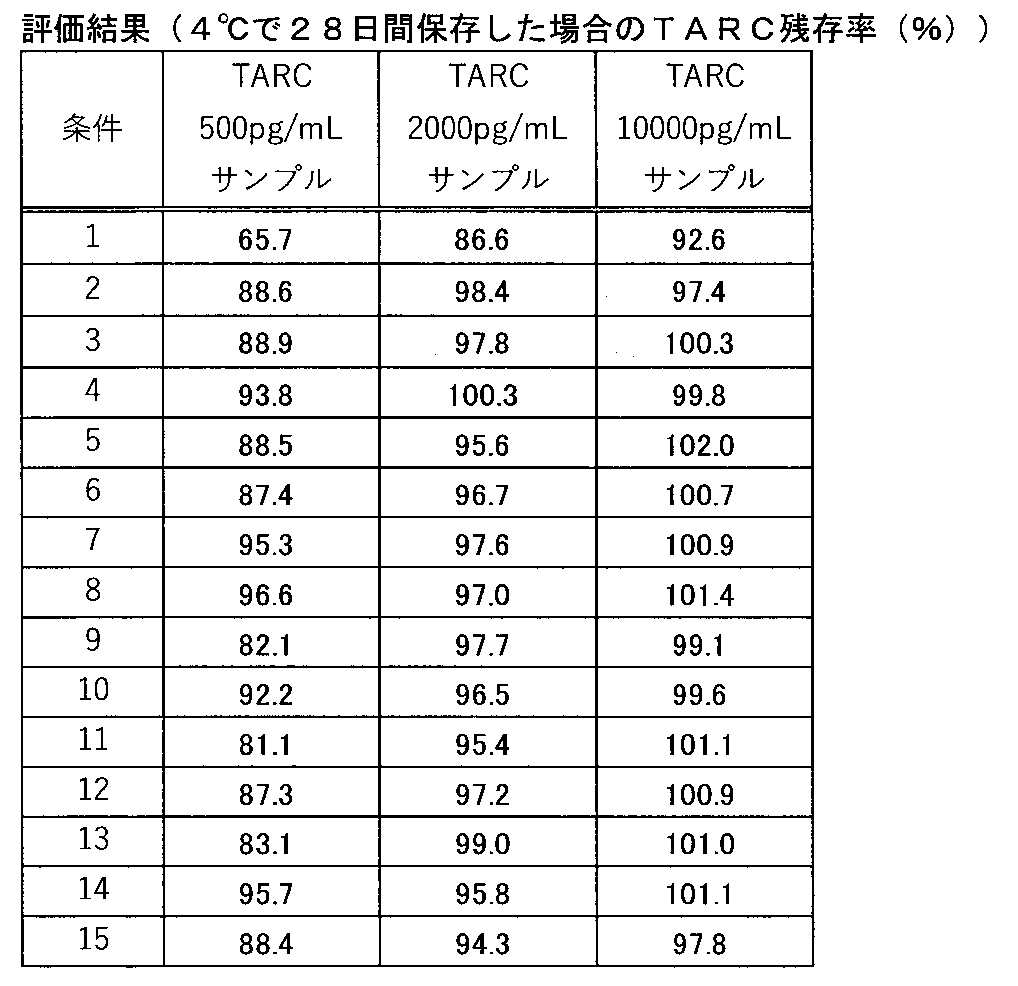
TARC濃度が500pg/mLの場合、2-メタクリロイルオキシエチルホスホリルコリンを構成単位として有する重合体を添加していない条件1では、28日経過後の残存率が65.7%となり、低い結果となった。一方、2-メタクリロイルオキシエチルホスホリルコリンを構成単位として有する重合体を添加した条件2~15では、残存率は81.1~96.6%と高い値を維持した。同様に、TARC濃度が2000pg/mL、10000pg/mLの場合も、2-メタクリロイルオキシエチルホスホリルコリンを構成単位として有する重合体を添加していない条件1に対して、本願で見いだされた2-メタクリロイルオキシエチルホスホリルコリンを構成単位として有する重合体を添加した条件2~15では、TARC残存率が改善された。これは、条件2~15では、2-メタクリロイルオキシエチルホスホリルコリンを構成単位として有する重合体の添加により、容器の壁面へのTARCの吸着を防止できたため、または保存中のTARCの構造変化を抑制できたためと考えられた。
≪比較例1:ガラスバイアルにおける保存安定性試験結果≫
ガラスバイアルにおけるTARCの保存安定性を試験した。保存液としては以下の組成の溶液を使用した。
・PBS(pH7.2)
・1質量% BSA
・界面活性剤(濃度、製品名、種類は表5に記載)
添加剤として界面活性剤を使用したこと、及び保存時間を6時間としたこと以外は、実施例1と同様の手順で実験を行った。
ガラスバイアルにおけるTARCの保存安定性を試験した。保存液としては以下の組成の溶液を使用した。
・PBS(pH7.2)
・1質量% BSA
・界面活性剤(濃度、製品名、種類は表5に記載)
添加剤として界面活性剤を使用したこと、及び保存時間を6時間としたこと以外は、実施例1と同様の手順で実験を行った。

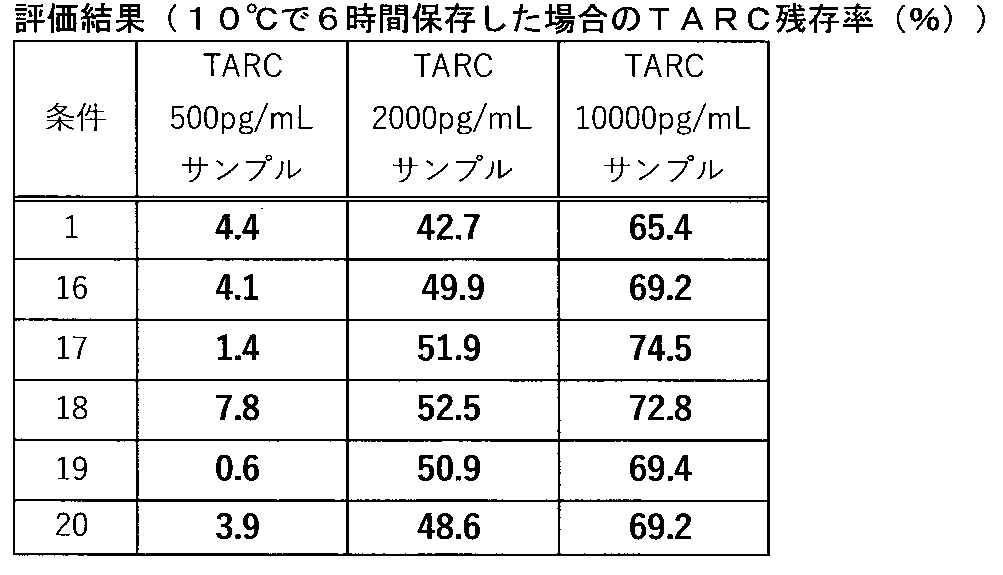
TARC濃度が500pg/mLの場合、界面活性剤を添加していない条件1では、6時間経過後の残存率が4.4%となり、大部分のTARCがガラス容器に吸着した、または構造が変化したと考えられた。これに対して、特定の構造を有する非イオン性界面活性剤、又は両性界面活性剤を添加した条件16~20では、6時間経過後の残存率が0.6%~7.8となり、界面活性剤を添加していない条件1と比較し、残存率は改善しなかった。同様に、TARC濃度が2000pg/mL、10000pg/mLの場合も、界面活性剤を添加していない条件1に対して、特定の構造を有する非イオン性界面活性剤、又は両性界面活性剤を添加した条件16~20において、TARC残存率は改善しなかった。
したがって、2-メタクリロイルオキシエチルホスホリルコリンを構成単位として有する重合体は、比較例1で使用した特定の構造を有する非イオン性界面活性剤および両性界面活性剤よりも、良好なTARCの保存安定性向上効果を有すると考えられた。特に条件20は、特許文献2に示された化合物を添加しているが、検討したすべてのTARC濃度において、保存安定性向上の効果は認められなかった。
したがって、2-メタクリロイルオキシエチルホスホリルコリンを構成単位として有する重合体は、比較例1で使用した特定の構造を有する非イオン性界面活性剤および両性界面活性剤よりも、良好なTARCの保存安定性向上効果を有すると考えられた。特に条件20は、特許文献2に示された化合物を添加しているが、検討したすべてのTARC濃度において、保存安定性向上の効果は認められなかった。
本発明によれば、保存安定性の高いTARC含有組成物、特に、TARC含有校正用試料を提供することができる。
Claims (20)
- TARC(Thymus and activation-regulated chemokine)を含む組成物であって、
TARC、及び
2-メタクリロイルオキシエチルホスホリルコリンを構成単位として有する重合体を含み、そして
液状である、前記組成物。 - TARCを測定するための校正用試料溶液である、請求項1に記載の組成物。
- 保存容器に充填されている、請求項1又は2に記載の組成物。
- 保存容器が、プラスチック又はガラスである、請求項3に記載の組成物。
- TARCの濃度が、前記組成物に対して、10pg/mL~1μg/mLである、請求項1~4のいずれかに記載の組成物。
- 前記重合体の濃度が、前記組成物に対して、0.001質量%~5質量%である、請求項1~5のいずれかに記載の組成物。
- 前記重合体の重量平均分子量が、1000~2000000である、請求項1~6のいずれかに記載の組成物。
- TARCの濃度が、前記組成物に対して500pg/mLの場合に、37℃で28日間、プラスチック容器において保存した後のTARCの残存率が、80%以上である、請求項1~7のいずれかに記載の組成物。
- TARCの濃度が、前記組成物に対して500pg/mLの場合に、4℃で28日間、プラスチック容器において保存した後のTARCの残存率が、80%以上である、請求項1~8のいずれかに記載の組成物。
- TARCの濃度が、前記組成物に対して500pg/mLの場合に10℃で12時間、ガラス容器において保存した後のTARCの残存率が30%以上である、請求項1~9のいずれかに記載の組成物。
- 前記重合体の重量平均分子量が、10000~70000である、請求項1~10のいずれかに記載の組成物。
- 請求項1~11のいずれかに記載の組成物を使用する、TARCの測定方法。
- 請求項1~11のいずれかに記載の組成物を含む、TARCの測定キット。
- 2-メタクリロイルオキシエチルホスホリルコリンを構成単位として有する重合体を含む溶液にTARCを接触させる工程を含む、TARCの保存安定性向上方法。
- 前記TARCの濃度が、前記溶液に対して、10pg/mL~1μg/mLとなるように調整する工程を含む、請求項14に記載のTARCの保存安定性向上方法。
- 前記重合体の濃度が、前記溶液に対して、0.001質量%~5質量%である、請求項14又は15に記載のTARCの保存安定性向上方法。
- 前記重合体の重量平均分子量が、10000~70000である、請求項14~16のいずれかに記載のTARCの保存安定性向上方法。
- TARCを含む溶液中のTARCの容器への吸着防止剤であって、2-メタクリロイルオキシエチルホスホリルコリンを構成単位として有する重合体を有効成分として含有する前記吸着防止剤。
- 前記TARCを含む溶液中のTARCの濃度が、前記溶液に対して、10pg/mL~1μg/mLである、請求項18に記載の吸着防止剤。
- 前記重合体の重量平均分子量が、10000~70000である、請求項18又は19に記載の吸着防止剤。
Priority Applications (3)
| Application Number | Priority Date | Filing Date | Title |
|---|---|---|---|
| US18/015,231 US20230258657A1 (en) | 2020-07-10 | 2021-07-09 | Composition containing tarc, and method for improving storage stability of tarc |
| CN202180048588.6A CN115777066A (zh) | 2020-07-10 | 2021-07-09 | 含有tarc的组合物和改善tarc储存稳定性的方法 |
| JP2021552964A JP6985567B1 (ja) | 2020-07-10 | 2021-07-09 | Tarcを含有する組成物、及びtarcの保存安定性向上方法 |
Applications Claiming Priority (2)
| Application Number | Priority Date | Filing Date | Title |
|---|---|---|---|
| JP2020-119026 | 2020-07-10 | ||
| JP2020119026 | 2020-07-10 |
Publications (1)
| Publication Number | Publication Date |
|---|---|
| WO2022009975A1 true WO2022009975A1 (ja) | 2022-01-13 |
Family
ID=79552514
Family Applications (1)
| Application Number | Title | Priority Date | Filing Date |
|---|---|---|---|
| PCT/JP2021/025904 Ceased WO2022009975A1 (ja) | 2020-07-10 | 2021-07-09 | Tarcを含有する組成物、及びtarcの保存安定性向上方法 |
Country Status (2)
| Country | Link |
|---|---|
| TW (1) | TWI893163B (ja) |
| WO (1) | WO2022009975A1 (ja) |
Citations (6)
| Publication number | Priority date | Publication date | Assignee | Title |
|---|---|---|---|---|
| JPH0783923A (ja) * | 1993-09-14 | 1995-03-31 | Nippon Oil & Fats Co Ltd | タンパク質吸着防止剤 |
| WO2003100386A1 (fr) * | 2002-05-28 | 2003-12-04 | National Institute Of Advanced Industrial Science And Technology | Methode de mesure d'une quantite restreinte d'une matiere au moyen d'un resonateur a quartz |
| JP2010156681A (ja) * | 2008-12-02 | 2010-07-15 | Kyowa Medex Co Ltd | リポ蛋白中成分の分別定量用標準品の製造方法 |
| US20130171659A1 (en) * | 2011-12-28 | 2013-07-04 | Abbott Japan Co., Ltd. | Methods of prognosis and diagnosis of rheumatoid arthritis |
| JP2015117269A (ja) * | 2013-12-17 | 2015-06-25 | 日油株式会社 | ポリマー及びその製造方法 |
| WO2019189642A1 (ja) * | 2018-03-28 | 2019-10-03 | デンカ生研株式会社 | リポ蛋白コレステロールの定量方法、定量試薬及び定量キット |
-
2021
- 2021-07-09 WO PCT/JP2021/025904 patent/WO2022009975A1/ja not_active Ceased
- 2021-07-09 TW TW110125273A patent/TWI893163B/zh active
Patent Citations (6)
| Publication number | Priority date | Publication date | Assignee | Title |
|---|---|---|---|---|
| JPH0783923A (ja) * | 1993-09-14 | 1995-03-31 | Nippon Oil & Fats Co Ltd | タンパク質吸着防止剤 |
| WO2003100386A1 (fr) * | 2002-05-28 | 2003-12-04 | National Institute Of Advanced Industrial Science And Technology | Methode de mesure d'une quantite restreinte d'une matiere au moyen d'un resonateur a quartz |
| JP2010156681A (ja) * | 2008-12-02 | 2010-07-15 | Kyowa Medex Co Ltd | リポ蛋白中成分の分別定量用標準品の製造方法 |
| US20130171659A1 (en) * | 2011-12-28 | 2013-07-04 | Abbott Japan Co., Ltd. | Methods of prognosis and diagnosis of rheumatoid arthritis |
| JP2015117269A (ja) * | 2013-12-17 | 2015-06-25 | 日油株式会社 | ポリマー及びその製造方法 |
| WO2019189642A1 (ja) * | 2018-03-28 | 2019-10-03 | デンカ生研株式会社 | リポ蛋白コレステロールの定量方法、定量試薬及び定量キット |
Non-Patent Citations (2)
| Title |
|---|
| ANONYMOUS: "A cura seed TARC, Package Insert, ''Usage, dose (operation method)", FUJIFILM TECHNO PRODUCTS, October 2019 (2019-10-01) * |
| ANONYMOUS: "Th2 Chemokine / TARC Kit HISCL® TARC", SYSMEX, October 2019 (2019-10-01), pages 1 - 4, XP055898538, Retrieved from the Internet <URL:https://www.sysmex.co.jp/pdf/documents/G005_RPI.pdf> [retrieved on 20210803] * |
Also Published As
| Publication number | Publication date |
|---|---|
| TW202217314A (zh) | 2022-05-01 |
| TWI893163B (zh) | 2025-08-11 |
Similar Documents
| Publication | Publication Date | Title |
|---|---|---|
| CN109187947B (zh) | 一种β2微球蛋白测定试剂盒及其检测方法 | |
| CN109725160B (zh) | 一种降钙素原(pct)检测试剂盒 | |
| TWI832901B (zh) | 血紅素之測定試劑、測定套組及測定方法 | |
| CN108152512A (zh) | 肝素结合蛋白检测试剂盒及其制备方法 | |
| CN101374410A (zh) | 含有升高数量的d-二聚体的储存稳定的细胞全血组合物 | |
| CN202916286U (zh) | 一种定量检测降钙素原pct的胶乳增强免疫比浊试剂盒 | |
| CN108089005A (zh) | 一种磁微粒甲胎蛋白化学发光免疫检测试剂盒及其制备方法 | |
| CN115902243A (zh) | 一种脂联素胶乳免疫比浊测定试剂盒及其制备方法 | |
| JP6985567B1 (ja) | Tarcを含有する組成物、及びtarcの保存安定性向上方法 | |
| CN103940992B (zh) | C-反应蛋白检测试剂盒及其制备 | |
| WO2022009975A1 (ja) | Tarcを含有する組成物、及びtarcの保存安定性向上方法 | |
| TWI899280B (zh) | 含有tarc之組成物及tarc之保存穩定性之提升方法 | |
| CN115561450A (zh) | 用于检测触珠蛋白含量的试剂盒 | |
| CN101354400B (zh) | 用于胶乳聚集反应的试剂及检测目标物质的方法 | |
| CN118369582A (zh) | 包含肺表面活性蛋白的液态组合物和包含所述液态组合物的免疫测定试剂盒以及肺表面活性蛋白的保存稳定性提高方法 | |
| CN110988362A (zh) | 抗组蛋白抗体测定试剂、试剂盒及其使用方法 | |
| JP6979149B1 (ja) | Tarcを含有する組成物、及びtarcの保存安定性向上方法 | |
| Sharma et al. | Structural basis of the binding of fatty acids to peptidoglycan recognition protein, PGRP-S through second binding site | |
| TWI900607B (zh) | 含有tarc之組成物及tarc之保存穩定性之提升方法 | |
| CN112268868A (zh) | 乳胶免疫比浊法测定钙卫蛋白的试剂盒 | |
| CN113252909A (zh) | 一种基于量子点免疫荧光检测试剂盒及其制备方法 | |
| EP4575501A1 (en) | Immunoassay method and reagent | |
| CN111856037A (zh) | Unc45a与hsp10的比值在pop早期预警、诊断、预后评估中的应用和产品 | |
| RU2843466C1 (ru) | Диагностический реагент для количественного определения прокальцитонина в образце | |
| EP4365592A1 (en) | Composition containing tarc, diluted solution, method for preventing carry over of tarc, adsorption-preventing agent, and continuous analysis method |
Legal Events
| Date | Code | Title | Description |
|---|---|---|---|
| ENP | Entry into the national phase |
Ref document number: 2021552964 Country of ref document: JP Kind code of ref document: A |
|
| 121 | Ep: the epo has been informed by wipo that ep was designated in this application |
Ref document number: 21837610 Country of ref document: EP Kind code of ref document: A1 |
|
| NENP | Non-entry into the national phase |
Ref country code: DE |
|
| 122 | Ep: pct application non-entry in european phase |
Ref document number: 21837610 Country of ref document: EP Kind code of ref document: A1 |