WO2022004656A1 - 内視鏡用可撓管、内視鏡型医療機器、及びこれらの製造方法 - Google Patents
内視鏡用可撓管、内視鏡型医療機器、及びこれらの製造方法 Download PDFInfo
- Publication number
- WO2022004656A1 WO2022004656A1 PCT/JP2021/024360 JP2021024360W WO2022004656A1 WO 2022004656 A1 WO2022004656 A1 WO 2022004656A1 JP 2021024360 W JP2021024360 W JP 2021024360W WO 2022004656 A1 WO2022004656 A1 WO 2022004656A1
- Authority
- WO
- WIPO (PCT)
- Prior art keywords
- flexible tube
- compound
- endoscope
- polyester
- component derived
- Prior art date
- Legal status (The legal status is an assumption and is not a legal conclusion. Google has not performed a legal analysis and makes no representation as to the accuracy of the status listed.)
- Ceased
Links
Images


Classifications
-
- A—HUMAN NECESSITIES
- A61—MEDICAL OR VETERINARY SCIENCE; HYGIENE
- A61L—METHODS OR APPARATUS FOR STERILISING MATERIALS OR OBJECTS IN GENERAL; DISINFECTION, STERILISATION OR DEODORISATION OF AIR; CHEMICAL ASPECTS OF BANDAGES, DRESSINGS, ABSORBENT PADS OR SURGICAL ARTICLES; MATERIALS FOR BANDAGES, DRESSINGS, ABSORBENT PADS OR SURGICAL ARTICLES
- A61L29/00—Materials for catheters, medical tubing, cannulae, or endoscopes or for coating catheters
- A61L29/08—Materials for coatings
- A61L29/085—Macromolecular materials
-
- A—HUMAN NECESSITIES
- A61—MEDICAL OR VETERINARY SCIENCE; HYGIENE
- A61L—METHODS OR APPARATUS FOR STERILISING MATERIALS OR OBJECTS IN GENERAL; DISINFECTION, STERILISATION OR DEODORISATION OF AIR; CHEMICAL ASPECTS OF BANDAGES, DRESSINGS, ABSORBENT PADS OR SURGICAL ARTICLES; MATERIALS FOR BANDAGES, DRESSINGS, ABSORBENT PADS OR SURGICAL ARTICLES
- A61L29/00—Materials for catheters, medical tubing, cannulae, or endoscopes or for coating catheters
- A61L29/04—Macromolecular materials
- A61L29/06—Macromolecular materials obtained otherwise than by reactions only involving carbon-to-carbon unsaturated bonds
-
- A—HUMAN NECESSITIES
- A61—MEDICAL OR VETERINARY SCIENCE; HYGIENE
- A61B—DIAGNOSIS; SURGERY; IDENTIFICATION
- A61B1/00—Instruments for performing medical examinations of the interior of cavities or tubes of the body by visual or photographical inspection, e.g. endoscopes; Illuminating arrangements therefor
- A61B1/005—Flexible endoscopes
-
- C—CHEMISTRY; METALLURGY
- C08—ORGANIC MACROMOLECULAR COMPOUNDS; THEIR PREPARATION OR CHEMICAL WORKING-UP; COMPOSITIONS BASED THEREON
- C08K—Use of inorganic or non-macromolecular organic substances as compounding ingredients
- C08K5/00—Use of organic ingredients
- C08K5/04—Oxygen-containing compounds
- C08K5/09—Carboxylic acids; Metal salts thereof; Anhydrides thereof
-
- C—CHEMISTRY; METALLURGY
- C08—ORGANIC MACROMOLECULAR COMPOUNDS; THEIR PREPARATION OR CHEMICAL WORKING-UP; COMPOSITIONS BASED THEREON
- C08K—Use of inorganic or non-macromolecular organic substances as compounding ingredients
- C08K5/00—Use of organic ingredients
- C08K5/16—Nitrogen-containing compounds
-
- C—CHEMISTRY; METALLURGY
- C08—ORGANIC MACROMOLECULAR COMPOUNDS; THEIR PREPARATION OR CHEMICAL WORKING-UP; COMPOSITIONS BASED THEREON
- C08L—COMPOSITIONS OF MACROMOLECULAR COMPOUNDS
- C08L63/00—Compositions of epoxy resins; Compositions of derivatives of epoxy resins
-
- C—CHEMISTRY; METALLURGY
- C08—ORGANIC MACROMOLECULAR COMPOUNDS; THEIR PREPARATION OR CHEMICAL WORKING-UP; COMPOSITIONS BASED THEREON
- C08L—COMPOSITIONS OF MACROMOLECULAR COMPOUNDS
- C08L67/00—Compositions of polyesters obtained by reactions forming a carboxylic ester link in the main chain; Compositions of derivatives of such polymers
-
- C—CHEMISTRY; METALLURGY
- C08—ORGANIC MACROMOLECULAR COMPOUNDS; THEIR PREPARATION OR CHEMICAL WORKING-UP; COMPOSITIONS BASED THEREON
- C08L—COMPOSITIONS OF MACROMOLECULAR COMPOUNDS
- C08L79/00—Compositions of macromolecular compounds obtained by reactions forming in the main chain of the macromolecule a linkage containing nitrogen with or without oxygen or carbon only, not provided for in groups C08L61/00 - C08L77/00
-
- A—HUMAN NECESSITIES
- A61—MEDICAL OR VETERINARY SCIENCE; HYGIENE
- A61L—METHODS OR APPARATUS FOR STERILISING MATERIALS OR OBJECTS IN GENERAL; DISINFECTION, STERILISATION OR DEODORISATION OF AIR; CHEMICAL ASPECTS OF BANDAGES, DRESSINGS, ABSORBENT PADS OR SURGICAL ARTICLES; MATERIALS FOR BANDAGES, DRESSINGS, ABSORBENT PADS OR SURGICAL ARTICLES
- A61L2420/00—Materials or methods for coatings medical devices
- A61L2420/02—Methods for coating medical devices
Definitions
- the present invention relates to a flexible tube for an endoscope, an endoscopic medical device, and a method for manufacturing these.
- An endoscope is a medical device for observing a patient's body cavity, digestive tract, esophagus, etc. Since it is inserted into the body and used, it is desired that the organ is not damaged and the patient does not feel pain or discomfort.
- a spiral tube formed by spirally winding a softly bending metal strip is adopted as the flexible tube constituting the insertion portion of the endoscope. Further, the periphery thereof is coated with a flexible resin, and devised so as not to irritate or damage the inner surface of the esophagus, gastrointestinal tract, body cavity and the like.
- the endoscope for observing the inside of the human body is used repeatedly.
- the flexible tube that constitutes the insertion part of the endoscope needs to be cleaned and disinfected with chemicals after each use.
- a sterilization level of cleanliness that exceeds disinfection is required. Therefore, the flexible tube for an endoscope is required to have a high degree of durability to withstand repeated sterilization treatments.
- Patent Document 1 a flexible tube for an endoscope coated with an outer skin made of an elastomer molded body for an endoscope in which two or more kinds of thermoplastic polyester elastomers are crosslinked is deteriorated in the outer skin with respect to various chemicals. It is stated that is unlikely to occur.
- Patent Document 2 includes a resin layer containing one or more elastomers selected from the group consisting of polyester elastomers, polyurethane elastomers, and polyamide elastomers or chain extensions thereof, and a group consisting of polyester elastomers, polyurethane elastomers, and polyamide elastomers.
- Patent Document 3 describes a cleaning solution or disinfection by using polybutylene naphthalate for the hard segment of the polyester elastomer constituting the outer skin in a flexible tube for an endoscope in which the surface of the flexible tube material is coated with an outer skin. It is described that deterioration of the outer skin due to the liquid can be suppressed, and durability to sterilization using an autoclave can be improved.
- Patent Document 4 contains heat containing a resin having a polybutylene succinate chain and one or more copolymer resins selected from the group consisting of an aliphatic ether ester copolymer resin and an aliphatic ether amide copolymer resin. It has been described that a thermoplastic resin composition has excellent heat resistance for sterilization at high temperatures, and that the composition is used to form a tube of a flexible tube for an endoscope. Further, in Patent Document 5, a thermoplastic resin having a 10% tensile strength of 10 MPa or more is adopted as a constituent material of the resin layer covering the flexible tube base material, and a hindered amine compound having a molecular weight of 500 or more is mixed with this resin. Therefore, it is described that the deterioration of the resin layer is unlikely to occur even if the hydrogen hydrogen plasma treatment is repeated or the hydrogen gas gas treatment is repeated.
- the endoscope insertion portion has a characteristic that the flexible tube base material and the coating layer of the flexible tube base material are not easily peeled off even if they are repeatedly bent, and cracks and the like are less likely to occur in the coating layer. Bending durability) is required.
- the flexible tube for endoscopes in order to insert it into the body without giving the patient a feeling of foreign matter and to deliver it smoothly and reliably to the affected area, the flexible tube for endoscopes not only improves bending durability but also on the surface. It is required to be smooth without unevenness and to have excellent slipperiness with the inner surface of the body cavity, gastrointestinal tract, esophagus, etc., that is, excellent surface smoothness.
- the present invention provides a flexible tube for an endoscope, which exhibits excellent sterility durability against strong sterilization treatment such as ozone water, and also has excellent bending durability and surface smoothness. It is an object of the present invention to provide an endoscopic medical device used. Another object of the present invention is to provide a method for manufacturing the flexible tube for an endoscope and the endoscopic medical device.
- the present inventors have a component derived from a specific chain extender as a constituent material of a coating layer (skin) constituting a flexible tube for an endoscope, and have a constituent component derived from a specific chain extender.
- a flexible tube for an endoscope having a flexible tubular flexible tube base material and a coating layer covering the outer periphery of the flexible tube base material.
- the coating layer contains a polyester chain extender having a naphthalene structure.
- the chain extender is (A) epoxy compound, (B) isocyanate compound, (C) amine compound, (D) oxazoline compound, (E) carbodiimide compound having a molecular weight of less than 3,000, and (F) carboxylic acid anhydride.
- a flexible tube for an endoscope containing a component derived from at least one chain extender and a component derived from polyester having a naphthalene structure.
- the polyester chain extender having a naphthalene structure contains a component derived from the epoxy compound (A), and the component derived from the epoxy compound (A) contains a component derived from a 2 to 6-functional epoxy compound.
- the chain extender of polyester having a naphthalene structure contains a component derived from the (B) isocyanate compound, and the component derived from the (B) isocyanate compound contains a component derived from a bifunctional or trifunctional isocyanate compound. , ⁇ 1> or ⁇ 2>.
- the chain extender of polyester having a naphthalene structure contains a component derived from the (C) amine compound, and the component derived from the (C) amine compound contains a component derived from a 2 to 4 functional amine compound.
- the polyester chain extender having a naphthalene structure contains a component derived from the (D) oxazoline compound, and the component derived from the (D) oxazoline compound contains a component derived from a polymer-type oxazoline compound.
- the flexible tube for an endoscope according to any one of 1> to ⁇ 4>.
- the chain extender of the polyester having a naphthalene structure contains the constituent component derived from the carbodiimide compound having a molecular weight of less than 3,000 (E), and the constituent component derived from the carbodiimide compound having a molecular weight of less than 3,000 (E) is cyclic.
- the flexible tube for an endoscope according to any one of ⁇ 1> to ⁇ 5>, which contains a component derived from a carbodiimide compound having a structure.
- the chain extender of a polyester having a naphthalene structure contains a component derived from the (F) carboxylic acid anhydride, and the component derived from the (F) carboxylic acid anhydride is a composition derived from a tetracarboxylic acid dianhydride.
- An endoscopic medical device having a flexible tube for an endoscope according to any one of ⁇ 1> to ⁇ 7>.
- ⁇ 9> At least on the outer periphery of a flexible tubular flexible tube substrate, (A) epoxy compound, (B) isocyanate compound, (C) amine compound, (D) oxazoline compound, (E) molecular weight less than 3,000.
- Can be used for endoscopy which comprises forming a coating layer using a coating layer forming material containing at least one chain extender of a carbodiimide compound and (F) carboxylic acid anhydride, and a polyester having a naphthalene structure.
- a method for manufacturing an endoscopic medical device which comprises incorporating the flexible tube for an endoscope according to any one of ⁇ 1> to ⁇ 7> into an insertion portion of the endoscopic medical device.
- the flexible tube for an endoscope of the present invention exhibits excellent sterilization durability against strong sterilization treatment such as ozone water, and also has excellent bending durability and surface smoothness.
- the endoscopic medical device of the present invention is a device provided with a flexible tube for an endoscope having the above-mentioned excellent characteristics. Further, according to the method for manufacturing a flexible tube for an endoscope of the present invention, the flexible tube for an endoscope of the present invention having the above characteristics can be obtained. According to the method for manufacturing an endoscopic medical device of the present invention, it is possible to obtain an endoscopic medical device provided with the flexible tube for an endoscope of the present invention having the above-mentioned characteristics.
- FIG. 1 is an external view showing the configuration of an electronic endoscope.
- FIG. 2 is a partial cross-sectional view showing a schematic configuration of a flexible tube for an endoscope.
- the flexible tube for an endoscope of the present invention (hereinafter, the flexible tube for an endoscope may be simply referred to as a “flexible tube”) includes a flexible tubular flexible tube base material and a flexible tube base material.
- the chain extender of the polyester having a naphthalene structure has (A) an epoxy compound, (B) an isocyanate compound, (C) an amine compound, (D) an oxazoline compound, and (E) a molecular weight of 3, with respect to the polyester having a naphthalene structure. It is a polymer obtained by subjecting a chain extension treatment with at least one chain extender of a carbodiimide compound of less than 000 and (F) carboxylic acid anhydride.
- the chain extender of the polyester having a naphthalene structure includes (A) an epoxy compound, (B) an isocyanate compound, (C) an amine compound, (D) an oxazoline compound, (E) a carbodiimide compound having a molecular weight of less than 3,000, and ( F) It contains a component derived from at least one chain extender of a carboxylic acid anhydride and a component derived from polyester having a naphthalene structure.
- the flexible tube of the present invention exhibits excellent sterilization durability even with strong sterilization treatment such as ozone water, has excellent bending durability, and is also excellent in surface smoothness. That is, polyester having a naphthalene structure exhibits a barrier function that inhibits the migration and penetration of active species having a sterilizing action such as hydroxyl radical into the coating layer due to the size of the molecular area of the naphthalene structure. In the present invention, it is considered that the barrier function is effectively enhanced by forming a polyester having such a structure into a chain extender (crosslinked body) by using a specific chain extender.
- the naphthalene structure of the chain extender in the coating layer inhibits the movement of the unreacted chain extender to the surface of the coating layer during thermal molding, and the chain extender provides an appropriate crosslink density and high molecular weight. It is considered that this will be realized and the characteristics required for endoscopes such as surface smoothness, flexibility, and fatigue resistance will be improved.
- the flexible tube of the present invention has a coating layer on the outer periphery of the flexible tube base material.
- the flexible tube of the present invention may have an intermediate layer on the flexible tube base material, in which case the flexible tube of the present invention has a coating layer on the intermediate layer.
- the coating layer may be a single layer or a multi-layer structure having two or more layers, and a single layer is preferable.
- the coating layer is a single layer in the present invention, the coating layer of the single layer includes a polyester chain extension having a naphthalene structure.
- a polyester chain extension having a naphthalene structure at least in the outermost layer is included. That is, in the present invention, the coating layer contains a polyester chain extender having a naphthalene structure in the outermost layer.
- polyester having a naphthalene structure examples include a polyester resin having a naphthalene structure and a polyester elastomer having a naphthalene structure.
- the polyester having the naphthalene structure is preferably composed of a dicarboxylic acid component (component derived from dicarboxylic acid) containing a naphthalenedicarboxylic acid component (component derived from naphthalenedicarboxylic acid) and a diol component (component derived from diol). Polyester can be mentioned.
- a specific example of the dicarboxylic acid component preferable as the naphthalene dicarboxylic acid component is the 2,6-naphthalene dicarboxylic acid component.
- the polyester resin having a naphthalene structure preferably has a naphthalene dicarboxylic acid component.
- the polyester resin having a naphthalene dicarboxylic acid component may have a dicarboxylic acid component other than the naphthalene dicarboxylic acid component as the dicarboxylic acid component.
- the dicarboxylic acid component other than the naphthalene dicarboxylic acid component is not particularly limited, and those usually used as the dicarboxylic acid component constituting the polyester resin can be widely applied.
- terephthalic acid isophthalic acid, phthalic acid (ortho), 5-sodium sulfoisophthalic acid, oxalic acid, succinic acid, adipic acid, sebacic acid, azelaic acid, dodecanedioic acid, dimer acid, maleic acid, fumaric acid
- phthalic acid ortho
- 5-sodium sulfoisophthalic acid oxalic acid
- succinic acid adipic acid, sebacic acid, azelaic acid
- dodecanedioic acid dimer acid
- maleic acid fumaric acid
- dicarboxylic acid components can be used.
- polyester resin having a naphthalene structure those usually used as a diol component constituting the polyester resin can be widely applied.
- a diol component constituting the polyester resin For example, configurations derived from ethylene glycol, diethylene glycol, 1,3-propanediol, 1,4-butanediol, neopentyl glycol, 1,6-hexanediol, cyclohexanedimethanol, triethylene glycol, bisphenol A, bisphenol S and the like. Ingredients are mentioned. One or more of these diol components can be used.
- the polyester resin having the naphthalene structure may contain a hydroxycarboxylic acid component as a component.
- a hydroxycarboxylic acid component examples include components derived from ⁇ -caprolactone, lactic acid, 4-hydroxybenzoic acid and the like. One or more of these hydroxycarboxylic acid components are used.
- the polyester resin having the naphthalene structure may be a homopolymer composed of the above components or a copolymer, and further contains a small amount of trifunctional compound components such as trimellitic acid, trimesic acid, pyromellitic acid, trimethylolpropane, glycerin, and pentaerythritol. It may be contained. Further, as the polyester resin having the naphthalene structure, two or more kinds of homopolymers or copolymers composed of the above components may be used in combination.
- the polyester elastomer having a naphthalene structure preferably has a naphthalene dicarboxylic acid component. More preferably, a hard segment composed of a crystalline polyester chain containing a dicarboxylic acid component containing a naphthalenedicarboxylic acid component and a low molecular weight diol component, and at least one of the following soft segments (i) to (iii). It is a copolymer composed of.
- Amorphous soft segment composed of aliphatic polyester chains (Ii) Amorphous soft segments composed of aliphatic polymer diol components, (Iii) A soft segment composed of a polyester chain composed of an aliphatic polymer diol component and a dicarboxylic acid component containing an aromatic dicarboxylic acid. That is, the naphthalene structure is formed in one or both of the hard segment and the soft segment. It may be installed, preferably at least in the hard segment.
- a specific example of the dicarboxylic acid component preferable as the naphthalene dicarboxylic acid component is the 2,6-naphthalene dicarboxylic acid component.
- a polyester elastomer having a naphthalene structure in the hard segment will be described below.
- the hard segment has a naphthalene dicarboxylic acid component.
- the hard segment has a naphthalenedicarboxylic acid component
- all of the dicarboxylic acid components of the hard segment may be a naphthalenedicarboxylic acid component, and the hard segment may have a dicarboxylic acid component other than the naphthalenedicarboxylic acid component.
- dicarboxylic acid component other than the naphthalene dicarboxylic acid component constituting the hard segment those usually used as the dicarboxylic acid component constituting the hard segment of a general polyester elastomer can be widely applied.
- a dicarboxylic acid component other than the naphthalene dicarboxylic acid component described in the description of the polyester resin having a naphthalene structure can be mentioned, and one or more of these dicarboxylic acid components can be contained.
- the dicarboxylic acid component other than the naphthalenedicarboxylic acid component constituting the hard segment preferably contains an aromatic dicarboxylic acid component (dicarboxylic acid component having an aromatic ring), and 50 of the dicarboxylic acid components other than the naphthalenedicarboxylic acid component.
- the aromatic dicarboxylic acid component is in an amount of mass% or more (preferably 70% by mass or more, more preferably 80% by mass or more, still more preferably 90% by mass or more). It is also preferable that all of the dicarboxylic acid components other than the naphthalene dicarboxylic acid component constituting the hard segment are aromatic dicarboxylic acid components.
- diol component constituting the hard segment those usually used as the diol component constituting the polyester resin can be widely applied.
- the diol component described in the polyester resin having a naphthalene structure can be mentioned, and one or more of those diol components can be contained.
- the hard segment may have one or more of the hydroxycarboxylic acid components described in the description of the polyester resin having a naphthalene structure as a constituent component.
- the hard segment may be a homopolymer or a copolymer composed of the constituents described above.
- the dicarboxylic acid component constituting the aliphatic polyester chain is not particularly limited as long as it is an aliphatic dicarboxylic acid component.
- it has components derived from oxalic acid, succinic acid, adipic acid, sebacic acid, azelaic acid, dodecanedioic acid, dimer acid, maleic acid, fumaric acid, itaconic acid, citraconic acid, mesaconic acid, cyclohexanedicarboxylic acid and the like. be able to.
- Aliphatic polyester chains can have one or more of these dicarboxylic acid components.
- the diol component of the aliphatic polyester chain constituting the soft segment is not particularly limited as long as it is an aliphatic diol component.
- examples thereof include aliphatic diol components derived from glycol, 1,5-pentanediol, 1,6-hexanediol, decamethylene glycol, cyclohexanedimethanol and the like.
- the aliphatic polyester chain has an aliphatic polymer diol component as a diol component.
- the aliphatic polymer diol component include polyalkylene glycols such as polyethylene glycol, polypropylene glycol, and polytetramethylene glycol, and one or more of these aliphatic polymer diol components can be contained.
- the polyalkylene glycol is a compound represented by HO-[(CH 2 ) m O] n-H.
- m is preferably 1 to 12, more preferably 2 to 10, further preferably 2 to 8, and even more preferably 2 to 6.
- n is preferably 5 to 100, more preferably 10 to 50.
- the soft segment is (ii) an amorphous soft segment derived from an aliphatic polymer diol
- the aliphatic polymer diol is not particularly limited as long as it is an aliphatic polymer diol.
- examples thereof include polyalkylene glycols such as polyethylene glycol, polypropylene glycol and polytetramethylene glycol.
- the polyester elastomer can have a structure having an aliphatic polymer diol component derived from one or more of these as a soft segment.
- the structure of the polyalkylene glycol is as described above.
- the soft segment is a soft segment composed of a polyester chain composed of (iii) an aliphatic polymer diol component and a dicarboxylic acid component containing an aromatic dicarboxylic acid
- the aliphatic polymer diol component is particularly limited.
- the constituent components derived from the aliphatic polymer diol described in (ii) above can be mentioned.
- examples of the aromatic dicarboxylic acid component include components derived from naphthalene dicarboxylic acid.
- the dicarboxylic acid component includes the dicarboxylic acid component described in (i) above.
- the polyester having a naphthalene structure reacts with the chain extender to form a chain extender, it has at least one functional group that reacts with the functional group of the chain extender, for example, a hydroxy group and a carboxy group. Alternatively, at least one of these groups is formed by heat kneading during the above reaction.
- the polyester may have these functional groups on at least one of the main chain and the side chain of the polymer, and preferably has these functional groups at one end or both ends of the main chain. These functional groups can be introduced into the polyester, for example, by selecting a raw material used for synthesizing the polyester, or by adjusting the conditions of the polymerization termination reaction. ..
- the functional group may also be generated by hydrolysis of polyester or the like.
- the functional group equivalent of the polyester (weight average molecular weight per functional group) can be appropriately determined in consideration of the functional number of the chain extender and the functional group equivalent.
- polyesters having a naphthalene structure examples include TQB-KET30 (trade name, manufactured by Teijin Chemicals Ltd.) and Perprene EN type (trade name, manufactured by Toyobo Co., Ltd.).
- One type of polyester having a naphthalene structure may be used alone, or two or more types may be used in combination.
- the content is preferably 50% by mass or more, more preferably 60% by mass or more, further preferably 70% by mass or more, still more preferably 80% by mass or more, still more preferably 90% by mass or more.
- the coating layer may be a layer made of a chain extension of polyester having a naphthalene structure, and when the coating layer is a plurality of layers, the outermost layer is polyester having a naphthalene structure. It may be a layer composed of a chain extender of.
- the coating layer is a single layer, the coating layer and when the coating layer is a multi-layer, the outermost layer is a chain extension of polyester having a naphthalene structure, a polymer other than polyester having a naphthalene structure, and a chain extension thereof. It can be blended with at least one kind, and in this case, as a polymer other than polyester having a naphthalene structure, a polymer generally used as a coating material constituting a flexible tube for an endoscope is widely applied. Can be done. Examples of such polymers include polyesters, polyurethanes and polyamides that do not have a naphthalene structure.
- the layer other than the outermost layer also contains at least one kind of polyester having a naphthalene structure and a chain extension thereof.
- each of the above polymers and their chain extenders that can be used for the coating layer of the present invention preferably has a molecular weight of 10,000 to 1,000,000, more preferably 20,000 to 500,000, and a molecular weight of 50,000 to 300. 000 is more preferred.
- the molecular weight of the polymer constituting the coating layer means the weight average molecular weight unless otherwise specified.
- the weight average molecular weight can be measured as a polystyrene-equivalent molecular weight by gel permeation chromatography (GPC). Specific measurement conditions are shown below.
- a GPC device HLC-8220 (trade name, manufactured by Tosoh Corporation), chloroform as an eluent and G3000HXL + G2000HXL (both trade name, manufactured by Tosoh Corporation) as an eluent, RI (differential refractometer) at 23 ° C. and a flow rate of 1 mL / min. Refractometer) Can be measured by gel permeation chromatography detected by a detector.
- the number average molecular weight can be measured under the same conditions as the weight average molecular weight described above. In the present specification, when the numerical range of the weight average molecular weight of the compound is described, this numerical range is also preferable as the numerical range of the number average molecular weight of this compound.
- the chain extender of the polyester having a naphthalene structure used in the present invention is (A) an epoxy compound, (B) an isocyanate compound, (C) an amine compound, (D) an oxazoline compound, and (E) a carbodiimide compound having a molecular weight of less than 3,000. And (F) carboxylic acid anhydride are prepared using at least one chain extender.
- Epoxy compound used as the chain extender in the present invention is not particularly limited, and for example, the epoxy compound described in JP-A-2008-115293 can be used.
- the epoxy compound may be either a monofunctional epoxy compound or a polyfunctional epoxy compound, and a polyfunctional epoxy compound is preferable.
- the functional number of the polyfunctional epoxy compound (the number of epoxy groups in one molecule) is preferably 2 to 6 from the viewpoint of sterilization durability, bending durability and surface smoothness of the flexible tube for endoscopes, and is preferably 2 to 6. 5 is more preferable, and 2 to 4 are even more preferable.
- the molecular weight of the epoxy compound is preferably 100 to 1,000, more preferably 200 to 600.
- the weight average molecular weight (Mw) of the epoxy compound is preferably 200 to 1,000, more preferably 300 to 800.
- the weight average molecular weight of the chain extender can be measured by GPC as a polystyrene-equivalent weight average molecular weight. Specific measurement conditions are shown below.
- RI differential refractometer
- the functional group equivalent (molecular weight or weight average molecular weight per epoxy group) of the epoxy compound is not particularly limited, and is preferably 50 to 300, more preferably 70 to 200.
- the epoxy compound examples include diglycidyl ether of dihydric phenol (diglycidyl ether containing a structure derived from a compound having two hydroxy groups bonded to a benzene ring or a naphthalene ring), and polyvalent (trivalent or higher) phenol.
- Polyglycidyl ether diglycidyl ether containing a structure derived from a compound having three or more hydroxy groups bonded to a benzene ring or a naphthalene ring
- an aliphatic dihydric alcohol or a high molecular weight diol diglycidyl ether a trivalent or higher fat.
- Examples thereof include polyglycidyl ethers of group alcohols, epoxy-modified silicones, glycidyl esters, glycidylamines, chain aliphatic epoxides, alicyclic epoxides, and urethane-modified epoxy compounds having a urethane bond in the structure.
- the diglycidyl ether of the dihydric phenol is not particularly limited, and a diglycidyl ether of dihydric phenol (having 6 to 30 carbon atoms) is preferable, for example, bisphenol F diglycidyl ether, bisphenol A diglycidyl ether, bisphenol B di.
- Glycidyl ether bisphenol AD diglycidyl ether, bisphenol S diglycidyl ether, halogenated bisphenol A diglycidyl ether (for example, tetrachlorobisphenol A diglycidyl ether, etc.), catechin diglycidyl ether, resorcinol diglycidyl ether, hydroquinone diglycidyl ether, 1,6-Dihydroxynaphthalenediglycidyl ether, dihydroxybiphenyldiglycidyl ether, octachloro-4,4'-dihydroxybiphenyldiglycidyl ether, tetramethylbiphenyldiglycidyl ether, 9,9'-bis (4-hydroxyphenyl) floorange
- diglycidyl ether obtained by reacting 2 mol of bisphenol A with 3 mol of epichlorohydrin.
- the polyhydric phenol (trivalent or higher) polyglycidyl ether is not particularly limited, and those having 6 or more carbon atoms and Mw of 5,000 or less are preferable.
- pyrogallol triglycidyl ether and dihydroxynaphthylcresol triglycidyl are preferable.
- Ether Tris (hydroxyphenyl) methanetriglycidyl ether, dinaphthylriol triglycidyl ether, 4,4'-oxybis (1,4-phenylethyl) phenylglycidyl ether, bis (dihydroxynaphthalene) tetraglycidyl ether, phenol or cresol novolac Glycidyl ether of resin (Mw200-5,000), glycidyl ether of limonenephenol novolak resin (Mw400-5,000), polyphenol (Mw400-5) obtained by condensation reaction of phenol with glioxal, glutal aldehyde, or formaldehyde. Examples thereof include polyglycidyl ethers of 000), polyglycidyl ethers of Mw400 to 5,000 obtained by the condensation reaction of resorcin and acetone, and the like.
- the diglycidyl ether of the aliphatic dihydric alcohol or the high molecular weight diol is not particularly limited, and the aliphatic dihydric alcohol having 2 to 100 carbon atoms or the diglycidyl ether of the high molecular weight diol of Mw150 to 5,000 is preferable.
- Diglycidyl ether, polytetramethylene glycol (Mw200-5,000) diglycidyl ether, neopentyl glycol diglycidyl ether and the like can be mentioned.
- the glycidyl ester is not particularly limited, and an aromatic carboxylic acid having 6 or more carbon atoms and having a divalent value or more, an aliphatic carboxylic acid or an alicyclic carboxylic acid glycidyl ester is preferable, and for example, a phthalic acid glycidyl ester (phthalate) is preferable.
- Aromatic carboxylic acids such as acid diglycidyl ester, isophthalic acid diglycidyl ester, terephthalic acid diglycidyl ester, etc.), trimellitic acid triglycidyl ester, etc .;
- Examples thereof include glycidyl esters of aliphatic or alicyclic carboxylic acids.
- the glycidylamine is not particularly limited, but is an aromatic amine glycidylamine having 6 or more carbon atoms and having 2 or more active hydrogen atoms, or an active hydrogen atom having 5 or more carbon atoms and having 2 or more active hydrogen atoms.
- the alicyclic or heterocyclic amine glycidyl amine having is preferable, for example, N, N-diglycidylaniline, N, N-diglycidyl toluidine, N, N, N', N'-tetraglycidyldiaminodiphenylmethane, N, Fragrances of N, N', N'-tetraglycidyldiaminodiphenylsulfone, N, N, N', N'-tetraglycidyldiaminodiphenylmethane (tetraglycidyldiaminodiphenylmethane), N, N, O-triglycidylaminophenol, etc.
- Group amine glycidyl amines aliphatic amine glycidyl amines such as N, N, N', N'-tetraglycidyl xylylene diamine, N, N, N', N'-tetraglycidyl hexamethylenediamine; N, N, Hydroponic compounds of N', N'-tetraglycidylxylylene diamine, glycidylamines of alicyclic amines such as N, N, N', N'-tetraglycidylcyclohexanediamine; Examples include glycidylamine.
- the above-mentioned chain aliphatic epoxide is not particularly limited, but a chain aliphatic epoxide having 6 or more carbon atoms and a divalent or higher valence is preferable, and for example, an epoxidized (poly) epoxide (for example, an epoxy equivalent of 130 to 1,000) is preferable.
- an epoxidized (poly) epoxide for example, an epoxy equivalent of 130 to 1,000
- examples thereof include epoxidized butadiene (Mw260 to 2,500) and epoxidized fats and oils (epoxidized soybean oil (Mw130 to 2,500)).
- the alicyclic epoxide is not particularly limited, but an alicyclic epoxide having 6 or more carbon atoms and Mw 2,500 or less and having 2 or more epoxy groups is preferable, for example, vinylcyclohexene dioxide and limonendioxide.
- Dicyclopentadiene Dioxide Bis (2,3-Epoxide Cyclopentyl) Ether, Ethylene Glycol Bisepoxide Dicyclopentyl Ether, Bis (3,4-Epoxide-6-Methylcyclohexylmethyl) Adipate, Bis (3,4-Epoxide- 6-Methylcyclohexylmethyl) butylamine and the like can be mentioned. It also includes a nuclear hydrogenated product of the above-mentioned phenolic epoxy compound.
- the urethane-modified urethane compound having a urethane bond in the above structure is not particularly limited, and is, for example, an isocyanate group-terminated urethane obtained by reacting a polyether urethane oligomer (Mw200 to 2,500, for example, a polyetherdiol and a diisocyanate). Examples thereof include a reaction product of (prepolymer) and glycidol.
- (B) Isocyanate compound The isocyanate compound used as the chain extender in the present invention is not particularly limited, and for example, the isocyanate compound described in International Publication No. 2014/157375 and the like can be used.
- the isocyanate compound may be either a monofunctional isocyanate compound or a polyfunctional isocyanate compound, and a polyfunctional isocyanate compound is preferable.
- the functional number of the polyfunctional isocyanate compound (the number of isocyanato groups in one molecule) is preferably 2 or 3 from the viewpoint of sterility durability, bending durability and surface smoothness of the flexible tube for endoscopes. More preferred.
- the molecular weight of the isocyanate compound is preferably 100 or more, more preferably 150 or more.
- the weight average molecular weight of the isocyanate compound is preferably 150 to 10,000, more preferably 200 to 10,000, still more preferably 300 to 5,000.
- the monofunctional isocyanate compound examples include butyl isocyanate, isopropyl isocyanate, 2-chloroethyl isocyanate, phenyl isocyanate, p-bromophenyl isocyanate, m-chlorophenyl isocyanate, o-chlorophenyl isocyanate, p-chlorophenyl isocyanate, 2,5-.
- polyfunctional isocyanate compound examples include hexamethylene diisocyanate, 2,4-toluylene diisocyanate, 2,6-toluylene diisocyanate, 1,5-naphthalenedi isocyanate, diphenylmethane-4,4'-diisocyanate, and 2,2-.
- a terminal isocyanate group-containing compound or the like obtained by the reaction between the polyfunctional isocyanate compound and the active hydrogen compound can also be used.
- examples of such compounds include an addition reaction product having a terminal isocyanate group obtained by the reaction of toluylene diisocyanate and trimethylolpropane, an addition reaction product having a terminal isocyanate group obtained by the reaction of toluylene diisocyanate and pentaerythritol, and the like. Can be mentioned.
- (C) Amine compound The amine compound used as the chain extender in the present invention is not particularly limited, and for example, the amine compounds described in JP-A-2008-545606 and JP-A-2018-182199 can be used.
- the amino group contained in the amine compound may be either an unsubstituted amino group or a monosubstituted amino group, and an unsubstituted amino group is preferable.
- an amine compound having an unsubstituted amino group will be referred to as a "primary amine compound”
- a compound having a monosubstituted amino group will be referred to as a "secondary amine compound”.
- amine compounds having an unsubstituted amino group and a monosubstituted amino group shall be classified as primary amine compounds.
- the functional number of the amine compound (the number of amino groups contained in one molecule) is preferably 2 to 4 from the viewpoint of sterility durability, bending durability and surface smoothness of the flexible tube for endoscopes, and 3 or 4 is preferable. More preferably, 4 is even more preferable.
- the molecular weight of the amine compound is preferably 50 or more, more preferably 150 or more.
- the weight average molecular weight of the amine compound is preferably 200 to 10,000, more preferably 300 to 8,000.
- an amine compound having a ring structure is preferable, and an amine having at least one of an alicyclic amine compound (amine compound having an alicyclic ring) and an aromatic amine compound (aromatic hydrocarbon ring and aromatic heterocycle) is preferable. Compounds) are preferred, and aromatic amine compounds are more preferred. An amine compound having an alicyclic ring and an aromatic ring (aromatic hydrocarbon ring and aromatic hetero ring) is classified as an aromatic amine compound.
- the amine compound may have a plurality of ring structures in the molecule, and the plurality of ring structures may be the same or different.
- alicyclic primary amine compound examples include cyclohexylamine.
- alicyclic secondary amine compound examples include N-methylcyclohexylamine.
- aromatic primary amine compound examples include diaminodiphenyl ether, xylenediamine (preferably paraxylenediamine), diaminobenzene, diaminotoluene, and methylenedi.
- Aniline dimethyldiaminobiphenyl, bis (trifluoromethyl) diaminobiphenyl, diaminobenzophenone, diaminobenzanilide, bis (aminophenyl) fluorene, bis (aminophenoxy) benzene, bis (aminophenoxy) biphenyl, dicarboxydiaminodiphenylmethane, diaminoresorcin , Dihydroxybenzidine, diaminobenzidine, 4,4'-diaminodiphenylmethane, 1,3,5-triaminophenoxybenzene, 2,2'-dimethylbenzidine, tris (4-aminophenyl) amine, 2,7-diaminofluorene, Tetrax (4-aminophenyl) methane, 2,4'-diaminodiphenylmethane, (o-tolyl) biguanide, melamine (1,3,5-triazine-2,4,
- aromatic secondary amine compound examples include 1,9-diaminophenylene, dibenzylamine, N, N'-di-isopropyl-p.
- an aromatic primary amine compound as the (C) amine compound from the viewpoint of sterility durability, bending durability and surface smoothness of the flexible tube for an endoscope.
- (D) Oxazoline compound The oxazoline compound used as the chain extender in the present invention is not particularly limited, and for example, the oxazoline compounds described in JP-A-2020-56006 and JP-A-2016-4978 can be used.
- the oxazoline compound may be either a monofunctional oxazoline compound or a polyfunctional oxazoline compound, and a polyfunctional oxazoline compound is preferable.
- the functional number of the polyfunctional oxazoline compound (the number of oxazoline groups contained in one molecule) is preferably 2 to 100, more preferably 2 to 50, and even more preferably 2 to 20.
- the molecular weight of the oxazoline compound is preferably 100 or more, more preferably 200 or more.
- the weight average molecular weight of the oxazoline compound is preferably 200 to 500,000, more preferably 500 to 500,000, and 5,000 to 500. 000 is more preferable, and 10,000 to 200,000 is even more preferable.
- the oxazoline compound examples include a bisoxazoline compound and a high-molecular-weight oxazoline compound (that is, a polymer having an oxazoline group, for example, an oxazoline group-containing polystyrene, an oxazoline group-containing acrylic polymer, and an oxazoline group-containing styrene- (meth) acrylic copolymer).
- the high molecular weight oxazoline compound is preferable from the viewpoint of sterilization durability, bending durability and surface smoothness of the flexible tube for an endoscope.
- the oxazoline content of the polymer-type oxazoline compound is not particularly limited, and is preferably 0.05 to 1.5 mmol / g, more preferably 0.1 to 1.0 mmol / g.
- bisoxazoline compound examples include 2,2'-bis (2-oxazoline), 2,2'-bis (4-methyl-2-oxazoline), and 2,2'-bis (4,4-dimethyl-2).
- -Oxazoline 2,2'-bis (4-ethyl-2-oxazoline), 2,2'-bis (4,4'-diethyl-2-oxazoline), 2,2'-bis (4-propyl-) 2-Oxazoline), 2,2'-bis (4-butyl-2-oxazoline), 2,2'-bis (4-hexyl-2-oxazoline), 2,2'-bis (4-phenyl-2-) Oxazoline), 2,2'-bis (4-cyclohexazoline), 2,2'-bis (4-benzyl-2-oxazoline), 2,2'-p-phenylenebis (2-oxazoline), 2,2'-m-Phenylenebis (2-oxazoline) (also known as 2,2'-(1,3-phenylene) bis (2-ox
- polymer-type oxazoline compound examples include the Epocross series manufactured by Nippon Shokubai Kagaku Kogyo Co., Ltd. (for example, Epocross K2010E, Epocross K2020E, Epocross K2030E, Epocross WS500, Epocross WS700, Epocross RPS-1005, all of which are trade names). be able to.
- the carbodiimide compound having a molecular weight of less than 3,000 (hereinafter, also simply referred to as “carbodiimide compound”) used as a chain extender in the present invention is not particularly limited, and is not particularly limited.
- Carbodiimide compounds having a molecular weight of less than 3,000 as described in Kai 2019-9263 and 2016-182685 can be used.
- the "molecular weight” means a weight average molecular weight when the carbodiimide compound has a molecular weight distribution.
- the molecular weight of the carbodiimide compound is preferably 150 or more, more preferably 200 or more.
- the weight average molecular weight of the carbodiimide compound is preferably 200 to 3,000, more preferably 500 to 2,000.
- the carbodiimide compound may be either a monofunctional carbodiimide compound or a polyfunctional carbodiimide compound.
- the functional number of the carbodiimide compound (the number of carbodiimide groups in one molecule) is preferably 1 to 6, more preferably 1 to 3, and even more preferably 1.
- the structure of the carbodiimide compound is not particularly limited and may be chain-shaped or cyclic, and a carbodiimide compound having a cyclic structure is preferable from the viewpoint of sterilization durability, bending durability and surface smoothness of the flexible tube for endoscopes. ..
- the "carbodiimide compound having a cyclic structure” is a compound having a ring containing a carbodiimide group as a ring constituent component, that is, a compound having a ring (carbodiimide ring) in which a nitrogen atom constituting the carbodiimide group and a carbon atom are ring constituent atoms.
- the number of carbodiimide groups constituting the carbodiimide ring may be one or two or more, but one is preferable.
- the carbodiimide ring is preferably a 4- to 16-membered ring, more preferably a 6 to 12-membered ring.
- Examples of the carbodiimide ring-constituting atom other than the carbodiimide group include a carbon atom, an oxygen atom, a nitrogen atom and a sulfur atom.
- monofunctional carbodiimide compounds include dicyclohexylcarbodiimide, diisopropylcarbodiimide, dimethylcarbodiimide, diisobutylcarbodiimide, dioctylcarbodiimide, t-butylisopropylcarbodiimide, diphenylcarbodiimide, di-t-butylcarbodiimide, di- ⁇ -naphthylcarbodiimide, N, N.
- a compound having a'-di-2,6-diisopropylphenylcarbodiimide and a carbodiimide ring (the number of carbodiimide groups constituting this ring is 1).
- the polyfunctional carbodiimide compound examples include a polycarbodiimide compound, that is, a polymer having a carbodiimide group in a repeating unit, and the degree of polymerization of this polymer is 2 or more, preferably 4 or more. On the other hand, the degree of polymerization is preferably 40 or less, more preferably 30 or less.
- Specific examples of the polyfunctional carbodiimide compound include a compound having two or more carbodiimide rings (the number of carbodiimide groups constituting this ring is 1) and a carbodiimide ring (the number of carbodiimide groups constituting this ring is 2 or more). Examples thereof include compounds having one.
- carbodiimide compounds include, for example, Carbodilite HMV-8CA (Nisshinbo), Carbodilite LA-1 (Nisshinbo), Stavaxol I (Line Chemie), Stavaxol P (Line Chemie), and the like. Examples thereof include Stavaxol P100 (manufactured by Rheinchemy), Stavaxol P400 (manufactured by Rheinchemy), Stabilizer 9000 (manufactured by Rashihikemi) and Carbodiista TCC-NP (manufactured by Teijin) (all trade names).
- the carbodiimide compound having a cyclic structure can be prepared, for example, by the method described in International Publication No. 2011/093478. Further, the polycarbodiimide compound is described in, for example, US Pat. No. 2,941956, Japanese Patent Publication No. 47-33279, J. Mol. Org. Chem. Vol. 28, p2069-2075 (1963), and Chemical Reviews 1981, Vol. 81, No. 4, p. It can be prepared by the method described in 619-621.
- Examples of the organic diisocyanate which is a raw material for producing the polycarbodiimide compound include aromatic diisocyanate, aliphatic diisocyanate, alicyclic diisocyanate and a mixture thereof.
- the carboxylic acid anhydride (an acid derived from a carboxylic acid) used as a chain extender in the present invention is not particularly limited, and may be either a chain carboxylic acid anhydride or a cyclic carboxylic acid anhydride. Cyclic carboxylic acid anhydrides are preferred.
- the number of carboxylic acid anhydride groups is not particularly limited, and is preferably 1 to 3, more preferably 2. That is, carboxylic acid anhydride (dicarboxylic acid anhydride), tetracarboxylic acid dianhydride and hexacarboxylic acid trianhydride are preferable, and the sterilization durability, bending durability and surface smoothness of the flexible tube for an endoscope are preferable. Therefore, tetracarboxylic acid anhydride is more preferable.
- the molecular weight of the carboxylic acid anhydride is not particularly limited, and is preferably 150 to 600, more preferably 180 to 400.
- carboxylic acid anhydride anhydride derived from carboxylic acid
- carboxylic acid anhydride anhydride derived from carboxylic acid
- the carboxylic acid anhydride described in JP-A-2016-37538 can be used.
- carboxylic acid anhydride examples include 4-ethynylphthalate anhydride (abbreviation: 4-EPA), 4-phenylethynylphthalate anhydride, maleic acid anhydride, citraconic acid anhydride, and the like. Itaconic acid anhydride, allylnagic acid anhydride, 5-norbornen-2,3-dicarboxylic acid anhydride, cyclohexene-1,2-dicarboxylic acid anhydride, exo-3,6-epoxy-1,2,3,6 -Tetrahydrophthalic anhydride, allyl succinic anhydride and the like can be mentioned.
- 4-EPA 4-ethynylphthalate anhydride
- 4-EPA 4-phenylethynylphthalate anhydride
- maleic acid anhydride citraconic acid anhydride
- Itaconic acid anhydride allylnagic acid anhydride
- 5-norbornen-2,3-dicarboxylic acid anhydride
- tetracarboxylic acid dianhydride examples include 3,3', 4,4'-biphenyltetracarboxylic acid dianhydride (abbreviation: s-BPDA), pyromellitic acid dianhydride (abbreviation: PMDA), 3.
- s-BPDA 4,4'-biphenyltetracarboxylic acid dianhydride
- PMDA pyromellitic acid dianhydride
- hexacarboxylic acid trianhydride examples include benzenehexacarboxylic acid 1,2: 3,4: 5,6-acid trianhydride.
- each chain extender isocyanate compound, (C) amine compound, (D) oxazoline compound, (E) molecular weight. It is preferable to use at least one of a carbodiimide compound of less than 3,000 and (F) a carboxylic acid anhydride, (D) an oxazoline compound, (E) a carbodiimide compound having a molecular weight of less than 3,000, and (F) a carboxylic acid anhydride. It is more preferable to use at least one of.
- the preferred form of each chain extender is as described above. That is, in these combinations, a combination in which each chain extender is in a preferable form is further preferable.
- the chain extenders can be used alone or in combination of two or more.
- the polyester chain extender having a naphthalene structure can be prepared by applying general reaction conditions between the polymer and the chain extender. For example, this can be done with reference to Japanese Patent Application Laid-Open No. 2014-188217. Specifically, for example, it can be prepared by reacting the polyester with the chain extender by melt-kneading a mixture containing a polyester having a naphthalene structure and a chain extender. This melt kneading can be performed at a heating temperature of 150 ° C. to 300 ° C. using, for example, a kneader (biaxial kneader or the like). If necessary, a catalyst may be used for preparing a polyester chain extender having a naphthalene structure.
- the amount of the chain extender used for preparing the chain extender of the polyester having a naphthalene structure is not particularly limited, and 0.05 parts by mass or more out of 100 parts by mass of the total amount of the polyester having a naphthalene structure and the chain extender. It is preferably 0 parts by mass or less, more preferably 0.1 parts by mass or more and 2.0 parts by mass or less, and further preferably 0.2 parts by mass or more and 1.5 parts by mass or less.
- the coating layer can appropriately contain various commonly used additives as long as the effects of the present invention are not impaired.
- additives include heat-resistant stabilizers, inorganic fillers, impact enhancers, plasticizers, lubricants, metal soaps, photoresistant aids and colorants.
- the content of the above-mentioned additive in the coating layer can also be appropriately adjusted.
- Such an additive may be derived from the material of the polyester chain extender having a naphthalene structure to be used, or may be added separately from the polyester chain extender having a naphthalene structure.
- an intermediate layer such as an adhesive layer or a primer layer can be provided between the flexible tube base material and the coating layer.
- An example of this adhesive layer is one formed of a composition composed of a polymer such as polyurethane and a polyisocyanate compound.
- a silane coupling agent or the like can be mentioned as a primer layer.
- the thickness of the intermediate layer is not particularly limited and may be, for example, 0.1 to 1.0 mm.
- top coat layer In the flexible tube of the present invention, a top coat layer (not shown) is arranged on the outer periphery of the coating layer 15 if necessary.
- the material of the top coat layer is not particularly limited, but urethane paint, acrylic paint, fluorine paint, silicone paint, epoxy paint, polyester paint and the like are applied.
- the main purpose of using the topcoat layer is to protect or polish the surface of the flexible tube, to impart slipperiness, and to impart chemical resistance. Therefore, the topcoat layer preferably has a high elastic modulus, a smooth surface, and excellent chemical resistance.
- the production of a flexible tube for an endoscope of the present invention includes a step of forming a coating layer.
- a component derived from polyester having a naphthalene structure, (A) epoxy compound, (B) isocyanate compound, (C) amine compound, and (D) oxazoline are formed on the outer periphery of the flexible tube base material. It comprises forming a coating layer with a coating layer forming material comprising a compound, (E) a carbodiimide compound having a molecular weight of less than 3,000 and (F) at least one chain extender of a carboxylic acid anhydride.
- the coating layer itself can be formed by a conventional method using the coating layer forming material.
- the coating layer is formed by extruding the coating layer forming material (formation temperature: 150 to 250 ° C.). Can be done.
- the coating layer forming material can be obtained, for example, by kneading the components used in the coating layer forming material with a twin-screw kneader.
- the flexible tube of the present invention can be widely applied to endoscopic medical devices.
- endoscopic medical devices can be applied to an endoscope equipped with a clip or a wire at the tip of the endoscope, or an instrument equipped with a basket or a brush.
- Endoscopic medical devices are medical devices that have an endoscope as a basic structure, as well as remote-operated medical devices that have a flexible insertion part and are used by being introduced into the body. And broadly includes medical equipment.
- the endoscope-type medical device of the present invention has the flexible tube for an endoscope of the present invention incorporated in the insertion portion thereof.
- the method for manufacturing an endoscope-type medical device of the present invention is a flexible tube for an endoscope obtained by the method for manufacturing a flexible tube for an endoscope of the present invention or a flexible tube for an endoscope of the present invention. Is included in the insertion part of the endoscopic medical device.
- the electronic endoscope incorporates a flexible tube for an endoscope, and is used as a medical device for observing the inside of the body cavity by inserting the flexible tube into the body cavity.
- the electronic endoscope 2 is attached to an insertion portion 3 inserted into a body cavity, a main body operation portion 5 connected to a base end portion of the insertion portion 3, a processor device, and a light source device. It has a universal cord 6 to be connected.
- the insertion portion 3 is a flexible tube 3a connected to the main body operation part 5, an angle part 3b connected to the flexible tube 3a, and an imaging device (not shown) for intrabody cavity imaging connected to the tip thereof. Is composed of a tip portion 3c with a built-in portion.
- the flexible tube 3a which occupies most of the length of the insertion portion 3, has flexibility over almost the entire length thereof, and in particular, the portion to be inserted into the body cavity or the like has a more flexible structure.
- the constituent material of the flexible tube base material is not particularly limited, and it is preferable to have a flexible tube base material made of metal as a constituent material.
- the flexible tube base material 14 is a tubular net body formed by braiding a metal wire around a spiral tube 11 formed by spirally winding a metal strip 11a on the innermost side. It is preferable that the 12 is covered and the bases 13 are fitted to both ends thereof. It is preferable that the surface of the metal constituting the flexible tube base material 14 is passivated in order to prevent corrosion. That is, it is preferable that the flexible tube base material 14 has a passivation film on the outer periphery thereof. This passivation process can be performed by a conventional method.
- the metal surface A passivation film can be formed on the surface.
- the metal constituting the flexible tube base material 14 is preferably stainless steel.
- the surface of stainless steel is usually in a state where chromium and oxygen are combined to form a passivation film.
- the coating layer 15 is formed to have a substantially uniform thickness in the longitudinal direction (axial direction) of the flexible tube base material 14.
- the thickness of the coating layer 15 is, for example, 0.1 to 0.6 mm, and the outer diameter D of the flexible tube 3a is, for example, 1.7 to 13.5 mm, preferably 3.0 to 8.0 mm. ..
- the outer diameter of the flexible tube base material 14 is, for example, 1.6 to 12.5 mm, preferably 2.2 to 7.8 mm.
- the thickness of the covering layer 15 is preferably 0.1 to 0.3 mm, and the outer diameter D of the flexible tube 3a is 3.0 to 5.0 mm.
- the outer diameter of the flexible tube base material 14 is 2.4 to 4.8 mm.
- Table 1 A mixture prepared by mixing each component shown in Tables 1-1 to 1-5 (hereinafter, Tables 1-1 to 1-5 are collectively referred to as Table 1) as the compounding ratio (part by mass) shown in Table 1 below.
- Table 1 was introduced into a twin-screw kneader (KZW15-30MG manufactured by Technobel Co., Ltd., trade name) in which the barrel temperature and the die temperature were set to 220 ° C., and kneaded at a screw rotation speed of 100 rpm.
- the molten strands discharged from the twin-screw kneader were cooled in a water tank and then cut with a pelletizer to obtain a pellet-shaped coating layer forming material.
- a flexible tube base material was prepared in which a spiral tube 11 was formed by using a metal strip 11a made of stainless steel, and the spiral tube 11 was covered with a tubular net body 12 woven with stainless steel fibers. ..
- This flexible tube base material has a length of 80 cm and a diameter of 12 mm.
- a passivation layer is formed on the surface of this stainless steel flexible tube by an annealing treatment (heat treatment) at the time of forming the spiral tube and the tubular formation.
- ⁇ Formation of adhesive layer> Prepared by mixing 10 parts by mass of polyester polyurethane ("N-2304" (trade name) manufactured by Nippon Polyurethane Industry Co., Ltd.), 1 part by mass of polyisocyanate ("Coronate L” (trade name) manufactured by Nippon Polyurethane Industry Co., Ltd.), and 20 parts by mass of methyl ethyl ketone.
- the adhesive layer forming solution was uniformly applied to the outer periphery of the above-mentioned stainless steel flexible tube base material, and dried at room temperature for 2 hours. Then, it was further heat-treated at 150 ° C. for 2 hours to prepare a flexible tube base material having an adhesive layer on the outer periphery (resin-coated surface). The thickness of the adhesive layer was 0.3 mm.
- the coating layer forming material prepared above was extruded and coated on the outer periphery of the flexible tube base material provided with the coating layer (molding temperature: 220 ° C.) to prepare a flexible tube for an endoscope having a coating layer.
- the thickness of the coating layer was 0.4 mm.
- One end of the flexible tube for an endoscope (length 80 cm) produced above is referred to as an end a, and the other end is referred to as an end b.
- the flexible tube After placing (contacting) the center of the flexible tube for the endoscope in the length direction with the apex of the fixed pulley, the flexible tube becomes U-shaped (curvature radius 5 cm) along the circumference of the pulley. I bent it like this. In this U-shaped bent state, the half circumference (15.7 cm) around the pulley is in contact with the flexible tube.
- the ends a and b were grasped, and the ends a and b were alternately pulled as follows.
- Test Example 3 (sterility durability) A 1 cm ⁇ 10 cm size test piece was cut out in the same manner as in Test Example 1. This test piece was installed in the flow path of an ozone water generator (trade name, "OWM-10L10P" manufactured by Ecodesign Co., Ltd.), and ozone water having an ozone concentration of 5 ppm was allowed to flow at a flow rate of 1 L / min for 8 hours. Then, it was washed with distilled water, and the test piece was dried at 23 ° C. ⁇ 50% RH (relative humidity) for 24 hours.
- ozone water generator trade name, "OWM-10L10P” manufactured by Ecodesign Co., Ltd.
- a tensile test was performed on the dried test piece using a Tensilon universal material tester (trade name: RTF-1210, manufactured by A & D Co., Ltd.), and evaluation was performed by applying the following evaluation criteria (elongation 100). % Means doubled). "C" and above pass this test.
- C It did not break even when the elongation reached 100%, and it broke before reaching the elongation of 200%.
- D Fracture before reaching 100% elongation.
- T-1 Polyester elastomer having polybutylene naphthalate as a structural unit ("Perprene EN-5000” (trade name) manufactured by Toyobo Co., Ltd., weight average molecular weight 119,000)
- T-2 Polyester elastomer having polybutylene naphthalate as a structural unit (“Perprene EN-1000” (trade name) manufactured by Toyobo Co., Ltd., weight average molecular weight 131,000)
- (S) Other polymers (S-1) Polyester elastomer having polybutylene terephthalate as a structural unit ("Perprene P-280B” manufactured by Toyobo Co., Ltd., weight average molecular weight 128,000) (S-2) Ether-based polyurethane elastomer (“Milactran E574PNAT” (trade name) manufactured by Nippon Polyurethane Industry Co., Ltd.), weight average molecular weight 145,000) (S-3) Polyamide Elastomer (Arkema's "Pebax 7233" (trade name), weight average molecular weight 48,000)
- A-1 Bisphenol A diglycidyl ether (“jER828” (trade name) manufactured by Mitsubishi Chemical Corporation, bifunctional, molecular weight 340)
- (B) Isocyanate compound] (B-1) p-tolyl isocyanate (reagent manufactured by Tokyo Kasei Co., Ltd., monofunctional, molecular weight 133) (B-2) 1,3-bis (isocyanatomethyl) benzene (Mitsui Chemicals, Inc. "Takenate 500" (trade name), bifunctional, molecular weight 188) (B-3) 1,3,5-Tris (6-isocyanatohex-1-yl) -1,3,5-triazine-2,4,6 (1H, 3H, 5H) -Torion (Nippon Polyurethane Industry Co., Ltd.) "Coronate HX” (trade name), trifunctional, molecular weight 505)
- E Carbodiimide compound with a molecular weight of less than 3,000
- E-1 Low molecular weight monocarbodiimide (“Stavaxol I” (trade name) manufactured by Rheinchemy, Inc., molecular weight 362)
- (F) Carboxylic acid anhydride (F-1) 4-ethynylphthalic anhydride (reagent manufactured by Tokyo Kasei Co., Ltd., monofunctional, molecular weight 172) (F-2) 1,2,4,5-Cyclohexanetetracarboxylic dianhydride (Reagent manufactured by Tokyo Kasei Co., Ltd., bifunctional, molecular weight 224) (F-3) 3,3', 4,4'-diphenyl ether tetracarboxylic dianhydride (reagent manufactured by Tokyo Kasei Co., Ltd., bifunctional, molecular weight 294)
- Comparative Example 1 contains a polyester having a naphthalene structure in the coating layer, but is not a chain extender specified in the present invention.
- the flexible tube of Comparative Example 1 failed in bending durability and sterility durability.
- Comparative Example 2 contains a polyester chain extender having a naphthalene structure prepared by using a polycarbodiimide having a weight average molecular weight of 15,000 in the coating layer.
- the flexible tube of Comparative Example 2 failed in surface smoothness and sterility durability.
- the characteristics of the flexible tube for an endoscope can be further improved by using the carboxylic dianhydride. This is considered to be one of the factors for improving the characteristics, because when the chain extender is used, the gelation of the polyester having a naphthalene structure can be suppressed.
Landscapes
- Health & Medical Sciences (AREA)
- Chemical & Material Sciences (AREA)
- Chemical Kinetics & Catalysis (AREA)
- Life Sciences & Earth Sciences (AREA)
- Organic Chemistry (AREA)
- Polymers & Plastics (AREA)
- Medicinal Chemistry (AREA)
- Animal Behavior & Ethology (AREA)
- Veterinary Medicine (AREA)
- Public Health (AREA)
- General Health & Medical Sciences (AREA)
- Epidemiology (AREA)
- Surgery (AREA)
- Molecular Biology (AREA)
- Optics & Photonics (AREA)
- Medical Informatics (AREA)
- Heart & Thoracic Surgery (AREA)
- Biomedical Technology (AREA)
- Radiology & Medical Imaging (AREA)
- Pathology (AREA)
- Physics & Mathematics (AREA)
- Nuclear Medicine, Radiotherapy & Molecular Imaging (AREA)
- Biophysics (AREA)
- Engineering & Computer Science (AREA)
- Endoscopes (AREA)
- Polyesters Or Polycarbonates (AREA)
- Polyurethanes Or Polyureas (AREA)
- Rigid Pipes And Flexible Pipes (AREA)
- Polyamides (AREA)
Abstract
可撓性を有する筒状の可撓管基材と、この可撓管基材の外周を覆う被覆層とを有する内視鏡用可撓管であって、上記被覆層が、ナフタレン構造を有するポリエステルの鎖延長体を含み、上記鎖延長体が、(A)エポキシ化合物、(B)イソシアネート化合物、(C)アミン化合物、(D)オキサゾリン化合物、(E)分子量3,000未満のカルボジイミド化合物及び(F)カルボン酸無水物の少なくとも1種の鎖延長剤由来の構成成分と、ナフタレン構造を有するポリエステル由来の構成成分とを含む、内視鏡用可撓管、これを用いた内視鏡型医療機器、並びに、上記内視鏡用可撓管及び上記内視鏡型医療機器の各製造方法。
Description
本発明は、内視鏡用可撓管、内視鏡型医療機器、及びこれらの製造方法に関する。
内視鏡は、患者の体腔内、消化管内又は食道等を観察するための医療用の機器である。体内に挿入して用いるため、臓器に傷をつけず、患者に痛み又は違和感を与えないものが望まれる。そのような要請から、内視鏡の挿入部を構成する可撓管には、柔らかく屈曲する金属帯片を螺旋状に巻いて形成された螺旋管が採用されている。さらに、その周囲が柔軟な樹脂で被覆され、食道、消化管又は体腔等の内表面に刺激又は傷などを与えない工夫がなされている。
人体の体内を観察するための内視鏡は繰り返し使用される。内視鏡の挿入部を構成する可撓管は、使用のたびに洗浄し、薬品を用いて消毒する必要がある。特に気管支等の感染可能性の高い部位に挿入する場合には、消毒を越える滅菌レベルの清浄性が求められる。したがって、内視鏡用可撓管には、滅菌処理の繰り返しにも耐える高度な耐久性が求められるようになっている。
例えば、特許文献1には、2種類以上の熱可塑性ポリエステルエラストマーを架橋した内視鏡用エラストマー成形体からなる外皮で被覆された内視鏡用可撓管が、各種薬品に対して外皮の劣化が生じにくいことが記載されている。
特許文献2には、ポリエステルエラストマー、ポリウレタンエラストマー、およびポリアミドエラストマーからなる群より選ばれる一つ以上のエラストマーまたはその鎖延長体を含む樹脂層と、ポリエステルエラストマー、ポリウレタンエラストマー、およびポリアミドエラストマーからなる群より選ばれる2つ以上のエラストマーの鎖延長体を含む樹脂層との2層で構成される外皮で被覆された内視鏡用可撓管が、過酢酸耐性に優れることが記載されている。
特許文献3には、可撓管素材表面に外皮を被覆してなる内視鏡用可撓管において、外皮を構成するポリエステルエラストマーのハードセグメントにポリブチレンナフタレートを使用することにより、洗浄液又は消毒液による外皮の劣化が抑えられ、オートクレーブを用いた滅菌処理に対する耐久性も向上し得ることが記載されている。
特許文献4には、ポリブチレンサクシネート鎖を有する樹脂と、脂肪族エーテルエステル共重合樹脂及び脂肪族エーテルアミド共重合樹脂からなる群から選ばれる1種以上の共重合樹脂と、を含有する熱可塑性樹脂組成物が、高温での滅菌を行うために優れた耐熱性を有し、この組成物を用いて内視鏡用可撓管のチューブを形成することが記載されている。
また特許文献5には、可撓管基材を被覆する樹脂層の構成材料として10%引張強度が10MPa以上である熱可塑性樹脂を採用し、この樹脂に分子量が500以上のヒンダードアミン化合物を混合することにより、過酸化水素プラズマ処理を繰り返しても、また過酸化水素ガス処理を繰り返しても、樹脂層の劣化を生じにくいことが記載されている。
特許文献2には、ポリエステルエラストマー、ポリウレタンエラストマー、およびポリアミドエラストマーからなる群より選ばれる一つ以上のエラストマーまたはその鎖延長体を含む樹脂層と、ポリエステルエラストマー、ポリウレタンエラストマー、およびポリアミドエラストマーからなる群より選ばれる2つ以上のエラストマーの鎖延長体を含む樹脂層との2層で構成される外皮で被覆された内視鏡用可撓管が、過酢酸耐性に優れることが記載されている。
特許文献3には、可撓管素材表面に外皮を被覆してなる内視鏡用可撓管において、外皮を構成するポリエステルエラストマーのハードセグメントにポリブチレンナフタレートを使用することにより、洗浄液又は消毒液による外皮の劣化が抑えられ、オートクレーブを用いた滅菌処理に対する耐久性も向上し得ることが記載されている。
特許文献4には、ポリブチレンサクシネート鎖を有する樹脂と、脂肪族エーテルエステル共重合樹脂及び脂肪族エーテルアミド共重合樹脂からなる群から選ばれる1種以上の共重合樹脂と、を含有する熱可塑性樹脂組成物が、高温での滅菌を行うために優れた耐熱性を有し、この組成物を用いて内視鏡用可撓管のチューブを形成することが記載されている。
また特許文献5には、可撓管基材を被覆する樹脂層の構成材料として10%引張強度が10MPa以上である熱可塑性樹脂を採用し、この樹脂に分子量が500以上のヒンダードアミン化合物を混合することにより、過酸化水素プラズマ処理を繰り返しても、また過酸化水素ガス処理を繰り返しても、樹脂層の劣化を生じにくいことが記載されている。
内視鏡用可撓管の滅菌耐久性に関し、近年、内視鏡用可撓管の湿熱劣化を抑える観点から、オートクレーブ処理に代えて、過酸化水素プラズマ、過酸化水素ガスなどを用いた化学的な滅菌処理も広く行われるようになってきた。さらに最近では、微量のオゾン(O3)を水に溶解したオゾン水を用いた滅菌処理が行われるようになってきた。このオゾン水はヒドロキシラジカルなどの強力な活性種を生じ、その酸化力は過酸化水素ガスよりも強い。したがって、オゾン水による滅菌処理に耐える有機材料としては、フッ素系樹脂が知られている程度である。
また内視鏡挿入部を患部等までスムーズに、かつ確実に届けるため、内視鏡挿入部は繰り返し曲げに付される。そのため、内視鏡挿入部には、繰り返し曲げに付されても可撓管基材とこの可撓管基材の被覆層とが剥離しにくく、また被覆層にヒビ割れ等が生じにくい特性(曲げ耐久性)が求められる。
また、患者に異物感を与えずに体内に挿入し、患部等までスムーズに、かつ確実に届けるためには、内視鏡用可撓管には、曲げ耐久性の向上だけでなく、表面に凹凸がなく平滑で、体腔、消化管、食道等の内表面との滑り性に優れること、すなわち、表面平滑性に優れることが求められる。
また内視鏡挿入部を患部等までスムーズに、かつ確実に届けるため、内視鏡挿入部は繰り返し曲げに付される。そのため、内視鏡挿入部には、繰り返し曲げに付されても可撓管基材とこの可撓管基材の被覆層とが剥離しにくく、また被覆層にヒビ割れ等が生じにくい特性(曲げ耐久性)が求められる。
また、患者に異物感を与えずに体内に挿入し、患部等までスムーズに、かつ確実に届けるためには、内視鏡用可撓管には、曲げ耐久性の向上だけでなく、表面に凹凸がなく平滑で、体腔、消化管、食道等の内表面との滑り性に優れること、すなわち、表面平滑性に優れることが求められる。
上記の点に鑑み、本発明は、オゾン水のような強力な滅菌処理に対して優れた滅菌耐久性を示し、また曲げ耐久性及び表面平滑性に優れる内視鏡用可撓管、これを用いた内視鏡型医療機器を提供することを目的とする。また本発明は、上記内視鏡用可撓管及び上記内視鏡型医療機器の各製造方法を提供することを目的とする。
本発明者らは上記課題に鑑み鋭意検討を重ねた結果、内視鏡用可撓管を構成する被覆層(外皮)の構成材料として、特定の鎖延長剤由来の構成成分を有し、かつナフタレン構造を導入したポリエステルを内視鏡用可撓管の被覆層に用いることにより、上記課題を解決できることを見出し、本発明を完成させるに至った。
上記の目的は下記の手段により達成された。
<1>
可撓性を有する筒状の可撓管基材と、この可撓管基材の外周を覆う被覆層とを有する内視鏡用可撓管であって、
上記被覆層が、ナフタレン構造を有するポリエステルの鎖延長体を含み、
上記鎖延長体が、(A)エポキシ化合物、(B)イソシアネート化合物、(C)アミン化合物、(D)オキサゾリン化合物、(E)分子量3,000未満のカルボジイミド化合物及び(F)カルボン酸無水物の少なくとも1種の鎖延長剤由来の構成成分と、ナフタレン構造を有するポリエステル由来の構成成分とを含む、内視鏡用可撓管。
<2>
上記ナフタレン構造を有するポリエステルの鎖延長体が、上記(A)エポキシ化合物由来の構成成分を含み、上記(A)エポキシ化合物由来の構成成分が、2~6官能のエポキシ化合物由来の構成成分を含む、<1>に記載の内視鏡用可撓管。
<3>
上記ナフタレン構造を有するポリエステルの鎖延長体が、上記(B)イソシアネート化合物由来の構成成分を含み、上記(B)イソシアネート化合物由来の構成成分が、2又は3官能のイソシアネート化合物由来の構成成分を含む、<1>又は<2>に記載の内視鏡用可撓管。
<4>
上記ナフタレン構造を有するポリエステルの鎖延長体が、上記(C)アミン化合物由来の構成成分を含み、上記(C)アミン化合物由来の構成成分が、2~4官能のアミン化合物由来の構成成分を含む、<1>~<3>のいずれか1つに記載の内視鏡用可撓管。
<5>
上記ナフタレン構造を有するポリエステルの鎖延長体が、上記(D)オキサゾリン化合物由来の構成成分を含み、上記(D)オキサゾリン化合物由来の構成成分が、高分子型オキサゾリン化合物由来の構成成分を含む、<1>~<4>のいずれか1つに記載の内視鏡用可撓管。
<6>
上記ナフタレン構造を有するポリエステルの鎖延長体が、上記(E)分子量3,000未満のカルボジイミド化合物由来の構成成分を含み、上記(E)分子量3,000未満のカルボジイミド化合物由来の構成成分が、環状構造を有するカルボジイミド化合物由来の構成成分を含む、<1>~<5>のいずれか1つに記載の内視鏡用可撓管。
<7>
上記ナフタレン構造を有するポリエステルの鎖延長体が、上記(F)カルボン酸無水物由来の構成成分を含み、上記(F)カルボン酸無水物由来の構成成分が、テトラカルボン酸二無水物由来の構成成分を含む、<1>~<6>のいずれか1つに記載の内視鏡用可撓管。
<8>
<1>~<7>のいずれか1つに記載の内視鏡用可撓管を有する内視鏡型医療機器。
<9>
可撓性を有する筒状の可撓管基材の少なくとも外周に、(A)エポキシ化合物、(B)イソシアネート化合物、(C)アミン化合物、(D)オキサゾリン化合物、(E)分子量3,000未満のカルボジイミド化合物及び(F)カルボン酸無水物の少なくとも1種の鎖延長剤と、ナフタレン構造を有するポリエステルとを含む被覆層形成材料を用いて被覆層を形成することを含む、内視鏡用可撓管の製造方法。
<10>
<9>に記載の内視鏡用可撓管の製造方法により内視鏡用可撓管を得る工程、及び、
得られた内視鏡用可撓管を内視鏡型医療機器の挿入部に組み込む工程
を含む、内視鏡型医療機器の製造方法。
<11>
<1>~<7>のいずれか1つに記載の内視鏡用可撓管を内視鏡型医療機器の挿入部に組み込むことを含む、内視鏡型医療機器の製造方法。
<1>
可撓性を有する筒状の可撓管基材と、この可撓管基材の外周を覆う被覆層とを有する内視鏡用可撓管であって、
上記被覆層が、ナフタレン構造を有するポリエステルの鎖延長体を含み、
上記鎖延長体が、(A)エポキシ化合物、(B)イソシアネート化合物、(C)アミン化合物、(D)オキサゾリン化合物、(E)分子量3,000未満のカルボジイミド化合物及び(F)カルボン酸無水物の少なくとも1種の鎖延長剤由来の構成成分と、ナフタレン構造を有するポリエステル由来の構成成分とを含む、内視鏡用可撓管。
<2>
上記ナフタレン構造を有するポリエステルの鎖延長体が、上記(A)エポキシ化合物由来の構成成分を含み、上記(A)エポキシ化合物由来の構成成分が、2~6官能のエポキシ化合物由来の構成成分を含む、<1>に記載の内視鏡用可撓管。
<3>
上記ナフタレン構造を有するポリエステルの鎖延長体が、上記(B)イソシアネート化合物由来の構成成分を含み、上記(B)イソシアネート化合物由来の構成成分が、2又は3官能のイソシアネート化合物由来の構成成分を含む、<1>又は<2>に記載の内視鏡用可撓管。
<4>
上記ナフタレン構造を有するポリエステルの鎖延長体が、上記(C)アミン化合物由来の構成成分を含み、上記(C)アミン化合物由来の構成成分が、2~4官能のアミン化合物由来の構成成分を含む、<1>~<3>のいずれか1つに記載の内視鏡用可撓管。
<5>
上記ナフタレン構造を有するポリエステルの鎖延長体が、上記(D)オキサゾリン化合物由来の構成成分を含み、上記(D)オキサゾリン化合物由来の構成成分が、高分子型オキサゾリン化合物由来の構成成分を含む、<1>~<4>のいずれか1つに記載の内視鏡用可撓管。
<6>
上記ナフタレン構造を有するポリエステルの鎖延長体が、上記(E)分子量3,000未満のカルボジイミド化合物由来の構成成分を含み、上記(E)分子量3,000未満のカルボジイミド化合物由来の構成成分が、環状構造を有するカルボジイミド化合物由来の構成成分を含む、<1>~<5>のいずれか1つに記載の内視鏡用可撓管。
<7>
上記ナフタレン構造を有するポリエステルの鎖延長体が、上記(F)カルボン酸無水物由来の構成成分を含み、上記(F)カルボン酸無水物由来の構成成分が、テトラカルボン酸二無水物由来の構成成分を含む、<1>~<6>のいずれか1つに記載の内視鏡用可撓管。
<8>
<1>~<7>のいずれか1つに記載の内視鏡用可撓管を有する内視鏡型医療機器。
<9>
可撓性を有する筒状の可撓管基材の少なくとも外周に、(A)エポキシ化合物、(B)イソシアネート化合物、(C)アミン化合物、(D)オキサゾリン化合物、(E)分子量3,000未満のカルボジイミド化合物及び(F)カルボン酸無水物の少なくとも1種の鎖延長剤と、ナフタレン構造を有するポリエステルとを含む被覆層形成材料を用いて被覆層を形成することを含む、内視鏡用可撓管の製造方法。
<10>
<9>に記載の内視鏡用可撓管の製造方法により内視鏡用可撓管を得る工程、及び、
得られた内視鏡用可撓管を内視鏡型医療機器の挿入部に組み込む工程
を含む、内視鏡型医療機器の製造方法。
<11>
<1>~<7>のいずれか1つに記載の内視鏡用可撓管を内視鏡型医療機器の挿入部に組み込むことを含む、内視鏡型医療機器の製造方法。
本明細書において置換ないし無置換を明記していない化合物については、所望の効果を奏する範囲で、置換基を有していてもよい意味である。
本明細書において、ある基の炭素数を規定する場合、この炭素数は、基全体の炭素数を意味する。つまり、この基がさらに置換基を有する形態である場合、この置換基を含めた全体の炭素数を意味する。
また、本明細書において、「~」とは、その前後に記載される数値を下限値及び上限値として含む意味で使用される。
本明細書において、ある基の炭素数を規定する場合、この炭素数は、基全体の炭素数を意味する。つまり、この基がさらに置換基を有する形態である場合、この置換基を含めた全体の炭素数を意味する。
また、本明細書において、「~」とは、その前後に記載される数値を下限値及び上限値として含む意味で使用される。
本発明の内視鏡用可撓管は、オゾン水のような強力な滅菌処理に対して優れた滅菌耐久性を示し、また曲げ耐久性及び表面平滑性に優れる。本発明の内視鏡型医療機器は、上記の優れた特性を有する内視鏡用可撓管を具備する機器である。また、本発明の内視鏡用可撓管の製造方法によれば、上記特性を有する本発明の内視鏡用可撓管を得ることができる。本発明の内視鏡型医療機器の製造方法によれば、上記特性を有する本発明の内視鏡用可撓管を具備する内視鏡型医療機器を得ることができる。
<内視鏡用可撓管>
本発明の内視鏡用可撓管(以下、内視鏡用可撓管を単に「可撓管」と称することがある)は、可撓性を有する筒状の可撓管基材と、この可撓管基材の外周を覆う被覆層とを有する内視鏡用可撓管であって、上記被覆層が、ナフタレン構造を有するポリエステルの鎖延長体を含む。
ナフタレン構造を有するポリエステルの鎖延長体は、ナフタレン構造を有するポリエステルに対して、(A)エポキシ化合物、(B)イソシアネート化合物、(C)アミン化合物、(D)オキサゾリン化合物、(E)分子量3,000未満のカルボジイミド化合物及び(F)カルボン酸無水物の少なくとも1種の鎖延長剤を用いて鎖延長処理を施すことにより得られるポリマーである。すなわち、ナフタレン構造を有するポリエステルの鎖延長体は、(A)エポキシ化合物、(B)イソシアネート化合物、(C)アミン化合物、(D)オキサゾリン化合物、(E)分子量3,000未満のカルボジイミド化合物及び(F)カルボン酸無水物の少なくとも1種の鎖延長剤由来の構成成分と、ナフタレン構造を有するポリエステル由来の構成成分とを含む。
本発明の内視鏡用可撓管(以下、内視鏡用可撓管を単に「可撓管」と称することがある)は、可撓性を有する筒状の可撓管基材と、この可撓管基材の外周を覆う被覆層とを有する内視鏡用可撓管であって、上記被覆層が、ナフタレン構造を有するポリエステルの鎖延長体を含む。
ナフタレン構造を有するポリエステルの鎖延長体は、ナフタレン構造を有するポリエステルに対して、(A)エポキシ化合物、(B)イソシアネート化合物、(C)アミン化合物、(D)オキサゾリン化合物、(E)分子量3,000未満のカルボジイミド化合物及び(F)カルボン酸無水物の少なくとも1種の鎖延長剤を用いて鎖延長処理を施すことにより得られるポリマーである。すなわち、ナフタレン構造を有するポリエステルの鎖延長体は、(A)エポキシ化合物、(B)イソシアネート化合物、(C)アミン化合物、(D)オキサゾリン化合物、(E)分子量3,000未満のカルボジイミド化合物及び(F)カルボン酸無水物の少なくとも1種の鎖延長剤由来の構成成分と、ナフタレン構造を有するポリエステル由来の構成成分とを含む。
本発明の可撓管は、オゾン水のような強力な滅菌処理に対しても優れた滅菌耐久性を示し、また曲げ耐久性に優れ、さらに表面平滑性にも優れる。すなわち、ナフタレン構造を有するポリエステルは、ナフタレン構造の分子面積の大きさに起因し、ヒドロキシラジカル等の滅菌作用を有する活性種の、被覆層内への移行及び浸透を阻害するバリア機能を発現していると考えられ、かかる構造を有するポリエステルを、本発明では特定の鎖延長剤を用いて鎖延長体(架橋体)とすることにより、上記バリア機能を効果的に高めていると考えられる。また被覆層中、鎖延長体のナフタレン構造は、熱成形時に未反応の鎖延長剤の被覆層表面への移動も阻害し、また鎖延長体とすることにより適度な架橋密度と高分子量化を実現して、表面平滑性、柔軟性、疲労耐性等の内視鏡に求められる特性の向上が図られると考えられる。
(被覆層)
本発明の可撓管は、可撓管基材の外周に被覆層を有する。本発明の可撓管は、可撓管基材上に中間層を有してもよく、この場合、本発明の可撓管は、中間層上に被覆層を有する。
本発明において、被覆層は単層でも2層以上の複層構造でもよく、単層が好ましい。本発明において被覆層が単層の場合には、この単層の被覆層にはナフタレン構造を有するポリエステルの鎖延長体が含まれる。また、被覆層が2層以上の複層構造の場合には、少なくとも最外層にナフタレン構造を有するポリエステルの鎖延長体が含まれる。すなわち、本発明において被覆層は、最外層にナフタレン構造を有するポリエステルの鎖延長体を含む。
本発明の可撓管は、可撓管基材の外周に被覆層を有する。本発明の可撓管は、可撓管基材上に中間層を有してもよく、この場合、本発明の可撓管は、中間層上に被覆層を有する。
本発明において、被覆層は単層でも2層以上の複層構造でもよく、単層が好ましい。本発明において被覆層が単層の場合には、この単層の被覆層にはナフタレン構造を有するポリエステルの鎖延長体が含まれる。また、被覆層が2層以上の複層構造の場合には、少なくとも最外層にナフタレン構造を有するポリエステルの鎖延長体が含まれる。すなわち、本発明において被覆層は、最外層にナフタレン構造を有するポリエステルの鎖延長体を含む。
-ナフタレン構造を有するポリエステル-
ナフタレン構造を有するポリエステルとして、ナフタレン構造を有するポリエステル樹脂、及びナフタレン構造を有するポリエステルエラストマーが挙げられる。
上記ナフタレン構造を有するポリエステルとして、好ましくはナフタレンジカルボン酸成分(ナフタレンジカルボン酸由来の構成成分)を含むジカルボン酸成分(ジカルボン酸由来の構成成分)とジオール成分(ジオール由来の構成成分)とから構成されるポリエステルが挙げられる。
上記ナフタレンジカルボン酸成分として好ましいジカルボン酸成分の具体例は、2,6-ナフタレンジカルボン酸成分である。
ナフタレン構造を有するポリエステルとして、ナフタレン構造を有するポリエステル樹脂、及びナフタレン構造を有するポリエステルエラストマーが挙げられる。
上記ナフタレン構造を有するポリエステルとして、好ましくはナフタレンジカルボン酸成分(ナフタレンジカルボン酸由来の構成成分)を含むジカルボン酸成分(ジカルボン酸由来の構成成分)とジオール成分(ジオール由来の構成成分)とから構成されるポリエステルが挙げられる。
上記ナフタレンジカルボン酸成分として好ましいジカルボン酸成分の具体例は、2,6-ナフタレンジカルボン酸成分である。
まず、ナフタレン構造を有するポリエステル樹脂について説明する。
ナフタレン構造を有するポリエステル樹脂は、ナフタレンジカルボン酸成分を有することが好ましい。ナフタレンジカルボン酸成分を有するポリエステル樹脂は、ジカルボン酸成分として、ナフタレンジカルボン酸成分以外のジカルボン酸成分を有してもよい。
ナフタレンジカルボン酸成分以外の上記ジカルボン酸成分は特に制限されず、ポリエステル樹脂を構成するジカルボン酸成分として通常用いられるものを広く適用できる。例えば、テレフタル酸、イソフタル酸、フタル酸(オルト体)、5-ナトリウムスルホイソフタル酸、シュウ酸、コハク酸、アジピン酸、セバシン酸、アゼライン酸、ドデカン二酸、ダイマー酸、マレイン酸、フマル酸、イタコン酸、シトラコン酸、メサコン酸及びシクロヘキサンジカルボン酸等に由来する構成成分が挙げられる。これらのジカルボン酸成分の1種又は2種以上を使用することができる。
ナフタレン構造を有するポリエステル樹脂は、ナフタレンジカルボン酸成分を有することが好ましい。ナフタレンジカルボン酸成分を有するポリエステル樹脂は、ジカルボン酸成分として、ナフタレンジカルボン酸成分以外のジカルボン酸成分を有してもよい。
ナフタレンジカルボン酸成分以外の上記ジカルボン酸成分は特に制限されず、ポリエステル樹脂を構成するジカルボン酸成分として通常用いられるものを広く適用できる。例えば、テレフタル酸、イソフタル酸、フタル酸(オルト体)、5-ナトリウムスルホイソフタル酸、シュウ酸、コハク酸、アジピン酸、セバシン酸、アゼライン酸、ドデカン二酸、ダイマー酸、マレイン酸、フマル酸、イタコン酸、シトラコン酸、メサコン酸及びシクロヘキサンジカルボン酸等に由来する構成成分が挙げられる。これらのジカルボン酸成分の1種又は2種以上を使用することができる。
ナフタレン構造を有するポリエステル樹脂は、ポリエステル樹脂を構成するジオール成分として通常用いられるものを広く適用できる。例えば、エチレングリコール、ジエチレングリコール、1,3-プロパンジオール、1,4-ブタンジオール、ネオペンチルグリコール、1,6-ヘキサンジオール、シクロヘキサンジメタノール、トリエチレングリコール、ビスフェノールA及びビスフェノールS等に由来する構成成分が挙げられる。これらのジオール成分の1種又は2種以上を使用することができる。
上記ナフタレン構造を有するポリエステル樹脂は、ヒドロキシカルボン酸成分を構成成分としていてもよい。上記ヒドロキシカルボン酸成分としては、ε-カプロラクトン、乳酸、4-ヒドロキシ安息香酸などに由来する構成成分が挙げられる。これらヒドロキシカルボン酸成分の1種又は2種以上が使用される。
上記ナフタレン構造を有するポリエステル樹脂は、上記成分からなるホモポリマーでも、コポリマーでもよく、更に、トリメリット酸、トリメシン酸、ピロメリット酸、トリメチロールプロパン、グリセリン、ペンタエリスリトール等の3官能化合物成分を少量含有していてもよい。
また上記ナフタレン構造を有するポリエステル樹脂として、上記成分からなるホモポリマー又はコポリマーを2種以上併用してもよい。
また上記ナフタレン構造を有するポリエステル樹脂として、上記成分からなるホモポリマー又はコポリマーを2種以上併用してもよい。
続いて、ナフタレン構造を有するポリエステルエラストマーについて説明する。
ナフタレン構造を有するポリエステルエラストマーは、ナフタレンジカルボン酸成分を有することが好ましい。より好ましくは、ナフタレンジカルボン酸成分を含むジカルボン酸成分と低分子ジオール成分とを構成成分とする結晶性ポリエステル鎖からなるハードセグメントと、下記(i)~(iii)の少なくともいずれかのソフトセグメントとにより構成された共重合体である。
(i)脂肪族ポリエステル鎖から構成された非晶性ソフトセグメント、
(ii)脂肪族ポリマージオール成分から構成された非晶性ソフトセグメント、
(iii)脂肪族ポリマージオール成分と芳香族ジカルボン酸を含むジカルボン酸成分とにより構成されたポリエステル鎖から構成されるソフトセグメント
すなわち、ナフタレン構造は、ハードセグメントとソフトセグメントのいずれか一方、又は両方に導入されていてよく、好ましくは少なくともハードセグメントに導入される。
上記ナフタレンジカルボン酸成分として好ましいジカルボン酸成分の具体例は、2,6-ナフタレンジカルボン酸成分である。ハードセグメントがナフタレン構造を有するポリエステルエラストマーについて以下に説明する。
ナフタレン構造を有するポリエステルエラストマーは、ナフタレンジカルボン酸成分を有することが好ましい。より好ましくは、ナフタレンジカルボン酸成分を含むジカルボン酸成分と低分子ジオール成分とを構成成分とする結晶性ポリエステル鎖からなるハードセグメントと、下記(i)~(iii)の少なくともいずれかのソフトセグメントとにより構成された共重合体である。
(i)脂肪族ポリエステル鎖から構成された非晶性ソフトセグメント、
(ii)脂肪族ポリマージオール成分から構成された非晶性ソフトセグメント、
(iii)脂肪族ポリマージオール成分と芳香族ジカルボン酸を含むジカルボン酸成分とにより構成されたポリエステル鎖から構成されるソフトセグメント
すなわち、ナフタレン構造は、ハードセグメントとソフトセグメントのいずれか一方、又は両方に導入されていてよく、好ましくは少なくともハードセグメントに導入される。
上記ナフタレンジカルボン酸成分として好ましいジカルボン酸成分の具体例は、2,6-ナフタレンジカルボン酸成分である。ハードセグメントがナフタレン構造を有するポリエステルエラストマーについて以下に説明する。
ハードセグメントがナフタレン構造を有するポリエステルエラストマーは、ハードセグメントがナフタレンジカルボン酸成分を有することが好ましい。ハードセグメントがナフタレンジカルボン酸成分を有する場合、ハードセグメントのジカルボン酸成分のすべてがナフタレンジカルボン酸成分でもよく、ハードセグメントにナフタレンジカルボン酸成分以外のジカルボン酸成分を有してもよい。ハードセグメントを構成する、ナフタレンジカルボン酸成分以外のジカルボン酸成分として、一般的なポリエステルエラストマーのハードセグメントを構成するジカルボン酸成分として通常用いられるものを広く適用できる。例えば、ナフタレン構造を有するポリエステル樹脂の説明で記載した、ナフタレンジカルボン酸成分以外のジカルボン酸成分を挙げることができ、それらのジカルボン酸成分の1種又は2種以上を有することができる。なかでもハードセグメントを構成するナフタレンジカルボン酸成分以外のジカルボン酸成分は、芳香族ジカルボン酸成分(芳香族環を有するジカルボン酸成分)を含むことが好ましく、ナフタレンジカルボン酸成分以外のジカルボン酸成分の50質量%以上(好ましくは70質量%以上、さらに好ましくは80質量%以上、さらに好ましくは90質量%以上)が芳香族ジカルボン酸成分であることが好ましい。また、ハードセグメントを構成する、ナフタレンジカルボン酸成分以外のジカルボン酸成分のすべてが芳香族ジカルボン酸成分であることも好ましい。
上記ハードセグメントを構成するジオール成分として、ポリエステル樹脂を構成するジオール成分として通常用いられるものを広く適用できる。例えば、ナフタレン構造を有するポリエステル樹脂において説明したジオール成分を挙げることができ、それらのジオール成分の1種又は2種以上を有することができる。
上記ハードセグメントは、ナフタレン構造を有するポリエステル樹脂の説明で記載した、ヒドロキシカルボン酸成分の1種又は2種以上を構成成分として有していてもよい。
上記ハードセグメントは、上記で説明した構成成分からなるホモポリマーでも、コポリマーでもよい。
上記ハードセグメントは、上記で説明した構成成分からなるホモポリマーでも、コポリマーでもよい。
上記ソフトセグメントが(i)脂肪族ポリエステル鎖の場合、この脂肪族ポリエステル鎖を構成するジカルボン酸成分としては、脂肪族ジカルボン酸成分であれば特に制限されない。例えば、シュウ酸、コハク酸、アジピン酸、セバシン酸、アゼライン酸、ドデカン二酸、ダイマー酸、マレイン酸、フマル酸、イタコン酸、シトラコン酸、メサコン酸、シクロヘキサンジカルボン酸等に由来する構成成分を有することができる。脂肪族ポリエステル鎖はこれらのジカルボン酸成分の1種又は2種以上を有することができる。
上記ソフトセグメントを構成する脂肪族ポリエステル鎖のジオール成分としては、脂肪族ジオール成分であれば特に制限されない。例えば、エチレングリコール、ジエチレングリコール、トリエチレングリコール、プロピレングリコール、ジプロピレングリコール、3-メチル-1,5-ペンタンジオール、1,3-プロパンジオール、1,4ーブタンジオール、1,9-ノナンジオール、ネオペンチルグリコール、1,5-ペンタンジオール、1,6-ヘキサンジオール、デカメチレングリコール及びシクロヘキサンジメタノール等に由来する脂肪族ジオール成分が挙げられる。これらのジオール成分の1種又は2種以上を有することができる。また、脂肪族ポリエステル鎖は、ジオール成分として、脂肪族ポリマージオール成分を有することも好ましい。脂肪族ポリマージオール成分としては、例えば、ポリエチレングリコール、ポリプロピレングリコール、ポリテトラメチレングリコール等のポリアルキレングリコールが挙げられ、これらの脂肪族ポリマージオール成分の1種又は2種以上を有することができる。本発明においてポリアルキレングリコールは、HO-[(CH2)mO]n-Hで表される化合物である。ここで、mは1~12が好ましく、2~10がより好ましく、2~8がさらに好ましく、2~6がさらに好ましい。また、nは5~100が好ましく、10~50がより好ましい。
また、上記ソフトセグメントが(ii)脂肪族ポリマージオール由来の非晶性ソフトセグメントの場合、この脂肪族ポリマージオールは、脂肪族性のポリマージオールであれば特に制限されない。例えば、ポリエチレングリコール、ポリプロピレングリコール、ポリテトラメチレングリコール等のポリアルキレングリコールが挙げられる。ポリエステルエラストマーは、これらの1種又は2種以上に由来する脂肪族ポリマージオール成分をソフトセグメントとして有する構造とすることができる。ポリアルキレングリコールの構造は上述した通りである。
また、上記ソフトセグメントが(iii)脂肪族ポリマージオール成分と芳香族ジカルボン酸を含むジカルボン酸成分とにより構成されたポリエステル鎖から構成されるソフトセグメントの場合、この脂肪族ポリマージオール成分は特に制限されず、例えば、上記(ii)で説明した脂肪族ポリマージオール由来の構成成分が挙げられる。また芳香族ジカルボン酸成分としては、ナフタレンジカルボン酸由来の構成成分が挙げられる。また芳香族ジカルボン酸成分以外のジカルボン酸成分を含む場合、このジカルボン酸成分としては、上記(i)で説明したジカルボン酸成分が挙げられる。
ナフタレン構造を有するポリエステルは、鎖延長剤と反応して鎖延長体を形成するため、鎖延長剤が有する官能基と反応する官能基、例えば、ヒドロキシ基及びカルボキシ基の少なくとも1種を有し、あるいは上記反応時の加熱混練においてこれらの基の少なくとも1種が形成される。上記ポリエステルは、これらの官能基をポリマーの主鎖及び側鎖の少なくとも一方に有していればよく、主鎖の片末端又は両末端に有することが好ましい。これらの官能基は、例えば、上記ポリエステルの合成に用いる原料を選択することにより上記ポリエステルに導入することができ、また、重合停止反応の条件を調節することによっても上記ポリエステルに導入することができる。また、上記官能基は、ポリエステルの加水分解等によっても生じ得る。
例えば、上記ポリエステルの官能基当量(上記官能基1つ当たりの重量平均分子量)は、鎖延長剤の官能数及び官能基当量当を考慮して適宜決定することができる。
例えば、上記ポリエステルの官能基当量(上記官能基1つ当たりの重量平均分子量)は、鎖延長剤の官能数及び官能基当量当を考慮して適宜決定することができる。
商業的に入手できる、上記ナフタレン構造を有するポリエステルとしては、TQB-KET30(商品名、帝人化成社製)、ペルプレンENタイプ(商品名、東洋紡社製)が挙げられる。
ナフタレン構造を有するポリエステルは1種を単独で用いてもよく、2種以上を組合せて用いてもよい。
被覆層が単層の場合の被覆層中の、ナフタレン構造を有するポリエステルの鎖延長体の含有量、及び、被覆層が複層の場合における最外層中のナフタレン構造を有するポリエステルの鎖延長体の含有量は、50質量%以上であることが好ましく、より好ましくは60質量%以上、さらに好ましくは70質量%以上、さらに好ましくは80質量%以上、さらに好ましくは90質量%以上である。また、被覆層が単層の場合の被覆層はナフタレン構造を有するポリエステルの鎖延長体からなる層であってもよく、また、被覆層が複層の場合における最外層は、ナフタレン構造を有するポリエステルの鎖延長体からなる層であってもよい。
被覆層が単層の場合の被覆層、及び、被覆層が複層の場合における最外層は、ナフタレン構造を有するポリエステルの鎖延長体と、ナフタレン構造を有するポリエステル以外のポリマー及びその鎖延長体の少なくとも1種とのブレンドとすることができ、この場合、ナフタレン構造を有するポリエステル以外のポリマーとしては、内視鏡用可撓管を構成する被覆材料として一般的に用いられるものを広く適用することができる。このようなポリマーとして、例えば、ナフタレン構造を有しないポリエステル、ポリウレタン及びポリアミドが挙げられる。
被覆層が複層の場合における最外層以外の層もまた、ナフタレン構造を有するポリエステル及びその鎖延長体の少なくとも1種を含むことが好ましい。
本発明の被覆層に用い得る上記各ポリマー及びそれらの鎖延長体は、分子量10,000~1,000,000が好ましく、分子量20,000~500,000がより好ましく、分子量50,000~300,000が更に好ましい。
本発明において、被覆層を構成するポリマーの分子量は、特に断らない限り、重量平均分子量を意味する。重量平均分子量は、ゲル浸透クロマトグラフィー(GPC)によってポリスチレン換算の分子量として計測することができる。以下に具体的な測定条件を示す。
GPC装置HLC-8220(商品名、東ソー社製)を用いて、溶離液としてクロロホルム、カラムとしてG3000HXL+G2000HXL(いずれも商品名、東ソー社製)を用い、23℃、流量1mL/minで、RI(示差屈折率)検出器で検出するゲルパーミエーションクロマトグラフィーで測定できる。
本願明細書において、数平均分子量は上記重量平均分子量と同じ条件で測定することができる。本願明細書において、化合物の重量平均分子量の数値範囲を記載する場合、この数値範囲はこの化合物の数平均分子量の数値範囲としても好ましいものである。
本発明において、被覆層を構成するポリマーの分子量は、特に断らない限り、重量平均分子量を意味する。重量平均分子量は、ゲル浸透クロマトグラフィー(GPC)によってポリスチレン換算の分子量として計測することができる。以下に具体的な測定条件を示す。
GPC装置HLC-8220(商品名、東ソー社製)を用いて、溶離液としてクロロホルム、カラムとしてG3000HXL+G2000HXL(いずれも商品名、東ソー社製)を用い、23℃、流量1mL/minで、RI(示差屈折率)検出器で検出するゲルパーミエーションクロマトグラフィーで測定できる。
本願明細書において、数平均分子量は上記重量平均分子量と同じ条件で測定することができる。本願明細書において、化合物の重量平均分子量の数値範囲を記載する場合、この数値範囲はこの化合物の数平均分子量の数値範囲としても好ましいものである。
-鎖延長剤-
本発明に用いるナフタレン構造を有するポリエステルの鎖延長体は、(A)エポキシ化合物、(B)イソシアネート化合物、(C)アミン化合物、(D)オキサゾリン化合物、(E)分子量3,000未満のカルボジイミド化合物及び(F)カルボン酸無水物の少なくとも1種の鎖延長剤を用いて調製される。
本発明に用いるナフタレン構造を有するポリエステルの鎖延長体は、(A)エポキシ化合物、(B)イソシアネート化合物、(C)アミン化合物、(D)オキサゾリン化合物、(E)分子量3,000未満のカルボジイミド化合物及び(F)カルボン酸無水物の少なくとも1種の鎖延長剤を用いて調製される。
(A)エポキシ化合物
本発明において鎖延長剤として用いられるエポキシ化合物は特に制限されず、例えば特開2008-115293号公報等に記載のエポキシ化合物を用いることができる。
本発明において鎖延長剤として用いられるエポキシ化合物は特に制限されず、例えば特開2008-115293号公報等に記載のエポキシ化合物を用いることができる。
エポキシ化合物は、単官能エポキシ化合物及び多官能エポキシ化合物のいずれでもよく、多官能エポキシ化合物が好ましい。多官能エポキシ化合物の官能数(1分子が有するエポキシ基の数)は、内視鏡用可撓管の滅菌耐久性、曲げ耐久性及び表面平滑性の点から、2~6が好ましく、2~5がより好ましく、2~4が更に好ましい。
エポキシ化合物の分子量は、100~1,000が好ましく、200~600がより好ましい。エポキシ化合物が分子量分布を有する場合、エポキシ化合物の重量平均分子量(Mw)は、200~1,000が好ましく、300~800がより好ましい。本発明において、鎖延長剤の重量平均分子量は、GPCによってポリスチレン換算の重量平均分子量として計測することができる。以下に具体的な測定条件を示す。
GPC装置HLC-8220(商品名、東ソー社製)を用いて、溶離液としてテトラヒドロフラン、カラムとしてG3000HXL+G2000HXL(いずれも商品名、東ソー社製)を用い、23℃、流量1mL/minで、RI(示差屈折率)検出器で検出するゲルパーミエーションクロマトグラフィーで測定できる。
GPC装置HLC-8220(商品名、東ソー社製)を用いて、溶離液としてテトラヒドロフラン、カラムとしてG3000HXL+G2000HXL(いずれも商品名、東ソー社製)を用い、23℃、流量1mL/minで、RI(示差屈折率)検出器で検出するゲルパーミエーションクロマトグラフィーで測定できる。
エポキシ化合物の官能基当量(エポキシ基1個当たりの分子量又は重量平均分子量)は特に制限されず、50~300が好ましく、70~200がより好ましい。
エポキシ化合物の具体例としては、2価フェノールのジグリシジルエーテル(ベンゼン環又はナフタレン環に結合したヒドロキシ基を2つ有する化合物由来の構造を含むジグリシジルエーテル)、多価(3価以上の)フェノールのポリグリシジルエーテル(ベンゼン環又はナフタレン環に結合したヒドロキシ基を3つ以上有する化合物由来の構造を含むジグリシジルエーテル)、脂肪族2価アルコール又は高分子ジオールのジグリシジルエーテル、3価以上の脂肪族アルコールのポリグリシジルエーテル、エポキシ変性シリコーン、グリシジルエステル、グリシジルアミン、鎖状脂肪族エポキシド、脂環式エポキシド、構造中にウレタン結合を有するウレタン変性エポキシ化合物等が挙げられる。
上記2価フェノールのジグリシジルエーテルとしては特に限定されず、2価フェノール(炭素数が6~30)のジグリシジルエーテルが好ましく、例えば、ビスフェノールFジグリシジルエーテル、ビスフェノールAジグリシジルエーテル、ビスフェノールBジグリシジルエーテル、ビスフェノールADジグリシジルエーテル、ビスフェノールSジグリシジルエーテル、ハロゲン化ビスフェノールAジグリシジルエーテル(例えば、テトラクロロビスフェノールAジグリシジルエーテル等)、カテキンジグリシジルエーテル、レゾルシノールジグリシジルエーテル、ヒドロキノンジグリシジルエーテル、1,6-ジヒドロキシナフタレンジグリシジルエーテル、ジヒドロキシビフェニルジグリシジルエーテル、オクタクロロ-4,4’-ジヒドロキシビフェニルジグリシジルエーテル、テトラメチルビフェニルジグリシジルエーテル、9,9’-ビス(4-ヒドロキシフェニル)フロオレンジグリシジルエーテル、2モルのビスフェノールAと3モルのエピクロロヒドリンとの反応から得られるジグリシジルエーテル等が挙げられる。
上記多価フェノール(3価以上)のポリグリシジルエーテルとしては特に限定されず、炭素数が6以上で、Mwが5,000以下のものが好ましく、例えば、ピロガロールトリグリシジルエーテル、ジヒドロキシナフチルクレゾールトリグリシジルエーテル、トリス(ヒドロキシフェニル)メタントリグリシジルエーテル、ジナフチルトリオールトリグリシジルエーテル、4,4’-オキシビス(1,4-フェニルエチル)フェニルグリシジルエーテル、ビス(ジヒドロキシナフタレン)テトラグリシジルエーテル、フェノール又はクレゾールノボラック樹脂(Mw200~5,000)のグリシジルエーテル、リモネンフェノールノボラック樹脂(Mw400~5,000)のグリシジルエーテル、フェノールとグリオキザール、グルタールアルデヒド、又は、ホルムアルデヒドとの縮合反応によって得られるポリフェノール(Mw400~5,000)のポリグリシジルエーテル、レゾルシンとアセトンとの縮合反応によって得られるMw400~5,000のポリフェノールのポリグリシジルエーテル等が挙げられる。
上記脂肪族2価アルコール又は高分子ジオールのジグリシジルエーテルとしては特に限定されず、炭素数が2~100の脂肪族2価アルコール又はMw150~5,000の高分子ジオールのジグリシジルエーテルが好ましく、例えば、エチレングリコールジグリシジルエーテル、プロピレングリコールジグリシジルエーテル、テトラメチレングリコールジグリシジルエーテル、1,6-ヘキサンジオールジグリシジルエーテル、ポリエチレングリコール(Mw150~4,000)ジグリシジルエーテル、ポリプロピレングリコール(Mw180~5,000)ジグリシジルエーテル、ポリテトラメチレングリコール(Mw200~5,000)ジグリシジルエーテル、ネオペンチルグリコールジグリシジルエーテル等が挙げられる。
上記3価以上の脂肪族アルコールのポリグリシジルエーテルとしては特に限定されず、炭素数が3以上で、Mwが10,000以下のグリシジルエーテルが好ましく、例えば、トリメチロールプロパントリグリシジルエーテル、グリセロールトリグリシジルエーテル、ペンタエリスリトールテトラグリシジルエーテル、ソルビトールヘキサグリシジルエーテル、ポリ(n(「-CH2-CH(OH)-CH2-O-」の繰り返し数)=2~5)グリセロールポリグリシジルエーテル等が挙げられる。
上記エポキシ変性シリコーンとしては特に限定されないが、2個以上の水酸基を有するMw200~2,000のポリジアルキルシロキサン(例えば、ポリジメチルシロキサン等)のグリシジルエーテルが好ましく、例えば、1,3-ビス(3-グリシドキシプロピル)-1,1,3,3-テトラメチルジシロキサン、1,3-ビス(3-グリシドキシプロピル)-1,1,3,3-ポリ(n(「-Si-O-」の繰り返し数)=2~20)テトラメチルジシロキサン等が挙げられる。
上記グリシジルエステルとしては特に限定されず、炭素数が6以上で2価以上の芳香族カルボン酸、脂肪族カルボン酸又は脂環式カルボン酸のグリシジルエステルが好ましく、例えば、フタル酸類のグリシジルエステル(フタル酸ジグリシジルエステル、イソフタル酸ジグリシジルエステル、テレフタル酸ジグリシジルエステル等)、トリメリット酸トリグリシジルエステル等の芳香族カルボン酸;上記芳香族カルボン酸のグリシジルエステルの芳香核水添加物、ダイマー酸ジグリシジルエステル、ジグリシジルオキサレート、ジグリシジルマレート、ジグリシジルスクシネート、ジグリシジルグルタレート、ジグリシジルアジペート、グリシジル(メタ)アクリレートの(共)重合体(重合度は例えば2~10)等の脂肪族又は脂環式カルボン酸のグリシジルエステル等が挙げられる。
上記グリシジルアミンとしては特に限定されないが、炭素数が6以上であって2以上の活性水素原子を有する芳香族アミンのグリシジルアミン、又は、炭素数が5以上であって2以上の活性水素原子を有する脂環式若しくは複素環式アミンのグリシジルアミンが好ましく、例えば、N,N-ジグリシジルアニリン、N,N-ジグリシジルトルイジン、N,N,N’,N’-テトラグリシジルジアミノジフェニルメタン、N,N,N’,N’-テトラグリシジルジアミノジフェニルスルホン、N,N,N’,N’-テトラグリシジルジアミノジフェニルメタン(テトラグリシジルジアミノジフェニルメタン)、N,N,O-トリグリシジルアミノフェノ-ル等の芳香族アミンのグリシジルアミン;N,N,N’,N’-テトラグリシジルキシリレンジアミン、N,N,N’,N’-テトラグリシジルヘキサメチレンジアミン等の脂肪族アミンのグリシジルアミン;N,N,N’,N’-テトラグリシジルキシリレンジアミンの水添化合物、N,N,N’,N’-テトラグリシジルシクロヘキサンジアミン等の脂環式アミンのグリシジルアミン;トリスグリシジルメラミン等の複素環式アミンのグリシジルアミン等が挙げられる。
上記鎖状脂肪族エポキシドとしては特に限定されないが、炭素数が6以上で2価以上の鎖状脂肪族エポキサイドが好ましく、例えば、エポキシ化(ポリ)アルカジエン(例えば、エポキシ当量130~1,000のエポキシ化ブタジエン(Mw260~2,500)、エポキシ化油脂(エポキシ化大豆油(Mw130~2,500)等が挙げられる。
上記脂環式エポキシドとしては特に限定されないが、炭素数6以上、Mw2,500以下であって、エポキシ基の数が2以上の脂環式エポキシドが好ましく、例えば、ビニルシクロヘキセンジオキシド、リモネンジオキシド、ジシクロペンタジエンジオキシド、ビス(2,3-エポキシシクロペンチル)エーテル、エチレングリコールビスエポキシジシクロペンチルエーテル、ビス(3,4-エポキシ-6-メチルシクロヘキシルメチル)アジペート、ビス(3,4-エポキシ-6-メチルシクロヘキシルメチル)ブチルアミン等が挙げられる。また、上述したフェノールのエポキシ化合物の核水添化物も含む。
上記構造中にウレタン結合を持つウレタン変性エポキシ化合物としては特に限定されず、例えば、ポリエーテルウレタンオリゴマー(Mw200~2,500、例えば、ポリエーテルジオールとジイソシアネートとを反応させて得られるイソシアネート基末端ウレタンプレポリマー)とグリシドールとの反応物等が挙げられる。
(B)イソシアネート化合物
本発明において鎖延長剤として用いられるイソシアネート化合物は特に制限されず、例えば国際公開第2014/157375号等に記載のイソシアネート化合物を用いることができる。
本発明において鎖延長剤として用いられるイソシアネート化合物は特に制限されず、例えば国際公開第2014/157375号等に記載のイソシアネート化合物を用いることができる。
イソシアネート化合物は、単官能イソシアネート化合物及び多官能イソシアネート化合物のいずれでもよく、多官能イソシアネート化合物が好ましい。多官能イソシアネート化合物の官能数(1分子が有するイソシアナト基の数)は、内視鏡用可撓管の滅菌耐久性、曲げ耐久性及び表面平滑性の点から、2又は3が好ましく、3がより好ましい。
イソシアネート化合物の分子量は、100以上が好ましく、150以上がより好ましい。イソシアネート化合物が分子量分布を有する場合、イソシアネート化合物の重量平均分子量は、150~10,000が好ましく、200~10,000がより好ましく、300~5,000がさらに好ましい。
単官能イソシアネート化合物の具体例としては、ブチルイソシアネート、イソプロピルイソシアネート、2-クロロエチルイソシアネート、フェニルイソシアネート、p-ブロモフェニルイソシアネート、m-クロロフェニルイソシアネート、o-クロロフェニルイソシアネート、p-クロロフェニルイソシアネート、2,5-ジクロロフェニルイソシアネート、3,4-ジクロロフェニルイソシアネート、2,6-ジメチルフェニルイソシアネート、o-フルオロフェニルイソシアネート、p-フルオロフェニルイソシアネート、m-トリルイソシアネート、p-トリルイソシアネート、o-トリフルオロメチルフェニルイソシアネート、m-トリフルオロメチルフェニルイソシアネート及びベンジルイソシアネートが挙げられる。
多官能イソシアネート化合物の具体例としては、ヘキサメチレンジイソシアネート、2,4-トルイレンジイソシアネート、2,6-トルイレンジイソシアネート、1,5-ナフタレンジイソシアネート、ジフェニルメタン-4,4'-ジイソシアネート、2,2-ジメチルジフェニルメタン-4,4'-ジイソシアネート、トリジンジイソシアネート、イソホロンジイソシアネート、キシリレンジイソシアネート、1,3-ビス(イソシアナトメチル)シクロヘキサン、1,3-ビス(イソシアナトメチル)ベンゼン、p-フェニレンジイソシアネート、1,3,6-ヘキサメチレントリイソシアネート、ビシクロヘプタントリイソシアネート、トリス-(3-イソシアナト-4-メチルフェニル)イソシアヌレート及びトリス-(6-イソシアナトヘキシル)イソシアヌレート(別名1,3,5-トリス(6-イソシアナトヘキサ-1-イル)-1,3,5-トリアジン-2,4,6(1H,3H,5H)-トリオン)が挙げられる。
また、上記多官能イソシアネート化合物と活性水素化合物との反応によって得られる、末端イソシアネート基含有化合物等も使用することができる。このような化合物の例としては、トルイレンジイソシアネートとトリメチロールプロパンの反応により得られる末端イソシアネート基を有する付加反応物、トルイレンジイソシアネートとペンタエリスリトールの反応により得られる末端イソシアネート基を有する付加反応物等が挙げられる。
(C)アミン化合物
本発明において鎖延長剤として用いられるアミン化合物は特に制限されず、例えば特表2008-545606公報及び特開2018-182199号公報等に記載のアミン化合物を用いることができる。
本発明において鎖延長剤として用いられるアミン化合物は特に制限されず、例えば特表2008-545606公報及び特開2018-182199号公報等に記載のアミン化合物を用いることができる。
アミン化合物が有するアミノ基は、無置換アミノ基及び一置換アミノ基のいずれでもよく、無置換アミノ基が好ましい。以下、無置換アミノ基を有するアミン化合物を「第一級アミン化合物」と記載し、一置換アミノ基を有する化合物を「第二級アミン化合物」と記載する。ただし、無置換アミノ基及び一置換アミノ基を有するアミン化合物は、第一級アミン化合物に分類するものとする。
アミン化合物の官能数(1分子が有するアミノ基の数)は、内視鏡用可撓管の滅菌耐久性、曲げ耐久性及び表面平滑性の点から、2~4が好ましく、3又は4がより好ましく、4が更に好ましい。
アミン化合物の分子量は、50以上が好ましく、150以上がより好ましい。アミン化合物が分子量分布を有する場合、アミン化合物の重量平均分子量は、200~10,000が好ましく、300~8,000がより好ましい。
アミン化合物としては、環構造を有するアミン化合物が好ましく、脂環式アミン化合物(脂環を有するアミン化合物)及び芳香族アミン化合物(芳香族炭化水素環及び芳香族ヘテロ環の少なくとも1種を有するアミン化合物)が好ましく、芳香族アミン化合物がより好ましい。なお、脂環と芳香族性環(芳香族炭化水素環及び芳香族ヘテロ環)とを有するアミン化合物は、芳香族アミン化合物に分類する。
アミン化合物は、分子内に複数の環構造を有していてもよく、複数の環構造は、同じであっても異なっていてもよい。
アミン化合物は、分子内に複数の環構造を有していてもよく、複数の環構造は、同じであっても異なっていてもよい。
脂環式第一級アミン化合物(脂環と無置換アミノ基とを有するアミン化合物)の具体例としては、シクロヘキシルアミンが挙げられる。
脂環式第二級アミン化合物(脂環と一置換アミノ基とを有するアミン化合物)の具体例としては、N-メチルシクロヘキシルアミンが挙げられる。
芳香族第一級アミン化合物(芳香族性環と無置換アミノ基とを有するアミン化合物)の具体例としては、ジアミノジフェニルエーテル、キシレンジアミン(好ましくはパラキシレンジアミン)、ジアミノベンゼン、ジアミノトルエン、メチレンジアニリン、ジメチルジアミノビフェニル、ビス(トリフルオロメチル)ジアミノビフェニル、ジアミノベンゾフェノン、ジアミノベンズアニリド、ビス(アミノフェニル)フルオレン、ビス(アミノフェノキシ)ベンゼン、ビス(アミノフェノキシ)ビフェニル、ジカルボキシジアミノジフェニルメタン、ジアミノレゾルシン、ジヒドロキシベンジジン、ジアミノベンジジン、4,4'-ジアミノジフェニルメタン、1,3,5-トリアミノフェノキシベンゼン、2,2’-ジメチルベンジジン、トリス(4-アミノフェニル)アミン、2,7-ジアミノフルオレン、テトラキス(4-アミノフェニル)メタン、2,4'-ジアミノジフェニルメタン、(o-トリル)ビグアニド、メラミン(1,3,5-トリアジン-2,4,6-トリアミン)、アンメリン、メラム、メレム、5-チアゾールアミン、2-アミノベンゾチアゾール、N,N',N''-トリス(4-アミノフェニル)-1,3,5-トリアジン-2,4,6-トリアミン及び2,4-ジアミノ-6-フェニル-1,3,5-トリアジンが挙げられる。
芳香族第二級アミン化合物(芳香族性環と一置換アミノ基とを有するアミン化合物)の具体例としては、1,9-ジアミノフルオレン、ジベンジルアミン、N,N’-ジ-イソプロピル-p-フェニレンジアミン、N,N’-ジ-s-ブチル-p-フェニレンジアミン、N,N’-ビス(1,4-ジメチルペンチル)-p-フェニレンジアミン、N,N’-ビス(1-エチル-3-メチルペンチル)-p-フェニレンジアミン、N,N′-ビス(1-メチルヘプチル)-p-フェニレンジアミン、N,N’-ジシクロヘキシル-p-フェニレンジアミン、N,N’-ジフェニル-p-フェニレンジアミン、N,N’-ビス(2-ナフチル)-p-フェニレンジアミン、N-イソプロピル-N’-フェニル-p-フェニレンジアミン、N-(1,3-ジメチルブチル)-N’-フェニル-p-フェニレンジアミン、N-(1-メチルヘプチル)-N’-フェニル-p-フェニレンジアミン、N-シクロヘキシル-N’-フェニル-p-フェニレンジアミン、4-(p-トルエンスルファモイル)ジフェニルアミン、ジフェニルアミン(炭素数1~8のアルキル基を有してもよい)、4-イソプロポキシジフェニルアミン、N-フェニル-1-ナフチルアミン(t-オクチル基を有してもよい)、N-(4-t-オクチルフェニル)-1-ナフチルアミン、N-フェニル-2-ナフチルアミン、オクチル化ジフェニルアミン(例えばp,p’-ジ-t-オクチルジフェニルアミン)、4-n-ブチルアミノフェノール、4-ブチリルアミノフェノール、4-ノナノイルアミノフェノール、4-ドデカノイルアミノフェノール、4-オクタデカノイルアミノフェノール、ビス(4-メトキシフェニル)アミン、1,2-ビス〔(2-メチルフェニル)-アミノ〕エタン、1,2-ビス(フェニルアミノ)プロパン、ビス〔4-(1′,3′-ジメチルブチル)フェニル〕アミン、2,3-ジヒドロ-3,3-ジメチル-4H-1,4-ベンゾチアジン及びフェノチアジン(炭素数1~8のアルキル基を有してもよい)が挙げられる。
本発明において、内視鏡用可撓管の滅菌耐久性、曲げ耐久性及び表面平滑性の点から、(C)アミン化合物として芳香族第一級アミン化合物を用いることが好ましい。
(D)オキサゾリン化合物
本発明において鎖延長剤として用いられるオキサゾリン化合物は特に制限されず、例えば特開2020-56006号公報及び特開2016-4978号公報等に記載のオキサゾリン化合物を用いることができる。
本発明において鎖延長剤として用いられるオキサゾリン化合物は特に制限されず、例えば特開2020-56006号公報及び特開2016-4978号公報等に記載のオキサゾリン化合物を用いることができる。
オキサゾリン化合物は、単官能オキサゾリン化合物及び多官能オキサゾリン化合物のいずれでもよく、多官能オキサゾリン化合物が好ましい。多官能オキサゾリン化合物の官能数(1分子が有するオキサゾリン基の数)は、2~100が好ましく、2~50がより好ましく、2~20が更に好ましい。
オキサゾリン化合物の分子量は、100以上が好ましく、200以上がより好ましい。オキサゾリン化合物が分子量分布を有する場合、すなわち、高分子型オキサゾリン化合物である場合、オキサゾリン化合物の重量平均分子量は、200~500,000が好ましく、500~500,000がより好ましく、5、000~500,000がより好ましく、10,000~200,000がさらに好ましい。
オキサゾリン化合物としては、例えば、ビスオキサゾリン化合物及び高分子型オキサゾリン化合物(すなわち、オキサゾリン基を有するポリマー、例えば、オキサゾリン基含有ポリスチレン、オキサゾリン基含有アクリルポリマー及びオキサゾリン基含有スチレン-(メタ)アクリルコポリマー)が挙げられ、内視鏡用可撓管の滅菌耐久性、曲げ耐久性及び表面平滑性の点から、高分子型オキサゾリン化合物が好ましい。
高分子型オキサゾリン化合物のオキサゾリン含有量は特に制限されず、0.05~1.5mmol/gが好ましく、0.1~1.0mmol/gがより好ましい。
ビスオキサゾリン化合物としては、例えば、2,2’-ビス(2-オキサゾリン)、2,2’-ビス(4-メチル-2-オキサゾリン)、2,2’-ビス(4,4-ジメチル-2-オキサゾリン)、2,2’-ビス(4-エチル-2-オキサゾリン)、2,2’-ビス(4,4’-ジエチル-2-オキサゾリン)、2,2’-ビス(4-プロピル-2-オキサゾリン)、2,2’-ビス(4-ブチル-2-オキサゾリン)、2,2’-ビス(4-ヘキシル-2-オキサゾリン)、2,2’-ビス(4-フェニル-2-オキサゾリン)、2,2’-ビス(4-シクロヘキシル-2-オキサゾリン)、2,2’-ビス(4-ベンジル-2-オキサゾリン)、2,2’-p-フェニレンビス(2-オキサゾリン)、2,2’-m-フェニレンビス(2-オキサゾリン)(別名2,2'-(1,3-フェニレン)ビス(2-オキサゾリン))、2,2’-o-フェニレンビス(2-オキサゾリン)、2,2’-p-フェニレンビス(4-メチル-2-オキサゾリン)、2,2’-p-フェニレンビス(4,4-ジメチル-2-オキサゾリン)、2,2’-m-フェニレンビス(4-メチル-2-オキサゾリン)、2,2’-m-フェニレンビス(4,4-ジメチル-2-オキサゾリン)、2,2’-エチレンビス(2-オキサゾリン)、2,2’-テトラメチレンビス(2-オキサゾリン)、2,2’-ヘキサメチレンビス(2-オキサゾリン)、2,2’-オクタメチレンビス(2-オキサゾリン)、2,2’-デカメチレンビス(2-オキサゾリン)、2,2’-エチレンビス(4-メチル-2-オキサゾリン)、2,2’-テトラメチレンビス(4,4-ジメチル-2-オキサゾリン)、2,2’-9,9’-ジフェノキシエタンビス(2-オキサゾリン)、2,2’-シクロヘキシレンビス(2-オキサゾリン)及び2,2’-ジフェニレンビス(2-オキサゾリン)が挙げられる。
高分子型オキサゾリン化合物の具体例として、日本触媒化学工業社製のエポクロスシリーズ(例えば、エポクロスK2010E、エポクロスK2020E、エポクロスK2030E、エポクロスWS500、エポクロスWS700、エポクロスRPS-1005、いずれも商品名)を挙げることができる。
高分子型オキサゾリン化合物の具体例として、日本触媒化学工業社製のエポクロスシリーズ(例えば、エポクロスK2010E、エポクロスK2020E、エポクロスK2030E、エポクロスWS500、エポクロスWS700、エポクロスRPS-1005、いずれも商品名)を挙げることができる。
(E)分子量3,000未満のカルボジイミド化合物
本発明において鎖延長剤として用いられる、分子量3,000未満のカルボジイミド化合物(以下、単に「カルボジイミド化合物」とも記載する。)は特に制限されず、例えば特開2019-9263公報及び特開2016-182685公報等に記載の、分子量3,000未満のカルボジイミド化合物を用いることができる。
なお、「分子量」は、カルボジイミド化合物が分子量分布を有する場合は、重量平均分子量を意味する。
本発明において鎖延長剤として用いられる、分子量3,000未満のカルボジイミド化合物(以下、単に「カルボジイミド化合物」とも記載する。)は特に制限されず、例えば特開2019-9263公報及び特開2016-182685公報等に記載の、分子量3,000未満のカルボジイミド化合物を用いることができる。
なお、「分子量」は、カルボジイミド化合物が分子量分布を有する場合は、重量平均分子量を意味する。
カルボジイミド化合物の分子量は、150以上が好ましく、200以上がより好ましい。カルボジイミド化合物が分子量分布を有する場合、カルボジイミド化合物の重量平均分子量は、200~3,000が好ましく、500~2,000がより好ましい。
カルボジイミド化合物は、単官能カルボジイミド化合物及び多官能カルボジイミド化合物のいずれでもよい。カルボジイミド化合物の官能数(1分子が有するカルボジイミド基の数)は、1~6が好ましく、1~3がより好ましく、1が更に好ましい。
カルボジイミド化合物の構造は特に制限されず、鎖状及び環状のいずれでもよく、内視鏡用可撓管の滅菌耐久性、曲げ耐久性及び表面平滑性の点から、環状構造を有するカルボジイミド化合物が好ましい。
「環状構造を有するカルボジイミド化合物」とは、カルボジイミド基を環構成成分として含む環を有する化合物、すなわち、カルボジイミド基を構成する窒素原子及び炭素原子が環構成原子である環(カルボジイミド環)を有する化合物を意味する。
カルボジイミド環を構成するカルボジイミド基は1つでも2つ以上でもよいが、1つが好ましい。
「環状構造を有するカルボジイミド化合物」とは、カルボジイミド基を環構成成分として含む環を有する化合物、すなわち、カルボジイミド基を構成する窒素原子及び炭素原子が環構成原子である環(カルボジイミド環)を有する化合物を意味する。
カルボジイミド環を構成するカルボジイミド基は1つでも2つ以上でもよいが、1つが好ましい。
カルボジイミド環は、4~16員環であることが好ましく、6~12員環であることがより好ましい。カルボジイミド基以外の、カルボジイミド環構成原子としては、例えば、炭素原子、酸素原子、窒素原子及び硫黄原子が挙げられる。
単官能カルボジイミド化合物の具体例として、ジシクロヘキシルカルボジイミド、ジイソプロピルカルボジイミド、ジメチルカルボジイミド、ジイソブチルカルボジイミド、ジオクチルカルボジイミド、t-ブチルイソプロピルカルボジイミド、ジフェニルカルボジイミド、ジ-t-ブチルカルボジイミド、ジ-β-ナフチルカルボジイミド、N,N’-ジ-2,6-ジイソプロピルフェニルカルボジイミド及びカルボジイミド環(この環を構成するカルボジイミド基の数は1)を有する化合物。
多官能カルボジイミド化合物の具体例としては、ポリカルボジイミド化合物、すなわち、カルボジイミド基を繰返し単位中に有するポリマーが挙げられ、このポリマーの重合度は、2以上であり、4以上が好ましい。一方重合度は40以下が好ましく、30以下がより好ましい。
また、多官能カルボジイミド化合物の具体例としては、カルボジイミド環(この環を構成するカルボジイミド基の数は1)を2つ以上有する化合物及びカルボジイミド環(この環を構成するカルボジイミド基の数は2以上)を1つ有する化合物が挙げられる。
また、多官能カルボジイミド化合物の具体例としては、カルボジイミド環(この環を構成するカルボジイミド基の数は1)を2つ以上有する化合物及びカルボジイミド環(この環を構成するカルボジイミド基の数は2以上)を1つ有する化合物が挙げられる。
工業的に入手可能な具体的なカルボジイミド化合物としては、例えば、カルボジライトHMV-8CA(日清紡製)、カルボジライトLA-1(日清紡製)、スタバクゾールI(ラインケミー社製)、スタバクゾールP(ラインケミー社製)、スタバクゾールP100(ラインケミー社製)、スタバクゾールP400(ラインケミー社製)、スタビライザー9000(ラシヒケミ社製)及びカルボジスタTCC-NP(帝人社製)(いずれも商品名)が挙げられる。
なお、環状構造を有するカルボジイミド化合物は、例えば国際公開第2011/093478号に記載の方法によって調製することができる。また、ポリカルボジイミド化合物は、例えば、米国特許第2941956号明細書、特公昭47-33279号公報、J.Org.Chem.28巻、p2069-2075(1963)、及びChemical Review 1981、81巻、第4号、p.619-621に記載された方法に調製することができる。
ポリカルボジイミド化合物の製造原料である有機ジイソシアネートとしては、例えば、芳香族ジイソシアネート、脂肪族ジイソシアネート、脂環族ジイソシアネート及びこれらの混合物を挙げることができ、具体的には、1,5-ナフタレンジイソシアネート、4,4’-ジフェニルメタンジイソシアネート、4,4’-ジフェニルジメチルメタンジイソシアネート、1,3-フェニレンジイソシアネート、1,4-フェニレンジイソシアネート、2,4-トリレンジイソシアネート、2,6-トリレンジイソシアネート、2,4-トリレンジイソシアネートと2,6-トリレンジイソシアネートとの混合物、ヘキサメチレンジイソシアネート、シクロヘキサン-1,4-ジイソシアネート、キシリレンジイソシアネート、イソホロンジイソシアネート、4,4’-ジシクロヘキシルメタンジイソシアネート、メチルシクロヘキサンジイソシアネート、テトラメチルキシリレンジイソシアネート、2,6-ジイソプロピルフェニルイソシアネート及び1,3,5-トリイソプロピルベンゼン-2,4-ジイソシアネート等を挙げるとこができる。
ポリカルボジイミド化合物の製造原料である有機ジイソシアネートとしては、例えば、芳香族ジイソシアネート、脂肪族ジイソシアネート、脂環族ジイソシアネート及びこれらの混合物を挙げることができ、具体的には、1,5-ナフタレンジイソシアネート、4,4’-ジフェニルメタンジイソシアネート、4,4’-ジフェニルジメチルメタンジイソシアネート、1,3-フェニレンジイソシアネート、1,4-フェニレンジイソシアネート、2,4-トリレンジイソシアネート、2,6-トリレンジイソシアネート、2,4-トリレンジイソシアネートと2,6-トリレンジイソシアネートとの混合物、ヘキサメチレンジイソシアネート、シクロヘキサン-1,4-ジイソシアネート、キシリレンジイソシアネート、イソホロンジイソシアネート、4,4’-ジシクロヘキシルメタンジイソシアネート、メチルシクロヘキサンジイソシアネート、テトラメチルキシリレンジイソシアネート、2,6-ジイソプロピルフェニルイソシアネート及び1,3,5-トリイソプロピルベンゼン-2,4-ジイソシアネート等を挙げるとこができる。
(F)酸無水物
本発明において鎖延長剤として用いられるカルボン酸無水物(カルボン酸由来の無水物)は特に制限されず、鎖状カルボン酸無水物及び環状カルボン酸無水物のいずれでもよく、環状カルボン酸無水物が好ましい。
カルボン酸無水物基の数は特に制限されず、1~3が好ましく、2がより好ましい。すなわち、カルボン酸無水物(ジカルボン酸無水物)、テトラカルボン酸二無水物及びヘキサカルボン酸三無水物が好ましく、内視鏡用可撓管の滅菌耐久性、曲げ耐久性及び表面平滑性の点から、テトラカルボン酸二無水物がより好ましい。
本発明において鎖延長剤として用いられるカルボン酸無水物(カルボン酸由来の無水物)は特に制限されず、鎖状カルボン酸無水物及び環状カルボン酸無水物のいずれでもよく、環状カルボン酸無水物が好ましい。
カルボン酸無水物基の数は特に制限されず、1~3が好ましく、2がより好ましい。すなわち、カルボン酸無水物(ジカルボン酸無水物)、テトラカルボン酸二無水物及びヘキサカルボン酸三無水物が好ましく、内視鏡用可撓管の滅菌耐久性、曲げ耐久性及び表面平滑性の点から、テトラカルボン酸二無水物がより好ましい。
カルボン酸無水物の分子量は特に制限されず、150~600が好ましく、180~400がより好ましい。
カルボン酸無水物(カルボン酸由来の無水物)としては、例えば、特開2016-37538号公報記載のカルボン酸無水物を用いることができる。
カルボン酸無水物(ジカルボン酸無水物)の具体例としては、4-エチニルフタル酸無水物(略語:4-EPA)、4-フェニルエチニルフタル酸無水物、マレイン酸無水物、シトラコン酸無水物、イタコン酸無水物、アリルナジック酸無水物、5-ノルボルネン-2,3-ジカルボン酸無水物、シクロヘキセン-1,2-ジカルボン酸無水物、exo-3,6-エポキシ-1,2,3,6-テトラヒドロフタル酸無水物及びアリルこはく酸無水物等が挙げられる。
テトラカルボン酸二無水物の具体例としては、3,3’,4,4’-ビフェニルテトラカルボン酸二無水物(略語:s-BPDA)、ピロメリット酸二無水物(略語:PMDA)、3,3’,4,4’-ベンゾフェノンテトラカルボン酸二無水物、2,2’,3,3’-ベンゾフェノンテトラカルボン酸二無水物、2,3,3’,4’-ベンゾフェノンテトラカルボン酸二無水物、3,3’,4,4’-ジフェニルスルホンテトラカルボン酸二無水物、2,2’,3,3’-ジフェニルスルホンテトラカルボン酸二無水物、2,3,3’,4’-ジフェニルスルホンテトラカルボン酸二無水物、3,3’,4,4’-ジフェニルエーテルテトラカルボン酸二無水物(略語:ODPA)、2,2’,3,3’-ジフェニルエーテルテトラカルボン酸二無水物、2,3,3’,4’-ジフェニルエーテルテトラカルボン酸二無水物、2,2-[ビス(3,4-ジカルボキシフェニル)]ヘキサフルオロプロパン二無水物、エチレングリコールビス(アンヒドロトリメリテート)、4,4’-[(イソプロピリデン)ビス(p-フェニレンオキシ)]ジフタル酸二無水物、シクロブタンテトラカルボン酸二無水物、メチルシクロブタンテトラカルボン酸二無水物、シクロペンタンテトラカルボン酸二無水物、1,2,4,5-シクロヘキサンテトラカルボン酸二無水物、エタンテトラカルボン酸二無水物、ブタンテトラカルボン酸二無水物及び3,3’,4,4’-ビシクロへキシルテトラカルボン酸二無水物が挙げられる。
ヘキサカルボン酸三無水物の具体例としては、ベンゼンヘキサカルボン酸1,2:3,4:5,6-酸三無水物が挙げられる。
内視鏡用可撓管の滅菌耐久性、曲げ耐久性及び表面平滑性の点から、鎖延長剤として、(B)イソシアネート化合物、(C)アミン化合物、(D)オキサゾリン化合物、(E)分子量3,000未満のカルボジイミド化合物及び(F)カルボン酸無水物の少なくとも1種を用いることが好ましく、(D)オキサゾリン化合物、(E)分子量3,000未満のカルボジイミド化合物及び(F)カルボン酸無水物の少なくとも1種を用いることがより好ましい。
鎖延長剤のこれらの組合せにおいて、各鎖延長剤の好ましい形態は、上述した通りである。すなわち、これらの組合せにおいて、各鎖延長剤の好ましい形態にした組合せが更に好ましい。
鎖延長剤のこれらの組合せにおいて、各鎖延長剤の好ましい形態は、上述した通りである。すなわち、これらの組合せにおいて、各鎖延長剤の好ましい形態にした組合せが更に好ましい。
本発明において、鎖延長剤は、それぞれ単独で又は2種類以上を組み合わせて使用することができる。
ナフタレン構造を有するポリエステルの鎖延長体の調製は、ポリマーと鎖延長剤との一般的な反応条件を適用して行うことができる。例えば、特開2014-188217号公報を参照して行うことができる。具体的には、例えば、ナフタレン構造を有するポリエステルと鎖延長剤とを含有する混合物を溶融混練することにより、上記ポリエステルと鎖延長剤とを反応させて調製することができる。この溶融混練は、例えば、混練機(二軸混錬機等)を用いて加熱温度150℃~300℃で行うことができる。なお、ナフタレン構造を有するポリエステルの鎖延長体の調製には、必要に応じて触媒を用いてもよい。
ナフタレン構造を有するポリエステルの鎖延長体の調製に用いる鎖延長剤の量は特に制限されず、ナフタレン構造を有するポリエステル及び鎖延長剤の配合量合計100質量部中、0.05質量部以上3.0質量部以下が好ましく、0.1質量部以上2.0質量部以下がより好ましく、0.2質量部以上1.5質量部以下が更に好ましい。
被覆層は、本発明の効果を損なわない範囲で常用の各種添加剤を、適宜含有させることができる。このような添加剤としては、例えば、耐熱安定剤、無機フィラー、衝撃向上剤、可塑剤、滑剤、金属石鹸、耐光助剤及び着色剤が挙げられる。被覆層中での上記添加剤の含有量も、適宜調整することができる。このような添加剤は用いるナフタレン構造を有するポリエステル鎖延長体の材料に由来してもよく、また、ナフタレン構造を有するポリエステル鎖延長体とは別に添加することもできる。
(中間層)
可撓管基材と被覆層との密着性向上のために、可撓管基材と被覆層との間に接着剤層、プライマー層等の中間層を設けることができる。この接着剤層の一例として、ポリウレタン等のポリマーと、ポリイソシアネート化合物とからなる組成物で形成されたものが挙げられる。また、プライマー層としてシランカップリング剤等が挙げられる。なお、中間層の厚みは特に制限されず、例えば0.1~1.0mmとすることができる。
可撓管基材と被覆層との密着性向上のために、可撓管基材と被覆層との間に接着剤層、プライマー層等の中間層を設けることができる。この接着剤層の一例として、ポリウレタン等のポリマーと、ポリイソシアネート化合物とからなる組成物で形成されたものが挙げられる。また、プライマー層としてシランカップリング剤等が挙げられる。なお、中間層の厚みは特に制限されず、例えば0.1~1.0mmとすることができる。
(トップコート層)
本発明の可撓管において、被覆層15の外周には、必要によりトップコート層(図示せず)が配される。トップコート層の材料は特に制限されないが、ウレタン塗料、アクリル塗料、フッ素塗料、シリコーン塗料、エポキシ塗料、ポリエステル塗料などが適用される。
トップコート層を使用する主な目的は、可撓管表面の保護又は艶出し、滑り性の付与、そして耐薬品性の付与である。そのため、トップコート層としては弾性率が高く、かつ表面が平滑になり、耐薬品性に優れるものが好ましい。
本発明の可撓管において、被覆層15の外周には、必要によりトップコート層(図示せず)が配される。トップコート層の材料は特に制限されないが、ウレタン塗料、アクリル塗料、フッ素塗料、シリコーン塗料、エポキシ塗料、ポリエステル塗料などが適用される。
トップコート層を使用する主な目的は、可撓管表面の保護又は艶出し、滑り性の付与、そして耐薬品性の付与である。そのため、トップコート層としては弾性率が高く、かつ表面が平滑になり、耐薬品性に優れるものが好ましい。
<可撓管の製造方法>
本発明の内視鏡用可撓管の製造は、被覆層の形成工程を含む。この被覆層の形成工程は、上記可撓管基材の外周に、ナフタレン構造を有するポリエステル由来の成分と、(A)エポキシ化合物、(B)イソシアネート化合物、(C)アミン化合物、(D)オキサゾリン化合物、(E)分子量3,000未満のカルボジイミド化合物及び(F)カルボン酸無水物の少なくとも1種の鎖延長剤とを含む被覆層形成材料を用いて被覆層を形成することを含む。被覆層形成材料を用いて被覆層を形成すること自体は常法により行うことができ、例えば、被覆層形成材料を押出被覆(形成温度:150~250℃)することにより被覆層を形成することができる。なお、被覆層形成材料は、例えば、被覆層形成材料に用いる成分を二軸混錬機により混錬して得ることができる。
本発明の内視鏡用可撓管の製造は、被覆層の形成工程を含む。この被覆層の形成工程は、上記可撓管基材の外周に、ナフタレン構造を有するポリエステル由来の成分と、(A)エポキシ化合物、(B)イソシアネート化合物、(C)アミン化合物、(D)オキサゾリン化合物、(E)分子量3,000未満のカルボジイミド化合物及び(F)カルボン酸無水物の少なくとも1種の鎖延長剤とを含む被覆層形成材料を用いて被覆層を形成することを含む。被覆層形成材料を用いて被覆層を形成すること自体は常法により行うことができ、例えば、被覆層形成材料を押出被覆(形成温度:150~250℃)することにより被覆層を形成することができる。なお、被覆層形成材料は、例えば、被覆層形成材料に用いる成分を二軸混錬機により混錬して得ることができる。
<内視鏡型医療機器>
本発明の可撓管は、内視鏡型医療機器に対して広く適用することができる。例えば、内視鏡の先端にクリップ又はワイヤーを装備したもの、あるいはバスケット又はブラシを装備した器具に適用することもできる。なお、内視鏡型医療機器とは、内視鏡を基本構造とする医療機器のほか、遠隔操作型の医療機器など、挿入部が可撓性を有し、体内に導入して用いられる医療及び診療機器を広く含む意味である。
本発明の内視鏡型医療機器は、その挿入部に本発明の内視鏡用可撓管が組み込まれている。すなわち、本発明の内視鏡型医療機器の製造方法は、本発明の内視鏡用可撓管又は本発明の内視鏡用可撓管の製造方法により得た内視鏡用可撓管を、内視鏡型医療機器の挿入部に組み込むことを含むものである。
本発明の可撓管は、内視鏡型医療機器に対して広く適用することができる。例えば、内視鏡の先端にクリップ又はワイヤーを装備したもの、あるいはバスケット又はブラシを装備した器具に適用することもできる。なお、内視鏡型医療機器とは、内視鏡を基本構造とする医療機器のほか、遠隔操作型の医療機器など、挿入部が可撓性を有し、体内に導入して用いられる医療及び診療機器を広く含む意味である。
本発明の内視鏡型医療機器は、その挿入部に本発明の内視鏡用可撓管が組み込まれている。すなわち、本発明の内視鏡型医療機器の製造方法は、本発明の内視鏡用可撓管又は本発明の内視鏡用可撓管の製造方法により得た内視鏡用可撓管を、内視鏡型医療機器の挿入部に組み込むことを含むものである。
本発明の内視鏡型医療機器の好ましい実施形態について、電子内視鏡を例に説明する。電子内視鏡は、内視鏡用可撓管が組み込まれ、この可撓管を体腔内に挿入して体腔内を観察等する医療機器として用いられる。図1に示した例において、電子内視鏡2は、体腔内に挿入される挿入部3と、挿入部3の基端部分に連設された本体操作部5と、プロセッサ装置や光源装置に接続されるユニバーサルコード6とを備えている。挿入部3は、本体操作部5に連設される可撓管3aと、そこに連設されるアングル部3bと、その先端に連設され、体腔内撮影用の撮像装置(図示せず)が内蔵された先端部3cとから構成される。挿入部3の大半の長さを占める可撓管3aは、そのほぼ全長にわたって可撓性を有し、特に体腔等の内部に挿入される部位はより可撓性に富む構造となっている。
<可撓管>
可撓管基材の構成材料は特に制限されず、金属を構成材料とする可撓管基材を有することが好ましい。
図2に示すように、可撓管基材14は、最内側に金属帯片11aを螺旋状に巻回することにより形成される螺旋管11に、金属線を編組してなる筒状網体12を被覆して両端に口金13をそれぞれ嵌合した形態とすることが好ましい。可撓管基材14を構成する金属は、腐蝕を防ぐために、その表面に不動態化処理が施されていることが好ましい。すなわち、可撓管基材14はその外周に不動態皮膜を有することが好ましい。この不動態化処理は常法により行うことができる。例えば、硝酸などの強力な酸化剤を含む溶液に浸漬したり、空気(酸素)中若しくは水(水蒸気)中で加熱したり、酸化剤を含む溶液中で陽極酸化したりすることにより、金属表面に不動態皮膜を形成することができる。
可撓管基材14を構成する金属は、ステンレススチールが好ましい。ステンレススチール表面は通常、クロムと酸素が結合して不動態皮膜が形成された状態にある。しかし、可撓管基材14の構成材料としてステンレススチールを使用する場合であっても、ステンレススチール表面全体に、より均一な不動態皮膜をより確実に形成させるために、ステンレススチールに上述した不動態化処理を施すことが好ましい。
可撓管基材の構成材料は特に制限されず、金属を構成材料とする可撓管基材を有することが好ましい。
図2に示すように、可撓管基材14は、最内側に金属帯片11aを螺旋状に巻回することにより形成される螺旋管11に、金属線を編組してなる筒状網体12を被覆して両端に口金13をそれぞれ嵌合した形態とすることが好ましい。可撓管基材14を構成する金属は、腐蝕を防ぐために、その表面に不動態化処理が施されていることが好ましい。すなわち、可撓管基材14はその外周に不動態皮膜を有することが好ましい。この不動態化処理は常法により行うことができる。例えば、硝酸などの強力な酸化剤を含む溶液に浸漬したり、空気(酸素)中若しくは水(水蒸気)中で加熱したり、酸化剤を含む溶液中で陽極酸化したりすることにより、金属表面に不動態皮膜を形成することができる。
可撓管基材14を構成する金属は、ステンレススチールが好ましい。ステンレススチール表面は通常、クロムと酸素が結合して不動態皮膜が形成された状態にある。しかし、可撓管基材14の構成材料としてステンレススチールを使用する場合であっても、ステンレススチール表面全体に、より均一な不動態皮膜をより確実に形成させるために、ステンレススチールに上述した不動態化処理を施すことが好ましい。
本実施形態において、被覆層15は、可撓管基材14の長手方向(軸方向)においてほぼ均一な厚みで形成される。被覆層15の厚みは、例えば、0.1~0.6mmであり、可撓管3aの外径Dは、例えば、1.7~13.5mmであり、3.0~8.0mmが好ましい。また、可撓管基材14の外径は、例えば、1.6~12.5mmであり、2.2~7.8mmが好ましい。また、本発明の可撓管を気管支への挿入に用いる場合、被覆層15の厚みは0.1~0.3mmが好ましく、可撓管3aの外径Dは3.0~5.0mmが好ましく、可撓管基材14の外径は2.4~4.8mmが好ましい。
以下に、本発明について実施例を通じてさらに詳細に説明するが、本発明がこれらにより限定して解釈されるものではない。
<被覆層形成材料の準備>
後記表1-1~1-5(以下、表1-1~1-5を纏めて表1と記載する)記載の各成分を、後記表1記載の配合比(質量部)として調製した混合物を、バレル温度及びダイ温度を220℃に設定した二軸混練機(テクノベル社製KZW15-30MG、商品名)に導入し、スクリュー回転数100rpmで混練した。二軸混練機から吐出された溶融状態のストランドを水槽中で冷却後、ペレタイザーでカットすることでペレット形状の被覆層形成材料を得た。
後記表1-1~1-5(以下、表1-1~1-5を纏めて表1と記載する)記載の各成分を、後記表1記載の配合比(質量部)として調製した混合物を、バレル温度及びダイ温度を220℃に設定した二軸混練機(テクノベル社製KZW15-30MG、商品名)に導入し、スクリュー回転数100rpmで混練した。二軸混練機から吐出された溶融状態のストランドを水槽中で冷却後、ペレタイザーでカットすることでペレット形状の被覆層形成材料を得た。
<可撓管基材の準備>
実施例及び比較例に用いた可撓管基材を、図2を参照して記載する。
ステンレススチール製の金属帯片11aを用いて螺旋管11を形成し、この螺旋管11を、ステンレススチール製の繊維を織り込んだ筒状網体12で被覆した形態の可撓管基材を用意した。この可撓管基材は、長さ80cm、直径12mmである。このステンレススチール製可撓管は、螺旋管及び筒状網体の形成時におけるアニール処理(加熱処理)により、表面に不動態層が形成されている。
実施例及び比較例に用いた可撓管基材を、図2を参照して記載する。
ステンレススチール製の金属帯片11aを用いて螺旋管11を形成し、この螺旋管11を、ステンレススチール製の繊維を織り込んだ筒状網体12で被覆した形態の可撓管基材を用意した。この可撓管基材は、長さ80cm、直径12mmである。このステンレススチール製可撓管は、螺旋管及び筒状網体の形成時におけるアニール処理(加熱処理)により、表面に不動態層が形成されている。
<接着剤層の形成>
ポリエステルポリウレタン(日本ポリウレタン社製「N-2304」(商品名))10質量部、ポリイソシアネート(日本ポリウレタン社製「コロネートL」(商品名))1質量部、メチルエチルケトン20質量部を混合して調製した接着剤層形成用溶液を、上記のステンレススチール製可撓管基材の外周に均一に塗布し、室温で2時間乾燥した。その後、さらに150℃で2時間熱処理し、外周(樹脂被覆面)に接着剤層を有する可撓管基材を調製した。接着剤層の厚さは0.3mmであった。
ポリエステルポリウレタン(日本ポリウレタン社製「N-2304」(商品名))10質量部、ポリイソシアネート(日本ポリウレタン社製「コロネートL」(商品名))1質量部、メチルエチルケトン20質量部を混合して調製した接着剤層形成用溶液を、上記のステンレススチール製可撓管基材の外周に均一に塗布し、室温で2時間乾燥した。その後、さらに150℃で2時間熱処理し、外周(樹脂被覆面)に接着剤層を有する可撓管基材を調製した。接着剤層の厚さは0.3mmであった。
<被覆層の形成>
被覆層を設けた可撓管基材の外周に、上記で準備した被覆層形成材料を押出被覆し(成形温度:220℃)、被覆層を有した内視鏡用可撓管を作製した。被覆層の厚さは0.4mmであった。
被覆層を設けた可撓管基材の外周に、上記で準備した被覆層形成材料を押出被覆し(成形温度:220℃)、被覆層を有した内視鏡用可撓管を作製した。被覆層の厚さは0.4mmであった。
[試験例1(表面平滑性)]
上記作製した内視鏡用可撓管から被覆層を引き剥がし、2cm×2cmサイズの試験片を切り出し、平滑な金属板上に載置した。表面光沢計(日本電色工業製変角光沢計「VG-2000」(商品名))により、入射角60°で試験片表面に光を照射して、反射率を測定し、下記評価基準にあてはめて評価した。「C」以上が本試験の合格である。なお、反射率が大きいほど、内視鏡用可撓管の表面平滑性が良好である。
<評価基準>
A:90%以上
B:80%以上90%未満
C:70%以上80%未満
D:70%未満
上記作製した内視鏡用可撓管から被覆層を引き剥がし、2cm×2cmサイズの試験片を切り出し、平滑な金属板上に載置した。表面光沢計(日本電色工業製変角光沢計「VG-2000」(商品名))により、入射角60°で試験片表面に光を照射して、反射率を測定し、下記評価基準にあてはめて評価した。「C」以上が本試験の合格である。なお、反射率が大きいほど、内視鏡用可撓管の表面平滑性が良好である。
<評価基準>
A:90%以上
B:80%以上90%未満
C:70%以上80%未満
D:70%未満
[試験例2(曲げ耐久性)]
上記作製した内視鏡用可撓管(長さ80cm)の一方の端を端aと称し、他方の端を端bと称する。固定された滑車の頂点に内視鏡用可撓管の長さ方向の中央をあてて(接触させて)から、可撓管を滑車の周囲に沿ってU字状(曲率半径5cm)になる様に折り曲げた。このU字状の折り曲げ状態において、滑車の周囲の半周分(15.7cm)が可撓管と接触した状態にある。端a及びbを掴み、以下のように端aと端bとを交互に引いた。
(1)可撓管が滑車の周囲の半周分に接触した状態を維持しながら、端aの末端が20cm移動するように端aを引く。
(2)可撓管が滑車の周囲の半周分に接触した状態を維持しながら、端bの末端が40cm移動するように端bを引く。
(3)可撓管が滑車の周囲の半周分に接触した状態を維持しながら、端aの末端が20cm移動するように端aを引いて、(1)の初期のU字の状態に戻す。
(1)~(3)を1往復として、可撓管基材と被覆層との間の剥がれ又は被覆層の亀裂が発生した時の往復回数を下記評価基準にあてはめて評価した。「C」以上が本試験の合格である。
<評価基準>
AA:50,000回以上
A:10,000回以上、50,000回未満
B:2,000回以上、10,000回未満
C:100回以上、2,000回未満
D:100回未満
上記作製した内視鏡用可撓管(長さ80cm)の一方の端を端aと称し、他方の端を端bと称する。固定された滑車の頂点に内視鏡用可撓管の長さ方向の中央をあてて(接触させて)から、可撓管を滑車の周囲に沿ってU字状(曲率半径5cm)になる様に折り曲げた。このU字状の折り曲げ状態において、滑車の周囲の半周分(15.7cm)が可撓管と接触した状態にある。端a及びbを掴み、以下のように端aと端bとを交互に引いた。
(1)可撓管が滑車の周囲の半周分に接触した状態を維持しながら、端aの末端が20cm移動するように端aを引く。
(2)可撓管が滑車の周囲の半周分に接触した状態を維持しながら、端bの末端が40cm移動するように端bを引く。
(3)可撓管が滑車の周囲の半周分に接触した状態を維持しながら、端aの末端が20cm移動するように端aを引いて、(1)の初期のU字の状態に戻す。
(1)~(3)を1往復として、可撓管基材と被覆層との間の剥がれ又は被覆層の亀裂が発生した時の往復回数を下記評価基準にあてはめて評価した。「C」以上が本試験の合格である。
<評価基準>
AA:50,000回以上
A:10,000回以上、50,000回未満
B:2,000回以上、10,000回未満
C:100回以上、2,000回未満
D:100回未満
[試験例3(滅菌耐久性)]
試験例1と同様にして1cm×10cmサイズの試験片を切り出した。この試験片を、オゾン水発生装置(商品名、エコデザイン社製「OWM-10L10P」)の流路内に設置し、オゾン濃度5ppmのオゾン水を流速1L/minで8時間流した。その後、蒸留水で洗浄し、試験片を23℃×50%RH(相対湿度)で24時間乾燥した。乾燥させた試験片に対して、テンシロン万能材料試験機(商品名:RTF-1210、エー・アンド・デイ社製)を用いて引張試験を行い、下記評価基準にあてはめて評価した(伸度100%は2倍に伸ばしたことを意味する)。「C」以上が本試験の合格である。
<評価基準>
A:伸度300%に到達しても破断しなかった。
B:伸度200%に到達しても破断せず、伸度300%に到達する前に破断した。
C:伸度100%に到達しても破断せず、伸度200%に到達する前に破断した。
D:伸度100%に到達する前に破断した。
試験例1と同様にして1cm×10cmサイズの試験片を切り出した。この試験片を、オゾン水発生装置(商品名、エコデザイン社製「OWM-10L10P」)の流路内に設置し、オゾン濃度5ppmのオゾン水を流速1L/minで8時間流した。その後、蒸留水で洗浄し、試験片を23℃×50%RH(相対湿度)で24時間乾燥した。乾燥させた試験片に対して、テンシロン万能材料試験機(商品名:RTF-1210、エー・アンド・デイ社製)を用いて引張試験を行い、下記評価基準にあてはめて評価した(伸度100%は2倍に伸ばしたことを意味する)。「C」以上が本試験の合格である。
<評価基準>
A:伸度300%に到達しても破断しなかった。
B:伸度200%に到達しても破断せず、伸度300%に到達する前に破断した。
C:伸度100%に到達しても破断せず、伸度200%に到達する前に破断した。
D:伸度100%に到達する前に破断した。

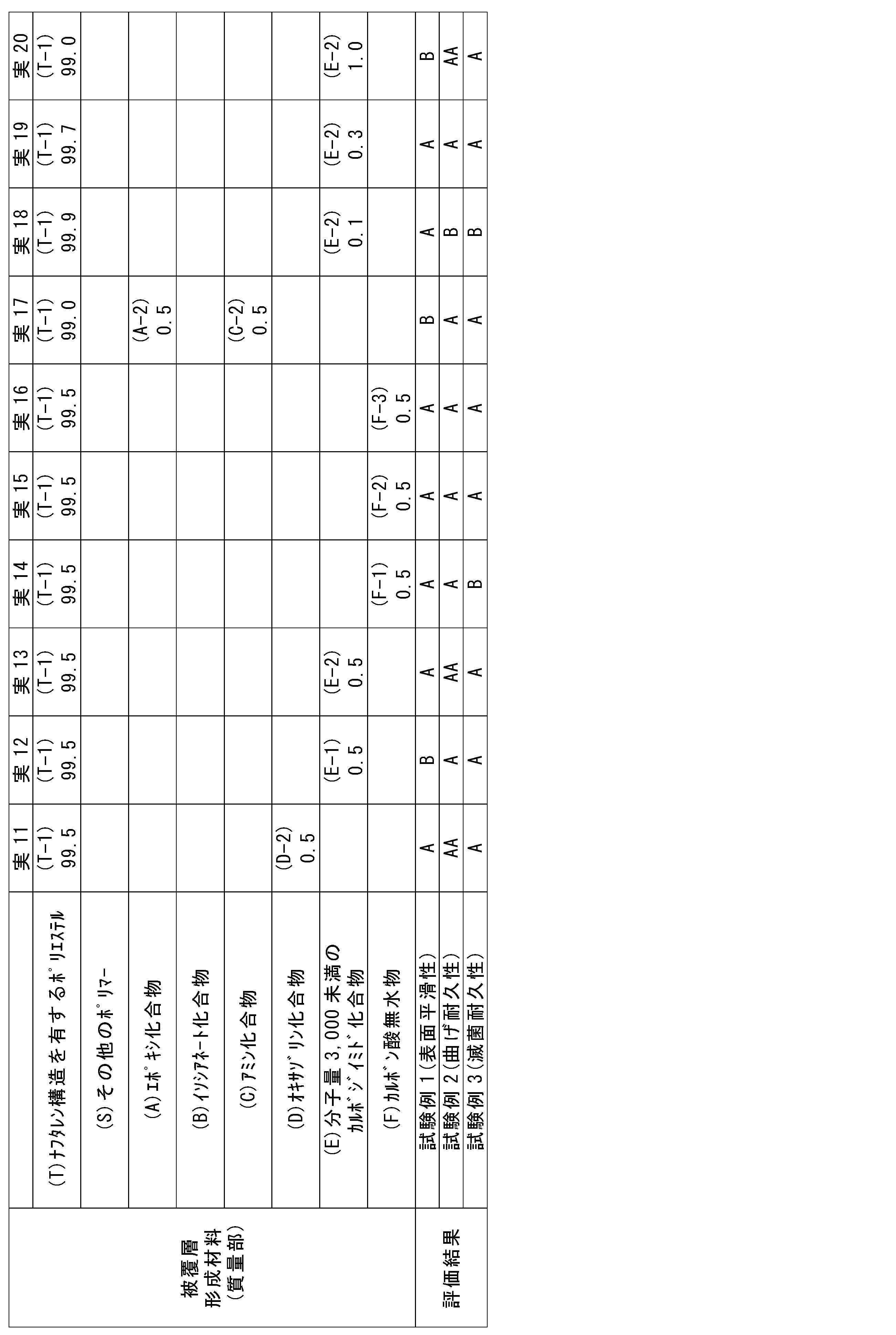
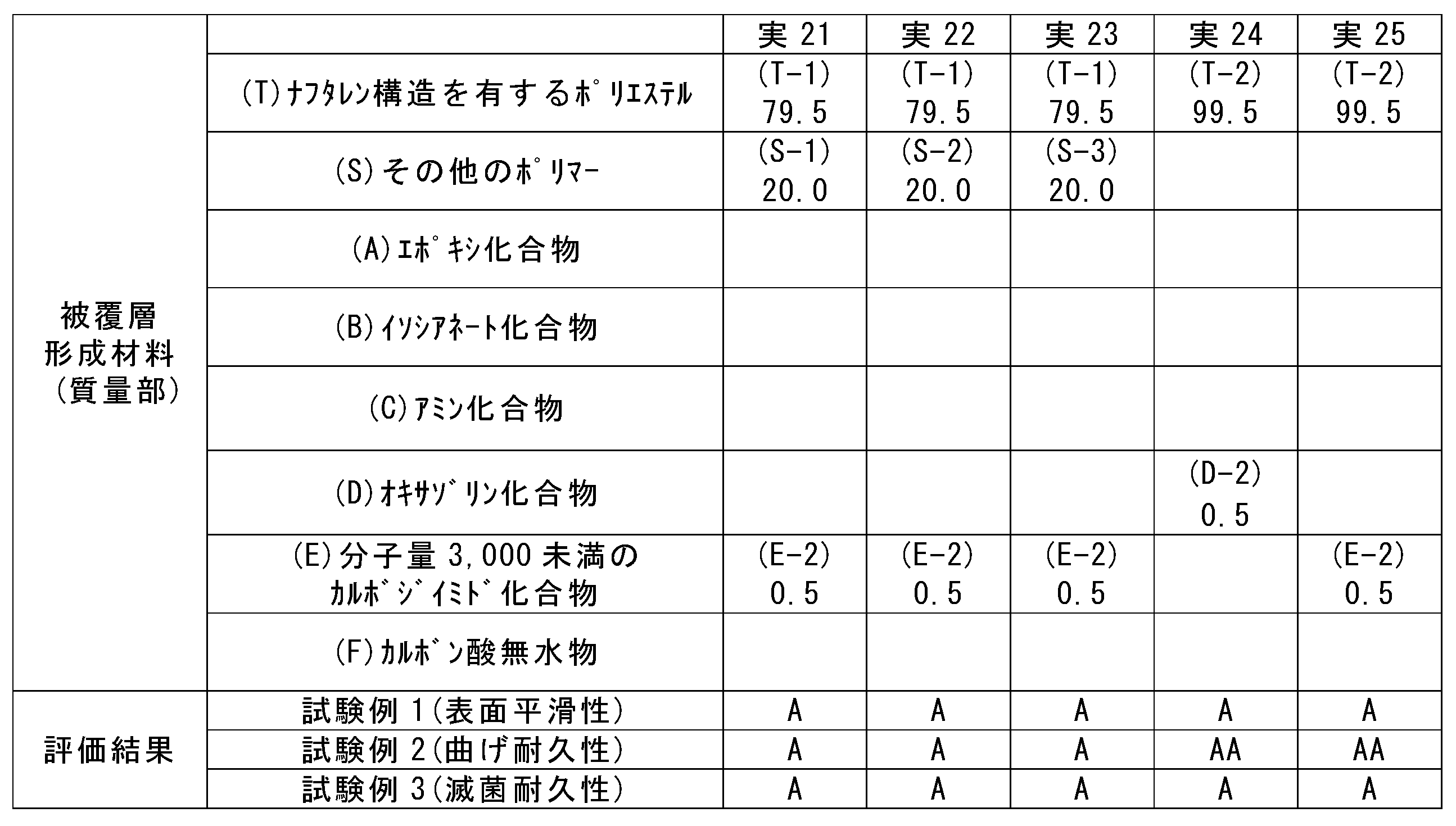
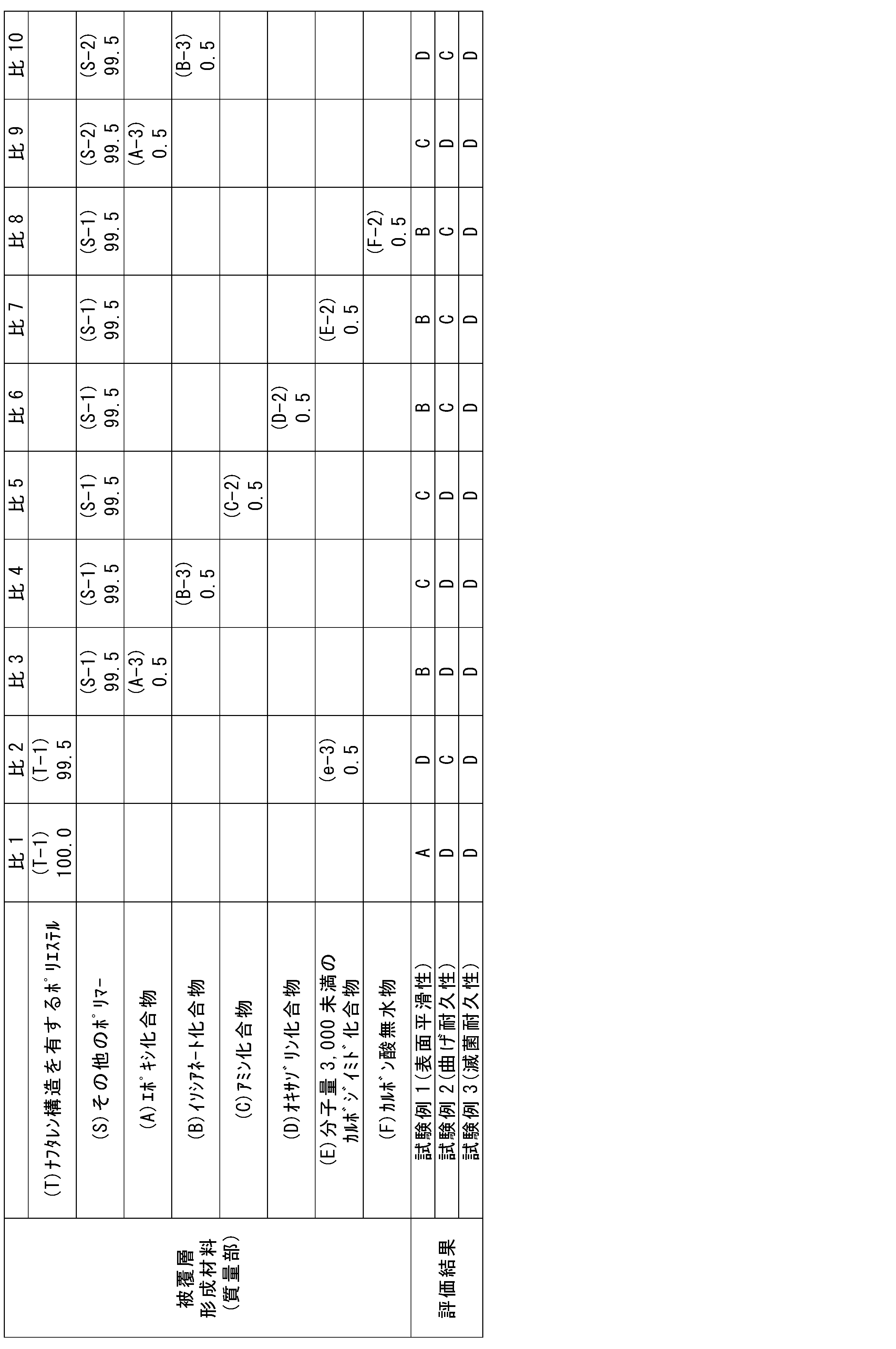
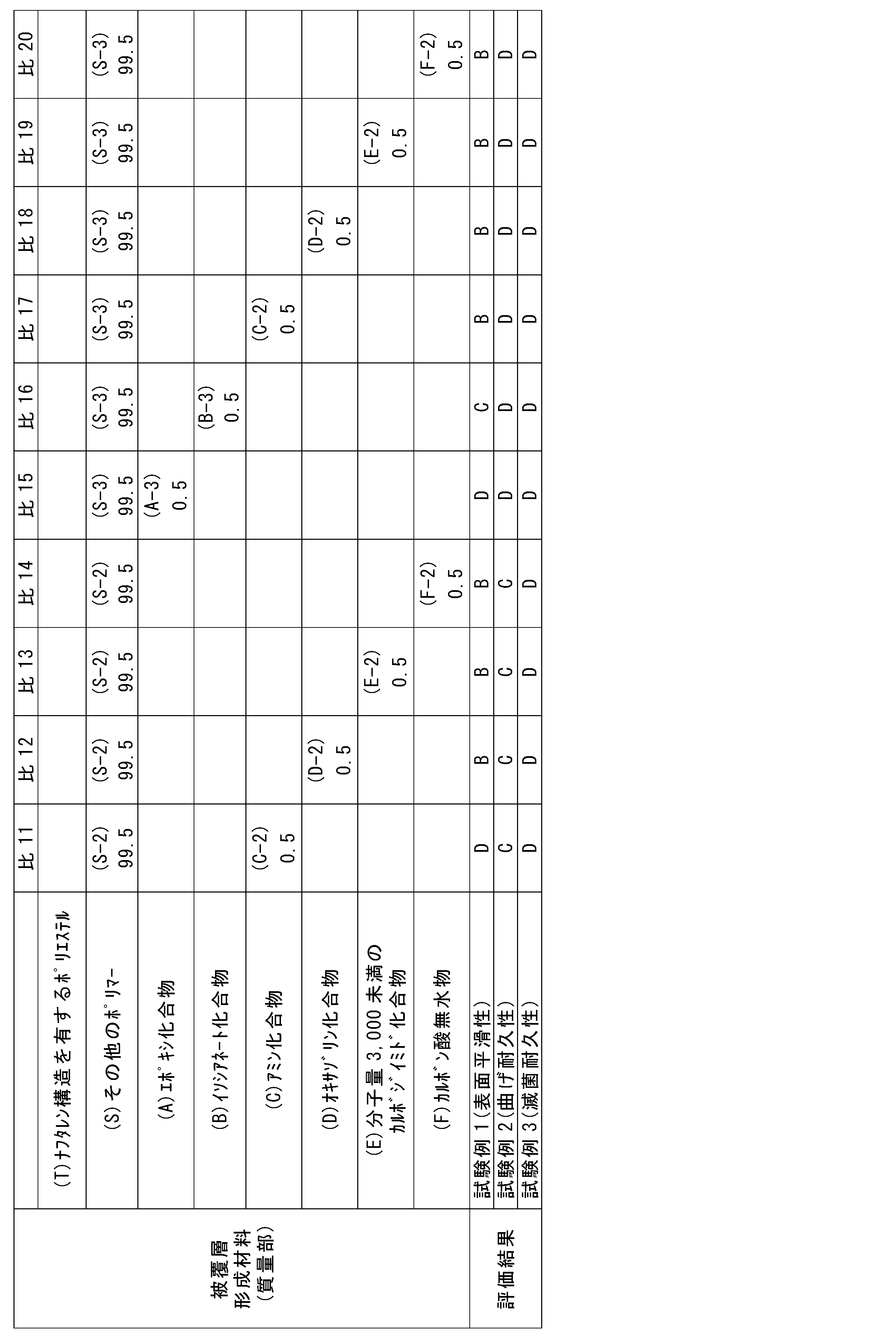
実:実施例
比:比較例
比:比較例
<表中の用語の説明>
[(T)ナフタレン構造を有するポリエステル]
(T-1)ポリブチレンナフタレートを構造単位に有するポリエステルエラストマー(東洋紡社製「ペルプレンEN-5000」(商品名)、重量平均分子量119,000)
(T-2)ポリブチレンナフタレートを構造単位に有するポリエステルエラストマー(東洋紡社製「ペルプレンEN-1000」(商品名)、重量平均分子量131,000)
[(T)ナフタレン構造を有するポリエステル]
(T-1)ポリブチレンナフタレートを構造単位に有するポリエステルエラストマー(東洋紡社製「ペルプレンEN-5000」(商品名)、重量平均分子量119,000)
(T-2)ポリブチレンナフタレートを構造単位に有するポリエステルエラストマー(東洋紡社製「ペルプレンEN-1000」(商品名)、重量平均分子量131,000)
[(S)その他のポリマー]
(S-1)ポリブチレンテレフタレートを構造単位に有するポリエステルエラストマー(東洋紡社製「ペルプレンP-280B」、重量平均分子量128,000)
(S-2)エーテル系ポリウレタンエラストマー(日本ポリウレタン社製「ミラクトランE574PNAT」(商品名))、重量平均分子量145,000)
(S-3)ポリアミドエラストマー(アルケマ社製「ペバックス7233」(商品名)、重量平均分子量48,000)
(S-1)ポリブチレンテレフタレートを構造単位に有するポリエステルエラストマー(東洋紡社製「ペルプレンP-280B」、重量平均分子量128,000)
(S-2)エーテル系ポリウレタンエラストマー(日本ポリウレタン社製「ミラクトランE574PNAT」(商品名))、重量平均分子量145,000)
(S-3)ポリアミドエラストマー(アルケマ社製「ペバックス7233」(商品名)、重量平均分子量48,000)
[(A)エポキシ化合物]
(A-1)ビスフェノールAジグリシジルエーテル(三菱ケミカル社製「jER828」(商品名)、2官能、分子量340)
(A-2)グリセロールトリグリシジルエーテル(ナガセケムテックス社製「デナコールEX-313」(商品名)、3官能、分子量260)
(A-3)テトラグリシジルジアミノジフェニルメタン(住友化学社製「スミエポキシELM-434」(商品名)、4官能、分子量423)
(A-1)ビスフェノールAジグリシジルエーテル(三菱ケミカル社製「jER828」(商品名)、2官能、分子量340)
(A-2)グリセロールトリグリシジルエーテル(ナガセケムテックス社製「デナコールEX-313」(商品名)、3官能、分子量260)
(A-3)テトラグリシジルジアミノジフェニルメタン(住友化学社製「スミエポキシELM-434」(商品名)、4官能、分子量423)
[(B)イソシアネート化合物]
(B-1)p-トリルイソシアネート(東京化成社製試薬、1官能、分子量133)
(B-2)1,3-ビス(イソシアナトメチル)ベンゼン(三井化学社製「タケネート500」(商品名)、2官能、分子量188)
(B-3)1,3,5-トリス(6-イソシアナトヘキサ-1-イル)-1,3,5-トリアジン-2,4,6(1H,3H,5H)-トリオン(日本ポリウレタン社製「コロネートHX」(商品名)、3官能、分子量505)
(B-1)p-トリルイソシアネート(東京化成社製試薬、1官能、分子量133)
(B-2)1,3-ビス(イソシアナトメチル)ベンゼン(三井化学社製「タケネート500」(商品名)、2官能、分子量188)
(B-3)1,3,5-トリス(6-イソシアナトヘキサ-1-イル)-1,3,5-トリアジン-2,4,6(1H,3H,5H)-トリオン(日本ポリウレタン社製「コロネートHX」(商品名)、3官能、分子量505)
[(C)アミン化合物]
(C-1)4,4'-ジアミノジフェニルメタン(東京化成社製試薬、2官能、分子量198)
(C-2)1,3,5-トリアジン-2,4,6-トリアミン(富士フイルム和光純薬社製試薬、3官能、分子量126)
(C-3)テトラキス(4-アミノフェニル)メタン(東京化成社製試薬、4官能、分子量381)
(C-1)4,4'-ジアミノジフェニルメタン(東京化成社製試薬、2官能、分子量198)
(C-2)1,3,5-トリアジン-2,4,6-トリアミン(富士フイルム和光純薬社製試薬、3官能、分子量126)
(C-3)テトラキス(4-アミノフェニル)メタン(東京化成社製試薬、4官能、分子量381)
[(D)オキサゾリン化合物]
(D-1)2,2'-(1,3-フェニレン)ビス(2-オキサゾリン)(三國製薬社製「1,3-BPO」(商品名)、2官能、分子量216)
(D-2)高分子型オキサゾリン(日本触媒社製「エポクロスRPS-1005」(商品名)、重量平均分子量16万、オキサゾリン基量0.27 mmol/g)
(D-1)2,2'-(1,3-フェニレン)ビス(2-オキサゾリン)(三國製薬社製「1,3-BPO」(商品名)、2官能、分子量216)
(D-2)高分子型オキサゾリン(日本触媒社製「エポクロスRPS-1005」(商品名)、重量平均分子量16万、オキサゾリン基量0.27 mmol/g)
[(E)分子量3,000未満のカルボジイミド化合物]
(E-1)低分子量モノカルボジイミド(ラインケミー社製「スタバクゾールI」(商品名)、分子量362)
(E-2)環状カルボジイミド(帝人社製「カルボジスタTCC-NP」(商品名)、分子量516)
(E-1)低分子量モノカルボジイミド(ラインケミー社製「スタバクゾールI」(商品名)、分子量362)
(E-2)環状カルボジイミド(帝人社製「カルボジスタTCC-NP」(商品名)、分子量516)
[(F)カルボン酸無水物]
(F-1)4-エチニルフタル酸無水物(東京化成社製試薬、1官能、分子量172)
(F-2)1,2,4,5-シクロヘキサンテトラカルボン酸二無水物(東京化成社製試薬、2官能、分子量224)
(F-3)3,3',4,4'-ジフェニルエーテルテトラカルボン酸二無水物(東京化成社製試薬、2官能、分子量294)
(F-1)4-エチニルフタル酸無水物(東京化成社製試薬、1官能、分子量172)
(F-2)1,2,4,5-シクロヘキサンテトラカルボン酸二無水物(東京化成社製試薬、2官能、分子量224)
(F-3)3,3',4,4'-ジフェニルエーテルテトラカルボン酸二無水物(東京化成社製試薬、2官能、分子量294)
[比較例で用いた鎖延長剤]
(e-3)ポリカルボジイミド(ラインケミー社製「スタバクゾールP100」(商品名)、重量平均分子量15,000)
(e-3)ポリカルボジイミド(ラインケミー社製「スタバクゾールP100」(商品名)、重量平均分子量15,000)
表1の結果から以下のことが分かる。
比較例1は、被覆層にナフタレン構造を有するポリエステルが含まれるが、本発明で規定する鎖延長体ではない。この比較例1の可撓管は、曲げ耐久性及び滅菌耐久性が不合格であった。
比較例2は、被覆層に、重量平均分子量15,000のポリカルボジイミドを用いて調製したナフタレン構造を有するポリエステル鎖延長体を含む。この比較例2の可撓管は表面平滑性及び滅菌耐久性が不合格であった。
また、比較例3~20の結果から、本発明で規定する鎖延長剤を用いても、ポリエステル鎖がナフタレン構造を有しない場合、少なくとも滅菌耐久性が不合格となることがわかる。
これに対して、実施例1~25は、被覆層が、本発明で規定するナフタレン構造を有するポリエステルの鎖延長体を含み、表面平滑性、曲げ耐久性及び滅菌耐久性がすべて合格であった。
実施例10と11との比較、実施例12と13との比較、及び実施例14と15及び16との比較から、鎖延長剤として、高分子型オキサゾリン化合物、環状構造を有するカルボジイミド化合物及びテトラカルボン酸二無水物を用いることで、より内視鏡用可撓管の特性を向上できることが分かる。これは、上記鎖延長剤を用いた場合、ナフタレン構造を有するポリエステルのゲル化を抑制することができ、これが特性向上の要因の1つであると考えられる。
比較例1は、被覆層にナフタレン構造を有するポリエステルが含まれるが、本発明で規定する鎖延長体ではない。この比較例1の可撓管は、曲げ耐久性及び滅菌耐久性が不合格であった。
比較例2は、被覆層に、重量平均分子量15,000のポリカルボジイミドを用いて調製したナフタレン構造を有するポリエステル鎖延長体を含む。この比較例2の可撓管は表面平滑性及び滅菌耐久性が不合格であった。
また、比較例3~20の結果から、本発明で規定する鎖延長剤を用いても、ポリエステル鎖がナフタレン構造を有しない場合、少なくとも滅菌耐久性が不合格となることがわかる。
これに対して、実施例1~25は、被覆層が、本発明で規定するナフタレン構造を有するポリエステルの鎖延長体を含み、表面平滑性、曲げ耐久性及び滅菌耐久性がすべて合格であった。
実施例10と11との比較、実施例12と13との比較、及び実施例14と15及び16との比較から、鎖延長剤として、高分子型オキサゾリン化合物、環状構造を有するカルボジイミド化合物及びテトラカルボン酸二無水物を用いることで、より内視鏡用可撓管の特性を向上できることが分かる。これは、上記鎖延長剤を用いた場合、ナフタレン構造を有するポリエステルのゲル化を抑制することができ、これが特性向上の要因の1つであると考えられる。
本発明をその実施態様とともに説明したが、我々は特に指定しない限り我々の発明を説明のどの細部においても限定しようとするものではなく、添付の請求の範囲に示した発明の精神と範囲に反することなく幅広く解釈されるべきであると考える。
本願は、2020年6月29日に日本国で特許出願された特願2020-111754に基づく優先権を主張するものであり、これはここに参照してその内容を本明細書の記載の一部として取り込む。
2 電子内視鏡(内視鏡)
3 挿入部
3a 可撓管
3b アングル部
3c 先端部
5 本体操作部
6 ユニバーサルコード
11 螺旋管
11a 金属帯片
12 筒状網体
13 口金
14 可撓管基材
15 被覆層
3 挿入部
3a 可撓管
3b アングル部
3c 先端部
5 本体操作部
6 ユニバーサルコード
11 螺旋管
11a 金属帯片
12 筒状網体
13 口金
14 可撓管基材
15 被覆層
Claims (11)
- 可撓性を有する筒状の可撓管基材と、該可撓管基材の外周を覆う被覆層とを有する内視鏡用可撓管であって、
前記被覆層が、ナフタレン構造を有するポリエステルの鎖延長体を含み、
前記鎖延長体が、(A)エポキシ化合物、(B)イソシアネート化合物、(C)アミン化合物、(D)オキサゾリン化合物、(E)分子量3,000未満のカルボジイミド化合物及び(F)カルボン酸無水物の少なくとも1種の鎖延長剤由来の構成成分と、ナフタレン構造を有するポリエステル由来の構成成分とを含む、内視鏡用可撓管。 - 前記ナフタレン構造を有するポリエステルの鎖延長体が、前記(A)エポキシ化合物由来の構成成分を含み、前記(A)エポキシ化合物由来の構成成分が、2~6官能のエポキシ化合物由来の構成成分を含む、請求項1に記載の内視鏡用可撓管。
- 前記ナフタレン構造を有するポリエステルの鎖延長体が、前記(B)イソシアネート化合物由来の構成成分を含み、前記(B)イソシアネート化合物由来の構成成分が、2又は3官能のイソシアネート化合物由来の構成成分を含む、請求項1又は2に記載の内視鏡用可撓管。
- 前記ナフタレン構造を有するポリエステルの鎖延長体が、前記(C)アミン化合物由来の構成成分を含み、前記(C)アミン化合物由来の構成成分が、2~4官能のアミン化合物由来の構成成分を含む、請求項1~3のいずれか1項に記載の内視鏡用可撓管。
- 前記ナフタレン構造を有するポリエステルの鎖延長体が、前記(D)オキサゾリン化合物由来の構成成分を含み、前記(D)オキサゾリン化合物由来の構成成分が、高分子型オキサゾリン化合物由来の構成成分を含む、請求項1~4のいずれか1項に記載の内視鏡用可撓管。
- 前記ナフタレン構造を有するポリエステルの鎖延長体が、前記(E)分子量3,000未満のカルボジイミド化合物由来の構成成分を含み、前記(E)分子量3,000未満のカルボジイミド化合物由来の構成成分が、環状構造を有するカルボジイミド化合物由来の構成成分を含む、請求項1~5のいずれか1項に記載の内視鏡用可撓管。
- 前記ナフタレン構造を有するポリエステルの鎖延長体が、前記(F)カルボン酸無水物由来の構成成分を含み、前記(F)カルボン酸無水物由来の構成成分が、テトラカルボン酸二無水物由来の構成成分を含む、請求項1~6のいずれか1項に記載の内視鏡用可撓管。
- 請求項1~7のいずれか1項に記載の内視鏡用可撓管を有する内視鏡型医療機器。
- 可撓性を有する筒状の可撓管基材の少なくとも外周に、(A)エポキシ化合物、(B)イソシアネート化合物、(C)アミン化合物、(D)オキサゾリン化合物、(E)分子量3,000未満のカルボジイミド化合物及び(F)カルボン酸無水物の少なくとも1種の鎖延長剤と、ナフタレン構造を有するポリエステルとを含む被覆層形成材料を用いて被覆層を形成することを含む、内視鏡用可撓管の製造方法。
- 請求項9に記載の内視鏡用可撓管の製造方法により内視鏡用可撓管を得る工程、及び、
得られた内視鏡用可撓管を内視鏡型医療機器の挿入部に組み込む工程
を含む、内視鏡型医療機器の製造方法。 - 請求項1~7のいずれか1項に記載の内視鏡用可撓管を内視鏡型医療機器の挿入部に組み込むことを含む、内視鏡型医療機器の製造方法。
Priority Applications (3)
| Application Number | Priority Date | Filing Date | Title |
|---|---|---|---|
| JP2022533994A JP7507240B2 (ja) | 2020-06-29 | 2021-06-28 | 内視鏡用可撓管、内視鏡型医療機器、及びこれらの製造方法 |
| CN202180043576.4A CN115942896B (zh) | 2020-06-29 | 2021-06-28 | 内窥镜用挠性管、内窥镜型医疗器械、及它们的制造方法 |
| US18/147,338 US20230139268A1 (en) | 2020-06-29 | 2022-12-28 | Flexible tube for endoscope, endoscopic medical device, and methods for producing the same |
Applications Claiming Priority (2)
| Application Number | Priority Date | Filing Date | Title |
|---|---|---|---|
| JP2020-111754 | 2020-06-29 | ||
| JP2020111754 | 2020-06-29 |
Related Child Applications (1)
| Application Number | Title | Priority Date | Filing Date |
|---|---|---|---|
| US18/147,338 Continuation US20230139268A1 (en) | 2020-06-29 | 2022-12-28 | Flexible tube for endoscope, endoscopic medical device, and methods for producing the same |
Publications (1)
| Publication Number | Publication Date |
|---|---|
| WO2022004656A1 true WO2022004656A1 (ja) | 2022-01-06 |
Family
ID=79316220
Family Applications (1)
| Application Number | Title | Priority Date | Filing Date |
|---|---|---|---|
| PCT/JP2021/024360 Ceased WO2022004656A1 (ja) | 2020-06-29 | 2021-06-28 | 内視鏡用可撓管、内視鏡型医療機器、及びこれらの製造方法 |
Country Status (4)
| Country | Link |
|---|---|
| US (1) | US20230139268A1 (ja) |
| JP (1) | JP7507240B2 (ja) |
| CN (1) | CN115942896B (ja) |
| WO (1) | WO2022004656A1 (ja) |
Citations (4)
| Publication number | Priority date | Publication date | Assignee | Title |
|---|---|---|---|---|
| JP2004141487A (ja) * | 2002-10-25 | 2004-05-20 | Olympus Corp | 内視鏡用可撓管 |
| JP2008540786A (ja) * | 2005-05-20 | 2008-11-20 | チバ ホールディング インコーポレーテッド | ポリエステルの熱及び光安定性を改良する方法 |
| WO2014157375A1 (ja) * | 2013-03-27 | 2014-10-02 | 富士フイルム株式会社 | 内視鏡用可撓管およびその製造方法 |
| WO2019189035A1 (ja) * | 2018-03-28 | 2019-10-03 | 富士フイルム株式会社 | 内視鏡用可撓管、内視鏡型医療機器及び内視鏡用可撓管基材被覆用樹脂組成物 |
Family Cites Families (4)
| Publication number | Priority date | Publication date | Assignee | Title |
|---|---|---|---|---|
| JP5325426B2 (ja) * | 2008-02-06 | 2013-10-23 | オリンパスメディカルシステムズ株式会社 | 内視鏡用エラストマー成形体 |
| JP6047440B2 (ja) * | 2013-03-27 | 2016-12-21 | 富士フイルム株式会社 | 内視鏡用可撓管およびその製造方法 |
| JP6226494B2 (ja) * | 2016-08-16 | 2017-11-08 | 富士フイルム株式会社 | 内視鏡用可撓管および内視鏡型医療機器 |
| EP3646900B1 (en) * | 2017-06-30 | 2025-05-21 | FUJIFILM Corporation | Endoscope flexible tube, endoscope-type medical device, resin composition for coating endoscope flexible tube substrate, and resin composition set for coating endoscope flexible tube substrate |
-
2021
- 2021-06-28 JP JP2022533994A patent/JP7507240B2/ja active Active
- 2021-06-28 CN CN202180043576.4A patent/CN115942896B/zh active Active
- 2021-06-28 WO PCT/JP2021/024360 patent/WO2022004656A1/ja not_active Ceased
-
2022
- 2022-12-28 US US18/147,338 patent/US20230139268A1/en active Pending
Patent Citations (4)
| Publication number | Priority date | Publication date | Assignee | Title |
|---|---|---|---|---|
| JP2004141487A (ja) * | 2002-10-25 | 2004-05-20 | Olympus Corp | 内視鏡用可撓管 |
| JP2008540786A (ja) * | 2005-05-20 | 2008-11-20 | チバ ホールディング インコーポレーテッド | ポリエステルの熱及び光安定性を改良する方法 |
| WO2014157375A1 (ja) * | 2013-03-27 | 2014-10-02 | 富士フイルム株式会社 | 内視鏡用可撓管およびその製造方法 |
| WO2019189035A1 (ja) * | 2018-03-28 | 2019-10-03 | 富士フイルム株式会社 | 内視鏡用可撓管、内視鏡型医療機器及び内視鏡用可撓管基材被覆用樹脂組成物 |
Also Published As
| Publication number | Publication date |
|---|---|
| CN115942896B (zh) | 2026-04-24 |
| JP7507240B2 (ja) | 2024-06-27 |
| US20230139268A1 (en) | 2023-05-04 |
| CN115942896A (zh) | 2023-04-07 |
| JPWO2022004656A1 (ja) | 2022-01-06 |
Similar Documents
| Publication | Publication Date | Title |
|---|---|---|
| JP6110827B2 (ja) | 内視鏡用可撓管、内視鏡用接着剤、内視鏡型医療機器、ならびに内視鏡用可撓管および内視鏡型医療機器の製造方法 | |
| WO2014157375A1 (ja) | 内視鏡用可撓管およびその製造方法 | |
| US11452795B2 (en) | Medical lubricating member, medical device using medical lubricating member, and method of producing medical lubricating member | |
| CN1860146A (zh) | 耐异丙醇性、挠性和柔软度得到改进的聚氨酯分散体(pud) | |
| US20090277666A1 (en) | Heat-resistant resin varnish, heat-resistant resin films, heat-resistant resin composites, and insulated wire | |
| CN111683579B (zh) | 内窥镜用粘接剂、固化物、内窥镜及内窥镜的制造方法 | |
| CN111050627B (zh) | 内窥镜用粘接剂、固化物、内窥镜及内窥镜的制造方法 | |
| US20090069631A1 (en) | Flexible tube for an endoscope | |
| JP7507240B2 (ja) | 内視鏡用可撓管、内視鏡型医療機器、及びこれらの製造方法 | |
| US20110245614A1 (en) | Endoscopic apparatus and method of manufacturing the same | |
| JPWO2020013003A1 (ja) | 内視鏡用接着剤及びその硬化物、並びに内視鏡及びその製造方法 | |
| JPWO2020175273A1 (ja) | 内視鏡用接着剤及びその硬化物、並びに内視鏡及びその製造方法 | |
| JP5485103B2 (ja) | 離型材 | |
| CN101484532A (zh) | 耐热性树脂清漆、耐热性树脂膜、耐热性树脂复合物及绝缘电线 | |
| JP5289283B2 (ja) | 内視鏡装置及びその製造方法 | |
| US12599705B2 (en) | Flexible tube for endoscope, endoscopic medical device, method for producing covering material constituting flexible tube for endoscope, and method for producing flexible tube for endoscope | |
| JP6887062B2 (ja) | 内視鏡用接着剤、硬化物、内視鏡、及び内視鏡の製造方法 | |
| WO2022070722A1 (ja) | 内視鏡用可撓管、内視鏡型医療機器、及びこれらの製造方法 | |
| US12575715B2 (en) | Flexible tube for endoscope, endoscopic medical device, and methods for producing the same | |
| JP7425850B2 (ja) | 内視鏡用可撓管、内視鏡型医療機器、及びこれらの製造方法 | |
| US12611091B2 (en) | Flexible tube for endoscope, endoscopic medical device, and methods for producing the same | |
| JP2013078880A (ja) | 離型材 | |
| JP5437055B2 (ja) | 離型材 | |
| JP2008237523A (ja) | 医療用具の製造方法および医療用具 |
Legal Events
| Date | Code | Title | Description |
|---|---|---|---|
| 121 | Ep: the epo has been informed by wipo that ep was designated in this application |
Ref document number: 21834186 Country of ref document: EP Kind code of ref document: A1 |
|
| ENP | Entry into the national phase |
Ref document number: 2022533994 Country of ref document: JP Kind code of ref document: A |
|
| NENP | Non-entry into the national phase |
Ref country code: DE |
|
| 122 | Ep: pct application non-entry in european phase |
Ref document number: 21834186 Country of ref document: EP Kind code of ref document: A1 |