WO2022004643A1 - 繊維により補強された硬化体 - Google Patents
繊維により補強された硬化体 Download PDFInfo
- Publication number
- WO2022004643A1 WO2022004643A1 PCT/JP2021/024324 JP2021024324W WO2022004643A1 WO 2022004643 A1 WO2022004643 A1 WO 2022004643A1 JP 2021024324 W JP2021024324 W JP 2021024324W WO 2022004643 A1 WO2022004643 A1 WO 2022004643A1
- Authority
- WO
- WIPO (PCT)
- Prior art keywords
- cured product
- mass
- fiber
- less
- alkali
- Prior art date
- Legal status (The legal status is an assumption and is not a legal conclusion. Google has not performed a legal analysis and makes no representation as to the accuracy of the status listed.)
- Ceased
Links
Classifications
-
- C—CHEMISTRY; METALLURGY
- C04—CEMENTS; CONCRETE; ARTIFICIAL STONE; CERAMICS; REFRACTORIES
- C04B—LIME, MAGNESIA; SLAG; CEMENTS; COMPOSITIONS THEREOF, e.g. MORTARS, CONCRETE OR LIKE BUILDING MATERIALS; ARTIFICIAL STONE; CERAMICS; REFRACTORIES; TREATMENT OF NATURAL STONE
- C04B28/00—Compositions of mortars, concrete or artificial stone, containing inorganic binders or the reaction product of an inorganic and an organic binder, e.g. polycarboxylate cements
- C04B28/02—Compositions of mortars, concrete or artificial stone, containing inorganic binders or the reaction product of an inorganic and an organic binder, e.g. polycarboxylate cements containing hydraulic cements other than calcium sulfates
- C04B28/08—Slag cements
-
- C—CHEMISTRY; METALLURGY
- C04—CEMENTS; CONCRETE; ARTIFICIAL STONE; CERAMICS; REFRACTORIES
- C04B—LIME, MAGNESIA; SLAG; CEMENTS; COMPOSITIONS THEREOF, e.g. MORTARS, CONCRETE OR LIKE BUILDING MATERIALS; ARTIFICIAL STONE; CERAMICS; REFRACTORIES; TREATMENT OF NATURAL STONE
- C04B28/00—Compositions of mortars, concrete or artificial stone, containing inorganic binders or the reaction product of an inorganic and an organic binder, e.g. polycarboxylate cements
- C04B28/006—Compositions of mortars, concrete or artificial stone, containing inorganic binders or the reaction product of an inorganic and an organic binder, e.g. polycarboxylate cements containing mineral polymers, e.g. geopolymers of the Davidovits type
-
- C—CHEMISTRY; METALLURGY
- C04—CEMENTS; CONCRETE; ARTIFICIAL STONE; CERAMICS; REFRACTORIES
- C04B—LIME, MAGNESIA; SLAG; CEMENTS; COMPOSITIONS THEREOF, e.g. MORTARS, CONCRETE OR LIKE BUILDING MATERIALS; ARTIFICIAL STONE; CERAMICS; REFRACTORIES; TREATMENT OF NATURAL STONE
- C04B16/00—Use of organic materials as fillers, e.g. pigments, for mortars, concrete or artificial stone; Treatment of organic materials specially adapted to enhance their filling properties in mortars, concrete or artificial stone
- C04B16/04—Macromolecular compounds
- C04B16/06—Macromolecular compounds fibrous
- C04B16/0616—Macromolecular compounds fibrous from polymers obtained by reactions only involving carbon-to-carbon unsaturated bonds
- C04B16/0625—Polyalkenes, e.g. polyethylene
- C04B16/0633—Polypropylene
-
- C—CHEMISTRY; METALLURGY
- C04—CEMENTS; CONCRETE; ARTIFICIAL STONE; CERAMICS; REFRACTORIES
- C04B—LIME, MAGNESIA; SLAG; CEMENTS; COMPOSITIONS THEREOF, e.g. MORTARS, CONCRETE OR LIKE BUILDING MATERIALS; ARTIFICIAL STONE; CERAMICS; REFRACTORIES; TREATMENT OF NATURAL STONE
- C04B16/00—Use of organic materials as fillers, e.g. pigments, for mortars, concrete or artificial stone; Treatment of organic materials specially adapted to enhance their filling properties in mortars, concrete or artificial stone
- C04B16/04—Macromolecular compounds
- C04B16/06—Macromolecular compounds fibrous
- C04B16/0616—Macromolecular compounds fibrous from polymers obtained by reactions only involving carbon-to-carbon unsaturated bonds
- C04B16/0641—Polyvinylalcohols; Polyvinylacetates
-
- C—CHEMISTRY; METALLURGY
- C04—CEMENTS; CONCRETE; ARTIFICIAL STONE; CERAMICS; REFRACTORIES
- C04B—LIME, MAGNESIA; SLAG; CEMENTS; COMPOSITIONS THEREOF, e.g. MORTARS, CONCRETE OR LIKE BUILDING MATERIALS; ARTIFICIAL STONE; CERAMICS; REFRACTORIES; TREATMENT OF NATURAL STONE
- C04B16/00—Use of organic materials as fillers, e.g. pigments, for mortars, concrete or artificial stone; Treatment of organic materials specially adapted to enhance their filling properties in mortars, concrete or artificial stone
- C04B16/04—Macromolecular compounds
- C04B16/06—Macromolecular compounds fibrous
- C04B16/0675—Macromolecular compounds fibrous from polymers obtained otherwise than by reactions only involving carbon-to-carbon unsaturated bonds
- C04B16/0691—Polyamides; Polyaramides
-
- C—CHEMISTRY; METALLURGY
- C04—CEMENTS; CONCRETE; ARTIFICIAL STONE; CERAMICS; REFRACTORIES
- C04B—LIME, MAGNESIA; SLAG; CEMENTS; COMPOSITIONS THEREOF, e.g. MORTARS, CONCRETE OR LIKE BUILDING MATERIALS; ARTIFICIAL STONE; CERAMICS; REFRACTORIES; TREATMENT OF NATURAL STONE
- C04B22/00—Use of inorganic materials as active ingredients for mortars, concrete or artificial stone, e.g. accelerators or shrinkage compensating agents
- C04B22/06—Oxides, Hydroxides
- C04B22/062—Oxides, Hydroxides of the alkali or alkaline-earth metals
-
- C—CHEMISTRY; METALLURGY
- C04—CEMENTS; CONCRETE; ARTIFICIAL STONE; CERAMICS; REFRACTORIES
- C04B—LIME, MAGNESIA; SLAG; CEMENTS; COMPOSITIONS THEREOF, e.g. MORTARS, CONCRETE OR LIKE BUILDING MATERIALS; ARTIFICIAL STONE; CERAMICS; REFRACTORIES; TREATMENT OF NATURAL STONE
- C04B22/00—Use of inorganic materials as active ingredients for mortars, concrete or artificial stone, e.g. accelerators or shrinkage compensating agents
- C04B22/08—Acids or salts thereof
- C04B22/14—Acids or salts thereof containing sulfur in the anion, e.g. sulfides
- C04B22/142—Sulfates
- C04B22/148—Aluminium-sulfate
-
- Y—GENERAL TAGGING OF NEW TECHNOLOGICAL DEVELOPMENTS; GENERAL TAGGING OF CROSS-SECTIONAL TECHNOLOGIES SPANNING OVER SEVERAL SECTIONS OF THE IPC; TECHNICAL SUBJECTS COVERED BY FORMER USPC CROSS-REFERENCE ART COLLECTIONS [XRACs] AND DIGESTS
- Y02—TECHNOLOGIES OR APPLICATIONS FOR MITIGATION OR ADAPTATION AGAINST CLIMATE CHANGE
- Y02P—CLIMATE CHANGE MITIGATION TECHNOLOGIES IN THE PRODUCTION OR PROCESSING OF GOODS
- Y02P40/00—Technologies relating to the processing of minerals
- Y02P40/10—Production of cement, e.g. improving or optimising the production methods; Cement grinding
-
- Y—GENERAL TAGGING OF NEW TECHNOLOGICAL DEVELOPMENTS; GENERAL TAGGING OF CROSS-SECTIONAL TECHNOLOGIES SPANNING OVER SEVERAL SECTIONS OF THE IPC; TECHNICAL SUBJECTS COVERED BY FORMER USPC CROSS-REFERENCE ART COLLECTIONS [XRACs] AND DIGESTS
- Y02—TECHNOLOGIES OR APPLICATIONS FOR MITIGATION OR ADAPTATION AGAINST CLIMATE CHANGE
- Y02W—CLIMATE CHANGE MITIGATION TECHNOLOGIES RELATED TO WASTEWATER TREATMENT OR WASTE MANAGEMENT
- Y02W30/00—Technologies for solid waste management
- Y02W30/50—Reuse, recycling or recovery technologies
- Y02W30/91—Use of waste materials as fillers for mortars or concrete
Definitions
- the present invention relates to a cured body reinforced with fibers.
- Geopolymer is an inorganic polymer produced by reacting aluminosilicate and alkali metal silicate, and is superior in durability and acid resistance to cement-based materials, as well as from the production of raw materials to products. Since the amount of carbon dioxide emitted during manufacturing is extremely low, it is attracting attention as an environmentally friendly material.
- Patent Document 1 describes a curable composition containing aluminum silicate, an alkali metal silicate, reinforcing fibers and water in order to improve the toughness of the cured product without impairing the fluidity of the curable composition.
- a curable composition to which specific slag particles are added is described.
- Patent Document 2 describes a composition composed of blast furnace granulated slag, an alkaline stimulant, a water-soluble polymer, an ultrafine powder, organic short fibers, and water, which is kneaded, molded, and then wet-cured.
- a composite material has been described, which is described as having excellent resistance to flames.
- Patent Document 3 comprises an active filler containing at least one of fly ash, blast furnace slag, sewage incineration sludge, and kaolin, silica or a silica compound, and an alkaline solution, and the amount of silica and the amount of alkali contained in the solution.
- a geopolymer composition characterized by a molar ratio of 0.50 or less has been described, and the geopolymer composition has been described as having improved durability.
- Geopolymer has the advantage of being environmentally friendly as described above, but has extremely high brittleness. Therefore, as described in Patent Documents 1 and 2, an improvement plan for reinforcing with fibers is known.
- the curable composition of the geopolymer has a very high viscosity and a short pot life, which makes it difficult to uniformly mix the fibers, and as a result, it is difficult to sufficiently bring out the reinforcing effect of the fibers. there were. Further, if the fibers are not uniformly mixed, fiber lumps are generated, and as a result, there is a concern that the dimensional stability is deteriorated.
- Japanese Unexamined Patent Publication No. 2011-184221 Japanese Unexamined Patent Publication No. 5-097495 Japanese Unexamined Patent Publication No. 2015-157731
- a cured product of a curable composition comprising (A) an aluminosilicate source, (B) an alkali activator and (C) an alkali-resistant fiber.
- the aluminosilicate source (A) contains blast furnace slag, and the content of the blast furnace slag is 40% by mass or more with respect to the total solid content of the aluminosilicate source (A).
- the content of the alkali activator (B) is 10% by mass or less with respect to the total solid content of the curable composition.
- the water content of the cured product is 10.0% by mass or less with respect to the total mass of the cured product.
- the alkali-resistant fiber (C) is at least one selected from the group consisting of polyvinyl alcohol-based fiber, polyethylene fiber, polypropylene fiber, acrylic fiber, aramid fiber and nylon fiber, and is the above-mentioned [1] or [2]. ] The cured product described in.
- the content of the alkali-resistant fiber (C) is 0.05% by mass or more and 5% by mass or less with respect to the total solid content of the cured product, according to any one of the above [1] to [3]. Hardened body.
- the coefficient of variation of the average content of the alkali-resistant fiber (C) contained in the 10 pieces cut out so as to be 10 g from the whole or a part of the cured product is 30% or less. 1] The cured product according to any one of [5].
- the cured product further contains an aggregate (E), and the content of the aggregate (E) is 15% by mass or more and 75% by mass or less with respect to the total solid content of the cured material.
- the cured product according to any one of [6].
- the cured product further contains a slag stimulant (D), and the content of the slag stimulant (D) is 0.01% by mass or more and 3% by mass or less with respect to the total solid content of the cured product.
- the cured product further contains a calcium sulfate derivative, and the content of the calcium sulfate derivative is 0.01% by mass or more and 20% by mass or less with respect to the total solid content of the cured product.
- the cured product of the present invention is a cured product of a curable composition containing (A) an aluminosilicate source, (B) an alkali activator, and (C) an alkali-resistant fiber.
- the aluminosilicate source (A) contains blast furnace slag, the content of the blast furnace slag is 40% by mass or more with respect to the total solid content of the aluminosilicate source (A), and the content of the alkali activator (B) is.
- the curable composition is 10% by mass or less with respect to the total solid content, and the water content of the cured product is 10.0% by mass or less with respect to the total mass of the cured product.
- the cured product When the water content of the cured product is higher than 10.0% by mass with respect to the total mass of the cured product, it is difficult for the cured product to have high bending strength and high bending toughness.
- the present inventors have added a cured product of a curable composition containing a specific aluminosilicate source (A), a specific ratio of an alkali activator (B) and an alkali-resistant fiber (C) to the total mass of the cured product.
- A specific aluminosilicate source
- B an alkali activator
- C alkali-resistant fiber
- the water content of the cured product can be adjusted to a value of 10.0% by mass or less by, for example, drying the undried cured product obtained after curing by the method described below.
- drying an undried cured product causes cracks on the surface and inside of the undried cured product, especially when it is dried at a relatively high temperature (for example, a temperature higher than 100 ° C.), resulting in cracks in the cured product.
- Mechanical strength is reduced.
- a large number of cracks occur and the mechanical strength of the cured product is significantly reduced.
- the water content of the cured product is preferably 9.0% by mass or less, more preferably 8.0% by mass or less, still more preferably 5.0% by mass or less, and particularly preferably 3. It is 0% by mass or less.
- the water content of the cured product can be adjusted to a value equal to or lower than the upper limit value by, for example, drying the undried cured product obtained after curing by the method described below.
- the lower limit of the water content of the cured product is not particularly limited.
- the water content of the cured product may be 0% by mass.
- the water content of the cured product can be measured by the method described in Examples described later.
- the aluminosilicate source (A) contains aluminosilicate (xM 2 O, yAl 2 O 3 , zSiO 2 , nH 2 O, M is an alkali metal) as a main component.
- the main component means the component having the largest mass in the aluminosilicate source.
- Aluminosilicate source by contact with highly alkaline solution [an aqueous solution of an alkali activator (B)], a cation such as aluminum and silicon was eluted, by which they are polycondensation, strong SiO 4 ⁇ AlO 4 Polymer network (geopolymer) is formed.
- the aluminosilicate source (A) contains blast furnace slag, and the content of the blast furnace slag is 40% by mass or more with respect to the total solid content of the aluminosilicate source (A).
- the content of the blast furnace slag is preferably 50% by mass or more, more preferably 60% by mass or more, still more preferably 65% by mass or more, and particularly preferably 70% by mass with respect to the total solid content of the aluminosilicate source (A). % Or more, and may be 100% by mass.
- the content of the blast furnace slag is at least the above lower limit value, the obtained cured product tends to have a finer structure, so that it is easy to obtain a cured product having higher bending strength, higher bending toughness and higher dimensional stability. .. Further, since blast furnace slag is a cheap raw material as compared with metakaolin and the like, the use of blast furnace slag has an advantage in terms of manufacturing cost.
- blast furnace slag There are two types of blast furnace slag: slow cooling slag, which is crystalline, and granulated slag, which is amorphous, both of which can be used in the present invention. It is preferable to use granulated slag from the viewpoint that it is easy to further improve the strength or promote the curing of the cured product.
- aluminosilicate sources (A) other than blast furnace slag are industrial wastes such as fly ash, red mud, and sewage sludge incineration ash; natural aluminosilicate minerals and their calcined products (eg, metakaolin), and Volcanic ash and the like can be mentioned. These substances are commercially available, and in the present invention, they may be used alone or in combination of two or more.
- the aluminosilicate source (A) further comprises at least one selected from the group consisting of fly ash, metakaolin and red mud, in addition to the blast furnace slag.
- the group consisting of fly ash, metakaolin and red mud in addition to the blast furnace slag.
- higher bending strength, higher bending toughness and higher dimensional stability are obtained because the compaction of the cured product is more likely to be increased as compared with the case where the blast furnace slag is used alone as the aluminosilicate source (A). It is easy to obtain a cured product to have.
- the content of at least one selected from the group consisting of fly ash, metakaolin and red mud is preferably 5% by mass or more, more preferably 5% by mass or more, based on the total solid content of the aluminosilicate source (A). It is 10% by mass or more, more preferably 15% by mass or more, preferably 60% by mass or less, more preferably 50% by mass or less, still more preferably 40% by mass or less, and the content of the blast furnace slag is aluminosilicate. 40% by mass or more, preferably 50% by mass or more, more preferably 60% by mass or more, preferably 95% by mass or less, more preferably 90% by mass or less, and further, with respect to the total solid content of the source (A). It is preferably 85% by mass or less.
- the specific surface area of the blast furnace slag is preferably 1000 to 9000 cm 2 / g, more preferably 2000 to 8000 cm 2 / g or more, and further preferably 3000 to 7000 cm 2 / g.
- the specific surface area of the blast furnace slag is equal to or greater than the lower limit and equal to or less than the upper limit, the blast furnace slag tends to have a sufficient reaction site and a suitable average particle size, and as a result, the produced cured product is more likely to have a specific surface area. Higher bending strength, higher bending toughness and higher dimensional stability are likely to be obtained.
- the specific surface area of the blast furnace slag can be adjusted to be equal to or higher than the lower limit value and lower than the upper limit value by, for example, pulverizing and classifying the blast furnace slag and using a specific fraction.
- the specific surface area of the blast furnace slag can be measured by, for example, a laser diffraction / scattering method.
- the content of the aluminosilicate source (A) is preferably 20% by mass or more, more preferably 30% by mass or more, still more preferably 35% by mass or more, and particularly preferably 35% by mass or more, based on the total solid content of the curable composition. It is 40% by mass or more, preferably 75% by mass or less, more preferably 70% by mass or less, still more preferably 65% by mass or less, and particularly preferably 60% by mass or less.
- the cured product in the present invention is usually produced by a method including a step of molding a curable composition.
- the content of the aluminosilicate source (A) is preferably 25% by mass or more, more preferably 25% by mass or more, based on the total solid content of the curable composition. Is 35% by mass or more, more preferably 40% by mass or more, preferably 70% by mass or less, more preferably 65% by mass or less, still more preferably 60% by mass or less.
- the content of the aluminosilicate source (A) is at least the lower limit value and at least the upper limit value, it is easy to obtain a cured product having higher bending strength, higher bending toughness and higher dimensional stability.
- the alkali activator (B) used in the present invention exhibits high alkalinity in water, and when it comes into contact with the aluminosilicate source (A), it activates it and elutes cations such as Al and Si. Have.
- the content of the alkali activator (B) is 10% by mass or less with respect to the total solid content of the curable composition. If the content of the alkali activator (B) is higher than 10% by mass, it is difficult to obtain high dimensional stability of the cured product.
- alkali activator (B) examples include alkali metal hydroxides such as sodium hydroxide, potassium hydroxide and lithium hydroxide, and alkali metal carbonates such as sodium carbonate, potassium carbonate and lithium carbonate. These can be used alone or in combination of two or more.
- the content thereof is preferably 0.01% by mass or more with respect to the total solid content of the curable composition. More preferably 0.1% by mass or more, further preferably 1% by mass or more, 10% by mass or less, preferably 9% by mass or less, more preferably 8% by mass or less, still more preferably 7% by mass or less, particularly preferably. Is 6% by mass or less.
- alkali activator (B) is an alkali metal silicate.
- the alkali metal silicate comes into contact with the aluminosilicate source (A), in addition to activating it and having an action, it becomes a source of the silicic acid monomer [Si (OH) 4] forming a geopolymer.
- A aluminosilicate source
- Si (OH) 4 silicic acid monomer
- the alkali metal silicate include sodium silicate, potassium silicate, lithium silicate and the like, and in the present invention, these may be used alone or in combination of two or more. From the viewpoint of low cost, it is preferable to use sodium silicate. Further, a part of sodium silicate may be replaced with potassium silicate as long as the advantage of manufacturing cost is not impaired.
- Sodium silicate may be used in the form of water glass (a concentrated aqueous solution of sodium silicate) obtained by dissolving sodium silicate in water and heating it.
- Alkali metal silicates are usually used in the form of aqueous solutions.
- the molar ratio of alkali metal / water in the aqueous alkali metal silicate solution is preferably 0.02 or more.
- the higher the molar ratio the higher the strength of the obtained cured product. Therefore, the higher the molar ratio, the more preferable.
- the smaller the molar ratio the more the aluminosilicate source (A), the alkali activator (B) and the alkali-resistant fiber (C).
- the fluidity of the curable composition containing the above is reduced, which makes molding difficult. Therefore, the molar ratio is preferably 0.03 to 0.20, more preferably 0.04 to 0.15, and particularly preferably 0.06 to 0.12.
- the content thereof is preferably 0.01% by mass with respect to the total solid content of the curable composition.
- the above is more preferably 0.1% by mass or more, further preferably 1% by mass or more, 10% by mass or less, preferably 8% by mass or less, more preferably 7% by mass or less, still more preferably 6% by mass or less. Particularly preferably, it is 5% by mass or less.
- this content is not less than the lower limit value and not more than the upper limit value, higher bending strength, higher bending toughness and higher dimensional stability are likely to be obtained in the produced cured product.
- the curable composition in the present invention is a combination of the above-mentioned alkali metal hydroxide and / or alkali metal carbonate and the above-mentioned alkali metal silicate as the alkali activator (B), preferably.
- the combination of the alkali metal hydroxide as described above and the alkali metal silicate as described above may be contained.
- the curable composition in the present invention contains such a combination as the alkali activator (B), it is easy to obtain a cured product having higher bending strength, higher bending toughness and high dimensional stability.
- the content thereof is preferably 0.6% by mass with respect to the total solid content of the curable composition. % Or more, more preferably 1.5% by mass or more, further preferably 3% by mass or more, 10% by mass or less, preferably 9% by mass or less, more preferably 8% by mass or less, still more preferably 7% by mass or less. Particularly preferably, it is 6% by mass or less.
- this content is not less than the lower limit value and not more than the upper limit value, higher bending strength, higher bending toughness and higher dimensional stability are likely to be obtained in the produced cured product.
- the alkali-resistant fiber (C) used in the present invention has an effect of increasing the bending strength and bending toughness of the cured product. Further, by suppressing cracks that may occur in the process of curing and drying the curable composition, it is possible to prevent deterioration of bending strength and dimensional stability of the cured product.
- the alkali-resistant fiber (C) may be an inorganic fiber or an organic fiber as long as it has chemical durability against alkali.
- the alkali-resistant inorganic fiber include alkali-resistant glass fiber, steel fiber (steel fiber), stainless fiber, carbon fiber and the like.
- alkali-resistant organic fibers include polyvinyl alcohol (hereinafter, may be referred to as PVA) fiber, polyolefin fiber (for example, polyethylene fiber and polypropylene fiber, etc.), ultrahigh molecular weight polyethylene fiber, and polyamide fiber (polyamide 6).
- Polyamides 6, 6, and polyamides 6, 10, etc. include aramid fibers (particularly para-aramid fibers), polyparaphenylene benzobisoxazole-based fibers [eg, polyparaphenylene benzoxazole (PBO) fibers], nylon fibers, acrylic fibers, rayon.
- PBO polyparaphenylene benzoxazole
- alkali-resistant fibers such as polynosic fibers (for example, polynosic fibers and solvent-spun cellulose fibers), polyphenylene sulfide fibers (PPS fibers), and polyether ether ketone fibers (PEEK fibers). These alkali-resistant fibers may be used alone or in combination of two or more.
- the alkali resistant fiber (C) is at least one selected from the group consisting of polyvinyl alcohol-based fiber, polyethylene fiber, polypropylene fiber, acrylic fiber, aramid fiber and nylon fiber. Is preferable.
- the average fiber diameter of the alkali-resistant fiber (C) is preferably 1000 ⁇ m or less, more preferably 500 ⁇ m or less, still more preferably 250 ⁇ m or less, still more preferably 150 ⁇ m or less, and particularly preferably 75 ⁇ m or less.
- the average fiber diameter of the alkali-resistant fiber (C) is usually 3 ⁇ m or more, preferably 5 ⁇ m or more, and more preferably 7 ⁇ m or more. When the average fiber diameter of the alkali-resistant fiber (C) is not more than the upper limit value, such an alkali-resistant fiber (C) has sufficient fiber strength and is easily industrially stably produced.
- the polymer matrix (hereinafter, also referred to as “matrix”) means a polymer portion to which an alkali-resistant fiber (C) is bonded in a cured product.
- the alkali-resistant fiber (C) has an aspect ratio of preferably 15 from the viewpoint of easily achieving both good dispersibility of the fiber in the curable composition and good reinforcing property after curing of the curable composition.
- the above is more preferably 30 or more, still more preferably 40 or more, particularly preferably 50 or more, preferably 2500 or less, more preferably 2000 or less, still more preferably 1000 or less, and particularly preferably 500 or less.
- the aspect ratio means the ratio (L / D) of the fiber length L and the fiber diameter D.
- the average fiber diameter and aspect ratio of the alkali-resistant fiber (C) can be determined in accordance with JIS L 1015 "Chemical Fiber Staple Test Method (8.5.1)".
- the average fiber length of the alkali-resistant fiber (C) is preferably 0. From the viewpoint of easily achieving both good dispersibility of the fiber in the curable composition and good reinforcing property after curing of the curable composition. It is 5 to 40 mm, more preferably 1 to 15 mm.
- the fiber tensile strength of the alkali-resistant fiber (C) in the present invention is preferably 3 cN / dtex or more, more preferably 5 cN / dtex or more, and particularly preferably 7 cN / dtex or more.
- the upper limit of the fiber tensile strength of the alkali-resistant fiber (C) in the present invention is appropriately set according to the type of fiber, and is, for example, 30 cN / dtex or less.
- the fiber tensile strength can be obtained in accordance with JIS L 1015 "Chemical fiber staple test method (8.5.1)".
- a PVA-based fiber for example, a vinylon fiber
- the alkali-resistant fiber (C) a PVA-based fiber having the following characteristics may be used.
- the degree of polymerization of the PVA-based polymer constituting the PVA-based fiber can be appropriately selected depending on the intended purpose, and is not particularly limited. Considering the mechanical properties of the obtained fiber and the like, the average degree of polymerization of the PVA-based polymer determined from the viscosity of the aqueous solution at 30 ° C. is preferably about 500 to 20000, more preferably about 800 to 15000, and particularly preferably about 1000 to. It is about 10,000.
- the average degree of polymerization of the PVA-based polymer is preferably 1000 or more, more preferably 1200 or more, more preferably 1500 or more, and particularly preferably 1750 or more.
- the PVA-based polymer may be a medium-polymerization product having an average degree of polymerization of 1000 or more and less than 3000, or a high-polymerization product having an average degree of polymerization of 3000 or more.
- the degree of saponification of the PVA-based polymer can also be appropriately selected according to the purpose and is not particularly limited.
- the saponification degree of the PVA-based polymer may be, for example, 95 mol% or more, preferably 98 mol% or more.
- the saponification degree of the PVA-based polymer may be 99 mol% or more, or may be 99.8 mol% or more.
- the PVA-based fiber used in the present invention is produced by dissolving such a PVA-based polymer in a solvent, spinning it by either a wet method, a dry wet method, or a dry method, and drying and heat-stretching it.
- Wet spinning is a method of discharging a spinning stock solution directly from a spinning nozzle into a solidification bath.
- Dry-wet spinning is a method in which a spinning stock solution is once discharged from a spinning nozzle into air at an arbitrary distance or into an inert gas, and then introduced into a solidification bath.
- Dry spinning is a method of discharging a spinning stock solution into the air or an inert gas.
- the PVA-based fiber may be drawn if necessary.
- acetalization treatment or the like which is generally performed for PVA-based fibers, may be performed.
- the solvent used for the spinning stock solution of PVA-based fibers is not particularly limited as long as it is a solvent capable of dissolving PVA.
- a solvent capable of dissolving PVA for example, one or a combination of two or more such as water, dimethyl sulfoxide (DMSO), dimethylformamide, dimethylacetamide and polyhydric alcohols (eg, glycerin, ethylene glycol and triethylene glycol) may be used.
- DMSO dimethyl sulfoxide
- dimethylformamide dimethylacetamide
- polyhydric alcohols eg, glycerin, ethylene glycol and triethylene glycol
- water or an organic solvent as the solvent.
- water and DMSO are particularly preferable from the viewpoint of ease of supply and the influence on the environmental load.
- the polymer concentration in the spinning stock solution varies depending on the composition and degree of polymerization of the PVA-based polymer and the type of solvent, but is generally 6 to 60% by mass.
- the above solvent may be used even in dry spinning.
- water may be used or an organic solvent may be used.
- the undiluted spinning solution may contain additives and the like, depending on the purpose, in addition to the PVA-based polymer.
- additives include boric acid, surfactants, antioxidants, decomposition inhibitors, antifreeze agents, pH regulators, concealing agents, colorants, oils and the like.
- the solvent used in the solidification bath may be appropriately selected depending on the type of solvent used in the spinning stock solution.
- the undiluted spinning solution is an aqueous solution
- an aqueous solution of inorganic salts having a solidifying ability with respect to the PVA-based polymer for example, sodium sulfate, ammonium sulfate, sodium carbonate, sodium hydroxide, etc.
- an alkaline aqueous solution may be used as the solidification bath.
- the solidification bath has the ability to solidify PVA-based polymers such as alcohols such as methanol, ethanol, propanol or butanol, and ketones such as acetone, methyl ethyl ketone or methyl isobutyl ketone.
- PVA-based polymers such as alcohols such as methanol, ethanol, propanol or butanol, and ketones such as acetone, methyl ethyl ketone or methyl isobutyl ketone.
- An organic solvent having the above may be used.
- PVA-based fibers obtained by dry spinning or PVA-based fibers obtained by wet spinning from a spinning stock solution using water or an organic solvent as a solvent are preferable from the viewpoint of fiber tensile strength.
- the raw yarn may be passed through an extraction bath, or the raw yarn may be wet-stretched at the same time as extraction. Further, after wet stretching, the fibers may be dried, and if necessary, further dry heat stretching may be performed.
- the total stretching ratio (the product of the wet stretching and the stretching ratio after drying) may be, for example, 5 to 25 times, preferably about 8 to 20 times.
- the alkali-resistant fiber (C) may be used as the alkali-resistant fiber (C), and examples thereof include organic fibers such as polyvinyl alcohol fiber manufactured by Kuraray Co., Ltd., polypropylene fiber manufactured by Balchip Co., Ltd., and nylon fiber manufactured by Toray Co., Ltd. In addition, inorganic fibers such as glass fibers manufactured by Nippon Electric Glass Co., Ltd. and Pacific Material Co., Ltd. can be mentioned.
- the content of the alkali resistant fiber (C) is preferably 0.05% by mass or more, more preferably 0.1% by mass or more, still more preferably 0.1% by mass, based on the total solid content of the cured product. It is 0.2% by mass or more, particularly preferably 0.3% by mass or more, preferably 5% by mass or less, more preferably 4% by mass or less, still more preferably 3% by mass or less.
- the content of the alkali-resistant fiber is not less than the lower limit value and not more than the upper limit value, higher bending strength and higher bending toughness can be easily obtained in the produced cured product.
- the content of the alkali-resistant fiber (C) in the cured product can be measured by the method described in Examples described later.
- the cured product in the present invention may further contain a slag stimulant (D).
- a slag stimulant (D) When the slag stimulant (D) is added to the curable composition in the present invention, it is easy to obtain a cured product having higher bending strength and / or higher bending toughness. Further, the curing time can be shortened, and even with the shortened curing time, it is easy to obtain a cured product having higher bending strength and / or higher bending toughness.
- the slag stimulant (D) examples include aluminum sulfate, calcium hydroxide, sodium sulfate, sodium aluminate and the like, and these may be used alone or in combination of two or more.
- the cured product contains at least one selected from the group consisting of aluminum sulfate, calcium hydroxide and sodium aluminate.
- the content thereof is preferably 0.01% by mass or more, more preferably 0.1% by mass or more, based on the total solid content of the cured product. It is more preferably 0.2% by mass or more, particularly preferably 0.3% by mass or more, preferably 3% by mass or less, more preferably 2.5% by mass or less, still more preferably 2% by mass or less, and particularly preferably. It is 1.5% by mass or less.
- the content is not less than the lower limit value and not more than the upper limit value, the effect of adding the above-mentioned slag stimulant (D) can be easily obtained.
- the cured product in the present invention may further contain an aggregate (E).
- the content thereof is preferably 15% by mass or more, more preferably 20% by mass or more, still more preferably 25% by mass, based on the total solid content of the cured product.
- an aggregate generally used for concrete or mortar may be used.
- the aggregate (E) is different from the aluminosilicate source (A) described above.
- the aggregates are classified into fine aggregates and coarse aggregates according to the size of particles, natural aggregates and artificial aggregates according to the origin, and lightweight aggregates, ordinary aggregates and heavy aggregates according to the density. These aggregates may be used alone or in combination of two or more.
- the fine aggregate may be an aggregate having a particle size of 5 mm or less, for example, sands having a particle size of 5 mm or less; pulverized inorganic materials such as silica stone, slag, slag particles, various sludges and rock minerals. Alternatively, granulated fine aggregate and the like can be mentioned.
- sands include sands such as river sand, mountain sand, sea sand, crushed sand, silica sand, slag, glass sand, iron sand, ash sand, calcium carbonate and artificial sand. These fine aggregates may be used alone or in combination of two or more.
- the coarse aggregate is an aggregate containing 85% by mass or more of particles having a particle size of 5 mm or more based on the total amount of the coarse aggregate.
- the coarse aggregate may be composed of particles having a particle size of more than 5 mm.
- Examples of the coarse aggregate include various gravel, artificial aggregate, recycled aggregate (recycled aggregate of construction waste, etc.) and the like. These coarse aggregates may be used alone or in combination of two or more.
- lightweight aggregates include natural lightweight aggregates such as volcanic gravel, expanded slag and charcoal shells, and artificial lightweight bones such as foamed pearlite, foamed pearlite, foamed black stone, vermiculite, silas balloons and fly ash microballoons. The material can be mentioned. These lightweight aggregates may be used alone or in combination of two or more.
- the cured product in the present invention may further contain a functional aggregate in addition to the above-mentioned aggregate (E).
- functional aggregates include colored aggregates, hard aggregates, elastic aggregates, aggregates having a specific shape, and the like, and specifically, layered silicate (layered silicate).
- layered silicate layered silicate
- mica, talc and kaolin), alumina, silica and the like can be mentioned.
- the ratio of the functional aggregate to the aggregate can be appropriately set according to each type.
- the mass ratio of the aggregate to the functional aggregate (aggregate / functional aggregate) can be set. It may be 99/1 to 70/30, preferably 98/2 to 75/25, and more preferably 97/3 to 80/20.
- These functional aggregates may be used alone or in combination of two or more.
- the cured product in the present invention may further contain a powder other than the aluminosilicate source (A) and the aggregate (E) as the other powder (F).
- a powder other than the aluminosilicate source (A) and the aggregate (E) as the other powder (F).
- other powders (F) include fine powders (eg, silica fume, slaked lime, fresh lime, alumina and bentonite, etc.), calcium sulfate derivatives (eg, dihydrate gypsum, ⁇ -type or ⁇ -type hemihydrate gypsum).
- the cured product contains at least one selected from the group consisting of silica fume, calcium sulfate derivative, and fluidizing agent.
- the cured product contains a calcium sulfate derivative because cracks are easily suppressed in the cured product.
- the curable composition contains a fluidizing agent, it is possible to prolong the pot life of the cured composition, and as a result, it is easy to uniformly mix the fibers, which is preferable. Further, the weight of the cured product can be reduced by using a foaming agent or a foaming aid, or by increasing the blending amount of the other powder (F).
- the content thereof is preferably 0.01% by mass or more, more preferably 0.1% by mass or more, based on the total solid content of the cured product. More preferably 0.5% by mass or more, particularly preferably 1% by mass or more, preferably 50% by mass or less, more preferably 40% by mass or less, still more preferably 30% by mass or less, still more preferably 25% by mass. % Or less, particularly preferably 20% by mass or less, and particularly preferably 15% by mass or less. In another aspect, it is also preferable that the content is 10% by mass or less, 7% by mass or less, 5% by mass or less, or 3% by mass or less. When the content is not less than the lower limit value and not more than the upper limit value, the effect of adding the other powder (F) described above can be easily obtained.
- the cured product further contains a calcium sulfate derivative, and the content of the calcium sulfate derivative is 0.01% by mass or more, more preferably 0.1% by mass, based on the total solid content of the cured product.
- the above is 20% by mass or less, more preferably 15% by mass or less.
- it is also preferable that the content is 3% by mass or less, or 2% by mass or less.
- the cured product in the present invention is usually produced by a method including a step of molding a curable composition. Therefore, if necessary, the molding aid (G) may be added to the curable composition. By adding the molding aid (G), molding unevenness of the curable composition can be reduced.
- molding aid (G) examples include pulps, thickeners (eg, cellulose ethers such as water-soluble polymer substances such as methyl cellulose, carboxymethyl cellulose, hydroxymethyl cellulose and hydroxyethyl cellulose, polyvinyl alcohol, polyacrylic acid, and lignin sulfone. Acidic acid, etc.) and various admixtures (eg, AE agent, fluidizer, water reducing agent, high performance water reducing agent, AE water reducing agent, high performance AE water reducing agent, water retention agent, water repellent, swelling agent, hardening accelerator) Can be mentioned. These may be used alone or in combination of two or more.
- thickeners eg, cellulose ethers such as water-soluble polymer substances such as methyl cellulose, carboxymethyl cellulose, hydroxymethyl cellulose and hydroxyethyl cellulose, polyvinyl alcohol, polyacrylic acid, and lignin sulfone. Acidic acid, etc.
- various admixtures eg,
- the addition ratio thereof is preferably 0.01% by mass or more, more preferably 0.1% by mass, based on the total solid content of the curable composition.
- the above is more preferably 0.5% by mass or more, particularly preferably 1% by mass or more, preferably 10% by mass or less, more preferably 7% by mass or less, still more preferably 6% by mass or less, and particularly preferably 5% by mass. % Or less.
- the addition rate is not less than the lower limit value and not more than the upper limit value, the effect of adding the above-mentioned molding aid can be easily obtained.
- the fiber cohesion degree of the cured product is preferably 10% or less, more preferably 8% or less, still more preferably 6% or less.
- the lower limit of the fiber cohesion may be 0% or more.
- the degree of fiber cohesion in the present specification is determined by the method described in Examples described later. When the fiber cohesion degree is not more than the above upper limit value, it is easy to improve the mechanical strength of the finally obtained molded product.
- the coefficient of variation of the average content of the alkali-resistant fiber (C) contained in the 10 pieces cut out to 10 g from the whole or a part of the cured product is preferably 30% or less, more preferably 25. % Or less, particularly preferably 20% or less.
- the coefficient of variation is obtained by the method described in Examples described later.
- Proportional limit bending strength is measured according to JIS A 1408 of the cured body is preferably 3N / mm 2 or more, more preferably 5N / mm 2 or more, more preferably 5.5 N / mm 2 or more, more preferably more Is 6 N / mm 2 or more, particularly preferably 7 N / mm 2 or more.
- the upper limit of the bending proportional limit strength is not particularly limited.
- the bending proportional limit strength is usually 30 N / mm 2 or less.
- the maximum bending strength measured according to JIS A 1408 of the cured product is preferably 3 N / mm 2 or more, more preferably 5 N / mm 2 or more, and further preferably 7 N / mm 2 or more.
- the upper limit of the maximum bending strength is not particularly limited.
- the maximum bending strength is usually 50 N / mm 2 or less.
- the bending toughness measured in accordance with JIS A 1408 of the cured product is preferably 50 N / mm or more, more preferably 100 N / mm or more, and further preferably 200 N / mm or more.
- the upper limit of bending toughness is not particularly limited. Bending toughness is usually 1500 N / mm or less.
- the dimensional change rate measured according to JIS A 5430 of the cured product is preferably 0.12% or less, more preferably 0.10% or less, and further preferably 0.08% or less.
- the cured product of the present invention is, for example, The step of mixing the components containing the aluminosilicate source (A) and the alkali activator (B) with water, A step of preparing a curable composition by adding an alkali-resistant fiber (C) to the obtained mixture and further mixing the mixture, and a step of molding, curing and drying the obtained curable composition to obtain a cured product. It can be manufactured by a method including.
- a slag stimulant (D), an aggregate (E), another powder (F) and a molding aid (G), which may be used as needed are used, these optional components are an aluminosilicate source (A).
- the component containing the alkali activator (B) can be added in the first mixing step of mixing with water.
- the powder (F) and the molding aid (G) include the above ⁇ (A) aluminosilicate source>, ⁇ (B) alkali activator>, ⁇ (C) alkali resistant fiber>, and ⁇ (D) slag. Stimulants>, ⁇ (E) Aggregate>, ⁇ (F) Other powders> and ⁇ (G) Molding aids> can be used.
- the mixing method in the first mixing step is not particularly limited, and usually at room temperature (for example, 25 ° C.), a known or conventional mixer or the like (for example, a mortar mixer, a tiltable mixer, a track mixer, a twin-screw mixer, an omni). It can be mixed using a mixer, a pan mixer, a planetary mixer, an Erich mixer, etc.).
- the order in which each component is put into a mixer or the like is not particularly limited.
- the amount of water is also not particularly limited, but is usually 100 parts by mass of the aluminosilicate source (A) from the viewpoint that a uniform curable composition can be easily obtained without the curable composition containing excess water. It is 30 to 300 parts by mass with respect to.
- Water may be added independently, or may be added in the form of water as the solvent when water glass is used as the alkali activator (B).
- a water-soluble substance for example, an alkali activator (B) and, if added, a water-soluble optional component [for example, aluminum sulfate which is a slag stimulant (D)]] in water in advance to make an aqueous solution.
- the obtained aqueous solution may be mixed with a water-insoluble component [for example, an aluminosilicate source (A), and if added, a water-insoluble optional component (for example, aggregate (E))].
- the aqueous solution and the mixture obtained by separately mixing the water-insoluble components may be mixed. Further, the mixing time is not particularly limited, and the mixture may be mixed until a uniform mixture is obtained.
- the alkali resistant fiber (C) is added to the obtained mixture and further mixed.
- the alkali-resistant fiber (C) may be added in a predetermined amount at one time, or may be added in two or more portions.
- a method for adding the alkali-resistant fiber (C) it is preferable to add the fiber in a unidirectionally aligned and converged state from the viewpoint that a uniform curable composition can be easily obtained.
- the mixing time after adding the fiber is not particularly limited, and the mixture may be mixed until a uniform curable composition is obtained. Further, in order to uniformly mix the alkali-resistant fiber (C), the temperature of the mixture at the time of mixing is also important.
- the temperature of the mixture is preferably 10 to 50 ° C, more preferably 15 to 40 ° C, still more preferably 20 to 35 ° C.
- the temperature of this mixture is not less than the lower limit value and not more than the upper limit value, it becomes easy to uniformly mix the fibers.
- the curable composition is cured so as to withstand a manufacturing process such as demolding or transfer.
- the obtained curable composition is a so-called casting method in which the curable composition is poured into an open mold, a dehydration molding method in which the curable composition is pressed or sucked and dehydrated. It can be molded by using a known technique such as an injection molding method in which a curable composition is injected into a sealed mold or an extrusion molding method in which a product having a certain shape can be molded through a mouthpiece.
- a vacuum extruder may be used in the extrusion molding method.
- the curable composition may be pressed by pressing using a top molding mold, a roll or the like.
- Curing may usually be carried out under normal pressure or pressure at a temperature of 20-95 ° C., for example 25 ° C. or 90 ° C., at a relative humidity of 20-99%.
- the curing time is appropriately set according to the pressure, temperature and / or humidity in which the curing is performed. The higher the pressure, temperature and humidity, the shorter the curing time, and the lower the pressure, temperature and humidity, the longer the curing time. For example, in the case of normal pressure steam curing (wet curing) at a temperature of 80 ° C.
- the curing may be performed for about 4 to 24 hours. Curing cures the curable composition. After that, additional curing may be carried out, in which case the curing conditions of the additional curing may be the same as or different from the initial curing.
- the undried cured product obtained after curing is dried until a predetermined moisture content is obtained.
- the cured product can have both high bending strength and high dimensional stability.
- the drying temperature is preferably 60 ° C. or higher, more preferably 80 ° C. or higher, still more preferably 100 ° C. or higher, and particularly preferably higher than 100 ° C. (for example, 105) from the viewpoint of easily obtaining higher bending strength and higher bending toughness. °C or higher).
- the drying temperature is preferably 250 ° C. or lower, more preferably 200 ° C. or lower, and particularly preferably 160 ° C. or lower, from the viewpoint of easily avoiding the problem of cracking caused by the temperature being too high.
- the drying time may be appropriately selected according to the size or shape of the undried cured product, the drying temperature, and the like.
- the method of drying the undried cured product is not particularly limited.
- it can be dried using a hot air drying method.
- the temperature inside the dryer is raised over a certain period of time (for example, 30 ° C./h), the temperature of the cured product to be dried is uniformly raised, and then the drying is performed at a predetermined drying temperature and time. It is preferable to let it.
- the obtained cured product has a specific water content based on a curable composition having excellent uniformity due to a specific composition, and therefore, by producing by the above method, the curing reaction is substantially complete. As it progresses and further densification of the fiber and the polymer matrix is expected to be realized, it is possible to have both high bending strength and high dimensional stability.
- the dimensional change rate of the cured product was measured according to JIS A 5430. First, the cured product to be measured was placed in a dryer, kept at a temperature of 60 ° C. ⁇ 3 ° C. for 24 hours, and then taken out. The removed cured product was placed in a desiccator whose humidity was controlled with silica gel, and left to stand until the temperature reached 20 ⁇ 1.5 ° C. Next, a milk-colored glass is pasted on the cured body, the marked lines are carved so that the distance between the marked lines is about 140 mm, the length between the marked lines is measured with a comparator having an accuracy of 1/500 mm, and the length is measured. It was set to L 1 (mm).
- the cured product was erected so that the length direction of the cured product was horizontal, and the cured product was immersed in water at 20 ° C. ⁇ 1.5 ° C. so that the upper end of the cured product was located about 30 mm below the water surface.
- the cured product was taken out from the water, the water adhering to the surface was wiped off, the length between the marked lines was measured again, and the length was defined as L 2 (mm).
- the dimensional change rate Y (%) due to water absorption was calculated by the following formula. The smaller the dimensional change rate Y, the higher the dimensional stability.
- the content of the alkali-resistant fiber (C) in the cut piece having the weight of W 1 (g) was calculated by the following formula. Similarly, the content of the alkali-resistant fiber (C) was calculated for each of the cut pieces having a weight of W 2 to W 10 (g). Further, the standard deviation and the average value of the content rate of the alkali-resistant fiber (C) of the cut piece having a weight of W 1 to W 10 (g) are calculated, and the average of the alkali-resistant fiber (C) is calculated by the following formula. The coefficient of variation of the content was calculated.
- the alkali-resistant fiber (C) for 100 parts by mass of each cut piece. was calculated, and the average value was calculated to obtain the number of copies of the alkali-resistant fiber (C) with respect to 100 parts by mass of the cured product.
- the fiber cohesion degree (mass of the fiber ball with respect to the total mass of the alkali-resistant fiber (C) contained in the cured product) was calculated by the following formula.
- Example 1 Using the materials shown in Tables 1 and 2 described later, a curable composition was prepared at the ratios shown in Table 2, and a cured product of the obtained curable composition was produced. Specifically, first, sodium hydroxide is dissolved in water in an amount corresponding to 35% by mass with respect to the total mass of the aluminosilicate source (A) and the other powder (F), and the alkali activator ( The solution of B) was prepared. Next, blast furnace granulated slag (fine ceramic 20A: specific surface area 6000 cm 2 / g) 36.8% by mass, which is an aluminosilicate source (A), and fly ash (manufactured by Shiden Business Co., Ltd .: Shiden Fly Ash II).
- PVA fiber polyvinyl alcohol fiber manufactured by Kuraray Co., Ltd., hereinafter referred to as "PVA1"
- PVA1 polyvinyl alcohol fiber manufactured by Kuraray Co., Ltd.
- the obtained curable composition was poured into a mold having a width of 4 cm, a length of 18 cm, and a thickness of 1 cm, cured under normal pressure under the conditions of 90 ° C. and RH 95% for 24 hours, and then demolded. This was dried for 4 hours in a blower constant temperature dryer set at 110 ° C. to produce a cured product.
- the obtained cured product was evaluated as described above. The results are shown in Table 5.
- Example 2 A cured product was produced and evaluated in the same manner as in Example 1 except that the drying conditions were changed to the conditions shown in Table 2.
- Example 4 As shown in Table 2, except that the ratio of alkali-resistant fibers was changed from 0.7% by mass to 1.4% by mass, and the ratio of blast furnace slag and the ratio of sand as aggregate (E) were changed accordingly. A cured product was produced and evaluated in the same manner as in Example 2.
- Example 5 As shown in Table 2, except that the types and proportions of alkali-resistant fibers were changed, and the proportions of blast furnace slag, fly ash, silica fume and sand as aggregate (E) were changed accordingly. A cured product was produced and evaluated in the same manner as in Example 2.
- Example 6 As shown in Table 2, a cured product was produced and evaluated in the same manner as in Example 2 except that the types and proportions of alkali-resistant fibers were changed, and the proportions of blast furnace slag and fly ash were changed accordingly. Was carried out.
- Example 7 As shown in Table 2, a cured product was produced and evaluated in the same manner as in Example 2 except that the type and ratio of alkali-resistant fibers were changed and the ratio of blast furnace slag was changed accordingly.
- Example 8 As shown in Table 2, a cured product was produced in the same manner as in Example 2 except that the ratio of blast furnace slag and the ratio of fly ash were changed, and the ratio of sand as the aggregate (E) was changed accordingly. And the evaluation was carried out.
- Example 9 Sodium hydroxide was dissolved in water in an amount corresponding to 35% by mass with respect to the total mass of the aluminosilicate source (A) and the other powder (F) to prepare a solution of the alkaline activator (B). Instead, sodium hydroxide and water glass No. 3 are dissolved in water in an amount corresponding to 30% by mass with respect to the total mass of the aluminosilicate source (A) and the other powder (F) to make an alkali. A cured product was produced and evaluated in the same manner as in Example 2 except that a solution of the activator (B) was prepared and the ratio of each material other than the alkali resistant fiber (C) and sodium gluconate was changed. Was carried out.
- Example 10 A cured product was produced and evaluated in the same manner as in Example 9 except that the drying conditions were changed to the conditions shown in Table 2.
- Example 11 As shown in Table 2, blast furnace slag, fly ash and metakaolin are used in place of the aluminosilicate source (A) blast furnace slag and fly ash, and each material other than the alkali resistant fiber (C) and the aggregate (E) is used. A cured product was produced and evaluated in the same manner as in Example 9 except that the ratio of the above was changed.
- Example 12 A cured product was produced and evaluated in the same manner as in Example 11 except that the drying conditions were changed to the conditions shown in Table 2.
- Example 13 In addition to the above materials, the blast furnace granulated slag and fly ash, which are the sources of alminosilicate (A), silica fume, which is the other powder (F), and the aggregate (E) are added to the mortar mixer.
- a cured product was produced in the same manner as in Example 2 except that aluminum sulfate, which is a slag stimulant (D), was added to the mortar mixer, and the ratios of the blast furnace granulated slag and the aggregate (E) were changed. And the evaluation was carried out.
- Example 14 A cured product was produced and evaluated in the same manner as in Example 13 except that the curing time was changed from 12 hours to 24 hours.
- Example 15 As shown in Table 2, the ratio of aluminum sulfate as the slag stimulant (D) was changed, and the ratio of blast furnace slag and the ratio of sand as the aggregate (E) were changed accordingly. In the same manner, a cured product was produced and evaluated.
- Example 16 As shown in Table 2, the proportion of aluminum sulfate as the slag stimulant (D) was changed, and the proportion of blast furnace slag, the proportion of fly ash, the proportion of silica fume, and the proportion of sand as the aggregate (E) were changed accordingly. A cured product was produced and evaluated in the same manner as in Example 14 except that the ratio was changed.
- Example 17 Sodium hydroxide was dissolved in water in an amount corresponding to 35% by mass with respect to the total mass of the aluminosilicate source (A) and the other powder (F) to prepare a solution of the alkaline activator (B). Instead, sodium hydroxide and water glass No. 3 are added in an amount corresponding to 30% by mass based on the total mass of the aluminosilicate source (A), the slag stimulant (D) and the other powder (F). In the same manner as in Example 2, except that a solution of the alkali activator (B) was prepared by dissolving in water of the above, and the ratio of each material other than the alkali resistant fiber (C) and sodium gluconate was changed. A cured product was manufactured and evaluated.
- Example 18 A cured product was produced and evaluated in the same manner as in Example 17 except that the drying conditions were changed to the conditions shown in Table 2.
- Example 19 In addition to the above materials, the blast furnace granulated slag and fly ash, which are the sources of alminosilicate (A), silica fume, which is the other powder (F), and the aggregate (E) are added to the mortar mixer. A cured product was produced and evaluated in the same manner as in Example 2 except that the other powder (F), dihydrate slag, was added to the mortar mixer and the ratio of the aggregate (E) was changed. Was carried out.
- Example 20 As shown in Table 2, the cured product was obtained in the same manner as in Example 19 except that the ratio of dihydrate gypsum was changed, and the ratio of blast furnace slag and the ratio of sand as the aggregate (E) were changed accordingly. Was manufactured and evaluated.
- Example 21 As shown in Table 2, the same as in Example 19 except that the ratio of dihydrate gypsum was changed, and the ratio of blast furnace slag, the ratio of fly ash, and the ratio of sand as the aggregate (E) were changed accordingly. Then, a cured product was produced and evaluated.
- Example 22 In addition to the above materials, the blast furnace granulated slag and fly ash, which are the sources of alminosilicate (A), silica fume, which is the other powder (F), and the aggregate (E) are added to the mortar mixer.
- the slag stimulant (D) aluminum sulfate and other powder (F) dihydrate gypsum were added to the mortar mixer, and the proportions of blast furnace granulated slag, fly ash and aggregate (E) were changed.
- a cured product was produced and evaluated in the same manner as in Example 2 except for the above.
- Example 23 Sodium hydroxide is dissolved in water in an amount corresponding to 54% by mass with respect to the total mass of the aluminosilicate source (A), other powders (F) and the molding aid (G) to be an alkali activator. A solution was prepared. Next, blast furnace granulated slag (fine ceramic 20A: specific surface area 6000 cm 2 / g) 36.8% by mass, which is an aluminosilicate source (A), and fly ash (manufactured by Shiden Business Co., Ltd .: Shiden Fly Ash II).
- PVA fiber polyvinyl alcohol fiber manufactured by Kuraray Co., Ltd., “PVA2”
- the obtained molded plate was covered with a vinyl sheet and cured under normal pressure under the conditions of 90 ° C. ⁇ RH 95% for 24 hours.
- Example 24 A cured product was produced and evaluated in the same manner as in Example 23 except that the curing time was changed from 12 hours to 24 hours.
- Example 25 As shown in Table 3, Examples except that the ratio of blast furnace slag, the ratio of fly ash, the ratio of sodium hydroxide as the alkali activator (B), and the ratio of sand as the aggregate (E) were changed. A cured product was produced and evaluated in the same manner as in 2.
- Examples 26 to 27 As shown in Table 3, a cured product was produced and evaluated in the same manner as in Example 2 except that the ratio of blast furnace slag and the ratio of fly ash were changed.
- Example 28 A cured product was produced and evaluated in the same manner as in Example 2 except that the curing temperature was changed from 90 ° C to 60 ° C.
- Example 29 As shown in Table 3, the ratio of blast furnace slag, the ratio of fly ash, the ratio of sodium hydroxide which is an alkali activator (B), the ratio of alkali-resistant fiber (C), and the ratio of sand which is an aggregate (E). The ratio was changed, aluminum powder and slaked lime were used instead of the other powders (F), silica fume and sodium gluconate, and the same alkali-resistant fiber (C) as in Example 2 was added and mixed. After that, a cured product was produced and evaluated in the same manner as in Example 2 except that the aluminum powder was further charged and mixed.
- Example 30 As shown in Table 3, the ratio of blast furnace slag, the ratio of fly ash, the ratio of sodium hydroxide which is an alkali activator (B), the ratio of alkali-resistant fiber (C), and the ratio of sand which is an aggregate (E).
- B alkali activator
- C alkali-resistant fiber
- E the ratio of sand which is an aggregate
- Example 31 As shown in Table 3, the ratio of blast furnace slag, the ratio of fly ash, the ratio of sodium hydroxide which is an alkali activator (B), the ratio of alkali-resistant fiber (C), and the ratio of sand which is an aggregate (E). , And the proportion of dihydrate gypsum was changed, red mud was further used as the aluminosilicate source (A), aluminum powder and slaked lime were used without silica fume and sodium gluconate, and Example 19 After the addition and mixing of the alkali-resistant fiber (C) similar to that in the above, a cured product was produced and evaluated in the same manner as in Example 19 except that the aluminum powder was further added and mixed.
- Example 32 As shown in Table 3, the ratio of blast furnace slag, the ratio of fly ash, the ratio of sodium hydroxide which is an alkali activator (B), the ratio of alkali-resistant fiber (C), and the ratio of sand which is an aggregate (E). , And the ratio of dihydrate gypsum was changed, red mud was further used as the aluminosilicate source (A), and slaked lime was used without silica fume and sodium gluconate, but the same as in Example 19. The cured product was manufactured and evaluated.
- Example 4 Example 1 except that the ratio of blast furnace slag, the ratio of fly ash, and the ratio of sand as the aggregate (E) were changed as shown in Table 4 without using the alkali-resistant fiber (C). In the same manner, a cured product was produced and evaluated.
- Example 5 Example 2 except that the ratio of blast furnace slag, the ratio of fly ash, and the ratio of sand as the aggregate (E) were changed as shown in Table 4 without using the alkali-resistant fiber (C). In the same manner, a cured product was produced and evaluated.
- Example 6 A cured product was produced and evaluated in the same manner as in Example 1 except that drying was not performed.
- Table 1 The characteristics of the fibers used in Examples and Comparative Examples are shown in Table 1 below.
- Table 5 shows the evaluation results of the cured products of Examples and Comparative Examples.
- the cured product of Comparative Example 1 in which the content of sodium hydroxide as the alkali activator (B) is more than 10% by mass with respect to the total solid content of the curable composition has a coefficient of variation of the average fiber content. It was high and showed a high coefficient of variation.
- the cured product of Comparative Example 2 in which the content of blast furnace slag with respect to the total solid content of the aluminosilicate source (A) was less than 40% by mass has a high coefficient of variation in the average fiber content and a high degree of fiber cohesion. Compared with Example 2, it showed low LOP and low bending toughness, and showed a high coefficient of variation.
- the cured product of Comparative Example 3 containing no reinforcing fibers and having a water content of the cured product higher than 10.0% by mass with respect to the total mass of the cured product showed low bending strength (MOR) and significantly low bending toughness.
- the cured products of Comparative Examples 4 to 5 containing no reinforcing fiber showed extremely low bending toughness.
- the cured products of Comparative Examples 6 to 9 in which the water content of the cured product is higher than 10.0% by mass with respect to the total mass of the cured product are from the cured products of the corresponding examples (Examples 1, 6, 7 and 8). , Bending strength and bending toughness were significantly lower.
- the cured product of the present invention has high bending strength and high dimensional stability. Therefore, the cured product of the present invention is not particularly limited, but is usefully used as various civil engineering / building materials such as blocks, floor materials, wall materials, ceiling materials, partitions, roofing materials and roof tiles. be able to.
Landscapes
- Chemical & Material Sciences (AREA)
- Engineering & Computer Science (AREA)
- Ceramic Engineering (AREA)
- Organic Chemistry (AREA)
- Structural Engineering (AREA)
- Materials Engineering (AREA)
- Chemical Kinetics & Catalysis (AREA)
- Inorganic Chemistry (AREA)
- Life Sciences & Earth Sciences (AREA)
- Geology (AREA)
- Geochemistry & Mineralogy (AREA)
- General Life Sciences & Earth Sciences (AREA)
- Environmental & Geological Engineering (AREA)
- Curing Cements, Concrete, And Artificial Stone (AREA)
- Reinforced Plastic Materials (AREA)
Abstract
Description
特許文献2には、高炉水砕スラグ、アルカリ刺激剤、水溶性高分子、超微粉状物質、有機質短繊維、および水からなる組成物を、混練、成形した後湿潤養生してなる高強度複合材料が記載されており、この複合材は炎に対して優れた抵抗性を有することが記載されている。
特許文献3には、フライアッシュ、高炉スラグ、下水焼却汚泥、カオリンの少なくとも1つを含む活性フィラーと、シリカまたはシリカ化合物と、アルカリ溶液とからなり、溶液中に含まれるシリカ量とアルカリ量のモル比が0.50以下であることを特徴とするジオポリマー組成物が記載されており、このジオポリマー組成物は向上した耐久性を有することが記載されている。
[1](A)アルミノケイ酸塩源、(B)アルカリ活性剤および(C)耐アルカリ性繊維を含んでなる硬化性組成物の硬化体であって、
アルミノケイ酸塩源(A)は高炉スラグを含み、高炉スラグの含有率はアルミノケイ酸塩源(A)の全固形分に対して40質量%以上であり、
アルカリ活性剤(B)の含有率は、硬化性組成物の全固形分に対して10質量%以下であり、
硬化体の含水率は、硬化体の総質量に対して10.0質量%以下である、硬化体。
[2]アルミノケイ酸塩源(A)の含有率は、硬化性組成物の全固形分に対して20質量%以上、75質量%以下である、前記[1]に記載の硬化体。
[3]耐アルカリ性繊維(C)は、ポリビニルアルコール系繊維、ポリエチレン繊維、ポリプロピレン繊維、アクリル繊維、アラミド繊維およびナイロン繊維からなる群から選択される少なくとも1つである、前記[1]または[2]に記載の硬化体。
[4]耐アルカリ性繊維(C)の含有率は、硬化体の全固形分に対して0.05質量%以上、5質量%以下である、前記[1]~[3]のいずれかに記載の硬化体。
[5]耐アルカリ性繊維(C)の繊維凝集度は10%以下である、前記[1]~[4]のいずれかに記載の硬化体。
[6]前記硬化体の全体または一部から10gとなるように切り出した10個の切出片に含まれる耐アルカリ性繊維(C)の平均含有率の変動係数は30%以下である、前記[1]~[5]のいずれかに記載の硬化体。
[7]硬化体は骨材(E)を更に含み、骨材(E)の含有率は、硬化体の全固形分に対して15質量%以上、75質量%以下である、前記[1]~[6]のいずれかに記載の硬化体。
[8]アルミノケイ酸塩源(A)は、フライアッシュ、メタカオリンおよび赤泥からなる群から選択される少なくとも1つを更に含む、前記[1]~[7]のいずれかに記載の硬化体。
[9]硬化体はスラグ刺激剤(D)を更に含み、スラグ刺激剤(D)の含有率は、硬化体の全固形分に対して0.01質量%以上、3質量%以下である、前記[1]~[8]のいずれかに記載の硬化体。
[10]硬化体は硫酸カルシウム誘導体を更に含み、硫酸カルシウム誘導体の含有率は、硬化体の全固形分に対して0.01質量%以上、20質量%以下である、前記[1]~[9]のいずれかに記載の硬化体。
本発明者らは、特定のアルミノケイ酸塩源(A)、特定の割合のアルカリ活性剤(B)および耐アルカリ性繊維(C)を含む硬化性組成物の硬化体が、硬化体の総質量に対して10.0質量%以下の含水率を有することにより、硬化体が高い曲げ強度と高い寸法安定性とを併せ持つことができることを見出した。硬化体の含水率は、例えば、養生後に得た未乾燥の硬化体を後述の方法で乾燥することにより、10.0質量%以下の値に調節できる。通常、未乾燥の硬化体を乾燥すると、比較的高い温度(例えば100℃より高い温度)で乾燥した場合は特に、未乾燥の硬化体の表面および内部にひび割れが生じ、その結果、硬化体の力学的強度は低下する。特に繊維で補強されていない未乾燥の硬化体では、ひび割れが多数生じ、硬化体の力学的強度は著しく低下する。しかし、本発明では、硬化体が特定の組成を有する硬化性組成物に基づくことにより、このような力学的強度の低下を回避するどころか、向上した力学的強度を得ることができた、と考えられる。即ち、乾燥(好ましくは比較的高い温度での乾燥)により、硬化反応を実質上完全に進行させるとともに、繊維とポリマーマトリックスとの更なる緻密化を実現し、それにより繊維補強効果を増進することができ、その結果、硬化体の高い曲げ強度および高い曲げタフネスを達成できた、と考えられる。ただし、上記は推定であり、本発明はこれらの作用機構に限定されない。
アルミノケイ酸塩源(A)は、アルミノケイ酸塩(xM2O・yAl2O3・zSiO2・nH2O、Mはアルカリ金属)を主成分として含有する。ここで、主成分とは、アルミノケイ酸塩源中で最も質量の多い成分を意味する。アルミノケイ酸塩源は、高アルカリ性溶液〔アルカリ活性剤(B)の水溶液〕との接触により、アルミニウムおよびケイ素等の陽イオンを溶出し、これらが重縮合することにより、強固なSiO4・AlO4のポリマーネットワーク(ジオポリマー)が形成される。
本発明で用いられるアルカリ活性剤(B)は、水中で高アルカリ性を示し、前記アルミノケイ酸塩源(A)と接触すると、それを活性化させ、AlおよびSi等の陽イオンを溶出させる作用を有する。
アルカリ活性剤(B)の含有率は、硬化性組成物の全固形分に対して10質量%以下である。アルカリ活性剤(B)の含有率が10質量%より高いと、硬化体の高い寸法安定性を得ることは困難である。
本発明における硬化性組成物が、これらの例示したアルカリ活性剤(B)を含有する場合、その含有率は、硬化性組成物の全固形分に対して、好ましくは0.01質量%以上、より好ましくは0.1質量%以上、更に好ましくは1質量%以上であり、10質量%以下、好ましくは9質量%以下、より好ましくは8質量%以下、更に好ましくは7質量%以下、特に好ましくは6質量%以下である。この含有率が前記下限値以上であり、前記上限値以下であると、アルミノケイ酸塩源(A)の活性化が進行しやすくなるため、製造された硬化体において、より高い曲げ強度、より高い曲げタフネスおよびより高い寸法安定性が得られやすい。
本発明で用いられる耐アルカリ性繊維(C)は、硬化体の曲げ強度および曲げタフネスを高める作用を有する。更に、硬化性組成物を養生、乾燥させる過程で発生する可能性があるひび割れを抑制することで、硬化体の曲げ強度や寸法安定性の低下を防ぐことが可能となる。
本発明における硬化体は、スラグ刺激剤(D)を更に含んでもよい。本発明における硬化性組成物にスラグ刺激剤(D)を添加すると、より高い曲げ強度および/またはより高い曲げタフネスを有する硬化体を得やすい。また、養生時間を短縮することもでき、短縮した養生時間であっても、より高い曲げ強度および/またはより高い曲げタフネスを有する硬化体を得やすい。
本発明における硬化体は、骨材(E)を更に含んでよい。本発明における硬化体が骨材(E)を含む場合、その含有率は、硬化体の全固形分に対して、好ましくは15質量%以上、より好ましくは20質量%以上、更に好ましくは25質量%以上、特に好ましくは40質量%以上であり、好ましくは75質量%以下、より好ましくは70質量%以下、更に好ましくは65質量%以下、特に好ましくは60質量%以下である。
従って、本発明の好ましい一態様では、硬化体は骨材(E)を更に含み、骨材(E)のの含有率は、硬化体の全固形分に対して15質量%以上、75質量%以下である。
前記含有率が、前記下限値以上であり、前記上限値以下であると、上述した骨材(E)の添加による効果を得やすい。
本発明における硬化体は、その他の粉体(F)として、アルミノケイ酸塩源(A)および骨材(E)以外の粉体を更に含んでよい。その他の粉体(F)の例としては、微粉状物質(例えば、シリカヒューム、消石灰、生石灰、アルミナおよびベントナイト等)、硫酸カルシウム誘導体(例えば、二水石膏、α型またはβ型の半水石膏、および無水石膏等)、発泡剤(例えば、アルミニウム粉末等)、発泡助剤(例えば、ステアリン酸金属塩、パルミチン酸金属塩等の金属石鹸等)、流動化剤(例えば、グルコン酸ナトリウム、L-酒石酸ナトリウム等)を挙げることができ、これらを単独で、または2種以上組み合わせて使用してよい。これらの中でも、高い曲げ強度や高い寸法安定性を得やすい観点から、シリカヒューム、硫酸カルシウム誘導体、および流動化剤からなる群から選択される1種以上を硬化体が含むことが好ましい。特に、硬化体が硫酸カルシウム誘導体を含むと、硬化体においてひび割れが抑制されやすいため好ましい。更に、硬化性組成物が流動化剤を含むと、硬化体組成物の可使時間を長くすることが可能となり、その結果、繊維を均一に混合しやすいため好ましい。また、発泡剤または発泡助剤を用いたり、その他粉体(F)の配合量を多くしたりすることにより、硬化体を軽量化することができる。
本発明における硬化体は通常、硬化性組成物を成形する工程を含む方法により製造される。従って、必要に応じて、硬化性組成物に成形助剤(G)を添加してもよい。成形助剤(G)を添加することにより、硬化性組成物の成形斑を低減することができる。
本発明の硬化体は、例えば、
アルミノケイ酸塩源(A)およびアルカリ活性剤(B)を含む成分を、水と共に混合する工程、
得られた混合物に耐アルカリ性繊維(C)を加えて更に混合することにより硬化性組成物を調製する工程、並びに
得られた硬化性組成物を成形、養生および乾燥することにより硬化体を得る工程
を含む方法により製造することができる。
この製造方法において使用されるアルミノケイ酸塩源(A)、アルカリ活性剤(B)および耐アルカリ性繊維(C)、並びに任意に用いてよいスラグ刺激剤(D)、骨材(E)、その他の粉体(F)および成形助剤(G)としては、先の<(A)アルミノケイ酸塩源>、<(B)アルカリ活性剤>、<(C)耐アルカリ性繊維>、<(D)スラグ刺激剤>、<(E)骨材>、<(F)その他の粉体>および<(G)成形助剤>の段落において記載したものをそれぞれ使用することができる。
乾燥時間は、未乾燥の硬化体の寸法または形状、乾燥温度等に応じて適宜選択すればよい。
硬化体の含水率を測定する際の硬化体の初期の含水率を一定に調整するため、40℃に設定した乾燥機において、測定する硬化体を72時間乾燥し、硬化体の質量を測定した。この質量を硬化体の基準質量W1(g)とした。
次に、100℃に設定した乾燥機において、硬化体を24時間乾燥し、硬化体の質量W2(g)を測定した。下記式により、硬化体の含水率X(質量%)を算出した。

硬化体の曲げ強度および曲げタフネスを測定する際の硬化体の含水率を一定に調整するため、40℃に設定した乾燥機において、測定する硬化体を72時間乾燥した。次いで、硬化体の曲げ強度および曲げタフネスを、JIS A 1408に準拠して測定した。曲げ強度は、島津製作所製オートグラフ「AG-50kNX」を用い、中央載荷方式で曲げスパン14.6cmおよび試験速度(載荷ヘッドスピード)2mm/分の条件で測定した。表5におけるLOPおよびMORは各々、曲げ比例限界強度および最大曲げ強度を意味する。
硬化体の寸法変化率は、JIS A 5430に準拠して測定した。
まず、測定する硬化体を乾燥機に入れ、その温度を60℃±3℃で24時間を保った後、取り出した。取り出した硬化体をシリカゲルで調湿したデシケータに入れ、20±1.5℃になるまで放置した。次に、硬化体に乳色ガラスを貼り、標線間が約140mmになるように標線を刻み、1/500mmの精度を持つコンパレータで標線間の長さを測定し、その長さをL1(mm)とした。続いて、硬化体の長さ方向が水平になるようこば立てし、硬化体の上端が水面下約30mmに位置するようにして、20℃±1.5℃の水中に浸漬した。24時間後、水中から硬化体を取り出して表面に付着した水を拭き取り、標線間の長さを再び測定し、その長さをL2(mm)とした。下記式により、吸水による寸法変化率Y(%)を算出した。

寸法変化率Yが小さいほど、寸法安定性が高いことを意味する。
硬化体から、10gとなるように片を切り出し、それら切出片のうち11個を任意に選択し、105℃で3時間乾燥後、各々の切出片の重量(W1~W11(g))を測定した。
11個の切出片のうちの1つを乳鉢で粉砕した。ここでは、W11(g)の重量を有する切出片を粉砕したものとして説明する。粉砕後、粉砕物に水を添加して10メッシュの金網で濾過することにより、耐アルカリ性繊維(C)とマトリックスとを分離した。次いで、濾液を更に濾紙で濾過することで、マトリックスを回収し、105℃で3時間乾燥後、マトリックスの重量W11-1(g)を精秤した。その後、600℃のマッフル炉に30分間投入した後、冷却してマトリックスの重量W11-2(g)を測り、下記式によりマトリックスの重量減少率X(%)を算出した。

次いで、残り10個の切出片(W1~W10(g)の重量を有する切出片)を600℃のマッフル炉に30分間投入して、切出片に含まれる耐アルカリ性繊維(C)を燃焼させた後、冷却して各々の重量(W1-1~W10-1(g))を測定した。
W1(g)の重量を有する切出片における耐アルカリ性繊維(C)の含有率を、下記式により算出した。

W2~W10(g)の重量を有する切出片の各々についても同様に、耐アルカリ性繊維(C)の含有率を算出した。
更に、W1~W10(g)の重量を有する切出片の耐アルカリ性繊維(C)の含有率の標準偏差と平均値とを算出し、下記式により、耐アルカリ性繊維(C)の平均含有率の変動係数を算出した。

また、上記方法により求めた、W1~W10(g)の重量を有する切出片の各々における耐アルカリ性繊維(C)の含有率から、各切出片100質量部に対する耐アルカリ性繊維(C)の部数を算出し、その平均値を求めて、硬化体100質量部に対する耐アルカリ性繊維(C)の部数とした。
硬化体から、100gとなるように片を切り出し、乳鉢で粉砕した。粉砕後、粉砕物に水を添加して10メッシュの金網で濾過することにより、耐アルカリ性繊維(C)とマトリックスとを分離した。金網上に残る繊維の中から、繊維の凝集により形成されたファイバーボール(繊維が20本以上束または塊となった凝集物)をピンセットで取出し、金網上に残った繊維についても取出し、それぞれの繊維を100℃に設定した乾燥機において24時間かけて乾燥し、分散した繊維の質量Wa(g)、繊維の凝集により形成されたファイバーボールの質量Wb(g)をそれぞれ測定した。繊維凝集度(硬化体に含まれる耐アルカリ性繊維(C)の総質量に対するファイバーボールの質量)は、下記式により算出した。

後に記載する表1および表2に記載の材料を用い、表2に記載の割合で硬化性組成物を調製し、得られた硬化性組成物の硬化体を製造した。
具体的には、まず、水酸化ナトリウムを、アルミノケイ酸塩源(A)およびその他の粉体(F)の総質量に対して35質量%に相当する量の水に溶解してアルカリ活性剤(B)の溶液を調製した。次に、アルミノケイ酸塩源(A)である高炉水砕スラグ(ファインセラメント20A:比表面積6000cm2/g)36.8質量%およびフライアッシュ(四電ビジネス株式会社製:四電フライアッシュII種)9.7質量%、その他の粉体(F)であるシリカヒューム(巴工業株式会社製:EFACOシリカヒューム)2.0質量%、並びに骨材(E)である砂(2:1の質量割合の東北珪砂株式会社製5号珪砂および東北珪砂株式会社製7号珪砂)48.0質量%をモルタルミキサーに投入して1分間混合した後、前記アルカリ活性剤溶液をモルタルミキサーに投入して1分間混合した。続いて、0.1質量%のその他の粉体(F)であるグルコン酸ナトリウムをモルタルミキサーに投入して更に3分間混合した。次いで、耐アルカリ性繊維(C)として、一方向に引き揃えて収束した0.7質量%のPVA繊維(株式会社クラレ製ポリビニルアルコール系繊維、以下において「PVA1」と称する)をモルタルミキサーに投入して更に1分間混合し、硬化性組成物を得た。得られた硬化性組成物を、幅4cm×長さ18cm×厚さ1cmの型枠に流し込み、常圧下、90℃×RH95%の条件下で24時間養生した後、脱型を行った。これを、110℃に設定した送風定温乾燥機において4時間乾燥することにより、硬化体を製造した。
得られた硬化体について、先に記載したように評価を実施した。結果を表5に示す。
乾燥条件を表2に記載の条件に変更したこと以外は実施例1と同様にして、硬化体を製造し、評価を実施した。
表2に記載の通り、耐アルカリ性繊維の割合を0.7質量%から1.4質量%に変更し、それに伴い高炉スラグの割合および骨材(E)である砂の割合を変更したこと以外は実施例2と同様にして、硬化体を製造し、評価を実施した。
表2に記載の通り、耐アルカリ性繊維の種類および割合を変更し、それに伴い高炉スラグの割合、フライアッシュの割合、シリカヒュームの割合および骨材(E)である砂の割合を変更したこと以外は実施例2と同様にして、硬化体を製造し、評価を実施した。
表2に記載の通り、耐アルカリ性繊維の種類および割合を変更し、それに伴い高炉スラグの割合およびフライアッシュの割合を変更したこと以外は実施例2と同様にして、硬化体を製造し、評価を実施した。
表2に記載の通り、耐アルカリ性繊維の種類および割合を変更し、それに伴い高炉スラグの割合を変更したこと以外は実施例2と同様にして、硬化体を製造し、評価を実施した。
表2に記載の通り、高炉スラグの割合およびフライアッシュの割合を変更し、それに伴い骨材(E)である砂の割合を変更したこと以外は実施例2と同様にして、硬化体を製造し、評価を実施した。
水酸化ナトリウムを、アルミノケイ酸塩源(A)およびその他の粉体(F)の総質量に対して35質量%に相当する量の水に溶解してアルカリ活性剤(B)の溶液を調製したことに代えて、水酸化ナトリウムおよび水ガラス3号を、アルミノケイ酸塩源(A)およびその他の粉体(F)の総質量に対して30質量%に相当する量の水に溶解してアルカリ活性剤(B)の溶液を調製したこと、並びに耐アルカリ性繊維(C)およびグルコン酸ナトリウム以外の各材料の割合を変更したこと以外は実施例2と同様にして、硬化体を製造し、評価を実施した。
乾燥条件を表2に記載の条件に変更したこと以外は実施例9と同様にして、硬化体を製造し、評価を実施した。
表2に記載の通り、アルミノケイ酸塩源(A)である高炉スラグおよびフライアッシュに代えて高炉スラグ、フライアッシュおよびメタカオリンを用い、耐アルカリ性繊維(C)および骨材(E)以外の各材料の割合を変更したこと以外は実施例9と同様にして、硬化体を製造し、評価を実施した。
乾燥条件を表2に記載の条件に変更したこと以外は実施例11と同様にして、硬化体を製造し、評価を実施した。
アルミノケイ酸塩源(A)である高炉水砕スラグおよびフライアッシュ、その他の粉体(F)であるシリカヒューム、並びに骨材(E)をモルタルミキサーに投入したことに代えて、前記材料に加えてスラグ刺激剤(D)である硫酸アルミニウムをモルタルミキサーに投入したこと、並びに高炉水砕スラグおよび骨材(E)の割合を変更したこと以外は実施例2と同様にして、硬化体を製造し、評価を実施した。
養生時間を12時間から24時間に変更したこと以外は実施例13と同様にして、硬化体を製造し、評価を実施した。
表2に記載の通り、スラグ刺激剤(D)である硫酸アルミニウムの割合を変更し、それに伴い高炉スラグの割合および骨材(E)である砂の割合を変更したこと以外は実施例14と同様にして、硬化体を製造し、評価を実施した。
表2に記載の通り、スラグ刺激剤(D)である硫酸アルミニウムの割合を変更し、それに伴い高炉スラグの割合、フライアッシュの割合、シリカヒュームの割合、および骨材(E)である砂の割合を変更したこと以外は実施例14と同様にして、硬化体を製造し、評価を実施した。
水酸化ナトリウムを、アルミノケイ酸塩源(A)およびその他の粉体(F)の総質量に対して35質量%に相当する量の水に溶解してアルカリ活性剤(B)の溶液を調製したことに代えて、水酸化ナトリウムおよび水ガラス3号を、アルミノケイ酸塩源(A)、スラグ刺激剤(D)およびその他の粉体(F)の総質量に対して30質量%に相当する量の水に溶解してアルカリ活性剤(B)の溶液を調製したこと、および耐アルカリ性繊維(C)およびグルコン酸ナトリウム以外の各材料の割合を変更したこと以外は実施例2と同様にして、硬化体を製造し、評価を実施した。
乾燥条件を表2に記載の条件に変更したこと以外は実施例17と同様にして、硬化体を製造し、評価を実施した。
アルミノケイ酸塩源(A)である高炉水砕スラグおよびフライアッシュ、その他の粉体(F)であるシリカヒューム、並びに骨材(E)をモルタルミキサーに投入したことに代えて、前記材料に加えてその他の粉体(F)である二水石膏をモルタルミキサーに投入したこと、並びに骨材(E)の割合を変更したこと以外は実施例2と同様にして、硬化体を製造し、評価を実施した。
表2に記載の通り、二水石膏の割合を変更し、それに伴い高炉スラグの割合、および骨材(E)である砂の割合を変更したこと以外は実施例19と同様にして、硬化体を製造し、評価を実施した。
表2に記載の通り、二水石膏の割合を変更し、それに伴い高炉スラグの割合、フライアッシュの割合、および骨材(E)である砂の割合を変更したこと以外は実施例19と同様にして、硬化体を製造し、評価を実施した。
アルミノケイ酸塩源(A)である高炉水砕スラグおよびフライアッシュ、その他の粉体(F)であるシリカヒューム、並びに骨材(E)をモルタルミキサーに投入したことに代えて、前記材料に加えてスラグ刺激剤(D)である硫酸アルミニウムおよびその他の粉体(F)である二水石膏をモルタルミキサーに投入したこと、並びに高炉水砕スラグ、フライアッシュおよび骨材(E)の割合を変更したこと以外は実施例2と同様にして、硬化体を製造し、評価を実施した。
水酸化ナトリウムを、アルミノケイ酸塩源類(A)、その他の粉体(F)および成形助剤(G)の総質量に対して54質量%に相当する量の水に溶解してアルカリ活性剤溶液を調製した。次に、アルミノケイ酸塩源(A)である高炉水砕スラグ(ファインセラメント20A:比表面積6000cm2/g)36.8質量%およびフライアッシュ(四電ビジネス株式会社製:四電フライアッシュII種)9.9質量%、その他の粉体(F)であるシリカヒューム(巴工業株式会社製:EFACOシリカヒューム)2.0質量%、成形助剤(G)であるパルプ(LBKP)2.0質量%および増粘剤(カルボキシメチルセルロース)0.7質量%、並びに骨材(E)である砂(2:1の質量割合の東北珪砂株式会社製5号珪砂および東北珪砂株式会社製7号珪砂)42.9質量%をアイリッヒミキサーに投入して1分間混合した後、前記アルカリ活性剤溶液をアイリッヒミキサーに投入して3分間混合した。得られた粗混練物と、0.1質量%のその他の粉体(F)であるグルコン酸ナトリウムとを、二本ロールニーダーに投入して4分間混合した。続いて、0.8質量%のPVA繊維(株式会社クラレ製ポリビニルアルコール系繊維、「PVA2」)を二本ロールニーダーに投入して更に2分間混合した。粘土状の混練物を、真空押出機を用いて740mmHgの減圧下、幅30cm、厚さを1cmの板状に押出成形した。得られた成形板にビニルシートを掛け、常圧下、90℃×RH95%の条件下で24時間養生した。これを、110℃に設定した送風定温乾燥機において8時間乾燥した後、幅4cm×長さ18cmに切り出し、硬化体を製造した。
得られた硬化体について、先に記載したように評価を実施した。結果を表5に示す。
養生時間を12時間から24時間に変更したこと以外は実施例23と同様にして、硬化体を製造し、評価を実施した。
表3に記載の通り、高炉スラグの割合、フライアッシュの割合、アルカリ活性剤(B)である水酸化ナトリウムの割合、および骨材(E)である砂の割合を変更したこと以外は実施例2と同様にして、硬化体を製造し、評価を実施した。
表3に記載の通り、高炉スラグの割合、およびフライアッシュの割合を変更したこと以外は実施例2と同様にして、硬化体を製造し、評価を実施した。
養生温度を90℃から60℃に変更したこと以外は実施例2と同様にして、硬化体を製造し、評価を実施した。
表3に記載の通り、高炉スラグの割合、フライアッシュの割合、アルカリ活性剤(B)である水酸化ナトリウムの割合、耐アルカリ繊維(C)の割合、並びに骨材(E)である砂の割合を変更したこと、その他の粉体(F)であるシリカフュームおよびグルコン酸ナトリウムに代えてアルミニウム粉末および消石灰を用いたこと、そして、実施例2と同様の耐アルカリ性繊維(C)の投入および混合の後、更にアルミニウム粉末を投入および混合したこと以外は実施例2と同様にして、硬化体を製造し、評価を実施した。
表3に記載の通り、高炉スラグの割合、フライアッシュの割合、アルカリ活性剤(B)である水酸化ナトリウムの割合、耐アルカリ繊維(C)の割合、骨材(E)である砂の割合、並びに二水石膏の割合を変更したこと、シリカフュームおよびグルコン酸ナトリウムを用いずアルミニウム粉末および消石灰を用いたこと、そして、実施例19と同様の耐アルカリ性繊維(C)の投入および混合の後、更にアルミニウム粉末を投入および混合したこと以外は実施例19と同様にして、硬化体を製造し、評価を実施した。
表3に記載の通り、高炉スラグの割合、フライアッシュの割合、アルカリ活性剤(B)である水酸化ナトリウムの割合、耐アルカリ繊維(C)の割合、骨材(E)である砂の割合、並びに二水石膏の割合を変更したこと、アルミノケイ酸塩源(A)として赤泥を更に用いたこと、シリカフュームおよびグルコン酸ナトリウムを用いずアルミニウム粉末および消石灰を用いたこと、そして、実施例19と同様の耐アルカリ性繊維(C)の投入および混合の後、更にアルミニウム粉末を投入および混合したこと以外は実施例19と同様にして、硬化体を製造し、評価を実施した。
表3に記載の通り、高炉スラグの割合、フライアッシュの割合、アルカリ活性剤(B)である水酸化ナトリウムの割合、耐アルカリ繊維(C)の割合、骨材(E)である砂の割合、および二水石膏の割合を変更したこと、アルミノケイ酸塩源(A)として赤泥を更に用いたこと、並びにシリカフュームおよびグルコン酸ナトリウムを用いず消石灰を用いたこと以外は実施例19と同様にして、硬化体を製造し、評価を実施した。
表4に記載の通り、アルカリ活性剤(B)である水酸化ナトリウムの含有率を硬化性組成物の全固形分に対して10質量%より多い割合に変更し、それに伴い、高炉スラグの割合、フライアッシュの割合、シリカヒュームの割合、および骨材(E)である砂の割合を変更したこと以外は実施例2と同様にして、硬化体を製造し、評価を実施した。
表4に記載の通り、アルミノケイ酸塩源(A)の全固形分に対する高炉スラグの含有率を40質量%未満に変更し、それに伴い、フライアッシュの割合、および骨材(E)である砂の割合を変更したこと以外は実施例2と同様にして、硬化体を製造し、評価を実施した。
耐アルカリ性繊維(C)を用いず、それに伴い、高炉スラグの割合、フライアッシュの割合、および骨材(E)である砂の割合を表4に記載の通り変更し、乾燥を実施しなかったこと以外は実施例2と同様にして、硬化体を製造し、評価を実施した。
耐アルカリ性繊維(C)を用いず、それに伴い、高炉スラグの割合、フライアッシュの割合、および骨材(E)である砂の割合を表4に記載の通り変更したこと以外は実施例1と同様にして、硬化体を製造し、評価を実施した。
耐アルカリ性繊維(C)を用いず、それに伴い、高炉スラグの割合、フライアッシュの割合、および骨材(E)である砂の割合を表4に記載の通り変更したこと以外は実施例2と同様にして、硬化体を製造し、評価を実施した。
乾燥を実施しなかったこと以外は実施例1と同様にして、硬化体を製造し、評価を実施した。
乾燥を実施しなかったこと以外は実施例6と同様にして、硬化体を製造し、評価を実施した。
乾燥を実施しなかったこと以外は実施例7と同様にして、硬化体を製造し、評価を実施した。
乾燥を実施しなかったこと以外は実施例8と同様にして、硬化体を製造し、評価を実施した。
表4に記載の通り乾燥条件を変更したこと以外は実施例1と同様にして、硬化体を製造し、評価を実施した。


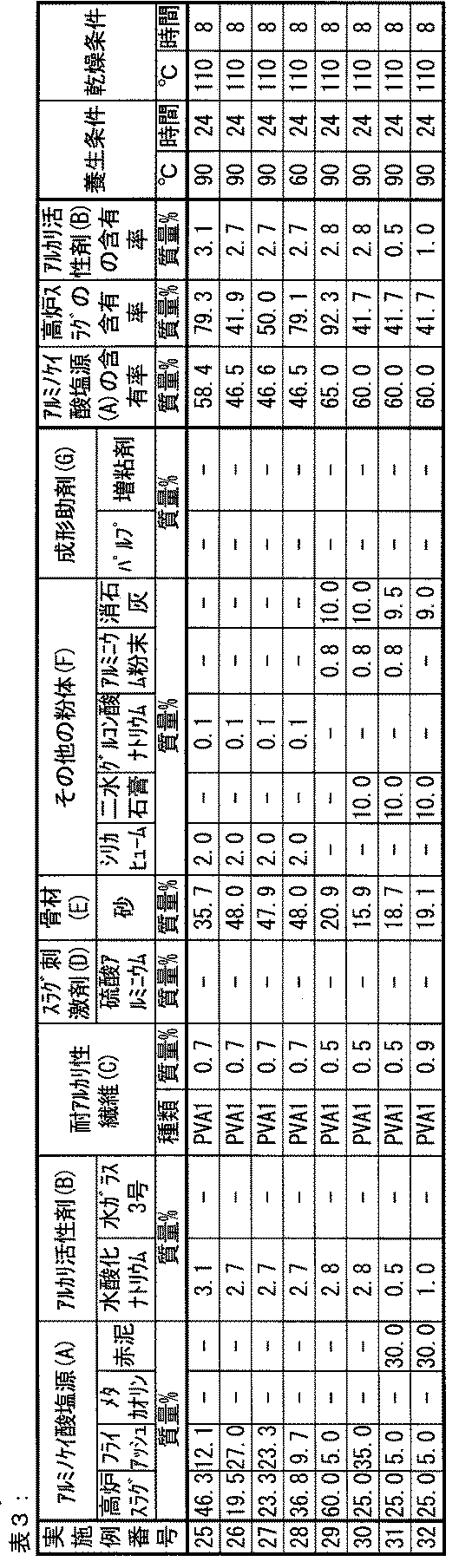
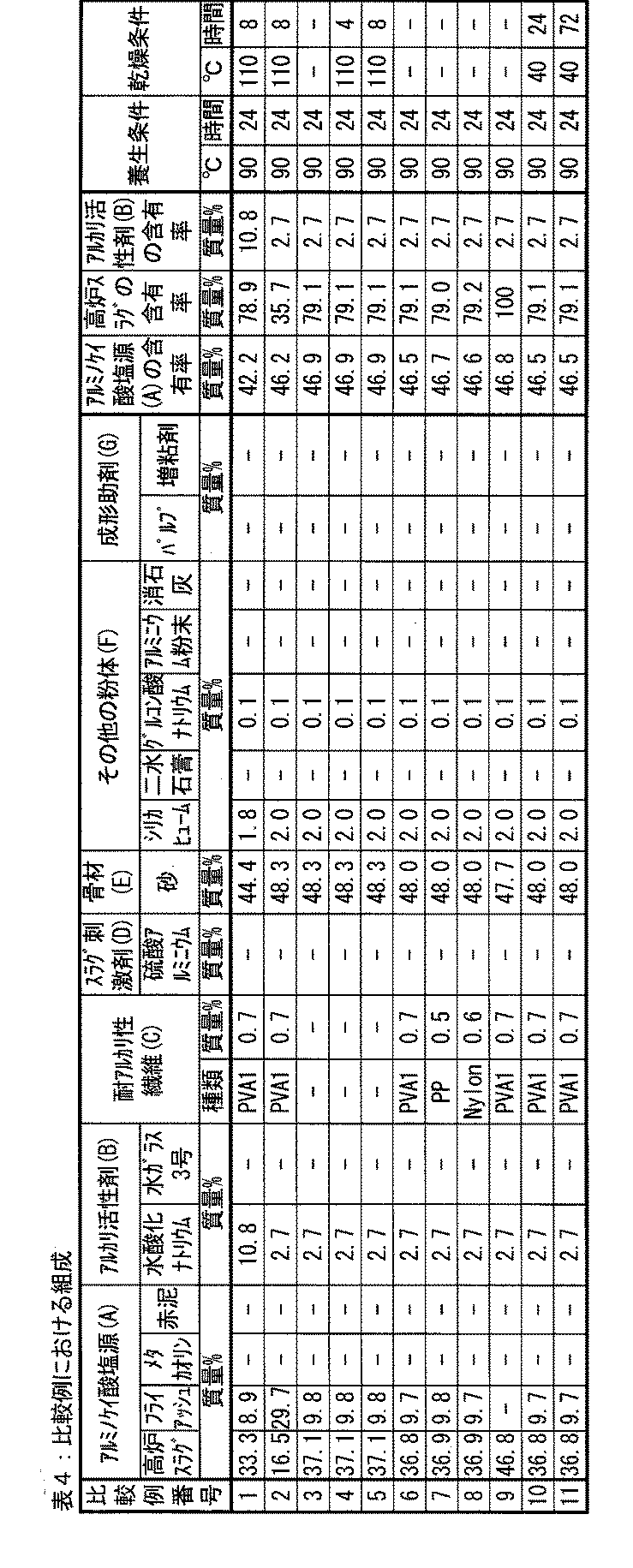
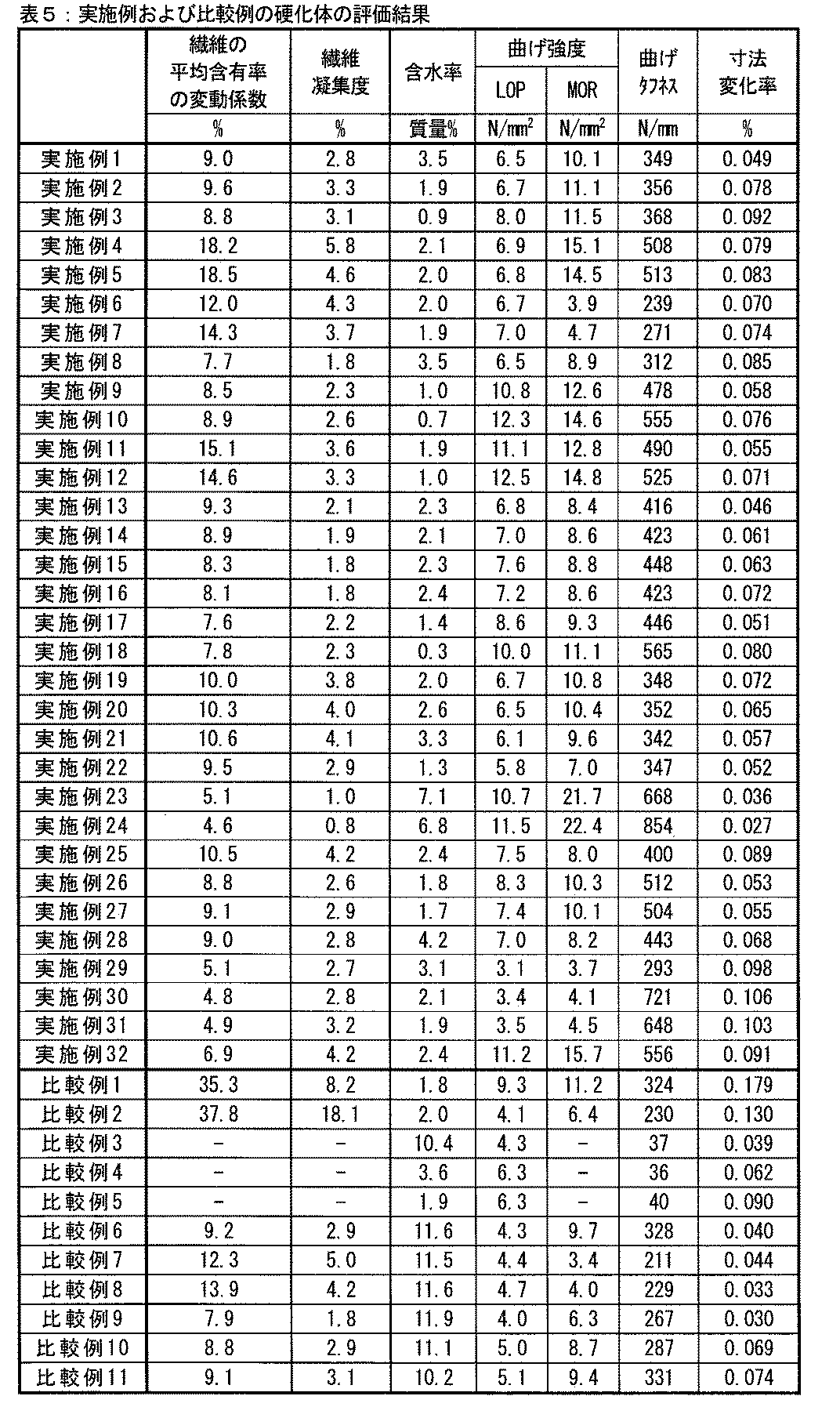
実施例9~10の結果に示されているように、水ガラスを用いると、より優れた曲げ強度および曲げタフネスを示した。
スラグ刺激剤(D)である硫酸アルミニウムを更に添加すると、実施例13の結果に示されているように、養生時間が短くても、更に向上した曲げタフネスが達成できた。また、実施例14~16の組成では、更に向上した曲げタフネスに加えて、更に向上したLOPも達成できた。
水ガラスおよび硫酸アルミニウムを用いると、実施例17~18の結果に示されているように、更に向上したLOPおよび曲げタフネスが得られた。
その他の粉体(F)として二水石膏を用いると、実施例19~21の結果に示されているように、より高い寸法安定性が得られた。また、成形性も改善されたことから、ひび割れがより良好に抑制されたことが分かった。
実施例29~32は、硬化体の軽量化も目的とした配合である。
アルミノケイ酸塩源(A)の全固形分に対する高炉スラグの含有率が40質量%未満である比較例2の硬化体は、繊維の平均含有率の変動係数および繊維凝集度が高く、対応する実施例2と比べて、低いLOPおよび低い曲げタフネスを示し、高い寸法変化率を示した。
補強繊維を含まず、硬化体の含水率が硬化体の総質量に対して10.0質量%より高い比較例3の硬化体は、低い曲げ強度(MOR)および著しく低い曲げタフネスを示した。
補強繊維を含まない比較例4~5の硬化体は、著しく低い曲げタフネスを示した。
硬化体の含水率が硬化体の総質量に対して10.0質量%より高い比較例6~9の硬化体は、対応する実施例の硬化体(実施例1、6、7および8)より、曲げ強度および曲げタフネスが顕著に低かった。
硬化体の含水率が硬化体の総質量に対して10.0質量%より高い比較例10~11の硬化体は、対応する実施例の硬化体(実施例1)より、曲げ強度および曲げタフネスが低く、寸法変化率が高かった。
Claims (10)
- (A)アルミノケイ酸塩源、(B)アルカリ活性剤および(C)耐アルカリ性繊維を含んでなる硬化性組成物の硬化体であって、
アルミノケイ酸塩源(A)は高炉スラグを含み、高炉スラグの含有率はアルミノケイ酸塩源(A)の全固形分に対して40質量%以上であり、
アルカリ活性剤(B)の含有率は、硬化性組成物の全固形分に対して10質量%以下であり、
硬化体の含水率は、硬化体の総質量に対して10.0質量%以下である、硬化体。 - アルミノケイ酸塩源(A)の含有率は、硬化性組成物の全固形分に対して20質量%以上、75質量%以下である、請求項1に記載の硬化体。
- 耐アルカリ性繊維(C)は、ポリビニルアルコール系繊維、ポリエチレン繊維、ポリプロピレン繊維、アクリル繊維、アラミド繊維およびナイロン繊維からなる群から選択される少なくとも1つである、請求項1または2に記載の硬化体。
- 耐アルカリ性繊維(C)の含有率は、硬化体の全固形分に対して0.05質量%以上、5質量%以下である、請求項1~3のいずれかに記載の硬化体。
- 耐アルカリ性繊維(C)の繊維凝集度は10%以下である、請求項1~4のいずれかに記載の硬化体。
- 前記硬化体の全体または一部から10gとなるように切り出した10個の切出片に含まれる耐アルカリ性繊維(C)の平均含有率の変動係数は30%以下である、請求項1~5のいずれかに記載の硬化体。
- 硬化体は骨材(E)を更に含み、骨材(E)の含有率は、硬化体の全固形分に対して15質量%以上、75質量%以下である、請求項1~6のいずれかに記載の硬化体。
- アルミノケイ酸塩源(A)は、フライアッシュ、メタカオリンおよび赤泥からなる群から選択される少なくとも1つを更に含む、請求項1~7のいずれかに記載の硬化体。
- 硬化体はスラグ刺激剤(D)を更に含み、スラグ刺激剤(D)の含有率は、硬化体の全固形分に対して0.01質量%以上、3質量%以下である、請求項1~8のいずれかに記載の硬化体。
- 硬化体は硫酸カルシウム誘導体を更に含み、硫酸カルシウム誘導体の含有率は、硬化体の全固形分に対して0.01質量%以上、20質量%以下である、請求項1~9のいずれかに記載の硬化体。
Priority Applications (6)
| Application Number | Priority Date | Filing Date | Title |
|---|---|---|---|
| US18/013,282 US20230250023A1 (en) | 2020-06-29 | 2021-06-28 | Cured fiber reinforced composite |
| JP2022533985A JP7764374B2 (ja) | 2020-06-29 | 2021-06-28 | 繊維により補強された硬化体 |
| BR112022024876A BR112022024876A2 (pt) | 2020-06-29 | 2021-06-28 | Compósito reforçado com fibra curada |
| EP21832571.0A EP4174042A4 (en) | 2020-06-29 | 2021-06-28 | HARDENED BODY WITH FIBER REINFORCEMENT |
| CN202180046112.9A CN115734954A (zh) | 2020-06-29 | 2021-06-28 | 由纤维增强的固化体 |
| JP2025149078A JP2025175085A (ja) | 2020-06-29 | 2025-09-09 | 繊維により補強された硬化体 |
Applications Claiming Priority (2)
| Application Number | Priority Date | Filing Date | Title |
|---|---|---|---|
| JP2020-111480 | 2020-06-29 | ||
| JP2020111480 | 2020-06-29 |
Publications (1)
| Publication Number | Publication Date |
|---|---|
| WO2022004643A1 true WO2022004643A1 (ja) | 2022-01-06 |
Family
ID=79315299
Family Applications (1)
| Application Number | Title | Priority Date | Filing Date |
|---|---|---|---|
| PCT/JP2021/024324 Ceased WO2022004643A1 (ja) | 2020-06-29 | 2021-06-28 | 繊維により補強された硬化体 |
Country Status (6)
| Country | Link |
|---|---|
| US (1) | US20230250023A1 (ja) |
| EP (1) | EP4174042A4 (ja) |
| JP (2) | JP7764374B2 (ja) |
| CN (1) | CN115734954A (ja) |
| BR (1) | BR112022024876A2 (ja) |
| WO (1) | WO2022004643A1 (ja) |
Cited By (6)
| Publication number | Priority date | Publication date | Assignee | Title |
|---|---|---|---|---|
| CN114751768A (zh) * | 2022-05-12 | 2022-07-15 | 浙江天造环保科技有限公司 | 用于3d打印的轻质高强再生骨料地聚物砂浆及其制备方法 |
| CN116081987A (zh) * | 2023-02-16 | 2023-05-09 | 中国海洋大学 | 一种赤泥基纤维复合胶凝材料及其制备方法 |
| JP7274034B1 (ja) | 2022-11-11 | 2023-05-15 | Ube三菱セメント株式会社 | ジオポリマー組成物の製造方法、ジオポリマー硬化体の製造方法、及びジオポリマー組成物調製用キット |
| JP2023121486A (ja) * | 2022-02-21 | 2023-08-31 | Ube三菱セメント株式会社 | ジオポリマー組成物及びその製造方法、ジオポリマー硬化体及びその製造方法、並びにジオポリマー組成物調製用キット |
| WO2024225386A1 (ja) | 2023-04-28 | 2024-10-31 | 株式会社クラレ | 水硬性組成物の硬化体 |
| JP7720576B1 (ja) | 2024-07-16 | 2025-08-08 | 学校法人大阪産業大学 | 混合物、アルカリ活性材料組成物、アルカリ活性材料硬化物およびその製造方法とアルカリ活性材料組成物から得られるプレキャスト製品とその製造方法 |
Families Citing this family (1)
| Publication number | Priority date | Publication date | Assignee | Title |
|---|---|---|---|---|
| CN118108475A (zh) * | 2024-01-25 | 2024-05-31 | 上海理工大学 | 一种赤泥与化学激发剂复合激发的高延性、可持续工程材料 |
Citations (7)
| Publication number | Priority date | Publication date | Assignee | Title |
|---|---|---|---|---|
| JPH0597495A (ja) | 1991-03-12 | 1993-04-20 | Nippon Kayaku Co Ltd | 高強度複合材料 |
| JPH11147278A (ja) * | 1997-09-03 | 1999-06-02 | Nippon Kayaku Co Ltd | 床 材 |
| JP2011184221A (ja) | 2010-03-05 | 2011-09-22 | Sekisui Chem Co Ltd | 硬化性組成物 |
| JP2012171855A (ja) * | 2011-02-24 | 2012-09-10 | Yoshiji Hirota | セメントを用いない硬化組成物 |
| JP2013216534A (ja) * | 2012-04-06 | 2013-10-24 | Nichiha Corp | 無機質板 |
| JP2015157731A (ja) | 2014-02-25 | 2015-09-03 | 前田建設工業株式会社 | ジオポリマー組成物 |
| JP2018122585A (ja) * | 2017-02-03 | 2018-08-09 | 株式会社東芝 | ジオポリマー成型体製造方法およびジオポリマー成型体製造システム |
Family Cites Families (12)
| Publication number | Priority date | Publication date | Assignee | Title |
|---|---|---|---|---|
| US5453310A (en) * | 1992-08-11 | 1995-09-26 | E. Khashoggi Industries | Cementitious materials for use in packaging containers and their methods of manufacture |
| FR2746095B1 (fr) * | 1996-03-15 | 1998-05-22 | Suspensions aqueuses de silice et leurs applications dans des compositions a base de liant mineral | |
| JP2004083314A (ja) * | 2002-08-23 | 2004-03-18 | Chiba Super Resin Kk | 石目状シ−トなどシ−ト成型用組成物、及びそれを用いたシ−トの製造方法 |
| DE102005053490A1 (de) * | 2005-11-09 | 2007-05-10 | Deutsches Wollforschungsinstitut An Der Rwth Aachen E.V. | Kompositmaterialien, enthaltend hydraulische Bindemittel |
| JP5539673B2 (ja) * | 2009-06-09 | 2014-07-02 | 株式会社竹中工務店 | 高炉スラグ組成物を用いたコンクリート組成物 |
| JP2010285302A (ja) * | 2009-06-09 | 2010-12-24 | Tokyo Institute Of Technology | 水硬性セメント組成物 |
| CN107265937B (zh) * | 2010-12-17 | 2021-06-29 | 天主教美利坚大学 | 用于超高性能混凝土的地质聚合物复合材料 |
| JP6277071B2 (ja) * | 2014-06-27 | 2018-02-07 | 株式会社竹中工務店 | 水硬性セメント組成物の製造方法及び解体コンクリート微粉末のスクリーニング方法 |
| US10196310B2 (en) * | 2016-08-04 | 2019-02-05 | Geopolymer Solutions LLC | Cold fusion concrete |
| US11560335B2 (en) * | 2017-12-26 | 2023-01-24 | Kuraray Co., Ltd. | Molded body formed from curable composition |
| JP7143077B2 (ja) * | 2017-12-26 | 2022-09-28 | 株式会社クラレ | 硬化性組成物から形成されるジオポリマー成形体 |
| US10836678B2 (en) * | 2018-04-12 | 2020-11-17 | Ut-Battelle, Llc | High-performance concrete mix for precast wythes |
-
2021
- 2021-06-28 CN CN202180046112.9A patent/CN115734954A/zh active Pending
- 2021-06-28 JP JP2022533985A patent/JP7764374B2/ja active Active
- 2021-06-28 WO PCT/JP2021/024324 patent/WO2022004643A1/ja not_active Ceased
- 2021-06-28 BR BR112022024876A patent/BR112022024876A2/pt unknown
- 2021-06-28 EP EP21832571.0A patent/EP4174042A4/en active Pending
- 2021-06-28 US US18/013,282 patent/US20230250023A1/en active Pending
-
2025
- 2025-09-09 JP JP2025149078A patent/JP2025175085A/ja not_active Withdrawn
Patent Citations (7)
| Publication number | Priority date | Publication date | Assignee | Title |
|---|---|---|---|---|
| JPH0597495A (ja) | 1991-03-12 | 1993-04-20 | Nippon Kayaku Co Ltd | 高強度複合材料 |
| JPH11147278A (ja) * | 1997-09-03 | 1999-06-02 | Nippon Kayaku Co Ltd | 床 材 |
| JP2011184221A (ja) | 2010-03-05 | 2011-09-22 | Sekisui Chem Co Ltd | 硬化性組成物 |
| JP2012171855A (ja) * | 2011-02-24 | 2012-09-10 | Yoshiji Hirota | セメントを用いない硬化組成物 |
| JP2013216534A (ja) * | 2012-04-06 | 2013-10-24 | Nichiha Corp | 無機質板 |
| JP2015157731A (ja) | 2014-02-25 | 2015-09-03 | 前田建設工業株式会社 | ジオポリマー組成物 |
| JP2018122585A (ja) * | 2017-02-03 | 2018-08-09 | 株式会社東芝 | ジオポリマー成型体製造方法およびジオポリマー成型体製造システム |
Non-Patent Citations (1)
| Title |
|---|
| See also references of EP4174042A4 |
Cited By (12)
| Publication number | Priority date | Publication date | Assignee | Title |
|---|---|---|---|---|
| JP2023121486A (ja) * | 2022-02-21 | 2023-08-31 | Ube三菱セメント株式会社 | ジオポリマー組成物及びその製造方法、ジオポリマー硬化体及びその製造方法、並びにジオポリマー組成物調製用キット |
| JP7841898B2 (ja) | 2022-02-21 | 2026-04-07 | Ube三菱セメント株式会社 | ジオポリマー組成物の製造方法、ジオポリマー硬化体の製造方法、並びにジオポリマー組成物調製用キット |
| CN114751768A (zh) * | 2022-05-12 | 2022-07-15 | 浙江天造环保科技有限公司 | 用于3d打印的轻质高强再生骨料地聚物砂浆及其制备方法 |
| JP7274034B1 (ja) | 2022-11-11 | 2023-05-15 | Ube三菱セメント株式会社 | ジオポリマー組成物の製造方法、ジオポリマー硬化体の製造方法、及びジオポリマー組成物調製用キット |
| JP2024070566A (ja) * | 2022-11-11 | 2024-05-23 | Ube三菱セメント株式会社 | ジオポリマー組成物の製造方法、ジオポリマー硬化体の製造方法、及びジオポリマー組成物調製用キット |
| CN116081987A (zh) * | 2023-02-16 | 2023-05-09 | 中国海洋大学 | 一种赤泥基纤维复合胶凝材料及其制备方法 |
| WO2024225386A1 (ja) | 2023-04-28 | 2024-10-31 | 株式会社クラレ | 水硬性組成物の硬化体 |
| JP7577246B1 (ja) * | 2023-04-28 | 2024-11-01 | 株式会社クラレ | 水硬性組成物の硬化体 |
| KR20260004329A (ko) | 2023-04-28 | 2026-01-08 | 주식회사 쿠라레 | 수경성 조성물의 경화체 |
| EP4703335A1 (en) | 2023-04-28 | 2026-03-04 | Kuraray Co., Ltd. | Hardened body of hydraulic composition |
| JP7720576B1 (ja) | 2024-07-16 | 2025-08-08 | 学校法人大阪産業大学 | 混合物、アルカリ活性材料組成物、アルカリ活性材料硬化物およびその製造方法とアルカリ活性材料組成物から得られるプレキャスト製品とその製造方法 |
| JP2026013268A (ja) * | 2024-07-16 | 2026-01-28 | 学校法人大阪産業大学 | 混合物、アルカリ活性材料組成物、アルカリ活性材料硬化物およびその製造方法とアルカリ活性材料組成物から得られるプレキャスト製品とその製造方法 |
Also Published As
| Publication number | Publication date |
|---|---|
| EP4174042A1 (en) | 2023-05-03 |
| JPWO2022004643A1 (ja) | 2022-01-06 |
| JP2025175085A (ja) | 2025-11-28 |
| EP4174042A4 (en) | 2024-07-17 |
| US20230250023A1 (en) | 2023-08-10 |
| CN115734954A (zh) | 2023-03-03 |
| BR112022024876A2 (pt) | 2023-01-17 |
| JP7764374B2 (ja) | 2025-11-05 |
Similar Documents
| Publication | Publication Date | Title |
|---|---|---|
| JP7764374B2 (ja) | 繊維により補強された硬化体 | |
| JP7178367B2 (ja) | 硬化性組成物から形成される成形体 | |
| JP7143077B2 (ja) | 硬化性組成物から形成されるジオポリマー成形体 | |
| JPWO2018003612A1 (ja) | 繊維補強炭酸化セメント成形物およびその製造方法 | |
| JPS58208163A (ja) | 無機質硬化体の製法 | |
| JP6302716B2 (ja) | 水硬性成形体用補強繊維および同繊維を含む水硬性材料 | |
| JP7577246B1 (ja) | 水硬性組成物の硬化体 | |
| WO2022004640A1 (ja) | 積層成形板およびその製造方法 | |
| CN114524658B (zh) | 一种磷酸铁硫氧镁复合水泥基3d打印材料的制备方法 | |
| JP2002293601A (ja) | 軽量モルタル材の製造方法 | |
| JPH10330146A (ja) | 水硬性無機質成形体の製造方法 | |
| JPWO2016175261A1 (ja) | 繊維含有炭酸化瓦およびその製造方法 | |
| JP7662908B1 (ja) | 無機質成形体 | |
| JP2005187264A (ja) | 押出成形組成物および押出成形硬化体並びに押出成形硬化体の製造方法 | |
| JP2002326851A (ja) | プラスチック人工軽量骨材及びその製造方法 | |
| JP4659475B2 (ja) | ケイ酸カルシウム系成形体 | |
| JP2898565B2 (ja) | 石炭灰を含有する固化物の製造方法 | |
| JP2025066249A (ja) | カルシウム系炭酸化合物及び含水組成物 | |
| JP3280636B2 (ja) | 成形物の製造方法 | |
| WO2025033286A1 (ja) | 無機質成形体用カルシウム系炭酸化合物 | |
| JPS58130150A (ja) | 軽量化無機質硬化体 | |
| BR112020011453B1 (pt) | Corpo moldado formado a partir de composição curável e seu método de produção | |
| JPH07126057A (ja) | 水硬性組成物の押出成形体、およびその製造方法 | |
| JPH0551549B2 (ja) | ||
| JPH01275455A (ja) | 水硬化複合材 |
Legal Events
| Date | Code | Title | Description |
|---|---|---|---|
| 121 | Ep: the epo has been informed by wipo that ep was designated in this application |
Ref document number: 21832571 Country of ref document: EP Kind code of ref document: A1 |
|
| ENP | Entry into the national phase |
Ref document number: 2022533985 Country of ref document: JP Kind code of ref document: A |
|
| REG | Reference to national code |
Ref country code: BR Ref legal event code: B01A Ref document number: 112022024876 Country of ref document: BR |
|
| ENP | Entry into the national phase |
Ref document number: 112022024876 Country of ref document: BR Kind code of ref document: A2 Effective date: 20221206 |
|
| NENP | Non-entry into the national phase |
Ref country code: DE |
|
| ENP | Entry into the national phase |
Ref document number: 2021832571 Country of ref document: EP Effective date: 20230130 |