WO2021256409A1 - ガラスセラミックス及び積層セラミック電子部品 - Google Patents
ガラスセラミックス及び積層セラミック電子部品 Download PDFInfo
- Publication number
- WO2021256409A1 WO2021256409A1 PCT/JP2021/022434 JP2021022434W WO2021256409A1 WO 2021256409 A1 WO2021256409 A1 WO 2021256409A1 JP 2021022434 W JP2021022434 W JP 2021022434W WO 2021256409 A1 WO2021256409 A1 WO 2021256409A1
- Authority
- WO
- WIPO (PCT)
- Prior art keywords
- weight
- glass
- less
- content
- ceramic
- Prior art date
- Legal status (The legal status is an assumption and is not a legal conclusion. Google has not performed a legal analysis and makes no representation as to the accuracy of the status listed.)
- Ceased
Links
Images


Classifications
-
- C—CHEMISTRY; METALLURGY
- C03—GLASS; MINERAL OR SLAG WOOL
- C03C—CHEMICAL COMPOSITION OF GLASSES, GLAZES OR VITREOUS ENAMELS; SURFACE TREATMENT OF GLASS; SURFACE TREATMENT OF FIBRES OR FILAMENTS MADE FROM GLASS, MINERALS OR SLAGS; JOINING GLASS TO GLASS OR OTHER MATERIALS
- C03C14/00—Glass compositions containing a non-glass component, e.g. compositions containing fibres, filaments, whiskers, platelets, or the like, dispersed in a glass matrix
- C03C14/004—Glass compositions containing a non-glass component, e.g. compositions containing fibres, filaments, whiskers, platelets, or the like, dispersed in a glass matrix the non-glass component being in the form of particles or flakes
-
- H—ELECTRICITY
- H01—ELECTRIC ELEMENTS
- H01B—CABLES; CONDUCTORS; INSULATORS; SELECTION OF MATERIALS FOR THEIR CONDUCTIVE, INSULATING OR DIELECTRIC PROPERTIES
- H01B3/00—Insulators or insulating bodies characterised by the insulating materials; Selection of materials for their insulating or dielectric properties
- H01B3/02—Insulators or insulating bodies characterised by the insulating materials; Selection of materials for their insulating or dielectric properties mainly consisting of inorganic substances
- H01B3/12—Insulators or insulating bodies characterised by the insulating materials; Selection of materials for their insulating or dielectric properties mainly consisting of inorganic substances ceramics
-
- C—CHEMISTRY; METALLURGY
- C03—GLASS; MINERAL OR SLAG WOOL
- C03C—CHEMICAL COMPOSITION OF GLASSES, GLAZES OR VITREOUS ENAMELS; SURFACE TREATMENT OF GLASS; SURFACE TREATMENT OF FIBRES OR FILAMENTS MADE FROM GLASS, MINERALS OR SLAGS; JOINING GLASS TO GLASS OR OTHER MATERIALS
- C03C3/00—Glass compositions
- C03C3/04—Glass compositions containing silica
- C03C3/076—Glass compositions containing silica with 40% to 90% silica, by weight
- C03C3/089—Glass compositions containing silica with 40% to 90% silica, by weight containing boron
- C03C3/091—Glass compositions containing silica with 40% to 90% silica, by weight containing boron containing aluminium
-
- C—CHEMISTRY; METALLURGY
- C03—GLASS; MINERAL OR SLAG WOOL
- C03C—CHEMICAL COMPOSITION OF GLASSES, GLAZES OR VITREOUS ENAMELS; SURFACE TREATMENT OF GLASS; SURFACE TREATMENT OF FIBRES OR FILAMENTS MADE FROM GLASS, MINERALS OR SLAGS; JOINING GLASS TO GLASS OR OTHER MATERIALS
- C03C10/00—Devitrified glass ceramics, i.e. glass ceramics having a crystalline phase dispersed in a glassy phase and constituting at least 50% by weight of the total composition
- C03C10/0009—Devitrified glass ceramics, i.e. glass ceramics having a crystalline phase dispersed in a glassy phase and constituting at least 50% by weight of the total composition containing silica as main constituent
-
- C—CHEMISTRY; METALLURGY
- C03—GLASS; MINERAL OR SLAG WOOL
- C03C—CHEMICAL COMPOSITION OF GLASSES, GLAZES OR VITREOUS ENAMELS; SURFACE TREATMENT OF GLASS; SURFACE TREATMENT OF FIBRES OR FILAMENTS MADE FROM GLASS, MINERALS OR SLAGS; JOINING GLASS TO GLASS OR OTHER MATERIALS
- C03C3/00—Glass compositions
- C03C3/04—Glass compositions containing silica
- C03C3/062—Glass compositions containing silica with less than 40% silica by weight
- C03C3/064—Glass compositions containing silica with less than 40% silica by weight containing boron
-
- C—CHEMISTRY; METALLURGY
- C03—GLASS; MINERAL OR SLAG WOOL
- C03C—CHEMICAL COMPOSITION OF GLASSES, GLAZES OR VITREOUS ENAMELS; SURFACE TREATMENT OF GLASS; SURFACE TREATMENT OF FIBRES OR FILAMENTS MADE FROM GLASS, MINERALS OR SLAGS; JOINING GLASS TO GLASS OR OTHER MATERIALS
- C03C3/00—Glass compositions
- C03C3/04—Glass compositions containing silica
- C03C3/062—Glass compositions containing silica with less than 40% silica by weight
- C03C3/064—Glass compositions containing silica with less than 40% silica by weight containing boron
- C03C3/066—Glass compositions containing silica with less than 40% silica by weight containing boron containing zinc
-
- C—CHEMISTRY; METALLURGY
- C03—GLASS; MINERAL OR SLAG WOOL
- C03C—CHEMICAL COMPOSITION OF GLASSES, GLAZES OR VITREOUS ENAMELS; SURFACE TREATMENT OF GLASS; SURFACE TREATMENT OF FIBRES OR FILAMENTS MADE FROM GLASS, MINERALS OR SLAGS; JOINING GLASS TO GLASS OR OTHER MATERIALS
- C03C3/00—Glass compositions
- C03C3/04—Glass compositions containing silica
- C03C3/076—Glass compositions containing silica with 40% to 90% silica, by weight
- C03C3/089—Glass compositions containing silica with 40% to 90% silica, by weight containing boron
- C03C3/091—Glass compositions containing silica with 40% to 90% silica, by weight containing boron containing aluminium
- C03C3/093—Glass compositions containing silica with 40% to 90% silica, by weight containing boron containing aluminium containing zinc or zirconium
-
- C—CHEMISTRY; METALLURGY
- C04—CEMENTS; CONCRETE; ARTIFICIAL STONE; CERAMICS; REFRACTORIES
- C04B—LIME, MAGNESIA; SLAG; CEMENTS; COMPOSITIONS THEREOF, e.g. MORTARS, CONCRETE OR LIKE BUILDING MATERIALS; ARTIFICIAL STONE; CERAMICS; REFRACTORIES; TREATMENT OF NATURAL STONE
- C04B35/00—Shaped ceramic products characterised by their composition; Ceramics compositions; Processing powders of inorganic compounds preparatory to the manufacturing of ceramic products
- C04B35/01—Shaped ceramic products characterised by their composition; Ceramics compositions; Processing powders of inorganic compounds preparatory to the manufacturing of ceramic products based on oxide ceramics
- C04B35/14—Shaped ceramic products characterised by their composition; Ceramics compositions; Processing powders of inorganic compounds preparatory to the manufacturing of ceramic products based on oxide ceramics based on silica
-
- C—CHEMISTRY; METALLURGY
- C04—CEMENTS; CONCRETE; ARTIFICIAL STONE; CERAMICS; REFRACTORIES
- C04B—LIME, MAGNESIA; SLAG; CEMENTS; COMPOSITIONS THEREOF, e.g. MORTARS, CONCRETE OR LIKE BUILDING MATERIALS; ARTIFICIAL STONE; CERAMICS; REFRACTORIES; TREATMENT OF NATURAL STONE
- C04B35/00—Shaped ceramic products characterised by their composition; Ceramics compositions; Processing powders of inorganic compounds preparatory to the manufacturing of ceramic products
- C04B35/01—Shaped ceramic products characterised by their composition; Ceramics compositions; Processing powders of inorganic compounds preparatory to the manufacturing of ceramic products based on oxide ceramics
- C04B35/16—Shaped ceramic products characterised by their composition; Ceramics compositions; Processing powders of inorganic compounds preparatory to the manufacturing of ceramic products based on oxide ceramics based on silicates other than clay
-
- C—CHEMISTRY; METALLURGY
- C04—CEMENTS; CONCRETE; ARTIFICIAL STONE; CERAMICS; REFRACTORIES
- C04B—LIME, MAGNESIA; SLAG; CEMENTS; COMPOSITIONS THEREOF, e.g. MORTARS, CONCRETE OR LIKE BUILDING MATERIALS; ARTIFICIAL STONE; CERAMICS; REFRACTORIES; TREATMENT OF NATURAL STONE
- C04B35/00—Shaped ceramic products characterised by their composition; Ceramics compositions; Processing powders of inorganic compounds preparatory to the manufacturing of ceramic products
- C04B35/01—Shaped ceramic products characterised by their composition; Ceramics compositions; Processing powders of inorganic compounds preparatory to the manufacturing of ceramic products based on oxide ceramics
- C04B35/16—Shaped ceramic products characterised by their composition; Ceramics compositions; Processing powders of inorganic compounds preparatory to the manufacturing of ceramic products based on oxide ceramics based on silicates other than clay
- C04B35/18—Shaped ceramic products characterised by their composition; Ceramics compositions; Processing powders of inorganic compounds preparatory to the manufacturing of ceramic products based on oxide ceramics based on silicates other than clay rich in aluminium oxide
-
- H—ELECTRICITY
- H01—ELECTRIC ELEMENTS
- H01G—CAPACITORS; CAPACITORS, RECTIFIERS, DETECTORS, SWITCHING DEVICES, LIGHT-SENSITIVE OR TEMPERATURE-SENSITIVE DEVICES OF THE ELECTROLYTIC TYPE
- H01G4/00—Fixed capacitors; Processes of their manufacture
- H01G4/002—Details
- H01G4/018—Dielectrics
- H01G4/06—Solid dielectrics
- H01G4/08—Inorganic dielectrics
- H01G4/12—Ceramic dielectrics
- H01G4/129—Ceramic dielectrics containing a glassy phase, e.g. glass ceramic
-
- H—ELECTRICITY
- H05—ELECTRIC TECHNIQUES NOT OTHERWISE PROVIDED FOR
- H05K—PRINTED CIRCUITS; CASINGS OR CONSTRUCTIONAL DETAILS OF ELECTRIC APPARATUS; MANUFACTURE OF ASSEMBLAGES OF ELECTRICAL COMPONENTS
- H05K1/00—Printed circuits
- H05K1/02—Details
- H05K1/03—Use of materials for the substrate
-
- H—ELECTRICITY
- H05—ELECTRIC TECHNIQUES NOT OTHERWISE PROVIDED FOR
- H05K—PRINTED CIRCUITS; CASINGS OR CONSTRUCTIONAL DETAILS OF ELECTRIC APPARATUS; MANUFACTURE OF ASSEMBLAGES OF ELECTRICAL COMPONENTS
- H05K1/00—Printed circuits
- H05K1/02—Details
- H05K1/03—Use of materials for the substrate
- H05K1/0306—Inorganic insulating substrates, e.g. ceramic, glass
-
- B—PERFORMING OPERATIONS; TRANSPORTING
- B32—LAYERED PRODUCTS
- B32B—LAYERED PRODUCTS, i.e. PRODUCTS BUILT-UP OF STRATA OF FLAT OR NON-FLAT, e.g. CELLULAR OR HONEYCOMB, FORM
- B32B2250/00—Layers arrangement
- B32B2250/24—All layers being polymeric
- B32B2250/244—All polymers belonging to those covered by group B32B27/36
-
- B—PERFORMING OPERATIONS; TRANSPORTING
- B32—LAYERED PRODUCTS
- B32B—LAYERED PRODUCTS, i.e. PRODUCTS BUILT-UP OF STRATA OF FLAT OR NON-FLAT, e.g. CELLULAR OR HONEYCOMB, FORM
- B32B2255/00—Coating on the layer surface
- B32B2255/10—Coating on the layer surface on synthetic resin layer or on natural or synthetic rubber layer
-
- B—PERFORMING OPERATIONS; TRANSPORTING
- B32—LAYERED PRODUCTS
- B32B—LAYERED PRODUCTS, i.e. PRODUCTS BUILT-UP OF STRATA OF FLAT OR NON-FLAT, e.g. CELLULAR OR HONEYCOMB, FORM
- B32B2307/00—Properties of the layers or laminate
- B32B2307/20—Properties of the layers or laminate having particular electrical or magnetic properties, e.g. piezoelectric
- B32B2307/202—Conductive
-
- B—PERFORMING OPERATIONS; TRANSPORTING
- B32—LAYERED PRODUCTS
- B32B—LAYERED PRODUCTS, i.e. PRODUCTS BUILT-UP OF STRATA OF FLAT OR NON-FLAT, e.g. CELLULAR OR HONEYCOMB, FORM
- B32B2307/00—Properties of the layers or laminate
- B32B2307/70—Other properties
- B32B2307/724—Permeability to gases, adsorption
- B32B2307/7242—Non-permeable
- B32B2307/7246—Water vapor barrier
-
- B—PERFORMING OPERATIONS; TRANSPORTING
- B32—LAYERED PRODUCTS
- B32B—LAYERED PRODUCTS, i.e. PRODUCTS BUILT-UP OF STRATA OF FLAT OR NON-FLAT, e.g. CELLULAR OR HONEYCOMB, FORM
- B32B2307/00—Properties of the layers or laminate
- B32B2307/70—Other properties
- B32B2307/732—Dimensional properties
- B32B2307/734—Dimensional stability
-
- B—PERFORMING OPERATIONS; TRANSPORTING
- B32—LAYERED PRODUCTS
- B32B—LAYERED PRODUCTS, i.e. PRODUCTS BUILT-UP OF STRATA OF FLAT OR NON-FLAT, e.g. CELLULAR OR HONEYCOMB, FORM
- B32B2457/00—Electrical equipment
-
- B—PERFORMING OPERATIONS; TRANSPORTING
- B32—LAYERED PRODUCTS
- B32B—LAYERED PRODUCTS, i.e. PRODUCTS BUILT-UP OF STRATA OF FLAT OR NON-FLAT, e.g. CELLULAR OR HONEYCOMB, FORM
- B32B27/00—Layered products comprising a layer of synthetic resin
- B32B27/06—Layered products comprising a layer of synthetic resin as the main or only constituent of a layer, which is next to another layer of the same or of a different material
- B32B27/08—Layered products comprising a layer of synthetic resin as the main or only constituent of a layer, which is next to another layer of the same or of a different material of synthetic resin
-
- B—PERFORMING OPERATIONS; TRANSPORTING
- B32—LAYERED PRODUCTS
- B32B—LAYERED PRODUCTS, i.e. PRODUCTS BUILT-UP OF STRATA OF FLAT OR NON-FLAT, e.g. CELLULAR OR HONEYCOMB, FORM
- B32B27/00—Layered products comprising a layer of synthetic resin
- B32B27/36—Layered products comprising a layer of synthetic resin comprising polyesters
-
- C—CHEMISTRY; METALLURGY
- C03—GLASS; MINERAL OR SLAG WOOL
- C03C—CHEMICAL COMPOSITION OF GLASSES, GLAZES OR VITREOUS ENAMELS; SURFACE TREATMENT OF GLASS; SURFACE TREATMENT OF FIBRES OR FILAMENTS MADE FROM GLASS, MINERALS OR SLAGS; JOINING GLASS TO GLASS OR OTHER MATERIALS
- C03C2214/00—Nature of the non-vitreous component
- C03C2214/04—Particles; Flakes
-
- C—CHEMISTRY; METALLURGY
- C03—GLASS; MINERAL OR SLAG WOOL
- C03C—CHEMICAL COMPOSITION OF GLASSES, GLAZES OR VITREOUS ENAMELS; SURFACE TREATMENT OF GLASS; SURFACE TREATMENT OF FIBRES OR FILAMENTS MADE FROM GLASS, MINERALS OR SLAGS; JOINING GLASS TO GLASS OR OTHER MATERIALS
- C03C2214/00—Nature of the non-vitreous component
- C03C2214/30—Methods of making the composites
-
- C—CHEMISTRY; METALLURGY
- C04—CEMENTS; CONCRETE; ARTIFICIAL STONE; CERAMICS; REFRACTORIES
- C04B—LIME, MAGNESIA; SLAG; CEMENTS; COMPOSITIONS THEREOF, e.g. MORTARS, CONCRETE OR LIKE BUILDING MATERIALS; ARTIFICIAL STONE; CERAMICS; REFRACTORIES; TREATMENT OF NATURAL STONE
- C04B2235/00—Aspects relating to ceramic starting mixtures or sintered ceramic products
- C04B2235/02—Composition of constituents of the starting material or of secondary phases of the final product
- C04B2235/30—Constituents and secondary phases not being of a fibrous nature
- C04B2235/32—Metal oxides, mixed metal oxides, or oxide-forming salts thereof, e.g. carbonates, nitrates, (oxy)hydroxides, chlorides
- C04B2235/3205—Alkaline earth oxides or oxide forming salts thereof, e.g. beryllium oxide
- C04B2235/3213—Strontium oxides or oxide-forming salts thereof
-
- C—CHEMISTRY; METALLURGY
- C04—CEMENTS; CONCRETE; ARTIFICIAL STONE; CERAMICS; REFRACTORIES
- C04B—LIME, MAGNESIA; SLAG; CEMENTS; COMPOSITIONS THEREOF, e.g. MORTARS, CONCRETE OR LIKE BUILDING MATERIALS; ARTIFICIAL STONE; CERAMICS; REFRACTORIES; TREATMENT OF NATURAL STONE
- C04B2235/00—Aspects relating to ceramic starting mixtures or sintered ceramic products
- C04B2235/02—Composition of constituents of the starting material or of secondary phases of the final product
- C04B2235/30—Constituents and secondary phases not being of a fibrous nature
- C04B2235/32—Metal oxides, mixed metal oxides, or oxide-forming salts thereof, e.g. carbonates, nitrates, (oxy)hydroxides, chlorides
- C04B2235/3231—Refractory metal oxides, their mixed metal oxides, or oxide-forming salts thereof
- C04B2235/3232—Titanium oxides or titanates, e.g. rutile or anatase
-
- C—CHEMISTRY; METALLURGY
- C04—CEMENTS; CONCRETE; ARTIFICIAL STONE; CERAMICS; REFRACTORIES
- C04B—LIME, MAGNESIA; SLAG; CEMENTS; COMPOSITIONS THEREOF, e.g. MORTARS, CONCRETE OR LIKE BUILDING MATERIALS; ARTIFICIAL STONE; CERAMICS; REFRACTORIES; TREATMENT OF NATURAL STONE
- C04B2235/00—Aspects relating to ceramic starting mixtures or sintered ceramic products
- C04B2235/02—Composition of constituents of the starting material or of secondary phases of the final product
- C04B2235/30—Constituents and secondary phases not being of a fibrous nature
- C04B2235/32—Metal oxides, mixed metal oxides, or oxide-forming salts thereof, e.g. carbonates, nitrates, (oxy)hydroxides, chlorides
- C04B2235/3231—Refractory metal oxides, their mixed metal oxides, or oxide-forming salts thereof
- C04B2235/3244—Zirconium oxides, zirconates, hafnium oxides, hafnates, or oxide-forming salts thereof
-
- C—CHEMISTRY; METALLURGY
- C04—CEMENTS; CONCRETE; ARTIFICIAL STONE; CERAMICS; REFRACTORIES
- C04B—LIME, MAGNESIA; SLAG; CEMENTS; COMPOSITIONS THEREOF, e.g. MORTARS, CONCRETE OR LIKE BUILDING MATERIALS; ARTIFICIAL STONE; CERAMICS; REFRACTORIES; TREATMENT OF NATURAL STONE
- C04B2235/00—Aspects relating to ceramic starting mixtures or sintered ceramic products
- C04B2235/02—Composition of constituents of the starting material or of secondary phases of the final product
- C04B2235/30—Constituents and secondary phases not being of a fibrous nature
- C04B2235/32—Metal oxides, mixed metal oxides, or oxide-forming salts thereof, e.g. carbonates, nitrates, (oxy)hydroxides, chlorides
- C04B2235/3284—Zinc oxides, zincates, cadmium oxides, cadmiates, mercury oxides, mercurates or oxide forming salts thereof
-
- C—CHEMISTRY; METALLURGY
- C04—CEMENTS; CONCRETE; ARTIFICIAL STONE; CERAMICS; REFRACTORIES
- C04B—LIME, MAGNESIA; SLAG; CEMENTS; COMPOSITIONS THEREOF, e.g. MORTARS, CONCRETE OR LIKE BUILDING MATERIALS; ARTIFICIAL STONE; CERAMICS; REFRACTORIES; TREATMENT OF NATURAL STONE
- C04B2235/00—Aspects relating to ceramic starting mixtures or sintered ceramic products
- C04B2235/02—Composition of constituents of the starting material or of secondary phases of the final product
- C04B2235/30—Constituents and secondary phases not being of a fibrous nature
- C04B2235/32—Metal oxides, mixed metal oxides, or oxide-forming salts thereof, e.g. carbonates, nitrates, (oxy)hydroxides, chlorides
- C04B2235/3293—Tin oxides, stannates or oxide forming salts thereof, e.g. indium tin oxide [ITO]
-
- C—CHEMISTRY; METALLURGY
- C04—CEMENTS; CONCRETE; ARTIFICIAL STONE; CERAMICS; REFRACTORIES
- C04B—LIME, MAGNESIA; SLAG; CEMENTS; COMPOSITIONS THEREOF, e.g. MORTARS, CONCRETE OR LIKE BUILDING MATERIALS; ARTIFICIAL STONE; CERAMICS; REFRACTORIES; TREATMENT OF NATURAL STONE
- C04B2235/00—Aspects relating to ceramic starting mixtures or sintered ceramic products
- C04B2235/02—Composition of constituents of the starting material or of secondary phases of the final product
- C04B2235/30—Constituents and secondary phases not being of a fibrous nature
- C04B2235/34—Non-metal oxides, non-metal mixed oxides, or salts thereof that form the non-metal oxides upon heating, e.g. carbonates, nitrates, (oxy)hydroxides, chlorides
- C04B2235/3409—Boron oxide, borates, boric acids, or oxide forming salts thereof, e.g. borax
-
- H—ELECTRICITY
- H01—ELECTRIC ELEMENTS
- H01G—CAPACITORS; CAPACITORS, RECTIFIERS, DETECTORS, SWITCHING DEVICES, LIGHT-SENSITIVE OR TEMPERATURE-SENSITIVE DEVICES OF THE ELECTROLYTIC TYPE
- H01G4/00—Fixed capacitors; Processes of their manufacture
- H01G4/30—Stacked capacitors
Definitions
- the present invention relates to glass ceramics and laminated ceramic electronic components.
- Patent Document 1 describes RO-Al 2 O 3- B 2 O 3- SiO 2 (where RO is one or more of the group consisting of MgO, CaO, SrO, BaO, and ZnO).
- a glass composition for a low-temperature fired substrate having a basic composition, in which RO and Al 2 O 3 are both in the range of 1 to 25 mol%, and the mol% ratio of SiO 2 / B 2 O 3 is 1.3 or less.
- glass ceramics containing an aggregate in the glass composition for a low-temperature fired substrate are disclosed.
- the glass ceramics described in Patent Document 1 can achieve an excellent dielectric loss of 20 ⁇ 10 -4 or less at 3 GHz.
- the glass composition for a low-temperature fired substrate described in Patent Document 1 has a mol% ratio of SiO 2 / B 2 O 3 of 1.3 or less, and has a high B (boron) content.
- Such a glass having a high boron composition can reduce the dielectric loss, but has a problem that the boron content is not stable. Specifically, there arises a problem that boron elutes into a solvent during mixing and grinding, and boron volatilizes during firing. When the boron content decreases due to elution or volatilization, the viscosity of the glass during firing decreases, which causes insufficient sintering.
- glass in which boron is reduced due to elution or volatilization is chemically unstable and has low moisture resistance and plating solution resistance, which may lead to quality deterioration.
- the glass ceramics described in Patent Document 1 have a large temperature change of 100 ppm / K or more in dielectric constant, and are difficult to apply to electronic devices such as filters. Further, since the coefficient of thermal expansion is as low as less than 6 ppm / K and the difference in coefficient of thermal expansion from other dielectrics and mounting substrates is large, it is likely to cause quality defects.
- the present invention has been made to solve the above problems, and an object of the present invention is to provide glass ceramics having a low boron content, a small dielectric constant and a small dielectric loss, a small temperature dependence of the dielectric constant, and a large coefficient of thermal expansion. do.
- One embodiment of the glass ceramics of the present invention is a glass ceramic containing Si, B, Al and Zn-containing glass and an aggregate, and the glass has a SiO 2 content of 20% by weight or more. and 55 wt% or less, B 2 content of O 3 is 15 wt% or more and 30 wt% or less, the weight ratio of SiO 2 to B 2 O 3 (SiO 2 / B 2 O 3) is 1.21 or more, the weight ratio of Al 2 O 3 with respect to ZnO (Al 2 O 3 / ZnO ) is 0.8 or more and 1.3 or less, as the aggregate, the weight of the glass ceramic, 20 wt % Or more and 50% by weight or less SiO 2 , 1% by weight or more and 10% by weight or less of TiO 2 , 3% by weight or less of ZrO 2 and 1% by weight or less of ZnO in the glass. 2.
- the contents of ZrO 2 , SnO 2 and SrO are all 0% by weight or more and
- Another embodiment of the glass ceramic of the present invention is a glass ceramic containing Si, B, Al, Zn, Ti and Zr, and has a SiO 2 content of 41.70% by weight or more and 67.48% by weight or less.
- the B 2 O 3 content is 8.74% by weight or more and 19.50% by weight or less
- the Al 2 O 3 content is 4.875% by weight or more and 21.125% by weight or less.
- ZnO content is 5.175% by weight or more and 21.425% by weight or less
- TiO 2 content is 1% by weight or more and 13.5% by weight or less
- ZrO 2 content is 6.8. It is characterized in that it is not more than% by weight, the content of SnO 2 is 3.95% by weight or less, and the content of SrO is 3.95% by weight or less.
- the laminated ceramic electronic component of the present invention is characterized by comprising a glass ceramic layer which is a sintered body of the glass ceramic of the present invention.
- the present invention it is possible to provide glass ceramics having a low boron content, a small dielectric constant and a small dielectric loss, a small temperature dependence of the dielectric constant, and a large coefficient of thermal expansion.
- FIG. 1 is a cross-sectional view schematically showing an example of a laminated ceramic electronic component of the present invention.
- FIG. 2 is a schematic cross-sectional view showing a laminated green sheet (unfired state) produced in the manufacturing process of the laminated ceramic electronic component in FIG.
- the glass ceramics and the laminated ceramic electronic components of the present invention will be described.
- the present invention is not limited to the following configuration, and may be appropriately modified without departing from the gist of the present invention.
- a combination of a plurality of individual preferred configurations described below is also the present invention.
- the glass ceramics of the present invention are low temperature co-fired ceramics (LTCC) materials.
- LTCC low temperature co-fired ceramics
- co-fired ceramic material at low temperature means a glass ceramic material that can be sintered at a firing temperature of 1000 ° C. or lower.
- One embodiment of the glass ceramics of the present invention is a glass ceramic containing Si, B, Al and Zn-containing glass and an aggregate, and the glass has a SiO 2 content of 20% by weight or more. and 55 wt% or less, B 2 content of O 3 is 15 wt% or more and 30 wt% or less, the weight ratio of SiO 2 to B 2 O 3 (SiO 2 / B 2 O 3) is 1.21 or more, the weight ratio of Al 2 O 3 with respect to ZnO (Al 2 O 3 / ZnO ) is 0.8 or more and 1.3 or less, as the aggregate, the weight of the glass ceramic, 20 wt % Or more and 50% by weight or less SiO 2 , 1% by weight or more and 10% by weight or less of TiO 2 , 3% by weight or less of ZrO 2 and 1% by weight or less of ZnO in the glass. 2.
- the contents of ZrO 2 , SnO 2 and SrO are all 0% by weight or more and
- glass 20% by weight or more, includes a SiO 2 of 55 wt% or less, 15 wt% or more, and a B 2 O 3 of 30 wt% or less, B 2 O 3 to weight ratio of SiO 2 (SiO 2 / B 2 O 3) is not less 1.21 or more, the weight ratio of Al 2 O 3 with respect to ZnO (Al 2 O 3 / ZnO ) is 0.8 or more, 1.3 or less , and the as the aggregate, 20% by weight or more, and SiO 2 of 50 wt% or less, 1% by weight or more, and 10 wt% or less of TiO 2, 3 the weight percent of ZrO 2, less 1 wt% Includes ZnO. Further, the contents of TiO 2 , ZrO 2 , SnO 2 and SrO in the glass are all 0% by weight or more and 5% by weight or less.
- the glass contains 40% by weight or more and 55% by weight or less of SiO 2 .
- the glass contains 40% by weight or more and 55% by weight or less of SiO 2 , it contributes to a decrease in the dielectric constant when the glass ceramics are sintered. As a result, stray capacitance and the like due to high frequency of the electric signal are suppressed.
- the content of SiO 2 exceeds 55% by weight, problems such as difficulty in sintering at 1000 ° C. or lower and difficulty in precipitation of ZnAl 2 O 4 crystals occur, but the content of SiO 2 is 55. Since it is less than% by weight, the above problem does not occur.
- the content of SiO 2 is less than 20% by weight, the viscosity is too low and vitrification becomes difficult.
- B 2 O 3 in the glass contributes to the decrease in glass viscosity. Therefore, the sintered body of glass-ceramics becomes dense.
- Glass constituting the glass ceramics of the present invention B 2 O content of 3 15% by weight or more, a 30% by weight or less, the weight ratio of SiO 2 to B 2 O 3 (SiO 2 / B 2 O 3 ) it is, since it is 1.21 or more, the proportion of B 2 O 3 in the total glass is small. Therefore, the elution and volatilization of boron from the glass is unlikely to occur, and problems such as insufficient sintering and deterioration of plating solution resistance are unlikely to occur.
- the weight ratio of SiO 2 to B 2 O 3 (SiO 2 / B 2 O 3) is 1.21 or more and 3.67 or less. If the weight ratio of SiO 2 to B 2 O 3 (SiO 2 / B 2 O 3) is in the above range, hardly occurs elution or volatilization of boron from the glass. If the weight ratio of SiO 2 to B 2 O 3 (SiO 2 / B 2 O 3) is less than 1.21, and B 2 O 3 is too large relative to the SiO 2, elution and evaporation of boron tends to occur become.
- Al 2 O 3 in the glass contributes to the improvement of the chemical stability of the glass.
- Zn in the glass forms ZnAl 2 O 4 together with Al.
- the weight ratio of Al 2 O 3 with respect to ZnO is 0.8 or more, if it is 1.3 or less, the content of the ZnAl 2 O 4 in the glass is the preferred range.
- the weight ratio of Al 2 O 3 with respect to ZnO is less than 0.8, ZnO is too much, Q value is the inverse of the dielectric loss is reduced.
- the glass may contain an auxiliary component.
- an auxiliary component As the subcomponent, at least one metal selected from the group consisting of alkali metals, alkaline earth metals and other metals is preferable.
- the alkali metal preferably contains at least one of Li, Na and K.
- the alkaline earth metal preferably contains at least one of Be, Mg, Ca, Sr and Ba.
- the other metal preferably contains at least one of Ti, Zr and Sn.
- the total content of the auxiliary components is preferably 0.1% by weight or more and 5% by weight or less of the total weight of the glass.
- the crystallization of the glass is promoted, which contributes to the reduction of the dielectric loss.
- the glass may contain at least one oxide selected from the group consisting of TiO 2 , ZrO 2 , SnO 2 and SrO.
- the content of TiO 2 , ZrO 2 , SnO 2 and SrO in the glass is 0% by weight or more and 5% by weight or less.
- the value of the relative permittivity becomes too large.
- the value of the relative permittivity becomes too large.
- the Sn content in the glass exceeds 5% by weight in terms of oxide, the Q value becomes too low. If the Sr content in the glass exceeds 5% by weight in terms of oxide, the Q value becomes too low.
- the glass ceramics of the present invention contain 40% by weight or more and 50% by weight or less of SiO 2 as an aggregate. Quartz is preferable as the SiO 2 as an aggregate. Quartz contributes to increasing the coefficient of thermal expansion when the glass ceramics are sintered. Since the coefficient of thermal expansion of glass is about 6 ppm / K, while the coefficient of thermal expansion of quartz is about 15 ppm / K, the high coefficient of thermal expansion when the glass ceramics are sintered due to the inclusion of quartz. Is obtained. Therefore, compressive stress is generated in the cooling process after sintering, and the mechanical strength (for example, the bending strength) is increased. In addition, reliability at the time of mounting on a mounting board (for example, a resin board) is enhanced.
- a mounting board for example, a resin board
- the coefficient of thermal expansion of glass ceramics can be increased to approach the coefficient of thermal expansion of a conductive layer made of copper, silver or the like. If the content of quartz as an aggregate is less than 20% by weight, the coefficient of thermal expansion may be too small. If the content of quartz as an aggregate exceeds 50% by weight, the coefficient of thermal expansion may be too large.
- the glass ceramics of the present invention contain 1% by weight or more and 10% by weight or less of TiO 2 as an aggregate.
- TiO 2 has a negatively large temperature coefficient (TCC) of relative permittivity.
- SiO 2 has a very large TCC. Therefore, by containing TiO 2 of 1% by weight or more and 10% by weight or less as the aggregate, the temperature dependence of the relative permittivity can be controlled to about 60 ppm / K. If the content of TiO 2 as an aggregate is less than 1% by weight and exceeds 10% by weight, the TCC cannot be adjusted to a desired value.
- the glass ceramics of the present invention contain 3% by weight or less of ZrO 2 as an aggregate. Dielectric loss can be reduced by containing 3% by weight or less of ZrO 2 as an aggregate with respect to the weight of the glass ceramics. If ZrO 2 as an aggregate is contained in an amount of more than 3% by weight, the relative permittivity becomes too large.
- the content of ZrO 2 as an aggregate with respect to the weight of the glass ceramics is 0% by weight or more, preferably 0.1% by weight or more, and more preferably 1% by weight or more.
- the glass ceramics of the present invention contain 1% by weight or less of ZnO as an aggregate. Sinterability can be improved by containing 1% by weight or less of ZnO as an aggregate with respect to the weight of the glass ceramics. In addition, the volatile component of ZnO in the glass can be supplemented. If ZnO as an aggregate is contained in an amount of more than 1% by weight, the moisture resistance is lowered.
- the content of ZnO as an aggregate with respect to the weight of the glass ceramics is 0% by weight or more, preferably 0.1% by weight or more.
- the glass and the glass can be obtained by a method of analyzing an electron diffraction pattern with a scanning electron microscope (SEM) or a transmission electron microscope (TEM), or a method of eluting the glass portion with hydrogen fluoride or the like. Aggregates can be distinguished or separated. By performing elemental analysis such as wavelength dispersive X-ray analysis (WDX), energy dispersive X-ray analysis (EDX), and inductively coupled plasma emission spectroscopy (ICP) on the distinguished or separated glass and aggregate. , Glass and aggregate composition can be measured respectively. By the above method, the content of SiO 2 as glass and the content of SiO 2 as an aggregate can be measured, respectively. The same applies to other elements.
- SEM scanning electron microscope
- TEM transmission electron microscope
- ICP inductively coupled plasma emission spectroscopy
- Another embodiment of the glass ceramic of the present invention is a glass ceramic containing Si, B, Al, Zn, Ti and Zr, and has a SiO 2 content of 41.70% by weight or more and 67.48% by weight or less.
- the B 2 O 3 content is 8.74% by weight or more and 19.50% by weight or less
- the Al 2 O 3 content is 4.875% by weight or more and 21.125% by weight or less.
- ZnO content is 5.175% by weight or more and 21.425% by weight or less
- TiO 2 content is 1% by weight or more and 13.5% by weight or less
- ZrO 2 content is 6.8. It is characterized in that it is not more than% by weight, the content of SnO 2 is 3.95% by weight or less, and the content of SrO is 3.95% by weight or less.
- the content of Si, B, Al, Zn, Ti, Zr, Sn and Sr is determined without distinguishing between the glass and the aggregate in one embodiment of the glass ceramic.
- another embodiment of the glass ceramics of the present invention is substantially the same as one embodiment of the glass ceramics of the present invention, and has the same effect.
- the laminated ceramic electronic component of the present invention is characterized by comprising a plurality of glass ceramic layers which are sintered bodies of the glass ceramic of the present invention.
- the laminated ceramic electronic component of the present invention is, for example, a laminated body having a plurality of glass ceramic layers which is a sintered body of the glass ceramic of the present invention, a laminated ceramic substrate using the laminated body, and mounted on the ceramic substrate. Examples include chip parts and electronic parts provided with ceramics. Since the laminated ceramic electronic component of the present invention includes a plurality of glass ceramic layers which are sintered bodies of the glass ceramic of the present invention, it has a low dielectric constant and a low dielectric loss.
- the laminate provided with a plurality of glass-ceramic layers which is a sintered body of the glass ceramic of the present invention, can be used, for example, for a communication ceramic multilayer substrate or a laminated dielectric filter.
- the coefficient of thermal expansion of the glass-ceramic layer is preferably 6 ppm / K or more.
- the relative permittivity of the glass-ceramic layer is preferably 6 or less.
- the Q value of the glass-ceramic layer is preferably 500 or more.
- the temperature characteristic (TCC) of the relative permittivity of the glass-ceramic layer is preferably -100 ppm / K or more and +100 ppm / K or less.
- FIG. 1 is a cross-sectional view schematically showing an example of the laminated ceramic electronic component of the present invention.
- the electronic component 2 includes a laminated body 1 in which a plurality of glass-ceramic layers 3 (five layers in FIG. 1) are laminated, and chip components 13 and 14 mounted on the laminated body 1.
- the laminate 1 is also a laminated ceramic substrate.
- the glass-ceramic layer 3 is a sintered body of the glass-ceramic of the present invention. Therefore, an electron including a laminated body 1 in which a plurality of glass ceramic layers 3 are laminated, a laminated ceramic substrate using the laminated body 1, and chip components 13 and 14 mounted on the laminated ceramic substrate (laminated body 1).
- the component 2 is a laminated ceramic electronic component of the present invention.
- the composition of the plurality of glass-ceramic layers 3 may be the same as each other or different from each other, but it is preferable that they are the same as each other.
- the laminated body 1 may further have a conductor layer.
- the conductor layer for example, constitutes a passive element such as a capacitor or an inductor, or constitutes a connection wiring that bears an electrical connection between the elements.
- Such a conductor layer includes conductor layers 9, 10, 11 and a via hole conductor layer 12 as shown in FIG.
- the conductor layers 9, 10, 11 and the via hole conductor layer 12 preferably contain Ag or Cu as a main component.
- Ag or Cu As a main component.
- the conductor layer 9 is arranged inside the laminated body 1. Specifically, the conductor layer 9 is arranged at the interface between the glass-ceramic layers 3.
- the conductor layer 10 is arranged on one main surface of the laminated body 1.
- the conductor layer 11 is arranged on the other main surface of the laminated body 1.
- the via hole conductor layer 12 is arranged so as to penetrate the glass-ceramic layer 3, and can electrically connect the conductor layers 9 of different layers to each other, electrically connect the conductor layers 9 and 10, and conduct conductors. It plays a role of electrically connecting the layers 9 and 11.
- the laminated body 1 is manufactured as follows, for example.
- the glass is prepared by mixing the sub-ingredients added as needed.
- the glass ceramics of the present invention are prepared by mixing glass with SiO 2 , TiO 2 , ZrO 2 and ZnO as aggregates.
- (C) Preparation of green sheet The glass ceramic of the present invention is mixed with a binder, a plasticizer, etc. to prepare a ceramic slurry. Then, the ceramic slurry is molded on a base film (for example, a polyethylene terephthalate (PET) film) and then dried to produce a green sheet.
- a base film for example, a polyethylene terephthalate (PET) film
- FIG. 2 is a schematic cross-sectional view showing a laminated green sheet (unfired state) produced in the manufacturing process of the laminated ceramic electronic component in FIG.
- the laminated green sheet 21 is formed by laminating a plurality of green sheets 22 (five in FIG. 2).
- the green sheet 22 becomes the glass-ceramic layer 3 after firing.
- the laminated green sheet 21 may be formed with a conductor layer including conductor layers 9, 10, 11 and a via hole conductor layer 12.
- the conductor layer can be formed by a screen printing method, a photolithography method, or the like using a conductive paste containing Ag or Cu.
- the firing temperature of the laminated green sheet 21 is not particularly limited as long as the glass ceramics of the present invention constituting the green sheet 22 can be sintered, and may be, for example, 1000 ° C. or lower.
- the firing atmosphere of the laminated green sheet 21 is not particularly limited, but when a material that is difficult to oxidize such as Ag is used as the conductor layers 9, 10, 11 and the via hole conductor layer 12, an air atmosphere is preferable, and Cu or the like is preferable. When a material that easily oxidizes is used, a low oxygen atmosphere such as a nitrogen atmosphere is preferable. Further, the firing atmosphere of the laminated green sheet 21 may be a reducing atmosphere.
- the laminated green sheet 21 may be fired while being sandwiched between the restraining green sheets.
- the restraining green sheet contains, as a main component, an inorganic material (for example, Al 2 O 3 ) that is substantially not sintered at the sintering temperature of the glass ceramics of the present invention constituting the green sheet 22. Therefore, the restraining green sheet does not shrink during firing of the laminated green sheet 21, and acts to suppress the shrinkage of the laminated green sheet 21 in the main surface direction. As a result, the dimensional accuracy of the obtained laminated body 1 (particularly, the conductor layers 9, 10, 11 and the via hole conductor layer 12) is improved.
- Chip parts 13 and 14 may be mounted on the laminated body 1 in a state of being electrically connected to the conductor layer 10. As a result, the electronic component 2 having the laminated body 1 is configured.
- Examples of the chip components 13 and 14 include LC filters, capacitors, inductors, and the like.
- the electronic component 2 may be mounted on a mounting board (for example, a motherboard) so as to be electrically connected via the conductor layer 11.
- a mounting board for example, a motherboard
- the "central particle size” means the central particle size D 50 measured by the laser diffraction / scattering method.
- the glasses G6 to G9, G12, G13, G19, G21, G23, and G25 marked with * in Table 1 are not the glasses constituting the glass ceramics of the present invention.
- the SiO 2 content of the glass G6 exceeds 55% by weight.
- Glass G7 is, B 2 O 3 content exceeds 30% by weight.
- Glass G9 is, B 2 O 3 content is less than 15 wt%.
- Glass G12 is the weight ratio of Al 2 O 3 with respect to ZnO (Al 2 O 3 / ZnO ) is less than 0.8.
- Glass G13 is the weight ratio of Al 2 O 3 with respect to ZnO (Al 2 O 3 / ZnO ) is greater than 1.3.
- Glass G19 has a TiO 2 content of more than 5% by weight.
- Glass G21 is, ZrO 2 content exceeds 5 wt%.
- the glass G23 has a SnO 2 content of more than 5% by weight.
- the glass G25 has an SrO content of more than 5% by weight.
- the laminated green sheet was calcined at 980 ° C. for 60 minutes in a reducing atmosphere, and the obtained fired body was a laminated body L1 to have a plurality of glass ceramic layers which are sintered bodies of glass ceramics. It is L38.
- the laminated bodies L6, L7, L8, L9, L12, L13, L22, L23, L25, L27, L28, L30, L32, L34, L36, and L38 marked with * in Table 2 are the glass ceramics of the present invention. It is not a laminated body using.
- Network analyzer Keysight 8757D
- Signal generator Keysight Synthesized Sweeper 83751
- Resonator Self-made jig (resonance frequency: 6GHz) Prior to the measurement, the cable loss was measured by connecting the network analyzer and the signal generator. The resonator was calibrated using a standard substrate (quartz, dielectric constant: 3.73, Q value: 4545 @ 6 GHz, thickness: 0.636 mm).
- the laminate provided with the glass-ceramic layer which is the sintered body of the glass-ceramic of the present invention, has a low relative permittivity even though it uses glass having a boron content of 30 wt% or less. It can be seen that the Q value is high, the temperature dependence of the relative permittivity is small, and the coefficient of thermal expansion is large. In addition, there were no problems associated with elution or volatilization of boron.
- the laminated body L6 was insufficiently sintered. It is considered that this is because the glass G6 having a SiO 2 content of more than 55% by weight was used, so that the sintering did not proceed sufficiently at 980 ° C.
- the laminated body L7 had insufficient moisture resistance. This is because the content of B 2 O 3 is a glass G7 exceeding 30 wt% is believed that such as boron elution or volatilization occurs in the manufacturing process.
- the laminated body L8 had insufficient moisture resistance.
- the laminated body L13 had a low Q value. This is because the weight ratio of Al 2 O 3 with respect to ZnO (Al 2 O 3 / ZnO ) is a glass G13 exceeding 1.3, the viscosity of the glass ends up increasing, to obtain a dense sintered body It is probable that it was not possible.
- the laminate L22 was insufficiently sintered. It is considered that this is because the content of SiO 2 as an aggregate exceeds 50% by weight.
- the laminated body L23 had a low coefficient of thermal expansion ⁇ .
- the laminated body L25 had a high relative permittivity. It is considered that this is because the content of ZrO 2 as an aggregate exceeds 3% by weight.
- the laminated body L27 does not have sufficient moisture resistance. It is considered that this is because the content of ZnO as an aggregate exceeds 1% by weight.
- the TCC of the laminated body L28 is too small. It is considered that this is because the content of TiO 2 , which is a negative material for TCC, as an aggregate was too high.
- the TCC of the laminated body L30 is too large.
- TCC does not contain TiO 2 , which is a negative material, as an aggregate, so that TCC becomes too large.
- the laminated body L32 had a high relative permittivity. It is considered that this is because the content of TiO 2 in the glass exceeds 5% by weight.
- the laminated body L34 had a high relative permittivity. It is considered that this is because the content of ZrO 2 in the glass exceeds 5% by weight.
- the laminated body L36 had a low Q value. It is considered that this is because the content of SnO 2 in the glass exceeded 5% by weight.
- the laminated body L38 had a low Q value. It is considered that this is because the content of SrO in the glass exceeded 5% by weight.
Landscapes
- Chemical & Material Sciences (AREA)
- Engineering & Computer Science (AREA)
- Ceramic Engineering (AREA)
- Materials Engineering (AREA)
- Organic Chemistry (AREA)
- Life Sciences & Earth Sciences (AREA)
- Chemical Kinetics & Catalysis (AREA)
- General Chemical & Material Sciences (AREA)
- Geochemistry & Mineralogy (AREA)
- Manufacturing & Machinery (AREA)
- Inorganic Chemistry (AREA)
- Structural Engineering (AREA)
- Power Engineering (AREA)
- Microelectronics & Electronic Packaging (AREA)
- Dispersion Chemistry (AREA)
- Crystallography & Structural Chemistry (AREA)
- Glass Compositions (AREA)
- Compositions Of Oxide Ceramics (AREA)
- Production Of Multi-Layered Print Wiring Board (AREA)
- Inorganic Insulating Materials (AREA)
Abstract
ガラスセラミックスは、Si、B、Al及びZnを含むガラスと、骨材と、を含むガラスセラミックスであって、上記ガラスは、SiO2の含有量が20重量%以上、55重量%以下であり、B2O3の含有量が15重量%以上、30重量%以下であり、B2O3に対するSiO2の重量比(SiO2/B2O3)が1.21以上であり、ZnOに対するAl2O3の重量比(Al2O3/ZnO)が0.8以上、1.3以下であり、上記骨材として、上記ガラスセラミックの重量に対して、20重量%以上、50重量%以下のSiO2と、1重量%以上、10重量%以下のTiO2と、3重量%以下のZrO2と、1重量%以下のZnOを含み、上記ガラス中の、TiO2、ZrO2、SnO2及びSrOの含有量がいずれも、0重量%以上、5重量%以下である。
Description
本発明は、ガラスセラミックス及び積層セラミック電子部品に関する。
セラミック多層配線基板用のセラミック材料として、低温焼成が可能なガラスセラミック材料が知られている。
例えば、特許文献1には、RO-Al2O3-B2O3-SiO2(ただし、ROはMgO、CaO、SrO、BaO、ZnOからなる群の中の1種または2種以上)の基本組成を有し、ROとAl2O3がいずれも1~25mol%の範囲内にあり、SiO2/B2O3のmol%比が1.3以下である低温焼成基板用ガラス組成物、及び、該低温焼成基板用ガラス組成物に骨材を含有するガラスセラミックスが開示されている。
特許文献1に記載のガラスセラミックスは、3GHzにおいて20×10-4以下という優れた誘電損失を達成することができる。
しかしながら、特許文献1に記載の低温焼成基板用ガラス組成物は、SiO2/B2O3のmol%比が1.3以下であり、B(ホウ素)の含有率が高い。このような高ホウ素組成のガラスは、誘電損失を低くすることができる一方で、ホウ素含有量が安定しないという問題を有する。具体的には、混合粉砕時にホウ素が溶媒に溶出したり、焼成時にホウ素が揮発するといった問題が生じる。ホウ素含有量が溶出や揮発によって減少すると、焼成時のガラスの粘度が低下して焼結不足の原因となる。また、ホウ素が溶出や揮発によって減少したガラスは、化学的に不安定で耐湿性や耐めっき液性が低く、品質低下を招く恐れがある。
また、特許文献1に記載のガラスセラミックスは、誘電率の温度変化が100ppm/K以上と大きく、フィルタ等の電子デバイスに適用することが難しい。
さらに、熱膨張係数が6ppm/K未満と低く、他の誘電体や実装基板との熱膨張係数の差が大きいため、品質不良の原因となりやすい。
さらに、熱膨張係数が6ppm/K未満と低く、他の誘電体や実装基板との熱膨張係数の差が大きいため、品質不良の原因となりやすい。
本発明は、上記課題を解決するものであり、ホウ素含有率が低く、誘電率及び誘電損失が小さく、誘電率の温度依存性が小さく、熱膨張係数が大きいガラスセラミックスを提供することを目的とする。
本発明のガラスセラミックスの一実施形態は、Si、B、Al及びZnを含むガラスと、骨材と、を含むガラスセラミックスであって、上記ガラスは、SiO2の含有量が20重量%以上、55重量%以下であり、B2O3の含有量が15重量%以上、30重量%以下であり、B2O3に対するSiO2の重量比(SiO2/B2O3)が1.21以上であり、ZnOに対するAl2O3の重量比(Al2O3/ZnO)が0.8以上、1.3以下であり、上記骨材として、上記ガラスセラミックスの重量に対して、20重量%以上、50重量%以下のSiO2と、1重量%以上、10重量%以下のTiO2と、3重量%以下のZrO2と、1重量%以下のZnOを含み、上記ガラス中の、TiO2、ZrO2、SnO2及びSrOの含有量がいずれも、0重量%以上、5重量%以下である、ことを特徴とする。
本発明のガラスセラミックスの他の実施形態は、Si、B、Al、Zn、Ti及びZrを含むガラスセラミックスであって、SiO2含有量が、41.70重量%以上、67.48重量%以下であり、B2O3含有量が、8.74重量%以上、19.50重量%以下であり、Al2O3含有量が、4.875重量%以上、21.125重量%以下であり、ZnO含有量が、5.175重量%以上、21.425重量%以下であり、TiO2含有量が、1重量%以上、13.5重量%以下であり、ZrO2含有量が6.8重量%以下であり、SnO2の含有量が、3.95重量%以下であり、SrOの含有量が、3.95重量%以下である、ことを特徴とする。
本発明の積層セラミック電子部品は、本発明のガラスセラミックスの焼結体であるガラスセラミック層を備えることを特徴とする。
本発明によれば、ホウ素含有率が低く、誘電率及び誘電損失が小さく、誘電率の温度依存性が小さく、熱膨張係数が大きいガラスセラミックスを提供することができる。
以下、本発明のガラスセラミックス及び積層セラミック電子部品について説明する。なお、本発明は、以下の構成に限定されるものではなく、本発明の要旨を逸脱しない範囲において適宜変更されてもよい。また、以下において記載する個々の好ましい構成を複数組み合わせたものもまた本発明である。
本発明のガラスセラミックスは、低温同時焼成セラミックス(LTCC)材料である。本明細書中、「低温同時焼成セラミックス材料」は、1000℃以下の焼成温度で焼結可能なガラスセラミック材料を意味する。
本発明のガラスセラミックスの一実施形態は、Si、B、Al及びZnを含むガラスと、骨材と、を含むガラスセラミックスであって、上記ガラスは、SiO2の含有量が20重量%以上、55重量%以下であり、B2O3の含有量が15重量%以上、30重量%以下であり、B2O3に対するSiO2の重量比(SiO2/B2O3)が1.21以上であり、ZnOに対するAl2O3の重量比(Al2O3/ZnO)が0.8以上、1.3以下であり、上記骨材として、上記ガラスセラミックスの重量に対して、20重量%以上、50重量%以下のSiO2と、1重量%以上、10重量%以下のTiO2と、3重量%以下のZrO2と、1重量%以下のZnOを含み、上記ガラス中の、TiO2、ZrO2、SnO2及びSrOの含有量がいずれも、0重量%以上、5重量%以下である、ことを特徴とする。
本発明のガラスセラミックスの一実施形態では、ガラスが、20重量%以上、55重量%以下のSiO2と、15重量%以上、30重量%以下のB2O3とを含み、B2O3に対するSiO2の重量比(SiO2/B2O3)が1.21以上であり、ZnOに対するAl2O3の重量比(Al2O3/ZnO)が0.8以上、1.3以下であり、上記骨材として、20重量%以上、50重量%以下のSiO2と、1重量%以上、10重量%以下のTiO2と、3重量%以下のZrO2と、1重量%以下のZnOを含む。
また、ガラス中の、TiO2、ZrO2、SnO2及びSrOの含有量がいずれも、0重量%以上、5重量%以下である。
また、ガラス中の、TiO2、ZrO2、SnO2及びSrOの含有量がいずれも、0重量%以上、5重量%以下である。
本発明のガラスセラミックスでは、ガラスが20重量%以上、55重量%以下のSiO2を含む。
ガラスが20重量%以上、55重量%以下のSiO2を含むと、ガラスセラミックスが焼結されたときに、誘電率の低下に寄与する。その結果、電気信号の高周波化に伴う浮遊容量等が抑制される。
SiO2の含有量が55重量%を超えると、1000℃以下で焼結させることが難しくなったり、ZnAl2O4の結晶が析出しにくくなるといった問題が生じるが、SiO2の含有量が55重量%以下であるため、上記の問題が生じない。
一方、SiO2の含有量が20重量%未満であると、粘度が低下しすぎてガラス化が困難となる。
ガラスが20重量%以上、55重量%以下のSiO2を含むと、ガラスセラミックスが焼結されたときに、誘電率の低下に寄与する。その結果、電気信号の高周波化に伴う浮遊容量等が抑制される。
SiO2の含有量が55重量%を超えると、1000℃以下で焼結させることが難しくなったり、ZnAl2O4の結晶が析出しにくくなるといった問題が生じるが、SiO2の含有量が55重量%以下であるため、上記の問題が生じない。
一方、SiO2の含有量が20重量%未満であると、粘度が低下しすぎてガラス化が困難となる。
ガラス中のB2O3は、ガラス粘度の低下に寄与する。そのため、ガラスセラミックスの焼結体が緻密なものとなる。
本発明のガラスセラミックスを構成するガラスは、B2O3の含有量が15重量%以上、30重量%以下であって、B2O3に対するSiO2の重量比(SiO2/B2O3)が、1.21以上であるから、ガラス全体に占めるB2O3の割合が少ない。従って、ガラスからのホウ素の溶出や揮発が生じにくく、焼結不足や耐めっき液性の低下といった問題を生じにくい。
本発明のガラスセラミックスを構成するガラスは、B2O3の含有量が15重量%以上、30重量%以下であって、B2O3に対するSiO2の重量比(SiO2/B2O3)が、1.21以上であるから、ガラス全体に占めるB2O3の割合が少ない。従って、ガラスからのホウ素の溶出や揮発が生じにくく、焼結不足や耐めっき液性の低下といった問題を生じにくい。
B2O3に対するSiO2の重量比(SiO2/B2O3)は、1.21以上、3.67以下である。B2O3に対するSiO2の重量比(SiO2/B2O3)が上記範囲であると、ガラスからのホウ素の溶出や揮発が生じにくい。
B2O3に対するSiO2の重量比(SiO2/B2O3)が1.21未満であると、SiO2に対してB2O3が多すぎて、ホウ素の溶出や揮発が起こりやすくなる。
B2O3に対するSiO2の重量比(SiO2/B2O3)が1.21未満であると、SiO2に対してB2O3が多すぎて、ホウ素の溶出や揮発が起こりやすくなる。
ガラス中のAl2O3は、ガラスの化学的安定性の向上に寄与する。
ガラス中のZnは、Alと共にZnAl2O4を形成する。
ガラスがAl及びZnを含むと、低損失化に寄与するZnAl2O4の結晶がガラス中に析出する。
ZnOに対するAl2O3の重量比(Al2O3/ZnO)が、0.8以上、1.3以下であると、ガラス中の上記ZnAl2O4の含有量が好ましい範囲となる。
ZnOに対するAl2O3の重量比(Al2O3/ZnO)が0.8未満になると、ZnOが多くなりすぎて、誘電損失の逆数であるQ値が低下してしまう。一方、ZnOに対するAl2O3の重量比(Al2O3/ZnO)が1.3を超えると、Al2O3が多くなりすぎてガラスの粘度が増加してしまい、緻密な焼結体を得ることができなくなる。
ガラス中のZnは、Alと共にZnAl2O4を形成する。
ガラスがAl及びZnを含むと、低損失化に寄与するZnAl2O4の結晶がガラス中に析出する。
ZnOに対するAl2O3の重量比(Al2O3/ZnO)が、0.8以上、1.3以下であると、ガラス中の上記ZnAl2O4の含有量が好ましい範囲となる。
ZnOに対するAl2O3の重量比(Al2O3/ZnO)が0.8未満になると、ZnOが多くなりすぎて、誘電損失の逆数であるQ値が低下してしまう。一方、ZnOに対するAl2O3の重量比(Al2O3/ZnO)が1.3を超えると、Al2O3が多くなりすぎてガラスの粘度が増加してしまい、緻密な焼結体を得ることができなくなる。
本発明のガラスセラミックスにおいて、ガラスは副成分を含んでいてもよい。
副成分としては、アルカリ金属、アルカリ土類金属及び他の金属からなる群から選択された少なくとも1種の金属が好ましい。
副成分としては、アルカリ金属、アルカリ土類金属及び他の金属からなる群から選択された少なくとも1種の金属が好ましい。
アルカリ金属としては、Li、Na及びKのうち少なくとも1つを含むことが好ましい。
アルカリ土類金属としては、Be、Mg、Ca、Sr及びBaのうち少なくとも1つを含むことが好ましい。
他の金属としては、Ti、Zr及びSnのうち少なくとも1つを含むことが好ましい。
副成分の含有量の合計は、ガラス全体の重量の0.1重量%以上、5重量%以下であることが好ましい。副成分が所定量含まれていると、ガラスの結晶化が促進され、誘電損失の低下に寄与する。
ガラスは、TiO2、ZrO2、SnO2及びSrOからなる群から選択される少なくとも1種の酸化物を含んでいてもよい。ただし、ガラス中のTiO2、ZrO2、SnO2及びSrOの含有量はいずれも、0重量%以上、5重量%以下とする。
上記条件を満たすことで、ガラスセラミックスのQ値を向上させ、誘電率の温度依存性を小さくすることができる。
上記条件を満たすことで、ガラスセラミックスのQ値を向上させ、誘電率の温度依存性を小さくすることができる。
ガラス中のTiの含有量が酸化物換算で5重量%を超えると、比誘電率の値が大きくなりすぎる。
ガラス中のZrの含有量が酸化物換算で5重量%を超えると、比誘電率の値が大きくなりすぎる。
ガラス中のSnの含有量が酸化物換算で5重量%を超えると、Q値が低くなりすぎる。
ガラス中のSrの含有量が酸化物換算で5重量%を超えると、Q値が低くなりすぎる。
ガラス中のZrの含有量が酸化物換算で5重量%を超えると、比誘電率の値が大きくなりすぎる。
ガラス中のSnの含有量が酸化物換算で5重量%を超えると、Q値が低くなりすぎる。
ガラス中のSrの含有量が酸化物換算で5重量%を超えると、Q値が低くなりすぎる。
本発明のガラスセラミックスは、骨材として、20重量%以上、50重量%以下のSiO2を含む。
骨材としてのSiO2は、クォーツが好ましい。
クォーツは、ガラスセラミックスが焼結されたときに、熱膨張係数を大きくすることに寄与する。ガラスの熱膨張係数が約6ppm/Kであるのに対して、クォーツの熱膨張係数は約15ppm/Kであるため、ガラスセラミックスがクォーツを含有することによって、焼結されたときに高熱膨張係数が得られる。そのため、焼結後の冷却過程において圧縮応力が発生し、機械強度(例えば、抗折強度)が高まる。また、実装基板(例えば、樹脂基板)への実装時の信頼性が高まる。
骨材としてのクォーツの含有量が20重量%以上、50重量%以下であると、ガラスセラミックスの熱膨張係数を高めて、銅や銀等からなる導電層の熱膨張係数に近づけることができる。骨材としてのクォーツの含有量が20重量%未満であると、熱膨張係数が小さすぎる場合がある。骨材としてのクォーツの含有量が50重量%を超えると、熱膨張係数が大きすぎる場合がある。
骨材としてのSiO2は、クォーツが好ましい。
クォーツは、ガラスセラミックスが焼結されたときに、熱膨張係数を大きくすることに寄与する。ガラスの熱膨張係数が約6ppm/Kであるのに対して、クォーツの熱膨張係数は約15ppm/Kであるため、ガラスセラミックスがクォーツを含有することによって、焼結されたときに高熱膨張係数が得られる。そのため、焼結後の冷却過程において圧縮応力が発生し、機械強度(例えば、抗折強度)が高まる。また、実装基板(例えば、樹脂基板)への実装時の信頼性が高まる。
骨材としてのクォーツの含有量が20重量%以上、50重量%以下であると、ガラスセラミックスの熱膨張係数を高めて、銅や銀等からなる導電層の熱膨張係数に近づけることができる。骨材としてのクォーツの含有量が20重量%未満であると、熱膨張係数が小さすぎる場合がある。骨材としてのクォーツの含有量が50重量%を超えると、熱膨張係数が大きすぎる場合がある。
本発明のガラスセラミックスは、骨材として、1重量%以上、10重量%以下のTiO2を含む。TiO2は比誘電率の温度係数(TCC)が負に大きい。一方、SiO2はTCCが正に大きい。従って、骨材として1重量%以上、10重量%以下のTiO2を含むことで、比誘電率の温度依存性を60ppm/K程度に制御することができる。
骨材としてのTiO2の含有量が1重量%未満及び10重量%を超えると、TCCを所望の値に調整することができない。
骨材としてのTiO2の含有量が1重量%未満及び10重量%を超えると、TCCを所望の値に調整することができない。
本発明のガラスセラミックスは、骨材として、3重量%以下のZrO2を含む。
ガラスセラミックスの重量に対して、骨材としてのZrO2を3重量%以下含むことで、誘電損失を低くすることができる。
骨材としてのZrO2を3重量%を超えて含むと、比誘電率が大きくなりすぎる。
ガラスセラミックスの重量に対する、骨材としてのZrO2の含有量は、0重量%以上であり、0.1重量%以上であることが好ましく、1重量%以上であることがより好ましい。
ガラスセラミックスの重量に対して、骨材としてのZrO2を3重量%以下含むことで、誘電損失を低くすることができる。
骨材としてのZrO2を3重量%を超えて含むと、比誘電率が大きくなりすぎる。
ガラスセラミックスの重量に対する、骨材としてのZrO2の含有量は、0重量%以上であり、0.1重量%以上であることが好ましく、1重量%以上であることがより好ましい。
本発明のガラスセラミックスは、骨材として、1重量%以下のZnOを含む。
ガラスセラミックスの重量に対して、骨材としてのZnOを1重量%以下含むことで、焼結性を向上させることができる。また、ガラス中のZnOの揮発成分を補うことができる。
骨材としてのZnOを1重量%を超えて含むと、耐湿性が低下する。
ガラスセラミックスの重量に対する、骨材としてのZnOの含有量は、0重量%以上であり、0.1重量%以上であることが好ましい。
ガラスセラミックスの重量に対して、骨材としてのZnOを1重量%以下含むことで、焼結性を向上させることができる。また、ガラス中のZnOの揮発成分を補うことができる。
骨材としてのZnOを1重量%を超えて含むと、耐湿性が低下する。
ガラスセラミックスの重量に対する、骨材としてのZnOの含有量は、0重量%以上であり、0.1重量%以上であることが好ましい。
なお、本発明のガラスセラミックスにおいては、走査型電子顕微鏡(SEM)や透過型電子顕微鏡(TEM)において電子回折パターンを分析する方法や、フッ化水素等でガラス部分を溶出する方法によって、ガラス及び骨材を区別または分離することができる。
区別または分離されたガラス及び骨材に対して、波長分散型X線分析(WDX)、エネルギー分散型X線分析(EDX)、誘導結合プラズマ発光分光分析(ICP)などの元素分析を行うことにより、ガラス及び骨材の組成をそれぞれ測定することができる。上記方法により、ガラスとしてのSiO2含有量と骨材としてのSiO2の含有量をそれぞれ測定することができる。他の元素についても同様である。
区別または分離されたガラス及び骨材に対して、波長分散型X線分析(WDX)、エネルギー分散型X線分析(EDX)、誘導結合プラズマ発光分光分析(ICP)などの元素分析を行うことにより、ガラス及び骨材の組成をそれぞれ測定することができる。上記方法により、ガラスとしてのSiO2含有量と骨材としてのSiO2の含有量をそれぞれ測定することができる。他の元素についても同様である。
本発明のガラスセラミックスの他の実施形態は、Si、B、Al、Zn、Ti及びZrを含むガラスセラミックスであって、SiO2含有量が、41.70重量%以上、67.48重量%以下であり、B2O3含有量が、8.74重量%以上、19.50重量%以下であり、Al2O3含有量が、4.875重量%以上、21.125重量%以下であり、ZnO含有量が、5.175重量%以上、21.425重量%以下であり、TiO2含有量が、1重量%以上、13.5重量%以下であり、ZrO2含有量が6.8重量%以下であり、SnO2の含有量が、3.95重量%以下であり、SrOの含有量が、3.95重量%以下である、ことを特徴とする。
本発明のガラスセラミックスの他の実施形態は、ガラスセラミックスの一実施形態において、ガラスと骨材とを区別せずに、Si、B、Al、Zn、Ti、Zr、Sn及びSrの含有量を規定したものに相当する。従って、本発明のガラスセラミックスの他の実施形態は、本発明のガラスセラミックスの一実施形態と実質的に同一であり、同一の効果を奏する。
[積層セラミック電子部品]
本発明の積層セラミック電子部品は、本発明のガラスセラミックスの焼結体であるガラスセラミック層を複数備えることを特徴とする。
本発明の積層セラミック電子部品は、本発明のガラスセラミックスの焼結体であるガラスセラミック層を複数備えることを特徴とする。
本発明の積層セラミック電子部品としては、例えば、本発明のガラスセラミックスの焼結体であるガラスセラミック層を複数備える積層体や、該積層体を用いた積層セラミック基板と、該セラミック基板に搭載されたチップ部品と、を備える電子部品等が挙げられる。
本発明の積層セラミック電子部品は、本発明のガラスセラミックスの焼結体であるガラスセラミック層を複数備えるため、低誘電率かつ低誘電損失である。
本発明の積層セラミック電子部品は、本発明のガラスセラミックスの焼結体であるガラスセラミック層を複数備えるため、低誘電率かつ低誘電損失である。
本発明のガラスセラミックスの焼結体であるガラスセラミック層を複数備える積層体は、例えば、通信用セラミック多層基板や、積層誘電体フィルタに用いることができる。
ガラスセラミック層の熱膨張係数は6ppm/K以上であることが好ましい。
ガラスセラミック層の比誘電率は6以下であることが好ましい。
ガラスセラミック層のQ値は500以上であることが好ましい。
ガラスセラミック層の比誘電率の温度特性(TCC)は、-100ppm/K以上、+100ppm/K以下であることが好ましい。
ガラスセラミック層の比誘電率は6以下であることが好ましい。
ガラスセラミック層のQ値は500以上であることが好ましい。
ガラスセラミック層の比誘電率の温度特性(TCC)は、-100ppm/K以上、+100ppm/K以下であることが好ましい。
図1は、本発明の積層セラミック電子部品の一例を模式的に示す断面図である。図1に示すように、電子部品2は、ガラスセラミック層3が複数(図1では、5層)積層されてなる積層体1と、積層体1に搭載されたチップ部品13、14を備える。積層体1は積層セラミック基板でもある。
ガラスセラミック層3は、本発明のガラスセラミックスの焼結体である。したがって、ガラスセラミック層3が複数積層されてなる積層体1、及び、積層体1を用いた積層セラミック基板と、該積層セラミック基板(積層体1)に搭載されたチップ部品13、14を備える電子部品2は、いずれも、本発明の積層セラミック電子部品である。複数のガラスセラミック層3の組成は、互いに同じであってもよく、互いに異なっていてもよいが、互いに同じであることが好ましい。
積層体1は、導体層を更に有していてもよい。導体層は、例えば、コンデンサ、インダクタ等の受動素子を構成したり、素子間の電気的接続を担う接続配線を構成したりする。このような導体層には、図1に示すような、導体層9、10、11、及び、ビアホール導体層12が含まれる。
導体層9、10、11、及び、ビアホール導体層12は、Ag又はCuを主成分として含有することが好ましい。このような低抵抗の金属を用いることによって、電気信号の高周波化に伴う信号伝播遅延の発生が防止される。また、ガラスセラミック層3の構成材料としては、本発明のガラスセラミックスが用いられているため、Ag及びCuとの同時焼成が可能である。
導体層9は、積層体1の内部に配置されている。具体的には、導体層9は、ガラスセラミック層3同士の界面に配置されている。
導体層10は、積層体1の一方の主面上に配置されている。
導体層11は、積層体1の他方の主面上に配置されている。
ビアホール導体層12は、ガラスセラミック層3を貫通するように配置されており、別々の階層の導体層9同士を電気的に接続したり、導体層9、10を電気的に接続したり、導体層9、11を電気的に接続したりする役割を担っている。
積層体1は、例えば、以下のように製造される。
(A)ガラスの調製
SiO2の含有量が、20重量%以上、55重量%以下となり、B2O3の含有量が、15重量%以上、30重量%以下となり、B2O3に対するSiO2の重量比(SiO2/B2O3)が1.21以上となり、ZnOに対するAl2O3の重量比(Al2O3/ZnO)が、0.8以上、1.3以下となるように、かつ、TiO2、ZrO2、SnO2及びSrOの含有量がいずれも、0重量%以上、5重量%以下となるように、SiO2、B2O3、Al2O3及びZnO並びに必要に応じて添加される副成分を混合することで、ガラスを調製する。
SiO2の含有量が、20重量%以上、55重量%以下となり、B2O3の含有量が、15重量%以上、30重量%以下となり、B2O3に対するSiO2の重量比(SiO2/B2O3)が1.21以上となり、ZnOに対するAl2O3の重量比(Al2O3/ZnO)が、0.8以上、1.3以下となるように、かつ、TiO2、ZrO2、SnO2及びSrOの含有量がいずれも、0重量%以上、5重量%以下となるように、SiO2、B2O3、Al2O3及びZnO並びに必要に応じて添加される副成分を混合することで、ガラスを調製する。
(B)ガラスセラミックスの調製
ガラスを骨材としてのSiO2、TiO2、ZrO2及びZnOと混合することで本発明のガラスセラミックスを調製する。
ガラスを骨材としてのSiO2、TiO2、ZrO2及びZnOと混合することで本発明のガラスセラミックスを調製する。
(C)グリーンシートの作製
本発明のガラスセラミックスを、バインダ、可塑剤、等と混合し、セラミックスラリーを調製する。そして、セラミックスラリーを基材フィルム(例えば、ポリエチレンテレフタレート(PET)フィルム)上に成形した後、乾燥させることによって、グリーンシートを作製する。
本発明のガラスセラミックスを、バインダ、可塑剤、等と混合し、セラミックスラリーを調製する。そして、セラミックスラリーを基材フィルム(例えば、ポリエチレンテレフタレート(PET)フィルム)上に成形した後、乾燥させることによって、グリーンシートを作製する。
(D)積層グリーンシートの作製
グリーンシートを積層することによって、積層グリーンシート(未焼成状態)を作製する。図2は、図1中の積層セラミック電子部品の製造過程で作製される積層グリーンシート(未焼成状態)を示す断面模式図である。図2に示すように、積層グリーンシート21は、グリーンシート22が複数(図2では、5枚)積層されてなる。グリーンシート22は、焼成後にガラスセラミック層3となるものである。積層グリーンシート21には、導体層9、10、11、及び、ビアホール導体層12を含む導体層を形成してもよい。導体層は、Ag又はCuを含む導電性ペーストを用いて、スクリーン印刷法、フォトリソグラフィ法、等によって形成可能である。
グリーンシートを積層することによって、積層グリーンシート(未焼成状態)を作製する。図2は、図1中の積層セラミック電子部品の製造過程で作製される積層グリーンシート(未焼成状態)を示す断面模式図である。図2に示すように、積層グリーンシート21は、グリーンシート22が複数(図2では、5枚)積層されてなる。グリーンシート22は、焼成後にガラスセラミック層3となるものである。積層グリーンシート21には、導体層9、10、11、及び、ビアホール導体層12を含む導体層を形成してもよい。導体層は、Ag又はCuを含む導電性ペーストを用いて、スクリーン印刷法、フォトリソグラフィ法、等によって形成可能である。
(E)積層グリーンシートの焼成
積層グリーンシート21を焼成する。その結果、図1に示すような積層体1が得られる。
積層グリーンシート21を焼成する。その結果、図1に示すような積層体1が得られる。
積層グリーンシート21の焼成温度は、グリーンシート22を構成する本発明のガラスセラミックスが焼結可能な温度であれば特に限定されず、例えば、1000℃以下であってもよい。
積層グリーンシート21の焼成雰囲気は、特に限定されないが、導体層9、10、11、及び、ビアホール導体層12として、Ag等の酸化しにくい材料を用いる場合には空気雰囲気が好ましく、Cu等の酸化しやすい材料を用いる場合には窒素雰囲気等の低酸素雰囲気が好ましい。また、積層グリーンシート21の焼成雰囲気は、還元雰囲気であってもよい。
なお、積層グリーンシート21は、拘束用グリーンシートで挟まれた状態で焼成されてもよい。拘束用グリーンシートは、グリーンシート22を構成する本発明のガラスセラミックスの焼結温度では実質的に焼結しない無機材料(例えば、Al2O3)を主成分として含有するものである。そのため、拘束用グリーンシートは、積層グリーンシート21の焼成時に収縮せず、積層グリーンシート21に対して主面方向での収縮を抑制するように作用する。その結果、得られる積層体1(特に、導体層9、10、11、及び、ビアホール導体層12)の寸法精度が高まる。
積層体1には、導体層10と電気的に接続された状態で、チップ部品13、14が搭載されていてもよい。これにより、積層体1を有する電子部品2が構成される。
チップ部品13、14としては、例えば、LCフィルタ、コンデンサ、インダクタ、等が挙げられる。
電子部品2は、導体層11を介して電気的に接続されるように、実装基板(例えば、マザーボード)に実装されていてもよい。
以下、本発明のガラスセラミックス及び積層セラミック電子部品をより具体的に開示した実施例を示す。なお、本発明は、これらの実施例のみに限定されるものではない。
(A)ガラスの調製
表1に示すような組成のガラスG1~G25(いずれも粉末状)を、下記の方法で作製した。まず、ガラス原料粉末を混合してからPt-Rh製のルツボに入れ、空気雰囲気中、1650℃で6時間以上溶融させた。その後、得られた溶融物を急冷させることで、カレットを作製した。そして、カレットを粗粉砕した後、有機溶剤及びPSZボール(直径:5mm)とともに容器に入れ、ボールミルで混合した。ボールミルで混合する際、粉砕時間を調節することによって、中心粒径1.5μmのガラス粉末を得た。ここで、「中心粒径」は、レーザー回折・散乱法によって測定された中心粒径D50を意味する。
表1中で*を付したガラスG6~G9、G12、G13、G19、G21、G23、G25は、本発明のガラスセラミックスを構成するガラスではない。
表1に示すような組成のガラスG1~G25(いずれも粉末状)を、下記の方法で作製した。まず、ガラス原料粉末を混合してからPt-Rh製のルツボに入れ、空気雰囲気中、1650℃で6時間以上溶融させた。その後、得られた溶融物を急冷させることで、カレットを作製した。そして、カレットを粗粉砕した後、有機溶剤及びPSZボール(直径:5mm)とともに容器に入れ、ボールミルで混合した。ボールミルで混合する際、粉砕時間を調節することによって、中心粒径1.5μmのガラス粉末を得た。ここで、「中心粒径」は、レーザー回折・散乱法によって測定された中心粒径D50を意味する。
表1中で*を付したガラスG6~G9、G12、G13、G19、G21、G23、G25は、本発明のガラスセラミックスを構成するガラスではない。

ガラスG6は、SiO2含有量が55重量%を超えている。
ガラスG7は、B2O3含有量が30重量%を超えている。
ガラスG8は、B2O3に対するSiO2の重量比(SiO2/B2O3)が1.21未満である。
ガラスG9は、B2O3含有量が15重量%未満である。
ガラスG12は、ZnOに対するAl2O3の重量比(Al2O3/ZnO)が0.8未満である。
ガラスG13は、ZnOに対するAl2O3の重量比(Al2O3/ZnO)が1.3を超えている。
ガラスG19は、TiO2含有量が5重量%を超えている。
ガラスG21は、ZrO2含有量が5重量%を超えている。
ガラスG23は、SnO2含有量が5重量%を超えている。
ガラスG25は、SrO含有量が5重量%を超えている。
ガラスG7は、B2O3含有量が30重量%を超えている。
ガラスG8は、B2O3に対するSiO2の重量比(SiO2/B2O3)が1.21未満である。
ガラスG9は、B2O3含有量が15重量%未満である。
ガラスG12は、ZnOに対するAl2O3の重量比(Al2O3/ZnO)が0.8未満である。
ガラスG13は、ZnOに対するAl2O3の重量比(Al2O3/ZnO)が1.3を超えている。
ガラスG19は、TiO2含有量が5重量%を超えている。
ガラスG21は、ZrO2含有量が5重量%を超えている。
ガラスG23は、SnO2含有量が5重量%を超えている。
ガラスG25は、SrO含有量が5重量%を超えている。
(B)ガラスセラミックスの調製
次に、表2に示すような組成で、ガラスと骨材をエタノール中に入れてボールミルで混合し、ガラスセラミックスを調製した。なお骨材のうち、SiO2は中心粒径1μmのクォーツである。
次に、表2に示すような組成で、ガラスと骨材をエタノール中に入れてボールミルで混合し、ガラスセラミックスを調製した。なお骨材のうち、SiO2は中心粒径1μmのクォーツである。
(C)グリーンシートの作製
ガラスセラミックス及び添加剤をトルエン-エタノールの混合溶媒中に入れてボールミルで混合し、さらに、エタノールに溶解したポリビニルブチラールのバインダ液と、可塑剤としてのフタル酸ジオクチル(DOP)液を添加し、セラミックスラリーを調製した。そして、セラミックスラリーを、ドクターブレードを用いてポリエチレンテレフタレートフィルム上に成形した後、40℃で乾燥させることによって、厚み25μmのグリーンシートS1~S38を作製した。
ガラスセラミックス及び添加剤をトルエン-エタノールの混合溶媒中に入れてボールミルで混合し、さらに、エタノールに溶解したポリビニルブチラールのバインダ液と、可塑剤としてのフタル酸ジオクチル(DOP)液を添加し、セラミックスラリーを調製した。そして、セラミックスラリーを、ドクターブレードを用いてポリエチレンテレフタレートフィルム上に成形した後、40℃で乾燥させることによって、厚み25μmのグリーンシートS1~S38を作製した。
(D)積層グリーンシートの作製
続いて、グリーンシートS1~S38の各々について、グリーンシートを78mm×58mmの長方形に切断して30枚積層した後、金型に入れてプレス機で圧着した後、平面視寸法が50mm角となるように側面を切断して、積層グリーンシートを作製した。
続いて、グリーンシートS1~S38の各々について、グリーンシートを78mm×58mmの長方形に切断して30枚積層した後、金型に入れてプレス機で圧着した後、平面視寸法が50mm角となるように側面を切断して、積層グリーンシートを作製した。
(E)積層グリーンシートの焼成
積層グリーンシートを還元雰囲気中、980℃で60分間焼成した、得られた被焼成体は、ガラスセラミックスの焼結体であるガラスセラミック層を複数備える積層体L1~L38である。ただし、表2中で*を付した積層体L6、L7、L8、L9、L12、L13、L22、L23、L25、L27、L28、L30、L32、L34、L36、L38は、本発明のガラスセラミックスを用いた積層体ではない。
積層グリーンシートを還元雰囲気中、980℃で60分間焼成した、得られた被焼成体は、ガラスセラミックスの焼結体であるガラスセラミック層を複数備える積層体L1~L38である。ただし、表2中で*を付した積層体L6、L7、L8、L9、L12、L13、L22、L23、L25、L27、L28、L30、L32、L34、L36、L38は、本発明のガラスセラミックスを用いた積層体ではない。
[比誘電率及び誘電損失の測定]
得られた各積層体L1~L38について、厚みを測定するとともに、摂動法によって6GHz条件下での比誘電率及び誘電損失を測定した。そして、誘電損失の測定値の逆数としてQ値を求めた。結果を表2に示す。
なお、比誘電率は6以下を良好と判断し、Q値は500以上を良好と判断した。
得られた各積層体L1~L38について、厚みを測定するとともに、摂動法によって6GHz条件下での比誘電率及び誘電損失を測定した。そして、誘電損失の測定値の逆数としてQ値を求めた。結果を表2に示す。
なお、比誘電率は6以下を良好と判断し、Q値は500以上を良好と判断した。
[測定装置及び測定条件]
ネットワークアナライザ:キーサイト製 8757D
信号発生器:キーサイト製 シンセサイズドスウィーパ 83751
共振器:自作治具(共振周波数:6GHz)
なお、測定に先だって、ネットワークアナライザと信号発生器を接続してケーブルロスの測定を行った。また、共振器は標準基板(石英製、誘電率:3.73、Q値:4545@6GHz、厚み:0.636mm)を用いて校正した。
ネットワークアナライザ:キーサイト製 8757D
信号発生器:キーサイト製 シンセサイズドスウィーパ 83751
共振器:自作治具(共振周波数:6GHz)
なお、測定に先だって、ネットワークアナライザと信号発生器を接続してケーブルロスの測定を行った。また、共振器は標準基板(石英製、誘電率:3.73、Q値:4545@6GHz、厚み:0.636mm)を用いて校正した。
[熱膨張係数αの測定]
得られた各積層体L1~L38について、DalatoメーターTD5000SE(ネッチ製)を用いて、室温から600℃までの温度範囲で熱膨張係数αを求めた。結果を表2に示す。なお、熱膨張係数αが6ppm/K以上であると、熱膨張係数が充分高いといえる。
得られた各積層体L1~L38について、DalatoメーターTD5000SE(ネッチ製)を用いて、室温から600℃までの温度範囲で熱膨張係数αを求めた。結果を表2に示す。なお、熱膨張係数αが6ppm/K以上であると、熱膨張係数が充分高いといえる。
[耐湿性試験]
以下の方法で耐湿性試験を行った。
グリーンシートS1~S38の表面に銅を含む導電性ペーストを印刷して、内部電極となるパターンが印刷されたグリーンシートを準備した。このグリーンシートを積層して積層体を作製し、焼成することで素子厚が10μmの積層コンデンサC1~C38を作製した。得られた積層コンデンサC1~C38につき、以下の条件でプレッシャークッカーバイアステスト(PCBT試験)を行い、196時間経過後の絶縁抵抗値が1010Ω以上のものを、充分な耐湿性を備えていると判断した。耐湿性が充分でなかったものを、表2の備考欄に示す。
温度:121℃
圧力:2気圧
湿度:95%RH
電圧:10V(DC)
以下の方法で耐湿性試験を行った。
グリーンシートS1~S38の表面に銅を含む導電性ペーストを印刷して、内部電極となるパターンが印刷されたグリーンシートを準備した。このグリーンシートを積層して積層体を作製し、焼成することで素子厚が10μmの積層コンデンサC1~C38を作製した。得られた積層コンデンサC1~C38につき、以下の条件でプレッシャークッカーバイアステスト(PCBT試験)を行い、196時間経過後の絶縁抵抗値が1010Ω以上のものを、充分な耐湿性を備えていると判断した。耐湿性が充分でなかったものを、表2の備考欄に示す。
温度:121℃
圧力:2気圧
湿度:95%RH
電圧:10V(DC)
[比誘電率の温度特性(TCC)の測定]
積層コンデンサC1~C38につき、LCRメータ(キーサイト製 4284A)を用いて1MHzでの静電容量の温度変化を測定した。結果を表2に示す。TCCの値が-100ppm/K以上、+100ppm/K以下であると、TCC特性が良好であるといえる。
なお、内部電極となるパターンが印刷されたグリーンシートS1~S38を積層して得られた積層コンデンサC1~C38は、厳密には積層体L1~L38とは異なるが、便宜上、積層体L1~L38の特性として表2に記載する。
積層コンデンサC1~C38につき、LCRメータ(キーサイト製 4284A)を用いて1MHzでの静電容量の温度変化を測定した。結果を表2に示す。TCCの値が-100ppm/K以上、+100ppm/K以下であると、TCC特性が良好であるといえる。
なお、内部電極となるパターンが印刷されたグリーンシートS1~S38を積層して得られた積層コンデンサC1~C38は、厳密には積層体L1~L38とは異なるが、便宜上、積層体L1~L38の特性として表2に記載する。
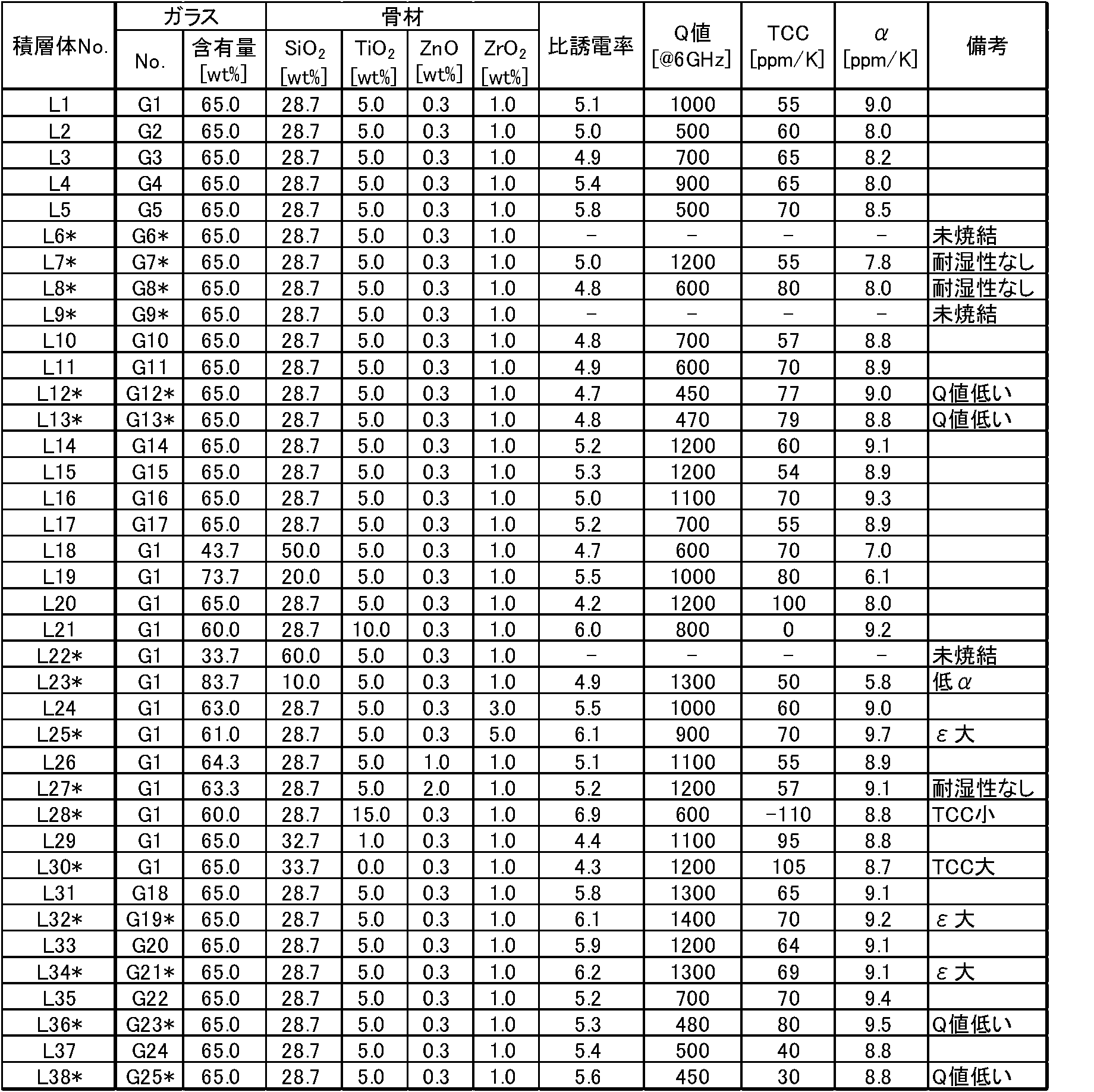
表2の結果より、本発明のガラスセラミックスの焼結体であるガラスセラミック層を備える積層体は、ホウ素含有率が30wt%以下のガラスを使用しているにも関わらず、比誘電率が低く、Q値が高く、比誘電率の温度依存性が小さく、熱膨張係数が大きいことがわかる。また、ホウ素の溶出や揮発に伴う問題も生じなかった。
一方で、積層体L6は焼結不足であった。これは、SiO2含有量が55重量%を超えるガラスG6を用いたために、980℃では充分に焼結が進行しなかったと考えられる。
積層体L7は耐湿性が不充分であった。これは、B2O3含有量が30重量%を超えるガラスG7を用いたために、作製工程においてホウ素の溶出や揮発などが生じたと考えられる。
積層体L8は耐湿性が不充分であった。これは、SiO2含有量が20重量%未満であり、B2O3に対するSiO2の重量比(SiO2/B2O3)が1.21未満のガラスG8を用いたために、粘度が低下しすぎてガラス化が困難になったか、または、ガラスからホウ素の溶出や揮発が生じて、ガラスセラミック層の緻密化が進行しなかったためと考えられる。
積層体L9は焼結不足であった。これは、B2O3含有量が15重量%未満のガラスG9を用いたために、ガラスの粘度が充分に低下せず、焼結不良を起こしたと考えられる。
積層体L12はQ値が低かった。これは、ZnOに対するAl2O3の重量比(Al2O3/ZnO)が0.8未満のガラスG12を用いているため、Q値が低下したと考えられる。
積層体L13はQ値が低かった。これは、ZnOに対するAl2O3の重量比(Al2O3/ZnO)が1.3を超えるガラスG13を用いているため、ガラスの粘度が増加してしまい、緻密な焼結体を得ることができなかったためと考えられる。
積層体L22は焼結不足であった。これは、骨材としてのSiO2の含有量が50重量%を超えているためと考えられる。
積層体L23は熱膨張係数αが低かった。これは、骨材としてのSiO2の含有量が20重量%未満であるためと考えられる。
積層体L25は比誘電率が高かった。これは、骨材としてのZrO2の含有量が3重量%を超えるためと考えられる。
積層体L27は充分な耐湿性を備えていない。これは、骨材としてのZnOの含有量が1重量%を超えるためと考えられる。
積層体L28はTCCが小さすぎる。これは、TCCが負の材料であるTiO2の骨材としての含有量が多すぎたためと考えられる。
積層体L30はTCCが大きすぎる。これは、TCCが負の材料であるTiO2を骨材として含まないため、TCCが大きくなりすぎたと考えられる。
積層体L32は比誘電率が高かった。これは、ガラス中のTiO2の含有量が5重量%を超えるためと考えられる。
積層体L34は比誘電率が高かった。これは、ガラス中のZrO2の含有量が5重量%を超えるためと考えられる。
積層体L36はQ値が低かった。これは、ガラス中のSnO2の含有量が5重量%を超えたためと考えられる。
積層体L38はQ値が低かった。これは、ガラス中のSrOの含有量が5重量%を超えたためと考えられる。
積層体L7は耐湿性が不充分であった。これは、B2O3含有量が30重量%を超えるガラスG7を用いたために、作製工程においてホウ素の溶出や揮発などが生じたと考えられる。
積層体L8は耐湿性が不充分であった。これは、SiO2含有量が20重量%未満であり、B2O3に対するSiO2の重量比(SiO2/B2O3)が1.21未満のガラスG8を用いたために、粘度が低下しすぎてガラス化が困難になったか、または、ガラスからホウ素の溶出や揮発が生じて、ガラスセラミック層の緻密化が進行しなかったためと考えられる。
積層体L9は焼結不足であった。これは、B2O3含有量が15重量%未満のガラスG9を用いたために、ガラスの粘度が充分に低下せず、焼結不良を起こしたと考えられる。
積層体L12はQ値が低かった。これは、ZnOに対するAl2O3の重量比(Al2O3/ZnO)が0.8未満のガラスG12を用いているため、Q値が低下したと考えられる。
積層体L13はQ値が低かった。これは、ZnOに対するAl2O3の重量比(Al2O3/ZnO)が1.3を超えるガラスG13を用いているため、ガラスの粘度が増加してしまい、緻密な焼結体を得ることができなかったためと考えられる。
積層体L22は焼結不足であった。これは、骨材としてのSiO2の含有量が50重量%を超えているためと考えられる。
積層体L23は熱膨張係数αが低かった。これは、骨材としてのSiO2の含有量が20重量%未満であるためと考えられる。
積層体L25は比誘電率が高かった。これは、骨材としてのZrO2の含有量が3重量%を超えるためと考えられる。
積層体L27は充分な耐湿性を備えていない。これは、骨材としてのZnOの含有量が1重量%を超えるためと考えられる。
積層体L28はTCCが小さすぎる。これは、TCCが負の材料であるTiO2の骨材としての含有量が多すぎたためと考えられる。
積層体L30はTCCが大きすぎる。これは、TCCが負の材料であるTiO2を骨材として含まないため、TCCが大きくなりすぎたと考えられる。
積層体L32は比誘電率が高かった。これは、ガラス中のTiO2の含有量が5重量%を超えるためと考えられる。
積層体L34は比誘電率が高かった。これは、ガラス中のZrO2の含有量が5重量%を超えるためと考えられる。
積層体L36はQ値が低かった。これは、ガラス中のSnO2の含有量が5重量%を超えたためと考えられる。
積層体L38はQ値が低かった。これは、ガラス中のSrOの含有量が5重量%を超えたためと考えられる。
1 積層体
2 電子部品
3 ガラスセラミック層
9、10、11 導体層
12 ビアホール導体層
13、14 チップ部品
21 積層グリーンシート
22 グリーンシート
2 電子部品
3 ガラスセラミック層
9、10、11 導体層
12 ビアホール導体層
13、14 チップ部品
21 積層グリーンシート
22 グリーンシート
Claims (3)
- Si、B、Al及びZnを含むガラスと、骨材と、を含むガラスセラミックスであって、
前記ガラスは、SiO2の含有量が20重量%以上、55重量%以下であり、B2O3の含有量が15重量%以上、30重量%以下であり、B2O3に対するSiO2の重量比(SiO2/B2O3)が1.21以上であり、ZnOに対するAl2O3の重量比(Al2O3/ZnO)が0.8以上、1.3以下であり、
前記骨材として、前記ガラスセラミックスの重量に対して、20重量%以上、50重量%以下のSiO2と、1重量%以上、10重量%以下のTiO2と、3重量%以下のZrO2と、1重量%以下のZnOを含み、
前記ガラス中の、TiO2、ZrO2、SnO2及びSrOの含有量がいずれも、0重量%以上、5重量%以下である、ことを特徴とするガラスセラミックス。 - Si、B、Al、Zn、Ti及びZrを含むガラスセラミックスであって、
SiO2含有量が、41.70重量%以上、67.48重量%以下であり、
B2O3含有量が、8.74重量%以上、19.50重量%以下であり、
Al2O3含有量が、4.875重量%以上、21.125重量%以下であり、
ZnO含有量が、5.175重量%以上、21.425重量%以下であり、
TiO2含有量が、1重量%以上、13.5重量%以下であり、
ZrO2含有量が、6.8重量%以下であり、
SnO2の含有量が、3.95重量%以下であり、
SrOの含有量が、3.95重量%以下である、ことを特徴とするガラスセラミックス。 - 請求項1又は2に記載のガラスセラミックスの焼結体であるガラスセラミック層を備えることを特徴とする、積層セラミック電子部品。
Priority Applications (4)
| Application Number | Priority Date | Filing Date | Title |
|---|---|---|---|
| JP2022531783A JP7494908B2 (ja) | 2020-06-17 | 2021-06-14 | ガラスセラミックス及び積層セラミック電子部品 |
| CN202180043343.4A CN115916717A (zh) | 2020-06-17 | 2021-06-14 | 玻璃陶瓷及层叠陶瓷电子部件 |
| CN202511652894.7A CN121494324A (zh) | 2020-06-17 | 2021-06-14 | 玻璃陶瓷及层叠陶瓷电子部件 |
| US18/065,980 US20230117436A1 (en) | 2020-06-17 | 2022-12-14 | Glass ceramic and laminated ceramic electronic component |
Applications Claiming Priority (8)
| Application Number | Priority Date | Filing Date | Title |
|---|---|---|---|
| JP2020-104657 | 2020-06-17 | ||
| JP2020-104658 | 2020-06-17 | ||
| JP2020104658 | 2020-06-17 | ||
| JP2020104657 | 2020-06-17 | ||
| JP2020-192651 | 2020-11-19 | ||
| JP2020192651 | 2020-11-19 | ||
| JP2020-192650 | 2020-11-19 | ||
| JP2020192650 | 2020-11-19 |
Related Child Applications (1)
| Application Number | Title | Priority Date | Filing Date |
|---|---|---|---|
| US18/065,980 Continuation US20230117436A1 (en) | 2020-06-17 | 2022-12-14 | Glass ceramic and laminated ceramic electronic component |
Publications (1)
| Publication Number | Publication Date |
|---|---|
| WO2021256409A1 true WO2021256409A1 (ja) | 2021-12-23 |
Family
ID=79268071
Family Applications (2)
| Application Number | Title | Priority Date | Filing Date |
|---|---|---|---|
| PCT/JP2021/022433 Ceased WO2021256408A1 (ja) | 2020-06-17 | 2021-06-14 | ガラス、ガラスセラミックス及び積層セラミック電子部品 |
| PCT/JP2021/022434 Ceased WO2021256409A1 (ja) | 2020-06-17 | 2021-06-14 | ガラスセラミックス及び積層セラミック電子部品 |
Family Applications Before (1)
| Application Number | Title | Priority Date | Filing Date |
|---|---|---|---|
| PCT/JP2021/022433 Ceased WO2021256408A1 (ja) | 2020-06-17 | 2021-06-14 | ガラス、ガラスセラミックス及び積層セラミック電子部品 |
Country Status (4)
| Country | Link |
|---|---|
| US (2) | US20230117436A1 (ja) |
| JP (2) | JP7491377B2 (ja) |
| CN (3) | CN121494324A (ja) |
| WO (2) | WO2021256408A1 (ja) |
Cited By (1)
| Publication number | Priority date | Publication date | Assignee | Title |
|---|---|---|---|---|
| WO2025028148A1 (ja) * | 2023-07-28 | 2025-02-06 | 株式会社村田製作所 | 低温焼成セラミック及び電子部品 |
Families Citing this family (3)
| Publication number | Priority date | Publication date | Assignee | Title |
|---|---|---|---|---|
| CN115340376B (zh) * | 2022-06-28 | 2023-08-08 | 清华大学深圳国际研究生院 | 一种ltcc用陶瓷基板及其制备方法和应用 |
| CN116102259B (zh) * | 2022-11-17 | 2025-02-07 | 武汉苏泊尔炊具有限公司 | 微晶玻璃、其制备方法及微晶玻璃制品 |
| CN120418214A (zh) * | 2023-06-16 | 2025-08-01 | 株式会社村田制作所 | 玻璃陶瓷结构体和电子部件 |
Citations (8)
| Publication number | Priority date | Publication date | Assignee | Title |
|---|---|---|---|---|
| JPS60235744A (ja) * | 1984-05-04 | 1985-11-22 | Asahi Glass Co Ltd | セラミック基板用組成物 |
| JPH04198041A (ja) * | 1990-11-28 | 1992-07-17 | Nippon Electric Glass Co Ltd | 結晶化ガラス |
| JP2004026529A (ja) * | 2002-06-21 | 2004-01-29 | Ferro Enamels Japan Ltd | 低温焼成基板用ガラス組成物およびそれを用いたガラスセラミックス |
| WO2010058697A1 (ja) * | 2008-11-19 | 2010-05-27 | 株式会社村田製作所 | ガラスセラミック組成物およびガラスセラミック基板 |
| WO2013021921A1 (ja) * | 2011-08-08 | 2013-02-14 | 旭硝子株式会社 | ガラスセラミックス体、発光素子搭載用基板、および発光装置 |
| WO2013121929A1 (ja) * | 2012-02-13 | 2013-08-22 | 株式会社村田製作所 | 複合積層セラミック電子部品 |
| WO2014038230A1 (ja) * | 2012-09-10 | 2014-03-13 | 日本碍子株式会社 | ガラス-セラミックス複合材料 |
| JP2016128361A (ja) * | 2013-03-26 | 2016-07-14 | 日本碍子株式会社 | ガラス−セラミックス複合材料 |
Family Cites Families (9)
| Publication number | Priority date | Publication date | Assignee | Title |
|---|---|---|---|---|
| US4312951A (en) | 1979-09-07 | 1982-01-26 | Mobay Chemical Corporation | Low-melting, lead-free ceramic frits |
| JPH05201746A (ja) * | 1992-01-28 | 1993-08-10 | Isuzu Seiko Glass Kk | 紫外線遮断ガラス |
| JP2695587B2 (ja) * | 1993-01-05 | 1997-12-24 | 松下電器産業株式会社 | ガラスセラミックス組成物 |
| JP2624149B2 (ja) * | 1993-11-09 | 1997-06-25 | 住友金属鉱山株式会社 | 低温焼成ガラスセラミック基板用組成物 |
| JP3288169B2 (ja) * | 1994-02-23 | 2002-06-04 | ホーヤ株式会社 | パッケージ用ガラスの製造方法 |
| JP5070723B2 (ja) * | 2005-11-04 | 2012-11-14 | 旭硝子株式会社 | 積層誘電体および層状誘電体の製造方法 |
| KR100882922B1 (ko) * | 2007-11-01 | 2009-02-10 | 한국과학기술연구원 | 고강도 및 고품질계수를 갖는 저온소성용 유전체 세라믹조성물 |
| JP5416917B2 (ja) | 2008-05-14 | 2014-02-12 | 株式会社オハラ | ガラス |
| KR100993010B1 (ko) * | 2008-06-26 | 2010-11-09 | 한국과학기술연구원 | 저온소성용 저유전율 유전체 세라믹 조성물 |
-
2021
- 2021-06-14 JP JP2022531782A patent/JP7491377B2/ja active Active
- 2021-06-14 WO PCT/JP2021/022433 patent/WO2021256408A1/ja not_active Ceased
- 2021-06-14 CN CN202511652894.7A patent/CN121494324A/zh active Pending
- 2021-06-14 WO PCT/JP2021/022434 patent/WO2021256409A1/ja not_active Ceased
- 2021-06-14 CN CN202180043409.XA patent/CN116133997B/zh active Active
- 2021-06-14 JP JP2022531783A patent/JP7494908B2/ja active Active
- 2021-06-14 CN CN202180043343.4A patent/CN115916717A/zh active Pending
-
2022
- 2022-12-14 US US18/065,980 patent/US20230117436A1/en active Pending
- 2022-12-14 US US18/066,052 patent/US20230109726A1/en active Pending
Patent Citations (8)
| Publication number | Priority date | Publication date | Assignee | Title |
|---|---|---|---|---|
| JPS60235744A (ja) * | 1984-05-04 | 1985-11-22 | Asahi Glass Co Ltd | セラミック基板用組成物 |
| JPH04198041A (ja) * | 1990-11-28 | 1992-07-17 | Nippon Electric Glass Co Ltd | 結晶化ガラス |
| JP2004026529A (ja) * | 2002-06-21 | 2004-01-29 | Ferro Enamels Japan Ltd | 低温焼成基板用ガラス組成物およびそれを用いたガラスセラミックス |
| WO2010058697A1 (ja) * | 2008-11-19 | 2010-05-27 | 株式会社村田製作所 | ガラスセラミック組成物およびガラスセラミック基板 |
| WO2013021921A1 (ja) * | 2011-08-08 | 2013-02-14 | 旭硝子株式会社 | ガラスセラミックス体、発光素子搭載用基板、および発光装置 |
| WO2013121929A1 (ja) * | 2012-02-13 | 2013-08-22 | 株式会社村田製作所 | 複合積層セラミック電子部品 |
| WO2014038230A1 (ja) * | 2012-09-10 | 2014-03-13 | 日本碍子株式会社 | ガラス-セラミックス複合材料 |
| JP2016128361A (ja) * | 2013-03-26 | 2016-07-14 | 日本碍子株式会社 | ガラス−セラミックス複合材料 |
Cited By (1)
| Publication number | Priority date | Publication date | Assignee | Title |
|---|---|---|---|---|
| WO2025028148A1 (ja) * | 2023-07-28 | 2025-02-06 | 株式会社村田製作所 | 低温焼成セラミック及び電子部品 |
Also Published As
| Publication number | Publication date |
|---|---|
| CN116133997A (zh) | 2023-05-16 |
| JPWO2021256409A1 (ja) | 2021-12-23 |
| US20230117436A1 (en) | 2023-04-20 |
| CN116133997B (zh) | 2025-11-21 |
| JP7494908B2 (ja) | 2024-06-04 |
| JPWO2021256408A1 (ja) | 2021-12-23 |
| CN115916717A (zh) | 2023-04-04 |
| CN121494324A (zh) | 2026-02-10 |
| US20230109726A1 (en) | 2023-04-13 |
| WO2021256408A1 (ja) | 2021-12-23 |
| JP7491377B2 (ja) | 2024-05-28 |
Similar Documents
| Publication | Publication Date | Title |
|---|---|---|
| JP7494908B2 (ja) | ガラスセラミックス及び積層セラミック電子部品 | |
| US8263230B2 (en) | Ceramic composition, ceramic green sheet, and ceramic electronic component | |
| CN104186027B (zh) | 复合层叠陶瓷电子部件 | |
| JP5040918B2 (ja) | ガラスセラミック組成物、ガラスセラミック焼結体および積層セラミック電子部品 | |
| CN103547544B (zh) | 玻璃陶瓷组合物 | |
| US20180319129A1 (en) | Multilayer body and electronic component | |
| JP5316545B2 (ja) | ガラスセラミック組成物およびガラスセラミック基板 | |
| WO2012157300A1 (ja) | 複合積層セラミック電子部品 | |
| JPWO2008018407A1 (ja) | ガラスセラミック組成物、ガラスセラミック焼結体および積層セラミック電子部品 | |
| US9190211B2 (en) | Composite laminated ceramic electronic component | |
| US20240300852A1 (en) | Glass-ceramic and electronic component | |
| JP7180689B2 (ja) | 積層体及び電子部品 | |
| JP7056764B2 (ja) | ガラスセラミック材料、積層体、及び、電子部品 | |
| JP4243521B2 (ja) | セラミック電子部品 | |
| JP7597203B2 (ja) | ガラスセラミック材料、積層体、及び、電子部品 | |
| WO2025028148A1 (ja) | 低温焼成セラミック及び電子部品 | |
| JP2004345914A (ja) | 誘電体ガラスセラミック組成物および多層回路基板 |
Legal Events
| Date | Code | Title | Description |
|---|---|---|---|
| 121 | Ep: the epo has been informed by wipo that ep was designated in this application |
Ref document number: 21824942 Country of ref document: EP Kind code of ref document: A1 |
|
| ENP | Entry into the national phase |
Ref document number: 2022531783 Country of ref document: JP Kind code of ref document: A |
|
| NENP | Non-entry into the national phase |
Ref country code: DE |
|
| 122 | Ep: pct application non-entry in european phase |
Ref document number: 21824942 Country of ref document: EP Kind code of ref document: A1 |