WO2021246215A1 - リチウム二次電池用正極活物質、その製造方法及びリチウム二次電池 - Google Patents
リチウム二次電池用正極活物質、その製造方法及びリチウム二次電池 Download PDFInfo
- Publication number
- WO2021246215A1 WO2021246215A1 PCT/JP2021/019534 JP2021019534W WO2021246215A1 WO 2021246215 A1 WO2021246215 A1 WO 2021246215A1 JP 2021019534 W JP2021019534 W JP 2021019534W WO 2021246215 A1 WO2021246215 A1 WO 2021246215A1
- Authority
- WO
- WIPO (PCT)
- Prior art keywords
- cobalt
- lithium
- positive electrode
- active material
- lithium secondary
- Prior art date
- Legal status (The legal status is an assumption and is not a legal conclusion. Google has not performed a legal analysis and makes no representation as to the accuracy of the status listed.)
- Ceased
Links
Images



Classifications
-
- C—CHEMISTRY; METALLURGY
- C01—INORGANIC CHEMISTRY
- C01G—COMPOUNDS CONTAINING METALS NOT COVERED BY SUBCLASSES C01D OR C01F
- C01G51/00—Compounds of cobalt
-
- H—ELECTRICITY
- H01—ELECTRIC ELEMENTS
- H01M—PROCESSES OR MEANS, e.g. BATTERIES, FOR THE DIRECT CONVERSION OF CHEMICAL ENERGY INTO ELECTRICAL ENERGY
- H01M4/00—Electrodes
- H01M4/02—Electrodes composed of, or comprising, active material
- H01M4/36—Selection of substances as active materials, active masses, active liquids
-
- H—ELECTRICITY
- H01—ELECTRIC ELEMENTS
- H01M—PROCESSES OR MEANS, e.g. BATTERIES, FOR THE DIRECT CONVERSION OF CHEMICAL ENERGY INTO ELECTRICAL ENERGY
- H01M4/00—Electrodes
- H01M4/02—Electrodes composed of, or comprising, active material
- H01M4/36—Selection of substances as active materials, active masses, active liquids
- H01M4/48—Selection of substances as active materials, active masses, active liquids of inorganic oxides or hydroxides
- H01M4/50—Selection of substances as active materials, active masses, active liquids of inorganic oxides or hydroxides of manganese
- H01M4/505—Selection of substances as active materials, active masses, active liquids of inorganic oxides or hydroxides of manganese of mixed oxides or hydroxides containing manganese for inserting or intercalating light metals, e.g. LiMn2O4 or LiMn2OxFy
-
- H—ELECTRICITY
- H01—ELECTRIC ELEMENTS
- H01M—PROCESSES OR MEANS, e.g. BATTERIES, FOR THE DIRECT CONVERSION OF CHEMICAL ENERGY INTO ELECTRICAL ENERGY
- H01M4/00—Electrodes
- H01M4/02—Electrodes composed of, or comprising, active material
- H01M4/36—Selection of substances as active materials, active masses, active liquids
- H01M4/48—Selection of substances as active materials, active masses, active liquids of inorganic oxides or hydroxides
- H01M4/52—Selection of substances as active materials, active masses, active liquids of inorganic oxides or hydroxides of nickel, cobalt or iron
- H01M4/525—Selection of substances as active materials, active masses, active liquids of inorganic oxides or hydroxides of nickel, cobalt or iron of mixed oxides or hydroxides containing iron, cobalt or nickel for inserting or intercalating light metals, e.g. LiNiO2, LiCoO2 or LiCoOxFy
-
- Y—GENERAL TAGGING OF NEW TECHNOLOGICAL DEVELOPMENTS; GENERAL TAGGING OF CROSS-SECTIONAL TECHNOLOGIES SPANNING OVER SEVERAL SECTIONS OF THE IPC; TECHNICAL SUBJECTS COVERED BY FORMER USPC CROSS-REFERENCE ART COLLECTIONS [XRACs] AND DIGESTS
- Y02—TECHNOLOGIES OR APPLICATIONS FOR MITIGATION OR ADAPTATION AGAINST CLIMATE CHANGE
- Y02E—REDUCTION OF GREENHOUSE GAS [GHG] EMISSIONS, RELATED TO ENERGY GENERATION, TRANSMISSION OR DISTRIBUTION
- Y02E60/00—Enabling technologies; Technologies with a potential or indirect contribution to GHG emissions mitigation
- Y02E60/10—Energy storage using batteries
Definitions
- the present invention relates to a positive electrode active material for a lithium secondary battery and a lithium secondary battery using the positive electrode active material.
- lithium-ion secondary batteries have been put into practical use as a power source for small electronic devices such as laptop computers, mobile phones, and video cameras.
- this lithium-ion secondary battery since it was reported by Mizushima et al. In 1980 that lithium cobalt oxide is useful as a positive electrode active material for lithium-ion secondary batteries, research and development on lithium-based composite oxides has been active. Many proposals have been made so far.
- the lithium secondary battery using lithium cobalt oxide has a problem of deterioration of cycle characteristics due to elution of cobalt atoms and the like.
- Patent Document 1 proposes a lithium secondary battery using a lithium cobalt-based composite oxide having a lithium cobalt oxide content of 20% or more on the particle surface of lithium cobalt oxide as a positive electrode active material.
- Patent Document 2 describes a positive electrode active material for a lithium secondary battery made of a lithium transition metal composite oxide containing 0.20 to 2.00% by weight of a Ti atom, wherein the Ti atom is a lithium transition metal. It has been proposed to use a lithium cobalt-based composite oxide that exists in the depth direction from the particle surface of the composite oxide and has the maximum concentration gradient on the particle surface as the positive electrode active material. Further, Patent Document 3 and Patent Document 4 below propose that a lithium cobalt-based composite oxide containing an Sr atom and a Ti atom is used as a positive electrode active material.
- an object of the present invention is that when used as a positive electrode active material for a lithium secondary battery, the positive electrode for a lithium secondary battery has a high energy density retention rate with little cycle deterioration even after repeated charging and discharging under a high voltage. It is an object of the present invention to provide a lithium secondary battery which is an active material and has a high energy density maintenance rate with little deterioration of the cycle even after repeated charging and discharging under a high voltage.
- the present invention uses Mg-containing lithium-cobalt-based composite oxide particles as lithium-cobalt-based composite oxide particles, and attaches a Ti-containing compound to the surface of the particles.
- a lithium secondary battery that uses a positive electrode active material containing cobalt oxide (Co 3 O 4 ) inside or on the surface of Mg-containing lithium cobalt-based composite oxide particles as the positive electrode active material is charged and discharged under high voltage.
- the lithium secondary battery has a high energy density maintenance rate with little deterioration of the cycle even if the above steps are repeated, and have completed the present invention.
- the present invention (1) is composed of Mg-containing lithium cobalt-based composite oxide particles having a Ti-containing compound attached to at least a part of the particle surface, and the Mg-containing lithium cobalt-based composite oxide is cobalt oxide. It provides a positive electrode active material for a lithium secondary battery, which is characterized by containing (Co 3 O 4).
- the content of cobalt oxide (Co 3 O 4 ) in the Mg-containing lithium cobalt-based composite oxide containing the cobalt oxide (Co 3 O 4 ) is CuK ⁇ ray as a radiation source.
- the intensity of the diffraction peak near 2 ⁇ 37.4 ° due to LiCoO 2 (B).
- the present invention (3) is, Mg content of Mg-containing lithium-cobalt composite oxide containing the cobalt oxide (Co 3 O 4) is, in terms of atom, cobalt oxide (Co 3 O 4)
- the present invention (4) provides the positive electrode active material for a lithium secondary battery according to any one of (1) to (3), wherein the Ti-containing compound is an oxide containing titanium. be.
- the amount of the Ti-containing compound adhered is as Ti with respect to Co in the Mg-containing lithium cobalt-based composite oxide containing cobalt oxide (Co 3 O 4) in terms of atoms. It provides a positive electrode active material for a lithium secondary battery according to any one of (1) to (4), which is characterized by having a content of 0.01 to 5.00 mol%.
- the Mg lithium cobalt-based composite oxide particles contain one or more M elements (M is Al, Ti, Zr, Cu) in addition to Li, Co, Mg and O. , Fe, Sr, Ca, V, Mo, Bi, Nb, Si, Zn, Ga, Ge, Sn, Ba, W, Na, K, Ni or Mn).
- M is Al, Ti, Zr, Cu
- the present invention (7), and Mg-containing lithium-cobalt composite oxide particles containing cobalt oxide (Co 3 O 4), a Ti-containing compound, by mixing treated with dry and cobalt oxide (Co 3 It shall be obtained by obtaining a mixed product of Mg-containing lithium cobalt-based composite oxide particles containing O 4 ) and a Ti-containing compound, and then heat-treating the mixed product at 400 to 1000 ° C.
- the present invention provides a positive electrode active material for a lithium secondary battery according to any one of (1) to (6).
- the present invention (8), and Mg-containing lithium-cobalt composite oxide particles containing cobalt oxide (Co 3 O 4), a Ti-containing compound, by mixing treated with dry and cobalt oxide (Co 3 A mixed treatment of Mg-containing lithium cobalt-based composite oxide particles containing O 4 ) and a Ti-containing compound is obtained, and then the mixed treatment is heat-treated at 400 to 1000 ° C. for a lithium secondary battery.
- the present invention provides a method for producing a positive electrode active material for a lithium secondary battery, which comprises obtaining a positive electrode active material.
- the present invention (9) provides a lithium secondary battery characterized by using the positive electrode active material for a lithium secondary battery according to any one of (1) to (7).
- the positive electrode active material for a lithium secondary battery when used as a positive electrode active material for a lithium secondary battery, has a high energy density retention rate with little cycle deterioration even after repeated charging and discharging under high voltage. , And it is possible to provide a lithium secondary battery having a high energy density maintenance rate with little deterioration of the cycle even if charging and discharging are repeated under a high voltage.
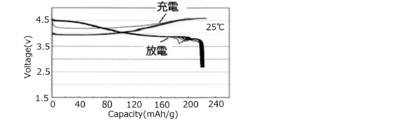
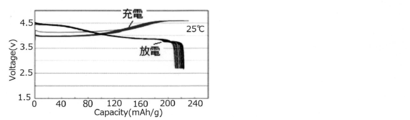
- FIG. 1 The charge / discharge characteristic figure of the lithium secondary battery using the positive electrode active material sample obtained in Example 1.
- FIG. The charge / discharge characteristic figure of the lithium secondary battery using the positive electrode active material sample obtained in Example 2.
- FIG. The charge / discharge characteristic figure of the lithium secondary battery using the positive electrode active material sample obtained in the comparative example 1.
- FIG. The charge / discharge characteristic figure of the lithium secondary battery using the positive electrode active material sample obtained in the comparative example 2.
- FIG. The charge / discharge characteristic figure of the lithium secondary battery using the positive electrode active material sample obtained in the comparative example 3.
- FIG. The charge / discharge characteristic figure of the lithium secondary battery using the positive electrode active material sample obtained in the comparative example 4.
- FIG. The charge / discharge characteristic figure of the lithium secondary battery using the positive electrode active material sample obtained in the comparative example 5.
- FIG. 1 The charge / discharge characteristic figure of the lithium secondary battery using the positive electrode active material sample obtained in Example 2.
- FIG. The charge / discharge characteristic figure of the lithium secondary battery using the positive electrode active material sample
- the positive electrode active material for a lithium secondary battery of the present invention is composed of Mg-containing lithium cobalt-based composite oxide particles having a Ti-containing compound attached to at least a part of the particle surface, and the Mg-containing lithium cobalt-based composite oxide.
- a positive electrode active material for a lithium secondary battery which is characterized by containing cobalt oxide (Co 3 O 4).
- a Ti-containing compound is attached to the particle surface of a Mg-containing lithium cobalt-based composite oxide containing cobalt oxide (Co 3 O 4).
- the positive electrode active material for a lithium secondary battery of the present invention is a "Mg-containing lithium cobalt-based composite oxide containing cobalt oxide (Co 3 O 4)" to which a Ti-containing compound is attached.
- the Mg-containing lithium cobalt-based composite oxide containing cobalt oxide (Co 3 O 4 ) is also referred to as Co 3 O 4 and Mg-containing lithium cobalt-based composite oxide particles.
- Mg is present inside the particles of the lithium cobalt-based composite oxide particles, and the Ti-containing compound is adhered to the particle surface of the lithium cobalt-based composite oxide particles.
- Cobalt oxide (Co 3 O 4 ) is present inside the particles of the lithium-cobalt-based composite oxide particles and / or on the surface of the particles of the lithium-cobalt-based composite oxide particles.
- the positive electrode active material for the lithium secondary battery of the present invention adheres to the lithium cobalt-based composite oxide particles containing Mg inside and at least a part of the particle surface of the lithium cobalt-based composite oxide particles. It is an aggregate of lithium cobalt oxide composite oxide particles composed of the above Ti-containing compound and having cobalt oxide (Co 3 O 4) present inside and / or on the particle surface of the lithium cobalt oxide composite oxide particles. be.
- the Co 3 O 4 and Mg-containing lithium cobalt-based composite oxide particles according to the positive electrode active material for a lithium secondary battery of the present invention contain Mg inside the particles of the lithium cobalt-based composite oxide particles. That is, in the Co 3 O 4 and Mg-containing lithium cobalt-based composite oxide particles according to the positive electrode active material for the lithium secondary battery of the present invention, Mg is contained inside the particles of the Co 3 O 4 and Mg-containing lithium cobalt-based composite oxide particles.
- the Mg is present in the particle inside the Co 3 O 4 and Mg-containing lithium-cobalt composite oxide particles, using a CuK ⁇ ray as a radiation source, Co 3 O 4 and Mg-containing lithium-cobalt
- a CuK ⁇ ray as a radiation source
- Co 3 O 4 and Mg-containing lithium-cobalt This means that when the composite oxide particles are subjected to X-ray diffraction analysis, the diffraction peak due to MgO is substantially not detected.
- the fact that the diffraction peak caused by MgO is not substantially detected means that the peak intensity of the diffraction peak caused by MgO is less than the lower limit of detection of the analyzer.
- the lithium cobalt-based composite oxide when Mg is present on the particle surface, the Mg element existing on the particle surface is present on the particle surface in the state of MgO, so Mg is present on the particle surface.
- the lithium-cobalt-based composite oxide is subjected to X-ray diffraction analysis, a peak due to MgO is observed.
- the positive electrode active material for a lithium secondary battery of the present invention contains cobalt oxide (Co 3 O 4 ) inside and / or on the surface of the particles of the Co 3 O 4 and Mg-containing lithium cobalt-based composite oxide particles.
- Co 3 O 4 and inside the particles Mg-containing lithium-cobalt composite oxide particles and contains cobalt oxide (Co 3 O 4), Co 3 O 4 and Mg-containing lithium-cobalt composite oxide particles It means that Co that exists in the state of Co 3 O 4 is contained in the particles of Co.
- the particle surface of the Co 3 O 4 and Mg-containing lithium-cobalt composite oxide particles, and containing cobalt oxide (Co 3 O 4), the particles of Co 3 O 4 and Mg-containing lithium-cobalt composite oxide particles It means that it contains Co that adheres to the surface and exists in the state of Co 3 O 4. That is, in the positive electrode active material for the lithium secondary battery of the present invention, cobalt oxide (Co 3 O 4 ) is present inside the particles of the Co 3 O 4 and Mg-containing lithium cobalt-based composite oxide particles and / or Co. 3 O 4 and Mg-containing lithium cobalt-based composite oxide particles are present in the positive electrode active material for a lithium secondary battery in a state of being attached to the particle surface.
- the fact that the Mg-containing lithium cobalt-based composite oxide particles contain cobalt oxide means that the Mg-containing lithium cobalt-based composite oxide is analyzed by X-ray diffraction using CuK ⁇ rays as the radiation source. When this is done, it is confirmed by detecting the diffraction peak caused by Co 3 O 4.
- a diffraction peak due to Co 3 O 4 is detected refers to the peak intensity of the diffraction peaks due to Co 3 O 4 is greater than or equal to the detection limit of the analyzer.
- Co 3 peak intensity of the diffraction peaks due to O 4 is more than the detection limit of the analyzer A, cobalt oxide (Co 3 O 4) Mg-containing lithium-cobalt composite oxide containing the present invention
- Co 3 with respect to the intensity (B) of the diffraction peak near 2 ⁇ 37.4 ° (37.4 ⁇ 0.2 °) caused by LiCoO 2.
- Ti-containing compound is attached to a part of the particle surface of the Co 3 O 4 and Mg-containing lithium cobalt-based composite oxide particles, or the entire particle surface is covered. Therefore, Ti-containing compounds are attached.
- Ti-containing compound attached to a part of the particle surface means that the particle surface has a portion where the surface of the object to be coated is exposed in addition to the Ti-containing compound.
- the cathode active material for a lithium secondary battery of the present invention using CuK ⁇ -ray as a radiation source, Co 3 O 4 and Mg-containing lithium-cobalt composite oxide, i.e., a positive electrode active material for a lithium secondary battery of the present invention
- the content of cobalt oxide (Co 3 O 4 ) in the Co 3 O 4 and Mg-containing lithium cobalt-based composite oxide particles uses CuK ⁇ ray as the radiation source.
- the content of the ratio (A) ((A / B) ⁇ 100) is preferably greater than 0.60% and 5.00% or less, and particularly preferably 0.80 to 2.50%.
- the intensity ratio of the diffraction peak is a value obtained by the height ratio of the diffraction peak.
- the atomic equivalent molar ratio (Li / Co) of Li to Co is preferably 0. It is 90 to 1.20, particularly preferably 0.95 to 1.15.
- the molar ratio (Li / Co) of Li to Co in the lithium cobalt-based composite oxide is in the above range, the energy density of the positive electrode active material for a lithium secondary battery becomes high.
- the atomic equivalent mol% of Mg with respect to Co ((Mg / Co) ⁇ 100) is. It is preferably 0.01 to 5.00 mol%, and particularly preferably 0.05 to 2.00 mol%.
- the atomic equivalent mol% ((Mg / Co) ⁇ 100) of Mg with respect to Co in the positive electrode active material for a lithium secondary battery is in the above range, the cycle characteristics of the positive electrode active material for a lithium secondary battery are enhanced. ..
- the atomic equivalent mol% of Ti with respect to Co ((Ti / Co) ⁇ 100) is It is preferably 0.01 to 5.00 mol%, and particularly preferably 0.10 to 2.00 mol%.
- the battery characteristics such as high charge / discharge capacity, cycle characteristics, and safety are obtained. Can be compatible.
- the Ti-containing compound adhering to the particle surface of the Co 3 O 4 and Mg-containing lithium cobalt-based composite oxide particles is, for example, a Ti oxide, a Ti and Li composite oxide, or a Ti and M element composite. Examples thereof include oxides, composite oxides of Ti, M element and Li, composite oxides of Ti and Mg, and the like.
- the Co 3 O 4 and Mg-containing lithium cobalt-based composite oxide particles contain one or more of the following M elements, if necessary, for the purpose of improving performance or physical properties. can do.
- the M elements contained in the Mg-containing lithium cobalt-based composite oxide as required are Al, Ti, Zr, Cu, Fe, Sr, Ca, V, Mo, Bi, Nb, Si, Zn, Ga, Ge, Sn, Ba, W, Na, K, Ni or Mn.
- the atomic equivalent mol% of M element with respect to Co in Co 3 O 4 and Mg-containing lithium cobalt-based composite oxide ((M). / Co) ⁇ 100) is preferably 0.01 to 5.00 mol%, particularly preferably 0.05 to 2.00 mol%.
- the atomic equivalent mol% of M element with respect to Co in Co 3 O 4 and Mg-containing lithium cobalt-based composite oxide particles (When (M / Co) ⁇ 100) is in the above range, the battery characteristics can be improved without impairing the charge / discharge capacity.
- the number of moles of the atomically converted M element which is the basis for calculating the above mol%, is each M. Refers to the total number of moles of elements.
- M element is also present on the surface of the Co 3 O 4 and Mg-containing lithium-cobalt may be present in the interior of the composite oxide particles, Co 3 O 4 and Mg-containing lithium-cobalt composite oxide particles It may be present both inside and on the surface of the Co 3 O 4 and Mg-containing lithium-cobalt-based composite oxide particles.
- the M element When the M element is present on the particle surface of the Co 3 O 4 and Mg-containing lithium cobalt-based composite oxide particles, the M element is present in the form of an oxide, a composite oxide, a sulfate, a phosphate, or the like. May be good.
- the Co 3 O 4 and Mg-containing lithium cobalt-based composite oxide particles are granules of the Co 3 O 4 and Mg-containing lithium cobalt-based composite oxide.
- the Co 3 O 4 and Mg-containing lithium cobalt-based composite oxide particles are lithium cobalt-based composite oxides before the Ti-containing compound is attached to the particle surface.
- the Co 3 O 4 and Mg-containing lithium-cobalt-based composite oxide particles are, for example, a raw material mixing step of preparing a raw material mixture containing a lithium compound, a cobalt compound, and a magnesium compound, and then firing the obtained raw material mixture. It is manufactured by performing a firing step.
- the lithium compound involved in the raw material mixing step is not particularly limited as long as it is a lithium compound usually used as a raw material for producing a lithium cobalt-based composite oxide, and lithium oxides, hydroxides, carbonates, nitrates, etc. Examples thereof include sulfates and organic acid salts.
- the cobalt compound involved in the raw material mixing step is not particularly limited as long as it is a cobalt compound usually used as a raw material for producing a lithium cobalt-based composite oxide, and is not particularly limited. Examples thereof include carbonates, nitrates, sulfates and organic acid salts.
- the magnesium compound involved in the raw material mixing step is not particularly limited as long as the Mg atom can be present inside the particles of the Mg-containing lithium cobalt-based composite oxide, and magnesium oxides, hydroxides, and the like are not particularly limited. Examples thereof include carbonates and organic acid salts.
- the mixing ratio of the lithium compound and the cobalt compound is such that the ratio of the number of moles of Li to the number of moles of Co (Li / Co molar ratio) is preferably 0.900 to 1.000 in terms of atoms.
- the mixing ratio is preferably 0.950 to 1.000, and particularly preferably 0.960 to 0.999.
- the Mg-containing lithium cobalt-based composite oxide particles (Co 3 O 4 and ) containing cobalt oxide (Co 3 O 4) inside and / or on the particle surface are contained.
- Mg-containing lithium-cobalt-based composite oxide particles) can be obtained.
- the mixing ratio of the magnesium compound and the cobalt compound is, in terms of atoms, mol% of Mg in terms of atoms ((Mg / Co) ⁇ 100), preferably 0.01 to 5.00 mol%. Particularly preferably, the mixing ratio is 0.05 to 2.00 mol%.
- the mixing ratio of the magnesium compound and the cobalt compound is in the above range, the cycle characteristics of the positive electrode active material for the lithium secondary battery are improved.
- a compound containing M element can be mixed with the raw material mixture.
- Examples of the compound containing the M element include oxides, hydroxides, carbonates, nitrates, sulfates, fluorides and organic acid salts containing the M element.
- a compound containing two or more kinds of M elements may be used as the compound containing the M element.
- the raw material lithium compound, cobalt compound, magnesium compound and compound containing M element are not limited in production history, but are impurities as much as possible in order to produce high-purity lithium cobalt-based composite oxide particles. It is preferable that the content is low.
- the raw material mixing step as a method of mixing the lithium compound, the cobalt compound, the magnesium compound, and the compound containing the M element used as necessary, for example, a ribbon mixer, a henschel mixer, a super mixer, and now.
- a mixing method using a tar mixer or the like can be mentioned.
- a household mixer is sufficient as a mixing method.
- the firing step is a step of obtaining a lithium cobalt-based composite oxide by firing the raw material mixture obtained by performing the raw material mixing step.
- the firing temperature when the raw material mixture is fired and the raw materials are reacted is 800 to 1150 ° C., preferably 900 to 1100 ° C., particularly preferably higher than 1000 ° C. and 1100 ° C. or lower.
- the firing temperature is within the above range, it is possible to reduce the production of superheated decomposition products of Co 3 O 4 and Mg-containing lithium cobalt-based composite oxide particles, and cobalt oxide (Co 3 O 4 ) can be used as described above. It can be contained in a range that remains.
- the firing time in the firing step is 1 to 30 hours, preferably 5 to 20 hours.
- the firing atmosphere in the firing step is an oxidizing atmosphere of air, oxygen gas, or the like.
- the Co 3 O 4 and Mg-containing lithium cobalt-based composite oxide particles thus obtained may be subjected to a plurality of firing steps, if necessary.
- the average particle size of the Co 3 O 4 and Mg-containing lithium cobalt-based composite oxide particles before the Ti-containing compound is attached is a particle size (D50) with a volume integration of 50% in the particle size distribution obtained by the laser diffraction / scattering method.
- the thickness is 0.5 to 30.0 ⁇ m, preferably 3.0 to 25.0 ⁇ m, and particularly preferably 7.0 to 25.0 ⁇ m.
- the BET specific surface area of the Co 3 O 4 and Mg-containing lithium cobalt-based composite oxide particles before the Ti-containing compound is attached is preferably 0.05 to 1.0 m 2 / g, particularly preferably 0.15. It is ⁇ 0.60 m 2 / g.
- the average particle diameter or BET specific surface area of the Co 3 O 4 and Mg-containing lithium cobalt-based composite oxide particles before the Ti-containing compound is attached is within the above range, it is easy to prepare and coat the positive electrode mixture. Further, an electrode having a high filling property can be obtained.
- a Ti-containing compound is attached to at least a part of the particle surface of the Co 3 O 4 and Mg-containing lithium cobalt-based composite oxide particles.
- the Ti-containing compound may be attached to a part of the surface of the Co 3 O 4 and Mg-containing lithium cobalt-based composite oxide particles, or Co 3 O 4 and may be attached over the entire surface of the Mg-containing lithium-cobalt composite oxide particles.
- the cycle deterioration is caused by the Ti-containing compound adhering to at least a part of the surface of the Co 3 O 4 and Mg-containing lithium cobalt-based composite oxide particles. Less, higher energy retention rate.
- Examples of the Ti-containing compound according to the positive electrode active material for a lithium secondary battery of the present invention include oxides containing titanium.
- the Ti-containing compound has high stability even when the oxide containing titanium is in a charged state, and can contribute to the improvement of battery characteristics.
- the amount of the Ti-containing compound attached is 0.01 as Ti with respect to Co in Co 3 O 4 and Mg-containing lithium cobalt-based composite oxide in terms of atoms. It is preferably ⁇ 5.00 mol%, preferably 0.10 to 2.00 mol%.
- the amount of the Ti-containing compound adhered is within the above range, it is possible to achieve both high charge / discharge capacity and battery characteristics such as cycle characteristics, load characteristics, and safety.
- the average particle size of the positive electrode active material for a lithium secondary battery of the present invention is a particle size (D50) with a volume integration of 50% in the particle size distribution obtained by the laser diffraction / scattering method, and is preferably 0.5 to 30.0 ⁇ m. It is 3.0 to 25.0 ⁇ m, particularly preferably 7.0 to 25.0 ⁇ m.
- the BET specific surface area of the positive electrode active material for a lithium secondary battery of the present invention is preferably 0.05 to 1.0 m 2 / g, and particularly preferably 0.15 to 0.6 m 2 / g.
- the average particle size or the BET specific surface area of the positive electrode active material for a lithium secondary battery of the present invention is within the above range, the preparation and coatability of the positive electrode mixture can be facilitated, and an electrode having high filling property can be obtained. Be done.
- the positive electrode active material for a lithium secondary battery according to the present invention may be produced by any production method, but is produced by the following method for producing a positive electrode active material for a lithium secondary battery according to the present invention. It is preferable from the viewpoint of making a lithium secondary battery having a high energy density maintenance rate with little deterioration of the cycle even if the battery is repeatedly charged and discharged under a high voltage.
- a Mg-containing lithium cobalt-based composite oxide particle containing cobalt oxide (Co 3 O 4 ) and a Ti-containing compound are mixed and treated in a dry manner.
- a mixed treatment product of the Mg-containing lithium cobalt-based composite oxide particles containing cobalt oxide (Co 3 O 4 ) and the Ti-containing compound is obtained, and then the mixed treatment product is heat-treated at 400 to 1000 ° C.
- the Mg-containing lithium cobalt-based composite oxide particles containing cobalt oxide (Co 3 O 4 ) according to the method for producing a positive electrode active material for a lithium secondary battery according to the present invention are for the above-mentioned lithium secondary battery according to the present invention. This is the same as the Co 3 O 4 and Mg-containing lithium cobalt-based composite oxide particles related to the positive electrode active material.
- Examples of the Ti-containing compound according to the method for producing a positive electrode active material for a lithium secondary battery according to the present invention include an oxide containing titanium.
- Examples of the oxide containing titanium include an oxide of Ti.
- the average particle size of the Ti-containing compound is the average particle size determined by the laser diffraction / scattering method, and is 30.0 ⁇ m or less, preferably 0.01 to 10.0 ⁇ m, which is efficient for the surface of the lithium cobalt-based composite oxide. It is preferable from the viewpoint that the Ti-containing compound can be attached.
- the Ti-containing compound may be an agglomerate in which primary particles are aggregated to form secondary particles.
- Co 3 O 4 and Mg-containing lithium cobalt-based composite oxide particles and a Ti-containing compound are mixed and treated in a dry manner, so that agglomerated inorganic Ti is contained.
- the compound can be crushed to the primary particles during mixing, and the Ti-containing compound can be attached to the particle surface of the Co 3 O 4 and Mg-containing lithium cobalt-based composite oxide.
- the primary particle size of the Ti-containing compound is the average particle size of the primary particles obtained from the scanning electron micrograph, and is 2.0 ⁇ m or less, preferably 0.01 to 0.5 ⁇ m. This is preferable from the viewpoint that the Ti-containing compound can be efficiently adhered to the surface of the Co 3 O 4 and Mg-containing lithium cobalt-based composite oxide.
- the mixing amount of the Ti-containing compound with the Co 3 O 4 and Mg-containing lithium cobalt-based composite oxide is, in terms of atoms, Co 3 O 4 and Mg-containing lithium.
- the high charge / discharge capacity and cycle should be such that the mixing amount of Ti in the cobalt-based composite oxide is 0.01 to 5.00 mol%, preferably 0.10 to 2.00 mol%. It is preferable from the viewpoint of achieving both battery performance such as characteristics, load characteristics, and safety.
- Co 3 O 4 and Mg-containing lithium cobalt-based composite oxide particles and a Ti-containing compound are mixed and treated in a dry manner to obtain Co 3 O 4 and Co 3 O 4 and A mixed product of Mg-containing lithium cobalt-based composite oxide particles and a Ti-containing compound can be obtained.
- Examples of the device used in the mixing process include devices such as a high speed mixer, a super mixer, a turbosphere mixer, a Henschel mixer, a Nauter mixer and a ribbon blender, and a V-type mixer. It should be noted that these mixing operations are not limited to the exemplified mechanical means. At the laboratory level, home mixers and laboratory mills are sufficient.
- the fine particles of the Ti-containing compound produced by being pulverized into fine particles during dry mixing are Co 3 O 4 and Mg-containing lithium-cobalt is obtained by adhering to the surface of the composite oxide particles.
- a mixed treatment of Co 3 O 4 and Mg-containing lithium cobalt-based composite oxide particles and a Ti-containing compound is then mixed at 400 to 1000 ° C., preferably 600 to 600.
- the heat treatment is carried out at 1000 ° C., particularly preferably 750 to 950 ° C.
- the Ti-containing compound can be firmly adhered to the surface of the Co 3 O 4 of the surface-treated particles and the Mg-containing lithium cobalt-based composite oxide particles.
- the heat treatment time is not critical, and if it is usually 1 hour or more, preferably 2 to 10 hours, the lithium secondary has satisfactory performance.
- a positive electrode active material for a battery can be obtained.
- the atmosphere of the heat treatment is preferably an oxidizing atmosphere such as air and oxygen gas.
- the lithium secondary battery of the present invention uses the positive electrode active material for a lithium secondary battery of the present invention as the positive electrode active material.
- the lithium secondary battery of the present invention comprises a positive electrode, a negative electrode, a separator, and a non-aqueous electrolyte containing a lithium salt.
- the positive electrode according to the lithium secondary battery of the present invention is formed, for example, by applying and drying a positive electrode mixture on a positive electrode current collector.
- the positive electrode mixture comprises a positive electrode active material, a conductive agent, a binder, a filler added as necessary, and the like.
- the positive electrode active material for the lithium secondary battery of the present invention is uniformly coated on the positive electrode. Therefore, the lithium secondary battery of the present invention has high battery performance, and in particular, even if charging / discharging is repeated under a high voltage (charging / discharging), the capacity is less deteriorated and the energy density maintenance rate is high.
- the content of the positive electrode active material contained in the positive electrode mixture according to the lithium secondary battery of the present invention is preferably 70 to 100% by mass, preferably 90 to 98% by mass.
- the positive electrode current collector according to the lithium secondary battery of the present invention is not particularly limited as long as it is an electronic conductor that does not cause a chemical change in the configured battery, but is not particularly limited, and is, for example, stainless steel, nickel, aluminum, or titanium. , Calcined carbon, aluminum, stainless steel surface treated with carbon, nickel, titanium, silver and the like. The surface of these materials may be oxidized and used, or the surface of the current collector may be made uneven by surface treatment. Examples of the form of the current collector include foil, film, sheet, net, punched body, lath body, porous body, foam body, fiber group, non-woven fabric molded body and the like.
- the thickness of the current collector is not particularly limited, but is preferably 1 to 500 ⁇ m.
- the conductive agent according to the lithium secondary battery of the present invention is not particularly limited as long as it is an electronic conductive material that does not cause a chemical change in the configured battery.
- graphite such as natural graphite and artificial graphite, carbon black such as carbon black, acetylene black, ketjen black, channel black, furnace black, lamp black, thermal black, and conductive fibers such as carbon fiber and metal fiber.
- metal powders such as carbon fluoride, aluminum and nickel powder, conductive whiskers such as zinc oxide and potassium titanate, conductive metal oxides such as titanium oxide, and conductive materials such as polyphenylene derivatives.
- graphite include scaly graphite, scaly graphite, earthy graphite and the like. These can be used alone or in combination of two or more.
- the blending ratio of the conductive agent is 1 to 50% by mass, preferably 2 to 30% by mass in the positive electrode mixture.
- binder according to the lithium secondary battery of the present invention examples include starch, polyvinylidene fluoride, polyvinyl alcohol, carboxymethyl cellulose, hydroxypropyl cellulose, regenerated cellulose, diacetyl cellulose, polyvinylpyrrolidone, tetrafluoroethylene, polyethylene and polypropylene.
- Ethylene-propylene-dienter polymer EPDM
- sulfonated EPDM styrene butadiene rubber
- fluororubber tetrafluoroethylene-hexafluoroethylene copolymer, tetrafluoroethylene-hexafluoropropylene copolymer, tetrafluoroethylene-per Fluoroalkyl vinyl ether copolymer, vinylidene fluoride-hexafluoropropylene copolymer, vinylidene fluoride-chlorotrifluoroethylene copolymer, ethylene-tetrafluoroethylene copolymer, polychlorotrifluoroethylene, vinylidene fluoride-penta Fluoropropylene copolymer, propylene-tetrafluoroethylene copolymer, ethylene-chlorotrifluoroethylene copolymer, vinylidene fluoride-hexafluoropropylene-
- the blending ratio of the binder is 1 to 50% by mass, preferably 5 to 15% by mass in the positive electrode mixture.
- the filler according to the lithium secondary battery of the present invention suppresses the volume expansion of the positive electrode in the positive electrode mixture, and is added as necessary.
- any fibrous material that does not cause a chemical change in the constructed battery can be used, and for example, olefin polymers such as polypropylene and polyethylene, and fibers such as glass and carbon are used.
- the amount of the filler added is not particularly limited, but is preferably 0 to 30% by mass in the positive electrode mixture.
- the negative electrode according to the lithium secondary battery of the present invention is formed by applying and drying a negative electrode material on a negative electrode current collector.
- the negative electrode current collector according to the lithium secondary battery of the present invention is not particularly limited as long as it is an electronic conductor that does not cause a chemical change in the configured battery, but is not particularly limited, and is, for example, stainless steel, nickel, copper, or titanium. , Aluminum, calcined carbon, copper or stainless steel surface-treated with carbon, nickel, titanium, silver, aluminum-cadmium alloy and the like. Further, the surface of these materials may be oxidized and used, or the surface of the current collector may be made uneven by surface treatment.
- Examples of the form of the current collector include foil, film, sheet, net, punched body, lath body, porous body, foam body, fiber group, non-woven fabric molded body and the like.
- the thickness of the current collector is not particularly limited, but is preferably 1 to 500 ⁇ m.
- the negative electrode material according to the lithium secondary battery of the present invention is not particularly limited, but for example, a carbonaceous material, a metal composite oxide, a lithium metal, a lithium alloy, a silicon alloy, a tin alloy, and metal oxidation.
- a carbonaceous material examples include materials, conductive polymers, chalcogen compounds, Li—Co—Ni-based materials, Li 4 Ti 5 O 12 , lithium niobate, silicon oxide (SiOx: 0.5 ⁇ x ⁇ 1.6) and the like.
- the carbonaceous material include graphitized carbon materials and graphite-based carbon materials.
- M 1 represents one or more elements selected from Mn, Fe, Pb and Ge.
- M 2 represents one or more elements selected from Al, B, P, Si, Group 1, Group 2, Group 3 and halogen elements of the Periodic Table, and 0 ⁇ p ⁇ 1, 1 ⁇ q ⁇ 3. ,. showing a 1 ⁇ r ⁇ 8), Li t Fe 2 O 3 (0 ⁇ t ⁇ 1), Li t WO 2 (0 ⁇ t ⁇ 1) compound of the like.
- Examples of the metal oxide include GeO, GeO 2 , SnO, SnO 2 , PbO, PbO 2 , Pb 2 O 3 , Pb 3 O 4 , Sb 2 O 3 , Sb 2 O 4 , Sb 2 O 5 , and Bi 2 O 3. , Bi 2 O 4 , Bi 2 O 5, and the like.
- Examples of the conductive polymer include polyacetylene and poly-p-phenylene.
- an insulating thin film having a large ion transmittance and a predetermined mechanical strength is used.
- Sheets and non-woven fabrics made of olefin polymers such as polypropylene, glass fibers, polyethylene, etc. are used because of their organic solvent resistance and hydrophobicity.
- the pore diameter of the separator may be in a range generally useful for batteries, and is, for example, 0.01 to 10 ⁇ m.
- the thickness of the separator may be in the range for a general battery, and is, for example, 5 to 300 ⁇ m.
- the solid electrolyte such as a polymer is used as the electrolyte described later, the solid electrolyte may also serve as a separator.
- the non-aqueous electrolyte containing a lithium salt according to the lithium secondary battery of the present invention comprises a non-aqueous electrolyte and a lithium salt.
- a non-aqueous electrolyte solution As the non-aqueous electrolyte according to the lithium secondary battery of the present invention, a non-aqueous electrolyte solution, an organic solid electrolyte, and an inorganic solid electrolyte are used.
- the non-aqueous electrolyte solution include N-methyl-2-pyrrolidinone, propylene carbonate, ethylene carbonate, butylene carbonate, dimethyl carbonate, diethyl carbonate, ⁇ -butyrolactone, 1,2-dimethoxyethane, tetrahydroxyfuran and 2-methyl.
- Tetrahydrofuran dimethylsulfoxide, 1,3-dioxolane, formamide, dimethylformamide, dioxolane, acetonitrile, nitromethane, methyl formate, methyl acetate, phosphate triester, trimethoxymethane, dioxorane derivative, sulfolane, methylsulfolane, 3-methyl Of aprotic organic solvents such as -2-oxazolidinone, 1,3-dimethyl-2-imidazolidinone, propylene carbonate derivative, tetrahydrofuran derivative, diethyl ether, 1,3-propanesarton, methyl propionate, ethyl propionate, etc. Examples thereof include a solvent obtained by mixing one kind or two or more kinds.
- Examples of the organic solid electrolyte according to the lithium secondary battery of the present invention include a polyethylene derivative, a polyethylene oxide derivative or a polymer containing the same, a polypropylene oxide derivative or a polymer containing the same, a phosphoric acid ester polymer, polyphosphazene, polyaziridine, and polyethylene.
- Examples thereof include a polymer containing an ionic dissociation group such as sulfide, polyvinyl alcohol, polyvinylidene fluoride, and polyhexafluoropropylene, and a mixture of a polymer containing an ionic dissociation group and the above-mentioned non-aqueous electrolytic solution.
- Li nitrides, halides, oxidates, sulfides and the like can be used, for example, Li 3 N, Li I, Li 5 NI 2 , Li.
- Li 3 PO 4-u N 2u / 3 u is 0 ⁇ u ⁇ 4
- Li 4 SiO 4-u N 2u / 3 u is Nitrogen such as 0 ⁇ u ⁇ 4)
- Li 4 GeO 4-u N 2u / 3 u is 0 ⁇ u ⁇ 4)
- Li 3 BO 3-u N 2u / 3 u is 0 ⁇ u ⁇ 3), etc.
- the containing compound can be contained in the inorganic solid electrolyte.
- By adding the oxygen-containing compound or the nitrogen-containing compound it is possible to widen the gaps of the formed amorphous skeleton, reduce the hindrance of the movement of lithium ions, and further improve the ionic conductivity.
- lithium salt according to the lithium secondary battery of the present invention those that are soluble in the above non-aqueous electrolyte are used, for example, LiCl, LiBr, LiI, LiClO 4 , LiBF 4 , LiB 10 Cl 10 , LiPF 6 , LiCF 3 SO 3 , LiCF 3 CO 2 , LiAsF 6 , LiSbF 6 , LiB 10 Cl 10 , LiAlCl 4 , CH 3 SO 3 Li, CF 3 SO 3 Li, (CF 3 SO 2 ) 2 NLi, chloroborane lithium, lower fatty group
- examples thereof include a salt obtained by mixing one or more of lithium carboxylate, lithium tetraphenylborate, imides and the like.
- the following compounds can be added to the non-aqueous electrolyte for the purpose of improving discharge, charging characteristics, and flame retardancy.
- pyridine triethylphosphite, triethanolamine, cyclic ether, ethylenediamine, n-glime, hexaphosphate triamide, nitrobenzene derivative, sulfur, quinoneimine dye, N-substituted oxazolidinone and N, N-substituted imidazolidine, ethylene glycol dialkyl ether.
- Ammonium salt polyethylene glucol, pyrrole, 2-methoxyethanol, aluminum trichloride, monomer of conductive polymer electrode active material, triethylenephosphonamide, trialkylphosphine, morpholine, aryl compound with carbonyl group, hexamethylphos
- Examples include holictriamide and 4-alkylmorpholine, dicyclic tertiary amines, oils, phosphonium salts and tertiary sulfonium salts, phosphazene, carbonates and the like.
- a halogen-containing solvent such as carbon tetrachloride and ethylene trifluoride can be contained in the electrolytic solution.
- carbon dioxide gas can be contained in the electrolytic solution in order to have suitability for high temperature storage.
- the lithium secondary battery of the present invention is a lithium secondary battery in which cycle deterioration is small even when charging and discharging are repeated under high voltage and the energy density maintenance rate is high, and the shape of the battery is a button, a seat, a cylinder, and a corner. , Coin type, etc. may be any shape.
- the use of the lithium secondary battery of the present invention is not particularly limited, but for example, a laptop computer, a laptop computer, a pocket word processor, a mobile phone, a cordless handset, a portable CD player, a radio, an LCD TV, a backup power supply, an electric shaver, and the like.
- Examples include electronic devices such as memory cards and video movies, and consumer electronic devices such as automobiles, electric vehicles, drones, game devices, and electric tools.
- Lithium carbonate (average particle size 5.7 ⁇ m), tricobalt tetraoxide (average particle size 2.5 ⁇ m) and magnesium oxide (average particle size 3.6 ⁇ m) are weighed, mixed well with an experimental mill, and Li / Co.
- the resulting raw material mixture was then calcined in an alumina pot at 1070 ° C. for 5 hours in the air.
- the fired product was pulverized and classified to obtain Co 3 O 4 and Mg-containing lithium cobalt-based composite oxide particles shown in Table 1.
- the Mg content was 1.00 mol% with respect to Co in Co 3 O 4 and the Mg-containing lithium cobalt-based composite oxide.
- the intensity of the diffraction peak was obtained as a ratio of the heights of the diffraction peaks. Further, the diffraction peak caused by MgO was less than the lower limit of detection, and was not substantially detected.
- ⁇ LCO sample 2 Lithium carbonate (average particle size 5.7 ⁇ m) and tricobalt tetraoxide (average particle size 2.5 ⁇ m) were weighed and mixed sufficiently with an experimental mixer to prepare a raw material mixture having a Li / Co molar ratio of 0.997. Got The resulting raw material mixture was then calcined in an alumina pot at 1070 ° C. for 5 hours in the air. After completion of firing, the fired product was pulverized and classified to obtain Co 3 O 4 and Mg-containing lithium cobalt-based composite oxide particles shown in Table 1.
- the intensity of the diffraction peak was obtained as a ratio of the heights of the diffraction peaks.
- the Mg content was 1.00 mol% with respect to Co in Co 3 O 4 and the Mg-containing lithium cobalt-based composite oxide.
- Example 1 30 g of LCO sample 1 was collected, 0.245 g of titanium oxide (TiO 2 ) was added thereto, and the mixture was sufficiently mixed with an experimental mill, and the obtained mixed product was baked at 800 ° C. for 5 hours. , Heat treatment was carried out to obtain a positive electrode active material sample in which 1.00 mol% of titanium oxide was attached to Co in the LCO sample in terms of Ti atoms. Further, the obtained positive electrode active material sample was mapped with Ti atoms on the particle surface by SEM-EDX analysis, and it was confirmed that Ti was present on a part of the particle surface of the LCO sample 1. As titanium oxide, an aggregate composed of secondary particles in which primary particles were aggregated was used.
- the average particle size determined by the laser diffraction / scattering method was 0.4 ⁇ m, and the average particle size of the primary particles determined by the SEM photograph was 0.05 ⁇ m.
- the average particle size of the primary particles was determined by arbitrarily extracting 100 particles from a scanning electron microscope.
- Example 2 30 g of LCO sample 1 was collected, 0.061 g of titanium oxide (TiO 2 ) was added thereto, and the mixture was sufficiently mixed with an experimental mill, and the obtained mixed product was baked at 800 ° C. for 5 hours. , Heat treatment was carried out to obtain a positive electrode active material sample in which 0.25 mol% of titanium oxide was attached to Co in the LCO sample in terms of Ti atoms. Further, the obtained positive electrode active material sample was mapped with Ti atoms on the particle surface by SEM-EDX analysis, and it was confirmed that Ti was present on a part of the particle surface of the LCO sample 1.
- TiO 2 titanium oxide
- a coin-type lithium secondary battery was manufactured using each member such as a separator, a negative electrode, a positive electrode, a current collector plate, a mounting bracket, an external terminal, and an electrolytic solution.
- the negative electrode using metallic lithium foil, the electrolytic solution 1 of ethylene carbonate and methylethyl carbonate were used: a solution obtained by dissolving LiPF 6 1 mol per kneading liquid 1 liter.
- the performance of the obtained lithium secondary battery was evaluated. The results are shown in Table 4.
- Initial capacity (per active material weight), initial charge / discharge efficiency The charge and discharge capacity of the first cycle in the cycle characteristic evaluation are the initial charge capacity and the initial discharge capacity, and the efficiency calculated by the following formula is the initial charge / discharge capacity. It was made efficient.
- Initial charge / discharge efficiency (%) (charge capacity in the first cycle / discharge capacity in the first cycle) ⁇ 100
- Capacity retention rate (discharge capacity in the 20th cycle / discharge capacity in the 1st cycle) x 100
- Energy density maintenance rate was calculated by the following formula from the Wh capacity (per active material weight) at the time of each discharge in the first cycle and the 20th cycle in the cycle characteristic evaluation.
- Energy density maintenance rate (%) (Discharge Wh capacity in the 20th cycle / Discharge Wh capacity in the 1st cycle) ⁇ 100
Landscapes
- Chemical & Material Sciences (AREA)
- Inorganic Chemistry (AREA)
- Chemical Kinetics & Catalysis (AREA)
- Electrochemistry (AREA)
- General Chemical & Material Sciences (AREA)
- Organic Chemistry (AREA)
- Battery Electrode And Active Subsutance (AREA)
- Inorganic Compounds Of Heavy Metals (AREA)
Applications Claiming Priority (2)
| Application Number | Priority Date | Filing Date | Title |
|---|---|---|---|
| JP2020-096311 | 2020-06-02 | ||
| JP2020096311A JP7252174B2 (ja) | 2020-06-02 | 2020-06-02 | リチウム二次電池用正極活物質、その製造方法及びリチウム二次電池 |
Publications (1)
| Publication Number | Publication Date |
|---|---|
| WO2021246215A1 true WO2021246215A1 (ja) | 2021-12-09 |
Family
ID=78831048
Family Applications (1)
| Application Number | Title | Priority Date | Filing Date |
|---|---|---|---|
| PCT/JP2021/019534 Ceased WO2021246215A1 (ja) | 2020-06-02 | 2021-05-24 | リチウム二次電池用正極活物質、その製造方法及びリチウム二次電池 |
Country Status (3)
| Country | Link |
|---|---|
| JP (1) | JP7252174B2 (https=) |
| TW (1) | TWI897968B (https=) |
| WO (1) | WO2021246215A1 (https=) |
Cited By (1)
| Publication number | Priority date | Publication date | Assignee | Title |
|---|---|---|---|---|
| JP2023115769A (ja) * | 2022-02-08 | 2023-08-21 | 堺化学工業株式会社 | 正極活物質用材料の製造方法 |
Citations (6)
| Publication number | Priority date | Publication date | Assignee | Title |
|---|---|---|---|---|
| US20120040247A1 (en) * | 2010-07-16 | 2012-02-16 | Colorado State University Research Foundation | LAYERED COMPOSITE MATERIALS HAVING THE COMPOSITION: (1-x-y)LiNiO2(xLi2Mn03)(yLiCoO2), AND SURFACE COATINGS THEREFOR |
| JP2015201432A (ja) * | 2014-03-31 | 2015-11-12 | 戸田工業株式会社 | 非水電解液二次電池用正極活物質粒子粉末及びその製造方法、並びに非水電解液二次電池 |
| CN105449197A (zh) * | 2015-12-28 | 2016-03-30 | 中信国安盟固利电源技术有限公司 | 一种锂离子电池正极材料及其制备方法 |
| KR20170133949A (ko) * | 2016-05-27 | 2017-12-06 | 코스모신소재 주식회사 | 리튬 이차 전지용 양극 활물질 및 이를 포함하는 리튬 이차 전지 |
| WO2019076023A1 (zh) * | 2017-10-20 | 2019-04-25 | 湖南杉杉能源科技股份有限公司 | 一种锂钴金属氧化物粉末及其制备方法及四氧化三钴含量的测定方法 |
| US20200136172A1 (en) * | 2017-07-13 | 2020-04-30 | Samsung Sdi Co., Ltd. | Lithium secondary battery |
Family Cites Families (7)
| Publication number | Priority date | Publication date | Assignee | Title |
|---|---|---|---|---|
| JP2000200605A (ja) | 1998-10-30 | 2000-07-18 | Sanyo Electric Co Ltd | 非水電解質電池およびその製造方法 |
| JP3806262B2 (ja) | 1999-03-18 | 2006-08-09 | セイミケミカル株式会社 | リチウム2次電池正極活物質用リチウム含有複合酸化物の製造方法 |
| AU2003264374A1 (en) * | 2002-09-03 | 2004-03-29 | Seimi Chemical Co., Ltd. | Process for producing lithium cobalt composite oxide for positive electrode of lithium secondary battery |
| JP5034366B2 (ja) | 2006-08-09 | 2012-09-26 | ソニー株式会社 | 非水電解質二次電池用正極活物質およびその製造方法、ならびに非水電解質二次電池 |
| JP2009266791A (ja) | 2008-03-31 | 2009-11-12 | Sanyo Electric Co Ltd | 非水電解質二次電池 |
| US10256461B2 (en) | 2012-09-25 | 2019-04-09 | Sanyo Electric Co., Ltd. | Nonaqueous electrolyte secondary battery and positive electrode active material for nonaqueous electrolyte secondary batteries |
| CN106450270B (zh) | 2015-08-13 | 2020-08-11 | 中国科学院物理研究所 | 锂离子二次电池的正极活性材料及其制备方法和应用 |
-
2020
- 2020-06-02 JP JP2020096311A patent/JP7252174B2/ja active Active
-
2021
- 2021-05-24 WO PCT/JP2021/019534 patent/WO2021246215A1/ja not_active Ceased
- 2021-05-27 TW TW110119301A patent/TWI897968B/zh active
Patent Citations (6)
| Publication number | Priority date | Publication date | Assignee | Title |
|---|---|---|---|---|
| US20120040247A1 (en) * | 2010-07-16 | 2012-02-16 | Colorado State University Research Foundation | LAYERED COMPOSITE MATERIALS HAVING THE COMPOSITION: (1-x-y)LiNiO2(xLi2Mn03)(yLiCoO2), AND SURFACE COATINGS THEREFOR |
| JP2015201432A (ja) * | 2014-03-31 | 2015-11-12 | 戸田工業株式会社 | 非水電解液二次電池用正極活物質粒子粉末及びその製造方法、並びに非水電解液二次電池 |
| CN105449197A (zh) * | 2015-12-28 | 2016-03-30 | 中信国安盟固利电源技术有限公司 | 一种锂离子电池正极材料及其制备方法 |
| KR20170133949A (ko) * | 2016-05-27 | 2017-12-06 | 코스모신소재 주식회사 | 리튬 이차 전지용 양극 활물질 및 이를 포함하는 리튬 이차 전지 |
| US20200136172A1 (en) * | 2017-07-13 | 2020-04-30 | Samsung Sdi Co., Ltd. | Lithium secondary battery |
| WO2019076023A1 (zh) * | 2017-10-20 | 2019-04-25 | 湖南杉杉能源科技股份有限公司 | 一种锂钴金属氧化物粉末及其制备方法及四氧化三钴含量的测定方法 |
Cited By (1)
| Publication number | Priority date | Publication date | Assignee | Title |
|---|---|---|---|---|
| JP2023115769A (ja) * | 2022-02-08 | 2023-08-21 | 堺化学工業株式会社 | 正極活物質用材料の製造方法 |
Also Published As
| Publication number | Publication date |
|---|---|
| JP2021190359A (ja) | 2021-12-13 |
| JP7252174B2 (ja) | 2023-04-04 |
| TWI897968B (zh) | 2025-09-21 |
| TW202209733A (zh) | 2022-03-01 |
Similar Documents
| Publication | Publication Date | Title |
|---|---|---|
| JP5584456B2 (ja) | リチウム二次電池用正極活物質、その製造方法及びリチウム二次電池 | |
| KR101478861B1 (ko) | 리튬 이차 전지용 정극 활성 물질, 그의 제조 방법 및 리튬 이차 전지 | |
| JP5897356B2 (ja) | リチウム二次電池用正極活物質の製造方法 | |
| JP5749650B2 (ja) | リチウム二次電池用正極活物質、その製造方法及びリチウム二次電池 | |
| JP5732351B2 (ja) | コバルト酸リチウムの製造方法 | |
| JP2012113823A (ja) | リチウム二次電池用正極活物質、その製造方法及びリチウム二次電池 | |
| WO2011065391A1 (ja) | リチウム二次電池用正極活物質、その製造方法及びリチウム二次電池 | |
| JP6935380B2 (ja) | リチウム二次電池用正極活物質、その製造方法及びリチウム二次電池 | |
| JP6855427B2 (ja) | リチウム二次電池用正極活物質、その製造方法及びリチウム二次電池 | |
| JP5897357B2 (ja) | リチウム二次電池正極活物質の製造方法、リチウム二次電池用正極活物質及びリチウム二次電池 | |
| JP2003020229A (ja) | リチウムコバルト系複合酸化物、その製造方法、、リチウム二次電池正極活物質及びリチウム二次電池 | |
| JP7031046B2 (ja) | リチウム二次電池用正極活物質及びリチウム二次電池 | |
| JP2020115438A (ja) | リチウム二次電池用正極活物質、その製造方法及びリチウム二次電池 | |
| JP4754209B2 (ja) | リチウムコバルト系複合酸化物粉末の製造方法 | |
| TWI897968B (zh) | 鋰二次電池用正極活性物質、其製造方法及鋰二次電池 | |
| JP5508322B2 (ja) | リチウムコバルト系複合酸化物粉末、リチウム二次電池正極活物質及びリチウム二次電池 | |
| JP2022075600A (ja) | リチウム二次電池用正極活物質、その製造方法及びリチウム二次電池 | |
| JP7851901B2 (ja) | リチウム二次電池用正極活物質、その製造方法及びリチウム二次電池 | |
| WO2023210525A1 (ja) | リチウム二次電池用正極活物質、その製造方法及びリチウム二次電池 | |
| JP2025120282A (ja) | リチウム二次電池用正極活物質、その製造方法及びリチウム二次電池 | |
| WO2021049310A1 (ja) | リチウム二次電池用正極活物質及びリチウム二次電池 | |
| KR20260045901A (ko) | 리튬 2차 전지용 양극 활물질 및 리튬 2차 전지 |
Legal Events
| Date | Code | Title | Description |
|---|---|---|---|
| 121 | Ep: the epo has been informed by wipo that ep was designated in this application |
Ref document number: 21816803 Country of ref document: EP Kind code of ref document: A1 |
|
| NENP | Non-entry into the national phase |
Ref country code: DE |
|
| 122 | Ep: pct application non-entry in european phase |
Ref document number: 21816803 Country of ref document: EP Kind code of ref document: A1 |