WO2021246125A1 - 光波形計測装置及び計測方法 - Google Patents
光波形計測装置及び計測方法 Download PDFInfo
- Publication number
- WO2021246125A1 WO2021246125A1 PCT/JP2021/018217 JP2021018217W WO2021246125A1 WO 2021246125 A1 WO2021246125 A1 WO 2021246125A1 JP 2021018217 W JP2021018217 W JP 2021018217W WO 2021246125 A1 WO2021246125 A1 WO 2021246125A1
- Authority
- WO
- WIPO (PCT)
- Prior art keywords
- frequency
- measurement
- light amount
- optical waveform
- amount fluctuation
- Prior art date
- Legal status (The legal status is an assumption and is not a legal conclusion. Google has not performed a legal analysis and makes no representation as to the accuracy of the status listed.)
- Ceased
Links
Images





Classifications
-
- G—PHYSICS
- G01—MEASURING; TESTING
- G01J—MEASUREMENT OF INTENSITY, VELOCITY, SPECTRAL CONTENT, POLARISATION, PHASE OR PULSE CHARACTERISTICS OF INFRARED, VISIBLE OR ULTRAVIOLET LIGHT; COLORIMETRY; RADIATION PYROMETRY
- G01J1/00—Photometry, e.g. photographic exposure meter
- G01J1/42—Photometry, e.g. photographic exposure meter using electric radiation detectors
-
- G—PHYSICS
- G01—MEASURING; TESTING
- G01J—MEASUREMENT OF INTENSITY, VELOCITY, SPECTRAL CONTENT, POLARISATION, PHASE OR PULSE CHARACTERISTICS OF INFRARED, VISIBLE OR ULTRAVIOLET LIGHT; COLORIMETRY; RADIATION PYROMETRY
- G01J1/00—Photometry, e.g. photographic exposure meter
- G01J1/42—Photometry, e.g. photographic exposure meter using electric radiation detectors
- G01J1/44—Electric circuits
-
- G—PHYSICS
- G01—MEASURING; TESTING
- G01J—MEASUREMENT OF INTENSITY, VELOCITY, SPECTRAL CONTENT, POLARISATION, PHASE OR PULSE CHARACTERISTICS OF INFRARED, VISIBLE OR ULTRAVIOLET LIGHT; COLORIMETRY; RADIATION PYROMETRY
- G01J11/00—Measuring the characteristics of individual optical pulses or of optical pulse trains
-
- G—PHYSICS
- G01—MEASURING; TESTING
- G01J—MEASUREMENT OF INTENSITY, VELOCITY, SPECTRAL CONTENT, POLARISATION, PHASE OR PULSE CHARACTERISTICS OF INFRARED, VISIBLE OR ULTRAVIOLET LIGHT; COLORIMETRY; RADIATION PYROMETRY
- G01J3/00—Spectrometry; Spectrophotometry; Monochromators; Measuring colours
- G01J3/02—Details
- G01J3/0205—Optical elements not provided otherwise, e.g. optical manifolds, diffusers, windows
- G01J3/0227—Optical elements not provided otherwise, e.g. optical manifolds, diffusers, windows using notch filters
-
- G—PHYSICS
- G01—MEASURING; TESTING
- G01J—MEASUREMENT OF INTENSITY, VELOCITY, SPECTRAL CONTENT, POLARISATION, PHASE OR PULSE CHARACTERISTICS OF INFRARED, VISIBLE OR ULTRAVIOLET LIGHT; COLORIMETRY; RADIATION PYROMETRY
- G01J3/00—Spectrometry; Spectrophotometry; Monochromators; Measuring colours
- G01J3/28—Investigating the spectrum
-
- G—PHYSICS
- G01—MEASURING; TESTING
- G01M—TESTING STATIC OR DYNAMIC BALANCE OF MACHINES OR STRUCTURES; TESTING OF STRUCTURES OR APPARATUS, NOT OTHERWISE PROVIDED FOR
- G01M11/00—Testing of optical apparatus; Testing structures by optical methods not otherwise provided for
-
- G—PHYSICS
- G01—MEASURING; TESTING
- G01R—MEASURING ELECTRIC VARIABLES; MEASURING MAGNETIC VARIABLES
- G01R23/00—Arrangements for measuring frequencies; Arrangements for analysing frequency spectra
- G01R23/16—Spectrum analysis; Fourier analysis
-
- G—PHYSICS
- G01—MEASURING; TESTING
- G01J—MEASUREMENT OF INTENSITY, VELOCITY, SPECTRAL CONTENT, POLARISATION, PHASE OR PULSE CHARACTERISTICS OF INFRARED, VISIBLE OR ULTRAVIOLET LIGHT; COLORIMETRY; RADIATION PYROMETRY
- G01J1/00—Photometry, e.g. photographic exposure meter
- G01J1/42—Photometry, e.g. photographic exposure meter using electric radiation detectors
- G01J1/44—Electric circuits
- G01J2001/4413—Type
- G01J2001/4426—Type with intensity to frequency or voltage to frequency conversion [IFC or VFC]
-
- G—PHYSICS
- G01—MEASURING; TESTING
- G01J—MEASUREMENT OF INTENSITY, VELOCITY, SPECTRAL CONTENT, POLARISATION, PHASE OR PULSE CHARACTERISTICS OF INFRARED, VISIBLE OR ULTRAVIOLET LIGHT; COLORIMETRY; RADIATION PYROMETRY
- G01J3/00—Spectrometry; Spectrophotometry; Monochromators; Measuring colours
- G01J3/28—Investigating the spectrum
- G01J3/42—Absorption spectrometry; Double beam spectrometry; Flicker spectrometry; Reflection spectrometry
- G01J3/433—Modulation spectrometry; Derivative spectrometry
- G01J2003/4332—Modulation spectrometry; Derivative spectrometry frequency-modulated
Definitions
- the present invention relates to an optical waveform measuring device and a measuring method for measuring an optical waveform of a measurement object such as a display.
- a display of a personal computer or the like updates an image at a cycle of a vertical sync signal (Vsync), so that the screen brightness fluctuates at a cycle of the vertical sync signal.
- Vsync vertical sync signal
- the display is a liquid crystal display device (LCD)
- LCD liquid crystal display device
- a display color analyzer for example, CA-410 manufactured by Konica Minolta Co., Ltd.
- Such a display color analyzer is provided with an optical sensor inside, and can measure not only color and brightness but also optical waveform and flicker.
- a sequential acquisition method for acquiring an instantaneous value and an integral acquisition method for acquiring an integrated value for a fixed time.
- the sequential acquisition method is excellent in high speed, while the integral method is excellent in low brightness measurement performance.
- frequency filtering as a means to reveal the characteristics of the acquired waveform.
- the acquired waveform is weighted as desired for each frequency component constituting the waveform.
- LPF low-pass filter
- the high frequency is attenuated with respect to the signal frequency.
- TCSF temporary contrast sensitivity function
- a waveform corresponding to human visual characteristics can be reproduced.
- the waveform of the measurement period prepared in advance in the system is acquired, or the user inputs the measurement points and acquires the waveform of the time corresponding to the points.
- Discrete Fourier Transform (DFT) processing is performed on the acquired waveform, and the acquired waveform is converted into a frequency spectrum.
- a filter having an arbitrary frequency characteristic is reflected on the obtained frequency spectrum.
- weighting is performed by multiplying each frequency.
- a filtered waveform is obtained by performing an inverse Fourier transform (IDFT) on the weighted frequency spectrum.
- IDFT inverse Fourier transform
- a fast Fourier transform is known as an algorithm for reducing the arithmetic processing of the discrete Fourier transform and the inverse Fourier transform.
- the number of measurement points at the time of waveform acquisition is often set to the power of 2 in order to reduce the computational load of the discrete Fourier transform and the inverse Fourier transform.
- Patent Document 1 a technique for determining a measurement time value by high-speed scanning in an optical measuring device (spectrometer) provided with an array detector and enabling synchronization of illumination light sources discontinuous in time is provided. It has been disclosed.
- the frequency component related to the measurement time is 1 / measurement time ⁇ n, that is, a frequency having a measurement time as one cycle and its harmonics.
- the waveform after the filter process (inverse Fourier transform after weighting) has a problem that the front end portion and the rear end portion of the waveform are greatly distorted.
- a method using a window function that makes the data ends the same value is disclosed.
- the acquired waveform is multiplied by the window function and it is subjected to the discrete Fourier transform.
- the window function is divided from the weighted and inverse Fourier transformed waveforms to create a filtered waveform.
- Patent Document 1 does not describe the optical waveform measurement or the above-mentioned problem regarding the optical waveform measurement. Therefore, even if Patent Document 1 is referred to, the above-mentioned problem cannot be solved.
- the present invention has been made in view of such a technical background, and an object of the present invention is to provide an optical waveform measuring device and a measuring method capable of reducing waveform distortion after filter processing.
- the above object is achieved by the following means. (1) By a detection means for detecting a candidate for a light amount fluctuation frequency of a measurement object, a frequency determining means for determining a light amount fluctuation frequency based on a candidate for a light amount fluctuation frequency detected by the detection means, and the frequency determining means.
- a measurement condition determining means for determining the measurement conditions for optical waveform measurement based on the determined light amount fluctuation frequency, an acquisition means for acquiring the optical waveform of the measurement object under the measurement conditions determined by the measurement condition determining means, and an acquisition means.
- the measurement condition determining means is an optical waveform measuring device that determines a sampling frequency and a number of measurement points whose measurement time is an integral multiple of the period of the light amount fluctuation frequency determined by the frequency determining means.
- the detection means acquires waveform data of light amount fluctuation by preliminary measurement before optical waveform measurement, acquires frequency spectrum data by performing Fourier conversion processing on the waveform data, and has an intensity in the frequency spectrum data.
- the optical waveform measuring device according to item 1 above which detects a candidate for a light amount fluctuation frequency based on a frequency having a singular point larger than an adjacent frequency.
- the frequency determination means includes a selection means capable of selecting one of the candidates of the light amount fluctuation frequency detected by the detection means, and the frequency determination means selects the candidate selected by the user by the selection means.
- the optical waveform measuring device according to the preceding item 1 or the preceding item 2 determined as a fluctuating frequency.
- the user is provided with an input means capable of inputting a light amount fluctuation frequency, and the frequency determination means is the closest to the light amount fluctuation frequency input by the input means among the candidates for the light amount fluctuation frequency detected by the detection means.
- the optical waveform measuring device according to the preceding item 1 or the preceding item 2 for determining a candidate as a light amount fluctuation frequency.
- the detection means detects a candidate for a light amount fluctuation frequency by complementing using the intensity of a frequency adjacent to a singular point whose intensity is larger than that of the adjacent frequency in the frequency spectrum data.
- Optical waveform measuring device (7) The optical waveform measuring apparatus according to item 1 above, wherein the detecting means acquires waveform data of light amount fluctuation by preliminary measurement before optical waveform measurement, and detects candidates for light amount fluctuation frequency by an autocorrelation method for the waveform data. .. (8) The optical waveform measuring device according to any one of the preceding items 1 to 7, wherein the wave number of the optical waveform acquired by the acquisition means changes depending on the light amount fluctuation frequency.
- a filter processing means for filtering the optical waveform acquired by the acquisition means is provided, the number of measurement points is m times (m is an integer) a power of 2, and the number of measurement points differs before and after the filter processing.
- the optical waveform measuring device according to any one of the above items 8.
- the optical waveform measuring apparatus according to item 9, wherein the optical waveform before filtering by the filtering means is averaged in units of m and then filtered.
- (11) A detection step in which the detection means detects a candidate for the light amount fluctuation frequency of the measurement object, and a frequency determination step in which the frequency determination means determines the light amount fluctuation frequency based on the light amount fluctuation frequency candidate detected in the detection step.
- the measurement condition determination means determines the measurement condition of the optical waveform measurement, and the measurement object is measured by the measurement condition determined by the measurement condition determination step.
- the sampling frequency and the number of measurement points are determined so that the measurement time is an integral multiple of the period of the light amount fluctuation frequency determined by the frequency determination step.
- Waveform measurement method (12) In the detection step, waveform data of light amount fluctuation is acquired by preliminary measurement before optical waveform measurement, frequency spectrum data is acquired by performing Fourier conversion processing on the waveform data, and the intensity of the frequency spectrum data is increased.
- the optical waveform measurement method according to item 11 above, wherein a candidate for a light amount fluctuation frequency is detected based on a frequency having a singular point larger than an adjacent frequency.
- the optical waveform measurement method according to the preceding item 11 or the preceding item 12, wherein in the frequency determination step, the candidate of the smallest frequency among the candidates of the light amount fluctuation frequency is determined as the light amount fluctuation frequency.
- the candidate closest to the light amount fluctuation frequency input by the input means is determined as the light amount fluctuation frequency in the preceding item 11 or the preceding item 12.
- the described optical waveform measurement method (16) The above-described item 12 in the previous section, wherein in the detection step, a candidate for a light amount fluctuation frequency is detected by complementing using the intensity of a frequency adjacent to a singular point whose intensity is larger than that of the adjacent frequency in the frequency spectrum data. Optical waveform measurement method.
- the optical waveform measurement method according to item 11 above wherein in the detection step, waveform data of light amount fluctuation is acquired by preliminary measurement before optical waveform measurement, and candidates for light amount fluctuation frequency are detected by an autocorrelation method for the waveform data. .. (18) The optical waveform measuring method according to any one of the preceding items 11 to 17, wherein the wave number of the optical waveform acquired by the acquisition step changes depending on the light amount fluctuation frequency. (19) The preceding item 11 is provided with a filter processing step for filtering the optical waveform acquired by the acquisition step, the number of measurement points is m times (m is an integer) a power of 2, and the number of measurement points is different before and after the filter processing. The optical waveform measurement method according to any one of the preceding items 18. (20) The optical waveform measurement method according to item 19 above, wherein the optical waveform before the filter processing by the filter processing step is averaged in units of m and then filtered.
- candidates for the light amount fluctuation frequency of the measurement target are detected, the light amount fluctuation frequency is determined based on the detected candidates, and the determined light amount fluctuation frequency is obtained. Based on this, the sampling frequency and the number of measurement points are determined so that the measurement time is an integral multiple of the period of the determined light amount fluctuation frequency. Therefore, even if arbitrary frequency filtering is performed, distortion-free waveform acquisition becomes possible. Even if the frequency to be measured is not known, the error can be minimized.
- the flicker index based on the IEC standard can be derived accurately and easily. That is, in the IEC standard, the flicker value is the value obtained by calculating (maximum value-minimum value) / average value for the waveform filtered by TCSF, but in order to derive this flicker value, an accurate filter is used. A post-waveform is required. Further, since the light quantity fluctuation period is required for deriving the average value, it can be easily derived by using the present invention.
- the waveform data of the light amount fluctuation is acquired by the preliminary measurement before the optical waveform measurement, and the frequency spectrum data is acquired by performing the Fourier conversion process on the waveform data, and the frequency is obtained.
- the candidate of the light amount fluctuation frequency is detected based on the frequency which is a singular point whose intensity is larger than the adjacent frequency, the candidate corresponding to the actual light amount fluctuation frequency of the measurement target can be detected, and the accuracy is high.
- the frequency of light fluctuation can be determined.
- the candidate for the smallest frequency is determined as the light amount fluctuation frequency from the light amount fluctuation frequency candidates, so that the light amount fluctuation frequency can be easily extracted.
- the candidate selected by the user from the detected light amount fluctuation frequency candidates is determined as the light amount fluctuation frequency, so that the optical waveform of the frequency that the user is paying attention to is determined. Can be measured with high accuracy.
- the candidate closest to the light amount fluctuation frequency input by the user is determined as the light amount fluctuation frequency, so that the user pays attention to it. It is possible to measure the optical waveform near the frequency with high accuracy.
- the light intensity fluctuation frequency is complemented by using the intensity of the frequency adjacent to the frequency at which the intensity becomes a singular point whose intensity is larger than the adjacent frequency in the frequency spectrum data. Since the candidates are detected, it is possible to determine the light amount fluctuation frequency with high accuracy.
- the waveform data of the light amount fluctuation is acquired by the preliminary measurement before the optical waveform measurement, and the candidate of the light amount fluctuation frequency is detected by the autocorrelation method for the waveform data.
- the preliminary measurement time can be shortened.
- the number of measurement points is m times the power of 2 (m is an integer), and the number of measurement points differs before and after the filter processing, so that an increase in the wave number is avoided. be able to.
- FIG. 1 It is a block diagram which shows the functional structure of the optical waveform measuring apparatus which concerns on one Embodiment of this invention. It is a flowchart which shows the detection of the candidate of the light amount fluctuation frequency, and the determination process of the light amount fluctuation frequency. It is a figure which shows an example of the spectrum data which is the spectrum analysis result of the acquired waveform data. It is a figure for demonstrating one determination method of a measurement condition. It is a figure for demonstrating another determination method of a measurement condition.
- the waveform diagram after the filter processing is shown, (A) is a diagram showing a conventional waveform, and (B) is a diagram showing a waveform in this embodiment.
- FIG. 1 is a block diagram showing a functional configuration of an optical waveform measuring device 1 according to an embodiment of the present invention.
- the optical waveform measuring device 1 includes a light receiving unit 11, a data processing unit 12, a candidate detection unit 13, a frequency determination unit 14, a measurement condition determination unit 15, and an optical waveform acquisition unit 16. , A filter processing unit 17, a display unit 18, and the like are provided.
- the light receiving unit 11 receives light from the measurement object 100 such as a display, and includes a light receiving sensor.
- the data processing unit 12 performs predetermined processing such as amplification on the light receiving data in the light receiving unit 11.
- the candidate detection unit 13 detects a candidate for the light amount fluctuation frequency based on the light receiving data processed by the data processing unit 12, and the frequency determination unit 14 determines the light amount fluctuation frequency from the detected candidates. do.
- the measurement condition determination unit 15 determines the sampling frequency and the number of measurement points based on the light amount fluctuation frequency determined by the frequency determination unit 14. In this embodiment, the sampling frequency and the number of measurement points to be an integral multiple of the period of the determined light amount fluctuation frequency are determined.
- the optical waveform acquisition 16 acquires an optical waveform at the sampling frequency and the number of measurement points determined by the measurement condition determination unit 15, the filter processing unit 17 filters the acquired optical waveform, and the display unit 18 measures after the filter processing. Display the results etc.
- the light receiving unit 11 receives the measurement light from the measurement object 100 such as a display. To receive light.
- the received light is subjected to predetermined data processing such as amplification by the data processing unit 12 and then input to the candidate detection unit 13.
- the candidate detection unit 13 detects a candidate for the light amount fluctuation frequency of the measurement object 100 (hereinafter, also referred to as a candidate frequency), and the frequency determination unit 14 determines the light amount fluctuation frequency from the detected candidate frequencies.
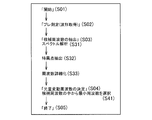
- An example of the process of detecting the candidate frequency and determining the frequency of light fluctuation is shown in the flowchart of FIG.
- a method of detecting the candidate frequency based on the waveform data of the light amount fluctuation acquired by the preliminary measurement is used.
- a frequency equal to or higher than the threshold value may be used as a candidate frequency.
- step S01 when the process is started in step S01, the light from the measurement object 100 is received by the preliminary measurement (pre-measurement), and the waveform data of the light amount fluctuation is acquired (step S02).
- step S02 the waveform data of the light amount fluctuation is acquired
- step S03 the candidate frequency is extracted (detected) (step S03). Specifically, first, the acquired waveform data is spectrally analyzed (step S31). In order to shorten the preliminary measurement time, the frequency resolution may be roughly set in the spectral analysis in the preliminary measurement.
- FIG. 3 shows an example of spectral data which is the result of spectral analysis.
- the case where the frequency resolution is set to 2 Hz is illustrated.
- 14 Hz and 16 Hz, 30 Hz and 32 Hz, 46 Hz and 48 Hz, and 60 Hz and 62 Hz of the spectral data are frequencies having higher intensities than adjacent frequencies, that is, singular points, and are in the vicinity of these singular points. It is considered that there is an actual candidate frequency whose intensity peaks in.
- the frequency is refined by the complement processing using the intensity of the frequency adjacent to the frequency to be the singular point.
- the detailing of the frequency by complementation is not limited, but may be performed by, for example, detecting the center of gravity.
- Candidate frequencies include fundamentals and their harmonics.
- the light amount fluctuation frequency is determined from the listed light amount fluctuation frequency candidates (step S04).
- the minimum frequency among the candidates is determined as the light amount fluctuation frequency (step S41), and the detection of the candidate frequency and the determination process of the light amount fluctuation frequency are completed (step S05).
- the waveform data of the light amount fluctuation is acquired by the pre-measurement (preliminary measurement) before the optical waveform measurement, the frequency spectrum data is acquired by performing the Fourier conversion process on the waveform data, and the frequency spectrum data is used. Since the candidate of the light amount fluctuation frequency is detected based on the frequency that becomes a singular point whose intensity is larger than the adjacent frequency, the candidate corresponding to the actual light amount fluctuation frequency of the measurement target can be detected, and the light amount fluctuation frequency with high accuracy is obtained. Can be determined. Further, when the candidate of the smallest frequency is determined as the light amount fluctuation frequency from the light amount fluctuation frequency candidates, the light amount fluctuation frequency can be easily extracted.
- the measurement condition determination unit 15 determines the sampling frequency and the number of measurement points.
- Measurement time T number of measurement points c / sampling frequency fs ⁇ wave number n / light intensity fluctuation frequency fv (However, n and c are natural numbers)
- the wave number n, the number of measurement points c, and the sampling frequency fs are determined so as to satisfy the relationship shown in the above [Equation 1] as much as possible. That is, the sampling frequency fs and the number of measurement points c whose measurement time T is an integral multiple (n / fv) of the period of the light amount fluctuation frequency fv are determined.
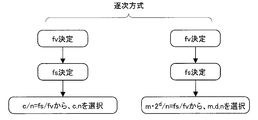
- the sampling frequency fs of the sequential method is determined by the system. With respect to the fs, as shown in the left part of FIG. 4, n and c satisfying the above [Equation 1] are selected. Since high-speed sampling can be realized in the sequential method, fs >> fv is generally satisfied, so that the number of measurement points c tends to be large.
- the measurement point c m ⁇ 2 d (m, d: natural number), and as shown in the right part of FIG. 4, the above-mentioned [ The wave numbers n, m, and d that satisfy the equation 1] are selected.
- fs ⁇ fv the wave number n and the number of measurement points c satisfying the above [Equation 1] become very large values. As a result, the measurement time becomes longer and the calculation load increases, and the merit of the fast Fourier transform cannot be obtained.
- the fast Fourier transform is established when m ⁇ 1 will be described later in the “filter processing function”. Since the m value means the reduction rate of the effective sampling frequency with respect to the filtered waveform, a smaller value is preferable (described later in the “filter processing function”).
- the system upper limit frequency is 2700 Hz
- sampling frequency fs 2700 Hz
- sampling frequency fs 27000 Hz Will be.
- the following is an example of determining the measurement conditions in the integration method that acquires the integrated value of the time determined for the acquisition of the amount of light.
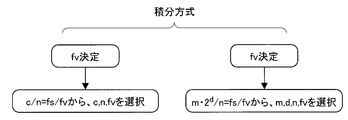
- the frequency setting generally has a high degree of freedom and can be set arbitrarily. Therefore, as the measurement condition, as shown in the left part of FIG. 5, c and fs satisfying the above [Equation 1] are selected with respect to the wave number n as a guide.
- the wave number n is changed depending on the light amount fluctuation frequency in order to maintain a high fs near the upper limit of the system. It is possible to change the wave number n according to the light amount fluctuation frequency, reduce the waveform distortion, and reduce the periodic matching error.
- the filter processing unit 17 After acquiring the optical waveform, the filter processing unit 17 performs filter processing on the acquired optical waveform.
- DFT discrete Fourier transform
- IDFT inverse Fourier transform
- the filter processing in the case of fast Fourier transform and m ⁇ 2 will be described below. That is, the waveform acquired before the fast Fourier transform process needs to be preprocessed.
- the measurement data (c arrays) is averaged or thinned out every m from the head data, and the number of data is compressed to 1 / m.
- a fast Fourier transform (DFT) process, a weighting, and a fast inverse Fourier transform (IDFT) process are performed on the compressed data of 2 d to generate a filtered waveform.
- DFT fast Fourier transform
- IDFT fast inverse Fourier transform
- the above-mentioned compression of the number of data is equivalent to setting the effective sampling frequency fs of the filtered waveform to 1 / m with respect to the acquired waveform. Therefore, the m value needs to be small enough not to affect the reproducibility of the waveform after filtering, but in the case of the sequential type, fs ⁇ fv, so that the influence of this m value on the waveform reproduction is small.
- the number of measurement points differs before and after the filter processing, and it is possible to avoid an increase in the wave number. Further, since the waveform before the filter processing is averaged in units of m and then the filter processing is performed, the noise of the waveform after the filtering processing can be reduced.
- FIG. 3A is a conventional waveform
- FIG. 3B is a waveform in the present embodiment.
- the waveform since the measurement conditions are set so as to match the light amount fluctuation frequency, the waveform has a waveform in which distortion is suppressed particularly at the front end portion and the rear end portion of the waveform, as compared with the conventional example.
- the candidate of the light amount fluctuation frequency of the measurement object 100 is detected, the light amount fluctuation frequency is determined based on the detected candidate, and the measurement time is described based on the determined light amount fluctuation frequency. Since the sampling frequency and the number of measurement points, which are integral multiples of the determined frequency fluctuation frequency, are determined, distortion-free waveform acquisition is possible even if arbitrary frequency filtering is applied, and the frequency to be measured is known. Even if it is not, the error can be minimized. In addition, the flicker index based on the IEC standard can be derived accurately and easily.
- the flicker value is the value obtained by calculating (maximum value-minimum value) / average value for the waveform filtered by TCSF, but in order to derive this flicker value, an accurate filter is used. A post-waveform is required. Further, since the light quantity fluctuation period is required for deriving the average value, it can be easily derived by using the present invention.
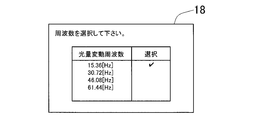
- a list of detected candidate frequencies may be displayed on the display unit 18 together with a message such as "Please select a frequency", and the user may be allowed to select a desired candidate.
- four candidate frequencies are displayed, indicating that the checked 15.36 Hz candidate frequency has been selected.
- the selected candidate frequency is determined as the light amount fluctuation frequency.
- the singular point shown in the spectrum data of FIG. 3 obtained as a result of the spectrum analysis in the preliminary measurement may be displayed as a candidate frequency and may be selected by the user.
- the light amount fluctuation frequency closest to the selected singularity is determined as the light amount fluctuation frequency that is the basis for determining the frequency resolution.
- the displayed candidate list is a list of candidate frequencies after being refined by complementation, in that an accurate candidate frequency can be displayed.
- the input field 18a is displayed together with a message such as "Please select a frequency", and the design value of the light amount fluctuation frequency is directly input to the user. There may be.
- the candidate frequency closest to the input frequency is determined as the light amount fluctuation frequency. In this way, even when the user is made to input the light amount fluctuation frequency and the candidate frequency closest to the input light amount fluctuation frequency is determined as the light amount fluctuation frequency, the optical waveform near the frequency that the user is paying attention to is measured with high accuracy. There is an effect that can be done.
- the waveform data of the light amount fluctuation is acquired by the preliminary measurement before the optical waveform measurement, and the frequency spectrum data is acquired by performing the Fourier conversion process on the acquired waveform data, and the intensity of the frequency spectrum data is increased.
- the detection of the candidate frequency may be performed by another method.
- the fluctuation cycle (frequency) may be directly obtained by acquiring the waveform data of the light amount fluctuation by the preliminary measurement before the optical waveform measurement and analyzing the acquired waveform data.
- an autocorrelation method for waveform data can be mentioned. This autocorrelation method is a method of extracting the periodicity of data and detecting a candidate frequency by calculating the correlation coefficient between the waveform data of the amount of light fluctuation and the data shifted in time from the waveform data.
- a periodic extraction method using feature points of waveform data by an image analysis method may be used.
- Detection of light intensity fluctuation frequency by analysis of waveform data has the effect of shortening the preliminary measurement time, but increases the calculation load.
- the candidate detection unit 13 may be configured by utilizing the function of a conventional optical waveform measuring device that acquires frequency spectrum data by performing a Fourier transform process on the waveform data of the amount of light fluctuation, or may be dedicated to detecting candidates. It may be configured by providing a circuit separately.
- the optical waveform measuring device may be configured by the personal computer 200.
- the personal computer 200 may detect the candidate frequency, determine the light amount fluctuation frequency, determine the measurement conditions, and the like by acquiring the light receiving data of the measurement object 100 from the conventional optical waveform measuring device 300.
- the optical waveform measurement step does not need to be performed continuously with the frequency detection step, the frequency determination step, and the measurement condition determination step.
- the frequency detection step, the frequency determination step, and the measurement condition determination step may be performed first to acquire the measurement condition data, and then only the optical measurement may be performed using the acquired measurement conditions.
- the determined measurement conditions may be recorded and stored in an optical waveform measuring device or an external recording device (for example, a personal computer or the like) connected to the optical waveform measuring device.
- an optical waveform measuring device or an external recording device (for example, a personal computer or the like) connected to the optical waveform measuring device.
- the present invention can be used when measuring the optical waveform of a measurement object such as a display.
Landscapes
- Physics & Mathematics (AREA)
- Spectroscopy & Molecular Physics (AREA)
- General Physics & Mathematics (AREA)
- Mathematical Physics (AREA)
- Chemical & Material Sciences (AREA)
- Analytical Chemistry (AREA)
- Photometry And Measurement Of Optical Pulse Characteristics (AREA)
Priority Applications (3)
| Application Number | Priority Date | Filing Date | Title |
|---|---|---|---|
| JP2022528505A JP7816144B2 (ja) | 2020-06-01 | 2021-05-13 | 光波形計測装置及び計測方法 |
| KR1020227041994A KR102808720B1 (ko) | 2020-06-01 | 2021-05-13 | 광 파형 계측 장치 및 계측 방법 |
| CN202180039449.7A CN115667861A (zh) | 2020-06-01 | 2021-05-13 | 光波形测量装置及测量方法 |
Applications Claiming Priority (2)
| Application Number | Priority Date | Filing Date | Title |
|---|---|---|---|
| JP2020-095517 | 2020-06-01 | ||
| JP2020095517 | 2020-06-01 |
Publications (1)
| Publication Number | Publication Date |
|---|---|
| WO2021246125A1 true WO2021246125A1 (ja) | 2021-12-09 |
Family
ID=78830876
Family Applications (1)
| Application Number | Title | Priority Date | Filing Date |
|---|---|---|---|
| PCT/JP2021/018217 Ceased WO2021246125A1 (ja) | 2020-06-01 | 2021-05-13 | 光波形計測装置及び計測方法 |
Country Status (4)
| Country | Link |
|---|---|
| JP (1) | JP7816144B2 (https=) |
| KR (1) | KR102808720B1 (https=) |
| CN (1) | CN115667861A (https=) |
| WO (1) | WO2021246125A1 (https=) |
Cited By (3)
| Publication number | Priority date | Publication date | Assignee | Title |
|---|---|---|---|---|
| WO2023136102A1 (ja) * | 2022-01-11 | 2023-07-20 | コニカミノルタ株式会社 | 光計測方法、光計測装置、データ処理装置及びプログラム |
| WO2023149337A1 (ja) * | 2022-02-07 | 2023-08-10 | コニカミノルタ株式会社 | ディスプレイ光計測装置及び光計測方法、データ処理装置並びにプログラム |
| WO2023189479A1 (ja) * | 2022-03-30 | 2023-10-05 | コニカミノルタ株式会社 | ディスプレイ光計測装置及び光計測方法、データ処理装置並びにプログラム |
Citations (5)
| Publication number | Priority date | Publication date | Assignee | Title |
|---|---|---|---|---|
| JP2003106898A (ja) * | 2001-09-28 | 2003-04-09 | Nohmi Bosai Ltd | 炎検出装置 |
| US20050103979A1 (en) * | 2003-11-13 | 2005-05-19 | Photo Research, Inc. | Temporal source analysis using array detectors |
| WO2019069634A1 (ja) * | 2017-10-05 | 2019-04-11 | コニカミノルタ株式会社 | 二次元フリッカ測定装置、二次元フリッカ測定システム、二次元フリッカ測定方法、及び、二次元フリッカ測定プログラム |
| WO2019069633A1 (ja) * | 2017-10-05 | 2019-04-11 | コニカミノルタ株式会社 | 二次元フリッカ測定装置及び二次元フリッカ測定方法 |
| JP2019100868A (ja) * | 2017-12-04 | 2019-06-24 | 日置電機株式会社 | 測定条件設定方法および光測定装置 |
Family Cites Families (11)
| Publication number | Priority date | Publication date | Assignee | Title |
|---|---|---|---|---|
| JPS60137825A (ja) * | 1983-12-27 | 1985-07-22 | Seto Yogyo Genryo Kk | 高純度チタニアの製造法 |
| TW594022B (en) * | 2003-01-08 | 2004-06-21 | Machvision Inc | Inspection method and system for LCD panel |
| DE10311617A1 (de) | 2003-03-14 | 2004-09-23 | Basf Ag | Verwendung von Polyacrylsäuren als Mahlhilfsmittel für Calciumcarbonat |
| JP2009017214A (ja) * | 2007-07-04 | 2009-01-22 | Canon Inc | フリッカ検出装置及びフリッカ検出方法 |
| EP2237054A4 (en) * | 2008-01-23 | 2014-10-01 | Anritsu Corp | MEASURED SIGNAL REPETITIVE FREQUENCY DETECTION METHOD, SAMPLING APPARATUS USING THE SAME, AND WAVEFORM OBSERVATION SYSTEM |
| JP5840868B2 (ja) * | 2011-05-27 | 2016-01-06 | 株式会社ソニック | 周波数検出方法及び装置 |
| JP5635038B2 (ja) * | 2012-06-25 | 2014-12-03 | 株式会社中電シーティーアイ | 振動特性を推定する方法および振動特性推定プログラムならびに振動特性推定プログラムを記録したコンピュータ読み取り可能な記録媒体 |
| WO2014167865A1 (ja) | 2013-04-12 | 2014-10-16 | パナソニック インテレクチュアル プロパティ コーポレーション オブ アメリカ | フリッカ低減装置、撮像装置およびフリッカ低減方法 |
| JP2016092787A (ja) * | 2014-11-11 | 2016-05-23 | キヤノン株式会社 | 画像処理装置 |
| JP6915539B2 (ja) * | 2015-09-02 | 2021-08-04 | コニカミノルタ株式会社 | 二次元測色装置及び二次元測色方法 |
| WO2020166201A1 (ja) * | 2019-02-12 | 2020-08-20 | コニカミノルタ株式会社 | フリッカ測定装置、フリッカ測定方法及びフリッカ測定プログラム |
-
2021
- 2021-05-13 CN CN202180039449.7A patent/CN115667861A/zh active Pending
- 2021-05-13 WO PCT/JP2021/018217 patent/WO2021246125A1/ja not_active Ceased
- 2021-05-13 KR KR1020227041994A patent/KR102808720B1/ko active Active
- 2021-05-13 JP JP2022528505A patent/JP7816144B2/ja active Active
Patent Citations (5)
| Publication number | Priority date | Publication date | Assignee | Title |
|---|---|---|---|---|
| JP2003106898A (ja) * | 2001-09-28 | 2003-04-09 | Nohmi Bosai Ltd | 炎検出装置 |
| US20050103979A1 (en) * | 2003-11-13 | 2005-05-19 | Photo Research, Inc. | Temporal source analysis using array detectors |
| WO2019069634A1 (ja) * | 2017-10-05 | 2019-04-11 | コニカミノルタ株式会社 | 二次元フリッカ測定装置、二次元フリッカ測定システム、二次元フリッカ測定方法、及び、二次元フリッカ測定プログラム |
| WO2019069633A1 (ja) * | 2017-10-05 | 2019-04-11 | コニカミノルタ株式会社 | 二次元フリッカ測定装置及び二次元フリッカ測定方法 |
| JP2019100868A (ja) * | 2017-12-04 | 2019-06-24 | 日置電機株式会社 | 測定条件設定方法および光測定装置 |
Cited By (3)
| Publication number | Priority date | Publication date | Assignee | Title |
|---|---|---|---|---|
| WO2023136102A1 (ja) * | 2022-01-11 | 2023-07-20 | コニカミノルタ株式会社 | 光計測方法、光計測装置、データ処理装置及びプログラム |
| WO2023149337A1 (ja) * | 2022-02-07 | 2023-08-10 | コニカミノルタ株式会社 | ディスプレイ光計測装置及び光計測方法、データ処理装置並びにプログラム |
| WO2023189479A1 (ja) * | 2022-03-30 | 2023-10-05 | コニカミノルタ株式会社 | ディスプレイ光計測装置及び光計測方法、データ処理装置並びにプログラム |
Also Published As
| Publication number | Publication date |
|---|---|
| KR20230003205A (ko) | 2023-01-05 |
| JP7816144B2 (ja) | 2026-02-18 |
| JPWO2021246125A1 (https=) | 2021-12-09 |
| CN115667861A (zh) | 2023-01-31 |
| KR102808720B1 (ko) | 2025-05-15 |
Similar Documents
| Publication | Publication Date | Title |
|---|---|---|
| WO2021246125A1 (ja) | 光波形計測装置及び計測方法 | |
| KR100838239B1 (ko) | 음질 표시 장치, 음질 표시 방법, 음질 표시 프로그램을 기록한 컴퓨터로 읽을 수 있는 매체 | |
| KR102728065B1 (ko) | 플리커 계측 장치 및 계측 방법 | |
| JP5453242B2 (ja) | 映像品質評価方法およびシステム | |
| JP6052027B2 (ja) | 脈波検出装置、脈波検出プログラムおよび脈波検出方法 | |
| JP2016096931A (ja) | シミ評価装置、シミ評価方法、及びシミ評価プログラム | |
| JP2000275098A (ja) | 波形信号解析装置 | |
| KR102810517B1 (ko) | 광 계측 장치, 광 계측 방법, 데이터 처리 장치 및 프로그램 | |
| US10561348B2 (en) | Device and method for spectrum analysis and device for blood glucose measurement | |
| US10242697B2 (en) | Pitch information generation device, pitch information generation method, and computer-readable recording medium therefor | |
| JP4925018B2 (ja) | 基本波ビート成分検出方法及びそれを用いる被測定信号のサンプリング装置並びに波形観測システム | |
| WO2022233110A1 (zh) | 一种阶梯叠加式傅里叶变换微分方法 | |
| KR20240134356A (ko) | 디스플레이 광 계측 장치 및 광 계측 방법, 데이터 처리 장치 그리고 프로그램 | |
| CN118525190A (zh) | 光测量方法、光测量装置、数据处理装置以及程序 | |
| CN118647845A (zh) | 显示器光测量装置及光测量方法、数据处理装置和程序 | |
| JP2013210293A (ja) | 音・画像解析による設備診断システム | |
| JPWO2017130417A1 (ja) | 生体音解析装置及び生体音解析方法、並びにコンピュータプログラム及び記録媒体 | |
| WO2020136051A1 (en) | Laser scanning microscope arrangement | |
| US12557996B1 (en) | Processing short video to obtain frequency information | |
| CN110889368A (zh) | 采用算术平均与几何平均差消除拉曼光谱背景的方法 | |
| JP2007534955A (ja) | 自己相関関数を決定する方法 | |
| JP2000055950A (ja) | 周波数解析装置及びその方法 | |
| CN120009226A (zh) | 一种适用于真空高温环境的痕量水分子测量方法及装置 | |
| CN116994111A (zh) | 基于深度学习的oct共轭镜像去除方法及装置 | |
| JPH11271021A (ja) | 波形解析器とその解析器を利用した変位測定器 |
Legal Events
| Date | Code | Title | Description |
|---|---|---|---|
| 121 | Ep: the epo has been informed by wipo that ep was designated in this application |
Ref document number: 21817394 Country of ref document: EP Kind code of ref document: A1 |
|
| ENP | Entry into the national phase |
Ref document number: 2022528505 Country of ref document: JP Kind code of ref document: A |
|
| ENP | Entry into the national phase |
Ref document number: 20227041994 Country of ref document: KR Kind code of ref document: A |
|
| NENP | Non-entry into the national phase |
Ref country code: DE |
|
| 122 | Ep: pct application non-entry in european phase |
Ref document number: 21817394 Country of ref document: EP Kind code of ref document: A1 |