WO2021240967A1 - 逆浸透膜処理方法 - Google Patents
逆浸透膜処理方法 Download PDFInfo
- Publication number
- WO2021240967A1 WO2021240967A1 PCT/JP2021/011424 JP2021011424W WO2021240967A1 WO 2021240967 A1 WO2021240967 A1 WO 2021240967A1 JP 2021011424 W JP2021011424 W JP 2021011424W WO 2021240967 A1 WO2021240967 A1 WO 2021240967A1
- Authority
- WO
- WIPO (PCT)
- Prior art keywords
- water
- reverse osmosis
- osmosis membrane
- treated
- membrane
- Prior art date
- Legal status (The legal status is an assumption and is not a legal conclusion. Google has not performed a legal analysis and makes no representation as to the accuracy of the status listed.)
- Ceased
Links
Images

Classifications
-
- B—PERFORMING OPERATIONS; TRANSPORTING
- B01—PHYSICAL OR CHEMICAL PROCESSES OR APPARATUS IN GENERAL
- B01D—SEPARATION
- B01D61/00—Processes of separation using semi-permeable membranes, e.g. dialysis, osmosis or ultrafiltration; Apparatus, accessories or auxiliary operations specially adapted therefor
- B01D61/02—Reverse osmosis; Hyperfiltration ; Nanofiltration
- B01D61/025—Reverse osmosis; Hyperfiltration
-
- B—PERFORMING OPERATIONS; TRANSPORTING
- B01—PHYSICAL OR CHEMICAL PROCESSES OR APPARATUS IN GENERAL
- B01D—SEPARATION
- B01D61/00—Processes of separation using semi-permeable membranes, e.g. dialysis, osmosis or ultrafiltration; Apparatus, accessories or auxiliary operations specially adapted therefor
- B01D61/02—Reverse osmosis; Hyperfiltration ; Nanofiltration
- B01D61/025—Reverse osmosis; Hyperfiltration
- B01D61/026—Reverse osmosis; Hyperfiltration comprising multiple reverse osmosis steps
-
- B—PERFORMING OPERATIONS; TRANSPORTING
- B01—PHYSICAL OR CHEMICAL PROCESSES OR APPARATUS IN GENERAL
- B01D—SEPARATION
- B01D61/00—Processes of separation using semi-permeable membranes, e.g. dialysis, osmosis or ultrafiltration; Apparatus, accessories or auxiliary operations specially adapted therefor
- B01D61/02—Reverse osmosis; Hyperfiltration ; Nanofiltration
- B01D61/04—Feed pretreatment
-
- B—PERFORMING OPERATIONS; TRANSPORTING
- B01—PHYSICAL OR CHEMICAL PROCESSES OR APPARATUS IN GENERAL
- B01D—SEPARATION
- B01D61/00—Processes of separation using semi-permeable membranes, e.g. dialysis, osmosis or ultrafiltration; Apparatus, accessories or auxiliary operations specially adapted therefor
- B01D61/02—Reverse osmosis; Hyperfiltration ; Nanofiltration
- B01D61/10—Accessories; Auxiliary operations
-
- B—PERFORMING OPERATIONS; TRANSPORTING
- B01—PHYSICAL OR CHEMICAL PROCESSES OR APPARATUS IN GENERAL
- B01D—SEPARATION
- B01D61/00—Processes of separation using semi-permeable membranes, e.g. dialysis, osmosis or ultrafiltration; Apparatus, accessories or auxiliary operations specially adapted therefor
- B01D61/02—Reverse osmosis; Hyperfiltration ; Nanofiltration
- B01D61/12—Controlling or regulating
-
- B—PERFORMING OPERATIONS; TRANSPORTING
- B01—PHYSICAL OR CHEMICAL PROCESSES OR APPARATUS IN GENERAL
- B01D—SEPARATION
- B01D65/00—Accessories or auxiliary operations, in general, for separation processes or apparatus using semi-permeable membranes
- B01D65/02—Membrane cleaning or sterilisation ; Membrane regeneration
-
- B—PERFORMING OPERATIONS; TRANSPORTING
- B01—PHYSICAL OR CHEMICAL PROCESSES OR APPARATUS IN GENERAL
- B01D—SEPARATION
- B01D65/00—Accessories or auxiliary operations, in general, for separation processes or apparatus using semi-permeable membranes
- B01D65/08—Prevention of membrane fouling or of concentration polarisation
-
- C—CHEMISTRY; METALLURGY
- C02—TREATMENT OF WATER, WASTE WATER, SEWAGE, OR SLUDGE
- C02F—TREATMENT OF WATER, WASTE WATER, SEWAGE, OR SLUDGE
- C02F1/00—Treatment of water, waste water, or sewage
- C02F1/44—Treatment of water, waste water, or sewage by dialysis, osmosis or reverse osmosis
-
- C—CHEMISTRY; METALLURGY
- C02—TREATMENT OF WATER, WASTE WATER, SEWAGE, OR SLUDGE
- C02F—TREATMENT OF WATER, WASTE WATER, SEWAGE, OR SLUDGE
- C02F1/00—Treatment of water, waste water, or sewage
- C02F1/44—Treatment of water, waste water, or sewage by dialysis, osmosis or reverse osmosis
- C02F1/441—Treatment of water, waste water, or sewage by dialysis, osmosis or reverse osmosis by reverse osmosis
-
- C—CHEMISTRY; METALLURGY
- C02—TREATMENT OF WATER, WASTE WATER, SEWAGE, OR SLUDGE
- C02F—TREATMENT OF WATER, WASTE WATER, SEWAGE, OR SLUDGE
- C02F1/00—Treatment of water, waste water, or sewage
- C02F1/66—Treatment of water, waste water, or sewage by neutralisation; pH adjustment
-
- C—CHEMISTRY; METALLURGY
- C02—TREATMENT OF WATER, WASTE WATER, SEWAGE, OR SLUDGE
- C02F—TREATMENT OF WATER, WASTE WATER, SEWAGE, OR SLUDGE
- C02F3/00—Biological treatment of water, waste water, or sewage
- C02F3/02—Aerobic processes
- C02F3/12—Activated sludge processes
-
- C—CHEMISTRY; METALLURGY
- C08—ORGANIC MACROMOLECULAR COMPOUNDS; THEIR PREPARATION OR CHEMICAL WORKING-UP; COMPOSITIONS BASED THEREON
- C08J—WORKING-UP; GENERAL PROCESSES OF COMPOUNDING; AFTER-TREATMENT NOT COVERED BY SUBCLASSES C08B, C08C, C08F, C08G or C08H
- C08J9/00—Working-up of macromolecular substances to porous or cellular articles or materials; After-treatment thereof
- C08J9/26—Working-up of macromolecular substances to porous or cellular articles or materials; After-treatment thereof by elimination of a solid phase from a macromolecular composition or article, e.g. leaching out
-
- B—PERFORMING OPERATIONS; TRANSPORTING
- B01—PHYSICAL OR CHEMICAL PROCESSES OR APPARATUS IN GENERAL
- B01D—SEPARATION
- B01D2253/00—Adsorbents used in seperation treatment of gases and vapours
- B01D2253/10—Inorganic adsorbents
- B01D2253/106—Silica or silicates
- B01D2253/108—Zeolites
-
- B—PERFORMING OPERATIONS; TRANSPORTING
- B01—PHYSICAL OR CHEMICAL PROCESSES OR APPARATUS IN GENERAL
- B01D—SEPARATION
- B01D2255/00—Catalysts
- B01D2255/90—Physical characteristics of catalysts
- B01D2255/902—Multilayered catalyst
-
- B—PERFORMING OPERATIONS; TRANSPORTING
- B01—PHYSICAL OR CHEMICAL PROCESSES OR APPARATUS IN GENERAL
- B01D—SEPARATION
- B01D2311/00—Details relating to membrane separation process operations and control
- B01D2311/04—Specific process operations in the feed stream; Feed pretreatment
-
- B—PERFORMING OPERATIONS; TRANSPORTING
- B01—PHYSICAL OR CHEMICAL PROCESSES OR APPARATUS IN GENERAL
- B01D—SEPARATION
- B01D2311/00—Details relating to membrane separation process operations and control
- B01D2311/18—Details relating to membrane separation process operations and control pH control
-
- B—PERFORMING OPERATIONS; TRANSPORTING
- B01—PHYSICAL OR CHEMICAL PROCESSES OR APPARATUS IN GENERAL
- B01D—SEPARATION
- B01D2311/00—Details relating to membrane separation process operations and control
- B01D2311/26—Further operations combined with membrane separation processes
- B01D2311/2626—Absorption or adsorption
-
- B—PERFORMING OPERATIONS; TRANSPORTING
- B01—PHYSICAL OR CHEMICAL PROCESSES OR APPARATUS IN GENERAL
- B01D—SEPARATION
- B01D2321/00—Details relating to membrane cleaning, regeneration, sterilization or to the prevention of fouling
- B01D2321/12—Use of permeate
-
- B—PERFORMING OPERATIONS; TRANSPORTING
- B01—PHYSICAL OR CHEMICAL PROCESSES OR APPARATUS IN GENERAL
- B01D—SEPARATION
- B01D2321/00—Details relating to membrane cleaning, regeneration, sterilization or to the prevention of fouling
- B01D2321/16—Use of chemical agents
- B01D2321/164—Use of bases
-
- C—CHEMISTRY; METALLURGY
- C02—TREATMENT OF WATER, WASTE WATER, SEWAGE, OR SLUDGE
- C02F—TREATMENT OF WATER, WASTE WATER, SEWAGE, OR SLUDGE
- C02F1/00—Treatment of water, waste water, or sewage
- C02F1/001—Processes for the treatment of water whereby the filtration technique is of importance
- C02F1/004—Processes for the treatment of water whereby the filtration technique is of importance using large scale industrial sized filters
-
- C—CHEMISTRY; METALLURGY
- C02—TREATMENT OF WATER, WASTE WATER, SEWAGE, OR SLUDGE
- C02F—TREATMENT OF WATER, WASTE WATER, SEWAGE, OR SLUDGE
- C02F1/00—Treatment of water, waste water, or sewage
- C02F1/28—Treatment of water, waste water, or sewage by sorption
- C02F1/283—Treatment of water, waste water, or sewage by sorption using coal, charred products, or inorganic mixtures containing them
-
- C—CHEMISTRY; METALLURGY
- C02—TREATMENT OF WATER, WASTE WATER, SEWAGE, OR SLUDGE
- C02F—TREATMENT OF WATER, WASTE WATER, SEWAGE, OR SLUDGE
- C02F2101/00—Nature of the contaminant
- C02F2101/10—Inorganic compounds
- C02F2101/16—Nitrogen compounds, e.g. ammonia
-
- C—CHEMISTRY; METALLURGY
- C02—TREATMENT OF WATER, WASTE WATER, SEWAGE, OR SLUDGE
- C02F—TREATMENT OF WATER, WASTE WATER, SEWAGE, OR SLUDGE
- C02F2103/00—Nature of the water, waste water, sewage or sludge to be treated
- C02F2103/34—Nature of the water, waste water, sewage or sludge to be treated from industrial activities not provided for in groups C02F2103/12 - C02F2103/32
- C02F2103/346—Nature of the water, waste water, sewage or sludge to be treated from industrial activities not provided for in groups C02F2103/12 - C02F2103/32 from semiconductor processing, e.g. waste water from polishing of wafers
-
- C—CHEMISTRY; METALLURGY
- C02—TREATMENT OF WATER, WASTE WATER, SEWAGE, OR SLUDGE
- C02F—TREATMENT OF WATER, WASTE WATER, SEWAGE, OR SLUDGE
- C02F2303/00—Specific treatment goals
- C02F2303/16—Regeneration of sorbents, filters
-
- C—CHEMISTRY; METALLURGY
- C02—TREATMENT OF WATER, WASTE WATER, SEWAGE, OR SLUDGE
- C02F—TREATMENT OF WATER, WASTE WATER, SEWAGE, OR SLUDGE
- C02F2303/00—Specific treatment goals
- C02F2303/18—Removal of treatment agents after treatment
-
- C—CHEMISTRY; METALLURGY
- C02—TREATMENT OF WATER, WASTE WATER, SEWAGE, OR SLUDGE
- C02F—TREATMENT OF WATER, WASTE WATER, SEWAGE, OR SLUDGE
- C02F2303/00—Specific treatment goals
- C02F2303/20—Prevention of biofouling
-
- C—CHEMISTRY; METALLURGY
- C11—ANIMAL OR VEGETABLE OILS, FATS, FATTY SUBSTANCES OR WAXES; FATTY ACIDS THEREFROM; DETERGENTS; CANDLES
- C11D—DETERGENT COMPOSITIONS; USE OF SINGLE SUBSTANCES AS DETERGENTS; SOAP OR SOAP-MAKING; RESIN SOAPS; RECOVERY OF GLYCEROL
- C11D2111/00—Cleaning compositions characterised by the objects to be cleaned; Cleaning compositions characterised by non-standard cleaning or washing processes
- C11D2111/10—Objects to be cleaned
- C11D2111/14—Hard surfaces
-
- Y—GENERAL TAGGING OF NEW TECHNOLOGICAL DEVELOPMENTS; GENERAL TAGGING OF CROSS-SECTIONAL TECHNOLOGIES SPANNING OVER SEVERAL SECTIONS OF THE IPC; TECHNICAL SUBJECTS COVERED BY FORMER USPC CROSS-REFERENCE ART COLLECTIONS [XRACs] AND DIGESTS
- Y02—TECHNOLOGIES OR APPLICATIONS FOR MITIGATION OR ADAPTATION AGAINST CLIMATE CHANGE
- Y02A—TECHNOLOGIES FOR ADAPTATION TO CLIMATE CHANGE
- Y02A20/00—Water conservation; Efficient water supply; Efficient water use
- Y02A20/124—Water desalination
- Y02A20/131—Reverse-osmosis
-
- Y—GENERAL TAGGING OF NEW TECHNOLOGICAL DEVELOPMENTS; GENERAL TAGGING OF CROSS-SECTIONAL TECHNOLOGIES SPANNING OVER SEVERAL SECTIONS OF THE IPC; TECHNICAL SUBJECTS COVERED BY FORMER USPC CROSS-REFERENCE ART COLLECTIONS [XRACs] AND DIGESTS
- Y02—TECHNOLOGIES OR APPLICATIONS FOR MITIGATION OR ADAPTATION AGAINST CLIMATE CHANGE
- Y02W—CLIMATE CHANGE MITIGATION TECHNOLOGIES RELATED TO WASTEWATER TREATMENT OR WASTE MANAGEMENT
- Y02W10/00—Technologies for wastewater treatment
- Y02W10/10—Biological treatment of water, waste water, or sewage
Definitions
- the present invention relates to a reverse osmosis membrane treatment method for treating water to be treated with a reverse osmosis membrane device (hereinafter, may be referred to as an RO device). More specifically, the present invention relates to a reverse osmosis membrane treatment method in which highly alkaline water having a pH of 9.5 or higher is intermittently brought into contact with an RO membrane device.
- RO membrane separation treatment which separates turbid substances, soluble substances, and ions in the water to be treated using a reverse osmosis membrane (RO membrane)
- microorganisms contained in the water to be treated grow in the equipment piping and on the membrane surface. This may form slime and cause problems such as a decrease in the amount of permeated water (flux).
- a method of constantly or intermittently adding a bactericidal agent to the water to be treated and separating the membrane while sterilizing the water to be treated or the inside of the apparatus is known.
- a method of adding a chlorine-based oxidizing agent such as sodium hypochlorite to sterilize microorganisms is performed.
- the permeable membrane is a permeable membrane that does not have chlorine resistance such as a polyamide polymer membrane
- a chlorine-based oxidant when added, the permeable membrane is oxidatively deteriorated by free chlorine derived from the chlorine-based oxidant. There was a problem that the removal rate was lowered.
- JP-A-1-104310 and JP-A-1-135506 in order to minimize such deterioration of the permeable membrane, ammonium ions are added after sterilization with free chlorine, and chloramine (monochloramine, monochloramine, A method for producing dichloramine) or a method for adding a bound chlorine compound such as chloramine T or dichloramine T is shown.
- Japanese Unexamined Patent Publication No. 2006-263510 describes a membrane separation method in which a bound chlorine agent composed of a chlorine-based oxidizing agent and a sulfamic acid compound is present in the water supply or washing water to the membrane separation device.
- Japanese Patent Application Laid-Open No. 2005-81269 describes in a method of treating organic matter-containing wastewater with a reverse osmosis membrane, in order to prevent a decrease in flux, an alkali is added to the organic matter-containing wastewater to adjust the pH to 9.5 or higher, and then reverse osmosis is performed. It is described that the membrane is treated and then the pH is adjusted to 4-8.
- the treated water containing ammonia RO treatment the water to be treated at a high pH, ammonia is present As majority of non-ionic NH 4, it can not be sufficiently removed ammonia by RO. Therefore, when RO-treating water to be treated that has a high pH and contains ammonia, an acid is added to adjust the pH to about 4 to 8, and a slime inhibitor (slime inhibitor) is added to prevent membrane fouling. After that, it is supplied to the RO device.
- a slime inhibitor slime inhibitor
- An object of the present invention is to provide a reverse osmosis membrane treatment method capable of efficiently treating water to be treated at low cost and suppressing slime.
- the reverse osmosis membrane treatment method of the present invention is a reverse osmosis membrane treatment method in which water to be treated is adjusted to a pH range of 4 to 8 and passed through a reverse osmosis membrane device, and is intermittently alkaline water having a pH of 9.5 or higher. Is brought into contact with the reverse osmosis membrane of the reverse osmosis membrane device.
- the water to be treated has a pH of 9.5 or higher, and the water to be treated has a pH of 9.5 or higher as the alkaline water.
- the alkaline water is wastewater from different processes in the same facility.
- a plurality of the reverse osmosis membrane devices are installed in parallel, and while the reverse osmosis membrane of at least one reverse osmosis membrane device is brought into contact with alkaline water having a pH of 9.5 or higher, the other reverse osmosis membrane device is used.
- the reverse osmosis membrane is treated by passing water to be treated adjusted to pH 4 to 8 through the osmosis membrane device.
- the pretreatment is activated carbon treatment.
- the ammonia concentration of the water to be treated and / or the alkaline water is 1 mg / L or more.
- the TOC concentration of the water to be treated is 0.5 mg / L or more.
- the step of bringing the alkaline water having a pH of 9.5 or higher into contact with the reverse osmosis membrane is performed once every 12 hours to 1 month.
- the RO membrane is washed using high-pH water to be treated and wastewater from other steps. Therefore, even if the washing frequency is increased, the cost of the cleaning agent for the RO membrane is not incurred. , Cleaning cost is low. Further, by increasing the washing frequency, RO membrane fouling can be sufficiently suppressed.
- the water to be treated having a high pH is adjusted to pH 4 to 8 and then subjected to RO treatment, ammonia can be sufficiently removed even when the water to be treated contains ammonia.
- water to be treated (raw water) having a pH of 9.5 or higher is adjusted to pH 4 to 8, preferably 5 to 7, and then passed through a reverse osmosis membrane device (RO device).
- RO device reverse osmosis membrane device
- it is suitable for treating water containing ammonia, particularly water having an ammonia concentration of 1 mg / L or more, particularly a high concentration of 1 to 10000 mg / L. Since ammonia is weakly basic, water containing ammonia having such a concentration usually has a pH of 9.5 or higher. Further, it is suitable for treating water to be treated having a TOC concentration of 0.5 mg / L or more, particularly 2 to 50 mg / L. Examples of such water to be treated include, but are not limited to, cleaning wastewater from a manufacturing process of a semiconductor such as a liquid crystal display.
- the upper limit of the pH of the water to be treated is not particularly limited, but is usually less than pH 12.
- the water to be treated may be pretreated with activated carbon or the like.
- activated carbon By treating the water to be treated with activated carbon as a pretreatment, ozone, peroxide and the like can be removed and deterioration of the RO membrane can be prevented.
- the effect of reducing the TOC load of the RO membrane by removing a part of the organic matter (TOC component) in the water to be treated is also obtained.
- the pre-processing means is not limited to activated carbon treatment, the biological treatment by activated sludge or suspended carrier technique, the reduction process of the H 2 O 2 with a drug, divided by the clarification filters and filtration devices or removal Nigomaku device One or two or more such as turbidity treatment may be adopted.
- acid is added to the water to be treated, which has been pretreated with activated carbon or the like, to adjust the pH to 4 to 8, preferably 5 to 7.
- a slime inhibitor is added after (or before or at the same time) this pH adjustment.
- the acid sulfuric acid, hydrochloric acid or the like can be used.
- the slime inhibitor include those described in the above-mentioned Patent Documents 1 to 3, but other slime inhibitors may be used.
- the RO membrane has low chlorine resistance, it is preferable to use a slime inhibitor other than the chlorine-based oxidizing agent.
- the water to be treated with pH adjustment and slime inhibitor added is passed through the filter as necessary, and then passed through the RO device.
- a filter a cartridge filter, an automatic backwash filter using a filter element, or the like can be used.
- the RO membrane After passing the water to be treated to the RO device for a predetermined time, the RO membrane is washed with the water to be treated having a pH of 9.5 or higher.
- the water to be treated having a pH of 9.5 or higher for washing the film it is preferable that the raw water is treated to remove suspended solids, and the above-mentioned pretreated water, particularly activated carbon treated water, is suitable.
- the upper limit of the pH of the water to be treated for washing the membrane is not particularly limited, but it is preferably less than 12 in order to prevent deterioration of the RO membrane. Therefore, when the pH of the water to be treated exceeds 12, the pH can be in the range of 9.5 to 12 by appropriately adding an acid or the like.
- the introduction is stopped, and a predetermined time (for example, the lower limit is preferably 2 hours, particularly 5 hours, and the upper limit is preferably 2 hours). It is preferable to maintain the state (preferably for 24 hours, particularly 12 hours). Since the pH of the water to be treated introduced for washing the membrane is 9.5 or higher, the slime adhering to the membrane surface or the like is dissolved and removed during this period.
- the RO device is preferably washed (rinsed) with permeated water of the RO device, raw water adjusted to pH 4 to 8, or other clean water, and then water to be treated with pH 4 to 8 is passed through the RO device. (RO processing) is restarted.
- Alkaline chemicals are not used for membrane cleaning with water to be treated with a pH of 9.5 or higher, so there is virtually no chemical cost. (However, if necessary, a small amount of alkaline agent may be added to the water to be treated having a pH of 9.5 or higher for membrane cleaning.) Therefore, the membrane cleaning may be carried out, for example, from 12 hours to 1 month, preferably from 12 hours to 1. Even if performed at a high frequency of about once a week, especially once every 12 to 60 hours, the drug cost will be zero or significantly low. Further, this cleaning method does not require cleaning equipment such as conventional membrane cleaning using an alkaline chemical, and the cleaning equipment cost is remarkably low. Labor costs for cleaning work will also be zero or significantly lower. Further, by shortening the cleaning interval, it is possible to carry out the cleaning in a situation where the contamination of the membrane does not progress, so that the cleaning can be effectively performed.
- FIG. 1 shows an example of a water treatment facility to which the above cleaning method is applied.
- the raw water is introduced into the reaction vessel 2 via the activated carbon tower 1, acid is added to adjust the pH to 4 to 8, and a slime inhibitor is added.
- the activated carbon tower 1 may be a biological activated carbon tower.
- the water in the reaction tank 2 is passed through the relay tank 3, the filter 4, and the pump (not shown) to the RO device 5, and the treated water is obtained. Concentrated water is discharged by a concentrated water discharge line (not shown).
- a bypass pipe 6 is provided in order to introduce the runoff water of the activated carbon tower 1 into the RO device 5 (in this example, the front stage side of the filter 4).
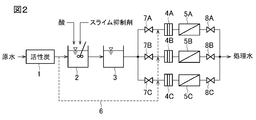
- FIG. 1 only one RO device 5 is installed, but a plurality of RO devices 5, for example, as shown in FIG. 2, three RO devices 5A, 5B, and 5C are installed in parallel and operated by the merry-go-round method. You may. Valves 7A to 7C and 8A to 8C are provided before and after each RO device 5A to 5C.
- the RO processing process is first performed by the RO devices 5A and 5B, and the RO device 5C is used as the cleaning process.
- the valves 7A, 7B, 8A, 8B are opened, and the water to be treated from the reaction tank 2 is passed through the RO devices 5A, 5B. Further, the valves 7C and 8C are closed, the activated carbon tower runoff water is introduced into the RO device 5C via the filter 4C, and the cleaning step is performed.
- the step of passing the activated carbon tower outflow water through the filter 4C and discharging the filter 4C cleaning wastewater from the filtration cleaning drainage discharge pipe (not shown) of the filter 4C is performed. It is preferable to provide it. By providing this step, it is possible to prevent the contaminants adhering to the filter 4C from recontaminating the RO apparatus 5C.
- the RO apparatus 5C is washed (rinsed) with raw water adjusted to pH 4 to 8 by adding an acid in the reaction tank 2, and then returned to the RO treatment step.
- the cleaning drainage is discharged to the outside of the system from the cleaning drainage discharge pipe (not shown) of the RO device 5C.
- the activated carbon tower runoff water is introduced into the RO device 5A, and the water to be treated from the reaction tank 2 is introduced into the RO devices 5B and 5C. Pass water.
- the activated carbon tower runoff water is introduced into the RO device 5B, and the water to be treated from the reaction tank 2 is introduced into the RO devices 5A and 5C. Pass water.
- FIG. 2 For example, in FIG. 2, three RO devices are shown, but two or four or more RO devices may be used. Further, in FIG. 2, the cleaning process is performed by one RO device and the RO processing process is performed by another RO device. However, when a large number of RO devices are installed in parallel, the cleaning process is performed by two or more RO devices. The process may be performed and the RO processing process may be performed by another RO device.
- the activated carbon tower runoff water is used in the cleaning step, but alkaline water having a pH of 9.5 or higher before being treated in the activated carbon tower 1 may be used in the cleaning step.
- the turbidity, TOC component, and the like are preferably water quality equal to or higher than that of the water supplied by the RO device 5, it is preferable to perform pretreatment equivalent to that of the water supplied by the RO device 5 except for pH adjustment.
- the activated carbon tower is used in FIG. 2, a pretreatment means other than the activated carbon tower may be installed.
- the alkaline water may be wastewater from different processes in the same facility.
Landscapes
- Chemical & Material Sciences (AREA)
- Engineering & Computer Science (AREA)
- Water Supply & Treatment (AREA)
- Chemical Kinetics & Catalysis (AREA)
- Nanotechnology (AREA)
- Life Sciences & Earth Sciences (AREA)
- Organic Chemistry (AREA)
- Hydrology & Water Resources (AREA)
- Environmental & Geological Engineering (AREA)
- Polymers & Plastics (AREA)
- Medicinal Chemistry (AREA)
- Biodiversity & Conservation Biology (AREA)
- Microbiology (AREA)
- Health & Medical Sciences (AREA)
- Materials Engineering (AREA)
- Separation Using Semi-Permeable Membranes (AREA)
- Water Treatment By Sorption (AREA)
Abstract
被処理水をpH4~8の範囲に調整して逆浸透膜装置に通水する逆浸透膜処理方法であって、間欠的にpH9.5以上のアルカリ水を該逆浸透膜装置の逆浸透膜に接触させることを特徴とする逆浸透膜処理方法。原水を活性炭などで前処理して前記被処理水としてもよい。前記被処理水がpH9.5以上の場合、前記アルカリ水としてこの被処理水を用いてもよい。
Description
本発明は被処理水を逆浸透膜装置(以下、RO装置ということがある。)で処理する逆浸透膜処理方法に関する。詳しくは、本発明は、pH9.5以上の高アルカリ性水をRO膜装置に間欠的に接触させる逆浸透膜処理方法に関する。
逆浸透膜(RO膜)を用い、被処理水中の濁質や溶解性物質、イオン類を分離する逆浸透膜分離処理においては、被処理水中に含まれる微生物が装置配管内や膜面で増殖してスライムを形成し、透過水量(フラックス)低下等の障害を引き起こすことがある。
このような微生物による透過膜の汚染を防止するために、被処理水に殺菌剤を常時又は間欠的に添加し、被処理水又は装置内を殺菌しながら膜分離する方法が知られている。一般的には、安価であり取り扱いも比較的容易な殺菌剤として、次亜塩素酸ナトリウムなどの塩素系酸化剤を添加し、微生物を殺菌する方法が行われている。
しかしながら、透過膜がポリアミド系高分子膜のような耐塩素性を持たない透過膜である場合、このような塩素系酸化剤を添加すると、透過膜は塩素系酸化剤由来の遊離塩素による酸化劣化をうけ、除去率が低下してしまうという問題があった。
特開平1-104310号公報、特開平1-135506号公報には、このような透過膜の劣化を最小限にするために、遊離塩素による殺菌後、アンモニウムイオンを添加し、クロラミン(モノクロラミン、ジクロラミン)を生成させる方法、或いはクロラミンT、ジクロラミンT等の結合塩素化合物を添加する方法が示されている。
特開2006-263510号公報には、膜分離装置への給水又は洗浄水に、塩素系酸化剤とスルファミン酸化合物とからなる結合塩素剤を存在させる膜分離方法が記載されている。
特開2005-81269号公報には、有機物含有排水を逆浸透膜処理する方法において、フラックス低下を防止するために、有機物含有排水にアルカリを添加してpH9.5以上に調整した後、逆浸透膜処理し、その後pHを4~8に調整することが記載されている。
アンモニアを含有する被処理水をRO処理する場合、被処理水を高pHにすると、アンモニアはその大部分が非イオン性のNH4として存在し、ROによって十分にアンモニアを除去することができない。そのため、高pHかつアンモニアを含有する被処理水をRO処理する場合は、酸を添加してpH4~8程度にすると共に、膜ファウリングを防止するためにスライム抑制剤(スライム防止剤)を添加した後、RO装置に供給する。
このようにスライム抑制剤を添加しても、TOC濃度が高く、バイオポテンシャルの高い被処理水にあっては、経時的にスライム発生等により膜ファウリングが進行するので、定期的に又は差圧上昇時に膜洗浄を行う必要がある。この洗浄としては、アルカリ剤を用いた定置洗浄(CIP洗浄)が行われることが多い。
この定期的な膜洗浄の頻度を多くすると、洗浄薬剤コストが高くなる。洗浄頻度を少なくしたのでは、膜ファウリングが進行する。また、膜差圧上昇を検知して膜洗浄を行う場合には、差圧を検知して洗浄を行う機構や運転作業員が必要となる。
以上のように、アンモニアを含有するTOC濃度が高い被処理水を中和し、スライム抑制剤を添加してRO処理する従来方法にあっては、洗浄薬剤コストが嵩む、定置洗浄設備が必要となる、あるいは作業人件費コストが嵩む等の課題があった。
本発明は、被処理水を低コストで、かつスライムを抑制して効率よく処理することができる逆浸透膜処理方法を提供することを目的とする。
本発明の逆浸透膜処理方法は、被処理水をpH4~8の範囲に調整して逆浸透膜装置に通水する逆浸透膜処理方法であって、間欠的にpH9.5以上のアルカリ水を該逆浸透膜装置の逆浸透膜に接触させることを特徴とする。
本発明の一態様では、前記被処理水がpH9.5以上であって、前記アルカリ水として前記pH9.5以上の前記被処理水を用いる。
本発明の一態様では、前記アルカリ水は、同じ施設内の異なる工程からの排水である。
本発明の一態様では、前記逆浸透膜装置が並列に複数設置されており、少なくとも一つの逆浸透膜装置の逆浸透膜にpH9.5以上のアルカリ水を接触させている間、他の逆浸透膜装置にpH4~8に調整した被処理水を通水して逆浸透膜処理する。
本発明の一態様では、原水を前処理して前記被処理水及び/又はアルカリ水とする工程を有する。
本発明の一態様では、前記前処理は活性炭処理である。
本発明の一態様では、前記被処理水及び/又はアルカリ水のアンモニア濃度が1mg/L以上である。
本発明の一態様では、前記被処理水のTOC濃度が0.5mg/L以上である。
本発明の一態様では、前記pH9.5以上のアルカリ水と前記逆浸透膜とを接触させる工程を12時間~1カ月に1回の頻度で行う。
本発明の逆浸透膜処理方法では、高pHの被処理水や他工程からの排水を用いてRO膜の洗浄を行うため、洗浄頻度を多くしても、RO膜の洗浄薬剤コストがかからないので、洗浄コストが低い。また、洗浄頻度を多くすることにより、RO膜ファウリングを十分に抑制することができる。
本発明の一態様では、高pHの被処理水をpH4~8に調整した後、RO処理するので、被処理水がアンモニアを含有する場合でも、十分にアンモニアを除去することができる。
本発明の一態様では、pH9.5以上の被処理水(原水)をpH4~8、好ましくは5~7に調整してから逆浸透膜装置(RO装置)に通水する。本発明では、被処理水がアンモニアを含むもの、特にアンモニア濃度が1mg/L以上とりわけ1~10000mg/Lの高濃度である被処理水を処理する場合に好適である。アンモニアは弱塩基性であるため、このような濃度のアンモニア含有水は通常pH9.5以上となる。また、TOC濃度が0.5mg/L以上、特に2~50mg/Lの被処理水を処理する場合に好適である。このような被処理水としては、半導体は液晶などの製造工程の洗浄排水などが例示されるが、これに限定されない。被処理水のpHの上限は特に制限されるものではないが、通常はpH12未満である。
本発明では、被処理水を活性炭等によって前処理してもよい。被処理水を前処理として活性炭処理することにより、オゾン、過酸化物などを除去してRO膜の劣化を防止することができる。また、被処理水中の有機物(TOC成分)の一部を除去してRO膜のTOC負荷を低減する効果も奏される。なお、前処理手段は活性炭処理に限定されるものではなく、活性汚泥や浮遊担体法による生物処理、薬剤によるH2O2の還元処理、除濁フィルターや濾過装置或は除濁膜装置による除濁処理などの1又は2以上を採用してもよい。
このように必要に応じて活性炭等によって前処理した被処理水に酸を添加してpH4~8好ましくは5~7に調整する。また、このpH調整の後(又は前もしくは同時)にスライム抑制剤を添加する。酸としては、硫酸、塩酸などを用いることができる。スライム抑制剤としては、前述の特許文献1~3に記載のものが例示されるが、その他のものであってもよい。なお、RO膜が耐塩素性が低いものである場合には、塩素系酸化剤以外のスライム抑制剤を用いることが好ましい。
pH調整及びスライム抑制剤添加された被処理水を、必要に応じフィルターに通水した後、RO装置に通水する。フィルターとしては、カートリッジフィルターやフィルターエレメントを用いた自動逆洗式フィルターなどを用いることができる。
このように、高pHの被処理水をpH4~8に調整した後、RO処理するので、被処理水がアンモニアを含有する場合でも、十分にアンモニアを除去することができる。
RO装置への被処理水の通水を所定時間行った後、pH9.5以上の被処理水によってRO膜を洗浄する。この膜洗浄用のpH9.5以上の被処理水としては、原水を懸濁物質除去処理したものが好適であり、上記の前処理水特に活性炭処理水が好適である。膜洗浄に供する被処理水のpHの上限は特に制限されるものではないが、RO膜の劣化を防止するため12未満とすることが好ましい。このため、被処理水のpHが12を超える場合には、適宜酸などを添加してpH=9.5~12の範囲とすることができる。
RO膜の洗浄を行うには、RO装置の原水側にpH9.5以上の被処理水を導入した後、この導入を停止し、所定時間(例えば下限としては2時間とくに5時間が好ましく、上限としては24時間特に12時間が好ましい)その状態を維持するのが好ましい。膜洗浄用に導入した被処理水のpHが9.5以上であるため、この間に、膜面等に付着したスライムが溶解除去される。
その後、好ましくはRO装置の透過水、pH4~8に調整した原水或はその他の清浄水を用いてRO装置を洗浄(リンス)した後、RO装置へのpH4~8の被処理水の通水(RO処理)を再開する。
このpH9.5以上の被処理水による膜洗浄には、アルカリ薬剤を使用しないので、薬剤コストが実質的にかからない。(ただし、必要に応じ、少量のアルカリ薬剤を膜洗浄用のpH9.5以上の被処理水に添加してもよい。)そのため、膜洗浄を例えば12時間から1カ月、好ましくは12時間から1週間、とりわけ12時間から60時間に1回程度の高頻度で行っても、薬剤コストはゼロ又は著しく低いものとなる。また、この洗浄方法であれば、従来のアルカリ薬剤を用いた膜洗浄のような洗浄設備が不要であり、洗浄設備コストも著しく低いものとなる。洗浄作業のための人件費コストもゼロ又は著しく低いものとなる。更に、洗浄間隔を短くすることにより、膜の汚染が進行しない状況で洗浄を実施することが可能となるため、効果的に洗浄を行うことが可能となる。
図1に、上記の洗浄方法が適用される水処理設備の一例を示す。
原水は、活性炭塔1を経て反応槽2に導入され、酸添加されてpH4~8に調整されると共に、スライム抑制剤が添加される。活性炭塔1は生物活性炭塔であってもよい。反応槽2内の水は、中継槽3、フィルター4及びポンプ(図示略)を経てRO装置5に通水され、処理水が得られる。濃縮水は、濃縮水排出ライン(図示略)によって排出される。活性炭塔1の流出水をRO装置5(この例では、フィルター4の前段側)に導入するために、バイパス配管6が設けられている。
図1では、RO装置5が1基のみ設置されているが、複数基、例えば図2のように、3基のRO装置5A,5B,5Cを並列に設置し、メリーゴーランド方式にて運転を行ってもよい。なお、各RO装置5A~5Cの前後にバルブ7A~7C、8A~8Cが設けられている。
メリーゴーランド方式の運転を行う場合、例えばまずRO装置5A,5BでRO処理工程を行い、RO装置5Cを洗浄工程とする。具体的には、バルブ7A,7B,8A,8Bを開とし、RO装置5A,5Bに反応槽2からの被処理水を通水する。また、バルブ7C,8Cを閉とし、RO装置5Cに活性炭塔流出水をフィルター4Cを経由して導入し、洗浄工程を行う。活性炭塔流出水をRO装置5Cに導入するに先立ち、まず、活性炭塔流出水をフィルター4Cに通水し、フィルター4Cの濾過洗浄排水排出配管(図示略)よりフィルター4C洗浄排水を排出する工程を設けることが好ましい。この工程を設けることで、フィルター4Cに付着した汚染物質がRO装置5Cを再汚染することを防止することができる。洗浄終了後は、反応槽2で酸を添加してpH4~8に調整した原水で、RO装置5Cを洗浄(リンス)した後、RO処理工程に復帰する。なお、洗浄排水はRO装置5Cの洗浄排水排出配管(図示略)から系外に排出する。
RO装置5Aで洗浄工程を行い、RO装置5B,5CでRO処理工程を行うときには、RO装置5Aに活性炭塔流出水を導入し、RO装置5B,5Cには反応槽2からの被処理水を通水する。RO装置5Bで洗浄工程を行い、RO装置5A,5CでRO処理工程を行うときには、RO装置5Bに活性炭塔流出水を導入し、RO装置5A,5Cには反応槽2からの被処理水を通水する。
上記説明は本発明の一例であり、本発明は上記以外の形態とされてもよい。
例えば図2では、RO装置が3基示されているが、2基又は4基以上であってもよい。また、図2では1基のRO装置で洗浄工程を行い、他のRO装置でRO処理工程を行うものとしているが、多数のRO装置を並列設置した場合には、2以上のRO装置で洗浄工程を行い、他のRO装置でRO処理工程を行うようにしてもよい。
また、図1および図2では、活性炭塔流出水を洗浄工程で用いるが、活性炭塔塔1で処理する前のpH9.5以上のアルカリ水を洗浄工程で用いても良い。ただし、濁質やTOC成分などはRO装置5の給水と同等以上の水質であることが好ましいので、pH調整以外はRO装置5の給水と同等の前処理を行うことが好ましい。
また、図2では活性炭塔が用いられているが、活性炭塔以外の前処理手段が設置されてもよい。
本発明では、前記アルカリ水は、同じ施設内の異なる工程からの排水であってもよい。
本発明を特定の態様を用いて詳細に説明したが、本発明の意図と範囲を離れることなく様々な変更が可能であることは当業者に明らかである。
本出願は、2020年5月28日付で出願された日本特許出願2020-093458に基づいており、その全体が引用により援用される。
本出願は、2020年5月28日付で出願された日本特許出願2020-093458に基づいており、その全体が引用により援用される。
1 活性炭塔
2 反応槽
3 中継槽
4,4A~4C フィルター
5,5A~5C RO装置
2 反応槽
3 中継槽
4,4A~4C フィルター
5,5A~5C RO装置
Claims (9)
- 被処理水をpH4~8の範囲に調整して逆浸透膜装置に通水する逆浸透膜処理方法であって、間欠的にpH9.5以上のアルカリ水を該逆浸透膜装置の逆浸透膜に接触させることを特徴とする逆浸透膜処理方法。
- 前記被処理水がpH9.5以上であって、前記アルカリ水として前記pH9.5以上の前記被処理水を用いる、請求項1の逆浸透膜処理方法。
- 前記アルカリ水は、同じ施設内の異なる工程からの排水である、請求項1又は2の逆浸透膜処理方法。
- 前記逆浸透膜装置が並列に複数設置されており、少なくとも一つの逆浸透膜装置の逆浸透膜にpH9.5以上のアルカリ水を接触させている間、他の逆浸透膜装置にpH4~8に調整した被処理水を通水して逆浸透膜処理する、請求項1~3のいずれかの逆浸透膜処理方法。
- 原水を前処理して前記被処理水及び/又はアルカリ水とする工程を有する、請求項1~4のいずれかの逆浸透膜処理方法。
- 前記前処理は活性炭処理である、請求項5の逆浸透膜処理方法。
- 前記被処理水及び/又はアルカリ水のアンモニア濃度が1mg/L以上である、請求項1~6のいずれかの逆浸透膜処理方法。
- 前記被処理水のTOC濃度が0.5mg/L以上である、請求項1~7のいずれかの逆浸透膜処理方法。
- 前記pH9.5以上のアルカリ水と前記逆浸透膜とを接触させる工程を12時間~1カ月に1回の頻度で行う、請求項1~8のいずれかの逆浸透膜処理方法。
Priority Applications (3)
| Application Number | Priority Date | Filing Date | Title |
|---|---|---|---|
| CN202180033631.1A CN115551622A (zh) | 2020-05-28 | 2021-03-19 | 逆渗透膜处理方法 |
| US17/927,734 US20230219041A1 (en) | 2020-05-28 | 2021-03-19 | Reverse osmosis membrane processing method |
| KR1020227034855A KR102813569B1 (ko) | 2020-05-28 | 2021-03-19 | 역침투막 처리 방법 |
Applications Claiming Priority (2)
| Application Number | Priority Date | Filing Date | Title |
|---|---|---|---|
| JP2020093458A JP6973565B1 (ja) | 2020-05-28 | 2020-05-28 | 逆浸透膜処理方法 |
| JP2020-093458 | 2020-05-28 |
Publications (1)
| Publication Number | Publication Date |
|---|---|
| WO2021240967A1 true WO2021240967A1 (ja) | 2021-12-02 |
Family
ID=78723338
Family Applications (1)
| Application Number | Title | Priority Date | Filing Date |
|---|---|---|---|
| PCT/JP2021/011424 Ceased WO2021240967A1 (ja) | 2020-05-28 | 2021-03-19 | 逆浸透膜処理方法 |
Country Status (6)
| Country | Link |
|---|---|
| US (1) | US20230219041A1 (ja) |
| JP (1) | JP6973565B1 (ja) |
| KR (1) | KR102813569B1 (ja) |
| CN (1) | CN115551622A (ja) |
| TW (1) | TW202210165A (ja) |
| WO (1) | WO2021240967A1 (ja) |
Citations (13)
| Publication number | Priority date | Publication date | Assignee | Title |
|---|---|---|---|---|
| JPS5075177A (ja) * | 1973-11-07 | 1975-06-20 | ||
| JPS5077310A (ja) * | 1973-11-17 | 1975-06-24 | ||
| JPS5451982A (en) * | 1977-10-01 | 1979-04-24 | Kobe Steel Ltd | Method of turning seawater into fresh water |
| JPS6019004A (ja) * | 1983-07-14 | 1985-01-31 | Nitto Electric Ind Co Ltd | 液体分離装置の連続運転方法 |
| JPS6038167B2 (ja) * | 1977-04-12 | 1985-08-30 | 帝人株式会社 | 膜の処理方法 |
| JPH091141A (ja) * | 1995-06-14 | 1997-01-07 | Japan Organo Co Ltd | 逆浸透膜装置の運転方法 |
| JPH11128919A (ja) * | 1997-10-28 | 1999-05-18 | Kurita Water Ind Ltd | 逆浸透膜処理方法 |
| JP2000317457A (ja) * | 1999-05-12 | 2000-11-21 | Kurita Water Ind Ltd | 純水の製造方法 |
| WO2009028315A1 (ja) * | 2007-08-29 | 2009-03-05 | Kurita Water Industries Ltd. | 有機物含有水の処理方法及び処理装置 |
| JP2010005560A (ja) * | 2008-06-27 | 2010-01-14 | Kurita Water Ind Ltd | 有機アルカリ排水の処理方法及び処理装置 |
| JP2011115712A (ja) * | 2009-12-02 | 2011-06-16 | Mitsubishi Heavy Ind Ltd | 濾過膜の洗浄方法 |
| JP2011125822A (ja) * | 2009-12-21 | 2011-06-30 | Toray Ind Inc | 膜モジュールの洗浄方法および造水装置 |
| US8617398B2 (en) * | 1996-08-12 | 2013-12-31 | Debasish Mukhopadhyay | Method for high efficiency reverse osmosis operation |
Family Cites Families (24)
| Publication number | Priority date | Publication date | Assignee | Title |
|---|---|---|---|---|
| GB8807825D0 (en) * | 1988-03-31 | 1988-05-05 | Romicon Inc | Multiple membrane filtration systems |
| US4986918A (en) * | 1989-11-08 | 1991-01-22 | Romicon Inc. | Membrane separation system and method of operation |
| US5182023A (en) * | 1991-10-17 | 1993-01-26 | Texas Romec, Inc. | Process for removing arsenic from water |
| KR0142580B1 (ko) * | 1995-03-10 | 1998-07-01 | 김광호 | 논 스톱 역삼투압 장치 구성 |
| US6120689A (en) * | 1997-08-22 | 2000-09-19 | Zenon Environmental, Inc. | High purity water using triple pass reverse osmosis (TPRO) |
| JP2001104310A (ja) | 1999-10-12 | 2001-04-17 | Olympus Optical Co Ltd | 超音波診断装置 |
| JP3503547B2 (ja) | 1999-11-08 | 2004-03-08 | 株式会社村田製作所 | 可変抵抗器 |
| JP3667597B2 (ja) * | 2000-05-12 | 2005-07-06 | 三菱住友シリコン株式会社 | 半導体製造工程から排出されるアンモニア含有排水の処理方法 |
| US20030173296A1 (en) * | 2003-04-14 | 2003-09-18 | Costa Lawrence C | High recovery reverse osmosis process and apparatus |
| JP2005081269A (ja) | 2003-09-09 | 2005-03-31 | Kurita Water Ind Ltd | 有機物含有排水の処理方法及び処理装置 |
| JP4496795B2 (ja) * | 2003-11-18 | 2010-07-07 | 栗田工業株式会社 | 有機物含有排水の処理方法及び処理装置 |
| JP2006263510A (ja) | 2005-03-22 | 2006-10-05 | Kurita Water Ind Ltd | 膜分離用スライム防止剤及び膜分離方法 |
| JPWO2008059824A1 (ja) * | 2006-11-16 | 2010-03-04 | 栗田工業株式会社 | 水処理装置および水処理方法 |
| JP2008132421A (ja) * | 2006-11-28 | 2008-06-12 | Kurita Water Ind Ltd | 水処理装置および水処理方法 |
| US10023487B2 (en) * | 2006-12-12 | 2018-07-17 | Veolia Water Solutions & Technologies Support | Method of recovering oil or gas and treating the resulting produced water |
| US8216473B2 (en) * | 2008-06-13 | 2012-07-10 | Solution Dynamics, Llc | Apparatus and methods for solution processing using reverse osmosis |
| JP5608988B2 (ja) * | 2009-02-27 | 2014-10-22 | 栗田工業株式会社 | 活性炭用スライムコントロール剤、活性炭装置への通水方法、有機物含有水の処理方法及び処理装置 |
| US8753513B2 (en) * | 2010-11-09 | 2014-06-17 | International Business Machines Corporation | Ammonia-peroxide wastewater treatment system |
| US9719179B2 (en) * | 2012-05-23 | 2017-08-01 | High Sierra Energy, LP | System and method for treatment of produced waters |
| US10287201B2 (en) * | 2013-01-18 | 2019-05-14 | Chevron U.S.A. Inc. | Methods and systems for treating produced water |
| WO2016037149A1 (en) * | 2014-09-04 | 2016-03-10 | Clean Chemistry, Inc. | Method of water treatment utilizing a peracetate oxidant solution |
| TW201803811A (zh) * | 2016-07-27 | 2018-02-01 | 栗田工業股份有限公司 | 有機性廢水的處理方法 |
| WO2018142904A1 (ja) * | 2017-02-02 | 2018-08-09 | オルガノ株式会社 | 逆浸透膜の改質方法、逆浸透膜、および、非荷電物質含有水の処理方法、逆浸透膜の運転方法および逆浸透膜装置 |
| WO2019143951A1 (en) * | 2018-01-22 | 2019-07-25 | Ecolab Usa Inc. | Method for permeate flow path sanitization in a reverse osmosis system |
-
2020
- 2020-05-28 JP JP2020093458A patent/JP6973565B1/ja active Active
-
2021
- 2021-03-19 WO PCT/JP2021/011424 patent/WO2021240967A1/ja not_active Ceased
- 2021-03-19 US US17/927,734 patent/US20230219041A1/en active Pending
- 2021-03-19 KR KR1020227034855A patent/KR102813569B1/ko active Active
- 2021-03-19 CN CN202180033631.1A patent/CN115551622A/zh active Pending
- 2021-05-14 TW TW110117400A patent/TW202210165A/zh unknown
Patent Citations (13)
| Publication number | Priority date | Publication date | Assignee | Title |
|---|---|---|---|---|
| JPS5075177A (ja) * | 1973-11-07 | 1975-06-20 | ||
| JPS5077310A (ja) * | 1973-11-17 | 1975-06-24 | ||
| JPS6038167B2 (ja) * | 1977-04-12 | 1985-08-30 | 帝人株式会社 | 膜の処理方法 |
| JPS5451982A (en) * | 1977-10-01 | 1979-04-24 | Kobe Steel Ltd | Method of turning seawater into fresh water |
| JPS6019004A (ja) * | 1983-07-14 | 1985-01-31 | Nitto Electric Ind Co Ltd | 液体分離装置の連続運転方法 |
| JPH091141A (ja) * | 1995-06-14 | 1997-01-07 | Japan Organo Co Ltd | 逆浸透膜装置の運転方法 |
| US8617398B2 (en) * | 1996-08-12 | 2013-12-31 | Debasish Mukhopadhyay | Method for high efficiency reverse osmosis operation |
| JPH11128919A (ja) * | 1997-10-28 | 1999-05-18 | Kurita Water Ind Ltd | 逆浸透膜処理方法 |
| JP2000317457A (ja) * | 1999-05-12 | 2000-11-21 | Kurita Water Ind Ltd | 純水の製造方法 |
| WO2009028315A1 (ja) * | 2007-08-29 | 2009-03-05 | Kurita Water Industries Ltd. | 有機物含有水の処理方法及び処理装置 |
| JP2010005560A (ja) * | 2008-06-27 | 2010-01-14 | Kurita Water Ind Ltd | 有機アルカリ排水の処理方法及び処理装置 |
| JP2011115712A (ja) * | 2009-12-02 | 2011-06-16 | Mitsubishi Heavy Ind Ltd | 濾過膜の洗浄方法 |
| JP2011125822A (ja) * | 2009-12-21 | 2011-06-30 | Toray Ind Inc | 膜モジュールの洗浄方法および造水装置 |
Also Published As
| Publication number | Publication date |
|---|---|
| KR20230019412A (ko) | 2023-02-08 |
| JP2021186727A (ja) | 2021-12-13 |
| CN115551622A (zh) | 2022-12-30 |
| TW202210165A (zh) | 2022-03-16 |
| KR102813569B1 (ko) | 2025-05-28 |
| US20230219041A1 (en) | 2023-07-13 |
| JP6973565B1 (ja) | 2021-12-01 |
Similar Documents
| Publication | Publication Date | Title |
|---|---|---|
| KR101671168B1 (ko) | 활성탄용 슬라임 컨트롤제, 활성탄 장치에 대한 통수 방법, 유기물 함유수의 처리 방법 및 처리 장치 | |
| JP5757089B2 (ja) | 有機物含有水の処理方法及び処理装置 | |
| US5647988A (en) | Method of back-washing submerged-type ceramic membrane separation apparatus | |
| CN101531421B (zh) | 处理废水的方法和废水处理装置 | |
| JP2005087887A (ja) | 膜の洗浄方法 | |
| US20060273038A1 (en) | Chemical cleaning for membranes | |
| WO2002004361A1 (en) | System and method for simultaneous removal of arsenic and fluoride from aqueous solutions | |
| JP4192205B2 (ja) | 膜の洗浄方法及び膜の洗浄装置 | |
| JP2009509731A (ja) | 化学洗浄剤および濾過膜洗浄方法 | |
| JP3735883B2 (ja) | 膜分離装置及び膜モジュールの洗浄方法 | |
| JP2007130523A (ja) | 水処理システムにおける膜洗浄方法 | |
| CN102730824A (zh) | 膜分离活性污泥装置进行的有机性排水的处理方法 | |
| JP4241684B2 (ja) | 膜モジュールの洗浄方法 | |
| JP6540154B2 (ja) | 逆浸透膜の洗浄方法 | |
| JP2015229146A (ja) | 膜モジュールの洗浄方法 | |
| JP6973565B1 (ja) | 逆浸透膜処理方法 | |
| JP2009160512A (ja) | 膜ろ過装置の排水処理方法 | |
| WO2023026554A1 (ja) | フッ素含有水の処理方法及び装置 | |
| JP4862005B2 (ja) | 水処理方法および水処理装置 | |
| WO2020026857A1 (ja) | 膜ろ過装置の洗浄方法および水処理方法 | |
| JPH01119306A (ja) | 逆浸透膜の洗浄方法 | |
| EP1204463B1 (fr) | Perfectionnements apportes au lavage chimique et, en particulier au rin age des dispositifs de separation membranaire de solutions et de suspension | |
| JP2022146502A (ja) | 有機排水の処理装置 | |
| JP2007245051A (ja) | ろ過膜の洗浄方法 | |
| US20160368801A1 (en) | Method and apparatus for treating wastewater containing cationic surfactant |
Legal Events
| Date | Code | Title | Description |
|---|---|---|---|
| 121 | Ep: the epo has been informed by wipo that ep was designated in this application |
Ref document number: 21811882 Country of ref document: EP Kind code of ref document: A1 |
|
| NENP | Non-entry into the national phase |
Ref country code: DE |
|
| 122 | Ep: pct application non-entry in european phase |
Ref document number: 21811882 Country of ref document: EP Kind code of ref document: A1 |