WO2021235496A1 - 電気光学素子用複合基板 - Google Patents
電気光学素子用複合基板 Download PDFInfo
- Publication number
- WO2021235496A1 WO2021235496A1 PCT/JP2021/019037 JP2021019037W WO2021235496A1 WO 2021235496 A1 WO2021235496 A1 WO 2021235496A1 JP 2021019037 W JP2021019037 W JP 2021019037W WO 2021235496 A1 WO2021235496 A1 WO 2021235496A1
- Authority
- WO
- WIPO (PCT)
- Prior art keywords
- dielectric constant
- electro
- constant layer
- high dielectric
- substrate
- Prior art date
- Legal status (The legal status is an assumption and is not a legal conclusion. Google has not performed a legal analysis and makes no representation as to the accuracy of the status listed.)
- Ceased
Links
Images

Classifications
-
- G—PHYSICS
- G02—OPTICS
- G02F—OPTICAL DEVICES OR ARRANGEMENTS FOR THE CONTROL OF LIGHT BY MODIFICATION OF THE OPTICAL PROPERTIES OF THE MEDIA OF THE ELEMENTS INVOLVED THEREIN; NON-LINEAR OPTICS; FREQUENCY-CHANGING OF LIGHT; OPTICAL LOGIC ELEMENTS; OPTICAL ANALOGUE/DIGITAL CONVERTERS
- G02F1/00—Devices or arrangements for the control of the intensity, colour, phase, polarisation or direction of light arriving from an independent light source, e.g. switching, gating or modulating; Non-linear optics
- G02F1/01—Devices or arrangements for the control of the intensity, colour, phase, polarisation or direction of light arriving from an independent light source, e.g. switching, gating or modulating; Non-linear optics for the control of the intensity, phase, polarisation or colour
- G02F1/011—Devices or arrangements for the control of the intensity, colour, phase, polarisation or direction of light arriving from an independent light source, e.g. switching, gating or modulating; Non-linear optics for the control of the intensity, phase, polarisation or colour in optical waveguides, not otherwise provided for in this subclass
- G02F1/0115—Devices or arrangements for the control of the intensity, colour, phase, polarisation or direction of light arriving from an independent light source, e.g. switching, gating or modulating; Non-linear optics for the control of the intensity, phase, polarisation or colour in optical waveguides, not otherwise provided for in this subclass in optical fibres
- G02F1/0118—Devices or arrangements for the control of the intensity, colour, phase, polarisation or direction of light arriving from an independent light source, e.g. switching, gating or modulating; Non-linear optics for the control of the intensity, phase, polarisation or colour in optical waveguides, not otherwise provided for in this subclass in optical fibres by controlling the evanescent coupling of light from a fibre into an active, e.g. electro-optic, overlay
-
- G—PHYSICS
- G02—OPTICS
- G02F—OPTICAL DEVICES OR ARRANGEMENTS FOR THE CONTROL OF LIGHT BY MODIFICATION OF THE OPTICAL PROPERTIES OF THE MEDIA OF THE ELEMENTS INVOLVED THEREIN; NON-LINEAR OPTICS; FREQUENCY-CHANGING OF LIGHT; OPTICAL LOGIC ELEMENTS; OPTICAL ANALOGUE/DIGITAL CONVERTERS
- G02F1/00—Devices or arrangements for the control of the intensity, colour, phase, polarisation or direction of light arriving from an independent light source, e.g. switching, gating or modulating; Non-linear optics
- G02F1/01—Devices or arrangements for the control of the intensity, colour, phase, polarisation or direction of light arriving from an independent light source, e.g. switching, gating or modulating; Non-linear optics for the control of the intensity, phase, polarisation or colour
- G02F1/03—Devices or arrangements for the control of the intensity, colour, phase, polarisation or direction of light arriving from an independent light source, e.g. switching, gating or modulating; Non-linear optics for the control of the intensity, phase, polarisation or colour based on ceramics or electro-optical crystals, e.g. exhibiting Pockels effect or Kerr effect
- G02F1/035—Devices or arrangements for the control of the intensity, colour, phase, polarisation or direction of light arriving from an independent light source, e.g. switching, gating or modulating; Non-linear optics for the control of the intensity, phase, polarisation or colour based on ceramics or electro-optical crystals, e.g. exhibiting Pockels effect or Kerr effect in an optical waveguide structure
-
- G—PHYSICS
- G02—OPTICS
- G02F—OPTICAL DEVICES OR ARRANGEMENTS FOR THE CONTROL OF LIGHT BY MODIFICATION OF THE OPTICAL PROPERTIES OF THE MEDIA OF THE ELEMENTS INVOLVED THEREIN; NON-LINEAR OPTICS; FREQUENCY-CHANGING OF LIGHT; OPTICAL LOGIC ELEMENTS; OPTICAL ANALOGUE/DIGITAL CONVERTERS
- G02F1/00—Devices or arrangements for the control of the intensity, colour, phase, polarisation or direction of light arriving from an independent light source, e.g. switching, gating or modulating; Non-linear optics
- G02F1/01—Devices or arrangements for the control of the intensity, colour, phase, polarisation or direction of light arriving from an independent light source, e.g. switching, gating or modulating; Non-linear optics for the control of the intensity, phase, polarisation or colour
- G02F1/03—Devices or arrangements for the control of the intensity, colour, phase, polarisation or direction of light arriving from an independent light source, e.g. switching, gating or modulating; Non-linear optics for the control of the intensity, phase, polarisation or colour based on ceramics or electro-optical crystals, e.g. exhibiting Pockels effect or Kerr effect
- G02F1/0305—Constructional arrangements
-
- B—PERFORMING OPERATIONS; TRANSPORTING
- B32—LAYERED PRODUCTS
- B32B—LAYERED PRODUCTS, i.e. PRODUCTS BUILT-UP OF STRATA OF FLAT OR NON-FLAT, e.g. CELLULAR OR HONEYCOMB, FORM
- B32B15/00—Layered products comprising a layer of metal
- B32B15/04—Layered products comprising a layer of metal comprising metal as the main or only constituent of a layer, which is next to another layer of the same or of a different material
-
- G—PHYSICS
- G02—OPTICS
- G02B—OPTICAL ELEMENTS, SYSTEMS OR APPARATUS
- G02B6/00—Light guides; Structural details of arrangements comprising light guides and other optical elements, e.g. couplings
- G02B6/10—Light guides; Structural details of arrangements comprising light guides and other optical elements, e.g. couplings of the optical waveguide type
- G02B6/12—Light guides; Structural details of arrangements comprising light guides and other optical elements, e.g. couplings of the optical waveguide type of the integrated circuit kind
-
- G—PHYSICS
- G02—OPTICS
- G02F—OPTICAL DEVICES OR ARRANGEMENTS FOR THE CONTROL OF LIGHT BY MODIFICATION OF THE OPTICAL PROPERTIES OF THE MEDIA OF THE ELEMENTS INVOLVED THEREIN; NON-LINEAR OPTICS; FREQUENCY-CHANGING OF LIGHT; OPTICAL LOGIC ELEMENTS; OPTICAL ANALOGUE/DIGITAL CONVERTERS
- G02F1/00—Devices or arrangements for the control of the intensity, colour, phase, polarisation or direction of light arriving from an independent light source, e.g. switching, gating or modulating; Non-linear optics
- G02F1/0009—Materials therefor
- G02F1/0018—Electro-optical materials
-
- G—PHYSICS
- G02—OPTICS
- G02F—OPTICAL DEVICES OR ARRANGEMENTS FOR THE CONTROL OF LIGHT BY MODIFICATION OF THE OPTICAL PROPERTIES OF THE MEDIA OF THE ELEMENTS INVOLVED THEREIN; NON-LINEAR OPTICS; FREQUENCY-CHANGING OF LIGHT; OPTICAL LOGIC ELEMENTS; OPTICAL ANALOGUE/DIGITAL CONVERTERS
- G02F1/00—Devices or arrangements for the control of the intensity, colour, phase, polarisation or direction of light arriving from an independent light source, e.g. switching, gating or modulating; Non-linear optics
- G02F1/01—Devices or arrangements for the control of the intensity, colour, phase, polarisation or direction of light arriving from an independent light source, e.g. switching, gating or modulating; Non-linear optics for the control of the intensity, phase, polarisation or colour
- G02F1/011—Devices or arrangements for the control of the intensity, colour, phase, polarisation or direction of light arriving from an independent light source, e.g. switching, gating or modulating; Non-linear optics for the control of the intensity, phase, polarisation or colour in optical waveguides, not otherwise provided for in this subclass
- G02F1/0113—Glass-based, e.g. silica-based, optical waveguides
-
- G—PHYSICS
- G02—OPTICS
- G02F—OPTICAL DEVICES OR ARRANGEMENTS FOR THE CONTROL OF LIGHT BY MODIFICATION OF THE OPTICAL PROPERTIES OF THE MEDIA OF THE ELEMENTS INVOLVED THEREIN; NON-LINEAR OPTICS; FREQUENCY-CHANGING OF LIGHT; OPTICAL LOGIC ELEMENTS; OPTICAL ANALOGUE/DIGITAL CONVERTERS
- G02F1/00—Devices or arrangements for the control of the intensity, colour, phase, polarisation or direction of light arriving from an independent light source, e.g. switching, gating or modulating; Non-linear optics
- G02F1/01—Devices or arrangements for the control of the intensity, colour, phase, polarisation or direction of light arriving from an independent light source, e.g. switching, gating or modulating; Non-linear optics for the control of the intensity, phase, polarisation or colour
- G02F1/03—Devices or arrangements for the control of the intensity, colour, phase, polarisation or direction of light arriving from an independent light source, e.g. switching, gating or modulating; Non-linear optics for the control of the intensity, phase, polarisation or colour based on ceramics or electro-optical crystals, e.g. exhibiting Pockels effect or Kerr effect
-
- G—PHYSICS
- G02—OPTICS
- G02B—OPTICAL ELEMENTS, SYSTEMS OR APPARATUS
- G02B6/00—Light guides; Structural details of arrangements comprising light guides and other optical elements, e.g. couplings
- G02B6/10—Light guides; Structural details of arrangements comprising light guides and other optical elements, e.g. couplings of the optical waveguide type
- G02B6/12—Light guides; Structural details of arrangements comprising light guides and other optical elements, e.g. couplings of the optical waveguide type of the integrated circuit kind
- G02B2006/12133—Functions
- G02B2006/12142—Modulator
-
- G—PHYSICS
- G02—OPTICS
- G02F—OPTICAL DEVICES OR ARRANGEMENTS FOR THE CONTROL OF LIGHT BY MODIFICATION OF THE OPTICAL PROPERTIES OF THE MEDIA OF THE ELEMENTS INVOLVED THEREIN; NON-LINEAR OPTICS; FREQUENCY-CHANGING OF LIGHT; OPTICAL LOGIC ELEMENTS; OPTICAL ANALOGUE/DIGITAL CONVERTERS
- G02F2202/00—Materials and properties
- G02F2202/09—Materials and properties inorganic glass
Definitions
- the present invention relates to a composite substrate for an electro-optical element.
- electro-optical elements are known.
- the electro-optical element can convert an electric signal into an optical signal by utilizing the electro-optic effect.
- Electro-optics are used in, for example, optical and radio wave fusion communication, and their development is underway to realize high-speed, large-capacity communication, low power consumption (low drive voltage), and low footprint. .. Therefore, for the electro-optical element, for example, the adoption of a configuration using a composite substrate has begun.
- a composite substrate for an electro-optical element a composite substrate in which an electro-optical crystal substrate having an electro-optic effect and a support substrate are integrated by direct bonding via a thin film layer (for example, a high dielectric constant oxide film) is known. ing.
- Such a composite substrate has the following problems.
- the electro-optic crystal substrate and the thin film layer are directly bonded, light propagation loss may occur.
- the thin film layer and the support substrate are directly bonded, high-speed driving may be difficult, and depending on the situation, the bonding itself may not be successful and a composite substrate may not be obtained.
- the main object of the present invention is that peeling is remarkably suppressed, light propagation loss is small when an electro-optic element is used, high-speed and low-voltage driving is possible, and it is excellent even in a harsh high-temperature environment. It is an object of the present invention to provide a composite substrate capable of realizing a very thin electro-optic element capable of maintaining reliability.
- an electro-optical crystal substrate having an electro-optic effect, a first high dielectric constant layer, a second high dielectric constant layer, and a support substrate are arranged in this order.
- the first high dielectric constant layer and the second high dielectric constant layer are directly bonded to each other, and an amorphous layer is formed at the bonding interface between the first high dielectric constant layer and the second high dielectric constant layer. Is formed.
- the first high dielectric constant layer is directly formed on the electro-optical crystal substrate, and the second high dielectric constant layer is directly formed on the support substrate. Has been done.
- the support substrate contains silicon oxide as a main component, and the argon concentration in the support substrate is 1.0 atomic% or less.
- the first high dielectric constant layer is directly formed on the electro-optical crystal substrate, and the low dielectric constant layer is directly formed on the support substrate.
- the second high dielectric constant layer is directly formed on the dielectric constant layer.
- the low dielectric constant layer contains silicon oxide as a main component, and the argon concentration in the low dielectric constant layer is 1.0 atomic% or less.
- the argon concentrations in the first high dielectric constant layer and the second high dielectric constant layer may be 1.0 atomic% to 10 atomic%, respectively.
- the first high dielectric constant layer is directly formed on the electro-optical crystal substrate, and the low dielectric constant layer is directly formed on the support substrate.
- the second high dielectric constant layer is directly formed on the dielectric constant layer.
- the low dielectric constant layer is composed of one selected from silicon oxide, aluminum oxide, magnesium fluoride and calcium fluoride.
- the first high dielectric constant layer is directly formed on the electro-optical crystal substrate, and the second high dielectric constant layer is directly formed on the support substrate. Has been done.
- the thickness of the electro-optical crystal substrate is 0.1 ⁇ m or more and less than 1.0 ⁇ m, and the thickness of the first high dielectric constant layer is 0.01 ⁇ m or more, the first high dielectric constant layer and the second high dielectric constant layer.
- the total thickness of the high dielectric constant layer is 0.10 ⁇ m or less.
- the composite substrate for an electro-optic element may further have a low dielectric constant layer directly formed on the support substrate, and the second high dielectric constant layer may be directly formed on the low dielectric constant layer.
- the support substrate is one selected from silicon, glass, sialon, mulite, aluminum nitride, silicon nitride, magnesium oxide, sapphire, quartz, crystal, gallium nitride, silicon carbide and gallium oxide.
- the thickness of the electro-optical crystal substrate is 0.1 ⁇ m to 0.8 ⁇ m. In one embodiment, the thickness of the electro-optical crystal substrate is 0.2 ⁇ m to 0.6 ⁇ m. In one embodiment, the electro-optical crystal substrate comprises lithium niobate, lithium tantalate, potassium niobate phosphate, potassium niobate / lithium niobate, potassium niobate, lithium tantalate / potassium niobate, and lithium niobate. It is composed of one selected from a solid solution of lithium tantalate and lithium tantalate.
- the thickness of the first high dielectric constant layer is 0.01 ⁇ m to 0.08 ⁇ m
- the thickness of the second high dielectric constant layer is 0.001 ⁇ m to 0.04 ⁇ m.
- the first high dielectric constant layer and the second high dielectric constant layer are selected from tantalum pentoxide, niobium oxide, titanium oxide, aluminum oxide, hafnium oxide and silicon, respectively. It is composed of.
- the thickness of the low dielectric constant layer is more than 10 ⁇ m and 20 ⁇ m or less.
- the support substrate or the low dielectric constant layer directly formed on the support substrate is composed of silicon oxide as a main component, and the argon concentration in the support substrate or the low dielectric constant layer is 1.0 atom.
- the thickness of the first high dielectric constant layer is set to a predetermined value or more, and the total thickness of the first high dielectric constant layer and the second high dielectric constant layer is set to a predetermined value or less.
- the electro-optical crystal substrate can be made very thin while maintaining the above-mentioned excellent effects, and as a result, an extremely thin electro-optical element can be realized.
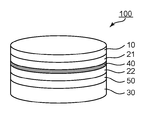
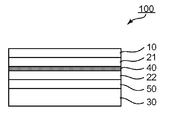
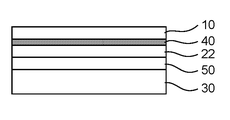
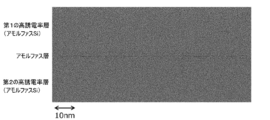
- FIG. 1 It is a schematic perspective view of the composite substrate for an electro-optic element according to one Embodiment of this invention. It is a schematic cross-sectional view of the composite substrate for an electro-optic element of FIG. It is schematic cross-sectional view of the composite substrate for an electro-optic element of Comparative Examples 1, 3, 5, 7, 9 and 11. It is schematic cross-sectional view of the composite substrate for an electro-optic element of the comparative example 2, 4, 6, 8, 10 and 12. 6 is a transmission electron microscope image showing a state of a bonding interface between a first high dielectric constant layer and a second high dielectric constant layer in the composite substrate for an electro-optical element of Example 7.
- FIG. 1 is a schematic perspective view of an electro-optic element composite substrate (hereinafter, may be simply referred to as a composite substrate) according to one embodiment of the present invention
- FIG. 2 is a schematic perspective view. It is a schematic cross-sectional view of the composite substrate of FIG.
- the composite substrate according to the embodiment of the present invention can be typically manufactured in the form of a so-called wafer, as shown in FIG.
- the size of the composite substrate can be appropriately set according to the purpose.
- the diameter of the wafer can be 4 inches (about 10 cm).
- a plurality of electro-optical elements can be manufactured from one composite substrate.
- the composite substrate is not limited to the form of the wafer, and may be manufactured and provided in various forms.
- the composite substrate 100 of the illustrated example has an electro-optical crystal substrate 10 having an electro-optical effect, a first high dielectric constant layer 21, a second high dielectric constant layer 22, and a support substrate 30 in this order.
- the first high dielectric constant layer 21 and the second high dielectric constant layer 22 are directly bonded.
- the electro-optic crystal substrate 10 and the support substrate 30 are integrated by the direct bonding of the two high dielectric constant layers.
- the first high dielectric constant layer 21 is formed by sputtering on the surface of the electro-optical crystal substrate 10; the second high dielectric constant layer 22 is formed by sputtering on the surface of the support substrate 30; The high dielectric constant layer 21 and the second high dielectric constant layer 22 are directly bonded to each other.
- the amorphous layer 40 is formed at the bonding interface of the direct bonding.
- the low dielectric constant layer 50 is formed on the second high dielectric constant layer 22 side of the support substrate 30.
- the low dielectric constant layer 50 is an arbitrary layer provided according to the purpose, and may be omitted.
- the composite substrate 100 may further have any layer (not shown).
- the type / function, number, combination, arrangement position, etc. of such layers can be appropriately set according to the purpose.
- the configuration below the support substrate 30 or the low dielectric constant layer 50 (if present) (opposite the electro-optic crystal substrate) can be appropriately set according to the purpose.
- a metal film may be provided below the support substrate 30 or the low dielectric constant layer 50 (if present).
- the dielectric constants of the first high dielectric constant layer 21 and the second high dielectric constant layer 22 are relatively low dielectric constants. It means that it is larger than the dielectric constant of the layer 50.
- the dielectric constants of the first high dielectric constant layer 21 and the second high dielectric constant layer 22 are relatively larger than the dielectric constant of the support substrate 30. means. That is, the first high dielectric constant layer 21, the second high dielectric constant layer 22, and the low dielectric constant layer 50 are not defined by the specific value of the dielectric constant of each layer. Further, the magnitude relationship between the dielectric constant of these layers and the dielectric constant of the electro-optical crystal substrate does not matter.
- the following advantages can be obtained by directly joining the first high dielectric constant layer 21 and the second high dielectric constant layer 22.
- the electro-optic element is made thinner (typically, the thickness of the electro-optic crystal substrate is 1 ⁇ m or less), it is preferable to reinforce it by compounding it with a support substrate. Furthermore, it has been found that it is effective to provide a high dielectric constant layer in such a composite substrate (electro-optical element) in order to satisfy the speed matching conditions and realize high-speed and low-voltage driving.
- the thickness of the electro-optical crystal substrate becomes 1 ⁇ m or less as described above, the effective permittivity of microwave waves (Refractive index) may become too small, and by providing a high dielectric constant layer between the electro-optical crystal substrate and the support substrate, it is possible to suppress an excessive decrease in the effective permittivity of microwave waves (refractive index). It can satisfy the speed matching condition.
- the high dielectric constant layer is a single layer, in order to integrate the electro-optic crystal substrate and the support substrate by direct bonding, the electro-optical crystal substrate and the high dielectric constant layer are directly bonded or high.
- Direct bonding between the dielectric constant layer and the support substrate is required.
- the present inventors have newly found that the position of an amorphous layer that can be formed in a direct junction via a single high dielectric constant layer has a great influence on the characteristics of an electro-optic element (for example, an optical modulator).
- the present invention has been completed. That is, when the electro-optic crystal substrate and the high dielectric constant layer are directly bonded, the amorphous layer formed at the bonding interface develops into the electro-optic crystal substrate. As a result, light is scattered and / or absorbed in the electro-optic crystal substrate, and in addition, the electro-optic constant of the electro-optic crystal substrate becomes insufficient.
- the material (substantially, atoms) constituting the support substrate can be diffused and transferred to the high dielectric constant layer via the amorphous layer formed at the bonding interface.
- the dielectric constant of the high dielectric constant layer may decrease and / or the conductivity may increase, resulting in an electric shielding effect.
- the speed matching conditions cannot be satisfied, and high-speed and low-voltage driving may become difficult.
- the bonding itself may not be successful and a composite substrate may not be obtained.
- two high dielectric constant layers are directly bonded to integrate the electro-optic crystal substrate and the support substrate.
- the amorphous layer can be formed between the two high dielectric constant layers, and the amorphous layer can be separated from both the electro-optic crystal substrate and the support substrate.
- direct bonding refers to components of a composite substrate without the intervention of an adhesive (first high dielectric constant layer 21 and second high dielectric constant layer 22 in the examples of FIGS. 1 and 2). Means that they are joined.
- the form of direct bonding can be appropriately set depending on the configuration of the layers or substrates to be bonded to each other.
- direct joining can be realized by the following procedure. In a high vacuum chamber (for example, about 1 ⁇ 10-6 Pa), a neutralized beam is applied to each bonding surface of the components (layers or substrates) to be bonded. As a result, each joint surface is activated. Then, in a vacuum atmosphere, the activated joining surfaces are brought into contact with each other and joined at room temperature.
- the load at the time of this joining can be, for example, 100N to 20000N.
- an inert gas is introduced into the chamber, and a high voltage is applied from a DC power source to the electrodes arranged in the chamber.
- a high voltage is applied from a DC power source to the electrodes arranged in the chamber.
- electrons move due to the electric field generated between the electrode (positive electrode) and the chamber (negative electrode), and a beam of atoms and ions due to the inert gas is generated.
- the ion beam is neutralized by the grid, so that the beam of neutral atoms is emitted from the high-speed atomic beam source.
- the atomic species constituting the beam is preferably an inert gas element (for example, argon (Ar), nitrogen (N)).
- the voltage at the time of activation by beam irradiation is, for example, 0.5 kV to 2.0 kV, and the current is, for example, 50 mA to 200 mA.
- the support substrate typically contains silicon oxide as a main component.
- the argon concentration in the support substrate is typically 1.0 atomic% or less, preferably 0.8 atomic% or less.
- the present inventors thin the electro-optic crystal substrate to less than 1.0 ⁇ m (for example, 0.6 ⁇ m), and the electro-optics in a harsh high temperature environment (for example, after a long-term heating reliability test). It was newly discovered that the crystal substrate may come off. As a result of diligent studies on such peeling, the present inventors have improved the film quality of the high-dielectric-constant layer and reduced the thickness of the high-dielectric-constant layer to reduce the thickness of the high-dielectric-constant layer. It was found that the peeling of the optics can be remarkably suppressed.
- the argon concentration of the high dielectric constant layer to be typically 10 atomic% or less and controlling the thickness of the high dielectric constant layer to 0.2 ⁇ m or less, it is possible to control the thickness of the high dielectric constant layer to 0.2 ⁇ m or less in a harsh high temperature environment. It was also found that the peeling of the electro-optical crystal substrate can be remarkably suppressed. Furthermore, as a result of diligently studying the requirements for forming a thin high dielectric constant layer having such excellent film quality, the present inventors control the state of the substrate or layer on which the high dielectric constant layer is formed.
- a second high dielectric constant layer having an excellent film quality and being thin is formed. I found out what I could do. That is, if the support substrate has the above configuration, a composite substrate having a very thin (for example, a thickness of less than 1 ⁇ m) electro-optic crystal substrate whose peeling is remarkably suppressed even in a harsh high temperature environment can be obtained. It can be realized. As a result, it is possible to realize a very thin electro-optical element that can maintain excellent reliability even in a harsh high temperature environment. Such an effect solves the problem recognized only when the electro-optical crystal substrate is further thinned, and is an unexpectedly excellent effect.
- the other excellent effects according to the embodiment of the present invention can be maintained even in the harsh high temperature environment.
- the argon concentration in the support substrate can be determined, for example, by purifying the support substrate by forming it by using the sol-gel method, by irradiating the formed support substrate with soft X-rays, or by using these. By combining the above, it is possible to control to the above desired range.
- the first high dielectric constant layer and the second high dielectric constant layer may be collectively referred to as a “high dielectric constant layer”.
- “first” and “second” are specified.
- the low dielectric constant layer when the low dielectric constant layer is provided, the low dielectric constant layer contains silicon oxide as a main component, and the argon concentration in the low dielectric constant layer is 1.0 atomic% or less. You may.
- the same effect as that of controlling the argon concentration of the support substrate can be obtained.
- the support substrate can be made of a material other than silicon oxide.
- the argon concentration in the low dielectric constant layer can be controlled by adjusting the argon partial pressure at the time of forming the low dielectric constant layer (typically, during sputtering).
- the thickness of the high dielectric constant layer any appropriate thickness can be adopted.
- the thickness of each of the high dielectric constant layers may be, for example, 0.001 ⁇ m to 1.0 ⁇ m, for example, 0.001 ⁇ m to 0.1 ⁇ m, and for example, 0.01 ⁇ m to 0.1 ⁇ m. May be good. If the thickness of the high dielectric constant layer is within such a range, it is possible to suppress an excessive decrease in the effective dielectric constant (refractive index) of the microwave due to the low dielectric constant layer and the support substrate, and at the same time, increase the effective dielectric constant of the microwave. It has the advantage that it can be made smaller.
- the electro-optic crystal substrate is very thin (for example, less than 1 ⁇ m).
- the total thickness of the first high dielectric constant layer and the second high dielectric constant layer may be, for example, 0.005 ⁇ m to 0.2 ⁇ m, and may be, for example, 0.008 ⁇ m to 0.15 ⁇ m.
- it may be 0.01 ⁇ m to 0.1 ⁇ m, or may be, for example, 0.03 ⁇ m to 0.08 ⁇ m.
- the effect of controlling the thickness of each of the high dielectric constant layers can be further remarkable.
- the thickness of the first high dielectric constant layer is typically 0.01 ⁇ m or more, preferably 0.02 ⁇ m or more, and more preferably 0.03 ⁇ m or more.
- the thickness of the first high dielectric constant layer may be, for example, 0.08 ⁇ m or less, or may be, for example, 0.07 ⁇ m or less.
- the total thickness of the first high dielectric constant layer and the second high dielectric constant layer is typically 0.10 ⁇ m or less, preferably 0.02 ⁇ m to 0.10 ⁇ m, and more preferably 0. It is 02 ⁇ m to 0.08 ⁇ m, more preferably 0.03 ⁇ m to 0.07 ⁇ m.
- the excellent effect of directly joining the two high dielectric constant layers to integrate the electro-optic crystal substrate and the support substrate typically, marked suppression of peeling and suppression of peeling, as well as
- the electro-optical crystal substrate can be made extremely thin while maintaining the suppression of light propagation loss and the realization of high-speed and low-voltage drive in the case of an electro-optical element.
- the electro-optic crystal substrate is thinned to, for example, less than 1 ⁇ m, for example, 0.8 ⁇ m or less, for example, 0.7 ⁇ m or less, and for example, 0.6 ⁇ m or less, the above-mentioned excellent results are obtained. The effect can be maintained.
- the thickness of the first high dielectric constant layer is too small, argon atoms diffuse into the electro-optic crystal substrate during direct bonding (more specifically, during irradiation with a neutralized beam), and / or the electro-optic crystal substrate. The crystallinity of the optics may deteriorate. As a result, a good drive voltage may not be achieved and / or the light propagation loss may increase. If the total thickness is too large, it becomes difficult to satisfy the speed matching condition, and the modulation band may decrease. As for the thickness of the second high dielectric constant layer, the thickness of the first high dielectric constant layer satisfies the above desired range, and the total thickness of the first high dielectric constant layer and the second high dielectric constant layer is satisfied.
- the thickness of the second high dielectric constant layer is preferably 0.001 ⁇ m to 0.04 ⁇ m, more preferably 0.005 ⁇ m to 0.035 ⁇ m, and further preferably 0.01 ⁇ m to 0.03 ⁇ m. When the thickness of the second high dielectric constant layer is within such a range, the function of the second high dielectric constant layer can be sufficiently ensured.
- the electro-optical crystal substrate 10 can be a layer (functional layer) having an electro-optical effect in an electro-optical element.
- a part or all of the electro-optical crystal substrate 10 can be an optical waveguide that transmits light in an electro-optical element.
- the electro-optic crystal substrate 10 has an upper surface exposed to the outside and a lower surface located in the composite substrate.
- the electro-optical crystal substrate 10 is composed of crystals of a material having an electro-optic effect.
- the optical constant (for example, the refractive index) of the electro-optical crystal substrate 10 may change when an electric field is applied.
- the c-axis of the electro-optic crystal substrate 10 may be parallel to the electro-optic crystal substrate 10.
- the electro-optical crystal substrate 10 may be an X-cut substrate or a Y-cut substrate.
- the c-axis of the electro-optic crystal substrate 10 may be perpendicular to the electro-optic crystal substrate 10. That is, the electro-optical crystal substrate 10 may be a Z-cut substrate.
- the thickness of the electro-optical crystal substrate 10 can be set to an arbitrary appropriate thickness depending on the intended purpose.
- the thickness of the electro-optical crystal substrate 10 can be, for example, 0.1 ⁇ m to 10 ⁇ m. As will be described later, since the composite substrate is reinforced by the support substrate, the thickness of the electro-optical crystal substrate can be reduced.
- the thickness of the electro-optical crystal substrate is preferably 0.2 ⁇ m or more, more preferably 0.3 ⁇ m or more, and further preferably 0.45 ⁇ m or more.
- the thickness of the electro-optic crystal substrate is preferably 5.0 ⁇ m or less, more preferably 2.8 ⁇ m or less, still more preferably 1.0 ⁇ m or less, and even more preferably less than 1.0 ⁇ m. It is particularly preferably 0.8 ⁇ m or less, and particularly preferably 0.6 ⁇ m or less.
- the upper limit of the thickness of the electro-optical crystal substrate is within such a range, the high-speed and low-voltage drive performance of the electro-optical element can be improved. Further, if the thickness of the electro-optical crystal substrate is within such a range, the effect of using the high dielectric constant layer becomes remarkable. That is, it is possible to realize driving at a higher speed and a lower voltage while suppressing a decrease in light propagation loss. Further, according to the embodiment of the present invention, even if such a very thin electro-optic crystal substrate is used, defects in a harsh high temperature environment are suppressed, so that excellent reliability can be obtained even in a harsh high temperature environment. It is possible to realize a very thin electro-optic element that can be maintained.
- any suitable material can be used as long as the effect according to the embodiment of the present invention can be obtained.
- Typical examples of such materials include dielectrics (eg, ceramics).
- Specific examples include lithium niobate (LiNbO 3 : LN), lithium tantalate (LiTaO 3 : LT), potassium niobate phosphate (KTiOPO 4 : KTP), and potassium niobate lithium (K x Li (1-x)).
- NbO 2 KLM
- potassium niobate KN
- potassium tantalate / potassium niobate KNb x Ta (1-x) O 3 : KTN
- a solid solution of lithium niobate and lithium tantalate Will be.
- the support substrate 30 has an upper surface located inside the composite substrate and a lower surface exposed to the outside.
- the support substrate 30 is provided to increase the strength of the composite substrate, whereby the thickness of the electro-optical crystal substrate can be reduced. Any suitable configuration may be adopted for the support substrate 30.
- the material constituting the support substrate include silicon (Si), glass, sialon (Si 3 N 4 -Al 2 O 3), mullite (3Al 2 O 3 ⁇ 2SiO 2 , 2Al 2 O 3 ⁇ 3SiO 2) , aluminum nitride (AlN), silicon nitride (Si 3 N 4), magnesium oxide (MgO), sapphire, quartz, quartz, gallium nitride (GaN), silicon carbide (SiC), gallium oxide (Ga 2 O 3) is given Be done.
- the support substrate 30 contains silicon oxide as a main component as described above. That is, the support substrate may be made of, for example, glass.
- the coefficient of linear expansion of the material constituting the support substrate 30 is preferably closer to the coefficient of linear expansion of the material constituting the electro-optical crystal substrate 10. With such a configuration, thermal deformation (typically, warpage) of the composite substrate can be suppressed.
- the coefficient of linear expansion of the material constituting the support substrate 30 is in the range of 50% to 150% with respect to the coefficient of linear expansion of the material constituting the electro-optical crystal substrate 10.
- the constituent material of the support substrate 30 may be the same as that of the electro-optical crystal substrate 10, and in particular, when LN or LT is used, a substrate having suppressed pyroelectricity can be used.
- any appropriate thickness can be adopted as long as it has the reinforcing effect of the composite substrate.
- the thickness of the support substrate is, for example, 100 ⁇ m to 1000 ⁇ m. If the thickness of the support substrate is too thin, the reinforcing effect and handleability may be insufficient. If the thickness of the support substrate is too thick, the following problems may occur: (1) The thickness of the substrate becomes large and it becomes difficult to flow in the conventional process, (2) The obtained electro-optic element becomes thick and the package becomes thick. The size becomes larger than before, (3) the heat dissipation of the support substrate becomes insufficient, and (4) ripple is likely to occur in the low frequency range.
- the low dielectric constant layer 50 may be formed on the support substrate 30.
- the velocity matching condition can be satisfied only by the low dielectric constant regardless of the support substrate.
- there is no movement of atoms to both the second high dielectric constant layer 22 and the support substrate 30, and the difference in the dielectric constant at the interface (as a result, the difference in the refractive index) can be increased.
- the choice of the material of the support substrate can be expanded.
- the low dielectric constant layer any suitable configuration can be adopted as long as it has such an effect.
- the material constituting the low dielectric constant layer 50 include silicon oxide (SiO 2 ), aluminum oxide (Al 2 O 3 ), magnesium fluoride (MgF 2 ), and calcium fluoride (CaF 2 ).
- the low dielectric constant layer may contain silicon oxide as a main component, and the argon concentration in the low dielectric constant layer may be 1.0 atomic% or less.
- the thickness of the low dielectric constant layer may be, for example, 0.6 ⁇ m to 20 ⁇ m, for example, 5 ⁇ m to 15 ⁇ m, for example, more than 10 ⁇ m and 20 ⁇ m or less, and for example, 12 ⁇ m to 20 ⁇ m. It may be, for example, 12 ⁇ m to 15 ⁇ m. If the thickness of the low dielectric constant layer is within such a range, there is an advantage that the speed matching conditions can be satisfied regardless of the support substrate or mainly the low dielectric constant layer. When the low dielectric constant layer is thick (for example, when the thickness exceeds 10 ⁇ m), the effect of controlling the argon concentration of the low dielectric constant layer can be remarkable.
- the argon concentration of the low dielectric constant layer within the above-mentioned desired range, it is possible to prevent the total amount of argon in the low dielectric constant layer from becoming excessively large even if the low dielectric constant layer becomes thick.
- the argon concentration of the high dielectric constant layer can be controlled to a predetermined value or less, and the peeling of the electro-optical crystal substrate can be remarkably suppressed even in a harsh high temperature environment. can.
- the first high dielectric constant layer 21 and the second high dielectric constant layer 22 may have the same configuration (substantially, constituent materials and thickness), and have different configurations from each other. There may be.
- the first high dielectric constant layer 21 and the second high dielectric constant layer 22 can each be made of the same material.
- the first high dielectric constant layer and the second high dielectric constant layer 22 made of different constituent materials are directly bonded, the first high dielectric constant layer and the second high dielectric constant layer and the second are formed through the amorphous layer formed at the bonding interface. Materials (substantially atoms) constituting the high dielectric constant layer of the above can diffuse and migrate to each other.
- the portion near the amorphous layer of the first high dielectric constant layer and the second high dielectric constant layer may have a composition different from that of the other portions.
- it can cause unexpected increases in conductivity and / or the generation of excessive stress.
- the high dielectric constant layer any suitable configuration can be adopted as long as it has the effect of suppressing an excessive decrease in the effective microwave dielectric constant (refractive index) and realizing high-speed and low-voltage driving.
- the materials constituting the high dielectric constant layer include tantalum pentoxide (Ta 2 O 5 ), niobium oxide (Nb 2 O 5 ), titanium oxide (TIO 2 ), aluminum oxide, hafnium oxide, and silicon (for example, amorphous). Silicon).
- the thickness of the first high dielectric constant layer, the thickness of the second high dielectric constant layer, and the total thickness of the first high dielectric constant layer and the second high dielectric constant layer are as described in Section A above. Is.
- the argon concentration in the high dielectric constant layer may be, for example, 1.0 atomic% to 10 atomic%, for example, 1.0 atomic% to 8.0 atomic%, and for example 1.0. It may be atomic% to 6.0 atomic%, for example 1.0 atomic% to 5.0 atomic%, or for example 2.0 atomic% to 10 atomic%. Further, it may be, for example, 4.0 atomic% to 10 atomic%, or may be, for example, 5.0 atomic% to 10 atomic%. If the argon concentration of the high dielectric constant layer is in such a range, the electro-optic crystal substrate can be peeled off under a harsh high temperature environment even when the electro-optic crystal substrate is made very thin (for example, less than 1 ⁇ m).
- such an argon concentration of the high dielectric constant layer is configured such that the support substrate or the low dielectric constant layer (if present) contains silicon oxide as a main component, and the support substrate or the low dielectric constant layer is formed. It can be realized by setting the argon concentration in the above to 1.0 atomic% or less.
- the amorphous layer 40 is a layer formed at the bonding interface by direct bonding between the first high dielectric constant layer 21 and the second high dielectric constant layer 22.
- the amorphous layer 40 has an amorphous structure, and is composed of an element constituting the first high dielectric constant layer 21 and an element constituting the second high dielectric constant layer 22.
- the amorphous layer may further comprise, typically, the atomic species (typically argon, nitrogen) that make up the neutral atomic beam used for direct bonding.
- the content of such atomic species in the amorphous layer can be, for example, 1.5 atomic% to 2.5 atomic%.
- the thickness of the amorphous layer can be, for example, 0.1 nm to 100 nm, and can be, for example, 2 nm to 15 nm.
- the amorphous layer 40 is formed by diffusing the atoms of the constituent materials of the first high dielectric constant layer 21 and the second high dielectric constant layer 22 in the direct bonding. Therefore, the upper surface (interface with the first high dielectric constant layer 21) and the lower surface (interface with the second high dielectric constant layer 22) of the amorphous layer are not always flat.
- the arithmetic mean roughness of the upper and lower surfaces of the amorphous layer can be, for example, 0.1 nm to 10 nm. Further, due to such a forming process, the upper part and the lower part of the amorphous layer may have different compositions.
- the amorphous layer When such an amorphous layer is formed at the interface between the electro-optical substrate or the support substrate and the high dielectric constant layer, as described above, the amorphous layer itself adversely affects the electro-optical crystal substrate, or the amorphous layer is formed.
- the constituent material of the support substrate diffuses through the structure, which may adversely affect the high dielectric constant layer.
- the amorphous layer is separated from both the electro-optic crystal substrate and the support substrate by directly joining the first high dielectric constant layer 21 and the second high dielectric constant layer 22. Therefore, it is possible to prevent such a problem.
- Example 1 An X-cut lithium niobate substrate having a diameter of 4 inches was prepared as an electro-optical crystal substrate, and a silicon substrate having a diameter of 4 inches (thickness 500 ⁇ m) was prepared as a support substrate.
- tantalum pentoxide was sputtered onto an electro-optical crystal substrate to form a first high dielectric constant layer having a thickness of 0.03 ⁇ m.
- silicon oxide was sputtered onto the support substrate to form a low dielectric constant layer having a thickness of 10.0 ⁇ m.
- the obtained low dielectric constant layer was slightly CMP polished to reduce the arithmetic mean roughness Ra on the surface of the low dielectric constant layer.
- the surface of the low dielectric constant layer was washed, and tantalum pentoxide was sputtered on the cleaned surface to form a second high dielectric constant layer having a thickness of 0.03 ⁇ m.
- the ⁇ 10 ⁇ m arithmetic average roughness of the interface between the second high dielectric constant layer and the low dielectric constant layer, and the arithmetic average roughness of the interface between the low dielectric constant layer and the support substrate.
- the electro-optical crystal is formed by directly joining the first high dielectric constant layer and the second high dielectric constant layer.
- the substrate and the support substrate are integrated.
- the direct joining was performed as follows.
- the electro-optical crystal substrate and the support substrate are put into a vacuum chamber, and the bonding surface of the electro-optical crystal substrate and the support substrate (first high dielectric constant layer and second high dielectric constant layer) is placed in a vacuum of 10-6 Pa.
- the surface of the surface) was irradiated with a high-speed Ar neutral atom beam (acceleration voltage 1 kV, Ar flow rate 60 sccm) for 70 seconds.
- the electro-optic crystal substrate and the support substrate are allowed to cool after being left for 10 minutes, and then the beam irradiation of the joint surface between the electro-optic crystal substrate and the support substrate (the first high dielectric constant layer and the second high dielectric constant layer).
- the surfaces) were brought into contact with each other and pressurized at 4.90 kN for 2 minutes to bond the electro-optical crystal substrate and the support substrate.
- the electro-optical crystal substrate was polished until the thickness became 0.5 ⁇ m to obtain the composite substrate for the electro-optic element shown in FIG. In the obtained composite substrate for an electro-optic element, no defects such as peeling were observed at the bonding interface.
- an optical waveguide (ridge type waveguide) and electrodes were formed to fabricate an optical modulator.
- the gap between the electrodes was 3 ⁇ m and the electrode length L was 1 cm
- the product V ⁇ ⁇ L of the half-wave voltage V ⁇ and the electrode length L was 1.0 Vcm.
- the propagation loss of the optical waveguide was 0.5 dB.
- the modulation band was 50 GHz, and no ripple was detected in the modulation characteristics below this frequency.
- Example 2 A composite for an electro-optical element similar to FIG. 2 in the same manner as in Example 1 except that a quartz glass substrate (thickness 500 ⁇ m) was used as the support substrate and a low dielectric constant layer was not formed on the support substrate. A substrate (however, no low dielectric constant layer between the second high dielectric constant layer and the support substrate) was obtained. In the obtained composite substrate for an electro-optic element, no defects such as peeling were observed at the bonding interface. Further, an optical modulator was manufactured from the obtained composite substrate. The product V ⁇ ⁇ L of the half-wavelength voltage V ⁇ and the electrode length L was 1.0 Vcm. The propagation loss of the optical waveguide was 0.5 dB. Further, the modulation band was 50 GHz, and no ripple was detected in the modulation characteristics below this frequency.
- Example 1 The same as in Example 1 except that the first high dielectric constant layer was not formed on the electro-optical crystal substrate (that is, the electro-optical crystal substrate 10 and the second high dielectric constant layer 22 were directly bonded).
- the composite substrate for the electro-optical element shown in FIG. 3 was obtained. In the obtained composite substrate for an electro-optic element, no defects such as peeling were observed at the bonding interface. Further, an optical modulator was manufactured from the obtained composite substrate.
- the product V ⁇ ⁇ L of the half-wave voltage V ⁇ and the electrode length L was 1.2 Vcm.
- the propagation loss of the optical waveguide was 1.0 dB. Further, the modulation band was 50 GHz, and no ripple was detected in the modulation characteristics below this frequency.
- the reason for the increase in the half-wave voltage is that the amorphous layer 40 formed at the junction interface has grown in the electro-optical crystal substrate 10, and the electro-optic effect of the lithium niobate crystal has decreased in this region. Probably the cause. It can be inferred that the change in the refractive index of the optical electric field distributed in this region becomes small due to the application of voltage, the amount of phase shift of the light propagating through the optical waveguide decreases, and as a result, the half-wavelength voltage of the optical modulator increases. .. Further, it is considered that the reason why the light propagation loss is increased is the absorption and / or scattering by the amorphous layer 40 formed at the bonding interface.
- the amorphous layer is a mixed layer of lithium niobate and tantalum pentoxide, and light is absorbed by the variation of the composition in the amorphous layer and / or the internal stress at the time of forming the amorphous layer, and the amorphous layer and the electro-optical crystal substrate are formed. It can be inferred that the light was scattered at the interface of.
- Example 2 The same as in Example 1 except that the second high dielectric constant layer was not formed on the support substrate (that is, the first high dielectric constant layer 21 and the low dielectric constant layer 50 were directly bonded).
- the composite substrate for the electro-optical element shown in FIG. 4 was obtained.
- a defect of peeling occurred at the bonding interface. Peeling occurred at a rate of about 30% with respect to the total area of the composite substrate.
- the light modulator was manufactured from the composite substrate having the above peeling of about 30%.
- the product V ⁇ ⁇ L of the half-wavelength voltage V ⁇ and the electrode length L was 1.0 Vcm.
- the propagation loss of the optical waveguide was 0.5 dB.
- the modulation band was 40 GHz, and no ripple was detected in the modulation characteristics below this frequency. It is considered that the reason why the modulation band is lowered is that the dielectric constant of the first high dielectric constant layer 21 is lowered.
- the amorphous layer 40 is formed at the interface between the first high dielectric constant layer 21 and the low dielectric constant layer 50 at the time of direct bonding, the dielectric constant of a portion of the first high dielectric constant layer is increased by the diffusion of silicon oxide. It can be inferred that the decrease in the effective permittivity and the effective refractive index of the electric signal cannot be suppressed, and the modulation band is reduced due to the deviation from the speed matching conditions.
- Examples 3 to 16 and Comparative Examples 3 to 12 A composite substrate for an electro-optic element was produced with the configuration shown in Table 1, and the presence or absence of defects such as peeling of the bonding interface was observed. Further, an optical modulator was produced from the obtained composite substrate and subjected to the same evaluation as in Example 1. The results are shown in Table 1.
- the two high dielectric constant layers are directly bonded to each other to form an electro-optic crystal substrate.
- the composite substrate for an electro-optical element can realize an electro-optical element (for example, an optical modulator) capable of high-speed and low-voltage drive with a small light propagation loss.
- the junction interface between the first high dielectric constant layer and the second high dielectric constant layer was observed with a transmission electron microscope (TEM).
- TEM transmission electron microscope
- a TEM image (magnification: 2 million times) is shown in FIG.
- EDX energy dispersive X-ray analysis
- the amorphous layer and its vicinity contained argon constituting a neutral atomic beam used for direct bonding.
- Oxygen in the vicinity of the amorphous layer is detected by the water adsorbed by the jig of the film forming apparatus and by oxidation after the film formation. If necessary, oxygen may be intentionally doped from the viewpoint of optical properties, electrical properties, and bonding strength.
- Example 17 An X-cut lithium niobate substrate having a diameter of 4 inches was prepared as an electro-optical crystal substrate, and a glass substrate (thickness 500 ⁇ m) having a diameter of 4 inches was prepared as a support substrate.
- the support substrate (glass substrate) was formed by the sol-gel method to be highly purified.
- the argon ion concentration of the glass substrate was measured by energy dispersive X-ray analysis and found to be 1 atomic%.
- a composite substrate was produced using these. Specifically, it was as follows.
- tantalum pentoxide was sputtered on each of the electro-optical crystal substrate and the glass substrate to form a first high dielectric constant layer and a second high dielectric constant layer having a thickness of 0.03 ⁇ m, respectively.
- the argon concentrations of the formed first high dielectric constant layer and the second high dielectric constant layer were measured by energy dispersive X-ray analysis and found to be 1 atomic%.
- the interface between the first high dielectric constant layer and the electro-optical crystal substrate has an arithmetic average roughness of ⁇ 10 ⁇ m, and the interface between the second high dielectric constant layer and the supporting substrate.
- the electro-optical crystal is formed by directly joining the first high dielectric constant layer and the second high dielectric constant layer.
- the substrate and the support substrate are integrated. The direct joining was performed as follows.
- the electro-optical crystal substrate and the support substrate are put into a vacuum chamber, and the bonding surface of the electro-optical crystal substrate and the support substrate (first high dielectric constant layer and second high dielectric constant layer) is placed in a vacuum of 10-6 Pa.
- the surface of the surface) was irradiated with a high-speed Ar neutral atom beam (acceleration voltage 1 kV, Ar flow rate 60 sccm) for 70 seconds.
- the electro-optic crystal substrate and the support substrate are allowed to cool after being left for 10 minutes, and then the beam irradiation of the joint surface between the electro-optic crystal substrate and the support substrate (the first high dielectric constant layer and the second high dielectric constant layer).
- the surfaces) were brought into contact with each other and pressurized at 4.90 kN for 2 minutes to bond the electro-optical crystal substrate and the support substrate.
- the electro-optic crystal substrate is polished to a thickness of 0.6 ⁇ m to have an electro-optic crystal substrate / first high dielectric constant layer / amorphous layer / second high dielectric constant layer / support substrate.
- a composite substrate for an electro-optical element (that is, a configuration in which the low dielectric constant layer was removed from the configuration shown in FIG. 2) was obtained. In the obtained composite substrate for an electro-optic element, no defects such as peeling were observed at the bonding interface.
- an optical waveguide (ridge type waveguide) and electrodes were formed to fabricate an optical modulator.
- the gap between the electrodes was 3 ⁇ m and the electrode length L was 1 cm
- the product V ⁇ ⁇ L of the half-wave voltage V ⁇ and the electrode length L was 1.0 Vcm.
- the propagation loss of the optical waveguide was 0.5 dB.
- the modulation band was 50 GHz, and no ripple was detected in the modulation characteristics below this frequency.
- the light modulator was subjected to a reliability test (high temperature holding test at 80 ° C. for 500 hours), and the same evaluation as above was performed. As a result, there was no change in the half-wave voltage V ⁇ , the propagation loss of the optical waveguide, and the measured value of the modulation band, and no peeling of the electro-optical crystal substrate was observed in the visual inspection. As described above, the light modulator of this embodiment showed extremely excellent reliability in a harsh high temperature environment.
- Example 17a An argon-containing glass substrate was used as the support substrate.
- the argon ion concentration of this glass substrate was measured by energy dispersive X-ray analysis and found to be 2 atomic%.
- a composite substrate for an electro-optical element was obtained in the same manner as in Example 17 except that this support substrate was used.
- the argon concentrations of the first high dielectric constant layer and the second high dielectric constant layer were measured by energy dispersive X-ray analysis and found to be 11 atomic%.
- no defects such as peeling were observed at the bonding interface.
- an optical modulator was produced in the same manner as in Example 17.
- the product V ⁇ ⁇ L of the half-wavelength voltage V ⁇ and the electrode length L of the obtained optical modulator was 1.0 Vcm, and the propagation loss of the optical waveguide was 0.5 dB. Further, the modulation band of the optical modulator was 50 GHz, and no ripple was detected in the modulation characteristics below this frequency. Further, the light modulator was subjected to the same reliability test as in Example 17. As a result, the electro-optical crystal substrate was peeled off, and the characteristics could not be evaluated. These results are summarized in Table 3. In addition, in order to facilitate the comparison, the numbers of the comparative examples and the reference examples shown in Table 3 correspond to the numbers of the examples.
- Examples 18 to 21, Comparative Examples 17b to 21b, Reference Examples 17a to 21b> A composite substrate for an electro-optic element was produced with the configuration shown in Table 3, and the presence or absence of defects such as peeling of the bonding interface was observed. Further, an optical modulator was produced from the obtained composite substrate and subjected to the same evaluation as in Example 1. In addition, the light modulator was subjected to the same reliability test as in Example 17. The results are shown in Table 3.
- the support substrate is made of silicon oxide as a main component, and the argon concentration in the support substrate is 1.0 atomic% or less. It is possible to realize a very thin electro-optical element that can maintain excellent reliability even in a high temperature environment. Further, as is clear from the reference example, it can be seen that such an effect is peculiar to the case where the electro-optical crystal substrate is thinned to less than 1 ⁇ m.
- Example 22 An X-cut lithium niobate substrate having a diameter of 4 inches was prepared as an electro-optical crystal substrate, and a silicon substrate having a diameter of 4 inches (thickness 500 ⁇ m) was prepared as a support substrate.
- tantalum pentoxide was sputtered onto an electro-optical crystal substrate to form a first high dielectric constant layer having a thickness of 0.03 ⁇ m.
- silicon oxide was sputtered onto the support substrate to form a low dielectric constant layer having a thickness of 12.0 ⁇ m.
- the obtained low dielectric constant layer was slightly CMP polished to reduce the arithmetic mean roughness Ra on the surface of the low dielectric constant layer.
- the surface of the low dielectric constant layer was washed, and tantalum pentoxide was sputtered on the cleaned surface to form a second high dielectric constant layer having a thickness of 0.03 ⁇ m.
- the argon ion concentration of the low dielectric constant layer was measured using energy dispersive X-ray analysis and found to be 1 atomic%.
- the argon concentration in the low dielectric constant layer was controlled by changing the argon partial pressure during sputtering. Further, the argon concentrations of the first high dielectric constant layer and the second high dielectric constant layer were measured by energy dispersive X-ray analysis and found to be 1 atomic%.
- the ⁇ 10 ⁇ m arithmetic average roughness of the interface between the first high dielectric constant layer and the electro-optical crystal substrate, and the arithmetic of the interface between the second high dielectric constant layer and the support substrate.
- the average roughness was measured, it was 0.2 nm at ⁇ 10 ⁇ m.
- the arithmetic average roughness of the surfaces of the first high dielectric constant layer and the second high dielectric constant layer was measured, they were both ⁇ 10 ⁇ m and 0.2 nm.
- the electro-optical crystal is formed by directly joining the first high dielectric constant layer and the second high dielectric constant layer.
- the substrate and the support substrate are integrated.
- the direct joining was performed as follows.
- the electro-optical crystal substrate and the support substrate are put into a vacuum chamber, and the bonding surface of the electro-optical crystal substrate and the support substrate (first high dielectric constant layer and second high dielectric constant layer) is placed in a vacuum of 10-6 Pa.
- the surface of the surface) was irradiated with a high-speed Ar neutral atom beam (acceleration voltage 1 kV, Ar flow rate 60 sccm) for 70 seconds.
- the electro-optic crystal substrate and the support substrate are allowed to cool after being left for 10 minutes, and then the beam irradiation of the joint surface between the electro-optic crystal substrate and the support substrate (the first high dielectric constant layer and the second high dielectric constant layer).
- the surfaces) were brought into contact with each other and pressurized at 4.90 kN for 2 minutes to bond the electro-optical crystal substrate and the support substrate.
- the electro-optical crystal substrate was polished to a thickness of 0.6 ⁇ m to obtain a composite substrate for an electro-optical element having the configuration shown in FIG. In the obtained composite substrate for an electro-optic element, no defects such as peeling were observed at the bonding interface.
- an optical waveguide (ridge type waveguide) and electrodes were formed to fabricate an optical modulator.
- the gap between the electrodes was 3 ⁇ m and the electrode length L was 1 cm
- the product V ⁇ ⁇ L of the half-wave voltage V ⁇ and the electrode length L was 1.0 Vcm.
- the propagation loss of the optical waveguide was 0.5 dB.
- the modulation band was 50 GHz, and no ripple was detected in the modulation characteristics below this frequency.
- the light modulator was subjected to a reliability test (high temperature holding test at 80 ° C. for 500 hours), and the same evaluation as above was performed. As a result, there was no change in the half-wave voltage V ⁇ , the propagation loss of the optical waveguide, and the measured value of the modulation band, and no peeling of the electro-optical crystal substrate was observed in the visual inspection. As described above, the light modulator of this embodiment showed extremely excellent reliability in a harsh high temperature environment. These results are summarized in Table 4.
- Example 22 A composite substrate for an electro-optical element was obtained in the same manner as in Example 22 except that a silicon oxide layer (thickness 12.0 ⁇ m) having an argon concentration of 2 atomic% was formed as a low dielectric constant layer.
- the argon concentration in the low dielectric constant layer was controlled by changing the argon partial pressure during sputtering.
- the argon concentrations of the first high dielectric constant layer and the second high dielectric constant layer were measured by energy dispersive X-ray analysis and found to be 11 atomic%.
- no defects such as peeling were observed at the bonding interface.
- an optical modulator was produced in the same manner as in Example 22.
- the product V ⁇ ⁇ L of the half-wavelength voltage V ⁇ and the electrode length L of the obtained optical modulator was 1.0 Vcm, and the propagation loss of the optical waveguide was 0.5 dB. Further, the modulation band of the optical modulator was 50 GHz, and no ripple was detected in the modulation characteristics below this frequency. Further, the light modulator was subjected to the same reliability test as in Example 22. As a result, the electro-optical crystal substrate was peeled off, and the characteristics could not be evaluated. These results are summarized in Table 4. In addition, in order to facilitate the comparison, the numbers of the comparative examples and the reference examples shown in Table 4 correspond to the numbers of the examples.
- Examples 23 to 26, Comparative Examples 23 to 26, Reference Examples 22 to 26> A composite substrate for an electro-optic element was produced with the configuration shown in Table 4, and the presence or absence of defects such as peeling of the bonding interface was observed. Further, an optical modulator was produced from the obtained composite substrate and subjected to the same evaluation as in Example 1. In addition, the light modulator was subjected to the same reliability test as in Example 22. The results are shown in Table 4.
- the low dielectric constant layer is composed mainly of silicon oxide, and the argon concentration in the low dielectric constant layer is 1.0 atomic% or less. This makes it possible to realize a very thin electro-optical element that can maintain excellent reliability even in a harsh high temperature environment. Further, as is clear from the reference example, it can be seen that such an effect is peculiar to the case where the electro-optical crystal substrate is thinned to less than 1 ⁇ m.
- Example 27 An X-cut lithium niobate substrate having a diameter of 4 inches was prepared as an electro-optical crystal substrate, and a silicon substrate having a diameter of 4 inches (thickness 500 ⁇ m) was prepared as a support substrate.
- tantalum pentoxide was sputtered onto an electro-optical crystal substrate to form a first high dielectric constant layer having a thickness of 0.01 ⁇ m.
- silicon oxide was sputtered onto the support substrate to form a low dielectric constant layer having a thickness of 12.0 ⁇ m.
- the obtained low dielectric constant layer was slightly CMP polished to reduce the arithmetic mean roughness Ra on the surface of the low dielectric constant layer.
- the surface of the low dielectric constant layer was washed, and tantalum pentoxide was sputtered on the cleaned surface to form a second high dielectric constant layer having a thickness of 0.03 ⁇ m.
- the ⁇ 10 ⁇ m arithmetic average roughness of the interface between the second high dielectric constant layer and the low dielectric constant layer, and the arithmetic average roughness of the interface between the low dielectric constant layer and the support substrate.
- the electro-optical crystal is formed by directly joining the first high dielectric constant layer and the second high dielectric constant layer.
- the substrate and the support substrate are integrated.
- the direct joining was performed as follows.
- the electro-optical crystal substrate and the support substrate are put into a vacuum chamber, and the bonding surface of the electro-optical crystal substrate and the support substrate (first high dielectric constant layer and second high dielectric constant layer) is placed in a vacuum of 10-6 Pa.
- the surface of the surface) was irradiated with a high-speed Ar neutral atom beam (acceleration voltage 1 kV, Ar flow rate 60 sccm) for 70 seconds.
- the electro-optic crystal substrate and the support substrate are allowed to cool after being left for 10 minutes, and then the beam irradiation of the joint surface between the electro-optic crystal substrate and the support substrate (the first high dielectric constant layer and the second high dielectric constant layer).
- the surfaces) were brought into contact with each other and pressurized at 4.90 kN for 2 minutes to bond the electro-optical crystal substrate and the support substrate.
- the electro-optical crystal substrate was polished to a thickness of 0.6 ⁇ m to obtain a composite substrate for an electro-optical element having the configuration shown in FIG. In the obtained composite substrate for an electro-optic element, no defects such as peeling were observed at the bonding interface.
- an optical waveguide (ridge type waveguide) and electrodes were formed to fabricate an optical modulator.
- the gap between the electrodes was 3 ⁇ m and the electrode length L was 1 cm
- the product V ⁇ ⁇ L of the half-wave voltage V ⁇ and the electrode length L was 1.0 Vcm.
- the propagation loss of the optical waveguide was 0.5 dB.
- the modulation band was 50 GHz, and no ripple was detected in the modulation characteristics below this frequency.
- Example 28 A composite substrate for an electro-optical element was produced in the same manner as in Example 27 except that the thickness of the first high dielectric constant layer was 0.05 ⁇ m. In the obtained composite substrate for an electro-optic element, no defects such as peeling were observed at the bonding interface. Further, an optical modulator was produced from the obtained composite substrate and subjected to the same evaluation as in Example 1. The results are shown in Table 5.
- Example 29 A composite substrate for an electro-optical element was produced in the same manner as in Example 27 except that the thickness of the first high dielectric constant layer was 0.07 ⁇ m. In the obtained composite substrate for an electro-optic element, no defects such as peeling were observed at the bonding interface. Further, an optical modulator was produced from the obtained composite substrate and subjected to the same evaluation as in Example 1. The results are shown in Table 5.
- Example 30> Similar to Example 27, except that a glass substrate (thickness 500 ⁇ m) was used as the support substrate and the second high dielectric constant layer was directly formed on the support substrate without forming the low dielectric constant layer. A composite substrate for an electro-optical element was manufactured. In the obtained composite substrate for an electro-optic element, no defects such as peeling were observed at the bonding interface. Further, an optical modulator was produced from the obtained composite substrate and subjected to the same evaluation as in Example 1. The results are shown in Table 5.
- Examples 31 to 32, Comparative Examples 30 to 32, and Reference Examples 29 to 30> A composite substrate for an electro-optical element was produced with the configurations shown in Table 5. In the obtained composite substrate for an electro-optic element, no defects such as peeling were observed at the bonding interface. Further, an optical modulator was produced from the obtained composite substrate and subjected to the same evaluation as in Example 1. The results are shown in Table 5.
- the two high dielectric constant layers are directly bonded to each other for electro-optics.
- Excellent effect by integrating the crystal substrate and the support substrate typically, remarkable suppression of peeling, suppression of light propagation loss when used as an electro-optic element, and high-speed and low-voltage drive. Realization
- the forming materials of the first high dielectric constant layer and the second high dielectric constant layer are Al 2 O 3 , respectively. It was confirmed that the same result can be obtained by changing to Nb 2 O 5 or amorphous silicon.
- the composite substrate according to the embodiment of the present invention can be suitably used for an electro-optical element (for example, an optical modulator).
- an electro-optical element for example, an optical modulator
- Electro-optic crystal substrate 21 First high dielectric constant layer 22 Second high dielectric constant layer 30
- Support substrate 40 Amorphous layer 50
- Low dielectric constant layer 100
Landscapes
- Physics & Mathematics (AREA)
- Nonlinear Science (AREA)
- Optics & Photonics (AREA)
- General Physics & Mathematics (AREA)
- Engineering & Computer Science (AREA)
- Crystallography & Structural Chemistry (AREA)
- Chemical & Material Sciences (AREA)
- Ceramic Engineering (AREA)
- Microelectronics & Electronic Packaging (AREA)
- Optical Modulation, Optical Deflection, Nonlinear Optics, Optical Demodulation, Optical Logic Elements (AREA)
- Laminated Bodies (AREA)
- Physical Vapour Deposition (AREA)
- Optical Integrated Circuits (AREA)
Priority Applications (5)
| Application Number | Priority Date | Filing Date | Title |
|---|---|---|---|
| JP2021561925A JP7199571B2 (ja) | 2020-05-20 | 2021-05-19 | 電気光学素子用複合基板 |
| CN202180005302.6A CN115516368B (zh) | 2020-05-20 | 2021-05-19 | 电光元件用复合基板 |
| DE112021000100.0T DE112021000100T5 (de) | 2020-05-20 | 2021-05-19 | Verbundsubstrat für elektro-optisches Element |
| US17/649,682 US12411367B2 (en) | 2020-05-20 | 2022-02-02 | Composite substrate for electro-optical element |
| JP2022201971A JP7401639B2 (ja) | 2020-05-20 | 2022-12-19 | 電気光学素子用複合基板 |
Applications Claiming Priority (2)
| Application Number | Priority Date | Filing Date | Title |
|---|---|---|---|
| JP2020088349 | 2020-05-20 | ||
| JP2020-088349 | 2020-05-20 |
Related Child Applications (1)
| Application Number | Title | Priority Date | Filing Date |
|---|---|---|---|
| US17/649,682 Continuation US12411367B2 (en) | 2020-05-20 | 2022-02-02 | Composite substrate for electro-optical element |
Publications (1)
| Publication Number | Publication Date |
|---|---|
| WO2021235496A1 true WO2021235496A1 (ja) | 2021-11-25 |
Family
ID=78707897
Family Applications (1)
| Application Number | Title | Priority Date | Filing Date |
|---|---|---|---|
| PCT/JP2021/019037 Ceased WO2021235496A1 (ja) | 2020-05-20 | 2021-05-19 | 電気光学素子用複合基板 |
Country Status (6)
| Country | Link |
|---|---|
| US (1) | US12411367B2 (https=) |
| JP (3) | JP7085599B2 (https=) |
| CN (1) | CN115516368B (https=) |
| DE (1) | DE112021000100T5 (https=) |
| TW (1) | TWI884167B (https=) |
| WO (1) | WO2021235496A1 (https=) |
Families Citing this family (2)
| Publication number | Priority date | Publication date | Assignee | Title |
|---|---|---|---|---|
| EP4092453A1 (en) * | 2021-05-20 | 2022-11-23 | Canon Kabushiki Kaisha | Film, element, and equipment |
| WO2024190840A1 (ja) | 2023-03-13 | 2024-09-19 | 三菱ケミカル株式会社 | 硬化物、硬化物含有炭素材、負極及び非水系二次電池 |
Citations (12)
| Publication number | Priority date | Publication date | Assignee | Title |
|---|---|---|---|---|
| JP2002040381A (ja) * | 2000-07-27 | 2002-02-06 | Ngk Insulators Ltd | 進行波型光変調器 |
| JP2010211241A (ja) * | 2010-06-28 | 2010-09-24 | Sumitomo Osaka Cement Co Ltd | 光変調器 |
| JP2012161831A (ja) * | 2011-02-09 | 2012-08-30 | Mitsubishi Electric Corp | 基板の製造方法 |
| WO2014077212A1 (ja) * | 2012-11-14 | 2014-05-22 | 日本碍子株式会社 | 複合基板及びその製法 |
| JP2017139720A (ja) * | 2016-02-02 | 2017-08-10 | 信越化学工業株式会社 | 複合基板および複合基板の製造方法 |
| WO2018031916A1 (en) * | 2016-08-12 | 2018-02-15 | President And Fellows Of Harvard College | Micro-machined thin film lithium niobate electro-optic devices |
| JP2018117030A (ja) * | 2017-01-18 | 2018-07-26 | 信越化学工業株式会社 | 複合基板および複合基板の製造方法 |
| WO2019071978A1 (zh) * | 2017-10-13 | 2019-04-18 | 济南晶正电子科技有限公司 | 纳米级单晶薄膜 |
| WO2019224908A1 (ja) * | 2018-05-22 | 2019-11-28 | 日本碍子株式会社 | 電気光学素子のための複合基板とその製造方法 |
| JP2019217530A (ja) * | 2018-06-20 | 2019-12-26 | 三菱重工工作機械株式会社 | 接合基板の製造方法及び接合基板 |
| US20200013765A1 (en) * | 2018-07-03 | 2020-01-09 | Invensas Bonding Technologies, Inc. | Techniques for joining dissimilar materials in microelectronics |
| JP6646187B1 (ja) * | 2018-11-08 | 2020-02-14 | 日本碍子株式会社 | 電気光学素子のための複合基板とその製造方法 |
Family Cites Families (9)
| Publication number | Priority date | Publication date | Assignee | Title |
|---|---|---|---|---|
| JPH065345B2 (ja) * | 1985-08-14 | 1994-01-19 | 日本電気株式会社 | 高速光変調器 |
| JP4126996B2 (ja) * | 2002-03-13 | 2008-07-30 | セイコーエプソン株式会社 | デバイスの製造方法及びデバイス製造装置 |
| CN1170175C (zh) * | 2002-05-24 | 2004-10-06 | 中国科学院上海微系统与信息技术研究所 | 双绝缘埋层绝缘体上硅基二维光子晶体波导及制备方法 |
| JP4174377B2 (ja) * | 2002-05-31 | 2008-10-29 | 松下電器産業株式会社 | 光学素子 |
| US7295742B2 (en) * | 2002-05-31 | 2007-11-13 | Matsushita Electric Industrial Co., Ltd. | Optical element and method for producing the same |
| JP6245587B1 (ja) | 2016-10-28 | 2017-12-13 | 大学共同利用機関法人自然科学研究機構 | レーザー部品 |
| US11181760B2 (en) * | 2019-07-09 | 2021-11-23 | HyperLight Corporation | Low-loss waveguiding structures, in particular modulators |
| US11899293B2 (en) * | 2020-02-07 | 2024-02-13 | HyperLight Corporation | Electro optical devices fabricated using deep ultraviolet radiation |
| US11662520B2 (en) * | 2020-05-19 | 2023-05-30 | Ohio State Innovation Foundation | Fiber-to-fiber platform for multi-layer ferroelectric on insulator waveguide devices |
-
2020
- 2020-08-27 TW TW109129250A patent/TWI884167B/zh active
- 2020-08-31 JP JP2020145642A patent/JP7085599B2/ja active Active
-
2021
- 2021-05-19 WO PCT/JP2021/019037 patent/WO2021235496A1/ja not_active Ceased
- 2021-05-19 JP JP2021561925A patent/JP7199571B2/ja active Active
- 2021-05-19 CN CN202180005302.6A patent/CN115516368B/zh active Active
- 2021-05-19 DE DE112021000100.0T patent/DE112021000100T5/de active Pending
-
2022
- 2022-02-02 US US17/649,682 patent/US12411367B2/en active Active
- 2022-12-19 JP JP2022201971A patent/JP7401639B2/ja active Active
Patent Citations (12)
| Publication number | Priority date | Publication date | Assignee | Title |
|---|---|---|---|---|
| JP2002040381A (ja) * | 2000-07-27 | 2002-02-06 | Ngk Insulators Ltd | 進行波型光変調器 |
| JP2010211241A (ja) * | 2010-06-28 | 2010-09-24 | Sumitomo Osaka Cement Co Ltd | 光変調器 |
| JP2012161831A (ja) * | 2011-02-09 | 2012-08-30 | Mitsubishi Electric Corp | 基板の製造方法 |
| WO2014077212A1 (ja) * | 2012-11-14 | 2014-05-22 | 日本碍子株式会社 | 複合基板及びその製法 |
| JP2017139720A (ja) * | 2016-02-02 | 2017-08-10 | 信越化学工業株式会社 | 複合基板および複合基板の製造方法 |
| WO2018031916A1 (en) * | 2016-08-12 | 2018-02-15 | President And Fellows Of Harvard College | Micro-machined thin film lithium niobate electro-optic devices |
| JP2018117030A (ja) * | 2017-01-18 | 2018-07-26 | 信越化学工業株式会社 | 複合基板および複合基板の製造方法 |
| WO2019071978A1 (zh) * | 2017-10-13 | 2019-04-18 | 济南晶正电子科技有限公司 | 纳米级单晶薄膜 |
| WO2019224908A1 (ja) * | 2018-05-22 | 2019-11-28 | 日本碍子株式会社 | 電気光学素子のための複合基板とその製造方法 |
| JP2019217530A (ja) * | 2018-06-20 | 2019-12-26 | 三菱重工工作機械株式会社 | 接合基板の製造方法及び接合基板 |
| US20200013765A1 (en) * | 2018-07-03 | 2020-01-09 | Invensas Bonding Technologies, Inc. | Techniques for joining dissimilar materials in microelectronics |
| JP6646187B1 (ja) * | 2018-11-08 | 2020-02-14 | 日本碍子株式会社 | 電気光学素子のための複合基板とその製造方法 |
Also Published As
| Publication number | Publication date |
|---|---|
| JP2023040025A (ja) | 2023-03-22 |
| DE112021000100T5 (de) | 2022-05-12 |
| JP7199571B2 (ja) | 2023-01-05 |
| JP7085599B2 (ja) | 2022-06-16 |
| TWI884167B (zh) | 2025-05-21 |
| CN115516368A (zh) | 2022-12-23 |
| JP7401639B2 (ja) | 2023-12-19 |
| JPWO2021235496A1 (https=) | 2021-11-25 |
| TW202144826A (zh) | 2021-12-01 |
| CN115516368B (zh) | 2025-08-29 |
| JP2021184075A (ja) | 2021-12-02 |
| US12411367B2 (en) | 2025-09-09 |
| US20220155619A1 (en) | 2022-05-19 |
Similar Documents
| Publication | Publication Date | Title |
|---|---|---|
| JP7075448B2 (ja) | 電気光学素子のための複合基板 | |
| US11573435B2 (en) | Composite substrate for electro-optic element and method for manufacturing the same | |
| JP7401639B2 (ja) | 電気光学素子用複合基板 | |
| TWI794492B (zh) | 接合體及彈性波元件 | |
| US11448907B2 (en) | Bonded bodies for optical modulators, optical modulators and a method of producing bonded bodies for optical modulators | |
| JP6136666B2 (ja) | 光導波路および電気光学デバイス | |
| JP7098666B2 (ja) | 電気光学素子のための複合基板とその製造方法 | |
| US6583480B1 (en) | Electro-optical element having protective film on top and side surfaces of buffer layer | |
| US20230061055A1 (en) | Composite substrate for photonic crystal element, and photonic crystal element | |
| JP7331208B2 (ja) | 電気光学素子のための複合基板とその製造方法 | |
| JPH04214527A (ja) | 光変調器の製作方法 |
Legal Events
| Date | Code | Title | Description |
|---|---|---|---|
| ENP | Entry into the national phase |
Ref document number: 2021561925 Country of ref document: JP Kind code of ref document: A |
|
| 121 | Ep: the epo has been informed by wipo that ep was designated in this application |
Ref document number: 21809385 Country of ref document: EP Kind code of ref document: A1 |
|
| 122 | Ep: pct application non-entry in european phase |
Ref document number: 21809385 Country of ref document: EP Kind code of ref document: A1 |
|
| WWG | Wipo information: grant in national office |
Ref document number: 202180005302.6 Country of ref document: CN |