WO2021225068A1 - 層状リン酸ジルコニウムの製造装置及び製造方法 - Google Patents
層状リン酸ジルコニウムの製造装置及び製造方法 Download PDFInfo
- Publication number
- WO2021225068A1 WO2021225068A1 PCT/JP2021/015701 JP2021015701W WO2021225068A1 WO 2021225068 A1 WO2021225068 A1 WO 2021225068A1 JP 2021015701 W JP2021015701 W JP 2021015701W WO 2021225068 A1 WO2021225068 A1 WO 2021225068A1
- Authority
- WO
- WIPO (PCT)
- Prior art keywords
- phosphate
- acid
- mixing
- aging
- zirconium
- Prior art date
- Legal status (The legal status is an assumption and is not a legal conclusion. Google has not performed a legal analysis and makes no representation as to the accuracy of the status listed.)
- Ceased
Links
Images


Classifications
-
- C—CHEMISTRY; METALLURGY
- C01—INORGANIC CHEMISTRY
- C01B—NON-METALLIC ELEMENTS; COMPOUNDS THEREOF; METALLOIDS OR COMPOUNDS THEREOF NOT COVERED BY SUBCLASS C01C
- C01B25/00—Phosphorus; Compounds thereof
- C01B25/16—Oxyacids of phosphorus; Salts thereof
- C01B25/26—Phosphates
- C01B25/37—Phosphates of heavy metals
Definitions
- the present invention has excellent heat resistance and chemical resistance, and is an ion exchanger that can be used as an impurity ion trapping agent for electronic materials, an antibacterial agent raw material, a deodorant, a discoloration inhibitor, a rust preventive, an intercalation carrier, and the like.
- the present invention relates to a layered zirconium phosphate production apparatus and method.
- Zirconium phosphate which is an inorganic ion exchanger, is used for various purposes by taking advantage of its characteristics.
- Zirconium phosphate includes amorphous ones and crystalline ones having a two-dimensional layered structure and a three-dimensional network structure.
- Zr 2 (HPO 4) 2 ⁇ nH 2 O is a lamellar zirconium phosphate taking a two-dimensional layered structure Among these, ion exchange performance, heat resistance, and excellent chemical resistance and radiation resistance, etc., electronic Material impurities Ion trapping agents, radioactive waste fixing agents, solid electrolytes, gas adsorbents, gas separating agents, rust preventives, catalysts, intercalation carriers, antibacterial agent raw materials, and the like.
- layered zirconium phosphate is excellent in ease of synthesis and performance
- various manufacturing methods are disclosed. For example, a hydrothermal method in which raw materials are mixed in water or in a state containing water and then pressure-heated for synthesis, and a wet synthesis method in which raw materials are mixed in water and then heated under normal pressure for synthesis, etc. Can be mentioned.
- layered zirconium phosphate which may contain Hf (hafnium), exhibits excellent performance particularly in the field of electronic materials, and a zirconium compound is used as a method for producing the same.
- a so-called wet synthesis method is disclosed in which the above-mentioned layered zirconium phosphate can be synthesized by mixing an aqueous solution containing phosphoric acid and / or an aqueous solution containing a salt thereof to form a precipitate and aging it. It is disclosed that by adding oxalic acid at the time of synthesis, the waste of raw materials is reduced and the utilization efficiency is improved.
- the recovered filtrate after separating the precipitate of the layered zirconium phosphate is at least a part of the reaction solution of the wet synthesis method.
- a layered zirconium phosphate precipitate is further obtained, and the utilization rate of the raw material component remaining in the mother liquor is increased.
- Japanese Patent Application Laid-Open No. 2012-224518 states that when a layered zirconium phosphate is synthesized by a wet synthesis method, a layered zirconium phosphate obtained as a precipitate is obtained by using an inorganic acid having a pKa (acid dissociation constant) of 0 or less in combination. It is disclosed that the utilization efficiency of the raw material is improved because the yield is improved.
- the concentration of zirconium phosphate in the synthetic solution can be improved, and the synthesis reaction can be continuously carried out, resulting in high productivity and high productivity. It is possible to provide an apparatus for producing layered zirconium phosphate having a small variation in particle size and high quality, and a production method using the same.
- the present invention includes the following aspects [1] to [10].
- a mixing device that mixes at least a zirconium compound, phosphoric acid and / or phosphate, an organic acid, an inorganic acid having an acid dissociation index (pKa) of 0 or less, and a solvent.
- An aging apparatus for aging a mixed solution obtained by mixing at least the zirconium compound, the phosphoric acid and / or phosphate, the organic acid, the inorganic acid, and the solvent in the mixing apparatus.
- a device for producing layered zirconium phosphate is
- the mixing device provides a supply mechanism for supplying at least the zirconium compound, the phosphoric acid and / or phosphate, the organic acid, the inorganic acid, and the solvent, and the mixed solution inside the mixing device.
- the apparatus for producing layered zirconium phosphate according to. [6]
- the supply mechanism is a plurality of independent supply mechanisms, the aqueous solution containing the zirconium compound, the aqueous solution containing the phosphate and / or the phosphate, and the aqueous solution containing the organic acid and the inorganic acid.
- the layered zirconium phosphate production apparatus according to [5] which has a mechanism for continuously supplying the mixing apparatus from each of the plurality of independent supply mechanisms.
- a method for producing layered zirconium phosphate including.
- the aqueous solution containing the zirconium compound, the aqueous solution containing the phosphate and / or the phosphate, and the aqueous solution containing the organic acid and the inorganic acid are prepared from each of the plurality of independent supply mechanisms.
- the amount of the inorganic acid added is in the range of 0.1 to 5.0 mol with respect to 1 mol of the zirconium compound, and the organic acid is at least one of oxalic acid and oxalate.
- the variation in the median diameter of the formed layered zirconium phosphate particles can be suppressed, and the thickening of the synthetic liquid due to the swelling of the produced gel containing the zirconium phosphate particles is suppressed.
- Stirring becomes easy. Therefore, the concentration of zirconium phosphate in the synthetic reaction solution can be improved, and the yield of the product can be improved. Further, since the raw materials and the like can be continuously charged into the manufacturing apparatus, it is possible to reduce the complicated work of charging a series of raw materials and the like required for each batch.
- the mixing device for raw materials that is, the reaction device
- the aging tank for the synthetic liquid slurry were performed in the same tank, that is, in the same batch, but by separating the mixing device and the aging device, it is simple and inexpensive. Since it becomes easy to install a plurality of aging devices and / or increase the size, it is possible to improve productivity while suppressing equipment costs.
- the present disclosure relates to a highly productive layered zirconium phosphate production apparatus and a production method thereof.
- the layered zirconium phosphate is a zirconium phosphate having a two-dimensional layered structure, and examples thereof include ⁇ -zirconium phosphate, ⁇ -zincyl phosphate, and ⁇ -zirconium phosphate.
- % means “% by weight”
- part means “part by weight”.
- the description of "lower limit to upper limit” representing the numerical range means “below the lower limit, below the upper limit”
- the description of "upper limit to lower limit” means “below the upper limit, above the lower limit”.
- process is included in the term not only in an independent process but also in the case where the intended purpose of the process is achieved even if it cannot be clearly distinguished from other processes.
- the layered zirconium phosphate production device of the present disclosure includes a mixing device and an aging device.
- the raw materials can be mixed by the mixing device, and the resulting mixed solution (hereinafter, also referred to as synthetic liquid slurry) can be aged by the aging device.
- the mixing device and the aging device are separate devices.
- the manufacturing equipment includes a supply device that supplies raw materials and the like to the mixing device, an extraction device that extracts the mixed liquid from the mixing device and sends it to the aging device, a cleaning device that cleans the synthetic liquid slurry, and a cleaning device after cleaning.
- a drying device for drying the slurry, a crushing device for crushing the layered zirconium phosphate obtained by drying, a taking-out device for taking out the product, and the like can be provided.
- mixing means mixing raw materials and the like, and a mixed liquid is a liquid obtained by mixing raw materials and the like in a mixing apparatus, and a reaction in which an initial sol-gel reaction proceeds as appropriate. It may be a product, and is preferably a slurry liquid in which initial layered zirconium phosphate particles are precipitated.
- aging refers to layered zirconium phosphate particles having a desired particle size by allowing the mixed solution to stand for an appropriate period of time under appropriate temperature, stirring and / or no stirring to allow the desired reaction to proceed. This is a process of manufacturing with good yield and little variation in particle size.
- the mixing device is a device that mixes at least a zirconium compound, phosphoric acid and / or a salt thereof (hereinafter, also referred to as “phosphoric acid (salt)”), an organic acid, an inorganic acid, and a solvent.
- phosphoric acid (salt) a salt thereof
- organic acid an inorganic acid
- solvent a solvent
- the mixing device it is preferable to use a tank type device.
- the tank-type mixing device preferably has a mechanism, a structure, or a method (hereinafter, collectively referred to as a "heating mechanism") capable of heating and heating the mixed liquid, and the mechanism is not particularly limited.
- the heating mechanism include a mechanism for immersing the tank in a heating medium such as a water bath and an oil bath, a mechanism for selecting a tank with a jacket and controlling the temperature using hot water and steam, and a tank type device.
- An example is a mechanism that controls the temperature by attaching a heat exchanger to the outside.
- the mixing device may be provided with a supply device for supplying raw materials and the like to the mixing device, and an extraction device for extracting the mixed solution from the mixing device and sending the mixture to the aging device, if necessary.
- the material of the mixing device is not particularly limited, but it is preferable to use a corrosion-resistant material in order to avoid corrosion by acid.
- Corrosion-resistant materials include stainless steel (hereinafter referred to as "SUS") and other materials whose inner surface is treated with corrosion-resistant treatment such as glass material and fluorine-containing resin, and nickel alloy [Hastelloy as a commercial product. (Registered trademark), etc.] and highly durable materials such as titanium.
- SUS stainless steel
- other materials whose inner surface is treated with corrosion-resistant treatment such as glass material and fluorine-containing resin, and nickel alloy [Hastelloy as a commercial product. (Registered trademark), etc.] and highly durable materials such as titanium.
- SUS device having a glass lining inside the tank a SUS device having a fluororesin coating inside the tank, and a highly durable material were used.
- an apparatus made of Hastelloy or the like is exemplified.
- PTFE Polytetrafluoroethylene (tetrafluoroethylene), PFA: Tetrafluoroethylene / Perfluoroalkyl Vinyl Ether Copolymer, FEP: Tetrafluoroethylene / hexafluoropropylene copolymer (4.6 fluoride), ETFE: Tetrafluoroethylene / ethylene copolymer, PVDF: Polyvinylidene fluoride (difluoride), PCTFE: Polychlorotrifluoroethylene (trifluorine), Can be mentioned.
- PTFE polytetrafluoroethylene (tetrafluoroethylene) is preferable, and Teflon (registered trademark) is more preferable.
- a device having a device for mixing raw materials and the like is preferable, and examples thereof include a tank type device having a stirring blade and a tank type device having a liquid feeding pump having a stirring ability to the outside. ..
- An example of a tank-type device equipped with a liquid feed pump having a stirring ability to the outside includes a device in which a static mixer or a line mixer and a liquid feed pump are combined.
- examples of the stirring blade include a three swept blade, a turbine blade, a propeller blade, a paddle blade, an anchor blade, a full zone blade, a max blend blade, and a supermix blade.
- a baffle plate can be attached if necessary.
- the material of the stirring blade is not particularly limited, but it is preferable to use a corrosion-resistant material in order to avoid corrosion by acid.
- examples of the corrosion-resistant material include the materials exemplified in the mixing device. Specifically, as an example of the corrosion-resistant processed material, a SUS stirring blade having a glass-lined surface, a SUS stirring blade having a fluororesin-coated surface, and a highly durable material were used. Examples include a stirring blade made of Hastelloy.
- the tank-type device preferably has a device for controlling the temperature of the liquid in the tank, and is composed of a tank with a jacket and a heat exchanger attached to the outside of the tank and has a mechanism for circulating the liquid. And so on.
- Devices that are tank-type and have a liquid feed pump that has a stirring capacity outside include a device that combines a static mixer and a liquid feed pump, a device that combines an in-line mixer and a liquid feed pump, and an emulsifier or homogenizer that can perform continuous processing. And a device that combines a liquid feed pump and the like.
- a device that combines a static mixer or a line mixer and a liquid feed pump multiple mixers are arranged in parallel so that four types of raw materials such as zirconium compound, phosphoric acid (salt), organic acid, and inorganic acid can be mixed in any order. Alternatively, they can be connected in series to assemble a mixing device.
- the aging device is a device for aging the mixed liquid (that is, the synthetic liquid slurry) obtained in the mixing device.
- the aging device is, for example, a device that accepts the mixed solution intermittently or continuously and heats it as needed to maintain the temperature for a long time.
- the aging device is not particularly limited, but a tank type, a tube type, or the like is preferable. Both the tank type and the tube type devices preferably have a heating mechanism, and the mechanism is not particularly limited. Examples of the heating mechanism include a mechanism for immersing the tank and pipe in a heating medium such as a water bath and an oil bath, a mechanism for selecting a tank and pipe with a jacket and controlling the temperature using hot water and steam, and a tank. A mechanism for controlling the temperature by attaching a heat exchanger to the outside of the mold device and the tube mold device can be mentioned.
- the heating mechanism of the tube-type aging device is such that the tube has a double-tube structure, the synthetic liquid slurry is flowed inside, and warm water or steam is poured outside to make the synthetic liquid slurry inside the tube.
- Examples include a heating mechanism.
- the heating temperature is not particularly limited and can be set arbitrarily, but a higher temperature is preferable because the aging time can be shortened, for example, 40 ° C. or higher, preferably 60 ° C. or higher, and more preferably. It is 80 ° C. or higher.
- the material of the tank-type aging device is not particularly limited, but it is preferable to use a corrosion-resistant material in order to avoid corrosion by acid.
- the corrosion-resistant material include the materials exemplified in the mixing device. Specific examples of using the corrosion-resistant material include the device exemplified in the mixing device.
- the stirring blade is not particularly limited, but it is preferable to use a corrosion-resistant material in order to avoid corrosion by acid. Examples of the corrosion-resistant material include the materials exemplified in the mixing device. Specific examples of the stirring blade using the corrosion resistant material include the stirring blade illustrated in the mixing device.
- Laminar flow is a non-dimensional number called the Reynolds number (hereinafter referred to as the Re number)
- the inner diameter of the tube is D [m]
- the average velocity of the fluid is U [m / s]
- the density of the fluid is ⁇ [. kg / m 3]
- a tubular structure having a small diameter and a long length is suitable, and a pipe or a tube generally called a tube is used.
- the material of the tubular aging device is not particularly limited, and it is preferable to use a corrosion-resistant material in order to avoid corrosion by acid.
- the corrosion-resistant material include the materials exemplified in the mixing device.
- examples of those that have been subjected to corrosion resistance treatment include SUS pipes with a glass lining inside, SUS pipes with a fluororesin coating inside, and fluororesin tubes (for example, PTFE (polytetrafluoro)).
- Examples include ethylene (tetrafluoro)) tubes and PFA (tetrafluoroethylene / perfluoroalkyl vinyl ether copolymer) tubes), and examples of using highly durable materials include elongated tubular titanium materials. Examples thereof include a tube processed into a fluoropolymer and a tube obtained by processing a fluoropolymer into an elongated tubular shape.
- one device may be used for one mixing device, a plurality of devices may be combined, and when a plurality of devices are combined, they may all be tank type or all. It may be a tubular type, a combination of a tank type and a tubular type, or a combination of a tank type and a mold different from the tubular type.
- the tube-type aging device can supply raw materials, etc., generate a mixture and supply it to the aging device, and perform aging and extraction of the produced product in a consistent and continuous manner, resulting in higher productivity. It can be expensive and is preferable.
- the mixing device is preferably provided with a supply device for supplying the raw materials and the like.
- a supply device for supplying the raw materials and the like.
- the supply device for example, after selecting an appropriate material, the raw material tank placed on the scale, the supply device, and the mixing device can be connected by piping.
- the raw material or the like can be supplied by adjusting the operation of the supply device while measuring the weight change of the raw material tank.
- the supply device include a liquid feed pump.
- Liquid feed pumps include centrifugal pumps, mixed flow pumps and axial flow pumps, which are classified as non-positive displacement pumps, reciprocating pumps such as plungy pumps and diaphragm pumps, which are classified as positive displacement pumps, and gear pumps. Examples include rotary pumps such as vane pumps.
- a flow meter can also be used in addition to the method of directly measuring and controlling the weight in the supply amount of raw materials and the like.
- the flow meter include an electromagnetic flow meter, a Karman vortex flow meter, an impeller type flow meter, a diaphragm type flow meter, an ultrasonic flow meter, a Koriori type flow meter, and the like, which are appropriate according to the properties of the raw materials and the like. Select to.
- a combination of a positive displacement pump such as a diaphragm pump and a gear pump and a flow meter is preferable in order to stabilize the supply amount.
- a combination of a scale for measuring the weight change of raw materials and the like and a tube pump or a hose pump can be preferably used because the liquid feeding is easy to operate.
- the liquid feeding device manufacturing device from the mixing device to the aging device is provided with an extraction device for extracting the mixed liquid inside the mixing device.
- the extraction device is not particularly limited, and examples thereof include a device for extracting from the bottom of the mixing device, a device for installing a tube on the upper or side surface of the mixing device and extracting the liquid through the tube, and in any case, the liquid is sent as needed.
- Means for sending liquid such as a liquid pipe can be used.
- the material of the liquid feed pipe is not particularly limited, but it is preferable to use a corrosion-resistant material in order to avoid corrosion by acid.
- Examples of the corrosion-resistant material include the materials exemplified in the mixing device. Specifically, examples of the ones that have been subjected to corrosion resistance treatment include a SUS liquid feed pipe in which the inner surface of the pipe is glass-lined, and a SUS liquid feed pipe in which the inner surface of the pipe is coated with a fluororesin.
- An example of using a highly durable material is a liquid feed tube made of Hastelloy.
- FIG. 1 schematically shows a layered zirconium phosphate production apparatus including a tank type mixing device and a tank type aging device.
- the manufacturing apparatus shown in FIG. 1 includes a raw material supply pump 1, a raw material supply pump 2, a raw material supply pump 3, an A liquid tank 4, a B liquid tank 5, a C1 to C4 liquid tank 6, and a stirring motor 7 for a mixing device. It includes a mixing device stirring blade 8, a mixing tank 9, a mixing device jacket 10, a extraction pipe 11, a aging device motor 12, a aging device stirring blade 13, an aging tank 14, and a aging device jacket 15.
- FIG. 3 schematically shows a layered zirconium phosphate production apparatus including a tank-type mixing apparatus and a tube-type aging apparatus.
- the manufacturing apparatus shown in FIG. 3 includes a raw material supply pump 1, a raw material supply pump 2, a raw material supply pump 3, a liquid A tank 4, a liquid B tank 5, a liquid tank C1 to C4, a stirring motor 7 for a mixing device, and the like. It includes a stirring blade 8 for a mixing device, a mixing tank 9, a jacket 10 for a mixing device, a extraction pipe 16, a pump 17 for sending a mixed liquid, an aging pipe 18, an oil bath 19, and a synthetic liquid slurry tank 20.
- the method for producing layered zirconium phosphate of the present disclosure is a method for producing layered zirconium phosphate using a manufacturing apparatus, wherein the zirconium compound, the phosphate and / or phosphate, and the organic.
- the aging step of aging the obtained mixed solution is included.
- the method for producing layered zirconium phosphate of the present disclosure raw materials and the like are continuously or alternately supplied to a mixing device for mixing, and the obtained mixed solution (that is, a synthetic solution slurry) is sent to an aging device. It can be aged in an aging device.
- the method for producing layered zirconium phosphate of the present disclosure may further include steps other than the mixing step and the aging step, if necessary. Other steps include, for example, a supply step of supplying raw materials and the like to the mixing device, an extraction step of extracting the mixed solution from the mixing device and sending the solution to the aging device, a cleaning step of cleaning the synthetic solution slurry, and a post-cleaning slurry. Examples thereof include a drying step of drying, a crushing step of crushing the layered zirconium phosphate obtained by drying, and a taking-out step of taking out the product.
- zirconium compound examples include zirconium nitrate, zirconium acetate, zirconium sulfate, zirconium carbonate, basic zirconium carbonate, basic zirconium sulfate, zirconium oxysulfate and zirconium oxychloride, and zirconium nitrate, zirconium acetate, zirconium sulfate and zirconium carbonate.
- Basic zirconium sulfate, zirconium oxysulfate and zirconium oxychloride are preferable, and zirconium oxychloride is more preferable in consideration of reactivity and economy.
- zirconium compounds may be mixed with water to be used as an aqueous solution of the zirconium compound in the production of layered zirconium phosphate, or a commercially available aqueous solution, for example, an aqueous solution of zircozole [manufactured by Daiichi Rare Element Chemical Industry Co., Ltd.] or the like may be used. You may use it.
- phosphoric acid (salt) examples include phosphoric acid, sodium phosphate, potassium phosphate, ammonium phosphate and the like, and phosphoric acid is preferable.
- the phosphoric acid (salt) is preferably used as an aqueous solution, more preferably a high-concentration phosphoric acid (salt) aqueous solution, further preferably a 75 to 85% by weight phosphoric acid (salt) aqueous solution, and particularly preferably. It is a 75-85% by weight phosphoric acid aqueous solution.
- the reaction ratio of phosphoric acid (salt) is the molar ratio of the charge to the zirconium compound, which is 2 or more, preferably 2.05 or more, and more preferably 2.1 or more.
- the reaction ratio of phosphoric acid (salt) may be large or excessive with respect to the zirconium compound, but considering the conductivity of the supernatant during washing with water after synthesis, from the viewpoint of improving the efficiency of the washing process, the above molar ratio is used. It is 3 or less, preferably 2.9 or less, and more preferably 2.6 or less.
- the inorganic acid is an inorganic acid having an acid dissociation constant (pKa) of 0 or less.
- Specific examples of the inorganic acid include hydrochloric acid, sulfuric acid, nitric acid, hydroiodic acid, hydrobromic acid, chloric acid, bromic acid, iodic acid, permanganic acid, thiocyan acid, perchloric acid, perbromic acid, and tetra. Fluoroboric acid, hexafluorophosphate and the like can be mentioned.
- hydrochloric acid sulfuric acid, and nitric acid, which are easily obtained industrially, are preferable, and hydrochloric acid is particularly preferable because it is safe in that it does not have oxidizing properties and it is difficult to generate a sparingly soluble salt.
- the reaction ratio of the inorganic acid is 0.1 to 8.0, more preferably 0.5 to 5.0, and further preferably 1.0 to 3.0 in terms of molar ratio to the zirconium compound. In the present disclosure, this ratio is preferable because it facilitates the production of layered zirconium phosphate.
- an organic acid is used in combination.
- the organic acid is preferably an aliphatic carboxylic acid, and more preferably an aliphatic dibasic acid carboxylic acid.
- Specific examples of the carboxylic acid of the aliphatic dibasic acid include oxalic acid, maleic acid, malonic acid, succinic acid and the like, and oxalic acid is more preferable.
- These organic acids may be salts, and the counterions when they are salts are not particularly limited, but are preferably selected from ammonium ions, sodium ions, and potassium ions.
- oxalic acid dihydrate ammonium oxalate, ammonium hydrogen oxalate and the like are preferably exemplified, and oxalic acid dihydrate is particularly preferable.
- the organic acid is considered to have an action of coordinating and bonding to the zirconium compound to enhance the solubility, it is preferable to mix it with the aqueous solution of the zirconium compound in advance.
- the reaction ratio of the organic acid is 1.0 to 3.5, more preferably 1.5 to 3.2, and even more preferably 2.0 to 3.0, in terms of molar ratio to the zirconium compound. In the present disclosure, this ratio is preferable because it facilitates the production of layered zirconium phosphate.
- a solvent is used as a raw material or the like.
- the solvent in the present disclosure is a liquid used to dissolve a raw material or a by-product or to disperse the product to form a liquid slurry.
- the solvent is not particularly limited, and examples thereof include water.
- raw materials such as zirconium compounds, phosphoric acid (salts), organic acids and inorganic acids are mixed in a solvent.
- Raw materials such as zirconium compounds, phosphoric acids (salts), organic acids and inorganic acids and solvents can be separately charged into a mixing device to prepare a mixed solution, or zirconium compounds, phosphoric acids (salts) and organic acids.
- raw materials such as inorganic acids, respectively, or in combination as appropriate, can be put into a mixing apparatus in a state of being previously dissolved and / or dispersed in a solvent to prepare a mixed solution.
- a mixing apparatus As the zirconium compound, phosphoric acid (salt), organic acid, and inorganic acid, water is used as a solvent, and it is preferable to use it as an aqueous solution containing each compound.
- An aqueous solution in which two or more kinds of a zirconium compound, a phosphoric acid (salt), an organic acid, and an inorganic acid are used in combination may be used, and an aqueous solution containing the organic acid and the inorganic acid is exemplified.
- the solvent can be added to the mixing device first or separately later.
- the amount of the solvent used in the mixed solution, that is, the synthetic solution slurry is not particularly limited, but from the viewpoint of high productivity of the target layered zirconium phosphate, the concentration of zirconium phosphate in the synthetic solution slurry is 5% by weight or more.
- the amount of the solvent is preferably 8% by weight or more, more preferably 10% by weight or more, and further preferably 10% by weight or more.
- the total ratio of the zirconium compound and phosphoric acid (salt) to the total amount of raw materials and the like is preferably 4.0 to 25.0% by weight in terms of improving the yield of layered zirconium phosphate and excellent stirring property of the mixed solution. , More preferably 6.0 to 18.0% by weight.
- water is used as a solvent, and an aqueous solution containing a zirconium compound, an aqueous solution containing a phosphate (salt), and an aqueous solution containing an organic acid and an inorganic acid are supplied by a plurality of independent supply mechanisms. It is preferable to supply the mixing device from each of the above.
- the concentration of the aqueous solution containing the zirconium compound is appropriately set according to the solubility. It may be a dispersion system, but it is preferably an aqueous solution.
- the concentration of the zirconium compound in the aqueous solution is, for example, preferably 10 to 50% by weight, more preferably 20 to 40% by weight.
- the concentration of phosphoric acid (salt) in the aqueous solution is preferably 10 to 100% by weight, more preferably 30 to 98% by weight. From the viewpoint of the storage tank volume and the viscosity of the aqueous solution, 35 to 90% by weight is more preferable.
- the total concentration of the organic acid and the inorganic acid in the aqueous solution is preferably 2.0 to 40% by weight, more preferably 4.0 to 35% by weight. .. From the viewpoint of the solubility of the compound, 5.0 to 15.0% by weight is more preferable.
- the raw materials and the like in the present disclosure are zirconium compounds, phosphoric acid (salts), inorganic acids, organic acids, and solvents, but compounds and additives other than these can also be used as needed.
- a polymeric compound called a flocculant, dispersant or scale control agent specifically: A copolymer obtained by polymerizing at least two of acrylic acid and / or a neutralizing salt thereof, acrylamide, and 2- (acryloyloxy) ethyl-N, N, N-trimethylammonium chloride; and acrylic.
- Acrylic acid and / or its neutralizing salt 2-acrylamide-2-methylpropan-1-sulfonic acid and / or its neutralizing salt, and tertiary butylacrylamide, which are polymerized at least two of them. Coalescence and the like can be mentioned.
- Manufacturing conditions (1) Mixing conditions
- a manufacturing device equipped with a mixing device and, if necessary, a supply mechanism, an extraction mechanism, and the like is used.
- the mixing conditions for using the mixing device will be described below with specific examples, but the mixing conditions are not limited thereto.
- the supply mechanism there is no particular limitation on the method of supplying the raw materials, but it is preferable that the raw materials containing the zirconium compound and the raw materials containing phosphoric acid (salt) are supplied to the mixing device from different supply devices. .. In this case, it is preferable that the raw material containing the zirconium compound and the raw material containing phosphoric acid (salt) are continuously supplied to the mixing apparatus. As a result, the deviation and variation in the concentration and molar ratio of each raw material in the mixing device are reduced, the variation in the particle size of the obtained layered zirconium phosphate is small, and the concentration of zirconium phosphate in the mixed solution is increased. In addition, high-quality layered zirconium phosphate can be continuously produced in large quantities with high productivity.
- the manufacturing conditions are appropriately set by combining the residence time of the mixed solution, the temperature of the mixed solution, and the stirring strength. Set the supply rate of raw materials, etc. accordingly.
- the residence time of the mixed solution in the mixing device can be obtained by dividing the amount of the liquid held in the mixing device by the amount of raw materials supplied or the amount of the mixed solution extracted.
- the residence time is not particularly limited, but is preferably 1 to 60 minutes, more preferably 5 to 40 minutes, and even more preferably 10 to 30 minutes.
- the temperature of the mixed solution is not particularly limited, but is preferably 10 to 80 ° C, more preferably 25 to 60 ° C.
- the mixed liquid temperature can be arbitrarily selected in combination with the above-mentioned residence time. For example, when a relatively long residence time is selected, it is preferable to set the mixture temperature lower.
- the stirring intensity is not particularly limited and can be finely adjusted by the stirring blade selected from the above-mentioned stirring blades. In that case, the speed of the tip portion of each blade, that is, the so-called tip speed can be used as an index.
- the tip speed is preferably 0.2 to 6.0 m / s, more preferably 0.6 to 3.0 m / s. Since the stirring strength is related to the control of the median diameter of the layered zirconium phosphate particles, for example, when increasing the median diameter, it is advisable to take measures to reduce the tip speed.
- the aging apparatus an apparatus that receives the mixed liquid extracted from the mixing apparatus, heats it as necessary, and maintains the temperature for a long time is used. After accepting the mixed solution, it is produced under the aging temperature, aging time and stirring conditions described later.
- the aging temperature is not particularly limited, but is preferably 60 to 130 ° C, more preferably 80 to 130 ° C, and even more preferably 90 to 100 ° C. By setting the temperature to 100 ° C. or lower, a pressure resistant device becomes unnecessary, and the equipment cost can be reduced.
- the aging time is not particularly limited, but is preferably 1 to 24 hours, more preferably 3 to 18 hours, and even more preferably 6 to 12 hours.
- the synthetic liquid slurry can be aged in the tank for the predetermined time described above and then cooled in the aging device (aging tank), or the synthetic liquid slurry can be another. It can also be taken out into a tank and cooled.
- the flow rate of the synthetic solution slurry is set to the diameter and length of the tube and the mixing device so that the synthetic solution slurry stays in the tube for the predetermined time described above. It can be set arbitrarily in consideration of the supply speed of the raw materials and the like.
- the stirring blade described above can be selected for stirring, and the rotation speed is arbitrarily selected depending on the blade shape.
- Layered zirconium phosphate can be produced even with an aging device that does not have a stirring blade, but it is preferable to use a stirring blade in consideration of making the temperature of the synthetic liquid slurry as uniform as possible and extracting the synthetic liquid slurry after aging. ..
- the synthetic liquid slurry obtained by heating in a tank-type aging apparatus for a required time is cooled to 60 ° C. or lower by flowing cold water through the jacket of the tank. Alternatively, it can be cooled by using an external heat exchanger. Alternatively, the heat exchange capacity of the heat exchanger can be increased so that the synthetic liquid slurry can be sent to the next process while being cooled in one pass.
- the synthetic liquid slurry obtained by heating in a tube-type aging device for an appropriate time is cooled to 60 ° C. or lower through a heat exchanger and sent to the next process. It is also possible to select a method in which the synthetic liquid slurry discharged from the aging apparatus is once received in a tank and cooled by a jacket, or a method in which the synthetic liquid slurry is circulated and cooled by an external heat exchanger.
- the aging synthetic liquid slurry removes unreacted raw materials such as zirconium compounds and phosphoric acid (salt), additives such as oxalic acid and hydrochloric acid, and by-products in the synthetic liquid slurry. Purify.
- Examples of the method for purifying the synthetic liquid slurry include a method of performing replacement cleaning in a slurry state, a method of combining solid-liquid separation and cake cleaning, and a method of combining both.
- a method of determining the end point of the replacement cleaning and the cake cleaning for example, a method of measuring the electric conductivity of the liquid discharged after cleaning can be mentioned.
- a continuous phase liquid phase excluding solid matter, also referred to as mobile phase
- deionized water by a cross-flow method using an organic membrane or an inorganic membrane.
- the replacement cleaning device include a tubular type ceramic filter device [commercially available products include devices manufactured by NGK Insulators, Ltd., Noritake Company Limited, and the like. In the following, parentheses also mean examples of commercially available products. ], Disk type ceramic filter device [Mitsubishi Kakoki Co., Ltd. and Eurotech Co., Ltd., etc.], and rotary filter device for installing filter cloth [Hiroshima Metal & Machinery Chemtech Company and Tsukishima Kikai ( Made by Co., Ltd.] etc.
- a filter press device [manufactured by Hitachi Shipbuilding Co., Ltd. and Kurita Kikai Seisakusho Co., Ltd.]
- a horizontal belt filter device [manufactured by Hitachi Shipbuilding Co., Ltd. and Tsukishima Machinery Co., Ltd.] [Manufactured by Tanabe Wiltech Co., Ltd. and Shinko Environmental Solutions Co., Ltd., etc.]
- Leaf filter device [manufactured by IHI Corporation] and FUNDABAC filter device [manufactured by IHI Corporation] ] Etc.
- drying of the synthetic liquid slurry that has been purified for example, a method of directly drying from a liquid to a powder and a method of further solid-liquid separating the synthetic liquid slurry to dry the cake obtained.
- a method of directly drying from a liquid to a powder and a method of further solid-liquid separating the synthetic liquid slurry to dry the cake obtained Listed and can be selected arbitrarily.
- a multi-stage drying process a plurality of drying devices can be combined.
- the method for directly drying the slurry include a jet turbo dryer [manufactured by Hiraiwa Iron Works Co., Ltd.], a fluidized bed dryer containing balls [manufactured by Nara Machinery Co., Ltd. and Okawara Seisakusho Co., Ltd.], and a drum dryer.
- a fluidized layer dryer [manufactured by Nara Machinery Co., Ltd.), a paddle dryer [manufactured by Nara Machinery Co., Ltd.], a vibration dryer [manufactured by Chuo Kakoki Co., Ltd., etc.) and a double cone type dryer [center] Kakoki Co., Ltd., Shinko Environmental Solutions Co., Ltd., Katsuragi Kogyo Co., Ltd., etc.] can be applied.
- the layered zirconium phosphate obtained by drying is usually pulverized and then sieved to obtain a product. Since the layered zirconium phosphate obtained by drying has a hygroscopic property, it is preferable to carry out the pulverization and the treatment of the sieve in dry air, in a nitrogen atmosphere, or in an atmosphere similar thereto.
- the dry air and nitrogen used are preferably controlled so that the dew point temperature is -10 ° C or lower.
- equipment classified as a pulverizer such as a hammer mill, a pin mill, and a jet mill is preferable.
- the sieve content includes a vibration type, an ultrasonic vibration type, an air flow classification type, and the like, and an arbitrary combination with a crusher can be selected.
- the particle size of the obtained layered zirconium phosphate was measured by a laser diffraction type particle size distribution measuring device "LA-950" manufactured by Horiba, and the results were analyzed on a volume basis.
- LA-950 laser diffraction type particle size distribution measuring device manufactured by Horiba
- a dispersion liquid to which 1.0% of the acquired powder was added to 100% of deionized water was dispersed by ultrasonic waves, and the measurement was performed at a refractive index of 2.4.
- Example 1 [Concentration of layered zirconium phosphate in the mixed solution (synthetic solution slurry) is 5.6% by weight, continuous operation in a tank-type aging device for 7 batches by continuous mixing] Zirconium oxychloride octahydrate (523 g) manufactured by Daiichi Rare Element Chemical Industry Co., Ltd. was dissolved in ion-exchanged water (477 g) to prepare an aqueous zirconium oxychloride solution (hereinafter referred to as solution A). As the 75% phosphoric acid aqueous solution (hereinafter referred to as solution B), a 75% phosphoric acid aqueous solution manufactured by Rasa Industries, Ltd. was used.
- solution B As the 75% phosphoric acid aqueous solution (hereinafter referred to as solution B), a 75% phosphoric acid aqueous solution manufactured by Rasa Industries, Ltd. was used.
- Oxalic acid dihydrate (186.6 g) manufactured by Ube Kosan Co., Ltd. and 35% hydrochloric acid (185.3 g) manufactured by Toa Synthetic Co., Ltd. are mixed and dissolved in deionized water (1628.1 g) to dissolve oxalic acid.
- An acid / hydrochloric acid mixed aqueous solution (hereinafter referred to as C1 solution) was prepared.
- the liquids A, B, and C1 were prepared in separate containers, and the work was continued while replenishing each tank of FIG. 1 with the amount required to obtain the desired product.
- the apparatus schematically shown in FIG. 1 was used.
- a mixing device a device in which a stirring device and a jacket were attached to a tank-type glass container (capacity: 0.8 L) (hereinafter referred to as a mixing tank) was used.
- the stirring device consisted of three swept wings and a stirring motor that rotates them.
- the jacket has a structure in which the temperature-controlled liquid is circulated and passed from another constant temperature device to adjust the liquid temperature in the tank.
- the raw materials such as A, B and C1 liquids are supplied from each tank to the mixing device via a metering pump.
- a tank-type glass container (capacity: 2 L) was provided with a stirrer and a jacket.
- the stirrer consisted of three swept wings and a stirrer motor to rotate them.
- the jacket has a structure in which the temperature-controlled liquid is circulated and passed from another constant temperature device to adjust the liquid temperature in the tank.
- the mixing device and the aging device were connected using a extraction pipe, and the mixture liquid overflowing from the mixing device was received by the aging device.
- FIG. 1 for convenience, only one aging device is shown, but after the aging device fills a predetermined amount, the extraction pipe of the mixing device is connected to another aging device, and the extraction of the mixed liquid is repeated. rice field.
- a C1 solution (oxalic acid / hydrochloric acid mixed aqueous solution, 100 g) was initially added to the mixing device, and stirring was started at a rotation speed of 200 rpm. In addition, hot water was passed through the jacket so that the temperature of the liquid in the mixing tank was 50 ° C.
- solution A solution of zirconium oxychloride octahydrate, supply rate: 7 g / min
- solution B (75% aqueous phosphoric acid solution, supply rate: 3.1 g / min
- solution C1 supply rate: 31.8 g / min
- the mixed solution was received from the extraction tube into a 2 L aging device (aging tank No. 1), and 20 minutes after receiving the mixed solution, stirring was started at 220 rpm. Approximately 40 minutes after the start of continuous charging, when 1.5 kg of the mixed solution was accumulated in the aging device, the receiving of the mixed solution from the extraction pipe was switched to another aging device (aging tank No. 2). By the same operation, the aging tank No. The aging apparatus was sequentially switched from 3 to 6. Aging tank No. No.
- Deionized water is poured into the obtained precipitate, and the precipitate is thoroughly washed with water until the conductivity of the washing water filtrate measured by the conductivity meter becomes 30 ⁇ S / cm or less, and then the precipitate is placed in an electric dryer. Drying at 110 ° C. for 16 hours gave a powdery product. This was crushed with a rotor speed mill (manufactured by Fritsch Japan, 16000 rpm, sieve opening 80 ⁇ m).
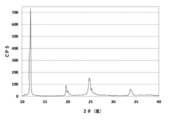
- the obtained zirconium phosphate powder X-ray diffraction, median diameter and ammonia gas removal rate were measured. As a result of measurement by powder X-ray diffraction, it was confirmed that the obtained zirconium phosphate was a layered ⁇ -zirconium phosphate.
- a diffraction diagram of powder X-ray diffraction is shown in FIG. The median diameter was 0.90 ⁇ m, the sodium ion exchange capacity was 6.5 meq / g, and the ammonia gas removal rate was> 99%.
- Aging tank No. 1 containing 1.5 kg of each mixed solution. 2-Aging tank No. No. 6 and 7.5 kg of the mixed solution were stored. In No. 7, the heating device was operated in sequence, and the aging tank No. 7 was used. The same treatment as in No. 1 was carried out to obtain ⁇ -zirconium phosphate.
- the obtained aging tank No. 1-Aging tank No. 7 Table 1 shows the yield (based on zirconium element) and median diameter of each ⁇ -zirconium phosphate.
- reaction number No. 1 The yield of zirconium ⁇ -zirconium phosphate obtained with respect to the charged zirconium oxychloride octahydrate was calculated to be 82% based on the zirconium element.
- the median diameter of ⁇ -zirconium phosphate was 0.92 ⁇ m. This series of manufacturing operations was repeated 6 more times (referred to as reaction numbers No. 2 to No. 7, respectively). The obtained reaction number No. 1 to No. 7 The yield and median diameter of each ⁇ -zirconium phosphate were determined. The results are shown in Table 1.
- Example 1 Comparing Example 1 in which the mixing of raw materials and the like is continuous operation and Comparative Example 1 in which mixing and aging of the raw materials and the like are repeated for each batch, it can be seen that the former has a high product yield and a small variation in median diameter.
- the aging tank No. 1 of Example 1. 7 is the result of aging in a 10 L tank, and it can be seen that there is no influence of the scale of the aging tank.
- Example 2 [The concentration of zirconium phosphate in the mixed solution (synthetic solution slurry) is 8.3% by weight, and one batch operation is performed in a tank-type aging device by continuous mixing]
- Oxalic acid dihydrate (211.5 g) and 35% hydrochloric acid (210.1 g) are mixed and dissolved in deionized water (1615.4 g) to prepare an oxalic acid / hydrochloric acid mixed aqueous solution (hereinafter referred to as C2 solution).
- C2 solution oxalic acid / hydrochloric acid mixed aqueous solution
- Example 3 [The concentration of zirconium phosphate in the mixed solution (synthetic solution slurry) is 11.2% by weight, and one batch operation is performed in a tank-type aging device by continuous mixing] Oxalic acid dihydrate (285.4 g) and 35% hydrochloric acid (283.5 g) are mixed and dissolved in deionized water (1131.7 g) to prepare an oxalic acid / hydrochloric acid mixed aqueous solution (hereinafter referred to as C3 solution). Prepared. Using the same apparatus as in Example 1, 100 g of C3 solution was initially added to the mixing apparatus, and stirring was started at a rotation speed of 200 rpm.
- the concentration of zirconium phosphate in the present mixed solution was 8.3% by weight.
- Example 4 [Zirconium phosphate concentration in the mixed solution (synthetic solution slurry) is 8.3% by weight, one batch operation without stirring in a tank-type aging device by continuous mixing]
- the mixing device was operated in the same manner as in Example 2, and the mixed solution flowing out from the overflow port was received in an aging tank not accompanied by a stirring device. Approximately 40 minutes later, when 1.5 kg was accumulated, the receiver of the mixed solution was switched to another aging device.
- the heating device attached to the aging tank in which the 1.5 kg mixture was stored was operated to raise the temperature of the mixture to 98 ° C. in about 90 minutes and maintain this temperature for 12 hours.
- Example 2 After that, the heating device was stopped, and the slurry of the synthetic liquid in the tank was cooled to 40 ° C. or lower by natural cooling. The same treatment as in Example 2 was carried out to obtain 109.6 g of ⁇ -zirconium phosphate in a yield of 88%. The median diameter of the obtained zirconium ⁇ -phosphate was 0.92 ⁇ m. The sodium ion exchange capacity was 6.5 meq / g, and the ammonia gas removal rate was> 99%. From this, it can be seen that the yield, median diameter and sodium ion exchange capacity are not particularly affected by the presence or absence of stirring in the aging stage.
- Example 5 [Zirconium phosphate concentration in the mixed solution (synthetic solution slurry) is 14.0% by weight, 1 batch operation in a tank-type aging device by continuous mixing, aging time: 6 hours]
- Oxalic acid dihydrate (212.5 g) and 35% hydrochloric acid (315.1 g) are mixed and dissolved in deionized water (2527.8 g) to prepare an oxalic acid / hydrochloric acid mixed aqueous solution (hereinafter referred to as C4 solution).
- C4 solution oxalic acid / hydrochloric acid mixed aqueous solution
- liquid temperature in the mixer tank was 60 ° C.
- continuous charging of liquid A (supply rate: 9.33 g / min), liquid B (supply rate: 4.16 g / min) and liquid C4 (supply rate: 18.67 g / min) was started.
- aging was started when 1.5 kg of the mixed solution was accumulated in the aging apparatus.
- the concentration of zirconium phosphate in this mixed solution was 14.0% by weight.
- the heating was stopped, and the slurry of the synthetic liquid in the tank was cooled to 40 ° C. or lower by natural cooling.
- Example 2 The same treatment as in Example 2 was carried out to obtain zirconium ⁇ -zirconium phosphate in a yield of 90%.
- the median diameter of the obtained zirconium ⁇ -phosphate was 0.88 ⁇ m.
- the sodium ion exchange capacity was 6.5 meq / g, and the ammonia gas removal rate was> 99%.
- Example 6 The concentration of zirconium phosphate in the mixed solution (synthetic solution slurry) is 8.3% by weight, and continuous continuous operation from mixing to aging by continuous mixing and tube-type aging device]
- the apparatus schematically shown in FIG. 3 was used.
- a mixing device a device in which a stirrer and a jacket were attached to a tank-shaped glass container (capacity: 0.3 L) was used.
- the stirring device consisted of three swept wings and a stirring motor that rotates them.
- the jacket has a structure in which the temperature-controlled liquid is circulated and passed from another constant temperature device to adjust the liquid temperature in the tank.
- the raw materials A, B and C2 liquids are supplied to the mixing device via a metering pump.
- a PTFE (polytetrafluoroethylene (tetrafluoroethylene)) tube (inner diameter 6 mm ⁇ , outer diameter 8 mm ⁇ , length 100 m) (hereinafter referred to as an aging tube) was placed in an oil bath.
- One end of the PTFE tube was connected to the discharge port of the liquid feed pump, and the pump suction port and the mixing device were connected.
- the other end was connected to a tank to receive the synthetic liquid slurry.
- the synthetic liquid slurry tank has a pressure resistant specification and has a structure that can be pressurized to 0.4 MPa with pressurized air.
- the liquid feeding pump is designed so that the discharge pressure can be boosted up to 0.3 MPa.
- the oil bath has a structure with a heater and a mixing function.
- the mixing device and the aging device were connected from the bottom of the mixing device using an extraction pipe as shown in FIG. 3, and the flow rate of the liquid feed pump was adjusted so as to keep the liquid level of the mixed solution of the mixing device constant.
- the concentration of zirconium phosphate in this mixed solution was 8.3% by weight.
- the oil bath temperature was set to 110 ° C., and the oil was circulated so that the temperature became uniform.
- the flow rate of the liquid feed pump at which the liquid level of the mixing device was constant was 16 g / min, and the time for heating the mixed solution in the tubular aging device was 3 hours.
- the mixing device was operated and the liquid was continuously sent to the aging device for 12 hours, and the synthetic liquid slurry discharged from the tube was received in a 1 L tank, and the container was switched every hour to obtain nine synthetic liquid slurries. (Synthetic solution No. 1 to synthetic solution No. 9). After the synthetic solution was allowed to cool naturally to 40 ° C.
- the aging device is a tube type instead of a tank type, the device is simpler than the aging in the tank type, the equipment cost can be suppressed, the operation is simple, and the productivity is further improved compared to the aging in the tank type. I understand.
- the work load of preparing raw materials, etc. for each batch is reduced by the layered zirconium phosphate manufacturing apparatus and manufacturing method including the mixing apparatus for mixing the raw materials and the like of the present disclosure and the aging apparatus for aging the mixed solution. Since the median diameter of the product can be stabilized and the concentration of the synthetic liquid slurry can be increased, the quality and productivity of the layered zirconium phosphate production can be improved.
- the apparatus and method for producing layered zirconium phosphate of the present disclosure can reduce the work load, suppress the variation in the median diameter of the product, and further increase the concentration of zirconium phosphate in the synthetic liquid slurry to increase the product yield. It is possible to provide a highly productive and high-quality method for producing layered zirconium phosphate.
Landscapes
- Chemical & Material Sciences (AREA)
- Organic Chemistry (AREA)
- Inorganic Chemistry (AREA)
- Inorganic Compounds Of Heavy Metals (AREA)
- Solid-Sorbent Or Filter-Aiding Compositions (AREA)
Priority Applications (2)
| Application Number | Priority Date | Filing Date | Title |
|---|---|---|---|
| JP2022519921A JP7647747B2 (ja) | 2020-05-08 | 2021-04-16 | 層状リン酸ジルコニウムの製造装置及び製造方法 |
| CN202180033347.4A CN115515894A (zh) | 2020-05-08 | 2021-04-16 | 层状磷酸锆的制造装置及制造方法 |
Applications Claiming Priority (2)
| Application Number | Priority Date | Filing Date | Title |
|---|---|---|---|
| JP2020082457 | 2020-05-08 | ||
| JP2020-082457 | 2020-05-08 |
Publications (1)
| Publication Number | Publication Date |
|---|---|
| WO2021225068A1 true WO2021225068A1 (ja) | 2021-11-11 |
Family
ID=78467938
Family Applications (1)
| Application Number | Title | Priority Date | Filing Date |
|---|---|---|---|
| PCT/JP2021/015701 Ceased WO2021225068A1 (ja) | 2020-05-08 | 2021-04-16 | 層状リン酸ジルコニウムの製造装置及び製造方法 |
Country Status (4)
| Country | Link |
|---|---|
| JP (1) | JP7647747B2 (https=) |
| CN (1) | CN115515894A (https=) |
| TW (1) | TWI888541B (https=) |
| WO (1) | WO2021225068A1 (https=) |
Families Citing this family (1)
| Publication number | Priority date | Publication date | Assignee | Title |
|---|---|---|---|---|
| CN118164448B (zh) * | 2024-03-29 | 2025-01-24 | 中南民族大学 | 一种基于溶剂萃取体系制备插层磷酸锆的循环工艺 |
Citations (4)
| Publication number | Priority date | Publication date | Assignee | Title |
|---|---|---|---|---|
| JP2003502254A (ja) * | 1999-06-16 | 2003-01-21 | ロディア・シミ | リン酸セリウム及び/又はランタンのゾル、その製造方法及びその研磨への応用 |
| JP2012224517A (ja) * | 2011-04-20 | 2012-11-15 | Toagosei Co Ltd | 層状リン酸ジルコニウムの製造方法 |
| JP2012224518A (ja) * | 2011-04-20 | 2012-11-15 | Toagosei Co Ltd | 層状リン酸ジルコニウムの製造方法 |
| JP2015524381A (ja) * | 2012-08-10 | 2015-08-24 | サムスン ファイン ケミカルズ カンパニー リミテッドSamsungfine Chemicals Co.,Ltd | ナノサイズ鉄リン酸塩粒子の製造方法 |
Family Cites Families (1)
| Publication number | Priority date | Publication date | Assignee | Title |
|---|---|---|---|---|
| WO2008053694A1 (fr) * | 2006-10-27 | 2008-05-08 | Toagosei Co., Ltd. | Nouveau phosphate de zirconium lamellaire |
-
2021
- 2021-04-16 JP JP2022519921A patent/JP7647747B2/ja active Active
- 2021-04-16 WO PCT/JP2021/015701 patent/WO2021225068A1/ja not_active Ceased
- 2021-04-16 CN CN202180033347.4A patent/CN115515894A/zh active Pending
- 2021-04-23 TW TW110114628A patent/TWI888541B/zh active
Patent Citations (4)
| Publication number | Priority date | Publication date | Assignee | Title |
|---|---|---|---|---|
| JP2003502254A (ja) * | 1999-06-16 | 2003-01-21 | ロディア・シミ | リン酸セリウム及び/又はランタンのゾル、その製造方法及びその研磨への応用 |
| JP2012224517A (ja) * | 2011-04-20 | 2012-11-15 | Toagosei Co Ltd | 層状リン酸ジルコニウムの製造方法 |
| JP2012224518A (ja) * | 2011-04-20 | 2012-11-15 | Toagosei Co Ltd | 層状リン酸ジルコニウムの製造方法 |
| JP2015524381A (ja) * | 2012-08-10 | 2015-08-24 | サムスン ファイン ケミカルズ カンパニー リミテッドSamsungfine Chemicals Co.,Ltd | ナノサイズ鉄リン酸塩粒子の製造方法 |
Also Published As
| Publication number | Publication date |
|---|---|
| CN115515894A (zh) | 2022-12-23 |
| JPWO2021225068A1 (https=) | 2021-11-11 |
| TWI888541B (zh) | 2025-07-01 |
| JP7647747B2 (ja) | 2025-03-18 |
| TW202200494A (zh) | 2022-01-01 |
Similar Documents
| Publication | Publication Date | Title |
|---|---|---|
| JP6419071B2 (ja) | ナノサイズ鉄リン酸塩粒子の製造方法 | |
| TWI737685B (zh) | 用於處理含碳組合物之方法、裝置及系統 | |
| CN101983917B (zh) | 一种高纯石墨的生产方法 | |
| KR101727939B1 (ko) | 테일러 반응기를 이용한 표면처리 방법 | |
| CN103203213A (zh) | 一种酸度可控液相撞击流反应装置 | |
| US8728418B2 (en) | Method for producing metal hydroxide fine particle | |
| CN103261086B (zh) | 干燥的表面改性纳米方解石 | |
| CN1290771C (zh) | 连续制备纳米级的水合氧化锆溶胶的方法 | |
| WO2021225068A1 (ja) | 層状リン酸ジルコニウムの製造装置及び製造方法 | |
| CN107999001A (zh) | 用于制备溴化物的方法 | |
| CN108176340A (zh) | 一种齿轮驱动式正反转冷却型反应釜 | |
| JP6623673B2 (ja) | フッ化カルシウムの製造方法 | |
| JPH069222A (ja) | 五酸化アンチモンの連続的製造方法 | |
| KR20040079956A (ko) | 폴리비닐아세탈 수지 및 그 제조방법 | |
| CN105964203A (zh) | 一种用于聚偏氯乙烯生产的聚合釜及其方法 | |
| CN110256613B (zh) | 一种氯化聚氯乙烯连续生产方法 | |
| CN109867299B (zh) | 一种制备拟薄水铝石的方法 | |
| CN109809468A (zh) | 一种纳米钛酸钡的制备方法及其应用 | |
| CN112239222B (zh) | 一种连续水热生产氢氧化镁的装备和方法 | |
| CN104313634A (zh) | 一种连续电解制备长链烷基氢氧化铵的方法 | |
| CN116314873A (zh) | 燃料电池催化剂的连续批量生产系统以及燃料电池催化剂的制备方法 | |
| CN103360185B (zh) | 一种cl-20颗粒的圆滑处理装置及圆滑处理方法 | |
| CN116102062A (zh) | 一种多钒酸铵连续沉淀的方法及其数学模型的建立方法 | |
| CN206965732U (zh) | 新型反应桶 | |
| CN211329362U (zh) | 具有偏心辅助搅拌的水合醋酸钠生产装置 |
Legal Events
| Date | Code | Title | Description |
|---|---|---|---|
| 121 | Ep: the epo has been informed by wipo that ep was designated in this application |
Ref document number: 21800552 Country of ref document: EP Kind code of ref document: A1 |
|
| ENP | Entry into the national phase |
Ref document number: 2022519921 Country of ref document: JP Kind code of ref document: A |
|
| NENP | Non-entry into the national phase |
Ref country code: DE |
|
| 122 | Ep: pct application non-entry in european phase |
Ref document number: 21800552 Country of ref document: EP Kind code of ref document: A1 |