WO2021187579A1 - 透明導電性フィルム - Google Patents
透明導電性フィルム Download PDFInfo
- Publication number
- WO2021187579A1 WO2021187579A1 PCT/JP2021/011154 JP2021011154W WO2021187579A1 WO 2021187579 A1 WO2021187579 A1 WO 2021187579A1 JP 2021011154 W JP2021011154 W JP 2021011154W WO 2021187579 A1 WO2021187579 A1 WO 2021187579A1
- Authority
- WO
- WIPO (PCT)
- Prior art keywords
- light
- conductive layer
- transmitting conductive
- film
- layer
- Prior art date
- Legal status (The legal status is an assumption and is not a legal conclusion. Google has not performed a legal analysis and makes no representation as to the accuracy of the status listed.)
- Ceased
Links
Images


Classifications
-
- C—CHEMISTRY; METALLURGY
- C23—COATING METALLIC MATERIAL; COATING MATERIAL WITH METALLIC MATERIAL; CHEMICAL SURFACE TREATMENT; DIFFUSION TREATMENT OF METALLIC MATERIAL; COATING BY VACUUM EVAPORATION, BY SPUTTERING, BY ION IMPLANTATION OR BY CHEMICAL VAPOUR DEPOSITION, IN GENERAL; INHIBITING CORROSION OF METALLIC MATERIAL OR INCRUSTATION IN GENERAL
- C23C—COATING METALLIC MATERIAL; COATING MATERIAL WITH METALLIC MATERIAL; SURFACE TREATMENT OF METALLIC MATERIAL BY DIFFUSION INTO THE SURFACE, BY CHEMICAL CONVERSION OR SUBSTITUTION; COATING BY VACUUM EVAPORATION, BY SPUTTERING, BY ION IMPLANTATION OR BY CHEMICAL VAPOUR DEPOSITION, IN GENERAL
- C23C14/00—Coating by vacuum evaporation, by sputtering or by ion implantation of the coating forming material
- C23C14/06—Coating by vacuum evaporation, by sputtering or by ion implantation of the coating forming material characterised by the coating material
- C23C14/08—Oxides
- C23C14/086—Oxides of zinc, germanium, cadmium, indium, tin, thallium or bismuth
-
- B—PERFORMING OPERATIONS; TRANSPORTING
- B32—LAYERED PRODUCTS
- B32B—LAYERED PRODUCTS, i.e. PRODUCTS BUILT-UP OF STRATA OF FLAT OR NON-FLAT, e.g. CELLULAR OR HONEYCOMB, FORM
- B32B7/00—Layered products characterised by the relation between layers; Layered products characterised by the relative orientation of features between layers, or by the relative values of a measurable parameter between layers, i.e. products comprising layers having different physical, chemical or physicochemical properties; Layered products characterised by the interconnection of layers
-
- B—PERFORMING OPERATIONS; TRANSPORTING
- B32—LAYERED PRODUCTS
- B32B—LAYERED PRODUCTS, i.e. PRODUCTS BUILT-UP OF STRATA OF FLAT OR NON-FLAT, e.g. CELLULAR OR HONEYCOMB, FORM
- B32B7/00—Layered products characterised by the relation between layers; Layered products characterised by the relative orientation of features between layers, or by the relative values of a measurable parameter between layers, i.e. products comprising layers having different physical, chemical or physicochemical properties; Layered products characterised by the interconnection of layers
- B32B7/02—Physical, chemical or physicochemical properties
- B32B7/023—Optical properties
-
- B—PERFORMING OPERATIONS; TRANSPORTING
- B32—LAYERED PRODUCTS
- B32B—LAYERED PRODUCTS, i.e. PRODUCTS BUILT-UP OF STRATA OF FLAT OR NON-FLAT, e.g. CELLULAR OR HONEYCOMB, FORM
- B32B7/00—Layered products characterised by the relation between layers; Layered products characterised by the relative orientation of features between layers, or by the relative values of a measurable parameter between layers, i.e. products comprising layers having different physical, chemical or physicochemical properties; Layered products characterised by the interconnection of layers
- B32B7/02—Physical, chemical or physicochemical properties
- B32B7/025—Electric or magnetic properties
-
- B—PERFORMING OPERATIONS; TRANSPORTING
- B32—LAYERED PRODUCTS
- B32B—LAYERED PRODUCTS, i.e. PRODUCTS BUILT-UP OF STRATA OF FLAT OR NON-FLAT, e.g. CELLULAR OR HONEYCOMB, FORM
- B32B9/00—Layered products comprising a layer of a particular substance not covered by groups B32B11/00 - B32B29/00
-
- C—CHEMISTRY; METALLURGY
- C23—COATING METALLIC MATERIAL; COATING MATERIAL WITH METALLIC MATERIAL; CHEMICAL SURFACE TREATMENT; DIFFUSION TREATMENT OF METALLIC MATERIAL; COATING BY VACUUM EVAPORATION, BY SPUTTERING, BY ION IMPLANTATION OR BY CHEMICAL VAPOUR DEPOSITION, IN GENERAL; INHIBITING CORROSION OF METALLIC MATERIAL OR INCRUSTATION IN GENERAL
- C23C—COATING METALLIC MATERIAL; COATING MATERIAL WITH METALLIC MATERIAL; SURFACE TREATMENT OF METALLIC MATERIAL BY DIFFUSION INTO THE SURFACE, BY CHEMICAL CONVERSION OR SUBSTITUTION; COATING BY VACUUM EVAPORATION, BY SPUTTERING, BY ION IMPLANTATION OR BY CHEMICAL VAPOUR DEPOSITION, IN GENERAL
- C23C14/00—Coating by vacuum evaporation, by sputtering or by ion implantation of the coating forming material
- C23C14/0021—Reactive sputtering or evaporation
- C23C14/0036—Reactive sputtering
- C23C14/0057—Reactive sputtering using reactive gases other than O2, H2O, N2, NH3 or CH4
-
- C—CHEMISTRY; METALLURGY
- C23—COATING METALLIC MATERIAL; COATING MATERIAL WITH METALLIC MATERIAL; CHEMICAL SURFACE TREATMENT; DIFFUSION TREATMENT OF METALLIC MATERIAL; COATING BY VACUUM EVAPORATION, BY SPUTTERING, BY ION IMPLANTATION OR BY CHEMICAL VAPOUR DEPOSITION, IN GENERAL; INHIBITING CORROSION OF METALLIC MATERIAL OR INCRUSTATION IN GENERAL
- C23C—COATING METALLIC MATERIAL; COATING MATERIAL WITH METALLIC MATERIAL; SURFACE TREATMENT OF METALLIC MATERIAL BY DIFFUSION INTO THE SURFACE, BY CHEMICAL CONVERSION OR SUBSTITUTION; COATING BY VACUUM EVAPORATION, BY SPUTTERING, BY ION IMPLANTATION OR BY CHEMICAL VAPOUR DEPOSITION, IN GENERAL
- C23C14/00—Coating by vacuum evaporation, by sputtering or by ion implantation of the coating forming material
- C23C14/06—Coating by vacuum evaporation, by sputtering or by ion implantation of the coating forming material characterised by the coating material
- C23C14/08—Oxides
-
- C—CHEMISTRY; METALLURGY
- C23—COATING METALLIC MATERIAL; COATING MATERIAL WITH METALLIC MATERIAL; CHEMICAL SURFACE TREATMENT; DIFFUSION TREATMENT OF METALLIC MATERIAL; COATING BY VACUUM EVAPORATION, BY SPUTTERING, BY ION IMPLANTATION OR BY CHEMICAL VAPOUR DEPOSITION, IN GENERAL; INHIBITING CORROSION OF METALLIC MATERIAL OR INCRUSTATION IN GENERAL
- C23C—COATING METALLIC MATERIAL; COATING MATERIAL WITH METALLIC MATERIAL; SURFACE TREATMENT OF METALLIC MATERIAL BY DIFFUSION INTO THE SURFACE, BY CHEMICAL CONVERSION OR SUBSTITUTION; COATING BY VACUUM EVAPORATION, BY SPUTTERING, BY ION IMPLANTATION OR BY CHEMICAL VAPOUR DEPOSITION, IN GENERAL
- C23C14/00—Coating by vacuum evaporation, by sputtering or by ion implantation of the coating forming material
- C23C14/22—Coating by vacuum evaporation, by sputtering or by ion implantation of the coating forming material characterised by the process of coating
- C23C14/34—Sputtering
-
- C—CHEMISTRY; METALLURGY
- C23—COATING METALLIC MATERIAL; COATING MATERIAL WITH METALLIC MATERIAL; CHEMICAL SURFACE TREATMENT; DIFFUSION TREATMENT OF METALLIC MATERIAL; COATING BY VACUUM EVAPORATION, BY SPUTTERING, BY ION IMPLANTATION OR BY CHEMICAL VAPOUR DEPOSITION, IN GENERAL; INHIBITING CORROSION OF METALLIC MATERIAL OR INCRUSTATION IN GENERAL
- C23C—COATING METALLIC MATERIAL; COATING MATERIAL WITH METALLIC MATERIAL; SURFACE TREATMENT OF METALLIC MATERIAL BY DIFFUSION INTO THE SURFACE, BY CHEMICAL CONVERSION OR SUBSTITUTION; COATING BY VACUUM EVAPORATION, BY SPUTTERING, BY ION IMPLANTATION OR BY CHEMICAL VAPOUR DEPOSITION, IN GENERAL
- C23C14/00—Coating by vacuum evaporation, by sputtering or by ion implantation of the coating forming material
- C23C14/22—Coating by vacuum evaporation, by sputtering or by ion implantation of the coating forming material characterised by the process of coating
- C23C14/56—Apparatus specially adapted for continuous coating; Arrangements for maintaining the vacuum, e.g. vacuum locks
- C23C14/562—Apparatus specially adapted for continuous coating; Arrangements for maintaining the vacuum, e.g. vacuum locks for coating elongated substrates
-
- C—CHEMISTRY; METALLURGY
- C23—COATING METALLIC MATERIAL; COATING MATERIAL WITH METALLIC MATERIAL; CHEMICAL SURFACE TREATMENT; DIFFUSION TREATMENT OF METALLIC MATERIAL; COATING BY VACUUM EVAPORATION, BY SPUTTERING, BY ION IMPLANTATION OR BY CHEMICAL VAPOUR DEPOSITION, IN GENERAL; INHIBITING CORROSION OF METALLIC MATERIAL OR INCRUSTATION IN GENERAL
- C23C—COATING METALLIC MATERIAL; COATING MATERIAL WITH METALLIC MATERIAL; SURFACE TREATMENT OF METALLIC MATERIAL BY DIFFUSION INTO THE SURFACE, BY CHEMICAL CONVERSION OR SUBSTITUTION; COATING BY VACUUM EVAPORATION, BY SPUTTERING, BY ION IMPLANTATION OR BY CHEMICAL VAPOUR DEPOSITION, IN GENERAL
- C23C14/00—Coating by vacuum evaporation, by sputtering or by ion implantation of the coating forming material
- C23C14/58—After-treatment
- C23C14/5873—Removal of material
-
- G—PHYSICS
- G02—OPTICS
- G02F—OPTICAL DEVICES OR ARRANGEMENTS FOR THE CONTROL OF LIGHT BY MODIFICATION OF THE OPTICAL PROPERTIES OF THE MEDIA OF THE ELEMENTS INVOLVED THEREIN; NON-LINEAR OPTICS; FREQUENCY-CHANGING OF LIGHT; OPTICAL LOGIC ELEMENTS; OPTICAL ANALOGUE/DIGITAL CONVERTERS
- G02F1/00—Devices or arrangements for the control of the intensity, colour, phase, polarisation or direction of light arriving from an independent light source, e.g. switching, gating or modulating; Non-linear optics
- G02F1/01—Devices or arrangements for the control of the intensity, colour, phase, polarisation or direction of light arriving from an independent light source, e.g. switching, gating or modulating; Non-linear optics for the control of the intensity, phase, polarisation or colour
- G02F1/13—Devices or arrangements for the control of the intensity, colour, phase, polarisation or direction of light arriving from an independent light source, e.g. switching, gating or modulating; Non-linear optics for the control of the intensity, phase, polarisation or colour based on liquid crystals, e.g. single liquid crystal display cells
- G02F1/133—Constructional arrangements; Operation of liquid crystal cells; Circuit arrangements
- G02F1/1333—Constructional arrangements; Manufacturing methods
-
- G—PHYSICS
- G02—OPTICS
- G02F—OPTICAL DEVICES OR ARRANGEMENTS FOR THE CONTROL OF LIGHT BY MODIFICATION OF THE OPTICAL PROPERTIES OF THE MEDIA OF THE ELEMENTS INVOLVED THEREIN; NON-LINEAR OPTICS; FREQUENCY-CHANGING OF LIGHT; OPTICAL LOGIC ELEMENTS; OPTICAL ANALOGUE/DIGITAL CONVERTERS
- G02F1/00—Devices or arrangements for the control of the intensity, colour, phase, polarisation or direction of light arriving from an independent light source, e.g. switching, gating or modulating; Non-linear optics
- G02F1/01—Devices or arrangements for the control of the intensity, colour, phase, polarisation or direction of light arriving from an independent light source, e.g. switching, gating or modulating; Non-linear optics for the control of the intensity, phase, polarisation or colour
- G02F1/13—Devices or arrangements for the control of the intensity, colour, phase, polarisation or direction of light arriving from an independent light source, e.g. switching, gating or modulating; Non-linear optics for the control of the intensity, phase, polarisation or colour based on liquid crystals, e.g. single liquid crystal display cells
- G02F1/133—Constructional arrangements; Operation of liquid crystal cells; Circuit arrangements
- G02F1/1333—Constructional arrangements; Manufacturing methods
- G02F1/1343—Electrodes
-
- G—PHYSICS
- G06—COMPUTING OR CALCULATING; COUNTING
- G06F—ELECTRIC DIGITAL DATA PROCESSING
- G06F3/00—Input arrangements for transferring data to be processed into a form capable of being handled by the computer; Output arrangements for transferring data from processing unit to output unit, e.g. interface arrangements
- G06F3/01—Input arrangements or combined input and output arrangements for interaction between user and computer
- G06F3/03—Arrangements for converting the position or the displacement of a member into a coded form
- G06F3/041—Digitisers, e.g. for touch screens or touch pads, characterised by the transducing means
-
- H—ELECTRICITY
- H01—ELECTRIC ELEMENTS
- H01B—CABLES; CONDUCTORS; INSULATORS; SELECTION OF MATERIALS FOR THEIR CONDUCTIVE, INSULATING OR DIELECTRIC PROPERTIES
- H01B13/00—Apparatus or processes specially adapted for manufacturing conductors or cables
-
- H—ELECTRICITY
- H01—ELECTRIC ELEMENTS
- H01B—CABLES; CONDUCTORS; INSULATORS; SELECTION OF MATERIALS FOR THEIR CONDUCTIVE, INSULATING OR DIELECTRIC PROPERTIES
- H01B5/00—Non-insulated conductors or conductive bodies characterised by their form
- H01B5/14—Non-insulated conductors or conductive bodies characterised by their form comprising conductive layers or films on insulating-supports
-
- H—ELECTRICITY
- H01—ELECTRIC ELEMENTS
- H01B—CABLES; CONDUCTORS; INSULATORS; SELECTION OF MATERIALS FOR THEIR CONDUCTIVE, INSULATING OR DIELECTRIC PROPERTIES
- H01B5/00—Non-insulated conductors or conductive bodies characterised by their form
- H01B5/16—Non-insulated conductors or conductive bodies characterised by their form comprising conductive material in insulating or poorly conductive material, e.g. conductive rubber
-
- H—ELECTRICITY
- H01—ELECTRIC ELEMENTS
- H01Q—ANTENNAS, i.e. RADIO AERIALS
- H01Q1/00—Details of, or arrangements associated with, antennas
- H01Q1/36—Structural form of radiating elements, e.g. cone, spiral, umbrella; Particular materials used therewith
- H01Q1/38—Structural form of radiating elements, e.g. cone, spiral, umbrella; Particular materials used therewith formed by a conductive layer on an insulating support
-
- H—ELECTRICITY
- H01—ELECTRIC ELEMENTS
- H01Q—ANTENNAS, i.e. RADIO AERIALS
- H01Q1/00—Details of, or arrangements associated with, antennas
- H01Q1/52—Means for reducing coupling between antennas; Means for reducing coupling between an antenna and another structure
-
- H—ELECTRICITY
- H05—ELECTRIC TECHNIQUES NOT OTHERWISE PROVIDED FOR
- H05K—PRINTED CIRCUITS; CASINGS OR CONSTRUCTIONAL DETAILS OF ELECTRIC APPARATUS; MANUFACTURE OF ASSEMBLAGES OF ELECTRICAL COMPONENTS
- H05K9/00—Screening of apparatus or components against electric or magnetic fields
-
- H—ELECTRICITY
- H10—SEMICONDUCTOR DEVICES; ELECTRIC SOLID-STATE DEVICES NOT OTHERWISE PROVIDED FOR
- H10F—INORGANIC SEMICONDUCTOR DEVICES SENSITIVE TO INFRARED RADIATION, LIGHT, ELECTROMAGNETIC RADIATION OF SHORTER WAVELENGTH OR CORPUSCULAR RADIATION
- H10F77/00—Constructional details of devices covered by this subclass
- H10F77/20—Electrodes
Definitions
- the present invention relates to a transparent conductive film.
- a transparent conductive film having a transparent base film and a transparent conductive layer (light-transmitting conductive layer) in order in the thickness direction is known.
- the light-transmitting conductive layer is used as a conductor film for forming a pattern of transparent electrodes in various devices such as liquid crystal displays, touch panels, and optical sensors.
- the light-transmitting conductive layer is formed, for example, by forming a conductive oxide on the base film by a sputtering method.
- an inert gas such as argon is used as a sputtering gas for colliding with the target (film-forming material supply material) and ejecting atoms on the target surface.
- a technique relating to such a transparent conductive film is described in, for example, Patent Document 1 below.
- the light-transmitting conductive layer of the transparent conductive film is patterned by etching the light-transmitting conductive layer through a predetermined etching mask.
- the transparent conductive film of Patent Document 1 has a problem that the etching rate in the etching process for the light-transmitting conductive layer is slow.
- the slow etching rate of the light-transmitting conductive layer in the transparent conductive film is not preferable from the viewpoint of the efficiency of the device manufacturing process in which the transparent conductive film is used.
- the present invention provides a transparent conductive film suitable for achieving a high etching rate in a light-transmitting conductive layer.
- a transparent base material and a light-transmitting conductive layer are provided in this order in the thickness direction, and the light-transmitting conductive layer contains krypton and is 2.8 ⁇ 10 -4 ⁇ ⁇ cm.
- the light-transmitting conductive layer has a hole mobility of ⁇ (cm 2 / V ⁇ s) and a carrier density of n ⁇ 10 19 (cm -3 ), and the ratio of n to ⁇ is 4.
- the above-mentioned transparent conductive film is included.
- the present invention [2] includes the transparent conductive film according to the above [1], wherein the light-transmitting conductive layer contains an indium-containing conductive oxide.
- the present invention [3] includes the transparent conductive film according to the above [1] or [2], wherein the hole mobility is 5 cm 2 / V ⁇ s or more and 40 cm 2 / V ⁇ s or less.
- the transparent conductivity according to any one of the above [1] to [3], wherein the carrier density is 100 ⁇ 10 19 cm -3 or more and 170 ⁇ 10 19 cm -3 or less. Includes film.
- the present invention [5] includes the transparent conductive film according to any one of the above [1] to [4], wherein the light-transmitting conductive layer is patterned.
- the light-transmitting conductive layer contains krypton and has a specific resistance of less than 2.8 ⁇ 10 -4 ⁇ ⁇ cm.
- the ratio of n to ⁇ is 4 in the hole mobility ⁇ (cm 2 / V ⁇ s) and the carrier density n ⁇ 10 19 (cm -3) of the light transmissive conductive layer. That is all. Therefore, the transparent conductive film of the present invention is suitable for achieving a high etching rate in the light-transmitting conductive layer.
- FIG. 2A represents a step of preparing a resin film
- FIG. 2B represents a step of forming a functional layer on the resin film
- FIG. 2C represents a step of forming a light-transmitting conductive layer on the functional layer
- FIG. 2D represents a step of crystallizing a light transmissive conductive layer.
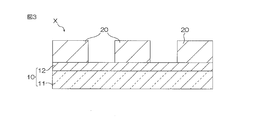
- the transparent conductive film shown in FIG. 1 the case where the light-transmitting conductive layer is patterned is shown. It is a graph which shows the relationship between the amount of oxygen introduced at the time of forming a light-transmitting conductive layer by a sputtering method, and the specific resistance of the light-transmitting conductive layer formed.
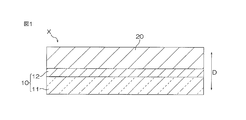
- FIG. 1 is a schematic cross-sectional view of the transparent conductive film X, which is an embodiment of the transparent conductive film of the present invention.
- the transparent conductive film X includes a transparent base material 10 and a light-transmitting conductive layer 20 in this order toward one side in the thickness direction D.
- the transparent conductive film X has a shape that spreads in a direction (plane direction) orthogonal to the thickness direction D.
- the transmissive conductive film X is an element provided in a touch sensor device, a light control element, a photoelectric conversion element, a heat ray control member, an antenna member, an electromagnetic wave shield member, a lighting device, an image display device, and the like.
- the transparent base material 10 includes the resin film 11 and the functional layer 12 in this order toward one side in the thickness direction D.
- the transparent base material 10 has a shape that spreads in a direction (plane direction) orthogonal to the thickness direction D.
- the resin film 11 is a transparent resin film having flexibility.
- the material of the resin film 11 include polyester resin, polyolefin resin, acrylic resin, polycarbonate resin, polyether sulfone resin, polyarylate resin, melamine resin, polyamide resin, polyimide resin, cellulose resin, and polystyrene resin.
- the polyester resin include polyethylene terephthalate (PET), polybutylene terephthalate, and polyethylene naphthalate.
- PET polyethylene terephthalate
- Polyolefin resins include, for example, polyethylene, polypropylene, and cycloolefin polymers (COPs).
- the acrylic resin include polymethacrylate.
- the acrylic resin include polymethacrylate.
- a polyolefin resin is preferably used, and more preferably COP is used, from the viewpoint of transparency and strength.
- the surface of the resin film 11 on the functional layer 12 side may be surface-modified.
- Examples of the surface modification treatment include corona treatment, plasma treatment, ozone treatment, primer treatment, glow treatment, and coupling agent treatment.
- the thickness of the resin film 11 is preferably 1 ⁇ m or more, more preferably 10 ⁇ m or more, and further preferably 30 ⁇ m or more.
- the thickness of the resin film 11 is preferably 300 ⁇ m or less, more preferably 200 ⁇ m or less, still more preferably 100 ⁇ m or less, and particularly preferably 75 ⁇ m or less.
- the total light transmittance (JIS K 7375-2008) of the resin film 11 is preferably 60% or more, more preferably 80% or more, still more preferably 85% or more.
- Such a configuration is transparent when the transparent conductive film X is provided in a touch sensor device, a dimming element, a photoelectric conversion element, a heat ray control member, an antenna member, an electromagnetic wave shielding member, a lighting device, an image display device, or the like. It is suitable for ensuring the transparency required for the conductive film X.
- the total light transmittance of the resin film 11 is, for example, 100% or less.
- the functional layer 12 is located on one surface of the thickness direction D of the resin film 11. Further, in the present embodiment, the functional layer 12 is a hard coat layer for preventing scratches from being formed on the exposed surface (upper surface in FIG. 1) of the light-transmitting conductive layer 20.
- the hard coat layer is a cured product of a curable resin composition.
- the resin contained in the curable resin composition include polyester resin, acrylic resin, urethane resin, amide resin, silicone resin, epoxy resin, and melamine resin.
- the curable resin composition include an ultraviolet curable resin composition and a thermosetting resin composition.
- an ultraviolet curable resin composition is preferably used from the viewpoint of helping to improve the production efficiency of the transparent conductive film X because it can be cured without heating at a high temperature.
- Specific examples of the ultraviolet curable fat composition include the composition for forming a hard coat layer described in JP-A-2016-179686.
- the surface of the functional layer 12 on the light-transmitting conductive layer 20 side may be surface-modified.
- the surface modification treatment include corona treatment, plasma treatment, ozone treatment, primer treatment, glow treatment, and coupling agent treatment.
- the thickness of the functional layer 12 as the hard coat layer is preferably 0.1 ⁇ m or more, more preferably 0.5 ⁇ m or more, and further preferably 1 ⁇ m or more. Such a configuration is suitable for exhibiting sufficient scratch resistance in the light-transmitting conductive layer 20.
- the thickness of the functional layer 12 as the hard coat layer is preferably 10 ⁇ m or less, more preferably 5 ⁇ m or less, and further preferably 3 ⁇ m or less from the viewpoint of ensuring the transparency of the functional layer 12.
- the thickness of the transparent base material 10 is preferably 1 ⁇ m or more, more preferably 10 ⁇ m or more, still more preferably 15 ⁇ m or more, and particularly preferably 30 ⁇ m or more.
- the thickness of the transparent base material 10 is preferably 310 ⁇ m or less, more preferably 210 ⁇ m or less, still more preferably 110 ⁇ m or less, and particularly preferably 80 ⁇ m or less.
- the total light transmittance (JIS K 7375-2008) of the transparent base material 10 is preferably 60% or more, more preferably 80% or more, still more preferably 85% or more.
- Such a configuration is transparent when the transparent conductive film X is provided in a touch sensor device, a dimming element, a photoelectric conversion element, a heat ray control member, an antenna member, an electromagnetic wave shielding member, a lighting device, an image display device, or the like. It is suitable for ensuring the transparency required for the conductive film X.
- the total light transmittance of the transparent base material 10 is, for example, 100% or less.
- the light-transmitting conductive layer 20 is located on one surface of the thickness direction D of the transparent base material 10.
- the light-transmitting conductive layer 20 is a crystalline film having both light-transmitting property and conductivity.
- the light-transmitting conductive layer 20 is a layer formed of a light-transmitting conductive material.
- the light-transmitting conductive material contains, for example, a conductive oxide as a main component.
- the conductive oxide for example, at least one kind of metal selected from the group consisting of In, Sn, Zn, Ga, Sb, Ti, Si, Zr, Mg, Al, Au, Ag, Cu, Pd and W.
- a metal oxide containing a semi-metal can be mentioned.
- the conductive oxide include an indium-containing conductive oxide and an antimony-containing conductive oxide.
- the indium-containing conductive oxide include indium tin oxide composite oxide (ITO), indium zinc composite oxide (IZO), indium gallium composite oxide (IGO), and indium gallium zinc composite oxide (IGZO). Be done.
- the antimony-containing conductive oxide include antimony tin composite oxide (ATO).
- an indium-containing conductive oxide is preferably used as the conductive oxide, and ITO is more preferably used.
- the ITO may contain a metal or a semimetal other than In and Sn in an amount less than the respective contents of In and Sn.
- the ratio of the tin oxide content to the total content of indium oxide (In 2 O 3 ) and tin oxide (SnO 2) in the light transmissive conductive layer 20 (tin oxide content ratio).
- tin oxide content ratio Is preferably 1% by mass or more, more preferably 3% by mass or more, still more preferably 5% by mass or more, and particularly preferably 7% by mass or more.
- the tin oxide content is preferably 15% by mass or less, more preferably 13% by mass or less, and further preferably 12% by mass or less.
- the above-mentioned content ratio of tin oxide is determined from the XPS spectrum measured by X-ray Photoelectron Spectroscopy for the object to be measured.
- the tin oxide content ratio in the light-transmitting conductive layer 20 may be non-uniform in the thickness direction D.
- the light-transmitting conductive layer 20 may include a first layer having a relatively high tin oxide content and a second layer having a relatively low tin oxide content in this order from the transparent substrate 10 side. good.
- the tin oxide content in the first layer is preferably 5% by mass or more, more preferably 8% by mass or more.
- the tin oxide content in the first layer is preferably 15% by mass or less, more preferably 13% by mass or less.
- the tin oxide content in the second layer is preferably 0.5% by mass or more, more preferably 2% by mass or more.
- the tin oxide content in the second layer is preferably 8% by mass or less, more preferably 5% by mass or less.
- the ratio of the thickness of the first layer to the thickness of the light-transmitting conductive layer 20 is preferably 50% or more, more preferably 60% or more, still more preferably 70% or more.
- the ratio of the thickness of the second layer to the thickness of the light-transmitting conductive layer 20 is preferably 50% or less, more preferably 40% or less, still more preferably 30% or less.
- the light-transmitting conductive layer 20 contains krypton (Kr) as a rare gas atom.
- the noble gas atom in the light transmissive conductive layer 20 is derived from the noble gas atom used as the sputtering gas in the sputtering method described later.
- the light-transmitting conductive layer 20 is a film (sputtered film) formed by a sputtering method.
- the configuration in which the light-transmitting conductive layer 20 contains Kr is suitable for realizing low resistance in the light-transmitting conductive layer 20.
- this configuration is suitable for achieving a high etching rate when the light-transmitting conductive layer 20 is etched, for example, for patterning.
- the presence or absence of Kr in the light transmissive conductive layer 20 is identified by, for example, fluorescent X-ray analysis described later with respect to Examples.
- the content ratio of Kr in the light transmissive conductive layer 20 is, for example, 0.5 atomic% or less, preferably 0.3 atomic% or less, and more preferably 0.2 atomic% or less in the entire thickness direction D. Is.
- the amorphous light-transmitting conductive layer (the light-transmitting conductive layer 20'described later) is crystallized by heating to form the light-transmitting conductive layer 20. It is suitable for achieving good crystal growth and forming large crystal grains, and therefore suitable for obtaining a light-transmitting conductive layer 20 having low resistance (the crystal grains in the light-transmitting conductive layer 20 are large). The resistance of the light-transmitting conductive layer 20 is lower).
- the content ratio of Kr in the light transmissive conductive layer 20 is, for example, 0.0001 atomic% or more in the entire area in the thickness direction D.
- the content ratio of Kr in the light-transmitting conductive layer 20 may be non-uniform in the thickness direction D.
- the Kr content may gradually increase or decrease as the distance from the transparent base material 10 increases.
- a partial region in which the Kr content gradually increases as the distance from the transparent base material 10 increases is located on the transparent base material 10
- a partial region in which the Kr content gradually decreases as the distance from the transparent base material 10 increases is located on the transparent base material 10
- the light-transmitting conductive layer 20 preferably contains only Kr as a noble gas atom. Such a configuration is preferable from the viewpoint of realizing low resistance in the light transmissive conductive layer 20. Further, this configuration is preferable from the viewpoint of realizing a high etching rate when the light transmissive conductive layer 20 is etched, for example, for patterning.
- the light-transmitting conductive layer 20 contains a rare gas atom other than Kr
- examples of the rare gas atom other than Kr include argon (Ar) and xenon (Xe).
- the light-transmitting conductive layer 20 preferably does not contain Xe.
- the content ratio of the noble gas atom (including Kr) in the light transmissive conductive layer 20 is, for example, 0.5 atomic% or less, preferably 0.3 atomic% or less, more preferably 0.3 atomic% or less in the entire thickness direction D. It is 0.2 atomic% or less.
- Such a configuration realizes good crystal growth when the amorphous light-transmitting conductive layer is crystallized by heating to form the light-transmitting conductive layer 20 in the manufacturing process of the transparent conductive film X. It is suitable for forming large crystal grains and therefore suitable for obtaining a light-transmitting conductive layer 20 having low resistance.
- the noble gas atom content ratio in the light transmissive conductive layer 20 is, for example, 0.0001 atomic% or more in the entire area in the thickness direction D.
- the thickness of the light-transmitting conductive layer 20 is, for example, 10 nm or more, preferably 25 nm or more, more preferably 30 nm or more, still more preferably 35 nm or more, and particularly preferably 40 nm or more. Such a configuration is suitable for reducing the resistance of the light-transmitting conductive layer 20.
- the thickness of the light-transmitting conductive layer 20 is, for example, 1000 nm or less, preferably less than 300 nm, more preferably 250 nm or less, still more preferably 200 nm or less, still more preferably 160 nm or less, particularly preferably less than 150 nm, most preferably. It is 148 nm or less. Such a configuration is suitable for reducing the compressive residual stress of the light-transmitting conductive layer 20 and suppressing the warp of the transparent conductive film X.
- the total light transmittance (JIS K 7375-2008) of the light-transmitting conductive layer 20 is preferably 60% or more, more preferably 80% or more, still more preferably 85% or more. Such a configuration is suitable for ensuring transparency in the light-transmitting conductive layer 20. Further, the total light transmittance of the light-transmitting conductive layer 20 is, for example, 100% or less.
- the surface resistance of the light transmissive conductive layer 20 is, for example, 200 ⁇ / ⁇ or less, preferably 70 ⁇ / ⁇ or less, more preferably 55 ⁇ / ⁇ or less, still more preferably 50 ⁇ / ⁇ or less, and particularly preferably 45 ⁇ / ⁇ or less.
- the surface resistance of the light-transmitting conductive layer 20 is, for example, 1 ⁇ / ⁇ or more.
- the specific resistance of the light transmissive conductive layer 20 is less than 2.8 ⁇ 10 -4 ⁇ ⁇ cm, preferably 2.2 ⁇ 10 -4 ⁇ ⁇ cm or less, and more preferably 2 ⁇ 10 -4 ⁇ ⁇ cm. Hereinafter, it is more preferably 1.8 ⁇ 10 -4 ⁇ ⁇ cm or less, and particularly preferably 1.7 ⁇ 10 -4 ⁇ ⁇ cm or less.
- the specific resistance of the light-transmitting conductive layer 20 is, for example, 0.1 ⁇ 10 -4 ⁇ ⁇ cm or more.
- the specific resistance is such that when the transparent conductive film X is provided in the touch sensor device, the dimming element, the photoelectric conversion element, the heat ray control member, the antenna member, the electromagnetic wave shielding member, the lighting device, the image display device, and the like. In addition, it is suitable for ensuring the low resistance required for the light-transmitting conductive layer 20.
- the specific resistance is obtained by multiplying the surface resistance by the thickness.
- the hole mobility in the light transmissive conductive layer 20 is preferably 5 cm 2 / V ⁇ s or more, more preferably 10 cm 2 / V ⁇ s or more, and further preferably 20 cm 2 / V ⁇ s or more.
- the hole mobility of the light-transmitting conductive layer 20 is preferably 40 cm 2 / V ⁇ s or less, more preferably 35 cm 2 / V ⁇ s or less, and further preferably 30 cm 2 / V ⁇ s or less.
- the hole mobility is determined by, for example, the adjustment of the Kr content ratio in the light-transmitting conductive layer 20 and the amorphous light-transmitting conductive layer that is converted into the light-transmitting conductive layer 20 by heating (the light-transmitting conductive layer described later). It can be adjusted by adjusting various conditions when the 20') is sputter-deposited. The conditions include, for example, the temperature of the base material (transparent base material 10 in this embodiment) on which the amorphous light-transmitting conductive layer is formed, and the temperature of the base material side (transparent base material 10 side in this embodiment). Spatter output and the like can be mentioned.
- the hole mobility can also be adjusted by adjusting the surface properties (in this embodiment, the surface properties of the functional layer 12) such as the surface shape of the base on which the amorphous light-transmitting conductive layer is formed.
- the carrier density in the light transmissive conductive layer 20 is preferably 100 ⁇ 10 19 cm -3 or more, and more preferably 120 ⁇ 10 19 cm -3 or more.
- the carrier density in the light transmissive conductive layer 20 is preferably 170 ⁇ 10 19 cm -3 or less, and more preferably 150 ⁇ 10 19 cm -3 or less.
- the carrier density is determined by, for example, the adjustment of the Kr content ratio in the light-transmitting conductive layer 20 and the amorphous light-transmitting conductive layer that is converted into the light-transmitting conductive layer 20 by heating (the light-transmitting conductive layer 20 described later). It can be adjusted by adjusting various conditions when sputter film formation of').
- Examples of the conditions include the temperature of the substrate (transparent substrate 10 in this embodiment) on which the amorphous light-transmitting conductive layer is formed, and the amount of oxygen introduced into the film-forming chamber.
- the carrier density can also be adjusted by adjusting the surface texture of the base on which the amorphous light-transmitting conductive layer is formed (in this embodiment, the surface texture of the functional layer 12).
- n with respect to ⁇ The ratio (n / ⁇ ) is 4 or more, preferably 4.2 or more, more preferably 4.4 or more, still more preferably 5 or more, and particularly preferably 6 or more.
- the ratio of n to ⁇ is, for example, 20 or less, preferably 10 or less, and more preferably less than 6.2. be.
- the light-transmitting conductive layer is crystalline can be determined, for example, as follows. First, the light-transmitting conductive layer (in the case of the transparent conductive film X, the light-transmitting conductive layer 20 on the transparent base material 10) is immersed in hydrochloric acid having a concentration of 5% by mass at 20 ° C. for 15 minutes. Next, the light-transmitting conductive layer is washed with water and then dried. Next, in the exposed plane of the light-transmitting conductive layer (in the transparent conductive film X, the surface of the light-transmitting conductive layer 20 opposite to the transparent base material 10), the resistance between the pair of terminals having a separation distance of 15 mm. Measure (resistance between terminals). In this measurement, when the resistance between terminals is 10 k ⁇ or less, the light-transmitting conductive layer is crystalline.
- the transparent conductive film X is manufactured as follows, for example.
- the resin film 11 is prepared.
- the functional layer 12 is formed on one surface of the resin film 11 in the thickness direction D.
- the transparent base material 10 is produced by forming the functional layer 12 on the resin film 11.
- the above-mentioned functional layer 12 as a hard coat layer can be formed by applying a curable resin composition on a resin film 11 to form a coating film, and then curing the coating film.
- the curable resin composition contains an ultraviolet-forming resin
- the coating film is cured by ultraviolet irradiation.
- the curable resin composition contains a thermosetting resin
- the coating film is cured by heating.
- the exposed surface of the functional layer 12 formed on the resin film 11 is surface-modified, if necessary.
- plasma treatment for example, argon gas is used as the inert gas.
- the discharge power in the plasma processing is, for example, 100 W or more, and for example, 500 W or less.
- an amorphous light-transmitting conductive layer 20' is formed on the transparent base material 10 (deposition step). Specifically, a material is formed on the functional layer 12 of the transparent base material 10 by a sputtering method to form an amorphous light-transmitting conductive layer 20'.
- the light-transmitting conductive layer 20' is an amorphous film having both light-transmitting property and conductivity (the light-transmitting conductive layer 20'is a crystalline light-transmitting conductivity by heating in a crystallization step described later. Converted to layer 20).
- the transparent base film 10 is run from the feeding roll to the winding roll provided in the apparatus while running the transparent base film 10.
- a material is formed on the material 10 to form a light-transmitting conductive layer 20'.
- a sputtering film forming apparatus provided with one film forming chamber may be used, or a sputtering film forming apparatus including a plurality of film forming chambers sequentially arranged along a traveling path of the transparent base material 10 may be used.
- An apparatus may be used (when forming the light transmissive conductive layer 20'including the first layer and the second layer described above, a sputtering film forming apparatus provided with two or more film forming chambers is used. ).
- a negative voltage is applied to a target arranged on the cathode in the film forming chamber while introducing a sputtering gas (inert gas) into the film forming chamber under vacuum conditions.
- a sputtering gas in the sputtering method, a glow discharge is generated to ionize gas atoms, the gas ions collide with the target surface at high speed, the target material is ejected from the target surface, and the ejected target material is placed on the functional layer 12 of the transparent base material 10.
- the above-mentioned conductive oxide with respect to the light-transmitting conductive layer 20 is used, preferably an indium-containing conductive oxide is used, and more preferably ITO is used. Used.
- the ratio of the content of tin oxide to the total content of tin oxide and indium oxide in the ITO is preferably 1% by mass or more, more preferably 3% by mass or more, still more preferably 5% by mass or more. , Especially preferably 7% by mass or more, preferably 15% by mass or less, more preferably 13% by mass or less, still more preferably 12% by mass or less.
- the sputtering method is preferably a reactive sputtering method.
- a reactive gas is introduced into the film forming chamber in addition to the sputtering gas.
- the gas introduced into the film forming chamber contains Kr as a sputtering gas and oxygen as a reactive gas.
- the sputtering gas may contain an inert gas other than Kr.
- the inert gas other than Kr include rare gas atoms other than Kr.
- the noble gas atom include Ar and Xe.
- the content ratio is preferably 5% by volume or less, more preferably 3% by volume or less.
- the ratio of the amount of oxygen introduced to the total amount of sputtering gas and oxygen introduced into the film forming chamber in the reactive sputtering method is, for example, 0.1 flow rate% or more, and for example, 5 flow rate% or less.
- the air pressure in the film formation chamber during film formation (sputter film formation) by the sputtering method is, for example, 0.02 Pa or more, and for example, 1 Pa or less.
- the temperature of the transparent substrate 10 during the sputtering film formation is, for example, 100 ° C. or lower, preferably 50 ° C. or lower, more preferably 30 ° C. or lower, and for example, ⁇ 20 ° C. or higher, preferably ⁇ 10 ° C. or higher, more preferably. Is above -7 ° C.
- Examples of the power supply for applying a voltage to the target include a DC power supply, an AC power supply, an MF power supply, and an RF power supply.
- a DC power source and an RF power source may be used in combination.
- the discharge voltage during the sputtering film formation is, for example, 200 V or more, and is, for example, 400 V or less.
- the light-transmitting conductive layer 20 is converted (crystallized) from amorphous to crystalline by heating (crystallization step).
- the heating means include an infrared heater and an oven.
- the heating temperature is, for example, 100 ° C. or higher, preferably 120 ° C. or higher, from the viewpoint of ensuring a high crystallization rate.
- the heating temperature is, for example, 200 ° C. or lower, preferably 180 ° C. or lower, more preferably 170 ° C. or lower, still more preferably 165 ° C. or lower, from the viewpoint of suppressing the influence of heating on the transparent base material 10.
- the heating time is, for example, 6 hours or less, preferably 200 minutes or less, more preferably 150 minutes or less, still more preferably 90 minutes or less, and for example, 1 minute or more, preferably 5 minutes or more.
- the transparent conductive film X is manufactured.
- the light-transmitting conductive layer 20 in the transparent conductive film X may be patterned as schematically shown in FIG.
- the light-transmitting conductive layer 20 can be patterned by etching the light-transmitting conductive layer 20 through a predetermined etching mask.
- the patterning of the light-transmitting conductive layer 20 may be carried out before the above-mentioned crystallization step or after the crystallization step.
- the patterned light-transmitting conductive layer 20 functions as, for example, a wiring pattern.
- the light-transmitting conductive layer 20 on the transparent base material 10 contains krypton and has a specific resistance of less than 2.8 ⁇ 10 -4 ⁇ ⁇ cm.
- the hole mobility of the light-transmitting conductive layer is ⁇ (cm 2 / V ⁇ s) and the carrier density is n ⁇ 10 19 (cm -3 )
- the ratio of n to ⁇ (n / ⁇ ). Is 4 or more, preferably 4.2 or more, more preferably 4.4 or more, still more preferably 5 or more, and particularly preferably 6 or more.
- Such a configuration in the transparent conductive film X is suitable for realizing a high etching rate in the light transmitting conductive layer 20. Specifically, it is as shown in Examples and Comparative Examples described later.
- the functional layer 12 may be an adhesion improving layer for realizing high adhesion of the light-transmitting conductive layer 20 to the transparent base material 10.
- the configuration in which the functional layer 12 is an adhesion improving layer is suitable for ensuring the adhesion between the transparent base material 10 and the light-transmitting conductive layer 20.
- the functional layer 12 may be an index-matching layer for adjusting the reflectance of the surface of the transparent base material 10 (one surface in the thickness direction D).
- the configuration in which the functional layer 12 is the refractive index adjusting layer makes it difficult to visually recognize the pattern shape of the light-transmitting conductive layer 20 when the light-transmitting conductive layer 20 on the transparent base material 10 is patterned. Suitable.
- the functional layer 12 may be a peeling functional layer for practically peeling the light-transmitting conductive layer 20 from the transparent base material 10.
- the structure in which the functional layer 12 is a peeling functional layer is suitable for peeling the light-transmitting conductive layer 20 from the transparent base material 10 and transferring the light-transmitting conductive layer 20 to another member.
- the functional layer 12 may be a composite layer in which a plurality of layers are connected in the thickness direction D.
- the composite layer preferably includes two or more layers selected from the group consisting of a hard coat layer, an adhesion improving layer, a refractive index adjusting layer, and a peeling functional layer.
- Such a configuration is suitable for complex expression of the above-mentioned functions of each selected layer in the functional layer 12.
- the functional layer 12 includes an adhesion improving layer, a hard coat layer, and a refractive index adjusting layer on the resin film 11 in this order toward one side in the thickness direction D.
- the functional layer 12 includes a peeling functional layer, a hard coat layer, and a refractive index adjusting layer on the resin film 11 in this order toward one side in the thickness direction D.
- the transparent conductive film X is used in a state of being bonded to an article and patterned as necessary.
- the transparent conductive film X is attached to the article, for example, via a fixing functional layer.
- Examples of articles include elements, members, and devices. That is, examples of the article with a transparent conductive film include an element with a transparent conductive film, a member with a transparent conductive film, and a device with a transparent conductive film.
- Examples of the element include a dimming element and a photoelectric conversion element.
- Examples of the dimming element include a current-driven dimming element and an electric field-driven dimming element.
- Examples of the current-driven dimming element include an electrochromic (EC) dimming element.
- Examples of the electric field drive type dimming element include a PDLC (polymer dispersed liquid crystal) dimming element, a PNLC (polymer network liquid crystal) dimming element, and an SPD (suspended particle device) dimming element.
- Examples of the photoelectric conversion element include a solar cell and the like.
- Examples of the solar cell include an organic thin-film solar cell and a dye-sensitized solar cell.
- Examples of the member include an electromagnetic wave shield member, a heat ray control member, a heater member, and an antenna member.
- Examples of the device include a touch sensor device, a lighting device, and an image display device.
- the article with the transparent conductive film is suitable for realizing a high etching rate in the light-transmitting conductive layer 20 of the transparent conductive film X provided therein, and is therefore suitable for realizing high manufacturing efficiency.
- the fixing functional layer examples include an adhesive layer and an adhesive layer.
- the material of the fixing function layer any material having transparency and exhibiting the fixing function can be used without particular limitation.
- the fixing functional layer is preferably formed of a resin.
- the resin include acrylic resin, silicone resin, polyester resin, polyurethane resin, polyamide resin, polyvinyl ether resin, vinyl acetate / vinyl chloride copolymer, modified polyolefin resin, epoxy resin, fluororesin, natural rubber, and synthetic rubber. Be done.
- Acrylic resin is preferable as the resin because it exhibits adhesive properties such as cohesiveness, adhesiveness, and appropriate wettability, is excellent in transparency, and is excellent in weather resistance and heat resistance.
- a corrosion inhibitor may be added to the fixing functional layer (resin forming the fixing functional layer) in order to suppress corrosion of the light-transmitting conductive layer 20.
- a migration inhibitor (for example, a material disclosed in Japanese Patent Application Laid-Open No. 2015-0222397) may be added to the fixing functional layer (resin forming the fixing functional layer) in order to suppress migration of the light-transmitting conductive layer 20. good.
- the fixing functional layer (resin forming the fixing functional layer) may be blended with an ultraviolet absorber in order to suppress deterioration of the article when it is used outdoors. Examples of the ultraviolet absorber include benzophenone compounds, benzotriazole compounds, salicylic acid compounds, oxalic acid anilides compounds, cyanoacrylate compounds, and triazine compounds.
- the light-transmitting conductive layer 20 (the light-transmitting conductive layer 20 after patterning) is formed in the transparent conductive film X. (Including) is exposed.
- the cover layer may be arranged on the exposed surface of the light-transmitting conductive layer 20.
- the cover layer is a layer that covers the light-transmitting conductive layer 20, and can improve the reliability of the light-transmitting conductive layer 20 and suppress functional deterioration due to damage to the light-transmitting conductive layer 20.
- Such a cover layer is preferably formed of a dielectric material, more preferably of a composite material of a resin and an inorganic material.
- Examples of the resin include the above-mentioned resins for the fixing functional layer.
- Examples of the inorganic material include inorganic oxides and fluorides.
- Examples of the inorganic oxide include silicon oxide, titanium oxide, niobium oxide, aluminum oxide, zirconium dioxide, and calcium oxide.
- Examples of the fluoride include magnesium fluoride.
- the cover layer may contain the above-mentioned corrosion inhibitor, migration inhibitor, and ultraviolet absorber.
- the present invention will be specifically described below with reference to examples.
- the present invention is not limited to the examples.
- the specific numerical values such as the compounding amount (content), the physical property value, the parameter, etc. described below are the compounding amounts corresponding to them described in the above-mentioned "mode for carrying out the invention”. It can be replaced with an upper limit (numerical value defined as “less than or equal to” or “less than”) or a lower limit (numerical value defined as "greater than or equal to” or “greater than or equal to”) such as content), physical property value, and parameter.
- Example 1 An ultraviolet curable resin composition containing an acrylic resin is applied to one surface of a long cycloolefin polymer (COP) film (trade name "Zeonoa", thickness 40 ⁇ m, manufactured by Zeon Co., Ltd.) as a transparent resin film. To form a coating film. Next, the coating film was cured by ultraviolet irradiation to form a hard coat layer (thickness 1 ⁇ m). Next, an ultraviolet curable resin composition (composite resin composition containing zirconia particles) for forming a refractive index adjusting layer was applied onto the hard coat layer to form a coating film.
- COP long cycloolefin polymer
- the coating film was cured by ultraviolet irradiation to form a refractive index adjusting layer (thickness 90 nm, refractive index 1.62) on the hard coat layer.
- a transparent base material including the resin film, the hard coat layer, and the refractive index adjusting layer in this order was produced.
- an amorphous light-transmitting conductive layer having a thickness of 66 nm was formed on the hard coat layer of the transparent substrate by the reactive sputtering method (deposition step).
- a sputtering film forming apparatus DC magnetron sputtering apparatus capable of carrying out a film forming process by a roll-to-roll method was used.
- the conditions for sputter film formation in this example are as follows.
- a sintered body of indium oxide and tin oxide (tin oxide concentration was 10% by mass) was used.
- a DC power supply was used as the power supply for applying the voltage to the target.
- the horizontal magnetic field strength on the target was 90 mT.
- the film formation temperature (the temperature of the transparent base material on which the light-transmitting conductive layer is laminated) was set to 20 ° C. Further, after the film forming chamber is evacuated until the ultimate vacuum degree in the film forming chamber of the apparatus reaches 0.8 ⁇ 10 -4 Pa, Kr as a sputtering gas and Kr as a reactive gas are used in the film forming chamber. Oxygen was introduced, and the air pressure in the film forming chamber was set to 0.2 Pa.
- the ratio of the oxygen introduction amount to the total introduction amount of Kr and oxygen introduced into the film forming chamber is about 2 flow rate%, and the oxygen introduction amount is in the region of the specific resistance-oxygen introduction amount curve as shown in FIG. Within R, the value of the specific resistance of the formed film was adjusted to be 6.9 ⁇ 10 -4 ⁇ ⁇ cm.
- the resistivity-oxygen introduction amount curve shown in FIG. 4 shows the specific resistance of the light-transmitting conductive layer when the light-transmitting conductive layer is formed by the reactive sputtering method under the same conditions as above except for the oxygen introduction amount. The dependence on the amount of oxygen introduced can be investigated and created in advance.
- the light-transmitting conductive layer on the transparent substrate was crystallized by heating in a hot air oven (crystallization step).
- the heating temperature was 130 ° C. and the heating time was 1.5 hours.
- the transparent conductive film of Example 1 was produced.
- the light-transmitting conductive layer (thickness 66 nm, crystalline) of the transparent conductive film of Example 1 is composed of a single Kr-containing ITO layer.
- Example 2 and 3 and Comparative Example 1 Except for the following, the transparent conductive films of Examples 2 and 3 and Comparative Example 1 were produced in the same manner as the transparent conductive films of Example 1.
- the thickness of the light-transmitting conductive layer to be formed is set to 56 nm (Example 2), 41 nm (Example 3) or 43 nm (Comparative Example 1) instead of 66 nm, and is formed.
- specific resistance of the membrane instead of the 6.9 ⁇ 10 -4 ⁇ ⁇ cm 7.4 ⁇ 10 -4 ⁇ ⁇ cm ( example 2), 7.2 ⁇ 10 -4 ⁇ ⁇ cm ( example 3) or The amount of oxygen introduced was adjusted so as to be 7.5 ⁇ 10 -4 ⁇ ⁇ cm (Comparative Example 1).
- the light-transmitting conductive layer (crystalline) of each of the transparent conductive films of Examples 2 and 3 and Comparative Example 1 is composed of a single Kr-containing ITO layer.
- Comparative Example 2 A transparent conductive film of Comparative Example 2 was produced in the same manner as the transparent conductive film of Example 1 except for the following.
- the film forming pressure was set to 0.4 Pa instead of 0.2 Pa, and the specific resistance of the film to be formed was 6.5 ⁇ 10.
- the amount of oxygen introduced was adjusted so that it was 7.0 ⁇ 10 -4 ⁇ ⁇ cm instead of -4 ⁇ ⁇ cm.
- the light-transmitting conductive layer (thickness 70 nm, crystalline) of the transparent conductive film of Comparative Example 2 is composed of a single Ar-containing ITO layer.
- Comparative Example 3 A transparent conductive film of Comparative Example 3 was produced in the same manner as the transparent conductive film of Example 1 except for the following.
- a first sputter film forming a first layer (thickness 26 nm) on a transparent substrate and a second sputter film forming a second layer (thickness 4 nm) on the first layer. And were carried out in sequence.
- the conditions for the first sputter film formation in this comparative example are as follows.
- a target a sintered body of indium oxide and tin oxide (tin oxide concentration was 10% by mass) was used.
- a DC power supply was used as the power supply for applying the voltage to the target.
- the horizontal magnetic field strength on the target was 90 mT.
- the film formation temperature was 20 ° C.
- Ar as a sputtering gas is added to the first film forming chamber.
- Oxygen as a reactive gas was introduced, and the air pressure in the film forming chamber was set to 0.4 Pa.
- the amount of oxygen introduced into the film forming chamber was adjusted so that the value of the specific resistance of the film to be formed was 6.2 ⁇ 10 -4 ⁇ ⁇ cm.
- the conditions for the second sputter film formation in this comparative example are as follows. As a target, a sintered body of indium oxide and tin oxide (tin oxide concentration was 3% by mass) was used. After vacuum exhausting the second film forming chamber until the ultimate vacuum degree in the second film forming chamber of the apparatus reaches 0.8 ⁇ 10 -4 Pa, the reaction with Ar as a sputtering gas in the second film forming chamber. Oxygen as a sex gas was introduced, and the air pressure in the film forming chamber was set to 0.2 Pa. In this comparative example, the other conditions for the second sputter film formation are the same as those for the first sputter film formation.
- the light-transmitting conductive layer (thickness 30 nm, crystalline) of the transparent conductive film of Comparative Example 3 is a first layer (thickness 26 nm) made of an Ar-containing ITO layer and a second layer (thickness 26 nm) made of an Ar-containing ITO layer. It has a thickness of 4 nm) in order from the transparent substrate side.
- Comparative Example 4 A transparent conductive film of Comparative Example 4 was produced in the same manner as the transparent conductive film of Example 1 except for the following.
- the light-transmitting conductive layer (thickness 83 nm, crystalline) of the transparent conductive film of Comparative Example 4 is composed of a single Ar-containing ITO layer.
- the thickness of the light-transmitting conductive layer in each of the transparent conductive films of Examples 1 to 3 and Comparative Examples 1 to 4 was measured by FE-TEM observation. Specifically, first, a cross-section observation sample of each light-transmitting conductive layer in Examples 1 to 3 and Comparative Examples 1 to 4 was prepared by the FIB microsampling method. In the FIB microsampling method, an FIB device (trade name "FB2200", manufactured by Hitachi) was used, and the acceleration voltage was set to 10 kV. Next, the thickness of the light-transmitting conductive layer in the cross-section observation sample was measured by FE-TEM observation. In the FE-TEM observation, an FE-TEM device (trade name "JEM-2800", manufactured by JEOL) was used, and the acceleration voltage was set to 200 kV.
- FE-TEM observation an FE-TEM device (trade name "JEM-2800", manufactured by JEOL) was used, and the acceleration voltage was set to 200 kV.
- the thickness of the first layer of the light transmissive conductive layer in Comparative Example 3 was obtained by subtracting the thickness of the first layer from the total thickness of the light-transmitting conductive layer in Comparative Example 3.
- the specific resistance of the light-transmitting conductive layer was examined for each of the transparent conductive films of Examples 1 to 3 and Comparative Examples 1 to 4. Specifically, by measuring the surface resistance of the light-transmitting conductive layer by the four-terminal method based on JIS K 7194 (1994), the surface resistance value is multiplied by the thickness of the light-transmitting conductive layer. The specific resistance ( ⁇ ⁇ cm) was determined. The results are shown in Table 1.
- ⁇ Hole mobility and carrier density> The hole mobility and carrier density of the light-transmitting conductive layer were measured for each of the transparent conductive films of Examples 1 to 3 and Comparative Examples 1 to 4.
- a Hall effect measurement system (trade name "HL5500PC", manufactured by Bio-Rad Laboratories, Inc.) was used for this measurement.
- Table 1 shows the values of the hole mobility ⁇ (cm 2 / V ⁇ s) and the carrier density n ⁇ 10 19 (cm -3) obtained by this measurement.
- Table 1 also shows the ratio of n to ⁇ (n / ⁇ ).
- etching rate of the light-transmitting conductive layer was examined for each of the transparent conductive films of Examples 1 to 3 and Comparative Examples 1 to 4. Specifically, for the transparent conductive film, one cycle in which the following first step, second step, and third step are carried out in this order was repeated (in the third step, based on the criteria described later). One cycle was repeated until it was determined that the etching was complete).
- the transparent conductive film was immersed in hydrochloric acid having a concentration of 7% by mass.
- the immersion temperature was 35 ° C.
- the immersion time was 15 seconds.
- the transparent conductive film was washed with water and then dried.
- the resistance (inter-terminal resistance) between a pair of terminals having a separation distance of 15 mm was measured on the exposed surface of the light-transmitting conductive layer of the transparent conductive film using a surface resistance measuring tester. When the measured resistance between terminals exceeds 50 k ⁇ or cannot be measured, it is determined that the etching is completed in the first step of the cycle to which the third step belongs.
- the etching rate (seconds / nm) was determined by dividing the cumulative immersion time (etching time) of the plurality of first steps in the plurality of cycles by the thickness of the light-transmitting conductive layer. The values are shown in Table 1.
- the light-transmitting conductive layer contains Kr, and the above-mentioned n / ⁇ value in the light-transmitting conductive layer is 4 or more.
- the transparent conductive film of Comparative Example 1 the value of n / ⁇ is less than 4
- the transparent conductive films of Comparative Examples 2 to 4 light.
- a higher etching rate is realized in the light transmissive conductive layer than in the case where the transmissive conductive layer does not contain Kr).
- the transparent conductive films of Examples 1 to 3 are the transparent conductive films of Comparative Examples 2 to 4 (the light-transmitting conductive layer does not contain Kr).
- the specific resistance of the light-transmitting conductive layer is lower than that of the light-transmitting conductive layer.
- Each of the transparent conductive films of Examples 2 and 3 (the light transmitting conductive layer contains Kr and the value of n / ⁇ is 4 or more) has a particularly low specific resistance of the light transmitting conductive layer. It is lower than the transparent conductive film of Comparative Example 1 (the light transmitting conductive layer contains Kr, but the value of n / ⁇ is less than 4).
- the transparent conductive film of the present invention can be used as a feed material for a conductor film for forming a pattern of transparent electrodes in various devices such as liquid crystal displays, touch panels, and optical sensors.
Landscapes
- Chemical & Material Sciences (AREA)
- Engineering & Computer Science (AREA)
- Physics & Mathematics (AREA)
- Chemical Kinetics & Catalysis (AREA)
- Materials Engineering (AREA)
- Mechanical Engineering (AREA)
- Metallurgy (AREA)
- Organic Chemistry (AREA)
- Nonlinear Science (AREA)
- General Physics & Mathematics (AREA)
- Crystallography & Structural Chemistry (AREA)
- Mathematical Physics (AREA)
- Optics & Photonics (AREA)
- General Engineering & Computer Science (AREA)
- Theoretical Computer Science (AREA)
- Manufacturing & Machinery (AREA)
- Microelectronics & Electronic Packaging (AREA)
- Human Computer Interaction (AREA)
- Non-Insulated Conductors (AREA)
- Laminated Bodies (AREA)
- Physical Vapour Deposition (AREA)
Priority Applications (4)
| Application Number | Priority Date | Filing Date | Title |
|---|---|---|---|
| KR1020227030817A KR20220156821A (ko) | 2020-03-19 | 2021-03-18 | 투명 도전성 필름 |
| JP2021545485A JP7237171B2 (ja) | 2020-03-19 | 2021-03-18 | 透明導電性フィルム |
| CN202180022925.4A CN115298765B (zh) | 2020-03-19 | 2021-03-18 | 透明导电性薄膜 |
| JP2022078431A JP7654592B2 (ja) | 2020-03-19 | 2022-05-11 | 透明導電性フィルム |
Applications Claiming Priority (12)
| Application Number | Priority Date | Filing Date | Title |
|---|---|---|---|
| JP2020-049864 | 2020-03-19 | ||
| JP2020049864 | 2020-03-19 | ||
| JP2020074853 | 2020-04-20 | ||
| JP2020-074854 | 2020-04-20 | ||
| JP2020-074853 | 2020-04-20 | ||
| JP2020074854 | 2020-04-20 | ||
| JP2020134832 | 2020-08-07 | ||
| JP2020-134832 | 2020-08-07 | ||
| JP2020-200422 | 2020-12-02 | ||
| JP2020200422 | 2020-12-02 | ||
| JP2020200421 | 2020-12-02 | ||
| JP2020-200421 | 2020-12-02 |
Publications (1)
| Publication Number | Publication Date |
|---|---|
| WO2021187579A1 true WO2021187579A1 (ja) | 2021-09-23 |
Family
ID=77771044
Family Applications (1)
| Application Number | Title | Priority Date | Filing Date |
|---|---|---|---|
| PCT/JP2021/011154 Ceased WO2021187579A1 (ja) | 2020-03-19 | 2021-03-18 | 透明導電性フィルム |
Country Status (5)
| Country | Link |
|---|---|
| JP (2) | JP7237171B2 (https=) |
| KR (1) | KR20220156821A (https=) |
| CN (1) | CN115298765B (https=) |
| TW (1) | TW202140823A (https=) |
| WO (1) | WO2021187579A1 (https=) |
Citations (2)
| Publication number | Priority date | Publication date | Assignee | Title |
|---|---|---|---|---|
| JPH05334924A (ja) * | 1992-05-29 | 1993-12-17 | Tonen Corp | 透明導電薄膜の製造法 |
| JP2011018623A (ja) * | 2009-07-10 | 2011-01-27 | Geomatec Co Ltd | 透明導電膜及びその製造方法 |
Family Cites Families (6)
| Publication number | Priority date | Publication date | Assignee | Title |
|---|---|---|---|---|
| JPH07262829A (ja) * | 1994-03-25 | 1995-10-13 | Hitachi Ltd | 透明導電膜及びその形成方法 |
| JP2000238178A (ja) * | 1999-02-24 | 2000-09-05 | Teijin Ltd | 透明導電積層体 |
| CN100499176C (zh) * | 2006-12-27 | 2009-06-10 | 西南交通大学 | 多层调制掺杂的ZnO-MgZnO透明导电氧化物薄膜 |
| JP5620967B2 (ja) * | 2012-11-22 | 2014-11-05 | 日東電工株式会社 | 透明導電性フィルム |
| KR20170008195A (ko) | 2014-05-20 | 2017-01-23 | 닛토덴코 가부시키가이샤 | 투명 도전성 필름 |
| WO2017082229A1 (ja) * | 2015-11-09 | 2017-05-18 | 日東電工株式会社 | 光透過性導電フィルムおよび調光フィルム |
-
2021
- 2021-03-18 JP JP2021545485A patent/JP7237171B2/ja active Active
- 2021-03-18 CN CN202180022925.4A patent/CN115298765B/zh active Active
- 2021-03-18 KR KR1020227030817A patent/KR20220156821A/ko active Pending
- 2021-03-18 WO PCT/JP2021/011154 patent/WO2021187579A1/ja not_active Ceased
- 2021-03-19 TW TW110110039A patent/TW202140823A/zh unknown
-
2022
- 2022-05-11 JP JP2022078431A patent/JP7654592B2/ja active Active
Patent Citations (2)
| Publication number | Priority date | Publication date | Assignee | Title |
|---|---|---|---|---|
| JPH05334924A (ja) * | 1992-05-29 | 1993-12-17 | Tonen Corp | 透明導電薄膜の製造法 |
| JP2011018623A (ja) * | 2009-07-10 | 2011-01-27 | Geomatec Co Ltd | 透明導電膜及びその製造方法 |
Also Published As
| Publication number | Publication date |
|---|---|
| JP7654592B2 (ja) | 2025-04-01 |
| JPWO2021187579A1 (https=) | 2021-09-23 |
| TW202140823A (zh) | 2021-11-01 |
| KR20220156821A (ko) | 2022-11-28 |
| CN115298765A (zh) | 2022-11-04 |
| JP7237171B2 (ja) | 2023-03-10 |
| JP2022105578A (ja) | 2022-07-14 |
| CN115298765B (zh) | 2023-12-05 |
Similar Documents
| Publication | Publication Date | Title |
|---|---|---|
| JP7237150B2 (ja) | 透明導電性フィルム | |
| JP7451505B2 (ja) | 透明導電性フィルムの製造方法 | |
| JP7556912B2 (ja) | 透明導電性フィルムの製造方法 | |
| JP7565936B2 (ja) | 光透過性導電膜および透明導電性フィルム | |
| JP7654592B2 (ja) | 透明導電性フィルム | |
| JP7240513B2 (ja) | 透明導電性フィルム | |
| US12156330B2 (en) | Light-transmitting electroconductive film and transparent electroconductive film | |
| JP7425266B2 (ja) | 透明導電性フィルム | |
| WO2022092190A2 (ja) | 透明導電性フィルム、および透明導電性フィルムの製造方法 | |
| WO2021187576A1 (ja) | 透明導電性フィルム | |
| CN116848595A (zh) | 透明导电性薄膜 |
Legal Events
| Date | Code | Title | Description |
|---|---|---|---|
| ENP | Entry into the national phase |
Ref document number: 2021545485 Country of ref document: JP Kind code of ref document: A |
|
| 121 | Ep: the epo has been informed by wipo that ep was designated in this application |
Ref document number: 21772617 Country of ref document: EP Kind code of ref document: A1 |
|
| NENP | Non-entry into the national phase |
Ref country code: DE |
|
| 122 | Ep: pct application non-entry in european phase |
Ref document number: 21772617 Country of ref document: EP Kind code of ref document: A1 |