WO2021172446A1 - 非水電解質二次電池用正極活物質、及び非水電解質二次電池 - Google Patents
非水電解質二次電池用正極活物質、及び非水電解質二次電池 Download PDFInfo
- Publication number
- WO2021172446A1 WO2021172446A1 PCT/JP2021/007144 JP2021007144W WO2021172446A1 WO 2021172446 A1 WO2021172446 A1 WO 2021172446A1 JP 2021007144 W JP2021007144 W JP 2021007144W WO 2021172446 A1 WO2021172446 A1 WO 2021172446A1
- Authority
- WO
- WIPO (PCT)
- Prior art keywords
- positive electrode
- active material
- composite oxide
- secondary battery
- transition metal
- Prior art date
- Legal status (The legal status is an assumption and is not a legal conclusion. Google has not performed a legal analysis and makes no representation as to the accuracy of the status listed.)
- Ceased
Links
Images
Classifications
-
- H—ELECTRICITY
- H01—ELECTRIC ELEMENTS
- H01M—PROCESSES OR MEANS, e.g. BATTERIES, FOR THE DIRECT CONVERSION OF CHEMICAL ENERGY INTO ELECTRICAL ENERGY
- H01M10/00—Secondary cells; Manufacture thereof
- H01M10/05—Accumulators with non-aqueous electrolyte
- H01M10/052—Li-accumulators
-
- C—CHEMISTRY; METALLURGY
- C01—INORGANIC CHEMISTRY
- C01G—COMPOUNDS CONTAINING METALS NOT COVERED BY SUBCLASSES C01D OR C01F
- C01G53/00—Compounds of nickel
- C01G53/40—Complex oxides containing nickel and at least one other metal element
-
- C—CHEMISTRY; METALLURGY
- C01—INORGANIC CHEMISTRY
- C01G—COMPOUNDS CONTAINING METALS NOT COVERED BY SUBCLASSES C01D OR C01F
- C01G53/00—Compounds of nickel
- C01G53/40—Complex oxides containing nickel and at least one other metal element
- C01G53/42—Complex oxides containing nickel and at least one other metal element containing alkali metals, e.g. LiNiO2
- C01G53/44—Complex oxides containing nickel and at least one other metal element containing alkali metals, e.g. LiNiO2 containing manganese
- C01G53/52—Complex oxides containing nickel and at least one other metal element containing alkali metals, e.g. LiNiO2 containing manganese of the type (Mn2O4)2-, e.g. Li2(NixMn2-x)O4 or Li2(MyNixMn2-x-y)O4
-
- C—CHEMISTRY; METALLURGY
- C01—INORGANIC CHEMISTRY
- C01G—COMPOUNDS CONTAINING METALS NOT COVERED BY SUBCLASSES C01D OR C01F
- C01G53/00—Compounds of nickel
- C01G53/40—Complex oxides containing nickel and at least one other metal element
- C01G53/42—Complex oxides containing nickel and at least one other metal element containing alkali metals, e.g. LiNiO2
- C01G53/44—Complex oxides containing nickel and at least one other metal element containing alkali metals, e.g. LiNiO2 containing manganese
- C01G53/54—Complex oxides containing nickel and at least one other metal element containing alkali metals, e.g. LiNiO2 containing manganese of the type (Mn2O4)-, e.g. Li(NixMn2-x)O4 or Li(MyNixMn2-x-y)O4
-
- H—ELECTRICITY
- H01—ELECTRIC ELEMENTS
- H01M—PROCESSES OR MEANS, e.g. BATTERIES, FOR THE DIRECT CONVERSION OF CHEMICAL ENERGY INTO ELECTRICAL ENERGY
- H01M4/00—Electrodes
- H01M4/02—Electrodes composed of, or comprising, active material
- H01M4/13—Electrodes for accumulators with non-aqueous electrolyte, e.g. for lithium-accumulators; Processes of manufacture thereof
- H01M4/131—Electrodes based on mixed oxides or hydroxides, or on mixtures of oxides or hydroxides, e.g. LiCoOx
-
- H—ELECTRICITY
- H01—ELECTRIC ELEMENTS
- H01M—PROCESSES OR MEANS, e.g. BATTERIES, FOR THE DIRECT CONVERSION OF CHEMICAL ENERGY INTO ELECTRICAL ENERGY
- H01M4/00—Electrodes
- H01M4/02—Electrodes composed of, or comprising, active material
- H01M4/36—Selection of substances as active materials, active masses, active liquids
- H01M4/362—Composites
- H01M4/364—Composites as mixtures
-
- H—ELECTRICITY
- H01—ELECTRIC ELEMENTS
- H01M—PROCESSES OR MEANS, e.g. BATTERIES, FOR THE DIRECT CONVERSION OF CHEMICAL ENERGY INTO ELECTRICAL ENERGY
- H01M4/00—Electrodes
- H01M4/02—Electrodes composed of, or comprising, active material
- H01M4/36—Selection of substances as active materials, active masses, active liquids
- H01M4/48—Selection of substances as active materials, active masses, active liquids of inorganic oxides or hydroxides
- H01M4/50—Selection of substances as active materials, active masses, active liquids of inorganic oxides or hydroxides of manganese
- H01M4/505—Selection of substances as active materials, active masses, active liquids of inorganic oxides or hydroxides of manganese of mixed oxides or hydroxides containing manganese for inserting or intercalating light metals, e.g. LiMn2O4 or LiMn2OxFy
-
- H—ELECTRICITY
- H01—ELECTRIC ELEMENTS
- H01M—PROCESSES OR MEANS, e.g. BATTERIES, FOR THE DIRECT CONVERSION OF CHEMICAL ENERGY INTO ELECTRICAL ENERGY
- H01M4/00—Electrodes
- H01M4/02—Electrodes composed of, or comprising, active material
- H01M4/36—Selection of substances as active materials, active masses, active liquids
- H01M4/48—Selection of substances as active materials, active masses, active liquids of inorganic oxides or hydroxides
- H01M4/52—Selection of substances as active materials, active masses, active liquids of inorganic oxides or hydroxides of nickel, cobalt or iron
- H01M4/525—Selection of substances as active materials, active masses, active liquids of inorganic oxides or hydroxides of nickel, cobalt or iron of mixed oxides or hydroxides containing iron, cobalt or nickel for inserting or intercalating light metals, e.g. LiNiO2, LiCoO2 or LiCoOxFy
-
- C—CHEMISTRY; METALLURGY
- C01—INORGANIC CHEMISTRY
- C01P—INDEXING SCHEME RELATING TO STRUCTURAL AND PHYSICAL ASPECTS OF SOLID INORGANIC COMPOUNDS
- C01P2002/00—Crystal-structural characteristics
- C01P2002/50—Solid solutions
- C01P2002/52—Solid solutions containing elements as dopants
- C01P2002/54—Solid solutions containing elements as dopants one element only
-
- H—ELECTRICITY
- H01—ELECTRIC ELEMENTS
- H01M—PROCESSES OR MEANS, e.g. BATTERIES, FOR THE DIRECT CONVERSION OF CHEMICAL ENERGY INTO ELECTRICAL ENERGY
- H01M4/00—Electrodes
- H01M4/02—Electrodes composed of, or comprising, active material
- H01M2004/026—Electrodes composed of, or comprising, active material characterised by the polarity
- H01M2004/028—Positive electrodes
-
- Y—GENERAL TAGGING OF NEW TECHNOLOGICAL DEVELOPMENTS; GENERAL TAGGING OF CROSS-SECTIONAL TECHNOLOGIES SPANNING OVER SEVERAL SECTIONS OF THE IPC; TECHNICAL SUBJECTS COVERED BY FORMER USPC CROSS-REFERENCE ART COLLECTIONS [XRACs] AND DIGESTS
- Y02—TECHNOLOGIES OR APPLICATIONS FOR MITIGATION OR ADAPTATION AGAINST CLIMATE CHANGE
- Y02E—REDUCTION OF GREENHOUSE GAS [GHG] EMISSIONS, RELATED TO ENERGY GENERATION, TRANSMISSION OR DISTRIBUTION
- Y02E60/00—Enabling technologies; Technologies with a potential or indirect contribution to GHG emissions mitigation
- Y02E60/10—Energy storage using batteries
-
- Y—GENERAL TAGGING OF NEW TECHNOLOGICAL DEVELOPMENTS; GENERAL TAGGING OF CROSS-SECTIONAL TECHNOLOGIES SPANNING OVER SEVERAL SECTIONS OF THE IPC; TECHNICAL SUBJECTS COVERED BY FORMER USPC CROSS-REFERENCE ART COLLECTIONS [XRACs] AND DIGESTS
- Y02—TECHNOLOGIES OR APPLICATIONS FOR MITIGATION OR ADAPTATION AGAINST CLIMATE CHANGE
- Y02P—CLIMATE CHANGE MITIGATION TECHNOLOGIES IN THE PRODUCTION OR PROCESSING OF GOODS
- Y02P70/00—Climate change mitigation technologies in the production process for final industrial or consumer products
- Y02P70/50—Manufacturing or production processes characterised by the final manufactured product
Definitions
- the present disclosure relates to a positive electrode active material for a non-aqueous electrolyte secondary battery and a non-aqueous electrolyte secondary battery using the positive electrode active material.
- Patent Document 1 discloses a positive electrode active material in which nanoparticles such as olivine-type lithium metal phosphate oxide are coated on the surface of a spinel-type lithium manganese-based oxide.
- Patent Document 2 discloses a positive electrode active material in which fine particles of an oxide of a metal element such as Zr are attached to the surface of a lithium-containing composite oxide.
- the secondary battery using the positive electrode active material disclosed in Patent Document 1 and Patent Document 2 has improved durability as compared with the secondary battery using the uncoated positive electrode active material, but has a battery capacity. Will be low.
- the positive electrode active material disclosed in Patent Document 1 and Patent Document 2 still has room for improvement in terms of battery capacity.
- the positive electrode active material for a non-aqueous electrolyte secondary battery which is one aspect of the present disclosure, contains a lithium transition metal composite oxide capable of occluding and releasing Li.
- Lithium transition metal composite oxide has the general formula Li x M1 y O z F w ( Formula, 0.5 ⁇ x ⁇ 3.1,1 ⁇ y ⁇ 2,2 ⁇ z + w ⁇ 4, M1 is Ni, Co, Represented by at least one element selected from Mn, Ti, Fe, Al, Ge, Si, and Nb), M2 (M2 is Ca, Sr, M2) inside the secondary particles of the lithium transition metal composite oxide. At least one element selected from Sc, Er, Y, Zr, and W).
- the non-aqueous electrolyte secondary battery includes a positive electrode containing the positive electrode active material for the non-aqueous electrolyte secondary battery, a negative electrode, and an electrolyte.
- the durability and battery capacity of the battery can be improved.
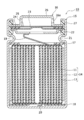
- FIG. 1 is a vertical cross-sectional view of a cylindrical secondary battery which is an example of the embodiment.
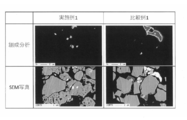
- FIG. 2 shows SEM photographs and EPMA analysis results of cross sections of the positive electrode active material in Example 1 and Comparative Example 1.
- the positive electrode active material in which the surface of the lithium transition metal composite oxide is coated with an oxide or the like suppresses side reactions such as decomposition of the electrolyte and elution of the transition metal from the positive electrode active material during charging and discharging of the battery. can.
- the coating makes it difficult for lithium ions to move, which may reduce the battery capacity.
- the present inventor has found at least one element selected from Ca, Sr, Sc, Er, Y, Zr, and W inside the secondary particles of the lithium transition metal composite oxide. It has been found that the durability and battery capacity of the secondary battery can be improved by using the existing positive electrode active material.
- the presence of at least one element selected from Ca, Sr, Sc, Er, Y, Zr, and W inside the secondary particles of the lithium transition metal composite oxide facilitates the movement of lithium ions. It is inferred that.
- a cylindrical battery in which a wound electrode body is housed in a cylindrical battery case is illustrated, but the electrode body is not limited to the wound type, and a plurality of positive electrodes and a plurality of negative electrodes are interposed via a separator. It may be a laminated type in which one sheet is alternately laminated one by one.
- the battery case is not limited to a cylindrical shape, and may be, for example, a square shape, a coin shape, or the like, or may be a battery case made of a laminated sheet including a metal layer and a resin layer.
- FIG. 1 is a vertical cross-sectional view of a cylindrical secondary battery 10 which is an example of an embodiment.
- the electrode body 14 and the non-aqueous electrolyte are housed in the exterior body 15.
- the electrode body 14 has a winding structure in which the positive electrode 11 and the negative electrode 12 are wound around the separator 13.
- the non-aqueous solvent (organic solvent) of the non-aqueous electrolyte carbonates, lactones, ethers, ketones, esters and the like can be used, and two or more of these solvents can be mixed and used. ..
- a mixed solvent containing a cyclic carbonate and a chain carbonate it is preferable to use a mixed solvent containing a cyclic carbonate and a chain carbonate.
- ethylene carbonate (EC), propylene carbonate (PC), butylene carbonate (BC) and the like can be used as the cyclic carbonate, and dimethyl carbonate (DMC), ethyl methyl carbonate (EMC), and diethyl carbonate (diethyl carbonate) (as the chain carbonate). DEC) and the like can be used.
- DEC diethyl carbonate
- the electrolyte salt of the non-aqueous electrolyte LiPF 6 , LiBF 4 , LiCF 3 SO 3, etc. and a mixture thereof can be used.
- the amount of the electrolyte salt dissolved in the non-aqueous solvent can be, for example, 0.5 to 2.0 mol / L.
- the sealing body 16 side will be referred to as “top” and the bottom side of the exterior body 15 will be referred to as “bottom”.
- the inside of the secondary battery 10 is sealed by closing the opening end of the exterior body 15 with the sealing body 16.
- Insulating plates 17 and 18 are provided above and below the electrode body 14, respectively.
- the positive electrode lead 19 extends upward through the through hole of the insulating plate 17 and is welded to the lower surface of the filter 22 which is the bottom plate of the sealing body 16.
- the cap 26, which is the top plate of the sealing body 16 electrically connected to the filter 22, serves as the positive electrode terminal.
- the negative electrode lead 20 extends to the bottom side of the exterior body 15 through the through hole of the insulating plate 18 and is welded to the inner surface of the bottom portion of the exterior body 15.
- the exterior body 15 serves as a negative electrode terminal.
- the negative electrode lead 20 passes through the outside of the insulating plate 18 and extends to the bottom side of the exterior body 15 and is welded to the inner surface of the bottom portion of the exterior body 15.
- the exterior body 15 is, for example, a bottomed cylindrical metal exterior can.
- a gasket 27 is provided between the exterior body 15 and the sealing body 16 to ensure the internal airtightness of the secondary battery 10.
- the exterior body 15 has a grooved portion 21 that supports the sealing body 16 and is formed by pressing, for example, a side surface portion from the outside.
- the grooved portion 21 is preferably formed in an annular shape along the circumferential direction of the exterior body 15, and the sealing body 16 is supported on the upper surface thereof via the gasket 27.
- the sealing body 16 has a filter 22, a lower valve body 23, an insulating member 24, an upper valve body 25, and a cap 26, which are laminated in order from the electrode body 14 side.
- Each member constituting the sealing body 16 has, for example, a disk shape or a ring shape, and each member except the insulating member 24 is electrically connected to each other.
- the lower valve body 23 and the upper valve body 25 are connected to each other at their central portions, and an insulating member 24 is interposed between the peripheral portions thereof.
- the positive electrode 11, the negative electrode 12, and the separator 13 constituting the secondary battery 10 will be described in detail, and in particular, the positive electrode active material contained in the positive electrode mixture layer constituting the positive electrode 11 will be described in detail.
- the positive electrode 11 has, for example, a positive electrode core such as a metal foil and a positive electrode mixture layer formed on the positive electrode core.
- a positive electrode core such as a metal foil and a positive electrode mixture layer formed on the positive electrode core.
- a metal foil such as aluminum that is stable in the potential range of the positive electrode, a film in which the metal is arranged on the surface layer, or the like can be used.
- the positive electrode mixture layer includes, for example, a positive electrode active material, a binder, a conductive material, and the like.
- a positive electrode mixture slurry containing a positive electrode active material, a binder, a conductive material, etc. is applied onto the positive electrode core and dried to form a positive electrode mixture layer, and then the positive electrode mixture layer is rolled. Can be produced by.
- Examples of the conductive material contained in the positive electrode mixture layer include carbon particles such as carbon black (CB), acetylene black (AB), Ketjen black, and graphite. These may be used alone or in combination of two or more.
- binder contained in the positive electrode mixture layer examples include fluororesins such as polytetrafluoroethylene (PTFE) and polyvinylidene fluoride (PVdF), polyacrylonitrile (PAN), polyimide resins, acrylic resins, and polyolefins.
- fluororesins such as polytetrafluoroethylene (PTFE) and polyvinylidene fluoride (PVdF), polyacrylonitrile (PAN), polyimide resins, acrylic resins, and polyolefins.
- PTFE polytetrafluoroethylene
- PVdF polyvinylidene fluoride
- PAN polyacrylonitrile
- polyimide resins acrylic resins
- acrylic resins acrylic resins
- polyolefins examples include system resins. These may be used alone or in combination of two or more.
- the positive electrode active material contains a lithium transition metal composite oxide capable of occluding and releasing Li.
- the lithium transition metal composite oxide may have a spinel structure. It can be confirmed by X-ray diffraction (XRD) that the lithium transition metal composite oxide has a spinel structure.
- the lithium transition metal composite oxide is, for example, secondary particles formed by agglomeration of a plurality of primary particles.
- the particle size of the primary particles constituting the secondary particles is, for example, 0.05 ⁇ m to 1 ⁇ m.
- the particle size of the primary particles is measured as the diameter of the circumscribed circle in the particle image observed by a scanning electron microscope (SEM).
- the volume-based median diameter (D50) of the secondary particles of the lithium transition metal composite oxide is, for example, 3 ⁇ m to 30 ⁇ m, preferably 5 ⁇ m to 25 ⁇ m, and particularly preferably 7 ⁇ m to 15 ⁇ m.
- D50 means a particle size in which the cumulative frequency is 50% from the smallest particle size in the volume-based particle size distribution, and is also called a medium diameter.
- the particle size distribution of the composite oxide (Z) can be measured using water as a dispersion medium using a laser diffraction type particle size distribution measuring device (for example, MT3000II manufactured by Microtrac Bell Co., Ltd.).
- Lithium transition metal composite oxide has the general formula Li x M1 y O z F w ( Formula, 0.5 ⁇ x ⁇ 3.1,1 ⁇ y ⁇ 2,2 ⁇ z + w ⁇ 4, M1 is Ni, Co, It is represented by at least one element selected from Mn, Ti, Fe, Al, Ge, Si, and Nb).
- the mole fraction of each element constituting the lithium transition metal composite oxide can be measured, for example, by inductively coupled plasma (ICP) emission spectroscopic analysis for elements other than F and ion chromatograph (IC) measurement for F.
- ICP inductively coupled plasma
- IC ion chromatograph
- the lithium transition metal composite oxide has a general formula of Li 1 + ⁇ Ni 0.5- ⁇ Mn 1.5- ⁇ M2 ⁇ + ⁇ O a F b (in the formula, 0 ⁇ ⁇ ⁇ 0.2, 0 ⁇ ⁇ ⁇ 0.2, 0 ⁇ ⁇ ⁇ 0.5, 0 ⁇ b ⁇ 0.2, 3.8 ⁇ a + b ⁇ 4.2, M2 is at least one element selected from Ti, Fe, Al, Ge, Si, and Nb) It may be represented by.
- ⁇ in 1 + ⁇ indicating the ratio of Li in the lithium transition metal composite oxide preferably satisfies 0 ⁇ ⁇ ⁇ 0.2 and 0 ⁇ ⁇ ⁇ 0.05.
- ⁇ is less than 0, the battery capacity may decrease as compared with the case where ⁇ satisfies the above range.
- ⁇ exceeds 0.2 the charge / discharge cycle characteristics may be deteriorated as compared with the case where ⁇ satisfies the above range.
- ⁇ at 0.5- ⁇ which indicates the ratio of Ni to the total number of moles of metal elements other than Li in the lithium transition metal composite oxide, satisfies 0 ⁇ ⁇ ⁇ 0.2 and 0 ⁇ ⁇ ⁇ 0.15. It is preferable to satisfy, and it is more preferable to satisfy 0 ⁇ ⁇ ⁇ 0.1.
- ⁇ at 1.5- ⁇ which indicates the ratio of Mn to the total number of moles of metal elements other than Li in the lithium transition metal composite oxide, satisfies 0 ⁇ ⁇ ⁇ 0.5 and 0 ⁇ ⁇ ⁇ 0.3. It is preferable to satisfy, and it is more preferable to satisfy 0 ⁇ ⁇ ⁇ 0.1.
- M is Ti, Fe, Al, Ge, Si, Nb, Ta, Zr, W, Mo, Sc, Y, and Er
- M is Ti, Fe, Al, Ge, Si, Nb, Ta, Zr, W, Mo, Sc, Y, and Er
- B which indicates the ratio of F in the lithium transition metal composite oxide, preferably satisfies 0 ⁇ b ⁇ 0.2 and 0 ⁇ b ⁇ 0.1.
- the inclusion of F in the lithium transition metal composite oxide improves the stability of the crystal structure of the lithium transition metal composite oxide. By stabilizing the crystal structure of the lithium transition metal composite oxide, for example, the durability of the secondary battery is improved.
- the positive electrode active material contains M2 (M2 is at least one element selected from Ca, Sr, Sc, Er, Y, Zr, and W) inside the secondary particles of the lithium transition metal composite oxide.
- M2 is at least one element selected from Ca, Sr, Sc, Er, Y, Zr, and W
- M2 is at least one element selected from Ca, Sr, Sc, Er, Y, Zr, and W
- M2 preferably contains at least one element selected from Ca and Sr.
- the above-mentioned lithium transition metal composite oxide and the positive electrode active material containing M2 contained inside the secondary particles of the lithium transition metal composite oxide will be referred to as “composite oxide (Y)”. ..
- the positive electrode active material contained in the secondary battery may contain the composite oxide (Y) as a main component and may be substantially composed of only the composite oxide (Y).
- the positive electrode active material may contain a composite oxide other than the composite oxide (Y) or other compounds as long as the object of the present disclosure is not impaired.
- the mole fraction of M2 with respect to the total number of moles of metal elements other than Li contained in the lithium transition metal composite oxide is preferably 0.2% to 10%, more preferably 0.2% to 2%.
- the mole fraction of M2 in the composite oxide (Y) can be measured by XRD.
- the distribution of M2 in the composite oxide (Y) can be confirmed two-dimensionally by an electron probe microanalyzer (EPMA). Specifically, after confirming the shape of the secondary particles of the lithium transition metal composite oxide with an electron image similar to that of SEM by EPMA, the composition analysis is performed at the same location. It can be confirmed that a large amount of Sr is present inside the secondary particles.
- EPMA electron probe microanalyzer
- the composite oxide (Y) can be synthesized, for example, by adding a Li source and an M2 source to a Li-free composite compound (X), mixing them, and calcining them at 200 ° C. to 1050 ° C.
- the composite compound (X) include composite oxides containing Ni, Mn and the like, hydroxides, carbonic acid compounds and the like.
- the Li source include LiOH and the like.
- the M2 source include M2 hydroxides, carbonic acid compounds, nitric acid compounds and the like.
- Examples of the M2 source include Ca (OH) 2 , CaCO 3 , Ca (NO 3 ) 2 , Sr (OH) 2 , SrCO 3 , Sr (NO 3 ) 2, and the like.
- the M2 source may be either a powdery solid or an aqueous solution in which the M2 source is dissolved. From the viewpoint of dispersing M2 inside or outside the secondary particles of the lithium transition metal composite oxide, the method of adding an aqueous solution is preferable. When an aqueous solution is added, Ca (NO 3 ) 2 and Sr (NO 3 ) 2 having high solubility in water are preferable as the M2 source from the viewpoint of facilitating the preparation of the aqueous solution.
- the negative electrode 12 has, for example, a negative electrode core such as a metal foil and a negative electrode mixture layer provided on the surface of the negative electrode core.
- a negative electrode core such as a metal foil and a negative electrode mixture layer provided on the surface of the negative electrode core.
- a metal foil such as copper that is stable in the potential range of the negative electrode, a film in which the metal is arranged on the surface layer, or the like can be used.
- the negative electrode mixture layer contains, for example, a negative electrode active material and a binder.
- the negative electrode is produced, for example, by applying a negative electrode mixture slurry containing a negative electrode active material, a binder, etc. onto the negative electrode core body and drying to form a negative electrode mixture layer, and then rolling the negative electrode mixture layer. can.
- the negative electrode mixture layer contains, for example, a carbon-based active material that reversibly occludes and releases lithium ions as a negative electrode active material.
- Suitable carbon-based active materials are natural graphite such as scaly graphite, massive graphite, earthy graphite, and graphite such as artificial graphite such as massive artificial graphite (MAG) and graphitized mesophase carbon microbeads (MCMB).
- a Si-based active material composed of at least one of Si and a Si-containing compound may be used, or a carbon-based active material and a Si-based active material may be used in combination.
- the binder contained in the negative electrode mixture layer fluororesin, PAN, polyimide, acrylic resin, polyolefin or the like can be used as in the case of the positive electrode, but styrene-butadiene rubber (SBR) may be used.
- SBR styrene-butadiene rubber
- the negative electrode mixture layer preferably further contains CMC or a salt thereof, polyacrylic acid (PAA) or a salt thereof, polyvinyl alcohol (PVA) and the like. Above all, it is preferable to use SBR in combination with CMC or a salt thereof, PAA or a salt thereof.
- separator a porous sheet having ion permeability and insulating property is used. Specific examples of the porous sheet include a microporous thin film, a woven fabric, and a non-woven fabric.
- material of the separator polyolefins such as polyethylene and polypropylene, cellulose and the like are suitable.
- the separator may have either a single-layer structure or a laminated structure. A heat-resistant layer or the like may be formed on the surface of the separator.
- the aqueous solution of nickel-manganese composite oxide (X), LiOH, and Sr (NO 3 ) 2 was mixed with the total amount of Ni and Mn, and the molar ratio of Li and Sr was 1: 0.5: 0. It was mixed so as to be 002.
- This mixture was calcined at 900 ° C. for 10 hours and then pulverized to obtain a lithium composite oxide (Y).
- XRD the mole fraction of Sr with respect to the total number of moles of metal elements excluding Li contained in the lithium transition metal composite oxide was 0.16%.
- the positive electrode active material, acetylene black, and polyvinylidene fluoride (PVdF) are mixed at a solid content mass ratio of 96.3: 2.5: 1.2, and an appropriate amount of N-methyl-2-pyrrolidone (NMP) is added. After the addition, this was kneaded to prepare a positive electrode mixture slurry.
- the positive electrode mixture slurry is applied to both sides of a positive electrode core made of aluminum foil, the coating film is dried, and then the coating film is rolled using a roller and cut to a predetermined electrode size to form the positive electrode core. A positive electrode having a positive electrode mixture layer formed on both sides was obtained. An exposed portion where the surface of the positive electrode core was exposed was provided on a part of the positive electrode.
- Natural graphite was used as the negative electrode active material.
- the negative electrode active material sodium carboxymethyl cellulose (CMC-Na), and styrene-butadiene rubber (SBR) were mixed in an aqueous solution at a solid content mass ratio of 100: 1: 1 to prepare a negative electrode mixture slurry.
- the negative electrode mixture slurry is applied to both sides of the negative electrode core made of copper foil, the coating film is dried, and then the coating film is rolled using a roller and cut to a predetermined electrode size to form the negative electrode core.
- a negative electrode having a negative electrode mixture layer formed on both sides was obtained.
- An exposed portion where the surface of the negative electrode core was exposed was provided on a part of the negative electrode.
- Fluoroethylene carbonate (FEC), ethylene carbonate (EC) and ethyl methyl carbonate (EMC) were mixed in a volume ratio of 1: 1: 6 to obtain a non-aqueous solvent.
- a non-aqueous electrolyte was obtained by dissolving LiPF 6 in this non-aqueous solvent at a concentration of 1.0 mol / L.
- An aluminum lead is attached to the exposed portion of the positive electrode, and a nickel lead is attached to the exposed portion of the negative electrode.
- the positive electrode and the negative electrode are spirally wound via a polyolefin separator, and then press-molded in the radial direction to form a flat shape.
- a wound electrode body was produced. This electrode body was housed in an exterior body made of an aluminum laminated sheet, and after injecting the non-aqueous electrolyte, the opening of the exterior body was sealed to obtain a non-aqueous electrolyte secondary battery having a design capacity of 650 mAh. ..
- Capacity retention rate (%) (26th cycle discharge capacity ⁇ 3rd cycle discharge capacity) x 100 ⁇ Cycle test>
- the test cell is charged at a constant current of 0.2 C at a constant current of 0.2 C until the battery voltage reaches 4.9 V under a temperature environment of 25 ° C., and then charged at a constant voltage of 4.9 V until the current value reaches 0.02 C. went. Then, constant current discharge was performed with a constant current of 0.2 C until the battery voltage became 3.0 V. This charge / discharge cycle was repeated for 26 cycles.
- Example 2 An aqueous solution of nickel-manganese composite oxide (X), LiOH, and Sr (NO 3 ) 2 has a total amount of Ni and Mn and a molar ratio of Li and Sr of 1: 0.5: 0.02.
- a battery was prepared and evaluated in the same manner as in Example 1 except that the batteries were mixed as described above.
- the mole fraction of Sr with respect to the total number of moles of metal elements excluding Li contained in the lithium transition metal composite oxide was 0.96%.
- Example 3 A battery was prepared and evaluated in the same manner as in Example 1 except that Ca (NO 3 ) 2 was used instead of Sr (NO 3 ) 2.
- Example 4 A battery was prepared and evaluated in the same manner as in Example 2 except that Ca (NO 3 ) 2 was used instead of Sr (NO 3 ) 2.
- a nickel-manganese composite oxide (X) was obtained by coprecipitation in the same manner as in Example 1. Next, the nickel-manganese composite oxide (X) and LiOH are mixed so that the total amount of Ni and Mn and the molar ratio of Li are 1: 0.5, and this mixture is mixed at 900 ° C. for 10 hours. It was fired to obtain a fired product. Further, an aqueous solution of Sr (NO 3 ) 2 is mixed and added to this fired product so that the total amount of Ni and Mn and the molar ratio of Sr are 1: 0.002, and the product is fired at 900 ° C. for 10 hours. After that, lithium composite oxide (Z) was synthesized by pulverization, and this was used as a positive electrode active material. The obtained positive electrode active material (lithium composite oxide (Z)) was evaluated by producing a battery in the same manner as in Example 1.
- Comparative example 2 The same as in Comparative Example 1 except that an aqueous solution of Sr (NO 3 ) 2 was mixed and added to the fired product so that the total amount of Ni and Mn and the molar ratio of Sr were 1: 0.02. A battery was manufactured and evaluated.
- Table 1 summarizes the results of the discharge capacity (initial capacity) and capacity retention rate of the initial batteries of Examples and Comparative Examples. Table 1 also shows the amount of M2 element and M2 added, and the presence or absence of M2 inside the secondary particles of the lithium transition metal composite oxide.
- FIG. 2 shows SEM photographs and EPMA analysis results of cross sections of the positive electrode active material in Example 1 and Comparative Example 1.
- Sr was unevenly distributed inside the secondary particles of the lithium transition metal composite oxide
- Comparative Example 1 Sr was unevenly distributed between the secondary particles of the lithium transition metal composite oxide.
- Ca is unevenly distributed inside the secondary particles of the lithium transition metal composite oxide
- Comparative Examples 3 and 4 Ca is located between the secondary particles of the lithium transition metal composite oxide. It was unevenly distributed.
Landscapes
- Chemical & Material Sciences (AREA)
- Chemical Kinetics & Catalysis (AREA)
- Electrochemistry (AREA)
- General Chemical & Material Sciences (AREA)
- Inorganic Chemistry (AREA)
- Organic Chemistry (AREA)
- Composite Materials (AREA)
- Engineering & Computer Science (AREA)
- Materials Engineering (AREA)
- Manufacturing & Machinery (AREA)
- Battery Electrode And Active Subsutance (AREA)
- Secondary Cells (AREA)
Priority Applications (4)
| Application Number | Priority Date | Filing Date | Title |
|---|---|---|---|
| CN202180015464.8A CN115152059B (zh) | 2020-02-28 | 2021-02-25 | 非水电解质二次电池用正极活性物质和非水电解质二次电池 |
| US17/800,779 US20230110150A1 (en) | 2020-02-28 | 2021-02-25 | Positive electrode active material for non-aqueous electrolyte secondary battery, and non-aqueous electrolyte secondary battery |
| EP21760526.0A EP4112558A4 (en) | 2020-02-28 | 2021-02-25 | POSITIVE ELECTRODE ACTIVE MATERIAL FOR SECONDARY BATTERY WITH ANHYDROUS ELECTROLYTE AND SECONDARY BATTERY WITH ANHYDROUS ELECTROLYTE |
| JP2022503702A JP7713646B2 (ja) | 2020-02-28 | 2021-02-25 | 非水電解質二次電池用正極活物質、及び非水電解質二次電池 |
Applications Claiming Priority (2)
| Application Number | Priority Date | Filing Date | Title |
|---|---|---|---|
| JP2020032999 | 2020-02-28 | ||
| JP2020-032999 | 2020-02-28 |
Publications (1)
| Publication Number | Publication Date |
|---|---|
| WO2021172446A1 true WO2021172446A1 (ja) | 2021-09-02 |
Family
ID=77491514
Family Applications (1)
| Application Number | Title | Priority Date | Filing Date |
|---|---|---|---|
| PCT/JP2021/007144 Ceased WO2021172446A1 (ja) | 2020-02-28 | 2021-02-25 | 非水電解質二次電池用正極活物質、及び非水電解質二次電池 |
Country Status (5)
| Country | Link |
|---|---|
| US (1) | US20230110150A1 (cg-RX-API-DMAC7.html) |
| EP (1) | EP4112558A4 (cg-RX-API-DMAC7.html) |
| JP (1) | JP7713646B2 (cg-RX-API-DMAC7.html) |
| CN (1) | CN115152059B (cg-RX-API-DMAC7.html) |
| WO (1) | WO2021172446A1 (cg-RX-API-DMAC7.html) |
Citations (7)
| Publication number | Priority date | Publication date | Assignee | Title |
|---|---|---|---|---|
| JP2005322480A (ja) * | 2004-05-07 | 2005-11-17 | Nec Corp | リチウム二次電池用正極活物質およびそれを使用したリチウム二次電池 |
| JP2006351487A (ja) * | 2005-06-20 | 2006-12-28 | Sony Corp | 正極活物質およびその製造方法、並びに電池 |
| JP2012138197A (ja) | 2010-12-24 | 2012-07-19 | Asahi Glass Co Ltd | リチウムイオン二次電池用の正極活物質、正極、リチウムイオン二次電池、および、リチウムイオン二次電池用正極活物質の製造方法 |
| JP2013191540A (ja) | 2012-03-13 | 2013-09-26 | Samsung Corning Precision Materials Co Ltd | 正極活物質およびその製造方法並びにこれを利用した2次電池 |
| JP2017069135A (ja) * | 2015-10-01 | 2017-04-06 | 株式会社豊田自動織機 | リチウム複合金属酸化物部、中間部及び導電性酸化物部を有する材料 |
| JP2020007210A (ja) * | 2018-06-29 | 2020-01-16 | 株式会社豊田自動織機 | 層状岩塩構造のリチウムニッケルコバルトタングステン酸化物 |
| WO2020262348A1 (ja) * | 2019-06-27 | 2020-12-30 | パナソニック株式会社 | 非水電解質二次電池用正極活物質、及び非水電解質二次電池 |
Family Cites Families (11)
| Publication number | Priority date | Publication date | Assignee | Title |
|---|---|---|---|---|
| CN101443273B (zh) * | 2006-02-17 | 2014-05-07 | 株式会社Lg化学 | 锂-金属复合氧化物的制备方法 |
| BRPI0814870A2 (pt) * | 2007-08-10 | 2015-02-03 | Umicore Nv | Óxido de metal de transição de lítio pulverulento, célula eletrolítica, e, método para preparar um óxido de metal de transição de lítio pulverulento |
| US9123959B2 (en) * | 2013-02-11 | 2015-09-01 | Wildcat Discovery Technologies, Inc. | High energy cathode material |
| JP6399388B2 (ja) * | 2013-11-28 | 2018-10-03 | パナソニックIpマネジメント株式会社 | 非水電解質二次電池 |
| JP6311925B2 (ja) * | 2014-05-13 | 2018-04-18 | 株式会社豊田自動織機 | リチウム複合金属酸化物及びその製造方法 |
| KR102349731B1 (ko) * | 2014-06-02 | 2022-01-11 | 에스케이온 주식회사 | 리튬 이차 전지 |
| US20190044179A1 (en) * | 2016-02-29 | 2019-02-07 | Panasonic Intellectual Property Management Co., Ltd. | Nonaqueous electrolyte secondary battery |
| JP6799829B2 (ja) * | 2016-03-30 | 2020-12-16 | パナソニックIpマネジメント株式会社 | 非水電解質二次電池用正極活物質、非水電解質二次電池用正極活物質の製造方法、及び非水電解質二次電池 |
| TWI633692B (zh) * | 2016-03-31 | 2018-08-21 | 烏明克公司 | 供汽車應用的鋰離子電池組 |
| CN110574194B (zh) * | 2017-11-06 | 2022-06-03 | 株式会社Lg化学 | 尖晶石结构的锂锰基正极活性材料和包含所述正极活性材料的正极和锂二次电池 |
| JP7164803B2 (ja) * | 2018-06-14 | 2022-11-02 | 日亜化学工業株式会社 | 非水電解質二次電池用正極活物質およびその製造方法 |
-
2021
- 2021-02-25 CN CN202180015464.8A patent/CN115152059B/zh active Active
- 2021-02-25 US US17/800,779 patent/US20230110150A1/en active Pending
- 2021-02-25 JP JP2022503702A patent/JP7713646B2/ja active Active
- 2021-02-25 WO PCT/JP2021/007144 patent/WO2021172446A1/ja not_active Ceased
- 2021-02-25 EP EP21760526.0A patent/EP4112558A4/en not_active Withdrawn
Patent Citations (7)
| Publication number | Priority date | Publication date | Assignee | Title |
|---|---|---|---|---|
| JP2005322480A (ja) * | 2004-05-07 | 2005-11-17 | Nec Corp | リチウム二次電池用正極活物質およびそれを使用したリチウム二次電池 |
| JP2006351487A (ja) * | 2005-06-20 | 2006-12-28 | Sony Corp | 正極活物質およびその製造方法、並びに電池 |
| JP2012138197A (ja) | 2010-12-24 | 2012-07-19 | Asahi Glass Co Ltd | リチウムイオン二次電池用の正極活物質、正極、リチウムイオン二次電池、および、リチウムイオン二次電池用正極活物質の製造方法 |
| JP2013191540A (ja) | 2012-03-13 | 2013-09-26 | Samsung Corning Precision Materials Co Ltd | 正極活物質およびその製造方法並びにこれを利用した2次電池 |
| JP2017069135A (ja) * | 2015-10-01 | 2017-04-06 | 株式会社豊田自動織機 | リチウム複合金属酸化物部、中間部及び導電性酸化物部を有する材料 |
| JP2020007210A (ja) * | 2018-06-29 | 2020-01-16 | 株式会社豊田自動織機 | 層状岩塩構造のリチウムニッケルコバルトタングステン酸化物 |
| WO2020262348A1 (ja) * | 2019-06-27 | 2020-12-30 | パナソニック株式会社 | 非水電解質二次電池用正極活物質、及び非水電解質二次電池 |
Non-Patent Citations (1)
| Title |
|---|
| See also references of EP4112558A4 |
Also Published As
| Publication number | Publication date |
|---|---|
| EP4112558A1 (en) | 2023-01-04 |
| CN115152059A (zh) | 2022-10-04 |
| EP4112558A4 (en) | 2023-08-30 |
| US20230110150A1 (en) | 2023-04-13 |
| JPWO2021172446A1 (cg-RX-API-DMAC7.html) | 2021-09-02 |
| CN115152059B (zh) | 2026-02-10 |
| JP7713646B2 (ja) | 2025-07-28 |
Similar Documents
| Publication | Publication Date | Title |
|---|---|---|
| JP7405655B2 (ja) | 非水電解質二次電池用正極及び非水電解質二次電池 | |
| JP7324119B2 (ja) | 非水電解質二次電池用正極活物質、及び非水電解質二次電池 | |
| JP7588079B2 (ja) | 非水電解質二次電池 | |
| US20240055595A1 (en) | Nonaqueous electrolyte secondary battery | |
| JP7573196B2 (ja) | 非水電解質二次電池用正極活物質、及び非水電解質二次電池 | |
| JP7595308B2 (ja) | 二次電池用の正極活物質、及び二次電池 | |
| CN112751019B (zh) | 非水电解质二次电池用正极活性物质和非水电解质二次电池 | |
| WO2024004578A1 (ja) | 非水電解質二次電池 | |
| CN112563482A (zh) | 非水电解质二次电池用正极活性物质和非水电解质二次电池 | |
| JP7752330B2 (ja) | 非水電解質二次電池用正極活物質、及び非水電解質二次電池 | |
| US20260094822A1 (en) | Positive electrode active material for secondary batteries, and secondary battery | |
| US20240145680A1 (en) | Active material for nonaqueous electrolyte secondary batteries, and nonaqueous electrolyte secondary battery | |
| WO2024029241A1 (ja) | 非水電解質二次電池用正極活物質、及び非水電解質二次電池 | |
| US20230361289A1 (en) | Positive electrode active material for nonaqueous electrolyte secondary batteries, and nonaqueous electrolyte secondary battery | |
| CN115152059B (zh) | 非水电解质二次电池用正极活性物质和非水电解质二次电池 | |
| CN114342116A (zh) | 非水电解质二次电池用正极活性物质和非水电解质二次电池 | |
| US20240055585A1 (en) | Active material for nonaqueous electrolyte secondary batteries, method for producing active material for nonaqueous electrolyte secondary batteries, and nonaqueous electrolyte secondary battery | |
| US20240079564A1 (en) | Active material for non-aqueous electrolyte secondary battery, and non-aqueous electrolyte secondary battery | |
| JP7539392B2 (ja) | 非水電解質二次電池用正極活物質、及び非水電解質二次電池 | |
| WO2022070648A1 (ja) | 非水電解質二次電池 |
Legal Events
| Date | Code | Title | Description |
|---|---|---|---|
| 121 | Ep: the epo has been informed by wipo that ep was designated in this application |
Ref document number: 21760526 Country of ref document: EP Kind code of ref document: A1 |
|
| ENP | Entry into the national phase |
Ref document number: 2022503702 Country of ref document: JP Kind code of ref document: A |
|
| NENP | Non-entry into the national phase |
Ref country code: DE |
|
| ENP | Entry into the national phase |
Ref document number: 2021760526 Country of ref document: EP Effective date: 20220928 |