WO2021167075A1 - 光学積層体、偏光板、画像表示装置 - Google Patents
光学積層体、偏光板、画像表示装置 Download PDFInfo
- Publication number
- WO2021167075A1 WO2021167075A1 PCT/JP2021/006404 JP2021006404W WO2021167075A1 WO 2021167075 A1 WO2021167075 A1 WO 2021167075A1 JP 2021006404 W JP2021006404 W JP 2021006404W WO 2021167075 A1 WO2021167075 A1 WO 2021167075A1
- Authority
- WO
- WIPO (PCT)
- Prior art keywords
- liquid crystal
- optically anisotropic
- anisotropic layer
- crystal compound
- layer
- Prior art date
- Legal status (The legal status is an assumption and is not a legal conclusion. Google has not performed a legal analysis and makes no representation as to the accuracy of the status listed.)
- Ceased
Links
Images

Classifications
-
- G—PHYSICS
- G02—OPTICS
- G02B—OPTICAL ELEMENTS, SYSTEMS OR APPARATUS
- G02B5/00—Optical elements other than lenses
- G02B5/30—Polarising elements
- G02B5/3016—Polarising elements involving passive liquid crystal elements
-
- G—PHYSICS
- G02—OPTICS
- G02B—OPTICAL ELEMENTS, SYSTEMS OR APPARATUS
- G02B5/00—Optical elements other than lenses
- G02B5/30—Polarising elements
- G02B5/3025—Polarisers, i.e. arrangements capable of producing a definite output polarisation state from an unpolarised input state
- G02B5/3033—Polarisers, i.e. arrangements capable of producing a definite output polarisation state from an unpolarised input state in the form of a thin sheet or foil, e.g. Polaroid
- G02B5/3041—Polarisers, i.e. arrangements capable of producing a definite output polarisation state from an unpolarised input state in the form of a thin sheet or foil, e.g. Polaroid comprising multiple thin layers, e.g. multilayer stacks
- G02B5/305—Polarisers, i.e. arrangements capable of producing a definite output polarisation state from an unpolarised input state in the form of a thin sheet or foil, e.g. Polaroid comprising multiple thin layers, e.g. multilayer stacks including organic materials, e.g. polymeric layers
-
- G—PHYSICS
- G02—OPTICS
- G02F—OPTICAL DEVICES OR ARRANGEMENTS FOR THE CONTROL OF LIGHT BY MODIFICATION OF THE OPTICAL PROPERTIES OF THE MEDIA OF THE ELEMENTS INVOLVED THEREIN; NON-LINEAR OPTICS; FREQUENCY-CHANGING OF LIGHT; OPTICAL LOGIC ELEMENTS; OPTICAL ANALOGUE/DIGITAL CONVERTERS
- G02F1/00—Devices or arrangements for the control of the intensity, colour, phase, polarisation or direction of light arriving from an independent light source, e.g. switching, gating or modulating; Non-linear optics
- G02F1/01—Devices or arrangements for the control of the intensity, colour, phase, polarisation or direction of light arriving from an independent light source, e.g. switching, gating or modulating; Non-linear optics for the control of the intensity, phase, polarisation or colour
- G02F1/13—Devices or arrangements for the control of the intensity, colour, phase, polarisation or direction of light arriving from an independent light source, e.g. switching, gating or modulating; Non-linear optics for the control of the intensity, phase, polarisation or colour based on liquid crystals, e.g. single liquid crystal display cells
- G02F1/133—Constructional arrangements; Operation of liquid crystal cells; Circuit arrangements
- G02F1/1333—Constructional arrangements; Manufacturing methods
- G02F1/1335—Structural association of cells with optical devices, e.g. polarisers or reflectors
- G02F1/13363—Birefringent elements, e.g. for optical compensation
- G02F1/133633—Birefringent elements, e.g. for optical compensation using mesogenic materials
-
- G—PHYSICS
- G02—OPTICS
- G02F—OPTICAL DEVICES OR ARRANGEMENTS FOR THE CONTROL OF LIGHT BY MODIFICATION OF THE OPTICAL PROPERTIES OF THE MEDIA OF THE ELEMENTS INVOLVED THEREIN; NON-LINEAR OPTICS; FREQUENCY-CHANGING OF LIGHT; OPTICAL LOGIC ELEMENTS; OPTICAL ANALOGUE/DIGITAL CONVERTERS
- G02F1/00—Devices or arrangements for the control of the intensity, colour, phase, polarisation or direction of light arriving from an independent light source, e.g. switching, gating or modulating; Non-linear optics
- G02F1/01—Devices or arrangements for the control of the intensity, colour, phase, polarisation or direction of light arriving from an independent light source, e.g. switching, gating or modulating; Non-linear optics for the control of the intensity, phase, polarisation or colour
- G02F1/13—Devices or arrangements for the control of the intensity, colour, phase, polarisation or direction of light arriving from an independent light source, e.g. switching, gating or modulating; Non-linear optics for the control of the intensity, phase, polarisation or colour based on liquid crystals, e.g. single liquid crystal display cells
- G02F1/133—Constructional arrangements; Operation of liquid crystal cells; Circuit arrangements
- G02F1/1333—Constructional arrangements; Manufacturing methods
- G02F1/1335—Structural association of cells with optical devices, e.g. polarisers or reflectors
- G02F1/13363—Birefringent elements, e.g. for optical compensation
- G02F1/133638—Waveplates, i.e. plates with a retardation value of lambda/n
-
- H—ELECTRICITY
- H05—ELECTRIC TECHNIQUES NOT OTHERWISE PROVIDED FOR
- H05B—ELECTRIC HEATING; ELECTRIC LIGHT SOURCES NOT OTHERWISE PROVIDED FOR; CIRCUIT ARRANGEMENTS FOR ELECTRIC LIGHT SOURCES, IN GENERAL
- H05B33/00—Electroluminescent light sources
- H05B33/02—Details
-
- H—ELECTRICITY
- H10—SEMICONDUCTOR DEVICES; ELECTRIC SOLID-STATE DEVICES NOT OTHERWISE PROVIDED FOR
- H10K—ORGANIC ELECTRIC SOLID-STATE DEVICES
- H10K59/00—Integrated devices, or assemblies of multiple devices, comprising at least one organic light-emitting element covered by group H10K50/00
- H10K59/80—Constructional details
- H10K59/8791—Arrangements for improving contrast, e.g. preventing reflection of ambient light
-
- H—ELECTRICITY
- H10—SEMICONDUCTOR DEVICES; ELECTRIC SOLID-STATE DEVICES NOT OTHERWISE PROVIDED FOR
- H10K—ORGANIC ELECTRIC SOLID-STATE DEVICES
- H10K59/00—Integrated devices, or assemblies of multiple devices, comprising at least one organic light-emitting element covered by group H10K50/00
- H10K59/80—Constructional details
- H10K59/8793—Arrangements for polarized light emission
-
- C—CHEMISTRY; METALLURGY
- C09—DYES; PAINTS; POLISHES; NATURAL RESINS; ADHESIVES; COMPOSITIONS NOT OTHERWISE PROVIDED FOR; APPLICATIONS OF MATERIALS NOT OTHERWISE PROVIDED FOR
- C09K—MATERIALS FOR MISCELLANEOUS APPLICATIONS, NOT PROVIDED FOR ELSEWHERE
- C09K2323/00—Functional layers of liquid crystal optical display excluding electroactive liquid crystal layer characterised by chemical composition
- C09K2323/02—Alignment layer characterised by chemical composition
-
- C—CHEMISTRY; METALLURGY
- C09—DYES; PAINTS; POLISHES; NATURAL RESINS; ADHESIVES; COMPOSITIONS NOT OTHERWISE PROVIDED FOR; APPLICATIONS OF MATERIALS NOT OTHERWISE PROVIDED FOR
- C09K—MATERIALS FOR MISCELLANEOUS APPLICATIONS, NOT PROVIDED FOR ELSEWHERE
- C09K2323/00—Functional layers of liquid crystal optical display excluding electroactive liquid crystal layer characterised by chemical composition
- C09K2323/03—Viewing layer characterised by chemical composition
- C09K2323/031—Polarizer or dye
Definitions
- the present invention relates to an optical laminate, a polarizing plate, and an image display device.
- the optically anisotropic layer is used in various image display devices from the viewpoints of eliminating image coloring and expanding the viewing angle.
- As the optically anisotropic layer a layer formed by using a liquid crystal compound has been proposed.
- Patent Document 1 discloses a vertically oriented liquid crystal cured film, a horizontally oriented liquid crystal cured film, and a laminate containing the horizontally oriented liquid crystal cured film in this order.
- a horizontal alignment film is arranged between the two optically anisotropic layers.
- the present invention has excellent adhesion between two optically anisotropic layers, and the liquid crystal orientation of the A plate, which is an optically anisotropic layer, or a layer formed by fixing a twist-oriented liquid crystal phase.
- An object of the present invention is to provide an optical laminate having excellent properties.
- Another object of the present invention is to provide a polarizing plate and an image display device.
- a first optically anisotropic layer formed by using the first liquid crystal compound A second optically anisotropic layer formed using the second liquid crystal compound, An optical laminate having a component derived from a first liquid crystal compound and a mixed layer containing a component derived from a second liquid crystal compound arranged between the first optically anisotropic layer and the second optically anisotropic layer.
- the first optically anisotropic layer is a C plate
- the second optically anisotropic layer is an A plate or a layer formed by fixing a twist-oriented liquid crystal phase.
- the mixed layer further contains a photo-aligned compound, From the surface of the optical laminate on the first optically anisotropic layer side toward the second optically anisotropic layer side, while irradiating an ion beam, the time-of-flight type secondary ion mass spectrometry is performed in the depth direction of the optical laminate.
- An optical laminate that satisfies both the conditions 1 and 2 described later when the components of the above are analyzed.
- the position between the first position and the second position is set as the third position.
- the optical lamination according to (1) wherein secondary ions derived from the first liquid crystal compound and the second liquid crystal compound are detected at any depth position in the region between the first position and the specific depth position. body.
- the adhesion between the two optically anisotropic layers is excellent, and the liquid crystal orientation of the A plate, which is an optically anisotropic layer, or the layer formed by fixing the twist-oriented liquid crystal phase is excellent.
- An optical laminate can be provided.
- an image display device can be provided.
- TOF-SIMS time-of-flight secondary ion mass spectrometry
- the present invention will be described in detail.
- the description of the constituent elements described below may be based on a typical embodiment of the present invention, but the present invention is not limited to such an embodiment.
- the numerical range represented by using "-" means a range including the numerical values before and after "-" as the lower limit value and the upper limit value.
- Re ( ⁇ ) and Rth ( ⁇ ) represent in-plane retardation and thickness direction retardation at wavelength ⁇ , respectively. Unless otherwise specified, the wavelength ⁇ is 550 nm.
- Re ( ⁇ ) and Rth ( ⁇ ) are values measured at a wavelength ⁇ in AxoScan and Axometrics.
- Slow phase axial direction (°) Re ( ⁇ ) R0 ( ⁇ )
- Rth ( ⁇ ) ((nx + ny) /2-nz) ⁇ d Is calculated.
- R0 ( ⁇ ) is displayed as a numerical value calculated by AxoScan, it means Re ( ⁇ ).
- the average refractive index values of the main optical films are illustrated below: cellulose acylate (1.48), cycloolefin polymer (1.52), polycarbonate (1.59), polymethylmethacrylate (1.49), And polystyrene (1.59).
- light means active light or radiation, for example, the emission line spectrum of a mercury lamp, far ultraviolet rays typified by an excima laser, extreme ultraviolet rays (EUV light: Extreme Ultraviolet), X rays, ultraviolet rays, and the like. It also means an electron beam (EB: Electron Beam) or the like. Of these, ultraviolet rays are preferable.
- the bonding direction of the divalent group (for example, -O-CO-) described in the present specification is not particularly limited, and for example, L 2 is-in the bonding of "L 1- L 2- L 3".
- L 2 is * 1-O-CO- * 2. It may be * 1-CO-O- * 2.
- the A plate is defined as follows. There are two types of A plates, a positive A plate (positive A plate) and a negative A plate (negative A plate), and the slow axis direction in the film plane (the direction in which the refractive index in the plane is maximized). ) Is nx, the refractive index in the direction orthogonal to the slow axis in the plane is ny, and the refractive index in the thickness direction is nz, the positive A plate satisfies the relationship of the equation (A1). And the negative A plate satisfies the relation of the formula (A2). The positive A plate shows a positive value for Rth, and the negative A plate shows a negative value for Rth.
- Equation (A1) nx> ny ⁇ nz Equation (A2) ny ⁇ nx ⁇ nz
- ⁇ includes not only the case where both are completely the same, but also the case where both are substantially the same. “Substantially the same” means, for example, “ny ⁇ nz” when (ny-nz) ⁇ d (where d is the thickness of the film) is -10 to 10 nm, preferably -5 to 5 nm. When (nx-nz) xd is -10 to 10 nm, preferably -5 to 5 nm, it is also included in "nx ⁇ nz”.
- C plates There are two types of C plates, a positive C plate (positive C plate) and a negative C plate (negative C plate).
- the positive C plate satisfies the relationship of the formula (C1)
- the negative C plate is It satisfies the relation of the formula (C2).
- the positive C plate shows a negative value of Rth
- the negative C plate shows a positive value of Rth. Equation (C1) nz> nx ⁇ ny Equation (C2) nz ⁇ nx ⁇ ny
- ⁇ includes not only the case where both are completely the same, but also the case where both are substantially the same.
- the layer formed by fixing the twist-oriented liquid crystal phase means a layer formed by fixing the phase in which the liquid crystal compound is twist-oriented along a spiral axis extending along the thickness direction.
- the twist angle is not particularly limited, and for example, a twist-oriented liquid crystal phase having a twist angle of more than 0 ° and 360 ° or less may be used.
- a cholesteric liquid crystal phase can be mentioned as a kind of twist-oriented liquid crystal phase. As used herein, the cholesteric liquid crystal phase is intended to have a twist angle of more than 360 °.
- the feature of the optical laminate of the present invention is that it has a mixed layer containing a photo-aligned compound and satisfies predetermined conditions 1 and 2. It was found that when the optical laminate satisfies the requirements of conditions 1 and 2, the orientation of the liquid crystal compound is excellent, and the adhesion between the first optically anisotropic layer and the second optically anisotropic layer is also excellent. doing.
- FIG. 1 is a schematic view showing an example of an optical laminate.
- the optical laminate 10 has a first optically anisotropic layer 12, a mixed layer 14, and a second optically anisotropic layer 16 in this order.
- the mixed layer 14 is arranged between the first optically anisotropic layer 12 and the second optically anisotropic layer 16.
- the first optically anisotropic layer 12 and the second optically anisotropic layer 16 are both layers formed by using a liquid crystal compound, and the first optically anisotropic layer 12 is a C plate and is a second optical.
- the anisotropic layer 16 is an A plate or a layer formed by fixing a twist-oriented liquid crystal phase. As shown in the optical laminate 10, the first optically anisotropic layer 12 and the mixed layer 14 are in direct contact with each other, and the second optically anisotropic layer 16 and the mixed layer 14 are in direct contact with each other.
- the optical laminate of the present invention is an optical laminate obtained by time-of-flight secondary ion mass spectrometry while irradiating an ion beam from the surface on the first optically anisotropic layer side toward the second optically anisotropic layer side.
- Condition 1 The peak position is the depth position of the mixed layer where the secondary ionic strength derived from the photo-aligned compound is maximized, and the secondary ionic strength is half of the secondary ionic strength at the peak position.
- the depth position on the optically anisotropic layer side is the first position, and the depth on the second optically anisotropic layer side of the peak position, which indicates the secondary ionic strength that is half of the secondary ionic strength at the peak position.
- the position is set to the second position, secondary ions derived from the first liquid crystal compound and the second liquid crystal compound are detected at any depth position in the region between the first position and the second position. .. Condition 2: When the distance between the first position and the peak position is the first distance and the distance between the second position and the peak position is the second distance, the total distance between the first distance and the second distance is used. On the other hand, the second distance is 50% or more.
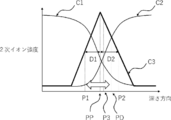
- FIG. 2 shows components in the depth direction in each layer by TOF-SIMS while ion-sputtering from the surface of the optical laminate 10 on the side of the first optically anisotropic layer 12 toward the side of the second optically anisotropic layer 16.
- the depth direction is intended to be a direction toward the second optically anisotropic layer 16 side with reference to the surface of the optical laminate 10 on the first optically anisotropic layer 12 side.
- the horizontal axis in FIG. 2, the axis extending in the left-right direction of the paper surface
- the vertical axis (in FIG. 2, the axis extending in the vertical direction of the paper surface) represents the secondary ionic strength of each component.
- the TOF-SIMS method is specifically described in "Surface Analysis Technology Selection Book Secondary Ion Mass Spectrometry" edited by the Japan Surface Science Society, Maruzen Co., Ltd. (published in 1999).
- the number is further from 1 nm in the depth direction.
- a series of operations for digging 100 nm and performing component analysis in the next surface depth region of 1 to 2 nm are repeated.
- the intensity of the fragment ion derived from the first liquid crystal compound is intended, and the “secondary ion intensity derived from the second liquid crystal compound” is intended to be the intensity of the fragment ion derived from the second liquid crystal compound.
- “Derived secondary ion intensity” is intended to be the intensity of fragment ions derived from a photoaligned compound.
- the optical laminate 10 is optically laminated by the TOF-SIMS method while irradiating an ion beam from the surface of the optical laminate 10 on the first optically anisotropic layer 12 side toward the second optically anisotropic layer 16 side.
- the secondary ion intensity derived from the first liquid crystal compound in the first optically anisotropic layer 12 is observed to be high, and the ion beam is further directed toward the depth direction.
- the intensity of secondary ions derived from the first liquid crystal compound gradually decreases. This means that the first optically anisotropic layer 12 has reached the mixed layer 14.
- the component derived from the first liquid crystal compound is included as a component constituting a part of the mixed layer 14, the first liquid crystal having a lower ionic strength than the secondary ionic strength derived from the first liquid crystal compound of the first optically anisotropic layer.
- the secondary ionic strength derived from the compound is observed.
- the mixture layer 14 reaches the second optically anisotropic layer 16 and is derived from the first liquid crystal compound. Secondary ionic strength is no longer observed. Further, as shown in FIG.
- the secondary ionic strength derived from the second liquid crystal compound is second. 2 It increases toward the optically anisotropic layer 16 side.
- the mixed layer 14 contains the component derived from the second liquid crystal compound, first, the secondary ionic strength derived from the second liquid crystal compound is observed at the depth position of the mixed layer 14. Further, when the components are analyzed in the depth direction, the mixed layer 14 reaches the second optically anisotropic layer 16, and the secondary ionic strength derived from the second liquid crystal compound becomes the highest.
- the mixed layer 14 contains the component derived from the first liquid crystal compound and the component derived from the second liquid crystal compound, the secondary ion derived from the first liquid crystal compound and the secondary ion derived from the second liquid crystal compound.
- the region at the depth position where both of the above are observed corresponds to the mixed layer 14.
- the secondary ionic strength derived from the first liquid crystal compound gradually decreases as it becomes deeper in the depth direction. That is, in the mixed layer 14 in the optical laminate 10 according to the embodiment of the present invention, the first liquid crystal compound is directed from the first optically anisotropic layer 12 side to the second optically anisotropic layer 16 side.
- the concentration of the derived component is gradually decreasing.
- the secondary ionic strength derived from the second liquid crystal compound gradually increases as it becomes deeper in the depth direction. That is, in the mixed layer 14 in the optical laminate 10 according to the embodiment of the present invention, the second liquid crystal compound is directed from the first optically anisotropic layer 12 side to the second optically anisotropic layer 16 side. The concentration of the derived component is gradually increasing.
- FIG. 2 the result of the secondary ionic strength derived from the photo-aligned compound (C3 in the figure) is shown. Since the photoalignment compound is contained in the mixed layer 14, as shown in FIG. 2, it is mainly strong in the region where both the secondary ion derived from the first liquid crystal compound and the secondary ion derived from the second liquid crystal compound are observed. Observed. In the profile in the depth direction shown in FIG. 2, the depth position of the mixed layer 14 having the maximum secondary ionic strength derived from the photo-aligned compound is defined as the peak position PP, and the secondary ionic strength is half of the secondary ionic strength at the peak position PP.
- the depth position on the first optically anisotropic layer 12 side of the mixed layer 14 with respect to the peak position PP, which indicates the ionic strength, is set as the first position P1, and the secondary ionic strength is half of the secondary ionic strength at the peak position PP.
- the depth position on the side of the second optically anisotropic layer 16 with respect to the peak position PP is defined as the second position P2.
- the secondary ions derived from the first liquid crystal compound and the secondary ions are detected.
- Secondary ions derived from the second liquid crystal compound are detected in the entire region between the first position P1 and the second position P2. NS.
- the liquid crystal orientation of the A plate, which is the second optically anisotropic layer 16, or the layer formed by fixing the twist-oriented liquid crystal phase is excellent.
- the X 50% or more, it means that a large amount of the photo-aligned compound contained in the mixed layer 14 is present on the side of the second optically anisotropic layer 16.
- the photo-aligned compound in the mixed layer 14 has a horizontal alignment function. Therefore, the A plate is arranged on the mixed layer 14, or the second optically anisotropic layer 16 side, which is a layer formed by fixing the twist-oriented liquid crystal phase, has a larger amount of the photo-aligned compound. Or, the orientation of the second liquid crystal compound forming the layer formed by fixing the twist-oriented liquid crystal phase becomes better.
- the photo-orientation group of the photo-orientation compound in the mixed layer 14 is oriented in a predetermined direction, so that the photo-orientation compound of the mixed layer 14 has a horizontal orientation function. That is, the mixed layer 14 has a function of horizontally aligning the liquid crystal compound located on the mixed layer 14 based on the function of the photo-aligned compound, and can function as a so-called horizontally oriented film.
- the horizontally aligned film is a film having a property that liquid crystal molecules arranged on the surface thereof are horizontally oriented with respect to the surface of the horizontally aligned film.
- the first position and the second position are the points where at least one of the effects of the more excellent liquid crystal orientation of the resulting layer can be obtained (hereinafter, also simply referred to as "the point where the effect of the present invention is more excellent").
- the first position is when the position in the middle of the position is the third position, the position is between the first position and the second position, and the depth position on the second position side of the third position is the specific depth position.
- the position between the first position P1 and the second position P2 is referred to as the third position P3. Further, as shown in FIG. 2, it is located between the first position P1 and the second position P2, and the depth position on the second position P2 side of the third position P3 is defined as the specific depth position PD.
- the secondary ions derived from the first liquid crystal compound and the secondary ions at any depth position in the region between the first position P1 and the specific depth position PD which are indicated by the white arrows in FIG.
- the first liquid crystal compound at any position in the region between the first position P1 and the third position P3, and at any position in the region between the third position P3 and the specific depth position PD, the first liquid crystal compound. It is preferable that the secondary ion derived from the secondary ion and the secondary ion derived from the second liquid crystal compound are detected.
- the position (depth position) of the specific depth position PD may be any position closer to the second position P2 than the third position P3, and the position is not particularly limited.
- the specific depth position is preferably the second position P2 in that the effect of the present invention is more excellent. That is, at any position in the region between the first position P1 and the second position P2, the secondary ion derived from the first liquid crystal compound and the secondary ion derived from the second liquid crystal compound are detected. More preferred.
- the first optically anisotropic layer is a layer formed by using the first liquid crystal compound.
- the first optically anisotropic layer corresponds to the C plate.
- the first optically anisotropic layer may be a positive C plate or a negative C plate.
- the first optically anisotropic layer is preferably a layer in which the oriented first liquid crystal compound is fixed.
- the first optically anisotropic layer is preferably a C plate formed by immobilizing an oriented first liquid crystal compound having a polymerizable group. Examples of the fixing method include a curing treatment (polymerization reaction) as described in detail later.
- the "fixed" state is a state in which the orientation of the liquid crystal compound is maintained.
- the layer has no fluidity, and the orientation form is changed by an external field or an external force. It is preferable that the state is such that the fixed orientation form can be kept stable.
- the first liquid crystal compound examples include known liquid crystal compounds. Generally, liquid crystal compounds can be classified into rod-shaped type and disk-shaped type according to their shape. Furthermore, there are small molecule and high molecular types, respectively.
- a polymer generally refers to a polymer having a degree of polymerization of 100 or more (Polymer Physics / Phase Transition Dynamics, Masao Doi, p. 2, Iwanami Shoten, 1992).
- a rod-shaped liquid crystal compound or a discotic liquid crystal compound is preferable, and a rod-shaped liquid crystal compound is more preferable.
- the first liquid crystal compound having a polymerizable group For the immobilization of the above-mentioned first liquid crystal compound, it is preferable to use the first liquid crystal compound having a polymerizable group.
- the first liquid crystal compound having a polymerizable group preferably has two or more polymerizable groups in one molecule.
- the type of the polymerizable group is not particularly limited, and a functional group capable of an addition polymerization reaction is preferable, and a polymerizable ethylenically unsaturated group or a ring-polymerizable group is preferable. More specifically, a (meth) acryloyl group, a vinyl group, a styryl group, or an allyl group is preferable, and a (meth) acryloyl group is more preferable.
- the (meth) acryloyl group is a notation that means a meta-acryloyl group or an acryloyl group.
- rod-shaped liquid crystal compound for example, those described in claim 1 of JP-A No. 11-513019 or paragraphs [0026] to [0098] of JP-A-2005-289980 can be preferably used, and discotics can be used.
- liquid crystal compound for example, those described in paragraphs [0020] to [0067] of JP2007-108732 or paragraphs [0013] to [0108] of JP2010-244038 can be preferably used. However, it is not limited to these.
- a liquid crystal compound having a reverse wavelength dispersibility can be used as the first liquid crystal compound.
- the “reverse wavelength dispersibility” liquid crystal compound is a retardation film produced using this compound, and the in-plane retardation (Re) value at a specific wavelength (visible light range) is measured. In this case, it means that the Re value becomes equal or higher as the measurement wavelength becomes larger.
- the reverse wavelength dispersible liquid crystal compound is not particularly limited as long as it can form a reverse wavelength dispersive film as described above. For example, the general formula (1) described in JP-A-2010-084032.
- the first optically anisotropic layer is formed by using the first liquid crystal compound.
- the first optically anisotropic layer contains a cured product (polymer) of the first liquid crystal compound. That is, the first optically anisotropic layer contains at least a component derived from the first liquid crystal compound.
- the component derived from the first liquid crystal compound is a concept including the first liquid crystal compound itself and a cured product (polymer) of the first liquid crystal compound.
- the content of the component derived from the first liquid crystal compound in the first optically anisotropic layer is not particularly limited, but is preferably 60 to 100% by mass, preferably 80 to 100% by mass, based on the total mass of the first optically anisotropic layer. % Is more preferable.
- the first optically anisotropic layer may contain components other than the components derived from the first liquid crystal compound.
- the first liquid crystal compound may contain a photoalignment compound on the surface side of the mixed layer.
- the thickness of the first optically anisotropic layer is not particularly limited, and is preferably 0.1 to 10 ⁇ m, more preferably 0.1 to 5 ⁇ m.
- the retardation in the thickness direction of the first optically anisotropic layer is not particularly limited, but the retardation in the thickness direction at a wavelength of 550 nm is preferably -10 to ⁇ 120 nm from the viewpoint of reducing the reflectance in the oblique direction of the circularly polarizing plate. -20 to -90 nm is more preferable.
- the mixed layer is a layer arranged between the first optically anisotropic layer and the second optically anisotropic layer.
- the mixed layer contains a component derived from the first liquid crystal compound and a component derived from the second liquid crystal compound. That is, the mixed layer is a layer containing the main component of the first optically anisotropic layer (component derived from the first liquid crystal compound) and the main component of the second optically anisotropic layer (component derived from the second liquid crystal compound). ..
- the components derived from the first liquid crystal compound are as described above. The components derived from the second liquid crystal compound will be described in detail later.
- the mixed layer further contains a photo-aligned compound.
- the photo-alignment compound is a compound that mainly controls the orientation of the liquid crystal compound constituting the second optically anisotropic layer, which will be described later.
- the photo-oriented compound has a photo-aligned group.
- the photo-oriented group is preferably a group in which at least one of dimerization and isomerization is generated by the action of light. Specific examples of the group dimerized by the action of light include the skeleton of at least one derivative selected from the group consisting of cinnamic acid derivatives, coumarin derivatives, chalcone derivatives, maleimide derivatives, and benzophenone derivatives. A group having a group and the like are preferably mentioned.
- the group isomerized by the action of light, specifically, at least one selected from the group consisting of, for example, an azobenzene compound, a stilbene compound, a spiropyran compound, a cinnamic acid compound, and a hydrazono- ⁇ -ketoester compound.
- Preferred examples include groups having a skeleton of a species compound.
- the group has a skeleton of a cinnamic acid derivative or an azobenzene compound, and the skeleton of the cinnamon acid derivative is more preferable, in particular, from the viewpoint that the liquid crystal orientation of the second optically anisotropic layer becomes better.
- the group has (hereinafter, also abbreviated as "cinnamoyl group”), and it is particularly preferable that the group is represented by the following formula (a1).
- R 2 ⁇ R 5 each independently represent a hydrogen atom or a substituent, to form a ring by bonding two groups adjacent You may.
- the photo-oriented group represented by the above formula (a1) is preferably a photo-oriented group represented by the following formula (a2).
- R 2 ⁇ R 6 each independently represents a hydrogen atom or a substituent, they may form a ring by bonding two groups adjacent good.
- substituents represented by an embodiment of R 2 - R 6 are, from the viewpoint of the effect of the present invention is more excellent, independently, a halogen atom, C 1 -C 20 straight alkyl branched or cyclic Group, linear alkyl halide group having 1 to 20 carbon atoms, alkoxy group having 1 to 20 carbon atoms, aryl group having 6 to 20 carbon atoms, aryloxy group having 6 to 20 carbon atoms, cyano group, amino group , Or a group represented by the following formula (a3) is preferable.
- specific examples of the substituents other than the group represented by the following formula (a3) include the same as those described in the substituent represented by an embodiment of R 1 in the formula (A).
- * represents the bond position with the benzene ring in the above formula (a2)
- R 7 represents a monovalent organic group.
- Examples of the monovalent organic group represented by R 7 in the above formula (a3) include a linear or cyclic alkyl group having 1 to 20 carbon atoms.
- the linear alkyl group is preferably an alkyl group having 1 to 6 carbon atoms, and specific examples thereof include a methyl group, an ethyl group, an n-propyl group and the like, and among them, a methyl group or an ethyl group. Group is preferred.
- cyclic alkyl group an alkyl group having 3 to 6 carbon atoms is preferable, and specific examples thereof include a cyclopropyl group, a cyclopentyl group, a cyclohexyl group and the like, and among them, a cyclohexyl group is preferable.
- the monovalent organic group represented by R 7 in the above formula (a3) may be a combination of a plurality of the above-mentioned linear alkyl group and cyclic alkyl group directly or via a single bond. good.
- R 2 ⁇ R 5 in In the formula (a1), or of R 2 ⁇ R 6 in the formula (a2) at least one (especially , R 6 ) is preferably the above-mentioned substituent, and more preferably an electron-donating substituent from the viewpoint of improving the reaction efficiency when polarized light is irradiated.
- the electron-donating substituent means a substituent having a Hammett value (Hammett substituent constant ⁇ p) of 0 or less, for example, an alkyl group, an alkyl halide group, and Alkoxy groups can be mentioned. Of these, an alkoxy group is preferable, and an alkoxy group having 6 to 16 carbon atoms is more preferable, and an alkoxy group having 7 to 10 carbon atoms is further preferable from the viewpoint that the effect of the present invention is more excellent.
- the photoalignment compound preferably further has a hydroxyl group or a ketone group. Since the photoalignment compound has a hydroxyl group or a ketone group, the liquid crystal orientation of the first optically anisotropic layer described above is more excellent.
- the photoalignment compound is preferably a polymer. That is, it is preferably a photo-oriented polymer.
- the photo-oriented compound preferably has a repeating unit containing a photo-oriented group and a repeating unit containing a hydroxyl group or a ketone group.
- the structure of the main chain of the repeating unit having a photo-oriented group is not particularly limited, and known structures can be mentioned. For example, (meth) acrylic type, styrene type, siloxane type, cycloolefin type, methylpentene type, and amide type. , And a skeleton selected from the group consisting of aromatic esters are preferred.
- a skeleton selected from the group consisting of (meth) acrylic type, siloxane type, and cycloolefin type is more preferable, and (meth) acrylic type skeleton is further preferable.
- the photo-oriented group may be bonded to the main chain of the photo-oriented polymer via a linking group.
- a linking group containing a cycloalkane ring is preferable, and a linking group containing a nitrogen atom and a cycloalkane ring is more preferable.
- the content of the repeating unit containing the photo-oriented group in the photo-aligned compound is not particularly limited, and from the viewpoint that the effect of the present invention is more excellent, 5 is compared with all the repeating units of the photo-aligned compound (photo-aligned polymer). It is preferably from 60% by mass, more preferably from 10 to 50% by mass, still more preferably from 15 to 40% by mass.
- repeating unit containing a hydroxyl group examples include a repeating unit represented by the following formula (B) (hereinafter, also abbreviated as “repeating unit B”).
- R 8 represents a hydrogen atom or a substituent.
- substituent represented by one aspect of R 8 include the same as those described for the substituent represented by one aspect of R 1 in the above formula (A).
- L 2 represents a divalent linking group.
- Examples of the divalent linking group represented by L 2 include the same as those described for the divalent linking group represented by L 1 in the above formula (A).
- n represents an integer of 1 or more, but an integer of 1 to 10 is preferable, an integer of 1 to 5 is more preferable, and an integer of 1 to 3 is more preferable from the viewpoint that the effect of the present invention is more excellent. An integer of is more preferred.
- LB1 represents an n + 1 valent linking group.
- LB1 in the above formula (B) represents an aliphatic hydrocarbon group having n + 1 valence and 1 or more carbon atoms.
- the aliphatic hydrocarbon group is n + 1 valent, for example, when n is 1, it represents a divalent aliphatic hydrocarbon group (so-called alkylene group), and when n is 2, it represents a trivalent fat. It represents a group hydrocarbon group, and when n is 3, it represents a tetravalent aliphatic hydrocarbon group.
- the aliphatic hydrocarbon group may be linear or branched. Further, the aliphatic hydrocarbon group may have a cyclic structure.
- the number of carbon atoms contained in the n + 1 valent linking group is not particularly limited, and is preferably 1 to 24, more preferably 1 to 10.
- the content of the repeating unit containing a hydroxyl group in the photoaligning compound is not particularly limited, and from the viewpoint that the effect of the present invention is more excellent, 3% by mass or more with respect to all the repeating units of the photoaligning compound (photoaligning polymer). Is preferable, 5% by mass or more is more preferable, 10% by mass or more is further preferable, 20% by mass or more is particularly preferable, 95% by mass or less is more preferable, 80% by mass or less is more preferable, and 60% by mass or less is further preferable. 50% by mass or less is particularly preferable, and 30% by mass or less is most preferable.
- the content of the component derived from the first liquid crystal compound in the mixed layer is not particularly limited, but is preferably 10 to 90% by mass, more preferably 30 to 70% by mass, based on the total mass of the mixed layer.
- the content of the component derived from the second liquid crystal compound in the mixed layer is not particularly limited, but is preferably 10 to 90% by mass, more preferably 30 to 70% by mass, based on the total mass of the mixed layer.
- the content of the photo-aligned compound in the mixed layer is not particularly limited, but is preferably 10 to 90% by mass, more preferably 30 to 70% by mass, based on the total mass of the mixed layer.
- the optical laminate of the present invention improves the adhesion between the first optically anisotropic layer and the second optically anisotropic layer, and improves the liquid crystal orientation of the optically anisotropic layer provided on the upper layer.
- the mixed layer is substantially free of fluorine atoms and silicon atoms.
- substantially nonexistent means less than or equal to the detected value (0.1% or less) when measured by X-ray Photoelectron Spectroscopy or ESCA: Electron Spectroscopy for Chemical Analysis: XPS. It means that.
- the thickness of the mixed layer is not particularly limited, and is preferably 1 to 1000 nm, more preferably 10 to 500 nm.
- the thickness of the mixed layer when the depth analysis of the optical laminate was performed by the TOF-SIMS method, secondary ions of both the component derived from the first liquid crystal compound and the component derived from the second liquid crystal compound were observed. Corresponds to the depth region.
- the second optically anisotropic layer is a layer formed by using the second liquid crystal compound.
- the second optically anisotropic layer corresponds to the A plate or the layer formed by fixing the twist-oriented liquid crystal phase.
- the second optically anisotropic layer may be a positive A plate or a negative A plate.
- the second optically anisotropic layer is preferably a layer in which the oriented second liquid crystal compound is fixed.
- the second optically anisotropic layer is preferably an A plate on which an oriented second liquid crystal compound having a polymerizable group is immobilized. Examples of the fixing method include a curing treatment (polymerization reaction) as described in detail later.
- the second optically anisotropic layer is a layer in which the twist-oriented liquid crystal phase is fixed
- the second optically anisotropic layer is a region in which the orientation states of different liquid crystal compounds are fixed along the thickness direction. May have a plurality of.
- the type of the second liquid crystal compound is not particularly limited, and examples thereof include the compounds exemplified as the first liquid crystal compound described above.
- the second optically anisotropic layer is a layer in which the twist-oriented liquid crystal phase is fixed
- a chiral agent to twist-orient the liquid crystal compound in the second optically anisotropic layer.
- the chiral agent has a function of inducing a helical structure of a liquid crystal compound. Since the chiral agent has a different sense or pitch of the spiral to be induced depending on the compound, it may be selected according to the purpose.
- the chiral agent a known compound can be used, but it is preferable to have a cinnamoyl group.
- an isosorbide derivative, an isomannide derivative, or a binaphthyl derivative is preferable.
- the isosorbide derivative a commercially available product such as LC-756 manufactured by BASF may be used.
- the content of the chiral agent in the second optically anisotropic layer is preferably 0.01 to 100 parts by mass, more preferably 0.1 to 15 parts by mass with respect to 100 parts by mass of the liquid crystal compound.
- the thickness of the second optically anisotropic layer is not particularly limited, and is preferably 0.1 to 10 ⁇ m, more preferably 0.5 to 5 ⁇ m.
- the in-plane retardation of the second optically anisotropic layer is not particularly limited, but the in-plane retardation at a wavelength of 550 nm is preferably 100 to 180 nm, more preferably 120 to 160 nm, from the viewpoint of functioning as a ⁇ / 4 plate. preferable.
- the thickness of the optical laminate is not particularly limited.
- the total thickness of the first optically anisotropic layer, the mixed layer, and the second optically anisotropic layer described above is preferably 0.2 to 10 ⁇ m, more preferably 0.5 to 5 ⁇ m, and 1 to 4 ⁇ m. Is even more preferable.
- the optical laminate may include a first optically anisotropic layer, a mixed layer, and a layer other than the second optically anisotropic layer described above.
- Other layers include, for example, supports.
- An orientation layer may be further arranged on the support.
- the support include a glass substrate and a polymer film.
- Polymer film materials include cellulose-based polymers; acrylic polymers such as polymethylmethacrylate; thermoplastic norbornene-based polymers; polycarbonate-based polymers; polyethylene terephthalates, and polyester-based polymers such as polyethylene naphthalate; polystyrene and acrylonitrile styrene.
- Sterite-based polymers such as copolymers; polyolefin-based polymers such as polyethylene, polypropylene, and ethylene-propylene copolymers;, vinyl chloride-based polymers; amide-based polymers such as nylon and aromatic polyamides; imide-based polymers; Sulphon-based polymers; polyether sulfone-based polymers; polyether ether ketone-based polymers; polyphenylene sulfide-based polymers; vinylidene chloride-based polymers; vinyl alcohol-based polymers; vinyl butyral-based polymers; allylate-based polymers; polyoxymethylene-based polymers; epoxy-based polymers ; Or a polymer in which these polymers are mixed can be mentioned.
- an orientation layer may be arranged on the support. The support may be peeled off after forming the optical laminate.
- the thickness of the support is not particularly limited, and is preferably 5 to 200 ⁇ m, more preferably 10 to 100 ⁇ m, and even more preferably 20 to 90 ⁇ m.
- Step 1 A repeating unit containing a first liquid crystal compound having a polymerizable group and a cleaving group that decomposes by the action of at least one selected from the group consisting of light, heat, acid and base to produce a hydroxyl group or a ketone group.
- a composition for forming a first optically anisotropic layer (hereinafter, also abbreviated as "first composition") containing a photo-oriented polymer having (hereinafter, also abbreviated as "cleaving group-containing photooriented polymer”) is used.
- Step 2 A treatment of cleaving the cleaving group to generate a hydroxyl group or a ketone group on the obtained coating film, and a curing treatment of aligning and curing the first liquid crystal compound.
- Step 3 The first optically anisotropic layer obtained in Step 2 is subjected to a photo-alignment treatment.
- Step 4 Has a polymerizable group.
- the photoalignment treatment of the first optically anisotropic layer was performed using a composition for forming a second optically anisotropic layer containing the second liquid crystal compound (hereinafter, also abbreviated as “second composition”).
- Step of forming a second optically anisotropic layer on the surface In the above procedure, by carrying out the above steps 1 to 3, the first optically anisotropic layer in which the photo-oriented polymer is unevenly distributed on one surface is formed. can get. Then, in step 4, when the second composition is applied to the surface of the first optically anisotropic layer in which the photoalignable polymer is unevenly distributed to form the second optically anisotropic layer, the surface of the first optically anisotropic layer is formed.
- the second liquid crystal compound in the second composition permeates into the inside thereof, and as a result, the above-mentioned mixed layer is formed between the first optically anisotropic layer and the second optically anisotropic layer.
- the uneven distribution position of the photo-oriented polymer in the mixed layer can be determined by changing the conditions of the procedure during the above step or by controlling the structure (for example, the type of cleaving group) of the photo-oriented polymer used. Can be adjusted.
- the above steps will be described in detail.
- Step 1 is a step of forming a coating film using a first liquid crystal compound having a polymerizable group and a first composition containing a cleaving group-containing photooriented polymer.
- the first liquid crystal compound having a polymerizable group contained in the first composition is as described above.
- cleaving group-containing photo-oriented polymer for example, a repeating unit having a group represented by the following formula (1), which produces a repeating unit (repeating unit B) represented by the above formula (B) by the action of an acid, is used.
- repeating unit B repeating unit represented by the above formula (B) by the action of an acid.
- examples include polymers having.
- L B is the same as L B1 in the formula (B).
- X represents a cleaving group which is decomposed by the action of an acid to generate a hydroxyl group.
- Y represents a group containing a fluorine atom or a silicon atom.
- n represents an integer of 1 or more. * Represents the bond position.
- Examples of the cleaving group represented by X include cleaving groups represented by the following formulas (B1) to (B5).
- * in the following formulas (B1) to (B5) represents a coupling position.
- RB1 independently represents a hydrogen atom or a substituent. Provided that at least one of the two R B1 represents a substituent, it may form two R B1 is bonded to each other to form a ring.
- RB2 independently represents a substituent. However, the two RBs may be combined with each other to form a ring.
- RB3 represents a substituent and m represents an integer of 0 to 3. When m is 2 or 3, the plurality of RB3s may be the same or different.
- RB4 represents a hydrogen atom or a substituent.
- RB5 represents a substituent.
- N represents an integer of 1 or more. Among them, an integer of 1 to 10 is preferable, an integer of 1 to 5 is more preferable, and an integer of 1 to 3 is further preferable, for the reason that the liquid crystal orientation becomes better.
- repeating unit having a group represented by the above formula (1) include the following.
- cleaving group-containing photooriented polymer that decomposes by the action of an acid to generate a ketone group include the following.
- the first composition may contain a first liquid crystal compound having a polymerizable group and other components other than the cleaving group-containing photooriented polymer.
- Other components include, for example, photoacid generators, polymerization initiators, solvents, cross-linking agents, surfactants, hydrophilic compounds, vertical alignment agents, horizontal alignment agents, and amine compounds.
- the photoacid generator is not particularly limited, and a compound that is sensitive to active light having a wavelength of 300 nm or more, preferably a wavelength of 300 to 450 nm and generates an acid is preferable. Further, a photoacid generator that is not directly sensitive to active light having a wavelength of 300 nm or more can be used as a sensitizer if it is a compound that is sensitive to active light having a wavelength of 300 nm or more and generates an acid when used in combination with a sensitizer. It can be preferably used in combination.
- Examples of the photoacid generator include onium salt compounds, trichloromethyl-s-triazines, sulfonium salts, iodonium salts, quaternary ammonium salts, diazomethane compounds, imide sulfonate compounds, and oxime sulfonate compounds. Among them, an onium salt compound, an imide sulfonate compound, or an oxime sulfonate compound is preferable, and an onium salt compound or an oxime sulfonate compound is more preferable.
- the photoacid generator may be used alone or in combination of two or more.
- the polymerization initiator is not particularly limited, and examples thereof include a thermal polymerization initiator and a photopolymerization initiator depending on the type of the polymerization reaction.
- a photopolymerization initiator capable of initiating a polymerization reaction by irradiation with ultraviolet rays is preferable.
- the photopolymerization initiator include ⁇ -carbonyl compounds (described in US Pat. No. 2,376,661 and US Pat. No. 2,376,670), acidoin ether (described in US Pat. No. 2,448,828), and ⁇ -hydrogen-substituted fragrance.
- Group acidoine compounds described in US Pat. No.
- Solvents include, for example, ketones (eg, acetone, 2-butanone, methylisobutylketone, and cyclohexanone), ethers (eg, dioxane, and tetrahydrofuran), aliphatic hydrocarbons (eg, hexane), fats.
- ketones eg, acetone, 2-butanone, methylisobutylketone, and cyclohexanone
- ethers eg, dioxane, and tetrahydrofuran
- aliphatic hydrocarbons eg, hexane
- Cyclic hydrocarbons eg, cyclohexane
- aromatic hydrocarbons eg, toluene, xylene, and trimethylbenzene
- carbon halides eg, dichloromethane, dichloroethane, dichlorobenzene, and chlorotoluene
- esters Classes eg, methyl acetate, ethyl acetate, and butyl acetate
- water eg, ethanol, isopropanol, butanol, and cyclohexanol
- cellosolves eg, methyl cellosolve and ethyl cellosolve
- cellosolves eg, methyl cellosolve and ethyl cellosolve
- acetates eg, dimethylsulfoxides
- amides eg, dimethylformamides, and dimethylacetamides.
- One type of solvent may be used alone, or two or more types may be used in combination.
- cross-linking agent examples include a compound having an epoxy group or an oxetanyl group, a blocked isocyanate compound, and an alkoxymethyl group-containing compound.
- the surfactant examples include conventionally known compounds.
- a surfactant having a fluorine atom and a surfactant having a silicon atom can be mentioned.
- the optical difference forming the optically anisotropic layer located under the optical laminate is such that the direct lamination of the first optically anisotropic layer and the second optically anisotropic layer is not hindered.
- the composition for forming a square layer preferably does not contain a surfactant having a fluorine atom or a surfactant having a silicon atom, and preferably does not contain a surfactant having a fluorine atom and a surfactant having a silicon atom. More preferred.
- the optical laminate By forming the optical laminate in this way, an optical laminate in which fluorine atoms or silicon atoms are substantially not present in the mixed layer can be obtained.
- the content of the surfactant is preferably 0.01 to 5% by mass, more preferably 0.05 to 3% by mass, based on the total mass of the liquid crystal compound.
- hydrophilic compound a compound capable of fixing the orientation of the liquid crystal compound in the vertical direction is preferable, and examples thereof include the polymer compounds described in paragraphs [0042] to [0046] of Japanese Patent No. 6739535.
- the content of the hydrophilic compound is preferably 0.5 to 10% by mass with respect to the liquid crystal compound.
- the vertical alignment agent may have a function of promoting the vertical orientation of the liquid crystal compound.
- an ionic compound and a boronic acid compound can be mentioned.
- the vertical alignment agent is preferably 0.1 to 5% by mass, more preferably 0.5 to 3% by mass, based on the total mass of the liquid crystal compound.
- the vertical alignment agent may contain only one type, or may contain two or more types. When two or more types are included, the total amount is preferably in the above range.
- the horizontal alignment agent may have a function of promoting the orientation of the liquid crystal compound in the horizontal direction.
- the content of the horizontal alignment agent is preferably 0.1 to 5% by mass with respect to the total mass of the liquid crystal compound.
- the amine compound may have a function of not deteriorating the orientation of the liquid crystal compound when the first composition is stored for several days (for example, about one week) after preparation.
- an amine compound having a boiling point of 50 to 230 ° C. and having no proton on the nitrogen atom is preferable, secondary amines and tertiary amines are more preferable, and diisopropylethylamine or tributylamine is further preferable. ..
- the content of the amine compound is preferably 0.01 to 10% by mass with respect to the total mass of the liquid crystal compound.
- the method of forming the coating film using the first composition is not particularly limited, and examples thereof include a method of applying the first composition on a support and performing a drying treatment as necessary.
- the support is as described above.
- the method of applying the first composition is not particularly limited, and examples thereof include a spin coating method, an air knife coating method, a curtain coating method, a roller coating method, a wire bar coating method, a gravure coating method, and a die coating method.
- Step 2 the obtained coating film is cleaved with the cleaving group to generate a hydroxyl group or a ketone group (hereinafter, also simply referred to as “cleaving treatment”), and the first liquid crystal compound is oriented.
- cleaving treatment a hydroxyl group or a ketone group
- This is a step of forming a first optically anisotropic layer by carrying out a curing treatment (hereinafter, also simply referred to as “curing treatment”) to cure the layers.
- a curing treatment hereinafter, also simply referred to as “curing treatment”.
- One of the cleavage treatment and the hardening treatment may be carried out first and the other may be carried out later, or both may be carried out at the same time.
- the optimum treatment is selected according to the type of cleavage group in the cleavage group-containing photooriented polymer used.
- the cleaving treatment includes an acid generation treatment.
- an acid generation treatment is preferable in terms of productivity and ease of cleavage of the cleavage group.
- the acid generation treatment is a treatment for generating an acid from a photoacid generator in a coating film. Specifically, it is a process of generating an acid by irradiating the light exposed by the photoacid generator contained in the coating film. By carrying out this treatment, cleavage at the cleavage group proceeds, and a hydroxyl group or a ketone group is generated. That is, for example, after cleaving a polymer having a repeating unit having a group represented by the formula (1) in this treatment, Y, which is a group containing a fluorine atom or a silicon atom, is eliminated and the repeating unit having a hydroxyl group. Only the polymer having B remains in the first optically anisotropic layer.
- the light irradiation treatment carried out in the above treatment may be any treatment in which the photoacid generator is exposed to light, and examples thereof include a method of irradiating ultraviolet rays.
- a lamp that emits ultraviolet rays such as a high-pressure mercury lamp and a metal halide lamp, can be used.
- the irradiation amount is preferably 10mJ / cm 2 ⁇ 50J / cm 2, more preferably 20mJ / cm 2 ⁇ 5J / cm 2, more preferably 30mJ / cm 2 ⁇ 3J / cm 2, 50 ⁇ 1000mJ / cm 2 Is particularly preferable.
- the curing treatment is a treatment in which the first liquid crystal compound in the coating film is oriented and cured. By carrying out this treatment, the oriented liquid crystal compound can be fixed.
- the treatment for orienting the first liquid crystal compound is not particularly limited, and examples thereof include heat treatment.
- the conditions of the heat treatment are not particularly limited, and the heating temperature is preferably 30 to 120 ° C, more preferably 50 to 100 ° C.
- the heating time is preferably 10 to 600 seconds, more preferably 30 to 300 seconds.
- Examples of the treatment for curing the oriented first liquid crystal compound include light irradiation treatment.
- the light irradiation treatment is not particularly limited, and examples thereof include a method of irradiating ultraviolet rays.
- a lamp that emits ultraviolet rays such as a high-pressure mercury lamp and a metal halide lamp, can be used.
- the irradiation amount is preferably 10mJ / cm 2 ⁇ 50J / cm 2, more preferably 20mJ / cm 2 ⁇ 5J / cm 2, more preferably 30mJ / cm 2 ⁇ 3J / cm 2, 50 ⁇ 1000mJ / cm 2 Is particularly preferable.
- the light irradiation treatment at the time of the acid generation treatment and the light irradiation treatment at the time of the curing treatment may be carried out at the same time.
- Step 3 is a step of subjecting the first optically anisotropic layer obtained in Step 2 to a photo-alignment treatment.
- the photo-alignment treatment include a method of irradiating the first optically anisotropic layer obtained in step 2 with polarized light or non-polarized light on the surface of the coating film from an oblique direction.
- the polarized light to be irradiated is not particularly limited, and examples thereof include linearly polarized light, circularly polarized light, and elliptically polarized light, and linearly polarized light is preferable.
- the "diagonal direction" for irradiating non-polarized light is not particularly limited as long as it is tilted by a polar angle ⁇ (0 ⁇ ⁇ 90 °) with respect to the normal direction of the coating film surface, depending on the purpose. However, it is preferable that ⁇ is 20 to 80 °.
- the wavelength in polarized light or unpolarized light is not particularly limited as long as it is light to which the photoaligning group is sensitive, and examples thereof include ultraviolet rays, near-ultraviolet rays, and visible light, and near-ultraviolet rays having a diameter of 250 to 450 nm are preferable.
- the light source for irradiating polarized or unpolarized light include a xenon lamp, a high-pressure mercury lamp, an ultra-high-pressure mercury lamp, and a metal halide lamp.
- an interference filter, a color filter, or the like for ultraviolet rays or visible rays obtained from such a light source the wavelength range to be irradiated can be limited.
- linearly polarized light can be obtained by using a polarizing filter or a polarizing prism for the light from these light sources.
- the amount of polarized or unpolarized integrated light is not particularly limited, and is preferably 1 to 300 mJ / cm 2 and more preferably 5 to 100 mJ / cm 2 .
- the illuminance of the polarized light or unpolarized light is not particularly limited, preferably 0.1 ⁇ 300mW / cm 2, more preferably 1 ⁇ 100mW / cm 2.
- Step 4 the second optically anisotropic layer is formed on the surface of the first optically anisotropic layer that has been subjected to the photoalignment treatment by using the second composition containing the second liquid crystal compound having a polymerizable group.
- the second liquid crystal compound having a polymerizable group contained in the second composition is as described above.
- the second composition may contain components other than the second liquid crystal compound having a polymerizable group.
- Other components that may be included in the second composition include polymerization initiators and solvents that may be included in the first composition described above.
- the procedure of the above step is not particularly limited, and the second composition is applied onto the photoaligned surface of the first optically anisotropic layer to orient the second liquid crystal compound in the coating film.
- a method of applying a curing treatment can be mentioned.
- Examples of the method of applying the second composition include the method of applying the first composition described above.
- Examples of the method for orienting the second liquid crystal compound include the above-mentioned method for orienting the first liquid crystal compound.
- Examples of the method for curing the second liquid crystal compound include the method for curing the first liquid crystal compound described above.
- the polarizing plate of the present invention has the above-mentioned optical laminate of the present invention and a polarizer. Further, the polarizing plate of the present invention can be used as a circular polarizing plate when the above-mentioned optical laminate of the present invention is a ⁇ / 4 plate.
- the above-mentioned optical laminate of the present invention is a ⁇ / 4 plate, and the angle formed by the slow axis of the ⁇ / 4 plate and the absorption axis of the polarizer described later is It is preferably 30 to 60 °, more preferably 40 to 50 °, even more preferably 42 to 48 °, and particularly preferably 45 °.
- the "slow-phase axis" of the ⁇ / 4 plate means the direction in which the refractive index becomes maximum in the plane of the ⁇ / 4 plate
- the "absorption axis" of the polarizer means the direction in which the absorbance is highest. do.
- the polarizer of the polarizing plate of the present invention is not particularly limited as long as it is a member having a function of converting light into specific linearly polarized light, and conventionally known absorption-type polarizers and reflection-type polarizers can be used. ..
- absorption type polarizer an iodine-based polarizer, a dye-based polarizer using a dichroic dye, a polyene-based polarizer, and the like are used.
- Iodine-based polarized light and dye-based polarized light include coated and stretched polarized light, and both can be applied.
- a method for obtaining a polarizer by stretching and dyeing a laminated film having a polyvinyl alcohol layer formed on a substrate Japanese Patent No. 5048120, Japanese Patent No. 5143918, Japanese Patent No. 46910205, and Japanese Patent No. The methods described in Japanese Patent No. 4751481 and Japanese Patent No. 4751486 can be mentioned, and known techniques for these polarizers can also be preferably used.
- the reflective polarizer As the reflective polarizer, a polarizer in which thin films having different birefringences are laminated, a wire grid type polarizer, and a polarizer in which a cholesteric liquid crystal having a selective reflection region and a 1/4 wave plate are combined are used.
- the polarizer is a polymer containing a polyvinyl alcohol-based resin (-CH 2- CHOH- as a repeating unit, in particular, a group consisting of polyvinyl alcohol and ethylene-vinyl alcohol copolymers. A polarizer containing at least one selected) is preferred.
- the thickness of the polarizer is not particularly limited, but is preferably 3 to 60 ⁇ m, more preferably 3 to 30 ⁇ m, and even more preferably 3 to 10 ⁇ m.
- the image display device of the present invention is an image display device having the optical laminate of the present invention or the circularly polarizing plate of the present invention.
- the display element used in the image display device of the present invention is not particularly limited, and examples thereof include a liquid crystal cell, an organic electroluminescence (hereinafter abbreviated as “EL”) display panel, and a plasma display panel. Of these, a liquid crystal cell or an organic EL display panel is preferable, and a liquid crystal cell is more preferable. That is, as the image display device of the present invention, a liquid crystal display device using a liquid crystal cell as a display element or an organic EL display device using an organic EL display panel as a display element is preferable.
- the liquid crystal cell used in the liquid crystal display device is a VA (Vertical Element) mode, an OCB (Optically Compensated Bend) mode, an IPS (In-Plane-Switching) mode, an FFS (Fringe-Field-Switching) mode, or a TN (Fringe-Field-Switching) mode. It is preferable to use the Twisted Nematic mode, but the mode is not limited to these.
- the organic EL display panel is a member in which a plurality of organic compound thin films including a light emitting layer or a light emitting layer are formed between a pair of electrodes of an anode and a cathode.
- a hole injection layer, a hole transport layer, and an electron injection It may have a layer, an electron transport layer, a protective layer, and the like, and each of these layers may have other functions.
- Various materials can be used to form each layer.
- the obtained mixed solution was shaken with a separating funnel, and then the aqueous phase was removed.
- a saturated aqueous sodium chloride solution was added to the obtained organic phase, and the mixture was separated and washed.
- the obtained organic phase was dried over anhydrous sodium sulfate, concentrated, and subjected to column chromatography to obtain monomer mV-13 (41 g).
- the obtained organic phase was transferred to a 2 L three-necked flask equipped with a stirring blade, a thermometer, a dropping funnel and a reflux tube, and stirred under water cooling. Then, N, N-dimethylaminopyridine (10.6 g) and triethylamine (65.9 g) were added, and 4-octyloxycinnamic acid chloride (191.9 g) previously dissolved in tetrahydrofuran (125 g) was added dropwise. The mixture was added dropwise over 30 minutes using a funnel, and after completion of the addition, the mixture was stirred at 50 ° C. for 6 hours.
- the reaction mixture was cooled to room temperature, washed separately with water, and the obtained organic layer was dried over anhydrous magnesium sulfate and concentrated to obtain a yellowish white solid.
- the obtained yellowish white solid was dissolved by heating in methyl ethyl ketone (400 g) and recrystallized to obtain 76 g of the following monomer mA-9 as a white solid (yield 40%).
- the copolymer P-1c (3.3 parts by mass), 4-methoxyphenol (0.016 parts by mass), and triethylamine (3.75 parts by mass) were placed in a flask equipped with a cooling tube, a thermometer, and a stirrer. Parts) and dimethylacetamide (4.95 parts by mass) were charged and stirred at 60 ° C. for 4 hours by heating in a water bath. After completion of the reaction, the mixture was allowed to cool to room temperature, the obtained reaction solution was poured into a large excess of methanol / water (1/3) to precipitate a polymer, and the recovered precipitate was filtered off to obtain a large amount of methanol.
- repeating unit A-9, repeating unit C-1, and repeating unit B-1 are subjected to 20/55/25 by blowing and drying at 40 ° C. for 12 hours.
- a photo-oriented polymer P-1 having (mol%) was obtained.
- reaction solution was allowed to cool to room temperature, and acetone (8 parts by mass) was added to the obtained reaction solution to prepare a polymerization solution A.
- heptane 1200 mL
- the internal temperature is cooled to 0 to 5 ° C.
- the remaining polymerization solution A (about 2 / 3) was added dropwise over 30-40 minutes.
- the precipitated polymer was filtered off, washed with heptane (200 mL) cooled to 5 ° C. or lower, and vacuum dried at 40 ° C. for 6 hours.
- a copolymer P-2c having a unit A-9, a repeating unit B-13, and a repeating unit C-1c was obtained.
- the copolymer P-2c (3.3 parts by mass), 4-methoxyphenol (0.016 parts by mass), and triethylamine (3.75 parts by mass) were placed in a flask equipped with a cooling tube, a thermometer, and a stirrer. Parts) and dimethylacetamide (4.95 parts by mass) were charged and stirred at 60 ° C. for 4 hours by heating in a water bath. After completion of the reaction, the mixture was allowed to cool to room temperature, the obtained reaction solution was poured into a large excess of methanol / water (1/3) to precipitate a polymer, and the recovered precipitate was filtered off to obtain a large amount of methanol.
- the following photo-oriented polymer P-2 was obtained by blowing and drying at 40 ° C. for 12 hours.
- the content ratio of the repeating unit A-9, the repeating unit B-13, and the repeating unit C-1 of the photooriented polymer P-2 is 25/40/35 (mass%) from the left.
- a cellulose acylate film (TD40UL, manufactured by FUJIFILM Corporation) is passed through a dielectric heating roll having a temperature of 60 ° C. to raise the film surface temperature to 40 ° C., and then an alkaline solution having the following composition is applied to one side of the film. , The film was applied at a coating amount of 14 ml / m 2 using a bar coater, and heated to 110 ° C. Next, the obtained film was conveyed under a steam-type far-infrared heater manufactured by Noritake Company Limited for 10 seconds. Next, 3 ml / m 2 of pure water was applied to the obtained film using the same bar coater.
- the obtained film was washed with water by a fountain coater and drained with an air knife three times, and then transported to a drying zone at 70 ° C. for 10 seconds to be dried to prepare an alkali saponified cellulose acylate film.
- a drying zone at 70 ° C. for 10 seconds to be dried to prepare an alkali saponified cellulose acylate film.
- the alignment layer coating liquid having the following composition was continuously applied to the long cellulose acetate film saponified as described above with a wire bar of # 14. After coating, the obtained film was dried with warm air at 60 ° C. for 60 seconds, and further dried with warm air at 100 ° C. for 120 seconds.
- polymerization initiator (IN1)" represents a photopolymerization initiator (IRGACURE2959, manufactured by BASF, Inc.).
- the dried coating film was continuously subjected to a rubbing treatment to form an oriented layer. At this time, the longitudinal direction of the elongated film and the conveying direction were parallel, and the rotation axis of the rubbing roller with respect to the longitudinal direction of the film was set to a direction of 45 ° clockwise.
- Example 1> (Formation of the first optically anisotropic layer)
- the following rod-shaped liquid crystal compound A (80 parts by mass), the following rod-shaped liquid crystal compound B (20 parts by mass), a photopolymerization initiator (IRGACURE819, manufactured by BASF) (3.0 parts by mass), the following photoacid generator (B-1). -1) (5.0 parts by mass), the following vertical alignment agent A (1 part by mass), the following vertical alignment agent B (0.5 parts by mass), and the photoalignable polymer P-1 (3.0 parts by mass). ) was dissolved in methyl ethyl ketone (215 parts by mass) to prepare the first optically anisotropic layer forming composition 1.
- the prepared composition 1 for forming a first optically anisotropic layer is applied onto the alignment layer with a wire bar of # 3.0, heated at 70 ° C. for 2 minutes, cooled to 40 ° C., and then oxygen concentration.
- Ultraviolet rays having an irradiation amount of 500 mJ / cm 2 were irradiated using a 365 nm UV-LED while purging nitrogen so as to have an atmosphere of 1.0% by volume or less.
- the first optically anisotropic layer was formed by anileing at 120 ° C. for 1 minute.
- the first optically anisotropic layer was a positive C plate satisfying the formula (C1) nz> nx ⁇ ny, and had a thickness of about 0.4 ⁇ m.
- the obtained first optically anisotropic layer was irradiated with UV light (ultra-high pressure mercury lamp; UL750; manufactured by HOYA) passing through a wire grid type polarizer at room temperature at 7.9 mJ / cm 2 (wavelength: 313 nm). , The orientation function was added.
- the composition 1 for forming the second optically anisotropic layer was applied onto the first optically anisotropic layer with a wire bar coater # 7, heated at 60 ° C. for 2 minutes, and maintained at 60 ° C. Using a 160 W / cm air-cooled metal halide lamp (manufactured by Eye Graphics Co., Ltd.) while purging nitrogen so that the oxygen concentration becomes 1.0% by volume or less, irradiate ultraviolet rays with an irradiation dose of 300 mJ / cm 2. A second optically anisotropic layer (thickness: 2.5 ⁇ m) was formed therein to prepare an optical laminate.
- the second optically anisotropic layer was a positive A plate satisfying the formula (A1) nx> ny ⁇ nz.
- Example 2 As a support, a cellulose acylate film (ZRD40, manufactured by FUJIFILM Corporation) was used instead of the cellulose acylate film with an orientation layer used in Example 1.
- the composition 2 for forming the first optically anisotropic layer the rod-shaped liquid crystal compound A (83 parts by mass), the following rod-shaped liquid crystal compound C (15 parts by mass), the following rod-shaped liquid crystal compound D (2 parts by mass), urethane acrylate ( EBECRYL1290, manufactured by Daicel Ornex Co., Ltd.
- composition 2 for forming the second optically anisotropic layer the following polymerizable liquid crystal compound A (65 parts by mass) and the following polymerizable liquid crystal compound B (35 parts by mass) are used instead of the rod-shaped liquid crystal compounds A and B.
- An optical laminate was obtained in the same manner as in Example 1 except that the thickness of the second optically anisotropic layer was changed to 3.0 ⁇ m.
- the first optically anisotropic layer was a positive C plate, and the second optically anisotropic layer was a positive A plate.
- the following polymer B (2 parts by mass), the above vertical alignment agent A (2 parts by mass), the following photopolymerization initiator B-2 (4 parts by mass), the following photoacid generator B-3 (3 parts by mass), Then, the photoalignable polymer P-2 (3.0 parts by mass) was dissolved in 680 parts by mass of methylisobutylketone to prepare a composition 3 for forming a first optically anisotropic layer.
- the prepared composition 3 for forming the first optically anisotropic layer was applied onto a cellulosic polymer film (TG40, manufactured by FUJIFILM Corporation) with a # 3.0 wire bar, and heated at 70 ° C. for 2 minutes.
- the first optically anisotropic layer was formed by annealing at 120 ° C. for 1 minute.
- the first optically anisotropic layer was a positive C plate satisfying the formula (C1) nz> nx ⁇ ny, and the film thickness was about 0.5 ⁇ m.
- the obtained first optically anisotropic layer was irradiated with UV light (ultra-high pressure mercury lamp; UL750; manufactured by HOYA) passing through a wire grid polarizer at room temperature at 7.9 mJ / cm 2 (wavelength: 313 nm). Orientation function was added.
- the second optical anisotropic layer is formed in the same manner as in Example 1 except that the composition 3 for forming the second optically anisotropic layer is used on the first optically anisotropic layer to which the alignment function is imparted.
- a sex layer was formed to prepare an optical laminate.
- the second optically anisotropic layer was a positive A plate satisfying the formula (A1) nx> ny ⁇ nz, and had a film thickness of 3.0 ⁇ m.
- Example 4 an optical laminate was produced in the same manner except that the second optically anisotropic layer (upper layer) was formed by the following method.
- the rod-shaped liquid crystal compound A 100 parts by mass
- ethylene oxide-modified trimethylolpropantriacrylate V # 360, manufactured by Osaka Organic Chemistry Co., Ltd.
- photopolymerization initiator Irgacure 819, manufactured by BASF.
- the composition 4 for forming a square layer was prepared.
- the composition 4 for forming the second optically anisotropic layer was applied onto the first optically anisotropic layer prepared above using a Geeser coating machine, and heated with warm air at 80 ° C. for 60 seconds. Subsequently, UV irradiation (500 mJ / cm 2 ) was performed at 80 ° C.
- the thickness of the second optically anisotropic layer was 1.2 ⁇ m, ⁇ nd at a wavelength of 550 nm was 164 nm, and the twist angle of the liquid crystal compound was 81 °. Assuming that the width direction of the film is 0 ° (the longitudinal direction is 90 °), the orientation axis angle of the liquid crystal compound when viewed from the surface side of the second optically anisotropic layer is -14 ° on the air side and the first optical difference. The side in contact with the anisotropic layer was -95 °.
- the orientation axis angle of the liquid crystal compound contained in the optically anisotropic layer is 0 ° with reference to the width direction of the substrate, and the substrate is observed from the surface side of the optically anisotropic layer in a clockwise direction (clockwise).
- the time is shown as negative, and the counterclockwise (counterclockwise) time is shown as positive.
- the twist angle of the liquid crystal compound is such that the substrate is observed from the surface side of the optically anisotropic layer, and the liquid crystal compound on the substrate side (back side) is based on the orientation axis direction of the liquid crystal compound on the surface side (front side).
- the orientation axis direction of is clockwise (clockwise), it is shown as negative, and when it is counterclockwise (counterclockwise), it is shown as positive.
- Leveling agent A (The numerical value in each repeating unit represents the content (mass%) with respect to all repeating units, the content of the repeating unit on the left side is 76% by mass, and the content of the repeating unit on the right side is 24% by mass. rice field.)
- the stable planar shape is intended to be a state in which there are no defects such as unevenness and poor orientation when an optical laminate is placed between two polarizing plates arranged with cross Nicols and observed.
- the liquid crystal director is intended as a vector in the direction in which the long axis of the liquid crystal molecule is oriented (orientation main axis).
- the prepared optical laminate was evaluated for adhesion according to the following criteria in a grid test (cross-cut method) quasi-processed with JIS K 5400. The results are shown in Table 1.
- time-of-flight secondary ion mass spectrometry was performed while cutting the film in the depth direction of the optical laminate with an Ar + cluster gun as described above.
- the components in the depth direction were analyzed by a total (TOF-SIMS) (“SIMS5” manufactured by IONTOF).
- TOF-SIMS TOF-SIMS
- SIMS5 manufactured by IONTOF
- the profile as shown in FIG. 2 was obtained. Specifically, a mixed layer corresponding to the region where the secondary ions derived from the first liquid crystal compound and the secondary ions derived from the second liquid crystal compound are observed is observed, and the first optical anisotropy is observed in the mixed layer.
- the concentration of the component derived from the first liquid crystal compound gradually decreased from the layer side toward the second optically anisotropic layer side. Further, in the mixed layer, the concentration of the component derived from the second liquid crystal compound gradually increased from the first optically anisotropic layer side to the second optically anisotropic layer side.
- the optical laminate of the present invention showed a desired effect.
Landscapes
- Physics & Mathematics (AREA)
- Optics & Photonics (AREA)
- General Physics & Mathematics (AREA)
- Crystallography & Structural Chemistry (AREA)
- Chemical & Material Sciences (AREA)
- Nonlinear Science (AREA)
- Mathematical Physics (AREA)
- Polarising Elements (AREA)
- Liquid Crystal (AREA)
- Electroluminescent Light Sources (AREA)
- Laminated Bodies (AREA)
- Addition Polymer Or Copolymer, Post-Treatments, Or Chemical Modifications (AREA)
- Devices For Indicating Variable Information By Combining Individual Elements (AREA)
Priority Applications (5)
| Application Number | Priority Date | Filing Date | Title |
|---|---|---|---|
| JP2022501081A JP7438321B2 (ja) | 2020-02-20 | 2021-02-19 | 光学積層体、偏光板、画像表示装置 |
| KR1020227027920A KR102701371B1 (ko) | 2020-02-20 | 2021-02-19 | 광학 적층체, 편광판, 화상 표시 장치 |
| CN202180015725.6A CN115151847B (zh) | 2020-02-20 | 2021-02-19 | 光学层叠体、偏振片、图像显示装置 |
| US17/890,253 US12360302B2 (en) | 2020-02-20 | 2022-08-17 | Optical laminate, polarizing plate, and image display device |
| US19/234,272 US20250306256A1 (en) | 2020-02-20 | 2025-06-11 | Optical laminate, polarizing plate, and image display device |
Applications Claiming Priority (2)
| Application Number | Priority Date | Filing Date | Title |
|---|---|---|---|
| JP2020026984 | 2020-02-20 | ||
| JP2020-026984 | 2020-02-20 |
Related Child Applications (1)
| Application Number | Title | Priority Date | Filing Date |
|---|---|---|---|
| US17/890,253 Continuation US12360302B2 (en) | 2020-02-20 | 2022-08-17 | Optical laminate, polarizing plate, and image display device |
Publications (1)
| Publication Number | Publication Date |
|---|---|
| WO2021167075A1 true WO2021167075A1 (ja) | 2021-08-26 |
Family
ID=77390867
Family Applications (1)
| Application Number | Title | Priority Date | Filing Date |
|---|---|---|---|
| PCT/JP2021/006404 Ceased WO2021167075A1 (ja) | 2020-02-20 | 2021-02-19 | 光学積層体、偏光板、画像表示装置 |
Country Status (5)
| Country | Link |
|---|---|
| US (2) | US12360302B2 (https=) |
| JP (1) | JP7438321B2 (https=) |
| KR (1) | KR102701371B1 (https=) |
| CN (1) | CN115151847B (https=) |
| WO (1) | WO2021167075A1 (https=) |
Cited By (3)
| Publication number | Priority date | Publication date | Assignee | Title |
|---|---|---|---|---|
| JPWO2022124379A1 (https=) * | 2020-12-11 | 2022-06-16 | ||
| JPWO2022158555A1 (https=) * | 2021-01-25 | 2022-07-28 | ||
| JP2024010366A (ja) * | 2022-07-12 | 2024-01-24 | 富士フイルム株式会社 | 欠陥検査方法および欠陥検査装置 |
Families Citing this family (1)
| Publication number | Priority date | Publication date | Assignee | Title |
|---|---|---|---|---|
| CN118742831A (zh) * | 2022-03-01 | 2024-10-01 | 富士胶片株式会社 | 衍射元件 |
Citations (5)
| Publication number | Priority date | Publication date | Assignee | Title |
|---|---|---|---|---|
| JP2006215221A (ja) * | 2005-02-03 | 2006-08-17 | Nitto Denko Corp | 偏光素子、液晶パネル、液晶テレビおよび液晶表示装置、ならびに偏光素子の製造方法 |
| WO2014156981A1 (ja) * | 2013-03-29 | 2014-10-02 | 富士フイルム株式会社 | 位相差フィルムの製造方法 |
| JP2016085424A (ja) * | 2014-10-29 | 2016-05-19 | 富士フイルム株式会社 | 光学フィルム、偏光板、画像表示装置、および、光学フィルムの製造方法 |
| JP2019015981A (ja) * | 2018-10-12 | 2019-01-31 | 林テレンプ株式会社 | 光学フィルム積層体とその製造方法及び該積層体を含む液晶表示パネル |
| JP2019522245A (ja) * | 2016-07-29 | 2019-08-08 | ロリク・テクノロジーズ・アーゲーRolic Technologies Ag | 液晶ポリマー材料上で配向を生じさせる方法 |
Family Cites Families (11)
| Publication number | Priority date | Publication date | Assignee | Title |
|---|---|---|---|---|
| CN101393296B (zh) * | 2004-09-10 | 2011-05-11 | 大日本印刷株式会社 | 相位差薄膜、光学功能薄膜、偏振光薄膜以及显示装置 |
| US20070042189A1 (en) * | 2004-10-06 | 2007-02-22 | Kenji Shirai | Retardation film and method for producing the same, optical functional film, polarizing film, and display device |
| JP2015038598A (ja) * | 2013-07-18 | 2015-02-26 | 富士フイルム株式会社 | 位相差フィルム、偏光板および液晶表示装置 |
| WO2015111474A1 (ja) * | 2014-01-22 | 2015-07-30 | 富士フイルム株式会社 | 偏光板、液晶表示装置 |
| JP7165491B2 (ja) | 2017-02-23 | 2022-11-04 | 住友化学株式会社 | 光学フィルム及びその製造方法 |
| WO2019013092A1 (ja) | 2017-07-12 | 2019-01-17 | 住友化学株式会社 | 楕円偏光板 |
| JP7491660B2 (ja) | 2017-08-21 | 2024-05-28 | 住友化学株式会社 | 光学補償機能付き位相差板 |
| JP7329926B2 (ja) | 2018-02-14 | 2023-08-21 | 住友化学株式会社 | 積層体およびその製造方法 |
| JP7166445B2 (ja) * | 2019-05-10 | 2022-11-07 | 富士フイルム株式会社 | センサー |
| WO2021033634A1 (ja) * | 2019-08-16 | 2021-02-25 | 富士フイルム株式会社 | 光学フィルム |
| WO2022124379A1 (ja) * | 2020-12-11 | 2022-06-16 | 富士フイルム株式会社 | 光学積層体、偏光板および画像表示装置 |
-
2021
- 2021-02-19 KR KR1020227027920A patent/KR102701371B1/ko active Active
- 2021-02-19 CN CN202180015725.6A patent/CN115151847B/zh active Active
- 2021-02-19 WO PCT/JP2021/006404 patent/WO2021167075A1/ja not_active Ceased
- 2021-02-19 JP JP2022501081A patent/JP7438321B2/ja active Active
-
2022
- 2022-08-17 US US17/890,253 patent/US12360302B2/en active Active
-
2025
- 2025-06-11 US US19/234,272 patent/US20250306256A1/en active Pending
Patent Citations (5)
| Publication number | Priority date | Publication date | Assignee | Title |
|---|---|---|---|---|
| JP2006215221A (ja) * | 2005-02-03 | 2006-08-17 | Nitto Denko Corp | 偏光素子、液晶パネル、液晶テレビおよび液晶表示装置、ならびに偏光素子の製造方法 |
| WO2014156981A1 (ja) * | 2013-03-29 | 2014-10-02 | 富士フイルム株式会社 | 位相差フィルムの製造方法 |
| JP2016085424A (ja) * | 2014-10-29 | 2016-05-19 | 富士フイルム株式会社 | 光学フィルム、偏光板、画像表示装置、および、光学フィルムの製造方法 |
| JP2019522245A (ja) * | 2016-07-29 | 2019-08-08 | ロリク・テクノロジーズ・アーゲーRolic Technologies Ag | 液晶ポリマー材料上で配向を生じさせる方法 |
| JP2019015981A (ja) * | 2018-10-12 | 2019-01-31 | 林テレンプ株式会社 | 光学フィルム積層体とその製造方法及び該積層体を含む液晶表示パネル |
Cited By (8)
| Publication number | Priority date | Publication date | Assignee | Title |
|---|---|---|---|---|
| JPWO2022124379A1 (https=) * | 2020-12-11 | 2022-06-16 | ||
| WO2022124379A1 (ja) * | 2020-12-11 | 2022-06-16 | 富士フイルム株式会社 | 光学積層体、偏光板および画像表示装置 |
| US12099224B2 (en) | 2020-12-11 | 2024-09-24 | Fujifilm Corporation | Optical laminate, polarizing plate, and image device display |
| JP7773998B2 (ja) | 2020-12-11 | 2025-11-20 | 富士フイルム株式会社 | 光学積層体、偏光板および画像表示装置 |
| JPWO2022158555A1 (https=) * | 2021-01-25 | 2022-07-28 | ||
| WO2022158555A1 (ja) * | 2021-01-25 | 2022-07-28 | 大日本印刷株式会社 | 光配向性を有する熱硬化性液晶組成物、配向膜兼位相差フィルム及びその製造方法、位相差板及びその製造方法、光学部材及びその製造方法、並びに、表示装置 |
| JP7416282B2 (ja) | 2021-01-25 | 2024-01-17 | 大日本印刷株式会社 | 光配向性を有する熱硬化性液晶組成物、配向膜兼位相差フィルム及びその製造方法、位相差板及びその製造方法、光学部材及びその製造方法、並びに、表示装置 |
| JP2024010366A (ja) * | 2022-07-12 | 2024-01-24 | 富士フイルム株式会社 | 欠陥検査方法および欠陥検査装置 |
Also Published As
| Publication number | Publication date |
|---|---|
| US20250306256A1 (en) | 2025-10-02 |
| JP7438321B2 (ja) | 2024-02-26 |
| KR20220120704A (ko) | 2022-08-30 |
| CN115151847A (zh) | 2022-10-04 |
| KR102701371B1 (ko) | 2024-08-30 |
| JPWO2021167075A1 (https=) | 2021-08-26 |
| US12360302B2 (en) | 2025-07-15 |
| CN115151847B (zh) | 2023-11-03 |
| US20220404535A1 (en) | 2022-12-22 |
Similar Documents
| Publication | Publication Date | Title |
|---|---|---|
| JP7232754B2 (ja) | 光配向性ポリマー、バインダー組成物、バインダー層、光学積層体、光学積層体の製造方法および画像表示装置 | |
| JP7438321B2 (ja) | 光学積層体、偏光板、画像表示装置 | |
| WO2019003682A1 (ja) | 光配向性共重合体、光配向膜、光学積層体および画像表示装置 | |
| JP7496416B2 (ja) | 光配向性ポリマー、バインダー組成物、バインダー層、光学積層体、光学積層体の製造方法、画像表示装置 | |
| JP7228049B2 (ja) | 光配向性ポリマー、バインダー組成物、バインダー層、光学積層体、光学積層体の製造方法、画像表示装置 | |
| JP6945052B2 (ja) | バインダー組成物、バインダー層、光学積層体および画像表示装置 | |
| JP7734084B2 (ja) | 光配向性ポリマー、バインダー組成物、バインダー層、光学積層体、光学積層体の製造方法、画像表示装置 | |
| KR20190077028A (ko) | 중합성 액정 조성물, 광학 이방성막, 광학 필름, 편광판, 화상 표시 장치 및 유기 일렉트로 루미네선스 표시 장치 | |
| JP7189232B2 (ja) | 光配向性共重合体、バインダー組成物、バインダー層、光学積層体および画像表示装置 | |
| WO2019022121A1 (ja) | 積層体、積層体の製造方法および画像表示装置 | |
| JP7212136B2 (ja) | 光配向膜用組成物、光配向膜、積層体 | |
| JP7385729B2 (ja) | 光学積層体、偏光板および画像表示装置 | |
| JP7773998B2 (ja) | 光学積層体、偏光板および画像表示装置 | |
| JP7303334B2 (ja) | 光配向性ポリマー、バインダー組成物、バインダー層、光学積層体、光学積層体の製造方法、画像表示装置 | |
| JP7454597B2 (ja) | 光学フィルム、液晶フィルム | |
| WO2021221100A1 (ja) | 組成物、組成物層、光学積層体および画像表示装置 | |
| JP7138721B2 (ja) | 光学積層フィルムロールの製造方法、および、光学積層フィルムロール | |
| JP2023080006A (ja) | 光配向性ポリマー、バインダー組成物、バインダー層、光学積層体、光学積層体の製造方法、画像表示装置 | |
| WO2021157704A1 (ja) | 光学フィルムの製造方法 | |
| JP7335986B2 (ja) | 化合物、液晶組成物、液晶フィルム | |
| KR20150018422A (ko) | 광학 이방성 적층체의 제조 방법 | |
| KR20230080321A (ko) | 광배향성 폴리머, 바인더 조성물, 바인더층, 광학 적층체, 광학 적층체의 제조 방법, 화상 표시 장치 |
Legal Events
| Date | Code | Title | Description |
|---|---|---|---|
| 121 | Ep: the epo has been informed by wipo that ep was designated in this application |
Ref document number: 21757163 Country of ref document: EP Kind code of ref document: A1 |
|
| ENP | Entry into the national phase |
Ref document number: 2022501081 Country of ref document: JP Kind code of ref document: A |
|
| ENP | Entry into the national phase |
Ref document number: 20227027920 Country of ref document: KR Kind code of ref document: A |
|
| NENP | Non-entry into the national phase |
Ref country code: DE |
|
| 122 | Ep: pct application non-entry in european phase |
Ref document number: 21757163 Country of ref document: EP Kind code of ref document: A1 |