WO2021153391A1 - ベーカリー食品用生地の製造方法 - Google Patents
ベーカリー食品用生地の製造方法 Download PDFInfo
- Publication number
- WO2021153391A1 WO2021153391A1 PCT/JP2021/001933 JP2021001933W WO2021153391A1 WO 2021153391 A1 WO2021153391 A1 WO 2021153391A1 JP 2021001933 W JP2021001933 W JP 2021001933W WO 2021153391 A1 WO2021153391 A1 WO 2021153391A1
- Authority
- WO
- WIPO (PCT)
- Prior art keywords
- mass
- less
- content
- dough
- starch
- Prior art date
- Legal status (The legal status is an assumption and is not a legal conclusion. Google has not performed a legal analysis and makes no representation as to the accuracy of the status listed.)
- Ceased
Links
Classifications
-
- A—HUMAN NECESSITIES
- A21—BAKING; EDIBLE DOUGHS
- A21D—TREATMENT OF FLOUR OR DOUGH FOR BAKING, e.g. BY ADDITION OF MATERIALS; BAKING; BAKERY PRODUCTS
- A21D13/00—Finished or partly finished bakery products
-
- A—HUMAN NECESSITIES
- A21—BAKING; EDIBLE DOUGHS
- A21D—TREATMENT OF FLOUR OR DOUGH FOR BAKING, e.g. BY ADDITION OF MATERIALS; BAKING; BAKERY PRODUCTS
- A21D2/00—Treatment of flour or dough by adding materials thereto before or during baking
- A21D2/08—Treatment of flour or dough by adding materials thereto before or during baking by adding organic substances
- A21D2/14—Organic oxygen compounds
- A21D2/16—Fatty acid esters
-
- A—HUMAN NECESSITIES
- A21—BAKING; EDIBLE DOUGHS
- A21D—TREATMENT OF FLOUR OR DOUGH FOR BAKING, e.g. BY ADDITION OF MATERIALS; BAKING; BAKERY PRODUCTS
- A21D2/00—Treatment of flour or dough by adding materials thereto before or during baking
- A21D2/08—Treatment of flour or dough by adding materials thereto before or during baking by adding organic substances
- A21D2/14—Organic oxygen compounds
- A21D2/18—Carbohydrates
-
- A—HUMAN NECESSITIES
- A21—BAKING; EDIBLE DOUGHS
- A21D—TREATMENT OF FLOUR OR DOUGH FOR BAKING, e.g. BY ADDITION OF MATERIALS; BAKING; BAKERY PRODUCTS
- A21D8/00—Methods for preparing or baking dough
- A21D8/02—Methods for preparing dough; Treating dough prior to baking
- A21D8/04—Methods for preparing dough; Treating dough prior to baking treating dough with microorganisms or enzymes
-
- C—CHEMISTRY; METALLURGY
- C12—BIOCHEMISTRY; BEER; SPIRITS; WINE; VINEGAR; MICROBIOLOGY; ENZYMOLOGY; MUTATION OR GENETIC ENGINEERING
- C12N—MICROORGANISMS OR ENZYMES; COMPOSITIONS THEREOF; PROPAGATING, PRESERVING, OR MAINTAINING MICROORGANISMS; MUTATION OR GENETIC ENGINEERING; CULTURE MEDIA
- C12N9/00—Enzymes; Proenzymes; Compositions thereof; Processes for preparing, activating, inhibiting, separating or purifying enzymes
- C12N9/14—Hydrolases (3)
- C12N9/16—Hydrolases (3) acting on ester bonds (3.1)
- C12N9/18—Carboxylic ester hydrolases (3.1.1)
- C12N9/20—Triglyceride splitting, e.g. by means of lipase
-
- C—CHEMISTRY; METALLURGY
- C12—BIOCHEMISTRY; BEER; SPIRITS; WINE; VINEGAR; MICROBIOLOGY; ENZYMOLOGY; MUTATION OR GENETIC ENGINEERING
- C12N—MICROORGANISMS OR ENZYMES; COMPOSITIONS THEREOF; PROPAGATING, PRESERVING, OR MAINTAINING MICROORGANISMS; MUTATION OR GENETIC ENGINEERING; CULTURE MEDIA
- C12N9/00—Enzymes; Proenzymes; Compositions thereof; Processes for preparing, activating, inhibiting, separating or purifying enzymes
- C12N9/14—Hydrolases (3)
- C12N9/24—Hydrolases (3) acting on glycosyl compounds (3.2)
- C12N9/2402—Hydrolases (3) acting on glycosyl compounds (3.2) hydrolysing O- and S- glycosyl compounds (3.2.1)
- C12N9/2405—Glucanases
- C12N9/2408—Glucanases acting on alpha -1,4-glucosidic bonds
Definitions
- the present invention relates to a method for producing a dough for bakery foods.
- Bakery foods such as bread are eaten as staple foods in many parts of the world, and are also popular as a main calorie source and a luxury item in Japan, where cooked rice is the staple food.
- bakery foods become hard and deteriorate in quality such as dryness due to some factors such as the passage of time after baking and the storage temperature.
- the cause of these quality deteriorations is the aging of starch contained in bakery foods. Therefore, in order to solve these deteriorations in quality, a technique of adding an enzyme such as starch-degrading enzyme to bread dough before baking to hydrolyze starch in bakery foods is widely used.
- an enzyme such as starch-degrading enzyme
- the crispness becomes worse when chewing bakery foods at the time of eating, and in the mouth when chewing.
- the texture such as crispness and melting in the mouth was deteriorated, such as stickiness or dumpling shape.
- Patent Document 1 discloses a texture improving agent for starch-containing foods, which comprises a starch-degrading enzyme having predetermined characteristics, whereby the starch in the food is intentionally slightly aged to soften it. It is said that it is possible to obtain foods that have a good texture that melts in the mouth while maintaining the stability.
- Patent Document 2 describes a composition containing 75% by mass or more of starch, and as the starch, a low molecular weight starch obtained from a starch having an amylose content of 5% by mass or more as a raw material is 3% by mass in the composition. % Or more and 45% by mass or less, the peak molecular weight of the low molecular weight starch is 3 ⁇ 10 3 or more and 5 ⁇ 10 4 or less, and the cold water swelling degree of the composition at 25 ° C. is 7 or more and 20 or less.
- a composition in which the content of granules on a sieve having a mesh size of 0.5 mm in the composition is 50% by mass or less is disclosed, and according to the invention, high water absorption rate, non-stickiness, and non-stickiness, and , It is said that it is possible to obtain a new material with an excellent balance of resistance to lumps. Further, for example, when it is blended with various foods, it is said that it is possible to obtain an excellent texture and good workability.
- Patent Document 2 does not disclose or suggest a means by which the texture of bakery foods can be reduced and the mouthfeel and crispness can be improved when an enzyme is used in combination.
- the following methods for producing dough for bakery foods, methods for producing bakery foods, and methods for reducing fluffing during eating of bakery foods are provided.
- the production method according to [1] wherein the powder raw material contains cereal flour.
- [9] [1] A method for producing a bakery food, which comprises a step of cooking a dough for a bakery food obtained by the production method according to any one of [1] to [8]. [10] The production method according to [9], wherein the cooking method is one or more selected from baking, oiling and steaming. [11] The production method according to [9] or [10], wherein the bakery food is one selected from the group consisting of bread, bread rolls, sweet bread, steamed bread, steamed cake and cooked bread.
- [12] A method for reducing fluffing during eating of bakery foods obtained by cooking dough for bakery foods containing powder raw materials and enzymes.
- the content of the component (A) satisfying the following conditions (1) to (4) in the dough is 0.8 with respect to the total content of the powder raw material and the component (A).
- the following methods for producing dough for bakery foods, methods for producing bakery foods, and methods for reducing fluffing during eating of bakery foods are provided.
- [1] Including a step of preparing a bakery food dough containing a powder raw material, ⁇ -amylase, and a component (A) satisfying the following conditions (1) to (4).
- the production method according to [1] wherein the powder raw material contains cereal flour.
- [11] A method for reducing fluffing during eating of bakery foods obtained by cooking dough for bakery foods containing powder raw materials and ⁇ -amylase.
- the content of the component (A) satisfying the following conditions (1) to (4) in the dough is 0.8 with respect to the total content of the powder raw material and the component (A).
- bakery foods having reduced clinging, improved mouthfeel, excellent crispness, improved softness, and excellent appearance and workability can be obtained even after storage at room temperature and refrigeration, and even after reheating after storage.
- fluttering here means a state in which food is mixed with saliva in the mouth and becomes messy and sticky when eaten.
- excellent crispness means that when food is chewed with teeth, it can be chewed smoothly.
- bakery food dough also simply referred to as dough
- dough refers to the dough before baking unless otherwise specified.
- the bakery food dough contains a powder raw material, an enzyme, and a component (A) that satisfies the following conditions (1) to (4).
- the content of the component (A) with respect to the total content of the powder raw material and the component (A) in the bakery food dough is 0.8% by mass or more and 35% by mass or less.
- the component (A) is a powdery granular material containing 75% by mass or more of starch.
- the powdery granular material includes at least one of the powdery material and the granular material, and may include both the powdery material and the granular material.
- the component (A) contains, as starch, a low molecular weight starch of starch having an amylose content of 5% by mass or more in the powder granules of 3% by mass or more and 45% by mass or less, and has a peak molecular weight of the low molecular weight starch.
- the content of starch in the component (A) is preferably 80% by mass or more, preferably 85% by mass or more, from the viewpoint of reducing clinging and improving mouth melting, crispness and softness. More preferred.
- the upper limit of the starch content in the component (A) is not limited and is 100% by mass or less, but may be, for example, 99.5% by mass or less and 99% by mass or less depending on the properties of the bakery food.
- the component (A) as the starch, a low molecular weight starch made from starch having an amylose content of 5% by mass or more as a raw material is contained in a specific ratio, and a low molecular weight starch having a specific peak molecular weight is used. That is, the starch in the component (A) contains 3% by mass or more and 45% by mass or less of the low molecular weight starch made from starch having an amylose content of 5% by mass or more in the component (A), and the peak of the low molecular weight starch.
- the molecular weight is 3 ⁇ 10 3 or more and 5 ⁇ 10 4 or less.
- the peak molecular weight of the low molecular weight starch is 3 ⁇ 10 3 or more, preferably 8 ⁇ 10 3 or more, from the viewpoint of reducing clinging and improving mouthfeel, crispness and softness.
- the peak molecular weight of the low molecular weight starch from the same viewpoint, it is 5 ⁇ 10 4 or less, preferably to 3 ⁇ 10 4 or less, still more preferably 1.5 ⁇ 10 4 or less.
- the method for measuring the peak molecular weight of starch after decomposition will be described in the section of Examples.
- the low molecular weight starch is preferably one or more selected from the group consisting of acid-treated starch, oxidation-treated starch or enzyme-treated starch, and more preferably acid-treated. It is starch.
- the conditions of the acid treatment are not particularly limited, and for example, the treatment can be carried out as follows. After adding the starch having an amylose content of 5% by mass or more and water to the reactor, an acid is further added. Alternatively, acid water in which acid is previously dissolved in water and starch as a raw material are added to the reactor. From the viewpoint of more stable acid treatment, it is desirable that the total amount of starch in the reaction is uniformly dispersed in the aqueous phase or in a slurry state. For that purpose, the concentration of the starch slurry in performing the acid treatment is adjusted so as to be in the range of, for example, 10% by mass or more and 50% by mass or less, preferably 20% by mass or more and 40% by mass or less. If the slurry concentration is too high, the slurry viscosity may increase, making it difficult to stir a uniform slurry.
- the acid used for the acid treatment include inorganic acids such as hydrochloric acid, sulfuric acid, and nitric acid, which can be used regardless of the type and purity.
- the acid concentration during acid treatment for example, the acid concentration during acid treatment.
- 0.05 Normality (N) or more and 4N or less is preferable, 0.1N or more and 4N or less is more preferable, and 0.2N or more and 3N or less is further preferable.
- the reaction temperature is preferably 30 ° C. or higher and 70 ° C. or lower, more preferably 35 ° C. or higher and 70 ° C. or lower, and further preferably 35 ° C. or higher and 65 ° C. or lower.
- the reaction time is preferably 0.5 hours or more and 120 hours or less, more preferably 1 hour or more and 72 hours or less, and further preferably 1 hour or more and 48 hours or less.
- the content of the low molecular weight starch in the component (A) is 3% by mass or more with respect to the entire component (A) from the viewpoint of reducing clinging and improving mouthfeel, crispness and softness. It is preferably 8% by mass or more, and more preferably 13% by mass or more.
- the content of the low molecular weight starch in the component (A) is 45% by mass or less, preferably 35% by mass or less, preferably 25% by mass, based on the whole component (A) from the same viewpoint. The following is more preferable.
- the amylose content in the raw material starch of the low molecular weight starch is 5% by mass or more, preferably 12% by mass or more, more preferably 22% by mass or more, still more preferably 45% by mass or more, still more preferably 55. It is by mass or more, more preferably 65% by mass or more.
- the upper limit of the amylose content in the raw material starch of the low molecular weight starch is not limited, and is 100% by mass or less, preferably 90% by mass or less, and more preferably 80% by mass or less.
- starch having an amylose content of 5% by mass or more which is a raw material for low molecular weight starch
- high amylose corn starch, corn starch, tapioca starch, sweet potato starch, horse bell starch, wheat starch, high amylose wheat starch, rice starch, and chemicals of these raw materials are used.
- One or more selected from the group consisting of processed starch processed physically, physically or enzymatically can be used. From the viewpoint of reducing clinging and improving melting in the mouth, it is preferable to use one or more selected from high amylose cornstarch, cornstarch, and tapioca starch, and it is more preferable to use high amylose cornstarch. ..
- High amylose cornstarch has an amylose content of 40% by mass or more and is available.
- Starch having an amylose content of 5% by mass or more is more preferably cornstarch having an amylose content of 40% by mass or more.
- the cold water swelling degree of the component (A) at 25 ° C. is 5 or more, preferably 5.5 or more, and further, from the viewpoint of reducing clinging and improving mouth melting, crispness and softness. It is preferably 6 or more. From the same viewpoint, the degree of cold water swelling of the component (A) at 25 ° C. is 20 or less, preferably 17 or less, and more preferably 15 or less.
- the degree of cold water swelling of the component (A) at 25 ° C. is measured by the following method. (1) The sample is heated and dried at 125 ° C.
- the content of the component (A) under the sieve with a mesh opening of 0.5 mm and on the sieve with a mesh opening of 0.038 mm according to the JIS-Z8801-1 standard is 30% by mass or more, which improves the softness. From the viewpoint, it is preferably 50% by mass or more, more preferably 65% by mass or more, and further preferably 70% by mass or more. Further, the content of the sieve having a mesh size of 0.5 mm and on the sieve having a mesh size of 0.038 mm is 100% by mass or less, which is preferably 97 from the viewpoint of reducing clinging and improving crispness. It is mass% or less, more preferably 92 mass% or less, still more preferably 86 mass% or less.
- the content of the component (A) under the sieve of 0.15 mm sieve and on the sieve of the sieve having a mesh size of 0.038 mm in the sieve of JIS-Z8801-1 standard is preferable from the viewpoint of improving the softness.
- the content of the sieve having a mesh size of 0.15 mm and on the sieve having a mesh size of 0.038 mm is preferably 98% by mass or less, more preferably, from the viewpoint of reducing clinging and improving crispness.
- starches can be used as the starch component other than the above-mentioned low molecular weight starch in the component (A).
- starches generally available on the market depending on the intended use, for example, starches for foods, regardless of the type, starches such as corn starch, potato starch, tapioca starch, wheat starch; and these starches.
- One or more types can be appropriately selected from chemically, physically or enzymatically processed processed starch and the like. It preferably contains one or more starches selected from the group consisting of cornstarch, wheat starch, potato starch, tapioca starch and cross-linked starches thereof, and more preferably contains cornstarch.
- the component (A) in the present embodiment may contain a component other than starch.
- the components other than the starch include insoluble salts such as calcium carbonate and calcium sulfate, and pigments, and it is preferable to add the insoluble salt, and the amount of the insoluble salt is 0.1% by mass or more and 2% by mass. More preferably, it is less than%.
- the method for producing the component (A) includes, for example, the following steps.
- (Granulation step) The raw material contains 3% by mass or more and 45% by mass or less of low-molecular-weight starch, and the total amount of low-molecular-weight starch and starch other than low-molecular-weight starch is 75% by mass or more.
- the process of granulating is granulating.
- the step of preparing low molecular weight starch is a step of decomposing starch having an amylose content of 5% by mass or more to obtain low molecular weight starch.
- the decomposition referred to here refers to decomposition accompanied by a reduction in the molecular weight of starch, and typical decomposition methods include decomposition by acid treatment, oxidation treatment, and enzyme treatment. Among these, acid treatment is preferable from the viewpoint of decomposition rate, cost, and reproducibility of decomposition reaction.
- a general method used for granulating starch can be used, but it is generally used for heat gelatinization of starch in terms of achieving a predetermined degree of swelling in cold water. It is preferable to use the above method.
- a method using a machine such as a drum dryer, a jet cooker, an extruder, or a spray dryer is known, but in the present embodiment, the component (A) in which the degree of swelling of cold water satisfies the above-mentioned specific condition. From the viewpoint of more reliably obtaining the above, heat gelatinization with an extruder or a drum dryer is preferable, and an extruder is more preferable.
- extruder treatment usually, after adding water to a raw material containing starch to adjust the water content to about 10 to 60% by mass, for example, a barrel temperature of 30 to 200 ° C., an outlet temperature of 80 to 180 ° C., and a screw rotation speed of 100 to 100 to It is heated and expanded under the conditions of 1,000 rpm and a heat treatment time of 5 to 60 seconds.
- the component (A) whose cold water swelling degree satisfies a specific condition can be obtained. Further, it is preferable that the granulated product obtained by heat gelatinization is crushed and sieved, if necessary, and the size is appropriately adjusted to obtain the component (A).
- the component (A) obtained as described above is a powdery granule containing low molecular weight starch, and the starch content, the degree of swelling in cold water, and the peak molecular weight of the low molecular weight starch all satisfy specific conditions. Therefore, it is possible to reduce the clinging of bakery foods and improve the melting, crispness and softness of the bakery foods.
- the content of the component (A) with respect to the total content of the powder raw material and the component (A) in the bakery food dough in the present invention is 0.8% by mass or more from the viewpoint of reducing clinging. It is preferably 1% by mass or more, more preferably 1.5% by mass or more, still more preferably 2% by mass or more, still more preferably 3% by mass or more, and even more preferably 3.5% by mass or more. Further, the content of the component (A) with respect to the total content of the powder raw material and the component (A) is 35% by mass or less, preferably 30 from the viewpoint of reducing clinging and improving the softness. It is mass% or less, more preferably 25% by mass or less, still more preferably 20% by mass or less, even more preferably 14% by mass or less, and even more preferably 10% by mass or less.
- the content of the component (A) in the entire bakery food dough in the present invention is preferably 0.3% by mass or more, more preferably 1.4% by mass, from the viewpoint of reducing clinging and improving crispness. As mentioned above, it is more preferably 1.9% by mass or more, and even more preferably 2.4% by mass or more.
- the content of the component (A) in the entire bakery food dough in the present invention is preferably 15% by mass or less, more preferably 15% by mass or less, from the viewpoint of reducing clinging, improving crispness, and further improving softness. It is 12% by mass or less, more preferably 10% by mass or less.
- the powder raw material is a raw material that is blended in a powdery form when preparing a dough for bakery foods.
- the component (A) is not included in the powder raw material.
- the enzyme described later for example, ⁇ -amylase
- powder raw materials include grain flours such as wheat flour, rice flour, rye flour, and soybean flour; proteins such as gluten and soybean protein; tapioca starch, corn starch, horse bell starch, wheat starch, rice starch, sago starch, and sweet potato starch.
- Green bean starch, pea starch and processed starch obtained by acetylating, etherifying, cross-linking, pregelatinization, oil processing, etc., or polysaccharides such as resistant starch, dextrin; sugar, fructose, glucose , Isoisomerized sugars, converted sugars, oligosaccharides, trehalose, sugar alcohols and other sugars; powdered sweeteners such as aspartame and acesulfam potassium; milk powders such as defatted milk powder, full fat powdered milk and cheese powder; salt; bran, cellulose , Dietary fiber such as resistant starch; eggs such as egg white powder and whole egg powder; thickening polysaccharides such as guar gum and alginate ester; flavor powder such as cocoa powder and matcha powder; nut powder such as almond poodle; swelling Agents; quality improvers such as yeast food (however, those containing no enzyme such as ⁇ -amylase); emulsifier
- the bakery food dough can contain an edible oil / fat composition as a raw material.
- edible oil and fat compositions are not particularly limited as long as they are generally used in bakery foods, and are solid at 20 ° C. such as margarine, shortening, butter; rapeseed oil, soybean oil, olive oil, etc. Examples thereof include those that are liquid at 20 ° C., and those that are solid at 20 ° C. are preferable.
- the content of the edible oil / fat composition in the bakery food dough is preferably 0% by mass or more and 30% by mass or less, 0.5% by mass or more and 20% by mass or less, and more preferably 1% by mass or more. It is 10% by mass or less, more preferably 1.5% by mass or more and 8% by mass or less.
- the edible oil / fat composition in the present embodiment contains edible oil / fat.
- edible oils and fats include soybean oil, rapeseed oil, palm oil, corn oil, olive oil, sesame oil, red flower oil, sunflower oil, cottonseed oil, rice oil, safflower oil, palm kernel oil, palm oil and other vegetable oils; beef tallow, lard.
- Animal fats such as fats; synthetic fats and oils such as medium-chain fatty acid triglycerides, and processed fats and oils obtained by separating, hydrogenating, and exchanging esters thereof.
- the lower limit of the content of the edible oil / fat in the edible oil / fat composition is preferably 50% by mass or more, more preferably 80% by mass or more, and further preferably 90% by mass or more.
- the upper limit of the content of edible fats and oils in the edible fats and oils composition is, for example, 100% by mass or less.
- the dough for bakery foods in the present invention contains an enzyme.
- the enzyme in the present embodiment is used for the purpose of improving the texture, storage stability, etc. of the bakery food, and can be used without particular limitation as long as it is of a quality that can be used for food processing.
- the shape may be powdery or liquid, and may be blended like an enzyme preparation or a bread quality improver, or may be blended in an edible oil / fat composition.
- the enzyme include ⁇ -amylase, ⁇ -amylase, glucoamylase, lipase, phospholipase, protease, hemicellase, glucose oxidase and the like. These enzymes can be used alone or in combination of two or more. Among these, as the enzyme used in the present invention, ⁇ -amylase, lipase, and a combination thereof are preferable.
- the bakery food dough comprises ⁇ -amylase.
- the ⁇ -amylase in the present embodiment is used for the purpose of improving the texture and storage stability of bakery foods, and can be used without particular limitation as long as it is of a quality that can be used for food processing.
- the shape may be powdery or liquid, and may be blended like an enzyme preparation or a bread quality improver, or may be blended in an edible oil / fat composition.
- ⁇ -Amylase is known to be of various origins such as animals, bacteria, and molds, and any of them can be used as long as it can be used for bread making, but mold-derived ones are preferable because they can exert a stable effect. ..
- ⁇ -Amylase is a commercially available product (for example, Biozyme A (manufactured by Amano Enzyme Co., Ltd.), Biozyme LC (manufactured by Amano Enzyme Co., Ltd.), GRINDAMYL MAX-LIFE E5 (manufactured by Danisco Japan Co., Ltd., Novamyl3DBG, Novamyl10000BG, Fungamyl2500SG). (Manufactured by Zyme Japan Co., Ltd.), etc.) are on sale, and those containing ⁇ -amylase in an edible oil / fat composition are also on sale. In the present invention, these commercially available products can also be used.
- the bakery food dough comprises lipase.
- the lipase in the present embodiment is used for the purpose of improving the texture and storage stability of bakery foods, and can be used without particular limitation as long as it is of a quality that can be used for food processing.
- the shape may be powdery or liquid, and may be blended like an enzyme preparation or a bread quality improver.
- Lipases of various origins such as animals, bacteria, and molds are known, and any lipase can be used as long as it can be used for bread making, but mold-derived lipases are preferable because they can exert a stable effect. Lipases are commercially available (for example, Riopan Prime (manufactured by Novozymes Japan Co., Ltd.)). In the present invention, these commercially available products can also be used.
- the method and timing of adding the enzyme in this embodiment are not particularly limited, and the enzyme may be added until the bakery food dough is obtained.
- the enzyme may be added until the bakery food dough is obtained.
- it may be added when mixing the powder raw materials, and if it is in the form of powder or liquid, it may be added at the same time as other water or edible oil / fat composition. From the viewpoint of stably exerting the effect, it is preferable to add it at the same time as the edible oil / fat composition, and it is more preferable to add it in advance to the edible oil / fat composition.
- the content of the enzyme in the dough for bakery foods in the present invention with respect to the total content of the powder raw material and the component (A) is preferably 1 mass from the viewpoint of reducing clinging during eating and improving crispness. It is ppm or more, more preferably 7 mass ppm or more, still more preferably 10 mass ppm or more, still more preferably 16 mass ppm or more.
- the content of the enzyme in the dough for bakery foods in the present invention with respect to the total content of the powder raw material and the component (A) is from the viewpoint of reducing clinging and improving crispness and from the viewpoint of favoring the appearance.
- the blending amount of the enzyme with respect to the total content of the powder raw material and the component (A) may follow the recommended amount of each manufacturer, and in the case of an enzyme preparation, it is, for example, 0.1 ppm or more and 1000 mass ppm or less.
- the mass ratio of the content of the component (A) to the content of the enzyme in the bakery food dough in the present invention is preferably 20 or more from the viewpoint of reducing clinging and making the appearance preferable. , More preferably 100 or more, even more preferably 500 or more, and even more preferably 1000 or more. Further, the mass ratio of the content of the component (A) to the content of the enzyme in the dough for bakery foods in the present invention is preferably 15,000 or less from the viewpoint of reducing clinging and improving crispness. It is preferably 12000 or less, more preferably 7000 or less.
- the content of ⁇ -amylase with respect to the total content of the powder raw material and the component (A) in the dough for bakery foods in the present invention causes fluttering during eating.
- it is preferably 1 mass ppm or more, more preferably 7 mass ppm or more, still more preferably 10 mass ppm or more, still more preferably 16 mass ppm or more.
- the content of ⁇ -amylase with respect to the total content of the powder raw material and the component (A) in the bakery food dough in the present invention is preferable from the viewpoint of reducing clinging and improving crispness and appearance.
- the blending amount of ⁇ -amylase with respect to the total content of the powder raw material and the component (A) may follow the recommended amount of each manufacturer, and in the case of an ⁇ -amylase preparation, for example, 0.1 ppm or more and 1000 mass ppm. It is as follows.
- the mass ratio of the content of the component (A) to the content of ⁇ -amylase in the dough for bakery foods in the present invention is preferably 20 or more from the viewpoint of reducing clinging and making the appearance preferable. It is more preferably 100 or more, still more preferably 500 or more, and even more preferably 1000 or more. Further, the mass ratio of the content of the component (A) to the content of ⁇ -amylase in the dough for bakery foods in the present invention is preferably 15,000 or less from the viewpoint of reducing clinging and improving crispness. , More preferably 12000 or less, still more preferably 7000 or less.
- the content of lipase with respect to the total content of the powder raw material and the component (A) in the bakery food dough in the present invention reduces clinging during eating.
- it is preferably 1 mass ppm or more, more preferably 7 mass ppm or more, still more preferably 10 mass ppm or more, still more preferably 16 mass ppm or more.
- the content of lipase with respect to the total content of the powder raw material and the component (A) in the bakery food dough in the present invention is from the viewpoint of reducing clinging and improving crispness and from the viewpoint of favoring the appearance.
- the blending amount of lipase with respect to the total content of the powder raw material and the component (A) may follow the recommended amount of each manufacturer, and in the case of a lipase preparation, it is, for example, 0.1 ppm or more and 1000 mass ppm or less.
- the mass ratio of the content of the component (A) to the content of lipase in the bakery food dough in the present invention is preferably 20 or more from the viewpoint of reducing clinging and making the appearance preferable. , More preferably 100 or more, even more preferably 500 or more, and even more preferably 600 or more. Further, the mass ratio of the content of the component (A) to the content of lipase in the bakery food dough in the invention is preferably 15,000 or less, more preferably 15,000 or less, from the viewpoint of reducing clinging and improving crispness. Is 12000 or less, more preferably 7000 or less.
- the U (Unit, active unit) of the enzyme in the dough for bakery foods in the present invention with respect to a total of 100 parts by mass of the powder raw material and the component (A) is preferably from the viewpoint of reducing clinging and improving crispness. It is 6 U or more, more preferably 7 U or more, and further preferably 8 U or more.
- the enzyme U with respect to a total of 100 parts by mass of the powder raw material and the component (A) is from the viewpoint of reducing clinging and improving crispness and from the viewpoint of making the appearance preferable. It is preferably 30 U or less, more preferably 25 U or less, still more preferably 20 U or less, and even more preferably 15 U or less.
- the U (Unit, active unit) of ⁇ -amylase with respect to a total of 100 parts by mass of the powder raw material and the component (A) in the bakery food dough in the present invention is from the viewpoint of reducing clinging and improving crispness. It is preferably 6U or more, more preferably 7U or more, and even more preferably 8U or more.
- the U of ⁇ -amylase with respect to a total of 100 parts by mass of the powder raw material and the component (A) in the bakery food dough in the present invention has a viewpoint of reducing clinging and improving crispness and a viewpoint of favoring the appearance.
- U is preferably 30 U or less, more preferably 25 U or less, still more preferably 20 U or less, and even more preferably 15 U or less.
- the value of U for the above ⁇ -amylase shall be in accordance with the nominal value of the commercially available enzyme preparation.
- brewed vinegar, fruit juice, acetic acid, phosphoric acid, lactic acid, citric acid and their salts, sodium acetate, sodium hydrogen carbonate, etc. are used as long as the effects of the present invention are not impaired.
- a pH regulator may be added.
- the method for producing a bakery food dough in the present invention includes a powder raw material, an enzyme, and the above-mentioned component (A), and includes a step of preparing a bakery food dough.
- the timing of adding the enzyme is as described in the above-mentioned (enzyme), ( ⁇ -amylase) or (lipase) section.
- the timing of adding the component (A) is not particularly limited, and the component (A) and other raw materials may be mixed at the same time, or after the component (A) and the powder raw material are mixed, other raw materials may be mixed. It may be mixed with the raw material.
- the method for preparing the dough for bakery foods may be a generally used method.
- the straight kneading method straight method
- the medium seed method the old noodle method
- the sweetened medium seed method and the liquid Seed method, no-time method, etc.
- the raw materials for bakery food dough are added in the mixing step (step of kneading the dough) in the bakery product manufacturing process.
- the process of kneading the dough is performed a plurality of times (medium-seed mixing, main-kneading, etc.) as in the medium-seed method
- the component (A) and the enzyme may be blended in one or both of them.
- the prepared dough may be stored frozen as a frozen dough.
- the dough can contain raw materials other than the raw materials described above.
- raw materials include liquid components such as water, milk, soy milk, fruit juice, vegetable juice, honey, black honey, and liquid sugar; eggs such as whole eggs, egg yolks, and egg whites; nuts, dried fruits, chocolate chips, etc.
- Various flavor materials sesame; brown rice; millets such as millet and egg yolk.
- the bakery foods obtained in the present embodiment are yeast fermented foods such as bread, pizza, yeast donuts, and steamed buns containing yeast (including Chinese buns); yeast such as pound cake, sponge cake, madeleine, finanche, chiffon cake, and pancake. Foods that do not contain yeast; steamed bread that does not contain yeast such as steamed Alps; steamed cakes that do not contain yeast such as steamed cheese cake.
- the bakery food in the present invention is preferably one selected from the group consisting of fermented yeast foods and steamed breads containing no yeast, more preferably one selected from fermented yeast foods, and even more preferably bread.
- Pizza steamed bread with yeast and yeast donuts, even more preferably one selected from the group consisting of bread, pizza and steamed bread with yeast, even more preferably.
- Bread examples of the type of bread include bread, bread rolls, buns, sweet bread, cooked bread, and the like, and cooked bread is preferable.
- the cooking bread referred to here is also called delicatessen bread, and is bread made by sandwiching or placing ingredients cooked separately from the normal bread manufacturing process as fillings.
- the bakery food manufacturing step includes a step of preparing the dough for bakery food and a step of cooking the dough by heating.
- the method for preparing the bakery food dough is as described above (method for producing the bakery food dough).
- the bakery food dough prepared in this way can be cooked to obtain bakery food.
- cooking are baking, steaming, oil sardine, and the like, and one or two kinds of cooking selected from baking and steaming are preferable, and baking is more preferable.
- Specific examples of firing include firing in a frying pan or hot plate, firing in a deck oven, convection heating, steam convection heating, etc., and one or two types selected from hot plate firing, firing in a deck oven, and convection heating. Is preferable, hot plate firing and firing in a deck oven are more preferable, and firing in a deck oven is more preferable.
- the cooking temperature is preferably 150 to 230 ° C, more preferably 160 to 220 ° C.
- the time is preferably 3 to 60 minutes, more preferably 6 to 50 minutes.
- the bakery food of the present invention may be eaten immediately after cooking, or may be eaten after a storage step.
- the storage includes frozen storage, refrigerated storage, room temperature storage and warm storage, and preferably one or 2 selected from the group consisting of frozen storage, refrigerated storage and room temperature storage. More than one species, more preferably one or two species selected from the group consisting of refrigerated storage and room temperature storage.
- the lower limit of the storage temperature is preferably ⁇ 50 ° C. or higher, more preferably ⁇ 20 ° C. or higher, further preferably more than 0 ° C., and even more preferably 3 ° C. or higher.
- the upper limit of the storage temperature is preferably 35 ° C. or lower, more preferably 30 ° C. or lower, still more preferably 25 ° C. or lower, still more preferably 20 ° C. or lower.
- the food in the present embodiment may be eaten after the above-mentioned storage step and after reheating.
- the reheating method include firing, microwave heating, oiling and steaming, and preferably one or more types consisting of firing, microwave heating and steaming, and more preferably from firing and microwave heating.
- the equipment used for reheating include an oven, an oven toaster, a microwave oven, a fryer, a steamer and a steam convection oven, and preferably one selected from an oven, an oven toaster, a microwave oven, a steamer and a steam convection oven.
- ovens preferably one or two or more selected from ovens, oven toasters, microwave ovens and steam convection ovens, and even more preferably one or two selected from ovens, oven toasters and microwaves. More than one species, and even more preferably one or two species selected from oven toasters and microwave ovens.
- the above-mentioned component (A) is added to the dough for bakery foods containing the powder raw material and the enzyme by 0.8% by mass or more and 35% by mass with respect to the total content of the powder raw material and the component (A).
- the content of the component (A) with respect to the content of the enzyme in the bakery food dough is preferably 20 or more, more preferably 100 or more, still more preferably 500 or more, and even more preferably 500 or more in terms of mass ratio. It is 1000 or more.
- the content of the component (A) with respect to the content of the enzyme in the bakery food dough is preferably 15,000 or less, more preferably 12,000 or less, still more preferably 7,000 or less in terms of mass ratio.
- Milled granules 1-3 Powder granules produced by the method of Production Example 2 described later ( ⁇ -Amylase)
- ⁇ -Amylase 1 Biozyme A (manufactured by Amano Enzyme Co., Ltd., derived from mold, properties: powder, 90000 U / g)
- ⁇ -Amylase 2 GRINDAMYL MAX-LIFE E5 (manufactured by Danisco Japan Co., Ltd., derived from mold, properties: powder)
- ⁇ -Amylase 3 Novamyl 10000BG (Novozyme Japan Co., Ltd., derived from bacteria, properties: powder)
- Lipase Lipopan Prime (manufactured by Novozyme Japan Co., Ltd., derived from mold, properties: powder) (Powder raw material) Strong flour 1: Eagle, manufactured by Nippon Flour Mills Co., Ltd.
- the mixture was neutralized with 3% NaOH, washed with water, dehydrated and dried to obtain acid-treated high amylose cornstarch.
- the peak molecular weight of the resulting acid-treated high-amylose cornstarch was measured by the method described below, the peak molecular weight was 1.2 ⁇ 10 4.
- the peak molecular weight was measured using an HPLC unit manufactured by Tosoh Corporation (pump DP-8020, RI detector RS-8021, degassing device SD-8022).
- the sample was pulverized, and the fraction under the sieve with a mesh opening of 0.15 mm was collected with a sieve of JIS-Z8801-1 standard.
- the recovered fraction was suspended in the mobile phase at 1 mg / mL, and the suspension was heated at 100 ° C. for 3 minutes to completely dissolve it. Filtration was performed using a 0.45 ⁇ m filtration filter (DISMIC-25HP PTFE 0.45 ⁇ m manufactured by ADVANTEC), and the filtrate was used as an analysis sample.
- Raw material supply 450 g / min Water: 17% by mass Barrel temperature: 50 ° C, 70 ° C and 100 ° C from the raw material inlet to the outlet Outlet temperature: 100-110 ° C Screw rotation speed 250 rpm
- the heated paste obtained by the extruder treatment in this manner was dried at 110 ° C. to adjust the water content to 10% by mass.
- the dried heated gelatinized product was pulverized with a desktop cutter crusher and then sieved with a JIS-Z8801-1 standard sieve.
- the sieved heated pastes were mixed at the blending ratios shown in Table 1 to prepare powder granules 1 to 3.
- Table 1 shows the values of the swelling degree of the powder granules 1 to 3 at 25 ° C. measured by the above-mentioned method.
- the method for producing bakery food was as follows.
- the dough was removed from the mixer and fermented at 27 ° C. for 60 minutes. 4.
- the dough was divided into 220 g pieces, rolled and allowed to rest for 20 minutes, and then placed in a mold and molded (mold specific volume 3.9). 5.
- the molded dough was fermented in a proofer at 36 ° C. and 75% relative humidity for 60 minutes. 6.
- the rough heat of the bread baked at room temperature (20 ° C.) was removed.
- After evaluating the appearance it was sliced to 1.8 cm with a slicer, sealed in a plastic bag, and stored in a refrigerator (4 ° C.) overnight. 9. The next day, it was taken out of the refrigerator and used for texture evaluation.
- the dough was divided into 230 g, rolled and allowed to rest for 20 minutes, and then placed in a mold and molded (mold specific volume 3.6). 5.
- the molded dough was fermented in a proofer at 38 ° C. and 85% relative humidity for 50-70 minutes. 6. After fermentation, it was baked in an oven under the following conditions and time. Baking conditions: Upper 210 ° C / Lower 220 ° C Baking time: 35 minutes 7. After baking, the rough heat of the bread baked at room temperature (20 ° C.) was removed. 8. 7. Above.
- the bread obtained in 1) was sliced into 1.8 cm, and the appearance and texture immediately after were evaluated by the evaluation method described later. The remaining bread was wrapped in a plastic bag and stored at room temperature after 1 day, 2 days, and in a refrigerator (4 ° C.), and the texture was evaluated after 4 hours and 1 day.
- bakery food dough was obtained and subsequently bakery food was produced according to the following procedure with the formulations shown in Tables 5 and 6, respectively.
- 1. All ingredients were placed in a mixer bowl and mixed with a bread mixer (VM-2 manufactured by Oshikiri Co., Ltd.) under the following conditions. Mixing conditions: Mixing at 2nd speed for 3 minutes and 3rd speed for 7-9 minutes with hook 2. After mixing, the dough was removed from the mixer and fermented at 28 ° C. for 60 or 90 minutes. 3. 3. The dough was divided into 220 g pieces, rolled and allowed to rest for 20 minutes, and then put into a mold through a moulder and molded (mold specific volume 4.0). 4.
- the molded dough was fermented in a proofer at 38 ° C. and 85% relative humidity for 40-60 minutes. 5. After fermentation, it was baked in an oven under the following conditions and time. Baking conditions: Upper 190 ° C / Lower 200 ° C Baking time: 40 minutes 6. After baking, the rough heat of the bread baked at room temperature (20 ° C.) was removed. 7. 6. Above. The bread obtained in 1) was sliced into 1.8 cm, and the appearance was evaluated by the evaluation method described later. The remaining bread was wrapped in a plastic bag and stored at room temperature one day later or in a refrigerator (4 ° C.) to evaluate the texture after one day.
- the bread containing the predetermined amount of the component (A) had an excellent texture after being stored at 4 ° C. for one day.
- the total content of the powder raw material and the component (A) It was good when ⁇ -amylase was contained in an amount of 15.9 mass ppm or more and 36.1 mass ppm or less, and even better when it was contained in an amount of 17.3 mass ppm or more and 18.1 mass ppm or less.
- the content of the component (A) with respect to the content of ⁇ -amylase was good when the mass ratio was 1250 or more and 10000 or less, and was better when it was 2500 or more and 5000 or less.
Landscapes
- Life Sciences & Earth Sciences (AREA)
- Engineering & Computer Science (AREA)
- Food Science & Technology (AREA)
- Health & Medical Sciences (AREA)
- Molecular Biology (AREA)
- Microbiology (AREA)
- Bakery Products And Manufacturing Methods Therefor (AREA)
Abstract
本発明は、くちゃつきが低減され口どけが向上し、歯切れに優れ、ソフトさが向上し、さらに外観や作業性にも優れるベーカリー食品に関する。 本発明のベーカリー食品は、粉体原料、酵素、および以下の条件(1)~(4):(1)澱粉含量が75質量%以上;(2)アミロース含量5質量%以上である澱粉の低分子化澱粉を3質量%以上45質量%以下含み、前記低分子化澱粉のピーク分子量が3×10³以上5×10⁴以下;(3)25℃における冷水膨潤度が5以上20以下;(4)目開き0.5mmの篩の篩下かつ目開き0.038mmの篩の篩上の含有量が30質量%以上100質量%以下;を満たす粉粒状物である成分(A)を含むベーカリー食品用生地を調製する工程を含み、ベーカリー食品用生地を調製する前記工程において、前記ベーカリー食品用生地中の、前記粉体原料と前記成分(A)の合計の含有量に対する前記成分(A)の含有量が0.8質量%以上35質量%以下である、ベーカリー食品用生地の製造方法を用いてベーカリー食品用生地を調製し、得られたベーカリー食品用生地を加熱調理して得ることができる。
Description
本発明は、ベーカリー食品用生地の製造方法に関する。
パン類をはじめとするベーカリー食品は、世界中の多くの地域で主食として食されており、米飯を主食とする日本においても主要なカロリー源として、また嗜好品としても人気の高い食品である。
一般的にベーカリー食品は、焼成後の時間経過や、保存温度などいくつかの要因により、硬くなり、パサつき等の品質低下が発生する。これら品質低下の原因は、ベーカリー食品に含まれるでん粉が老化することにより生ずる。
そこでこれらの品質低下を解決するために、焼成前のパン生地にでん粉分解酵素などの酵素を加え、ベーカリー食品中のでん粉を加水分解する技術が広く行われている。しかしながら、これら酵素を配合することでしっとり感やソフトさをより長い間維持できる一方で、喫食時にベーカリー食品を咬断(こうだん)する際に歯切れが悪くなり、咀嚼した際に口の中でねちゃつきが生じ、あるいは団子状になるなど、歯切れや口どけなどの食感が低下するという課題があった。
そこでこれらの品質低下を解決するために、焼成前のパン生地にでん粉分解酵素などの酵素を加え、ベーカリー食品中のでん粉を加水分解する技術が広く行われている。しかしながら、これら酵素を配合することでしっとり感やソフトさをより長い間維持できる一方で、喫食時にベーカリー食品を咬断(こうだん)する際に歯切れが悪くなり、咀嚼した際に口の中でねちゃつきが生じ、あるいは団子状になるなど、歯切れや口どけなどの食感が低下するという課題があった。
特許文献1には、所定の特性を有する澱粉分解酵素を含んでなる、澱粉含有食品用の食感改良剤が開示されており、これにより食品中における澱粉をあえて僅かに老化させることにより、ソフトさを保ちつつ口溶けの良好な食感を有する食品を得られるとされている。
また、特許文献2には澱粉を75質量%以上含む組成物であって、前記澱粉として、アミロース含量5質量%以上である澱粉を原料として得られた低分子化澱粉を当該組成物中3質量%以上45質量%以下含み、前記低分子化澱粉のピーク分子量が3×10³以上5×10⁴以下であって、25℃における当該組成物の冷水膨潤度が7以上20以下であり、当該組成物中の目開き0.5mmの篩上の粒状物の含有量が50質量%以下である組成物が開示されており、該発明によれば、吸水率の高さ、べたつきのなさ、および、ダマになりにくさのバランスに優れる新規な素材を得ることができるとされている。また、たとえば各種食品に配合した際に、優れた食感や良好な作業性を得ることも可能となるとされている。
しかしながら、特許文献1の技術においても、酵素を使用したベーカリー食品のくちゃつきを低減し歯切れを向上させるという点で、なお改善の余地があった。
また、特許文献2では、酵素を併用した場合に、ベーカリー食品の食感のくちゃつきが低減され、口どけおよび歯切れを向上できる手段については、開示も示唆もされていない。
また、特許文献2では、酵素を併用した場合に、ベーカリー食品の食感のくちゃつきが低減され、口どけおよび歯切れを向上できる手段については、開示も示唆もされていない。
そこで、本発明者等が鋭意検討したところ、酵素を使用するベーカリー食品において、特定の成分を生地に含有させることで、くちゃつきが低減され口どけが向上し、歯切れに優れ、さらにソフトさが向上したベーカリー食品が得られることを見出し、本発明を完成させた。
すなわち、本発明によれば、以下のベーカリー食品用生地の製造方法、ベーカリー食品の製造方法、およびベーカリー食品の喫食時のくちゃつきを低減する方法が提供される。
[1]
ベーカリー食品用生地の製造方法であって、
粉体原料、酵素、および以下の条件(1)~(4)を満たす成分(A)を含むベーカリー食品用生地を調製する工程を含み、
ベーカリー食品用生地を調製する前記工程において、
前記生地中の、前記粉体原料と前記成分(A)の合計の含有量に対する前記成分(A)の含有量が0.8質量%以上35質量%以下である、ベーカリー食品用生地の製造方法。
成分(A):以下の条件(1)~(4)を満たす粉粒状物
(1)澱粉含量が75質量%以上
(2)アミロース含量5質量%以上である澱粉の低分子化澱粉を3質量%以上45質量%以下含み、前記低分子化澱粉のピーク分子量が3×10³以上5×10⁴以下
(3)25℃における冷水膨潤度が5以上20以下
(4)目開き0.5mmの篩の篩下かつ目開き0.038mmの篩の篩上の含有量が30質量%以上100質量%以下
[2]
前記粉体原料が穀粉を含む、[1]に記載の製造方法。
[3]
前記生地が、さらに食用油脂組成物を含む、[1]または[2]に記載の製造方法。
[4]
前記酵素が、前記食用油脂組成物中に含まれる、[3]に記載の製造方法。
[5]
前記成分(A)の目開き0.15mmの篩の篩下かつ目開き0.038mmの篩の篩上の含有量が10質量%以上98質量%以下である、[1]乃至[4]いずれか1項に記載の製造方法。
[6]
前記生地中の、前記粉体原料と前記成分(A)の合計の含有量に対する前記酵素の含有量が1質量ppm以上600質量ppm以下である、[1]乃至[5]いずれか1項に記載の製造方法。
[7]
前記生地中の、前記酵素の含有量に対する前記成分(A)の含有量が、質量比で20以上15000以下である、[1]乃至[6]いずれか1項に記載の製造方法。
[8]
前記酵素が、α-アミラーゼ及びリパーゼからなる群より選ばれる1種以上である、[1]乃至[7]いずれか1項に記載の製造方法。
[9]
[1]乃至[8]いずれか1項に記載の製造方法で得られたベーカリー食品用生地を、加熱調理する工程を含む、ベーカリー食品の製造方法。
[10]
前記加熱調理の方法が、焼成、油ちょうおよび蒸しから選択される1種または2種以上である、[9]に記載の製造方法。
[11]
前記ベーカリー食品が、食パン、ロールパン、菓子パン、蒸しパン、蒸しケーキおよび調理パンからなる群から選択される1種である、[9]または[10]に記載の製造方法。
[12]
粉体原料および酵素を含むベーカリー食品用生地を加熱調理して得られるベーカリー食品の喫食時のくちゃつきを低減する方法であって、
前記生地中に以下の条件(1)~(4)を満たす成分(A)を、前記粉体原料と前記成分(A)の合計の含有量に対する前記成分(A)の含有量が0.8質量%以上35質量%以下となるよう配合する、前記方法。
成分(A):以下の条件(1)~(4)を満たす粉粒状物
(1)澱粉含量が75質量%以上
(2)アミロース含量5質量%以上である澱粉の低分子化澱粉を3質量%以上45質量%以下含み、前記低分子化澱粉のピーク分子量が3×10³以上5×10⁴以下
(3)25℃における冷水膨潤度が5以上20以下
(4)目開き0.5mmの篩の篩下かつ目開き0.038mmの篩の篩上の含有量が30質量%以上100質量%以下
[13]
前記生地中の、酵素の含有量に対する前記成分(A)の含有量が、質量比で20以上15000以下である、[12]に記載の前記方法。
[14]
前記酵素が、α-アミラーゼ及びリパーゼからなる群より選ばれる1種以上である、[12]または[13]に記載の方法。
[1]
ベーカリー食品用生地の製造方法であって、
粉体原料、酵素、および以下の条件(1)~(4)を満たす成分(A)を含むベーカリー食品用生地を調製する工程を含み、
ベーカリー食品用生地を調製する前記工程において、
前記生地中の、前記粉体原料と前記成分(A)の合計の含有量に対する前記成分(A)の含有量が0.8質量%以上35質量%以下である、ベーカリー食品用生地の製造方法。
成分(A):以下の条件(1)~(4)を満たす粉粒状物
(1)澱粉含量が75質量%以上
(2)アミロース含量5質量%以上である澱粉の低分子化澱粉を3質量%以上45質量%以下含み、前記低分子化澱粉のピーク分子量が3×10³以上5×10⁴以下
(3)25℃における冷水膨潤度が5以上20以下
(4)目開き0.5mmの篩の篩下かつ目開き0.038mmの篩の篩上の含有量が30質量%以上100質量%以下
[2]
前記粉体原料が穀粉を含む、[1]に記載の製造方法。
[3]
前記生地が、さらに食用油脂組成物を含む、[1]または[2]に記載の製造方法。
[4]
前記酵素が、前記食用油脂組成物中に含まれる、[3]に記載の製造方法。
[5]
前記成分(A)の目開き0.15mmの篩の篩下かつ目開き0.038mmの篩の篩上の含有量が10質量%以上98質量%以下である、[1]乃至[4]いずれか1項に記載の製造方法。
[6]
前記生地中の、前記粉体原料と前記成分(A)の合計の含有量に対する前記酵素の含有量が1質量ppm以上600質量ppm以下である、[1]乃至[5]いずれか1項に記載の製造方法。
[7]
前記生地中の、前記酵素の含有量に対する前記成分(A)の含有量が、質量比で20以上15000以下である、[1]乃至[6]いずれか1項に記載の製造方法。
[8]
前記酵素が、α-アミラーゼ及びリパーゼからなる群より選ばれる1種以上である、[1]乃至[7]いずれか1項に記載の製造方法。
[9]
[1]乃至[8]いずれか1項に記載の製造方法で得られたベーカリー食品用生地を、加熱調理する工程を含む、ベーカリー食品の製造方法。
[10]
前記加熱調理の方法が、焼成、油ちょうおよび蒸しから選択される1種または2種以上である、[9]に記載の製造方法。
[11]
前記ベーカリー食品が、食パン、ロールパン、菓子パン、蒸しパン、蒸しケーキおよび調理パンからなる群から選択される1種である、[9]または[10]に記載の製造方法。
[12]
粉体原料および酵素を含むベーカリー食品用生地を加熱調理して得られるベーカリー食品の喫食時のくちゃつきを低減する方法であって、
前記生地中に以下の条件(1)~(4)を満たす成分(A)を、前記粉体原料と前記成分(A)の合計の含有量に対する前記成分(A)の含有量が0.8質量%以上35質量%以下となるよう配合する、前記方法。
成分(A):以下の条件(1)~(4)を満たす粉粒状物
(1)澱粉含量が75質量%以上
(2)アミロース含量5質量%以上である澱粉の低分子化澱粉を3質量%以上45質量%以下含み、前記低分子化澱粉のピーク分子量が3×10³以上5×10⁴以下
(3)25℃における冷水膨潤度が5以上20以下
(4)目開き0.5mmの篩の篩下かつ目開き0.038mmの篩の篩上の含有量が30質量%以上100質量%以下
[13]
前記生地中の、酵素の含有量に対する前記成分(A)の含有量が、質量比で20以上15000以下である、[12]に記載の前記方法。
[14]
前記酵素が、α-アミラーゼ及びリパーゼからなる群より選ばれる1種以上である、[12]または[13]に記載の方法。
また、本発明によれば、以下のベーカリー食品用生地の製造方法、ベーカリー食品の製造方法、およびベーカリー食品の喫食時のくちゃつきを低減する方法が提供される。
[1]
粉体原料、α-アミラーゼ、および以下の条件(1)~(4)を満たす成分(A)を含むベーカリー食品用生地を調製する工程を含み、
ベーカリー食品用生地を調製する前記工程において、
前記生地中の、前記粉体原料と前記成分(A)の合計の含有量に対する前記成分(A)の含有量が0.8質量%以上35質量%以下である、ベーカリー食品用生地の製造方法。
成分(A):以下の条件(1)~(4)を満たす粉粒状物
(1)澱粉含量が75質量%以上
(2)アミロース含量5質量%以上である澱粉の低分子化澱粉を3質量%以上45質量%以下含み、前記低分子化澱粉のピーク分子量が3×10³以上5×10⁴以下
(3)25℃における冷水膨潤度が5以上20以下
(4)目開き0.5mmの篩の篩下かつ目開き0.038mmの篩の篩上の含有量が30質量%以上100質量%以下
[2]
前記粉体原料が穀粉を含む、[1]に記載の製造方法。
[3]
前記生地が、さらに食用油脂組成物を含む、[1]または[2]に記載の製造方法。
[4]
前記α-アミラーゼが、前記食用油脂組成物中に含まれる、[3]に記載の製造方法。
[5]
前記成分(A)の目開き0.15mmの篩の篩下かつ目開き0.038mmの篩の篩上の含有量が10質量%以上98質量%以下である、[1]乃至[4]に記載の製造方法。
[6]
前記生地中の、前記粉体原料と前記成分(A)の合計の含有量に対するα-アミラーゼの含有量が1質量ppm以上600質量ppm以下である、[1]乃至[5]いずれか1項に記載の製造方法。
[7]
前記生地中の、α-アミラーゼの含有量に対する前記成分(A)の含有量が、質量比で20以上15000以下である、[1]乃至[6]いずれか1項に記載の製造方法。
[8]
[1]乃至[7]いずれか1項に記載の製造方法で得られたベーカリー食品用生地を、加熱調理する工程を含む、ベーカリー食品の製造方法。
[9]
前記加熱調理の方法が、焼成、油ちょうおよび蒸しから選択される1種または2種以上である、[8]に記載の製造方法。
[10]
前記ベーカリー食品が、食パン、ロールパン、菓子パン、蒸しパン、蒸しケーキおよび調理パンからなる群から選択される1種である、[8]または[9]に記載の製造方法。
[11]
粉体原料およびα-アミラーゼを含むベーカリー食品用生地を加熱調理して得られるベーカリー食品の喫食時のくちゃつきを低減する方法であって、
前記生地中に以下の条件(1)~(4)を満たす成分(A)を、前記粉体原料と前記成分(A)の合計の含有量に対する前記成分(A)の含有量が0.8質量%以上35質量%以下となるよう配合する、前記方法。
成分(A):以下の条件(1)~(4)を満たす粉粒状物
(1)澱粉含量が75質量%以上
(2)アミロース含量5質量%以上である澱粉の低分子化澱粉を3質量%以上45質量%以下含み、前記低分子化澱粉のピーク分子量が3×10³以上5×10⁴以下
(3)25℃における冷水膨潤度が5以上20以下
(4)目開き0.5mmの篩の篩下かつ目開き0.038mmの篩の篩上の含有量が30質量%以上100質量%以下
[12]
前記生地中の、α-アミラーゼの含有量に対する前記成分(A)の含有量が、質量比で20以上15000以下である、[11]に記載の前記方法。
[1]
粉体原料、α-アミラーゼ、および以下の条件(1)~(4)を満たす成分(A)を含むベーカリー食品用生地を調製する工程を含み、
ベーカリー食品用生地を調製する前記工程において、
前記生地中の、前記粉体原料と前記成分(A)の合計の含有量に対する前記成分(A)の含有量が0.8質量%以上35質量%以下である、ベーカリー食品用生地の製造方法。
成分(A):以下の条件(1)~(4)を満たす粉粒状物
(1)澱粉含量が75質量%以上
(2)アミロース含量5質量%以上である澱粉の低分子化澱粉を3質量%以上45質量%以下含み、前記低分子化澱粉のピーク分子量が3×10³以上5×10⁴以下
(3)25℃における冷水膨潤度が5以上20以下
(4)目開き0.5mmの篩の篩下かつ目開き0.038mmの篩の篩上の含有量が30質量%以上100質量%以下
[2]
前記粉体原料が穀粉を含む、[1]に記載の製造方法。
[3]
前記生地が、さらに食用油脂組成物を含む、[1]または[2]に記載の製造方法。
[4]
前記α-アミラーゼが、前記食用油脂組成物中に含まれる、[3]に記載の製造方法。
[5]
前記成分(A)の目開き0.15mmの篩の篩下かつ目開き0.038mmの篩の篩上の含有量が10質量%以上98質量%以下である、[1]乃至[4]に記載の製造方法。
[6]
前記生地中の、前記粉体原料と前記成分(A)の合計の含有量に対するα-アミラーゼの含有量が1質量ppm以上600質量ppm以下である、[1]乃至[5]いずれか1項に記載の製造方法。
[7]
前記生地中の、α-アミラーゼの含有量に対する前記成分(A)の含有量が、質量比で20以上15000以下である、[1]乃至[6]いずれか1項に記載の製造方法。
[8]
[1]乃至[7]いずれか1項に記載の製造方法で得られたベーカリー食品用生地を、加熱調理する工程を含む、ベーカリー食品の製造方法。
[9]
前記加熱調理の方法が、焼成、油ちょうおよび蒸しから選択される1種または2種以上である、[8]に記載の製造方法。
[10]
前記ベーカリー食品が、食パン、ロールパン、菓子パン、蒸しパン、蒸しケーキおよび調理パンからなる群から選択される1種である、[8]または[9]に記載の製造方法。
[11]
粉体原料およびα-アミラーゼを含むベーカリー食品用生地を加熱調理して得られるベーカリー食品の喫食時のくちゃつきを低減する方法であって、
前記生地中に以下の条件(1)~(4)を満たす成分(A)を、前記粉体原料と前記成分(A)の合計の含有量に対する前記成分(A)の含有量が0.8質量%以上35質量%以下となるよう配合する、前記方法。
成分(A):以下の条件(1)~(4)を満たす粉粒状物
(1)澱粉含量が75質量%以上
(2)アミロース含量5質量%以上である澱粉の低分子化澱粉を3質量%以上45質量%以下含み、前記低分子化澱粉のピーク分子量が3×10³以上5×10⁴以下
(3)25℃における冷水膨潤度が5以上20以下
(4)目開き0.5mmの篩の篩下かつ目開き0.038mmの篩の篩上の含有量が30質量%以上100質量%以下
[12]
前記生地中の、α-アミラーゼの含有量に対する前記成分(A)の含有量が、質量比で20以上15000以下である、[11]に記載の前記方法。
なお、これらの各構成の任意の組み合わせや、本発明の表現を方法、装置などの間で変換したものもまた本発明の態様として有効である。
本発明によれば、くちゃつきが低減され口どけが向上し、歯切れに優れ、ソフトさが向上し、さらに外観や作業性にも優れるベーカリー食品を得ることができる。また、室温および冷蔵での保管後、またさらに保管後の再加熱後であっても、これらの食感に優れるベーカリー食品を得ることができる。なお、ここでいうくちゃつきとは、喫食した際に、口の中で食品が唾液と混じってくちゃくちゃと粘る様子をいう。また、歯切れに優れるとは、食品を歯で噛んだ時に、すっと噛み切れる様子を言う。
以下、本発明の実施の形態について、各成分の具体例を挙げて説明する。なお、各成分はいずれも単独でまたは2種以上を組み合わせて用いることができる。また、本発明におけるベーカリー食品用生地(単に生地ともいう)とは、特にことわりのない限りは焼成前の生地を指す。
(ベーカリー食品用生地)
本実施形態において、ベーカリー食品用生地は、粉体原料、酵素、および以下の条件(1)~(4)を満たす成分(A)を含む。そして、前記ベーカリー食品用生地中の、前記粉体原料と前記成分(A)の合計の含有量に対する前記成分(A)の含有量が0.8質量%以上35質量%以下である。
成分(A):以下の条件(1)~(4)を満たす粉粒状物
(1)澱粉含量が75質量%以上
(2)アミロース含量5質量%以上である澱粉の低分子化澱粉を3質量%以上45質量%以下含み、前記低分子化澱粉のピーク分子量が3×10³以上5×10⁴以下
(3)25℃における冷水膨潤度が5以上20以下
(4)目開き0.5mmの篩の篩下かつ目開き0.038mmの篩の篩上の含有量が30質量%以上100質量%以下
以下、ベーカリー食品用生地の原材料である各成分について説明する。
本実施形態において、ベーカリー食品用生地は、粉体原料、酵素、および以下の条件(1)~(4)を満たす成分(A)を含む。そして、前記ベーカリー食品用生地中の、前記粉体原料と前記成分(A)の合計の含有量に対する前記成分(A)の含有量が0.8質量%以上35質量%以下である。
成分(A):以下の条件(1)~(4)を満たす粉粒状物
(1)澱粉含量が75質量%以上
(2)アミロース含量5質量%以上である澱粉の低分子化澱粉を3質量%以上45質量%以下含み、前記低分子化澱粉のピーク分子量が3×10³以上5×10⁴以下
(3)25℃における冷水膨潤度が5以上20以下
(4)目開き0.5mmの篩の篩下かつ目開き0.038mmの篩の篩上の含有量が30質量%以上100質量%以下
以下、ベーカリー食品用生地の原材料である各成分について説明する。
(成分(A))
成分(A)は、澱粉を75質量%以上含む粉粒状物である。ここで、粉粒状物とは、粉状物および粒状物のうち少なくとも一方を含むものであり、粉状物および粒状物の両方を含むものであってもよい。
そして、成分(A)は、澱粉として、アミロース含量5質量%以上である澱粉の低分子化澱粉を前記粉粒状物中に3質量%以上45質量%以下含み、前記低分子化澱粉のピーク分子量が3×10³以上5×10⁴以下であって、25℃における前記粉粒状物の冷水膨潤度が5以上20以下である。
以下、成分(A)についてさらに具体的に説明する。
成分(A)は、澱粉を75質量%以上含む粉粒状物である。ここで、粉粒状物とは、粉状物および粒状物のうち少なくとも一方を含むものであり、粉状物および粒状物の両方を含むものであってもよい。
そして、成分(A)は、澱粉として、アミロース含量5質量%以上である澱粉の低分子化澱粉を前記粉粒状物中に3質量%以上45質量%以下含み、前記低分子化澱粉のピーク分子量が3×10³以上5×10⁴以下であって、25℃における前記粉粒状物の冷水膨潤度が5以上20以下である。
以下、成分(A)についてさらに具体的に説明する。
成分(A)中の澱粉の含有量は、くちゃつきを低減し、口どけ、歯切れおよびソフトさを向上させる観点から、80質量%以上とすることが好ましく、85質量%以上とすることがさらに好ましい。
また、成分(A)中の澱粉含量の上限に制限はなく、100質量%以下であるが、ベーカリー食品の性状等に応じてたとえば99.5質量%以下、99質量%以下としてもよい。
また、成分(A)中の澱粉含量の上限に制限はなく、100質量%以下であるが、ベーカリー食品の性状等に応じてたとえば99.5質量%以下、99質量%以下としてもよい。
また、成分(A)は、上記澱粉として、アミロース含量5質量%以上の澱粉を原料とする低分子化澱粉を特定の割合で含み、低分子化澱粉として特定のピーク分子量のものが用いられる。すなわち、成分(A)中の澱粉が、アミロース含量5質量%以上の澱粉を原料とする低分子化澱粉を成分(A)中に3質量%以上45質量%以下含み、低分子化澱粉のピーク分子量が3×10³以上5×10⁴以下である。
低分子化澱粉のピーク分子量は、くちゃつきを低減し、口どけ、歯切れおよびソフトさを向上させる観点から、3×10³以上であり、8×10³以上とすることが好ましい。また、低分子化澱粉のピーク分子量は、同様の観点から、5×10⁴以下であり、3×10⁴以下とすることが好ましく、1.5×10⁴以下とすることがさらに好ましい。なお、分解後の澱粉のピーク分子量の測定方法については、実施例の項に記載する。
低分子化澱粉は、その製造安定性に優れる観点から、好ましくは、酸処理澱粉、酸化処理澱粉または酵素処理澱粉からなる群から選択される1種または2種以上であり、より好ましくは酸処理澱粉である。
前記酸処理の条件は、特に問わないが、例えば、以下のように処理することができる。
前記アミロース含量5質量%以上の澱粉と水を反応装置に投入した後、さらに酸を投入する。あるいは水に酸をあらかじめ溶解させた酸水と原料の澱粉を反応装置に投入する。酸処理をより安定的に行う観点からは、反応中の澱粉の全量が水相内に均質に分散した状態、またはスラリー化した状態にあることが望ましい。そのためには、酸処理を行う上での澱粉スラリーの濃度を、たとえば10質量%以上50質量%以下、好ましくは20質量%以上40質量%以下の範囲になるように調整する。スラリー濃度が高すぎると、スラリー粘度が上昇し、均一なスラリーの攪拌が難しくなる場合がある。
前記アミロース含量5質量%以上の澱粉と水を反応装置に投入した後、さらに酸を投入する。あるいは水に酸をあらかじめ溶解させた酸水と原料の澱粉を反応装置に投入する。酸処理をより安定的に行う観点からは、反応中の澱粉の全量が水相内に均質に分散した状態、またはスラリー化した状態にあることが望ましい。そのためには、酸処理を行う上での澱粉スラリーの濃度を、たとえば10質量%以上50質量%以下、好ましくは20質量%以上40質量%以下の範囲になるように調整する。スラリー濃度が高すぎると、スラリー粘度が上昇し、均一なスラリーの攪拌が難しくなる場合がある。
前記酸処理に用いられる酸として、具体的には塩酸、硫酸、硝酸などの無機酸が挙げられ、種類、純度などを問わず利用できる。
酸処理反応において、たとえば酸処理時の酸濃度は.0.05規定度(N)以上4N以下が好ましく、0.1N以上4N以下がより好ましく、0.2N以上3N以下がさらに好ましい。また、反応温度は、30℃以上70℃以下が好ましく、35℃以上70℃以下がより好ましく、35℃以上65℃以下がさらに好ましい。反応時間は、0.5時間以上120時間以下が好ましく、1時間以上72時間以下がより好ましく、1時間以上48時間以下がさらに好ましい。
成分(A)中の低分子化澱粉の含有量は、くちゃつきを低減し、口どけ、歯切れおよびソフトさを向上させる観点から、成分(A)全体に対して3質量%以上であり、8質量%以上であることが好ましく、13質量%以上とすることがさらに好ましい。
一方、成分(A)中の低分子化澱粉の含有量は、同様の観点から、成分(A)全体に対して45質量%以下であり、35質量%以下であることが好ましく、25質量%以下とすることがさらに好ましい。
一方、成分(A)中の低分子化澱粉の含有量は、同様の観点から、成分(A)全体に対して45質量%以下であり、35質量%以下であることが好ましく、25質量%以下とすることがさらに好ましい。
また、低分子化澱粉の原料澱粉中のアミロース含量は、5質量%以上であり、好ましくは12質量%以上、より好ましくは22質量%以上、さらに好ましくは45質量%以上、さらにより好ましくは55質量%以上、よりいっそう好ましくは65質量%以上である。なお、低分子化澱粉の原料澱粉中のアミロース含量の上限に制限はなく、100質量%以下であり、好ましくは90質量%以下、より好ましくは80質量%以下である。
低分子化澱粉の原料であるアミロース含量5質量%以上の澱粉として、ハイアミロースコーンスターチ、コーンスターチ、タピオカ澱粉、甘藷澱粉、馬鈴薯澱粉、小麦澱粉、ハイアミロース小麦澱粉、米澱粉および、これらの原料を化学的、物理的または酵素的に加工した加工澱粉からなる群から選択される1種または2種以上を用いることができる。くちゃつきを低減し、口どけを向上させる観点から、ハイアミロースコーンスターチ、コーンスターチ、および、タピオカ澱粉から選択される1種または2種以上を用いることが好ましく、ハイアミロースコーンスターチを用いることがより好ましい。ハイアミロースコーンスターチのアミロース含量は、40質量%以上のものが入手可能である。アミロース含量5質量%以上の澱粉は、より好ましくはアミロース含量が40質量%以上のコーンスターチである。
また、成分(A)の25℃における冷水膨潤度は、くちゃつきを低減し、口どけ、歯切れおよびソフトさを向上させる観点から、5以上であり、好ましくは5.5以上であり、さらに好ましくは6以上である。
また、同様の観点から、成分(A)の25℃における冷水膨潤度は20以下であり、好ましくは17以下、さらに好ましくは15以下である。
ここで、成分(A)の25℃における冷水膨潤度は、以下の方法で測定される。
(1)試料を、水分計(研精工業株式会社製、型番MX‐50)を用いて、125℃で加熱乾燥させて水分測定し、得られた水分値から乾物質量を算出する。
(2)この乾物質量換算で試料1gを25℃の水50mLに分散した状態にし、30分間25℃の恒温槽の中でゆるやかに撹拌した後、3000rpmで10分間遠心分離(遠心分離機:日立工機社製、日立卓上遠心機CT6E型;ローター:T4SS型スイングローター;アダプター:50TC×2Sアダプター)し、沈殿層と上澄層に分ける。
(3)上澄層を取り除き、沈殿層質量を測定し、これをB(g)とする。
(4)沈殿層を乾固(105℃、恒量)したときの質量をC(g)とする。
(5)BをCで割った値を冷水膨潤度とする。
また、同様の観点から、成分(A)の25℃における冷水膨潤度は20以下であり、好ましくは17以下、さらに好ましくは15以下である。
ここで、成分(A)の25℃における冷水膨潤度は、以下の方法で測定される。
(1)試料を、水分計(研精工業株式会社製、型番MX‐50)を用いて、125℃で加熱乾燥させて水分測定し、得られた水分値から乾物質量を算出する。
(2)この乾物質量換算で試料1gを25℃の水50mLに分散した状態にし、30分間25℃の恒温槽の中でゆるやかに撹拌した後、3000rpmで10分間遠心分離(遠心分離機:日立工機社製、日立卓上遠心機CT6E型;ローター:T4SS型スイングローター;アダプター:50TC×2Sアダプター)し、沈殿層と上澄層に分ける。
(3)上澄層を取り除き、沈殿層質量を測定し、これをB(g)とする。
(4)沈殿層を乾固(105℃、恒量)したときの質量をC(g)とする。
(5)BをCで割った値を冷水膨潤度とする。
成分(A)の、JIS-Z8801-1規格における目開き0.5mmの篩の篩下かつ目開き0.038mmの篩の篩上の含有量は30質量%以上であり、ソフトさを向上させる観点から、好ましくは50質量%以上、より好ましくは65質量%以上、さらに好ましくは70質量%以上である。また、目開き0.5mmの篩の篩下かつ目開き0.038mmの篩の篩上の含有量は100質量%以下であり、くちゃつきを低減させ歯切れを向上させる観点から、好ましくは97質量%以下、より好ましくは92質量%以下、さらに好ましくは86質量%以下である。
また、成分(A)の、JIS-Z8801-1規格の篩における0.15mmの篩の篩下かつ目開き0.038mmの篩の篩上の含有量は、ソフトさを向上させる観点から、好ましくは10質量%以上、より好ましくは20質量%以上、さらに好ましくは30質量%以上である。また、目開き0.15mmの篩の篩下かつ目開き0.038mmの篩の篩上の含有量は、くちゃつきを低減させ歯切れを向上させる観点から、好ましくは98質量%以下、より好ましくは92質量%以下、さらに好ましくは70質量%以下、さらにより好ましくは65質量%以下、さらにより好ましくは50質量%以下である。
本実施形態において、成分(A)中の上記低分子化澱粉以外の澱粉成分としては、様々な澱粉を使用することができる。具体的には、用途に応じて一般に市販されている澱粉、たとえば食品用の澱粉であれば、種類を問わないが、コーンスターチ、馬鈴薯澱粉、タピオカ澱粉、小麦澱粉などの澱粉;およびこれらの澱粉を化学的、物理的または酵素的に加工した加工澱粉などから、1種以上を適宜選ぶことができる。好ましくは、コーンスターチ、小麦澱粉、馬鈴薯澱粉、タピオカ澱粉およびこれらの架橋澱粉からなる群から選択される1種または2種以上の澱粉を含有し、より好ましくは、コーンスターチを含有する。
また、本実施形態における成分(A)には、澱粉以外の成分を配合することもできる。
澱粉以外の成分の具体例としては、炭酸カルシウム、硫酸カルシウムなどの不溶性塩や、色素が挙げられ、不溶性塩を配合することが好ましく、不溶性塩の配合量は、0.1質量%以上2質量%以下であることがより好ましい。
澱粉以外の成分の具体例としては、炭酸カルシウム、硫酸カルシウムなどの不溶性塩や、色素が挙げられ、不溶性塩を配合することが好ましく、不溶性塩の配合量は、0.1質量%以上2質量%以下であることがより好ましい。
次に、成分(A)の製造方法を説明する。成分(A)の製造方法は、たとえば、以下の工程を含む。
(低分子化澱粉の調製工程)アミロース含量5質量%以上の原料澱粉を低分子化処理してピーク分子量が3×10³以上5×10⁴以下の低分子化澱粉を得る工程。
(造粒工程)原料に低分子化澱粉を3質量%以上45質量%以下含み、かつ低分子化澱粉と低分子化澱粉以外の澱粉の合計が75質量%以上である、原料を加熱糊化して造粒する工程。
(低分子化澱粉の調製工程)アミロース含量5質量%以上の原料澱粉を低分子化処理してピーク分子量が3×10³以上5×10⁴以下の低分子化澱粉を得る工程。
(造粒工程)原料に低分子化澱粉を3質量%以上45質量%以下含み、かつ低分子化澱粉と低分子化澱粉以外の澱粉の合計が75質量%以上である、原料を加熱糊化して造粒する工程。
低分子化澱粉の調製工程は、アミロース含量5質量%以上の澱粉を分解して低分子化澱粉とする工程である。ここでいう分解とは、澱粉の低分子化を伴う分解をいい、代表的な分解方法として酸処理や酸化処理、酵素処理による分解が挙げられる。この中でも、分解速度やコスト、分解反応の再現性の観点から、好ましくは酸処理である。
また、造粒工程には、澱粉の造粒に使用されている一般的な方法を用いることができるが、所定の冷水膨潤度とする点で、澱粉の加熱糊化に使用されている一般的な方法を用いることが好ましい。具体的には、ドラムドライヤー、ジェットクッカー、エクストルーダー、スプレードライヤーなどの機械を使用した方法が知られているが、本実施形態において、冷水膨潤度が上述した特定の条件を満たす成分(A)をより確実に得る観点から、エクストルーダーやドラムドライヤーによる加熱糊化が好ましく、エクストルーダーがより好ましい。
エクストルーダー処理する場合は通常、澱粉を含む原料に加水して水分含量を10~60質量%程度に調整した後、たとえばバレル温度30~200℃、出口温度80~180℃、スクリュー回転数100~1,000rpm、熱処理時間5~60秒の条件で、加熱膨化させる。
エクストルーダー処理する場合は通常、澱粉を含む原料に加水して水分含量を10~60質量%程度に調整した後、たとえばバレル温度30~200℃、出口温度80~180℃、スクリュー回転数100~1,000rpm、熱処理時間5~60秒の条件で、加熱膨化させる。
本実施形態において、たとえば上記特定の原料を加熱糊化する工程により、冷水膨潤度が特定の条件を満たす成分(A)を得ることができる。また、加熱糊化して得られた造粒物を、必要に応じて、粉砕し、篩い分けをし、大きさを適宜調整して、成分(A)を得るとよい。
以上により得られる成分(A)は、低分子化澱粉を含む粉粒状物であって、澱粉含量、冷水膨潤度、および、低分子化澱粉のピーク分子量がいずれも特定の条件を満たす構成となっているため、ベーカリー食品のくちゃつきを低減し、口どけ、歯切れおよびソフトさを向上させることができる。
本発明におけるベーカリー食品用生地中の、粉体原料と成分(A)の合計の含有量に対する成分(A)の含有量は、くちゃつきを低減させる観点から、0.8質量%以上であり、好ましくは1質量%以上、より好ましくは1.5質量%以上、さらに好ましくは2質量%以上、さらにより好ましくは3質量%以上、よりいっそう好ましくは3.5質量%以上である。
また、粉体原料と成分(A)の合計の含有量に対する成分(A)の含有量は、くちゃつきを低減させ、ソフトさを向上させる観点から、35質量%以下であり、好ましくは30質量%以下、より好ましくは25質量%以下、さらに好ましくは20質量%以下、さらにより好ましくは14質量%以下、よりいっそう好ましくは10質量%以下である。
また、粉体原料と成分(A)の合計の含有量に対する成分(A)の含有量は、くちゃつきを低減させ、ソフトさを向上させる観点から、35質量%以下であり、好ましくは30質量%以下、より好ましくは25質量%以下、さらに好ましくは20質量%以下、さらにより好ましくは14質量%以下、よりいっそう好ましくは10質量%以下である。
本発明におけるベーカリー食品用生地全体に対する成分(A)の含有量は、くちゃつきを低減させ歯切れを向上させる観点から、好ましくは0.3質量%以上であり、より好ましくは1.4質量%以上、さらに好ましくは1.9質量%以上、さらにより好ましくは2.4質量%以上である。
本発明におけるベーカリー食品用生地全体に対する成分(A)の含有量は、くちゃつきを低減させ歯切れを向上させ、さらにソフトさを向上させる観点から、好ましくは15質量%以下であり、より好ましくは12質量%以下、さらに好ましくは10質量%以下である。
本発明におけるベーカリー食品用生地全体に対する成分(A)の含有量は、くちゃつきを低減させ歯切れを向上させ、さらにソフトさを向上させる観点から、好ましくは15質量%以下であり、より好ましくは12質量%以下、さらに好ましくは10質量%以下である。
(粉体原料)
次に粉体原料について説明する。粉体原料は、ベーカリー食品用生地を調製する際に粉状の形態で配合される原材料である。ただし成分(A)は粉体原料には含まない。また後述の酵素(例えば、α-アミラーゼなど)が粉体の場合、粉体原料には含まない。
粉体原料の具体例として、小麦粉、米粉、ライ麦粉、大豆粉等の穀粉;グルテン、大豆蛋白質等の蛋白質;タピオカ澱粉、とうもろこし澱粉、馬鈴薯澱粉、小麦澱粉、コメ澱粉、サゴ澱粉、甘藷澱粉、緑豆澱粉、エンドウ豆澱粉およびこれらにアセチル化、エーテル化、架橋化、α化、油脂加工等の加工を単独もしくは組み合わせた加工澱粉、難消化性澱粉、デキストリン等の多糖類;砂糖、果糖、ブドウ糖、異性化糖、転化糖、オリゴ糖、トレハロース、糖アルコール等の糖類;アスパルテーム、アセスルファムカリウム等の粉末状の甘味料;脱脂粉乳、全脂粉乳、チーズパウダー等の乳類;食塩;ふすま、セルロース、難消化性デキストリン等の食物繊維;卵白粉、全卵粉などの卵類;グアーガム、アルギン酸エステル等の増粘多糖類;ココアパウダー、抹茶パウダー等の風味パウダー;アーモンドプードル等のナッツパウダー;膨張剤;イーストフード等の品質改良剤(ただしα-アミラーゼなどの酵素を含まないもの);乳化剤等が挙げられる。
また、ベーカリー食品用生地は、粉体原料として、好ましくは穀粉を含み、より好ましくは小麦粉および米粉から選ばれる1種または2種以上を含み、さらに好ましくは小麦粉を含む。
次に粉体原料について説明する。粉体原料は、ベーカリー食品用生地を調製する際に粉状の形態で配合される原材料である。ただし成分(A)は粉体原料には含まない。また後述の酵素(例えば、α-アミラーゼなど)が粉体の場合、粉体原料には含まない。
粉体原料の具体例として、小麦粉、米粉、ライ麦粉、大豆粉等の穀粉;グルテン、大豆蛋白質等の蛋白質;タピオカ澱粉、とうもろこし澱粉、馬鈴薯澱粉、小麦澱粉、コメ澱粉、サゴ澱粉、甘藷澱粉、緑豆澱粉、エンドウ豆澱粉およびこれらにアセチル化、エーテル化、架橋化、α化、油脂加工等の加工を単独もしくは組み合わせた加工澱粉、難消化性澱粉、デキストリン等の多糖類;砂糖、果糖、ブドウ糖、異性化糖、転化糖、オリゴ糖、トレハロース、糖アルコール等の糖類;アスパルテーム、アセスルファムカリウム等の粉末状の甘味料;脱脂粉乳、全脂粉乳、チーズパウダー等の乳類;食塩;ふすま、セルロース、難消化性デキストリン等の食物繊維;卵白粉、全卵粉などの卵類;グアーガム、アルギン酸エステル等の増粘多糖類;ココアパウダー、抹茶パウダー等の風味パウダー;アーモンドプードル等のナッツパウダー;膨張剤;イーストフード等の品質改良剤(ただしα-アミラーゼなどの酵素を含まないもの);乳化剤等が挙げられる。
また、ベーカリー食品用生地は、粉体原料として、好ましくは穀粉を含み、より好ましくは小麦粉および米粉から選ばれる1種または2種以上を含み、さらに好ましくは小麦粉を含む。
(食用油脂組成物)
また、ベーカリー食品用生地は原料として、食用油脂組成物を含むことができる。かかる食用油脂組成物の具体例としては、ベーカリー食品に一般的に用いられるものであれば特に制限はなく、マーガリン、ショートニング、バター等の20℃で固体のもの;菜種油、大豆油、オリーブ油等の20℃で液体のもの、等が挙げられ、好ましくは20℃で固体のものである。また、ベーカリー食品用生地中の食用油脂組成物の含有量は、好ましくは0質量%以上30質量%以下であり、0.5質量%以上20質量%以下であり、より好ましくは1質量%以上10質量%以下、さらに好ましくは1.5質量%以上8質量%以下である。
また、ベーカリー食品用生地は原料として、食用油脂組成物を含むことができる。かかる食用油脂組成物の具体例としては、ベーカリー食品に一般的に用いられるものであれば特に制限はなく、マーガリン、ショートニング、バター等の20℃で固体のもの;菜種油、大豆油、オリーブ油等の20℃で液体のもの、等が挙げられ、好ましくは20℃で固体のものである。また、ベーカリー食品用生地中の食用油脂組成物の含有量は、好ましくは0質量%以上30質量%以下であり、0.5質量%以上20質量%以下であり、より好ましくは1質量%以上10質量%以下、さらに好ましくは1.5質量%以上8質量%以下である。
本実施形態における食用油脂組成物は食用油脂を含む。食用油脂の具体例として、大豆油、菜種油、パーム油、コーン油、オリーブ油、ゴマ油、紅花油、ひまわり油、綿実油、米油、落花生油、パーム核油、ヤシ油などの植物油脂;牛脂、豚脂等の動物脂;中鎖脂肪酸トリグリセリドなどの合成油脂、およびこれらを分別、水素添加、エステル交換等を施した加工油脂が挙げられる。
本実施形態において、食用油脂組成物中の食用油脂の含有量の下限は、好ましくは50質量%以上であり、より好ましくは80質量%以上であり、さらに好ましくは90質量%以上である。また、食用油脂組成物中の食用油脂の含有量の上限は、たとえば100質量%以下である。
本実施形態において、食用油脂組成物中の食用油脂の含有量の下限は、好ましくは50質量%以上であり、より好ましくは80質量%以上であり、さらに好ましくは90質量%以上である。また、食用油脂組成物中の食用油脂の含有量の上限は、たとえば100質量%以下である。
(酵素)
本発明におけるベーカリー食品用生地は酵素を含む。本実施形態における酵素とは、ベーカリー食品の食感や保存性等を向上する目的で使用されるもので、食品加工用に使用できる品質のものであれば特に制限なく使用可能である。その形状は粉末状、液体状を問わず、また、酵素製剤、パン品質改良剤のように配合されていても良く、あるいは食用油脂組成物中に配合されていてもよい。
酵素としては、α-アミラーゼ、β-アミラーゼ、グルコアミラーゼ、リパーゼ、ホスホリパーゼ、プロテアーゼ、ヘミセルラーゼ、グルコースオキシダーゼなどが挙げられる。
これらの酵素は、1種または2種以上で用いることができる。
これらの中でも、本発明に用いられる酵素としては、α-アミラーゼ、リパーゼ、及びこれらの組み合わせが好ましい。
本発明におけるベーカリー食品用生地は酵素を含む。本実施形態における酵素とは、ベーカリー食品の食感や保存性等を向上する目的で使用されるもので、食品加工用に使用できる品質のものであれば特に制限なく使用可能である。その形状は粉末状、液体状を問わず、また、酵素製剤、パン品質改良剤のように配合されていても良く、あるいは食用油脂組成物中に配合されていてもよい。
酵素としては、α-アミラーゼ、β-アミラーゼ、グルコアミラーゼ、リパーゼ、ホスホリパーゼ、プロテアーゼ、ヘミセルラーゼ、グルコースオキシダーゼなどが挙げられる。
これらの酵素は、1種または2種以上で用いることができる。
これらの中でも、本発明に用いられる酵素としては、α-アミラーゼ、リパーゼ、及びこれらの組み合わせが好ましい。
(α-アミラーゼ)
本発明の一実施形態において、ベーカリー食品用生地は、α-アミラーゼを含む。本実施形態におけるα-アミラーゼとは、ベーカリー食品の食感や保存性等を向上する目的で使用されるもので、食品加工用に使用できる品質のものであれば特に制限なく使用可能である。その形状は粉末状、液体状を問わず、また、酵素製剤、パン品質改良剤のように配合されていても良く、あるいは食用油脂組成物中に配合されていてもよい。
α-アミラーゼは、動物や細菌、カビなどさまざまな由来のものが知られており、製パンに使用できればいずれでも使用できるが、安定的に効果が発揮できる点でカビ由来のものが好適である。
α-アミラーゼは市販品(例えば、ビオザイムA(天野エンザイム株式会社製)、ビオザイムLC(天野エンザイム株式会社製)、GRINDAMYL MAX-LIFE E5(ダニスコジャパン株式会社製、Novamyl3DBG、Novamyl10000BG、Fungamyl2500SG(いずれもノボザイムジャパン株式会社製)等)が販売されており、またα-アミラーゼを食用油脂組成物に配合したものも販売されている。本発明においては、これらの市販品を使用することもできる。
本発明の一実施形態において、ベーカリー食品用生地は、α-アミラーゼを含む。本実施形態におけるα-アミラーゼとは、ベーカリー食品の食感や保存性等を向上する目的で使用されるもので、食品加工用に使用できる品質のものであれば特に制限なく使用可能である。その形状は粉末状、液体状を問わず、また、酵素製剤、パン品質改良剤のように配合されていても良く、あるいは食用油脂組成物中に配合されていてもよい。
α-アミラーゼは、動物や細菌、カビなどさまざまな由来のものが知られており、製パンに使用できればいずれでも使用できるが、安定的に効果が発揮できる点でカビ由来のものが好適である。
α-アミラーゼは市販品(例えば、ビオザイムA(天野エンザイム株式会社製)、ビオザイムLC(天野エンザイム株式会社製)、GRINDAMYL MAX-LIFE E5(ダニスコジャパン株式会社製、Novamyl3DBG、Novamyl10000BG、Fungamyl2500SG(いずれもノボザイムジャパン株式会社製)等)が販売されており、またα-アミラーゼを食用油脂組成物に配合したものも販売されている。本発明においては、これらの市販品を使用することもできる。
(リパーゼ)
本発明の一実施形態において、ベーカリー食品用生地は、リパーゼを含む。本実施形態におけるリパーゼとは、ベーカリー食品の食感や保存性等を向上する目的で使用されるもので、食品加工用に使用できる品質のものであれば特に制限なく使用可能である。その形状は粉末状、液体状を問わず、また、酵素製剤、パン品質改良剤のように配合されていても良い。
リパーゼは、動物や細菌、カビなどさまざまな由来のものが知られており、製パンに使用できればいずれでも使用できるが、安定的に効果が発揮できる点でカビ由来のものが好適である。
リパーゼは市販品(例えば、リオパンプライム(ノボザイムスジャパン株式会社製)など)が販売されている。本発明においては、これらの市販品を使用することもできる。
本発明の一実施形態において、ベーカリー食品用生地は、リパーゼを含む。本実施形態におけるリパーゼとは、ベーカリー食品の食感や保存性等を向上する目的で使用されるもので、食品加工用に使用できる品質のものであれば特に制限なく使用可能である。その形状は粉末状、液体状を問わず、また、酵素製剤、パン品質改良剤のように配合されていても良い。
リパーゼは、動物や細菌、カビなどさまざまな由来のものが知られており、製パンに使用できればいずれでも使用できるが、安定的に効果が発揮できる点でカビ由来のものが好適である。
リパーゼは市販品(例えば、リオパンプライム(ノボザイムスジャパン株式会社製)など)が販売されている。本発明においては、これらの市販品を使用することもできる。
本実施形態における酵素の添加方法やタイミングは特に限定されず、ベーカリー食品用生地を得るまでに加えればよい。例えば粉末状であれば粉体原料を混合する際に添加しても良いし、粉末状または液体状であればその他の水分や食用油脂組成物などと同時に加えることも可能であるが、酵素の効果を安定的に発揮させる観点から、食用油脂組成物と同時に加えることが好ましく、あらかじめ食用油脂組成物に配合されているものがより好ましい。
本発明におけるベーカリー食品用生地中の、粉体原料と成分(A)の合計の含有量に対する酵素の含有量は、喫食時のくちゃつきを低減させ歯切れを向上させる観点から、好ましくは1質量ppm以上であり、より好ましくは7質量ppm以上、さらに好ましくは10質量ppm以上、さらにより好ましくは16質量ppm以上である。
本発明におけるベーカリー食品用生地中の、粉体原料と成分(A)の合計の含有量に対する酵素の含有量は、くちゃつきを低減させ歯切れを向上させる観点および外観を好ましいものとする観点から、好ましくは600質量ppm以下であり、より好ましくは400質量ppm以下、さらに好ましくは100質量ppm以下、さらにより好ましくは80質量ppm以下である。
ここで、粉体原料と成分(A)の合計の含有量に対する酵素の配合量は、各メーカーの推奨量に従えばよく、酵素製剤であれば例えば0.1ppm以上1000質量ppm以下である。
本発明におけるベーカリー食品用生地中の、粉体原料と成分(A)の合計の含有量に対する酵素の含有量は、くちゃつきを低減させ歯切れを向上させる観点および外観を好ましいものとする観点から、好ましくは600質量ppm以下であり、より好ましくは400質量ppm以下、さらに好ましくは100質量ppm以下、さらにより好ましくは80質量ppm以下である。
ここで、粉体原料と成分(A)の合計の含有量に対する酵素の配合量は、各メーカーの推奨量に従えばよく、酵素製剤であれば例えば0.1ppm以上1000質量ppm以下である。
本発明におけるベーカリー食品用生地中の、酵素の含有量に対する成分(A)の含有量の質量比は、くちゃつきを低減させる観点および外観を好ましいものとする観点から、好ましくは20以上であり、より好ましくは100以上、さらに好ましくは500以上、さらにより好ましくは1000以上である。
また、本発明におけるベーカリー食品用生地中の、酵素の含有量に対する成分(A)の含有量の質量比は、くちゃつきを低減させ歯切れを向上させる観点から、好ましくは15000以下であり、より好ましくは12000以下、さらに好ましくは7000以下である。
また、本発明におけるベーカリー食品用生地中の、酵素の含有量に対する成分(A)の含有量の質量比は、くちゃつきを低減させ歯切れを向上させる観点から、好ましくは15000以下であり、より好ましくは12000以下、さらに好ましくは7000以下である。
例えば、酵素としてα-アミラーゼを用いる場合、本発明におけるベーカリー食品用生地中の、粉体原料と成分(A)の合計の含有量に対するα-アミラーゼの含有量は、喫食時のくちゃつきを低減させ歯切れを向上させる観点から、好ましくは1質量ppm以上であり、より好ましくは7質量ppm以上、さらに好ましくは10質量ppm以上、さらにより好ましくは16質量ppm以上である。
本発明におけるベーカリー食品用生地中の、粉体原料と成分(A)の合計の含有量に対するα-アミラーゼの含有量は、くちゃつきを低減させ歯切れを向上させる観点および外観を好ましいものとする観点から、好ましくは600質量ppm以下であり、より好ましくは400質量ppm以下、さらに好ましくは100質量ppm以下、さらにより好ましくは60質量ppm以下である。
ここで、粉体原料と成分(A)の合計の含有量に対するα-アミラーゼの配合量は、各メーカーの推奨量に従えばよく、α-アミラーゼ製剤であれば例えば0.1ppm以上1000質量ppm以下である。
本発明におけるベーカリー食品用生地中の、粉体原料と成分(A)の合計の含有量に対するα-アミラーゼの含有量は、くちゃつきを低減させ歯切れを向上させる観点および外観を好ましいものとする観点から、好ましくは600質量ppm以下であり、より好ましくは400質量ppm以下、さらに好ましくは100質量ppm以下、さらにより好ましくは60質量ppm以下である。
ここで、粉体原料と成分(A)の合計の含有量に対するα-アミラーゼの配合量は、各メーカーの推奨量に従えばよく、α-アミラーゼ製剤であれば例えば0.1ppm以上1000質量ppm以下である。
本発明におけるベーカリー食品用生地中の、α-アミラーゼの含有量に対する成分(A)の含有量の質量比は、くちゃつきを低減させる観点および外観を好ましいものとする観点から、好ましくは20以上であり、より好ましくは100以上、さらに好ましくは500以上、さらにより好ましくは1000以上である。
また、本発明におけるベーカリー食品用生地中の、α-アミラーゼの含有量に対する成分(A)の含有量の質量比は、くちゃつきを低減させ歯切れを向上させる観点から、好ましくは15000以下であり、より好ましくは12000以下、さらに好ましくは7000以下である。
また、本発明におけるベーカリー食品用生地中の、α-アミラーゼの含有量に対する成分(A)の含有量の質量比は、くちゃつきを低減させ歯切れを向上させる観点から、好ましくは15000以下であり、より好ましくは12000以下、さらに好ましくは7000以下である。
また、例えば、酵素としてリパーゼを用いる場合、本発明におけるベーカリー食品用生地中の、粉体原料と成分(A)の合計の含有量に対するリパーゼの含有量は、喫食時のくちゃつきを低減させ歯切れを向上させる観点から、好ましくは1質量ppm以上であり、より好ましくは7質量ppm以上、さらに好ましくは10質量ppm以上、さらにより好ましくは16質量ppm以上である。
本発明におけるベーカリー食品用生地中の、粉体原料と成分(A)の合計の含有量に対するリパーゼの含有量は、くちゃつきを低減させ歯切れを向上させる観点および外観を好ましいものとする観点から、好ましくは600質量ppm以下であり、より好ましくは400質量ppm以下、さらに好ましくは100質量ppm以下、さらにより好ましくは80質量ppm以下である。
ここで、粉体原料と成分(A)の合計の含有量に対するリパーゼの配合量は、各メーカーの推奨量に従えばよく、リパーゼ製剤であれば例えば0.1ppm以上1000質量ppm以下である。
本発明におけるベーカリー食品用生地中の、粉体原料と成分(A)の合計の含有量に対するリパーゼの含有量は、くちゃつきを低減させ歯切れを向上させる観点および外観を好ましいものとする観点から、好ましくは600質量ppm以下であり、より好ましくは400質量ppm以下、さらに好ましくは100質量ppm以下、さらにより好ましくは80質量ppm以下である。
ここで、粉体原料と成分(A)の合計の含有量に対するリパーゼの配合量は、各メーカーの推奨量に従えばよく、リパーゼ製剤であれば例えば0.1ppm以上1000質量ppm以下である。
本発明におけるベーカリー食品用生地中の、リパーゼの含有量に対する成分(A)の含有量の質量比は、くちゃつきを低減させる観点および外観を好ましいものとする観点から、好ましくは20以上であり、より好ましくは100以上、さらに好ましくは500以上、さらにより好ましくは600以上である。
また、発明におけるベーカリー食品用生地中の、リパーゼの含有量に対する成分(A)の含有量の質量比は、くちゃつきを低減させ歯切れを向上させる観点から、好ましくは15000以下であり、より好ましくは12000以下、さらに好ましくは7000以下である。
また、発明におけるベーカリー食品用生地中の、リパーゼの含有量に対する成分(A)の含有量の質量比は、くちゃつきを低減させ歯切れを向上させる観点から、好ましくは15000以下であり、より好ましくは12000以下、さらに好ましくは7000以下である。
本発明におけるベーカリー食品用生地中の、粉体原料と成分(A)の合計100質量部に対する酵素のU(Unit、活性単位)は、くちゃつきを低減させ歯切れを向上させる観点から、好ましくは6U以上であり、より好ましくは7U以上、さらに好ましくは8U以上である。
本発明におけるベーカリー食品用生地中の、粉体原料と成分(A)の合計100質量部に対する酵素のUは、くちゃつきを低減させ歯切れを向上させる観点および外観を好ましいものとする観点から、好ましくは30U以下であり、より好ましくは25U以下、さらに好ましくは20U以下、さらにより好ましくは15U以下である。
本発明におけるベーカリー食品用生地中の、粉体原料と成分(A)の合計100質量部に対するα-アミラーゼのU(Unit、活性単位)は、くちゃつきを低減させ歯切れを向上させる観点から、好ましくは6U以上であり、より好ましくは7U以上、さらに好ましくは8U以上である。
本発明におけるベーカリー食品用生地中の、粉体原料と成分(A)の合計100質量部に対するα-アミラーゼのUは、くちゃつきを低減させ歯切れを向上させる観点および外観を好ましいものとする観点から、好ましくは30U以下であり、より好ましくは25U以下、さらに好ましくは20U以下、さらにより好ましくは15U以下である。
ここで、上記α-アミラーゼについてのUの値は、商業的に販売されている酵素製剤の公称値に従うものとする。また、α-アミラーゼの至適pHに調整するため、本発明の効果を妨げない範囲で醸造酢、果汁、酢酸、リン酸、乳酸、クエン酸及びそれらの塩、酢酸ナトリウム、炭酸水素ナトリウム等のpH調整剤を加えてもよい。
本発明におけるベーカリー食品用生地中の、粉体原料と成分(A)の合計100質量部に対する酵素のUは、くちゃつきを低減させ歯切れを向上させる観点および外観を好ましいものとする観点から、好ましくは30U以下であり、より好ましくは25U以下、さらに好ましくは20U以下、さらにより好ましくは15U以下である。
本発明におけるベーカリー食品用生地中の、粉体原料と成分(A)の合計100質量部に対するα-アミラーゼのU(Unit、活性単位)は、くちゃつきを低減させ歯切れを向上させる観点から、好ましくは6U以上であり、より好ましくは7U以上、さらに好ましくは8U以上である。
本発明におけるベーカリー食品用生地中の、粉体原料と成分(A)の合計100質量部に対するα-アミラーゼのUは、くちゃつきを低減させ歯切れを向上させる観点および外観を好ましいものとする観点から、好ましくは30U以下であり、より好ましくは25U以下、さらに好ましくは20U以下、さらにより好ましくは15U以下である。
ここで、上記α-アミラーゼについてのUの値は、商業的に販売されている酵素製剤の公称値に従うものとする。また、α-アミラーゼの至適pHに調整するため、本発明の効果を妨げない範囲で醸造酢、果汁、酢酸、リン酸、乳酸、クエン酸及びそれらの塩、酢酸ナトリウム、炭酸水素ナトリウム等のpH調整剤を加えてもよい。
(ベーカリー食品用生地の製造方法)
本発明におけるベーカリー食品用生地の製造方法は、粉体原料、酵素、および前述の成分(A)を含み、ベーカリー食品用生地を調製する工程を含む。
ベーカリー食品用生地を調製する工程において、酵素を添加するタイミングについては前述の(酵素)、(α-アミラーゼ)または(リパーゼ)の項で述べたとおりである。
また、成分(A)を添加するタイミングは特に限定されず、成分(A)およびそれ以外の原料をすべて同時に混合しても良いし、成分(A)と粉体原料を混合した後に、その他の原料と共に混合しても良い。
ここで、ベーカリー食品用生地の調製方法は、一般的に用いられる方法でよく、たとえば、パン生地であれば、直捏法(ストレート法)、中種法、老麺法、加糖中種法、液種法、ノータイム法等である。
通常、ベーカリー食品用生地にかかる原材料は、ベーカリー製品製造工程のミキシング工程(生地を混捏する工程)において添加される。中種法のように、生地を混捏する工程が複数回(中種ミキシング、本捏ミキシングなど)ある場合は、いずれか一方、あるいは両方に、成分(A)および、酵素を配合すればよい。
また、調製された生地は冷凍生地として冷凍保存されてもよい。
本発明におけるベーカリー食品用生地の製造方法は、粉体原料、酵素、および前述の成分(A)を含み、ベーカリー食品用生地を調製する工程を含む。
ベーカリー食品用生地を調製する工程において、酵素を添加するタイミングについては前述の(酵素)、(α-アミラーゼ)または(リパーゼ)の項で述べたとおりである。
また、成分(A)を添加するタイミングは特に限定されず、成分(A)およびそれ以外の原料をすべて同時に混合しても良いし、成分(A)と粉体原料を混合した後に、その他の原料と共に混合しても良い。
ここで、ベーカリー食品用生地の調製方法は、一般的に用いられる方法でよく、たとえば、パン生地であれば、直捏法(ストレート法)、中種法、老麺法、加糖中種法、液種法、ノータイム法等である。
通常、ベーカリー食品用生地にかかる原材料は、ベーカリー製品製造工程のミキシング工程(生地を混捏する工程)において添加される。中種法のように、生地を混捏する工程が複数回(中種ミキシング、本捏ミキシングなど)ある場合は、いずれか一方、あるいは両方に、成分(A)および、酵素を配合すればよい。
また、調製された生地は冷凍生地として冷凍保存されてもよい。
(その他の原材料)
本実施形態において、生地は上述した原材料以外の原材料を含むことができる。具体例としては、水、牛乳、豆乳、果汁、野菜汁、はちみつ、黒蜜、液糖などの液体成分;全卵、卵黄、卵白などの卵類;ナッツ類、ドライフルーツ類、チョコチップ等の各種風味素材;ゴマ;玄米;キビ、アワなどの雑穀類が挙げられる。
本実施形態において、生地は上述した原材料以外の原材料を含むことができる。具体例としては、水、牛乳、豆乳、果汁、野菜汁、はちみつ、黒蜜、液糖などの液体成分;全卵、卵黄、卵白などの卵類;ナッツ類、ドライフルーツ類、チョコチップ等の各種風味素材;ゴマ;玄米;キビ、アワなどの雑穀類が挙げられる。
(ベーカリー食品)
本実施形態において得られるベーカリー食品は、パン、ピザ、イーストドーナツ、イースト入り蒸しパン(含む中華まん)等のイースト発酵食品;パウンドケーキ、スポンジケーキ、マドレーヌ、フィナンシェ、シフォンケーキ、パンケーキ等の、イーストを含まない食品;アルプス蒸し等のイーストを含まない蒸しパン;チーズ蒸しケーキ等のイーストを含まない蒸しケーキ等が挙げられる。本発明におけるベーカリー食品は、好ましくはイースト発酵食品およびイーストを含まない蒸しパンからなる群から選択される1種であり、より好ましくはイースト発酵食品から選択される1種であり、さらに好ましくはパン、ピザ、イースト入り蒸しパンおよびイーストドーナツからなる群から選択される1種であり、さらにより好ましくはパン、ピザおよびイースト入り蒸しパンからなる群から選択される1種であり、よりいっそう好ましくはパンである。
パンの種類としては、食パン、ロールパン、バンズ、菓子パン、調理パン等が挙げられ、調理パンが好ましい。
ここでいう調理パンとは、総菜パンとも呼ばれ、通常のパン製造工程とは別に調理した具材を、中具としたり乗せたり挟み込んで作られるパンのことである。調理パンとしては、焼きそばパン、ハンバーガー、パニーニ、スライスした食パンに、トマトケチャップや、シュレッドチーズ、薄くスライスしたサラミなどの具材をトッピングして、オーブントースターで焼成するようなピザ風トーストや、野菜、ハム、チーズなどを挟んだサンドウィッチなどが挙げられ、冷蔵温度で保管されることが多いピザ風トーストおよびサンドウィッチからなる群から選ばれる1種に特に好適である。
本実施形態において得られるベーカリー食品は、パン、ピザ、イーストドーナツ、イースト入り蒸しパン(含む中華まん)等のイースト発酵食品;パウンドケーキ、スポンジケーキ、マドレーヌ、フィナンシェ、シフォンケーキ、パンケーキ等の、イーストを含まない食品;アルプス蒸し等のイーストを含まない蒸しパン;チーズ蒸しケーキ等のイーストを含まない蒸しケーキ等が挙げられる。本発明におけるベーカリー食品は、好ましくはイースト発酵食品およびイーストを含まない蒸しパンからなる群から選択される1種であり、より好ましくはイースト発酵食品から選択される1種であり、さらに好ましくはパン、ピザ、イースト入り蒸しパンおよびイーストドーナツからなる群から選択される1種であり、さらにより好ましくはパン、ピザおよびイースト入り蒸しパンからなる群から選択される1種であり、よりいっそう好ましくはパンである。
パンの種類としては、食パン、ロールパン、バンズ、菓子パン、調理パン等が挙げられ、調理パンが好ましい。
ここでいう調理パンとは、総菜パンとも呼ばれ、通常のパン製造工程とは別に調理した具材を、中具としたり乗せたり挟み込んで作られるパンのことである。調理パンとしては、焼きそばパン、ハンバーガー、パニーニ、スライスした食パンに、トマトケチャップや、シュレッドチーズ、薄くスライスしたサラミなどの具材をトッピングして、オーブントースターで焼成するようなピザ風トーストや、野菜、ハム、チーズなどを挟んだサンドウィッチなどが挙げられ、冷蔵温度で保管されることが多いピザ風トーストおよびサンドウィッチからなる群から選ばれる1種に特に好適である。
(ベーカリー食品の製造方法)
次に、ベーカリー食品の製造工程について説明する。
次に、ベーカリー食品の製造工程について説明する。
本実施形態において、ベーカリー食品の製造工程は、ベーカリー食品用生地を調製する工程、および、前記生地を加熱調理する工程を含む。
ベーカリー食品用生地の調製方法は、前述の(ベーカリー食品用生地の製造方法)に記載したとおりである。
ベーカリー食品用生地の調製方法は、前述の(ベーカリー食品用生地の製造方法)に記載したとおりである。
このようにして調製されたベーカリー食品用生地を、加熱調理する工程を経てベーカリー食品を得ることができる。加熱調理の具体例として、焼成、蒸し、油ちょう等が挙げられ、焼成および蒸しから選択される1種または2種の加熱調理が好ましく、より好ましくは焼成である。焼成の具体例としては、フライパンやホットプレートによる焼成、デッキオーブンによる焼成、コンベクション加熱、スチームコンベクション加熱等が挙げられ、ホットプレート焼成、デッキオーブンによる焼成およびコンベクション加熱から選択される1種または2種が好ましく、より好ましくはホットプレート焼成およびデッキオーブンによる焼成であり、さらに好ましくはデッキオーブンによる焼成である。加熱調理の温度は、好ましくは150~230℃、より好ましくは160~220℃である。時間は好ましくは3~60分であり、より好ましくは6~50分である。
本発明のベーカリー食品は、加熱調理後すぐに喫食されてもよいし、保管工程ののち喫食されてもよい。
保管工程ののち喫食される場合、保管は、冷凍保管、冷蔵保管、室温保管および温蔵保管等が挙げられ、好ましくは冷凍保管、冷蔵保管および室温保管からなる群から選択される1種または2種以上であり、より好ましくは冷蔵保管および室温保管からなる群から選択される1種または2種である。
また、保管の温度の下限は具体的には、好ましくは-50℃以上であり、より好ましくは-20℃以上、さらに好ましくは0℃超、さらにより好ましくは3℃以上である。
保管の温度の上限は、好ましくは35℃以下であり、より好ましくは30℃以下、さらに好ましくは25℃以下、さらにより好ましくは20℃以下である。
保管工程ののち喫食される場合、保管は、冷凍保管、冷蔵保管、室温保管および温蔵保管等が挙げられ、好ましくは冷凍保管、冷蔵保管および室温保管からなる群から選択される1種または2種以上であり、より好ましくは冷蔵保管および室温保管からなる群から選択される1種または2種である。
また、保管の温度の下限は具体的には、好ましくは-50℃以上であり、より好ましくは-20℃以上、さらに好ましくは0℃超、さらにより好ましくは3℃以上である。
保管の温度の上限は、好ましくは35℃以下であり、より好ましくは30℃以下、さらに好ましくは25℃以下、さらにより好ましくは20℃以下である。
また、本実施形態における食品は、上述の保管工程の後、再加熱後、喫食されるものであってもよい。
再加熱の方法は、焼成、マイクロ波加熱、油ちょうおよび蒸し等が挙げられ、好ましくは焼成、マイクロ波加熱および蒸しからなる1種または2種以上であり、より好ましくは焼成およびマイクロ波加熱から選ばれる1種または2種であり、さらに好ましくは焼成である。
再加熱に使用する機器としては、オーブン、オーブントースター、電子レンジ、フライヤー、蒸し器およびスチームコンベクションオーブン等が挙げられ、好ましくは、オーブン、オーブントースター、電子レンジ、蒸し器およびスチームコンベクションオーブンから選ばれる1種または2種以上であり、より好ましくはオーブン、オーブントースター、電子レンジおよびスチームコンベクションオーブンから選ばれる1種または2種以上であり、さらに好ましくはオーブン、オーブントースターおよび電子レンジから選ばれる1種または2種以上であり、さらにより好ましくはオーブントースターおよび電子レンジから選ばれる1種または2種である。
再加熱の方法は、焼成、マイクロ波加熱、油ちょうおよび蒸し等が挙げられ、好ましくは焼成、マイクロ波加熱および蒸しからなる1種または2種以上であり、より好ましくは焼成およびマイクロ波加熱から選ばれる1種または2種であり、さらに好ましくは焼成である。
再加熱に使用する機器としては、オーブン、オーブントースター、電子レンジ、フライヤー、蒸し器およびスチームコンベクションオーブン等が挙げられ、好ましくは、オーブン、オーブントースター、電子レンジ、蒸し器およびスチームコンベクションオーブンから選ばれる1種または2種以上であり、より好ましくはオーブン、オーブントースター、電子レンジおよびスチームコンベクションオーブンから選ばれる1種または2種以上であり、さらに好ましくはオーブン、オーブントースターおよび電子レンジから選ばれる1種または2種以上であり、さらにより好ましくはオーブントースターおよび電子レンジから選ばれる1種または2種である。
本実施形態においては、粉体原料および酵素を含むベーカリー食品用生地に、上述の成分(A)を粉体原料と成分(A)の合計の含有量に対し、0.8質量%以上35質量%以下となるよう配合することにより、該生地を加熱調理して得られるベーカリー食品のくちゃつきを低減させることができる。
その際のベーカリー食品用生地中の酵素の含有量に対する前記成分(A)の含有量は、質量比で好ましくは20以上であり、より好ましくは100以上、さらに好ましくは500以上、さらにより好ましくは1000以上である。また、ベーカリー食品用生地中の酵素の含有量に対する前記成分(A)の含有量は、質量比で好ましくは15000以下であり、より好ましくは12000以下、さらに好ましくは7000以下である。
その際のベーカリー食品用生地中の酵素の含有量に対する前記成分(A)の含有量は、質量比で好ましくは20以上であり、より好ましくは100以上、さらに好ましくは500以上、さらにより好ましくは1000以上である。また、ベーカリー食品用生地中の酵素の含有量に対する前記成分(A)の含有量は、質量比で好ましくは15000以下であり、より好ましくは12000以下、さらに好ましくは7000以下である。
以下に、本発明の実施例について説明するが、本発明はこれに限定するものではない。
(原材料)
以下の例では、原材料として、主に以下のものを使用した。
(澱粉)
低分子化澱粉:後述する製造例1で製造した酸処理ハイアミロースコーンスターチ
コーンスターチ:コーンスターチY、株式会社J-オイルミルズ製
粉粒状物1~3:後述する製造例2の方法で製造された粉粒状物
(α-アミラーゼ)
α-アミラーゼ1:ビオザイムA(天野エンザイム株式会社製、カビ由来、性状:粉末、90000U/g)
α-アミラーゼ2:GRINDAMYL MAX-LIFE E5(ダニスコジャパン株式会社製、カビ由来、性状:粉末)
α-アミラーゼ3:Novamyl 10000BG(ノボザイムジャパン株式会社、細菌由来、性状:粉末)
(リパーゼ)
リパーゼ:リポパンプライム(ノボザイムジャパン株式会社製、カビ由来、性状:粉末)
(粉体原料)
強力粉1:イーグル、日本製粉株式会社製
強力粉2:カメリヤ、日清製粉株式会社製
薄力粉:フラワー、日清製粉株式会社製
(その他の原材料)
ショートニング1:ファシエ、株式会社J-オイルミルズ製
パン酵母:オリエンタルイースト、形状:ペースト状、オリエンタル酵母株式会社製
セミドライイースト:サフセミドライイースト赤、ル・サッフル社製
脱脂粉乳:よつ葉北海道脱脂粉乳、よつ葉乳業株式会社製
パン品質改良剤:Cオリエンタルフード、オリエンタル酵母工業株式会社
マーガリン:マイスタージェネータ、株式会社J-オイルミルズ製
以下の例では、原材料として、主に以下のものを使用した。
(澱粉)
低分子化澱粉:後述する製造例1で製造した酸処理ハイアミロースコーンスターチ
コーンスターチ:コーンスターチY、株式会社J-オイルミルズ製
粉粒状物1~3:後述する製造例2の方法で製造された粉粒状物
(α-アミラーゼ)
α-アミラーゼ1:ビオザイムA(天野エンザイム株式会社製、カビ由来、性状:粉末、90000U/g)
α-アミラーゼ2:GRINDAMYL MAX-LIFE E5(ダニスコジャパン株式会社製、カビ由来、性状:粉末)
α-アミラーゼ3:Novamyl 10000BG(ノボザイムジャパン株式会社、細菌由来、性状:粉末)
(リパーゼ)
リパーゼ:リポパンプライム(ノボザイムジャパン株式会社製、カビ由来、性状:粉末)
(粉体原料)
強力粉1:イーグル、日本製粉株式会社製
強力粉2:カメリヤ、日清製粉株式会社製
薄力粉:フラワー、日清製粉株式会社製
(その他の原材料)
ショートニング1:ファシエ、株式会社J-オイルミルズ製
パン酵母:オリエンタルイースト、形状:ペースト状、オリエンタル酵母株式会社製
セミドライイースト:サフセミドライイースト赤、ル・サッフル社製
脱脂粉乳:よつ葉北海道脱脂粉乳、よつ葉乳業株式会社製
パン品質改良剤:Cオリエンタルフード、オリエンタル酵母工業株式会社
マーガリン:マイスタージェネータ、株式会社J-オイルミルズ製
(製造例1)低分子化澱粉の製造
粉粒状物1~3の原料となる低分子化澱粉として酸処理ハイアミロースコーンスターチを製造した。
ハイアミロースコーンスターチ(株式会社J-オイルミルズ製、HS-7、アミロース含量70質量%)を水に懸濁して35.6%(w/w)スラリーを調製し、50℃に加温した。そこへ、攪拌しながら4.25Nに調製した塩酸水溶液をスラリー質量比で1/9倍量加え反応を開始した。16時間反応後、3%NaOHで中和し、水洗、脱水、乾燥し、酸処理ハイアミロースコーンスターチを得た。
得られた酸処理ハイアミロースコーンスターチのピーク分子量を後述の方法で測定したところ、ピーク分子量は1.2×10⁴であった。
粉粒状物1~3の原料となる低分子化澱粉として酸処理ハイアミロースコーンスターチを製造した。
ハイアミロースコーンスターチ(株式会社J-オイルミルズ製、HS-7、アミロース含量70質量%)を水に懸濁して35.6%(w/w)スラリーを調製し、50℃に加温した。そこへ、攪拌しながら4.25Nに調製した塩酸水溶液をスラリー質量比で1/9倍量加え反応を開始した。16時間反応後、3%NaOHで中和し、水洗、脱水、乾燥し、酸処理ハイアミロースコーンスターチを得た。
得られた酸処理ハイアミロースコーンスターチのピーク分子量を後述の方法で測定したところ、ピーク分子量は1.2×10⁴であった。
(ピーク分子量の測定方法)
ピーク分子量の測定は、東ソー株式会社製HPLCユニットを使用しておこなった(ポンプDP-8020、RI検出器RS-8021、脱気装置SD-8022)。
(1)試料を粉砕し、JIS-Z8801-1規格の篩で、目開き0.15mm篩下の画分を回収した。この回収画分を移動相に1mg/mLとなるように懸濁し、懸濁液を100℃3分間加熱して完全に溶解した。0.45μmろ過フィルター(ADVANTEC社製、DISMIC-25HP PTFE 0.45μm)を用いてろ過を行い、ろ液を分析試料とした。
(2)以下の分析条件で分子量を測定した。
カラム:TSKgel α-M(7.8mmφ、30cm)(東ソー株式会社製)2本
流速:0.5mL/min
移動相:5mM 硝酸ナトリウム含有90%(v/v)ジメチルスルホキシド溶液
カラム温度:40℃
分析量:0.2mL
(3)検出器データを、ソフトウェア(マルチステーションGPC-8020modelIIデータ収集ver5.70、東ソー株式会社製)にて収集し、分子量ピークを計算した。
検量線には、分子量既知のプルラン(Shodex Standard P-82、昭和電工株式会社製)を使用した。
ピーク分子量の測定は、東ソー株式会社製HPLCユニットを使用しておこなった(ポンプDP-8020、RI検出器RS-8021、脱気装置SD-8022)。
(1)試料を粉砕し、JIS-Z8801-1規格の篩で、目開き0.15mm篩下の画分を回収した。この回収画分を移動相に1mg/mLとなるように懸濁し、懸濁液を100℃3分間加熱して完全に溶解した。0.45μmろ過フィルター(ADVANTEC社製、DISMIC-25HP PTFE 0.45μm)を用いてろ過を行い、ろ液を分析試料とした。
(2)以下の分析条件で分子量を測定した。
カラム:TSKgel α-M(7.8mmφ、30cm)(東ソー株式会社製)2本
流速:0.5mL/min
移動相:5mM 硝酸ナトリウム含有90%(v/v)ジメチルスルホキシド溶液
カラム温度:40℃
分析量:0.2mL
(3)検出器データを、ソフトウェア(マルチステーションGPC-8020modelIIデータ収集ver5.70、東ソー株式会社製)にて収集し、分子量ピークを計算した。
検量線には、分子量既知のプルラン(Shodex Standard P-82、昭和電工株式会社製)を使用した。
(冷水膨潤度の測定方法)
(1)試料を、水分計(研精工業株式会社、型番MX‐50)を用いて、125℃で加熱乾燥させて水分測定し、得られた水分値から乾燥物質量を算出した。
(2)この乾燥物質量換算で試料1gを25℃の水50mLに分散した状態にし、30分間25℃の恒温槽の中でゆるやかに撹拌した後、3000rpmで10分間遠心分離(遠心分離機:日立工機社製、日立卓上遠心機CT6E型;ローター:T4SS型スイングローター;アダプター:50TC×2Sアダプター)し、沈殿層と上澄層に分けた。
(3)上澄層を取り除き、沈殿層質量を測定し、これをB(g)とした。
(4)沈殿層を乾固(105℃、恒量)したときの質量をC(g)とした。
(5)BをCで割った値を冷水膨潤度とした。
(1)試料を、水分計(研精工業株式会社、型番MX‐50)を用いて、125℃で加熱乾燥させて水分測定し、得られた水分値から乾燥物質量を算出した。
(2)この乾燥物質量換算で試料1gを25℃の水50mLに分散した状態にし、30分間25℃の恒温槽の中でゆるやかに撹拌した後、3000rpmで10分間遠心分離(遠心分離機:日立工機社製、日立卓上遠心機CT6E型;ローター:T4SS型スイングローター;アダプター:50TC×2Sアダプター)し、沈殿層と上澄層に分けた。
(3)上澄層を取り除き、沈殿層質量を測定し、これをB(g)とした。
(4)沈殿層を乾固(105℃、恒量)したときの質量をC(g)とした。
(5)BをCで割った値を冷水膨潤度とした。
(製造例2)粉粒状物1~3の製造
コーンスターチ79質量%、上述の(製造例1)で得られた酸処理ハイアミロースコーンスターチ20質量%、および、炭酸カルシウム1質量%を充分に均一になるまで袋内で混合した。2軸エクストルーダー(幸和工業社製KEI-45)を用いて、混合物を加圧加熱処理した。処理条件は、以下の通りである。
原料供給:450g/分
加水:17質量%
バレル温度:原料入口から出口に向かって50℃、70℃および100℃
出口温度:100~110℃
スクリューの回転数250rpm
このようにしてエクストルーダー処理により得られた加熱糊化物を110℃にて乾燥し、水分含量を10質量%に調整した。
次いで、乾燥した加熱糊化物を、卓上カッター粉砕機で粉砕した後、JIS-Z8801-1規格の篩で篩分けした。篩分けした加熱糊化物を、表1の配合割合で混合し、粉粒状物1~3を調製した。粉粒状物1~3の25℃における冷水膨潤度を前述の方法で測定した値を表1に合わせて示す。
コーンスターチ79質量%、上述の(製造例1)で得られた酸処理ハイアミロースコーンスターチ20質量%、および、炭酸カルシウム1質量%を充分に均一になるまで袋内で混合した。2軸エクストルーダー(幸和工業社製KEI-45)を用いて、混合物を加圧加熱処理した。処理条件は、以下の通りである。
原料供給:450g/分
加水:17質量%
バレル温度:原料入口から出口に向かって50℃、70℃および100℃
出口温度:100~110℃
スクリューの回転数250rpm
このようにしてエクストルーダー処理により得られた加熱糊化物を110℃にて乾燥し、水分含量を10質量%に調整した。
次いで、乾燥した加熱糊化物を、卓上カッター粉砕機で粉砕した後、JIS-Z8801-1規格の篩で篩分けした。篩分けした加熱糊化物を、表1の配合割合で混合し、粉粒状物1~3を調製した。粉粒状物1~3の25℃における冷水膨潤度を前述の方法で測定した値を表1に合わせて示す。

(製造例3)酵素入りショートニングの製造方法
1.α-アミラーゼ1を1.8g、およびα-アミラーゼ3を0.792gはかり取り、0.9質量%の食塩水9.2gで溶解し、酵素溶液を調製した(α-アミラーゼ1:5000U/g)。
2.ショートニング1を1kgボウルにとり、30℃にまで温度を上げ、柔らかくした。そこへ上記1.で調製した酵素溶液1g(0.1質量%、5000U)添加し、均一に混ざるようミキシングした。
3.上記2.を15℃まで冷まし、酵素入りショートニングを得た。(ショートニング中α‐アミラーゼ濃度:100質量ppm、5U/g)
1.α-アミラーゼ1を1.8g、およびα-アミラーゼ3を0.792gはかり取り、0.9質量%の食塩水9.2gで溶解し、酵素溶液を調製した(α-アミラーゼ1:5000U/g)。
2.ショートニング1を1kgボウルにとり、30℃にまで温度を上げ、柔らかくした。そこへ上記1.で調製した酵素溶液1g(0.1質量%、5000U)添加し、均一に混ざるようミキシングした。
3.上記2.を15℃まで冷まし、酵素入りショートニングを得た。(ショートニング中α‐アミラーゼ濃度:100質量ppm、5U/g)
ベーカリー食品の製造方法は、以下の手順で行った。
(角食パンの製造方法1)
実験1および2に関しては、それぞれ、表2および3に記載の配合で以下の手順に従い、ベーカリー食品用生地を得、続いてベーカリー食品を製造した。
1.ショートニング類を除くすべての材料をミキサーボウルに入れ、パン用ミキサー(カントーミキサー HP-20M、関東混合機株式会社製)にて以下の条件でミキシングした。
ミキシング条件:フックにて1速で3分、2速で4分混捏
2.上記1.のミキシング後、ショートニング類を加え、以下の条件でミキシングし、ベーカリー食品用生地を得た。
ミキシング条件:フックにて1速で2分、2速で4分、3速で1分混捏
3.ミキシング後、ミキサーから生地を出して、27℃で60分間発酵させた。
4.生地を220gに分割し丸めて20分間休ませた後、型に入れ成型した(型比容積3.9)。
5.成形した生地を36℃相対湿度75%のホイロで60分間発酵させた。
6.発酵後、オーブンにて以下の条件と時間で焼成した。
焼成条件:上段210℃/下段220℃
焼成時間:40分
7.焼成後、室温(20℃)にて焼成したパンの粗熱を除去した。
8.外観を評価したのちに、スライサーで1.8cmにスライスし、ビニール袋で密閉し、冷蔵庫(4℃)で一晩保存した。
9.翌日冷蔵庫から取り出して、食感評価に供した。
実験1および2に関しては、それぞれ、表2および3に記載の配合で以下の手順に従い、ベーカリー食品用生地を得、続いてベーカリー食品を製造した。
1.ショートニング類を除くすべての材料をミキサーボウルに入れ、パン用ミキサー(カントーミキサー HP-20M、関東混合機株式会社製)にて以下の条件でミキシングした。
ミキシング条件:フックにて1速で3分、2速で4分混捏
2.上記1.のミキシング後、ショートニング類を加え、以下の条件でミキシングし、ベーカリー食品用生地を得た。
ミキシング条件:フックにて1速で2分、2速で4分、3速で1分混捏
3.ミキシング後、ミキサーから生地を出して、27℃で60分間発酵させた。
4.生地を220gに分割し丸めて20分間休ませた後、型に入れ成型した(型比容積3.9)。
5.成形した生地を36℃相対湿度75%のホイロで60分間発酵させた。
6.発酵後、オーブンにて以下の条件と時間で焼成した。
焼成条件:上段210℃/下段220℃
焼成時間:40分
7.焼成後、室温(20℃)にて焼成したパンの粗熱を除去した。
8.外観を評価したのちに、スライサーで1.8cmにスライスし、ビニール袋で密閉し、冷蔵庫(4℃)で一晩保存した。
9.翌日冷蔵庫から取り出して、食感評価に供した。
(角食パンの製造方法2)
実験3は、表4に記載の配合で、以下の手順に従い、ベーカリー食品用生地を得、続いてベーカリー食品を製造した。
1.ショートニング類を除くすべての材料をミキサーボウルに入れ、パン用ミキサー(カントーミキサー HP-20M、関東混合機株式会社製)にて以下の条件でミキシングした。
ミキシング条件:フックにて1速で3分、2速で2分、3速で2分混捏
2.上記1.のミキシング後、ショートニング類を加え、以下の条件でミキシングし、パン生地を得た。
ミキシング条件:フックにて1速で2分、2速で4分
3.ミキシング後、ミキサーから生地を出して、28℃で60分間発酵させた。
4.生地を230gに分割し丸めて20分間休ませた後、型に入れ成型した(型比容積3.6)。
5.成形した生地を38℃相対湿度85%のホイロで50~70分間発酵させた。
6.発酵後、オーブンにて以下の条件と時間で焼成した。
焼成条件:上段210℃/下段220℃
焼成時間:35分
7.焼成後、室温(20℃)にて焼成したパンの粗熱を除去した。
8.上記7.で得られたパンを1.8cmにスライスし、後述の評価方法にて外観および直後の食感を評価した。残りのパンはビニール袋に包み、室温保管し1日後、2日後、および冷蔵庫(4℃)で保管し4時間後、1日後の食感を評価した。
実験3は、表4に記載の配合で、以下の手順に従い、ベーカリー食品用生地を得、続いてベーカリー食品を製造した。
1.ショートニング類を除くすべての材料をミキサーボウルに入れ、パン用ミキサー(カントーミキサー HP-20M、関東混合機株式会社製)にて以下の条件でミキシングした。
ミキシング条件:フックにて1速で3分、2速で2分、3速で2分混捏
2.上記1.のミキシング後、ショートニング類を加え、以下の条件でミキシングし、パン生地を得た。
ミキシング条件:フックにて1速で2分、2速で4分
3.ミキシング後、ミキサーから生地を出して、28℃で60分間発酵させた。
4.生地を230gに分割し丸めて20分間休ませた後、型に入れ成型した(型比容積3.6)。
5.成形した生地を38℃相対湿度85%のホイロで50~70分間発酵させた。
6.発酵後、オーブンにて以下の条件と時間で焼成した。
焼成条件:上段210℃/下段220℃
焼成時間:35分
7.焼成後、室温(20℃)にて焼成したパンの粗熱を除去した。
8.上記7.で得られたパンを1.8cmにスライスし、後述の評価方法にて外観および直後の食感を評価した。残りのパンはビニール袋に包み、室温保管し1日後、2日後、および冷蔵庫(4℃)で保管し4時間後、1日後の食感を評価した。
(角食パンの製造方法3)
実験4および5に関しては、それぞれ、表5および6に記載の配合で、以下の手順に従い、ベーカリー食品用生地を得、続いてベーカリー食品を製造した。
1.すべての材料をミキサーボウルに入れ、パン用ミキサー(株式会社オシキリ製 VM-2)にて以下の条件でミキシングした。
ミキシング条件:フックにて2速で3分、3速で7~9分混捏
2.ミキシング後、ミキサーから生地を出して、28℃で60分間または90分間発酵させた。
3.生地を220gに分割し丸めて20分間休ませた後、モルダーを通し型に入れ成型した(型比容積4.0)。
4.成形した生地を38℃相対湿度85%のホイロで40~60分間発酵させた。
5.発酵後、オーブンにて以下の条件と時間で焼成した。
焼成条件:上段190℃/下段200℃
焼成時間:40分
6.焼成後、室温(20℃)にて焼成したパンの粗熱を除去した。
7.上記6.で得られたパンを1.8cmにスライスし、後述の評価方法にて外観を評価した。残りのパンはビニール袋に包み、室温保管し1日後または冷蔵庫(4℃)で保管し1日後の食感を評価した。
実験4および5に関しては、それぞれ、表5および6に記載の配合で、以下の手順に従い、ベーカリー食品用生地を得、続いてベーカリー食品を製造した。
1.すべての材料をミキサーボウルに入れ、パン用ミキサー(株式会社オシキリ製 VM-2)にて以下の条件でミキシングした。
ミキシング条件:フックにて2速で3分、3速で7~9分混捏
2.ミキシング後、ミキサーから生地を出して、28℃で60分間または90分間発酵させた。
3.生地を220gに分割し丸めて20分間休ませた後、モルダーを通し型に入れ成型した(型比容積4.0)。
4.成形した生地を38℃相対湿度85%のホイロで40~60分間発酵させた。
5.発酵後、オーブンにて以下の条件と時間で焼成した。
焼成条件:上段190℃/下段200℃
焼成時間:40分
6.焼成後、室温(20℃)にて焼成したパンの粗熱を除去した。
7.上記6.で得られたパンを1.8cmにスライスし、後述の評価方法にて外観を評価した。残りのパンはビニール袋に包み、室温保管し1日後または冷蔵庫(4℃)で保管し1日後の食感を評価した。
(評価方法)
各例で作製したベーカリー食品について、生地作製時の作業性、焼成後の外観および食感を、以下の評価基準に従い評価した。
生地作製時の作業性および焼成後の外観は作業者1名が評価した。食感は、実験1、2、4および5については専門パネラー3名の合議で評価し、3点以上を合格とした。実験3については室温(20℃)保管した製品を、専門パネラー3名の評点の平均値で、2点超を合格とし、4℃で保管した製品を、専門パネラー2名の評点の平均値で、2点合格とした。
ここで、焼成後の外観の評価における「腰折れ」とは、角食パンの側面部分あるいは、上面が凹む現象をさし、専門用語では「ケービング」とも呼ばれる現象のことである。
各例で作製したベーカリー食品について、生地作製時の作業性、焼成後の外観および食感を、以下の評価基準に従い評価した。
生地作製時の作業性および焼成後の外観は作業者1名が評価した。食感は、実験1、2、4および5については専門パネラー3名の合議で評価し、3点以上を合格とした。実験3については室温(20℃)保管した製品を、専門パネラー3名の評点の平均値で、2点超を合格とし、4℃で保管した製品を、専門パネラー2名の評点の平均値で、2点合格とした。
ここで、焼成後の外観の評価における「腰折れ」とは、角食パンの側面部分あるいは、上面が凹む現象をさし、専門用語では「ケービング」とも呼ばれる現象のことである。
(生地作製時の作業性)
5:生地がべとつかず、とてもミキシングや分割がしやすい
4:生地がほとんどべとつかず、ミキシングや分割がしやすい
3:生地があまりべとつかず、ミキシングや分割が問題なくできる
2:生地がややべとつき、ややミキシングや分割がしにくい
1:生地がかなりべとつき、かなりミキシングや分割がしにくい
(焼成後の外観)
5:形状が均一で、腰折れがない
4:少し形状が不均一、あるいはわずかに腰折れあり
3:やや形状が不均一、あるいはやや腰折れあり
2:形状が不均一、あるいは腰折れあり
1:かなり形状が不均一、および/または腰折れがひどい
(食感:ソフトさ)
5:非常にソフトである
4:かなりソフトである
3:ややソフトである
2:あまりソフトではない
1:ソフトではなく、硬さを感じる
(食感:くちゃつき/口どけ)
5:全くくちゃつきを感じず、非常に口どけが良い
4:ほとんどくちゃつきを感じず、かなり口どけが良い
3:わずかにくちゃつきを感じるが、口どけが良い
2:ややくちゃつきを感じ、口どけがやや悪い
1:くちゃつきを感じ口の中で団子状になり、口どけが悪い
(食感:歯切れ)
5:非常に歯切れが良い
4:歯切れが良い
3:やや歯切れが良い
2:あまり歯切れが良くない
1:歯切れが悪く、噛み切りにくい
5:生地がべとつかず、とてもミキシングや分割がしやすい
4:生地がほとんどべとつかず、ミキシングや分割がしやすい
3:生地があまりべとつかず、ミキシングや分割が問題なくできる
2:生地がややべとつき、ややミキシングや分割がしにくい
1:生地がかなりべとつき、かなりミキシングや分割がしにくい
(焼成後の外観)
5:形状が均一で、腰折れがない
4:少し形状が不均一、あるいはわずかに腰折れあり
3:やや形状が不均一、あるいはやや腰折れあり
2:形状が不均一、あるいは腰折れあり
1:かなり形状が不均一、および/または腰折れがひどい
(食感:ソフトさ)
5:非常にソフトである
4:かなりソフトである
3:ややソフトである
2:あまりソフトではない
1:ソフトではなく、硬さを感じる
(食感:くちゃつき/口どけ)
5:全くくちゃつきを感じず、非常に口どけが良い
4:ほとんどくちゃつきを感じず、かなり口どけが良い
3:わずかにくちゃつきを感じるが、口どけが良い
2:ややくちゃつきを感じ、口どけがやや悪い
1:くちゃつきを感じ口の中で団子状になり、口どけが悪い
(食感:歯切れ)
5:非常に歯切れが良い
4:歯切れが良い
3:やや歯切れが良い
2:あまり歯切れが良くない
1:歯切れが悪く、噛み切りにくい
(実験1)
表2に記載の原材料および配合で、ベーカリー生地を調製し、ベーカリー食品を得た。
評価結果を表2に示す。
表2に記載の原材料および配合で、ベーカリー生地を調製し、ベーカリー食品を得た。
評価結果を表2に示す。
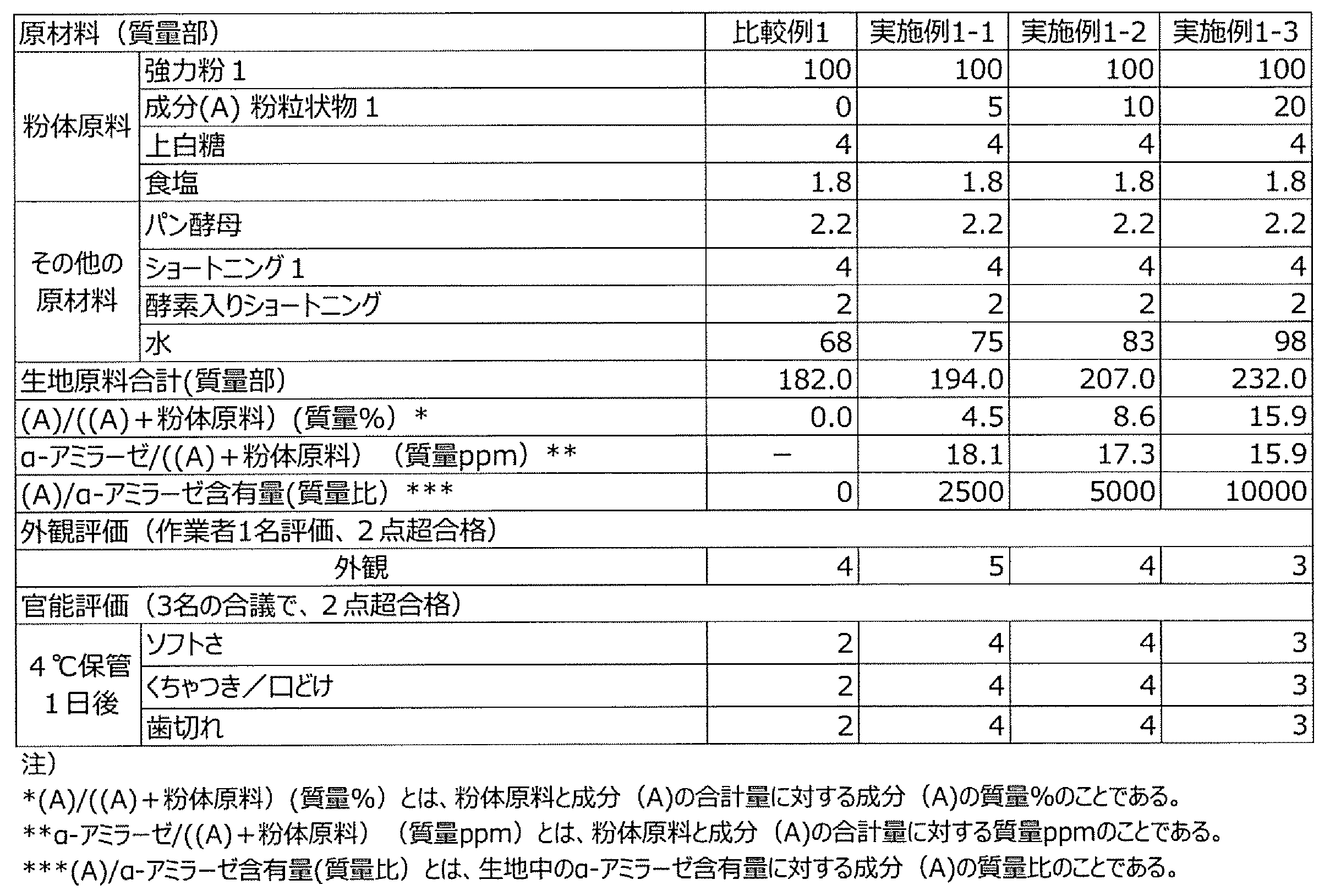
表2の結果より、α-アミラーゼと、成分(A)を配合して作製した角食パンはいずれも、くちゃつきが低減され口どけが良好で、ソフトさ、歯切れが向上し、好ましいものであった。
成分(A)を粉体原料と成分(A)の合計の含有量に対し、4.5質量%以上15.9質量%以下含む場合、対照と比較してくちゃつきの無さ、口どけ、ソフトさ、歯切れなどの食感が向上しており、4.5質量%以上8.6質量%以下含む場合、より優れていた。
成分(A)を粉体原料と成分(A)の合計の含有量に対し、4.5質量%以上15.9質量%以下含む場合、対照と比較してくちゃつきの無さ、口どけ、ソフトさ、歯切れなどの食感が向上しており、4.5質量%以上8.6質量%以下含む場合、より優れていた。
(実験2)
表3に記載の原材料および配合で、ベーカリー生地を調製し、ベーカリー食品を得た。
評価結果を表3に示す。
表3に記載の原材料および配合で、ベーカリー生地を調製し、ベーカリー食品を得た。
評価結果を表3に示す。
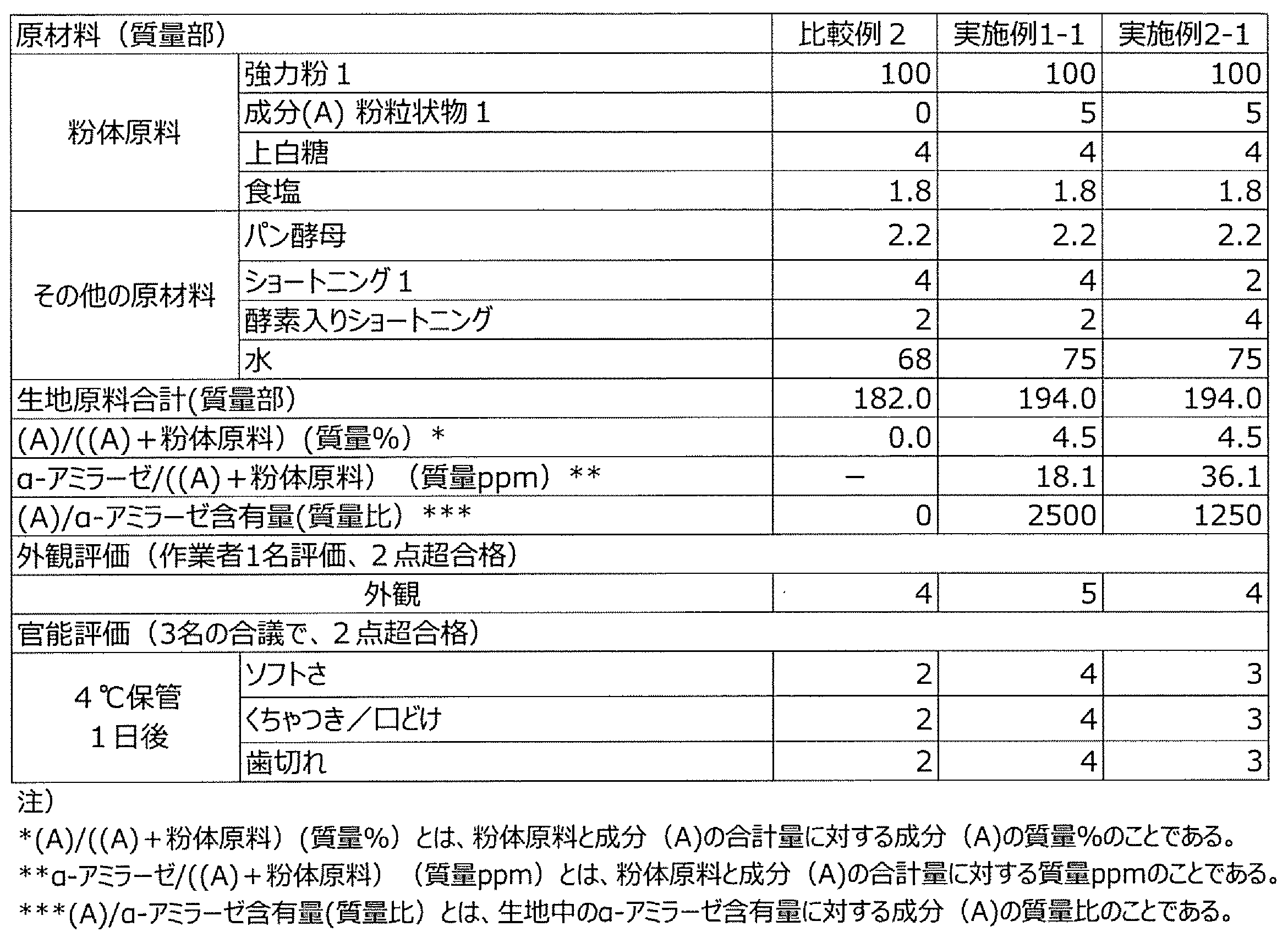
生地に含まれるα-アミラーゼの量を変えた場合でも、成分(A)を所定量含んだパンは4℃で一日保管後の食感に優れていた。
表2および表3の結果と合わせて考察すると、4℃1日保管後のソフトさ、くちゃつき/口どけおよび歯切れの観点では、粉体原料と成分(A)の合計の含有量に対しα-アミラーゼを15.9質量ppm以上36.1質量ppm以下含有する場合良好であり、17.3質量ppm以上18.1質量ppm以下含有する場合、さらに良好であった。
また、同様の観点からα-アミラーゼの含有量に対する前記成分(A)の含有量は、質量比で1250以上10000以下の場合、良好であり、2500以上5000以下の場合、より良好であった。
表2および表3の結果と合わせて考察すると、4℃1日保管後のソフトさ、くちゃつき/口どけおよび歯切れの観点では、粉体原料と成分(A)の合計の含有量に対しα-アミラーゼを15.9質量ppm以上36.1質量ppm以下含有する場合良好であり、17.3質量ppm以上18.1質量ppm以下含有する場合、さらに良好であった。
また、同様の観点からα-アミラーゼの含有量に対する前記成分(A)の含有量は、質量比で1250以上10000以下の場合、良好であり、2500以上5000以下の場合、より良好であった。
(実験3)
表4に記載の原材料および配合で、ベーカリー生地を調製し、ベーカリー食品を得た。
評価結果を表4に示す。
表4に記載の原材料および配合で、ベーカリー生地を調製し、ベーカリー食品を得た。
評価結果を表4に示す。
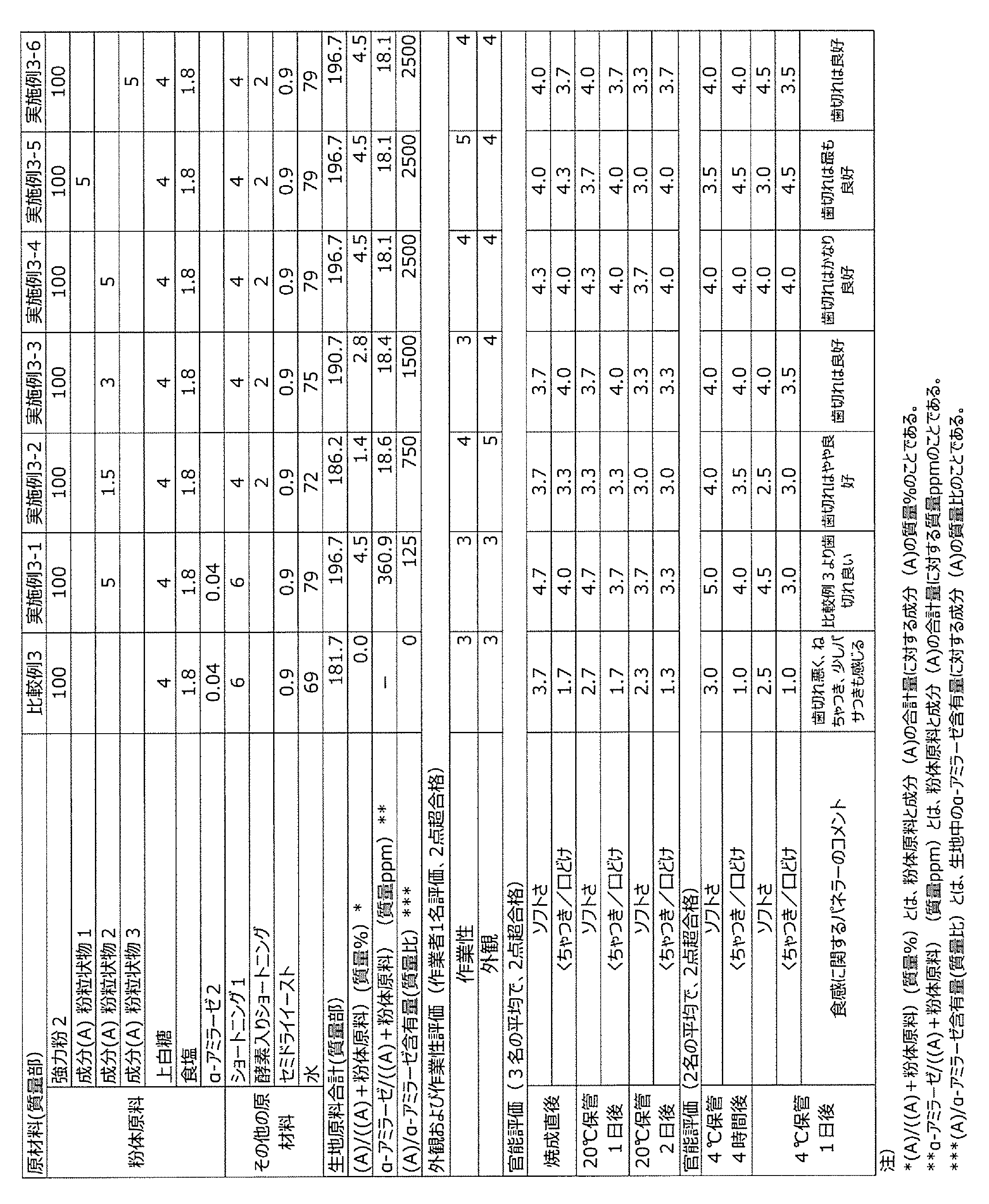
表4の結果より、α-アミラーゼと、成分(A)を配合して作製した角食パンはいずれも、くちゃつきが低減され口どけが良好で、ソフトさ、歯切れが向上し、好ましいものであった。
α-アミラーゼを粉体原料とともに粉のまま配合した場合でも、成分(A)を含むと好ましいパンが得られた(実施例3-1)。α-アミラーゼ粉のまま配合した場合と油脂組成物にα-アミラーゼをあらかじめ混合した場合(実施例3-4)と比較すると、作業性、外観、20℃および4℃での1日後のくちゃつきおよび口どけに関しては、油脂組成物にα-アミラーゼを配合した場合の方が優れていた。
成分(A)の、目開き0.5mmの篩の篩下かつ目開き0.038mmの篩の篩上の含有量は、80.7質量%以上95.8質量%以下の場合、くちゃつきが低減され口どけが良好で、ソフトさ、歯切れが向上し、良好であった。ソフトさの観点からは、80.7質量%以上93.4質量%以下の場合、より良好であった。くちゃつき低減と口どけ、歯切れの観点からは93.4質量%以上95.8質量%以下の場合、より良好であった。
成分(A)の、目開き0.5mmの篩の篩下かつ目開き0.038mmの篩の篩上の含有量は、80.7質量%以上95.8質量%以下の場合、くちゃつきが低減され口どけが良好で、ソフトさ、歯切れが向上し、良好であった。ソフトさの観点からは、80.7質量%以上93.4質量%以下の場合、より良好であった。くちゃつき低減と口どけ、歯切れの観点からは93.4質量%以上95.8質量%以下の場合、より良好であった。
また、成分(A)の、0.15mmの篩の篩下かつ目開き0.038mmの篩の篩上の含有量は、23.7質量%以上93.4質量%以下の場合、くちゃつきが低減され口どけが良好で、ソフトさ、歯切れが向上し、良好であった。20℃保管時のソフトさの観点からは、59.4質量%以上93.4質量%以下の場合、より良好であった。4℃で1日保管後のくちゃつき低減と口どけの観点からは23.7質量%以上59.4質量%以下の場合、より良好であった。
α-アミラーゼを粉体原料とともに粉のまま配合した場合でも、成分(A)を含むと好ましいパンが得られた(実施例3-1)。α-アミラーゼ粉のまま配合した場合と油脂組成物にα-アミラーゼをあらかじめ混合した場合(実施例3-4)と比較すると、作業性、外観、20℃および4℃での1日後のくちゃつきおよび口どけに関しては、油脂組成物にα-アミラーゼを配合した場合の方が優れていた。
成分(A)の、目開き0.5mmの篩の篩下かつ目開き0.038mmの篩の篩上の含有量は、80.7質量%以上95.8質量%以下の場合、くちゃつきが低減され口どけが良好で、ソフトさ、歯切れが向上し、良好であった。ソフトさの観点からは、80.7質量%以上93.4質量%以下の場合、より良好であった。くちゃつき低減と口どけ、歯切れの観点からは93.4質量%以上95.8質量%以下の場合、より良好であった。
成分(A)の、目開き0.5mmの篩の篩下かつ目開き0.038mmの篩の篩上の含有量は、80.7質量%以上95.8質量%以下の場合、くちゃつきが低減され口どけが良好で、ソフトさ、歯切れが向上し、良好であった。ソフトさの観点からは、80.7質量%以上93.4質量%以下の場合、より良好であった。くちゃつき低減と口どけ、歯切れの観点からは93.4質量%以上95.8質量%以下の場合、より良好であった。
また、成分(A)の、0.15mmの篩の篩下かつ目開き0.038mmの篩の篩上の含有量は、23.7質量%以上93.4質量%以下の場合、くちゃつきが低減され口どけが良好で、ソフトさ、歯切れが向上し、良好であった。20℃保管時のソフトさの観点からは、59.4質量%以上93.4質量%以下の場合、より良好であった。4℃で1日保管後のくちゃつき低減と口どけの観点からは23.7質量%以上59.4質量%以下の場合、より良好であった。
表2~表4の結果を合わせて考察すると、粉体原料と成分(A)の合計の含有量に対し、成分(A)を1.4質量%以上15.9質量%以下含む場合、4℃1日保管後の、くちゃつきの無さ、口どけ、ソフトさ、歯切れなどの食感が向上していた。ソフトさの観点からは、1.4質量%以上15.9質量%以下含む場合良好であり、2.8質量%以上8.6質量%以下含む場合、より良好であった。くちゃつき/口どけの観点からは、1.4質量%以上15.9質量%以下含む場合良好であり、2.8質量%以上8.6質量%以下含む場合、より良好であり、4.5質量%以上8.6質量%以下含む場合、より良好であった。
また、表2~表4の結果より、成分(A)を生地中に0.8質量%以上8.6質量%以下含む場合、4℃1日保管後の、くちゃつきの無さ、口どけ、ソフトさ、歯切れなどの食感が向上していた。4℃1日保管後のソフトさの観点からは、0.8質量%以上8.6質量%以下含む場合良好であり、1.6質量%以上4.8質量%以下含む場合、より良好であった。4℃1日保管後のくちゃつき/口どけの観点からは、0.8質量%以上8.6質量%以下含む場合良好であり、1.6質量%以上4.8質量%以下含む場合、より良好であり、2.5質量%以上4.8質量%以下含む場合、より良好であった。
また、表2~表4の結果より、成分(A)を生地中に0.8質量%以上8.6質量%以下含む場合、4℃1日保管後の、くちゃつきの無さ、口どけ、ソフトさ、歯切れなどの食感が向上していた。4℃1日保管後のソフトさの観点からは、0.8質量%以上8.6質量%以下含む場合良好であり、1.6質量%以上4.8質量%以下含む場合、より良好であった。4℃1日保管後のくちゃつき/口どけの観点からは、0.8質量%以上8.6質量%以下含む場合良好であり、1.6質量%以上4.8質量%以下含む場合、より良好であり、2.5質量%以上4.8質量%以下含む場合、より良好であった。
(実験4)
表5に記載の原材料および配合で、ベーカリー生地を調製し、ベーカリー食品を得た。
評価結果を表5に示す。
表5に記載の原材料および配合で、ベーカリー生地を調製し、ベーカリー食品を得た。
評価結果を表5に示す。

(実験5)
表6に記載の原材料および配合で、ベーカリー生地を調製し、ベーカリー食品を得た。
評価結果を表6に示す。
表6に記載の原材料および配合で、ベーカリー生地を調製し、ベーカリー食品を得た。
評価結果を表6に示す。
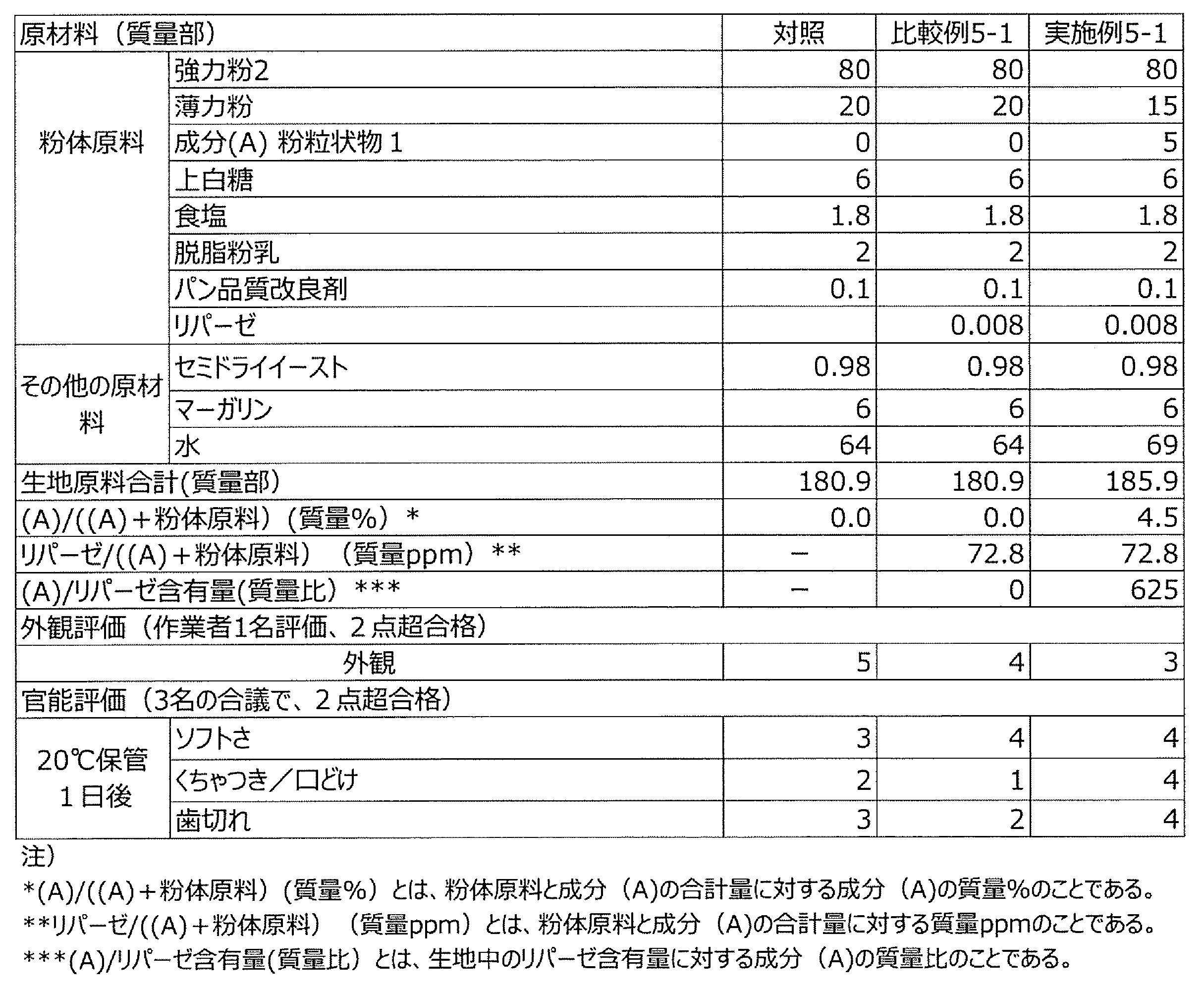
表5および表6の結果に示されるとおり、α-アミラーゼをリパーゼに変えた場合でも、成分(A)を所定量含んだパンは4℃や20℃で一日保管後の食感に優れていた。
Claims (14)
- ベーカリー食品用生地の製造方法であって、
粉体原料、酵素、および以下の条件(1)~(4)を満たす成分(A)を含むベーカリー食品用生地を調製する工程を含み、
ベーカリー食品用生地を調製する前記工程において、
前記生地中の、前記粉体原料と前記成分(A)の合計の含有量に対する前記成分(A)の含有量が0.8質量%以上35質量%以下である、ベーカリー食品用生地の製造方法。
成分(A):以下の条件(1)~(4)を満たす粉粒状物
(1)澱粉含量が75質量%以上
(2)アミロース含量5質量%以上である澱粉の低分子化澱粉を3質量%以上45質量%以下含み、前記低分子化澱粉のピーク分子量が3×10³以上5×10⁴以下
(3)25℃における冷水膨潤度が5以上20以下
(4)目開き0.5mmの篩の篩下かつ目開き0.038mmの篩の篩上の含有量が30質量%以上100質量%以下 - 前記粉体原料が穀粉を含む、請求項1に記載の製造方法。
- 前記生地が、さらに食用油脂組成物を含む、請求項1または2に記載の製造方法。
- 前記酵素が、前記食用油脂組成物中に含まれる、請求項3に記載の製造方法。
- 前記成分(A)の目開き0.15mmの篩の篩下かつ目開き0.038mmの篩の篩上の含有量が10質量%以上98質量%以下である、請求項1乃至4いずれか1項に記載の製造方法。
- 前記生地中の、前記粉体原料と前記成分(A)の合計の含有量に対する前記酵素の含有量が1質量ppm以上600質量ppm以下である、請求項1乃至5いずれか1項に記載の製造方法。
- 前記生地中の、前記酵素の含有量に対する前記成分(A)の含有量が、質量比で20以上15000以下である、請求項1乃至6いずれか1項に記載の製造方法。
- 前記酵素が、α-アミラーゼ及びリパーゼからなる群より選ばれる1種以上である、請求項1乃至7いずれか1項に記載の製造方法。
- 請求項1乃至8いずれか1項に記載の製造方法で得られたベーカリー食品用生地を、加熱調理する工程を含む、ベーカリー食品の製造方法。
- 前記加熱調理の方法が、焼成、油ちょうおよび蒸しから選択される1種または2種以上である、請求項9に記載の製造方法。
- 前記ベーカリー食品が、食パン、ロールパン、菓子パン、蒸しパン、蒸しケーキおよび調理パンからなる群から選択される1種である、請求項9または10に記載の製造方法。
- 粉体原料および酵素を含むベーカリー食品用生地を加熱調理して得られるベーカリー食品の喫食時のくちゃつきを低減する方法であって、
前記生地中に以下の条件(1)~(4)を満たす成分(A)を、前記粉体原料と前記成分(A)の合計の含有量に対する前記成分(A)の含有量が0.8質量%以上35質量%以下となるよう配合する、前記方法。
成分(A):以下の条件(1)~(4)を満たす粉粒状物
(1)澱粉含量が75質量%以上
(2)アミロース含量5質量%以上である澱粉の低分子化澱粉を3質量%以上45質量%以下含み、前記低分子化澱粉のピーク分子量が3×10³以上5×10⁴以下
(3)25℃における冷水膨潤度が5以上20以下
(4)目開き0.5mmの篩の篩下かつ目開き0.038mmの篩の篩上の含有量が30質量%以上100質量%以下 - 前記生地中の、酵素の含有量に対する前記成分(A)の含有量が、質量比で20以上15000以下である、請求項12に記載の前記方法。
- 前記酵素が、α-アミラーゼ及びリパーゼからなる群より選ばれる1種以上である、請求項12または13に記載の方法。
Priority Applications (1)
| Application Number | Priority Date | Filing Date | Title |
|---|---|---|---|
| JP2021574678A JPWO2021153391A1 (ja) | 2020-01-31 | 2021-01-21 |
Applications Claiming Priority (2)
| Application Number | Priority Date | Filing Date | Title |
|---|---|---|---|
| JP2020015834 | 2020-01-31 | ||
| JP2020-015834 | 2020-01-31 |
Publications (1)
| Publication Number | Publication Date |
|---|---|
| WO2021153391A1 true WO2021153391A1 (ja) | 2021-08-05 |
Family
ID=77078553
Family Applications (1)
| Application Number | Title | Priority Date | Filing Date |
|---|---|---|---|
| PCT/JP2021/001933 Ceased WO2021153391A1 (ja) | 2020-01-31 | 2021-01-21 | ベーカリー食品用生地の製造方法 |
Country Status (3)
| Country | Link |
|---|---|
| JP (1) | JPWO2021153391A1 (ja) |
| TW (1) | TW202133729A (ja) |
| WO (1) | WO2021153391A1 (ja) |
Cited By (1)
| Publication number | Priority date | Publication date | Assignee | Title |
|---|---|---|---|---|
| JP2023084593A (ja) * | 2021-12-07 | 2023-06-19 | 株式会社J-オイルミルズ | 食品用組成物の製造方法 |
Families Citing this family (1)
| Publication number | Priority date | Publication date | Assignee | Title |
|---|---|---|---|---|
| CN114097852A (zh) * | 2021-11-16 | 2022-03-01 | 中国农业科学院茶叶研究所 | 一种基于冷藏中种发酵制备无蔗糖全麦茶面包的方法 |
Citations (4)
| Publication number | Priority date | Publication date | Assignee | Title |
|---|---|---|---|---|
| JPH06169681A (ja) * | 1992-07-27 | 1994-06-21 | Gist Brocades Nv | パンの品質の改良用の酵素製品及びパンの品質の改良方法 |
| WO2014132534A1 (ja) * | 2013-02-26 | 2014-09-04 | 株式会社J-オイルミルズ | 組成物、これを用いた衣材、飲食品および飼料、ならびに組成物の製造方法 |
| WO2015152099A1 (ja) * | 2014-03-31 | 2015-10-08 | ナガセケムテックス株式会社 | パンその他穀物粉膨化食品の凝集性改善剤 |
| JP2019165646A (ja) * | 2018-03-22 | 2019-10-03 | 株式会社Adeka | 製パン改良材 |
-
2021
- 2021-01-21 WO PCT/JP2021/001933 patent/WO2021153391A1/ja not_active Ceased
- 2021-01-21 JP JP2021574678A patent/JPWO2021153391A1/ja active Pending
- 2021-01-21 TW TW110102215A patent/TW202133729A/zh unknown
Patent Citations (4)
| Publication number | Priority date | Publication date | Assignee | Title |
|---|---|---|---|---|
| JPH06169681A (ja) * | 1992-07-27 | 1994-06-21 | Gist Brocades Nv | パンの品質の改良用の酵素製品及びパンの品質の改良方法 |
| WO2014132534A1 (ja) * | 2013-02-26 | 2014-09-04 | 株式会社J-オイルミルズ | 組成物、これを用いた衣材、飲食品および飼料、ならびに組成物の製造方法 |
| WO2015152099A1 (ja) * | 2014-03-31 | 2015-10-08 | ナガセケムテックス株式会社 | パンその他穀物粉膨化食品の凝集性改善剤 |
| JP2019165646A (ja) * | 2018-03-22 | 2019-10-03 | 株式会社Adeka | 製パン改良材 |
Cited By (1)
| Publication number | Priority date | Publication date | Assignee | Title |
|---|---|---|---|---|
| JP2023084593A (ja) * | 2021-12-07 | 2023-06-19 | 株式会社J-オイルミルズ | 食品用組成物の製造方法 |
Also Published As
| Publication number | Publication date |
|---|---|
| JPWO2021153391A1 (ja) | 2021-08-05 |
| TW202133729A (zh) | 2021-09-16 |
Similar Documents
| Publication | Publication Date | Title |
|---|---|---|
| EP2269464B1 (en) | Gluten-free bakery products | |
| JP4682117B2 (ja) | ベーカリー食品用小麦粉代替物及びベーカリー食品 | |
| JP2021000060A (ja) | 改質小麦粉 | |
| JP6592460B2 (ja) | ベーカリー食品用加工澱粉及びベーカリー食品用ミックス | |
| JP7480061B2 (ja) | ベーカリー食品の製造方法 | |
| WO2020213422A1 (ja) | 焼き菓子用生地の製造方法 | |
| WO2021153391A1 (ja) | ベーカリー食品用生地の製造方法 | |
| KR20210034595A (ko) | 구운 과자의 제조방법 | |
| JP7652718B2 (ja) | ベーカリー食品用生地の製造方法 | |
| TW202025912A (zh) | 麵包用麵團之製造方法 | |
| WO2023013429A1 (ja) | ベーカリー食品用生地の製造方法 | |
| JP2001078674A (ja) | スナック様食品 | |
| CN113993383A (zh) | 家庭用面包混合料 | |
| JP7385762B1 (ja) | 生地加熱食品用加工澱粉及び生地加熱食品用ミックス | |
| JP2023022783A (ja) | ベーカリー食品用組成物 | |
| WO2021153285A1 (ja) | ベーカリー食品の食感低下抑制方法 | |
| JP7422081B2 (ja) | 油脂組成物 | |
| JP2024148156A (ja) | ベーカリー食品用湯種生地用組成物、ベーカリー食品用湯種生地、ベーカリー食品用生地の製造方法、及びベーカリー食品の製造方法 | |
| JP2024147978A (ja) | ベーカリー食品用組成物、ベーカリー食品用生地、ベーカリー食品用生地の製造方法、及びベーカリー食品の製造方法 | |
| WO2023008208A1 (ja) | ベーカリー食品用組成物 | |
| JP2025008871A (ja) | ベーカリー食品用組成物、ベーカリー食品用生地、ベーカリー食品の製造方法、及びベーカリー食品の食感改良方法 | |
| JPH09224551A (ja) | 菓子類用小麦粉組成物 | |
| JP2021159077A (ja) | 食物繊維含有加工食品の粉っぽさを改善する方法 | |
| JP2025076199A (ja) | 小麦全粒粉およびこれを用いる小麦粉含有食品 | |
| JPWO2020111059A1 (ja) | 食品の製造方法 |
Legal Events
| Date | Code | Title | Description |
|---|---|---|---|
| 121 | Ep: the epo has been informed by wipo that ep was designated in this application |
Ref document number: 21748017 Country of ref document: EP Kind code of ref document: A1 |
|
| ENP | Entry into the national phase |
Ref document number: 2021574678 Country of ref document: JP Kind code of ref document: A |
|
| NENP | Non-entry into the national phase |
Ref country code: DE |
|
| 122 | Ep: pct application non-entry in european phase |
Ref document number: 21748017 Country of ref document: EP Kind code of ref document: A1 |