WO2021149358A1 - 光学積層体およびその製造方法 - Google Patents
光学積層体およびその製造方法 Download PDFInfo
- Publication number
- WO2021149358A1 WO2021149358A1 PCT/JP2020/044456 JP2020044456W WO2021149358A1 WO 2021149358 A1 WO2021149358 A1 WO 2021149358A1 JP 2020044456 W JP2020044456 W JP 2020044456W WO 2021149358 A1 WO2021149358 A1 WO 2021149358A1
- Authority
- WO
- WIPO (PCT)
- Prior art keywords
- layer
- sensitive adhesive
- pressure
- adhesive layer
- liquid crystal
- Prior art date
- Legal status (The legal status is an assumption and is not a legal conclusion. Google has not performed a legal analysis and makes no representation as to the accuracy of the status listed.)
- Ceased
Links
Images
Classifications
-
- G—PHYSICS
- G02—OPTICS
- G02B—OPTICAL ELEMENTS, SYSTEMS OR APPARATUS
- G02B5/00—Optical elements other than lenses
- G02B5/30—Polarising elements
-
- B—PERFORMING OPERATIONS; TRANSPORTING
- B32—LAYERED PRODUCTS
- B32B—LAYERED PRODUCTS, i.e. PRODUCTS BUILT-UP OF STRATA OF FLAT OR NON-FLAT, e.g. CELLULAR OR HONEYCOMB, FORM
- B32B7/00—Layered products characterised by the relation between layers; Layered products characterised by the relative orientation of features between layers, or by the relative values of a measurable parameter between layers, i.e. products comprising layers having different physical, chemical or physicochemical properties; Layered products characterised by the interconnection of layers
- B32B7/02—Physical, chemical or physicochemical properties
- B32B7/023—Optical properties
-
- G—PHYSICS
- G09—EDUCATION; CRYPTOGRAPHY; DISPLAY; ADVERTISING; SEALS
- G09F—DISPLAYING; ADVERTISING; SIGNS; LABELS OR NAME-PLATES; SEALS
- G09F9/00—Indicating arrangements for variable information in which the information is built-up on a support by selection or combination of individual elements
Definitions
- the present invention relates to an optical laminate and a method for producing the same.
- a polarizing plate having excellent crack resistance is known as a polarizing plate used in a liquid crystal display device, an organic electroluminescence (EL) display device, or the like (Patent Document 1).
- a polarizing plate containing a liquid crystal layer made of a cured product of a polymerizable liquid crystal compound has a problem that cracks are likely to occur in the liquid crystal layer when bent.
- An object of the present invention is to provide an optical laminate in which cracks are suppressed in the liquid crystal layer even when bent, and a method for producing the same.
- the present invention provides an optical laminate illustrated below and a method for producing the same.
- An optical laminate including a front plate, a first pressure-sensitive adhesive layer, a polarizing plate, and a second pressure-sensitive adhesive layer in this order.
- the polarizing plate includes a liquid crystal layer made of a cured product of a polymerizable liquid crystal compound.
- Ra [ ⁇ m] be the surface roughness of the first pressure-sensitive adhesive layer on the target side surface, which is a part of the entire circumference of the optical laminate and the side surface extending in the stacking direction is the target side surface.
- the polarizing plate includes a linear polarizer layer and a retardation layer in this order from the side of the first pressure-sensitive adhesive layer toward the side of the second pressure-sensitive adhesive layer.
- the optical laminate can be bent along a bending axis and can be bent.
- a method for producing an optical laminate comprising a step of cutting the optical laminate film with a laser beam to form the target side surface.
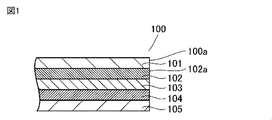
- FIG. 1 is a schematic cross-sectional view showing an example of the optical laminate of the present invention.
- the optical laminate 100 shown in FIG. 1 includes a front plate 101, a first pressure-sensitive adhesive layer 102, a polarizing plate 103, and a second pressure-sensitive adhesive layer 104 in this order.
- the polarizing plate 103 includes a liquid crystal layer made of a cured product of a polymerizable liquid crystal compound.
- the liquid crystal layer means a layer containing a cured product of a polymerizable liquid crystal compound, and it is not necessary to exhibit liquid crystal property.
- the optical laminate 100 may have a release film 105 bonded to the surface of the second pressure-sensitive adhesive layer 104.
- the optical laminate 100 may have a back plate that is bonded to the surface of the second pressure-sensitive adhesive layer 104.
- a side surface that is a part of the entire circumference of the optical laminated body 100 and extends in the stacking direction is defined as the target side surface 100a.
- the surface roughness of the side surface 102a of the first pressure-sensitive adhesive layer 102 is Ra [ ⁇ m] on the target side surface 100a
- the side surface 102a of the first pressure-sensitive adhesive layer 102 satisfies the relationship of the following formula (1a), and is preferable.
- the relationship of the following equation (1b) is satisfied.
- the surface roughness Ra is a value measured according to the method described in Examples. Ra ⁇ 10 ⁇ m (1a) Ra ⁇ 6 ⁇ m (1b)
- the side surface 102a of the first pressure-sensitive adhesive layer 102 preferably satisfies the relationship of the following formula (2a), and more preferably satisfies the relationship of the following formula (2b).
- the target side surface 100a may be at least a part of the entire circumference of the optical laminate 100, and may have an arbitrary size at any location as long as it includes the side surface 102a of the first pressure-sensitive adhesive layer 102. ..
- the target side surface 100a may be the entire circumference of the optical laminate 100.
- the optical laminated body 100 may have a bending axis in the main surface direction of the optical laminated body, and the optical laminated body 100 can be bent along the bending axis.
- the target side surface preferably includes a side surface that intersects the bending axis.
- the main surface of the optical laminate means a surface perpendicular to the thickness direction of the optical laminate.
- the side surface 102a of the first pressure-sensitive adhesive layer 102 on the target side surface 100a may be formed on the first pressure-sensitive adhesive layer 102 before the first pressure-sensitive adhesive layer 102 is laminated, or the first pressure-sensitive adhesive layer 102 may be laminated. It may be formed at the time of cutting or after cutting the optical laminated film.
- the side surface 102a of the first pressure-sensitive adhesive layer 102 is preferably formed by irradiating the optical laminated film with laser light. By irradiating the laser beam, the first pressure-sensitive adhesive layer 102 starts to melt, and before the first pressure-sensitive adhesive layer 102 is completely melted, a force such as cutting is applied, and the relationship between the formulas (1a) and (2a) is established. A filling side surface 102a can be formed.
- the laser light an appropriate laser light can be selected depending on the material and thickness of the layer constituting the optical laminated film, and for example, a laser radiating a wavelength in the range of 200 nm to 11 ⁇ m is used.
- the laser may be a continuous wave (CW) laser or a pulsed laser.
- the type of laser light examples include a gas laser such as a CO 2 laser, a solid-state laser such as a YAG laser, and a semiconductor laser.
- the laser used is preferably a CO 2 laser.
- the surface roughness Ra of the side surface 102a of the first pressure-sensitive adhesive layer 102 can be adjusted according to the cutting method and cutting conditions.
- the surface roughness Ra of the side surface 102a of the first pressure-sensitive adhesive layer 102 can be adjusted by the incident direction, the depth of focus, the output condition, the moving speed, and the focal position of the laser light.
- the laser light may be incident from the front plate 101 side of the optical laminated film, or may be incident from the second adhesive layer 104 side.
- the laser beam is incident from the front plate 101 side.
- the laser light irradiation conditions any appropriate conditions can be adopted depending on the laser to be used.
- the output conditions are preferably 1 W or more and 100 W or less, more preferably 2 W or more and 60 W or less, and further preferably 4 W or more and 10 W or less.
- the moving speed is preferably 30 mm / sec or more and 1000 mm / sec or less, more preferably 100 mm / sec or more and 500 mm / sec or less, and further preferably 250 mm / sec or more and 400 mm / sec or less.
- the focus of the laser light may be aligned with the surface of the optical laminated film on the front plate 101 side, or may be aligned with the inside of the first pressure-sensitive adhesive layer 102.
- the surface roughness Ra of the side surface 102a of the first pressure-sensitive adhesive layer 102 can be easily adjusted to a predetermined range.
- the optical laminate 100 may form the side surface 102a of the first pressure-sensitive adhesive layer 102 by cutting the optical laminate film into a predetermined shape using a cutter, a cutting blade, or the like, and then irradiating the cut surface with a laser beam.
- the optical laminated film is irradiated with a laser beam, and cutting and formation of the side surface 102a are performed by the same step.
- the target side surface 100a of the optical laminate 100 becomes a cut surface by laser light.
- the liquid crystal layer tends to crack along the bending axis.
- the side surface 102a of the first pressure-sensitive adhesive layer 102 on the target side surface 100a satisfies the relationship of the formula (1a)
- the optical laminate 100 is bent so that the target side surface 100a and the bending axis intersect. Can also suppress the occurrence of cracks.
- the side surface 102a of the first pressure-sensitive adhesive layer 102 satisfies the relationship of the formula (1a
- the cured product of the polymerizable liquid crystal compound is used. It is considered that stress concentration on the side surface of the liquid crystal layer (particularly the retardation layer which is the liquid crystal layer) can be avoided and the occurrence of cracks can be suppressed.
- the crack means a crack that occurs in at least one layer of the optical laminate 100, and tends to occur in the liquid crystal layer contained in the polarizing plate 103.
- the polarizing plate 103 includes a plurality of liquid crystal layers, the thinner the liquid crystal layer, the more likely it is that cracks will occur. The occurrence of cracks can be discriminated by observation with an optical microscope.
- Examples of the liquid crystal layer contained in the polarizing plate 103 include a linear polarizing element layer and a retardation layer, and examples of the retardation layer include a positive C layer, a ⁇ / 4 layer, a ⁇ / 2 layer, or a combination thereof. Is exemplified.
- the polarizing plate 103 may be configured to include at least one liquid crystal layer, and may be configured to include a plurality of liquid crystal layers.
- the polarizing plate 103 includes a positive C layer as a liquid crystal layer, cracks tend to occur in the positive C layer.
- the positive C layer is usually thin, which is considered to be one of the reasons why cracks are likely to occur. According to the present invention, even in the optical laminate 100 including the polarizing plate 103 including the positive C layer as the liquid crystal layer, the occurrence of cracks can be suppressed.
- bending includes a form of bending in which a curved surface is formed in a bent portion, and the bending radius of the bent inner surface is not particularly limited. Bending also includes refraction with an inner surface refraction angle greater than 0 degrees and less than 180 degrees, and folding with an inner surface bending radius close to zero or an inner surface refraction angle of 0 degrees.
- the thickness of the optical laminate 100 is not particularly limited because it varies depending on the function required for the optical laminate, the application of the optical laminate, etc., but is, for example, 20 ⁇ m or more and 2000 ⁇ m or less, preferably 50 ⁇ m or more and 1000 ⁇ m or less, and more. It is preferably 100 ⁇ m or more and 500 ⁇ m or less.
- the plan view shape of the optical laminate 100 may be, for example, a square shape, preferably a square shape having a long side and a short side, and more preferably a rectangle.
- the length of the long side may be, for example, 10 mm or more and 1400 mm or less, preferably 50 mm or more and 600 mm or less.
- the length of the short side is, for example, 5 mm or more and 800 mm or less, preferably 30 mm or more and 500 mm or less, and more preferably 50 mm or more and 300 mm or less.
- Each layer constituting the optical laminate 100 may have corners R-processed, end portions notched, or perforated.
- the optical laminate 100 can be used, for example, in a display device or the like.
- the display device is not particularly limited, and examples thereof include an organic electroluminescence (organic EL) display device, an inorganic electroluminescence (inorganic EL) display device, a liquid crystal display device, and an electroluminescent display device.
- the optical laminate 100 is suitable for a display device having flexibility that allows bending.
- the material and thickness of the front plate 101 are not limited as long as it is a plate-like body capable of transmitting light.
- the front plate may be composed of only one layer, or may be composed of two or more layers.
- the front plate 101 includes a resin plate (for example, a resin plate, a resin sheet, a resin film, etc.), a glass plate (for example, a glass plate, a glass film, etc.), a resin plate, and a glass.
- a laminated body with a plate-like body of the above can be mentioned.
- the front plate 101 can form the outermost surface of the display device.
- the thickness of the front plate 101 may be, for example, 30 ⁇ m or more and 500 ⁇ m or less, preferably 40 ⁇ m or more and 200 ⁇ m or less, and more preferably 50 ⁇ m or more and 100 ⁇ m or less.
- the thickness of each layer constituting the optical laminate 100 can be measured according to the thickness measuring method described in Examples described later.
- the resin plate-like body is not limited as long as it can transmit light.
- the resin constituting the resin plate-like body include triacetyl cellulose, acetyl cellulose butyrate, ethylene-vinyl acetate copolymer, propionyl cellulose, butyryl cellulose, acetyl propionyl cellulose, polyester, polystyrene, polyamide, and polyether.
- the resin plate-like body is preferably a resin film formed of a polymer such as polyimide, polyamide, or polyamideimide.
- the front plate 101 may be a resin film provided with a hard coat layer.
- the hard coat layer may be formed on one surface of the resin film or may be formed on both sides.
- the hard coat layer is, for example, a cured layer of an ultraviolet curable resin.
- the ultraviolet curable resin include acrylic resin, silicone resin, polyester resin, urethane resin, amide resin, epoxy resin and the like.
- the hard coat layer may contain additives to improve strength.
- the additive is not particularly limited, and examples thereof include inorganic fine particles, organic fine particles, or a mixture thereof.
- the front plate 101 is a glass plate
- tempered glass for a display is preferably used as the glass plate.
- the thickness of the glass plate may be, for example, 20 ⁇ m or more and 1000 ⁇ m or less.
- the front plate 101 not only has a function of protecting the front surface (screen) of the display device (function as a window film), but also functions as a touch sensor and blue light cut. It may have a function, a viewing angle adjusting function, and the like.
- the first pressure-sensitive adhesive layer 102 is interposed between the front plate 101 and the polarizing plate 103, and these are bonded together.
- the first pressure-sensitive adhesive layer 102 may be composed of one layer or two or more layers, but is preferably composed of one layer.
- the first pressure-sensitive adhesive layer 102 is composed of a pressure-sensitive adhesive composition containing (meth) acrylic resin, rubber-based resin, urethane-based resin, ester-based resin, silicone-based resin, and polyvinyl ether-based resin as main components (base polymer). can do.
- a pressure-sensitive adhesive composition containing (meth) acrylic resin, rubber-based resin, urethane-based resin, ester-based resin, silicone-based resin, and polyvinyl ether-based resin as main components (base polymer).
- base polymer base polymer
- the pressure-sensitive adhesive composition may be an active energy ray-curable type or a thermosetting type.
- Examples of the (meth) acrylic resin used in the pressure-sensitive adhesive composition include (meth) butyl (meth) acrylate, ethyl (meth) acrylate, isooctyl (meth) acrylate, and 2-ethylhexyl (meth) acrylate.
- a polymer or copolymer containing one or more acrylates as a monomer is preferably used. It is preferable that the base polymer is copolymerized with a polar monomer.
- Examples of the polar monomer include (meth) acrylic acid compound, (meth) acrylic acid 2-hydroxypropyl compound, (meth) acrylic acid hydroxyethyl compound, (meth) acrylamide compound, and N, N-dimethylaminoethyl (meth) acrylate compound.
- the pressure-sensitive adhesive composition may contain only the above-mentioned base polymer, but usually further contains a cross-linking agent.
- the cross-linking agent is a metal ion having a divalent value or higher and forming a carboxylic acid metal salt with the carboxyl group, a polyamine compound forming an amide bond with the carboxyl group, and a carboxyl group. Examples thereof include polyepoxy compounds or polyols that form an ester bond with, and polyisocyanate compounds that form an amide bond with a carboxyl group.
- the cross-linking agent is preferably a polyisocyanate compound.
- the active energy ray-curable pressure-sensitive adhesive composition has a property of being cured by being irradiated with active energy rays such as ultraviolet rays and electron beams, and has adhesiveness even before irradiation with active energy rays, such as a film. It has the property that it can be brought into close contact with the adherend of the above, and can be cured by irradiation with active energy rays to adjust the adhesion.
- the active energy ray-curable pressure-sensitive adhesive composition is preferably an ultraviolet-curable type.
- the active energy ray-curable pressure-sensitive adhesive composition further contains an active energy ray-polymerizable compound in addition to the base polymer and the cross-linking agent. If necessary, a photopolymerization initiator, a photosensitizer, or the like may be contained.
- the active energy ray-polymerizable compound is, for example, a (meth) acrylate monomer having at least one (meth) acryloyloxy group in the molecule; obtained by reacting two or more kinds of functional group-containing compounds, and at least 2 in the molecule.
- (Meta) acrylic compounds such as (meth) acryloyloxy group-containing compounds such as (meth) acrylate oligomers having one (meth) acryloyloxy group, and compounds having at least two benzoylphenylmethacryloyl groups in the molecule. Can be mentioned.
- the pressure-sensitive adhesive composition can contain 0.1 part by mass or more of the active energy ray-polymerizable compound with respect to 100 parts by mass of the solid content of the pressure-sensitive adhesive composition, and is 10 parts by mass or less, 5 parts by mass or less, or 2 parts by mass. Can include less than one copy.
- Benzoylphenylmethacryloyl group means a group represented by the following structure. * Represents a bond.
- the number of benzoylphenylmethacryloyl groups contained in the molecule of the active energy ray-polymerizable compound can be 5 or less, and can be 4 or less.
- Examples of the compound having at least two benzoylphenyl metaacryloyl groups in the molecule include the following compounds.
- the photopolymerization initiator examples include benzophenone, benzyl dimethyl ketal, 1-hydroxycyclohexyl ketone and the like.
- the photopolymerization initiator may contain one kind or two or more kinds.
- the total content thereof may be, for example, 0.01 part by mass or more and 3.0 parts by mass or less with respect to 100 parts by mass of the solid content of the pressure-sensitive adhesive composition.
- the pressure-sensitive adhesive composition includes fine particles for imparting light scattering properties, beads (resin beads, glass beads, etc.), glass fibers, resins other than the base polymer, pressure-sensitive imparting agents, and fillers (metal powders and other inorganic powders). Etc.), antioxidants, UV absorbers, dyes, pigments, colorants, antifoaming agents, corrosion inhibitors, photopolymerization initiators and other additives can be included.
- the first pressure-sensitive adhesive layer 102 can be formed by applying an organic solvent diluent of the pressure-sensitive adhesive composition on a substrate and drying it.
- the first pressure-sensitive adhesive layer 102 can also be formed by using a pressure-sensitive adhesive sheet formed by using the pressure-sensitive adhesive composition.
- the first pressure-sensitive adhesive layer 102 can also be formed by applying the pressure-sensitive adhesive composition to the surface of the front plate 101 or the polarizing plate 103 and drying it.
- a method for applying the pressure-sensitive adhesive composition for example, a bar coating method, a knife coating method, a roll coating method, a blade coating method, a die coating method, a gravure coating method and the like can be used.
- the active energy ray-curable pressure-sensitive adhesive composition is used, the formed pressure-sensitive adhesive layer can be irradiated with active energy rays to obtain a pressure-sensitive adhesive layer having a desired degree of curing.
- the thickness of the first pressure-sensitive adhesive layer 102 is not particularly limited, but is preferably 1 ⁇ m or more and 100 ⁇ m or less, more preferably 3 ⁇ m or more and 50 ⁇ m or less, 10 ⁇ m or more, or 20 ⁇ m or more. You may.
- the polarizing plate 103 includes a linear polarizing element layer.
- the linear polarizing element layer may be a liquid crystal layer, and in that case, the polarizing plate 103 may or may not include a liquid crystal layer other than the linear polarizing element layer.
- the other liquid crystal layer is, for example, a retardation layer.
- the polarizing plate 103 may be, for example, a linear polarizing plate, a circular polarizing plate, an elliptical polarizing plate, or the like. Since the circularly polarizing plate includes a linear polarizing element layer and a retardation layer and can absorb external light reflected in the image display device, it imparts a function as an antireflection film to the optical laminate 100. be able to.
- the thickness of the polarizing plate 103 is usually 5 ⁇ m or more, may be 20 ⁇ m or more, 25 ⁇ m or more, or 30 ⁇ m or more.
- the thickness of the polarizing plate 103 is preferably 80 ⁇ m or less, and more preferably 60 ⁇ m or less.
- the linearly polarized light element layer has a function of selectively transmitting unidirectional linearly polarized light composed of unpolarized light rays such as natural light.
- the linear polarizer layer is also simply referred to as a polarizer layer.
- the polarizer layer may be a stretched film or a stretched layer on which a dichroic dye is adsorbed, and contains a cured product of a polymerizable liquid crystal compound and a dichroic dye, and the dichroic dye is a curing of the polymerizable liquid crystal compound. It may be a liquid crystal layer dispersed in an object and oriented.
- the dichroic dye refers to a dye having a property in which the absorbance in the major axis direction and the absorbance in the minor axis direction of the molecule are different.
- the polarizing layer is a liquid crystal layer, it is preferable because there is no limitation in the bending direction as compared with the case where the stretched film or the stretched layer has the dichroic dye adsorbed.
- the polarizer layer which is a stretched film on which a bicolor dye is adsorbed, is usually obtained by dyeing the polyvinyl alcohol-based resin film with a bicolor dye such as iodine in a step of uniaxially stretching the polyvinyl alcohol-based resin film. It can be produced through a step of adsorbing a bicolor dye, a step of treating a polyvinyl alcohol-based resin film on which the bicolor dye is adsorbed with an aqueous boric acid solution, and a step of washing with water after the treatment with the aqueous boric acid solution.
- the thickness of the polarizer layer is usually 30 ⁇ m or less, preferably 18 ⁇ m or less, and more preferably 15 ⁇ m or less. Reducing the thickness of the polarizer layer is advantageous for thinning the polarizing plate 103.
- the thickness of the polarizer layer is usually 1 ⁇ m or more, and may be, for example, 5 ⁇ m or more.
- the polyvinyl alcohol-based resin is obtained by saponifying the polyvinyl acetate-based resin.
- the polyvinyl acetate-based resin in addition to polyvinyl acetate which is a homopolymer of vinyl acetate, a copolymer of vinyl acetate and another monomer copolymerizable therewith is used.
- examples of other monomers copolymerizable with vinyl acetate include unsaturated carboxylic acid compounds, olefin compounds, vinyl ether compounds, unsaturated sulfone compounds, and (meth) acrylamide compounds having an ammonium group. ..
- the saponification degree of the polyvinyl alcohol-based resin is usually about 85 mol% or more and 100 mol% or less, preferably 98 mol% or more.
- the polyvinyl alcohol-based resin may be modified, and polyvinyl formal, polyvinyl acetal, and the like modified with aldehydes can also be used.
- the degree of polymerization of the polyvinyl alcohol-based resin is usually 1000 or more and 10000 or less, preferably 1500 or more and 5000 or less.
- the polarizer layer which is a stretched layer on which a dichroic dye is adsorbed, is usually a step of applying a coating liquid containing the above-mentioned polyvinyl alcohol-based resin on a base film, a step of uniaxially stretching the obtained laminated film, and uniaxial.
- the base film used for forming the polarizer layer may be used as a protective layer for the polarizer layer. If necessary, the base film may be peeled off from the polarizer layer.
- the material and thickness of the base film may be the same as the material and thickness of the thermoplastic resin film described later.
- the stretched film on which the dichroic dye is adsorbed or the polarizing layer, which is a stretched layer, may be used as it is as a component of the polarizing plate, and a protective layer may be formed on one or both sides thereof and used as a component of the polarizing plate. May be good.
- a thermoplastic resin film described later can be used as the protective layer.
- the thermoplastic resin film is, for example, a cyclopolyolefin resin film; a cellulose acetate resin film made of a resin such as triacetyl cellulose or diacetyl cellulose; a polyester resin film made of a resin such as polyethylene terephthalate, polyethylene naphthalate, or polybutylene terephthalate; Examples of films known in the art such as polycarbonate-based resin films; (meth) acrylic-based resin films; polypropylene-based resin films and the like can be mentioned.
- the polarizer layer and the protective layer can be laminated via a bonding layer described later.
- the thickness of the thermoplastic resin film is usually 100 ⁇ m or less, preferably 80 ⁇ m or less, more preferably 60 ⁇ m or less, still more preferably 40 ⁇ m or less, still more preferably 30 ⁇ m or less. Yes, it is usually 5 ⁇ m or more, preferably 10 ⁇ m or more.
- a hard coat layer may be formed on the thermoplastic resin film.
- the hard coat layer may be formed on one side of the thermoplastic resin film, or may be formed on both sides. By providing the hard coat layer, a thermoplastic resin film having improved hardness and scratchability can be obtained.
- the hard coat layer can be formed in the same manner as the hard coat layer formed on the resin film described above.
- the polymerizable liquid crystal compound used for forming the liquid crystal layer is a compound having a polymerizable reactive group and exhibiting liquid crystallinity.
- the polymerizable reactive group is a group involved in the polymerization reaction, and is preferably a photopolymerizable reactive group.
- the photopolymerizable reactive group refers to a group that can participate in the polymerization reaction by an active radical, an acid, or the like generated from the photopolymerization initiator.
- Examples of the photopolymerizable functional group include a vinyl group, a vinyloxy group, a 1-chlorovinyl group, an isopropenyl group, a 4-vinylphenyl group, an acryloyloxy group, a methacryloyloxy group, an oxylanyl group, an oxetanyl group and the like.
- an acryloyloxy group, a methacryloyloxy group, a vinyloxy group, an oxylanyl group and an oxetanyl group are preferable, and an acryloyloxy group is more preferable.
- the type of the polymerizable liquid crystal compound is not particularly limited, and a rod-shaped liquid crystal compound, a disk-shaped liquid crystal compound, and a mixture thereof can be used.
- the liquid crystal property of the polymerizable liquid crystal compound may be a thermotropic liquid crystal or a lyotropic liquid crystal, and the phase-ordered structure may be a nematic liquid crystal or a smectic liquid crystal.
- the dichroic dye used for the polarizer layer which is a liquid crystal layer, preferably has an absorption maximum wavelength ( ⁇ MAX) in the range of 300 to 700 nm.
- a bicolor dye include an acridine dye, an oxazine dye, a cyanine dye, a naphthalene dye, an azo dye, an anthraquinone dye and the like, and among them, the azo dye is preferable.
- the azo dye include a monoazo dye, a bisazo dye, a trisazo dye, a tetrakisazo dye, a stilbene azo dye, and the like, and a bisazo dye and a trisazo dye are preferable.
- the dichroic dye may be used alone or in combination of two or more, but it is preferable to combine three or more. In particular, it is more preferable to combine three or more kinds of azo compounds.
- a part of the dichroic dye may have a reactive group or may have a liquid crystallinity.
- a composition for forming a polarizing layer containing a polymerizable liquid crystal compound and a dichroic dye is applied onto an alignment film formed on a base film, and the polymerizable liquid crystal compound is polymerized. It can be formed by curing it.
- a polarizer layer may be formed by applying a composition for forming a polarizer layer on a substrate film to form a coating film, and then stretching the coating film together with the substrate film.
- the base film used for forming the polarizer layer may be used as a protective layer for the polarizer layer.
- the material and thickness of the base film may be the same as the material and thickness of the thermoplastic resin film described above.
- compositions for forming a polarizer layer containing a polymerizable liquid crystal compound and a dichroic dye examples include JP-A-2013-373353 and JP-A-2013-33249. , JP-A-2017-83843, etc. can be exemplified.
- additives such as a solvent, a polymerization initiator, a cross-linking agent, a leveling agent, an antioxidant, a plasticizer, and a sensitizer are further added. It may be included. Only one of these components may be used, or two or more of these components may be used in combination.
- the polymerization initiator that may be contained in the composition for forming a polarizer layer is a compound that can initiate a polymerization reaction of a polymerizable liquid crystal compound, and is photopolymerized in that the polymerization reaction can be initiated under lower temperature conditions.
- Sex initiators are preferred. Specific examples thereof include photopolymerization initiators capable of generating active radicals or acids by the action of light, and among them, photopolymerization initiators that generate radicals by the action of light are preferable.
- the content of the polymerization initiator is preferably 1 part by mass or more and 10 parts by mass or less, and more preferably 3 parts by mass or more and 8 parts by mass or less, based on 100 parts by mass of the total amount of the polymerizable liquid crystal compound. Within this range, the reaction of the polymerizable group proceeds sufficiently, and the orientation state of the liquid crystal compound is likely to be stabilized.
- the thickness of the polarizer layer which is a liquid crystal layer, is usually 10 ⁇ m or less, preferably 0.5 ⁇ m or more and 8 ⁇ m or less, and more preferably 1 ⁇ m or more and 5 ⁇ m or less.
- the polarizer layer which is a liquid crystal layer, may be used as a linear polarizing plate without peeling and removing the base film, or may be used as a linear polarizing plate by peeling and removing the base film from the polarizer layer.
- the polarizing element layer which is a liquid crystal layer, may be used as a linear polarizing plate by forming a protective layer on one side or both sides thereof.
- the protective layer the above-mentioned thermoplastic resin film can be used.
- the polarizer layer which is a liquid crystal layer, may have an overcoat layer on one side or both sides of the polarizer layer for the purpose of protecting the polarizer layer.
- the overcoat layer can be formed, for example, by applying a material (composition) for forming the overcoat layer on the polarizer layer.
- the material constituting the overcoat layer include a photocurable resin and a water-soluble polymer.
- a (meth) acrylic resin, a polyvinyl alcohol-based resin, or the like can be used as a material constituting the overcoat layer.
- the polarizing plate 103 When the polarizing plate 103 has a retardation layer, the polarizing plate 103 usually includes a linear polarizing element layer and a retardation layer in this order from the side of the first pressure-sensitive adhesive layer 102 toward the side of the second pressure-sensitive adhesive layer 104. It is a configuration having.
- the outermost layer that constitutes the polarizing plate 103 and is in contact with the first pressure-sensitive adhesive layer 102 is preferably a base film or a protective layer used for forming the polarizer layer.
- the retardation layer may be one layer or two or more layers.
- the retardation layer may be configured as a retardation laminate in which an overcoat layer that protects the surface thereof, a base film that supports the retardation layer, and the like are laminated.
- the retardation layer includes a ⁇ / 4 layer, and further includes at least one of a ⁇ / 2 layer and a positive C layer.
- the retardation layer includes the ⁇ / 2 layer, the ⁇ / 2 layer and the ⁇ / 4 layer are laminated in order from the linear polarizer layer side.
- the ⁇ / 4 layer and the positive C layer may be laminated in order from the linear polarizer layer side, and the positive C layer and the ⁇ / 4 layer may be stacked in order from the linear polarizer layer side. It may be laminated.
- the thickness of the retardation layer is, for example, 0.1 ⁇ m or more and 10 ⁇ m or less, preferably 0.5 ⁇ m or more and 8 ⁇ m or less, and more preferably 1 ⁇ m or more and 6 ⁇ m or less.
- the retardation layer may be formed from the resin film exemplified as the material of the protective layer of the polarizing plate, or may be a liquid crystal layer made of a cured product of a polymerizable liquid crystal compound.
- the retardation layer may have a bonding layer for bonding the ⁇ / 4 layer and the ⁇ / 2 layer or the positive C layer.
- the retardation layer can be formed by applying a composition containing the polymerizable liquid crystal compound to a base film and curing it. An orientation layer may be formed between the base film and the coating layer. The material and thickness of the base film may be the same as the material and thickness of the thermoplastic resin film.
- the retardation layer is formed from a layer obtained by curing a polymerizable liquid crystal compound, the retardation layer may be incorporated into the optical laminate in the form of a retardation laminate having an alignment layer and a base film. It may be incorporated into the optical laminate in the form of a retardation laminate having an alignment film.
- the retardation layer can be bonded to the linear polarizing plate via the bonding layer.
- the second pressure-sensitive adhesive layer 104 is bonded to the surface of the polarizing plate 103 opposite to the surface to which the first pressure-sensitive adhesive layer 102 is bonded.
- the second pressure-sensitive adhesive layer 104 may be composed of one layer or two or more layers, but is preferably composed of one layer.
- the additives to be obtained, the method for producing the second pressure-sensitive adhesive layer, the thickness of the second pressure-sensitive adhesive layer, and the like are the same as those shown in the above description of the first pressure-sensitive adhesive layer 102.
- the second pressure-sensitive adhesive layer 104 may be the same as or different from the first pressure-sensitive adhesive layer 102 in terms of the composition, composition, thickness, and the like of the pressure-sensitive adhesive composition.
- a release film 105 may be attached to the surface of the second pressure-sensitive adhesive layer 104.
- the surface roughness Ra of the side surface of the second pressure-sensitive adhesive layer 104 is preferably 7 ⁇ m or less, more preferably 4 ⁇ m or less, and further 1 ⁇ m or more, from the viewpoint of being able to further suppress the occurrence of cracks. Is preferably 2 ⁇ m or more.
- the surface roughness Ra is a value measured according to the method described in Examples.
- the optical laminate 100 can include a laminating layer for joining the two layers.
- the bonding layer is a layer composed of a pressure-sensitive adhesive or an adhesive.
- the pressure-sensitive adhesive used as the material of the bonding layer the same pressure-sensitive adhesive composition as the pressure-sensitive adhesive composition constituting the first pressure-sensitive adhesive layer 102 can be used.
- the bonding layer is different from other adhesives, for example, the adhesives constituting the first adhesive layer 102 (meth) acrylic adhesive, styrene adhesive, silicone adhesive, rubber adhesive, urethane adhesive. Adhesives, polyester adhesives, epoxy copolymer adhesives and the like can also be used.
- the adhesive used as the material of the bonding layer can be formed by combining one or more of, for example, a water-based adhesive, an active energy ray-curable adhesive, and the like.
- a water-based adhesive include a polyvinyl alcohol-based resin aqueous solution, a water-based two-component urethane-based emulsion adhesive, and the like.
- the active energy ray-curable adhesive is an adhesive that cures by irradiating with active energy rays such as ultraviolet rays, and is, for example, an adhesive containing a polymerizable compound and a photopolymerizable initiator, and an adhesive containing a photoreactive resin.
- Adhesives containing a binder resin and a photoreactive cross-linking agent Adhesives containing a binder resin and a photoreactive cross-linking agent, and the like.
- the polymerizable compound include photopolymerizable monomers such as a photocurable epoxy monomer, a photocurable acrylic monomer, and a photocurable urethane monomer, and oligomers derived from these monomers.
- the photopolymerization initiator include compounds containing substances that generate active species such as neutral radicals, anion radicals, and cationic radicals by irradiating them with active energy rays such as ultraviolet rays.
- the thickness of the bonded layer may be, for example, 1 ⁇ m or more, preferably 1 ⁇ m or more and 25 ⁇ m or less, more preferably 2 ⁇ m or more and 15 ⁇ m or less, and further preferably 2.5 ⁇ m or more and 5 ⁇ m or less.
- the two opposing surfaces that are bonded via the bonding layer may be subjected to corona treatment, plasma treatment, flame treatment, etc. in advance, or may have a primer layer or the like.
- Back plate As the back plate, a plate-like body capable of transmitting light, a component used in a normal display device, or the like can be used.
- the thickness of the back plate may be, for example, 5 ⁇ m or more and 2000 ⁇ m or less, preferably 10 ⁇ m or more and 1000 ⁇ m or less, and more preferably 15 ⁇ m or more and 500 ⁇ m or less.
- the plate-like body used for the back plate may be composed of only one layer, may be composed of two or more layers, and an example of the plate-like body described in the front plate 101 may be used. can.
- Examples of components used in a normal display device used for a back plate include a touch sensor panel, an organic EL display element, and the like.
- the touch sensor panel is not limited as long as it is a panel having a sensor (that is, a touch sensor) capable of detecting the touched position.
- the detection method of the touch sensor is not limited, and touch sensor panels such as a resistive film method, a capacitance coupling method, an optical sensor method, an ultrasonic method, an electromagnetic induction coupling method, and a surface acoustic wave method are exemplified. Since the cost is low, a touch sensor panel of a resistance film type or a capacitance coupling type is preferably used.
- a resistance film type touch sensor As an example of a resistance film type touch sensor, a pair of substrates arranged opposite to each other, an insulating spacer sandwiched between the pair of substrates, and a transparent conductive film provided as a resistance film on the inner front surface of each substrate. Examples thereof include a member composed of a film and a touch position detection circuit.
- a touch position detection circuit In an image display device provided with a resistance film type touch sensor, when the surface of the front plate is touched, the opposing resistance films are short-circuited and a current flows through the resistance film.
- the touch position detection circuit detects the change in voltage at this time, and the touched position is detected.
- An example of a capacitance coupling type touch sensor is a member composed of a substrate, a transparent electrode for position detection provided on the entire surface of the substrate, and a touch position detection circuit.
- a capacitance coupling type touch sensor when the surface of the front plate is touched, the transparent electrode is grounded via the capacitance of the human body at the touched point.
- the touch position detection circuit detects the grounding of the transparent electrode, and the touched position is detected.
- the thickness of the touch sensor panel may be, for example, 5 ⁇ m or more and 2000 ⁇ m or less, preferably 5 ⁇ m or more and 100 ⁇ m or less, and more preferably 5 ⁇ m or more and 50 ⁇ m or less.
- the touch sensor panel may be a member in which a touch sensor pattern is formed on a base film.
- the example of the base film may be the same as the example in the description of the thermoplastic resin film described above. Further, the touch sensor panel may be transferred from the base film to the adherend via the pressure-sensitive adhesive layer.
- the thickness of the touch sensor pattern may be, for example, 1 ⁇ m or more and 20 ⁇ m or less.
- the method for manufacturing the optical laminate includes a step of preparing an optical laminate film including a front plate 101, a first pressure-sensitive adhesive layer 102, a polarizing plate 103, and a second pressure-sensitive adhesive layer 104 in this order, and the optical lamination. It has a step of cutting a film with a laser beam to form the target side surface.
- the obtained optical laminate is the same optical laminate as the above-mentioned optical laminate 100.
- the optical laminated film has the same layer structure as the optical laminated body 100.
- Each layer constituting the optical laminated film can be bonded by a bonding layer such as an adhesive layer.
- a bonding layer such as an adhesive layer.
- the laser beam is irradiated from the front plate 101 side or the opposite side of the optical laminated film to cut the optical laminated film to obtain the optical laminated body 100.
- the target side surface 100a is formed at the same time.
- the laser light irradiation conditions can be the conditions described in the above-mentioned ⁇ optical laminate>.
- the optical laminate 100 can be used as a display device.
- the display device is not particularly limited, and examples thereof include an image display device such as an organic EL display device, an inorganic EL display device, a liquid crystal display device, and an electroluminescent display device.
- the display device including the optical laminate 100 exhibits excellent bending durability and can be used as a flexible display capable of bending or winding.
- the optical laminate 100 can be used by being bonded to the visual side of the display panel, for example, via a second adhesive layer 104.
- Example 1> (Preparation of front plate with adhesive layer) A window film having a thickness of 50 ⁇ m (base film 40 ⁇ m, hard coat layer 10 ⁇ m, length 179 mm ⁇ width 106 mm) having a hard coat layer formed on one surface of the base film was prepared as the front plate 101, and used as the first adhesive layer 102. A (meth) acrylic pressure-sensitive adhesive layer (thickness 25 ⁇ m, length 179 mm ⁇ width 106 mm) was prepared.
- the base film of the window film is a polyimide resin film
- the hard coat layer is a layer formed from a composition containing a dendrimer compound having a polyfunctional acrylic group at the end.
- a front plate with an adhesive layer (a laminate composed of the front plate 101 and the first adhesive layer 102) was obtained.
- the corona treatment was performed under the conditions of frequency: 20 kHz, voltage: 8.6 kV, power: 2.5 kW, and speed: 6 m / min.
- a retardation laminate including a retardation layer obtained by polymerizing and curing a polymerizable liquid crystal compound
- a retardation laminate including a retardation layer obtained by polymerizing and curing a polymerizable liquid crystal compound
- a ⁇ / 4 plate composed of a retardation layer and an alignment film / an adhesive layer (thickness 5 ⁇ m) / a positive C layer (thickness 3 ⁇ m) composed of a retardation layer and an alignment film obtained by curing a liquid crystal compound] are attached.
- a circular polarizing plate (layer structure of "TAC / linear polarizer layer / retardation laminate", thickness 44.5 ⁇ m, length 179 mm ⁇ width 106 mm) produced in this manner was obtained.
- the surface on the retardation laminate side and the surface to be bonded to the circular polarizing plate of the second pressure-sensitive adhesive layer 104 (the same as the first pressure-sensitive adhesive layer 102) prepared in advance are subjected to corona treatment, and then the circular polarizing plate is formed.
- the pressure-sensitive adhesive layer was bonded to obtain a circular polarizing plate with a pressure-sensitive adhesive layer (a laminate composed of the polarizing plate 103 and the second pressure-sensitive adhesive layer 104).
- the release film 105 was left attached to the surface.
- the surface of the pressure-sensitive adhesive layer (first pressure-sensitive adhesive layer 102) of the front plate with the pressure-sensitive adhesive layer and the TAC surface of the circularly polarizing plate with the pressure-sensitive adhesive layer are subjected to corona treatment so that the surface treated with corona is on the inside.
- a front plate with an adhesive layer and a circularly polarizing plate with an adhesive layer were laminated and bonded using a roll bonding machine to obtain an optical laminated film.
- the obtained optical laminated film is irradiated with CO 2 laser light (LPTECH, LPTSLC-M, continuous wave oscillation) from the front plate 101 side, cut into a size of 20 mm ⁇ 100 mm, and the optical laminated body 100.
- the plan view shape of the optical laminate is a square shape, and the cut surface formed by the laser beam constitutes the side surface over the entire circumference.
- the laser beam was focused by a lens and focused on the surface of the optical laminate on the front plate 101 side.
- the laser beam irradiation was performed under the moving speed conditions and output conditions shown in Table 1. With respect to the optical laminates of each Example and each Comparative Example thus obtained, the surface roughness Ra of the first pressure-sensitive adhesive layer and the second pressure-sensitive adhesive layer on the target side surface was measured by the method described later.
- a resin molded body was formed from the polyimide-based resin composition, and this was prepared as a simulated molded body (instead of an organic EL panel) of the display laminate.
- This simulated molded product had a thickness of 113 ⁇ m.
- the obtained simulated molded product was irradiated with CO 2 laser light (LPTECH, LPTSLC-M, continuous wave oscillation) and cut into a size of 22 mm ⁇ 112 mm.
- the laser beam irradiation was performed under the conditions of a moving speed of 240 mm / sec and an output of 24 W.
- the arithmetic mean roughness Ra of the side surface 102a) was calculated and used as the surface roughness Ra.
- the bending test was performed at a temperature of 25 ° C.
- the bending test piece is installed in a bending tester (F1-2SV, manufactured by Forehu) in a flat state (not bent), and the distance between the facing front plates is 3 so that the front plate side is on the inside.
- the bending test piece was bent 180 ° so as to be 0.0 mm (bending radius 1.5 mm). After that, it returned to the original flat state.
- the bending speed was 1 time / 1 second. The number of bends when cracks or floating of the adhesive layer occurred in the region bent by the bending operation was recorded as the limit number of bends.
- the limit number of bends was evaluated according to the following criteria.
- Table 1 shows the results of subjecting the optical laminates 100 of Examples 1 to 3 and Comparative Examples 1 to 4 to a bending test.
- 100 optical laminate 100a target side surface, 101 front plate, 102 first adhesive layer, 102a first adhesive layer side surface, 103 polarizing plate, 104 second adhesive layer, 105 release film.
Landscapes
- Physics & Mathematics (AREA)
- General Physics & Mathematics (AREA)
- Optics & Photonics (AREA)
- Engineering & Computer Science (AREA)
- Theoretical Computer Science (AREA)
- Polarising Elements (AREA)
- Laminated Bodies (AREA)
- Glass Compositions (AREA)
Priority Applications (2)
| Application Number | Priority Date | Filing Date | Title |
|---|---|---|---|
| CN202080094320.1A CN115038999A (zh) | 2020-01-24 | 2020-11-30 | 光学层叠体及其制造方法 |
| KR1020227015111A KR20220126710A (ko) | 2020-01-24 | 2020-11-30 | 광학 적층체 및 그 제조 방법 |
Applications Claiming Priority (2)
| Application Number | Priority Date | Filing Date | Title |
|---|---|---|---|
| JP2020-009967 | 2020-01-24 | ||
| JP2020009967A JP2021117321A (ja) | 2020-01-24 | 2020-01-24 | 光学積層体およびその製造方法 |
Publications (1)
| Publication Number | Publication Date |
|---|---|
| WO2021149358A1 true WO2021149358A1 (ja) | 2021-07-29 |
Family
ID=76993312
Family Applications (1)
| Application Number | Title | Priority Date | Filing Date |
|---|---|---|---|
| PCT/JP2020/044456 Ceased WO2021149358A1 (ja) | 2020-01-24 | 2020-11-30 | 光学積層体およびその製造方法 |
Country Status (5)
| Country | Link |
|---|---|
| JP (1) | JP2021117321A (https=) |
| KR (1) | KR20220126710A (https=) |
| CN (1) | CN115038999A (https=) |
| TW (1) | TW202128420A (https=) |
| WO (1) | WO2021149358A1 (https=) |
Families Citing this family (1)
| Publication number | Priority date | Publication date | Assignee | Title |
|---|---|---|---|---|
| CN113936558B (zh) * | 2021-10-26 | 2023-06-27 | 武汉华星光电半导体显示技术有限公司 | 显示模组及其制备方法、显示装置 |
Citations (5)
| Publication number | Priority date | Publication date | Assignee | Title |
|---|---|---|---|---|
| JP2009037228A (ja) * | 2007-07-06 | 2009-02-19 | Nitto Denko Corp | 偏光板 |
| US20140009429A1 (en) * | 2012-07-03 | 2014-01-09 | Chimei Innolux Corporation | Method of producing capacitive coplanar touch panel devices with laser ablation |
| JP2019185007A (ja) * | 2018-04-11 | 2019-10-24 | 住友化学株式会社 | 偏光板および表示装置 |
| JP2019200413A (ja) * | 2018-05-11 | 2019-11-21 | 住友化学株式会社 | 偏光板および表示装置 |
| JP2020003520A (ja) * | 2018-06-25 | 2020-01-09 | 住友化学株式会社 | 積層体 |
Family Cites Families (6)
| Publication number | Priority date | Publication date | Assignee | Title |
|---|---|---|---|---|
| JP2003107221A (ja) * | 2001-09-26 | 2003-04-09 | Nitto Denko Corp | 半透過反射板、半透過型偏光板及びそれを用いた液晶表示装置 |
| US20050153079A1 (en) * | 2003-12-25 | 2005-07-14 | Nitto Denko Corporation | Method of manufacturing laminated polarizing plate, laminated polarizing plate obtained by the method, and image display including the same |
| JP2006272616A (ja) * | 2005-03-28 | 2006-10-12 | Konica Minolta Opto Inc | 光学フィルム、及びその製造装置 |
| JP5588893B2 (ja) | 2011-02-23 | 2014-09-10 | 日東電工株式会社 | 偏光板およびその製造方法 |
| JP2018194606A (ja) * | 2017-05-15 | 2018-12-06 | 日東電工株式会社 | 円偏光板および有機elパネル |
| JP6420511B1 (ja) * | 2017-12-18 | 2018-11-07 | 住友化学株式会社 | 枚葉フィルムの製造方法 |
-
2020
- 2020-01-24 JP JP2020009967A patent/JP2021117321A/ja active Pending
- 2020-11-30 CN CN202080094320.1A patent/CN115038999A/zh active Pending
- 2020-11-30 KR KR1020227015111A patent/KR20220126710A/ko not_active Abandoned
- 2020-11-30 WO PCT/JP2020/044456 patent/WO2021149358A1/ja not_active Ceased
- 2020-12-02 TW TW109142471A patent/TW202128420A/zh unknown
Patent Citations (5)
| Publication number | Priority date | Publication date | Assignee | Title |
|---|---|---|---|---|
| JP2009037228A (ja) * | 2007-07-06 | 2009-02-19 | Nitto Denko Corp | 偏光板 |
| US20140009429A1 (en) * | 2012-07-03 | 2014-01-09 | Chimei Innolux Corporation | Method of producing capacitive coplanar touch panel devices with laser ablation |
| JP2019185007A (ja) * | 2018-04-11 | 2019-10-24 | 住友化学株式会社 | 偏光板および表示装置 |
| JP2019200413A (ja) * | 2018-05-11 | 2019-11-21 | 住友化学株式会社 | 偏光板および表示装置 |
| JP2020003520A (ja) * | 2018-06-25 | 2020-01-09 | 住友化学株式会社 | 積層体 |
Also Published As
| Publication number | Publication date |
|---|---|
| JP2021117321A (ja) | 2021-08-10 |
| KR20220126710A (ko) | 2022-09-16 |
| CN115038999A (zh) | 2022-09-09 |
| TW202128420A (zh) | 2021-08-01 |
Similar Documents
| Publication | Publication Date | Title |
|---|---|---|
| WO2021010114A1 (ja) | 光学積層体およびその製造方法 | |
| WO2021153098A1 (ja) | 光学積層体、及び表示装置の製造方法 | |
| JP2021152641A (ja) | 円偏光板及び光学積層体 | |
| WO2021187099A1 (ja) | 円偏光板及び光学積層体 | |
| JP2020144168A (ja) | 光学積層体及びその製造方法 | |
| WO2022255154A1 (ja) | 積層体 | |
| WO2021149358A1 (ja) | 光学積層体およびその製造方法 | |
| JP2021144208A (ja) | 積層シートおよびその製造方法 | |
| JP2021149087A (ja) | 積層シートおよびその製造方法 | |
| WO2021149359A1 (ja) | 光学積層体及び表示装置 | |
| WO2021193348A1 (ja) | 積層体 | |
| CN115244439B (zh) | 层叠片及其制造方法 | |
| WO2022255155A1 (ja) | 積層体 | |
| WO2021177040A1 (ja) | 光学積層体 | |
| WO2021166434A1 (ja) | 光学積層体およびそれを備えた表示装置 | |
| WO2021187098A1 (ja) | 円偏光板及び光学積層体 | |
| JP2021144209A (ja) | 光学積層体 | |
| WO2021176989A1 (ja) | 光学積層体及び表示装置 | |
| JP2021152649A (ja) | 積層体 | |
| WO2021182056A1 (ja) | 光学積層体 | |
| KR102345851B1 (ko) | 광학 적층체 및 표시장치 | |
| CN115280200B (zh) | 层叠片及其制造方法 | |
| JP2021152640A (ja) | 円偏光板及び光学積層体 | |
| TW202200377A (zh) | 光學積層體 | |
| JP2021140136A (ja) | 光学積層体及び表示装置 |
Legal Events
| Date | Code | Title | Description |
|---|---|---|---|
| 121 | Ep: the epo has been informed by wipo that ep was designated in this application |
Ref document number: 20915283 Country of ref document: EP Kind code of ref document: A1 |
|
| NENP | Non-entry into the national phase |
Ref country code: DE |
|
| 122 | Ep: pct application non-entry in european phase |
Ref document number: 20915283 Country of ref document: EP Kind code of ref document: A1 |