WO2021145192A1 - 酸性水中油型乳化食品及びその製造法 - Google Patents
酸性水中油型乳化食品及びその製造法 Download PDFInfo
- Publication number
- WO2021145192A1 WO2021145192A1 PCT/JP2020/048627 JP2020048627W WO2021145192A1 WO 2021145192 A1 WO2021145192 A1 WO 2021145192A1 JP 2020048627 W JP2020048627 W JP 2020048627W WO 2021145192 A1 WO2021145192 A1 WO 2021145192A1
- Authority
- WO
- WIPO (PCT)
- Prior art keywords
- oil
- water
- emulsified food
- acidic
- water emulsified
- Prior art date
- Legal status (The legal status is an assumption and is not a legal conclusion. Google has not performed a legal analysis and makes no representation as to the accuracy of the status listed.)
- Ceased
Links
Classifications
-
- A—HUMAN NECESSITIES
- A23—FOODS OR FOODSTUFFS; TREATMENT THEREOF, NOT COVERED BY OTHER CLASSES
- A23G—COCOA; COCOA PRODUCTS, e.g. CHOCOLATE; SUBSTITUTES FOR COCOA OR COCOA PRODUCTS; CONFECTIONERY; CHEWING GUM; ICE-CREAM; PREPARATION THEREOF
- A23G1/00—Cocoa; Cocoa products, e.g. chocolate; Substitutes therefor
- A23G1/30—Cocoa products, e.g. chocolate; Substitutes therefor
- A23G1/32—Cocoa products, e.g. chocolate; Substitutes therefor characterised by the composition containing organic or inorganic compounds
Definitions
- the present invention relates to an oil-in-water emulsified food product in acid water and a method for producing the same. It relates to a method for producing an oil-type emulsified food.
- the oil-in-water emulsified food is a food in the category called "hydrous chocolate" in the market, and among them, the emulsified type is the oil-in-water type, and ganache and raw chocolate are fried. From the classic "fresh chocolate” made by adding fresh cream to chocolate, water-containing chocolate and ganache, which are not fresh cream but added with water-based ingredients, have emerged and have become a wide variety of product categories in the market. However, the emulsified type of oil-in-water emulsion has a continuous aqueous phase and a fresh texture, and inquiries from the market are high.
- a food having an oil-in-water emulsion whose aqueous phase is acidic there is mayonnaise in which an oil phase such as salad oil and an aqueous phase such as vinegar are emulsified with lecithin in egg yolk.
- an oil phase such as salad oil
- an aqueous phase such as vinegar
- sour cream in which the aqueous phase becomes acidic by fermenting fresh cream, which is an oil-in-water emulsion, with lactic acid bacteria. Both are smooth and non-gritty, but the aqueous phase is essentially free of sugar and other sweeteners.
- Cited Document 1 is characterized in that "a coffee extract or a cocoa (or chocolate) beverage contains added proteins, fats and oils, emulsifiers, polysaccharides, and edible acidic substances to form an acidic oil-in-water emulsion.
- a coffee extract or a cocoa (or chocolate) beverage contains added proteins, fats and oils, emulsifiers, polysaccharides, and edible acidic substances to form an acidic oil-in-water emulsion.
- Patent Document 4 Although there is an invention of an oil-type paste-like composition (Patent Document 4), the pH is not so low that it can be widely used in sour foods, and it is premised on heat treatment. It's different. As described above, there are many foods that are highly acidic oil-in-water emulsions, but their effects have not been sufficient for application to raw chocolate.
- Cited Document 5 "Casein is very susceptible to pH, and the stable range of particle size is 1 to 3 ⁇ m or less, and separation and the like occur unless homogenized with a homogenizer or a colloid mill to this value. Therefore, “it is desirable that the casein content is 0.1% or less” and “the organic acid monoglyceride is 0.01 to 0.5% by weight and / or the fatty acid content of 20 or more carbon atoms is 30% or more.
- An oil-in-water emulsified chocolate processed food containing 0.01 to 0.5% by weight of a certain glycerin monofatty acid ester is disclosed.
- JP-A-59-91845 Japanese Unexamined Patent Publication No. 63-49039 JP-A-59-91845 WO2015 / 178494A Japanese Unexamined Patent Publication No. 61-52256
- An object of the present invention is to provide oil-in-water hydrous chocolates having good workability and good flavor and texture without roughness due to agglutination of solid content even in a highly acidic state, and a method for producing the same. Is.
- the present inventor has conducted various studies to solve the above problems, and is mainly responsible for the aggregation of casein and the separation of fats and oils in non-fat milk solids (aggregation of fats and oils: creaming), and is in a state of high sugar content and high acidity.
- aggregation of fats and oils creaming
- the present invention (1) The pH of the aqueous phase of the acidic oil-in-water emulsified food is 5.5 or less, the sugar content is 40 to 75%, and the content of water-soluble soybean polysaccharide is 0 in the whole acidic oil-in-water emulsified food.
- An acidic oil-in-water emulsified food characterized by having a casein content of 2.0% by weight or more and 0.01% by weight or more.
- the acidic oil-in-water emulsified food according to (1) which has a fat content of 20 to 40% by weight.
- an acidic oil-in-water emulsified food having a high sugar content and a high acidity can be produced by a simple method to produce an oil-in-water emulsified food having a good flavor and texture without roughness due to aggregation of solids.
- a method can be provided.
- the oil-in-water emulsified food referred to in the present invention is produced by mixing an oil-based food such as chocolate with an aqueous component, and fats and oils and edible foods are dispersed in a continuous phase (referred to as an aqueous phase) which is an aqueous component.
- aqueous phase a continuous phase
- Typical examples are raw chocolate and ganache.
- fresh cream which is an emulsion containing milk fat
- cream containing milk fat and vegetable oil and cream of vegetable oil not containing milk fat.
- the properties of the aqueous phase, the oil phase, and edible are not particularly limited.
- the chocolates used in the present invention are not limited to those subject to regulations (“Fair Competition Code for Labeling Chocolates”) or legal restrictions, but also various chocolates and fat processing using animal and vegetable fats and oils other than cocoa butter. Also includes food and chocolate products.
- Chocolates prepared by a conventional method can be used by appropriately blending raw materials such as cocoa mass, cocoa butter, cocoa, edible oils and fats, sugars, milk powder, emulsifiers, and flavors.
- raw chocolate was given as an example as a typical example of the oil-in-water emulsified food referred to in the present invention, but in Japan, chocolate obtained by blending chocolate dough with water-containing foods such as cream and western liquor is called "raw chocolate".
- raw chocolate standard It is called and is stipulated as an original standard (hereinafter referred to as "raw chocolate standard") of the "Chocolate Fair Competition Code” (established by the National Chocolate Industry Fair Trade Council and certified by the Fair Trade Committee).
- the oil-in-water emulsified food in the present invention shall include not only those defined by this raw chocolate standard but also ganache foods outside the standard, but “raw chocolate” satisfying this "raw chocolate standard”. Is particularly valuable in the market.
- the oil-in-water emulsified food according to the present invention includes oily foods such as chocolates and aqueous components, as well as Western liquor, butter, milk, liquid sugar, and fruit puree that can be generally used for raw chocolate and ganache. , Fruit juice, fruit juice powder, nut paste, matcha, etc. can be used as long as the effects of the present invention are not impaired.
- the pH of the aqueous phase of the oil-in-water emulsified food should be 5.5 or less, preferably 1.0 to 5.0, more preferably 1.5 to 4.5, and most preferably 2.0 to 4.0. Is preferable. (Therefore, in the present application, foods satisfying this pH condition are referred to as "acidic oil-in-water emulsified foods".) The closer the pH is to the neutral range, that is, above 6.0, the less likely it is that solids will aggregate, but that will not allow the acidity to be fully exhibited and will only retain the conventional flavor.
- the pH of the aqueous phase of the acidic oil-in-water emulsified food in the present invention depends on the product design of the final product, and outside the range, the final product is not obtained. It is only that the quality required for the product cannot be obtained, and the pH is not necessarily adjusted.
- the material that brings about a low pH depends on the final product and is not particularly limited, but as an example, it is also used as an acidulant such as citric acid, malic acid, lactic acid, succinic acid, fumaric acid, ascorbic acid, and acetic acid.
- an acidulant such as citric acid, malic acid, lactic acid, succinic acid, fumaric acid, ascorbic acid, and acetic acid.
- examples thereof include fruit puree, fruit juice and fruit juice powder, fermented milk, fermented milk powder, etc., which contain the acidic substances and have the effect of lowering the pH by adding these acidic substances.
- the sugar content in the aqueous phase of the oil-in-water emulsified food of the present invention is preferably contained in an amount corresponding to 40 to 75%, preferably 50 to 75%, more preferably 60 to 75% on a sugar content meter.
- the lower the sugar content the closer the viscosity and specific density of the aqueous phase to that of water, and the easier it is to mix with the oil phase, but the sweetness is insufficient and the flavor is far from the raw chocolate-like flavor at the time of eating. If the sugar content is too high, it will not be possible to stably emulsify in water even if it is mixed with the oil phase.
- the sugar content of the aqueous phase of the acidic oil-in-water emulsified food in the present invention is below the lower limit, the effect is not obtained, but the quality required for the final product is not obtained, and the sugar content is inevitably adjusted. Rather, by blending the ingredients required for the sweetness and physical properties of the final product, even those within the above sugar content range can be mixed for emulsification and a stable product can be obtained. Therefore, the material that brings about a high sugar content is dependent on the final product and is not particularly limited.
- Distillate saccharified product isomerized liquid sugar, sucrose-bound candy, oligosaccharide, reduced sugar polydextrose, sorbitol, reduced lactose, trehalose, xylose, xylitol, martitol, erythritol, mannitol, fructo-oligosaccharide, soybean oligosaccharide, galactooligosaccharide, Examples thereof include saccharides such as milk fruit oligosaccharides, raffinose, lactose, palatinose oligosaccharides, stevia, aspartame, and sugar alcohols, and these saccharides can be used alone or in combination of two or more.
- the water-soluble soybean polysaccharide refers to a water-soluble polysaccharide extracted from soybean, and the production method thereof is not particularly limited.
- okara which is a by-product of extracting isolated soybean protein, is used as a raw material, and water is added to the raw material to extract the soybean protein under weakly acidic conditions and high temperature conditions exceeding 100 ° C., which are the isoelectric points of soybean protein. NS.
- the extracted filtrate may be used as a raw material as it is, or a product which has undergone a purification process such as activated carbon or desalting, or a dried product thereof may be used.
- the blending amount in the present invention indicates the blending amount as a dried product.
- Casein in the present invention is a kind of milk protein contained in dairy products, and milk protein is mainly classified into whey (whey) and casein. It is considered that casein is one of the milk proteins that causes roughness in the highly acidic state of the aqueous phase.
- the casein content in the acidic oil-in-water emulsified food of the present invention is 2.0% by weight or less, preferably 1.5% by weight or less, and most preferably substantially absent, that is, 0% by weight. Is preferable. The higher the casein content, the more likely it is to become grainy under acidic conditions.
- the milky taste of raw chocolate is originally brought about by fresh cream, it is necessary to add dairy products when a more raw chocolate-like flavor is required.
- casein is a kind of protein contained in milk, and in the case of milk protein derived from milk, it is roughly classified into ⁇ -casein ⁇ -casein and ⁇ -casein.
- casein molecules exist in the form of salts bound to calcium ions and sodium ions.
- casein treated with rennet which is one of the milk-clotting enzymes, but the casein in the present invention includes (unreacted) casein, sodium caseinate, potassium casein, and rennet casein. It refers to all, and when expressed as the amount of casein, it refers to the total amount of these caseins.
- the acidic oil-in-water emulsified food of the present invention preferably has a fat content of 20 to 40% by weight, more preferably 25 to 40% by weight. If it is more than this, emulsification may become unstable, or it may become hard over time due to changes in the crystals of fats and oils.
- the fats and oils here are fats derived from cocoa raw materials such as cocoa mass and cocoa (coconut oil), milk fats derived from dairy raw materials, rapeseed oil, soybean oil, sunflower seed oil, cottonseed oil, safflower oil, rice bran oil, etc.
- Vegetable oils such as corn oil, safflower oil, olive oil, capoc oil, sesame oil, evening primrose oil, palm oil, shea oil, monkey oil, palm oil, palm kernel oil, beef oil, lard, fish oil, whale oil and other animal oils.
- oils and fats can be used. Oils and fats refer to the total amount of them.
- an emulsifier conventionally used for adjusting hydrous chocolate can be appropriately used when preparing an oil-in-water emulsified food.
- One example is the use of one or more selected from lecithin, sucrose fatty acid ester, glycerin fatty acid ester, polyglycerin fatty acid ester, sorbitan fatty acid ester, organic acid monoglyceride, polysorbate and the like.
- fruit juice, various Western liquors and the like may be added for flavoring and storage stability.
- polysaccharides xanthan gum, locust bean gum, guar gum, arabic gum, furceran, CMC, microcrystalline cellulose, pectin, agar, carrageenan, gelatin, starch, etc.
- fragrances, and pigments may be added as needed.
- the method for preparing an acidic oil-in-water emulsified food according to the present invention will be described below based on an example.
- the acidic oil-in-water emulsified food requires the addition of the specific water-soluble soybean polysaccharide specified above and the adjustment of the pH necessary for product design.
- Existing methods for preparing oil-in-water emulsified foods such as hydrous chocolate containing water can be appropriately used.
- an aqueous component such as starch syrup, water, an emulsion such as fresh cream, etc. is added to the dough of an oily food such as chocolate, and mixed for an appropriate time with a dispersion mixer. Cooling.
- each acidic oil-in-water emulsified food was prepared in the same blending amount except that each was added.
- the raw materials are water-soluble soybean polysaccharide (“Soya Five-S-LA200”, manufactured by Fuji Oil Co., Ltd.), vegetable oil (trade name “Melano NEWSS-7” manufactured by Fuji Oil Co., Ltd.), and fresh cream.
- the test method for separation evaluation was to put 100 ml of acidic oil-in-water emulsified food in a measuring cylinder and store it at 50 ° C. overnight. This is a storage condition that is unthinkable in terms of product distribution, but it is a method that can simulate a long-term storage state in a short time. Therefore, since it is a harsh condition, even if separation occurs under this condition, it does not mean that there is no immediate commercial value. Judgment was made by the ratio (%) of the separated oil reservoir after storage.
- the evaluation criteria were as follows, and the evaluations up to ⁇ and ⁇ were passed. ⁇ : Almost no separation is seen. ⁇ : Although there is separation, it is improved from the conventional degree of separation.
- X Degree of separation comparable to conventional products.
- Flavor evaluation The prepared acidic oil-in-water emulsified food was sensory evaluated for its flavor by seven panelists. The evaluation criteria were as follows. ⁇ : Shows fresh and fresh acidity and is very good ⁇ : Feels acidity, but is slightly less fresh but superior to conventional products. X: It is difficult to feel the sour taste, or the unpleasant taste is strong. It is less than the conventional product and has no novelty.
- Textture evaluation The texture of the prepared acidic oil-in-water emulsified food was sensory evaluated by seven panelists. The evaluation criteria were as follows. ⁇ : Smooth tongue without any roughness. ⁇ : It doesn't feel rough, but it feels a little strange to the touch.
- PH measurement method The pH of the acidic oil-in-water emulsified food itself was measured with a glass electrode type hydrogen ion concentration indicator (“Portable pH Meter D-72” manufactured by HORIBA, Ltd.).
- PH measurement method A sugar content meter (trade name: MASTER REFRACTOMETER MASTER-3M, measurement range: sugar content 58.0% to 90.0%, manufactured by Atago Co., Ltd.) was used for measuring the sugar content (Bx).
- Comparative Example 1 that is, the conventional hydrous chocolate could not suppress the separation of oil content, and the separated oil content reached 25% of the total.
- Example 1 the separation of fats and oils was improved (16%) as compared with Comparative Example 1, and the separation was sufficiently suppressed under commercially available storage conditions, reaching a state of market value, and further, Example 1 No separation was observed between 2 and Example 3.
- each raw material is caseinate (potassium caseinate trade name "TATUA500” made by TATAUA Co-operative Dairy Company Limited, casein content 91.2%), whey powder (trade name "WPC80%” made by Warrnambool Cheese , Casein content 0.0%), Whole fat powder milk (trade name "Yotsuba whole milk powder” manufactured by Yotsuba Dairy Co., Ltd., casein content 21.7%), Coco Avatar (Product name "Coco Avatar 201" Fuji Oil Co., Ltd. (Manufactured by the company) and vegetable fats and oils (trade name "Melano NEW.SS-7” manufactured by Fuji Oil Co., Ltd.) were used.
- each acidic oil-in-water emulsified food was prepared with the same blending amount except that the base oil-based food was changed to A to F.
- the obtained acidic oil-in-water emulsified food was subjected to separation evaluation, flavor evaluation, texture evaluation, and pH was measured.
- Table 4 shows the separation test and the evaluation of texture evaluation.
- Example 4 casein amount 0.2% by weight
- Example 5 Example 5 (1.6% by weight
- Comparative Example 2 (2.5% by weight)
- Comparative Example 3 (4.8% by weight) felt grainy and had poor commercial value.
- Example 6 casein amount 0.2% by weight
- whey protein which is a milk-derived protein other than caseinate
- no graininess was felt, but casein and whey protein were mixed as milk protein.
- the whole milk powder (5.0% by weight) was rough.
- an acidic oil-in-water emulsified food was prepared according to Table 7 with the same composition except that the amounts of starch syrup and water were changed from those of Example 13. That is, acidic oil-in-water emulsified foods of Example 13 (sugar content 69.0%), Comparative Example 6 (sugar content 76.0%), and Comparative Example 7 (sugar content 79.8%) were obtained.
- the obtained acidic oil-in-water emulsified food was subjected to separation evaluation, flavor evaluation, texture evaluation, and pH and sugar content were measured. The separation test, flavor evaluation, and texture evaluation are shown in Table 7.
- the influence of the oil content of the acidic oil-in-water emulsified food is that the acidic water-oil type that does not separate from Example 11 (oil content 27.0% by weight) to Example 14 (oil content 38.9% by weight).
- An emulsified food was obtained.
- Example 11 sucgar content 72.0%) was not separated.
- Comparative Example 6 sucgar content 76.0%) was separated (separation degree 55%), and Comparative Example 7 (sugar content 79.8%) was separated (separation degree 60%).
- the present invention relates to oil-in-water hydrous chocolates having good workability and good flavor and texture without roughness due to agglutination of solid content even in a highly acidic state.
Landscapes
- Chemical & Material Sciences (AREA)
- Inorganic Chemistry (AREA)
- Life Sciences & Earth Sciences (AREA)
- Engineering & Computer Science (AREA)
- Food Science & Technology (AREA)
- Polymers & Plastics (AREA)
- Confectionery (AREA)
- Edible Oils And Fats (AREA)
Abstract
本発明は酸性度が高い状態でも、固形分の凝集によるザラツキがなく、作業性が良好で、かつ風味食感の良好な水中油型含水チョコレート類および、その製造方法の提供を課題とするものである。 無脂乳固形分中のカゼインが凝集の主体であるため、特定の配合量以下にすること、また高糖度で酸性度の高い状態でも機能を発揮できる安定剤として水溶性大豆多糖類を用いる事で安定的に上記課題を解決できた水中油型含水チョコレートを製造できる。
Description
本発明は、酸性水中油型乳化食品とその製造法に関し、特に酸性度が高い状態でも、乳化が安定して分離しにくく、固形分の凝集によるザラツキがない、風味食感の良好な酸性水中油型乳化食品を製造する方法に関する。
水中油型乳化食品とは、市場においては「含水チョコレート」と呼ばれるカテゴリーの食品であり、その中でも乳化型が水中油型であるものを指し、ガナッシュや生チョコレートといったものが揚げられる。
チョコレートに生クリームを入れた古典的な「生チョコレート」から生クリームでなくとも水性成分を加えた、含水チョコレートやガナッシュと呼ばれるものが現れ、市場においてバラエティーに富んだ商品カテゴリーとなったのではあるが、水中油型乳化物の乳化型になっているものは、水相が連続相でみずみずしい食感であり、市場からの引き合いも高い。
チョコレートに生クリームを入れた古典的な「生チョコレート」から生クリームでなくとも水性成分を加えた、含水チョコレートやガナッシュと呼ばれるものが現れ、市場においてバラエティーに富んだ商品カテゴリーとなったのではあるが、水中油型乳化物の乳化型になっているものは、水相が連続相でみずみずしい食感であり、市場からの引き合いも高い。
一方、水分を含まない従来型のチョコレートにはカカオ固形分を低減させた代わりに、粉乳などによりホワイトチョコレートとしたもの、さらにホワイトチョコレートをベースに緑茶やコーヒーなどといった飲料粉末を添加したものや、果汁由来の可食物を添加した、いわゆる「カラーチョコレート」と呼ばれる分野がある。
その中でも果汁は酸味のあるものが多く、その酸味の再現はそういった果汁系カラーチョコレートにおいては商品価値を高める重要な要素である。
しかし、含水チョコレートにおいては、水相の酸性が高くなると乳固形分に由来するとみられる、固形分の凝集、そしてそれにともない、口腔内でのざらつきを生じ、商品価値を損ねることおびただしいものであった。また水相の酸性が高くなると、乳化が不安定となり、油の分離ないし、水相側の分離が発生する。
そのため、酸性の高い含水チョコレートは十分に市場からの要求を満たすものはなかった。
その中でも果汁は酸味のあるものが多く、その酸味の再現はそういった果汁系カラーチョコレートにおいては商品価値を高める重要な要素である。
しかし、含水チョコレートにおいては、水相の酸性が高くなると乳固形分に由来するとみられる、固形分の凝集、そしてそれにともない、口腔内でのざらつきを生じ、商品価値を損ねることおびただしいものであった。また水相の酸性が高くなると、乳化が不安定となり、油の分離ないし、水相側の分離が発生する。
そのため、酸性の高い含水チョコレートは十分に市場からの要求を満たすものはなかった。
また、水中油型乳化物である食品においてその水相が酸性であるものとしては、サラダ油等の油相と食酢等の水相とを卵黄中のレシチンにて乳化したマヨネーズが存在する。また、水中油型乳化物である生クリームを乳酸菌で発酵させることで水相が酸性になるサワークリームといったものがある。
双方とも、滑らかでざらつきはないが、水相には本質的には砂糖などの甘味料は含まれていない。砂糖に代表される甘味料は、水相での濃度(糖度)が上がるにつれ粘度と比重が大きくなり、油相と混和しにくくなり、水中油型乳化物を得るのは困難となる。
また、乳化を安定させる安定剤や乳化物には酸性でその機能を発揮することが困難なものが多く、上記糖度が上がったものはいっそうその乳化状態を維持できない。
双方とも、滑らかでざらつきはないが、水相には本質的には砂糖などの甘味料は含まれていない。砂糖に代表される甘味料は、水相での濃度(糖度)が上がるにつれ粘度と比重が大きくなり、油相と混和しにくくなり、水中油型乳化物を得るのは困難となる。
また、乳化を安定させる安定剤や乳化物には酸性でその機能を発揮することが困難なものが多く、上記糖度が上がったものはいっそうその乳化状態を維持できない。
引用文献1では、「コーヒー抽出液又はココア(又はチョコレート)飲料に、添加された蛋白質、油脂類、乳化剤、多糖類、食用酸性物質を含み、酸性の水中油型のエマルジョンとすることを特徴とするコーヒー、ココア飲料の改質製造法」といった発明があり、その乳化物は「コーヒー飲料等に酸性物質が加わりPHが4.5以下の酸性」と、酸性の場合にも対応出来るといった記載が、また「この乳化体に対して糖類、香料、色素その他の物質を加えてもよい」といった記載もあるが、あくまでもこれはコーヒーやココアといった低粘度の飲料であり、生チョコレートのような塑性がある、高糖度、高油分の食品に応用できるものではない。
他にも水中油型乳化物で低いpHの水相持つ発明はある(例えば、引用文献2、3)はあるが、引用文献1と同様に高油分や高糖度への応用は特に示唆されていなかった。
また、ココアパウダーを7~15重量%含有する食用水中油型ペースト状組成物であって、特定温度と回転数、測定開始後の特定時間での条件でのズリ応力が所定の関係式を満たし、特定条件による加熱膨張率が1.5倍未満、水分活性が0.92~0.94等の条件を満たした上で、且つpHが5.5~5.8であるチョコレート風味の食用水中油型ペースト状組成物という発明(特許文献4)があるが、pHは酸味のある食品に広汎に用いる事が出来るほど低くなく、また加熱処理を前提にしている為、本願発明の課題とは異なるものである。
このように、酸性の高い水中油型乳化物である食品は数々あるが、生チョコレートへの応用をするには効果が十分でなかった。
他にも水中油型乳化物で低いpHの水相持つ発明はある(例えば、引用文献2、3)はあるが、引用文献1と同様に高油分や高糖度への応用は特に示唆されていなかった。
また、ココアパウダーを7~15重量%含有する食用水中油型ペースト状組成物であって、特定温度と回転数、測定開始後の特定時間での条件でのズリ応力が所定の関係式を満たし、特定条件による加熱膨張率が1.5倍未満、水分活性が0.92~0.94等の条件を満たした上で、且つpHが5.5~5.8であるチョコレート風味の食用水中油型ペースト状組成物という発明(特許文献4)があるが、pHは酸味のある食品に広汎に用いる事が出来るほど低くなく、また加熱処理を前提にしている為、本願発明の課題とは異なるものである。
このように、酸性の高い水中油型乳化物である食品は数々あるが、生チョコレートへの応用をするには効果が十分でなかった。
一方で引用文献5においては、「カゼインはpHにより非常に影響を受け易く、また粒子径の安定域が1~3μm以下にあり、この値までホモゲナイザーまたはコロイドミルで均質化しないと分離等を起こす」ため「カゼイン含量を0.1%以下とすることが望ましい」とした上で「有機酸モノグリセライドを0.01~0.5重量%及び/又は炭素数20以上の脂肪酸含量が30%以上であるグリセリンモノ脂肪酸エステルを0.01~0.5重量%含有してなることを特徴とする水中油型乳化チョコレート加工食品」が開示されている。しかしカゼインの量を減らすことで凝集(本願発明のざらつき感に相当する)は抑えることができるが、引用文献5の水中油型乳化チョコレート加工食品では低いpH、特にpH5.5を下回るような難易度の高いものまでは対処できない。
本発明は酸性度が高い状態でも、固形分の凝集によるザラツキがなく、作業性が良好で、かつ風味食感の良好な水中油型含水チョコレート類および、その製造方法の提供を課題とするものである。
本発明者は上記課題を解決すべく種々検討を行い、無脂乳固形分中のカゼインの凝集と油脂の分離(油脂の凝集:クリーミング)の主体であり、また高糖度で酸性度の高い状態でも機能を発揮できる安定剤として、水溶性大豆多糖類を用いる事で上記課題を解決できることを見出し、本発明を完成させた。
すなわち、本発明は、
(1)酸性水中油型乳化食品の水相のpHが5.5以下、糖度が40~75%であり、酸性水中油型乳化食品全体に対して、水溶性大豆多糖類の含有量が0.01重量%以上、カゼイン含有量が2.0重量%以下であることを特徴とする、酸性水中油型乳化食品であり、
(2)油脂含有量が20~40重量%である(1)記載の酸性水中油型乳化食品であり、
(3)酸性水中油型乳化食品の水相のpHを5.5以下に調整する工程を有する、(1)ないし(2)のいずれか1項に記載の酸性水中油型乳化食品の製造方法である
(1)酸性水中油型乳化食品の水相のpHが5.5以下、糖度が40~75%であり、酸性水中油型乳化食品全体に対して、水溶性大豆多糖類の含有量が0.01重量%以上、カゼイン含有量が2.0重量%以下であることを特徴とする、酸性水中油型乳化食品であり、
(2)油脂含有量が20~40重量%である(1)記載の酸性水中油型乳化食品であり、
(3)酸性水中油型乳化食品の水相のpHを5.5以下に調整する工程を有する、(1)ないし(2)のいずれか1項に記載の酸性水中油型乳化食品の製造方法である
本発明により、平易な方法にて、糖度が高く酸性度が高い状態の酸性水中油型乳化食品が、固形分の凝集によるザラツキのない風味食感の良好な酸性水中油型乳化食品を製造する方法を提供することができる。
以下、本発明を具体的に説明する。
(水中油型乳化食品)
本発明で言う水中油型乳化食品とは、チョコレート類といった油性食品と水性成分を混合して製造されたものであり、水性成分である連続相(水相と称する)に油脂と可食物が分散して存在する存在する水中油型の乳化をした食品を指す。代表的なものには、生チョコレートやガナッシュと称するものがある。
ここで、上記の通り水相として乳脂肪分を含有する乳化物である生クリームを用いても、さらには乳脂肪及び植物性油脂を含有するクリーム、乳脂肪分を含有しない植物性油脂のクリーム等の水中油型乳化物を使用することができ、最終的に水中油型の乳化状態になっていれば、特に水相と油相、可食物の性状に限定はない。
本発明で言う水中油型乳化食品とは、チョコレート類といった油性食品と水性成分を混合して製造されたものであり、水性成分である連続相(水相と称する)に油脂と可食物が分散して存在する存在する水中油型の乳化をした食品を指す。代表的なものには、生チョコレートやガナッシュと称するものがある。
ここで、上記の通り水相として乳脂肪分を含有する乳化物である生クリームを用いても、さらには乳脂肪及び植物性油脂を含有するクリーム、乳脂肪分を含有しない植物性油脂のクリーム等の水中油型乳化物を使用することができ、最終的に水中油型の乳化状態になっていれば、特に水相と油相、可食物の性状に限定はない。
本発明で使用するチョコレート類には、規約(「チョコレート類の表示に関する公正競争規約」)ないし法規上の制約を受けるものだけではなく、ココアバター以外の動植物油脂を使用した各種チョコレート類および油脂加工食品、チョコレート製品も包含する。カカオマス、ココアバター、ココア、食用油脂類、糖類、粉乳、乳化剤、香料などの原料を適宜配合し、常法により調製したチョコレート類を使用することができる。
また、本発明で言う水中油型乳化食品の代表的なものとして生チョコレートを一例としてあげたが、日本では、チョコレート生地とクリームや洋酒などの含水可食物をブレンドしたチョコレートは「生チョコレート」と呼ばれ、「チョコレート公正競争規約」(全国チョコレート業公正取引協議会制定・公正取引委員会認定)の独自規格(以降、「生チョコレート規格」と称する)として規定されている。上記の通り、本発明における水中油型乳化食品はこの生チョコレート規格によって定められるもののみならず、その規格の外にあるガナッシュ類も含むものとするが、この「生チョコレート規格」を満たした「生チョコレート」は特に、市場での価値が高い。
また、本発明で言う水中油型乳化食品の代表的なものとして生チョコレートを一例としてあげたが、日本では、チョコレート生地とクリームや洋酒などの含水可食物をブレンドしたチョコレートは「生チョコレート」と呼ばれ、「チョコレート公正競争規約」(全国チョコレート業公正取引協議会制定・公正取引委員会認定)の独自規格(以降、「生チョコレート規格」と称する)として規定されている。上記の通り、本発明における水中油型乳化食品はこの生チョコレート規格によって定められるもののみならず、その規格の外にあるガナッシュ類も含むものとするが、この「生チョコレート規格」を満たした「生チョコレート」は特に、市場での価値が高い。
なお、本発明に係る水中油型乳化食品には、チョコレート類といった油性食品及び水性成分の他、たとえば、一般的に生チョコレートやガナッシュ類に使用できる、洋酒、バター、牛乳、液糖、フルーツピューレ、果汁や果汁パウダー、ナッツペースト、抹茶など、本発明の効果を妨げない範囲で使用することができる。
(水相のpH)
水中油型乳化食品の水相のpHは5.5以下、望ましくは1.0~5.0、さらに望ましくは1.5~4.5、もっとも望ましくは2.0~4.0である事が好ましい。(そのため、本願ではこのpH条件を満たすものを「酸性水中油型乳化食品」と称する。)
pHが中性域付近すなわち6.0を上回るものであるほど、固形分の凝集は起こりにくいが、それでは酸味を十分に発揮できず、従来の風味にとどまるものでしかない。一方pHが低い(すなわち酸味が強い)方に関しては商品設計上、かなり低くても商品として成り立ち、むしろその酸味こそが望まれる商品も多い。望ましい範囲としてはpH1以上とはしたが、商品設計上必要ならば1未満であっても本発明の効果を発揮することは可能ではある。
また、本願発明における酸性水中油型乳化食品の水相のpHは、上記の通り、最終製品の商品設計に依存するものであり、その範囲の外は、効果が得られないというよりは、最終製品が求める品質のものが得られないというだけであり、必然的にpHは調節ではなく、その最終製品の酸味として求められる材料の配合によって、低いpHにおいても、ざらつかないという効果が得られるというものである。そのため低いpHをもたらす材料としては最終製品依存であり特に限定はされないが、一例としては、クエン酸、リンゴ酸、乳酸、コハク酸、フマル酸、アスコルビン酸、酢酸などが挙げられる酸味料としても用いられる酸性物質、そしてこれら酸性物質を含み添加によって、pHを下げる効果のある、フルーツピューレ、果汁や果汁パウダー、発酵乳、発酵乳パウダーなどが挙げられる。
水中油型乳化食品の水相のpHは5.5以下、望ましくは1.0~5.0、さらに望ましくは1.5~4.5、もっとも望ましくは2.0~4.0である事が好ましい。(そのため、本願ではこのpH条件を満たすものを「酸性水中油型乳化食品」と称する。)
pHが中性域付近すなわち6.0を上回るものであるほど、固形分の凝集は起こりにくいが、それでは酸味を十分に発揮できず、従来の風味にとどまるものでしかない。一方pHが低い(すなわち酸味が強い)方に関しては商品設計上、かなり低くても商品として成り立ち、むしろその酸味こそが望まれる商品も多い。望ましい範囲としてはpH1以上とはしたが、商品設計上必要ならば1未満であっても本発明の効果を発揮することは可能ではある。
また、本願発明における酸性水中油型乳化食品の水相のpHは、上記の通り、最終製品の商品設計に依存するものであり、その範囲の外は、効果が得られないというよりは、最終製品が求める品質のものが得られないというだけであり、必然的にpHは調節ではなく、その最終製品の酸味として求められる材料の配合によって、低いpHにおいても、ざらつかないという効果が得られるというものである。そのため低いpHをもたらす材料としては最終製品依存であり特に限定はされないが、一例としては、クエン酸、リンゴ酸、乳酸、コハク酸、フマル酸、アスコルビン酸、酢酸などが挙げられる酸味料としても用いられる酸性物質、そしてこれら酸性物質を含み添加によって、pHを下げる効果のある、フルーツピューレ、果汁や果汁パウダー、発酵乳、発酵乳パウダーなどが挙げられる。
(水相の糖度)
本願発明における酸性水中油型乳化食品の水相の糖類は糖度計で40~75%、好ましくは50~75%、より好ましく60~75%、に相当する量含有している事が好ましい。
糖度が低いほど、水相の粘度や比重が水に近く、油相との混合作業はしやすくなるが、甘味が不足して、生チョコレート的な喫食時の風味から遠くなる。糖度が高すぎると、油相と混和しても安定的に水中油型乳化が出来なくなる。
本願発明における酸性水中油型乳化食品の水相の糖度は下限以下は、効果が得られないというよりは、最終製品が求める品質のものが得られないというだけであり、必然的に糖度は調節ではなく、その最終製品の甘味度や物性として求められる材料の配合によって、上記糖度の範囲に入るものにおいても、乳化のための混合作業が出来て安定した製品が得られるというものである。そのため高い糖度をもたらす材料としては最終製品依存であり特に限定はされないが、一例としては油性食品、特にチョコレート類に用いられる糖類、例えばブドウ糖、果糖、ショ糖、麦芽糖、酵素糖化水飴、乳糖、還元澱粉糖化物、異性化液糖、ショ糖結合水飴、オリゴ糖、還元糖ポリデキストロース、ソルビトール、還元乳糖、トレハロース、キシロース、キシリトール、マルチトール、エリスリトール、マンニトール、フラクトオリゴ糖、大豆オリゴ糖、ガラクトオリゴ糖、乳果オリゴ糖、ラフィノース、ラクチュロース、パラチノースオリゴ糖、ステビア、アスパルテーム、糖アルコール等の糖類が挙げられ、これらの糖類は、単独で用いることもでき、又は2種以上を組み合わせて用いることもできる。
本願発明における酸性水中油型乳化食品の水相の糖類は糖度計で40~75%、好ましくは50~75%、より好ましく60~75%、に相当する量含有している事が好ましい。
糖度が低いほど、水相の粘度や比重が水に近く、油相との混合作業はしやすくなるが、甘味が不足して、生チョコレート的な喫食時の風味から遠くなる。糖度が高すぎると、油相と混和しても安定的に水中油型乳化が出来なくなる。
本願発明における酸性水中油型乳化食品の水相の糖度は下限以下は、効果が得られないというよりは、最終製品が求める品質のものが得られないというだけであり、必然的に糖度は調節ではなく、その最終製品の甘味度や物性として求められる材料の配合によって、上記糖度の範囲に入るものにおいても、乳化のための混合作業が出来て安定した製品が得られるというものである。そのため高い糖度をもたらす材料としては最終製品依存であり特に限定はされないが、一例としては油性食品、特にチョコレート類に用いられる糖類、例えばブドウ糖、果糖、ショ糖、麦芽糖、酵素糖化水飴、乳糖、還元澱粉糖化物、異性化液糖、ショ糖結合水飴、オリゴ糖、還元糖ポリデキストロース、ソルビトール、還元乳糖、トレハロース、キシロース、キシリトール、マルチトール、エリスリトール、マンニトール、フラクトオリゴ糖、大豆オリゴ糖、ガラクトオリゴ糖、乳果オリゴ糖、ラフィノース、ラクチュロース、パラチノースオリゴ糖、ステビア、アスパルテーム、糖アルコール等の糖類が挙げられ、これらの糖類は、単独で用いることもでき、又は2種以上を組み合わせて用いることもできる。
添加量が少なすぎると、糖度の上昇・pHの上昇に伴い、乳化を安定化できなくなる。
なお添加量の上限は多すぎても安定性は発揮される。風味に与える影響も少ないが、コストは増す。
水溶性大豆多糖類とは、大豆から抽出される水溶性の多糖類を指し、その製造方法は特に限定されるものではない。一般的には、分離大豆蛋白質を抽出した後の副産物であるオカラを原料に、これに水を加えて大豆蛋白質の等電点とされる弱酸性下且つ100℃を超える高温条件下で抽出される。抽出された水溶性大豆多糖類は、抽出ろ液をそのまま原料として使用しても良く、さらに活性炭や脱塩といった精製工程を経たもの、更にこれらを乾燥したものを使用しても良い。なお本発明における配合量とは、乾燥物としての配合量を示す。
なお添加量の上限は多すぎても安定性は発揮される。風味に与える影響も少ないが、コストは増す。
水溶性大豆多糖類とは、大豆から抽出される水溶性の多糖類を指し、その製造方法は特に限定されるものではない。一般的には、分離大豆蛋白質を抽出した後の副産物であるオカラを原料に、これに水を加えて大豆蛋白質の等電点とされる弱酸性下且つ100℃を超える高温条件下で抽出される。抽出された水溶性大豆多糖類は、抽出ろ液をそのまま原料として使用しても良く、さらに活性炭や脱塩といった精製工程を経たもの、更にこれらを乾燥したものを使用しても良い。なお本発明における配合量とは、乾燥物としての配合量を示す。
(カゼイン)
本発明におけるカゼインとは、乳製品に含まれる乳蛋白の一種で、乳蛋白には主にホエー(乳清)とカゼインに大別される。そして、水相の高酸性状態にてざらつきを生じさせるのは乳蛋白の中でもカゼインに起因すると見られる。本発明の酸性水中油型乳化食品におけるカゼイン含有量は2.0重量%以下であり、望ましくは、1.5重量%以下、もっとも望ましくは実質的に含まないこと、すなわち0重量%であることが好ましい。
カゼイン含有量が高くなると酸性下にてざらつきを生じやすくなる。
一方で、本来生チョコレートの乳味感は生クリームにてもたらされているものであるため、より生チョコレート的な風味を必要とする場合には乳製品の添加が必要であり、その場合はカゼインを低減させた乳製品を用いる必要がある。特にカゼインを低減させる方法、低減した乳製品は限定されないものの、一般的にはホエー(乳清)の濃度を高めた、乳清蛋白質(ホエープロテイン)が、さらにはたんぱく質含量を高めた乳清蛋白質濃縮物(Whey protein concentration:WPC)が好適に用いられる。
カゼインは、乳類に含まれるタンパク質の一種であり、牛乳由来の乳タン白の場合はα-カゼインβ-カゼイン、κ-カゼインに大別される。またカゼイン分子はカルシウムイオンやナトリウムイオンと結合した塩の状態で存在する。他にも凝乳酵素の一つであるレンネットにて処理されたレンネットカゼインなどもあるが、本発明におけるカゼインとしては、(未反応の)カゼイン、カゼインナトリウム、カゼインカリウム、レンネットカゼインの全てを指すものし、カゼイン量と表現するときは、これらのカゼインの合計量を指す。
本発明におけるカゼインとは、乳製品に含まれる乳蛋白の一種で、乳蛋白には主にホエー(乳清)とカゼインに大別される。そして、水相の高酸性状態にてざらつきを生じさせるのは乳蛋白の中でもカゼインに起因すると見られる。本発明の酸性水中油型乳化食品におけるカゼイン含有量は2.0重量%以下であり、望ましくは、1.5重量%以下、もっとも望ましくは実質的に含まないこと、すなわち0重量%であることが好ましい。
カゼイン含有量が高くなると酸性下にてざらつきを生じやすくなる。
一方で、本来生チョコレートの乳味感は生クリームにてもたらされているものであるため、より生チョコレート的な風味を必要とする場合には乳製品の添加が必要であり、その場合はカゼインを低減させた乳製品を用いる必要がある。特にカゼインを低減させる方法、低減した乳製品は限定されないものの、一般的にはホエー(乳清)の濃度を高めた、乳清蛋白質(ホエープロテイン)が、さらにはたんぱく質含量を高めた乳清蛋白質濃縮物(Whey protein concentration:WPC)が好適に用いられる。
カゼインは、乳類に含まれるタンパク質の一種であり、牛乳由来の乳タン白の場合はα-カゼインβ-カゼイン、κ-カゼインに大別される。またカゼイン分子はカルシウムイオンやナトリウムイオンと結合した塩の状態で存在する。他にも凝乳酵素の一つであるレンネットにて処理されたレンネットカゼインなどもあるが、本発明におけるカゼインとしては、(未反応の)カゼイン、カゼインナトリウム、カゼインカリウム、レンネットカゼインの全てを指すものし、カゼイン量と表現するときは、これらのカゼインの合計量を指す。
(油脂含有量)
本発明の酸性水中油型乳化食品は、油脂含有量が望ましくは20~40重量%、より望ましくは、25~40重量%であることが好ましい。
これより多いと乳化が不安定となったり、油脂の結晶変化により経時で硬くなったりする場合がある。なお、ここでの油脂分は、カカオマスやココアなどのカカオ原料由来の脂肪分(ココアバター)や乳原料由来の乳脂肪分、菜種油、大豆油、ヒマワリ種子油、綿実油、落花生油、米ぬか油、コーン油、サフラワー油、オリーブ油、カポック油、ゴマ油、月見草油、パーム油、シア油、サル脂、ヤシ油、パーム核油等の植物性油脂、牛脂、ラード、魚油、鯨油等の動物性油脂、これらの硬化、分別、エステル交換等を施した加工油脂などが例示でき、上記油脂類の単独または混合油あるいはそれらの硬化、分別、エステル交換等を施した加工油脂を使用することができ、油脂分はそれらの合計量をいう。
なお、本発明においては、前出「生チョコレート規格」を満たした状態でも本願発明の課題を解決できる酸性水中油型乳化食品を作成することは可能である。
本発明の酸性水中油型乳化食品は、油脂含有量が望ましくは20~40重量%、より望ましくは、25~40重量%であることが好ましい。
これより多いと乳化が不安定となったり、油脂の結晶変化により経時で硬くなったりする場合がある。なお、ここでの油脂分は、カカオマスやココアなどのカカオ原料由来の脂肪分(ココアバター)や乳原料由来の乳脂肪分、菜種油、大豆油、ヒマワリ種子油、綿実油、落花生油、米ぬか油、コーン油、サフラワー油、オリーブ油、カポック油、ゴマ油、月見草油、パーム油、シア油、サル脂、ヤシ油、パーム核油等の植物性油脂、牛脂、ラード、魚油、鯨油等の動物性油脂、これらの硬化、分別、エステル交換等を施した加工油脂などが例示でき、上記油脂類の単独または混合油あるいはそれらの硬化、分別、エステル交換等を施した加工油脂を使用することができ、油脂分はそれらの合計量をいう。
なお、本発明においては、前出「生チョコレート規格」を満たした状態でも本願発明の課題を解決できる酸性水中油型乳化食品を作成することは可能である。
本発明においては、酸性水中油型乳化食品調製時に、従来より含水チョコレート調整時に用いられている乳化剤を適宜使用できる。一例としては、レシチン、ショ糖脂肪酸エステル、グリセリン脂肪酸エステル、ポリグリセリン脂肪酸エステル、ソルビタン脂肪酸エステル、有機酸モノグリセリド、ポリソルベートなどから選ばれる1種あるいは2種類以上の使用が挙げられる。
また、風味付け及び保存性のために果汁、各種洋酒等を加えてもよい。さらに、多糖類(キサンタンガム、ローカストビーンガム、グアーガム、アラビアガム、ファーセラン、CMC,微結晶セルロース等、ペクチン、寒天、カラギーナン、ゼラチン、澱粉、等)、香料、色素も必要に応じて加えてよい。
また、風味付け及び保存性のために果汁、各種洋酒等を加えてもよい。さらに、多糖類(キサンタンガム、ローカストビーンガム、グアーガム、アラビアガム、ファーセラン、CMC,微結晶セルロース等、ペクチン、寒天、カラギーナン、ゼラチン、澱粉、等)、香料、色素も必要に応じて加えてよい。
(製造法)
以下に、本発明に係る酸性水中油型乳化食品の調製法を、例に基づいて記載する。本発明における、酸性水中油型乳化食品は上記規定した特定の水溶性大豆多糖類の添加や、商品設計上に必要であるpHの調整は必要であるが、特にその調整方法については生チョコレートを含む含水チョコレートといった既存の水中油型乳化食品の調製方法を適宜援用することができる。特に限定はされないが、一例としてはチョコレートに代表される油性食品の生地に、水飴、水、生クリームなどに代表される乳化物など水性成分を加え、分散混合機で適当な時間混合して、冷却する。
以下に、本発明に係る酸性水中油型乳化食品の調製法を、例に基づいて記載する。本発明における、酸性水中油型乳化食品は上記規定した特定の水溶性大豆多糖類の添加や、商品設計上に必要であるpHの調整は必要であるが、特にその調整方法については生チョコレートを含む含水チョコレートといった既存の水中油型乳化食品の調製方法を適宜援用することができる。特に限定はされないが、一例としてはチョコレートに代表される油性食品の生地に、水飴、水、生クリームなどに代表される乳化物など水性成分を加え、分散混合機で適当な時間混合して、冷却する。
以下に実施例および比較例を例示して本発明効果をより一層明瞭にするが、これらは例示であって本発明の精神がこれらの例示に限定されるものではない。なお、例中部及び%は何れも重量基準を意味する。
<水溶性大豆多糖類が酸性水中油型乳化食品に与える影響>
(ベース油性食品の作成)
表1に示された通りに配合し、混捏してベース油性食品Aを得た。
(ベース油性食品の作成)
表1に示された通りに配合し、混捏してベース油性食品Aを得た。

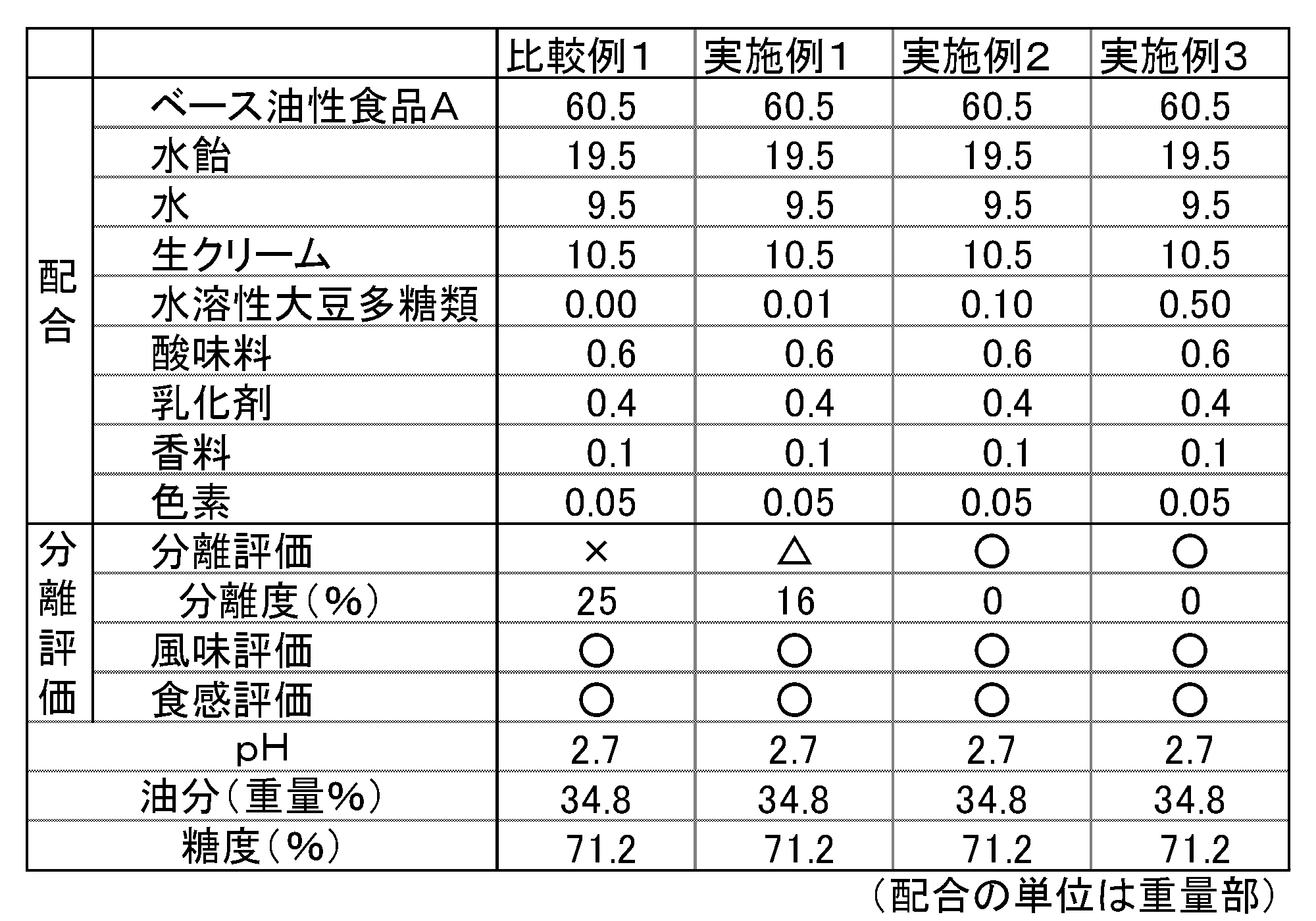
つづいて、表2に従い、ベース油性食品Aに水溶性大豆多糖類の量を比較例1は添加せず、実施例1は0.01、実施例2は0.10、実施例3は0.50、それぞれ添加する以外は同じ配合量にてそれぞれの酸性水中油型乳化食品を作製した。
なお、それぞれの原料は、水溶性大豆多糖類(「ソヤファイブ-S-LA200」、不二製油株式会社製)、植物油脂(商品名「メラノNEWSS-7」不二製油株式会社製)、生クリーム(製品名:明治十勝フレッシュクリーム47、株式会社明治製、カゼイン量0.2重量%)、乳化剤(グリセリン脂肪酸エステル、商品名:グリスターMSW-7S、阪本薬品工業株式会社製)を用いた。
酸性水中油型乳化食品は、融解したベース油性食品に水飴、水、生クリーム、他添加物を加え、分散混合機で相が均質になるまで混合して、冷却した。
得られた酸性水中油型乳化食品の分離評価、風味評価、食感評価に供し、またpHを測定した。
分離試験、食感評価の評価は表2に示した。
なお、それぞれの原料は、水溶性大豆多糖類(「ソヤファイブ-S-LA200」、不二製油株式会社製)、植物油脂(商品名「メラノNEWSS-7」不二製油株式会社製)、生クリーム(製品名:明治十勝フレッシュクリーム47、株式会社明治製、カゼイン量0.2重量%)、乳化剤(グリセリン脂肪酸エステル、商品名:グリスターMSW-7S、阪本薬品工業株式会社製)を用いた。
酸性水中油型乳化食品は、融解したベース油性食品に水飴、水、生クリーム、他添加物を加え、分散混合機で相が均質になるまで混合して、冷却した。
得られた酸性水中油型乳化食品の分離評価、風味評価、食感評価に供し、またpHを測定した。
分離試験、食感評価の評価は表2に示した。
(分離評価)
分離評価の試験方法は、メスシリンダーに酸性水中油型乳化食品を100ml入れて50℃に1晩保管した。これは商品の流通上は考えられない保存条件であるが、長期間の保存状態を短時間でシミュレーションできる方法である。そのため、過酷な条件であるため、この条件で分離が起きたとしても即商品価値がないというわけではない。保管後の分離した油層の全体に対する割合(%)で判断した。なお、評価基準は以下の通りとし、○と△評価までを合格とした。
○:分離がほとんど見られない。
△:分離はあるが、従来の分離度合いよりは改善している。
×:従来品並の分離度合い。
(風味評価)
作成した酸性水中油型乳化食品をパネラー7名にて、風味の官能評価を行った。評価基準は以下とした。
○:みずみずしくフレッシュな酸味を呈し、非常に良好
△:酸味を感じるが、ややフレッシュさを欠けるものの従来品よりは優れている。
×:酸味を感じにくいか、雑味が強い。従来品以下で新規性はない。
(食感評価)
作成した酸性水中油型乳化食品をパネラー7名にて、食感の官能評価を行った。評価基準は以下とした。
○:ざらつきを全く感じない滑らかな舌ざわり。
△:ざらつきまではいかないが舌触りに微妙な違和感。
×:あきらかにざらつきを感じる。
(pH測定法)
pHは、酸性水中油型乳化食品自体を、ガラス電極式水素イオン濃度指示計(「ポータブル型pHメーターD-72」株式会社堀場製作所製)にて測定した。
(糖度測定法)
糖度(Bx)の測定には、糖度計(商品名:MASTER REFRACTOMETER MASTER-3M、測定範囲:糖度58.0%~90.0%、株式会社アタゴ製)を用いた。
分離評価の試験方法は、メスシリンダーに酸性水中油型乳化食品を100ml入れて50℃に1晩保管した。これは商品の流通上は考えられない保存条件であるが、長期間の保存状態を短時間でシミュレーションできる方法である。そのため、過酷な条件であるため、この条件で分離が起きたとしても即商品価値がないというわけではない。保管後の分離した油層の全体に対する割合(%)で判断した。なお、評価基準は以下の通りとし、○と△評価までを合格とした。
○:分離がほとんど見られない。
△:分離はあるが、従来の分離度合いよりは改善している。
×:従来品並の分離度合い。
(風味評価)
作成した酸性水中油型乳化食品をパネラー7名にて、風味の官能評価を行った。評価基準は以下とした。
○:みずみずしくフレッシュな酸味を呈し、非常に良好
△:酸味を感じるが、ややフレッシュさを欠けるものの従来品よりは優れている。
×:酸味を感じにくいか、雑味が強い。従来品以下で新規性はない。
(食感評価)
作成した酸性水中油型乳化食品をパネラー7名にて、食感の官能評価を行った。評価基準は以下とした。
○:ざらつきを全く感じない滑らかな舌ざわり。
△:ざらつきまではいかないが舌触りに微妙な違和感。
×:あきらかにざらつきを感じる。
(pH測定法)
pHは、酸性水中油型乳化食品自体を、ガラス電極式水素イオン濃度指示計(「ポータブル型pHメーターD-72」株式会社堀場製作所製)にて測定した。
(糖度測定法)
糖度(Bx)の測定には、糖度計(商品名:MASTER REFRACTOMETER MASTER-3M、測定範囲:糖度58.0%~90.0%、株式会社アタゴ製)を用いた。
結果、比較例1、すなわち従来型の含水チョコレートは油分の分離を抑えることができず、分離した油分は全体の25%に達した。一方実施例1は油脂の分離が比較例1に比べて改善(16%)しており、市販の保存条件では十分に分離を抑えられる、市場価値がある状態に達しており、さらには実施例2と実施例3では分離は認められなかった。
<カゼインが酸性水中油型乳化食品に与える影響>
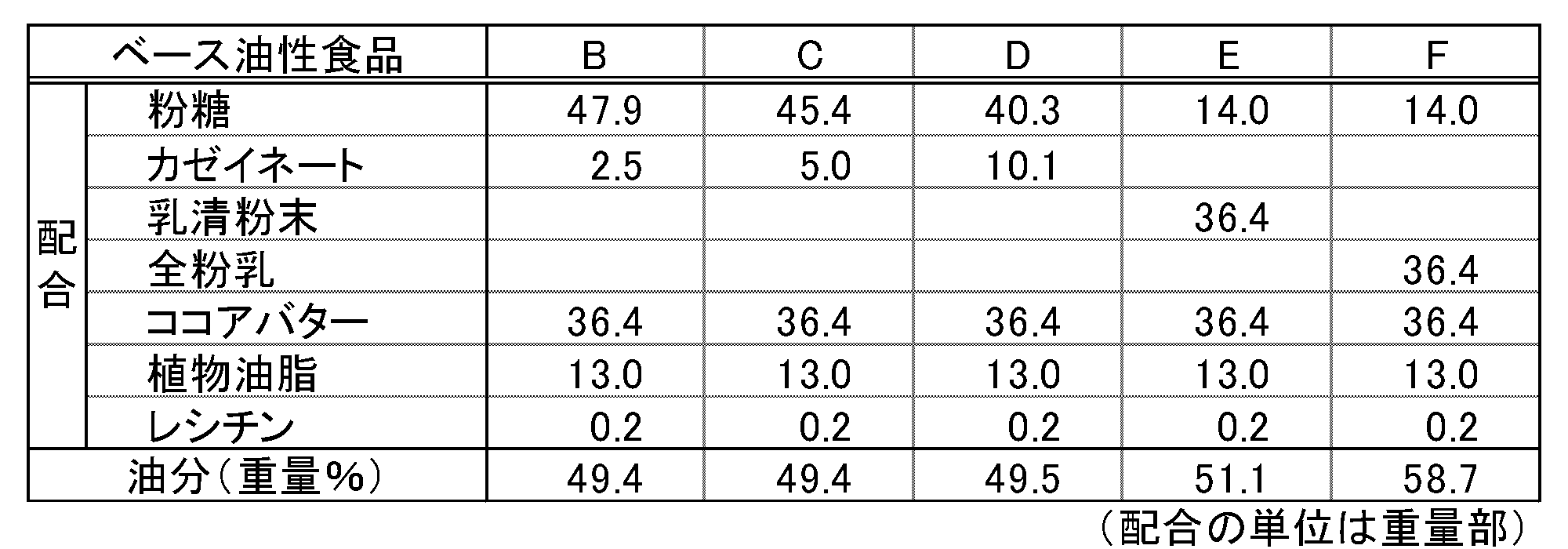
表3に示された通りに配合し、混捏してベース油性食品A~Fを得た。なお、それぞれの原料は、カゼイネート(カリウム・カゼイネート商品名「TATUA500」TATUA Co-operative Dairy Company Limited製、カゼイン含有率91.2%)、乳清粉末(商品名「WPC80%」Warrnambool Cheese&Butter Pty Ltd製、カゼイン含有率0.0%)、全脂粉乳(商品名「よつ葉全粉乳」よつ葉乳業株式会社製、カゼイン含有率21.7%)、ココアバター(商品名「ココアバター201」不二製油株式会社製)、植物油脂(商品名「メラノNEW.SS-7」不二製油株式会社製)をそれぞれ用いた。
表3に示された通りに配合し、混捏してベース油性食品A~Fを得た。なお、それぞれの原料は、カゼイネート(カリウム・カゼイネート商品名「TATUA500」TATUA Co-operative Dairy Company Limited製、カゼイン含有率91.2%)、乳清粉末(商品名「WPC80%」Warrnambool Cheese&Butter Pty Ltd製、カゼイン含有率0.0%)、全脂粉乳(商品名「よつ葉全粉乳」よつ葉乳業株式会社製、カゼイン含有率21.7%)、ココアバター(商品名「ココアバター201」不二製油株式会社製)、植物油脂(商品名「メラノNEW.SS-7」不二製油株式会社製)をそれぞれ用いた。
つづいて、表4に従い、ベース油性食品をA~Fに換える以外は同じ配合量にてそれぞれの酸性水中油型乳化食品を作製した。
得られた酸性水中油型乳化食品の分離評価、風味評価、食感評価に供し、またpHを測定した。
分離試験、食感評価の評価は表4に示した。
得られた酸性水中油型乳化食品の分離評価、風味評価、食感評価に供し、またpHを測定した。
分離試験、食感評価の評価は表4に示した。
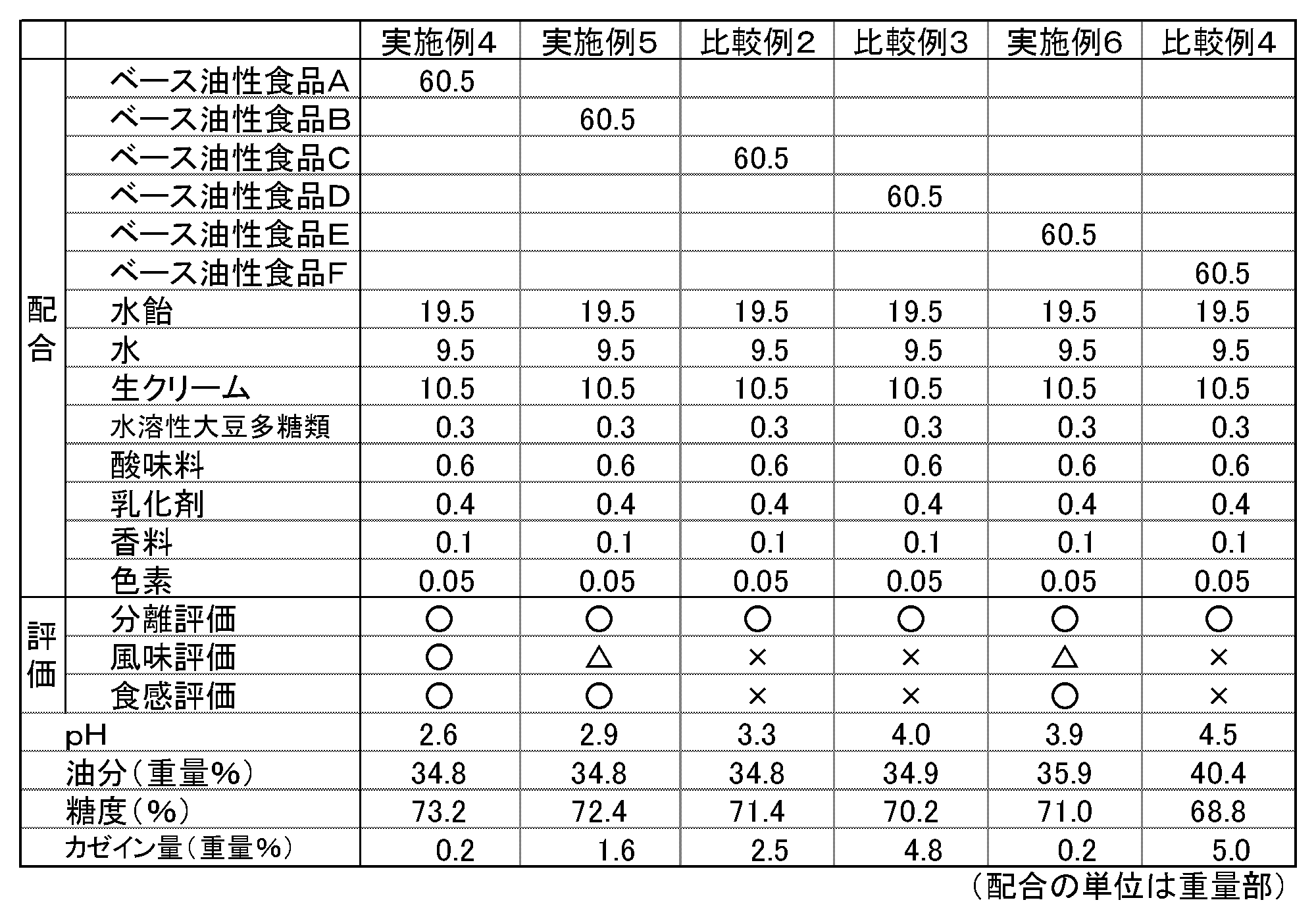
結果、カゼイネートの配合比率を変化させたものは、実施例4(カゼイン量0.2重量%)と実施例5(同1.6重量%)まではざらつきを感じなかったものの、比較例2(同2.5重量%)、比較例3(同4.8重量%)はざらつきを感じ、商品価値の乏しいものとなった。
また、カゼイネート以外の乳由来蛋白質である乳清たん白を用いた実施例6(カゼイン量0.2重量%)はザラツキを感じないが、乳タン白としてカゼインと乳清たん白が混在している全脂粉乳(同5.0重量%)はざらつきを感じるものであった。
また、カゼイネート以外の乳由来蛋白質である乳清たん白を用いた実施例6(カゼイン量0.2重量%)はザラツキを感じないが、乳タン白としてカゼインと乳清たん白が混在している全脂粉乳(同5.0重量%)はざらつきを感じるものであった。
<pHが酸性水中油型乳化食品に与える影響>
表1に示されたベース油性食品Aを用い、つづいて、表5に従い、実施例7(pH2.6)、実施例8(pH3.4)、実施例9(pH4.5)、実施例10(pH5.2)、比較例5(pH6.3)、のそれぞれの目標とするpHに調節するように酸味料を添加する以外は同じ配合量にてそれぞれの酸性水中油型乳化食品を作製した。得られた酸性水中油型乳化食品の分離評価、食感評価に供し、またpHを測定した。分離試験、風味評価、食感評価の評価は表5に示した。
表1に示されたベース油性食品Aを用い、つづいて、表5に従い、実施例7(pH2.6)、実施例8(pH3.4)、実施例9(pH4.5)、実施例10(pH5.2)、比較例5(pH6.3)、のそれぞれの目標とするpHに調節するように酸味料を添加する以外は同じ配合量にてそれぞれの酸性水中油型乳化食品を作製した。得られた酸性水中油型乳化食品の分離評価、食感評価に供し、またpHを測定した。分離試験、風味評価、食感評価の評価は表5に示した。

結果、他の水溶性大豆多糖類やカゼインの規定を満たす限りは、どのpH条件でも分離を生じなかったが、pHが高いと酸味の強い商品を設計した際に十分に風味を発揮できないため比較例11(pH6.3)に至ると、従来品に比べ優位性が感じられなかった。
(糖度・油分と酸性水中油型乳化食品)
表6に示されたベース油性食品G、H、I、Jを用い、つづいて、表7に従い、それぞれのベース油性食品を変える以外は同じ配合にて、酸性水中油型乳化食品を作成した。すなわち、実施例11(油分27.0重量%)、実施例12(油分31.0重量%)、実施例13(油分34.8重量%)、実施例14(油分38.9重量%)の酸性水中油型乳化食品が得られた。
一方で、ベース油性食品Iを用いて、表7に従い、実施例13と水飴と水の量を変える以外は同じ配合にて、酸性水中油型乳化食品を作成した。すなわち実施例13(糖度69.0%)、比較例6(糖度76.0%)、比較例7(糖度79.8%)の酸性水中油型乳化食品を得た。
得られた酸性水中油型乳化食品の分離評価、風味評価、食感評価に供し、またpHと糖度を測定した。
分離試験、風味評価、食感評価の評価は表7に示した。
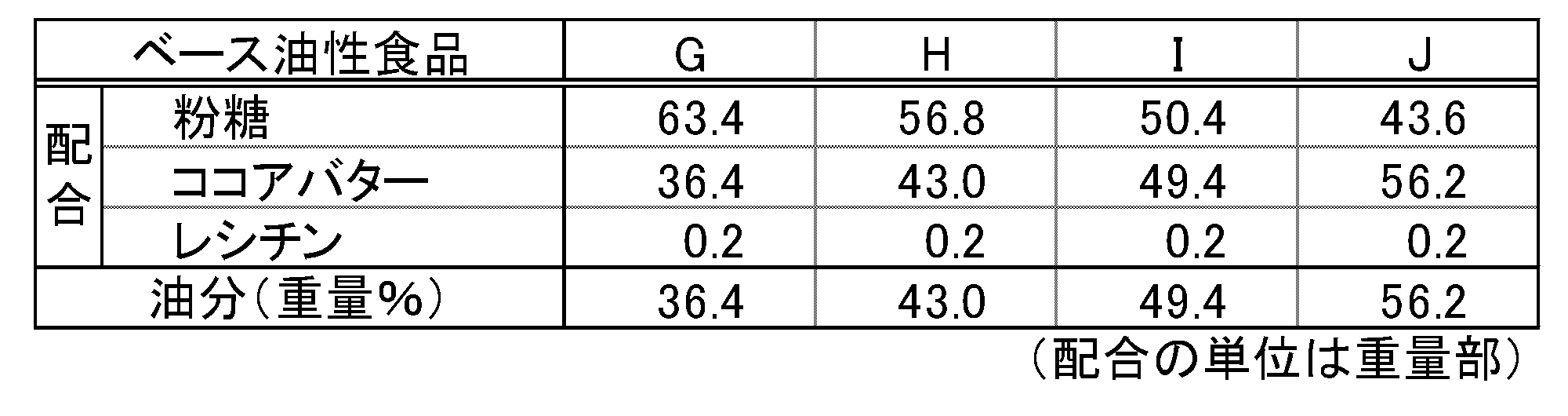

表6に示されたベース油性食品G、H、I、Jを用い、つづいて、表7に従い、それぞれのベース油性食品を変える以外は同じ配合にて、酸性水中油型乳化食品を作成した。すなわち、実施例11(油分27.0重量%)、実施例12(油分31.0重量%)、実施例13(油分34.8重量%)、実施例14(油分38.9重量%)の酸性水中油型乳化食品が得られた。
一方で、ベース油性食品Iを用いて、表7に従い、実施例13と水飴と水の量を変える以外は同じ配合にて、酸性水中油型乳化食品を作成した。すなわち実施例13(糖度69.0%)、比較例6(糖度76.0%)、比較例7(糖度79.8%)の酸性水中油型乳化食品を得た。
得られた酸性水中油型乳化食品の分離評価、風味評価、食感評価に供し、またpHと糖度を測定した。
分離試験、風味評価、食感評価の評価は表7に示した。
結果、酸性水中油型乳化食品の油分の与える影響は、実施例11(油分27.0重量%)から実施例14(油分38.9重量%)までは分離をすることがない酸性水中油型乳化食品が得られた。また、糖度の与える影響は、実施例11(糖度72.0%)は分離することはなかった。比較例6(糖度76.0%)は分離(分離度55%)、比較例7(糖度79.8%)は分離(分離度60%)した。
本発明は、酸性度が高い状態でも、固形分の凝集によるザラツキがなく、作業性が良好で、かつ風味食感の良好な水中油型含水チョコレート類に関する。
Claims (3)
- 酸性水中油型乳化食品の水相のpHが5.5以下、糖度が40~75%であり、酸性水中油型乳化食品全体に対して、水溶性大豆多糖類の含有量が0.01重量%以上、カゼイン含有量が2.0重量%以下であることを特徴とする、酸性水中油型乳化食品。
- 油脂含有量が20~40重量%である請求項1記載の酸性水中油型乳化食品。
- 酸性水中油型乳化食品の水相のpHを5.5以下に調整する工程を有する、請求項1ないし請求項2のいずれか1項に記載の酸性水中油型乳化食品の製造方法。
Applications Claiming Priority (2)
| Application Number | Priority Date | Filing Date | Title |
|---|---|---|---|
| JP2020006177A JP7559326B2 (ja) | 2020-01-17 | 2020-01-17 | 酸性水中油型乳化食品及びその製造法 |
| JP2020-006177 | 2020-01-17 |
Publications (1)
| Publication Number | Publication Date |
|---|---|
| WO2021145192A1 true WO2021145192A1 (ja) | 2021-07-22 |
Family
ID=76863725
Family Applications (1)
| Application Number | Title | Priority Date | Filing Date |
|---|---|---|---|
| PCT/JP2020/048627 Ceased WO2021145192A1 (ja) | 2020-01-17 | 2020-12-25 | 酸性水中油型乳化食品及びその製造法 |
Country Status (2)
| Country | Link |
|---|---|
| JP (1) | JP7559326B2 (ja) |
| WO (1) | WO2021145192A1 (ja) |
Citations (6)
| Publication number | Priority date | Publication date | Assignee | Title |
|---|---|---|---|---|
| JPH0975015A (ja) * | 1995-09-07 | 1997-03-25 | Fuji Oil Co Ltd | 水中油型乳化物 |
| JPH10257861A (ja) * | 1997-01-17 | 1998-09-29 | Fuji Oil Co Ltd | 乳化物及びその製造法 |
| JP2006204132A (ja) * | 2005-01-26 | 2006-08-10 | Sanei Gen Ffi Inc | 糖の析出抑制方法 |
| JP4655933B2 (ja) * | 2003-09-16 | 2011-03-23 | 不二製油株式会社 | 水中油型乳化組成物 |
| JP2013143931A (ja) * | 2011-06-07 | 2013-07-25 | Fuji Oil Co Ltd | 風味の改善された大豆飲食品、並びにそれらの製造法 |
| JP2014027890A (ja) * | 2012-07-31 | 2014-02-13 | Uha Mikakuto Co Ltd | 含水チョコレート及びそれを含有するセンター入りチョコレート |
-
2020
- 2020-01-17 JP JP2020006177A patent/JP7559326B2/ja active Active
- 2020-12-25 WO PCT/JP2020/048627 patent/WO2021145192A1/ja not_active Ceased
Patent Citations (6)
| Publication number | Priority date | Publication date | Assignee | Title |
|---|---|---|---|---|
| JPH0975015A (ja) * | 1995-09-07 | 1997-03-25 | Fuji Oil Co Ltd | 水中油型乳化物 |
| JPH10257861A (ja) * | 1997-01-17 | 1998-09-29 | Fuji Oil Co Ltd | 乳化物及びその製造法 |
| JP4655933B2 (ja) * | 2003-09-16 | 2011-03-23 | 不二製油株式会社 | 水中油型乳化組成物 |
| JP2006204132A (ja) * | 2005-01-26 | 2006-08-10 | Sanei Gen Ffi Inc | 糖の析出抑制方法 |
| JP2013143931A (ja) * | 2011-06-07 | 2013-07-25 | Fuji Oil Co Ltd | 風味の改善された大豆飲食品、並びにそれらの製造法 |
| JP2014027890A (ja) * | 2012-07-31 | 2014-02-13 | Uha Mikakuto Co Ltd | 含水チョコレート及びそれを含有するセンター入りチョコレート |
Non-Patent Citations (2)
| Title |
|---|
| MAEDA YUICHI: "Characteristics and application of soluble soybean polysaccharides "Soyafibe-S", FOOD INDUSTRY, vol. 37, no. 12, pages 71 - 76 * |
| YAMANE MASAYUKI ET AL.: "Purification of highly active MSC- derived exosomes realized by PS affinity method - Proposal of a completely new strategy in regenaerative therapy using exosomes", MAKO PURE CHEMICAL NEWS, vol. 88, no. 4, 15 October 2020 (2020-10-15), pages 10 - 11 * |
Also Published As
| Publication number | Publication date |
|---|---|
| JP7559326B2 (ja) | 2024-10-02 |
| JP2021112148A (ja) | 2021-08-05 |
Similar Documents
| Publication | Publication Date | Title |
|---|---|---|
| DE102009019551B4 (de) | Sensorisch und ernährungsphysiologisch veränderte Nahrungsmittel und Verfahren zu deren Herstellung | |
| CN104582502B (zh) | 低脂或脱脂的包含气泡的乳剂 | |
| CN100553465C (zh) | 水包油型乳化组合物 | |
| CN102711494A (zh) | 对氧化稳定的油和掺合物及包含所述物质的组合物 | |
| MX2013010789A (es) | Composicion comestible en emulsion de aceite en agua. | |
| US20070128323A1 (en) | Creams, whipped products thereof, dry powders thereof and process for producing the same | |
| TW202320636A (zh) | 水中油型乳化物 | |
| JP5714290B2 (ja) | 起泡性水中油型乳化組成物 | |
| CN108463113A (zh) | 用于制备奶精的方法 | |
| CN111601511A (zh) | 针对发泡系统优化的奶油组合物 | |
| CN101111158B (zh) | 制备冰淇淋用植物蛋白成分的方法以及含有所述蛋白成分的冰淇淋 | |
| JP2019149983A (ja) | 油中水型乳化油脂組成物用乳化材 | |
| JP5301373B2 (ja) | 起泡性水中油型乳化油脂組成物 | |
| JP2024047396A (ja) | 起泡性水中油型乳化油脂組成物 | |
| RU2142711C1 (ru) | Безлактозное молоко (варианты), пищевой продукт (варианты) и способы их получения | |
| JP2017029022A (ja) | 水中油型乳化脂用乳化材 | |
| JP2016119884A (ja) | クリーム様製品の製造方法 | |
| JPWO2004062384A1 (ja) | O/w型乳化物及びこれを用いた食品の製造法 | |
| US20090123604A1 (en) | Emulsion food ingredient | |
| WO2025063175A1 (ja) | 起泡性水中油型乳化油脂組成物 | |
| JP7559326B2 (ja) | 酸性水中油型乳化食品及びその製造法 | |
| JP2002320446A (ja) | 水中油型乳化脂の製造方法 | |
| JPH0227941A (ja) | フレッシュチーズ様食品とその製造方法 | |
| JP6154691B2 (ja) | スポンジケーキ用懸濁液 | |
| JPH069477B2 (ja) | 低脂肪起泡水中油型乳化脂 |
Legal Events
| Date | Code | Title | Description |
|---|---|---|---|
| 121 | Ep: the epo has been informed by wipo that ep was designated in this application |
Ref document number: 20914438 Country of ref document: EP Kind code of ref document: A1 |
|
| NENP | Non-entry into the national phase |
Ref country code: DE |
|
| 122 | Ep: pct application non-entry in european phase |
Ref document number: 20914438 Country of ref document: EP Kind code of ref document: A1 |