WO2021117852A1 - ジチアポリエーテルジオール、その製造方法、ジチアポリエーテルジオールを含むSnAgめっき液、及びSnAgめっき液を用いてめっき皮膜を形成する方法 - Google Patents
ジチアポリエーテルジオール、その製造方法、ジチアポリエーテルジオールを含むSnAgめっき液、及びSnAgめっき液を用いてめっき皮膜を形成する方法 Download PDFInfo
- Publication number
- WO2021117852A1 WO2021117852A1 PCT/JP2020/046221 JP2020046221W WO2021117852A1 WO 2021117852 A1 WO2021117852 A1 WO 2021117852A1 JP 2020046221 W JP2020046221 W JP 2020046221W WO 2021117852 A1 WO2021117852 A1 WO 2021117852A1
- Authority
- WO
- WIPO (PCT)
- Prior art keywords
- organic phase
- dithiapolyetherdiol
- raw material
- plating solution
- snag
- Prior art date
- Legal status (The legal status is an assumption and is not a legal conclusion. Google has not performed a legal analysis and makes no representation as to the accuracy of the status listed.)
- Ceased
Links
Classifications
-
- C—CHEMISTRY; METALLURGY
- C07—ORGANIC CHEMISTRY
- C07C—ACYCLIC OR CARBOCYCLIC COMPOUNDS
- C07C323/00—Thiols, sulfides, hydropolysulfides or polysulfides substituted by halogen, oxygen or nitrogen atoms, or by sulfur atoms not being part of thio groups
- C07C323/10—Thiols, sulfides, hydropolysulfides or polysulfides substituted by halogen, oxygen or nitrogen atoms, or by sulfur atoms not being part of thio groups containing thio groups and singly-bound oxygen atoms bound to the same carbon skeleton
- C07C323/11—Thiols, sulfides, hydropolysulfides or polysulfides substituted by halogen, oxygen or nitrogen atoms, or by sulfur atoms not being part of thio groups containing thio groups and singly-bound oxygen atoms bound to the same carbon skeleton having the sulfur atoms of the thio groups bound to acyclic carbon atoms of the carbon skeleton
- C07C323/12—Thiols, sulfides, hydropolysulfides or polysulfides substituted by halogen, oxygen or nitrogen atoms, or by sulfur atoms not being part of thio groups containing thio groups and singly-bound oxygen atoms bound to the same carbon skeleton having the sulfur atoms of the thio groups bound to acyclic carbon atoms of the carbon skeleton the carbon skeleton being acyclic and saturated
-
- C—CHEMISTRY; METALLURGY
- C07—ORGANIC CHEMISTRY
- C07C—ACYCLIC OR CARBOCYCLIC COMPOUNDS
- C07C319/00—Preparation of thiols, sulfides, hydropolysulfides or polysulfides
- C07C319/22—Preparation of thiols, sulfides, hydropolysulfides or polysulfides of hydropolysulfides or polysulfides
-
- C—CHEMISTRY; METALLURGY
- C25—ELECTROLYTIC OR ELECTROPHORETIC PROCESSES; APPARATUS THEREFOR
- C25D—PROCESSES FOR THE ELECTROLYTIC OR ELECTROPHORETIC PRODUCTION OF COATINGS; ELECTROFORMING; APPARATUS THEREFOR
- C25D3/00—Electroplating: Baths therefor
- C25D3/02—Electroplating: Baths therefor from solutions
- C25D3/56—Electroplating: Baths therefor from solutions of alloys
-
- C—CHEMISTRY; METALLURGY
- C25—ELECTROLYTIC OR ELECTROPHORETIC PROCESSES; APPARATUS THEREFOR
- C25D—PROCESSES FOR THE ELECTROLYTIC OR ELECTROPHORETIC PRODUCTION OF COATINGS; ELECTROFORMING; APPARATUS THEREFOR
- C25D3/00—Electroplating: Baths therefor
- C25D3/02—Electroplating: Baths therefor from solutions
- C25D3/56—Electroplating: Baths therefor from solutions of alloys
- C25D3/60—Electroplating: Baths therefor from solutions of alloys containing more than 50% by weight of tin
-
- C—CHEMISTRY; METALLURGY
- C25—ELECTROLYTIC OR ELECTROPHORETIC PROCESSES; APPARATUS THEREFOR
- C25D—PROCESSES FOR THE ELECTROLYTIC OR ELECTROPHORETIC PRODUCTION OF COATINGS; ELECTROFORMING; APPARATUS THEREFOR
- C25D3/00—Electroplating: Baths therefor
- C25D3/02—Electroplating: Baths therefor from solutions
- C25D3/56—Electroplating: Baths therefor from solutions of alloys
- C25D3/64—Electroplating: Baths therefor from solutions of alloys containing more than 50% by weight of silver
Definitions
- the present invention relates to dithiapolyetherdiol, which is a kind of sulfide compound preferably used for SnAg plating solution, and a method for producing the same.
- the present invention relates to a SnAg alloy plating solution for forming a SnAg plating film by an electroplating method. Furthermore, the present invention relates to a method of forming a plating film for a semiconductor wafer or a printed circuit board using a SnAg plating solution.
- the present application claims priority based on Japanese Patent Application No. 2019-224523 filed in Japan on December 12, 2019, and Japanese Patent Application No. 2020-203251 filed in Japan on December 8, 2020. The contents are used here.
- n 1 to 3.
- a strong acid having a dehydrating action such as concentrated sulfuric acid and alkyl sulfonic acid.
- An object of the present invention is to provide a high-purity dithiapolyetherdiol having a low halogen content and a method for producing the same.
- Another object of the present invention is to provide a dithiapolyetherdiol and a method for producing the same, which, when used in a SnAg plating solution, improve the stability of the plating solution, the appearance of the plating film, and the uniformity of the film thickness. .. That is, another object of the present invention is to provide a SnAg plating solution containing dithiapolyetherdiol having good stability of the plating solution, and a method for forming a plating film having good appearance and film thickness uniformity. It is in.
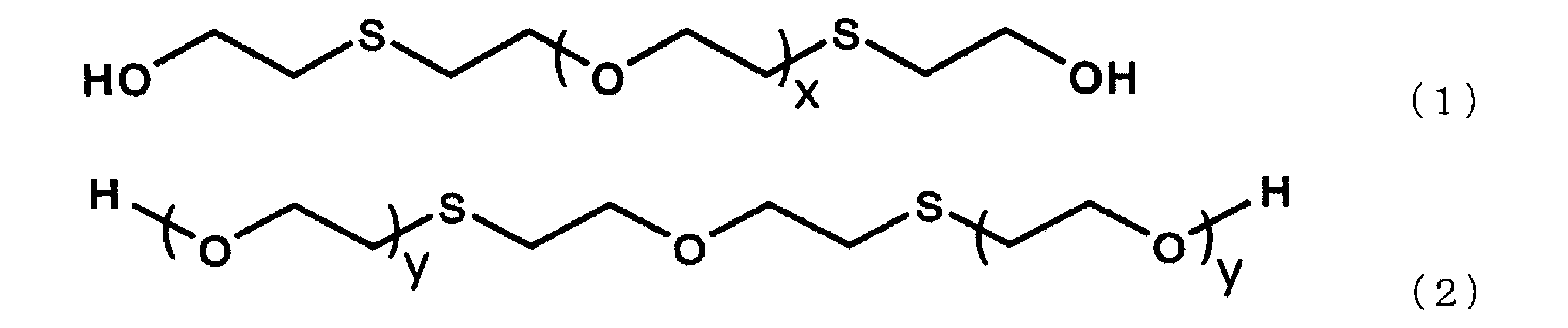
- a first aspect of the present invention is a dithiapolyether having a halogen content of 10 ppm or less, a purity of 80% or more, and represented by the following general formula (1) or (2). It is a diol. However, in the general formula (1) or (2), x and y are arbitrary natural numbers.
- Purity is measured by the following method.
- a high performance liquid chromatography column (Prominence UFLC manufactured by Shimadzu Corporation) filled with octadecyl silica (ODS) as a stationary phase
- ODS octadecyl silica
- the area ratio of the peak area of the dithiapolyetherdiol is calculated, assuming that the peak area of all the detected components is 100%.
- the calculated area ratio is taken as the purity of the dithiapolyether diol.
- the area ratio of the peak area of the component having the largest peak area is defined as the purity.
- a general formula and a formula are structural formulas.
- a second aspect of the present invention is the dithiapolyetherdiol according to the first aspect, wherein the Hazen unit color number (APHA) measured in accordance with JIS K0071-1 (1998) is 100 or less. is there.
- APHA Hazen unit color number
- a third aspect of the present invention is a SnAg plating solution containing the dithiapolyetherdiol of the first or second aspect.
- a fourth aspect of the present invention is a method for forming a plating film, which comprises a step of forming a plating film using the SnAg plating solution of the third aspect.
- (a-1) an alcohol compound having a mercapto group at one end (raw material A), an ether compound having halogen groups at both ends (raw material B), and an alkaline aqueous solution are mixed.
- an alkaline aqueous solution are mixed and heated to obtain a reaction product solution containing an alkali metal salt, and (b) included in the reaction product solution of the step (a-1) or the step (a-2).
- a method for producing a dithia polyether diol which comprises a step of evaporating and removing impurities in the organic phase by heating the removed organic phase.
- a sixth aspect of the present invention is the method for producing a dithiapolyetherdiol according to the fifth aspect, wherein (b-1) the organic phase is performed between the step (b) and the step (c). Is further diluted with an organic solvent in which the alkali metal salt is insoluble to separate the alkali metal salt from the organic phase.
- a seventh aspect of the present invention is the method for producing a dithiapolyetherdiol according to a fifth or sixth aspect, which is between the step (b) and the step (c), or the step (b). Between -1) and the step (c), (b-2) further includes a step of bringing the organic phase into contact with activated carbon.
- An eighth aspect of the present invention is the method for producing a dithiapolyetherdiol according to any one of the fifth to seventh aspects, wherein the evaporation of impurities in the organic phase in the step (d) is under reduced pressure. It is done in.
- the dithiapolyetherdiol of the first aspect of the present invention contains an oxygen atom "-O-" in the molecule in the above-mentioned general formula (1) or (2). Therefore, it has the effect of improving water solubility by hydrogen bonding with water. Further, since it contains a hydroxyl group "-OH", it acts as a hydrophilic group and has an effect of further improving water solubility by hydrogen bonding with water. Further, since the ether bond "COC" is present between the S atoms, the stability of the dithiapolyetherdiol itself is excellent and at least two S atoms are contained, so that these S atoms are in the plating bath.
- the dithiapolyetherdiol of the second aspect of the present invention has a Hazen unit color number (APHA) of 100 or less, the plating solution becomes transparent when used in the SnAg plating solution.
- APHA Hazen unit color number
- the SnAg plating solution of the third aspect of the present invention contains dithiapolyetherdiol, it is excellent in electrolytic stability and stability over time as described above. It also improves the appearance of the plating film and the uniformity of the film thickness.
- the SnAg plating solution of the third aspect is used, a plating film having a good appearance and a uniform film thickness can be produced.
- the raw material (A), the raw material (B), and the alkaline aqueous solution are mixed to obtain a reaction aqueous solution containing an alkali metal salt.
- the reaction aqueous solution is separated into an organic phase and an aqueous phase, and halogens and metal ions are removed from the separated organic phase.
- the organic phase is heated to remove impurities to obtain the desired product. Therefore, a high-purity dithiapolyetherdiol having a low halogen content can be produced.
- the organic phase before treating the separated organic phase with an ion exchange resin, the organic phase is diluted with an organic solvent in which an alkali metal salt is not dissolved. Therefore, the contents of the halide ion and the metal ion can be significantly reduced, and the purification efficiency of the ion exchange resin can be improved.
- the reaction product containing the alkali metal salt is separated into an organic phase and an aqueous phase, and before removing the halide ion from the separated organic phase.
- the organic phase is brought into contact with activated carbon.
- the colored impurity component of the organic phase is adsorbed and removed by the activated carbon, and the dithiapolyetherdiol can be made transparent.
- the production method of the first embodiment includes the step (a-1).
- step (a-1) an alcohol compound having a mercapto group at one end (raw material A), an ether compound having a halogen group at both ends (raw material B), and an alkaline aqueous solution are mixed and heated to form an alkali metal.
- a reaction product containing a salt is obtained.
- the raw material (A) is an alcohol compound having a mercapto group at one end (hereinafter, also referred to as a raw material (A1)).
- 2-mercaptoethanol represented by the following formula (3) can be mentioned.
- the raw material (B) is an ether compound having halogen groups at both ends (hereinafter, also referred to as the raw material (B1)).
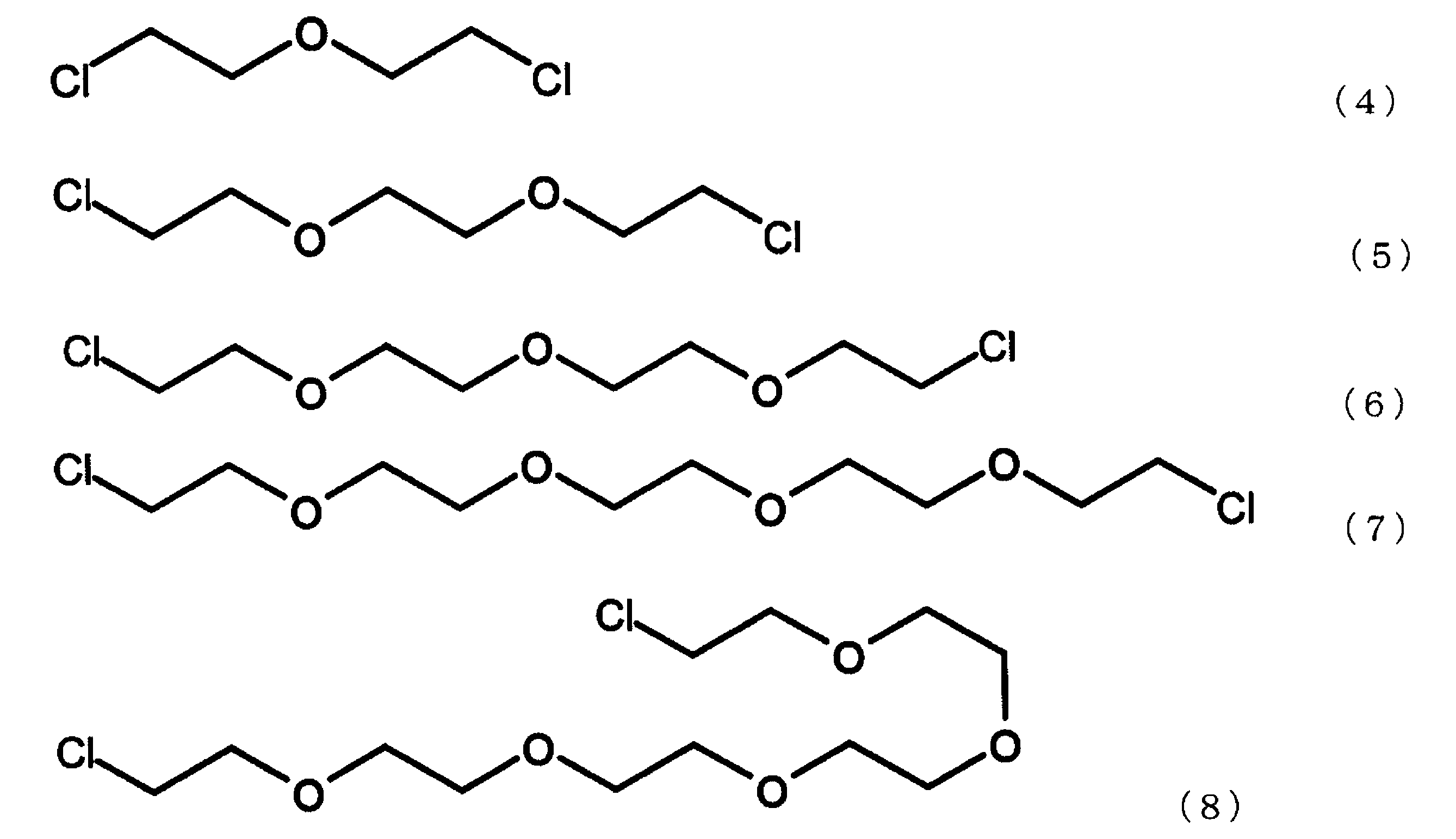
- the compounds represented by the following formulas (4) to (8) can be mentioned.
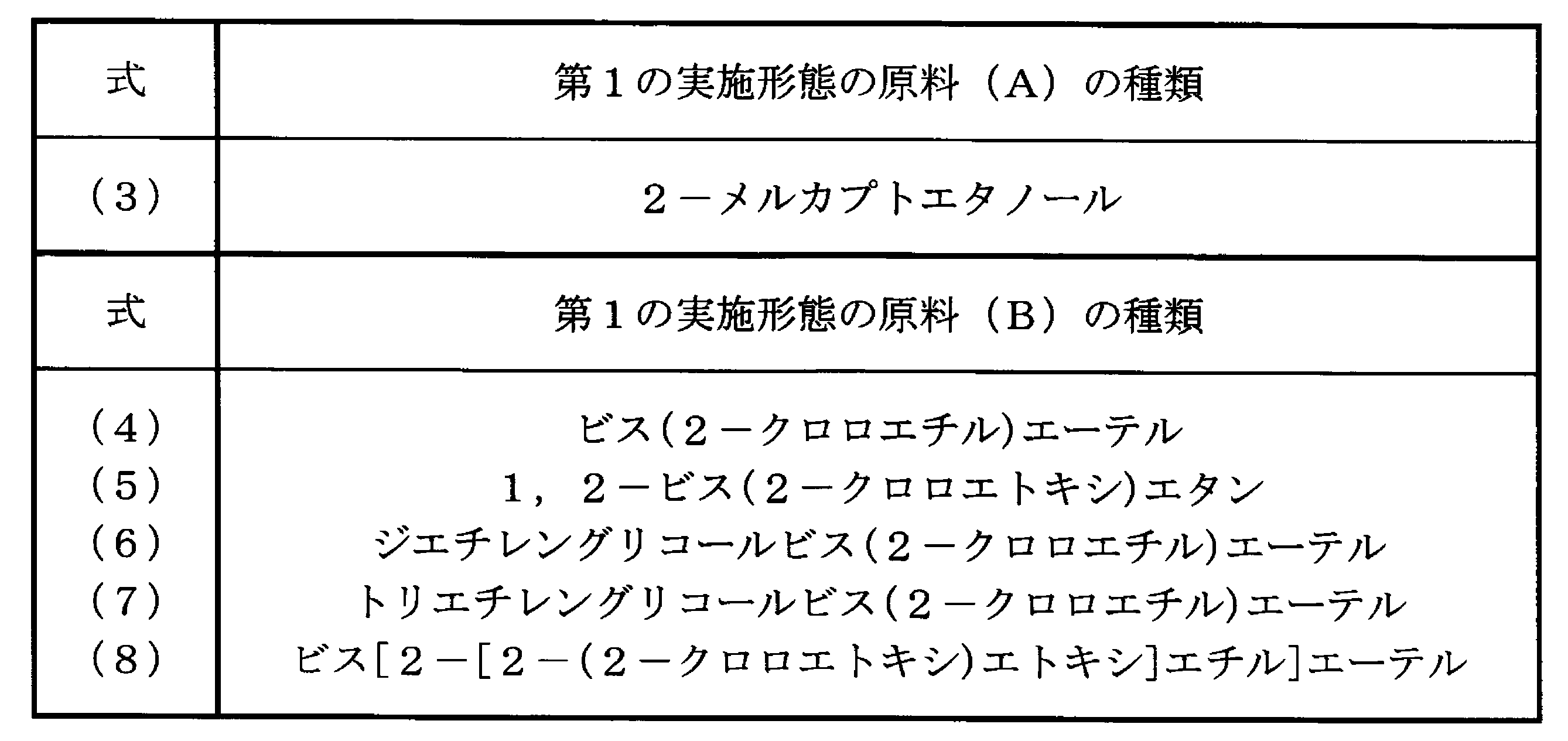
- Table 1 below shows the ether compounds represented by the formulas (4) to (8) of the raw material (B) together with the raw material (A) of the formula (3).
- Examples of the alkaline aqueous solution of the production method of the first embodiment include aqueous solutions of sodium hydroxide, potassium hydroxide, sodium carbonate, potassium hydrogencarbonate and the like.
- aqueous solutions of sodium hydroxide, potassium hydroxide, sodium carbonate, potassium hydrogencarbonate and the like Regarding the mixing of the raw material (A), the raw material (B), and the alkaline aqueous solution, for example, it is preferable to first uniformly mix the raw material (A) with the alkaline aqueous solution. As a result, the deprotonation of the raw material (A) can be reliably performed.
- the raw material (B) is preferable to uniformly mix the raw material (B) with this mixed solution and heat it.
- This heating is preferably performed by heating the mixed solution to a temperature of 40 ° C. to 100 ° C. in an air atmosphere and holding it for 3 hours to 24 hours.
- a dehalogenation reaction occurs, and the main reaction product, dithiapolyetherdiol, the by-product, alkali metal halide, the unreacted raw material, and the organic impurities produced by the side reaction are formed.
- the contained reaction product is obtained.
- reaction product solution contains an organic phase and an aqueous phase
- it is separated into an organic phase and an aqueous phase. If the amount of the reaction product is small, it is separated into an organic phase and an aqueous phase by a separating funnel, and if the amount of the reaction product is large, it is separated into an organic phase and an aqueous phase by centrifugation or the like.
- the reaction product may be concentrated in order to facilitate separation into the organic phase and the aqueous phase.
- (B-1) Step of Diluting Organic Phase with Organic Solvent insoluble Alkali Metal Salt The separated organic phase is sampled, an organic solvent insoluble in alkali metal salt is added to this organic phase, and the organic phase is divided by volume into 2. It is preferable to dilute it 1 to 10 times. That is, it is preferable to add the organic solvent so that the volume after dilution is 2 to 10 times the volume before dilution.
- the organic solvent isopropanol, toluene and the like can be used. As a result, the alkali metal salt is easily precipitated or precipitated. Therefore, when the alkali metal salt is solid-liquid separated, an organic phase having a low alkali metal salt content can be obtained.
- (B-2) Step of contacting the organic phase with activated carbon
- the organic phase of the above step (b) or the organic phase that has undergone the step (b-1) is brought into contact with the activated carbon to make the colored and offensive odor organic phase transparent. It is preferable to deodorize at the same time. If the organic phase is small, granular activated carbon is mixed with the organic phase to bring the organic phase into contact with the activated carbon. If the amount of the organic phase is large, the organic phase is passed through a column filled with activated carbon to bring the organic phase into contact with the activated carbon.
- the activated carbon for example, activated carbon such as "Taiko K type” manufactured by Futamura Chemical Co., Ltd., “Kuraraycol” manufactured by Kuraray Co., Ltd., and “Refined Shirasagi” manufactured by Osaka Gas Chemical Co., Ltd. can be used.
- the step (b-2) may be performed a plurality of times as needed.
- the amount (g) of the activated carbon with respect to the amount (L) of the organic phase is preferably 1 g / L to 200 g / L.
- the organic phase is passed through the column filled with activated carbon, it is preferable to pass the organic phase through the column at a flow velocity having a linear velocity LV (Linear Velocity) of 0.1 to 5.
- Step of bringing the organic phase into contact with the ion exchange resin The organic phase of the above step (b), the organic phase of the step (b-1) or the organic phase of the step (b-2) is brought into contact with the ion exchange resin. The remaining halide ion and metal ion are removed. If the amount of the organic phase is small, the granular ion exchange resin is mixed with the organic phase and the organic phase is brought into contact with the ion exchange resin. If the amount of the organic phase is large, the organic phase is passed through a column packed with an ion exchange resin.
- the ion exchange resin examples include “A series” and “C series” manufactured by Purolite, “Duolite” manufactured by Sumika Chemtex, "SK series”, “SA series” and “SM series” manufactured by Mitsubishi Chemical Corporation. Ion exchange resins such as “SMUPB” can be used.
- the step (c) may be performed a plurality of times as needed.
- the amount (g) of the ion exchange resin with respect to the amount (L) of the organic phase is preferably 1 g / L to 200 g / L.
- LV Linear Velocity
- step (D) Step of removing impurities in the organic phase
- the impurities in the organic phase are evaporated and the impurities are removed.
- the organic phase in which the offensive odor remains is deodorized, and the purity of the obtained dithiapolyetherdiol is increased.
- the evaporation of the impurities is preferably carried out under a reduced pressure of 0.001 MPa to 0.01 MPa and a temperature of 40 ° C. to 100 ° C. for 1 hour to 24 hours. This facilitates the evaporation of impurities from the organic phase.
- the organic phase is diluted with an organic solvent in which the alkali metal salt does not dissolve, and the alkali metal salt is precipitated and / or precipitated to remove the alkali metal salt from the organic phase. It is being removed.
- the dithiapolyetherdiol produced by the method of the first embodiment has a halogen content of 10 ppm or less and a purity of 80% or more, and is represented by the above-mentioned general formula (1).
- the preferred halogen content is 5 ppm or less and the preferred purity is 90% or more.
- Examples of the dithiapolyetherdiol of the first embodiment include the following formulas (9) to (13).
- the number of x in the general formula (1) is also shown. It is preferable that x is in the range of 1 to 5 because the raw material is easily available.
- the manufacturing method of the second embodiment includes the step (a-2).
- step (a-2) an ether compound having a mercapto group at both ends (raw material A), an alcohol compound having a halogen group at one end (raw material B), and an alkaline aqueous solution are mixed and heated to form an alkali metal.
- a reaction product containing a salt is obtained.
- the raw material (A) and the raw material (B) are different from those of the first embodiment.
- the production method of the second embodiment is different from that of the first embodiment. The same is true.
- the raw material (A) is an ether compound having mercapto groups at both ends (hereinafter, also referred to as the raw material (A2)).
- the raw material (A2) is an ether compound having mercapto groups at both ends (hereinafter, also referred to as the raw material (A2)).
- bis (2-mercaptoethyl) ether represented by the following formula (14) can be mentioned.
- the raw material (B) is an alcohol compound having a halogen group at one end (hereinafter, also referred to as the raw material (B2)).
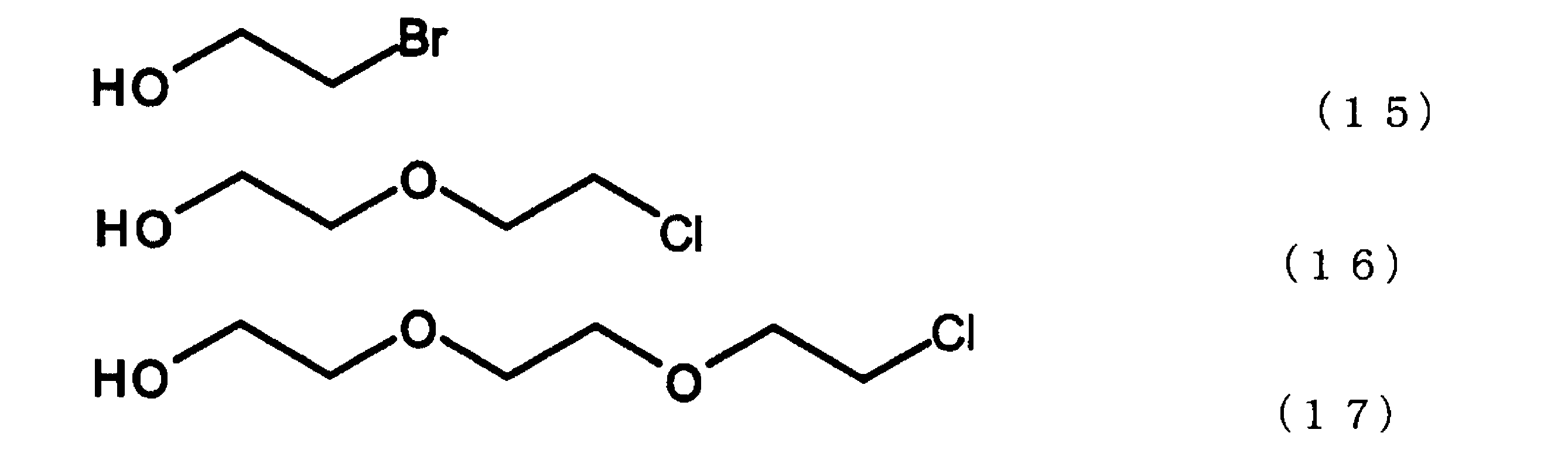
- the raw material (B2) for example, compounds represented by the following formulas (15) to (17) can be mentioned.
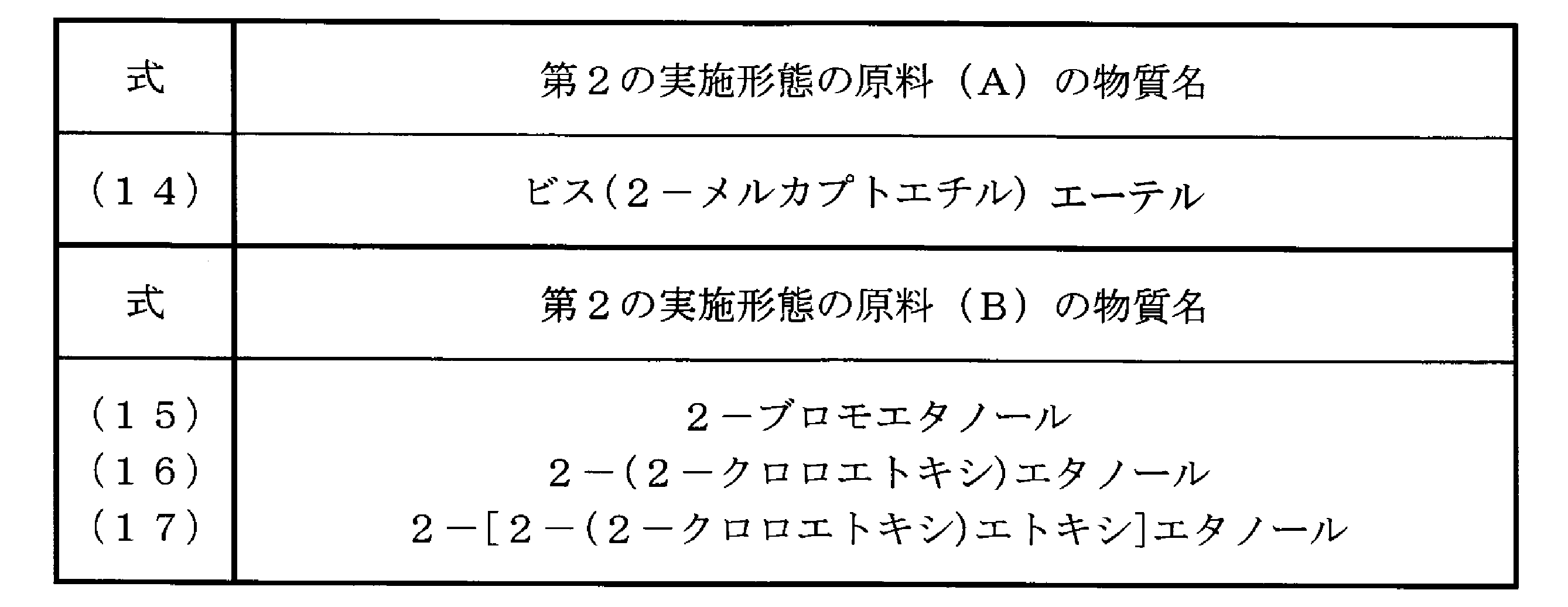
- Table 2 below shows the alcohol compounds represented by the formulas (15) to (17) of the raw material (B) together with the raw material (A) of the formula (14).
- the dithiapolyetherdiol produced by the method of the second embodiment has the same characteristic values as the dithiapolyetherdiol produced by the method of the first embodiment. That is, this dithiapolyetherdiol has a halogen content of 10 ppm or less and a purity of 80% or more, and is represented by the above-mentioned general formula (2). The preferred halogen content is 5 ppm or less and the preferred purity is 90% or more.
- Examples of the dithiapolyetherdiol of the second embodiment include the following formulas (18) to (20). The number of y in the general formula (2) is also described. It is preferable that y is in the range of 1 to 3 because the raw material is easily available.
- the SnAg plating solution of the present embodiment contains the dithiapolyetherdiol produced in the first and second embodiments, and is also a soluble Sn salt that dissolves in water to generate divalent tin ions. , Soluble Ag salt and additives.
- the dithiapolyetherdiol acts as a complexing agent for Ag ions.
- the additive include an acid electrolyte (free acid), a surfactant, an antioxidant, a complexing agent for Sn, a pH adjusting agent, a brightening agent and the like.
- This SnAg plating solution can be prepared, for example, by mixing a soluble tin salt, the above-mentioned dithiapolyetherdiol and additives, and water.
- an electroplating method is used.
- the plating film include plating films for semiconductor wafers and printed circuit boards.
- the liquid temperature of this SnAg plating liquid at the time of plating is generally 70 ° C. or lower, preferably 10 ° C. to 40 ° C.
- the current density at the time of forming the plating film by electroplating is in the range of 0.1 A / dm 2 or more and 100 A / dm 2 or less, preferably 0.5 A / dm 2 or more and 20 A / dm 2 or less.
- the SnAg plating solution containing dithiapolyetherdiol produced in the first and second embodiments can be applied to an electronic component to be plated to form a plating film on the electronic component.
- electronic components include printed circuit boards, flexible printed circuit boards, film carriers, semiconductor integrated circuits, resistors, capacitors, filters, inductors, thermistors, crystal transducers, switches, lead wires, and the like.
- Example 1 40 g (1 mol) of sodium hydroxide was dissolved in 200 mL of pure water and the solution was cooled to 5 ° C. 78.1 g (1 mol) of 2-mercaptoethanol represented by the formula (3) was mixed with this aqueous sodium hydroxide solution as a raw material (A), and the mixture was stirred with a stirrer to prepare a first mixed solution. Subsequently, 71.5 g (0.5 mol) of bis (2-chloroethyl) ether represented by the formula (4) as a raw material (B) is mixed with this first mixed solution, and the mixture is stirred with a stirrer to give the first mixture. Two mixed solutions were prepared. The second mixed solution was heated to 80 ° C. in an air atmosphere and refluxed at 80 ° C. for 12 hours. As a result, the raw material (A) and the raw material (B) reacted to obtain a reaction product.
- This reaction product was transferred to a separating funnel and allowed to stand, and separated into two phases, an organic phase and an aqueous phase.
- 2-Isopropanol was mixed with the separated organic phase, and the organic phase was diluted 5-fold by volume. That is, 2-isopropanol was added so that the volume after dilution was 5 times the volume before dilution.
- the solids were removed from the organic phase by filtering the solids precipitated or precipitated by dilution.
- granular activated carbon (“purified egret” manufactured by Osaka Gas Chemical Co., Ltd.) was mixed with the organic phase at a ratio of 10 g / L, and the mixture was stirred for 1 hour. After stirring, the mixed liquid was filtered to remove activated carbon.
- Granular ion exchange resin (“SMUPB” manufactured by Mitsubishi Chemical Corporation) was mixed with the organic phase from which activated carbon had been removed at a ratio of 200 g / L, and the mixture was stirred for 1 hour. After stirring, the mixed liquid was filtered to remove the ion exchange resin. Subsequently, the organic phase from which the ion exchange resin had been removed was transferred to an eggplant-shaped flask, the pressure was reduced to 0.005 MPa, and the mixture was heated at 80 ° C. for 12 hours to evaporate impurities in the organic phase to obtain a liquid final product. ..
- Table 3 below shows the production conditions (No. 1) of the dithiapolyetherdiol in Example 1, Examples 2 to 8 described below, and Comparative Examples 1 and 2. That is, each type of the raw material (A) and the raw material (B) used in Example 1 and the following Examples 2 to 8 and Comparative Examples 1 and 2 is shown.
- the formula numbers correspond to the formula numbers shown in the embodiments.
- Table 4 below shows the production conditions (No. 2) of the dithiapolyetherdiol in Examples 1 and 2 to 8 and Comparative Examples 1 and 2 described below. That is, the presence or absence of the manufacturing process in Example 1 and the following Examples 2 to 8 and Comparative Examples 1 and 2 is shown.
- the process code corresponds to the process code shown in the embodiment.
- Example 2 to 8 and Comparative Examples 1 to 2 In Examples 2 to 8 and Comparative Examples 1 and 2, as shown in Table 3, the type of the raw material (A) and the type of the raw material (B) were the same as or changed from those of Example 1, respectively. Further, as shown in Table 4, step (a-1), step (b), step (b-1), step (b-2), step (c), and step (d) were performed or not performed. .. In Example 6, impurities in step (d) were removed under "normal pressure". In Example 7, contact with the activated carbon in step (b-2) was not performed. In Example 8, the step (b-1) was not diluted with an organic solvent.
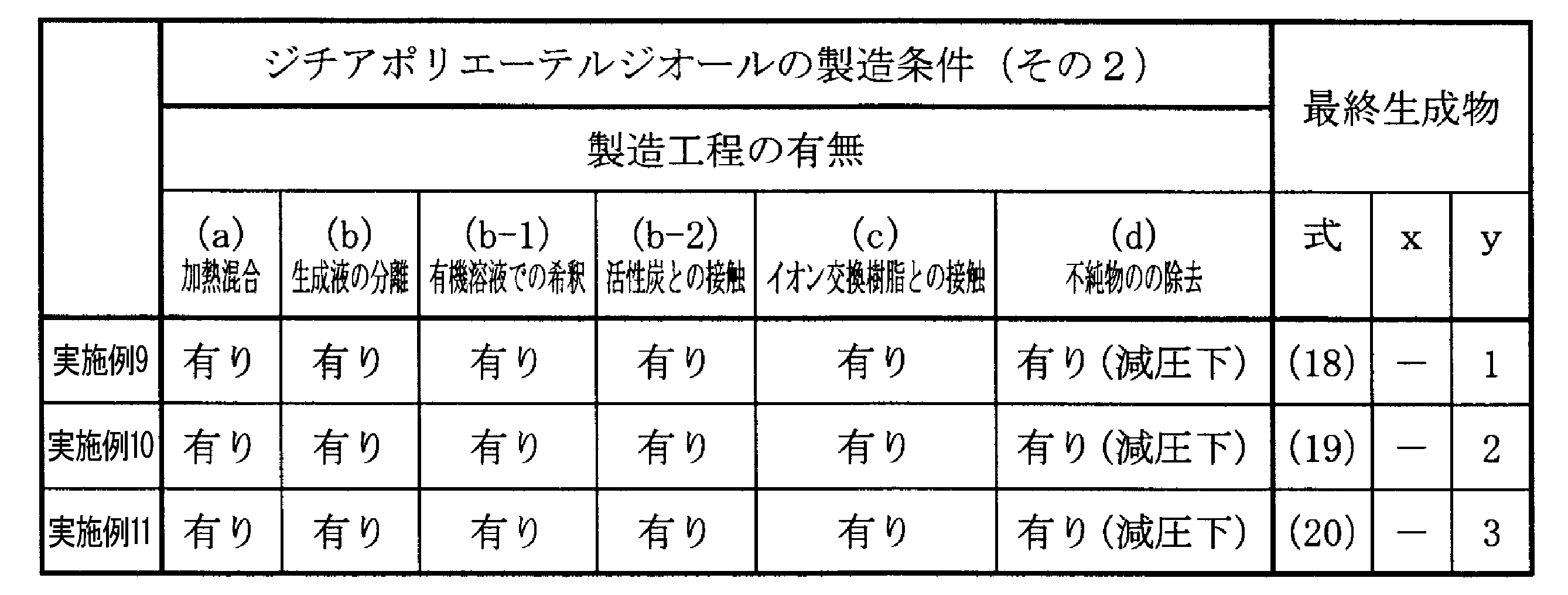
- Example 9 40 g (1 mol) of sodium hydroxide was dissolved in 200 mL of pure water and the solution was cooled to 5 ° C. 69.1 g (0.5 mol) of bis (2-mercaptoethyl) ether represented by the formula (14) as a raw material (A) is mixed with this aqueous sodium hydroxide solution, and the mixture is stirred with a stirrer for the third mixing. The liquid was prepared. Subsequently, 124.9 g (1 mol) of 2-bromoethanol represented by the formula (15) is mixed with this third mixed solution as a raw material (B) and stirred with a stirrer to prepare a fourth mixed solution. did. From this point onward, the final product was obtained in the same manner as in Example 1.
- Table 5 below shows the production conditions (No. 1) of the dithiapolyether diol in Example 9 and Examples 10 to 11 described below. That is, each type of the raw material (A) and the raw material (B) used in Example 9 and Examples 10 to 11 described below is shown.
- the formula numbers correspond to the formula numbers shown in the embodiments.
- Table 6 below shows the production conditions (No. 2) of the dithiapolyetherdiol in Example 9 and Examples 10 to 11 described below. That is, the presence or absence of the manufacturing process in Example 9 and Examples 10 to 11 described below is shown.
- the process code corresponds to the process code shown in the embodiment.
- Example 10 to 11 ⁇ Examples 10 to 11>
- the type of the raw material (A) and the type of the raw material (B) were the same as or changed from those of Example 9, respectively. Further, as shown in Table 6, steps (a-2), step (b), step (b-1), step (b-2), step (c), and step (d) were performed. In Examples 10-11, the final product was produced in the same manner as in Example 9.
- dithiapolyetherdiol which is the final product of 13 kinds obtained in Examples 1 to 11 and Comparative Examples 1 and 2, as samples, the halogen content, purity and color taste (Hazen unit color number) of these samples were taken. ) was measured and evaluated by the following method. Further, a SnAg plating solution was prepared using these dithiapolyetherdiols, and a plating test was performed to evaluate the stability of the plating solution, the appearance of the plating film, and the uniformity of the film thickness. These results are shown in Table 7.
- Halogen content was calculated by quantifying the ion concentration of halogen (F, Cl, Br, I) in the sample by ion chromatography (Prominence HIC-SP, manufactured by Shimadzu Corporation).
- the molar ratio of the dithiapolyetherdiol to the amount of Ag in the SnAg plating solution having the following composition was 1: 1.
- the tin methanesulfonic acid aqueous solution was prepared by electrolyzing a metal tin plate in the methanesulfonic acid aqueous solution.
- the silver methanesulfonic acid aqueous solution was prepared by electrolyzing a metallic silver plate in the methanesulfonic acid aqueous solution.
- composition of SnAg plating solution Tin methanesulfonate (as Sn 2+ ): 50 g / L Silver methanesulfonate (as Ag + ): 0.005 mol / L Methanesulfonic acid (as free acid): 200 g / L Dithia polyether diol: 0.005 mol / L Nonionic surfactant: 10g / L Brightener: 10 mg / L Ion-exchanged water: balance
- (D-2) Appearance of Plating Film 13 types of SnAg alloy plating solutions that have been bathed are placed separately in a plating tank, a wafer with a pattern formed as a cathode is placed in the solution, and a Pt / Ti mesh plate is placed as an anode. Then, a plating test was conducted. As the plating conditions, the liquid temperature was 25 ° C., the energizing current was 4 A / dm 2 , and the plating treatment time was 25 minutes. During the plating process, the plating solution was stirred with a cathode rocker. The appearance of the plating film formed in the pattern was observed with a laser microscope.
- a film having a surface roughness Ra of less than 2 ⁇ m is evaluated as “good”, and a film having a surface roughness Ra of 2 ⁇ m or more and less than 5 ⁇ m is evaluated as “good”, and the surface roughness Ra is evaluated.
- a film having a roughness of 5 ⁇ m or more was evaluated as “poor”. The appearance of the plating film was evaluated based on these three criteria.
- Comparative Example 2 the impurities in the step (d) were not removed. In Comparative Example 2, the purity was as low as "50%”. The stability of the plating solution, the appearance of the plating film, and the uniformity of the film thickness were all "poor".
- Step (d) was performed.
- the obtained final products have a halogen content and purity within the range shown in the first aspect of the present invention, and SnAg containing these final products.
- impurities in step (d) were removed under normal pressure.
- Example 6 the purity was slightly low at “80%”, the color was high at “80”, and the appearance of the plating film and the uniformity of the film thickness were “possible”, respectively.
- contact with the activated carbon in step (b-2) was not performed.
- the halogen content was slightly as high as “10 ppm”, and the number of Hazen unit colors of the tint was very high as “240”.
- the stability of the plating solution, the appearance of the plating film, and the uniformity of the film thickness were all "good”.
- step (b-1) the mixture was diluted with pure water without being diluted with an organic solvent.
- the color was slightly high at "60", but the stability of the plating solution, the appearance of the plating film, and the uniformity of the film thickness were all "good".
- the dithiapolyetherdiol of the present embodiment can be used as a SnAg plating solution for forming a part of an electronic component such as a solder plating film for a semiconductor wafer or a printed circuit board.
Landscapes
- Chemical & Material Sciences (AREA)
- Organic Chemistry (AREA)
- Engineering & Computer Science (AREA)
- Chemical Kinetics & Catalysis (AREA)
- Electrochemistry (AREA)
- Materials Engineering (AREA)
- Metallurgy (AREA)
- Organic Low-Molecular-Weight Compounds And Preparation Thereof (AREA)
Abstract
このジチアポリエーテルジオールは、ハロゲン含有量が10ppm未満であり、純度が80%以上であり、かつ下記一般式(1)又は(2)で表される。但し、一般式(1)又は(2)中、x及びyは任意の自然数である。
Description
本発明は、SnAgめっき液に好適に用いられるスルフィド化合物の一種であるジチアポリエーテルジオール及びその製造方法に関する。本発明は、電気めっき法によりSnAgめっき膜を形成するためのSnAg合金めっき液に関する。更に本発明は、SnAgめっき液を用いて半導体ウエハやプリント基板用のめっき皮膜を形成する方法に関する。
本願は、2019年12月12日に日本に出願された特願2019-224523号、及び2020年12月8日に日本に出願された特願2020-203251号に基づき優先権を主張し、その内容をここに援用する。
本願は、2019年12月12日に日本に出願された特願2019-224523号、及び2020年12月8日に日本に出願された特願2020-203251号に基づき優先権を主張し、その内容をここに援用する。
本発明者は、錫合金めっき液において用いられるスルフィド化合物として、下記の一般式(21)で示されるスルフィド化合物を提案した(特許文献1(請求項1、段落[0033])参照。)。式(21)中、nは1~3である。

このスルフィド化合物は、濃硫酸やアルキルスルホン酸等の脱水作用をもつ強酸中でチオジエタノール(n=0)を脱水縮合して得られる。このときの反応温度、反応時間及び精製条件を変えることにより、一般式(21)中のnの値を制御することができる。
一方、従来より、ハロゲン化銀写真感光材料の現像処理に用いられるスルフィド化合物として、3,9-ジチア-6-オキサ-1,11-ウンデカンジオール(HOCH2CH2SCH2CH2OCH2CH2SCH2CH2OH)が開示されている(例えば、特許文献2(第14欄第18~28行)参照。)。この化合物は、以下の方法により合成される。2-メルカプトエタノール15.6g、ビス-(2-クロロエチル)エーテル14.3g、炭酸ナトリウム10.6gを50%エタノールに溶解する。そして、その溶液を20時間還流し、溶媒を減圧留去する。次いで、熱無水エタノールと酢酸エチルで上記化合物を抽出する。以上により上記化合物は合成される。目的物(上記化合物)は蒸留で得られる。
しかし、特許文献1に示されるスルフィド化合物は、強酸中でチオジエタノール(n=0)を脱水縮合して合成されることから、『HOCH2CH2SCH2CH2OH』と『HOCH2CH2SCH2CH2OH』の2分子が脱水縮合した二量体のみならず、この二量体に単一の上記分子が更に縮合した三量体、或いは四量体等の多量体が生成されてしまう。このため、錫合金めっき液に好適な純度の高いスルフィド化合物を生成することが難しい。これに起因して、このスルフィド化合物をSnAgめっき液に用いる場合、めっき時に析出するAg組成が安定せず、めっき皮膜の外観及び膜厚の均一性が損なわれる場合があった。
この点、特許文献2に記載されたような2-メルカプトエタノールと、ビス-(2-クロロエチル)エーテルとの反応では、上述のような多量体が生成しない。しかしながら、特許文献2に記載されたような2-メルカプトエタノールと、ビス-(2-クロロエチル)エーテルとの反応では、主たる反応生成物としてのスルフィド化合物のほか、副生成物として塩化ナトリウム(NaCl)が生成される。更には、未反応の原料や副反応による有機不純物も残留する。
これらの残留物のために、特許文献2に示されるスルフィド化合物は、塩素含有量が多くかつ純度が低い。このように、塩素などのハロゲン含有量が多いスルフィド化合物をSnAgめっき液に用いる場合には、塩化銀などのハロゲン化銀を生成し、これに起因して、SnAgめっき液の安定性が悪化し易い課題があった。また純度が低いスルフィド化合物をSnAgめっき液に用いる場合には、めっき性能、特にめっき皮膜の外観が悪化し易く、めっき皮膜の膜厚の均一性が低下し易いといった課題があった。
これらの残留物のために、特許文献2に示されるスルフィド化合物は、塩素含有量が多くかつ純度が低い。このように、塩素などのハロゲン含有量が多いスルフィド化合物をSnAgめっき液に用いる場合には、塩化銀などのハロゲン化銀を生成し、これに起因して、SnAgめっき液の安定性が悪化し易い課題があった。また純度が低いスルフィド化合物をSnAgめっき液に用いる場合には、めっき性能、特にめっき皮膜の外観が悪化し易く、めっき皮膜の膜厚の均一性が低下し易いといった課題があった。
本発明の目的は、ハロゲン含有量が少なく高純度のジチアポリエーテルジオール及びその製造方法を提供することにある。本発明の別の目的は、SnAgめっき液に用いる場合、めっき液の安定性、めっき皮膜の外観及び膜厚の均一性を良好にするジチアポリエーテルジオール及びその製造方法を提供することにある。すなわち、本発明の別の目的は、めっき液の安定性が良好なジチアポリエーテルジオールを含むSnAgめっき液、及び外観及び膜厚の均一性が良好なめっき皮膜を形成する方法を提供することにある。
本発明の第1の態様は、ハロゲン含有量が10ppm以下であり、純度が80%以上であり、かつ下記一般式(1)又は(2)で表されることを特徴とするジチアポリエーテルジオールである。但し、一般式(1)又は(2)中、x及びyは任意の自然数である。
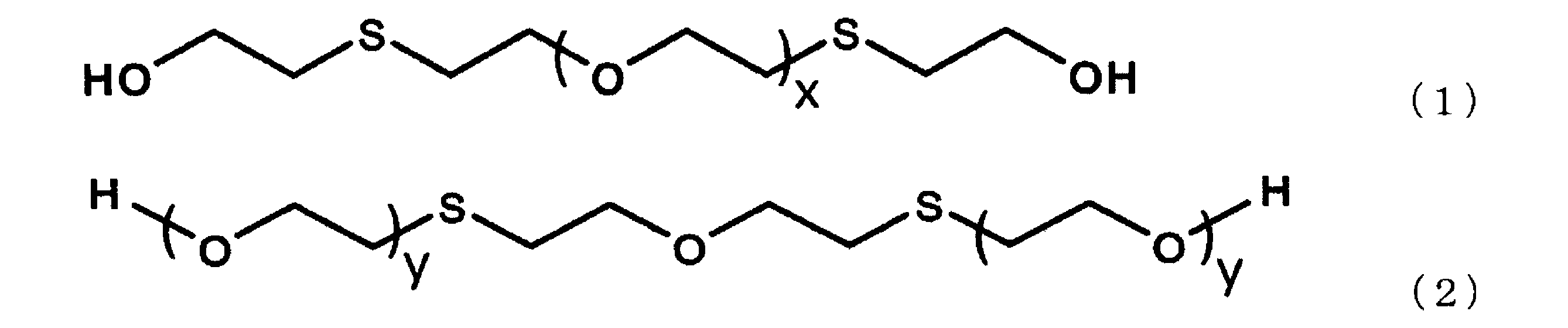
純度は、以下の方法により測定される。固定相としてオクタデシルシリカ(ODS)が充填された高速液体クロマトグラフィーカラム(島津製作所社製、Prominence UFLC)にて、純水を移動相として、メタノール濃度を10%~100%まで段階的に変化させるグラジェント分析を行う。検出された全成分のピーク面積を100%とし、ジチアポリエーテルジオールのピーク面積の面積比を算出する。算出された面積比をジチアポリエーテルジオールの純度とする。2種以上のジチアポリエーテルジオールを含む場合、最もピーク面積の大きい成分のピーク面積の面積比を純度とする。
なお、本明細書において、一般式や式は、構造式である。
なお、本明細書において、一般式や式は、構造式である。
本発明の第2の態様は、第1の態様に係るジチアポリエーテルジオールであって、JIS K0071-1(1998年)に準拠して測定されるハーゼン単位色数(APHA)が100以下である。
本発明の第3の態様は、第1又は第2の態様のジチアポリエーテルジオールを含むことを特徴とするSnAgめっき液である。
本発明の第4の態様は、第3の態様のSnAgめっき液を用いてめっき皮膜を形成する工程を有することを特徴とするめっき皮膜の形成方法である。
本発明の第5の態様は、(a-1)一方の末端にメルカプト基を有するアルコール化合物(原料A)と、両末端にハロゲン基を有するエーテル化合物(原料B)と、アルカリ性水溶液とを混合し加熱することによりアルカリ金属塩を含む反応生成液を得る工程、又は(a-2)両末端にメルカプト基を有するエーテル化合物(原料A)と一方の末端にハロゲン基を有するアルコール化合物(原料B)と、アルカリ性水溶液とを混合し加熱することによりアルカリ金属塩を含む反応生成液を得る工程と、(b)前記工程(a-1)又は前記工程(a-2)の反応生成液に含まれる有機相と水相とを分離する工程と、(c)前記有機相をイオン交換樹脂に接触させてハロゲン化物イオン及び金属イオンを除去する工程と、(d)前記ハロゲン化物イオン及び金属イオンを除去した有機相を加熱することにより前記有機相中の不純物を蒸発させて除去する工程とを含むことを特徴とするジチアポリエーテルジオールの製造方法である。
本発明の第6の態様は、第5の態様に係るジチアポリエーテルジオールの製造方法であって、前記工程(b)と前記工程(c)の間に、(b-1)前記有機相をアルカリ金属塩が溶解しない有機溶媒で希釈して前記有機相から前記アルカリ金属塩を分離する工程を更に含む。
本発明の第7の態様は、第5又は第6の態様に係るジチアポリエーテルジオールの製造方法であって、前記工程(b)と前記工程(c)の間に、又は前記工程(b-1)と前記工程(c)の間に、(b-2)前記有機相を活性炭に接触させる工程を更に含む。
本発明の第8の態様は、第5~第7の態様のいずれかに係るジチアポリエーテルジオールの製造方法であって、前記工程(d)における前記有機相中の不純物の蒸発が減圧下で行われる。
本発明の第1の態様のジチアポリエーテルジオールは、SnAgめっき液に用いられる場合には、上述した一般式(1)又は(2)において、分子中に酸素原子「-O-」を含むため、水との水素結合により、水溶性を向上させる効果がある。またヒドロキシル基「-OH」を含むため、これが親水基として作用し、水との水素結合により、更に水溶性を向上させる効果がある。またS原子間にエーテル結合「C-O-C」が存在することにより、ジチアポリエーテルジオール自体の安定性に優れ、かつ少なくともS原子を2個含むため、これらのS原子がめっき浴中の錫より貴な銀イオンを十分に錯体化する。またハロゲン含有量が10ppm以下と少ないため、めっき液中にハロゲン化銀が殆ど生成しない。これにより、このSnAgめっき液は使用中も保管中も長期間にわたって電解安定性及び経時安定性に優れる。また純度が80%以上であるため、副生成物が少なく、めっき電極表面へのジチアポリエーテルジオールの吸着が適切に行われる。これによりめっき皮膜の外観及び膜厚の均一性を良好になる。
本発明の第2の態様のジチアポリエーテルジオールは、ハーゼン単位色数(APHA)が100以下であるため、SnAgめっき液に用いられる場合には、めっき液が透明になる。
本発明の第3の態様のSnAgめっき液は、ジチアポリエーテルジオールを含むため、上述したように、電解安定性及び経時安定性に優れる。まためっき皮膜の外観及び膜厚の均一性を良好にする。
本発明の第4の態様の形成方法によれば、第3の態様のSnAgめっき液を用いるため、めっき皮膜の外観が良好で、膜厚が均一なめっき皮膜を作製することができる。
本発明の第5の態様の製造方法によれば、原料(A)と原料(B)とアルカリ性水溶液とを混合してアルカリ金属塩を含む反応水溶液を得る。この反応水溶液を有機相と水相に分離し、分離した有機相からハロゲン及び金属イオンを除去する。次いで有機相を加熱することにより不純物を除去して、目的物を得る。このため、ハロゲン含有量が少なく高純度のジチアポリエーテルジオールを製造することができる。
本発明の第6の態様の製造方法によれば、分離した有機相をイオン交換樹脂で処理する前に、前記有機相をアルカリ金属塩が溶解しない有機溶媒で希釈する。このため、ハロゲン化物イオン及び金属イオンの含有量を大幅に低減させることができ、イオン交換樹脂による精製効率を高めることができる。
本発明の第7の態様の製造方法によれば、アルカリ金属塩を含む反応生成物を有機相と水相に分離した後であり、かつ分離した有機相からハロゲン化物イオンを除去する前に、有機相を活性炭に接触させる。これにより、有機相の着色不純物成分が活性炭に吸着除去され、ジチアポリエーテルジオールを透明にすることができる。
本発明の第8の態様の製造方法によれば、有機相中の不純物の除去を減圧下で行うことにより、有機相から不純物が蒸発し易くなり、より高純度のジチアポリエーテルジオールが得られる。
以下に、本発明の第1及び第2の実施形態のジチアポリエーテルジオールを製造する方法について説明する。
<第1の実施形態>
〔ジチアポリエーテルジオールの製造方法〕
(a-1)原料(A)と原料(B)とアルカリ性水溶液との混合加熱工程
第1の実施形態の製造方法は、工程(a-1)を有する。工程(a-1)では、一方の末端にメルカプト基を有するアルコール化合物(原料A)と両末端にハロゲン基を有するエーテル化合物(原料B)と、アルカリ性水溶液とを混合し加熱することによりアルカリ金属塩を含む反応生成液を得る。即ち、原料(A)は一方の末端にメルカプト基を有するアルコール化合物である(以下、原料(A1)とも言う)。例えば、以下の式(3)に示す2-メルカプトエタノールが挙げられる。
〔ジチアポリエーテルジオールの製造方法〕
(a-1)原料(A)と原料(B)とアルカリ性水溶液との混合加熱工程
第1の実施形態の製造方法は、工程(a-1)を有する。工程(a-1)では、一方の末端にメルカプト基を有するアルコール化合物(原料A)と両末端にハロゲン基を有するエーテル化合物(原料B)と、アルカリ性水溶液とを混合し加熱することによりアルカリ金属塩を含む反応生成液を得る。即ち、原料(A)は一方の末端にメルカプト基を有するアルコール化合物である(以下、原料(A1)とも言う)。例えば、以下の式(3)に示す2-メルカプトエタノールが挙げられる。

また原料(B)は両末端にハロゲン基を有するエーテル化合物である(以下、原料(B1)とも言う)。例えば、以下の式(4)~式(8)に示す化合物が挙げられる。以下の表1に、式(3)の原料(A)とともに、原料(B)の式(4)~式(8)で表されるエーテル化合物を示す。
第1の実施形態の製造方法のアルカリ性水溶液としては、水酸化ナトリウム、水酸化カリウム、炭酸ナトリウム、炭酸水素カリウム等の水溶液が挙げられる。原料(A)と原料(B)とアルカリ性水溶液との混合に関しては、例えば、最初にアルカリ性水溶液に原料(A)を均一に混合することが好ましい。これにより、原料(A)の脱プロトン化を確実に行うことができる。混合時の発熱を抑制する理由で、混合前にアルカリ性水溶液を0℃~10℃の温度に冷却しておくことが好ましい。次いでこの混合液に原料(B)を均一に混合し加熱することが好ましい。この加熱は、混合液を大気雰囲気下、40℃~100℃の温度まで加熱し、3時間~24時間保持して行うことが好ましい。これにより、脱ハロゲン化反応が起こり、主たる反応生成物であるジチアポリエーテルジオールと、副生成物であるハロゲン化アルカリ金属塩と、未反応の原料と、副反応により生成した有機不純物とが含まれる反応生成液が得られる。
(b)反応生成液を有機相と水相に分離する工程
得られた反応生成液には、有機相と水相が混在しているため、有機相と水相とに分離する。反応生成液が少量であれば、分液ロートにより有機相と水相とに分離し、反応生成液が多量であれば、遠心分離等により有機相と水相とに分離する。なお、有機相と水相とに分離し易くするため、反応生成液を濃縮してもよい。
得られた反応生成液には、有機相と水相が混在しているため、有機相と水相とに分離する。反応生成液が少量であれば、分液ロートにより有機相と水相とに分離し、反応生成液が多量であれば、遠心分離等により有機相と水相とに分離する。なお、有機相と水相とに分離し易くするため、反応生成液を濃縮してもよい。
(b-1)有機相をアルカリ金属塩が溶解しない有機溶媒で希釈する工程
分離した有機相を採取し、この有機相にアルカリ金属塩が溶解しない有機溶媒を加え、有機相を体積比で2倍~10倍に希釈することが好ましい。すなわち、希釈後の体積が希釈前の体積の2倍~10倍になるように有機溶媒を加えることが好ましい。この有機溶媒としては、イソプロパノール、トルエンなどを用いることができる。これによりアルカリ金属塩が析出又は沈殿し易くなるため、このアルカリ金属塩を固液分離するとアルカリ金属塩の含有量が少ない有機相が得られる。
分離した有機相を採取し、この有機相にアルカリ金属塩が溶解しない有機溶媒を加え、有機相を体積比で2倍~10倍に希釈することが好ましい。すなわち、希釈後の体積が希釈前の体積の2倍~10倍になるように有機溶媒を加えることが好ましい。この有機溶媒としては、イソプロパノール、トルエンなどを用いることができる。これによりアルカリ金属塩が析出又は沈殿し易くなるため、このアルカリ金属塩を固液分離するとアルカリ金属塩の含有量が少ない有機相が得られる。
(b-2)有機相を活性炭に接触させる工程
上記の工程(b)の有機相又は工程(b-1)を経た有機相を活性炭に接触させて、有色で異臭のある有機相を透明にするとともに脱臭することが好ましい。有機相が少量であれば、粒状の活性炭を有機相に混合して有機相を活性炭に接触させる。有機相が多量であれば、活性炭を充填したカラムに有機相を通過させて有機相を活性炭に接触させる。活性炭としては、例えば、フタムラ化学社製「太閤Kタイプ」、クラレ社製「クラレコール」、大阪ガスケミカル社製「精製白鷺」のような活性炭を使用することができる。なお、工程(b-2)は必要に応じて複数回実施してもよい。
活性炭を有機相に混合する場合、有機相の量(L)に対する活性炭の量(g)を1g/L~200g/Lとすることが好ましい。活性炭を充填したカラムに有機相を通過させる場合、線速度LV(Linear Velocity)が0.1~5となる流速でカラムに有機相を通過させることが好ましい。
上記の工程(b)の有機相又は工程(b-1)を経た有機相を活性炭に接触させて、有色で異臭のある有機相を透明にするとともに脱臭することが好ましい。有機相が少量であれば、粒状の活性炭を有機相に混合して有機相を活性炭に接触させる。有機相が多量であれば、活性炭を充填したカラムに有機相を通過させて有機相を活性炭に接触させる。活性炭としては、例えば、フタムラ化学社製「太閤Kタイプ」、クラレ社製「クラレコール」、大阪ガスケミカル社製「精製白鷺」のような活性炭を使用することができる。なお、工程(b-2)は必要に応じて複数回実施してもよい。
活性炭を有機相に混合する場合、有機相の量(L)に対する活性炭の量(g)を1g/L~200g/Lとすることが好ましい。活性炭を充填したカラムに有機相を通過させる場合、線速度LV(Linear Velocity)が0.1~5となる流速でカラムに有機相を通過させることが好ましい。
(c)有機相をイオン交換樹脂に接触させる工程
上記工程(b)の有機相、工程(b-1)を経た有機相又は工程(b-2)を経た有機相をイオン交換樹脂に接触させて、残存しているハロゲン化物イオン及び金属イオンを除去する。有機相が少量であれば、粒状のイオン交換樹脂を有機相に混合して有機相をイオン交換樹脂に接触させる。有機相が多量であれば、イオン交換樹脂を充填したカラムに有機相を通過させる。イオン交換樹脂としては、例えば、ピュロライト社製「Aシリーズ」及び「Cシリーズ」、住化ケムテックス社製「デュオライト」、三菱ケミカル社製「SKシリーズ」、「SAシリーズ」、「SMシリーズ」及び「SMUPB」のようなイオン交換樹脂を使用することができる。なお、工程(c)は必要に応じて複数回実施してもよい。
イオン交換樹脂を有機相に混合する場合、有機相の量(L)に対するイオン交換樹脂の量(g)を1g/L~200g/Lとすることが好ましい。イオン交換樹脂を充填したカラムに有機相を通過させる場合、線速度LV(Linear Velocity)が0.1~5となる流速でカラムに有機相を通過させることが好ましい。
上記工程(b)の有機相、工程(b-1)を経た有機相又は工程(b-2)を経た有機相をイオン交換樹脂に接触させて、残存しているハロゲン化物イオン及び金属イオンを除去する。有機相が少量であれば、粒状のイオン交換樹脂を有機相に混合して有機相をイオン交換樹脂に接触させる。有機相が多量であれば、イオン交換樹脂を充填したカラムに有機相を通過させる。イオン交換樹脂としては、例えば、ピュロライト社製「Aシリーズ」及び「Cシリーズ」、住化ケムテックス社製「デュオライト」、三菱ケミカル社製「SKシリーズ」、「SAシリーズ」、「SMシリーズ」及び「SMUPB」のようなイオン交換樹脂を使用することができる。なお、工程(c)は必要に応じて複数回実施してもよい。
イオン交換樹脂を有機相に混合する場合、有機相の量(L)に対するイオン交換樹脂の量(g)を1g/L~200g/Lとすることが好ましい。イオン交換樹脂を充填したカラムに有機相を通過させる場合、線速度LV(Linear Velocity)が0.1~5となる流速でカラムに有機相を通過させることが好ましい。
(d)有機相中の不純物を除去する工程
上記工程(c)を経た有機相を加熱することにより有機相中の不純物を蒸発させて不純物を除去する。これにより、異臭が残っている有機相を脱臭するとともに、得られるジチアポリエーテルジオールの純度が高まる。上記不純物の蒸発は、0.001MPa~0.01MPaの減圧下、温度40℃~100℃、1時間~24時間の条件で行うことが、好ましい。これにより、有機相から不純物が蒸発し易くなる。
上記工程(c)を経た有機相を加熱することにより有機相中の不純物を蒸発させて不純物を除去する。これにより、異臭が残っている有機相を脱臭するとともに、得られるジチアポリエーテルジオールの純度が高まる。上記不純物の蒸発は、0.001MPa~0.01MPaの減圧下、温度40℃~100℃、1時間~24時間の条件で行うことが、好ましい。これにより、有機相から不純物が蒸発し易くなる。
なお、上記実施形態においては、工程(b-1)において、有機相をアルカリ金属塩が溶解しない有機溶媒で希釈し、アルカリ金属塩を析出及び/又は沈殿させることにより有機相からアルカリ金属塩を除去している。しかし、有機相を純水で洗浄することで、アルカリ金属塩を有機相から除去することも可能である。
〔ジチアポリエーテルジオール〕
上記第1の実施形態の方法で製造されたジチアポリエーテルジオールは、ハロゲン含有量が10ppm以下であり、純度が80%以上であり、上述した一般式(1)で表される。好ましいハロゲン含有量は5ppm以下であり、好ましい純度は90%以上である。
上記第1の実施形態の方法で製造されたジチアポリエーテルジオールは、ハロゲン含有量が10ppm以下であり、純度が80%以上であり、上述した一般式(1)で表される。好ましいハロゲン含有量は5ppm以下であり、好ましい純度は90%以上である。
第1の実施形態のジチアポリエーテルジオールとしては、以下の式(9)~(13)が例示される。一般式(1)中のxの数も併記する。xは1~5の範囲にあることが、原料が入手し易いため、好ましい。

<第2の実施形態>
〔ジチアポリエーテルジオールの製造方法〕
次に本発明の第2の実施形態を説明する。第2の実施形態の製造方法は、工程(a-2)を有する。工程(a-2)では、両末端にメルカプト基を有するエーテル化合物(原料A)と一方の末端にハロゲン基を有するアルコール化合物(原料B)と、アルカリ性水溶液とを混合し加熱することによりアルカリ金属塩を含む反応生成液を得る。第2の実施形態の製造方法では、原料(A)と原料(B)が第1の実施形態と異なるだけで、それ以外は、第2の実施形態の製造方法は、第1の実施形態と同様である。
〔ジチアポリエーテルジオールの製造方法〕
次に本発明の第2の実施形態を説明する。第2の実施形態の製造方法は、工程(a-2)を有する。工程(a-2)では、両末端にメルカプト基を有するエーテル化合物(原料A)と一方の末端にハロゲン基を有するアルコール化合物(原料B)と、アルカリ性水溶液とを混合し加熱することによりアルカリ金属塩を含む反応生成液を得る。第2の実施形態の製造方法では、原料(A)と原料(B)が第1の実施形態と異なるだけで、それ以外は、第2の実施形態の製造方法は、第1の実施形態と同様である。
第2の実施形態の製造方法では、原料(A)は両末端にメルカプト基を有するエーテル化合物である(以下、原料(A2)とも言う)。例えば、以下の式(14)に示すビス(2-メルカプトエチル)エーテルが挙げられる。

また原料(B)は一方の末端にハロゲン基を有するアルコール化合物である(以下、原料(B2)とも言う)。例えば、以下の式(15)~式(17)に示す化合物が挙げられる。以下の表2に、式(14)の原料(A)とともに、原料(B)の式(15)~式(17)で表されるアルコール化合物を示す。
〔ジチアポリエーテルジオール〕
第2の実施形態の方法で製造されたジチアポリエーテルジオールは、第1の実施形態の方法で製造されたジチアポリエーテルジオールと、その特性値は同じである。即ち、このジチアポリエーテルジオールは、ハロゲン含有量が10ppm以下であり、純度が80%以上であり、上述した一般式(2)で表される。好ましいハロゲン含有量は5ppm以下であり、好ましい純度は90%以上である。第2の実施形態のジチアポリエーテルジオールとしては、以下の式(18)~(20)が例示される。一般式(2)中のyの数も併記する。yは1~3の範囲にあることが、原料が入手し易いため、好ましい。
第2の実施形態の方法で製造されたジチアポリエーテルジオールは、第1の実施形態の方法で製造されたジチアポリエーテルジオールと、その特性値は同じである。即ち、このジチアポリエーテルジオールは、ハロゲン含有量が10ppm以下であり、純度が80%以上であり、上述した一般式(2)で表される。好ましいハロゲン含有量は5ppm以下であり、好ましい純度は90%以上である。第2の実施形態のジチアポリエーテルジオールとしては、以下の式(18)~(20)が例示される。一般式(2)中のyの数も併記する。yは1~3の範囲にあることが、原料が入手し易いため、好ましい。

〔SnAgめっき液及びこのめっき液を用いてめっき皮膜を形成する方法〕
本実施形態のSnAgめっき液は、第1及び第2の実施形態で製造されたジチアポリエーテルジオールを含むとともに、これ以外に、水に溶解して二価の錫イオンを生成する可溶性Sn塩、可溶性Ag塩及び添加剤を含む。ジチアポリエーテルジオールはAgイオンの錯体化剤として作用する。添加剤としては、酸電解質(遊離酸)、界面活性剤、酸化防止剤、Sn用の錯体化剤、pH調整剤、光沢化剤等が挙げられる。このSnAgめっき液は、例えば、可溶性錫塩、上記ジチアポリエーテルジオール及び添加剤と、水とを混合することにより調製することができる。
本実施形態のSnAgめっき液は、第1及び第2の実施形態で製造されたジチアポリエーテルジオールを含むとともに、これ以外に、水に溶解して二価の錫イオンを生成する可溶性Sn塩、可溶性Ag塩及び添加剤を含む。ジチアポリエーテルジオールはAgイオンの錯体化剤として作用する。添加剤としては、酸電解質(遊離酸)、界面活性剤、酸化防止剤、Sn用の錯体化剤、pH調整剤、光沢化剤等が挙げられる。このSnAgめっき液は、例えば、可溶性錫塩、上記ジチアポリエーテルジオール及び添加剤と、水とを混合することにより調製することができる。
本実施形態のSnAgめっき液を用いてめっき皮膜を形成する方法としては、電気めっき法による。めっき皮膜としては、半導体ウエハやプリント基板用のめっき皮膜が挙げられる。このSnAgめっき液のめっき時の液温は一般に70℃以下、好ましくは10℃~40℃である。電気めっきによるめっき膜の形成時の電流密度は、0.1A/dm2以上100A/dm2以下の範囲、好ましくは0.5A/dm2以上20A/dm2以下の範囲である。
第1及び第2の実施形態で製造されたジチアポリエーテルジオールを含むSnAgめっき液を被めっき物である電子部品に適用して、電子部品にめっき皮膜を形成することができる。電子部品としては、プリント基板、フレキシブルプリント基板、フィルムキャリア、半導体集積回路、抵抗、コンデンサ、フィルタ、インダクタ、サーミスタ、水晶振動子、スイッチ、リード線などが挙げられる。
次に本実施形態の実施例を比較例とともに詳しく説明する。
<実施例1>
40g(1モル)の水酸化ナトリウムを純水200mLに溶解させ、溶液を5℃まで冷却した。この水酸化ナトリウム水溶液に、原料(A)として、式(3)で表される2-メルカプトエタノール78.1g(1モル)を混合し、スターラーで撹拌して第1混合液を調製した。続いて、この第1混合液に、原料(B)として、式(4)で表されるビス(2-クロロエチル)エーテル71.5g(0.5モル)を混合し、スターラーで撹拌して第2混合液を調製した。この第2混合液を大気雰囲気下、80℃まで加熱し、80℃で12時間還流した。これにより原料(A)と原料(B)とが反応し、反応生成液が得られた。
40g(1モル)の水酸化ナトリウムを純水200mLに溶解させ、溶液を5℃まで冷却した。この水酸化ナトリウム水溶液に、原料(A)として、式(3)で表される2-メルカプトエタノール78.1g(1モル)を混合し、スターラーで撹拌して第1混合液を調製した。続いて、この第1混合液に、原料(B)として、式(4)で表されるビス(2-クロロエチル)エーテル71.5g(0.5モル)を混合し、スターラーで撹拌して第2混合液を調製した。この第2混合液を大気雰囲気下、80℃まで加熱し、80℃で12時間還流した。これにより原料(A)と原料(B)とが反応し、反応生成液が得られた。
この反応生成液を分液ロートに移して静置させ、有機相と水相の二相に分離した。分離した有機相に、2-イソプロパノールを混合して、有機相を体積比で5倍に希釈した。すなわち、希釈後の体積が希釈前の体積の5倍になるように2-イソプロパノールを添加した。希釈により析出又は沈殿した固形分を濾過することにより、有機相から固形分を除去した。次に、有機相に粒状の活性炭(大阪ガスケミカル社製「精製白鷺」)を10g/Lの割合で混合し、1時間撹拌した。撹拌後、混合した液を濾過して活性炭を除去した。
活性炭を除去した有機相に、粒状のイオン交換樹脂(三菱ケミカル社製「SMUPB」)を200g/Lの割合で混合し、1時間撹拌した。撹拌後、混合した液を濾過してイオン交換樹脂を除去した。続いて、イオン交換樹脂を除去した有機相をナス型フラスコに移し、0.005MPaに減圧し、80℃で12時間加熱し、有機相中の不純物を蒸発させ、液状の最終生成物を得た。
以下の表3に、実施例1及び次に述べる実施例2~8及び比較例1~2におけるジチアポリエーテルジオールの製造条件(その1)を示す。即ち、実施例1及び次に述べる実施例2~8及び比較例1~2において使用した原料(A)及び原料(B)の各種類を示す。表3中、式の番号は、実施形態で示した式の番号に対応する。

また以下の表4に、実施例1及び次に述べる実施例2~8及び比較例1~2におけるジチアポリエーテルジオールの製造条件(その2)を示す。即ち、実施例1及び次に述べる実施例2~8及び比較例1~2における製造工程の有無を示す。表4中、工程の符号は、実施形態で示した工程の符号に対応する。

<実施例2~8及び比較例1~2>
実施例2~8及び比較例1~2では、表3に示すように、原料(A)の種類、原料(B)の種類をそれぞれ実施例1のものと同一とするか又は変更した。また表4に示すように、工程(a-1)、工程(b)、工程(b-1)、工程(b-2)、工程(c)、工程(d)を行うか又は行わなかった。
なお、実施例6では、工程(d)の不純物の除去を“常圧下”で行った。実施例7では、工程(b-2)の活性炭との接触を行わなかった。実施例8では、工程(b-1)の有機溶媒での希釈を行わなかった。代わりに、純水を用いて体積比で5倍に希釈し、工程(c)のイオン交換樹脂との接触を10回繰り返し行った。比較例1では、工程(c)のイオン交換樹脂との接触及び工程(d)の不純物の除去を行わなかった。比較例2では、工程(d)の不純物の除去を行わなかった。それ以外は、実施例2~8及び比較例1~2では、実施例1と同様にして最終生成物を製造した。
実施例2~8及び比較例1~2では、表3に示すように、原料(A)の種類、原料(B)の種類をそれぞれ実施例1のものと同一とするか又は変更した。また表4に示すように、工程(a-1)、工程(b)、工程(b-1)、工程(b-2)、工程(c)、工程(d)を行うか又は行わなかった。
なお、実施例6では、工程(d)の不純物の除去を“常圧下”で行った。実施例7では、工程(b-2)の活性炭との接触を行わなかった。実施例8では、工程(b-1)の有機溶媒での希釈を行わなかった。代わりに、純水を用いて体積比で5倍に希釈し、工程(c)のイオン交換樹脂との接触を10回繰り返し行った。比較例1では、工程(c)のイオン交換樹脂との接触及び工程(d)の不純物の除去を行わなかった。比較例2では、工程(d)の不純物の除去を行わなかった。それ以外は、実施例2~8及び比較例1~2では、実施例1と同様にして最終生成物を製造した。
<実施例9>
40g(1モル)の水酸化ナトリウムを純水200mLに溶解させ、溶液を5℃まで冷却した。この水酸化ナトリウム水溶液に、原料(A)として、式(14)で表されるビス(2-メルカプトエチル)エーテル69.1g(0.5モル)を混合し、スターラーで撹拌して第3混合液を調製した。続いて、この第3混合液に、原料(B)として、式(15)で表される2-ブロモエタノール124.9g(1モル)を混合し、スターラーで撹拌して第4混合液を調製した。これ以降、実施例1と同様にして、最終生成物を得た。
40g(1モル)の水酸化ナトリウムを純水200mLに溶解させ、溶液を5℃まで冷却した。この水酸化ナトリウム水溶液に、原料(A)として、式(14)で表されるビス(2-メルカプトエチル)エーテル69.1g(0.5モル)を混合し、スターラーで撹拌して第3混合液を調製した。続いて、この第3混合液に、原料(B)として、式(15)で表される2-ブロモエタノール124.9g(1モル)を混合し、スターラーで撹拌して第4混合液を調製した。これ以降、実施例1と同様にして、最終生成物を得た。
また以下の表5に、実施例9及び次に述べる実施例10~11におけるジチアポリエーテルジオールの製造条件(その1)を示す。即ち、実施例9及び次に述べる実施例10~11において使用した原料(A)及び原料(B)の各種類を示す。表5中、式の番号は、実施形態で示した式の番号に対応する。

また以下の表6に、実施例9及び次に述べる実施例10~11におけるジチアポリエーテルジオールの製造条件(その2)を示す。即ち、実施例9及び次に述べる実施例10~11における製造工程の有無を示す。表6中、工程の符号は、実施形態で示した工程の符号に対応する。
<実施例10~11>
実施例10~11では、表5に示すように、原料(A)の種類、原料(B)の種類をそれぞれ実施例9のものと同一とするか又は変更した。また表6に示すように、工程(a-2)、工程(b)、工程(b-1)、工程(b-2)、工程(c)、工程(d)を行った。実施例10~11では、実施例9と同様にして最終生成物を製造した。
実施例10~11では、表5に示すように、原料(A)の種類、原料(B)の種類をそれぞれ実施例9のものと同一とするか又は変更した。また表6に示すように、工程(a-2)、工程(b)、工程(b-1)、工程(b-2)、工程(c)、工程(d)を行った。実施例10~11では、実施例9と同様にして最終生成物を製造した。
<比較試験及び評価>
実施例1~11及び比較例1~2で得られた13種類の最終生成物であるジチアポリエーテルジオールをサンプルとして、これらのサンプルについて、ハロゲン含有量、純度及び色味(ハーゼン単位色数)を次の方法で測定して評価した。またこれらのジチアポリエーテルジオールを用いてSnAgめっき液を調製し、めっき試験を行い、めっき液の安定性、めっき皮膜の外観及び膜厚の均一性を評価した。これらの結果を表7に示す。
実施例1~11及び比較例1~2で得られた13種類の最終生成物であるジチアポリエーテルジオールをサンプルとして、これらのサンプルについて、ハロゲン含有量、純度及び色味(ハーゼン単位色数)を次の方法で測定して評価した。またこれらのジチアポリエーテルジオールを用いてSnAgめっき液を調製し、めっき試験を行い、めっき液の安定性、めっき皮膜の外観及び膜厚の均一性を評価した。これらの結果を表7に示す。

(a)ハロゲン含有量
サンプル中のハロゲン(F、Cl、Br、I)のイオン濃度をイオンクロマトグラフィー(島津製作所社製、Prominence HIC-SP)により定量することにより、ハロゲン含有量を算出した。
サンプル中のハロゲン(F、Cl、Br、I)のイオン濃度をイオンクロマトグラフィー(島津製作所社製、Prominence HIC-SP)により定量することにより、ハロゲン含有量を算出した。
(b)純度
固定相としてオクタデシルシリカ(ODS)が充填された高速液体クロマトグラフィーカラム(島津製作所社製、Prominence UFLC)にサンプル(ジチアポリエーテルジオール)を導入した。純水を移動相として、メタノール濃度を10%~100%まで段階的に変化させるグラジェント分析を行った。検出された全成分のピーク面積を100%とし、サンプルのピーク面積を、面積比で算出した((サンプルのピーク面積/全成分のピーク面積)×100(%))。算出された面積比をサンプルの純度とした。
固定相としてオクタデシルシリカ(ODS)が充填された高速液体クロマトグラフィーカラム(島津製作所社製、Prominence UFLC)にサンプル(ジチアポリエーテルジオール)を導入した。純水を移動相として、メタノール濃度を10%~100%まで段階的に変化させるグラジェント分析を行った。検出された全成分のピーク面積を100%とし、サンプルのピーク面積を、面積比で算出した((サンプルのピーク面積/全成分のピーク面積)×100(%))。算出された面積比をサンプルの純度とした。
(c)色味(ハーゼン単位色数)
サンプル(ジチアポリエーテルジオール)をガラスセルに分取し、40℃に保温した状態で日本電色工業株式会社製の色彩・濁度同時測定器(型番:TZ6000)を用いて色彩を測定し、その値から色味としてのハーゼン単位色数(APHA)を求めた。
サンプル(ジチアポリエーテルジオール)をガラスセルに分取し、40℃に保温した状態で日本電色工業株式会社製の色彩・濁度同時測定器(型番:TZ6000)を用いて色彩を測定し、その値から色味としてのハーゼン単位色数(APHA)を求めた。
(d)めっき試験
メタンスルホン酸錫水溶液に、遊離酸としてのメタンスルホン酸と、サンプル(ジチアポリエーテルジオール)と、ノニオン系界面活性剤(エチレンジアミンにポリオキシエチレンとポリオキシプロピレンを50:50の割合で付加させたもの)と、光沢剤としてのベンジリデンアセトンとを混合して溶解させた。次いで、混合液に更にメタンスルホン酸銀水溶液を加えて混合した。そして最後にイオン交換水を加えて、下記組成のSnAgめっき液を建浴した。下記組成のSnAgめっき液中のAg量に対する上記ジチアポリエーテルジオールのモル比は1:1であった。なお、メタンスルホン酸錫水溶液は、金属錫板をメタンスルホン酸水溶液中で電解させることにより調製した。メタンスルホン酸銀水溶液は、金属銀板をメタンスルホン酸水溶液中で電解させることにより調製した。
メタンスルホン酸錫水溶液に、遊離酸としてのメタンスルホン酸と、サンプル(ジチアポリエーテルジオール)と、ノニオン系界面活性剤(エチレンジアミンにポリオキシエチレンとポリオキシプロピレンを50:50の割合で付加させたもの)と、光沢剤としてのベンジリデンアセトンとを混合して溶解させた。次いで、混合液に更にメタンスルホン酸銀水溶液を加えて混合した。そして最後にイオン交換水を加えて、下記組成のSnAgめっき液を建浴した。下記組成のSnAgめっき液中のAg量に対する上記ジチアポリエーテルジオールのモル比は1:1であった。なお、メタンスルホン酸錫水溶液は、金属錫板をメタンスルホン酸水溶液中で電解させることにより調製した。メタンスルホン酸銀水溶液は、金属銀板をメタンスルホン酸水溶液中で電解させることにより調製した。
(SnAgめっき液の組成)
メタンスルホン酸錫(Sn2+として):50g/L
メタンスルホン酸銀(Ag+として):0.005mol/L
メタンスルホン酸(遊離酸として):200g/L
ジチアポリエーテルジオール:0.005mol/L
ノニオン系界面活性剤:10g/L
光沢剤:10mg/L
イオン交換水:残部
メタンスルホン酸錫(Sn2+として):50g/L
メタンスルホン酸銀(Ag+として):0.005mol/L
メタンスルホン酸(遊離酸として):200g/L
ジチアポリエーテルジオール:0.005mol/L
ノニオン系界面活性剤:10g/L
光沢剤:10mg/L
イオン交換水:残部
(d-1)めっき液の安定性
13種類の建浴したSnAg合金めっき液をガラス製の密封ボトルに各別に入れ、25℃で1ヶ月保管した。1ヶ月経過した後で、目視で液の外観を観察し、透明を維持しているものを「良好」(good)と評価し、濁りや沈殿物が見られるものを「不良」(poor)と評価した。
13種類の建浴したSnAg合金めっき液をガラス製の密封ボトルに各別に入れ、25℃で1ヶ月保管した。1ヶ月経過した後で、目視で液の外観を観察し、透明を維持しているものを「良好」(good)と評価し、濁りや沈殿物が見られるものを「不良」(poor)と評価した。
(d-2)めっき皮膜の外観
13種類の建浴したSnAg合金めっき液をめっき槽に各別に入れ、液中にカソードとしてパターンを形成したウエハを配置し、アノードとしてPt/Tiメッシュ板を配置し、めっき試験を行った。めっき条件としては、液温を25℃とし、通電電流を4A/dm2とし、めっき処理時間を25分間とした。めっき処理中、めっき液をカソードロッカーで撹拌した。パターン内に形成されためっき皮膜の外観をレーザー顕微鏡で観察した。めっき皮膜表面の表面粗さRaが2μm未満の皮膜を「良好」(good)と評価し、表面粗さRaが2μm以上5μm未満の皮膜を「可」(fair)と評価し、表面粗さRaが5μm以上の皮膜を「不良」(poor)と評価した。これら3つの判断基準でめっき皮膜の外観を評価した。
13種類の建浴したSnAg合金めっき液をめっき槽に各別に入れ、液中にカソードとしてパターンを形成したウエハを配置し、アノードとしてPt/Tiメッシュ板を配置し、めっき試験を行った。めっき条件としては、液温を25℃とし、通電電流を4A/dm2とし、めっき処理時間を25分間とした。めっき処理中、めっき液をカソードロッカーで撹拌した。パターン内に形成されためっき皮膜の外観をレーザー顕微鏡で観察した。めっき皮膜表面の表面粗さRaが2μm未満の皮膜を「良好」(good)と評価し、表面粗さRaが2μm以上5μm未満の皮膜を「可」(fair)と評価し、表面粗さRaが5μm以上の皮膜を「不良」(poor)と評価した。これら3つの判断基準でめっき皮膜の外観を評価した。
(d-3)めっき皮膜の膜厚の均一性
上記パターン内に形成されためっき皮膜の膜厚の均一性を調べた。10箇所のダイ内のめっき皮膜の膜厚の最大値(Tmax)と最小値(Tmin)と平均値(Tave)を求め、以下の式により、膜厚均一性を算出し、めっきが均一に行われたか評価した。
めっき皮膜の膜厚の均一性={(Tmax-Tmin)/(2×Tave)}×100(%)
めっき皮膜の膜厚の均一性が5%未満のものを「良好」(good)と評価し、5%以上10%未満のものを「可」(fair)と評価し、10%以上のものを「不良」(poor)と評価した。これら3つの判断基準でめっき皮膜の膜厚の均一性を評価した。
上記パターン内に形成されためっき皮膜の膜厚の均一性を調べた。10箇所のダイ内のめっき皮膜の膜厚の最大値(Tmax)と最小値(Tmin)と平均値(Tave)を求め、以下の式により、膜厚均一性を算出し、めっきが均一に行われたか評価した。
めっき皮膜の膜厚の均一性={(Tmax-Tmin)/(2×Tave)}×100(%)
めっき皮膜の膜厚の均一性が5%未満のものを「良好」(good)と評価し、5%以上10%未満のものを「可」(fair)と評価し、10%以上のものを「不良」(poor)と評価した。これら3つの判断基準でめっき皮膜の膜厚の均一性を評価した。
表4、表6及び表7から明らかなように、比較例1では、工程(c)のイオン交換樹脂との接触、及び工程(d)の不純物の除去を行わなかった。この比較例1では、ハロゲン含有量が「700ppm」と非常に多く、純度が「46%」と低く、色味のハーゼン単位色数が「120」と高かった。まためっき液の安定性、めっき皮膜の外観及び膜厚の均一性は、すべて「不良」であった。
また比較例2では、工程(d)の不純物の除去を行わなかった。この比較例2では、純度が「50%」と低かった。まためっき液の安定性、めっき皮膜の外観及び膜厚の均一性は、すべて「不良」であった。
これに対して、実施例1~5及び実施例9~11では、本発明の第5の態様の工程(a-1)又は工程(a-2)、工程(b)、工程(c)及び工程(d)を行った。実施例1~5及び実施例9~11では、得られた最終生成物がハロゲン含有量及び純度が本発明の第1の態様に示される範囲内にあり、かつこれらの最終生成物を含むSnAgめっき液を用いためっき試験結果であるめっき液の安定性、めっき皮膜の外観及び膜厚の均一性は、すべて「良好」であった。
実施例6では、工程(d)の不純物の除去を常圧下で行った。この実施例6では、純度が「80%」と若干低く、色味が「80」と高く、めっき皮膜の外観及び膜厚の均一性がそれぞれ「可」であった。
実施例7では、工程(b-2)の活性炭との接触を行わなかった。この実施例7では、ハロゲン含有量が「10ppm」と僅かに多く、色味のハーゼン単位色数が「240」と非常に高かった。しかし、めっき液の安定性、めっき皮膜の外観及び膜厚の均一性は、すべて「良好」であった。
実施例8では、工程(b-1)において有機溶媒で希釈せずに純水で希釈した。この実施例8では、色味が「60」と若干高かったが、めっき液の安定性、めっき皮膜の外観及び膜厚の均一性は、すべて「良好」であった。
実施例6では、工程(d)の不純物の除去を常圧下で行った。この実施例6では、純度が「80%」と若干低く、色味が「80」と高く、めっき皮膜の外観及び膜厚の均一性がそれぞれ「可」であった。
実施例7では、工程(b-2)の活性炭との接触を行わなかった。この実施例7では、ハロゲン含有量が「10ppm」と僅かに多く、色味のハーゼン単位色数が「240」と非常に高かった。しかし、めっき液の安定性、めっき皮膜の外観及び膜厚の均一性は、すべて「良好」であった。
実施例8では、工程(b-1)において有機溶媒で希釈せずに純水で希釈した。この実施例8では、色味が「60」と若干高かったが、めっき液の安定性、めっき皮膜の外観及び膜厚の均一性は、すべて「良好」であった。
本実施形態のジチアポリエーテルジオールは、半導体ウエハやプリント基板用のはんだめっき皮膜などのような電子部品の一部を形成するためのSnAgめっき液に利用することができる。
Claims (8)
- ハロゲン含有量が10ppm以下であり、純度が80%以上であり、かつ下記一般式(1)又は(2)で表されることを特徴とするジチアポリエーテルジオール。但し、一般式(1)又は(2)中、x及びyは任意の自然数である。
- JIS K0071-1(1998年)に準拠して測定されるハーゼン単位色数(APHA)が100以下である請求項1に記載のジチアポリエーテルジオール。
- 請求項1又は請求項2に記載のジチアポリエーテルジオールを含むことを特徴とするSnAgめっき液。
- 請求項3に記載のSnAgめっき液を用いてめっき皮膜を形成する工程を有することを特徴とするめっき皮膜の形成方法。
- (a-1)一方の末端にメルカプト基を有するアルコール化合物(原料A)と、両末端にハロゲン基を有するエーテル化合物(原料B)と、アルカリ性水溶液とを混合し加熱することによりアルカリ金属塩を含む反応生成液を得る工程、又は
(a-2)両末端にメルカプト基を有するエーテル化合物(原料A)と、一方の末端にハロゲン基を有するアルコール化合物(原料B)と、アルカリ性水溶液とを混合し加熱することによりアルカリ金属塩を含む反応生成液を得る工程と、
(b)前記工程(a-1)又は前記工程(a-2)の反応生成液に含まれる有機相と水相とを分離する工程と、
(c)前記有機相をイオン交換樹脂に接触させてハロゲン化物イオン及び金属イオンを除去する工程と、
(d)前記ハロゲン化物イオン及び金属イオンを除去した有機相を加熱することにより前記有機相中の不純物を蒸発させて除去する工程と、を含むことを特徴とするジチアポリエーテルジオールの製造方法。 - 前記工程(b)と前記工程(c)の間に、
(b-1)前記有機相をアルカリ金属塩が溶解しない有機溶媒で希釈して前記有機相から前記アルカリ金属塩を分離する工程を更に含む請求項5に記載のジチアポリエーテルジオールの製造方法。 - 前記工程(b)と前記工程(c)の間に、又は前記工程(b-1)と前記工程(c)の間に、
(b-2)前記有機相を活性炭に接触させる工程を更に含む請求項5又は請求項6に記載のジチアポリエーテルジオールの製造方法。 - 前記工程(d)における前記有機相中の不純物の蒸発が減圧下で行われる請求項5~請求項7のいずれか一項に記載のジチアポリエーテルジオールの製造方法。
Priority Applications (2)
| Application Number | Priority Date | Filing Date | Title |
|---|---|---|---|
| US17/768,312 US20240116861A1 (en) | 2019-12-12 | 2020-12-11 | Dithiapolyether diol, method for producing same, snag plating solution containing dithiapolyether diol, and method for forming plating film with use of snag plating solution |
| KR1020227012534A KR20220113671A (ko) | 2019-12-12 | 2020-12-11 | 디티아폴리에테르디올, 그 제조 방법, 디티아폴리에테르디올을 포함하는 SnAg 도금액, 및 SnAg 도금액을 사용하여 도금 피막을 형성하는 방법 |
Applications Claiming Priority (4)
| Application Number | Priority Date | Filing Date | Title |
|---|---|---|---|
| JP2019-224523 | 2019-12-12 | ||
| JP2019224523 | 2019-12-12 | ||
| JP2020203251A JP2021095396A (ja) | 2019-12-12 | 2020-12-08 | ジチアポリエーテルジオール及びその製造方法並びに該ジチアポリエーテルジオールを含むSnAgめっき液、該SnAgめっき液を用いてめっき皮膜を形成する方法 |
| JP2020-203251 | 2020-12-08 |
Publications (1)
| Publication Number | Publication Date |
|---|---|
| WO2021117852A1 true WO2021117852A1 (ja) | 2021-06-17 |
Family
ID=76329984
Family Applications (1)
| Application Number | Title | Priority Date | Filing Date |
|---|---|---|---|
| PCT/JP2020/046221 Ceased WO2021117852A1 (ja) | 2019-12-12 | 2020-12-11 | ジチアポリエーテルジオール、その製造方法、ジチアポリエーテルジオールを含むSnAgめっき液、及びSnAgめっき液を用いてめっき皮膜を形成する方法 |
Country Status (3)
| Country | Link |
|---|---|
| US (1) | US20240116861A1 (ja) |
| KR (1) | KR20220113671A (ja) |
| WO (1) | WO2021117852A1 (ja) |
Citations (4)
| Publication number | Priority date | Publication date | Assignee | Title |
|---|---|---|---|---|
| GB991936A (en) * | 1960-07-11 | 1965-05-12 | Stevens & Co Inc J P | Chemical products, including chemically modified polymeric materials and processes for preparation thereof |
| JPS59147350A (ja) * | 1983-02-10 | 1984-08-23 | Fuji Photo Film Co Ltd | ハロゲン化銀写真感光材料の現像処理方法 |
| US20140318982A1 (en) * | 2011-12-09 | 2014-10-30 | Dong Hyun Kim | Method for preparing tin-silver alloy plating solution and plating solution prepared by same |
| JP2018123421A (ja) * | 2017-01-31 | 2018-08-09 | 三菱マテリアル株式会社 | 錫合金めっき液 |
Family Cites Families (3)
| Publication number | Priority date | Publication date | Assignee | Title |
|---|---|---|---|---|
| US3194830A (en) * | 1959-10-14 | 1965-07-13 | Eastman Kodak Co | Diesters of saturated aliphatic dicar-boxylic acids containing both oxygen and sulphur in the chain |
| JP2668150B2 (ja) | 1990-05-23 | 1997-10-27 | 三菱電機株式会社 | 不揮発性半導体記憶装置 |
| JP3718790B2 (ja) * | 1998-12-24 | 2005-11-24 | 石原薬品株式会社 | 銀及び銀合金メッキ浴 |
-
2020
- 2020-12-11 US US17/768,312 patent/US20240116861A1/en not_active Abandoned
- 2020-12-11 WO PCT/JP2020/046221 patent/WO2021117852A1/ja not_active Ceased
- 2020-12-11 KR KR1020227012534A patent/KR20220113671A/ko active Pending
Patent Citations (4)
| Publication number | Priority date | Publication date | Assignee | Title |
|---|---|---|---|---|
| GB991936A (en) * | 1960-07-11 | 1965-05-12 | Stevens & Co Inc J P | Chemical products, including chemically modified polymeric materials and processes for preparation thereof |
| JPS59147350A (ja) * | 1983-02-10 | 1984-08-23 | Fuji Photo Film Co Ltd | ハロゲン化銀写真感光材料の現像処理方法 |
| US20140318982A1 (en) * | 2011-12-09 | 2014-10-30 | Dong Hyun Kim | Method for preparing tin-silver alloy plating solution and plating solution prepared by same |
| JP2018123421A (ja) * | 2017-01-31 | 2018-08-09 | 三菱マテリアル株式会社 | 錫合金めっき液 |
Also Published As
| Publication number | Publication date |
|---|---|
| KR20220113671A (ko) | 2022-08-16 |
| US20240116861A1 (en) | 2024-04-11 |
Similar Documents
| Publication | Publication Date | Title |
|---|---|---|
| US4634509A (en) | Method for production of aqueous quaternary ammonium hydroxide solution | |
| CN101302632B (zh) | 金属电镀组合物 | |
| US9657403B2 (en) | Method for preparing tin-silver alloy plating solution and plating solution prepared by same | |
| CN101298688B (zh) | 锡或锡合金电镀溶液 | |
| WO2004065663A1 (ja) | スズ含有メッキ浴 | |
| JPH1121692A (ja) | めっき方法及びめっき物 | |
| KR101636361B1 (ko) | 과불소화알킬 계면활성제를 함유하는 솔더범프용 주석합금 전기도금액 | |
| CN106480475B (zh) | 高纯度铜电解精炼用添加剂和高纯度铜的制造方法 | |
| KR20070021972A (ko) | 주석 전기도금액 및 주석 전기도금 방법 | |
| WO2021117852A1 (ja) | ジチアポリエーテルジオール、その製造方法、ジチアポリエーテルジオールを含むSnAgめっき液、及びSnAgめっき液を用いてめっき皮膜を形成する方法 | |
| Morgan | CCCXLII.—Preparation and stability of cuprous nitrate and other cuprous salts in presence of nitriles | |
| JP2021095396A (ja) | ジチアポリエーテルジオール及びその製造方法並びに該ジチアポリエーテルジオールを含むSnAgめっき液、該SnAgめっき液を用いてめっき皮膜を形成する方法 | |
| JPS6133914B2 (ja) | ||
| CN105579488B (zh) | 具有联萘骨架的环氧树脂 | |
| JP2019081885A (ja) | イオン交換樹脂、精製方法、及びイオン性樹脂の製造方法 | |
| SE502520C2 (sv) | Bad, sätt och användning vid elektroplätering med tenn- vismutlegeringar | |
| KR101738535B1 (ko) | 솔더범프용 주석계 전기도금액 | |
| KR101421503B1 (ko) | 고순도 메탄설폰산 동염 및 이를 함유하고 있는 회로 배선 도금용 동 도금액의 제조 방법 | |
| US10407785B2 (en) | Additive for high-purity copper electrolytic refining and method of producing high-purity copper | |
| TWI728396B (zh) | 錫合金鍍敷液 | |
| CN107075704A (zh) | 高纯度铜电解精炼用添加剂及高纯度铜的制造方法 | |
| EP3124653A1 (en) | Electroplating additive and preparation method for the same | |
| US20180282891A1 (en) | Copper sulfate, copper sulfate solution, plating solution, method for producing copper sulfate, method for producing semiconductor circuit board, and method for producing electronic apparatus | |
| EP4563729A1 (en) | Aqueous composition for depositing a tin silver alloy and method for electrolyti-cally depositing such an alloy | |
| SU840208A1 (ru) | Электролит дл осаждени покрытий изСплАВА ОлОВО-СВиНЕц |
Legal Events
| Date | Code | Title | Description |
|---|---|---|---|
| 121 | Ep: the epo has been informed by wipo that ep was designated in this application |
Ref document number: 20899741 Country of ref document: EP Kind code of ref document: A1 |
|
| WWE | Wipo information: entry into national phase |
Ref document number: 17768312 Country of ref document: US |
|
| NENP | Non-entry into the national phase |
Ref country code: DE |
|
| 122 | Ep: pct application non-entry in european phase |
Ref document number: 20899741 Country of ref document: EP Kind code of ref document: A1 |