WO2021106926A1 - 紙積層体 - Google Patents
紙積層体 Download PDFInfo
- Publication number
- WO2021106926A1 WO2021106926A1 PCT/JP2020/043797 JP2020043797W WO2021106926A1 WO 2021106926 A1 WO2021106926 A1 WO 2021106926A1 JP 2020043797 W JP2020043797 W JP 2020043797W WO 2021106926 A1 WO2021106926 A1 WO 2021106926A1
- Authority
- WO
- WIPO (PCT)
- Prior art keywords
- resin layer
- paper
- mass
- resin
- layer
- Prior art date
- Legal status (The legal status is an assumption and is not a legal conclusion. Google has not performed a legal analysis and makes no representation as to the accuracy of the status listed.)
- Ceased
Links
Classifications
-
- B—PERFORMING OPERATIONS; TRANSPORTING
- B32—LAYERED PRODUCTS
- B32B—LAYERED PRODUCTS, i.e. PRODUCTS BUILT-UP OF STRATA OF FLAT OR NON-FLAT, e.g. CELLULAR OR HONEYCOMB, FORM
- B32B27/00—Layered products comprising a layer of synthetic resin
- B32B27/06—Layered products comprising a layer of synthetic resin as the main or only constituent of a layer, which is next to another layer of the same or of a different material
- B32B27/10—Layered products comprising a layer of synthetic resin as the main or only constituent of a layer, which is next to another layer of the same or of a different material of paper or cardboard
-
- B—PERFORMING OPERATIONS; TRANSPORTING
- B65—CONVEYING; PACKING; STORING; HANDLING THIN OR FILAMENTARY MATERIAL
- B65D—CONTAINERS FOR STORAGE OR TRANSPORT OF ARTICLES OR MATERIALS, e.g. BAGS, BARRELS, BOTTLES, BOXES, CANS, CARTONS, CRATES, DRUMS, JARS, TANKS, HOPPERS, FORWARDING CONTAINERS; ACCESSORIES, CLOSURES, OR FITTINGS THEREFOR; PACKAGING ELEMENTS; PACKAGES
- B65D65/00—Wrappers or flexible covers; Packaging materials of special type or form
- B65D65/38—Packaging materials of special type or form
- B65D65/40—Applications of laminates for particular packaging purposes
-
- D—TEXTILES; PAPER
- D21—PAPER-MAKING; PRODUCTION OF CELLULOSE
- D21H—PULP COMPOSITIONS; PREPARATION THEREOF NOT COVERED BY SUBCLASSES D21C OR D21D; IMPREGNATING OR COATING OF PAPER; TREATMENT OF FINISHED PAPER NOT COVERED BY CLASS B31 OR SUBCLASS D21G; PAPER NOT OTHERWISE PROVIDED FOR
- D21H19/00—Coated paper; Coating material
- D21H19/36—Coatings with pigments
- D21H19/38—Coatings with pigments characterised by the pigments
- D21H19/40—Coatings with pigments characterised by the pigments siliceous, e.g. clays
-
- D—TEXTILES; PAPER
- D21—PAPER-MAKING; PRODUCTION OF CELLULOSE
- D21H—PULP COMPOSITIONS; PREPARATION THEREOF NOT COVERED BY SUBCLASSES D21C OR D21D; IMPREGNATING OR COATING OF PAPER; TREATMENT OF FINISHED PAPER NOT COVERED BY CLASS B31 OR SUBCLASS D21G; PAPER NOT OTHERWISE PROVIDED FOR
- D21H19/00—Coated paper; Coating material
- D21H19/80—Paper comprising more than one coating
- D21H19/82—Paper comprising more than one coating superposed
-
- D—TEXTILES; PAPER
- D21—PAPER-MAKING; PRODUCTION OF CELLULOSE
- D21H—PULP COMPOSITIONS; PREPARATION THEREOF NOT COVERED BY SUBCLASSES D21C OR D21D; IMPREGNATING OR COATING OF PAPER; TREATMENT OF FINISHED PAPER NOT COVERED BY CLASS B31 OR SUBCLASS D21G; PAPER NOT OTHERWISE PROVIDED FOR
- D21H19/00—Coated paper; Coating material
- D21H19/80—Paper comprising more than one coating
- D21H19/84—Paper comprising more than one coating on both sides of the substrate
Definitions
- the present invention relates to a paper laminate.
- a packaging material in which a paper base material is provided with an oxygen barrier property are used to prevent deterioration of the quality of the contents.
- Patent Document 1 proposes a paper barrier material in which a water vapor barrier layer and a gas barrier layer are provided in this order on a paper base material.
- the water vapor barrier layer contains a water vapor barrier resin and a water repellent
- the gas barrier layer contains a water-soluble polymer and a surfactant.
- Patent Document 2 proposes a paper barrier packaging material in which a water vapor barrier layer and a gas barrier layer are provided on a paper base material.
- the water vapor barrier layer contains 50% by weight or more and 100% by weight or less of kaolin having an average particle size of 5 ⁇ m or more and an aspect ratio of 10 or more
- the binder resin of the gas barrier layer is a polyvinyl alcohol resin.
- an object of the present invention is to provide a paper laminate having a high barrier property.
- the present inventors have a first resin layer and a protective layer on one surface of the paper substrate, and at least one of the second resin layer and the OP varnish layer on the other surface of the paper substrate. It has been found that the paper laminate having the above-mentioned problem can be solved. That is, the present invention provides the following (1) to (15). (1) Paper having at least one of a paper base material, a first resin layer and a protective layer on one surface of the paper base material, and a second resin layer and an OP varnish layer on the other side of the paper base material.
- the first resin layer contains a water-suspendable polymer 1, a plate-like inorganic compound having an aspect ratio of 50 or more, and a cationic resin
- the protective layer is a water-soluble polymer and water suspension.
- the plate-like inorganic compound is at least one selected from the group consisting of synthetic mica, bentonite and kaolin.
- the content of the plate-like inorganic compound contained in the first resin layer is 0.1 part by mass with respect to 100 parts by mass of the water-suspendable polymer 1 contained in the first resin layer.
- the paper laminate according to any one of (1) to (8) above, wherein the plate-like inorganic compound has a thickness of 200 nm or less.
- the ratio of the plate-like inorganic compound contained in the first resin layer is 0.1% by mass or more and 80% by mass or less in the total solid content of the first resin layer.
- the content of the cationic resin contained in the first resin layer is 1 part by mass or more and 300 parts by mass or less with respect to 100 parts by mass of the plate-like inorganic compound contained in the first resin layer.
- the content of the cationic resin contained in the first resin layer is 0.1 part by mass with respect to 100 parts by mass of the water-suspending polymer 1 contained in the first resin layer.
- the paper laminate of the present embodiment comprises a paper substrate, a first resin layer and a protective layer on one surface of the paper substrate, and a second resin layer and an OP varnish layer on the other surface of the paper substrate.
- the paper laminate of the present embodiment has high barrier performance. In the present embodiment, it is considered that the first resin layer and the second resin layer or the OP varnish layer mainly exhibit the barrier property, particularly the water vapor barrier property, and the protective layer expresses the gas barrier property, particularly the oxygen barrier property. Be done.
- the water vapor barrier property is exhibited by forming the first resin layer on one surface, the water vapor barrier property is not sufficient only by forming the first resin layer on one surface, and the other.
- the first resin layer and the protective layer may be provided in this order on one surface of the paper base material from the side closer to the paper base material, or the protective layer may be provided from the side closer to the paper base material. And the first resin layer may be provided in this order. From the viewpoint of improving the water vapor barrier property, it is preferable to have the first resin layer and the protective layer in this order on one surface of the paper base material from the side closer to the paper base material. Further, the other surface of the paper substrate may have either or both of the second resin layer and the OP varnish layer. In the present embodiment, by having either or both of the second resin layer and the OP varnish layer, sufficient barrier properties can be exhibited, so that the cost of the paper laminate can be suppressed and the production is easy.
- the first resin layer or the protective layer is directly formed on the paper base material on one surface of the paper base material.
- either the second resin layer or the OP varnish layer is directly formed on the paper base material on the other surface of the paper base material.
- the first resin layer is directly formed on the paper substrate.
- the second resin layer or OP varnish layer is directly formed on the paper substrate.
- the amount of the first resin layer formed is preferably equal to or greater than the total amount of the amounts formed of the second resin layer and the OP varnish layer, and is more than the total value of the amounts formed of the second resin layer and the OP varnish layer. Is more preferable.
- the amount of the first resin layer formed is preferably 1.5 times or more, more preferably 2.0 times or more, more preferably 2.0 times or more, the total value of the formed amounts of the second resin layer and the OP varnish layer. It is preferably 3.0 times or more, still more preferably 4.0 times or more, and the upper limit is not particularly limited, but is, for example, 10.0 times or less, preferably 8.0 times or less, more preferably 6.0 times or more. It is as follows. Thereby, the water vapor barrier property can be improved. In addition, the gas barrier property can be improved.
- the paper base material in the present embodiment is not particularly limited as long as it is a paper generally used containing plant-derived pulp as a main component.
- Specific examples of the paper base material in the present embodiment include bleached or unbleached kraft paper, high-quality paper, paperboard, liner paper, coated paper, single-gloss paper, glassin paper, and graphan paper.
- paper containing pulp as a main component which is easily dispersed in water by a mechanical dissociation action, is preferable.
- the dissociation freeness (degree of drainage) measured according to JIS P 811-2: 2012 of the paper base material is preferably 800 ml or less, and more preferably 500 ml or less, from the viewpoint of improving the barrier property.
- the lower limit is not particularly limited, but from the viewpoint of ease of papermaking, it is preferably 150 ml or more, more preferably 250 ml or more.
- the dissociation freeness is a Canadian standard drainage degree (Canadian standard) obtained by measuring the pulp obtained by dissociating the paper after papermaking in accordance with JIS P 820-1: 2012 in accordance with JIS P 811-2: 2012. Freeness).
- a known method can be used as for the method of beating the pulp in order to adjust the disintegration freeness.
- the size of the paper base material is not particularly limited, but from the viewpoint of improving the barrier property, it is preferable that the size of the Suhito size according to JIS P 8122: 2004 is 1 second or more.
- the upper limit is not particularly limited, but is preferably 100 seconds or less, more preferably 30 seconds or less.
- the size of the paper substrate is determined by the type and content of internal sizing agents such as rosin-based, alkyl-ketene dimer-based, alkenyl anhydride-based succinic acid-based, styrene-unsaturated carboxylic acid-based, higher fatty acid-based, and petroleum resin-based, and pulp. It can be controlled by the type of rosin, smoothing process, and the like.
- the content of the internal sizing agent is not particularly limited, but is preferably 0 parts by mass or more and preferably 3 parts by mass or less with respect to 100 parts by mass of the pulp of the paper base material.
- a known internal chemical can be appropriately added to the paper substrate.
- internal chemicals include fillers, paper strength enhancers, yield improvers, pH adjusters, drainage improvers, water resistant agents, fabric softeners, antistatic agents, defoamers, slime control agents, dyes, and pigments.
- the filler include kaolin, talc, heavy calcium carbonate, light calcium carbonate, calcium sulfite, gypsum, calcined kaolin, white carbon, amorphous silica, delaminated kaolin, diatomaceous soil, magnesium carbonate, aluminum hydroxide, and the like. Calcium hydroxide, magnesium hydroxide, zinc hydroxide, titanium dioxide and the like can be mentioned.
- the paper base material is obtained by making a papermaking material containing a pulp slurry as a main component.
- the pulp slurry is obtained from wood or non-wood raw material chips through steps such as cooking, washing, and bleaching.
- the method in the cooking step, the washing step, the bleaching step and the like is not particularly limited.
- the pulp slurry obtained through these steps is further beaten in the presence of water.
- wood pulp include softwood pulp and hardwood pulp.
- non-wood pulp include cotton pulp, hemp pulp, kenaf pulp, and bamboo pulp. Materials other than pulp fibers such as synthetic fibers such as rayon fibers and nylon fibers may also be blended as auxiliary materials as long as the effects of the present invention are not impaired.
- a known wet paper machine for example, a long net type paper machine, a gap former type paper machine, a circular net type paper machine, a short net type paper machine, or the like is appropriately selected and used. ..
- the paper layer formed by the paper machine is not particularly limited, but is conveyed by felt and dried by a dryer.
- a multi-stage cylinder dryer may be used as a pre-dryer before drying the dryer.
- the paper base material obtained as described above may be surface-treated with a calendar to make the paper thickness and gloss profile uniform.
- a known calendar processing machine can be appropriately selected and used.
- the basis weight of the paper base material is not particularly limited, but is preferably 20 g / m 2 or more, more preferably 30 g / m 2 or more, and preferably 500 g / m 2 or less, preferably 400 g. More preferably, it is / m 2 or less.
- the paper substrate preferably has a density of 0.5 g / cm 3 or more, more preferably 0.6 g / cm 3 or more, and 1.2 g / cm 3 or less. It is preferably 1.0 g / cm 3 or less, and more preferably 1.0 g / cm 3.
- the first resin layer in the present embodiment is formed on one surface of the paper base material.
- the first resin layer contains a water-suspendable polymer 1, a plate-like inorganic compound having an aspect ratio of 50 or more, and a cationic resin.
- a dense film having no voids is formed, which is clearly different from the conventional one. It is considered that the dense film structure of the first resin layer without voids exhibits excellent water vapor barrier properties.
- the first resin layer is formed on the paper base material and the protective layer is directly formed on the first resin layer, it also contributes to the formation of a uniform protective layer, and has even better gas barrier property and water vapor barrier. It is thought that sex can be expressed.
- the water-suspendable polymer 1 is a polymer that can be suspended in water, and makes it easy to prepare a coating material using water as a dispersion medium when forming the first resin layer. Since the water-suspendable polymer 1 functions as a binder in the formation of the first resin layer, the first resin layer containing a plate-like inorganic compound or the like can be uniformly formed.
- the water-suspendable polymer 1 is preferably a thermoplastic resin from the viewpoint of giving flexibility to the first resin layer and enhancing durability during processing.
- Thermoplastic resins include polyolefin resins (polyethylene, polypropylene, etc.), vinyl chloride resins, styrene resins, styrene / unsaturated carboxylic acid copolymers, styrene / butadiene copolymers, acrylonitrile / styrene copolymers, acrylonitrile / Butadiene copolymer, ABS resin, AAS resin, AES resin, poly-4-methylpentene-1 resin, polybutene-1 resin, vinylidene fluoride resin, vinyl fluoride resin, fluororesin, polycarbonate resin, polyamide resin, acetal resin , Polyphenylene oxide resin, polyester resin (polyethylene terephthalate, polybutylene terephthalate, etc.), polyphenylene sulfide resin, polyimide resin, polysulfone resin, polyethersulfone resin, aromatic polyester resin, polyallylate resin, olefin
- one or more selected from the group consisting of an olefin / unsaturated carboxylic acid-based copolymer, a styrene / butadiene-based copolymer, and a styrene / unsaturated carboxylic acid-based copolymer is preferable.
- the olefin / unsaturated carboxylic acid-based copolymer is a copolymer obtained by copolymerizing an olefin monomer and an unsaturated carboxylic acid-based monomer, for example, by emulsion polymerization.
- the olefin monomer of the olefin / unsaturated carboxylic acid-based copolymer include ethylene and ⁇ -olefins such as propylene and butylene, and among these, ethylene is preferable.
- the unsaturated carboxylic acid-based monomer of the olefin / unsaturated carboxylic acid-based copolymer includes an unsaturated carboxylic acid monomer and an ester monomer of an unsaturated carboxylic acid that forms a carboxylic acid by hydrolysis.
- Examples of the unsaturated carboxylic acid-based monomer of the olefin / unsaturated carboxylic acid-based copolymer include acrylic acid, methacrylic acid, crotonic acid, silicic acid, itaconic acid, fumaric acid, maleic acid, butentricarboxylic acid and the like.
- the unsaturated carboxylic acid-based monomer constituting the olefin / unsaturated carboxylic acid-based copolymer may be used alone or in combination of two or more.
- the olefin / unsaturated carboxylic acid-based copolymer may be copolymerized with a small amount of an olefin and other monomers copolymerizable with the unsaturated carboxylic acid-based monomer.
- olefin / unsaturated carboxylic acid-based copolymers include ethylene / acrylic acid copolymer, ethylene / methacrylic acid copolymer, ethylene / methyl acrylate copolymer, ethylene / methyl methacrylate copolymer, and the like. It is preferably one or more selected from the group consisting of ethylene / ethyl acrylate copolymer, ethylene / ethyl methacrylate copolymer, ethylene / butyl acrylate copolymer, and ethylene / butyl methacrylate copolymer.
- Ethylene / acrylic acid copolymer, and ethylene / methacrylic acid copolymer are more preferably one or more, and ethylene / acrylic acid copolymer is particularly preferable.
- the content of the unsaturated carboxylic acid-based monomer unit of the olefin / unsaturated carboxylic acid-based copolymer is preferably 1 mol% or more, more preferably 10 mol% or more, and preferably 50 mol% or less. It is preferably 30 mol% or less. When the content of the unsaturated carboxylic acid-based monomer is within the above range, the dispersibility of the plate-like inorganic compound is excellent.
- the weight average molecular weight of the olefin / unsaturated carboxylic acid-based copolymer is preferably 10,000 or more, more preferably 100,000 or more, and preferably 100,000 or more, from the viewpoint of viscosity and strength when applied to a paper substrate. It is 10 million or less, more preferably 5 million or less.
- a commercially available product may be used as the olefin / unsaturated carboxylic acid-based copolymer, and examples thereof include "Zyxen (trade name)” manufactured by Sumitomo Seika Chemical Co., Ltd.
- styrene-butadiene copolymer examples include styrene-butadiene rubber (SBR) and modified styrene-butadiene rubber (modified SBR).
- modified SBR examples of the modified styrene-butadiene rubber include acid-modified styrene-butadiene rubber (acid-modified SBR).
- Commercially available products may be used as the styrene-butadiene copolymer, and examples thereof include "Nipol LX407S series (trade name)" and “Nipol LX407BP series (trade name)” manufactured by Zeon Corporation.
- the styrene / unsaturated carboxylic acid-based copolymer is obtained by emulsifying and polymerizing a styrene-based compound, an unsaturated carboxylic acid-based compound, and a monomer composed of other compounds copolymerizable with the styrene-based compound. It is a coalescence.
- the styrene compound include styrene, ⁇ -methylstyrene, vinyltoluene, pt-butylstyrene, chlorostyrene and the like. Of these, styrene is preferable.
- unsaturated carboxylic acid compounds include acrylic acid, methacrylic acid, (meth) acrylic acid ester, (meth) acrylamide propanesulfonic acid, and (meth) acrylate sulfoalkyl sodium salt (alkyl group having 2 or more carbon atoms). 3 or less) and the like.
- acrylic acid, methacrylic acid, acrylic acid ester, and methacrylic acid ester are preferable, and acrylic acid and acrylic acid ester are more preferable.
- the (meth) acrylic acid ester is preferably an acrylic acid alkyl ester, and the alkyl group preferably has 1 to 6 carbon atoms.
- styrene / unsaturated carboxylic acid copolymer for example, "Harville Series C-3 (trade name)” manufactured by Daiichi Paint Mfg. Co., Ltd. and "ACRONAL4160” manufactured by BASF. Product name) ”and so on.
- the content ratio of the water-suspendable polymer 1 in the first resin layer is not particularly limited, but is preferably 15% by mass or more, more preferably 20% by mass or more, based on the total solid content of the first resin layer. It is more preferably 50% by mass or more, further preferably 60% by mass or more, further preferably 70% by mass or more, particularly preferably 75% by mass or more, and 95% by mass or less is preferable, and 90% by mass or less is more preferable.
- the aspect ratio of the plate-like inorganic compound is 50 or more, preferably 80 or more, more preferably 200 or more, still more preferably 300 or more, and particularly preferably 500 or more.
- the larger the aspect ratio the longer the moving distance of water vapor and gas becomes. Due to the maze effect, the water vapor barrier property and the gas barrier property can be improved. Further, the larger the aspect ratio, the higher the water vapor barrier property can be exhibited with a smaller content.
- the upper limit of the aspect ratio is not particularly limited, but is preferably 10,000 or less from the viewpoint of availability, viscosity when forming the first resin layer, and the like.
- the aspect ratio of the plate-like inorganic compound is determined by taking a magnified photograph of a cross section in the thickness direction parallel to the direction in which the first resin layer is applied (vertical direction of the first resin layer) using an electron microscope, and at least.
- the length and thickness of the 30 plate-like inorganic compounds are measured and arithmetically averaged to obtain the average length and average thickness. Then, the value obtained by dividing the average length of the plate-shaped inorganic compound by the average thickness is defined as the aspect ratio of the plate-shaped inorganic compound.
- the plate-like inorganic compound is not particularly limited as long as it has the above aspect ratio, but is preferably one or more selected from the group consisting of synthetic mica, bentonite, and kaolin, and more than synthetic mica and kaolin. More preferably, it is one or more selected from the group.
- the thickness (average thickness) of the plate-like inorganic compound is preferably 200 nm or less, more preferably 120 nm or less, still more preferably 80 nm or less, still more preferably 50 nm or less, and particularly preferably 20 nm or less.
- the lower limit of the thickness is not particularly limited, but is preferably 1 nm or more from the viewpoint of availability, viscosity when forming the first resin layer, and the like.
- the length (average length) of the plate-shaped inorganic compound is preferably 1 ⁇ m or more, and preferably 100 ⁇ m or less.
- the length is 1 ⁇ m or more, the plate-like inorganic compound tends to be arranged parallel to the paper substrate. Further, when the length is 100 ⁇ m or less, there is little concern that a part of the plate-like inorganic compound protrudes from the first resin layer.
- the length of the plate-shaped inorganic compound may be described by the expression of particle size.
- the content of the plate-like inorganic compound contained in the first resin layer is not particularly limited, and the water-suspendable polymer 1 contained in the first resin layer is 0. It is preferably 1 part by mass or more, more preferably 1 part by mass or more, preferably 800 parts by mass or less, more preferably 100 parts by mass or less, and more preferably 80 parts by mass or less. It is even more preferably 50 parts by mass or less, and particularly preferably 20 parts by mass or less.
- the content of the plate-like inorganic compound contained in the first resin layer is 0.1 part by mass or more with respect to 100 parts by mass of the water-suspendable polymer 1 contained in the first resin layer. And, the water vapor barrier property is likely to be developed.
- the content of the plate-like inorganic compound contained in the first resin layer is 800 parts by mass or less with respect to 100 parts by mass of the water-suspendable polymer 1 contained in the first resin layer. Then, there is little concern that a part of the plate-like inorganic compound is exposed from the layer surface and the water vapor barrier property is lowered. Further, when the protective layer is directly formed on the first resin layer, there is little concern that the coatability of the protective layer is lowered and the uniform protective layer is not formed and the gas barrier property is lowered.
- the proportion of the plate-like inorganic compound contained in the first resin layer is not particularly limited, and from the viewpoint of improving the water vapor barrier property and the gas barrier property, 0.1% by mass or more in the total solid amount of the first resin layer is used. Preferably, 1% by mass or more is more preferable, and 2% by mass or more is particularly preferable.
- the proportion of the plate-like inorganic compound contained in the first resin layer is preferably 80% by mass or less based on the total solid amount of the first resin layer from the viewpoint of improving the smoothness of the surface of the protective layer. , 50% by mass or less, more preferably 40% by mass or less, further preferably 20% by mass or less, and particularly preferably 15% by mass or less. From the viewpoint of being effective with a smaller content, synthetic mica having a large aspect ratio and a small thickness can be preferably used among the plate-like inorganic compounds.
- the first resin layer contains a cationic resin.
- the plate-shaped inorganic compound has a so-called card house structure in which the plate-shaped inorganic compounds are three-dimensionally connected to each other because the plate-shaped flat portion is easily charged anionic and the edge portion is easily charged cationically. It has been known. Due to this card house structure, the viscosity of the aqueous dispersion of the plate-like inorganic compound becomes very high.
- the aqueous dispersion of the plate-like inorganic compound exhibits thixotropy. It is considered that when an appropriate cationic resin is added to the aqueous dispersion of the plate-shaped inorganic compound, the cationic resin is adsorbed on the anionically charged flat portion of the plate-shaped inorganic compound, and the card house structure is destroyed. Be done. As a result, it is presumed that the three-dimensional connection of the plate-shaped inorganic compounds is suppressed, the plate-shaped inorganic compounds are easily laminated in parallel with the plane of the paper substrate, and the water vapor barrier property is improved. Furthermore, it is estimated that the gas barrier property is also improved.
- cationic resin examples include polyamine resins, modified polyamide resins (for example, cationic modified polyamide resins such as amine-modified polyamide resins), polyamide epichlorohydrin resins, polyethyleneimine resins, polyalkylene polyamine resins, polyamide compounds, and polyamides.
- the formaldehyde condensation reaction product, polyamide polyurea compound, polyamine polyurea compound, polyamideamine polyurea compound and polyamideamine compound, polyvinylpyridine, amino-modified acrylamide compound, polyvinylamine resin, polydiallyldimethylammonium chloride and the like can be mentioned. it can.
- the cationic resin is preferably at least one selected from the polyamine resin, the modified polyamide resin, and the polyethyleneimine resin, more preferably the modified polyamide resin, and the cationic modified polyamide resin. It is more preferable, and an amine-modified polyamide resin is particularly preferable.
- Commercially available products may be used as the cationic resin, for example, "Sumirez Resin SPI-203 (50) (trade name)", “Sumirez Resin SPI-102A (trade name)”, and “Sumirez” manufactured by Taoka Chemical Industry Co., Ltd. Resin SPT-106N (trade name) ”and the like.
- the surface charge of the cationic resin is preferably 0.1 meq / g or more, and preferably 10 meq / g or less, more preferably 5.0 meq / g or less.
- the surface charge of the cationic resin is measured by the method described below. First, the polymer as a sample is dissolved in water to obtain a solution having a polymer concentration of 1 ppm. To the solution, 0.001N sodium polyethylene sulfonate is added dropwise using a charge analyzer Mutek PCD-04 type (BTG type), and the amount of charge is measured.
- the content of the cationic resin contained in the first resin layer is 1 part by mass or more with respect to 100 parts by mass of the plate-like inorganic compound contained in the first resin layer from the viewpoint of improving the water vapor barrier property.
- 10 parts by mass or more is more preferable, 20 parts by mass or more is further preferable, 50 parts by mass or more is particularly preferable, and 300 parts by mass or less is more preferable, 250 parts by mass or less is more preferable, and 150 parts by mass or less is further preferable.
- 100 parts by mass or less is particularly preferable.
- the content of the cationic resin contained in the first resin layer is adjusted with respect to 100 parts by mass of the water-suspendable polymer 1 contained in the first resin layer from the viewpoint of improving the water vapor barrier property. It is preferably 0.1 part by mass or more, more preferably 1 part by mass or more, further preferably 3 parts by mass or more, particularly preferably 5 parts by mass or more, and preferably 20 parts by mass or less, more preferably 15 parts by mass. It is as follows.
- the proportion of the cationic resin contained in the first resin layer is not particularly limited, and is preferably 0.1% by mass or more, more preferably 0.2% by mass or more, based on the total solid content of the first resin layer. It is more preferably mass% or more, particularly preferably 5% by mass or more, preferably 20% by mass or less, and even more preferably 15% by mass or less.
- the plate-like inorganic compound, and the cationic resin in addition to the water-suspendable polymer 1, the plate-like inorganic compound, and the cationic resin, other pigments, dispersants other than the above-mentioned cationic resin, and surfactants are appropriately used, if necessary.
- Antifoaming agents, wetting agents, dyes, tint adjusters, thickeners, water-soluble polymers and other auxiliaries can be added.
- the thickness of the first resin layer is preferably 0.5 ⁇ m or more, more preferably 1 ⁇ m or more, and more preferably 20 ⁇ m or less, more preferably 15 ⁇ m or less, and more preferably 10 ⁇ m or less. It is particularly preferable to have.
- the amount of the first resin layer formed is preferably 0.5 g / m 2 or more, more preferably 1 g / m 2 or more, and 20 g / m 2 or less as the solid content. Is preferable, and it is more preferably 15 g / m 2 or less, and particularly preferably 10 g / m 2 or less.
- the amount of the first resin layer formed is preferably equal to or greater than the total value of the amounts of the second resin layer and the OP varnish layer, which will be described later. Specifically, the amount of the second resin layer and the OP varnish layer formed (solid).
- the total value of (minutes) is 100 parts by mass, it is preferably 100 parts by mass or more, more preferably 150 parts by mass or more, more preferably 200 parts by mass or more, and 300 parts by mass or more. It is more preferably 400 parts by mass or more, preferably 1000 parts by mass or less, more preferably 800 parts by mass or less, and further preferably 600 parts by mass or less. ..
- the protective layer in this embodiment is formed on one surface of the paper base material.
- a protective layer contains at least one of a water-soluble polymer and a water-suspendable polymer 2.
- the protective layer may be formed on the first resin layer or may be formed on a paper base material. When formed on the first resin layer, it is excellent in gas barrier property, particularly oxygen barrier property, and can protect the first resin layer to improve the barrier property.
- the protective layer by forming the protective layer on the paper base material, a uniform first resin layer can be formed and the barrier property can be improved.
- having the first resin layer and the protective layer in this order on one surface of the paper base material from the side closer to the paper base material is excellent in gas barrier property, particularly oxygen barrier property.
- the paper laminate of the present embodiment may have the protective layer and the first resin layer in this order on one surface of the paper base material from the side closer to the paper base material. It is preferable that the water-suspendable polymer 1 contained in the first resin layer and the water-suspendable resin 2 contained in the protective layer are not the same.
- the water-soluble polymer means a polymer that is soluble in water.
- a polymer that is soluble in water means a polymer that dissolves 1 g or more in 100 g of water at 25 ° C.
- Examples of the water-soluble polymer include polyvinyl alcohol, modified polyvinyl alcohol, starch and its derivatives, cellulose derivatives, polyvinylpyrrolidone, polyacrylic acid and its salts, casein, polyethyleneimine and the like.
- completely saponified or partially saponified polyvinyl alcohol or modified polyvinyl alcohol is preferable because it has more excellent gas barrier properties.
- modified polyvinyl alcohol include ethylene-modified polyvinyl alcohol, carboxy-modified polyvinyl alcohol, silicon-modified polyvinyl alcohol, acetoacetyl-modified polyvinyl alcohol, and diacetone-modified polyvinyl alcohol.
- the water-soluble polymer is ethylene-modified polyvinyl alcohol.
- Polyvinyl alcohol and modified polyvinyl alcohol include fully saponified type and partially saponified type, and the fully saponified type is preferable. Completely saponified means that the degree of saponification is more than 96%.
- the degree of saponification is a value measured by a method based on JIS K6726: 1994.
- Commercially available products may be used as the polyvinyl alcohol and the modified polyvinyl alcohol, and examples of the modified polyvinyl alcohol include "Exevar (trade name)" manufactured by Kuraray Co., Ltd.
- the water-suspendable polymer 2 used for the protective layer is not water-soluble, but is a polymer that can be suspended in water that is finely dispersed in water, such as dispersions, emulsions, and suspensions. Yes, it facilitates the preparation of paints as dispersion media when forming the protective layer.
- the water-suspendable polymer 2 is preferably one or more selected from the group consisting of, for example, a polyvinylidene chloride polymer and a polyurethane polymer, and is preferably a polyvinylidene chloride polymer dispersion or emulsion, and It is more preferably one or more selected from the group consisting of polyurethane-based polymer dispersions or emulsions, further preferably polyurethane-based polymer dispersions or emulsions, and more preferably polyurethane-based polymer dispersions. More preferred.
- the gas barrier property in a high humidity environment can be enhanced.
- a polyurethane-based polymer for example, a polyurethane resin and a derivative thereof are preferable.
- the polyurethane resin a commercially available product may be used, for example, "Takelac W series (trade name)", “Takelac WPB series (trade name)", “Takelac WS series (trade name)” manufactured by Mitsui Chemicals, Inc., etc. Specifically, Takelac WPB-341 is exemplified.
- a polyvinylidene chloride-based polymer for example, a polyvinylidene chloride resin is preferable.
- polyvinylidene chloride resin a commercially available product may be used, for example, "Saran Latex L-411A” and “Saran Latex L-549B” manufactured by Asahi Kasei Corporation, “Diofan A297” and “Diofan B” manufactured by Solvay Specialty Polymers Japan Co., Ltd. -204 "and the like, and specifically," Diofan B-204 "is exemplified.
- the oxygen permeability at 50% RH is preferably 100ml / (m 2 ⁇ day ⁇ atm) or less, 50ml / (m 2 ⁇ day ⁇ Atm) or less is more preferable.
- the oxygen permeability is measured under the condition of 23 ° C. and 50% using an oxygen permeability measuring device (OX-TRAN2 / 20 manufactured by MOCON).
- the polyurethane resin preferably contains at least one of a constituent unit derived from metaxylylene diisocyanate and a constituent unit derived from hydrogenated metaxylylene diisocyanate, and the constituent unit derived from metaxylylene diisocyanate with respect to the total amount of the constituent unit derived from polyisocyanate.
- the total content of the constituent units derived from hydrogenated metaxylylene diisocyanate is preferably 50 mol% or more.
- polyurethane resin a synthetic product may be used, and examples thereof include the polyurethane resin described in International Publication No. 2015/016069.
- polyurethane resin a commercially available product may be used, and examples thereof include "Takelac WPB-341".
- the total content of the water-soluble polymer and the water-suspendable polymer 2 is preferably 50% by mass or more, more preferably 55% by mass or more, and 60% by mass, based on the total solid content of the protective layer.
- the above is more preferable, and it is preferably 100% by mass or less, more preferably 90% by mass or less, and further preferably 80% by mass or less.
- the protective layer may contain the above-mentioned plate-like inorganic compound as in the case of the first resin layer.
- the plate-like inorganic compound is preferably at least one selected from the group consisting of synthetic mica, bentonite and kaolin from the viewpoint of improving the barrier property.
- the plate-shaped inorganic compound contained in the protective layer may be of the same type as the plate-shaped inorganic compound contained in the first resin layer, or may be of a different type.
- the content of the plate-shaped inorganic compound is not particularly limited, but is based on 100 parts by mass in total of the water-soluble polymer and the water-suspended polymer 2 of the protective layer.
- 5 parts by mass or more of synthetic mica having a large aspect ratio and a small thickness is contained in a total of 100 parts by mass of the water-soluble polymer and the water-suspended polymer 2 of the protective layer. It is preferable that the content is 15 parts by mass or less.
- the content of the other plate-like inorganic compound is the sum of the water-soluble polymer and the water-suspendable polymer 2 of the protective layer. It is preferably 20 parts by mass or more, and preferably 80 parts by mass or less with respect to 100 parts by mass.
- the protective layer may be a plate-like inorganic compound, other pigments, a cationic resin, or a cationic resin other than the above-mentioned cationic resin, as appropriate. It is possible to add an auxiliary agent such as a dispersant, a surfactant, a defoaming agent, a wetting agent, a dye, a color adjusting agent, and a thickener.
- an auxiliary agent such as a dispersant, a surfactant, a defoaming agent, a wetting agent, a dye, a color adjusting agent, and a thickener.
- the thickness of the protective layer is preferably 0.1 ⁇ m or more, preferably 0.5 ⁇ m or more, preferably 10 ⁇ m or less, and more preferably 5 ⁇ m or less.
- the amount of the protective layer formed is preferably 0.1 g / m 2 or more, more preferably 0.5 g / m 2 or more, and 10 g / m 2 or less as the solid content. Is preferable, and 5 g / m 2 or less is more preferable.
- the second resin layer in the present embodiment is formed on the other surface of the paper base material.
- the second resin layer contains the water-suspendable polymer 1.
- the water-suspendable polymer 1 is not particularly limited, and can be appropriately selected from those that can be used for the first resin layer described above.
- the water-suspendable polymer 1 contained in the second resin layer may be of the same type as the water-suspendable polymer 1 contained in the first resin layer, or may be of a different type. It is preferable that they are of the same type.
- an olefin / unsaturated carboxylic acid-based copolymer is preferable from the viewpoint of improving the water vapor barrier property.
- the contents of the water-suspendable polymer 1 are as described above.
- the second resin layer preferably further contains a plate-like inorganic compound having an aspect ratio of 50 or more and a cationic resin.
- the plate-shaped inorganic compound and the cationic resin are not particularly limited, and can be appropriately selected from those that can be used for the first resin layer described above.
- the plate-shaped inorganic compound and the cationic resin contained in the second resin layer may be of the same type as the plate-shaped inorganic compound and the cationic resin contained in the first resin layer, or may be of different types. ..
- the contents of the plate-shaped inorganic compound and the cationic resin, and preferred embodiments are as described above.
- the second resin layer may have the same composition as the first resin layer, or may have a composition different from that of the first resin layer.
- the second resin layer has the same composition as the first resin layer, it is not necessary to separately prepare the second resin layer paint for forming the second resin layer, and the first resin for forming the first resin layer does not need to be prepared separately.
- Layered paint can be used and is easy to manufacture.
- the above-mentioned plate-like inorganic compound, cationic resin, and dispersants other than the above-mentioned cationic resin, surfactant, and erasing agent are appropriately used.
- Auxiliary agents such as foaming agents, wetting agents, dyes, tint adjusters, thickeners, and water-soluble polymers can be added.
- the OP varnish layer in this embodiment is formed on the other surface of the paper substrate.
- Such an OP varnish layer is also called an overprint varnish layer and contains a varnish (OP varnish) generally used to protect the printing ink surface.
- OP varnish a varnish
- medium which is a colorless and transparent ink used to lighten the color of the printing ink, can also be used as the OP varnish.
- Examples of the water-based OP varnish include acrylic acid ester-based emulsions and styrene / acrylic copolymer-based emulsions.
- Examples of the ultraviolet curable OP varnish include a mixture of an acrylic acid ester-based monomer and another monomer or oligomer.
- Examples of the solvent-based OP varnish include acrylic-based, urethane-based, epoxy-based, and cellulose-based. It can also be prepared as a solvent-free OP varnish, and its viscosity can be lowered by diluting it with an organic solvent or monomer or heating it.
- an aqueous OP varnish from the viewpoint of improving the disintegration property of the paper base material and improving the recyclability.
- a hydrophobic UV-curable OP varnish can also be used in a latex state.
- a commercially available product may be used as the OP varnish, and examples thereof include a water-repellent varnish "YW338 Aquacoat Hassui Varnish T (trade name)" manufactured by Toyo Ink Co., Ltd.
- the total thickness of the second resin layer and the OP varnish layer is preferably 0.5 ⁇ m or more, more preferably 1 ⁇ m or more, and preferably 20 ⁇ m or less, preferably 15 ⁇ m or less. More preferably, it is particularly preferably 10 ⁇ m or less, and most preferably 3 ⁇ m or less.
- the amount of the second resin layer and the OP varnish layer formed is preferably 0.5 g / m 2 or more, more preferably 1 g / m 2 or more, and 20 g / m 2 or more, respectively, as a solid content. preferably m 2 less, more preferably 15 g / m 2 or less, particularly preferably at 10 g / m 2 or less, and most preferably 3 g / m 2 or less.
- ⁇ Sealant layer> it is preferable to further have a sealant layer on at least one outermost layer of the paper laminate. That is, the sealant layer is above the layer farthest from the paper base material on the side where the first resin layer and the protective layer are formed, or the layer farthest from the paper base material on the side where the second resin layer or the OP varnish layer is formed. It can be formed on either or both of the above.
- the sealant layer is a layer that melts and adheres by heating or ultrasonic waves, and is a layer that can bond the paper laminates to each other by heat sealing or the like.
- the sealant layer can be formed by laminating synthetic resins such as polyethylene, polypropylene, ethylene-vinyl acetate polymer, and polyvinyl acetate polymer by the melt extrusion laminating method or the dry laminating method.
- the sealant layer can also be formed by applying an emulsified dispersion of a synthetic resin such as polyethylene, polypropylene, an ethylene-vinyl acetate polymer, or a polyvinyl acetate polymer.
- the sealant layer preferably contains a biodegradable resin.
- the biodegradable resin are not particularly limited, and for example, polylactic acid (PLA), polybutylene succinate (PBS), polybutylene succinate adipate (PBSA), 3-hydroxybutanoic acid / 3-hydroxyhexanoic acid. Copolymers (PHBH) and the like can be mentioned.
- Commercially available products may be used as the biodegradable resin, and examples thereof include "Randy PL series (trade name)" manufactured by Miyoshi Oil & Fat Co., Ltd. as polylactic acid.
- the thickness of the sealant layer is preferably 1 ⁇ m or more, more preferably 3 ⁇ m or more, and more preferably 50 ⁇ m or less, more preferably 30 ⁇ m or less.
- the amount of the sealant layer formed is preferably 1 g / m 2 or more, more preferably 3 g / m 2 or more, and preferably 50 g / m 2 or less, preferably 30 g, as a solid content. More preferably, it is / m 2 or less.
- the paper laminate of the present embodiment preferably has low water vapor permeability, specifically, preferably 5.0 g / (m 2 ⁇ day) or less, more preferably 3.0 g / (m 2 ⁇ day). Below, it is more preferably 2.5 g / (m 2 ⁇ day) or less, even more preferably 2.0 g / m 2 or less, and preferably 0.1 g / (m 2 ⁇ day) or more, more preferably. It is 0.5 g / (m 2 ⁇ day) or more, more preferably 1.0 g / (m 2 ⁇ day) or more.
- the water vapor permeability of the paper laminate is measured by the method described in Examples.
- a first resin layer and a protective layer are formed on one surface of a paper base material, and a sealant layer is formed if necessary. Further, at least one of a second resin layer and an OP varnish layer is formed on the other surface of the paper base material, and a sealant layer is formed if necessary.
- the method for forming each layer is not particularly limited, but it is preferable to form each layer by a coating method.
- a first resin layer paint is applied on one surface of a paper substrate and dried to form a first resin layer, and a protective layer is further applied on the first resin layer.
- the paint may be applied and dried to form a protective layer.
- at least one of the second resin layer coating material and the OP varnish may be applied onto the other surface of the paper substrate and dried to form at least one of the second resin layer and the OP varnish layer.
- the OP varnish can be cured by irradiating it with radiated electromagnetic rays such as ultraviolet rays.
- Each layer may be formed by sequentially applying and drying the paint, or may be formed by simultaneously applying multiple layers and then drying.
- the coating layers on the front surface and the back surface of the paper substrate may be coated simultaneously on both sides, or the lower layer and the upper layer on one side may be coated simultaneously.
- the amount of each layer formed described above is also referred to as the amount of coating after drying, or simply the amount of coating.
- the method for forming the OP varnish layer is not particularly limited, and may be formed by a coating method, or may be formed by a printing method such as offset printing, gravure printing, flexographic printing, or silk screen printing.
- the coating equipment for applying the paint, and known equipment may be used.
- the coating equipment include a blade coater, a bar coater, an air knife coater, a slit die coater, a curtain coater, a gravure coater, a micro gravure coater, a gate roll coater, and a size press coater.
- a coater that scrapes the coated surface such as a blade coater, a bar coater, an air knife coater, and a slit die coater, is preferable because it promotes the orientation of the plate-like inorganic compound.
- the drying equipment for drying after coating or printing is not particularly limited, and known equipment can be used.
- Examples of the drying equipment include a hot air dryer, an infrared dryer, a gas burner, and a hot plate. Further, the drying temperature may be appropriately set in consideration of the drying time and the like.
- the solvent (solvent) for the coating material is not particularly limited, and water; or an organic solvent such as ethanol, isopropyl alcohol, methyl ethyl ketone or toluene; can be used.
- water is preferable as the dispersion medium of the coating material from the viewpoint of not causing the problem of the volatile organic solvent. That is, the coating material of the first resin layer, the protective layer, the second resin layer, the OP varnish layer and the sealant layer is preferably an aqueous composition.
- the solid content concentration of the coating material is not particularly limited and may be appropriately selected from the viewpoint of coatability or printability and drying easiness, but is preferably 3% by mass or more, more preferably 5% by mass or more, still more preferably. Is 10% by mass or more, and preferably 80% by mass or less, more preferably 70% by mass or less, still more preferably 60% by mass or less. It can also be adjusted to a desired coating amount by diluting with a solvent.
- the paper laminate of the present embodiment can be suitably used as a packaging material for foods such as coffee, confectionery, milk, pharmaceuticals, medical products, electronic parts, etc. by taking advantage of the above-mentioned excellent water vapor barrier property and gas barrier property. it can. Among these, since it has resistance to cracking, it can be suitably used for flexible packaging materials, paper containers for heavy bags, packaging containers such as milk cartons, and the like.
- Example 1 -Preparation of protective layer paint 100 parts of an aqueous solution of ethylene-modified polyvinyl alcohol (completely saponified type, trade name: Excelval AQ-4104, manufactured by Kuraray Co., Ltd.) as a water-soluble polymer with a solid content concentration of 15%, a plate-like inorganic compound 25 parts of aqueous dispersion (synthetic mica, particle size 6.3 ⁇ m, aspect ratio about 1000, thickness about 5 nm, solid content 6%, trade name: NTO-05, manufactured by Topy Industry Co., Ltd.), and a plate-like inorganic compound ( A composition consisting of 15 parts of an aqueous dispersion having a solid content of 55% in which engineered kaolin, particle diameter 10 ⁇ m, aspect ratio about 100, thickness about 100 nm, product name: Varisurf HX, manufactured by Imeris Co., Ltd.) is mixed and stirred. And obtained a protective layer paint.
- first resin layer Paint Self-emulsifying polyolefin dispersion liquid as an olefin / unsaturated carboxylic acid-based copolymer as a water-suspendable polymer 1 (solid content 29.2%, unsaturated carboxylic acid-based monomer) Content 20 mol%, trade name: Zyxen AC, manufactured by Sumitomo Seika Co., Ltd., 35 parts, aqueous dispersion of plate-like inorganic compound (synthetic mica, particle size 6.3 ⁇ m, aspect ratio about 1000, thickness about 5 nm, Solid content 6%, trade name: NTO-05, manufactured by Topy Industry Co., Ltd.
- modified polyamide resin as cationic resin solid content 53%, trade name: SPI203 (50) H, Taoka Chemical Industry Co., Ltd.
- bleached kraft paper (basis weight 50 g / m 2 , thickness 60 ⁇ m, separation freeness (water drainage degree) 400 ml measured according to JIS P 811-2: 2012, JIS P 8122: A kraft size degree of 9 seconds according to 2004, manufactured by Oji Materia Co., Ltd.) was used.
- a first resin layer was formed on one surface (surface) of the paper base material, and a protective layer was formed on the first resin layer. That is, for the first resin layer, the first resin layer paint obtained above is used, and the coating amount after drying is 3 g / m 2 (thickness after drying is 3 ⁇ m) with a Mayer bar.
- the protective layer is coated with the protective layer paint obtained above with a Mayer bar so that the coating amount after drying is 3 g / m 2 (thickness after drying is 3 ⁇ m), and then hot air. It was formed by drying in a dryer at 120 ° C. for 1 minute. Further, using the first resin layer paint obtained above as the second resin layer paint, the amount of coating applied on the other surface (back surface) of the paper substrate is 3 g / m 2 (thickness after drying is 3 ⁇ m). After coating with a Mayer bar so as to be, it was dried at 120 ° C. for 1 minute in a hot air dryer to form a second resin layer, and a paper laminate was obtained.
- Example 2 In the production of the paper laminate of Example 1, the olefin / unsaturated carboxylic acid-based co-weight as the water-suspendable polymer 1 was used as the second resin layer paint instead of the first resin layer paint obtained above.
- a self-emulsifying polyolefin dispersion solid content 29.2%, content of unsaturated carboxylic acid monomer 20 mol%, trade name: Zyxen AC, manufactured by Sumitomo Seika Co., Ltd.
- a paper laminate was obtained in the same manner as in Example 1 except that the one having a portion of 18% was used as the second resin layer paint.
- Example 3 In the production of the paper laminate of Example 1, as the second resin layer paint, OP varnish (solid content 42.6%, trade name: YW338 Aquacoat Hassui varnish T,) was used instead of the first resin layer paint obtained above. A paper laminate was obtained in the same manner as in Example 1 except that an OP varnish layer was formed in place of the second resin layer using Toyo Ink Co., Ltd.).
- Example 4 In the production of the paper laminate of Example 1, instead of forming the first resin layer on one surface (surface) of the paper base material and forming the protective layer on the first resin layer, the paper base A paper laminate was obtained in the same manner as in Example 1 except that a protective layer was formed on one surface (surface) of the material and a first resin layer was formed on the protective layer.
- Example 5 In the preparation of the paper laminate of Example 1, thickness after 5 g / m 2 (dry instead a coating amount after drying of the first resin layer 3 g / m 2 (thickness 3 ⁇ m after drying) of and 5 [mu] m), except that the thickness after 1 g / m 2 (dry instead a coating amount after drying of the second resin layer to 3 g / m 2 (thickness 3 ⁇ m after drying) was a 1 [mu] m) , A paper laminate was obtained in the same manner as in Example 1.
- Example 6 Low-density polyethylene (manufactured by Japan Polyethylene Corporation) as a sealant layer was extruded and laminated on the protective layer of the paper laminate produced in Example 1 so as to have a basis weight of 28 g / m 2 (thickness 30 ⁇ m). A paper laminate was obtained in the same manner as in Example 1 except for the above.
- Example 7 Except for extruding and laminating Bio-PBS (manufactured by Mitsubishi Chemical Corporation) as a sealant layer on the protective layer of the paper laminate prepared in Example 1 so as to have a basis weight of 25 g / m 2 (thickness 20 ⁇ m). Obtained a paper laminate in the same manner as in Example 1.
- Bio-PBS manufactured by Mitsubishi Chemical Corporation
- OX-TRAN2 oxygen transmittance measuring device manufactured by MOCON. It was measured under a condition of 50% relative humidity (low humidity condition). When 1 H-NMR measurement was performed on the polyurethane resin, the content of the constituent units derived from metaxylylene diisocyanate was 50 mol% or more with respect to the total amount of the constituent units derived from polyisocyanate.
- Example 9 Low-density polyethylene (manufactured by Japan Polyethylene Corporation) as a sealant layer was extruded and laminated on the protective layer of the paper laminate prepared in Example 8 so as to have a basis weight of 28 g / m 2 (thickness 30 ⁇ m). A paper laminate was obtained in the same manner as in Example 8 except for the above.
- Example 10 Except for extruding and laminating Bio-PBS (manufactured by Mitsubishi Chemical Corporation) as a sealant layer on the protective layer of the paper laminate prepared in Example 8 so as to have a basis weight of 25 g / m 2 (thickness 20 ⁇ m). Obtained a paper laminate in the same manner as in Example 8.
- Bio-PBS manufactured by Mitsubishi Chemical Corporation
- Example 11 A self-emulsifying polyolefin dispersion as a sealant layer (solid content 29.2%, content of unsaturated carboxylic acid monomer 20 mol%, trade name) on the protective layer of the paper laminate prepared in Example 8. : Seixen AC, manufactured by Sumitomo Seika Co., Ltd.) diluted with water to a solid content of 18% so that the coating amount after drying is 3 g / m 2 (thickness after drying is 3 ⁇ m).
- a paper laminate was obtained in the same manner as in Example 8 except that it was formed by coating with a Mayer bar and then drying in a hot air dryer at 120 ° C. for 1 minute.
- Example 1 In the production of the paper laminate of Example 1, instead of forming the first resin layer on one surface (surface) of the paper base material and forming the protective layer on the first resin layer, the paper base A first resin layer is formed on one surface (surface) of the material, a first resin layer is further formed on the first resin layer, and a protective layer is formed on the first resin layer which is the second layer. did. That is, a first resin layer having a two-layer structure with a coating amount of 3 g / m 2 after drying was formed. Further, the second resin layer was not formed on the other surface (back surface) of the paper substrate. A paper laminate was obtained in the same manner as in Example 1 except for these.
- Example 2 In the preparation of the paper laminate of Example 1, and the coating amount after drying of the first resin layer in place of 3 g / m 2 and 6 g / m 2. Furthermore, the second resin layer was not formed on the other surface of the paper substrate. A paper laminate was obtained in the same manner as in Example 1 except for these.
- the paper laminates of Examples 1 to 11 had low water vapor permeability and excellent water vapor barrier properties.
- the paper laminates of Comparative Examples 1 and 2 since neither the second resin layer nor the OP varnish layer is formed on the other surface of the paper base material, the water vapor permeability is high and the water vapor barrier property is inferior. It was.
- the second resin layer in which the second resin layer contains a plate-like inorganic compound having an aspect ratio of 50 or more and a cationic resin, the second resin layer is plate-like inorganic.
- the water vapor permeability was lower and the water vapor barrier property was superior.
- the paper laminate of Example 1 having the first resin layer and the protective layer in this order from the side closer to the paper base material on one surface of the paper base material is a paper base.
- the paper laminate of Example 4 having the protective layer and the first resin layer in this order on one surface of the material from the side closer to the paper base material the water vapor permeability was lower and the water vapor barrier property was superior.
- the amount of the first resin layer formed is the second resin layer.
- the water vapor permeability was lower and the water vapor barrier property was superior to that of the paper laminate of Example 1, which was the same as the amount of the paper laminate.
- Examples 6 and 9 in which low-density polyethylene (manufactured by Japan Polyethylene Corporation) as a sealant layer was extruded and laminated on the protective layer of the paper laminate.
- Each of the paper laminates had a lower water vapor permeability and was superior in water vapor barrier property as compared with Examples 1 and 8 in which the sealant layer was not formed.
- a paper laminate having high barrier properties such as water vapor barrier property and gas barrier property
- the paper laminate of the present invention can be suitably used as a packaging material for foods such as coffee, confectionery and milk, pharmaceuticals, medical products, electronic parts and the like.
Landscapes
- Chemical & Material Sciences (AREA)
- Dispersion Chemistry (AREA)
- Engineering & Computer Science (AREA)
- Mechanical Engineering (AREA)
- Laminated Bodies (AREA)
- Paper (AREA)
- Wrappers (AREA)
Abstract
本発明は、高いバリア性を有する紙積層体を提供する。紙基材と、紙基材の一方の面の第1樹脂層および保護層と、紙基材の他方の面の第2樹脂層およびOPニス層の少なくともいずれかとを有する紙積層体であって、第1樹脂層が、水懸濁性高分子1、アスペクト比50以上の板状無機化合物、およびカチオン性樹脂を含有し、保護層が水溶性高分子および水懸濁性高分子2の少なくともいずれかを含有し、第2樹脂層が水懸濁性高分子1を含有する、紙積層体。
Description
本発明は、紙積層体に関する。
従来、紙基材に、水蒸気をバリアする水蒸気バリア性や、水蒸気以外のガス(酸素等)をバリアするガスバリア性を付与した包装材料、特に、紙基材に酸素バリア性を付与した包装材料は、食品、医療品、電子部品等の包装において、内容物の品質低下を防止するために用いられている。
紙基材に水蒸気バリア性やガスバリア性を付与する方法としては、水蒸気バリア性やガスバリア性に優れた合成樹脂フィルムを紙基材に積層する方法が一般的である。しかし、紙基材に合成樹脂フィルム等を積層した材料は、使用後に紙や合成樹脂等をリサイクルすることが困難であり、環境面において課題を有するものであった。
そこで、合成樹脂フィルム等を使用せずに、紙を基材とした水蒸気バリア性やガスバリア性を有するガスバリア性材料の開発が進められてきている。たとえば、特許文献1には、紙基材上に、水蒸気バリア層、ガスバリア層がこの順で設けられた紙製バリア材料が提案されている。前記水蒸気バリア層は、水蒸気バリア性樹脂および撥水剤を含有し、且つ前記ガスバリア層は、水溶性高分子および界面活性剤を含有する。また、特許文献2には、紙基材上に水蒸気バリア層およびガスバリア層が設けられた紙製バリア包装材料が提案されている。水蒸気バリア層は、平均粒子径5μm以上、アスペクト比10以上のカオリンを全顔料に対して50重量%以上100重量%以下含有し、ガスバリア層のバインダー樹脂は、ポリビニルアルコール樹脂である。
特許文献1および2のように、紙基材の酸素バリア性、水蒸気バリア性等のバリア性を向上させる試みはなされているものの、十分なバリア性能が得られていない。たとえば、紙基材の厚さを増加する試みもなされているが、紙のように水が浸透する性質を持つ基材上に積層することから、バリア性、特に水蒸気バリア性には、必ずしも満足すべき結果が得られていないのが現状である。
そこで、本発明は、高いバリア性を有する紙積層体を提供することを主な目的とする。
そこで、本発明は、高いバリア性を有する紙積層体を提供することを主な目的とする。
本発明者等は、鋭意検討の結果、紙基材の一方の面に第1樹脂層と保護層とを有し、紙基材の他方の面に第2樹脂層およびOPニス層の少なくともいずれかを有する紙積層体が、前記課題を解決することを見出した。
すなわち、本発明は以下の(1)~(15)を提供するものである。
(1)紙基材と、前記紙基材の一方の面の第1樹脂層および保護層と、前記紙基材の他方の面の第2樹脂層およびOPニス層の少なくともいずれかとを有する紙積層体であって、前記第1樹脂層が、水懸濁性高分子1、アスペクト比50以上の板状無機化合物、およびカチオン性樹脂を含有し、前記保護層が水溶性高分子および水懸濁性高分子2の少なくともいずれかを含有し、前記第2樹脂層が水懸濁性高分子1を含有する、紙積層体。
(2)前記第2樹脂層が、アスペクト比50以上の板状無機化合物、およびカチオン性樹脂をさらに含有する、前記(1)に記載の紙積層体。
(3)前記紙基材の一方の面に、前記紙基材に近い側から前記第1樹脂層と前記保護層とをこの順に有する、前記(1)または(2)に記載の紙積層体。
(4)前記紙基材の一方の面に、前記紙基材に近い側から前記保護層と前記第1樹脂層とをこの順に有する、前記(1)または(2)に記載の紙積層体。
(5)前記第1樹脂層の形成量が、前記第2樹脂層および前記OPニス層の形成量の合計値以上である、前記(1)~(4)のいずれかに記載の紙積層体。
(6)前記水懸濁性高分子1が、オレフィン・不飽和カルボン酸系共重合体、スチレン・ブタジエン系共重合体、およびスチレン・不飽和カルボン酸系共重体よりなる群から選ばれる1種以上である、前記(1)~(5)のいずれかに記載の紙積層体。
(7)前記板状無機化合物が、合成マイカ、ベントナイトおよびカオリンよりなる群から選ばれる1種以上である、前記(1)~(6)のいずれかに記載の紙積層体。
(8)前記第1樹脂層に含まれる前記板状無機化合物の含有量が、前記第1樹脂層中に含まれる前記水懸濁性高分子1を100質量部に対して0.1質量部以上800質量部以下である、前記(1)~(7)のいずれかに記載の紙積層体。
(9)前記板状無機化合物の厚さが200nm以下である、前記(1)~(8)のいずれかに記載の紙積層体。
(10)前記第1樹脂層に含有される前記板状無機化合物の割合は、前記第1樹脂層の全固形分中、0.1質量%以上80質量%以下である、前記(1)~(9)のいずれかに記載の紙積層体。
(11)前記第1樹脂層に含有される前記カチオン性樹脂の含有量は、前記第1樹脂層に含まれる前記板状無機化合物100質量部に対して、1質量部以上300質量部以下である、前記(1)~(10)のいずれかに記載の紙積層体。
(12)前記第1樹脂層中に含有されるカチオン性樹脂の含有量は、前記第1樹脂層に含有される水懸濁性高分子1を100質量部に対して、0.1質量部以上20質量部以下である、前記(1)~(11)のいずれかに記載の紙積層体。
(13)前記水溶性高分子がポリビニルアルコールおよび変性ポリビニルアルコールよりなる群から選ばれる1種以上である、前記(1)~(12)のいずれかに記載の紙積層体。
(14)少なくとも一方の最外層にシーラント層をさらに有する、前記(1)~(13)のいずれかに記載の紙積層体。
(15)前記紙積層体が包装用材料である、前記(1)~(14)のいずれかに記載の紙積層体。
すなわち、本発明は以下の(1)~(15)を提供するものである。
(1)紙基材と、前記紙基材の一方の面の第1樹脂層および保護層と、前記紙基材の他方の面の第2樹脂層およびOPニス層の少なくともいずれかとを有する紙積層体であって、前記第1樹脂層が、水懸濁性高分子1、アスペクト比50以上の板状無機化合物、およびカチオン性樹脂を含有し、前記保護層が水溶性高分子および水懸濁性高分子2の少なくともいずれかを含有し、前記第2樹脂層が水懸濁性高分子1を含有する、紙積層体。
(2)前記第2樹脂層が、アスペクト比50以上の板状無機化合物、およびカチオン性樹脂をさらに含有する、前記(1)に記載の紙積層体。
(3)前記紙基材の一方の面に、前記紙基材に近い側から前記第1樹脂層と前記保護層とをこの順に有する、前記(1)または(2)に記載の紙積層体。
(4)前記紙基材の一方の面に、前記紙基材に近い側から前記保護層と前記第1樹脂層とをこの順に有する、前記(1)または(2)に記載の紙積層体。
(5)前記第1樹脂層の形成量が、前記第2樹脂層および前記OPニス層の形成量の合計値以上である、前記(1)~(4)のいずれかに記載の紙積層体。
(6)前記水懸濁性高分子1が、オレフィン・不飽和カルボン酸系共重合体、スチレン・ブタジエン系共重合体、およびスチレン・不飽和カルボン酸系共重体よりなる群から選ばれる1種以上である、前記(1)~(5)のいずれかに記載の紙積層体。
(7)前記板状無機化合物が、合成マイカ、ベントナイトおよびカオリンよりなる群から選ばれる1種以上である、前記(1)~(6)のいずれかに記載の紙積層体。
(8)前記第1樹脂層に含まれる前記板状無機化合物の含有量が、前記第1樹脂層中に含まれる前記水懸濁性高分子1を100質量部に対して0.1質量部以上800質量部以下である、前記(1)~(7)のいずれかに記載の紙積層体。
(9)前記板状無機化合物の厚さが200nm以下である、前記(1)~(8)のいずれかに記載の紙積層体。
(10)前記第1樹脂層に含有される前記板状無機化合物の割合は、前記第1樹脂層の全固形分中、0.1質量%以上80質量%以下である、前記(1)~(9)のいずれかに記載の紙積層体。
(11)前記第1樹脂層に含有される前記カチオン性樹脂の含有量は、前記第1樹脂層に含まれる前記板状無機化合物100質量部に対して、1質量部以上300質量部以下である、前記(1)~(10)のいずれかに記載の紙積層体。
(12)前記第1樹脂層中に含有されるカチオン性樹脂の含有量は、前記第1樹脂層に含有される水懸濁性高分子1を100質量部に対して、0.1質量部以上20質量部以下である、前記(1)~(11)のいずれかに記載の紙積層体。
(13)前記水溶性高分子がポリビニルアルコールおよび変性ポリビニルアルコールよりなる群から選ばれる1種以上である、前記(1)~(12)のいずれかに記載の紙積層体。
(14)少なくとも一方の最外層にシーラント層をさらに有する、前記(1)~(13)のいずれかに記載の紙積層体。
(15)前記紙積層体が包装用材料である、前記(1)~(14)のいずれかに記載の紙積層体。
[紙積層体]
本実施形態の紙積層体は、紙基材と、前記紙基材の一方の面の第1樹脂層および保護層と、前記紙基材の他方の面の第2樹脂層およびOPニス層の少なくともいずれかとを有する紙積層体であって、前記第1樹脂層が、水懸濁性高分子1、アスペクト比50以上の板状無機化合物、およびカチオン性樹脂を含有し、前記保護層が水溶性高分子および水懸濁性高分子2の少なくともいずれかを含有し、前記第2樹脂層が水懸濁性高分子1を含有する。本実施形態の紙積層体は、高いバリア性能を有する。
本実施形態では、主に第1樹脂層および第2樹脂層もしくはOPニス層によって、バリア性、特に水蒸気バリア性を発現し、保護層によってガスバリア性、特に酸素バリア性を発現していると考えられる。
本実施形態の紙積層体は、紙基材と、前記紙基材の一方の面の第1樹脂層および保護層と、前記紙基材の他方の面の第2樹脂層およびOPニス層の少なくともいずれかとを有する紙積層体であって、前記第1樹脂層が、水懸濁性高分子1、アスペクト比50以上の板状無機化合物、およびカチオン性樹脂を含有し、前記保護層が水溶性高分子および水懸濁性高分子2の少なくともいずれかを含有し、前記第2樹脂層が水懸濁性高分子1を含有する。本実施形態の紙積層体は、高いバリア性能を有する。
本実施形態では、主に第1樹脂層および第2樹脂層もしくはOPニス層によって、バリア性、特に水蒸気バリア性を発現し、保護層によってガスバリア性、特に酸素バリア性を発現していると考えられる。
本実施形態では、紙基材の他方の面に形成された第2樹脂層およびOPニス層の少なくともいずれかを有することによって、特段に優れた水蒸気バリア性を発現することができる。理由については明らかではないが、紙のように水やビヒクルが浸透する性質を持つ基材では、水懸濁性高分子1またはワニスが紙基材上に適度に留まり、紙基材中の水蒸気の移動を効果的に阻むことが考えられる。なお、一方の面に第1樹脂層を形成することにより水蒸気バリア性が発現されるが、その水蒸気バリア性は一方の面に第1樹脂層を形成するだけでは十分なものではなく、他方の面に第2樹脂層およびOPニス層の少なくともいずれかを形成することではじめて十分で余りある水蒸気バリア性が発現される。なお、本発明の効果を奏するメカニズムは、上記に限定されるものではない。なお、本明細書において、範囲を示す「X~Y」は「X以上Y以下」を意味する。また、本明細書において、特記しない限り、操作および物性等の測定は、室温(20℃以上25℃以下)/相対湿度40%RH以上50%RH以下の条件で行う。
本実施形態では、紙基材の一方の面に、紙基材に近い側から第1樹脂層と保護層とをこの順に有していてもよく、あるいは、紙基材に近い側から保護層と第1樹脂層とをこの順に有していてもよい。水蒸気バリア性を向上する観点から、紙基材の一方の面に、紙基材に近い側から第1樹脂層と保護層とをこの順に有することが好ましい。また、紙基材の他方の面には、第2樹脂層およびOPニス層のいずれか一方または両方を有することができる。本実施形態では、第2樹脂層およびOPニス層のいずれか一方または両方を有することにより、十分なバリア性を発現できるため、紙積層体のコストを抑えて、製造が容易である。
本実施形態では、紙基材の一方の面には第1樹脂層および保護層のいずれかが、紙基材上に直接形成されていることが好ましい。さらに、紙基材の他方の面には第2樹脂層およびOPニス層のいずれかが、紙基材上に直接形成されていることが好ましい。これにより、紙基材中の水蒸気の移動を効果的に阻むことができる。本発明の好ましい実施形態では、紙基材上に第1樹脂層が直接形成されている。また、本発明の別の好ましい実施形態では、紙基材上に第2樹脂層またはOPニス層が直接形成されている。
本実施形態では、第1樹脂層の形成量は、第2樹脂層およびOPニス層の形成量の合計値以上であることが好ましく、第2樹脂層およびOPニス層の形成量の合計値よりも大きいことがより好ましい。具体的には、第1樹脂層の形成量は、第2樹脂層およびOPニス層の形成量の合計値に対して、好ましくは1.5倍以上、より好ましくは2.0倍以上、さらに好ましくは3.0倍以上、さらにより好ましくは4.0倍以上であり、上限は、特に限定されないが、たとえば10.0倍以下、好ましくは8.0倍以下、より好ましくは6.0倍以下である。これにより、水蒸気バリア性を向上することができる。また、ガスバリア性を向上することもできる。
<紙基材>
本実施形態における紙基材は、植物由来のパルプを主成分として一般的に用いられている紙であれば特に制限はない。本実施形態における紙基材としては、具体的には、晒または未晒クラフト紙、上質紙、板紙、ライナー紙、塗工紙、片艶紙、グラシン紙、グラファン紙などが挙げられる。これらの中でも、機械的離解作用により水中で分散しやすいパルプを主成分とする紙であることが好ましい。
本実施形態における紙基材は、植物由来のパルプを主成分として一般的に用いられている紙であれば特に制限はない。本実施形態における紙基材としては、具体的には、晒または未晒クラフト紙、上質紙、板紙、ライナー紙、塗工紙、片艶紙、グラシン紙、グラファン紙などが挙げられる。これらの中でも、機械的離解作用により水中で分散しやすいパルプを主成分とする紙であることが好ましい。
紙基材のJIS P 8121-2:2012に準じて測定した離解フリーネス(濾水度)は、バリア性を向上させる観点から、800ml以下とすることが好ましく、500ml以下とすることがより好ましい。下限は特に限定されないが、抄紙の容易性の観点から、好ましくは150ml以上、より好ましくは250ml以上である。ここで、離解フリーネスとは、抄紙後の紙をJIS P 8220-1:2012に準拠して離解したパルプを、JIS P 8121-2:2012に準拠して測定したカナダ標準濾水度(Canadian standard freeness)のことである。離解フリーネスを調整するために、パルプを叩解する方法については、公知の方法を使用することができる。
紙基材のサイズ度は、特に限定されないが、バリア性を向上させる観点から、JIS P 8122:2004に準ずるステキヒトサイズ度が1秒以上とすることが好ましい。上限は特に限定されないが、好ましくは100秒以下、より好ましくは30秒以下である。紙基材のサイズ度は、ロジン系、アルキルケテンダイマー系、アルケニル無水コハク酸系、スチレン-不飽和カルボン酸系、高級脂肪酸系、石油樹脂系等の内添サイズ剤の種類や含有量、パルプの種類、平滑化処理等によって制御することができる。内添サイズ剤の含有量は、特に限定されないが、紙基材のパルプ100質量部に対して、0質量部以上が好ましく、3質量部以下が好ましい。
紙基材には、公知の内添薬品を適宜添加することができる。内添薬品としては、たとえば、填料、紙力増強剤、歩留り向上剤、pH調整剤、濾水性向上剤、耐水化剤、柔軟剤、帯電防止剤、消泡剤、スライムコントロール剤、染料、顔料などが挙げられる。前記填料としては、たとえば、カオリン、タルク、重質炭酸カルシウム、軽質炭酸カルシウム、亜硫酸カルシウム、石膏、焼成カオリン、ホワイトカーボン、非晶質シリカ、デラミネーテッドカオリン、珪藻土、炭酸マグネシウム、水酸化アルミニウム、水酸化カルシウム、水酸化マグネシウム、水酸化亜鉛、二酸化チタンなどが挙げられる。
紙基材は、パルプスラリーを主成分とする抄紙原料を抄紙することにより得られる。
前記パルプスラリーは、木材または非木材の原料チップから、蒸解、洗浄、漂白等の工程を経て得られる。蒸解工程、洗浄工程、漂白工程等における方法については特に限定はない。これらの工程を経て得られたパルプスラリーは、さらに、水の存在下で叩解される。木材パルプとしては、針葉樹パルプ、広葉樹パルプなどが挙げられる。非木材パルプとしては、綿パルプ、麻パルプ、ケナフパルプ、竹パルプなどが挙げられる。レーヨン繊維やナイロン繊維等の合成繊維等のパルプ繊維外の材料も、本発明の効果を損なわない限り、副資材として配合してもよい。
前記パルプスラリーは、木材または非木材の原料チップから、蒸解、洗浄、漂白等の工程を経て得られる。蒸解工程、洗浄工程、漂白工程等における方法については特に限定はない。これらの工程を経て得られたパルプスラリーは、さらに、水の存在下で叩解される。木材パルプとしては、針葉樹パルプ、広葉樹パルプなどが挙げられる。非木材パルプとしては、綿パルプ、麻パルプ、ケナフパルプ、竹パルプなどが挙げられる。レーヨン繊維やナイロン繊維等の合成繊維等のパルプ繊維外の材料も、本発明の効果を損なわない限り、副資材として配合してもよい。
紙基材の抄紙においては、公知の湿式抄紙機、たとえば長網式抄紙機、ギャップフォーマー型抄紙機、円網式抄紙機、短網式抄紙機等の抄紙機を適宜選択して使用する。抄紙機によって形成された紙層は、特に限定されないがフェルトにて搬送し、ドライヤーで乾燥させる。ドライヤー乾燥前にプレドライヤーとして、多段式シリンダードライヤーを使用してもよい。
また、上記のようにして得られた紙基材に、カレンダーによる表面処理を施して紙厚や光沢のプロファイルの均一化を図ってもよい。カレンダー処理としては公知のカレンダー処理機を適宜選択して使用することができる。
また、上記のようにして得られた紙基材に、カレンダーによる表面処理を施して紙厚や光沢のプロファイルの均一化を図ってもよい。カレンダー処理としては公知のカレンダー処理機を適宜選択して使用することができる。
紙基材の坪量は、特に限定されないが、20g/m2以上であることが好ましく、30g/m2以上であることがより好ましく、そして、500g/m2以下であることが好ましく、400g/m2以下であることがより好ましい。紙基材は、成形加工性の観点から、密度が0.5g/cm3以上であることが好ましく、0.6g/cm3以上であることがより好ましく、そして、1.2g/cm3以下であることが好ましく、1.0g/cm3以下であることがより好ましい。
<第1樹脂層>
本実施形態における第1樹脂層は、紙基材の一方の面に形成されている。かかる第1樹脂層は、水懸濁性高分子1、アスペクト比50以上の板状無機化合物、およびカチオン性樹脂を含有する。これにより、第1樹脂層の顕微鏡拡大写真を撮ったときに、従来とは明らかに異なり、空隙のない稠密な膜が形成される。この第1樹脂層の空隙のない稠密な膜構造が、優れた水蒸気バリア性を発揮していると考えられる。また、第1樹脂層を紙基材上に形成し、保護層を第1樹脂層上に直接形成する場合、均一な保護層の形成にも寄与して、より一層優れたガスバリア性、水蒸気バリア性を発現することができると考えられる。
本実施形態における第1樹脂層は、紙基材の一方の面に形成されている。かかる第1樹脂層は、水懸濁性高分子1、アスペクト比50以上の板状無機化合物、およびカチオン性樹脂を含有する。これにより、第1樹脂層の顕微鏡拡大写真を撮ったときに、従来とは明らかに異なり、空隙のない稠密な膜が形成される。この第1樹脂層の空隙のない稠密な膜構造が、優れた水蒸気バリア性を発揮していると考えられる。また、第1樹脂層を紙基材上に形成し、保護層を第1樹脂層上に直接形成する場合、均一な保護層の形成にも寄与して、より一層優れたガスバリア性、水蒸気バリア性を発現することができると考えられる。
<<水懸濁性高分子1>>
水懸濁性高分子1は、水に懸濁することが可能な高分子であり、第1樹脂層を形成する際に、水を分散媒とした塗料を調製することを容易にする。水懸濁性高分子1は、第1樹脂層の形成においてバインダーとして機能するため、板状無機化合物等を含有する第1樹脂層を均一に形成することができる。
水懸濁性高分子1は、第1樹脂層に柔軟性を持たせ、加工時の耐久性を高める観点から熱可塑性樹脂が好ましい。熱可塑性樹脂としては、ポリオレフィン樹脂(ポリエチレン、ポリプロピレン等)、塩化ビニル樹脂、スチレン樹脂、スチレン・不飽和カルボン酸系共重合体、スチレン・ブタジエン系共重合体、アクリロニトリル/スチレン共重合体、アクリロニトリル/ブタジエン共重合体、ABS樹脂、AAS樹脂、AES樹脂、ポリ-4-メチルペンテン-1樹脂、ポリブテン-1樹脂、フッ化ビニリデン樹脂、フッ化ビニル樹脂、フッ素樹脂、ポリカーボネート樹脂、ポリアミド樹脂、アセタール樹脂、ポリフェニレンオキシド樹脂、ポリエステル樹脂(ポリエチレンテレフタレート、ポリブチレンテレフタレート等)、ポリフェニレンサルファイド樹脂、ポリイミド樹脂、ポリスルホン樹脂、ポリエーテルスルホン樹脂、芳香族ポリエステル樹脂、ポリアリレート樹脂、オレフィン・不飽和カルボン酸系共重合体、およびこれらの変性物等が挙げられる。中でも、オレフィン・不飽和カルボン酸系共重合体、スチレン・ブタジエン系共重合体、およびスチレン・不飽和カルボン酸系共重合体よりなる群から選ばれる1種以上であることが好ましい。
水懸濁性高分子1は、水に懸濁することが可能な高分子であり、第1樹脂層を形成する際に、水を分散媒とした塗料を調製することを容易にする。水懸濁性高分子1は、第1樹脂層の形成においてバインダーとして機能するため、板状無機化合物等を含有する第1樹脂層を均一に形成することができる。
水懸濁性高分子1は、第1樹脂層に柔軟性を持たせ、加工時の耐久性を高める観点から熱可塑性樹脂が好ましい。熱可塑性樹脂としては、ポリオレフィン樹脂(ポリエチレン、ポリプロピレン等)、塩化ビニル樹脂、スチレン樹脂、スチレン・不飽和カルボン酸系共重合体、スチレン・ブタジエン系共重合体、アクリロニトリル/スチレン共重合体、アクリロニトリル/ブタジエン共重合体、ABS樹脂、AAS樹脂、AES樹脂、ポリ-4-メチルペンテン-1樹脂、ポリブテン-1樹脂、フッ化ビニリデン樹脂、フッ化ビニル樹脂、フッ素樹脂、ポリカーボネート樹脂、ポリアミド樹脂、アセタール樹脂、ポリフェニレンオキシド樹脂、ポリエステル樹脂(ポリエチレンテレフタレート、ポリブチレンテレフタレート等)、ポリフェニレンサルファイド樹脂、ポリイミド樹脂、ポリスルホン樹脂、ポリエーテルスルホン樹脂、芳香族ポリエステル樹脂、ポリアリレート樹脂、オレフィン・不飽和カルボン酸系共重合体、およびこれらの変性物等が挙げられる。中でも、オレフィン・不飽和カルボン酸系共重合体、スチレン・ブタジエン系共重合体、およびスチレン・不飽和カルボン酸系共重合体よりなる群から選ばれる1種以上であることが好ましい。
(オレフィン・不飽和カルボン酸系共重合体)
オレフィン・不飽和カルボン酸系共重合体は、オレフィン単量体と不飽和カルボン酸系単量体とを共重合、例えば乳化重合することにより得られる共重合体である。
オレフィン・不飽和カルボン酸系共重合体のオレフィン単量体としては、エチレン、ならびにプロピレンおよびブチレン等のα-オレフィンが挙げられ、これらの中でも、好ましくはエチレンである。
オレフィン・不飽和カルボン酸系共重合体の不飽和カルボン酸系単量体は、不飽和カルボン酸単量体、および加水分解によりカルボン酸を形成する不飽和カルボン酸のエステル単量体を含む。オレフィン・不飽和カルボン酸系共重合体の不飽和カルボン酸系単量体としては、たとえば、アクリル酸、メタクリル酸、クロトン酸、ケイ皮酸、イタコン酸、フマル酸、マレイン酸、ブテントリカルボン酸等の不飽和カルボン酸およびそのエステル;イタコン酸モノエチルエステル、フマル酸モノブチルエステル、マレイン酸モノブチルエステル等の、少なくとも1個のカルボキシ基を有する不飽和ポリカルボン酸のモノアルキルエステルなどが挙げられる。
オレフィン・不飽和カルボン酸系共重合体を構成する不飽和カルボン酸系単量体は、単独で、または2種以上用いてもよい。オレフィン・不飽和カルボン酸系共重合体は、オレフィンおよび不飽和カルボン酸系単量体と共重合可能なその他の単量体が少量共重合されていてもよい。
これらの中でも、オレフィン・不飽和カルボン酸系共重合体は、エチレン・アクリル酸共重合体、エチレン・メタクリル酸共重合体、エチレン・アクリル酸メチル共重合体、エチレン・メタクリル酸メチル共重合体、エチレン・アクリル酸エチル共重合体、エチレン・メタクリル酸エチル共重合体、エチレン・アクリル酸ブチル共重合体、およびエチレン・メタクリル酸ブチル共重合体よりなる群から選ばれる1種以上であることが好ましく、エチレン・アクリル酸共重合体、およびエチレン・メタクリル酸共重合体よりなる群から選ばれる1種以上であることがより好ましく、エチレン・アクリル酸共重合体であることが特に好ましい。
オレフィン・不飽和カルボン酸系共重合体は、オレフィン単量体と不飽和カルボン酸系単量体とを共重合、例えば乳化重合することにより得られる共重合体である。
オレフィン・不飽和カルボン酸系共重合体のオレフィン単量体としては、エチレン、ならびにプロピレンおよびブチレン等のα-オレフィンが挙げられ、これらの中でも、好ましくはエチレンである。
オレフィン・不飽和カルボン酸系共重合体の不飽和カルボン酸系単量体は、不飽和カルボン酸単量体、および加水分解によりカルボン酸を形成する不飽和カルボン酸のエステル単量体を含む。オレフィン・不飽和カルボン酸系共重合体の不飽和カルボン酸系単量体としては、たとえば、アクリル酸、メタクリル酸、クロトン酸、ケイ皮酸、イタコン酸、フマル酸、マレイン酸、ブテントリカルボン酸等の不飽和カルボン酸およびそのエステル;イタコン酸モノエチルエステル、フマル酸モノブチルエステル、マレイン酸モノブチルエステル等の、少なくとも1個のカルボキシ基を有する不飽和ポリカルボン酸のモノアルキルエステルなどが挙げられる。
オレフィン・不飽和カルボン酸系共重合体を構成する不飽和カルボン酸系単量体は、単独で、または2種以上用いてもよい。オレフィン・不飽和カルボン酸系共重合体は、オレフィンおよび不飽和カルボン酸系単量体と共重合可能なその他の単量体が少量共重合されていてもよい。
これらの中でも、オレフィン・不飽和カルボン酸系共重合体は、エチレン・アクリル酸共重合体、エチレン・メタクリル酸共重合体、エチレン・アクリル酸メチル共重合体、エチレン・メタクリル酸メチル共重合体、エチレン・アクリル酸エチル共重合体、エチレン・メタクリル酸エチル共重合体、エチレン・アクリル酸ブチル共重合体、およびエチレン・メタクリル酸ブチル共重合体よりなる群から選ばれる1種以上であることが好ましく、エチレン・アクリル酸共重合体、およびエチレン・メタクリル酸共重合体よりなる群から選ばれる1種以上であることがより好ましく、エチレン・アクリル酸共重合体であることが特に好ましい。
オレフィン・不飽和カルボン酸系共重合体は、不飽和カルボン酸系単量体単位の含有量が、好ましくは1mol%以上、より好ましくは10mol%以上であり、そして、好ましくは50mol%以下、より好ましくは30mol%以下である。不飽和カルボン酸系単量体の含有量が上記範囲内であると、板状無機化合物の分散性に優れる。
オレフィン・不飽和カルボン酸系共重合体の重量平均分子量は、紙基材に付与する際の粘度および強度の観点から、好ましくは1万以上、より好ましくは10万以上であり、そして、好ましくは1000万以下、より好ましくは500万以下である。
オレフィン・不飽和カルボン酸系共重合体として市販品を用いてもよく、たとえば、住友精化株式会社製の「ザイクセン(商品名)」等が挙げられる。
(スチレン・ブタジエン系共重合体)
スチレン・ブタジエン系共重合体としては、たとえば、スチレン・ブタジエン系ゴム(SBR)、変性スチレン・ブタジエン系ゴム(変性SBR)などが挙げられる。
変性スチレン・ブタジエン系ゴムとしては、たとえば、酸変性スチレン・ブタジエン系ゴム(酸変性SBR)などが挙げられる。
スチレン・ブタジエン系共重合体として市販品を用いてもよく、たとえば、日本ゼオン株式会社製の「Nipol LX407Sシリーズ(商品名)」、「Nipol LX407BPシリーズ(商品名)」などが挙げられる。
スチレン・ブタジエン系共重合体としては、たとえば、スチレン・ブタジエン系ゴム(SBR)、変性スチレン・ブタジエン系ゴム(変性SBR)などが挙げられる。
変性スチレン・ブタジエン系ゴムとしては、たとえば、酸変性スチレン・ブタジエン系ゴム(酸変性SBR)などが挙げられる。
スチレン・ブタジエン系共重合体として市販品を用いてもよく、たとえば、日本ゼオン株式会社製の「Nipol LX407Sシリーズ(商品名)」、「Nipol LX407BPシリーズ(商品名)」などが挙げられる。
(スチレン・不飽和カルボン酸系共重合体)
スチレン・不飽和カルボン酸系共重合体は、スチレン系化合物と、不飽和カルボン酸系化合物と、これらと共重合可能なその他の化合物からなる単量体とを乳化重合することによって得られる共重合体である。
スチレン系化合物としては、たとえば、スチレン、α-メチルスチレン、ビニルトルエン、p-t-ブチルスチレン、クロロスチレンなどが挙げられる。これらの中でも、スチレンが好適である。
不飽和カルボン酸系化合物としては、たとえば、アクリル酸、メタクリル酸、(メタ)アクリル酸エステル、(メタ)アクリルアミドプロパンスルホン酸、(メタ)アクリル酸スルホアルキルナトリウム塩(アルキル基の炭素数が2以上3以下)などが挙げられる。これらの中でも、アクリル酸、メタクリル酸、アクリル酸エステル、メタクリル酸エステルが好適であり、アクリル酸、アクリル酸エステルがより好適である。(メタ)アクリル酸エステルとしてはアクリル酸アルキルエステルが好ましく、アルキル基の炭素数は好ましくは1~6である。
スチレン・不飽和カルボン酸系共重合体として市販品を用いてもよく、たとえば、株式会社第一塗料製造所製の「ハービルシリーズC-3(商品名)」、BASF社製の「ACRONAL4160(商品名)」などが挙げられる。
スチレン・不飽和カルボン酸系共重合体は、スチレン系化合物と、不飽和カルボン酸系化合物と、これらと共重合可能なその他の化合物からなる単量体とを乳化重合することによって得られる共重合体である。
スチレン系化合物としては、たとえば、スチレン、α-メチルスチレン、ビニルトルエン、p-t-ブチルスチレン、クロロスチレンなどが挙げられる。これらの中でも、スチレンが好適である。
不飽和カルボン酸系化合物としては、たとえば、アクリル酸、メタクリル酸、(メタ)アクリル酸エステル、(メタ)アクリルアミドプロパンスルホン酸、(メタ)アクリル酸スルホアルキルナトリウム塩(アルキル基の炭素数が2以上3以下)などが挙げられる。これらの中でも、アクリル酸、メタクリル酸、アクリル酸エステル、メタクリル酸エステルが好適であり、アクリル酸、アクリル酸エステルがより好適である。(メタ)アクリル酸エステルとしてはアクリル酸アルキルエステルが好ましく、アルキル基の炭素数は好ましくは1~6である。
スチレン・不飽和カルボン酸系共重合体として市販品を用いてもよく、たとえば、株式会社第一塗料製造所製の「ハービルシリーズC-3(商品名)」、BASF社製の「ACRONAL4160(商品名)」などが挙げられる。
第1樹脂層における水懸濁性高分子1の含有割合は、特に限定されないが、第1樹脂層の全固形量中15質量%以上であることが好ましく、20質量%以上であることがより好ましく、50質量%以上であることがさらに好ましく、60質量%以上であることがさらにより好ましく、70質量%以上であることがさらに一層好ましく、75質量%以上であることが特に好ましく、そして、95質量%以下が好ましく、90質量%以下がより好ましい。
<<板状無機化合物>>
板状無機化合物のアスペクト比は、50以上であり、好ましくは80以上であり、より好ましくは200以上であり、さらに好ましくは300以上であり、特に好ましくは500以上である。アスペクト比が大きいほど、水蒸気およびガスの移動距離が長くなる迷路効果により、水蒸気バリア性およびガスバリア性を向上させることができる。また、アスペクト比が大きいほど、少ない含有量で高い水蒸気バリア性を発揮することができる。アスペクト比の上限は、特に限定されないが、入手容易性、第1樹脂層を形成する際の粘度等の観点から、好ましくは10000以下である。
板状無機化合物のアスペクト比は、第1樹脂層を付与した方向に対して平行な厚さ方向(第1樹脂層の垂直方向)の断面について、電子顕微鏡を用いて拡大写真を撮影し、少なくとも30個の板状無機化合物の長さおよび厚さを測定し、算術平均することにより平均長さおよび平均厚さを求める。そして、板状無機化合物の平均長さを平均厚さで除した値を板状無機化合物のアスペクト比とする。
板状無機化合物のアスペクト比は、50以上であり、好ましくは80以上であり、より好ましくは200以上であり、さらに好ましくは300以上であり、特に好ましくは500以上である。アスペクト比が大きいほど、水蒸気およびガスの移動距離が長くなる迷路効果により、水蒸気バリア性およびガスバリア性を向上させることができる。また、アスペクト比が大きいほど、少ない含有量で高い水蒸気バリア性を発揮することができる。アスペクト比の上限は、特に限定されないが、入手容易性、第1樹脂層を形成する際の粘度等の観点から、好ましくは10000以下である。
板状無機化合物のアスペクト比は、第1樹脂層を付与した方向に対して平行な厚さ方向(第1樹脂層の垂直方向)の断面について、電子顕微鏡を用いて拡大写真を撮影し、少なくとも30個の板状無機化合物の長さおよび厚さを測定し、算術平均することにより平均長さおよび平均厚さを求める。そして、板状無機化合物の平均長さを平均厚さで除した値を板状無機化合物のアスペクト比とする。
板状無機化合物は、上記のアスペクト比を有していれば、特に限定されないが、合成マイカ、ベントナイト、およびカオリンよりなる群から選ばれる1種以上であることが好ましく、合成マイカ、およびカオリンよりなる群から選ばれる1種以上であることがより好ましい。
板状無機化合物の厚さ(平均厚さ)は、好ましくは200nm以下、より好ましくは120nm以下、さらに好ましくは80nm以下、さらにより好ましくは50nm以下、特に好ましくは20nm以下である。厚さの下限は、特に限定されないが、入手容易性、第1樹脂層を形成する際の粘度等の観点から、好ましくは1nm以上である。板状無機化合物の平均厚さが小さい方が、第1樹脂層中における板状無機化合物の積層数が多くなるため、少ない含有量で高い水蒸気バリア性を発揮することができる。
板状無機化合物の長さ(平均長さ)は、1μm以上であることが好ましく、100μm以下であることが好ましい。長さが1μm以上であると、板状無機化合物が紙基材に対して平行に配列し易い。また、長さが100μm以下であると、板状無機化合物の一部が第1樹脂層から突出する懸念が少ない。なお、板状無機化合物の長さは、粒子径という表現で記載されることもある。
第1樹脂層中に含有される板状無機化合物の含有量は、特に限定されず、前記第1樹脂層中に含有される水懸濁性高分子1を100質量部に対して、0.1質量部以上であることが好ましく、1質量部以上であることがより好ましく、800質量部以下であることが好ましく、100質量部以下であることがより好ましく、80質量部以下であることがさらに好ましく、50質量部以下であることがさらにより好ましく、20質量部以下が特に好ましい。第1樹脂層中に含有される板状無機化合物の含有量が、第1樹脂層中に含有される水懸濁性高分子1を100質量部に対して、0.1質量部以上であると、水蒸気バリア性が発現し易い。一方、第1樹脂層中に含有される板状無機化合物の含有量が、第1樹脂層中に含有される水懸濁性高分子1を100質量部に対して、800質量部以下であると、板状無機化合物の一部が層表面から露出して水蒸気バリア性が低下する懸念が少ない。また、保護層を第1樹脂層上に直接形成する場合、保護層の塗工性が低下して均一な保護層が形成されずにガスバリア性が低下する懸念が少ない。
第1樹脂層中に含有される板状無機化合物の割合は、特に限定されず、水蒸気バリア性およびガスバリア性を向上する観点から、第1樹脂層の全固形量中0.1質量%以上が好ましく、1質量%以上がより好ましく、2質量%以上が特に好ましい。一方、第1樹脂層中に含有される板状無機化合物の割合は、保護層表面の平滑性を向上する観点から、第1樹脂層の全固形量中、80質量%以下であることが好ましく、50質量%以下であることがより好ましく、40質量%以下であることがさらに好ましく、20質量%以下であることがさらにより好ましく、15質量%以下であることが特に好ましい。より少ない含有量で効果的であるといった観点から、板状無機化合物の中でもアスペクト比が大きく、厚さの小さい合成マイカが好適に使用できる。
<<カチオン性樹脂>>
第1樹脂層は、カチオン性樹脂を含有する。これにより、板状無機化合物の分散性が向上し、水蒸気バリア性が大きく向上する。板状無機化合物は、板状の平面部分がアニオン性に帯電しやすく、エッジ部分がカチオン性に帯電しやすいため、板状無機化合物が相互に立体的に連結した、いわゆるカードハウス構造をとることが知られている。このカードハウス構造のために、板状無機化合物の水分散液の粘度は非常に高くなる。一方、カードハウス構造は撹拌などにより力を加えると簡単に壊れるため、板状無機化合物の水分散液はチキソトロピー性を示す。板状無機化合物の水分散液に、適切なカチオン性樹脂を添加すると、板状無機化合物のアニオン性に帯電した平面部分にカチオン性樹脂が吸着することによって、カードハウス構造が破壊されると考えられる。その結果、板状無機化合物が立体的に連結することが抑制され、板状無機化合物が紙基材平面に対して平行に積層しやすくなり、水蒸気バリア性の向上につながると推定される。さらに、ガスバリア性も向上すると推定される。
第1樹脂層は、カチオン性樹脂を含有する。これにより、板状無機化合物の分散性が向上し、水蒸気バリア性が大きく向上する。板状無機化合物は、板状の平面部分がアニオン性に帯電しやすく、エッジ部分がカチオン性に帯電しやすいため、板状無機化合物が相互に立体的に連結した、いわゆるカードハウス構造をとることが知られている。このカードハウス構造のために、板状無機化合物の水分散液の粘度は非常に高くなる。一方、カードハウス構造は撹拌などにより力を加えると簡単に壊れるため、板状無機化合物の水分散液はチキソトロピー性を示す。板状無機化合物の水分散液に、適切なカチオン性樹脂を添加すると、板状無機化合物のアニオン性に帯電した平面部分にカチオン性樹脂が吸着することによって、カードハウス構造が破壊されると考えられる。その結果、板状無機化合物が立体的に連結することが抑制され、板状無機化合物が紙基材平面に対して平行に積層しやすくなり、水蒸気バリア性の向上につながると推定される。さらに、ガスバリア性も向上すると推定される。
カチオン性樹脂としては、たとえば、ポリアミン樹脂、変性ポリアミド系樹脂(たとえば、アミン変性ポリアミド樹脂等のカチオン変性ポリアミド樹脂)、ポリアミドエピクロロヒドリン樹脂、ポリエチレンイミン樹脂、ポリアルキレンポリアミン樹脂、ポリアミド化合物、ポリアミドアミン・エピハロヒドリンまたはホルムアルデヒド縮合反応生成物、ポリアミン・エピハロヒドリンまたはホルムアルデヒド縮合反応生成物、ポリアミドポリ尿素・エピハロヒドリンまたはホルムアルデヒド縮合反応生成物、ポリアミンポリ尿素・エピハロヒドリンまたはホルムアルデヒド縮合反応生成物、ポリアミドアミンポリ尿素・エピハロヒドリンまたはホルムアルデヒド縮合反応生成物、ポリアミドポリ尿素化合物、ポリアミンポリ尿素化合物、ポリアミドアミンポリ尿素化合物およびポリアミドアミン化合物、ポリビニルピリジン、アミノ変性アクリルアミド系化合物、ポリビニルアミン樹脂、ポリジアリルジメチルアンモニウムクロリドなどを挙げることができる。
これらの中でも、カチオン性樹脂は、ポリアミン樹脂、変性ポリアミド系樹脂、およびポリエチレンイミン樹脂より選ばれる少なくとも1種であることが好ましく、変性ポリアミド系樹脂であることがより好ましく、カチオン変性ポリアミド樹脂であることがさらに好ましく、アミン変性ポリアミド樹脂であることが特に好ましい。
カチオン性樹脂として市販品を用いてもよく、たとえば、田岡化学工業株式会社製の「Sumirez Resin SPI-203(50)(商品名)」、「Sumirez Resin SPI-102A(商品名)」、「Sumirez Resin SPT-106N(商品名)」などが挙げられる。
カチオン性樹脂の表面電荷は、好ましくは0.1meq/g以上であり、そして、好ましくは10meq/g以下、より好ましくは5.0meq/g以下である。カチオン性樹脂の表面電荷が上記範囲であると、カードハウス構造を破壊することが可能であり、水懸濁性高分子1とも適度に共存できる。
なお、カチオン性樹脂の表面電荷は、以下に記載する方法で測定される。まず、試料となる重合体を水に溶解して、重合体濃度1ppmの溶液を得る。その溶液に対し、チャージアナライザーMutek PCD-04型(BTG社型)を用いて、0.001Nポリエチレンスルホン酸ナトリウムを滴下して電荷量を測定する。
これらの中でも、カチオン性樹脂は、ポリアミン樹脂、変性ポリアミド系樹脂、およびポリエチレンイミン樹脂より選ばれる少なくとも1種であることが好ましく、変性ポリアミド系樹脂であることがより好ましく、カチオン変性ポリアミド樹脂であることがさらに好ましく、アミン変性ポリアミド樹脂であることが特に好ましい。
カチオン性樹脂として市販品を用いてもよく、たとえば、田岡化学工業株式会社製の「Sumirez Resin SPI-203(50)(商品名)」、「Sumirez Resin SPI-102A(商品名)」、「Sumirez Resin SPT-106N(商品名)」などが挙げられる。
カチオン性樹脂の表面電荷は、好ましくは0.1meq/g以上であり、そして、好ましくは10meq/g以下、より好ましくは5.0meq/g以下である。カチオン性樹脂の表面電荷が上記範囲であると、カードハウス構造を破壊することが可能であり、水懸濁性高分子1とも適度に共存できる。
なお、カチオン性樹脂の表面電荷は、以下に記載する方法で測定される。まず、試料となる重合体を水に溶解して、重合体濃度1ppmの溶液を得る。その溶液に対し、チャージアナライザーMutek PCD-04型(BTG社型)を用いて、0.001Nポリエチレンスルホン酸ナトリウムを滴下して電荷量を測定する。
第1樹脂層中に含有されるカチオン性樹脂の含有量は、水蒸気バリア性を向上させる観点から、第1樹脂層に含有される板状無機化合物100質量部に対して、1質量部以上が好ましく、10質量部以上がより好ましく、20質量部以上がさらに好ましく、50質量部以上が特に好ましく、そして、300質量部以下が好ましく、250質量部以下がより好ましく、150質量部以下がさらに好ましく、100質量部以下が特に好ましい。
第1樹脂層中に含有されるカチオン性樹脂の含有量は、水蒸気バリア性を向上させる観点から、第1樹脂層中に含有される水懸濁性高分子1を100質量部に対して、好ましくは0.1質量部以上、より好ましくは1質量部以上、さらに好ましくは3質量部以上、特に好ましくは5質量部以上であり、そして、好ましくは20質量部以下、より好ましくは15質量部以下である。
第1樹脂層中に含有されるカチオン性樹脂の割合は、特に限定されず、第1樹脂層の全固形量中0.1質量%以上が好ましく、0.2質量%以上がより好ましく、1質量%以上がさらに好ましく、5質量%以上が特に好ましく、そして、20質量%以下であることが好ましく、15質量%以下であることがより好ましい。
第1樹脂層には、水懸濁性高分子1、板状無機化合物、およびカチオン性樹脂以外に、必要に応じて適宜、その他の顔料、上述したカチオン性樹脂以外の分散剤、界面活性剤、消泡剤、濡れ剤、染料、色合い調整剤、増粘剤、水溶性高分子等の助剤を添加することができる。
第1樹脂層の厚さは、0.5μm以上であることが好ましく、1μm以上であることがより好ましく、そして、20μm以下であることが好ましく、15μm以下であることがより好ましく、10μm以下であることが特に好ましい。
また、第1樹脂層の形成量は、固形分として、0.5g/m2以上であることが好ましく、1g/m2以上であることがより好ましく、そして、20g/m2以下であることが好ましく、15g/m2以下であることがより好ましく、10g/m2以下であることが特に好ましい。
第1樹脂層の形成量は、後述する第2樹脂層およびOPニス層の形成量の合計値以上であることが好ましく、具体的には、第2樹脂層およびOPニス層の形成量(固形分)の合計値を100質量部としたとき、100質量部以上であることが好ましく、150質量部以上であることがより好ましく、200質量部以上であることがより好ましく、300質量部以上であることがより好ましく、400質量部以上であることがより好ましく、そして、1000質量部以下であることが好ましく、800質量部以下であることがより好ましく、600質量部以下であることがさらに好ましい。
また、第1樹脂層の形成量は、固形分として、0.5g/m2以上であることが好ましく、1g/m2以上であることがより好ましく、そして、20g/m2以下であることが好ましく、15g/m2以下であることがより好ましく、10g/m2以下であることが特に好ましい。
第1樹脂層の形成量は、後述する第2樹脂層およびOPニス層の形成量の合計値以上であることが好ましく、具体的には、第2樹脂層およびOPニス層の形成量(固形分)の合計値を100質量部としたとき、100質量部以上であることが好ましく、150質量部以上であることがより好ましく、200質量部以上であることがより好ましく、300質量部以上であることがより好ましく、400質量部以上であることがより好ましく、そして、1000質量部以下であることが好ましく、800質量部以下であることがより好ましく、600質量部以下であることがさらに好ましい。
<保護層>
本実施形態における保護層は、紙基材の一方の面に形成されている。かかる保護層は、水溶性高分子および水懸濁性高分子2の少なくともいずれかを含有する。保護層は、第1樹脂層上に形成されていてもよく、紙基材上に形成されていてもよい。第1樹脂層上に形成される場合、ガスバリア性、特に酸素バリア性に優れるとともに、第1樹脂層を保護してバリア性を向上できる。一方、保護層を紙基材上に形成することによって、均一な第1樹脂層を形成し、バリア性を向上することができる。これらの中でも、前記紙基材の一方の面に、紙基材に近い側から前記第1樹脂層と前記保護層とをこの順に有することが、ガスバリア性、特に酸素バリア性にも優れる紙積層体を得る観点から好ましい。なお、本実施形態の紙積層体は、前記紙基材の一方の面に、紙基材に近い側から前記保護層と前記第1樹脂層とをこの順に有していてもよい。なお、第1樹脂層が含有する水懸濁性高分子1と、保護層が含有する水懸濁性樹脂2とは、非同一であることが好ましい。
本実施形態における保護層は、紙基材の一方の面に形成されている。かかる保護層は、水溶性高分子および水懸濁性高分子2の少なくともいずれかを含有する。保護層は、第1樹脂層上に形成されていてもよく、紙基材上に形成されていてもよい。第1樹脂層上に形成される場合、ガスバリア性、特に酸素バリア性に優れるとともに、第1樹脂層を保護してバリア性を向上できる。一方、保護層を紙基材上に形成することによって、均一な第1樹脂層を形成し、バリア性を向上することができる。これらの中でも、前記紙基材の一方の面に、紙基材に近い側から前記第1樹脂層と前記保護層とをこの順に有することが、ガスバリア性、特に酸素バリア性にも優れる紙積層体を得る観点から好ましい。なお、本実施形態の紙積層体は、前記紙基材の一方の面に、紙基材に近い側から前記保護層と前記第1樹脂層とをこの順に有していてもよい。なお、第1樹脂層が含有する水懸濁性高分子1と、保護層が含有する水懸濁性樹脂2とは、非同一であることが好ましい。
<<水溶性高分子>>
水溶性高分子とは、水に溶解可能な高分子をいう。水に溶解可能な高分子とは、25℃の水100gに1g以上溶解するものをいう。
水溶性高分子としては、たとえば、ポリビニルアルコール、変性ポリビニルアルコール、デンプンおよびその誘導体、セルロース誘導体、ポリビニルピロリドン、ポリアクリル酸およびその塩、カゼイン、ポリエチレンイミンなどが挙げられる。
水溶性高分子とは、水に溶解可能な高分子をいう。水に溶解可能な高分子とは、25℃の水100gに1g以上溶解するものをいう。
水溶性高分子としては、たとえば、ポリビニルアルコール、変性ポリビニルアルコール、デンプンおよびその誘導体、セルロース誘導体、ポリビニルピロリドン、ポリアクリル酸およびその塩、カゼイン、ポリエチレンイミンなどが挙げられる。
これらの中でも、ガスバリア性がより優れていることから、完全ケン化もしくは部分ケン化したポリビニルアルコール、または変性ポリビニルアルコールが好ましい。変性ポリビニルアルコールとしては、エチレン変性ポリビニルアルコール、カルボキシ変性ポリビニルアルコール、珪素変性ポリビニルアルコール、アセトアセチル変性ポリビニルアルコール、ジアセトン変性ポリビニルアルコールなどが挙げられる。本発明の好ましい実施形態において、水溶性高分子は、エチレン変性ポリビニルアルコールである。
ポリビニルアルコールおよび変性ポリビニルアルコールには、完全ケン化型物および部分ケン化型物があるが、完全ケン化型であることが好ましい。完全ケン化とは、ケン化度が96%超であることを意味する。なお、ケン化度は、JIS K6726:1994に準拠した方法で測定される値である。ポリビニルアルコールおよび変性ポリビニルアルコールとして市販品を用いてもよく、たとえば、変性ポリビニルアルコールとして、たとえば、株式会社クラレ製の「エクセバール(商品名)」等が挙げられる。
ポリビニルアルコールおよび変性ポリビニルアルコールには、完全ケン化型物および部分ケン化型物があるが、完全ケン化型であることが好ましい。完全ケン化とは、ケン化度が96%超であることを意味する。なお、ケン化度は、JIS K6726:1994に準拠した方法で測定される値である。ポリビニルアルコールおよび変性ポリビニルアルコールとして市販品を用いてもよく、たとえば、変性ポリビニルアルコールとして、たとえば、株式会社クラレ製の「エクセバール(商品名)」等が挙げられる。
<<水懸濁性高分子2>>
保護層に使用する水懸濁性高分子2は、水溶性ではないが、ディスパーション、エマルションやサスペンションのように水中で微分散された状態となる水に懸濁することが可能な高分子であり、保護層を形成する際に分散媒とした塗料を調製することを容易にする。
水懸濁性高分子2としては、たとえば、ポリ塩化ビニリデン系高分子およびポリウレタン系高分子よりなる群から選ばれる1種以上であることが好ましく、ポリ塩化ビニリデン系高分子ディスパーションもしくはエマルション、およびポリウレタン系高分子ディスパーションもしくはエマルションよりなる群から選ばれる1種以上であることがより好ましく、ポリウレタン系高分子ディスパーションまたはエマルションであることがさらに好ましく、ポリウレタン系高分子ディスパーションであることがよりさらに好ましい。
保護層がポリウレタン系高分子またはポリ塩化ビニリデン系高分子を含むことで、高湿度環境でのガスバリア性を高めることができる。
ポリウレタン系高分子としては、たとえば、ポリウレタン樹脂およびその誘導体が好ましい。ポリウレタン樹脂は、市販品を用いてもよく、たとえば、三井化学株式会社製の「タケラックW系(商品名)」、「タケラックWPB系(商品名)」、「タケラックWS系(商品名)」等が挙げられ、具体的には、タケラックWPB-341が例示される。
ポリ塩化ビニリデン系高分子としては、たとえば、ポリ塩化ビニリデン樹脂が好ましい。ポリ塩化ビニリデン樹脂は、市販品を用いてもよく、たとえば、旭化成社製の「サランラテックスL―411A」、「サランラテックスL-549B」、ソルベイスペシャルティポリマーズジャパン株式会社製の「DiofanA297」、「DiofanB-204」等が挙げられ、具体的には、「DiofanB-204」が例示される。
保護層に使用する水懸濁性高分子2は、水溶性ではないが、ディスパーション、エマルションやサスペンションのように水中で微分散された状態となる水に懸濁することが可能な高分子であり、保護層を形成する際に分散媒とした塗料を調製することを容易にする。
水懸濁性高分子2としては、たとえば、ポリ塩化ビニリデン系高分子およびポリウレタン系高分子よりなる群から選ばれる1種以上であることが好ましく、ポリ塩化ビニリデン系高分子ディスパーションもしくはエマルション、およびポリウレタン系高分子ディスパーションもしくはエマルションよりなる群から選ばれる1種以上であることがより好ましく、ポリウレタン系高分子ディスパーションまたはエマルションであることがさらに好ましく、ポリウレタン系高分子ディスパーションであることがよりさらに好ましい。
保護層がポリウレタン系高分子またはポリ塩化ビニリデン系高分子を含むことで、高湿度環境でのガスバリア性を高めることができる。
ポリウレタン系高分子としては、たとえば、ポリウレタン樹脂およびその誘導体が好ましい。ポリウレタン樹脂は、市販品を用いてもよく、たとえば、三井化学株式会社製の「タケラックW系(商品名)」、「タケラックWPB系(商品名)」、「タケラックWS系(商品名)」等が挙げられ、具体的には、タケラックWPB-341が例示される。
ポリ塩化ビニリデン系高分子としては、たとえば、ポリ塩化ビニリデン樹脂が好ましい。ポリ塩化ビニリデン樹脂は、市販品を用いてもよく、たとえば、旭化成社製の「サランラテックスL―411A」、「サランラテックスL-549B」、ソルベイスペシャルティポリマーズジャパン株式会社製の「DiofanA297」、「DiofanB-204」等が挙げられ、具体的には、「DiofanB-204」が例示される。
(ポリウレタン樹脂)
ポリウレタン樹脂は、25μm厚のシートに換算した際の23℃、50%RHにおける酸素透過度が、100ml/(m2・day・atm)以下であることが好ましく、50ml/(m2・day・atm)以下であることがより好ましい。
なお、本明細書において、酸素透過度は、酸素透過率測定装置(MOCON社製、OX-TRAN2/20)を使用し、23℃50%の条件にて測定される。
ポリウレタン樹脂は、メタキシリレンジイソシアネート由来の構成単位および水添メタキシリレンジイソシアネート由来の構成単位の少なくとも一方を含有することが好ましく、ポリイソシアネート由来の構成単位全量に対する、メタキシリレンジイソシアネート由来の構成単位および水添メタキシリレンジイソシアネート由来の構成単位の合計含有量が、50モル%以上であることが好ましい。かようなポリウレタン系樹脂は、水素結合およびキシリレン基同士のスタッキング効果によって高い凝集力を発現するため、優れたガスバリア性を有する。
ポリウレタン樹脂としては、合成品を使用してもよく、例えば、国際公開第2015/016069号に記載のポリウレタン樹脂等が挙げられる。あるいは、ポリウレタン樹脂としては、市販品を使用してもよく、例えば、「タケラックWPB-341」などが例示される。
ポリウレタン樹脂は、25μm厚のシートに換算した際の23℃、50%RHにおける酸素透過度が、100ml/(m2・day・atm)以下であることが好ましく、50ml/(m2・day・atm)以下であることがより好ましい。
なお、本明細書において、酸素透過度は、酸素透過率測定装置(MOCON社製、OX-TRAN2/20)を使用し、23℃50%の条件にて測定される。
ポリウレタン樹脂は、メタキシリレンジイソシアネート由来の構成単位および水添メタキシリレンジイソシアネート由来の構成単位の少なくとも一方を含有することが好ましく、ポリイソシアネート由来の構成単位全量に対する、メタキシリレンジイソシアネート由来の構成単位および水添メタキシリレンジイソシアネート由来の構成単位の合計含有量が、50モル%以上であることが好ましい。かようなポリウレタン系樹脂は、水素結合およびキシリレン基同士のスタッキング効果によって高い凝集力を発現するため、優れたガスバリア性を有する。
ポリウレタン樹脂としては、合成品を使用してもよく、例えば、国際公開第2015/016069号に記載のポリウレタン樹脂等が挙げられる。あるいは、ポリウレタン樹脂としては、市販品を使用してもよく、例えば、「タケラックWPB-341」などが例示される。
水溶性高分子および水懸濁性高分子2の合計の含有量は、保護層の全固形量中50質量%以上であることが好ましく、55質量%以上であることがより好ましく、60質量%以上であることがさらに好ましく、そして、100質量%以下であることが好ましく、90質量%以下であることがより好ましく、80質量%以下であることがさらに好ましい。
保護層には、第1樹脂層と同様に、前記した板状無機化合物を含有させてもよい。板状無機化合物としては、バリア性を向上させる観点から、合成マイカ、ベントナイトおよびカオリンよりなる群から選ばれる少なくとも1種であることが好ましい。保護層に含有させる板状無機化合物は、第1樹脂層に含有させる板状無機化合物と同一の種類であってもよいし、異なる種類であってもよい。板状無機化合物を保護層に含有させる場合、板状無機化合物の含有量は、特に限定されないが、保護層の水溶性高分子および水懸濁性高分子2の合計100質量部に対して、0.1質量部以上であることが好ましく、1質量部以上であることがより好ましく、5質量以上であることがさらに好ましく、20質量%以上であることがさらにより好ましく、40質量%以上であることがさらに一層好ましく、55質量%以上が特に好ましく、そして、80質量部以下であることが好ましく、70質量部以下であることがより好ましい。板状無機化合物の中でも、保護層の水溶性高分子および水懸濁性高分子2の合計100質量部に対して、アスペクト比が大きく、厚さの小さい合成マイカを5質量部以上含有させることが好ましく、そして、15質量部以下含有させることが好ましい。さらに、合成マイカと他の板状無機化合物(たとえば、カオリン等)を併用する場合、他の板状無機化合物の含有量は、保護層の水溶性高分子および水懸濁性高分子2の合計100質量部に対して、20質量部以上であることが好ましく、そして、80質量部以下であることが好ましい。
保護層は、水溶性高分子および水懸濁性高分子2のいずれか1つ以外に、必要に応じて適宜、板状無機化合物、その他の顔料、カチオン性樹脂、上述したカチオン性樹脂以外の分散剤、界面活性剤、消泡剤、濡れ剤、染料、色合い調整剤、増粘剤等の助剤などを添加することが可能である。
保護層の厚さは、0.1μm以上であることが好ましく、0.5μm以上であることが好ましく、そして、10μm以下であることが好ましく、5μm以下であることがより好ましい。また、保護層の形成量は、固形分として、0.1g/m2以上であることが好ましく、0.5g/m2以上であることがより好ましく、そして、10g/m2以下であることが好ましく、5g/m2以下であることがより好ましい。
<第2樹脂層>
本実施形態における第2樹脂層は、紙基材の他方の面に形成されている。かかる第2樹脂層は、水懸濁性高分子1を含有している。水懸濁性高分子1としては、特に限定されず、前述した第1樹脂層に使用できるものの中から適宜選択することができる。第2樹脂層に含有させる水懸濁性高分子1は、第1樹脂層に含有させる水懸濁性高分子1と同一の種類であってもよいし、異なる種類であってもよいが、同一の種類であることが好ましい。これらの中でも、第2樹脂層に含有させる水懸濁性高分子1としては、水蒸気バリア性を向上する観点から、オレフィン・不飽和カルボン酸系共重合体が好ましい。水懸濁性高分子1の内容は、前述したとおりである。
本実施形態における第2樹脂層は、紙基材の他方の面に形成されている。かかる第2樹脂層は、水懸濁性高分子1を含有している。水懸濁性高分子1としては、特に限定されず、前述した第1樹脂層に使用できるものの中から適宜選択することができる。第2樹脂層に含有させる水懸濁性高分子1は、第1樹脂層に含有させる水懸濁性高分子1と同一の種類であってもよいし、異なる種類であってもよいが、同一の種類であることが好ましい。これらの中でも、第2樹脂層に含有させる水懸濁性高分子1としては、水蒸気バリア性を向上する観点から、オレフィン・不飽和カルボン酸系共重合体が好ましい。水懸濁性高分子1の内容は、前述したとおりである。
第2樹脂層は、アスペクト比50以上の板状無機化合物、およびカチオン性樹脂をさらに含有することが好ましい。板状無機化合物およびカチオン性樹脂としては、特に限定されず、前述した第1樹脂層に使用できるものの中から適宜選択することができる。第2樹脂層に含有させる板状無機化合物およびカチオン性樹脂は、第1樹脂層に含有させる板状無機化合物およびカチオン性樹脂と同一の種類であってもよいし、異なる種類であってもよい。板状無機化合物およびカチオン性樹脂の内容、ならびに好ましい態様は、前述したとおりである。
第2樹脂層は、第1樹脂層と同じ組成でもよいし、第1樹脂層と異なる組成であってもよい。第2樹脂層が第1樹脂層と同じ組成であると、第2樹脂層を形成するための第2樹脂層塗料を別途調製する必要がなく、第1樹脂層を形成するための第1樹脂層塗料を使用することができ、製造が容易である。
第2樹脂層には、水懸濁性高分子1以外に、必要に応じて適宜、上述した板状無機化合物、カチオン性樹脂、ならびに上述したカチオン性樹脂以外の分散剤、界面活性剤、消泡剤、濡れ剤、染料、色合い調整剤、増粘剤、および水溶性高分子などの助剤を添加することができる。
<OPニス層>
本実施形態におけるOPニス層は、紙基材の他方の面に形成されている。かかるOPニス層は、オーバープリントニス層とも呼称され、一般に印刷インキ面を保護するために使用されているワニス(OPニス)を含有している。また、印刷インキの色を薄くするために使用する無色透明のインキであるメジウムをOPニスとして用いることもできる。
本実施形態におけるOPニス層は、紙基材の他方の面に形成されている。かかるOPニス層は、オーバープリントニス層とも呼称され、一般に印刷インキ面を保護するために使用されているワニス(OPニス)を含有している。また、印刷インキの色を薄くするために使用する無色透明のインキであるメジウムをOPニスとして用いることもできる。
水系OPニスとしては、たとえば、アクリル酸エステル系、スチレン・アクリル共重合体系のエマルジョンなどが挙げられる。紫外線硬化型OPニスとしては、たとえばアクリル酸エステル系モノマーと他のモノマーまたはオリゴマーの混合物などが挙げられる。溶剤系OPニスとしては、たとえば、アクリル系、ウレタン系、エポキシ系、セルロース系などが挙げられる。無溶剤系OPニスとして調製することもでき、有機溶剤またはモノマーで希釈したり、加温したりすることにより、粘度を下げることができる。
本実施形態では紙基材の離解性を高めて、リサイクル性を向上する観点から、水系OPニスを使用することが好ましい。OPニス層塗料の媒体が水の場合、疎水性の紫外線硬化型OPニスをラテックスの状態で用いることもできる。OPニスとして市販品を用いてもよく、たとえば、東洋インキ株式会社製の撥水ワニス「YW338 アクワコート ハッスイ ワニスT(商品名)」等が挙げられる。
第2樹脂層およびOPニス層の厚さは、合計して、0.5μm以上であることが好ましく、1μm以上であることがより好ましく、そして、20μm以下であることが好ましく、15μm以下であることがより好ましく、10μm以下であることが特に好ましく、3μm以下であることが最も好ましい。また、第2樹脂層およびOPニス層の形成量は、それぞれ、固形分として、0.5g/m2以上であることが好ましく、1g/m2以上であることがより好ましく、そして、20g/m2以下であることが好ましく、15g/m2以下であることがより好ましく、10g/m2以下であることが特に好ましく、3g/m2以下であることが最も好ましい。
<シーラント層>
本発明では、紙積層体の少なくとも一方の最外層にシーラント層をさらに有することが好ましい。すなわち、シーラント層は、第1樹脂層および保護層を形成した側の紙基材から最も遠い層の上か、または第2樹脂層もしくはOPニス層を形成した側の紙基材から最も遠い層の上かの、どちらか一方または両方に形成することができる。
本発明では、紙積層体の少なくとも一方の最外層にシーラント層をさらに有することが好ましい。すなわち、シーラント層は、第1樹脂層および保護層を形成した側の紙基材から最も遠い層の上か、または第2樹脂層もしくはOPニス層を形成した側の紙基材から最も遠い層の上かの、どちらか一方または両方に形成することができる。
シーラント層は、加熱や超音波で溶融し接着する層であり、紙積層体同士をヒートシール等により相互に結合させることができる層である。
シーラント層は、ポリエチレン、ポリプロピレン、エチレン・酢酸ビニル系重合体、ポリ酢酸ビニル重合体等の合成樹脂を溶融押出ラミ法やドライラミ法によって積層することによって形成することができる。また、シーラント層は、ポリエチレン、ポリプロピレン、エチレン・酢酸ビニル系重合体、ポリ酢酸ビニル重合体等の合成樹脂の乳化分散液を塗工することによって形成することもできる。
シーラント層は、生分解性樹脂を含有することが好ましい。生分解性樹脂の具体例としては、特に限定されず、たとえばポリ乳酸(PLA)、ポリブチレンサクシネート(PBS)、ポリブチレンサクシネートアジペート(PBSA)、3-ヒドロキシブタン酸・3-ヒドロキシヘキサン酸共重合体(PHBH)等が挙げられる。
生分解性樹脂として市販品を用いてもよく、たとえば、ポリ乳酸として、ミヨシ油脂株式会社製の「ランディ PLシリーズ(商品名)」等が挙げられる。
生分解性樹脂として市販品を用いてもよく、たとえば、ポリ乳酸として、ミヨシ油脂株式会社製の「ランディ PLシリーズ(商品名)」等が挙げられる。
シーラント層の厚さは、1μm以上であることが好ましく、3μm以上であることがより好ましく、そして、50μm以下であることが好ましく、30μm以下であることがより好ましい。また、シーラント層の形成量は、固形分として、1g/m2以上であることが好ましく、3g/m2以上であることがより好ましく、そして、50g/m2以下であることが好ましく、30g/m2以下であることがより好ましい。
<紙積層体の物性>
本実施形態の紙積層体は、水蒸気透過度が低いことが好ましく、具体的には、好ましくは5.0g/(m2・day)以下、より好ましくは3.0g/(m2・day)以下、さらに好ましくは2.5g/(m2・day)以下、よりさらに好ましくは2.0g/m2以下であり、そして、好ましくは0.1g/(m2・day)以上、より好ましくは0.5g/(m2・day)以上、さらに好ましくは1.0g/(m2・day)以上である。
紙積層体の水蒸気透過度は、実施例に記載の方法により測定される。
本実施形態の紙積層体は、水蒸気透過度が低いことが好ましく、具体的には、好ましくは5.0g/(m2・day)以下、より好ましくは3.0g/(m2・day)以下、さらに好ましくは2.5g/(m2・day)以下、よりさらに好ましくは2.0g/m2以下であり、そして、好ましくは0.1g/(m2・day)以上、より好ましくは0.5g/(m2・day)以上、さらに好ましくは1.0g/(m2・day)以上である。
紙積層体の水蒸気透過度は、実施例に記載の方法により測定される。
<紙積層体の製造方法>
本実施形態の紙積層体は、紙基材の一方の面に第1樹脂層と保護層とが形成され、必要によりシーラント層が形成される。また、紙基材の他方の面に第2樹脂層およびOPニス層の少なくともいずれかが形成され、必要によりシーラント層が形成される。各層の形成方法は、特に限定されないが、塗工法により形成することが好ましい。
本実施形態の紙積層体は、紙基材の一方の面に第1樹脂層と保護層とが形成され、必要によりシーラント層が形成される。また、紙基材の他方の面に第2樹脂層およびOPニス層の少なくともいずれかが形成され、必要によりシーラント層が形成される。各層の形成方法は、特に限定されないが、塗工法により形成することが好ましい。
本発明の好ましい一態様として、たとえば、紙基材の一方の面上に第1樹脂層塗料を塗工し、乾燥して、第1樹脂層を形成し、さらに第1樹脂層上に保護層塗料を塗工し、乾燥して、保護層を形成すればよい。さらに紙基材の他方の面上に第2樹脂層塗料およびOPニスの少なくともいずれかを塗工し、乾燥して、第2樹脂層およびOPニス層の少なくともいずれかを形成すればよい。このとき、紫外線等の放射電磁線を照射してOPニスを硬化させることができる。各層は、塗料を逐次塗工および乾燥させて形成してもよく、同時多層塗工した後に乾燥させて形成してもよい。同時多層塗工としては、紙基材における表面と裏面の塗工層を両面同時に、または片面の下層および上層を同時に塗工してもよい。上述した各層の形成量は、塗工法によれば乾燥後の塗工量、単に塗工量とも呼称される。
OPニス層の形成方法は、特に限定されず、塗工法により形成してもよく、オフセット印刷、グラビア印刷、フレキソ印刷、シルクスクリーン印刷などの印刷方式により形成してもよい。
塗料を塗工するための塗工設備には特に制限はなく、公知の設備を用いればよい。塗工設備としては、たとえば、ブレードコーター、バーコーター、エアナイフコーター、スリットダイコーター、カーテンコーター、グラビアコーター、マイクログラビアコーター、ゲートロールコーター、サイズプレスコーターなどが例示される。特に、第1樹脂層の形成には、ブレードコーター、バーコーター、エアナイフコーター、スリットダイコーター等の塗工表面をスクレイプするコーターが、板状無機化合物の配向を促す点で好ましい。
塗工または印刷した後に乾燥するための乾燥設備には、特に限定されず、公知の設備を用いることができる。乾燥設備としては、たとえば、熱風乾燥機、赤外線乾燥機、ガスバーナー、熱板などが挙げられる。また、乾燥温度は、乾燥時間等を考慮して、適宜設定すればよい。
塗料の溶媒(溶剤)としては、特に限定されず、水;またはエタノール、イソプロピルアルコール、メチルエチルケトンもしくはトルエン等の有機溶媒;を用いることができる。
これらの中でも、本発明において、揮発性有機溶媒の問題を生じない観点から、塗料の分散媒としては、水が好ましい。すなわち、第1樹脂層、保護層、第2樹脂層、OPニス層およびシーラント層の塗料は、水系組成物であることが好ましい。
これらの中でも、本発明において、揮発性有機溶媒の問題を生じない観点から、塗料の分散媒としては、水が好ましい。すなわち、第1樹脂層、保護層、第2樹脂層、OPニス層およびシーラント層の塗料は、水系組成物であることが好ましい。
塗料の固形分濃度は、特に限定されず、塗工性もしくは印刷適性、および乾燥容易性の観点から適宜選択すればよいが、好ましくは3質量%以上、より好ましくは5質量%以上、さらに好ましくは10質量%以上であり、そして、好ましくは80質量%以下、より好ましくは70質量%以下、さらに好ましくは60質量%以下である。溶媒で希釈することにより、所望とする塗工量に調節することもできる。
本実施形態の紙積層体は、上記の優れた水蒸気バリア性およびガスバリア性を活かして、コーヒー、菓子、牛乳等の食品、医薬品、医療品、電子部品等の包装用材料として好適に用いることができる。これらの中でも、折割れに耐性を有することから、軟包装用材料、重袋用の紙容器、ミルクカートン等の包装容器に好適に用いることができる。
以下に実施例と比較例とを挙げて本発明の特徴をさらに具体的に説明する。以下の実施例に示す材料、使用量、割合、処理内容、処理手順等は、本発明の趣旨を逸脱しない限り適宜変更することができる。したがって、本発明の範囲は以下に示す具体例により限定的に解釈されるべきものではない。なお、実施例および比較例中の「部」および「%」は、特に断らない限り、それぞれ「質量部」および「質量%」を示す。また、実施例および比較例の操作は、特に断らない限り、20~25℃、40~50%RHの条件で行った。
[実施例1]
・保護層塗料の調製
水溶性高分子としてのエチレン変性ポリビニルアルコール(完全ケン化型、商品名:エクセバールAQ-4104、株式会社クラレ製)の固形分濃度15%水溶液100部、板状無機化合物の水分散液(合成マイカ、粒子径6.3μm、アスペクト比約1000、厚さ約5nm、固形分6%、商品名:NTO-05、トピー工業株式会社製)25部、および板状無機化合物(エンジニアードカオリン、粒子径10μm、アスペクト比約100、厚さ約100nm、製品名:バリサーフHX、イメリス社製)を水に分散した固形分55%の水分散液15部からなる組成物を混合撹拌して保護層塗料を得た。
・保護層塗料の調製
水溶性高分子としてのエチレン変性ポリビニルアルコール(完全ケン化型、商品名:エクセバールAQ-4104、株式会社クラレ製)の固形分濃度15%水溶液100部、板状無機化合物の水分散液(合成マイカ、粒子径6.3μm、アスペクト比約1000、厚さ約5nm、固形分6%、商品名:NTO-05、トピー工業株式会社製)25部、および板状無機化合物(エンジニアードカオリン、粒子径10μm、アスペクト比約100、厚さ約100nm、製品名:バリサーフHX、イメリス社製)を水に分散した固形分55%の水分散液15部からなる組成物を混合撹拌して保護層塗料を得た。
・第1樹脂層塗料の調製
水懸濁性高分子1としてのオレフィン・不飽和カルボン酸系共重合体として自己乳化型ポリオレフィン分散液(固形分29.2%、不飽和カルボン酸系単量体の含有量20mol%、商品名:ザイクセンAC、住友精化株式会社製)35部、板状無機化合物の水分散液(合成マイカ、粒子径6.3μm、アスペクト比約1000、厚さ約5nm、固形分6%、商品名:NTO-05、トピー工業株式会社製)20部、カチオン性樹脂としての変性ポリアミド系樹脂(固形分53%、商品名:SPI203(50)H、田岡化学工業株式会社製)2部、25%アンモニア水溶液0.1部、および水からなる組成物を混合撹拌して固形分濃度20%の第1樹脂層塗料を得た。
水懸濁性高分子1としてのオレフィン・不飽和カルボン酸系共重合体として自己乳化型ポリオレフィン分散液(固形分29.2%、不飽和カルボン酸系単量体の含有量20mol%、商品名:ザイクセンAC、住友精化株式会社製)35部、板状無機化合物の水分散液(合成マイカ、粒子径6.3μm、アスペクト比約1000、厚さ約5nm、固形分6%、商品名:NTO-05、トピー工業株式会社製)20部、カチオン性樹脂としての変性ポリアミド系樹脂(固形分53%、商品名:SPI203(50)H、田岡化学工業株式会社製)2部、25%アンモニア水溶液0.1部、および水からなる組成物を混合撹拌して固形分濃度20%の第1樹脂層塗料を得た。
・紙積層体の作製
紙基材として晒クラフト紙(坪量50g/m2、厚さ60μm、JIS P 8121-2:2012に準じて測定した離解フリーネス(濾水度)400ml、JIS P 8122:2004に準ずるステキヒトサイズ度9秒、王子マテリア株式会社製)を用いた。この紙基材の一方の面(表面)上に第1樹脂層を形成し、この第1樹脂層上に保護層を形成した。すなわち、第1樹脂層は、上記で得られた第1樹脂層塗料を用いて、乾燥後の塗工量が3g/m2(乾燥後の厚さが3μm)となるように、メイヤーバーで塗工した後、熱風乾燥機内で120℃、1分間乾燥して形成した。保護層は、上記で得られた保護層塗料を用いて、乾燥後の塗工量が3g/m2(乾燥後の厚さが3μm)となるように、メイヤーバーで塗工した後、熱風乾燥機内で120℃、1分間乾燥して形成した。さらに第2樹脂層塗料として上記で得られた第1樹脂層塗料を用いて、紙基材の他方の面(裏面)上に塗工量が3g/m2(乾燥後の厚さが3μm)となるようにメイヤーバーで塗工した後、熱風乾燥器内で120℃、1分間乾燥して第2樹脂層を形成し、紙積層体を得た。
紙基材として晒クラフト紙(坪量50g/m2、厚さ60μm、JIS P 8121-2:2012に準じて測定した離解フリーネス(濾水度)400ml、JIS P 8122:2004に準ずるステキヒトサイズ度9秒、王子マテリア株式会社製)を用いた。この紙基材の一方の面(表面)上に第1樹脂層を形成し、この第1樹脂層上に保護層を形成した。すなわち、第1樹脂層は、上記で得られた第1樹脂層塗料を用いて、乾燥後の塗工量が3g/m2(乾燥後の厚さが3μm)となるように、メイヤーバーで塗工した後、熱風乾燥機内で120℃、1分間乾燥して形成した。保護層は、上記で得られた保護層塗料を用いて、乾燥後の塗工量が3g/m2(乾燥後の厚さが3μm)となるように、メイヤーバーで塗工した後、熱風乾燥機内で120℃、1分間乾燥して形成した。さらに第2樹脂層塗料として上記で得られた第1樹脂層塗料を用いて、紙基材の他方の面(裏面)上に塗工量が3g/m2(乾燥後の厚さが3μm)となるようにメイヤーバーで塗工した後、熱風乾燥器内で120℃、1分間乾燥して第2樹脂層を形成し、紙積層体を得た。
[実施例2]
実施例1の紙積層体の作製において、第2樹脂層塗料として、上記で得られた第1樹脂層塗料に代えて、水懸濁性高分子1としてのオレフィン・不飽和カルボン酸系共重合体として自己乳化型ポリオレフィン分散液(固形分29.2%、不飽和カルボン酸系単量体の含有量20mol%、商品名:ザイクセンAC、住友精化株式会社製)を水で希釈して固形分18%としたものを第2樹脂層塗料として用いたこと以外は、実施例1と同様にして紙積層体を得た。
実施例1の紙積層体の作製において、第2樹脂層塗料として、上記で得られた第1樹脂層塗料に代えて、水懸濁性高分子1としてのオレフィン・不飽和カルボン酸系共重合体として自己乳化型ポリオレフィン分散液(固形分29.2%、不飽和カルボン酸系単量体の含有量20mol%、商品名:ザイクセンAC、住友精化株式会社製)を水で希釈して固形分18%としたものを第2樹脂層塗料として用いたこと以外は、実施例1と同様にして紙積層体を得た。
[実施例3]
実施例1の紙積層体の作製において、第2樹脂層塗料として、上記で得られた第1樹脂層塗料に代えて、OPニス(固形分42.6%、商品名:YW338 アクワコート ハッスイワニスT、東洋インキ株式会社製)を用いて、第2樹脂層に代えてOPニス層を形成したこと以外は、実施例1と同様にして紙積層体を得た。
実施例1の紙積層体の作製において、第2樹脂層塗料として、上記で得られた第1樹脂層塗料に代えて、OPニス(固形分42.6%、商品名:YW338 アクワコート ハッスイワニスT、東洋インキ株式会社製)を用いて、第2樹脂層に代えてOPニス層を形成したこと以外は、実施例1と同様にして紙積層体を得た。
[実施例4]
実施例1の紙積層体の作製において、紙基材の一方の面(表面)上に第1樹脂層を形成し、この第1樹脂層上に保護層を形成したことに代えて、紙基材の一方の面(表面)上に保護層を形成し、この保護層上に第1樹脂層を形成したこと以外は、実施例1と同様にして紙積層体を得た。
実施例1の紙積層体の作製において、紙基材の一方の面(表面)上に第1樹脂層を形成し、この第1樹脂層上に保護層を形成したことに代えて、紙基材の一方の面(表面)上に保護層を形成し、この保護層上に第1樹脂層を形成したこと以外は、実施例1と同様にして紙積層体を得た。
[実施例5]
実施例1の紙積層体の作製において、第1樹脂層の乾燥後の塗工量を3g/m2(乾燥後の厚さが3μm)に代えて5g/m2(乾燥後の厚さが5μm)とし、第2樹脂層の乾燥後の塗工量を3g/m2(乾燥後の厚さが3μm)に代えて1g/m2(乾燥後の厚さが1μm)としたこと以外は、実施例1と同様にして紙積層体を得た。
実施例1の紙積層体の作製において、第1樹脂層の乾燥後の塗工量を3g/m2(乾燥後の厚さが3μm)に代えて5g/m2(乾燥後の厚さが5μm)とし、第2樹脂層の乾燥後の塗工量を3g/m2(乾燥後の厚さが3μm)に代えて1g/m2(乾燥後の厚さが1μm)としたこと以外は、実施例1と同様にして紙積層体を得た。
[実施例6]
実施例1で作製した紙積層体の保護層の上に、シーラント層としての低密度ポリエチレン(日本ポリエチレン株式会社製)を坪量28g/m2(厚さ30μm)になるように押出ラミネートしたこと以外は、実施例1と同様にして紙積層体を得た。
実施例1で作製した紙積層体の保護層の上に、シーラント層としての低密度ポリエチレン(日本ポリエチレン株式会社製)を坪量28g/m2(厚さ30μm)になるように押出ラミネートしたこと以外は、実施例1と同様にして紙積層体を得た。
[実施例7]
実施例1で作製した紙積層体の保護層の上に、シーラント層としてのバイオPBS(三菱ケミカル株式会社製)を坪量25g/m2(厚さ20μm)になるように押出ラミネートしたこと以外は、実施例1と同様にして紙積層体を得た。
実施例1で作製した紙積層体の保護層の上に、シーラント層としてのバイオPBS(三菱ケミカル株式会社製)を坪量25g/m2(厚さ20μm)になるように押出ラミネートしたこと以外は、実施例1と同様にして紙積層体を得た。
[実施例8]
実施例1の紙積層体の作製において、保護層の水溶性高分子を、ポリウレタン樹脂ディスパーション(タケラックWPB-341、三井化学株式会社製、ポリウレタン樹脂の25μm厚のシートに換算した際の23℃、50%RHにおける酸素透過度=2.0ml/(m2・day・atm))におけるポリウレタン樹脂に変更したこと以外は、実施例1と同様にして紙積層体を得た。
なお、ポリウレタン樹脂の25μm厚のシートに換算した際の23℃、50%RHにおける酸素透過度は、酸素透過率測定装置(MOCON社製、OX-TRAN2/20)を使用し、温度23℃、相対湿度50%の条件(低湿度条件)にて、測定された。なお、上記ポリウレタン樹脂について、1H-NMR測定を行ったところ、ポリイソシアネート由来の構成単位全量に対するメタキシリレンジイソシアネート由来の構成単位の含有量は、50モル%以上であった。
実施例1の紙積層体の作製において、保護層の水溶性高分子を、ポリウレタン樹脂ディスパーション(タケラックWPB-341、三井化学株式会社製、ポリウレタン樹脂の25μm厚のシートに換算した際の23℃、50%RHにおける酸素透過度=2.0ml/(m2・day・atm))におけるポリウレタン樹脂に変更したこと以外は、実施例1と同様にして紙積層体を得た。
なお、ポリウレタン樹脂の25μm厚のシートに換算した際の23℃、50%RHにおける酸素透過度は、酸素透過率測定装置(MOCON社製、OX-TRAN2/20)を使用し、温度23℃、相対湿度50%の条件(低湿度条件)にて、測定された。なお、上記ポリウレタン樹脂について、1H-NMR測定を行ったところ、ポリイソシアネート由来の構成単位全量に対するメタキシリレンジイソシアネート由来の構成単位の含有量は、50モル%以上であった。
[実施例9]
実施例8で作製した紙積層体の保護層の上に、シーラント層としての低密度ポリエチレン(日本ポリエチレン株式会社製)を坪量28g/m2(厚さ30μm)になるように押出ラミネートしたこと以外は、実施例8と同様にして紙積層体を得た。
実施例8で作製した紙積層体の保護層の上に、シーラント層としての低密度ポリエチレン(日本ポリエチレン株式会社製)を坪量28g/m2(厚さ30μm)になるように押出ラミネートしたこと以外は、実施例8と同様にして紙積層体を得た。
[実施例10]
実施例8で作製した紙積層体の保護層の上に、シーラント層としてのバイオPBS(三菱ケミカル株式会社製)を坪量25g/m2(厚さ20μm)になるように押出ラミネートしたこと以外は、実施例8と同様にして紙積層体を得た。
実施例8で作製した紙積層体の保護層の上に、シーラント層としてのバイオPBS(三菱ケミカル株式会社製)を坪量25g/m2(厚さ20μm)になるように押出ラミネートしたこと以外は、実施例8と同様にして紙積層体を得た。
[実施例11]
実施例8で作製した紙積層体の保護層の上に、シーラント層としての自己乳化型ポリオレフィン分散液(固形分29.2%、不飽和カルボン酸系単量体の含有量20mol%、商品名:ザイクセンAC、住友精化株式会社製)を水で希釈して固形分18%としたものを乾燥後の塗工量が3g/m2(乾燥後の厚さが3μm)となるように、メイヤーバーで塗工した後、熱風乾燥機内で120℃、1分間乾燥して形成したこと以外は、実施例8と同様にして紙積層体を得た。
実施例8で作製した紙積層体の保護層の上に、シーラント層としての自己乳化型ポリオレフィン分散液(固形分29.2%、不飽和カルボン酸系単量体の含有量20mol%、商品名:ザイクセンAC、住友精化株式会社製)を水で希釈して固形分18%としたものを乾燥後の塗工量が3g/m2(乾燥後の厚さが3μm)となるように、メイヤーバーで塗工した後、熱風乾燥機内で120℃、1分間乾燥して形成したこと以外は、実施例8と同様にして紙積層体を得た。
[比較例1]
実施例1の紙積層体の作製において、紙基材の一方の面(表面)上に第1樹脂層を形成し、この第1樹脂層上に保護層を形成したことに代えて、紙基材の一方の面(表面)上に第1樹脂層を形成し、この第1樹脂層上にさらに第1樹脂層を形成し、この二層目となる第1樹脂層上に保護層を形成した。すなわち、乾燥後の塗工量が3g/m2ずつの二層構造を有する第1樹脂層を形成した。さらに、紙基材の他方の面(裏面)上に第2樹脂層を形成しなかった。これら以外は、実施例1と同様にして紙積層体を得た。
実施例1の紙積層体の作製において、紙基材の一方の面(表面)上に第1樹脂層を形成し、この第1樹脂層上に保護層を形成したことに代えて、紙基材の一方の面(表面)上に第1樹脂層を形成し、この第1樹脂層上にさらに第1樹脂層を形成し、この二層目となる第1樹脂層上に保護層を形成した。すなわち、乾燥後の塗工量が3g/m2ずつの二層構造を有する第1樹脂層を形成した。さらに、紙基材の他方の面(裏面)上に第2樹脂層を形成しなかった。これら以外は、実施例1と同様にして紙積層体を得た。
[比較例2]
実施例1の紙積層体の作製において、第1樹脂層の乾燥後の塗工量を3g/m2代えて6g/m2とした。さらに、紙基材の他方の面上に第2樹脂層を形成しなかった。これら以外は、実施例1と同様にして紙積層体を得た。
実施例1の紙積層体の作製において、第1樹脂層の乾燥後の塗工量を3g/m2代えて6g/m2とした。さらに、紙基材の他方の面上に第2樹脂層を形成しなかった。これら以外は、実施例1と同様にして紙積層体を得た。
得られた紙積層体について、以下の各性能を評価した。評価結果は、表1-1及び表1-2に示すとおりであった。
・水蒸気透過度
JIS Z0208(カップ法)B法(温度40℃±0.5℃、相対湿度90%±2%)に準拠して、紙積層体の第1樹脂層が内側(低湿度側)に来るように配置して、水蒸気透過性を測定した。水蒸気透過度の値は低いほど水蒸気バリア性に優れる。
JIS Z0208(カップ法)B法(温度40℃±0.5℃、相対湿度90%±2%)に準拠して、紙積層体の第1樹脂層が内側(低湿度側)に来るように配置して、水蒸気透過性を測定した。水蒸気透過度の値は低いほど水蒸気バリア性に優れる。

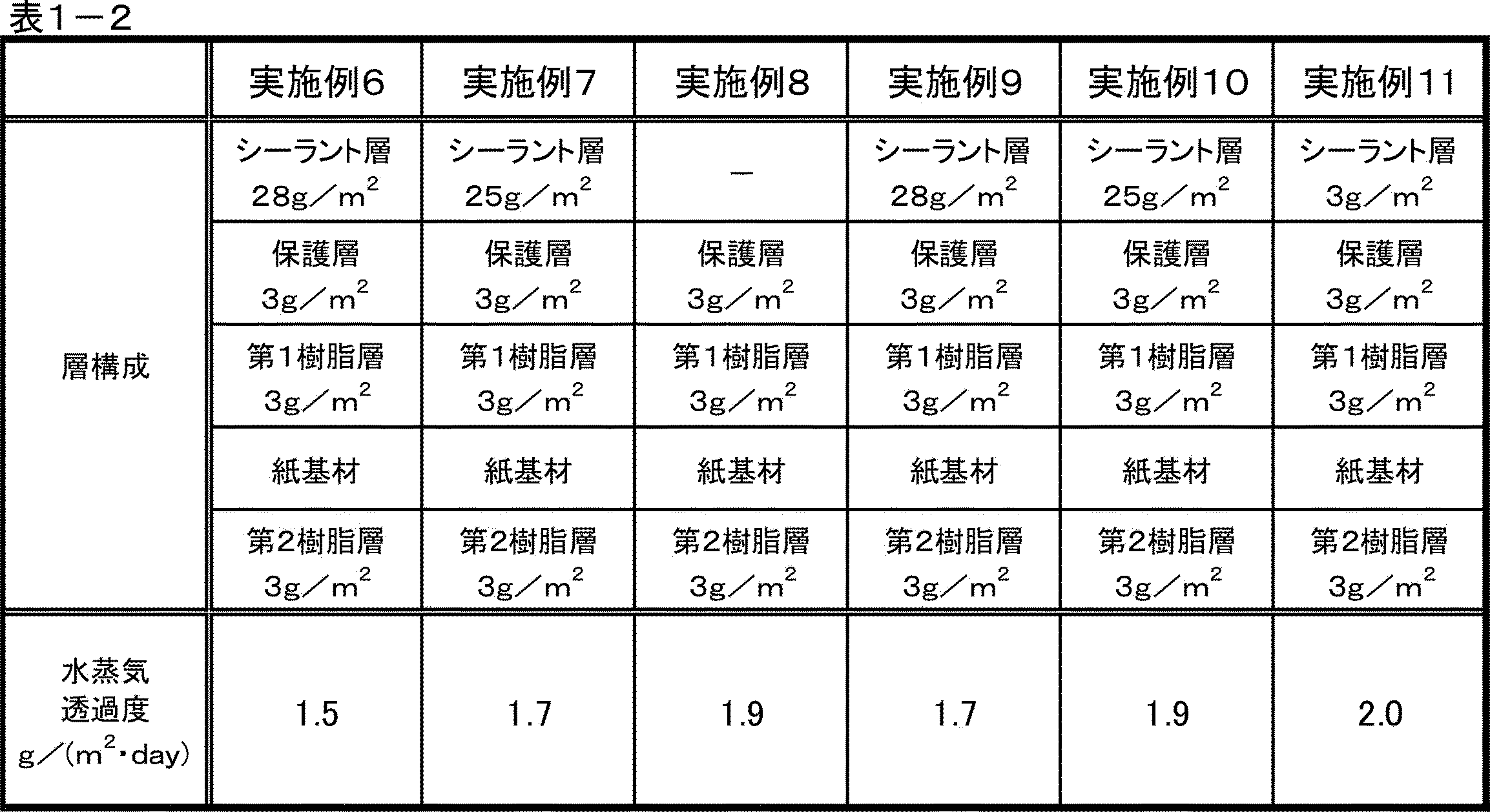
表1-1及び表1-2から明らかなように、実施例1~11の紙積層体は、水蒸気透過度が低く、水蒸気バリア性に優れていた。一方、比較例1および2の紙積層体は、紙基材の他方の面に第2樹脂層およびOPニス層のいずれも形成されていないので、水蒸気透過度が高く、水蒸気バリア性に劣っていた。
また、表1-1から明らかなように、第2樹脂層がアスペクト比50以上の板状無機化合物およびカチオン性樹脂を含有する実施例1の紙積層体は、第2樹脂層が板状無機化合物およびカチオン性樹脂を含有しない実施例2および3の紙積層体よりも、水蒸気透過度がより低く、水蒸気バリア性により優れていた。
また、表1-1から明らかなように、紙基材の一方の面に紙基材に近い側から第1樹脂層と保護層とをこの順に有する実施例1の紙積層体は、紙基材の一方の面に紙基材に近い側から保護層と第1樹脂層とをこの順に有する実施例4の紙積層体よりも、水蒸気透過度がより低く、水蒸気バリア性により優れていた。
また、表1-1から明らかなように、第1樹脂層の形成量が第2樹脂層の形成量より大きい実施例5の紙積層体は、第1樹脂層の形成量が第2樹脂層の形成量と同じである実施例1の紙積層体よりも、水蒸気透過度がより低く、水蒸気バリア性により優れていた。
さらに、表1-1及び表1-2から明らかなように、紙積層体の保護層の上に、シーラント層としての低密度ポリエチレン(日本ポリエチレン株式会社製)を押出ラミネートした実施例6及び9の紙積層体は、それぞれ、シーラント層が形成されていない実施例1及び8よりも、水蒸気透過度がより低く、水蒸気バリア性により優れていた。
また、表1-1から明らかなように、第2樹脂層がアスペクト比50以上の板状無機化合物およびカチオン性樹脂を含有する実施例1の紙積層体は、第2樹脂層が板状無機化合物およびカチオン性樹脂を含有しない実施例2および3の紙積層体よりも、水蒸気透過度がより低く、水蒸気バリア性により優れていた。
また、表1-1から明らかなように、紙基材の一方の面に紙基材に近い側から第1樹脂層と保護層とをこの順に有する実施例1の紙積層体は、紙基材の一方の面に紙基材に近い側から保護層と第1樹脂層とをこの順に有する実施例4の紙積層体よりも、水蒸気透過度がより低く、水蒸気バリア性により優れていた。
また、表1-1から明らかなように、第1樹脂層の形成量が第2樹脂層の形成量より大きい実施例5の紙積層体は、第1樹脂層の形成量が第2樹脂層の形成量と同じである実施例1の紙積層体よりも、水蒸気透過度がより低く、水蒸気バリア性により優れていた。
さらに、表1-1及び表1-2から明らかなように、紙積層体の保護層の上に、シーラント層としての低密度ポリエチレン(日本ポリエチレン株式会社製)を押出ラミネートした実施例6及び9の紙積層体は、それぞれ、シーラント層が形成されていない実施例1及び8よりも、水蒸気透過度がより低く、水蒸気バリア性により優れていた。
本発明によれば、水蒸気バリア性、ガスバリア性等のバリア性が高い紙積層体が得られる。本発明の紙積層体は、コーヒー、菓子、牛乳等の食品、医薬品、医療品、電子部品等の包装用材料として好適に用いることができる。
Claims (15)
- 紙基材と、前記紙基材の一方の面の第1樹脂層および保護層と、前記紙基材の他方の面の第2樹脂層およびOPニス層の少なくともいずれかとを有する紙積層体であって、
前記第1樹脂層が、水懸濁性高分子1、アスペクト比50以上の板状無機化合物、およびカチオン性樹脂を含有し、
前記保護層が水溶性高分子および水懸濁性高分子2の少なくともいずれかを含有し、
前記第2樹脂層が水懸濁性高分子1を含有する、紙積層体。 - 前記第2樹脂層が、アスペクト比50以上の板状無機化合物、およびカチオン性樹脂をさらに含有する、請求項1に記載の紙積層体。
- 前記紙基材の一方の面に、前記紙基材に近い側から前記第1樹脂層と前記保護層とをこの順に有する、請求項1または2に記載の紙積層体。
- 前記紙基材の一方の面に、前記紙基材に近い側から前記保護層と前記第1樹脂層とをこの順に有する、請求項1または2に記載の紙積層体。
- 前記第1樹脂層の形成量が、前記第2樹脂層および前記OPニス層の形成量の合計値以上である、請求項1~4のいずれか一項に記載の紙積層体。
- 前記水懸濁性高分子1が、オレフィン・不飽和カルボン酸系共重合体、スチレン・ブタジエン系共重合体、およびスチレン・不飽和カルボン酸系共重体よりなる群から選ばれる1種以上である、請求項1~5のいずれか一項に記載の紙積層体。
- 前記板状無機化合物が、合成マイカ、ベントナイトおよびカオリンよりなる群から選ばれる1種以上である、請求項1~6のいずれか一項に記載の紙積層体。
- 前記第1樹脂層中に含まれる前記板状無機化合物の含有量が、前記第1樹脂層中に含まれる前記水懸濁性高分子1を100質量部に対して0.1質量部以上800質量部以下である、請求項1~7のいずれか一項に記載の紙積層体。
- 前記板状無機化合物の厚さが200nm以下である、請求項1~8のいずれか一項に記載の紙積層体。
- 前記第1樹脂層に含有される前記板状無機化合物の割合は、前記第1樹脂層の全固形分中、0.1質量%以上80質量%以下である、請求項1~9のいずれか一項に記載の紙積層体。
- 前記第1樹脂層に含有される前記カチオン性樹脂の含有量は、前記第1樹脂層に含まれる板状無機化合物100質量部に対して、1質量部以上300質量部以下である、請求項1~10のいずれか一項に記載の紙積層体。
- 前記第1樹脂層中に含有されるカチオン性樹脂の含有量は、前記第1樹脂層に含有される水懸濁性高分子1を100質量部に対して、0.1質量部以上20質量部以下である、請求項1~11のいずれか一項に記載の紙積層体。
- 前記水溶性高分子がポリビニルアルコールおよび変性ポリビニルアルコールよりなる群から選ばれる1種以上である、請求項1~12のいずれか一項に記載の紙積層体。
- 少なくとも一方の最外層にシーラント層をさらに有する、請求項1~13のいずれか一項に記載の紙積層体。
- 前記紙積層体が包装用材料である、請求項1~14のいずれか一項に記載の紙積層体。
Priority Applications (1)
| Application Number | Priority Date | Filing Date | Title |
|---|---|---|---|
| JP2021512470A JP6943351B1 (ja) | 2019-11-27 | 2020-11-25 | 紙積層体 |
Applications Claiming Priority (2)
| Application Number | Priority Date | Filing Date | Title |
|---|---|---|---|
| JP2019213872 | 2019-11-27 | ||
| JP2019-213872 | 2019-11-27 |
Publications (1)
| Publication Number | Publication Date |
|---|---|
| WO2021106926A1 true WO2021106926A1 (ja) | 2021-06-03 |
Family
ID=76129284
Family Applications (1)
| Application Number | Title | Priority Date | Filing Date |
|---|---|---|---|
| PCT/JP2020/043797 Ceased WO2021106926A1 (ja) | 2019-11-27 | 2020-11-25 | 紙積層体 |
Country Status (2)
| Country | Link |
|---|---|
| JP (1) | JP6943351B1 (ja) |
| WO (1) | WO2021106926A1 (ja) |
Cited By (7)
| Publication number | Priority date | Publication date | Assignee | Title |
|---|---|---|---|---|
| JP2023028340A (ja) * | 2021-08-19 | 2023-03-03 | Dicグラフィックス株式会社 | 積層体、及び該積層体を用いた包装紙又は容器 |
| JP7245951B1 (ja) | 2022-10-14 | 2023-03-24 | 大王製紙株式会社 | バリア紙、産業用材、包装材及び積層体 |
| US20230243106A1 (en) * | 2020-05-27 | 2023-08-03 | Oji Holdings Corporation | Heat-sealable paper and packaging bag |
| JP2024020406A (ja) * | 2018-08-17 | 2024-02-14 | 日本製紙株式会社 | 塗工紙 |
| JP7607174B1 (ja) * | 2024-05-08 | 2024-12-26 | 日本製紙株式会社 | 塗工紙 |
| JP7607176B1 (ja) * | 2024-10-23 | 2024-12-26 | 日本製紙株式会社 | 塗工紙 |
| JP7607175B1 (ja) * | 2024-09-19 | 2024-12-26 | 日本製紙株式会社 | 塗工紙 |
Citations (7)
| Publication number | Priority date | Publication date | Assignee | Title |
|---|---|---|---|---|
| JP2001253035A (ja) * | 2000-03-08 | 2001-09-18 | Kuraray Co Ltd | バリアー性を有する紙容器 |
| JP2004218130A (ja) * | 2003-01-14 | 2004-08-05 | Oji Paper Co Ltd | 防湿積層体 |
| JP2009143615A (ja) * | 2007-12-17 | 2009-07-02 | Oji Paper Co Ltd | 粉末洗剤用包装容器 |
| JP2014181409A (ja) * | 2013-03-18 | 2014-09-29 | Nippon Paper Industries Co Ltd | 紙製バリア包装材料 |
| WO2019189229A1 (ja) * | 2018-03-28 | 2019-10-03 | 日本製紙株式会社 | 紙製バリア材料 |
| JP2019177577A (ja) * | 2018-03-30 | 2019-10-17 | 日本製紙株式会社 | 発泡シート |
| JP2020189489A (ja) * | 2019-05-20 | 2020-11-26 | 王子ホールディングス株式会社 | バリア性積層体 |
-
2020
- 2020-11-25 JP JP2021512470A patent/JP6943351B1/ja active Active
- 2020-11-25 WO PCT/JP2020/043797 patent/WO2021106926A1/ja not_active Ceased
Patent Citations (7)
| Publication number | Priority date | Publication date | Assignee | Title |
|---|---|---|---|---|
| JP2001253035A (ja) * | 2000-03-08 | 2001-09-18 | Kuraray Co Ltd | バリアー性を有する紙容器 |
| JP2004218130A (ja) * | 2003-01-14 | 2004-08-05 | Oji Paper Co Ltd | 防湿積層体 |
| JP2009143615A (ja) * | 2007-12-17 | 2009-07-02 | Oji Paper Co Ltd | 粉末洗剤用包装容器 |
| JP2014181409A (ja) * | 2013-03-18 | 2014-09-29 | Nippon Paper Industries Co Ltd | 紙製バリア包装材料 |
| WO2019189229A1 (ja) * | 2018-03-28 | 2019-10-03 | 日本製紙株式会社 | 紙製バリア材料 |
| JP2019177577A (ja) * | 2018-03-30 | 2019-10-17 | 日本製紙株式会社 | 発泡シート |
| JP2020189489A (ja) * | 2019-05-20 | 2020-11-26 | 王子ホールディングス株式会社 | バリア性積層体 |
Cited By (10)
| Publication number | Priority date | Publication date | Assignee | Title |
|---|---|---|---|---|
| JP2024020406A (ja) * | 2018-08-17 | 2024-02-14 | 日本製紙株式会社 | 塗工紙 |
| JP7657892B2 (ja) | 2018-08-17 | 2025-04-07 | 日本製紙株式会社 | 塗工紙 |
| US20230243106A1 (en) * | 2020-05-27 | 2023-08-03 | Oji Holdings Corporation | Heat-sealable paper and packaging bag |
| US12291821B2 (en) * | 2020-05-27 | 2025-05-06 | Oji Holdings Corporation | Heat-sealable paper and packaging bag |
| JP2023028340A (ja) * | 2021-08-19 | 2023-03-03 | Dicグラフィックス株式会社 | 積層体、及び該積層体を用いた包装紙又は容器 |
| JP7245951B1 (ja) | 2022-10-14 | 2023-03-24 | 大王製紙株式会社 | バリア紙、産業用材、包装材及び積層体 |
| JP2024058264A (ja) * | 2022-10-14 | 2024-04-25 | 大王製紙株式会社 | バリア紙、産業用材、包装材及び積層体 |
| JP7607174B1 (ja) * | 2024-05-08 | 2024-12-26 | 日本製紙株式会社 | 塗工紙 |
| JP7607175B1 (ja) * | 2024-09-19 | 2024-12-26 | 日本製紙株式会社 | 塗工紙 |
| JP7607176B1 (ja) * | 2024-10-23 | 2024-12-26 | 日本製紙株式会社 | 塗工紙 |
Also Published As
| Publication number | Publication date |
|---|---|
| JPWO2021106926A1 (ja) | 2021-12-02 |
| JP6943351B1 (ja) | 2021-09-29 |
Similar Documents
| Publication | Publication Date | Title |
|---|---|---|
| JP6943351B1 (ja) | 紙積層体 | |
| JP7036105B2 (ja) | ガスバリア性積層体 | |
| JP7439641B2 (ja) | バリア性積層体およびその製造方法 | |
| JP2021035753A (ja) | 紙積層体およびその製造方法 | |
| JP6901058B1 (ja) | 紙積層体 | |
| JP7047704B2 (ja) | ガスバリア性積層体およびその製造方法 | |
| CN112888565B (zh) | 阻气性层叠体和其制造方法 | |
| WO2021106891A1 (ja) | バリア性積層体 | |
| JP7559705B2 (ja) | バリア性積層体 | |
| JP6870797B1 (ja) | バリア性積層体 | |
| JP7238851B2 (ja) | バリア性積層体 | |
| JP2020192737A (ja) | 防湿性積層体および紙容器 | |
| JP2014173201A (ja) | 紙製バリア包装材料 | |
| WO2021166910A1 (ja) | ガスバリア性積層体 | |
| JP2021020398A (ja) | バリア包装材料 | |
| JP7643145B2 (ja) | ガスバリア性積層体及びガスバリア性シール紙 | |
| JP7298409B2 (ja) | バリア性積層体 | |
| JP7268614B2 (ja) | バリア性積層体 | |
| JP7582640B2 (ja) | 蒸着用紙基材 | |
| JP2024102611A (ja) | 紙製バリア材料 | |
| JP2020179637A (ja) | バリア性積層体 | |
| JP7729343B2 (ja) | バリア性積層体及び包装袋 | |
| JP2020179638A (ja) | バリア性積層体 | |
| WO2026053774A1 (ja) | 紙製バリア材料 | |
| JP2022014610A (ja) | ガスバリア性積層体 |
Legal Events
| Date | Code | Title | Description |
|---|---|---|---|
| ENP | Entry into the national phase |
Ref document number: 2021512470 Country of ref document: JP Kind code of ref document: A |
|
| 121 | Ep: the epo has been informed by wipo that ep was designated in this application |
Ref document number: 20893808 Country of ref document: EP Kind code of ref document: A1 |
|
| NENP | Non-entry into the national phase |
Ref country code: DE |
|
| 122 | Ep: pct application non-entry in european phase |
Ref document number: 20893808 Country of ref document: EP Kind code of ref document: A1 |