WO2021039020A1 - 感光性樹脂組成物、及び有機el素子隔壁 - Google Patents
感光性樹脂組成物、及び有機el素子隔壁 Download PDFInfo
- Publication number
- WO2021039020A1 WO2021039020A1 PCT/JP2020/022733 JP2020022733W WO2021039020A1 WO 2021039020 A1 WO2021039020 A1 WO 2021039020A1 JP 2020022733 W JP2020022733 W JP 2020022733W WO 2021039020 A1 WO2021039020 A1 WO 2021039020A1
- Authority
- WO
- WIPO (PCT)
- Prior art keywords
- group
- dye
- resin composition
- photosensitive resin
- mass
- Prior art date
- Legal status (The legal status is an assumption and is not a legal conclusion. Google has not performed a legal analysis and makes no representation as to the accuracy of the status listed.)
- Ceased
Links
Images

Classifications
-
- G—PHYSICS
- G03—PHOTOGRAPHY; CINEMATOGRAPHY; ANALOGOUS TECHNIQUES USING WAVES OTHER THAN OPTICAL WAVES; ELECTROGRAPHY; HOLOGRAPHY
- G03F—PHOTOMECHANICAL PRODUCTION OF TEXTURED OR PATTERNED SURFACES, e.g. FOR PRINTING, FOR PROCESSING OF SEMICONDUCTOR DEVICES; MATERIALS THEREFOR; ORIGINALS THEREFOR; APPARATUS SPECIALLY ADAPTED THEREFOR
- G03F7/00—Photomechanical, e.g. photolithographic, production of textured or patterned surfaces, e.g. printing surfaces; Materials therefor, e.g. comprising photoresists; Apparatus specially adapted therefor
- G03F7/004—Photosensitive materials
-
- C—CHEMISTRY; METALLURGY
- C09—DYES; PAINTS; POLISHES; NATURAL RESINS; ADHESIVES; COMPOSITIONS NOT OTHERWISE PROVIDED FOR; APPLICATIONS OF MATERIALS NOT OTHERWISE PROVIDED FOR
- C09D—COATING COMPOSITIONS, e.g. PAINTS, VARNISHES OR LACQUERS; FILLING PASTES; CHEMICAL PAINT OR INK REMOVERS; INKS; CORRECTING FLUIDS; WOODSTAINS; PASTES OR SOLIDS FOR COLOURING OR PRINTING; USE OF MATERIALS THEREFOR
- C09D5/00—Coating compositions, e.g. paints, varnishes or lacquers, characterised by their physical nature or the effects produced; Filling pastes
- C09D5/32—Radiation-absorbing paints
-
- C—CHEMISTRY; METALLURGY
- C08—ORGANIC MACROMOLECULAR COMPOUNDS; THEIR PREPARATION OR CHEMICAL WORKING-UP; COMPOSITIONS BASED THEREON
- C08F—MACROMOLECULAR COMPOUNDS OBTAINED BY REACTIONS ONLY INVOLVING CARBON-TO-CARBON UNSATURATED BONDS
- C08F2/00—Processes of polymerisation
- C08F2/46—Polymerisation initiated by wave energy or particle radiation
- C08F2/48—Polymerisation initiated by wave energy or particle radiation by ultraviolet or visible light
- C08F2/50—Polymerisation initiated by wave energy or particle radiation by ultraviolet or visible light with sensitising agents
-
- C—CHEMISTRY; METALLURGY
- C08—ORGANIC MACROMOLECULAR COMPOUNDS; THEIR PREPARATION OR CHEMICAL WORKING-UP; COMPOSITIONS BASED THEREON
- C08F—MACROMOLECULAR COMPOUNDS OBTAINED BY REACTIONS ONLY INVOLVING CARBON-TO-CARBON UNSATURATED BONDS
- C08F220/00—Copolymers of compounds having one or more unsaturated aliphatic radicals, each having only one carbon-to-carbon double bond, and only one being terminated by only one carboxyl radical or a salt, anhydride ester, amide, imide or nitrile thereof
- C08F220/02—Monocarboxylic acids having less than ten carbon atoms; Derivatives thereof
- C08F220/10—Esters
- C08F220/26—Esters containing oxygen in addition to the carboxy oxygen
- C08F220/30—Esters containing oxygen in addition to the carboxy oxygen containing aromatic rings in the alcohol moiety
-
- C—CHEMISTRY; METALLURGY
- C08—ORGANIC MACROMOLECULAR COMPOUNDS; THEIR PREPARATION OR CHEMICAL WORKING-UP; COMPOSITIONS BASED THEREON
- C08F—MACROMOLECULAR COMPOUNDS OBTAINED BY REACTIONS ONLY INVOLVING CARBON-TO-CARBON UNSATURATED BONDS
- C08F220/00—Copolymers of compounds having one or more unsaturated aliphatic radicals, each having only one carbon-to-carbon double bond, and only one being terminated by only one carboxyl radical or a salt, anhydride ester, amide, imide or nitrile thereof
- C08F220/02—Monocarboxylic acids having less than ten carbon atoms; Derivatives thereof
- C08F220/10—Esters
- C08F220/26—Esters containing oxygen in addition to the carboxy oxygen
- C08F220/32—Esters containing oxygen in addition to the carboxy oxygen containing epoxy radicals
-
- C—CHEMISTRY; METALLURGY
- C08—ORGANIC MACROMOLECULAR COMPOUNDS; THEIR PREPARATION OR CHEMICAL WORKING-UP; COMPOSITIONS BASED THEREON
- C08G—MACROMOLECULAR COMPOUNDS OBTAINED OTHERWISE THAN BY REACTIONS ONLY INVOLVING UNSATURATED CARBON-TO-CARBON BONDS
- C08G59/00—Polycondensates containing more than one epoxy group per molecule; Macromolecules obtained by polymerising compounds containing more than one epoxy group per molecule using curing agents or catalysts which react with the epoxy groups
- C08G59/14—Polycondensates modified by chemical after-treatment
- C08G59/1433—Polycondensates modified by chemical after-treatment with organic low-molecular-weight compounds
- C08G59/1438—Polycondensates modified by chemical after-treatment with organic low-molecular-weight compounds containing oxygen
- C08G59/1455—Monocarboxylic acids, anhydrides, halides, or low-molecular-weight esters thereof
-
- C—CHEMISTRY; METALLURGY
- C09—DYES; PAINTS; POLISHES; NATURAL RESINS; ADHESIVES; COMPOSITIONS NOT OTHERWISE PROVIDED FOR; APPLICATIONS OF MATERIALS NOT OTHERWISE PROVIDED FOR
- C09D—COATING COMPOSITIONS, e.g. PAINTS, VARNISHES OR LACQUERS; FILLING PASTES; CHEMICAL PAINT OR INK REMOVERS; INKS; CORRECTING FLUIDS; WOODSTAINS; PASTES OR SOLIDS FOR COLOURING OR PRINTING; USE OF MATERIALS THEREFOR
- C09D133/00—Coating compositions based on homopolymers or copolymers of compounds having one or more unsaturated aliphatic radicals, each having only one carbon-to-carbon double bond, and at least one being terminated by only one carboxyl radical, or of salts, anhydrides, esters, amides, imides, or nitriles thereof; Coating compositions based on derivatives of such polymers
- C09D133/04—Homopolymers or copolymers of esters
- C09D133/06—Homopolymers or copolymers of esters of esters containing only carbon, hydrogen and oxygen, the oxygen atom being present only as part of the carboxyl radical
- C09D133/062—Copolymers with monomers not covered by C09D133/06
- C09D133/066—Copolymers with monomers not covered by C09D133/06 containing -OH groups
-
- C—CHEMISTRY; METALLURGY
- C09—DYES; PAINTS; POLISHES; NATURAL RESINS; ADHESIVES; COMPOSITIONS NOT OTHERWISE PROVIDED FOR; APPLICATIONS OF MATERIALS NOT OTHERWISE PROVIDED FOR
- C09D—COATING COMPOSITIONS, e.g. PAINTS, VARNISHES OR LACQUERS; FILLING PASTES; CHEMICAL PAINT OR INK REMOVERS; INKS; CORRECTING FLUIDS; WOODSTAINS; PASTES OR SOLIDS FOR COLOURING OR PRINTING; USE OF MATERIALS THEREFOR
- C09D133/00—Coating compositions based on homopolymers or copolymers of compounds having one or more unsaturated aliphatic radicals, each having only one carbon-to-carbon double bond, and at least one being terminated by only one carboxyl radical, or of salts, anhydrides, esters, amides, imides, or nitriles thereof; Coating compositions based on derivatives of such polymers
- C09D133/04—Homopolymers or copolymers of esters
- C09D133/14—Homopolymers or copolymers of esters of esters containing halogen, nitrogen, sulfur or oxygen atoms in addition to the carboxy oxygen
-
- C—CHEMISTRY; METALLURGY
- C09—DYES; PAINTS; POLISHES; NATURAL RESINS; ADHESIVES; COMPOSITIONS NOT OTHERWISE PROVIDED FOR; APPLICATIONS OF MATERIALS NOT OTHERWISE PROVIDED FOR
- C09D—COATING COMPOSITIONS, e.g. PAINTS, VARNISHES OR LACQUERS; FILLING PASTES; CHEMICAL PAINT OR INK REMOVERS; INKS; CORRECTING FLUIDS; WOODSTAINS; PASTES OR SOLIDS FOR COLOURING OR PRINTING; USE OF MATERIALS THEREFOR
- C09D163/00—Coating compositions based on epoxy resins; Coating compositions based on derivatives of epoxy resins
- C09D163/04—Epoxynovolacs
-
- C—CHEMISTRY; METALLURGY
- C09—DYES; PAINTS; POLISHES; NATURAL RESINS; ADHESIVES; COMPOSITIONS NOT OTHERWISE PROVIDED FOR; APPLICATIONS OF MATERIALS NOT OTHERWISE PROVIDED FOR
- C09D—COATING COMPOSITIONS, e.g. PAINTS, VARNISHES OR LACQUERS; FILLING PASTES; CHEMICAL PAINT OR INK REMOVERS; INKS; CORRECTING FLUIDS; WOODSTAINS; PASTES OR SOLIDS FOR COLOURING OR PRINTING; USE OF MATERIALS THEREFOR
- C09D201/00—Coating compositions based on unspecified macromolecular compounds
- C09D201/02—Coating compositions based on unspecified macromolecular compounds characterised by the presence of specified groups, e.g. terminal or pendant functional groups
-
- C—CHEMISTRY; METALLURGY
- C09—DYES; PAINTS; POLISHES; NATURAL RESINS; ADHESIVES; COMPOSITIONS NOT OTHERWISE PROVIDED FOR; APPLICATIONS OF MATERIALS NOT OTHERWISE PROVIDED FOR
- C09D—COATING COMPOSITIONS, e.g. PAINTS, VARNISHES OR LACQUERS; FILLING PASTES; CHEMICAL PAINT OR INK REMOVERS; INKS; CORRECTING FLUIDS; WOODSTAINS; PASTES OR SOLIDS FOR COLOURING OR PRINTING; USE OF MATERIALS THEREFOR
- C09D7/00—Features of coating compositions, not provided for in group C09D5/00; Processes for incorporating ingredients in coating compositions
- C09D7/40—Additives
- C09D7/41—Organic pigments; Organic dyes
-
- C—CHEMISTRY; METALLURGY
- C09—DYES; PAINTS; POLISHES; NATURAL RESINS; ADHESIVES; COMPOSITIONS NOT OTHERWISE PROVIDED FOR; APPLICATIONS OF MATERIALS NOT OTHERWISE PROVIDED FOR
- C09D—COATING COMPOSITIONS, e.g. PAINTS, VARNISHES OR LACQUERS; FILLING PASTES; CHEMICAL PAINT OR INK REMOVERS; INKS; CORRECTING FLUIDS; WOODSTAINS; PASTES OR SOLIDS FOR COLOURING OR PRINTING; USE OF MATERIALS THEREFOR
- C09D7/00—Features of coating compositions, not provided for in group C09D5/00; Processes for incorporating ingredients in coating compositions
- C09D7/40—Additives
- C09D7/60—Additives non-macromolecular
- C09D7/63—Additives non-macromolecular organic
-
- G—PHYSICS
- G03—PHOTOGRAPHY; CINEMATOGRAPHY; ANALOGOUS TECHNIQUES USING WAVES OTHER THAN OPTICAL WAVES; ELECTROGRAPHY; HOLOGRAPHY
- G03F—PHOTOMECHANICAL PRODUCTION OF TEXTURED OR PATTERNED SURFACES, e.g. FOR PRINTING, FOR PROCESSING OF SEMICONDUCTOR DEVICES; MATERIALS THEREFOR; ORIGINALS THEREFOR; APPARATUS SPECIALLY ADAPTED THEREFOR
- G03F7/00—Photomechanical, e.g. photolithographic, production of textured or patterned surfaces, e.g. printing surfaces; Materials therefor, e.g. comprising photoresists; Apparatus specially adapted therefor
- G03F7/004—Photosensitive materials
- G03F7/022—Quinonediazides
- G03F7/023—Macromolecular quinonediazides; Macromolecular additives, e.g. binders
-
- G—PHYSICS
- G03—PHOTOGRAPHY; CINEMATOGRAPHY; ANALOGOUS TECHNIQUES USING WAVES OTHER THAN OPTICAL WAVES; ELECTROGRAPHY; HOLOGRAPHY
- G03F—PHOTOMECHANICAL PRODUCTION OF TEXTURED OR PATTERNED SURFACES, e.g. FOR PRINTING, FOR PROCESSING OF SEMICONDUCTOR DEVICES; MATERIALS THEREFOR; ORIGINALS THEREFOR; APPARATUS SPECIALLY ADAPTED THEREFOR
- G03F7/00—Photomechanical, e.g. photolithographic, production of textured or patterned surfaces, e.g. printing surfaces; Materials therefor, e.g. comprising photoresists; Apparatus specially adapted therefor
- G03F7/004—Photosensitive materials
- G03F7/027—Non-macromolecular photopolymerisable compounds having carbon-to-carbon double bonds, e.g. ethylenic compounds
- G03F7/032—Non-macromolecular photopolymerisable compounds having carbon-to-carbon double bonds, e.g. ethylenic compounds with binders
- G03F7/033—Non-macromolecular photopolymerisable compounds having carbon-to-carbon double bonds, e.g. ethylenic compounds with binders the binders being polymers obtained by reactions only involving carbon-to-carbon unsaturated bonds, e.g. vinyl polymers
-
- H—ELECTRICITY
- H05—ELECTRIC TECHNIQUES NOT OTHERWISE PROVIDED FOR
- H05B—ELECTRIC HEATING; ELECTRIC LIGHT SOURCES NOT OTHERWISE PROVIDED FOR; CIRCUIT ARRANGEMENTS FOR ELECTRIC LIGHT SOURCES, IN GENERAL
- H05B33/00—Electroluminescent light sources
- H05B33/02—Details
-
- H—ELECTRICITY
- H05—ELECTRIC TECHNIQUES NOT OTHERWISE PROVIDED FOR
- H05B—ELECTRIC HEATING; ELECTRIC LIGHT SOURCES NOT OTHERWISE PROVIDED FOR; CIRCUIT ARRANGEMENTS FOR ELECTRIC LIGHT SOURCES, IN GENERAL
- H05B33/00—Electroluminescent light sources
- H05B33/12—Light sources with substantially two-dimensional [2D] radiating surfaces
-
- H—ELECTRICITY
- H05—ELECTRIC TECHNIQUES NOT OTHERWISE PROVIDED FOR
- H05B—ELECTRIC HEATING; ELECTRIC LIGHT SOURCES NOT OTHERWISE PROVIDED FOR; CIRCUIT ARRANGEMENTS FOR ELECTRIC LIGHT SOURCES, IN GENERAL
- H05B33/00—Electroluminescent light sources
- H05B33/12—Light sources with substantially two-dimensional [2D] radiating surfaces
- H05B33/14—Light sources with substantially two-dimensional [2D] radiating surfaces characterised by the chemical or physical composition or the arrangement of the electroluminescent material, or by the simultaneous addition of the electroluminescent material in or onto the light source
-
- H—ELECTRICITY
- H05—ELECTRIC TECHNIQUES NOT OTHERWISE PROVIDED FOR
- H05B—ELECTRIC HEATING; ELECTRIC LIGHT SOURCES NOT OTHERWISE PROVIDED FOR; CIRCUIT ARRANGEMENTS FOR ELECTRIC LIGHT SOURCES, IN GENERAL
- H05B33/00—Electroluminescent light sources
- H05B33/12—Light sources with substantially two-dimensional [2D] radiating surfaces
- H05B33/22—Light sources with substantially two-dimensional [2D] radiating surfaces characterised by the chemical or physical composition or the arrangement of auxiliary dielectric or reflective layers
-
- H—ELECTRICITY
- H10—SEMICONDUCTOR DEVICES; ELECTRIC SOLID-STATE DEVICES NOT OTHERWISE PROVIDED FOR
- H10K—ORGANIC ELECTRIC SOLID-STATE DEVICES
- H10K50/00—Organic light-emitting devices
- H10K50/80—Constructional details
- H10K50/86—Arrangements for improving contrast, e.g. preventing reflection of ambient light
- H10K50/865—Arrangements for improving contrast, e.g. preventing reflection of ambient light comprising light absorbing layers, e.g. light-blocking layers
-
- H—ELECTRICITY
- H10—SEMICONDUCTOR DEVICES; ELECTRIC SOLID-STATE DEVICES NOT OTHERWISE PROVIDED FOR
- H10K—ORGANIC ELECTRIC SOLID-STATE DEVICES
- H10K59/00—Integrated devices, or assemblies of multiple devices, comprising at least one organic light-emitting element covered by group H10K50/00
- H10K59/80—Constructional details
- H10K59/8791—Arrangements for improving contrast, e.g. preventing reflection of ambient light
- H10K59/8792—Arrangements for improving contrast, e.g. preventing reflection of ambient light comprising light absorbing layers, e.g. black layers
Definitions
- the present invention relates to a photosensitive resin composition, an organic EL element partition wall, an organic EL element insulating film, and an organic EL element using the same. More specifically, the present invention relates to a photosensitive resin composition containing a black dye, and an organic EL element partition wall, an organic EL element insulating film, and an organic EL element using the same.
- partitioning materials are used at intervals of colored patterns in the display area or at edges of peripheral parts of the display area in order to improve display characteristics.
- a partition wall is first formed, and the pixels of the organic substance are formed between the partition walls.
- the partition walls are generally formed by photolithography using a photosensitive resin composition and have insulating properties. Specifically, a photosensitive resin composition is applied onto a substrate using a coating device, volatile components are removed by means such as heating, and then exposed through a mask, and then, in the case of a negative type, an unexposed portion is exposed.
- the exposed portion is developed by removing it with a developing solution such as an alkaline aqueous solution, and the obtained pattern is heat-treated to form a partition wall (insulating film).
- a developing solution such as an alkaline aqueous solution
- an organic substance that emits three colors of light, red, green, and blue, is formed between the partition walls by an inkjet method or the like to form pixels of an organic EL display device.
- the partition material In the field, in recent years, due to the miniaturization of display devices and the diversification of displayed contents, higher performance and higher definition of pixels are required. Attempts have been made to make the partition material have a light-shielding property by using a colorant for the purpose of increasing the contrast in the display device and improving the visibility. However, when the partition material is provided with a light-shielding property, the photosensitive resin composition tends to have low sensitivity, and as a result, the exposure time may be long and the productivity may be lowered. Therefore, the photosensitive resin composition used for forming the partition material containing the colorant is required to have higher sensitivity.
- Patent Document 1 Japanese Unexamined Patent Publication No. 2001-281440 describes a positive radiation-sensitive resin composition containing an alkali-soluble resin and a quinonediazide compound as a radiation-sensitive resin composition that exhibits high light-shielding properties by heat treatment after exposure. The composition to which titanium black is added is described.
- Patent Document 2 Japanese Unexamined Patent Publication No. 2002-116536 describes carbon black in a radiation-sensitive resin composition containing [A] alkali-soluble resin, [B] 1,2-quinonediazide compound, and [C] colorant. It describes a method of blackening the partition material using.
- Patent Document 3 Japanese Unexamined Patent Publication No. 2010-237310 describes a positive radiation-sensitive resin composition containing an alkali-soluble resin and a quinonediazide compound as a radiation-sensitive resin composition that exhibits light-shielding properties by heat treatment after exposure. The composition to which the heat-sensitive dye is added is described.
- Japanese Unexamined Patent Publication No. 2001-281440 Japanese Unexamined Patent Publication No. 2002-116536 Japanese Unexamined Patent Publication No. 2010-237310
- the photosensitive resin composition used for forming a colored partition material it is necessary to use a considerable amount of a colorant in order to sufficiently enhance the light-shielding property of the cured film.
- a colorant used in order to sufficiently enhance the light-shielding property of the cured film.
- the radiation applied to the film of the photosensitive resin composition is absorbed by the colorant, so that the effective intensity of the radiation in the film is the lower part of the film (the side closer to the substrate).
- the photosensitive resin composition is not sufficiently exposed (photosensitivity inhibition), and as a result, the pattern forming property is deteriorated.
- a partition wall in an organic EL element it is important that the material forming the partition wall has high sensitivity from the viewpoint of productivity and the like.
- a black photosensitive resin composition containing a colorant when used, exposure defects occur under the normally used exposure conditions, so that it is necessary to lengthen the exposure time, for example, which reduces productivity. It was a factor to make it.
- An object of the present invention is to reduce the photosensitive inhibition of a photosensitive resin composition containing a black dye, improve the pattern forming property, and increase the sensitivity.
- the present inventors increase the content of the black dye while ensuring the light-shielding property of the photosensitive resin composition by adding a dye other than black. It has been found that the reduction can improve the pattern forming property of the photosensitive resin composition and increase the sensitivity.
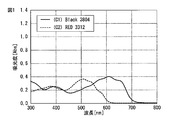
- the dye (C2) has an absorption maximum at a wavelength of 480 to 550 nm in the wavelength range of 300 to 800 nm, and the absorbance of the dye (C2) at the absorption maximum wavelength is Abs1, and the average absorbance at a wavelength of 560 to 600 nm.
- R 6 , R 7 , R 8 , R 9 and R 10 are independently hydrogen atoms, alkyl groups having 1 to 5 carbon atoms, and cycloalkyl groups having 5 to 10 carbon atoms, respectively. Alternatively, it is an aryl group having 6 to 12 carbon atoms, and * in the formula (2) represents a bonding portion with a carbon atom constituting an aromatic ring), an alkenyl group having 1 to 2 carbon atoms.
- An alkoxy group or a hydroxyl group, and at least one of R 1 , R 2 and R 3 is an alkenyl group represented by the formula (2)
- Q is an alkylene group represented by the formula ⁇ CR 4 R 5 ⁇ .
- R 12 is at least one selected from the group consisting of a hydrogen atom, a methyl group, an ethyl group and a propyl group.
- Hydroxystyrene resin derivative having a structural unit represented by From the group consisting of (c) an alkaline aqueous solution-soluble resin having an epoxy group and a phenolic hydroxyl group, and (d) an alkaline aqueous solution-soluble copolymer of a polymerizable monomer having an alkali-soluble functional group and another polymerizable monomer.
- the photosensitive resin composition according to any one of [1] to [11], which is at least one selected.
- the binder resin (A) From the group consisting of (c) an alkaline aqueous solution-soluble resin having an epoxy group and a phenolic hydroxyl group, and (d) an alkaline aqueous solution-soluble copolymer of a polymerizable monomer having an alkali-soluble functional group and another polymerizable monomer.
- the photosensitive resin composition according to any one of [1] to [11], which is at least one selected.
- An organic EL device insulating film containing a cured product of the photosensitive resin composition according to any one of [1] to [13].
- the present invention it is possible to reduce the photosensitive inhibition of the photosensitive resin composition containing a black dye, improve the pattern forming property, and increase the sensitivity.
- alkali-soluble and “alkali aqueous solution-soluble” mean that the photosensitive resin composition or its components, or the film or cured film of the photosensitive resin composition is an alkaline aqueous solution, for example, 2.38% by mass hydroxide. It means that it can be dissolved in an aqueous solution of tetramethylammonium.
- alkali-soluble functional group means a group that imparts such alkali solubility to the photosensitive resin composition or a component thereof, or a coating film or a cured coating film of the photosensitive resin composition.
- the "radical polymerizable functional group” refers to one or more ethylenically unsaturated groups
- the "radical polymerizable compound” refers to a compound having one or more ethylenically unsaturated groups
- (meth) acrylic means acrylic or methacrylic
- (meth) acrylate means acrylate or methacrylate
- (meth) acryloyl means acryloyl or methacryloyl.
- the photosensitive resin composition of one embodiment contains a binder resin (A), a radiation-sensitive compound (B) and a dye (C), and the dye (C) is a dye (C2) other than the black dye (C1) and (C1). )including.
- the dye (C2) has an absorption maximum at a wavelength of 480 to 550 nm in the wavelength range of 300 to 800 nm, and the absorbance at the wavelength of the maximum absorption wavelength of the dye (C2) is Abs1 and the average absorbance at a wavelength of 560 to 600 nm is Abs2. Occasionally, Abs2 / Abs1 is 0.1-1.0.
- the binder resin (A) is not particularly limited, but preferably has an alkali-soluble functional group and is alkali-soluble.
- the alkali-soluble functional group is not particularly limited, and examples thereof include a carboxy group, a phenolic hydroxyl group, a sulfo group, a phosphoric acid group, and a mercapto group.
- a binder resin having two or more kinds of alkali-soluble functional groups may be used.
- binder resin (A) examples include acrylic resin, polystyrene resin, epoxy resin, polyamide resin, phenol resin, polyimide resin, polyamic acid resin, polybenzoxazole resin, polybenzoxazole resin precursor, silicone resin, and cyclic olefin polymer. , Cardo resins, derivatives of these resins, and those having an alkali-soluble functional group bonded to these resins.
- a homopolymer or a copolymer of a polymerizable monomer having an alkali-soluble functional group can also be used. These resins can be used alone or in combination of two or more kinds of resins.
- the binder resin (A) may have a radically polymerizable functional group.
- the binder resin (A) has a (meth) acryloyloxy group, an allyl group or a metalyl group as a radically polymerizable functional group.
- the binder resin (A) contains at least one selected from the following resin components (a) to (k).
- Polyamic acid resin g) Polybenzoxazole resin
- (h) Polybenzoxazole resin precursor i) Silicone resin
- the polyalkenylphenol resin (a) can be obtained by converting a hydroxyl group of a known phenol resin into an alkenyl ether and further rearranging the alkenyl ether group by Claisen rearrangement. Above all, equation (1) A polyalkenylphenol resin having the structural unit of is preferable. By containing such a resin, the developing characteristics of the obtained photosensitive resin composition can be improved and the outgas can be reduced.
- R 1 , R 2 and R 3 are independently hydrogen atoms, alkyl groups having 1 to 5 carbon atoms, and formula (2).
- R 6 , R 7 , R 8 , R 9 and R 10 are independently hydrogen atoms, alkyl groups having 1 to 5 carbon atoms, and cycloalkyl groups having 5 to 10 carbon atoms, respectively. Alternatively, it is an aryl group having 6 to 12 carbon atoms, and * in the formula (2) represents a bonding portion with a carbon atom constituting an aromatic ring), an alkenyl group having 1 to 2 carbon atoms.
- alkyl group having 1 to 5 carbon atoms Independently hydrogen atom, alkyl group having 1 to 5 carbon atoms, alkenyl group having 2 to 6 carbon atoms, cycloalkyl group having 5 to 10 carbon atoms, or aryl group having 6 to 12 carbon atoms. ..
- the structural units of the respective formulas (1) may be the same or different.
- R 1 , R 2 and R 3 of the formula (1) are a hydrogen atom, an alkyl group having 1 to 5 carbon atoms, an alkenyl group represented by the formula (2), an alkoxy group having 1 to 2 carbon atoms or a hydroxyl group.
- the and at least one of R 1, R 2 and R 3 is an alkenyl group represented by formula (2).
- Specific examples of the alkyl group having 1 to 5 carbon atoms in R 1 , R 2 and R 3 of the formula (1) include a methyl group, an ethyl group, an n-propyl group, an isopropyl group, an n-butyl group and sec. -Butyl group, tert-butyl group, n-pentyl group and the like can be mentioned.
- Specific examples of the alkoxy group having 1 to 2 carbon atoms include a methoxy group and an ethoxy group.
- R 6 , R 7 , R 8 , R 9 and R 10 are independently hydrogen atoms, alkyl groups having 1 to 5 carbon atoms, and 5 carbon atoms, respectively. It is a cycloalkyl group of up to 10 or an aryl group having 6 to 12 carbon atoms.
- Specific examples of the alkyl group having 1 to 5 carbon atoms include a methyl group, an ethyl group, an n-propyl group, an isopropyl group, an n-butyl group, a sec-butyl group, a tert-butyl group, an n-pentyl group and the like. Can be mentioned.
- Examples of the cycloalkyl group having 5 to 10 carbon atoms include a cyclopentyl group, a cyclohexyl group, a methylcyclohexyl group, a cycloheptyl group and the like.
- Specific examples of the aryl group having 6 to 12 carbon atoms include a phenyl group, a methylphenyl group, an ethylphenyl group, a biphenyl group, a naphthyl group and the like. It is preferable that R 6 , R 7 , R 8 , R 9 and R 10 are independently hydrogen atoms or alkyl groups having 1 to 5 carbon atoms, respectively.
- Examples of the alkenyl group represented by the preferred formula (2) include an allyl group and a metharyl group from the viewpoint of reactivity, and more preferably an allyl group.
- any one of R 1 , R 2 and R 3 is an allyl group or a metharyl group, and the other two are hydrogen atoms.
- Q of the formula (1) has an alkylene group represented by the formula ⁇ CR 4 R 5 ⁇ , a cycloalkylene group having 5 to 10 carbon atoms, a divalent organic group having an aromatic ring, and an alicyclic condensed ring 2 It is a valent organic group or a divalent group combining these.
- R 4 and R 5 are independently hydrogen atoms, alkyl groups having 1 to 5 carbon atoms, alkenyl groups having 2 to 6 carbon atoms, cycloalkyl groups having 5 to 10 carbon atoms, or 6 to 6 carbon atoms, respectively. It is an aryl group of 12.
- alkyl group having 1 to 5 carbon atoms examples include a methyl group, an ethyl group, an n-propyl group, an isopropyl group, an n-butyl group, a sec-butyl group, a tert-butyl group, an n-pentyl group and the like.
- alkenyl group having 2 to 6 carbon atoms include a vinyl group, an allyl group, a butenyl group, a pentenyl group, a hexenyl group and the like.
- Examples of the cycloalkyl group having 5 to 10 carbon atoms include a cyclopentyl group, a cyclohexyl group, a methylcyclohexyl group, a cycloheptyl group and the like.
- Specific examples of the aryl group having 6 to 12 carbon atoms include a phenyl group, a methylphenyl group, an ethylphenyl group, a biphenyl group, a naphthyl group and the like.
- R 4 and R 5 are preferably hydrogen atoms or alkyl groups having 1 to 3 carbon atoms independently of each other, and most preferably both are hydrogen atoms.
- cycloalkylene group having 5 to 10 carbon atoms include a cyclopentylene group, a cyclohexylene group, a methylcyclohexylene group, a cycloheptylene group and the like.
- divalent organic group having an aromatic ring include a phenylene group, a trilene group, a naphthylene group, a biphenylene group, a fluorenylene group, an anthracenylene group, a xylylene group, a 4,4-methylenediphenyl group, and formula (6).
- the group represented by is mentioned.
- Specific examples of the divalent organic group having an alicyclic condensed ring include a dicyclopentadienylene group and the like.
- alkali developability particularly preferred polyalkenyl phenolic resin from viewpoint of outgas (a)
- Q is -CH 2 of the formula (1) - a Things, that is, equation (4) Those having a structural unit represented by.
- R 1 , R 2 and R 3 are the same as in formula (1).
- Preferred R 1, R 2 and R 3 are the same as the preferred R 1, R 2 and R 3 in Formula (1).
- the structural unit represented by the formula (1) or the formula (4) is preferably 50 to 100 mol%, more preferably 70 to 100 mol%, and further preferably 70 to 100 mol% in the polyalkenylphenol resin (a). Is 80 to 100 mol%. It is preferable that the structural unit represented by the formula (1) or the formula (4) is 50 mol% or more in the polyalkenylphenol resin (a) because the heat resistance is improved. Since the phenolic hydroxyl group in the polyalkenylphenol resin (a) is ionized in the presence of the basic compound and becomes soluble in water, it is necessary to have a certain amount or more of the phenolic hydroxyl group from the viewpoint of alkali developability. is there.
- the polyalkenylphenol resin (a) containing the structural unit of the formula (4) has the structural unit represented by the formula (4) and the formula (7). It is particularly preferable that the polyalkenylphenol resin has a structural unit represented by.
- R 1a , R 2a and R 3a are independently hydrogen atoms or alkyl groups having 1 to 5 carbon atoms. Preferred R 1a , R 2a and R 3a are similar to preferred R 1 , R 2 and R 3 in formula (1).
- the number of the structural units represented by the formula (4) is x
- the formula ( Assuming that the number of structural units represented by 7) is y, 0.5 ⁇ x / (x + y) ⁇ 1, 0 ⁇ y / (x + y) ⁇ 0.5, and x + y is preferably 2 to 50. , More preferably 3 to 40, still more preferably 5 to 25.
- the polyalkenylphenol resin (a) When the polyalkenylphenol resin (a) is used as the binder resin (A), the polyalkenylphenol resin (a) has a preferable number average molecular weight of 500 to 5000, more preferably 800 to 3000, and further preferably 900. ⁇ 2000.
- the weight average molecular weight of the polyalkenylphenol resin (a) is preferably 500 to 30,000, more preferably 3,000 to 25,000, and even more preferably 5,000 to 20,000. If the number average molecular weight is 500 or more, or the weight average molecular weight is 500 or more, the alkaline development rate is appropriate and the difference in dissolution rate between the exposed and unexposed areas is sufficient, so the pattern resolution is good and the number average molecular weight is high.
- the weight average molecular weight is 5000 or less, or the weight average molecular weight is 30,000 or less, the alkali developability is good.
- the number average molecular weight and the weight average molecular weight of the binder resin (A) mean standard polystyrene-equivalent values measured by gel permeation chromatography (GPC).
- (B) Hydroxystyrene resin derivative As the binder resin (A), the formula (3) A hydroxypolystyrene resin derivative (b) having the structural unit of can also be used. By containing such a resin, it is possible to improve the developing characteristics of the obtained photosensitive resin composition and also contribute to the reduction of outgassing.
- R 11 is a hydrogen atom or an alkyl group having 1 to 5 carbon atoms
- a is an integer of 1 to 4
- b is an integer of 1 to 4
- a + b is within the range of 2 to 5.
- R 12 is at least one selected from the group consisting of a hydrogen atom, a methyl group, an ethyl group and a propyl group.
- the structural unit represented by the formula (3) and the formula (5) in terms of alkali developability and outgassing is preferably a copolymer having a structural unit represented by.
- R 13 is a hydrogen atom or an alkyl group having 1 to 5 carbon atoms, and c is an integer of 1 to 5.
- a hydroxystyrene resin derivative (b) having a structural unit represented by the formula (3), and a hydroxystyrene resin derivative having a structural unit represented by the formula (3) and a structural unit represented by the formula (5) ( b) is, for example, an aromatic vinyl compound having a phenolic hydroxyl group such as p-hydroxystyrene, m-hydroxystyrene, o-hydroxystyrene, p-isopropenylphenol, m-isopropenylphenol, o-isopropenylphenol.
- styrene is reacted with a part of the polymer or copolymer obtained by polymerizing one or two or more kinds by a known method by a known method, for example, the method described in JP2013-151705. It can be obtained by allowing it to react with or further reacting with alcohol.
- aromatic vinyl compound having a phenolic hydroxyl group p-hydroxystyrene or m-hydroxystyrene is preferably used.
- the hydroxypolystyrene resin derivative (b) When the hydroxystyrene resin derivative (b) is used as the binder resin (A), the hydroxypolystyrene resin derivative (b) has a preferable number average molecular weight of 1000 to 20000, more preferably 3000 to 10000, and further preferably 4000 to 4000. It is 9000.
- the hydroxystyrene resin derivative (b) has a preferable weight average molecular weight of 1,000 to 100,000, more preferably 5,000 to 75,000, and even more preferably 10,000 to 50,000.
- the number average molecular weight is 1000 or more, or the weight average molecular weight is 1000 or more, it is suitable as a resin for a photosensitive material because its alkali solubility is appropriate, and when the number average molecular weight is 20000 or less or the weight average molecular weight is 100,000 or less. If there is, the coatability and developability are good.
- an alkaline aqueous solution-soluble resin (c) having an epoxy group and a phenolic hydroxyl group can also be used.
- Such an alkaline aqueous solution-soluble resin (c) includes, for example, an epoxy group of a compound having at least two epoxy groups in one molecule (hereinafter, may be referred to as “epoxy compound”) and hydroxybenzoic acid. It can be obtained by reacting the carboxy group of the compound.
- the alkaline aqueous solution-soluble resin (c) has an epoxy group, crosslinks can be formed by reacting with phenolic hydroxyl groups during heating, and the chemical resistance and heat resistance of the coating film can be improved. Phenolic hydroxyl groups contribute to solubility in alkaline aqueous solutions during development.
- reaction formula 1 shows an example of a reaction in which one of the epoxy groups of the epoxy compound reacts with the carboxy group of the hydroxybenzoic acid compound to form a compound having a phenolic hydroxyl group.
- Examples of the compound having at least two epoxy groups in one molecule include phenol novolac type epoxy resin, cresol novolac type epoxy resin, bisphenol type epoxy resin, biphenol type epoxy resin, naphthalene skeleton-containing epoxy resin, and alicyclic epoxy resin. , Heterocyclic epoxy resin and the like. These epoxy compounds may have two or more epoxy groups in one molecule, and may be used alone or in combination of two or more. Since these compounds are thermosetting, the structure cannot be uniquely described due to differences in the presence or absence of epoxy groups, the types of functional groups, the degree of polymerization, etc., as is common knowledge of those skilled in the art. An example of the structure of the novolak type epoxy resin is shown in the equation (9).
- R 14 is a hydrogen atom, an alkyl group having 1 to 5 carbon atoms, an alkoxy group having 1 to 2 carbon atoms, or a hydroxyl group, and m is an integer of 1 to 50.
- Examples of the phenol novolac type epoxy resin include EPRICLON (registered trademark) N-770 (manufactured by DIC Corporation) and jER (registered trademark) -152 (manufactured by Mitsubishi Chemical Corporation).
- Examples of the cresol novolac type epoxy resin include EPICLON (registered trademark) N-695 (manufactured by DIC Corporation) and EOCN (registered trademark) -102S (manufactured by Nippon Kayaku Co., Ltd.).
- Examples of the bisphenol type epoxy resin include bisphenol A type such as jER (registered trademark) 828, jER (registered trademark) 1001 (manufactured by Mitsubishi Chemical Corporation), and YD-128 (trade name, manufactured by Nippon Steel Chemical & Materials Co., Ltd.).
- Examples thereof include epoxy resins, bisphenol F type epoxy resins such as jER (registered trademark) 806 (manufactured by Mitsubishi Chemical Co., Ltd.) and YDF-170 (trade name, manufactured by Nippon Steel Chemical & Materials Co., Ltd.).
- Examples of the biphenol type epoxy resin include jER (registered trademark) YX-4000 and jER (registered trademark) YL-6121H (manufactured by Mitsubishi Chemical Corporation).
- Examples of the naphthalene skeleton-containing epoxy resin include NC-7000 (trade name, manufactured by Nippon Kayaku Co., Ltd.) and EXA-4750 (trade name, manufactured by DIC Corporation).
- Examples of the alicyclic epoxy resin include EHPE (registered trademark) -3150 (manufactured by Daicel Chemical Industries, Ltd.).
- Examples of the heterocyclic epoxy resin include TEPIC (registered trademark), TEPIC-L, TEPIC-H, and TEPIC-S (manufactured by Nissan Chemical Industries, Ltd.).
- the compound having at least two epoxy groups in one molecule is a cresol novolac type epoxy resin.
- the photosensitive resin composition containing an alkaline aqueous solution-soluble resin (c) having an epoxy group derived from a cresol novolac type epoxy resin and a phenolic hydroxyl group has excellent pattern forming properties, and the alkali solubility can be easily adjusted. There is little outgas.
- a hydroxybenzoic acid compound is a compound in which at least one of the 2 to 6 positions of benzoic acid is substituted with a hydroxyl group, for example, salicylic acid, 4-hydroxybenzoic acid, 2,3-dihydroxybenzoic acid, 2,4-dihydroxybenzoic acid. , 2,5-Dihydroxybenzoic acid, 2,6-dihydroxybenzoic acid, 3,4-dihydroxybenzoic acid, 3,5-dihydroxybenzoic acid, 2-hydroxy-5-nitrobenzoic acid, 3-hydroxy-4-nitro Examples thereof include benzoic acid and 4-hydroxy-3-nitrobenzoic acid, and a dihydroxybenzoic acid compound is preferable from the viewpoint of enhancing alkali developability. These hydroxybenzoic acid compounds may be used alone or in combination of two or more.
- the alkaline aqueous solution soluble resin (c) having an epoxy group and a phenolic hydroxyl group is a reaction product of a compound having at least two epoxy groups in one molecule and a hydroxybenzoic acid compound, and the formula ( 8) Has the structure of.
- d is an integer of 1 to 5
- * represents a bond with a residue of a compound having at least two epoxy groups in one molecule, excluding the epoxy group.
- the hydroxybenzoic acid compound is 0.2 to 1 with respect to 1 equivalent of the epoxy group of the epoxy compound. It can be used in 0 equivalents, preferably 0.3 to 0.9 equivalents, more preferably 0.4 to 0.8 equivalents.
- the amount of the hydroxybenzoic acid compound is 0.2 equivalent or more, sufficient alkali solubility can be obtained, and when it is 1.0 equivalent or less, the increase in molecular weight due to a side reaction can be suppressed.
- a catalyst may be used to accelerate the reaction between the epoxy compound and the hydroxybenzoic acid compound.
- the amount of the catalyst used can be 0.1 to 10 parts by mass based on 100 parts by mass of the reaction raw material mixture composed of the epoxy compound and the hydroxybenzoic acid compound.
- the reaction temperature can be 60 to 150 ° C. and the reaction time can be 3 to 30 hours.
- Examples of the catalyst used in this reaction include triethylamine, benzyldimethylamine, triethylammonium chloride, benzyltrimethylammonium bromide, benzyltrimethylammonium iodide, triphenylphosphine, chromium octanate, zirconium octanate and the like.
- the number average molecular weight of the alkaline aqueous solution-soluble resin (c) having an epoxy group and a phenolic hydroxyl group is preferably 500 to 8000, more preferably 800 to 6000, and even more preferably 1000 to 5000.
- the number average molecular weight is 500 or more, the alkali solubility is appropriate, so that it is good as a resin for a photosensitive material, and when it is 8000 or less, the coatability and developability are good.
- a polymerizable monomer having an alkali-soluble functional group and other An alkaline aqueous solution-soluble copolymer (d) of the polymerizable monomer can be used.
- the alkali-soluble functional group include a carboxy group, an alcoholic hydroxyl group, a phenolic hydroxyl group, a sulfo group, a phosphoric acid group, an acid anhydride group and the like.
- the polymerizable functional group contained in the polymerizable monomer include radically polymerizable functional groups.
- the alkali aqueous solution-soluble copolymer (d) of the polymerizable monomer having an alkali-soluble functional group and other polymerizable monomer is, for example, the polymerizable monomer having an alkali-soluble functional group and other polymerizable simpler. It can be produced by radically polymerizing a monomer. After synthesizing the copolymer by radical polymerization, a derivative to which an alkali-soluble functional group is added may be used.
- Examples of the polymerizable monomer having an alkali-soluble functional group include 4-hydroxystyrene, (meth) acrylic acid, ⁇ -bromo (meth) acrylic acid, ⁇ -chloro (meth) acrylic acid, and ⁇ -frill (meth).
- Acrylic acid ⁇ -styryl (meth) acrylic acid, maleic acid, monomethyl maleate, monoethyl maleate, monoisopropyl maleate, fumaric acid, silicic acid, ⁇ -cyanosilicate acrylic acid, itaconic acid, crotonic acid, propiolic acid , 4-Hydroxyphenyl methacrylate, 3,5-dimethyl-4-hydroxybenzylacrylamide, 4-hydroxyphenylacrylamide, 4-hydroxyphenylmaleimide, 3-maleimide propiolic acid, 4-maleimide butyric acid, 6-maleimide hexane acid and the like. Be done.
- Examples of other polymerizable monomers include styrene derivatives such as styrene, vinyltoluene, ⁇ -methylstyrene, p-methylstyrene, and p-ethylstyrene; acrylamide; acrylonitrile; and vinyl alcohols such as vinyl-n-butyl ether.
- Ether compounds alkyl (meth) acrylate, tetrahydrofurfuryl (meth) acrylate, dimethylaminoethyl (meth) acrylate, diethylaminoethyl (meth) acrylate, glycidyl (meth) acrylate, 2,2,2-trifluoroethyl (meth) (Meta) acrylic acid esters such as acrylates, 2,2,3,3-tetrafluoropropyl (meth) acrylates and isobornyl (meth) acrylates; maleic acid derivatives such as maleic anhydride and maleic acid monoesters; phenylmaleimide, Examples thereof include N-substituted maleimides such as cyclohexyl maleimide.
- the alkali aqueous solution-soluble copolymer (d) of the polymerizable monomer having an alkali-soluble functional group and other polymerizable monomers has an alicyclic structure, an aromatic structure, or a polycyclic type. It is preferable to have one or more kinds of cyclic structures such as a structure, an inorganic cyclic structure, and a heterocyclic structure.
- R 15 is a hydrogen atom or an alkyl group having 1 to 5 carbon atoms
- e is an integer of 1 to 5.
- 4-Hydroxyphenyl methacrylate is particularly preferable as the polymerizable monomer having such an alkali-soluble functional group.
- Examples of other polymerizable monomers include styrene derivatives such as styrene, vinyltoluene, ⁇ -methylstyrene, p-methylstyrene, and p-ethylstyrene; acrylamide; acrylonitrile; and vinyl alcohols such as vinyl-n-butyl ether.
- Ether compounds alkyl (meth) acrylate, tetrahydrofurfuryl (meth) acrylate, dimethylaminoethyl (meth) acrylate, diethylaminoethyl (meth) acrylate, glycidyl (meth) acrylate, 2,2,2-trifluoroethyl (meth) (Meta) acrylic acid esters such as acrylates, 2,2,3,3-tetrafluoropropyl (meth) acrylates and isobornyl (meth) acrylates; maleic acid derivatives such as maleic anhydride and maleic acid monoesters; phenylmaleimide, Examples thereof include N-substituted maleimides such as cyclohexyl maleimide.
- R 16 and R 17 are independently hydrogen atoms, alkyl groups having 1 to 3 carbon atoms, fully or partially fluorinated alkyl groups having 1 to 3 carbon atoms, or A halogen atom
- R 18 is a hydrogen atom, a linear or cyclic alkyl group having 1 to 6 carbon atoms, a phenyl group, or a hydroxy group, an alkyl group having 1 to 6 carbon atoms, and 1 to 6 carbon atoms. It is a phenyl group substituted with at least one selected from the group consisting of alkoxy groups.
- R 16 and R 17 are preferably hydrogen atoms.
- R 18 is preferably a cyclic alkyl group or phenyl group having 1 to 6 carbon atoms. Phenylmaleimide and cyclohexylmaleimide are particularly preferred as such other polymerizable monomers.
- the alkali aqueous solution soluble copolymer (d) of the polymerizable monomer having an alkali-soluble functional group and the other polymerizable monomer is represented by the formula (10).
- R 15 is a hydrogen atom or an alkyl group having 1 to 5 carbon atoms
- e is an integer of 1 to 5.
- Structural unit represented by and formula (11) In the formula (11), R 16 and R 17 are independent hydrogen atoms, alkyl groups having 1 to 3 carbon atoms, and fully or partially fluorinated alkyl groups having 1 to 3 carbon atoms, respectively.
- R 18 is a hydrogen atom, a linear or cyclic alkyl group having 1 to 6 carbon atoms, a phenyl group, or a hydroxy group, an alkyl group having 1 to 6 carbon atoms, and 1 to 6 carbon atoms. It is a phenyl group substituted with at least one selected from the group consisting of the alkoxy groups of.) It has a structural unit represented by.
- a resin obtained by radically polymerizing these polymerizable monomers shape retention and developability can be improved and outgassing can be reduced.
- the polymerization initiator for producing the alkali-soluble copolymer (d) of the polymerizable monomer having an alkali-soluble functional group and the other polymerizable monomer by radical polymerization is not limited to the following. 2,2'-Azobisisobutyronitrile, 2,2'-azobis (2-methylbutyronitrile), dimethyl 2,2'-azobis (2-methylpropionate), 4,4'-azobis ( 4-Cyanovaleric acid), azo polymerization initiators such as 2,2'-azobis (2,4-dimethylvaleronitrile) (AVN), dicumyl peroxide, 2,5-dimethyl-2,5-di (tert) -Butylperoxy) hexane, tert-butylcumyl peroxide, di-tert-butyl peroxide, 1,1,3,3-tetramethylbutylhydroperoxide, cumenehydroperoxide, etc.
- AZA 2,2'-
- a peroxide polymerization initiator at ⁇ 170 ° C., or a peroxide polymerization initiator such as benzoyl peroxide, lauroyl peroxide, 1,1′-di (tert-butylperoxy) cyclohexane, or tert-butylperoxypivalate. be able to.
- the amount of the polymerization initiator used is generally 0.01 parts by mass or more, 0.05 parts by mass or more or 0.5 parts by mass or more, 40 parts by mass or less, 20 parts by mass with respect to 100 parts by mass of the mixture of polymerizable monomers. It is preferably parts by mass or less or 15 parts by mass or less.
- a RAFT (Reversible Addition Fragmentation Transfer) agent may be used in combination with a polymerization initiator.
- the RAFT agent is not limited to the following, and thiocarbonylthio compounds such as dithioester, dithiocarbamate, trithiocarbonate, and xantate can be used.
- the RAFT agent can be used in the range of 0.005 to 20 parts by mass with respect to 100 parts by mass of the total amount of the polymerizable monomer, and is preferably used in the range of 0.01 to 10 parts by mass.
- the weight average molecular weight (Mw) of the alkali-soluble copolymer (d) of the polymerizable monomer having an alkali-soluble functional group and the other polymerizable monomer can be 3000 to 80,000, and is 4000 to 70,000. It is preferably present, and more preferably 5000 to 60,000.
- the number average molecular weight (Mn) can be 1000 to 30000, preferably 1500 to 25000, and more preferably 2000 to 20000.
- the degree of polydispersity (Mw / Mn) can be 1.0 to 3.5, preferably 1.1 to 3.0, and more preferably 1.2 to 2.8.
- the alkali aqueous solution-soluble copolymer (d) of the polymerizable monomer having an alkali-soluble functional group and other polymerizable monomer also corresponds to the hydroxypolystyrene resin derivative (b), it is alkaline. It shall be treated as an alkaline aqueous solution-soluble copolymer (d) of a polymerizable monomer having a soluble functional group and other polymerizable monomers.
- alkaline aqueous solution-soluble copolymer (d) of the polymerizable monomer having an alkali-soluble functional group and other polymerizable monomer also corresponds to the alkaline aqueous solution-soluble resin (c) having an epoxy group and a phenolic hydroxyl group. Is treated as an alkaline aqueous solution-soluble copolymer (d) of a polymerizable monomer having an alkali-soluble functional group and other polymerizable monomers.
- the hydroxypolystyrene resin derivative (b) and the alkaline aqueous solution-soluble resin (c) having an epoxy group and a phenolic hydroxyl group are soluble in an alkaline aqueous solution of a polymerizable monomer having an alkali-soluble functional group and other polymerizable monomers. Those corresponding to the copolymer (d) shall be excluded.
- the binder resin (A) is a polyimide resin (e), a polyamic acid. It is at least one selected from the resin (f), the polybenzoxazole resin (g), and the polybenzoxazole resin precursor (h).
- the polyamic acid resin (f) becomes a resin having a polyimide structure by dehydration ring closure.
- the polybenzoxazole resin precursor (h) becomes a polybenzoxazole resin (g) by dehydration and ring closure.
- the polyimide resin (e) has a structural unit represented by the formula (12).
- the polyamic acid resin (f) and the polybenzoxazole resin precursor (h) have a structural unit represented by the formula (13).
- the polybenzoxazole resin (g) has a structural unit represented by the formula (14).
- the polyimide resin (e) may have both a structural unit represented by the formula (12) and a structural unit represented by the formula (13), and the polybenzoxazole resin (g) is represented by the formula (14). It may have both the structural unit to be used and the structural unit represented by the formula (13).
- R 19 is a 4- to 10-valent organic group
- R 20 is a 2- to 8-valent organic group
- R 21 and R 22 are independently hydroxyl groups, carboxy groups, and sulfo groups, respectively.
- it is a mercapto group
- f and g are independently integers of 0 to 6.
- R 23 is a 2- to 8-valent organic group
- R 24 is a 2- to 8-valent organic group
- R 25 and R 26 are independently hydroxyl groups, sulfo groups, and mercapto groups, respectively.
- Or -COOR 27 R 27 is a hydrogen atom or a monovalent hydrocarbon group having 1 to 20 carbon atoms
- h and i are independently integers of 0 to 6, except that h + i> 0. Is.
- h is an integer of 1 or more
- at least one of R 25 is ⁇ COOR 27 .
- i is an integer of 1 or more
- at least one of R 26 is a phenolic hydroxyl group.
- R 28 is a 2- to 8-valent organic group
- R 29 is a 2- to 8-valent organic group
- R 30 and R 31 are independently hydroxyl groups, carboxy groups, and sulfo groups, respectively.
- it is a mercapto group
- j and k are independently integers of 0 to 6.
- R 19- (R 21 ) f in formula (12) represents a residue of acid dianhydride.
- R 19 is a 4- to 10-valent organic group, preferably an organic group having 5 to 40 carbon atoms including an aromatic ring or a cyclic aliphatic group.
- Examples of the acid dianhydride include pyromellit acid dianhydride, 3,3', 4,4'-biphenyltetracarboxylic dianhydride, 2,3,3', 4'-biphenyltetracarboxylic dianhydride.
- R 23- (R 25 ) h in formula (13) and R 28- (R 30 ) j in formula (14) represent acid residues, respectively.
- R 23 and R 28 are independently 2- to 8-valent organic groups, and are preferably organic groups having 5 to 40 carbon atoms including an aromatic ring or a cyclic aliphatic group.
- the acid examples include aromatic dicarboxylic acids such as terephthalic acid, isophthalic acid, diphenyl ether dicarboxylic acid, bis (carboxyphenyl) hexafluoropropane, biphenyl dicarboxylic acid, benzophenone dicarboxylic acid and triphenyldicarboxylic acid; trimellitic acid and trimesic acid.
- aromatic dicarboxylic acids such as terephthalic acid, isophthalic acid, diphenyl ether dicarboxylic acid, bis (carboxyphenyl) hexafluoropropane, biphenyl dicarboxylic acid, benzophenone dicarboxylic acid and triphenyldicarboxylic acid
- trimellitic acid and trimesic acid examples include trimellitic acid and trimesic acid.
- Diphenyl ether tricarboxylic acid aromatic tricarboxylic acids such as biphenyltricarboxylic acid; pyromellitic acid, 3,3', 4,4'-biphenyltetracarboxylic acid, 2,3,3', 4'-biphenyltetracarboxylic acid, 2 , 2', 3,3'-biphenyltetracarboxylic acid, 3,3', 4,4'-benzophenone tetracarboxylic acid, 2,2', 3,3'-benzophenone tetracarboxylic acid, 2,2-bis ( 3,4-Dicarboxyphenyl) hexafluoropropane, 2,2-bis (2,3-dicarboxyphenyl) hexafluoropropane, 1,1-bis (3,4-dicarboxyphenyl) ethane, 1,1- Bis (2,3-dicarboxyphenyl) ethane, bis (3,
- Aromatic tetracarboxylic acids ; butane tetracarboxylic acids, aliphatic tetracarboxylic acids such as 1,2,3,4-cyclopentanetetracarboxylic acids, and combinations of two or more of these.
- one or two carboxy groups correspond to R 25 in the formula (13) or R 30 in the formula (14).
- These acids may be in the form of esters or acid anhydrides.
- R 20- (R 22 ) g of formula (12), R 24- (R 26 ) i of formula (13), and R 29- (R 31 ) k of formula (14) each contain diamine residues.
- R 20 , R 24, and R 29 are independently 2- to 8-valent organic groups, and are preferably organic groups having 5 to 40 carbon atoms including an aromatic ring or a cyclic aliphatic group.
- Examples of the diamine corresponding to R 20 of the formula (12) and R 24 of the formula (13) according to the polyamic acid resin (f) include 3,4'-diaminodiphenyl ether, 4,4'-diaminodiphenyl ether, and 3 , 4'-diaminodiphenylmethane, 4,4'-diaminodiphenylmethane, 1,4-bis (4-aminophenoxy) benzene, benzidine, m-phenylenediamine, p-phenylenediamine, 1,5-naphthalenediamine, 2,6 -Naphthalenediamine, bis (4-aminophenoxy) biphenyl, bis [4- (4-aminophenoxy) phenyl] ether, 1,4-bis (4-aminophenoxy) benzene, 2,2'-dimethyl-4,4 '-Diaminobiphenyl, 2,2'-diethyl-4,4'-diaminobi
- the diamine corresponding to R 24 of the formula (13) and R 29 of the formula (14) according to the polybenzoxazole resin precursor (h) for example, with respect to the amino group on the aromatic ring of the aromatic diamine.
- examples thereof include a bisaminophenol compound having a phenolic hydroxyl group at the ortho position, and a combination of two or more of these.
- the polyimide resin (e), the polyamic acid resin (f), the polybenzoxazole resin (g), and the polybenzoxazole resin precursor (h) are monoamines, acid anhydrides, acid chlorides, which have an acidic group at their ends. It may have an acidic group at the end of the main chain by being sealed with a monocarboxylic acid or the like.
- the polyamic acid resin (f) is, for example, a method of reacting a tetracarboxylic acid dianhydride with a diamine, forming a diester from the tetracarboxylic acid dianhydride and an alcohol, and then reacting the diester with the diamine in the presence of a condensing agent. It can be synthesized by a method of producing a diester from tetracarboxylic acid dianhydride and an alcohol, acid chlorideizing the remaining dicarboxylic acid, and then reacting the obtained intermediate with a diamine.
- the polybenzoxazole resin precursor (h) can be synthesized, for example, by subjecting a bisaminophenol compound to a condensation reaction of a polyvalent carboxylic acid such as a dicarboxylic acid, a tricarboxylic acid or a tetracarboxylic acid.
- a method of reacting an intermediate obtained by reacting a dehydration condensing agent such as dicyclohexylcarbodiimide (DCC) with a polyvalent carboxylic acid with a bisaminophenol compound, and a tertiary amine such as pyridine were added. Examples thereof include a method of dropping a dicarboxylic acid dichloride solution onto a solution of a bisaminophenol compound.
- the polyimide resin (e) can be synthesized, for example, by heating the polyamic acid resin (f) obtained by the above method or dehydrating and ring-closing the polyamic acid resin (f) by a chemical treatment such as an acid or a base.
- the polybenzoxazole resin (g) can be synthesized, for example, by heating the polybenzoxazole resin precursor (h) obtained by the above method or dehydrating and closing the ring by a chemical treatment such as an acid or a base.
- the number average molecular weight of the polyimide resin (e), the polyamic acid resin (f), the polybenzoxazole resin (g), and the polybenzoxazole resin precursor (h) is preferably 500 to 8000, preferably 800 to 6000. More preferably, it is more preferably 1000 to 5000. When the number average molecular weight is 500 or more, the alkali solubility is appropriate, so that it is good as a resin for a photosensitive material, and when it is 8000 or less, the coatability and developability are good.
- the binder resin (A) contains a silicone resin (i).
- the silicone resin (i) can be synthesized by hydrolyzing and condensing at least one compound selected from the organosilane represented by the formula (15) and the organosilane represented by the formula (16). By using the organosilanes represented by the formulas (15) and (16), a photosensitive resin composition having excellent sensitivity and resolution can be obtained.
- the organosilane represented by the formula (15) is shown below.
- R 32 is a hydrogen atom, an alkyl group having 1 to 10 carbon atoms, an alkenyl group having 2 to 10 carbon atoms or an aryl group having 6 to 16 carbon atoms
- R 33 is a hydrogen atom. It is an alkyl group having 1 to 6 carbon atoms, an acyl group having 2 to 6 carbon atoms, or an aryl group having 6 to 16 carbon atoms
- p is an integer of 0 to 3.
- the plurality of R 32s may be the same or different.
- the plurality of R 33s may be the same or different.
- organosilane represented by the formula (15) examples include tetrafunctional silanes such as tetramethoxysilane, tetraethoxysilane, tetraacetoxysilane, and tetraphenoxysilane; methyltrimethoxysilane, methyltriethoxysilane, and methyltriiso.
- the organosilane represented by the formula (16) is shown below.
- R 34 to R 37 are independently hydrogen atoms, alkyl groups having 1 to 6 carbon atoms, acyl groups having 2 to 6 carbon atoms, or aryl groups having 6 to 16 carbon atoms.
- N is in the range of 2-8.
- n is 2 or more, the plurality of R 35 and R 36 may be the same or different.
- organosilane represented by the formula (16) examples include methyl silicate 51 manufactured by Fuso Chemical Industry Co., Ltd. (R 34 to R 37 are methyl groups, n is an average of 4), and M silicate 51 manufactured by Tama Chemical Industry Co., Ltd. (R 34 to R 37 are methyl groups, n is an average of 3 to 5), silicate 40 (R 34 to R 37 are ethyl groups, n is an average of 4 to 6), silicate 45 (R 34 to R 37 are ethyl groups, n is an average of 6 to 8), methyl silicate 51 manufactured by Corcote Co., Ltd.
- R 34 to R 37 is a methyl group, n is an average of 4
- methyl silicate 53A R 34 to R 37 is a methyl group, n is an average of 7
- Ethyl silicate 40 R 34 to R 37 are ethyl groups, n is an average of 5 and the like. It is also possible to use two or more of these in combination.
- the silicone resin (i) can be synthesized by hydrolyzing and partially condensing the organosilanes represented by the formulas (15) and (16). Due to partial condensation, the silicone resin (i) has residual silanol groups.
- Examples of the hydrolysis and partial condensation include a method in which a solvent, water, a catalyst and the like are added to the organosilane mixture as needed, and the mixture is heated and stirred at 50 ° C. to 150 ° C. for about 0.5 to 100 hours. If necessary, a hydrolysis by-product (alcohol such as methanol) or a condensation by-product (water) may be distilled off.
- an acid catalyst or a base catalyst is preferably used.
- the acid catalyst include hydrochloric acid, nitric acid, sulfuric acid, hydrofluoric acid, phosphoric acid, acetic acid, trifluoroacetic acid, formic acid, polyvalent carboxylic acid or its anhydride, ion exchange resin and the like.
- the base catalyst include triethylamine, tripropylamine, tributylamine, tripentylamine, trihexylamine, triheptylamine, trioctylamine, diethylamine, triethanolamine, diethanolamine, sodium hydroxide, potassium hydroxide and amino groups.
- Examples thereof include an alkoxysilane having an ion exchange resin and an ion exchange resin.
- the catalyst may be removed after hydrolysis and partial condensation, if necessary, by washing with water, treatment with an ion exchange resin, or a combination thereof. By removing the catalyst, the storage stability of the photosensitive resin composition can be improved.
- the weight average molecular weight (Mw) of the silicone resin (i) is preferably 1000 to 100,000, more preferably 1000 to 50,000.
- Mw weight average molecular weight
- the film-forming property can be improved, and when the weight average molecular weight is 100,000 or less, the alkali developability is good.
- the binder resin (A) comprises a cyclic olefin polymer (j).
- the cyclic olefin polymer (j) is a homopolymer or copolymer of a cyclic olefin monomer having an alicyclic structure and an ethylenically unsaturated double bond.
- the cyclic olefin polymer (j) may have a structural unit derived from a monomer other than the cyclic olefin monomer.
- Examples of the monomer constituting the cyclic olefin polymer (j) include a cyclic olefin monomer having a protonic polar group, a cyclic olefin monomer having a polar group other than protonic, and a cyclic olefin single having no polar group. Examples thereof include a metric and a monomer other than the cyclic olefin.
- the monomer other than the cyclic olefin may have a protonic polar group or a polar group other than this, and may not have a polar group.
- Examples of the cyclic olefin monomer having a protonic polar group include 5-hydroxycarbonylbicyclo [2.2.1] hept-2-ene and 5-methyl-5-hydroxycarbonylbicyclo [2.2.1].
- Examples of the cyclic olefin monomer having a polar group other than protic are 5-acetoxybicyclo [2.2.1] hept-2-ene and 5-methoxycarbonylbicyclo [2.2.1] hept-2. -En, 5-methyl-5-methoxycarbonylbicyclo [2.2.1] hept-2-ene, 8-acetoxytetracyclo [4.4.0.1 2,5 . 1 7, 10 ] Dodeca-3-ene, 8-methoxycarbonyltetracyclo [4.4.0.1 2,5 . 1 7, 10 ] Dodeca-3-ene, 8-ethoxycarbonyltetracyclo [4.4.0.1 2,5 . 1 7, 10 ] Dodeca-3-ene, 8-ethoxycarbonyltetracyclo [4.4.0.1 2,5 .
- Cyclic olefins with cyano groups such as 17 and 10 ] dodeca-3-ene and 5-cyanobicyclo [2.2.1] hept-2-ene; 8-chlorotetracyclo [4.4.0.1 2] , 5 . 17 and 10 ]
- Cyclic olefins having a halogen atom such as dodeca-3-ene, and combinations of two or more of these can be mentioned.
- Examples of the cyclic olefin monomer having no polar group include bicyclo [2.2.1] hept-2-ene, 5-ethyl-bicyclo [2.2.1] hept-2-ene, and 5-. Butyl-bicyclo [2.2.1] hept-2-ene, 5-ethylidene-bicyclo [2.2.1] hept-2-ene, 5-methylidene-bicyclo [2.2.1] hept-2-en En, 5-vinyl-bicyclo [2.2.1] hept-2-ene, tricyclo [4.3.0.1 2,5 ] deca-3,7-diene, tetracyclo [8.4.0.1] 11,14 .
- monomers other than cyclic olefins include ethylene, propylene, 1-butene, 1-pentene, 1-hexene, 3-methyl-1-butene, 3-methyl-1-pentene, and 3-ethyl-1.
- -Pentene 4-methyl-1-pentene, 4-methyl-1-hexene, 4,4-dimethyl-1-hexene, 4,4-dimethyl-1-pentene, 4-ethyl-1-hexene, 3-ethyl -1-Hexene, 1-octene, 1-decene, 1-dodecene, 1-tetradecene, 1-hexadecene, 1-octadecene, 1-eicosene and other ⁇ -olefins with 2 to 20 carbon atoms; 1,4-hexadiene , 4-Methyl-1,4-Hexadiene, 5-methyl-1,4-Hexadiene, chain olefins such as non-conjugated diene such as 1,7-octadiene, and combinations of two or more of these.
- the cyclic olefin polymer (j) can be synthesized by polymerizing the above-mentioned monomer by ring-opening polymerization or addition polymerization.
- the polymerization catalyst for example, a metal complex such as molybdenum, ruthenium, or osmium, or a combination of two or more thereof is preferably used.
- the cyclic olefin polymer may be hydrogenated.
- the hydrogenation catalyst those generally used for hydrogenation of olefin compounds can be used, and examples thereof include a Cheegler type homogeneous catalyst, a noble metal complex catalyst, and a supported noble metal catalyst.
- the weight average molecular weight (Mw) of the cyclic olefin polymer (j) is preferably 1000 to 100,000, more preferably 1000 to 50,000.
- the weight average molecular weight is 1000 or more, the film-forming property can be improved, and when the weight average molecular weight is 100,000 or less, the alkali developability is good.
- the binder resin (A) includes a cardo resin (k).
- the cardo resin (k) has a cardo structure, that is, a skeletal structure in which two other cyclic structures are bonded to the quaternary carbon atoms constituting the cyclic structure.
- Examples of the skeleton structure in which two other cyclic structures are bonded to the quaternary carbon atom constituting the cyclic structure include a fluorene skeleton, a bisphenol fluorene skeleton, a bisaminophenylfluorene skeleton, a fluorene skeleton having an epoxy group, and an acrylic group. Examples include a fluorene skeleton.
- An example of a cardo structure is a fluorene ring with a benzene ring bonded to it.
- the cardo resin (k) can be synthesized by polymerizing the monomers by the reaction between the functional groups of the monomers having a cardo structure.
- Examples of the polymerization method of the monomer having a cardo structure include a ring-opening polymerization method and an addition polymerization method.
- Examples of the compound having a cardo structure include bis (glycidyloxyphenyl) fluorene type epoxy resin, 9,9-bis (4-hydroxyphenyl) fluorene, and 9,9-bis (4-hydroxy-3-methylphenyl).
- Cardo-structure-containing bisphenol compounds such as fluorene; 9,9-bis (cyanoalkyl) fluorene compounds such as 9,9-bis (cyanomethyl) fluorene; 9,9 such as 9,9-bis (3-aminopropyl) fluorene -Bis (aminoalkyl) fluorene compounds and the like, and combinations of two or more of these can be mentioned.
- the cardo resin (k) may be a copolymer of a monomer having a cardo structure and another copolymerizable monomer.
- the weight average molecular weight (Mw) of the cardo resin (k) is preferably 1000 to 100,000, more preferably 1000 to 50,000.
- the weight average molecular weight is 1000 or more, the film-forming property can be improved, and when the weight average molecular weight is 100,000 or less, the alkali developability is good.
- the binder resin (A) is a phenol novolac resin, a cresol novolac resin, a triphenylmethane-type phenol resin, a phenol aralkyl resin, a biphenyl aralkyl phenol resin, a phenol-dicyclopentadiene copolymer resin, or a derivative thereof. And other phenolic resins are included.
- a phenol resin is used as the binder resin (A)
- the preferable number average molecular weight varies depending on the resin structure, but is generally 100 to 50,000, more preferably 500 to 30,000, still more preferably 800 to 10,000. is there.
- the alkaline development rate is appropriate and the difference in dissolution rate between the exposed and unexposed areas is sufficient, so the pattern resolution is good, and if it is 50,000 or less, the alkaline development is good. ..
- binder resin (A) one type of resin may be used alone, or two or more types of resins may be used in combination.
- the content of the binder resin (A) in the photosensitive resin composition is 5 to 60 parts by mass based on a total of 100 parts by mass of the binder resin (A), the radiation-sensitive compound (B), and the dye (C). It is preferably 10 to 55 parts by mass, and more preferably 10 to 50 parts by mass.
- the content of the binder resin (A) is 5 parts by mass or more based on the total of 100 parts by mass, the residual film ratio, heat resistance, sensitivity and the like are appropriate.
- the optical density (OD value) of the cured film is equal to or more than a desired value, for example, 1 or more per 1 ⁇ m film thickness. It is possible to maintain the light-shielding property even after curing.
- the binder resin (A) is preferably at least one selected from the resin components (a) to (k), and more preferably at least one selected from the resin components (a) to (d). , More preferably at least one selected from the resin components (c) and (d). In another preferred embodiment, the binder resin (A) is at least one selected from (a), (b), and (c).
- any combination is possible when a plurality of the resin components (a) to (k) are contained, preferably containing at least two kinds selected from the resin components (a) to (d), and more preferably the resin component. It contains at least two types selected from (a), (c), and (d), and more preferably contains resin components (c) and (d).
- the total amount of at least one resin component selected from (a) to (d) in the binder resin (A) is preferably 0.5% by mass or more, more preferably 50% by mass or more, and further preferably 88. It is mass% or more. When the total amount of at least one resin component selected from (a) to (d) in the binder resin (A) is 0.5% by mass or more, the heat resistance of the resin composition is good.
- the four types of resin components (a) to (d) may be used in combination.
- the proportion of the polyalkenylphenol resin (a) in the binder resin (A) is 5 to 50% by mass
- the proportion of the hydroxypolystyrene resin derivative (b) is 5 to 30% by mass
- the epoxy group and phenol is 5 to 50% by mass
- the proportion of the alkaline aqueous solution-soluble resin (c) having a sex hydroxyl group is 10 to 80% by mass
- that of the alkaline aqueous solution-soluble copolymer (d) of the polymerizable monomer having an alkali-soluble functional group and other polymerizable monomers is preferably 10 to 80% by mass.
- a photoacid generator As the radiation-sensitive compound (B), a photoacid generator, a photobase generator or a photopolymerization initiator can be used.
- a photoacid generator is a compound that generates an acid when irradiated with radiation such as visible light, ultraviolet light, ⁇ -rays, and electron beams. Since the photoacid generator increases the solubility of the irradiated portion in the alkaline aqueous solution, it can be used in a positive photosensitive resin composition in which the portion is dissolved.
- a photobase generator is a compound that generates a base when irradiated with radiation.
- a photopolymerization initiator is a compound that generates radicals when irradiated with radiation.
- the photosensitive resin composition contains a binder resin or a radically polymerizable compound having a radically polymerizable functional group
- the photopolymerization initiator is a radical polymerization functional group or a radically polymerizable compound of the binder resin of the portion irradiated with the radiation. It can be used in a negative photosensitive resin composition in which radical polymerization of the above proceeds to form a polymer insoluble in an alkaline aqueous solution in the portion thereof.
- the radiation-sensitive compound (B) is preferably a photoacid generator in that a pattern with high sensitivity and high resolution can be obtained.
- the photoacid generator at least one selected from the group consisting of a quinone diazide compound, a sulfonium salt, a phosphonium salt, a diazonium salt, and an iodonium salt can be used.
- the photoacid generator is a compound or salt that is sensitive to i-rays (365 nm).
- the quinonediazide compound includes a polyhydroxy compound in which quinonediazide sulfonic acid is ester-bonded, a polyamino compound in which quinonediazide sulfonic acid is conjugated with a sulfonamide, and a polyhydroxypolyamino compound in which quinonediazide sulfonic acid is ester-bonded or a sulfonamide bond. Examples include those that have been used. From the viewpoint of the contrast between the exposed portion and the unexposed portion, it is preferable that 20 mol% or more of the total functional groups of the polyhydroxy compound or the polyamino compound are substituted with quinonediazide.
- polyhydroxy compound examples include Bis-Z, BisP-EZ, TekP-4HBPA, TrisP-HAP, TrisP-PA, TrisP-SA, TrisOCR-PA, BisOCHP-Z, BisP-MZ, BisP-PZ, and BisP-IPZ.
- BisOCP-IPZ BisP-CP, BisRS-2P, BisRS-3P, BisP-OCHP, Methyltris-FR-CR, BisRS-26X, DML-MBPC, DML-MBOC, DML-OCHP, DML-PCHP, DML- PC, DML-PTBP, DML-34X, DML-EP, DML-POP, Dimethylol-BisOC-P, DML-PFP, DML-PSBP, DML-MTrisPC, TriML-P, TriML-35XL, TML-BP, TML- HQ, TML-pp-BPF, TML-BPA, TMOM-BP, HML-TPPHBA, HML-TPHAP (trade name, manufactured by Honshu Chemical Industry Co., Ltd.), BIR-OC, BIP-PC, BIR-PC, BIR -PTBP, BIRO-PCHP, BIP-BIOC-F, 4PC, BIR-BIPC-F, TEP-BIP
- polyamino compound examples include 1,4-phenylenediamine, 1,3-phenylenediamine, 4,4'-diaminodiphenyl ether, 4,4'-diaminodiphenylmethane, 4,4'-diaminodiphenyl sulfone, and 4,4'-.
- examples thereof include, but are not limited to, diaminodiphenyl sulfide.
- polyhydroxypolyamino compound examples include, but are not limited to, 2,2-bis (3-amino-4-hydroxyphenyl) hexafluoropropane, 3,3'-dihydroxybenzidine and the like.
- the quinone diazide compound is preferably a 1,2-naphthoquinone diazido-4-sulfonic acid ester or a 1,2-naphthoquinone diazido-5-sulfonic acid ester of a polyhydroxy compound, preferably a 1,2-naphthoquinone diazide-4-sulfonic acid. More preferably, it is an ester.
- the quinone diazide compound When the quinone diazide compound is irradiated with ultraviolet light or the like, it produces a carboxy group through the reaction shown in the following reaction formula 2. By generating a carboxy group, the exposed portion (coating) becomes soluble in an alkaline aqueous solution, and the portion becomes alkaline developable.
- the content of the photoacid generator in the photosensitive resin composition is that of the binder resin (A), the radiation-sensitive compound (B), and the dye (C). Based on a total of 100 parts by mass, it can be 5 to 50 parts by mass, preferably 10 to 45 parts by mass, and more preferably 15 to 40 parts by mass.
- the content of the photoacid generator is 5 parts by mass or more based on the total of 100 parts by mass, the alkali developability is good, and when it is 50 parts by mass or less, the coating film is reduced by heating at 300 ° C. or higher. Can be suppressed.
- a photobase generator may be used as the radiation-sensitive compound (B).
- the photobase generator at least one selected from the group consisting of an amide compound and an ammonium salt can be used.
- the photobase generator is a compound or salt that is sensitive to i-rays (365 nm).
- Examples of the amide compound include 2-nitrophenylmethyl-4-methacryloyloxypiperidine-1-carboxylate, 9-anthrylmethyl-N, N-dimethylcarbamate, and 1- (anthraquinone-2-yl) ethylimidazole carboxylate. , (E) -1- [3- (2-Hydroxyphenyl) -2-propenoyl] piperidine and the like.
- ammonium salt examples include 1,2-diisopropyl-3- (bisdimethylamino) methylene) guanidium 2- (3-benzoylphenyl) propionate and (Z)- ⁇ [bis (dimethylamino) methylidene] amino ⁇ -N. -Cyclohexylamino) metanaminium tetrakis (3-fluorophenyl) borate, 1,2-dicyclohexyl-4,4,5,5-tetramethylbiguanidium n-butyltriphenylborate and the like.
- the content of the photobase generator in the photosensitive resin composition is that of the binder resin (A), the radiation-sensitive compound (B), and the dye (C). Based on a total of 100 parts by mass, the amount can be 0.1 to 25 parts by mass, preferably 0.5 to 20 parts by mass, and more preferably 1 to 15 parts by mass.
- the content of the photobase generator is 0.1 parts by mass or more based on the total 100 parts by mass, the alkali developability is good, and when it is 20 parts by mass or less, the film is formed by heating at 300 ° C. or higher. Can be suppressed.
- a photopolymerization initiator may be used as the radiation-sensitive compound (B).
- the photopolymerization initiator comprises a benzyl ketal compound, an ⁇ -hydroxyketone compound, an ⁇ -aminoketone compound, an acylphosphine oxide compound, an oxime ester compound, an acrydin compound, a benzophenone compound, an acetophenone compound, an aromatic ketoester compound and a benzoic acid ester compound. At least one selected from the group can be used.
- the photopolymerization initiator is a compound that is highly sensitive to i-rays (365 nm).
- the photopolymerization initiator is preferably an ⁇ -hydroxyketone compound, an ⁇ -aminoketone compound, an acylphosphine oxide compound, an oxime ester compound, an acridin compound or a benzophenone compound, and an ⁇ -aminoketone compound.
- Acylphosphine oxide compound, or oxime ester compound is more preferable.
- Examples of the benzyl ketal compound include 2,2-dimethoxy-1,2-diphenylethane-1-one.
- Examples of the ⁇ -hydroxyketone compound include 1- (4-isopropylphenyl) -2-hydroxy-2-methylpropan-1-one, 2-hydroxy-2-methyl-1-phenylpropan-1-one, 1 -Hydroxycyclohexylphenylketone, 1- [4- (2-hydroxyethoxy) phenyl] -2-hydroxy-2-methylpropan-1-one or 2-hydroxy-1- [4- [4- (2-hydroxy-) 2-Methylpropionyl) benzyl] phenyl] -2-methylpropan-1-one can be mentioned.
- Examples of the ⁇ -aminoketone compound include 2-dimethylamino-2-methyl-1-phenylpropan-1-one, 2-diethylamino-2-methyl-1-phenylpropan-1-one, and 2-methyl-2-one.
- acylphosphine oxide compound examples include 2,4,6-trimethylbenzoyl-diphenylphosphine oxide, bis (2,4,6-trimethylbenzoyl) -phenylphosphine oxide or bis (2,6-dimethoxybenzoyl)-(2). , 4,4-Trimethylpentyl) phosphine oxide.
- oxime ester compound examples include 1-phenylpropane-1,2-dione-2- (O-ethoxycarbonyl) oxime, 1-phenylbutane-1,2-dione-2- (O-methoxycarbonyl) oxime, and the like.
- 1,3-Diphenylpropane-1,2,3-trion-2- (O-ethoxycarbonyl) oxime 1- [4- (phenylthio) phenyl] octane-1,2-dione-2- (O-benzoyl) Oxime, 1- [4- [4- (carboxyphenyl) thio] phenyl] Propane-1,2-dione-2- (O-acetyl) oxime, 1- [9-ethyl-6- (2-methylbenzoyl) -9H-Carbazole-3-yl] Etanone-1- (O-acetyl) oxime, 1- [9-ethyl-6- [2-methyl-4- [1- (2,2-dimethyl-1,3-) Dioxolan-4-yl) methyloxy] benzoyl] -9H-carbazole-3-yl] etanone-1- (O-acetyl) oxime can be mentioned.
- Examples of the acridine compound include 1,7-bis (acridine-9-yl) -n-heptane.
- Examples of the benzophenone compound include benzophenone, 4,4'-bis (dimethylamino) benzophenone, 4,4'-bis (diethylamino) benzophenone, 4-phenylbenzophenone, 4,4-dichlorobenzophenone, 4-hydroxybenzophenone, and alkyl. Examples thereof include benzophenone, 3,3', 4,4'-tetrakis (tert-butylperoxycarbonyl) benzophenone, 4-methylbenzophenone, dibenzylketone or fluorenone.
- Examples of the acetophenone compound include 2,2-diethoxyacetophenone, 2,3-diethoxyacetophenone, 4-tert-butyldichloroacetophenone, benzalacetophenone or 4-azidobenzalacetophenone.
- Examples of the aromatic ketoester compound include 2-phenyl-2-methyl oxyacetate.
- Examples of the benzoic acid ester compound include ethyl 4-dimethylaminobenzoate, 4-dimethylaminobenzoic acid (2-ethyl) hexyl, ethyl 4-diethylaminobenzoate and methyl 2-benzoylbenzoate.
- a photocationic polymerization initiator that generates a cationic species or a Lewis acid by light can be used as the photopolymerization initiator.
- the photocationic polymerization initiator include triphenylsulfonium, sulfonium such as diphenyl-4- (phenylthio) phenylsulfonium, iodonium such as diphenyliodonium and bis (dodecylphenyl) iodonium, and diazonium such as phenyldiazonium.
- Fe such as 1-benzyl-2-cyanopyridinium, pyridinium such as 1- (naphthylmethyl) -2-cyanopyridinium, (2,4-cyclopentadiene-1-yl) [(1-methylethyl) benzene] -Fe a cation, anion moiety, BF 4 -, PF 6 - , SbF 6 -, [BX 4] - (X is phenyl group substituted with at least two or more fluorine atom or a trifluoromethyl group) structure with like
- the onium salt to be used is mentioned.
- the content of the photopolymerization initiator in the photosensitive resin composition is that of the binder resin (A), the radiation-sensitive compound (B), and the dye (C). Based on a total of 100 parts by mass, it can be 0.1 to 25 parts by mass, preferably 0.5 to 20 parts by mass, and more preferably 1 to 15 parts by mass.
- the content of the photopolymerization initiator is 0.1 parts by mass or more based on the total of 100 parts by mass, the alkali developability is good, and when it is 20 parts by mass or less, the film is formed by heating at 300 ° C. or higher. Can be suppressed.
- the photosensitive resin composition may further contain a radically polymerizable compound.
- Resins and compounds having a plurality of ethylenically unsaturated groups as radically polymerizable compounds can crosslink the coating to increase the hardness thereof.
- a compound having a plurality of (meth) acrylic groups as the radically polymerizable compound from the viewpoints of reactivity at the time of exposure, hardness of the film and heat resistance.
- the content of the radically polymerizable compound in the photosensitive resin composition can be 15 parts by mass to 65 parts by mass and 20 parts by mass to 60 parts by mass with respect to 100 parts by mass of the binder resin (A). It is preferably 25 parts by mass to 50 parts by mass.
- the content of the radically polymerizable compound is in the above range, the alkali developability is good, and the heat resistance of the cured film can be improved.
- the dye (C) includes a black dye (C1) and a dye (C2) other than (C1).
- the dye (C2) has an absorption maximum at a wavelength of 480 to 550 nm in the wavelength range of 300 to 800 nm, and the absorbance of the maximum absorption wavelength of the dye (C2) is Abs1 and the average absorbance at a wavelength of 560 to 600 nm is Abs2.
- Abs2 / Abs1 is 0.1 to 1.0.
- the formability can be improved and the sensitivity can be increased.
- the photosensitive resin composition containing a dye has less residue of the colorant during development as compared with the photosensitive resin composition containing a pigment, and a high-definition pattern can be formed on the film. Visibility of display devices such as organic EL displays by forming a black partition wall or an insulating film on an organic EL element using a photosensitive resin composition containing a combination of a black dye (C1) and a dye (C2) as a dye. Can be improved.
- the type and content of the black dye (C1) and the dye (C2) are such that the optical density (OD value) of the cured film of the photosensitive resin composition is equal to or more than a desired value, for example, 1 or more per 1 ⁇ m of film thickness. , Can be selected and determined.
- the black dye (C1) and the dye (C2) can be used alone or in combination of two or more.
- the black dye (C1) is not particularly limited, and examples thereof include dyes defined by the color index (CI) of solvent black 7 to 47.
- the black dye is preferably C.I. I. More preferably, the solvent black 27, 29 or 34 C.I. I. It is specified in. Solvent Black 7-47 C.I. I.
- the black dye By using at least one of the dyes specified in (1) as the black dye, it is possible to more effectively maintain the light-shielding property of the film of the photosensitive resin composition after curing.
- the black dye (C1) include VALIFAST (registered trademark) BLACK 3804 (black dye specified by CI of Solvent Black 34, manufactured by Orient Chemical Industry Co., Ltd.) and VALIFAST (registered trademark) BLACK. 3830 (Black dye specified by CI of Solvent Black 27, manufactured by Orient Chemical Industry Co., Ltd.), VALIFAST (registered trademark) BLACK 3810 (Black dye specified by CI of Solvent Black 29, Orient Chemical) (Manufactured by Kogyo Co., Ltd.), VALIFAST (registered trademark) BLACK 3820 (black dye specified by CI of Solvent Black 27, manufactured by Orient Chemical Industry Co., Ltd.), NUBIAN (registered trademark) BLACK TN-870 (solvent black 7) Black dye specified in CI, manufactured by Orient Chemical Industry Co., Ltd.) and the like.
- VALIFAST registered trademark
- BLACK 3804 black dye specified by CI of Solvent Black 34, manufactured by Orient Chemical Industry Co., Ltd.
- VALIFAST registered trademark
- the dye (C2) is a dye other than the black dye (C1) and has an absorption maximum at a wavelength of 480 to 550 nm in the wavelength range of 300 to 800 nm.
- the absorbance of the black dye (C1) is generally relatively low in the wavelength region of 450 to 550 nm.
- the low absorbance of the black dye (C1) in the above wavelength region is complemented, and the black dye while ensuring the light-shielding property of the photosensitive resin composition.
- the content of (C1) can be further reduced, and the pattern forming property of the photosensitive resin composition can be improved and the sensitivity can be effectively increased.
- the dye (C2) preferably has an absorption maximum at a wavelength of 500 to 550 nm, and more preferably has an absorption maximum at a wavelength of 500 to 540 nm in the wavelength range of 300 to 800 nm.
- the dye (C2) has Abs2 / Abs1 of 0.1 to 1.0 when the absorbance at the absorption maximum wavelength is Abs1 and the average absorbance at a wavelength of 560 to 600 nm is Abs2.
- the dye (C2) preferably has Abs2 / Abs1 of 0.2 to 0.8, and more preferably 0.3 to 0.6.
- the absorbance of the dye (C2) is 300 to 800 nm with a spectrophotometer (trade name V670, manufactured by JASCO Corporation) using a solution obtained by diluting the dye (C2) with ⁇ -butyrolactone to a concentration of 10 ppm (mass basis). It is determined by measuring the absorption spectrum in the wavelength range of 1 at 23 ° C. in 1 nm increments.
- the average absorbance is a number average value of the absorbance measured in 1 nm increments in a predetermined wavelength range.
- the dye (C2) for example, a dye generally classified as a red dye can be used, but a dye other than the red dye may be used.
- the absorbance of the maximum absorption wavelength in the wavelength range of 300 to 800 nm of the dye (C2) is 100
- the absorbance of the dye (C2) in the wavelength of 365 nm is preferably 0 to 80, preferably 30 to 75. More preferably, it is more preferably 50 to 70.
- the absorbance of the dye (C2) at a wavelength of 365 nm is in the above range, the sensitivity of the photosensitive resin composition, particularly the sensitivity to i-rays, can be increased.
- a red dye is preferable, and specifically, VALIFAST (registered trademark) RED 3312 (red dye specified by CI of Solvent Red 122, manufactured by Orient Chemical Industry Co., Ltd.), VALIFAST ( Examples thereof include RED 3311 (red dye specified by CI of Solvent Red 8, manufactured by Orient Chemical Industry Co., Ltd.).
- the dye (C) may contain a dye (C3) other than the black dye (C1) and the dye (C2) as long as the effects of the present invention are not impaired.
- other dyes (C3) include azo dyes, benzoquinone dyes, naphthoquinone dyes, anthraquinone dyes, cyanine dyes, squarylium dyes, croconium dyes, merocyanine dyes, and stillben dyes. Examples thereof include diphenylmethane dyes, triphenylmethane dyes, fluorane dyes, spiropyran dyes, phthalocyanine dyes, indigo dyes, flugide dyes, nickel complex dyes, and azulene dyes.
- VALIFAST registered trademark
- ORANGE 3209 range dye defined by CI of Solvent Orange 62, manufactured by Orient Chemical Industry Co., Ltd.
- VALIFAST registered trademark
- BROWN 3405 solvent yellow 82 C.I. Mixture of dye specified in I. and other dyes, manufactured by Orient Chemical Industry Co., Ltd.
- VALIFAST registered trademark
- BLUE 2602 blue dye specified in CI of Solvent Blue 44, Orient Chemical Industry Co., Ltd.
- the content of the dye (C) in the photosensitive resin composition is preferably 15 to 50 parts by mass based on a total of 100 parts by mass of the binder resin (A), the radiation-sensitive compound (B), and the dye (C). , More preferably 20 to 45 parts by mass, still more preferably 25 to 40 parts by mass.
- the content of the dye (C) is 15 parts by mass or more based on the total of 100 parts by mass, the light-shielding property of the film after curing can be maintained.
- the content of the dye (C) is 50 parts by mass or less based on the total of 100 parts by mass, the residual film ratio, heat resistance, sensitivity and the like are appropriate.
- the content of the black dye (C1) in the photosensitive resin composition is preferably 50 to 95% by mass, more preferably 60 to 90% by mass, based on the total mass of the dye (C). More preferably, it is 70 to 85% by mass.
- the content of the black dye (C1) in the photosensitive resin composition is preferably 50% by mass or more based on the total mass of the dye (C)
- the cured film is cured to the extent that the observer can visually recognize it as black.
- the saturation and lightness of the coating film can be reduced, and by setting the content to 95% by mass or less, it is possible to effectively improve the pattern forming property and increase the sensitivity of the photosensitive resin composition.
- the content of the dye (C2) in the photosensitive resin composition is preferably 5 to 35% by mass, more preferably 11 to 33% by mass, based on the total mass of the dye (C), and further. It is preferably 15 to 25% by mass.
- the photosensitive resin composition may contain, as an optional component, a dissolution accelerator, a thermosetting agent, a surfactant, a colorant other than the dye (C), and the like.
- the optional component (D) is defined as not applicable to any of (A) to (C).
- the photosensitive resin composition can contain a dissolution accelerator, for example, in order to improve the solubility of the alkali-soluble portion during development.
- a dissolution accelerator for example, in order to improve the solubility of the alkali-soluble portion during development.
- a dissolution accelerator a low molecular weight compound having an alkali-soluble functional group is used.
- a compound having at least one group selected from a carboxy group and a phenolic hydroxyl group is preferable.
- the low molecular weight compound having an alkali-soluble functional group can be used alone or in combination of two or more.
- low molecular weight compounds having a carboxy group include aliphatic monocarboxylic acids such as formic acid, acetic acid, propionic acid, butyric acid, valeric acid, pivalic acid, caproic acid, diethylacetic acid, enanthic acid and capricic acid; oxalic acid and malon. Acids, succinic acid, glutaric acid, adipic acid, pimeric acid, suberic acid, azelaic acid, sebacic acid, brassic acid, methylmalonic acid, ethylmalonic acid, dimethylmalonic acid, methylsuccinic acid, tetramethylsuccinic acid, citraconic acid, etc.
- aliphatic monocarboxylic acids such as formic acid, acetic acid, propionic acid, butyric acid, valeric acid, pivalic acid, caproic acid, diethylacetic acid, enanthic acid and capricic acid
- Aliphatic dicarboxylic acids such as aliphatic tricarboxylic acids such as tricarbaryl acid, aconitic acid, and camphoronic acid; aromatic monocarboxylic acids such as benzoic acid, toluic acid, cumic acid, hemmellitic acid, and mesitylic acid; phthalic acid, isophthalic acid, Aromatic polycarboxylic acids such as terephthalic acid, trimellitic acid, trimesic acid, merophanic acid, pyromellitic acid; aromatic hydroxycarboxylic acids such as dihydroxybenzoic acid, trihydroxybenzoic acid and gallic acid; phenylacetic acid, hydroatropic acid, hydrocay Examples thereof include other carboxylic acids such as dermal acid, mandelic acid, phenylsuccinic acid, atropic acid, silicic acid, methyl silicate, benzyl silicate, cinnamylidene acetic acid, kumalic acid and umbellic acid.
- Low molecular weight compounds with phenolic hydroxyl groups include catechol, resorcinol, hydroquinone, propyl gallate, dihydroxynaphthalene, leukoquinizarin, 1,2,4-benzenetriol, anthracentriol, pyrogallol, fluoroglucinol, tetrahydroxybenzophenone, phenolphthal.
- Rain, phenolphthalin, tris (4-hydroxyphenyl) methane, 1,1,1-tris (4-hydroxyphenyl) ethane, ⁇ , ⁇ , ⁇ '-tris (4-hydroxyphenyl) -1-ethyl-4 -Isopropylbenzene and the like can be mentioned.
- the content of the dissolution accelerator can be 0.1 to 20 parts by mass, preferably 0.1 to 20 parts by mass, based on a total of 100 parts by mass of the binder resin (A), the radiation-sensitive compound (B), and the dye (C). It is 1 to 15 parts by mass, more preferably 3 to 12 parts by mass. If the content of the dissolution accelerator is 0.1 parts by mass or more based on the total of 100 parts by mass, the dissolution of the binder resin (A) can be effectively promoted, and if it is 20 parts by mass or less. Excessive dissolution of the binder resin (A) can be suppressed, and the pattern formability and surface quality of the coating film can be improved.
- thermosetting agent A thermal radical generator can be used as the thermosetting agent.
- Preferred thermal radical generators include organic peroxides, specifically dicumyl peroxide, 2,5-dimethyl-2,5-di (tert-butylperoxy) hexane, tert-butyl.
- Organic peroxides with a 10-hour half-life temperature of 100 to 170 ° C. such as cumyl peroxide, di-tert-butyl peroxide, 1,1,3,3-tetramethylbutylhydroperoxide, cumenehydroperoxide, etc. Can be mentioned.
- the content of the thermosetting agent is 5 parts by mass based on a total of 100 parts by mass of the binder resin (A), the radiation-sensitive compound (B), the dye (C), and other solids (excluding the thermosetting agent). It is preferably parts or less, more preferably 4 parts by mass or less, and further preferably 3 parts by mass or less.
- the photosensitive resin composition can contain a surfactant, for example, in order to improve the coatability, the smoothness of the coating film, or the developability of the coating film.
- a surfactant include polyoxyethylene alkyl ethers such as polyoxyethylene lauryl ether, polyoxyethylene stearyl ether, and polyoxyethylene oleyl ether; and poly such as polyoxyethylene octylphenyl ether and polyoxyethylene nonylphenyl ether.
- Oxyethylene aryl ethers Nonionic surfactants such as polyoxyethylene dialkyl esters such as polyoxyethylene dilaurate and polyoxyethylene distearate; Megafuck (registered trademarks) F-251, F-281, F 430, F-444, R-40, F-553, F-554, F-555, F-556, F-557, F-558, F-559 (above, Product name, manufactured by DIC Co., Ltd., Surfron (registered trademark) S-242, S-243, S-386, S-420, S-611 (above, product name, manufactured by ACG Seimi Chemical Co., Ltd.) Fluorosurfactants such as, etc .; organosiloxane polymers KP323, KP326, KP341 (above, trade name, manufactured by Shin-Etsu Chemical Industry Co., Ltd.) and the like can be mentioned. These may be used alone, or two or more kinds may be used.
- the content of the surfactant is 2% by mass based on a total of 100 parts by mass of the binder resin (A), the radiation-sensitive compound (B), the dye (C), and other solids (excluding the surfactant). It is preferably parts or less, more preferably 1 part by mass or less, and further preferably 0.5 parts by mass or less.
- the photosensitive resin composition can contain a second colorant other than the dye (C).
- the second colorant include organic pigments and inorganic pigments, which can be used according to the purpose.
- the second colorant can be used in a content that does not impair the effects of the disclosure of the present invention.
- pigments include black pigments such as carbon black, carbon nanotubes, acetylene black, graphite, iron black, aniline black, titanium black, perylene pigments, and lactam pigments; I. Pigment Yellow 20, 24, 86, 93, 109, 110, 117, 125, 137, 138, 147, 148, 153, 154, 166, C.I. I. Pigment Orange 36, 43, 51, 55, 59, 61, C.I. I. Pigment Red 9, 97, 122, 123, 149, 168, 177, 180, 192, 215, 216, 217, 220, 223, 224, 226, 227, 228, 240, C.I. I. Pigment Violet 19, 23, 29, 30, 37, 40, 50, C.I. I. Pigment Blue 15, 15: 1, 15: 4, 22, 60, 64, C.I. I. Pigment Green 7, C.I. I. Pigment Brown 23, 25, 26 and the like.
- black pigments such as carbon black, carbon
- the photosensitive resin composition can be used in a solution state dissolved in a solvent (however, when a black pigment is contained, the pigment is in a dispersed state).
- a photosensitive resin composition containing the solvent (E) and having a viscosity suitable for use is also referred to as a coating composition.
- a photosensitive resin composition containing the solvent (E) and having a viscosity suitable for use is also referred to as a coating composition.
- a photosensitive resin composition containing the solvent (E) and having a viscosity suitable for use is also referred to as a coating composition.
- a photosensitive resin composition containing the solvent (E) and having a viscosity suitable for use is also referred to as a coating composition.
- a photosensitive resin composition containing the solvent (E) and having a viscosity suitable for use is also referred to as a coating composition.
- the solvent examples include glycol ethers such as ethylene glycol monomethyl ether, ethylene glycol dimethyl ether, ethylene glycol methyl ethyl ether and ethylene glycol monoethyl ether, ethylene glycol alkyl ether acetate such as methyl cellosolve acetate and ethyl cellosolve acetate, and diethylene glycol monomethyl ether.
- glycol ethers such as ethylene glycol monomethyl ether, ethylene glycol dimethyl ether, ethylene glycol methyl ethyl ether and ethylene glycol monoethyl ether
- ethylene glycol alkyl ether acetate such as methyl cellosolve acetate and ethyl cellosolve acetate
- diethylene glycol monomethyl ether examples of the solvent.
- Diethylene glycol compounds such as diethylene glycol diethyl ether, diethylene glycol dimethyl ether, diethylene glycol ethyl methyl ether, diethylene glycol monoethyl ether, diethylene glycol monobutyl ether, propylene glycol alkyl ether acetate compounds such as propylene glycol monomethyl ether acetate and propylene glycol monoethyl ether acetate, toluene, xylene and the like.
- Aromatic hydrocarbons methyl ethyl ketone, methyl amyl ketone, cyclohexanone, 4-hydroxy-4-methyl-2-pentanone, cyclohexanone and other ketones, ethyl 2-hydroxypropionate, methyl 2-hydroxy-2-methylpropionate, 2 -Ethyl hydroxy-2-methylpropionate, ethyl ethoxyacetate, ethyl hydroxyacetate, methyl 2-hydroxy-2-methylbutanoate, methyl 3-methoxypropionate, ethyl 3-methoxypropionate, methyl 3-ethoxypropionate, 3 -Esters such as ethyl ethoxypropionate, ethyl acetate, butyl acetate, methyl lactate, ethyl lactate, ⁇ -butyrolactone, and amide compounds such as N-methyl-2-pyrrolidone, N, N-dimethylformamide, N, N-dimethyl
- the photosensitive resin composition is prepared by dissolving or dispersing the binder resin (A), the radiation-sensitive compound (B), the dye (C), and optionally the optional component (D) in the solvent (E) and mixing them. Can be prepared.
- the solid content concentration of the photosensitive resin composition can be appropriately determined depending on the purpose of use. For example, the solid content concentration of the photosensitive resin composition may be 1 to 60% by mass, 3 to 50% by mass, or 5 to 40% by mass.
- a known method can be used as the dispersion mixing method when the pigment is used as the optional component (D).
- ball type such as ball mill, sand mill, bead mill, paint shaker, rocking mill, blade type such as kneader, paddle mixer, planetary mixer, henshell mixer, roll type such as 3 roll mixer, and other types such as raikai machine, colloid mill, An ultrasonic wave, a homogenizer, a rotation / revolution mixer, or the like may be used. It is preferable to use a bead mill because of dispersion efficiency and fine dispersion.
- the filtration means include a millipore filter having a pore size of 0.05 to 1.0 ⁇ m.
- the photosensitive resin composition prepared in this way is also excellent in long-term storage stability.
- Abs4 / Abs3 is 0.8 to 1.6.
- Is. Abs4 / Abs3 is preferably 0.9 to 1.5, and more preferably 1.0 to 1.4.
- Abs4 / Abs3 is 0.8 or more, the OD value is in a preferable range, and the light-shielding property of the cured film is improved.
- Abs4 / Abs3 is 1.6 or less, the alkali solubility of the exposed portion is improved.
- the absorbance curve of the photosensitive resin composition use a solution obtained by diluting the photosensitive resin composition with ⁇ -butyrolactone to a concentration of 12 ppm (mass standard), and use a spectrophotometer (trade name V670, manufactured by JASCO Corporation). It is determined by measuring the absorption spectrum in the wavelength range of 300 to 800 nm in 1 nm increments at 23 ° C. The average absorbance is a number average value of the absorbance measured in 1 nm increments in a predetermined wavelength range.
- the photosensitive resin composition When the photosensitive resin composition is used for radiation lithography, first, the photosensitive resin composition is dissolved or dispersed in a solvent to prepare a coating composition. Next, the coating composition is applied to the surface of the substrate, the solvent is removed by means such as heating, and a film is formed.
- the method for applying the coating composition to the substrate surface is not particularly limited, and for example, a spray method, a roll coating method, a slit method, a spin coating method, or the like can be used.
- the solvent is usually removed by heating or the like to form a film (pre-baking).
- the heating conditions vary depending on the type of each component, the mixing ratio, etc., but a film is usually obtained by heat-treating at 70 to 130 ° C., for example, for 30 seconds to 20 minutes on a hot plate and 1 to 60 minutes in an oven. be able to.
- the prebaked film is irradiated with radiation (for example, visible light, ultraviolet rays, far ultraviolet rays, X-rays, electron beams, gamma rays, synchrotron radiation, etc.) through a photomask having a predetermined pattern (exposure step).
- radiation for example, visible light, ultraviolet rays, far ultraviolet rays, X-rays, electron beams, gamma rays, synchrotron radiation, etc.
- the preferred radiation is ultraviolet or visible light having a wavelength of 250 to 450 nm.
- the radiation is ghi rays.
- the radiation is i-ray.
- the film is developed by contacting it with a developing solution, the exposed part is removed, and a pattern is formed on the film (development process).
- a developing solution examples include inorganic alkalis such as sodium hydroxide, potassium hydroxide, sodium carbonate, sodium silicate, sodium metasilicate, and aqueous ammonia; primary amines such as ethylamine and n-propylamine; diethylamine and di.
- Secondary amines such as -n-propylamine; Tertiary amines such as triethylamine and methyldiethylamine; Alcoholic amines such as dimethylethanolamine and triethanolamine; Tetramethylammonium hydroxide, tetraethylammonium hydroxide, choline Tertiary ammonium salts such as pyrrole, piperidine, 1,8-diazabicyclo [5.4.0] -7-undecene, 1,5-diazabicyclo [4.3.0] -5-nonane, etc.
- An aqueous solution of the alkali compound of the above can be used.
- An aqueous solution obtained by adding an appropriate amount of a water-soluble organic solvent such as methanol or ethanol, a surfactant or the like to an alkaline aqueous solution can also be used as a developing solution.
- the development time is usually 30 to 180 seconds.
- the developing method may be any of a liquid filling method, a shower method, a dipping method and the like. After the development, a pattern can be formed on the coating film by washing with running water for 30 to 90 seconds, removing unnecessary portions, and air-drying with compressed air or compressed nitrogen.
- a cured film can be obtained by heat-treating the patterned film with a heating device such as a hot plate or an oven at 100 to 350 ° C. for 20 to 200 minutes (post-baking, heat treatment). Process).
- a heating device such as a hot plate or an oven at 100 to 350 ° C. for 20 to 200 minutes.
- the temperature may be kept constant, the temperature may be raised continuously, or the temperature may be raised stepwise.
- the optical density (OD value) of the cured film of the photosensitive resin composition is 1 or more per 1 ⁇ m of the film thickness.
- the optical density (OD value) of the cured film of the photosensitive resin composition is preferably 1.005 or more, and more preferably 1.01 or more.
- the optical density (OD value) of the cured film of the photosensitive resin composition is such that the film of the photosensitive resin composition is heated at 120 ° C. for 80 seconds in an air atmosphere and then heated at 250 ° C. for 60 minutes in a nitrogen gas atmosphere. It is a value when it is cured by doing.
- One embodiment is to prepare a coating composition by dissolving or dispersing a photosensitive resin composition in a solvent, applying the coating composition to a substrate to form a film, and removing the solvent contained in the film.
- To dry the film to expose the film by irradiating the dried film with radiation through a photomask, to develop the exposed film by contacting it with a developing solution, and to form a pattern on the film.
- a method for producing an organic EL element partition wall or an organic EL element insulating film which comprises heat-treating a film on which a pattern is formed at a temperature of 100 ° C. to 350 ° C. to form an organic EL element partition wall or an organic EL element insulating film. Is.
- One embodiment is an organic EL device partition wall containing a cured product of a photosensitive resin composition.
- One embodiment is an organic EL device insulating film containing a cured product of a photosensitive resin composition.
- One embodiment is an organic EL device containing a cured product of a photosensitive resin composition.
- the weight average molecular weight and the number average molecular weight of the binder resin (A) were calculated using a calibration curve prepared using a polystyrene standard substance under the following measurement conditions.
- the reaction solution was returned to room temperature, diluted with ⁇ -butyrolactone to a solid content of 20% by mass, and the solution was filtered to obtain a solution of a second resin having 197.7 g of an epoxy group and a phenolic hydroxyl group.
- the number average molecular weight of the obtained reaction product was 2400, and the weight average molecular weight was 8300.
- the precipitated copolymer is recovered by filtration and vacuum-dried at 90 ° C. for 4 hours to obtain an alkaline aqueous solution-soluble copolymer of a polymerizable monomer having an alkali-soluble functional group and another polymerizable monomer (third). Resin) was recovered as a white powder in an amount of 32.4 g.
- the number average molecular weight of the obtained reaction product was 3100, and the weight average molecular weight was 6600.
- Radiation-sensitive compound (B) 1,2-naphthoquinonediazide-4-sulfonic acid of quinonediazide compound TPPA (4) -150DF ( ⁇ , ⁇ , ⁇ '-tris (4-hydroxyphenyl) -1-ethyl-4-isopropylbenzene) which is a photoacid generator Ester, manufactured by Toyo Gosei Co., Ltd.) was used.
- Dye (C) As the dye, the black dye (C1), the dye (C2) and other dyes (C3) shown in Table 1 were used.
- a solution obtained by diluting the dye with ⁇ -butyrolactone (GBL) to 10 ppm (mass basis) was put into a quartz cell (cell optical path length 1 cm) and used, and a spectrophotometer (trade name V670, trade name V670, The absorption spectrum in the wavelength range of 300 to 800 nm was measured at 23 ° C. in 1 nm increments with JASCO Corporation.
- the obtained absorbance at the maximum absorption wavelength was defined as Abs1, and the average value of the absorbance at a wavelength of 560 to 600 nm was defined as the average absorbance Abs2.
- the absorbance curves of VALIFAST® BLACK 3804, which is a black dye (C1), and VALIFAST® RED 3312, which is a dye (C2), are shown in FIG. 1, and VALIFAST®, which is another dye (C3).
- the absorbance curves of ORANGE 3209, VALIFAST® BROWN 3405, and VALIFAST® BLUE 2602 are shown in FIG. 2, respectively.
- Optional component (D) Phloroglucinol or adipic acid was used as a dissolution accelerator. Megafvck (registered trademark) F-559 (fluorine-based surfactant, manufactured by DIC Corporation) was used as the surfactant (leveling agent).
- the average absorbance Abs3 at a wavelength of 450 to 545 nm and the average absorbance Abs4 at a wavelength of 550 to 650 nm of the photosensitive resin composition were measured by the following procedure.
- a solution obtained by diluting the photosensitive resin composition with GBL to 12 ppm is used in a quartz cell (cell optical path length 1 cm), and is used with a spectrophotometer (trade name V670, manufactured by JASCO Corporation) at 300 to 800 nm.
- the absorption spectrum in the wavelength range of 1 was measured at 23 ° C. in 1 nm increments.
- the average value of the obtained absorbances at a wavelength of 450 to 545 nm and the average value of the absorbances at a wavelength of 550 to 650 nm were defined as average absorbances Abs3 and Abs4, respectively, and Abs4 / Abs3 were calculated.
- the coating composition was bar-coated on a glass substrate (size 100 mm ⁇ 100 mm ⁇ 1 mm) so that the dry film thickness was about 1.5 ⁇ m, and the solvent was dried by heating on a hot plate at 120 ° C. for 80 seconds.
- a bandpass filter for mercury exposure (trade name HB0365, manufactured by Asahi Spectral Co., Ltd.) and a quartz photomask with an exposure device (trade name: Multilight ML-251A / B, manufactured by Ushio Electric Co., Ltd.) incorporating an ultra-high pressure mercury lamp.
- Exposure was performed at 100 mJ / cm 2 via (with a line & space (L / S) pattern of 5 ⁇ m, 10 ⁇ m, 20 ⁇ m, 50 ⁇ m, 100 ⁇ m, 200 ⁇ m, 500 ⁇ m).
- the exposure amount was measured using an ultraviolet integrated light meter (trade name UIT-150 light receiving unit UVD-S365, manufactured by Ushio, Inc.).
- the exposed film was subjected to alkaline development for 60 seconds with a 2.38 mass% tetramethylammonium hydroxide aqueous solution using a spin developer (AD-1200, manufactured by Takizawa Sangyo Co., Ltd.). Then, a pattern sample was obtained by curing at 250 ° C. for 60 minutes in a nitrogen gas atmosphere.
- a pattern sample after alkali development with a film thickness changed between 0.9 and 1.5 ⁇ m was observed using an optical microscope (VHX-6000, manufactured by KEYENCE CORPORATION), and the edge portion of the pattern was also observed.
- the film thickness of the sample having no residue after alkaline development was measured using an optical film thickness measuring device (F20-NIR, manufactured by Filmometry Co., Ltd.). The larger the value, the better the exposure sensitivity.
- the visual residue a pattern sample after alkaline development in which the film thickness was changed between 0.9 and 1.5 ⁇ m was visually observed, and the film thickness of the sample in which the glass substrate surface could be seen without residue was measured by an optical film thickness measuring device. (F20-NIR, manufactured by Film Metrics Co., Ltd.) was used for measurement. The larger the value, the better the exposure sensitivity.
- the coating composition was bar-coated on a glass substrate (size 100 mm ⁇ 100 mm ⁇ 1 mm) so that the dry film thickness was about 1.5 ⁇ m, and the solvent was dried by heating on a hot plate at 120 ° C. for 80 seconds.
- an optical film thickness measuring device F20-NIR, manufactured by Filmometrics Co., Ltd.
- 2.38 mass% hydroxide using a spin developing device (AD-1200, manufactured by Takizawa Sangyo Co., Ltd.).
- Alkaline development was carried out in an aqueous solution of tetramethylammonium for 60 seconds.
- the film thickness after alkaline development was measured again using an optical film thickness measuring device (F20-NIR, manufactured by Filmometrics Co., Ltd.), and the film thickness ( ⁇ m) dissolved before and after development was calculated as the unexposed portion solubility. ..
- the coating composition was spin-coated on a glass substrate (size 100 mm ⁇ 100 mm ⁇ 1 mm) so that the dry film thickness was about 1.5 ⁇ m, and heated on a hot plate at 120 ° C. for 80 seconds to dry the solvent. Then, a film was obtained by curing at 250 ° C. for 60 minutes in a nitrogen gas atmosphere. The OD value of the cured film was measured with a transmission densitometer (BMT-1, manufactured by Sakata Inx Engineering Co., Ltd.), corrected by the OD value of glass only, and converted to the OD value per 1 ⁇ m of the film thickness. The thickness of the coating film was measured using an optical film thickness measuring device (F20-NIR, manufactured by Filmometrics Co., Ltd.).
- Example 2 Comparative Examples 1 to 4
- a photosensitive resin composition was prepared in the same manner as in Example 1 with the composition (part by mass) shown in Table 2.
- the prepared photosensitive resin composition was evaluated for spectral data, OD value after heating, solubility in unexposed areas, pattern peeling, pattern residue, and visual residue. The results are shown in Table 2.
- the mass part of the composition in Table 2 is a solid content conversion value.
- VALIFAST registered trademark
- BLUE 2602 was not sufficiently dissolved and precipitated over time, so evaluation other than the OD value after heating was not performed.
- the photosensitive resin composition of the present invention can be suitably used for radiation lithography for forming a partition wall or an insulating film of an organic EL element.
- the organic EL element provided with a partition wall or an insulating film formed from the photosensitive resin composition of the present invention is suitably used as an electronic component of a display device showing good contrast.
Landscapes
- Chemical & Material Sciences (AREA)
- Organic Chemistry (AREA)
- Physics & Mathematics (AREA)
- Wood Science & Technology (AREA)
- Life Sciences & Earth Sciences (AREA)
- Materials Engineering (AREA)
- Engineering & Computer Science (AREA)
- Chemical Kinetics & Catalysis (AREA)
- Health & Medical Sciences (AREA)
- General Physics & Mathematics (AREA)
- Medicinal Chemistry (AREA)
- Polymers & Plastics (AREA)
- Spectroscopy & Molecular Physics (AREA)
- General Chemical & Material Sciences (AREA)
- Emergency Medicine (AREA)
- Optics & Photonics (AREA)
- Materials For Photolithography (AREA)
Priority Applications (4)
| Application Number | Priority Date | Filing Date | Title |
|---|---|---|---|
| KR1020217042770A KR102797545B1 (ko) | 2019-08-28 | 2020-06-09 | 감광성 수지 조성물, 및 유기 el 소자 격벽 |
| US17/637,622 US20220275241A1 (en) | 2019-08-28 | 2020-06-09 | Photosensitive resin composition and organic el element partition wall |
| JP2021542026A JP7687951B2 (ja) | 2019-08-28 | 2020-06-09 | 感光性樹脂組成物、及び有機el素子隔壁 |
| CN202080059917.2A CN114303097A (zh) | 2019-08-28 | 2020-06-09 | 感光性树脂组合物及有机el元件间隔壁 |
Applications Claiming Priority (2)
| Application Number | Priority Date | Filing Date | Title |
|---|---|---|---|
| JP2019-155417 | 2019-08-28 | ||
| JP2019155417 | 2019-08-28 |
Publications (1)
| Publication Number | Publication Date |
|---|---|
| WO2021039020A1 true WO2021039020A1 (ja) | 2021-03-04 |
Family
ID=74683609
Family Applications (1)
| Application Number | Title | Priority Date | Filing Date |
|---|---|---|---|
| PCT/JP2020/022733 Ceased WO2021039020A1 (ja) | 2019-08-28 | 2020-06-09 | 感光性樹脂組成物、及び有機el素子隔壁 |
Country Status (5)
| Country | Link |
|---|---|
| US (1) | US20220275241A1 (https=) |
| JP (1) | JP7687951B2 (https=) |
| KR (1) | KR102797545B1 (https=) |
| CN (1) | CN114303097A (https=) |
| WO (1) | WO2021039020A1 (https=) |
Cited By (1)
| Publication number | Priority date | Publication date | Assignee | Title |
|---|---|---|---|---|
| JP2023098345A (ja) * | 2021-12-28 | 2023-07-10 | 株式会社レゾナック | ポジ型感光性樹脂組成物、及び有機el素子隔壁 |
Citations (2)
| Publication number | Priority date | Publication date | Assignee | Title |
|---|---|---|---|---|
| JP2003344998A (ja) * | 2002-05-22 | 2003-12-03 | Fuji Photo Film Co Ltd | マゼンタ用感光性着色組成物、カラーフィルターの製造方法、及びカラーフィルター |
| WO2016024425A1 (ja) * | 2014-08-12 | 2016-02-18 | Jsr株式会社 | 素子、絶縁膜及びその製造方法、並びに感放射線性樹脂組成物 |
Family Cites Families (7)
| Publication number | Priority date | Publication date | Assignee | Title |
|---|---|---|---|---|
| JP3929556B2 (ja) * | 1997-07-24 | 2007-06-13 | 富士フイルム株式会社 | 感放射線性着色組成物 |
| JP2001281440A (ja) | 2000-04-03 | 2001-10-10 | Nippon Zeon Co Ltd | 遮光膜、その製造方法及びその用途 |
| JP2002116536A (ja) | 2000-10-06 | 2002-04-19 | Jsr Corp | 感放射線性樹脂組成物、その硬化物および素子。 |
| JP5343664B2 (ja) | 2009-03-30 | 2013-11-13 | Jsr株式会社 | 感放射線性樹脂組成物、有機el表示素子用隔壁及び絶縁膜、並びにその形成方法 |
| JP2016108362A (ja) * | 2014-12-02 | 2016-06-20 | 花王株式会社 | 着色硬化性樹脂組成物 |
| TWI769146B (zh) * | 2016-01-08 | 2022-07-01 | 日商富士軟片股份有限公司 | 著色組成物、著色組成物的製造方法、彩色濾光片、圖案形成方法、固體攝像元件及圖像顯示裝置 |
| JP7255182B2 (ja) * | 2017-10-31 | 2023-04-11 | 東レ株式会社 | ネガ型感光性樹脂組成物、硬化膜、並びに有機elディスプレイ及びその製造方法 |
-
2020
- 2020-06-09 CN CN202080059917.2A patent/CN114303097A/zh active Pending
- 2020-06-09 US US17/637,622 patent/US20220275241A1/en not_active Abandoned
- 2020-06-09 WO PCT/JP2020/022733 patent/WO2021039020A1/ja not_active Ceased
- 2020-06-09 JP JP2021542026A patent/JP7687951B2/ja active Active
- 2020-06-09 KR KR1020217042770A patent/KR102797545B1/ko active Active
Patent Citations (2)
| Publication number | Priority date | Publication date | Assignee | Title |
|---|---|---|---|---|
| JP2003344998A (ja) * | 2002-05-22 | 2003-12-03 | Fuji Photo Film Co Ltd | マゼンタ用感光性着色組成物、カラーフィルターの製造方法、及びカラーフィルター |
| WO2016024425A1 (ja) * | 2014-08-12 | 2016-02-18 | Jsr株式会社 | 素子、絶縁膜及びその製造方法、並びに感放射線性樹脂組成物 |
Cited By (2)
| Publication number | Priority date | Publication date | Assignee | Title |
|---|---|---|---|---|
| JP2023098345A (ja) * | 2021-12-28 | 2023-07-10 | 株式会社レゾナック | ポジ型感光性樹脂組成物、及び有機el素子隔壁 |
| JP7828755B2 (ja) | 2021-12-28 | 2026-03-12 | 日本ポリテック株式会社 | ポジ型感光性樹脂組成物、及び有機el素子隔壁 |
Also Published As
| Publication number | Publication date |
|---|---|
| CN114303097A (zh) | 2022-04-08 |
| US20220275241A1 (en) | 2022-09-01 |
| JP7687951B2 (ja) | 2025-06-03 |
| JPWO2021039020A1 (https=) | 2021-03-04 |
| KR20220016161A (ko) | 2022-02-08 |
| KR102797545B1 (ko) | 2025-04-21 |
Similar Documents
| Publication | Publication Date | Title |
|---|---|---|
| JP6689434B1 (ja) | 感光性樹脂組成物、有機el素子隔壁、及び有機el素子 | |
| JP6680315B2 (ja) | ネガ型感光性樹脂組成物、硬化膜、硬化膜を具備する素子及び表示装置、並びにその製造方法 | |
| JP6797160B2 (ja) | 感光性樹脂組成物、有機el素子隔壁、及び有機el素子 | |
| TWI621919B (zh) | 正型感光性樹脂組成物 | |
| TWI658328B (zh) | Positive photosensitive resin composition and titanium black dispersion | |
| WO2020240925A1 (ja) | 感光性樹脂組成物及び有機el素子隔壁 | |
| JPWO2018003808A1 (ja) | ネガ型感光性樹脂組成物、硬化膜、硬化膜を具備する素子、素子を具備する表示装置、及び有機elディスプレイ | |
| JP7687951B2 (ja) | 感光性樹脂組成物、及び有機el素子隔壁 | |
| WO2022145187A1 (ja) | 感光性樹脂組成物及び有機el素子隔壁 | |
| JP6827572B2 (ja) | 感光性樹脂組成物、有機el素子隔壁、及び有機el素子 | |
| JP7809652B2 (ja) | 感光性樹脂組成物及び有機el素子隔壁 | |
| JP7772589B2 (ja) | ポジ型感光性樹脂組成物、及び有機el素子隔壁 | |
| WO2022145189A1 (ja) | 感光性樹脂組成物及び有機el素子隔壁 | |
| WO2021246445A1 (ja) | ポジ型感光性樹脂組成物、及び有機el素子隔壁 | |
| WO2026083961A1 (ja) | ポジ型感光性樹脂組成物、有機el素子隔壁、有機el素子絶縁膜、及び有機el素子 |
Legal Events
| Date | Code | Title | Description |
|---|---|---|---|
| 121 | Ep: the epo has been informed by wipo that ep was designated in this application |
Ref document number: 20858028 Country of ref document: EP Kind code of ref document: A1 |
|
| ENP | Entry into the national phase |
Ref document number: 2021542026 Country of ref document: JP Kind code of ref document: A |
|
| ENP | Entry into the national phase |
Ref document number: 20217042770 Country of ref document: KR Kind code of ref document: A |
|
| NENP | Non-entry into the national phase |
Ref country code: DE |
|
| 122 | Ep: pct application non-entry in european phase |
Ref document number: 20858028 Country of ref document: EP Kind code of ref document: A1 |