WO2021033708A1 - 蓄電デバイス用外装材の成形工程における品質管理方法、蓄電デバイスの製造方法、蓄電デバイス用外装材、及び蓄電デバイス - Google Patents
蓄電デバイス用外装材の成形工程における品質管理方法、蓄電デバイスの製造方法、蓄電デバイス用外装材、及び蓄電デバイス Download PDFInfo
- Publication number
- WO2021033708A1 WO2021033708A1 PCT/JP2020/031241 JP2020031241W WO2021033708A1 WO 2021033708 A1 WO2021033708 A1 WO 2021033708A1 JP 2020031241 W JP2020031241 W JP 2020031241W WO 2021033708 A1 WO2021033708 A1 WO 2021033708A1
- Authority
- WO
- WIPO (PCT)
- Prior art keywords
- power storage
- storage device
- exterior material
- layer
- base material
- Prior art date
- Legal status (The legal status is an assumption and is not a legal conclusion. Google has not performed a legal analysis and makes no representation as to the accuracy of the status listed.)
- Ceased
Links
Images




Classifications
-
- H—ELECTRICITY
- H01—ELECTRIC ELEMENTS
- H01M—PROCESSES OR MEANS, e.g. BATTERIES, FOR THE DIRECT CONVERSION OF CHEMICAL ENERGY INTO ELECTRICAL ENERGY
- H01M50/00—Constructional details or processes of manufacture of the non-active parts of electrochemical cells other than fuel cells, e.g. hybrid cells
- H01M50/10—Primary casings; Jackets or wrappings
- H01M50/116—Primary casings; Jackets or wrappings characterised by the material
- H01M50/124—Primary casings; Jackets or wrappings characterised by the material having a layered structure
- H01M50/126—Primary casings; Jackets or wrappings characterised by the material having a layered structure comprising three or more layers
-
- G—PHYSICS
- G01—MEASURING; TESTING
- G01N—INVESTIGATING OR ANALYSING MATERIALS BY DETERMINING THEIR CHEMICAL OR PHYSICAL PROPERTIES
- G01N21/00—Investigating or analysing materials by the use of optical means, i.e. using sub-millimetre waves, infrared, visible or ultraviolet light
- G01N21/17—Systems in which incident light is modified in accordance with the properties of the material investigated
- G01N21/25—Colour; Spectral properties, i.e. comparison of effect of material on the light at two or more different wavelengths or wavelength bands
-
- H—ELECTRICITY
- H01—ELECTRIC ELEMENTS
- H01G—CAPACITORS; CAPACITORS, RECTIFIERS, DETECTORS, SWITCHING DEVICES, LIGHT-SENSITIVE OR TEMPERATURE-SENSITIVE DEVICES OF THE ELECTROLYTIC TYPE
- H01G11/00—Hybrid capacitors, i.e. capacitors having different positive and negative electrodes; Electric double-layer [EDL] capacitors; Processes for the manufacture thereof or of parts thereof
- H01G11/78—Cases; Housings; Encapsulations; Mountings
-
- H—ELECTRICITY
- H01—ELECTRIC ELEMENTS
- H01G—CAPACITORS; CAPACITORS, RECTIFIERS, DETECTORS, SWITCHING DEVICES, LIGHT-SENSITIVE OR TEMPERATURE-SENSITIVE DEVICES OF THE ELECTROLYTIC TYPE
- H01G11/00—Hybrid capacitors, i.e. capacitors having different positive and negative electrodes; Electric double-layer [EDL] capacitors; Processes for the manufacture thereof or of parts thereof
- H01G11/84—Processes for the manufacture of hybrid or EDL capacitors, or components thereof
-
- H—ELECTRICITY
- H01—ELECTRIC ELEMENTS
- H01G—CAPACITORS; CAPACITORS, RECTIFIERS, DETECTORS, SWITCHING DEVICES, LIGHT-SENSITIVE OR TEMPERATURE-SENSITIVE DEVICES OF THE ELECTROLYTIC TYPE
- H01G9/00—Electrolytic capacitors, rectifiers, detectors, switching devices, light-sensitive or temperature-sensitive devices; Processes of their manufacture
- H01G9/004—Details
- H01G9/08—Housing; Encapsulation
-
- H—ELECTRICITY
- H01—ELECTRIC ELEMENTS
- H01M—PROCESSES OR MEANS, e.g. BATTERIES, FOR THE DIRECT CONVERSION OF CHEMICAL ENERGY INTO ELECTRICAL ENERGY
- H01M10/00—Secondary cells; Manufacture thereof
- H01M10/04—Construction or manufacture in general
-
- H—ELECTRICITY
- H01—ELECTRIC ELEMENTS
- H01M—PROCESSES OR MEANS, e.g. BATTERIES, FOR THE DIRECT CONVERSION OF CHEMICAL ENERGY INTO ELECTRICAL ENERGY
- H01M50/00—Constructional details or processes of manufacture of the non-active parts of electrochemical cells other than fuel cells, e.g. hybrid cells
- H01M50/10—Primary casings; Jackets or wrappings
-
- H—ELECTRICITY
- H01—ELECTRIC ELEMENTS
- H01M—PROCESSES OR MEANS, e.g. BATTERIES, FOR THE DIRECT CONVERSION OF CHEMICAL ENERGY INTO ELECTRICAL ENERGY
- H01M50/00—Constructional details or processes of manufacture of the non-active parts of electrochemical cells other than fuel cells, e.g. hybrid cells
- H01M50/10—Primary casings; Jackets or wrappings
- H01M50/102—Primary casings; Jackets or wrappings characterised by their shape or physical structure
- H01M50/105—Pouches or flexible bags
-
- H—ELECTRICITY
- H01—ELECTRIC ELEMENTS
- H01M—PROCESSES OR MEANS, e.g. BATTERIES, FOR THE DIRECT CONVERSION OF CHEMICAL ENERGY INTO ELECTRICAL ENERGY
- H01M50/00—Constructional details or processes of manufacture of the non-active parts of electrochemical cells other than fuel cells, e.g. hybrid cells
- H01M50/10—Primary casings; Jackets or wrappings
- H01M50/116—Primary casings; Jackets or wrappings characterised by the material
- H01M50/121—Organic material
-
- Y—GENERAL TAGGING OF NEW TECHNOLOGICAL DEVELOPMENTS; GENERAL TAGGING OF CROSS-SECTIONAL TECHNOLOGIES SPANNING OVER SEVERAL SECTIONS OF THE IPC; TECHNICAL SUBJECTS COVERED BY FORMER USPC CROSS-REFERENCE ART COLLECTIONS [XRACs] AND DIGESTS
- Y02—TECHNOLOGIES OR APPLICATIONS FOR MITIGATION OR ADAPTATION AGAINST CLIMATE CHANGE
- Y02E—REDUCTION OF GREENHOUSE GAS [GHG] EMISSIONS, RELATED TO ENERGY GENERATION, TRANSMISSION OR DISTRIBUTION
- Y02E60/00—Enabling technologies; Technologies with a potential or indirect contribution to GHG emissions mitigation
- Y02E60/10—Energy storage using batteries
-
- Y—GENERAL TAGGING OF NEW TECHNOLOGICAL DEVELOPMENTS; GENERAL TAGGING OF CROSS-SECTIONAL TECHNOLOGIES SPANNING OVER SEVERAL SECTIONS OF THE IPC; TECHNICAL SUBJECTS COVERED BY FORMER USPC CROSS-REFERENCE ART COLLECTIONS [XRACs] AND DIGESTS
- Y02—TECHNOLOGIES OR APPLICATIONS FOR MITIGATION OR ADAPTATION AGAINST CLIMATE CHANGE
- Y02P—CLIMATE CHANGE MITIGATION TECHNOLOGIES IN THE PRODUCTION OR PROCESSING OF GOODS
- Y02P70/00—Climate change mitigation technologies in the production process for final industrial or consumer products
- Y02P70/50—Manufacturing or production processes characterised by the final manufactured product
Definitions
- the present disclosure relates to a quality control method in a molding process of an exterior material for a power storage device, a manufacturing method of a power storage device, an exterior material for a power storage device, and a power storage device.
- an exterior material is an indispensable member for sealing the power storage device elements such as electrodes and electrolytes.
- a metal exterior material has been widely used as an exterior material for a power storage device.
- recesses are generally formed by cold molding, and storage device elements such as electrodes and electrolytic solutions are arranged in the space formed by the recesses to form a thermosetting resin.
- storage device elements such as electrodes and electrolytic solutions are arranged in the space formed by the recesses to form a thermosetting resin.
- a bent portion is formed in the exterior material for the power storage device by forming a recess for accommodating the power storage device element.
- whitening may occur on the surface portion.
- Whitening due to molding of the exterior material for the power storage device leads to poor appearance of the power storage device, and is therefore subject to quality control in the molding of the exterior material for the power storage device. In the quality control, for example, when the exterior material for a power storage device is colored or when the degree of whitening is large, the presence or absence of whitening can be visually confirmed.
- the main purpose of the present disclosure is to provide a new quality control method in the molding process of the exterior material for a power storage device.
- the inventors of the present disclosure have made diligent studies to solve the above problems.
- the exterior material for the power storage device to be tested is extracted from the exterior material for the power storage device in which the recess is formed, and the outer side forming the recess of the exterior material for the power storage device to be tested.
- For the curved and non-curved surfaces of the surface measure the L * value of the reflected light in the L * a * b * color space under the SCI method, the field of view 10 °, and the measurement conditions of the light source F2, respectively, and obtain the L * value.
- the exterior material for a power storage device having a recess formed is a good product based on the magnitude of the difference (that is, the absolute value of the difference in L * values), it is compared with the conventional visual determination. It was found that quality control can be performed with high accuracy.
- the exterior material for a power storage device composed of a laminate including a base material layer, a barrier layer, and a thermosetting resin layer is formed from the thermosetting resin layer side.
- Quality control targets exterior materials for power storage devices, which are molded so as to project toward the base material layer and have recesses on the thermosetting resin layer side for accommodating power storage device elements.
- the exterior material for the power storage device to be tested is extracted from the exterior material for the power storage device in which the recess is formed, and the curved surface portion and the non-curved surface portion of the outer surface forming the recess of the exterior material for the power storage device to be tested are SCI, respectively.
- the L * value of the reflected light in the L * a * b * color space was measured under the method, the field of view of 10 °, and the measurement conditions of the light source F2, and a recess was formed based on the magnitude of the difference in the L * values.
- a determination step for determining whether or not the exterior material for a power storage device is a good product is provided. Quality control method in the molding process of exterior materials for power storage devices.
- the present disclosure it is possible to provide a novel quality control method in the molding process of the exterior material for a power storage device. Further, according to the present disclosure, it is also possible to provide a method for manufacturing an exterior material for a power storage device using the quality control method. Further, according to the present disclosure, it is possible to provide an exterior material for a power storage device determined to be a non-defective product by the quality control method, and further, a power storage device using the exterior material for the power storage device.
- the quality control of the present disclosure is a quality control method in a molding process of an exterior material for a power storage device, and the quality control method includes at least a base material layer, a barrier layer, and a heat-sealing resin layer in order from the outside.
- the exterior material for a power storage device composed of a laminate comprising the above is molded so as to project from the heat-sealing resin layer side to the base material layer side, and the power storage device element is housed on the heat-sealing resin layer side.
- the exterior material for the power storage device in which the recess is formed is subject to quality control, and the exterior material for the power storage device to be tested is extracted from the exterior material for the power storage device in which the recess is formed, and the exterior material for the power storage device to be tested is extracted.
- the exterior material for the power storage device to be tested is extracted from the exterior material for the power storage device in which the recess is formed, and the exterior material for the power storage device to be tested is extracted.
- the present invention is characterized by comprising a determination step of determining whether or not the exterior material for a power storage device having a recess formed is a non-defective product based on the magnitude of the difference in L * values. According to the quality control method of the present disclosure, it is possible to determine whether or not the exterior material for a power storage device having a recess formed is a non-defective product based on the size of the difference in L * values.
- the quality control method the manufacturing method of the power storage device, the exterior material for the power storage device, and the power storage device in the molding process of the exterior material for the power storage device of the present disclosure will be described in detail.
- the numerical range indicated by “-” means “greater than or equal to” and “less than or equal to”.
- the notation of 2 to 15 mm means 2 mm or more and 15 mm or less.
- the quality control method of the present disclosure is a quality control method in the molding process of an exterior material for a power storage device.
- the exterior material for a power storage device subject to quality control is composed of a laminate having at least a base material layer, a barrier layer, and a thermosetting resin layer in this order from the outside. ing. The laminated structure of the exterior material for the power storage device and the details of each layer will be described later.
- the exterior material for a power storage device subject to quality control is molded so as to project from the thermosetting resin layer side to the base material layer side, and has heat fusion properties.
- a recess for accommodating the power storage device element is formed on the resin layer side. That is, the exterior material for the power storage device has a recess formed by molding. As will be described later, the molding can be performed using a mold or the like.
- the shape of the recess formed in the exterior material for the power storage device is not particularly limited as long as a space that can accommodate the power storage device element is formed.
- Specific examples of the shape of the concave portion include a substantially rectangular shape in a plan view and a substantially circular shape in a plan view when observed from the base material layer 1 side.
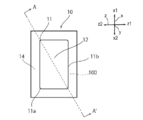
- FIGS. 5 and 6 show a schematic view in which the concave portion 100 having a rectangular shape in a plan view is provided in the exterior material 10 for a power storage device.
- the rectangular shape in a plan view includes not only a case where the corners of the rectangle are right angles, but also a rounded shape as shown in FIGS. 5 and 6.
- the curved surface portion 11 includes a corner portion 11a and a ridge line portion 11b protruding toward the base material layer 1, and the corner portion 11
- the surfaces of the base material layer 1 side of each of the 11a and the ridge line portion 11b have a predetermined radius of curvature R.
- the rectangular recess 100 in a plan view forms a rectangular parallelepiped space, and the power storage device element is housed in the space. If the shape of the recess is circular in a plan view, the recess forms a columnar space, and the power storage device element is housed in the space.
- the size of the recess 100 is not particularly limited, and is appropriately designed according to the size of the power storage device (that is, the size of the power storage device element to be accommodated) and the like.
- the length of the long side of the recess 100 is, for example, about 20 mm or more, preferably about 30 mm when the exterior material 10 for the power storage device is observed from the base material layer 1 side. As mentioned above, it is more preferably about 50 mm or more.
- the length of the long side of the recess 100 is, for example, about 600 mm or less, preferably about 400 mm or less, and more preferably about 200 mm or less.
- the preferred range of the length of the long side of the recess 100 is about 20 to 600 ⁇ m, about 20 to 400 ⁇ m, about 20 to 200 ⁇ m, about 30 to 600 ⁇ m, about 30 to 400 ⁇ m, about 30 to 200 ⁇ m, about 50 to 600 ⁇ m, 50. Examples thereof include about 400 ⁇ m and about 50 to 200 mm.
- the length of the short side of the recess 100 is, for example, about 10 mm or more, preferably about 20 mm or more, and more preferably about 30 mm or more.
- the length of the short side of the recess 100 is, for example, about 300 mm or less, preferably about 200 mm or less, and more preferably about 100 mm or less.
- the preferred range of the length of the short side of the recess 100 is about 10 to 300 ⁇ m, about 10 to 200 ⁇ m, about 10 to 100 ⁇ m, about 20 to 300 ⁇ m, about 20 to 200 ⁇ m, about 20 to 100 ⁇ m, about 30 to 300 ⁇ m, and 30. Examples thereof include about 200 ⁇ m and about 30 to 100 mm.
- the length of the long side of the recess 100 and the length of the short side may be the same (that is, the shape of the recess 100 is square in a plan view).
- the depth D of the recess 100 is not particularly limited, and is appropriately designed according to the size of the power storage device (that is, the size of the power storage device element accommodated) and the like.
- the exterior material 10 for a power storage device having a total thickness described later about 4 to 10 mm can be mentioned.
- the recess 100 included in the exterior material 10 for a power storage device is formed by molding a film-shaped exterior material for a power storage device. Specifically, a mold (female mold) arranged on the base material layer 1 side of the laminate constituting the exterior material for the power storage device and a mold (male mold) arranged on the thermosetting resin layer 4 side. ) To form the laminate (generally cold molding) so that it protrudes from the thermosetting resin layer 4 side to the base material layer 1 side, thereby forming the thermosetting resin layer 4 side. A recess 100 in which the power storage device element is housed can be formed.
- the quality control method of the present disclosure is characterized by including a determination step of determining whether or not the exterior material for a power storage device having a recess formed is a non-defective product.
- the exterior material for the power storage device to be tested is extracted from the exterior material 10 for the power storage device in which the recess 100 is formed, and the curved surface portion 11 on the outer surface forming the recess of the exterior material for the power storage device to be tested.
- the non-curved surface portion 12 the L * value of the reflected light in the L * a * b * color space is measured under the SCI method, the field of view 10 °, and the measurement conditions of the light source F2, respectively, and the magnitude of the difference between the L * values is large.
- the exterior material for the power storage device having the recess formed is a good product.
- the exterior material for the power storage device to be tested may be randomly extracted, or a predetermined ratio (for example, recesses) may be used. It may be extracted as an exterior material for a power storage device to be tested at a ratio of 1 in 1,000 to 10,000 formed exterior materials for a power storage device), or an exterior material for a power storage device having a recess formed therein. All of the above may be extracted as the exterior material for the power storage device to be tested.
- the measurement of L * value and the like is automated and incorporated into the production line in consideration of the production efficiency of the power storage device. Is desirable.
- a bent portion (see curved surfaces 11 and 13 in FIG. 6) is formed in the exterior material for the power storage device.
- whitening may occur on the surface portion.
- Whitening due to molding of the exterior material for the power storage device leads to poor appearance of the power storage device, and is therefore subject to quality control in the molding of the exterior material for the power storage device. In the quality control, for example, when the exterior material for a power storage device is colored or when the degree of whitening is large, the presence or absence of whitening can be visually confirmed.
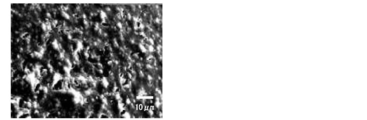
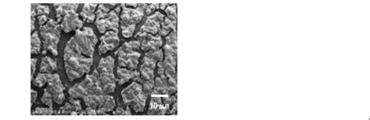
- the bent portion (outer surface of the exterior material for the power storage device) is observed by a scanning electron microscope or the like.
- a scanning electron microscope or the like When observing the curved surface portion of the above, very fine cracks may be formed. Therefore, it is desired to further improve the accuracy of the quality control method in the molding process of the exterior material for the power storage device.
- the curved portion of the recess formed by molding on the basis of the magnitude of the difference in the L * value (i.e. the absolute value of the difference between L * values), fine cracks on the curved surface portion It is possible to suitably detect the quality such as whether or not it is formed. Therefore, if the quality control method of the present disclosure is used for manufacturing a power storage device, an evaluation standard for the magnitude of the difference in L * values is appropriately set according to the quality required for the power storage device, and the exterior material for the power storage device is used. It is possible to preferably suppress the production of defective products in the molding process of.
- the evaluation criteria for the difference in L * values can be appropriately set according to the quality required for the power storage device.
- the evaluation standard is the same as the L * value of the curved surface portion 11.
- the absolute value of the difference between the non-curved surface portion 12 and L * is preferably 2.0 or less, more preferably 1.8 or less, and further preferably 1.5. Below, it is more preferably 1.0 or less, further preferably 0.5 or less, and particularly preferably 0.3 or less.
- the preferred range of the absolute value of the difference between the L * value of the curved surface portion 11 and the L * value of the non-curved surface portion 12 is about 0.0 to 2.0 and 0.0 to 1. Examples thereof include about 8, about 0.0 to 1.5, about 0.0 to 1.0, about 0.0 to 0.5, and about 0.0 to 0.3.
- a crack is generated in a layer constituting an exterior material for a power storage device such as a surface coating layer, so that a gap is generated, the gloss of the base is exposed, and the L * value of the curved surface portion is higher than that of the non-curved surface portion.
- the electrolytic solution permeates through the minute cracks, causing the exterior material to peel off. It will be connected.
- the exterior material for the power storage device cannot follow the molding and cracks occur. Therefore, even if it is hard, it is flexible and flexible. It can be adjusted by making it a characteristic. Further, even if the exterior material for a power storage device is hard and supple, if a large amount of additives such as wax and particles are present, the adhesion between the resin and the particles or the boundary between the resin and the wax is weak, and cracks are likely to occur from the boundary. Therefore, it is preferable to adjust the content of the additive to the minimum necessary.
- the electrolytic solution is used as the power storage device exterior in the power storage device manufacturing process depending on the degree of the crack.
- the electrolytic solution may permeate the cracks and peel off between the layers constituting the exterior material for the power storage device. From the viewpoint of quality control so that a power storage device having excellent electrolytic solution resistance is manufactured, the absolute value of the difference between the L * value of the curved surface portion 11 and the L * value of the non-curved surface portion 12 in the determination process.
- ABSOR value of the difference determined to be a non-defective product is preferably controlled under stricter conditions than the whitening, preferably 1.5 or less, more preferably 1.0 or less, still more preferably 0.5. Below, it is particularly preferably 0.3 or less.
- the absolute value of the difference between the L * value of the curved surface portion 11 and the L * value of the non-curved surface portion 12 is 0.0 or more.
- the preferred range of the absolute value of the difference between the L * value of the curved surface portion 11 and the L * value of the non-curved surface portion 12 is about 0.0 to 1.5, about 0.0 to 1.0, and 0.0. Examples thereof include about 0.5 and about 0.0 to 0.3.
- the absolute value of the difference between the a * value of the curved surface portion 11 and the a * value of the non-curved surface portion 12 (that is, the absolute value, which is the absolute value of the difference determined to be a good product).
- a preferable range of is about 0.00 to 0.12.
- the value of ⁇ E * ab is preferably about 1.8 or less, more preferably about 1.0 or less.
- the preferable range of the value of ⁇ E * ab is about 0.0 to 1.8 and about 0.0 to 1.0.
- the determination step can be specifically carried out as follows.
- L * a * b * under the following conditions. Measure the L * value in color space.
- the observation condition of the spectrophotometer (for example, Konica Minolta spectrophotometer (CM-700d)) calibrated with a white calibration cap (for example, CM-A177: manufactured by Konica Minolta) is 10 °, and the observation light source is F2.
- CM-700d Konica Minolta spectrophotometer
- a white calibration cap for example, CM-A177: manufactured by Konica Minolta
- the observation light source is F2.
- SCI mode JIS Z8722-2009.
- the L * value of the outer surface (the surface on the base material layer 1 side) of each of the curved surface portion 11 and the non-curved surface portion 12 to be measured is measured at room temperature and normal humidity.
- the measurement diameter is set to 8 mm ⁇
- the measurement diameter is set to 3 mm ⁇ for measurement.
- the a * value and the b * value of the curved surface portion 11 and the non-curved surface portion 12 can also be measured together with the measurement of
- the curved surface portion 11 for which the L * value is to be measured is the portion of the curved surface portion 11 forming the recess 100 that is most stretched by molding (molding in the formation of the recess 100) (that is, the finest cracks are most generated). The part that is easy to do).
- the most stretched portion is the portion where the difference between the L * values is the largest, and the portion where the L * value of the curved surface portion 11 is the largest.
- the corner portion 11a is the most extended portion of the curved surface portion 11 (rectangular shape in a plan view).
- the part 11a is the target for measuring the L * value.
- the corners 11a are present at four points in the shape of the molding die, but if the shapes of the four corners of the mold forming the corners 11a are the same, the L * value of the corners 11a since it becomes substantially the same, by measuring the L * values for the corners 11a of the one position, the measurement of the L * values for the corners 11a of the other three can be omitted.
- the curved surface portion 11 for measuring the a * value and the b * value is the same as the curved surface portion 11 for measuring the L * value.
- the ridge line portion 11b may be the most extended portion.
- the existing ridge portion 11b can be the most extended portion. In such a case, it is preferable to use the ridge line portion 11b as the measurement target of the L * value.
- the ridgeline portion is the target for measuring the L * value.
- the curved surface portion 13 in FIG. 6 is a curved surface portion that does not protrude toward the base material layer 1, and is generally stretched by molding as compared with the curved surface portion 11 that protrudes toward the base material layer 1. It is small and may or may not be adopted as the curved surface portion 11 for which the L * value is to be measured.
- the L * value of the non-curved surface portion is preferably measured as the non-curved surface portion 12 at a portion that is not substantially stretched by molding.
- the L * value of the non-curved surface portion is usually the same at any position, but for example, when the recess 100 is observed from the base material layer 1 side, the central portion of the recessed portion 100 is defined as the non-curved surface portion 12, and the L * value is L * value. It is preferable to measure.
- L * value and the non-curved portion 12 L * value of the curved surface portion 11 of the outer package 10 for a power storage device that is the object of quality control, respectively is not particularly limited, the As described above, the difference between these L * values may be appropriately managed from the viewpoints of whitening and electrolytic solution resistance.
- the exterior material 10 for a power storage device is colored (specifically, at least one of the layers located closer to the base material layer 1 than the barrier layer 3 of the exterior material 10 for a power storage device (for example,).
- the barrier layer 3 When a color different from the above is visually recognized), whitening or the like on the curved surface portion 11 is likely to be determined as a defective product, and particularly when the appearance of the exterior material 10 for a power storage device is a dark color such as black, the present disclosure is made.
- a quality control method is preferably used.
- the L * value of the non-curved surface portion 12 of the exterior material 10 for a power storage device is preferably, for example, about 60.0 or less, and more preferably about 50.0 or less. Yes, about 40.0 is more preferred, and about 30.0 or less is even more preferred.
- the L * value of the non-curved surface portion 12 is, for example, about 0.0 or more, about 10.0 or more, about 20.0 or more, and the like.
- the preferred range of the L * value of the non-curved surface portion 12 is about 0.0 to 60.0, about 0.0 to 50.0, about 0.0 to 40.0, about 0.0 to 30.0, and so on.
- the a * value of the non-curved surface portion 12 is, for example, about +2.00 or less, preferably about +1.00 or less.
- the a * value of the non-curved surface portion 12 is, for example, about ⁇ 2.00 or more, preferably about ⁇ 1.00 or more.
- the preferred range of the a * value of the non-curved surface portion 12 is about -2.00 to +2.00, about -2.00 to +1.00, about -1.00 to +2.00, and -1.00 to +1. About .00 is mentioned.
- the b * value of the non-curved surface portion 12 is, for example, about +1.00 or less, preferably about +0.00 or less.
- the b * value of the non-curved surface portion 12 is, for example, about ⁇ 3.00 or more, preferably about ⁇ 2.00 or more.
- the preferable range of the b * value of the non-curved surface portion 12 is about -3.00 to +1.00, about -3.00 to +0.00, about -2.00 to +1.00, and -2.00 to +0. About .00 is mentioned.
- the layer located at the outermost layer of the exterior material 10 for the power storage device for example, the base material layer 1 described later, the surface coating.
- the composition and thickness of the layer 6 and the like, the shape and size of the mold, the surface roughness, and the pressing pressure of the mold are adjusted to obtain a predetermined value.
- the difference between the L * value of the curved surface portion 11 and the L * value of the non-curved surface portion 12 is adjusted by adjusting the laminating conditions of each layer in the laminating process of the exterior material 10 for the power storage device. You may.
- the mirror glossiness of the non-curved surface portion 12 of the exterior material 10 for a power storage device is preferably, for example, about 5.0 or less, and more preferably about 3.6 or less. Is.
- the mirror glossiness is, for example, about 1.0 or more. Preferred ranges of the mirror glossiness include about 1.0 to 5.0 and about 1.0 to 3.6.
- the mirror glossiness of the non-curved surface portion 12 of the exterior material 10 for a power storage device is specified as follows.
- the mirror glossiness of the non-curved surface portion of the exterior material for the power storage device in which the recess is formed is substantially the mirror glossiness of the outer surface (position of the non-curved surface portion after molding) of the exterior material for the power storage device before molding. (That is, the mirror glossiness does not substantially change due to molding in the non-curved surface portion, but for example, when the recess 100 is observed from the base material layer 1 side, the central portion of the recess 100 is designated as the non-curved surface portion 12. Therefore, it is preferable to measure the mirror surface glossiness.) Therefore, when the exterior material for the power storage device before molding is available, the mirror surface gloss on the outer surface of the exterior material for the power storage device before molding is measured as follows. It may be measured by a method.
- the mirror glossiness of the outer surface of the non-curved surface portion of the exterior material for a power storage device is measured by the following measuring method.
- an incident angle of 60 degrees is used using a gloss measuring device (for example, a gloss measuring device micro-tri-gloss manufactured by Toyo Seiki Seisakusho (measurement area 9 mm x 15 mm)).
- the mirror glossiness of the surface coating layer in the above is measured.
- the power storage device in which the recess is formed is based on the magnitude of the L * value of the curved portion and the non-curved portion forming the recess. It is a new quality control method that includes a judgment process to judge whether the exterior material for use is non-defective, and performs more accurate quality control than the conventional quality control using visual inspection or a camera. Is also possible. Therefore, by utilizing the quality control method of the present disclosure for manufacturing a power storage device, it is possible to more efficiently manufacture a non-defective product of the power storage device.
- the determination step is based on whether or not the exterior material for a power storage device has fine cracks formed in the layer constituting the exterior material for the power storage device, for example, by molding when forming the recess. It can be used as a determination method for evaluating the characteristics (molding characteristics) of the above, and by using this determination method, the characteristics of the exterior material for a power storage device can be easily evaluated without using a scanning electron microscope or the like. be able to.
- the manufacturing method of the power storage device of the present disclosure is composed of a laminate including at least a base material layer 1, a barrier layer 3, and a thermosetting resin layer 4 in this order from the outside.
- the power storage device element is sealed by a package formed by heat-sealing the thermosetting resin layer 4.
- This is a method for manufacturing a power storage device.
- the method for manufacturing the power storage device of the present disclosure uses the quality control method described in the column of "1. Quality control method" for manufacturing the power storage device, and the description of overlapping matters will be omitted as appropriate. Further, as described above, the laminated structure of the exterior material for the power storage device and the details of each layer will be described later.
- the power storage device exterior is formed with a recess for accommodating the power storage device element so as to project from the thermosetting resin layer side to the base material layer side of the power storage device exterior material. It has a process of preparing materials.
- the exterior material for the power storage device in which such a recess is formed is as described in the above section “1. Quality control method”, and the description thereof will be omitted.
- the exterior material for the power storage device to be tested is extracted from the exterior material for the power storage device in which the recess is formed, and the outer side forming the recess of the exterior material for the power storage device to be tested is formed.
- the curved surface and non-curved surface measure the L * value of the reflected light in the L * a * b * color space under the SCI method, the field of view 10 °, and the measurement conditions of the light source F2, respectively, and obtain the L * value. It is provided with a determination step of determining whether or not the exterior material for a power storage device having a recess formed is a good product based on the magnitude of the difference.
- the determination process is also as described in the above section “1. Quality control method”, and the description thereof will be omitted. If, in the determination process of the method for manufacturing the energy storage device of the present disclosure, the exterior material for the energy storage device having the recess formed is determined to be a defective product, the process of laminating the exterior material for the energy storage device or the exterior of the energy storage device The process returns to the material molding process, and the configuration, laminating method, molding conditions, etc. of the exterior material for the power storage device are adjusted until the product is judged to be non-defective in the determination process.
- the method for manufacturing a power storage device of the present disclosure includes a step of manufacturing a power storage device by accommodating a power storage device element in a recess of an exterior material for the power storage device.
- a step of manufacturing a power storage device by accommodating a power storage device element in a recess of an exterior material for the power storage device.
- the exterior material for the power storage device in which the recess is formed is a non-defective product
- it is determined that the formation of the recess is appropriate, and the recess is formed.
- a power storage device element is housed in the storage device to manufacture a power storage device.
- the evaluation criteria for the difference in L * values can be appropriately set according to the quality required for the power storage device.
- the absolute value of the difference between L * values of the non-curved portion 12 is preferably 2.0 or less, more preferably 1.8 or less, further It is preferably 1.5 or less, more preferably 1.0 or less, still more preferably 0.5 or less, and particularly preferably 0.3 or less.
- the preferred range of the absolute value of the difference between the L * value of the curved surface portion 11 and the L * value of the non-curved surface portion 12 is about 0.0 to 2.0 and 0.0 to 1. Examples thereof include about 8, about 0.0 to 1.5, about 0.0 to 1.0, about 0.0 to 0.5, and about 0.0 to 0.3.
- the L * value of the curved surface portion 11, of the non-curved portion 12 L * value
- the absolute value of the difference from the above is preferably controlled under stricter conditions than the whitening, preferably 1.5 or less, more preferably 1.0 or less. It is more preferably 0.5 or less, and particularly preferably 0.3 or less.
- the absolute value of the difference between the L * value of the curved surface portion 11 and the L * value of the non-curved surface portion 12 is 0.0 or more.
- the preferred range of the absolute value of the difference between the L * value of the curved surface portion 11 and the L * value of the non-curved surface portion 12 is about 0.0 to 1.5, about 0.0 to 1.0, and 0.0. Examples thereof include about 0.5 and about 0.0 to 0.3. From the same viewpoint, the absolute value of the difference between the a * value of the curved surface portion 11 and the a * value of the non-curved surface portion 12 (that is, the absolute value, which is the absolute value of the difference determined to be a good product). A preferable range of is about 0.00 to 0.12.
- a known method can be applied to the method of manufacturing the power storage device by accommodating the power storage device element in the recess 100. Specifically, the electrode, the electrolytic solution, and the like constituting the power storage device element are housed in the recess 100, and the heat-sealing resin layers 4 of the exterior material 10 for the power storage device are heat-sealed to form the power storage device element. Seal to obtain a power storage device.
- the inspection method of the present disclosure is an inspection method of an exterior material for a power storage device in which a recess is formed.
- the exterior material for a power storage device composed of a laminate including a base material layer, a barrier layer, and a thermosetting resin layer, in order from the outside, is the thermosetting resin.
- the inspection target is an exterior material for a power storage device, which is formed so as to project from the layer side to the base material layer side and has a recess formed on the heat-sealing resin layer side for accommodating the power storage device element.
- the quality control method of the present disclosure described above can be said to be a quality control method using the inspection method of the present disclosure, and the description of matters overlapping with the matters described in the above-mentioned "1. Quality control method" column will be omitted as appropriate. Further, as described above, the laminated structure of the exterior material for the power storage device and the details of each layer will be described later.
- the exterior material for the power storage device in which the recess to be inspected is formed is as described in the above section "1. Quality control method", and the description thereof will be omitted.
- the curved surface portion and the non-curved surface portion of the outer surface forming the concave portion of the exterior material for the power storage device in which the concave portion is formed are subjected to the SCI method, the field of view 10 °, and the measurement conditions of the light source F2, respectively.
- the determination process is also as described in the above section “1. Quality control method”, and the description thereof will be omitted.
- the evaluation criteria for the difference in L * values can be appropriately set according to the quality required for the power storage device.
- the absolute value of the difference between L * values of the non-curved portion 12 is preferably 2.0 or less, more preferably 1.8 or less, further It is preferably 1.5 or less, more preferably 1.0 or less, still more preferably 0.5 or less, and particularly preferably 0.3 or less.
- the preferred range of the absolute value of the difference between the L * value of the curved surface portion 11 and the L * value of the non-curved surface portion 12 is about 0.0 to 2.0 and 0.0 to 1. Examples thereof include about 8, about 0.0 to 1.5, about 0.0 to 1.0, about 0.0 to 0.5, and about 0.0 to 0.3.
- the L * value of the curved surface portion 11, of the non-curved portion 12 L * value
- the absolute value of the difference from the above is preferably controlled under stricter conditions than the whitening, preferably 1.5 or less, more preferably 1.0 or less. It is more preferably 0.5 or less, and particularly preferably 0.3 or less.
- the absolute value of the difference between the L * value of the curved surface portion 11 and the L * value of the non-curved surface portion 12 is 0.0 or more.
- the preferred range of the absolute value of the difference between the L * value of the curved surface portion 11 and the L * value of the non-curved surface portion 12 is about 0.0 to 1.5, about 0.0 to 1.0, and 0.0. Examples thereof include about 0.5 and about 0.0 to 0.3. From the same viewpoint, the absolute value of the difference between the a * value of the curved surface portion 11 and the a * value of the non-curved surface portion 12 (that is, the absolute value, which is the absolute value of the difference determined to be a good product). A preferable range of is about 0.00 to 0.12.
- Exterior material for power storage device is composed of a laminated body including a base material layer 1, a barrier layer 3, and a thermosetting resin layer 4, at least in this order from the outside. It is an exterior material for devices.
- the exterior material 10 for a power storage device is formed so as to project from the thermosetting resin layer 4 side to the base material layer 1 side, and the recess 100 in which the power storage device element is housed on the heat fusion resin layer 4 side. It has.
- the reflected light L * a * b * is obtained under the SCI method, the field of view 10 °, and the measurement conditions of the light source F2, respectively.
- the absolute value of the difference between the L * value of the curved surface portion 11, of the non-curved portion 12 and the L * is characterized by more than 1.5. That is, the case 10 for a power storage device of the present disclosure, one of the "1.
- the electrolytic solution may be used as the exterior material for the power storage device in the manufacturing process of the power storage device depending on the degree of the cracks. When it adheres to the surface, the electrolytic solution may permeate into the cracks and the layers constituting the exterior material for the power storage device may be peeled off. Therefore, the absolute value of the difference between the L * value of the curved surface portion 11 of the exterior material 10 for the power storage device in which the recess is formed and the L * value of the non-curved surface portion 12 should be managed under stricter conditions than the whitening. Is desirable.
- the absolute value of the difference between the L * value of the curved surface portion 11 and the L * value of the non-curved surface portion 12 is particularly low, 1.5 or less. It is set to a value.
- the absolute value of the difference between the L * value of the curved surface portion 11 and the L * value of the non-curved surface portion 12 is preferably 1.0 or less, more preferably 0.5 or less. , Especially preferably 0.3 or less.
- the absolute value of the difference between the L * value of the curved surface portion 11 and the L * value of the non-curved surface portion 12 is 0.0 or more.
- the preferred range of the absolute value of the difference between the L * value of the curved surface portion 11 and the L * value of the non-curved surface portion 12 is about 0.0 to 1.5, about 0.0 to 1.0, and 0.0. Examples thereof include about 0.5 and about 0.0 to 0.3. From the same viewpoint, a preferable range of the absolute value of the difference between the a * value of the curved surface portion 11 and the a * value of the non-curved surface portion 12 is about 0.00 to 0.12. From the same viewpoint, a preferable range of the absolute value of the difference between the b * value of the curved surface portion and the b * value of the non-curved surface portion is about 0.00 to 0.60.
- the preferable L * value, a * value, and b * value of the curved surface portion 11 and the non-curved surface portion 12, the measurement method thereof, and the details of the measurement location are as described in "1. Quality control method" above.
- the exterior material 10 for a power storage device before forming the recess 100 is described below so that the exterior material for the power storage device protrudes from the thermosetting resin layer 4 side to the base material layer 1 side.
- the curved surface portion 11 and the non-curved surface portion 12 on the outer surface which are molded under the molding conditions to form a recess on the thermosetting resin layer 4 side in which the power storage device element is housed to form the recess of the exterior material 10 for the power storage device.
- the non-curved portion It is preferable that the absolute value of the difference between 12 and L * is 1.5 or less.
- the electric storage device for the exterior material 10 is not formed a recess as described above, to form a recess at a predetermined molding condition, and the L * value of the curved surface portion 11, the absolute of the difference between the non-curved portion 12 L * The value is 1.5 or less.
- the exterior material for the power storage device is placed between the molding die (female mold) having a diameter of 54.5 mm (TD) x 31.6 mm (MD) and the corresponding molding die (male mold) on the female mold side. It is arranged so as to be on the base material layer side, the pressing pressure (surface pressure) is 0.25 MPa, and cold molding is performed at a molding depth of 3.0 mm to form a concave portion having a rectangular shape in a plan view.
- the clearance between the female type and the male type is 0.5 mm.
- the surface of the female mold has a maximum height roughness (nominal value of Rz) of 0.8 ⁇ m specified in Table 2 of the comparative surface roughness standard piece in JIS B 0659-1: 2002 Annex 1 (reference). ..
- the female corner R is 2.0 mm and the ridge R is 2.5 mm.
- the male surface has a maximum height roughness (nominal value of Rz) of 3.2 ⁇ m specified in Table 2 of the comparative surface roughness standard piece in JIS B 0659-1: 2002 Annex 1 (reference). ..
- the male corner R is 2.0 mm and the ridge R is 2.0 mm.
- the male-shaped corner R and ridge line R have a maximum height roughness (nominal value of Rz) of 1 as specified in Table 2 of the comparative surface roughness standard piece in JIS B 0659-1: 2002 Annex 1 (reference). It is 0.6 ⁇ m.
- the absolute value of the difference between the L * value of the curved surface portion 11 and the L * value of the non-curved surface portion 12 after the recess is formed under the above-mentioned molding conditions. Is preferably 1.0 or less, more preferably 0.5 or less, and particularly preferably 0.3 or less. As described above, the absolute value of the difference between the L * value of the curved surface portion 11 and the L * value of the non-curved surface portion 12 is 0.0 or more. The preferred range of the absolute value of the difference between the L * value of the curved surface portion 11 and the L * value of the non-curved surface portion 12 is about 0.0 to 1.5, about 0.0 to 1.0, and 0.0.
- Examples thereof include about 0.5 and about 0.0 to 0.3. From the same viewpoint, a preferable range of the absolute value of the difference between the a * value of the curved surface portion 11 and the a * value of the non-curved surface portion 12 is about 0.00 to 0.12. From the same viewpoint, a preferable range of the absolute value of the difference between the b * value of the curved surface portion and the b * value of the non-curved surface portion is about 0.00 to 0.60. Further, the preferable L * value, a * value, and b * value of the curved surface portion 11 and the non-curved surface portion 12, the measurement method thereof, and the details of the measurement location are as described in "1. Quality control method" above. is there.
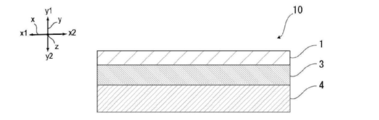
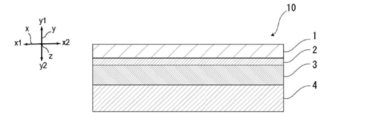
- the exterior material 10 for power storage device is composed of a laminate having at least a base material layer 1, a barrier layer 3, and a thermosetting resin layer 4 in this order. It is configured.
- the base material layer 1 is on the outermost layer side
- the thermosetting resin layer 4 is on the innermost layer.
- the peripheral portion 14 is heat-sealed with the thermosetting resin layers 4 of the power storage device exterior material 10 facing each other. The energy storage device element is housed in the space formed by this.
- the heat-sealing resin layer 4 side is inside the barrier layer 3 and the base material layer 1 side is more than the barrier layer 3 with the barrier layer 3 as a reference. It is the outside.
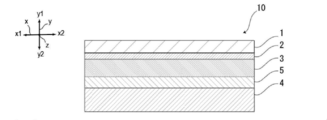
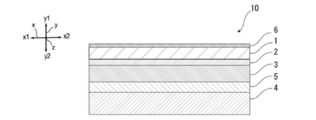
- the exterior material 10 for a power storage device is used as necessary for the purpose of enhancing the adhesiveness between the base material layer 1 and the barrier layer 3 and the like. It may have an adhesive layer 2. Further, for example, as shown in FIGS. 3 and 4, the adhesive layer 5 is required between the barrier layer 3 and the thermosetting resin layer 4 for the purpose of enhancing the adhesiveness between the layers. May have. Further, as shown in FIG. 4, a surface coating layer 6 or the like may be provided on the outside of the base material layer 1 (the side opposite to the thermosetting resin layer 4 side), if necessary.
- the thickness of the laminate constituting the exterior material 10 for the power storage device is not particularly limited, but is preferably about 180 ⁇ m or less, about 155 ⁇ m or less, and about 120 ⁇ m or less from the viewpoint of cost reduction, energy density improvement, and the like. Further, the thickness of the laminate constituting the exterior material 10 for the power storage device is preferably about 35 ⁇ m or more, about 45 ⁇ m or more, and about from the viewpoint of maintaining the function of the exterior material for the power storage device of protecting the power storage device element. 60 ⁇ m or more can be mentioned.
- the preferred range of the laminate constituting the exterior material 10 for the power storage device is, for example, about 35 to 180 ⁇ m, about 35 to 155 ⁇ m, about 35 to 120 ⁇ m, about 45 to 180 ⁇ m, about 45 to 155 ⁇ m, about 45 to 120 ⁇ m. , About 60 to 180 ⁇ m, about 60 to 155 ⁇ m, about 60 to 120 ⁇ m, and particularly preferably about 60 to 155 ⁇ m.
- the ratio of the total thickness of the adhesive layer 5, the thermosetting resin layer 4, and the surface coating layer 6 provided as needed is preferably 90% or more, more preferably 95% or more. More preferably, it is 98% or more.
- the exterior material 10 for a power storage device of the present disclosure includes a base material layer 1, an adhesive layer 2, a barrier layer 3, an adhesive layer 5, and a thermosetting resin layer 4, the exterior for the power storage device
- the ratio of the total thickness of each of these layers to the thickness (total thickness) of the laminate constituting the material 10 is preferably 90% or more, more preferably 95% or more, and further preferably 98% or more.
- the exterior material 10 for a power storage device of the present disclosure is a laminated body including a base material layer 1, an adhesive layer 2, a barrier layer 3, and a thermosetting resin layer 4, the exterior material for a power storage device is also used.
- the ratio of the total thickness of each of these layers to the thickness (total thickness) of the laminate constituting 10 is, for example, 80% or more, preferably 90% or more, more preferably 95% or more, and further preferably 98% or more. Can be done.
- the base material layer 1 is a layer provided for the purpose of exerting a function as a base material of an exterior material for a power storage device.
- the base material layer 1 is located on the outer layer side of the exterior material for the power storage device.
- the material forming the base material layer 1 is not particularly limited as long as it has a function as a base material, that is, at least an insulating property.
- the base material layer 1 can be formed using, for example, a resin, and the resin may contain an additive described later.
- the base material layer 1 may be, for example, a resin film formed of resin or may be formed by applying a resin.
- the resin film may be an unstretched film or a stretched film.
- the stretched film include a uniaxially stretched film and a biaxially stretched film, and a biaxially stretched film is preferable.
- the stretching method for forming the biaxially stretched film include a sequential biaxial stretching method, an inflation method, and a simultaneous biaxial stretching method.
- the method for applying the resin include a roll coating method, a gravure coating method, and an extrusion coating method.
- the resin forming the base material layer 1 examples include resins such as polyester, polyamide, polyolefin, epoxy resin, acrylic resin, fluororesin, polyurethane, silicon resin, and phenol resin, and modified products of these resins. Further, the resin forming the base material layer 1 may be a copolymer of these resins, or may be a modified product of the copolymer. Further, it may be a mixture of these resins.
- the resin forming the base material layer 1 include polyester and polyamide.
- polyester examples include polyethylene terephthalate, polybutylene terephthalate, polyethylene naphthalate, polybutylene naphthalate, polyethylene isophthalate, and copolymerized polyester.
- copolymerized polyester examples include a copolymerized polyester containing ethylene terephthalate as a repeating unit.
- a copolymer polyester hereinafter abbreviated after polyethylene (terephthalate / isophthalate)
- polyethylene (terephthalate / adipate) polyethylene (terephthalate / terephthalate /)
- polyethylene (terephthalate / terephthalate /) which polymerizes with ethylene isophthalate using ethylene terephthalate as a repeating unit as a main component.
- polyesters (Sodium sulfoisophthalate), polyethylene (terephthalate / sodium isophthalate), polyethylene (terephthalate / phenyl-dicarboxylate), polyethylene (terephthalate / decandicarboxylate) and the like. These polyesters may be used alone or in combination of two or more.
- polyamide specifically, an aliphatic polyamide such as nylon 6, nylon 66, nylon 610, nylon 12, nylon 46, a copolymer of nylon 6 and nylon 66; terephthalic acid and / or isophthalic acid.
- Hexamethylenediamine-isophthalic acid-terephthalic acid copolymerized polyamide such as nylon 6I, nylon 6T, nylon 6IT, nylon 6I6T (I stands for isophthalic acid, T stands for terephthalic acid), polyamide MXD6 (polymethaki) containing the derived structural units.
- Polyamide containing aromatics such as silylene adipamide); Alicyclic polyamide such as polyamide PACM6 (polybis (4-aminocyclohexyl) methaneadipamide); Further, lactam component and isocyanate component such as 4,4'-diphenylmethane-diisocyanate Examples thereof include a copolymerized polyamide, a polyesteramide copolymer or a polyether esteramide copolymer which is a copolymer of a copolymerized polyamide and a polyester or a polyalkylene ether glycol; and a polyamide such as these copolymers. These polyamides may be used alone or in combination of two or more.
- the base material layer 1 preferably contains at least one of a polyester film, a polyamide film, and a polyolefin film, and preferably contains at least one of a stretched polyester film, a stretched polypropylene film, and a stretched polyolefin film. It is more preferable to contain at least one of a stretched polyethylene terephthalate film, a stretched polybutylene terephthalate film, a stretched nylon film, and a stretched polypropylene film, preferably a biaxially stretched polyethylene terephthalate film, a biaxially stretched polybutylene terephthalate film, and a biaxially stretched nylon film. , It is more preferable to contain at least one of the biaxially stretched polypropylene films.
- the base material layer 1 may be a single layer or may be composed of two or more layers.
- the base material layer 1 may be a laminated body in which a resin film is laminated with an adhesive or the like, or the resin is co-extruded to form two or more layers. It may be a laminated body of the resin film. Further, the laminated body of the resin film obtained by co-extruding the resin into two or more layers may be used as the base material layer 1 without being stretched, or may be uniaxially stretched or biaxially stretched as the base material layer 1.
- the laminate of two or more layers of resin film in the base material layer 1 include a laminate of a polyester film and a nylon film, a laminate of two or more layers of nylon film, and a laminate of two or more layers of polyester film. And the like, preferably, a laminate of a stretched nylon film and a stretched polyester film, a laminate of two or more layers of stretched nylon film, and a laminate of two or more layers of stretched polyester film are preferable.
- the base material layer 1 is a laminate of two layers of resin film, a laminate of polyester resin film and polyester resin film, a laminate of polyamide resin film and polyamide resin film, or a laminate of polyester resin film and polyamide resin film.
- a laminate is preferable, and a laminate of a polyethylene terephthalate film and a polyethylene terephthalate film, a laminate of a nylon film and a nylon film, or a laminate of a polyethylene terephthalate film and a nylon film is more preferable.
- the polyester resin is difficult to discolor when the electrolytic solution adheres to the surface, for example, when the base material layer 1 is a laminate of two or more resin films, the polyester resin film is the base material layer 1. It is preferably located in the outermost layer.
- the two or more layers of resin films may be laminated via an adhesive.
- Preferred adhesives include those similar to the adhesives exemplified in the adhesive layer 2 described later.
- the method of laminating two or more layers of resin films is not particularly limited, and known methods can be adopted. Examples thereof include a dry laminating method, a sandwich laminating method, an extrusion laminating method, and a thermal laminating method, and a dry laminating method is preferable.
- the laminating method can be mentioned.
- the thickness of the adhesive is, for example, about 2 to 5 ⁇ m.
- an anchor coat layer may be formed on the resin film and laminated. Examples of the anchor coat layer include the same adhesives as those exemplified in the adhesive layer 2 described later. At this time, the thickness of the anchor coat layer is, for example, about 0.01 to 1.0 ⁇ m.
- additives such as a lubricant, a flame retardant, an antiblocking agent, an antioxidant, a light stabilizer, a tackifier, and an antistatic agent are present on at least one of the surface and the inside of the base material layer 1. Good. Only one type of additive may be used, or two or more types may be mixed and used.
- the lubricant is present on the surface of the base material layer 1.
- the lubricant is not particularly limited, but an amide-based lubricant is preferable.
- Specific examples of the amide-based lubricant include saturated fatty acid amides, unsaturated fatty acid amides, substituted amides, methylol amides, saturated fatty acid bisamides, unsaturated fatty acid bisamides, fatty acid ester amides, and aromatic bisamides.
- saturated fatty acid amide examples include lauric acid amide, palmitic acid amide, stearic acid amide, bechenic acid amide, hydroxystearic acid amide and the like.
- unsaturated fatty acid amide examples include oleic acid amide and erucic acid amide.
- substituted amide examples include N-oleyl palmitic acid amide, N-stearyl stearic acid amide, N-stearyl oleic acid amide, N-oleyl stearic acid amide, N-stearyl erucate amide and the like.
- methylolamide examples include methylolstearic acid amide.
- saturated fatty acid bisamide examples include methylene bisstearic acid amide, ethylene biscapric acid amide, ethylene bislauric acid amide, ethylene bisstearic acid amide, ethylene bishydroxystearic acid amide, ethylene bisbechenic acid amide, and hexamethylene bisstearate.
- saturated fatty acid bisamide examples include acid amides, hexamethylene bisbechenic acid amides, hexamethylene hydroxystearic acid amides, N, N'-distearyl adipate amides, and N, N'-distealyl sebasic acid amides.
- unsaturated fatty acid bisamides include ethylene bisoleic acid amide, ethylene biserucic acid amide, hexamethylene bisoleic acid amide, N, N'-diorail adipate amide, and N, N'-diorail sebacic acid amide. And so on.
- Specific examples of the fatty acid ester amide include stearoamide ethyl stearate and the like.
- Specific examples of the aromatic bisamide include m-xylylene bisstearic acid amide, m-xylylene bishydroxystearic acid amide, and N, N'-distearyl isophthalic acid amide.
- One type of lubricant may be used alone, or two or more types may be used in combination.
- the abundance thereof is not particularly limited, but is preferably about 3 mg / m 2 or more, more preferably about 4 to 15 mg / m 2 , and further preferably 5 to 14 mg. / M 2 is mentioned.
- the lubricant existing on the surface of the base material layer 1 may be one in which the lubricant contained in the resin constituting the base material layer 1 is exuded, or one in which the lubricant is applied to the surface of the base material layer 1. You may.
- the thickness of the base material layer 1 is not particularly limited as long as it functions as a base material, and examples thereof include about 3 to 50 ⁇ m, preferably about 10 to 35 ⁇ m.
- the thickness of the resin films constituting each layer is preferably about 2 to 25 ⁇ m, respectively.
- the adhesive layer 2 is a layer provided between the base material layer 1 and the barrier layer 3 as necessary for the purpose of enhancing the adhesiveness.
- the adhesive layer 2 is formed by an adhesive capable of adhering the base material layer 1 and the barrier layer 3.
- the adhesive used for forming the adhesive layer 2 is not limited, but may be any of a chemical reaction type, a solvent volatile type, a heat melting type, a hot pressure type and the like. Further, it may be a two-component curable adhesive (two-component adhesive), a one-component curable adhesive (one-component adhesive), or a resin that does not involve a curing reaction. Further, the adhesive layer 2 may be a single layer or a multilayer.
- the adhesive component contained in the adhesive include polyesters such as polyethylene terephthalate, polybutylene terephthalate, polyethylene naphthalate, polybutylene naphthalate, polyethylene isophthalate, and copolymerized polyester; polyether; polyurethane; epoxy resin; Phenolic resin; Polyethylene such as nylon 6, nylon 66, nylon 12, copolymerized polyamide; Polyethylene resin such as polyolefin, cyclic polyolefin, acid-modified polyolefin, acid-modified cyclic polyolefin; Polyvinyl acetate; Cellulose; (Meta) acrylic resin; Polyethylene; polycarbonate; amino resin such as urea resin and melamine resin; rubber such as chloroprene rubber, nitrile rubber and styrene-butadiene rubber; silicone resin and the like.
- polyesters such as polyethylene terephthalate, polybutylene terephthalate, polyethylene naphthalate, polybutylene
- adhesive components may be used alone or in combination of two or more.
- a polyurethane adhesive is preferable.
- the resins used as these adhesive components can be used in combination with an appropriate curing agent to increase the adhesive strength.
- An appropriate curing agent is selected from polyisocyanate, polyfunctional epoxy resin, oxazoline group-containing polymer, polyamine resin, acid anhydride and the like, depending on the functional group of the adhesive component.
- polyurethane adhesive examples include a polyurethane adhesive containing a main agent containing a polyol compound and a curing agent containing an isocyanate compound.
- a polyol such as a polyester polyol, a polyether polyol, and an acrylic polyol is used as a main component, and an aromatic or aliphatic polyisocyanate is used as a curing agent.
- the polyol compound it is preferable to use a polyester polyol having a hydroxyl group in the side chain in addition to the hydroxyl group at the end of the repeating unit.
- Examples of the curing agent include aliphatic, alicyclic, aromatic, and aromatic aliphatic isocyanate compounds.
- Examples of the isocyanate-based compound include hexamethylene diisocyanate (HDI) xylylene diisocyanate (XDI), isophorone diisocyanate (IPDI), hydrogenated XDI (H6XDI), hydrogenated MDI (H12MDI), tolylene diisocyanate (TDI), and diphenylmethane diisocyanate ( MDI), naphthalenediocyanate (NDI) and the like.
- HDI hexamethylene diisocyanate
- XDI xylylene diisocyanate
- IPDI isophorone diisocyanate
- H6XDI hydrogenated XDI
- H12MDI hydrogenated MDI
- TDI tolylene diisocyanate
- MDI diphenylmethane diisocyanate
- a multimer for example, a trimer
- a multimer include an adduct body, a biuret body, a nurate body and the like. Since the adhesive layer 2 is formed of a polyurethane adhesive, excellent electrolyte resistance is imparted to the exterior material for the power storage device, and even if the electrolyte adheres to the side surface, the base material layer 1 is suppressed from peeling off. ..
- the adhesive layer 2 may contain a colorant, a thermoplastic elastomer, a tackifier, a filler (including particles) and the like, as long as the adhesiveness is not impaired. Since the adhesive layer 2 contains a colorant, the exterior material for the power storage device can be colored. As the colorant, known pigments, dyes and the like can be used. Further, only one type of colorant may be used, or two or more types may be mixed and used.
- the exterior material 10 for the power storage device is colored (specifically, at least one of the layers located closer to the base material layer 1 than the barrier layer 3 of the exterior material 10 for the power storage device 10).
- the exterior material 10 for a power storage device is observed from the base material layer 1 side by coloring the layers (for example, the base material layer 1, the adhesive layer 2, the coloring layer, the surface coating layer 6, etc., which will be described later).
- the layers for example, the base material layer 1, the adhesive layer 2, the coloring layer, the surface coating layer 6, etc., which will be described later.
- whitening on the curved surface portion 11 is likely to be determined as a defective product, and particularly when the appearance of the exterior material 10 for a power storage device is a dark color such as black.
- the quality control method of the present disclosure becomes effective. Therefore, it is preferable that the adhesive layer 2 of the exterior material 10 for the power storage device is colored.
- the type of pigment is not particularly limited as long as it does not impair the adhesiveness of the adhesive layer 2.
- organic pigments include azo-based, phthalocyanine-based, quinacridone-based, anthracinone-based, dioxazine-based, indigothioindigo-based, perinone-perylene-based, isowearnine-based, and benzimidazolone-based pigments, which are inorganic.
- the pigment include carbon black-based, titanium oxide-based, cadmium-based, lead-based, chromium oxide-based, and iron-based pigments, and other examples include fine powder of mica (mica) and fish scale foil.
- colorants for example, carbon black is preferable in order to make the appearance of the exterior material for a power storage device black.
- the average particle size of the pigment is not particularly limited, and examples thereof include about 0.05 to 5 ⁇ m, preferably about 0.08 to 2 ⁇ m.
- the average particle size of the pigment is the median size measured by a laser diffraction / scattering type particle size distribution measuring device.
- the content of the pigment in the adhesive layer 2 is not particularly limited as long as the exterior material for the power storage device is colored, and examples thereof include about 5 to 60% by mass, preferably 10 to 40% by mass.
- the thickness of the adhesive layer 2 is not particularly limited as long as the base material layer 1 and the barrier layer 3 can be adhered to each other, but is, for example, about 1 ⁇ m or more and about 2 ⁇ m or more.
- the thickness of the adhesive layer 2 is, for example, about 10 ⁇ m or less and about 5 ⁇ m or less.
- the preferable range of the thickness of the adhesive layer 2 is about 1 to 10 ⁇ m, about 1 to 5 ⁇ m, about 2 to 10 ⁇ m, and about 2 to 5 ⁇ m.
- the colored layer is a layer provided between the base material layer 1 and the barrier layer 3 as needed (not shown).
- a colored layer may be provided between the base material layer 1 and the adhesive layer 2 and between the adhesive layer 2 and the barrier layer 3. Further, a colored layer may be provided on the outside of the base material layer 1. By providing the coloring layer, the exterior material for the power storage device can be colored.
- a colored adhesive layer 2 and a colored layer may be provided between the base material layer 1 and the barrier layer 3.
- the colored layer can be formed, for example, by applying an ink containing a colorant to the surface of the base material layer 1 or the surface of the barrier layer 3.
- a colorant known pigments, dyes and the like can be used. Further, only one type of colorant may be used, or two or more types may be mixed and used.
- colorant contained in the colored layer include the same as those exemplified in the column of [Adhesive layer 2].
- the barrier layer 3 is at least a layer that suppresses the infiltration of water.
- Examples of the barrier layer 3 include a metal foil having a barrier property, a thin-film deposition film, a resin layer, and the like.
- Examples of the vapor deposition film include a metal vapor deposition film, an inorganic oxide vapor deposition film, a carbon-containing inorganic oxide vapor deposition film, and the like
- examples of the resin layer include polymers and tetras mainly composed of polyvinylidene chloride and chlorotrifluoroethylene (CTFE). Examples thereof include polymers containing fluoroethylene (TFE) as a main component, polymers having a fluoroalkyl group, fluorine-containing resins such as polymers containing fluoroalkyl units as a main component, and ethylene vinyl alcohol copolymers.
- examples of the barrier layer 3 include a resin film provided with at least one of these vapor-deposited films and a resin layer.
- a plurality of barrier layers 3 may be provided.
- the barrier layer 3 preferably includes a layer made of a metal material.
- Specific examples of the metal material constituting the barrier layer 3 include an aluminum alloy, stainless steel, titanium steel, and a steel plate.
- the metal material includes at least one of an aluminum alloy foil and a stainless steel foil. Is preferable.
- the aluminum alloy foil is more preferably a soft aluminum alloy foil composed of, for example, an annealed aluminum alloy, and the viewpoint of further improving the moldability. Therefore, it is preferable that the aluminum alloy foil contains iron.
- the iron-containing aluminum alloy foil (100% by mass) the iron content is preferably 0.1 to 9.0% by mass, more preferably 0.5 to 2.0% by mass.
- the iron content is 0.1% by mass or more, an exterior material for a power storage device having more excellent moldability can be obtained.
- the iron content is 9.0% by mass or less, a more flexible exterior material for a power storage device can be obtained.
- the soft aluminum alloy foil for example, an aluminum alloy having a composition specified by JIS H4160: 1994 A8021HO, JIS H4160: 1994 A8079HO, JIS H4000: 2014 A8021PO, or JIS H4000: 2014 A8077P-O. Foil is mentioned. Further, if necessary, silicon, magnesium, copper, manganese and the like may be added. Further, softening can be performed by annealing or the like.
- stainless steel foils examples include austenite-based, ferrite-based, austenite-ferritic-based, martensitic-based, and precipitation-hardened stainless steel foils. Further, from the viewpoint of providing an exterior material for a power storage device having excellent moldability, the stainless steel foil is preferably made of austenitic stainless steel.
- austenitic stainless steel constituting the stainless steel foil include SUS304, SUS301, and SUS316L, and among these, SUS301 or SUS304 is particularly preferable.
- the thickness of the barrier layer 3 may at least exhibit a function as a barrier layer that suppresses the infiltration of water, and is, for example, about 9 to 200 ⁇ m.
- the thickness of the barrier layer 3 is preferably about 85 ⁇ m or less, more preferably about 50 ⁇ m or less, still more preferably about 40 ⁇ m or less, and particularly preferably about 35 ⁇ m or less.
- the thickness of the barrier layer 3 is preferably about 10 ⁇ m or more, more preferably about 20 ⁇ m or more, and more preferably about 25 ⁇ m or more.
- the preferred range of the thickness of the barrier layer 3 is about 10 to 85 ⁇ m, about 10 to 50 ⁇ m, about 10 to 40 ⁇ m, about 10 to 35 ⁇ m, about 20 to 85 ⁇ m, about 20 to 50 ⁇ m, about 20 to 40 ⁇ m, and about 20 to. Examples thereof include about 35 ⁇ m, about 25 to 85 ⁇ m, about 25 to 50 ⁇ m, about 25 to 40 ⁇ m, and about 25 to 35 ⁇ m.
- the barrier layer 3 is made of an aluminum alloy foil, the above range is particularly preferable.
- the thickness of the stainless steel foil is preferably about 60 ⁇ m or less, more preferably about 50 ⁇ m or less, still more preferably about 40 ⁇ m or less, still more preferably about 30 ⁇ m. Below, it is particularly preferably about 25 ⁇ m or less.
- the thickness of the stainless steel foil is preferably about 10 ⁇ m or more, more preferably about 15 ⁇ m or more.
- the preferred range of the thickness of the stainless steel foil is about 10 to 60 ⁇ m, about 10 to 50 ⁇ m, about 10 to 40 ⁇ m, about 10 to 30 ⁇ m, about 10 to 25 ⁇ m, about 15 to 60 ⁇ m, about 15 to 50 ⁇ m, and about 15 to. Examples thereof include about 40 ⁇ m, about 15 to 30 ⁇ m, and about 15 to 25 ⁇ m.
- the barrier layer 3 is a metal foil, it is preferable that a corrosion-resistant film is provided on at least the surface opposite to the base material layer in order to prevent dissolution and corrosion.
- the barrier layer 3 may be provided with a corrosion-resistant film on both sides.
- the corrosion-resistant film is, for example, a hot-water transformation treatment such as boehmite treatment, a chemical conversion treatment, an anodization treatment, a plating treatment such as nickel or chromium, and a corrosion prevention treatment for applying a coating agent on the surface of the barrier layer.
- This is a thin film that makes the barrier layer corrosive.
- the treatment for forming the corrosion-resistant film one type may be performed, or two or more types may be combined.
- the hydrothermal modification treatment and the anodizing treatment are treatments in which the surface of the metal foil is dissolved by a treatment agent to form a metal compound having excellent corrosion resistance. Note that these processes may be included in the definition of chemical conversion process.
- the barrier layer 3 has a corrosion-resistant film, the barrier layer 3 includes the corrosion-resistant film.
- the corrosion-resistant film is formed by preventing delamination between the barrier layer (for example, aluminum alloy foil) and the base material layer during molding of the exterior material for a power storage device, and by hydrogen fluoride generated by the reaction between the electrolyte and water. , Melting and corrosion of the barrier layer surface, especially when the barrier layer is an aluminum alloy foil, it prevents the aluminum oxide existing on the barrier layer surface from melting and corroding, and the adhesiveness (wetness) of the barrier layer surface. The effect of preventing delamination between the base material layer and the barrier layer during heat sealing and preventing delamination between the base material layer and the barrier layer during molding is shown.
- the barrier layer for example, aluminum alloy foil
- Various corrosion-resistant films formed by chemical conversion treatment are known, and are mainly at least one of phosphate, chromate, fluoride, triazinethiol compound, and rare earth oxide. Examples include a corrosion-resistant film containing. Examples of the chemical conversion treatment using a phosphate or a chromate include a chromium acid chromate treatment, a phosphoric acid chromate treatment, a phosphoric acid-chromate treatment, a chromium salt treatment, and the like, and chromium used in these treatments.
- Examples of the compound include chromium nitrate, chromium fluoride, chromium sulfate, chromium acetate, chromium oxalate, chromium dichromate, acetylacetate chromate, chromium chloride, and chromium potassium sulfate.
- examples of the phosphorus compound used in these treatments include sodium phosphate, potassium phosphate, ammonium phosphate, polyphosphoric acid and the like.
- examples of the chromate treatment include etching chromate treatment, electrolytic chromate treatment, and coating type chromate treatment, and coating type chromate treatment is preferable.
- At least the inner layer side surface of the barrier layer (for example, aluminum alloy foil) is first known as an alkali dipping method, an electrolytic cleaning method, an acid cleaning method, an electrolytic acid cleaning method, an acid activation method and the like.
- Degreasing treatment is performed by the treatment method, and then, a metal phosphate such as Cr (chromium) phosphate, Ti (titanium) phosphate, Zr (zyroxide) salt, Zn (zinc) phosphate, etc. is applied to the degreased surface.
- a treatment liquid for example, various solvents such as water, alcohol-based solvent, hydrocarbon-based solvent, ketone-based solvent, ester-based solvent, and ether-based solvent can be used, and water is preferable.
- Examples of the resin component used at this time include polymers such as phenol-based resin and acrylic-based resin, and aminoated phenol polymers having repeating units represented by the following general formulas (1) to (4). Examples thereof include the chromate treatment used. In the aminated phenol polymer, the repeating units represented by the following general formulas (1) to (4) may be contained alone or in any combination of two or more. May be good.
- the acrylic resin shall be a polyacrylic acid, an acrylic acid methacrylate copolymer, an acrylic acid maleic acid copolymer, an acrylic acid styrene copolymer, or a derivative of these sodium salts, ammonium salts, amine salts, etc. Is preferable.
- polyacrylic acid means a polymer of acrylic acid.
- the acrylic resin is preferably a copolymer of acrylic acid and a dicarboxylic acid or a dicarboxylic acid anhydride, and an ammonium salt, a sodium salt, or a copolymer of an acrylic acid and a dicarboxylic acid or a dicarboxylic acid anhydride.
- it is preferably an amine salt. Only one type of acrylic resin may be used, or two or more types may be mixed and used.
- X represents a hydrogen atom, a hydroxy group, an alkyl group, a hydroxyalkyl group, an allyl group or a benzyl group.
- R 1 and R 2 represent a hydroxy group, an alkyl group, or a hydroxyalkyl group, respectively, which are the same or different.
- examples of the alkyl group represented by X, R 1 and R 2 include a methyl group, an ethyl group, an n-propyl group, an isopropyl group, an n-butyl group and an isobutyl group.
- Examples thereof include a linear or branched alkyl group having 1 to 4 carbon atoms such as a tert-butyl group.
- Examples of the hydroxyalkyl groups represented by X, R 1 and R 2 include hydroxymethyl group, 1-hydroxyethyl group, 2-hydroxyethyl group, 1-hydroxypropyl group, 2-hydroxypropyl group and 3-. Linear or branched chain with 1 to 4 carbon atoms in which one hydroxy group such as hydroxypropyl group, 1-hydroxybutyl group, 2-hydroxybutyl group, 3-hydroxybutyl group, 4-hydroxybutyl group is substituted.
- Alkyl groups can be mentioned.
- the alkyl group and the hydroxyalkyl group represented by X, R 1 and R 2 may be the same or different, respectively.
- X is preferably a hydrogen atom, a hydroxy group or a hydroxyalkyl group.
- the number average molecular weight of the aminated phenol polymer having the repeating unit represented by the general formulas (1) to (4) is, for example, preferably about 5 to 1,000,000, and preferably about 1,000 to 20,000. More preferred.
- the amination phenol polymer for example, polycondenses a phenol compound or a naphthol compound with formaldehyde to produce a polymer composed of repeating units represented by the above general formula (1) or general formula (3), and then formsaldehyde. It is produced by introducing a functional group (-CH 2 NR 1 R 2 ) into the polymer obtained above using amine (R 1 R 2 NH).
- the aminated phenol polymer is used alone or in combination of two or more.
- the corrosion resistant film it is formed by a coating type corrosion prevention treatment in which a coating agent containing at least one selected from the group consisting of a rare earth element oxide sol, an anionic polymer, and a cationic polymer is applied.
- the thin film to be used is mentioned.
- the coating agent may further contain phosphoric acid or phosphate, a cross-linking agent for cross-linking the polymer.
- fine particles of the rare earth element oxide for example, particles having an average particle diameter of 100 nm or less
- the rare earth element oxide examples include cerium oxide, yttrium oxide, neodymium oxide, lanthanum oxide and the like, and cerium oxide is preferable from the viewpoint of further improving adhesion.
- the rare earth element oxide contained in the corrosion-resistant film may be used alone or in combination of two or more.
- various solvents such as water, alcohol solvent, hydrocarbon solvent, ketone solvent, ester solvent, ether solvent and the like can be used, and water is preferable.
- the cationic polymer examples include polyethyleneimine, an ionic polymer complex composed of polyethyleneimine and a polymer having a carboxylic acid, a primary amine graft acrylic resin obtained by graft-polymerizing a primary amine on an acrylic main skeleton, polyallylamine or a derivative thereof. , Amination phenol and the like are preferable.
- the anionic polymer is preferably a poly (meth) acrylic acid or a salt thereof, or a copolymer containing (meth) acrylic acid or a salt thereof as a main component.
- the cross-linking agent is at least one selected from the group consisting of a compound having a functional group of any of an isocyanate group, a glycidyl group, a carboxyl group and an oxazoline group and a silane coupling agent.
- the phosphoric acid or phosphate is condensed phosphoric acid or condensed phosphate.
- a film in which fine particles of metal oxides such as aluminum oxide, titanium oxide, cerium oxide, and tin oxide and barium sulfate are dispersed in phosphoric acid is applied to the surface of the barrier layer, and 150 Examples thereof include those formed by performing a baking treatment at a temperature of ° C. or higher.
- the corrosion-resistant film may have a laminated structure in which at least one of a cationic polymer and an anionic polymer is further laminated.
- a cationic polymer and an anionic polymer include those described above.
- composition of the corrosion-resistant film can be analyzed by using, for example, a time-of-flight secondary ion mass spectrometry method.
- the amount of the corrosion-resistant film formed on the surface of the barrier layer 3 in the chemical conversion treatment is not particularly limited, but for example, in the case of performing a coating type chromate treatment, a chromic acid compound per 1 m 2 of the surface of the barrier layer 3 Is, for example, about 0.5 to 50 mg, preferably about 1.0 to 40 mg in terms of chromium, and the phosphorus compound is, for example, about 0.5 to 50 mg, preferably about 1.0 to 40 mg in terms of phosphorus, and an amination phenol polymer. Is preferably contained in a proportion of, for example, about 1.0 to 200 mg, preferably about 5.0 to 150 mg.
- the thickness of the corrosion-resistant film is not particularly limited, but is preferably about 1 nm to 20 ⁇ m, more preferably 1 nm to 100 nm, from the viewpoint of the cohesive force of the film and the adhesion to the barrier layer and the thermosetting resin layer. The degree, more preferably about 1 nm to 50 nm.
- the thickness of the corrosion-resistant film can be measured by observation with a transmission electron microscope or a combination of observation with a transmission electron microscope and energy dispersive X-ray spectroscopy or electron beam energy loss spectroscopy.
- the time-of-flight secondary ion mass spectrometry analysis of the composition of the corrosion resistant coating using, for example, secondary ion consisting Ce and P and O (e.g., Ce 2 PO 4 +, CePO 4 - at least 1, such as species) or, for example, secondary ion of Cr and P and O (e.g., CrPO 2 +, CrPO 4 - peak derived from at least one), such as is detected.
- secondary ion consisting Ce and P and O e.g., Ce 2 PO 4 +, CePO 4 - at least 1, such as species
- secondary ion of Cr and P and O e.g., CrPO 2 +, CrPO 4 - peak derived from at least one
- a solution containing a compound used for forming a corrosion-resistant film is applied to the surface of the barrier layer by a bar coating method, a roll coating method, a gravure coating method, a dipping method, or the like, and then the temperature of the barrier layer is applied. It is carried out by heating so that the temperature is about 70 to 200 ° C.
- the barrier layer may be subjected to a degreasing treatment by an alkali dipping method, an electrolytic cleaning method, an acid cleaning method, an electrolytic acid cleaning method or the like in advance. By performing the degreasing treatment in this way, it becomes possible to more efficiently perform the chemical conversion treatment on the surface of the barrier layer.
- an acid degreasing agent in which a fluorine-containing compound is dissolved in an inorganic acid for the degreasing treatment it is possible to form not only the degreasing effect of the metal foil but also the immobile metal fluoride. In such cases, only degreasing treatment may be performed.
- thermosetting resin layer 4 In the exterior material for a power storage device of the present disclosure, the thermosetting resin layer 4 corresponds to the innermost layer, and has a function of heat-sealing the heat-sealing resin layers with each other when assembling the power storage device to seal the power storage device element. It is a layer (sealant layer) that exerts.
- the resin constituting the heat-fusing resin layer 4 is not particularly limited as long as it can be heat-fused, but a resin containing a polyolefin skeleton such as polyolefin or acid-modified polyolefin is preferable.
- a resin containing a polyolefin skeleton such as polyolefin or acid-modified polyolefin is preferable.
- the fact that the resin constituting the heat-sealing resin layer 4 contains a polyolefin skeleton can be analyzed by, for example, infrared spectroscopy, gas chromatography-mass spectrometry, or the like. Further, when the resin constituting the thermosetting resin layer 4 is analyzed by infrared spectroscopy, it is preferable that a peak derived from maleic anhydride is detected.
- thermosetting resin layer 4 is a layer composed of maleic anhydride-modified polyolefin
- a peak derived from maleic anhydride is detected when measured by infrared spectroscopy.
- the degree of acid denaturation is low, the peak may become small and may not be detected. In that case, it can be analyzed by nuclear magnetic resonance spectroscopy.
- polystyrene resin examples include polyethylenes such as low-density polyethylene, medium-density polyethylene, high-density polyethylene, and linear low-density polyethylene; ethylene- ⁇ -olefin copolymers; homopolypropylene and block copolymers of polypropylene (for example, with propylene).
- Polypropylene such as (block copolymer of ethylene), random copolymer of polypropylene (for example, random copolymer of propylene and ethylene); propylene- ⁇ -olefin copolymer; terpolymer of ethylene-butene-propylene and the like.
- polypropylene is preferable.
- the polyolefin resin may be a block copolymer or a random copolymer.
- One type of these polyolefin resins may be used alone, or two or more types may be used in combination.
- the polyolefin may be a cyclic polyolefin.
- the cyclic polyolefin is a copolymer of an olefin and a cyclic monomer, and examples of the olefin which is a constituent monomer of the cyclic polyolefin include ethylene, propylene, 4-methyl-1-pentene, styrene, butadiene, and isoprene. Be done.
- cyclic monomer which is a constituent monomer of the cyclic polyolefin examples include cyclic alkenes such as norbornene; cyclic diene such as cyclopentadiene, dicyclopentadiene, cyclohexadiene, and norbornadiene. Among these, cyclic alkene is preferable, and norbornene is more preferable.
- the acid-modified polyolefin is a polymer modified by block-polymerizing or graft-polymerizing a polyolefin with an acid component.
- the acid-modified polyolefin the above-mentioned polyolefin, a copolymer obtained by copolymerizing the above-mentioned polyolefin with a polar molecule such as acrylic acid or methacrylic acid, or a polymer such as a crosslinked polyolefin can also be used.
- the acid component used for acid modification include carboxylic acids such as maleic acid, acrylic acid, itaconic acid, crotonic acid, maleic anhydride, and itaconic anhydride, or anhydrides thereof.
- the acid-modified polyolefin may be an acid-modified cyclic polyolefin.
- the acid-modified cyclic polyolefin is a polymer obtained by copolymerizing a part of the monomers constituting the cyclic polyolefin in place of the acid component, or by block-polymerizing or graft-polymerizing the acid component with the cyclic polyolefin. is there.
- the acid component used for the acid modification is the same as the acid component used for the modification of the polyolefin.
- Preferred acid-modified polyolefins include polyolefins modified with carboxylic acid or its anhydride, polypropylene modified with carboxylic acid or its anhydride, maleic anhydride-modified polyolefin, and maleic anhydride-modified polypropylene.
- thermosetting resin layer 4 may be formed of one type of resin alone, or may be formed of a blended polymer in which two or more types of resins are combined. Further, the thermosetting resin layer 4 may be formed of only one layer, but may be formed of two or more layers with the same or different resins.
- thermosetting resin layer 4 may contain a lubricant or the like, if necessary.
- a lubricant is not particularly limited, and a known lubricant can be used.
- the lubricant may be used alone or in combination of two or more.
- the lubricant is not particularly limited, but an amide-based lubricant is preferable. Specific examples of the lubricant include those exemplified in the base material layer 1. One type of lubricant may be used alone, or two or more types may be used in combination.
- the amount of the lubricant is not particularly limited, but is preferably about 10 to 50 mg / m 2 from the viewpoint of improving the moldability of the exterior material for the power storage device. , More preferably about 15 to 40 mg / m 2.
- the lubricant existing on the surface of the thermosetting resin layer 4 may be one in which the lubricant contained in the resin constituting the thermosetting resin layer 4 is exuded, or the lubricant of the thermosetting resin layer 4 may be exuded.
- the surface may be coated with a lubricant.
- the thickness of the thermosetting resin layer 4 is not particularly limited as long as the thermosetting resin layers have a function of heat-sealing to seal the power storage device element, but is preferably about 100 ⁇ m or less, preferably. It is about 85 ⁇ m or less, more preferably about 15 to 85 ⁇ m.
- the thickness of the thermosetting resin layer 4 is preferably about 85 ⁇ m or less, more preferably about 15 to 45 ⁇ m, for example.
- the thickness of the thermosetting resin layer 4 is preferably about 20 ⁇ m or more, more preferably 35 to 85 ⁇ m. The degree can be mentioned.
- the adhesive layer 5 is provided between the barrier layer 3 (or the corrosion-resistant film) and the thermosetting resin layer 4 as necessary in order to firmly bond them. It is a layer to be corroded.
- the adhesive layer 5 is formed of a resin capable of adhering the barrier layer 3 and the thermosetting resin layer 4 to each other.
- the resin used for forming the adhesive layer 5 for example, the same resin as the adhesive exemplified in the adhesive layer 2 can be used.
- the resin used for forming the adhesive layer 5 contains a polyolefin skeleton, and the above-mentioned heat-sealing property Examples thereof include the polyolefin exemplified in the resin layer 4 and the acid-modified polyolefin.
- the adhesive layer 5 preferably contains an acid-modified polyolefin.
- the acid-modifying component include dicarboxylic acids such as maleic acid, itaconic acid, succinic acid, and adipic acid, and anhydrides thereof, acrylic acid, and methacrylic acid.
- they are anhydrous from the viewpoint of ease of modification and versatility.
- Maleic acid is most preferred.
- the olefin component is preferably polypropylene-based resin, and the adhesive layer 5 most preferably contains maleic anhydride-modified polypropylene.
- the resin constituting the adhesive layer 5 contains a polyolefin skeleton can be analyzed by, for example, infrared spectroscopy, gas chromatography-mass spectrometry, or the like, and the analysis method is not particularly limited.
- the resin constituting the adhesive layer 5 comprises an acid-modified polyolefin, for example, when measuring the infrared spectroscopy at maleic anhydride-modified polyolefin, anhydride in the vicinity of a wave number of 1760 cm -1 and near the wave number 1780 cm -1 A peak derived from maleic anhydride is detected. However, if the degree of acid denaturation is low, the peak may become small and may not be detected. In that case, it can be analyzed by nuclear magnetic resonance spectroscopy.
- the adhesive layer 5 is a resin composition containing an acid-modified polyolefin and a curing agent. It is more preferably a cured product.
- the acid-modified polyolefin the above-mentioned ones are preferably exemplified.
- the adhesive layer 5 is a cured product of a resin composition containing an acid-modified polyolefin and at least one selected from the group consisting of a compound having an isocyanate group, a compound having an oxazoline group, and a compound having an epoxy group. It is particularly preferable that the resin composition is a cured product containing an acid-modified polyolefin and at least one selected from the group consisting of a compound having an isocyanate group and a compound having an epoxy group. Further, the adhesive layer 5 preferably contains at least one selected from the group consisting of polyurethane, polyester, and epoxy resin, and more preferably contains polyurethane and epoxy resin.
- an ester resin produced by the reaction of an epoxy group and a maleic anhydride group and an amide ester resin produced by a reaction of an oxazoline group and a maleic anhydride group are preferable.
- an unreacted substance of a curing agent such as a compound having an isocyanate group, a compound having an oxazoline group, or an epoxy resin remains in the adhesive layer 5
- the presence of the unreacted substance is determined by, for example, infrared spectroscopy. It can be confirmed by a method selected from Raman spectroscopy, time-of-flight secondary ion mass spectrometry (TOF-SIMS), and the like.
- the curing agent having a heterocycle include a curing agent having an oxazoline group and a curing agent having an epoxy group.
- examples of the curing agent having a C—C bond include a curing agent having an oxazoline group and a curing agent having an epoxy group.
- the fact that the adhesive layer 5 is a cured product of a resin composition containing these curing agents is, for example, gas chromatograph mass spectrometry (GCMS), infrared spectroscopy (IR), time-of-flight secondary ion mass spectrometry (TOF). -SIMS), X-ray photoelectron spectroscopy (XPS) and other methods can be used for confirmation.
- GCMS gas chromatograph mass spectrometry
- IR infrared spectroscopy
- TOF time-of-flight secondary ion mass spectrometry
- -SIMS X-ray photoelectron spectroscopy
- XPS X-ray photoelectron spectroscopy
- the compound having an isocyanate group is not particularly limited, but from the viewpoint of effectively enhancing the adhesion between the barrier layer 3 and the adhesive layer 5, a polyfunctional isocyanate compound is preferable.
- the polyfunctional isocyanate compound is not particularly limited as long as it is a compound having two or more isocyanate groups.
- Specific examples of the polyfunctional isocyanate-based curing agent include pentandiisocyanate (PDI), isophorone diisocyanate (IPDI), hexamethylene diisocyanate (HDI), tolylene diisocyanate (TDI), and diphenylmethane diisocyanate (MDI), which are polymerized or nurate. Examples thereof include chemical compounds, mixtures thereof, and copolymers with other polymers.
- an adduct body, a burette body, an isocyanate body and the like can be mentioned.
- the content of the compound having an isocyanate group in the adhesive layer 5 is preferably in the range of 0.1 to 50% by mass, and 0.5 to 40% by mass in the resin composition constituting the adhesive layer 5. More preferably in the range. As a result, the adhesion between the barrier layer 3 and the adhesive layer 5 can be effectively enhanced.
- the compound having an oxazoline group is not particularly limited as long as it is a compound having an oxazoline skeleton.
- Specific examples of the compound having an oxazoline group include those having a polystyrene main chain and those having an acrylic main chain.
- examples of commercially available products include the Epocross series manufactured by Nippon Shokubai Co., Ltd.
- the proportion of the compound having an oxazoline group in the adhesive layer 5 is preferably in the range of 0.1 to 50% by mass, preferably in the range of 0.5 to 40% by mass in the resin composition constituting the adhesive layer 5. It is more preferable to be in. As a result, the adhesion between the barrier layer 3 and the adhesive layer 5 can be effectively enhanced.
- Examples of the compound having an epoxy group include an epoxy resin.
- the epoxy resin is not particularly limited as long as it is a resin capable of forming a crosslinked structure by an epoxy group existing in the molecule, and a known epoxy resin can be used.
- the weight average molecular weight of the epoxy resin is preferably about 50 to 2000, more preferably about 100 to 1000, and even more preferably about 200 to 800.
- the weight average molecular weight of the epoxy resin is a value measured by gel permeation chromatography (GPC) measured under the condition that polystyrene is used as a standard sample.
- epoxy resin examples include glycidyl ether derivative of trimethylolpropane, bisphenol A diglycidyl ether, modified bisphenol A diglycidyl ether, bisphenol F type glycidyl ether, novolac glycidyl ether, glycerin polyglycidyl ether, polyglycerin polyglycidyl ether and the like. Can be mentioned.
- One type of epoxy resin may be used alone, or two or more types may be used in combination.
- the proportion of the epoxy resin in the adhesive layer 5 is preferably in the range of 0.1 to 50% by mass, and preferably in the range of 0.5 to 40% by mass in the resin composition constituting the adhesive layer 5. Is more preferable. As a result, the adhesion between the barrier layer 3 and the adhesive layer 5 can be effectively enhanced.
- the polyurethane is not particularly limited, and known polyurethane can be used.
- the adhesive layer 5 may be, for example, a cured product of a two-component curable polyurethane.
- the proportion of polyurethane in the adhesive layer 5 is preferably in the range of 0.1 to 50% by mass, and preferably in the range of 0.5 to 40% by mass in the resin composition constituting the adhesive layer 5. More preferred. As a result, the adhesion between the barrier layer 3 and the adhesive layer 5 can be effectively enhanced in an atmosphere in which a component that induces corrosion of the barrier layer such as an electrolytic solution is present.
- the adhesive layer 5 is a cured product of a resin composition containing at least one selected from the group consisting of a compound having an isocyanate group, a compound having an oxazoline group, and an epoxy resin, and the acid-modified polyolefin.
- the acid-modified polyolefin functions as a main agent, and the compound having an isocyanate group, the compound having an oxazoline group, and the compound having an epoxy group each function as a curing agent.
- the adhesive layer 5 may contain a modifier having a carbodiimide group.
- the thickness of the adhesive layer 5 is preferably about 50 ⁇ m or less, about 40 ⁇ m or less, about 30 ⁇ m or less, about 20 ⁇ m or less, and about 5 ⁇ m or less.
- the thickness of the adhesive layer 5 is preferably about 0.1 ⁇ m or more and about 0.5 ⁇ m or more.
- the thickness range of the adhesive layer 5 is preferably about 0.1 to 50 ⁇ m, about 0.1 to 40 ⁇ m, about 0.1 to 30 ⁇ m, about 0.1 to 20 ⁇ m, and about 0.1 to 5 ⁇ m. , About 0.5 to 50 ⁇ m, about 0.5 to 40 ⁇ m, about 0.5 to 30 ⁇ m, about 0.5 to 20 ⁇ m, and about 0.5 to 5 ⁇ m.
- the thickness is preferably about 1 to 10 ⁇ m, more preferably about 1 to 5 ⁇ m.
- the resin exemplified in the thermosetting resin layer 4 it is preferably about 2 to 50 ⁇ m, more preferably about 10 to 40 ⁇ m.
- the adhesive layer 5 is a cured product of the adhesive exemplified in the adhesive layer 2 or a resin composition containing an acid-modified polyolefin and a curing agent, for example, the resin composition is applied and cured by heating or the like. As a result, the adhesive layer 5 can be formed. Further, when the resin exemplified in the thermosetting resin layer 4 is used, it can be formed by, for example, extrusion molding of the thermosetting resin layer 4 and the adhesive layer 5.
- the exterior material for a power storage device of the present disclosure is above the base material layer 1 (base material layer 1), if necessary, for the purpose of improving at least one of designability, electrolytic solution resistance, scratch resistance, moldability, and the like.
- the surface coating layer 6 may be provided on the side opposite to the barrier layer 3 of the above.
- the surface coating layer 6 is a layer located on the outermost layer side of the exterior material for the power storage device when the power storage device is assembled using the exterior material for the power storage device.
- the surface coating layer 6 includes, for example, resins such as polyvinylidene chloride, polyester, polyurethane, acrylic resin, epoxy resin, polyamide, fluororesin, silicon resin, and phenol resin, mixtures of these resins, and modified products of these resins. It can be formed by at least one of a copolymer containing the above resins and a copolymer containing a modified product of these resins.
- the resin is preferably a curable resin.
- the resin forming the surface coating layer 6 is a curable resin
- the resin may be either a one-component curable type or a two-component curable type, but is preferably a two-component curable type.
- the two-component curable resin include two-component curable polyurethane, two-component curable polyester, and two-component curable epoxy resin. Of these, two-component curable polyurethane is preferable.
- the two-component curable polyurethane examples include polyurethane containing a main agent containing a polyol compound and a curing agent containing an isocyanate compound.
- the polyol preferably contains two or more of polyester polyol, polyether polyol, acrylic polyol and the like, and may contain two or more of three types of polyester polyol, polyether polyol, and acrylic polyol. More preferred.
- the polyol preferably contains an acrylic polyol.
- the curing agent preferably contains an aromatic isocyanate compound.
- the polyol compound it is preferable to use a polyester polyol having a hydroxyl group in the side chain in addition to the hydroxyl group at the end of the repeating unit.
- the curing agent include aliphatic, alicyclic, aromatic, and aromatic aliphatic isocyanate compounds.
- isocyanate-based compound examples include hexamethylene diisocyanate (HDI), xylylene diisocyanate (XDI), isophorone diisocyanate (IPDI), hydrogenated XDI (H6XDI), hydrogenated MDI (H12MDI), tolylene diisocyanate (TDI), and diphenylmethane diisocyanate. (MDI), naphthalenediocyanate (NDI) and the like. Moreover, a polyfunctional isocyanate modified product from one kind or two or more kinds of these diisocyanates and the like can be mentioned. Further, a multimer (for example, a trimer) can be used as the polyisocyanate compound.
- a multimer for example, a trimer
- Examples of such a multimer include an adduct body, a biuret body, a nurate body and the like.
- the aliphatic isocyanate-based compound refers to an isocyanate having an aliphatic group and no aromatic ring
- the alicyclic isocyanate-based compound refers to an isocyanate having an alicyclic hydrocarbon group, which is an aromatic isocyanate-based compound.
- the surface coating layer 6 has the above-mentioned lubricant or antistatic agent on at least one of the surface and the inside of the surface coating layer 6, depending on the functionality to be provided on the surface coating layer 6 and the surface thereof. It may contain additives such as blocking agents, matting agents (fillers and the like (particles and the like)), flame retardants, antioxidants, tackifiers, antistatic agents and the like. Examples of the additive include fine particles having an average particle size of about 0.5 nm to 5 ⁇ m. The average particle size of the additive shall be the median size measured by a laser diffraction / scattering type particle size distribution measuring device.
- the additive may be either an inorganic substance or an organic substance.
- the shape of the additive is also not particularly limited, and examples thereof include a spherical shape, a fibrous shape, a plate shape, an amorphous shape, and a scaly shape.
- additives include talc, silica, graphite, kaolin, montmorillonite, mica, hydrotalcite, silica gel, zeolite, aluminum hydroxide, magnesium hydroxide, zinc oxide, magnesium oxide, aluminum oxide, neodium oxide, and antimony oxide.
- Titanium oxide, cerium oxide, calcium sulfate, barium sulfate, calcium carbonate, calcium silicate, lithium carbonate, calcium benzoate, calcium oxalate, magnesium stearate, alumina, carbon black, carbon nanotubes, refractory nylon, acrylate resin examples thereof include crosslinked acrylic, crosslinked styrene, crosslinked polyethylene, benzoguanamine, gold, aluminum, copper and nickel.
- the additive may be used alone or in combination of two or more.
- silica, barium sulfate, and titanium oxide are preferable from the viewpoint of dispersion stability and cost.
- the additive may be subjected to various surface treatments such as an insulation treatment and a highly dispersible treatment on the surface.
- the exterior material 10 for the power storage device is colored (specifically, at least one of the layers located closer to the base material layer 1 than the barrier layer 3 of the exterior material 10 for the power storage device 10).
- the exterior material 10 for a power storage device is observed from the base material layer 1 side by coloring the layers (for example, the base material layer 1, the adhesive layer 2, the coloring layer, the surface coating layer 6, etc., which will be described later).
- a color different from that of the barrier layer 3 is visually recognized
- whitening on the curved surface portion 11 is likely to be determined as a defective product, and particularly when the appearance of the exterior material 10 for a power storage device is a dark color such as black.
- the quality control method of the present disclosure becomes effective.
- the surface coating layer 6 may be colored, and it is preferable that the surface coating layer 6 contains a matting agent.
- the surface coating layer 6 contains a resin (for example, polyurethane formed from a mixture of a polyol compound and an aromatic isocyanate compound), inorganic particles (for example, silica particles), and organic particles.
- the quality control method of the present disclosure is effective when the exterior material 10 for a power storage device is observed from the surface coating layer 6 side, which is composed of the composition and has a dark black appearance.
- the method for forming the surface coating layer 6 is not particularly limited, and examples thereof include a method of applying a resin for forming the surface coating layer 6.
- a resin mixed with the additive may be applied.
- the thickness of the surface coating layer 6 is not particularly limited as long as it exhibits the above-mentioned functions as the surface coating layer 6, and examples thereof include about 0.5 to 10 ⁇ m, preferably about 1 to 5 ⁇ m.
- the method for manufacturing the exterior material for power storage device is not particularly limited as long as a laminated body in which each layer of the exterior material for power storage device of the present invention is laminated can be obtained, and at least the base material. Examples thereof include a method including a step of laminating the layer 1, the barrier layer 3, and the thermosetting resin layer 4 in this order.
- laminate A a laminate in which the base material layer 1, the adhesive layer 2, and the barrier layer 3 are laminated in this order
- the laminated body A is formed by applying an adhesive used for forming the adhesive layer 2 on the base material layer 1 or, if necessary, on the barrier layer 3 whose surface has been chemically converted, by a gravure coating method. It can be carried out by a dry laminating method in which the barrier layer 3 or the base material layer 1 is laminated and the adhesive layer 2 is cured after being applied and dried by a coating method such as a roll coating method.
- thermosetting resin layer 4 is laminated on the barrier layer 3 of the laminated body A.
- the thermosetting resin layer 4 is laminated on the barrier layer 3 of the laminated body A by a method such as a thermal laminating method or an extrusion laminating method. do it.
- the adhesive layer 5 is provided between the barrier layer 3 and the heat-sealing resin layer 4, for example, (1) the adhesive layer 5 and the heat-sealing resin layer are placed on the barrier layer 3 of the laminated body A.
- a method of laminating 4 by extruding (co-extrusion laminating method, tandem laminating method), (2) Separately, a laminated body in which the adhesive layer 5 and the heat-sealing resin layer 4 are laminated is formed, and this is laminated.
- Method of Laminating (3) While pouring the melted adhesive layer 5 between the barrier layer 3 of the laminated body A and the heat-sealing resin layer 4 which has been formed into a sheet in advance, through the adhesive layer 5.
- a method of laminating the laminate A and the heat-sealing resin layer 4 (sandwich lamination method), (4) a solution coating of an adhesive for forming the adhesive layer 5 on the barrier layer 3 of the laminate A is performed. Examples thereof include a method of laminating by a method of drying, a method of baking, and the like, and a method of laminating a heat-sealing resin layer 4 which is formed into a sheet in advance on the adhesive layer 5.
- the surface coating layer 6 is laminated on the surface of the base material layer 1 opposite to the barrier layer 3.
- the surface coating layer 6 can be formed, for example, by applying the above resin that forms the surface coating layer 6 to the surface of the base material layer 1.
- the order of the step of laminating the barrier layer 3 on the surface of the base material layer 1 and the step of laminating the surface coating layer 6 on the surface of the base material layer 1 is not particularly limited.
- the barrier layer 3 may be formed on the surface of the base material layer 1 opposite to the surface coating layer 6.
- the surface coating layer 6 provided as needed / the base material layer 1 / the adhesive layer 2 provided as needed / the barrier layer 3 / the adhesive layer 5 provided as needed / heat fusion A laminate having the sex resin layers 4 in this order is formed, and may be further subjected to heat treatment in order to strengthen the adhesiveness of the adhesive layer 2 and the adhesive layer 5 provided as needed.
- each layer constituting the laminated body may be subjected to surface activation treatment such as corona treatment, blast treatment, oxidation treatment, ozone treatment, etc., if necessary, to improve processing suitability. ..
- surface activation treatment such as corona treatment, blast treatment, oxidation treatment, ozone treatment, etc.
- a corona treatment to the surface of the base material layer 1 opposite to the barrier layer 3, the printability of ink on the surface of the base material layer 1 can be improved.
- exterior materials for power storage devices of the present disclosure are used for packaging for sealing and accommodating power storage device elements such as positive electrodes, negative electrodes, and electrolytes. That is, a power storage device element having at least a positive electrode, a negative electrode, and an electrolyte can be housed in a package formed of the exterior material for a power storage device of the present disclosure to form a power storage device.
- a power storage device element having at least a positive electrode, a negative electrode, and an electrolyte is provided with the exterior material for the power storage device of the present disclosure in a state in which metal terminals connected to each of the positive electrode and the negative electrode are projected outward.
- the peripheral edge of the power storage device element is covered so that a flange portion (a region where the heat-sealing resin layers come into contact with each other) can be formed, and the heat-sealing resin layers of the flange portion are heat-sealed and sealed.
- thermosetting resin portion of the exterior material for the power storage device of the present disclosure is inside (the surface in contact with the power storage device element). )
- the thermosetting resin layers of the two exterior materials for power storage devices may be overlapped with each other facing each other, and the peripheral edges of the overlapped exterior materials for power storage devices may be heat-sealed to form a package.
- one exterior material for a power storage device may be folded back and overlapped, and the peripheral edge portion may be heat-sealed to form a package. In the case of folding and overlapping, as shown in the example shown in FIG.
- the side other than the folded side may be heat-sealed to form a package by a three-way seal, or the package may be folded so that a flange portion can be formed. It may be sealed on all sides.
- a recess for accommodating the power storage device element may be formed by deep drawing molding or overhang molding. As shown in the example shown in FIG. 11, it is not necessary to provide a recess in one of the exterior materials for the power storage device and not in the exterior material for the other power storage device, and the other exterior material for the power storage device also has a recess. May be provided.
- the exterior material for a power storage device of the present disclosure can be suitably used for a power storage device such as a battery (including a capacitor, a capacitor, etc.). Further, the exterior material for a power storage device of the present disclosure may be used for either a primary battery or a secondary battery, but is preferably used for a secondary battery.
- the type of the secondary battery to which the exterior material for the power storage device of the present disclosure is applied is not particularly limited, and for example, a lithium ion battery, a lithium ion polymer battery, an all-solid-state battery, a lead storage battery, a nickel / hydrogen storage battery, and a nickel / hydrogen storage battery.
- lithium ion batteries and lithium ion polymer batteries can be mentioned as suitable application targets of the exterior materials for power storage devices of the present disclosure.
- Example 1-6 A stretched nylon (ONy) film (thickness 15 ⁇ m) was prepared as a base material layer. Further, as a barrier layer, an aluminum foil (JIS H4160: 1994 A8021HO (thickness 35 ⁇ m)) was prepared. Next, the barrier layer and the base material layer are laminated by a dry laminating method using an adhesive (a two-component urethane adhesive containing carbon black as a colorant), and then an aging treatment is performed to carry out the base material. A laminated body of a layer / adhesive layer (black) / barrier layer was prepared. Both sides of the aluminum foil are subjected to chemical conversion treatment.
- an adhesive a two-component urethane adhesive containing carbon black as a colorant
- a treatment liquid consisting of phenol resin, chromium fluoride compound, and phosphoric acid is applied to both sides of the aluminum foil by a roll coating method so that the amount of chromium applied is 10 mg / m 2 (dry mass). This was done by coating and baking.
- thermosetting resin layer (thickness 15 ⁇ m)
- the adhesive layer / thermosetting resin layer was laminated on the barrier layer by co-extruding.
- a resin composition having a composition described below (the resin is a polyurethane resin formed from a mixture of a polyol compound and an isocyanate compound) is formed on the surface of the base material layer of the obtained laminate so as to have a thickness of 3 ⁇ m.
- a matte surface coating layer is formed by coating on the surface coating layer (3 ⁇ m) / base material layer (thickness 15 ⁇ m) / adhesive layer (3 ⁇ m) / barrier layer (35 ⁇ m) in this order from the outside.
- a laminated body (total thickness 91 ⁇ m) in which / an adhesive layer (20 ⁇ m) / a thermosetting resin layer (15 ⁇ m) was laminated was obtained.
- each of the obtained laminates was cut into strips of 150 mm (TD; Transverse Direction) x 90 mm (MD: Machine Direction).
- the MD of the laminated body corresponds to the rolling direction (RD) of the aluminum alloy foil
- the TD of the laminated body corresponds to the TD of the aluminum alloy foil.
- a strip piece is placed between the molding die (female mold) having a diameter of 54.5 mm (TD) ⁇ 31.6 mm (MD) and the corresponding molding die (male mold) (female mold).
- An exterior material for a power storage device having a black appearance having a concave portion 100 having a rectangular shape in a plan view as shown in the schematic view of No. 6 was obtained.
- the clearance between the female type and the male type was 0.5 mm.
- the surface of the female mold has a maximum height roughness (nominal value of Rz) of 0.8 ⁇ m specified in Table 2 of the comparative surface roughness standard piece in JIS B 0659-1: 2002 Annex 1 (reference). ..
- the female corner R is 2.0 mm and the ridge R is 2.5 mm.
- the male surface has a maximum height roughness (nominal value of Rz) of 3.2 ⁇ m specified in Table 2 of the comparative surface roughness standard piece in JIS B 0659-1: 2002 Annex 1 (reference). ..
- the male corner R is 2.0 mm and the ridge R is 2.0 mm.
- the male corner R and ridge line R have a maximum height roughness (nominal value of Rz) of 1 specified in Table 2 of the comparative surface roughness standard piece in JIS B 0659-1: 2002 Annex 1 (reference). It is 0.6 ⁇ m.
- Example 7 A stretched nylon (ONy) film (thickness 12 ⁇ m) was prepared as a base material layer. Further, as a barrier layer, a stainless steel foil (SUS304 (thickness 20 ⁇ m)) was prepared. Next, the barrier layer and the base material layer are laminated by a dry laminating method using an adhesive (a two-component urethane adhesive containing carbon black as a colorant), and then an aging treatment is performed to carry out the base material. A laminated body of a layer / adhesive layer (black) / barrier layer was prepared. Both sides of the stainless steel foil are subjected to chemical conversion treatment.
- an adhesive a two-component urethane adhesive containing carbon black as a colorant
- the chemical conversion treatment of the stainless steel foil is performed by applying a treatment liquid consisting of a phenol resin, a chromium fluoride compound, and phosphoric acid to the stainless steel foil by a roll coating method so that the amount of chromium applied is 10 mg / m 2 (dry mass). This was done by applying and baking on both sides.
- the barrier layer and the heat-sealing resin layer of the laminate obtained above are bonded by a dry laminating method using a modified olefin adhesive (the thickness of the adhesive layer after curing is 3 ⁇ m) to form a barrier.
- An adhesive layer and a heat-sealing resin layer were laminated on the layer.
- the thermosetting resin layer an unstretched polypropylene film (thickness 23 ⁇ m) was used.
- a resin composition 2 having a composition described later the resin is a polyurethane resin formed from a mixture of a polyol compound and an isocyanate compound has a thickness of 3 ⁇ m.
- a matte surface coating layer By coating on, a matte surface coating layer is formed, and the surface coating layer (3 ⁇ m) / base material layer (thickness 12 ⁇ m) / adhesive layer (3 ⁇ m) / barrier layer (20 ⁇ m) / A laminated body (total thickness 64 ⁇ m) in which an adhesive layer (3 ⁇ m) / thermosetting resin layer (23 ⁇ m) was laminated was obtained.
- the obtained laminate was molded in the same manner as in Examples 1 to 6 to obtain an exterior material for a power storage device having a black appearance having a rectangular recess 100 in a plan view as shown in the schematic views of FIGS. 5 and 6. It was.
- Example 8 In the formation of the surface coating layer, the schematic views of FIGS. 5 and 6 are shown in the same manner as in Example 7 except that the following resin composition 3 is used instead of the resin composition 2 to form the surface coating layer.
- resin composition of surface coating layer In the examples, resin compositions having the following compositions were used for forming the surface coating layer.
- Resin composition 1 (used in Example 1)) Resin (polyurethane formed from a mixture of one polyol compound and an aliphatic isocyanate compound), inorganic particles (barium sulfate particles average particle size 1 ⁇ m), organic particles (average particle size 2 ⁇ m), and olefin wax. Resin composition containing.
- Resin composition 2 (used in Examples 2 and 7)) Resin (polyurethane formed from a mixture of two polyol compounds and an aliphatic isocyanate compound), inorganic particles (silica particle average particle size 1 ⁇ m), organic particles (average particle size 2 ⁇ m), and olefin wax. Resin composition containing.
- Resin composition 3 (used in Examples 3 and 8)) Resin (polyurethane formed from a mixture of two polyol compounds and an aromatic isocyanate compound (the blending ratio of the two polyol compounds is changed from resin composition 2)) and inorganic particles (silica particle average particle diameter 1 ⁇ m). ) And organic particles (average particle diameter 2 ⁇ m).
- Resin composition 6 (used in Example 6)
- Resin polyurethane formed from a mixture of two polyol compounds and an aromatic isocyanate compound (the compounding ratio of the two polyol compounds is changed from the resin composition of Example 3)
- inorganic particles siliconca particle average.
- ⁇ Judgment process> It is a curved surface portion of the outer surface on the base material layer side forming the concave portion of the exterior material for each power storage device obtained in the following method, and protrudes toward the base material layer side of the exterior material for the power storage device.
- the corners of the curved surface (curved surface 11 shown in the schematic views of FIGS. 5 and 6) and the non-curved surface of the outer surface on the base material layer side forming the recess (shown in the schematic views of FIGS. 5 and 6).
- the L * value, a * value, and b * value in the L * a * b * color space were measured for each of the non-curved surface portions 12 (central portion of the recess 100)) under the following conditions.
- CM-700d Konica Minolta spectrophotometer calibrated with a white calibration cap (CM-A177: Konica Minolta) to 10 °, and set the observation light source to F2 and SCI mode (JIS Z8722-2009).
- CM-A177 Konica Minolta
- the L * value, a * value, and b * value of the outer (base material layer side) surface of the curved surface portion and the non-curved surface portion were measured at room temperature and normal humidity, respectively.
- the measurement diameter was set to 8 mm ⁇ for the curved surface portion, and the measurement diameter was set to 3 mm ⁇ for the non-curved surface portion.
- Table 1 shows the results of evaluation of the cracks observed with the scanning electron microscope according to the following criteria. A: No cracks have occurred. B: Cracks have occurred, but each crack is small and the number of cracks is small. C: Cracks are generated, each crack is large, and the number of cracks is very large.
- ⁇ Appearance evaluation> an expert in whitening evaluation by molding an exterior material for a power storage device visually inspects the curved surface portion and the non-curved surface portion where the L * value, a * value, and b * value are measured. was observed and evaluated according to the following criteria. The results are shown in Table 1.
- C Compared with the non-curved surface portion, it is judged that the curved surface portion is slightly whitened, but it is a little difficult to judge unless it is an expert.
- the mirror glossiness of the outer surface of the surface coating layer before molding of the exterior material for each power storage device was measured by the following measuring method. Specular gloss of the surface coating layer at an incident angle of 60 degrees using a gloss measuring instrument micro-tri-gloss (measurement area 9 mm x 15 mm) manufactured by Toyo Seiki Seisakusho in accordance with the method specified in JIS Z 8741 (1997). The degree was measured. The results are shown in Table 1. The mirror glossiness shown in Table 1 is a value obtained by rounding off the second decimal place of the measured value.
- the exterior materials for power storage devices produced in Examples 1 to 8 have a matte tone containing inorganic particles in the surface coating layer, it can be said that they are exterior materials for power storage devices in which fine cracks are likely to occur due to molding.
- the L * value of the curved surface portion and the non-curved surface portion 12 are based on the comparison of the evaluations of the electrolytic solution resistance of Examples 3, 5, 7, 8 and Example 6. It can be seen that in Examples 3, 5, 7, and 8 in which the absolute value of the difference from the L * value of is controlled to be 1.5 or less, the electrolytic solution resistance is particularly excellent.
- Item 1 This is a quality control method in the molding process of exterior materials for power storage devices.
- the exterior material for a power storage device composed of a laminate including a base material layer, a barrier layer, and a thermosetting resin layer is formed of the thermosetting resin layer at least in this order from the outside.
- Quality control targets exterior materials for power storage devices, which are molded so as to project from the side toward the base material layer side and have recesses formed on the heat-sealing resin layer side for accommodating the power storage device elements.
- the exterior material for the power storage device to be tested is extracted from the exterior material for the power storage device in which the recess is formed, and the curved portion and the non-curved portion of the outer surface forming the recess of the exterior material for the power storage device to be tested
- the L * value of the reflected light in the L * a * b * color space is measured under the SCI method, the field of view 10 °, and the measurement conditions of the light source F2, and the recess is based on the magnitude of the difference between the L * values. It is provided with a determination step of determining whether or not the exterior material for the power storage device on which the is formed is a good product. Quality control method in the molding process of exterior materials for power storage devices. Item 2.
- the L * value of the curved surface portion, the absolute value of the difference between L * values of the non-curved portion judges as non-defective ones is 1.5 or less, according to claim 1 Quality control method.
- Item 3. Item 2. The quality control method according to Item 1 or 2, wherein the exterior material for a power storage device includes a surface coating layer on the outside of the base material layer.
- the exterior material for a power storage device includes an adhesive layer between the base material layer and the barrier layer. The quality control method according to any one of Items 1 to 3, wherein the adhesive layer is colored.
- thermosetting resin layer heats at least in the peripheral edge of the exterior material for a power storage device composed of a laminate including a base material layer, a barrier layer, and a thermosetting resin layer in this order from the outside.
- the method for manufacturing the power storage device is an exterior for a power storage device in which a recess for accommodating the power storage device element is formed so as to project from the thermosetting resin layer side of the exterior material for the power storage device to the base material layer side.
- the process of preparing the material and The exterior material for the power storage device to be tested is extracted from the exterior material for the power storage device in which the recess is formed, and the curved and non-curved portions of the outer surface forming the recess of the exterior material for the power storage device to be tested.
- the L * value of the reflected light in the L * a * b * color space is measured under the SCI method, the field of view 10 °, and the measurement conditions of the light source F2, and the recess is based on the magnitude of the difference between the L * values.
- a determination process for determining whether or not the exterior material for a power storage device on which is formed is a non-defective product and A process of manufacturing a power storage device by accommodating a power storage device element in the recess of the exterior material for the power storage device. Is equipped with As a result of the determination step, when it is determined that the molded exterior material for the power storage device is a non-defective product, it is determined that the formation of the recess is appropriate, and the power storage device element is accommodated in the recess.
- a method for manufacturing a power storage device, which manufactures a power storage device Item 6.
- the L * value of the curved surface portion, the absolute value of the difference between L * values of the non-curved portion judges as non-defective ones is 1.5 or less, according to claim 5 Manufacturing method of power storage device.
- Item 7. Item 5. The method for manufacturing a power storage device according to Item 5 or 6, wherein the exterior material for the power storage device includes a surface coating layer on the outside of the base material layer.
- the exterior material for a power storage device includes an adhesive layer between the base material layer and the barrier layer.
- the exterior material for a power storage device composed of a laminate including a base material layer, a barrier layer, and a thermosetting resin layer is formed on the heat-sealing resin layer side at least in order from the outside.
- the exterior material for a power storage device which is formed so as to protrude toward the base material layer side and has a recess on the heat-sealing resin layer side for accommodating the power storage device element, is to be inspected.
- Item 11 Item 9. The inspection method according to Item 9 or 10, wherein the exterior material for a power storage device includes a surface coating layer on the outside of the base material layer. Item 12.
- An exterior material for a power storage device composed of a laminate including a base material layer, a barrier layer, and a thermosetting resin layer in order from the outside.
- the exterior material for a power storage device is molded so as to project from the thermosetting resin layer side to the base material layer side, and has a recess on the heat-sealing resin layer side in which the power storage device element is housed.
- the curved surface portion and the non-curved surface portion of the outer surface forming the concave portion of the exterior material for the power storage device are subjected to the L * a * b * color space of the reflected light under the SCI method, the field view of 10 °, and the measurement conditions of the light source F2, respectively.
- An exterior material for a power storage device in which the absolute value of the difference between the L * value of the curved surface portion and the L * of the non-curved surface portion is 1.5 or less when the L * value is measured.
- Item 13. Item 12. The exterior material for a power storage device according to Item 12, wherein the exterior material for a power storage device includes a surface coating layer on the outside of the base material layer.
- the exterior material for a power storage device includes an adhesive layer between the base material layer and the barrier layer.
- An exterior material for a power storage device composed of a laminate including a base material layer, a barrier layer, and a thermosetting resin layer in order from the outside.
- the exterior material for the power storage device is molded under the following molding conditions so as to project from the thermosetting resin layer side to the base material layer side, and the power storage device element is placed on the thermosetting resin layer side.
- the curved and non-curved portions of the outer surface that form the recesses to be accommodated and form the recesses of the exterior material for the power storage device are L of reflected light under the SCI method, the field of view 10 °, and the measurement conditions of the light source F2, respectively.
- * a * b * A power storage device in which the absolute value of the difference between the L * value of the curved surface portion and the L * of the non-curved surface portion is 1.5 or less when the L * value in the color space is measured. Exterior material.
- the exterior material for the power storage device is placed between the molding die (female mold) having a diameter of 54.5 mm (TD) x 31.6 mm (MD) and the corresponding molding die (male mold) on the female mold side. It is arranged so as to be on the base material layer side, the pressing pressure (surface pressure) is 0.25 MPa, and cold molding is performed at a molding depth of 3.0 mm to form a concave portion having a rectangular shape in a plan view.
- the clearance between the female type and the male type is 0.5 mm.
- the female surface has a maximum height roughness (nominal value of Rz) of 0.8 ⁇ m specified in Table 2 of the comparative surface roughness standard piece in JIS B 0659-1: 2002 Annex 1 (reference). ..
- the female corner R is 2.0 mm and the ridge R is 2.5 mm.
- the male surface has a maximum height roughness (nominal value of Rz) of 3.2 ⁇ m specified in Table 2 of the comparative surface roughness standard piece in JIS B 0659-1: 2002 Annex 1 (reference). ..
- the male corner R is 2.0 mm and the ridge R is 2.0 mm.
- the male-shaped corner R and ridge line R have a maximum height roughness (nominal value of Rz) of 1 as specified in Table 2 of the comparative surface roughness standard piece in JIS B 0659-1: 2002 Annex 1 (reference). It is 0.6 ⁇ m.
- Item 2. The exterior material for a power storage device according to Item 15, wherein the exterior material for a power storage device includes a surface coating layer on the outside of the base material layer.
- the exterior material for a power storage device includes an adhesive layer between the base material layer and the barrier layer.
- Base material layer 2 Adhesive layer 3 Barrier layer 4 Thermosetting resin layer 5 Adhesive layer 6 Surface coating layer 10 Exterior material for power storage device 11 Curved surface part 11a Corner part 11b Ridge line part 12 Non-curved surface part 13 Curved surface part 14 Peripheral part 100 recesses
Landscapes
- Engineering & Computer Science (AREA)
- Power Engineering (AREA)
- Chemical & Material Sciences (AREA)
- General Chemical & Material Sciences (AREA)
- Electrochemistry (AREA)
- Chemical Kinetics & Catalysis (AREA)
- Manufacturing & Machinery (AREA)
- Microelectronics & Electronic Packaging (AREA)
- Physics & Mathematics (AREA)
- Analytical Chemistry (AREA)
- Pathology (AREA)
- Immunology (AREA)
- General Physics & Mathematics (AREA)
- General Health & Medical Sciences (AREA)
- Biochemistry (AREA)
- Life Sciences & Earth Sciences (AREA)
- Health & Medical Sciences (AREA)
- Spectroscopy & Molecular Physics (AREA)
- Sealing Battery Cases Or Jackets (AREA)
- Electric Double-Layer Capacitors Or The Like (AREA)
- Fixed Capacitors And Capacitor Manufacturing Machines (AREA)
- Secondary Cells (AREA)
Priority Applications (3)
| Application Number | Priority Date | Filing Date | Title |
|---|---|---|---|
| CN202411677428.XA CN119560705A (zh) | 2019-08-20 | 2020-08-19 | 蓄电器件用外包装材料的成形工序中的品质管理方法、蓄电器件的制造方法、蓄电器件用外包装材料和蓄电器件 |
| CN202080058608.3A CN114342160B (zh) | 2019-08-20 | 2020-08-19 | 蓄电器件用外包装材料的成形工序中的品质管理方法、蓄电器件的制造方法、蓄电器件用外包装材料和蓄电器件 |
| JP2020573367A JP6849162B1 (ja) | 2019-08-20 | 2020-08-19 | 蓄電デバイス用外装材の成形工程における品質管理方法、蓄電デバイスの製造方法、蓄電デバイス用外装材、及び蓄電デバイス |
Applications Claiming Priority (2)
| Application Number | Priority Date | Filing Date | Title |
|---|---|---|---|
| JP2019150683 | 2019-08-20 | ||
| JP2019-150683 | 2019-08-20 |
Publications (1)
| Publication Number | Publication Date |
|---|---|
| WO2021033708A1 true WO2021033708A1 (ja) | 2021-02-25 |
Family
ID=74660981
Family Applications (1)
| Application Number | Title | Priority Date | Filing Date |
|---|---|---|---|
| PCT/JP2020/031241 Ceased WO2021033708A1 (ja) | 2019-08-20 | 2020-08-19 | 蓄電デバイス用外装材の成形工程における品質管理方法、蓄電デバイスの製造方法、蓄電デバイス用外装材、及び蓄電デバイス |
Country Status (3)
| Country | Link |
|---|---|
| JP (3) | JP6849162B1 (enExample) |
| CN (2) | CN114342160B (enExample) |
| WO (1) | WO2021033708A1 (enExample) |
Cited By (3)
| Publication number | Priority date | Publication date | Assignee | Title |
|---|---|---|---|---|
| KR20220170263A (ko) * | 2021-06-22 | 2022-12-29 | 주식회사 엘지에너지솔루션 | 파우치형 전지 케이스 검사 시스템 및 검사 방법 |
| JP2023543240A (ja) * | 2020-11-23 | 2023-10-13 | エルジー エナジー ソリューション リミテッド | 二次電池パウチケースの製造方法、二次電池パウチフィルム及び二次電池パウチケース |
| JP2024546078A (ja) * | 2022-07-01 | 2024-12-17 | エルジー エナジー ソリューション リミテッド | パウチフォーミング装置およびこれを利用したパウチフォーミング方法 |
Citations (5)
| Publication number | Priority date | Publication date | Assignee | Title |
|---|---|---|---|---|
| WO2012050182A1 (ja) * | 2010-10-14 | 2012-04-19 | 凸版印刷株式会社 | リチウムイオン電池用外装材 |
| WO2013069730A1 (ja) * | 2011-11-11 | 2013-05-16 | 大日本印刷株式会社 | 電気化学セル用包装材料 |
| WO2016140256A1 (ja) * | 2015-03-03 | 2016-09-09 | 凸版印刷株式会社 | 蓄電装置用外装材、及びそれを用いた蓄電装置 |
| JP2017069203A (ja) * | 2015-09-30 | 2017-04-06 | 大日本印刷株式会社 | 電池用包装材料及び電池 |
| JP2017190169A (ja) * | 2016-04-14 | 2017-10-19 | 凸版印刷株式会社 | フィルム |
Family Cites Families (7)
| Publication number | Priority date | Publication date | Assignee | Title |
|---|---|---|---|---|
| JP4470917B2 (ja) * | 2006-06-29 | 2010-06-02 | ソニー株式会社 | 電極集電体、電池用電極及び二次電池 |
| JP5293845B2 (ja) * | 2011-11-11 | 2013-09-18 | 大日本印刷株式会社 | 電気化学セル用包装材料 |
| JP6596844B2 (ja) * | 2015-03-03 | 2019-10-30 | 凸版印刷株式会社 | 蓄電装置用外装材、及びそれを用いた蓄電装置 |
| CN108886116B (zh) * | 2016-04-12 | 2021-12-21 | 大日本印刷株式会社 | 电池用包装材料、其制造方法和电池 |
| CN109075268B (zh) * | 2016-04-14 | 2021-04-30 | 大日本印刷株式会社 | 电池用包装材料、其制造方法、电池用包装材料的成型时的不良判定方法、铝合金箔 |
| KR102308638B1 (ko) | 2017-04-20 | 2021-10-01 | 다이니폰 인사츠 가부시키가이샤 | 전지용 포장 재료, 그의 제조 방법 및 전지 |
| CN109444137B (zh) * | 2018-11-11 | 2021-04-27 | 廊坊立邦涂料有限公司 | 一种涂料黑白格遮盖力的检测方法 |
-
2020
- 2020-08-19 CN CN202080058608.3A patent/CN114342160B/zh active Active
- 2020-08-19 WO PCT/JP2020/031241 patent/WO2021033708A1/ja not_active Ceased
- 2020-08-19 JP JP2020573367A patent/JP6849162B1/ja active Active
- 2020-08-19 CN CN202411677428.XA patent/CN119560705A/zh active Pending
-
2021
- 2021-03-03 JP JP2021033454A patent/JP7676821B2/ja active Active
-
2025
- 2025-04-28 JP JP2025074944A patent/JP2025111711A/ja active Pending
Patent Citations (5)
| Publication number | Priority date | Publication date | Assignee | Title |
|---|---|---|---|---|
| WO2012050182A1 (ja) * | 2010-10-14 | 2012-04-19 | 凸版印刷株式会社 | リチウムイオン電池用外装材 |
| WO2013069730A1 (ja) * | 2011-11-11 | 2013-05-16 | 大日本印刷株式会社 | 電気化学セル用包装材料 |
| WO2016140256A1 (ja) * | 2015-03-03 | 2016-09-09 | 凸版印刷株式会社 | 蓄電装置用外装材、及びそれを用いた蓄電装置 |
| JP2017069203A (ja) * | 2015-09-30 | 2017-04-06 | 大日本印刷株式会社 | 電池用包装材料及び電池 |
| JP2017190169A (ja) * | 2016-04-14 | 2017-10-19 | 凸版印刷株式会社 | フィルム |
Cited By (5)
| Publication number | Priority date | Publication date | Assignee | Title |
|---|---|---|---|---|
| JP2023543240A (ja) * | 2020-11-23 | 2023-10-13 | エルジー エナジー ソリューション リミテッド | 二次電池パウチケースの製造方法、二次電池パウチフィルム及び二次電池パウチケース |
| JP7723080B2 (ja) | 2020-11-23 | 2025-08-13 | エルジー エナジー ソリューション リミテッド | 二次電池パウチケースの製造方法、二次電池パウチフィルム及び二次電池パウチケース |
| KR20220170263A (ko) * | 2021-06-22 | 2022-12-29 | 주식회사 엘지에너지솔루션 | 파우치형 전지 케이스 검사 시스템 및 검사 방법 |
| KR102840467B1 (ko) | 2021-06-22 | 2025-07-30 | 주식회사 엘지에너지솔루션 | 파우치형 전지 케이스 검사 시스템 및 검사 방법 |
| JP2024546078A (ja) * | 2022-07-01 | 2024-12-17 | エルジー エナジー ソリューション リミテッド | パウチフォーミング装置およびこれを利用したパウチフォーミング方法 |
Also Published As
| Publication number | Publication date |
|---|---|
| JP2021093375A (ja) | 2021-06-17 |
| JP2025111711A (ja) | 2025-07-30 |
| CN119560705A (zh) | 2025-03-04 |
| JPWO2021033708A1 (ja) | 2021-09-13 |
| CN114342160A (zh) | 2022-04-12 |
| CN114342160B (zh) | 2024-12-10 |
| JP6849162B1 (ja) | 2021-03-24 |
| JP7676821B2 (ja) | 2025-05-15 |
Similar Documents
| Publication | Publication Date | Title |
|---|---|---|
| JPWO2020071254A1 (ja) | 蓄電デバイス用外装材、その製造方法、及び蓄電デバイス | |
| JP7104136B2 (ja) | 蓄電デバイス用外装材、その製造方法、及び蓄電デバイス | |
| JP6819839B1 (ja) | 蓄電デバイス用外装材、その製造方法、及び蓄電デバイス | |
| JPWO2020085462A1 (ja) | 蓄電デバイス用外装材、その製造方法、及び蓄電デバイス | |
| JP6849162B1 (ja) | 蓄電デバイス用外装材の成形工程における品質管理方法、蓄電デバイスの製造方法、蓄電デバイス用外装材、及び蓄電デバイス | |
| JP6828858B1 (ja) | 蓄電デバイス用外装材、その製造方法、及び蓄電デバイス | |
| WO2020235534A1 (ja) | 蓄電デバイス用外装材、その製造方法、蓄電デバイス、及びポリアミドフィルム | |
| WO2020204185A1 (ja) | 蓄電デバイス用外装材、その製造方法、及び蓄電デバイス | |
| JP2020187976A (ja) | 蓄電デバイス用外装材、その製造方法、蓄電デバイス、及びポリアミドフィルム | |
| JP6989071B1 (ja) | 蓄電デバイス用外装材、その製造方法、及び蓄電デバイス | |
| JP7036290B2 (ja) | 蓄電デバイス用外装材、その製造方法、及び蓄電デバイス | |
| JP7118038B2 (ja) | 蓄電デバイス用外装材、蓄電デバイス、及びこれらの製造方法 | |
| JP2021077647A (ja) | 蓄電デバイス用外装材、その製造方法、及び蓄電デバイス | |
| JP7055904B2 (ja) | 蓄電デバイス用外装材、その製造方法、及び蓄電デバイス | |
| JP6828777B1 (ja) | 蓄電デバイス用外装材、その製造方法、及び蓄電デバイス | |
| JP7024935B1 (ja) | 蓄電デバイス用外装材、その製造方法、及び蓄電デバイス | |
| JP6870777B2 (ja) | 蓄電デバイス用外装材、その製造方法、及び蓄電デバイス | |
| WO2021215538A1 (ja) | 蓄電デバイス用外装材、その製造方法、及び蓄電デバイス | |
| WO2021162059A1 (ja) | 蓄電デバイス用外装材、その製造方法、及び蓄電デバイス | |
| WO2021157673A1 (ja) | 蓄電デバイス用外装材、その製造方法、及び蓄電デバイス | |
| WO2023113037A1 (ja) | 蓄電デバイス用外装材の成形工程における品質管理方法、検査方法、蓄電デバイス用外装材、及び蓄電デバイスの製造方法 |
Legal Events
| Date | Code | Title | Description |
|---|---|---|---|
| ENP | Entry into the national phase |
Ref document number: 2020573367 Country of ref document: JP Kind code of ref document: A |
|
| 121 | Ep: the epo has been informed by wipo that ep was designated in this application |
Ref document number: 20854360 Country of ref document: EP Kind code of ref document: A1 |
|
| NENP | Non-entry into the national phase |
Ref country code: DE |
|
| 122 | Ep: pct application non-entry in european phase |
Ref document number: 20854360 Country of ref document: EP Kind code of ref document: A1 |