WO2021019784A1 - 希土類ボンド磁石用コンパウンド及びその製造方法、成形体及びその製造方法、並びに硬化物 - Google Patents
希土類ボンド磁石用コンパウンド及びその製造方法、成形体及びその製造方法、並びに硬化物 Download PDFInfo
- Publication number
- WO2021019784A1 WO2021019784A1 PCT/JP2019/030347 JP2019030347W WO2021019784A1 WO 2021019784 A1 WO2021019784 A1 WO 2021019784A1 JP 2019030347 W JP2019030347 W JP 2019030347W WO 2021019784 A1 WO2021019784 A1 WO 2021019784A1
- Authority
- WO
- WIPO (PCT)
- Prior art keywords
- compound
- rare earth
- epoxy resin
- resin
- group
- Prior art date
- Legal status (The legal status is an assumption and is not a legal conclusion. Google has not performed a legal analysis and makes no representation as to the accuracy of the status listed.)
- Ceased
Links
Classifications
-
- C—CHEMISTRY; METALLURGY
- C08—ORGANIC MACROMOLECULAR COMPOUNDS; THEIR PREPARATION OR CHEMICAL WORKING-UP; COMPOSITIONS BASED THEREON
- C08G—MACROMOLECULAR COMPOUNDS OBTAINED OTHERWISE THAN BY REACTIONS ONLY INVOLVING UNSATURATED CARBON-TO-CARBON BONDS
- C08G59/00—Polycondensates containing more than one epoxy group per molecule; Macromolecules obtained by polymerising compounds containing more than one epoxy group per molecule using curing agents or catalysts which react with the epoxy groups
- C08G59/18—Macromolecules obtained by polymerising compounds containing more than one epoxy group per molecule using curing agents or catalysts which react with the epoxy groups ; e.g. general methods of curing
- C08G59/68—Macromolecules obtained by polymerising compounds containing more than one epoxy group per molecule using curing agents or catalysts which react with the epoxy groups ; e.g. general methods of curing characterised by the catalysts used
-
- C—CHEMISTRY; METALLURGY
- C08—ORGANIC MACROMOLECULAR COMPOUNDS; THEIR PREPARATION OR CHEMICAL WORKING-UP; COMPOSITIONS BASED THEREON
- C08K—Use of inorganic or non-macromolecular organic substances as compounding ingredients
- C08K9/00—Use of pretreated ingredients
- C08K9/04—Ingredients treated with organic substances
- C08K9/06—Ingredients treated with organic substances with silicon-containing compounds
-
- C—CHEMISTRY; METALLURGY
- C08—ORGANIC MACROMOLECULAR COMPOUNDS; THEIR PREPARATION OR CHEMICAL WORKING-UP; COMPOSITIONS BASED THEREON
- C08L—COMPOSITIONS OF MACROMOLECULAR COMPOUNDS
- C08L63/00—Compositions of epoxy resins; Compositions of derivatives of epoxy resins
-
- H—ELECTRICITY
- H01—ELECTRIC ELEMENTS
- H01F—MAGNETS; INDUCTANCES; TRANSFORMERS; SELECTION OF MATERIALS FOR THEIR MAGNETIC PROPERTIES
- H01F1/00—Magnets or magnetic bodies characterised by the magnetic materials therefor; Selection of materials for their magnetic properties
- H01F1/01—Magnets or magnetic bodies characterised by the magnetic materials therefor; Selection of materials for their magnetic properties of inorganic materials
- H01F1/03—Magnets or magnetic bodies characterised by the magnetic materials therefor; Selection of materials for their magnetic properties of inorganic materials characterised by their coercivity
- H01F1/032—Magnets or magnetic bodies characterised by the magnetic materials therefor; Selection of materials for their magnetic properties of inorganic materials characterised by their coercivity of hard-magnetic materials
- H01F1/04—Magnets or magnetic bodies characterised by the magnetic materials therefor; Selection of materials for their magnetic properties of inorganic materials characterised by their coercivity of hard-magnetic materials metals or alloys
- H01F1/047—Alloys characterised by their composition
- H01F1/053—Alloys characterised by their composition containing rare earth metals
- H01F1/055—Alloys characterised by their composition containing rare earth metals and magnetic transition metals, e.g. SmCo5
- H01F1/059—Alloys characterised by their composition containing rare earth metals and magnetic transition metals, e.g. SmCo5 and Va elements, e.g. Sm2Fe17N2
-
- H—ELECTRICITY
- H01—ELECTRIC ELEMENTS
- H01F—MAGNETS; INDUCTANCES; TRANSFORMERS; SELECTION OF MATERIALS FOR THEIR MAGNETIC PROPERTIES
- H01F41/00—Apparatus or processes specially adapted for manufacturing or assembling magnets, inductances or transformers; Apparatus or processes specially adapted for manufacturing materials characterised by their magnetic properties
- H01F41/02—Apparatus or processes specially adapted for manufacturing or assembling magnets, inductances or transformers; Apparatus or processes specially adapted for manufacturing materials characterised by their magnetic properties for manufacturing cores, coils, or magnets
Definitions
- the present disclosure relates to a compound for rare earth bond magnets and a method for producing the same, a molded product and the method for producing the same, and a cured product.
- the compound containing the metal powder and the resin composition is used as a raw material for various industrial products such as an inductor, an electromagnetic wave shield, and a bond magnet, depending on the physical characteristics of the metal powder (see Patent Documents 1 to 3 below). ).
- rare earth magnets using rare earth magnet powder as metal powder have high magnetic properties and are used in various fields today.
- Rare earth magnets are roughly classified into rare earth sintered magnets and rare earth bond magnets according to the raw material powder used, the manufacturing method, and the like.
- Rare earth sintered magnets have large dimensional changes in the sintering process, and there are restrictions on the shape such as requiring post-processing.
- rare earth bond magnets have a large degree of freedom in shape because they have little dimensional change during thermosetting, can maintain high dimensional accuracy, and exhibit irregular shapes without processing. Further, the rare earth bond magnet has an advantage that the electric resistance is high because the resin which is an insulator exists between the magnet powders.
- rare earth bond magnets contain a resin binder, the molded body density is lower than the true alloy density (for example, the true alloy density of powder for neodymium iron boron bond magnets is 7.6 g / cm 3 ), and is generally a relatively relatively binder. Even a compression bond magnet with a small amount of magnets has lower magnetic properties than a sintered magnet.
- rare earth bond magnets are increasingly used in a wide range of environments by taking advantage of their features such as degree of freedom in shape, dimensional accuracy, and the ability to be integrally molded with other members.
- Japanese Unexamined Patent Publication No. 8-273916 Japanese Unexamined Patent Publication No. 2001-21405 Japanese Unexamined Patent Publication No. 2004-31786
- the fluidity of the compound is required in the process of supplying and filling the compound into the mold. Further, the manufactured rare earth bond magnet is required to have high mechanical strength that can withstand use in a wide range of environments.
- the conventional compound when trying to realize excellent fluidity when molding a rare earth bond magnet, the shape retention of the molded body becomes insufficient, and the mechanical strength of the obtained rare earth bond magnet is lowered. There was a problem. Therefore, with the conventional compound, it is difficult to achieve both the fluidity at the time of molding and the mechanical strength after molding at a high level.
- the present disclosure discloses a resin composition containing an epoxy resin, a phenol resin, a curing accelerator and a silicon compound, and an inorganic substance in which at least a part of the surface of Sm—Fe—N alloy particles contains silicon.
- a compound for rare earth bond magnets comprising coated particles covered with a coating.
- the coated particles in which at least a part of the surface of the Sm—Fe—N alloy particles is covered with an inorganic film containing silicon, aggregation of the coated particles is suppressed, and the aggregation of the coated particles is suppressed.
- the frictional force acting between the coated particles and between the coated particles and the binder resin epoxy resin, phenol resin, etc.
- the fluidity of the compound can be significantly improved as compared with the case where the Sm—Fe—N alloy particles not covered with the inorganic film containing silicon are used.
- the shape retention of the molded product tends to decrease.
- the resin composition mixed with the coated particles contains a silicon compound, so that the molded product contains a silicon compound. It is possible to obtain a rare earth bond magnet having excellent mechanical strength by suppressing a decrease in shape retention. This is because the silicon compound in the resin composition has a high affinity with the inorganic coating containing silicon on the surface of the coated particles, so that the adhesion of the interface between the resin composition and the coated particles is improved, and the silicon compound. As the binder resin gels and the strength of the binder resin increases when the molded product is taken out, cracks and the like occur in the obtained rare earth bond magnet starting from the interface between the cured product of the resin composition and the coated particles. It is considered that this is because the occurrence can be suppressed. Therefore, according to the above compound, it is possible to produce a rare earth bond magnet having excellent fluidity during molding and excellent mechanical strength.
- the silicon compound may contain a silane coupling agent having an amino group.
- the resin composition constituting the compound contains a silane coupling agent having an amino group, the adhesion at the interface between the resin composition and the coated particles is further improved. Therefore, in the obtained rare earth bond magnet, the resin composition It is possible to further suppress the occurrence of cracks and the like starting from the interface between the cured product and the coated particles. As a result, according to the above compound, a rare earth bond magnet having more excellent mechanical strength can be produced.
- the content of the silicon compound may be 1.0% by mass or more and 2.0% by mass or less based on the total solid content of the compound.
- the content of the silicon compound is within the above range, it is possible to provide a compound capable of producing a rare earth bond magnet having excellent fluidity during molding and excellent mechanical strength.
- the Sm—Fe—N alloy particles may be spherical. Since the Sm—Fe—N alloy particles are spherical, the fluidity of the compound can be further improved. Further, if the Sm—Fe—N alloy particles are spherical, the mechanical strength of the rare earth bond magnet tends to decrease. However, according to the compound for rare earth bond magnets of the present disclosure, the mechanical strength of the rare earth bond magnet decreases. Can be sufficiently suppressed.
- the average particle size of the Sm—Fe—N alloy particles may be 1 ⁇ m or more and 5 ⁇ m or less.
- the average particle size of the Sm—Fe—N alloy particles is within the above range, it is possible to provide a compound capable of producing a rare earth bond magnet having excellent fluidity at the time of molding and excellent mechanical strength.
- the curing accelerator may contain at least one of a borate salt and a borane compound.
- a borate salt and a borane compound as a curing accelerator, it is possible to improve the rapid curing property and storage stability of the compound, and also to have better fluidity during molding and the obtained rare earth bond magnet. It is possible to realize better mechanical strength of.
- the present disclosure also provides a molded product containing the compound for the rare earth bond magnet of the present disclosure described above.
- the present disclosure also provides a cured product of the compound for rare earth bond magnets of the above disclosure.
- the present disclosure is also a method for producing the compound for a rare earth bond magnet of the present disclosure, which comprises a step of mixing the coating particles and the resin composition in the presence of an organic solvent and drying them.
- a method for manufacturing a compound for a bond magnet is also a method for producing the compound for a rare earth bond magnet of the present disclosure, which comprises a step of mixing the coating particles and the resin composition in the presence of an organic solvent and drying them.
- the present disclosure further provides a method for producing a molded product, comprising a step of compression molding the compound for a rare earth bond magnet of the present disclosure.
- a compound for a rare earth bond magnet capable of producing a rare earth bond magnet having excellent fluidity during molding and excellent mechanical strength. Further, according to the present disclosure, it is possible to provide a method for producing the compound for rare earth bond magnets, a molded product and a method for producing the same, and a cured product.
- the compound for rare earth bond magnets according to the present embodiment is a resin composition containing an epoxy resin, a phenol resin, a curing accelerator and a silicon compound, and an Sm-Fe-N system. It comprises coated particles in which at least a part of the surface of the alloy particles is covered with an inorganic film containing silicon.
- the resin composition used in the compound of the present embodiment has a function as a binder for rare earth bond magnets.
- the resin composition is prepared by blending an epoxy resin, a phenol resin, a curing accelerator, and a silicon compound.
- Epoxy resin is, for example, an epoxy resin having two or more epoxy groups in one molecule.
- epoxy resins include, for example, biphenyl type epoxy resin, stillben type epoxy resin, diphenylmethane type epoxy resin, sulfur atom-containing epoxy resin, novolac type epoxy resin, dicyclopentadiene type epoxy resin, salicylaldehyde type epoxy resin, and the like.
- the biphenyl type epoxy resin is not particularly limited as long as it is an epoxy resin having a biphenyl skeleton, and is, for example, an alkyl-substituted or unsubstituted biphenol epoxy resin.
- the stilbene type epoxy resin is not particularly limited as long as it is an epoxy resin having a stilbene skeleton, but is, for example, a diglycidyl ether type epoxy resin such as stilbene-based phenols.
- the diphenylmethane type epoxy resin is not particularly limited as long as it is an epoxy resin having a diphenylmethane skeleton.
- the novolak type epoxy resin is a resin obtained by epoxidizing the novolak resin, and is obtained by condensing or co-condensing phenols and / or naphthols and a compound having an aldehyde group under an acidic catalyst.
- phenols include phenol, cresol, xylenol, resorcin, catechol, bisphenol A and bisphenol F.
- naphthols include ⁇ -naphthol, ⁇ -naphthol and dihydroxynaphthalene.
- Examples of the compound having an aldehyde group include formaldehyde, acetaldehyde, propionaldehyde, benzaldehyde, salicylaldehyde and the like.
- Examples of the novolak type epoxy resin include phenol novolac type epoxy resin and orthocresol novolac type epoxy resin. These may be used alone or in combination of two or more.
- the dicyclopentadiene type epoxy resin is not particularly limited as long as it is an epoxy resin epoxidized using a compound having a dicyclopentadiene skeleton as a raw material.
- the salicylaldehyde type epoxy resin is not particularly limited as long as it is an epoxy resin made from a compound having a salicylaldehyde skeleton.
- the copolymerized epoxy resin of naphthols and phenols is not particularly limited as long as it is an epoxy resin made from a compound having a naphthol skeleton and a compound having a phenol skeleton.
- Examples of the epoxidized product of the aralkyl type phenol resin include epoxidized products such as phenol aralkyl resin and naphthol aralkyl resin. These may be used alone or in combination of two kinds.
- bisphenol type epoxy resin examples include bisphenol A, bisphenol F and bisphenol S. These may be used alone or in combination of two or more.
- the glycidyl ether type epoxy resin for alcohols is, for example, a glycidyl ether type epoxy resin such as butanediol, polyethylene glycol and polypropylene glycol. These may be used alone or in combination of two or more.
- the glycidyl ester type epoxy resin is, for example, a glycidyl ester type epoxy resin of carboxylic acids such as phthalic acid, isophthalic acid and tetrahydrophthalic acid. These may be used alone or in combination of two or more.
- the glycidyl-type or methylglycidyl-type epoxy resin is, for example, a glycidyl-type or methylglycidyl-type epoxy resin in which active hydrogen bonded to a nitrogen atom such as aniline or isocyanuric acid is replaced with a glycidyl group.
- the alicyclic epoxy resin includes, for example, vinylcyclohexene epoxide obtained by epoxidizing an olefin bond in the molecule, 3,4-epoxycyclohexenemethyl-3,4-epoxycyclohexanecarboxylate and 2- (3,4-).
- Epoxy) cyclohexene-5,5-spiro (3,4-epoxy) cyclohexane-m-dioxane and the like can be mentioned. These may be used alone or in combination of two or more.
- biphenyl type epoxy resin from the viewpoint of water resistance, solvent resistance and oil resistance, biphenyl type epoxy resin, stilbene type epoxy resin, diphenylmethane type epoxy resin, sulfur atom-containing epoxy resin, and aralkyl type phenol resin epoxy.
- the compound is more preferable.
- the sulfur atom-containing epoxy resin is not particularly limited as long as it is an epoxy resin containing a sulfur atom.
- More preferable epoxidized products of the aralkyl-type phenolic resin include epoxidized products of the aralkyl-type phenolic resin such as the phenol aralkyl resin, the naphthol aralkyl resin and the biphenyl-type phenol aralkyl resin.
- the epoxidized product of this aralkyl type phenol resin is synthesized from phenols such as phenol and cresol and / or naphthols such as naphthol and dimethylnaphthol, and dimethoxyparaxylene, bis (methoxymethyl) biphenyl and derivatives thereof.
- the epoxy resin is not particularly limited as long as it is an epoxy resin made from a phenol resin. These may be used alone or in combination of two or more.
- novolak type epoxy resin dicyclopentadiene type epoxy resin, salicylaldehyde type epoxy resin and copolymerized epoxy resin of naphthols and phenols are more preferable.
- More preferable novolak type epoxy resins include, for example, epoxy resins obtained by epoxidizing novolak type phenolic resins such as phenol novolac, cresol novolak and naphthol novolak by a method such as glycidyl etherification. These may be used alone or in combination of two or more.
- an epoxy resin having a naphthalene structure may be used.
- the epoxy resin having a naphthalene structure include those in which a glycidyl group is bonded to a naphthalene skeleton.
- the epoxy resin having a naphthalene structure may be a bifunctional type, a trifunctional type or a tetrafunctional type.
- the number of naphthalene skeletons in the epoxy resin having a naphthalene structure can be 1 or more, but is preferably 2 or more. Further, the upper limit of the number of the naphthalene skeletons can be set to 8.
- the epoxy resin having a naphthalene structure for example, a methylene-bonded dimer of a naphthalenedi epoxy compound, a naphthylene ether type epoxy resin, a naphthalene novolac type epoxy resin, and a naphthalenedi epoxy compound from the viewpoint of being superior in mechanical strength at room temperature and high temperature. , Methylene conjugate of naphthalene monoepoxy compound and naphthalenedi epoxy compound and the like.
- Specific examples of the epoxy resin having a naphthalene structure include HP-4032, HP-4032D, HP-4700, HP-4750, EXA-7311-G4, EXA-7734-G4, and EXA-9540 (these are DIC stocks). Company-made, product name) and the like. These may be used alone or in combination of two or more.
- the epoxy resin may contain an epoxy resin other than the above-mentioned more preferable epoxy resin.
- the content of the above-mentioned more preferable epoxy resin in the epoxy resin is preferably 30% by mass or more with respect to the total mass of the epoxy resin. , More preferably 50% by mass or more.
- the biphenyl type epoxy resin is more preferably an epoxy resin represented by the following general formula (II).
- To those marketed in the epoxy resin represented by the following general formula (II) are, for example, YX-4000H (Mitsubishi Chemical Co., Ltd., trade name, a location where the oxygen atoms are replaced among R 8 Compounds with methyl groups at the 3,3', 5,5'positions and hydrogen atoms other than the 4 and 4'positions) and YL-6121H (manufactured by Mitsubishi Chemical Co., Ltd., trade name, all R 8) there 4,4'-bis (2,3-epoxypropoxy) biphenyl, which is a hydrogen atom, '3,3 when the position' oxygen atom 4 and 4 positions that are substituted of R 8, 5 , A mixture with a compound in which the 5'position is a methyl group and the other is a hydrogen atom) and the like.
- R 8 represents a hydrogen atom or an alkyl group having 1 to 12 carbon atoms or an aryl group having 4 to 18 carbon atoms, all of which may be the same or different, and n is an average value. , 0 to 20 integers, decimals or decimals.
- the stilbene type epoxy resin is more preferably an epoxy resin represented by the following general formula (III).
- the epoxy resins represented by the following general formula (III) those commercially available are, for example, ESLV-210 (manufactured by Sumitomo Chemical Industries, Ltd., trade name, R 9 at which the oxygen atom is substituted).
- R 9 and R 10 each independently represent a hydrogen atom or a monovalent organic group having 1 to 18 carbon atoms, and all of them may be the same or different, and n is an average. It is a value and indicates an integer from 0 to 20, a decimal number, or a decimal number.
- the "monovalent organic group having 1 to 18 carbon atoms” has 1 to 18 carbon atoms and may be substituted or unsubstituted, an aliphatic hydrocarbon group, an aromatic hydrocarbon group, or a fat. It means that it contains at least one selected from the group consisting of a group hydrocarbon oxy group, an aromatic hydrocarbon oxy group, a carbonyl group, an oxycarbonyl group and a carbonyloxy group.
- Examples of the aliphatic hydrocarbon oxy group include methoxy group, ethoxy group, propoxy group, isopropoxy group, n-butoxy group, sec-butoxy group, tert-butoxy group, cyclopropyloxy group, cyclohexyloxy group and cyclopentyl.
- An oxy group having a structure in which an oxygen atom is bonded to the above-mentioned aliphatic hydrocarbon group such as an oxy group, an allyloxy group and a vinyloxy group, and an alkyl group, an alkoxy group, an aryl group, an aryloxy group, an amino group, a halogen atom and the like. Examples include replaced ones.
- the aromatic hydrocarbon oxy group has a structure in which an oxygen atom is bonded to the above aromatic hydrocarbon group such as a phenoxy group, a methylphenoxy group, an ethylphenoxy group, a methoxyphenoxy group, a butoxyphenoxy group and a phenoxyphenoxy group.
- an oxygen atom is bonded to the above aromatic hydrocarbon group such as a phenoxy group, a methylphenoxy group, an ethylphenoxy group, a methoxyphenoxy group, a butoxyphenoxy group and a phenoxyphenoxy group.
- Examples thereof include the oxy group of the above, and those substituted with an alkyl group, an alkoxy group, an aryl group, an aryloxy group, an amino group, a halogen atom and the like.
- Examples of the carbonyl group include aliphatic hydrocarbon carbonyl groups such as formyl group, acetyl group, ethylcarbonyl group, butyryl group, cyclohexylcarbonyl group and allylcarbonyl, and aromatic hydrocarbons such as phenylcarbonyl group and methylphenylcarbonyl group.
- Examples thereof include a carbonyl group and the like, and those substituted with an alkyl group, an alkoxy group, an aryl group, an aryloxy group, an amino group, a halogen atom and the like.
- oxycarbonyl group examples include aliphatic hydrocarbon oxycarbonyl groups such as methoxycarbonyl group, ethoxycarbonyl group, butoxycarbonyl group, allyloxycarbonyl group and cyclohexyloxycarbonyl group, phenoxycarbonyl group and methylphenoxycarbonyl group.
- aliphatic hydrocarbon oxycarbonyl groups such as methoxycarbonyl group, ethoxycarbonyl group, butoxycarbonyl group, allyloxycarbonyl group and cyclohexyloxycarbonyl group, phenoxycarbonyl group and methylphenoxycarbonyl group.
- aromatic hydrocarbon oxycarbonyl groups and the like and those in which they are substituted with an alkyl group, an alkoxy group, an aryl group, an aryloxy group, an amino group, a halogen atom and the like.
- Examples of the carbonyloxy group include aliphatic hydrocarbon carbonyloxy groups such as methylcarbonyloxy group, ethylcarbonyloxy group, butylcarbonyloxy group, allylcarbonyloxy group and cyclohexylcarbonyloxy group, phenylcarbonyloxy group and methylphenyl.
- Examples thereof include aromatic hydrocarbon carbonyloxy groups such as carbonyloxy groups, and those substituted with alkyl groups, alkoxy groups, aryl groups, aryloxy groups, amino groups, halogen atoms and the like.
- R 8 to R 21 and R 37 to R 41 in the general formulas (II) to (III) and the following general formulas (IV) to (XI) “all may be the same or different” , for example, means that all of the formula (II) in 8 to 168 of R 8 may be the same or different. It means that all of the other R 9 to R 21 and R 37 to R 41 may be the same or different for each number included in the equation. Further, R 8 to R 21 and R 37 to R 41 may be the same or different from each other. For example, all of R 9 and R 10 may be the same or different. Further, in the present specification, the other parts "all may be the same or different" have the same meaning as described above.
- the diphenylmethane type epoxy resin is more preferably an epoxy resin represented by the following general formula (IV).
- the epoxy resins represented by the following general formula (IV) those commercially available are, for example, YSLV-80XY (manufactured by Nittetsu Chemical & Materials Co., Ltd., trade name, all of R 11 are hydrogen atoms, and R Of the twelve , compounds in which the 3,3', 5,5'positions are methyl groups and the other positions are hydrogen atoms when the positions where the oxygen atoms are substituted are the 4 and 4'positions) and the like.
- R 11 and R 12 each independently represent a hydrogen atom or a monovalent organic group having 1 to 18 carbon atoms, all of which may be the same or different, and n is an average. It is a value and indicates an integer from 0 to 20, a decimal number, or a decimal number.
- the sulfur atom-containing epoxy resin is more preferably an epoxy resin represented by the following general formula (V).
- R 13 represents a hydrogen atom or a monovalent organic group having 1 to 18 carbon atoms, all of which may be the same or different, and n is an average value and is an integer of 0 to 20. , Decimal or band decimal.
- An epoxy resin obtained by epoxidizing a novolak-type phenolic resin such as phenol novolac, cresol novolak, or naphthol novolak by a method such as glycidyl etherification is more preferably an epoxy resin represented by the following general formula (VI). ..
- R 14 and R 15 each independently represent a hydrogen atom or a monovalent organic group having 1 to 18 carbon atoms, all of which may be the same or different, and i is 0. It indicates an integer of 3 to 3, n is an average value, and indicates an integer of 0 to 20, a decimal number or a decimal number, and i may be the same or different.
- the dicyclopentadiene type epoxy resin is more preferably an epoxy resin represented by the following general formula (VII).
- R 16 represents a hydrogen atom or a monovalent organic group having 1 to 18 carbon atoms, all of which may be the same or different
- i represents an integer of 0 to 3
- n represents an integer of 0 to 3. It is an average value, indicating an integer from 0 to 20, a decimal number, or a decimal number, and i may be the same or different.
- the salicylaldehyde type epoxy resin is more preferably an epoxy resin obtained by glycidyl etherification of a reaction product of a compound having a salicylaldehyde skeleton and a compound having a phenolic hydroxyl group (salitylaldehyde type phenol resin such as novolak type phenol resin). It is a salicylaldehyde type epoxy resin, for example, an epoxy resin represented by the following general formula (VIII).
- epoxy resins represented by the following general formula (VIII) those commercially available include, for example, EPPN-502H (manufactured by Nippon Kayaku Co., Ltd., trade name), 1032H60 (manufactured by Mitsubishi Chemical Corporation, trade name, etc.).
- EPPN-502H manufactured by Nippon Kayaku Corporation, trade name
- R 17 and R 18 each independently represent a hydrogen atom or a monovalent organic group having 1 to 18 carbon atoms, all of which may be the same or different, and i is 0. It indicates an integer of 3 to 3, k indicates an integer of 0 to 4, n is an average value, indicates an integer of 0 to 20, a decimal number or a decimal number, and i and k may all be the same or different. .
- the copolymerized epoxy resin of naphthols and phenols is more preferably a novolak type phenol resin using a compound having a naphthol skeleton and a compound having a phenol skeleton, which is glycidyl etherified.
- the following general formula It is an epoxy resin represented by (IX).
- R 19 to R 21 each independently represent a hydrogen atom or a monovalent organic group having 1 to 18 carbon atoms, and all of them may be the same or different, and i is 0.
- j indicates an integer of 0 to 2
- k indicates an integer of 0 to 4
- p indicates an integer or a decimal of 0 to 1 as an average value
- l and m indicate an average value, respectively. It is an integer, a fraction, or a decimal number from 0 to 21, (l + m) indicates an integer or a decimal number from 1 to 21, and j and k may all be the same or different.
- Examples of the epoxy resin represented by the above general formula (IX) include random copolymers containing l structural units and m structural units at random, alternating copolymers containing alternately, and copolymers containing regularly. Examples include block copolymers contained in a block shape, and any one of these may be used alone or in combination of two or more.
- the epoxies of the aralkyl-type phenolic resin such as phenol aralkyl resin, naphthol aralkyl resin, and biphenyl-type phenol aralkyl resin are preferably phenols such as phenol and cresol and / or naphthols such as naphthol and dimethylnaphthol and dimethoxyparaxylene. It is a glycidyl etherified phenolic resin synthesized from bis (methoxymethyl) biphenyl and derivatives thereof, and is, for example, an epoxy resin represented by the following general formulas (X) and (XI).
- R 37 to R 41 independently represent a hydrogen atom or a monovalent organic group having 1 to 18 carbon atoms, and all of them may be the same or different.
- I indicates an integer of 0 to 3
- j indicates an integer of 0 to 2
- k indicates an integer of 0 to 4
- n is an average value, and indicates an integer of 0 to 20, a decimal number or a decimal number.
- I, j and k may all be the same or different.
- N in the general formulas (II) to (XI) is an average value, preferably an integer, a decimal number, or a decimal number of 0 to 20.
- n is 0 to 20
- the melt viscosity of the epoxy resin can be reduced, and the viscosity of the compound for rare earth bond magnets during melt molding can also be reduced, so that deterioration of moldability due to high viscosity can be suppressed. be able to.
- the average n in one molecule is set in the range of 0 to 10.
- the more preferable epoxy resin is the epoxy resin represented by the general formulas (VI) to (VIII) from the viewpoint of high temperature mechanical strength. ..
- Phenol resin functions as a curing agent for epoxy resin.
- the phenol resin is not particularly limited, and examples thereof include a phenol resin having two or more phenolic hydroxyl groups in one molecule generally used as a curing agent.
- examples of the phenol resin include a compound having two phenolic hydroxyl groups in one molecule, an aralkyl type phenol resin, a dicyclopentadiene type phenol resin, a salicylaldehyde type phenol resin, a novolac type phenol resin, a benzaldehyde type phenol and an aralkyl type.
- Copolymerization type phenol resin with phenol, paraxylylene and / or metaxylylene-modified phenol resin melamine-modified phenol resin, terpen-modified phenol resin, dicyclopentadiene-type naphthol resin, cyclopentadiene-modified phenol resin, polycyclic aromatic ring-modified phenol resin, biphenyl
- examples thereof include a type phenol resin, a triphenylmethane type phenol resin, and a phenol resin obtained by copolymerizing two or more of these. These may be used alone or in combination of two or more.
- Examples of the compound having two phenolic hydroxyl groups in one molecule include resorcin, catechol, bisphenol A, bisphenol F, and substituted or unsubstituted biphenol.
- phenol resins from the viewpoint of water resistance, solvent resistance and oil resistance, aralkyl-type phenol resin and copolymerized phenol resin of benzaldehyde-type phenol and aralkyl-type phenol are preferable.
- phenol resins from the viewpoint of high temperature mechanical strength, dicyclopentadiene type phenol resin, salicylaldehyde type phenol resin and novolak type phenol resin are preferable.
- aralkyl-type phenolic resins Two types of these aralkyl-type phenolic resins, dicyclopentadiene-type phenolic resins, salicylaldehyde-type phenolic resins, copolymer-type phenolic resins of benzaldehyde-type phenols and aralkyl-type phenols, and novolac-type phenolic resins can be used alone. The above may be used in combination.
- the phenol resins need to be the above-mentioned preferable phenol resins, and some of the phenol resins may be the above-mentioned preferable phenol resins.
- the content of the above-mentioned preferable phenol resin in the phenol resin is preferably 30% by mass or more, more preferably 30% by mass or more, based on the total mass of the phenol resin from the viewpoint of fully exerting its performance. It is 50% by mass or more.
- the aralkyl-type phenol resin is not particularly limited as long as it is a phenol resin synthesized from phenols and / or naphthols, dimethoxyparaxylene, bis (methoxymethyl) biphenyl, or derivatives thereof.
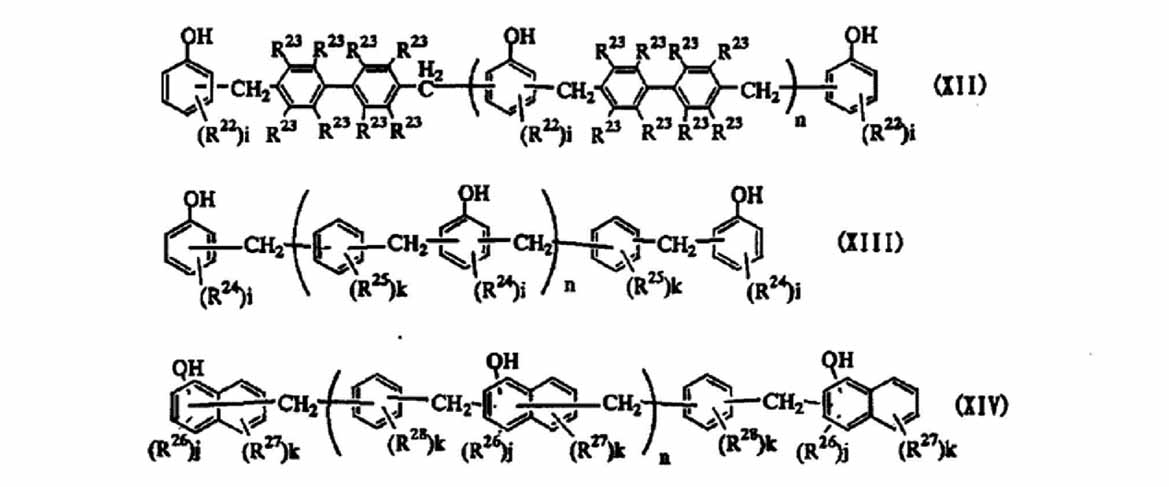
- the aralkyl type phenol resin is preferably a phenol resin represented by the following general formulas (XII) to (XIV).
- R 22 to R 28 independently represent a hydrogen atom or a monovalent organic group having 1 to 18 carbon atoms, and all of them may be the same or different.
- I indicates an integer of 0 to 3
- k indicates an integer of 0 to 4
- j indicates an integer of 0 to 2
- n is an average value, and indicates an integer of 0 to 20, a decimal number or a decimal number.
- I, j, k and n may all be the same or different.
- the dicyclopentadiene-type phenol resin is not particularly limited as long as it is a phenol resin using a compound having a dicyclopentadiene skeleton as a raw material.
- the dicyclopentadiene-type phenol resin is preferably a phenol resin represented by the following general formula (XV).
- XV phenol resin represented by the following general formula (XV)
- R 29 represents a hydrogen atom or a monovalent organic group having 1 to 18 carbon atoms, all of which may be the same or different, i represents an integer of 0 to 3, and n represents an integer of 0 to 3. It is an average value, indicating an integer from 0 to 20, a decimal number, or a decimal number, and i may be the same or different.
- the salicylaldehyde-type phenol resin is not particularly limited as long as it is a phenol resin using a compound having a salicylaldehyde skeleton as a raw material.
- the salicylaldehyde-type phenol resin is preferably a phenol resin represented by the following general formula (XVI).
- XVI phenol resin represented by the following general formula (XVI)
- R 30 and R 31 each independently represent a hydrogen atom or a monovalent organic group having 1 to 18 carbon atoms, all of which may be the same or different, and i is 0. It indicates an integer of 3 to 3, k indicates an integer of 0 to 4, n is an average value, indicates an integer of 0 to 20, a decimal number or a decimal number, and i and k may all be the same or different. .
- the copolymerization type phenol resin of the benzaldehyde type and the aralkyl type is not particularly limited as long as it is a copolymerization type phenol resin of a phenol resin using a compound having a benzaldehyde skeleton as a raw material and an aralkyl type phenol resin.
- the copolymerized phenol resin of the benzaldehyde type and the aralkyl type is preferably a phenol resin represented by the following general formula (XVII).
- R 32 to R 34 independently represent a hydrogen atom or a monovalent organic group having 1 to 18 carbon atoms, and all of them may be the same or different, and i is 0. It indicates an integer of 3 to 3, k indicates an integer of 0 to 4, q indicates an integer of 0 to 5, and l and m are integers, decimals or decimals of 0 to 21 on average, respectively (l + m). Indicates a positive number from 1 to 21, and i may be the same or different from each other.)
- Novorak-type phenolic resins include, for example, phenols such as phenol, cresol, xylenol, resorcin, catechol, bisphenol A, bisphenol F, phenylphenol and aminophenol and / or naphthols such as ⁇ -naphthol, ⁇ -naphthol and dihydroxynaphthalene.
- phenols such as phenol, cresol, xylenol, resorcin, catechol, bisphenol A, bisphenol F, phenylphenol and aminophenol and / or naphthols such as ⁇ -naphthol, ⁇ -naphthol and dihydroxynaphthalene.
- aldehydes such as formaldehyde, acetaldehyde, propionaldehyde, benzaldehyde and salicylaldehyde under an acidic catalyst.
- the novolak type phenol resin is not particularly limited as long as it is a phenol resin obtained by condensing or cocondensing the above phenols and / or the above naphthols and the above aldehydes under an acidic catalyst.
- the novolak type phenol resin is preferably a phenol resin represented by the following general formula (XVIII).
- R 35 and R 36 each independently represent a hydrogen atom or a monovalent organic group having 1 to 18 carbon atoms, all of which may be the same or different, and i is 0. It indicates an integer of 3 to 3, k indicates an integer of 0 to 4, n is an average value, indicates an integer of 0 to 20, a decimal number or a decimal number, and i may be the same or different.
- N in the above general formulas (XII) to (XVIII) is preferably in the range of 0 to 20.
- n is in the range of 0 to 20.
- the melt viscosity of the phenol resin does not become too high, and the moldability of the compound can be improved.
- the average n is in the range of 0 to 10.
- the compounding ratio of the epoxy resin and the phenol resin is the ratio of the hydroxyl group equivalent of the total phenol resin to the epoxy equivalent of the total epoxy resin (number of hydroxyl groups in the phenol resin / epoxy in the epoxy resin).
- the number of groups is preferably 0.5 to 2.0, more preferably 0.7 to 1.5, and even more preferably 0.8 to 1.3.
- the curing accelerator is not limited as long as it is a composition that reacts with the epoxy resin to accelerate the curing of the epoxy resin, for example.
- the curing accelerator one type may be used alone or two or more types may be used in combination.
- the curing accelerator may contain, for example, at least one of a borate salt and a borane compound.
- a compound containing at least one of a borate salt and a borane compound as a curing accelerator is superior in fluidity, storage stability and moldability to a compound containing another curing accelerator (for example, imidazoles). ..
- the borate salt used as the curing accelerator may be a compound represented by the following general formula (I-1).
- X + B - (R) 4 (I-1) (In the general formula (I-1), X represents at least one selected from the group consisting of alkylphosphonium salt, arylphosphonium salt, imidazole salt, imidazole derivative salt, tertiary amine salt and quaternary ammonium salt, and B Indicates boron, and R indicates at least one selected from the group consisting of an alkyl group, an aryl group and a fluoro group.)
- the borate salt represented by the general formula (I-1) is, for example, tetrabutylphosphineium tetraphenylborate, tetraphenylphosphonium / tetrakis (4-methylphenyl) borate, tetraphenylphosphonium / tetraphenylborate, tetraphenylphosphonium / Tetra-p-tolylborate, and tri-tert-butylphosphonium-tetraphenylborate, triphenylphosphine-benzoquinone-tetraphenylphosphonium, tetraphenylphosphonium-tetrakis (4-methylphenyl) borate, tetra (n-butyl) phosphonium tetra It may be at least one selected from phenylborate.
- the borane compound used as the curing accelerator may be a compound represented by the following general formula (I-2).
- Y ⁇ B (R) 3 (I-2)
- Y represents at least one selected from the group consisting of alkylphosphine, arylphosphine, imidazole, imidazole derivative and tertiary amine
- B represents boron
- R represents an alkyl group and aryl. Indicates at least one selected from the group consisting of groups and fluorogroups.
- the borane compound represented by the general formula (I-2) may be at least one selected from, for example, triphenylphosphine triphenylborane, 2-methylimidazole triphenylborane, and triethanolamine triphenylphosphine.
- the curing accelerator may contain, for example, imidazoles.
- the imidazoles used as the curing accelerator may be alkyl group-substituted imidazoles, benzimidazoles, or the like.
- the activation temperature of imidazoles tends to be lower than the activation temperature of the above-mentioned borate salts and borane compounds. Therefore, a compound containing imidazoles is more likely to cure in a shorter time at a lower temperature than a compound containing a borate salt or a borane compound. Therefore, when the molded product is cured in a short time, imidazoles are suitable as a curing accelerator.
- the compound may be used as an imidazole-based curing accelerator, for example, 1-cyanoethyl-2-undecylimidazole, 2-undecyl imidazole, 2-heptadecyl imidazole, 2-ethyl-4-methylimidazole, and 1-cyanoethyl-2- It may contain at least one selected from phenylimidazole.
- imidazole-based curing accelerators include, for example, 2MZ-H, C11Z, C17Z, 1,2DMZ, 2E4MZ, 2PZ-PW, 2P4MZ, 1B2MZ, 1B2PZ, 2MZ-CN, C11Z-CN, 2E4MZ-CN, 2PZ. -CN, C11Z-CNS, 2P4MHZ, TPZ, SFZ (above, trade name manufactured by Shikoku Chemicals Corporation) and the like can be mentioned.
- the amount of the curing accelerator to be blended is not particularly limited as long as it can obtain the curing promoting effect.
- the amount of the curing accelerator is preferably 0.1 to 30 parts by mass, more preferably 0.1 to 30 parts by mass, based on 100 parts by mass of the epoxy resin. May be 1 to 15 parts by mass.
- the content of the curing accelerator is preferably 0.001 part by mass or more and 5 parts by mass or less with respect to the total mass of the epoxy resin and the curing agent (for example, phenol resin).
- the blending amount of the curing accelerator is less than 0.1 parts by mass, it is difficult to obtain a sufficient curing promoting effect.
- the blending amount of the curing accelerator is 30 parts by mass or less, the storage stability of the compound is likely to be improved. However, even when the blending amount and content of the curing accelerator are out of the above range, the effect according to the present disclosure can be obtained.
- the curing accelerator exists as either or a mixture of the structure when blended with the epoxy resin and the phenol resin and the structure reacted with the epoxy resin and / or the phenol resin, and the structure is , Nuclear magnetic resonance apparatus (NMR) and other methods can be used for analysis.
- NMR Nuclear magnetic resonance apparatus
- the silicon compound can improve the adhesion between the resin composition and the coated particles, and can improve the mechanical strength of the rare earth bond magnet formed from the compound.
- the silicon compound exists in a state of being dispersed in, for example, an epoxy resin and a phenol resin.
- the silicon compound is not particularly limited, but may contain a silane coupling agent.
- the silane coupling agent may be at least one selected from the group consisting of, for example, epoxysilane, mercaptosilane, aminosilane, alkylsilane, ureidosilane, acid anhydride-based silane, and vinylsilane.
- a silane coupling agent having an amino group is preferable, and an aminophenyl-based silane coupling agent is more preferable, from the viewpoint of further improving the mechanical strength of the rare earth bond magnet.
- the resin composition may contain one of the above-mentioned coupling agents, or may contain a plurality of of the above-mentioned coupling agents.
- silane coupling agent for example, N- (2-aminoethyl) -3-aminopropyldimethylmethoxysilane, N- (2-aminoethyl) -3-aminopropyltrimethoxysilane, 3-aminopropyl
- examples thereof include trimethoxysilane, 3-aminopropyltriethoxysilane, 3-triethoxysilyl-N- (1,3-dimethylbutylidene) propylamine, and N-phenyl-3-aminopropyltrimethoxysilane. These may be used alone or in combination of two or more.
- the content of the silicon compound in the compound may be 0.1% by mass or more, 0.8% by mass or more, 1.0% by mass or more, or 1.4% by mass or more based on the total solid content of the compound. , 3.0% by mass or less, 2.5% by mass or less, 2.2% by mass or less, or 2.0% by mass or less.
- the content of the silicon compound is at least the above lower limit value, the mechanical strength of the rare earth bond magnet formed from the compound tends to be further improved.
- the content of the silicon compound is not more than the above upper limit value, it tends to be possible to suppress a decrease in fluidity during molding of the compound.
- the content of the silicon compound in the resin composition may be 20% by mass or more, 25% by mass or more, or 40% by mass or more, based on the total solid content of the resin composition, 50% by mass or less, 48% by mass or more. It may be less than or equal to 45% by mass or less.
- the content of the silicon compound is at least the above lower limit value, the mechanical strength of the rare earth bond magnet formed from the compound tends to be further improved.
- the content of the silicon compound is not more than the above upper limit value, it tends to be possible to suppress a decrease in fluidity during molding of the compound.
- the resin composition may contain other components other than the above-mentioned epoxy resin, phenol resin, curing accelerator and silicon compound, if necessary.
- other components include resins other than the above, coupling agents other than silane coupling agents, elastomer modifiers, fillers, flame retardants and the like.
- Examples of the coupling agent other than the silane coupling agent include titanium-based compounds, aluminum chelates, and aluminum / zirconium-based compounds.
- the elastomer modifier may be added to the compound in order to enhance the adhesion between the resin composition of the compound and the coating particles, to strengthen the resin composition, and to reduce the internal stress of the resin component.
- the elastomer modifier include a liquid rubber modifier, a rubber particle size modifier, a core-shell particle size modifier, a silicone-based modifier, and a urethane prepolymer modifier.
- the filler may be added to the compound in order to improve water absorption, dimensional stability, chemical resistance, mechanical strength, thermal expansion coefficient, and the like.
- the filler include silica, calcium carbonate, kaolin clay, titanium oxide, barium sulfate, zinc oxide, aluminum hydroxide, magnesium hydroxide, talc and mica.
- Flame retardants may be added to the compound for environmental safety, recyclability, moldability and low cost.
- examples of the flame retardant include brominated flame retardants, scale flame retardants, hydrated metal compound flame retardants, silicone flame retardants, nitrogen-containing compounds, hindered amine compounds, organic metal compounds and aromatic empras.
- the coating particles used in the compound of the present embodiment are formed by covering at least a part of the surface of the Sm—Fe—N alloy particles with an inorganic coating containing silicon.
- the entire surface of the Sm—Fe—N alloy particles may be covered with an inorganic film, or a part of the surface may be covered with an inorganic film.
- the compound contains a large number of coated particles. In the present specification, this collection of a large number of coated particles is also referred to as a rare earth magnet powder.
- each Sm-Fe-N (samarium-iron-nitrogen) alloy particle is not particularly limited, but may be spherical, flat, prismatic or needle-like, and preferably spherical.
- the shape of the Sm—Fe—N alloy particles can be evaluated by the circularity coefficient measured by image analysis of the microscopic observation image.
- the circularity coefficient is a value defined by the following equation, and the higher the value, the more rounded the particles are and the closer to a spherical shape.
- the Sm-Fe-N alloy particles are spherical means that the circularity coefficient is 0.78 or more.
- the circularity coefficient of the Sm—Fe—N alloy particles may be 0.80 or more, 0.85 or more, 0.90 or more, 0.95 or more. You may. When the circularity coefficient of the Sm—Fe—N alloy particles is within the above range, the fluidity of the compound can be further improved.
- C 4 ⁇ F / L 2 (C: circularity coefficient, F: projected area of particles (mm 2 ), L: projected peripheral length of particles (mm))
- the compound of the present embodiment has an advantage that the particles are easily rotated during molding in a magnetic field and the orientation of the coated particles is excellent because the coated particles are used. Further, when the shape of the Sm—Fe—N alloy particles is spherical, the particles are more likely to rotate during molding in a magnetic field, and the orientation is further improved. Therefore, by performing molding in a magnetic field using the compound of the present embodiment, it is possible to efficiently manufacture a high-performance anisotropic rare earth bond magnet having excellent orientation of rare earth magnet powder.
- the average particle size of the Sm—Fe—N alloy particles is not particularly limited, but may be 1 ⁇ m or more, 2 ⁇ m or more, or 3 ⁇ m or more, and may be 50 ⁇ m or less, 30 ⁇ m or less, 10 ⁇ m or less, or 5 ⁇ m or less. Good. When the average particle size is 1 ⁇ m or more, the magnetic flux density of the molded product tends to improve. When the average particle size is 50 ⁇ m or less, the mechanical strength of the molded product tends to improve.
- the average particle size can be measured by, for example, a particle size distribution meter.
- the compound may contain coated particles using a plurality of types of Sm—Fe—N alloy particles having different average particle diameters or shapes.
- the coated particles may contain alloy particles other than the Sm—Fe—N alloy particles.
- alloys constituting other alloy particles include Nd—Fe—B alloys (rare earth magnets) and Sm—Co alloys (rare earth magnets).
- the inorganic coating that coats the Sm—Fe—N alloy particles contains at least Si (silicon).
- the Si-containing inorganic coating may further contain, for example, at least one element selected from the group consisting of O (oxygen), B (boron), Na (sodium) and Al (aluminum).
- the inorganic coating may include, for example, SiO 2 (glass silicate) or glass borosilicate.
- a large number of particles made of glass containing Si may cover the surface of the Sm—Fe—N alloy particles.
- the means for covering the surface of the Sm—Fe—N alloy particles with the above-mentioned inorganic film may be, for example, a spray dryer.
- the surface treatment liquid containing Si may be sprayed onto the Sm—Fe—N alloy particles.
- the surface treatment liquid containing Si may be a liquid containing the material itself constituting the inorganic film such as glass described above, or a liquid containing a raw material of the material constituting the inorganic film such as glass.
- the means for covering the surface of the Sm—Fe—N alloy particles with an inorganic film may be an impregnation method.
- Sm—Fe—N alloy particles may be immersed in a surface treatment liquid containing Si.
- the Sm—Fe—N alloy particles to which the surface treatment liquid is attached may be heated if necessary.
- the surface of the coated particles may be covered with a coupling agent. Further, the surface of the Sm—Fe—N alloy particles may be covered with a coupling agent. However, the coupling agent does not correspond to an inorganic film containing Si. Further, the coupling agent is used separately from the silicon compound blended in the resin composition.
- the coated particles may further have a surface covered with a coupling agent as well as a surface covered with an inorganic coating. Examples of the coupling agent include a silane coupling agent.
- the compound may further include a metal powder having a surface covered with a coupling agent as a metal powder separate from the coating particles.
- the compound may further comprise a metal powder having a surface treated with phosphoric acid (eg, organic phosphoric acid).
- the compound may further comprise a metal powder having a phosphate-covered surface.
- the coated particles may further have a surface treated with phosphoric acid as well as a surface covered with an inorganic coating.
- the content of the coated particles in the compound is 90% by mass or more and less than 100% by mass, 93% by mass or more and 99.5% by mass or less, 94% by mass or more and 99.5% by mass or less, or 99.5% by mass or less, based on the total solid content of the compound. , 96% by mass or more and 99.5% by mass or less.
- the relative permeability of the compound tends to increase.
- the fluidity of the compound tends to decrease.
- even when the content of the coated particles is high by using the coated particles coated with the inorganic coating containing silicon, it is possible to achieve both high relative magnetic permeability and high fluidity.
- the content of the coated particles in the compound can be rephrased as the filling rate of the coated particles in the compound.
- the filling rate of the coated particles in the compound can be rephrased as the space factor of the coated particles in the compound.
- the content of the resin composition in the compound is greater than 0% by mass and 10% by mass or less, 0.5% by mass or more and 7% by mass or less, 0.5% by mass or more and 6% by mass or less, based on the total mass of the compound. Alternatively, it may be 0.5% by mass or more and 4% by mass or less.
- the melt viscosity of the compound of the present embodiment at 100 ° C. may be 800 to 4000 Pa ⁇ s, 900 to 3500 Pa ⁇ s, or 1000 to 3000 Pa ⁇ s.
- the melt viscosity is 800 Pa ⁇ s or more, the shape retention after molding tends to be good, and when it is 4000 Pa ⁇ s or less, the fluidity is high and excellent moldability is obtained, and a desired shape is obtained. There is a tendency that it is easy to manufacture the molded product of the above with high accuracy and efficiency.
- the compound for rare earth bond magnets of the present embodiment can be produced, for example, as follows. First, an epoxy resin, a phenol resin, a curing accelerator, a silicon compound, and if necessary, other components are blended to prepare a resin composition (first step). In addition, a rare earth magnet powder containing coated particles is prepared. Next, the resin composition is diluted with an organic solvent, if necessary, and then the rare earth magnet powder and the resin composition diluted with the organic solvent are mixed. Then, by volatilizing (drying) the organic solvent during mixing, a compound for a rare earth bond magnet containing a rare earth magnet powder and a resin composition for coating the rare earth magnet powder can be produced (second step). ..
- an organic solvent may be added to the resin composition in order to reduce the viscosity of the resin composition and improve workability and fluidity during kneading.
- the organic solvent used for diluting the resin composition is preferably a volatile organic solvent that becomes a gas at room temperature from the viewpoint of workability.
- organic solvents that can be preferably used include acetone, methyl ethyl ketone, methyl isobutyl ketone, benzene, toluene, xylene and the like. From the viewpoint of safety and handleability, methyl ethyl ketone is preferable.
- the method for producing a rare earth-bonded magnet of the present embodiment includes a step of producing the above compound (first step and second step), a step of compress-molding the compound to prepare a compression molded product (third step), and a step of producing a compression molded product. And a step of heat-treating the compression molded product (fourth step).
- the compound is compression molded at a pressure of preferably 500 to 2500 MPa, more preferably 1400 to 2000 MPa to prepare a compression molded product of the compound.
- the pressure when compressing the compound is 500 to 2500 MPa
- the rare earth bond magnet can be made dense, practical magnetic characteristics can be obtained, and the burden on the mold can be reduced.
- the density of the compression molded product is preferably 75% or more and 86% or less, and more preferably 80% or more and 86% or less with respect to the true density of the coated particles.
- the density of the compression molded product of the compound is 75% or more and 86% or less, a rare earth bond magnet having good magnetic characteristics and high mechanical strength can be produced.
- the compression molded product is heat-treated at a temperature of preferably 150 to 400 ° C., more preferably 175 to 350 ° C.
- a temperature at which the compression molded product is heat-treated is a temperature of 150 to 400 ° C.
- the heat treatment time is preferably 1 minute to 4 hours, more preferably 5 minutes to 3 hours.
- the rare earth bond magnet of the present embodiment is manufactured by the method for producing a rare earth bond magnet of the present embodiment using the compound of the present embodiment.
- the glass transition temperature of the cured resin composition formed by curing the resin composition in the rare earth bond magnet is preferably 150 ° C. or higher, more preferably 175 ° C. or higher, and further preferably 200 ° C. or higher.
- the glass transition temperature is, for example, a temperature at which tan ⁇ peaks in dynamic viscoelasticity measurement.
- the ratio of the elastic modulus of the rare earth bond magnet at 150 ° C. to the elastic modulus of the rare earth bond magnet at 50 ° C. is preferably 70% or more, more preferably 80% or more, and further preferably 90% or more.
- the elastic modulus ratio is 70% or more, a rare earth bond magnet having excellent heat resistance can be obtained.
- the method for measuring the elastic modulus include a method of measuring the three-point bending test at temperatures of 50 ° C. and 150 ° C., a method of measuring the elastic modulus of 50 ° C. and 150 ° C. by dynamic viscoelasticity measurement, and the like. ..
- the relative density of the rare earth bond magnet is preferably 70% or more, more preferably 80%, and further preferably 90% or more with respect to the true density of the coated particles.
- the relative density of the rare earth bond magnet is 70% or more with respect to the true density of the coated particles, a rare earth bond magnet having excellent magnetic properties can be obtained.
- the density of the rare earth bond magnet is preferably 95% or less with respect to the true density of the coated particles.
- the crushing strength of the rare earth bond magnet at a temperature of 120 ° C. is preferably 100 MPa or more, more preferably 150 MPa or more, and further preferably 160 MPa or more.
- the crushing strength of the rare earth bond magnet at a temperature of 120 ° C. is 100 MPa or more, a rare earth bond magnet having high mechanical strength at a high temperature can be obtained.
- Epoxy resin (3,3', 5,5'-tetramethylbiphenol diglycidyl ether, trade name: YX-4000H, manufactured by Mitsubishi Chemical Co., Ltd., epoxy equivalent: 192 g / eq) 3.66 g, phenol in a 500 ml eggplant flask.
- Resin Novolak type phenol resin, trade name: HP-850N, manufactured by Hitachi Kasei Co., Ltd., hydroxyl group equivalent: 108 g / eq
- curing accelerator tetrabutylphosphonium / tetraphenylborate, trade name: PX-4PB, Weigh 0.176 g (manufactured by Hokuko Chemical Co., Ltd.) and 2.11 g of a silane coupling agent having an amino group (N-phenyl-3-aminopropyltrimethoxysilane, trade name: KBM-573, manufactured by Shin-Etsu Chemical Co., Ltd.).
- Phenol manufactured by Wako Pure Chemical Industries, Ltd., trade name
- a solution of the resin composition As the rare earth magnet powder, Sm 2 Fe 17 N 3 alloy particles (average particle diameter: 2 [mu] m, the shape: spherical) coated particles the whole surface of coated with silica coating (Nichia stock) After adding 192 g (manufactured by the company) and stirring and mixing for 30 minutes, acetone was distilled off at room temperature by an evaporator. The obtained mixture was collected on a vat, spread thinly, and dried at room temperature using a vacuum dryer. While crushing the massive mixture during drying, the mixture was dried for a total of 24 hours to obtain a compound having a coating particle content (space factor) of 96% by mass.
- Example 2 A compound was obtained in the same manner as in Example 1 except that the composition of the solid content constituting the resin composition was changed to the components and the blending amount (unit: g) shown in Table 1.
- the epoxy resin and phenol resin used in Examples 3 and 4 are as follows.
- HP-4700 (4-functional naphthalene type epoxy resin, manufactured by DIC Corporation, trade name, epoxy equivalent: 165 g / eq)
- HP-7200 dicyclopentadiene type epoxy resin, manufactured by DIC Corporation, trade name, epoxy equivalent: 259 g / eq
- SN-395 Naphthalene-type phenolic resin, manufactured by Nittetsu Chemical & Materials Co., Ltd., trade name, hydroxyl group equivalent: 105 g / eq
- Comparative Example 2 A compound was obtained in the same manner as in Example 1 except that the composition of the solid content constituting the resin composition was changed to the components and the blending amount (unit: g) shown in Table 1. In Comparative Example 2 and Example 1, the compounding ratios of the epoxy resin, the phenol resin and the curing accelerator in the resin composition are the same.
- melt viscosity of compound was measured using a rheometer MCR301 (trade name, manufactured by Anton Pearl Japan Co., Ltd.).
- the gap between the 12 mm ⁇ aluminum probe and the aluminum plate was set to 0.5 mm, and the compound was placed in the gap.
- the compound was sprinkled on an aluminum plate to a thickness of about 1 mm, the aluminum probe was lowered while being heated to 80 ° C., and the sample portion was returned to room temperature when the distance between the gaps was reached.
- ⁇ Making rare earth bond magnets> The compounds obtained in Examples and Comparative Examples were filled in a predetermined mold and molded by a hydraulic press at a molding pressure of 2000 MPa to prepare a cylindrical molded body having a diameter of 11.3 mm and a height of 8 mm. Then, the molded product was heat-treated in a dryer at a temperature of 200 ° C. for 10 minutes to cure the resin composition in the compound to prepare a rare earth bond magnet (cylindrical test piece).
- the compound for rare earth bond magnets according to the present disclosure has excellent fluidity, and the obtained rare earth bond magnet has excellent crushing strength.
- By using such a compound for a rare earth bond magnet it is possible to provide a rare earth bond magnet having excellent mechanical strength with good productivity, and its industrial value is high.
Landscapes
- Chemical & Material Sciences (AREA)
- Power Engineering (AREA)
- Engineering & Computer Science (AREA)
- Medicinal Chemistry (AREA)
- Polymers & Plastics (AREA)
- Organic Chemistry (AREA)
- Health & Medical Sciences (AREA)
- Chemical Kinetics & Catalysis (AREA)
- Inorganic Chemistry (AREA)
- Crystallography & Structural Chemistry (AREA)
- Manufacturing & Machinery (AREA)
- Hard Magnetic Materials (AREA)
- Manufacturing Cores, Coils, And Magnets (AREA)
- Epoxy Resins (AREA)
- Compositions Of Macromolecular Compounds (AREA)
Abstract
Description
本実施形態に係る希土類ボンド磁石用コンパウンド(本明細書中、単に「コンパウンド」とも言う)は、エポキシ樹脂、フェノール樹脂、硬化促進剤及びケイ素化合物を含む樹脂組成物と、Sm-Fe-N系合金粒子の表面の少なくとも一部がケイ素を含む無機被膜で覆われた被覆粒子と、を備える。以下、コンパウンドを構成する各成分について詳細に説明する。
本実施形態のコンパウンドに使用される樹脂組成物は、希土類ボンド磁石の結合材としての機能を有する。樹脂組成物は、エポキシ樹脂、フェノール樹脂、硬化促進剤、及び、ケイ素化合物を配合することによって作製される。
エポキシ樹脂は、例えば、1分子中に2個以上のエポキシ基を有するエポキシ樹脂である。そのようなエポキシ樹脂には、例えば、ビフェニル型エポキシ樹脂、スチルベン型エポキシ樹脂、ジフェニルメタン型エポキシ樹脂、硫黄原子含有型エポキシ樹脂、ノボラック型エポキシ樹脂、ジシクロペンタジエン型エポキシ樹脂、サリチルアルデヒド型エポキシ樹脂、ナフトール類とフェノール類との共重合型エポキシ樹脂、アラルキル型フェノール樹脂のエポキシ化物、ビスフェノール型エポキシ樹脂、アルコール類のグリシジルエーテル型エポキシ樹脂、パラキシリレン及び/又はメタキシリレン変性フェノール樹脂のグリシジルエーテル型エポキシ樹脂、テルペン変性フェノール樹脂のグリシジルエーテル型エポキシ樹脂、シクロペンタジエン型エポキシ樹脂、多環芳香環変性フェノール樹脂のグリシジルエーテル型エポキシ樹脂、ナフタレン環含有フェノール樹脂のグリシジルエーテル型エポキシ樹脂、グリシジルエステル型エポキシ樹脂、グリシジル型又はメチルグリシジル型のエポキシ樹脂、脂環型エポキシ樹脂、ハロゲン化フェノールノボラック型エポキシ樹脂、ハイドロキノン型エポキシ樹脂、トリメチロールプロパン型エポキシ樹脂及びオレフィン結合を過酢酸等の過酸で酸化して得られる線状脂肪族エポキシ樹脂等が挙げられる。これらを単独で用いても2種以上を組み合わせて用いてもよい。






フェノール樹脂は、エポキシ樹脂の硬化剤として機能する。フェノール樹脂としては特に制限はないが、例えば、硬化剤として一般に使用される1分子中に2個以上のフェノール性水酸基を有するフェノール樹脂が挙げられる。フェノール樹脂には、例えば、1分子中に2個のフェノール性水酸基を有する化合物、アラルキル型フェノール樹脂、ジシクロペンタジエン型フェノール樹脂、サリチルアルデヒド型フェノール樹脂、ノボラック型フェノール樹脂、ベンズアルデヒド型フェノールとアラルキル型フェノールとの共重合型フェノール樹脂、パラキシリレン及び/又はメタキシリレン変性フェノール樹脂、メラミン変性フェノール樹脂、テルペン変性フェノール樹脂、ジシクロペンタジエン型ナフトール樹脂、シクロペンタジエン変性フェノール樹脂、多環芳香環変性フェノール樹脂、ビフェニル型フェノール樹脂、トリフェニルメタン型フェノール樹脂、並びにこれらの2種以上を共重合して得たフェノール樹脂等が挙げられる。これらを単独で用いても2種以上を組み合わせて用いてもよい。なお、1分子中に2個のフェノール性水酸基を有する化合物には、例えば、レゾルシン、カテコール、ビスフェノールA、ビスフェノールF及び置換又は非置換のビフェノール等が挙げられる。


硬化促進剤は、例えば、エポキシ樹脂と反応してエポキシ樹脂の硬化を促進させる組成物であれば限定されない。硬化促進剤は、1種を単独で用いても2種以上を組み合わせて用いてもよい。
X+ B-(R)4 (I-1)
(一般式(I-1)中、Xは、アルキルホスホニウム塩、アリールホスホニウム塩、イミダゾール塩、イミダゾール誘導体の塩、3級アミン塩及び4級アンモニウム塩からなる群より選ばれる少なくとも一種を示し、Bはホウ素を示し、Rは、アルキル基、アリール基及びフルオロ基からなる群より選ばれる少なくとも一種を示す。)
Y・B(R)3 (I-2)
(一般式(I-2)中、Yはアルキルホスフィン、アリールホスフィン、イミダゾール、イミダゾール誘導体及び3級アミンからなる群より選ばれる少なくも一種を示し、Bはホウ素を示し、Rはアルキル基、アリール基及びフルオロ基からなる群より選ばれる少なくとも一種を示す。)
ケイ素化合物は、樹脂組成物と被覆粒子との密着性を向上させ、コンパウンドから形成される希土類ボンド磁石の機械強度を向上させることができる。樹脂組成物においてケイ素化合物は、例えば、エポキシ樹脂及びフェノール樹脂中に分散された状態で存在している。
樹脂組成物は、必要に応じて上述したエポキシ樹脂、フェノール樹脂、硬化促進剤及びケイ素化合物以外の他の成分を含んでもよい。他の成分としては、例えば、上記以外の樹脂、シランカップリング剤以外の他のカップリング剤、エラストマー変性剤、フィラー、難燃剤等が挙げられる。
シランカップリング剤以外の他のカップリング剤としては、チタン系化合物、アルミニウムキレート類、及び、アルミニウム/ジルコニウム系化合物等が挙げられる。
エラストマー変性剤は、コンパウンドの樹脂組成物と被覆粒子との密着性を高めるため、樹脂組成物の強靱化のため及び樹脂成分の内部応力を低減させるために、コンパウンドに配合してもよい。エラストマー変性剤としては、液状ゴム変性剤、ゴム粒子径変性剤、コアシェル粒子径変性剤、シリコーン系変性剤及びウレタンプレポリマー変性剤等が挙げられる。
フィラーは、吸水性、寸法安定性、耐薬品性、機械強度向上及び熱膨張係数向上等のために、コンパウンドに配合してもよい。フィラーとしては、シリカ、炭酸カルシウム、カオリンクレー、酸化チタン、硫酸バリウム、酸化亜鉛、水酸化アルミニウム、水酸化マグネシウム、タルク及びマイカ等が挙げられる。
難燃剤は、環境安全性、リサイクル性、成形加工性及び低コストのために、コンパウンドに配合してもよい。難燃剤としては、臭素系難燃剤、鱗茎難燃剤、水和金属化合物系難燃剤、シリコーン系難燃剤、窒素含有化合物、ヒンダードアミン化合物、有機金属化合物及び芳香族エンプラ等が挙げられる。
本実施形態のコンパウンドに使用される被覆粒子は、Sm-Fe-N系合金粒子の表面の少なくとも一部がケイ素を含む無機被膜で覆われてなるものである。被覆粒子において、Sm-Fe-N系合金粒子の表面全体が無機被膜で覆われていてもよく、表面の一部が無機被膜で覆われていてもよい。コンパウンドには、多数の被覆粒子が含有される。本明細書では、この多数の被覆粒子の集まりを希土類磁石粉ともいう。
C=4πF/L2
(C:円形度係数、F:粒子の投影面積(mm2)、L:粒子の投影周囲長(mm))
本実施形態の希土類ボンド磁石用コンパウンドは、例えば、以下のように製造することができる。まず、エポキシ樹脂、フェノール樹脂、硬化促進剤、ケイ素化合物、及び必要に応じて他の成分を配合して樹脂組成物を作製する(第1の工程)。また、被覆粒子を含む希土類磁石粉を用意する。次に、樹脂組成物を必要に応じて有機溶剤で希釈した後、希土類磁石粉と有機溶剤で希釈した樹脂組成物とを混合する。そして、混合中に有機溶剤を揮発(乾燥)させることにより、希土類磁石粉と、希土類磁石粉を被覆する樹脂組成物とを含む希土類ボンド磁石用コンパウンドを作製することができる(第2の工程)。
本実施形態の希土類ボンド磁石の製造方法は、上記コンパウンドを作製する工程(第1の工程及び第2の工程)、コンパウンドを圧縮成形して圧縮成形体を作製する工程(第3の工程)、及び圧縮成形体を熱処理する工程(第4の工程)を含む。
本実施形態の希土類ボンド磁石は、本実施形態のコンパウンドを使用して本実施形態の希土類ボンド磁石の製造方法により製造される。
500mlナスフラスコに、エポキシ樹脂(3,3’,5,5’-テトラメチルビフェノールジグリシジルエーテル、商品名:YX-4000H、三菱ケミカル株式会社製、エポキシ当量:192g/eq)3.66g、フェノール樹脂(ノボラック型フェノール樹脂、商品名:HP-850N、日立化成株式会社製、水酸基当量:108g/eq)2.06g、硬化促進剤(テトラブチルホスホニウム・テトラフェニルボレート、商品名:PX-4PB、北興化学株式会社製)0.176g、アミノ基を有するシランカップリング剤(N-フェニル-3-アミノプロピルトリメトキシシラン、商品名:KBM-573、信越化学株式会社製)2.11gを計り取り、アセトン(和光純薬工業株式会社製、商品名)24gに溶解し、樹脂組成物の溶液を得た。この樹脂組成物の溶液に、希土類磁石粉として、Sm2Fe17N3系合金粒子(平均粒子径:2μm、形状:球状)の表面全体をシリカ被膜で被覆した被覆粒子(日亜化学工業株式会社製)192gを加えて30分間撹拌混合した後、エバポレータにより常温でアセトンを留去した。得られた混合物をバット上に回収して薄く広げ、真空乾燥機を用いて常温で乾燥した。乾燥途中で塊状の混合物を解砕しながら、合計24時間乾燥し、被覆粒子の含有量(占積率)が96質量%であるコンパウンドを得た。
樹脂組成物を構成する固形分の組成を、表1に示した成分及び配合量(単位:g)に変更したこと以外は実施例1と同様にして、コンパウンドを得た。なお、実施例3及び4で用いたエポキシ樹脂及びフェノール樹脂は以下の通りである。
HP-4700(4官能ナフタレン型エポキシ樹脂、DIC株式会社製、商品名、エポキシ当量:165g/eq)
HP-7200(ジシクロペンタジエン型エポキシ樹脂、DIC株式会社製、商品名、エポキシ当量:259g/eq)
SN-395(ナフタレン型フェノール樹脂、日鉄ケミカル&マテリアル株式会社製、商品名、水酸基当量:105g/eq)
希土類磁石粉として、Sm2Fe17N3系合金粒子(平均粒子径:2μm、形状:球状)の表面全体をリン化合物で被覆した被覆粒子(日亜化学工業株式会社製)を用いたこと以外は実施例1と同様にして、コンパウンドを得た。
樹脂組成物を構成する固形分の組成を、表1に示した成分及び配合量(単位:g)に変更したこと以外は実施例1と同様にして、コンパウンドを得た。なお、比較例2及び実施例1において、樹脂組成物中のエポキシ樹脂、フェノール樹脂及び硬化促進剤の配合比は同じである。
コンパウンドの溶融粘度は、レオメータMCR301(商品名、株式会社アントンパール・ジャパン製)を使用して測定した。12mmφのアルミプローブとアルミプレートとのギャップを0.5mmとし、そのギャップにコンパウンドを配置した。具体的には、アルミプレート上にコンパウンドを厚さ1mm程度に撒き、80℃に加温した状態でアルミプローブを下げ、上記ギャップ間距離になった時点で試料部分を室温に戻した。その後、歪み5%、周波数10Hz、昇温速度10℃/分の条件で昇温させながら測定を行い、測定温度100℃における粘度の値をコンパウンドの溶融粘度とした。結果を表1に示す。
実施例及び比較例で得られたコンパウンドを所定の金型に充填し、油圧プレス機により成形圧力2000MPaで成形し、直径11.3mm、高さ8mmの円柱状の成形体を作製した。その後、成形体に対し、乾燥機中200℃の温度で10分間の熱処理を施して、コンパウンド中の樹脂組成物を硬化させ、希土類ボンド磁石(円柱状試験片)を作製した。
万能圧縮試験機(株式会社島津製作所製、AG-10TBR)を用いて、大気中でクロスヘッド速度0.5mm/分で、円柱状試験片の高さ方向から圧縮圧力を印加し、円柱状試験片が破壊した時の圧縮圧力の最大値を圧壊強度(MPa)とした。圧壊強度の測定は、室温(25℃)状態、及び、恒温槽中で120℃で10分間加熱した状態の円柱状試験片を用いて行った。結果を表1に示す。

Claims (10)
- エポキシ樹脂、フェノール樹脂、硬化促進剤及びケイ素化合物を含む樹脂組成物と、Sm-Fe-N系合金粒子の表面の少なくとも一部がケイ素を含む無機被膜で覆われた被覆粒子と、を備える希土類ボンド磁石用コンパウンド。
- 前記ケイ素化合物が、アミノ基を有するシランカップリング剤を含む、請求項1に記載のコンパウンド。
- 前記ケイ素化合物の含有量が、コンパウンドの固形分全量を基準として1.0質量%以上2.0質量%以下である、請求項1又は2に記載のコンパウンド。
- 前記Sm-Fe-N系合金粒子が、球状である、請求項1~3のいずれか一項に記載のコンパウンド。
- 前記Sm-Fe-N系合金粒子の平均粒子径が1μm以上5μm以下である、請求項1~4のいずれか一項に記載のコンパウンド。
- 前記硬化促進剤が、ボレート塩及びボラン化合物のうちの少なくとも一種を含む、請求項1~5のいずれか一項に記載のコンパウンド。
- 請求項1~6のいずれか一項に記載の希土類ボンド磁石用コンパウンドを含む、成形体。
- 請求項1~6のいずれか一項に記載の希土類ボンド磁石用コンパウンドの硬化物。
- 請求項1~6のいずれか一項に記載の希土類ボンド磁石用コンパウンドを製造する方法であって、
前記被覆粒子と、前記樹脂組成物とを、有機溶剤の存在下で混合し、乾燥させる工程を備える、希土類ボンド磁石用コンパウンドの製造方法。 - 請求項1~6のいずれか一項に記載の希土類ボンド磁石用コンパウンドを圧縮成形する工程を備える、成形体の製造方法。
Priority Applications (2)
| Application Number | Priority Date | Filing Date | Title |
|---|---|---|---|
| JP2021536590A JP7547343B2 (ja) | 2019-08-01 | 2019-08-01 | 希土類ボンド磁石用コンパウンド及びその製造方法、成形体及びその製造方法、並びに硬化物 |
| PCT/JP2019/030347 WO2021019784A1 (ja) | 2019-08-01 | 2019-08-01 | 希土類ボンド磁石用コンパウンド及びその製造方法、成形体及びその製造方法、並びに硬化物 |
Applications Claiming Priority (1)
| Application Number | Priority Date | Filing Date | Title |
|---|---|---|---|
| PCT/JP2019/030347 WO2021019784A1 (ja) | 2019-08-01 | 2019-08-01 | 希土類ボンド磁石用コンパウンド及びその製造方法、成形体及びその製造方法、並びに硬化物 |
Publications (1)
| Publication Number | Publication Date |
|---|---|
| WO2021019784A1 true WO2021019784A1 (ja) | 2021-02-04 |
Family
ID=74230662
Family Applications (1)
| Application Number | Title | Priority Date | Filing Date |
|---|---|---|---|
| PCT/JP2019/030347 Ceased WO2021019784A1 (ja) | 2019-08-01 | 2019-08-01 | 希土類ボンド磁石用コンパウンド及びその製造方法、成形体及びその製造方法、並びに硬化物 |
Country Status (2)
| Country | Link |
|---|---|
| JP (1) | JP7547343B2 (ja) |
| WO (1) | WO2021019784A1 (ja) |
Citations (4)
| Publication number | Priority date | Publication date | Assignee | Title |
|---|---|---|---|---|
| JP2016194140A (ja) * | 2015-04-01 | 2016-11-17 | 住友金属鉱山株式会社 | 希土類系磁性粉末及びその製造方法、並びにボンド磁石用樹脂組成物、ボンド磁石 |
| JP2017034097A (ja) * | 2015-07-31 | 2017-02-09 | 日立化成株式会社 | Nd−Fe−B系ボンド磁石用樹脂コンパウンド、Nd−Fe−B系ボンド磁石及びその製造方法 |
| JP2018199847A (ja) * | 2017-05-26 | 2018-12-20 | 住友金属鉱山株式会社 | 希土類系磁性粉末の製造方法 |
| WO2019106812A1 (ja) * | 2017-11-30 | 2019-06-06 | 日立化成株式会社 | コンパウンド粉 |
Family Cites Families (4)
| Publication number | Priority date | Publication date | Assignee | Title |
|---|---|---|---|---|
| JP3646486B2 (ja) * | 1997-08-11 | 2005-05-11 | セイコーエプソン株式会社 | 希土類ボンド磁石 |
| JP2000034503A (ja) * | 1998-07-17 | 2000-02-02 | Sumitomo Metal Mining Co Ltd | Sm−Fe−N系ボンド磁石用合金粉末 |
| KR101296551B1 (ko) | 2007-02-09 | 2013-08-13 | 가부시키가이샤 닛폰 쇼쿠바이 | 실란 화합물, 그 제조 방법 및 실란 화합물을 포함하는 수지 조성물 |
| JP7180071B2 (ja) * | 2017-12-11 | 2022-11-30 | 昭和電工マテリアルズ株式会社 | 金属元素含有粉、成形体、及び金属元素含有粉の製造方法 |
-
2019
- 2019-08-01 JP JP2021536590A patent/JP7547343B2/ja active Active
- 2019-08-01 WO PCT/JP2019/030347 patent/WO2021019784A1/ja not_active Ceased
Patent Citations (4)
| Publication number | Priority date | Publication date | Assignee | Title |
|---|---|---|---|---|
| JP2016194140A (ja) * | 2015-04-01 | 2016-11-17 | 住友金属鉱山株式会社 | 希土類系磁性粉末及びその製造方法、並びにボンド磁石用樹脂組成物、ボンド磁石 |
| JP2017034097A (ja) * | 2015-07-31 | 2017-02-09 | 日立化成株式会社 | Nd−Fe−B系ボンド磁石用樹脂コンパウンド、Nd−Fe−B系ボンド磁石及びその製造方法 |
| JP2018199847A (ja) * | 2017-05-26 | 2018-12-20 | 住友金属鉱山株式会社 | 希土類系磁性粉末の製造方法 |
| WO2019106812A1 (ja) * | 2017-11-30 | 2019-06-06 | 日立化成株式会社 | コンパウンド粉 |
Also Published As
| Publication number | Publication date |
|---|---|
| JP7547343B2 (ja) | 2024-09-09 |
| JPWO2021019784A1 (ja) | 2021-02-04 |
Similar Documents
| Publication | Publication Date | Title |
|---|---|---|
| JP6437203B2 (ja) | 希土類ボンド磁石用コンパウンド、希土類ボンド磁石及び希土類ボンド磁石の製造方法 | |
| US8545977B2 (en) | Polymer concrete electrical insulation | |
| WO2022220295A1 (ja) | 磁性粉末、コンパウンド、成形体、ボンド磁石、及び圧粉磁心 | |
| CN110903604B (zh) | 一种用于功率器件封装的三元树脂组合物 | |
| JP6052868B2 (ja) | エポキシ樹脂の硬化剤、製法、およびその用途 | |
| JP2025010228A (ja) | ボンド磁石用コンパウンド及びボンド磁石用成形体 | |
| JP7547343B2 (ja) | 希土類ボンド磁石用コンパウンド及びその製造方法、成形体及びその製造方法、並びに硬化物 | |
| TW201910478A (zh) | 密封用樹脂組成物、密封用樹脂組成物的製造方法、半導體裝置及半導體裝置的製造方法 | |
| WO2020225885A1 (ja) | 希土類ボンド磁石用コンパウンド、希土類ボンド磁石、希土類ボンド磁石の製造方法、及び樹脂組成物 | |
| JP7346985B2 (ja) | 希土類ボンド磁石用コンパウンドの製造方法、及び、希土類ボンド磁石の製造方法 | |
| JP7582179B2 (ja) | 封止組成物及び半導体装置 | |
| JP2020139042A (ja) | 封止組成物及び半導体装置 | |
| JP7567284B2 (ja) | 希土類ボンド磁石の製造方法 | |
| JPH09151303A (ja) | エポキシ樹脂組成物 | |
| JPH10324733A (ja) | エポキシ樹脂組成物、エポキシ樹脂の製造方法及び半導体封止材料 | |
| JP2021169584A (ja) | エポキシ樹脂組成物 | |
| CN113242873A (zh) | 密封组合物及半导体装置 | |
| JP7676861B2 (ja) | 造粒粉末、及びボンド磁石の製造方法 | |
| JP7294412B2 (ja) | 樹脂粒子混合物 | |
| KR20200103683A (ko) | 밀봉 조성물 및 그의 제조 방법 그리고 반도체 장치 | |
| JP2006249400A (ja) | エポキシ樹脂組成物 | |
| WO2025052516A1 (ja) | 樹脂組成物、電子部品装置及び樹脂組成物の製造方法 | |
| CN119183467A (zh) | 成形用树脂组合物及电子零件装置 | |
| JP2024055627A (ja) | 成形用樹脂組成物及び電子部品装置 | |
| JP2006063154A (ja) | 重合性組成物 |
Legal Events
| Date | Code | Title | Description |
|---|---|---|---|
| 121 | Ep: the epo has been informed by wipo that ep was designated in this application |
Ref document number: 19939374 Country of ref document: EP Kind code of ref document: A1 |
|
| ENP | Entry into the national phase |
Ref document number: 2021536590 Country of ref document: JP Kind code of ref document: A |
|
| NENP | Non-entry into the national phase |
Ref country code: DE |
|
| 32PN | Ep: public notification in the ep bulletin as address of the adressee cannot be established |
Free format text: NOTING OF LOSS OF RIGHTS PURSUANT TO RULE 112(1) EPC (EPO FORM 1205A DATED 04/05/2022) |
|
| 122 | Ep: pct application non-entry in european phase |
Ref document number: 19939374 Country of ref document: EP Kind code of ref document: A1 |