WO2021005841A1 - 通信システム、通信方法、およびセンサユニット - Google Patents
通信システム、通信方法、およびセンサユニット Download PDFInfo
- Publication number
- WO2021005841A1 WO2021005841A1 PCT/JP2020/012426 JP2020012426W WO2021005841A1 WO 2021005841 A1 WO2021005841 A1 WO 2021005841A1 JP 2020012426 W JP2020012426 W JP 2020012426W WO 2021005841 A1 WO2021005841 A1 WO 2021005841A1
- Authority
- WO
- WIPO (PCT)
- Prior art keywords
- unit
- vending machine
- encrypted data
- server device
- terminal device
- Prior art date
- Legal status (The legal status is an assumption and is not a legal conclusion. Google has not performed a legal analysis and makes no representation as to the accuracy of the status listed.)
- Ceased
Links
Images







Classifications
-
- G—PHYSICS
- G06—COMPUTING OR CALCULATING; COUNTING
- G06Q—INFORMATION AND COMMUNICATION TECHNOLOGY [ICT] SPECIALLY ADAPTED FOR ADMINISTRATIVE, COMMERCIAL, FINANCIAL, MANAGERIAL OR SUPERVISORY PURPOSES; SYSTEMS OR METHODS SPECIALLY ADAPTED FOR ADMINISTRATIVE, COMMERCIAL, FINANCIAL, MANAGERIAL OR SUPERVISORY PURPOSES, NOT OTHERWISE PROVIDED FOR
- G06Q50/00—Information and communication technology [ICT] specially adapted for implementation of business processes of specific business sectors, e.g. utilities or tourism
- G06Q50/10—Services
-
- G—PHYSICS
- G06—COMPUTING OR CALCULATING; COUNTING
- G06F—ELECTRIC DIGITAL DATA PROCESSING
- G06F21/00—Security arrangements for protecting computers, components thereof, programs or data against unauthorised activity
- G06F21/60—Protecting data
- G06F21/606—Protecting data by securing the transmission between two devices or processes
-
- G—PHYSICS
- G06—COMPUTING OR CALCULATING; COUNTING
- G06F—ELECTRIC DIGITAL DATA PROCESSING
- G06F21/00—Security arrangements for protecting computers, components thereof, programs or data against unauthorised activity
- G06F21/30—Authentication, i.e. establishing the identity or authorisation of security principals
- G06F21/44—Program or device authentication
-
- G—PHYSICS
- G06—COMPUTING OR CALCULATING; COUNTING
- G06K—GRAPHICAL DATA READING; PRESENTATION OF DATA; RECORD CARRIERS; HANDLING RECORD CARRIERS
- G06K19/00—Record carriers for use with machines and with at least a part designed to carry digital markings
- G06K19/06—Record carriers for use with machines and with at least a part designed to carry digital markings characterised by the kind of the digital marking, e.g. shape, nature, code
- G06K19/06009—Record carriers for use with machines and with at least a part designed to carry digital markings characterised by the kind of the digital marking, e.g. shape, nature, code with optically detectable marking
-
- G—PHYSICS
- G06—COMPUTING OR CALCULATING; COUNTING
- G06K—GRAPHICAL DATA READING; PRESENTATION OF DATA; RECORD CARRIERS; HANDLING RECORD CARRIERS
- G06K19/00—Record carriers for use with machines and with at least a part designed to carry digital markings
- G06K19/06—Record carriers for use with machines and with at least a part designed to carry digital markings characterised by the kind of the digital marking, e.g. shape, nature, code
- G06K19/06009—Record carriers for use with machines and with at least a part designed to carry digital markings characterised by the kind of the digital marking, e.g. shape, nature, code with optically detectable marking
- G06K19/06037—Record carriers for use with machines and with at least a part designed to carry digital markings characterised by the kind of the digital marking, e.g. shape, nature, code with optically detectable marking multi-dimensional coding
-
- G—PHYSICS
- G06—COMPUTING OR CALCULATING; COUNTING
- G06K—GRAPHICAL DATA READING; PRESENTATION OF DATA; RECORD CARRIERS; HANDLING RECORD CARRIERS
- G06K7/00—Methods or arrangements for sensing record carriers, e.g. for reading patterns
- G06K7/10—Methods or arrangements for sensing record carriers, e.g. for reading patterns by electromagnetic radiation, e.g. optical sensing; by corpuscular radiation
- G06K7/14—Methods or arrangements for sensing record carriers, e.g. for reading patterns by electromagnetic radiation, e.g. optical sensing; by corpuscular radiation using light without selection of wavelength, e.g. sensing reflected white light
- G06K7/1404—Methods for optical code recognition
- G06K7/1408—Methods for optical code recognition the method being specifically adapted for the type of code
- G06K7/1417—2D bar codes
-
- G—PHYSICS
- G06—COMPUTING OR CALCULATING; COUNTING
- G06Q—INFORMATION AND COMMUNICATION TECHNOLOGY [ICT] SPECIALLY ADAPTED FOR ADMINISTRATIVE, COMMERCIAL, FINANCIAL, MANAGERIAL OR SUPERVISORY PURPOSES; SYSTEMS OR METHODS SPECIALLY ADAPTED FOR ADMINISTRATIVE, COMMERCIAL, FINANCIAL, MANAGERIAL OR SUPERVISORY PURPOSES, NOT OTHERWISE PROVIDED FOR
- G06Q20/00—Payment architectures, schemes or protocols
- G06Q20/08—Payment architectures
- G06Q20/18—Payment architectures involving self-service terminals [SST], vending machines, kiosks or multimedia terminals
-
- G—PHYSICS
- G06—COMPUTING OR CALCULATING; COUNTING
- G06Q—INFORMATION AND COMMUNICATION TECHNOLOGY [ICT] SPECIALLY ADAPTED FOR ADMINISTRATIVE, COMMERCIAL, FINANCIAL, MANAGERIAL OR SUPERVISORY PURPOSES; SYSTEMS OR METHODS SPECIALLY ADAPTED FOR ADMINISTRATIVE, COMMERCIAL, FINANCIAL, MANAGERIAL OR SUPERVISORY PURPOSES, NOT OTHERWISE PROVIDED FOR
- G06Q20/00—Payment architectures, schemes or protocols
- G06Q20/30—Payment architectures, schemes or protocols characterised by the use of specific devices or networks
- G06Q20/32—Payment architectures, schemes or protocols characterised by the use of specific devices or networks using wireless devices
- G06Q20/327—Short range or proximity payments by means of M-devices
-
- G—PHYSICS
- G06—COMPUTING OR CALCULATING; COUNTING
- G06Q—INFORMATION AND COMMUNICATION TECHNOLOGY [ICT] SPECIALLY ADAPTED FOR ADMINISTRATIVE, COMMERCIAL, FINANCIAL, MANAGERIAL OR SUPERVISORY PURPOSES; SYSTEMS OR METHODS SPECIALLY ADAPTED FOR ADMINISTRATIVE, COMMERCIAL, FINANCIAL, MANAGERIAL OR SUPERVISORY PURPOSES, NOT OTHERWISE PROVIDED FOR
- G06Q20/00—Payment architectures, schemes or protocols
- G06Q20/30—Payment architectures, schemes or protocols characterised by the use of specific devices or networks
- G06Q20/32—Payment architectures, schemes or protocols characterised by the use of specific devices or networks using wireless devices
- G06Q20/327—Short range or proximity payments by means of M-devices
- G06Q20/3276—Short range or proximity payments by means of M-devices using a pictured code, e.g. barcode or QR-code, being read by the M-device
-
- G—PHYSICS
- G06—COMPUTING OR CALCULATING; COUNTING
- G06Q—INFORMATION AND COMMUNICATION TECHNOLOGY [ICT] SPECIALLY ADAPTED FOR ADMINISTRATIVE, COMMERCIAL, FINANCIAL, MANAGERIAL OR SUPERVISORY PURPOSES; SYSTEMS OR METHODS SPECIALLY ADAPTED FOR ADMINISTRATIVE, COMMERCIAL, FINANCIAL, MANAGERIAL OR SUPERVISORY PURPOSES, NOT OTHERWISE PROVIDED FOR
- G06Q20/00—Payment architectures, schemes or protocols
- G06Q20/38—Payment protocols; Details thereof
- G06Q20/382—Payment protocols; Details thereof insuring higher security of transaction
- G06Q20/3827—Use of message hashing
-
- G—PHYSICS
- G06—COMPUTING OR CALCULATING; COUNTING
- G06Q—INFORMATION AND COMMUNICATION TECHNOLOGY [ICT] SPECIALLY ADAPTED FOR ADMINISTRATIVE, COMMERCIAL, FINANCIAL, MANAGERIAL OR SUPERVISORY PURPOSES; SYSTEMS OR METHODS SPECIALLY ADAPTED FOR ADMINISTRATIVE, COMMERCIAL, FINANCIAL, MANAGERIAL OR SUPERVISORY PURPOSES, NOT OTHERWISE PROVIDED FOR
- G06Q20/00—Payment architectures, schemes or protocols
- G06Q20/38—Payment protocols; Details thereof
- G06Q20/42—Confirmation, e.g. check or permission by the legal debtor of payment
- G06Q20/425—Confirmation, e.g. check or permission by the legal debtor of payment using two different networks, one for transaction and one for security confirmation
-
- G—PHYSICS
- G06—COMPUTING OR CALCULATING; COUNTING
- G06Q—INFORMATION AND COMMUNICATION TECHNOLOGY [ICT] SPECIALLY ADAPTED FOR ADMINISTRATIVE, COMMERCIAL, FINANCIAL, MANAGERIAL OR SUPERVISORY PURPOSES; SYSTEMS OR METHODS SPECIALLY ADAPTED FOR ADMINISTRATIVE, COMMERCIAL, FINANCIAL, MANAGERIAL OR SUPERVISORY PURPOSES, NOT OTHERWISE PROVIDED FOR
- G06Q30/00—Commerce
- G06Q30/06—Buying, selling or leasing transactions
-
- G—PHYSICS
- G07—CHECKING-DEVICES
- G07F—COIN-FREED OR LIKE APPARATUS
- G07F11/00—Coin-freed apparatus for dispensing, or the like, discrete articles
- G07F11/02—Coin-freed apparatus for dispensing, or the like, discrete articles from non-movable magazines
- G07F11/44—Coin-freed apparatus for dispensing, or the like, discrete articles from non-movable magazines in which magazines the articles are stored in bulk
-
- G—PHYSICS
- G07—CHECKING-DEVICES
- G07F—COIN-FREED OR LIKE APPARATUS
- G07F7/00—Mechanisms actuated by objects other than coins to free or to actuate vending, hiring, coin or paper currency dispensing or refunding apparatus
- G07F7/02—Mechanisms actuated by objects other than coins to free or to actuate vending, hiring, coin or paper currency dispensing or refunding apparatus by keys or other credit registering devices
-
- G—PHYSICS
- G07—CHECKING-DEVICES
- G07F—COIN-FREED OR LIKE APPARATUS
- G07F7/00—Mechanisms actuated by objects other than coins to free or to actuate vending, hiring, coin or paper currency dispensing or refunding apparatus
- G07F7/08—Mechanisms actuated by objects other than coins to free or to actuate vending, hiring, coin or paper currency dispensing or refunding apparatus by coded identity card or credit card or other personal identification means
- G07F7/10—Mechanisms actuated by objects other than coins to free or to actuate vending, hiring, coin or paper currency dispensing or refunding apparatus by coded identity card or credit card or other personal identification means together with a coded signal, e.g. in the form of personal identification information, like personal identification number [PIN] or biometric data
-
- G—PHYSICS
- G07—CHECKING-DEVICES
- G07F—COIN-FREED OR LIKE APPARATUS
- G07F9/00—Details other than those peculiar to special kinds or types of apparatus
- G07F9/001—Interfacing with vending machines using mobile or wearable devices
-
- G—PHYSICS
- G07—CHECKING-DEVICES
- G07F—COIN-FREED OR LIKE APPARATUS
- G07F9/00—Details other than those peculiar to special kinds or types of apparatus
- G07F9/002—Vending machines being part of a centrally controlled network of vending machines
-
- H—ELECTRICITY
- H04—ELECTRIC COMMUNICATION TECHNIQUE
- H04L—TRANSMISSION OF DIGITAL INFORMATION, e.g. TELEGRAPHIC COMMUNICATION
- H04L9/00—Cryptographic mechanisms or cryptographic arrangements for secret or secure communications; Network security protocols
- H04L9/06—Cryptographic mechanisms or cryptographic arrangements for secret or secure communications; Network security protocols the encryption apparatus using shift registers or memories for block-wise or stream coding, e.g. DES systems or RC4; Hash functions; Pseudorandom sequence generators
- H04L9/0643—Hash functions, e.g. MD5, SHA, HMAC or f9 MAC
-
- H—ELECTRICITY
- H04—ELECTRIC COMMUNICATION TECHNIQUE
- H04L—TRANSMISSION OF DIGITAL INFORMATION, e.g. TELEGRAPHIC COMMUNICATION
- H04L9/00—Cryptographic mechanisms or cryptographic arrangements for secret or secure communications; Network security protocols
- H04L9/08—Key distribution or management, e.g. generation, sharing or updating, of cryptographic keys or passwords
- H04L9/0816—Key establishment, i.e. cryptographic processes or cryptographic protocols whereby a shared secret becomes available to two or more parties, for subsequent use
- H04L9/0819—Key transport or distribution, i.e. key establishment techniques where one party creates or otherwise obtains a secret value, and securely transfers it to the other(s)
- H04L9/0825—Key transport or distribution, i.e. key establishment techniques where one party creates or otherwise obtains a secret value, and securely transfers it to the other(s) using asymmetric-key encryption or public key infrastructure [PKI], e.g. key signature or public key certificates
-
- H—ELECTRICITY
- H04—ELECTRIC COMMUNICATION TECHNIQUE
- H04L—TRANSMISSION OF DIGITAL INFORMATION, e.g. TELEGRAPHIC COMMUNICATION
- H04L9/00—Cryptographic mechanisms or cryptographic arrangements for secret or secure communications; Network security protocols
- H04L9/08—Key distribution or management, e.g. generation, sharing or updating, of cryptographic keys or passwords
- H04L9/0861—Generation of secret information including derivation or calculation of cryptographic keys or passwords
-
- H—ELECTRICITY
- H04—ELECTRIC COMMUNICATION TECHNIQUE
- H04L—TRANSMISSION OF DIGITAL INFORMATION, e.g. TELEGRAPHIC COMMUNICATION
- H04L9/00—Cryptographic mechanisms or cryptographic arrangements for secret or secure communications; Network security protocols
- H04L9/30—Public key, i.e. encryption algorithm being computationally infeasible to invert or user's encryption keys not requiring secrecy
-
- H—ELECTRICITY
- H04—ELECTRIC COMMUNICATION TECHNIQUE
- H04L—TRANSMISSION OF DIGITAL INFORMATION, e.g. TELEGRAPHIC COMMUNICATION
- H04L9/00—Cryptographic mechanisms or cryptographic arrangements for secret or secure communications; Network security protocols
- H04L9/32—Cryptographic mechanisms or cryptographic arrangements for secret or secure communications; Network security protocols including means for verifying the identity or authority of a user of the system or for message authentication, e.g. authorization, entity authentication, data integrity or data verification, non-repudiation, key authentication or verification of credentials
- H04L9/321—Cryptographic mechanisms or cryptographic arrangements for secret or secure communications; Network security protocols including means for verifying the identity or authority of a user of the system or for message authentication, e.g. authorization, entity authentication, data integrity or data verification, non-repudiation, key authentication or verification of credentials involving a third party or a trusted authority
- H04L9/3213—Cryptographic mechanisms or cryptographic arrangements for secret or secure communications; Network security protocols including means for verifying the identity or authority of a user of the system or for message authentication, e.g. authorization, entity authentication, data integrity or data verification, non-repudiation, key authentication or verification of credentials involving a third party or a trusted authority using tickets or tokens, e.g. Kerberos
-
- H—ELECTRICITY
- H04—ELECTRIC COMMUNICATION TECHNIQUE
- H04L—TRANSMISSION OF DIGITAL INFORMATION, e.g. TELEGRAPHIC COMMUNICATION
- H04L9/00—Cryptographic mechanisms or cryptographic arrangements for secret or secure communications; Network security protocols
- H04L9/32—Cryptographic mechanisms or cryptographic arrangements for secret or secure communications; Network security protocols including means for verifying the identity or authority of a user of the system or for message authentication, e.g. authorization, entity authentication, data integrity or data verification, non-repudiation, key authentication or verification of credentials
- H04L9/3215—Cryptographic mechanisms or cryptographic arrangements for secret or secure communications; Network security protocols including means for verifying the identity or authority of a user of the system or for message authentication, e.g. authorization, entity authentication, data integrity or data verification, non-repudiation, key authentication or verification of credentials using a plurality of channels
-
- H—ELECTRICITY
- H04—ELECTRIC COMMUNICATION TECHNIQUE
- H04L—TRANSMISSION OF DIGITAL INFORMATION, e.g. TELEGRAPHIC COMMUNICATION
- H04L9/00—Cryptographic mechanisms or cryptographic arrangements for secret or secure communications; Network security protocols
- H04L9/32—Cryptographic mechanisms or cryptographic arrangements for secret or secure communications; Network security protocols including means for verifying the identity or authority of a user of the system or for message authentication, e.g. authorization, entity authentication, data integrity or data verification, non-repudiation, key authentication or verification of credentials
- H04L9/3226—Cryptographic mechanisms or cryptographic arrangements for secret or secure communications; Network security protocols including means for verifying the identity or authority of a user of the system or for message authentication, e.g. authorization, entity authentication, data integrity or data verification, non-repudiation, key authentication or verification of credentials using a predetermined code, e.g. password, passphrase or PIN
-
- H—ELECTRICITY
- H04—ELECTRIC COMMUNICATION TECHNIQUE
- H04L—TRANSMISSION OF DIGITAL INFORMATION, e.g. TELEGRAPHIC COMMUNICATION
- H04L9/00—Cryptographic mechanisms or cryptographic arrangements for secret or secure communications; Network security protocols
- H04L9/32—Cryptographic mechanisms or cryptographic arrangements for secret or secure communications; Network security protocols including means for verifying the identity or authority of a user of the system or for message authentication, e.g. authorization, entity authentication, data integrity or data verification, non-repudiation, key authentication or verification of credentials
- H04L9/3236—Cryptographic mechanisms or cryptographic arrangements for secret or secure communications; Network security protocols including means for verifying the identity or authority of a user of the system or for message authentication, e.g. authorization, entity authentication, data integrity or data verification, non-repudiation, key authentication or verification of credentials using cryptographic hash functions
-
- H—ELECTRICITY
- H04—ELECTRIC COMMUNICATION TECHNIQUE
- H04W—WIRELESS COMMUNICATION NETWORKS
- H04W12/00—Security arrangements; Authentication; Protecting privacy or anonymity
- H04W12/06—Authentication
- H04W12/068—Authentication using credential vaults, e.g. password manager applications or one time password [OTP] applications
-
- H—ELECTRICITY
- H04—ELECTRIC COMMUNICATION TECHNIQUE
- H04W—WIRELESS COMMUNICATION NETWORKS
- H04W12/00—Security arrangements; Authentication; Protecting privacy or anonymity
- H04W12/08—Access security
- H04W12/084—Access security using delegated authorisation, e.g. open authorisation [OAuth] protocol
-
- H—ELECTRICITY
- H04—ELECTRIC COMMUNICATION TECHNIQUE
- H04W—WIRELESS COMMUNICATION NETWORKS
- H04W12/00—Security arrangements; Authentication; Protecting privacy or anonymity
- H04W12/60—Context-dependent security
- H04W12/63—Location-dependent; Proximity-dependent
-
- H—ELECTRICITY
- H04—ELECTRIC COMMUNICATION TECHNIQUE
- H04W—WIRELESS COMMUNICATION NETWORKS
- H04W12/00—Security arrangements; Authentication; Protecting privacy or anonymity
- H04W12/60—Context-dependent security
- H04W12/69—Identity-dependent
- H04W12/77—Graphical identity
-
- H—ELECTRICITY
- H04—ELECTRIC COMMUNICATION TECHNIQUE
- H04W—WIRELESS COMMUNICATION NETWORKS
- H04W4/00—Services specially adapted for wireless communication networks; Facilities therefor
- H04W4/02—Services making use of location information
-
- H—ELECTRICITY
- H04—ELECTRIC COMMUNICATION TECHNIQUE
- H04W—WIRELESS COMMUNICATION NETWORKS
- H04W4/00—Services specially adapted for wireless communication networks; Facilities therefor
- H04W4/80—Services using short range communication, e.g. near-field communication [NFC], radio-frequency identification [RFID] or low energy communication
-
- G—PHYSICS
- G06—COMPUTING OR CALCULATING; COUNTING
- G06F—ELECTRIC DIGITAL DATA PROCESSING
- G06F2221/00—Indexing scheme relating to security arrangements for protecting computers, components thereof, programs or data against unauthorised activity
- G06F2221/21—Indexing scheme relating to G06F21/00 and subgroups addressing additional information or applications relating to security arrangements for protecting computers, components thereof, programs or data against unauthorised activity
- G06F2221/2111—Location-sensitive, e.g. geographical location, GPS
-
- G—PHYSICS
- G06—COMPUTING OR CALCULATING; COUNTING
- G06Q—INFORMATION AND COMMUNICATION TECHNOLOGY [ICT] SPECIALLY ADAPTED FOR ADMINISTRATIVE, COMMERCIAL, FINANCIAL, MANAGERIAL OR SUPERVISORY PURPOSES; SYSTEMS OR METHODS SPECIALLY ADAPTED FOR ADMINISTRATIVE, COMMERCIAL, FINANCIAL, MANAGERIAL OR SUPERVISORY PURPOSES, NOT OTHERWISE PROVIDED FOR
- G06Q2220/00—Business processing using cryptography
-
- H—ELECTRICITY
- H04—ELECTRIC COMMUNICATION TECHNIQUE
- H04W—WIRELESS COMMUNICATION NETWORKS
- H04W12/00—Security arrangements; Authentication; Protecting privacy or anonymity
- H04W12/03—Protecting confidentiality, e.g. by encryption
Definitions
- the present invention relates to a communication system, a communication method, and a sensor unit.
- Galla is a virtual vending machine that imitates a vending machine (so-called “Gacha Gacha” or “Gachapon”: see Patent Document 1) in which a capsule containing a toy comes out when a coin is inserted and the handle is twisted. ..
- gacha In games using gacha, items etc. can be obtained by inserting virtual coins distributed for a fee or free into the gacha. Purchasing paid coins in this type of game is called billing. In gachas that require paid coins, you may be able to obtain powerful items and rare characters that are not normally available (or difficult to obtain) for a single charge of 100 yen. For this reason, some users charge a large amount of money until a desired item or the like is obtained, and it is difficult to pay the amount. This is a problem common not only to product sales by virtual vending machines but also to product sales by vending machines including "Gacha Gacha".
- the present invention has been made in view of the above circumstances, and an object of the present invention is to provide a technique for remotely controlling the sale of products by a vending machine.
- the terminal device captures a two-dimensional code attached to the vending machine, acquires the vending machine ID, and acquires the position information.
- the second step of determining whether the vending machine ID and the location information match the stored information, and if they match, the second step of transmitting the product information to the terminal device, and the second server device A third step of receiving a payment request from the terminal device, executing a payment process, and transmitting a payment token to the first server device, and the first server device receiving the payment token and hashing sensor information.
- the communication system captures the two-dimensional code attached to the vending machine to acquire the vending machine ID, acquires the position information at the time of imaging, and obtains the vending machine ID and the above.
- the location information is transmitted to the first server device, a search request is made to the virtual server device group that realizes the hash pool by the hash value sent from the first server device, and further, the position information is sent from the third server device.
- the terminal device requesting the unlocking of the vending machine, the vending machine ID, and the location information are stored in the information.
- the product information is transmitted to the terminal device, and when the payment token is received, the hash value obtained by hashing the stored sensor information by a hash function is generated.
- the first server device to be transmitted to the terminal device and the search request based on the hash value are received from the terminal device, the existence of the hash value is confirmed, and if it exists, the public key is transmitted to the third server device.
- a group of virtual server devices a third server device that generates an unlock code, encrypts the unlock code with the public key, and transmits encrypted data to the terminal device, and a third server device that generates the public key to generate the virtual A sensor unit that transmits to the server device group and receives the encrypted data from the terminal device to determine the success or failure of the encrypted data, and if it is determined to be correct, unlocks the vending machine. Has.
- the sensor unit is a sensor unit mounted on the vending machine and unlocking the vending machine based on the encrypted data sent from the terminal device.
- An encryption processing unit that generates a key and a private key and encrypts the unlocking code with a public key, and a hash that hashes sensor information including at least the sensor ID and sensor position information with a hash function and outputs a hash value. It has been sent from the generation unit, at least the management unit that stores and manages the public key generated by the encryption processing unit and the hash value generated by the hash generation unit in the storage unit, and the terminal device. It includes an unlocking unit that determines the success or failure of the encrypted data and unlocks the vending machine when the encrypted data matches the encrypted data generated by the encryption processing unit.
- the senor unit can be retrofitted to an existing vending machine such as a gacha, and in that case, the sales of the existing vending machine or the like can be remotely managed.
- FIG. 1 is a block diagram showing a configuration example of the wireless communication system 1 according to the first embodiment of the present invention.
- the wireless communication system 1 includes a wireless communication terminal 10 and a server device 40 connected to the wireless communication network 20.
- the wireless communication network 20 includes a wired communication network
- the server device 40 is connected to the wired communication network.
- the wireless communication terminal 10 is, for example, a smartphone.
- the wireless communication terminal 10 is housed in the wireless communication network 20 and performs wireless communication according to a predetermined wireless communication standard (WI-FI in the present embodiment, but not limited to this). Further, the wireless communication terminal 10 has a function of performing short-range wireless communication with another device according to a wireless communication standard different from the wireless communication standard.
- a wireless communication standard different from the wireless communication standard.
- the latter wireless communication standard will be referred to as a "first wireless communication standard”
- the former wireless communication standard will be referred to as a "second wireless communication standard”.
- a specific example of the second wireless communication standard is WI-FI.
- specific examples of the first wireless communication standard include Bluetooth (registered trademark) or IrDA. In this embodiment, Bluetooth (registered trademark) is adopted as the first wireless communication standard.
- the vending machine 30 in FIG. 1 is the above-mentioned "gacha-gacha".
- the vending machine 30 has a function of performing short-range wireless communication with the wireless communication terminal 10 in accordance with the first wireless communication standard. Although only one vending machine 30 is shown in FIG. 1, the number of vending machines 30 may be two or more.
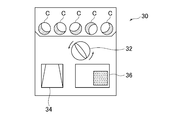
- FIG. 2 is a front view of the vending machine 30. In the vending machine 30, when the handle 32 is twisted in the direction of the arrow after the product price is input (in this embodiment, the virtual coin is input), one capsule C containing the toy is ejected from the outlet 34. Come on.
- a printed matter 36 on which a matrix-type two-dimensional code corresponding to an identifier uniquely indicating the vending machine 30 (for example, a character string consisting of a predetermined number of alphanumeric characters) is printed is pasted in the vicinity of the take-out port 34. There is.
- the product sales are prohibited until the security code for releasing the product sales prohibition is received by short-range wireless communication, and the handle 32 is twisted in the state where the security code is not received. Capsule C does not come out even if it is done.
- the security code is 256 bytes of 1-time data randomly generated by the server device 40. Each time the server device 40 receives an identifier uniquely indicating the vending machine 30, it issues a security code corresponding to the identifier and returns it to the sender of the identifier.
- the server device 40 is a computer device having a user DB and a vending machine management DB, and in addition to issuing a security code and issuing virtual coins, settle the issue price of virtual coins (in other words, in other words). For example, settle the product price).
- position information for example, information indicating the latitude and longitude of the installation location
- a security code is issued in association with the identifier of the vending machine 30.
- Information for is stored.
- specific examples of information for issuing the security code include the initial value (so-called pseudo-random number seed) in the algorithm and the security code issued most recently. ..
- the user DB is a database for managing users who want to purchase products by lifting the ban on the sale of products by the vending machine 30 using the wireless communication system 1.
- the user DB stores information indicating the purchase history of the product and the payment history of the product price by the user in association with the identifier uniquely indicating the user.
- Specific examples of the identifier that uniquely identifies the user include a user ID assigned to the user when the service usage contract is concluded by the wireless communication system 1.
- a decentralized ledger technology called blockchain is used to settle the product price in this embodiment.
- a blockchain is a database with a continuously increasing list of ordered records called blocks.
- each block in the blockchain corresponds to one settlement, and each block includes information about the settlement, a time stamp indicating the time when the settlement was executed, and a link to the previous block. ing.
- a printed matter 36 printed with a matrix type two-dimensional code corresponding to the uniquely indicated identifier of the vending machine 30 is pasted in the vicinity of the outlet 34 of the vending machine 30.
- the user of the wireless communication terminal 10 unlocks the vending machine 30 by reading the matrix-type two-dimensional code using the wireless communication terminal 10 and transmitting the identifier obtained from the code to the server device 40. You can do (that is, lift the ban on the sale of goods).
- the wireless communication terminal 10 that plays a central role in lifting the ban on the sale of products by the vending machine 30 will be described.
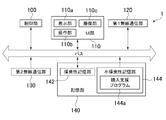
- FIG. 3 is a block diagram showing a configuration example of the wireless communication terminal 10.
- the wireless communication terminal 10 mediates data transfer between the control unit 100, the user interface unit 110, the first wireless communication unit 120, the second wireless communication unit 130, the storage unit 140, and these components.
- the user interface unit is abbreviated as "UI unit”.
- UI unit the user interface unit
- the abbreviation will be similarly omitted in the present specification.
- the control unit 100 is, for example, a computer such as a CPU (Central Processing Unit).
- the control unit 100 executes a program stored in the storage unit 140 (more accurately, the non-volatile storage unit 144) and functions as a control center of the wireless communication terminal 10.
- the UI unit 110 is an aggregate of devices that provide a user interface for allowing the user to use the wireless communication terminal 10. As shown in FIG. 1, the UI unit 110 includes a display unit 110a, an operation unit 110b, and an imaging unit 110c. In addition to these units, the UI unit 110 includes a voice input / output unit that collects the user's voice and outputs the voice represented by the voice data, but the audio input / output unit is not shown because it is not closely related to the present invention. And detailed description will be omitted.
- the display unit 110a is, for example, a liquid crystal display and its drive circuit. Under the control of the control unit 100, the display unit 110a displays images of various screens prompting the user to use the wireless communication terminal 10.
- the image pickup unit 110c is, for example, an image sensor.
- the imaging unit 110c captures an image in the imaging field of view, and outputs image data representing the imaging result to the control unit 100.
- the operation unit 110b is a transparent sheet-like touch sensor provided so as to cover the display area of the display unit 110a.
- the operation unit 110b forms a so-called touch panel together with the display unit 110a.
- the user of the wireless communication terminal 10 can perform various inputs by touching or flicking the operation unit 110b.
- the operation unit 110b When the user performs a touch operation, a flick operation, or the like on the operation unit 110b, the operation unit 110b outputs data representing the operation content of the user to the control unit 100. As a result, the operation performed by the user is transmitted to the control unit 100.
- the first wireless communication unit 120 is a communication circuit that performs wireless communication conforming to the first wireless communication standard.
- the first wireless communication unit 120 receives the data transmitted from the remote device of the wireless communication conforming to the first wireless communication standard and delivers it to the control unit 100, while the first wireless communication unit 120 delivers the data delivered from the control unit 100 to the remote device.
- the second wireless communication unit 130 performs wireless communication with the base station of the wireless communication network 20 in accordance with the second wireless communication standard.
- the second wireless communication unit 130 sends the data given by the control unit 100 to the wireless communication network 20, receives the data sent from the wireless communication network 20, and delivers the received data to the control unit 100.
- the storage unit 140 includes a volatile storage unit 142 and a non-volatile storage unit 144.
- the volatile storage unit 142 is, for example, a RAM (Random Access Memory).
- the volatile storage unit 142 is used by the control unit 100 as a work area when executing a program.
- the non-volatile storage unit 144 is, for example, a flash ROM (Read Only Memory).
- Various programs and various data are stored in the non-volatile storage unit 144.
- Specific examples of the program stored in the non-volatile storage unit 144 include a kernel program that realizes an OS (Operating System) in the control unit 100, various application programs of a web browser and an e-mail client, and features of the present invention.
- An example is a purchase support program 144a that causes the control unit 100 to execute the unlocking process shown below.
- the programs other than the purchase support program 144a are not particularly different from those installed on a general smartphone.
- the control unit 100 reads the kernel program from the non-volatile storage unit 144 to the volatile storage unit 142 when the power supply (not shown in FIG. 3) of the wireless communication terminal 10 is turned on, and starts executing the kernel program.
- the control unit 100 which operates according to the kernel program and realizes the OS, executes the purchase support program 144a or another application program or the UI unit 110 in response to the instruction input by the operation to the operation unit 110b. It is possible to control the operation of components other than the control unit 100 such as.
- the purchase support program 144a since there is no particular difference between the programs other than the purchase support program 144a and those installed on a general smartphone, detailed description thereof will be omitted, and the purchase support program 144a will be mainly described below.
- the control unit 100 instructed to execute the purchase support program 144a by the operation on the operation unit 110b reads the purchase support program 144a from the non-volatile storage unit 144 to the volatile storage unit 142, and starts the execution.
- the control unit 100 operating according to the purchase support program 144a causes the display unit 110a to display the screen G01 shown in FIG.
- the virtual operator B01 on the screen G01 is a virtual operator for searching the installation location of the vending machine 30.
- the control unit 100 transmits the position information indicating the current position of the wireless communication terminal 10 to the server device 40.
- the current position of the wireless communication terminal 10 may be specified by using an existing technology such as GPS.
- the server device 40 refers to the vending machine 30 installed in a predetermined range (for example, a range of 100 meters in radius) centered on the position indicated by the position information received from the wireless communication terminal 10 with reference to the vending machine management DB. To identify. Then, the server device 40 returns the position information indicating the installation location of the specified vending machine 30 to the wireless communication terminal 10.
- a predetermined range for example, a range of 100 meters in radius
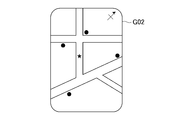
- the control unit 100 Upon receiving the position information returned from the server device 40, the control unit 100 displays the search result screen G02 shown in FIG. 5 on the display unit 110a.
- the image of the search result screen G02 is an icon indicating the current position (icon with a star in FIG. 5) and an icon corresponding to the vending machine 30 (icon with a black circle in FIG. 5) on the image of the map in the above predetermined range. It is an image obtained by plotting.
- a user who visually recognizes the search result screen G02 can go to the nearest installation location of the vending machine 30 by referring to the information displayed on the search result screen G02.
- the control unit 100 shifts the display image of the display unit 110a to the payment means selection screen G03 shown in FIG.
- the payment method selection screen G03 is a screen for allowing the user to select a payment method (credit card or the like) used for payment of virtual coins for purchasing a product.
- the control unit 100 writes the information indicating the selected payment means in the volatile storage unit 142, and shifts the display image of the display unit 110a to the screen G01. ..
- the image captured by the imaging unit 110c is displayed in the area A01 on the screen G01.
- the user of the wireless communication terminal 10 places the wireless communication terminal 10 in the vicinity of the outlet 34 of the vending machine 30 so that the entire matrix type two-dimensional code corresponding to the identifier of the vending machine 30 is displayed in the area A01. Adjust the posture while holding it up, and take an image of the matrix type two-dimensional code.
- the control unit 100 acquires the identifier of the vending machine 30 by analyzing the captured image.
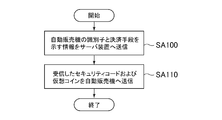
- FIG. 7 is a flowchart showing the flow of the unlocking process. As shown in FIG. 7, first, the control unit 100 uses the second wireless communication unit 130 to transfer the identifier acquired in the above procedure and the information indicating the payment method selected on the payment method selection screen G03 to the server device 40. (Step SA100).
- the server device 40 When the server device 40 receives the information indicating the identifier and the payment method transmitted from the wireless communication terminal 10, the server device 40 refers to the stored contents of the vending machine management DB, issues a security code corresponding to the identifier, and purchases a product. The virtual coin for the product is issued and the product price is settled by the payment means indicated by the received information. Then, the server device 40 returns the issued security code and virtual coin to the sender of the identifier.
- control unit 100 When the control unit 100 receives the security code and virtual coin returned from the server device 40, the control unit 100 transmits the received security code and virtual coin to the vending machine 30 by the first wireless communication unit 120 (step SA110).
- the vending machine 30 When the vending machine 30 receives the security code and virtual coins transmitted from the wireless communication terminal 10, the vending machine 30 lifts the ban on the sale of products. As a result, it is possible to purchase the product sold by the vending machine 30 (in this embodiment, the gacha-gacha is executed). When the user of the wireless communication terminal 10 completes the purchase of the product, the vending machine 30 returns to the locked state again.
- the issuance of the security code makes it possible to remotely manage the sale of products by the vending machine. For example, after the total purchase price of the product reaches a predetermined upper limit in a predetermined period (for example, one month), the issuance of a new security code is suspended until the period elapses, and the gacha is charged. You can prevent overdoing.
- a predetermined upper limit in a predetermined period for example, one month
- the vending machine 30 in the above embodiment is a "gacha-gacha", but of course it may be a vending machine for soft drinks, alcoholic beverages, foods, books, cigarettes, etc., and "Gacha Gacha” in computer games. It may be a virtual vending machine such as "Gacha”. That is, the products sold by the vending machine 30 are not limited to physical objects such as toys, and may be data such as in-game items and game character data.
- the virtual coin is intervened in the settlement of the sales price of the product, but the settlement may be performed only with the actual money as in the conventional gacha-gacha without interposing the virtual coin. Only the security code needs to be returned to the server device 40.
- a printed matter 36 on which a matrix-type two-dimensional code corresponding to an identifier uniquely indicating the vending machine 30 is printed is attached to the vending machine 30 in the above embodiment, and a character representing the identifier is attached.
- a printed matter with a row printed may be pasted. This is because the identifier can be obtained by taking an image of a printed matter on which a character string representing an identifier is printed by the imaging unit 110c and performing character recognition on the captured image. Further, the user who visually recognizes the character string printed on the printed matter may input the characters constituting the character string one by one by operating the operation unit 110b (for example, operating the virtual keyboard).
- the imaging unit 110c can be omitted.
- the wireless communication system 1 including the wireless communication terminal 10 has been described, but the wireless communication terminal 10 may be manufactured or sold as a single unit. Further, although the wireless communication terminal 10 in the above embodiment is a smartphone, it may be a tablet terminal, a notebook personal computer, a wearable computer, or the like.
- control unit and the first wireless communication unit that performs short-range wireless communication according to the first wireless communication standard perform communication according to a second wireless communication standard different from the first wireless communication standard.
- a security code that includes a second wireless communication unit, and the control unit is a vending machine that performs short-range wireless communication with another device in accordance with the first wireless communication standard, and lifts the prohibition on the sale of products.
- the communication according to the second wireless communication standard is triggered by the input of the identifier given to the vending machine.
- the security code Upon receiving the identifier, the security code is issued and addressed to the server device that returns to the sender of the identifier, the input identifier is transmitted by the second wireless communication unit, and is returned from the server device. It is sufficient to provide a wireless communication terminal characterized in that an incoming security code is received by the second wireless communication unit and the received security code is transmitted to the vending machine by the first wireless communication unit.
- the purchase support program 144a for causing the control unit 100 to execute the unlocking process that remarkably shows the feature of the present invention is pre-installed in the non-volatile storage unit 144 of the wireless communication terminal 10, but it is purchased.
- the support program 144a may be manufactured or sold alone.
- the computer is a vending machine that performs short-range wireless communication with other devices in accordance with the first wireless communication standard, and sales of products are prohibited until a security code is received to lift the prohibition on sales of products.
- the communication according to the second wireless communication standard different from the first wireless communication standard is performed.
- the wireless communication terminal can function as the wireless communication terminal 10 of the above embodiment. Because it will be possible.
- a mode of writing to a computer-readable recording medium such as a flash ROM and distributing the program, or a mode of distributing by downloading via a telecommunication line such as the Internet can be considered.
- the lock related to the sale of vending machines such as gacha is released by the terminal device of the user who has completed the payment, and the product is purchased. You will be able to do it.
- the sensor unit can be retrofitted to an existing vending machine, in which case the vending machine can be unlocked and purchased by the user's terminal device.
- a function corresponding to a sensor unit can be retrofitted by a plug-in. The details will be described below.
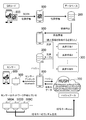
- FIG. 8 shows and describes the configuration of the communication system according to the second embodiment of the present invention.
- the communication system includes a first server device 200 including a database server device, a second server device 300 equipped with a payment means, a third server device 400, and automatic operation.
- Vending machines 800A to 800C ... (Hereinafter, when generically referred to, reference numeral 800 is used) and sensor units 500A to 500C ... (Hereinafter referred to collectively, reference numeral 500 is used) mounted on these vending machines 800A to 800C .... It is composed of a user terminal device 600 and a virtual server device group 700 that realizes a hash pool.
- a communication system may be realized by any combination of some of these configurations.
- As the user's terminal device 600 various devices such as a smartphone, a tablet terminal, and a node-type personal computer can be adopted.
- the user's terminal device 600 captures the two-dimensional code attached to the vending machine 800, acquires the ID of the vending machine, acquires the position information at the time of imaging, and transmits these information to the first server device 200. By doing so, the acquisition of the encrypted data related to the unlocking of the vending machine 800 is requested.
- the first server device 200 determines whether the acquired ID and location information of the vending machine match the recorded information, and if they match, the product information related to the product handled by the vending machine is displayed. It is transmitted to the terminal device 600. On the user's terminal device 600, this product information is displayed in a selectable manner, a desired product is specified, and the payment procedure is proceeded.
- the payment request from the user's terminal device 600 is sent to the second server device 300 that realizes the selected payment means, and after the payment process is executed by the second server device 300, the payment token is sent to the first server. It is sent to the device 200.
- the second server device 200 receives the payment token, it generates a hash value obtained by hashing the sensor information with a hash function and transmits it to the user's terminal device 600.
- the user's terminal device 600 makes a search request based on the received hash value to the virtual server device group 700 that realizes the hash pool.
- the virtual server device group 700 confirms the existence of the hash value, and if it exists, transmits the public key to the third server device 400.
- the third server device 400 generates an unlocking code, encrypts the unlocking code with a public key, and transmits the encrypted data to the terminal device 600.
- the terminal device 600 wirelessly communicates with the sensor unit 500 of the vending machine 800 by wireless means such as Bluetooth (registered trademark), and transmits the encrypted data to the sensor unit 500 to lock the vending machine. Request cancellation.
- the sensor unit 500 determines the success or failure of the encrypted data, and if it is determined to be correct, unlocks the vending machine 800. In this way, the user acquires the product from the vending machine 800.
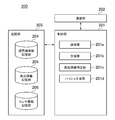
- FIG. 10 shows and describes the configuration of the first server device.
- the first server device corresponds to, for example, a database server device.
- the first server device 200 has a control unit 201, a communication unit 202, and a storage unit 203.
- the control unit 201, the communication unit 202, and the storage unit 203 are communicably connected via a bus.
- it may have an input unit such as a keyboard and a mouse, and a display unit such as a liquid crystal display that performs various displays.
- the communication unit 202 is realized by, for example, a network interface card (NIC) or the like, is connected to a communication network 900 such as the Internet by wire or wirelessly, and communicates with a terminal device 600 or the like. It is a communication interface.
- NIC network interface card
- the storage unit 203 is realized by, for example, a semiconductor memory element such as a RAM (RandomAccessMemory) or a flash memory (FlashMemory), a hard disk drive (HDD; HardDiscDrive), an optical disk device, or the like, and is controlled.
- the program executed in the unit 201 is stored in advance.
- the storage unit 203 includes a vending machine information storage unit 204, a product information storage unit 205, and a sensor information storage unit 206.
- the vending machine information storage unit 204 stores the vending machine ID, the location information related to the installation location of the vending machine, the product ID of the handled product, and the like in association with each other.
- the product information storage unit 205 stores the product ID and detailed information (model name, unit price, quantity, etc.) related to the product in association with each other.
- the sensor information storage unit 20 stores the sensor ID of the sensor unit 500, the position information (location), the vending machine ID of the mounted vending machine, and the like in association with each other.
- the control unit 201 is realized by a CPU (Central Processing Unit), an MPU (Micro Processing Unit), or the like, and by executing a program stored in the storage unit 203, the transmission unit 201a, the reception unit 201b, and the product information identification unit It functions as 201c and hash generation unit 201d.
- the control unit 201 may be configured by an integrated circuit such as an ASIC (Application Specific Integrated Circuit) or an FPGA (Field Programmable Array).
- the transmission unit 201a transmits, for example, the product information of the product information storage unit 205, the hash value generated by the hash generation unit 201d, and the like to the user's terminal device 600 via the communication unit 202.
- the receiving unit 201b receives the vending machine ID and location information sent from the user's terminal device 600, the payment token sent from the second server device 300, and the like via the communication unit 202.
- the product information specifying unit 201c identifies the product ID of the product handled with reference to the vending machine information storage unit 204 based on the vending machine ID sent from the user's terminal device 600, and based on the product ID.
- Product information is specified with reference to the product information storage unit 205.
- the hash generation unit 201d hashes the sensor information stored in the sensor information storage unit 206 by a hash function to generate a hash value.
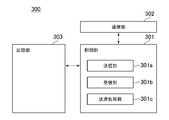
- FIG. 11 shows and describes the configuration of the second server device.
- the second server device 300 has a control unit 301, a communication unit 302, and a storage unit 303.
- the control unit 301, the communication unit 302, and the storage unit 203 are communicably connected via a bus.
- it may have an input unit such as a keyboard and a mouse, and a display unit such as a liquid crystal display that performs various displays.
- the communication unit 302 is realized by, for example, a NIC or the like, and is a communication interface that is connected to a communication network 900 such as the Internet by wire or wirelessly and communicates with a terminal device 600 or the like.
- the storage unit 303 is realized by, for example, a semiconductor memory element such as a RAM or a flash memory, an HDD, an optical disk device, or the like, and stores a program executed by the control unit 301 in advance. Further, the storage unit 303 stores the payment information.
- the control unit 301 functions as a transmission unit 301a, a reception unit 301b, and a payment processing unit 301c by executing a program realized by a CPU, an MPU, or the like and stored in the storage unit 303.
- the control unit 301 may be composed of an integrated circuit such as an ASIC or FPGA.
- the transmission unit 301a transmits, for example, a payment token to the first server device 200 via the communication unit 302.
- the receiving unit 301b receives the payment request sent from the user's terminal device 600 via the communication unit 302.
- the settlement processing unit 301c performs settlement processing based on the settlement request.
- the result of the payment process is stored in the storage unit 303 as payment information.
- FIG. 12 shows and describes the configuration of the third server device.
- the third server device 400 has a control unit 401, a communication unit 402, and a storage unit 403.
- the control unit 401, the communication unit 402, and the storage unit 403 are communicably connected via a bus.
- it may have an input unit such as a keyboard and a mouse, and a display unit such as a liquid crystal display that performs various displays.
- the communication unit 402 is realized by, for example, a NIC or the like, and is a communication interface that is connected to a communication network 900 such as the Internet by wire or wirelessly and communicates with a terminal device 600 or the like.
- the storage unit 403 is realized by, for example, a semiconductor memory element such as a RAM or a flash memory, an HDD, an optical disk device, or the like, and stores a program executed by the control unit 401 in advance.
- the control unit 401 is realized by a CPU, an MPU, or the like, and functions as a transmission unit 401a, a reception unit 401b, a code generation unit 401c, and an encryption processing unit 401d by executing the program of the storage unit 403.
- the control unit 401 may be composed of an integrated circuit such as an ASIC or FPGA.
- the transmission unit 401a transmits, for example, the encrypted data generated by the encryption processing unit 401d to the user's terminal device 600 via the communication unit 402.
- the receiving unit 401b receives the public key sent from the virtual server device group 700 via the communication unit 402.
- the code generation unit 401c generates an unlocking code.
- the encryption processing unit 401d encrypts the unlocking code with the public key and generates encrypted data.
- FIG. 13 shows and describes the configuration of the terminal device.
- the terminal device 600 includes a control unit 601, a communication unit 602, an operation unit 603, a display unit 604, an image pickup unit 605, and a storage unit 606.
- Each unit 601 to 606 is communicably connected via a control bus.
- the communication unit 602 is realized by, for example, a NIC or the like, and is a communication interface that is connected to a communication network 4 such as the Internet by wire or wirelessly and communicates with the first server device 200 or the like.
- the operation unit 603 is realized by a mouse, a keyboard, or the like, and receives various operation inputs by the user.
- the display unit 604 is realized by a liquid crystal display or the like and performs various displays.
- the operation unit 603 and the display unit 604 may be integrally configured as a touch panel.
- the imaging unit 605 images a two-dimensional code or the like attached to the vending machine 800.
- the storage unit 606 is realized by, for example, a semiconductor memory element such as a RAM or a flash memory, an HDD, an optical disk device, or the like, and stores a program executed by the control unit 601.
- the control unit 601 is realized by a CPU, an MPU, or the like, and by executing a program stored in the storage unit 606, the transmission unit 601a, the reception unit 601b, the code analysis unit 601c, the position information acquisition unit 601d, and the request unit Functions as 601e.
- the control unit 11 may be composed of an integrated circuit such as an ASIC or FPGA.
- the transmission unit 601a obtains the vending machine ID obtained by imaging the two-dimensional code attached to the vending machine 800 by the imaging unit 605, and further by the analysis by the code analysis unit 601c, and the position information acquisition 601d.
- the obtained position information is transmitted to the first server device 200 via the communication unit 602.
- the receiving unit 601b receives the encrypted data or the like sent from the third server device 400 via the communication unit 602.
- the code analysis unit 601c analyzes the two-dimensional code imaged by the image pickup unit 605 and acquires the vending machine ID.
- the position information acquisition unit 601d acquires the position information of the terminal device 600 (or the vending machine 800) at the time of imaging by means such as GPS (Global Positioning System) or BLE (Bluetooth (registered trademark) Low Energy). Then, the request unit 601e makes a request for unlocking to the sensor unit 500 based on the operation of the operation unit 603.
- GPS Global Positioning System
- BLE Bluetooth (registered trademark) Low Energy
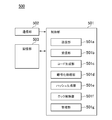
- FIG. 14 shows and describes the configuration of the sensor unit.
- This sensor unit is a module mounted on the vending machine 800.
- the sensor unit 500 mounted on the vending machine 800 has a control unit 501 that controls the whole, a communication unit 502, and a storage unit 503.
- the communication unit 502 is connected to a communication network 4 such as the Internet by wire or wirelessly, or is connected to a user's terminal device 600, a first server device 200, or the like by short-range wireless communication such as Bluetooth (registered trademark). It is a communication interface that communicates between.
- the storage unit 503 is realized by, for example, a semiconductor memory element such as a RAM or a flash memory, and stores a program executed by the control unit 501. Further, the storage unit 503 stores the generated code, the encrypted encrypted data, the generated hash, and the like.
- the control unit 501 is realized by a CPU or the like, and by executing a program stored in the storage unit 503, the transmission unit 501a, the reception unit 501b, the code generation unit 501c, the encryption processing unit 501d, the hash generation unit 501e, It functions as an unlocking unit 501f, a management unit 501g, and the like.
- the transmission unit 501a transmits the generated public key to the virtual server device group 700 that realizes the hash pool via the communication unit 502.
- the receiving unit 501b receives the encrypted data transmitted from the user's terminal device 600 via the communication unit 502.
- the code generation section 501c generates a variable number unlocking code.
- the number of fluctuations means that the code generated by a predetermined algorithm is changed each time.
- the encryption processing unit 501d generates a public key and a private key based on, for example, a public-key cryptography, and associates a hash value described later with the public key as necessary. Further, if necessary, the variable number unlocking code is encrypted with the public key.
- the public key is made public, the recipient holds the private key paired with the public key, and if necessary, decrypts the received content with the private key.
- the sensor unit 500 is both a sender and a receiver.
- the public key encryption method includes three algorithms, a key generation algorithm, an encryption algorithm, and a decryption algorithm, and key generation, encryption, and decryption are performed based on these algorithms.
- the key generation algorithm generates and outputs a public key / private key pair.
- a public key and a bit string called a plaintext (variable number unlocking code in this example) are input, and a ciphertext (encrypted data) is generated and output.
- the decryption algorithm the private key and the ciphertext (encrypted data) are input, and the plaintext (in this example, the variable number unlocking code) is generated and output.
- the hash generation unit 501e hashes the sensor information (sensor ID, position information, etc.) with a hash function and outputs a hash value.
- the unlocking unit 501g determines the success or failure of the encrypted data sent from the user's terminal device 600, and if it matches the encrypted data (or variable number unlocking code) held by the encrypted data, , Unlock (unlock).
- unlocking means, for example, when the vending machine is a gacha, unlocking the drive system related to carrying out the product and carrying out the product.
- the management unit 501h stores and manages the public key generated by the encryption processing unit 501d and the hash value generated by the hash generation unit 501e in association with each other in the storage unit 503.
- the user's terminal device 600 captures the two-dimensional code attached to the vending machine 800 with the image pickup unit 605, and the code analysis unit 601c analyzes the image to acquire the vending machine ID of the vending machine (S1). ),
- the position information acquisition unit 601d acquires the position information at the time of imaging by means such as GPS or GLE (S2), and the transmission unit 601a obtains the vending machine ID and the position information via the communication unit 602 as the first server device.
- the acquisition of encrypted data related to the unlocking of the vending machine 800 is requested (S3).
- the receiving unit 201b receives the vending machine ID and the position information via the communication unit 202 (S4), and the product information specifying unit 201c obtains the vending machine ID and the position information. , It is determined whether or not the information recorded in the vending machine information storage unit 204 matches, and if it matches, the product information related to the product handled by the vending machine is read from the product information storage unit 205 (S5) and transmitted.
- the unit 201a transmits the product information to the user's terminal device 600 in the HTML model or the like via the communication unit 202 (S6).
- the receiving unit 601b receives the product information via the communication unit 602 (S7)
- the product information is selectively displayed on the display unit 604 together with the payment means, and is desired by the operation of the operation unit 603.
- the request unit 601e makes a payment request to the second server device 300 via the communication unit 602 (S8).
- the receiving unit 301b receives the payment request via the communication unit 302 (S9)
- the payment processing unit 301c performs the payment processing related to the electronic payment (S10)
- the transmitting unit 301a communicates.
- a payment token proving that the electronic payment has been completed is transmitted to the first server device 200 via the unit 302 (S11).
- the hash generating unit 201d sends the sensor information (sensor ID and sensor) stored in the sensor information storage unit 206.
- a hash value obtained by hashing (location, etc.) by a hash function is generated, and the transmission unit 201a transmits the hash value to the user's terminal device 600 via the communication unit 202 (S13).
- the hash function used by the hash generation unit 201d for hashing is the same as the hash function used by the hash generation unit 501e of the sensor unit 501, and the sensor information to be hashed is also the same. Therefore, the sensor unit 501 It is possible to generate the same hash value as the side.
- the requesting unit 601e realizes the hash pool via the communication unit 602. Is requested to search based on the received hash value (SS15).
- the virtual server device group 700 confirms the existence of the hash value, and if it exists, transmits the public key to the third server device 400 (S16).
- the code generating unit 401c when the receiving unit 401b receives the public key via the communication unit 402 (S17), the code generating unit 401c generates a variable number unlocking code, and the encryption processing unit 401d performs the encryption logic.
- the unlocking code is encrypted with the public key based on the above, and the transmitting unit 401a transmits the encrypted data to the terminal device 600 via the communication unit 402 (S18).
- the encryption logic used for the encryption process in the third server device 400 is the same as the encryption logic used in the sensor unit 500. Further, the code generation logic used in the code generation unit 401c is also the same as that used in the sensor unit 500.
- the requesting unit 601e is a sensor mounted on the vending machine 800 via the communication unit 602.
- a sensor unlock request is made by transmitting encrypted data between the unit 500 and short-range wireless communication such as Bluetooth (registered trademark) (S20).
- the transmission unit 501a of the sensor unit 500 receives the encrypted data via the communication unit 502 (S21), and the unlocking unit 501f determines the success or failure of the encrypted data and encrypts the data. If it is determined that the data is correct, the vending machine 800 is unlocked (S22). In this way, the user acquires the product from the vending machine 800.
- the sensor unit 500 generates a variable number unlocking code by the code generation unit 501c, and the encryption processing unit 501d encrypts the encrypted data by the encryption logic and the received encryption. It may be judged by comparing with the encryption data. Alternatively, the received encrypted data is decrypted by the decryption logic of the encryption processing unit 501d to obtain a variable number unlocking code, which is compared with the variable number unlocking code generated by the code generation unit 501c. You may try to do so.
- variable number unlocking code is displayed on the Web. It can be prevented from leaking to, and more secure transactions are realized.
- the first server device consisting of a database server and the third server device that generates encrypted data use the same logic as the sensor unit for hash generation and encrypted data generation, so a variable number unlock code and There is no need to send and receive hashes, which also makes more secure transactions possible.
- the encrypted data is generated when the third server device that receives the public key from the hash pool encrypts the variable number unlocking code with the public key, so that leakage of the encrypted data should be prevented. Can be done. That is, it is possible to secure an advantage in deterring the leakage accident of encrypted data.
- the hash value is generated by the first server device and sent to the user's terminal device
- the encrypted data is generated by the third server device and sent to the user's terminal device. Because it is, it also leads to deterrence of attacks.
- the possibility of decryption is stochastically equal to zero even if it is attacked.
- the present embodiment is not limited to this, and various improvements and changes can be made.
- the sensor units mounted on each vending machine form a sensor network in a predetermined unit, and the public key is uploaded to the hash pool by the sensor unit having a sufficient power remaining amount.
- the sensor unit having a sufficient power remaining amount it is also possible to realize power saving.
Landscapes
- Engineering & Computer Science (AREA)
- Computer Security & Cryptography (AREA)
- Business, Economics & Management (AREA)
- Physics & Mathematics (AREA)
- General Physics & Mathematics (AREA)
- Theoretical Computer Science (AREA)
- Computer Networks & Wireless Communication (AREA)
- Signal Processing (AREA)
- Accounting & Taxation (AREA)
- General Business, Economics & Management (AREA)
- Strategic Management (AREA)
- Finance (AREA)
- General Health & Medical Sciences (AREA)
- Health & Medical Sciences (AREA)
- Tourism & Hospitality (AREA)
- Marketing (AREA)
- Economics (AREA)
- Software Systems (AREA)
- General Engineering & Computer Science (AREA)
- Computer Hardware Design (AREA)
- Primary Health Care (AREA)
- Human Resources & Organizations (AREA)
- Power Engineering (AREA)
- Electromagnetism (AREA)
- Toxicology (AREA)
- Artificial Intelligence (AREA)
- Computer Vision & Pattern Recognition (AREA)
- Computing Systems (AREA)
- Bioethics (AREA)
- Development Economics (AREA)
- Control Of Vending Devices And Auxiliary Devices For Vending Devices (AREA)
- Management, Administration, Business Operations System, And Electronic Commerce (AREA)
- Financial Or Insurance-Related Operations Such As Payment And Settlement (AREA)
Priority Applications (4)
| Application Number | Priority Date | Filing Date | Title |
|---|---|---|---|
| EP20837085.8A EP3998567B1 (en) | 2018-11-13 | 2020-03-19 | Communication system, communication method, and sensor unit |
| KR1020227004435A KR102767547B1 (ko) | 2018-11-13 | 2020-03-19 | 통신 시스템, 통신 방법, 및 센서 유닛 |
| US17/626,052 US11941598B2 (en) | 2018-11-13 | 2020-03-19 | Communication system, communication method, and sensor unit |
| CN202080047847.9A CN114026585B (zh) | 2018-11-13 | 2020-03-19 | 通信系统、通信方法以及传感器单元 |
Applications Claiming Priority (3)
| Application Number | Priority Date | Filing Date | Title |
|---|---|---|---|
| JP2019515390A JPWO2020100207A1 (ja) | 2018-11-13 | 2018-11-13 | 無線通信システム、無線通信端末、およびプログラム |
| JP2019-128812 | 2019-07-10 | ||
| JP2019128812A JP6681501B1 (ja) | 2018-11-13 | 2019-07-10 | 通信システム、通信方法、およびセンサユニット |
Publications (1)
| Publication Number | Publication Date |
|---|---|
| WO2021005841A1 true WO2021005841A1 (ja) | 2021-01-14 |
Family
ID=70168413
Family Applications (1)
| Application Number | Title | Priority Date | Filing Date |
|---|---|---|---|
| PCT/JP2020/012426 Ceased WO2021005841A1 (ja) | 2018-11-13 | 2020-03-19 | 通信システム、通信方法、およびセンサユニット |
Country Status (6)
| Country | Link |
|---|---|
| US (1) | US11941598B2 (https=) |
| EP (1) | EP3998567B1 (https=) |
| JP (3) | JP6681501B1 (https=) |
| KR (1) | KR102767547B1 (https=) |
| CN (1) | CN114026585B (https=) |
| WO (1) | WO2021005841A1 (https=) |
Families Citing this family (2)
| Publication number | Priority date | Publication date | Assignee | Title |
|---|---|---|---|---|
| JP7023474B1 (ja) | 2021-09-01 | 2022-02-22 | 株式会社バンダイ | 物品供給装置、物品供給システム及び管理装置 |
| JP7851554B1 (ja) | 2025-10-24 | 2026-04-27 | 株式会社シフト | オフライン認証型決済端末 |
Citations (10)
| Publication number | Priority date | Publication date | Assignee | Title |
|---|---|---|---|---|
| JPH07148358A (ja) | 1993-12-01 | 1995-06-13 | Sega Enterp Ltd | カプセル玩具 |
| JP2002117442A (ja) * | 2000-10-06 | 2002-04-19 | Tietech Co Ltd | 自動販売機の販売制限解除方式 |
| JP2002140756A (ja) * | 2000-11-01 | 2002-05-17 | Ids:Kk | サービス享受システム |
| JP2002150370A (ja) * | 2000-11-07 | 2002-05-24 | Sanyo Electric Co Ltd | 自動販売機、自動販売機の利用者管理装置、および自動販売機の販売制限システム |
| JP2002298203A (ja) * | 2001-03-30 | 2002-10-11 | Mitsubishi Electric Corp | サーバと該サーバを含む自動販売機システム |
| JP2004348238A (ja) * | 2003-05-20 | 2004-12-09 | Nippon Telegr & Teleph Corp <Ntt> | 通信方法および認証装置 |
| US20120187187A1 (en) * | 2011-01-20 | 2012-07-26 | Lai Games Australia Pty Ltd | Two-way symbological communication between electronic devices |
| JP2013235442A (ja) * | 2012-05-09 | 2013-11-21 | Japan Machine Service Co Ltd | 事業所内自動販売機管理システム |
| US20170266544A1 (en) * | 2016-03-18 | 2017-09-21 | Ming-Jian Huang | Interactive vending system and method |
| WO2018042669A1 (ja) * | 2016-09-05 | 2018-03-08 | 楽天株式会社 | 自動販売機管理システム、自動販売機管理方法、管理装置、携帯端末、及びプログラム |
Family Cites Families (30)
| Publication number | Priority date | Publication date | Assignee | Title |
|---|---|---|---|---|
| JP2001227217A (ja) * | 2000-02-14 | 2001-08-24 | Matsushita Electric Ind Co Ltd | キーレスエントリシステム |
| JP2002115436A (ja) | 2000-08-02 | 2002-04-19 | Sanyo Electric Co Ltd | 自動販売機およびその扉開閉制御システム |
| US7110954B2 (en) | 2001-03-12 | 2006-09-19 | University Of Hong Kong | Wireless purchase and on-line inventory apparatus and method for vending machines |
| JP2002344438A (ja) | 2001-05-14 | 2002-11-29 | Nippon Telegr & Teleph Corp <Ntt> | 鍵共有システム及び装置並びにプログラム |
| US20030125836A1 (en) | 2002-11-23 | 2003-07-03 | Munroe Chirnomas | Method and apparatus for controlling a vending machine |
| US7725897B2 (en) * | 2004-11-24 | 2010-05-25 | Kabushiki Kaisha Toshiba | Systems and methods for performing real-time processing using multiple processors |
| US7389530B2 (en) * | 2003-09-12 | 2008-06-17 | International Business Machines Corporation | Portable electronic door opener device and method for secure door opening |
| WO2006116110A2 (en) * | 2005-04-22 | 2006-11-02 | Redbox Automated Retail, L.L.C. | System and method for communicating vending information |
| US8931072B2 (en) * | 2006-09-28 | 2015-01-06 | Niklas Magnusson | Method of gaining access to a device |
| GB0901589D0 (en) * | 2009-01-30 | 2009-03-11 | Omar Ralph M | Improvements relating to multifunction authentication systems |
| KR101245984B1 (ko) * | 2011-11-11 | 2013-03-20 | 인하대학교 산학협력단 | 단말기를 사용한 자산 관리 장치 및 방법 |
| AU2013295667B2 (en) * | 2012-07-25 | 2016-08-04 | Paypal, Inc. | Electronic payments to non-internet connected devices systems and methods |
| JP5960035B2 (ja) * | 2012-11-28 | 2016-08-02 | 株式会社日立産機システム | 位置情報システム |
| US9898884B1 (en) * | 2013-04-04 | 2018-02-20 | Cantaloupe Systems, Inc. | Method and system of personal vending |
| JP6361098B2 (ja) * | 2013-08-28 | 2018-07-25 | 株式会社リコー | 認証システム及び認証プログラム |
| US10019724B2 (en) | 2015-01-30 | 2018-07-10 | PayRange Inc. | Method and system for providing offers for automated retail machines via mobile devices |
| JP6304590B2 (ja) * | 2014-03-13 | 2018-04-04 | 株式会社コナミデジタルエンタテインメント | ゲームシステム、管理装置及びプログラム |
| US9852423B2 (en) * | 2014-04-08 | 2017-12-26 | Usa Technologies, Inc. | Systems and methods for wireless authorization of transactions with mobile payment devices |
| US10628789B2 (en) * | 2014-05-20 | 2020-04-21 | Gimme Vending LLC | Communication device for vending machine and method of using the same |
| GB201506135D0 (en) * | 2015-04-10 | 2015-05-27 | Mastercard International Inc | Vending machine transactions |
| JP6855169B2 (ja) * | 2016-04-11 | 2021-04-07 | 進 松川 | 携帯端末機及び広告配信システム |
| SE542426C2 (en) * | 2016-04-12 | 2020-04-28 | Surfboard Payments Ab | Method and system for authorizing a transaction |
| JP7051859B2 (ja) * | 2016-12-12 | 2022-04-11 | トゥルソナ,インコーポレイテッド | 光検出を用いたネットワーク対応アカウント作成のための方法及びシステム |
| US11042862B2 (en) | 2016-12-13 | 2021-06-22 | ViaTouch Media, Inc. | Methods and utilities for consumer interaction with a self service system |
| CN207249809U (zh) * | 2017-08-07 | 2018-04-17 | 王海巍 | 自动售货机 |
| CN109035509A (zh) * | 2018-07-12 | 2018-12-18 | 佛山伊苏巨森科技有限公司 | 一种通过区块链启闭智能门锁的方法 |
| CN109858898A (zh) * | 2019-01-24 | 2019-06-07 | 深圳市萝趣电子商务有限公司 | 自动售货机出货开门系统以及购物系统 |
| US11989706B2 (en) * | 2019-12-19 | 2024-05-21 | Kishore Swaminathan | Open infrastructure for vending machine payments from mobile devices |
| EP4143797B1 (en) * | 2020-04-27 | 2025-06-04 | SodaX Pty Ltd | Vending machine system |
| US11837060B2 (en) * | 2020-07-07 | 2023-12-05 | Romaine Empire, Inc. | Systems and methods for contactless pickup at a vending machine |
-
2019
- 2019-07-10 JP JP2019128812A patent/JP6681501B1/ja active Active
-
2020
- 2020-03-19 US US17/626,052 patent/US11941598B2/en active Active
- 2020-03-19 EP EP20837085.8A patent/EP3998567B1/en active Active
- 2020-03-19 CN CN202080047847.9A patent/CN114026585B/zh active Active
- 2020-03-19 JP JP2020049663A patent/JP2020115649A/ja active Pending
- 2020-03-19 WO PCT/JP2020/012426 patent/WO2021005841A1/ja not_active Ceased
- 2020-03-19 KR KR1020227004435A patent/KR102767547B1/ko active Active
-
2024
- 2024-03-13 JP JP2024039296A patent/JP7660732B2/ja active Active
Patent Citations (10)
| Publication number | Priority date | Publication date | Assignee | Title |
|---|---|---|---|---|
| JPH07148358A (ja) | 1993-12-01 | 1995-06-13 | Sega Enterp Ltd | カプセル玩具 |
| JP2002117442A (ja) * | 2000-10-06 | 2002-04-19 | Tietech Co Ltd | 自動販売機の販売制限解除方式 |
| JP2002140756A (ja) * | 2000-11-01 | 2002-05-17 | Ids:Kk | サービス享受システム |
| JP2002150370A (ja) * | 2000-11-07 | 2002-05-24 | Sanyo Electric Co Ltd | 自動販売機、自動販売機の利用者管理装置、および自動販売機の販売制限システム |
| JP2002298203A (ja) * | 2001-03-30 | 2002-10-11 | Mitsubishi Electric Corp | サーバと該サーバを含む自動販売機システム |
| JP2004348238A (ja) * | 2003-05-20 | 2004-12-09 | Nippon Telegr & Teleph Corp <Ntt> | 通信方法および認証装置 |
| US20120187187A1 (en) * | 2011-01-20 | 2012-07-26 | Lai Games Australia Pty Ltd | Two-way symbological communication between electronic devices |
| JP2013235442A (ja) * | 2012-05-09 | 2013-11-21 | Japan Machine Service Co Ltd | 事業所内自動販売機管理システム |
| US20170266544A1 (en) * | 2016-03-18 | 2017-09-21 | Ming-Jian Huang | Interactive vending system and method |
| WO2018042669A1 (ja) * | 2016-09-05 | 2018-03-08 | 楽天株式会社 | 自動販売機管理システム、自動販売機管理方法、管理装置、携帯端末、及びプログラム |
Non-Patent Citations (1)
| Title |
|---|
| See also references of EP3998567A4 |
Also Published As
| Publication number | Publication date |
|---|---|
| JP6681501B1 (ja) | 2020-04-15 |
| JP2020080139A (ja) | 2020-05-28 |
| EP3998567C0 (en) | 2024-12-18 |
| JP7660732B2 (ja) | 2025-04-11 |
| CN114026585B (zh) | 2025-06-24 |
| EP3998567A4 (en) | 2023-07-19 |
| JP2024071425A (ja) | 2024-05-24 |
| US20220253818A1 (en) | 2022-08-11 |
| KR102767547B1 (ko) | 2025-02-12 |
| EP3998567A1 (en) | 2022-05-18 |
| JP2020115649A (ja) | 2020-07-30 |
| KR20220035165A (ko) | 2022-03-21 |
| US11941598B2 (en) | 2024-03-26 |
| EP3998567B1 (en) | 2024-12-18 |
| CN114026585A (zh) | 2022-02-08 |
Similar Documents
| Publication | Publication Date | Title |
|---|---|---|
| US20220114584A1 (en) | Apparatus and methods to define and use bearer tokens, certified tokens and applications using bearer tokens and certified tokens | |
| JP6603792B2 (ja) | 仮想通貨保管取引システム及びその動作方法 | |
| JP7660732B2 (ja) | 通信システム、通信方法 | |
| JPWO2002039342A1 (ja) | プライベート電子バリューバンクシステム | |
| MX2012013840A (es) | Metodo y dispositivos para la produccion y uso de un documento de identificacion que pueda mostrarse en un dispositivo movil. | |
| KR101950752B1 (ko) | 가상화폐를 활용하는 대금결제 시스템 및 가상화폐를 활용하는 대금결제 방법 | |
| US20190356484A1 (en) | Device for off-line storage and usage of digital assets | |
| JP4292733B2 (ja) | 画像配布システム、画像データ配布装置、画像配布方法ならびに画像データ配布装置用プログラムおよびこれを記録したコンピュータ読み取り可能な記録媒体 | |
| WO2021132454A1 (ja) | トランザクション委任方法、トランザクション委任システム、及びコンピュータプログラム | |
| TWI345725B (en) | Information processing device, secure processing device and information processing system | |
| US11176548B2 (en) | Systems and methods for cold payment solution | |
| JP2010061318A (ja) | ユーザ端末、及びユーザ端末で実行される方法、プログラム、データ構造 | |
| JP7156889B2 (ja) | 決済処理方法 | |
| KR20200096400A (ko) | 디지털 가상화폐를 qr(또는 bar)코드와 매칭시켜 전송하는 디지털 가상화폐의 전송시스템 및 그 방법 | |
| TW557441B (en) | Electronic settlement system and method, and computer readable recording medium | |
| JP2005352786A (ja) | 電子チケット販売方法、電子チケット販売・譲渡方法、サーバ装置、クライアント装置、プログラム及び記録媒体 | |
| JP7156888B2 (ja) | 決済処理方法 | |
| JPWO2020040070A1 (ja) | トランザクション処理方法、システムおよびプログラム | |
| GB2581860A (en) | Blockchain wallet | |
| JP6924877B1 (ja) | 決済処理方法 | |
| KR20230114034A (ko) | 블록체인 기술을 이용한 예술품 및 수집품의 거래 관리 시스템 | |
| JPWO2020100207A1 (ja) | 無線通信システム、無線通信端末、およびプログラム | |
| US20250175337A1 (en) | Information processing device, computer program product, and information processing method | |
| JP7633635B1 (ja) | 金銭取引システム、情報端末、コンピュータープログラムおよび金銭取引方法 | |
| JP2002083239A (ja) | デジタルコンテンツ販売方法およびシステム |
Legal Events
| Date | Code | Title | Description |
|---|---|---|---|
| 121 | Ep: the epo has been informed by wipo that ep was designated in this application |
Ref document number: 20837085 Country of ref document: EP Kind code of ref document: A1 |
|
| ENP | Entry into the national phase |
Ref document number: 20227004435 Country of ref document: KR Kind code of ref document: A |
|
| ENP | Entry into the national phase |
Ref document number: 2020837085 Country of ref document: EP Effective date: 20220210 |
|
| WWG | Wipo information: grant in national office |
Ref document number: 202080047847.9 Country of ref document: CN |