WO2020262642A1 - 化学架橋アルギン酸を用いた移植用デバイス - Google Patents
化学架橋アルギン酸を用いた移植用デバイス Download PDFInfo
- Publication number
- WO2020262642A1 WO2020262642A1 PCT/JP2020/025324 JP2020025324W WO2020262642A1 WO 2020262642 A1 WO2020262642 A1 WO 2020262642A1 JP 2020025324 W JP2020025324 W JP 2020025324W WO 2020262642 A1 WO2020262642 A1 WO 2020262642A1
- Authority
- WO
- WIPO (PCT)
- Prior art keywords
- formula
- alginic acid
- group
- solution
- cells
- Prior art date
- Legal status (The legal status is an assumption and is not a legal conclusion. Google has not performed a legal analysis and makes no representation as to the accuracy of the status listed.)
- Ceased
Links
Images





Classifications
-
- A—HUMAN NECESSITIES
- A61—MEDICAL OR VETERINARY SCIENCE; HYGIENE
- A61L—METHODS OR APPARATUS FOR STERILISING MATERIALS OR OBJECTS IN GENERAL; DISINFECTION, STERILISATION OR DEODORISATION OF AIR; CHEMICAL ASPECTS OF BANDAGES, DRESSINGS, ABSORBENT PADS OR SURGICAL ARTICLES; MATERIALS FOR BANDAGES, DRESSINGS, ABSORBENT PADS OR SURGICAL ARTICLES
- A61L27/00—Materials for grafts or prostheses or for coating grafts or prostheses
- A61L27/50—Materials characterised by their function or physical properties, e.g. injectable or lubricating compositions, shape-memory materials, surface modified materials
- A61L27/52—Hydrogels or hydrocolloids
-
- A—HUMAN NECESSITIES
- A61—MEDICAL OR VETERINARY SCIENCE; HYGIENE
- A61F—FILTERS IMPLANTABLE INTO BLOOD VESSELS; PROSTHESES; DEVICES PROVIDING PATENCY TO, OR PREVENTING COLLAPSING OF, TUBULAR STRUCTURES OF THE BODY, e.g. STENTS; ORTHOPAEDIC, NURSING OR CONTRACEPTIVE DEVICES; FOMENTATION; TREATMENT OR PROTECTION OF EYES OR EARS; BANDAGES, DRESSINGS OR ABSORBENT PADS; FIRST-AID KITS
- A61F2/00—Filters implantable into blood vessels; Prostheses, i.e. artificial substitutes or replacements for parts of the body; Appliances for connecting them with the body; Devices providing patency to, or preventing collapsing of, tubular structures of the body, e.g. stents
- A61F2/02—Prostheses implantable into the body
- A61F2/022—Artificial gland structures using bioreactors
-
- A—HUMAN NECESSITIES
- A61—MEDICAL OR VETERINARY SCIENCE; HYGIENE
- A61K—PREPARATIONS FOR MEDICAL, DENTAL OR TOILETRY PURPOSES
- A61K35/00—Medicinal preparations containing materials or reaction products thereof with undetermined constitution
- A61K35/12—Materials from mammals; Compositions comprising non-specified tissues or cells; Compositions comprising non-embryonic stem cells; Genetically modified cells
- A61K35/37—Digestive system
- A61K35/39—Pancreas; Islets of Langerhans
-
- A—HUMAN NECESSITIES
- A61—MEDICAL OR VETERINARY SCIENCE; HYGIENE
- A61K—PREPARATIONS FOR MEDICAL, DENTAL OR TOILETRY PURPOSES
- A61K47/00—Medicinal preparations characterised by the non-active ingredients used, e.g. carriers or inert additives; Targeting or modifying agents chemically bound to the active ingredient
- A61K47/30—Macromolecular organic or inorganic compounds, e.g. inorganic polyphosphates
- A61K47/36—Polysaccharides; Derivatives thereof, e.g. gums, starch, alginate, dextrin, hyaluronic acid, chitosan, inulin, agar or pectin
-
- A—HUMAN NECESSITIES
- A61—MEDICAL OR VETERINARY SCIENCE; HYGIENE
- A61K—PREPARATIONS FOR MEDICAL, DENTAL OR TOILETRY PURPOSES
- A61K9/00—Medicinal preparations characterised by special physical form
- A61K9/0012—Galenical forms characterised by the site of application
- A61K9/0019—Injectable compositions; Intramuscular, intravenous, arterial, subcutaneous administration; Compositions to be administered through the skin in an invasive manner
- A61K9/0024—Solid, semi-solid or solidifying implants, which are implanted or injected in body tissue
-
- A—HUMAN NECESSITIES
- A61—MEDICAL OR VETERINARY SCIENCE; HYGIENE
- A61K—PREPARATIONS FOR MEDICAL, DENTAL OR TOILETRY PURPOSES
- A61K9/00—Medicinal preparations characterised by special physical form
- A61K9/06—Ointments; Bases therefor; Other semi-solid forms, e.g. creams, sticks, gels
-
- A—HUMAN NECESSITIES
- A61—MEDICAL OR VETERINARY SCIENCE; HYGIENE
- A61L—METHODS OR APPARATUS FOR STERILISING MATERIALS OR OBJECTS IN GENERAL; DISINFECTION, STERILISATION OR DEODORISATION OF AIR; CHEMICAL ASPECTS OF BANDAGES, DRESSINGS, ABSORBENT PADS OR SURGICAL ARTICLES; MATERIALS FOR BANDAGES, DRESSINGS, ABSORBENT PADS OR SURGICAL ARTICLES
- A61L27/00—Materials for grafts or prostheses or for coating grafts or prostheses
- A61L27/14—Macromolecular materials
- A61L27/20—Polysaccharides
-
- A—HUMAN NECESSITIES
- A61—MEDICAL OR VETERINARY SCIENCE; HYGIENE
- A61L—METHODS OR APPARATUS FOR STERILISING MATERIALS OR OBJECTS IN GENERAL; DISINFECTION, STERILISATION OR DEODORISATION OF AIR; CHEMICAL ASPECTS OF BANDAGES, DRESSINGS, ABSORBENT PADS OR SURGICAL ARTICLES; MATERIALS FOR BANDAGES, DRESSINGS, ABSORBENT PADS OR SURGICAL ARTICLES
- A61L27/00—Materials for grafts or prostheses or for coating grafts or prostheses
- A61L27/36—Materials for grafts or prostheses or for coating grafts or prostheses containing ingredients of undetermined constitution or reaction products thereof, e.g. transplant tissue, natural bone, extracellular matrix
- A61L27/38—Materials for grafts or prostheses or for coating grafts or prostheses containing ingredients of undetermined constitution or reaction products thereof, e.g. transplant tissue, natural bone, extracellular matrix containing added animal cells
- A61L27/3804—Materials for grafts or prostheses or for coating grafts or prostheses containing ingredients of undetermined constitution or reaction products thereof, e.g. transplant tissue, natural bone, extracellular matrix containing added animal cells characterised by specific cells or progenitors thereof, e.g. fibroblasts, connective tissue cells, kidney cells
-
- A—HUMAN NECESSITIES
- A61—MEDICAL OR VETERINARY SCIENCE; HYGIENE
- A61P—SPECIFIC THERAPEUTIC ACTIVITY OF CHEMICAL COMPOUNDS OR MEDICINAL PREPARATIONS
- A61P3/00—Drugs for disorders of the metabolism
- A61P3/08—Drugs for disorders of the metabolism for glucose homeostasis
- A61P3/10—Drugs for disorders of the metabolism for glucose homeostasis for hyperglycaemia, e.g. antidiabetics
Definitions
- the present invention relates to a device for transplanting cells or the like into a living body. More specifically, the present invention relates to a transplant device using chemically crosslinked alginic acid, and a method for producing the same.
- Non-Patent Document 1 Organ Biologic, VOL24, No. 1, pp. 7-12, 2017).
- Patent Document 1 Japanese Patent Application Laid-Open No. 55-157502
- Patent Document 2 Japanese Patent Application Laid-Open No. 60-258121
- Gazette Patent Document 3: International Publication No. 95/28480
- Patent Document 4 International Publication No. 92/19195
- Patent Document 5 Japanese Patent Application Laid-Open No. 2017-196150).
- bio-artificial islets are mainly (1) "microcapsule type” in which individual islets are coated with polymer gel or the like, and (2) “macro” in which many islets are coated with polymer gel or semipermeable membrane. It is classified into “capsule type” and (3) “hemooperfusion type” in which pancreatic islets are encapsulated in an immunoisolation device or hollow fiber module made of a semipermeable membrane and blood is perfused into the device (Non-Patent Document 1). ..
- microcapsule type individual islets are encapsulated using a polymer gel that can be isolated from immune cells and permeate nutrients and insulin, and then transplanted into the body (mainly intraperitoneally) in the same way as normal islet transplantation. It is a technology. In addition to being able to isolate from the recipient's immune cells, it has the advantage that the permeation time due to diffusion is short due to the relatively thin isolation film, and nutrient permeation and cell response are accelerated, but when the function of the islets deteriorates. It is difficult to recover.
- the blood perfusion type is a technology for perfusing blood into a channel that isolates the pancreatic island with a semitransparent membrane, and has applied the accumulation of technologies such as artificial dialysis and bioartificial liver, and many basic studies have been conducted.
- the problems are that the size of the device is large and the risk of thrombus formation is high, and there is a drawback that thrombus is easily formed and clogged during long-term use, and it has not been put into practical use.
- the macrocapsule type is an improved technology for the purpose of enabling the drawback of the microcapsule type, that is, the removal of pancreatic islets when their function declines.
- studies on islet transplantation using macrocapsule type heterologous islets have not yet reported excellent results, and islets such as donor shortage, use of immunosuppressive drugs, long-term engraftment and functional maintenance of islets, etc.
- Bioartificial islets using heterologous islets that overcome the problems of transplantation have not yet been found.
- Non-Patent Document 2 JOURNAL OF BIOMEDICAL MATERIALS RESEARCH, Part B / VOL103B, ISSUE). 5, P1120-1132 (2015)).
- the document discloses that alginate capsules formed by the click reaction are more stable than ionic cross-linking (C 2+ ) cross-linking.
- JP-A-55-157502 Japanese Unexamined Patent Publication No. 60-258121 International Publication No. 95/28480 Pamphlet International Publication No. 92/19195 Pamphlet JP-A-2017-196150
- the novel alginic acid derivatives used here are hydrogelled by, for example, chemical cross-linking, and the alginic acid derivatives that are chemically cross-linked.
- the alginate gel prepared in a flat plate shape using Maintain and have excellent in vivo stability When the alginate gel prepared in a flat plate shape using Maintain and have excellent in vivo stability.
- novel alginic acid derivatives used here can be used, for example, for chemical cross-linking, that is, for chemical cross-linking.
- a reactive group capable of producing or a reactive group complementary to the reactive group has been introduced.
- the chemical cross-linking is carried out, for example, by a cross-linking reaction by a Huisgen reaction (1,3-dipolar addition cyclization reaction), and may be carried out, for example, between the alkyne derivatives of the formulas (I) and (II). Well, or, for example, it may be carried out between an alginic acid derivative of formula (I) and another molecule having an azido group, or between an alkynic acid derivative of formula (II) and another molecule having an alkyne group. You may.
- a device prepared by using an alginic acid derivative gelled by chemical cross-linking for transplanting cells or the like into a living body more specifically, a chemistry in which, for example, insulin-secreting cells or pancreatic islets are embedded.
- a transplant device including a crosslinked alginate gel and, if necessary, a semitransparent film coating the gel, a method for producing the same, and the like.
- the alginic acid derivative gelled by chemical cross-linking is, for example, the formula (I) in which a cyclic alkyne group or an azide group is introduced into any one or more carboxyl groups of alginic acid via an amide bond and a divalent linker.
- alginic acid derivative of the formula (II) It is an alginic acid derivative of the formula (II), and a novel crosslinked alginic acid can be obtained by carrying out a Huisgen reaction (1,3-dipolar addition cyclization reaction) using the alginic acid derivatives of the formulas (I) and (II). ..
- An exemplary embodiment may be as follows [1]-[23].
- the chemically crosslinked alginic acid derivative contains an arbitrary carboxyl group of the first alginic acid and an arbitrary carboxyl group of the second alginic acid according to the following formula (III-L):
- [In formula (III-L), -CONH- and -NHCO- at both ends represent an amide bond via any carboxyl group of alginic acid;
- -L 1- is the same as the definition in the above aspect [3];
- -L 2- is the same as the definition in the above aspect [3];
- X is the following partial structural formula:
- the alginic acid derivative of the formula (I) has the following formula (EX-1- (I) -A-2).
- the alginic acid derivative of the formula (II) is the following formula (EX-2- (II) -A-2).
- the transplant device according to the above [3] or [4].
- the alginic acid derivative of the formula (I) has the following formula (EX-3- (I) -A-2).
- the alginic acid derivative of the formula (II) is the following formula (EX-4- (II) -A-2).
- the transplant device according to the above [3] or [4].
- the semipermeable membrane is a dialysis membrane formed from a cellulose derivative.
- transplantation device according to any one of [1] to [12] above, wherein the transplantation site of the transplantation device is subcutaneous or intraperitoneal.
- Insulin-secreting cells or pancreatic islets are suspended in a solution of an alginate derivative hydrogelized by chemical cross-linking, and the solution in which the insulin-secreting cells or pancreatic islets are suspended is encapsulated in a semipermeable membrane, and then the semipermeable membrane is sealed.
- the transplantation device according to any one of [1] to [17] above, which is obtained by gelling an alginic acid derivative in a semipermeable membrane by contacting with a solution containing a divalent metal ion.
- a method for producing a transplant device containing a hydrogel in which insulin-secreting cells or pancreatic islets are encapsulated which comprises the following steps (a) to (d).
- Step (c) A step of bringing the solution of the alginic acid derivative obtained in the step (b) into contact with a solution containing divalent metal ions to prepare a gel having a thickness of 0.5 to 5 mm.
- a method for producing a transplant device containing a hydrogel containing insulin-secreting cells or pancreatic islets which comprises the following steps (a) to (d).
- the present invention provides a new implantable device.
- the implantable device exhibits at least one or more of the following effects: (1) Excellent biocompatibility and stability, low cytotoxicity, and almost no adhesion or inflammation at the transplant site. (2) The gel is less dissolved and the shape is maintained for a long period of time. (3) It becomes possible to maintain the hypoglycemic effect and regulate blood glucose for a long period of time. (4) After long-term use, the alginate gel in the semipermeable membrane can maintain its shape without dissolving, and the islets can survive and function, and can be used for a long period of time. (5) It can be exchanged, can be immunoisolated, has less adhesion, inflammation, etc., and is a highly safe medical material.
- a more preferred embodiment of the transplant device has excellent transplant results and functionality, is novel in terms of material, and can be transplanted into diabetic patients (particularly type I diabetes and insulin-depleted type II diabetes) to provide long-term blood glucose. It is possible to maintain the descending effect and regulate blood sugar. In addition, recovery is possible when the function of insulin-secreting cells or islets in the hydrogel is reduced. Alternatively, regular replacement or additional transplantation is possible. It is also possible to use insulin-secreting cells differentiated from stem cells (iPS or the like) or human pancreatic islets as the insulin-secreting cells or islets enclosed in the hydrogel of the transplant device. Therefore, a device of a more preferred embodiment is useful.
- a device prepared by using an alginic acid derivative gelled by chemical cross-linking for transplanting cells or the like into a living body more specifically, a chemistry in which, for example, insulin-secreting cells or pancreatic islets are embedded.
- a transplant device including a crosslinked alginate gel and, if necessary, a semitransparent film coating the gel, a method for producing the same, and the like.
- the alginic acid derivative gelled by chemical cross-linking is, for example, the formula (I) in which a cyclic alkyne group or an azide group is introduced into any one or more carboxyl groups of alginic acid via an amide bond and a divalent linker.
- alginic acid derivative of the formula (II) It is an alginic acid derivative of the formula (II), and a novel crosslinked alginic acid can be obtained by carrying out a Huisgen reaction (1,3-dipolar addition cyclization reaction) using the alginic acid derivatives of the formulas (I) and (II). ..
- An exemplary embodiment may be as follows [1]-[23].
- the first aspect is a transplantation device containing a hydrogel in which insulin-secreting cells or pancreatic islets are encapsulated, wherein the hydrogel is a gel of an alginic acid derivative by chemical cross-linking. is there.
- the second aspect is the transplantation device according to the above [1], wherein the hydrogel comprises a chemical crosslink by a triazole ring formed by a Huisgen reaction as a crosslink.
- the chemically crosslinked alginic acid derivative contains an arbitrary carboxyl group of the first alginic acid and an arbitrary carboxyl group of the second alginic acid according to the following formula (III-L):
- III-L [In formula (III-L), -CONH- and -NHCO- at both ends represent an amide bond via any carboxyl group of alginic acid;
- -L 1- is the same as the definition in the above aspect [3];
- -L 2- is the same as the definition in the above aspect [3];
- X is the following partial structural formula:
- the alginic acid derivative of the formula (I) has the following formula (EX-1- (I) -A-2).
- the alginic acid derivative of the formula (II) is the following formula (EX-2- (II) -A-2).
- the transplant device according to the above [3] or [4].
- the alginic acid derivative of the formula (I) has the following formula (EX-3- (I) -A-2).
- the alginic acid derivative of the formula (II) is the following formula (EX-4- (II) -A-2).
- the transplant device according to the above [3] or [4].
- the seventh aspect is the transplantation device according to any one of [1] to [6] above, wherein the islets are human islets or porcine islets.
- the eighth aspect is the transplantation device according to the above [7], wherein the islets are adult porcine islets.
- a ninth aspect is the transplant device according to the above [7], wherein the islets are fetal, neonatal, or perinatal porcine islets.
- the tenth aspect is the transplantation device according to any one of the above [1] to [9], wherein the hydrogel is further coated with a semipermeable membrane.
- the eleventh aspect is the transplantation device according to the above [10], wherein the semipermeable membrane is a dialysis membrane formed of a cellulose derivative.
- the twelfth aspect is the transplantation device according to the above [11], wherein the cellulose derivative is cellulose acetate.
- the thirteenth aspect is the transplantation device according to any one of the above [1] to [12], wherein the transplantation site of the transplantation device is subcutaneous or intraperitoneal.
- the fourteenth aspect is the transplantation device according to any one of the above [1] to [13], wherein the thickness of the transplantation device is 0.5 to 5 mm.
- the fifteenth aspect is the transplant device according to the above [14], wherein the thickness of the transplant device is 1 to 3 mm.
- the 16th aspect is the transplantation device according to any one of the above [1] to [13], wherein the hydrogel has a thickness of 0.5 to 3 mm.
- the seventeenth aspect is the transplantation device according to the above [16], wherein the hydrogel has a thickness of 0.5 to 1 mm.
- insulin-secreting cells or pancreatic islets are suspended in a solution of an alginic acid derivative hydrogelized by chemical cross-linking, and the solution in which the insulin-secreting cells or pancreatic islets are suspended is encapsulated in a semipermeable membrane.
- the twentieth aspect is the transplantation device according to the above [19], wherein the solution containing divalent metal ions is a solution containing calcium ions.
- a 21st aspect is a method for producing a transplant device containing a hydrogel containing insulin-secreting cells or pancreatic islets, which comprises the following steps (a) to (d).
- Step (c) A step of bringing the solution of the alginic acid derivative obtained in the step (b) into contact with a solution containing divalent metal ions to prepare a gel having a thickness of 0.5 to 5 mm.
- a 22nd aspect is a method for producing a transplantation device containing a hydrogel containing insulin-secreting cells or pancreatic islets, which comprises the following steps (a) to (d).
- Step (c) A step of encapsulating the solution of the alginic acid derivative obtained in step (b) in a semipermeable membrane.
- the 23rd aspect is the method for producing a transplant device according to the above [21] or [22], wherein the solution containing divalent metal ions is a solution containing calcium ions.
- the “transplantation device” is a hydrogel in which insulin-secreting cells or pancreatic islets are encapsulated.
- the hydrogel is a gel of an alginic acid derivative by chemical cross-linking. Therefore, as the alginic acid derivative, one that can be gelled by chemical cross-linking is used.
- the shape of the hydrogel in which insulin-secreting cells or pancreatic islets are enclosed is, for example, a flat plate type.
- the hydrogel may be further coated with a semipermeable membrane, in which case the hydrogel containing insulin-secreting cells or islets is inserted into the semipermeable membrane.
- the "insulin-secreting cell” used in the transplantation device means ⁇ -cells that secrete insulin among the cells constituting the islets.
- the “islets”, also known as Langerhans islets, are cell clusters composed of an average of about 2000 islet cells.
- Pancreatic islets are 5 cells: ⁇ cells that secrete glucagon, ⁇ cells that secrete insulin, ⁇ cells that secrete somatostatin, ⁇ cells that secrete grelin, and PP (pancreatic polypeptide) cells that secrete pancreatic polypeptide. Consists of seed cells.
- “Insulin-secreting cells or islets” are also referred to as cells or tissues having the secretory function of biologically active products.
- the “islet cell” may be any cell containing at least one of the above five types of cells, but preferably contains at least ⁇ cells.
- the islet cells may be a mixture containing all of ⁇ cells, ⁇ cells, delta cells, ⁇ cells, and PP cells, or may be in a state contained in islets.
- the “islet cells” may be those that have become islet cells by differentiation.
- the “islet cells” may also include, for example, iPS cells, ES cells, and islet cells obtained by differentiating somatic stem cells (eg, mesenchymal stem cells).
- the insulin-secreting cells or islets preferably have viability and function to the extent that the patient's pathological state can be recovered when transplanted into the patient.
- islets or islets cells for example, insulin is secreted, and it is preferable that glucose responsiveness is maintained even after transplantation.
- bioartificial islets are examples of bioartificial organs.
- the cells included in the bioartificial islets include, for example, insulin-secreting cells.
- Insulin-secreting cells are either cells contained in pancreatic islets collected from humans or pigs, or pancreatic islets differentiated from stem cells (eg, ES cells, iPS cells, and somatic stem cells (eg, mesenchymal stem cells)). It may be.
- the transplantation device of the present invention may use cells other than insulin-secreting cells, islets and islet cells.
- any cells can be used as long as they can be used for cell transplantation, and the types thereof are not particularly limited.
- the cell to be used may be one type, or a plurality of types of cells may be used in combination.
- the cells to be used include preferably animal cells, more preferably vertebrate-derived cells, and particularly preferably human-derived cells.
- the type of vertebrate-derived cells may be any of stem cells (eg, pluripotent cells or somatic stem cells), progenitor cells, or mature cells.
- pluripotent cells for example, embryonic stem (ES) cells, reproductive stem (GS) cells, or induced pluripotent stem (iPS) cells can be used.
- somatic stem cells for example, mesenchymal stem cells (MSCs), hematopoietic stem cells, sheep membrane cells, umbilical cord blood cells, bone marrow-derived cells, myocardial stem cells, adipose-derived stem cells, or nerve stem cells can be used.
- progenitor cells and mature cells include skin, dermis, epidermis, muscle, myocardium, nerve, bone, cartilage, endothelium, brain, epithelium, heart, kidney, liver, spleen, oral cavity, cornea, bone marrow, and cord blood.
- Cells derived from dermis or hair can be used.
- human-derived cells include ES cells, iPS cells, MSCs, chondrocytes, osteoblasts, osteoblast progenitor cells, interwoven cells, myoblasts, myocardial cells, myocardial blast cells, nerve cells, and hepatocytes.
- Fibroblasts corneal endothelial cells, vascular endothelial cells, corneal epithelial cells, sheep membrane cells, umbilical cord blood cells, bone marrow-derived cells, or hematopoietic stem cells can be used.
- the origin of the cell may be either an autologous cell or an allogeneic cell.
- ES cells iPS cells, mesenchymal stem cells (MSCs) can be used.
- Examples of donors of "insulin-secreting cells or islets (including islet cells)” include humans and pigs.
- Donors of "insulin-secreting cells, islets or islets cells” are, in some embodiments, pigs in terms of eliminating donor shortages.
- the "insulin-secreting cell or islet (including islet cells)” may be either an islet or an islet differentiated from ES cells or iPS cells.
- pancreatic islets including pancreatic islet cells
- pancreatic islets are derived from pigs, adult porcine islets or fetal, neonatal, or perinatal porcine islets can be mentioned.
- the pancreatic islets may be appropriately cultured before use.
- transplantation site is not particularly limited, and examples thereof include subcutaneous, intraperitoneal, intrahepatic, intramuscular, intraocular, and subcapsular, but subcutaneous and intraperitoneal transplantation is preferable.
- the "semipermeable membrane (semipermeable membrane)” is a membrane that allows only molecules or ions of a certain size or smaller to permeate. It is a system of a solute that does not permeate the semipermeable membrane and a solvent that exhibits permeability. When two solutions of two concentrations are brought into contact with each other through the semipermeable membrane, an osmotic pressure is generated at a distance and only the solvent permeates.
- the implantable devices described herein may include a semipermeable membrane, or the semipermeable membrane may not be required, i.e., it may not include a semipermeable membrane.
- the implantable device of some embodiments is a hydrogel alone (eg, encapsulated with insulin-secreting cells or islets), i.e., the hydrogel is not coated with a semipermeable membrane.
- Implantable devices in which the hydrogel is not coated with a semipermeable membrane are preferably biocompatible and stable, have less cytotoxicity, have little adhesion or inflammation at the site of implantation, and have less gel dissolution and shape. It is maintained for a long period of time, and more preferably, it is capable of sustaining a hypoglycemic effect and regulating blood glucose for a long period of time.
- the hydrogel is coated with a semipermeable membrane.
- semitransparent membrane examples include membranes or tubes used for dialysis, and dialysis tubes, cotton cellulose dialysis membranes, regenerated cellulose dialysis membranes, cellulose ester dialysis membranes, etc. can also be used, and the trade name is Cellu-. Examples include Sep T Tubular Membrane (Membrane Filtration Products), Spectra Biotech Membrane (SPECTRUM), Spectra / Pore CE dialysis tube (SPECTRUM) and the like.
- the "semipermeable membrane” is preferably a semipermeable membrane made of a cellulose ester. Specific examples include a dialysis membrane, Spectra / Pore CE dialysis tube (SPECTRUM).
- the cellulose ester is more preferably a polymer of cellulose acetate.
- the semipermeable membrane used here contains a resin.
- the semipermeable membrane can be produced, for example, by dissolving at least one kind of resin in a solvent and coagulating the dissolved resin.
- a resin is not particularly limited.
- a resin such as an ethylene-vinyl alcohol-based copolymer, a polysulfone-based polymer, a polyacrylonitrile-based polymer, a cellulose-based polymer such as cellulose acetate, a polyamide-based polymer, or a polycarbonate-based polymer can be used. Can be done. More preferably, it is a cellulosic polymer such as cellulose acetate.
- the semipermeable membrane used here has a "molecular weight cutoff".
- molecular weight cutoff is meant the magnitude of the maximum molecular weight that is not substantially blocked. Molecules with a molecular weight above the molecular weight cutoff are substantially prevented from entering and exiting the semipermeable membrane.
- the "molecular weight cutoff" of the semipermeable membrane used here is preferably 100 kDa (kilodalton).
- the cutoff value is set to "MWCO", and the cutoff value is 100 to 500 Da (Dalton), 0.5 to 1 kDa, 3.5 to 5 kDa. , 8 to 10 kDa, 20 kDa, 50 kDa, 100 kDa, 300 kDa, 1000 kDa and the like.
- the cutoff value has a molecular weight cutoff greater than about 500,000 daltons, molecules such as IgG and complements can enter these semipermeable membranes, whereas host cells such as immune cells. The entry into the semipermeable membrane is blocked, and insulin, cellular nutrients and oxygen can pass through the semipermeable membrane.
- the unit Dalton symbol means Da
- 1000 Da means 1 kDa.
- the thickness of the implantable device is preferably 0.5-5 mm, more preferably 1-3 mm.
- the thickness of the transplantation device is preferably 0.5 to 5 mm in thickness of the semipermeable membrane when the hydrogel containing insulin-secreting cells or pancreatic islets is coated with the semipermeable membrane, from 1 to 1. It is more preferably 3 mm.
- the thickness of the hydrogel is 0.5-5 mm, preferably 0.5-3 mm, more preferably 0.5-1 mm.
- the thickness of the hydrogel in the semipermeable membrane is preferably 1 to 3 mm, more preferably 1.5 mm to 2 mm.
- the thickness of the hydrogel is 0.5 to 5 mm, preferably 0.5 to 3 mm, and more preferably 0.5 to 1 mm.
- the shape of the transplant device is not particularly limited as long as it is a flat plate.
- the flat plate means a flat plate, and indicates a plate shape having a substantially constant thickness and a large area.
- Examples of the shape of the plate include flat plates such as polygons such as triangles, quadrangles, and pentagons, and circles.
- the transplanting device has the above-mentioned thickness and a substantially constant thickness in the entire plate shape.
- the thickness variation in the plate-shaped transplant device is preferably within ⁇ 10%, more preferably within ⁇ 5%.
- the thickness of the implantable device is the thickness of the thickest portion of the implantable device.
- the shape of the transplantation device looks like a rugby ball, and both ends are slightly thin.
- the shape may be thicker at the center than at both ends.
- the thickness of the transplant device means the thickness near the center, which is the part of the maximum thickness.
- the shape of the hydrogel is not particularly limited as long as it is a flat plate.
- the flat plate means a flat plate, and indicates a plate shape having a substantially constant thickness and a large area. Examples of the shape of the plate include flat plates such as polygons such as triangles, quadrangles, and pentagons, and circles.
- the hydrogel has the above-mentioned thickness and has a substantially constant thickness in the entire plate shape.
- the variation in thickness of the hydrogel is preferably within ⁇ 10%, more preferably within ⁇ 5%.
- the thickness of the hydrogel is the thickness of the thickest portion of the hydrogel.
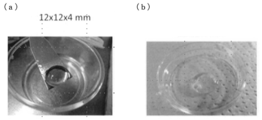
- the flat hydrogel is, for example, a crosslinked alginic acid gel having a minor diameter of 12 to 15 mm, a major diameter of 12 to 18 mm, and a thickness of about 0.5 to 5 mm, and is circular. It is also possible to take shapes such as quadrangle, hexagon, and octagon. When the flat plate type hydrogel is expressed by the area, it can be expressed as, for example, 144 to 270 mm 2 .
- IEQ is an abbreviation for Islet Equivalents, and is an international unit representing the amount of islets, in which islets are regarded as spherical and islets with a diameter of 150 ⁇ m are defined as 1 IQ.
- Islet Transplantation Implementation Manual of the Japan Pancreatic and Islet Transplantation Study Group
- Islet amount 5000 IEQ / kg (patient weight) or more I will refer to it here as well.
- the device for transplantation can be appropriately set to the number of pancreatic islets calculated so as to produce a desired therapeutic effect, and can be appropriately set to an appropriate device according to the weight of the patient, the degree of symptoms, and the like.
- the amount of insulin-secreting cells can also be appropriately set according to the islets.
- step (a): a step of removing the pancreas from a living body and separating pancreatic islets as an optional step means that the step (a) is optional. means.
- the "living body” is, for example, a human or a non-human mammal, and examples of the non-human mammal include pigs.
- step (a) is performed, for example, in the case of isolation of porcine pancreatic islets, a known procedure of the present technology, or Shimoda et al. (Shimoda; Cell Transplantation, Vol. 21, pp. 501-508, 2012).
- pancreas can be obtained from adult pigs under aseptic conditions and islet cells can be isolated according to the method described in 1 or according to a standard Ricordy technique using the Edmonton protocol. Isolation of other non-human mammalian islets or human islets can also be performed according to the isolation of porcine islets. Then, the isolated pancreatic islets may be used as they are, or may be cultured and used. Regarding the culture of pancreatic islets, for example, according to the method of Noguchi et al. (Transplantation Proceedings, 42, 2084-286 (2010)), in a medium (Connaught Medical Research Laboratory (CMRL) -based Media-1).
- CMRL Connaught Medical Research Laboratory
- step of mixing cells or tissues selected from the group consisting of for example, the alginate derivatives represented by the above formulas (I) and (II) can be mentioned as being able to be hydrogelized by chemical cross-linking. Can be done.
- step (b) for example, an aqueous solution of 0.1 to 5% by weight of the alginic acid derivative or a physiological saline aqueous solution is prepared, and insulin-secreting cells, islets, cultured islet cells, and stem cells are added to the solution.
- Cells or tissues selected from the group consisting of more differentiated islet cells eg, islets obtained in step (a), insulin secreting cells isolated from the islets, or islet cells isolated from the islets). Islet cells obtained by culturing the cells) are appropriately suspended in a required amount.
- the "solution of the alginic acid derivative that can be hydrogelized by chemical cross-linking” is, for example, the solution of the alginic acid derivative represented by the above formula (I) and the alginic acid derivative represented by the above formula (II).
- step (c) a step of contacting the solution of the alginic acid derivative obtained in step (b) with a solution containing divalent metal ions to prepare a gel having a thickness of 0.5 to 5 mm".
- the solution of the alginic acid derivative obtained in step (b) in which cells or tissues (for example, pancreatic islets) are suspended, is gelled.
- the solution of the alginic acid derivative of the formula (I) and the solution of the alginic acid derivative represented by the formula (II) are appropriately mixed in their respective doses according to the introduction rate of each chemical cross-linking group. You can.
- step (d): as an optional step of coating the gel obtained in step (c) with a semipermeable membrane means that step (d) is optional.
- the gel obtained in the step (c) is coated with a semipermeable membrane by a method known in the art or a method similar thereto.
- the gel is coated by inserting it into a semipermeable membrane (eg, a semipermeable membrane tube with one end sealed) and sealing the other end.
- step (c): encapsulating the solution of the alginic acid derivative obtained in step (b) in a semipermeable membrane is performed in step (b) in which cells or tissues (for example, pancreatic islets) are suspended.
- the obtained solution of the alginic acid derivative is coated with a semipermeable membrane by a method known in the art or a method similar thereto.
- the solution of the alginic acid derivative of the formula (I) and the solution of the alginic acid derivative represented by the formula (II) are appropriately mixed in their respective doses according to the introduction rate of each chemical cross-linking group. You can.
- the device obtained in step (d) may be washed with a solvent such as physiological saline. Moreover, you may culture in a medium for a predetermined period.
- the solution containing "divalent metal ion" used in the transplantation device examples include a solution containing calcium ion, barium ion, strontium ion and the like. It is preferably a solution containing calcium ions or barium ions, and more preferably a solution containing calcium ions.
- a solution containing divalent metal ions can be obtained, for example, by dissolving a salt of divalent metal ions in a solvent.
- the salt of the divalent metal ion include calcium chloride, barium chloride, strontium chloride and the like.
- the solvent include water and physiological saline.
- the solution containing divalent metal ions is a solution containing calcium ions, preferably an aqueous solution containing calcium chloride. It is desirable to appropriately adjust the amount of the solution containing the divalent metal ion according to the amount of the alginic acid derivative used, the molecular weight, and the like.
- the hydrogel in the device can be prepared by encapsulating the solution of the alginate derivative in the semipermeable membrane and then contacting it with a divalent metal ion solution. It may be gelled before being sealed in the semipermeable membrane and then sealed in the semipermeable membrane.
- contact means immersing a semipermeable membrane containing a solution of an alginic acid derivative in a divalent metal ion solution, applying a divalent metal ion solution to the semipermeable membrane containing a solution of an alginic acid derivative, and the like. Can be mentioned.
- Hydrogel used for transplantation devices refers to a polymer having a three-dimensional network structure that is insoluble in water and a swollen body due to water.
- the hydrogel may be simply referred to as a gel.
- the molecular weight of the molecule that can pass through the network structure of this gel can be changed greatly and freely. That is, it is conceivable that the mesh structure of the gel has a small mesh when the polymer concentration is high, and a large mesh when the polymer concentration is low. If the mesh of the network structure is too large, antibodies and the like invade the network structure. In this case, rejection of insulin-secreting cells or islets in the gel is likely to occur. Rejection inhibits the production of necessary substances such as insulin.
- the material of hydrogel consists of the following polymers.
- collagen hyaluronan, gelatin, fibronectin, elastin, tenacin, laminin, bitronectin, polymer, heparan sulfate, chondroitin, chondroitin sulfate, keratin, keratane sulfate, dermatan sulfate, carrageenan, heparin, chitin, chitosan, alginate, alginate derivative.
- an alginic acid derivative is preferable from the viewpoint of biocompatibility, long-term engraftment of pancreatic islets, maintenance of function, and the like.
- the alginic acid derivative that can be used for the transplant device will be described in detail below.
- the alginic acid derivative may include the alginic acid derivative of the following aspects [1] to [17].
- the first aspect of the alginic acid derivative is as follows. Any one or more amide bond and a divalent carboxyl group of the linker of alginate (-L 1 -) via a cyclic alkyne group (Akn) is introduced, the following formula (I): [In formula (I), (ALG) represents alginic acid; -NHCO- represents an amide bond via any carboxyl group of alginic acid; -L 1- represents the following partial structural formula [in each formula, The outside of the wavy line at both ends is not included]: Represents a divalent linker selected from the group of; Akn is the following partial structural formula [in each formula, the right side of the wavy line is not included]: The alginic acid derivative represented by [representing a cyclic alkyne group selected from the group of, and the star symbolizing the chiral center].
- -L 1- is preferably the following partial structural formula [in each formula, the wavy line outside at both ends is not included]: It is a divalent linker selected from the group of; More preferably, the following partial structural formula [in each formula, the outside of the wavy lines at both ends is not included]: It is a divalent linker selected from the group of; More preferably, the following partial structural formula [in each formula, the outside of the wavy lines at both ends is not included]: It is a divalent linker selected from the group of.
- Akn is preferably the following partial structural formula [in each formula, the right side of the wavy line is not included]: It is a cyclic alkyne group selected from the group of; More preferably, the following partial structural formula [in each formula, the right side of the wavy line is not included]: It is a cyclic alkyne group selected from the group of.
- the combination of Akn and ⁇ L 1 ⁇ is preferably the following partial structural formula [in each formula, the right side of the wavy line (imino group side). Does not include]: As indicated by the group selected from the group of; More preferably, the following partial structural formula [in each formula, the right side of the wavy line (imino group side) is not included]: As indicated by the group selected from the group of; More preferably, the following partial structural formula [in each formula, the right side of the wavy line (imino group side) is not included]: As shown by the group selected from the group of.
- -L 1 - is preferably the following partial structural formula [in each formula does not include the wavy line outer ends: It is a divalent linker selected from the group of; More preferably, the following partial structural formula [in each formula, the outside of the wavy lines at both ends is not included]: It is a divalent linker selected from the group of; More preferably, the following partial structural formula [in each formula, the outside of the wavy lines at both ends is not included]: It is a divalent linker selected from the group of.
- the combination of Akn and ⁇ L 1 ⁇ is preferably the following partial structural formula [in each formula, the right side of the wavy line (imino group side). Does not include]: As indicated by the group selected from the group of; More preferably, the following partial structural formula [in each formula, the right side of the wavy line (imino group side) is not included]: As indicated by the group selected from the group of; More preferably, the following partial structural formula [in each formula, the right side of the wavy line (imino group side) is not included]: As shown by the group selected from the group of.
- -L 1- is preferably the following partial structural formula [in each formula, the wavy line outside at both ends is not included]: It is a divalent linker selected from the group of; More preferably, the following partial structural formula [in each formula, the outside of the wavy lines at both ends is not included]: It is a divalent linker selected from the group of; More preferably, the following partial structural formula [in each formula, the outside of the wavy lines at both ends is not included]: It is a divalent linker selected from the group of.
- Akn and -L 1 - is a combination of, preferably, below: Any combination (in Table -L 1 - or the formula Akn is the aspect [1], [1-1], [1-1a], [1-2], [1-2a], and (As described in [1-1b]), or as indicated by a group selected from the group of the following formulas [in each formula, the right side of the wavy line (imino group side) is not included];
- the second aspect of the alginic acid derivative is as follows.
- the introduction rate of two Akn-L 1- NH groups (Akn and -L 1- are the same as the definitions in the above embodiment [1]) is 0.1% to 30%, said embodiment [1]. ]
- the introduction rate of two Akn-L 1- NH groups is preferably 2% to 20%; more preferably 3 to 10%.
- the introduction rate of two Akn-L 1- NH groups is preferably 0.3% to 20%; more preferably 0.5 to 10%. ..
- a third aspect of the alginic acid derivative is as follows.
- the weight average molecular weight of the alginic acid derivative measured by the gel filtration chromatography method is preferably 300,000 Da to 2.5 million Da, more preferably 500,000 Da to 2 million Da. Is.
- the weight average molecular weight of the alginic acid derivative measured by the gel filtration chromatography method is preferably 300,000 Da to 2.5 million Da, more preferably 1 million Da to 2 million Da. Is.
- a fourth aspect of the alginic acid derivative is as follows. Any one or more amide bond and a divalent carboxyl group of the linker of alginate (-L 2 -) via the azide group is introduced, by the following formula (II): [In formula (II), (ALG) represents alginic acid; -NHCO- represents an amide bond via any carboxyl group of alginic acid; -L 2- represents the following partial structural formula [in each formula, The outside of the wavy line at both ends is not included]: Represents a divalent linker selected from the group of] alginic acid derivatives represented by.
- -L 2 - is preferably the following partial structural formula: It is a linker selected from the group of [in each equation, the outside of the wavy line at both ends is not included]; More preferably, the following partial structural formula: It is a linker selected from the group of.
- -L 2 - is preferably the following partial structural formula: It is a linker selected from the group of [in each equation, the outside of the wavy line at both ends is not included]; More preferably, the following partial structural formula: It is a linker selected from the group of.
- -L 2 - is preferably the following partial structural formula: It is a linker selected from the group of [in each equation, the outside of the wavy line at both ends is not included]; More preferably, the following partial structural formula: It is a linker selected from the group of [in each equation, the outside of the wavy line at both ends is not included].
- a fifth aspect of the alginic acid derivative is as follows. N 3 -L 2 -NH 2 group (-L 2 - is the aspect [4] defined to be the same in) the introduction rate is 0.1 to 30%, in the embodiment [4] The alginic acid derivative of the above formula (II).
- the introduction rate of two N 3- L 2- NH groups is preferably 2% to 20%; more preferably 3 to 10%.
- the introduction rate of two N 3- L 2- NH groups is preferably 0.3% to 20%; more preferably 0.5 to 15%. is there.
- a sixth aspect of the alginic acid derivative is as follows.
- the weight average molecular weight of the alginic acid derivative of the formula (II) measured by the gel filtration chromatography method is preferably 300,000 Da to 2.5 million Da, more preferably 500,000 Da. It is Da to 2 million Da.
- the weight average molecular weight of the alginic acid derivative of the formula (II) measured by the gel filtration chromatography method is preferably 300,000 Da to 2.5 million Da, more preferably 1 million Da. It is Da to 2 million Da.
- a seventh aspect of the alginic acid derivative is as follows. Any carboxyl group of the first alginic acid and any carboxyl group of the second alginic acid are represented by the following formula (III-L): [In formula (III-L), -CONH- and -NHCO- at both ends represent an amide bond via any carboxyl group of alginic acid; -L 1- is the same as the definition in the above aspect [1]; -L 2- is the same as the definition in the above aspect [4]; X is the following partial structural formula: Cross-linked alginic acid that is a cyclic group selected from the group of (in each formula, the outside of the wavy line at both ends is not included), and the star mark represents the chiral center].
- -L 1- is the following partial structural formula [in each formula, the outside of the wavy lines at both ends is not included]: It is a divalent linker selected from the group of; -L 2- is the following partial structural formula: It is a divalent linker selected from the group of [in each equation, the outside of the wavy line at both ends is not included]; X is the following partial structural formula: It is a cyclic group selected from the group of (in each formula, the outside of the wavy line at both ends is not included)].
- -L 1- is the following partial structural formula [in each formula, the outside of the wavy lines at both ends is not included]: It is a divalent linker selected from the group of; -L 2- is the following partial structural formula: It is a divalent linker selected from the group of [in each equation, the outside of the wavy line at both ends is not included]; X is the following partial structural formula: It is a cyclic group selected from the group of (in each formula, the outside of the wavy line at both ends is not included)].
- -L 1- is the following partial structural formula [in each formula, the outside of the wavy lines at both ends is not included]: It is a divalent linker selected from the group of; -L 2- is the following partial structural formula: It is a divalent linker selected from the group of (in each equation, the outside of the wavy line at both ends is not included); X is the following partial structural formula: It is a cyclic group selected from the group of (in each formula, the outside of the wavy line at both ends is not included).
- -L 1 - is represented by the following partial structural formula: (In the formula, the outside of the wavy lines at both ends is not included); -L 2- is the following partial structural formula: (In the formula, the outside of the wavy lines at both ends is not included); X is the following partial structural formula: (In each equation, the outside of the wavy line at both ends is not included).
- the combination of -L 2- X-L 1- is the following partial structural formula [in each formula, the outside of the wavy lines at both ends is Not included]: As shown by the substructure selected from the group of; More preferably, the combination of -L 2- X-L 1- has the following partial structural formula [in the formula, the outside of the wavy lines at both ends is not included]: As indicated by either.
- -L 1- is the following partial structural formula [in each formula, the outside of the wavy lines at both ends is not included]: It is a divalent linker selected from the group of; -L 2- is the following partial structural formula: It is a divalent linker selected from the group of [in each equation, the outside of the wavy line at both ends is not included]; X is the following partial structural formula: It is a cyclic group selected from the group of (in each formula, the outside of the wavy line at both ends is not included)].
- -L 1- is the following partial structural formula [in each formula, the outside of the wavy lines at both ends is not included]: It is a divalent linker selected from the group of; -L 2- is the following partial structural formula: It is a divalent linker selected from the group of [in each equation, the outside of the wavy line at both ends is not included]; X is the following partial structural formula: It is a cyclic group selected from the group of (in each formula, the outside of the wavy line at both ends is not included)].
- -L 1- is the following partial structural formula [in each formula, the outside of the wavy lines at both ends is not included]: It is a divalent linker selected from the group of; -L 2- is the following partial structural formula: It is a divalent linker selected from the group of (in each equation, the outside of the wavy line at both ends is not included); X is the following partial structural formula: It is a cyclic group selected from the group of (in each formula, the outside of the wavy line at both ends is not included).
- -L 1 - is represented by the following partial structural formula: It is a divalent linker selected from the group of (in the formula, the outside of the wavy line at both ends is not included); -L 2- is the following partial structural formula: It is a divalent linker selected from the group of (in the formula, the outside of the wavy line at both ends is not included); X is the following partial structural formula: It is a cyclic group selected from the group of (in each formula, the outside of the wavy line at both ends is not included).
- the combination of -L 2- X-L 1- is the formula in the table below: As shown by the partial structure selected from the group of (the formulas of -L 1- , -L 2- or -X- in the table are the above-mentioned aspects [1], [1-1], [1- 1a], [1-1b], [4], [4-1], [4-1a], [4-1b], [7], [7-1], [7-2], [7-] 3], [7-3-1], [7-1a], [7-2a], [7-3a], and [7-3a-1]); More preferably, the combination of -L 2- X-L 1- has the following partial structural formula [in the formula, the outside of the wavy lines at both ends is not included]: As shown by the partial structure selected from the group of.
- -L 1- is the following partial structural formula [in each formula, the outside of the wavy lines at both ends is not included]: It is a divalent linker selected from the group of; -L 2- is the following partial structural formula: It is a divalent linker selected from the group of [in each equation, the outside of the wavy line at both ends is not included]; X is the following partial structural formula: It is a cyclic group selected from the group of (in each formula, the outside of the wavy line at both ends is not included)].
- -L 1- is the following partial structural formula [in each formula, the outside of the wavy lines at both ends is not included]: It is a divalent linker selected from the group of; -L 2- is the following partial structural formula: It is a divalent linker selected from the group of [in each equation, the outside of the wavy line at both ends is not included]; X is the following partial structural formula: It is a cyclic group selected from the group of (in each formula, the outside of the wavy line at both ends is not included)].
- -L 1- is the following partial structural formula [in each formula, the outside of the wavy lines at both ends is not included]: It is a divalent linker selected from the group of; -L 2- is the following partial structural formula: It is a divalent linker selected from the group of (in each equation, the outside of the wavy line at both ends is not included); X is the following partial structural formula: It is a cyclic group selected from the group of (in each formula, the outside of the wavy line at both ends is not included).
- -L 1 -X-L 2 - is a combination of, the following table of the formula:
- the formulas of -L 1- , -L 2- or -X- in the table are the above-mentioned aspects [1], [1-1], [1-1a], [1-1b], [1-1b], [4], [4-1], [4-1a], [4-1b], [7] [7-1], [ 7-2], [7-3], [7-3-1], [7-1a], [7-2a], [7-3a], [7-3a-1], [7-1b] , [7-2b], and [7-3b]);
- the combination of -L 2- X-L 1- has the following partial structural formula [in the formula, the outside of the wavy lines at both ends is not included]: As shown by the partial structure selected from the group of.
- the preferred embodiments of the crosslinked alginic acid of the above embodiment [7] can be arbitrarily formed.
- An eighth aspect of the alginic acid derivative is as follows.
- the alginic acid derivative of the formula (I) described in the embodiment [1] and the alginic acid derivative of the formula (II) described in the embodiment [4] are mixed and subjected to a Huisgen reaction, thereby describing the embodiment [7].
- a method for producing crosslinked alginic acid which comprises obtaining crosslinked alginic acid.
- the eighth aspect is as follows.
- Cross-linked alginic acid which comprises a chemical cross-link by a triazole ring formed by the Huisgen reaction as a cross-link, and an ion cross-link partially formed by calcium ions.
- a ninth aspect of the alginic acid derivative is as follows. By dropping a mixed solution of the alginic acid derivative of the formula (I) according to the embodiment [1] and the alginic acid derivative of the formula (II) according to the embodiment [4] into a calcium chloride solution. The resulting crosslinked alginic acid structure.
- a tenth aspect of the alginic acid derivative is as follows.
- the eleventh aspect of the alginic acid derivative is as follows.
- a mixed solution of an alginic acid derivative obtained by mixing the alginic acid derivative of the formula (I) according to the embodiment [1] and the alginic acid derivative of the formula (II) according to the embodiment [4] is added dropwise to the calcium chloride solution.
- a method for producing a crosslinked alginic acid structure which comprises obtaining the crosslinked alginic acid structure according to the above aspect [9] or [10].
- a twelfth aspect of the alginic acid derivative is as follows.
- a thirteenth aspect of the alginic acid derivative is as follows.
- a medical material containing the crosslinked alginic acid structure according to any one of the aspects [9], [10] and [12].
- a fourteenth aspect of the alginic acid derivative is as follows.
- a fifteenth aspect of the alginic acid derivative is as follows.
- the sixteenth aspect is as follows.
- the following formula (AM-1): Wherein (AM-1), -L 1 - , and combinations Akn is, the following table: The amino compound represented by any combination of the above (each formula is the same as the definition of the above aspect [1]), or a pharmaceutically acceptable salt thereof, or a solvate thereof.
- Akn-L 1 - is a combination of, the following table: (Each formula is in the above-mentioned aspects [1-1], [1-2], [1-1a], [1-2a], [1-1b], and [1-2b]. As described); More preferably, the table below: (Each formula is the combination of the above-mentioned aspects [1-1], [1-2], [1-1a], [1-2a], [1-1b], and [1-2b]. Same as definition); More preferably, the table below: (Each formula is the combination of the above-mentioned aspects [1-1], [1-2], [1-1a], [1-2a], [1-1b], and [1-2b]. Same as definition); For example, the following structural formula: It is as shown by any of the structural formulas in.
- the seventeenth aspect is as follows.
- alginic acid in the present specification, when referring to alginic acid, at least one alginic acid (sometimes referred to as "alginic acids") selected from the group consisting of alginic acid, alginic acid esters, and salts thereof (for example, sodium alginate) is referred to. means.
- the alginic acid used may be of natural origin or synthetic, but is preferably of natural origin.
- Preferred alginic acids are bioabsorbable polysaccharides extracted from brown algae such as Lessonia, Macrocystis, Laminaria, Ascophyllum, Derbilia, Kadika, Arame, and Kombu, D-mannuronic acid (M).
- alginic acid may be referred to as (ALG) -COOH, with alginic acid as (ALG) and one of any carboxyl groups of alginic acid as -COOH.
- the alginic acid is sodium alginate.
- the sodium alginate commercially available sodium alginate can be used.
- the sodium alginate is the sodium alginate of A-1, A-2, A-3, B-1, B-2, and B-3 described in the table below (sold by Mochida Pharmaceutical Co., Ltd.). Co., Ltd.) is used.
- the viscosity, weight average molecular weight and M / G ratio of each 1 w / w% aqueous solution of sodium alginate are shown in the table below.
- the physical property values of the sodium alginate A-1, A-2, A-3, B-1, B-2, and B-3 were measured by the following various methods.
- the measuring method is not limited to the method, but each physical property value may differ from the above depending on the measuring method.
- Da (Dalton) may be added as a unit in the molecular weights of alginic acid, alginic acid derivatives, crosslinked alginic acid, and crosslinked alginic acid.
- the composition ratio (M / G ratio) of D-mannuronic acid and L-gluuronic acid of alginic acids differs mainly depending on the type of organism from which seaweeds are derived, and is also affected by the habitat and season of the organism. , From a high G type with an M / G ratio of about 0.2 to a high M type with an M / G ratio of about 5. It is known that the gelling ability of alginic acids and the properties of the produced gel are affected by the M / G ratio, and that the gel strength generally increases when the G ratio is high.
- the M / G ratio also affects the hardness, brittleness, water absorption, flexibility, etc. of the gel.
- the M / G ratio of the alginic acids and / or salts thereof used is usually 0.2 to 4.0, more preferably 0.4 to 3.0, still more preferably 0.5 to 3.0. is there.
- the numerical range indicated by using “-” indicates a range including the numerical values before and after "-" as the minimum value and the maximum value, respectively.
- alginate ester and “alginate” used in the present specification are not particularly limited, but in order to react with a cross-linking agent, it is necessary that they do not have a functional group that inhibits the cross-linking reaction.
- the alginate ester is preferably propylene glycol alginate, or the like.
- examples of the alginate include a monovalent salt of alginic acid and a divalent salt of alginic acid.
- the monovalent salt of alginic acid is preferably sodium alginate, potassium alginate, ammonium alginate, etc., more preferably sodium alginate or potassium alginate, and particularly preferably sodium alginate.
- Preferred examples of the divalent salt of alginic acid include calcium alginate, magnesium alginate, barium alginate, strontium alginate, and the like.
- Alginic acid is a high molecular weight polysaccharide and it is difficult to accurately determine its molecular weight, but it generally has a weight average molecular weight of 10 to 10 million, preferably 10,000 to 8 million, and more preferably 20,000 to 3 million. Is the range of. It is known that in the measurement of the molecular weight of a polymer substance derived from a natural product, the value may differ depending on the measurement method.
- the weight average molecular weight measured by gel permeation chromatography (GPC) or gel filtration chromatography (collectively referred to as size exclusion chromatography) is preferably 100,000 or more, more preferably 500,000 or more, and also. It is preferably 5 million or less, more preferably 3 million or less. The preferred range is 100,000 to 5 million, more preferably 150,000 to 3 million.
- the absolute weight average molecular weight can be measured.
- the weight average molecular weight (absolute molecular weight) measured by the GPC-MALS method is preferably 10,000 or more, more preferably 50,000 or more, still more preferably 60,000 or more, and preferably 1 million or less, more preferably 80. It is 10,000 or less, more preferably 700,000 or less, and particularly preferably 500,000 or less.
- the preferred range is 10,000 to 1,000,000, more preferably 50,000 to 800,000, still more preferably 60,000 to 700,000, and particularly preferably 60,000 to 500,000.
- a measurement error of 10% to 20% can occur.
- the value may fluctuate in the range of 320,000 to 480,000 for 400,000, 400,000 to 600,000 for 500,000, and 800,000 to 1.2 million for 1 million.
- the molecular weight of alginic acids can be measured according to a conventional method.
- Typical conditions when gel filtration chromatography is used for molecular weight measurement are as described in Examples of the present specification described later.
- the column for example, Superose6 Increase 10/300 GL column (GE Healthcare Science Co., Ltd.) can be used, and as a developing solvent, for example, a 10 mmol / L phosphate buffer solution (pH 7.4) containing 0.15 mol / L NaCl.
- a developing solvent for example, a 10 mmol / L phosphate buffer solution (pH 7.4) containing 0.15 mol / L NaCl.
- blue dextran, tyroglobulin, ferritin, aldolase, conalbumin, ovalbumin, ribonuclease A and aprotinin can be used as molecular weight standards.
- the viscosity of alginic acid used in the present specification is not particularly limited, but when the viscosity is measured as an aqueous solution of 1 w / w% alginic acid, it is preferably 10 mPa ⁇ s to 1000 mPa ⁇ s, more preferably 50 mPa ⁇ s. It is s to 800 mPa ⁇ s.
- the viscosity of the aqueous solution of alginic acid can be measured according to a conventional method.
- a co-axis double-cylindrical rotational viscometer, a single cylindrical rotational viscometer (Brookfield type viscometer), a cone-plate type rotational viscometer (cone plate type viscometer), etc. of the rotational viscometer method are used.
- Alginic acids have a large molecular weight and high viscosity when they are initially extracted from brown algae, but the molecular weight decreases and the viscosity becomes low in the process of drying and purification by heat.
- Alginic acids having different molecular weights can be produced by methods such as controlling conditions such as temperature in the production process, selecting brown algae as a raw material, and fractionating the molecular weight in the production process. Further, by mixing with different lots of alginic acids having different molecular weights or viscosities, it is possible to obtain alginic acids having a desired molecular weight.
- the alginic acid used herein is, in some embodiments, unendotoxin-treated alginic acid, or in some other embodiments, low-endotoxin-treated alginic acid.
- Low endotoxin means that the endotoxin level is low enough not to cause inflammation or fever. More preferably, it is alginates treated with low endotoxin.
- the low endotoxin treatment can be performed by a known method or a method similar thereto.
- William et al.'S method for purifying biopolymer salts such as alginate and gellan gum see, eg, JP-A-2002-530440
- James et al.'S method for purifying polysaccharides eg, international publication.
- the method of Lewis et al. See, eg, US Pat. No.
- Low endotoxin treatment is not limited to these, but uses cleaning, filtration with filters (endotoxin removal filter, charged filter, etc.), extrafiltration, and columns (endotoxin adsorption affinity column, gel filtration column, column with ion exchange resin, etc.).
- the endotoxin level can be confirmed by a known method, for example, it can be measured by a method using Limulus reagent (LAL), a method using Endospecy (registered trademark) ES-24S set (Seikagaku Corporation), or the like. ..
- LAL Limulus reagent
- Endospecy registered trademark
- ES-24S set Seikagaku Corporation
- the method for treating endotoxin used is not particularly limited, but as a result, the endotoxin content of alginates should be 500 endotoxin units (EU) / g or less when endotoxin measurement with Limulus reagent (LAL) is performed. Is more preferable, and more preferably 100 EU / g or less, particularly preferably 50 EU / g or less, and particularly preferably 30 EU / g or less.
- the low endotoxin-treated sodium alginate is available from commercial products such as Sea Matrix® (Mochida Pharmaceutical Co., Ltd.) and PRONOVA TM UP LVG (FMCBioPolymer).
- alginic Acid derivatives are provided.
- the alginic acid derivative is a reactive group in the Huisgen reaction or a reactive group complementary to the reactive group via an amide bond and a divalent linker to any one or more carboxyl groups of the alginic acid.
- the alginic acid derivative is a reactive group in the Huisgen reaction or a reactive group complementary to the reactive group via an amide bond and a divalent linker to any one or more carboxyl groups of the alginic acid.
- plurality e.g., 1 to 10, or 1 to 5
- the -CH 2 - hydrogen atoms, oxo group ( O)
- C 1-6 alkyl group e.g., methyl From groups such as groups, ethyl groups, n-propyl groups, iso-propyl groups, etc.
- halogen atoms eg, fluorine atoms, chlorine atoms, bromine atoms, iodine atoms, etc.
- hydroxyl groups -OH
- a plurality (for example, 1 to 10 or 1 to 5) may be substituted with the selected group.
- alginic acid derivatives represented by the formulas (I) and (II), which are novel alginic acid derivatives in the present specification can be produced, for example, by the method of the following formula (for details, refer to the general production method described later). It is possible.
- the weight average molecular weight of the alginic acid derivative represented by the formula (I) or the formula (II) of the present specification is 100,000 Da to 3 million Da, preferably 300,000 Da to 2.5 million Da, and more preferably 50. It is 10,000 Da to 2 million Da.
- the molecular weights of both alginic acid derivatives can be determined by the method described later.
- the Akn-L 1 -NH-group of the formula (I) does not have to be bonded to all the carboxyl groups of the alginic acid constituent unit, and the N 3- L 2- of the formula (II).
- the NH-group need not be attached to all the carboxyl groups of the alginate building block.
- the N 3- L 2 -NH- group of the formula (II) is a complementary reactive group.
- Akn-L 1 -NH- group of formula (I) is the complementary reactive groups.
- the introduction rate of the reactive group or the complementary reactive group is 0.1% to 30% or 1% to 30%, preferably 2% to 20%, respectively, more preferably. Is 3% to 10%.
- the introduction rate of the reactive group or the complementary reactive group is expressed as a percentage of the number of uronic acid monosaccharide units into which each reactive group has been introduced among the uronic acid monosaccharide units which are repeating units of alginic acids. It is the value that was set.
- % used for the introduction rate of a reactive group or a complementary reactive group in an alginic acid derivative means mol%.
- the introduction rate of each reactive group or complementary reactive group can be determined by the method described in Examples described later.
- the cyclic alkyne group (Akn) in the formula (I) and the azide group in the formula (II) form a triazole ring by the Huisgen reaction, thereby forming a crosslink.
- the Huisgen reaction (1,3-dipolar addition cyclization reaction) is a condensation reaction between compounds having a terminal azide group and a terminal alkyne group as shown in the following formula.
- a disubstituted 1,2,3-triazole ring is obtained in good yield, and it is characterized in that no extra by-product is generated. It is considered that a 1,4- or 1,5-disubstituted triazole ring can be formed in the reaction, but a regioselective triazole ring can be obtained by using a copper catalyst.
- the Huisgen reaction is an azide compound having a substituted primary azide, a secondary azide, a tertiary azide, an aromatic azide, etc., and a terminal or cyclic alkyne which is a complementary reactive group of the azide group.
- a compound having a group can be used.
- various functional groups for example, ester group, carboxyl group, alkenyl group, hydroxyl group, amino group, etc. should be substituted in the reaction substrate. Is possible.
- 1,2,3-triazoles are short, easy, and efficient without the use of copper catalysts to produce unwanted by-products and avoid copper-catalyzed cytotoxicity.
- the cyclic alkyne group (cyclooctyl group) described in the above aspect [1] is used as the alkyne group of the Huisgen reaction.
- Cross-linked alginic acid is mediated by (i) a divalent metal ionic bond, (ii) a chemical bond, or (iii) a divalent metal ionic bond and a chemical bond. There is something. Any crosslinked alginic acid has the property of forming a gel-like to semi-solid, and in some cases sponge-like morphology.
- Cross-linked alginic acid via a divalent metal ionic bond proceeds at an ultrafast speed and is reversible, whereas cross-linked alginic acid via a chemical bond proceeds slowly under relatively mild conditions. And it is irreversible.
- the physical properties of the crosslinked alginic acid are adjusted by, for example, changing the concentration of the aqueous solution containing the divalent metal ion to be used (for example, the calcium chloride aqueous solution) or the introduction rate of the reactive group introduced into the alginic acid. Is possible.
- alginic acid structures can be produced.
- a specific structure can be instantly formed from an alginic acid solution by an ionic cross-linking reaction, and a cross-linking reaction by a chemical bond is used to strengthen the structure of the structure (for example, to obtain long-term stability, etc.). It is possible to do.
- a crosslinked alginate structure via both a divalent metal ionic bond and a chemical bond the divalent metal ion incorporated by the ionic bonding was reversibly released, and only the crosslink by the chemical bond remained. It is also possible to create a structure.
- the crosslinked alginic acid structure using the alginic acid derivative in the preferred embodiment has stability because it contains crosslinks by chemical bonds, and has a longer shape than the crosslinked alginic acid structure using only ion crosslinks using sodium alginate. It can be maintained for a period of time, which is advantageous.
- the crosslinked alginic acid of a certain aspect can be obtained by mixing the alginic acid derivatives of the formula (I) and the alginic acid derivative of the formula (II) and carrying out the Huisgen reaction.
- Cross-linked alginic acid in some embodiments forms a three-dimensional network structure via chemical cross-linking (cross-linking with a triazole ring formed from an alkyne group and an azide group).
- a preferred alginic acid derivative is one in which the stability of the crosslinked alginic acid after cross-linking is improved.
- the crosslinked alginic acid has the following formula (III-L): between any carboxyl group of the first alginic acid and any carboxyl group of the second alginic acid.
- formula (III-L) -CONH- and -NHCO- at both ends represent amide bonds mediated by any carboxyl group of alginic acid; -L 1- , -L 2- , and X are the above-mentioned firsts. It is the same as the definition in the aspect of 7.] It is a crosslinked alginic acid bonded via amide.
- the mixing ratio of the alginic acid derivative of formula (I) to the alginic acid derivative of formula (II) when preparing the crosslinked alginic acid is the weight of the derivative of formula (I) and the derivative of formula (II).
- the ratio is, for example, 1 to 1.5: 1, preferably 1.2 to 1.5: 1, or 1 to 1.2: 1, more preferably 1: 1.
- the mixing ratio of the alginic acid derivative of formula (II) to the alginic acid derivative of formula (I) in preparing the crosslinked alginic acid is the weight of the derivative of formula (II) and the derivative of formula (I).
- ratio for example, 1 to 4.0: 1, preferably 1.5 to 4.0: 1, or 1.2 to 1.5: 1, or 1 to 1.2: 1, more preferably 1. It is 1.
- the mixing ratio of the alginic acid derivative of the formula (I) to the alginic acid derivative of the formula (II) in preparing the crosslinked alginic acid is more preferably the alginic acid derivative of the formula (I) and the alginic acid derivative of the formula (II).
- the introduction rate (mol%) ratio of the reactive group of the alginic acid derivative for example, 1 to 1.5: 1, preferably 1.2 to 1.5: 1, or 1 to 1.2: 1. , More preferably 1: 1.
- the mixing ratio of the alginic acid derivative of the formula (II) to the alginic acid derivative of the formula (I) in preparing the crosslinked alginic acid is more preferably the alginic acid derivative of the formula (II) and the alginic acid derivative of the formula (I).
- the introduction rate (mol%) ratio of the reactive group of the alginic acid derivative for example, 1 to 4.0: 1, preferably 1.5 to 4.0: 1, or 1.2 to 1.5 :. It is 1, or 1 to 1.2: 1, more preferably 1: 1.
- the crosslinked alginic acid does not need to have all the carboxyl groups of the constituent units of alginic acid having the crosslink of the above formula (III-L).
- the introduction rate (also referred to as the crosslinking rate) of the crosslinking represented by the above formula (III-L) is, for example, 0.1 to 80%, 0.3 to 60%, 0.5 to 30%, or It is in the range of 1.0 to 10%.
- the concentration of the alginic acid derivative of the formula (I) or the formula (II) in the Huisgen reaction for obtaining crosslinked alginic acid is usually 1 to 500 mg / mL, preferably in the range of 5 to 100 mg / mL.
- the reaction temperature of the Huisgen reaction is usually an outside temperature of 4 to 60 ° C, preferably an outside temperature of 15 to 40 ° C.
- the stirring time for forming the crosslinked alginic acid (hydrogel) is, for example, several seconds to 24 hours, several seconds to 12 hours, several seconds to 30 minutes, or several seconds to 10 minutes.
- the reaction solvent or reaction solution used in the Huisgen reaction is not particularly limited, but is, for example, tap water, pure water (for example, distilled water, ion-exchanged water, RO water, RO-EDI water, etc.), ultrapure water, cells.
- pure water for example, distilled water, ion-exchanged water, RO water, RO-EDI water, etc.
- ultrapure water examples thereof include culture medium, phosphate buffered physiological saline (PBS), and physiological saline, and ultrapure water is preferable.
- the cross-linked alginic acid of some embodiments is a cross-linked alginic acid including a chemical cross-link by a triazole ring formed by the Huisgen reaction as a cross-link and an ion cross-link partially formed by calcium ions.
- crosslinked alginic acid structure The crosslinked alginic acid structure can be obtained by a method including subjecting the alginic acid derivative to a crosslinking reaction. For example, it can be prepared by the following methods, but is not limited thereto.
- a specific structure partially crosslinked can be obtained by dropping a solution containing the alginic acid derivative of the formula (I) into a solution containing divalent metal ions.
- a further cross-linking reaction Huisgen reaction
- Huisgen reaction Huisgen reaction
- a crosslinked alginic acid structure can be obtained. It is also possible to carry out this method by substituting the alginic acid derivative of the formula (I) with the alginic acid derivative of the formula (II) and the alginic acid derivative of the formula (II) with the alginic acid derivative of the formula (I). ..
- the divalent metal ion used in the above method is not particularly limited, and examples thereof include calcium ion, magnesium ion, barium ion, strontium ion, zinc ion and the like, and calcium ion is preferable.
- the solution containing calcium ions used in the above method is not particularly limited, and examples thereof include an aqueous solution of calcium chloride, an aqueous solution of calcium carbonate, an aqueous solution of calcium gluconate, and the like, and an aqueous solution of calcium chloride is preferable.
- the calcium ion concentration of the solution containing calcium ions used in the above method is not particularly limited, but examples thereof include 1 mM to 1 M, preferably 5 mM to 500 mM, and more preferably 10 mM to 300 mM.
- the solvent or solution used in the above method is also not particularly limited, but for example, tap water, pure water (for example, distilled water, ion-exchanged water, RO water, RO-EDI water, etc.), ultrapure water, cell culture medium. , Phosphoric acid buffered physiological saline (PBS), physiological saline and the like, and ultrapure water is preferable.
- cross-linked alginic acid structures include, for example, fibrous structures, fibers, beads, gels, substantially spherical gels, and the like.
- the preferred crosslinked alginic acid structure is one with improved stability. Further, the crosslinked alginic acid structure may have an ability to hold the contents inside (content retention).
- the physical properties of the alginate gel can be adjusted by the physical properties such as hardness, elasticity, repulsive force, tearing force, and stress at break.
- biocompatibility means a biocompatible material (here, an alginic acid derivative into which a photoreactive group represented by the formula (I) is introduced, and a photobridged alginic acid structure produced by using the alginic acid derivative.
- a biocompatible material here, an alginic acid derivative into which a photoreactive group represented by the formula (I) is introduced, and a photobridged alginic acid structure produced by using the alginic acid derivative.
- the property of not causing a reaction such as an interaction between a living body (referring to the body), a local reaction of a tissue adjacent to the biological material, or a systemic reaction is said to have biocompatibility.
- the biocompatibility of the alginic acid derivative or the photocrosslinked alginic acid structure will be confirmed in the examples of biocompatibility described later.
- Stability of the crosslinked alginic acid structure The stability of the crosslinked alginic acid structure can be confirmed by, for example, measuring the gel stability, and the permeability can be confirmed by measuring the gel transmittance.
- Phosphate buffered saline PBS
- concentration of alginic acid leaked into PBS ⁇ g / mL
- the value obtained by dividing the measured alginic acid concentration by the total alginic acid concentration obtained by decomposing the crosslinked alginic acid structure gel as a percentage is defined as the disintegration rate.
- the gel stability can be determined by the method described in Examples described later.
- the gel disintegration rate of the crosslinked alginic acid structure is preferably 0% to 90%, more preferably 0% to 70%, and further preferably 0% to 50%.
- the stability of the crosslinked alginic acid structure means that the lower the concentration of alginic acid leaked into the aqueous solution, that is, the lower the gel disintegration rate, the higher the stability.
- a crosslinked alginic acid structure gel containing fluorescein isothiocyanate-dextran is prepared, physiological saline is added to the gel placed in a container, and the concentration of dextran leaked into the physiological saline is measured.
- the gel permeability is the value obtained by dividing the measured dextran concentration by the total dextran concentration obtained by decomposing the fluorescein isothiocyanate-dextran-encapsulating cross-linked alginic acid structure gel.
- the gel transmittance can be determined by the method described in Examples described later.
- the gel permeability of the crosslinked alginic acid 24 hours after the addition of the physiological saline is preferably 0% to 90%, more preferably 0% to 70%, and further preferably 0% to 70% when dextran having a molecular weight of 2 million is included. It is preferably 0% to 50%.
- dextran having a molecular weight of 150,000 is included, for example, if the purpose of use of the crosslinked alginic acid structure gel is to release / produce a protein or an antibody, it is preferably 1% to 100%, more preferably 10. It is% to 100%, and more preferably 30% to 100%. If the purpose of use is an immune septum, it is preferably 0% to 90%, more preferably 0% to 70%, and even more preferably 0% to 50%.
- the permeability of the crosslinked alginic acid structure means that the lower the transmittance, the lower the permeability of the contents and extragel substances, and the higher the transmittance, the higher the permeability of the contents and extragel substances. means.
- the transmittance of the gel can be adjusted by the molecular weight and concentration of alginic acid used, the type and introduction rate of cross-linking groups to be introduced into alginic acid, the type and concentration of divalent metal ions used for gelation, or a combination thereof. is there.
- a crosslinked alginic acid structure gel containing fluorescein isothiocyanate-dextran as a content can be prepared by the following method.
- the solution of the alginic acid derivative represented by the formula (I) is mixed with the fluorescein isothiocyanate-dextran solution.
- (2) The mixed solution obtained in (1) is mixed with the solution of the alginic acid derivative represented by the formula (II).
- the formula (II) of (2) is changed to the formula (I)
- (3) The mixed solution obtained in (2) is dropped into a solution containing calcium ions, and the obtained gel forms chemical crosslinks and ion crosslinks in the solution to form fluorescein isothiocyanate-dextran.
- An encapsulated crosslinked alginic acid structure gel is obtained.
- the alginic acid derivatives represented by the formula (I) or the formula (II) are H 2 N-L 1- Akn (in the formula, L 1 and Akn are the above-mentioned embodiments [1]. definitions and amine derivatives represented by the same as a) in (AM-1), or, H 2 N-L 2 -N 3 ( wherein, L 2 is as defined in the aspect [4]
- the amine derivative (AM-2) represented by (is) can be produced by a condensation reaction using an arbitrary carboxyl group of alginic acids and a condensing agent.
- DCC 1-ethyl-3- (3-dimethylaminopropyl) carbodiimide hydrochloride
- WSC ⁇ HCl benzotriazol-1-yloxytris (dimethylamino) phosphonium hexafluorophosphate
- BOP reagent bis (BOP reagent) 2-Oxo-3-oxazolidinyl) phosphinic chloride
- BOP-Cl 2-chloro-1,3-dimethylimidazolinium hexafluorophosphate (CIP), or 4- (4,6-dimethoxy-1
- a condensing agent selected from 3,5-triazine-2-yl) -4-methylmorpholinium chloride (DMT-MM), etc., tetrahydrofuran, 1,4-dioxane, etc.
- the carboxylic acid derivative of the formula (I) can be produced by carrying out a condensation reaction at a temperature between 0 ° C. and 50 ° C. in the presence or absence of an inorganic base of the above or an organic base such as triethylamine or pyridine. it can.
- the introduction rate of the amine of the formula (AM-1) or the formula (AM-2) shall take into consideration the properties of the amine and the like. Then, the reaction conditions such as (i) to (v) below can be appropriately selected and combined to enable adjustment.
- the following shows a more specific method for producing an amine among the amines represented by the formula (AM-1) or the formula (AM-2).
- RA a C 1 to 6 alkyl group such as a methyl group or an ethyl group
- P 1 is an -C (O) O-tertBu group, -C (O) O-Bn.
- P 2 is a -C (O) O-tertBu group, -C (O) ) O-Bn group, -C (O) CH 3 group, -C (O) CF 3 group, -SO 2 Ph, -SO 2 PhMe group, -SO 2 Ph (NO 2 ) group, etc.
- protection and deprotection of protecting group P 1 and P 2 known methods described in the literature, for example, "Protective Groups in Organic Synthesis (Protective Groups in Organic Synthesis 4thEdition) first The protection / deprotection can be performed according to the deprotection method described in the textbook of "John Wiley & Sons, Greene et al.”, 4th edition, 2007.
- a compound of formula (SM-1) [a compound of formula (SM-1) is a commercially available compound or a compound that can be produced from a commercially available compound by a production method known in the literature] and a compound of formula (RG-1) [formula (RG-).
- an alkyne group formed by performing debromination reaction with DBU further (iii) an amine compound represented by the formula (AM-OL-1) by a protecting group P 1 deprotection, or ( It can be produced as a salt of AM-OL-1).
- the compound of the formula (SM-2) [the compound of the formula (SM-2) is a commercially available compound or a compound that can be produced from a commercially available compound by a production method known in the literature] and the formula (RG-2) [formula (RG-2).
- the compound of is a commercially available compound or a compound that can be produced from a commercially available compound by a production method known in the literature], and a method known in the literature, for example, "European Journal of Organic Chemistry, 2014 (6), p1280-1286; According to the method described in "2014", etc., the Mitsunobu reaction was carried out in the presence of (i) PPh 3 and N 2 (CO 2 CHMe 2 ) 2 solvents in a solvent not involved in the reaction such as tetrahydrofuran, followed by a Mitsunobu reaction.
- iii) Represented by the formula (IM-2) by hydrolyzing in the presence of a base such as lithium hydroxide and sodium hydroxide in a solvent not involved in the reaction such as methanol, ethanol, tetrahydrofuran and water or a mixed solvent thereof. Can be produced.
- a base such as lithium hydroxide and sodium hydroxide
- a solvent not involved in the reaction such as methanol, ethanol, tetrahydrofuran and water or a mixed solvent thereof.
- SM-3 the compound of the formula (SM-3) is a commercially available compound or a compound that can be produced from a commercially available compound by a production method known in the literature
- a method known in the literature for example, "Faming Zhunli” (I)
- a base such as pyridine
- H 2 NOH-HCl is reacted in a solvent not involved in the reaction such as ethanol to form an oxime according to the method described in "Shenqing, 1045299898, 22 Apr 2015” and the like.
- (ii) P 2 O 5 is reacted with diphosphorus pentoxide in methanesulfonic acid to form an 8-membered ring lactam by carrying out the Beckman transition, followed by the reaction of (iii) diethyl ether and the like.
- the compound represented by the formula (IM-3) can be produced by reducing the amide group with a reducing agent such as BH 3 or LiAlH 4 in a solvent not involved.
- the formula (IM-5) is used by reacting in the presence of a base such as sodium hydroxide and an interphase transfer catalyst such as tetrabutylammonium bromide in a solvent not involved in the reaction such as toluene.
- a base such as sodium hydroxide
- an interphase transfer catalyst such as tetrabutylammonium bromide
- the compound represented can be produced.
- SM-4 is a commercially available compound or a compound that can be produced from a commercially available compound by a production method known in the literature
- a method known in the literature for example, "Synthesis, (9), p1191-1194; 2002 ”, etc., by adding bromine and then performing a debromination reaction using tert-BuOK to form an alkyne group.
- a compound represented by the formula (IM-7) can be produced.
- a compound of formula (SM-5) [the compound of formula (SM-5) is a commercially available compound or a compound that can be produced from a commercially available compound by a production method known in the literature], a method known in the literature, for example, "US Patent. P-nitrophenyl chloroformate is reacted in the presence / absence of a base such as pyridine in a solvent such as dichloromethane that is not involved in the reaction, according to the method described in "Application Publication No. 2013-0137861" and the like. As a result, a carbonate compound can be obtained.
- the formula (IM-8) can be produced by carrying out the same condensation reaction as in [Method for producing an alginic acid derivative of (I)].
- a compound of formula (SM-7) [a compound of formula (SM-7) is a commercially available compound or a compound that can be produced from a commercially available compound by a production method known in the literature] and a compound of formula (RG-11) [formula (RG-RG-).
- the ester group is hydrolyzed in a solvent such as methanol, ethanol, tetrahydrofuran, water, etc. that does not participate in the reaction or a mixed solvent thereof, thereby carrying out the formula (IM-9). ) Can be produced.
- a base such as sodium hydroxide
- a compound of the formula (SM-8) [the compound of the formula (SM-8) is a commercially available compound or a compound that can be produced from a commercially available compound by a production method known in the literature], a method known in the literature, for example, "International publication”.
- a compound of formula (IM-11) is obtained by adding bromine and then debrominating using LiN (i-Pr) 2 according to the method described in "Pamphlet No. 2009/067663". Can be manufactured.
- a carboxylic acid represented by the formula (SM-M) can be used in a method known in the literature, for example, "Experimental Chemistry Course 5th Edition 16, Carboxylic Acids and Derivatives, Acid Halides, Acid Anhydrous, pp. 99-118. According to the method described in “2007, Maruzen”, etc., it is converted to an acid halide or an acid anhydride, and the compound of the formula (RG-M-1) is used in the presence of a base such as triethylamine or pyridine.
- a base such as triethylamine or pyridine.
- a solvent selected from halogen-based solvents such as dichloromethane and chloroform, ether-based solvents such as diethyl ether and tetrahydrofuran, aromatic hydrocarbon-based solvents such as toluene and benzene, and polar solvents such as N, N-dimethylformamide.
- the compound of the formula (IM-M-1) can be similarly produced by reacting from 0 ° C. at a temperature at which the solvent refluxes.
- ⁇ Process 2> [Production Method M] Using the compound of the formula (IM-M-1) obtained in ⁇ Step 1>, a method known in the literature, for example, "Protective Groups in Organic" by Green et al.
- halogen-based solvents such as dichloromethane and chloroform
- ether-based solvents such as diethyl ether, tetrahydrofuran, 1,2-dimethoxyethane, and 1,4-dioxane.
- the reaction is carried out using a solvent that does not participate in the reaction, such as an aromatic hydrocarbon solvent such as benzene or toluene, or a mixed solvent thereof, or without a solvent, at a temperature at which the solvent returns from ⁇ 78 ° C., and the formula (IM)
- ⁇ S-1 can be produced.
- E Halogen (for chlorine, bromine, iodine)]: A method known in the literature using a compound of formula (SM-S), for example, described in "Experimental Chemistry Course 4th Edition 19, Organic Synthesis I, Hydrocarbon / Halogen Compounds, pp. 363-482, 1992, Maruzen” and the like.
- Various halogenating agents chlorinating agent, brominating agent, iodizing agent
- solvents not involved in the reaction are appropriately selected according to the above methods, and the reaction is carried out at a temperature at which the solvent refluxes from 0 ° C.
- E chlorine>
- chlorinating agents hydrogen chloride / zinc chloride (HCl / ZnCl 2 ), hydrogen chloride / hexamethylphosphate triamide (HCl / HMPA), thionyl chloride (SOCl 2 ), carbon tetrachloride / triphenylphosphine (CCl 4 / PPh) 3 ), Triphosgen / Triphenylphosphine ((CCl 3 ) 2 CO / PPh 3 ), Triphosgen / N, N-dimethylformamide (POCl 3 / DMF) and other reagents to produce the desired chlorinated product. Can be done.
- ⁇ In the case of X bromine>
- a brominating agent 48% hydrobromic acid (48% HBr), 48% hydrobromic acid / sulfuric acid (48% HBr / H 2 SO 4 ), hydrogen bromide / lithium bromide (HBr / LiBr), odor.
- a desired chlorinated product can be produced by using a reagent such as sodium bromide / sulfuric acid (NaBr / H 2 SO 4 ) and phosphorus tribromide (PBr 3 ).
- PBr 3 phosphorus tribromide
- HI hydroiodic acid
- I 2 / PPh 3 triphenylphosphine
- a carboxylic acid represented by the formula (SM-M) can be used in a method known in the literature, for example, "Experimental Chemistry Course 5th Edition 16, Carboxylic Acids and Derivatives, Acid Halides, Acid Anhydrous, pp. 99-118. According to the method described in “2007, Maruzen”, etc., it is converted to an acid halide or an acid anhydride, and the compound of the formula (RG-T-1) is used in the presence of a base such as triethylamine or pyridine.
- a base such as triethylamine or pyridine.
- a solvent selected from halogen-based solvents such as dichloromethane and chloroform, ether-based solvents such as diethyl ether and tetrahydrofuran, aromatic hydrocarbon-based solvents such as toluene and benzene, and polar solvents such as N, N-dimethylformamide.
- the compound of the formula (IM-T-1) can be similarly produced by reacting at a temperature at which the solvent refluxes from 0 ° C.
- ⁇ Process 2> [Manufacturing Method T] Using the compound of the formula (IM-T-1) obtained in ⁇ Step 1>, a method known in the literature, for example, "Protecting Groups in Organic" by Green et al.
- the amine compound represented by the formula (AM-1) or the formula (AM-2) (including the formulas subordinate to each formula) is a pharmaceutically acceptable salt (for example, an acid addition salt). ) May form.
- the salt is not particularly limited as long as it is a pharmaceutically acceptable salt, and examples thereof include a salt with an inorganic acid, a salt with an organic acid, and a salt with an acidic amino acid.
- Preferable examples of the salt with an inorganic acid include salts with hydrochloric acid, hydrobromic acid, hydrobromic acid, nitric acid, sulfuric acid, phosphoric acid and the like.
- Suitable examples of salts with organic acids include, for example, formic acid, acetic acid, trifluoroacetic acid, propionic acid, butyric acid, valeric acid, enanthic acid, capric acid, myristic acid, palmitic acid, stearic acid, lactic acid, sorbic acid, Salts with aliphatic monocarboxylic acids such as mandelic acid, salts with aliphatic dicarboxylic acids such as oxalic acid, malonic acid, succinic acid, fumaric acid, maleic acid, malic acid, tartaric acid, and aliphatic tricarboxylic acids such as citric acid.
- examples thereof include salts with organic carboxylic acids, salts with organic sulfonic acids such as methanesulfonic acid, benzenesulfonic acid and p-toluenesulfonic acid, and acid addition salts with acidic amino acids such as aspartic acid and glutamate.
- the salt with an acidic amino acid include a salt with aspartic acid, glutamic acid and the like. Of these, pharmaceutically acceptable salts are preferable.
- the salt is prepared according to a conventional method, for example, by mixing the compound with a solution containing an appropriate amount of an acid or a base to form a desired salt, and then separating and filtering, or by distilling off the mixed solvent. Obtainable.
- Handbook of Pharmaceutical Salts: Properties, Selection, and Use, Stahl & Wermous have been published and are described in detail in this document.
- the amine compound represented by the formula (AM-1) or the formula (AM-2) (including the formulas lower than each formula) or a salt thereof is solvated with a solvent such as water, ethanol or glycerol.
- a solvent such as water, ethanol or glycerol.
- variable substituent when a cyclic substituent is substituted with a variable substituent, it means that the variable substituent is not bonded to a specific carbon atom of the cyclic group.
- the variable substituent Rs in the following formula A means that it can be substituted with any of the carbon atoms i, ii, iii, iv or v in the formula A.
- Alginic Acid derivatives can be used to prepare transplant devices as described above.
- alginic acid derivatives can be used in place of conventional alginic acid in a wide range of fields such as food, medicine, cosmetics, textiles, and papermaking.
- Preferred uses of the alginic acid derivative or the photocrosslinked alginic acid structure include, specifically, medical treatment such as wound dressing, postoperative adhesion prevention material, drug sustained-release base material, cell culture base material, and cell transplantation base material. Materials can be mentioned.
- Examples of the shape of the crosslinked alginic acid structure when used as a medical material include tubular, fibrous, fiber, beads, gel, and substantially spherical gel, and beads, gel, and substantially spherical gel are preferable. It is more preferable to use a substantially spherical gel.
- a particularly preferred embodiment of the implant device using an alginic acid derivative is excellent in biocompatibility and stability, has low cytotoxicity, has little adhesion or inflammation at the implantation site, and dissolves the gel (with or without a semipermeable membrane). It is possible to maintain the shape for a long period of time, maintain the hypoglycemic effect for a long period of time, and regulate blood glucose.
- JEOL JNM-ECX400 FT-NMR (JEOL Ltd.) was used for the measurement of the nuclear magnetic resonance spectrum (NMR).
- [UPLC] Using a Waters AQUITY UPLC system and a BEH C18 column (2.1 mm x 50 mm, 1.7 ⁇ m) (Waters), acetonitrile: 0.05% trifluoroacetic acid aqueous solution 5:95 (0 minutes) to 95: 5 Mobile phase and gradient conditions from (1.0 min) to 95: 5 (1.6 min) to 5:95 (2.0 min) were used.
- M means the molecular weight
- RT means the retention time
- [M + H] + and [M + Na] + mean the molecular ion peak.
- the "room temperature” in the examples usually indicates a temperature of about 0 ° C to about 35 ° C.
- Reactive substituent introduction rate in Example (mole%) was introduced for 1 H-NMR monosaccharide constituting the alginate calculated from (D 2 O) the number of moles of (guluronic acid and mannuronic acid) units It shall indicate the ratio of the number of moles of the reactive substituent.
- sodium alginate showing the physical property values shown in Table 10 was used as the sodium alginate before the reactive group or the complementary reactive group was introduced.
- Table 12 shows the physical property values (specifically, Example 1a, Example 2a) of the alginic acid derivatives (Example 1a, Example 2a) into which the reactive group was introduced, which were obtained in (Example 1) to (Example 4-2). , Reactive group introduction rate (mol%), molecular weight, and weight average molecular weight (10,000 Da)).
- Example 1 Synthesis of dibenzocyclooctyne-amine group-introduced alginic acid (Example 1a, Example 1b, Example 1c, and Example 1d):
- Example 1a Synthesis of dibenzocyclooctyne-amine group-introduced alginic acid (EX1- (I) -A-2a): 4- (4,6-dimethoxy-1,3,5-triazine-2-yl)-in an aqueous solution (43.6 mL) of sodium alginate (manufactured by Mochida Pharmaceutical Co., Ltd .: A-2) prepared to 1% by weight. 4-Methylmorpholinium chloride (DMT-MM) (111.65 mg), 1 molar concentration-sodium alginate solution (403.5 ⁇ L) was added.
- DMT-MM 4-Methylmorpholinium chloride
- the introduction rate of the reactive substituent was 6.9 mol% (NMR integration ratio).
- Example 1b Synthesis of dibenzocyclooctyne-amine group-introduced alginic acid (EX1- (I) -A-2b): 4- (4,6-dimethoxy-1,3,5-triazine-2-yl) -4- (4,6-dimethoxy-1,3,5-triazine-2-yl) -4- (4,6-dimethoxy-1,3,5-triazine-2-yl) -4- (4,6-dimethoxy-1,3,5-triazine-2-yl) in an aqueous solution (120 mL) of sodium alginate (manufactured by Mochida Pharmaceutical Co., Ltd .: A-2) prepared in 1% by weight.
- Methylmorpholinium chloride (DMT-MM) (330 mg), 1 molar concentration-sodium alginate aqueous solution (300 ⁇ L) was added.
- the introduction rate of the reactive substituent was 5.0 mol% (NMR integration ratio).
- Example 1c Synthesis of dibenzocyclooctyne-amine group-introduced alginic acid (EX1- (I) -A-2c): 4- (4,6-dimethoxy-1,3,5-triazine-2-yl) -4- (4,6-dimethoxy-1,3,5-triazine-2-yl) -4- (4,6-dimethoxy-1,3,5-triazine-2-yl) -4- (4,6-dimethoxy-1,3,5-triazine-2-yl) in an aqueous solution (120 mL) of sodium alginate (manufactured by Mochida Pharmaceutical Co., Ltd .: A-2) prepared in 1% by weight.
- Methylmorpholinium chloride (DMT-MM) (167 mg), 1 molar concentration-sodium alginate aqueous solution (151 ⁇ L) was added.
- the introduction rate of the reactive substituent was 2.3 mol% (NMR integration ratio).
- the introduction rate of the reactive substituent was 2.4 mol% (NMR integration ratio).
- Example 2 Synthesis of 4- (2-aminoethoxy) -N- (3-azidopropyl) benzamide group-introduced alginic acid (Example 2a, Example 2b, Example 2c, and Example 2d):
- Example 2 Lithium hydroxide monohydrate (0.25 g) was added to a solution of the compound EX2-IM-1 (0.44 g) obtained in ⁇ Step 1> in methanol (4.4 mL). , 60 ° C. for 3 hours and 30 minutes. 1N-hydrochloric acid (5 mL) was added to the reaction mixture, and the mixture was extracted 3 times with ethyl acetate (10 mL). The organic layer was washed successively with water (5 mL) and saturated brine (5 mL), dried over anhydrous sodium sulfate, and the solvent was evaporated under reduced pressure.
- the introduction rate of the reactive substituent (4- (2-aminoethoxy) -N- (3-azidopropyl) benzamide group) was 6.1 mol% (NMR integration ratio).
- the introduction rate of the reactive substituent (4- (2-aminoethoxy) -N- (3-azidopropyl) benzamide group) was 2.3 mol% (NMR integration ratio).
- the introduction rate of the reactive substituent (4- (2-aminoethoxy) -N- (3-azidopropyl) benzamide group) was 2.3 mol% (NMR integration ratio).
- Example 3 To a 1,4-dioxane solution (3.5 mL) of the compound EX3-IM-1 (0.5 g) obtained in ⁇ Step 1> under water-cooled stirring, 4N-hydrogen chloride. / 1,4-dioxane (3.5 mL) was added, and the mixture was stirred at room temperature for 3 hours. After adding diisopropyl ether (40 mL) to the reaction solution, the precipitate was filtered to obtain the title compound EX3-IM-2 (0.36 g) as a white solid.
- the white solid was dissolved in 180 mL of water, lyophilized, dried at 40 ° C. for 6 hours, and then refrigerated once. The mixture was dried again at 40 ° C. for 5 hours to obtain the title compound EX3- (I) -A-2b (2.77 g) as a white amorphous substance.
- tert-butyl (2-aminoethyl) carbamate [CAS: 57260-73-8] (825 mg) and pyridine (1.04 mL) It was added to a methylene chloride (7.0 mL) solution under ice-water cooling, and stirred at room temperature for 1 hour.
- the reaction mixture is diluted with tert-butyl methyl ether (30 mL), water (10 mL), saturated stratified water (5 mL), 0.5N-citric acid (twice at 5 mL), water (5 mL), saturated saline. It was washed sequentially with water (5 mL).
- Example 4 The compound (EX4-IM-1,500 mg) obtained in ⁇ Step 1> was suspended in 1,4-dioxane (1.5 mL). 4 Predetermined-hydrogen chloride / dioxane solution (3.5 mL) was added under ice-water cooling, and the mixture was stirred at room temperature for 2.5 hours. Diisopropyl ether (10.5 mL) was added to the reaction mixture, and the mixture was stirred at room temperature for 50 minutes. The solid was filtered, washed with diisopropyl ether, and dried under reduced pressure to give the title compound EX4-IM-2 (365 mg) as a light beige solid.
- the introduction rate of the reactive group was 5.3 mol% (NMR integration ratio).
- Example 4-2 The compound (EX4-2-IM-1,670 mg) obtained in ⁇ Step 1> was mixed with 4 default-hydrogen chloride / 1,4-dioxane (4.7 mL) under ice-water cooling. ) was added, and the mixture was stirred at room temperature for 2 hours. Diisopropyl ether (14 mL) was added to the reaction mixture, and the mixture was stirred for 30 minutes. The obtained solid was collected by filtration, washed with diisopropyl ether, and dried under reduced pressure to give the title compound EX4-2-IM-2 (604 mg) as a light beige solid.
- the introduction rate of the reactive group was 2.72 mol% (NMR integration ratio).
- Reactive group or complementary reactive group introduction rate means a value representing the number of reactive groups or complementary reactive groups introduced per uronic acid monosaccharide unit, which is a repeating unit of alginic acid, as a percentage.
- the reactive group or complementary reactive group introduction rate (mol%) was calculated by the integral ratio of 1 H-NMR.
- the amount of alginic acid required to calculate the introduction rate is measured by the carbazole sulfate method using a calibration curve, and the amount of reactive groups or complementary reactive groups is measured by an absorbance measurement method using a calibration curve. You can also do it.
- the molecular weight of alginate into which a reactive group or a complementary reactive group has been introduced is bluedextran (molecular weight 2 million Da, SIGMA), tyroglobulin (molecular weight 669000 Da, GE Healthcare Science) ferritin (molecular weight). 440,000 Da, GE Healthcare Science) Aldolase (molecular weight 158,000 Da, GE Healthcare Science), Conalbumin (molecular weight 75,000 Da, GE Healthcare Science), Obalbumin (molecular weight 4.4) 10,000 Da, GE Healthcare Science), Ribonuclease A (Molecular Weight 137,000 Da, GE Healthcare Science) and Aprotinin (Molecular Weight 6500 Da, GE Healthcare Science) are used as standard products and are reactive groups or complementary.
- the molecular weight (Mi) at the elution time i of the previously obtained chromatogram was calculated. Then, the absorbance at the elution time i was read and used as Hi. From these data, the weight average molecular weight (Mw) was calculated from the following formula.
- Alginic acid of Example 1 (a, b, c): 1.5 wt% saline solution (solutions of Example 5-1a, Example 5-1b, Example 5-1c) Alginic acid of Example 2 (a, b, c): 3.0 wt% saline solution (solutions of Example 5-2a, Example 5-2b, Example 5-2c) Alginic acid of Example 3 (a): 1.5 wt% physiological saline solution (solution of Example 5-3a) Alginic acid of Example 4: 3.0 wt% saline solution (solution of Example 5-4)
- a 1.0 wt% physiological saline solution is prepared and sterilized by filtration using MILLEX GV 0.22 ⁇ m (Millipore, 0.22 ⁇ m, Cat.
- Example 1 Alginic acid of Example 1 (d): 1.0 wt% physiological saline solution (solution of Example 5-1d) Alginic acid of Example 2 (d): 1.0 wt% physiological saline solution (solution of Example 5-2d) Alginic acid of Example 3 (b): 1.0 wt% saline solution (solution of Example 5-3b) Alginic acid of Example 4-2: 1.0 wt% physiological saline solution (solution of Example 5-5)
- each of these alginate physiological saline solutions was used in the test after adjusting the concentration as appropriate.
- the solution of Example 5-1 (a, b, c) and the solution of Example 5-2 (a, b, c) are combined, and the solution of Example 5-3a and the solution of Example 5 are combined.
- the alginic acid prepared in Example 1 (d) or Example 3 (b) is combined with the alginic acid prepared in Example 2 (d) or Example 4-2 to prepare a chemically crosslinked alginic acid gel.
- Example 5-1d and the solution of Example 5-2d are combined, the solution of Example 5-1d and the solution of Example 5-5 are combined, and the solution of Example 5-3b is combined.
- the solution and the solution of Example 5-2d are combined, and the solution of Example 5-3b and the solution of Example 5-5 are combined.
- the flat plate gel is, for example, an alginate gel having a short diameter of 12 to 15 mm, a long diameter of 12 to 18 mm, and a thickness of about 0.5 to 5 mm, and is circular, quadrangular, hexagonal, or so. It is also possible to take an octagon, etc., and it is not particularly limited.
- Example 6-1 Production of flat plate alginate gel for transplantation
- a flat plate-type alginate gel was produced using a 55 mmol / L calcium chloride aqueous solution according to "Production of a flat plate-type alginate gel" described in Example 5.
- the alginate solution was prepared to 1% by weight, an aqueous solution of sodium alginate (manufactured by Mochida Pharmaceutical Co., Ltd .: B-2), an aqueous solution of sodium alginate (manufactured by Mochida Pharmaceutical Co., Ltd .: A-2), a solution of Example 5-1b and Examples.
- the following flat plate type alginate gel was prepared using. The prepared alginate gel on a flat plate was cultured overnight in D-MEM medium. The next day, it was replaced with serum-free D-MEM medium, further replaced with physiological saline, and allowed to stand for 1 hour or longer to obtain an alginate gel for transplantation into animals.
- Example 6-1a An aqueous solution of sodium alginate (manufactured by Mochida Pharmaceutical Co., Ltd .: B-2) prepared to 1% by weight was used to obtain an alginate gel on a flat plate having a short diameter (12 mm), a long diameter (15 mm), and a thickness (5 mm). A photograph of this flat plate-type alginate gel is shown as FIG. 1 (a).
- Example 6-1b A flat plate of short diameter (12 mm) -long diameter (12 mm) -thickness (4 mm) using a solution obtained by mixing the solution of Example 5-1b and the solution of Example 5-2b at a ratio of 2: 1 (volume ratio). An upper alginate gel was obtained. The chemical cross-linking group was adjusted to a concentration of 1%. A photograph of this flat plate-type alginate gel is shown in FIG. 2 (a). Shown as.
- Example 6-1c A flat plate of short diameter (12 mm) -long diameter (12 mm) -thickness (4 mm) using a solution obtained by mixing the solution of Example 5-1b and the solution of Example 5-2b at a ratio of 2: 1 (volume ratio). An upper alginate gel was obtained. The chemical cross-linking group was adjusted to a concentration of 2%. A photograph of this flat plate-type alginate gel is shown as FIG. 3 (a).
- Example 6-1d Using an aqueous solution of sodium alginate (manufactured by Mochida Pharmaceutical Co., Ltd .: A-2) prepared in 1% by weight, a short diameter (about 12 mm) -long diameter (about 12 mm) -thickness (about 4 mm) alginate gel on a flat plate was prepared. Obtained.
- Example 6-1e Short diameter (about 12 mm) -long diameter (about 12 mm) -thickness (about 4 mm) using a solution obtained by mixing the solution of Example 5-1d and the solution of Example 5-2d at a ratio of 1: 1 (volume ratio). ) On a flat plate, an alginate gel was obtained. The chemical cross-linking group was adjusted to a concentration of 1%.
- Example 6-1f Using a solution obtained by mixing the solution of Example 5-1d and the solution of Example 5-5 at a ratio of 1: 1 (volume ratio), short diameter (about 12 mm) -long diameter (about 12 mm) -thickness (about 4 mm). ) On a flat plate, an alginate gel was obtained. The chemical cross-linking group was adjusted to a concentration of 1%.
- Example 6-1g Using a solution obtained by mixing the solution of Example 5-3b and the solution of Example 5-2d at a ratio of 1: 1 (volume ratio), short diameter (about 12 mm) -long diameter (about 12 mm) -thickness (about 4 mm). ) On a flat plate, an alginate gel was obtained. The chemical cross-linking group was adjusted to a concentration of 1%.
- Example 6-1h Using a solution obtained by mixing the solution of Example 5-3b and the solution of Example 5-5 at a ratio of 1: 1 (volume ratio), short diameter (about 12 mm) -long diameter (about 12 mm) -thickness (about 4 mm). ) On a flat plate, an alginate gel was obtained. The chemical cross-linking group was adjusted to a concentration of 1%.
- Example 6-2 Transplantation test of flat plate alginate gel into animals
- Each alginate gel prepared in Examples 6-1a to 6-1c was intraperitoneally transplanted into healthy mice C57BL / 6NCr. After 5 weeks, the abdomen was opened and the gel was removed to confirm the state of the gel. Intraperitoneal adhesions and inflammation were also confirmed.
- each alginate gel prepared in Examples 6-1d to h was transplanted into the abdominal cavity of healthy mouse C57BL / 6NCr. After 1, 2 or 4 weeks, the abdomen was opened and the gel was removed, and the state of the gel was confirmed. Intraperitoneal adhesions and inflammation were also confirmed.
- Alginate gel of Example 6-1a The extracted alginate gel did not maintain its original shape, was disjointed, and the amount of remaining gel that could be confirmed was small. A photograph of this state is shown as FIG. 1 (b). Alginate gel of Example 6-1b: The extracted alginate gel did not change in gel size. A photograph of this state is shown as FIG. 2 (b). Alginate gel of Example 6-1c: The extracted alginate gel was cracked, but the original shape was almost maintained, and the gel size did not change. A photograph of this state is shown as FIG. 3 (b).
- Alginate gel of Example 6-1d The alginate gel removed after 1 week did not maintain its original shape, was disjointed, and the amount of gel that could be confirmed remaining was small.
- Alginate gel of Example 6-1f There was no change in gel size in any of the alginate gels removed after 1 week, 2 weeks, and 4 weeks.
- Example 6-1 g of alginate gel There was no change in gel size in any of the alginate gels removed after 1 week and 2 weeks. The alginate gel removed after 4 weeks was cracked, but the original shape was almost maintained, and the gel size did not change.
- Alginate gel of Example 6-1h There was no change in gel size in any of the alginate gels removed after 1 week and 2 weeks. The alginate gel removed after 4 weeks was cracked, but the original shape was almost maintained, and the gel size did not change.
- the alginate gels of Examples 6-1a, 6-1b, and 6-1c were transplanted, and 5 weeks later, the abdomen was opened and confirmed. As a result, there was no adhesion or inflammation between the intraperitoneal organs. There were no adhesions or inflammation in the omentum or intestinal membrane in which the gel was buried. There was no adhesion or inflammation in the liver to which the separated gel had adhered.
- Example 6-1d The alginate gels of Example 6-1d, Example 6-1f, Example 6-1g, and Example 6-1h were transplanted, and the abdomen was opened and confirmed after 1 week, 2 weeks, and 4 weeks. There were no adhesions or inflammation between the intra-abdominal organs. There were no adhesions or inflammation in the omentum or intestinal membrane in which the gel was buried. There was no adhesion or inflammation in the liver to which the separated gel had adhered.
- Example 6-3 Cell survival confirmation test of flat plate alginate gel
- MIN6 cells (5 ⁇ 10 6 cells), which are cell lines of pancreatic islet ⁇ -cells, were used in Examples 6-1a, 6-1b, 6-1c, 6-1d, and 6-.
- an alginic acid gel was prepared, and it was prepared in a D-MEM medium for 3 to 4 weeks. After culturing, the survival of MIN6 cells was confirmed under a microscope.
- Example 1b with an introduction rate of 5.0 mol% and Example 2b with an introduction rate of 4.9 mol% 1.5% by weight of the physiological saline solution of Example 5-1b and 3.0 were used, respectively.
- the saline solution of Example 5-2b in% by weight is prepared.
- a 2% by weight alginic acid solution having an introduction rate of cross-linking groups of 5 mol% can be prepared.
- the solutions of Examples 5-1b and 5-2b are diluted 2-fold and 4-fold to prepare solutions, which are mixed at a ratio of 2: 1 (volume ratio) to prepare a solution.
- the mixed solution of the 2-fold diluted solution is used as the solution of Example 7-1, and the mixed solution of the 4-fold diluted solution is used as the solution of Example 7-2. Further, in the same manner, the solution of Example 5-1c and the solution of Example 5-2c were mixed at a ratio of 2: 1 (volume ratio), and a mixed solution of a 4-fold diluted solution was used in Example 7-3. Make a solution.
- Example 7-1a Transplant device prepared using 100 ⁇ L of the solution of Example 7-1
- Example 7-1b Transplant device prepared using 200 ⁇ L of the solution of Example 7-1
- Example 7-2a Transplant device prepared using 100 ⁇ L of the solution of Example 7-2
- Example 7-2b Transplant device prepared using 200 ⁇ L of the solution of Example 7-2
- Example 7-3a Example 7-3 Transplant device prepared using 100 ⁇ L of solution
- Example 7-3b Transplant device prepared using 200 ⁇ L of solution of Example 7-3
- the islet pellets dispensed into one device are suspended in the alginic acid solution (B1) of Example 5-1b. Later, the solutions of Examples 7-1a, 7-1b, 7-2a, and 7-2b were mixed with the alginic acid solution (C1) of Example 5-2b and the islets of porcine were suspended. And said.
- the alginic acid solution (B1) of Example 5-1b and the alginic acid solution (C1) of Example 5-2b were prepared in physiological saline according to the pellet amount (10 to 30 ⁇ L) of the porcine pancreatic islet amount of 10000 IEQ per device.
- the concentration was adjusted. Further, in order to prepare a 100 ⁇ L or 200 ⁇ L porcine islet-containing 0.5% to 1.0% by weight alginic acid solution, the islet pellets dispensed into one device in the alginic acid solution (B1) of Example 5-1c were added. After suspension, it was mixed with the alginic acid solution (C1) of Example 5-2c to prepare the solutions of Examples 7-3a and 7-3b in which the islets of porcine were suspended. The alginic acid solution (B1) of Example 5-1c and the alginic acid solution (C1) of Example 5-2c were prepared in physiological saline according to the pellet amount (10 to 30 ⁇ L) of the porcine islet amount of 10000 IEQ per device. The concentration was adjusted.
- the alginic acid solution containing porcine pancreatic islands prepared as Example 7-1a, Example 7-2a, Example 7-2b and Example 7-3b was rapidly semipermeable membrane (Spectrum dialysis tube "Spectra / Pore CE (Spectra / Pore CE)”. Encapsulate in (fractional molecular weight 100,000) ”) (after heat-sealing one end of the semipermeable membrane, add an alginic acid solution and enclose with a titanium clip), and soak in 55 mmol / LCaCl 2 solution for 10 to 15 minutes, and device. The alginic acid solution inside was gelled.
- the transplantation device was washed with physiological saline for 3 minutes and cultured overnight in the transplantation medium (M199-nicotinamide-FBS + P / S). Next, the cells were soaked in a serum-free medium for transplantation (M199 + P / S) for 30 minutes, and then soaked in physiological saline for pre-transplantation + P / S for 30 minutes for washing to obtain a device for transplantation into mice.
- a photograph of the prepared transplantation device is shown in FIG.
- the size of the transplant device length 10 mm x width 26 mm x thickness about 2 mm ⁇
- Culture conditions M199 + Nicotinamide + Fetal bovine serum + Penicillin / Streptomycin (P / S), O / N ⁇ Washing conditions: 1) Serum-free medium for transplantation (M199 + P / S), 30 min, rt 2) Saline (saline + P / S), 30min, rt
- Administration method / transplantation method Anesthetize by intraperitoneal administration of 0.25 to 0.3 mL of a three-kind mixed anesthetic (domitol / midazolam / betorfar), shave the abdomen under anesthesia, disinfect, make a midline incision of about 2 cm in the abdomen, and use the device for transplantation after washing. It was simply placed intraperitoneally and transplanted without fixation. After transplantation, the abdomen was closed and 0.25 to 0.3 mL of a medetomidine antagonist (antisedan) was subcutaneously injected to awaken the patient. The surgery was performed by keeping the mice warm on a heat pad. No administration of immunosuppressants. No administration of fluid replacement, antibiotics, anti-inflammatory agents, etc.
- a three-kind mixed anesthetic domitol / midazolam / betorfar
- Blood glucose / weight measurement method Blood glucose levels were measured before and every few days after transplantation at regular times during the day. Blood glucose was measured with a drop of blood from a scalpel cut in the tail using the Glutest Neo Alpha and Glutest Neo sensors. Body weight was measured with an electronic balance at any time immediately before blood glucose measurement. The blood glucose level of the device-transplanted mice was less than 300 mg / dL, and the diabetic-cured individuals were defined. The blood glucose level fluctuations up to day 75 after transplantation when the transplantation device of Example 7-2a was used are shown in FIG. 5-1 and the body weight fluctuations are shown in FIG. 6-1. In addition, changes in blood glucose level up to day 305 after transplantation are shown in Fig. 5-2, and changes in body weight are shown in Fig.
- the device for transplantation was taken out and transplanted to another diabetes model mouse (here, the device was transplanted to the diabetes model mouse, the transplanted device was taken out after a predetermined period of time, and the removed device was taken out to another device.
- Transplantation into a diabetes model mouse is called "relay transplantation"
- the blood glucose level fluctuations up to day 26 after the relay transplantation are shown in Fig. 5-3
- the body weight fluctuations are shown in Fig. 6-3.
- # 1 and # 2 mean numbers for identifying the transplanted mouse solids, respectively.
- There was no abnormality in body weight fluctuation and the blood glucose level was maintained at a normal level for 75 days.
- there was no abnormality in body weight fluctuation for 305 days after transplantation and 26 days after further relay transplantation and the blood glucose level was maintained normally.
- Example 7-2b As for the blood glucose level fluctuation when the transplant device of Example 7-2b was used, there was no abnormality in the body weight fluctuation as in Example 7-2a, and the blood glucose level was maintained at a normal value for 75 days.
- the blood glucose level fluctuations up to day 305 after transplantation when the transplantation device of Example 7-2b was used are shown in FIG. 7-1, and the body weight fluctuations are shown in FIG. 8-1.
- the transplantation device was taken out on day 305 after transplantation and transplanted to another diabetes model mouse, and the fluctuation of blood glucose level up to day 26 after relay transplantation was shown in FIG. 7-2 and the fluctuation of body weight was shown in FIG. 8-2.
- 305 days after transplantation and 26 days after further relay transplantation there was no abnormality in body weight fluctuation, and the blood glucose level was maintained normal.
- Example 7-3b As for the blood glucose level fluctuation when the transplantation device of Example 7-3b was used, there was no abnormality in the body weight fluctuation as in Example 7-2a, and the blood glucose level was maintained at a normal value for 75 days.
- the fluctuation of blood glucose level up to day 305 after transplantation when using the transplantation device of Example 7-3b is shown in FIG. 9-1, and the fluctuation of body weight is shown in FIG. 10-1.
- the transplantation device was taken out on day 305 after transplantation and transplanted to another diabetes model mouse, and the fluctuation of blood glucose level up to day 26 after relay transplantation was shown in FIG. 9-2 and the fluctuation of body weight was shown in FIG. 10-2.
- # 2 and # 3 the device was removed in the middle and the test was completed.
- For 305 days after transplantation and 26 days after further relay transplantation there was no abnormality in body weight fluctuation, and the blood glucose level was maintained normal.
- transplantation device In the preparation of the transplantation device, a transplantation device in which pancreatic islets were encapsulated in a semipermeable membrane was prepared without using an alginic acid derivative. When transplanted into mice by the same method as in the above-mentioned [Evaluation of transplantation device (transplantation test)], no hypoglycemic effect of diabetic mice was observed.
- tissue reactivity was performed as follows. A few weeks after transplantation, or after the blood glucose level rises at any time, the device transplanted mouse is anesthetized with a three-kind mixed anesthetic, the abdomen is disinfected under anesthesia, the abdomen is incised about 4 cm in the middle, and the transplanted device is inserted between the intraperitoneal organs. looked for. If a part of the device is seen between the organs, slowly remove it with tweezers and check whether the device can be removed by itself. Observe the surface condition of the removed device. ⁇ Observation items> 1. 1. Check the surface of the device for angiogenesis.
- angiogenesis observe whether it is at the capillary level or even thick blood vessels. 2. 2. Next, observe whether they are adherent or connected to organs, peritoneum, omentum, etc. Investigate whether the organ can be exfoliated bluntly or need to be exfoliated sharply. 3. 3. If it is directly adhered to an organ, check which part of the device (entire surface, part, side, device crease, sealing part, etc.) is adhered to which organ. 4. Check if there is inflammation on the organ side. * After removing the device, the abdomen is closed. Subcutaneous injection of an antagonist is awakened. Surgery is performed by keeping the mouse warm on a heat pad.
- Example 7-1a When the transplantation device of Example 7-1a was used, the device was removed 10 weeks after the transplantation, and the tissue reactivity was observed. As a result, (1) no angiogenesis was formed on the surface of the device, and (2) the device was present. It did not adhere to the organs, peritoneum, omentum, etc., (3) the organs could be bluntly detached, did not adhere directly to the organs, and (4) no inflammation was observed on the organ side. ..
- pancreatic islet cells The appearance of viable pancreatic islet cells in the excised device is stained as follows, that is, (a) staining of pancreatic islet cells with Dithison, (b) staining of pancreatic islet cells with Dithison, and (c) fluorescent staining of live cells with FDA. , (D) After fluorescent staining of dead cells with PI, pancreatic islet cells dispersed in alginate gel without staining were observed under a microscope. As a result, it was confirmed that the islet cells were sufficiently alive in the device.
- the transplant device of the preferred embodiment exhibits at least one or more of the following effects.
- the gel is less dissolved and the shape is maintained for a long period of time.
- the alginate gel in the semipermeable membrane can maintain its shape without dissolving, and the islets can survive and function, and can be used for a long period of time.
- It can be exchanged, can be immunoisolated, has less adhesion, inflammation, etc., and is a highly safe medical material.
- a more preferred embodiment of the transplant device has excellent transplant results and functionality, is novel in terms of material, and can be transplanted into diabetic patients (particularly type I diabetes and insulin-depleted type II diabetes) to provide long-term blood glucose. It is possible to maintain the descending effect and regulate blood sugar. In addition, recovery is possible when the function of insulin-secreting cells or islets in the hydrogel is reduced. Alternatively, regular replacement or additional transplantation is possible. It is also possible to use insulin-secreting cells differentiated from stem cells (iPS or the like) or human pancreatic islets as the insulin-secreting cells or islets enclosed in the hydrogel of the transplant device. Therefore, a more preferred embodiment of the implant device is useful.
Landscapes
- Health & Medical Sciences (AREA)
- Life Sciences & Earth Sciences (AREA)
- Chemical & Material Sciences (AREA)
- Veterinary Medicine (AREA)
- Animal Behavior & Ethology (AREA)
- General Health & Medical Sciences (AREA)
- Public Health (AREA)
- Medicinal Chemistry (AREA)
- Epidemiology (AREA)
- Engineering & Computer Science (AREA)
- Biomedical Technology (AREA)
- Transplantation (AREA)
- Oral & Maxillofacial Surgery (AREA)
- Dermatology (AREA)
- Pharmacology & Pharmacy (AREA)
- Cell Biology (AREA)
- Zoology (AREA)
- Chemical Kinetics & Catalysis (AREA)
- Diabetes (AREA)
- Dispersion Chemistry (AREA)
- Urology & Nephrology (AREA)
- Botany (AREA)
- Gastroenterology & Hepatology (AREA)
- Inorganic Chemistry (AREA)
- Physiology (AREA)
- Biotechnology (AREA)
- Developmental Biology & Embryology (AREA)
- Immunology (AREA)
- Virology (AREA)
- Nutrition Science (AREA)
- Bioinformatics & Cheminformatics (AREA)
- Nuclear Medicine, Radiotherapy & Molecular Imaging (AREA)
- Endocrinology (AREA)
- Neurosurgery (AREA)
- Hematology (AREA)
- Obesity (AREA)
- General Chemical & Material Sciences (AREA)
- Emergency Medicine (AREA)
- Organic Chemistry (AREA)
- Cardiology (AREA)
Priority Applications (6)
| Application Number | Priority Date | Filing Date | Title |
|---|---|---|---|
| US17/620,918 US20220409773A1 (en) | 2019-06-28 | 2020-06-26 | Transplantation device using chemically crosslinked alginic acid |
| EP20831016.9A EP3991792B1 (en) | 2019-06-28 | 2020-06-26 | Transplantation device using chemically crosslinked alginic acid |
| JP2021527790A JP7210095B2 (ja) | 2019-06-28 | 2020-06-26 | 化学架橋アルギン酸を用いた移植用デバイス |
| CA3144606A CA3144606A1 (en) | 2019-06-28 | 2020-06-26 | Transplantation device using chemically crosslinked alginic acid |
| CN202080046753.XA CN114302749A (zh) | 2019-06-28 | 2020-06-26 | 使用了化学交联海藻酸的移植用器件 |
| JP2023000699A JP2023041070A (ja) | 2019-06-28 | 2023-01-05 | 化学架橋アルギン酸を用いた移植用デバイス |
Applications Claiming Priority (2)
| Application Number | Priority Date | Filing Date | Title |
|---|---|---|---|
| JP2019122063 | 2019-06-28 | ||
| JP2019-122063 | 2019-06-28 |
Publications (1)
| Publication Number | Publication Date |
|---|---|
| WO2020262642A1 true WO2020262642A1 (ja) | 2020-12-30 |
Family
ID=74059924
Family Applications (1)
| Application Number | Title | Priority Date | Filing Date |
|---|---|---|---|
| PCT/JP2020/025324 Ceased WO2020262642A1 (ja) | 2019-06-28 | 2020-06-26 | 化学架橋アルギン酸を用いた移植用デバイス |
Country Status (6)
| Country | Link |
|---|---|
| US (1) | US20220409773A1 (enExample) |
| EP (1) | EP3991792B1 (enExample) |
| JP (2) | JP7210095B2 (enExample) |
| CN (1) | CN114302749A (enExample) |
| CA (1) | CA3144606A1 (enExample) |
| WO (1) | WO2020262642A1 (enExample) |
Cited By (4)
| Publication number | Priority date | Publication date | Assignee | Title |
|---|---|---|---|---|
| WO2021125279A1 (ja) * | 2019-12-18 | 2021-06-24 | 持田製薬株式会社 | 化学架橋アルギン酸ゲルファイバ |
| WO2022270549A1 (ja) * | 2021-06-23 | 2022-12-29 | 持田製薬株式会社 | 新規なポリマーコーティング架橋アルギン酸ゲルファイバ |
| JP2023041070A (ja) * | 2019-06-28 | 2023-03-23 | 持田製薬株式会社 | 化学架橋アルギン酸を用いた移植用デバイス |
| WO2023127872A1 (ja) * | 2021-12-28 | 2023-07-06 | 株式会社ポル・メド・テック | 移植材料の製造方法、及び移植材料 |
Families Citing this family (1)
| Publication number | Priority date | Publication date | Assignee | Title |
|---|---|---|---|---|
| KR102830487B1 (ko) * | 2020-01-16 | 2025-07-08 | 삼성전자주식회사 | 세포 클러스터를 이용한 생체 전자약 장치 |
Citations (21)
| Publication number | Priority date | Publication date | Assignee | Title |
|---|---|---|---|---|
| JPS55157502A (en) | 1979-03-28 | 1980-12-08 | Damon Corp | Live tissue encapsulation and tissue transplantation |
| JPS60258121A (ja) | 1984-05-24 | 1985-12-20 | コノート ラボラトリーズ リミテツド | 生きた組織や細胞のマイクロカプセル及びその製造方法 |
| WO1992019195A1 (en) | 1991-04-25 | 1992-11-12 | Brown University Research Foundation | Implantable biocompatible immunoisolatory vehicle for delivery of selected therapeutic products |
| WO1993013136A1 (en) | 1991-12-20 | 1993-07-08 | Howmedica Inc. | Ultra-pure polysaccharide materials for medical use |
| WO1995028480A1 (en) | 1994-04-15 | 1995-10-26 | Biohybrid Technologies, Inc. | Methods of use of uncoated gel particles |
| JPH08269102A (ja) | 1995-03-30 | 1996-10-15 | Shiseido Co Ltd | エンドトキシンフリーのβ1,3−グルカン及びその製造法並びに医療用ゲル素材 |
| US5589591A (en) | 1986-07-03 | 1996-12-31 | Advanced Magnetics, Inc. | Endotoxin-free polysaccharides |
| JPH09324001A (ja) | 1996-04-02 | 1997-12-16 | Kyowa Hakko Kogyo Co Ltd | ヒアルロン酸ナトリウムの精製法 |
| JP2000507202A (ja) * | 1995-12-07 | 2000-06-13 | エンセル,インコーポレイテッド | 生体人工装置及びそのための細胞マトリックス |
| JP2002530440A (ja) | 1998-11-13 | 2002-09-17 | シーピー ケルコ ユー.エス.インク. | エンドトキシンレベルが低い生体高分子塩、その生体高分子組成物およびこれを製造する方法 |
| JP2005036036A (ja) | 2003-07-16 | 2005-02-10 | Tanabe Seiyaku Co Ltd | エンドトキシン除去方法 |
| WO2009067663A1 (en) | 2007-11-21 | 2009-05-28 | University Of Georgia Research Foundation, Inc. | Alkynes and methods of reacting alkynes with 1,3-dipole-functional compounds |
| US20130137861A1 (en) | 2011-11-30 | 2013-05-30 | Agilent Technologies, Inc. | Novel methods for the synthesis and purification of oligomers |
| JP2013525425A (ja) * | 2010-04-27 | 2013-06-20 | シンアフィックス ビー.ブイ. | 縮合シクロオクチン化合物及び無金属クリック反応におけるそれらの使用 |
| WO2014146677A1 (en) * | 2013-03-18 | 2014-09-25 | Koc Universitesi | Peg hydrogels functionalized with glucagon and rgds-tetrapeptide and containing stem cells for islet coating |
| WO2015143092A1 (en) | 2014-03-18 | 2015-09-24 | The Research Foundation For The State University Of New York | Therapeutic agent for treating tumors |
| CN105078923A (zh) * | 2014-05-07 | 2015-11-25 | 中国科学院大连化学物理研究所 | Peg原位共价接枝的海藻酸盐微胶囊及其制备和应用 |
| WO2016152980A1 (ja) | 2015-03-24 | 2016-09-29 | 国立大学法人岐阜大学 | オリゴヌクレオチド誘導体及びそれを用いたオリゴヌクレオチド構築物並びにそれらの製造方法 |
| JP2017196150A (ja) | 2016-04-27 | 2017-11-02 | 株式会社クラレ | 移植用デバイス及びバイオ人工臓器 |
| JP2019512522A (ja) * | 2016-03-24 | 2019-05-16 | ミレニアム ファーマシューティカルズ, インコーポレイテッドMillennium Pharmaceuticals, Inc. | アルギネートヒドロゲル組成物 |
| JP2019122063A (ja) | 2017-12-28 | 2019-07-22 | 河村電器産業株式会社 | スマートメータ通信装置 |
Family Cites Families (5)
| Publication number | Priority date | Publication date | Assignee | Title |
|---|---|---|---|---|
| US9555007B2 (en) * | 2013-03-14 | 2017-01-31 | Massachusetts Institute Of Technology | Multi-layer hydrogel capsules for encapsulation of cells and cell aggregates |
| US20160297131A1 (en) * | 2015-04-07 | 2016-10-13 | The Texas A&M University System | Hydrogel Microparticles via Soft Robotics Micromold (SRM) for In Vitro Cell Culture |
| WO2018050764A1 (en) * | 2016-09-14 | 2018-03-22 | Ecole Polytechnique Federale De Lausanne (Epfl) | Hydrogels based on functionalized polysaccharides |
| CN112236457B (zh) * | 2018-06-14 | 2023-08-29 | 持田制药株式会社 | 新型交联海藻酸 |
| WO2020262642A1 (ja) * | 2019-06-28 | 2020-12-30 | 持田製薬株式会社 | 化学架橋アルギン酸を用いた移植用デバイス |
-
2020
- 2020-06-26 WO PCT/JP2020/025324 patent/WO2020262642A1/ja not_active Ceased
- 2020-06-26 CA CA3144606A patent/CA3144606A1/en active Pending
- 2020-06-26 EP EP20831016.9A patent/EP3991792B1/en active Active
- 2020-06-26 JP JP2021527790A patent/JP7210095B2/ja active Active
- 2020-06-26 US US17/620,918 patent/US20220409773A1/en active Pending
- 2020-06-26 CN CN202080046753.XA patent/CN114302749A/zh active Pending
-
2023
- 2023-01-05 JP JP2023000699A patent/JP2023041070A/ja active Pending
Patent Citations (22)
| Publication number | Priority date | Publication date | Assignee | Title |
|---|---|---|---|---|
| JPS55157502A (en) | 1979-03-28 | 1980-12-08 | Damon Corp | Live tissue encapsulation and tissue transplantation |
| JPS60258121A (ja) | 1984-05-24 | 1985-12-20 | コノート ラボラトリーズ リミテツド | 生きた組織や細胞のマイクロカプセル及びその製造方法 |
| US5589591A (en) | 1986-07-03 | 1996-12-31 | Advanced Magnetics, Inc. | Endotoxin-free polysaccharides |
| WO1992019195A1 (en) | 1991-04-25 | 1992-11-12 | Brown University Research Foundation | Implantable biocompatible immunoisolatory vehicle for delivery of selected therapeutic products |
| WO1993013136A1 (en) | 1991-12-20 | 1993-07-08 | Howmedica Inc. | Ultra-pure polysaccharide materials for medical use |
| WO1995028480A1 (en) | 1994-04-15 | 1995-10-26 | Biohybrid Technologies, Inc. | Methods of use of uncoated gel particles |
| JPH08269102A (ja) | 1995-03-30 | 1996-10-15 | Shiseido Co Ltd | エンドトキシンフリーのβ1,3−グルカン及びその製造法並びに医療用ゲル素材 |
| JP2000507202A (ja) * | 1995-12-07 | 2000-06-13 | エンセル,インコーポレイテッド | 生体人工装置及びそのための細胞マトリックス |
| JPH09324001A (ja) | 1996-04-02 | 1997-12-16 | Kyowa Hakko Kogyo Co Ltd | ヒアルロン酸ナトリウムの精製法 |
| JP2002530440A (ja) | 1998-11-13 | 2002-09-17 | シーピー ケルコ ユー.エス.インク. | エンドトキシンレベルが低い生体高分子塩、その生体高分子組成物およびこれを製造する方法 |
| JP2005036036A (ja) | 2003-07-16 | 2005-02-10 | Tanabe Seiyaku Co Ltd | エンドトキシン除去方法 |
| WO2009067663A1 (en) | 2007-11-21 | 2009-05-28 | University Of Georgia Research Foundation, Inc. | Alkynes and methods of reacting alkynes with 1,3-dipole-functional compounds |
| JP2011504507A (ja) * | 2007-11-21 | 2011-02-10 | ユニバーシティ・オブ・ジョージア・リサーチ・ファウンデイション・インコーポレイテッド | アルキン類及び1,3−双極子機能性化合物とアルキン類を反応させる方法 |
| JP2013525425A (ja) * | 2010-04-27 | 2013-06-20 | シンアフィックス ビー.ブイ. | 縮合シクロオクチン化合物及び無金属クリック反応におけるそれらの使用 |
| US20130137861A1 (en) | 2011-11-30 | 2013-05-30 | Agilent Technologies, Inc. | Novel methods for the synthesis and purification of oligomers |
| WO2014146677A1 (en) * | 2013-03-18 | 2014-09-25 | Koc Universitesi | Peg hydrogels functionalized with glucagon and rgds-tetrapeptide and containing stem cells for islet coating |
| WO2015143092A1 (en) | 2014-03-18 | 2015-09-24 | The Research Foundation For The State University Of New York | Therapeutic agent for treating tumors |
| CN105078923A (zh) * | 2014-05-07 | 2015-11-25 | 中国科学院大连化学物理研究所 | Peg原位共价接枝的海藻酸盐微胶囊及其制备和应用 |
| WO2016152980A1 (ja) | 2015-03-24 | 2016-09-29 | 国立大学法人岐阜大学 | オリゴヌクレオチド誘導体及びそれを用いたオリゴヌクレオチド構築物並びにそれらの製造方法 |
| JP2019512522A (ja) * | 2016-03-24 | 2019-05-16 | ミレニアム ファーマシューティカルズ, インコーポレイテッドMillennium Pharmaceuticals, Inc. | アルギネートヒドロゲル組成物 |
| JP2017196150A (ja) | 2016-04-27 | 2017-11-02 | 株式会社クラレ | 移植用デバイス及びバイオ人工臓器 |
| JP2019122063A (ja) | 2017-12-28 | 2019-07-22 | 河村電器産業株式会社 | スマートメータ通信装置 |
Non-Patent Citations (22)
| Title |
|---|
| "Strategic Applications of Named Reactions in Organic Synthesis", 2005, ACADEMIC PRESS |
| ACID AMIDES AND ACID IMIDES, pages 118 - 154 |
| APPL. MICROBIOL. BIOTECHNOL., vol. 40, 1994, pages 638 - 643 |
| BIOORGANIC & MEDICINAL CHEMISTRY, vol. 11, 2003, pages 4189 - 4206 |
| CARBOHYDRATE POLYMERS, vol. 169, 2017, pages 332 - 340 |
| CAS, no. 1255942-06-3 |
| CHEM. BER., vol. 94, 1961, pages 3260 - 3275 |
| DESAI,R.M. ET AL.: "Versatile click alginate hydrogels crosslinked via tetrazine-norbornene chemistry", BIOMATERIALS, vol. 50, 2015, pages 30 - 37, XP055319420, DOI: 10.1016/j.biomaterials.2015.01.048 * |
| EUROPEAN JOURNAL OF ORGANIC CHEMISTRY, vol. 2014, no. 6, 2014, pages 1280 - 1286 |
| GREENE ET AL.: "Protective Groups in Organic Synthesis 4th Edition", 2007, JOHN WILEY & SONS, pages: 258 - 283 |
| JOURNAL OF BIOMEDICAL MATERIALS RESEARCH, vol. 103B, no. 5, 2015, pages 1120 - 1132 |
| JOURNAL OF THE AMERICAN CHEMICAL SOCIETY, vol. 126, no. 46, 2004, pages 15046 - 15047 |
| JOURNAL OF THE AMERICAN CHEMICAL SOCIETY, vol. 136, no. 29, 2014, pages 10450 - 10459 |
| MARUZEN: "Experimental Chemistry Course", vol. 16, 2007, MARUZEN, article "Synthesis of Organic Compounds IV: Carboxylic acids, derivatives and esters", pages: 363 - 118 |
| NOGUCHI ET AL., TRANSPLANTATION PROCEEDINGS, vol. 42, 2010, pages 2084 - 2086 |
| ORG. PROCESS RES. DEV., vol. 22, 2018, pages 108 - 110 |
| ORGAN BIOLOGY, vol. 24, no. 1, 2017, pages 7 - 12 |
| ORGANOMETALLICS, vol. 29, no. 23, 2010, pages 6619 - 6622 |
| SHIMODA ET AL., CELL TRANSPLANTATION, vol. 21, 2012, pages 501 - 508 |
| STAHLWERMUTH: "Handbook of Pharmaceutical Salts: Properties, Selection and Use", 2002, WILEY-VCH |
| SYNTHESIS, vol. 46, no. 5, 2014, pages 669 - 677 |
| SYNTHESIS, vol. 9, 2002, pages 1191 - 1194 |
Cited By (12)
| Publication number | Priority date | Publication date | Assignee | Title |
|---|---|---|---|---|
| JP2023041070A (ja) * | 2019-06-28 | 2023-03-23 | 持田製薬株式会社 | 化学架橋アルギン酸を用いた移植用デバイス |
| WO2021125279A1 (ja) * | 2019-12-18 | 2021-06-24 | 持田製薬株式会社 | 化学架橋アルギン酸ゲルファイバ |
| WO2022270549A1 (ja) * | 2021-06-23 | 2022-12-29 | 持田製薬株式会社 | 新規なポリマーコーティング架橋アルギン酸ゲルファイバ |
| JPWO2022270549A1 (enExample) * | 2021-06-23 | 2022-12-29 | ||
| JP2024020393A (ja) * | 2021-06-23 | 2024-02-14 | 持田製薬株式会社 | 新規なポリマーコーティング架橋アルギン酸ゲルファイバ |
| JP7450793B2 (ja) | 2021-06-23 | 2024-03-15 | 持田製薬株式会社 | 新規なポリマーコーティング架橋アルギン酸ゲルファイバ |
| JP2024063159A (ja) * | 2021-06-23 | 2024-05-10 | 持田製薬株式会社 | 新規なポリマーコーティング架橋アルギン酸ゲルファイバ |
| JP7545000B2 (ja) | 2021-06-23 | 2024-09-03 | 持田製薬株式会社 | 新規なポリマーコーティング架橋アルギン酸ゲルファイバ |
| US12312574B2 (en) | 2021-06-23 | 2025-05-27 | Mochida Pharmaceutical Co., Ltd. | Polymer-coated crosslinked alginate gel fiber |
| WO2023127872A1 (ja) * | 2021-12-28 | 2023-07-06 | 株式会社ポル・メド・テック | 移植材料の製造方法、及び移植材料 |
| JPWO2023127872A1 (enExample) * | 2021-12-28 | 2023-07-06 | ||
| JP7440987B2 (ja) | 2021-12-28 | 2024-02-29 | 株式会社ポル・メド・テック | 移植材料の製造方法、及び移植材料 |
Also Published As
| Publication number | Publication date |
|---|---|
| EP3991792A4 (en) | 2023-07-12 |
| JP7210095B2 (ja) | 2023-01-23 |
| CA3144606A1 (en) | 2020-12-30 |
| JP2023041070A (ja) | 2023-03-23 |
| CN114302749A (zh) | 2022-04-08 |
| JPWO2020262642A1 (enExample) | 2020-12-30 |
| US20220409773A1 (en) | 2022-12-29 |
| EP3991792B1 (en) | 2025-06-25 |
| EP3991792C0 (en) | 2025-06-25 |
| EP3991792A1 (en) | 2022-05-04 |
Similar Documents
| Publication | Publication Date | Title |
|---|---|---|
| JP7210095B2 (ja) | 化学架橋アルギン酸を用いた移植用デバイス | |
| AU2019200810B2 (en) | Modified alginates for anti-fibrotic materials and applications | |
| CN109153734B (zh) | 结冷胶水凝胶、制备、方法及其用途 | |
| JP2022079725A (ja) | アルギネートヒドロゲル組成物 | |
| JP2018517004A (ja) | 自己組み込み型ヒドロゲル及びその製造方法 | |
| JP7625014B2 (ja) | 化学架橋アルギン酸を用いた移植用デバイス | |
| EP4268856A1 (en) | Multilayer structure using chemically crosslinked alginic acid | |
| KR20250030639A (ko) | 주사 가능한 단일 성분 하이드로젤 | |
| HK1238663A1 (en) | Modified alginates for anti-fibrotic materials and applications | |
| HK1238663B (en) | Modified alginates for anti-fibrotic materials and applications |
Legal Events
| Date | Code | Title | Description |
|---|---|---|---|
| 121 | Ep: the epo has been informed by wipo that ep was designated in this application |
Ref document number: 20831016 Country of ref document: EP Kind code of ref document: A1 |
|
| ENP | Entry into the national phase |
Ref document number: 2021527790 Country of ref document: JP Kind code of ref document: A |
|
| ENP | Entry into the national phase |
Ref document number: 3144606 Country of ref document: CA |
|
| NENP | Non-entry into the national phase |
Ref country code: DE |
|
| WWE | Wipo information: entry into national phase |
Ref document number: 2020831016 Country of ref document: EP |
|
| WWG | Wipo information: grant in national office |
Ref document number: 2020831016 Country of ref document: EP |