WO2020262055A1 - 創傷治療用ガス組成物及び創傷治療装置 - Google Patents
創傷治療用ガス組成物及び創傷治療装置 Download PDFInfo
- Publication number
- WO2020262055A1 WO2020262055A1 PCT/JP2020/023342 JP2020023342W WO2020262055A1 WO 2020262055 A1 WO2020262055 A1 WO 2020262055A1 JP 2020023342 W JP2020023342 W JP 2020023342W WO 2020262055 A1 WO2020262055 A1 WO 2020262055A1
- Authority
- WO
- WIPO (PCT)
- Prior art keywords
- gas composition
- hydrogen sulfide
- wound
- gas
- wound treatment
- Prior art date
- Legal status (The legal status is an assumption and is not a legal conclusion. Google has not performed a legal analysis and makes no representation as to the accuracy of the status listed.)
- Ceased
Links
Images






Classifications
-
- A—HUMAN NECESSITIES
- A61—MEDICAL OR VETERINARY SCIENCE; HYGIENE
- A61K—PREPARATIONS FOR MEDICAL, DENTAL OR TOILETRY PURPOSES
- A61K33/00—Medicinal preparations containing inorganic active ingredients
- A61K33/04—Sulfur, selenium or tellurium; Compounds thereof
-
- A—HUMAN NECESSITIES
- A61—MEDICAL OR VETERINARY SCIENCE; HYGIENE
- A61K—PREPARATIONS FOR MEDICAL, DENTAL OR TOILETRY PURPOSES
- A61K9/00—Medicinal preparations characterised by special physical form
- A61K9/0012—Galenical forms characterised by the site of application
- A61K9/007—Pulmonary tract; Aromatherapy
-
- A—HUMAN NECESSITIES
- A61—MEDICAL OR VETERINARY SCIENCE; HYGIENE
- A61M—DEVICES FOR INTRODUCING MEDIA INTO, OR ONTO, THE BODY; DEVICES FOR TRANSDUCING BODY MEDIA OR FOR TAKING MEDIA FROM THE BODY; DEVICES FOR PRODUCING OR ENDING SLEEP OR STUPOR
- A61M15/00—Inhalators
-
- A—HUMAN NECESSITIES
- A61—MEDICAL OR VETERINARY SCIENCE; HYGIENE
- A61M—DEVICES FOR INTRODUCING MEDIA INTO, OR ONTO, THE BODY; DEVICES FOR TRANSDUCING BODY MEDIA OR FOR TAKING MEDIA FROM THE BODY; DEVICES FOR PRODUCING OR ENDING SLEEP OR STUPOR
- A61M16/00—Devices for influencing the respiratory system of patients by gas treatment, e.g. ventilators; Tracheal tubes
- A61M16/10—Preparation of respiratory gases or vapours
- A61M16/12—Preparation of respiratory gases or vapours by mixing different gases
-
- A—HUMAN NECESSITIES
- A61—MEDICAL OR VETERINARY SCIENCE; HYGIENE
- A61M—DEVICES FOR INTRODUCING MEDIA INTO, OR ONTO, THE BODY; DEVICES FOR TRANSDUCING BODY MEDIA OR FOR TAKING MEDIA FROM THE BODY; DEVICES FOR PRODUCING OR ENDING SLEEP OR STUPOR
- A61M35/00—Devices for applying media, e.g. remedies, on the human body
- A61M35/30—Gas therapy for therapeutic treatment of the skin
-
- A—HUMAN NECESSITIES
- A61—MEDICAL OR VETERINARY SCIENCE; HYGIENE
- A61P—SPECIFIC THERAPEUTIC ACTIVITY OF CHEMICAL COMPOUNDS OR MEDICINAL PREPARATIONS
- A61P17/00—Drugs for dermatological disorders
- A61P17/02—Drugs for dermatological disorders for treating wounds, ulcers, burns, scars, keloids, or the like
-
- A—HUMAN NECESSITIES
- A61—MEDICAL OR VETERINARY SCIENCE; HYGIENE
- A61M—DEVICES FOR INTRODUCING MEDIA INTO, OR ONTO, THE BODY; DEVICES FOR TRANSDUCING BODY MEDIA OR FOR TAKING MEDIA FROM THE BODY; DEVICES FOR PRODUCING OR ENDING SLEEP OR STUPOR
- A61M16/00—Devices for influencing the respiratory system of patients by gas treatment, e.g. ventilators; Tracheal tubes
- A61M16/10—Preparation of respiratory gases or vapours
- A61M16/12—Preparation of respiratory gases or vapours by mixing different gases
- A61M16/122—Preparation of respiratory gases or vapours by mixing different gases with dilution
- A61M16/125—Diluting primary gas with ambient air
-
- A—HUMAN NECESSITIES
- A61—MEDICAL OR VETERINARY SCIENCE; HYGIENE
- A61M—DEVICES FOR INTRODUCING MEDIA INTO, OR ONTO, THE BODY; DEVICES FOR TRANSDUCING BODY MEDIA OR FOR TAKING MEDIA FROM THE BODY; DEVICES FOR PRODUCING OR ENDING SLEEP OR STUPOR
- A61M16/00—Devices for influencing the respiratory system of patients by gas treatment, e.g. ventilators; Tracheal tubes
- A61M16/20—Valves specially adapted to medical respiratory devices
- A61M16/201—Controlled valves
- A61M16/202—Controlled valves electrically actuated
-
- A—HUMAN NECESSITIES
- A61—MEDICAL OR VETERINARY SCIENCE; HYGIENE
- A61M—DEVICES FOR INTRODUCING MEDIA INTO, OR ONTO, THE BODY; DEVICES FOR TRANSDUCING BODY MEDIA OR FOR TAKING MEDIA FROM THE BODY; DEVICES FOR PRODUCING OR ENDING SLEEP OR STUPOR
- A61M16/00—Devices for influencing the respiratory system of patients by gas treatment, e.g. ventilators; Tracheal tubes
- A61M16/20—Valves specially adapted to medical respiratory devices
- A61M16/201—Controlled valves
- A61M16/202—Controlled valves electrically actuated
- A61M16/203—Proportional
- A61M16/204—Proportional used for inhalation control
-
- A—HUMAN NECESSITIES
- A61—MEDICAL OR VETERINARY SCIENCE; HYGIENE
- A61M—DEVICES FOR INTRODUCING MEDIA INTO, OR ONTO, THE BODY; DEVICES FOR TRANSDUCING BODY MEDIA OR FOR TAKING MEDIA FROM THE BODY; DEVICES FOR PRODUCING OR ENDING SLEEP OR STUPOR
- A61M2202/00—Special media to be introduced, removed or treated
- A61M2202/02—Gases
- A61M2202/0266—Nitrogen (N)
Definitions
- the present invention relates to a wound healing gas composition and a wound healing device.
- a wound means a physical damage to the body surface tissue, and is a general term for a "wound” in which the wound is open and a “wound” in which the wound is not open. Most mild wounds heal spontaneously without any special treatment. In addition, even severe wounds are usually healed by natural healing power if treatments such as suturing and skin grafting are properly performed.
- wound healing is often extremely prolonged. For example, this applies when the wound is a refractory ulcer such as a decubitus ulcer, a venous stasis dermatitis, an arterial ulcer, a diabetic ulcer and a radiation ulcer.
- Healing of surgical wounds may also be prolonged in patients who have undergone surgery. This is due to the patient's ability to heal spontaneously due to the patient's illness and medication.
- pressure ulcers are necrotic skin ulcers that result from prolonged pressure on the skin and are often found in patients who have been bedridden for long periods of time.
- Patent Document 1 discloses that monosodium glutamate is orally ingested as an internal preparation and a method of ingesting the same.
- Patent Document 2 discloses that a wound healing agent containing glutamine, polydextrose, lactulose and bifidobacteria is orally ingested.
- Patent Document 3 discloses that an external preparation containing either hydrophilic petrolatum or white petrolatum and povidone iodine is applied to the wound surface.
- Patent Document 4 hydrogen-containing water is used as an external liquid agent, and the pressure ulcer site is immersed in the water, which is dropped onto the pressure ulcer site, and an application tool impregnated with the pressure ulcer site is attached to the pressure ulcer site.
- Patent Document 5 discloses that cotton gauze impregnated with fradiomycin sulfate and trafermin is packed in the back of an ulcer.
- Patent Document 6 discloses that a wound is covered with a wound dressing composed of a non-woven fabric containing crosslinked hyaluronic acid, silver sulfadiazine and crosslinked alginic acid.
- H 2 S hydrogen sulfide
- H 2 S hot springs containing hydrogen sulfide
- H 2 S is to be efficacious in skin disorders and cardiovascular diseases, it has been used in folk medicine since ancient times.
- hydrogen sulfide (H 2 S) is to have a toxic, not easily handled daily.
- the hydrogen sulfide (H 2 S) is, in a low concentration condition, cytoprotection, vasorelaxant, has been reported to exhibit antioxidant, biological activity, such as neurotransmission modulating effects and apoptosis inhibitory action ..
- Patent Document 7 discloses that increasing the viability activity was recovered after the stasis that exposure of mice to H 2 S atmosphere at 80 ppm.
- Patent Document 8 hydrogen sulfide or the like having a vasodilatory action is stored as a therapeutic gas in a biocompatible polymer matrix containing a polymer and closed cells and having a surface configured to be in direct contact with the wound site. Therefore, delivering the therapeutic gas to the wound site is disclosed as a technical idea.
- an object of the present invention is to provide a wound treatment gas composition and a wound treatment device used in a novel wound treatment method using hydrogen sulfide.
- the present inventor prepares a gas composition containing a predetermined amount of hydrogen sulfide, exposes a wound to the gas composition, and / or treats the wound. It has been found that the healing effect of the wound is enhanced by inhaling the gas composition to the target organism, and the present invention has been completed.
- the first embodiment of the present invention for achieving the above object is a wound healing gas composition containing hydrogen sulfide at a ratio of 20 ppm or less.
- a second embodiment of the present invention for achieving the above object is to supply the above-mentioned gas composition for wound healing, to expose the wound to the gas composition, and / or to the organism to be treated.
- a wound healing device provided with a cover or container for inhaling the gas composition.
- the conceptual diagram which shows the structure of the wound treatment apparatus which concerns on one Embodiment of this invention.
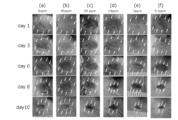
- Photographs showing the state of pressure ulcers in Examples 1 to 4 and Comparative Examples 1 and 2 ((a): Comparative Example 1, (b): Comparative Example 2, (c): Example 1, (d) Example 2, (E): Example 3, (f): Example 4).
- the wound healing gas composition according to the first embodiment of the present invention contains hydrogen sulfide in a proportion of 20 ppm or less.
- the hydrogen sulfide concentration in the gas composition capable of obtaining such a high therapeutic effect is 20 ppm or less.
- the hydrogen sulfide concentration exceeds 20 ppm, the wound healing effect is diminished. The cause of this has not been identified at this time, but it is speculated that it is related to the toxicity of hydrogen sulfide.
- the upper limit of the hydrogen sulfide concentration in the gas composition is preferably 10 ppm or less, more preferably 5 ppm or less, and further preferably 1 ppm or less, in that the wound healing effect can be obtained at an early stage.
- the lower limit of the hydrogen sulfide concentration is not limited as long as it contains hydrogen sulfide, but it is preferably 0.4 ppb or more, and more preferably 0.02 ppm or more, in terms of promoting wound healing.
- the hydrogen sulfide concentration in the present specification is based on the volume.
- the gas composition according to the first embodiment exerts an excellent effect in treating wounds that are difficult to heal spontaneously, such as pressure ulcers.
- the wound treatment apparatus 1 As shown in FIG. 1, the wound treatment apparatus 1 according to the second embodiment of the present invention (hereinafter, referred to as “second embodiment”) has a wound treatment gas composition containing hydrogen sulfide in a proportion of 20 ppm or less.
- a cover or container 10 is provided for feeding and exposing the wound to the gas composition and / or for allowing the organism to be treated to inhale the gas composition.
- the mechanism by which the above-mentioned gas composition is effective in treating wounds is not clear at present, but changes in skin tissue due to contact with the gas composition and improvement in natural healing power by inhalation of the gas composition are possible. It is presumed that it has an effect.
- the above-mentioned gas composition is supplied to the cover or the container 10, the wound is exposed to the hydrogen sulfide contained in the gas composition, and / or the hydrogen sulfide is applied to the organism to be treated. It is believed that inhalation can significantly accelerate wound healing.
- the cover or container 10 used has a function of exposing the wound to the wound healing gas composition and / or a function of inhaling the gas composition to the organism to be treated.
- the cover refers to a member having a structure that covers the mouth or nose of the wound or the organism to be treated, and examples thereof include a shell-shaped structure and a sheet-shaped one.
- the container refers to a member having a structure that accommodates the wounded part, the mouth or nose of the organism to be treated, or the whole body of the organism to be treated, and a box-shaped container is exemplified.
- the material and structure of the cover or container 10 are not limited as long as they do not react with hydrogen sulfide and can suppress the release of hydrogen sulfide-containing gas to the periphery of the device.
- Examples of the material of the cover include hydrogenated styrene-based thermoplastic elastomer (SEBS) and thermoplastic elastomer (TPE).
- Examples of the material of the container include acrylic and glass.
- the cover or container 10 may be formed by combining a plurality of materials.
- a structure having a discharge port in addition to a supply port for hydrogen sulfide-containing gas, a combination of a plurality of members via a gasket or the like, a door portion through which an organism to be treated enters and exits, etc. can be mentioned.
- the cover or container 10 facilitates suppression of the release of hydrogen sulfide-containing gas in use to the outside, and allows exposure to the supplied wound healing gas composition and inhalation of the gas composition at the same time. Therefore, it is preferable to use a container that can accommodate the whole body of the organism to be treated and can be sealed. In that case, it is more preferable that the material is made of a transparent material so that the state of the organism to be treated can be confirmed.
- the wound healing gas composition supplied into the cover or the container 10 shall contain hydrogen sulfide at a ratio of 20 ppm or less as described above. By supplying the wound healing gas composition, the above-mentioned remarkable wound healing effect is obtained.
- the wound treatment device 1 includes a wound treatment gas source 20 for supplying the above-mentioned wound treatment gas composition to the cover or container 10.
- the wound healing gas source 20 is not limited as long as it can stably supply a wound healing gas having a low impurity content. Examples include a cylinder filled with a wound healing gas, a compound that reacts with a component in the atmosphere to generate hydrogen sulfide, and the like.
- the wound treatment device 1 includes a carrier gas source 30 for diluting the hydrogen sulfide-containing gas supplied from the wound treatment gas source 20 and promoting its movement to the cover or the container 10. May be good.
- the carrier gas source 30 is not limited as long as it can stably supply the carrier gas.
- An example is a cylinder filled with carrier gas.
- the type of carrier gas used is not limited as long as it is stable in the atmosphere and does not interfere with the wound healing action of hydrogen sulfide.
- air, nitrogen or argon or a mixed gas thereof can be mentioned. Of these, air is preferable because it does not inhibit the respiration of the whole body of the organism to be treated even when it is contained in the container 10 and is easily available.
- the wound treatment device 1 is configured so that gas flow and stop can be performed intermittently at a preset time.
- a flow rate control means such as a needle valve and a valve controller or a mass flow controller may be provided in the path from the wound healing gas source 20 to the cover or the container 10.
- the carrier gas source 30 is provided in the wound treatment device 1 as described above, it is more preferable to provide the flow rate control means also in the path from the carrier gas source 30 to the cover or the container 10.
- related embodiments include exposure of a wound to the wound healing gas composition according to the first embodiment and / or a treatment target.
- a method of treating a wound in which the gas composition is inhaled into an organism can be mentioned.
- the treatment method a remarkable wound healing effect can be obtained by the action of the wound healing gas described above.
- the means for exposing the wound to the wound healing gas composition and / or for causing the treated organism to inhale the gas composition is not limited, but stabilizes a gas having a low hydrogen sulfide concentration. It is preferable to use the wound healing apparatus according to the second embodiment described above in that it can be supplied.
- Example 1 In this example, Examples 2 to 4 and Comparative Examples 1 and 2 described later, the effect of the present invention on a pressure ulcer model was examined.
- mice C57BL / 6 mice, 8 weeks old
- isoflurane mice
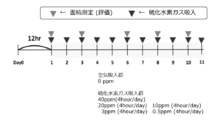
- the back skin is pressed by sandwiching it with two strong magnets as shown in FIG. 2 (a) and held for 12 hours.
- FIG. 2 (b) a pressure ulcer was formed.
- the above-mentioned mouse was placed in the container 10 of the wound treatment device 1 having the configuration shown in FIG.
- the container 10 an acrylic box that can accommodate and seal the whole body of the mouse was used.
- a gas having a hydrogen sulfide concentration of 20 ppm was supplied using air as a carrier gas, and pressure ulcers were observed.
- the mouse was placed in the container 10 and the hydrogen sulfide-containing gas was supplied for 4 hours per day every day for 11 days from the time when 12 hours had passed.
- Example 2 Examples were the same as in Example 1 except that the hydrogen sulfide concentrations in the gas supplied into the container 10 were 10 ppm (Example 2), 3 ppm (Example 3) and 0.5 ppm (Example 4), respectively.
- the measures related to 2 to 4 were performed.
- Example 2 the photograph of the pressure ulcer taken is shown in FIG. 4 (d), and the area measurement result of the pressure ulcer is shown in FIG. 5 (c) by a black triangle marker and a solid line.
- Example 3 the photograph of the pressure ulcer taken is shown in FIG. 4 (e), and the area measurement result of the pressure ulcer is shown in FIG. 5 (d) by a black triangle marker and a solid line.
- Example 4 the photograph of the pressure ulcer taken is shown in FIG. 4 (f), and the area measurement result of the pressure ulcer is shown in FIG. 5 (e) by a black triangle marker and a solid line.
- Comparative Example 1 The procedure according to Comparative Example 1 was carried out in the same manner as in Example 1 except that the gas supplied into the container 10 was only air, that is, a gas having a hydrogen sulfide concentration of 0 ppm.
- the photograph of the pressure ulcer taken is shown as (a) in FIG.
- the obtained area measurement results of the pressure ulcer are shown in FIGS. 5 (a) to 5 (e) by white square markers and dotted lines.
- Comparative Example 2 The treatment according to Comparative Example 2 was carried out in the same manner as in Example 1 except that the concentration of hydrogen sulfide in the gas supplied into the container 10 was set to 40 ppm.
- the photograph of the pressure ulcer taken is shown in FIG. 4 (b), and the area measurement result of the pressure ulcer is shown in FIG. 5 (a) by a black circular marker and a solid line.
- the healing effect of the pressure ulcer can be obtained by exposing the pressure ulcer to a gas containing hydrogen sulfide at a ratio of 20 ppm or less and / or inhaling the gas composition to the organism to be treated.
- a gas containing hydrogen sulfide at a ratio of 20 ppm or less and / or inhaling the gas composition to the organism to be treated.
- the hydrogen sulfide concentration in the gas is 10 ppm or less, it can be said that a remarkable healing effect can be obtained.
- Example 5 In this example and Examples 6 and 7 and Comparative Example 3 described later, the effect of the present invention on the skin resection model was examined.
- Example 6 The treatments according to Examples 6 and 7 were carried out in the same manner as in Example 5 except that the hydrogen sulfide concentration in the gas supplied into the container 10 was set to 10 ppm (Example 6) and 1 ppm (Example 7).
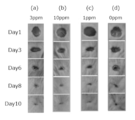
- Example 6 the photograph of the skin excision portion taken is shown in FIG. 7 (b), and the area measurement result of the skin excision portion is shown in FIG. 8 (b) by a black triangular marker and a solid line.
- Example 7 the photograph of the skin excision portion taken is shown in FIG. 7 (c), and the area measurement result of the skin excision portion is shown in FIG. 8 (c) by a black triangle marker and a solid line.
- Comparative Example 3 The procedure according to Comparative Example 3 was carried out in the same manner as in Example 5 except that the gas supplied into the container 10 was only air, that is, a gas having a hydrogen sulfide concentration of 0 ppm.
- the photograph of the skin excision portion taken is shown in FIG. 7 (d), and the area measurement results of the skin excision portion are shown in FIGS. 8 (a) to 8 (c) by white square markers and dotted lines, respectively.
- Example 8 In this example and Comparative Example 4 described later, diabetic mice were used as the organism to be treated, and the effect of the present invention was examined. Organisms with diabetes have reduced natural healing power of wounds. Therefore, exposure to hydrogen sulfide gas and / or inhalation of the gas is expected to have a remarkable wound healing effect.
- Example 8 The treatment according to Example 8 was performed in the same manner as in Example 6 except that a diabetic mouse (C57BL / 6J HamSlc-ob / ob mouse, 8 weeks old) was used as the organism to be treated.
- the diabetic mouse used is an obese mouse that serves as a model for type II diabetes.
- the photograph of the skin excision portion taken is shown in FIG. 9 (a), and the area measurement result of the skin excision portion is shown in FIG. 10 by a black triangular marker and a solid line.
- Comparative Example 4 The treatment according to Comparative Example 4 was performed in the same manner as in Comparative Example 3 except that the diabetic mouse described above was used as the organism to be treated.
- the photograph of the skin excision portion taken is shown in FIG. 9 (b), and the area measurement result of the skin excision portion is shown in FIG. 10 by a white square marker and a dotted line.
- the present invention it is possible to provide a novel treatment method for wounds. Therefore, the present invention is useful in that the options for the wound treatment method are increased, and the treatment can be performed according to the patient's medical condition and constitution, the request for the treatment method, and the like.
Landscapes
- Health & Medical Sciences (AREA)
- Life Sciences & Earth Sciences (AREA)
- Veterinary Medicine (AREA)
- Public Health (AREA)
- General Health & Medical Sciences (AREA)
- Animal Behavior & Ethology (AREA)
- Engineering & Computer Science (AREA)
- Medicinal Chemistry (AREA)
- Pharmacology & Pharmacy (AREA)
- Chemical & Material Sciences (AREA)
- Epidemiology (AREA)
- Bioinformatics & Cheminformatics (AREA)
- Hematology (AREA)
- Heart & Thoracic Surgery (AREA)
- Biomedical Technology (AREA)
- Anesthesiology (AREA)
- Chemical Kinetics & Catalysis (AREA)
- General Chemical & Material Sciences (AREA)
- Nuclear Medicine, Radiotherapy & Molecular Imaging (AREA)
- Organic Chemistry (AREA)
- Dermatology (AREA)
- Inorganic Chemistry (AREA)
- Pulmonology (AREA)
- Emergency Medicine (AREA)
- Pharmaceuticals Containing Other Organic And Inorganic Compounds (AREA)
- Medicinal Preparation (AREA)
Priority Applications (4)
| Application Number | Priority Date | Filing Date | Title |
|---|---|---|---|
| JP2021528203A JP7240687B2 (ja) | 2019-06-28 | 2020-06-15 | 創傷治療用ガス組成物及び創傷治療装置 |
| CN202080047506.1A CN114040769A (zh) | 2019-06-28 | 2020-06-15 | 创伤治疗用气体组合物及创伤治疗装置 |
| EP20832054.9A EP3991737A4 (en) | 2019-06-28 | 2020-06-15 | GAS COMPOSITION FOR USE IN WOUND TREATMENT, AND WOUND TREATMENT DEVICE |
| US17/618,695 US20220241322A1 (en) | 2019-06-28 | 2020-06-15 | Wound-treating gas composition, and wound-treating apparatus |
Applications Claiming Priority (2)
| Application Number | Priority Date | Filing Date | Title |
|---|---|---|---|
| JP2019122423 | 2019-06-28 | ||
| JP2019-122423 | 2019-06-28 |
Publications (1)
| Publication Number | Publication Date |
|---|---|
| WO2020262055A1 true WO2020262055A1 (ja) | 2020-12-30 |
Family
ID=74061927
Family Applications (1)
| Application Number | Title | Priority Date | Filing Date |
|---|---|---|---|
| PCT/JP2020/023342 Ceased WO2020262055A1 (ja) | 2019-06-28 | 2020-06-15 | 創傷治療用ガス組成物及び創傷治療装置 |
Country Status (5)
| Country | Link |
|---|---|
| US (1) | US20220241322A1 (https=) |
| EP (1) | EP3991737A4 (https=) |
| JP (1) | JP7240687B2 (https=) |
| CN (1) | CN114040769A (https=) |
| WO (1) | WO2020262055A1 (https=) |
Citations (10)
| Publication number | Priority date | Publication date | Assignee | Title |
|---|---|---|---|---|
| JP2001212170A (ja) | 2000-02-04 | 2001-08-07 | Toyobo Co Ltd | 創傷被覆材 |
| JP2008538569A (ja) | 2005-04-20 | 2008-10-30 | フレッド ハッチンソン キャンサー リサーチ センター | 細胞、組織、臓器、および生物の生存能力を高めるための方法、組成物、および製造物 |
| JP2009191015A (ja) | 2008-02-14 | 2009-08-27 | Ajinomoto Co Inc | 創傷治癒促進剤 |
| JP2010077143A (ja) | 2005-04-08 | 2010-04-08 | Mie Univ | 創傷治療用外用剤 |
| JP2010530001A (ja) * | 2007-06-15 | 2010-09-02 | イカリア, インコーポレイテッド | 硫化物単独または一酸化窒素との組み合わせを含む組成物およびその使用 |
| JP2011219411A (ja) | 2010-04-08 | 2011-11-04 | Hiroshima Kasei Ltd | 褥瘡治療外用液剤および褥瘡治療装置 |
| JP2013519374A (ja) * | 2010-02-11 | 2013-05-30 | ユニバーシティー オブ サザン カリフォルニア | 修飾されたadamディスインテグリンドメインポリペプチドおよびその使用 |
| JP2015120646A (ja) | 2013-12-20 | 2015-07-02 | 公立大学法人奈良県立医科大学 | 創傷治療剤 |
| JP2016077514A (ja) | 2014-10-16 | 2016-05-16 | 高田 任康 | 皮膚潰瘍の治療材 |
| JP2019507622A (ja) | 2016-02-16 | 2019-03-22 | アヴェント インコーポレイテッド | 治療ガスの貯蔵及び創傷への送達のためのシステム及び方法 |
Family Cites Families (2)
| Publication number | Priority date | Publication date | Assignee | Title |
|---|---|---|---|---|
| WO2008079993A2 (en) * | 2006-12-22 | 2008-07-03 | Ikaria, Inc. | Combinations of nitric oxide and sulfide and methods of use and manufacture thereof |
| US20110015565A1 (en) * | 2009-07-15 | 2011-01-20 | Hursey Francis X | Gas dispenser with therapeutic agent |
-
2020
- 2020-06-15 WO PCT/JP2020/023342 patent/WO2020262055A1/ja not_active Ceased
- 2020-06-15 JP JP2021528203A patent/JP7240687B2/ja active Active
- 2020-06-15 US US17/618,695 patent/US20220241322A1/en active Pending
- 2020-06-15 CN CN202080047506.1A patent/CN114040769A/zh active Pending
- 2020-06-15 EP EP20832054.9A patent/EP3991737A4/en active Pending
Patent Citations (10)
| Publication number | Priority date | Publication date | Assignee | Title |
|---|---|---|---|---|
| JP2001212170A (ja) | 2000-02-04 | 2001-08-07 | Toyobo Co Ltd | 創傷被覆材 |
| JP2010077143A (ja) | 2005-04-08 | 2010-04-08 | Mie Univ | 創傷治療用外用剤 |
| JP2008538569A (ja) | 2005-04-20 | 2008-10-30 | フレッド ハッチンソン キャンサー リサーチ センター | 細胞、組織、臓器、および生物の生存能力を高めるための方法、組成物、および製造物 |
| JP2010530001A (ja) * | 2007-06-15 | 2010-09-02 | イカリア, インコーポレイテッド | 硫化物単独または一酸化窒素との組み合わせを含む組成物およびその使用 |
| JP2009191015A (ja) | 2008-02-14 | 2009-08-27 | Ajinomoto Co Inc | 創傷治癒促進剤 |
| JP2013519374A (ja) * | 2010-02-11 | 2013-05-30 | ユニバーシティー オブ サザン カリフォルニア | 修飾されたadamディスインテグリンドメインポリペプチドおよびその使用 |
| JP2011219411A (ja) | 2010-04-08 | 2011-11-04 | Hiroshima Kasei Ltd | 褥瘡治療外用液剤および褥瘡治療装置 |
| JP2015120646A (ja) | 2013-12-20 | 2015-07-02 | 公立大学法人奈良県立医科大学 | 創傷治療剤 |
| JP2016077514A (ja) | 2014-10-16 | 2016-05-16 | 高田 任康 | 皮膚潰瘍の治療材 |
| JP2019507622A (ja) | 2016-02-16 | 2019-03-22 | アヴェント インコーポレイテッド | 治療ガスの貯蔵及び創傷への送達のためのシステム及び方法 |
Non-Patent Citations (3)
| Title |
|---|
| KAKINOHANA, MANABU: "Hydrogen Sulfide and Spinal Cord Protection", JAPANESE JOURNAL OF INTENSIVE CARE MEDICINE, vol. 40, no. 8, 2016, JP, pages 555 - 559, XP009532778, ISSN: 0389-1194 * |
| See also references of EP3991737A4 |
| ZHAO H. ET AL.: "Hydrogen sulfide improves diabetic wound healing in ob/ob mice via attenuating inflammation", JOURNAL OF DIABETES AND ITS COMPLICATIONS, vol. 31, 2017, pages 1363 - 1369, XP085153435, DOI: 10.1016/j.jdiacomp.2017.06.011 * |
Also Published As
| Publication number | Publication date |
|---|---|
| JPWO2020262055A1 (https=) | 2020-12-30 |
| EP3991737A4 (en) | 2023-08-09 |
| EP3991737A1 (en) | 2022-05-04 |
| JP7240687B2 (ja) | 2023-03-16 |
| CN114040769A (zh) | 2022-02-11 |
| US20220241322A1 (en) | 2022-08-04 |
Similar Documents
| Publication | Publication Date | Title |
|---|---|---|
| AU2005321963B2 (en) | Device and method for treatment of wounds with nitric oxide | |
| US9655840B2 (en) | Wound care products | |
| CN105579074B (zh) | 敷料系统 | |
| JP2017505165A (ja) | コンフォーマルカバーを含む外傷性創傷ドレッシングシステム | |
| Bonham | Surgical wound case studies with the versatile 1 wound vacuum system for negative pressure wound therapy | |
| JP7240687B2 (ja) | 創傷治療用ガス組成物及び創傷治療装置 | |
| Brakora et al. | HYPERBARIC ())(YC, EN THERAPY POR DIABETIC WOUNDS | |
| Silvetti | An effective method of treating long-enduring wounds and ulcers by topical applications of solutions of nutrients | |
| SE425350B (sv) | Steril kompress for behandling av vetskande sar innehallande salt i fast form | |
| RU2328292C1 (ru) | Способ лечения флегмон челюстно-лицевой области | |
| JP7262065B2 (ja) | 皮膚創傷予防用及び/又は皮膚創傷治療用構成体 | |
| WO2023091145A1 (en) | Improved biosynthetic wound and burn dressing with silver-based broad antimicrobial activity | |
| RU2790837C2 (ru) | Спрей для лечения инфицированных и неинфицированных ран при сахарном диабете i типа | |
| CN109908205A (zh) | 一种预防或治疗口腔疾病的药物 | |
| Hegde et al. | A CLINICAL STUDY TO EVALUATE THE EFFICACY OF JATYADI GHRITA VIKESHIKA DRESSING IN THE MANAGEMENT OF DUSHTAVRANA WSR TO VENOUS ULCER | |
| Sobotkaa et al. | Sodium hyaluronate with an iodine complex in the treatment of different wounds | |
| Seldon et al. | STIMULATION OF WOUND HEALING: A NEW USE FOE POWDERED BLOOD CELLS | |
| CN121971692A (en) | Wound surface treating agent and preparation method thereof | |
| CN119033995A (zh) | 一种具有抗菌功能且可促进伤口愈合的中药水凝胶敷料的制备方法 | |
| CN116077565A (zh) | 一种促创面愈合制剂及其制备方法 | |
| HU221676B1 (hu) | Gyógyászati készítmény, amely hatóanyagként jódot és ezüst-nitrátot tartalmazó etanolos, vagy vizes-etanolos oldatokból áll és eljárás az előállítására | |
| Yuanhai et al. | The International Journal of Lower Extremity | |
| UA100923U (uk) | Спосіб лікування гнійних ран | |
| UA111599U (uk) | Стоматологічна пов'язка для лікування патологічних процесів в порожнині рота |
Legal Events
| Date | Code | Title | Description |
|---|---|---|---|
| 121 | Ep: the epo has been informed by wipo that ep was designated in this application |
Ref document number: 20832054 Country of ref document: EP Kind code of ref document: A1 |
|
| ENP | Entry into the national phase |
Ref document number: 2021528203 Country of ref document: JP Kind code of ref document: A |
|
| NENP | Non-entry into the national phase |
Ref country code: DE |
|
| WWE | Wipo information: entry into national phase |
Ref document number: 2020832054 Country of ref document: EP |