WO2020261923A1 - 表示媒体、真正性判定方法、及び表示媒体を含む物品 - Google Patents
表示媒体、真正性判定方法、及び表示媒体を含む物品 Download PDFInfo
- Publication number
- WO2020261923A1 WO2020261923A1 PCT/JP2020/022170 JP2020022170W WO2020261923A1 WO 2020261923 A1 WO2020261923 A1 WO 2020261923A1 JP 2020022170 W JP2020022170 W JP 2020022170W WO 2020261923 A1 WO2020261923 A1 WO 2020261923A1
- Authority
- WO
- WIPO (PCT)
- Prior art keywords
- layer
- display medium
- cholesteric
- resin
- group
- Prior art date
- Legal status (The legal status is an assumption and is not a legal conclusion. Google has not performed a legal analysis and makes no representation as to the accuracy of the status listed.)
- Ceased
Links
Images


Classifications
-
- G—PHYSICS
- G02—OPTICS
- G02B—OPTICAL ELEMENTS, SYSTEMS OR APPARATUS
- G02B5/00—Optical elements other than lenses
- G02B5/30—Polarising elements
- G02B5/3016—Polarising elements involving passive liquid crystal elements
-
- B—PERFORMING OPERATIONS; TRANSPORTING
- B42—BOOKBINDING; ALBUMS; FILES; SPECIAL PRINTED MATTER
- B42D—BOOKS; BOOK COVERS; LOOSE LEAVES; PRINTED MATTER CHARACTERISED BY IDENTIFICATION OR SECURITY FEATURES; PRINTED MATTER OF SPECIAL FORMAT OR STYLE NOT OTHERWISE PROVIDED FOR; DEVICES FOR USE THEREWITH AND NOT OTHERWISE PROVIDED FOR; MOVABLE-STRIP WRITING OR READING APPARATUS
- B42D25/00—Information-bearing cards or sheet-like structures characterised by identification or security features; Manufacture thereof
- B42D25/30—Identification or security features, e.g. for preventing forgery
- B42D25/36—Identification or security features, e.g. for preventing forgery comprising special materials
- B42D25/364—Liquid crystals
-
- B—PERFORMING OPERATIONS; TRANSPORTING
- B42—BOOKBINDING; ALBUMS; FILES; SPECIAL PRINTED MATTER
- B42D—BOOKS; BOOK COVERS; LOOSE LEAVES; PRINTED MATTER CHARACTERISED BY IDENTIFICATION OR SECURITY FEATURES; PRINTED MATTER OF SPECIAL FORMAT OR STYLE NOT OTHERWISE PROVIDED FOR; DEVICES FOR USE THEREWITH AND NOT OTHERWISE PROVIDED FOR; MOVABLE-STRIP WRITING OR READING APPARATUS
- B42D25/00—Information-bearing cards or sheet-like structures characterised by identification or security features; Manufacture thereof
- B42D25/30—Identification or security features, e.g. for preventing forgery
- B42D25/36—Identification or security features, e.g. for preventing forgery comprising special materials
- B42D25/378—Special inks
- B42D25/391—Special inks absorbing or reflecting polarised light
-
- G—PHYSICS
- G02—OPTICS
- G02B—OPTICAL ELEMENTS, SYSTEMS OR APPARATUS
- G02B5/00—Optical elements other than lenses
- G02B5/30—Polarising elements
- G02B5/3025—Polarisers, i.e. arrangements capable of producing a definite output polarisation state from an unpolarised input state
- G02B5/3033—Polarisers, i.e. arrangements capable of producing a definite output polarisation state from an unpolarised input state in the form of a thin sheet or foil, e.g. Polaroid
- G02B5/3041—Polarisers, i.e. arrangements capable of producing a definite output polarisation state from an unpolarised input state in the form of a thin sheet or foil, e.g. Polaroid comprising multiple thin layers, e.g. multilayer stacks
-
- G—PHYSICS
- G02—OPTICS
- G02B—OPTICAL ELEMENTS, SYSTEMS OR APPARATUS
- G02B5/00—Optical elements other than lenses
- G02B5/30—Polarising elements
- G02B5/3083—Birefringent or phase retarding elements
Definitions
- the present invention relates to a display medium, an authenticity determination method, and an article including the display medium.
- Patent Document 1 a medium using a cholesteric liquid crystal compound which is a polymer compound is known. Further, there are also known identification media in which the information visually recognized differs between the front and the back (Patent Documents 2 to 6).
- JP-A-2007-216602 Japanese Patent No. 3652476 JP-A-2017-185668 Japanese Unexamined Patent Publication No. 2017-215580 Japanese Patent No. 5828182 International Publication No. 2007/007784 (Corresponding Foreign Gazette: US Patent Application Publication No. 2008/0129036) JP-A-2007-216602
- a material having a circular polarization separation function has a function of transmitting one of right-handed circularly polarized light and left-handed circularly polarized light and reflecting a part or all of the other circularly polarized light.
- Different images appear when the display medium using such a material is observed through the right circular polarizing plate and when observed through the left circular polarizing plate. Therefore, in determining the authenticity of an article provided with such a display medium, it is common to use a viewer provided with two circular polarizing plates, a right circular polarizing plate and a left circular polarizing plate.
- the present inventor has diligently studied to solve the above problems. As a result, they have found that the above problems can be solved by a display medium including a predetermined first layer and a third layer having a circular polarization separation function and a second layer which is a retardation layer, and complete the present invention. I let you. That is, the present invention provides the following.
- [1] Includes a first layer, a second layer, and a third layer. Part or all of the first layer, part or all of the second layer, and part or all of the third layer overlap in this order in the thickness direction.
- the first layer is a layer capable of reflecting circular polarization having a rotation direction D1 and transmitting circular polarization having a rotation direction D2 opposite to the rotation direction D1.
- the second layer is a retardation layer and
- the third layer is a display medium that can reflect the circular polarization whose rotation direction is the rotation direction D1 and can transmit the circular polarization whose rotation direction is the rotation direction D2.
- the first layer has a reflectance of 35% or more and 50% or less in a wavelength range of 420 nm or more and 650 nm or less.
- the resin flakes contained in the third layer have a reflectance of 35% or more and 50% or less in a wavelength range of 420 nm or more and 650 nm or less, according to [2] or [3]. Display medium.
- Authenticity determination method including. [7] An article containing the display medium according to any one of [1] to [5].
- the present invention it is possible to provide a display medium whose authenticity can be determined without using a special viewer; a method for determining the authenticity of the display medium; and an article containing the display medium.
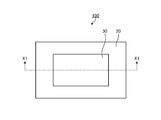
- FIG. 1 is a schematic plan view of a display medium according to an embodiment of the present invention as viewed from the thickness direction thereof.
- FIG. 2 is a cross-sectional view schematically showing a cross section of FIG. 1 in the X1-X1 direction.
- FIG. 3 is an exploded perspective view schematically showing a display medium according to an embodiment of the present invention.
- FIG. 4 is a schematic view illustrating a state of reflected light of a display medium when unpolarized light is irradiated from the third layer side.
- FIG. 5 is a schematic view illustrating a state of reflected light of a display medium when unpolarized light is irradiated from the first layer side.
- FIG. 6 is a graph showing the measurement results of the reflectance of the cholesteric resin layer at wavelengths of 400 nm to 780 nm.
- FIG. 7 is a side view schematically showing an apparatus for producing resin flakes.
- nx represents the refractive index in the direction perpendicular to the thickness direction of the layer (in-plane direction) and in the direction giving the maximum refractive index.
- ny represents the refractive index in the in-plane direction of the layer and orthogonal to the nx direction.
- nz represents the refractive index in the thickness direction of the layer.
- d represents the thickness of the layer.
- the measurement wavelength is 560 nm unless otherwise specified.
- a material having a positive intrinsic birefringence means a material in which the refractive index in the stretching direction is larger than the refractive index in the direction perpendicular to it, unless otherwise specified.
- a material having a negative intrinsic birefringence means a material in which the refractive index in the stretching direction is smaller than the refractive index in the direction perpendicular to it, unless otherwise specified.
- the value of the intrinsic birefringence can be calculated from the permittivity distribution.
- (meth) acrylic includes “acrylic", “methacryl” and combinations thereof.
- (thio) epoxy includes “epoxy”, “thioepoxy” and combinations thereof.
- iso (thio) cyanate includes “isocyanate”, “isothiocyanate” and combinations thereof.
- specular reflection means reflection in a direction different from the direction of specular reflection.
- the "visible light region” refers to a wavelength range of 400 nm or more and 780 nm or less.
- the display medium includes a first layer, a second layer, and a third layer. A part or all of the first layer, a part or all of the second layer, and a part or all of the third layer overlap in this order in the thickness direction.
- the first layer is a layer capable of reflecting circular polarization having a rotation direction D1 and transmitting circular polarization having a rotation direction D2 opposite to the rotation direction D1.
- the second layer is a retardation layer.
- the third layer is a layer capable of reflecting the circular polarization having the rotation direction D1 and transmitting the circular polarization having the rotation direction D2.
- the display medium of the present embodiment has the above-mentioned configuration
- the display medium is irradiated with unpolarized light and the reflected light is observed from the first layer side and the third layer side, without using a special viewer.
- the color of the first layer observed from the side of the first layer and the color of the third layer observed from the third layer are different. Therefore, the authenticity of the display medium can be determined without using a special viewer.
- FIG. 1 is a schematic plan view of a display medium according to an embodiment of the present invention as viewed from the thickness direction thereof.
- FIG. 2 is a cross-sectional view schematically showing a cross section of FIG. 1 in the X1-X1 direction.
- FIG. 3 is an exploded perspective view schematically showing a display medium according to an embodiment of the present invention.
- the display medium 100 includes a first layer 10, a second layer 20, and a third layer 30.
- the first layer 10 and the second layer 20 have the same shape and size when viewed from the thickness direction of the display medium 100 (in FIG.
- the second layer 20 is in contact with the surface of the first layer 10.
- the third layer 30 is arranged on the region A20, which is a part of the second layer 20, so as to be in contact with the surface of the second layer 20.
- the region A10 which is a part of the first layer 10 the region A20 which is a part of the second layer, and the region A30 which is the whole of the third layer are the regions A10.
- -Region A20-Region A30 overlaps in the thickness direction (vertical direction of the paper surface in FIG. 2).
- the fact that the regions A10 to A30 overlap in the thickness direction means that the regions A10 to A30 are in the same planar position when viewed from the thickness direction.
- the first layer 10 and the second layer 20 have the same shape and size when viewed from the thickness direction of the display medium 100, but the first layer and the second layer have the same shape and size. May have different shapes and sizes.
- the arbitrary layer is preferably a layer having high light transmittance, more preferably a layer having a total light transmittance of 80% or more, still more preferably a layer having a total light transmittance of 85% or more, and preferably.
- a layer having a small retardation Re in the in-plane direction (for example, 0 nm or more and 5 nm or less).
- Specific examples of the material forming the layer having high light transmittance and small retardation Re include hard polyvinyl chloride, soft polyvinyl chloride, acrylic resin, and glass.
- the display medium may further include a first outer layer and / or a second outer layer, as long as it does not significantly impair the effects of the present invention.
- the first outer layer and the second outer layer are preferably layers having high light transmittance, more preferably layers having a total light transmittance of 80% or more, and further preferably having a total light transmittance of 85% or more. It is a layer.
- Specific examples of the materials constituting the first outer layer and the second outer layer include hard polyvinyl chloride, soft polyvinyl chloride, acrylic resin, glass, polycarbonate (PC), and polyethylene terephthalate (PET). It can be appropriately selected according to the intended use of the medium, the required texture, durability, and mechanical strength.
- the first outer layer and the second outer layer may be independently layers having a small retardation Re in the in-plane direction (for example, 0 nm or more and 5 nm or less), and for example, the retardation in the in-plane direction is 5 nm or more. It may be a layer of.
- the retardation Re of the first outer layer and the second outer layer in the in-plane direction can be 600 nm or less.
- Examples of the layer structure of the display medium further including the first outer layer and / or the second outer layer include the following. -The display medium has a first outer layer, a first layer, a second layer, a third layer, and a second outer layer arranged in this order.
- the display medium has a first outer layer, a first layer, a second layer, and a third layer arranged in this order.
- the display medium has a first layer, a second layer, a third layer, and a second outer layer arranged in this order.
- the third layer 30 has a rectangular shape when viewed from the thickness direction of the display medium 100, but in another embodiment, the third layer 30 has a rectangular shape when viewed from the thickness direction of the display medium 100. It may have a pattern such as letters, numbers, and figures.
- the first layer and the third layer are layers capable of reflecting the circular polarization having the rotation direction D1 and transmitting the circular polarization having the rotation direction D2 opposite to the rotation direction D1.
- the reflection may be specular reflection or scattered reflection.
- the third layer is a layer capable of scattering and reflecting circularly polarized light having the rotation direction D1.
- the surface of the third layer may be provided with irregularities to be a layer capable of scattering and reflecting circularly polarized light, which will be described later.
- the third layer by forming the third layer as a layer containing resin flakes, a layer that scatters and reflects circularly polarized light may be used.
- the rotation direction D1 of the circularly polarized light may be left or right. Therefore, both the first layer and the third layer may be a layer capable of reflecting left circular polarization and transmitting right circular polarization, a layer capable of reflecting right circular polarization and capable of transmitting left circular polarization. It may be. Both the first layer and the third layer may be a layer capable of reflecting all of the irradiated circularly polarized light having the rotation direction D1, or may reflect a part of the irradiated circularly polarized light having the rotation direction D1. It may be a layer.
- both the first layer and the third layer may be a layer capable of transmitting all of the irradiated circularly polarized light having the rotation direction D2, or a part of the circularly polarized light having the rotation direction D2. It may be a reflective layer.
- the first layer and the third layer may be formed of the same material or may be formed of different materials.
- a layer having cholesteric regularity for example, a resin layer having cholesteric regularity
- a layer containing resin flakes having cholesteric regularity can be used.
- the cholesteric regularity of the resin layer having cholesteric regularity is that the molecular axes are aligned in a certain direction on one plane, but on the next plane that overlaps with the molecular axes, the directions of the molecular axes are slightly shifted at an angle, and further.
- the structure is such that the angle of the next plane is further shifted, and the angle of the molecular axis in the plane is shifted (twisted) as it sequentially passes through the planes arranged in an overlapping manner. That is, when the molecules in the layer have cholesteric regularity, the molecules are aligned in the resin layer in a manner forming a layer of a large number of molecules.
- the molecules are aligned so that the axis of the molecule is in a certain direction, and in the adjacent layer B, the molecules are displaced at an angle with the direction in the layer A.
- the molecules are aligned in the direction, and in the layer C adjacent thereto, the molecules are aligned in a direction further deviated from the direction in the layer B at an angle.
- the angles of the axes of the molecules are continuously displaced, and a structure in which the molecules are twisted is formed.
- the structure in which the direction of the molecular axis is twisted in this way becomes an optically chiral structure.
- the resin layer having cholesteric regularity is also referred to as a cholesteric resin layer.
- the cholesteric resin layer usually has a circular polarization separation function. That is, the cholesteric resin layer has a property of transmitting one of the right-handed circularly polarized light and the left-handed circularly polarized light and reflecting a part or all of the other circularly polarized light. The reflection in the cholesteric resin layer reflects the circularly polarized light while maintaining its chirality.
- the wavelength at which the circular polarization separation function is exhibited depends on the pitch of the spiral structure in the cholesteric resin layer.
- the pitch of the spiral structure is the distance in the plane normal direction until the direction of the molecular axis in the spiral structure gradually shifts as it advances in the plane and then returns to the original molecular axis direction.
- the cholesteric resin layer can be obtained, for example, by providing a film of the cholesteric liquid crystal composition on an appropriate support for forming the resin layer and curing the film of the cholesteric liquid crystal composition.
- the obtained layer can be used as it is as a cholesteric resin layer.
- This cholesteric resin layer is a layer made of a film of the material itself that can reflect one of the right circularly polarized light and the left circularly polarized light and transmit the other circularly polarized light. Therefore, the cholesteric resin layer itself can be used as the first layer.
- the cholesteric liquid crystal composition for forming the cholesteric resin layer for example, a composition containing a liquid crystal compound and capable of exhibiting a cholesteric liquid crystal phase when a film is formed on the support can be used.
- the liquid crystal compound a liquid crystal compound which is a polymer compound and a polymerizable liquid crystal compound can be used.
- a polymerizable liquid crystal compound By polymerizing such a polymerizable liquid crystal compound in a state of exhibiting cholesteric regularity, the film of the cholesteric liquid crystal composition can be cured to obtain a cured non-liquid crystal resin layer while exhibiting cholesteric regularity. it can.
- Resin flakes with cholesteric regularity are small pieces of resin with cholesteric regularity.
- a small piece having cholesteric regularity can reflect one of the right and left circularly polarized light and transmit the other circularly polarized light.
- a layer containing an aggregate of small pieces can scatter and reflect one of the right and left circularly polarized light and transmit the other circularly polarized light.
- the cholesteric resin layer can reflect one of the right circularly polarized light and the left circularly polarized light and transmit the other circularly polarized light in at least a part of the visible light region. It is preferably used as resin flakes having properties.
- the resin flakes are crushed products obtained by crushing a resin layer different from the cholesteric resin layer as the first layer. It may be.
- the resin flakes which are the materials of the third layer, are crushed products obtained by crushing the same layer as the cholesteric resin layer used as the first layer. Is preferable.
- the flakes of the resin having cholesteric regularity can be produced from the cholesteric resin layer by, for example, the method for producing a peeled piece described in Japanese Patent No. 6142714.
- flakes made of a material having no polarization characteristics can be used.
- the flakes having no polarization characteristics include at least one selected from carbon black, oxides of metals belonging to groups 3 to 11 of the 4th period of the periodic table of elements, nitrides, and nitrogen oxides. Flakes are mentioned. One of these may be used alone, or two or more of them may be used in combination at any ratio.
- the first layer When the first layer is a layer having cholesteric regularity, the first layer preferably has a reflectance of 35% or more and 50% or less in the wavelength range of 420 nm or more and 650 nm or less. As a result, the first layer can have a good polarization separation function in a wide visible light region having a wavelength range of 420 nm or more and 650 nm or less, and as a result, the third layer when observed from the first layer side. The color can be made clearer.
- the resin flakes contained in the third layer have a reflectance for non-polarized light of 35 nm or more and 650 nm or less. It is preferably% or more and 50% or less. As a result, the resin flakes effectively scatter and reflect the light. As a result, the color difference between the light visually recognized when the display medium is observed from the first layer side and the light visually recognized when the display medium is observed from the third layer side can be more easily recognized.
- the reflectance of the cholesteric resin layer which is the material of the resin flakes, can be measured, and the value can be used as the value of the reflectance of the resin flakes.
- Suitable cholesteric resin layers having high reflectance in the wavelength region of 420 nm or more and 650 nm or less include, for example, (i) a cholesteric resin layer in which the pitch size of the spiral structure is changed stepwise, and (ii) the pitch of the spiral structure. Examples thereof include a cholesteric resin layer whose size is continuously changed.
- the cholesteric resin layer in which the pitch of the spiral structure is changed stepwise can be obtained by forming a plurality of cholesteric resin layers having different pitches of the spiral structure.
- a cholesteric resin layer can be produced by preparing a plurality of cholesteric resin layers having different spiral structure pitches in advance and then fixing each layer with an adhesive or an adhesive.
- it can be produced by forming a certain cholesteric resin layer and then sequentially forming another cholesteric resin layer.
- the cholesteric resin layer in which the pitch size of the spiral structure is continuously changed is not particularly limited by the manufacturing method, but a preferable example of the manufacturing method of such a cholesteric resin layer is to form the cholesteric resin layer.
- a cholesteric liquid crystal composition containing a polymerizable liquid crystal compound for this purpose is preferably applied onto another layer such as an alignment film to obtain a layer of the liquid crystal composition, and then one or more times of light irradiation and / or addition. Examples thereof include a method of curing the layer in a state where the pitch of the spiral structure is continuously changed by heat treatment. Since such an operation is an operation of expanding the reflection band of the cholesteric resin layer, it is called a wide band processing.
- a wide reflection band can be realized even with a cholesteric resin layer having a thin thickness of, for example, 10 ⁇ m or less, which is preferable.
- a preferred embodiment of the cholesteric liquid crystal composition to be subjected to such a broadband treatment is the cholesteric liquid crystal composition (X) described in detail below.
- cholesteric resin layer in which the pitch size of the spiral structure is continuously changed only one layer may be used alone, or a plurality of layers may be used in layers.
- a cholesteric resin layer that exerts a circular polarization separation function in a part of the visible light region and a cholesteric resin layer that exerts a circular polarization separation function in another region are combined to widen the visible light region.
- a cholesteric resin layer, which is a mode in which the circular polarization separation function is exhibited in the region, may be used.
- the cholesteric resin layer may be a resin layer composed of only one layer, or may be a resin layer composed of two or more layers.
- the cholesteric resin layer may include two or more cholesteric resin layers (i), or may include two or more cholesteric resin layers (ii). Both of these may be combined to provide two or more layers.
- the number of layers constituting the cholesteric resin layer is preferably 1 to 100 layers, and more preferably 1 to 20 layers.
- the cholesteric liquid crystal composition (X) contains a polymerizable non-liquid crystal compound represented by the following formula (1) and a specific polymerizable liquid crystal compound. Further, each of the non-liquid crystal compound and the polymerizable liquid crystal compound represented by the formula (1) may be used alone or in combination of two or more in any ratio. Hereinafter, each of these components will be described in sequence.
- R 1 and R 2 are independently linear or branched alkyl groups having 1 to 20 carbon atoms and linear having 1 to 20 carbon atoms, respectively.
- the alkyl group and the alkylene oxide group may not be substituted or may be substituted with one or more halogen atoms.
- the halogen atom, hydroxyl group, carboxyl group, (meth) acrylic group, epoxy group, mercapto group, isocyanate group, amino group and cyano group are alkyl groups having 1 or 2 carbon atoms and alkylene oxide groups. May be combined with.
- R 1 and R 2 include halogen atoms, hydroxyl groups, carboxyl groups, (meth) acrylic groups, epoxy groups, mercapto groups, isocyanate groups, amino groups, and cyano groups.
- At least one of R 1 and R 2 is preferably a reactive group.
- the reactive group may include, for example, a carboxyl group, a (meth) acrylic group, an epoxy group, a mercapto group, an isocyanate group, and an amino group, and these groups may be accompanied by an arbitrary interposition group. Good.
- a 1 and A 2 are independently 1,4-phenylene group, 1,4-cyclohexylene group, cyclohexene-1,4-diyl group, 4,4'-biphenylene group, 4, respectively.
- substituents such as a halogen atom, a hydroxyl group, a carboxyl group, a cyano group, an amino group, an alkyl group having 1 to 10 carbon atoms, and an alkyl halide group. You may be. If two or more substituents are present in each of A 1 and A 2 , they may be the same or different.
- a 1 and A 2 are groups selected from the group consisting of 1,4-phenylene groups, 4,4'-biphenylene groups, and 2,6-naphthylene groups. These aromatic ring skeletons are relatively rigid as compared with the alicyclic skeleton, have a high affinity for the mesogen of the polymerizable liquid crystal compound, and have a higher orientation uniformity ability.
- the compound of formula (1) preferably has chirality.
- the cholesteric liquid crystal composition (X) preferably contains a mixture of a plurality of optical isomers as the compound of the formula (1). For example, it may contain a mixture of multiple types of enantiomers and / or diastereomers.
- At least one of the compounds of the formula (1) preferably has a melting point in the range of 50 ° C. to 150 ° C.
- the compound of the formula (1) preferably has a high ⁇ n.
- ⁇ n as the cholesteric liquid crystal composition (X) can be improved, and a cholesteric resin layer having a wide wavelength range capable of reflecting circularly polarized light can be produced.
- At least one type of ⁇ n of the compound of the formula (1) is preferably 0.18 or more, more preferably 0.22 or more.
- the upper limit of ⁇ n can be, for example, 0.50 or less.
- particularly preferable compounds of the formula (1) include, for example, the following compounds (A1) to (A10):
- the cholesteric liquid crystal composition (X) usually contains a polymerizable liquid crystal compound having at least two or more reactive groups in one molecule.
- the polymerizable liquid crystal compound include a compound represented by the formula (2). R 3- C 3- D 3- C 5- MC 6- D 4- C 4- R 4 (2)
- R 3 and R 4 are reactive groups, which are independently a (meth) acrylic group, a (thio) epoxy group, an oxetane group, a thietanyl group, an aziridinyl group, a pyrrol group, and a vinyl group. , Allyl group, fumarate group, cinnamoyl group, oxazoline group, mercapto group, iso (thio) cyanate group, amino group, hydroxyl group, carboxyl group, and alkoxysilyl group.
- D 3 and D 4 are a single bond, a linear or branched alkyl group having 1 to 20 carbon atoms, and a linear or branched alkyl group having 1 to 20 carbon atoms. Represents a group selected from the group consisting of chain alkylene oxide groups.
- M represents a mesogen group. Specifically, M may have an unsubstituted or substituent, azomethines, azoxys, phenyls, biphenyls, terphenyls, naphthalenes, anthracenes, benzoic acid esters, cyclohexanecarboxylics.
- Two to four skeletons selected from the group of acid phenyl esters, cyanophenylcyclohexanes, cyano-substituted phenylpyrimidines, alkoxy-substituted phenylpyrimidines, phenyldioxans, trans, alkenylcyclohexylbenzonitriles, -O.
- R 5 and R 7 represent a hydrogen atom or an alkyl group having 1 to 10 carbon atoms.
- R 6 represents a hydrogen atom or an alkyl group having 1 to 6 carbon atoms.
- alkyl group having 1 to 10 carbon atoms which may have a substituent examples include a halogen atom, a hydroxyl group, a carboxyl group, a cyano group, an amino group, and 1 to 6 carbon atoms.
- the polymerizable liquid crystal compound preferably has an asymmetric structure.
- the asymmetric structure is a structure in which R 3- C 3- D 3- C 5- and -C 6- D 4- C 4- R 4 are different from each other with the mesogen group M as the center in the formula (2).
- the orientation uniformity can be further enhanced.
- the ⁇ n of the polymerizable liquid crystal compound is preferably 0.18 or more, more preferably 0.22 or more.
- a polymerizable liquid crystal compound having a ⁇ n value of 0.30 or more the absorption edge on the long wavelength side of the ultraviolet absorption spectrum may extend to the visible region.
- polymerizable liquid crystal compounds whose absorption edge extends to the visible region can also be used as long as the spectrum does not adversely affect the desired optical performance.
- a cholesteric resin layer having high optical performance for example, selective reflection performance of circularly polarized light
- the upper limit of ⁇ n can be, for example, 0.50 or less.
- Preferred specific examples of the polymerizable liquid crystal compound include the following compounds (B1) to (B9).
- the polymerizable liquid crystal compound is not limited to the following compounds.
- the weight ratio of (total weight of the polymerizable non-liquid crystal compound of the formula (1)) / (total weight of the polymerizable liquid crystal compound) is preferably 0.05 or more, more preferably. Is 0.1 or more, particularly preferably 0.15 or more, preferably 1 or less, more preferably 0.65 or less, and particularly preferably 0.45 or less.
- the weight ratio is preferably 0.05 or more, more preferably. Is 0.1 or more, particularly preferably 0.15 or more, preferably 1 or less, more preferably 0.65 or less, and particularly preferably 0.45 or less.
- the orientation uniformity can be improved.
- the value to the upper limit or less the orientation uniformity can be increased, the stability of the liquid crystal phase can be increased, and ⁇ n as the liquid crystal composition can be increased to select the desired optical performance (for example, circular polarization). It is possible to stably obtain the characteristic of reflecting the light.
- the total weight indicates the weight when one type is used, and indicates the total weight when two or more types are used.
- the molecular weight of the compound of the formula (1) is preferably less than 600, and the molecular weight of the polymerizable liquid crystal compound is preferably 600 or more.
- the compound of the formula (1) can enter the gaps of the polymerizable liquid crystal compound having a larger molecular weight than that, and the orientation uniformity can be improved.
- the cholesteric liquid crystal composition such as the cholesteric liquid crystal composition (X) may optionally contain a cross-linking agent in order to improve the film strength and durability after curing.
- a cross-linking agent the reaction may occur simultaneously when the film of the cholesteric liquid crystal composition is cured, the reaction may be promoted by performing a heat treatment after curing, or the reaction may proceed naturally due to moisture to increase the cross-linking density of the cholesteric resin layer.
- Those that can be used and that do not deteriorate the orientation uniformity can be appropriately selected and used. Therefore, for example, any cross-linking agent that cures with ultraviolet rays, heat, humidity, or the like can be preferably used.
- cross-linking agent examples include a polyfunctional acrylate compound; an epoxy compound; an isocyanate compound; a polyoxazoline compound; an alkoxysilane compound; Further, one type of cross-linking agent may be used alone, or two or more types may be used in combination at an arbitrary ratio. Further, a known catalyst may be used depending on the reactivity of the cross-linking agent. By using a catalyst, it is possible to improve productivity in addition to improving the film strength and durability of the cholesteric resin layer.
- the cholesteric liquid crystal composition may optionally contain a photoinitiator.
- a photoinitiator for example, a known compound that generates radicals or acids by ultraviolet rays or visible light can be used.
- Specific examples of the photoinitiator include benzoin, benzyl dimethyl ketal, benzophenone, biacetyl, acetophenone, Michler ketone, benzyl, benzyl isobutyl ether, tetramethylthium mono (di) sulfide, 2,2-azobisisobutyronitrile, 2 , 2-azobis-2,4-dimethylvaleronitrile, benzoyl peroxide, di-tert-butyl peroxide, 1-hydroxycyclohexylphenylketone, 2-hydroxy-2-methyl-1-phenyl-propane-1-one, 1- (4-Isopropylphenyl) -2-hydroxy-2-methylpropan-1-one, thioxanth
- one type of these may be used alone, or two or more types may be used in combination at an arbitrary ratio.
- a known photosensitizer or a tertiary amine compound as a polymerization accelerator may be used to control the curability.
- the amount of the photoinitiator is preferably 0.03% by weight to 7% by weight in the cholesteric liquid crystal composition.
- the cholesteric liquid crystal composition may optionally contain a surfactant.
- a surfactant for example, one that does not inhibit the orientation can be appropriately selected and used.
- a surfactant for example, a nonionic surfactant containing a siloxane or an alkyl fluoride group in the hydrophobic group portion is preferably mentioned.
- oligomers having two or more hydrophobic group portions in one molecule are particularly preferable.
- surfactants include PF-151N, PF-636, PF-6320, PF-656, PF-6520, PF-3320, PF-651, PF-652 of PolyFox of OMNOVA; FTX-209F, FTX-208G, FTX-204D; Surfron KH-40 from Seimi Chemical Co., Ltd .; etc. can be used. Further, one type of surfactant may be used alone, or two or more types may be used in combination at an arbitrary ratio.
- the amount of the surfactant is preferably such that the amount of the surfactant in the cured film obtained by curing the cholesteric liquid crystal composition is 0.05% by weight to 3% by weight.
- the cholesteric liquid crystal composition may optionally contain a chiral agent.
- the twisting direction of the cholesteric resin layer can be appropriately selected depending on the type and structure of the chiral agent used. When the twist is to the right, a chiral agent which imparts right-handedness is used, and when the twisting direction is to the left, a chiral agent which imparts left-handedness is used. Specific examples of the chiral agent include JP-A-2005-289881, JP-A-2004-115414, JP-A-2003-66214, JP-A-2003-313187, JP-A-2003-342219, and JP-A-2003-342219.
- the amount of chiral agent can be arbitrarily set within a range that does not deteriorate the desired optical performance.
- the specific amount of the chiral agent is usually 1% by weight to 60% by weight in the cholesteric liquid crystal composition.
- the cholesteric liquid crystal composition may further contain other optional components, if necessary.
- the optional component include a solvent, a polymerization inhibitor for improving pot life, an antioxidant for improving durability, an ultraviolet absorber, a light stabilizer and the like.
- one of these optional components may be used alone, or two or more of them may be used in combination at an arbitrary ratio. The amount of these arbitrary components can be arbitrarily set as long as the desired optical performance is not deteriorated.
- the method for producing the cholesteric liquid crystal composition is not particularly limited, and it can be produced by mixing each of the above components.
- the cholesteric resin layer is, for example, subjected to treatments such as corona discharge treatment and rubbing treatment as necessary on the surface of a support made of a film such as a transparent resin, and further provided with an alignment film as necessary, and further, this surface. It can be obtained by providing a film of a cholesteric liquid crystal composition on the film and further performing an orientation treatment and / or a curing treatment as necessary.
- the application of the cholesteric liquid crystal composition on the support or the alignment film can be carried out by a known method, for example, an extrusion coating method, a direct gravure coating method, a reverse gravure coating method, a die coating method, a bar coating method or the like. ..
- the orientation treatment can be performed, for example, by heating the film of the cholesteric liquid crystal composition at 50 ° C. to 150 ° C. for 0.5 minutes to 10 minutes. By performing the orientation treatment, the cholesteric liquid crystal composition in the film can be well oriented.
- the curing treatment can be performed by a combination of one or more light irradiation and a heating treatment.
- the heating conditions are, for example, preferably 40 ° C. or higher, more preferably 50 ° C. or higher, preferably 200 ° C. or lower, more preferably 140 ° C. or lower, preferably 1 second or longer, more preferably 5 seconds or longer.
- the time may be preferably 3 minutes or less, more preferably 120 seconds or less.
- the light used for light irradiation includes not only visible light but also ultraviolet rays and other electromagnetic waves. Light irradiation can be performed, for example, by irradiating light having a wavelength of 200 nm to 500 nm for 0.01 seconds to 3 minutes.
- a wide range of circular polarization separation functions can be obtained.
- the expansion of the reflection band and irradiation with strong ultraviolet rays may be carried out in air, or a part or all of the steps may be carried out in an atmosphere in which the oxygen concentration is controlled (for example, in a nitrogen atmosphere). ..
- the step of applying and curing the cholesteric liquid crystal composition on another layer such as an alignment film is not limited to one time, and the application and curing may be repeated a plurality of times to form two or more cholesteric resin layers.
- a cholesteric liquid crystal composition such as cholesteric liquid crystal composition (X)
- X cholesteric liquid crystal composition
- a cholesteric resin layer containing a compound and having a thickness of 5 ⁇ m or more can be easily formed.
- the cholesteric resin layer thus obtained can be used as it is as the first layer together with the support and the alignment film. Further, if necessary, the support or the like can be peeled off and only the cholesteric resin layer can be transferred and used as the first layer.
- the second layer is a retardation layer.
- the retardation layer is a layer capable of changing the polarization state of the light incident on the layer.
- the retardation layer may be uniaxial or biaxial.
- As an example of the retardation layer a so-called positive A plate having a characteristic of nx>ny ⁇ nz; a so-called negative A plate having a characteristic of nz ⁇ nx>ny; a so-called positive having a characteristic of nz> nx ⁇ ny.
- a stretched film obtained by stretching a resin film formed of a thermoplastic resin and a liquid crystal composition containing a polymerizable liquid crystal compound are oriented in a predetermined direction and then the orientation is maintained.
- examples thereof include a liquid crystal cured film obtained by curing the film while keeping the film.
- the material of the stretched film either a material having a positive intrinsic birefringence; a material having a negative intrinsic birefringence; or a material in which a material having a positive intrinsic birefringence and a negative material are combined at an arbitrary ratio is used.
- the material may be appropriately selected according to the desired characteristics of the retardation layer.
- the material for forming the stretched film include polyolefin resins such as polyethylene resin and polypropylene resin; resins containing polymers containing an alicyclic structure such as norbornene-based resins; and vinyl aromatic compound polymer resins such as polystyrene.
- Cellulosic resins such as triacetyl cellulose resin; polyimide resin; polyamideimide resin; polyamide resin; polyetherimide resin; polyether ether ketone resin; polyether ketone resin; polyketone sulfide resin; polyether sulfone resin; polysulfone resin; polyphenylene Sulfide resin; polyphenylene oxide resin; polyethylene terephthalate resin; polybutylene terephthalate resin; polyethylene naphthalate resin; polyacetal resin; polycarbonate resin; polyallylate resin; (meth) acrylic resin; polyvinyl alcohol resin; (meth) acrylic acid ester-vinyl fragrance Group compound copolymer resin; isobutene / N-methylmaleimide copolymer resin; styrene / acrylic nitrile copolymer resin; combination of these resins; and the like.
- a resin containing a polymer containing an alicyclic structure is preferable.
- the polymer containing an alicyclic structure may be appropriately referred to as an "alicyclic structure-containing polymer".
- the alicyclic structure-containing polymer is a polymer containing an alicyclic structure in a repeating unit. Examples of the alicyclic structure-containing polymer include a polymer obtained by a polymerization reaction using a cyclic olefin as a monomer; and a hydride thereof.
- the alicyclic structure-containing polymer either a polymer having an alicyclic structure in the main chain or a polymer having an alicyclic structure in the side chain can be used.
- the alicyclic structure-containing polymer preferably contains an alicyclic structure in the main chain.
- the alicyclic structure include a cycloalkane structure and a cycloalkene structure, and the cycloalkane structure is preferable from the viewpoint of thermal stability and the like.
- the alicyclic structure-containing polymer is, for example, (1) norbornene-based polymer, (2) monocyclic cyclic olefin polymer, (3) cyclic conjugated diene polymer, and (4) vinyl alicyclic hydrocarbon polymer. , (5) These hydrides can be mentioned. Among these, norbornene-based polymers and hydrides thereof are more preferable from the viewpoint of transparency and moldability.
- Examples of the norbornene-based polymer include a ring-opening polymer of a norbornene-based monomer, a ring-opening copolymer of a norbornene-based monomer and another monomer capable of ring-opening copolymerization, and hydrides thereof; Examples thereof include a copolymer and an addition copolymer of a norbornene-based monomer and another monomer copolymerizable.
- a ring-opening polymer hydride of a norbornene-based monomer is particularly preferable from the viewpoint of transparency.
- the resin containing the alicyclic structure-containing polymer various products are commercially available, and among them, those having desired characteristics can be appropriately selected and used. Examples of such commercially available products are the product names "ZEONOR” (manufactured by Zeon Corporation), “Arton” (manufactured by JSR Corporation), “Apel” (manufactured by Mitsui Chemicals, Inc.), and “TOPAS” (manufactured by Polyplastics). (Manufactured) product group.
- a resin film can be obtained by a method such as a cast molding method, an extrusion molding method, or an inflation molding method, and the resin film is stretched to obtain a stretched film as a retardation layer.
- the retardation Re in the in-plane direction is preferably 40 nm or more, more preferably 300 nm or more, preferably 1600 nm or less, and more preferably 1250 nm or less.
- the retardation Re in the in-plane direction of the second layer is equal to or higher than the lower limit value, the second layer emits the incident light with a large phase difference, and the display medium is displayed on the first layer side.
- the color difference between the light visually recognized when observed from the third layer and the light visually recognized when observed from the third layer side can be further increased.
- the reflectance of the display medium for non-polarized light can be set to a value having neither a maximum nor a minimum in the visible light region.
- the reflection spectrum does not have many maximums and minimums, the color of the reflected light can be recognized more accurately with the naked eye. As a result, the color difference between the light visually recognized when observed from the first layer side and the light visually recognized when observed from the third layer side can be more easily identified with the naked eye.
- the in-plane retardation Res at the wavelengths of 400 nm, 560 nm, and 650 nm of the second layer are Re (400), Re (560), and Re (650), respectively.
- the value of Re (400) / Re (560) is preferably 0.8 or more, more preferably 1.0 or more, and the upper limit value can be, for example, 1.3 or less.
- the value of Re (650) / Re (560) is preferably 1.1 or less, more preferably 1.000 or less, and the lower limit value can be, for example, 0.8 or more.
- the Re (400) / Re (560) value and / or the Re (650) / Re (560) value fall within the above range, so that the second layer has a different wavelength.
- Light can be given very different phase differences from each other. As a result, the color difference between the light visually recognized when the display medium is observed from the first layer side and the light visually recognized when observed from the third layer side can be further increased.
- FIG. 4 is a schematic view illustrating a state of reflected light of a display medium when unpolarized light is irradiated from the third layer side.
- FIG. 5 is a schematic view illustrating a state of reflected light of a display medium when unpolarized light is irradiated from the first layer side.
- the third layer 30 when the non-polarized light A1 is irradiated from the third layer 30 side of the display medium 100, the third layer 30 reflects the circularly polarized light A1R having the rotation direction D1 of the third layer 30. The color corresponding to the selected reflection band is visually recognized.
- the third layer 30 transmits the circularly polarized light B1 having the rotation direction D2, and the circularly polarized light B1 is absorbed by the absorbing layer 200 through the second layer 20 and the first layer 10.
- the first layer 10 transmits the circularly polarized light A3L having the rotation direction D2.
- the polarization state is changed by giving a phase difference by the second layer 20 which is a retardation layer.
- the second layer 20 transmits the circularly polarized light A4RL including the circularly polarized light having the rotation direction D1 and the circularly polarized light having the rotation direction D2.
- the third layer 30 reflects the circularly polarized light A5R having the rotation direction D1 among the circularly polarized light A4RL, and transmits the circularly polarized light B2 having the rotation direction D2.
- the circularly polarized light B2 is absorbed by the absorption layer 200.
- the ratio of the circularly polarized light having the rotation direction D1 and the circularly polarized light having the rotation direction D2 differs depending on the wavelength, so that the intensity of the circularly polarized light A5R differs depending on the wavelength.
- the circularly polarized light A5R is incident on the second layer 20 and is given a phase difference to change the polarized state.
- the second layer 20 transmits the circularly polarized light A6RL including the circularly polarized light having the rotation direction D1 and the circularly polarized light having the rotation direction D2.
- the first layer 10 transmits the circularly polarized light A7L having the rotation direction D2 among the circularly polarized light A6RL.
- the ratio of the circular polarization having the rotation direction D1 to the circular polarization having the rotation direction D2 differs depending on the wavelength, so that the intensity of the circular polarization A7L differs depending on the wavelength. Therefore, the color of the circularly polarized light A7L is different from that of the circularly polarized light A1R which does not pass through the second layer 20.
- the color of the reflected light A1R of the display medium 100 when unpolarized light is irradiated from the third layer 30 side of the display medium 100 is the non-polarized light A2 from the first layer 10 side of the display medium 100. It is different from the color of the reflected light A7L of the display medium 100 when irradiated with.
- the first layer 10 is a layer having cholesteric regularity and the third layer 30 is a layer containing resin flakes having cholesteric regularity
- the following effects are further added to the display medium.
- the third layer 30 scatters and reflects the circularly polarized light in the rotation direction D1 among the non-polarized light A1, and the third layer 30 reflects the circularly polarized light.
- the polarized light A1R is visually recognized as scattered light.
- the non-polarized light A2 is irradiated from the first layer 10 side, the circularly polarized light A7L emitted from the first layer 10 is visually recognized as scattered light.
- Scattered light can be easily distinguished from specularly reflected light. Further, the reflected light from the region of the display medium 100 in which the third layer 30 does not overlap in the thickness direction is specularly reflected light. Therefore, when the shape of the third layer 30 is observed by irradiating the third layer 30 side with non-polarized light, or when the shape of the first layer 10 is irradiated with non-polarized light and observed. Easy to recognize.
- the display medium Due to the action of the display medium, the colors displayed on the display medium differ between the front and back. Therefore, the display medium functions as an identification medium for identifying the authenticity, and it can be determined whether or not the display medium is genuine.
- the authenticity determination method of the display medium will be described later.
- the display medium can be suitably used as, for example, a card such as a business card, a printed matter for posting, a decorative item, or the like by utilizing the fact that different colors can be displayed on the front and back sides.
- the method for determining the authenticity of a display medium is Step of confirming that the display medium is translucent (1), A step of irradiating the display medium with non-polarized light from the third layer side, observing the reflected light of the display medium from the third layer side, and acquiring color information C3 by the third layer ( 2), A step of irradiating the display medium with non-polarized light from the first layer side, observing the reflected light of the display medium from the first layer side, and acquiring color information C1 by the first layer ( 3), and the step (4) of comparing the color information C3 with the color information C1 and determining that the color information C3 and the color information C1 are not the same. including.
- the step (1) may be performed before or after the steps (2) to (4).
- the step (3) may be performed after the step (2), or the step (2) may be performed after the step (3).
- step (1) it is confirmed that the display medium is translucent.
- translucent means that the display medium has a transmittance of 30% or more when non-polarized light is incident on the display medium.
- the display medium is not translucent, it can be determined that the display medium is a medium manufactured of a material having no circular polarization separation function and is not genuine.
- the display medium is irradiated with unpolarized light from the third layer side, the reflected light of the display medium is observed from the third layer side, and the color information C3 by the third layer is acquired. ..
- Examples of color information C3 include lightness, hue, and saturation.
- the color information C3 may be obtained qualitatively by visual inspection or quantitatively by a colorimeter or the like.
- the process (2) is usually performed by superimposing the display medium on an object having a high light absorption rate.
- An example of an object having a high light absorption rate is black paper.
- the display medium is irradiated with unpolarized light from the first layer side, the reflected light of the display medium is observed from the first layer side, and the color information C1 by the first layer is acquired.
- the color information C1 include the same information as the examples given as the example of the color information C3. Similar to the color information C3, the color information C1 may be obtained qualitatively by visual inspection or quantitatively by a colorimeter or the like.
- the process (3) is usually performed by superimposing the display medium on an object having a high light absorption rate.
- the color information C1 by the first layer means the color information about the region where the first layer overlaps the second layer and the third layer in the thickness direction.
- step (4) the color information C3 and the color information C1 are compared, and it is determined that the color information C3 and the color information C1 are not the same.
- the display medium is genuine. It can be determined that there is.
- the color information C3 and C1 can be, for example, an a * value and a b * value in the color space CIE 1976 L * a * b * .
- the determination that the color information C3 and the color information C1 are not the same is determined, for example, by observing the color coordinates (a * 1 , b * 1 ) observed from the first layer side and the third layer side. This can be done by determining whether or not the distance (difference ⁇ (1-3) ) from the coordinates (a * 3 , b * 3 ) of the given color is equal to or greater than a predetermined value.
- the difference ⁇ (1-3) is preferably 20 or more, more preferably 40 or more, it can be determined that the color information C3 and the color information C1 are not the same.
- the determination is based on the qualitative color information C3 obtained visually and the qualitative color information C1 obtained visually. It is preferable to make a comparison.
- the display medium may be attached to the object in any form such as a certificate or a tag to be an article containing the display medium.
- the target to which the display medium is attached includes a target whose authenticity should be identified.
- the average particle size of the resin flakes was measured by the following method. First, using several sieves having different meshes, the ratio of resin flakes passing through the sieves having the meshes is measured. Then, the particle size distribution of the resin flakes is expressed as an integrated weight percentage from the size of the opening and the ratio of the resin flakes passing through the sieve having the opening. In this particle size distribution, the particle size at which the integrated value of the weight is 50% was defined as the average particle size.
- the color of the reflected light in the portion of the first layer (that is, the portion of the character pattern “GENUINE”) that overlaps the third layer in the thickness direction, as observed from the first layer side.
- the difference ⁇ (1-3) between the degree and the chromaticity of the reflected light in the third layer (the part of the character pattern “GENUINE”) observed from the third layer side was calculated by the following method. First, with a spectrophotometer (“UV-VIS550” manufactured by JASCO Corporation), the reflectance 1 in the character pattern “GENUINE” portion is measured from the side of the first layer in the wavelength range of 400 nm or more and 780 nm or less.
- the reflectance 3 in the portion of the character pattern "GENUINE” was measured from the side of the three layers.
- the D65 light source is set as the light source of the reflected light by the color calculation software attached to the spectrophotometer, and the a * value in the color space CIE 1976 L * a * b * of the reflected light is based on the reflectance 1 or the reflectance 3.
- b * values were calculated.
- the reflected light in the part of the first layer (the part of the character pattern "GENUINE") overlapping the third layer in the thickness direction is a * value and b *.
- the values were calculated, and the obtained a * value and b * value were defined as a * 1 and b * 1 , respectively.
- ⁇ (1-3) ⁇ ⁇ (a * 1- a * 3 ) 2 + (b * 1- b * 3 ) 2 ⁇
- the retardation Re in the in-plane direction at a wavelength of 400 nm, a wavelength of 560 nm, and a wavelength of 650 nm was measured with a retardation meter (“Axoscan” manufactured by AXOMETRICS). From the measured in-plane retardation Re, the values of Re (400) / Re (560) and the values of Re (650) / Re (560) were calculated.
- the in-plane retardation Res at a wavelength of 400 nm, a wavelength of 560 nm, and a wavelength of 650 nm are referred to as Re (400), Re (560), and Re (650), respectively.
- the components used for the preparation of the liquid crystal composition L1 are as follows.
- the photopolymerizable liquid crystal compound 1 is a compound having a structure represented by the following formula (B5).
- the photopolymerizable non-liquid crystal compound is a compound having a structure represented by the following formula (A10).
- LC756 As the chiral agent, "LC756” manufactured by BASF was used.
- photoinitiator As the photoinitiator, “Irgacure OXE02” manufactured by Ciba Japan Co., Ltd. was used.
- surfactant As the surfactant, “Futergent 209F” manufactured by Neos Co., Ltd. was used.
- PET film A4100 manufactured by Toyobo Co., Ltd .; thickness 100 ⁇ m
- PET film A4100 manufactured by Toyobo Co., Ltd .; thickness 100 ⁇ m
- This base film was attached to the feeding portion of the film transport device, and the following operations were performed while transporting the base film in the long direction.
- a rubbing process was performed in a long direction parallel to the transport direction.
- the prepared liquid crystal composition L1 was applied to the surface subjected to the rubbing treatment using a die coater. As a result, a film of the uncured liquid crystal composition was formed on one side of the base film.
- the film of the uncured liquid crystal composition is subjected to orientation treatment by heating at 120 ° C. for 4 minutes, and then irradiated with ultraviolet rays of 800 mJ / cm 2 in a nitrogen atmosphere to completely complete the film of the liquid crystal composition. Hardened to.
- a multi-layer film having a layer having cholesteric regularity (cholesteric resin layer) having the thickness shown in Table 2 was obtained on one side of the long PET film.
- the liquid crystal composition L1 containing the chiral agent is cured under the conditions shown in Table 2 while maintaining the cholesteric regularity to obtain a layer having the cholesteric regularity.
- FIG. 6 is a graph showing the measurement results of the reflectance of the cholesteric resin layer at wavelengths of 400 nm to 780 nm. As shown in FIG. 6, it can be seen that the cholesteric resin layer has a reflectance of 35% or more and 50% or less in the wavelength range of 420 nm or more and 650 nm or less.
- a manufacturing apparatus 400 including a film feeding unit 420, a peeling unit 430, and a film collecting unit 440 was prepared.
- the peeling portion 430 includes a bar 434 having an acute-angled corner portion 435 and a nozzle 436 provided immediately downstream of the corner portion 435 that can inject air.
- the angle of the corner portion 435 of the bar 434 was set so that the multilayer film 410 could be folded back at an angle ⁇ (45 °).
- the multilayer film 410 was attached to the film delivery portion 420 so that the cholesteric resin layer 411 was removed from the PET film 412 which was the support at the corner portion 435 of the bar 434 and the multilayer film 410 could be folded back. Then, the multi-layer film 410 was sent out from the film delivery unit 420 in a state where the film recovery unit 440 applied tension to the multi-layer film 410 in the transport direction. At this time, the magnitude of the tension applied to the multilayer film 410 was set to 80 N / m. In addition, air was injected from the nozzle 436 at a pressure of 0.5 MPa.
- the multilayer film 410 was folded back at the corner portion 435 of the bar 434, and many cracks were formed. After that, the cholesteric resin layer 411 in which the cracks were formed was peeled off and blown off by the air ejected from the nozzle 436, and the peeled piece 411A was obtained. The obtained peeled piece 411A was collected by a collector.
- the recovered cholesteric resin layer stripped pieces were crushed using a stone mill type crusher (“Micro Powder MPW-G008” manufactured by West Co., Ltd.) to obtain resin flakes.
- the average particle size of the obtained resin flakes was 50 ⁇ m.
- the reflectance of the resin flakes for non-polarization shall be the same as the reflectance measured for the cholesteric resin layer, which is the raw material of the resin flakes. Therefore, as shown in FIG. 6, the reflectance of the resin flakes with respect to unpolarized light is 35% or more and 50% or less in the wavelength range of 420 nm or more and 650 nm or less.
- a paint was produced by the following method. A mixture of 100 parts by weight of screen ink (“No. 2500 medium” manufactured by Jujo Chemical Co., Ltd.) as a binder solution, 10 parts by weight of a special diluent (Tetron standard solvent) for the screen ink, and 15 parts by weight of the flakes. Then, the paint 1 was manufactured.
- screen ink No. 2500 medium
- a special diluent Tetron standard solvent
- Paint 2 was manufactured in the same manner as in Production Example B1 (Manufacturing of paint) except that the following items were changed. -Flakes of metallic aluminum ("Silver Pigment 606H” manufactured by Seiko Advance Co., Ltd.) were used instead of the resin flakes.
- the obtained extruded film (length 150 mm ⁇ width 50 mm) is stretched in the length direction using a tensile tester with a constant temperature bath (manufactured by Instron), and has an in-plane direction retardation Re shown in Table 3.
- the retardation layer 1 was obtained.
- the stretching temperature was 125 ° C.
- the distance between the chucks of the tensile tester was 50 mm
- the stretching speed was 100 mm / min.
- the draw ratio was as shown in Table 3.
- Tables show the stretching ratios of the retardation layers 1 to 22, the in-plane retardation Re, the layer thickness, the birefringence ⁇ n, the values of Re (400) / Re (560), and the values of Re (650) / Re (560). Shown in 3.
- Example 1 (1-1. Manufacture of multi-layer body)
- the cholesteric resin layer contained in the multilayer film obtained in Production Example A1 was bonded to the retardation layer 1 using a sheet-like adhesive.
- As the adhesive "transparent adhesive tape LUCIACS CS9621T" (thickness 25 ⁇ m, visible light transmittance: 90% or more, in-plane direction retardation Re: 3 nm or less) manufactured by Nitto Denko Corporation was used.
- the PET film was peeled off from the multilayer film bonded to the retardation layer to obtain a multilayer body 1 having a layer structure of (cholesteric resin layer) / (adhesive layer) / (phase difference layer). ..
- the identification medium 1 as a display medium includes a portion in which (cholesteric resin layer) / (adhesive layer) / (phase difference layer) / (layer of dried paint 1) overlap in the thickness direction in this order.
- the "cholesteric resin layer” corresponds to the first layer
- the "phase difference layer” corresponds to the second layer
- the "dry paint 1 layer” corresponds to the third layer. ..
- the paint 1 contains resin flakes produced from a cholesteric resin layer. The resin flakes can reflect circular polarization in the same rotational direction as the circular polarization that the cholesteric resin layer can reflect, and can transmit circular polarization in the same rotational direction as the circular polarization that the cholesteric resin layer can transmit.
- the layer of the dried paint 1 can reflect the circularly polarized light in the same rotation direction as the circularly polarized light that the cholesteric resin layer can reflect, and the circularly polarized light in the same rotation direction as the circularly polarized light that the cholesteric resin layer can transmit. Can be made transparent.
- Identification media 2 to 22 as display media were obtained in the same manner as in Example 1 except that the following items were changed.
- the multi-layer bodies 2 to 22 were obtained by using the retardation layers 2 to 22 obtained in Production Examples C2 to C22 instead of the retardation layer 1. .. -In (1-2. Production of identification medium as display medium), identification media 2 to 22 were obtained by using multilayer bodies 2 to 22 instead of the multilayer body 1.
- the identification media 2 to 22 include a portion in which (cholesteric resin layer) / (adhesive layer) / (phase difference layer) / (layer of dried paint 1) are overlapped in this order in the thickness direction, respectively.
- the "cholesteric resin layer” corresponds to the first layer
- the "phase difference layer” corresponds to the second layer
- the "dry paint 1 layer” corresponds to the third layer. Applicable.
- Identification media C1 to C3 as display media were obtained in the same manner as in Example 1 except that the following items were changed.
- (1-1. Production of a multilayer body a multilayer body is used instead of the retardation layer 1, using the retardation layers 4, 13, or 21 obtained in Production Example C4, C13, or C21.
- C1 to C3 were obtained.
- the multilayer bodies C1 to C3 are used instead of the multilayer body 1, and the coating material 2 produced in Production Example B2 is used instead of the coating material 1.
- Identification media C1 to C3 were obtained.
- the identification media C1 to C3 each include a portion in which (cholesteric resin layer) / (adhesive layer) / (phase difference layer) / (layer of dried paint 2) are overlapped in this order in the thickness direction.
- the identification medium C4 was obtained in the same manner as in Example 1 (1-2. Production of an identification medium as a display medium) except that the multilayer C4 was used instead of the multilayer 1.
- the identification medium C4 includes a portion in which (aluminum layer) / (phase difference layer) / (layer of dried paint 1) are overlapped in this order in the thickness direction.
- Identification media C5 and C6 as display media were obtained in the same manner as in Comparative Example 4 except that the following items were changed.
- -In (C4-1. Manufacture of a multilayer body), a multilayer body C5 or C6 was obtained by using a retardation layer 13 or 21 instead of the retardation layer 4.
- C4-2. Manufacture of identification medium as display medium identification medium C5 or C6 was obtained by using multilayer C5 or C6 instead of multilayer C4.
- Identification media C8 and C9 as display media were obtained in the same manner as in Comparative Example 7 except that the following items were changed. -The identification medium C8 or C9 was obtained by using the multi-layer C5 or C6 obtained in Comparative Examples 5 and 6 instead of the multi-layer C4.
- CLC sheet Cholesteric resin layer
- CLC flakes Layer of paint 1 containing resin flakes produced from cholesteric resin layer
- Al flakes Layer of paint 2 containing flake of metallic aluminum
- Al sheet Translucent formed from paint 3.
- the identification medium (display medium) according to Examples 1 to 22 has ⁇ (1-3) of 20 or more, and has a chromaticity observed from the third layer side and from the first layer side by visual inspection. It can be determined that there is a difference from the observed chromaticity. Therefore, the identification medium (display medium) according to Examples 1 to 22 does not require a special viewer and can be determined to be a genuine medium.
- Identification medium (display medium) according to Comparative Examples 4 to 6 which is a translucent aluminum layer; Comparative Example in which both the third layer and the first layer are layers having no circular polarization separation function.
- the identification medium (display medium) according to 7 to 9 has a significantly smaller value of ⁇ (1-3) than the identification medium (display medium) according to Examples 1 to 22, and is less than 20 with the naked eye. By visual inspection, it cannot be determined that there is a difference between the chromaticity observed from the third layer side and the chromaticity observed from the first layer side. Therefore, the identification medium (display medium) according to Comparative Examples 1 to 9 cannot be determined to be a genuine medium.
Landscapes
- Physics & Mathematics (AREA)
- General Physics & Mathematics (AREA)
- Optics & Photonics (AREA)
- Chemical & Material Sciences (AREA)
- Crystallography & Structural Chemistry (AREA)
- Polarising Elements (AREA)
- Credit Cards Or The Like (AREA)
Priority Applications (4)
| Application Number | Priority Date | Filing Date | Title |
|---|---|---|---|
| JP2021527577A JP7556351B2 (ja) | 2019-06-26 | 2020-06-04 | 表示媒体、真正性判定方法、及び表示媒体を含む物品 |
| EP20832349.3A EP3992678B1 (en) | 2019-06-26 | 2020-06-04 | Display medium, authenticity determination method, and article including display medium |
| US17/596,908 US11988856B2 (en) | 2019-06-26 | 2020-06-04 | Display medium, authenticity determination method, and article including display medium |
| CN202080045502.XA CN114008496B (zh) | 2019-06-26 | 2020-06-04 | 显示介质、真实性判定方法以及包含显示介质的物品 |
Applications Claiming Priority (2)
| Application Number | Priority Date | Filing Date | Title |
|---|---|---|---|
| JP2019-119065 | 2019-06-26 | ||
| JP2019119065 | 2019-06-26 |
Publications (1)
| Publication Number | Publication Date |
|---|---|
| WO2020261923A1 true WO2020261923A1 (ja) | 2020-12-30 |
Family
ID=74061230
Family Applications (1)
| Application Number | Title | Priority Date | Filing Date |
|---|---|---|---|
| PCT/JP2020/022170 Ceased WO2020261923A1 (ja) | 2019-06-26 | 2020-06-04 | 表示媒体、真正性判定方法、及び表示媒体を含む物品 |
Country Status (5)
| Country | Link |
|---|---|
| US (1) | US11988856B2 (https=) |
| EP (1) | EP3992678B1 (https=) |
| JP (1) | JP7556351B2 (https=) |
| CN (1) | CN114008496B (https=) |
| WO (1) | WO2020261923A1 (https=) |
Cited By (5)
| Publication number | Priority date | Publication date | Assignee | Title |
|---|---|---|---|---|
| WO2022209852A1 (ja) * | 2021-03-30 | 2022-10-06 | 日本ゼオン株式会社 | 光学表示媒体、物品、及び光学表示媒体の使用方法 |
| JP2022155079A (ja) * | 2021-03-30 | 2022-10-13 | 日本ゼオン株式会社 | 識別媒体、製造方法、物品、及び識別媒体の使用方法 |
| WO2023282063A1 (ja) * | 2021-07-07 | 2023-01-12 | 日本ゼオン株式会社 | 光学表示媒体 |
| WO2023190481A1 (ja) * | 2022-03-30 | 2023-10-05 | 日本ゼオン株式会社 | 識別媒体及び物品 |
| WO2023190483A1 (ja) * | 2022-03-30 | 2023-10-05 | 日本ゼオン株式会社 | 識別媒体及び物品 |
Citations (23)
| Publication number | Priority date | Publication date | Assignee | Title |
|---|---|---|---|---|
| JPS5828182B2 (ja) | 1975-09-26 | 1983-06-14 | 鹿島建設株式会社 | キセツタンクテイバンノボウシヨクコウホウ |
| JPS6142714B2 (https=) | 1978-04-03 | 1986-09-22 | Mitsubishi Electric Corp | |
| JPH0672962A (ja) | 1992-08-28 | 1994-03-15 | Asahi Denka Kogyo Kk | 光学活性フェニル化合物 |
| JP2000255200A (ja) * | 1999-03-05 | 2000-09-19 | Dainippon Printing Co Ltd | 偽造防止体及び偽造判別方法 |
| JP2000290315A (ja) | 1999-04-08 | 2000-10-17 | Asahi Denka Kogyo Kk | 重合性光学活性化合物 |
| US6468444B1 (en) | 1999-03-25 | 2002-10-22 | Basf Aktiengesellschaft | Chiral compounds and their use as chiral dopants for producing cholesteric liquid crystal compositions |
| JP2003066214A (ja) | 2001-08-22 | 2003-03-05 | Fuji Photo Film Co Ltd | コレステリック液晶カラーフィルタの製造方法 |
| JP2003313187A (ja) | 2002-04-18 | 2003-11-06 | Fuji Photo Film Co Ltd | 光学活性イソソルビド誘導体及びその製造方法、光反応型キラル剤、液晶組成物、液晶カラーフィルター、光学フィルム及び記録媒体、並びに液晶の螺旋構造を変化させる方法、液晶の螺旋構造を固定化する方法 |
| JP2003342219A (ja) | 2002-05-27 | 2003-12-03 | Asahi Denka Kogyo Kk | 光学活性化合物及び該化合物を含有した液晶組成物 |
| JP2004115414A (ja) | 2002-09-25 | 2004-04-15 | Asahi Denka Kogyo Kk | 光学活性化合物及び該光学活性化合物を含有した液晶組成物 |
| JP3652476B2 (ja) | 1997-07-29 | 2005-05-25 | 日本発条株式会社 | 対象物の識別構造及びその構造が設けられた対象物 |
| JP2005289881A (ja) | 2004-03-31 | 2005-10-20 | Asahi Denka Kogyo Kk | 光学活性化合物及び該化合物を含有した液晶組成物 |
| WO2007007784A1 (ja) | 2005-07-12 | 2007-01-18 | Toppan Printing Co., Ltd. | スレッドとその製造方法、スレッドを用いた偽造防止用紙、及び偽造防止印刷物、並びにそれらを用いた真贋判定方法 |
| WO2007018258A1 (ja) * | 2005-08-10 | 2007-02-15 | Zeon Corporation | 光学素子、偏光板、位相差板、照明装置、および液晶表示装置 |
| US20070053028A1 (en) * | 2004-01-19 | 2007-03-08 | David Ezra | Diffractive, polarization modulating optical devices |
| JP2007176870A (ja) | 2005-12-28 | 2007-07-12 | Nippon Zeon Co Ltd | キラル剤 |
| JP2007216602A (ja) | 2006-02-20 | 2007-08-30 | Toppan Printing Co Ltd | スレッド状印刷物および偽造防止用紙 |
| JP2008197223A (ja) * | 2007-02-09 | 2008-08-28 | Nippon Zeon Co Ltd | 光学素子、偏光板、位相差板、照明装置、および液晶表示装置 |
| JP2010196005A (ja) * | 2009-02-27 | 2010-09-09 | Dainippon Printing Co Ltd | 色彩可変インキ組成物 |
| JP2017185668A (ja) | 2016-04-04 | 2017-10-12 | 凸版印刷株式会社 | 情報表示媒体及び情報表示媒体付き物品 |
| US9800428B2 (en) | 2013-02-20 | 2017-10-24 | Panasonic Intellectual Property Corporation Of America | Control method for information apparatus and computer-readable recording medium |
| JP2017215580A (ja) | 2016-05-27 | 2017-12-07 | 大日本印刷株式会社 | 表示体、印刷物および情報記録媒体 |
| WO2020004155A1 (ja) * | 2018-06-29 | 2020-01-02 | 日本ゼオン株式会社 | 識別媒体、真正性判定方法、及び物品 |
Family Cites Families (20)
| Publication number | Priority date | Publication date | Assignee | Title |
|---|---|---|---|---|
| US20040247825A1 (en) | 1991-11-27 | 2004-12-09 | Faris Sadeg M. | Coloring media having improved brightness and color characteristics |
| CN1103776C (zh) | 1996-07-01 | 2003-03-26 | 默克专利股份有限公司 | 手性掺杂剂和包含它的液晶材料和聚合物膜 |
| DE69832574T2 (de) | 1997-07-29 | 2006-06-14 | Nhk Spring Co Ltd | Optisches Identifizierungssystem mit cholesterischen Flüssigkristallen |
| JP2002372623A (ja) * | 2001-06-14 | 2002-12-26 | Nitto Denko Corp | 複合位相差板、円偏光板及び液晶表示装置、有機el表示装置 |
| JP4195245B2 (ja) * | 2002-06-28 | 2008-12-10 | 三菱レイヨン・エンジニアリング株式会社 | 汚泥の粉砕方法、及び粉砕装置 |
| WO2004032099A1 (ja) * | 2002-09-30 | 2004-04-15 | Osaka Sealing Printing Co., Ltd. | 液晶ラベル、液晶ラベル連続体および液晶ラベルの製造方法 |
| JP4392826B2 (ja) * | 2003-05-16 | 2010-01-06 | 日本発條株式会社 | 対象物の識別媒体及び識別方法 |
| JP4237544B2 (ja) * | 2003-05-19 | 2009-03-11 | 日東電工株式会社 | 光学素子、集光バックライトシステムおよび液晶表示装置 |
| WO2005101069A1 (ja) | 2004-04-14 | 2005-10-27 | Dai Nippon Printing Co., Ltd. | 真偽判定用媒体、真偽判定可能な基材、真偽判定用媒体ラベル、真偽判定用媒体転写シ-ト、真偽判定可能なシ-ト、および真偽判定可能な情報記録体 |
| JP4390265B2 (ja) * | 2004-04-14 | 2009-12-24 | 大日本印刷株式会社 | 真偽判定用媒体、真偽判定用媒体ラベル、真偽判定用媒体転写シート、真偽判定可能なシート、および真偽判定可能な情報記録体 |
| JP4959304B2 (ja) * | 2006-11-22 | 2012-06-20 | 日本発條株式会社 | 識別媒体、識別方法および識別装置 |
| JP5115206B2 (ja) | 2008-01-15 | 2013-01-09 | 大日本印刷株式会社 | 中間転写記録媒体ならびにそれを用いる情報記録方法および情報記録体の製造方法 |
| JP2009288312A (ja) * | 2008-05-27 | 2009-12-10 | Nippon Zeon Co Ltd | 光学素子及び液晶表示装置 |
| JP2011137850A (ja) * | 2009-12-25 | 2011-07-14 | Dainippon Printing Co Ltd | 赤外線反射部材 |
| JP5647047B2 (ja) * | 2011-03-18 | 2014-12-24 | 日本発條株式会社 | 識別媒体 |
| JP5828182B2 (ja) | 2011-06-23 | 2015-12-02 | 独立行政法人 国立印刷局 | 真偽判別媒体 |
| JP6142714B2 (ja) | 2013-07-30 | 2017-06-07 | 日本ゼオン株式会社 | 樹脂薄膜の剥離片の製造方法、樹脂薄膜顔料の製造方法、塗料、偽造防止物品、セキュリティ物品及び加飾性物品 |
| JP6375381B2 (ja) * | 2014-09-19 | 2018-08-15 | 富士フイルム株式会社 | 光学フィルム、照明装置および画像表示装置 |
| WO2016056617A1 (ja) * | 2014-10-10 | 2016-04-14 | 日本化薬株式会社 | 光反射フィルム、ならびにこれを用いた光制御フィルム、光学フィルム、機能性ガラスおよびヘッドアップディスプレイ |
| EP3502755B1 (en) * | 2016-08-19 | 2024-07-31 | Zeon Corporation | Display medium for assessment and method for manufacturing same |
-
2020
- 2020-06-04 US US17/596,908 patent/US11988856B2/en active Active
- 2020-06-04 WO PCT/JP2020/022170 patent/WO2020261923A1/ja not_active Ceased
- 2020-06-04 EP EP20832349.3A patent/EP3992678B1/en active Active
- 2020-06-04 CN CN202080045502.XA patent/CN114008496B/zh active Active
- 2020-06-04 JP JP2021527577A patent/JP7556351B2/ja active Active
Patent Citations (24)
| Publication number | Priority date | Publication date | Assignee | Title |
|---|---|---|---|---|
| JPS5828182B2 (ja) | 1975-09-26 | 1983-06-14 | 鹿島建設株式会社 | キセツタンクテイバンノボウシヨクコウホウ |
| JPS6142714B2 (https=) | 1978-04-03 | 1986-09-22 | Mitsubishi Electric Corp | |
| JPH0672962A (ja) | 1992-08-28 | 1994-03-15 | Asahi Denka Kogyo Kk | 光学活性フェニル化合物 |
| JP3652476B2 (ja) | 1997-07-29 | 2005-05-25 | 日本発条株式会社 | 対象物の識別構造及びその構造が設けられた対象物 |
| JP2000255200A (ja) * | 1999-03-05 | 2000-09-19 | Dainippon Printing Co Ltd | 偽造防止体及び偽造判別方法 |
| US6468444B1 (en) | 1999-03-25 | 2002-10-22 | Basf Aktiengesellschaft | Chiral compounds and their use as chiral dopants for producing cholesteric liquid crystal compositions |
| JP2000290315A (ja) | 1999-04-08 | 2000-10-17 | Asahi Denka Kogyo Kk | 重合性光学活性化合物 |
| JP2003066214A (ja) | 2001-08-22 | 2003-03-05 | Fuji Photo Film Co Ltd | コレステリック液晶カラーフィルタの製造方法 |
| JP2003313187A (ja) | 2002-04-18 | 2003-11-06 | Fuji Photo Film Co Ltd | 光学活性イソソルビド誘導体及びその製造方法、光反応型キラル剤、液晶組成物、液晶カラーフィルター、光学フィルム及び記録媒体、並びに液晶の螺旋構造を変化させる方法、液晶の螺旋構造を固定化する方法 |
| JP2003342219A (ja) | 2002-05-27 | 2003-12-03 | Asahi Denka Kogyo Kk | 光学活性化合物及び該化合物を含有した液晶組成物 |
| JP2004115414A (ja) | 2002-09-25 | 2004-04-15 | Asahi Denka Kogyo Kk | 光学活性化合物及び該光学活性化合物を含有した液晶組成物 |
| US20070053028A1 (en) * | 2004-01-19 | 2007-03-08 | David Ezra | Diffractive, polarization modulating optical devices |
| JP2005289881A (ja) | 2004-03-31 | 2005-10-20 | Asahi Denka Kogyo Kk | 光学活性化合物及び該化合物を含有した液晶組成物 |
| WO2007007784A1 (ja) | 2005-07-12 | 2007-01-18 | Toppan Printing Co., Ltd. | スレッドとその製造方法、スレッドを用いた偽造防止用紙、及び偽造防止印刷物、並びにそれらを用いた真贋判定方法 |
| US20080129036A1 (en) | 2005-07-12 | 2008-06-05 | Toppan Printing Co., Ltd. | Thread and method of manufacturing the same, counterfeit preventive paper using thread, counterfeit preventive printed material, and method of judging authenticity utilizing them |
| WO2007018258A1 (ja) * | 2005-08-10 | 2007-02-15 | Zeon Corporation | 光学素子、偏光板、位相差板、照明装置、および液晶表示装置 |
| JP2007176870A (ja) | 2005-12-28 | 2007-07-12 | Nippon Zeon Co Ltd | キラル剤 |
| JP2007216602A (ja) | 2006-02-20 | 2007-08-30 | Toppan Printing Co Ltd | スレッド状印刷物および偽造防止用紙 |
| JP2008197223A (ja) * | 2007-02-09 | 2008-08-28 | Nippon Zeon Co Ltd | 光学素子、偏光板、位相差板、照明装置、および液晶表示装置 |
| JP2010196005A (ja) * | 2009-02-27 | 2010-09-09 | Dainippon Printing Co Ltd | 色彩可変インキ組成物 |
| US9800428B2 (en) | 2013-02-20 | 2017-10-24 | Panasonic Intellectual Property Corporation Of America | Control method for information apparatus and computer-readable recording medium |
| JP2017185668A (ja) | 2016-04-04 | 2017-10-12 | 凸版印刷株式会社 | 情報表示媒体及び情報表示媒体付き物品 |
| JP2017215580A (ja) | 2016-05-27 | 2017-12-07 | 大日本印刷株式会社 | 表示体、印刷物および情報記録媒体 |
| WO2020004155A1 (ja) * | 2018-06-29 | 2020-01-02 | 日本ゼオン株式会社 | 識別媒体、真正性判定方法、及び物品 |
Non-Patent Citations (1)
| Title |
|---|
| See also references of EP3992678A4 |
Cited By (10)
| Publication number | Priority date | Publication date | Assignee | Title |
|---|---|---|---|---|
| WO2022209852A1 (ja) * | 2021-03-30 | 2022-10-06 | 日本ゼオン株式会社 | 光学表示媒体、物品、及び光学表示媒体の使用方法 |
| JPWO2022209852A1 (https=) * | 2021-03-30 | 2022-10-06 | ||
| JP2022155079A (ja) * | 2021-03-30 | 2022-10-13 | 日本ゼオン株式会社 | 識別媒体、製造方法、物品、及び識別媒体の使用方法 |
| JP7552479B2 (ja) | 2021-03-30 | 2024-09-18 | 日本ゼオン株式会社 | 識別媒体、製造方法、物品、及び識別媒体の使用方法 |
| EP4318058A4 (en) * | 2021-03-30 | 2025-04-09 | Zeon Corporation | OPTICAL DISPLAY MEDIUM, ARTICLE AND METHOD OF USING OPTICAL DISPLAY MEDIUM |
| WO2023282063A1 (ja) * | 2021-07-07 | 2023-01-12 | 日本ゼオン株式会社 | 光学表示媒体 |
| CN117546062A (zh) * | 2021-07-07 | 2024-02-09 | 日本瑞翁株式会社 | 光学显示介质 |
| EP4369064A4 (en) * | 2021-07-07 | 2025-06-18 | Zeon Corporation | OPTICAL DISPLAY MEDIUM |
| WO2023190481A1 (ja) * | 2022-03-30 | 2023-10-05 | 日本ゼオン株式会社 | 識別媒体及び物品 |
| WO2023190483A1 (ja) * | 2022-03-30 | 2023-10-05 | 日本ゼオン株式会社 | 識別媒体及び物品 |
Also Published As
| Publication number | Publication date |
|---|---|
| CN114008496A (zh) | 2022-02-01 |
| US20220326422A1 (en) | 2022-10-13 |
| EP3992678A1 (en) | 2022-05-04 |
| JP7556351B2 (ja) | 2024-09-26 |
| JPWO2020261923A1 (https=) | 2020-12-30 |
| CN114008496B (zh) | 2024-03-08 |
| EP3992678A4 (en) | 2023-07-26 |
| US11988856B2 (en) | 2024-05-21 |
| EP3992678B1 (en) | 2025-08-06 |
Similar Documents
| Publication | Publication Date | Title |
|---|---|---|
| JP7556351B2 (ja) | 表示媒体、真正性判定方法、及び表示媒体を含む物品 | |
| TWI840375B (zh) | 辨識媒介、真實性判定方法及被辨識物品 | |
| JP7428137B2 (ja) | 真正性判定用のビュワー及びその製造方法、識別媒体の真正性の判定方法、並びに、真正性判定用セット | |
| EP3330079B1 (en) | Cholesteric resin laminate, production method, and use | |
| JP7380554B2 (ja) | 識別媒体及び識別媒体の真正性を識別する方法 | |
| WO2021065484A1 (ja) | 表示媒体、表示物品及び表示セット | |
| JP7099519B2 (ja) | 樹脂薄膜の剥離片の製造方法 | |
| JPWO2019230840A1 (ja) | 識別媒体及び識別媒体の真正性を識別する方法 | |
| JP7658272B2 (ja) | 複合顔料、識別媒体及び真正性判定方法 | |
| JP7669926B2 (ja) | 複合顔料、識別媒体及び真正性判定方法 | |
| EP4006889B1 (en) | Display medium and display set | |
| EP4502678A1 (en) | Identification medium | |
| EP4502677A1 (en) | Identification medium and article | |
| JP7552689B2 (ja) | 表示媒体及び表示物品 |
Legal Events
| Date | Code | Title | Description |
|---|---|---|---|
| 121 | Ep: the epo has been informed by wipo that ep was designated in this application |
Ref document number: 20832349 Country of ref document: EP Kind code of ref document: A1 |
|
| ENP | Entry into the national phase |
Ref document number: 2021527577 Country of ref document: JP Kind code of ref document: A |
|
| NENP | Non-entry into the national phase |
Ref country code: DE |
|
| ENP | Entry into the national phase |
Ref document number: 2020832349 Country of ref document: EP Effective date: 20220126 |
|
| WWG | Wipo information: grant in national office |
Ref document number: 2020832349 Country of ref document: EP |