WO2020240959A1 - フェライト系ステンレス鋼板およびその製造方法 - Google Patents
フェライト系ステンレス鋼板およびその製造方法 Download PDFInfo
- Publication number
- WO2020240959A1 WO2020240959A1 PCT/JP2020/008783 JP2020008783W WO2020240959A1 WO 2020240959 A1 WO2020240959 A1 WO 2020240959A1 JP 2020008783 W JP2020008783 W JP 2020008783W WO 2020240959 A1 WO2020240959 A1 WO 2020240959A1
- Authority
- WO
- WIPO (PCT)
- Prior art keywords
- rolled
- hot
- content
- cold
- less
- Prior art date
- Legal status (The legal status is an assumption and is not a legal conclusion. Google has not performed a legal analysis and makes no representation as to the accuracy of the status listed.)
- Ceased
Links
Classifications
-
- C—CHEMISTRY; METALLURGY
- C22—METALLURGY; FERROUS OR NON-FERROUS ALLOYS; TREATMENT OF ALLOYS OR NON-FERROUS METALS
- C22C—ALLOYS
- C22C38/00—Ferrous alloys, e.g. steel alloys
- C22C38/18—Ferrous alloys, e.g. steel alloys containing chromium
- C22C38/28—Ferrous alloys, e.g. steel alloys containing chromium with titanium or zirconium
-
- C—CHEMISTRY; METALLURGY
- C21—METALLURGY OF IRON
- C21D—MODIFYING THE PHYSICAL STRUCTURE OF FERROUS METALS; GENERAL DEVICES FOR HEAT TREATMENT OF FERROUS OR NON-FERROUS METALS OR ALLOYS; MAKING METAL MALLEABLE, e.g. BY DECARBURISATION OR TEMPERING
- C21D8/00—Modifying the physical properties of ferrous metals or ferrous alloys by deformation combined with, or followed by, heat treatment
- C21D8/02—Modifying the physical properties of ferrous metals or ferrous alloys by deformation combined with, or followed by, heat treatment during manufacturing of plates or strips
- C21D8/0221—Modifying the physical properties of ferrous metals or ferrous alloys by deformation combined with, or followed by, heat treatment during manufacturing of plates or strips characterised by the working steps
- C21D8/0226—Hot rolling
-
- C—CHEMISTRY; METALLURGY
- C21—METALLURGY OF IRON
- C21D—MODIFYING THE PHYSICAL STRUCTURE OF FERROUS METALS; GENERAL DEVICES FOR HEAT TREATMENT OF FERROUS OR NON-FERROUS METALS OR ALLOYS; MAKING METAL MALLEABLE, e.g. BY DECARBURISATION OR TEMPERING
- C21D8/00—Modifying the physical properties of ferrous metals or ferrous alloys by deformation combined with, or followed by, heat treatment
- C21D8/02—Modifying the physical properties of ferrous metals or ferrous alloys by deformation combined with, or followed by, heat treatment during manufacturing of plates or strips
- C21D8/0221—Modifying the physical properties of ferrous metals or ferrous alloys by deformation combined with, or followed by, heat treatment during manufacturing of plates or strips characterised by the working steps
- C21D8/0236—Cold rolling
-
- C—CHEMISTRY; METALLURGY
- C21—METALLURGY OF IRON
- C21D—MODIFYING THE PHYSICAL STRUCTURE OF FERROUS METALS; GENERAL DEVICES FOR HEAT TREATMENT OF FERROUS OR NON-FERROUS METALS OR ALLOYS; MAKING METAL MALLEABLE, e.g. BY DECARBURISATION OR TEMPERING
- C21D8/00—Modifying the physical properties of ferrous metals or ferrous alloys by deformation combined with, or followed by, heat treatment
- C21D8/02—Modifying the physical properties of ferrous metals or ferrous alloys by deformation combined with, or followed by, heat treatment during manufacturing of plates or strips
- C21D8/0247—Modifying the physical properties of ferrous metals or ferrous alloys by deformation combined with, or followed by, heat treatment during manufacturing of plates or strips characterised by the heat treatment
- C21D8/0273—Final recrystallisation annealing
-
- C—CHEMISTRY; METALLURGY
- C21—METALLURGY OF IRON
- C21D—MODIFYING THE PHYSICAL STRUCTURE OF FERROUS METALS; GENERAL DEVICES FOR HEAT TREATMENT OF FERROUS OR NON-FERROUS METALS OR ALLOYS; MAKING METAL MALLEABLE, e.g. BY DECARBURISATION OR TEMPERING
- C21D9/00—Heat treatment, e.g. annealing, hardening, quenching or tempering, adapted for particular articles; Furnaces therefor
- C21D9/46—Heat treatment, e.g. annealing, hardening, quenching or tempering, adapted for particular articles; Furnaces therefor for sheet metals
-
- C—CHEMISTRY; METALLURGY
- C22—METALLURGY; FERROUS OR NON-FERROUS ALLOYS; TREATMENT OF ALLOYS OR NON-FERROUS METALS
- C22C—ALLOYS
- C22C38/00—Ferrous alloys, e.g. steel alloys
-
- C—CHEMISTRY; METALLURGY
- C22—METALLURGY; FERROUS OR NON-FERROUS ALLOYS; TREATMENT OF ALLOYS OR NON-FERROUS METALS
- C22C—ALLOYS
- C22C38/00—Ferrous alloys, e.g. steel alloys
- C22C38/001—Ferrous alloys, e.g. steel alloys containing N
-
- C—CHEMISTRY; METALLURGY
- C22—METALLURGY; FERROUS OR NON-FERROUS ALLOYS; TREATMENT OF ALLOYS OR NON-FERROUS METALS
- C22C—ALLOYS
- C22C38/00—Ferrous alloys, e.g. steel alloys
- C22C38/18—Ferrous alloys, e.g. steel alloys containing chromium
- C22C38/24—Ferrous alloys, e.g. steel alloys containing chromium with vanadium
-
- C—CHEMISTRY; METALLURGY
- C22—METALLURGY; FERROUS OR NON-FERROUS ALLOYS; TREATMENT OF ALLOYS OR NON-FERROUS METALS
- C22C—ALLOYS
- C22C38/00—Ferrous alloys, e.g. steel alloys
- C22C38/18—Ferrous alloys, e.g. steel alloys containing chromium
- C22C38/26—Ferrous alloys, e.g. steel alloys containing chromium with niobium or tantalum
-
- C—CHEMISTRY; METALLURGY
- C22—METALLURGY; FERROUS OR NON-FERROUS ALLOYS; TREATMENT OF ALLOYS OR NON-FERROUS METALS
- C22C—ALLOYS
- C22C38/00—Ferrous alloys, e.g. steel alloys
- C22C38/18—Ferrous alloys, e.g. steel alloys containing chromium
- C22C38/40—Ferrous alloys, e.g. steel alloys containing chromium with nickel
- C22C38/42—Ferrous alloys, e.g. steel alloys containing chromium with nickel with copper
-
- C—CHEMISTRY; METALLURGY
- C22—METALLURGY; FERROUS OR NON-FERROUS ALLOYS; TREATMENT OF ALLOYS OR NON-FERROUS METALS
- C22C—ALLOYS
- C22C38/00—Ferrous alloys, e.g. steel alloys
- C22C38/18—Ferrous alloys, e.g. steel alloys containing chromium
- C22C38/40—Ferrous alloys, e.g. steel alloys containing chromium with nickel
- C22C38/44—Ferrous alloys, e.g. steel alloys containing chromium with nickel with molybdenum or tungsten
-
- C—CHEMISTRY; METALLURGY
- C22—METALLURGY; FERROUS OR NON-FERROUS ALLOYS; TREATMENT OF ALLOYS OR NON-FERROUS METALS
- C22C—ALLOYS
- C22C38/00—Ferrous alloys, e.g. steel alloys
- C22C38/18—Ferrous alloys, e.g. steel alloys containing chromium
- C22C38/40—Ferrous alloys, e.g. steel alloys containing chromium with nickel
- C22C38/52—Ferrous alloys, e.g. steel alloys containing chromium with nickel with cobalt
-
- C—CHEMISTRY; METALLURGY
- C22—METALLURGY; FERROUS OR NON-FERROUS ALLOYS; TREATMENT OF ALLOYS OR NON-FERROUS METALS
- C22C—ALLOYS
- C22C38/00—Ferrous alloys, e.g. steel alloys
- C22C38/60—Ferrous alloys, e.g. steel alloys containing lead, selenium, tellurium, or antimony, or more than 0.04% by weight of sulfur
-
- C—CHEMISTRY; METALLURGY
- C21—METALLURGY OF IRON
- C21D—MODIFYING THE PHYSICAL STRUCTURE OF FERROUS METALS; GENERAL DEVICES FOR HEAT TREATMENT OF FERROUS OR NON-FERROUS METALS OR ALLOYS; MAKING METAL MALLEABLE, e.g. BY DECARBURISATION OR TEMPERING
- C21D2211/00—Microstructure comprising significant phases
- C21D2211/005—Ferrite
Definitions
- the present invention relates to a ferritic stainless steel sheet and a method for producing the same, and more particularly to a ferritic stainless steel sheet having excellent corrosion resistance and productivity and having a 0.2% proof stress equivalent to AISI439.
- Stainless steel contains Cr in the steel, so that a dense and chemically stable passivation film is formed on the steel surface, and it has excellent corrosion resistance.
- ferritic stainless steels are relatively inexpensive compared to austenitic stainless steels because they do not contain many expensive elements, have a small coefficient of thermal expansion, and have magnetism. Due to its characteristics, it is applied to various applications such as cooking utensils and automobile exhaust system members.
- AISI439 (18 mass% Cr-0.3 mass% Ti steel).
- AISI439 has excellent corrosion resistance, and since Ti is contained in the steel, the occurrence of sensitization is suppressed and the welded portion is excellent in corrosion resistance.
- AISI439 is a ferrite-based stainless steel having a relatively low recrystallization temperature, and is not an annealing line dedicated to stainless steel having a high maximum annealing temperature in the cold-rolled plate annealing process, which is one of the manufacturing processes.
- the maximum annealing temperature is as low as about 900 ° C.
- the annealing line for both ordinary steel and stainless steel can soften the steel, and the productivity is high, so it is relatively inexpensive. Therefore, AISI439 is applied to a wide range of applications including automobile exhaust system members.
- SUH409L has high productivity because the recrystallization temperature is relatively low like AISI439. Further, it is cheaper than AISI439 because the content of Cr that causes an increase in raw material cost and manufacturing cost is low. However, in many cases, AISI439 could not be replaced by SUH409L, and AISI439 has been used continuously.
- SUH409L cannot replace the material of the member in which AISI439 is used is mainly due to the following two points.
- SUH409L has a lower content of Cr, which is an element for improving corrosion resistance, than AISI439, and has lower corrosion resistance than AISI439.
- the steel sheet is not required to have the same corrosion resistance as AISI439 due to the optimization of the member structure, but the SUH409L may have insufficient corrosion resistance.
- SUH409L has a lower content of Cr, which is both a corrosion resistance improving element and a solid solution strengthening element, than AISI439, and has a low 0.2% proof stress.
- the difference in 0.2% proof stress of the steel sheet causes a change in the amount of so-called springback, in which the steel sheet slightly returns to its original shape after being bent or otherwise processed. Such a difference in the amount of springback becomes a problem in the processing of steel sheets.
- the bending angle during processing is set to be larger than the target bending angle.
- the sum of the bending angle at the time of machining and the angle returned by the springback becomes exactly the target bending angle, and a desired machining shape can be obtained.
- Patent Document 1 describes C: 0.015% by mass or less, Si: 0.5% by mass or less, Cr: more than 25.0 to 35.0% by mass, N: 0.020% by mass or less, Ti: 0. Ferritic stainless steel with excellent impact resistance and perforation, containing 50% by mass or less, the balance having the composition of Fe excluding unavoidable impurities, and the minimum value of 0.2% resistance in three directions being 320 N / mm 2 or more. Is disclosed.
- Patent Document 2 describes C: 0.15% by mass or less, Si: 1.0% by mass or less, Mn: 1.0% by mass or less, S: 0.005% by mass or less, Cr: 10 to 20% by mass, Ni: 0.5% by mass or less, Al: 0.001 to 0.05% by mass, Fe: Substantially the composition of the balance, size: 10 ⁇ m or less, Al 2 O 3 system and / or Al 2 O 3 ⁇ MgO
- a processed hardened material of a stainless steel plate having a processed ferrite structure in which system inclusions are dispersed with a cleanliness of 0.06 or less is disclosed.
- the present invention has been developed in view of the above problems, and is a ferritic stainless steel having a Cr content of less than 15.0% by mass, excellent productivity and corrosion resistance, and 0.2% proof stress equivalent to AISI439. It is an object of the present invention to provide a stainless steel sheet and a method for producing the same.
- excellent in productivity means that the cold-rolled plate is annealed at 900 ° C. ⁇ 20 s (20 s at 900 ° C.) in the evaluation of the hardness change of the cold-rolled plate accompanying the annealing described below. It means that the hardness of the cold-spread annealed plate decreases until the formula (1) is satisfied. If the formula (1) is satisfied, the cold-rolled plate can be annealed at 900 ° C. ⁇ 20 s, and the cold-rolled plate can be annealed on an annealing line for both ordinary steel and stainless steel.
- the cold-rolled plate (cold-rolled plate not annealed) was evaluated for the cold-rolled plate obtained by cold-rolling the hot-rolled annealed plate at a reduction rate of 67%.
- test pieces having a length of 15 mm and a width of 20 mm were cut out from the cold rolled plate obtained by cold rolling, and the Vickers hardness (HV) of the cross section of one of the test pieces was used as a test force 9. Measure under the conditions of 8.N and holding time of 15 seconds, and use the above hardness a.
- the remaining two test pieces were annealed with a cold-rolled plate at 900 ° C. for 20 s and 1050 ° C. for 20 s, and then cut into a size of 15 mm in length and 10 mm in width.
- the hardness (HV) is measured under the above-mentioned conditions, and is defined as the above-mentioned hardnesses b and c, respectively.
- excellent in corrosion resistance means that after polishing a steel sheet to No. 400 with emery abrasive paper, a 5.0 mass% NaCl aqueous solution is sprayed (2 hours, 35 ° C.) in accordance with JASO M609-91. , 98% RH), dry (4 hours, 60 ° C, 30% RH), wet (2 hours, 50 ° C, 95% RH or more) as one cycle, and 5 cycles of corrosion test were performed. Indicates that is 20% or less.
- "having a 0.2% proof stress equivalent to AISI439” means that the steel sheet has a rolling direction (L direction), a 45 degree direction (D direction) with respect to the rolling direction, and a rolling direction.
- L direction rolling direction
- D direction 45 degree direction
- C direction perpendicular direction
- the present inventors have a Cr content of less than 15.0% by mass, excellent productivity and corrosion resistance, and a ferritic stainless steel sheet having a 0.2% proof stress equivalent to AISI439. It was investigated. As a result, the following findings were obtained.
- C 0.004 to 0.020%
- Si 0.05 to 0.90%
- Mn 0.05 to 0.60%
- P 0.050% or less
- S 0 .030% or less
- Al 0.001 to 0.100%
- Cr 13.0% or more and less than 15.0%
- Ti 0.15 to 0.35%
- Nb 0.030 to 0.090%
- V 0.010 to 0.200%
- N 0.004 to 0.020%
- the average cross-sectional area of the crystal grains is 200 to 400 ⁇ m.
- ferritic stainless steel sheet having a structure of 2 and having a 0.2% proof stress in the L, D, and C directions of 230 to 300 MPa, the productivity and corrosion resistance are excellent, and AISI439 and AISI439 are used. A ferritic stainless steel plate having the same 0.2% proof stress can be obtained.
- the mechanism is considered as follows.
- the grain refinement of the hot-rolled annealed plate is achieved by making the conditions of hot rolling and hot-rolled annealed suitable. Furthermore, by cold-rolling a hot-rolled annealed plate with fine crystal grains and then performing finish annealing under appropriate conditions, a cold-rolled annealed plate with fine crystal grains can be obtained, resulting in a 0.2% proof stress. Can be improved.
- Nb was selected as the solid solution strengthening element for increasing the 0.2% proof stress of the cold-spread annealed plate from the viewpoint of not causing a decrease in corrosion resistance.
- the recrystallization temperature of the cold-rolled plate rises.
- the increase in recrystallization temperature due to Nb is due to the fact that some Nb are precipitated as fine NbC, which causes dislocations and pinning effects at grain boundaries.
- the precipitated NbC is mainly precipitated as a composite precipitate with coarse TiN ((Nb, V) C is precipitated on the surface of the coarse TiN) and the recrystallization temperature. Is thought to be suppressed.
- the present invention is based on the above findings, and its gist structure is as follows.
- C 0.004 to 0.020%
- Si 0.05 to 0.90%
- Mn 0.05 to 0.60%
- P 0.050% or less
- S 0.030% or less
- Al 0.001 to 0.100%
- Cr 13.0% or more and less than 15.0%
- Ti 0.15 to 0.35%
- Nb 0.030-0.090%
- the component composition is further increased by mass%. Ni: 0.01-0.60%, Cu: 0.01 to 0.80%, Co: 0.01-0.50%, Mo: 0.01 to 1.00%, and W: 0.01 to 0.50%
- the component composition is further increased by mass%.
- a hot rolling step in which a steel material having the above composition is held at a temperature of 1100 to 1250 ° C. for 10 minutes or more, then hot-rolled to obtain a hot-rolled plate, and then wound at a winding temperature of 500 to 600 ° C.
- the hot-rolled sheet after the hot-rolled sheet annealing step is cold-rolled to obtain a cold-rolled sheet, the cold-rolled sheet is annealed at a temperature of 880 to 900 ° C. for 5 to 180 seconds to obtain a cold-rolled sheet.
- a method for manufacturing a ferritic stainless steel sheet which comprises a cold-rolled sheet annealing step.
- a ferritic stainless steel sheet having a Cr content of less than 15.0% by mass, excellent productivity and corrosion resistance, and a 0.2% proof stress equivalent to AISI439, and a method for producing the same. can do.
- C is an element effective for increasing the 0.2% proof stress of steel. This effect can be obtained by setting the C content to 0.004% or more. However, if the C content exceeds 0.020%, the steel becomes hard and the moldability is lowered, or the corrosion resistance is lowered. Therefore, the C content is set to 0.004 to 0.020%.
- the C content is 0.006% or more. More preferably, the C content is 0.008% or more. Further, preferably, the C content is 0.015% or less. More preferably, the C content is 0.012% or less.
- Si 0.05 to 0.90% Si has a deoxidizing effect. This effect can be obtained by setting the Si content to 0.05% or more. However, when the Si content exceeds 0.90%, the steel becomes hard and the 0.2% proof stress increases excessively. Therefore, the Si content is set to 0.05 to 0.90%.
- the Si content is 0.07% or more. More preferably, the Si content is 0.10% or more. More preferably, the Si content is 0.15% or more. Even more preferably, the Si content is 0.22% or more. Further, preferably, the Si content is 0.80% or less. More preferably, the Si content is 0.60% or less.
- Mn 0.05 to 0.60% Mn has a deoxidizing effect. This effect can be obtained by setting the Mn content to 0.05% or more. However, when the Mn content exceeds 0.60%, precipitation and coarsening of MnS are promoted, and this MnS becomes a starting point of corrosion and the corrosion resistance of the steel sheet is lowered. Therefore, the Mn content is set to 0.05 to 0.60%. Preferably, the Mn content is 0.15% or more. Further, preferably, the Mn content is 0.30% or less.
- P 0.050% or less
- P is an element that reduces corrosion resistance. Further, P is segregated at the grain boundaries to reduce hot workability. Therefore, the P content is preferably as low as possible and is 0.050% or less. Preferably, the P content is 0.040% or less. More preferably, the P content is 0.030% or less.
- S 0.030% or less S forms MnS as a precipitate with Mn. This MnS becomes a starting point of corrosion and lowers corrosion resistance. Therefore, the S content is preferably as low as 0.030% or less. Preferably, the S content is 0.020% or less.
- Al 0.001 to 0.100%
- Al has a deoxidizing effect. This effect is obtained when the Al content is 0.001% or more. However, when the Al content exceeds 0.100%, the steel becomes hard and the moldability is lowered, and the corrosion resistance is lowered. Therefore, the Al content is set to 0.001 to 0.100%.
- the Al content is 0.030% or more. Further, preferably, the Al content is 0.060% or less.
- Cr 13.0% or more and less than 15.0% Cr is an element that forms a passivation film on the surface to enhance corrosion resistance. If the Cr content is less than 13.0%, sufficient corrosion resistance cannot be obtained. On the other hand, when the Cr content is 15.0% or more, the raw material cost and the manufacturing cost increase. Therefore, the Cr content is set to 13.0% or more and less than 15.0%. Preferably, the Cr content is 13.5% or more. Further, preferably, the Cr content is 14.5% or less. Preferably, the Cr content is 14.0% or less.
- Ti 0.15 to 0.35%
- Ti is an element that fixes C and N by forming a carbonitride and suppresses the occurrence of sensitization. This effect can be obtained by setting the Ti content to 0.15% or more. However, when the Ti content exceeds 0.35%, the steel becomes hard and the formability deteriorates. Therefore, the Ti content is set to 0.15 to 0.35%.
- the Ti content is 0.20% or more. Further, preferably, the Ti content is 0.30% or less.
- Nb 0.030-0.090%
- Nb is an element effective for increasing the 0.2% proof stress of steel by being dissolved in the steel of the cold annealed sheet. This effect can be obtained by setting the Nb content to 0.030% or more. However, when the Nb content exceeds 0.090%, the recrystallization temperature of steel rises even if the effect of suppressing the rise in recrystallization temperature due to V, which will be described later, is obtained, and an annealing line for both ordinary steel and stainless steel is formed. When manufactured using it, the softening of the steel becomes insufficient, or the crystal grains become excessively fine, and the 0.2% strength becomes high. Therefore, the Nb content is set to 0.030 to 0.090%. Preferably, the Nb content is 0.035% or more. More preferably, the Nb content is 0.040% or more. Further, preferably, the Nb content is 0.080% or less. More preferably, the Nb content is 0.070% or less.
- V 0.010 to 0.200%
- V is an element that enhances productivity by suppressing an increase in the recrystallization temperature of steel due to Nb. This effect can be obtained by setting the V content to 0.010% or more.
- the V content is set to 0.010 to 0.200%.
- the V content is 0.020% or more. More preferably, the V content is 0.030% or more. Further, preferably, the V content is 0.150% or less. More preferably, the V content is 0.100% or less.
- N 0.004 to 0.020%
- N is an element effective in increasing the 0.2% proof stress of steel. This effect can be obtained by setting the N content to 0.004% or more. However, when the N content exceeds 0.020%, the steel becomes hard and the moldability is lowered, or the corrosion resistance is lowered. Therefore, the N content is set to 0.004 to 0.020%.
- the N content is 0.005% or more. More preferably, the N content is 0.007% or more. Further, preferably, the N content is 0.015% or less. More preferably, the N content is 0.012% or less.
- the rest other than the above components are Fe and unavoidable impurities.
- one or two selected from the following groups A and B may be contained.
- Group A Ni: 0.01 to 0.60%, Cu: 0.01 to 0.80%, Co: 0.01 to 0.50%, Mo: 0.01 to 1.00%, and W : One or more selected from 0.01 to 0.50%
- Group B Zr: 0.01 to 0.50%, B: 0.0003 to 0.0030%, Mg: 0 0005 to 0.0100%, Ca: 0.0003 to 0.0030%, Y: 0.01 to 0.20%, REM (rare earth metal): 0.01 to 0.10%, Sn: 0.01 One or more selected from ⁇ 0.50% and Sb: 0.01 ⁇ 0.50%
- Ni 0.01-0.60% Ni enhances the corrosion resistance of steel by suppressing the active melting of steel in a low pH environment.
- the Ni content is set to 0.01 to 0.60%.
- the Ni content is 0.10% or more. Further, preferably, the Ni content is 0.25% or less.
- Cu 0.01 to 0.80% Cu is an element that improves the corrosion resistance of stainless steel.
- the Cu content is set to 0.01 to 0.80%.
- the Cu content is 0.30% or more. More preferably, the Cu content is 0.40% or more.
- the Cu content is preferably 0.50% or less. More preferably, the Cu content is 0.45% or less. Even more preferably, the Cu content is 0.42% or less.
- Co 0.01-0.50%
- Co is an element that improves the corrosion resistance of stainless steel.
- the Co content is set to 0.01 to 0.50%.
- the Co content is 0.03% or more. More preferably, the Co content is 0.05% or more. Further, preferably, the Co content is 0.30% or less. More preferably, the Co content is 0.10% or less.
- Mo 0.01-1.00% Mo has the effect of improving the corrosion resistance of stainless steel.
- the Mo content is set to 0.01 to 1.00%.
- the Mo content is 0.03% or more. More preferably, the Mo content is 0.05% or more. Further, preferably, the Mo content is 0.50% or less. More preferably, the Mo content is 0.30% or less.
- W 0.01 to 0.50%
- W is an element that improves the corrosion resistance of stainless steel.
- the W content is set to 0.01 to 0.50%.
- the W content is 0.03% or more. More preferably, the W content is 0.05% or more. Further, preferably, the W content is 0.30% or less. More preferably, the W content is 0.10% or less.
- Zr 0.01-0.50%
- Zr is an element that fixes C and N by forming a carbonitride and improves the corrosion resistance of steel.
- the Zr content is set to 0.01 to 0.50%.
- the Zr content is 0.03% or more. More preferably, the Zr content is 0.05% or more. Further, preferably, the Zr content is 0.40% or less. More preferably, the Zr content is 0.30% or less.
- B 0.0003 to 0.0030% B has the effect of improving the strength of steel. On the other hand, if B is excessively contained, the steel becomes hard and the 0.2% proof stress increases excessively. Therefore, when B is contained, the B content is set to 0.0003 to 0.0030%. Preferably, the B content is 0.0010% or more. Further, preferably, the B content is 0.0025% or less.
- Mg acts as an antacid.
- the Mg content is set to 0.0005 to 0.0100%.
- the Mg content is 0.0010% or more.
- the Mg content is 0.0050% or less. More preferably, the Mg content is 0.0030% or less.
- Ca acts as an antacid.
- the Ca content is set to 0.0003 to 0.0030%.
- the Ca content is 0.0005% or more. More preferably, the Ca content is 0.0007% or more.
- the Ca content is preferably 0.0025% or less. More preferably, the Ca content is 0.0015% or less.
- Y 0.01 to 0.20%
- Y is an element that improves the cleanliness of steel.
- the Y content is set to 0.01 to 0.20%.
- the Y content is 0.03% or more.
- the Y content is 0.10% or less.
- REM Radar Metals: 0.01-0.10% REM (rare earth metal: an element having atomic numbers 57 to 71 such as La, Ce, and Nd) is an element that improves the cleanliness of steel.
- the REM content is set to 0.01 to 0.10%.
- the REM content is 0.02% or more.
- the REM content is 0.05% or less.
- the REM content in the present invention is the total content of one or more elements selected from the above-mentioned REM.
- Sn 0.01 to 0.50%
- Sn is an element effective in suppressing rough processed skin.
- the Sn content is set to 0.01 to 0.50%.
- the Sn content is 0.03% or more. Further, preferably, the Sn content is 0.20% or less.
- Sb 0.01 to 0.50% Similar to Sn, Sb is an element effective in suppressing rough processed skin. On the other hand, if Sb is contained in excess, surface defects increase. Therefore, when Sb is contained, the Sb content is set to 0.01 to 0.50%. Preferably, the Sb content is 0.03% or more. Further, preferably, the Sb content is 0.20% or less.
- the components are It shall be contained as an unavoidable impurity.
- Average cross-sectional area of crystal grains 200-400 ⁇ m 2
- the average cross-sectional area of the crystal grains in the structure is controlled within a predetermined range, so that the product can be produced with excellent productivity.
- Ferritic stainless steel having 0.2% proof stress equivalent to AISI439 can be obtained.
- the average cross-sectional area of the crystal grains affects the 0.2% proof stress of the steel. If the average cross-sectional area of the crystal grains is less than 200 ⁇ m 2 , the 0.2% proof stress of the steel becomes high, and the 0.2% proof stress equivalent to AISI439 cannot be obtained.
- the average cross-sectional area of the crystal grains in the structure is set to 200 to 400 ⁇ m 2 .
- the average cross-sectional area of the crystal grains is 240 ⁇ m 2 or more.
- the average cross-sectional area of the crystal grains is 360 ⁇ m 2 or less.
- the average cross-sectional area of the crystal grains can be controlled by a production method described later.
- the average cross-sectional area of the crystal grains can be evaluated by the following method.
- a test piece for structure observation having a width of 10 mm and a length of 15 mm is cut out from a ferritic stainless steel plate, embedded in a resin so that the cross section in the length direction becomes the observation surface, and then the observation surface is mirror-polished. Then, the observation surface is etched with a picric acid hydrochloric acid solution (100 mL ethanol-1 g picric acid-5 mL hydrochloric acid) to reveal grain boundaries, and then the structure is photographed with an optical microscope at a magnification of 500 times.
- a picric acid hydrochloric acid solution 100 mL ethanol-1 g picric acid-5 mL hydrochloric acid
- a circle with a radius of 100 ⁇ m (a circle with a radius of 50 mm when the observation image is printed at a magnification of 500 times) is drawn with respect to the obtained observation image in the actual field of view, and the crystal grains completely contained in the circle.
- the average cross-sectional area A ( ⁇ m) of the crystal grains given by measuring the number as n 1 and the number of crystal grains cut by the circumference as n 2 and substituting the obtained measurement results into the following formula (2) 2 ) is evaluated.
- A 31400 / (n 1 + 0.6 ⁇ n 2 ) ⁇ ⁇ ⁇ (2)
- 0.2% proof stress in the L direction 230-300 MPa 0.2% proof stress in the D direction: 230-300 MPa 0.2% proof stress in C direction: 230-300 MPa
- 0.2% proof stress equivalent to AISI439 0.2% in the L, C and D directions of ferritic stainless steel sheets. It is necessary that the proof stress is in the range of 230 to 300 MPa.
- the 0.2% proof stress in any direction is less than 230 MPa, it is compared with AISI439 when the steel is processed so that the direction perpendicular to the direction in which the 0.2% proof stress is less than 230 MPa is the bending ridge line. Then the amount of springback becomes smaller.
- the 0.2% proof stress in any direction exceeds 300 MPa
- the steel is processed so that the direction perpendicular to the direction in which the 0.2% proof stress exceeds 300 MPa becomes the bending ridge line, as compared with AISI439. Then, the amount of springback increases. Therefore, the 0.2% proof stress in the L direction, the D direction, and the C direction is set to 230 to 300 MPa.
- the 0.2% proof stress is 240 MPa or more. Further, preferably, the 0.2% proof stress is 290 MPa or less.
- a steel having the above-mentioned composition is melted by a known method such as a converter or an electric furnace, and then made into a steel material (steel slab) by a continuous casting method or an ingot-integration method. After holding this steel material at a temperature of 1100 to 1250 ° C. for 10 minutes or more, it is hot-rolled to obtain a hot-rolled plate, and then the hot-rolled plate is wound at a winding temperature of 500 ° C. or higher and 600 ° C. or lower to be hot-rolled. It is a plate coil.
- the hot-rolled plate is annealed by holding it at a temperature of 940 to 1000 ° C. for 5 to 180 seconds to obtain a hot-rolled annealed plate.
- the atmosphere of hot-rolled sheet annealing is preferably an atmospheric atmosphere.
- the scale is then removed by pickling.
- cold rolling is performed to obtain a cold-rolled plate, and then the cold-rolled plate is annealed at a temperature of 880 to 900 ° C. for 5 to 180 seconds to obtain a cold-rolled annealed plate. After annealing the cold-rolled plate, pickling or surface grinding is performed to remove the scale.
- Skin pass rolling may be performed on the cold-rolled annealed sheet from which the scale has been removed. However, if the reduction rate of skin pass rolling exceeds 2%, not only the 0.2% proof stress becomes excessively high, but also the moldability deteriorates. Therefore, when skin pass rolling is performed, the reduction rate should be 2% or less. It is preferable to do so.
- a hot-rolled plate with a small amount of solid solution C and solid solution N can be obtained by precipitating nitride. Since the obtained hot-rolled plate has strain remaining in the steel and has a small amount of solid solution C and N, recrystallization can occur even by annealing at a relatively low temperature of 940 ° C. or higher and 1000 ° C. or lower. Occur. Further, by setting the annealing temperature to a relatively low temperature, a hot-spread annealed plate having relatively small crystal grains can be obtained.
- a hot-rolled annealed plate having relatively small crystal grains is cold-rolled to obtain a cold-rolled plate, and then the cold-rolled plate is annealed at a temperature of 880 ° C. or higher and 900 ° C. or lower to cool the desired crystal grain size.
- An annealing plate can be obtained.
- the heating time of the steel slab is less than 10 minutes, NbC in the steel is not sufficiently solid-solved, and the effect of increasing the 0.2% proof stress by Nb on the cold-spread annealing plate cannot be obtained, and the cold-spread annealing is not obtained.
- the 0.2% proof stress of the board is reduced.
- the heating temperature of the steel slab exceeds 1250 ° C., the steel slab is deformed and the manufacturability of the hot-rolled plate in the hot rolling process is lowered. Therefore, in the present invention, it is preferable to hold the steel slab at 1100 ° C. or higher and 1250 ° C. or lower for 10 minutes or longer and then hot-roll it to obtain a hot-rolled plate.
- the heating temperature of the steel slab is 1150 ° C. or higher.
- the heating time is more preferably 30 minutes or more.
- the heating temperature of the steel slab is 1200 ° C. or lower.
- the heating time of the steel slab is preferably 2 hours or less. ..
- the winding temperature of the hot-rolled plate is less than 500 ° C.
- the precipitation of Cr carbonitride in the steel becomes insufficient, and the amount of solid solution C and solid solution N contained in the hot-rolled plate becomes excessive.
- the recrystallization temperature of the hot-rolled plate becomes high. In that case, even if the hot-rolled plate is annealed at a temperature described later, the hot-rolled plate does not recrystallize.
- a locally high-strain field with locally high lattice strain is formed near the grain boundaries, and these are recrystallized nuclei in the annealing process of the cold-rolled sheet.
- the hot-rolled plate does not recrystallize, and the crystal grains of the cold-rolled annealed plate become coarse, and the 0.2% proof stress of the cold-rolled annealed plate decreases. To do. Therefore, in the present invention, it is preferable to wind the hot-rolled plate after hot rolling at a winding temperature of 500 ° C. or higher and 600 ° C. or lower to obtain a hot-rolled plate coil.
- a process of annealing a hot-rolled plate by holding the hot-rolled plate at a temperature of 940 ° C. or higher and 1000 ° C. or lower for 5 to 180 seconds to obtain a hot-rolled plate (heat-rolled plate annealing step). If the hot-rolled sheet annealing temperature is less than 940 ° C., the hot-rolled plate does not recrystallize, and the crystal grains of the cold-rolled annealed plate become coarse, and the 0.2% proof stress of the cold-rolled annealed plate decreases.
- the hot-rolled annealed temperature exceeds 1000 ° C.
- the crystal grains of the hot-rolled annealed plate become coarse
- the crystal grains of the cold-rolled annealed plate become coarse
- the 0.2% proof stress of the cold-rolled annealed plate decreases.
- the holding time of the hot-rolled sheet is less than 5 seconds
- the hot-rolled plate does not recrystallize, and the crystal grains of the cold-rolled annealed plate become coarse, and the 0.2% proof stress of the cold-rolled annealed plate becomes coarse. Decreases.
- the holding time of the hot-rolled annealed plate exceeds 180 seconds, the crystal grains of the hot-rolled annealed plate become coarse, the crystal grains of the cold-rolled annealed plate become coarse, and the 0.2% proof stress of the cold-rolled annealed plate decreases.
- the annealing temperature range of the hot-rolled plate is 950 ° C. or higher and 980 ° C. or lower.
- the above-mentioned holding time is more preferably 10 seconds or more.
- the above-mentioned holding time is more preferably 30 seconds or less.
- the hot-rolled annealed sheet after the hot-rolled sheet annealing process is cold-rolled to obtain a cold-rolled sheet.
- the cold reduction rate is preferably 50% or more. More preferably, it is 65% or more.
- a process of annealing a cold-rolled plate in which the cold-rolled plate is held at a temperature of 880 ° C. or higher and 900 ° C. or lower for 5 to 180 seconds to obtain a cold-rolled plate (cold-rolled plate annealing step).
- the cold-rolled plate annealing temperature is less than 880 ° C., the crystal grains of the steel become excessively fine and the 0.2% proof stress becomes excessively high.
- cold-rolled plate annealing exceeding 900 ° C. cannot be performed on a highly productive common steel-stainless steel combined annealing line.
- the holding time of the cold-rolled plate annealing is less than 5 seconds, the crystal grains of the steel become excessively fine and the 0.2% proof stress becomes excessively high.
- the holding time of cold-rolled plate annealing exceeds 180 seconds, the crystal grains of the steel become coarse and the 0.2% proof stress becomes excessively low. Therefore, in the present invention, it is preferable to perform cold-rolled plate annealing in which the cold-rolled plate is held at 880 ° C. or higher and 900 ° C. or lower for 5 to 180 seconds. More preferably, the annealing temperature range of the cold rolled plate is 890 ° C. or higher.
- the above-mentioned holding time is more preferably 10 seconds or more.
- the above-mentioned holding time is more preferably 120 seconds or less.
- Example 1 After melting a ferritic stainless steel having the component composition shown in Table 1-1 into a 100 kg ingot (steel material), each slab shown in Table 1-2 is heated at each slab heating temperature shown in Table 1-2. After holding the heating time, hot rolling was performed to obtain a hot-rolled plate having a plate thickness of 3.0 mm. Immediately after the final pass of hot rolling is completed, the hot-rolled plate is air-cooled to each winding temperature shown in Table 1-2, and then the hot-rolled plate is inserted into an electric furnace and held at each winding temperature for 1 hour. After that, it was cooled in an electric furnace.
- the hot-rolled plate after hot rolling is placed at each winding temperature in the actual production line. This is a simulation of the temperature history in which the product is wound into a coil and then slowly cooled.
- the obtained hot-rolled plate was held at each hot-rolled plate annealing temperature shown in Table 1-2 for each hot-rolled plate annealing time shown in Table 1-2, and then air-cooled to obtain a hot-rolled annealed plate.
- This hot-rolled annealed plate was pickled with a sulfuric acid solution followed by a mixed solution of hydrofluoric acid and nitric acid to be used as a material for cold rolling, and then cold-rolled to a plate thickness of 1.0 mm to obtain a cold-rolled plate. ..
- a part of the obtained cold-rolled plate was held at the annealing temperature of each cold-rolled plate shown in Table 1-2 for the annealing time of each cold-rolled plate shown in Table 1-2, and then air-cooled.
- the surface scale was removed by surface grinding to obtain a cold-spread annealed plate.
- the obtained cold-rolled plate and cold-rolled annealed plate were subjected to the following evaluation.
- test pieces having a length of 15 mm and a width of 20 mm were cut out from the cold-rolled plate, and the Vickers hardness (HV) of the cross section of one of the test pieces was measured and used as the above-mentioned hardness a. .. Further, the remaining two test pieces were annealed at 900 ° C. for 20 s and at 1050 ° C. for 20 s, respectively, and then cut into a size of 15 mm in length ⁇ 10 mm in width, and the Vickers hardness of the cross section of the cut test pieces ( HV) was measured and set to the above hardnesses b and c, respectively.
- HV Vickers hardness
- the test surface was mirror-polished and used for the test.
- the measurement conditions for Vickers hardness were a test force of 9.8 N and a holding time of 15 seconds. Those having the measured hardnesses a, b, and c satisfying the formula (1) were evaluated as " ⁇ (pass)", and those not satisfying the measured hardness were evaluated as " ⁇ (fail)". If the evaluation is ⁇ , it can be evaluated that the cold-rolled plate can be annealed on the annealing line for both ordinary steel and stainless steel, and the productivity is excellent.
- a circle with a radius of 100 ⁇ m (a circle with a radius of 50 mm when the observation image is printed at a magnification of 500 times) is drawn with respect to the obtained observation image in the actual field of view, and the crystal grains completely contained in the circle.
- the average cross-sectional area A ( ⁇ m) of the crystal grains given by measuring the number as n 1 and the number of crystal grains cut by the circumference as n 2 and substituting the obtained measurement results into the following formula (2) 2 ) was evaluated.
- A 31400 / (n 1 + 0.6 ⁇ n 2 ) ⁇ ⁇ ⁇ (2)
- test piece having a length of 80 mm and a width of 60 mm was cut out from a cold-spread annealed plate obtained under the above manufacturing conditions by shearing.
- the surface of the test piece was polished to No. 400 with emery paper, degreased with acetone, and then subjected to a corrosion test to evaluate the corrosion resistance.
- Corrosion tests were carried out in accordance with JASO M609-91.
- One cycle is 5.0 mass% NaCl aqueous solution spray (35 ° C., relative humidity 98%) 2h ⁇ dry (60 ° C., relative humidity 30%) 4h ⁇ wet (50 ° C., relative humidity 95% or more) 2h, 5 cycles Corrosion test was carried out. After the test, the rusting area ratio was measured by image analysis in a region of 30 mm ⁇ 30 mm in the center of the surface of the test piece from a photograph of the surface of the test piece. Then, those having a rust area ratio of 20% or less were evaluated as " ⁇ (pass)", and those having a rust area ratio of more than 20% were evaluated as " ⁇ (fail)". If it is ⁇ in this evaluation, it can be evaluated as having excellent corrosion resistance.
- the ferritic stainless steel sheets (Test Nos. 1-1 to 1-9) of the example of the present invention have a productivity evaluation of " ⁇ ", an average cross-sectional area of crystal grains of 200 ⁇ m 2 or more and 400 ⁇ m 2 or less, and L.
- the 0.2% proof stress in all three directions of the direction, the D direction and the C direction is 230 MPa or more and 300 MPa or less, and the evaluation of the corrosion resistance is " ⁇ ", and the 0.2% proof stress equivalent to AISI439 is obtained. It was found that it was excellent in productivity and corrosion resistance.
- Test No. In the comparative example of 1-12, the hot-rolled plate winding temperature is higher than the range of the present invention, the average cross-sectional area of the crystal grains is larger than the range of the present invention, and the L direction and the C direction are larger than the range of the present invention. The 0.2% proof stress was low.
- the hot-rolled plate winding temperature is lower than the range of the present invention
- the average cross-sectional area of the crystal grains is larger than the range of the present invention
- the L direction, the D direction and the range of the present invention are higher than the range of the present invention.
- the 0.2% proof stress was low in all three directions in the C direction.
- the hot-rolled plate annealing temperature is lower than the range of the present invention
- the average cross-sectional area of the crystal grains is larger than the range of the present invention
- the L direction, the D direction and C are larger than the range of the present invention.
- the 0.2% proof stress was low in all three directions.
- the hot-rolled plate annealing temperature is higher than the range of the present invention
- the average cross-sectional area of the crystal grains is larger than the range of the present invention
- the L direction, the D direction and C are larger than the range of the present invention.
- the yield strength was low by 0.2% in all three directions.
- the hot-rolled plate annealing time is shorter than the range of the present invention
- the average cross-sectional area of the crystal grains is larger than the range of the present invention
- the L direction, the D direction and C are larger than the range of the present invention.
- the 0.2% proof stress was low in all three directions.
- the hot-rolled plate annealing time is longer than the range of the present invention
- the average cross-sectional area of the crystal grains is larger than the range of the present invention
- the L direction, the D direction and C are larger than the range of the present invention.
- the yield strength was low by 0.2% in all three directions.
- the cold-rolled plate annealing temperature is lower than the range of the present invention
- the average cross-sectional area of the crystal grains is smaller than the range of the present invention
- the L direction, the D direction and C are smaller than the range of the present invention.
- the 0.2% proof stress was high in all three directions.
- the cold-rolled plate annealing time is longer than the range of the present invention
- the average cross-sectional area of the crystal grains is larger than the range of the present invention
- the L direction, the D direction and C are larger than the range of the present invention.
- the 0.2% proof stress was low in all three directions.
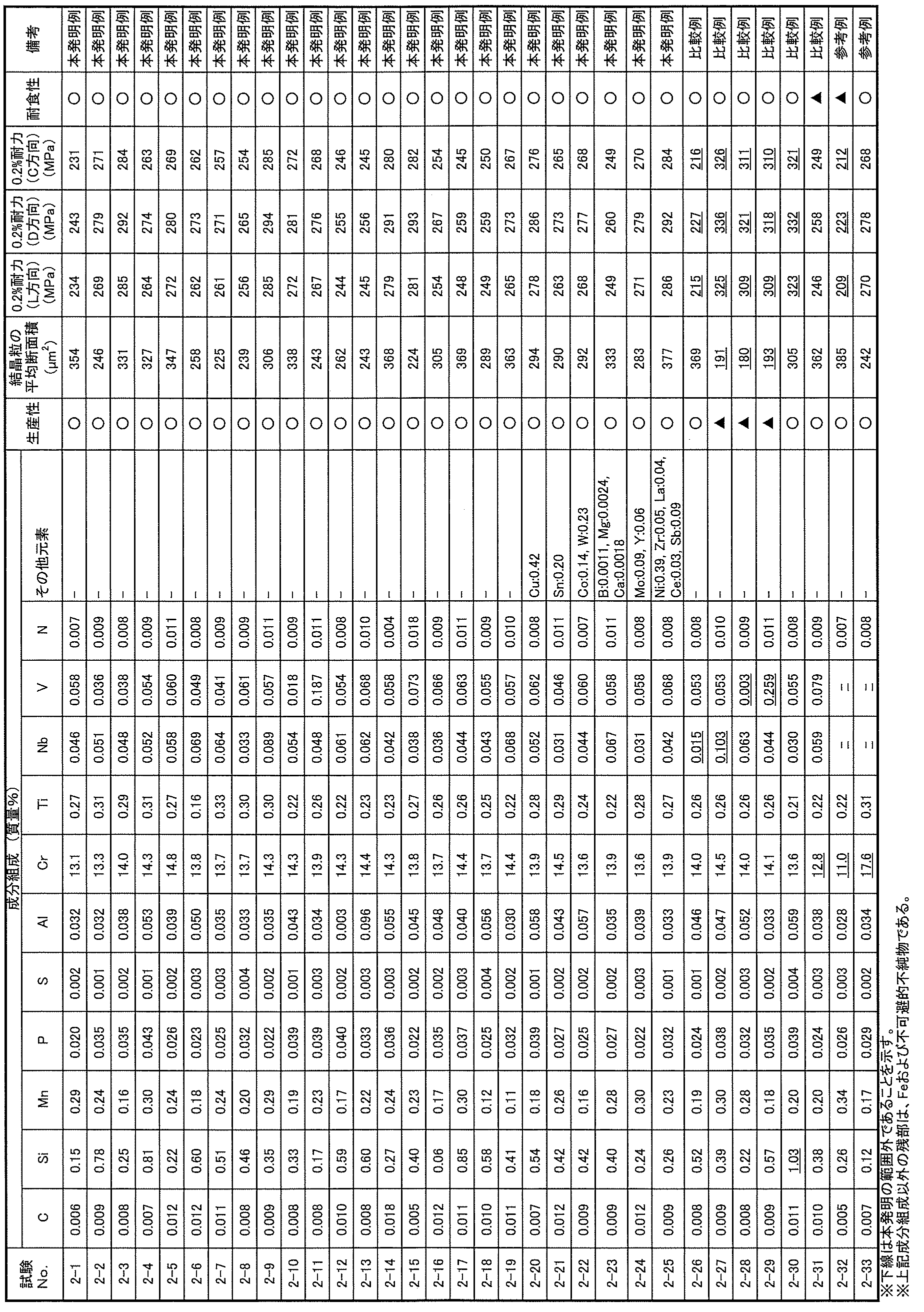
- Example 2 Ferritic stainless steel having the composition shown in Table 2 is melted into a 100 kg ingot (steel material), heated at a temperature of 1160 ° C. for 1 hour, hot-rolled, and hot-rolled to a plate thickness of 3.0 mm. It was made into a board. Immediately after the final pass of hot rolling is completed, the hot-rolled sheet is air-cooled to 550 ° C., then the hot-rolled sheet is inserted into an electric furnace set at 550 ° C. and held for 1 hour, and then cooled in the electric furnace. did. The obtained hot-rolled plate was held at 980 ° C. for 20 seconds and then air-cooled to obtain a hot-spread annealed plate.
- the hot-rolled annealed plate was pickled with a sulfuric acid solution followed by a mixed solution of hydrofluoric acid and nitric acid to be used as a material for cold rolling, and then cold-rolled to a plate thickness of 1.0 mm to obtain a cold-rolled plate.
- a part of the obtained cold-rolled plate was held at 900 ° C. for 100 seconds, then air-cooled, and then the front and back surfaces were ground to remove the surface scale to obtain a cold-rolled annealed plate.
- the obtained cold-rolled plate and cold-rolled annealed plate were subjected to the above-mentioned evaluation.
- the test No. 2-32 and 2-33 are reference examples, and the above-mentioned test No. No. 2-32 is a component composition of SUH409L standard, and the test No. 2-33 is a component composition of AISI439 standard.
- the ferritic stainless steel sheets (Test Nos. 2-1 to 2-25) of the example of the present invention have a productivity evaluation of " ⁇ ", an average cross-sectional area of crystal grains of 200 ⁇ m 2 or more and 400 ⁇ m 2 or less, and L.
- the 0.2% proof stress in all three directions of the direction, the D direction and the C direction is 230 MPa or more and 300 MPa or less, and the evaluation of the corrosion resistance is " ⁇ ", and the 0.2% proof stress equivalent to AISI439 is obtained. It was found that the productivity was excellent and the corrosion resistance was excellent.
- Test No. In the comparative example of 2-27, since the content of Nb is higher than the component range of the present invention, the productivity is inferior, and the average cross-sectional area of the crystal grains is smaller than the range of the present invention, which is smaller than the range of the present invention.
- the 0.2% proof stress was high in all three directions of the L direction, the D direction and the C direction.
- Test No. In the comparative example of 2-28, since the V content is lower than the component range of the present invention, the productivity is inferior, and the average cross-sectional area of the crystal grains is smaller than the range of the present invention, which is smaller than the range of the present invention.
- the 0.2% proof stress was high in all three directions of the L direction, the D direction and the C direction.
- Test No. In the comparative example of 2-29, the V content is higher than the component range of the present invention, the productivity is inferior, and the average cross-sectional area of the crystal grains is smaller than the range of the present invention, which is larger than the range of the present invention.
- the 0.2% proof stress was high in all three directions of the direction, the D direction and the C direction.
- Test No. 2-32 is a reference example having a component composition of SUH409L standard. Test No. In 2-32, the desired corrosion resistance and 0.2% proof stress cannot be obtained.
- Test No. 2-33 is a reference example having a component composition of AISI439 standard. Test No. Since 2-33 contains Cr of 15.0% by mass or more, the raw material cost and the manufacturing cost are high.
- the ferritic stainless steel sheet of the present invention has excellent corrosion resistance and 0.2% proof stress equivalent to AISI439, it is used for automobile exhaust system members, rockers, parts for home appliances, building materials, kitchen equipment, railway vehicles, and electric devices. It is suitable for parts and the like, and is particularly suitable for automobile exhaust system members such as automobile exhaust pipes, converter cases, front pipes, center pipes, mufflers, and muffler cutters.
- the ferritic stainless steel sheet of the present invention is particularly suitable as an inexpensive alternative steel for the members used in AISI439.
Landscapes
- Chemical & Material Sciences (AREA)
- Engineering & Computer Science (AREA)
- Mechanical Engineering (AREA)
- Materials Engineering (AREA)
- Metallurgy (AREA)
- Organic Chemistry (AREA)
- Physics & Mathematics (AREA)
- Thermal Sciences (AREA)
- Crystallography & Structural Chemistry (AREA)
- Heat Treatment Of Sheet Steel (AREA)
Abstract
Description
c+0.1×(a-c)≧b ・・・(1)
[1]質量%で、
C:0.004~0.020%、
Si:0.05~0.90%、
Mn:0.05~0.60%、
P:0.050%以下、
S:0.030%以下、
Al:0.001~0.100%、
Cr:13.0%以上15.0%未満、
Ti:0.15~0.35%、
Nb:0.030~0.090%、
V:0.010~0.200%、および
N:0.004~0.020%を含有し、残部がFeおよび不可避的不純物からなる成分組成と、
結晶粒の平均断面積が200~400μm2である組織を有し、
L方向、D方向およびC方向の0.2%耐力がいずれも230~300MPaであるフェライト系ステンレス鋼板。
[2]前記成分組成が、さらに、質量%で、
Ni:0.01~0.60%、
Cu:0.01~0.80%、
Co:0.01~0.50%、
Mo:0.01~1.00%、および
W:0.01~0.50%
のうちから選ばれた1種または2種以上を含有する[1]に記載のフェライト系ステンレス鋼板。
[3]前記成分組成が、さらに、質量%で、
Zr:0.01~0.50%、
B:0.0003~0.0030%、
Mg:0.0005~0.0100%、
Ca:0.0003~0.0030%、
Y:0.01~0.20%、
REM(希土類金属):0.01~0.10%、
Sn:0.01~0.50%、および
Sb:0.01~0.50%のうちから選ばれた1種または2種以上を含有する[1]または[2]に記載のフェライト系ステンレス鋼板。
[4]自動車排気系部材用である、[1]~[3]のいずれかに記載のフェライト系ステンレス鋼板。
[5]前記[1]~[4]のいずれかに記載のフェライト系ステンレス鋼板の製造方法であって、
前記成分組成を有する鋼素材を、1100~1250℃の温度で10分以上保持した後、熱間圧延して熱延板とし、その後、500~600℃の巻取温度で巻き取る熱間圧延工程と、
前記熱間圧延工程後の熱延板に940~1000℃の温度で5~180秒保持する熱延板焼鈍を施し熱延焼鈍板を得る熱延板焼鈍工程と、
前記熱延板焼鈍工程後の熱延焼鈍板を冷間圧延して冷延板とした後、880~900℃の温度で5~180秒保持する冷延板焼鈍を施し冷延焼鈍板を得る冷延板焼鈍工程と、を有する、フェライト系ステンレス鋼板の製造方法。
Cは、鋼の0.2%耐力を高めるのに有効な元素である。この効果はC含有量を0.004%以上にすることで得られる。しかし、C含有量が0.020%を超えると、鋼が硬質化して成形性が低下したり、耐食性が低下する。よって、C含有量は0.004~0.020%とする。好ましくは、C含有量は0.006%以上である。より好ましくは、C含有量は0.008%以上である。また、好ましくは、C含有量は0.015%以下である。より好ましくは、C含有量は0.012%以下である。
Siは、脱酸作用を有する。この効果は、Si含有量を0.05%以上にすることで得られる。しかし、Si含有量が0.90%を超えると鋼が硬質化して0.2%耐力が過度に上昇する。従って、Si含有量は0.05~0.90%とする。好ましくは、Si含有量は0.07%以上である。より好ましくは、Si含有量は0.10%以上である。さらに好ましくは、Si含有量は0.15%以上である。さらにより好ましくは、Si含有量は0.22%以上である。また、好ましくは、Si含有量は0.80%以下である。より好ましくは、Si含有量は0.60%以下である。
Mnは、脱酸効果を有する。この効果は、Mn含有量を0.05%以上にすることで得られる。しかし、Mn含有量が0.60%を超えるとMnSの析出および粗大化が促進され、このMnSが腐食の起点となって鋼板の耐食性が低下する。従って、Mn含有量は0.05~0.60%とする。好ましくは、Mn含有量は0.15%以上である。また、好ましくは、Mn含有量は0.30%以下である。
Pは耐食性を低下させる元素である。また、Pは結晶粒界に偏析することで熱間加工性を低下させる。そのため、P含有量は、可能な限り少ないほうが望ましく、0.050%以下とする。好ましくは、P含有量は0.040%以下である。さらに好ましくは、P含有量は0.030%以下である。
Sは、Mnと析出物としてMnSを形成する。このMnSは腐食の起点となり、耐食性を低下させる。よって、S含有量は、低いほうが望ましく、0.030%以下とする。好ましくは、S含有量は0.020%以下である。
Alは、脱酸効果を有する。この効果は、Al含有量が0.001%以上で得られる。しかし、Al含有量が0.100%を超えると鋼が硬質化して成形性が低下するとともに耐食性が低下する。よって、Al含有量は0.001~0.100%とする。好ましくは、Al含有量は0.030%以上である。また、好ましくは、Al含有量は0.060%以下である。
Crは、表面に不働態皮膜を形成して耐食性を高める元素である。Cr含有量が13.0%未満では十分な耐食性が得られない。一方、Cr含有量が15.0%以上となると、原料コストや製造コストの増大を招く。よって、Cr含有量は13.0%以上15.0%未満とする。好ましくは、Cr含有量は13.5%以上である。また、好ましくは、Cr含有量は14.5%以下である。好ましくは、Cr含有量は14.0%以下である。
Tiは、炭窒化物を形成することでC、Nを固定し、鋭敏化の発生を抑制する元素である。この効果は、Ti含有量を0.15%以上にすることで得られる。しかし、Ti含有量が0.35%を超えると、鋼が硬質化して成形性が低下する。よって、Ti含有量は0.15~0.35%とする。好ましくは、Ti含有量は0.20%以上である。また、好ましくは、Ti含有量は0.30%以下である。
Nbは、冷延焼鈍板の鋼中に固溶して存在することで、鋼の0.2%耐力を高めるのに有効な元素である。この効果は、Nb含有量を0.030%以上にすることで得られる。しかし、Nb含有量が0.090%を超えると、後述するVによる再結晶温度上昇の抑制効果を得たとしても、鋼の再結晶温度が上昇し、普通鋼-ステンレス鋼兼用の焼鈍ラインを用いて製造した場合、鋼の軟質化が不十分となったり、結晶粒が過度に微細となって0.2%耐力が高くなる。よって、Nb含有量は0.030~0.090%とする。好ましくは、Nb含有量は0.035%以上である。より好ましくは、Nb含有量は0.040%以上である。また、好ましくは、Nb含有量は0.080%以下である。より好ましくは、Nb含有量は0.070%以下である。
Vは、Nbによる鋼の再結晶温度上昇を抑制することで、生産性を高める元素である。この効果は、V含有量を0.010%以上にすることで得られる。一方、過剰にVを含有するとV炭窒化物が過度に析出し、再結晶温度上昇して鋼の生産性を低下させる。よって、V含有量は0.010~0.200%とする。好ましくは、V含有量は0.020%以上である。より好ましくは、V含有量は0.030%以上である。また、好ましくは、V含有量は0.150%以下である。より好ましくは、V含有量は0.100%以下である。
Nは、鋼の0.2%耐力を高めるのに有効な元素である。この効果はN含有量を0.004%以上にすることで得られる。しかし、N含有量が0.020%を超えると、鋼が硬質化して成形性が低下したり、耐食性が低下する。よって、N含有量は0.004~0.020%とする。好ましくは、N含有量は0.005%以上である。より好ましくは、N含有量は0.007%以上である。また、好ましくは、N含有量は0.015%以下である。より好ましくは、N含有量は0.012%以下である。
(A群)Ni:0.01~0.60%、Cu:0.01~0.80%、Co:0.01~0.50%、Mo:0.01~1.00%、およびW:0.01~0.50%のうちから選ばれた1種または2種以上
(B群)Zr:0.01~0.50%、B:0.0003~0.0030%、Mg:0.0005~0.0100%、Ca:0.0003~0.0030%、Y:0.01~0.20%、REM(希土類金属):0.01~0.10%、Sn:0.01~0.50%、およびSb:0.01~0.50%のうちから選んだ1種または2種以上
Niは、低pH環境において、鋼の活性溶解を抑制することで、鋼の耐食性を高める。一方、過剰にNiを含有すると、鋼の成分コストおよび製造コストの上昇を招くとともに、鋼が硬質化して成形性が低下する。そのため、Niを含有する場合は、Ni含有量を0.01~0.60%とする。好ましくは、Ni含有量は0.10%以上である。また、好ましくは、Ni含有量は0.25%以下である。
Cuは、ステンレス鋼の耐食性を向上させる元素である。一方、過剰にCuを含有すると、鋼の成分コストおよび製造コストの上昇を招くとともに、ε-Cuが析出しやすくなり、耐食性が低下する。そのため、Cuを含有する場合は、Cu含有量を0.01~0.80%とする。好ましくは、Cu含有量は0.30%以上である。より好ましくは、Cu含有量は0.40%以上である。また、好ましくは、Cu含有量は0.50%以下である。より好ましくは、Cu含有量は0.45%以下である。さらにより好ましくは、Cu含有量は0.42%以下である。
Coは、ステンレス鋼の耐食性を向上させる元素である。一方、過剰にCoを含有すると、鋼が硬質化して0.2%耐力が過度に上昇する。そのため、Coを含有する場合は、Co含有量は0.01~0.50%とする。好ましくは、Co含有量は0.03%以上である。より好ましくは、Co含有量は0.05%以上である。また、好ましくは、Co含有量は0.30%以下である。より好ましくは、Co含有量は0.10%以下である。
Moには、ステンレス鋼の耐食性を向上させる効果がある。一方、過剰にMoを含有すると、鋼の成分コストおよび製造コストの上昇を招くとともに、鋼が硬質化して0.2%耐力が過度に上昇する。そのため、Moを含有する場合は、Mo含有量を0.01~1.00%とする。好ましくは、Mo含有量は0.03%以上である。より好ましくは、Mo含有量は0.05%以上である。また、好ましくは、Mo含有量は0.50%以下である。より好ましくは、Mo含有量は0.30%以下である。
Wは、ステンレス鋼の耐食性を向上させる元素である。一方、過剰にWを含有すると、鋼が硬質化して0.2%耐力が過度に上昇する。そのため、Wを含有する場合は、W含有量を0.01~0.50%とする。好ましくは、W含有量は0.03%以上である。より好ましくは、W含有量は0.05%以上である。また、好ましくは、W含有量は0.30%以下である。より好ましくは、W含有量は0.10%以下である。
Zrは、炭窒化物を形成することでC、Nを固定し、鋼の耐食性を向上させる元素である。一方、過剰にZrを含有すると炭窒化物が過度に析出し、鋼の耐食性が低下する。そのため、Zrを含有する場合は、Zr含有量を0.01~0.50%とする。好ましくは、Zr含有量は0.03%以上である。より好ましくは、Zr含有量は0.05%以上である。また、好ましくは、Zr含有量は0.40%以下である。より好ましくは、Zr含有量は0.30%以下である。
Bには、鋼の強度を向上させる効果がある。一方、過剰にBを含有すると鋼が硬質化して0.2%耐力が過度に上昇する。そのため、Bを含有する場合は、B含有量を0.0003~0.0030%とする。好ましくは、B含有量は0.0010%以上である。また、好ましくは、B含有量は0.0025%以下である。
Mgは、脱酸剤として作用する。一方、過剰にMgを含有すると表面欠陥が増加する。そのため、Mgを含有する場合は、Mg含有量を0.0005~0.0100%とする。好ましくは、Mg含有量は0.0010%以上である。また、好ましくは、Mg含有量は0.0050%以下である。より好ましくは、Mg含有量は0.0030%以下である。
Caは、脱酸剤として作用する。一方、過剰にCaを含有すると表面欠陥が増加する。そのため、Caを含有する場合は、Ca含有量を0.0003~0.0030%とする。好ましくは、Ca含有量は0.0005%以上である。より好ましくは、Ca含有量は0.0007%以上である。また、好ましくは、Ca含有量は0.0025%以下である。より好ましくは、Ca含有量は0.0015%以下である。
Yは、鋼の清浄度を向上させる元素である。一方、過剰にYを含有すると表面欠陥が増加する。そのため、Yを含有する場合は、Y含有量を0.01~0.20%とする。好ましくは、Y含有量は0.03%以上である。また、好ましくは、Y含有量は0.10%以下である。
REM(希土類金属:La、Ce、Ndなどの原子番号57~71の元素)は、鋼の清浄度を向上させる元素である。一方、REMを過剰に含有すると、表面欠陥が増加する。そのため、REMを含有する場合は、REM含有量を0.01~0.10%とする。好ましくは、REM含有量は0.02%以上である。また、好ましくは、REM含有量は0.05%以下である。なお、本発明におけるREM含有量は、上述のREMから選択された1種または2種以上の元素の総含有量である。
Snは、加工肌荒れの抑制に有効な元素である。一方、過剰にSnを含有すると、鋼の熱間加工性が低下する。そのため、Snを含有する場合は、Sn含有量を0.01~0.50%とする。好ましくは、Sn含有量は0.03%以上である。また、好ましくは、Sn含有量は0.20%以下である。
Sbは、Snと同様に、加工肌荒れの抑制に有効な元素である。一方、過剰にSbを含有すると、表面欠陥が増加する。そのため、Sbを含有する場合は、Sb含有量を0.01~0.50%とする。好ましくは、Sb含有量は0.03%以上である。また、好ましくは、Sb含有量は0.20%以下である。
本発明においては、Nbをはじめとした各種元素の含有量を制御することに加え、組織における結晶粒の平均断面積を所定の範囲に制御することで、優れた生産性のもと製造可能な、AISI439と同等の0.2%耐力を有するフェライト系ステンレス鋼を得ることができる。ここで、結晶粒の平均断面積は、鋼の0.2%耐力に影響を与える。結晶粒の平均断面積が200μm2未満では、鋼の0.2%耐力が高くなり、AISI439と同等の0.2%耐力が得られない。また、結晶粒の平均断面積が400μm2を超えると、鋼の0.2%耐力が低くなり、AISI439と同等の0.2%耐力が得られない。よって、組織における結晶粒の平均断面積は、200~400μm2とする。好ましくは、結晶粒の平均断面積は240μm2以上である。また、好ましくは、結晶粒の平均断面積は360μm2以下である。なお、結晶粒の平均断面積は、後述する製造方法で制御することができる。
A = 31400/(n1+0.6×n2) ・・・(2)
D方向の0.2%耐力:230~300MPa
C方向の0.2%耐力:230~300MPa
AISI439と同等の0.2%耐力を有し、加工を施した際にAISI439と同等のスプリングバック量を得るためには、フェライト系ステンレス鋼板のL方向、C方向およびD方向の0.2%耐力を、いずれも230~300MPaの範囲とすることが必要である。いずれかの方向の0.2%耐力が230MPa未満であると、当該0.2%耐力が230MPa未満である方向に垂直な方向が曲げ稜線となるように鋼を加工した場合に、AISI439と比較してスプリングバック量が小さくなる。また、いずれかの方向の0.2%耐力が300MPaを超えると、当該0.2%耐力が300MPaを超える方向に垂直な方向が曲げ稜線となるように鋼を加工した場合に、AISI439と比較してスプリングバック量が大きくなる。よって、L方向、D方向およびC方向の0.2%耐力は、いずれも230~300MPaとする。好ましくは、前記0.2%耐力は、いずれも240MPa以上である。また、好ましくは、前記0.2%耐力は、いずれも290MPa以下である。
鋼スラブの加熱温度が1100℃未満であると、鋼中のNbCが十分に固溶せず、冷延焼鈍板においてNbによる0.2%耐力の上昇効果が得られず、冷延焼鈍板の0.2%耐力が低下する。また、鋼スラブの加熱時間が10分未満であると、鋼中のNbCが十分に固溶せず、冷延焼鈍板においてNbによる0.2%耐力の上昇効果が得られず、冷延焼鈍板の0.2%耐力が低下する。また、鋼スラブの加熱温度が1250℃を超えると、鋼スラブの変形を招き熱間圧延工程における熱延板の製造性を低下させる。よって、本発明においては、鋼スラブを1100℃以上1250℃以下に10分以上保持してから熱間圧延して熱延板とすることが好ましい。より好ましくは、鋼スラブの加熱温度は1150℃以上である。また、上記の加熱時間は、より好ましくは30分以上である。また、より好ましくは、鋼スラブの加熱温度は1200℃以下である。また、鋼スラブの過度に長時間の加熱保持は、鋼スラブの変形を招き熱間圧延工程における熱延板の製造性を低下させるため、鋼スラブの加熱時間は2時間以下とすることが好ましい。
熱延板焼鈍温度が940℃未満であると、熱延板が再結晶せず、これにともない冷延焼鈍板の結晶粒が粗大となり、冷延焼鈍板の0.2%耐力が低下する。熱延板焼鈍温度が1000℃を超えると、熱延焼鈍板の結晶粒が粗大となり、冷延焼鈍板の結晶粒が粗大となって、冷延焼鈍板の0.2%耐力が低下する。また、熱延板焼鈍の保持時間が5秒未満であると、熱延板が再結晶せず、これにともない冷延焼鈍板の結晶粒が粗大となり、冷延焼鈍板の0.2%耐力が低下する。熱延板焼鈍の保持時間が180秒を超えると、熱延焼鈍板の結晶粒が粗大となり、冷延焼鈍板の結晶粒が粗大となって、冷延焼鈍板の0.2%耐力が低下する。よって、本発明においては、熱延板を940℃以上1000℃以下の温度で5~180秒保持する熱延板焼鈍を行い、熱延焼鈍板とすることが好ましい。より好ましくは、熱延板の焼鈍温度の範囲は950℃以上980℃以下である。また、上記の保持時間は、より好ましくは10秒以上である。また、上記の保持時間は、より好ましくは30秒以下である。
冷延板焼鈍温度が880℃未満であると、鋼の結晶粒が過度に微細となり、0.2%耐力が過度に高くなる。一方、900℃を超える冷延板焼鈍は生産性の高い普通鋼-ステンレス鋼兼用の焼鈍ラインで冷延板焼鈍を行うことができない。また、冷延板焼鈍の保持時間が5秒未満であると、鋼の結晶粒が過度に微細となり、0.2%耐力が過度に高くなる。一方、冷延板焼鈍の保持時間が180秒を超えると、鋼の結晶粒が粗大となり、0.2%耐力が過度に低くなる。よって、本発明においては、冷延板を880℃以上900℃以下で5~180秒保持する冷延板焼鈍を行うことが好ましい。より好ましくは、冷延板の焼鈍温度の範囲は890℃以上である。また、上記の保持時間は、より好ましくは10秒以上である。また、上記の保持時間は、より好ましくは120秒以下である。
表1-1に示す成分組成を有するフェライト系ステンレス鋼を100kg鋼塊(鋼素材)に溶製した後、表1-2に記載の各スラブ加熱温度で、表1-2に記載の各スラブ加熱時間保持した後、熱間圧延を行って板厚3.0mmの熱延板とした。熱間圧延の最終パスが完了した直後より、熱延板を表1-2に記載の各巻取温度まで空冷した後、熱延板を電気炉に挿入して各巻取温度にて1時間保持し、その後電気炉内で炉冷した。なお、この熱延板を電気炉に挿入して各巻取温度にて1時間保持し、その後電気炉内で炉冷する工程は、実製造ラインにおいて熱間圧延後の熱延板を各巻取温度でコイル状に巻き取ってから徐冷する温度履歴を模擬したものである。

上記の製造条件で得られた冷延板の硬さaと、前記冷延板に、900℃にて20sの冷延板焼鈍を施した冷延焼鈍板の硬さbと、十分に軟質化した場合の指標として1050℃にて20sの冷延板焼鈍を施した冷延焼鈍板の硬さcとを比較することで、焼鈍にともなう冷延板の硬さ変化を評価した。具体的には、前記冷延板より長さ15mm×幅20mmの試験片を3枚切出し、そのうち1枚の試験片の断面のビッカース硬さ(HV)を測定し、上記の硬さaとした。また、残り2枚の試験片について、それぞれ900℃において20s、1050℃において20sの焼鈍を施した後、長さ15mm×幅10mmのサイズに切断し、切断した試験片の断面のビッカース硬さ(HV)を測定し、それぞれ上記の硬さb、cとした。試験片は、樹脂埋めの後に、試験面を鏡面研磨して試験に供した。ビッカース硬さの測定条件は、試験力9.8N、保持時間15秒とした。測定した硬さa、b、およびcが、式(1)を満たすものを「○(合格)」、満たさなかったものを「▲(不合格)」として評価した。この評価で○であれば、普通鋼-ステンレス鋼兼用の焼鈍ラインで冷延板焼鈍を行うことができ、生産性に優れると評価できる。
c+0.1×(a-c)≧b ・・・(1)
上記の製造条件で得られた冷延焼鈍板より、幅10mm×長さ15mmの組織観察用試験片を切出し、長さ方向の断面が観察面となるように樹脂に埋め込んだ後、観察面を鏡面研磨した。その後、ピクリン酸塩酸溶液(100mLエタノール-1gピクリン酸-5mL塩酸)にて観察面をエッチングし、結晶粒界を現出させた後、500倍の倍率にて光学顕微鏡にて組織を撮影した。得られた観察像に対し、実視野にして半径100μmの円(500倍の倍率で観察像を印刷した場合、半径50mmの円)を描き、その円内に完全に含まれている結晶粒の数をn1、円周によって切られている結晶粒の数をn2としてそれぞれ計測し、得られた計測結果を下記式(2)に代入して与えられる結晶粒の平均断面積A(μm2)を評価した。
A = 31400/(n1+0.6×n2) ・・・(2)
上記の製造条件で得られた冷延焼鈍板より、圧延方向(L方向)、圧延方向に対して45度方向(D方向)、および、圧延方向に対して直角方向(C方向)のそれぞれが長手となるように、JIS13号B試験片を採取し、引張試験を行った。引張試験は、JIS Z 2241に準拠して実施し、得られた各試験片の0.2%耐力を評価した。
上記の製造条件で得られた冷延焼鈍板より、せん断加工により長さ80mm×幅60mmの試験片を切出した。試験片の表面をエメリー紙で400番まで研磨し、アセトンによる脱脂を行った後、腐食試験を行って、耐食性を評価した。腐食試験は、JASO M609-91に準拠して実施した。1サイクルを5.0質量%NaCl水溶液噴霧(35℃、相対湿度98%)2h→乾燥(60℃、相対湿度30%)4h→湿潤(50℃、相対湿度95%以上)2hとし、5サイクルの腐食試験を実施した。試験後、試験片表面を撮影した写真から、試験片表面中央の30mm×30mmの領域について、画像解析により発銹面積率を測定した。そして、発銹面積率が20%以下であったものを「○(合格)」、20%超であったものを「▲(不合格)」として評価した。この評価で○であれば、耐食性に優れると評価できる。
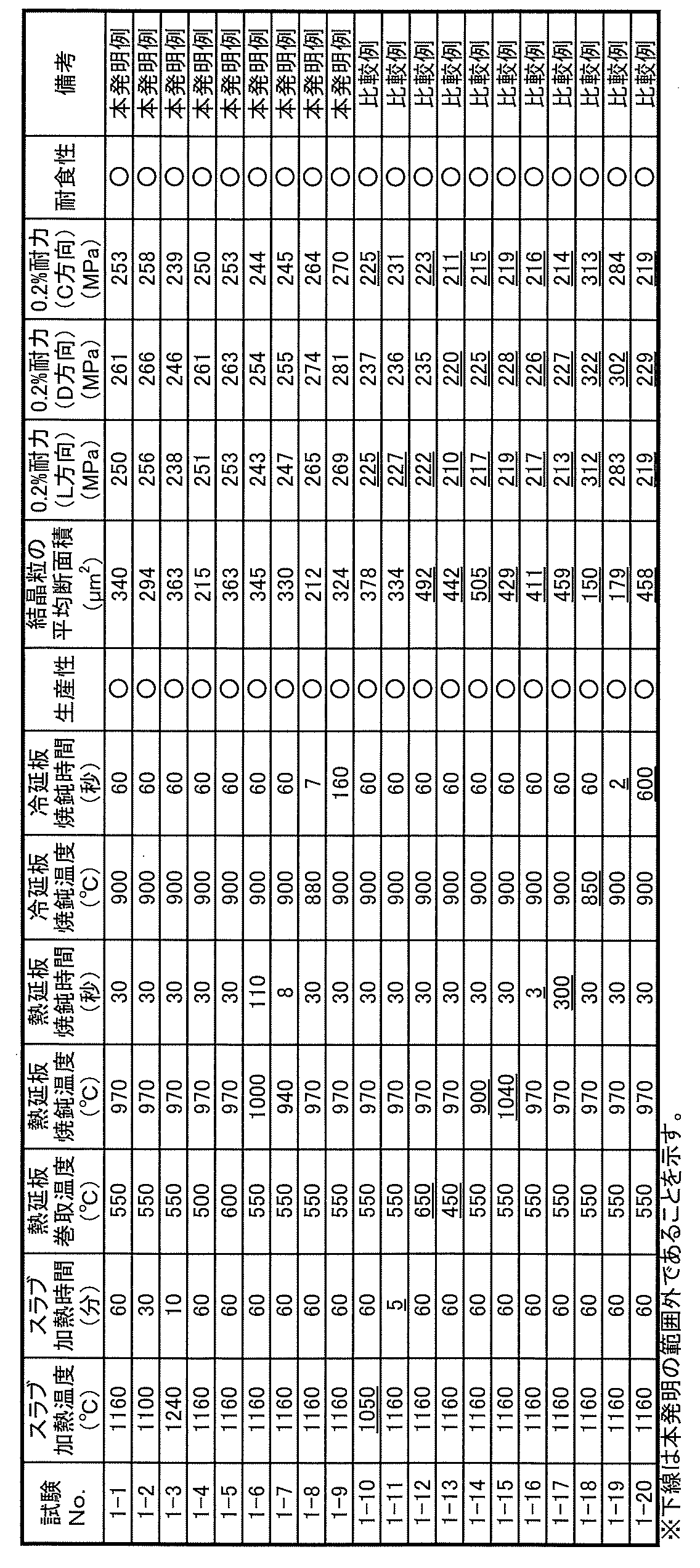
表2に示す成分組成を有するフェライト系ステンレス鋼を100kg鋼塊(鋼素材)に溶製した後、1160℃の温度で1時間加熱し、熱間圧延を行って板厚3.0mmの熱延板とした。熱間圧延の最終パスが完了した直後より、熱延板を550℃まで空冷した後、熱延板を550℃に設定した電気炉に挿入して1時間保持し、その後電気炉内で炉冷した。得られた熱延板を980℃で20秒保持した後、空冷し、熱延焼鈍板とした。熱延焼鈍板を硫酸溶液と続いてフッ酸と硝酸の混合溶液で酸洗し、冷間圧延用素材として、その後、板厚1.0mmまでの冷間圧延を行い、冷延板とした。得られた冷延板の一部は、900℃で100秒保持した後、空冷し、その後、表裏面の表面研削を行って表面スケールを除去して、冷延焼鈍板とした。得られた冷延板および冷延焼鈍板を、上述した評価に供した。なお、試験No.2-32、2-33は参考例であり、前記試験No.2-32はSUH409L規格の成分組成であり、前記試験No.2-33はAISI439規格の成分組成である。
Claims (5)
- 質量%で、
C:0.004~0.020%、
Si:0.05~0.90%、
Mn:0.05~0.60%、
P:0.050%以下、
S:0.030%以下、
Al:0.001~0.100%、
Cr:13.0%以上15.0%未満、
Ti:0.15~0.35%、
Nb:0.030~0.090%、
V:0.010~0.200%、および
N:0.004~0.020%を含有し、残部がFeおよび不可避的不純物からなる成分組成と、
結晶粒の平均断面積が200~400μm2である組織を有し、
L方向、D方向およびC方向の0.2%耐力がいずれも230~300MPaであるフェライト系ステンレス鋼板。 - 前記成分組成が、さらに、質量%で、
Ni:0.01~0.60%、
Cu:0.01~0.80%、
Co:0.01~0.50%、
Mo:0.01~1.00%、および
W:0.01~0.50%
のうちから選ばれた1種または2種以上を含有する請求項1に記載のフェライト系ステンレス鋼板。 - 前記成分組成が、さらに、質量%で、
Zr:0.01~0.50%、
B:0.0003~0.0030%、
Mg:0.0005~0.0100%、
Ca:0.0003~0.0030%、
Y:0.01~0.20%、
REM(希土類金属):0.01~0.10%、
Sn:0.01~0.50%、および
Sb:0.01~0.50%のうちから選ばれた1種または2種以上を含有する請求項1または2に記載のフェライト系ステンレス鋼板。 - 自動車排気系部材用である、請求項1~3のいずれかに記載のフェライト系ステンレス鋼板。
- 請求項1~4のいずれかに記載のフェライト系ステンレス鋼板の製造方法であって、
前記成分組成を有する鋼素材を、1100~1250℃の温度で10分以上保持した後、熱間圧延して熱延板とし、その後、500~600℃の巻取温度で巻き取る熱間圧延工程と、
前記熱間圧延工程後の熱延板に940~1000℃の温度で5~180秒保持する熱延板焼鈍を施し熱延焼鈍板を得る熱延板焼鈍工程と、
前記熱延板焼鈍工程後の熱延焼鈍板を冷間圧延して冷延板とした後、880~900℃の温度で5~180秒保持する冷延板焼鈍を施し冷延焼鈍板を得る冷延板焼鈍工程と、を有する、フェライト系ステンレス鋼板の製造方法。
Priority Applications (3)
| Application Number | Priority Date | Filing Date | Title |
|---|---|---|---|
| KR1020217035053A KR102590079B1 (ko) | 2019-05-29 | 2020-03-03 | 페라이트계 스테인리스 강판 및 그 제조 방법 |
| JP2020532071A JP6809653B1 (ja) | 2019-05-29 | 2020-03-03 | フェライト系ステンレス鋼板およびその製造方法 |
| CN202080032468.2A CN113767181B (zh) | 2019-05-29 | 2020-03-03 | 铁素体系不锈钢板及其制造方法 |
Applications Claiming Priority (2)
| Application Number | Priority Date | Filing Date | Title |
|---|---|---|---|
| JP2019-099958 | 2019-05-29 | ||
| JP2019099958 | 2019-05-29 |
Publications (1)
| Publication Number | Publication Date |
|---|---|
| WO2020240959A1 true WO2020240959A1 (ja) | 2020-12-03 |
Family
ID=73553298
Family Applications (1)
| Application Number | Title | Priority Date | Filing Date |
|---|---|---|---|
| PCT/JP2020/008783 Ceased WO2020240959A1 (ja) | 2019-05-29 | 2020-03-03 | フェライト系ステンレス鋼板およびその製造方法 |
Country Status (4)
| Country | Link |
|---|---|
| JP (1) | JP6809653B1 (ja) |
| KR (1) | KR102590079B1 (ja) |
| CN (1) | CN113767181B (ja) |
| WO (1) | WO2020240959A1 (ja) |
Cited By (1)
| Publication number | Priority date | Publication date | Assignee | Title |
|---|---|---|---|---|
| CN116479340A (zh) * | 2023-04-28 | 2023-07-25 | 浙江丰业集团有限公司 | 一种高韧性铁素体钢钢管及其制备方法 |
Families Citing this family (1)
| Publication number | Priority date | Publication date | Assignee | Title |
|---|---|---|---|---|
| CN115572893B (zh) * | 2022-09-02 | 2023-06-16 | 武汉钢铁有限公司 | 一种耐大气腐蚀的高强度汽车轮辐用钢及其制造方法 |
Citations (6)
| Publication number | Priority date | Publication date | Assignee | Title |
|---|---|---|---|---|
| JPH05320772A (ja) * | 1992-03-24 | 1993-12-03 | Sumitomo Metal Ind Ltd | フェライトステンレス鋼板の製造方法 |
| JP2001032050A (ja) * | 1999-07-21 | 2001-02-06 | Nippon Steel Corp | 曲げ加工時の形状凍結性に優れたフェライト系ステンレス鋼とその製造方法 |
| JP2002332548A (ja) * | 2001-05-10 | 2002-11-22 | Nisshin Steel Co Ltd | 成形加工時の形状凍結性に優れたフェライト系ステンレス鋼帯およびその製造方法 |
| JP2004084067A (ja) * | 2002-06-17 | 2004-03-18 | Jfe Steel Kk | Ti添加フェライト系ステンレス鋼板およびその製造方法 |
| CN101845603A (zh) * | 2009-03-26 | 2010-09-29 | 宝山钢铁股份有限公司 | 一种汽车排气系统高温端部件用铁素体不锈钢及制造方法 |
| JP2016041847A (ja) * | 2014-08-14 | 2016-03-31 | Jfeスチール株式会社 | フェライト系ステンレス鋼板 |
Family Cites Families (12)
| Publication number | Priority date | Publication date | Assignee | Title |
|---|---|---|---|---|
| JP3941363B2 (ja) * | 1999-09-09 | 2007-07-04 | Jfeスチール株式会社 | 延性、加工性および耐リジング性に優れたフェライト系ステンレス冷延鋼板およびその製造方法 |
| JP4082205B2 (ja) * | 2002-12-20 | 2008-04-30 | Jfeスチール株式会社 | 加工性および耐リジング性に優れたフェライト系ステンレス鋼板およびその製造方法 |
| KR100741993B1 (ko) | 2003-08-06 | 2007-07-23 | 닛신 세이코 가부시키가이샤 | 스테인레스강의 가공 경화재 |
| JP2007009263A (ja) | 2005-06-29 | 2007-01-18 | Nisshin Steel Co Ltd | 耐衝撃穴開き性に優れたフェライト系ステンレス鋼 |
| JP4626484B2 (ja) * | 2005-10-27 | 2011-02-09 | Jfeスチール株式会社 | プレス成形性に優れたフェライト系ステンレス冷延鋼板およびその製造方法 |
| KR20160105869A (ko) * | 2014-01-08 | 2016-09-07 | 제이에프이 스틸 가부시키가이샤 | 페라이트계 스테인리스강 및 그 제조 방법 |
| JP5862846B2 (ja) * | 2014-01-08 | 2016-02-16 | Jfeスチール株式会社 | フェライト系ステンレス鋼およびその製造方法 |
| US10837075B2 (en) * | 2014-02-05 | 2020-11-17 | Jfe Steel Corporation | Hot rolled and annealed ferritic stainless steel sheet, method of producing same, and cold rolled and annealed ferritic stainless steel sheet |
| CN105506499B (zh) * | 2014-09-25 | 2018-11-02 | 宝钢不锈钢有限公司 | 一种具有良好折弯外观的铁素体不锈钢及其制造方法 |
| JP6411881B2 (ja) * | 2014-12-16 | 2018-10-24 | Jfeスチール株式会社 | フェライト系ステンレス鋼およびその製造方法 |
| MX2018009402A (es) * | 2016-02-02 | 2018-12-19 | Nisshin Steel Co Ltd | Chapa de acero inoxidable ferritico que contiene nb laminada en caliente y metodo para producir la misma, y chapa de acero inoxidable ferritico que contiene nb laminada en frio y metodo para producir la misma. |
| WO2018198834A1 (ja) * | 2017-04-25 | 2018-11-01 | Jfeスチール株式会社 | フェライト系ステンレス鋼板およびその製造方法 |
-
2020
- 2020-03-03 KR KR1020217035053A patent/KR102590079B1/ko active Active
- 2020-03-03 WO PCT/JP2020/008783 patent/WO2020240959A1/ja not_active Ceased
- 2020-03-03 JP JP2020532071A patent/JP6809653B1/ja active Active
- 2020-03-03 CN CN202080032468.2A patent/CN113767181B/zh active Active
Patent Citations (6)
| Publication number | Priority date | Publication date | Assignee | Title |
|---|---|---|---|---|
| JPH05320772A (ja) * | 1992-03-24 | 1993-12-03 | Sumitomo Metal Ind Ltd | フェライトステンレス鋼板の製造方法 |
| JP2001032050A (ja) * | 1999-07-21 | 2001-02-06 | Nippon Steel Corp | 曲げ加工時の形状凍結性に優れたフェライト系ステンレス鋼とその製造方法 |
| JP2002332548A (ja) * | 2001-05-10 | 2002-11-22 | Nisshin Steel Co Ltd | 成形加工時の形状凍結性に優れたフェライト系ステンレス鋼帯およびその製造方法 |
| JP2004084067A (ja) * | 2002-06-17 | 2004-03-18 | Jfe Steel Kk | Ti添加フェライト系ステンレス鋼板およびその製造方法 |
| CN101845603A (zh) * | 2009-03-26 | 2010-09-29 | 宝山钢铁股份有限公司 | 一种汽车排气系统高温端部件用铁素体不锈钢及制造方法 |
| JP2016041847A (ja) * | 2014-08-14 | 2016-03-31 | Jfeスチール株式会社 | フェライト系ステンレス鋼板 |
Cited By (1)
| Publication number | Priority date | Publication date | Assignee | Title |
|---|---|---|---|---|
| CN116479340A (zh) * | 2023-04-28 | 2023-07-25 | 浙江丰业集团有限公司 | 一种高韧性铁素体钢钢管及其制备方法 |
Also Published As
| Publication number | Publication date |
|---|---|
| KR20210144847A (ko) | 2021-11-30 |
| CN113767181A (zh) | 2021-12-07 |
| JP6809653B1 (ja) | 2021-01-06 |
| JPWO2020240959A1 (ja) | 2021-09-13 |
| KR102590079B1 (ko) | 2023-10-17 |
| CN113767181B (zh) | 2023-05-09 |
Similar Documents
| Publication | Publication Date | Title |
|---|---|---|
| CN106133166B (zh) | 铁素体系不锈钢轧制钢板和其制造方法以及法兰部件 | |
| JP6017341B2 (ja) | 曲げ性に優れた高強度冷延鋼板 | |
| JP5609945B2 (ja) | 高強度冷延鋼板およびその製造方法 | |
| JP5316634B2 (ja) | 加工性に優れた高強度鋼板およびその製造方法 | |
| JP5924459B1 (ja) | ステンレス冷延鋼板用素材 | |
| CN106414783A (zh) | 不锈钢冷轧钢板用坯料及其制造方法 | |
| KR102398707B1 (ko) | 고탄소 냉연 강판 및 그 제조 방법 | |
| JP2021155794A (ja) | ホットスタンプ部品用鋼板およびその製造方法 | |
| WO2019065508A1 (ja) | フェライト系ステンレス熱延焼鈍鋼板およびその製造方法 | |
| JP2021155791A (ja) | ホットスタンプ部品用鋼板およびその製造方法 | |
| JP7436825B2 (ja) | ホットスタンプ部品用鋼板およびその製造方法 | |
| JP6098537B2 (ja) | 高強度冷延鋼板およびその製造方法 | |
| JP6809653B1 (ja) | フェライト系ステンレス鋼板およびその製造方法 | |
| US11186900B2 (en) | High-strength cold rolled steel sheet and method for manufacturing the same | |
| KR20110018457A (ko) | 냉연 강판 및 그 제조 방법 그리고 백라이트 섀시 | |
| JP2019173070A (ja) | 二次加工性及び耐高温酸化性に優れるAl含有フェライト系ステンレス鋼材および加工品 | |
| JP2021155787A (ja) | ホットスタンプ部品用鋼板およびその製造方法 | |
| JP6003837B2 (ja) | 高強度プレス部品の製造方法 | |
| JP7047813B2 (ja) | フェライト系ステンレス鋼板およびその製造方法 | |
| JP7038799B2 (ja) | フェライト系ステンレス熱延焼鈍鋼板およびその製造方法 | |
| JP2021155789A (ja) | ホットスタンプ部品用鋼板およびその製造方法 | |
| JP2010137344A (ja) | せん断端面の耐食性に優れるフェライト系ステンレス鋼板のせん断方法 | |
| JP7564420B2 (ja) | ホットスタンプ部品の製造方法 | |
| JP2001207244A (ja) | 延性、加工性および耐リジング性に優れたフェライト系ステンレス冷延鋼板およびその製造方法 | |
| JP7436824B2 (ja) | ホットスタンプ部品用鋼板およびその製造方法 |
Legal Events
| Date | Code | Title | Description |
|---|---|---|---|
| ENP | Entry into the national phase |
Ref document number: 2020532071 Country of ref document: JP Kind code of ref document: A |
|
| 121 | Ep: the epo has been informed by wipo that ep was designated in this application |
Ref document number: 20814071 Country of ref document: EP Kind code of ref document: A1 |
|
| ENP | Entry into the national phase |
Ref document number: 20217035053 Country of ref document: KR Kind code of ref document: A |
|
| NENP | Non-entry into the national phase |
Ref country code: DE |
|
| 122 | Ep: pct application non-entry in european phase |
Ref document number: 20814071 Country of ref document: EP Kind code of ref document: A1 |