WO2020225934A1 - 毛包原基及びその製造方法 - Google Patents
毛包原基及びその製造方法 Download PDFInfo
- Publication number
- WO2020225934A1 WO2020225934A1 PCT/JP2019/031142 JP2019031142W WO2020225934A1 WO 2020225934 A1 WO2020225934 A1 WO 2020225934A1 JP 2019031142 W JP2019031142 W JP 2019031142W WO 2020225934 A1 WO2020225934 A1 WO 2020225934A1
- Authority
- WO
- WIPO (PCT)
- Prior art keywords
- culture
- cells
- epithelial cells
- mesenchymal cells
- hair follicle
- Prior art date
- Legal status (The legal status is an assumption and is not a legal conclusion. Google has not performed a legal analysis and makes no representation as to the accuracy of the status listed.)
- Ceased
Links
Images








































Classifications
-
- C—CHEMISTRY; METALLURGY
- C12—BIOCHEMISTRY; BEER; SPIRITS; WINE; VINEGAR; MICROBIOLOGY; ENZYMOLOGY; MUTATION OR GENETIC ENGINEERING
- C12N—MICROORGANISMS OR ENZYMES; COMPOSITIONS THEREOF; PROPAGATING, PRESERVING, OR MAINTAINING MICROORGANISMS; MUTATION OR GENETIC ENGINEERING; CULTURE MEDIA
- C12N5/00—Undifferentiated human, animal or plant cells, e.g. cell lines; Tissues; Cultivation or maintenance thereof; Culture media therefor
- C12N5/06—Animal cells or tissues; Human cells or tissues
- C12N5/0602—Vertebrate cells
- C12N5/0625—Epidermal cells, skin cells; Cells of the oral mucosa
- C12N5/0627—Hair cells
- C12N5/0628—Hair stem cells; Hair progenitors
-
- C—CHEMISTRY; METALLURGY
- C12—BIOCHEMISTRY; BEER; SPIRITS; WINE; VINEGAR; MICROBIOLOGY; ENZYMOLOGY; MUTATION OR GENETIC ENGINEERING
- C12N—MICROORGANISMS OR ENZYMES; COMPOSITIONS THEREOF; PROPAGATING, PRESERVING, OR MAINTAINING MICROORGANISMS; MUTATION OR GENETIC ENGINEERING; CULTURE MEDIA
- C12N5/00—Undifferentiated human, animal or plant cells, e.g. cell lines; Tissues; Cultivation or maintenance thereof; Culture media therefor
- C12N5/06—Animal cells or tissues; Human cells or tissues
- C12N5/0602—Vertebrate cells
- C12N5/0625—Epidermal cells, skin cells; Cells of the oral mucosa
- C12N5/0627—Hair cells
-
- C—CHEMISTRY; METALLURGY
- C12—BIOCHEMISTRY; BEER; SPIRITS; WINE; VINEGAR; MICROBIOLOGY; ENZYMOLOGY; MUTATION OR GENETIC ENGINEERING
- C12N—MICROORGANISMS OR ENZYMES; COMPOSITIONS THEREOF; PROPAGATING, PRESERVING, OR MAINTAINING MICROORGANISMS; MUTATION OR GENETIC ENGINEERING; CULTURE MEDIA
- C12N2502/00—Coculture with; Conditioned medium produced by
- C12N2502/09—Coculture with; Conditioned medium produced by epidermal cells, skin cells, oral mucosa cells
- C12N2502/092—Coculture with; Conditioned medium produced by epidermal cells, skin cells, oral mucosa cells hair cells
-
- C—CHEMISTRY; METALLURGY
- C12—BIOCHEMISTRY; BEER; SPIRITS; WINE; VINEGAR; MICROBIOLOGY; ENZYMOLOGY; MUTATION OR GENETIC ENGINEERING
- C12N—MICROORGANISMS OR ENZYMES; COMPOSITIONS THEREOF; PROPAGATING, PRESERVING, OR MAINTAINING MICROORGANISMS; MUTATION OR GENETIC ENGINEERING; CULTURE MEDIA
- C12N2502/00—Coculture with; Conditioned medium produced by
- C12N2502/13—Coculture with; Conditioned medium produced by connective tissue cells; generic mesenchyme cells, e.g. so-called "embryonic fibroblasts"
- C12N2502/1352—Mesenchymal stem cells
- C12N2502/1388—Mesenchymal stem cells from other natural sources
-
- C—CHEMISTRY; METALLURGY
- C12—BIOCHEMISTRY; BEER; SPIRITS; WINE; VINEGAR; MICROBIOLOGY; ENZYMOLOGY; MUTATION OR GENETIC ENGINEERING
- C12N—MICROORGANISMS OR ENZYMES; COMPOSITIONS THEREOF; PROPAGATING, PRESERVING, OR MAINTAINING MICROORGANISMS; MUTATION OR GENETIC ENGINEERING; CULTURE MEDIA
- C12N2513/00—3D culture
-
- C—CHEMISTRY; METALLURGY
- C12—BIOCHEMISTRY; BEER; SPIRITS; WINE; VINEGAR; MICROBIOLOGY; ENZYMOLOGY; MUTATION OR GENETIC ENGINEERING
- C12N—MICROORGANISMS OR ENZYMES; COMPOSITIONS THEREOF; PROPAGATING, PRESERVING, OR MAINTAINING MICROORGANISMS; MUTATION OR GENETIC ENGINEERING; CULTURE MEDIA
- C12N2533/00—Supports or coatings for cell culture, characterised by material
- C12N2533/50—Proteins
- C12N2533/52—Fibronectin; Laminin
-
- C—CHEMISTRY; METALLURGY
- C12—BIOCHEMISTRY; BEER; SPIRITS; WINE; VINEGAR; MICROBIOLOGY; ENZYMOLOGY; MUTATION OR GENETIC ENGINEERING
- C12N—MICROORGANISMS OR ENZYMES; COMPOSITIONS THEREOF; PROPAGATING, PRESERVING, OR MAINTAINING MICROORGANISMS; MUTATION OR GENETIC ENGINEERING; CULTURE MEDIA
- C12N2533/00—Supports or coatings for cell culture, characterised by material
- C12N2533/50—Proteins
- C12N2533/54—Collagen; Gelatin
Definitions
- the present invention relates to a hair follicle primordium and a method for producing the same.
- Non-Patent Document 1 skin tissue (skin organoids) are formed in vitro by seeding and culturing induced pluripotent stem cells (iPSCs) prepared from mouse fetal fibroblasts on a 96-well plate. It is stated that it should be done.
- iPSCs induced pluripotent stem cells
- Patent Document 1 describes a step of seeding mesenchymal cells and epithelial cells in a micro-concave plate composed of regularly arranged micro-recesses and mixing and culturing them while supplying oxygen to form a hair follicle primordium. A method for producing an aggregate of regenerated hair follicle primordiums is described.
- Patent Document 2 describes a method for producing full-thickness skin having skin appendages, wherein the "full-thickness skin having skin appendages" is at least the following (1) to (3); (1) epidermal layer. And skin containing the dermal layer, (2) at least one skin appendage, and (3) subcutaneous tissue, the method of which involves the following steps; (a) physiology capable of activating the Wnt pathway in the embryonic body.
- Step of stimulating with active substance (b): step of preparing a conjugate containing the following (A) and (B); (A) all or part of the embryo-like body stimulated in step (a) ( B) Scaffold material, (c): the step of transplanting the conjugate prepared in the step (b) into an animal, and (d): the step of producing full-thickness skin derived from the conjugate in the animal.
- a method is described, characterized in that it comprises.
- Non-Patent Document 1 uses induced pluripotent stem cells, the operation is complicated and a relatively long culture period is required.
- the present invention has been made in view of the above problems, and one of its purposes is to provide a hair follicle primordium capable of forming a hair shaft-like structure in vitro in a simple and short period of time.
- One aspect of the method according to an embodiment of the present invention for solving the above problems is to seed epithelial cells and mesenchymal cells; (a) laminin and entactin, and / or (b) type IV.
- a method for producing a hair follicle primordia which comprises forming a hair follicle primordia.
- a method for producing a hair follicle primordium capable of forming a hair shaft-like structure in vitro easily and in a short period of time.
- the epithelial cells and the mesenchymal cells may be retained in the culture medium in which (a) laminin and entactin are dispersed.
- the epithelial cells and the mesenchymal cells may be retained in the culture medium in which the type IV collagen (b) is dispersed.
- the method comprises precipitating the seeded epithelial cells and the mesenchymal cells on a culture substrate in a culture medium, and the epithelial cells and the interstitial cells precipitated on the culture substrate.
- the leaf line cells may be retained in the culture medium in which the (a) and / or (b) are dispersed.
- the concentration of the (a) and / or (b) is the above.
- Co-culturing of the epithelial cells and the mesenchymal cells in a culture medium having a concentration lower than that at the time of retention may be included.
- the hair follicle primordium having a hair shaft-like structure may be formed by performing the co-culture.
- Another aspect of the method according to one embodiment of the present invention for solving the above problems is to seed epithelial cells and mesenchymal cells, and to co-culture the epithelial cells and the mesenchymal cells.
- a cell culture involving the formation of a hair follicle primordia the epithelial cells and the mesenchymal cells in a culture medium in which (a) laminin and entactin and / or (b) type IV collagen are dispersed.
- a method for promoting the formation of a hair shaft-like structure in a hair follicle primordium in vitro in a simple and short period of time there is provided.
- Yet another aspect of the method according to one embodiment of the present invention for solving the above problems is to seed epithelial cells and mesenchymal cells, and to co-culture the epithelial cells and the mesenchymal cells.
- This is the method used for.
- (a) laminin and entactin and / or (b) type IV collagen are used. The method to use is provided.
- the hair follicle primordia for solving the above problems is a hair follicle primordia containing epithelial cells and mesenchymal cells, has a hair shaft-like structure, and has an arrector pili structure. And / or a hair follicle primordia that does not contain sebaceous gland structure and has not been transplanted into the living body.
- a hair follicle primordium having a hair shaft-like structure formed in vitro is provided easily and in a short period of time.
- a hair follicle primordium capable of forming a hair shaft-like structure in vitro in a simple and short period of time, and a method for producing the same.
- epithelial cells and mesenchymal cells are seeded; (a) laminin and entactin, and / or (b).
- the method By retaining the epithelial cells and mesenchymal cells in a culture medium in which type IV collagen is dispersed; and by co-culturing the epithelial lineage cells and mesenchymal cells in the culture medium.
- the methods for producing hair follicle primordia including forming hair follicle primordia.
- a hair follicle primordia capable of forming a hair follicle-like structure in vitro by contacting with (a) laminin and entactin and / or (b) type IV collagen dispersed in the culture medium can be easily obtained. Moreover, they have found that they can be produced in a short period of time, and have completed the present invention.
- the method includes seeding epithelial cells and mesenchymal cells, and co-culturing the epithelial cells and mesenchymal cells to form a hair follicle primordia.
- the hair follicles primordia includes methods of promoting the formation of hair shaft-like structures.
- the method includes seeding epithelial cells and mesenchymal cells, and co-culturing the epithelial cells and mesenchymal cells to form a hair follicle primordia.
- the present embodiment is a culture solution additive (more specifically) for promoting the formation of a hair shaft-like structure in the hair follicle primordium of (a) laminin and entactin and / or (b) type IV collagen. Includes use as (ingredients dispersed in culture).
- the epithelial cells used in this method are not particularly limited as long as they are epithelial cells that form a hair follicle primordia by co-culturing with mesenchymal cells, but for example, epithelial cells derived from hair follicle tissue. , One or more selected from the group consisting of epithelial cells derived from skin tissue and hair follicle epithelial cells derived from stem cells in a culture system.
- Epithelial cells derived from hair follicle tissue are, for example, epithelial cells derived from the bulge region of hair follicle tissue (for example, outermost layer cells of the outer hair root sheath), and epithelial cells derived from the hair matrix base of hair follicle tissue. It may be one or more selected from the group consisting of cells.
- the epithelial cells derived from the skin tissue may be, for example, one or more selected from the group consisting of epidermal keratinocytes and developing skin epithelial cells.
- the hair follicle epithelial cells derived from stem cells in the culture system are, for example, hair follicle epithelial cells derived from iPS (induced Pluripotent Stem) cells, ES (Embryonic Stem) cells, or EG (Embryonic Germ) cells. It may be that.
- Epithelial cells may be epithelial stem cells.
- Epithelial cells express hair growth-related genes. Specifically, epithelial cells are identified, for example, as cells expressing cytokeratin. When the epithelial lineage cell is an epithelial stem cell, the epithelial stem cell is identified as, for example, a cell expressing one or more selected from the group consisting of cytokeratin 15 and CD34.
- the epithelial cells may be primary cells collected from a living body, or may be pre-cultured cells (for example, subcultured cells and / or established cells).
- the mesenchymal cells used in this method are not particularly limited as long as they are mesenchymal cells that form hair follicle primordia by co-culturing with epithelial cells, but for example, mesenchymal cells derived from hair follicle tissue. It is preferably one or more selected from the group consisting of lineage cells, mesenchymal cells derived from skin tissue, and mesenchymal cells derived from stem cells in a culture system.
- the mesenchymal cells derived from the hair follicle tissue may be, for example, one or more selected from the group consisting of dermal papilla cells and hair bulb sheath cells.
- the mesenchymal cells derived from the skin tissue may be, for example, one or more selected from the group consisting of dermal root sheath cells and developing skin mesenchymal cells.
- the mesenchymal cells derived from stem cells in the culture system may be, for example, hair follicle mesenchymal cells derived from iPS cells, ES cells, or EG cells.
- Mesenchymal cells express hair growth-related genes. Specifically, mesenchymal cells are identified as cells expressing one or more selected from the group consisting of, for example, Versican and ALP (alkaline phosphatase). The mesenchymal cells may be primary cells collected from a living body, or may be pre-cultured cells (for example, subcultured cells and / or established cells).
- co-culture of only epithelial cells and mesenchymal cells may be performed, but co-culture including other cells may be performed.
- the other cells are not particularly limited as long as the effects of the present invention can be obtained, but for example, pigment cells, pigment progenitor cells, pigment stem cells, and pluripotent stem cells (eg, iPS cells, ES cells, or Muse). It may be one or more selected from the group consisting of (Multilineage-differentiting stress-ending) cells) -derived pigment stem cells.
- the timing of seeding the other cells is not particularly limited as long as the epithelial cells, mesenchymal cells and the hair follicle primordium containing the other cells are formed.
- the method first, epithelial cells and mesenchymal cells are seeded.
- artificial pluripotent stem cells are seeded. For this reason, complicated operations for differentiating induced pluripotent stem cells have been essential.
- the method may not include seeding pluripotent stem cells.
- the method may not include the differentiation of pluripotent stem cells.
- the method may not include culturing pluripotent stem cells.
- the epithelial cells and mesenchymal cells are seeded by placing the epithelial cells and mesenchymal cells in a culture vessel.
- a culture solution cell suspension
- the culture vessel is a culture medium in which epithelial cells and mesenchymal cells are settled (for example, the bottom of the culture vessel or a culture substrate that is separate from the culture medium placed in the culture vessel). Therefore, it can be said that the epithelial cells and the mesenchymal cells are seeded on the culture substrate.
- the epithelial cells and mesenchymal cells may be seeded at the same time, or one of the epithelial cells and mesenchymal cells is first seeded. May be seeded and then the other cell seeded. That is, among epithelial cells and mesenchymal cells, one cell is first seeded without contact with the other cell, and then the other cell is seeded, and the one cell and the other cell are seeded. May be brought into contact with. In this case, it is preferable to first seed the mesenchymal cells and then seed the epithelial cells.
- a cell suspension containing mesenchymal cells but not epithelial lineage cells is placed in a culture vessel (for example, a well of a 96-well plate) to seed the mesenchymal cells, and then the mesenchymal cells are seeded.
- a cell suspension containing epithelial cells is placed in a culture vessel containing mesenchymal cells and the epithelial cells are seeded.
- the cell suspension containing epithelial cells may not contain mesenchymal cells.
- one of the epithelial cells and the mesenchymal cells may be seeded first, then the one cell may be cultured, and then the other cell may be seeded. That is, in this case, of the epithelial cells and the mesenchymal cells, first one cell is seeded and cultured without contacting the other cell, and then the other cell is seeded and the other cell is used. Initiate co-culture with the other cell.
- the time from seeding the one cell to seeding the other cell is not particularly limited as long as the effect of the present invention can be obtained.
- it may be 96 hours or less, preferably 72 hours or less, more preferably 48 hours or less, and particularly preferably 24 hours or less.
- the seeded epithelial cells and mesenchymal cells are preferably dispersed in the culture medium.
- the epithelial cells and mesenchymal cells are mixed and dispersed in the culture medium.
- the individual cells dispersed in the culture medium are not bound to other cells or are attached to other cells, but the other cells are allowed to flow by the operation such as pipetting. Easily separated from cells.
- the culture medium used in this method is not particularly limited as long as it is a solution capable of maintaining the survival of epithelial cells and mesenchymal cells within the range in which the effects of the present invention can be obtained.
- the one cell dispersed in the culture medium was first seeded and then dispersed in the culture medium. It is preferable to seed the other cell.
- a cell suspension containing no epithelial cells and dispersed with mesenchymal cells is placed in a culture vessel to seed the mesenchymal cells, and then a culture containing the mesenchymal cells.
- a cell suspension in which epithelial cells are dispersed is placed in a container and the epithelial cells are seeded.
- the density of seeded epithelial cells and mesenchymal cells is not particularly limited as long as it can form a hair follicle primordium in the subsequent co-culture, for example, in a culture vessel (particularly on a culture substrate). It is preferable that the density is such that individual cells can contact adjacent cells (in the precipitated state).
- seeded epithelial cells and mesenchymal cells are co-cultured in a culture medium to form a hair follicle primordium containing the epithelial cells and mesenchymal cells. That is, by co-culturing the epithelial cells and the mesenchymal cells in the culture medium, the epithelial cells and the mesenchymal cells aggregate with the passage of the culture time to form a hair follicle primordia.
- the seeded epithelial cells and mesenchymal cells are kept in a mixed and dispersed state in the culture medium. After that, as the culture time elapses, the formation of bonds between epithelial cells, the formation of bonds between mesenchymal cells, and the formation of bonds between epithelial cells and mesenchymal cells proceed. As a result, epithelial cells aggregate to form epithelial cell aggregates, mesenchymal cells aggregate to form mesenchymal cell aggregates, and the epithelial cell aggregates and mesenchymal cells In parallel with the formation of aggregates, the binding between the epithelial cell aggregates and the mesenchymal cell aggregates is also formed. Finally, a hair follicle primordium containing epithelial cell aggregates and mesenchymal cell aggregates is formed.
- epithelial cells and mesenchymal cells first one cell (for example, mesenchymal cell) is seeded, and then the other cell (for example, epithelial lineage cell) is seeded, so that one cell aggregates.
- Efficient hair follicles primordia containing a first cell aggregate formed in the process and a second cell aggregate formed by aggregating the other cell and linked to the first cell aggregate.
- epithelial cells and mesenchymal cells need to aggregate in order to form hair follicle primordia in this method, both epithelial cells and mesenchymal cells for forming the hair follicle primordia must be aggregated. Culturing is performed in a fluid culture solution.
- Hair follicle primordium is a cell aggregate that forms hair when transplanted into an animal.
- the hair follicle primordium produced in this method may be a hair follicle primordium spheroid.
- Hair follicle primordium spheroids are substantially spherical cell aggregates.
- the ratio of the number of epithelial cells and mesenchymal cells to the total number of cells constituting the hair follicle primordium is not particularly limited as long as the effects of the present invention can be obtained, but is, for example, 50% or more. It may be present, it may be 70% or more, or it may be 90% or more.
- the ratio of the number of epithelial cells and mesenchymal cells to the total number of cells seeded to produce the hair follicle primordium may be, for example, 50% or more, and 70% or more. It may be present, or it may be 90% or more.
- the ratio of the number of epithelial cells and mesenchymal cells to the total number of cells co-cultured to form hair follicle primordium may be, for example, 50% or more, 70% or more. It may be 90% or more.
- epithelial cells and mesenchymal cells may be co-cultured on a non-adhesive culture medium.
- the epithelial cells and mesenchymal cells are suspended in the culture medium without adhering to the culture substrate, or the culture medium is flowed by an operation such as pipetting to cause the culture. It adheres to the culture substrate to the extent that it is easily detached from the substrate.
- the shape of epithelial cells and mesenchymal cells cultured on a cell-non-adhesive culture medium remains approximately spherical.
- a non-adhesive hair follicle primordium By co-culturing on a cell non-adhesive culture substrate, a non-adhesive hair follicle primordium is formed.
- the non-adhesive hair follicle primordia is suspended in the culture medium or adheres to the culture medium to the extent that it can be easily detached from the culture medium by flowing the culture medium by an operation such as pipetting. To do.
- the culture vessel for co-culturing the epithelial cells and the mesenchymal cells is not particularly limited as long as the epithelial cells and the mesenchymal cells can form a hair follicle primordium, but for example, a relatively small well may be formed. It is preferably used.
- the area of the bottom surface of one well used as a culture vessel may be, for example, 1000 mm 2 or less, preferably 100 mm 2 or less, more preferably 50 mm 2 or less, and 20 mm 2 or less. It is particularly preferable to have.
- Area of the bottom surface of the well may be, for example, at 100 [mu] m 2 or more, preferably 1000 .mu.m 2 or more, more preferably 10000 2 or more, and particularly preferably 100000 2 or more.
- the area of the bottom surface of the well may be specified by arbitrarily combining one of the above-mentioned lower limit values and one of the above-mentioned upper limit values.
- the area of the bottom surface of the well may be, for example, 100 ⁇ m 2 or more and 1000 mm 2 or less, preferably 1000 ⁇ m 2 or more and 100 mm 2 or less, and 10000 ⁇ m 2 or more and 50 mm 2 or less. More preferably, it is 100,000 ⁇ m 2 or more, and 20 mm 2 or less is particularly preferable.
- one hair follicle primordium may be formed in each culture vessel (for example, each well) by co-culturing epithelial cells and mesenchymal cells. That is, in this case, the epithelial cells and mesenchymal cells seeded in each culture vessel aggregate in the culture vessel to form one hair follicle primordium.
- laminin and entactin preferably contain a complex of laminin and entactin.
- epithelial cells and mesenchymal cells are retained in a culture medium in which type IV collagen is dispersed.
- epithelial cells and mesenchymal cells are retained in a culture medium in which (a) laminin and entactin and (b) type IV collagen are dispersed.
- the composition containing the pre-prepared (a) and / or the composition containing the pre-prepared (b) is added to the culture solution.
- the epithelial cells and mesenchymal cells are retained in the culture medium in which (a) and / or (b) are dispersed, so that the epithelial cells and mesenchymal cells are retained in the culture medium.
- the cells are brought into contact with the (a) and / or (b).
- epithelial cells and mesenchymal cells are brought into contact with (a) and / or (b) dispersed in the culture medium.
- (a) and / or (b) to be contacted with epithelial cells and mesenchymal cells in this method are dispersed in a fluid culture medium (a) and / or (b).
- the epithelial cells and the mesenchymal cells are not (a) and / or (b) constituting the hydrogel embedding the epithelial cells and the mesenchymal cells, and the epithelial cells and the mesenchymal cells are hydro.
- the gel When retained on the surface of the gel, it is not (a) and / or (b) constituting the hydrogel, and is preliminarily fixed to the culture substrate in which the epithelial cells and mesenchymal cells are retained. It is not (a) and / or (b) that has been converted.
- the method is performed on the surface of a hydrogel (eg, a hydrogel composed of components containing (a) and / or (b), or a hydrogel not containing (a) and / or (b)). It may include contacting the retained epithelial and mesenchymal cells with (a) and / or (b) dispersed in the culture medium. However, this method is dispersed in the culture medium with epithelial cells and mesenchymal cells retained on the surface of the hydrogel composed of the components containing (a) and / or (b). It may not include contact with (a) and / or (b).
- a hydrogel eg, a hydrogel composed of components containing (a) and / or (b), or a hydrogel not containing (a) and / or (b)
- this method comprises epithelial cells and mesenchymal cells retained on the surface of a hydrogel that does not contain (a) and / or (b), and (a) and (a) dispersed in a culture medium. / Or may not include contact with (b).
- the method also includes contacting the epithelial cells and mesenchymal cells retained on the surface of the hydrogel with (a) and / or (b) dispersed in the culture medium. It may not be.
- it may include contact with (b).
- (a) and / or (b) are dispersed in the culture medium with epithelial cells and mesenchymal cells held on the immobilized culture medium (a). And / or contact with (b) may not be included.
- epithelial cells and mesenchymal cells are embedded in a hydrogel composed of components containing (a) and / or (b) before the hair follicle primordium is formed. It may not include culturing.
- epithelial cells and mesenchymal cells are embedded and cultured in a hydrogel that does not contain (a) and / or (b) before the hair follicle primordium is formed. It may not be included.
- the method may not include embedding and culturing epithelial cells and mesenchymal cells in hydrogel before the hair follicle primordium is formed.
- the cell suspension containing epithelial cells and mesenchymal cells used for seeding may contain (a) and / or (b), and may not contain (a) and / or (b). May be good.
- the epithelial cells and the interstitial cells can be obtained by adding the (a) and / or (b) to the culture medium after seeding.
- the leaf line cells are brought into contact with (a) and / or (b) dispersed in the culture medium.
- the cell suspension containing the epithelial cells and the mesenchymal cells and (a) and / or (b) is placed in a culture vessel. Seeding may be carried out, or first, a cell suspension containing the epithelial cells and mesenchymal cells and not containing (a) and / or (b) is placed in a culture vessel and seeded. After that, (a) and / or (b) may be added to the culture vessel.
- a cell suspension containing the one cell or the other cell and (a) and / or (b) may be placed in a culture vessel for seeding.
- a cell suspension containing the one cell or the other cell and not containing (a) and / or (b) is placed in a culture vessel for seeding, and then (in the culture vessel. You may add a) and / or (b).
- the concentration of (a) laminin and entactin in the culture medium that retains epithelial cells and mesenchymal cells is not particularly limited as long as the effects of the present invention can be obtained, but is, for example, 1 ⁇ g / mL or more. It may be 3 ⁇ g / mL or more, and 5 ⁇ g / mL or more is particularly preferable.
- the concentration of (a) laminin and entactin in the culture solution may be, for example, 3000 ⁇ g / mL or less, preferably 2500 ⁇ g / mL or less, and particularly preferably 2000 ⁇ g / mL or less.
- the concentration of (a) laminin and entactin in the above-mentioned culture solution may be specified by arbitrarily combining any of the above-mentioned lower limit values and any of the above-mentioned upper limit values. That is, the concentration of (a) laminin and entactin in the culture medium holding epithelial cells and mesenchymal cells may be, for example, 1 ⁇ g / mL or more and 3000 ⁇ g / mL or less, and 3 ⁇ g / mL or more and 2500 ⁇ g. It is preferably less than / mL, and particularly preferably 5 ⁇ g / mL or more and 2000 ⁇ g / mL or less.
- the concentration of (b) type IV collagen in the culture medium that retains epithelial cells and mesenchymal cells is not particularly limited as long as the effects of the present invention can be obtained, but is, for example, 1 ⁇ g / mL or more. It may be 3 ⁇ g / mL or more, and 5 ⁇ g / mL or more is particularly preferable.
- concentration of (b) type IV collagen in the culture solution may be, for example, 1000 ⁇ g / mL or less, preferably 700 ⁇ g / mL or less, and particularly preferably 400 ⁇ g / mL or less.
- the concentration of (b) type IV collagen in the above-mentioned culture solution may be specified by arbitrarily combining any of the above-mentioned lower limit values and any of the above-mentioned upper limit values. That is, the concentration of (b) type IV collagen in the culture medium that retains epithelial cells and mesenchymal cells may be, for example, 1 ⁇ g / mL or more and 1000 ⁇ g / mL or less, and 3 ⁇ g / mL or more and 700 ⁇ g. It is preferably less than / mL, and particularly preferably 5 ⁇ g / mL or more and 400 ⁇ g / mL or less.
- the concentration of (a) and / or (b) in the culture solution is generally set. It may be lower than the concentration used for gelation. That is, the concentration of (a) and / or (b) in the culture medium that retains the epithelial cells and the mesenchymal cells may be lower than the concentration that gels the entire culture solution.
- the temperature at which the epithelial cells and the mesenchymal cells are retained in the culture medium in which (a) and / or (b) is dispersed is not particularly limited as long as the effects of the present invention can be obtained, but for example.
- the temperature is preferably suitable for co-culture of the epithelial cells and the mesenchymal cells, and specifically, for example, the temperature is preferably 30 ° C. or higher and 45 ° C. or lower, and 35 ° C. or higher and 40 ° C. or higher. A temperature of ° C. or lower is particularly preferable.
- Time to retain epithelial cells and mesenchymal cells in the culture medium in which (a) and / or (b) is dispersed (co-culture in the culture medium in which the (a) and / or (b) is dispersed)
- the time for retaining the epithelial cells and mesenchymal cells at a temperature suitable for the above is not particularly limited as long as the effects of the present invention can be obtained, but for example, it may be 30 minutes or more. It is often 40 minutes or longer, more preferably 50 minutes or longer, and particularly preferably 60 minutes or longer.
- the timing of retaining epithelial cells and mesenchymal cells in the culture medium in which (a) and / or (b) is dispersed is not particularly limited as long as the effects of the present invention can be obtained, but hair follicles It is preferable to start before the formation of the primordium.
- co-culture of the epithelial cells and mesenchymal cells is started.
- the epithelial cells and mesenchymal cells are started to be held at a temperature suitable for co-culture (for example, preferably 35 ° C. or higher and 39 ° C. or lower, particularly preferably 36 ° C. or higher and 38 ° C. or lower). It may be started before 28 hours have elapsed, preferably before 24 hours have elapsed, more preferably before 20 hours have elapsed, and 15 hours have elapsed. It is even more preferable to start before the lapse of 10 hours.
- the epithelial cells and the mesenchymal cells are seeded at the same time, and one of the epithelial cells and the mesenchymal cells (for example, the mesenchymal cells) is first seeded, and then the other cells are seeded.
- seeding for example, epithelial cells
- the co-culture before any of the above threshold times elapses from the time when the co-culture of the epithelial cells and the mesenchymal cells is started (the co-culture).
- first one cell for example, mesenchymal cell
- the other cell for example, epithelial lineage cell
- Is seeded and co-culture is started, when the culture of the one cell is started (that is, the temperature suitable for culturing the one cell (for example, preferably 35 ° C. or higher, 39 ° C. or lower, particularly).
- the culture of the one cell that is, the temperature suitable for culturing the one cell (for example, preferably 35 ° C. or higher, 39 ° C. or lower, particularly).
- the culture of the one cell that is, the temperature suitable for culturing the one cell (for example, preferably 35 ° C. or higher, 39 ° C. or lower, particularly).
- before 28 hours have passed (at the same time as or after the start of culturing the one cell, and the start of culturing the one cell).
- the retention of one cell (the previously seeded cell among the epithelial cells and the mesenchymal cells) in the culture medium in which (a) and / or (b) is dispersed is, for example, the one. It is preferable to start before 24 hours have elapsed from the time when the cell culture of the cells is started, more preferably before 18 hours have elapsed, and even more preferably before 12 hours have elapsed. It is preferable to start at the same time as the start of culturing of the one cell.
- the method further comprises precipitating the seeded epithelial cells and mesenchymal cells on the culture medium in the culture medium, and the epithelial cells and mesenchymal cells settled on the culture medium.
- the cells may be retained in a culture medium in which (a) and / or (b) are dispersed.
- epithelial cells and mesenchymal cells were seeded on the culture substrate in the culture medium to which (a) and / or (b) was not added (particularly, in the culture medium to which (a) was not added).
- the seeded epithelial cells and mesenchymal cells are settled on the culture substrate in the culture medium, and then the culture medium (a) and / or (b) are used. Is added to retain the epithelial cells and mesenchymal cells in the dispersed culture medium containing (a) and / or (b).
- the epithelial cells and mesenchymal cells were seeded on the culture substrate in the culture medium to which (a) and / or (b) was added (particularly, in the culture medium to which (a) was added).
- a temperature lower than the temperature suitable for co-culture for example, preferably 10 ° C. or lower (specifically, for example, more than 0 ° C. or 10 ° C. or lower), more preferably 7 ° C. or lower, particularly preferably.
- the epithelial cells and mesenchymal cells were settled on the culture substrate at 5 ° C. or lower), and then the dispersed (a) and / or (b) were subjected to the dispersal at a temperature suitable for the co-culture.
- the epithelial cells and mesenchymal cells are retained in the containing culture medium.
- the method for precipitating epithelial cells and mesenchymal cells on the culture substrate is not particularly limited, and for example, by allowing the culture vessel containing the culture substrate to stand still, and / or including the culture substrate. By subjecting the culture vessel to centrifugation, the epithelial cells and mesenchymal cells can be precipitated on the culture substrate in the culture medium in the culture vessel.
- epithelial cells and mesenchymal cells are retained in the culture medium in which (a) and / or (b) are dispersed as described above, and then the epithelial cells and the epithelial cells and the cells are retained in the culture medium.
- a hair follicle primordia containing the epithelial cells and the mesenchymal cells is formed.
- a culture solution to which (a) and / or (b) is added may be used, or a culture solution to which (a) and / or (b) is not added may be used. That is, in this method, after retention of epithelial cells and mesenchymal cells in the culture medium in which (a) and / or (b) is dispersed, the concentration of the (a) and / or (b) is retained. Co-culture of the epithelial cells and mesenchymal cells in a culture medium having a concentration lower than that of the time may be included.
- the epithelial cells and mesenchymal cells are retained in the culture medium containing the dispersed (a) and / or (b) at the first concentration, and then the (a) and / or (b).
- the epithelial cells and mesenchymal cells are co-cultured in a culture medium having a second concentration lower than the first concentration.
- the second concentration is smaller than the first concentration and is not particularly limited as long as the effect of the present invention can be obtained, but may be, for example, one-fifth or less of the first concentration. It may be 1/10 or less, 1/15 or less, 1/20 or less, 1/25 or less, or 30. It may be less than one-third.
- the second concentration of (a) may be, for example, less than 1 ⁇ g / mL, less than 0.2 ⁇ g / mL, or less than 0.1 ⁇ g / mL.
- the second concentration of (b) may be, for example, less than 1 ⁇ g / mL, less than 0.2 ⁇ g / mL, or less than 0.1 ⁇ g / mL.
- the concentration of (a) and / or (b) is the second concentration throughout the co-culture period until the hair follicle primordia are formed.
- the co-culture may be carried out in the culture solution, or the culture solution in which the concentration of (a) and / or (b) is the second concentration only in a part of the co-culture period. Co-culture may be performed inside.
- the concentrations of (a) and / or (b) in the culture medium used for co-culture for example, the production cost of hair follicle primordium can be effectively reduced, and complicated operations can be performed. Operability can also be improved by reducing the amount.
- a hair follicle primordia capable of forming a hair shaft-like structure in vitro can be easily produced in a short period of time. That is, by further culturing the hair follicle primordium produced by this method, a hair shaft-like structure can be formed in the hair follicle primordium.
- epithelial cells and mesenchymal cells are retained in the culture medium in which (a) and / or (b) are dispersed, and then the epithelial cells and mesenchymal cells are co-cultured.
- a hair follicle primordium having a hair shaft-like structure may be formed.
- the epithelial cells and the mesenchymal cells aggregate to form the hair follicle primordium, the epithelial cells and the mesenchymal cells continue until a hair shaft-like structure is formed on the hair follicle primordium.
- a hair follicle primordium having a hair shaft-like structure can be produced easily and in a short period of time in vitro.
- the hair follicle primordium having a hair shaft-like structure may be formed before the lapse of, particularly preferably 170 hours.
- the hair shaft-like structure of the hair follicle primordium is a filamentous structure formed on the hair follicle primordium.
- This hair shaft-like structure may contain keratin.
- the hair shaft-like structure may also contain melanin.
- the hair shaft-like structure may be erupted from the hair follicle primordium. Further, the hair shaft-like structure may have a cuticle structure.
- the length of the hair shaft-like structure of the hair follicle primordium is not particularly limited, but may be, for example, 30 ⁇ m or more, 50 ⁇ m or more, or 100 ⁇ m or more. ..
- the hair follicle primordium according to the present embodiment (hereinafter referred to as "genuine hair follicle primordium”) is a hair follicle primordium containing epithelial cells and mesenchymal cells, has a hair shaft-like structure, and has a hair shaft-like structure.
- the hair follicle primordium is preferably produced by the above-mentioned method.
- This hair follicle primordium has a hair shaft-like structure even though it has not yet been transplanted into a living body.
- conventionally it has been possible to produce a hair follicle primordium capable of forming a hair shaft-like structure in the living body after being transplanted into the living body.
- the skin tissue formed by culturing induced pluripotent stem cells has a complicated structure such as an arrector pili muscle structure and a sebaceous gland structure.
- the hair follicle primordium has a relatively simple structure.
- the hair follicle primordium does not include the arrector pili structure and / or the sebaceous gland structure as described in Non-Patent Document 1 above.
- the hair follicle primordium may not contain the arrector pili structure, may not contain the sebaceous gland structure, or may not contain the arrector pili structure and the sebaceous gland structure.
- the use of the hair follicle primordium is not particularly limited, but the hair follicle primordium can be used for medical treatment such as transplantation to a patient, or can be used for research on hair formation. ..
- the living body into which the hair follicle primordium is transplanted may be a human or a non-human animal, but is preferably a human.
- the transplantation of the hair follicle primordium into a living body is preferably a transplantation into the skin of the living body.
- Transplantation of hair follicle primordium into a living body may be used for medical purposes or for research purposes. Transplantation of hair follicle primordium into a living body may be, for example, transplantation to a human patient who has or may suffer from the disease for the treatment or prevention of a disease associated with hair loss.
- AGA androgenetic alopecia
- FGA female androgenetic alopecia
- Consists of androgenetic alopecia, androgenetic alopecia, traction alopecia, metabolic alopecia, compression alopecia, alopecia areata, neurogenic alopecia, alopecia, systemic alopecia, and symptomatic alopecia It may be 1 or more selected from the group.
- the hair follicle primordium may be used, for example, for the search for substances that can be used for the treatment or prevention of diseases associated with hair loss, the search for substances involved in the disease, and the study of the mechanism of the disease.
- Example 1-1 epithelial cells and mesenchymal cells were co-cultured using a culture medium containing laminin, entactin and type IV collagen.
- DMEM / F12 medium Advanced Dulvecco's Modulated Eagle Medium / Ham's
- GultaMax Supplement GultaMax Supplement
- InvivoGen Norm
- epithelial cells and mesenchymal cells having an amount of each cell density of 5 ⁇ 10 3 cells / mL (amount of total cell density of 1 ⁇ 10 4 cells / mL) were suspended in this culture medium. Further, a cell suspension was prepared by adding an amount of Matrigel (Matrigel (registered trademark) Basement Membrane Matrix, CORNING (registered trademark)) having a concentration of 1 v / v%.
- Matrigel Matrigel (registered trademark) Basement Membrane Matrix, CORNING (registered trademark)
- the Matrigel product used contained 10.6 mg / mL (the amount of protein measured by the Lowry method) of a soluble base membrane matrix extracted from an EHS (Engelbreth-Holm-Swarm) mouse tumor, and the composition ratio in the base membrane matrix.
- EHS Engelbreth-Holm-Swarm
- the cell suspension to which the 1v / v% Matrigel product was added contained 59 ⁇ g / mL laminin, 8 ⁇ g / mL entactin, and 33 ⁇ g / mL type IV collagen.
- Epithelial cells and mesenchymal cells were seeded by putting 100 ⁇ L of the above cell suspension into each well of a 96-well plate (Prime surface (registered trademark), Sumitomo Bakelite). Immediately after sowing, the 96-well plate was transferred to a refrigerator at 4 ° C. and allowed to stand for 20 minutes. By this standing, epithelial cells and mesenchymal cells settled on the bottom surface of the well in a chilled culture medium in a refrigerator so as to be in contact with each other. Then, the 96-well plate was transferred to an incubator at 37 ° C., and co-culture of epithelial cells and mesenchymal cells was started in the incubator. Co-culture was performed for 12 days.
- the culture solution was exchanged once every two days.
- To replace the culture medium first remove almost all the culture medium from each well, and then use DMEM / F12 medium containing 1% GultaMax Supplement and 0.2% Norm Fancin without Matrigel as a new culture medium. This was done by adding 100 ⁇ L to each well.
- Example 1-2 for comparison, the above Example 1-1 was used except that Matrigel was not added to the cell suspension at the time of seeding (that is, only the culture medium containing no Matrigel was used). In the same manner as above, co-culture of epithelial cells and mesenchymal cells was performed.
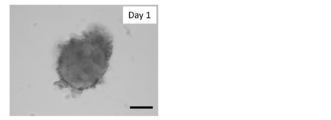
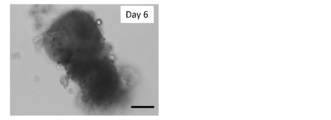
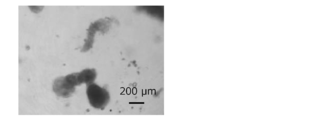
- [result] 1A, 1B, and 1C show phase-contrast micrographs taken on day 1, culture 3, and culture 6, respectively, in the co-culture in one well of Example 1-1.
- 1D, 1E, and 1F show phase-contrast micrographs taken on day 1, culture 3, and culture 6, respectively, in the co-culture in one well of Example 1-2. Is shown.
- the scale bar shows 100 ⁇ m.
- Example 1D to 1F a hair follicle primordium having a hair shaft-like structure was not formed.
- a hair follicle primordium having a hair shaft-like structure was formed. That is, as indicated by the arrowhead in FIG. 1C, a hair shaft-like structure was formed on the hair follicle primordium on the 6th day of culture.
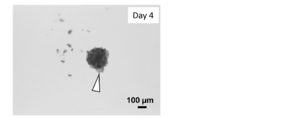
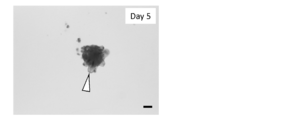
- FIGS. 2A, 2B, and 2C are taken in the co-culture system in one other well of Example 1-1 on the 4th day, the 5th day, and the 6th day of the culture, respectively.
- a phase-contrast micrograph is shown.
- the scale bar shows 100 ⁇ m.
- Example 1-1 the formation of a hair shaft-like structure was confirmed on the 4th day of culture, and then the hair stem-like structure was elongated with the lapse of culture time. ..
- the efficiency of hair shaft-like structure formation in the hair follicle primordium on the 10th day of culture was evaluated. That is, the number of hair follicle-like structures formed on the 10th day of culture is divided by the total number of hair follicle primordia and multiplied by 100 to form the hair follicle-like structure (%). ) was calculated.
- Example 1-2 the formation of a hair shaft-like structure was not confirmed in all of the 96 hair follicle primordia, and the formation rate of the hair shaft-like structure was 0 (zero)%.
- Example 1-1 the formation of a hair follicle-like structure was confirmed in 88 hair follicle primordia out of 96 hair follicle primordia, and the formation rate of the hair follicle-like structure was 92%. there were.
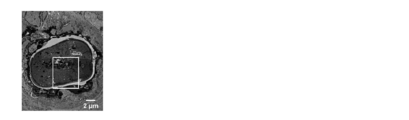
- FIG. 3 shows a scanning micrograph of the hair shaft-like structure formed on the hair follicle primordium on the 12th day of culture in Example 1-1.
- the scale bar shows 30 ⁇ m.
- the hair shaft-like structure formed on the hair follicle primordium had a cuticle structure which is a characteristic structure of the hair shaft of a living body.
- Epithelial cells and mesenchymal cells were prepared in the same manner as in Example 1 above.
- Example 2-1 epithelial cells and mesenchymal cells were seeded in a culture medium containing laminin, entactin and type IV collagen. That is, first, DMEM / F12 medium containing 1% GultaMax Supplement and 0.2% Norm splashcin was prepared as a culture medium.
- epithelial cells and mesenchymal cells having an amount of each cell density of 5 ⁇ 10 3 cells / mL (amount of total cell density of 1 ⁇ 10 4 cells / mL) were suspended in this culture medium. Further, a cell suspension was prepared by adding an amount of Matrigel having a concentration of 1 v / v%.
- Epithelial cells and mesenchymal cells were seeded by putting 100 ⁇ L of the above cell suspension into each well of a 96-well plate. Immediately after sowing, the 96-well plate was transferred to a refrigerator at 4 ° C. and allowed to stand for 20 minutes to settle epithelial cells and mesenchymal cells in each well. Then, the 96-well plate was transferred to an incubator at 37 ° C., and co-culture of epithelial cells and mesenchymal cells was started in the incubator.
- the culture solution was changed once every two days.
- To exchange the culture medium first remove 100 ⁇ L of the culture medium from each well, and then use DMEM / F12 medium containing 1% GultaMax Supplement and 0.2% Norm Fancin as a new culture medium without Matrigel. This was done by adding 100 ⁇ L to the wells.
- Example 2-2 epithelial cells and mesenchymal cells were seeded in a culture medium free of laminin, entactin and type IV collagen, and then laminin, entactin and type IV collagen were cultured on the first day of culture. Added to the solution.
- the respective cell densities were 5 ⁇ 10 3 cells / mL (total cell densities were 1 ⁇ 10 4 cells / mL).
- a cell suspension was prepared by suspending epithelial cells and mesenchymal cells.
- the 96-well plate was transferred to a refrigerator at 4 ° C. and allowed to stand for 20 minutes. Then, the 96-well plate was transferred to an incubator at 37 ° C., and co-culture of epithelial cells and mesenchymal cells was continued in the incubator. The exchange of the culture solution was carried out in the same manner as in Example 2-1 above.
- Example 2-3 epithelial cells and mesenchymal cells were seeded in a culture medium free of laminin, entactin and type IV collagen, and then laminin, entactin and type IV collagen were cultured on the third day of culture. Added to the solution.
- Example 2-2 100 ⁇ L of a cell suspension containing epithelial cells and mesenchymal cells was placed in each well of a 96-well plate to seed the epithelial cells and mesenchymal cells. Then, co-culture was started in a 37 ° C. incubator.
- the 96-well plate was transferred to a refrigerator at 4 ° C. and allowed to stand for 20 minutes. Then, the 96-well plate was transferred to an incubator at 37 ° C., and co-culture of epithelial cells and mesenchymal cells was continued in the incubator. The exchange of the culture solution was carried out in the same manner as in Example 2-1 above.
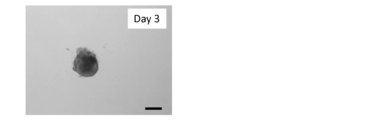
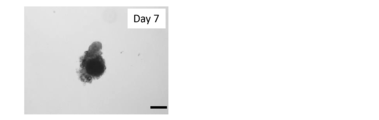
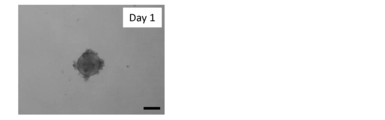
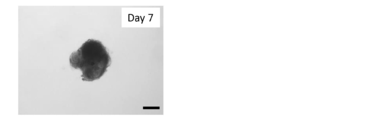
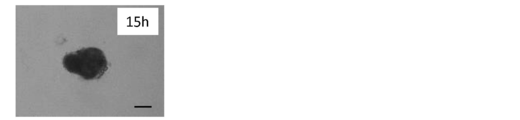
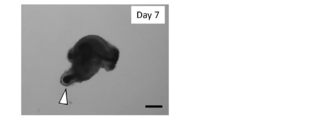
- [result] 4A, 4B, and 4C show phase-contrast micrographs taken on the first day, the third day, and the seventh day of the culture in the co-culture of Example 2-1 respectively.
- 4D, 4E, and 4F show phase-contrast micrographs taken on the first day, the third day, and the seventh day of the culture in the co-culture of Example 2-2, respectively.
- 4G, 4H, and 4I show phase-contrast micrographs taken on the first day, the third day, and the seventh day of the culture in the co-culture of Example 2-3, respectively.
- the scale bar shows 200 ⁇ m.
- Example 2-1 a hair follicle primordium having a hair shaft-like structure was formed. That is, as indicated by the arrowhead in FIG. 4C, a hair shaft-like structure was formed on the hair follicle primordium on the 7th day of culture.
- FIGS. 4D to 4I in Examples 2-2 and 2-3, no hair shaft-like structure was formed on the hair follicle primordium on the 7th day of culture.
- Epithelial cells and mesenchymal cells were prepared in the same manner as in Example 1 above.
- Example 3-1 [culture] In Example 3-1 first, epithelial cells and mesenchymal cells were seeded in a culture medium containing no laminin, entactin and type IV collagen, and then immediately after the seeding (0 hours after the seeding). Laminin, entactin and type IV collagen were added to the culture medium.
- the respective cell densities were 5 ⁇ 10 3 cells / mL (total cell densities were 1 ⁇ 10 4 cells / mL).
- a cell suspension was prepared by suspending epithelial cells and mesenchymal cells.
- the 96-well plate was transferred to an incubator at 37 ° C., and co-culture of epithelial cells and mesenchymal cells was started in the incubator.
- the exchange of the culture solution was carried out in the same manner as in Example 2-1 of Example 2 above.
- Example 3-2 first, epithelial cells and mesenchymal cells were seeded in a culture medium containing no laminin, entactin, and type IV collagen to start co-culture, and then 0 from the start of the co-culture. After 5 hours, laminin, entactin and type IV collagen were added to the culture medium.
- the respective cell densities are 5 ⁇ 10 3 cells / mL (total cell densities are 1 ⁇ 10 4 cells / mL).
- Epithelial cells and mesenchymal cells were suspended to prepare cell suspensions.
- Epithelial cells and mesenchymal cells were seeded by putting 100 ⁇ L of the above cell suspension into each well of a 96-well plate. Immediately after seeding, the 96-well plate was transferred to an incubator at 37 ° C., and co-culture of epithelial cells and mesenchymal cells was started in the incubator.
- Example 3-3 epithelial cells and epithelial cells and the same as in Example 3-2 above, except that laminin, entactin and type IV collagen were added to the culture medium 1 hour after the start of co-culture. Co-culture of mesenchymal cells was performed.
- Example 3-4 epithelial cells and epithelial cells and the same as in Example 3-2 above, except that laminin, entactin and type IV collagen were added to the culture medium 2 hours after the start of co-culture. Co-culture of mesenchymal cells was performed.
- Example 3-5 epithelial cells and epithelial cells and the same as in Example 3-2 above, except that laminin, entactin and type IV collagen were added to the culture medium 3 hours after the start of co-culture. Co-culture of mesenchymal cells was performed.
- Example 3-6 epithelial cells and epithelial cells and the same as in Example 3-2 above, except that laminin, entactin and type IV collagen were added to the culture medium 6 hours after the start of co-culture. Co-culture of mesenchymal cells was performed.
- Example 3-7 epithelial cells and epithelial cells and the same as in Example 3-2 above, except that laminin, entactin and type IV collagen were added to the culture medium 15 hours after the start of co-culture. Co-culture of mesenchymal cells was performed.
- Example 3-8 epithelial cells and epithelial cells and the same as in Example 3-2 above, except that laminin, entactin and type IV collagen were added to the culture medium 22 hours after the start of co-culture. Co-culture of mesenchymal cells was performed.
- [result] 5A, 5B, 5C, 5D, 5E, 5F, 5G, and 5H show Example 3-1 and Example 3-2, Example 3-3, Example 3-4, and Example 3, respectively.
- a phase-contrast micrograph taken on the third day of culture is shown.
- 6A, 6B, 6C, 6D, 6E, 6F, 6G, and 6H show Example 3-1 and Example 3-2, Example 3-3, Example 3-4, and Example 3, respectively.
- a phase contrast micrograph taken on the 8th day of the culture is shown.
- the scale bar shows 200 ⁇ m.
- Example 3-1 The formation rate of the hair follicle-like structure was 22% in Example 3-1 (2 out of 9 hair follicle primordia) and 89% in Example 3-2 (8 out of 9 hair follicle primordia).
- Example 3-3 7 out of 9 hair follicle primordia
- Example 3-4 9 out of 9 hair follicle primordia
- Example 3-5 89% (8 out of 9 hair follicle primordia), 78% in Example 3-6 (7 out of 9 hair follicle primordia), 44% in Example 3-7 (9 hair follicles) 4 of the primordia), and 22% (2 of the 9 hair follicle primordia) in Example 3-8.
- the hair shaft-like structure formation efficiency of Examples 3-7 and 3-8 to which Matrigel was added 15 hours or 22 hours after the start of co-culture was 0.5 to 6 hours later.
- the reason why the cells were smaller than those of Examples 3-2 to 3-6 to which the above was added is considered to be, for example, that the aggregation of epithelial cells and mesenchymal cells had already progressed at the time of addition of the matrigel.
- Example 3-1 The reason why the hair shaft-like structure formation efficiency of Example 3-1 to which Matrigel was added immediately after the start of co-culture was low was that, for example, some epithelial cells and mesenchymal cells were present at the time of addition of Matrigel. It is probable that it did not settle on the bottom of the well and was still in a floating state.
- Example 2-2 of Example 2 above although the same as in Example 3-6, laminin, entactin and type IV collagen were added to the culture solution when about 22 hours had passed from the start of co-culture. No formation of hair shaft-like structure was confirmed in the hair follicle primordium on the 6th day of culture. As a cause of this, for example, an influence derived from individual differences in the mice from which the cells were collected can be considered.
- Epithelial cells and mesenchymal cells were prepared in the same manner as in Example 1 above.
- Example 4 epithelial cells and mesenchymal cells were co-cultured using a culture medium containing laminin and entactin.
- a culture medium DMEM / F12 medium containing 1% GultaMax Supplement and 0.2% Norm splashcin was prepared.
- epithelial cells and mesenchymal cells in an amount of 5 ⁇ 10 3 cells / mL (total cell density of 1 ⁇ 10 4 cells / mL) were suspended in this culture medium. Further, a cell suspension was prepared by adding a high-concentration laminin / entactin complex (HIGH CONCENTRATION LAMININ / ENTACTIN COMPLEX, CORNING®) in an amount having a concentration of 1 v / v%.
- a high-concentration laminin / entactin complex HGH CONCENTRATION LAMININ / ENTACTIN COMPLEX, CORNING®
- the high-concentration laminin / entactin complex product used contained 15.2 mg / mL soluble basement membrane matrix extracted from EHS mouse tumors, contained a laminin / entactin complex with a purity of 90% or higher by SDS-PAGE, and laminin. And entactin were contained in an equimolar ratio.
- the cell suspension to which the 1 v / v% high concentration laminin / entactin complex product was added was such that the 137-152 ⁇ g / mL laminin / entactin complex (ie, 68-76 ⁇ g / mL laminin and entactin, respectively). It is calculated that it contained).
- the content of laminin is 115% to 129% of that in the cell suspension of Example 1-1 of Example 1 above, and the total content of laminin and entactin is , 204% to 227% of that in the cell suspension of Example 1-1 of Example 1 above.
- Epithelial cells and mesenchymal cells were seeded by putting 100 ⁇ L of the above cell suspension into each well of a 96-well plate. Immediately after sowing, the 96-well plate was transferred to a refrigerator at 4 ° C. and allowed to stand for 20 minutes, so that epithelial cells and mesenchymal cells were placed on the bottom surface of the wells in the cooled culture medium in the refrigerator. It was settled. Then, the 96-well plate was transferred to an incubator at 37 ° C., and co-culture of epithelial cells and mesenchymal cells was started in the incubator. The exchange of the culture solution was carried out in the same manner as in Example 1-1 of Example 1 above.
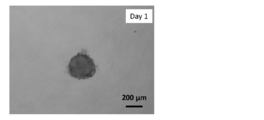
- [result] 7A, 7B, and 7C show phase-contrast micrographs taken on the first day, the third day, and the seventh day of the culture in the co-culture of Example 4, respectively.
- the scale bar shows 200 ⁇ m.
- a hair follicle primordium having a hair shaft-like structure was formed by using a culture solution containing laminin and entactin. That is, as indicated by the arrowhead in FIG. 7C, a hair shaft-like structure was formed on the hair follicle primordium on the 7th day of culture.
- Epithelial cells and mesenchymal cells were prepared in the same manner as in Example 1 above.
- Example 5-1 co-culture of epithelial cells and mesenchymal cells was performed using a culture solution containing laminin. That is, first, DMEM / F12 medium containing 1% GultaMax Supplement and 0.2% Norm splashcin was prepared as a culture medium.
- epithelial cells and mesenchymal cells having an amount of each cell density of 5 ⁇ 10 3 cells / mL (amount of total cell density of 1 ⁇ 10 4 cells / mL) were suspended in this culture medium. Further, a cell suspension was prepared by adding high-purity laminin (LAMININ-ULTRAPURE, MOUSE, CORNING®) in an amount having a concentration of 1 v / v%.
- LAMININ-ULTRAPURE, MOUSE, CORNING® high-purity laminin
- the high-purity laminin product used contained 0.82 mg / mL of soluble basement membrane matrix extracted from EHS mouse tumors and contained laminin with a purity of 95% or higher by SDS-PAGE.
- the cell suspension to which the high-purity laminin product of 1 v / v% was added contained about 8 ⁇ g / mL laminin. That is, it is calculated that the content of laminin in the cell suspension of Example 5-1 was 13% to 14% of that in the cell suspension of Example 1-1 of Example 1 above.
- Epithelial cells and mesenchymal cells were seeded by putting 100 ⁇ L of the above cell suspension into each well of a 96-well plate. Immediately after sowing, the 96-well plate was transferred to a refrigerator at 4 ° C. and allowed to stand for 20 minutes, so that epithelial cells and mesenchymal cells were placed on the bottom surface of the wells in the cooled culture medium in the refrigerator. It was settled.
- the 96-well plate was transferred to an incubator at 37 ° C., and co-culture of epithelial cells and mesenchymal cells was started in the incubator.
- the exchange of the culture solution was carried out in the same manner as in Example 1-1 of Example 1 above.
- Example 5-2 epithelial cells and mesenchymal cells were co-cultured using a culture solution containing laminin and entactin in the same manner as in Example 4 of Example 4 above.
- Example 5-3 epithelial cells and mesenchymal cells were co-cultured using a culture medium containing type IV collagen. That is, first, DMEM / F12 medium containing 1% GultaMax Supplement and 0.2% Norm splashcin was prepared as a culture medium.
- epithelial cells and mesenchymal cells having an amount of each cell density of 5 ⁇ 10 3 cells / mL (amount of total cell density of 1 ⁇ 10 4 cells / mL) were suspended in this culture medium. Further, a cell suspension was prepared by adding an amount of type IV collagen (COLLAGEN IV, MOUSE, CORNING®) having a concentration of 1 v / v%.
- type IV collagen COLLAGEN IV, MOUSE, CORNING®
- the type IV collagen product used contained 1.25 mg / mL of a soluble basement membrane matrix extracted from EHS mouse tumors, and contained type IV collagen with a purity of 90% or higher according to SDS-PAGE.
- the cell suspension to which the 1 v / v% type IV collagen product was added contained 11 to 13 ⁇ g / mL of type IV collagen. That is, in the cell suspension of Example 5-3, the content of type IV collagen was 34% to 38% of that in the cell suspension of Example 1-1 of Example 1 above.
- Epithelial cells and mesenchymal cells were seeded by putting 100 ⁇ L of the above cell suspension into each well of a 96-well plate. Immediately after sowing, the 96-well plate was transferred to a refrigerator at 4 ° C. and allowed to stand for 20 minutes, so that the cells were settled on the bottom surface of the well in the cooled culture solution in the refrigerator.
- the 96-well plate was transferred to an incubator at 37 ° C., and co-culture of epithelial cells and mesenchymal cells was started in the incubator.
- the exchange of the culture solution was carried out in the same manner as in Example 1-1 of Example 1 above.
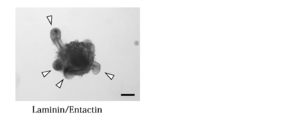
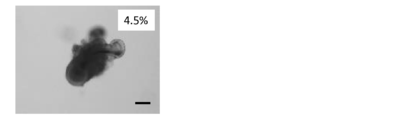
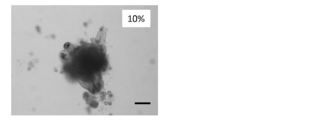
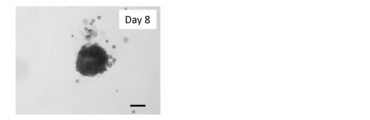
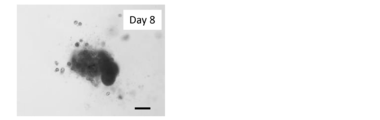
- [result] 8A, 8B, and 8C show phase-contrast micrographs taken on day 8 of culture in Example 5-1, Example 5-2, and Example 5-3, respectively.
- the scale bar shows 200 ⁇ m.
- Example 5-1 using the culture solution containing laminin, no hair shaft-like structure was formed in the hair follicle primordium on the 8th day of culture.
- Example 5-2 using the culture solution containing laminin and entactin, a hair shaft-like structure was formed in the hair follicle primordium on the 8th day of culture.
- Example 5-3 using the culture solution containing type IV collagen, a hair shaft-like structure was formed in the hair follicle primordium on the 8th day of culture.
- Epithelial cells and mesenchymal cells were prepared in the same manner as in Example 1 above.
- Example 6 instead of the Matrigel product used in Example 1-1 of Example 1, a Matrigel product having a reduced content of growth factors (Matrigel® Basement Membrane Matrix (Growth Factor Reduced), Epithelial cells and mesenchymal cells in the same manner as in Example 1-1 of Example 1 except that CORNING (registered trademark) was used in an amount such that the concentration in the culture medium was 1 v / v%. Was co-cultured for 8 days.
- Matrigel® Basement Membrane Matrix Greened trademark
- the Matrigel product (GFR) used contained 8-12 mg / mL (the amount of protein measured by the Lowry method) of a soluble basement membrane matrix extracted from EHS (Engelbreth-Holm-Swarm) mouse tumors, and said the basement membrane matrix.
- the composition ratio was 61% for laminin, 7% for entactin, and 30% for type IV collagen.
- [result] 9A and 9B show phase-contrast micrographs taken on the first day and the eighth day of the culture in the co-culture of Example 6, respectively.
- a hair follicle primordium having a hair shaft-like structure was formed in Example 6. That is, as shown in FIG. 9B, a hair shaft-like structure was formed on the hair follicle primordium on the 8th day of culture.
- Example 6 a hair follicle primordium having a hair shaft-like structure was formed as in Example 1-1 described above, and the formation rate of the hair shaft-like structure was about the same as in Example 1-1.
- Epithelial cells and mesenchymal cells were prepared in the same manner as in Example 1 above.
- Example 7-1 the epithelial system was the same as in Example 1-1 of Example 1 above, except that the concentration of the matrigel added to the culture medium was 0.1 v / v% instead of 1 v / v%.
- Co-culture of cells and mesenchymal cells was performed. It is calculated that the cell suspension to which 0.1 v / v% Matrigel was added contained 6 ⁇ g / mL laminin, 1 ⁇ g / mL entactin, and 3 ⁇ g / mL type IV collagen.
- Example 7-2 the epithelial system was the same as in Example 1-1 of Example 1 above, except that the concentration of the matrigel added to the culture medium was 0.2 v / v% instead of 1 v / v%. Co-culture of cells and mesenchymal cells was performed. It is calculated that the cell suspension to which 0.2 v / v% Matrigel was added contained 12 ⁇ g / mL laminin, 2 ⁇ g / mL entactin, and 7 ⁇ g / mL type IV collagen.
- Example 7-3 the epithelial system was the same as in Example 1-1 of Example 1 above, except that the concentration of the matrigel added to the culture medium was 0.3 v / v% instead of 1 v / v%.
- Co-culture of cells and mesenchymal cells was performed. It is calculated that the cell suspension to which 0.3 v / v% Matrigel was added contained 18 ⁇ g / mL laminin, 3 ⁇ g / mL entactin, and 10 ⁇ g / mL type IV collagen.
- Example 7-4 the epithelial system was the same as in Example 1-1 of Example 1 above, except that the concentration of the matrigel added to the culture medium was 0.4 v / v% instead of 1 v / v%. Co-culture of cells and mesenchymal cells was performed. It is calculated that the cell suspension to which 0.4 v / v% Matrigel was added contained 24 ⁇ g / mL laminin, 3 ⁇ g / mL entactin, and 13 ⁇ g / mL type IV collagen.
- Example 7-5 the epithelial system was the same as in Example 1-1 of Example 1 above, except that the concentration of the matrigel added to the culture medium was 0.5 v / v% instead of 1 v / v%. Co-culture of cells and mesenchymal cells was performed. It is calculated that the cell suspension to which 0.5 v / v% Matrigel was added contained 30 ⁇ g / mL laminin, 4 ⁇ g / mL entactin, and 16 ⁇ g / mL type IV collagen.
- Example 7-6 the epithelial system was the same as in Example 1-1 of Example 1 above, except that the concentration of the matrigel added to the culture medium was 0.6 v / v% instead of 1 v / v%. Co-culture of cells and mesenchymal cells was performed. It is calculated that the cell suspension to which 0.5 v / v% Matrigel was added contained 36 ⁇ g / mL laminin, 5 ⁇ g / mL entactin, and 20 ⁇ g / mL type IV collagen.
- [result] 10A, 10B, 10C, 10D, 10E, and 10F show Example 7-1, Example 7-2, Example 7-3, Example 7-4, Example 7-5, and Example 7, respectively.
- a phase-contrast micrograph taken on the first day of the culture is shown.
- 11A, 11B, 11C, 11D, 11E, and 11F show Example 7-1, Example 7-2, Example 7-3, Example 7-4, Example 7-5, and Example 7, respectively.
- a phase-contrast micrograph taken on the third day of the culture is shown.
- 12A, 12B, 12C, 12D, 12E, and 12F show Example 7-1, Example 7-2, Example 7-3, Example 7-4, Example 7-5, and Example 7, respectively.
- a phase-contrast micrograph taken on the 8th day of the culture is shown.
- the scale bar shows 200 ⁇ m.
- the hair follicle primordium having a hair shaft-like structure was used. Been formed. That is, as shown in FIGS. 12A to 12F, a hair shaft-like structure was formed on the hair follicle primordium on the 8th day of culture in all the examples.
- Example 7-1 3 out of 12 hair follicle primordia
- Example 7-2 (12 hair follicles).
- Example 7-3 11 out of 12 hair follicle primordia
- Example 7-4, 7-5, and 7-6 (12) 12 of the hair follicle primordia
- Epithelial cells and mesenchymal cells were prepared in the same manner as in Example 1 above.
- Example 8-1 the epithelial system was the same as in Example 1-1 of Example 1 above, except that the concentration of the matrigel added to the culture medium was 2.0 v / v% instead of 1 v / v%.
- Co-culture of cells and mesenchymal cells was performed. It is calculated that the cell suspension to which 2.0 v / v% Matrigel was added contained 119 ⁇ g / mL laminin, 17 ⁇ g / mL entactin, and 66 ⁇ g / mL type IV collagen.
- Example 8-2 the epithelial system was the same as in Example 1-1 of Example 1 above, except that the concentration of the matrigel added to the culture medium was 2.5 v / v% instead of 1 v / v%. Co-culture of cells and mesenchymal cells was performed. It is calculated that the cell suspension to which 2.5 v / v% Matrigel was added contained 148 ⁇ g / mL laminin, 21 ⁇ g / mL entactin, and 82 ⁇ g / mL type IV collagen.
- Example 8-3 the epithelial system was the same as in Example 1-1 of Example 1 above, except that the concentration of the matrigel added to the culture medium was set to 3.0 v / v% instead of 1 v / v%. Co-culture of cells and mesenchymal cells was performed. It is calculated that the cell suspension to which 3.0 v / v% Matrigel was added contained 178 ⁇ g / mL laminin, 25 ⁇ g / mL entactin, and 99 ⁇ g / mL type IV collagen.
- Example 8-4 the epithelial system was the same as in Example 1-1 of Example 1 above, except that the concentration of the matrigel added to the culture medium was 3.5 v / v% instead of 1 v / v%.
- Co-culture of cells and mesenchymal cells was performed. It is calculated that the cell suspension to which 3.5 v / v% Matrigel was added contained 208 ⁇ g / mL laminin, 30 ⁇ g / mL entactin, and 115 ⁇ g / mL type IV collagen.
- Example 8-5 the epithelial system was the same as in Example 1-1 of Example 1 above, except that the concentration of the matrigel added to the culture medium was 4.0 v / v% instead of 1 v / v%. Co-culture of cells and mesenchymal cells was performed. It is calculated that the cell suspension to which 4.0 v / v% Matrigel was added contained 237 ⁇ g / mL laminin, 34 ⁇ g / mL entactin, and 131 ⁇ g / mL type IV collagen.
- Example 8-6 the epithelial system was the same as in Example 1-1 of Example 1 above, except that the concentration of the matrigel added to the culture medium was 4.5 v / v% instead of 1 v / v%.
- Co-culture of cells and mesenchymal cells was performed.
- the cell suspension to which 4.5 v / v% Matrigel was added contained 267 ⁇ g / mL laminin, 38 ⁇ g / mL entactin, and 148 ⁇ g / mL type IV collagen.
- [result] 13A, 13B, 13C, 13D, 13E, and 13F show Example 8-1, Example 8-2, Example 8-3, Example 8-4, Example 8-5, and Example 8, respectively.
- a phase-contrast micrograph taken on the first day of the culture is shown.
- 14A, 14B, 14C, 14D, 14E, and 14F show Example 8-1, Example 8-2, Example 8-3, Example 8-4, Example 8-5, and Example 8, respectively.
- a phase-contrast micrograph taken on the third day of the culture is shown.
- 15A, 15B, 15C, 15D, 15E, and 15F show Example 8-1, Example 8-2, Example 8-3, Example 8-4, Example 8-5, and Example 8, respectively.
- a phase-contrast micrograph taken on the 8th day of the culture is shown.
- the scale bar indicates 200 ⁇ m.
- the hair follicle primordium having a hair shaft-like structure was used. Been formed. That is, as shown in FIGS. 15A to 15F, a hair shaft-like structure was formed on the hair follicle primordium on the 8th day of culture in all the examples.
- the formation rate of hair shaft-like structures on the 8th day of culture was 100% in Examples 8-1, 8-2 and 8-3 (6 out of 6 hair follicle primordia), and Example 8- 4, Example 8-5, and Example 8-6 were also 100% (12 out of 12 hair follicle primordia).
- Epithelial cells and mesenchymal cells were prepared in the same manner as in Example 1 above.
- Example 9-1 the same as in Example 4 of Example 4 above, except that the concentration of the high-concentration laminin / entactin complex product added to the culture solution was 0.5 v / v% instead of 1 v / v%. Then, co-culture of epithelial cells and mesenchymal cells was performed. The cell suspension to which the high concentration laminin / entactin complex product of 0.5 v / v% was added was 68 to 76 ⁇ g / mL of laminin / entactin complex (that is, 34 to 38 ⁇ g / mL of laminin and mL, respectively). It is calculated that it contained entactin).
- Example 9-2 the same as in Example 4 of Example 4 above, except that the concentration of the high-concentration laminin / entactin complex product added to the culture solution was set to 5.0 v / v% instead of 1 v / v%. Then, co-culture of epithelial cells and mesenchymal cells was performed.
- the cell suspension to which the 5.0 v / v% high-concentration laminin / entactin complex product was added was composed of 684 to 760 ⁇ g / mL laminin / entactin complex (that is, 342 to 380 ⁇ g / mL laminin and mL, respectively. It is calculated that it contained entactin).
- Example 9-3 the same as in Example 4 of Example 4 above, except that the concentration of the high-concentration laminin / entactin complex product added to the culture solution was set to 10.0 v / v% instead of 1 v / v%. Then, co-culture of epithelial cells and mesenchymal cells was performed. The cell suspension to which the 5.0 v / v% high-concentration laminin / entactin complex product was added was 1368 to 1520 ⁇ g / mL of laminin / entactin complex (that is, 684 to 760 ⁇ g / mL of laminin and each of them. It is calculated that it contained entactin).
- [result] 16A, 16B, and 16C show phase-contrast micrographs taken on the second day of culture in the co-cultures of Example 9-1, Example 9-2, and Example 9-3, respectively.
- 17A, 17B, and 17C show phase-contrast micrographs taken on the 8th day of culture in the co-cultures of Example 9-1, Example 9-2, and Example 9-3, respectively.
- the scale bar shows 200 ⁇ m.
- hair follicle primordia having a hair shaft-like structure were formed in all the examples (Examples 9-1 to 9-3). That is, as shown in FIGS. 17A to 17C, in all the examples, a hair shaft-like structure was formed on the hair follicle primordium on the 8th day of culture.
- Epithelial cells and mesenchymal cells were prepared in the same manner as in Example 1 above.
- Example C1-1 epithelial cells were obtained in the same manner as in Example 4 of Example 4 above, except that the concentration of the high-purity laminin product added to the culture medium was 5 v / v% instead of 1 v / v%. And mesenchymal cells were co-cultured. It is calculated that the cell suspension containing the 5 v / v% high-purity laminin product contained 39 to 41 ⁇ g / mL laminin.
- Example C1-2 epithelial cells were obtained in the same manner as in Example 4 of Example 4 above, except that the concentration of the high-purity laminin product added to the culture medium was 10 v / v% instead of 1 v / v%. And mesenchymal cells were co-cultured. It is calculated that the cell suspension containing a high-purity laminin product of 10 v / v% contained 78 to 82 ⁇ g / mL of laminin.
- [result] 18A, 18B, and 18C show phase-contrast micrographs taken on the first day, the third day, and the eighth day of the culture in the co-culture of Example C1-1, respectively.
- 18D, 18E, and 18F show phase-difference micrographs taken on day 1, culture 3, and culture 8, respectively, in the co-culture of Example C1-2.
- the scale bar shows 200 ⁇ m.
- Example C1-1 As shown in FIGS. 18A to 18F, no hair follicle primordium having a hair shaft-like structure was formed in either Example C1-1 or Example C1-2.
- Epithelial cells and mesenchymal cells were prepared in the same manner as in Example 1 above.
- Example C2 epithelial cells and mesenchymal cells were co-cultured in a culture medium containing no type IV collagen on the surface of a culture dish coated with type IV collagen in advance.
- the type IV collagen product used in Example 5-3 of Example 5 above was diluted with a 0.05 M HCl solution to a concentration of 100 ⁇ g / mL according to the description of the coating method in the instruction manual to prepare a coating solution. ..
- 1 mL of this coating solution was added to a culture dish having a diameter of 35 mm and kept at room temperature for 1 hour. Then, the coating liquid was discarded from the culture dish, and the surface of the culture dish was washed with purified water.
- the respective cell densities are 5 ⁇ 10 3 cells / mL (total cell densities are 1 ⁇ 10 4 cells / mL).
- Epithelial cells and mesenchymal cells were suspended to prepare cell suspensions.
- Epithelial cells and mesenchymal cells were seeded and co-culture was started by adding 2 mL each of the above cell suspension to a culture dish coated with type IV collagen in advance as described above.
- [result] 19A and 19B show phase-contrast micrographs taken on the second day and the eighth day of the culture in the co-culture of Example C2, respectively.
- the scale bar shows 200 ⁇ m.
- Epithelial cells and mesenchymal cells were prepared in the same manner as in Example 1 above.
- Example C3-1 co-culture of epithelial cells and mesenchymal cells was performed on a gel containing laminin, entactin and type IV collagen in a culture medium containing no laminin, entactin and type IV collagen.
- Example 1-1 of Example 1 50 ⁇ L of the Matrigel product used in Example 1-1 of Example 1 was dropped onto the bottom surface of each well of a 96-well flat-bottomed culture plate, and the mixture was incubated at 37 ° C. for 15 minutes to gel. Then, epithelial cells and mesenchymal cells suspended in a culture medium containing no Matrigel product were seeded on the gel of each well, and co-culture was performed on the gel.
- Example C3-2 epithelial cells and mesenchymal cells were co-cultured in a gel containing laminin, entactin and type IV collagen.
- the Matrigel product was mixed with epithelial cells and mesenchymal cells, and 50 ⁇ L of the obtained cell suspension was added dropwise to the bottom surface of each well of the 96-well flat-bottomed culture plate at 37 ° C. for 15 minutes. Gelled by incubation. Then, a culture solution containing no Matrigel product was poured onto a gel in which dispersed epithelial cells and mesenchymal cells were embedded in each well, and co-culture was performed in the gel.
- Example C3-3 the hair follicle primordia formed by co-culturing epithelial cells and mesenchymal cells in a culture medium containing no laminin, entactin and type IV collagen is used as laminin, entactin and type IV collagen.
- the cells were cultured on a gel containing laminin, entactin, and type IV collagen in a culture medium free of them.
- Example 1-2 of Example 1 co-culture of epithelial cells and mesenchymal cells was carried out for 3 days in a culture medium containing no laminin, entactin and type IV collagen. A hair follicle primordia containing epithelial and mesenchymal cells was formed.
- a Matrigel gel was formed in the same manner as in Example C3-1 above. Then, the hair follicle primordium formed as described above is seeded on the gel formed as described above in the culture solution to which Matrigel is not added, and the hair follicle primordium is spread on the gel for 9 days. It was cultured.
- Example C3-4 the hair follicle primordia formed by co-culturing epithelial cells and mesenchymal cells in a culture medium containing no laminin, entactin and type IV collagen is used as laminin, entactin and type IV collagen.
- a culture medium containing no laminin, entactin and type IV collagen was used as laminin, entactin and type IV collagen.
- Example 1-2 of Example 1 co-culture of epithelial cells and mesenchymal cells was carried out for 3 days in a culture medium containing no laminin, entactin and type IV collagen.
- a hair follicle primordia containing epithelial and mesenchymal cells was formed.
- the hair follicle primordium was embedded in the gel of Matrigel, and the hair follicle primordium was cultured in the gel for 9 days.
- [result] 20A, 20B, 20C, and 20D show phase-contrast micrographs taken on day 12 of culture in Example C3-1, Example C3-2, Example C3-3, and Example C3-4, respectively. Is shown.
- the scale bar shows 200 ⁇ m.
- Epithelial cells and mesenchymal cells were prepared in the same manner as in Example 1 above.
- Example 10 epithelial cells and mesenchymal cells were co-cultured using a culture medium containing laminin, entactin, and type IV collagen.
- a culture medium DMEM / F12 medium containing 1% GultaMax Supplement and 0.2% Norm splashcin was prepared.
- epithelial cells and mesenchymal cells were suspended in this culture medium in an amount such that each cell density was 5 ⁇ 10 3 cells / 200 ⁇ L (a total cell density was 1 ⁇ 10 4 cells / 200 ⁇ L). Further, a cell suspension was prepared by adding an amount of Matrigel having a concentration of 1 v / v%.
- Epithelial cells and mesenchymal cells were seeded by putting 200 ⁇ L of the above cell suspension into each well of a 96-well plate. Immediately after sowing, the 96-well plate was transferred to a refrigerator at 4 ° C. and allowed to stand for 20 minutes. By this standing, epithelial cells and mesenchymal cells settled on the bottom surface of the well in a chilled culture medium in a refrigerator so as to be in contact with each other. Then, the 96-well plate was transferred to an incubator at 37 ° C., and co-culture of epithelial cells and mesenchymal cells was started in the incubator. Co-culture was performed for 6 days.
- the culture solution was exchanged once every two days.
- To exchange the culture medium first remove 100 ⁇ L of the culture medium from each well, and then use DMEM / F12 medium containing 1% GultaMax Supplement and 0.2% Norm Fancin as a new culture medium without Matrigel. This was done by adding 100 ⁇ L to the wells.
- an off-salmic V-lance (20G, Nippon Archon Co., Ltd.) was used to form a transplant hole on the back of a nude mouse, and a pipette was used to transplant 21 hair follicle primordia, each having a hair shaft-like structure. Inserted into the hole.
- FIG. 21 shows an example of a photograph of the back of a nude mouse 22 days after transplantation.
- This hair regeneration efficiency is obtained when a hair follicle primordium having no hair shaft-like structure, which is formed by using a culture solution containing no laminin, entactin, or type IV collagen, is transplanted (results not shown). It was expensive compared to. As described above, it was confirmed that the hair is regenerated with high efficiency by transplanting the hair follicle primordium produced by the above-mentioned co-culture into a living body.
- Epithelial cells and mesenchymal cells were prepared in the same manner as in Example 1 above. However, first, on the day when only the mesenchymal cells are seeded, the mesenchymal cells are collected from the first mouse individual, and then, after the mesenchymal cells are cultured for one day, on the day when the epithelial cells are further seeded, Epithelial cells were collected from a second mouse individual different from the first individual.
- Example 11 [culture] In Example 11, first, a culture containing laminin, entactin, and type IV collagen is used to start culturing only mesenchymal cells, then epithelial cells are added, and a culture containing laminin, entactin, and type IV collagen is added. Co-culture of epithelial cells and mesenchymal cells was performed using the solution.
- DMEM / F12 medium containing 1% GultaMax Supplement and 0.2% NormPFcin was prepared.
- mesenchymal cells in an amount having a cell density of 5 ⁇ 10 4 cells / mL and further adding Matrigel in an amount having a concentration of 1 v / v%, the mesenchymal system was added.
- a cell suspension of cells was prepared.
- Mesenchymal cells were seeded by placing 100 ⁇ L of a cell suspension of mesenchymal cells in each well of a 96-well plate (cell density of mesenchymal cells: 5 ⁇ 10 3 cells / well). Immediately after seeding, the 96-well plate was transferred to a refrigerator at 4 ° C. and allowed to stand for 20 minutes to allow mesenchymal cells to settle on the bottom surface of the well. The 96-well plate was then transferred to an incubator at 37 ° C. and mesenchymal cells were initiated in the incubator. Mesenchymal cells were cultured for 1 day.
- epithelial cells in a culture medium (DMEM / F12 medium containing 1% GultaMax Supplement and 0.2% NormPFcin) have a cell density of 5 ⁇ 10 4 cells / mL.
- DMEM / F12 medium containing 1% GultaMax Supplement and 0.2% NormPFcin have a cell density of 5 ⁇ 10 4 cells / mL.
- Matrigel having a concentration of 1 v / v% was added to prepare a suspension of the epithelial cells.
- a 96-well plate containing mesenchymal cells cultured for 1 day as described above was transferred to a refrigerator at 4 ° C. and allowed to stand for 20 minutes. Then, epithelial cells were seeded by adding 100 ⁇ L of a suspension of epithelial cells to each well containing mesenchymal cells (cell density of epithelial cells: 5 ⁇ 10 3 cells / well).
- the 96-well plate containing the epithelial cells and mesenchymal cells was transferred to a refrigerator at 4 ° C. and allowed to stand for 20 minutes. Then, the 96-well plate was transferred to an incubator at 37 ° C., and co-culture of epithelial cells and mesenchymal cells was started in the incubator. Co-culture was performed for 14 days. That is, co-culture of the epithelial cells and the mesenchymal cells was carried out for 14 days from the day when the epithelial cells were seeded in each well containing the mesenchymal cells. The exchange of the culture solution was carried out in the same manner as in Example 10 above.
- [result] 22A and 22B show phase-contrast micrographs taken in the co-culture of Example 11 on the 3rd and 14th days from the start of the co-culture, respectively.
- the scale bar shows 200 ⁇ m.
- most of the hair follicle primordia formed on the third day of culture are aggregated with mesenchymal cell aggregates formed by aggregation of mesenchymal cells and epithelial cells. Contains epithelial cell aggregates formed in series with the mesenchymal cell aggregates. Further, as shown in FIG. 22B, it was also confirmed that one long hair shaft-like structure was formed from one hair follicle primordium on the 14th day of culture.
- FIG. 23 shows the results of measuring the length of the hair shaft-like structure formed in the hair follicle primordium during co-culture.
- the horizontal axis represents the number of days of co-culture
- the vertical axis represents the length of the hair shaft-like structure formed in the hair follicle primordium.
- the hair shaft-like structure began to be observed 4 days after the start of co-culture, and then, as the culture time elapsed, the hair stem-like structure grew and became longer. ..
- FIG. 24A shows a photograph obtained by observing a cross section of a hair shaft-like structure formed in the hair follicle primordium on the 14th day of culture with a transmission microscope.
- the scale bar shows 5 ⁇ m.
- FIG. 24B shows an enlarged square area surrounded by the white line shown in FIG. 24A.
- the scale bar shows 2 ⁇ m.
- FIG. 24C shows an enlarged area of the square surrounded by the white line shown in FIG. 24B.
- the scale bar shows 500 nm.
- FIG. 24D shows an enlarged area of the square surrounded by the white line shown in FIG. 24C.
- the scale bar shows 200 nm.
- the hair shaft-like structure formed in the hair follicle primordium has a structure similar to that of living hair such as melanin and cortex.
- Example 12-1 epithelial cells, mesenchymal cells and melanocytes were co-cultured using a culture medium containing laminin, entactin and type IV collagen.
- a culture medium DMEM / F12 medium containing 1% GultaMax Supplement and 0.2% Norm splashcin was prepared.
- epithelial cells and mesenchymal cells having an amount of 5 ⁇ 10 3 cells / 200 ⁇ L and melanocytes having a cell density of 1.25 ⁇ 10 3 cells / 200 ⁇ L were added to the culture solution.
- melanocytes having a cell density of 1.25 ⁇ 10 3 cells / 200 ⁇ L
- total cell density 1.125 ⁇ 10 4 cells / 200 ⁇ L
- Matrigel an amount of Matrigel to a concentration of 1 v / v%
- Epithelial cells, mesenchymal cells and melanocytes were seeded by putting 200 ⁇ L of the above cell suspension into each well of a 96-well plate. Immediately after sowing, the 96-well plate was transferred to a refrigerator at 4 ° C. and allowed to stand for 20 minutes. This placement caused epithelial cells, mesenchymal cells and melanocytes to settle on the bottom of the well in contact with each other. Then, the 96-well plate was transferred to an incubator at 37 ° C., and co-culture of epithelial cells, mesenchymal cells and melanocytes was started in the incubator. Co-culture was performed for 8 days. The exchange of the culture solution was carried out in the same manner as in Example 10 above.
- Example 12-2 the above-mentioned Example 12-1 except that melanocytes (total cell density: 1.25 ⁇ 10 4 cells / 200 ⁇ L) having an amount of cell density of 2.5 ⁇ 10 3 cells / 200 ⁇ L were used.
- melanocytes total cell density: 1.25 ⁇ 10 4 cells / 200 ⁇ L
- co-culture of epithelial cells, mesenchymal cells and melanocytes was performed.
- Example 12-3 the same as in Example 12-1 described above except that melanocytes (total cell density: 1.5 ⁇ 10 4 cells / 200 ⁇ L) having an amount of cell density of 5 ⁇ 10 3 cells / 200 ⁇ L were used. Then, epithelial cells, mesenchymal cells and melanocytes were co-cultured.
- melanocytes total cell density: 1.5 ⁇ 10 4 cells / 200 ⁇ L
- epithelial cells, mesenchymal cells and melanocytes were co-cultured.
- Example 12-C1 co-culture of epithelial cells and mesenchymal cells was carried out in the same manner as in Example 12-1 above except that melanocytes were not used (total cell density: 1 ⁇ 10 4 cells / 200 ⁇ L). went.
- the ratio of the seeded numbers of the three types of cells was "1: 1: 0" in Example 12-C1 and "4: 4: 1" in Example 12-1. , “2: 2: 1" in Example 12-2, and “1: 1: 1” in Example 12-3.
- [result] 25A, 25B, 25C, and 25D show the positions photographed on the 8th day of culture in the co-culture of Example 12-C1, Example 12-1, Example 12-2, and Example 12-3, respectively. A phase contrast micrograph is shown.
- FIG. 25A co-culture of bulb / c mouse-derived epithelial cells and mesenchymal cells with white hair formed a hair follicle primordium with a white hair shaft-like structure.
- FIGS. 25B to 25D in all of Examples 12-1 to 12-3, melanocytes were further added to the epithelial cells and mesenchymal cells derived from Bulb / c mice having white hairs. By the added co-culture, a hair follicle primordium having a black hair shaft-like structure was formed.
Landscapes
- Health & Medical Sciences (AREA)
- Engineering & Computer Science (AREA)
- Life Sciences & Earth Sciences (AREA)
- Biomedical Technology (AREA)
- Bioinformatics & Cheminformatics (AREA)
- Wood Science & Technology (AREA)
- Biotechnology (AREA)
- Organic Chemistry (AREA)
- Chemical & Material Sciences (AREA)
- Genetics & Genomics (AREA)
- Zoology (AREA)
- Biochemistry (AREA)
- Microbiology (AREA)
- Dermatology (AREA)
- General Engineering & Computer Science (AREA)
- General Health & Medical Sciences (AREA)
- Cell Biology (AREA)
- Developmental Biology & Embryology (AREA)
- Micro-Organisms Or Cultivation Processes Thereof (AREA)
Priority Applications (4)
| Application Number | Priority Date | Filing Date | Title |
|---|---|---|---|
| EP19927959.7A EP3967749A4 (en) | 2019-05-07 | 2019-08-07 | HAIR FOLLICLE PLANTS AND PROCEDURES FOR THEIR MANUFACTURE |
| CN201980096118.XA CN113785047B (zh) | 2019-05-07 | 2019-08-07 | 毛囊原基及其制造方法 |
| US17/609,164 US20220228113A1 (en) | 2019-05-07 | 2019-08-07 | Hair Follicle Primordia and Method for Producing Same |
| JP2021518296A JP7427180B2 (ja) | 2019-05-07 | 2019-08-07 | 毛包原基及びその製造方法 |
Applications Claiming Priority (2)
| Application Number | Priority Date | Filing Date | Title |
|---|---|---|---|
| JP2019087747 | 2019-05-07 | ||
| JP2019-087747 | 2019-05-07 |
Publications (1)
| Publication Number | Publication Date |
|---|---|
| WO2020225934A1 true WO2020225934A1 (ja) | 2020-11-12 |
Family
ID=73050764
Family Applications (1)
| Application Number | Title | Priority Date | Filing Date |
|---|---|---|---|
| PCT/JP2019/031142 Ceased WO2020225934A1 (ja) | 2019-05-07 | 2019-08-07 | 毛包原基及びその製造方法 |
Country Status (5)
| Country | Link |
|---|---|
| US (1) | US20220228113A1 (https=) |
| EP (1) | EP3967749A4 (https=) |
| JP (1) | JP7427180B2 (https=) |
| CN (1) | CN113785047B (https=) |
| WO (1) | WO2020225934A1 (https=) |
Cited By (3)
| Publication number | Priority date | Publication date | Assignee | Title |
|---|---|---|---|---|
| WO2023058429A1 (ja) * | 2021-10-08 | 2023-04-13 | 国立大学法人横浜国立大学 | 毛髪再生能を有する細胞凝集塊の製造方法及びこれに関連する方法 |
| JP2023056592A (ja) * | 2021-10-08 | 2023-04-20 | 国立大学法人横浜国立大学 | 移植用毛様組織及びこれに関連する方法 |
| WO2025079436A1 (ja) * | 2023-10-12 | 2025-04-17 | 国立大学法人横浜国立大学 | 毛乳頭細胞活性化用組成物 |
Citations (3)
| Publication number | Priority date | Publication date | Assignee | Title |
|---|---|---|---|---|
| WO2016039279A1 (ja) | 2014-09-08 | 2016-03-17 | 株式会社オーガンテクノロジーズ | 皮膚付属器官を有する全層皮膚の製造方法 |
| WO2017073625A1 (ja) | 2015-10-30 | 2017-05-04 | 国立大学法人横浜国立大学 | 再生毛包原基の集合体の製造方法、毛包組織含有シート、及び毛包組織含有シートの製造方法 |
| JP2018082638A (ja) * | 2016-11-21 | 2018-05-31 | 国立大学法人横浜国立大学 | 毛細血管構造を有する再生毛包原基の集合体の製造方法、毛包組織含有シート、及び毛包組織含有シートの製造方法 |
Family Cites Families (5)
| Publication number | Priority date | Publication date | Assignee | Title |
|---|---|---|---|---|
| GB0605450D0 (en) * | 2006-03-17 | 2006-04-26 | Intercytex Ltd | Cell co-culture |
| EP2105499A1 (en) * | 2008-03-28 | 2009-09-30 | Technische Universität Berlin | Methods for producing de novo papillae and hair microfollicles and their use for in vitro tests and in vivo implantations |
| EP2991692B1 (en) * | 2013-05-03 | 2019-08-21 | The Henry M. Jackson Foundation for the Advancement of Military Medicine, Inc. | Skin substitutes and methods for hair follicle neogenesis |
| US20200208106A1 (en) | 2017-08-22 | 2020-07-02 | National University Corporation Yokohama National University | Production Method of Multiple Regenerated Hair Follicle Primordia, Production Method of Hair Follicle Tissue-Containing Sheet, Hair Regeneration Kit and Method for Screening Hair Growth promoter or Hair Growth Inhibitor |
| CN109395165A (zh) * | 2018-12-21 | 2019-03-01 | 江阴司特易生物技术有限公司 | 一种人工复合神经导管及制备方法 |
-
2019
- 2019-08-07 WO PCT/JP2019/031142 patent/WO2020225934A1/ja not_active Ceased
- 2019-08-07 CN CN201980096118.XA patent/CN113785047B/zh active Active
- 2019-08-07 JP JP2021518296A patent/JP7427180B2/ja active Active
- 2019-08-07 EP EP19927959.7A patent/EP3967749A4/en active Pending
- 2019-08-07 US US17/609,164 patent/US20220228113A1/en active Pending
Patent Citations (3)
| Publication number | Priority date | Publication date | Assignee | Title |
|---|---|---|---|---|
| WO2016039279A1 (ja) | 2014-09-08 | 2016-03-17 | 株式会社オーガンテクノロジーズ | 皮膚付属器官を有する全層皮膚の製造方法 |
| WO2017073625A1 (ja) | 2015-10-30 | 2017-05-04 | 国立大学法人横浜国立大学 | 再生毛包原基の集合体の製造方法、毛包組織含有シート、及び毛包組織含有シートの製造方法 |
| JP2018082638A (ja) * | 2016-11-21 | 2018-05-31 | 国立大学法人横浜国立大学 | 毛細血管構造を有する再生毛包原基の集合体の製造方法、毛包組織含有シート、及び毛包組織含有シートの製造方法 |
Non-Patent Citations (5)
| Title |
|---|
| CORNING INTERNATIONAL K.K.: "Corning Matrigel Basement Membrane Matrix", CORNING INTERNATIONAL CO., LTD. LIFE SCIENCE DIVISION, 2016, JP, pages 1 - 31, XP009532439 * |
| JIYOON LEE ET AL.: "Hair Follicle Development in Mouse Pluripotent Stem Cell-Derived Skin Organoids", CELL REPORTS, vol. 22, 2018, pages 242 - 254, XP055555341, DOI: 10.1016/j.celrep.2017.12.007 |
| KOH-EI TOYOSHIMA ET AL., NATURE COMMUNICATIONS, vol. 3, 2012, pages 784 |
| LEE JIYOON. ET AL.: "Hair follicle development in mouse pluripotent stem cell -derived skin organoids", CELL REPORTS, vol. 22, 2018, pages 242 - 254, XP055555341, DOI: 10.1016/j.celrep.2017.12.007 * |
| See also references of EP3967749A4 |
Cited By (5)
| Publication number | Priority date | Publication date | Assignee | Title |
|---|---|---|---|---|
| WO2023058429A1 (ja) * | 2021-10-08 | 2023-04-13 | 国立大学法人横浜国立大学 | 毛髪再生能を有する細胞凝集塊の製造方法及びこれに関連する方法 |
| JP2023056592A (ja) * | 2021-10-08 | 2023-04-20 | 国立大学法人横浜国立大学 | 移植用毛様組織及びこれに関連する方法 |
| JP2023056591A (ja) * | 2021-10-08 | 2023-04-20 | 国立大学法人横浜国立大学 | 毛髪再生能を有する細胞凝集塊の製造方法及びこれに関連する方法 |
| JP7847810B2 (ja) | 2021-10-08 | 2026-04-20 | 国立大学法人横浜国立大学 | 毛髪再生能を有する細胞凝集塊の製造方法及びこれに関連する方法 |
| WO2025079436A1 (ja) * | 2023-10-12 | 2025-04-17 | 国立大学法人横浜国立大学 | 毛乳頭細胞活性化用組成物 |
Also Published As
| Publication number | Publication date |
|---|---|
| JPWO2020225934A1 (https=) | 2020-11-12 |
| EP3967749A4 (en) | 2023-05-03 |
| JP7427180B2 (ja) | 2024-02-05 |
| CN113785047B (zh) | 2025-08-08 |
| EP3967749A1 (en) | 2022-03-16 |
| CN113785047A (zh) | 2021-12-10 |
| US20220228113A1 (en) | 2022-07-21 |
Similar Documents
| Publication | Publication Date | Title |
|---|---|---|
| KR20140006014A (ko) | 가이드를 갖는 이식용 재생 기관 원기의 제조방법, 해당 방법에 의해 제조되는, 가이드를 갖는 이식용 재생 기관 원기를 포함하는 조성물 및 가이드를 갖는 이식용 재생 기관 원기의 이식방법 | |
| WO2011094964A1 (zh) | 一种含毛囊组织工程皮肤的制备方法 | |
| JP7427180B2 (ja) | 毛包原基及びその製造方法 | |
| JP6999132B2 (ja) | 再生毛包原基を有する培養皮膚の製造方法及びその使用 | |
| CN108324993B (zh) | 一种诱导毛发再生的干细胞复合体、其制备方法及应用 | |
| JP7847810B2 (ja) | 毛髪再生能を有する細胞凝集塊の製造方法及びこれに関連する方法 | |
| AU2019290037C1 (en) | Expansion and differentiation of neuronal precursor cells | |
| JP7246629B2 (ja) | 間葉系細胞の培養方法、活性化間葉系細胞の製造方法、毛包原基の製造方法、間葉系細胞の活性化方法、及び上皮系細胞の活性化方法 | |
| WO2017217393A1 (ja) | 毛髪再生用細胞包埋ビーズ及びその製造方法、並びに毛髪再生用キット | |
| CN109641016A (zh) | 表达甲状旁腺激素1受体的细胞及其用途 | |
| WO2019220843A1 (ja) | 細胞含有ハイドロゲル体及びその製造方法 | |
| JP7246595B2 (ja) | 毛包原基、毛包原基の製造方法、及び毛包原基に含まれる細胞の活性化方法 | |
| JP7444367B2 (ja) | 増幅毛包間葉系細胞の製造方法及びその使用 | |
| CN116875537B (zh) | 一种构建毛囊类器官的方法 | |
| JP2017113030A (ja) | 再構成頭皮モデルおよび活性分子のスクリーニング方法 | |
| JP2021073932A (ja) | ファイバー担体−細胞含有ゲル複合体及びその製造方法、並びにファイバー担体−細胞含有ゲル複合体製造用キット | |
| JP2023056592A (ja) | 移植用毛様組織及びこれに関連する方法 | |
| WO2019221307A1 (ja) | 再生毛の色制御方法、毛の再生方法及び毛包原基の製造方法 | |
| EP2119769B1 (en) | Method for production of hair and biomaterial | |
| CN100362972C (zh) | 人工毛乳头替代结构及其制作方法 |
Legal Events
| Date | Code | Title | Description |
|---|---|---|---|
| 121 | Ep: the epo has been informed by wipo that ep was designated in this application |
Ref document number: 19927959 Country of ref document: EP Kind code of ref document: A1 |
|
| ENP | Entry into the national phase |
Ref document number: 2021518296 Country of ref document: JP Kind code of ref document: A |
|
| NENP | Non-entry into the national phase |
Ref country code: DE |
|
| ENP | Entry into the national phase |
Ref document number: 2019927959 Country of ref document: EP Effective date: 20211207 |
|
| WWG | Wipo information: grant in national office |
Ref document number: 201980096118.X Country of ref document: CN |