WO2020218161A1 - 吸水性樹脂粒子及びその製造方法、吸収体、並びに、吸収性物品 - Google Patents
吸水性樹脂粒子及びその製造方法、吸収体、並びに、吸収性物品 Download PDFInfo
- Publication number
- WO2020218161A1 WO2020218161A1 PCT/JP2020/016748 JP2020016748W WO2020218161A1 WO 2020218161 A1 WO2020218161 A1 WO 2020218161A1 JP 2020016748 W JP2020016748 W JP 2020016748W WO 2020218161 A1 WO2020218161 A1 WO 2020218161A1
- Authority
- WO
- WIPO (PCT)
- Prior art keywords
- water
- gel
- resin particles
- absorbent resin
- jig
- Prior art date
- Legal status (The legal status is an assumption and is not a legal conclusion. Google has not performed a legal analysis and makes no representation as to the accuracy of the status listed.)
- Ceased
Links
Images


Classifications
-
- A—HUMAN NECESSITIES
- A61—MEDICAL OR VETERINARY SCIENCE; HYGIENE
- A61F—FILTERS IMPLANTABLE INTO BLOOD VESSELS; PROSTHESES; DEVICES PROVIDING PATENCY TO, OR PREVENTING COLLAPSING OF, TUBULAR STRUCTURES OF THE BODY, e.g. STENTS; ORTHOPAEDIC, NURSING OR CONTRACEPTIVE DEVICES; FOMENTATION; TREATMENT OR PROTECTION OF EYES OR EARS; BANDAGES, DRESSINGS OR ABSORBENT PADS; FIRST-AID KITS
- A61F13/00—Bandages or dressings; Absorbent pads
- A61F13/15—Absorbent pads, e.g. sanitary towels, swabs or tampons for external or internal application to the body; Supporting or fastening means therefor; Tampon applicators
- A61F13/53—Absorbent pads, e.g. sanitary towels, swabs or tampons for external or internal application to the body; Supporting or fastening means therefor; Tampon applicators characterised by the absorbing medium
-
- A—HUMAN NECESSITIES
- A61—MEDICAL OR VETERINARY SCIENCE; HYGIENE
- A61L—METHODS OR APPARATUS FOR STERILISING MATERIALS OR OBJECTS IN GENERAL; DISINFECTION, STERILISATION OR DEODORISATION OF AIR; CHEMICAL ASPECTS OF BANDAGES, DRESSINGS, ABSORBENT PADS OR SURGICAL ARTICLES; MATERIALS FOR BANDAGES, DRESSINGS, ABSORBENT PADS OR SURGICAL ARTICLES
- A61L15/00—Chemical aspects of, or use of materials for, bandages, dressings or absorbent pads
- A61L15/16—Bandages, dressings or absorbent pads for physiological fluids such as urine or blood, e.g. sanitary towels, tampons
- A61L15/20—Bandages, dressings or absorbent pads for physiological fluids such as urine or blood, e.g. sanitary towels, tampons containing organic materials
-
- A—HUMAN NECESSITIES
- A61—MEDICAL OR VETERINARY SCIENCE; HYGIENE
- A61L—METHODS OR APPARATUS FOR STERILISING MATERIALS OR OBJECTS IN GENERAL; DISINFECTION, STERILISATION OR DEODORISATION OF AIR; CHEMICAL ASPECTS OF BANDAGES, DRESSINGS, ABSORBENT PADS OR SURGICAL ARTICLES; MATERIALS FOR BANDAGES, DRESSINGS, ABSORBENT PADS OR SURGICAL ARTICLES
- A61L15/00—Chemical aspects of, or use of materials for, bandages, dressings or absorbent pads
- A61L15/16—Bandages, dressings or absorbent pads for physiological fluids such as urine or blood, e.g. sanitary towels, tampons
- A61L15/42—Use of materials characterised by their function or physical properties
- A61L15/60—Liquid-swellable gel-forming materials, e.g. super-absorbents
-
- C—CHEMISTRY; METALLURGY
- C08—ORGANIC MACROMOLECULAR COMPOUNDS; THEIR PREPARATION OR CHEMICAL WORKING-UP; COMPOSITIONS BASED THEREON
- C08J—WORKING-UP; GENERAL PROCESSES OF COMPOUNDING; AFTER-TREATMENT NOT COVERED BY SUBCLASSES C08B, C08C, C08F, C08G or C08H
- C08J3/00—Processes of treating or compounding macromolecular substances
- C08J3/12—Powdering or granulating
- C08J3/16—Powdering or granulating by coagulating dispersions
Definitions
- the present invention relates to water-absorbent resin particles, a method for producing the same, an absorber, and an absorbent article.
- Patent Document 1 discloses water-absorbent resin particles having a particle size that are suitably used for absorbent articles such as diapers.
- Patent Document 2 describes a method of using a hydrogel-absorbing polymer having specific saline flow inducibility, pressure-lowering performance, etc. as an effective absorbent member for accommodating a body fluid such as urine. It is disclosed.
- the liquid provided for the absorbent article is not sufficiently absorbed by the absorbent article, the excess liquid may flow on the surface of the absorbent article and leak to the outside of the absorbent article. Therefore, an excellent liquid absorption amount is required for the absorbent article, and in particular, the liquid is supplied to the absorbent article in a state of being attached to the object of use (diaper user, liquid source, etc.). At that time, it is required that leakage is unlikely to occur while absorbing a large amount of liquid.
- One aspect of the present invention is to provide water-absorbent resin particles capable of obtaining an absorbent article having an excellent liquid-absorbing amount when the liquid is supplied in a state of being attached to a target for use, and a method for producing the same. With the goal.
- Another aspect of the present invention is to provide an absorber and an absorbent article using the water-absorbent resin particles.
- One aspect of the present invention provides water-absorbent resin particles having a gel repulsive force reduction rate of 5% or more measured by the following procedures (1) to (5).
- a gel that swells 30 times as much as the water-absorbent resin particles is prepared in the recess of a container having a recess that opens upward in the vertical direction.
- the flat surface of the jig having a flat surface is brought into contact with the surface of the gel from above in the vertical direction.
- the jig in the vertical direction do pushed 1mm in the gel, obtaining a maximum value L 1 of load applied to the jig during the operation.
- Another aspect of the present invention provides an absorber containing the above-mentioned water-absorbent resin particles.
- Another aspect of the present invention provides an absorbent article comprising the absorber described above.
- Another aspect of the present invention provides a method for producing water-absorbent resin particles, which comprises a step of selecting water-absorbent resin particles based on the gel repulsive force reduction rate measured by the following procedures (1) to (5).
- a gel that swells 30 times as much as the water-absorbent resin particles is prepared in the recess of a container having a recess that opens upward in the vertical direction.
- the flat surface of the jig having a flat surface is brought into contact with the surface of the gel from above in the vertical direction.
- An operation of pushing the jig 1 mm into the gel in the vertical direction is performed to obtain a maximum value L 1 of the load applied to the jig during the operation.
- water-absorbent resin particles capable of obtaining an absorbent article having an excellent liquid absorption amount when attached to a target for use.
- a water-absorbent resin particle capable of obtaining an absorbent article having an excellent liquid absorption amount when the liquid is supplied in a state of being attached to a target for use, and a method for producing the same. can do. Further, according to another aspect of the present invention, it is possible to provide an absorber and an absorbent article using the water-absorbent resin particles. According to another aspect of the present invention, it is possible to provide application of resin particles, absorbers and absorbent articles to absorbents. According to another aspect of the present invention, it is possible to provide application of resin particles, an absorber and an absorbent article to the adjustment of the amount of liquid absorbed in the absorbent article.
- Water-soluble means that it exhibits a solubility in water of 5% by mass or more at 25 ° C.
- the materials exemplified in the present specification may be used alone or in combination of two or more.
- the content of each component in the composition means the total amount of the plurality of substances present in the composition when a plurality of substances corresponding to each component are present in the composition, unless otherwise specified.
- Saline refers to a 0.9% by mass sodium chloride aqueous solution.
- the gel repulsive force reduction rate measured by the following procedures (1) to (5) is 5% or more.
- a gel that swells 30 times as much as the water-absorbent resin particles is prepared in the recess of a container having a recess that opens upward in the vertical direction.
- the flat surface of the jig having a flat surface is brought into contact with the surface of the gel from above in the vertical direction.
- An operation of pushing the jig 1 mm into the gel in the vertical direction is performed to obtain a maximum value L 1 of the load applied to the jig during the operation.
- the gel when the water-absorbent resin particles gel when the absorbent article is attached to the object to be used, the gel easily fits the shape of the attachment point to be used, and there is a gap inside the absorbent article at the attachment point. Even if it occurs, the gel can easily fill the gap. As a result, leakage of the liquid from the gap is suppressed, so that leakage is unlikely to occur while absorbing a large amount of liquid.
- the 30-fold swelling gel used in step (1) in the gel repulsive force reduction rate test can be obtained by mixing 1 part by mass of water-absorbent resin particles and 29 parts by mass of physiological saline.
- the container has a bottomed recess, and the container is arranged so that the opening direction of the recess is located on the upper side in the vertical direction.
- the container has, for example, a flat bottom surface.
- the side wall forming the recess may have a shape that does not interfere with the operation of each subsequent step, and for example, the side wall does not come into contact with the jig and the side wall.
- the cross section of the recess perpendicular to the opening direction is, for example, circular. Glass can be used as the material of the container.
- a jig having a flat surface and capable of transmitting the load applied when it comes into contact with the gel to the detector can be used.
- the shape of the flat surface may be circular, for example, and the diameter of the circular flat surface may be 4.9 cm.
- the jig includes, for example, a flat plate portion having a flat surface in contact with the gel. It is preferable that the entire flat plate portion is not immersed in the gel during the operations of steps (3) and (4).
- the height of the flat plate portion may be 1 mm or more, and may exceed 1 mm.
- the step (3) may be performed after the jig is brought into contact with the surface of the gel in the step (2) and then the jig is pulled away from the gel.
- step (3) the jig is pushed into the gel by 1 mm in the vertical direction to obtain the maximum value L 1 (unit: N) of the first load applied to the jig during the operation.
- step (4) the operation of pulling the jig back 0.5 mm from the gel in the vertical direction and then pushing the jig 0.5 mm into the gel is repeated 29 times, and the jig is used during the final operation in the repeated operation (reciprocating operation).
- the maximum value L 30 (unit: N) of the load applied to is obtained.
- a vertical load applied to the jig can be obtained as the gel repulsive force.
- the load increases as the jig is pushed into the gel, and decreases as the jig is pulled back from the gel.
- step (3) and step (4) when the jig is pushed into the gel by 1 mm, the maximum value of the load during each operation tends to be obtained.
- step (4) the maximum value of the load in each operation can be measured 29 times by repeating the operation of pushing 1 mm 29 times, and the number of acquisitions of steps (3) and (4) in the final operation in the repeated operation. Is integrated to obtain the maximum value L 30 of the 30th load.
- the scanning speed of the jig in the step (3) and the step (4) may be, for example, 10 mm / min.
- step (5) as the following equation, the first maximum value L 1 and 30th maximum difference gel repulsive force decrease rate of the ratio L 1 of the load between the maximum value L 30 of the load of the load Get as.
- Gel repulsive force reduction rate [%] (L 1- L 30 ) / L 1 x 100
- the gel repulsive force reduction rate is preferably 6% or more, 7% or more, 8% or more, 9% or more, or 10% or more from the viewpoint of easily obtaining an excellent liquid absorption amount in the absorbent article.
- the gel repulsive force reduction rate is 40% or less, 35% or less, 30% or less, 25% or less, 22% or less, 20% or less, 15% or less, from the viewpoint of easily obtaining an excellent liquid absorption amount in an absorbent article. Alternatively, 12.5% or less is preferable. From these viewpoints, the gel repulsive force reduction rate is preferably 5 to 40%.
- the gel repulsive force reduction rate the gel repulsive force reduction rate at room temperature (25 ⁇ 2 ° C.) can be used.
- the maximum value L 1 of the load obtained in the step (3) is 1.00 N or more, 1.20 N or more, 1.40 N or more, 1.60 N or more, from the viewpoint of easily obtaining an excellent liquid absorption amount in the absorbent article. It is preferably 1.70 N or more, 1.80 N or more, or 1.90 N or more.
- the maximum value L 1 of the load is 6.00 N or less, 5.50 N or less, 5.00 N or less, 4.50 N or less, 4.00 N or less, from the viewpoint of easily obtaining an excellent liquid absorption amount in the absorbent article. It is preferably 50 N or less, or 3.00 N or less. From these viewpoints, the maximum load value L 1 is preferably 1.00 to 6.00 N.
- the maximum value L 30 of the load obtained in the step (4) is 0.95 N or more, 1.00 N or more, 1.20 N or more, 1.40 N or more, from the viewpoint of easily obtaining an excellent liquid absorption amount in the absorbent article. It is preferably 1.50 N or more, 1.60 N or more, or 1.70 N or more.
- the maximum load value L 30 is 5.50 N or less, 5.00 N or less, 4.75 N or less, 4.50 N or less, 4.00 N or less, from the viewpoint of easily obtaining an excellent liquid absorption amount in an absorbent article. It is preferably 50 N or less, 3.00 N or less, 2.50 N or less, or 2.20 N or less. From these viewpoints, the maximum load value L 30 is preferably 0.95 to 5.50 N.
- the water-absorbent resin particles according to the present embodiment may be any water-absorbent resin particles as long as they can retain water, and the liquid to be absorbed may contain water.
- the water-absorbent resin particles according to the present embodiment have excellent absorbency of body fluids such as urine, sweat, and blood (for example, menstrual blood).
- the water-absorbent resin particles according to the present embodiment can be used as a constituent component of the absorber according to the present embodiment.
- the water retention amount of the physiological saline of the water-absorbent resin particles according to the present embodiment is preferably in the following range.
- the amount of water retained is 10 g / g or more, 15 g / g or more, 20 g / g or more, 25 g / g or more, 30 g / g or more, or 35 g / g or more from the viewpoint of easily obtaining an excellent liquid absorption amount in an absorbent article. Is preferable.
- the amount of water retained is 80 g / g or less, 70 g / g or less, 65 g / g or less, 60 g / g or less, 55 g / g or less, 52 g / g or less, 50 g from the viewpoint of easily obtaining an excellent liquid absorption amount in an absorbent article. It is preferably / g or less, 48 g / g or less, or 45 g / g or less. From these viewpoints, the water retention amount is preferably 10 to 80 g / g. As the water retention amount, the water retention amount at room temperature (25 ⁇ 2 ° C.) can be used. The amount of water retained can be measured by the method described in Examples described later.
- the water absorption amount of the physiological saline under a load of 4.14 kPa of the water-absorbent resin particles according to the present embodiment is preferably in the following range.
- the amount of water absorption is 1 mL / g or more, 3 mL / g or more, 5 mL / g or more, 8 mL / g or more, 10 mL / g or more, 12 mL / g or more, 15 mL from the viewpoint of easily obtaining an excellent liquid absorption amount in an absorbent article. It is preferably / g or more, or 18 mL / g or more.
- the amount of water absorption is 40 mL / g or less, 35 mL / g or less, 30 mL / g or less, 28 mL / g or less, 25 mL / g or less, or 22 mL / g or less from the viewpoint of easily suppressing excessive swelling in the absorbent article.
- the water absorption amount is preferably 1 to 40 mL / g.
- the water absorption amount at room temperature (25 ⁇ 2 ° C.) can be used. The amount of water absorption can be measured by the method described in Examples described later.
- the 10-minute value of the non-pressurized DW of the water-absorbent resin particles according to the present embodiment is 30 mL / g or more, 35 mL / g or more, 40 mL / g or more, from the viewpoint of easily obtaining an excellent liquid absorption amount in the absorbent article. It is preferably 45 mL / g or more, or 50 mL / g or more.
- the 10-minute value of unpressurized DW may be 80 mL / g or less, 75 mL / g or less, 70 mL / g or less, or 65 mL / g or less.
- the 10-minute value of unpressurized DW may be 30 to 80 mL / g.
- the 10-minute value of non-pressurized DW can be measured by the method described in Examples described later.
- the 10-minute value of the non-pressurized DW is the water absorption rate represented by the amount of the water-absorbent resin particles that have absorbed the physiological saline within 10 minutes after the contact with the physiological saline under no pressure. ..
- the non-pressurized DW is represented by the absorption amount [mL] per 1 g of the water-absorbent resin particles before the absorption of the physiological saline.
- Examples of the shape of the water-absorbent resin particles according to the present embodiment include substantially spherical, crushed, and granular shapes. Further, the water-absorbent resin particles according to the present embodiment may be in a form in which fine particles (primary particles) are aggregated (secondary particles) in addition to a form in which each is composed of a single particle.
- the medium particle size of the water-absorbent resin particles (water-absorbent resin particles before water absorption) according to the present embodiment is preferably in the following range.
- the medium particle size is 100 ⁇ m or more, 140 ⁇ m or more, 200 ⁇ m or more, 250 ⁇ m or more, 280 ⁇ m or more, 300 ⁇ m or more, 310 ⁇ m or more, 320 ⁇ m or more, 330 ⁇ m or more, 340 ⁇ m or more from the viewpoint of easily obtaining an excellent liquid absorption amount in an absorbent article. , Or 350 ⁇ m or more is preferable.
- the medium particle size is preferably 600 ⁇ m or less, 550 ⁇ m or less, 500 ⁇ m or less, 450 ⁇ m or less, 400 ⁇ m or less, or 380 ⁇ m or less from the viewpoint of easily keeping the tactile sensation of the absorbent article soft.
- the medium particle size is preferably 100 to 600 ⁇ m.
- the water-absorbent resin particles according to the present embodiment may have a desired particle size distribution at the time of being obtained by the production method described later, but the particle size distribution can be obtained by performing an operation such as particle size adjustment using classification with a sieve. May be adjusted.
- the water-absorbent resin particles according to the present embodiment are, for example, crosslinked polymers (derived from ethylenically unsaturated monomers) obtained by polymerizing a monomer containing an ethylenically unsaturated monomer as polymer particles.
- a crosslinked polymer having a structural unit to be used) can be included. That is, the water-absorbent resin particles according to the present embodiment can have a structural unit derived from an ethylenically unsaturated monomer, and are a crosslinked polymer having a structural unit derived from an ethylenically unsaturated monomer. It can contain polymer particles containing.
- a water-soluble ethylenically unsaturated monomer can be used as the ethylenically unsaturated monomer.
- the polymerization method include a reverse phase suspension polymerization method, an aqueous solution polymerization method, a bulk polymerization method, and a precipitation polymerization method.
- the reverse phase suspension polymerization method or the aqueous solution polymerization method is preferable from the viewpoint of ensuring good water absorption characteristics (water retention amount, etc.) of the obtained water-absorbent resin particles and easy control of the polymerization reaction.
- a reverse phase suspension polymerization method will be described as an example as a method for polymerizing an ethylenically unsaturated monomer.
- the ethylenically unsaturated monomer is preferably water-soluble, for example, (meth) acrylic acid and a salt thereof, 2- (meth) acrylamide-2-methylpropanesulfonic acid and a salt thereof, (meth) acrylamide, N. , N-dimethyl (meth) acrylamide, 2-hydroxyethyl (meth) acrylate, N-methylol (meth) acrylamide, polyethylene glycol mono (meth) acrylate, N, N-diethylaminoethyl (meth) acrylate, N, N-diethylamino Examples thereof include propyl (meth) acrylate and diethylaminopropyl (meth) acrylamide.
- the amino group may be quaternized.
- the ethylenically unsaturated monomer may be used alone or in combination of two or more.
- Functional groups such as the carboxyl group and amino group of the above-mentioned monomers can function as functional groups capable of cross-linking in the surface cross-linking step described later.
- the ethylenically unsaturated monomer is selected from the group consisting of (meth) acrylic acid and its salts, acrylamide, methacrylamide, and N, N-dimethylacrylamide. It is preferable to contain at least one compound selected, and more preferably to contain at least one compound selected from the group consisting of (meth) acrylic acid and salts thereof, and acrylamide. From the viewpoint of further enhancing the water absorption characteristics (water retention amount and the like), the ethylenically unsaturated monomer further preferably contains at least one compound selected from the group consisting of (meth) acrylic acid and salts thereof. That is, the water-absorbent resin particles preferably have a structural unit derived from at least one selected from the group consisting of (meth) acrylic acid and salts thereof.
- a monomer other than the above-mentioned ethylenically unsaturated monomer may be used.
- Such a monomer can be used, for example, by being mixed with an aqueous solution containing the above-mentioned ethylenically unsaturated monomer.
- the amount of the ethylenically unsaturated monomer used should be the total amount of the monomer (the total amount of the monomer for obtaining the water-absorbent resin particles. For example, the total amount of the monomer giving the structural unit of the crosslinked polymer. The same shall apply hereinafter). On the other hand, it is preferably 70 to 100 mol%.
- the ratio of (meth) acrylic acid and a salt thereof is more preferably 70 to 100 mol% with respect to the total amount of the monomers.
- “Ratio of (meth) acrylic acid and its salt” means the ratio of the total amount of (meth) acrylic acid and its salt.
- the water-absorbent resin particles containing a crosslinked polymer having a structural unit derived from the ethylenically unsaturated monomer and the above-mentioned ethylenically unsaturated monomer.
- it contains at least one compound selected from the group consisting of (meth) acrylic acid and a salt thereof, and the ratio of the (meth) acrylic acid and a salt thereof is the total amount of the monomer for obtaining the water-absorbent resin particles.
- 70 to 100 mol% of the total amount of the monomers giving the structural unit of the crosslinked polymer can be provided.
- the ethylenically unsaturated monomer is usually preferably used as an aqueous solution.
- concentration of the ethylenically unsaturated monomer in the aqueous solution containing the ethylenically unsaturated monomer (hereinafter, simply referred to as “monomer aqueous solution”) is preferably 20% by mass or more and preferably 25 to 70% by mass. More preferably, 30 to 55% by mass is further preferable.
- Examples of the water used in the aqueous solution include tap water, distilled water, ion-exchanged water and the like.
- the monomer aqueous solution may be used by neutralizing the acid group with an alkaline neutralizer.
- the degree of neutralization of the ethylenically unsaturated monomer by the alkaline neutralizing agent increases the osmotic pressure of the obtained water-absorbent resin particles and further enhances the water absorption characteristics (water retention amount, etc.). It is preferably 10 to 100 mol%, more preferably 50 to 90 mol%, and even more preferably 60 to 80 mol% of the acidic group in the weight.
- alkaline neutralizing agent examples include alkali metal salts such as sodium hydroxide, sodium carbonate, sodium hydrogencarbonate, potassium hydroxide and potassium carbonate; ammonia and the like.
- the alkaline neutralizer may be used alone or in combination of two or more.
- the alkaline neutralizer may be used in the form of an aqueous solution to simplify the neutralization operation. Neutralization of the acid group of the ethylenically unsaturated monomer can be performed, for example, by adding an aqueous solution of sodium hydroxide, potassium hydroxide or the like to the above-mentioned monomer aqueous solution and mixing them.
- the monomer aqueous solution is dispersed in a hydrocarbon dispersion medium in the presence of a surfactant, and the ethylenically unsaturated monomer is polymerized using a radical polymerization initiator or the like.
- a radical polymerization initiator a water-soluble radical polymerization initiator can be used.
- Nonionic surfactants include sorbitan fatty acid ester, polyglycerin fatty acid ester, sucrose fatty acid ester, polyoxyethylene sorbitan fatty acid ester, polyoxyethylene glycerin fatty acid ester, sorbitol fatty acid ester, polyoxyethylene sorbitol fatty acid ester, and polyoxyethylene.
- Alkyl ether polyoxyethylene alkyl phenyl ether, polyoxyethylene castor oil, polyoxyethylene hydrogenated castor oil, alkylallyl formaldehyde condensed polyoxyethylene ether, polyoxyethylene polyoxypropylene block copolymer, polyoxyethylene polyoxypropyl alkyl ether, Examples thereof include polyethylene glycol fatty acid ester.
- Anionic surfactants include fatty acid salts, alkylbenzene sulfonates, alkylmethyl taurates, polyoxyethylene alkylphenyl ether sulfates, polyoxyethylene alkyl ether sulfonates, and polyoxyethylene alkyl ether phosphates. , Phosphate ester of polyoxyethylene alkyl allyl ether and the like.
- the surfactant may be used alone or in combination of two or more.
- the surfactant is a sorbitan fatty acid ester. It preferably contains at least one compound selected from the group consisting of polyglycerin fatty acid esters and sucrose fatty acid esters. From the viewpoint that an appropriate particle size distribution of the water-absorbent resin particles can be easily obtained, and from the viewpoint that the water-absorbing characteristics (water retention amount, etc.) of the water-absorbent resin particles and the performance of the absorbent article using the same can be easily improved, the surfactant is used. , Sucrose fatty acid ester is preferably contained, and sucrose stearic acid ester is more preferable.
- the amount of the surfactant used is preferably 0.05 to 10 parts by mass with respect to 100 parts by mass of the aqueous monomer solution from the viewpoint of obtaining a sufficient effect on the amount used and economically. .08 to 5 parts by mass is more preferable, and 0.1 to 3 parts by mass is further preferable.
- a polymer-based dispersant may be used in combination with the above-mentioned surfactant.
- the polymer dispersant include maleic anhydride-modified polyethylene, maleic anhydride-modified polypropylene, maleic anhydride-modified ethylene / propylene copolymer, maleic anhydride-modified EPDM (ethylene / propylene / diene / terpolymer), and maleic anhydride.
- the polymer-based dispersant may be used alone or in combination of two or more.
- maleic anhydride-modified polyethylene maleic anhydride-modified polypropylene
- maleic anhydride-modified ethylene / propylene copolymer maleic anhydride / ethylene copolymer weight.
- maleic anhydride / propylene copolymer, maleic anhydride / ethylene / propylene copolymer, polyethylene, polypropylene, ethylene / propylene copolymer, oxidized polyethylene, oxidized polypropylene, and oxidized ethylene / propylene copolymer At least one selected from the group consisting of coalescing is preferable.
- the amount of the polymer-based dispersant used is preferably 0.05 to 10 parts by mass with respect to 100 parts by mass of the monomer aqueous solution from the viewpoint of obtaining a sufficient effect on the amount used and from the viewpoint of economic efficiency. , 0.08 to 5 parts by mass is more preferable, and 0.1 to 3 parts by mass is further preferable.
- the hydrocarbon dispersion medium may contain at least one compound selected from the group consisting of chain aliphatic hydrocarbons having 6 to 8 carbon atoms and alicyclic hydrocarbons having 6 to 8 carbon atoms.
- a chain aliphatic hydrocarbon such as n-hexane, n-heptane, 2-methylhexane, 3-methylhexane, 2,3-dimethylpentane, 3-ethylpentane, n-octane; cyclohexane , Methylcyclohexane, cyclopentane, methylcyclopentane, trans-1,2-dimethylcyclopentane, cis-1,3-dimethylcyclopentane, trans-1,3-dimethylcyclopentane and other alicyclic hydrocarbons; benzene, Examples include aromatic hydrocarbons such as toluene and xylene.
- the hydrocarbon dispersion medium may be used alone
- the hydrocarbon dispersion medium may contain at least one selected from the group consisting of n-heptane and cyclohexane from the viewpoint of being industrially easily available and having stable quality. From the same viewpoint, as the mixture of the above-mentioned hydrocarbon dispersion medium, for example, commercially available ExxonHeptane (manufactured by ExxonMobil: containing 75 to 85% of n-heptane and isomeric hydrocarbons) is used. You may.
- the amount of the hydrocarbon dispersion medium used is preferably 30 to 1000 parts by mass and 40 to 500 parts by mass with respect to 100 parts by mass of the monomer aqueous solution from the viewpoint of appropriately removing the heat of polymerization and easily controlling the polymerization temperature. Is more preferable, and 50 to 400 parts by mass is further preferable.
- the amount of the hydrocarbon dispersion medium used is 30 parts by mass or more, the polymerization temperature tends to be easily controlled.
- the amount of the hydrocarbon dispersion medium used is 1000 parts by mass or less, the productivity of polymerization tends to be improved, which is economical.
- the radical polymerization initiator is preferably water-soluble, and is, for example, a persulfate such as potassium persulfate, ammonium persulfate, sodium persulfate; methyl ethyl ketone peroxide, methyl isobutyl ketone peroxide, di-t-butyl peroxide, t.
- a persulfate such as potassium persulfate, ammonium persulfate, sodium persulfate
- methyl ethyl ketone peroxide methyl isobutyl ketone peroxide
- di-t-butyl peroxide di-t-butyl peroxide
- -Peroxides such as butyl cumylperoxide, t-butylperoxyacetate, t-butylperoxyisobutyrate, t-butylperoxypivalate, hydrogen peroxide; 2,2'-azobis (2-amidinopropane) ) 2 hydrochloride, 2,2'-azobis [2- (N-phenylamidino) propane] 2 hydrochloride, 2,2'-azobis [2- (N-allylamidino) propane] 2 hydrochloride, 2,2 '-Azobis [2- (2-imidazolin-2-yl) propane] dihydrochloride, 2,2'-azobis ⁇ 2- [1- (2-hydroxyethyl) -2-imidazolin-2-yl] propane ⁇ Dihydrochloride, 2,2'-azobis ⁇ 2-methyl-N- [1,1-bis (hydroxymethyl) -2-hydroxyethyl] propionamide ⁇ , 2,2'-azobis [2-methyl-N-
- the radical polymerization initiator may be used alone or in combination of two or more.
- examples of the radical polymerization initiator include potassium persulfate, ammonium persulfate, sodium persulfate, 2,2'-azobis (2-amidinopropane) dihydrochloride, and 2,2'-azobis [2- (2-imidazolin-2-).
- Is preferable and at least one selected from the group consisting of potassium persulfate, ammonium persulfate, and sodium persulfate is more preferable.
- potassium persulfate ammonium persulfate
- sodium persulfate it is easy to increase the gel repulsive force reduction rate and adjust it to a suitable range while maintaining water absorption characteristics such as water retention.
- the amount of the radical polymerization initiator used may be 0.05 to 10 mmol per 1 mol of the ethylenically unsaturated monomer.
- the amount of the radical polymerization initiator used is 0.05 mmol or more, the polymerization reaction does not require a long time and is efficient.
- the amount of the radical polymerization initiator used is 10 mmol or less, it is easy to suppress the occurrence of a rapid polymerization reaction.
- the above-mentioned radical polymerization initiator can also be used as a redox polymerization initiator in combination with a reducing agent such as sodium sulfite, sodium hydrogen sulfite, ferrous sulfate, and L-ascorbic acid.
- a reducing agent such as sodium sulfite, sodium hydrogen sulfite, ferrous sulfate, and L-ascorbic acid.
- the monomer aqueous solution used for the polymerization may contain a chain transfer agent.
- chain transfer agent include hypophosphates, thiols, thiolic acids, secondary alcohols, amines and the like.
- the monomer aqueous solution used for polymerization may contain a thickener.
- the thickener include hydroxyethyl cellulose, hydroxypropyl cellulose, methyl cellulose, carboxymethyl cellulose, polyethylene glycol, polyacrylamide, polyethyleneimine, dextrin, sodium alginate, polyvinyl alcohol, polyvinylpyrrolidone, polyethylene oxide and the like. If the stirring speed at the time of polymerization is the same, the higher the viscosity of the aqueous monomer solution, the larger the medium particle size of the obtained particles tends to be.
- Cross-linking by self-cross-linking may occur during polymerization, but cross-linking may be performed by using an internal cross-linking agent.
- an internal cross-linking agent When an internal cross-linking agent is used, it is easy to control the water absorption characteristics (water retention amount, etc.) of the water-absorbent resin particles.
- the internal cross-linking agent is usually added to the reaction solution during the polymerization reaction.
- the internal cross-linking agent examples include di or tri (meth) acrylic acid esters of polyols such as ethylene glycol, propylene glycol, trimethylpropane, glycerin, polyoxyethylene glycol, polyoxypropylene glycol, and polyglycerin; Unsaturated polyesters obtained by reacting polyols with unsaturated acids (maleic acid, fumaric acid, etc.); bis (meth) acrylamides such as N, N'-methylenebis (meth) acrylamide; polyepoxides and (meth) Di or tri (meth) acrylic acid esters obtained by reacting with acrylic acid; di (meth) obtained by reacting polyisocyanate (tolylene diisocyanate, hexamethylene diisocyanate, etc.) with hydroxyethyl (meth) acrylate.
- polyols such as ethylene glycol, propylene glycol, trimethylpropane, glycerin, polyoxyethylene glycol, polyoxypropy
- Acrylic acid carbamil esters compounds having two or more polymerizable unsaturated groups such as allylated starch, allylated cellulose, diallyl phthalate, N, N', N "-triallyl isocyanurate, divinylbenzene; Poly such as (poly) ethylene glycol diglycidyl ether, (poly) propylene glycol diglycidyl ether, (poly) glycerin diglycidyl ether, (poly) glycerin triglycidyl ether, (poly) propylene glycol polyglycidyl ether, polyglycerol polyglycidyl ether, etc.
- Poly such as (poly) ethylene glycol diglycidyl ether, (poly) propylene glycol diglycidyl ether, (poly) glycerin diglycidyl ether, (poly) glycerin triglycidyl ether, (poly) propylene
- Glycidyl compound such as epichlorohydrin, epibromhydrin, ⁇ -methylepichlorohydrin; 2 reactive functional groups such as isocyanate compound (2,4-tolylene diisocyanate, hexamethylene diisocyanate, etc.) Examples thereof include compounds having more than one.
- the internal cross-linking agent may be used alone or in combination of two or more. As the internal cross-linking agent, a polyglycidyl compound is preferable, and a diglycidyl ether compound is used.
- the amount of the internal cross-linking agent used is from the viewpoint that it is easy to obtain an excellent liquid absorption amount in the absorbent article, and the water-soluble property is suppressed by appropriately cross-linking the obtained polymer, so that a sufficient water absorption amount can be obtained.
- 30 mmol or less is preferable, 0.01 to 10 mmol is more preferable, 0.012 to 5 mmol is further preferable, and 0.015 to 1 mmol is particularly preferable, per 1 mol of the ethylenically unsaturated monomer.
- 0.02 to 0.1 mmol is very preferable, and 0.025 to 0.06 mmol is very preferable.
- An ethylenically unsaturated monomer, a radical polymerization initiator, a surfactant, a polymer-based dispersant, a hydrocarbon dispersion medium, etc. (if necessary, an internal cross-linking agent) are mixed and heated under stirring to obtain oil.
- Reversed phase suspension polymerization can be performed in a medium water system.
- a monomer aqueous solution containing an ethylenically unsaturated monomer is used as a hydrocarbon dispersion medium in the presence of a surfactant (more polymer-based dispersant if necessary). Disperse.
- a surfactant more polymer-based dispersant if necessary. Disperse.
- the timing of adding the surfactant, the polymer-based dispersant, etc. may be either before or after the addition of the monomer aqueous solution.
- the surfactant is prepared after the monomer aqueous solution is dispersed in the hydrocarbon dispersion medium in which the polymer-based dispersant is dispersed. It is preferable to carry out the polymerization after further dispersing the above.
- Reverse phase suspension polymerization can be carried out in one stage or in multiple stages of two or more stages. Reversed phase suspension polymerization is preferably carried out in 2 to 3 steps from the viewpoint of increasing productivity.
- the reaction mixture obtained in the first step polymerization reaction after the first step reverse phase suspension polymerization is subjected to an ethylenically unsaturated single amount.
- the body may be added and mixed, and the reverse phase suspension polymerization of the second and subsequent steps may be carried out in the same manner as in the first step.
- the above-mentioned radical polymerization initiator and / or internal cross-linking agent is used in the reverse phase of each stage of the second and subsequent stages.
- reverse phase suspension polymerization is carried out by adding within the range of the molar ratio of each component to the above-mentioned ethylenically unsaturated monomer.
- An internal cross-linking agent may be used in the reverse phase suspension polymerization in each of the second and subsequent stages, if necessary.
- an internal cross-linking agent it is added within the range of the molar ratio of each component to the above-mentioned ethylenically unsaturated monomer based on the amount of the ethylenically unsaturated monomer provided in each stage, and the suspension is reversed. It is preferable to carry out turbid polymerization.
- the temperature of the polymerization reaction varies depending on the radical polymerization initiator used, but by advancing the polymerization rapidly and shortening the polymerization time, the efficiency is improved and the heat of polymerization is easily removed to carry out the reaction smoothly. From the viewpoint, 20 to 150 ° C. is preferable, and 40 to 120 ° C. is more preferable.
- the reaction time is usually 0.5-4 hours.
- the completion of the polymerization reaction can be confirmed, for example, by stopping the temperature rise in the reaction system. As a result, the polymer of the ethylenically unsaturated monomer is usually obtained in the state of a hydrogel.
- cross-linking may be performed by adding a cross-linking agent to the obtained hydrogel polymer and heating it.
- a cross-linking agent By performing cross-linking after the polymerization, the degree of cross-linking of the hydrogel polymer can be increased and the water absorption characteristics (water retention amount, etc.) can be further improved.
- post-polymerization cross-linking agent examples include polyols such as ethylene glycol, propylene glycol, 1,4-butanediol, trimethylolpropane, glycerin, polyoxyethylene glycol, polyoxypropylene glycol, and polyglycerin; (poly) ethylene glycol diglycidyl ether.
- polyglycidyl compounds such as (poly) ethylene glycol diglycidyl ether, (poly) glycerin diglycidyl ether, (poly) glycerin triglycidyl ether, (poly) propylene glycol polyglycidyl ether, and polyglycerol polyglycidyl ether are preferable. ..
- the cross-linking agent may be used alone or in combination of two or more.
- the amount of the cross-linking agent after polymerization is set per 1 mol of ethylenically unsaturated monomer from the viewpoint that suitable water absorption characteristics (water retention amount, etc.) can be easily obtained by appropriately cross-linking the obtained hydrogel-like polymer. , 30 mmol or less, more preferably 10 mmol or less, further preferably 0.01 to 5 mmol, particularly preferably 0.012 to 1 mmol, extremely preferably 0.015 to 0.1 mmol, 0.02 to 0.02 to 0.05 mmol is highly preferred.
- the timing of adding the cross-linking agent after polymerization may be after the polymerization of the ethylenically unsaturated monomer used for polymerization, and in the case of multi-stage polymerization, it is preferable to add it after multi-stage polymerization.
- the post-polymerization cross-linking agent contains water in consideration of heat generation during and after polymerization, retention due to process delay, opening of the system when the cross-linking agent is added, and fluctuation of water content due to addition of water accompanying the addition of the cross-linking agent. From the viewpoint of rate (described later), it is preferable to add in the region of [moisture content immediately after polymerization ⁇ 3% by mass].
- polymer particles for example, polymer particles having a structural unit derived from an ethylenically unsaturated monomer
- a drying method for example, (a) a hydrogel-like polymer is dispersed in a hydrocarbon dispersion medium, and co-boiling distillation is performed by heating from the outside, and the hydrocarbon dispersion medium is refluxed to remove water.
- Examples thereof include (b) a method of taking out the hydrogel polymer by decantation and drying under reduced pressure, and (c) a method of filtering the hydrogel polymer with a filter and drying under reduced pressure. Above all, it is preferable to use the method (a) because of the simplicity in the manufacturing process.
- the particle size of the water-absorbent resin particles can be adjusted by adjusting the rotation speed of the stirrer during the polymerization reaction, or by adding a flocculant into the system after the polymerization reaction or in the early stage of drying. By adding a flocculant, the particle size of the obtained water-absorbent resin particles can be increased.
- an inorganic flocculant can be used as the flocculant.
- the inorganic flocculant for example, powdered inorganic flocculant
- the aggregating agent is preferably at least one selected from the group consisting of silica, aluminum oxide, talc and kaolin.
- the flocculant is previously dispersed in a hydrocarbon dispersion medium or water of the same type as that used in the polymerization, and then the hydrogel polymer is mixed under stirring.
- a method of mixing in a hydrocarbon dispersion medium containing the mixture is preferable.
- the amount of the flocculant added is preferably 0.001 to 1 part by mass, more preferably 0.005 to 0.5 part by mass, based on 100 parts by mass of the ethylenically unsaturated monomer used for the polymerization. 01 to 0.2 parts by mass is more preferable.
- the amount of the flocculant added is within the above range, water-absorbent resin particles having the desired particle size distribution can be easily obtained.
- surface cross-linking of the surface portion (surface and vicinity of the surface) of the hydrogel polymer is performed using a surface cross-linking agent in the drying step (moisture removing step) or subsequent steps. Is preferable.
- the surface cross-linking is preferably performed at a timing when the hydrogel polymer has a specific water content.
- the time of surface cross-linking is preferably when the water content of the hydrogel polymer is 5 to 50% by mass, more preferably 10 to 40% by mass, and even more preferably 15 to 35% by mass.
- the water content (mass%) of the hydrogel polymer is calculated by the following formula.
- Moisture content [Ww / (Ww + Ws)] x 100
- Ww Necessary when mixing a flocculant, a surface cross-linking agent, etc. to the amount obtained by subtracting the amount of water discharged to the outside of the system by the drying step from the amount of water contained in the monomer aqueous solution before polymerization in the entire polymerization step The amount of water in the hydrogel polymer to which the amount of water used is added.
- Ws A solid content calculated from the amount of materials such as an ethylenically unsaturated monomer, a cross-linking agent, and an initiator that constitute a hydrogel polymer.
- Examples of the surface cross-linking agent include compounds having two or more reactive functional groups.
- Surface cross-linking agents include polyols such as ethylene glycol, propylene glycol, 1,4-butanediol, trimethylolpropane, glycerin, polyoxyethylene glycol, polyoxypropylene glycol, and polyglycerin; (poly) ethylene glycol diglycidyl ether.
- the surface cross-linking agent may be used alone or in combination of two or more.
- a polyglycidyl compound is preferable, and (poly) ethylene glycol diglycidyl ether, (poly) glycerin diglycidyl ether, (poly) glycerin triglycidyl ether, (poly) propylene glycol polyglycidyl ether, and polyglycerol are used. At least one selected from the group consisting of polyglycidyl ether is more preferable.
- the amount of the surface cross-linking agent used is preferably 0.01 to 20 mmol with respect to 1 mol of the ethylenically unsaturated monomer used for polymerization from the viewpoint that suitable water absorption characteristics (water retention amount, etc.) can be easily obtained.
- 0.05 to 10 mmol is more preferable, 0.1 to 5 mmol is further preferable, 0.15 to 1 mmol is particularly preferable, and 0.2 to 0.5 mmol is extremely preferable.
- polymer particles which are surface-cross-linked dried products can be obtained by distilling off water and a hydrocarbon dispersion medium by a known method, drying under heating and reduced pressure, and the like.
- the polymerization reaction can be carried out using various stirrers having stirring blades.
- a flat plate blade a lattice blade, a paddle blade, a propeller blade, an anchor blade, a turbine blade, a Faudler blade, a ribbon blade, a full zone blade, a max blend blade and the like can be used.
- the flat plate blade has a shaft (stirring shaft) and a flat plate portion (stirring portion) arranged around the shaft.
- the flat plate portion may have a slit or the like.
- the water-absorbent resin particles according to the present embodiment include, for example, a gel stabilizer and a metal chelating agent (ethylenediaminetetraacetic acid and its salt, diethylenetriamine-5 acetic acid and its salt, for example, diethylenetriamine-5 sodium acetate and the like).
- a gel stabilizer and a metal chelating agent ethylenediaminetetraacetic acid and its salt, diethylenetriamine-5 acetic acid and its salt, for example, diethylenetriamine-5 sodium acetate and the like.
- Additional components such as fluidity improver (lubricant) can be further included. Additional components may be located inside the polymer particles, on the surface of the polymer particles, or both.
- the water-absorbent resin particles may contain a plurality of inorganic particles arranged on the surface of the polymer particles.
- the inorganic particles can be arranged on the surface of the polymer particles.
- the inorganic particles may be silica particles such as amorphous silica.
- the content of the inorganic particles may be in the following range based on the total mass of the polymer particles.
- the content of the inorganic particles may be 0.05% by mass or more, 0.1% by mass or more, 0.15% by mass or more, or 0.2% by mass or more.
- the content of the inorganic particles may be 5.0% by mass or less, 3.0% by mass or less, 1.0% by mass or less, or 0.5% by mass or less.
- the inorganic particles here usually have a minute size as compared with the size of the polymer particles.
- the average particle size of the inorganic particles may be 0.1 to 50 ⁇ m, 0.5 to 30 ⁇ m, or 1 to 20 ⁇ m.
- the average particle size can be measured by the pore electric resistance method or the laser diffraction / scattering method depending on the characteristics of the particles.
- the absorber according to this embodiment contains the water-absorbent resin particles according to this embodiment.
- the absorber according to the present embodiment may contain a fibrous substance, for example, a mixture containing water-absorbent resin particles and the fibrous substance.
- the structure of the absorber may be, for example, a structure in which the water-absorbent resin particles and the fibrous material are uniformly mixed, and the water-absorbent resin particles are sandwiched between the fibrous material formed in a sheet or layer. It may be a configuration or another configuration.
- the fibrous material examples include finely pulverized wood pulp; cotton; cotton linter; rayon; cellulosic fibers such as cellulose acetate; synthetic fibers such as polyamide, polyester and polyolefin; and a mixture of these fibers.
- the average fiber length of the fibrous material is usually 0.1 to 10 mm, and may be 0.5 to 5 mm.
- the fibrous material may be used alone or in combination of two or more.
- hydrophilic fibers can be used.
- the fibers may be adhered to each other by adding an adhesive binder to the fibrous material.
- the adhesive binder include heat-sealing synthetic fibers, hot melt adhesives, and adhesive emulsions.
- the adhesive binder may be used alone or in combination of two or more.
- the heat-bondable synthetic fiber examples include a total fusion type binder such as polyethylene, polypropylene, and an ethylene-propylene copolymer; a non-total fusion type binder having a side-by-side or core-sheath structure of polypropylene and polyethylene.
- a total fusion type binder such as polyethylene, polypropylene, and an ethylene-propylene copolymer
- non-total fusion type binder having a side-by-side or core-sheath structure of polypropylene and polyethylene.
- hot melt adhesive examples include ethylene-vinyl acetate copolymer, styrene-isoprene-styrene block copolymer, styrene-butadiene-styrene block copolymer, styrene-ethylene-butylene-styrene block copolymer, and styrene-ethylene-propylene-styrene block copolymer.
- a mixture of a base polymer such as amorphous polypropylene and a tackifier, a plasticizer, an antioxidant and the like.
- Examples of the adhesive emulsion include polymers of at least one monomer selected from the group consisting of methyl methacrylate, styrene, acrylonitrile, 2-ethylhexyl acrylate, butyl acrylate, butadiene, ethylene, and vinyl acetate.
- the absorber according to the present embodiment may contain an inorganic powder (for example, amorphous silica), a deodorant, an antibacterial agent, a pigment, a dye, a fragrance, an adhesive and the like.
- an inorganic powder for example, amorphous silica
- the absorber may contain an inorganic powder in addition to the inorganic particles in the water-absorbent resin particles.
- the shape of the absorber according to the present embodiment may be, for example, a sheet shape.
- the thickness of the absorber (for example, the thickness of the sheet-shaped absorber) may be 0.1 to 20 mm or 0.3 to 15 mm.
- the content of the water-absorbent resin particles in the absorber is 2 to 100% by mass, 10 to 80% by mass, or 20 to 20 to 100% by mass with respect to the total of the water-absorbent resin particles and the fibrous material from the viewpoint of easily obtaining sufficient absorption characteristics. It may be 60% by mass.
- the content of the water-absorbent resin particles in the absorber is preferably 100 to 1000 g, more preferably 150 to 800 g, and even more preferably 200 to 700 g per 1 m 2 of the absorber from the viewpoint of easily obtaining sufficient absorption characteristics.
- the content of the fibrous substance in the absorber is preferably 50 to 800 g, more preferably 100 to 600 g, and even more preferably 150 to 500 g per 1 m 2 of the absorber from the viewpoint of easily obtaining sufficient absorption characteristics.
- the absorbent article according to the present embodiment includes an absorber according to the present embodiment.
- Other constituent members of the absorbent article according to the present embodiment include a core wrap that retains the shape of the absorber and prevents the constituent members of the absorber from falling off or flowing; on the outermost side on the side where the liquid to be absorbed enters.
- Liquid permeable sheet to be arranged Examples thereof include a liquid permeable sheet arranged on the outermost side opposite to the side where the liquid to be absorbed enters.
- Absorbent articles include diapers (for example, paper diapers), toilet training pants, incontinence pads, sanitary materials (sanitary napkins, tampons, etc.), sweat pads, pet sheets, simple toilet materials, animal excrement treatment materials, and the like. ..
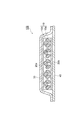
- FIG. 1 is a cross-sectional view showing an example of an absorbent article.
- the absorbent article 100 shown in FIG. 1 includes an absorbent body 10, core wraps 20a and 20b, a liquid permeable sheet 30, and a liquid permeable sheet 40.
- the liquid permeable sheet 40, the core wrap 20b, the absorbent body 10, the core wrap 20a, and the liquid permeable sheet 30 are laminated in this order.
- the absorber 10 has a water-absorbent resin particle 10a according to the present embodiment and a fiber layer 10b containing a fibrous material.
- the water-absorbent resin particles 10a are dispersed in the fiber layer 10b.
- the core wrap 20a is arranged on one side of the absorber 10 (upper side of the absorber 10 in FIG. 1) in contact with the absorber 10.
- the core wrap 20b is arranged on the other side of the absorber 10 (lower side of the absorber 10 in FIG. 1) in contact with the absorber 10.
- the absorber 10 is arranged between the core wrap 20a and the core wrap 20b.
- Examples of the core wraps 20a and 20b include tissues, non-woven fabrics, woven fabrics, synthetic resin films having liquid permeation holes, net-like sheets having a mesh, and the like.
- the core wrap 20a and the core wrap 20b have, for example, a main surface having the same size as the absorber 10.
- the liquid permeable sheet 30 is arranged on the outermost side on the side where the liquid to be absorbed enters.
- the liquid permeable sheet 30 is arranged on the core wrap 20a in contact with the core wrap 20a.
- Examples of the liquid permeable sheet 30 include non-woven fabrics made of synthetic resins such as polyethylene, polypropylene, polyester and polyamide, and porous sheets.
- the liquid permeable sheet 40 is arranged on the outermost side of the absorbent article 100 on the opposite side of the liquid permeable sheet 30.
- the liquid permeable sheet 40 is arranged under the core wrap 20b in contact with the core wrap 20b.
- liquid impermeable sheet 40 examples include a sheet made of a synthetic resin such as polyethylene, polypropylene, and polyvinyl chloride, and a sheet made of a composite material of these synthetic resins and a non-woven fabric.
- the liquid permeable sheet 30 and the liquid permeable sheet 40 have, for example, a main surface wider than the main surface of the absorber 10, and the outer edges of the liquid permeable sheet 30 and the liquid permeable sheet 40 are It extends around the absorber 10 and the core wraps 20a, 20b.
- the magnitude relationship between the absorbent body 10, the core wraps 20a and 20b, the liquid permeable sheet 30, and the liquid permeable sheet 40 is not particularly limited, and is appropriately adjusted according to the use of the absorbent article and the like. Further, the method of retaining the shape of the absorber 10 by using the core wraps 20a and 20b is not particularly limited, and as shown in FIG. 1, the absorber may be wrapped by a plurality of core wraps, and the absorber is wrapped by one core wrap. It may be.
- the absorber may be adhered to the top sheet.
- a hot melt adhesive is applied to the top sheet at predetermined intervals in a striped shape, a spiral shape, etc. in the width direction and adhered; starch, carboxymethyl cellulose, polyvinyl alcohol, polyvinylpyrrolidone, etc. Examples thereof include a method of adhering using a water-soluble binder such as a water-soluble polymer.
- a method of adhering by heat-sealing of the heat-sealing synthetic fibers may be adopted.
- the liquid absorbing method according to the present embodiment includes a step of bringing the liquid to be absorbed into contact with the water-absorbent resin particles, the absorber or the absorbent article according to the present embodiment.
- the present embodiment is a method for adjusting the amount of liquid absorption in an absorbent article, and is a method for adjusting the amount of liquid absorption using the water-absorbent resin particles, an absorber or the absorbent article according to the present embodiment (for example, an improvement method). )
- the method for adjusting the liquid absorption amount according to the present embodiment includes an adjustment step for adjusting the gel repulsive force reduction rate measured by the above-mentioned procedures (1) to (5) for the water-absorbent resin particles according to the present embodiment. ..
- the gel repulsive force reduction rate can be adjusted to each of the above ranges (for example, 5% or more).
- the water-absorbent resin particles according to the present embodiment include a selection step of selecting the water-absorbent resin particles based on the gel repulsive force reduction rate measured by the above-mentioned procedures (1) to (5).
- a method for producing water-absorbent resin particles can be provided.
- the gel repulsive force reduction rate can be adjusted to each of the above ranges (for example, 5% or more).
- the present embodiment it is possible to provide a method for producing an absorber using the water-absorbent resin particles obtained by the above-mentioned method for producing water-absorbent resin particles.
- the method for producing an absorber according to the present embodiment includes a particle manufacturing step for obtaining water-absorbent resin particles by the above-mentioned method for producing water-absorbent resin particles.
- the method for producing an absorber according to the present embodiment may include a step of mixing the water-absorbent resin particles and the fibrous material after the particle manufacturing step. According to the present embodiment, it is possible to provide a method for producing an absorbent article using the absorber obtained by the above-mentioned method for producing an absorber.
- the method for producing an absorbent article according to the present embodiment includes an absorber manufacturing step for obtaining an absorber by the above-mentioned method for manufacturing an absorber.
- the method for producing an absorbent article according to the present embodiment may include a step of obtaining an absorbent article by using the absorber and other constituent members of the absorbent article after the absorbent body manufacturing step. For example, an absorbent article is obtained by laminating the absorber and other constituent members of the absorbent article with each other.
- Example 1 A round-bottomed cylindrical separable flask having an inner diameter of 11 cm and an internal volume of 2 L equipped with a reflux condenser, a dropping funnel, a nitrogen gas introduction pipe, and a stirrer was prepared.
- the stirrer was equipped with a stirrer blade (flat blade) 200 whose outline is shown in FIG.
- the stirring blade 200 includes a shaft 200a and a flat plate portion 200b.
- the flat plate portion 200b is welded to the shaft 200a and has a curved tip.
- the flat plate portion 200b is formed with four slits S extending along the axial direction of the shaft 200a.
- the four slits S are arranged in the width direction of the flat plate portion 200b, the width of the two inner slits S is 1 cm, and the width of the two outer slits S is 0.5 cm.
- the length of the flat plate portion 200b is about 10 cm, and the width of the flat plate portion 200b is about 6 cm.
- 293 g of n-heptane was added as a hydrocarbon dispersion medium to the above-mentioned separable flask, and a maleic anhydride-modified ethylene-propylene copolymer (manufactured by Mitsui Chemicals Co., Ltd., High Wax 1105A) was added as a polymer-based dispersant.
- a mixture was obtained by adding 0.736 g.
- the dispersant was dissolved in n-heptane by heating the mixture to 80 ° C. with stirring with a stirrer, and then the mixture was cooled to 50 ° C.
- hydroxylethyl cellulose manufactured by Sumitomo Seika Co., Ltd., HEC AW-15F
- HEC AW-15F hydroxylethyl cellulose
- 0.0648 g 0.0648 g (0.272 mmol) of sodium persulfate as a water-soluble radical polymerization initiator
- ethylene as an internal cross-linking agent.
- An aqueous solution of the first stage was prepared by adding 0.010 g (0.057 mmol) of glycol diglycidyl ether and dissolving it.
- the above-mentioned first-stage aqueous solution was added to the above-mentioned separable flask while stirring at a stirring speed of 425 rpm, and then the mixture was stirred for 10 minutes. Then, it was obtained by heating and dissolving 0.736 g of sucrose stearic acid ester (surfactant, manufactured by Mitsubishi Chemical Foods Co., Ltd., Ryoto Sugar Ester S-370, HLB value: 3) in 6.62 g of n-heptane. The detergent solution was added to the separable flask. Then, the inside of the system was sufficiently replaced with nitrogen while stirring at a stirring speed of 425 rpm. Then, the flask was immersed in a water bath at 70 ° C. to raise the temperature, and polymerization was carried out for 60 minutes to obtain a first-stage polymerization slurry solution.
- sucrose stearic acid ester surfactant, manufactured by Mitsubishi Chemical Foods Co., Ltd., Ryoto Sugar Este
- the inside of the separable flask described above was cooled to 25 ° C. while stirring at a rotation speed of 650 rpm of the stirrer, and then the entire amount of the aqueous solution of the second stage described above was added to the polymerized slurry solution of the first stage described above. Was added to. Subsequently, after replacing the inside of the system with nitrogen for 30 minutes, the flask was again immersed in a water bath at 70 ° C. to raise the temperature, and the polymerization reaction was carried out for 60 minutes to obtain a second-stage hydrogel polymer. It was.
- n-heptane was evaporated at 125 ° C. and dried to obtain polymer particles (dried product).
- polymer particles dried product
- 0.2% by mass of amorphous silica (Tokuseal NP-S manufactured by Oriental Silicas Corporation) is weighted based on the total mass of the polymer particles.
- amorphous silica Tokuseal NP-S manufactured by Oriental Silicas Corporation
- Example 2 The rotation speed of the stirrer was changed to 350 rpm in the preparation of the polymerized slurry liquid in the first stage, and 257.2 g of water was added by azeotropic distillation in the hydrogel polymer after the polymerization in the second stage. 231.2 g of water-absorbent resin particles were obtained in the same manner as in Example 1 except that the particles were extracted from the system. The medium particle size of the water-absorbent resin particles was 359 ⁇ m.
- Example 3 The rotation speed of the stirrer was changed to 350 rpm in the preparation of the polymerized slurry liquid in the first stage, and 238.6 g of water was added by azeotropic distillation in the hydrogel polymer after the polymerization in the second stage. 226.4 g of water-absorbent resin particles were obtained in the same manner as in Example 1 except that the particles were extracted from the system. The medium particle size of the water-absorbent resin particles was 378 ⁇ m.
- Example 4 In the preparation of the water-containing gel polymer in the second stage, the temperature in the separable flask was changed to 31 ° C instead of 25 ° C, and in the water-containing gel polymer after the polymerization in the second stage, 232.0 g of water-absorbent resin particles were obtained in the same manner as in Example 1 except that 275.8 g of water was extracted from the system by azeotropic distillation. The medium particle size of the water-absorbent resin particles was 148 ⁇ m.
- the rotation speed of the stirrer when adding the entire amount of the aqueous liquid in the second stage to the polymerized slurry liquid in the first stage was changed to 1000 rpm, and the water-containing gel after the polymerization in the second stage.
- 228.5 g of water-absorbent resin particles were obtained in the same manner as in Example 1 except that 232.0 g of water was extracted from the system by copolymerization distillation.
- the medium particle size of the water-absorbent resin particles was 354 ⁇ m.
- Comparative Example 2 In the hydrogel polymer after the second stage polymerization, 229.0 g of water-absorbent resin particles were obtained in the same manner as in Comparative Example 1, except that 216.7 g of water was extracted from the system by azeotropic distillation. Obtained. The medium particle size of the water-absorbent resin particles was 348 ⁇ m.
- the above-mentioned medium particle diameter of the water-absorbent resin particles was measured by the following procedure in an environment of a temperature of 25 ⁇ 2 ° C. and a humidity of 50 ⁇ 10%. That is, from the top, the JIS standard sieve has a mesh size of 600 ⁇ m, a mesh size of 500 ⁇ m, a mesh size of 425 ⁇ m, a mesh size of 300 ⁇ m, a mesh size of 250 ⁇ m, a mesh size of 180 ⁇ m, and a mesh size of 150 ⁇ m. , And the saucer in that order.
- the water retention amount (room temperature, 25 ⁇ 2 ° C.) of the physiological saline of the water-absorbent resin particles was measured by the following procedure. First, a cotton bag (Membroad No. 60, width 100 mm ⁇ length 200 mm) weighing 2.0 g of water-absorbent resin particles was placed in a beaker having an internal volume of 500 mL. After pouring 500 g of physiological saline into a cotton bag containing water-absorbent resin particles at a time so that maco cannot be formed, tie the upper part of the cotton bag with a rubber band and let it stand for 30 minutes to swell the water-absorbent resin particles. I let you.
- the cotton bag was dehydrated for 1 minute using a dehydrator (manufactured by Kokusan Co., Ltd., product number: H-122) set to have a centrifugal force of 167 G, and then contained a swelling gel after dehydration.
- the mass Wa [g] of the cotton bag was measured.
- the same operation was performed without adding the water-absorbent resin particles, the empty mass Wb [g] of the cotton bag when wet was measured, and the water retention amount of the physiological saline of the water-absorbent resin particles was calculated from the following formula.
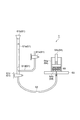
- the amount of water absorption (room temperature, 25 ° C. ⁇ 2 ° C.) of the physiological saline under the load of the water-absorbent resin particles was measured using the measuring device Y shown in FIG.
- the measuring device Y is composed of a burette unit 61, a conduit 62, a measuring table 63, and a measuring unit 64 placed on the measuring table 63.
- the burette portion 61 has a burette 61a extending in the vertical direction, a rubber stopper 61b arranged at the upper end of the burette 61a, a cock 61c arranged at the lower end of the burette 61a, and one end extending into the burette 61a in the vicinity of the cock 61c. It has an air introduction pipe 61d and a cock 61e arranged on the other end side of the air introduction pipe 61d.
- the conduit 62 is attached between the burette portion 61 and the measuring table 63.
- the inner diameter of the conduit 62 is 6 mm.
- a hole having a diameter of 2 mm is formed in the central portion of the measuring table 63, and the conduit 62 is connected to the hole.
- the measuring unit 64 has a cylinder 64a (made of acrylic resin), a nylon mesh 64b adhered to the bottom of the cylinder 64a, and a weight 64c.
- the inner diameter of the cylinder 64a is 20 mm.
- the opening of the nylon mesh 64b is 75 ⁇ m (200 mesh).
- the water-absorbent resin particles 65 to be measured are uniformly sprinkled on the nylon mesh 64b.
- the diameter of the weight 64c is 19 mm, and the mass of the weight 64c is 119.6 g.
- the weight 64c is placed on the water-absorbent resin particles 65, and a load of 4.14 kPa can be applied to the water-absorbent resin particles 65.
- the weight 64c was placed and the measurement was started. Since the same volume of air as the physiological saline absorbed by the water-absorbent resin particles 65 is quickly and smoothly supplied to the inside of the burette 61a from the air introduction pipe, the water level of the physiological saline inside the burette 61a is reduced. However, the amount of physiological saline absorbed by the water-absorbent resin particles 65 is obtained.
- the scale of the burette 61a is engraved from the top to the bottom in increments of 0 mL to 0.5 mL, and the scale Va of the burette 61a before the start of water absorption and the burette 61a 60 minutes after the start of water absorption are used as the water level of the physiological saline.
- ⁇ Unpressurized DW> The non-pressurized DW of the water-absorbent resin particles was measured using the measuring device Z shown in FIG. The measurement was carried out 5 times for one type of water-absorbent resin particles, and the average value of the measured values at three points excluding the minimum value and the maximum value was obtained.
- the measuring device Z has a burette portion 71, a conduit 72, a flat plate-shaped measuring table 73, a nylon mesh 74, a frame 75, and a clamp 76.
- the burette portion 71 was connected to a burette 71a on which a scale was written, a rubber stopper 71b for sealing the opening at the upper part of the burette 71a, a cock 71c connected to the tip of the lower part of the burette 71a, and a lower part of the burette 71a. It has an air introduction pipe 71d and a cock 71e.
- the burette portion 71 is fixed by a clamp 76.
- the measuring table 73 has a through hole 73a having a diameter of 2 mm formed in the central portion thereof, and is supported by a frame 75 having a variable height.
- the through hole 73a of the measuring table 73 and the cock 71c of the burette portion 71 are connected by a conduit 72.
- the inner diameter of the conduit 72 is 6 mm.
- the measurement was performed in an environment with a temperature of 25 ° C and a humidity of 50 ⁇ 10%.
- the cock 71c and the cock 71e of the burette portion 71 were closed, and the physiological saline 77 adjusted to 25 ° C. was put into the burette 71a through the opening at the upper part of the burette 71a.
- the cock 71c and the cock 71e were opened after the opening of the burette 71a was sealed with the rubber stopper 71b.
- the inside of the conduit 72 was filled with saline 77 to prevent air bubbles from entering.
- the height of the measuring table 73 was adjusted so that the height of the water surface of the physiological saline 77 that reached the inside of the through hole 73a was the same as the height of the upper surface of the measuring table 73. After the adjustment, the height of the water surface of the physiological saline 77 in the burette 71a was read by the scale of the burette 71a, and the position was set as the zero point (reading value at 0 seconds).
- a nylon mesh 74 (100 mm ⁇ 100 mm, 250 mesh, thickness: about 50 ⁇ m) was laid in the vicinity of the through hole 73a on the measuring table 73, and a cylinder having an inner diameter of 30 mm and a height of 20 mm was placed in the center thereof. 1.00 g of water-absorbent resin particles 78 were uniformly sprayed on this cylinder. Then, the cylinder was carefully removed to obtain a sample in which the water-absorbent resin particles 78 were dispersed in a circle in the central portion of the nylon mesh 74.
- the nylon mesh 74 on which the water-absorbent resin particles 78 were placed was quickly moved so that the center thereof was at the position of the through hole 73a so that the water-absorbent resin particles 78 did not dissipate, and the measurement was started.
- the time when the air bubbles were first introduced into the burette 71a from the air introduction pipe 71d was defined as the start of water absorption (0 seconds).
- the decrease amount of the physiological saline 77 in the burette 71a (that is, the amount of the physiological saline 77 absorbed by the water-absorbent resin particles 78) is sequentially read in units of 0.1 mL, and calculated from the start of water absorption of the water-absorbent resin particles 78.
- the weight loss Wc [g] of the physiological saline 77 after 10 minutes was read. From Wc, the 10-minute value of non-pressurized DW was calculated by the following formula.
- the non-pressurized DW is the amount of water absorbed per 1.00 g of the water-absorbent resin particles 78.
- Unpressurized DW value [mL / g] Wc / 1.00
- EZtest (manufactured by Shimadzu Corporation, trade name: EZtest, model number: EZ-SX) is used for measuring the gel repulsive force reduction rate.
- the jig provided in EZtest can be attached to the load cell of EZtest, and the position of the jig in the vertical direction can be adjusted using the software Trapezium X (manufactured by Shimadzu Corporation) for Shimadzu autograph.
- the load cell senses the response of the load applied to the jig when the jig is brought into contact with the surface of the gel with respect to the 30-fold swollen gel placed on the measuring table, and the load is used as the test force on the measurement screen.
- the jig includes a disk portion and a rod-shaped portion.
- the disk portion is in the shape of a disk having flat surfaces on the front and back surfaces, having a diameter of 4.9 cm and a thickness of 1.2 cm.
- the length of the rod-shaped portion is 14 cm.
- One end of the rod-shaped portion is connected to the center of the flat surface of the disk portion, and the other end of the rod-shaped portion is connected to the load cell.
- the position of the container is adjusted so that the central axis in the height direction of the container is located at the center of the disk portion.
- the clearance between the jig and the inner wall of the container is 7.5 mm.
- the measurement was performed in an environment with a temperature of 25 ⁇ 2 ° C and a humidity of 50 ⁇ 10%.
- the above-mentioned container containing the 30-fold swollen gel was placed on the measuring table.
- the jig was lowered until the load cell connected to the jig sensed a test force of 0.01 N, and the jig and the gel surface were brought into contact with each other.
- the jig was placed at the measurement start position by raising the jig by 0.05 mm.
- the jig was pushed into the gel by 1 mm at a speed of 10 mm / min, and the maximum value L 1 (maximum test force in the first cycle. Unit [N]) of the test force at this time was measured.
- a liquid feed pump (DOSEIT P910, input diameter: 0.5 cm ⁇ ) manufactured by INTERGRA was assembled.
- the input amount of the test solution was set to 40 mL and the input rate was set to 8 mL / sec.
- the test solution was sent to the tip of the tube (inner diameter: 0.5 cm). After putting the tip of the tube into the graduated cylinder, the test solution was injected into the graduated cylinder by driving the liquid feed pump. Calibration was performed by reading the value of the measuring cylinder and confirming that the injection amount of the test solution was the set value (40 mL).
- a sheet-shaped absorber having a size of 40 cm ⁇ 12 cm is uniformly mixed by air papermaking using an air flow type mixer (Padformer manufactured by Otec Co., Ltd.) to uniformly mix 10 g of water-absorbent resin particles and 8 g of crushed pulp.
- An air flow type mixer (Padformer manufactured by Otec Co., Ltd.) to uniformly mix 10 g of water-absorbent resin particles and 8 g of crushed pulp.
- a load of 196 kPa is applied to the whole for 30 seconds and pressed. Obtained a laminate.
- an air-through type porous liquid permeable sheet (15.5 cm ⁇ 47 cm) made of polyethylene-polypropylene having a basis weight of 22 g / m 2 ). was attached to the back sheet from the top of the absorber. Then, the central part (turned up part) of the back sheet in the pair of side gathers is attached to the liquid permeable sheet with tape glue and returned to the original position, and the portion overlaps the liquid permeable sheet. Absorbent article (diaper) was obtained.
- a doll manufactured by Kato Tech Co., Ltd. (a mannequin for girls, a standing position, a human model for children from the lower abdomen to the thigh, transparent) was prepared.
- the dimensions of the doll are as follows. The above test solution was adjusted to a temperature of 25 ⁇ 2 ° C. in a constant temperature bath. After connecting the tube connected to the urination part of the doll and the tube of the liquid delivery pump, the test solution was sent to the liquid outlet of the urination part of the doll.
- Length around the abdomen (around the navel position): 475 mm
- Length around the buttocks 465mm
- Length around the base of the foot 280 mm
- Crotch length (length between the bases of both feet): 36 mm
- Length between navel and urination 145 mm
- the absorbent article After measuring the mass W1 of the above-mentioned absorbent article, the absorbent article was attached to the doll. As the fixing position of the fastening tape in the absorbent article, the tape fixing position "1" printed on the surface of the back sheet was adopted. At this time, the gathers of the absorbent article are in contact with the crotch part of the doll, the gathers are standing, the length of the mounting part is not biased before and after the absorbent article, and the back and tummy circumference. It was confirmed that there was no looseness in.
- the doll was placed on its back in the bat. 40 mL of the test solution was fed every 5 minutes at a charging rate of 8 mL / sec, and the feeding was repeated until leakage from the absorbent article (liquid outflow from the back side or the crotch side) occurred. After the leakage occurred, the absorbent article was removed from the doll, and the mass W2 of the absorbent article was measured. Then, the amount of absorbed test solution "W2-W1" was calculated. The results are shown in Table 1. When the amount of liquid absorbed is large, it indicates that the amount of liquid that can be absorbed before leakage occurs is large.
- adjusting the gel repulsive force reduction rate is effective in obtaining an absorbent article having an excellent liquid absorption amount when the liquid is supplied in a state of being attached to the object to be used. Is confirmed.
- Nylon mesh 64c ... Weight, 73a ... Through hole, 75 ... Mount, 76 ... Clamp, 77 ... Physiological saline, 100 ... Absorbent article, 200 ... Stirring blade, 200a ... Shaft, 200b ... Flat plate, S ... Slit, Y, Z ... Measuring device.
Landscapes
- Health & Medical Sciences (AREA)
- Chemical & Material Sciences (AREA)
- Epidemiology (AREA)
- Engineering & Computer Science (AREA)
- Life Sciences & Earth Sciences (AREA)
- Animal Behavior & Ethology (AREA)
- General Health & Medical Sciences (AREA)
- Public Health (AREA)
- Veterinary Medicine (AREA)
- Dispersion Chemistry (AREA)
- Materials Engineering (AREA)
- Hematology (AREA)
- Vascular Medicine (AREA)
- Heart & Thoracic Surgery (AREA)
- Biomedical Technology (AREA)
- Chemical Kinetics & Catalysis (AREA)
- Medicinal Chemistry (AREA)
- Polymers & Plastics (AREA)
- Organic Chemistry (AREA)
- Spectrometry And Color Measurement (AREA)
- Diffracting Gratings Or Hologram Optical Elements (AREA)
- Absorbent Articles And Supports Therefor (AREA)
Priority Applications (1)
| Application Number | Priority Date | Filing Date | Title |
|---|---|---|---|
| JP2021516058A JP7117456B2 (ja) | 2019-04-23 | 2020-04-16 | 吸水性樹脂粒子及びその製造方法、吸収体、並びに、吸収性物品 |
Applications Claiming Priority (2)
| Application Number | Priority Date | Filing Date | Title |
|---|---|---|---|
| JP2019082042 | 2019-04-23 | ||
| JP2019-082042 | 2019-04-23 |
Publications (1)
| Publication Number | Publication Date |
|---|---|
| WO2020218161A1 true WO2020218161A1 (ja) | 2020-10-29 |
Family
ID=72942660
Family Applications (1)
| Application Number | Title | Priority Date | Filing Date |
|---|---|---|---|
| PCT/JP2020/016748 Ceased WO2020218161A1 (ja) | 2019-04-23 | 2020-04-16 | 吸水性樹脂粒子及びその製造方法、吸収体、並びに、吸収性物品 |
Country Status (2)
| Country | Link |
|---|---|
| JP (1) | JP7117456B2 (https=) |
| WO (1) | WO2020218161A1 (https=) |
Citations (8)
| Publication number | Priority date | Publication date | Assignee | Title |
|---|---|---|---|---|
| JP2001158802A (ja) * | 1999-12-02 | 2001-06-12 | Kao Corp | 高吸水性樹脂の製造方法 |
| JP2003026706A (ja) * | 2001-07-13 | 2003-01-29 | Sumitomo Seika Chem Co Ltd | 連続凝集装置およびこれを備えた多段重合装置 |
| JP2005132957A (ja) * | 2003-10-30 | 2005-05-26 | Dainippon Ink & Chem Inc | 吸水性樹脂の製造方法 |
| JP2007177153A (ja) * | 2005-12-28 | 2007-07-12 | Toagosei Co Ltd | 逆相懸濁重合装置及び重合体の製造方法 |
| JP2009506132A (ja) * | 2005-08-23 | 2009-02-12 | 株式会社日本触媒 | 改質された吸水性樹脂の製造方法 |
| WO2012033025A1 (ja) * | 2010-09-06 | 2012-03-15 | 住友精化株式会社 | 吸水性樹脂、及びその製造方法 |
| WO2016182082A1 (ja) * | 2015-05-14 | 2016-11-17 | 株式会社日本触媒 | 重合性液体組成物の分散方法及び球状重合体粒子の製造方法 |
| WO2017169246A1 (ja) * | 2016-03-31 | 2017-10-05 | 住友精化株式会社 | 吸水性樹脂粒子の製造装置 |
-
2020
- 2020-04-16 JP JP2021516058A patent/JP7117456B2/ja active Active
- 2020-04-16 WO PCT/JP2020/016748 patent/WO2020218161A1/ja not_active Ceased
Patent Citations (8)
| Publication number | Priority date | Publication date | Assignee | Title |
|---|---|---|---|---|
| JP2001158802A (ja) * | 1999-12-02 | 2001-06-12 | Kao Corp | 高吸水性樹脂の製造方法 |
| JP2003026706A (ja) * | 2001-07-13 | 2003-01-29 | Sumitomo Seika Chem Co Ltd | 連続凝集装置およびこれを備えた多段重合装置 |
| JP2005132957A (ja) * | 2003-10-30 | 2005-05-26 | Dainippon Ink & Chem Inc | 吸水性樹脂の製造方法 |
| JP2009506132A (ja) * | 2005-08-23 | 2009-02-12 | 株式会社日本触媒 | 改質された吸水性樹脂の製造方法 |
| JP2007177153A (ja) * | 2005-12-28 | 2007-07-12 | Toagosei Co Ltd | 逆相懸濁重合装置及び重合体の製造方法 |
| WO2012033025A1 (ja) * | 2010-09-06 | 2012-03-15 | 住友精化株式会社 | 吸水性樹脂、及びその製造方法 |
| WO2016182082A1 (ja) * | 2015-05-14 | 2016-11-17 | 株式会社日本触媒 | 重合性液体組成物の分散方法及び球状重合体粒子の製造方法 |
| WO2017169246A1 (ja) * | 2016-03-31 | 2017-10-05 | 住友精化株式会社 | 吸水性樹脂粒子の製造装置 |
Also Published As
| Publication number | Publication date |
|---|---|
| JP7117456B2 (ja) | 2022-08-12 |
| JPWO2020218161A1 (https=) | 2020-10-29 |
Similar Documents
| Publication | Publication Date | Title |
|---|---|---|
| EP3896120B1 (en) | Water-absorbing resin particles, absorbent, and absorbent article | |
| WO2020184394A1 (ja) | 吸水性樹脂粒子、吸収体、吸収性物品、吸水性樹脂粒子の通液維持率の測定方法、及び吸水性樹脂粒子の製造方法 | |
| JP6856826B1 (ja) | 吸水性樹脂粒子 | |
| CN113544164A (zh) | 吸水性树脂颗粒 | |
| WO2020184386A1 (ja) | 吸水性樹脂粒子、吸収性物品、吸水性樹脂粒子を製造する方法、及び吸収体への生理食塩水の浸透速度を速める方法 | |
| JP7129490B2 (ja) | 吸水性樹脂粒子、吸収体、吸収性物品、及び液吸引力測定方法 | |
| WO2020184398A1 (ja) | 吸水性樹脂粒子及びその製造方法、吸収体、並びに、吸収性物品 | |
| WO2020184393A1 (ja) | 吸水性樹脂粒子、吸収体及び吸収性物品 | |
| JP7194197B2 (ja) | 吸収体及び吸収性物品 | |
| JP7443330B2 (ja) | 吸水性樹脂粒子及びその製造方法、吸収体、吸収性物品、並びに、浸透速度の調整方法 | |
| WO2020184387A1 (ja) | 吸水性樹脂粒子及びその製造方法、吸収体、並びに吸収性物品 | |
| JP6991389B2 (ja) | 吸水性樹脂粒子及びその製造方法 | |
| JP7733572B2 (ja) | 吸水性樹脂粒子 | |
| JP6780048B2 (ja) | 吸水性樹脂粒子、吸収体及び吸収性物品 | |
| JP7117456B2 (ja) | 吸水性樹脂粒子及びその製造方法、吸収体、並びに、吸収性物品 | |
| WO2020218168A1 (ja) | 吸水性樹脂粒子、吸収体及び吸収性物品 | |
| WO2020218160A1 (ja) | 吸水性樹脂粒子、吸収体及び吸収性物品 | |
| WO2021049450A1 (ja) | 吸水性樹脂粒子 | |
| JP7143513B2 (ja) | 吸水性樹脂粒子及びその製造方法、吸収体、並びに、吸収性物品 | |
| JP7629850B2 (ja) | 吸水性樹脂粒子、吸収体及び吸収性物品 | |
| JP6752320B2 (ja) | 吸収性物品及びその製造方法 | |
| JP6775050B2 (ja) | 吸収性物品 | |
| WO2020218166A1 (ja) | 吸水性樹脂粒子 |
Legal Events
| Date | Code | Title | Description |
|---|---|---|---|
| 121 | Ep: the epo has been informed by wipo that ep was designated in this application |
Ref document number: 20795020 Country of ref document: EP Kind code of ref document: A1 |
|
| ENP | Entry into the national phase |
Ref document number: 2021516058 Country of ref document: JP Kind code of ref document: A |
|
| NENP | Non-entry into the national phase |
Ref country code: DE |
|
| 122 | Ep: pct application non-entry in european phase |
Ref document number: 20795020 Country of ref document: EP Kind code of ref document: A1 |