WO2020213251A1 - 車両用表示装置 - Google Patents
車両用表示装置 Download PDFInfo
- Publication number
- WO2020213251A1 WO2020213251A1 PCT/JP2020/006718 JP2020006718W WO2020213251A1 WO 2020213251 A1 WO2020213251 A1 WO 2020213251A1 JP 2020006718 W JP2020006718 W JP 2020006718W WO 2020213251 A1 WO2020213251 A1 WO 2020213251A1
- Authority
- WO
- WIPO (PCT)
- Prior art keywords
- vehicle
- display
- cover member
- display device
- surrounding
- Prior art date
- Legal status (The legal status is an assumption and is not a legal conclusion. Google has not performed a legal analysis and makes no representation as to the accuracy of the status listed.)
- Ceased
Links
Images







Classifications
-
- B—PERFORMING OPERATIONS; TRANSPORTING
- B60—VEHICLES IN GENERAL
- B60K—ARRANGEMENT OR MOUNTING OF PROPULSION UNITS OR OF TRANSMISSIONS IN VEHICLES; ARRANGEMENT OR MOUNTING OF PLURAL DIVERSE PRIME-MOVERS IN VEHICLES; AUXILIARY DRIVES FOR VEHICLES; INSTRUMENTATION OR DASHBOARDS FOR VEHICLES; ARRANGEMENTS IN CONNECTION WITH COOLING, AIR INTAKE, GAS EXHAUST OR FUEL SUPPLY OF PROPULSION UNITS IN VEHICLES
- B60K35/00—Instruments specially adapted for vehicles; Arrangement of instruments in or on vehicles
- B60K35/20—Output arrangements, i.e. from vehicle to user, associated with vehicle functions or specially adapted therefor
- B60K35/21—Output arrangements, i.e. from vehicle to user, associated with vehicle functions or specially adapted therefor using visual output, e.g. blinking lights or matrix displays
- B60K35/22—Display screens
-
- B—PERFORMING OPERATIONS; TRANSPORTING
- B60—VEHICLES IN GENERAL
- B60K—ARRANGEMENT OR MOUNTING OF PROPULSION UNITS OR OF TRANSMISSIONS IN VEHICLES; ARRANGEMENT OR MOUNTING OF PLURAL DIVERSE PRIME-MOVERS IN VEHICLES; AUXILIARY DRIVES FOR VEHICLES; INSTRUMENTATION OR DASHBOARDS FOR VEHICLES; ARRANGEMENTS IN CONNECTION WITH COOLING, AIR INTAKE, GAS EXHAUST OR FUEL SUPPLY OF PROPULSION UNITS IN VEHICLES
- B60K35/00—Instruments specially adapted for vehicles; Arrangement of instruments in or on vehicles
- B60K35/20—Output arrangements, i.e. from vehicle to user, associated with vehicle functions or specially adapted therefor
- B60K35/28—Output arrangements, i.e. from vehicle to user, associated with vehicle functions or specially adapted therefor characterised by the type of the output information, e.g. video entertainment or vehicle dynamics information; characterised by the purpose of the output information, e.g. for attracting the attention of the driver
-
- B—PERFORMING OPERATIONS; TRANSPORTING
- B60—VEHICLES IN GENERAL
- B60K—ARRANGEMENT OR MOUNTING OF PROPULSION UNITS OR OF TRANSMISSIONS IN VEHICLES; ARRANGEMENT OR MOUNTING OF PLURAL DIVERSE PRIME-MOVERS IN VEHICLES; AUXILIARY DRIVES FOR VEHICLES; INSTRUMENTATION OR DASHBOARDS FOR VEHICLES; ARRANGEMENTS IN CONNECTION WITH COOLING, AIR INTAKE, GAS EXHAUST OR FUEL SUPPLY OF PROPULSION UNITS IN VEHICLES
- B60K35/00—Instruments specially adapted for vehicles; Arrangement of instruments in or on vehicles
- B60K35/50—Instruments characterised by their means of attachment to or integration in the vehicle
-
- B—PERFORMING OPERATIONS; TRANSPORTING
- B60—VEHICLES IN GENERAL
- B60K—ARRANGEMENT OR MOUNTING OF PROPULSION UNITS OR OF TRANSMISSIONS IN VEHICLES; ARRANGEMENT OR MOUNTING OF PLURAL DIVERSE PRIME-MOVERS IN VEHICLES; AUXILIARY DRIVES FOR VEHICLES; INSTRUMENTATION OR DASHBOARDS FOR VEHICLES; ARRANGEMENTS IN CONNECTION WITH COOLING, AIR INTAKE, GAS EXHAUST OR FUEL SUPPLY OF PROPULSION UNITS IN VEHICLES
- B60K35/00—Instruments specially adapted for vehicles; Arrangement of instruments in or on vehicles
- B60K35/60—Instruments characterised by their location or relative disposition in or on vehicles
-
- B—PERFORMING OPERATIONS; TRANSPORTING
- B60—VEHICLES IN GENERAL
- B60K—ARRANGEMENT OR MOUNTING OF PROPULSION UNITS OR OF TRANSMISSIONS IN VEHICLES; ARRANGEMENT OR MOUNTING OF PLURAL DIVERSE PRIME-MOVERS IN VEHICLES; AUXILIARY DRIVES FOR VEHICLES; INSTRUMENTATION OR DASHBOARDS FOR VEHICLES; ARRANGEMENTS IN CONNECTION WITH COOLING, AIR INTAKE, GAS EXHAUST OR FUEL SUPPLY OF PROPULSION UNITS IN VEHICLES
- B60K37/00—Dashboards
- B60K37/20—Dashboard panels
-
- B—PERFORMING OPERATIONS; TRANSPORTING
- B60—VEHICLES IN GENERAL
- B60N—SEATS SPECIALLY ADAPTED FOR VEHICLES; VEHICLE PASSENGER ACCOMMODATION NOT OTHERWISE PROVIDED FOR
- B60N3/00—Arrangements or adaptations of other passenger fittings, not otherwise provided for
-
- B—PERFORMING OPERATIONS; TRANSPORTING
- B60—VEHICLES IN GENERAL
- B60R—VEHICLES, VEHICLE FITTINGS, OR VEHICLE PARTS, NOT OTHERWISE PROVIDED FOR
- B60R11/00—Arrangements for holding or mounting articles, not otherwise provided for
- B60R11/02—Arrangements for holding or mounting articles, not otherwise provided for for radio sets, television sets, telephones, or the like; Arrangement of controls thereof
-
- G—PHYSICS
- G09—EDUCATION; CRYPTOGRAPHY; DISPLAY; ADVERTISING; SEALS
- G09F—DISPLAYING; ADVERTISING; SIGNS; LABELS OR NAME-PLATES; SEALS
- G09F9/00—Indicating arrangements for variable information in which the information is built-up on a support by selection or combination of individual elements
-
- H—ELECTRICITY
- H04—ELECTRIC COMMUNICATION TECHNIQUE
- H04N—PICTORIAL COMMUNICATION, e.g. TELEVISION
- H04N5/00—Details of television systems
- H04N5/64—Constructional details of receivers, e.g. cabinets or dust covers
Definitions
- This disclosure relates to a vehicle display device installed and used within a predetermined distance from a seat.
- a vehicle display device used in a manner of standing on the upper surface of a dashboard is known.
- a display device for vehicles for the purpose of improving the visibility and design of the display screen, for example, as in Patent Document 1, a cover member for protecting the screen is made of glass.
- Various configurations have been proposed.
- Patent Document 1 also discloses a configuration as a vehicle display device having a touch panel function for the purpose of improving display operability.
- Patent Document 1 discloses a configuration in which a cover member is made of tempered glass and a touch panel having a specific thickness is used in order to reduce the risk of the glass breaking due to an impact on the glass surface.
- the glass cover member will be referred to as a cover glass.
- the vehicle display device may be arranged in a range where the occupant's head can collide when a vehicle collision occurs (hereinafter, the head collision range).
- the vehicle display device provided with the touch panel function may be arranged within the reach of the driver's seat occupant as the head collision range in order to ensure the operability of the occupant. Therefore, it is preferable that the cover member such as the cover glass is configured so as not to be easily broken for the purpose of protecting the occupants.
- the above head collision range may be set based on the regulations of the area where the vehicle is used.
- the head collision range is defined as "Attachment 28 Technical Standards for Shock Absorption of Instrument Panels” in "Article 20 Riding Equipment” of "Safety Standards for Road Transport Vehicles” indicated by the Ministry of Land, Infrastructure, Transport and Tourism of Japan. It may be set based on the range shown in the above.
- Patent Document 1 improvement in strength against impact (in other words, bending fracture) from a direction substantially perpendicular to the main surface of the cover glass can be expected.
- the vehicle display device of Patent Document 1 is configured on the assumption that the head collides with the surface portion of the cover glass from a direction orthogonal to the surface portion.
- Patent Document 1 does not study the case where the head collides with the edge portion of the cover glass from diagonally above.
- the edge portion of the cover glass here refers to an end portion including a corner portion of the cover glass.
- the collision position (in other words, the attack point) between the occupant's head and the vehicle display device may be not the surface portion of the cover glass but the upper viewing side end portion of the vehicle display device.
- the impact on the upper viewing side end of the vehicle display device acts directly or indirectly on the upper edge of the cover glass. Since the impact force on the edge portion of the cover glass is concentrated in a small area, there is a higher risk of glass breakage than when the attack point is located on the surface portion of the cover glass. Further, since the impact on the edge portion has a small impact area, it may be cracked by a mechanism closer to Hertz fracture rather than bending fracture. Therefore, it is preferable that the display device for a vehicle is configured so that the cover glass is not easily broken even when the head collides with the upper viewing side end of the device from diagonally above.
- a frame in other words, a bezel
- a bezel is arranged on the outer circumference of the cover glass.
- the cover member made of acrylic or polycarbonate also has a property of being easily cracked by an impact on the edge portion. That is, even when the cover member is made of acrylic or polycarbonate, it has the same problem as the cover glass against edge impact.
- An object of the present disclosure is to provide a vehicle display device in which the cover member is hard to break while suppressing the bezel width.
- a display unit mounted on a vehicle and displaying information, a frame arranged on the back side of the display unit, and a tubular member surrounding the display unit from the side, the end portion on the viewing side is A surrounding member formed as an opening and a plate-shaped cover member having translucency and arranged on the visual side of the display surface of the display so as to close the opening of the surrounding member are provided and surrounded.
- the visible end of the member does not cover the visible surface of the cover member
- the display body is formed by the display, frame, surrounding member, and cover member
- the upper side of the display body is the dash of the vehicle.
- the vehicle display device that is arranged so as to protrude above the board, a part of the lower region of the display main body is supported by the vehicle mounting portion, and the rear side of the frame is the occupant in the event of a vehicle collision.
- a reinforcing portion is provided to resist a collision of the head, and the upper visible end portion, which is the visible side end portion of the upper surrounding portion, which is a portion located above the display portion in the surrounding member, is more visible than the surface of the cover member. It is characterized in that it is configured to protrude to the side and is deformably formed on the edge side of the cover member due to a collision of the occupant's head.
- the front end portion (that is, the upper viewing side end portion) of the portion of the surrounding member located on the upper side of the display portion is configured to project toward the viewing side from the surface of the cover member. Therefore, the primary collision position with the occupant's head is the upper viewing side end, and the impact due to the collision between the vehicle display device and the head can be suppressed from being directly applied to the edge portion of the cover member. it can.
- the upper visible end can be deformed to the edge side of the cover member by the collision of the occupant's head.
- the impact load at the time of collision is reduced (absorbed), so that the impact on the cover member can be reduced.
- the display main body portion can be displaced without breaking so as to bend. It is possible to displace the impact force and reduce the impact on the occupants.
- the visible end of the surrounding member corresponds to the bezel.
- the above-mentioned action and effect can be obtained by projecting the upper viewing side end portion toward the viewing side from the surface of the cover member so as to be deformable. Therefore, there is little need to increase the width of the visible end (that is, the bezel) of the surrounding member. That is, according to the above configuration, it is possible to provide a vehicle display device in which the cover member is hard to break while suppressing the bezel width.
- the vehicle display device 100 of the first embodiment is shown in FIGS. 1 to 8.
- the vehicle display device 100 of the first embodiment is installed on the dashboard 200 (instrument panel design member 201, instrument panel internal member 202) of the vehicle, and is configured as a device for displaying various information. More specifically, the vehicle display device 100 is arranged in a region located at the center in the vehicle width direction on the upper surface of the dashboard 200 with the display surface of the display 1 facing the rear of the vehicle.
- the direction in which information is displayed on the vehicle display device 100 (occupant side) is referred to as a visual recognition side.
- the visible side corresponds to the front side for the vehicle display device 100. Further, the direction opposite to the visual recognition side will be referred to as the back side.
- the vehicle provided with the vehicle display device 100 may be a vehicle having a driver's seat on the left side. Further, the vehicle display device 100 may be used in a fully autonomous vehicle that does not have a driver's seat.
- the vehicle display device 100 is preset with a vertical direction and a horizontal direction.
- the vehicle display device 100 is attached so that the vertical direction is substantially parallel to the vertical direction of the vehicle.
- the vehicle display device 100 is attached so that the left-right direction is substantially parallel to the left-right direction of the vehicle (in other words, the vehicle width direction).
- the substantially parallel state is not limited to a completely parallel state, but includes a state in which the state is tilted by about 30 ° from the completely parallel state. That is, the vehicle display device 100 may be mounted in an inclined posture so that the occupant seated in the driver's seat can recognize the display screen of the display 1 with respect to the horizontal surface of the vehicle without discomfort.
- the vehicle horizontal plane refers to a plane perpendicular to the height direction of the vehicle.
- the vehicle display device 100 is arranged so that the upper side of the display main body 101, which will be described later, protrudes above the dashboard 200 of the vehicle.
- This mounting form is so-called on-dash mounting.
- a part of the lower region of the display main body 101 is supported by the instrument panel internal member 202 formed inside the instrument panel design member 201 of the vehicle.
- a mounting stay 21 extending downward is formed in the lower region of the display main body 101 (here, the lower side surface of the drawing unit 2 described later), and the tip end side of the mounting stay 21 is formed. It is fixed to the instrument panel internal member 202 by a fastening member such as a bolt 22.
- the instrument panel internal member 202 corresponds to the mounting portion of the present disclosure.
- a mounting stay is provided on the lower side of the display main body 101 and fixed to the instrument panel design member 201, or a protruding connection is made on the lower side of the display main body 101.
- a portion may be provided and fixed by inserting it into an insertion hole or the like formed in the instrument panel design member 201.
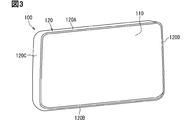
- the vehicle display device 100 includes a display surface 110 on which an image is displayed, a device side surface 120, and a device back surface.
- the back surface of the device refers to the surface opposite to the display surface 110.
- the device side surface 120 corresponds to a surface formed along the viewing direction in the vehicle display device 100.
- the vehicle display device 100 includes an upper surface portion 120A, a lower surface portion 120B, a left side surface portion 120C, and a right side surface portion 120D as device side surface portions 120 so as to correspond to the top, bottom, left, and right sides of the vehicle display device 100.
- the vehicle display device 100 is formed in a flat rectangular parallelepiped shape whose thickness direction is the direction perpendicular to the display surface 110.
- the vehicle display device 100 is formed so that the length in the left-right direction is longer than the length in the up-down direction.
- the upper surface portion 120A corresponds to a portion of the surrounding member 5 described later, which is located above the display 1.
- the portion located above the display 1 that is, the upper surface portion 120A
- the visible side end of the upper surrounding portion corresponds to the upper visible side end.
- the “visually visible end portion of the surrounding member 5” below refers to the visible side end portion of the surrounding member 5 located above the display 1 (that is, the upper surface portion 120A).
- the following description can be applied to parts other than the upper surface portion 120A.
- the side surface portion of a certain member refers to a surface of the member facing a direction substantially orthogonal to the viewing direction. Further, the visible side end portion of a certain member refers to the frontmost end portion (that is, the front end portion) of the member.
- the vehicle display device 100 is realized by combining a display 1, a drawing unit 2, a frame 3, a rear case 4, a surrounding member 5, a cover member 6, and the like.
- the combination of the display 1, the frame 3, the surrounding member 5, and the cover member 6 corresponds to the display main body 101 of the present disclosure.
- the display 1 is a device that drives and displays an image based on a control signal from a display controller mounted on the drawing unit 2.
- the display 1 corresponds to the display unit of the present disclosure.
- the display 1 includes a rectangular display surface as an example.
- the display 1 is configured to enable full-color display.
- various displays such as a liquid crystal display, an organic EL (Electro-Luminence) display, and a plasma display can be adopted.
- the display 1 is realized by using a liquid crystal panel 11 using a thin film transistor (TFT) and a backlight 12.
- TFT thin film transistor
- the liquid crystal panel 11 is, for example, an active matrix type formed of a plurality of liquid crystal pixels arranged in a two-dimensional direction on a display surface.
- the backlight 12 is a light source panel that emits light toward the liquid crystal panel 11.
- the backlight 12 is realized by using one or more LEDs.
- the backlight 12 is arranged on the back side of the liquid crystal panel 11.
- the backlight 12 is configured by a direct type method, but as another aspect, the backlight 12 may be configured by an edge light method.
- a light source frame 13 is provided on the edge (periphery) of the backlight 12 on the liquid crystal panel 11 side.
- the light source frame 13 has an L-shaped cross section and is made of a metal material such as aluminum, magnesium, stainless steel, or a steel plate.
- the material of the light source frame 13 may be realized by using a resin material such as polycarbonate (PC: polycarbonate).
- the liquid crystal panel 11 is fixed to the visible side of the backlight 12 via the light source frame 13.
- the light source frame 13 and the liquid crystal panel 11 are adhered to each other by an adhesive 14.
- an elastic adhesive, an elastic double-sided tape, or the like is used as the adhesive 14.
- the elastic double-sided tape refers to a double-sided tape having elasticity (in other words, cushioning property and elasticity) in which an adhesive is applied to both sides of a non-woven fabric, sponge, or the like.
- Examples of the elastic double-sided tape include double-sided tape using acrylic foam.
- the drawing unit 2 has a flat box shape having a thickness in the vertical direction, is arranged in an area on the lower side on the back side of the display main body 101, and has a lower opening of the back case 4 described later and a lower opening. It is connected to the display 1 via the frame 3.
- the drawing unit 2 is a control unit that controls the display state of the display 1.
- the drawing unit 2 adjusts the light emitting state of the backlight 12 and the translucent state of a plurality of liquid crystal pixels in the liquid crystal panel 11 according to the original image data for display and the operation state by the occupant, thereby adjusting the display 1
- the image display (image formation, image color, brightness setting, etc.) is controlled.
- the drawing unit 2 is fixed to the instrument panel internal member 202 by the mounting stay 21 and the bolt 22.
- the frame 3 is a member that covers the display 1 from the back side and integrally supports the display 1.
- the frame 3 is, for example, a metal molded product (die-cast product) formed of a metal material such as aluminum, magnesium, stainless steel, or a steel plate.
- the frame 3 has a main body portion 31, an extension portion 32, and a reinforcing rib 33, which are integrally formed.
- the frame 3 is joined to at least a part of the area surrounding the upper side of the display 1 in the surrounding member 5 described later.
- the main body 31 is a plate-shaped member arranged on the back side of the backlight 12.
- the extension portion 32 is a plate-shaped portion that is bent and extended toward the viewing side from the periphery of the main body portion 31.
- the extension portion 32 is joined to the extension portion 54 of the enclosing member 5, which will be described later.
- the reinforcing rib 33 is provided on the back side of the main body portion 31, and is a reinforcing portion for countering a collision of the occupant's head with the display main body portion 101 at the time of a vehicle collision.
- the reinforcing rib 33 is formed as a plurality of plate-shaped members protruding from the main body 31 to the back surface side.
- the plurality of plate-shaped members are formed so that the plate thickness direction is the left-right direction, the amount of protrusion gradually increases from the upper side to the lower side, and the shape seen from the side becomes a triangle. These plate-shaped members are arranged so as to be arranged in the left-right direction of the vehicle.
- the above frame 3 is fixed to the display 1 by, for example, a snap-fit mechanism.
- the method for maintaining the combined state of these members (hereinafter, the fixing method) is not limited to this.
- the frame 3 and the display 1 may be connected by screwing, welding, or the like.
- the back case 4 is a member for covering the frame 3 from the back side, and a lower opening for inserting an end portion of the drawing unit 2 on the visual side is formed in the lower region.
- the back case 4 is configured to have a light-shielding property by using, for example, a synthetic resin such as polycarbonate.
- the back case 4 is formed to have a size necessary and sufficient for accommodating the frame 3.
- the back case 4 is formed so as to gradually incline toward the viewing side from the lower region to the upper region.
- the outer peripheral portion of the back case 4 is provided with a fitting groove for fitting with the fitting claw provided on the back side of the surrounding member 5.
- the fitting grooves may be provided at positions corresponding to the fitting claws, and the number and formation locations thereof may be appropriately designed.
- the fitting groove may be formed over the entire circumference.
- an O-ring or the like may be arranged at the connecting portion between the back case 4 and the surrounding member 5. That is, various waterproof and dustproof structures can be applied to the connecting portion between the back case 4 and the surrounding member 5.
- the back case 4 and the surrounding member 5 may be fixed by screwing, welding, or an elastic adhesive.
- the surrounding member 5 is a tubular member that surrounds the frame 3 including the display 1 from the side over the entire circumference.
- the side here refers to a direction orthogonal to the thickness direction of the display 1.
- the visible end and the back end of the enclosing member 5 are formed as openings.
- the cylindrical shape here is not limited to a cylindrical shape having a circular / elliptical cross section, but also includes a square tubular shape having a rectangular cross section.
- the surrounding member 5 is, for example, a member (resin molded product) using a resin material such as polycarbonate (PC) resin, and is configured to have a light-shielding property.
- the surrounding member 5 integrally includes a peripheral wall portion 51, a cover receiving portion 52, a bezel portion 53, an extension portion 54, and the like.
- the configurations such as the peripheral wall portion 51, the cover receiving portion 52, the bezel portion 53, and the extension portion 54 all refer to a part of the surrounding member 5.
- the configurations such as the peripheral wall portion 51, the cover receiving portion 52, the bezel portion 53, and the extension portion 54 are physically (in other words, as a substance) integrally and continuously connected.
- the peripheral wall portion 51 is fitted with the back case 4 to form a portion that surrounds the display 1, the frame 3, and the like from the outer peripheral side.
- the peripheral wall portion 51 corresponds to the main body portion of the surrounding member 5.
- a fitting claw for engaging with a fitting groove provided on the outer peripheral portion of the back case 4 is provided at the rear end of the peripheral wall portion 51.
- the peripheral wall portion 51 corresponds to a tubular configuration extending from the cover receiving portion 52, which will be described later, toward the visual recognition side.
- the cover receiving portion 52 is a visible end portion of the peripheral wall portion 51 and is formed so as to project inward in the radial direction (center side of the display surface of the display 1), and the edge portion of the cover member 6 described later is on the back side. It is configured to support from.
- the cover receiving portion 52 is continuously provided so as to substantially go around the inside of the peripheral wall portion 51.
- the cover receiving portion 52 is configured to be flat so as to be parallel to the display surface of the display 1, and the surface on the viewing side is the receiving surface 521.
- the bezel portion 53 extends from the peripheral wall portion 51 in the surrounding member 5 and is located on the visual side of the cover receiving portion 52.
- the bezel portion 53 can be deformed to the edge portion 61 side of the cover member 6, which will be described later, when the occupant's head collides with the vehicle.
- the bezel portion 53 corresponds to the upper viewing side end portion of the present disclosure.
- the bezel portion 53 is erected on the edge portion of the cover receiving portion 52 so as to surround the edge portion (in other words, the edge portion 61) of the cover member 6 described later.
- the bezel portion 53 is erected substantially perpendicular to the receiving surface 521 so as not to cover the visible surface of the cover member 6. That is, the surrounding member 5 (bezel portion 53) is configured so as not to cover the visible surface of the cover member 6.
- the thickness of the bezel portion 53 is set to, for example, 1.5 mm or more (about 2.5 mm).
- the outer edge of the bezel portion 53 is chamfered.
- the bezel portion 53 is formed so that the width gradually decreases from the innermost portion toward the tip portion.
- the thickness of the bezel portion 53 corresponds to the width of the surrounding member 5 that can be seen around the cover member 6. Further, the thickness of the bezel portion 53 corresponds to the width of the upper viewing side end portion in the vertical direction.
- the thickness of the bezel portion 53 may be set to 10 mm or less. Further, the thickness of the bezel portion 53 is preferably set to 5.0 mm or less at the maximum from the viewpoint of design. It is even more preferable that the thickness of the bezel portion 53 is set to 3.0 mm or less from the viewpoint of design.
- the height (length in the visual viewing direction) of the bezel portion 53 with respect to the receiving surface 521 is a value obtained by adding the thickness of the cover member 6 and the thickness of the elastic adhesive member 7 with a likelihood of about 0.5 mm. It is set to a value. In the present embodiment, the height of the bezel portion 53 with respect to the receiving surface 521 is set to about 2.4 mm. That is, the tip portion of the bezel portion 53 is configured to protrude by about 0.5 mm from the visible side surface of the cover member 6.
- the bezel portion 53 Since the amount of protrusion of the bezel portion 53 with respect to the cover member 6 is very small, the bezel portion 53 does not function as a back plate (in other words, a hood). Further, since the amount of protrusion of the bezel portion 53 with respect to the cover member 6 is small, it is difficult for the user to give the impression that the bezel portion 53 protrudes with respect to the cover member 6. That is, it is possible to provide an external shape in which the bezel portion 53 and the cover member 6 are connected substantially seamlessly.
- the bezel portion 53 may be configured such that the protrusion amount of the bezel portion 53 with respect to the cover member 6 is 0.1 mm or more and 2.0 mm or less.
- the bezel portion 53 may be configured to protrude from the surface of the cover member 6, and the amount of protrusion thereof is more preferably 0.3 mm or more. Further, from the viewpoint of design, the bezel portion 53 is preferably configured so that the amount of protrusion of the bezel portion 53 with respect to the cover member 6 is 1.0 mm or less.
- the extended portion 54 is a plate-shaped portion extending from the intermediate position between the end portion and the tip portion of the cover receiving portion 52 on the peripheral wall portion 51 side to the back surface side in parallel with the peripheral wall portion 51.
- the extension portion 32 of the frame 3 is inserted between the peripheral wall portion 51 and the extension portion 54, and the lower side surface of the extension portion 32 and the upper side surface of the extension portion 54 are joined.
- the cover member 6 has a configuration for protecting the display surface of the display 1.
- the cover member 6 is a transparent plate-shaped member.
- the cover member 6 is made of glass.
- the glass here also includes tempered glass.
- the cover member 6 is preferably made of glass from the viewpoint of translucency, but as another embodiment, the cover member 6 may be made of resin such as acrylic or polycarbonate.
- the thickness of the cover member 6 is set to about 1.5 mm.
- the thickness of the cover member 6 can be changed as appropriate.
- the thickness of the cover member 6 may be 0.25 mm, 0.5 mm, 1.0 mm, 2.0 mm, or the like.
- the cover member 6 is formed to be substantially the same as the inner dimension of the bezel portion 53 of the surrounding member 5. Specifically, when the cover member 6 is attached to the surrounding member 5, there is a gap of about 0.5 mm between the cover member 6 (edge portion 61 at the end of the cover member 6) and the bezel portion 53. It is formed to the size that occurs (that is, smaller by a small amount). According to the configuration in which the gap between the bezel portion 53 and the cover member 6 is set to about 0.5 mm in this way, the bezel portion 53 and the cover member 6 come into contact with each other due to the difference in the coefficient of linear expansion between the two. The risk of stress being applied to the cover member 6 can be reduced.
- the gap between the bezel portion 53 and the cover member 6 may be set to 0.1 mm or more and 2.0 mm or less.
- the manufacturing target value (design value) of the gap between the bezel portion 53 and the cover member 6 may be 0.2 mm, 0.8 mm, 1.0 mm, 1.5 mm, or the like.
- the cover member 6 is adhered to the receiving surface 521 of the enclosing member 5 by using a predetermined elastic adhesive member 7 so as to close the opening on the visual side of the enclosing member 5.
- the elastic adhesive member 7 is realized by using an elastic adhesive or an elastic double-sided tape.
- the thickness of the elastic adhesive member 7 is set to about 0.4 mm.
- the cover member 6 is adhered to the display surface of the display 1 (liquid crystal panel 11) by using a predetermined resin material having translucency (hereinafter referred to as an opticarboning material). That is, the cover member 6 is opti-carboned with the display 1.
- the resin layer that fills the gap between the cover member 6 and the display 1 is referred to as an optical adhesive layer 8.
- the opticarbonating material any resin that is colorless and transparent and has elasticity may be used, and various resin materials can be adopted.
- acrylic, silicon, or urethane resins are suitable.
- the optical adhesive layer 8 may be realized by using a sheet-shaped OCA (Optical Clear Adhesive). According to the configuration in which the optical adhesive layer 8 is provided between the display 1 and the cover member 6, it is possible to suppress the reflection of light and improve the visibility. Due to its translucency, the cover member 6 and the optical adhesive layer 8 visibly transmit the display of the display 1 to the occupants.
- the optical adhesive layer 8 is an arbitrary element and can be omitted.
- the gap between the cover member 6 and the display 1 is filled, and the area for receiving the back surface side of the cover member 6 is expanded to cause a collision.
- the stress applied to the cover member 6 at the time can be made relatively small.
- the optical adhesive layer 8 may be provided as needed and may be abolished.
- the vehicle display device 100 of the present embodiment is as described above, and its operation and operation / effect will be described below.
- the vehicle display device 100 is located below the occupant's head and is arranged in a range where the occupant's head can collide due to the impact when a front end collision of the vehicle occurs (hereinafter, head collision range). Can be done.
- head collision range a range where the occupant's head can collide due to the impact when a front end collision of the vehicle occurs
- the vehicle display device 100 is attached to the head collision range, the occupant's head may collide with the upper end of the vehicle display device 100 from diagonally above due to the impact of the vehicle collision, as shown in FIG. ..
- FIG. 6 shows a position where a spherical head model Md having a diameter of 165 mm, which imitates the head of an occupant, collides with a vehicle display device 100 mounted on the dashboard 200 so as to protrude above the dashboard 200. It shows the configuration and the collision position.
- the head collision range here is, for example, a range in which the spherical head model Md statically contacts when the spherical head model Md is rotated from a predetermined rotation center C with a predetermined turning radius R.
- the radius of gyration R may be set to a value corresponding to the distance from the hip joint point of the human body to the center of the head, such as 705 mm.
- the turning radius R may be adjusted in the range of 654.5 mm to 755.5 mm.
- the center of rotation C can be, for example, a seating reference point.
- the seating reference point refers to the position of the hip joint point when the human body model is seated in a seat such as the driver's seat by the seating method specified in ISO 6549-1980, or the design standard position set on the seat corresponding thereto. Further, in the seat that can be adjusted back and forth, the rotation center C is moved forward by a predetermined amount (for example, 127 mm) and vertically upward by a predetermined amount (for example, 19 mm) from the seating reference point in addition to the seating reference point. Points can be adopted.
- the direction in which the impact from the head acts on the collision position is the direction perpendicular to the tangent line at the collision position (that is, the normal direction at the collision position).
- the collision test of the head model may be performed on the assumption that a vehicle traveling at a speed of 20 km / h collides with the front end.
- the collision speed of the head model may be set to 20 ⁇ 1 km / h.
- the bezel portion 53 is configured to be located on the back side (back side side) of the surface of the cover member 6, the head portion may directly collide with the edge portion 61 of the cover member 6. Therefore, the cover member 6 is relatively liable to crack.
- the edge portion 61 is also referred to as an end portion.
- the edge portion 61 also includes a corner portion.
- the front end portion, that is, the bezel portion (upper viewing side end portion) 53 of the portion of the surrounding member 5 located on the upper side of the display 1 is more visible than the surface of the cover member 6. It is configured to protrude to the side. Therefore, the primary collision position with the occupant's head is the bezel portion 53, and the impact due to the collision between the vehicle display device 100 and the head is suppressed from being directly applied to the edge portion 61 of the cover member 6. Can be done.
- the bezel portion 53 can be deformed to the edge portion 61 side of the cover member 6 by the collision of the occupant head Mg.
- the impact load at the time of collision is reduced (absorbed), so that the impact on the cover member 6 can be reduced.
- the extending portion 54 of the surrounding member 5 is joined to the extending portion 32 of the frame 3.
- the back side of the surrounding member 5 (peripheral wall portion 51 and extension portion 54) with respect to the bezel portion 53 is in the direction opposite to the impact direction like a seesaw. Since it is possible to suppress the displacement to the bezel portion 53, the bezel portion 53 is surely deformed, and the impact can be reduced.
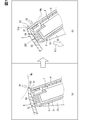
- (a) and (b) show displacements and / or deformations caused by the head Mg colliding with the bezel portion 53.
- (A) shows the primary impact SP.
- the initial shape of the bezel portion 53 extends like an eave.
- the initial shape of the bezel portion 53 extends parallel to the edge portion 61 and protrudes from the surface of the cover member 6.
- (B) shows a secondary impact SS.
- the extension portion 32 and the extension portion 54 are plate-shaped members that extend along the directions of the impact SP and the impact SS. Displacement and deformation of the extension portion 32 and the extension portion 54 in the directions of the impact SP and the impact SS are suppressed, and the initial shape INT is maintained.
- the bezel portion 53 is deformed by the impact SP and has a deformed shape 53a.
- the deformed shape 53a of the bezel portion 53 is a buckling shape curved so as to involve the edge portion 61.
- the initial protrusion amount of the bezel portion 53 in (a) is the amount of protrusion that the shape 53a may slightly cover the surface of the cover member 6 when it is deformed as shown in (b).
- the display 1 itself is rotated by the impact SS in the direction indicated by the arrow VII and sinks. As a whole, the display 1 rotates so as to fall backward of the display 1 while maintaining the shape of the directly related parts, and descends in the direction of gravity.
- the deformation of the bezel portion 53 and the backward displacement of the display 1 suppress the damage of the cover member 6.
- the display main body 101 since a part of the lower region of the display main body 101 is supported by the instrument panel internal member 202 of the vehicle, as shown in FIG. 8, when the occupant head Mg collides, the upper part of the display main body 101 is displayed. The side is displaced so as to draw an arc in the direction of impact, starting from the bolt 22 of the mounting stay 21. At this time, since the reinforcing rib 33 is provided on the back side of the frame 3 to counter the collision of the occupant head Mg at the time of the collision of the vehicle, the display main body 101 is displaced without breaking so as to bend. It is possible to parry the impact force and mitigate the impact on the occupants.
- FIG. 8 shows displacements and / or deformations caused by the head Mg colliding with the display 1.
- A shows the primary impact SP.
- Display 1 rotates in the direction of arrow VIII. In other words, the display 1 rotates so as to fall backward of the display 1 as a whole.
- B shows a secondary impact SS.
- the center point Ri of rotation is the stress concentration point in the bolt 22.
- the visible end of the surrounding member 5 corresponds to a so-called bezel.
- the above-mentioned action and effect can be obtained by projecting the bezel portion 53 toward the visible side from the surface of the cover member 6 so as to be deformable. Therefore, there is little need to increase the width of the visible end portion (that is, the bezel portion 53) of the surrounding member 5. That is, according to the above configuration, it is possible to provide the vehicle display device 100 in which the cover member 6 is hard to break while suppressing the bezel width.
- the collision direction of the occupant's head with respect to the display main body 101 at the time of a collision has a certain width such as from the upper side to the diagonally upper side depending on the mounting position of the display main body 101 in various vehicles, but in the present embodiment. According to the configuration, a stable effect can be obtained regardless of the impact direction, and the common vehicle display device 100 can be deployed in various vehicles.
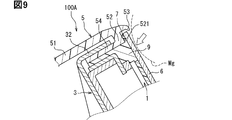
- the vehicle display device 100A of the second embodiment is shown in FIG.
- the shape of the cover receiving portion 52 in the surrounding member 5 is changed and the elastic adhesive member 9 is added to the vehicle display device 100 of the first embodiment. There is.
- the area (vertical dimension) of the cover receiving portion 52 is shortened from the peripheral wall portion 51 side to the position on the lower surface side of the extending portion 54. That is, the area of the receiving surface 521 is reduced.
- the space formed by the display 1, the surrounding member 5 (extended portion 54), and the cover member 6 is filled with the elastic adhesive member 9 because the area of the receiving surface 521 is reduced.
- the elastic adhesive member 9 for example, a silicon-based or urethane-based liquid elastic adhesive is used.
- the elastic adhesive member 9 the same material as the elastic adhesive member 7 or the optical adhesive layer 8 described in the first embodiment may be used.
- the cover member 6 can be received by the surface by the elastic adhesive member 9, so that the impact (local stress due to the impact) can be reduced. Can be done.
- Disclosure in this specification, drawings and the like is not limited to the illustrated embodiments.
- the disclosure includes exemplary embodiments and modifications by those skilled in the art based on them.
- disclosure is not limited to the parts and / or element combinations shown in the embodiments. Disclosure can be carried out in various combinations.
- the disclosure can have additional parts that can be added to the embodiment.
- the disclosure includes the parts and / or elements of the embodiment omitted. Disclosures include replacements or combinations of parts and / or elements between one embodiment and another.
- the technical scope disclosed is not limited to the description of the embodiments. Some technical scopes disclosed are indicated by the claims description and should be understood to include all modifications within the meaning and scope equivalent to the claims description.
- the frame 3 is a metal molded product (die-cast product), and the reinforcing portion in the frame 3 is a reinforcing rib 33 integrally formed with the main body portion 31.
- the present invention is not limited to this, and as in the vehicle display device 100B shown in FIG. 10, the reinforcing portion is a reinforcing plate 33A made of sheet metal parts, and is inclined and joined to the main body portion 31 of the frame 3. It may be a thing.
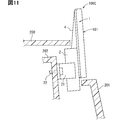
- the thickness direction of the flat box-shaped drawing unit 2 is set to the front-rear direction and arranged on the back side of the lower region of the display main body 101, for example.
- a mounting stay 21 may be provided on the side surface of the drawing unit 2 and fixed to the instrument panel internal member 202.
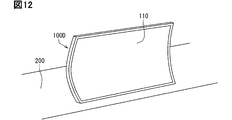
- the vehicle display device may be the vehicle display device 100D shown in FIG. 12 or the vehicle display device 100E shown in FIG.
- the vehicle display devices 100D and 100E are devices having a curved display surface (so-called curved display).
- the bending direction of the display surface is not limited to the direction illustrated in FIG. 12 or FIG. 13, and can be changed as appropriate.
- the display surface 110 is not limited to this and may be vertically long. Further, the display surface 110 is not limited to a rectangle, and may be an ellipse or the like.
- the extension portion 32 of the frame 3 is joined to the extension portion 54 of the surrounding member 5.
- the extension portion 54 may be abolished and the extension portion 32 may be joined to the peripheral wall portion 51 of the surrounding member 5.
- the joining of the frame 3 and the surrounding member 5 may be performed as needed, and may be abolished.
- the frame 3 is made of metal, it may be made of resin.
Landscapes
- Engineering & Computer Science (AREA)
- Mechanical Engineering (AREA)
- Transportation (AREA)
- Chemical & Material Sciences (AREA)
- Combustion & Propulsion (AREA)
- Signal Processing (AREA)
- Multimedia (AREA)
- Physics & Mathematics (AREA)
- General Physics & Mathematics (AREA)
- Theoretical Computer Science (AREA)
- Instrument Panels (AREA)
- Devices For Indicating Variable Information By Combining Individual Elements (AREA)
- Passenger Equipment (AREA)
- Fittings On The Vehicle Exterior For Carrying Loads, And Devices For Holding Or Mounting Articles (AREA)
Applications Claiming Priority (2)
| Application Number | Priority Date | Filing Date | Title |
|---|---|---|---|
| JP2019-079587 | 2019-04-18 | ||
| JP2019079587A JP6988857B2 (ja) | 2019-04-18 | 2019-04-18 | 車両用表示装置 |
Publications (1)
| Publication Number | Publication Date |
|---|---|
| WO2020213251A1 true WO2020213251A1 (ja) | 2020-10-22 |
Family
ID=72838209
Family Applications (1)
| Application Number | Title | Priority Date | Filing Date |
|---|---|---|---|
| PCT/JP2020/006718 Ceased WO2020213251A1 (ja) | 2019-04-18 | 2020-02-20 | 車両用表示装置 |
Country Status (2)
| Country | Link |
|---|---|
| JP (1) | JP6988857B2 (https=) |
| WO (1) | WO2020213251A1 (https=) |
Cited By (2)
| Publication number | Priority date | Publication date | Assignee | Title |
|---|---|---|---|---|
| US20230074923A1 (en) * | 2021-09-06 | 2023-03-09 | Hyundai Mobis Co., Ltd. | Display assembly for vehicle |
| CN117292629A (zh) * | 2022-06-23 | 2023-12-26 | 上海天马微电子有限公司 | 显示设备 |
Families Citing this family (1)
| Publication number | Priority date | Publication date | Assignee | Title |
|---|---|---|---|---|
| JP7678641B2 (ja) * | 2022-02-03 | 2025-05-16 | パナソニックオートモーティブシステムズ株式会社 | 表示装置 |
Citations (9)
| Publication number | Priority date | Publication date | Assignee | Title |
|---|---|---|---|---|
| JPH05165013A (ja) * | 1991-12-17 | 1993-06-29 | Sony Corp | 液晶表示装置 |
| JP2013035424A (ja) * | 2011-08-08 | 2013-02-21 | Toyota Motor Corp | インストルメントパネル構造 |
| US20130169125A1 (en) * | 2011-12-30 | 2013-07-04 | Sony Ericsson Mobile Communications Ab | Corner improvement in window carrier for crack window |
| JP2013205551A (ja) * | 2012-03-28 | 2013-10-07 | Kyocera Corp | 透光性パネル取付構造及び携帯型電子機器 |
| JP2014177149A (ja) * | 2013-03-13 | 2014-09-25 | Mazda Motor Corp | 表示ユニットの取付け構造 |
| JP2015527603A (ja) * | 2012-06-21 | 2015-09-17 | コーニング インコーポレイテッド | その縁に保護支持ブラケットを有する、ディスプレイ内のカバープレート |
| JP2016037173A (ja) * | 2014-08-07 | 2016-03-22 | 日本精機株式会社 | 車両用表示装置 |
| JP2018146805A (ja) * | 2017-03-06 | 2018-09-20 | 京セラ株式会社 | 電子機器 |
| JP2019056790A (ja) * | 2017-09-21 | 2019-04-11 | Necパーソナルコンピュータ株式会社 | 表示装置及び電子機器 |
Family Cites Families (3)
| Publication number | Priority date | Publication date | Assignee | Title |
|---|---|---|---|---|
| JP2013144523A (ja) * | 2012-01-16 | 2013-07-25 | Toyota Motor Corp | インストルメントパネル構造 |
| DE102016200902A1 (de) * | 2016-01-22 | 2017-07-27 | Robert Bosch Gmbh | Bildschirmeinrichtung und Informationsvorrichtung für ein Fahrzeug sowie Verfahren zum Herstellen einer Informationsvorrichtung |
| JP6948883B2 (ja) * | 2017-08-29 | 2021-10-13 | ダイキョーニシカワ株式会社 | 表示装置の取付構造 |
-
2019
- 2019-04-18 JP JP2019079587A patent/JP6988857B2/ja active Active
-
2020
- 2020-02-20 WO PCT/JP2020/006718 patent/WO2020213251A1/ja not_active Ceased
Patent Citations (9)
| Publication number | Priority date | Publication date | Assignee | Title |
|---|---|---|---|---|
| JPH05165013A (ja) * | 1991-12-17 | 1993-06-29 | Sony Corp | 液晶表示装置 |
| JP2013035424A (ja) * | 2011-08-08 | 2013-02-21 | Toyota Motor Corp | インストルメントパネル構造 |
| US20130169125A1 (en) * | 2011-12-30 | 2013-07-04 | Sony Ericsson Mobile Communications Ab | Corner improvement in window carrier for crack window |
| JP2013205551A (ja) * | 2012-03-28 | 2013-10-07 | Kyocera Corp | 透光性パネル取付構造及び携帯型電子機器 |
| JP2015527603A (ja) * | 2012-06-21 | 2015-09-17 | コーニング インコーポレイテッド | その縁に保護支持ブラケットを有する、ディスプレイ内のカバープレート |
| JP2014177149A (ja) * | 2013-03-13 | 2014-09-25 | Mazda Motor Corp | 表示ユニットの取付け構造 |
| JP2016037173A (ja) * | 2014-08-07 | 2016-03-22 | 日本精機株式会社 | 車両用表示装置 |
| JP2018146805A (ja) * | 2017-03-06 | 2018-09-20 | 京セラ株式会社 | 電子機器 |
| JP2019056790A (ja) * | 2017-09-21 | 2019-04-11 | Necパーソナルコンピュータ株式会社 | 表示装置及び電子機器 |
Cited By (3)
| Publication number | Priority date | Publication date | Assignee | Title |
|---|---|---|---|---|
| US20230074923A1 (en) * | 2021-09-06 | 2023-03-09 | Hyundai Mobis Co., Ltd. | Display assembly for vehicle |
| US12304311B2 (en) * | 2021-09-06 | 2025-05-20 | Hyundai Mobis Co., Ltd. | Display assembly for vehicle |
| CN117292629A (zh) * | 2022-06-23 | 2023-12-26 | 上海天马微电子有限公司 | 显示设备 |
Also Published As
| Publication number | Publication date |
|---|---|
| JP2020177146A (ja) | 2020-10-29 |
| JP6988857B2 (ja) | 2022-01-05 |
Similar Documents
| Publication | Publication Date | Title |
|---|---|---|
| JP6950715B2 (ja) | 車両用表示装置 | |
| KR102015035B1 (ko) | 차량용 인스트루먼트 패널 | |
| US8730128B2 (en) | Apparatus for displaying information in a motor vehicle | |
| US20190163232A1 (en) | Automotive display device | |
| JP6988857B2 (ja) | 車両用表示装置 | |
| US11932107B2 (en) | Display apparatus comprising a self-illuminated screen element, motor vehicle comprising a display apparatus, and associated operating method | |
| US12043177B2 (en) | Rear-view mirror device mounted in a vehicle, vehicle-mounted display device, vehicle-mounted display system | |
| JP2024118894A (ja) | 車両用表示装置 | |
| US20180219052A1 (en) | Display system for a vehicle | |
| JP7106223B2 (ja) | 表示装置 | |
| JP7006266B2 (ja) | 表示装置およびルーバーフィルム | |
| WO2022185769A1 (ja) | 表示装置 | |
| JP7521459B2 (ja) | 表示装置 | |
| JP2024124177A (ja) | 車両用表示装置 | |
| JP2024148830A (ja) | 車両用表示装置 | |
| JP2018158632A (ja) | 表示装置 | |
| JP7375729B2 (ja) | 表示装置 | |
| JP2016060333A (ja) | 表示装置 | |
| JP7472876B2 (ja) | 表示装置 | |
| JP7853824B2 (ja) | 表示装置 | |
| JP2024147309A (ja) | 車両用表示装置 | |
| JP2010097080A (ja) | フラットパネルディスプレイ装置 | |
| JP2024058994A (ja) | 表示装置 | |
| JP2009109886A (ja) | 表示装置 | |
| JP7077937B2 (ja) | 車両用表示装置 |
Legal Events
| Date | Code | Title | Description |
|---|---|---|---|
| 121 | Ep: the epo has been informed by wipo that ep was designated in this application |
Ref document number: 20790890 Country of ref document: EP Kind code of ref document: A1 |
|
| NENP | Non-entry into the national phase |
Ref country code: DE |
|
| 122 | Ep: pct application non-entry in european phase |
Ref document number: 20790890 Country of ref document: EP Kind code of ref document: A1 |