WO2020208988A1 - モータ及び電気機器 - Google Patents
モータ及び電気機器 Download PDFInfo
- Publication number
- WO2020208988A1 WO2020208988A1 PCT/JP2020/010039 JP2020010039W WO2020208988A1 WO 2020208988 A1 WO2020208988 A1 WO 2020208988A1 JP 2020010039 W JP2020010039 W JP 2020010039W WO 2020208988 A1 WO2020208988 A1 WO 2020208988A1
- Authority
- WO
- WIPO (PCT)
- Prior art keywords
- fixing member
- magnet
- permanent magnet
- gap
- rotor core
- Prior art date
- Legal status (The legal status is an assumption and is not a legal conclusion. Google has not performed a legal analysis and makes no representation as to the accuracy of the status listed.)
- Ceased
Links
Images








Classifications
-
- H—ELECTRICITY
- H02—GENERATION; CONVERSION OR DISTRIBUTION OF ELECTRIC POWER
- H02K—DYNAMO-ELECTRIC MACHINES
- H02K7/00—Arrangements for handling mechanical energy structurally associated with dynamo-electric machines, e.g. structural association with mechanical driving motors or auxiliary dynamo-electric machines
- H02K7/04—Balancing means
-
- H—ELECTRICITY
- H02—GENERATION; CONVERSION OR DISTRIBUTION OF ELECTRIC POWER
- H02K—DYNAMO-ELECTRIC MACHINES
- H02K1/00—Details of the magnetic circuit
- H02K1/06—Details of the magnetic circuit characterised by the shape, form or construction
- H02K1/22—Rotating parts of the magnetic circuit
- H02K1/27—Rotor cores with permanent magnets
- H02K1/2706—Inner rotors
- H02K1/272—Inner rotors the magnetisation axis of the magnets being perpendicular to the rotor axis
- H02K1/274—Inner rotors the magnetisation axis of the magnets being perpendicular to the rotor axis the rotor consisting of two or more circumferentially positioned magnets
- H02K1/2753—Inner rotors the magnetisation axis of the magnets being perpendicular to the rotor axis the rotor consisting of two or more circumferentially positioned magnets the rotor consisting of magnets or groups of magnets arranged with alternating polarity
- H02K1/276—Magnets embedded in the magnetic core, e.g. interior permanent magnets [IPM]
-
- H—ELECTRICITY
- H02—GENERATION; CONVERSION OR DISTRIBUTION OF ELECTRIC POWER
- H02K—DYNAMO-ELECTRIC MACHINES
- H02K1/00—Details of the magnetic circuit
- H02K1/06—Details of the magnetic circuit characterised by the shape, form or construction
- H02K1/22—Rotating parts of the magnetic circuit
- H02K1/28—Means for mounting or fastening rotating magnetic parts on to, or to, the rotor structures
-
- H—ELECTRICITY
- H02—GENERATION; CONVERSION OR DISTRIBUTION OF ELECTRIC POWER
- H02K—DYNAMO-ELECTRIC MACHINES
- H02K21/00—Synchronous motors having permanent magnets; Synchronous generators having permanent magnets
- H02K21/12—Synchronous motors having permanent magnets; Synchronous generators having permanent magnets with stationary armatures and rotating magnets
- H02K21/14—Synchronous motors having permanent magnets; Synchronous generators having permanent magnets with stationary armatures and rotating magnets with magnets rotating within the armatures
- H02K21/16—Synchronous motors having permanent magnets; Synchronous generators having permanent magnets with stationary armatures and rotating magnets with magnets rotating within the armatures having annular armature cores with salient poles
Definitions
- This disclosure relates to motors and electrical equipment.
- Motors are used in various electrical devices. For example, in an electric blower mounted on a vacuum cleaner, a motor is used to rotate a rotating fan.
- a motor of this type an IPM (Interior Permanent Magnet) motor having a rotor in which a permanent magnet is embedded in a rotor core is known.
- IPM Interior Permanent Magnet
- the relaxation torque due to the unevenness of the magnitude of the reluctance generated in the rotor core can be obtained. Therefore, a compact and highly efficient motor can be realized.
- a permanent magnet is arranged in the magnet insertion hole formed in the rotor core.
- the permanent magnet and the rotor core arranged in the magnet insertion hole may be fixed by an adhesive.
- a method of adhering and fixing a permanent magnet and a rotor core using an adhesive for example, a method of arranging a permanent magnet in a magnet insertion hole and filling a gap between the permanent magnet and the rotor core with an adhesive is known. There is. Further, a method of inserting a permanent magnet having an adhesive sheet attached to the entire circumference into a magnet insertion hole is also known (see Patent Document 1).
- a gap is provided as a play between the permanent magnet arranged in the magnet insertion hole and the rotor core so that the permanent magnet does not break when the magnet is inserted into the magnet insertion hole.
- the adhesive fixing position of the permanent magnet in the magnet insertion hole when the adhesive is injected into the gap to bond and fix the permanent magnet. May vary.
- the amount of adhesive injected into each magnet insertion hole may vary. As described above, when the adhesive fixing position of the permanent magnet and the injection amount of the adhesive vary, an imbalance of the magnetic flux generated in the rotor occurs and the vibration of the motor increases.
- the present disclosure has been made to solve such a problem, and an object of the present disclosure is to provide a low-vibration motor and electrical equipment having excellent productivity.
- one aspect of the motor according to the present disclosure has a rotor core in which a magnet insertion hole is formed and a permanent magnet arranged in the magnet insertion hole, and rotates about an axis. It includes a rotor, a stator facing the rotor, and a fixing member for fixing a permanent magnet in a magnet insertion hole formed in the rotor core.
- the fixing member includes a protrusion fitted in the gap between the rotor core and the permanent magnet.
- the permanent magnet is in contact with the inner surface located on the outer side of the inner surface included in the magnet insertion hole when viewed from the direction in which the axis extends.
- the fixing member may be a balance weight.
- the permanent magnet is plate-shaped and has a side surface of the first magnet which is one side surface in the width direction of the permanent magnet, a side surface of the second magnet which is the side surface of the other side in the width direction of the permanent magnet, and a permanent magnet. It is preferable to include a first magnet main surface which is a main surface on one side in the thickness direction and a second magnet main surface which is a main surface on the other side in the thickness direction of the permanent magnet.
- the magnet insertion hole is a first hole main surface which is an inner surface in the radial direction intersecting the axial center of the rotor core as an inner surface of the rotor core in the magnet insertion hole, and a first surface which is one side of the magnet insertion hole.
- the permanent magnet is preferably arranged in the magnet insertion hole so that the main surface of the first magnet is located inside the main surface of the second magnet in the radial direction of the axis of the rotor core.
- the gap is between the first gap, which is the gap between the side surface of the first magnet and the side surface of the first hole, and the side surface of the second magnet and the side surface of the second hole.
- a second gap portion which is a gap between the two magnets and a third gap portion which is a gap between the main surface of the first magnet and the main surface of the first hole.
- first gap portion and the second gap portion may be a flux barrier.
- the fixing member has a first convex portion fitted in the first gap portion and a second convex portion fitted in the second gap portion as the convex portion.
- the permanent magnet may be trapezoidal when the rotor is viewed from the direction in which the axis extends.
- the radial outer side of the rotor core in the permanent magnet may be larger than the radial inner side of the rotor core in the permanent magnet.
- the convex portion is fitted in the third gap portion.
- the rotor core may be provided with a recess that is recessed in a stepped shape from the opening surface of the magnet insertion hole as a part of the third gap portion.
- the convex portion may be fitted into the concave portion.
- the third gap portion and the convex portion may be elongated along the main surface of the first magnet of the permanent magnet.
- the rotor has a shaft that penetrates the rotor core. It is preferable that the fixing member is provided with a through hole through which the shaft penetrates. The fixing member preferably faces a surface in the axial direction of the shaft.
- the motor may include, as a fixing member, a first fixing member facing one surface in the axial direction of the shaft and a second fixing member facing the other surface in the axial direction of the shaft.
- a plurality of magnet insertion holes may be provided along the circumferential direction of the rotor core.
- a plurality of convex portions may be provided corresponding to each of the plurality of permanent magnets.
- the fixing member is made of a non-magnetic material.
- non-magnetic material is preferably a thermoplastic resin.
- the rotor core and the permanent magnet are harder than the convex portion.
- one aspect of the electrical equipment according to the present disclosure includes any of the above motors.
- the permanent magnet is fixed to the rotor core at a predetermined position in the magnet insertion hole without using an adhesive. can do. Therefore, it is possible to realize a low-vibration motor having excellent productivity and an electric device provided with this motor.
- FIG. 1 is a cross-sectional view of the motor according to the embodiment.
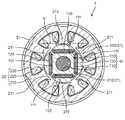
- FIG. 2 is a cross-sectional view of the motor in line II-II of FIG.
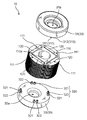
- FIG. 3 is a perspective view of a rotor and a fixing member used in the motor according to the embodiment.
- FIG. 4 is an exploded perspective view of a rotor and a fixing member used in the motor according to the embodiment.
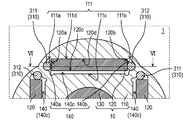
- FIG. 5 is a partially enlarged cross-sectional view of a rotor used in the motor according to the embodiment.
- FIG. 6 is a cross-sectional view of the rotor in the VI-VI line of FIG.
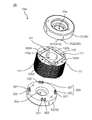
- FIG. 7 is an exploded perspective view of a rotor and a fixing member used in the motor according to the first modification.
- FIG. 1 is a cross-sectional view of the motor according to the embodiment.
- FIG. 2 is a cross-sectional view of the motor in line II-II of FIG.
- FIG. 3 is a perspective view of a
- FIG. 8 is a partially enlarged cross-sectional view of the rotor used in the motor according to the first modification.
- FIG. 9 is a diagram showing a state when a permanent magnet is assembled to the rotor core in the motor according to the first modification.
- FIG. 10 is a partially enlarged cross-sectional view of a rotor used in the motor according to the second modification.
- FIG. 11 is a perspective view of the first fixing member used in the motor according to the second modification.
- FIG. 12 is a cross-sectional view of a rotor used in another motor according to the second modification.
- FIG. 13 is a partially enlarged cross-sectional view of the rotor used in the motor according to the modified example 3.
- FIG. 14 is a cross-sectional view of a rotor used in the motor according to the modified example 4.
- FIG. 15 is a partially enlarged cross-sectional view of the rotor used in the motor according to the modified example 5.
- FIG. 16 is a partially enlarged cross-sectional view of the rotor used in the motor according to the modified example 6.
- FIG. 17 is a diagram showing an electric device including a motor.
- each figure is a schematic view and is not necessarily exactly illustrated.
- substantially the same configuration is designated by the same reference numerals, and duplicate description will be omitted or simplified.
- FIG. 1 is a cross-sectional view of the motor 1 according to the embodiment.
- FIG. 2 is a cross-sectional view of the motor 1 in line II-II of FIG.
- the motor 1 in the present embodiment can be used, for example, as a fan motor of an electric blower mounted on a vacuum cleaner.
- the motor 1 includes a rotor 10, a stator 20, and a fixing member 30.
- the motor 1 further includes a first bearing 41, a second bearing 42, a first bracket 51, and a second bracket 52.
- the motor 1 in the present embodiment is an inner rotor type electric motor in which the rotor 10 is arranged inside the stator 20. That is, the stator 20 is arranged so as to surround the rotor 10. The stator 20 faces the rotor 10.
- the rotor 10 (rotor) is arranged inside the stator 20 via a small air gap with the stator 20.
- the rotor 10 has a configuration in which a plurality of N poles and S poles are repeatedly present in the circumferential direction.
- the rotor 10 rotates about the axis C by the magnetic force generated in the stator 20.
- the rotor 10 has a rotor core 110, a permanent magnet 120, and a shaft 130.
- the rotor core 110 is a laminated body in which a plurality of steel plates are laminated in the direction of the axial center C of the shaft 130 (axial center direction).
- Each of the plurality of steel plates is, for example, a punched electromagnetic steel plate having a predetermined shape.
- the plurality of steel plates are fixed to each other by, for example, caulking.
- the permanent magnet 120 is composed of a sintered magnet.
- the permanent magnet 120 is embedded in the rotor core 110. That is, the motor 1 is an IPM motor having a rotor 10 in which a permanent magnet 120 is embedded in a rotor core 110. A plurality of permanent magnets 120 are embedded in the rotor core 110.
- the shaft 130 (rotating shaft) is, for example, a metal rod, and extends along the axis C.
- the shaft 130 is fixed to the rotor core 110.
- the shaft 130 is inserted into a through hole 110a provided in the center of the rotor core 110 so as to extend on both sides of the rotor core 110 in the axial direction.
- the shaft 130 is fixed to the rotor core 110 by, for example, press-fitting or shrink-fitting into the through hole 110a of the rotor core 110.
- the rotor 10 configured in this way rotates about the axis C of the shaft 130 as the center of rotation. That is, the shaft 130 becomes the center when the rotor 10 rotates.
- the details of the rotor 10 will be described later.
- the stator 20 (stator) is arranged so as to surround the rotor 10 with a small air gap between the stator 20 and the rotor 10.
- the stator 20 generates a magnetic force acting on the rotor 10.
- the stator 20 has a stator core 210 (stator core), a winding coil 220, and an insulator 230.
- the stator core 210 is a laminated body in which a plurality of steel plates are laminated along the direction of the axis C of the shaft 130. Each of the plurality of steel plates is, for example, a punched electromagnetic steel plate having a predetermined shape.
- the stator core 210 is not limited to the laminated body, and may be a bulk body made of a magnetic material. As shown in FIG. 2, the stator core 210 is provided with a plurality of teeth 211 protruding toward the rotor core 110 of the rotor 10. The plurality of teeth 211 are arranged at equal intervals in the circumferential direction while forming slots which are openings between the teeth 211.
- the winding coil 220 is a stator coil, and is wound around each of a plurality of teeth 211 provided on the stator core 210 via an insulator 230.
- Each winding coil 220 is composed of three-phase unit coils of U-phase, V-phase, and W-phase, which are electrically different from each other by 120 degrees. That is, the winding coil 220 wound around the teeth 211 is energized and driven by three-phase alternating current that is energized in units of U-phase, V-phase, and W-phase.
- the insulator 230 is made of an insulating resin material and covers the teeth 211 of the stator core 210.
- the insulator 230 is provided on each tooth 211.
- the fixing member 30 is a member that fixes the permanent magnet 120 to the rotor core 110.
- the permanent magnet 120 is held by the rotor core 110 by being fixed to the rotor core 110 by the fixing member 30.
- the fixing member 30 is attached to the shaft 130. Therefore, the fixing member 30 rotates together with the rotor core 110 as the shaft 130 rotates.
- the fixing member 30 is a balance weight for adjusting the weight balance of the rotor 10. That is, the permanent magnet 120 is fixed to the rotor core 110 by using the existing balance weight.
- the balance weight is an adjusting member for adjusting the weight balance of the rotor 10 by cutting out a part of the outer peripheral portion of the balance weight by cutting or the like. By using the balance weight, it is possible to eliminate the eccentricity of the rotor 10 and rotate the rotor 10 in a well-balanced manner around the shaft 130 (rotating shaft).
- the first fixing member 31 and the second fixing member 32 are arranged as the fixing member 30.
- the first fixing member 31 faces one surface of the rotor core 110 in the axial direction of the shaft 130.
- the second fixing member 32 faces the other surface of the rotor core 110 in the axial direction of the shaft 130.
- the rotor core 110 is sandwiched between the first fixing member 31 and the second fixing member 32.
- each permanent magnet 120 is sandwiched between the first fixing member 31 and the second fixing member 32 and fixed to the rotor core 110.
- the first fixing member 31 and the second fixing member 32 are in contact with the rotor core 110.
- the first fixing member 31 is provided with a through hole 31a through which the shaft 130 penetrates.
- the second fixing member 32 is provided with a through hole 32a through which the shaft 130 penetrates.
- the first fixing member 31 and the second fixing member 32 are fixed to the shaft 130 by press fitting, for example, but the fixing method between the first fixing member 31 and the second fixing member 32 and the shaft 130 is not limited to this. ..
- the detailed configuration of the first fixing member 31 and the second fixing member 32 will be described later.
- the first bearing 41 and the second bearing 42 are bearings that rotatably hold the shaft 130.
- the first bearing 41 supports a portion of the shaft 130 that protrudes from one side of the rotor core 110.
- the second bearing 42 supports a portion of the rotor core 110 that protrudes from the other side.
- ball bearings are used for the first bearing 41 and the second bearing 42, other bearings such as thrust bearings can also be used.
- the first bracket 51 holds the first bearing 41. Specifically, the first bearing 41 is fixed to the recess provided in the first bracket 51.
- the second bracket 52 holds the second bearing 42. Specifically, the second bearing 42 is fixed to the recess provided in the second bracket 52.
- the first bracket 51 and the second bracket 52 are made of, for example, a metal material.
- the first bracket 51 and the second bracket 52 constitute the outer shell of the motor 1.
- the first bracket 51 is a frame (housing) having an opening.
- the second bracket 52 is a lid that closes the opening of the first bracket 51.
- the shaft 130 penetrates the first bracket 51. A part of the shaft 130 projects outward from the first bracket 51.
- a load such as a rotary fan is attached to a portion of the shaft 130 that protrudes outward from the first bracket 51. That is, in the shaft 130, the portion protruding from the first bracket 51 is the output shaft.
- stator 20 when the winding coil 220 of the stator 20 is energized, a field current flows through the winding coil 220 and magnetic flux is generated in the stator 20 (stator core 210).
- stator 20 stator core 210
- the magnetic force generated by the interaction between the magnetic flux of the stator 20 and the magnetic flux generated from the permanent magnet 120 of the rotor 10 becomes the torque for rotating the rotor 10, and the rotor 10 rotates.
- FIG. 3 is a perspective view of the rotor 10 and the fixing member 30 used in the motor 1 according to the embodiment.
- FIG. 4 is an exploded perspective view of the rotor 10 and the fixing member 30 used in the motor 1.
- FIG. 5 is a partially enlarged cross-sectional view of the rotor 10.
- FIG. 6 is a cross-sectional view of the rotor 10 along the VI-VI line of FIG. In FIG. 4, the shaft 130 is omitted.
- FIG. 5 shows an enlarged view of only the rotor 10 in the region V surrounded by the broken line in FIG.
- the rotor 10 has a rotor core 110, a permanent magnet 120 embedded in the rotor core 110, and a shaft 130 inserted into the through hole 110a of the rotor core 110.
- a plurality of magnet insertion holes 111 are formed in the rotor core 110 as magnet embedding holes in which the permanent magnets 120 are embedded and arranged.
- the plurality of magnet insertion holes 111 are provided along the circumferential direction of the rotor core 110. Specifically, the plurality of magnet insertion holes 111 are provided near the inside of the outer peripheral surface of the rotor core 110 at equal intervals along the rotation direction of the rotor core 110.
- Four magnet insertion holes 111 are provided. The four magnet insertion holes 111 are arranged so as to form a regular polygon (square in the present embodiment) when viewed from above.
- Each magnet insertion hole 111 is a through hole that penetrates the rotor core 110 along the longitudinal direction of the shaft 130 (the direction of the axis C). Therefore, each magnet insertion hole 111 is opened at both end surfaces of the shaft 130 in the rotor core 110 in the longitudinal direction.
- the opening shape of each magnet insertion hole 111 is, for example, a slit shape.
- the arbitrary cross-sectional shape of each magnet insertion hole 111 when cut in a plane whose normal direction is the longitudinal direction of the shaft 130 is the same as the opening shape and is slit-shaped.
- Each magnet insertion hole 111 has a first hole side surface 111a, which is one side surface of the magnet insertion hole 111, and the other side of the magnet insertion hole 111, as the inner surface of the rotor core 110 in the magnet insertion hole 111.
- the second hole side surface 111b which is a surface
- the first hole main surface 111c which is the inner surface of the rotor core 110 in the radial direction (the radial direction of the rotor 10)
- the second hole which is the outer surface of the rotor core 110 in the radial direction.
- Permanent magnets 120 are arranged in each of the plurality of magnet insertion holes 111. One permanent magnet 120 is inserted into each magnet insertion hole 111. Since the rotor core 110 is provided with four magnet insertion holes 111, four permanent magnets 120 are embedded in the rotor core 110. The plurality of permanent magnets 120 are arranged at equal intervals along the circumferential direction of the rotor core 110, similarly to the plurality of magnet insertion holes 111. Each permanent magnet 120 is magnetized, and the permanent magnet 120 is arranged so that the magnetic poles of the S pole and the N pole alternately exist in the circumferential direction of the rotor 10.
- the rotor 10 has a plurality of magnetic poles at equal intervals along the circumferential direction of the rotor core 110.
- the permanent magnet 120 may be magnetized after being placed in the magnet insertion hole 111, or the permanent magnet 120 may be magnetized in advance before being inserted into the magnet insertion hole 111. May be good. However, considering the workability of inserting the permanent magnet 120 into the magnet insertion hole 111, it is better to magnetize the permanent magnet 120 after inserting it into the magnet insertion hole 111.
- Each permanent magnet 120 has a plate shape.
- the permanent magnet 120 is a thin plate-shaped rectangular parallelepiped, and has a rectangular shape in a plan view. Therefore, the cross-sectional shape of the permanent magnet 120 when cut in a plane whose normal direction is the longitudinal direction of the shaft 130 is rectangular.
- the plate-shaped permanent magnet 120 includes a first magnet side surface 120a which is one side surface of the permanent magnet 120 in the width direction, a second magnet side surface 120b which is the other side surface of the permanent magnet 120 in the width direction, and a permanent magnet. It has a first magnet main surface 120c which is a main surface on one side in the thickness direction of 120, and a second magnet main surface 120d which is a main surface on the other side in the thickness direction of the permanent magnet 120.
- Each permanent magnet 120 is arranged in the magnet insertion hole 111 so that the thickness direction is the radial direction of the rotor core 110. Specifically, each permanent magnet 120 is arranged in the magnet insertion hole 111 so that the first magnet main surface 120c is located inside the rotor core 110 in the radial direction with respect to the second magnet main surface 120d. Therefore, in each permanent magnet 120, the first magnet main surface 120c is located inside the rotor core 110 in the radial direction, and the second magnet main surface 120d is located outside the rotor core 110 in the radial direction.
- Each permanent magnet 120 is arranged in the magnet insertion hole 111 closer to the outer side (outer peripheral side) in the radial direction of the rotor core 110. Each permanent magnet 120 is in contact with the radial outer inner surface of the rotor core 110 in the magnet insertion hole 111. Specifically, the second magnet main surface 120d of the permanent magnet 120 is in surface contact with the second hole main surface 111d of the magnet insertion hole 111.
- a gap 140 (clearance) exists between the rotor core 110 and the permanent magnet 120 in a state where the permanent magnet 120 is arranged in the magnet insertion hole 111.
- the gap 140 is between the first gap portion 140a, which is the gap between the first magnet side surface 120a and the first hole side surface 111a, and the second magnet side surface 120b and the second hole side surface 111b. It includes a second gap portion 140b which is a gap and a third gap portion 140c which is a gap between the first magnet main surface 120c and the first hole main surface 111c.
- the first gap 140a and the second gap 140b are flux barriers (magnetic barriers) for preventing magnetic flux leakage. That is, the first gap portion 140a and the second gap portion 140b have a function of suppressing or blocking the passage of magnetic flux generated from the permanent magnet 120 arranged in the magnet insertion hole 111.
- the third gap 140c is, for example, a slit-shaped gap having a width of 0.2 mm or less. The width of the third gap 140c is 0.05 mm.
- the first fixing member 31 has a convex portion 310 that is fitted into the gap 140 between the rotor core 110 and the permanent magnet 120.
- the permanent magnet 120 can be fixed to the rotor core 110 by fitting the convex portion 310 of the first fixing member 31 into the gap 140. That is, the convex portion 310 of the first fixing member 31 has a shape and size that can be press-fitted into the gap 140. As a result, the permanent magnet 120 can be fixed to the rotor core 110 by the reaction force when the convex portion 310 of the first fixing member 31 is pushed into the gap 140 by press fitting.
- the first fixing member 31 has, as the convex portion 310, a first convex portion 311 fitted in the first gap portion 140a of the gap 140 and a second convex portion 312 fitted in the second gap portion 140b of the gap 140.
- the first convex portion 311 and the second convex portion 312 are fitted by using the first gap portion 140a and the second gap portion 140b which are flux barriers, and the pair of first convex portion 311 and second convex portion 312 are used.
- the permanent magnet 120 is fixed to the rotor core 110 so as to sandwich the permanent magnet 120.
- the first convex portion 311 is fitted into the first gap portion 140a by light press fitting.
- the second convex portion 312 is fitted into the second gap portion 140b by light press fitting.
- the first convex portion 311 and the second convex portion 312 of the first fixing member 31 are, for example, shells formed so as to project from the disk-shaped base portion (weight portion) of the first fixing member 31 toward the rotor core 110. It is a protrusion of the shape.
- a plurality of convex portions 310 of the first fixing member 31 are provided corresponding to each of the plurality of permanent magnets 120. That is, a plurality of convex portions 310 are provided corresponding to each of the plurality of magnet insertion holes 111. A pair of first convex portions 311 and second convex portions 312 are fitted in one magnet insertion hole 111. Therefore, the first fixing member 31 is provided with a pair of first convex portions 311 and second convex portions 312 as many as the number of magnet insertion holes 111 provided in the rotor core 110. In the present embodiment, since the four magnet insertion holes 111 are provided, four pairs of the first convex portion 311 and the second convex portion 312 are also provided. That is, the first fixing member 31 is provided with four first convex portions 311 and four second convex portions 312.
- the second fixing member 32 has a convex portion 320 fitted in the gap 140 between the rotor core 110 and the permanent magnet 120, similarly to the first fixing member 31.
- the permanent magnet 120 can be fixed to the rotor core 110 by fitting the convex portion 320 of the second fixing member 32 into the gap 140. That is, the convex portion 320 of the second fixing member 32 has a shape and size that can be press-fitted into the gap 140. As a result, the permanent magnet 120 can be fixed to the rotor core 110 by the reaction force when the convex portion 320 of the second fixing member 32 is pushed into the gap 140 by press fitting.
- the second fixing member 32 has, as the convex portion 320, a first convex portion 321 fitted in the first gap portion 140a of the gap 140 and a second convex portion 322 fitted in the second gap portion 140b of the gap 140.
- the first convex portion 321 and the second convex portion 322 are fitted by using the first gap portion 140a and the second gap portion 140b which are flux barriers, and the pair of first convex portions 321 and the second convex portion 322 are used.
- the permanent magnet 120 is fixed to the rotor core 110 so as to sandwich the permanent magnet 120.
- the first convex portion 321 is fitted into the first gap portion 140a by light press fitting.
- the second convex portion 322 is fitted into the second gap portion 140b by light press fitting.
- the first convex portion 321 and the second convex portion 322 of the second fixing member 32 are, for example, shells formed so as to project from the disk-shaped base portion (weight portion) of the second fixing member 32 toward the rotor core 110. It is a protrusion of the shape.
- a plurality of convex portions 320 of the second fixing member 32 are provided corresponding to each of the plurality of permanent magnets 120 and the plurality of magnet insertion holes 111. Further, a pair of first convex portions 321 and second convex portions 322 are fitted in one magnet insertion hole 111. Therefore, the second fixing member 32 is provided with a pair of first convex portions 321 and second convex portions 322 as many as the number of magnet insertion holes 111 provided in the rotor core 110. In the present embodiment, since the four magnet insertion holes 111 are provided, four pairs of the first convex portion 321 and the second convex portion 322 are also provided. That is, the second fixing member 32 is also provided with four first convex portions 321 and four second convex portions 322, similarly to the first fixing member 31.
- the convex portion 320 (first convex portion 321 and second convex portion 322) of the second fixing member 32 is on the opposite side of the convex portion 310 (first convex portion 311 and second convex portion 312) of the first fixing member 31. It is fitted in the gap 140. That is, in the present embodiment, the permanent magnet 120 is fixed to the rotor core 110 by the first fixing member 31 and the second fixing member 32 that sandwich the rotor core 110. Specifically, one end of the permanent magnet 120 in the longitudinal direction of the shaft 130 is fixed by the first fixing member 31. The other end of the permanent magnet 120 in the longitudinal direction of the shaft 130 is fixed by the second fixing member 32.
- the top view shape of the first fixing member 31 and the second fixing member 32 is circular.
- the outer diameters of the first fixing member 31 and the second fixing member 32 are substantially the same as the outer diameter of the rotor core 110.
- the first fixing member 31 and the second fixing member 32 may be made of a non-magnetic material such as resin or metal (aluminum, brass, stainless steel, etc.). Further, the first fixing member 31 and the second fixing member 32 may be made of a composite of resin and metal. For example, the weight portions of the first fixing member 31 and the second fixing member 32 may be made of resin, and metal pins may be used as the convex portions 310 and the convex portions 320. In this case, for example, the first fixing member 31 and the second fixing member 32 can be manufactured by insert molding.
- the first fixing member 31 and the second fixing member 32 are entirely made of a thermoplastic resin. That is, both the base portion of the first fixing member 31 and the second fixing member 32 and the convex portion 310 and the convex portion 320 are made of a thermoplastic resin.
- the hardness of the convex portion 310 of the first fixing member 31 and the hardness of the convex portion 320 of the second fixing member 32 may be smaller than the hardness of either the rotor core 110 or the permanent magnet 120. That is, the convex portion 310 of the first fixing member 31 and the convex portion 320 of the second fixing member 32 may be made of a material softer than the rotor core 110 and the permanent magnet 120.
- the hardness of the convex portion 310 of the first fixing member 31 and the hardness of the convex portion 320 of the second fixing member 32 can be expressed by, for example, elastic modulus or Vickers hardness.
- the first fixing member 31 and the second fixing member 32 have the same shape and the same material. That is, the first fixing member 31 and the second fixing member 32 are the same resin molded parts.
- the motor 1 has a rotor core 110 in which the magnet insertion hole 111 is formed, and a permanent magnet 120 arranged in the magnet insertion hole 111, and has an axial center. It includes a rotor 10 that rotates around the center, a stator 20 that faces the rotor 10, and a fixing member 30 that fixes the permanent magnet 120 in the magnet insertion hole 111.
- the fixing member 30 includes a convex portion 310 fitted in a gap 140 between the rotor core 110 and the permanent magnet 120.
- the stator 20 is wound around each of a stator core 210 in which a plurality of steel plates are laminated, a plurality of teeth 211 provided on the stator core 210 and projecting toward the rotor core 110, and the plurality of teeth 211. It also has a winding coil 220.
- the permanent magnet 120 is placed at a predetermined position of the magnet insertion hole 111 without using an adhesive. Can be fixed to the rotor core 110.
- the permanent magnet 120 can be fixed without using an adhesive. Therefore, the productivity of the motor 1 is improved.
- no adhesive since no adhesive is used, it is possible to reduce the unbalanced amount of the rotor due to the variation in the adhesive fixing position of the permanent magnet 120 and the variation in the injection amount of the adhesive, so that the vibration of the motor 1 can be suppressed. .. Therefore, it is possible to realize a low-vibration motor 1 having excellent productivity.
- the first fixing member 31 is provided with a through hole 31a through which the shaft 130 penetrates, and the first fixing member 31 is the axial center C of the shaft 130 of the rotor core 110. Facing the plane in the direction.
- the first fixing member 31 can be inserted into the shaft 130 and faced with the surface of the rotor core 110 in the direction of the axis C of the shaft 130 to fix the first fixing member 31 to the shaft 130.
- the permanent magnet 120 can be more reliably fixed by the first fixing member 31 fixed to the shaft 130.
- the fixing member 30 facing one surface in the direction of the axis C of the shaft 130 of the rotor core 110 and the rotor core 110
- a second fixing member 32 facing the other surface in the direction of the axis C of the shaft 130 of the shaft 130 is provided.
- the permanent magnet 120 inserted into the magnet insertion hole 111 can be fixed with the rotor core 110 sandwiched between the first fixing member 31 and the second fixing member 32.
- the permanent magnet 120 can be fixed by the first fixing member 31 and the second fixing member 32 in a state of being sandwiched from the direction of the axis C of the shaft 130. Therefore, the permanent magnet 120 can be more reliably fixed to the rotor core 110.
- the permanent magnet 120 is in contact with the inner surface of the inner surface included in the magnet insertion hole 111, which is located outside in the radial direction of the rotor core 110, when viewed from the direction in which the axis C extends. .. Specifically, the second magnet main surface 120d of the permanent magnet 120 and the second hole main surface 111d of the magnet insertion hole 111 are in surface contact with each other.
- the permanent magnet 120 can be positioned outside the magnet insertion hole 111 in the initial state. Therefore, it is possible to suppress deterioration of performance characteristics due to misalignment of the permanent magnet 120. This point will be described below.
- the fixed positions of the permanent magnets 120 in the magnet insertion holes 111 may vary.
- the permanent magnet 120 by locating the permanent magnet 120 in advance on the outer side in the radial direction of the magnet insertion hole 111 in the initial state, even if a centrifugal force acts on the permanent magnet 120, Further, the permanent magnet 120 cannot move outward in the radial direction. As a result, it is possible to prevent variations in the fixed positions of the permanent magnets 120 in the magnet insertion holes 111. Therefore, it is possible to suppress deterioration of performance characteristics due to misalignment of the permanent magnet 120.
- the fixing member 30 in the present embodiment is a balance weight.
- the first fixing member 31 and the second fixing member 32 are both balance weights.
- the permanent magnet 120 can be fixed to the rotor core 110 by using the balance weight. That is, the first fixing member 31 and the second fixing member 32 in the present embodiment have a function of adjusting the balance of the rotor and a function of fixing the permanent magnet 120. Therefore, the permanent magnet 120 can be fixed to the rotor core 110 without adding a fixing member only for fixing the permanent magnet 120. Further, the imbalance of the rotor 10 can be reduced by cutting a part of the first fixing member 31 and the second fixing member 32, which are balance weights, to correct the unbalance amount of the rotor 10. Therefore, the motor 1 with even lower vibration can be realized.
- the permanent magnet 120 is fixed by the fixing member 30 by using the flux barrier provided in the magnet insertion hole 111.
- the gap 140 is a first gap 140a which is a gap between the first magnet side surface 120a of the permanent magnet 120 and the first hole side surface 111a of the magnet insertion hole 111.
- the second gap 140b which is a gap between the second magnet side surface 120b of the permanent magnet 120 and the second hole side surface 111b of the magnet insertion hole 111, the first magnet main surface 120c of the permanent magnet 120, and the magnet insertion hole. It includes a third gap portion 140c which is a gap between the first hole main surface 111c and 111.
- the first gap portion 140a and the second gap portion 140b are flux barriers.
- the first fixing member 31 has a first convex portion 311 fitted into the first gap portion 140a which is a flux barrier and a second convex portion 312 fitted into the second gap portion 140b which is a flux barrier as the convex portion 310. And have.
- the second fixing member 32 has a first convex portion 321 fitted in the first gap portion 140a which is a flux barrier and a second convex portion 321 which is a flux barrier as a convex portion 320. It has a second convex portion 322 fitted in the gap portion 140b.
- the convex portion 310 of the first fixing member 31 and the convex portion 320 of the second fixing member 32 are fitted by using the first gap portion 140a and the second gap portion 140b which are flux barriers.
- the permanent magnet 120 is fixed to the rotor core 110 without adhesive without separately forming a gap or a recess in the rotor core 110 only for fitting the convex portion 310 of the fixing member 31 and the convex portion 320 of the second fixing member 32. be able to. As a result, the permanent magnet 120 can be fixed at low cost.
- the first fixing member 31 and the second fixing member 32 are made of a non-magnetic material.
- the permanent magnet 120 can be fixed by the first fixing member 31 and the second fixing member 32 without affecting the performance of the rotor 10.
- thermoplastic resin is used as a non-magnetic material. That is, the first fixing member 31 and the second fixing member 32 are made of a thermoplastic resin.
- the convex portion 310 of the first fixing member 31 and the convex portion 320 of the second fixing member 32 can be provided with an appropriate elastic force, so that the convex portion 310 and the second fixing member of the first fixing member 31 can be provided with an appropriate elastic force.
- the convex portion 320 of 32 is fitted into the gap 140, the convex portion 310 and the convex portion 320 can be elastically deformed.
- the stress when the convex portion 310 and the convex portion 320 are fitted into the gap 140 between the rotor core 110 and the permanent magnet 120 in the magnet insertion hole 111 can be absorbed by the convex portion 310 and the convex portion 320.
- the rotor core 110 and the permanent magnet 120 may be harder than the convex portion 310 of the first fixing member 31 and the convex portion 320 of the second fixing member 32.
- the stress when fitting the convex portion 310 and the convex portion 320 into the gap 140 between the rotor core 110 and the permanent magnet 120 in the magnet insertion hole 111 can be absorbed by the convex portion 310 and the convex portion 320.
- a highly reliable motor 1 can be realized.
- FIG. 7 is an exploded perspective view of the rotor 10A and the fixing member 30 used in the motor 1A according to the first modification.
- FIG. 8 is a partially enlarged cross-sectional view of the rotor 10A used in the motor 1A.
- the shapes of the permanent magnet 120A and the permanent magnet 120 are different between the motor 1A according to the present modification and the motor 1 in the above embodiment.
- the permanent magnet 120 was rectangular when the rotor 10 was viewed from above, but as shown in FIG. 7, the motor 1A in this modified example has the rotor 10A.
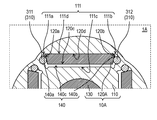
- the permanent magnet 120A is trapezoidal when viewed from above. That is, in this modification, the cross-sectional shape of the permanent magnet 120A is trapezoidal as shown in FIG.
- the configurations other than the permanent magnet 120A are the same as those of the motor 1 in the above embodiment.
- the radial outer side of the rotor core 110 in the permanent magnet 120A is larger than the radial inner side of the rotor core 110 in the permanent magnet 120A. It is arranged in the magnet insertion hole 111 of the rotor core 110 so as to be large. That is, when the upper base of the trapezoid of the permanent magnet 120A is the short side and the lower base is the long side, each of the trapezoidal permanent magnets 120A has the long side in the radial direction of the rotor core 110 in the magnet insertion hole 111. It is arranged so as to be located on the outer side (outer peripheral side) and the short side is located inside the rotor core 110 in the radial direction.
- FIG. 9 is a diagram showing a state when the permanent magnet 120A is assembled to the rotor core 110 in the motor 1A according to the first modification.
- FIG. 9 shows only the first fixing member 31 of the fixing members 30, the same applies to the second fixing member 32.
- the permanent magnet 120A is inserted into each magnet insertion hole 111 of the rotor core 110, and the permanent magnet 120A is arranged in the magnet insertion hole 111.
- the permanent magnet 120A can be easily inserted into the magnet insertion hole 111. Therefore, there is a gap around the permanent magnet 120A arranged in the magnet insertion hole 111.
- the first fixing member 31 is assembled to the rotor core 110 so that the convex portion 310 is fitted into the gap 140. Specifically, the first convex portion 311 of the first fixing member 31 is fitted into the first gap portion 140a and the second convex portion 312 of the first fixing member 31 is fitted into the second gap portion 140b by press fitting.
- the first convex portion 311 is pushed into the first gap 140a while the first convex portion 311 is in contact with one side surface of the trapezoidal permanent magnet 120A, and the second convex portion 311 is pressed against the other side surface of the trapezoidal permanent magnet 120A.
- the second convex portion 312 is pushed into the second gap portion 140b while the convex portion 312 is in contact with the second convex portion 312.
- the permanent magnet 120A receives stress from the first convex portion 311 and the second convex portion 312, and automatically moves to the outside in the radial direction of the rotor core 110.
- the permanent magnet 120A can be positioned on the outer peripheral side of the magnet insertion hole 111 simply by fitting the convex portion 310 (first convex portion 311 and second convex portion 312) into the gap 140. Specifically, each permanent magnet 120A can be brought into contact with the radial outer inner surface of the rotor core 110 in the magnet insertion hole 111. That is, the second magnet main surface 120d of the permanent magnet 120A and the second hole main surface 111d of the magnet insertion hole 111 can be obtained by simply fitting the convex portion 310 (first convex portion 311 and second convex portion 312) into the gap 140.
- the permanent magnet 120A is naturally positioned in the magnet insertion hole 111 so that the magnets come into surface contact with each other.
- the shape of the permanent magnet 120A trapezoidal, it is possible to prevent erroneous insertion when the permanent magnet 120A is inserted into the magnet insertion hole 111. As a result, it is possible to eliminate an error in the magnetizing direction of the permanent magnet 120A due to incorrect insertion.
- FIG. 10 is a partially enlarged cross-sectional view of the rotor 10B used in the motor 1B according to the modified example 2.
- FIG. 11 is a perspective view of the first fixing member 31B used for the motor 1B. In FIG. 10, configurations other than the rotor 10B, the first fixing member 31B, and the second fixing member 32B are omitted.
- the configurations of the first fixing member 31B and the second fixing member 32B are different between the motor 1B according to this modification and the motor 1 in the above embodiment.
- the convex portion 310 of the first fixing member 31 and the convex portion 320 of the second fixing member 32 are bullet-shaped protrusions.
- the convex portion 310B of the first fixing member 31B and the convex portion 320B of the second fixing member 32B are viewed from above when the rotor 10B is viewed from above. It is elongated along the first magnet main surface 120c of the permanent magnet 120.
- the shape of the convex portion 310B of the first fixing member 31B is a triangular prism extending along the long side of the permanent magnet 120. Since the second fixing member 32B has the same shape as the first fixing member 31B, the shape of the convex portion 320B of the second fixing member 32B is also a triangular prism extending along the long side of the permanent magnet 120.
- the position of the gap 140 into which the convex portion 310B of the first fixing member 31B and the convex portion 320B of the second fixing member 32B are fitted is also different between the motor 1B according to the present modification and the motor 1 in the above embodiment.
- the convex portion 310 of the first fixing member 31 and the convex portion 320 of the second fixing member 32 are formed in the first gap portion 140a and the second gap portion 140b of the gap 140. It was fitted.
- the convex portion 310B of the first fixing member 31B and the convex portion 320B of the second fixing member 32B are fitted into the third gap portion 140c of the gap 140. ..
- the configurations other than the first fixing member 31B and the second fixing member 32B are the same as those of the motor 1 in the above embodiment.
- the permanent magnet 120 arranged in the magnet insertion hole 111 of the rotor core 110 can be fixed to the rotor core 110 by the first fixing member 31B and the second fixing member 32B.
- the permanent magnet 120 is placed at a predetermined position of the magnet insertion hole 111 without using an adhesive. Can be fixed to the rotor core 110. Therefore, it is possible to realize a low-vibration motor 1B having excellent productivity.
- the convex portion 310B of the first fixing member 31B and the convex portion 320B of the second fixing member 32B are fitted into the third gap portion 140c.
- the third gap 140c is a narrow region having a width of 0.2 mm or less. Therefore, the widths of the convex portion 310B and the convex portion 320B are also narrowed, and depending on the material of the convex portion 310B and the convex portion 320B, the mechanical strength of the convex portion 310B and the convex portion 320B is lowered, so that the convex portion 310B and the convex portion 320B are narrowed.
- the holding power of the permanent magnet 120 by the 320B may decrease.
- the third gap 140c which is originally not desired to function as a flux barrier, becomes a flux barrier.
- the magnetic flux of the rotor 10 may be significantly reduced, and the performance of the motor 1 may be deteriorated.
- FIG. 12 is a cross-sectional view of the rotor 10B used in the other motor according to the second modification.
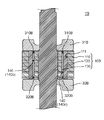
- the rotor core 110B may be provided with a recess 112 having a width larger than the width of the third gap 140c.
- the recess 112 is formed as a part of the third gap 140c so as to be recessed in a stepped shape from the opening surface of the magnet insertion hole 111 in the cross-sectional view of the rotor core 110B.
- the recesses 112 are provided on both sides of the rotor core 110B in the longitudinal direction of the shaft 130.
- the convex portion 310B of the first fixing member 31B is fitted in one concave portion 112, and the convex portion 320B of the second fixing member 32B is fitted in the other concave portion 112.
- the width of the convex portion 310B of the first fixing member 31B and the width of the convex portion 320B of the second fixing member 32B can be increased by the amount that the width of the concave portion 112 is made larger than the width of the third gap portion 140c.
- the mechanical strength of the convex portion 310B and the convex portion 320B can be increased.
- the holding force of the permanent magnet 120 by the convex portion 310B and the convex portion 320B can be secured without significantly reducing the magnetic flux of the rotor 10.
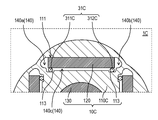
- FIG. 13 is a partially enlarged cross-sectional view of the rotor 10C used in the motor 1C according to the modified example 3. Specifically, like the rotor 10C in the motor 1C shown in FIG. 13, the positions of the first convex portion 311C and the second convex portion 312C of the first fixing member 31C are changed to change the positions of the first convex portion 311C and the second convex portion 311C and the second.
- Both of the convex portions 312C may be fitted into the third gap portion 140c.
- the third gap portion 140c It is preferable to partially widen the width of the first convex portion 311C and the second convex portion 312C to increase the width of the first convex portion 311C and the second convex portion 312C. Specifically, as shown in FIG.
- the rotor core 110C may be formed with a recess 113 recessed inward in the radial direction of the rotor core 110C in the rotor core 110C in the third gap 140c of the magnet insertion hole 111.
- the second fixing member has the same configuration as the first fixing member 31C.
- first gap portion 140a, the second gap portion 140b, and the third gap portion 140c is formed on the convex portion of the first fixing member and the second fixing member. It may be configured to be fitted in both the first gap portion 140a and the second gap portion 140b and the third gap portion 140c, instead of being fitted in the first gap portion 140a and the second gap portion 140b. That is, the number of convex portions of the first fixing member and the second fixing member is increased, and the number of convex portions fitted into both the first gap portion 140a, the second gap portion 140b, and the third gap portion 140c is first. It may be formed on the fixing member and the second fixing member. For example, it may be a first fixing member and a second fixing member having both the convex portion shown in FIG. 5 and the convex portion shown in FIG. 13 (or FIG. 11).
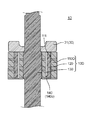
- FIG. 14 is a cross-sectional view of the rotor 10D used in the motor 1D according to the modified example 4.
- the first fixing member 31 may be used.
- the steel plate on which the magnet insertion hole 111 is not formed functions as a stopper plate, so that the permanent magnet 120 can be prevented from falling out of the magnet insertion hole 111 even if only the first fixing member 31 is used.
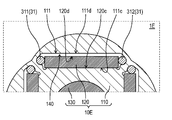
- FIG. 15 is a partially enlarged cross-sectional view of the rotor 10E used in the motor 1E according to the modified example 5.
- the permanent magnet 120 may be inserted in the magnet insertion hole 111 as in the rotor 10E of the motor 1E shown in FIG.
- the first magnet main surface 120c of the permanent magnet 120 and the first hole main surface 111c of the magnet insertion hole 111 are in surface contact with each other.
- FIG. 16 is a partially enlarged cross-sectional view of the rotor 10F used for the motor 1F according to the modified example 6.
- the permanent magnet 120 is not in contact with the outer inner surface of the rotor core 110 in the magnet insertion hole 111 in the radial direction, and the diameter of the rotor core 110 in the magnet insertion hole 111. It does not have to be in contact with the inner surface inside the direction.
- the first magnet main surface 120c of the permanent magnet 120 and the first hole main surface 111c of the magnet insertion hole 111 are not in contact with each other, and the second magnet main surface of the permanent magnet 120 is not in contact with each other.
- the 120d and the second hole main surface 111d of the magnet insertion hole 111 are not in contact with each other. That is, in FIG. 16, the permanent magnet 120 is not in contact with any inner surface of the magnet insertion hole 111, and a gap 140 exists on the entire circumference of the permanent magnet 120.
- the first fixing member 31 and the second fixing member 32 are defined as balance weights, but the present invention is not limited to this.
- the first fixing member 31 and the second fixing member 32 do not have to have a balance weight function.
- a balance weight may be provided separately from the first fixing member 31 and the second fixing member 32, or the balance weight may not be provided.
- the first fixing member 31 and the second fixing member 32 may have a function of fixing the permanent magnet 120 by using existing parts of the motor other than the balance weight.
- the first convex portion 311 and the second convex portion 312 of the first fixing member 31 and the first convex portion 321 and the second convex portion 322 of the second fixing member 32 are all bullet-shaped. However, it is not limited to this.
- the first convex portion 311 and the second convex portion 312 of the first fixing member 31 and the first convex portion 321 and the second convex portion 322 of the second fixing member 32 are formed by the rotor core 110 and the permanent magnet 120 in the magnet insertion hole 111. Any shape is applied as long as it is a shape that fits into the gap 140 between them.
- the tip portions of the first convex portion 311 and the second convex portion 312 of the first fixing member 31 and the first convex portion 321 and the second convex portion 322 of the second fixing member 32 are tapered. It is preferable that a tapered surface is formed. As a result, the first convex portion 311 and the second convex portion 312 of the first fixing member 31 and the first convex portion 321 and the second convex portion 322 of the second fixing member 32 can be easily pushed into the gap 140.
- the number of poles of the magnetic poles of the rotor 10 is 4 (that is, the number of permanent magnets 120 is 4), but the present invention is not limited to this.
- the number of poles of the magnetic poles of the rotor 10 is 2n (n is a natural number), any number can be applied.
- FIG. 17 is a diagram showing an electric device 400 including the motor 1.
- the motors of the above-described embodiment and various modifications are used for household electric devices other than vacuum cleaners such as air conditioners and refrigerators, or for various electric devices such as industrial electric devices such as automobile devices and robots. can do.
- the technology of the present disclosure can be widely used for motors and electric devices equipped with motors.
Landscapes
- Engineering & Computer Science (AREA)
- Power Engineering (AREA)
- Permanent Field Magnets Of Synchronous Machinery (AREA)
- Iron Core Of Rotating Electric Machines (AREA)
- Manufacture Of Motors, Generators (AREA)
Priority Applications (4)
| Application Number | Priority Date | Filing Date | Title |
|---|---|---|---|
| EP20788585.6A EP3955429A4 (en) | 2019-04-11 | 2020-03-09 | ENGINE AND ELECTRICAL DEVICE |
| JP2021513520A JP7538998B2 (ja) | 2019-04-11 | 2020-03-09 | モータ及び電気機器 |
| US17/601,556 US12015326B2 (en) | 2019-04-11 | 2020-03-09 | Motor and electric device |
| CN202080025842.6A CN113661635B (zh) | 2019-04-11 | 2020-03-09 | 电动机和电气设备 |
Applications Claiming Priority (2)
| Application Number | Priority Date | Filing Date | Title |
|---|---|---|---|
| JP2019-075740 | 2019-04-11 | ||
| JP2019075740 | 2019-04-11 |
Publications (1)
| Publication Number | Publication Date |
|---|---|
| WO2020208988A1 true WO2020208988A1 (ja) | 2020-10-15 |
Family
ID=72751050
Family Applications (1)
| Application Number | Title | Priority Date | Filing Date |
|---|---|---|---|
| PCT/JP2020/010039 Ceased WO2020208988A1 (ja) | 2019-04-11 | 2020-03-09 | モータ及び電気機器 |
Country Status (5)
| Country | Link |
|---|---|
| US (1) | US12015326B2 (https=) |
| EP (1) | EP3955429A4 (https=) |
| JP (1) | JP7538998B2 (https=) |
| CN (1) | CN113661635B (https=) |
| WO (1) | WO2020208988A1 (https=) |
Cited By (1)
| Publication number | Priority date | Publication date | Assignee | Title |
|---|---|---|---|---|
| JP2023133009A (ja) * | 2022-03-11 | 2023-09-22 | 株式会社マキタ | 電動工具 |
Families Citing this family (1)
| Publication number | Priority date | Publication date | Assignee | Title |
|---|---|---|---|---|
| IT202300008937A1 (it) * | 2023-05-05 | 2024-11-05 | Maria Sagula | Dispositivo di ventilazione |
Citations (7)
| Publication number | Priority date | Publication date | Assignee | Title |
|---|---|---|---|---|
| JPH054739U (ja) * | 1991-07-03 | 1993-01-22 | 株式会社東芝 | 永久磁石回転子 |
| JPH0888963A (ja) * | 1994-07-20 | 1996-04-02 | Daikin Ind Ltd | ブラシレスdcモータ |
| JP3277780B2 (ja) | 1995-12-07 | 2002-04-22 | 松下電器産業株式会社 | 永久磁石埋め込み形モータにおける永久磁石の固定方法 |
| JP2011147323A (ja) * | 2010-01-18 | 2011-07-28 | Toyota Motor Corp | Ipmモータ用ロータとipmモータ |
| JP2012029343A (ja) * | 2010-07-20 | 2012-02-09 | Daikin Ind Ltd | 永久磁石回転子およびその製造方法 |
| JP2013051840A (ja) * | 2011-08-31 | 2013-03-14 | Daikin Ind Ltd | ロータ |
| JP2013099038A (ja) * | 2011-10-28 | 2013-05-20 | Mitsuba Corp | 電動機用ロータおよびブラシレスモータ |
Family Cites Families (17)
| Publication number | Priority date | Publication date | Assignee | Title |
|---|---|---|---|---|
| JP4496064B2 (ja) * | 2004-11-25 | 2010-07-07 | 株式会社東芝 | 永久磁石形モータ及び洗濯機 |
| JP4666500B2 (ja) | 2005-12-27 | 2011-04-06 | 三菱電機株式会社 | 永久磁石埋込型モータの回転子 |
| DE102007015249A1 (de) | 2007-03-27 | 2008-10-02 | Miele & Cie. Kg | Rotor, insbesondere für einen Elektromotor einer Umwälzpumpe |
| JP2010226882A (ja) * | 2009-03-24 | 2010-10-07 | Daikin Ind Ltd | 回転子用端板、永久磁石支持部材及び回転子 |
| JP5584669B2 (ja) * | 2011-10-14 | 2014-09-03 | 三菱電機株式会社 | 回転電機の回転子 |
| JP2013207817A (ja) * | 2012-03-27 | 2013-10-07 | Toshiba Corp | 電動機および電動送風機 |
| JP5956277B2 (ja) * | 2012-08-07 | 2016-07-27 | 山洋電気株式会社 | 永久磁石式モータ、および永久磁石式モータの製造方法 |
| WO2014054150A1 (ja) | 2012-10-04 | 2014-04-10 | 三菱電機株式会社 | 永久磁石埋込型電動機 |
| JP6191370B2 (ja) * | 2013-10-03 | 2017-09-06 | シンフォニアテクノロジー株式会社 | 同期電動機 |
| US10110077B2 (en) * | 2014-08-21 | 2018-10-23 | Mitsubishi Electric Corporation | Permanent-magnet-embedded electric motor and compressor |
| CN106059149A (zh) * | 2016-08-09 | 2016-10-26 | 珠海凌达压缩机有限公司 | 电机转子组件及电机 |
| JP6192795B2 (ja) * | 2016-11-29 | 2017-09-06 | 株式会社ミツバ | ブラシレスモータ |
| WO2018139791A1 (ko) * | 2017-01-24 | 2018-08-02 | 엘지이노텍 주식회사 | 모터 |
| JP6289694B2 (ja) * | 2017-02-16 | 2018-03-07 | 三菱電機株式会社 | 永久磁石埋込型電動機、圧縮機、冷凍空調装置 |
| JPWO2018180636A1 (ja) * | 2017-03-31 | 2020-02-06 | 日本電産サーボ株式会社 | モータ |
| KR20230076397A (ko) * | 2021-11-24 | 2023-05-31 | 현대자동차주식회사 | 구동모터 회전자의 마그넷 조립 시스템 |
| DE102022110024A1 (de) * | 2022-04-26 | 2023-10-26 | Dr. Ing. H.C. F. Porsche Aktiengesellschaft | Permanenterregter Traktionsmotor-Rotor und Verfahren zu seiner Herstellung |
-
2020
- 2020-03-09 EP EP20788585.6A patent/EP3955429A4/en active Pending
- 2020-03-09 CN CN202080025842.6A patent/CN113661635B/zh active Active
- 2020-03-09 JP JP2021513520A patent/JP7538998B2/ja active Active
- 2020-03-09 WO PCT/JP2020/010039 patent/WO2020208988A1/ja not_active Ceased
- 2020-03-09 US US17/601,556 patent/US12015326B2/en active Active
Patent Citations (7)
| Publication number | Priority date | Publication date | Assignee | Title |
|---|---|---|---|---|
| JPH054739U (ja) * | 1991-07-03 | 1993-01-22 | 株式会社東芝 | 永久磁石回転子 |
| JPH0888963A (ja) * | 1994-07-20 | 1996-04-02 | Daikin Ind Ltd | ブラシレスdcモータ |
| JP3277780B2 (ja) | 1995-12-07 | 2002-04-22 | 松下電器産業株式会社 | 永久磁石埋め込み形モータにおける永久磁石の固定方法 |
| JP2011147323A (ja) * | 2010-01-18 | 2011-07-28 | Toyota Motor Corp | Ipmモータ用ロータとipmモータ |
| JP2012029343A (ja) * | 2010-07-20 | 2012-02-09 | Daikin Ind Ltd | 永久磁石回転子およびその製造方法 |
| JP2013051840A (ja) * | 2011-08-31 | 2013-03-14 | Daikin Ind Ltd | ロータ |
| JP2013099038A (ja) * | 2011-10-28 | 2013-05-20 | Mitsuba Corp | 電動機用ロータおよびブラシレスモータ |
Cited By (2)
| Publication number | Priority date | Publication date | Assignee | Title |
|---|---|---|---|---|
| JP2023133009A (ja) * | 2022-03-11 | 2023-09-22 | 株式会社マキタ | 電動工具 |
| JP7820198B2 (ja) | 2022-03-11 | 2026-02-25 | 株式会社マキタ | 電動工具 |
Also Published As
| Publication number | Publication date |
|---|---|
| JPWO2020208988A1 (https=) | 2020-10-15 |
| CN113661635B (zh) | 2024-06-04 |
| US20220181946A1 (en) | 2022-06-09 |
| CN113661635A (zh) | 2021-11-16 |
| EP3955429A4 (en) | 2022-05-25 |
| US12015326B2 (en) | 2024-06-18 |
| JP7538998B2 (ja) | 2024-08-23 |
| EP3955429A1 (en) | 2022-02-16 |
Similar Documents
| Publication | Publication Date | Title |
|---|---|---|
| CN110086274B (zh) | 永久磁铁埋入型电动机及其制造方法 | |
| KR100918893B1 (ko) | 축방향 에어갭타입 전동기 | |
| JP4706339B2 (ja) | アキシャルエアギャップ型電動機 | |
| JP5858232B2 (ja) | ロータコア、モータ、およびモータの製造方法 | |
| CN102570669B (zh) | 端板和用于旋转电机的使用该端板的转子 | |
| WO2012107981A1 (ja) | モータの回転子およびそれを備えたファン駆動用モータ | |
| JP3616338B2 (ja) | 電動機の回転子 | |
| JP7538998B2 (ja) | モータ及び電気機器 | |
| JPWO2020208988A5 (https=) | ||
| JP2007068318A (ja) | 磁石埋込型モータ | |
| JP2007330030A (ja) | ロータのリング磁石固定構造及び電動パワーステアリング用モータ | |
| JP2006304539A (ja) | アキシャルギャップ型回転電機のロータ構造 | |
| US20220181933A1 (en) | Rotor, motor, and electric power steering device | |
| CN115085420B (zh) | 转子以及旋转电机 | |
| JP2013126267A (ja) | 回転電気機械および圧縮機 | |
| JP6685166B2 (ja) | アキシャルギャップ型回転電機 | |
| JP2021164308A (ja) | ロータおよびモータ | |
| JP7642131B1 (ja) | 回転電機及びそのロータ | |
| WO2020049972A1 (ja) | 過給機用埋込永久磁石型モータ | |
| JP2008131742A (ja) | モータ | |
| JP6455218B2 (ja) | ロータ及びモータ | |
| WO2019202943A1 (ja) | モータ | |
| KR102613213B1 (ko) | Bldc 모터의 로터 | |
| JP2013169131A (ja) | ブラシレスモータ用ロータ及び電動パワーステアリング装置 | |
| KR200182198Y1 (ko) | 영구자석형 전동기의 회전자 |
Legal Events
| Date | Code | Title | Description |
|---|---|---|---|
| 121 | Ep: the epo has been informed by wipo that ep was designated in this application |
Ref document number: 20788585 Country of ref document: EP Kind code of ref document: A1 |
|
| ENP | Entry into the national phase |
Ref document number: 2021513520 Country of ref document: JP Kind code of ref document: A |
|
| NENP | Non-entry into the national phase |
Ref country code: DE |
|
| ENP | Entry into the national phase |
Ref document number: 2020788585 Country of ref document: EP Effective date: 20211111 |