WO2020184033A1 - 結晶性物質および膜複合体 - Google Patents
結晶性物質および膜複合体 Download PDFInfo
- Publication number
- WO2020184033A1 WO2020184033A1 PCT/JP2020/005241 JP2020005241W WO2020184033A1 WO 2020184033 A1 WO2020184033 A1 WO 2020184033A1 JP 2020005241 W JP2020005241 W JP 2020005241W WO 2020184033 A1 WO2020184033 A1 WO 2020184033A1
- Authority
- WO
- WIPO (PCT)
- Prior art keywords
- crystalline substance
- powder
- support
- substance
- film
- Prior art date
- Legal status (The legal status is an assumption and is not a legal conclusion. Google has not performed a legal analysis and makes no representation as to the accuracy of the status listed.)
- Ceased
Links
Images




Classifications
-
- C—CHEMISTRY; METALLURGY
- C01—INORGANIC CHEMISTRY
- C01B—NON-METALLIC ELEMENTS; COMPOUNDS THEREOF; METALLOIDS OR COMPOUNDS THEREOF NOT COVERED BY SUBCLASS C01C
- C01B37/00—Compounds having molecular sieve properties but not having base-exchange properties
- C01B37/06—Aluminophosphates containing other elements, e.g. metals, boron
- C01B37/065—Aluminophosphates containing other elements, e.g. metals, boron the other elements being metals only
-
- B—PERFORMING OPERATIONS; TRANSPORTING
- B01—PHYSICAL OR CHEMICAL PROCESSES OR APPARATUS IN GENERAL
- B01D—SEPARATION
- B01D67/00—Processes specially adapted for manufacturing semi-permeable membranes for separation processes or apparatus
- B01D67/0039—Inorganic membrane manufacture
- B01D67/0051—Inorganic membrane manufacture by controlled crystallisation, e,.g. hydrothermal growth
-
- B—PERFORMING OPERATIONS; TRANSPORTING
- B01—PHYSICAL OR CHEMICAL PROCESSES OR APPARATUS IN GENERAL
- B01D—SEPARATION
- B01D69/00—Semi-permeable membranes for separation processes or apparatus characterised by their form, structure or properties; Manufacturing processes specially adapted therefor
- B01D69/12—Composite membranes; Ultra-thin membranes
- B01D69/1213—Laminated layers
-
- B—PERFORMING OPERATIONS; TRANSPORTING
- B01—PHYSICAL OR CHEMICAL PROCESSES OR APPARATUS IN GENERAL
- B01D—SEPARATION
- B01D69/00—Semi-permeable membranes for separation processes or apparatus characterised by their form, structure or properties; Manufacturing processes specially adapted therefor
- B01D69/14—Dynamic membranes
- B01D69/141—Heterogeneous membranes, e.g. containing dispersed material; Mixed matrix membranes
- B01D69/147—Heterogeneous membranes, e.g. containing dispersed material; Mixed matrix membranes containing embedded adsorbents
-
- B—PERFORMING OPERATIONS; TRANSPORTING
- B01—PHYSICAL OR CHEMICAL PROCESSES OR APPARATUS IN GENERAL
- B01D—SEPARATION
- B01D71/00—Semi-permeable membranes for separation processes or apparatus characterised by the material; Manufacturing processes specially adapted therefor
- B01D71/02—Inorganic material
- B01D71/028—Molecular sieves
- B01D71/0281—Zeolites
-
- B—PERFORMING OPERATIONS; TRANSPORTING
- B01—PHYSICAL OR CHEMICAL PROCESSES OR APPARATUS IN GENERAL
- B01J—CHEMICAL OR PHYSICAL PROCESSES, e.g. CATALYSIS OR COLLOID CHEMISTRY; THEIR RELEVANT APPARATUS
- B01J20/00—Solid sorbent compositions or filter aid compositions; Sorbents for chromatography; Processes for preparing, regenerating or reactivating thereof
- B01J20/02—Solid sorbent compositions or filter aid compositions; Sorbents for chromatography; Processes for preparing, regenerating or reactivating thereof comprising inorganic material
- B01J20/0203—Solid sorbent compositions or filter aid compositions; Sorbents for chromatography; Processes for preparing, regenerating or reactivating thereof comprising inorganic material comprising compounds of metals not provided for in B01J20/04
- B01J20/0248—Compounds of B, Al, Ga, In, Tl
-
- B—PERFORMING OPERATIONS; TRANSPORTING
- B01—PHYSICAL OR CHEMICAL PROCESSES OR APPARATUS IN GENERAL
- B01J—CHEMICAL OR PHYSICAL PROCESSES, e.g. CATALYSIS OR COLLOID CHEMISTRY; THEIR RELEVANT APPARATUS
- B01J20/00—Solid sorbent compositions or filter aid compositions; Sorbents for chromatography; Processes for preparing, regenerating or reactivating thereof
- B01J20/02—Solid sorbent compositions or filter aid compositions; Sorbents for chromatography; Processes for preparing, regenerating or reactivating thereof comprising inorganic material
- B01J20/0203—Solid sorbent compositions or filter aid compositions; Sorbents for chromatography; Processes for preparing, regenerating or reactivating thereof comprising inorganic material comprising compounds of metals not provided for in B01J20/04
- B01J20/0274—Solid sorbent compositions or filter aid compositions; Sorbents for chromatography; Processes for preparing, regenerating or reactivating thereof comprising inorganic material comprising compounds of metals not provided for in B01J20/04 characterised by the type of anion
- B01J20/0292—Phosphates of compounds other than those provided for in B01J20/048
-
- B—PERFORMING OPERATIONS; TRANSPORTING
- B01—PHYSICAL OR CHEMICAL PROCESSES OR APPARATUS IN GENERAL
- B01J—CHEMICAL OR PHYSICAL PROCESSES, e.g. CATALYSIS OR COLLOID CHEMISTRY; THEIR RELEVANT APPARATUS
- B01J20/00—Solid sorbent compositions or filter aid compositions; Sorbents for chromatography; Processes for preparing, regenerating or reactivating thereof
- B01J20/02—Solid sorbent compositions or filter aid compositions; Sorbents for chromatography; Processes for preparing, regenerating or reactivating thereof comprising inorganic material
- B01J20/10—Solid sorbent compositions or filter aid compositions; Sorbents for chromatography; Processes for preparing, regenerating or reactivating thereof comprising inorganic material comprising silica or silicate
- B01J20/16—Alumino-silicates
- B01J20/18—Synthetic zeolitic molecular sieves
-
- B—PERFORMING OPERATIONS; TRANSPORTING
- B01—PHYSICAL OR CHEMICAL PROCESSES OR APPARATUS IN GENERAL
- B01J—CHEMICAL OR PHYSICAL PROCESSES, e.g. CATALYSIS OR COLLOID CHEMISTRY; THEIR RELEVANT APPARATUS
- B01J20/00—Solid sorbent compositions or filter aid compositions; Sorbents for chromatography; Processes for preparing, regenerating or reactivating thereof
- B01J20/28—Solid sorbent compositions or filter aid compositions; Sorbents for chromatography; Processes for preparing, regenerating or reactivating thereof characterised by their form or physical properties
- B01J20/28014—Solid sorbent compositions or filter aid compositions; Sorbents for chromatography; Processes for preparing, regenerating or reactivating thereof characterised by their form or physical properties characterised by their form
- B01J20/28033—Membrane, sheet, cloth, pad, lamellar or mat
- B01J20/28035—Membrane, sheet, cloth, pad, lamellar or mat with more than one layer, e.g. laminates, separated sheets
-
- C—CHEMISTRY; METALLURGY
- C01—INORGANIC CHEMISTRY
- C01B—NON-METALLIC ELEMENTS; COMPOUNDS THEREOF; METALLOIDS OR COMPOUNDS THEREOF NOT COVERED BY SUBCLASS C01C
- C01B37/00—Compounds having molecular sieve properties but not having base-exchange properties
- C01B37/04—Aluminophosphates [APO compounds]
-
- C—CHEMISTRY; METALLURGY
- C01—INORGANIC CHEMISTRY
- C01B—NON-METALLIC ELEMENTS; COMPOUNDS THEREOF; METALLOIDS OR COMPOUNDS THEREOF NOT COVERED BY SUBCLASS C01C
- C01B37/00—Compounds having molecular sieve properties but not having base-exchange properties
- C01B37/06—Aluminophosphates containing other elements, e.g. metals, boron
- C01B37/08—Silicoaluminophosphates [SAPO compounds], e.g. CoSAPO
-
- B—PERFORMING OPERATIONS; TRANSPORTING
- B01—PHYSICAL OR CHEMICAL PROCESSES OR APPARATUS IN GENERAL
- B01D—SEPARATION
- B01D2256/00—Main component in the product gas stream after treatment
- B01D2256/24—Hydrocarbons
- B01D2256/245—Methane
-
- B—PERFORMING OPERATIONS; TRANSPORTING
- B01—PHYSICAL OR CHEMICAL PROCESSES OR APPARATUS IN GENERAL
- B01D—SEPARATION
- B01D2257/00—Components to be removed
- B01D2257/50—Carbon oxides
- B01D2257/504—Carbon dioxide
-
- B—PERFORMING OPERATIONS; TRANSPORTING
- B01—PHYSICAL OR CHEMICAL PROCESSES OR APPARATUS IN GENERAL
- B01D—SEPARATION
- B01D2323/00—Details relating to membrane preparation
- B01D2323/24—Use of template or surface directing agents [SDA]
-
- B—PERFORMING OPERATIONS; TRANSPORTING
- B01—PHYSICAL OR CHEMICAL PROCESSES OR APPARATUS IN GENERAL
- B01D—SEPARATION
- B01D53/00—Separation of gases or vapours; Recovering vapours of volatile solvents from gases; Chemical or biological purification of waste gases, e.g. engine exhaust gases, smoke, fumes, flue gases, aerosols
- B01D53/22—Separation of gases or vapours; Recovering vapours of volatile solvents from gases; Chemical or biological purification of waste gases, e.g. engine exhaust gases, smoke, fumes, flue gases, aerosols by diffusion
- B01D53/228—Separation of gases or vapours; Recovering vapours of volatile solvents from gases; Chemical or biological purification of waste gases, e.g. engine exhaust gases, smoke, fumes, flue gases, aerosols by diffusion characterised by specific membranes
-
- C—CHEMISTRY; METALLURGY
- C01—INORGANIC CHEMISTRY
- C01P—INDEXING SCHEME RELATING TO STRUCTURAL AND PHYSICAL ASPECTS OF SOLID INORGANIC COMPOUNDS
- C01P2002/00—Crystal-structural characteristics
- C01P2002/70—Crystal-structural characteristics defined by measured X-ray, neutron or electron diffraction data
- C01P2002/72—Crystal-structural characteristics defined by measured X-ray, neutron or electron diffraction data by d-values or two theta-values, e.g. as X-ray diagram
-
- Y—GENERAL TAGGING OF NEW TECHNOLOGICAL DEVELOPMENTS; GENERAL TAGGING OF CROSS-SECTIONAL TECHNOLOGIES SPANNING OVER SEVERAL SECTIONS OF THE IPC; TECHNICAL SUBJECTS COVERED BY FORMER USPC CROSS-REFERENCE ART COLLECTIONS [XRACs] AND DIGESTS
- Y02—TECHNOLOGIES OR APPLICATIONS FOR MITIGATION OR ADAPTATION AGAINST CLIMATE CHANGE
- Y02P—CLIMATE CHANGE MITIGATION TECHNOLOGIES IN THE PRODUCTION OR PROCESSING OF GOODS
- Y02P20/00—Technologies relating to chemical industry
- Y02P20/151—Reduction of greenhouse gas [GHG] emissions, e.g. CO2
Definitions
- the present invention relates to crystalline materials and membrane complexes. [Refer to related applications]
- the present application claims the priority benefit from the Japanese patent application JP2019-043080 filed on March 8, 2019, and all disclosures of such application are incorporated herein by reference.
- SAT type zeolite for example, "The templated synthesis and structure determination by synchrotron microcrystal diffusion of the novel small pore magnesium aluminumophosphate STA-2" (Journal of Chemical Society, Dalton 4485s) by Graham W. Noble and two others. -Page 4490) (Reference 1), Maria Laub, and 10 others "Molecular Modeling, Multinuclear NMR, and Diffraction Studies in the Templated Synthesis and characterization of the Aluminum Sieve STA-2" (Journal of Physics and Chemistry 2010) Vol. 114, pp. 12698-12710) discloses a method for producing the powder.
- crystalline substances such as zeolite are being studied or put into practical use for various purposes such as separation of specific gases and adsorption of molecules. Therefore, in order to expand the options of crystalline substances having desired properties, crystalline substances having a novel structure are constantly required.
- the present invention is directed to a crystalline substance, and an object of the present invention is to provide a crystalline substance having a novel structure.
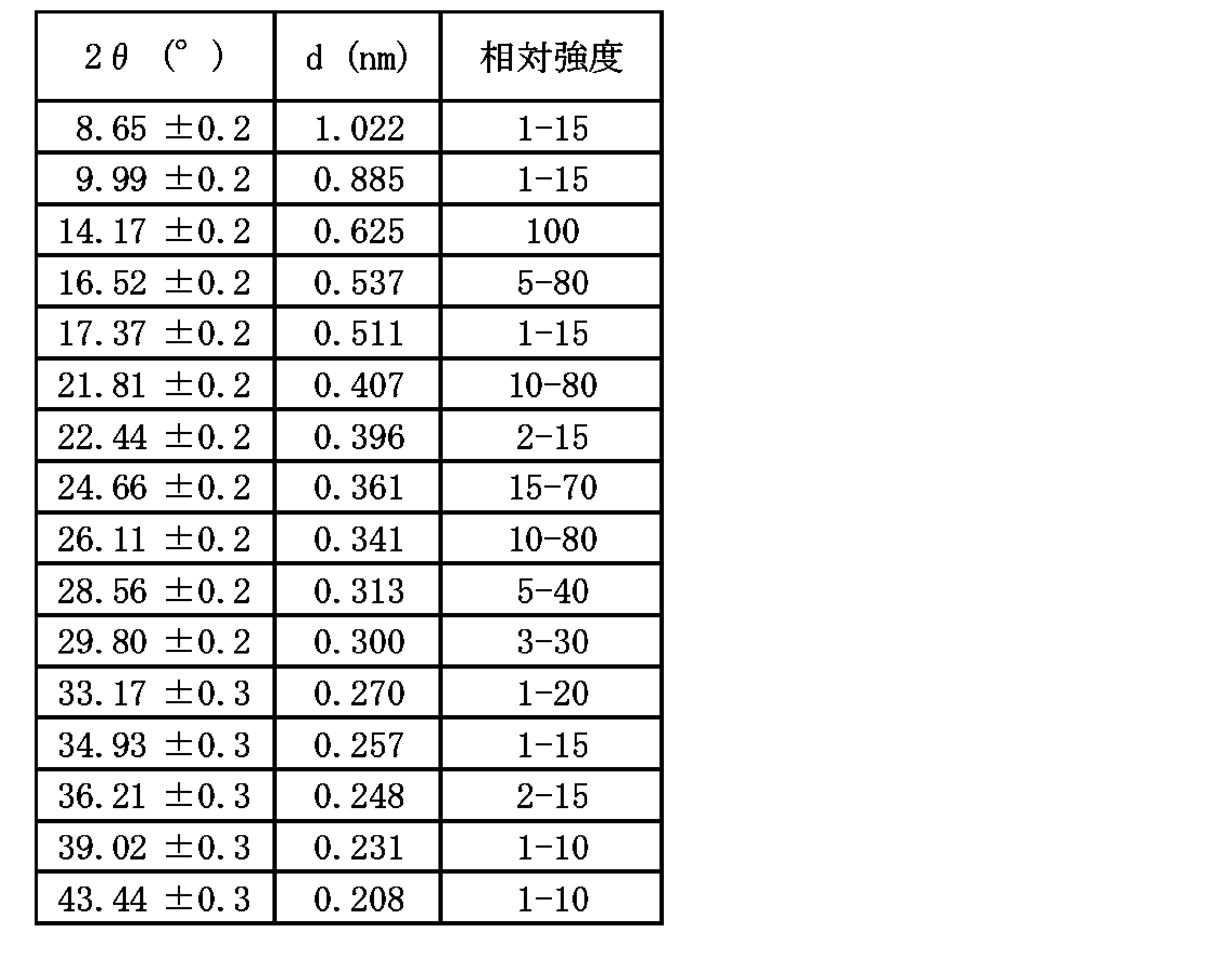
- the crystalline material according to one preferred embodiment of the present invention contains oxygen, aluminum and phosphorus and has the powder X-ray diffraction peaks listed in the table below.
- the crystalline substance is a powder having an average particle size of 0.01 to 10 ⁇ m.
- the crystalline substance does not contain a structure defining agent.
- the crystalline material further comprises at least one of silicon, magnesium, zinc, titanium, cobalt, copper, iron and boron.
- the present invention is also directed to membrane complexes.
- the film composite according to one preferred embodiment of the present invention includes a support and a film containing the crystalline substance and provided on the support.
- the crystalline substance according to the present invention (hereinafter, also referred to as “the present crystalline substance”) contains oxygen (O), aluminum (Al) and phosphorus (P), and has powder X-ray diffraction peaks shown in Table 2. Have.
- the present crystalline substance having the powder X-ray diffraction peak shown in Table 2 is produced by subjecting the zeolite having the structural code “SAT” defined by the International Zeolite Society to the treatment described later. ..
- the powder X-ray diffraction pattern shown in Table 2 is different from the powder X-ray diffraction pattern of the SAT-type zeolite (for example, see (b) of FIG. 1 of Document 1 above), and in this crystalline substance, for example, 2 ⁇ .
- the crystalline substance may contain peaks other than the powder X-ray diffraction peaks shown in Table 2. Such a peak may occur due to the mixture of other substances or the like.
- An example of a SAT-type zeolite used for producing this crystalline substance is an AlPO-type zeolite in which an atom (T atom) located at the center of an oxygen tetrahedron (TO 4 ) constituting the zeolite consists of Al and P. .. SAPO-type zeolite whose T atom is composed of Si (silicon), Al and P, MAPSO-type zeolite whose T atom is composed of magnesium (Mg), Si, Al and P, and T atom is zinc (Zn) and Si. ZnAPSO type zeolite composed of Al and P may be used. A part of the T atom may be replaced with other elements such as titanium (Ti) and boron (B).
- the present crystalline substance produced from the above-mentioned SAT-type zeolite is a porous substance and is considered to be a zeolite, similarly to the SAT-type zeolite.
- the crystalline material also typically has a composition similar to that of the SAT-type zeolite. Therefore, the crystalline material contains oxygen, aluminum and phosphorus.
- the crystalline substance may further contain at least one of silicon, magnesium, zinc, titanium, cobalt, copper, iron and boron. This makes it possible to change the pore size and adsorption characteristics of the crystalline substance.
- the phosphorus / aluminum molar ratio (a value obtained by dividing the number of moles of phosphorus by the number of moles of aluminum; the same applies hereinafter) in the present crystalline substance is preferably 0.5 to 4, more preferably. It is 0.7 to 2. It is possible to adjust the phosphorus / aluminum ratio in the crystalline substance by adjusting the mixing ratio of the aluminum source and the phosphorus source in the raw material solution described later (the same applies to the ratio of other elements). ).
- the structure-directing agent (hereinafter, also referred to as “SDA”) used in the production of the SAT-type zeolite is removed. That is, the preferred crystalline material does not contain SDA. As a result, pores are appropriately secured in the crystalline substance.
- SDA structure-directing agent
- TPD-MS heating generated gas mass spectrometry
- the gas generated when heating at a heating rate of 10 ° C./min while performing He flow is analyzed using a gas chromatograph mass spectrometer (GC / MS QP2010Plus) manufactured by Shimadzu Corporation. This confirms the presence or absence of SDA.
- the crystalline material may include SDA.
- the crystalline substance may contain an alkali metal.
- the alkali metal is, for example, sodium (Na) or potassium (K).
- the average pore diameter of this crystalline substance is 1 nm or less.
- this crystalline substance is produced as a powder.
- the average particle size of the powder of the crystalline substance is, for example, 0.01 to 10 ⁇ m, preferably 0.05 to 5 ⁇ m, and more preferably 0.1 to 1 ⁇ m.
- the average particle size of the powder is the median diameter (D50) in the particle size distribution obtained by the laser scattering method.
- the crystalline substance may be produced as a film.
- FIG. 1 is a diagram showing a flow of production of a powder of a crystalline substance having a powder X-ray diffraction peak in Table 2.
- a SAT-type zeolite powder (crystal) is produced and prepared (step S11).
- a raw material solution is prepared, for example, by dissolving an aluminum source, a phosphorus source, SDA, or the like in a solvent.
- the composition of the raw material solution is, for example, 1Al 2 O 3 : 1P 2 O 5 : 0.8 SDA: 200H 2 O.
- Alcohol such as ethanol may be used as the solvent of the raw material solution in addition to water.
- the aluminum source for example, sodium aluminate, aluminum hydroxide, aluminum alkoxide, alumina sol and the like can be used.
- the phosphorus source for example, phosphoric acid, phosphoric acid ester, aluminum phosphate or the like can be used.
- the SDA contained in the raw material solution is, for example, an organic substance.
- the SDA for example, 1,4-diazabicyclo hydroxide [2.2.2] octane-C4-diquat or the like can be used.
- hydrothermal synthesis of the raw material solution is performed.
- the temperature during hydrothermal synthesis is, for example, 120 to 200 ° C.
- the hydrothermal synthesis time is, for example, 5 to 240 hours.
- the obtained crystals are washed with pure water.
- SAT-type zeolite powder is produced.
- the SAT-type zeolite powder may be prepared by other methods.
- the SDA in the powder is burned and removed by heat-treating the powder in an oxidizing gas atmosphere (step S12).
- the SDA is removed almost completely.
- the heating temperature for removing SDA is, for example, 350 to 700 ° C.
- the heating time is, for example, 10 to 200 hours.
- the oxidizing gas atmosphere is an atmosphere containing oxygen, for example, in the atmosphere.
- the SAT-type zeolite powder is mixed with hot water and heated (step S13).
- the temperature of the hot water is, for example, 100 to 300 ° C, preferably 100 to 200 ° C.
- the heating time is, for example, 10 to 100 hours, preferably 20 to 50 hours.
- the obtained crystals are washed with pure water. Then, by drying the washed crystals, a crystalline substance having a powder X-ray diffraction peak shown in Table 2 can be obtained.
- Example 1 Pure aluminum alkoxide (aluminum isopropoxide), 85% phosphoric acid, and 1,4-diazabicyclo [2.2.2] octane-C4-diquat as an aluminum source, phosphorus source, and SDA (structural regulator), respectively. It was dissolved in water to prepare a raw material solution having a composition of 1 Al 2 O 3 : 1P 2 O 5 : 0.8 SDA: 200H 2 O. This raw material solution was hydrothermally synthesized at 190 ° C. for 50 hours. The crystals obtained by hydrothermal synthesis were recovered, washed thoroughly with pure water, and then completely dried at 100 ° C.
- aluminum isopropoxide 85% phosphoric acid
- 1,4-diazabicyclo [2.2.2] octane-C4-diquat as an aluminum source, phosphorus source, and SDA (structural regulator), respectively. It was dissolved in water to prepare a raw material solution having a composition of
- the obtained crystal was a crystal of SAT type zeolite.
- the crystals were heat-treated at 500 ° C. for 20 hours to burn off SDA, and heat-treated in hot water at 150 ° C. for 15 hours.
- the obtained crystals were recovered, washed thoroughly with pure water, and then completely dried at 100 ° C. As a result, a powder of a crystalline substance was obtained.
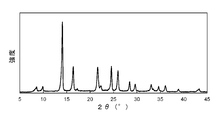
- FIG. 2 is a diagram showing a powder X-ray diffraction pattern of the crystalline substance of Example 1.
- the measurement of the X-ray diffraction pattern was carried out by densely packing the measurement powder in a sample holder having a sufficient depth.
- an X-ray diffractometer (device name: MiniFlex600) manufactured by Rigaku Co., Ltd. was used.
- the powder X-ray diffraction measurement was performed at a tube voltage of 40 kV, a tube current of 15 mA, a scanning speed of 0.5 ° / min, and a scanning step of 0.02 °.
- the divergence slit 1.25 °, the scattering slit 1.25 °, the light receiving slit 0.3 mm, the incident solar slit 5.0 °, and the light receiving solar slit 5.0 ° were set.
- a monochromator was not used, and a 0.015 mm thick nickel foil was used as the CuK ⁇ ray filter.
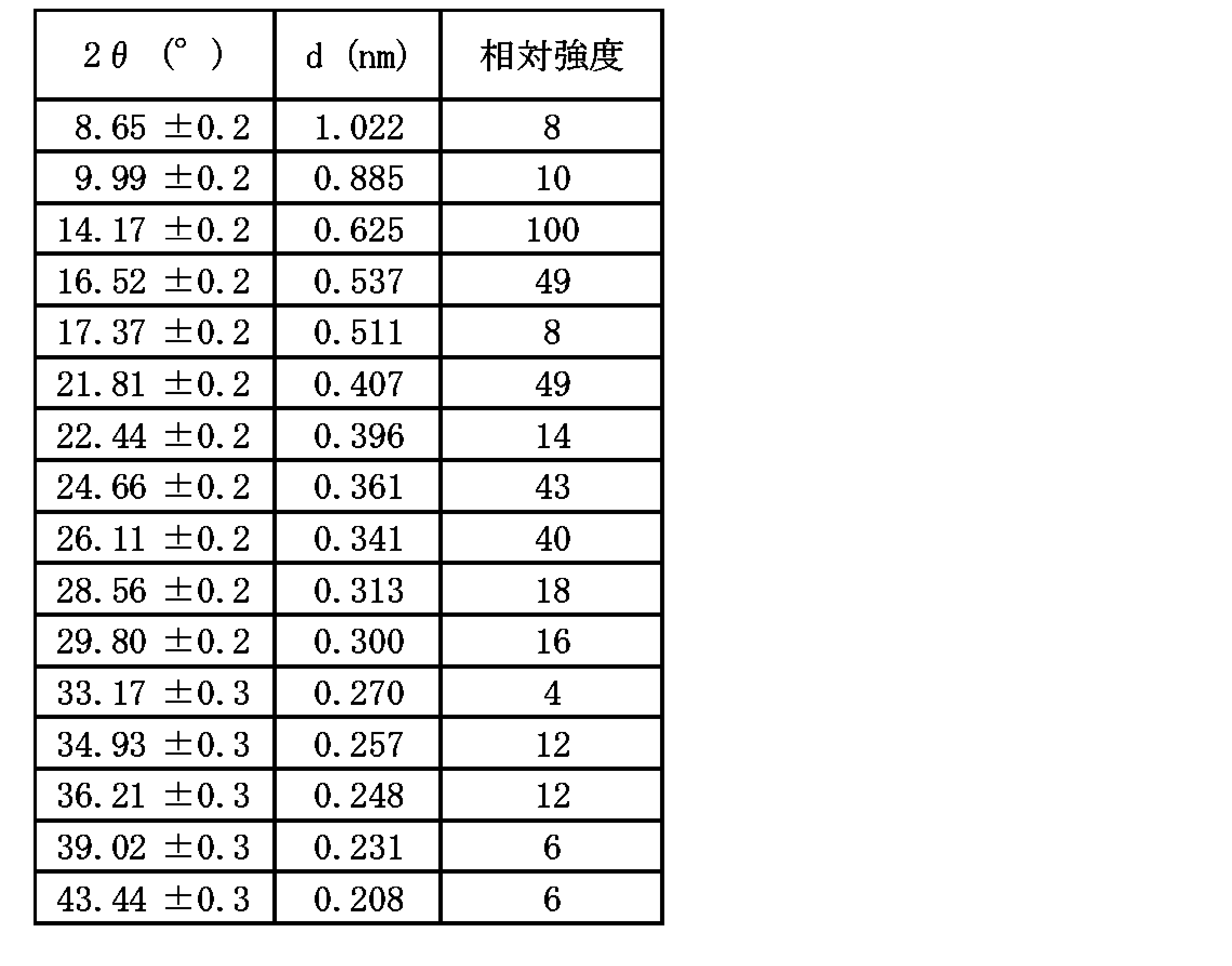
- Table 3 shows the relative intensities of each peak of the powder X-ray diffraction pattern of FIG. The relative intensity of each peak in Table 3 was included in the range of relative intensity shown in Table 2, and the crystalline substance of Example 1 had the powder X-ray diffraction peak shown in Table 2.
- Example 2 A powder of a crystalline substance was obtained in the same manner as in Example 1 except that alumina sol was used as an aluminum source.
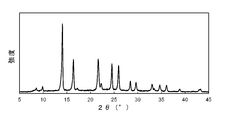
- FIG. 3 is a diagram showing a powder X-ray diffraction pattern of the crystalline substance of Example 2.
- Table 4 shows the relative intensities of each peak of the powder X-ray diffraction pattern of FIG. The relative intensities of each peak in Table 4 were included in the range of relative intensities shown in Table 2, and the crystalline substance of Example 2 had the powder X-ray diffraction peaks shown in Table 2.
- Example 3 A powder of a crystalline substance was obtained in the same manner as in Example 1 except that magnesium acetate was added to the raw material solution.
- FIG. 4 is a diagram showing a powder X-ray diffraction pattern of the crystalline substance of Example 3.
- Table 5 shows the relative intensities of each peak of the powder X-ray diffraction pattern of FIG. The relative intensities of each peak in Table 5 were included in the range of relative intensities shown in Table 2, and the crystalline substance of Example 3 had the powder X-ray diffraction peaks shown in Table 2.
- FIG. 5 is a cross-sectional view of the membrane composite 1.
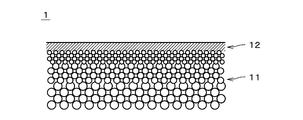
- FIG. 6 is an enlarged cross-sectional view showing a part of the membrane complex 1.
- the film composite 1 includes a porous support 11 and a polycrystalline film 12 provided on the support 11.
- the polycrystalline film in the present embodiment is a polycrystalline film in which the crystalline substance is formed on the surface of the support 11.
- the polycrystalline film 12 is drawn with a thick line.
- parallel diagonal lines are provided on the polycrystalline film 12.
- the thickness of the polycrystalline film 12 is drawn thicker than the actual thickness.
- the support 11 is a porous member that is permeable to gas and liquid.
- the support 11 is a monolith type in which a plurality of through holes 111 extending in the longitudinal direction (that is, the vertical direction in FIG. 5) are provided on an integrally molded columnar body. It is a support.
- the support 11 is substantially columnar.
- the cross section of each through hole 111 (that is, the cell) perpendicular to the longitudinal direction is, for example, substantially circular.
- the diameter of the through hole 111 is larger than the actual diameter, and the number of the through hole 111 is smaller than the actual number.
- the polycrystalline film 12 is formed on the inner side surface of the through hole 111, and covers the inner side surface of the through hole 111 over substantially the entire surface.
- the length of the support 11 (that is, the length in the vertical direction in FIG. 5) is, for example, 10 cm to 200 cm.
- the outer diameter of the support 11 is, for example, 0.5 cm to 30 cm.
- the distance between the central axes of the adjacent through holes 111 is, for example, 0.3 mm to 10 mm.
- the surface roughness (Ra) of the support 11 is, for example, 0.1 ⁇ m to 5.0 ⁇ m, preferably 0.2 ⁇ m to 2.0 ⁇ m.
- the shape of the support 11 may be, for example, a honeycomb shape, a flat plate shape, a tubular shape, a cylindrical shape, a columnar shape, a polygonal columnar shape, or the like. When the shape of the support 11 is tubular or cylindrical, the thickness of the support 11 is, for example, 0.1 mm to 10 mm.
- the support 11 is formed of a ceramic sintered body.
- the ceramic sintered body selected as the material of the support 11 include alumina, silica, mullite, zirconia, titania, yttria, silicon nitride, silicon carbide and the like.
- the support 11 contains at least one of alumina, silica and mullite.
- the support 11 may include an inorganic binder.
- the inorganic binder at least one of titania, mullite, easily sinterable alumina, silica, glass frit, clay mineral, and easily sinterable cordierite can be used.
- the average pore diameter of the support 11 is, for example, 0.01 ⁇ m to 70 ⁇ m, preferably 0.05 ⁇ m to 25 ⁇ m.
- the average pore diameter of the support 11 in the vicinity of the surface on which the polycrystalline film 12 is formed is 0.01 ⁇ m to 1 ⁇ m, preferably 0.05 ⁇ m to 0.5 ⁇ m.
- D5 is, for example, 0.01 ⁇ m to 50 ⁇ m
- D50 is, for example, 0.05 ⁇ m to 70 ⁇ m
- D95 is, for example, 0.1 ⁇ m to 2000 ⁇ m. is there.
- the porosity of the support 11 in the vicinity of the surface on which the polycrystalline film 12 is formed is, for example, 25% to 50%.
- the support 11 has, for example, a multilayer structure in which a plurality of layers having different average pore diameters are laminated in the thickness direction.
- the average pore diameter and sintered particle size in the surface layer including the surface on which the polycrystalline film 12 is formed are smaller than the average pore diameter and sintered particle size in the layers other than the surface layer.
- the average pore diameter of the surface layer of the support 11 is, for example, 0.01 ⁇ m to 1 ⁇ m, preferably 0.05 ⁇ m to 0.5 ⁇ m.
- the above materials can be used as the material for each layer.
- the materials of the plurality of layers forming the multilayer structure may be the same or different.
- the polycrystalline film 12 is a porous film having pores.
- the polycrystalline membrane 12 can be used as a separation membrane that separates a specific substance from a mixed substance in which a plurality of types of substances are mixed by utilizing a molecular sieving action.
- other substances are less likely to permeate than the specific substance.
- the permeation amount of the other substance in the polycrystalline film 12 is smaller than the permeation amount of the specific substance.
- the thickness of the polycrystalline film 12 is, for example, 0.05 ⁇ m to 30 ⁇ m, preferably 0.1 ⁇ m to 20 ⁇ m, and more preferably 0.5 ⁇ m to 10 ⁇ m. Thickening the polycrystalline film 12 improves the separation performance. Thinning the polycrystalline film 12 increases the permeation rate.
- the surface roughness (Ra) of the polycrystalline film 12 is, for example, 5 ⁇ m or less, preferably 2 ⁇ m or less, more preferably 1 ⁇ m or less, and further preferably 0.5 ⁇ m or less.
- the average pore diameter of the polycrystalline film 12 composed of the present crystalline substance is, for example, 1 nm or less, similar to the powder of the crystalline substance.
- the average pore diameter of the polycrystalline film 12 is preferably 0.2 nm or more and 0.8 nm or less, more preferably 0.3 nm or more and 0.5 nm or less, and further preferably 0.3 nm or more and 0. It is 0.4 nm or less.
- the average pore size of the polycrystalline film 12 is smaller than the average pore size of the support 11 in the vicinity of the surface on which the polycrystalline film 12 is formed.
- the permeation amount (permeence) of CO 2 of the polycrystalline film 12 at 20 ° C. to 400 ° C. is, for example, 100 nmol / m 2 ⁇ s ⁇ Pa or more. Further, the CO 2 permeation amount / CH 4 leakage amount ratio (permeence ratio) of the polycrystalline film 12 at 20 ° C. to 400 ° C. is, for example, 100 or more.
- the permeence and permeence ratio are those when the partial pressure difference of CO 2 between the supply side and the transmission side of the polycrystalline film 12 is 1.5 MPa.
- FIG. 7 is a diagram showing a flow of production of the membrane composite 1.
- a seed crystal used for producing the polycrystalline film 12 is prepared (step S21).
- the seed crystal is obtained from, for example, a SAT-type zeolite powder produced by hydrothermal synthesis and obtained from the zeolite powder, as in step S11 of FIG.
- the zeolite powder may be used as a seed crystal as it is, or the seed crystal may be obtained by processing the powder by pulverization or the like.
- the porous support 11 is immersed in the solution in which the seed crystal is dispersed, and the seed crystal is attached to the support 11 (step S22).
- the seed crystal is attached to the support 11 by bringing the solution in which the seed crystal is dispersed into contact with the portion of the support 11 on which the polycrystalline film 12 is to be formed. As a result, a seed crystal adhesion support is produced.
- the seed crystal may be attached to the support 11 by another method.
- the support 11 to which the seed crystal is attached is immersed in the raw material solution.
- the raw material solution is prepared by dissolving an aluminum source, a phosphorus source, SDA and the like in a solvent in the same manner as in step S11.
- a SAT-type zeolite membrane (polycrystalline membrane of zeolite) is formed on the support 11 (step S23).
- the temperature during hydrothermal synthesis is, for example, 120 to 200 ° C.
- the hydrothermal synthesis time is, for example, 5 to 100 hours.
- the composition of the SAT-type zeolite membrane can be adjusted by adjusting the mixing ratio of the aluminum source and the phosphorus source in the raw material solution.
- the support 11 and the zeolite membrane are washed with pure water and then dried.
- the support 11 and the zeolite membrane are heat-treated in an oxidizing gas atmosphere to burn and remove the SDA in the zeolite membrane (step S24).
- the micropores in the zeolite membrane penetrate.
- the SDA is removed almost completely.
- the heating temperature for removing SDA is, for example, 350 to 700 ° C.
- the heating time is, for example, 10 to 200 hours.
- the support 11 and the zeolite membrane are immersed in hot water and heated (step S25).
- the temperature of the hot water is, for example, 100 to 300 ° C, preferably 100 to 200 ° C.
- the heating time is, for example, 10 to 100 hours, preferably 20 to 50 hours.
- the support 11 and the polycrystalline film are washed with pure water and then dried at, for example, 100 ° C.
- a film complex 1 including the support 11 and the polycrystalline film 12 is obtained.
- the polycrystalline film 12 is composed of a crystalline substance having a powder X-ray diffraction peak shown in Table 2.
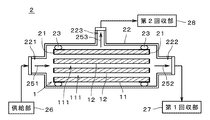
- FIG. 8 is a diagram showing the separation device 2.
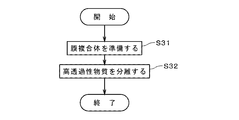
- FIG. 9 is a diagram showing a flow of separation of mixed substances by the separation device 2.
- a mixed substance containing a plurality of types of fluids that is, gas or liquid
- a highly permeable substance in the mixed substance is mixed by permeating the membrane complex 1. Separate from the substance.
- the separation in the separation device 2 may be performed, for example, for the purpose of extracting a substance having high permeability from the mixed substance, or for concentrating the substance having low permeability.
- the mixed substance (that is, a mixed fluid) may be a mixed gas containing a plurality of types of gases, a mixed solution containing a plurality of types of liquids, and a gas-liquid two-phase containing both a gas and a liquid. It may be a fluid.
- the mixed substances include, for example, hydrogen (H 2 ), helium (He), nitrogen (N 2 ), oxygen (O 2 ), water (H 2 O), water vapor (H 2 O), carbon monoxide (CO), and the like.
- Carbon dioxide (CO 2 ) nitrogen oxide, ammonia (NH 3 ), sulfur oxide, hydrogen sulfide (H 2 S), sulfur fluoride, mercury (Hg), arsine (AsH 3 ), hydrogen cyanide (HCN), hydrogen sulfide
- Nitrogen oxide is a compound of nitrogen and oxygen.
- the above-mentioned nitrogen oxides include, for example, nitric oxide (NO), nitrogen dioxide (NO 2 ), nitrous oxide (also referred to as dinitrogen monoxide) (N 2 O), and dinitrogen trioxide (N 2 O 3). ), Dinitrogen pentoxide (N 2 O 4 ), dinitrogen pentoxide (N 2 O 5 ) and other gases called NO X.
- Sulfur oxides are compounds of sulfur and oxygen.
- the above-mentioned sulfur oxide is, for example, a gas called SO X (socks) such as sulfur dioxide (SO 2 ) and sulfur trioxide (SO 3 ).
- Sulfur fluoride is a compound of fluorine and sulfur.
- the C1-C8 hydrocarbon is a hydrocarbon having 1 or more and 8 or less carbon atoms.
- the C3 to C8 hydrocarbon may be any of a straight chain compound, a side chain compound and a cyclic compound.
- the hydrocarbons of C3 to C8 are saturated hydrocarbons (that is, those in which double bonds and triple bonds are not present in the molecule) and unsaturated hydrocarbons (that is, double bonds and / or triple bonds are molecules. It may be either of those present in it).
- Hydrocarbons of C1 to C4 are, for example, methane (CH 4 ), ethane (C 2 H 6 ), ethylene (C 2 H 4 ), propane (C 3 H 8 ), propylene (C 3 H 6 ), normal butane.
- the above-mentioned organic acid is carboxylic acid, sulfonic acid, or the like.
- the carboxylic acid is, for example, formic acid (CH 2 O 2 ), acetic acid (C 2 H 4 O 2 ), oxalic acid (C 2 H 2 O 4 ), acrylic acid (C 3 H 4 O 2 ), or benzoic acid (C. 6 H 5 COOH) and the like.
- the sulfonic acid is, for example, ethanesulfonic acid (C 2 H 6 O 3 S) or the like.
- the organic acid may be a chain compound or a cyclic compound.
- the alcohols mentioned above include, for example, methanol (CH 3 OH), ethanol (C 2 H 5 OH), isopropanol (2-propanol) (CH 3 CH (OH) CH 3 ), ethylene glycol (CH 2 (OH) CH 2 ). (OH)) or butanol (C 4 H 9 OH) and the like.
- Mercaptans are organic compounds having hydrogenated sulfur (SH) at the end, and are substances also called thiols or thioalcohols.
- the above-mentioned mercaptans are, for example, methyl mercaptan (CH 3 SH), ethyl mercaptan (C 2 H 5 SH), 1-propanethiol (C 3 H 7 SH) and the like.
- ester is, for example, formate ester or acetate ester.
- ethers include, for example, dimethyl ether ((CH 3 ) 2 O), methyl ethyl ether (C 2 H 5 OCH 3 ) or diethyl ether ((C 2 H 5 ) 2 O).
- ketone is, for example, acetone ((CH 3 ) 2 CO), methyl ethyl ketone (C 2 H 5 COCH 3 ) or diethyl ketone ((C 2 H 5 ) 2 CO).
- aldehydes mentioned above are, for example, acetaldehyde (CH 3 CHO), propionaldehyde (C 2 H 5 CHO) or butyraldehyde (butyraldehyde) (C 3 H 7 CHO).
- the mixed substance separated by the separation device 2 will be described as a mixed gas containing a plurality of types of gases.
- the separation device 2 includes a membrane composite 1, a sealing section 21, an outer cylinder 22, two sealing members 23, a supply section 26, a first recovery section 27, and a second recovery section 28.
- the membrane composite 1, the sealing portion 21, and the sealing member 23 are housed in the outer cylinder 22.
- the supply unit 26, the first collection unit 27, and the second collection unit 28 are arranged outside the outer cylinder 22 and connected to the outer cylinder 22.
- the sealing portions 21 are attached to both ends of the support 11 in the longitudinal direction (that is, the left-right direction in FIG. 8), and cover both end faces in the longitudinal direction of the support 11 and outer surfaces in the vicinity of both end faces. It is a member to be sealed.
- the sealing portion 21 prevents the inflow and outflow of gas from the both end faces of the support 11.
- the sealing portion 21 is, for example, a plate-shaped member formed of glass or resin. The material and shape of the sealing portion 21 may be changed as appropriate. Since the sealing portion 21 is provided with a plurality of openings overlapping the plurality of through holes 111 of the support 11, both ends of each through hole 111 of the support 11 in the longitudinal direction are covered with the sealing portion 21. It has not been. Therefore, inflow and outflow of gas and the like from the both ends to the through hole 111 is possible.
- the outer cylinder 22 is a substantially cylindrical tubular member.
- the outer cylinder 22 is made of, for example, stainless steel or carbon steel.
- the longitudinal direction of the outer cylinder 22 is substantially parallel to the longitudinal direction of the membrane composite 1.
- a supply port 221 is provided at one end of the outer cylinder 22 in the longitudinal direction (that is, the left end in FIG. 8), and a first discharge port 222 is provided at the other end.
- a second discharge port 223 is provided on the side surface of the outer cylinder 22.
- the supply unit 26 is connected to the supply port 221.
- the first collection unit 27 is connected to the first discharge port 222.
- the second collection unit 28 is connected to the second discharge port 223.
- the inner space of the outer cylinder 22 is a closed space isolated from the space around the outer cylinder 22.
- the two sealing members 23 are arranged over the entire circumference between the outer surface of the membrane composite 1 and the inner surface of the outer cylinder 22 in the vicinity of both ends in the longitudinal direction of the membrane composite 1.
- Each seal member 23 is a substantially annular member made of a material that is impermeable to gas.
- the seal member 23 is, for example, an O-ring formed of a flexible resin.
- the seal member 23 is in close contact with the outer surface of the membrane composite 1 and the inner surface of the outer cylinder 22 over the entire circumference. In the example shown in FIG. 8, the sealing member 23 is in close contact with the outer surface of the sealing portion 21, and indirectly adheres to the outer surface of the film composite 1 via the sealing portion 21.
- the space between the sealing member 23 and the outer surface of the membrane composite 1 and the space between the sealing member 23 and the inner surface of the outer cylinder 22 are sealed, and gas can hardly or cannot pass through.
- the supply unit 26 supplies the mixed gas to the internal space of the outer cylinder 22 via the supply port 221.
- the supply unit 26 is, for example, a blower or a pump that pumps the mixed gas toward the outer cylinder 22.
- the blower or pump includes a pressure adjusting unit that adjusts the pressure of the mixed gas supplied to the outer cylinder 22.
- recovery part 28 are the storage container which stores the gas discharged
- the membrane complex 1 is prepared by preparing the above-mentioned separation device 2 (step S31).
- the supply unit 26 supplies a mixed gas containing a plurality of types of gases having different permeability to the polycrystalline film 12 to the internal space of the outer cylinder 22.
- the main components of the mixed gas are CO 2 and CH 4 .
- the mixed gas may contain a gas other than CO 2 and CH 4 .
- the pressure (that is, the introduction pressure) of the mixed gas supplied from the supply unit 26 to the inner space of the outer cylinder 22 is, for example, 0.1 MPa to 20.0 MPa.
- the temperature at which the mixed gas is separated is, for example, 10 ° C. to 150 ° C.
- the mixed gas supplied from the supply unit 26 to the outer cylinder 22 is introduced into each through hole 111 of the support 11 from the left end in the drawing of the membrane composite 1 as shown by an arrow 251.
- the highly permeable gas in the mixed gas (for example, CO 2 and hereinafter referred to as “highly permeable substance”) is the polycrystalline film 12 provided on the inner surface of each through hole 111, and It passes through the support 11 and is derived from the outer surface of the support 11.
- the highly permeable substance is separated from the gas having low permeability in the mixed gas (for example, CH 4 and hereinafter referred to as “low permeable substance”) (step S32).
- the gas (hereinafter, referred to as “permeation substance”) derived from the outer surface of the support 11 is recovered by the second recovery unit 28 via the second exhaust port 223, as indicated by an arrow 253.
- the pressure (that is, permeation pressure) of the gas recovered by the second recovery unit 28 via the second exhaust port 223 is, for example, about 1 atm (0.101 MPa).
- the gas excluding the gas that has passed through the polycrystalline film 12 and the support 11 (hereinafter, referred to as “impermeable substance”) has the through holes 111 of the support 11 from the left side in the drawing. It passes to the right and is collected by the first collection unit 27 via the first discharge port 222 as shown by the arrow 252.
- the pressure of the gas recovered by the first recovery unit 27 via the first discharge port 222 is, for example, substantially the same as the introduction pressure.
- the impermeable substance may include a highly permeable substance that has not penetrated the polycrystalline membrane 12.
- the crystalline substance having the powder X-ray diffraction peak shown in Table 2 may be produced from other than the SAT type zeolite.
- the film composite 1 may further include a functional film and a protective film laminated on the polycrystalline film 12.
- a functional film or protective film may be an inorganic film such as a zeolite film, a silica film or a carbon film, or an organic film such as a polyimide film or a silicone film.
- a substance that easily adsorbs a specific molecule such as CO 2 may be added to the functional film or the protective film laminated on the polycrystalline film 12.
- the film of the film complex 1 in addition to the polycrystalline film 12 composed of the present crystalline substance, a film in which particles of the present crystalline substance are dispersed in a film such as an organic film, or particles of the present crystalline substance.
- a film formed by mixing an organic substance, an inorganic substance, or the like may be used.
- the film provided on the support 11 may contain the present crystalline substance.
- the crystalline substance of the present invention can be used for various purposes other than the membrane complex.
- the membrane complex can be used as, for example, a gas separation membrane, and further, it can be used in various fields as a separation membrane other than gas, an adsorption membrane for various substances, and the like.
Landscapes
- Chemical & Material Sciences (AREA)
- Organic Chemistry (AREA)
- Inorganic Chemistry (AREA)
- Chemical Kinetics & Catalysis (AREA)
- Analytical Chemistry (AREA)
- Geology (AREA)
- Life Sciences & Earth Sciences (AREA)
- Dispersion Chemistry (AREA)
- Engineering & Computer Science (AREA)
- Manufacturing & Machinery (AREA)
- Crystallography & Structural Chemistry (AREA)
- Separation Using Semi-Permeable Membranes (AREA)
- Silicates, Zeolites, And Molecular Sieves (AREA)
- Solid-Sorbent Or Filter-Aiding Compositions (AREA)
Abstract
Description
[関連出願の参照]
本願は、2019年3月8日に出願された日本国特許出願JP2019-043080からの優先権の利益を主張し、当該出願の全ての開示は、本願に組み込まれる。

アルミニウム源、リン源、SDA(構造規定剤)として、それぞれアルミニウムアルコキシド(アルミニウムイソプロポキシド)、85%リン酸、水酸化1,4-ジアザビシクロ[2.2.2]オクタン-C4-ジクアットを純水に溶解させ、組成が1Al2O3:1P2O5:0.8SDA:200H2Oの原料溶液を作製した。この原料溶液を190℃にて50時間水熱合成した。水熱合成によって得られた結晶を回収し、純水にて十分に洗浄した後、100℃で完全に乾燥させた。X線回折測定の結果、得られた結晶はSAT型ゼオライトの結晶であった。この結晶を500℃にて20時間加熱処理することによってSDAを燃焼除去し、150℃の熱水中で15時間加熱処理した。得られた結晶を回収し、純水にて十分に洗浄した後、100℃で完全に乾燥させた。これにより、結晶性物質の粉末を得た。

アルミニウム源としてアルミナゾルを用いた以外は、実施例1と同様にして結晶性物質の粉末を得た。図3は、実施例2の結晶性物質の粉末X線回折パターンを示す図である。また、図3の粉末X線回折パターンの各ピークの相対強度を表4に示す。表4の各ピークの相対強度は、表2に示す相対強度の範囲に含まれており、実施例2の結晶性物質は、表2に記載の粉末X線回折ピークを有していた。

原料溶液に酢酸マグネシウムを添加した以外は、実施例1と同様にして結晶性物質の粉末を得た。図4は、実施例3の結晶性物質の粉末X線回折パターンを示す図である。また、図4の粉末X線回折パターンの各ピークの相対強度を表5に示す。表5の各ピークの相対強度は、表2に示す相対強度の範囲に含まれており、実施例3の結晶性物質は、表2に記載の粉末X線回折ピークを有していた。
11 支持体
12 多結晶膜
Claims (5)
- 結晶性物質であって、
酸素、アルミニウムおよびリンを含み、下表に記載の粉末X線回折ピークを有する。

- 請求項1に記載の結晶性物質であって、
平均粒径が0.01~10μmの粉末である。 - 請求項1または2に記載の結晶性物質であって、
構造規定剤を含まない。 - 請求項1ないし3のいずれか1つに記載の結晶性物質であって、
ケイ素、マグネシウム、亜鉛、チタン、コバルト、銅、鉄およびホウ素の少なくとも一種をさらに含む。 - 膜複合体であって、
支持体と、
請求項1ないし4のいずれか1つに記載の結晶性物質を含み、前記支持体に設けられた膜と、
を備える。
Priority Applications (4)
| Application Number | Priority Date | Filing Date | Title |
|---|---|---|---|
| CN202080018263.9A CN113508092B (zh) | 2019-03-08 | 2020-02-12 | 结晶性物质及膜复合体 |
| JP2021505605A JP7085688B2 (ja) | 2019-03-08 | 2020-02-12 | 結晶性物質および膜複合体 |
| DE112020001122.4T DE112020001122B4 (de) | 2019-03-08 | 2020-02-12 | Kristallines Material und Membrankomplex |
| US17/305,674 US12134565B2 (en) | 2019-03-08 | 2021-07-13 | Crystalline material and membrane complex |
Applications Claiming Priority (2)
| Application Number | Priority Date | Filing Date | Title |
|---|---|---|---|
| JP2019-043080 | 2019-03-08 | ||
| JP2019043080 | 2019-03-08 |
Related Child Applications (1)
| Application Number | Title | Priority Date | Filing Date |
|---|---|---|---|
| US17/305,674 Continuation US12134565B2 (en) | 2019-03-08 | 2021-07-13 | Crystalline material and membrane complex |
Publications (1)
| Publication Number | Publication Date |
|---|---|
| WO2020184033A1 true WO2020184033A1 (ja) | 2020-09-17 |
Family
ID=72426175
Family Applications (1)
| Application Number | Title | Priority Date | Filing Date |
|---|---|---|---|
| PCT/JP2020/005241 Ceased WO2020184033A1 (ja) | 2019-03-08 | 2020-02-12 | 結晶性物質および膜複合体 |
Country Status (5)
| Country | Link |
|---|---|
| US (1) | US12134565B2 (ja) |
| JP (1) | JP7085688B2 (ja) |
| CN (1) | CN113508092B (ja) |
| DE (1) | DE112020001122B4 (ja) |
| WO (1) | WO2020184033A1 (ja) |
Cited By (2)
| Publication number | Priority date | Publication date | Assignee | Title |
|---|---|---|---|---|
| WO2024190041A1 (ja) * | 2023-03-10 | 2024-09-19 | 日本碍子株式会社 | 分離膜複合体および分離膜複合体の製造方法 |
| JP7908508B2 (ja) | 2023-03-10 | 2026-08-19 | Ngk株式会社 | 分離膜複合体および分離膜複合体の製造方法 |
Families Citing this family (1)
| Publication number | Priority date | Publication date | Assignee | Title |
|---|---|---|---|---|
| CN118679006A (zh) * | 2022-02-28 | 2024-09-20 | 日本碍子株式会社 | 陶瓷基材、陶瓷支撑体以及分离膜复合体 |
Citations (2)
| Publication number | Priority date | Publication date | Assignee | Title |
|---|---|---|---|---|
| WO2016121887A1 (ja) * | 2015-01-30 | 2016-08-04 | 日本碍子株式会社 | 分離膜構造体 |
| WO2016121889A1 (ja) * | 2015-01-30 | 2016-08-04 | 日本碍子株式会社 | 分離膜構造体及び窒素濃度低減方法 |
Family Cites Families (17)
| Publication number | Priority date | Publication date | Assignee | Title |
|---|---|---|---|---|
| US4663139A (en) * | 1985-12-16 | 1987-05-05 | Union Carbide Corporation | Crystalline AlPO4 -39 |
| US5095163A (en) * | 1991-02-28 | 1992-03-10 | Uop | Methanol conversion process using SAPO catalysts |
| DE19939416A1 (de) * | 1999-08-20 | 2001-02-22 | Basf Ag | Verfahren zur Herstellung eines kristallinen, zeolithischen Feststoffs |
| FR2909666B1 (fr) * | 2006-12-08 | 2009-03-06 | Centre Nat Rech Scient | Deshydratation du methanol en dimethyl ether employant des catalyseurs a base d'une zeolithe supportee sur du carbure de silicium |
| KR101757405B1 (ko) * | 2010-06-25 | 2017-07-14 | 셰브런 유.에스.에이.인크. | 분자체 ssz-81의 제조방법 |
| CN102958838B (zh) * | 2010-06-25 | 2015-07-08 | 雪佛龙美国公司 | 分子筛ssz-81 |
| WO2012128218A1 (ja) * | 2011-03-22 | 2012-09-27 | 日本碍子株式会社 | 多孔質体、及びハニカム形状セラミック製分離膜構造体 |
| US9981256B2 (en) * | 2011-12-02 | 2018-05-29 | Pq Corporation | Stabilized microporous crystalline material, the method of making the same, and the use for selective catalytic reduction of NOx |
| WO2013126140A1 (en) * | 2012-02-21 | 2013-08-29 | Exxonmobil Chemical Patents Inc. | Molecular sieve material, its synthesis and use |
| CN108290144B (zh) * | 2015-11-25 | 2021-04-02 | 三菱化学株式会社 | 沸石催化剂及低级烯烃的制造方法 |
| CN107032364B (zh) * | 2016-02-04 | 2019-08-20 | 中国科学院大连化学物理研究所 | 一种磷酸硅铝分子筛、其制备方法及应用 |
| GB2551622A (en) * | 2016-04-22 | 2017-12-27 | Johnson Matthey Plc | STA-19, A new member of the GME family of molecular sieve zeotypes, methods of preparation and use |
| WO2017187418A1 (en) * | 2016-04-28 | 2017-11-02 | Johnson Matthey Public Limited Company | Sta-20, a novel molecular sieve framework type, methods of preparation and use |
| JPWO2018135472A1 (ja) * | 2017-01-18 | 2019-11-07 | 住友電気工業株式会社 | ゼオライト膜および分離膜 |
| JP7106883B2 (ja) * | 2017-02-17 | 2022-07-27 | 三菱ケミカル株式会社 | 多孔質支持体-ゼオライト膜複合体、rho型ゼオライトの製造方法及び分離方法 |
| CN110446544B (zh) * | 2017-03-31 | 2021-10-22 | 日本碍子株式会社 | Afx结构的沸石膜、膜结构体以及膜结构体的制造方法 |
| JP6971098B2 (ja) | 2017-09-05 | 2021-11-24 | 昭和電工株式会社 | 樹脂成形品の製造装置及び光照射装置 |
-
2020
- 2020-02-12 WO PCT/JP2020/005241 patent/WO2020184033A1/ja not_active Ceased
- 2020-02-12 CN CN202080018263.9A patent/CN113508092B/zh active Active
- 2020-02-12 JP JP2021505605A patent/JP7085688B2/ja active Active
- 2020-02-12 DE DE112020001122.4T patent/DE112020001122B4/de active Active
-
2021
- 2021-07-13 US US17/305,674 patent/US12134565B2/en active Active
Patent Citations (2)
| Publication number | Priority date | Publication date | Assignee | Title |
|---|---|---|---|---|
| WO2016121887A1 (ja) * | 2015-01-30 | 2016-08-04 | 日本碍子株式会社 | 分離膜構造体 |
| WO2016121889A1 (ja) * | 2015-01-30 | 2016-08-04 | 日本碍子株式会社 | 分離膜構造体及び窒素濃度低減方法 |
Non-Patent Citations (1)
| Title |
|---|
| CASTRO MARIA, SEYMOUR VALERIE R., CARNEVALE DIEGO, GRIFFIN JOHN M., ASHBROOK SHARON E., WRIGHT PAUL A., APPERLEY DAVID C., PARKER : "Molecular Modeling, Multinuclear NMR, and Diffraction Studies in the Templated Synthesis and Characterization of the Aluminophosphate Molecular Sieve STA-2", J. PHYS. CHEM. C, vol. 114, 2010, pages 12698 - 12710, XP055739342 * |
Cited By (3)
| Publication number | Priority date | Publication date | Assignee | Title |
|---|---|---|---|---|
| WO2024190041A1 (ja) * | 2023-03-10 | 2024-09-19 | 日本碍子株式会社 | 分離膜複合体および分離膜複合体の製造方法 |
| JPWO2024190041A1 (ja) * | 2023-03-10 | 2024-09-19 | ||
| JP7908508B2 (ja) | 2023-03-10 | 2026-08-19 | Ngk株式会社 | 分離膜複合体および分離膜複合体の製造方法 |
Also Published As
| Publication number | Publication date |
|---|---|
| JPWO2020184033A1 (ja) | 2021-11-25 |
| DE112020001122T5 (de) | 2021-12-16 |
| CN113508092B (zh) | 2023-06-27 |
| DE112020001122B4 (de) | 2026-05-07 |
| JP7085688B2 (ja) | 2022-06-16 |
| US12134565B2 (en) | 2024-11-05 |
| CN113508092A (zh) | 2021-10-15 |
| US20210340016A1 (en) | 2021-11-04 |
Similar Documents
| Publication | Publication Date | Title |
|---|---|---|
| JP7213977B2 (ja) | ゼオライト膜複合体、ゼオライト膜複合体の製造方法、分離装置、膜型反応装置および分離方法 | |
| US11305240B2 (en) | Zeolite membrane complex and method of producing zeolite membrane complex | |
| WO2020195105A1 (ja) | ゼオライト膜複合体、ゼオライト膜複合体の製造方法、ゼオライト膜複合体の処理方法、および、分離方法 | |
| WO2022018910A1 (ja) | 分離膜複合体および分離方法 | |
| JP6979548B2 (ja) | ゼオライト膜複合体の製造方法およびゼオライト膜複合体 | |
| JP7170825B2 (ja) | 分離方法 | |
| WO2019181459A1 (ja) | ゼオライト膜複合体、および、ゼオライト膜複合体の製造方法 | |
| US20230373799A1 (en) | Zeolite membrane complex, separation apparatus, membrane reactor, and method of producing zeolite membrane complex | |
| JP7085688B2 (ja) | 結晶性物質および膜複合体 | |
| JP7757416B2 (ja) | ゼオライト膜複合体、膜反応装置およびゼオライト膜複合体の製造方法 | |
| WO2024157536A1 (ja) | 分離膜複合体および分離膜複合体の製造方法 | |
| WO2021186959A1 (ja) | ガス分離方法およびゼオライト膜 | |
| JP7629676B2 (ja) | ゼオライト膜複合体およびゼオライト膜複合体の製造方法 | |
| CN120752084A (zh) | 分离膜复合体及分离膜复合体的制造方法 | |
| CN118201701A (zh) | 沸石膜复合体及膜反应装置 | |
| JP7297475B2 (ja) | ゼオライト合成用ゾル、ゼオライト膜の製造方法、および、ゼオライト粉末の製造方法 |
Legal Events
| Date | Code | Title | Description |
|---|---|---|---|
| 121 | Ep: the epo has been informed by wipo that ep was designated in this application |
Ref document number: 20770497 Country of ref document: EP Kind code of ref document: A1 |
|
| ENP | Entry into the national phase |
Ref document number: 2021505605 Country of ref document: JP Kind code of ref document: A |
|
| WWE | Wipo information: entry into national phase |
Ref document number: 112020001122 Country of ref document: DE |
|
| 122 | Ep: pct application non-entry in european phase |
Ref document number: 20770497 Country of ref document: EP Kind code of ref document: A1 |
|
| WWG | Wipo information: grant in national office |
Ref document number: 112020001122 Country of ref document: DE |