WO2020158822A1 - 突起付きh形鋼およびその製造方法 - Google Patents
突起付きh形鋼およびその製造方法 Download PDFInfo
- Publication number
- WO2020158822A1 WO2020158822A1 PCT/JP2020/003256 JP2020003256W WO2020158822A1 WO 2020158822 A1 WO2020158822 A1 WO 2020158822A1 JP 2020003256 W JP2020003256 W JP 2020003256W WO 2020158822 A1 WO2020158822 A1 WO 2020158822A1
- Authority
- WO
- WIPO (PCT)
- Prior art keywords
- mass
- less
- steel
- protrusions
- content
- Prior art date
- Legal status (The legal status is an assumption and is not a legal conclusion. Google has not performed a legal analysis and makes no representation as to the accuracy of the status listed.)
- Ceased
Links
Images

Classifications
-
- C—CHEMISTRY; METALLURGY
- C22—METALLURGY; FERROUS OR NON-FERROUS ALLOYS; TREATMENT OF ALLOYS OR NON-FERROUS METALS
- C22C—ALLOYS
- C22C38/00—Ferrous alloys, e.g. steel alloys
- C22C38/04—Ferrous alloys, e.g. steel alloys containing manganese
-
- B—PERFORMING OPERATIONS; TRANSPORTING
- B21—MECHANICAL METAL-WORKING WITHOUT ESSENTIALLY REMOVING MATERIAL; PUNCHING METAL
- B21B—ROLLING OF METAL
- B21B1/00—Metal-rolling methods or mills for making semi-finished products of solid or profiled cross-section; Sequence of operations in milling trains; Layout of rolling-mill plant, e.g. grouping of stands; Succession of passes or of sectional pass alternations
- B21B1/08—Metal-rolling methods or mills for making semi-finished products of solid or profiled cross-section; Sequence of operations in milling trains; Layout of rolling-mill plant, e.g. grouping of stands; Succession of passes or of sectional pass alternations for rolling structural sections, i.e. work of special cross-section, e.g. angle steel
-
- C—CHEMISTRY; METALLURGY
- C21—METALLURGY OF IRON
- C21D—MODIFYING THE PHYSICAL STRUCTURE OF FERROUS METALS; GENERAL DEVICES FOR HEAT TREATMENT OF FERROUS OR NON-FERROUS METALS OR ALLOYS; MAKING METAL MALLEABLE, e.g. BY DECARBURISATION OR TEMPERING
- C21D8/00—Modifying the physical properties of ferrous metals or ferrous alloys by deformation combined with, or followed by, heat treatment
-
- C—CHEMISTRY; METALLURGY
- C21—METALLURGY OF IRON
- C21D—MODIFYING THE PHYSICAL STRUCTURE OF FERROUS METALS; GENERAL DEVICES FOR HEAT TREATMENT OF FERROUS OR NON-FERROUS METALS OR ALLOYS; MAKING METAL MALLEABLE, e.g. BY DECARBURISATION OR TEMPERING
- C21D8/00—Modifying the physical properties of ferrous metals or ferrous alloys by deformation combined with, or followed by, heat treatment
- C21D8/02—Modifying the physical properties of ferrous metals or ferrous alloys by deformation combined with, or followed by, heat treatment during manufacturing of plates or strips
- C21D8/0221—Modifying the physical properties of ferrous metals or ferrous alloys by deformation combined with, or followed by, heat treatment during manufacturing of plates or strips characterised by the working steps
- C21D8/0226—Hot rolling
-
- C—CHEMISTRY; METALLURGY
- C22—METALLURGY; FERROUS OR NON-FERROUS ALLOYS; TREATMENT OF ALLOYS OR NON-FERROUS METALS
- C22C—ALLOYS
- C22C38/00—Ferrous alloys, e.g. steel alloys
-
- C—CHEMISTRY; METALLURGY
- C22—METALLURGY; FERROUS OR NON-FERROUS ALLOYS; TREATMENT OF ALLOYS OR NON-FERROUS METALS
- C22C—ALLOYS
- C22C38/00—Ferrous alloys, e.g. steel alloys
- C22C38/001—Ferrous alloys, e.g. steel alloys containing N
-
- C—CHEMISTRY; METALLURGY
- C22—METALLURGY; FERROUS OR NON-FERROUS ALLOYS; TREATMENT OF ALLOYS OR NON-FERROUS METALS
- C22C—ALLOYS
- C22C38/00—Ferrous alloys, e.g. steel alloys
- C22C38/02—Ferrous alloys, e.g. steel alloys containing silicon
-
- C—CHEMISTRY; METALLURGY
- C22—METALLURGY; FERROUS OR NON-FERROUS ALLOYS; TREATMENT OF ALLOYS OR NON-FERROUS METALS
- C22C—ALLOYS
- C22C38/00—Ferrous alloys, e.g. steel alloys
- C22C38/12—Ferrous alloys, e.g. steel alloys containing tungsten, tantalum, molybdenum, vanadium, or niobium
-
- C—CHEMISTRY; METALLURGY
- C22—METALLURGY; FERROUS OR NON-FERROUS ALLOYS; TREATMENT OF ALLOYS OR NON-FERROUS METALS
- C22C—ALLOYS
- C22C38/00—Ferrous alloys, e.g. steel alloys
- C22C38/18—Ferrous alloys, e.g. steel alloys containing chromium
- C22C38/40—Ferrous alloys, e.g. steel alloys containing chromium with nickel
- C22C38/58—Ferrous alloys, e.g. steel alloys containing chromium with nickel with more than 1.5% by weight of manganese
Definitions
- the present invention relates to a H-section steel with protrusions and a method for manufacturing the same, and in addition to being excellent in mechanical properties such as tensile strength and elongation, which is a substitute for a reinforcing bar used as a reinforcing material for a large structure such as a bridge pier, it has excellent toughness. Also relates to a H-shaped steel with protrusions and a method for manufacturing the same.
- reinforced concrete using reinforcing bars is widely used as a reinforcing material.
- the construction of a reinforced concrete structure is performed by assembling the reinforcing bars, installing a formwork, and placing concrete in the formwork.
- the reinforcing bars densely in terms of strength
- the construction quality is deteriorated, but also the construction is prolonged, which is a major problem.
- the number of skilled workers engaged in the construction is declining year by year, and there is a further demand for the development of structural steel that contributes to labor saving on site work and shortening the construction period.
- H-section steel with a protrusion that has a greater cross-sectional rigidity than rebar and can reduce the number of necessary members in the same structure. It is known that this H-section steel with a projection has a projection on the outer surface of the flange and has a high concrete adhesion performance equal to or higher than that of a reinforcing bar. In order to guarantee the performance as a structure, the H-section steel with protrusions used for a large structure as a substitute for a reinforcing bar is required to have toughness in addition to mechanical properties such as tensile strength and elongation.
- Patent Document 1 discloses a H-section steel with protrusions in which tensile strength and toughness are enhanced in a well-balanced manner by adjusting the addition amounts of Nb, V and Ni in the steel.
- Patent Document 2 for the purpose of improving the toughness of the H-shaped steel with protrusions, there is a technique of setting an optimum cooling stop temperature according to the flange thickness and appropriately adjusting the amount of cooling water on the inner and outer surfaces of the flange. It is disclosed.
- the H-section steel with protrusions described in Patent Documents 1 and 2 described above has both high tensile strength and toughness by adding Nb and V forming a carbonitride, but has a predetermined tensile strength and There was a problem that toughness could not be obtained stably.
- the present invention has been made to advantageously solve the above-mentioned problems, and compared with the conventional H-section steel with protrusions, the H-type with protrusions capable of improving the toughness while stably securing tensile strength equal to or higher than that of the conventional H-section steel with protrusions. It is an object to provide steel with its manufacturing method.
- the inventors of the present invention produced H-section steels with protrusions in which the contents of C, Si, Mn, P, S, V and N were changed, and investigated the tensile properties and toughness thereof.
- V, N, and S contained in the steel in addition to the strength increase due to VN precipitation in ferrite, by promoting intragranular ferrite transformation centered on VN, excellent toughness is obtained. It was found that
- the present invention is based on the above findings of the present invention, and its gist is as follows.
- C 0.05 to 0.20 mass%, Si: 0.05 to 0.60 mass%, Mn: 1.20 to 1.70 mass%, P: 0.035 mass% or less, S: 0.035 mass% or less, V: 0.040 to 0.200 mass% and N: 0.0040 to 0.0200 mass% is contained in the range satisfying the following formula (1), the balance is steel composition of Fe and unavoidable impurities, tensile strength is 490 MPa or more, yield strength is 355 MPa or more, and impact at 0°C. H-section steel with protrusions that has an absorbed energy vE0 of 27 J or more.
- [%V], [%N] and [%S] are the contents (% by mass) of V, N and S in the steel, respectively.
- the steel composition is further Cr: 1.0 mass% or less, Cu: 1.0 mass% or less, Ni: 1.0 mass% or less, Mo: 1.0 mass% or less, Al: 0.10 mass% or less, Nb: 0.10 mass% or less, B : H-shaped steel with projection according to 1 above, containing one or more selected from the group consisting of 0.010 mass% or less, Ca: 0.10 mass% or less, Mg: 0.10 mass% or less and REM: 0.10 mass% or less. ..
- a method for producing a H-section steel with protrusions comprising hot rolling a steel material having the steel composition according to any one of 1 or 2 above to form H-section steel with protrusions, After the finish rolling of the hot rolling, protrusions are formed on the outer surface of the flange of the H-shaped steel, and after the finish rolling, the average cooling rate from the cooling start temperature of 750°C or higher to 500°C: 0.1 to 30°C/s.
- a method for manufacturing an H-section steel with protrusions which is cooled under the conditions of.
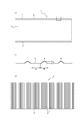
- the sectional view of H-section steel with a projection is shown. It is a figure which shows H-section steel with a protrusion, (a) is the side view seen from the opposing direction of a web, (b) is the top view seen from the opposing direction of a flange outer surface, (c) is the upper surface of a flange outer surface. The figures are respectively shown.
- C 0.05 to 0.20% C is an element necessary to secure the strength of the base material and needs to be contained at least 0.05%. However, if the C content exceeds 0.20%, not only the toughness of the base material is lowered but also the weldability is lowered. Therefore, in the present invention, the C content is set to 0.05 to 0.20%.
- the C content is preferably 0.10% or more. Further, the C content is preferably 0.15% or less.
- Si 0.05 to 0.60% Si must be contained in the base metal at a strength of 0.05% or more as a deoxidizing agent, but if the Si content exceeds 0.60%, the toughness decreases and the high bond strength of Si with oxygen is high. Therefore, the weldability deteriorates. Therefore, in the present invention, the Si content is set to 0.05 to 0.60%.
- the Si content is preferably 0.20% or more. Further, the Si content is preferably 0.40% or less.
- Mn 1.20 ⁇ 1.70%
- Mn is a relatively inexpensive element that has the effect of increasing the strength of steel, so it is an important element for increasing strength.
- the Mn content is set to 1.20 to 1.70%.
- the Mn content is preferably 1.40% or more. Further, the Mn content is preferably 1.60% or less.
- the amount of P in steel is 0.035% or less. It is preferably 0.020% or less.
- P is usually an element that is unavoidably contained in steel as an impurity, and excessive reduction in P causes an increase in refining time and an increase in cost, so the P content should be 0.005% or more. preferable.
- S 0.035% or less
- the S content in steel is 0.035% or less. It is preferably 0.020% or less.
- the smaller the amount of S the more preferable, and therefore the lower limit of the S content is not particularly limited and may be 0%.
- S is an element that is unavoidably contained in steel as an impurity, and excessive reduction of S causes increase in refining time and cost, so the S content should be 0.002% or more. preferable.
- V 0.040 to 0.200%
- V is an important element that has the effect of precipitating in austenite as VN during rolling or during cooling after rolling to form ferrite transformation nuclei, which has the effect of refining the crystal grains.
- V also has a role of increasing the strength of the base material by precipitation strengthening, and is an essential element for ensuring high tensile strength and toughness.
- the V content needs to be 0.040% or more.
- the V content is set to 0.040 to 0.200%.
- the V content is preferably 0.060% or more. Further, the V content is preferably 0.120% or less.
- N 0.0040-0.0200%
- N is a useful element that combines with V in steel and improves the base metal strength as VN, and it is necessary to contain 0.0040% or more.
- the N content exceeds 0.0200%, the carbonitride formed is coarsened and the toughness of the base material is greatly impaired, which is not preferable. Therefore, in the present invention, the N content is set to 0.0040 to 0.0200%.
- the N content is preferably 0.0060% or more. Further, the N content is preferably 0.0120% or less.
- the value calculated by the above formula which is a parameter based on the contents of V, N, and S, to be 0.05 or more, a sufficient amount that contributes to the improvement of toughness while suppressing the precipitation of coarse MnS. It is possible to secure the deposited VN.
- the value calculated by [%V] ⁇ [%N]/[%S] is set in the range of 0.05 to 0.50. Further, the value calculated by the above formula is preferably 0.10 or more and 0.30 or less.
- the balance other than the components described above is Fe and inevitable impurities.
- Cr 1.0% or less
- Cu 1.0% or less
- Ni 1.0 or less for the purpose of improving strength, ductility, toughness, and weld property.
- Mo 1.0% or less
- Al 0.10% or less
- Nb 0.10% or less
- B 0.010% or less
- Ca 0.10% or less
- Mg 0.10% or less
- REM 0.10% or less 1
- One kind or two or more kinds may be optionally contained.
- Cr 1.0% or less Cr is an element that can further strengthen the steel by solid solution strengthening. However, if the content exceeds 1.0%, the upper bainite transformation is promoted and the toughness is lowered, which is not preferable. Therefore, when the chemical composition of steel contains Cr, the Cr content is 1.0% or less. It is more preferably 0.005% or more and 0.5% or less.
- Cu 1.0% or less
- Cu is an element that can further strengthen the steel by solid solution strengthening. However, if the content exceeds 1.0%, Cu cracking tends to occur. Therefore, if the composition of the steel contains Cu, the Cu content should be 1.0% or less. It is more preferably 0.005% or more and 0.5% or less.
- Ni 1.0% or less
- Ni is an element that can increase the strength of steel without deteriorating ductility.
- Cu cracking can be suppressed by adding Cu together, it is desirable that Ni is also contained when the steel composition contains Cu.
- the Ni content exceeds 1.0%, the hardenability of steel further increases and the toughness tends to decrease. Therefore, when the steel composition contains Ni, the Ni content is 1.0% or less. It is more preferably 0.005% or more and 0.5% or less.
- Mo 1.0% or less Mo is an element that can further strengthen the steel by solid solution strengthening. However, if the content exceeds 1.0%, a large amount of upper bainite is generated in the steel, and the toughness tends to decrease. Therefore, when the component composition contains Mo, the Mo content is 1.0% or less. It is more preferably 0.005% or more and 0.5% or less.
- Al 0.10% or less
- Al is an element that can be added as a deoxidizing agent.
- the Al content is preferably 0.10% or less.
- the lower limit of the Al content is not particularly limited, but it is preferably 0.001% or more for deoxidation. More preferably, it is 0.001% or more and 0.03% or less.
- Nb 0.10% or less
- Nb is an element that has the effect of improving the tensile strength and yield point of steel by precipitating as carbonitride in steel. However, if its content exceeds 0.10%, in addition to promoting precipitation embrittlement, it also promotes upper bainite transformation, which tends to reduce the toughness of the steel. Therefore, when the steel composition contains Nb, the Nb content is 0.10% or less. It is more preferably 0.01% or more and 0.05% or less.
- B 0.010% or less
- B is an element having the effect of segregating to the grain boundaries in steel and improving the grain boundary strength. It is also an element effective for improving toughness by forming a composite precipitate with TiN, which becomes the nucleation site of intragranular ferrite, and refining the microstructure.
- the toughness tends to decrease due to the precipitation of coarse carbonitrides at the grain boundaries. Therefore, when the steel composition contains B, the B content is 0.010% or less. It is more preferably 0.001% or more and 0.003% or less.
- Ca 0.10% or less
- Ca has a function of converting the oxides and sulfides in the sulfide-based inclusions into those having high stability at high temperatures, and granulating the sulfide-based inclusions.
- the toughness and ductility of the steel can be improved by the effect of Ca to control the morphology of inclusions.
- the Ca content exceeds 0.10%, the cleanliness tends to decrease and the toughness tends to decrease. Therefore, when the steel composition contains Ca, the Ca content is 0.10% or less. It is more preferably 0.0010% or more and 0.0050% or less.
- Mg 0.10% or less
- Mg has the function of transforming the oxides and sulfides in the sulfide-based inclusions into those having high stability at high temperatures, and granulating the sulfide-based inclusions. Then, the toughness and ductility of the steel can be improved by the effect of controlling the morphology of inclusions by this Mg. However, if the Mg content exceeds 0.10%, the cleanliness tends to decrease and the toughness tends to decrease. Therefore, when the steel composition contains Mg, the Mg content is 0.10% or less. It is more preferably 0.0010% or more and 0.0050% or less.
- REM 0.10% or less REM (rare earth metal) has the effect of transforming oxides and sulfides in sulfide-based inclusions into those with high stability at high temperatures, and granulating sulfide-based inclusions. .. Then, the toughness and ductility of the steel can be improved by the effect of controlling the morphology of inclusions by the REM. However, if the REM content exceeds 0.10%, the cleanliness tends to decrease and the toughness tends to decrease. Therefore, if the steel composition contains REM, the REM content should be 0.10% or less. It is more preferably 0.0010% or more and 0.0050% or less. The balance other than the elements described above is Fe and inevitable impurities.
- the H-section steel with protrusions of the present invention will be described in detail. That is, as shown in FIG. 1, the H-section steel with protrusions is formed by connecting a pair of flanges 2 with a web 3 similarly to a general H-section steel.
- the H-section steel with protrusions has protrusions 4 on the outer surface of the flange 2.
- the projections 4 are provided to give concrete adhesion performance.
- the location where the projection 4 is provided is the outer surface of the flange 2 as shown in FIG. In the illustrated example, the entire outer surface of the flange 2 is an enlarged view of a portion surrounded by a square in FIG. 2A.
- the protrusions 4 are formed so as to be arranged in the longitudinal direction of the flange 2.
- the shape, size, and number of protrusions can be set arbitrarily according to the specifications required for H-section steel with protrusions. Therefore, although not limited to the illustrated example, for example, the height h of the projection 4 is preferably 1.5 mm or more in consideration of the concrete adhesion performance. On the other hand, the upper limit of the height h is preferably 6 mm from the viewpoint of preventing roll breakage. Further, the distance d between the protrusions 4 preferably satisfies the relationship of h/d ⁇ 0.05 with the height h in consideration of the concrete adhesion performance.
- the hot rolling conditions for forming the H-shaped steel are not particularly limited and may be carried out according to a conventional method.
- the protrusion can be formed by using a roll having a groove corresponding to the protrusion to be formed on the surface of the roll as a roll for rolling down the portion (flange outer surface) where the protrusion is formed. After finish rolling, it is necessary to perform cooling satisfying the following conditions.
- the flange temperature at the start of cooling is set to 750°C or higher in order to prevent the decrease in production efficiency by starting the cooling of the steel material immediately after finish rolling. To do.
- the flange temperature at the start of cooling is less than the Ar 3 temperature, it becomes difficult to obtain sufficient strength, so it is preferable to further set the flange temperature at the start of cooling to the Ar 3 temperature or higher.
- the Ar 3 transformation temperature is simply shown in relation to the steel composition by the following equation (2), for example.
- Ar 3 910-310 ⁇ [%C]+25 ⁇ ([%Si]+2 ⁇ [%Al])-80 ⁇ [Mneq] ⁇ (2)
- [Mneq] is a value calculated by the following equation (3).
- [Mneq] [%Mn]+[%Cr]+[%Cu]+[%Mo]+[%Ni]/2+10 ⁇ ([%Nb]-0.02) ⁇ (3)
- [%M] means the content (mass %) of the element M in the steel.
- the content of the element M contained as an unavoidable impurity It should be calculated using the analysis value).
- Average cooling rate from cooling start temperature to 500°C 0.1 ⁇ 30°C/s If the average cooling rate from the cooling start temperature to 500°C is less than 0.1°C/s, it is difficult to secure the predetermined tensile properties and toughness, so the cooling rate is 0.1°C/s or more. On the other hand, when the cooling rate becomes higher than 30°C/s, adverse effects such as decrease in toughness and excessive increase in tensile strength occur due to the formation of bainite or martensite.
- the cooling rate is in the range of 0.1 to 30°C/s.
- a preferred average cooling rate is in the range of 0.5 to 10°C/s.
- the H-shaped steel with projections has a tensile strength of 490 MPa or more, a yield strength of 355 MPa or more, and an impact absorption energy vE0 of 27 J at 0°C.
- excellent mechanical performance can be obtained.
- the tensile strength is 640 MPa
- the yield strength is 475 MPa
- the impact absorption energy vE0 at 0° C. is about 350 J.
- the flange thickness of the H-section steel with protrusions targeted by the present invention is not particularly limited.
- the protrusion on the outer surface of the flange is formed by using a grooved roll in the finish rolling process. That is, it is necessary to increase the amount of reduction of the flange portion as much as possible in order to give a desired protrusion height. Therefore, a protruding H-section steel with a thick flange requires greater reduction.
- the present invention by controlling the rolling temperature within an appropriate range, it is said that the formation efficiency of the projection height is lowered. Even in the case of a thick H-section steel with a flange thickness of 16 mm or more, a sufficient projection height can be obtained. Can be granted.
- the finish rolling temperature is preferably 800°C or higher from the viewpoint of forming protrusions having a sufficient protrusion height. If the finishing rolling temperature is less than 800°C, it is difficult to stably form protrusions of sufficient height.
- the upper limit of the finishing temperature is not particularly limited, but if it exceeds 1050° C., the austenite grain size becomes coarse and the toughness tends to decrease. Therefore, the finishing temperature is preferably 1050° C. or lower.
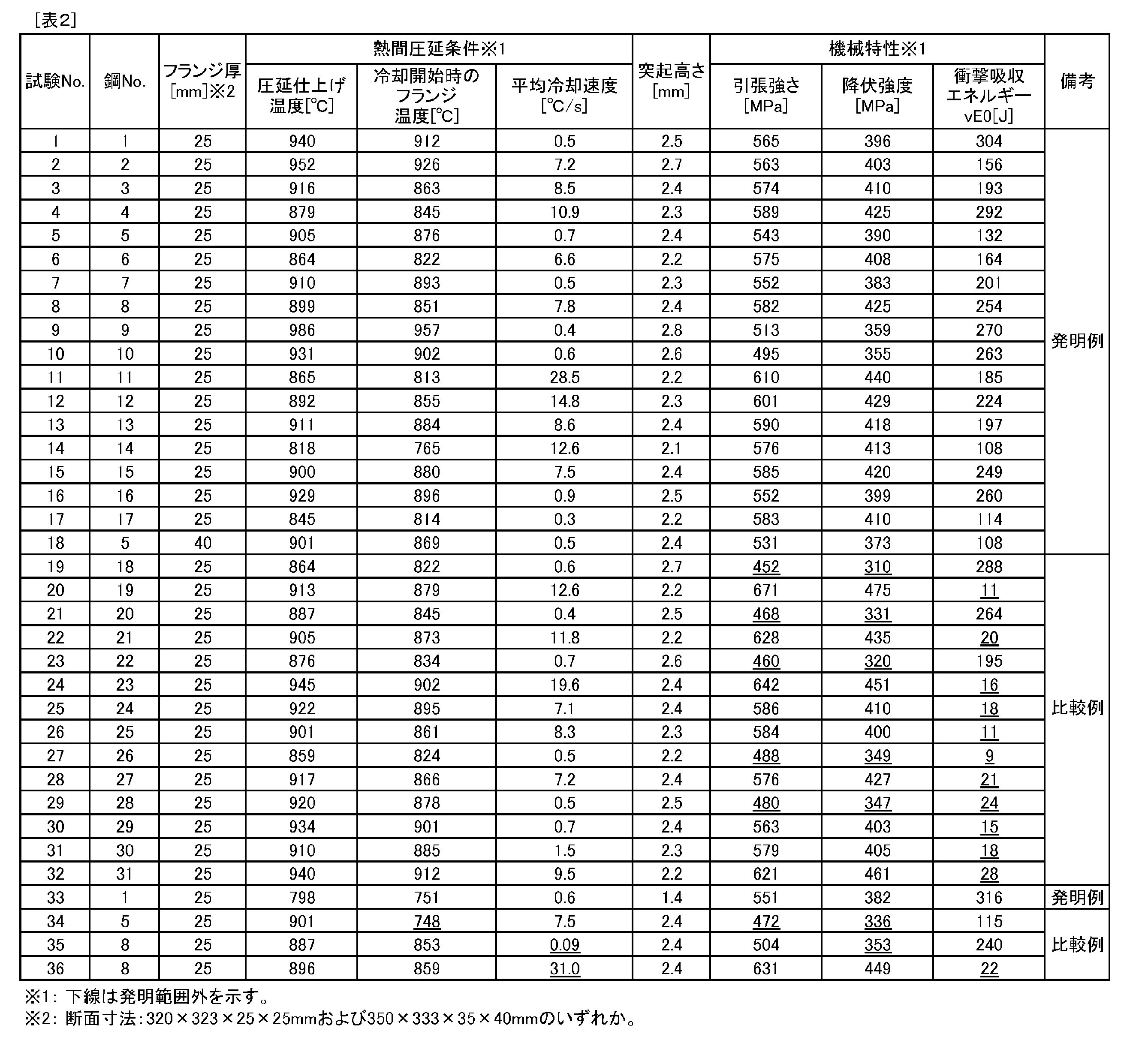
- a steel blank having the composition shown in Table 1 was made into a beam blank having a cross section of 400 mm ⁇ 560 mm ⁇ length of 8000 mm by a continuous casting machine, heated at 1250°C for 2 hours, and then hot-rolled and cooled under the conditions shown in Table 2.
- a H-section steel 1 with protrusions having a cross-sectional shape shown in FIG. 1, that is, a shape having a web 3 and a pair of flanges 2 arranged at both ends of the web was manufactured.
- the cross-sectional dimension web height x flange width x web thickness x flange thickness
- the cross-sectional dimension is one of two types of 320 x 323 x 25 x 25 mm and 350 x 333 x 35 x 40 mm.
- a rolling roll having a groove corresponding to the projection shape to be formed on the flange outer surface is used as a rolling roll for rolling down the flange outer surface, and the flange outer surface extends in the width direction of the flange 2 as shown in FIG.
- the existing protrusions 4 were formed.
- the finish rolling roll that rolls down the outer surface of the flange is provided with a groove capable of forming a protrusion having a protrusion width w of 15 mm and a protrusion height h of 1.5 mm or more.
- the cooling rate after finish rolling is measured by measuring the temperature of the outer surface of the flange with a radiation thermometer and converting the temperature change from the start of cooling to the end of cooling per unit time (seconds) to obtain the cooling rate (°C/ s) was calculated.
- the obtained H-section steel with protrusions was subjected to protrusion height evaluation, tensile test and toughness test. The details of each evaluation will be described below in detail.
- the protrusion height h on the outer surface of the flange shown in FIG. 2 was measured. Such a value was measured at three points in the rolling direction of the H-section steel with protrusions after finish rolling in the rolling direction, the center portion and the tail end portion, and the average value was adopted.
- the lower limit of the required performance of the protrusion height was set to 1.5 mm, and a value above this value was set as a suitable range of the protrusion height h.
- the manufacturing conditions under which the H-shaped steel with protrusions having the protrusion height h of not less than this value are obtained can be evaluated as particularly preferable conditions from the viewpoint of ease of forming the protrusions.
- Table 2 also shows the results of the above survey.
- Test results of the H-section steel with protrusions produced by the manufacturing method within the scope of the present invention (the average cooling rate of the outer surface of the flange is within the scope of the present invention) using a compatible steel satisfying the steel composition of the present invention (test No. in Table 2). .1 to 18, 33) all satisfied the desired properties (tensile strength: 490 MPa or more, yield strength: 355 MPa or more and impact absorption energy vE0: 27 J or more at 0° C.).
- the protrusion height was 1.4 mm, which was less than the preferred range (1.5 mm or more).
Landscapes
- Chemical & Material Sciences (AREA)
- Engineering & Computer Science (AREA)
- Mechanical Engineering (AREA)
- Materials Engineering (AREA)
- Metallurgy (AREA)
- Organic Chemistry (AREA)
- Physics & Mathematics (AREA)
- Thermal Sciences (AREA)
- Crystallography & Structural Chemistry (AREA)
- Heat Treatment Of Steel (AREA)
Abstract
Description
1.C:0.05~0.20質量%、Si:0.05~0.60質量%、Mn:1.20~1.70質量%、P:0.035質量%以下、S: 0.035質量%以下、V:0.040~0.200質量%およびN:0.0040~0.0200質量%を、下記(1)式を満足する範囲で含有し、残部がFeおよび不可避的不純物の鋼組成を有し、引張強さが490MPa以上、降伏強度が355MPa以上、かつ0℃における衝撃吸収エネルギーvE0が27J以上である、突起付きH形鋼。
記
0.05≦[%V]×[%N]/[%S] ≦0.50 ・・・(1)
ここで、[%V]、[%N]および[%S]はそれぞれ、鋼中のV、NおよびSの含有量(質量%)である。
前記熱間圧延の仕上圧延によりH形鋼のフランジ外面に突起を形成し、該仕上圧延の後に、750℃以上の冷却開始温度から500℃までの間を平均冷却速度:0.1~30℃/sの条件で冷却する突起付きH形鋼の製造方法。
Cは、母材強度を確保するために必要な元素であり、少なくとも0.05%含有されていることを必要とする。しかし、C含有量が0.20%を超えると、母材靭性を低下させるばかりか、溶接性を低下させる。そのため、本発明ではC含有量を0.05~0.20%とする。なお、C含有量は0.10%以上とすることが好ましい。また、C含有量は0.15%以下とすることが好ましい。
Siは、母材強度の確保および脱酸剤として0.05%以上で含有される必要があるが、Si含有量が0.60%を超えると靭性の低下に加え、Siの有する高い酸素との結合力のため、溶接性が劣化する。そのため、本発明ではSi含有量を0.05~0.60%とする。なお、Si含有量は0.20%以上とすることが好ましい。また、Si含有量は0.40%以下とすることが好ましい。
Mnは、Siと同様、鋼の強度を高める効果のある比較的安価な元素であるため、高強度化には重要な元素である。しかし、Mn含有量が1.20%未満では、その添加効果は小さく、一方、1.70%を超えると、上部ベイナイト変態を促進させ、靭性を低下させるので好ましくない。そのため、本発明ではMn含有量を1.20~1.70%とする。なお、Mn含有量は1.40%以上とすることが好ましい。また、Mn含有量は1.60%以下とすることが好ましい。
Pは、その含有量が0.035%を超えると、鋼の延性が劣化する。そのため、本発明では鋼中のP量を0.035%以下とする。好ましくは0.020%以下である。一方、Pは少ないほど好ましいため、P含有量の下限は特に限定されず、0%であってよい。しかし、通常、Pは不純物として鋼中に不可避的に含有される元素であり、過度の低P化は精錬時間の増加やコストの上昇を招くため、P含有量は0.005%以上とすることが好ましい。
Sは、鋼中に含有されると主にA系介在物の形態で鋼材中に存在する。S含有量が0.035%を超えると、この介在物量が著しく増加し、同時に粗大な介在物を生成するため、鋼の靭性を大きく低下させる。そのため、本発明では鋼中のS含有量を0.035%以下とする。好ましくは0.020%以下である。一方、Sは少ないほど好ましいため、S含有量の下限は特に限定されず、0%であってよい。なお、通常、Sは不純物として鋼中に不可避的に含有される元素であり、過度の低S化は精錬時間の増加やコストの上昇を招くため、S含有量は0.002%以上とすることが好ましい。
Vは、圧延中または圧延後の冷却中にVNとしてオーステナイトに析出してフェライト変態核となり、結晶粒を微細化する効果を有する重要な元素である。また、Vは、析出強化により母材強度を高める役割も有しており、高い引張強度と靭性を確保するために不可欠な元素である。前記効果を得るためにはV含有量を0.040%以上とする必要がある。一方、V含有量が0.200%を超えると、析出脆化を助長し、母材靭性を大きく損なうので好ましくない。そのため、本発明ではV含有量を0.040~0.200%とする。なお、V含有量は0.060%以上とすることが好ましい。また、V含有量は0.120%以下とすることが好ましい。
Nは、鋼中でVと結合し、VNとして母材強度を向上させる有用な元素であり、0.0040%以上の含有を必要とする。しかし、N含有量が、0.0200%を超えると形成される炭窒化物が粗大化して母材靭性を大きく損なうので好ましくない。そのため、本発明ではN含有量を0.0040~0.0200%とする。なお、N含有量は0.0060%以上とすることが好ましい。また、N含有量は0.0120%以下とすることが好ましい。
0.05≦[%V]×[%N]/[%S] ≦0.50 ・・・(1)
さらに、本発明の突起付きH形鋼では、以上説明した成分の他に、強度や延性、靱性、溶接部特性の向上を目的として、Cr:1.0%以下、Cu:1.0%以下、Ni:1.0%以下、Mo:1.0%以下、Al:0.10%以下、Nb:0.10%以下、B:0.010%以下、Ca:0.10%以下、Mg:0.10%以下およびREM:0.10%以下の中から選ばれる1種または2種以上を任意に含有していてもよい。
以下、上記元素の含有量を特定した理由を説明する。
Crは、固溶強化により鋼の更なる高強度化を図ることができる元素である。ただし、その含有量が1.0%を超えると、上部ベイナイト変態を促進させ、靭性を低下させるので好ましくない。したがって、鋼の成分組成がCrを含有する場合は、Cr含有量は1.0%以下とする。より好ましくは0.005%以上であり、0.5%以下である。
Cuは、固溶強化により鋼の更なる高強度化を図ることができる元素である。ただし、その含有量が1.0%を超えると、Cu割れを生じやすくなる。したがって、鋼の成分組成がCuを含有する場合は、Cu含有量は1.0%以下とする。より好ましくは0.005%以上であり、0.5%以下である。
Niは、延性を劣化することなく鋼の高強度化を図ることができる元素である。また、Cuと複合添加することによりCu割れを抑制することができるため、鋼組成がCuを含有する場合にはNiも含有することが望ましい。ただし、Ni含有量が1.0%を超えると、鋼の焼入れ性がより上昇し、靭性が低下する傾向がある。したがって、鋼組成がNiを含有する場合は、Ni量は1.0%以下とする。より好ましくは0.005%以上であり、0.5%以下である。
Moは、固溶強化によってさらなる鋼の高強度化を図ることができる元素である。ただし、その含有量が1.0%を超えると、鋼中に上部ベイナイトが多量に生成するようになり、靭性が低下する傾向がある。したがって、成分組成がMoを含有する場合は、Mo含有量は1.0%以下とする。より好ましくは0.005%以上であり、0.5%以下である。
Alは、脱酸剤として添加することができる元素である。しかし、Al含有量が0.10%を超えると、Alの有する高い酸素との結合力のため、鋼中に酸化物系介在物が多量に生成し、その結果、鋼の延性が低下する。したがって、鋼組成がAlを含有する場合は、Al量は0.10%以下とすることが好ましい。一方、Al含有量の下限は特に限定されないが、脱酸のためには0.001%以上とすることが好ましい。より好ましくは0.001%以上であり、0.03%以下である。
Nbは、鋼中で炭窒化物として析出することで、鋼の引張強度や降伏点を向上させる効果を有する元素である。ただし、その含有量が0.10%を超えると、析出脆化を助長することに加え、上部ベイナイト変態を促進させるため、鋼の靭性が低下する傾向がある。したがって、鋼組成がNbを含有する場合は、Nb含有量は0.10%以下とする。より好ましくは0.01%以上であり、0.05%以下である。
Bは、鋼中で粒界に偏析し粒界強度を向上させる効果を有する元素である。また、粒内フェライトの核生成サイトとなるTiNとの複合析出物を形成し、ミクロ組織を微細化することで靭性向上にも有効な元素である。一方、その含有量が0.010%を超えると、粗大な炭窒化物の粒界析出により靭性が低下しがちとなる。したがって、鋼組成がBを含有する場合は、B含有量は0.010%以下とする。より好ましくは0.001%以上であり、0.003%以下である。
Caは、硫化物系介在物中の酸化物および硫化物を、高温における安定性が高いものへ変質させて、硫化物系介在物を粒状化する作用を有する。そして、このCaによる介在物の形態制御効果により、鋼の靭性、延性の向上を図ることが出できる。但し、Ca含有量が0.10%を超えると、清浄度が低下して靭性が低下しがちとなる。したがって、鋼組成がCaを含有する場合は、Ca含有量は0.10%以下とする。より好ましくは0.0010%以上であり、0.0050%以下である。
Mgは、硫化物系介在物中の酸化物および硫化物を、高温における安定性が高いものへ変質させて、硫化物系介在物を粒状化する作用を有する。そして、このMgによる介在物の形態制御効果により、鋼の靭性、延性の向上を図ることが出できる。但し、Mg含有量が0.10%を超えると、清浄度が低下して靭性が低下しがちとなる。したがって、鋼組成がMgを含有する場合は、Mg含有量は0.10%以下とする。より好ましくは0.0010%以上であり、0.0050%以下である。
REM(希土類金属)は、硫化物系介在物中の酸化物および硫化物を、高温における安定性が高いものへ変質させて、硫化物系介在物を粒状化する作用を有する。そして、このREMによる介在物の形態制御効果により、鋼の靭性、延性の向上を図ることが出できる。但し、REM含有量が0.10%を超えると、清浄度が低下して靭性が低下しがちとなる。したがって、鋼組成がREMを含有する場合は、REM含有量は0.10%以下とする。より好ましくは0.0010%以上であり、0.0050%以下である。
以上説明した元素以外の残部はFeおよび不可避的不純物である。
本発明では、仕上圧延直後に鋼材の冷却を開始することによって生産能率の低下を防止することを所期して、冷却開始時のフランジ温度は750℃以上とする。一方、冷却開始時のフランジ温度がAr3温度未満になると、十分な強度を得難くなるため、さらに冷却開始時のフランジ温度をAr3温度以上とすることが好ましい。なお、Ar3変態温度は、例えば以下の(2)式により鋼成分との関係で簡易的に示される。
Ar3=910-310×[%C]+25×([%Si]+2×[%Al])-80×[Mneq] ・・・(2)
ここで、[Mneq]は次の(3)式で算出される値である。
[Mneq]=[%Mn]+[%Cr]+[%Cu]+[%Mo]+[%Ni]/2+10×([%Nb]-0.02)・・・(3)
なお、上記(2)式、(3)式において、[%M]は鋼中の元素Mの含有量(質量%)を意味する。ここで、上記(2)式および(3)式でAr3を計算するにあたり、積極的に含有させていない元素Mの含有量については、不可避的不純物として含有されている元素Mの含有量(分析値)を用いて算出するものとする。
冷却開始温度から500℃までの平均冷却速度が0.1℃/sに満たないと、所定の引張特性および靭性を確保することが難しいため、冷却速度は0.1℃/s以上とする。一方、前記冷却速度が30℃/sを超えて大きくなると、ベイナイトあるいはマルテンサイトの生成により、靭性の低下や引張強さの過度な上昇といった弊害が生じるため、冷却開始温度から500℃までの平均冷却速度は0.1~30℃/sの範囲とする。好ましい平均冷却速度は、0.5~10℃/sの範囲である。

得られた突起付きH形鋼について、図2に示したフランジ外面の突起高さhを測定した。かかる値の測定は、仕上圧延後の突起付きH形鋼の圧延方向における先端部、中央部および尾端部の3箇所について行い、その平均値を採用した。なお、突起高さの要求性能下限値を1.5mmに設定し、この値以上を突起高さhの好適範囲とした。また、突起高さhがこの値以上となる突起付きH形鋼が得られた製造条件は、突起形成のし易さの観点からも特に好ましい条件と評価できる。
図1に符号5として示すフランジ1/6B部(1/6Bを挟むフランジ幅方向長さ60mm)より、引張方向がH形鋼のフランジ長手方向となるように、JIS Z2201に規定されたJIS1A試験片(フランジ全厚試験片)を採取し、JIS Z2241に準じて引張試験を行い、降伏強度(降伏応力YSまたは0.2%耐力)、引張強さを測定した。
図1に示したフランジ1/6B部5のフランジ裏面から1/4t(tはフランジ厚)の位置を中心として、JIS Z2202に規定された2mmVノッチシャルピー衝撃試験片を採取し、JISZ2242に準じてシャルピー衝撃試験を行い、0℃における吸収エネルギーを測定した。
2 フランジ
3 ウェブ
4 突起
5 フランジ1/6B部(試験片採取位置)
Claims (5)
- C:0.05~0.20質量%、Si:0.05~0.60質量%、Mn:1.20~1.70質量%、P:0.035質量%以下、S:0.035質量%以下、V:0.040~0.200質量%およびN:0.0040~0.0200質量%を、次の(1)式を満足する範囲で含有し、残部がFeおよび不可避的不純物の鋼組成を有し、引張強さが490MPa以上、降伏強度が355MPa以上、かつ0℃における衝撃吸収エネルギーvE0が27J以上である、突起付きH形鋼。
記
0.05≦[%V]×[%N]/[%S] ≦0.50 ・・・(1)
ここで、[%V]、[%N]および[%S]はそれぞれ、鋼中のV、NおよびSの含有量(質量%)である。 - 前記鋼組成は、さらに、Cr:1.0質量%以下、Cu:1.0質量%以下、Ni:1.0質量%以下、Mo:1.0質量%以下、Al:0.10質量%以下、Nb:0.10質量%以下、B:0.010質量%以下、Ca:0.10質量%以下、Mg:0.10質量%以下およびREM:0.10質量%以下の中から選ばれる1種または2種以上を含有する請求項1に記載の突起付きH形鋼。
- 前記突起は、高さが1.5mm以上である請求項1または2に記載の突起付きH形鋼。
- 請求項1または2のいずれかに記載の鋼組成を有する鋼素材に、熱間圧延を施して突起付きH形鋼を成形する突起付きH形鋼の製造方法であって、
前記熱間圧延の仕上圧延によりH形鋼のフランジ外面に突起を形成し、該仕上圧延の後に、750℃以上の冷却開始温度から500℃までの間を平均冷却速度:0.1~30℃/sの条件で冷却する突起付きH形鋼の製造方法。 - 前記仕上圧延を800℃以上の温度で行う請求項4に記載の突起付きH形鋼の製造方法。
Priority Applications (4)
| Application Number | Priority Date | Filing Date | Title |
|---|---|---|---|
| KR1020217027441A KR102588284B1 (ko) | 2019-01-31 | 2020-01-29 | 돌기가 있는 h형강 및 그의 제조 방법 |
| CN202080011567.2A CN113396237B (zh) | 2019-01-31 | 2020-01-29 | 带突起的h型钢及其制造方法 |
| JP2020533326A JP6819831B2 (ja) | 2019-01-31 | 2020-01-29 | 突起付きh形鋼およびその製造方法 |
| SG11202108242RA SG11202108242RA (en) | 2019-01-31 | 2020-01-29 | H-beam having protrusions, and manufacturing method for same |
Applications Claiming Priority (2)
| Application Number | Priority Date | Filing Date | Title |
|---|---|---|---|
| JP2019-016140 | 2019-01-31 | ||
| JP2019016140 | 2019-01-31 |
Publications (1)
| Publication Number | Publication Date |
|---|---|
| WO2020158822A1 true WO2020158822A1 (ja) | 2020-08-06 |
Family
ID=71840204
Family Applications (1)
| Application Number | Title | Priority Date | Filing Date |
|---|---|---|---|
| PCT/JP2020/003256 Ceased WO2020158822A1 (ja) | 2019-01-31 | 2020-01-29 | 突起付きh形鋼およびその製造方法 |
Country Status (5)
| Country | Link |
|---|---|
| JP (1) | JP6819831B2 (ja) |
| KR (1) | KR102588284B1 (ja) |
| CN (1) | CN113396237B (ja) |
| SG (1) | SG11202108242RA (ja) |
| WO (1) | WO2020158822A1 (ja) |
Cited By (2)
| Publication number | Priority date | Publication date | Assignee | Title |
|---|---|---|---|---|
| CN112159929A (zh) * | 2020-09-28 | 2021-01-01 | 马鞍山钢铁股份有限公司 | 一种超大承载力屈曲约束支撑用热轧h型钢及其生产方法 |
| JP2022074057A (ja) * | 2020-10-29 | 2022-05-17 | Jfeスチール株式会社 | 突起付きh形鋼およびその製造方法 |
Families Citing this family (1)
| Publication number | Priority date | Publication date | Assignee | Title |
|---|---|---|---|---|
| CN114369765B (zh) * | 2022-01-17 | 2023-04-14 | 马鞍山钢铁股份有限公司 | 一种屈服强度550MPa级热轧H型钢及其生产方法 |
Citations (3)
| Publication number | Priority date | Publication date | Assignee | Title |
|---|---|---|---|---|
| JPH09125140A (ja) * | 1995-08-29 | 1997-05-13 | Kawasaki Steel Corp | 強度、靱性、溶接性および耐震性に優れた極厚h形鋼およびその製造方法 |
| JPH11323477A (ja) * | 1998-05-08 | 1999-11-26 | Kawasaki Steel Corp | 高強度・高靱性極厚h形鋼 |
| JP2004256834A (ja) * | 2003-02-24 | 2004-09-16 | Jfe Steel Kk | 熱間加工性および靱性に優れる突起付h形鋼およびその製造方法 |
Family Cites Families (4)
| Publication number | Priority date | Publication date | Assignee | Title |
|---|---|---|---|---|
| JP2006075883A (ja) | 2004-09-10 | 2006-03-23 | Jfe Steel Kk | 突起付h形鋼の製造方法 |
| TW200845197A (en) * | 2007-03-28 | 2008-11-16 | Matsushita Electric Industrial Co Ltd | Plasma etching apparatus |
| JP5439887B2 (ja) * | 2008-03-31 | 2014-03-12 | Jfeスチール株式会社 | 高張力鋼およびその製造方法 |
| MX386573B (es) * | 2015-03-06 | 2025-03-19 | Jfe Steel Corp | Láminas de acero de alta resistencia y método de fabricación correspondiente. |
-
2020
- 2020-01-29 KR KR1020217027441A patent/KR102588284B1/ko active Active
- 2020-01-29 JP JP2020533326A patent/JP6819831B2/ja active Active
- 2020-01-29 WO PCT/JP2020/003256 patent/WO2020158822A1/ja not_active Ceased
- 2020-01-29 SG SG11202108242RA patent/SG11202108242RA/en unknown
- 2020-01-29 CN CN202080011567.2A patent/CN113396237B/zh active Active
Patent Citations (3)
| Publication number | Priority date | Publication date | Assignee | Title |
|---|---|---|---|---|
| JPH09125140A (ja) * | 1995-08-29 | 1997-05-13 | Kawasaki Steel Corp | 強度、靱性、溶接性および耐震性に優れた極厚h形鋼およびその製造方法 |
| JPH11323477A (ja) * | 1998-05-08 | 1999-11-26 | Kawasaki Steel Corp | 高強度・高靱性極厚h形鋼 |
| JP2004256834A (ja) * | 2003-02-24 | 2004-09-16 | Jfe Steel Kk | 熱間加工性および靱性に優れる突起付h形鋼およびその製造方法 |
Cited By (2)
| Publication number | Priority date | Publication date | Assignee | Title |
|---|---|---|---|---|
| CN112159929A (zh) * | 2020-09-28 | 2021-01-01 | 马鞍山钢铁股份有限公司 | 一种超大承载力屈曲约束支撑用热轧h型钢及其生产方法 |
| JP2022074057A (ja) * | 2020-10-29 | 2022-05-17 | Jfeスチール株式会社 | 突起付きh形鋼およびその製造方法 |
Also Published As
| Publication number | Publication date |
|---|---|
| KR102588284B1 (ko) | 2023-10-11 |
| JP6819831B2 (ja) | 2021-01-27 |
| KR20210118926A (ko) | 2021-10-01 |
| SG11202108242RA (en) | 2021-08-30 |
| CN113396237B (zh) | 2023-03-07 |
| CN113396237A (zh) | 2021-09-14 |
| JPWO2020158822A1 (ja) | 2021-02-18 |
Similar Documents
| Publication | Publication Date | Title |
|---|---|---|
| EP2272994B1 (en) | High-tensile strength steel and manufacturing method thereof | |
| JP4410741B2 (ja) | 成形性に優れた高強度薄鋼板およびその製造方法 | |
| JP4072191B1 (ja) | 高温強度、靭性及び耐再熱脆化特性に優れた耐火鋼材並びにその製造方法 | |
| JP6819831B2 (ja) | 突起付きh形鋼およびその製造方法 | |
| JP6819830B2 (ja) | 突起付きh形鋼およびその製造方法 | |
| EP3733912A1 (en) | High-strength high-toughness hot-rolled steel sheet and manufacturing method therefor | |
| JP7347361B2 (ja) | 突起付きh形鋼およびその製造方法 | |
| CN108474090B (zh) | 低屈强比高强度钢材及其制造方法 | |
| JP7184062B2 (ja) | 突条付きh形鋼およびその製造方法 | |
| JP6589503B2 (ja) | H形鋼及びその製造方法 | |
| JPH07316650A (ja) | 低降伏比高強度熱延鋼板の製造方法 | |
| JP3440710B2 (ja) | フィレット部靱性に優れたh形鋼およびその製造方法 | |
| JP4757858B2 (ja) | 高温強度、靭性及び耐再熱脆化特性に優れた耐火鋼材並びにその製造方法 | |
| JP4222073B2 (ja) | フィレット部靱性に優れたh形鋼およびその製造方法 | |
| JP2022074057A (ja) | 突起付きh形鋼およびその製造方法 | |
| JP7732150B2 (ja) | 突起付きh形鋼およびその製造方法 | |
| JPH11158543A (ja) | 溶接部靱性に優れた圧延形鋼の製造方法 | |
| KR20130075034A (ko) | 용접부 인성과 연성이 우수한 후강판의 제조방법 및 이를 이용한 용접구조물 | |
| JP4757857B2 (ja) | 高温強度、靭性及び耐再熱脆化特性に優れた耐火鋼材並びにその製造方法 | |
| JP2007277629A (ja) | 極厚鋼材及びその製造方法 | |
| JPS6152317A (ja) | 低温靭性にすぐれた熱延鋼板の製造方法 | |
| JPH11323477A (ja) | 高強度・高靱性極厚h形鋼 | |
| JP5168045B2 (ja) | 高温強度、靭性及び耐再熱脆化特性に優れた耐火鋼材並びにその製造方法 | |
| JPH10287949A (ja) | 靱性と加工性に優れた400〜800N/mm2級高強度熱延鋼板及びその製造方法 | |
| JPH101723A (ja) | 高加工性高強度熱延鋼板の製造方法 |
Legal Events
| Date | Code | Title | Description |
|---|---|---|---|
| ENP | Entry into the national phase |
Ref document number: 2020533326 Country of ref document: JP Kind code of ref document: A |
|
| 121 | Ep: the epo has been informed by wipo that ep was designated in this application |
Ref document number: 20749466 Country of ref document: EP Kind code of ref document: A1 |
|
| NENP | Non-entry into the national phase |
Ref country code: DE |
|
| ENP | Entry into the national phase |
Ref document number: 20217027441 Country of ref document: KR Kind code of ref document: A |
|
| 122 | Ep: pct application non-entry in european phase |
Ref document number: 20749466 Country of ref document: EP Kind code of ref document: A1 |