WO2020151566A1 - 抑制pge2/ep4信号传导的化合物、其制备方法及其在医药上的应用 - Google Patents
抑制pge2/ep4信号传导的化合物、其制备方法及其在医药上的应用 Download PDFInfo
- Publication number
- WO2020151566A1 WO2020151566A1 PCT/CN2020/072487 CN2020072487W WO2020151566A1 WO 2020151566 A1 WO2020151566 A1 WO 2020151566A1 CN 2020072487 W CN2020072487 W CN 2020072487W WO 2020151566 A1 WO2020151566 A1 WO 2020151566A1
- Authority
- WO
- WIPO (PCT)
- Prior art keywords
- alkyl
- atom
- compound
- group
- alkoxy
- Prior art date
- Legal status (The legal status is an assumption and is not a legal conclusion. Google has not performed a legal analysis and makes no representation as to the accuracy of the status listed.)
- Ceased
Links
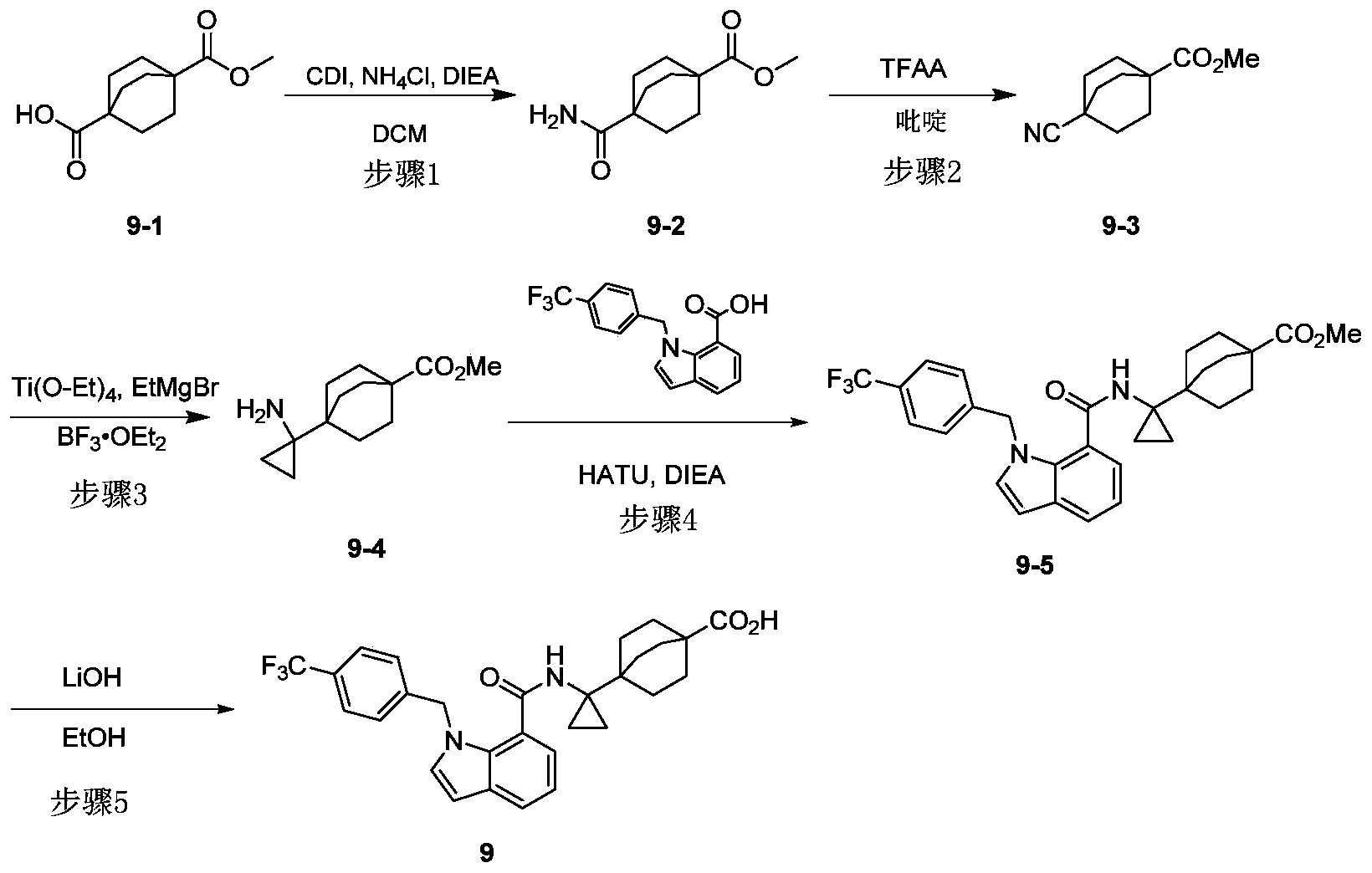
- IATYMCYPSAMTHX-UHFFFAOYSA-N COC(C(C1)(C2)CC12C1(CC1)N)=O Chemical compound COC(C(C1)(C2)CC12C1(CC1)N)=O IATYMCYPSAMTHX-UHFFFAOYSA-N 0.000 description 2
- BTNBHBRZVNKZLS-UHFFFAOYSA-N NC(c1cccc2c1[n](Cc1cc(cc(cc3)F)c3[o]1)cc2)=O Chemical compound NC(c1cccc2c1[n](Cc1cc(cc(cc3)F)c3[o]1)cc2)=O BTNBHBRZVNKZLS-UHFFFAOYSA-N 0.000 description 2
- TWFKSQPOCJYBFI-UHFFFAOYSA-N BCc1ccc(C(F)(F)F)cc1 Chemical compound BCc1ccc(C(F)(F)F)cc1 TWFKSQPOCJYBFI-UHFFFAOYSA-N 0.000 description 1
- WHDZIHLWBZWJMI-UHFFFAOYSA-N COC(C(C1)(C2)CC12C#N)=O Chemical compound COC(C(C1)(C2)CC12C#N)=O WHDZIHLWBZWJMI-UHFFFAOYSA-N 0.000 description 1
- 0 COC(C(C1)(C2)CC12C1(C(*)(*)C1(*)*)N)=O Chemical compound COC(C(C1)(C2)CC12C1(C(*)(*)C1(*)*)N)=O 0.000 description 1
- GYHQUTXHUMZSAO-UHFFFAOYSA-N COC(C(C1)(C2)CC12C1(CC1)NC(c1cccc2c1[n](Cc1ccc(C(F)(F)F)cc1)cc2)=O)=O Chemical compound COC(C(C1)(C2)CC12C1(CC1)NC(c1cccc2c1[n](Cc1ccc(C(F)(F)F)cc1)cc2)=O)=O GYHQUTXHUMZSAO-UHFFFAOYSA-N 0.000 description 1
- QNDYSZLDEQGLLG-UHFFFAOYSA-N COC(c1cc2cc(F)ccc2[o]1)=O Chemical compound COC(c1cc2cc(F)ccc2[o]1)=O QNDYSZLDEQGLLG-UHFFFAOYSA-N 0.000 description 1
- FTLOEULOTNVCGF-UHFFFAOYSA-N COC(c1cccc2c1[nH]cc2)=O Chemical compound COC(c1cccc2c1[nH]cc2)=O FTLOEULOTNVCGF-UHFFFAOYSA-N 0.000 description 1
- MIBOWQXPCLHKFH-UHFFFAOYSA-N COC(c1cccc2c1[n](Cc1cc3cc(F)ccc3[o]1)cc2)=O Chemical compound COC(c1cccc2c1[n](Cc1cc3cc(F)ccc3[o]1)cc2)=O MIBOWQXPCLHKFH-UHFFFAOYSA-N 0.000 description 1
- CBCQEGNVXQADHB-UHFFFAOYSA-N COC(c1cccc2c1[n](Cc1ccc(C(F)(F)F)cc1)cc2)=O Chemical compound COC(c1cccc2c1[n](Cc1ccc(C(F)(F)F)cc1)cc2)=O CBCQEGNVXQADHB-UHFFFAOYSA-N 0.000 description 1
- STJYEXQHCJEKJB-UHFFFAOYSA-N OC(C(C1)(C2)CC12C1(CC1)NC(c1cccc2c1[n](Cc(nc1)ccc1-c1ccncc1)cc2)=O)=O Chemical compound OC(C(C1)(C2)CC12C1(CC1)NC(c1cccc2c1[n](Cc(nc1)ccc1-c1ccncc1)cc2)=O)=O STJYEXQHCJEKJB-UHFFFAOYSA-N 0.000 description 1
- VURRGJUQWVGEHJ-UHFFFAOYSA-N OC(C(C1)(C2)CC12C1(CC1)NC(c1cccc2c1[n](Cc1ccc(C(F)(F)F)cc1)cc2)=O)=O Chemical compound OC(C(C1)(C2)CC12C1(CC1)NC(c1cccc2c1[n](Cc1ccc(C(F)(F)F)cc1)cc2)=O)=O VURRGJUQWVGEHJ-UHFFFAOYSA-N 0.000 description 1
- BPWIMNMRUNWDGF-UHFFFAOYSA-N OC(C(C1)(C2)CC12C1(CC1)NC(c1cccc2c1[n](Cc1nc3ccccc3[s]1)cc2)=O)=O Chemical compound OC(C(C1)(C2)CC12C1(CC1)NC(c1cccc2c1[n](Cc1nc3ccccc3[s]1)cc2)=O)=O BPWIMNMRUNWDGF-UHFFFAOYSA-N 0.000 description 1
- IPDOBVFESNNYEE-UHFFFAOYSA-N OC(c1cccc2c1[nH]cc2)=O Chemical compound OC(c1cccc2c1[nH]cc2)=O IPDOBVFESNNYEE-UHFFFAOYSA-N 0.000 description 1
- XIHZXHRUSLVNDB-UHFFFAOYSA-N OC(c1cccc2c1[n](Cc1ccc(C(F)(F)F)cc1)cc2)=O Chemical compound OC(c1cccc2c1[n](Cc1ccc(C(F)(F)F)cc1)cc2)=O XIHZXHRUSLVNDB-UHFFFAOYSA-N 0.000 description 1
- VFXRFXAEZVQAHB-UHFFFAOYSA-N OCc1cc2cc(F)ccc2[o]1 Chemical compound OCc1cc2cc(F)ccc2[o]1 VFXRFXAEZVQAHB-UHFFFAOYSA-N 0.000 description 1
- FDUBQNUDZOGOFE-UHFFFAOYSA-N Oc(c(C=O)c1)ccc1F Chemical compound Oc(c(C=O)c1)ccc1F FDUBQNUDZOGOFE-UHFFFAOYSA-N 0.000 description 1
Images


Classifications
-
- C—CHEMISTRY; METALLURGY
- C07—ORGANIC CHEMISTRY
- C07D—HETEROCYCLIC COMPOUNDS
- C07D209/00—Heterocyclic compounds containing five-membered rings, condensed with other rings, with one nitrogen atom as the only ring hetero atom
- C07D209/02—Heterocyclic compounds containing five-membered rings, condensed with other rings, with one nitrogen atom as the only ring hetero atom condensed with one carbocyclic ring
- C07D209/04—Indoles; Hydrogenated indoles
- C07D209/10—Indoles; Hydrogenated indoles with substituted hydrocarbon radicals attached to carbon atoms of the hetero ring
-
- C—CHEMISTRY; METALLURGY
- C07—ORGANIC CHEMISTRY
- C07D—HETEROCYCLIC COMPOUNDS
- C07D209/00—Heterocyclic compounds containing five-membered rings, condensed with other rings, with one nitrogen atom as the only ring hetero atom
- C07D209/02—Heterocyclic compounds containing five-membered rings, condensed with other rings, with one nitrogen atom as the only ring hetero atom condensed with one carbocyclic ring
- C07D209/04—Indoles; Hydrogenated indoles
- C07D209/08—Indoles; Hydrogenated indoles with only hydrogen atoms or radicals containing only hydrogen and carbon atoms, directly attached to carbon atoms of the hetero ring
-
- A—HUMAN NECESSITIES
- A61—MEDICAL OR VETERINARY SCIENCE; HYGIENE
- A61K—PREPARATIONS FOR MEDICAL, DENTAL OR TOILETRY PURPOSES
- A61K31/00—Medicinal preparations containing organic active ingredients
- A61K31/33—Heterocyclic compounds
- A61K31/395—Heterocyclic compounds having nitrogen as a ring hetero atom, e.g. guanethidine or rifamycins
- A61K31/40—Heterocyclic compounds having nitrogen as a ring hetero atom, e.g. guanethidine or rifamycins having five-membered rings with one nitrogen as the only ring hetero atom, e.g. sulpiride, succinimide, tolmetin, buflomedil
- A61K31/403—Heterocyclic compounds having nitrogen as a ring hetero atom, e.g. guanethidine or rifamycins having five-membered rings with one nitrogen as the only ring hetero atom, e.g. sulpiride, succinimide, tolmetin, buflomedil condensed with carbocyclic rings, e.g. carbazole
- A61K31/404—Indoles, e.g. pindolol
-
- A—HUMAN NECESSITIES
- A61—MEDICAL OR VETERINARY SCIENCE; HYGIENE
- A61K—PREPARATIONS FOR MEDICAL, DENTAL OR TOILETRY PURPOSES
- A61K31/00—Medicinal preparations containing organic active ingredients
- A61K31/33—Heterocyclic compounds
- A61K31/395—Heterocyclic compounds having nitrogen as a ring hetero atom, e.g. guanethidine or rifamycins
- A61K31/435—Heterocyclic compounds having nitrogen as a ring hetero atom, e.g. guanethidine or rifamycins having six-membered rings with one nitrogen as the only ring hetero atom
- A61K31/44—Non condensed pyridines; Hydrogenated derivatives thereof
- A61K31/4427—Non condensed pyridines; Hydrogenated derivatives thereof containing further heterocyclic ring systems
- A61K31/4439—Non condensed pyridines; Hydrogenated derivatives thereof containing further heterocyclic ring systems containing a five-membered ring with nitrogen as a ring hetero atom, e.g. omeprazole
-
- A—HUMAN NECESSITIES
- A61—MEDICAL OR VETERINARY SCIENCE; HYGIENE
- A61K—PREPARATIONS FOR MEDICAL, DENTAL OR TOILETRY PURPOSES
- A61K31/00—Medicinal preparations containing organic active ingredients
- A61K31/33—Heterocyclic compounds
- A61K31/395—Heterocyclic compounds having nitrogen as a ring hetero atom, e.g. guanethidine or rifamycins
- A61K31/435—Heterocyclic compounds having nitrogen as a ring hetero atom, e.g. guanethidine or rifamycins having six-membered rings with one nitrogen as the only ring hetero atom
- A61K31/47—Quinolines; Isoquinolines
- A61K31/4709—Non-condensed quinolines and containing further heterocyclic rings
-
- A—HUMAN NECESSITIES
- A61—MEDICAL OR VETERINARY SCIENCE; HYGIENE
- A61K—PREPARATIONS FOR MEDICAL, DENTAL OR TOILETRY PURPOSES
- A61K31/00—Medicinal preparations containing organic active ingredients
- A61K31/33—Heterocyclic compounds
- A61K31/395—Heterocyclic compounds having nitrogen as a ring hetero atom, e.g. guanethidine or rifamycins
- A61K31/535—Heterocyclic compounds having nitrogen as a ring hetero atom, e.g. guanethidine or rifamycins having six-membered rings with at least one nitrogen and one oxygen as the ring hetero atoms, e.g. 1,2-oxazines
- A61K31/5375—1,4-Oxazines, e.g. morpholine
- A61K31/5377—1,4-Oxazines, e.g. morpholine not condensed and containing further heterocyclic rings, e.g. timolol
-
- A—HUMAN NECESSITIES
- A61—MEDICAL OR VETERINARY SCIENCE; HYGIENE
- A61K—PREPARATIONS FOR MEDICAL, DENTAL OR TOILETRY PURPOSES
- A61K39/00—Medicinal preparations containing antigens or antibodies
- A61K39/395—Antibodies; Immunoglobulins; Immune serum, e.g. antilymphocytic serum
-
- A—HUMAN NECESSITIES
- A61—MEDICAL OR VETERINARY SCIENCE; HYGIENE
- A61K—PREPARATIONS FOR MEDICAL, DENTAL OR TOILETRY PURPOSES
- A61K39/00—Medicinal preparations containing antigens or antibodies
- A61K39/395—Antibodies; Immunoglobulins; Immune serum, e.g. antilymphocytic serum
- A61K39/39533—Antibodies; Immunoglobulins; Immune serum, e.g. antilymphocytic serum against materials from animals
- A61K39/39541—Antibodies; Immunoglobulins; Immune serum, e.g. antilymphocytic serum against materials from animals against normal tissues, cells
-
- A—HUMAN NECESSITIES
- A61—MEDICAL OR VETERINARY SCIENCE; HYGIENE
- A61K—PREPARATIONS FOR MEDICAL, DENTAL OR TOILETRY PURPOSES
- A61K45/00—Medicinal preparations containing active ingredients not provided for in groups A61K31/00 - A61K41/00
- A61K45/06—Mixtures of active ingredients without chemical characterisation, e.g. antiphlogistics and cardiaca
-
- A—HUMAN NECESSITIES
- A61—MEDICAL OR VETERINARY SCIENCE; HYGIENE
- A61P—SPECIFIC THERAPEUTIC ACTIVITY OF CHEMICAL COMPOUNDS OR MEDICINAL PREPARATIONS
- A61P19/00—Drugs for skeletal disorders
- A61P19/02—Drugs for skeletal disorders for joint disorders, e.g. arthritis, arthrosis
-
- A—HUMAN NECESSITIES
- A61—MEDICAL OR VETERINARY SCIENCE; HYGIENE
- A61P—SPECIFIC THERAPEUTIC ACTIVITY OF CHEMICAL COMPOUNDS OR MEDICINAL PREPARATIONS
- A61P19/00—Drugs for skeletal disorders
- A61P19/06—Antigout agents, e.g. antihyperuricemic or uricosuric agents
-
- A—HUMAN NECESSITIES
- A61—MEDICAL OR VETERINARY SCIENCE; HYGIENE
- A61P—SPECIFIC THERAPEUTIC ACTIVITY OF CHEMICAL COMPOUNDS OR MEDICINAL PREPARATIONS
- A61P25/00—Drugs for disorders of the nervous system
- A61P25/06—Antimigraine agents
-
- A—HUMAN NECESSITIES
- A61—MEDICAL OR VETERINARY SCIENCE; HYGIENE
- A61P—SPECIFIC THERAPEUTIC ACTIVITY OF CHEMICAL COMPOUNDS OR MEDICINAL PREPARATIONS
- A61P29/00—Non-central analgesic, antipyretic or antiinflammatory agents, e.g. antirheumatic agents; Non-steroidal antiinflammatory drugs [NSAID]
-
- A—HUMAN NECESSITIES
- A61—MEDICAL OR VETERINARY SCIENCE; HYGIENE
- A61P—SPECIFIC THERAPEUTIC ACTIVITY OF CHEMICAL COMPOUNDS OR MEDICINAL PREPARATIONS
- A61P35/00—Antineoplastic agents
-
- C—CHEMISTRY; METALLURGY
- C07—ORGANIC CHEMISTRY
- C07D—HETEROCYCLIC COMPOUNDS
- C07D401/00—Heterocyclic compounds containing two or more hetero rings, having nitrogen atoms as the only ring hetero atoms, at least one ring being a six-membered ring with only one nitrogen atom
- C07D401/02—Heterocyclic compounds containing two or more hetero rings, having nitrogen atoms as the only ring hetero atoms, at least one ring being a six-membered ring with only one nitrogen atom containing two hetero rings
- C07D401/06—Heterocyclic compounds containing two or more hetero rings, having nitrogen atoms as the only ring hetero atoms, at least one ring being a six-membered ring with only one nitrogen atom containing two hetero rings linked by a carbon chain containing only aliphatic carbon atoms
-
- C—CHEMISTRY; METALLURGY
- C07—ORGANIC CHEMISTRY
- C07D—HETEROCYCLIC COMPOUNDS
- C07D401/00—Heterocyclic compounds containing two or more hetero rings, having nitrogen atoms as the only ring hetero atoms, at least one ring being a six-membered ring with only one nitrogen atom
- C07D401/14—Heterocyclic compounds containing two or more hetero rings, having nitrogen atoms as the only ring hetero atoms, at least one ring being a six-membered ring with only one nitrogen atom containing three or more hetero rings
-
- C—CHEMISTRY; METALLURGY
- C07—ORGANIC CHEMISTRY
- C07D—HETEROCYCLIC COMPOUNDS
- C07D405/00—Heterocyclic compounds containing both one or more hetero rings having oxygen atoms as the only ring hetero atoms, and one or more rings having nitrogen as the only ring hetero atom
- C07D405/02—Heterocyclic compounds containing both one or more hetero rings having oxygen atoms as the only ring hetero atoms, and one or more rings having nitrogen as the only ring hetero atom containing two hetero rings
- C07D405/06—Heterocyclic compounds containing both one or more hetero rings having oxygen atoms as the only ring hetero atoms, and one or more rings having nitrogen as the only ring hetero atom containing two hetero rings linked by a carbon chain containing only aliphatic carbon atoms
-
- C—CHEMISTRY; METALLURGY
- C07—ORGANIC CHEMISTRY
- C07D—HETEROCYCLIC COMPOUNDS
- C07D413/00—Heterocyclic compounds containing two or more hetero rings, at least one ring having nitrogen and oxygen atoms as the only ring hetero atoms
- C07D413/02—Heterocyclic compounds containing two or more hetero rings, at least one ring having nitrogen and oxygen atoms as the only ring hetero atoms containing two hetero rings
- C07D413/06—Heterocyclic compounds containing two or more hetero rings, at least one ring having nitrogen and oxygen atoms as the only ring hetero atoms containing two hetero rings linked by a carbon chain containing only aliphatic carbon atoms
-
- C—CHEMISTRY; METALLURGY
- C07—ORGANIC CHEMISTRY
- C07D—HETEROCYCLIC COMPOUNDS
- C07D413/00—Heterocyclic compounds containing two or more hetero rings, at least one ring having nitrogen and oxygen atoms as the only ring hetero atoms
- C07D413/14—Heterocyclic compounds containing two or more hetero rings, at least one ring having nitrogen and oxygen atoms as the only ring hetero atoms containing three or more hetero rings
-
- C—CHEMISTRY; METALLURGY
- C07—ORGANIC CHEMISTRY
- C07D—HETEROCYCLIC COMPOUNDS
- C07D417/00—Heterocyclic compounds containing two or more hetero rings, at least one ring having nitrogen and sulfur atoms as the only ring hetero atoms, not provided for by group C07D415/00
- C07D417/02—Heterocyclic compounds containing two or more hetero rings, at least one ring having nitrogen and sulfur atoms as the only ring hetero atoms, not provided for by group C07D415/00 containing two hetero rings
- C07D417/06—Heterocyclic compounds containing two or more hetero rings, at least one ring having nitrogen and sulfur atoms as the only ring hetero atoms, not provided for by group C07D415/00 containing two hetero rings linked by a carbon chain containing only aliphatic carbon atoms
-
- C—CHEMISTRY; METALLURGY
- C07—ORGANIC CHEMISTRY
- C07D—HETEROCYCLIC COMPOUNDS
- C07D471/00—Heterocyclic compounds containing nitrogen atoms as the only ring hetero atoms in the condensed system, at least one ring being a six-membered ring with one nitrogen atom, not provided for by groups C07D451/00 - C07D463/00
- C07D471/02—Heterocyclic compounds containing nitrogen atoms as the only ring hetero atoms in the condensed system, at least one ring being a six-membered ring with one nitrogen atom, not provided for by groups C07D451/00 - C07D463/00 in which the condensed system contains two hetero rings
- C07D471/04—Ortho-condensed systems
-
- C—CHEMISTRY; METALLURGY
- C07—ORGANIC CHEMISTRY
- C07D—HETEROCYCLIC COMPOUNDS
- C07D487/00—Heterocyclic compounds containing nitrogen atoms as the only ring hetero atoms in the condensed system, not provided for by groups C07D451/00 - C07D477/00
- C07D487/02—Heterocyclic compounds containing nitrogen atoms as the only ring hetero atoms in the condensed system, not provided for by groups C07D451/00 - C07D477/00 in which the condensed system contains two hetero rings
- C07D487/04—Ortho-condensed systems
-
- C—CHEMISTRY; METALLURGY
- C07—ORGANIC CHEMISTRY
- C07K—PEPTIDES
- C07K16/00—Immunoglobulins [IG], e.g. monoclonal or polyclonal antibodies
- C07K16/18—Immunoglobulins [IG], e.g. monoclonal or polyclonal antibodies against material from animals or humans
- C07K16/28—Immunoglobulins [IG], e.g. monoclonal or polyclonal antibodies against material from animals or humans against receptors, cell surface antigens or cell surface determinants
- C07K16/2803—Immunoglobulins [IG], e.g. monoclonal or polyclonal antibodies against material from animals or humans against receptors, cell surface antigens or cell surface determinants against the immunoglobulin superfamily
- C07K16/2818—Immunoglobulins [IG], e.g. monoclonal or polyclonal antibodies against material from animals or humans against receptors, cell surface antigens or cell surface determinants against the immunoglobulin superfamily against CD28 or CD152
-
- A—HUMAN NECESSITIES
- A61—MEDICAL OR VETERINARY SCIENCE; HYGIENE
- A61K—PREPARATIONS FOR MEDICAL, DENTAL OR TOILETRY PURPOSES
- A61K39/00—Medicinal preparations containing antigens or antibodies
- A61K2039/505—Medicinal preparations containing antigens or antibodies comprising antibodies
-
- A—HUMAN NECESSITIES
- A61—MEDICAL OR VETERINARY SCIENCE; HYGIENE
- A61K—PREPARATIONS FOR MEDICAL, DENTAL OR TOILETRY PURPOSES
- A61K2300/00—Mixtures or combinations of active ingredients, wherein at least one active ingredient is fully defined in groups A61K31/00 - A61K41/00
Definitions
- the present invention relates to the field of medicine, and relates to a compound represented by general formula (I), a preparation method thereof, a pharmaceutical composition containing the derivative, and its use as a therapeutic agent, especially as a PGE2/EP4 signaling inhibitor in treatment Use in cancer and chronic inflammatory diseases.
- a compound represented by general formula (I) a preparation method thereof, a pharmaceutical composition containing the derivative, and its use as a therapeutic agent, especially as a PGE2/EP4 signaling inhibitor in treatment Use in cancer and chronic inflammatory diseases.
- Prostaglandin E2 is one of the main products produced by the action of cyclooxygenase (COX) on arachidonic acid, and it is known to participate in many physiological and pathophysiological reactions.
- PGE2-mediated intracellular signaling depends on its binding to one or more specific prostaglandin E receptors (EP1-4) on target cells, which are coupled to different G proteins.
- EP4 is expressed in a variety of tissues and cells, including immune, bone and joint, cardiovascular, gastrointestinal and respiratory systems, and cancer cells.
- EP4 coupled with G ⁇ can activate adenylate cyclase (AC) and catalyze the formation of the second messenger cAMP.
- AC adenylate cyclase
- cAMP protein kinase A
- PKA protein kinase A
- EP4 also stimulates the non-classical pathway phosphatidylinositol 3 kinase (PI3K)/protein kinase B (PKB, also known as Akt) to promote cell survival, and activates extracellular regulatory kinase (ERK) to promote migration and proliferation.
- PI3K phosphatidylinositol 3 kinase
- PBB protein kinase B
- Akt extracellular regulatory kinase
- EP4 antagonists More and more preclinical data support the potential therapeutic value of prostaglandin E receptor 4 (EP4) antagonists in several indications. Most scientific evidence indicates that selective EP4 antagonists may be an effective inflammatory pain relief drug, and its intestinal tolerance is better than NSAIDs and COX-2 inhibitors. This is the current standard drug. Importantly, EP4 antagonists can achieve safer cardiovascular safety because they do not directly interfere with the biosynthesis of prostaglandin E (PGE2) and other prostaglandins (such as prostacyclin and thromboxane). EP4 receptor antagonists may also have therapeutic applications in the treatment of migraine, because EP4 receptors are involved in PGE2-mediated cerebral vasodilation, which is an important factor in migraine.
- PGE2 prostaglandin E
- other prostaglandins such as prostacyclin and thromboxane
- EP4 receptors play an important role in many neurodegenerative diseases, such as multiple sclerosis and Alzheimer's disease, in which PGE2 is involved.
- the PGE2/EP4 signaling pathway is related to the occurrence of colorectal cancer, breast cancer, lung cancer, prostate cancer, ovarian cancer, bladder cancer, liver cancer, etc.
- the activation of this cascade signal, elevated tumor PGE2 levels or EP4 overexpression can inactivate host anti-tumor immune cells, enhance cancer cell proliferation, migration and metastasis, and promote tumor-related angiogenesis, thereby promoting tumor progression.
- EP4 knockout mice delayed tumorigenesis compared to wild-type mice in the context of APCmin mutation, indicating their tumor promoting activity.
- Selective EP4 receptor antagonists can inhibit PGE2-induced cancer cell proliferation in vitro, and can slow down tumor progression and metastasis in various preclinical tumor models.
- the selective EP4 receptor antagonist also blocks the induction of suppressor cells derived from bone marrow, restores the activity of natural killer cells, and enhances the production of pro-inflammatory cytokines (TNF- ⁇ ) and IL-12 by bone marrow cells and Th1 cells.
- TNF- ⁇ pro-inflammatory cytokines
- IL-12 pro-inflammatory cytokines
- E7046 (ie (S)-4-(1-(3-(difluoromethyl)-1-methyl-5-(3-(trifluoromethyl)phenoxy)-1H-pyrazole-4- Carboxamido) ethyl) benzoic acid) is an E-type prostate receptor 4 antagonist developed by Eisai. It changes the tumor microenvironment by acting on the EP4 receptor to promote the immune function of the body. E7046 has demonstrated strong anti-cancer activity and immune benefits in preclinical in vitro and in vivo tests. Combined (such as radiotherapy, immune checkpoint inhibitors) medication can significantly inhibit the growth of a variety of tumors, combined with radiotherapy and chemotherapy. Clinical Ib In progress (WO2015179615A1 and Diana I. Albu et al., "Oncoimmunology", 2017, 6(8): e1338239).
- MF-766 i.e. 4-(1-(1-(4-(trifluoromethyl)benzyl)-1H-indole-7-carboxamido)cyclopropyl)benzoic acid
- Merck EP4 receptor antagonist for the treatment of acute and chronic pain, osteoarthritis, rheumatoid arthritis and cancer
- EP4 receptor antagonists also include, for example, WO2017066633A1, WO2017041323A1, WO2018084230A1 and so on. Due to the huge market demand, it is still necessary to continue to develop highly active and selective EP4 receptor antagonists.
- the purpose of the present invention is to provide a class of compounds that inhibit PGE2/EP4 signal transduction with high activity and high selectivity.
- the inventors have repeatedly conducted serious studies and surprisingly found a novel compound containing The compound of formula (I), thus completing the present invention.
- the present invention relates to compounds of the following general formula (I):
- M 1 , M 2 , M 3 , M 5 , M 6 and M 7 are each independently a N atom or CR 4 ;
- M 4 is selected from N atom and C atom
- Ring A is selected from C 6-10 aryl, C 3-6 cycloalkyl, 5-10 membered heteroaryl and 3-6 membered heterocyclic group;
- Y is selected from a bond, C 1-4 alkylene, -CR 5 R 6 -, -O-, -OC 1-4 alkylene-, -NR 9 C 1-4 alkylene- and -NR 9 -, the C 1-4 alkylene is optionally selected from H atom, D atom, halogen, hydroxyl, cyano, amino, nitro, C 1-4 alkyl, C 1-4 alkoxy, halogen Substituted C 1-4 alkyl, halogenated C 1-4 alkoxy, hydroxy C 1-4 alkyl, C 3-6 cycloalkyl, 3-6 membered heterocyclic group, C 6-10 aryl and 5 One or more substituents in the -10 membered heteroaryl group;
- R 1 and R 2 identical or different and are each independently selected from H atom, D atom, a cyano group, C 1-4 alkyl, C 1-4 alkoxy, C 3-6 cycloalkyl, 3-6 Membered heterocyclic group, -C(O)OR 4 , C(O)NR 7 R 8 , -COR 4 , -S(O) m R 4 , -NR 7 R 8 , C 6-10 aryl and 5-
- a 10-membered heteroaryl group, the C 1-4 alkyl group and C 1-4 alkoxy group are each independently optionally selected from H atom, D atom, halogen, hydroxyl, cyano, amino, nitro, C 1 -4 alkyl, C 1-4 alkoxy, halogenated C 1-4 alkyl, halogenated C 1-4 alkoxy, hydroxy C 1-4 alkyl, C 3-6 cycloalkyl, 3- 6-membered heterocyclic group, -C(O)OR 4 ,
- R 3 are the same or different, and are each independently selected from hydrogen H atom, D atom, halogen, hydroxyl, cyano, amino, nitro, C 1-4 alkyl, C 1-4 alkoxy, C 3-6 Cycloalkyl, 3-6 membered heterocyclyl, C 6-10 aryl, 5-10 membered heteroaryl, -C(O)R 4 , -C(O)OR 4 , -OC(O)NR 7 R 8 , -NR 7 C(O)OR 4 , -S(O) m R 4 , -NR 7 R 8 and -C(O)NR 7 R 8 , wherein the C 1-4 alkyl group, C 1 -4 alkoxy, C 3-6 cycloalkyl, 3-6 membered heterocyclyl, C 6-10 aryl and 5-10 membered heteroaryl are each independently optionally selected from C 1-4 alkyl One of hydroxy C 1-4 alkyl, C 1-4 alkoxy, halogenated C
- R 4 is selected from H atom, D atom, halogen, hydroxyl, amino, C 1-4 alkyl, C 1-4 alkoxy, C 3-6 cycloalkyl, 3-6 membered heterocyclic group, C 6- 10 aryl and 5-10 membered heteroaryl groups, wherein the C 1-4 alkyl group, C 1-4 alkoxy group, C 3-6 cycloalkyl group, 3-6 membered heterocyclic group, C 6-10 Aryl and 5-10 membered heteroaryl are each independently optionally selected from C 1-4 alkyl, hydroxy C 1-4 alkyl, C 1-4 alkoxy, halogenated C 1-4 alkyl, Substituted by one or more substituents among halogenated C 1-4 alkoxy, halogen, hydroxyl, cyano, amino and nitro groups;
- R 5 and R 6 are each independently selected from H atom, D atom, C 1-4 alkyl, C 3-6 cycloalkyl, 3-6 membered heterocyclic group, C 6-10 aryl and 5-10 membered Heteroaryl, wherein the C 1-4 alkyl, C 3-6 cycloalkyl, 3-6 membered heterocyclyl, C 6-10 aryl and 5-10 membered heteroaryl are each independently optionally Selected from C 1-4 alkyl, hydroxy C 1-4 alkyl, C 1-4 alkoxy, halogenated C 1-4 alkyl, halogenated C 1-4 alkoxy, halogen, hydroxyl, cyano , Amino and nitro substituted by one or more substituents; or R 5 and R 6 together with the atoms to which they are attached form a C 3-6 cycloalkyl or 3-6 membered heterocyclic group, wherein the C 3 -6 cycloalkyl or 3-6 membered heterocyclic group are
- R 7 and R 8 are each independently selected from H atom, D atom, C 1-4 alkyl, halogenated C 1-4 alkyl, C 3-6 cycloalkyl, 3-6 membered heterocyclic group, C 6 -10 aryl and 5-10 membered heteroaryl, wherein the C 1-4 alkyl, halogenated C 1-4 alkyl, C 3-6 cycloalkyl, 3-6 membered heterocyclic group, C 6 -10 aryl and 5-10 membered heteroaryl are each independently optionally selected from C 1-4 alkyl, hydroxy C 1-4 alkyl, C 1-4 alkoxy, halogenated C 1-4 alkane Substituted by one or more substituents in the group, halogenated C 1-4 alkoxy, halogen, hydroxy, cyano, amino and nitro;
- R 9 is selected from H atom, D atom and C 1-4 alkyl group, wherein the C 1-4 alkyl group is optionally selected from hydroxy C 1-4 alkyl group, C 1-4 alkoxy group, halogenated C 1-4 alkyl, halogenated C 1-4 alkoxy, halogen, hydroxy, cyano, amino and nitro substituted by one or more substituents;
- n 0, 1 or 2;
- n 0, 1, 2, 3, or 4.
- the compound represented by general formula (I) is a compound represented by general formula (II):
- M 1 , M 3 , M 5 and M 6 are each independently CH or C-halogen
- M 2 is CR 4 or N atom
- M 7 is N atom
- M 4 is C atom
- ring A, R 1 , R 2 , R 3 , R 4 , X, Y and n are as defined in general formula (I).
- Y is a C 1-4 alkylene group, preferably a methylene group.
- R 1 and R 2 are the same or different, and are each independently selected from H atom, D atom and C 1-4 alkyl; or R 1 and R 2 together with the atoms to which they are attached form a C 3-6 cycloalkyl group, preferably a cyclopropyl group.
- the compound represented by general formula (I) is a compound represented by general formula (III):
- R 1 and R 2 are the same or different, and are each independently selected from H atom, D atom and C 1-4 alkyl; or R 1 and R 2 together with the atoms to which they are connected form a C 3-6 cycloalkyl, preferably Cyclopropyl
- M 2 is N atom or CR 4 ;
- R 4 is selected from H atom, D atom and halogen
- X, ring A, R 3 and n are as defined in the general formula (I).
- ring A is selected from phenyl, pyridyl, quinolinyl, benzofuranyl, morpholinyl, pyrazole, cyclopropyl , Isoxazole, benzoxazole and benzothiazole.
- R 3 is the same or different, and each is independently selected from H atom, D atom, halogen, C 1-4 alkyl, fluoro C 1-4 alkyl, phenyl, hydroxy C 1-4 alkyl substituted phenyl, morpholinyl, pyridyl, pyrazolyl, C 1-4 alkyl substituted pyrazolyl, hydroxy C 1-4 Alkyl substituted pyrazolyl, cyclopropyl, isoxazolyl and piperidinyl.
- Typical compounds of the present invention include but are not limited to:
- the compounds of the present invention can be prepared by various methods known for preparing such compounds, for example, as shown in the following reaction scheme. Unless otherwise stated in the reaction scheme and subsequent discussion, M 1 to M 7 , ring A, X, Y, R 1 , R 2 , R 3 and n are as defined in the general formula (I).
- Z Cl, Br or I
- R is C 1-4 alkyl, preferably methyl.
- the compound of general formula (I-B) can be obtained by hydrolyzing the compound of general formula (I-A) in solution under alkaline conditions.
- the hydrolysis reaction can be carried out under conventional conditions: under a typical condition, the reaction is carried out under alkaline conditions, such as in the presence of sodium hydroxide, potassium hydroxide or lithium hydroxide.
- the selected solvents include methanol, ethanol, propanol, butanol, 2-methoxyethane, 1,4-dioxane, ethylene glycol, tetrahydrofuran, and 1,2-dimethoxyethane.
- the reaction temperature can be 0-100°C, usually 20°C to 60°C, and the reaction time ranges from 60 minutes to 10 hours.
- the compound of general formula (IB) and the compound of general formula (IC) undergo a condensation reaction in an inert solvent in the presence of a condensing agent to obtain a compound of general formula (ID).
- the condensing agent is selected from 2-(7- Benzotriazole oxide)-N,N,N',N'-tetramethylurea hexafluorophosphate (HATU), 1-ethyl-3-(3-dimethylaminopropyl)carbodiimide Amine (EDCI), 1-(3-dimethylaminopropyl)-3-ethylcarbodiimide hydrochloride, N,N'-dicyclohexylcarbodiimide, N,N'-diisopropyl Carbodiimide, O-benzotriazole-N,N,N',N'-tetramethylurea tetrafluoroborate, 1-hydroxybenzotriazole, 1-hydroxy-7-couple Azobenzotriazo
- the inert solvent is selected from dimethylformamide, dimethylacetamide, N-methylpyrrolidone, dimethyl sulfoxide, tetrahydrofuran, dimethoxyethane or a mixture of these solvents.
- the reaction temperature can be 0-50°C, and the reaction time can be 10 hours to 24 hours.
- the compound of general formula (I) can be obtained by hydrolyzing the compound of general formula (I-D) in solution under alkaline conditions.
- the reaction conditions are the same as in step 2.
- Z Cl, Br or I
- R is C 1-4 alkyl, preferably methyl.
- the compound of general formula (I-1) reacts with the compound of general formula (I-2) in the presence of a base in an inert solvent to obtain the compound of general formula (I-A).
- the base is selected from potassium tert-butoxide, sodium tert-butoxide, lithium tert-butoxide, sodium hydrogen, potassium hydrogen, sodium ethoxide, potassium ethoxide;
- the inert solvent is selected from dimethylformamide, dimethyl Acetamide, N-methylpyrrolidone, dimethyl sulfoxide, tetrahydrofuran, dimethoxyethane or a mixture of these solvents.
- the reaction temperature can be 0-100°C, usually 20°C to 60°C, and the reaction time ranges from 60 minutes to 10 hours.
- Z Cl, Br or I
- R is C 1-4 alkyl, preferably methyl.
- the compound of general formula (I-1) reacts with the compound of general formula (I-3) in the presence of a base in an inert solvent to obtain the compound of general formula (I-4).
- the reaction conditions are the same as in step 1A.
- the compound of general formula (I-4) reacts with carbon oxide in methanol or ethanol in the presence of a palladium catalyst, ligand and organic base to obtain a compound of general formula (I-A).
- the palladium catalyst is selected from the group consisting of palladium acetate, palladium(II) acetylacetonate, palladium(II) propionate, tetrakis(triphenylphosphine)palladium, [1,2-bis(dicyclohexylphosphino)ethane] chloride Palladium(II) and bis(dicyclohexylphosphino)palladium(0)
- the ligand is selected from triphenylphosphine, 1,2-bis(diphenylphosphino)ethane, di-tert-butyl neopentylphosphine , Bis(2-diphenylphosphinoethyl)phenylphosphine, 1,
- the present invention also relates to a pharmaceutical composition, which comprises a therapeutically effective amount of a compound represented by general formula (I) or its tautomer, meso, racemate, enantiomer, non- Enantiomers, or mixtures thereof, or pharmaceutically acceptable salts thereof, and pharmaceutically acceptable carriers, diluents or excipients.
- a pharmaceutical composition which comprises a therapeutically effective amount of a compound represented by general formula (I) or its tautomer, meso, racemate, enantiomer, non- Enantiomers, or mixtures thereof, or pharmaceutically acceptable salts thereof, and pharmaceutically acceptable carriers, diluents or excipients.
- the present invention also relates to the use of the compound represented by the general formula (I) or the pharmaceutical composition containing the same in the preparation of a medicine for inhibiting PGE2/EP4 signal transduction.
- the present invention also relates to the use of the compound represented by the general formula (I) or the pharmaceutical composition containing the same in the preparation of a medicine for the treatment of cancer.
- the cancer is selected from breast cancer, cervical cancer, colorectal cancer, and intrauterine cancer.
- the present invention also relates to a compound represented by general formula (I) or a pharmaceutical composition containing it for preparing and treating acute or chronic pain, migraine, osteoarthritis, rheumatoid arthritis, gout, bursitis, ankylosing spine Inflammation, primary dysmenorrhea, cancer or arteriosclerosis drugs.
- a compound represented by general formula (I) or a pharmaceutical composition containing it for preparing and treating acute or chronic pain, migraine, osteoarthritis, rheumatoid arthritis, gout, bursitis, ankylosing spine Inflammation, primary dysmenorrhea, cancer or arteriosclerosis drugs.
- the present invention also relates to the compound represented by the general formula (I) or its tautomer, meso, racemate, enantiomer, diastereomer, or mixture thereof, or A pharmaceutically acceptable salt, or a pharmaceutical composition containing the same, which is used as a medicine.
- the present invention also relates to the compound represented by the general formula (I) or its tautomer, meso, racemate, enantiomer, diastereomer, or mixture thereof, or A pharmaceutically acceptable salt, or a pharmaceutical composition containing the same, which is used to inhibit PGE2/EP4 signaling.
- the present invention also relates to the compound represented by the general formula (I) or its tautomer, meso, racemate, enantiomer, diastereomer, or mixture thereof, or A pharmaceutically acceptable salt or a pharmaceutical composition containing the same, which is used for the treatment of cancer.
- the cancer is selected from breast cancer, cervical cancer, colorectal cancer, endometrial cancer, glioblastoma, Head and neck cancer, kidney cancer, liver cancer, lung cancer, medulloblastoma, ovarian cancer, pancreatic cancer, prostate cancer, skin cancer and urethral cancer.
- the present invention also relates to the compound represented by the general formula (I) or its tautomer, meso, racemate, enantiomer, diastereomer, or mixture thereof, or A pharmaceutically acceptable salt, or a pharmaceutical composition containing it, for the treatment of acute or chronic pain, migraine, osteoarthritis, rheumatoid arthritis, gout, bursitis, ankylosing spondylitis, and primary sexual dysmenorrhea, cancer or arteriosclerosis.
- the compound represented by the general formula (I) or its tautomer, meso, racemate, enantiomer, diastereomer, or mixture thereof or A pharmaceutically acceptable salt, or a pharmaceutical composition containing it, for the treatment of acute or chronic pain, migraine, osteoarthritis, rheumatoid arthritis, gout, bursitis, ankylosing spondylitis, and primary sexual dysmenorrhea, cancer or arteriosclerosis.
- a method for inhibiting PGE2/EP4 signal transduction comprising administering a therapeutically effective amount of a compound represented by general formula (I) or its tautomers, mesosomes, racemates, enantiomers to a desired patient Conformers, diastereomers or mixtures thereof, or pharmaceutically acceptable salts thereof, or pharmaceutical compositions containing them.
- a compound represented by general formula (I) or its tautomers, mesosomes, racemates, enantiomers to a desired patient Conformers, diastereomers or mixtures thereof, or pharmaceutically acceptable salts thereof, or pharmaceutical compositions containing them.
- a method for the treatment of cancer comprising administering to a desired patient a therapeutically effective amount of a compound represented by the general formula (I) or its tautomer, meso, racemate, enantiomer, non- Enantiomers or mixtures thereof, or pharmaceutically acceptable salts thereof, or pharmaceutical compositions containing them.
- the cancer is selected from breast cancer, cervical cancer, colorectal cancer, endometrial cancer, Glioblastoma, head and neck cancer, kidney cancer, liver cancer, lung cancer, medulloblastoma, ovarian cancer, pancreatic cancer, prostate cancer, skin cancer, and urethral cancer.
- a method for the treatment of acute or chronic pain, migraine, osteoarthritis, rheumatoid arthritis, gout, bursitis, ankylosing spondylitis, primary dysmenorrhea, cancer or arteriosclerosis including administration to patients in need
- the compounds and antibodies according to the present invention can be administered orally, sublingually, intraperitoneally, parenterally, subcutaneously, intramuscularly, intravenously, transdermally, topically, or rectally.
- the active ingredient may be the same as conventional
- the pharmaceutical carriers are mixed together and administered to animals or humans in the form of administration units.
- Suitable administration unit forms include oral forms such as tablets, gel capsules, powders, granules and oral solutions or suspensions, sublingual or oral administration forms, parenteral, subcutaneous, intramuscular, intravenous, and nasal Intra or intraocular administration form and rectal administration form.
- the main active ingredient is mixed with pharmaceutical carriers such as gelatin, starch, lactose, magnesium stearate, talc, gum arabic and the like.
- pharmaceutical carriers such as gelatin, starch, lactose, magnesium stearate, talc, gum arabic and the like.
- the tablets may be coated with sucrose or other suitable materials or processed in such a way that they have prolonged or delayed activity and continuously release a predetermined amount of active ingredient.
- a gel capsule preparation is obtained by mixing the active ingredient with a diluent and by pouring the obtained mixture into soft or hard capsules.
- Preparations in the form of syrups or tinctures may contain the active ingredient together with sweetening agents, preservatives, and flavoring agents and appropriate coloring agents.
- the water-dispersible powders or granules may contain active ingredients mixed with dispersing agents, wetting agents or suspending agents and with flavoring or sweetening agents.
- Suppositories are used for rectal administration and are prepared with adhesives that melt at rectal temperature, for example, cocoa butter or polyethylene glycol.
- Aqueous suspension, isotonic saline solution or sterile and injectable solution which contains pharmacologically compatible dispersing agent and/or wetting agent for parenteral, intranasal or intraocular Apply.
- the active ingredient (possibly with one or more additive carriers) can also be formulated as microcapsules.
- the compound of the present invention can be administered at a dose between 0.01 mg/day and 1000 mg/day, provided in a single dose/day or administered in several doses throughout the day, for example, the same dose twice a day .
- the daily dose administered is advantageously between 0.1 mg and 1000 mg, even more advantageously between 2.5 mg and 200 mg. It may be necessary to administer doses outside of these ranges, and those skilled in the art will be aware of this themselves.
- the pharmaceutical composition may also be formulated for external administration. It can be introduced into the usual forms of the application type (ie, in particular lotions, foams, gels, dispersions, sprays), which have excipients, in particular It can penetrate the skin to improve the properties and accessibility of the active ingredients.
- these compositions usually further comprise a physiologically acceptable medium, which usually comprises water or a solvent, for example, alcohol, ether or glycol.
- the composition may also contain surfactants, preservatives, stabilizers, emulsifiers, thickeners, other active ingredients that produce complementary effects or possible synergistic effects, trace elements, essential oils, fragrances, colorants, collagen, Chemical or mineral filter.
- stereoisomers refer to geometric isomers (or configuration isomers) or optical isomers.
- “Geometric isomers” are caused by substituents at different positions on the double bond, which can then have the Z or E configuration, also called cis or trans.
- Optical isomers are particularly caused by substituents at different steric positions on carbon atoms, said carbon atoms containing four different substituents. This carbon atom constitutes the chiral center or asymmetric center.
- Optical isomers include diastereomers and enantiomers.
- Optical isomers that are non-superimposable mirror images of each other are called “enantiomers”.
- Optical isomers that are not superimposable mirror images of each other are called "diastereomers”.
- racemic mixture A mixture containing equal amounts of two separate enantiomeric forms of opposite chirality is called a "racemic mixture”.
- tautomer refers to a structural isomer of a compound obtained by proton transfer rearrangement (prototropie), that is, by the migration of hydrogen atoms and the change of the position of the double bond.
- the different tautomers of the compound are usually mutually convertible and exist in the solution in a balanced manner in proportions, which may vary according to the solvent used, temperature or pH.
- pharmaceutically acceptable is understood to mean that it is used to prepare a pharmaceutical composition, which is generally safe, non-toxic, biologically or otherwise satisfactory and the combination The drug can be accepted for veterinary and human drug use.
- the "pharmaceutically acceptable salt” of the compound is understood to refer to the following salt, which is a pharmaceutically acceptable (as defined herein) salt and which possesses the expected pharmacological activity of the parent compound.
- This salt includes:
- Acid addition salts formed with inorganic acids such as hydrochloric acid, hydrobromic acid, sulfuric acid, nitric acid, phosphoric acid, etc., or with organic acids such as acetic acid, benzenesulfonic acid, benzoic acid, camphorsulfonic acid, citric acid, and ethanesulfonic acid , Fumaric acid, glucoheptonic acid, gluconic acid, glutamic acid, glycolic acid, hydroxypamoic acid, 2-hydroxyethanesulfonic acid, lactic acid, maleic acid, malic acid, mandelic acid, methanesulfonic acid, mucon Acid, 2-naphthalenesulfonic acid, propionic acid, salicylic acid, succinic acid, dibenzoyl-L-tartaric acid, tartaric acid, p-toluenesulfonic acid, trimethylacetic acid, trifluoroacetic acid and other acid addition salts; with organic acids such as ace
- alkali metal ions such as Na + , K + or Li +
- alkaline earth metal ions such as Ca 2+ or Mg 2+
- aluminum ions or the salt formed when coordinated with an organic base or an inorganic base.
- Acceptable organic bases include diethanolamine, ethanolamine, N-methylglucamine, triethanolamine, tromethamine and the like.
- Acceptable inorganic bases include aluminum hydroxide, calcium hydroxide, potassium hydroxide, sodium carbonate, and sodium hydroxide.
- halogen means fluorine, bromine, chlorine or iodine atom.
- C 1-4 alkyl refers to a saturated straight or branched hydrocarbon chain containing 1 to 4 carbon atoms. Representative examples include, but are not limited to, methyl, ethyl, n-propyl, isopropyl, n-butyl, isobutyl, sec-butyl, and tert-butyl groups.
- C 1-4 alkylene refers to a divalent hydrocarbon chain containing 1 to 4 carbon atoms. Representative examples include, but are not limited to, CH 2 -, -CH 2 -CH 2 -, -CH 2 -CH 2 -CH 2 -, -CH 2 -CH 2 -CH 2 -and the like.
- C 1-4 alkoxy refers to -O-(C 1-4 alkyl), wherein the definition of C 1-4 alkyl is as described above. Non-limiting examples include methoxy, ethoxy, propoxy, butoxy and the like.
- halogenated C 1-4 alkyl means that C 1-4 alkyl is substituted by one or more halogens, wherein the definitions of C 1-4 alkyl and halogen are as described above.
- halogenated C 1-4 alkoxy means that C 1-4 alkoxy is substituted by one or more halogens, wherein C 1-4 alkoxy and halogen are as defined above.
- hydroxy C 1-4 alkyl refers to hydroxy substituted C 1-4 alkyl, wherein alkyl is as defined above.
- C 3-6 cycloalkyl refers to a saturated or partially unsaturated monocyclic hydrocarbon system containing 3 to 6 carbon atoms. Representative examples include, but are not limited to, cyclohexyl, cyclopentyl, cyclobutyl, Cyclopropyl, cyclohexenyl, etc.
- 3-6 membered heteroalkyl refers to a heterocyclic group containing 3 to 6 ring atoms, of which 1-3 ring atoms are selected from nitrogen, oxygen or S(O) m (where m is 0, 1, or 2)
- Atomized saturated or partially unsaturated monocyclic hydrocarbon systems representative examples include, but are not limited to, pyrrolidinyl, imidazolidinyl, tetrahydrofuranyl, tetrahydropyranyl, tetrahydrothienyl, dihydroimidazolyl, dihydroimidazolyl, Hydrofuranyl, dihydropyrazolyl, dihydropyrrolyl, piperidinyl, piperazinyl, morpholinyl, etc.
- C 6-10 aryl refers to a 6 to 10 membered all-carbon monocyclic or fused polycyclic (that is, rings sharing adjacent pairs of carbon atoms) groups with a conjugated ⁇ -electron system, such as phenyl and naphthalene base. Phenyl is more preferred.
- the aryl ring may be fused to a heteroaryl, heterocyclic or cycloalkyl ring, wherein the ring connected to the parent structure is an aryl ring, non-limiting examples thereof include:
- heteroaryl refers to a heteroaromatic system containing 1 to 4 heteroatoms and 5 to 10 ring atoms, wherein the heteroatoms are selected from oxygen, sulfur and nitrogen, preferably containing 1 to 2 heteroatoms 5-membered or 6-membered heteroaryl groups, such as quinolinyl, imidazolyl, furyl, thienyl, thiazolyl, pyrazolyl, oxazolyl, isoxazolyl, pyrrolyl, tetrazolyl, pyridyl, Pyrimidine, thiadiazole, pyrazinyl, etc.
- the heteroaryl ring may be fused on an aryl, heterocyclic or cycloalkyl ring, wherein the ring connected to the parent structure is a heteroaryl ring, non-limiting examples of which include:
- hydroxy refers to the -OH group.
- nitro refers to -NO 2 .
- amino refers to -NH 2 .
- cyano refers to -CN.
- a bond refers to a covalent bond represented by "-”.
- heterocyclic group optionally substituted by an alkyl group means that an alkyl group may but does not have to be present.
- the description includes the case where the heterocyclic group is substituted by an alkyl group and the case where the heterocyclic group is not substituted by an alkyl group. .
- Substituted refers to one or more hydrogen atoms in the group, preferably up to 5, more preferably 1 to 3 hydrogen atoms independently of each other substituted by a corresponding number of substituents. It goes without saying that the substituents are only in their possible chemical positions, and those skilled in the art can determine (by experiment or theory) possible or impossible substitutions without too much effort. For example, an amino group or a hydroxyl group with free hydrogen may be unstable when combined with a carbon atom with an unsaturated (eg, olefinic) bond.
- “Pharmaceutical composition” means a mixture containing one or more of the compounds described herein or their physiologically/pharmaceutically acceptable salts or prodrugs and other chemical components, and other components such as physiological/pharmaceutically acceptable carriers And excipients.
- the purpose of the pharmaceutical composition is to promote the administration to the organism, which is beneficial to the absorption of the active ingredient and thus the biological activity.
- antibody includes all types of immunoglobulins, including IgG, IgM, IgA, IgD, and IgE, or fragments thereof, which can be applied to the medicine used herein.
- the antibody may be a monoclonal antibody or a polyclonal antibody, and may be a species of any origin, including, for example, mouse, rat, rabbit, horse, or human.
- Retaining antibody fragments found specifically for proteins or epitopes, such as CTLA4, PDL1 or PD1, which bind to the antibodies used in the present invention, are also included in the scope of the term "antibody”. These fragments can be produced by known techniques.
- Antibodies can be chimeric or humanized, especially when they are used for therapeutic purposes.
- CTLA4 antibody or “anti-CTLA4" refers to an antibody or antibody against cytotoxic T-lymphocyte antigen 4 (CTLA4).
- exemplary antibodies include, but are not limited to, CTLA4 antagonist antibodies or CTLA4 antibodies, such as Ipilimumab (Ipilimumab, Bristol-Myers Squibb) and Tremelimumab (Pfizer).
- PDL1 antibody or “anti-PDL1” refers to an antibody against programmed death ligand 1 (PDL1).
- Example antibodies include but are not limited to Atezolizumab (Roche), Devalumab (Durvlumab, AstraZeneca), BMS-936559, CK-301 (Check Point Therapeutics), KN035 (Corning Jereh), BGB-A333 (BeiGene), CS1001 (Cornerstone), HLX20 (Fuhong Henlius), KL-A167 (Kelun Botai Company), F520 (New Times Company), GR1405 (Zhixiang Jintai Company), MSB2311 (Maebs Company).
- PD1 antibody or “anti-PD1” refers to an antibody against programmed death protein 1 (PD1).
- Example antibodies include, but are not limited to nivolumab (nivolumab, Bristol-Myers Squibb), labrolizumab (Merck), pembrolizumab (Merck & Co.), Avelumab (Merck/Pfizer), Pidilizumab (Medivation Company), AMP-224, AMP-514 (GSK), Spartalizumab (Novartis), Cemiplimab (trade name Libtayo, Sanofi/Regeneron), Treplimab (Junshi), Sintilizumab (Cinda), Carrelizumab (Hengrui Company), Tirelizumab (BeiGene), GLS-010 (Yuheng Pharmaceutical Company), GB226 (Jiahe Company) ), CS1003 (Cornerstone Company), BAT-1306 (Bai Aota
- Figure 1 shows the effect of different doses of compound 6 and E7046 on tumor growth in a CT-26 colorectal cancer model.
- Figure 2 shows the effect of different doses of Compound 6 and E7046 on the body weight of mice in a CT-26 colorectal cancer model.
- Figure 3 shows the effect of different doses of compound 6 and anti-PD-1 antibody on tumor growth when administered separately or in combination in a CT-26 colorectal cancer model.
- Figure 4 shows the effect of different doses of Compound 6 and anti-PD-1 antibody on the body weight of mice when administered alone and in combination in a CT-26 colorectal cancer model.
- Figure 5 shows the effect of different doses of Compound 6 and anti-PD-1 antibody on tumor growth when administered alone and in combination in an EMT-6 breast cancer model.
- Figure 6 shows the effect of different doses of Compound 6 and anti-PD-1 antibody on the body weight of mice when administered alone and in combination in a breast cancer tumor model.
- the experimental methods without specific conditions are usually in accordance with conventional conditions or in accordance with the conditions recommended by the raw material or commodity manufacturers.
- Reagents without specific sources are conventional reagents purchased on the market.
- the structure of the compound is determined by nuclear magnetic resonance (NMR) or/and mass spectrometry (MS).
- NMR chemical shift ( ⁇ ) is given in units of 10 -6 (ppm).
- the determination solvent is deuterated chloroform (CDCl 3 ), deuterated dimethyl sulfoxide (DMSO-d 6 ), deuterated methanol (CD 3 OD) or deuterated acetonitrile (CD 3 CN).
- the internal standard is tetramethylsilane (TMS).
- s is a singlet
- bs is a broad singlet
- d is a doublet
- t is a triplet
- q is a quartet
- m is a multiplet or a large number of peaks
- dd is a double doublet
- Liquid Mass Spectrometry SHIMADZU LCMS-2020, Column: 5 ⁇ m x 30x2.1mm S/N: H17-247175, column temperature: 50.0°C, mobile phase: A: water (0.0375% TFA), B: acetonitrile (0.01875% TFA), ionization mode: ESI, polarity: positive.
- Nuclear magnetic resonance instrument Bruker ARX-500 high resolution mass spectrometer and Bruker ARX-400 high resolution mass spectrometer.
- MTT detection instrument Thermo Scientific Multiskan GO full-wavelength microplate reader.
- the thin layer chromatography silica gel plate uses Qingdao GF254 silica gel plate, the size of the silica gel plate used in thin layer chromatography (TLC) is 0.15mm ⁇ 0.2mm, and the size of thin layer chromatography separation and purification products is 0.4mm ⁇ 0.5mm.
- the reactions are all carried out under an argon atmosphere or a nitrogen atmosphere.
- the solution in the reaction refers to an aqueous solution.
- reaction temperature is room temperature.
- TLC thin layer chromatography
- cAMP cyclic adenosine monophosphate
- PI3K Also stimulates the non-classical pathway phosphatidylinositol 3 kinase
- ERK Extracellular regulatory kinase
- NSAIDs Non-steroidal anti-inflammatory drugs
- TNF- ⁇ Tumor Necrosis Factor ⁇
- IL-12 Interleukin 12
- HATU 1-[Bis(dimethylamino)methylene]-1H-1,2,3-triazolo[4,5-b]pyridine-3-oxide hexafluorophosphate
- DIPEA Diisopropylethylamine
- NBS N-bromosuccinimide
- tBuBrettPhos 2-(di-tert-butylphosphino)-2',4',6'-triisopropyl-3,6-dimethoxy-1,1'-biphenyl
- Step 2 Preparation of 1-(4-(trifluoromethyl)benzyl)-1H-indole-7-carboxylic acid 1-3
- Step 3 3-(1-(1-(4-(Trifluoromethyl)benzyl)-1H-indole-7-carboxamido)cyclopropyl)bicyclo[1.1.1]pentan Preparation of methyl alkane-1-carboxylate 1-4
- Step 4 3-(1-(1-(4-(Trifluoromethyl)benzyl)-1H-indole-7-carboxamido)cyclopropyl)bicyclo[1.1.1]pentan Preparation of alkane-1-carboxylic acid 1
- Step 3 Preparation of 1-((5-phenylpyridin-2-yl)methyl)-1H-indole-7-carboxylic acid methyl ester 2-4
- Step 4 Preparation of 1-((5-phenylpyridin-2-yl)methyl)-1H-indole-7-carboxylic acid 2-5
- Step 5 3-(1-(1-((5-phenylpyridin-2-yl)methyl)-1H-indole-7-carboxamido)cyclopropyl)bicyclic [1.1.1] Preparation of methyl pentane-1-carboxylate 2-6
- Step 6 3-(1-(1-((5-phenylpyridin-2-yl)methyl)-1H-indole-7-carboxamido)cyclopropyl)bicyclic [1.1.1] Preparation of pentane-1-carboxylic acid 2
- Step 3-6 3-(1-(1-((6-phenylpyridin-3-yl)methyl)-1H-indole-7-carboxamido)cyclopropyl)bicyclic [1.1.1] Preparation of pentane-1-carboxylic acid 5
- Step 2-5 3-(1-(5-chloro-1-((5-phenylpyridin-2-yl)methyl)-1H-indole-7-carboxamido)cyclopropyl) Preparation of bicyclo[1.1.1]pentane-1-carboxylic acid 7
- Step 4 Preparation of 1-((5-morpholinopyridin-2-yl)methyl)-1H-indole-7-carboxylic acid 10-5
- Step 5 3-(1-(1-((5-morpholinopyridin-2-yl)methyl)-1H-indole-7-carboxamido)cyclopropyl)bicyclic [1.1.1] Preparation of methyl pentane-1-carboxylate 10-6
- Step 1 Preparation of 1-([2,3'-bipyridine]-6'-ylmethyl)-1H-indole-7-carboxylic acid 11-1
- Step 2 3-(1-(1-([2,3'-Bipyridyl]-6'-ylmethyl)-1H-indole-7-carboxamido)cyclopropyl)bicyclic [1.1.1] Preparation of methyl pentane-1-carboxylate 11-2
- Step 3 3-(1-(1-([2,3'-bipyridyl]-6'-ylmethyl)-1H-indole-7-carboxamido)cyclopropyl)bicyclic [1.1.1] Preparation of pentane-1-carboxylic acid 11
- step 1 compound 11-0 was replaced by pyridin-3-ylboronic acid to obtain compound 12 as a pale yellow solid.
- step 1 compound 11-0 was replaced by pyridin-4-ylboronic acid to obtain compound 13, as a light yellow solid.
- step 1 (1-methyl-1H-pyrazol-4-yl)boronic acid was substituted for compound 11-0 to obtain compound 14 as a white solid.
- step 1 (1H-pyrazol-4-yl)boronic acid was substituted for compound 11-0 to obtain compound 15, as a pale yellow solid.
- step 1 3-(4-(4,4,5,5-tetramethyl-1,3,2-dioxaborolan-2-yl)- 1H-pyrazol-1-yl)propan-1-ol was substituted for compound 11-0 to obtain compound 16, a white solid.
- step 1 piperidin-3-ol was used to replace compound 11-0.
- Cs 2 CO 3 (787mg, 2.42mmol)
- 2-(dimethylamino) was added.
- Acetic acid 25mg, 242umol
- cuprous iodide 70.0mg, 367umol
- step 1 cyclopropylboronic acid was substituted for compound 11-0 to obtain compound 18 as a white solid.
- step 1 (2-(hydroxymethyl)phenyl)boronic acid was substituted for compound 11-0 to obtain compound 19 as a white solid.
- Step 1 Preparation of 3-(chlorocarbonyl)bicyclo[1.1.1]pentane-1-carboxylic acid methyl ester 20-1
- Step 5 3-(1-(1-(benzofuran-2-ylmethyl)-1H-indole-7-carboxamido)ethyl)bicyclo[1.1.1]pentan Preparation of alkane-1-carboxylic acid 20
- Step 6 (R)-3-(1-(1-(benzofuran-2-ylmethyl)-1H-indole-7-carboxamido)ethyl)bicyclo[1.1.1] Pentane-1-carboxylic acid 20-5 and (S)-3-(1-(1-(benzofuran-2-ylmethyl)-1H-indole-7-carboxamido)ethyl)bis Preparation of cyclo[1.1.1]pentane-1-carboxylic acid 20-6
- reaction solution was poured into water, extracted with ethyl acetate (200mL x 3), the organic phase was washed with water and saturated brine in turn, dried with anhydrous sodium sulfate, and the solvent was evaporated under reduced pressure to obtain the crude product, which was passed through a silica gel column [ Eluent: petroleum ether-ethyl acetate (20:1-5:1)] to obtain compound 21-1 (2.1 g, yield: 51.8%) as a yellow solid.
- Step 4 3-(1-(1-(1-(benzofuran-2-ylmethyl)-1H-pyrrolo[3,2-c]pyridine-7-carboxamido) ring Synthesis of propyl)bicyclo[1.1.1]pentane-1-carboxylic acid methyl ester 25-4
- benzofuran-2-carboxylic acid methyl ester 30-0 (1.9 g, 10.8 mmol) and tetrahydrofuran (50 mL) were added, stirred under nitrogen protection, and cooled to 0° C. in an ice bath.
- Lithium tetrahydroaluminum-d4 (2.2g, 54.10mmol) was slowly added to it in batches, keeping the temperature at 0°C. After the addition is complete, continue to stir at 0°C for 1 hour.
- Step 2 Synthesis of 3-(1-aminocyclopropyl-2,2,3,3-d4)bicyclo[1.1.1]pentane-1-carboxylic acid methyl ester
- the aqueous phase was basified to pH ⁇ 12 with 10M aqueous sodium hydroxide solution at 0°C and extracted with ethyl acetate (200 mL ⁇ 2).
- compound 6-2 (251mg, 1.17mmol) and N,N-dimethylformamide (10mL) were added, cooled to 0°C in an ice bath with stirring, and then potassium tert-butoxide (171mg, 1.52mmol) and 7-bromo-5-fluoro-1H-indole 32-0 (295mg, 1.40mmol). After the addition is complete, stir at room temperature for 1 hour.
- Test example 1 MCF7 cAMP measurement
- Inhibition% 100-100 ⁇ (high control-analysis data)/(high control-low control)
- Test example 2 Clearance test in liver cells
- Hepatocyte type mouse
- b Transfer a vial of cryopreserved liver cells from storage, ensuring that the vial is kept at a low temperature until the thawing process occurs. Thaw the cells by placing the vial in a 37°C water bath and gently shaking the vial for 2 minutes. After the thawing is complete, spray the vial with 70% ethanol, and transfer the vial to a biological safety cabinet.
- the in vitro half-life (t1/2) is determined by the slope value k:
- N number of hepatocytes per well (0.1 ⁇ 10 6 cells)
- Test Example 3 Inhibitory effect of compound 6 on CT-26 colorectal tumors in mice
- mice 6-week-old female BALB/c mice, each implanted subcutaneously with 1 ⁇ 10 6 CT26 cancer cells (National Experimental Cell Resource Sharing Service Platform, resource number 3111CCCC), when the tumor reaches approximately At 60-80mm 3 , mice bearing tumors were randomly assigned to the vehicle or treatment group.
- Compound 6 was administered orally (po) as a suspension in 0.5% MC at an amount of 10, 30, or 150 mg/kg, once a day.
- the mice in the vehicle group were given oral distilled water repeatedly every day, and the administration time was the same as that of compound 6.
- the tumor volume and body weight were recorded 2-3 times a week. The results are shown in Figure 1 and Figure 2.
- FIG. 1 shows that compound 6 and E7046 have no significant effect on the body weight of mice.
- mice 6-week-old female BALB/c mice were implanted subcutaneously with 1 ⁇ 10 6 CT26 cancer cells. When the tumor reached about 60-80mm 3 , the mice bearing the tumor were randomly assigned To the vehicle or treatment group.
- Compound 6 was administered orally (po) as a suspension in 0.5% MC at an amount of 30 or 150 mg/kg when administered alone or in combination, once a day.
- anti-PD-1 antibody Intraperitoneally at a dose of 5 mg/kg, once every 4 days, for a total of 3 times (Q4D ⁇ 3).
- the mice in the vehicle group and PD-1 administered alone were given oral distilled water repeatedly every day, and the administration time was the same as that of compound 6.
- the tumor volume and body weight were recorded 2-3 times a week. The results are shown in Figure 3 and Figure 4.
- Figure 4 shows that Compound 6 has no significant effect on the body weight of mice when administered alone and in combination with anti-PD1 antibody.
- Test Example 5 Compound 6 and anti-PD-1 antibody alone and in combination can affect EM-6 mammary glands in mice Tumor suppression
- mice 6-week-old female BALB/c mice were implanted subcutaneously with 5 ⁇ 10 5 EMT-6 cancer cells. When the tumor reached about 60-80 mm 3 , the mice bearing the tumor were Randomly assigned to the vehicle or treatment group.
- Compound 6 was administered orally (po) in a suspension of 30 mg/kg in 0.5% MC when administered alone or in combination, once a day.
- an anti-PD-1 antibody Invivomab anti-mouse PD-1 (CD279), Abcam
- the mice in the vehicle group and PD-1 administered alone were given oral distilled water repeatedly every day, and the administration time was the same as that of compound 6.
- the tumor volume and body weight were recorded 2-3 times a week. The results are shown in Figure 5 and Figure 6.
- Figure 6 shows that Compound 6 has no significant effect on the body weight of mice when administered alone and in combination with anti-PD1 antibody.
Landscapes
- Chemical & Material Sciences (AREA)
- Organic Chemistry (AREA)
- Health & Medical Sciences (AREA)
- Life Sciences & Earth Sciences (AREA)
- Medicinal Chemistry (AREA)
- General Health & Medical Sciences (AREA)
- Pharmacology & Pharmacy (AREA)
- Animal Behavior & Ethology (AREA)
- Public Health (AREA)
- Veterinary Medicine (AREA)
- Epidemiology (AREA)
- Chemical Kinetics & Catalysis (AREA)
- General Chemical & Material Sciences (AREA)
- Nuclear Medicine, Radiotherapy & Molecular Imaging (AREA)
- Engineering & Computer Science (AREA)
- Immunology (AREA)
- Bioinformatics & Cheminformatics (AREA)
- Rheumatology (AREA)
- Pain & Pain Management (AREA)
- Physical Education & Sports Medicine (AREA)
- Biomedical Technology (AREA)
- Mycology (AREA)
- Microbiology (AREA)
- Neurology (AREA)
- Neurosurgery (AREA)
- Orthopedic Medicine & Surgery (AREA)
- Biophysics (AREA)
- Biochemistry (AREA)
- Genetics & Genomics (AREA)
- Molecular Biology (AREA)
- Proteomics, Peptides & Aminoacids (AREA)
- Pharmaceuticals Containing Other Organic And Inorganic Compounds (AREA)
- Plural Heterocyclic Compounds (AREA)
- Nitrogen Condensed Heterocyclic Rings (AREA)
- Medicines Containing Antibodies Or Antigens For Use As Internal Diagnostic Agents (AREA)
Abstract
Description


| 时间(分钟) | B(%) | 流速(mL/分钟) |
| 0.0 | 5 | 1.5 |
| 0.80 | 95 | 1.5 |
| 1.20 | 95 | 1.5 |
| 1.21 | 5 | 1.5 |
| 1.55 | 5 | 1.5 |




Claims (15)
- 一种通式(I)所示的化合物:
 或其互变异构体、内消旋体、外消旋体、对映异构体、非对映异构体、或其混合物形式,或其药学上可接受的盐,其中:M 1、M 2、M 3、M 5、M 6和M 7各自独立地为N原子或C-R 4;M 4选自N原子和C原子;环A选自C 6-10芳基、C 3-6环烷基、5-10元杂芳基和3-6元杂环基;X为
 Y选自一个键、C 1-4亚烷基、-CR 5R 6-、-O-、-OC 1-4亚烷基-、-NR 9C 1-4亚烷基-和-NR 9-,所述C 1-4亚烷基任选被选自H原子、D原子、卤素、羟基、氰基、氨基、硝基、C 1-4烷基、C 1-4烷氧基、卤代C 1-4烷基、卤代C 1-4烷氧基、羟基C 1-4烷基、C 3-6环烷基、3-6元杂环基、C 6-10芳基和5-10元杂芳基中的一个或多个取代基所取代;R 1和R 2相同或不同,且各自独立地选自H原子、D原子、氰基、C 1-4烷基、C 1-4烷氧基、C 3-6环烷基、3-6元杂环基、-C(O)OR 4、C(O)NR 7R 8、-COR 4、-S(O) mR 4、-NR 7R 8、C 6-10芳基和5-10元杂芳基,所述C 1-4烷基和C 1-4烷氧基各自独立地任选被选自H原子、D原子、卤素、羟基、氰基、氨基、硝基、C 1-4烷基、C 1-4烷氧基、卤代C 1-4烷基、卤代C 1-4烷氧基、羟基C 1-4烷基、C 3-6环烷基、3-6元杂环基、-C(O)OR 4、C(O)NR 7R 8、-COR 4、-NR 4C(O)NR 7R 8、-OC(O)NR 7R 8、-NR 7C(O)OR 4、-S(O) mR 4、-NR 7R 8、C 6-10芳基和5-10元杂芳基中的一个或多个取代基所取代;或者R 1和R 2与其相连接的原子一起形成C 3-6环烷基或3-6元杂环基,其中所述C 3-6环烷基和3-6元杂环基各自独立地任选被选自D原子、卤素、羟基、氰基、氨基、硝基、-C(O)OR 4、C(O)NR 7R 8、-COR 4、-NR 4C(O)NR 7R 8、-OC(O)NR 7R 8、-NR 7C(O)OR 4、-S(O) mR 4、-NR 7R 8、C 1-4烷基、C 1-4烷氧基、卤代C 1-4烷基、卤代C 1-4烷氧基、羟基C 1-4烷基、C 3-6环烷基、3-6元杂环基、C 6-10芳基和5-10元杂芳基中的一个或多个取代基所取代;R 3相同或不同,且各自独立地选自H原子、D原子、卤素、羟基、氰基、氨 基、硝基、C 1-4烷基、C 1-4烷氧基、C 3-6环烷基、3-6元杂环基、C 6-10芳基、5-10元杂芳基、-C(O)R 4、-C(O)OR 4、-OC(O)NR 7R 8、-NR 7C(O)OR 4、-S(O) mR 4、-NR 7R 8和-C(O)NR 7R 8,其中所述C 1-4烷基、C 1-4烷氧基、C 3-6环烷基、3-6元杂环基、C 6-10芳基和5-10元杂芳基各自独立地任选被选自C 1-4烷基、羟基C 1-4烷基、C 1-4烷氧基、卤代C 1-4烷基、卤代C 1-4烷氧基、卤素、羟基、氰基、氨基和硝基中的一个或多个取代基所取代;R 4选自H原子、D原子、卤素、羟基、氨基、C 1-4烷基、C 1-4烷氧基、C 3-6环烷基、3-6元杂环基、C 6-10芳基和5-10元杂芳基,其中所述C 1-4烷基、C 1-4烷氧基、C 3-6环烷基、3-6元杂环基、C 6-10芳基和5-10元杂芳基各自独立地任选被选自C 1-4烷基、羟基C 1-4烷基、C 1-4烷氧基、卤代C 1-4烷基、卤代C 1-4烷氧基、卤素、羟基、氰基、氨基和硝基中的一个或多个取代基所取代;R 5和R 6各自独立地选自H原子、D原子、C 1-4烷基、C 3-6环烷基、3-6元杂环基、C 6-10芳基和5-10元杂芳基,其中所述C 1-4烷基、C 3-6环烷基、3-6元杂环基、C 6-10芳基和5-10元杂芳基各自独立地任选被选自C 1-4烷基、羟基C 1-4烷基、C 1-4烷氧基、卤代C 1-4烷基、卤代C 1-4烷氧基、卤素、羟基、氰基、氨基和硝基中的一个或多个取代基所取代;或者R 5和R 6与其相连接的原子一起形成C 3-6环烷基或3-6元杂环基,其中所述C 3-6环烷基或3-6元杂环基各自独立地任选被选自卤素、羟基、氰基、氨基、硝基、C 1-4烷基、C 1-4烷氧基、卤代C 1-4烷基、卤代C 1-4烷氧基、羟基C 1-4烷基、C 3-6环烷基、3-6元杂环基、C 6-10芳基和5-10元杂芳基中的一个或多个取代基所取代;R 7和R 8各自独立地选自H原子、D原子、C 1-4烷基、卤代C 1-4烷基、C 3-6环烷基、3-6元杂环基、C 6-10芳基和5-10元杂芳基,其中所述C 1-4烷基、卤代C 1-4烷基、C 3-6环烷基、3-6元杂环基、C 6-10芳基和5-10元杂芳基各自独立地任选被选自C 1-4烷基、羟基C 1-4烷基、C 1-4烷氧基、卤代C 1-4烷基、卤代C 1-4烷氧基、卤素、羟基、氰基、氨基和硝基中的一个或多个取代基所取代;R 9选自H原子、D原子和C 1-4烷基,其中所述C 1-4烷基任选被选自羟基C 1-4烷基、C 1-4烷氧基、卤代C 1-4烷基、卤代C 1-4烷氧基、卤素、羟基、氰基、氨基和硝基中的一个或多个取代基所取代;m为0、1或2;以及n为0、1、2、3或4。
 - 根据权利要求1所述的通式(I)所示的化合物,其通式为(II)所示的化合物:
 其中M 1、M 3、M 5和M 6各自独立地为CH或C-卤素,M 2为C-R 4或N原子,M 7为N原子,M 4为C原子,环A、R 1、R 2、R 3、R 4、X、Y和n如权利要求1中所定义。
 - 根据权利要求1或2所述的通式(I)所示的化合物,其中Y为C 1-4亚烷基,优选亚甲基。
- 根据权利要求1-3中任一项所述的通式(I)所示的化合物,其中R 1和R 2相同或不同,且各自独立地选自H原子、D原子和C 1-4烷基;或者R 1和R 2与其相连接的原子一起形成C 3-6环烷基,优选环丙基。
- 根据权利要求1-3中任一项所述的通式(I)所示的化合物,其为通式(III)所示的化合物:
 或其互变异构体、内消旋体、外消旋体、对映异构体、非对映异构体、或其混合物形式或其可药用的盐,其中:R 1和R 2相同或不同,且各自独立地选自H原子、D原子和C 1-4烷基;或者R 1和R 2与其相连接的原子一起形成C 3-6环烷基,优选环丙基;M 2为N原子或C-R 4;R 4选自H原子、D原子和卤素;X、环A、R 3和n如权利要求1中所定义。
 - 根据权利要求1-5中任一项所述的通式(I)所示的化合物,其中环A选自苯基、吡啶基、喹啉基、苯并呋喃基、吗啉基、吡唑、环丙基、异噁唑、苯并噁唑和苯并噻唑。
- 根据权利要求1-5中任一项所述的通式(I)所示的化合物,其中R 3相同或不同,且各自独立地选自H原子、D原子、卤素、C 1-4烷基、氟代C 1-4烷基、苯基、羟基C 1-4烷基取代的苯基、吗啉基、吡啶基、吡唑基、C 1-4烷基取代的吡唑基、羟基C 1-4烷基取代的吡唑基、环丙基、异噁唑基、哌啶基和羟基取代的哌啶基。
- 根据权利要求1-7中任一项所述的通式(I)所示的化合物,其选自:


- 一种制备根据权利要求1-8中任一项所述的通式(I)所示的化合物的方法,其包括:
 通式(I-A)的化合物水解得到通式(I-B)的化合物,所述通式(I-B)的化合物和通式(I-C)的化合物发生缩合反应得到通式(I-D)的化合物,所述通式(I-D)的化合物水解脱去R之后得到通式(I)的化合物;其中:R为C 1-4烷基;M 1至M 7、环A、X、Y、R 1、R 2、R 3和n如权利要求1中所定义。
 - 一种药物组合物,其包含治疗有效量的根据权利要求1-8中任一项所述的通式(I)所示的化合物以及药学上可接受的载体、稀释剂或赋形剂。
- 根据权利要求10所述的药物组合物,其进一步包含抗体,所述抗体选自抗CTLA4抗体、抗PDL1抗体和抗PD1抗体。
- 根据权利要求11所述的药物组合物,其中抗体选自易普利姆玛单抗、Tremelimumab、派姆单抗、纳武单抗、Atezolizumab、Avelumab、德瓦鲁单抗、Pidilizumab、AMP-224、AMP-514、PDR001、Cemiplimab、BMS-936559、CK-301、特瑞普利单抗、信迪利单抗、卡瑞利株单抗、替雷利株单抗、KN035、GLS-010、GB226、CS1001、CS1003、BAT-1306、HX008、AK105、LZM009、HLX10、HLX20、KL-A167、F520、GR1405和MSB2311。
- 根据权利要求1-8中任一项所述的通式(I)所示的化合物或根据权利要求10-12中任一项所述的药物组合物在制备抑制PGE2/EP4信号传导的药物中的用途。
- 根据权利要求1-8中任一项所述的通式(I)所示的化合物或根据权利要求10-12中任一项所述的药物组合物在制备治疗癌症的药物中的用途,优选地,所述癌症选自乳腺癌、宫颈癌、结肠直肠癌、子宫内膜癌、胶质母细胞瘤、头颈癌、肾癌、肝癌、肺癌、髓母细胞瘤、卵巢癌、胰腺癌、前列腺癌、皮肤癌和尿道癌。
- 根据权利要求1-8中任一项所述的通式(I)所示的化合物或根据权利要求10-12中任一项所述的药物组合物在制备治疗急性或慢性疼痛、偏头痛、骨关节炎、类风湿性关节炎、痛风、粘液囊炎、强直性脊柱炎、原发性痛经、癌症或动脉硬化症的药物中的用途。
Priority Applications (8)
| Application Number | Priority Date | Filing Date | Title |
|---|---|---|---|
| CN202080002090.1A CN111989311B (zh) | 2019-01-22 | 2020-01-16 | 抑制pge2/ep4信号传导的化合物、其制备方法及其在医药上的应用 |
| CA3126484A CA3126484A1 (en) | 2019-01-22 | 2020-01-16 | Compound for inhibiting pge2/ep4 signaling transduction inhibiting, preparation method therefor, and medical uses thereof |
| AU2020212111A AU2020212111B2 (en) | 2019-01-22 | 2020-01-16 | Compound for inhibiting PGE2/EP4 signaling transduction inhibiting, preparation method therefor, and medical uses thereof |
| JP2021541481A JP7488269B2 (ja) | 2019-01-22 | 2020-01-16 | Pge2/ep4シグナル伝達を阻害する化合物、その製造方法及びその医薬における応用 |
| KR1020217024124A KR102861190B1 (ko) | 2019-01-22 | 2020-01-16 | Pge2/ep4 신호 전달을 억제하기 위한 화합물, 이의 제조 방법, 및 이의 의약적 용도 |
| ES20744659T ES2995259T3 (en) | 2019-01-22 | 2020-01-16 | Compound for inhibiting pge2/ep4 signaling transduction inhibiting, preparation method therefor, and medical uses thereof |
| EP20744659.2A EP3889134B1 (en) | 2019-01-22 | 2020-01-16 | Compound for inhibiting pge2/ep4 signaling transduction inhibiting, preparation method therefor, and medical uses thereof |
| US17/423,248 US12240812B2 (en) | 2019-01-22 | 2020-01-16 | Compound for inhibiting PGE2/EP4 signaling transduction inhibiting, preparation method therefor, and medical uses thereof |
Applications Claiming Priority (2)
| Application Number | Priority Date | Filing Date | Title |
|---|---|---|---|
| CN201910057555 | 2019-01-22 | ||
| CN201910057555.2 | 2019-01-22 |
Publications (1)
| Publication Number | Publication Date |
|---|---|
| WO2020151566A1 true WO2020151566A1 (zh) | 2020-07-30 |
Family
ID=71736755
Family Applications (1)
| Application Number | Title | Priority Date | Filing Date |
|---|---|---|---|
| PCT/CN2020/072487 Ceased WO2020151566A1 (zh) | 2019-01-22 | 2020-01-16 | 抑制pge2/ep4信号传导的化合物、其制备方法及其在医药上的应用 |
Country Status (10)
| Country | Link |
|---|---|
| US (1) | US12240812B2 (zh) |
| EP (1) | EP3889134B1 (zh) |
| JP (1) | JP7488269B2 (zh) |
| KR (1) | KR102861190B1 (zh) |
| CN (1) | CN111989311B (zh) |
| AU (1) | AU2020212111B2 (zh) |
| CA (1) | CA3126484A1 (zh) |
| ES (1) | ES2995259T3 (zh) |
| TW (1) | TWI865480B (zh) |
| WO (1) | WO2020151566A1 (zh) |
Cited By (7)
| Publication number | Priority date | Publication date | Assignee | Title |
|---|---|---|---|---|
| WO2022102731A1 (ja) | 2020-11-13 | 2022-05-19 | 小野薬品工業株式会社 | Ep4拮抗薬と免疫チェックポイント阻害物質との併用によるがん治療 |
| WO2022111222A1 (zh) * | 2020-11-26 | 2022-06-02 | 安润医药科技(苏州)有限公司 | 作为前列腺素ep4受体拮抗剂的酰胺衍生物及其用途 |
| CN114591137A (zh) * | 2022-05-10 | 2022-06-07 | 上海赛默罗生物科技有限公司 | 螺桨烷类衍生物的合成方法 |
| WO2022247881A1 (zh) * | 2021-05-28 | 2022-12-01 | 凯复(苏州)生物医药有限公司 | 治疗肿瘤的联合疗法 |
| WO2022257961A1 (zh) * | 2021-06-08 | 2022-12-15 | 武汉人福创新药物研发中心有限公司 | 用于治疗ep2、ep4受体介导的疾病的苯并杂环化合物 |
| WO2023025270A1 (zh) * | 2021-08-27 | 2023-03-02 | 凯复(苏州)生物医药有限公司 | 一种吲哚类化合物的固体形式及其制备方法和用途 |
| WO2023160569A1 (en) * | 2022-02-24 | 2023-08-31 | Guangdong Newopp Biopharmaceuticals Co., Ltd. | Carboxamide compounds as pge2 receptor antagonists |
Families Citing this family (3)
| Publication number | Priority date | Publication date | Assignee | Title |
|---|---|---|---|---|
| WO2020251957A1 (en) * | 2019-06-11 | 2020-12-17 | Teon Therapeutics, Inc. | Prostaglandin e2 receptor 4 antagonists and uses thereof |
| CN119013017A (zh) * | 2022-02-15 | 2024-11-22 | 治纳辅医药科技有限公司 | 包含抗癌剂和对前列腺素e2受体具有抑制活性的新化合物的用于治疗癌症的药物组合物 |
| GB202211232D0 (en) | 2022-08-02 | 2022-09-14 | Heptares Therapeutics Ltd | Prostaglandin EP4 receptor agonist compounds |
Citations (11)
| Publication number | Priority date | Publication date | Assignee | Title |
|---|---|---|---|---|
| WO2008104055A1 (en) | 2007-02-26 | 2008-09-04 | Merck Frosst Canada Ltd. | Indole and indoline cyclopropyl amide derivatives as ep4 receptor antagonists |
| WO2009048558A1 (en) * | 2007-10-11 | 2009-04-16 | Merck & Co., Inc. | Maxi-k channel blockers and methods of use |
| EP2172447A1 (en) * | 2007-07-03 | 2010-04-07 | Astellas Pharma Inc. | Amide compound |
| WO2013096496A2 (en) * | 2011-12-21 | 2013-06-27 | Allergan, Inc. | Compounds acting at multiple prostaglandin receptors giving a general anti-inflammatory response |
| CN104411684A (zh) * | 2012-06-29 | 2015-03-11 | 伊莱利利公司 | 苯氧基乙基哌啶化合物 |
| WO2015179615A1 (en) | 2014-05-23 | 2015-11-26 | Eisai R&D Management Co., Ltd | Combination therapies for the treatment of cancer |
| CN105793236A (zh) * | 2013-12-17 | 2016-07-20 | 伊莱利利公司 | 二甲基苯甲酸化合物 |
| WO2017041323A1 (zh) | 2015-09-09 | 2017-03-16 | 深圳市华星光电技术有限公司 | 一种偏光片 |
| WO2017066633A1 (en) | 2015-10-16 | 2017-04-20 | Eisai R&D Management Co., Ltd. | Ep4 antagonists |
| WO2018084230A1 (en) | 2016-11-04 | 2018-05-11 | Askat Inc. | Use of ep4 receptor antagonists for the treatment of nash-associated liver cancer |
| WO2018195123A1 (en) * | 2017-04-18 | 2018-10-25 | Tempest Therapeutics, Inc. | Bicyclic compounds and their use in the treatment of cancer |
Family Cites Families (1)
| Publication number | Priority date | Publication date | Assignee | Title |
|---|---|---|---|---|
| EP2565191B1 (en) * | 2008-05-14 | 2014-10-08 | Astellas Pharma Inc. | 4-(Indol-7-ylcarbonylaminomethyl)cyclohexanecarboxylic acid derivatives as EP4 receptor antagonists useful for the treatment of chronic renal failure or diabetic nephropathy |
-
2020
- 2020-01-16 US US17/423,248 patent/US12240812B2/en active Active
- 2020-01-16 WO PCT/CN2020/072487 patent/WO2020151566A1/zh not_active Ceased
- 2020-01-16 CN CN202080002090.1A patent/CN111989311B/zh active Active
- 2020-01-16 CA CA3126484A patent/CA3126484A1/en active Pending
- 2020-01-16 JP JP2021541481A patent/JP7488269B2/ja active Active
- 2020-01-16 AU AU2020212111A patent/AU2020212111B2/en active Active
- 2020-01-16 EP EP20744659.2A patent/EP3889134B1/en active Active
- 2020-01-16 ES ES20744659T patent/ES2995259T3/es active Active
- 2020-01-16 KR KR1020217024124A patent/KR102861190B1/ko active Active
- 2020-01-22 TW TW109102571A patent/TWI865480B/zh active
Patent Citations (11)
| Publication number | Priority date | Publication date | Assignee | Title |
|---|---|---|---|---|
| WO2008104055A1 (en) | 2007-02-26 | 2008-09-04 | Merck Frosst Canada Ltd. | Indole and indoline cyclopropyl amide derivatives as ep4 receptor antagonists |
| EP2172447A1 (en) * | 2007-07-03 | 2010-04-07 | Astellas Pharma Inc. | Amide compound |
| WO2009048558A1 (en) * | 2007-10-11 | 2009-04-16 | Merck & Co., Inc. | Maxi-k channel blockers and methods of use |
| WO2013096496A2 (en) * | 2011-12-21 | 2013-06-27 | Allergan, Inc. | Compounds acting at multiple prostaglandin receptors giving a general anti-inflammatory response |
| CN104411684A (zh) * | 2012-06-29 | 2015-03-11 | 伊莱利利公司 | 苯氧基乙基哌啶化合物 |
| CN105793236A (zh) * | 2013-12-17 | 2016-07-20 | 伊莱利利公司 | 二甲基苯甲酸化合物 |
| WO2015179615A1 (en) | 2014-05-23 | 2015-11-26 | Eisai R&D Management Co., Ltd | Combination therapies for the treatment of cancer |
| WO2017041323A1 (zh) | 2015-09-09 | 2017-03-16 | 深圳市华星光电技术有限公司 | 一种偏光片 |
| WO2017066633A1 (en) | 2015-10-16 | 2017-04-20 | Eisai R&D Management Co., Ltd. | Ep4 antagonists |
| WO2018084230A1 (en) | 2016-11-04 | 2018-05-11 | Askat Inc. | Use of ep4 receptor antagonists for the treatment of nash-associated liver cancer |
| WO2018195123A1 (en) * | 2017-04-18 | 2018-10-25 | Tempest Therapeutics, Inc. | Bicyclic compounds and their use in the treatment of cancer |
Non-Patent Citations (2)
| Title |
|---|
| DIANA I. ALBU ET AL., ONCOIMMUNOLOGY, vol. 6, no. 8, 2017, pages e1338239 |
| See also references of EP3889134A4 |
Cited By (9)
| Publication number | Priority date | Publication date | Assignee | Title |
|---|---|---|---|---|
| WO2022102731A1 (ja) | 2020-11-13 | 2022-05-19 | 小野薬品工業株式会社 | Ep4拮抗薬と免疫チェックポイント阻害物質との併用によるがん治療 |
| WO2022111222A1 (zh) * | 2020-11-26 | 2022-06-02 | 安润医药科技(苏州)有限公司 | 作为前列腺素ep4受体拮抗剂的酰胺衍生物及其用途 |
| WO2022247881A1 (zh) * | 2021-05-28 | 2022-12-01 | 凯复(苏州)生物医药有限公司 | 治疗肿瘤的联合疗法 |
| WO2022257961A1 (zh) * | 2021-06-08 | 2022-12-15 | 武汉人福创新药物研发中心有限公司 | 用于治疗ep2、ep4受体介导的疾病的苯并杂环化合物 |
| WO2023025270A1 (zh) * | 2021-08-27 | 2023-03-02 | 凯复(苏州)生物医药有限公司 | 一种吲哚类化合物的固体形式及其制备方法和用途 |
| JP2024532601A (ja) * | 2021-08-27 | 2024-09-05 | キーセラ(スーチョウ)バイオ-ファーマスーティカルズ カンパニー,リミテッド | インドール化合物の固体形態、その調製方法及びその使用 |
| AU2022334637B2 (en) * | 2021-08-27 | 2026-02-19 | Keythera (Suzhou) Bio-Pharmaceuticals Co., Limited | Solid form of indole compound, preparation method therefor and use thereof |
| WO2023160569A1 (en) * | 2022-02-24 | 2023-08-31 | Guangdong Newopp Biopharmaceuticals Co., Ltd. | Carboxamide compounds as pge2 receptor antagonists |
| CN114591137A (zh) * | 2022-05-10 | 2022-06-07 | 上海赛默罗生物科技有限公司 | 螺桨烷类衍生物的合成方法 |
Also Published As
| Publication number | Publication date |
|---|---|
| US20220064113A1 (en) | 2022-03-03 |
| EP3889134A1 (en) | 2021-10-06 |
| CN111989311B (zh) | 2022-03-22 |
| TWI865480B (zh) | 2024-12-11 |
| EP3889134C0 (en) | 2024-09-25 |
| CN111989311A (zh) | 2020-11-24 |
| JP2022522993A (ja) | 2022-04-21 |
| AU2020212111A1 (en) | 2021-08-05 |
| CA3126484A1 (en) | 2020-07-30 |
| TW202041498A (zh) | 2020-11-16 |
| KR102861190B1 (ko) | 2025-09-17 |
| KR20210117280A (ko) | 2021-09-28 |
| US12240812B2 (en) | 2025-03-04 |
| EP3889134A4 (en) | 2022-02-16 |
| JP7488269B2 (ja) | 2024-05-21 |
| EP3889134B1 (en) | 2024-09-25 |
| AU2020212111B2 (en) | 2025-01-23 |
| ES2995259T3 (en) | 2025-02-10 |
Similar Documents
| Publication | Publication Date | Title |
|---|---|---|
| TWI865480B (zh) | 抑制pge2/ep4信號傳導的化合物、其製備方法及其在醫藥上的應用 | |
| CN102892759B (zh) | 具有犬尿氨酸产生抑制作用的含氮杂环化合物 | |
| TWI787018B (zh) | 轉染過程重排之抑制劑 | |
| CN102026961B (zh) | 酰胺化合物 | |
| CN110857293B (zh) | 一种新型的喹啉衍生物抑制剂 | |
| TW201910306A (zh) | Nlrp3發炎體之選擇性抑制劑 | |
| CN110337433B (zh) | 用于调节sgk活性的化合物和药物组合物及其方法 | |
| WO2019141202A9 (zh) | Tam家族激酶/和csf1r激酶抑制剂及其用途 | |
| CN110627775A (zh) | 一种小分子化合物 | |
| CN104736533B (zh) | Vegfr3抑制剂 | |
| CN105579447B (zh) | 乙炔基衍生物 | |
| CN110156656A (zh) | 五元杂芳环衍生物、其制备方法、药物组合物及应用 | |
| CN110526898A (zh) | 3-吲唑啉酮类化合物、其制备方法及其在医药学上的应用 | |
| CN103313707A (zh) | 二苯基-胺衍生物的用途、合成方法及药物组合物 | |
| CA2654515C (en) | Substituted 3-cyanopyridines as protein kinase inhibitors | |
| TW202417429A (zh) | 用於抑制yap-tead交互作用的新穎雜雙環化合物及包含其之藥學組成物 | |
| TW201536761A (zh) | 取代三嗪酮化合物及t型鈣通道阻斷劑 | |
| CN117105919A (zh) | 一种靶向抗肿瘤药物及其在制备药物中的用途 | |
| HK40051501B (zh) | 抑制pge2/ep4信號傳導的化合物、其製備方法及其在醫藥上的應用 | |
| HK40051501A (zh) | 抑制pge2/ep4信號傳導的化合物、其製備方法及其在醫藥上的應用 | |
| CN108117551B (zh) | 取代(1H-吡唑[3,4-b]吡啶)脲类化合物及其抗肿瘤用途 | |
| HK1177931A1 (zh) | 用作jnk的抑制剂的2-氨基-嘧啶衍生物 | |
| HK1177931B (zh) | 用作jnk的抑制剂的2-氨基-嘧啶衍生物 | |
| HK1220200B (zh) | 乙炔基衍生物 |
Legal Events
| Date | Code | Title | Description |
|---|---|---|---|
| 121 | Ep: the epo has been informed by wipo that ep was designated in this application |
Ref document number: 20744659 Country of ref document: EP Kind code of ref document: A1 |
|
| ENP | Entry into the national phase |
Ref document number: 3126484 Country of ref document: CA |
|
| ENP | Entry into the national phase |
Ref document number: 2021541481 Country of ref document: JP Kind code of ref document: A |
|
| ENP | Entry into the national phase |
Ref document number: 2020744659 Country of ref document: EP Effective date: 20210701 |
|
| NENP | Non-entry into the national phase |
Ref country code: DE |
|
| ENP | Entry into the national phase |
Ref document number: 2020212111 Country of ref document: AU Date of ref document: 20200116 Kind code of ref document: A |
|
| WWG | Wipo information: grant in national office |
Ref document number: 17423248 Country of ref document: US |