WO2020137066A1 - 複合半透膜 - Google Patents
複合半透膜 Download PDFInfo
- Publication number
- WO2020137066A1 WO2020137066A1 PCT/JP2019/038648 JP2019038648W WO2020137066A1 WO 2020137066 A1 WO2020137066 A1 WO 2020137066A1 JP 2019038648 W JP2019038648 W JP 2019038648W WO 2020137066 A1 WO2020137066 A1 WO 2020137066A1
- Authority
- WO
- WIPO (PCT)
- Prior art keywords
- layer
- semipermeable membrane
- composite semipermeable
- separation functional
- functional layer
- Prior art date
- Legal status (The legal status is an assumption and is not a legal conclusion. Google has not performed a legal analysis and makes no representation as to the accuracy of the status listed.)
- Ceased
Links
Classifications
-
- B—PERFORMING OPERATIONS; TRANSPORTING
- B01—PHYSICAL OR CHEMICAL PROCESSES OR APPARATUS IN GENERAL
- B01D—SEPARATION
- B01D69/00—Semi-permeable membranes for separation processes or apparatus characterised by their form, structure or properties; Manufacturing processes specially adapted therefor
- B01D69/12—Composite membranes; Ultra-thin membranes
- B01D69/1216—Three or more layers
-
- B—PERFORMING OPERATIONS; TRANSPORTING
- B01—PHYSICAL OR CHEMICAL PROCESSES OR APPARATUS IN GENERAL
- B01D—SEPARATION
- B01D61/00—Processes of separation using semi-permeable membranes, e.g. dialysis, osmosis or ultrafiltration; Apparatus, accessories or auxiliary operations specially adapted therefor
- B01D61/02—Reverse osmosis; Hyperfiltration ; Nanofiltration
- B01D61/025—Reverse osmosis; Hyperfiltration
-
- B—PERFORMING OPERATIONS; TRANSPORTING
- B01—PHYSICAL OR CHEMICAL PROCESSES OR APPARATUS IN GENERAL
- B01D—SEPARATION
- B01D61/00—Processes of separation using semi-permeable membranes, e.g. dialysis, osmosis or ultrafiltration; Apparatus, accessories or auxiliary operations specially adapted therefor
- B01D61/02—Reverse osmosis; Hyperfiltration ; Nanofiltration
- B01D61/027—Nanofiltration
-
- B—PERFORMING OPERATIONS; TRANSPORTING
- B01—PHYSICAL OR CHEMICAL PROCESSES OR APPARATUS IN GENERAL
- B01D—SEPARATION
- B01D65/00—Accessories or auxiliary operations, in general, for separation processes or apparatus using semi-permeable membranes
- B01D65/08—Prevention of membrane fouling or of concentration polarisation
-
- B—PERFORMING OPERATIONS; TRANSPORTING
- B01—PHYSICAL OR CHEMICAL PROCESSES OR APPARATUS IN GENERAL
- B01D—SEPARATION
- B01D67/00—Processes specially adapted for manufacturing semi-permeable membranes for separation processes or apparatus
- B01D67/0002—Organic membrane manufacture
- B01D67/0006—Organic membrane manufacture by chemical reactions
-
- B—PERFORMING OPERATIONS; TRANSPORTING
- B01—PHYSICAL OR CHEMICAL PROCESSES OR APPARATUS IN GENERAL
- B01D—SEPARATION
- B01D67/00—Processes specially adapted for manufacturing semi-permeable membranes for separation processes or apparatus
- B01D67/0081—After-treatment of organic or inorganic membranes
- B01D67/0088—Physical treatment with compounds, e.g. swelling, coating or impregnation
-
- B—PERFORMING OPERATIONS; TRANSPORTING
- B01—PHYSICAL OR CHEMICAL PROCESSES OR APPARATUS IN GENERAL
- B01D—SEPARATION
- B01D67/00—Processes specially adapted for manufacturing semi-permeable membranes for separation processes or apparatus
- B01D67/0081—After-treatment of organic or inorganic membranes
- B01D67/0095—Drying
-
- B—PERFORMING OPERATIONS; TRANSPORTING
- B01—PHYSICAL OR CHEMICAL PROCESSES OR APPARATUS IN GENERAL
- B01D—SEPARATION
- B01D69/00—Semi-permeable membranes for separation processes or apparatus characterised by their form, structure or properties; Manufacturing processes specially adapted therefor
- B01D69/02—Semi-permeable membranes for separation processes or apparatus characterised by their form, structure or properties; Manufacturing processes specially adapted therefor characterised by their properties
-
- B—PERFORMING OPERATIONS; TRANSPORTING
- B01—PHYSICAL OR CHEMICAL PROCESSES OR APPARATUS IN GENERAL
- B01D—SEPARATION
- B01D69/00—Semi-permeable membranes for separation processes or apparatus characterised by their form, structure or properties; Manufacturing processes specially adapted therefor
- B01D69/10—Supported membranes; Membrane supports
- B01D69/107—Organic support material
- B01D69/1071—Woven, non-woven or net mesh
-
- B—PERFORMING OPERATIONS; TRANSPORTING
- B01—PHYSICAL OR CHEMICAL PROCESSES OR APPARATUS IN GENERAL
- B01D—SEPARATION
- B01D69/00—Semi-permeable membranes for separation processes or apparatus characterised by their form, structure or properties; Manufacturing processes specially adapted therefor
- B01D69/12—Composite membranes; Ultra-thin membranes
-
- B—PERFORMING OPERATIONS; TRANSPORTING
- B01—PHYSICAL OR CHEMICAL PROCESSES OR APPARATUS IN GENERAL
- B01D—SEPARATION
- B01D69/00—Semi-permeable membranes for separation processes or apparatus characterised by their form, structure or properties; Manufacturing processes specially adapted therefor
- B01D69/12—Composite membranes; Ultra-thin membranes
- B01D69/1214—Chemically bonded layers, e.g. cross-linking
-
- B—PERFORMING OPERATIONS; TRANSPORTING
- B01—PHYSICAL OR CHEMICAL PROCESSES OR APPARATUS IN GENERAL
- B01D—SEPARATION
- B01D69/00—Semi-permeable membranes for separation processes or apparatus characterised by their form, structure or properties; Manufacturing processes specially adapted therefor
- B01D69/12—Composite membranes; Ultra-thin membranes
- B01D69/125—In situ manufacturing by polymerisation, polycondensation, cross-linking or chemical reaction
- B01D69/1251—In situ manufacturing by polymerisation, polycondensation, cross-linking or chemical reaction by interfacial polymerisation
-
- B—PERFORMING OPERATIONS; TRANSPORTING
- B01—PHYSICAL OR CHEMICAL PROCESSES OR APPARATUS IN GENERAL
- B01D—SEPARATION
- B01D71/00—Semi-permeable membranes for separation processes or apparatus characterised by the material; Manufacturing processes specially adapted therefor
- B01D71/06—Organic material
- B01D71/30—Polyalkenyl halides
- B01D71/32—Polyalkenyl halides containing fluorine atoms
-
- B—PERFORMING OPERATIONS; TRANSPORTING
- B01—PHYSICAL OR CHEMICAL PROCESSES OR APPARATUS IN GENERAL
- B01D—SEPARATION
- B01D71/00—Semi-permeable membranes for separation processes or apparatus characterised by the material; Manufacturing processes specially adapted therefor
- B01D71/06—Organic material
- B01D71/56—Polyamides, e.g. polyester-amides
-
- B—PERFORMING OPERATIONS; TRANSPORTING
- B01—PHYSICAL OR CHEMICAL PROCESSES OR APPARATUS IN GENERAL
- B01D—SEPARATION
- B01D71/00—Semi-permeable membranes for separation processes or apparatus characterised by the material; Manufacturing processes specially adapted therefor
- B01D71/06—Organic material
- B01D71/76—Macromolecular material not specifically provided for in a single one of groups B01D71/08 - B01D71/74
- B01D71/82—Macromolecular material not specifically provided for in a single one of groups B01D71/08 - B01D71/74 characterised by the presence of specified groups, e.g. introduced by chemical after-treatment
-
- B—PERFORMING OPERATIONS; TRANSPORTING
- B32—LAYERED PRODUCTS
- B32B—LAYERED PRODUCTS, i.e. PRODUCTS BUILT-UP OF STRATA OF FLAT OR NON-FLAT, e.g. CELLULAR OR HONEYCOMB, FORM
- B32B27/00—Layered products comprising a layer of synthetic resin
- B32B27/12—Layered products comprising a layer of synthetic resin next to a fibrous or filamentary layer
-
- B—PERFORMING OPERATIONS; TRANSPORTING
- B32—LAYERED PRODUCTS
- B32B—LAYERED PRODUCTS, i.e. PRODUCTS BUILT-UP OF STRATA OF FLAT OR NON-FLAT, e.g. CELLULAR OR HONEYCOMB, FORM
- B32B27/00—Layered products comprising a layer of synthetic resin
- B32B27/28—Layered products comprising a layer of synthetic resin comprising synthetic resins not wholly covered by any one of the sub-groups B32B27/30 - B32B27/42
- B32B27/286—Layered products comprising a layer of synthetic resin comprising synthetic resins not wholly covered by any one of the sub-groups B32B27/30 - B32B27/42 comprising polysulphones; polysulfides
-
- B—PERFORMING OPERATIONS; TRANSPORTING
- B32—LAYERED PRODUCTS
- B32B—LAYERED PRODUCTS, i.e. PRODUCTS BUILT-UP OF STRATA OF FLAT OR NON-FLAT, e.g. CELLULAR OR HONEYCOMB, FORM
- B32B27/00—Layered products comprising a layer of synthetic resin
- B32B27/34—Layered products comprising a layer of synthetic resin comprising polyamides
-
- B—PERFORMING OPERATIONS; TRANSPORTING
- B32—LAYERED PRODUCTS
- B32B—LAYERED PRODUCTS, i.e. PRODUCTS BUILT-UP OF STRATA OF FLAT OR NON-FLAT, e.g. CELLULAR OR HONEYCOMB, FORM
- B32B5/00—Layered products characterised by the non- homogeneity or physical structure, i.e. comprising a fibrous, filamentary, particulate or foam layer; Layered products characterised by having a layer differing constitutionally or physically in different parts
- B32B5/02—Layered products characterised by the non- homogeneity or physical structure, i.e. comprising a fibrous, filamentary, particulate or foam layer; Layered products characterised by having a layer differing constitutionally or physically in different parts characterised by structural features of a fibrous or filamentary layer
- B32B5/022—Non-woven fabric
-
- B—PERFORMING OPERATIONS; TRANSPORTING
- B32—LAYERED PRODUCTS
- B32B—LAYERED PRODUCTS, i.e. PRODUCTS BUILT-UP OF STRATA OF FLAT OR NON-FLAT, e.g. CELLULAR OR HONEYCOMB, FORM
- B32B5/00—Layered products characterised by the non- homogeneity or physical structure, i.e. comprising a fibrous, filamentary, particulate or foam layer; Layered products characterised by having a layer differing constitutionally or physically in different parts
- B32B5/18—Layered products characterised by the non- homogeneity or physical structure, i.e. comprising a fibrous, filamentary, particulate or foam layer; Layered products characterised by having a layer differing constitutionally or physically in different parts characterised by features of a layer of foamed material
-
- B—PERFORMING OPERATIONS; TRANSPORTING
- B01—PHYSICAL OR CHEMICAL PROCESSES OR APPARATUS IN GENERAL
- B01D—SEPARATION
- B01D2321/00—Details relating to membrane cleaning, regeneration, sterilization or to the prevention of fouling
- B01D2321/281—Details relating to membrane cleaning, regeneration, sterilization or to the prevention of fouling by applying a special coating to the membrane or to any module element
-
- B—PERFORMING OPERATIONS; TRANSPORTING
- B01—PHYSICAL OR CHEMICAL PROCESSES OR APPARATUS IN GENERAL
- B01D—SEPARATION
- B01D2323/00—Details relating to membrane preparation
- B01D2323/15—Use of additives
- B01D2323/218—Additive materials
- B01D2323/2182—Organic additives
- B01D2323/21839—Polymeric additives
-
- B—PERFORMING OPERATIONS; TRANSPORTING
- B01—PHYSICAL OR CHEMICAL PROCESSES OR APPARATUS IN GENERAL
- B01D—SEPARATION
- B01D2323/00—Details relating to membrane preparation
- B01D2323/30—Cross-linking
-
- B—PERFORMING OPERATIONS; TRANSPORTING
- B01—PHYSICAL OR CHEMICAL PROCESSES OR APPARATUS IN GENERAL
- B01D—SEPARATION
- B01D2323/00—Details relating to membrane preparation
- B01D2323/40—Details relating to membrane preparation in-situ membrane formation
-
- B—PERFORMING OPERATIONS; TRANSPORTING
- B01—PHYSICAL OR CHEMICAL PROCESSES OR APPARATUS IN GENERAL
- B01D—SEPARATION
- B01D2325/00—Details relating to properties of membranes
- B01D2325/20—Specific permeability or cut-off range
-
- B—PERFORMING OPERATIONS; TRANSPORTING
- B01—PHYSICAL OR CHEMICAL PROCESSES OR APPARATUS IN GENERAL
- B01D—SEPARATION
- B01D2325/00—Details relating to properties of membranes
- B01D2325/26—Electrical properties
-
- B—PERFORMING OPERATIONS; TRANSPORTING
- B01—PHYSICAL OR CHEMICAL PROCESSES OR APPARATUS IN GENERAL
- B01D—SEPARATION
- B01D2325/00—Details relating to properties of membranes
- B01D2325/28—Degradation or stability over time
-
- B—PERFORMING OPERATIONS; TRANSPORTING
- B01—PHYSICAL OR CHEMICAL PROCESSES OR APPARATUS IN GENERAL
- B01D—SEPARATION
- B01D2325/00—Details relating to properties of membranes
- B01D2325/30—Chemical resistance
-
- B—PERFORMING OPERATIONS; TRANSPORTING
- B01—PHYSICAL OR CHEMICAL PROCESSES OR APPARATUS IN GENERAL
- B01D—SEPARATION
- B01D2325/00—Details relating to properties of membranes
- B01D2325/43—Specific optical properties
-
- B—PERFORMING OPERATIONS; TRANSPORTING
- B32—LAYERED PRODUCTS
- B32B—LAYERED PRODUCTS, i.e. PRODUCTS BUILT-UP OF STRATA OF FLAT OR NON-FLAT, e.g. CELLULAR OR HONEYCOMB, FORM
- B32B2255/00—Coating on the layer surface
- B32B2255/02—Coating on the layer surface on fibrous or filamentary layer
-
- B—PERFORMING OPERATIONS; TRANSPORTING
- B32—LAYERED PRODUCTS
- B32B—LAYERED PRODUCTS, i.e. PRODUCTS BUILT-UP OF STRATA OF FLAT OR NON-FLAT, e.g. CELLULAR OR HONEYCOMB, FORM
- B32B2255/00—Coating on the layer surface
- B32B2255/10—Coating on the layer surface on synthetic resin layer or on natural or synthetic rubber layer
-
- B—PERFORMING OPERATIONS; TRANSPORTING
- B32—LAYERED PRODUCTS
- B32B—LAYERED PRODUCTS, i.e. PRODUCTS BUILT-UP OF STRATA OF FLAT OR NON-FLAT, e.g. CELLULAR OR HONEYCOMB, FORM
- B32B2255/00—Coating on the layer surface
- B32B2255/26—Polymeric coating
-
- B—PERFORMING OPERATIONS; TRANSPORTING
- B32—LAYERED PRODUCTS
- B32B—LAYERED PRODUCTS, i.e. PRODUCTS BUILT-UP OF STRATA OF FLAT OR NON-FLAT, e.g. CELLULAR OR HONEYCOMB, FORM
- B32B2262/00—Composition or structural features of fibres which form a fibrous or filamentary layer or are present as additives
- B32B2262/02—Synthetic macromolecular fibres
- B32B2262/0276—Polyester fibres
-
- B—PERFORMING OPERATIONS; TRANSPORTING
- B32—LAYERED PRODUCTS
- B32B—LAYERED PRODUCTS, i.e. PRODUCTS BUILT-UP OF STRATA OF FLAT OR NON-FLAT, e.g. CELLULAR OR HONEYCOMB, FORM
- B32B2307/00—Properties of the layers or laminate
- B32B2307/70—Other properties
- B32B2307/726—Permeability to liquids, absorption
Definitions
- the present invention relates to a composite semipermeable membrane useful for selective separation of a liquid mixture, and relates to a composite semipermeable membrane excellent in high water permeability, stain resistance and chemical resistance.
- Membranes used for membrane separation of liquid mixtures include microfiltration membranes, ultrafiltration membranes, nanofiltration membranes, reverse osmosis membranes, etc. These membranes include, for example, water containing salt, harmful substances, etc. It is used to obtain water, to produce industrial ultrapure water, to treat wastewater, and to collect valuables.
- a separation functional layer composed of a crosslinked polyamide obtained by a polycondensation reaction of a polyfunctional amine and a polyfunctional acid halide is used.
- a composite semipermeable membrane obtained by coating on a microporous support membrane is widely used as a separation membrane having high permeability and high selective separation.
- Patent Document 1 As a method for improving the adhesion of dirt, a method in which polyvinyl alcohol is coated on the surface of the separation functional layer to neutralize the charge state to suppress fouling (see Patent Document 1), a coating layer containing polyalkylene oxide A method of forming a film (see Patent Documents 2 and 3) has been proposed.
- An object of the present invention is to provide a composite semipermeable membrane having high water permeability and stain resistance, and stable stain resistance before and after acid contact.
- the present invention has any one of the following configurations (1) to (7).
- a base material A porous support layer provided on the substrate, A separation functional layer provided on the porous support layer, A composite semipermeable membrane comprising: The separation functional layer, A first layer having a crosslinked aromatic polyamide which is a polymer of a polyfunctional aromatic amine and a polyfunctional aromatic acid chloride; Is present on the first layer, and contains a coating layer having an aliphatic polyamide having a fluorine atom, which is a polymer of a polyfunctional aliphatic carboxylic acid compound and a polyfunctional aliphatic amine, The ratio of the number of fluorine atoms to the total number of atoms of all elements measured by X-ray photoelectron spectroscopy performed by irradiating X-rays from the coating layer side of the composite semipermeable membrane is 0.5% or more.
- a composite semipermeable membrane wherein the ratio of the number of nitrogen atoms to the number of oxygen atoms (N/O ratio) measured in the X-ray photoelectron spectroscopy measurement is 0.8 or more and 1.3 or less.
- the contact angle 30 seconds after the pure water droplets land on the separation functional layer surface is 15 degrees from the contact angle 1 second after the pure water droplets land on the separation functional layer surface.
- the composite semipermeable membrane according to (2) which is smaller than the above.
- n is an integer of 1 or more and 100 or less
- R 1 is a hydrogen atom or a methyl group
- R 2 is an alkylene group having 1 to 3 carbon atoms
- R 3 is a hydrogen atom or a carbon number. Refers to 1 to 3 alkyl groups.
- Separation functional layer of the composite semipermeable membrane of the present invention it is possible to achieve a high salt removal rate by including a cross-linked aromatic polyamide that is a polymer of a polyfunctional aromatic amine and a polyfunctional aromatic acid chloride, By having a layer (coating layer) that coats the crosslinked aromatic polyamide, a composite semipermeable membrane having high stain resistance can be obtained.
- the separation functional layer of the composite semipermeable membrane of the present invention contains a chemically stable aliphatic polyamide and has a fluorine atom, so that it has high water permeability and maintains excellent stain resistance before and after acid contact. And stable operation over a long period of time can be realized.
- the composite semipermeable membrane of the present invention includes a support membrane composed of a base material and a porous support layer, and a separation functional layer formed on the support membrane.
- the separation functional layer has substantially separation performance, and the support membrane does not substantially have separation performance of ions etc. though water is permeable, and the separation function layer can be provided with strength.
- the separation functional layer is a first layer having a crosslinked aromatic polyamide which is a polymer of a polyfunctional aromatic amine and a polyfunctional aromatic acid chloride, and a polyfunctional aliphatic carboxyl group which is present on the first layer. And a coating layer containing an aliphatic polyamide having a fluorine atom, which is a polymer of an acid and a polyfunctional aliphatic amine.
- the aliphatic polyamide having a fluorine atom that covers the first layer has a function of preventing adhesion of dirt substances.
- the composite semipermeable membrane specifically includes RO (Reverse Osmosis) membrane and NF (Nanofiltration) membrane as a membrane having a function of removing ions from an aqueous solution.
- RO Reverse Osmosis
- NF Nanofiltration
- the support film includes a base material and a porous support layer.
- the present invention is not limited to this configuration.
- the support film may have no base material and may be composed of only a porous support layer.
- Substrates of the polymer forming the substrate include polyester-based polymers, polyamide-based polymers, polyolefin-based polymers, and mixtures or copolymers thereof. Among them, a polyester polymer cloth having high mechanical and thermal stability is particularly preferable. As the form of the cloth, a long fiber non-woven fabric, a short fiber non-woven fabric, and a woven/knitted fabric can be preferably used.
- the porous support layer is for providing strength to a separation functional layer that has substantially no separation performance for ions and the like and substantially has separation performance.
- the pore size and pore distribution of the porous support layer are not particularly limited.
- the pore size may be uniform throughout the porous support layer, or may gradually increase from the surface of the porous support layer on the side in contact with the separation functional layer to the other surface.
- a porous support layer having a pore size on the surface in contact with the separation functional layer of 0.1 nm or more and 100 nm or less is preferable.
- the material used for the porous support layer and its shape are not particularly limited.
- the porous support layer includes, for example, homopolymers or copolymers such as polysulfone, polyether sulfone, polyamide, polyester, cellulosic polymer, vinyl polymer, polyphenylene sulfide, polyphenylene sulfide sulfone, polyphenylene sulfone, and polyphenylene oxide, alone or mixed.
- polysulfone polyether sulfone
- polyamide polyester
- cellulosic polymer vinyl polymer
- polyphenylene sulfide polyphenylene sulfide sulfone
- polyphenylene sulfone polyphenylene oxide
- cellulose acetate, cellulose nitrate and the like can be used as the cellulosic polymer
- polyethylene, polypropylene, polyvinyl chloride, polyacrylonitrile and the like can be used as the vinyl polymer.
- homopolymers or copolymers of polysulfone, polyamide, polyester, cellulose acetate, cellulose nitrate, polyvinyl chloride, polyacrylonitrile, polyphenylene sulfide, polyphenylene sulfide sulfone and the like are preferable. More preferred are cellulose acetate, polysulfone, polyphenylene sulfide sulfone, or homopolymers or copolymers of polyphenylene sulfone. Further, among these materials, a homopolymer or a copolymer of polysulfone can be generally used because it is chemically, mechanically and thermally stable and easy to mold.
- the polysulfone preferably has a weight average molecular weight (Mw) of 10,000 or more and 200,000 or less when measured by gel permeation chromatography (GPC) using N-methylpyrrolidone as a solvent and polystyrene as a standard substance, more preferably It is 15,000 or more and 100,000 or less.
- Mw weight average molecular weight
- the Mw of the polysulfone is 10,000 or more, it is possible to obtain the mechanical strength and heat resistance preferable as the porous support layer. Further, when the Mw of the polysulfone is 200,000 or less, the viscosity of the solution is in an appropriate range and good moldability can be realized.
- a solution of the above polysulfone in N,N-dimethylformamide (hereinafter referred to as DMF) is cast to a certain thickness on a tightly woven polyester cloth or polyester non-woven fabric, which is wet coagulated in water.
- DMF N,N-dimethylformamide
- the thickness of the base material and porous support layer affects the mechanical strength of the composite semipermeable membrane and the packing density when it is used as an element.
- the total thickness of the base material and the porous support layer is preferably 30 ⁇ m or more and 300 ⁇ m or less, and more preferably 100 ⁇ m or more and 220 ⁇ m or less.
- the thickness of the porous support layer is preferably 20 ⁇ m or more and 100 ⁇ m or less.
- the thickness means an average value.
- the average value represents an arithmetic mean value.
- the thicknesses of the base material and the porous support layer are obtained by calculating the average value of the thicknesses at 20 points measured at 20 ⁇ m intervals in the direction orthogonal to the thickness direction (the surface direction of the film) by cross-sectional observation.
- the porous support layer can be selected from various commercially available materials such as "Millipore Filter VSWP” (trade name) manufactured by Millipore and "Ultra Filter UK10” (trade name) manufactured by Toyo Roshi Kaisha, Ltd. Of Saline Water Research and Development Progress Report “No. 359 (1968).
- the separation functional layer is a layer having a solute separating function in the composite semipermeable membrane.
- the separation functional layer includes a first layer containing a crosslinked aromatic polyamide and a coating layer containing an aliphatic polyamide having a fluorine atom, which is present on the first layer.
- the coating layer has a function of substantially suppressing the attachment of dirt.
- the separation functional layer preferably contains a crosslinked aromatic polyamide as a main component.
- the main component refers to a component that accounts for 50% by weight or more of the components of the separation functional layer.
- the separation functional layer can exhibit high removal performance by containing 50% by weight or more of the crosslinked aromatic polyamide.
- the content of the crosslinked aromatic polyamide in the separation functional layer is preferably 80% by weight or more, more preferably 90% by weight or more.
- the proportion of the crosslinked aromatic polyamide in the first layer is preferably 80% by weight or more, more preferably 90% by weight or more.
- the first layer may be formed only of crosslinked aromatic polyamide.
- the first layer is arranged so as to contact the upper surface of the porous support layer (the surface opposite to the surface where the porous support layer contacts the substrate).
- a crosslinked aromatic polyamide can be formed by chemically reacting a polyfunctional aromatic amine with a polyfunctional aromatic acid chloride.
- a polyfunctional aromatic amine and the polyfunctional aromatic acid chloride contains a trifunctional or higher functional compound.
- a polyfunctional aromatic amine has two or more amino groups of at least one of a primary amino group and a secondary amino group in one molecule, and at least one of the amino groups is a primary amino group. It means an aromatic amine that is an amino group.
- Examples of polyfunctional aromatic amines include o-phenylenediamine, m-phenylenediamine, p-phenylenediamine, o-xylylenediamine, m-xylylenediamine, p-xylylenediamine, o-diaminopyridine, m- 1,3,5-Triaminobenzene, a polyfunctional aromatic amine in which two amino groups such as diaminopyridine and p-diaminopyridine are bonded to an aromatic ring in any of the ortho, meta and para positions.
- polyfunctional aromatic amines such as 1,2,4-triaminobenzene, 3,5-diaminobenzoic acid, 3-aminobenzylamine and 4-aminobenzylamine.
- m-phenylenediamine, p-phenylenediamine, and 1,3,5-triaminobenzene are preferably used.
- m-phenylenediamine hereinafter, also referred to as m-PDA
- These polyfunctional aromatic amines may be used alone or in combination of two or more.
- Polyfunctional aromatic acid chloride refers to an aromatic acid chloride having at least two chlorocarbonyl groups in one molecule.
- trifunctional acid chlorides include trimesic acid chloride
- bifunctional acid chlorides include biphenyldicarboxylic acid dichloride, azobenzenedicarboxylic acid dichloride, terephthalic acid chloride, isophthalic acid chloride, and naphthalenedicarboxylic acid chloride.
- trimesic acid chloride which is an acid chloride of 1,3,5-benzenetricarboxylic acid
- TMC trimesic acid chloride
- the polyfunctional aromatic acid chlorides may be used alone or in combination of two or more.
- each of the polyfunctional aromatic amine and polyfunctional aromatic acid chloride constituting the crosslinked aromatic polyamide is preferably occupied by a compound having a molecular weight of less than 1000, more preferably by a compound having a molecular weight of less than 500. Since 90% by weight or more of each of the polyfunctional aromatic amine and the polyfunctional acid aromatic chloride is occupied by a compound having a molecular weight of less than 1000, the solubility of the polyfunctional aromatic amine and the polyfunctional acid aromatic chloride in the solvent is high. Therefore, interfacial polycondensation occurs with high efficiency. As a result, the obtained thin film of crosslinked aromatic polyamide has a high solute separation function.
- the crosslinked aromatic polyamide has an amide group derived from a polymerization reaction of a polyfunctional aromatic amine and a polyfunctional aromatic acid chloride, an amino group derived from an unreacted terminal functional group, and a carboxy group.
- the amount of these functional groups affects the water permeability and the salt removal rate of the composite semipermeable membrane.
- the functional groups in the crosslinked aromatic polyamide can be converted or a new functional group can be introduced into the crosslinked aromatic polyamide.
- the amount of permeated water and the salt removal rate can be improved.
- the functional group to be introduced alkyl group, alkenyl group, alkynyl group, halogen group, hydroxyl group, amino group, carboxy group, ether group, thioether group, ester group, aldehyde group, nitro group, nitroso group, nitrile group, azo group Etc.
- the aliphatic polyamide having a fluorine atom is present on the surface of the first layer, that is, the surface opposite to the surface where the first layer contacts the porous support layer.
- the aliphatic polyamide having a fluorine atom may completely cover the first layer, or a part of the first layer may be exposed.
- a portion that is located on the first layer and that includes an aliphatic polyamide having a fluorine atom, including a case where a part of the first layer is exposed is referred to as a “coating layer”.
- the separation functional layer has a first layer containing a crosslinked aromatic polyamide, and a coating layer provided on the first layer and containing an aliphatic polyamide having a fluorine atom. That is, the base material, the porous support layer, the first layer, and the coating layer are arranged in this order.
- the aliphatic polyamide having a fluorine atom is present on the surface of the separation functional layer, even if the contaminant is attached to the surface of the separation functional layer, the adhesion of the contaminant to the crosslinked aromatic polyamide is suppressed. As a result, the contamination of the crosslinked aromatic polyamide that substantially has the separating function is suppressed, and the deterioration of the performance of the composite semipermeable membrane is suppressed.
- the ratio of the number of atoms of fluorine atoms to the total number of atoms of all elements measured by XPS (X-ray photoelectron spectroscopy) on the surface of the coating layer side (hereinafter referred to as “proportion F”).
- Proportion F the ratio of the number of nitrogen atoms to the number of oxygen atoms
- N/O ratio the ratio of the number of nitrogen atoms to the number of oxygen atoms
- Ratio F (%) number of atoms of fluorine atom/total number of atoms of all elements x 100
- N/O ratio number of nitrogen atoms/number of oxygen atoms
- the measured ratio F is 0.5% or more and 8% or less, and the N/O ratio is It was found that the water permeability was high and the decrease in water permeability before and after the stain resistance test was small when the ratio was 0.8 or more and 1.3 or less. More preferably, the ratio F is 2% or more and 5% or less, and the N/O ratio is more preferably 1.0 or more and 1.2 or less.
- the X-ray photoelectron spectroscopy measurement is performed as follows. That is, the composite semipermeable membrane of the present invention is dried under vacuum at 25° C., and the composition of the elements detected in the range of 0 eV or more and 1400 eV or less is analyzed by wide scan analysis by X-ray photoelectron spectroscopy. Using an X-ray photoelectron spectrometer SSX-100 manufactured by SSI in the United States, aluminum K ⁇ 1 ray, K ⁇ 2 ray (1486.6 eV) as excitation X-ray, X-ray output of 10 kV and 20 mV, and photoelectron escape angle of 30° were measured. The measurement is performed at three different positions of the composite semipermeable membrane, and the average value is used as the measurement value.
- the coating layer contains an aliphatic polyamide having a fluorine atom formed by reacting a polyfunctional aliphatic amine with a polyfunctional aliphatic carboxylic acid compound, and It takes a functional group and a polymer structure described below.
- the aliphatic polyamide having a fluorine atom is preferably crosslinked between at least one of intermolecular and intramolecular. This is preferable from the viewpoint of maintaining stain resistance for a long period of time because it has a cross-linked structure and can keep its function even when cut at one place.
- the crosslinked structure include a structure in which a linear polymer is crosslinked using a crosslinking agent, a three-dimensional network polymer, a structure in which pendant polymers and dendrimers are connected at a plurality of points.
- the aliphatic polyamide having a fluorine atom preferably has one or more types of structures included in the following structural group (i) from the viewpoint of easy availability and high amino group density.
- n is an integer of 1 or more and 100 or less
- R 1 is a hydrogen atom or a methyl group
- R 2 is an alkylene group having 1 to 3 carbon atoms
- R 3 is a hydrogen atom or 1 carbon atom. To 3 alkyl groups.
- alkylene group having 1 to 3 carbon atoms examples include methylene group, ethylene group and n-propylene group.
- alkyl group having 1 to 3 carbon atoms examples include methyl group, ethyl group, n-propyl group and i-propyl group.
- Aliphatic polyamide is a non-aromatic polymer.
- the non-aromatic polymer is a polymer having no aromatic ring.
- the polymer (aliphatic polyamide) of a polyfunctional aliphatic amine and a polyfunctional aliphatic carboxylic acid compound contained in the coating layer is a polyfunctional aliphatic amine that is not an aromatic compound and a polyfunctional aliphatic carboxylic acid that is not an aromatic compound. Since it is formed by repelling the acid compound, it does not contain an aromatic compound.
- (2-2-1) Functional group (2-2-1-1) Fluorine atom
- the aliphatic polyamide forming the coating layer contains a fluorine atom.
- the fluorine atoms in the coating layer By properly controlling the fluorine atoms in the coating layer, the surface free energy of the coating layer and the permeation rate of water molecules inside the coating layer are controlled, which contributes to the desired state shown in (2-1). .. Specifically, the fluorine atom exists as a functional group having a structure represented by —CF 2 — or —CF 3 .
- the functional group has a maximum value in the range where the peak of F1s is 680 eV or more and 695 eV or less. Have one or more.
- the aliphatic polyamide forming the coating layer is a polyamide, it has a plurality of amide groups. Containing a plurality of amide groups contributes to maintaining an appropriate hydrophilicity and controlling the amount of water contained in the coating layer to achieve the desired state shown in (2-1). Furthermore, by containing an amide group, good acid resistance can be secured.
- the coating layer contains an aliphatic polyamide which is a polymer of a polyfunctional aliphatic amine and a polyfunctional aliphatic carboxylic acid compound. Furthermore, the aliphatic polyamide constituting the coating layer of the present invention contains the above-mentioned (2-2-1) "fluorine atom” and "amide group". More specifically, the polyamide constituting the coating layer of the present invention is a unit of a polyfunctional aliphatic amine having the above “fluorine atom”, and/or a polyfunctional aliphatic carboxylic acid compound having the above “fluorine atom”. The unit takes a structure in which it is bound via the above-mentioned "amide group”.
- the unit having “fluorine atom” is specifically a carbon containing a functional group having a structure represented by —CF 2 — or —CF 3. It is a unit of number 1-10. Further, the unit may contain an ether bond, for example, CF 3 —O—CF 2 —, —CF 2 —O—CF 2 —, CF 2 —CH 2 —O—, —CF(CF 3 )—. Structure may be contained.
- the above unit must be contained in at least one of a polyfunctional aliphatic amine and a polyfunctional aliphatic carboxylic acid compound for forming an aliphatic polyamide (non-aromatic polymer) that constitutes the coating layer.
- polyfunctional aliphatic amine the above unit and a compound having two or more amino groups can be preferably used.
- polyfunctional aliphatic carboxylic acid compound a compound having the above unit and one or more carboxylic acid groups or a functional group derived from a carboxylic acid (such as acid chloride or acid fluoride) can be preferably used.
- a polyfunctional aliphatic carboxylic acid compound having one or two carboxylic acid groups or a functional group derived from a carboxylic acid (acid chloride, acid fluoride, etc.). You can choose.
- perfluoroalkanoyl fluoride perfluorosuccinoyl fluoride, hexafluoroglutaryl fluoride, octafluoroadipoyl fluoride, perfluoropolyether diacryl fluoride, perfluoroalkanoic acid, per Fluorosuccinic acid, perfluoroglutaric acid, perfluoroadipic acid, perfluoroalkanedioic acid, perfluoro-3,6-dioxaoctane-1,8-dioic acid, perfluoro-3,6,6 Examples thereof include 9-trioxaundecane-1,11-dioic acid. Since the structure formed by condensation of epoxy group-amino group is inferior in acid resistance, a compound containing an epoxy group is not used in the present invention.
- the surface of the separation functional layer (specifically, the surface of the separation functional layer on the coating layer side) is pure.
- the contact angle 30 seconds after depositing pure water on the surface of the separation functional layer is 20 degrees or less.
- the contact angle here means a static contact angle, which means the hydrophilicity of the surface of the separation functional layer, and the smaller the contact angle, the higher the hydrophilicity.
- ⁇ S ⁇ L cos ⁇ + ⁇ SL (1)
- ⁇ S is the surface tension of the separation functional layer
- ⁇ L is the surface tension of pure water
- ⁇ SL is the interfacial tension between the separation functional layer and pure water.
- the angle ⁇ formed by the tangent line of pure water and the surface of the separation functional layer when this equation is satisfied is called the contact angle.
- the contact angle gradually changes to a small value with the passage of time from the deposition of pure water, and converges to a constant value in 30 seconds.
- This value is synonymous with the hydrophilicity of the surface of the molecular functional layer in water.
- the time from the deposition of pure water on the surface of the separation functional layer to the measurement of the contact angle is 30 seconds. If the measurement time is longer than that, it is not preferable because the effect of evaporation of water droplets is reflected in the measurement result.
- the amount of pure water to be dropped is preferably 2 ⁇ L, because the influence of the weight of the water droplet on the measured value is small and the influence of evaporation is small.
- the contact angle of pure water is 20 degrees or less after 30 seconds from the deposition of pure water on the separation functional layer means that the separation functional layer has high hydrophilicity in water.
- the higher the hydrophilicity of the surface of the separation functional layer the higher the water permeability, but it is known that since the frequency of contact between the foulant and the separation functional layer increases, the water permeability is lowered due to fouling.
- the separation functional layer includes a coating layer containing an aliphatic polyamide that is a polymer of a polyfunctional aliphatic carboxylic acid and a polyfunctional aliphatic amine, and contains a fluorine atom
- the separation functional It has been found that even if the contact angle between the layer and pure water is 20 degrees or less, both high water permeability and high stain resistance can be achieved. Further, the contact angle is more preferably 10 degrees or less.
- the present inventors found that the contact angle 30 seconds after the pure water droplets deposit on the surface of the separation functional layer is 15 degrees or more smaller than the contact angle 1 second after the pure water droplets deposit on the surface of the separation functional layer. It was found that the property is improved.
- a large change in contact angle over time after deposition of pure water means a large effect of improving the hydrophilicity of the surface due to contact with water, and a large change in contact angle results in contact with dirt during operation.
- the hydrophilicity of the surface of the separation functional layer is temporarily reduced, the surface is immediately hydrophilized by contact with water. Therefore, it is considered that the effect of accelerating the desorption of dirt by the hydrated water molecules is improved.
- the present inventors have found that there is a close relationship between the surface zeta potential of the separation functional layer and the desorption property of the membrane contaminant of the composite semipermeable membrane.
- the zeta potential is a measure of the net fixed charge on the surface of the ultrathin film layer, and the zeta potential on the surface of the separation functional layer can be calculated from the electric mobility by the Helmholtz-Smoluchowski equation shown in the following equation (2). Can be sought by.
- the zeta potential is the potential for the solution at the interface (sliding surface) between the stationary and fluidized beds of material.
- the quartz surface is usually negatively charged, so positively charged ions and particles gather near the cell surface.
- negatively charged ions and particles are increased in the central portion of the cell, and an ion distribution is generated in the cell.
- electroosmotic flow Since the migration velocity reflects the charge on the cell surface, the charge (surface potential) on the cell surface can be evaluated by obtaining this migration velocity distribution.
- the zeta potential is measured using a membrane sample with a size of 20 mm x 30 mm, and the standard particles for electrophoresis are polystyrene particles coated with hydroxypropyl cellulose on the surface (particle size 520 nm) adjusted to a predetermined concentration with an aqueous NaCl solution. It can be dispersed and measured.
- a measuring device for example, an electrophoretic light scattering photometer ELS-8000 manufactured by Otsuka Electronics can be used.
- the surface zeta potential of the separation functional layer at pH 6 is 15 mV or more higher than the surface zeta potential of the separation functional layer at pH 11 under the condition of NaCl 10 mM.
- the first layer of the separation functional layer contains an amino group derived from a polyfunctional aromatic amine and a carboxy group derived from a polyfunctional aromatic acid chloride. Further, the coating layer contains an amino group derived from a polyfunctional aliphatic amine and a carboxy group derived from a polyfunctional carboxylic acid compound. The surface zeta potential value changes depending on the dissociation degree of these functional groups contained in the first layer and the coating layer.
- the surface zeta potential of the separation functional layer at pH 6 is related to the adsorptivity of membrane contaminants. If the change in the surface zeta potential is large when the pH is changed from the neutral region to the alkaline region, the permeated water amount recovery property of the membrane to which the contaminants are attached becomes high. It is considered that this is because the charge balance on the surface of the separation functional layer significantly changes with a change in pH, and the desorption of contaminants attached to the surface of the separation functional layer is promoted by the change in hydrophilicity and electrostatic repulsion.
- the separation functional layer is formed by forming a first layer containing a crosslinked aromatic polyamide obtained by chemically reacting a polyfunctional aromatic amine and a polyfunctional aromatic acid chloride, Then, it is obtained by forming a coating layer containing an aliphatic polyamide having a fluorine atom on the first layer.
- the interfacial polymerization method is most preferable from the viewpoint of productivity and performance. The step of interfacial polymerization will be described below.
- the step of interfacial polymerization includes (a) a step of bringing an aqueous solution containing a polyfunctional aromatic amine (polyfunctional aromatic amine aqueous solution) into contact with the porous support layer, and (b) an aqueous solution containing a polyfunctional aromatic amine.
- the concentration of the polyfunctional aromatic amine in the polyfunctional aromatic amine aqueous solution is preferably in the range of 0.1% by weight or more and 20% by weight or less, more preferably 0.5% by weight or more and 15% by weight or more. It is within the range of not more than wt %. When the concentration of the polyfunctional aromatic amine is within this range, sufficient solute removal performance and water permeability can be obtained.
- the polyfunctional aromatic amine aqueous solution contains a surfactant, an organic solvent, an alkaline compound, an antioxidant, etc. as long as it does not interfere with the reaction between the polyfunctional aromatic amine and the polyfunctional aromatic acid chloride. May be.
- the surfactant has the effects of improving the wettability of the surface of the supporting film and reducing the interfacial tension between the polyfunctional aromatic amine aqueous solution and the non-polar solvent.
- the organic solvent may act as a catalyst for the interfacial polycondensation reaction, and if added, the interfacial polycondensation reaction may be performed efficiently.
- the contact of the polyfunctional aromatic amine aqueous solution with the porous support layer is preferably performed uniformly and continuously on the porous support layer.
- a method of coating the polyfunctional aromatic amine aqueous solution on the porous support layer, a method of immersing the porous support layer in the polyfunctional aromatic amine aqueous solution, and the like can be mentioned.
- the contact time between the porous support layer and the aqueous polyfunctional aromatic amine solution is preferably 1 second or more and 10 minutes or less, and more preferably 10 seconds or more and 3 minutes or less.
- the supporting membrane after contact with the aqueous solution of polyfunctional aromatic amine is vertically held to allow the excess aqueous solution to flow naturally. It is possible to use a method of performing the above or a method of blowing a stream of nitrogen or the like from an air nozzle to forcibly drain the liquid. Further, after draining, the film surface may be dried to partially remove the water content of the aqueous solution.
- the concentration of the polyfunctional aromatic acid chloride in the organic solvent solution (solution A and solution B) is preferably 0.01% by weight or more and 10% by weight or less, More preferably, it is in the range of 0.02% by weight or more and 2.0% by weight or less. This is because when the concentration of the polyfunctional aromatic acid chloride is 0.01% by weight or more, a sufficient reaction rate can be obtained, and when it is 10% by weight or less, the occurrence of side reactions can be suppressed. ..
- the organic solvent is preferably immiscible with water, dissolves the polyfunctional aromatic acid chloride and does not destroy the supporting film, and is inert to the polyfunctional aromatic amine and the polyfunctional aromatic acid chloride. Anything will do.
- Preferred examples include hydrocarbon compounds such as n-nonane, n-decane, n-undecane, n-dodecane, isooctane, isodecane and isododecane, and mixed solvents thereof.
- the method for contacting the porous support layer with the polyfunctional aromatic amine chloride in the organic solvent solution A in contact with the polyfunctional aromatic amine aqueous solution is the same as the method for coating the porous support layer with the polyfunctional aromatic amine aqueous solution.
- step (c) the organic solvent solution B in which the polyfunctional aromatic acid chloride is dissolved is contacted and heated.
- the heat treatment temperature is 50° C. or higher and 180° C. or lower, preferably 60° C. or higher and 160° C. or lower. By heating in this range, a synergistic effect of promoting the interfacial polymerization reaction by heat and concentration of the solution can be obtained.
- step (d) the organic solvent is removed by the step of draining the organic solvent after the reaction.
- the organic solvent can be removed by, for example, holding the film in a vertical direction to naturally remove excess organic solvent, removing the organic solvent by blowing air with a blower, or a mixed fluid of water and air. The method of removing the excess organic solvent can be used.
- the coating layer is formed on the surface of the first layer containing the crosslinked aromatic polyamide.
- the polyfunctional aliphatic amine and the polyfunctional aliphatic carboxylic acid compound may be directly reacted on the surface of the first layer to form a coating layer.
- a coating layer may be formed by coating a solution containing a pre-synthesized polymer (aliphatic polyamide) on the first layer.
- the coating layer may be formed by immersing the film containing the first layer in a solution containing a polymer (aliphatic polyamide) synthesized in advance.
- the coating layer may be formed by preparing a composite semipermeable membrane element, which will be described later, and then passing the polymer solution through the solution.
- the reaction between the polyfunctional aliphatic amine and the polyfunctional aliphatic carboxylic acid compound is used.
- an amide bond is formed by the reaction of the amino group with a carboxylic acid group or a functional group derived from a carboxylic acid (acid chloride, acid fluoride, etc.), but the reaction proceeds with high efficiency and in a short time. Therefore, it is preferable to use various reaction auxiliaries (condensation accelerators) as necessary.
- Condensation accelerators include sulfuric acid, 4-(4,6-dimethoxy-1,3,5-triazin-2-yl)-4-methylmorpholinium chloride (DMT-MM), 1-(3-dimethylamino) Propyl)-3-ethylcarbodiimide hydrochloride, N,N'-dicyclohexylcarbodiimide, N,N'-diisopropylcarbodiimide, N,N'-carbonyldiimidazole, 1,1'-carbonyldi(1,2,4-triazole ), 1H-benzotriazol-1-yloxytris(dimethylamino)phosphonium hexafluorophosphate, 1H-benzotriazol-1-yloxytris(dimethylamino)phosphonium hexafluorophosphate, (7-azabenzotriazole 1-yloxy)tripyrrolidinophosphonium hexafluorophosphate, chloro
- reaction time and concentration in the aliphatic polyamide synthesis can be appropriately adjusted depending on the solvent, the condensation accelerator and the chemical structure of the compound used, but from the viewpoint of productivity, the reaction time is preferably 24 hours or less, and 12 hours or less. Is more preferable, 6 hours or less is further preferable, and 1 hour or less is particularly preferable. After completion of the reaction, residual compounds may be removed and purified.
- the coating layer and the first layer may be connected to each other by a chemical bond.
- the chemical bond between the coating layer and the first layer is preferably a covalent bond, and the functional group possessed by the polymer constituting each layer can be used, and performance stability before and after acid contact is ensured.
- the chemical bond between the coating layer and the first layer is particularly preferably an amide bond.
- an amino group of the aliphatic polyamide forming the coating layer, and a carboxylic acid group of the crosslinked aromatic polyamide forming the first layer or a functional group derived from a carboxylic acid (acid chloride, acid fluoride, etc.)
- a carboxylic acid acid chloride, acid fluoride, etc.
- an amide bond By forming an amide bond, an amide bond can be formed between the aliphatic polyamide forming the coating layer and the first layer.
- the formation of the amide bond is performed when the crosslinked aromatic polyamide forming the first layer and the aliphatic polyamide forming the coating layer come into contact with each other.
- a chemical reaction may be performed between the coating layer and the first layer.
- the coating layer is formed by immersing the film containing the first layer in a solution containing the aliphatic polyamide synthesized in advance, a chemical reaction may be performed between the coating layer and the first layer.
- a chemical reaction may be performed between the coating layer and the first layer.
- the above-mentioned polyfunctional aliphatic amine and the polyfunctional aliphatic carboxylic acid compound are directly reacted on the surface of the first layer to form an aliphatic polyamide to be a coating layer, at the same time, a cross-linked aromatic compound forming the first layer is formed.
- An amide bond may be formed with a polyamide.
- the carboxylic acid group is preferably kept in a state of high reaction activity, if necessary.
- the reaction between the acid chloride group possessed by the crosslinked aromatic polyamide immediately after the interfacial polymerization and the amino group possessed by the aliphatic polyamide may be utilized, or a polyfunctional aliphatic amine and a polyfunctional aliphatic carboxylic acid compound may be used.
- the reaction between the acid fluoride group possessed by the aliphatic polyamide and the amino group possessed by the crosslinked aromatic polyamide immediately after the completion of the reaction with may be used.
- reaction aid condensation accelerator
- condensation accelerator the same compounds as those exemplified in the above (2-4-1) can be preferably used. By utilizing these reactions, an amide bond can be formed between the coating layer and the first layer with high efficiency and in a short time.
- the reaction time and the concentration of the condensation accelerator in the amide bond formation between the coating layer and the first layer can be appropriately adjusted depending on the solvent used, the condensation accelerator, the polymer and the chemical structure of the crosslinked aromatic polyamide. From the viewpoint of productivity, the reaction time is preferably 24 hours or less, more preferably 1 hour or less, further preferably 10 minutes or less, and particularly preferably 3 minutes or less. During the reaction, heating may be performed if necessary. After completion of the reaction, the obtained composite semipermeable membrane may be washed with water, hot water or a suitable organic solvent to remove the reactive compound.
- the composite semipermeable membrane of the present invention comprises a feed water flow channel material such as a plastic net, a permeate flow channel material such as tricot, and a film for increasing pressure resistance, if necessary. It is wound around a cylindrical water collecting pipe having a large number of holes and is suitably used as a spiral type composite semipermeable membrane element. Furthermore, a composite semipermeable membrane module in which these elements are connected in series or in parallel and housed in a pressure vessel can be used.
- the above-mentioned composite semipermeable membrane, its element, and module can be combined with a pump for supplying feed water to them, a device for pretreating the feed water, and the like to form a fluid separation device.
- a fluid separation device By using this fluid separation device, the feed water can be separated into permeated water such as drinking water and concentrated water that has not permeated through the membrane to obtain water suitable for the purpose.
- the operating pressure for permeation is preferably 0.5 MPa or more and 10 MPa or less.
- the solute removal rate decreases as the supply water temperature increases, but the membrane permeation flux decreases as the supply water temperature decreases, so 5°C or higher and 45°C or lower is preferable.
- the pH of the feed water becomes high, in the case of feed water having a high solute concentration such as seawater, scales such as magnesium may occur, and there is a concern that the membrane may deteriorate due to high pH operation. Driving is preferred.
- Examples of the feed water treated by the composite semipermeable membrane of the present invention include liquid mixtures containing 500 mg/L or more and 100 g/L or less of TDS (Total Dissolved Solids: total dissolved solids) such as seawater, brackish water, and wastewater.
- TDS Total Dissolved Solids: total dissolved solids
- seawater brackish water
- wastewater wastewater
- TDS Total Dissolved Solids
- a solution filtered through a 0.45 micron filter can be evaporated from a temperature of 39.5°C or higher and 40.5°C or lower and calculated from the weight of the residue. Convert from
- the obtained supporting film was immersed in a 3% by weight aqueous solution of m-phenylenediamine (m-PDA) for 2 minutes, the supporting film was slowly pulled up in the vertical direction, and nitrogen was blown from an air nozzle to remove excess from the surface of the supporting film. The aqueous solution was removed. Then, in a controlled environment of room temperature of 40° C., a decane solution of 40° C. containing 0.165% by weight of trimesic acid chloride (TMC) was applied so that the surface of the supporting membrane was completely wet, and left still for 1 minute. After that, the support membrane was made vertical and the excess solution was drained off to remove, and dried by heating at 80° C. for 1 minute to obtain a composite semipermeable membrane having the first layer (crosslinked aromatic polyamide layer).
- TMC trimesic acid chloride
- Compound 1 shown in Table 1 was dissolved in pure water at a concentration shown in Table 1 to prepare a polymer solution, and then the first layer of the composite semipermeable membrane having the first layer obtained in (Reference Example 1).
- the composite semipermeable membrane having a coating layer was prepared by applying the coating solution on the side surface, immersing the obtained polymer solution in the obtained polymer solution for 1 hour at 25° C., and then washing with pure water.
- the obtained polymer solution was applied to the surface of the composite semipermeable membrane having the first layer obtained in (Reference Example 1) on the first layer side, and immersed in the obtained polymer solution at 25° C. for 1 hour. By washing with pure water, a composite semipermeable membrane having a coating layer was produced.
- Example 8 Compounds 1 and 2 shown in Table 2 were dissolved in pure water at the concentrations shown in Table 2, and then 4-(4,6-dimethoxy-1,3,5-triazin-2-yl) was used as a condensation accelerator.
- -4-Methylmorpholinium chloride was dissolved so as to have the same molar concentration as that of Compound 1 in Table 2, and stirred at 25°C for 1 hour to prepare a polymer solution.
- X-ray photoelectron spectrometer SSX-100 manufactured by SSI, USA
- Excited X-ray Aluminum K ⁇ 1 ray, K ⁇ 2 ray (1486.6 eV)
- X-ray output 10kV 20mV
- Photoelectron escape angle 30°
- the ratio (molar ratio) of the number of atoms of various detected elements was obtained from the XPS spectrum.
- the ratio of the number of fluorine atoms to the total number of atoms of all elements is an average value of the values obtained by measuring at three points in one sample.
- the N/O ratio is a value calculated by dividing the number of nitrogen atoms by the number of oxygen atoms, and is similarly the average value of the values obtained at three points.
- the XPS measurement extends to a maximum depth of about 10 nm from the sample surface.
- the photoelectron escape angle was set to 30°, so the measurement depth is considered to be about 5 nm from the sample surface.
- the contact angle after 1 second between the water drop and the surface of the separation function layer after the water drop leaves the syringe needle, and the angle between the water drop and the surface of the separation function layer after 30 seconds after the water drop leaves the syringe needle was measured as the contact angle after 30 seconds.
- the measurement was recorded and saved by the camera attached to the measuring device, and the contact angle for a predetermined time was calculated using the analysis software attached to the measuring device. The average value of the values obtained by performing measurement at three points in one sample was calculated.
- the composite semipermeable membrane was washed with ultrapure water and set in a flat plate sample cell so that the separation functional layer surface of the composite semipermeable membrane was in contact with the monitor particle solution, and measurement was performed.
- the monitor particle solution a measurement solution prepared by dispersing monitor particles in a 10 mM NaCl aqueous solution adjusted to pH 6 or pH 11 was used.
- the surface zeta potential of the separation functional layer at pH 6 and the surface zeta potential of the separation functional layer at pH 11 were measured.
- the value of "surface zeta potential of separation functional layer at pH 6-surface zeta potential of separation functional layer at pH 11" was calculated.
- the average value of the values obtained by measuring at three points for each pH in one sample was calculated.
- Electrophoretic light scattering photometer ELS-8000
- Monitor particles polystyrene latex particles manufactured by Otsuka Electronics Co., Ltd. (particle size: 500 nm, surface-coated with hydroxypropyl cellulose)
- Salt removal rate (%) 100 ⁇ 1-(TDS concentration in permeated water/TDS concentration in feed water) ⁇
- the amount of permeated water (m 3 /m 2 /day) was obtained from the amount of permeated water (cubic meter) per square meter of the membrane surface obtained under the above-mentioned conditions.
- the composite semipermeable membrane of the present invention is excellent in high water permeability and stain resistance, and is also excellent in stability of stain resistance after acid contact.
Landscapes
- Chemical & Material Sciences (AREA)
- Chemical Kinetics & Catalysis (AREA)
- Engineering & Computer Science (AREA)
- Manufacturing & Machinery (AREA)
- Water Supply & Treatment (AREA)
- Nanotechnology (AREA)
- Inorganic Chemistry (AREA)
- Textile Engineering (AREA)
- Separation Using Semi-Permeable Membranes (AREA)
- Polyamides (AREA)
Abstract
本発明は、基材と、多孔性支持層と、分離機能層を備え、前記分離機能層は、架橋芳香族ポリアミドを有する第1層と、フッ素原子を有する脂肪族ポリアミドを有する被覆層を含有し、前記複合半透膜の前記被覆層側からのX線光電子分光測定において測定された、全元素の合計原子数に対するフッ素原子の原子数の割合が0.5%以上8%以下であり、前記X線光電子分光測定において測定された、酸素原子の原子数に対する窒素原子の原子数の比が0.8以上1.3以下である、複合半透膜に関する。
Description
本発明は、液状混合物の選択的分離に有用な複合半透膜に関し、高い透水性、耐汚れ性、耐薬品性に優れた複合半透膜に関するものである。
液状混合物の膜分離に使用される膜には、精密ろ過膜、限外ろ過膜、ナノろ過膜、逆浸透膜などがあり、これらの膜は、例えば塩分、有害物を含んだ水などから飲料水を得る場合や、工業用超純水の製造、排水処理、有価物の回収などに用いられている。
現在市販されている逆浸透膜及びナノろ過膜の大部分は複合半透膜であり、中でも、多官能アミンと多官能酸ハロゲン化物との重縮合反応によって得られる架橋ポリアミドからなる分離機能層を微多孔性支持膜上に被覆して得られる複合半透膜は、透過性や選択分離性の高い分離膜として広く用いられている。
しかし、複合半透膜を使用し続けると、膜表面に、有機物や重金属、微生物などの汚れ物質が付着し、膜の透過流束が低下し易く、ある期間運転後に酸、アルカリなどによる薬液洗浄が必要となる。そこで、汚れ物質が付着しにくく、かつ、酸、アルカリなどの薬液洗浄前後での性能変化の少ない複合半透膜が望まれている。
汚れの付着を改善する方法として、ポリビニルアルコールを分離機能層表面に被覆することで荷電状態を中性にして、ファウリングを抑制する方法(特許文献1参照)、ポリアルキレンオキシドを含有する被覆層を形成するなどの方法(特許文献2、3参照)が提案されている。
しかしながら、特許文献1~3に記載の技術では、汚れ物質の付着抑制効果(耐汚れ性)が不十分であること、酸による洗浄や酸性溶液中での保存により、膜性能や耐汚れ性が低下すること、さらには、分離機能層を被覆することにより透水性が低下してしまうことなどの問題点がある。
本発明は、高い透水性及び耐汚れ性を有し、かつ、酸接触前後での耐汚れ性が安定した複合半透膜を提供することを目的とする。
上記課題を解決するために、本発明は、下記(1)~(7)のいずれかの構成を備える。
(1)基材と、
前記基材上に設けられた多孔性支持層と、
前記多孔性支持層上に設けられた分離機能層と、
を備える複合半透膜であって、
前記分離機能層は、
多官能芳香族アミンと多官能芳香族酸クロリドとの重合体である架橋芳香族ポリアミドを有する第1層と、
前記第1層上に存在し、多官能脂肪族カルボン酸化合物と多官能脂肪族アミンの重合体である、フッ素原子を有する脂肪族ポリアミドを有する被覆層とを含有し、
前記複合半透膜の前記被覆層側からX線を照射することで行われるX線光電子分光測定において測定された、全元素の合計原子数に対するフッ素原子の原子数の割合が0.5%以上8%以下であり、
前記X線光電子分光測定において測定された、酸素原子の原子数に対する窒素原子の原子数の比(N/O比)が0.8以上1.3以下である、複合半透膜。
(2)前記複合半透膜を25℃で12時間真空乾燥した後に、前記分離機能層表面に対し、純水2μLを着滴させることで行われる静的接触角測定において、前記分離機能層表面への純水着滴から30秒後の接触角が20度以下である、(1)に記載の複合半透膜。
(3)前記静的接触角測定において、前記分離機能層表面への純水着滴から30秒後の接触角が、前記分離機能層表面への純水着滴から1秒後の接触角より15度以上小さい、(2)に記載の複合半透膜。
(4)前記脂肪族ポリアミドが、分子内または分子間の少なくとも一方で架橋されている、(1)~(3)のいずれか1つに記載の複合半透膜。
(5)前記脂肪族ポリアミドが、前記第1層にアミド結合で結合している、(1)~(4)のいずれか1つに記載の複合半透膜。
(6)前記脂肪族ポリアミドが、下記構造群(i)に含まれる1種類以上の構造を有する、(1)~(5)のいずれか1つに記載の複合半透膜。
(1)基材と、
前記基材上に設けられた多孔性支持層と、
前記多孔性支持層上に設けられた分離機能層と、
を備える複合半透膜であって、
前記分離機能層は、
多官能芳香族アミンと多官能芳香族酸クロリドとの重合体である架橋芳香族ポリアミドを有する第1層と、
前記第1層上に存在し、多官能脂肪族カルボン酸化合物と多官能脂肪族アミンの重合体である、フッ素原子を有する脂肪族ポリアミドを有する被覆層とを含有し、
前記複合半透膜の前記被覆層側からX線を照射することで行われるX線光電子分光測定において測定された、全元素の合計原子数に対するフッ素原子の原子数の割合が0.5%以上8%以下であり、
前記X線光電子分光測定において測定された、酸素原子の原子数に対する窒素原子の原子数の比(N/O比)が0.8以上1.3以下である、複合半透膜。
(2)前記複合半透膜を25℃で12時間真空乾燥した後に、前記分離機能層表面に対し、純水2μLを着滴させることで行われる静的接触角測定において、前記分離機能層表面への純水着滴から30秒後の接触角が20度以下である、(1)に記載の複合半透膜。
(3)前記静的接触角測定において、前記分離機能層表面への純水着滴から30秒後の接触角が、前記分離機能層表面への純水着滴から1秒後の接触角より15度以上小さい、(2)に記載の複合半透膜。
(4)前記脂肪族ポリアミドが、分子内または分子間の少なくとも一方で架橋されている、(1)~(3)のいずれか1つに記載の複合半透膜。
(5)前記脂肪族ポリアミドが、前記第1層にアミド結合で結合している、(1)~(4)のいずれか1つに記載の複合半透膜。
(6)前記脂肪族ポリアミドが、下記構造群(i)に含まれる1種類以上の構造を有する、(1)~(5)のいずれか1つに記載の複合半透膜。
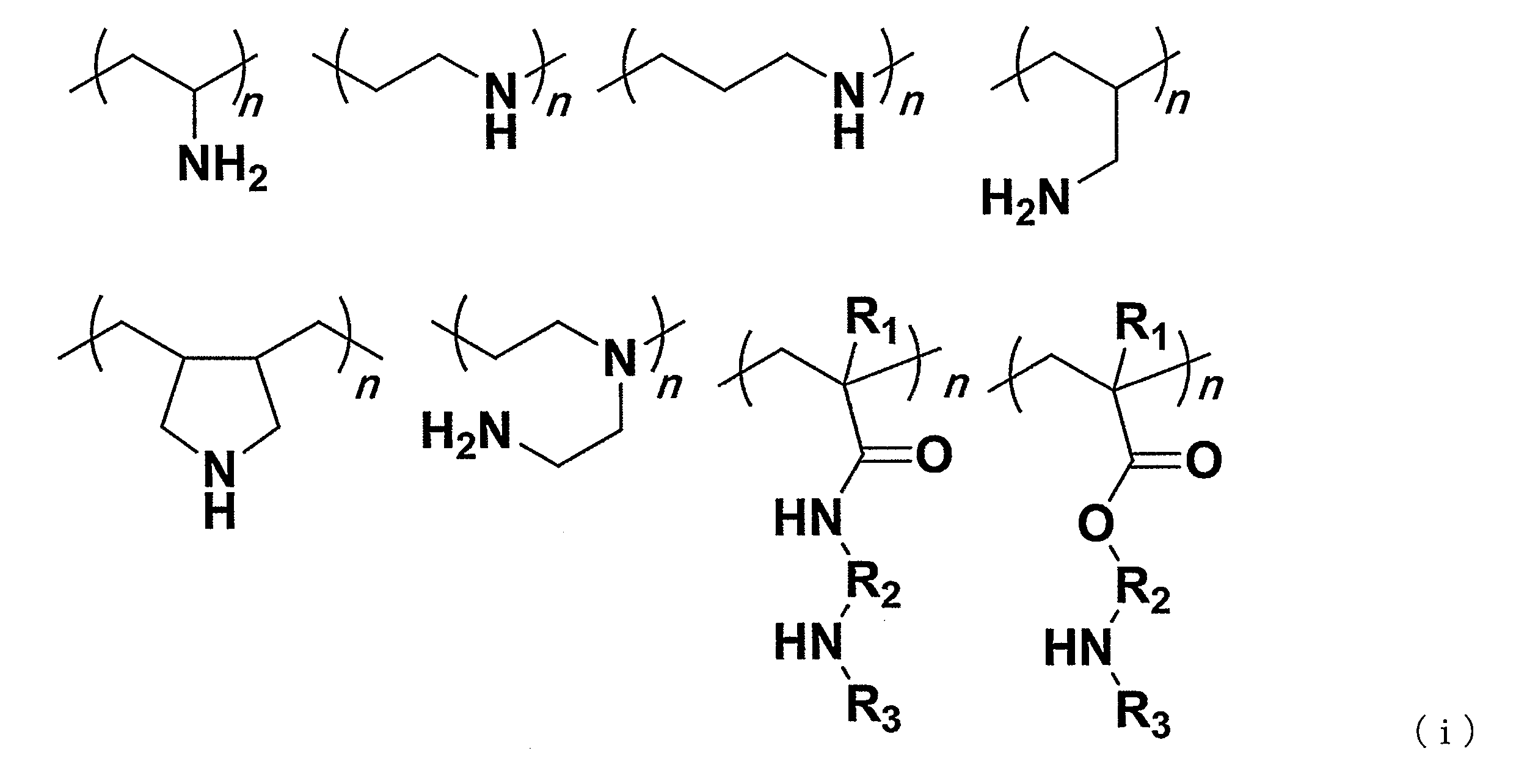
(但し、nは1以上、かつ、100以下の整数であり、R1は水素原子またはメチル基であり、R2は炭素数1から3のアルキレン基であり、R3は水素原子または炭素数1から3のアルキル基を指す。)
(7)pH6における前記分離機能層の表面ゼータ電位が、pH11における前記分離機能層の表面ゼータ電位より15mV以上高い、(1)~(6)のいずれか1つに記載の複合半透膜。
(7)pH6における前記分離機能層の表面ゼータ電位が、pH11における前記分離機能層の表面ゼータ電位より15mV以上高い、(1)~(6)のいずれか1つに記載の複合半透膜。
本発明の複合半透膜の分離機能層が、多官能芳香族アミンと多官能芳香族酸クロリドとの重合体である架橋芳香族ポリアミドを含むことで高い塩除去率を達成することができ、架橋芳香族ポリアミドを被覆する層(被覆層)を有することで高い耐汚れ性をもつ複合半透膜が得られる。また、本発明の複合半透膜の分離機能層が化学的に安定な脂肪族ポリアミドを含有し、かつフッ素原子を有するため高い透水性を有し、酸接触前後でも優れた耐汚れ性を維持し易く、長期間にわたる安定な運転を実現できる。
本発明の複合半透膜は、基材と多孔性支持層から成る支持膜と、支持膜上に形成される分離機能層とを備える。分離機能層は実質的に分離性能を有するものであり、支持膜は水を透過するものの実質的にイオン等の分離性能を有さず、分離機能層に強度を与えることができる。
また、分離機能層は、多官能芳香族アミンと多官能芳香族酸クロリドとの重合体である架橋芳香族ポリアミドを有する第1層と、前記第1層上に存在し、多官能脂肪族カルボン酸と多官能脂肪族アミンの重合体である、フッ素原子を有する脂肪族ポリアミドを含む被覆層とを含有する。
第1層を被覆するフッ素原子を有する脂肪族ポリアミドは、汚れ物質の付着を防止する機能を有する。
複合半透膜は、水溶液からイオンを除去する機能を有する膜として、具体的には、RO(Reverse Osmosis)膜及びNF(Nanofiltration)膜が挙げられる。
以下、本発明の構成について具体的に説明する。
(1)支持膜
本発明では、支持膜は、基材と、多孔性支持層とを備える。ただし、本発明はこの構成に限定されるものではない。例えば、支持膜は、基材を持たず、多孔性支持層のみで構成されていてもよい。
(1)支持膜
本発明では、支持膜は、基材と、多孔性支持層とを備える。ただし、本発明はこの構成に限定されるものではない。例えば、支持膜は、基材を持たず、多孔性支持層のみで構成されていてもよい。
(1-1)基材
基材を形成する重合体としては、ポリエステル系重合体、ポリアミド系重合体、ポリオレフィン系重合体、及びこれらの混合物又は共重合体等が挙げられる。中でも、機械的、熱的に安定性の高いポリエステル系重合体の布帛が特に好ましい。布帛の形態としては、長繊維不織布や短繊維不織布、さらには織編物を好ましく用いることができる。
基材を形成する重合体としては、ポリエステル系重合体、ポリアミド系重合体、ポリオレフィン系重合体、及びこれらの混合物又は共重合体等が挙げられる。中でも、機械的、熱的に安定性の高いポリエステル系重合体の布帛が特に好ましい。布帛の形態としては、長繊維不織布や短繊維不織布、さらには織編物を好ましく用いることができる。
(1-2)多孔性支持層
多孔性支持層は、イオン等の分離性能を実質的に有さず、分離性能を実質的に有する分離機能層に強度を与えるためのものである。多孔性支持層の孔径及び孔の分布は特に限定されない。例えば、孔径は、多孔性支持層全体で均一であるか、又は多孔性支持層において分離機能層と接する側の表面からもう一方の面にかけて徐々に大きくなっていてもよい。また、分離機能層と接する側の表面における孔径が0.1nm以上100nm以下であるような多孔性支持層が好ましい。多孔性支持層に使用する材料やその形状は特に限定されない。
多孔性支持層は、イオン等の分離性能を実質的に有さず、分離性能を実質的に有する分離機能層に強度を与えるためのものである。多孔性支持層の孔径及び孔の分布は特に限定されない。例えば、孔径は、多孔性支持層全体で均一であるか、又は多孔性支持層において分離機能層と接する側の表面からもう一方の面にかけて徐々に大きくなっていてもよい。また、分離機能層と接する側の表面における孔径が0.1nm以上100nm以下であるような多孔性支持層が好ましい。多孔性支持層に使用する材料やその形状は特に限定されない。
多孔性支持層は、例えば、ポリスルホン、ポリエーテルスルホン、ポリアミド、ポリエステル、セルロース系ポリマー、ビニルポリマー、ポリフェニレンスルフィド、ポリフェニレンスルフィドスルホン、ポリフェニレンスルホン、及びポリフェニレンオキシド等のホモポリマー又はコポリマーを、単独で又は混合して使用することができる。ここでセルロース系ポリマーとしては酢酸セルロース、硝酸セルロースなど、ビニルポリマーとしてはポリエチレン、ポリプロピレン、ポリ塩化ビニル、ポリアクリロニトリルなどが使用できる。
中でもポリスルホン、ポリアミド、ポリエステル、酢酸セルロース、硝酸セルロース、ポリ塩化ビニル、ポリアクリロニトリル、ポリフェニレンスルフィド、ポリフェニレンスルフィドスルホンなどのホモポリマーまたはコポリマーが好ましい。より好ましくは酢酸セルロース、ポリスルホン、ポリフェニレンスルフィドスルホン、またはポリフェニレンスルホンのホモポリマーまたはコポリマーが挙げられる。さらに、これらの素材の中では化学的、機械的、熱的に安定性が高く、成型が容易であることからポリスルホンのホモポリマーまたはコポリマーが一般的に使用できる。
ポリスルホンは、ゲルパーミエーションクロマトグラフィー(GPC)でN-メチルピロリドンを溶媒に、ポリスチレンを標準物質として測定した場合の重量平均分子量(Mw)が、10000以上200000以下であることが好ましく、より好ましくは15000以上100000以下である。
ポリスルホンのMwが10000以上であることで、多孔性支持層として好ましい機械的強度及び耐熱性を得ることができる。また、ポリスルホンのMwが200000以下であることで、溶液の粘度が適切な範囲となり、良好な成形性を実現することができる。
例えば、上記ポリスルホンのN,N-ジメチルホルムアミド(以降、DMFと記載する。)溶液を、密に織ったポリエステル布又はポリエステル不織布の上に一定の厚さに注型し、それを水中で湿式凝固させることによって、表面の大部分が直径数10nm以下の微細な孔を有する多孔性支持層を得ることができる。
基材と多孔性支持層の厚みは、複合半透膜の機械的強度及びそれをエレメントにしたときの充填密度に影響を与える。十分な機械的強度及び充填密度を得るためには、基材と多孔性支持層の厚みの合計が、30μm以上300μm以下であることが好ましく、100μm以上220μm以下であるとより好ましい。また、多孔性支持層の厚みは、20μm以上100μm以下であることが好ましい。なお、本明細書において、特に付記しない限り、厚みとは、平均値を意味する。ここで平均値とは相加平均値を表す。すなわち、基材と多孔性支持層の厚みは、断面観察で厚み方向に直交する方向(膜の面方向)に20μm間隔で測定した、20点の厚みの平均値を算出することで求められる。
多孔性支持層は、ミリポア社製“ミリポアフィルターVSWP”(商品名)や、東洋濾紙社製“ウルトラフィルターUK10”(商品名)のような各種市販材料から選択することもできるが、“オフィス・オブ・セイリーン・ウォーター・リサーチ・アンド・ディベロップメント・プログレス・レポート”No.359(1968)に記載された方法に従って製造することができる。
(2)分離機能層
分離機能層は、複合半透膜において溶質の分離機能を担う層である。
分離機能層は、架橋芳香族ポリアミドを含有する第1層と、第1層の上に存在するフッ素原子を有する脂肪族ポリアミドを含有する被覆層とを備える。被覆層は、実質的に汚れの付着を抑制する機能を有する。
分離機能層は、複合半透膜において溶質の分離機能を担う層である。
分離機能層は、架橋芳香族ポリアミドを含有する第1層と、第1層の上に存在するフッ素原子を有する脂肪族ポリアミドを含有する被覆層とを備える。被覆層は、実質的に汚れの付着を抑制する機能を有する。
(2-1)組成
分離機能層は、架橋芳香族ポリアミドを主成分として含有することが好ましい。主成分とは分離機能層の成分のうち、50重量%以上を占める成分を指す。分離機能層は、架橋芳香族ポリアミドを50重量%以上含むことにより、高い除去性能を発現することができる。また、分離機能層における架橋芳香族ポリアミドの含有率は80重量%以上であることが好ましく、90重量%以上であることがより好ましい。
分離機能層は、架橋芳香族ポリアミドを主成分として含有することが好ましい。主成分とは分離機能層の成分のうち、50重量%以上を占める成分を指す。分離機能層は、架橋芳香族ポリアミドを50重量%以上含むことにより、高い除去性能を発現することができる。また、分離機能層における架橋芳香族ポリアミドの含有率は80重量%以上であることが好ましく、90重量%以上であることがより好ましい。
また、第1層において、架橋芳香族ポリアミドが占める割合は、80重量%以上であることが好ましく、90重量%以上であることがより好ましい。第1層は架橋芳香族ポリアミドのみで形成されていてもよい。
第1層は、多孔性支持層の上面(多孔性支持層が基材と接する面とは逆の面)に、接するように配置される。
架橋芳香族ポリアミドは、多官能芳香族アミンと多官能芳香族酸クロリドとを化学反応させることにより形成できる。ここで、多官能芳香族アミン及び多官能芳香族酸クロリドの少なくとも一方が3官能以上の化合物を含んでいることが好ましい。これにより、剛直な分子鎖が得られ、水和イオンやホウ素などの微細な溶質を除去するための良好な孔構造が形成される。
多官能芳香族アミンとは、一分子中に第一級アミノ基及び第二級アミノ基のうち少なくとも一方のアミノ基を2個以上有し、かつ、アミノ基のうち少なくとも1つは第一級アミノ基である芳香族アミンを意味する。多官能芳香族アミンとしては、例えば、o-フェニレンジアミン、m-フェニレンジアミン、p-フェニレンジアミン、o-キシリレンジアミン、m-キシリレンジアミン、p-キシリレンジアミン、o-ジアミノピリジン、m-ジアミノピリジン、p-ジアミノピリジン等の2個のアミノ基がオルト位やメタ位、パラ位のいずれかの位置関係で芳香環に結合した多官能芳香族アミン、1,3,5-トリアミノベンゼン、1,2,4-トリアミノベンゼン、3,5-ジアミノ安息香酸、3-アミノベンジルアミン、4-アミノベンジルアミンなどの多官能芳香族アミンなどが挙げられる。特に、膜の選択分離性や透過性、耐熱性を考慮すると、m-フェニレンジアミン、p-フェニレンジアミン、及び1,3,5-トリアミノベンゼンが好適に用いられる。中でも、入手の容易性や取り扱いのしやすさから、m-フェニレンジアミン(以下、m-PDAとも記す。)を用いることがより好ましい。これらの多官能芳香族アミンは、単独で用いられてもよいし、2種以上が併用されてもよい。
多官能芳香族酸クロリドとは、一分子中に少なくとも2個のクロロカルボニル基を有する芳香族酸クロリドをいう。例えば、3官能酸クロリドでは、トリメシン酸クロリドなどを挙げることができ、2官能酸クロリドでは、ビフェニルジカルボン酸ジクロリド、アゾベンゼンジカルボン酸ジクロリド、テレフタル酸クロリド、イソフタル酸クロリド、ナフタレンジカルボン酸クロリドなどを挙げることができる。膜の選択分離性、耐熱性を考慮すると、一分子中に2~4個の塩化カルボニル基を有する多官能芳香族酸クロリドであることが好ましい。特に経済性、入手の容易さ、取り扱い易さ、反応性の容易さ等の点から、1,3,5-ベンゼントリカルボン酸の酸クロリドであるトリメシン酸クロリド(以下、TMCという。)が好ましい。上記多官能芳香族酸クロリドは1種を単独で用いても、2種類以上を混合物として用いてもよい。
架橋芳香族ポリアミドを構成する多官能芳香族アミン及び多官能芳香族酸クロリドのそれぞれの90重量%以上を分子量1000未満の化合物が占めることが好ましく、分子量500未満の化合物が占めることがより好ましい。多官能芳香族アミン及び多官能酸芳香族クロリドのそれぞれの90重量%以上を分子量1000未満の化合物が占めることで、多官能芳香族アミン及び多官能酸芳香族クロリドの溶媒への溶解性が高くなるので、高効率で界面重縮合が起こる。その結果、得られる架橋芳香族ポリアミドの薄膜は、高い溶質分離機能を有する。
上記架橋芳香族ポリアミドは、多官能芳香族アミンと多官能芳香族酸クロリドの重合反応に由来するアミド基、未反応末端官能基に由来するアミノ基及びカルボキシ基を有する。これらの官能基量は、複合半透膜の透水性能や塩除去率に影響を与える。
架橋芳香族ポリアミド形成後に化学処理を行うと、架橋芳香族ポリアミド中の官能基を変換したり、架橋芳香族ポリアミドに新たな官能基を導入したりすることができ、これによって複合半透膜の透過水量や塩除去率を向上させることができる。導入する官能基としては、アルキル基、アルケニル基、アルキニル基、ハロゲン基、水酸基、アミノ基、カルボキシ基、エーテル基、チオエーテル基、エステル基、アルデヒド基、ニトロ基、ニトロソ基、ニトリル基、アゾ基等が挙げられる。
フッ素原子を有する脂肪族ポリアミドは、第1層の表面、つまり第1層が多孔性支持層と接する面とは逆の面に存在する。フッ素原子を有する脂肪族ポリアミドは第1層を完全に被覆していてもよいし、第1層の一部が露出していてもよい。説明の便宜上、第1層の一部が露出している場合も含めて、第1層上に位置し、かつフッ素原子を有する脂肪族ポリアミドを含む部分を「被覆層」と呼ぶ。分離機能層は、架橋芳香族ポリアミドを含有する第1層と、第1層上に設けられ、フッ素原子を有する脂肪族ポリアミドを含有する被覆層とを有する。つまり、基材、多孔性支持層、第1層及び被覆層がこの順に配置される。
フッ素原子を有する脂肪族ポリアミドが分離機能層表面に存在することで、仮に汚染物質が分離機能層表面に付着しても、汚染物質が架橋芳香族ポリアミドに付着することが抑制される。その結果、分離機能を実質的に担う架橋芳香族ポリアミドの汚染が抑制され、複合半透膜の性能低下が抑制される。
本発明者らは鋭意検討した結果、被覆層側の表面においてXPS(X線光電子分光測定)で測定される全元素の合計原子数に対するフッ素原子の原子数の割合(以下、「割合F」と称することがある。)と、同じくXPSで測定される酸素原子の原子数に対する窒素原子の原子数の比(N/O比)が耐汚れ性と透水性能に影響することを見出した。
なお、割合F及びN/O比の求め方は下記のとおりである。
割合F(%)=フッ素原子の原子数/全元素の合計原子数×100
N/O比=窒素原子の原子数/酸素原子の原子数
割合F(%)=フッ素原子の原子数/全元素の合計原子数×100
N/O比=窒素原子の原子数/酸素原子の原子数
親水性の高い窒素原子を多く有することで、膜表面に水和した水分子による汚れの付着抑制と付着した汚れの脱着促進の効果があると考えられる。また、低表面自由エネルギーのフッ素原子を有することでフッ素原子を含まない場合よりも親水性の汚れに対する耐汚れ性が向上することを見出した。さらに、水中において、被覆層表面には親水性の高い窒素原子が露出しやすいため、被覆層表面への水の浸透が速く、かつ、被覆層内部には親水性の低いフッ素原子が偏析しやすいため、被覆層内部での水の移動が速くなり、複合半透膜として高い透水性をもつことを見出した。
具体的には複合半透膜の被覆層側からX線を照射することで行われるX線光電子分光測定において、測定された割合Fが0.5%以上8%以下であり、N/O比が0.8以上1.3以下であれば透水性が高く、耐汚れ性試験前後での透水性の低下幅が小さくなることを見出した。さらに割合Fが2%以上5%以下であればより好ましく、N/O比は1.0以上1.2以下であればより好ましい。
なお、X線光電子分光測定は以下のように行われる。
すなわち、本発明の複合半透膜を25℃の真空下で乾燥し、X線光電子分光測定によるワイドスキャン分析にて、0eV以上1400eV以下の範囲に検出される元素の組成分析を行う。米国SSI社製X線光電子分光測定装置SSX-100を用い、励起X線としてアルミニウム Kα1線、Kα2線(1486.6eV)、X線出力を10kV 20mV、光電子脱出角度を30°の条件で測定し、複合半透膜の異なる3つの位置での測定を行い、その平均値を測定値とする。
すなわち、本発明の複合半透膜を25℃の真空下で乾燥し、X線光電子分光測定によるワイドスキャン分析にて、0eV以上1400eV以下の範囲に検出される元素の組成分析を行う。米国SSI社製X線光電子分光測定装置SSX-100を用い、励起X線としてアルミニウム Kα1線、Kα2線(1486.6eV)、X線出力を10kV 20mV、光電子脱出角度を30°の条件で測定し、複合半透膜の異なる3つの位置での測定を行い、その平均値を測定値とする。
(2-2)被覆層の化学構造
被覆層は、多官能脂肪族アミンと、多官能脂肪族カルボン酸化合物とを反応させることで形成されたフッ素原子を有する脂肪族ポリアミドを含有し、かつ、以下に説明する官能基、ポリマー構造を取る。
被覆層は、多官能脂肪族アミンと、多官能脂肪族カルボン酸化合物とを反応させることで形成されたフッ素原子を有する脂肪族ポリアミドを含有し、かつ、以下に説明する官能基、ポリマー構造を取る。
フッ素原子を有する脂肪族ポリアミドは、分子間又は分子内の少なくとも一方で架橋されていることが好ましい。これは架橋構造を有していることで、一箇所切断を受けても機能を保ち続けることができるため、耐汚れ性の長期維持という観点から好ましい。架橋構造は、直鎖ポリマーが架橋剤を用いて架橋された構造、3次元の網目状ポリマー、ペンダントポリマーやデンドリマーが複数の点で接続された構造等をあげることができる。
また、フッ素原子を有する脂肪族ポリアミドは、入手容易性およびアミノ基密度の高さの観点から、下記構造群(i)に含まれる1種類以上の構造を有することが好ましい。
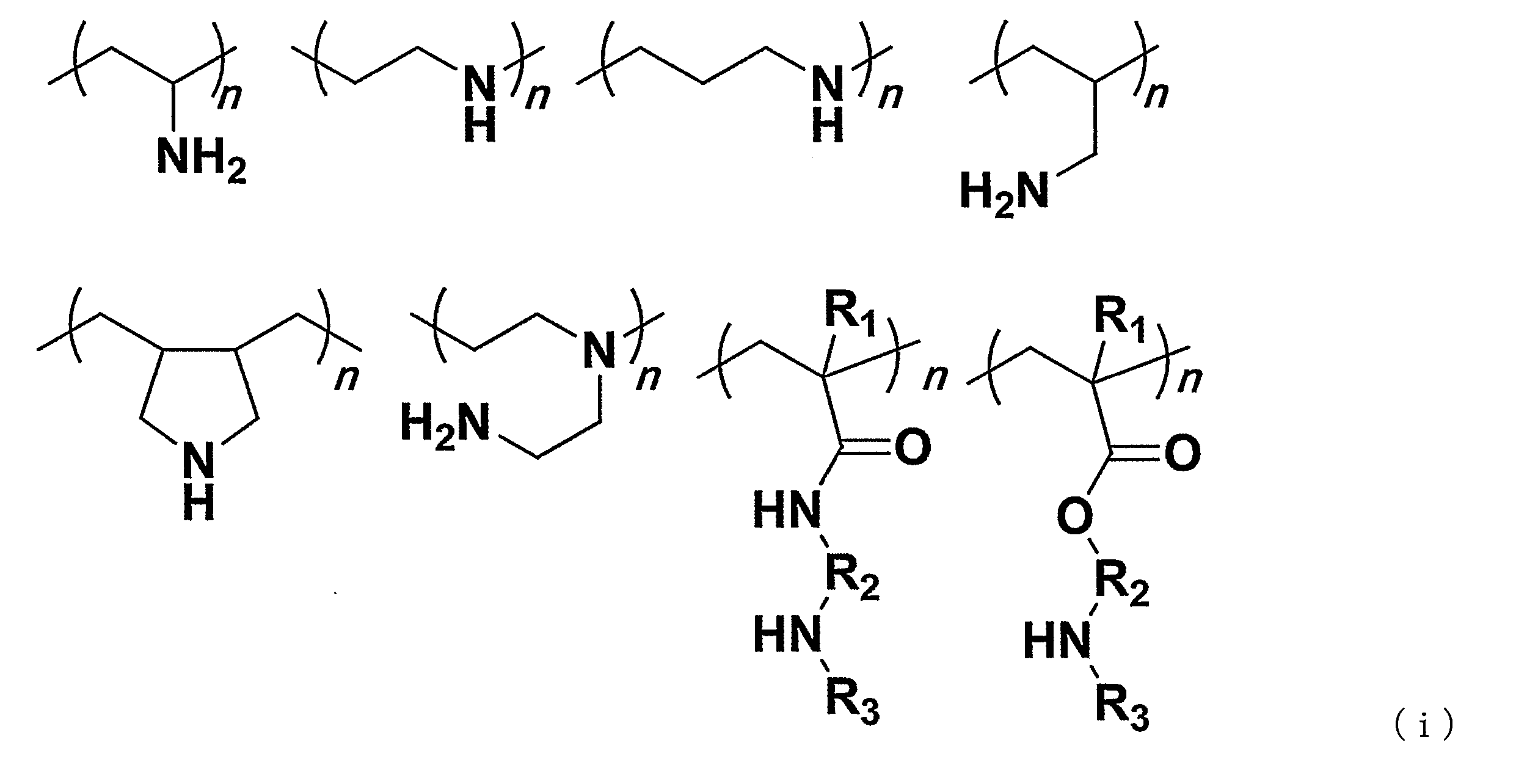
但し、nは1以上、かつ、100以下の整数であり、R1は水素原子またはメチル基であり、R2は炭素数1から3のアルキレン基であり、R3は水素原子または炭素数1から3のアルキル基を指す。
炭素数1から3のアルキレン基としては、メチレン基、エチレン基、n-プロピレン基が挙げられる。炭素数1から3のアルキル基としては、メチル基、エチル基、n-プロピル基、i-プロピル基が挙げられる。
脂肪族ポリアミドは、非芳香族ポリマーである。非芳香族ポリマーとは、芳香環を持たないポリマーである。被覆層が含有する多官能脂肪族アミンと多官能脂肪族カルボン酸化合物との重合体(脂肪族ポリアミド)は、芳香族化合物ではない多官能脂肪族アミンと芳香族化合物ではない多官能脂肪族カルボン酸化合物とを反騰させることで形成されているので、芳香族化合物を含有しない。
(2-2-1)官能基
(2-2-1-1)フッ素原子
被覆層を形成する脂肪族ポリアミドは、フッ素原子を含有する。被覆層内のフッ素原子を適切に制御することで、被覆層の表面自由エネルギーと被覆層内部の水分子の透過速度を制御し、(2-1)に示す所望の状態とすることに寄与する。具体的には、フッ素原子は、-CF2-または-CF3で示される構造の官能基として存在する。当該官能基は、本発明の複合半透膜の被覆層側表面からX線を照射することで行われるX線光電子分光測定において、F1sのピークが680eV以上、かつ695eV以下の範囲に、極大値を1つ以上有する。
(2-2-1-1)フッ素原子
被覆層を形成する脂肪族ポリアミドは、フッ素原子を含有する。被覆層内のフッ素原子を適切に制御することで、被覆層の表面自由エネルギーと被覆層内部の水分子の透過速度を制御し、(2-1)に示す所望の状態とすることに寄与する。具体的には、フッ素原子は、-CF2-または-CF3で示される構造の官能基として存在する。当該官能基は、本発明の複合半透膜の被覆層側表面からX線を照射することで行われるX線光電子分光測定において、F1sのピークが680eV以上、かつ695eV以下の範囲に、極大値を1つ以上有する。
(2-2-1-2)アミド基
被覆層を形成する脂肪族ポリアミドは、ポリアミドであるため複数のアミド基を有する。アミド基を複数含有することで適度な親水性を保持させて被覆層に含まれる水の量を制御し、(2-1)に示す所望の状態とすることに寄与する。さらに、アミド基を含有することで、良好な耐酸性を確保することができる。
被覆層を形成する脂肪族ポリアミドは、ポリアミドであるため複数のアミド基を有する。アミド基を複数含有することで適度な親水性を保持させて被覆層に含まれる水の量を制御し、(2-1)に示す所望の状態とすることに寄与する。さらに、アミド基を含有することで、良好な耐酸性を確保することができる。
(2-2-2)ポリマー構造
被覆層は、多官能脂肪族アミンと、多官能脂肪族カルボン酸化合物との重合体である脂肪族ポリアミドを含有する。さらに、本発明の被覆層を構成する脂肪族ポリアミドは、上記(2-2-1)の「フッ素原子」、「アミド基」を含有する。より具体的には、本発明の被覆層を構成するポリアミドは、上記「フッ素原子」を有する多官能脂肪族アミンのユニット、および/または上記「フッ素原子」を有する多官能脂肪族カルボン酸化合物のユニットが、上記「アミド基」を介して結合した構造を取る。
被覆層は、多官能脂肪族アミンと、多官能脂肪族カルボン酸化合物との重合体である脂肪族ポリアミドを含有する。さらに、本発明の被覆層を構成する脂肪族ポリアミドは、上記(2-2-1)の「フッ素原子」、「アミド基」を含有する。より具体的には、本発明の被覆層を構成するポリアミドは、上記「フッ素原子」を有する多官能脂肪族アミンのユニット、および/または上記「フッ素原子」を有する多官能脂肪族カルボン酸化合物のユニットが、上記「アミド基」を介して結合した構造を取る。
これらのユニットは、アミド結合を挟んで交互に配置されると共に、各ユニットの導入量は、適宜調整可能である。その際、ユニットとユニットの具体的な化学構造は、以下に例示する化合物から、適宜選択可能である。
(2-2-2-1)「フッ素原子」を有するユニット
「フッ素原子」を有するユニットは、具体的には、-CF2-または-CF3で示される構造の官能基を含有する、炭素数1~10のユニットである。さらに、本ユニットは、エーテル結合を含んでよく、例えば、CF3-O-CF2-、-CF2-O-CF2-、CF2-CH2-O-、-CF(CF3)-などの構造を含有してもよい。
「フッ素原子」を有するユニットは、具体的には、-CF2-または-CF3で示される構造の官能基を含有する、炭素数1~10のユニットである。さらに、本ユニットは、エーテル結合を含んでよく、例えば、CF3-O-CF2-、-CF2-O-CF2-、CF2-CH2-O-、-CF(CF3)-などの構造を含有してもよい。
被覆層を構成する脂肪族ポリアミド(非芳香族ポリマー)を形成するための多官能脂肪族アミン、多官能脂肪族カルボン酸化合物の少なくともどちらか一方に、上記ユニットが含まれることが必要である。
多官能脂肪族アミンとしては、上記ユニットと、2つ以上のアミノ基を有する化合物が好適に使用できる。多官能脂肪族カルボン酸化合物としては、上記ユニットと、1つ以上のカルボン酸基またはカルボン酸から誘導される官能基(酸クロリド、酸フルオライドなど)を有する化合物が好適に使用できる。
入手容易性から、1つまたは2つのカルボン酸基またはカルボン酸から誘導される官能基(酸クロリド、酸フルオライドなど)を有する多官能脂肪族カルボン酸化合物を使用することが好ましく、市販品から適宜選択することができる。具体的には、パーフルオロアルカノイルフルオライド、パーフルオロスクシノイルフルオライド、ヘキサフルオログルタリルフルオライド、オクタフルオロアジポイルフルオライド、パーフルオロポリエーテルジアクリルフルオライド、パーフルオロアルカノイックアシッド、パーフルオロスクシニックアシッド、パーフルオログルタリックアシッド、パーフルオロアジピックアシッド、パーフルオロアルカンジオイックアシッド、パーフルオロ-3,6-ジオキサオクタン-1,8-ジオイックアシッド、パーフルオロ-3,6,9-トリオキサウンデカン-1,11-ジオイックアシッドなどが例として挙げられる。なお、エポキシ基―アミノ基による縮合により形成される構造は、耐酸性に劣ることから、本発明ではエポキシ基を含有する化合物を使用しない。
(2-3)分離機能層の特性
本発明における複合半透膜を25℃で12時間真空乾燥した後に、分離機能層表面(具体的に、分離機能層の被覆層側の表面)への純水2μLを着滴させることで行われる静的接触角測定において、分離機能層表面への純水着滴から30秒後の接触角は20度以下であることが望ましい。ここでの接触角とは、静的接触角を指し、分離機能層表面の親水性の高さを意味し、接触角が小さいほど親水性が高いことを意味する。
本発明における複合半透膜を25℃で12時間真空乾燥した後に、分離機能層表面(具体的に、分離機能層の被覆層側の表面)への純水2μLを着滴させることで行われる静的接触角測定において、分離機能層表面への純水着滴から30秒後の接触角は20度以下であることが望ましい。ここでの接触角とは、静的接触角を指し、分離機能層表面の親水性の高さを意味し、接触角が小さいほど親水性が高いことを意味する。
純水を分離機能層表面に滴下すると、「ヤングの式」と呼ばれる、式(1)が成り立つ。
γS=γLcosθ+γSL (1)
ここで、γSは分離機能層の表面張力、γLは純水の表面張力、γSLは分離機能層と純水の界面張力である。この式を満たすときの純水の接線と分離機能層表面のなす角θを接触角という。
γS=γLcosθ+γSL (1)
ここで、γSは分離機能層の表面張力、γLは純水の表面張力、γSLは分離機能層と純水の界面張力である。この式を満たすときの純水の接線と分離機能層表面のなす角θを接触角という。
接触角は純水着滴からの時間の経過と共に徐々に小さい値へと変化し、30秒で一定値に収束する。この値は水中における分子機能層表面の親水性と同義である。純水の分離機能層表面への着滴から接触角を測定するまでの時間は30秒である。それより長時間測定時間を要する場合、水滴の蒸発の影響が測定結果に反映されるので好ましくない。また、滴下する純水量は2μLが測定値への水滴の重みの影響が小さく、蒸発の影響も小さく好ましい。
分離機能層への純水着滴から30秒後の純水の接触角が20度以下であるということは、分離機能層が水中で高い親水性を有することを意味する。一般に分離機能層表面の親水性が高いほど、透水性が高くなるが、ファウラントと分離機能層との接触頻度が増えるため、ファウリングによる透水性低下が大きくなることが知られている。本発明者らは鋭意検討の結果、分離機能層が多官能脂肪族カルボン酸と多官能脂肪族アミンの重合体である脂肪族ポリアミドを含む被覆層を含み、かつフッ素原子を含むとき、分離機能層と純水との接触角が20度以下であっても、高い透水性と高い耐汚れ性を両立できることを見出した。さらに接触角は、10度以下であることがより好ましい。
また、本発明者らは分離機能層表面への純水着滴から30秒後の接触角が、分離機能層表面への純水着滴から1秒後の接触角より15度以上小さいことで耐汚れ性が向上することを見出した。純水着滴後の時間経過による接触角変化が大きいということは、水の接触による表面の親水性向上効果が大きいということを意味しており、接触角変化が大きいと、運用中に汚れの接触により、一時的に分離機能層表面の親水性が低下しても、水の接触により直ちに表面が親水化される。そのため、水和した水分子による汚れの脱着促進効果が向上すると考えられる。
本発明者らは鋭意検討を行った結果、分離機能層の表面ゼータ電位と、複合半透膜の膜汚染物質の脱離性とに密接な関係があることを見出した。
ゼータ電位とは超薄膜層表面の正味の固定電荷の尺度であり、分離機能層表面のゼータ電位は、電気移動度から、下記式(2)に示すヘルムホルツ・スモルコフスキー(Helmholtz-Smoluchowski)の式によって求めることができる。

(式(2)中、Uは電気移動度、εは溶液の誘電率、ηは溶液の粘度である)。
ここで、溶液の誘電率、粘度は、測定温度での文献値を使用する。
ここで、溶液の誘電率、粘度は、測定温度での文献値を使用する。
ゼータ電位の測定原理について説明する。材料に接した溶液又は水溶液には、材料表面の電荷の影響で、表面の近傍に流動できない静止層が存在する。ゼータ電位は、材料の静止層と流動層の境界面(すべり面)での溶液に対する電位である。
ここで、石英ガラスセル中の水溶液を考えると、石英表面は通常マイナスに荷電されているため、セル表面付近にプラス荷電のイオンや粒子が集まる。一方、セル中心部にはマイナス荷電のイオンや粒子が多くなり、セル内でイオン分布が生じている。この状態で電場をかけると、セル内ではイオン分布を反映し、セル内の位置で異なる泳動速度でイオンが動く(電気浸透流という。)。泳動速度はセル表面の電荷を反映したものであるので、この泳動速度分布を求めることにより、セル表面の電荷(表面電位)を評価することができる。
通常ゼータ電位の測定は、大きさ20mm×30mmの膜試料を用い、電気泳動させるための標準粒子は表面をヒドロキシプロピルセルロースでコーティングしたポリスチレン粒子(粒径520nm)を所定濃度に調整したNaCl水溶液に分散させて測定することができる。測定装置は例えば大塚電子製電気泳動光散乱光度計ELS-8000などが使用できる。
本発明の複合半透膜は、NaCl10mMの条件において、pH6における分離機能層の表面ゼータ電位が、pH11における分離機能層の表面ゼータ電位よりも15mV以上高いことが望ましい。
分離機能層の第1層には、多官能芳香族アミンに由来するアミノ基及び多官能芳香族酸クロリドに由来するカルボキシ基が含まれる。また、被覆層には、多官能脂肪族アミンに由来するアミノ基及び多官能カルボン酸化合物に由来するカルボキシ基が含まれる。第1層及び被覆層に含まれるこれら官能基の解離度によって表面ゼータ電位の値が変化する。
分離機能層のpH6における表面ゼータ電位は、膜汚染物質の吸着性に関係している。pHを中性領域からアルカリ性領域に変化させたときに、表面ゼータ電位の変化が大きいと、汚染物質の付着した膜の透過水量回復性が高くなる。これは、pH変化に伴い、分離機能層表面の荷電バランスが大きく変化し、親水性の変化及び静電反発によって分離機能層表面に付着した汚染物質の脱離が促進されるためと考えられる。分離機能層のpH6における表面ゼータ電位がpH11における表面ゼータ電位よりも15mV以上高ければ分離機能層表面に付着した汚染物質の脱着が十分に促進され、高い透水量回復性を得ることができる。
(2-4)分離機能層の形成方法
分離機能層は、多官能芳香族アミン、多官能芳香族酸クロリドを化学反応させることにより得られる架橋芳香族ポリアミドを含有する第1層を形成し、その後、第1層上にフッ素原子を有する脂肪族ポリアミドを含む被覆層を形成することで得られる。第1層形成のための化学反応の方法として、界面重合法が生産性、性能の観点から最も好ましい。以下、界面重合の工程について説明する。
分離機能層は、多官能芳香族アミン、多官能芳香族酸クロリドを化学反応させることにより得られる架橋芳香族ポリアミドを含有する第1層を形成し、その後、第1層上にフッ素原子を有する脂肪族ポリアミドを含む被覆層を形成することで得られる。第1層形成のための化学反応の方法として、界面重合法が生産性、性能の観点から最も好ましい。以下、界面重合の工程について説明する。
界面重合の工程は、(a)多官能芳香族アミンを含有する水溶液(多官能芳香族アミン水溶液)を多孔性支持層上に接触させる工程と、(b)多官能芳香族アミンを含有する水溶液を接触させた多孔性支持層に多官能芳香族酸クロリドを溶解させた有機溶媒溶液Aを接触させる工程と、(c)さらに多官能芳香族酸クロリドを溶解させた有機溶媒溶液Bを接触させ加熱する工程と、(d)反応後に残留する有機溶媒を液切りする工程、を有する。
なお、本欄では、支持膜が基材と多孔性支持層とを備える場合を例に挙げるが、支持膜が別の構成を備える場合は、「多孔性支持層」を「支持膜」と読み替えればよい。
工程(a)において、多官能芳香族アミン水溶液における多官能芳香族アミンの濃度は0.1重量%以上20重量%以下の範囲内であることが好ましく、より好ましくは0.5重量%以上15重量%以下の範囲内である。多官能芳香族アミンの濃度がこの範囲であると十分な溶質除去性能及び透水性を得ることができる。
多官能芳香族アミン水溶液には、多官能芳香族アミンと多官能芳香族酸クロリドとの反応を妨害しないものであれば、界面活性剤や有機溶媒、アルカリ性化合物、酸化防止剤などが含まれていてもよい。界面活性剤は、支持膜表面の濡れ性を向上させ、多官能芳香族アミン水溶液と非極性溶媒との間の界面張力を減少させる効果がある。有機溶媒は界面重縮合反応の触媒として働くことがあり、添加することにより界面重縮合反応を効率よく行える場合がある。
多官能芳香族アミン水溶液の多孔性支持層への接触は、多孔性支持層上に均一かつ連続的に行うことが好ましい。具体的には、例えば、多官能芳香族アミン水溶液を多孔性支持層にコーティングする方法や、多孔性支持層を多官能芳香族アミン水溶液に浸漬する方法などを挙げることができる。多孔性支持層と多官能芳香族アミン水溶液との接触時間は、1秒以上10分間以下であることが好ましく、10秒以上3分間以下であるとさらに好ましい。
多官能芳香族アミン水溶液を多孔性支持層に接触させた後は、膜上に液滴が残らないように十分に液切りする。十分に液切りすることで、多孔性支持層形成後に液滴残存部分が膜欠点となって除去性能が低下することを防ぐことができる。液切りの方法としては、例えば、日本国特開平2-78428号公報に記載されているように、多官能芳香族アミン水溶液接触後の支持膜を垂直方向に把持して過剰の水溶液を自然流下させる方法や、エアーノズルから窒素などの気流を吹き付け、強制的に液切りする方法などを用いることができる。また、液切り後、膜面を乾燥させて水溶液の水分を一部除去することもできる。
工程(b)及び(c)において、有機溶媒溶液(溶液A及び溶液B)中の多官能芳香族酸クロリドの濃度は、0.01重量%以上10重量%以下の範囲内であると好ましく、0.02重量%以上2.0重量%以下の範囲内であるとさらに好ましい。多官能芳香族酸クロリドの濃度を0.01重量%以上とすることで十分な反応速度が得られ、また、10重量%以下とすることで副反応の発生を抑制することができるためである。
有機溶媒は、水と非混和性であり、かつ多官能芳香族酸クロリドを溶解し、支持膜を破壊しないものが好ましく、多官能芳香族アミン及び多官能芳香族酸クロリドに対して不活性であるものであればよい。好ましい例として、n-ノナン、n-デカン、n-ウンデカン、n-ドデカン、イソオクタン、イソデカン、イソドデカンなどの炭化水素化合物及びそれらの混合溶媒が挙げられる。
多官能芳香族酸クロリドの有機溶媒溶液Aの多官能芳香族アミン水溶液と接触させた多孔性支持層への接触の方法は、多官能芳香族アミン水溶液の多孔性支持層への被覆方法と同様に行えばよい。
工程(c)において、多官能芳香族酸クロリドを溶解させた有機溶媒溶液Bを接触させ加熱する。加熱処理する温度としては50℃以上180℃以下、好ましくは60℃以上160℃以下である。この範囲で加熱することにより、熱及び溶液の濃縮による界面重合反応の促進の相乗効果が得られる。
工程(d)において、反応後の有機溶媒を液切りする工程により、有機溶媒を除去する。有機溶媒の除去は、例えば、膜を垂直方向に把持して過剰の有機溶媒を自然流下して除去する方法、送風機で風を吹き付けることで有機溶媒を乾燥除去する方法、水とエアーの混合流体で過剰の有機溶媒を除去する方法等を用いることができる。
(2-4-1)被覆層の形成方法
被覆層は、架橋芳香族ポリアミドを含有する第1層の表面に形成される。その際、上記多官能脂肪族アミンと多官能脂肪族カルボン酸化合物を、第1層の表面で直接反応させ、被覆層を形成してもよい。または、予め合成されたポリマー(脂肪族ポリアミド)を含む溶液を第1層上にコーティングして被覆層を形成してもよい。または、予め合成されたポリマー(脂肪族ポリアミド)を含む溶液に第1層を含む膜を浸漬して被覆層を形成してもよい。さらに、後述する複合半透膜エレメントを作製してからポリマー溶液を通液処理して、被覆層を形成しても良い。
被覆層は、架橋芳香族ポリアミドを含有する第1層の表面に形成される。その際、上記多官能脂肪族アミンと多官能脂肪族カルボン酸化合物を、第1層の表面で直接反応させ、被覆層を形成してもよい。または、予め合成されたポリマー(脂肪族ポリアミド)を含む溶液を第1層上にコーティングして被覆層を形成してもよい。または、予め合成されたポリマー(脂肪族ポリアミド)を含む溶液に第1層を含む膜を浸漬して被覆層を形成してもよい。さらに、後述する複合半透膜エレメントを作製してからポリマー溶液を通液処理して、被覆層を形成しても良い。
上記ポリマー(脂肪族ポリアミド)の合成に際しては、上記多官能脂肪族アミンと多官能脂肪族カルボン酸化合物との反応を利用する。この際、アミノ基と、カルボン酸基またはカルボン酸から誘導される官能基(酸クロリド、酸フルオライドなど)との反応により、アミド結合が形成されるが、高効率かつ短時間での反応を進めるために、必要に応じ、種々の反応助剤(縮合促進剤)を利用することが好ましい。
縮合促進剤としては、硫酸、4-(4,6-ジメトキシ-1,3,5-トリアジン-2-イル)-4-メチルモルホリニウムクロリド(DMT-MM)、1-(3-ジメチルアミノプロピル)-3-エチルカルボジイミド塩酸塩、N,N’-ジシクロヘキシルカルボジイミド、N,N’-ジイソプロピルカルボジイミド、N,N’-カルボニルジイミダゾール、1,1’-カルボニルジ(1,2,4-トリアゾール)、1H-ベンゾトリアゾール-1-イルオキシトリス(ジメチルアミノ)ホスホニウムヘキサフルオロりん酸塩、1H-ベンゾトリアゾール-1-イルオキシトリス(ジメチルアミノ)ホスホニウムヘキサフルオロりん酸塩、(7-アザベンゾトリアゾール-1-イルオキシ)トリピロリジノホスホニウムヘキサフルオロりん酸塩、クロロトリピロリジノホスホ二ウムヘキサフルオロりん酸塩、ブロモトリス(ジメチルアミノ)ホスホニウムヘキサフルオロりん酸塩、3-(ジエトキシホスホリルオキシ)-1,2,3-ベンゾトリアジン-4(3H)-オン、O-(ベンゾトリアゾール-1-イル)-N,N,N’,N’-テトラメチルウロニウムヘキサフルオロりん酸塩、O-(7-アザベンゾトリアゾール-1-イル)-N,N,N’,N’-テトラメチルウロニウムヘキサフルオロりん酸塩、O-(N-スクシンイミジル)-N,N,N’,N’-テトラメチルウロニウムテトラフルオロほう酸塩、O-(N-スクシンイミジル)-N,N,N’,N’-テトラメチルウロニウムヘキサフルオロりん酸塩、O-(3,4-ジヒドロ-4-オキソ-1,2,3-ベンゾトリアジン-3-イル)-N,N,N’,N’-テトラメチルウロニウムテトラフルオロほう酸塩、トリフルオロメタンスルホン酸(4,6-ジメトキシ-1,3,5-トリアジン-2-イル)-(2-オクトキシ-2-オキソエチル)ジメチルアンモニウム、S-(1-オキシド-2-ピリジル)-N,N,N’,N’-テトラメチルチウロニウムテトラフルオロほう酸塩、O-[2-オキソ-1(2H)-ピリジル]-N,N,N’,N’-テトラメチルウロニウムテトラフルオロほう酸塩、{{[(1-シアノ-2-エトキシ-2-オキソエチリデン)アミノ]オキシ}-4-モルホリノメチレン}ジメチルアンモニウムヘキサフルオロりん酸塩、2-クロロ-1,3-ジメチルイミダゾリニウムヘキサフルオロりん酸塩、1-(クロロ-1-ピロリジニルメチレン)ピロリジニウムヘキサフルオロりん酸塩、2-フルオロ-1,3-ジメチルイミダゾリニウムヘキサフルオロりん酸塩、フルオロ-N,N,N’,N’-テトラメチルホルムアミジニウムヘキサフルオロりん酸塩などが例として挙げられる。
脂肪族ポリアミド合成における反応時間及び濃度は、使用する溶媒、縮合促進剤及び化合物の化学構造により、適宜調整可能であるが、生産性の観点から、反応時間は24時間以内が好ましく、12時間以内がより好ましく、6時間以内がさらに好ましく、1時間以内が特に好ましい。反応終了後、残渣化合物を除去し、精製しておいてもよい。
(2-5)被覆層と第1層との間の化学結合
被覆層と第1層は、互いに化学結合により繋がっていてもよい。被覆層と第1層が化学結合を形成している場合、被覆層がより安定的に存在できるので好ましい。被覆層と第1層との間の化学結合は、共有結合であることが好ましく、各々の層を構成するポリマーの保有する官能基を使用できる点や、酸接触前後での性能安定性を担保できる点から、被覆層と第1層との間の化学結合は、アミド結合であることが特に好ましい。
被覆層と第1層は、互いに化学結合により繋がっていてもよい。被覆層と第1層が化学結合を形成している場合、被覆層がより安定的に存在できるので好ましい。被覆層と第1層との間の化学結合は、共有結合であることが好ましく、各々の層を構成するポリマーの保有する官能基を使用できる点や、酸接触前後での性能安定性を担保できる点から、被覆層と第1層との間の化学結合は、アミド結合であることが特に好ましい。
具体的には、被覆層を形成する脂肪族ポリアミドのアミノ基と、第1層を形成する架橋芳香族ポリアミドのカルボン酸基またはカルボン酸から誘導される官能基(酸クロリド、酸フルオライドなど)との反応によりアミド結合を形成するか、被覆層を形成する脂肪族ポリアミドのカルボン酸基またはカルボン酸から誘導される官能基と、第1層を形成する架橋芳香族ポリアミドのアミノ基との反応によりアミド結合を形成することで、被覆層を形成する脂肪族ポリアミドと第1層との間にアミド結合を形成することができる。
本アミド結合の形成は、第1層を構成する架橋芳香族ポリアミドと、被覆層を形成する脂肪族ポリアミドとが接触した際に行われる。具体的には、予め合成された脂肪族ポリアミドを含む溶液を第1層上にコーティングして被覆層を形成する際、被覆層と第1層との間で化学反応を行ってよい。または、予め合成された脂肪族ポリアミドを含む溶液に第1層を含む膜を浸漬して被覆層を形成する際、被覆層と第1層との間で化学反応を行ってよい。
さらに、後述する複合半透膜エレメントを作製してからポリマー溶液を通液処理して、被覆層を形成する際、被覆層と第1層との間で化学反応を行ってよい。または、上記多官能脂肪族アミンと多官能脂肪族カルボン酸化合物を、第1層表面で直接反応させ、被覆層となる脂肪族ポリアミドを形成する際、同時に、第1層を形成する架橋芳香族ポリアミドとのアミド結合形成を行ってもよい。
被覆層と第1層との間のアミド結合形成に際し、カルボン酸基は、必要に応じ反応活性の高い状態にしておくことが好ましい。例えば、界面重合直後の架橋芳香族ポリアミドの保有する酸クロリド基と、脂肪族ポリアミドの保有するアミノ基との反応を利用してもよいし、多官能脂肪族アミンと多官能脂肪族カルボン酸化合物との反応終了直後の脂肪族ポリアミドの保有する酸フルオライド基と、架橋芳香族ポリアミドの保有するアミノ基との反応を利用してもよい。
反応助剤(縮合促進剤)の利用は、高効率かつ短時間でのアミド結合形成の観点から、特に好ましい。縮合促進剤としては、上記(2-4-1)で例示したものと全く同じ化合物を、好適に使用することができる。これらの反応を利用することで、高効率かつ短時間で被覆層と第1層との間にアミド結合を形成することができる。
被覆層と第1層との間のアミド結合形成における反応時間及び縮合促進剤の濃度は、使用する溶媒、縮合促進剤、ポリマー及び架橋芳香族ポリアミドの化学構造により、適宜調整可能であるが、生産性の観点から、反応時間は24時間以内が好ましく、1時間以内がより好ましく、10分以内がさらに好ましく、3分以内が特に好ましい。反応の最中、必要に応じ加熱を行ってもよい。反応終了後、水、熱水または適切な有機溶媒により、得られた複合半透膜を洗浄し、反応性の化合物を除去してもよい。
(3)複合半透膜の利用
本発明の複合半透膜は、プラスチックネットなどの供給水流路材と、トリコットなどの透過水流路材と、必要に応じて耐圧性を高めるためのフィルムと共に、多数の孔を穿設した筒状の集水管の周りに巻回され、スパイラル型の複合半透膜エレメントとして好適に用いられる。さらに、このエレメントを直列または並列に接続して圧力容器に収納した複合半透膜モジュールとすることもできる。
本発明の複合半透膜は、プラスチックネットなどの供給水流路材と、トリコットなどの透過水流路材と、必要に応じて耐圧性を高めるためのフィルムと共に、多数の孔を穿設した筒状の集水管の周りに巻回され、スパイラル型の複合半透膜エレメントとして好適に用いられる。さらに、このエレメントを直列または並列に接続して圧力容器に収納した複合半透膜モジュールとすることもできる。
また、上記の複合半透膜やそのエレメント、モジュールは、それらに供給水を供給するポンプや、その供給水を前処理する装置などと組み合わせて、流体分離装置を構成することができる。この流体分離装置を用いることにより、供給水を飲料水などの透過水と膜を透過しなかった濃縮水とに分離して、目的にあった水を得ることができる。
流体分離装置の操作圧力は高い方が溶質除去率は向上するが、運転に必要なエネルギーも増加すること、また、複合半透膜の耐久性を考慮すると、複合半透膜に被処理水を透過する際の操作圧力は、0.5MPa以上、10MPa以下が好ましい。供給水温度は、高くなると溶質除去率が低下するが、低くなるに従い膜透過流束も減少するので、5℃以上、45℃以下が好ましい。また、供給水pHが高くなると、海水などの高溶質濃度の供給水の場合、マグネシウムなどのスケールが発生する恐れがあり、また、高pH運転による膜の劣化が懸念されるため、中性領域での運転が好ましい。
本発明の複合半透膜によって処理される供給水としては、海水、かん水、排水等の500mg/L以上100g/L以下のTDS(Total Dissolved Solids:総溶解固形分)を含有する液状混合物が挙げられる。一般に、TDSは総溶解固形分量を指し、「重量÷体積」あるいは「重量比」で表される。定義によれば、0.45ミクロンのフィルターで濾過した溶液を39.5℃以上40.5℃以下の温度で蒸発させ残留物の重さから算出できるが、より簡便には実用塩分(S)から換算する。
以下実施例をもって本発明をさらに具体的に説明する。ただし、本発明はこれにより何ら限定されるものではない。
(1)複合半透膜の作製
(参考例1)
ポリエステル不織布(通気量2.0cc/cm2/sec)上にポリスルホン(PSf)の16.0重量%DMF溶液を25℃の条件下で200μmの厚みでキャストし、ただちに純水中に浸漬して5分間放置することによって、支持膜を作製した。
(参考例1)
ポリエステル不織布(通気量2.0cc/cm2/sec)上にポリスルホン(PSf)の16.0重量%DMF溶液を25℃の条件下で200μmの厚みでキャストし、ただちに純水中に浸漬して5分間放置することによって、支持膜を作製した。
得られた支持膜をm-フェニレンジアミン(m-PDA)の3重量%水溶液中に2分間浸漬し、該支持膜を垂直方向にゆっくりと引き上げ、エアーノズルから窒素を吹き付け支持膜表面から余分な水溶液を取り除いた。その後、室温40℃に制御した環境で、トリメシン酸クロリド(TMC)0.165重量%を含む40℃のデカン溶液を支持膜の表面が完全に濡れるように塗布して1分間静置した。その後、支持膜を垂直にして余分な溶液を液切りして除去し、80℃で1分間加熱乾燥することで、第1層(架橋芳香族ポリアミド層)を有する複合半透膜を得た。
(比較例1)
(参考例1)で得られた第1層を有する複合半透膜をそのまま用いた。
(参考例1)で得られた第1層を有する複合半透膜をそのまま用いた。
(比較例2)
表1に示す化合物2を、表1に示す濃度で純水中に溶解し、ポリマー溶液を作成した後、(参考例1)で得られた第1層を有する複合半透膜の第1層側表面に塗布し、得られたポリマー溶液に25℃で1時間浸漬した後、純水で洗浄することで、被覆層を有する複合半透膜を作製した。
表1に示す化合物2を、表1に示す濃度で純水中に溶解し、ポリマー溶液を作成した後、(参考例1)で得られた第1層を有する複合半透膜の第1層側表面に塗布し、得られたポリマー溶液に25℃で1時間浸漬した後、純水で洗浄することで、被覆層を有する複合半透膜を作製した。
(比較例3~16、実施例1~7)
表1又は表2に示す化合物1、化合物2を(比較例3~9及び11~16、実施例1~7)、または、表1に示す化合物1、化合物2、化合物3を(比較例10)、表1又は表2に示す濃度で純水中に溶解した後、縮合促進剤として4―(4,6―ジメトキシ―1,3,5-トリアジン―2―イル)―4―メチルモルホリニウムクロリドを表1又は表2中の化合物1と同じモル濃度となる様に溶解し、25℃で1時間撹拌し、ポリマー溶液を作製した。なお、比較例3~10及び13の化合物2については下記化合物(ii)を用いた。
表1又は表2に示す化合物1、化合物2を(比較例3~9及び11~16、実施例1~7)、または、表1に示す化合物1、化合物2、化合物3を(比較例10)、表1又は表2に示す濃度で純水中に溶解した後、縮合促進剤として4―(4,6―ジメトキシ―1,3,5-トリアジン―2―イル)―4―メチルモルホリニウムクロリドを表1又は表2中の化合物1と同じモル濃度となる様に溶解し、25℃で1時間撹拌し、ポリマー溶液を作製した。なお、比較例3~10及び13の化合物2については下記化合物(ii)を用いた。
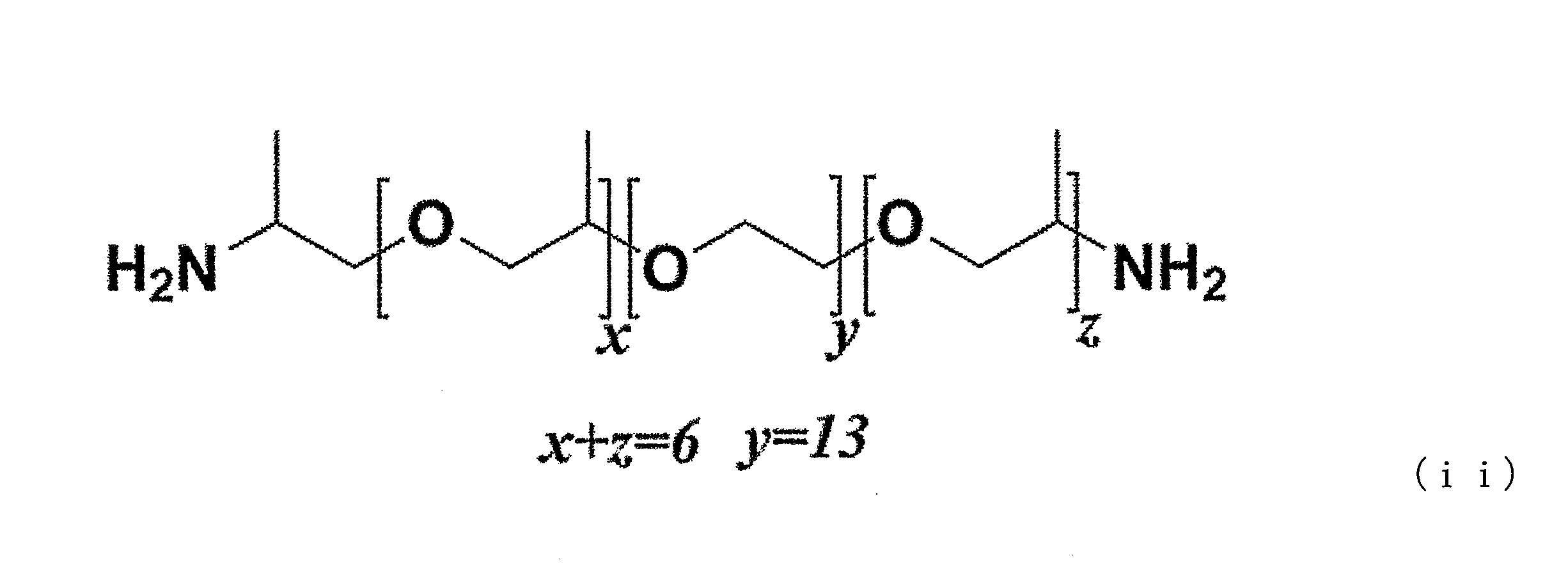
得られたポリマー溶液を、(参考例1)で得られた第1層を有する複合半透膜の第1層側表面に塗布し、得られたポリマー溶液に25℃で1時間浸漬した後、純水で洗浄することで、被覆層を有する複合半透膜を作製した。
(実施例8)
表2に示す化合物1、化合物2を、表2に示す濃度で純水中に溶解した後、縮合促進剤として4―(4,6―ジメトキシ―1,3,5-トリアジン―2―イル)―4―メチルモルホリニウムクロリドを表2中の化合物1と同じモル濃度となる様に溶解し、25℃で1時間撹拌し、ポリマー溶液を作製した。
表2に示す化合物1、化合物2を、表2に示す濃度で純水中に溶解した後、縮合促進剤として4―(4,6―ジメトキシ―1,3,5-トリアジン―2―イル)―4―メチルモルホリニウムクロリドを表2中の化合物1と同じモル濃度となる様に溶解し、25℃で1時間撹拌し、ポリマー溶液を作製した。
得られたポリマー溶液に4―(4,6―ジメトキシ―1,3,5-トリアジン―2―イル)―4―メチルモルホリニウムクロリドを1000ppmとなるように溶解させ、25℃で撹拌を10分間行って溶液を得た。当該溶液を(参考例1)で得られた第1層を有する複合半透膜の第1層側表面に塗布し、25℃で1時間浸漬した後、純水で洗浄することで、被覆層を有する複合半透膜を作製した。
(2)X線光電子分光測定による複合半透膜の表面元素組成分析
複合半透膜を25℃の真空下で乾燥した。複合半透膜の被覆層側の表面においてX線光電子分光測定による、0eV以上1400eV以下の範囲でのワイドスキャン分析を行った。条件は以下のとおりであった。
複合半透膜を25℃の真空下で乾燥した。複合半透膜の被覆層側の表面においてX線光電子分光測定による、0eV以上1400eV以下の範囲でのワイドスキャン分析を行った。条件は以下のとおりであった。
X線光電子分光測定装置:米国SSI社製 SSX-100
励起X線:アルミニウム Kα1線、Kα2線(1486.6eV)
X線出力:10kV 20mV
光電子脱出角度:30°
励起X線:アルミニウム Kα1線、Kα2線(1486.6eV)
X線出力:10kV 20mV
光電子脱出角度:30°
測定装置の解析ソフトにより、XPSスペクトルから、検出された種々の元素の原子数の割合(モル比)を得た。全元素の合計原子数に対するフッ素原子の原子数の割合は、1つの試料において3箇所で測定を行って得られた値の平均値である。また、N/O比は、窒素原子数を酸素原子数で除することで算出された値であり、同様に3箇所で得られた値の平均値である。
なお、XPSによる測定がおよぶのは試料表面から最大でも10nm程度の深さまでであり、本例では光電子脱出角度を30°としたので測定の深度は試料表面から5nm程度までであると考えられる。
(3)静的接触角測定
複合半透膜を超純水で洗浄し、25℃で12時間真空乾燥した後に、接触角測定装置台上に分離機能層側が上になり、平らになるように固定した。シリンジ針の先から2μLの水滴を出し、複合半透膜の直上から近づけることで、分離機能層表面に水滴を付着させた。シリンジ針を分離機能層から遠ざけることで、シリンジ針を付着した水滴から離した。
複合半透膜を超純水で洗浄し、25℃で12時間真空乾燥した後に、接触角測定装置台上に分離機能層側が上になり、平らになるように固定した。シリンジ針の先から2μLの水滴を出し、複合半透膜の直上から近づけることで、分離機能層表面に水滴を付着させた。シリンジ針を分離機能層から遠ざけることで、シリンジ針を付着した水滴から離した。
水滴がシリンジ針から離れてから1秒後の水滴と分離機能層表面が成す角度を1秒後の接触角、水滴がシリンジ針から離れてから30秒後の水滴と分離機能層表面が成す角度を30秒後の接触角として測定した。測定は測定装置付属のカメラで記録保存し、測定装置付属の解析ソフトを用いて所定時間の接触角を算出した。1つの試料において3箇所で測定を行って得られた値の平均値を算出した。
なお、上記測定は以下の測定装置及び測定条件で行った。
静的接触角測定装置:協和界面科学株式会社製 接触角計 (Drop Master 500)
使用液:純水
液摘量:2μL
測定法:液摘法(1/2θ法)
静的接触角測定装置:協和界面科学株式会社製 接触角計 (Drop Master 500)
使用液:純水
液摘量:2μL
測定法:液摘法(1/2θ法)
(4)表面ゼータ電位測定
複合半透膜を超純水で洗浄し、平板試料用セルに、複合半透膜の分離機能層面がモニター粒子溶液に接するようにセットし測定した。モニター粒子溶液としては、pH6またはpH11に調整した10mMNaCl水溶液にモニター粒子を分散させた測定液を用いた。
複合半透膜を超純水で洗浄し、平板試料用セルに、複合半透膜の分離機能層面がモニター粒子溶液に接するようにセットし測定した。モニター粒子溶液としては、pH6またはpH11に調整した10mMNaCl水溶液にモニター粒子を分散させた測定液を用いた。
各pHの測定液を用い、pH6における分離機能層の表面ゼータ電位とpH11における分離機能層の表面ゼータ電位をそれぞれ測定した。「pH6における分離機能層の表面ゼータ電位-pH11における分離機能層の表面ゼータ電位」の値を計算した。1つの試料において各pHについて3箇所で測定を行って得られた値の平均値を算出した。
なお、上記測定は以下の測定装置及び測定条件で行った。
表面ゼータ電位測定装置:大塚電子株式会社製電気泳動光散乱光度計(ELS-8000)
モニター粒子:大塚電子株式会社製ポリスチレンラテックス粒子(粒子径:500nm、ヒドロキシプロピルセルロースで表面被覆処理済)
表面ゼータ電位測定装置:大塚電子株式会社製電気泳動光散乱光度計(ELS-8000)
モニター粒子:大塚電子株式会社製ポリスチレンラテックス粒子(粒子径:500nm、ヒドロキシプロピルセルロースで表面被覆処理済)
(5)複合半透膜の性能評価
上記(1)で得られた複合半透膜に、温度25℃、pH7に調整した海水(TDS濃度3.5%)(Total Dissolved Solids:総溶解固形分)を操作圧力5.5MPaで供給して膜通水試験を行い、製造時膜性能(塩除去率、透過水量)を求めた。
上記(1)で得られた複合半透膜に、温度25℃、pH7に調整した海水(TDS濃度3.5%)(Total Dissolved Solids:総溶解固形分)を操作圧力5.5MPaで供給して膜通水試験を行い、製造時膜性能(塩除去率、透過水量)を求めた。
塩除去率は、次の式から求めた。
塩除去率(%)=100×{1-(透過水中のTDS濃度/供給水中のTDS濃度)}
塩除去率(%)=100×{1-(透過水中のTDS濃度/供給水中のTDS濃度)}
また、透過水量(m3/m2/日)は、上述の条件下で得られた、膜面1平方メートル当たりの1日の透水量(立方メートル)から求めた。
(6)耐汚れ性試験
上記(5)の製造時膜性能の評価後、ドライミルクを100ppmの濃度となる様に海水中に添加し、温度25℃、操作圧力5.5MPaでさらに1時間通水後、透過水量を測定し、製造時の透過水量との比(ドライミルク添加後の透過水量/製造時の透過水量)を透過水量保持率として算出した。
上記(5)の製造時膜性能の評価後、ドライミルクを100ppmの濃度となる様に海水中に添加し、温度25℃、操作圧力5.5MPaでさらに1時間通水後、透過水量を測定し、製造時の透過水量との比(ドライミルク添加後の透過水量/製造時の透過水量)を透過水量保持率として算出した。
(7)酸接触後の耐汚れ性試験
上記(1)で得られた複合半透膜を、pH2に調整した25℃の純水中で24時間浸漬した後、pH7の純水で洗浄し、上記(2)と同様の手順で透過水量(m3/m2/日)を求めた。その後、ドライミルクを100ppmの濃度となる様に海水中に添加し、温度25℃、操作圧力5.5MPaでさらに1時間通水後、透過水量を測定し、ドライミルク添加前の透過水量との比(ドライミルク添加後の透過水量/ドライミルク添加前の透過水量)を透過水量保持率として算出した。
上記(1)で得られた複合半透膜を、pH2に調整した25℃の純水中で24時間浸漬した後、pH7の純水で洗浄し、上記(2)と同様の手順で透過水量(m3/m2/日)を求めた。その後、ドライミルクを100ppmの濃度となる様に海水中に添加し、温度25℃、操作圧力5.5MPaでさらに1時間通水後、透過水量を測定し、ドライミルク添加前の透過水量との比(ドライミルク添加後の透過水量/ドライミルク添加前の透過水量)を透過水量保持率として算出した。
(8)耐汚れ性試験後のアルカリ接触による透過水量回復試験
上記(3)で試験した後の複合半透膜を、pH12に調整した25℃の純水中で30分間浸漬した後、pH7の純水で洗浄し、上記(2)と同様の手順で透過水量(m3/m2/日)を求めた後、製造時の透過水量との比(アルカリ接触後の透過水量/製造時の透過水量)を透過水量回復率として算出した。
上記(3)で試験した後の複合半透膜を、pH12に調整した25℃の純水中で30分間浸漬した後、pH7の純水で洗浄し、上記(2)と同様の手順で透過水量(m3/m2/日)を求めた後、製造時の透過水量との比(アルカリ接触後の透過水量/製造時の透過水量)を透過水量回復率として算出した。
以上の実施例、比較例で得られた複合半透膜の分離機能層の化学構造、特性、性能値をそれぞれ表1~4に示す。
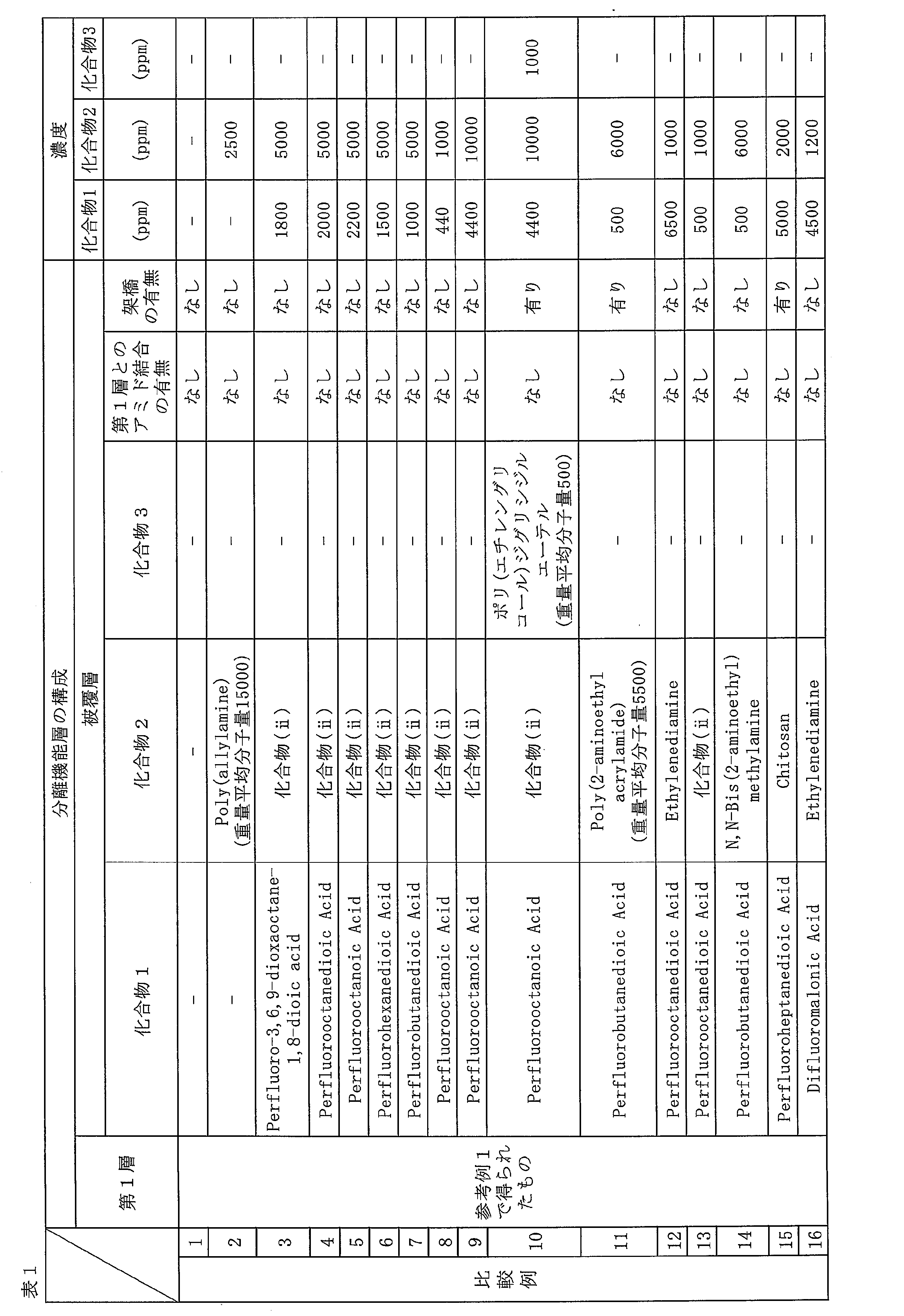
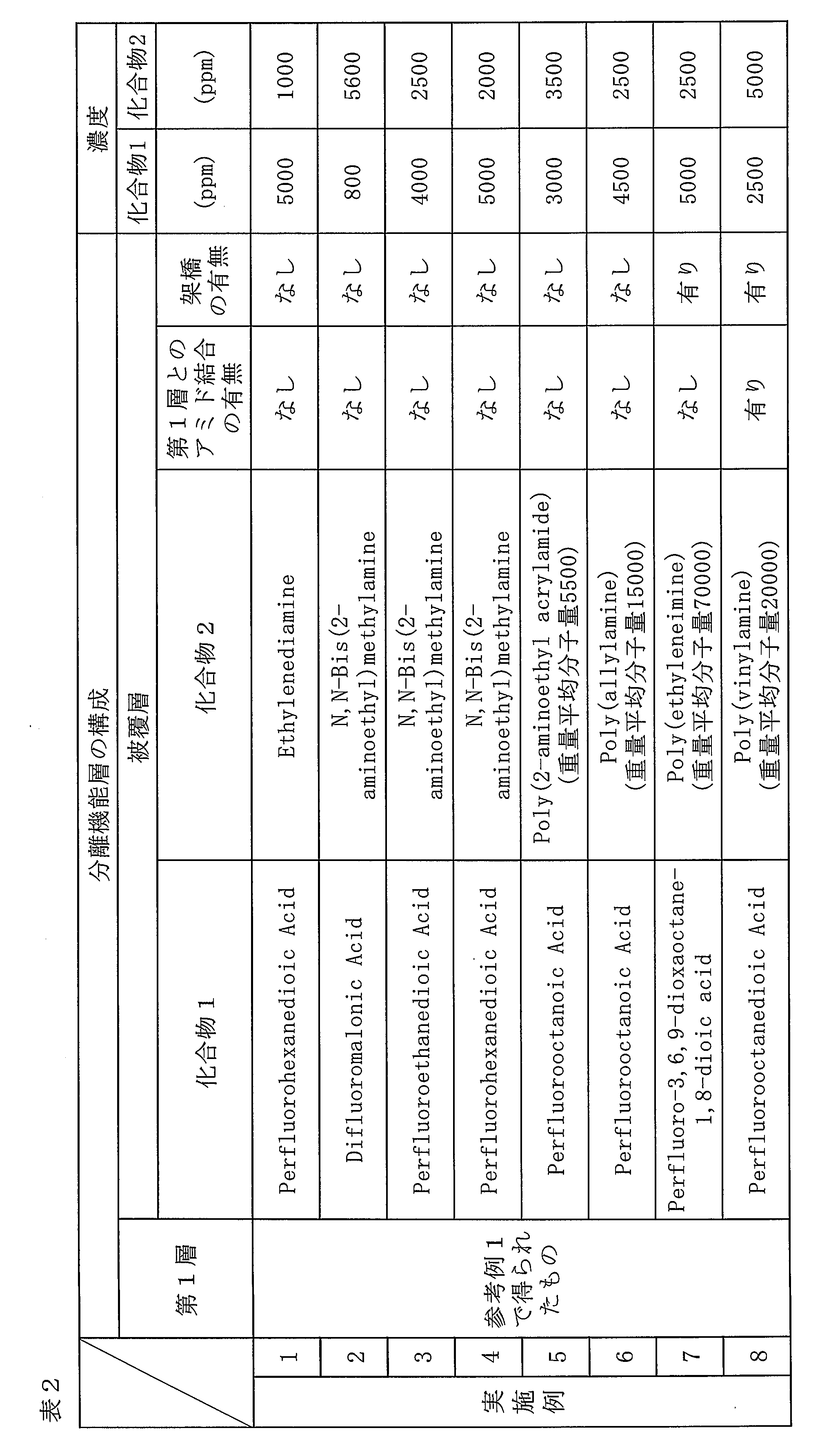
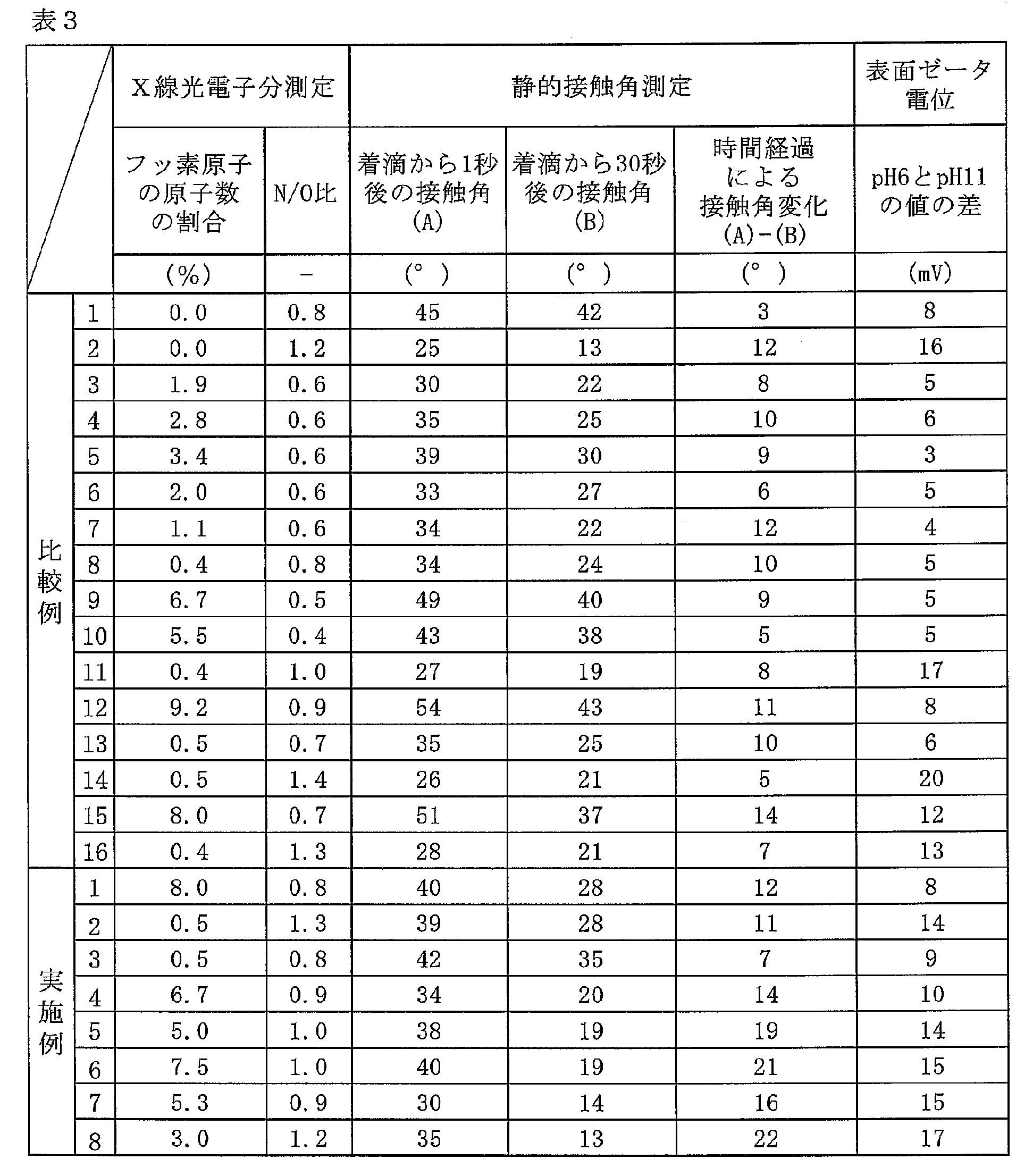
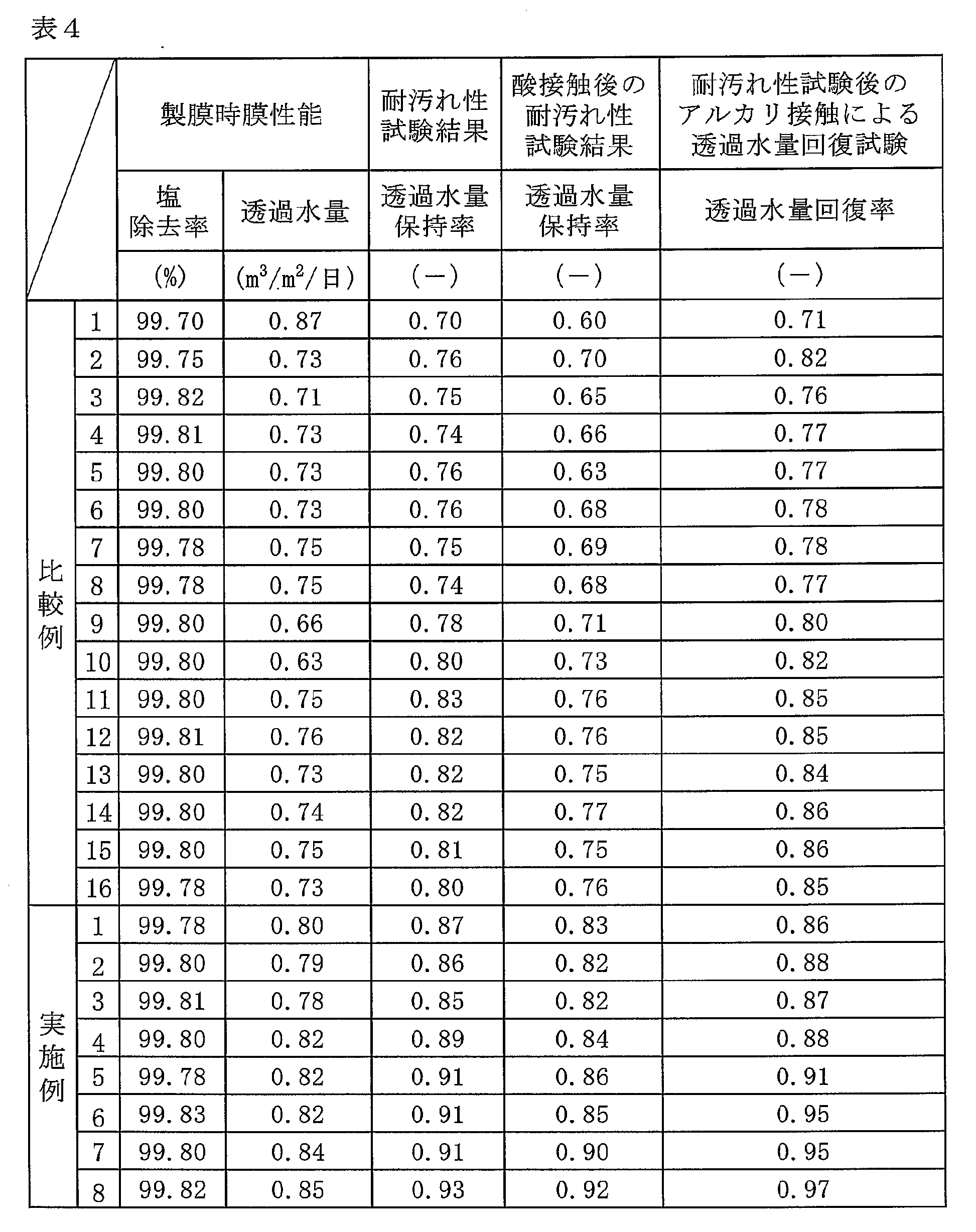
実施例に示すように、本発明の複合半透膜は、高い透水性や耐汚れ性に優れ、さらに、酸接触後の耐汚れ性の安定性においても優れていることが分かる。
本発明を詳細にまた特定の実施態様を参照して説明したが、本発明の精神と範囲を逸脱することなく様々な変更や修正を加えることができることは当業者にとって明らかである。本出願は2018年12月26日出願の日本特許出願(特願2018-242776)に基づくものであり、その内容はここに参照として取り込まれる。
Claims (7)
- 基材と、
前記基材上に設けられた多孔性支持層と、
前記多孔性支持層上に設けられた分離機能層と、
を備える複合半透膜であって、
前記分離機能層は、
多官能芳香族アミンと多官能芳香族酸クロリドとの重合体である架橋芳香族ポリアミドを有する第1層と、
前記第1層上に存在し、多官能脂肪族カルボン酸化合物と多官能脂肪族アミンの重合体である、フッ素原子を有する脂肪族ポリアミドを有する被覆層とを含有し、
前記複合半透膜の前記被覆層側からX線を照射することで行われるX線光電子分光測定において測定された、全元素の合計原子数に対するフッ素原子の原子数の割合が0.5%以上8%以下であり、
前記X線光電子分光測定において測定された、酸素原子の原子数に対する窒素原子の原子数の比(N/O比)が0.8以上1.3以下である、複合半透膜。 - 前記複合半透膜を25℃で12時間真空乾燥した後に、前記分離機能層表面に対し、純水2μLを着滴させることで行われる静的接触角測定において、前記分離機能層表面への純水着滴から30秒後の接触角が20度以下である、請求項1に記載の複合半透膜。
- 前記静的接触角測定において、前記分離機能層表面への純水着滴から30秒後の接触角が、前記分離機能層表面への純水着滴から1秒後の接触角より15度以上小さい、請求項2に記載の複合半透膜。
- 前記脂肪族ポリアミドが、分子内または分子間の少なくとも一方で架橋されている、請求項1~3のいずれか1項に記載の複合半透膜。
- 前記脂肪族ポリアミドが、前記第1層にアミド結合で結合している、請求項1~4のいずれか1項に記載の複合半透膜。
- 前記脂肪族ポリアミドが、下記構造群(i)に含まれる1種類以上の構造を有する、請求項1~5のいずれか1項に記載の複合半透膜。

- pH6における前記分離機能層の表面ゼータ電位が、pH11における前記分離機能層の表面ゼータ電位より15mV以上高い、請求項1~6のいずれか1項に記載の複合半透膜。
Priority Applications (4)
| Application Number | Priority Date | Filing Date | Title |
|---|---|---|---|
| CN201980085514.2A CN113226527B (zh) | 2018-12-26 | 2019-09-30 | 复合半透膜 |
| KR1020217018849A KR102844128B1 (ko) | 2018-12-26 | 2019-09-30 | 복합 반투막 |
| US17/415,854 US12121867B2 (en) | 2018-12-26 | 2019-09-30 | Composite semipermeable membrane |
| JP2019554720A JPWO2020137066A1 (ja) | 2018-12-26 | 2019-09-30 | 複合半透膜 |
Applications Claiming Priority (2)
| Application Number | Priority Date | Filing Date | Title |
|---|---|---|---|
| JP2018-242776 | 2018-12-26 | ||
| JP2018242776 | 2018-12-26 |
Publications (1)
| Publication Number | Publication Date |
|---|---|
| WO2020137066A1 true WO2020137066A1 (ja) | 2020-07-02 |
Family
ID=71125753
Family Applications (1)
| Application Number | Title | Priority Date | Filing Date |
|---|---|---|---|
| PCT/JP2019/038648 Ceased WO2020137066A1 (ja) | 2018-12-26 | 2019-09-30 | 複合半透膜 |
Country Status (5)
| Country | Link |
|---|---|
| US (1) | US12121867B2 (ja) |
| JP (1) | JPWO2020137066A1 (ja) |
| KR (1) | KR102844128B1 (ja) |
| CN (1) | CN113226527B (ja) |
| WO (1) | WO2020137066A1 (ja) |
Cited By (2)
| Publication number | Priority date | Publication date | Assignee | Title |
|---|---|---|---|---|
| JP2022147165A (ja) * | 2021-03-23 | 2022-10-06 | 三菱ケミカル株式会社 | 中空糸膜、中空糸膜モジュール、廃水処理装置及び廃水処理方法 |
| JP2023047511A (ja) * | 2021-09-27 | 2023-04-06 | 東レ株式会社 | 複合半透膜 |
Families Citing this family (1)
| Publication number | Priority date | Publication date | Assignee | Title |
|---|---|---|---|---|
| CN118027396B (zh) * | 2024-01-17 | 2025-04-04 | 浙江恒逸石化研究院有限公司 | 一种抗污自清洁弹性尼龙及其制备方法 |
Citations (3)
| Publication number | Priority date | Publication date | Assignee | Title |
|---|---|---|---|---|
| JP2012020281A (ja) * | 2010-07-15 | 2012-02-02 | Internatl Business Mach Corp <Ibm> | 複層活性層を有する複合膜 |
| JP2015504369A (ja) * | 2012-11-05 | 2015-02-12 | エルジー・ケム・リミテッド | 耐汚染性に優れたポリアミド系水処理分離膜及びその製造方法 |
| JP2015516876A (ja) * | 2013-03-07 | 2015-06-18 | エルジー・ケム・リミテッド | 耐汚染性に優れたポリアミド系水処理分離膜及びその製造方法 |
Family Cites Families (20)
| Publication number | Priority date | Publication date | Assignee | Title |
|---|---|---|---|---|
| JP3834091B2 (ja) * | 1996-01-08 | 2006-10-18 | 日東電工株式会社 | 下水の処理方法 |
| WO1997034686A1 (en) | 1996-03-18 | 1997-09-25 | Nitto Denko Corporation | Composite reverse osmosis membrane and method of reverse osmotic treatment of water using the same |
| US6280853B1 (en) | 1999-06-10 | 2001-08-28 | The Dow Chemical Company | Composite membrane with polyalkylene oxide modified polyamide surface |
| EP1800735B1 (en) * | 2001-03-19 | 2012-05-23 | Nitto Denko Corporation | Method for producing composite semipermeable membrane |
| JP2003144874A (ja) * | 2001-11-12 | 2003-05-20 | Nitto Denko Corp | 複合半透膜 |
| CN101085867A (zh) * | 2006-06-05 | 2007-12-12 | 大立高分子工业股份有限公司 | 聚酰胺酸组合物和利用其制成的液晶取向剂和取向膜 |
| CN101439270B (zh) | 2008-12-04 | 2011-08-24 | 宁波灏钻科技有限公司 | 一种亲水性抗污染反渗透膜的制备方法 |
| US8754139B2 (en) * | 2009-02-20 | 2014-06-17 | International Business Machines Corporation | Polyamide membranes with fluoroalcohol functionality |
| JP2012066181A (ja) * | 2010-09-22 | 2012-04-05 | Asahi Kasei Corp | 複合逆浸透膜及びその製造方法 |
| KR101967262B1 (ko) | 2011-09-29 | 2019-04-09 | 도레이 카부시키가이샤 | 복합 반투막 |
| ITMI20112145A1 (it) | 2011-11-25 | 2013-05-26 | Selex Galileo Spa | Capsula di test di sensori avionici e metodo per testare sensori avionici |
| JP6295949B2 (ja) | 2013-02-28 | 2018-03-20 | 東レ株式会社 | 複合半透膜およびその製造方法 |
| KR20150066974A (ko) * | 2013-12-09 | 2015-06-17 | 삼성전자주식회사 | 내오염성 화합물, 내오염성 막, 및 내오염성 막의 제조 방법 |
| CA2941675C (en) * | 2014-03-31 | 2022-01-11 | Toray Industries, Inc. | Substrate film, catalyst transfer sheet, method for producing membrane electrode assembly, and method for producing catalyst layer-coated electrolyte membrane |
| JP6303837B2 (ja) * | 2014-06-06 | 2018-04-04 | 栗田工業株式会社 | 逆浸透膜の耐汚染化処理方法 |
| US10663092B2 (en) * | 2014-09-12 | 2020-05-26 | Ube Industries, Ltd. | Multilayer tube |
| CN105327625A (zh) * | 2015-11-26 | 2016-02-17 | 中国科学院生态环境研究中心 | 一种平板芳香聚酰胺纳滤膜的制备方法 |
| WO2017110898A1 (ja) * | 2015-12-25 | 2017-06-29 | 東レ株式会社 | 複合半透膜 |
| CN107096402B (zh) * | 2016-02-19 | 2020-03-27 | 中国科学院苏州纳米技术与纳米仿生研究所 | 水中抗油吸附和粘附材料、膜、涂层及其制备方法与应用 |
| CN105727763B (zh) * | 2016-03-07 | 2018-05-22 | 天津大学 | 一种含氟聚酰胺复合纳滤膜的制备方法 |
-
2019
- 2019-09-30 JP JP2019554720A patent/JPWO2020137066A1/ja active Pending
- 2019-09-30 CN CN201980085514.2A patent/CN113226527B/zh active Active
- 2019-09-30 KR KR1020217018849A patent/KR102844128B1/ko active Active
- 2019-09-30 US US17/415,854 patent/US12121867B2/en active Active
- 2019-09-30 WO PCT/JP2019/038648 patent/WO2020137066A1/ja not_active Ceased
Patent Citations (3)
| Publication number | Priority date | Publication date | Assignee | Title |
|---|---|---|---|---|
| JP2012020281A (ja) * | 2010-07-15 | 2012-02-02 | Internatl Business Mach Corp <Ibm> | 複層活性層を有する複合膜 |
| JP2015504369A (ja) * | 2012-11-05 | 2015-02-12 | エルジー・ケム・リミテッド | 耐汚染性に優れたポリアミド系水処理分離膜及びその製造方法 |
| JP2015516876A (ja) * | 2013-03-07 | 2015-06-18 | エルジー・ケム・リミテッド | 耐汚染性に優れたポリアミド系水処理分離膜及びその製造方法 |
Cited By (4)
| Publication number | Priority date | Publication date | Assignee | Title |
|---|---|---|---|---|
| JP2022147165A (ja) * | 2021-03-23 | 2022-10-06 | 三菱ケミカル株式会社 | 中空糸膜、中空糸膜モジュール、廃水処理装置及び廃水処理方法 |
| JP7643123B2 (ja) | 2021-03-23 | 2025-03-11 | 三菱ケミカル株式会社 | 中空糸膜とその製造方法、中空糸膜モジュール、廃水処理装置及び廃水処理方法 |
| JP2023047511A (ja) * | 2021-09-27 | 2023-04-06 | 東レ株式会社 | 複合半透膜 |
| JP7700605B2 (ja) | 2021-09-27 | 2025-07-01 | 東レ株式会社 | 複合半透膜 |
Also Published As
| Publication number | Publication date |
|---|---|
| CN113226527B (zh) | 2023-07-18 |
| JPWO2020137066A1 (ja) | 2021-11-04 |
| US12121867B2 (en) | 2024-10-22 |
| KR20210105360A (ko) | 2021-08-26 |
| US20220080363A1 (en) | 2022-03-17 |
| CN113226527A (zh) | 2021-08-06 |
| KR102844128B1 (ko) | 2025-08-08 |
Similar Documents
| Publication | Publication Date | Title |
|---|---|---|
| KR100618454B1 (ko) | 폴리알킬렌 옥사이드 개질된 폴리아미드 표면을 갖는복합체 막 | |
| KR20180095048A (ko) | 선택적 투과성 그래핀 옥사이드 멤브레인 | |
| US8640886B2 (en) | Composite membrane including coating of polyalkylene oxide and triazine compounds | |
| KR102233177B1 (ko) | 복합 반투막 및 복합 반투막 엘리먼트 | |
| JP7010216B2 (ja) | 複合半透膜及びその製造方法 | |
| WO2011149572A1 (en) | Polyamide membrane with coating comprising polyalkylene oxide and imidazol compounds | |
| KR102844128B1 (ko) | 복합 반투막 | |
| KR102253557B1 (ko) | 복합 반투막 및 복합 반투막 엘리먼트 | |
| CN103260731B (zh) | 通过界面聚合得到的聚磺酰胺膜 | |
| JP6702181B2 (ja) | 複合半透膜 | |
| JP7283207B2 (ja) | 複合半透膜 | |
| JP7700605B2 (ja) | 複合半透膜 | |
| JP2020121264A (ja) | 複合半透膜 | |
| JP2020082034A (ja) | 複合半透膜 | |
| JP2020049466A (ja) | 複合半透膜 | |
| WO2023127819A1 (ja) | 複合半透膜 | |
| CN118414203A (zh) | 复合半透膜 | |
| JP2020069469A (ja) | 複合半透膜 |
Legal Events
| Date | Code | Title | Description |
|---|---|---|---|
| ENP | Entry into the national phase |
Ref document number: 2019554720 Country of ref document: JP Kind code of ref document: A |
|
| 121 | Ep: the epo has been informed by wipo that ep was designated in this application |
Ref document number: 19902433 Country of ref document: EP Kind code of ref document: A1 |
|
| NENP | Non-entry into the national phase |
Ref country code: DE |
|
| 122 | Ep: pct application non-entry in european phase |
Ref document number: 19902433 Country of ref document: EP Kind code of ref document: A1 |